What Is Press Note 3 (2020) and Why Was It Introduced
Press Note 3 was enacted on 17 April 2020 as a direct response to the COVID-19 economic crisis. The Government of India introduced it to prevent opportunistic acquisitions of financially distressed Indian companies by investors from land bordering countries (LBCs).
Which Countries Are Classified as Land Bordering Countries Under PN3
The seven countries classified as LBCs under PN3 are:
- China
- Pakistan
- Bangladesh
- Nepal
- Myanmar
- Bhutan
- Afghanistan
Any investment where the beneficial owner traced back to any one of these countries required mandatory government approval, regardless of how small that ownership stake was. This was not limited to direct investments. A fund domiciled in Singapore or the United States with even a minor Chinese limited partner (LP) was captured by the rule.
The Unintended Consequence That Led to the 2026 Amendment
The broad sweep of PN3 (2020) created a significant structural problem for global private equity and venture capital funds. Many global funds have Chinese LP participation as a standard part of their investor base. Under the original rule, any such fund was effectively locked out of investing in India through the automatic route, regardless of how small the Chinese LP’s share actually was.
This was widely acknowledged as an unintended outcome that dampened legitimate foreign capital flows into India at a time when the country was actively seeking to attract global investment. The March 2026 amendment is the government’s correction to this specific structural friction.
The March 2026 Amendment to PN3: What Exactly Changed
The Cabinet’s amendment introduces two discrete and targeted changes to the existing framework. Neither of them constitutes a blanket liberalisation of FDI rules.
Change 1: The 10% Beneficial Ownership Carve-Out
This is the most significant change introduced by the amendment. Under the revised rules:
- LBC investors who hold non-controlling beneficial ownership of up to 10% in an investing entity may now invest in Indian companies via the automatic route
- The investee entity is required to report relevant details to the Department for Promotion of Industry and Internal Trade (DPIIT) at the time of receiving capital
- The beneficial ownership test is applied at the level of the investor entity, not at the level of the fund’s ultimate LP base
- All applicable sectoral caps and entry conditions continue to apply
This carve-out directly addresses the situation of global funds with minority Chinese LP exposure. Where that exposure remains below 10% and is non-controlling, the fund is now eligible for the automatic route into India.
Change 2: 60-Day Clearance Timeline for Specified Manufacturing Sectors
The second change introduces a defined approval timeline for LBC investment proposals in a specific list of manufacturing sectors. Key details include:
- A decision will now be issued within 60 days of receipt of the proposal
- Previously, approval timelines were entirely open-ended, creating planning and deal-structuring uncertainty
- Majority Indian shareholding and control must be maintained at all times in all such investments
- The Committee of Secretaries under the Cabinet Secretary has the authority to revise and expand the list of eligible sectors over time
The Five Manufacturing Sectors Eligible for 60-Day Fast-Track Approval
| Sector | Fast-Track Eligible |
|---|---|
| Capital goods | Yes |
| Electronic capital goods | Yes |
| Electronic components | Yes |
| Polysilicon | Yes |
| Ingot-wafer | Yes |
No other sectors currently qualify for the 60-day fast-track. Misclassification into an ineligible sector does not trigger this timeline and restarts the approval clock from the beginning.
How PN3 Works After the March 2026 Amendment: A Complete Framework
The table below captures the full investment route matrix under PN3 as amended in March 2026.
| LBC Investor Type | Beneficial Ownership Threshold | Investment Route |
|---|---|---|
| Non-controlling beneficial owner | Up to 10% | Automatic Route + mandatory DPIIT reporting |
| Any LBC investor | Above 10% BO | Government Route (approval required) |
| Any LBC investor | Controlling stake (any size) | Government Route (approval required) |
Critical note: Majority Indian shareholding and control must be maintained at all times across all categories of LBC investment.
Who Is Directly Affected by the PN3 Amendment
The amendment is precisely targeted. Understanding who it does and does not affect is essential before making any structuring or compliance decisions.
Stakeholders Directly Affected
- Global PE and VC funds with Chinese LP exposure: This group was previously fully blocked from the automatic route due to any LBC beneficial ownership in their LP base. The 10% carve-out now makes India-focused allocations viable for such funds, provided the Chinese LP’s stake is non-controlling and stays below 10%
- Manufacturing joint ventures in the specified sectors: Polysilicon, ingot-wafer, electronics, and capital goods ventures that need Chinese technology partners or capital can now plan around a defined 60-day approval window rather than an open-ended government process
- Capital goods and electronics ventures: Any promoter or fund managing investments in these sectors who previously faced planning uncertainty due to indefinite LBC approval timelines now has a more predictable regulatory pathway
Stakeholders Not Affected by This Change
- SaaS, fintech, consumer, and other tech or services startups raising standard VC rounds from non-LBC domiciled funds
- FDI originating from funds domiciled in the United States, Singapore, Mauritius, the UAE, or any other non-LBC country with no LBC beneficial ownership
- Companies and funds operating entirely outside the five listed manufacturing sectors
- Any LBC investor seeking a controlling position in an Indian company
Raising From a Global Fund? Structure It Right the First Time. Let’s Talk
What the PN3 Amendment Does Not Do
This section is critical to read carefully, given how the amendment has been characterised in mainstream coverage. The March 2026 change does not:
- Alter FDI rules for investors from non-LBC countries in any way
- Remove the government route requirement for any LBC investor holding more than 10% beneficial ownership
- Remove the government route requirement for any LBC investor seeking a controlling stake, regardless of ownership size
- Compress fundraising timelines for a standard startup raising from a US or Singapore-domiciled VC fund
- Create a new automatic route for Chinese entities seeking majority or controlling positions in Indian companies
- Apply the 60-day fast-track to any sector outside the five specified manufacturing categories
Compliance and Structuring Action Framework
Regulatory clarity on paper does not automatically translate into compliance or correct structuring in practice. The following five-step action framework applies to founders, fund managers, and legal counsel working with affected investments.
Step 1: Audit Your Cap Table and LP Structure
If your company has raised from a global fund, the first step is to trace that fund’s LP base for any LBC beneficial ownership. Key considerations include:
- The beneficial ownership test is applied at the investor entity level
- SPVs and HoldCos carry their own BO implications and must be assessed separately
- Assumptions about clean LP structures should be verified with written confirmation from the fund manager
Step 2: Map Beneficial Ownership Against the 10% Threshold Before Claiming Automatic Route
Claiming automatic route eligibility with LBC beneficial ownership above 10%, or where a controlling LBC stake exists, constitutes a FEMA (Foreign Exchange Management Act) violation. Consequences include:
- Compounding penalties that are expensive and time-consuming
- Delays in closing future fundraising rounds
- Regulatory scrutiny of the entire cap table going forward
Do not assume eligibility. Map it precisely with legal counsel before funds are received.
Step 3: Build DPIIT Reporting Into Your Compliance Calendar from Day One
Mandatory reporting on LBC investment receipts must happen at the time of capital receipt, not at year-end or during a subsequent compliance review. Important points:
- The penalty window opens the moment funds are credited to the investee entity
- Retrofitting compliance documentation after the fact is significantly more complex and costly
- Reporting obligations should be built into the term sheet negotiation and closing process
Step 4: Manufacturing Sector Founders Must Confirm PN3 Sector Eligibility Before Filing
For founders operating in or adjacent to the five listed manufacturing sectors:
- Confirm in writing, with a legal opinion, that your specific business activity falls within one of the five eligible sectors
- Misclassification does not extend a timeline. It restarts the approval process entirely
- The Committee of Secretaries may revise the sector list over time, so eligibility must be confirmed at the time of the specific transaction
Step 5: Fund Managers Should Revisit India Allocation Decisions Blocked by LBC LP Exposure
For fund managers who had previously concluded that Indian allocations were not viable due to LBC LP exposure in their fund structure:
- The 10% carve-out may now make India-focused investments possible for the first time
- A full structure review and formal legal opinion are recommended before committing or deploying capital
- Fund documents and side letters may need to be reviewed to confirm how the BO threshold is calculated and represented to Indian regulators
The Broader Policy Context: Why This Amendment Matters for India’s FDI Ecosystem
India has been systematically working to improve the predictability and transparency of its FDI framework for global capital. The PN3 amendment fits into this broader trajectory in two important ways.
Removing Structural Friction for Global Capital Pools
The global LP base for large PE and VC funds is internationally diversified. Chinese LP participation in global funds is common and does not, in most cases, confer any operational influence or strategic control over investee companies. The 10% carve-out acknowledges this commercial reality and removes a friction that was deterring a meaningful segment of legitimate global capital from entering India.
Improving Regulatory Predictability for Strategic Manufacturing Investment
India’s manufacturing ambitions, particularly in electronics, semiconductors, and clean energy supply chains, require partnership with countries and entities that hold specific technology and production expertise. The 60-day fast-track is a signal that the government is willing to create structured pathways for this capital while maintaining majority Indian control requirements. The open-ended approval timeline that previously existed was a material deterrent to deal structuring and investment commitment in these sectors.
Summary: Key Takeaways from the March 2026 PN3 Amendment
The following points summarise the essential content of this policy update:
- The amendment introduces a 10% non-controlling beneficial ownership carve-out that allows qualifying LBC investors to use the automatic FDI route for the first time
- A 60-day approval timeline is introduced for LBC investment proposals in five specified manufacturing sectors: capital goods, electronic capital goods, electronic components, polysilicon, and ingot-wafer
- Majority Indian shareholding and control must be maintained at all times for investments using the new pathways
- The amendment does not liberalise FDI broadly, does not affect non-LBC investors, and does not apply to most technology and services companies
- The most affected group is global PE and VC funds with minority Chinese LP exposure that were previously blocked from the automatic route
- DPIIT reporting at the time of capital receipt is mandatory and non-negotiable
- Incorrect beneficial ownership mapping or sector misclassification carries serious FEMA compliance consequences
Key Changes in the Revised Framework
1. Fund Raising and Investor Requirements
Accredited Investors Only
Under the new regulations, Angel Funds (registered after September 10, 2025) can only onboard Accredited Investors. This is a significant shift from previous guidelines, where Angel Funds could accept investments from a broader range of investors.
Transition Period for Existing Funds
Existing Angel Funds (registered before September 10, 2025) have until September 8, 2026, to comply with the new requirement. During this transition period, they can still accept investments from non-Accredited Investors but must limit the number of such investors to 200. After September 8, 2026, non-Accredited Investors will no longer be allowed to invest in Angel Funds.
Minimum Investor Requirement
To declare the first close, Angel Funds must onboard at least five Accredited Investors. This ensures that the fund has a solid foundation of investors before progressing.
First Close Timeline
The first close for Angel Funds must be declared within 12 months from the date SEBI communicates taking the Private Placement Memorandum (PPM) on record.
2. Investment Structure and Process
Direct Investments
Angel Funds will now make investments directly in investee companies. The requirement to launch separate schemes for each investment has been discontinued, streamlining the process.
No Term Sheet Filing
The earlier mandate to file term sheets with SEBI has been removed. However, Angel Funds must still maintain records of term sheets for each investment, ensuring transparency.
Follow-on Investments
Angel Funds are allowed to make follow-on investments in companies that are no longer considered startups, provided certain conditions are met:
- Post-issue shareholding percentage does not exceed the pre-issue percentage.
- Total investment in any investee company cannot exceed ₹25 Crore.
- Contributions for follow-on investments must come from existing investors, pro-rata to their initial investment.
Lock-in Period
The lock-in period for investments is set to one year. If the exit is through a sale to a third party, the lock-in period is reduced to six months.
3. Overseas Investments
Angel Funds are permitted to invest up to 25% of their total investments in foreign companies, subject to obtaining a SEBI No Objection Certificate (NOC). This provision is designed to give Angel Funds greater flexibility in their investment choices.
4. Investment Allocation and Returns
Defined Methodology for Allocation
Angel Fund managers are now required to disclose a clear methodology for allocating investments among investors in the Private Placement Memorandum (PPM). This ensures that the allocation process is transparent and fair.
Pro-rata Rights
Investors will have pro-rata rights in investments and distributions, based on their contributions. Exceptions apply for carried interest arrangements.
5. Regulatory Classification and Compliance
Reclassification to Category I AIF
Under the revised framework, Angel Funds will now be classified as a separate sub-category under Category I AIF, rather than as a sub-category under Venture Capital Funds.
Annual PPM Audit
Angel Funds with total investments exceeding ₹100 Crore will be required to conduct an annual audit of their compliance with the PPM terms, starting from the 2025-26 financial year.
Performance Benchmarking
Angel Funds are mandated to report investment-wise valuations and cash flow data to benchmarking agencies. These reports must be included in marketing materials and the PPM.
Calculation Basis for Limits
All limits and conditions applicable to Angel Funds will now be calculated based on total investments made (at cost), rather than corpus/investable funds. This ensures a more accurate and consistent approach to regulatory compliance.
Comparative Table: Angel Funds Revised Regulatory Framework
| ASPECT | ERSTWHILE REGULATIONS | REVISED FRAMEWORK (2025) |
|---|---|---|
| Investor Eligibility and Transition Period | Angel investors defined as: (a) Individual with net tangible assets ≥ ₹2 crore (excluding principal residence) with early-stage investment experience, serial entrepreneur experience, or senior management professional with ≥10 years’ experience; (b) Body corporate with net worth ≥ ₹10 crore; (c) Registered AIF or VCF. | Angel Funds shall raise funds only from Accredited Investors by way of issuing units. |
| Minimum Commitment/Contributions from Investor | Not less than ₹25 lakh from an angel investor. | No minimum value of investment. |
| Scheme Launch / Term Sheet | Angel Fund may launch schemes subject to filing term sheet with SEBI containing material information in specified format. | Angel Funds shall not launch any schemes. Maintain records of term sheets for each investment. |
| First Close Requirements | Not specified. | Angel Funds must onboard at least five Accredited Investors before declaring first close. |
| Investment Target | Angel funds shall invest in startups that are not promoted or sponsored by an industrial group whose turnover exceeds ₹300 crore. | Angel Funds must invest only in startups not related to any corporate group whose turnover exceeds ₹300 crore. |
| Lock-in Period per Portfolio Investment | 1-year lock-in period. | 1-year lock-in period, or 6 months if exit is by sale to a third party. |
| Follow-on Investments | Not specified. | Angel Funds may make follow-on investments subject to: post-issue shareholding not exceeding pre-issue, total investment not exceeding ₹25 crore, and contributions only from existing investors. |
| Manager and Sponsor Obligations | Manager must continue interest of not less than 2.5% of corpus or ₹50 lakh. | Manager must invest at least 0.5% of the investment amount or ₹50,000 in each investment. |
| Annual PPM Audit | Not applicable. | Annual audit of compliance with PPM terms for Angel Funds exceeding ₹100 crore in investments. |
| Performance Benchmarking | Not applicable. | Angel Funds must report investment-wise valuations to benchmarking agencies. |
| Overseas Investment | Permitted with SEBI NOC upto 25% of corpus. | Permitted with SEBI NOC upto 25% of total investment (at cost). |
Conclusion
The new 2025 Angel Fund regulations introduce more stringent investor eligibility criteria, enhance transparency, and refine the investment process. These changes are designed to strengthen the Angel Fund ecosystem, ensuring better governance and risk management while opening up more investment opportunities in India’s startup ecosystem. Angel Funds will now operate with greater clarity and regulatory compliance, paving the way for sustained growth in the sector.
By streamlining compliance requirements, providing clearer rules for overseas investments, and improving investor protections, the revised framework is expected to attract more Accredited Investors, leading to greater capital inflows into India’s startup ecosystem.
For Angel Funds, it is crucial to adhere to these new regulations to maintain their registration and avoid penalties. Investors can now participate in Angel Funds with a clearer understanding of the investment process, including detailed disclosure of terms and transparent allocation methodologies.
]]>The updated framework addresses several long-standing points of discussion and aims to align angel investing with global best practices.
Key Changes to the Angel Fund Framework:
- Mandatory Accredited Investor Status: A crucial change is the mandate that all Angel Fund investors must now be Accredited Investors (AI). This ensures that only verified and risk-aware individuals or entities participate, given the high-risk nature of early-stage investments. As of now, India reportedly has only 649 Accredited Investors, underscoring the exclusivity and rigorous verification process for this investor class.
- Revised Investment Thresholds: The per-investee company investment thresholds have been significantly revised. Angel Funds can now invest between INR 10 lakh and INR 25 crore in a single startup. This is a substantial increase from the previous range of INR 25 lakh to INR 10 crore, allowing for larger and more impactful angel rounds.
- Removal of Concentration Cap: SEBI has removed the 25% investment concentration cap for a single startup. This change provides Angel Funds with greater flexibility to allocate more capital to high-potential ventures, enabling them to double down on promising investments.
- Expanded Investor Base: Angel Funds are now permitted to pool contributions from more than 200 Accredited Investors in a single deal. This move significantly broadens the potential investor base for startups, as the previous limit often restricted larger syndication.
- Follow-on Investments Permitted: In a practical amendment, Angel Funds can now make follow-on investments in an investee company even if it no longer qualifies as a “startup” as per the official definition. This ensures continued support for companies through their growth journey.
- Transparent Investment Allocation: Every investment opportunity presented by an Angel Fund must now be offered to all eligible investors. The allocation process for such investments will strictly follow the method disclosed in the fund’s Private Placement Memorandum (PPM), ensuring fairness and transparency.
- “Skin in the Game” for Managers: To foster greater alignment of interest and responsibility, the fund sponsor or manager must now contribute the higher of 0.5% of the investment amount or ₹50,000 in each investment made by the fund. This “skin in the game” requirement aims to ensure that fund managers share a direct financial stake in the success of the investee companies.
- Grandfathering Provisions: Existing Angel Funds and investments made by non-Accredited Investors will be grandfathered, with a one-year glide path provided for compliance with the new regulations. This allows for a smooth transition without disrupting ongoing investments.
These comprehensive measures are expected to significantly boost capital inflow into Indian startups, making the angel investing landscape more robust, transparent, and attractive for sophisticated investors. The focus on Accredited Investors also highlights SEBI’s commitment to protecting less experienced investors while fostering growth in the early-stage funding ecosystem.
What are your thoughts on these new regulations and their potential impact on startup funding in India? For a deeper discussion, please reach out to priya.k@treelife.in.
]]>The new regulations introduce a category-wise mandatory certification framework through the National Institute of Securities Markets (NISM). This move clarifies the certification pathway for AIF professionals and replaces SEBI’s earlier notification dated May 10, 2024.
Category-Wise Certification Now Mandatory:
The updated norms specify different NISM certification requirements based on the AIF category:
- Category I & II AIFs: Key personnel associated with the management of Category I and Category II AIFs are now required to pass either the NISM Series-XIX-C: Alternative Investment Fund Managers Certification Examination or the newly introduced NISM Series-XIX-D: Category I and II Alternative Investment Fund Managers Certification Examination. This ensures that professionals managing these AIFs possess a common minimum knowledge benchmark covering regulatory, operational, and fiduciary aspects.
- Category III AIFs: For key personnel of Category III AIFs, the mandate requires passing either the NISM Series-XIX-C: Alternative Investment Fund Managers Certification Examination or the newly introduced NISM Series-XIX-E: Category III Alternative Investment Fund Managers Certification Examination. This specific certification for Category III AIFs caters to the distinct complexities and strategies often associated with these funds, which may involve higher leverage and more complex investment approaches.
Deadline and Industry Impact:
All existing AIFs are required to comply with these updated certification requirements on or before July 31, 2025. With this approaching deadline, AIF managers are actively preparing their teams to meet the new standards.
This regulatory change is poised to have a significant impact on the AIF landscape. Beyond enhancing professionalism and accountability, it raises questions about potential shifts in hiring strategies for funds. Managers might prioritize candidates who already hold the required certifications or invest heavily in training existing personnel. The emphasis on standardized knowledge is expected to foster greater investor confidence and promote best practices across the alternative investment sector in India.
]]>The newly approved framework for Third-Party Fund Management Services is designed to facilitate greater participation and flexibility within the IFSC’s fund management ecosystem. Under this innovative model, registered FMEs at GIFT IFSC will now be able to manage restricted schemes on behalf of third-party fund managers. Crucially, this eliminates the prior requirement for these third-party fund managers to establish a physical presence within the IFSC, thereby reducing operational overheads and streamlining market entry.
Key Conditions Under the New Framework:
While offering unprecedented flexibility, the “Platform Play” model is subject to specific conditions to ensure robust governance and financial stability:
- Additional Net Worth Requirement: FMEs opting for the “Platform Play” model must maintain an additional net worth of USD 500,000 over and above their existing net worth thresholds as stipulated under the prevailing FME regulations. This ensures that participating entities possess sufficient financial capacity to manage the increased responsibilities.
- Mandatory Principal Officer: For each scheme managed under the “Platform Play” framework, the FME is required to appoint a dedicated Principal Officer (PO). This ensures direct accountability and dedicated oversight for every scheme.
- Transition to Dedicated FME Model: To ensure scalability and appropriate regulatory oversight, if the fund corpus of a scheme managed under this model exceeds USD 50 million, it will be mandatory for the scheme to transition to a dedicated FME model. This provision is designed to encourage the establishment of a full-fledged presence as the fund grows, further solidifying the IFSC’s ecosystem.
This progressive move by the IFSCA is anticipated to significantly strengthen GIFT IFSC’s position as a globally competitive and innovation-driven fund management hub. By lowering barriers to entry and offering flexible operational models, the “Platform Play” framework is expected to attract a wider array of fund managers and schemes, fostering growth and diversification within the IFSC.
Interested in exploring or planning to set up a scheme under the Platform Play model? For further discussion, please reach out to gift@treelife.in.
]]>The exemption, however, is not unconditional and comes with specific regulatory requirements for both the payee (IFSC unit) and the payer.
What the IFSC Unit (Payee) Must Do:
To avail of this crucial TDS exemption, an IFSC unit must adhere to the following conditions:
- Submit Form 1 Annually: The IFSC unit must submit a statement-cum-declaration in Form 1 to each payer. This form serves as a declaration that the unit has opted for the tax holiday benefits available under Section 80LA of the Income-tax Act.
- Annual Verification: This Form 1 must be filed and verified every year throughout the opted 10-year tax holiday window.
- Income from Approved Activity: Crucially, the exemption applies only to business income derived from activities explicitly approved for the IFSC unit.
What the Payer Must Do:
Mainland entities making payments to IFSC units must also follow specific guidelines to ensure compliance:
- Receipt of Form 1 is Key: Payers should cease deducting TDS only after receiving a duly filled and verified Form 1 from the concerned IFSC unit.
- Report Exempt Payments: All such payments, on which TDS has not been deducted due to this exemption, must be reported in the quarterly TDS returns. This reporting is to be done as per Section 200(3) read with Rule 31A of the Income-tax Rules.
- Retain Form 1: It is imperative for payers to properly retain the received Form 1 for audit and compliance purposes.
Important Considerations:
- Non-Compliance by IFSC Unit: If an IFSC unit fails to submit Form 1, or if the exemption is claimed beyond its eligible 10-year period, TDS must be deducted as per the normal provisions of the Income-tax Act.
- Scope of Exemption: The notification specifies the nature of payments and the categories of IFSC units that qualify for this exemption. While the full table outlines these details, it generally covers payments like professional, consulting, and advisory fees; commission incentives; interest on leases; freight or hire charges; portfolio management fees; advisory and management fees; professional and technical service fees; rent for data centers; and penalties levied by exchanges.
This move is a welcome development for the Indian financial landscape, reinforcing the government’s commitment to developing GIFT City as a globally competitive financial hub by reducing compliance burdens and enhancing operational efficiency for IFSC units.
Historically, stamp duty in Gujarat was predominantly levied on the transfer of physical assets or formal court-approved merger orders. The revised definition means that even a share purchase agreement (SPA), if it leads to a change in the management or control of a company, could now attract stamp duty under the Gujarat Stamp Act.
Key Implications for Businesses and Dealmakers
This expanded scope of “Conveyance” carries several critical implications:
- Increased Transaction Costs: Depending on the asset composition of the company (movable versus immovable assets), stamp duty ranging from 2% to 4.9% may now be applicable. This could significantly increase the overall transaction costs for M&A, private equity, and buyout deals involving companies with a nexus to Gujarat.
- Influence on Deal Structuring: The new provisions may compel dealmakers to re-evaluate how share-based acquisitions and corporate restructurings are structured. There will be a greater need for meticulous planning to assess and potentially mitigate stamp duty liabilities.
- Broader Legal Widening: This change is part of a broader trend of widening the application of stamp duty law in Gujarat. The Act now also covers NCLT orders under Sections 230–234 (relating to compromises, arrangements, and amalgamations), Insolvency and Bankruptcy Code (IBC) resolution plans, and fast-track mergers under Section 233 of the Companies Act, 2013.
Navigating the Complexities
Given the broadened scope, it is now imperative for dealmakers, corporate advisors, and legal professionals to carefully assess how stamp duty liabilities might be triggered, especially in transactions where Gujarat has a jurisdictional nexus.
The amendment raises interesting questions regarding its interplay with complex multi-state or cross-border restructurings. For instance, scenarios where either the transferor or transferee entity is situated in Gujarat, or where a change in the shareholding of an offshore or out-of-state holding company results in a consequential change in control of a Gujarat-based company, will require careful examination under the new provisions. Understanding these nuances will be critical for effective deal execution and compliance.
]]>Key Amendments:
- Staffing Flexibility: Effective June 9, 2025, IFSCA has relaxed the mandatory requirement for GRCTCs to appoint at least five qualified professionals, including a Head of Treasury and a Compliance Officer, before commencing operations. This relaxation allows entities to operate with a leaner team during the initial phase.
- Conditional Approval for Indian Contract Transfers: Previously, GRCTCs were prohibited from receiving or transferring existing contracts from Indian service recipients. The new amendment permits such transfers, subject to approval from the IFSCA Chairperson, for a period not exceeding one year from the commencement of operations. This provision facilitates a phased entry for multinational corporations into the Indian market.
Implications for International Firms:
- Phased Expansion: International firms can now pilot their treasury operations in IFSCs with reduced initial staffing, enabling a phased approach to expansion.
- Operational Flexibility: The amendments provide greater flexibility in staffing and operational setup, aligning with international best practices and easing the entry process for foreign entities.
- Regulatory Alignment: These changes reflect IFSCA’s commitment to fostering a conducive business environment while maintaining regulatory standards.
Industry Impact:
The revised framework is expected to attract a diverse range of financial institutions to establish their treasury operations in IFSCs, thereby contributing to the growth and development of India’s financial sector. By aligning with global standards and offering operational flexibility, IFSCA aims to position IFSCs as a competitive hub for international financial services.
Interested in setting up operations in IFSCs or seeking guidance on navigating the updated regulatory framework?
Treelife offers expert advisory services and preparing necessary documentation, and ensuring compliance with IFSCA regulations.
]]>The window for regularization, allowing payment of a Late Submission Fee (LSF) instead of undergoing the lengthy compounding process, will close on August 21, 2025.
This initiative, introduced under Regulation 11(2) of the FEMA (Overseas Investment) Regulations, 2022, has offered a three-year period for Indian entities to address any past non-compliance concerning OI transactions. After the deadline, any delays in reporting OI transactions before August 22, 2022, will require either compounding or adjudication.
Key Objectives of the Regularization Window:
- Facilitate Accurate Reporting: Encourage entities to report past OI transactions accurately, promoting greater transparency in India’s cross-border financial dealings.
- Reduce Regulatory Backlog: Help address outstanding reporting delays, reducing the overall workload for regulators.
What You Need to Do
If your organization has any pending OI transactions to be reported, including filing of Form APR, ensure that you act before August 21, 2025.
Reach out to your AD Bank to settle any outstanding reporting issues and avoid the complexities of the compounding process.
]]>The International Financial Services Centres Authority (IFSCA) has unveiled a new framework facilitating co-investments by Venture Capital and Restricted Schemes (classified as Category I, II, or III Alternative Investment Funds – AIFs) through Special Purpose Vehicles (SPVs) under the recently updated Fund Management Regulations, 2025. This move aims to provide greater flexibility and structure for fund managers and investors operating within the GIFT IFSC.
The framework outlines a clear co-investment structure where a Fund Management Entity (FME) can establish a “Special Scheme” to co-invest alongside an existing Venture Capital Scheme or Restricted Scheme (referred to as “Existing Scheme”). Investment by the FME in the Special Scheme is optional.
Permissible Co-investment Structure
The co-investment structure involves an AIF (the Existing Scheme) and a Special Scheme, which is also to be registered as the same category of AIF. The Special Scheme then invests in an Investee Company.
Key Conditions and Provisions of the Framework
- Who can launch a Special Scheme? Only FMEs registered with IFSCA that currently manage an operational Venture Capital Scheme or Restricted Scheme are eligible to launch a Special Scheme.
- Structure of Special Scheme: The Special Scheme can be constituted as a Company, Limited Liability Partnership (LLP), or Trust.
- AIF Category Classification: The Special Scheme must be classified under the same AIF category (I, II, or III) as that of its Existing Scheme.
- Minimum Contribution by Existing Scheme: The Existing Scheme must contribute at least 25% of the equity share capital, interest, or capital contribution (as applicable) in the Special Scheme.
- Investment Objective: The co-investment strategy of the Special Scheme must be aligned with the investment strategy of the Existing Scheme. Importantly, the Special Scheme can invest only in one portfolio company, with exceptions allowed for restructuring purposes.
- Tenure: The tenure of the Special Scheme will be co-terminus with that of the Existing Scheme, or earlier if the Existing Scheme is liquidated.
- Eligible Investors: Any person is eligible to invest in the Special Scheme, subject to the minimum contribution norms stipulated under the FME Regulations.
- Leverage Conditions: Any leverage undertaken by the Special Scheme must remain within the overall limits specified in the Placement Memorandum of the Existing Scheme. Encumbrances are permitted for the purpose of leverage.
- FME Contribution: The FME has the discretion to contribute to the Special Scheme.
- Control and Decision-making: The sole control and decision-making authority for the Special Scheme rests with the FME. Investors in the Special Scheme cannot interfere with the regulatory compliance of the Existing Scheme.
- KYC Requirements: For existing investors, no fresh Know Your Customer (KYC) procedures are required. However, new investors must undergo KYC as per IFSCA’s AML-CTF & KYC Guidelines, 2022.
- Term Sheet Filing: A term sheet must be filed within 45 days of the investment. This term sheet will be treated as a constitutional document for the purpose of bank account opening.
- Investor Disclosures: Investors in the Existing Scheme must be informed before capital is raised for the Special Scheme. The term sheet itself must include all necessary disclosures as per the FME Regulations.
- Reporting to IFSCA: Reporting requirements for the Special Scheme are to be consolidated with those of the Existing Scheme.
- SEZ Approval Requirement: The Special Scheme must obtain a separate SEZ (Special Economic Zone) approval under the SEZ Act, 2005, before filing the term sheet.
- Fee Payment: Applicable fees will be payable as per the IFSCA Circular dated April 8, 2025.
This new co-investment framework is expected to provide greater operational flexibility and attract more fund management activity to GIFT IFSC, solidifying its position as a competitive global financial hub.
A key proposal is the introduction of exposure caps aimed at limiting interconnected risks within the financial system:
- A single regulated entity will be allowed to invest up to 10% of the corpus of an AIF scheme.
- Aggregate exposure by all regulated entities to the same AIF scheme is proposed to be capped at 15%.
These changes are aimed at curbing practices like evergreening of loans and circular financing arrangements, where lenders indirectly fund borrower companies via AIF routes.
At the same time, this move could significantly reshape the domestic fundraising landscape—especially for AIFs that rely on Indian institutional capital as anchor investors. The proposal introduces a more cautious, risk-sensitive framework that fund managers will need to consider while structuring their capital sources.
Key Exemptions from Provisioning Requirements:
The draft outlines certain carve-outs where REs would not be subject to provisioning norms:
- If the RE holds less than 5% of the AIF scheme’s corpus;
- If the AIF’s investment in a borrower is only in equity instruments (such as equity shares, CCPS, or CCDs);
- If the AIF is a strategic Fund of Funds (FoF) backed by the Government.
As SEBI tightens its due diligence norms for AIFs and the RBI refines exposure limits for REs, alignment between fundraising and deployment strategies is becoming increasingly important. These regulatory shifts may also influence the perception of risk and confidence for global Limited Partners (LPs) looking at India-focused funds, especially where domestic institutions are key participants.
Curious how these guidelines may affect your AIF strategy or structure?
Let’s talk – write to us at dhairya.c@treelife.in
1) NISM Series-XIX-D:
Meant for key investment personnel managing Category I and II AIFs, this exam will cover topics such as regulatory guidelines, fund management practices, investment valuation norms, taxation, and other category-specific aspects.
2) NISM Series-XIX-E:
Targeted at those managing Category III AIFs, it will focus on similar themes, but customized to reflect the distinctive features and regulatory nuances of Category III funds.
The new exams are stated to be available starting May 1, 2025.
However, while NISM has clarified the structure and launch of these certifications, uncertainty remains regarding the exact timelines for mandatory compliance. The Securities and Exchange Board of India (SEBI) has yet to issue a formal notification specifying when these exams will become compulsory for AIF managers.
With the May 9, 2025 deadline approaching, it will be interesting to see how this transition unfolds.
Write to us at priya.k@treelife.in if you need assistance here.
]]>Key Takeaways:
- A separate CIV scheme will need to be launched for each co-investment in an investee company, with prior intimation to SEBI, in accordance with the shelf PPM for CIV schemes filed with SEBI at the time of registration. Each CIV will require separate bank accounts, demat accounts, and a PAN.
- CIVs will have the flexibility to invest up to 100% of their corpus in a single portfolio. Co-investment opportunities can only be provided to investors of the AIF who are Accredited Investors.
- Exit timing to be co-terminus for the AIF and CIV.
While the proposed changes could lead to more agile and competitive AIFs, it’s crucial that the regulatory framework remains streamlined and doesn’t introduce unnecessary complexity into the co-investment process. In light of this, SEBI has invited industry feedback on the consultation paper.
Reach out at priya.k@treelife.in for a discussion.
]]>1) New Permissible Activities Proposed to be Added:
Ancillary Services:
- Actuarial Services
- Business Process Outsourcing (BPO)
- Customer Care Support
- Human Resource and Payroll Processing
- Insolvency and Liquidation Support Services
- Knowledge Process Outsourcing (KPO)
- Risk Management and Mitigation
- Supply Chain Management Support
Tech-Fin Services:
- Cloud Computing Services
- Data Centre Operations
- ERP Systems
- Implementation of eGRC Software Platforms
- IT services linked to the payment ecosystem
2) Strengthening Governance:
The appointment of a Principal Officer (PO) and Compliance Officer (CO) is now mandated in the draft regulations. The educational criteria for these roles have also been clearly specified, emphasizing qualifications like CA, CS, CMA, CFA, or relevant postgraduate degrees in finance, law, or business.
3) Service Recipient:
It is important to note that the requirement of Service Recipient being:
- An entity in GIFT-IFSC
- Any BFSI entity located outside India for the purpose of making arrangements for delivery of financial services specified by IFSCA
- Indian entities solely for setting up offices in IFSC
…still remains unchanged.
 Link to the Consultation Paper:
Consultation Paper on draft IFSCA (TechFin and Ancillary Services) Regulations, 2025
Comments are invited on the Consultation Paper until June 1st, 2025.
Write to us at dhairya.c@treelife.in for discussion.
Impact on Existing AIFs
This extension ensures more flexibility for the AIF industry, helping them align with SEBI’s Regulations without compromising compliance standards. The certification is essential for the key personnel of AIF Managers and aims to enhance industry professionalism and investor protection.
Next Steps:
- AIFs that are yet to meet the certification requirement must ensure compliance by July 31, 2025.
- The updated certification requirement affects all AIFs, including schemes launched prior to May 2024 and those pending approval.
Announcement by NISM for Category Specific Exams for AIF Managers on May 1, 2025
In a related development, NISM has announced the introduction of separate certification exams for AIF Managers, set to begin on May 1, 2025. These exams will be tailored to specific AIF categories (i.e., Category I / II AIFs and Category III AIFs) covering the distinct regulatory guidelines and operational nuances of each category.
However, it’s important to note that SEBI has not provided any updates regarding this new certification framework in its latest circular dated May 13, 2025. As such, the timeline for mandatory compliance with these new exams remains unclear.
Have Questions?
Let’s connect at dhairya.c@treelife.in for a discussion!
]]>The updated CMI Regulations introduce several key changes designed to simplify operations, improve market access, and enhance regulatory clarity within GIFT IFSC, while also aligning with international standards.
Key Changes Introduced in the New Regulations
- Expansion of Intermediary Categories: The revised regulations now specifically recognize and include ESG (Environmental, Social, and Governance) rating and data providers, as well as research entities, within the official list of recognized intermediaries. This expansion reflects the growing importance of sustainable finance and data-driven insights in global capital markets.
- Lower Net Worth Requirements: To facilitate easier entry for new players and smaller firms, IFSCA has reduced the minimum net worth requirements for certain intermediaries. This includes investment bankers, investment advisers, and credit rating agencies. This move is expected to democratize access to the IFSC market for a wider range of financial service providers.
- Defined Eligibility Criteria for Compliance Officers: The updated framework introduces clear definitions and prescribed qualifications for the crucial role of a Compliance Officer. This is aimed at strengthening the compliance function within intermediary firms and ensuring that qualified professionals oversee adherence to regulatory standards.
These comprehensive changes are geared towards fostering a more efficient, accessible, and robust capital market ecosystem within the IFSC. By reducing barriers to entry and clearly defining roles and responsibilities, IFSCA aims to solidify GIFT IFSC’s position as a globally competitive financial hub.
Link to new regulations: https://ifsca.gov.in/Viewer?Path=Document%2FLegal%2Fifsca-cmi-regulations-202517042025051646.pdf&Title=IFSCA%20%28Capital%20Market%20Intermediaries%29%20Regulations%2C%202025&Date=17%2F04%2F2025
]]>Several key frameworks have seen revisions in their annual recurring fees:
- FinTech Entities: The recurring fees for FinTech entities are now linked to their annual revenues, ranging from Nil to USD 10,000. This revenue-based fee structure likely aims to provide a more scalable and equitable approach to fees for these innovative companies.
- Ancillary Service Providers: The flat annual recurring fee for Ancillary Service Providers has been revised from USD 1,000 to USD 1,500.
- Global/Regional Corporate Treasury Centres (GRCTCs): The flat annual recurring fee for GRCTCs has been revised from USD 12,500 to USD 25,000. This increase aligns with the enhanced regulatory oversight and benefits associated with operating as a GRCTC in the IFSC.
A notable point of discussion arising from the circular is its “effective immediately” clause, dated April 8, 2025. This raises questions about whether the revised fees will apply to annual payments for the financial year 2024-25, which are typically due by April 30, 2025. This immediate implementation could have implications for entities that had budgeted based on the previous fee structure for the current financial year.
The revised fee structure is a critical update for all entities in GIFT IFSC, requiring careful review to understand the impact on their operational costs.
]]>The transition framework addresses key areas, particularly concerning the eligibility and process for launching schemes under the new regime.
Key Clarifications and Updates Include
- Eligibility for launching schemes filed under the erstwhile regulations: FMEs can now launch schemes under the 2025 Regulations only if those schemes were formally “taken on record” by IFSCA during the six-month validity period stipulated under the 2022 Regulations (i.e., ending on February 19, 2025). Furthermore, the FMEs must have received approval for an extension of the Private Placement Memorandum (PPM) validity, with the extended period concluding on or after February 19, 2025.
- Launching of schemes where the validity period of PPMs has expired: IFSCA has granted a one-time opportunity for FMEs to re-file PPMs for Venture Capital and Restricted Schemes whose validity had expired before February 19, 2025. This opportunity is subject to specific conditions:
- The PPM must be re-filed within three months.
- There should be no material changes in the PPM.
- A filing fee equivalent to 50% of the standard fee applicable for a fresh scheme under the 2025 regulations must be paid. Upon successful re-filing, IFSCA will take the revised PPM on record and grant an additional validity of six months, calculated from the date of its communication.
- Processing fee clarity in relation to PPMs whose validity had expired: FMEs are generally required to inform the Authority about any material changes from the information provided in the PPM, along with the payment of applicable processing fees. However, the framework clarifies that if any such filing becomes necessary due to an action by the Authority or a revision in the regulatory regime, the processing fee will not be applicable.
These amendments underscore IFSCA’s commitment to fostering innovation, improving the ease of doing business, and enhancing global competitiveness within GIFT IFSC’s asset management landscape.
For entities considering setting up or restructuring their fund operations in the IFSC, understanding these updated guidelines is crucial for seamless transition and compliance. If you’re considering setting up or restructuring your fund operations in IFSC, feel free to reach out at dhairya.c@treelife.in for a discussion
]]>The International Financial Services Centres Authority (IFSCA) has introduced a revised framework for Global/Regional Corporate Treasury Centres (GRCTCs) in GIFT IFSC, effective April 4, 2025. This updated framework brings several key regulatory enhancements and newly introduced provisions aimed at streamlining operations and strengthening oversight for these specialized financial entities.
The revisions build upon the erstwhile framework dated June 25, 2021, incorporating changes across various aspects of GRCTC operations, from permissible activities to corporate governance.
Key Changes in the Revised Framework:
- Expanded Permissible Activities: While the core permissible activities for GRCTCs largely remain the same, the revised framework includes key additions such as managing obligations of service recipients towards insurance and pension-related commitments, acting as a holding company, and managing relationships with financial institutions, investors, and counterparties. GRCTCs can also undertake any other treasury activity with prior intimation to the Authority.
- Broadened Definition of “Group Entity”: The definition of “group entity” has been expanded. Previously, it covered holding, subsidiary, associate companies, branches, joint ventures, or subsidiaries of a holding company to which it is also a subsidiary. The revised framework now also includes entities sharing a common brand name.
- Mandatory Substance Requirements: A significant new inclusion is the mandate for GRCTCs to employ at least five qualified personnel, based in IFSC, to undertake permissible activities. This includes the Head of Treasury and the Compliance Officer, who must be appointed before the commencement of operations. This contrasts with the erstwhile framework, which had no specific mention of substance requirements for GRCTCs beyond those applicable to finance companies generally.
- Flexible Service Recipients: While the erstwhile framework restricted permissible activities to only Group Entities domiciled in jurisdictions not identified as ‘High-Risk Jurisdictions subject to a Call for Action’ by FATF, the revised framework allows services to be undertaken for: Group Entities; Group Entities of the Parent; and Branches of such Parent or Group Entities. GRCTCs must maintain an updated list of all service recipients and provide it to IFSCA when requested.
- Time Limit for Commencement of Operations: The revised framework now explicitly requires GRCTCs to begin operations within six months of obtaining registration , a provision not present in the erstwhile framework.
- Revised Fee Structure: While the application fee (USD 1,000) and registration fee (USD 12,500) remain unchanged, the annual recurring fee has been doubled from USD 12,500 to USD 25,000.
- Enhanced Currency of Operations: The previous framework permitted operations only in freely convertible foreign currency, with Indian Rupee (INR) allowed solely for administrative expenses via a separate INR SNRR account. Transactions in non-freely convertible currencies were only permitted if directly linked to underlying trade flows of Group Entities and settled in freely convertible currency. The revised framework allows operations in “Any of the Specified Foreign Currency(ies)” and permits transactions outside IFSC in currencies other than Specified Foreign Currency(ies). Additionally, GRCTCs may now open an SNRR account with an authorized dealer in India (outside IFSC) under Schedule 4 of FEMA Deposit Regulations, 2016, for business transactions outside IFSC.
- Specific Corporate Governance Policy: Unlike the erstwhile framework which required compliance with general IFSCA Guidelines on Corporate Governance and Disclosure Requirements for a Finance Company , the revised framework mandates GRCTCs to have a Board-approved corporate governance policy clearly documenting governance arrangements. It also requires a Board-approved policy for undertaking permissible activities, including approval processes, financial limits, oversight/audit procedures, and other relevant control mechanisms.
Transition Period:
Existing GRCTCs are required to align with the new framework within six months from the date of its notification.
These changes reflect IFSCA’s continuous efforts to evolve its regulatory landscape, making GIFT IFSC a more robust and attractive destination for corporate treasury operations while ensuring sound governance practices.
The original framework, designed to ensure transparency, accountability, and robust management practices, lays down comprehensive governance and disclosure standards. These standards cover critical areas such as “fit and proper” criteria for management, detailed risk management policies, compliance functions, comprehensive disclosure requirements, and robust grievance redressal mechanisms.
Key Changes and Their Implications
The recent amendment specifically exempts finance companies operating as GRCTCs from both Part I (Generic Guidelines) and Part II (Detailed Guidelines) of the comprehensive governance framework. This revision is particularly notable given the unique operational nature of treasury centers.
- Tailored Regulation for GRCTCs: By exempting GRCTCs from the general governance framework, IFSCA acknowledges their distinct role within corporate structures. GRCTCs primarily serve as in-house banks for multinational corporations, centralizing fund management, intercompany lending, and financial risk management for their group entities. Their operations, while critical, differ significantly from those of traditional finance companies offering services to external clients.
- Reduced Compliance Burden: This exclusion is expected to significantly reduce the compliance burden on GRCTCs. Instead of adhering to the broader governance requirements designed for diverse finance companies, GRCTCs will now operate under a more specific and streamlined regulatory framework tailored to their treasury functions. This will allow them to focus more on their core activities of optimizing group-wide liquidity, managing financial risks, and facilitating inter-company transactions.
- Encouraging GRCTC Setup in GIFT IFSC: The move is a strategic step by IFSCA to make GIFT IFSC an even more attractive destination for multinational corporations looking to set up their global or regional treasury operations. By offering a more agile regulatory environment for these specialized units, IFSCA aims to draw more such centers to the IFSC, bolstering its position as a competitive international financial hub.
- Continued Focus on Prudence: While exempting GRCTCs from the general governance framework, it’s understood that IFSCA will continue to maintain appropriate prudential oversight to ensure the safety and soundness of these entities, in line with their specific risk profiles and activities. This reflects a balanced approach to regulation – one that is both facilitative and prudent.
This proactive regulatory update by IFSCA demonstrates its commitment to adapting the regulatory landscape to the evolving needs of the global financial industry. It aims to foster a more business-friendly environment within GIFT IFSC, attracting specialized financial activities and contributing to the growth of India’s international financial services ecosystem.
For companies considering establishing a finance company or a corporate treasury center in GIFT City, understanding these updated guidelines is crucial for efficient setup and operations.
Link to amendment circular: https://ifsca.gov.in/Viewer?Path=Document%2FLegal%2F02-guidelines-on-corporate-governance-and-disclosure-requirements-for-a-finance-company04042025061002.pdf&Title=Amendment%20to%20the%20%E2%80%98Guidelines%20on%20Corporate%20Governance%20and%20Disclosure%20Requirements%20for%20a%20Finance%20Company&Date=04%2F04%2F2025
If you’re considering setting up a finance company or treasury centre in GIFT City, feel free to reach out at dhairya.c@treelife.in for a discussion.
]]>The existing fast-track merger mechanism, while efficient, has had a limited scope. The proposed amendments aim to widen its applicability significantly, thereby reducing the burden on the NCLT and enhancing the overall ease of doing business in India.
Key Proposed Inclusions under the Fast-Track Route
The draft notification outlines several crucial categories of companies that will now be eligible for the fast-track merger process:
- Unlisted Companies with Limited Borrowings and No Default: Unlisted companies (excluding Section 8 companies, which are non-profit entities) will be able to pursue fast-track mergers if their borrowings are less than ₹50 crore and they have no record of default in repayment. This opens the fast-track route to a large segment of the corporate sector that currently has to undergo the longer NCLT-approved merger process.
- Holding Company with Unlisted Subsidiaries: The framework proposes to include mergers between a holding company (whether listed or unlisted) and one or more of its unlisted subsidiaries. Currently, only wholly-owned subsidiaries are explicitly covered under the fast-track route, and this expansion will provide greater flexibility for intra-group consolidations.
- Fellow Unlisted Subsidiaries within a Group: Mergers between unlisted subsidiaries of the same holding company (often referred to as “fellow subsidiaries”) will also be brought under the fast-track mechanism. This is a pragmatic step to simplify internal group restructuring, which typically presents lower risks compared to mergers involving unrelated entities.
- Cross-Border Mergers with Indian WOS: The draft proposes to integrate the merger of a foreign holding company into its Indian Wholly-Owned Subsidiary (WOS) within Rule 25, making it a self-contained fast-track route for eligible cross-border mergers. This is particularly relevant in the context of the growing “reverse flip” trend, where Indian-founded startups, previously domiciled abroad, are looking to shift their base back to India for strategic or investor-driven reasons. This streamlined process will facilitate such re-domestication.
Implications and Way Forward
This expansion of the fast-track merger framework is a welcome development. It is expected to:
- Reduce Regulatory Friction: By allowing more categories of mergers to bypass the lengthy NCLT approval process, the amendments will significantly reduce the time, cost, and complexity associated with corporate reorganizations.
- Improve Ease of Doing Business: The streamlined process will contribute to a more efficient and attractive business environment in India, encouraging both domestic and international companies to consider mergers and acquisitions for growth and consolidation.
- Enable Faster Intra-Group Consolidations: The inclusion of holding-subsidiary and fellow subsidiary mergers will allow corporate groups to consolidate their entities more rapidly, leading to operational efficiencies and better resource allocation.
The MCA has invited stakeholders to submit their comments on this draft notification until May 5, 2025, through its e-Consultation Module. This consultative approach ensures that the final framework is robust and addresses the practical needs of businesses.
This proactive step by the MCA reinforces the government’s commitment to judicial efficiency and creating a more agile and business-friendly regulatory landscape in India.
Source on pending appeals: Parliament Response, DECEMBER 17, 2024 https://sansad.in/getFile/annex/266/AU2450_7V12kR.pdf?source=pqars#:~:text=As%20per%20information%20provided%20by,one%20President%20and%2062%20members
]]>Understanding SEBI’s Concern
These virtual trading platforms typically draw users in with the allure of prize-based competitions, the creation of virtual portfolios, or gamified trading experiences. They allow participants to “trade” using virtual money, mimicking the dynamics of actual stock market transactions.
However, SEBI’s primary concern stems from the fact that these platforms operate without any registration or oversight from the regulatory body. This lack of regulation translates into significant risks for unsuspecting users:
- Absence of Investor Protection: Users of these platforms are not afforded the same level of investor protection that is mandatory for dealings with SEBI-registered intermediaries. This means that if something goes wrong, there are no established regulatory safeguards to protect their interests.
- No Grievance Redressal or Dispute Resolution: In the event of a dispute, issue, or perceived unfair practice, participants have no recourse to SEBI’s robust grievance redressal or dispute resolution mechanisms. This leaves them vulnerable with limited avenues for complaint or resolution.
- Potential Misuse of Data: There is a considerable risk of personal and trading data being misused by unregulated platforms, given the absence of stringent data protection protocols typically enforced by SEBI for its registered entities.
A Recurring Warning
It’s important to note that this isn’t the first time SEBI has issued such a caution. A similar advisory was released in 2016, underscoring a persistent issue in the market. The latest advisory serves as a strong reminder that only SEBI-registered intermediaries are authorized to facilitate investment and trading activities in the Indian securities markets.
Key Takeaway for Investors
For investors, the message is clear: exercise extreme caution. If a platform promises risk-free stock market games, virtual trading, or prize-based competitions, it’s essential to think twice before engaging. While the immediate financial risk might seem minimal (as real money isn’t directly invested in the simulated trades), participation in such unregulated schemes can expose individuals to other financial risks, including the misuse of personal data and the absence of legal safeguards.
Stay informed, verify the credentials of any platform offering investment-related services, and always choose to engage with SEBI-registered intermediaries for your financial activities.
]]>Previous Limitations on Advance Fees
Prior to this circular, SEBI had placed strict limitations on the amount of advance fees that IAs and RAs could charge their clients:
- Research Analysts (RAs): Were restricted from charging advance fees for more than three months.
- Investment Advisers (IAs): Could not charge advance fees for periods exceeding six months.
These restrictions, while aimed at investor protection, sometimes limited the ability of professionals to offer comprehensive, long-term advisory and research services, and could create administrative overhead for both parties.
Key Changes Introduced by SEBI
The new circular introduces several key modifications to these provisions:
- Extended Advance Fee Period: Both Investment Advisers and Research Analysts can now charge advance fees for a period of up to one year, provided this arrangement is mutually agreed upon by the client. This allows for longer engagement terms and potentially reduces the frequency of billing cycles.
- Targeted Application of Fee Rules: Significantly, SEBI has clarified that its fee-related provisions, including fee limits and refund policies, will now primarily apply only to individual and Hindu Undivided Family (HUF) clients, with the exception of accredited investors.
- Bilateral Agreements for Specific Clients: For non-individual clients, accredited investors, and institutional investors, the fee structures will no longer be dictated by SEBI-mandated limits. Instead, these arrangements will be governed by bilateral contractual agreements between the IA/RA and the client, allowing for greater customization and negotiation based on the scale and complexity of the services.
Implications for the Industry and Clients
This relaxation is poised to have several positive implications:
- Increased Flexibility for Professionals: IAs and RAs will now have more leeway to structure their services and fee models, enabling them to offer more integrated and long-term recommendations. This aligns with industry demands for a more adaptive regulatory environment.
- Streamlined Operations: For both service providers and clients, longer advance fee periods can simplify administrative processes related to billing and payments.
- Client Vigilance Remains Key: While the changes offer flexibility, clients, particularly individual and HUF investors, must remain diligent. It is crucial for them to carefully review and understand the terms of any long-term fee commitments before agreeing to them. They should ensure that the fee structure aligns with the services they expect to receive and their financial planning needs.
SEBI’s move reflects an evolving approach to regulating financial services, balancing investor protection with the need to foster a dynamic and efficient market for financial advisory and research services.
Looking to set up an RIA / RA? Reach out to us for a detailed discussion at priya.k@treelife.in
]]>Abolition of the Equalization Levy (the “Google Tax”)
- One of the most notable developments is India’s decision to remove the 6% equalization levy, often dubbed the “Google Tax.”
- This levy, introduced in 2016, applied to foreign digital companies generating revenue from Indian users without a physical presence in the country. U.S. tech giants such as Google and Meta had long viewed this tax as discriminatory, making it a persistent point of contention in bilateral trade discussions.
- The removal of this levy, announced at the enactment stage of the Finance Bill 2025 and effective from April 1, 2025, is a direct response to U.S. concerns. This move aims to align India’s digital taxation framework with global consensus-driven approaches and facilitate smoother trade negotiations.
- The levy’s abolition is expected to reduce the tax burden on these digital companies and, potentially, lower advertising costs for Indian businesses.
Considering Tariff Reductions on U.S. Imports
- In a further gesture of goodwill and strategic foresight, India is reportedly considering reducing tariffs on a substantial portion of U.S. imports, estimated to be valued at approximately $23 billion.
- This proactive measure seeks to preempt and mitigate the impact of potential U.S. retaliatory tariffs, which could otherwise affect a much larger volume of Indian exports, valued at an estimated $66 billion.
- While the specifics of these tariff cuts are still under deliberation, discussions include a range of agricultural products such as almonds, pistachios, oatmeal, and quinoa.
- However, key domestic sectors like meat and dairy are expected to remain protected from these reductions, reflecting India’s efforts to balance trade liberalization with safeguarding its national interests.
Strategic Trade Diplomacy Ahead of Deadline
These concerted efforts underscore India’s commitment to de-escalating trade frictions and fostering stronger economic ties with the United States. By taking these preemptive actions ahead of the April 2 deadline for potential U.S. tariffs, India demonstrates a proactive and diplomatic approach to global trade challenges.
The ongoing discussions and proposed changes are indicative of a maturing trade relationship between the two democracies, emphasizing dialogue and mutual understanding to navigate complex global economic landscapes. As India continues to integrate into the global economy, such strategic moves will be crucial in shaping its international trade policies and alliances.
Source: https://www.reuters.com/world/india/india-eyes-tariff-cut-23-bln-us-imports-shield-66-bln-exports-sources-say-2025-03-25/
Under the existing regulatory framework, SEBI-registered stock brokers are mandated to obtain an NOC from the market regulator before they can float a subsidiary or enter into a joint venture to operate within GIFT-IFSC. This requirement has been identified as a potential hurdle for swift market entry and expansion.
Key Proposed Changes
SEBI’s new proposal aims to abolish this NOC requirement entirely. Instead, stock brokers will be permitted to offer their services in GIFT-IFSC through a Separate Business Unit (SBU). This significant shift is designed to alleviate compliance burdens and enhance ease of doing business.
Implications of the Proposal
The proposed changes carry several key implications for stock brokers and the GIFT-IFSC ecosystem:
- Seamless Market Entry: Stock brokers will be able to leverage their existing infrastructure and operational expertise to establish a presence in GIFT-IFSC with greater ease and efficiency. This could lead to a quicker setup time and reduced administrative overhead.
- Independent SBU Operations: While operating under the umbrella of the parent stock broker, the SBU in GIFT-IFSC will function independently. Crucially, it will be required to maintain an “arms-length relationship” with the broker’s Indian operations, ensuring regulatory distinctiveness.
- Different Grievance Redressal Mechanisms: It’s important to note that grievance redressal mechanisms applicable to Indian operations, such as SEBI Complaints Redressal System (SCORES) and the Investor Protection Fund (IPF), will not extend to these SBUs. This is because the SBUs will fall under the regulatory jurisdiction of the International Financial Services Centres Authority (IFSCA) within GIFT-IFSC, which has its own set of investor protection frameworks.
- Transition for Existing Entities: The proposal also includes provisions for existing subsidiaries and joint ventures already operating in GIFT-IFSC to transition into the SBU model, offering them the benefits of the simplified framework.
SEBI has actively sought feedback on this crucial proposal, inviting public comments until April 11, 2025. Interested stakeholders can access the detailed consultation paper and submit their comments directly through the official SEBI website: https://www.sebi.gov.in/reports-and-statistics/reports/mar-2025/consultation-paper-on-facilitation-to-sebi-registered-stock-brokers-to-undertake-securities-market-related-activities-in-gujarat-international-finance-tech-city-international-financial-services-cent-_92823.html
This move by SEBI underscores its commitment to fostering a more conducive and accessible environment for financial services within GIFT-IFSC, aligning with India’s broader vision of establishing a world-class international financial hub.
Have doubts? Speak to us at dhairya.c@treelife.in
]]>Key Implications
- Every entity registered with IFSCA (Regulated Entities / REs) must appoint a Designated Officer (like a CISO) to lead cyber risk management.
- Entities need to develop and regularly update a Cyber Security and Cyber-Resilience Framework tailored to their operations.
- Annual audits are now mandatory
- Cyber incidents to be reported within 6 hours, followed by a root cause analysis within 30 days.
Important Due Dates
- The framework comes into effect April 1, 2025.
- Annual audits to be completed and reported within 90 days of the financial year-end.
Entities exempt from this guideline
Certain entities, such as units with less than 10 employees, branches of regulated entities, and foreign universities, enjoy a 3-year exemption subject to specific conditions as under:
- REs shall adopt the Cyber Security and Cyber Resilience framework and IS Policy of its parent entity.
- The CISO of the parent entity shall act as the Designated Officer for the REs in IFSC.
- The parent entity of REs, in India or overseas, shall be regulated by a financial sector regulator in its home jurisdiction.
If you’re navigating these new regulations or setting up operations in GIFT IFSC, it’s crucial to align strategies early. Have questions or need guidance? Let’s connect at dhairya.c@treelife.in for a discussion.
]]>The International Financial Services Centres Authority (IFSCA) continues to enhance the regulatory landscape at GIFT IFSC, driving global competitiveness and ease of doing business. On February 26, 2025, IFSCA introduced key circulars and consultation papers aimed at providing greater clarity, easing compliance, and fostering innovation.
Key Regulatory Changes
i) Reduction in Interest on Late Payment of Fees
IFSCA has significantly reduced the interest rate on late fee payments from 15% per month to 0.75% per month. This reduction underscores the regulator’s commitment to promoting the overall IFSC ecosystem, easing compliance burdens while maintaining financial discipline.
ii) Revised Aircraft Leasing Framework
IFSCA has revised its aircraft leasing rules to allow lessors in IFSCs to acquire aircraft from Indian manufacturers, subject to the following conditions:
- The aircraft should not be exclusively used by Indian residents or for domestic services.
- Acquisition is permitted if the manufacturer is not a group entity of the lessor.
- Sale and leaseback transactions are permitted for aircraft being imported into India for the first time.
This change strengthens India’s position as a global aircraft leasing hub.
iii) Mandatory FIU-IND FINGate 2.0 Registration
Regulated entities must register on the FIU-IND portal before commencing business (or within 30 days post-commencement). This step enhances compliance with AML/CFT regulations, reinforcing financial transparency at IFSC.
Consultation Papers
 Tokenization of Real-World Assets
IFSCA is exploring a regulatory framework to enable the issuance, trading, and settlement of tokenized assets (commodities, real estate, etc.). This aims to reduce transaction time, enhance liquidity, transparency, and accessibility.
Securitization by Overseas Insurers/Reinsurers
The consultation paper seeks stakeholder views on the proposed securitization framework for overseas insurers/reinsurers providing insurance coverage to IFSC-regulated entities. It focuses on ensuring financial stability and risk mitigation while promoting a globally competitive insurance and reinsurance market in the IFSC.
Need guidance on IFSC regulations?
At Treelife, we help businesses navigate the GIFT IFSC and their strategic fit with expert legal, financial, and compliance solutions. Write to us at gift@treelife.in
]]>What is PPT?
The Principle Purpose Test is an anti-abuse measure introduced as part of the OECD’s BEPS Action Plan 6. It allows tax authorities to deny treaty benefits if it is reasonable to conclude that one of the principal purposes of a transaction or arrangement is to secure tax benefits under a treaty, unless such benefits align with the object and purpose of the treaty. By targeting only arrangements with the primary intent of tax avoidance, PPT ensures that legitimate tax planning within the framework of tax treaties remains unaffected.
CBDT has issued Circular No. 1 of 2025, on 21 January, 2025 providing critical clarifications on invocation of PPT provisions under tax treaties, offering relief to genuine cases while reaffirming India’s commitment to curbing treaty abuse.
Key highlights from the CBDT circular:
1️) Prospective Application:
PPT provisions apply prospectively. For DTAAs updated bilaterally, the PPT is effective from the entry into force of the treaty or protocol. For treaties modified through the MLI, the date is determined under Article 35 of the MLI.
2️) Grandfathering provisions:
Grandfathering clauses in DTAAs with countries like Cyprus, Mauritius, and Singapore shall remain unaffected by PPT provisions and would continue to operate under the specific terms of DTAA.
3️) Supplementary Guidance:
Tax authorities may refer to the UN Model Tax Convention Commentary (2021 update) and BEPS Action Plan 6 Final Report for necessary guidance while deciding on the invocation and application of the PPT provision, subject to India’s reservations, wherever applicable.
This circular strikes a balance by targeting treaty abuse while safeguarding legitimate tax planning under applicable treaty provisions. At a time when global developments bring uncertainty, India’s proactive approach provides much-needed clarity and relief for stakeholders.
With these contrasting developments, 2025 is shaping up to be a pivotal year for international tax. What are your thoughts on these changes?
]]>Here’s a quick summary of the new provisions for funds in GIFT IFSC:
Non-retail schemes (Venture Capital Schemes and AIFs)
- Minimum scheme corpus reduced to USD 3 Mn from USD 5 Mn. For open-ended schemes, investment can commence at USD 1 Mn, with the minimum corpus achieved within 12 months.
- FME contribution in schemes increased to 100% (subject to the condition that the FME/its associates and their UBOs are non-residents in India, and the scheme does not invest more than 1/3rd of its corpus in any single company and its associates).
- Joint Investments by related individuals now permitted
Manpower requirements for FMEs
- FMEs managing AUM exceeding USD 1 Bn must appoint an additional KMP.
- All employees of FMEs will be required to undergo certifications from institutions prescribed by IFSCA
- The requirement for obtaining prior approval from IFSCA for appointing Key Managerial Personnel (KMPs) has been removed. Going forward, FMEs only need to inform IFSCA about such appointments after they are made.
- Following amendments made to PO / KMP’s educational qualification and experience requirements: a) The required post-graduate diploma duration has been reduced from 2 years to 1 year. b) CFA or FRM certifications are now accepted as educational qualifications. c) If a PO has 15 years of relevant work experience, a graduate degree is enough. d) For the 5-year experience requirement, consultancy experience in fund management (e.g., deal due diligence, transaction advisory) is now considered. However, only up to 2 years of consultancy experience will count, and the remaining 3 years must be in other specified areas as per the regulations.
Retail Schemes
- Track record evaluation criteria for Registered FMEs (Retail) expanded to consider group experience collectively
- Listing of close-ended schemes on recognized exchanges is now optional if the minimum investment per investor is at least USD 10,000
Others
- Funds in IFSC (subject to exceptions) now mandated to appoint a custodian
- Temporary investments may be made in bank deposits / overnight schemes
- Minimum ticket size for PMS reduced to USD 75,000 from USD 150,000
Previously, IFSC units faced restrictions on using SNRR accounts outside the IFSC for business-related transactions. Now, pursuant to this circular:
- IFSC units now have the flexibility to manage business-related expenses in INR outside IFSC, i.e., they may also receive funds in INR like government incentives or sales proceeds.
- Financial service-related transactions such as receipt of fees shall continue to stay within IFSC banking units.
This step simplifies operations for IFSC units and reinforces India’s growing role as a global financial hub. A welcome move to address industry needs!
Link to circular: https://lnkd.in/dpPx-SQ2
]]>Current Issues:
Owing to the introduction of Regulation 62A of SEBI (LODR) Regulations, 2015, all listed entities (entities with equity shares, non-convertible debt, preference shares, perpetual instruments, Indian depository receipts, securitized debt, mutual fund units, or other SEBI approved securities listed on any of the recognized stock exchanges) were required to:
- List all subsequent NCD issuances from January 1, 2024 onwards.
- List any previously unlisted NCDs issued post-January 1, 2024, within 3 months of any new listed issuance.
This significantly restricted the availability of unlisted debt securities, making it difficult for Category II AIFs to comply with their >50% unlisted securities investment mandate.
Proposed Amendment by SEBI:
To provide greater flexibility while ensuring that AIFs continue to assume meaningful credit risk, SEBI proposes the following revision to the investment norms for Category II AIFs: “Category II Alternative Investment Fund to invest more than 50% of their total investible funds in unlisted securities, and/or listed debt securities having credit rating ‘A’ or below, directly or through investment in units of other AIFs.”
This change would allow Category II AIFs to meet the >50% “primarily” threshold by investing in a combination of unlisted securities and lower-rated listed debt, ensuring continued capital flow to businesses that lack access to traditional funding sources.
SEBI is inviting public comments on this proposal until February 28, 2025. Share your views here: https://lnkd.in/dukSc3Mi
]]>- New Investments: The mandatory dematerialisation requirement for new investments by AIFs will now be effective from July 1, 2025 (previously October 1, 2024). This means any investment made on or after this date must be held in dematerialised form, ensuring greater transparency and ease of transaction.
- Existing Investments: AIFs holding investments that require dematerialisation must comply by October 31, 2025 (earlier January 31, 2025). This extension gives AIFs additional time to transition their holdings into a dematerialised format while maintaining regulatory compliance.
- Exemption for Certain AIF Schemes: AIF schemes with tenure ending on or before October 31, 2025, are exempt from this requirement (previously, the exemption was only for schemes ending on or before January 31, 2025). This provides relief for funds nearing maturity.
These regulatory relaxations aim to provide AIFs with a smoother transition period while ensuring that compliance requirements are met efficiently.
Link to SEBI circular dated 14 February 2025: https://lnkd.in/dW2-b9Ye
]]>𝐊𝐞𝐲 𝐇𝐢𝐠𝐡𝐥𝐢𝐠𝐡𝐭𝐬 𝐨𝐟 𝐭𝐡𝐞 𝐏𝐨𝐥𝐢𝐜𝐲
- To attract 250+ new GCCs leading to creation of 50,000+ jobs
- ₹10,000+ crore expected investment inflow
- CAPEX support up to ₹200 crore & OPEX assistance up to ₹40 crore
- Employment incentives, covering CTC reimbursement & EPF support
- Interest subsidies, electricity duty exemptions, and skill development grants
With world-class infrastructure, progressive policies, and a thriving talent pool, Gujarat is set to become a preferred destination for Global Capability Centres. The state’s focus on digital transformation, innovation, and economic growth aligns with India’s vision of Viksit Bharat@2047.
As a firm assisting businesses in setting up operations in India as well as GIFT IFSC, we are excited about the opportunities this policy unlocks! Looking forward to collaborating with businesses looking to expand in Gujarat’s vibrant ecosystem. For more information, reach out to us at https://gift.treelife.in/ or call us at +91-9930156000 or email us at gift@treelife.in
Source: https://cmogujarat.gov.in/en/latest-news/gujarat-gcc-policy-2025-30-launch
#GCC #GIFTCity #StartupIndia #Innovation #DigitalTransformation #PolicyDrivenGrowth #Gujarat #Consulting #IndiaExpansion
]]>Key changes:
1. Flexible Acquisition Options for FOCC: Previously, Foreign Owned and Controlled Corporations (FOCCs) with over 50% foreign shareholding investing in another Indian entity for downstream investments were required to remit the entire deal value upfront. The revised framework introduces much needed flexibility, aligning with the standard FDI provisions:
a) Deferred payment – 25% of the transaction value may be deferred over a period of 18 months.
b) Share Swaps – downward investment through share swaps is now permissible i.e. issue of its own shares in lieu of receipt of shares of the investee company.
2.Tenor Flexibility for CCD/CCPS: The tenor of Compulsorily Convertible Debentures (CCDs) and Compulsorily Convertible Preference Shares (CCPS) can now be amended in accordance with the Companies Act, 2013. This is especially beneficial when share conversion needs to be postponed due to fluctuating market conditions.
These changes significantly enhance regulatory clarity and operational flexibility for M&A and investments. This would aid in fostering global-local partnerships, boost investor confidence, and catalyze growth for businesses across India.
What does this mean for you? Let’s connect at dhairya.c@treelife.in for a discussion.
Link to the updated Master direction on Foreign Investment – https://lnkd.in/dUC9sxUD
]]>Accordingly, in order to provide guidelines to IBUs for opening and maintaining FCAs for Resident Individuals, IFSCA issued a circular on 10 October 2024 providing certain clarifications.
However, IFSCA has now issued an updated circular on 13 December 2024 superseding the earlier circular providing following key guidelines / clarifications:
1) Resident individuals are permitted to deposit unutilized funds from their FCAs in Fixed Deposits, provided the tenure of such deposits does not exceed 180 days.
2) Resident individuals are allowed to remit funds directly into their FCAs from locations other than onshore India provided that such remittance represents funds duly remitted earlier under LRS or income earned on the investments made from funds duly remitted earlier under LRS.
3) IBUs are also encouraged to facilitate the opening of FCAs digitally through internet and mobile banking platforms, ensuring a smoother customer experience.
These updates provide much-needed operational clarity for IBUs, ensuring smoother processes for FCA opening for resident individuals while aligning with IFSCA’s regulations and facilitating greater flexibility.
Reach out to us at dhairya.c@treelife.in for a discussion.
]]>Key findings, on quizzing “top” five sellers, include:
- Preferred sellers are often linked to former employees or associates, with their inventory, profit margins, and even bank accounts allegedly controlled by the e-commerce giants.
- Sellers with massive turnovers report minimal profits, raising red flags about manipulated margins.
- Issues with the “Just in Time” (JIT) stock-gathering model, suggesting it violates FDI rules by reducing the marketplace to a multi-brand platform for the giants’ benefit.
By controlling inventory, warehouses, and profits, Amazon and Flipkart are accused of undermining the FDI norm’s purpose of fostering a fair marketplace for small retailers. ED plans to file a complaint within 3 months and summon top officials for questioning.
Read more here – https://economictimes.indiatimes.com/epaper/delhicapital/2024/nov/19/et-comp/enforcement-directorate-uncovers-direct-links-between-amazon-flipkart-and-sellers/articleshow/115428846.cms
Need a quick refresher on FDI rules in e-commerce? We have created a handy cheat sheet to break it down here.
FDI in E-Commerce – Guidelines
B2B E-commerce activities (not retail)
- 100% FDI permitted under the automatic route
Market place model of e-commerce
- 100% FDI permitted under the automatic route
E-commerce
Means buying and selling of goods and services, including digital products, over digital & electronic networks.
‘Market place model of e-commerce’
Means providing an information technology platform by an e-commerce entity on a digital and electronic network to act as a facilitator between buyer and seller.
‘Inventory based model of e-commerce’
Means an e-commerce activity where inventory of goods and services is owned by the e-commerce entity and is sold to the consumers directly.
Permissible Transactions
- Marketplace e-commerce entities are permitted to enter into B2B transactions with registered sellers.
- E-commerce marketplace entities may provide support services to sellers (e.g., logistics, warehousing, marketing).
Seller Responsibility
- Seller details (name, address, contact) must be displayed for goods/services sold online.
- Delivery and customer satisfaction post-sale are the seller’s responsibility.
- Warranty/guarantee of goods/services rests solely with the seller.
Ownership and Control
- Marketplace e-commerce entities must not exercise ownership over the inventory.
- Control is deemed if over 25% of a vendor’s purchases are from the marketplace entity or its group companies.
- Entities with equity participation or inventory control by a marketplace entity cannot sell on that entity’s platform.
Fair Competition
- Marketplace entities cannot influence pricing of goods/services and must ensure fair competition.
- Services like fulfillment, logistics, and marketing must be provided fairly and at arm’s length.
- Cashbacks by group companies must be fair and non-discriminatory.
- Sellers cannot be forced to sell products exclusively on any platform.
Restrictions
- FDI is not allowed in inventory-based e-commerce models.
What’s your thought? Reach out to us at priya.k@treelife.in for a deeper discussion or leave a comment below!
As of September 30, 2024, the IFSC exchanges boasted a listing of approximately USD 14 billion in ESG-labelled debt securities, a significant chunk of the total USD 64 billion debt listings in a short period. This rapid growth highlights the growing appetite for sustainable investments among global investors.
Certain investors, particularly institutional ones like pension funds and socially responsible investment (SRI) funds, explicitly state in their investment mandates that they can only invest in ESG-labeled securities. To encourage and promote ESG funds, the IFSCA has waived fund filing fees for the first 10 ESG funds registered at GIFT-IFSC, to incentivize fund managers to launch ESG-focused funds.
However, this rapid growth also comes with a significant risk of “greenwashing” where companies or funds exaggerate or falsely claim their environmental and sustainability efforts.
What is “Greenwashing”?
However, with this rapid growth comes a significant risk: greenwashing. Greenwashing occurs when companies or funds exaggerate or fabricate their environmental and sustainability efforts to project a greener image and attract investors. It’s essentially a deceptive marketing tactic that undermines the true purpose of sustainable investing.
IFSCA’s Consultation Paper: Mitigating Greenwashing
Recognizing the threat of greenwashing, the IFSCA has released a consultation paper seeking public comment on a draft circular titled “Principles to Mitigate the Risk of Greenwashing in ESG labelled debt securities in the IFSC.” This circular outlines principles that companies and funds issuing ESG-labelled debt securities on the IFSC platform must adhere to.
Refer link for consultation paper: https://ifsca.gov.in/ReportPublication?MId=8kS3KLrLjxk=
]]>What are Global Capability Centres (GCCs)?
For those unfamiliar with the term, GCCs are specialized facilities established by companies to handle various strategic functions. These functions can encompass a wide range of areas, including:
- Information Technology (IT) services
- Customer support
- Research and development (R&D)
- Analytics
By setting up GCCs, companies can streamline operations, reduce costs, and tap into a pool of talented professionals. This allows them to achieve their global objectives more efficiently.
Why is Karnataka a Major Hub for GCCs?
India is a powerhouse for GCCs, boasting over 1,300 such centers. Karnataka takes the lead in this domain, housing nearly 30% of India’s GCCs and employing a staggering 35% of the workforce in this sector. Several factors contribute to Karnataka’s attractiveness for GCCs:
- Vast Talent Pool: Karnataka is home to some of India’s premier educational institutions, churning out a steady stream of highly skilled graduates in engineering, technology, and other relevant fields.
- Cost-Effectiveness:India offers a significant cost advantage for setting up and operating GCCs, compared to other global locations.
Key Highlights of Karnataka’s GCC Policy 2024-2029
The recently unveiled GCC Policy outlines a series of ambitious goals and initiatives aimed at propelling Karnataka to the forefront of the global GCC landscape. Here are some of the key highlights:
- Establishment of 500 New GCCs: The policy sets a target of establishing 500 new GCCs in Karnataka by 2029. This aggressive target signifies the government’s commitment to significantly expanding the state’s GCC footprint.
- Generating $50 Billion in Economic Output: The policy envisions generating a staggering $50 billion in economic output through GCCs by 2029. This substantial economic contribution will be a boon for Karnataka’s overall development.
- Creation of 3.5 Lakh Jobs: The policy aims to create 3.5 lakh (350,000) new jobs across Karnataka through the establishment and operation of new GCCs. This significant job creation will provide immense opportunities for the state’s workforce.
- Centre of Excellence for AI in Bengaluru: Recognizing the growing importance of Artificial Intelligence (AI), the policy proposes establishing a Centre of Excellence for AI in Bengaluru. This center will focus on driving research, development, and innovation in the field of AI, fostering a robust AI ecosystem in Karnataka.
- AI Skilling Council: The policy acknowledges the need to equip the workforce with the necessary skills to thrive in the AI-driven future. To address this, the policy proposes the creation of an AI Skilling Council. This council will be responsible for developing and delivering AI-related training programs, ensuring Karnataka’s workforce is well-prepared for the jobs of tomorrow.
- INR 100 Crore Innovation Fund: The policy establishes an INR 100 crore (approximately $12.3 million) Innovation Fund. This fund will support joint research initiatives between academia and GCCs, fostering a collaborative environment that fuels innovation and technological advancements.
The GCC Policy has a clear and ambitious goal: for Karnataka to capture 50% of India’s GCC market share by 2029. Read more about the policy here.
]]>This shift back home is driven by several factors, including a booming Indian market, attractive stock market valuations, and a desire to be closer to their target audience – Indian customers. To further incentivize this homecoming, the Ministry of Corporate Affairs (MCA) has recently introduced a significant policy change.
MCA Streamlines Cross-border Mergers for Reverse Flipping
The MCA has amended the Companies (Compromises, Arrangements, and Amalgamations) Rules, 2016, to streamline the process of cross-border mergers. This move makes it easier for foreign holding companies to merge with their wholly-owned Indian subsidiaries, facilitating a smooth transition for startups seeking to return to their roots.
Key Takeaways of the Amended Rules
Here’s a breakdown of the key benefits for startups considering a reverse flip through this streamlined process:
- Fast-Track Mergers: The Indian subsidiary can file an application under Section 233 read with Rule 25 of the Act. This rule governs “fast-track mergers,” which receive deemed approval if the Central Government doesn’t provide a response within 60 days.
- RBI Approval: Both the foreign holding company and the Indian subsidiary need prior approval from the Reserve Bank of India (RBI) for the merger.
- Compliance with Section 233: The Indian subsidiary, acting as the transferee company, must comply with Section 233 of the Companies Act, which outlines the requirements for fast-track mergers.
- No NCLT Clearance Required: This streamlined process eliminates the need for clearance from the National Company Law Tribunal (NCLT), further reducing time and complexity.
The Road Ahead
The MCA’s move represents a significant positive step for Indian startups looking to return home. This policy change, coupled with a thriving domestic market, is likely to accelerate the trend of reverse flipping. This not only benefits returning companies but also strengthens the overall Indian startup ecosystem, fostering innovation and entrepreneurial growth within the country.
]]>What is the IFSC and Why is SWIT Important?
The International Financial Services Centres Authority (IFSCA) was established to develop a world-class financial center in India. Located in Gujarat’s GIFT City, the IFSC aims to attract international financial institutions and businesses by offering a global standard regulatory environment. However, setting up operations in the IFSC previously involved navigating a complex web of approvals from various regulatory bodies, including IFSCA itself, the SEZ authorities, the Reserve Bank of India (RBI), the Securities and Exchange Board of India (SEBI), and the Insurance Regulatory and Development Authority of India (IRDAI). This process could be time-consuming and cumbersome for businesses.
SWIT: Streamlining the Application Process
The SWIT platform addresses this challenge by creating a one-stop solution for all approvals required for setting up a business in GIFT IFSC. Here’s how SWIT simplifies the process:
- Single Application Form: Businesses no longer need to submit separate applications to various authorities. SWIT provides a unified form that captures all the necessary information.
- Integrated Approvals: SWIT integrates with relevant regulatory bodies – RBI, SEBI, and IRDAI – for obtaining No Objection Certificates (NOCs) seamlessly.
- SEZ Approval Integration: The platform connects with the SEZ Online System for obtaining approvals from the SEZ authorities managing GIFT City.
- GST Registration: SWIT facilitates easy registration with the Goods and Services Tax (GST) authorities.
- Real-time Validation: The system verifies PAN, Director Identification Number (DIN), and Company Identification Number (CIN) in real-time, ensuring data accuracy.
- Integrated Payment Gateway: Applicants can make payments for various fees and charges directly through the platform.
- Digital Signature Certificate (DSC) Module: The platform enables users to obtain and manage DSCs, a crucial requirement for online submissions.
Benefits of SWIT for Businesses
The introduction of SWIT offers several advantages for businesses considering the IFSC:
- Reduced Time and Cost: By consolidating the application process into a single platform, SWIT significantly reduces the time and cost involved in obtaining approvals.
- Enhanced Transparency: SWIT provides a transparent and user-friendly interface that allows businesses to track the progress of their applications in real-time.
- Improved Ease of Doing Business: This makes GIFT City a more attractive proposition for global investors and businesses.
Looking Ahead: The Future of GIFT City
The launch of SWIT is a significant step forward in positioning GIFT City as a leading international financial center. By streamlining the application process and promoting ease of doing business, SWIT paves the way for increased investment and growth in the IFSC. This, in turn, will contribute to India’s ambition of becoming a global financial hub.
]]>Understanding Sovereign Green Bonds
SGrBs are debt instruments issued by a government to raise funds specifically for projects that have positive environmental or climate benefits. The proceeds from these bonds are earmarked for green initiatives, such as renewable energy projects, energy efficiency improvements, and sustainable infrastructure development. As global awareness of climate change grows, SGrBs are gaining traction as a viable investment option for those seeking to align their portfolios with sustainable development goals.
The Role of IFSCA
The IFSCA’s initiative to facilitate SGrBs in the GIFT IFSC is a strategic move that aligns with India’s commitment to achieving net-zero emissions by 2070. The GIFT IFSC has been designed as a global financial hub, offering a regulatory environment that supports international business and financial services. By introducing SGrBs, the IFSCA aims to create a robust platform for sustainable finance in India.
Key Features of the IFSCA’s SGrB Scheme
1. Eligible Investors
The IFSCA’s scheme allows a diverse range of investors to participate in the SGrB market. Eligible investors include:
- Non-residents investors from jurisdictions deemed low-risk can invest in these bonds.
- Foreign Banks’ International Banking Units (IBUs): These entities, which do not have a physical presence or business operations in India, can also invest in SGrBs.
2. Trading and Settlement Platforms: The IFSCA has established electronic platforms through IFSC Exchanges for the trading of SGrBs in primary markets. Moreover, secondary market trading will be facilitated through Over-the-Counter (OTC) markets.
3. Enhancing Global Capital Inflows: One of the primary objectives of introducing SGrBs in the GIFT IFSC is to enhance global capital inflows into India. With the global community increasingly prioritizing sustainable investment opportunities, India stands to benefit significantly from the influx of foreign capital. The availability of SGrBs provides a unique opportunity for investors looking to contribute to environmental sustainability while achieving financial returns.
The IFSCA’s introduction of SGrBs in the GIFT IFSC is a forward-thinking initiative that aligns with global sustainability goals. By facilitating access for non-resident investors and creating robust trading platforms, India is positioning itself as a leader in sustainable finance. As the world moves toward a greener future, the role of SGrBs will become increasingly important. For investors, these bonds not only represent a chance to achieve financial returns but also to make a meaningful impact on the environment.
]]>- BHASKAR aims to bring together key stakeholders and address challenges in the entrepreneurial ecosystem.
- With over 1,46,000 DPIIT-recognized startups in India, BHASKAR seeks to harness the potential by offering access to resources, tools, and knowledge.
- It bridges the gap between startups, investors, mentors, and stakeholders, promoting interactions and collaborations.
- By providing a centralized platform, BHASKAR facilitates quicker decision-making, scaling, and personalized interactions through unique BHASKAR IDs.
- The platform is pivotal in driving India’s innovation narrative and fostering a more connected, efficient, and collaborative environment for entrepreneurship.
Key Features of BHASKAR
- Networking and Collaboration: BHASKAR bridges the gap between startups, investors, mentors, and various stakeholders, enabling seamless interactions and collaborations across different sectors.
- Centralized Access to Resources: By consolidating resources, BHASKAR provides startups with immediate access to essential tools and knowledge, facilitating faster decision-making and scaling.
- Personalized Identification: Each stakeholder is assigned a unique BHASKAR ID, promoting personalized interactions and tailored experiences across the platform.
- Enhanced Discoverability: With powerful search functionalities, users can effortlessly locate relevant resources, collaborators, and opportunities, leading to quicker decision-making and action.
BHASKAR: Pioneering the Future of India’s Startups
BHASKAR is poised to reshape India’s startup arena, fostering a more efficient, connected, and collaborative environment for entrepreneurship. The launch of BHASKAR underscores the Government of India’s commitment to catapulting India as a leader in global innovation, entrepreneurship, and economic growth.
Read More – https://www.pib.gov.in/PressReleasePage.aspx?PRID=2055243
]]>Who can request:
- Existing players in IFSCA
- Persons intending to undertake business in IFSC
- Others as may be specified
Types of guidance:
- No-Action Letters: Request IFSCA to indicate whether or not it would take any action if the proposed activity/ business/ transaction is carried out
- Interpretive Letters: Request for IFSCA’s interpretation of specific legal provisions
Process:
Application fee: USD 1,000
IFSCA aims to respond to requests within 30 days
The consultation paper invites stakeholders / public to submit feedback by September 10, 2024 via email This is a proactive approach by the IFSCA to foster transparency and provide support to entities operating or looking to operate within the IFSC, ensuring that they have the necessary guidance to comply with the evolving regulatory landscape.
]]>Initially, this removal of indexation benefit was to apply to properties acquired after 2001. In a relief to real estate owners, it has now been proposed to extend the option of availing indexation benefit to properties purchased until July 23, 2024.
Taxpayers selling property purchased before July 23, 2024 will have two options to compute their long term capital gains tax:
– Continue under the old tax regime : Pay a 20% long-term capital gains tax with the indexation benefit
– Opt for the new tax regime: Pay a lower tax rate of 12.5% without any indexation benefit
But what happens in case of a long term capital loss? Will the loss on account of indexation benefit be allowed to be carried forward? Let us know your thoughts in the comments below or reach out to us at priya.k@treelife.in for a detailed discussion.
Stay tuned for further insights on this!
]]>What?
Fund Management Entities (FMEs) operating in GIFT IFSC may extend their fund management platforms to other clients.
Who?
All FMEs registered with IFSCA can manage schemes (funds) for other clients, up to an AUM of USD 10 million per fund.
How?
– Adequate disclosures in offer documents
– Appointment of distinct Principal and Compliance Officers for each strategy.
– Implementation of a comprehensive risk management framework.
– Regular internal audits and reviews.
– A robust mechanism to address investor complaints and disputes.
– Operational independence for each strategy.
Why?
This framework draws inspiration from the Luxembourg ManCos model, managing more than EUR 100 bn in AUM, where investment funds are managed on behalf of others, handling key tasks such as portfolio management, risk control, compliance, and investor relations.
The proposed Platform Play framework will allow fund managers to explore opportunities in GIFT IFSC by using the platform of an existing FME. Additionally, this framework offers existing FMEs the opportunity to expand their service offerings to other funds.
General public and stakeholders are requested to forward their comments/suggestions on this framework on or before August 26, 2024.
What do you think of this? Reach out to us at @priya.k@treelife.in for a deeper discussion or leave a comment below.
]]>DOWNLOAD FULL PDF
We’re thrilled to share the remarkable growth in fund management activities at GIFT-IFSC! Our latest infographic highlights the significant increase in the number of FMEs and funds, investment commitments, and quarterly growth. This impressive surge underscores the expanding scale and acceptance of GIFT-IFSC as a premier fund management hub.
𝐅𝐞𝐞 𝐒𝐭𝐫𝐮𝐜𝐭𝐮𝐫𝐞:
– 𝐀𝐩𝐩𝐥𝐢𝐜𝐚𝐭𝐢𝐨𝐧 𝐅𝐞𝐞𝐬: $1,000 per activity
– 𝐑𝐞𝐠𝐢𝐬𝐭𝐫𝐚𝐭𝐢𝐨𝐧 𝐅𝐞𝐞𝐬: $5,000
𝐀𝐧𝐧𝐮𝐚𝐥 𝐅𝐞𝐞𝐬 𝐟𝐨𝐫 𝐒𝐞𝐫𝐯𝐢𝐜𝐞 𝐏𝐫𝐨𝐯𝐢𝐝𝐞𝐫𝐬:
– Less than 500 employees: $5,000 per activity
– 500 to 1,000 employees: $7,500 per activity
– More than 1,000 employees: $10,000 per activity
𝐊𝐞𝐲 𝐏𝐨𝐢𝐧𝐭𝐬 𝐟𝐨𝐫 𝐄𝐱𝐢𝐬𝐭𝐢𝐧𝐠 𝐀𝐧𝐜𝐢𝐥𝐥𝐚𝐫𝐲 𝐒𝐞𝐫𝐯𝐢𝐜𝐞 𝐏𝐫𝐨𝐯𝐢𝐝𝐞𝐫𝐬 (𝐀𝐒𝐏𝐬):
– Existing ASPs rendering BATF services under the IFSCA ASP Framework are not required to pay the application fee for the same activity under BATF regulations.
– Annual/recurring fees will be adjusted for the fees already paid under the ASP framework.
𝐈𝐦𝐩𝐨𝐫𝐭𝐚𝐧𝐭 𝐃𝐚𝐭𝐞:
– Existing ASPs must communicate their willingness to operate under the new BATF regulations for bookkeeping, accountancy, and taxation services by August 2, 2024.
𝘍𝘰𝘳 𝘮𝘰𝘳𝘦 𝘥𝘦𝘵𝘢𝘪𝘭𝘴, 𝘤𝘩𝘦𝘤𝘬 𝘰𝘶𝘵 𝘵𝘩𝘦 𝘊𝘪𝘳𝘤𝘶𝘭𝘢𝘳 𝘩𝘦𝘳𝘦: http://surl.li/yxvqex
]]>𝐖𝐡𝐨 𝐍𝐞𝐞𝐝𝐬 𝐭𝐨 𝐅𝐢𝐥𝐞?
All India-resident companies, LLPs, and entities with FDI or overseas investments.
𝐊𝐞𝐲 𝐃𝐚𝐭𝐞𝐬:
1. Submission Deadline: July 15
2. Revised Return Deadline: September 30
𝐇𝐨𝐰 𝐭𝐨 𝐅𝐢𝐥𝐞:
1. Register on the RBI portal: FLA Registration Link
2. Submit the required verification documents.
3. Log in and complete the form.
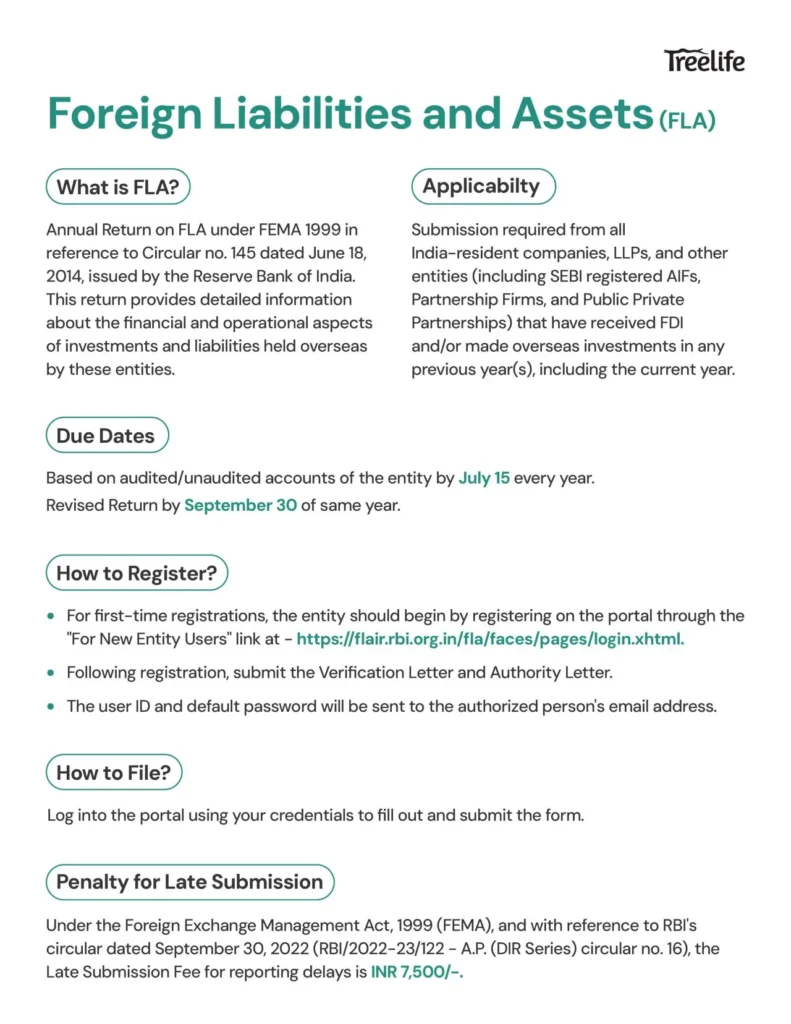
Permissible Activities
Book-keeping Services
- Inclusion: Classify and record transactions, including payroll ledgers in books of account
- Exclusion: Does not include payroll management and taxation services
Accounting Services (excluding audit)
- Inclusion: Review, compilation, preparation, and analysis of financial statements
- Exclusion: Audit; Review and compilation without any assurance and attestation
Taxation Services
- Offer tax consultation, preparation, and planning
- Advise on all forms of direct and indirect taxes
- Prepare and file various tax returns
Financial Crime Compliance Services
- Render compliance services of AML/CFT measures, FATF recommendations, and related activities
Additional Requirements
- Legal Form: Company or LLP
- Service Recipient: Non-resident and does not reside in a high-risk jurisdiction identified by FATF.*
- Minimum Office Space Criteria: 60 sq. ft. per employee
*Please refer to the list of High-Risk Jurisdictions – February 2024.
]]>DOWNLOAD FULL PDF
Starting June 18, 2024, all advertisers and advertising agencies must upload a ” – ” before publishing ads on TV, radio, print, or online platforms, as per the . Ensure your ads comply with all guidelines!
This amendment marks a significant enhancement in facilitating the involvement of the NRI community in the Indian financial markets.
However, it is important to note that the formal amendment to the SEBI FPI Regulations is yet awaited.
Let us know your thoughts in the comments below or reach out to us at priya.k@treelife.in for a detailed discussion.
The Government of India (“GoI”), on March 04, 2024 has announced significant amendment in the Consolidation FDI Policy, 2020 (“FDI Policy”) pertaining to the space sector, which will be effective from the date of FEMA notification. The amendment has been brought with an objective to liberalize the space sector and promote foreign investment in the Indian space economy.
As on today, the FDI policy allows 100% FDI subject to government approval in establishment and operation of satellites, subject to the sectoral guidelines of Department of Space/ISRO.
Amendments under Article 5.2.12
Vide the press note dated March 04, 2024 issued by Department for Promotion of Industry and Internal Trade, GoI has introduced the following amendments under Article 5.2.12 of the FDI Policy:
1.For manufacturing and operation of satellites, the sector cap for FDI has been set at 100%, wherein upto 74% FDI can be made through automatic route and FDI beyond 74% would require government approval;
2.Satellite data products, ground segment and user segment can have 100% FDI through automatic route;
3.Launch vehicle and associated systems or sub-systems can have 100% FDI, wherein, upto 49% FDI can be made through automatic route and FDI beyond 49% would require government approval;
4.For creation of spacesports for launching and receiving spacecraft, 100% FDI can be made through automatic route; and
5.Manufacturing of components and systems/sub-systems for satellites, ground segment and user segment, can have 100% FDI through automatic route.
Conclusion
Further, the press note sets out definitions of each activity mentioned above which are exclusive in nature, with an intention to avoid any uncertainty going forward.
The amendment is aligned with GoI’s vision to increase the space economy of India five-fold in the next 10 years, to touch $40 billion. By liberalizing the space sector, the foreign investors will find the Indian space sector to be a lucrative opportunity which would lead to immense technological growth in the sector.
]]>Here are the noteworthy changes affecting startups:
1. Power of Attorney Duty: Formerly INR 100, now increased to INR 500.
2. Any Other Agreement under Article 5:Duty has risen from INR 200 to INR 500.
]]>Supreme Court Judgement – https://lnkd.in/dX2kk8wT
So, what is the MFN clause, and how does the Supreme Court ruling impact existing arrangements entered into between group companies of MNCs?
The MFN clause allows for a reduction in the TDS rates on dividends, interest, royalties, or fees for technical services (FTS), as applicable. Also, it can limit the scope of royalty/FTS (for example, make available) in the treaty entered with the First Country. These adjustments only come into play if, at a later date, such concessions are extended by India to another OECD member (Third Country).
Example
- 1986 DTAA notified between India and Canada (First Country) which contained the MFN provision.
- 1988 DTAA entered between India and Sweden (OECD member) which contained more favourable benefits than what was given to Canada.
- 1992 CBDT amended the DTAA with Canada (First Country) under section 90 to extend beneficial provisions present in the India-Sweden DTAA (Third Country).
What was happening?
- The bilateral treaties between India and the Netherlands, France, and Switzerland contained the MFN clause.
- Entities based in the Netherlands, France, and Switzerland automatically claimed the beneficial provisions present in subsequent tax treaties signed by India with Third Countries, based on the MFN clause in their respective DTAAs with India.
- Certain Third Counties were not an OECD member at the time of signing the DTAA with India and became OECD members later.
Example
- DTAA entered between India and Slovenia contained lower tax rate of 5% on Dividend.
- India-Slovenia DTAA came into force on Feb 17, 2005.
- Slovenia became an OECD member on July 21, 2010. Entities from the First Country with whom India had entered into DTAA before Slovenia (Third Country) claimed beneficial provisions present in the India-Slovenia DTAA under the MFN clause automatically without CBDT notification.
Supreme Court Ruling –
Issues raised
- Whether there is any right to invoke the MFN clause when the Third Country with which India has entered into a DTAA was not an OECD member at the time of entering into such DTAA?
- Whether the MFN clause is to be given effect to automatically or if it is to only come into effect after a notification is Issued.
Held
- Notification under Section 90(1) is necessary and a mandatory condition for a court, authority, or tribunal to give effect to a DTAA, or any protocol changing its terms or conditions, which has the effect of altering the existing provisions of law.
- Third Country should be a member of OECD at the time of entering into DTAA with India, for the earlier treaty beneficiary (First Country) to claim parity.
- MFN clause present in a tax treaty does not automatically lead to the benefit present in DTAA entered with a Third Country being extended automatically to the First Country. The terms of the earlier DTAA entered with the First Country are required to be amended through a separate notification under Section 90.
Treelife comments:
Going forward, entities from First Country should claim beneficial provisions present in DTAA entered between India and the Third Country under the MFN clause if: 1. Third Country is OECD member at the time of entering the DTAA with India 2. CBDT has issued a notification extended the benefits present in DTAA entered with a Third Country to the DTAA entered with the First Country.
]]>Report Highlights
Here are some highlights of the Indian Interim Budget 2024:
Focus on Infrastructure Development: The government has allocated significant funds for building highways, railways, airports, and other critical infrastructure projects to achieve the vision of ‘Viksit Bharat’ (Developed India) by 2047 https://innovateindia.mygov.in/viksitbharat2047/. This push for infrastructure spending is expected to create jobs and boost overall economic growth.
Boost to Social Welfare Schemes: The budget aims to uplift people out of poverty by increasing spending on social welfare programs like education, healthcare, and poverty alleviation. This focus on social welfare should benefit a large portion of the Indian population.
Investment in Research and Innovation: The government announced a corpus of ₹1 lakh crore to provide long-term financing for research and development in sunrise sectors. This initiative is expected to propel India’s technological advancements and self-reliance (Atmanirbharta) https://pib.gov.in/PressReleaseIframePage.aspx?PRID=1845882.
Measures for Sustainable Development: The budget promotes sustainability through initiatives like rooftop solarization. A target has been set to enable one crore households to generate their own solar power and potentially even sell surplus electricity back to the grid. This scheme is likely to increase clean energy adoption and reduce dependence on fossil fuels.
Support for MSMEs and Farmers: The budget proposes measures to support small businesses (MSMEs) and farmers. This may include tax breaks for MSMEs and continued financial assistance to farmers under schemes like PM-KISAN. These initiatives are expected to give a leg up to these crucial sectors of the Indian economy.
In today’s globalized era, the world feels more interconnected than ever. Many companies are expanding internationally, setting up offices worldwide, and seeking new markets for their products. Some startups, including some unicorns, have relocated their holding company outside India in a process known as “flipping” to capitalize on global opportunities.
Understanding the Flipping Phenomenon
Flipping, in the Indian startup realm, refers to the practice where startups, originally based in India, restructure their corporate structure to relocate their holding company and intellectual property (IP) to foreign jurisdictions, usually the United States or Singapore despite having a majority of their market, personnel and founders in India.
The primary reasons for startups to externalize their corporate structure inter-alia are access to deeper pools of venture capital, favorable tax framework, market penetration and brand positioning as an international entity, which can be beneficial in terms of attracting global talent and customers.
However, recent times have seen an emergence of an interesting counter-trend: ‘Reverse Flipping’ or ‘De-externalization’.
However, recent times have witnessed an intriguing counter-trend: ‘Reverse Flipping’ or ‘De-externalization’ i.e. Indian startups are opting to reverse flip back into India due to its favorable economic policies, burgeoning domestic market, and growing investor confidence in the country’s startup ecosystem.
The Emergence of Reverse Flipping
Reverse flipping, as the name suggests, is the antithesis of the flipping trend. Here, startups that once relocated their holding companies outside India are now considering a strategic move back to their home ground, India.
As mentioned above, one of the primary reasons for reverse flipping back to India is the fact that the Indian startup ecosystem has matured significantly in recent years. There is now a large pool of untapped domestic retail investors who want to invest in emerging companies they believe have the potential to grow. Additionally, the Indian government is taking steps to make it easier for startups to go public, which could make it more attractive for startups to reverse flip.
Take, for example, PhonePe. Originally an Indian entity, it flipped its structure to Singapore but has now moved its base back to India. In doing so, the founders have gone on record to say that the investors had to pay almost INR 8,000 crore of taxes to the Indian Government. It also stands to lose the chance to offset its accumulated losses of almost INR 7,000 crore against future profits due to this restructuring. Also, all employees had to be migrated to a new India-level ESOP plan which stipulates a minimum 1 year cliff thereby resetting the vesting status to zero with a 1 year cliff.
PhonePe is not alone. Several startups like Razorpay and Groww are also evaluating this shift, acknowledging the promise that the Indian market holds.
How to Reverse Flip?
Structuring a reverse flip is not easy and startups considering this reverse journey have to navigate a maze of regulations. Some popular methods include share swaps, mergers, etc and could also require approval from NCLT.
Startups need to be aware of the potential tax and exchange control implications that come with such a restructuring exercise.
When a startup’s valuation has increased significantly since its initial flip, there can be significant tax consequences upon reverse flipping. The process can be perceived as a ‘transfer of assets’, leading to capital gains tax implications in India and possibly even in foreign jurisdictions. This can also technically lead to a change in beneficial ownership, thereby risking the accumulated losses for setoff against future profits. Startups also need to navigate the exchange control regulations when repatriating funds or assets to India, ensuring all compliances are met.
While the above provides a birds-eye view, it’s imperative for startups to consult experts for a tailor-made approach, aligning with their unique business needs and ensuring compliance with the tax and regulatory framework.
What is the Government saying?
Indian Economic Survey 2022-23 acknowledged the concept of reverse flipping and has listed possible measures that can accelerate the reverse flipping process for startups including simplifying the process for granting tax holidays to start-ups, simplification of taxation of ESOPs, simplifying multiple layers of tax and uncertainty due to tax litigation, simplifying procedures for capital flows, etc.
The International Financial Services Centres Authority i.e. IFSCA has also constituted an expert committee to formulate a roadmap to ‘Onshore the Indian innovation to GIFT IFSC’. IFSCA plans to make GIFT City, India’s first IFSC, the preferred location for startups to reverse flip into. This expert committee submitted its report1 on 25 August 2023 with recommended measures to be undertaken by various stakeholders such as ministries and regulatory bodies in implementing the idea of onshoring the Indian innovation to GIFT IFSC.
In Conclusion
The trend of reverse flipping underscores the belief in India’s potential as a global startup hub. While challenges exist, the long-term benefits of tapping into the domestic market, coupled with the strengthening startup ecosystem, are compelling many to look homeward. It will be intriguing to witness how this trend evolves and shapes the future.
Looking for expert contract advice? Call us at +91 99301 56000 today.
]]>The Reverse Flip
What is Reverse Flip?
“Reverse flip” or “re-domiciliation” refers to a corporate restructuring process in which a company changes its country of domicile or legal registration from one jurisdiction to another.
Background
- PhonePe was incorporated in 2015 in India
- In April 2016, PhonePe was acquired by Flipkart. As part of the acquisition, PhonePe flipped its structure to Singapore
- In 2018, PhonePe became a part of Walmart after it acquired Flipkart
- In October 2022, PhonePe announced that it has moved its domicile to India (reverse flip) for following key reasons:
- PhonePe wants to focus on India markets for the next couple of decades. PhonePe is a digital payments company that operates primarily in India. By redomiciling to India, PhonePe can be more responsive to the needs of its customers and partners.
- The Indian government has been tightening regulations for digital payments companies in recent years. By redomiciling to India, PhonePe can be more easily compliant with these regulations.
- To be better positioned for an IPO. PhonePe is expected to go public in the next few years
What Happened?
Steps undertaken
- PhonePe moved all businesses and subsidiaries of PhonePe Singapore to PhonePe India directly
- PhonePe created a new ESOP plan at India level and migrated all group employees to this new plan
- IndusOS, owned by PhonePe, also shifted operations from Singapore to PhonePe India
Key Consequences of Reverse Flip to India
- Lapse of accumulated losses of USD 900 million
- PhonePe stands to lose the chance to offset its USD 900 million (~INR 7,380 crore) of accumulated losses against future profits as shifting the domicile from Singapore to India is viewed as a restricting event under Section 79 of the Income Tax Act, 1961
- As per the provisions of Section 79, a company is not allowed to carry forward the losses if the change in beneficial ownership of shareholding of more than 50% occurred at the end of year in which losses were incurred
- Reset of ESOPs to zero vesting with 1 year cliff
- All employees of PhonePe were migrated to the new India level ESOP plan which stipulates a minimum 1 year cliff.
- Thus, the employees vesting status was reset to zero with a 1 year cliff
- Tax payout by investors of almost INR 8,000 cr
- PhonePe investors, led by Walmart, sold their stake in the Singapore entity and invested in PhonePe India
- This means that there was a capital gains tax event in India for the the investors leading to a tax-pay-out of almost INR 8,000 cr
Other Startups looking at Reverse Flip
- Razorpay is in process to move its parent entity from the US to India
- Groww is planning to move its domicile from the US to India
- Pepperfry has reverse flipped their structure to India via amalgamation
Who Should Consider a Reverse Flip?
US Holding Company Founders Preparing for IPO
If your company is incorporated in Delaware or any US jurisdiction but operates primarily in India and plans to go public on Indian exchanges (NSE/BSE), reverse flip is essential. Indian regulators prefer domestic listed entities for governance and regulatory oversight. PhonePe, Razorpay, and Groww all recognized that a Singapore or US entity listing in India would face scrutiny. Moving domicile to India eliminates this friction during IPO roadshows and regulatory approvals.
Founders Facing Regulatory Arbitrage Pressure
RBI and government regulations on fintech, payments, e-commerce, and data localization keep tightening. If you are a foreign-incorporated entity managing Indian customer data, processing Indian rupees, or handling payments, you face compliance questions daily. A reverse flip positions you as a domestic entity subject to Indian regulations from day one, reducing legal ambiguity and investor concern. This is especially critical for payments companies, lending platforms, and data-heavy SaaS firms.
Pre-IPO India-Focused Startups (3 to 5 Years to IPO)
If your IPO timeline is 3 to 5 years and India is your primary market, reverse flip makes sense now. The longer you wait, the more complex the unwinding. PhonePe did this in October 2022, approximately 2 to 3 years before expected IPO (likely 2024 to 2025). Early reverse flip gives you time to settle into Indian regulatory framework, rebuild investor relationships, and demonstrate consistent India-domiciled governance.
Startups Facing Investor Pressure to “Prove India Commitment”
Late-stage investors and PE firms increasingly ask: “Are you really India-focused or is this a tax optimization play?” A reverse flip is a credible signal. Moving your legal domicile, reincorporating subsidiaries, and resetting ESOP structures shows serious commitment. It is no longer just about tax benefits; it is about operational alignment with your market.
Founders NOT Ready for Reverse Flip
Early-stage startups (Seed to Series A) should not reverse flip. The costs (legal, tax, ESOP reset, loss carry-forward forfeiture) exceed benefits. Wait until Series B or C when you have institutional investors and clearer IPO trajectory. Also skip reverse flip if you operate across multiple geographies. If India is just 30 to 40% of revenue, the regulatory and tax burden may not justify the move. Finally, if you have no IPO plans in next 5 years, reverse flip is premature. The tax loss lapse (like PhonePe’s USD 900 million) is painful if you are not profitable soon.
Read our Founder Guide on Reverse Flip.
Planning a reverse flip to India? We structure cross-border mergers, FEMA compliance, and tax alignment. Let’s Talk
Source:
https://www.bqprime.com/business/after-phonepe-razorpay-kicks-off-reverse-flipping-process
https://inc42.com/features/unicorn-desh-wapsi-reverse-flipping-is-the-new-startup-sensation
]]>Vision for Budget 2023
Amrit Kaal – an empowered and inclusive economy
Our nation will enter a 25-year period wherein India will go from India@75 to India@100. Amrit Kaal marks the blueprint to steer the Indian economy for the upcoming years. The vision for the Amrit Kaal includes technology-driven and knowledge-based economy with strong public finances, and a robust financial sector. The economic agenda for achieving this vision focuses on three things:
- Facilitating ample opportunities for citizens, especially the youth, to fulfil their aspirations;
- Providing strong impetus to growth and job creation;
- Strengthening macro-economic stability
The Budget in Amrit Kaal presented by Hon’ble Finance Minister Smt. Nirmala Sitharaman adopts 7 priorities as ‘Saptarishi’
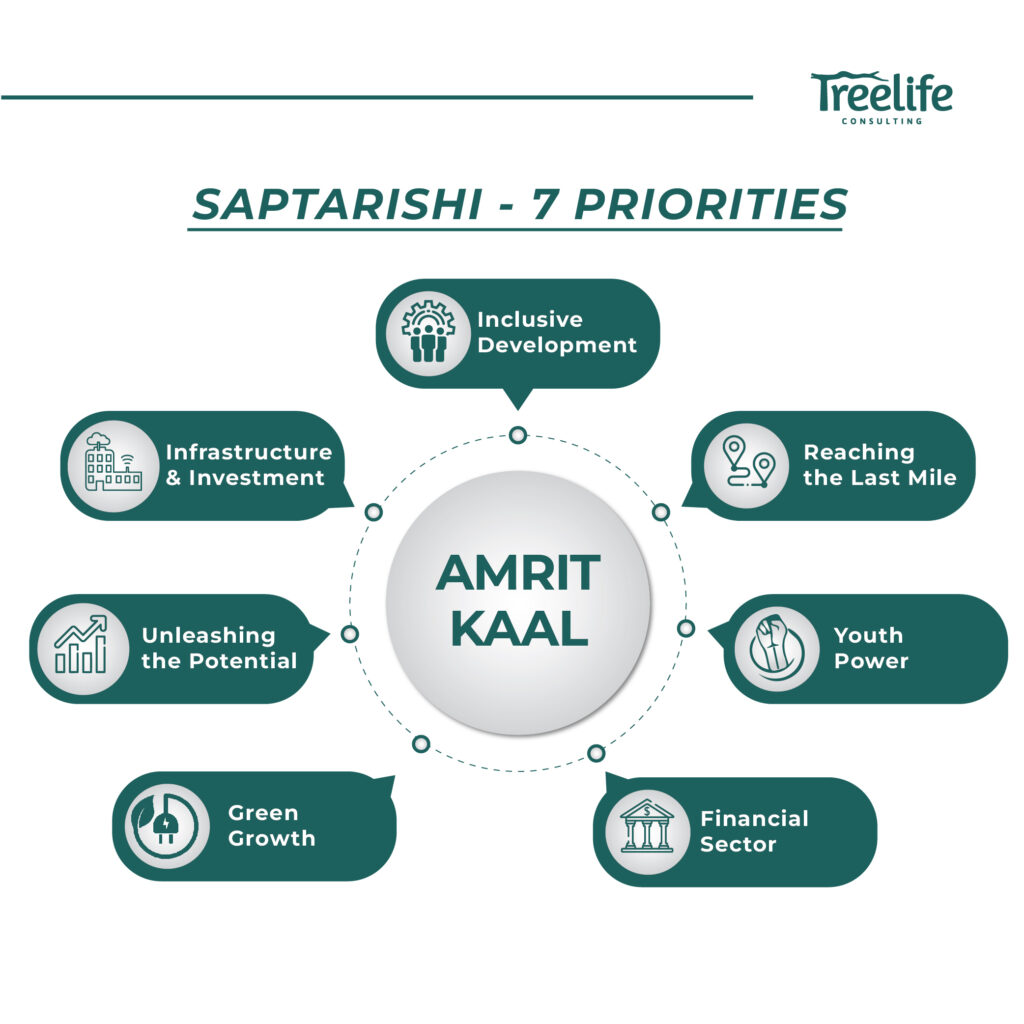
Green Growth
The Government has proposed to implement many programs for green fuel, green energy, green farming, green mobility, green buildings, and green equipment, and policies for efficient use of energy across various economic sectors. These green growth efforts help in reducing carbon intensity of the economy and provides for largescale green job opportunities. The following key programs have been proposed apart from many other initiatives
- PM PRANAM – To incentivize States/ UTs to promote usage of alternative fertilizers
- MISHTI – To ensure Mangrove plantation along the coastline
- Amrit Dharohar – To implement optimal usage of wetlands
- GOBARdhan Scheme – To establish 500 “Waste to Wealth” plants to promote circular economy
Flow of Money in Budget 2023
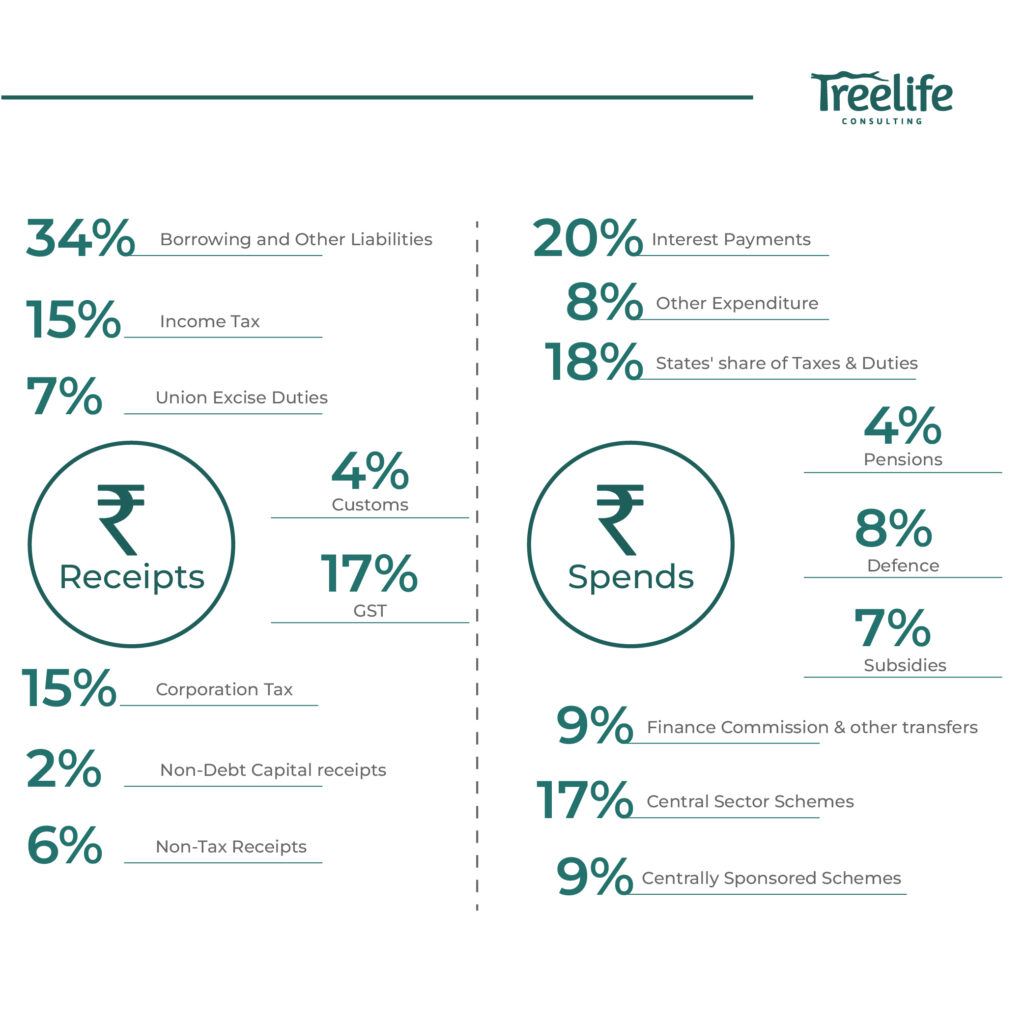
Economic Growth Indicators
- Per Capita income has increased to ` 1.97 lakh pa
- GDP growth is estimated at 7%, highest amongst largest economies
- The fiscal deficit is estimated to be 5.9% of GDP. The government intending to bring the fiscal deficit below 4.5% of GDP by 2025-26.
- Capital Investment outlay increased to INR 10 Lakh Crores. Increase of 33% which is ~ 3.3% of GDP.
- Effective capex to be INR 13.7 Lakh crores. ~ 4.5% of GDP
- This year around 6.5 crore Income tax returns were filed and nearly 45% of returns were processed within 24 hours. The average processing period reduced from 93 days in financial year 13-14 to 16 days now.
- Digital payments has widened by 76% in transactions and 91% in value over the last year.
Savings Scheme Proposals
- A new scheme for Women called Mahila Samman Savings Certificate, will be available for 2 year up to March 2025. This will offer deposit upto INR 2 lakh at fixed interest rate of 7.5%.
- The deposit limit for Senior Citizen Savings Scheme (SCSS) is proposed to enhanced from 15 lakh to 30 lakh subject to the prescribed conditions. The maximum deposit limit for Monthly Income Account Scheme will be enhanced from 4.5 lakh to 9 lakh for single account and from 9 lakh to 15 lakh for joint account.
- Reduction in the TDS rate from 30% to 20% on EPF taxable withdrawal in non-PAN cases.
- KYC process will be streamlined and PAN card will be adopted as a single identifier.
Health, Education & Transport initiatives
- 157 New Nursing colleges to be started
- National Digital Library to be for children and adolescents
- 38,800 teachers to be recruited for the 740 Ekalvya Model Residential schools serving for tribal students
- To empower the youth and help the ‘Amrit Peedhi’, the government have formulated the National Education Policy, focused on skilling, adopted economic policies that facilitate job creation at scale, and have supported business opportunities.
- 50 additional airports, heliports, water aerodromes and advance landing grounds will be revived for improving regional air connectivity.
- Highest ever capital outlay of INR 2.4 lakh crores for railways
Other key announcements
- A system of ‘Unified Filing Process’ will be set-up by the government to share the information or filed return in simplified forms on a common portal, across the agencies.
- An integrated IT portal will be established for investors to reclaim unclaimed shares and unpaid dividends from the Investor Education and Protection Fund Authority.
- A one stop solution for reconciliation and updating of identity and address of individuals maintained by various government agencies, regulators and regulated entities will be established using DigiLocker service and Aadhaar as foundational identity.
- A Central Processing Centre will be setup for faster response to companies through centralized handling of various forms filed with field offices under the Companies Act.
- At present, India is the largest producer and second largest exporter of Millets. Efforts are made to make India a global hub for Millets.
KEY MACRO ECONOMIC INDICATORS
- GDP growth estimated at 7%
- This year nearly 6.5 crore Income tax returns were filed
- Average processing period of Income Tax Returns reduced from 93 days in financial year 13-14 to 16 days now.
- Fiscal deficit is estimated to be 5.9% of GDP
- Per Capita income has increased to INR 1.97 lakh p.a.
- Digital payments widened around 76% in transactions and 91% in value over the last year.
BUDGET SNAPSHOT FOR STARTUP STAKEHOLDERS
KEY HIGHLIGHTS FOR STARTUP ECOSYSTEM
- Maximum surcharge rate capped to 25% under new tax regime thereby reducing the maximum tax rate from 42.74% to 39%
- Rollover benefit under section 54 and 54F for reinvestment of capital gains in new residential properties capped at INR 10 crore
- Change in shareholding of eligible start-ups not to impact carry forward of losses as long as such loss is incurred during the period of 10 years (previously 7 years) beginning from the year of incorporation
- Angel tax provisions extended to infusion of share premium in excess of FMV by non-residents (earlier applicable only to infusion by resident shareholders) – Exemption from angel tax to startups still continues
- Payments to MSMEs beyond mandated 15 / 45 days (as per MSMED Act) is proposed to be allowed as deduction only on payment basis. Deduction allowed on accrual basis only if payment made within aforementioned mandated time
- Rebate provided to individuals earning upto INR 7 lakhs in an FY – no tax required to be paid by such individuals
STARTUPS
- Threshold for small businesses to avail the presumptive tax scheme is increased to INR 3 crore from INR 2 crore
- TDS introduced on net winnings from online games at the time of withdrawal or at the end of the financial year without any threshold. Threshold of INR 10,000 for TDS on winnings lottery, crossword puzzles games, etc clarified to apply to aggregate winnings during a financial year (and not per transaction)
- Date of incorporation for startups eligible to apply for tax holiday extended to 01 April 2024 (earlier 01 April 2023)
- Clarification provided that the cost of acquisition / cost of improvement of intangible asset / rights for which no consideration was paid for acquisition will be NIL for the purpose of computation of capital gains
- Provisions of section 28(iv) and section 194R regarding taxability and TDS on benefit or perquisite received in the course of business extended to benefit or perquisite provided in cash
- Basic customs duty rate reduced to 13% from 21% on goods (other than textiles and agriculture)
- Custom duty exemption on machinery for manufacture of lithium-ion cells used in batteries of EVs extended to 31 March 2024
FOUNDERS AND TEAM
- Threshold for professionals to avail the presumptive tax scheme is increased to INR 75 lakhs from INR 50 lakhs
- Gift of a sum over INR 50,000 by a resident individual to a ‘resident but not ordinarily resident’ individual now taxable in the hands of the recipient
- Standard deduction of INR 50,000 to salaried individuals, and deduction from family pension up to INR 15,000 now allowed under the new tax regime as well
- Tax exemption limit increased to INR 25 lakhs from INR 3 lakhs on income from salary under ‘leave encashment’ for non government employees.
- Anomaly of double deduction of interest on borrowed capital for property (as deduction from income from house property and added to cost of acquisition / improvement for computing capital gains on sale) now removed
- Income from Insurance policies issued after 01 April 2023 (other than ULIP) having premium above INR 5 lakh in a year now taxable (except where income is received on death of insured person)
ANGEL INVESTORS
- TCS on foreign remittances under LRS and overseas tour packages increased to 20% without any threshold (earlier 5% with a threshold of INR 7 lakhs)
There are no specific tax announcements pertaining to VCs except amendments in sec 56 (2)(vii)(b) for offshore funds mentioned above
]]>The Department of Consumer Affairs, Ministry of Consumer Affairs, Food and Public Distribution (vide press release dated January 20, 2023) has released guidelines for celebrities, influencers and virtual influencers specifically with respect to social media platforms. The said guidelines are called ‘Endorsement Know-hows! For Celebrities, Influencers & Virtual Influencers on Social Media platforms
These guidelines talks about the disclosure of certain information by such celebs and influencers while they are advertising/ promoting certain products on social media platforms.
1) Let’s break down some key words and it’s meaning
Celebrities: Famous personalities, including but not limited to the entertainment or sports industry have the power to affect the decisions or opinions of their audience.
Influencers: Creators who advertise products and services with a strong influence on the purchasing decisions or opinions of their audience.
Virtual Influencers: Fictional computer-generated ‘people’ or avatars who have realistic characteristics, features, and personalities of humans, and behave in a similar manner as influencers.
Material connection: Includes but is not limited to benefits and incentives, such as:
- Monetary or other compensation;
- Free products with or without any conditions attached, including those received unsolicited, discounts, gifts;
- Contest and sweepstakes entries;Trips or hotel stays;Media barters;Coverage and awards; or
- Any family, personal or employment relationship.
2) Who should be disclosing information?
Individuals/ groups who have access to an audience and the power to affect their audiences’ purchasing decisions or opinions about a product, service, brand or experience, because of the influencer’s / celebrity’s authority, knowledge, position, or relationship with their audience.
3) When should such information be disclosed?
A material connection between an advertiser and celebrity/ influencer may affect the weight or credibility of the representation made by the celebrity/ influencer.
4) How to disclose information?
- Information should be hard to miss – in a manner that it is clear, prominent and extremely hard to miss; disclosures should not be mixed with a group of hashtags/ links.
- In case of endorsement in a picture – disclosure should be superimposed over the images in such a manner so that the person viewing them can see them clearly.
- In case of endorsement in a video – disclosures shall be placed in the video and not only in the description; such disclosures shall be in both the audio as well as the video format.
- In case of endorsement in a live stream – disclosures shall be displayed prominently throughout the entire stream.
- Use of simple and clear language
- Terms which are allowed: ‘advertisement’ or ‘ad’; ‘sponsored’; ‘paid promotion’ or ‘paid’.
- Disclosures shall be in the same language as the endorsements.
- Separate disclosures shall be made apart from platform disclosure tools.
5) Due Diligence
Celebrities/influencers are always advised to review and satisfy themselves that the advertiser is in a position to substantiate the claims made in the advertisement. It is strongly recommended that the endorser of a product or service should have actually used or experienced the product or service before endorsing it.
6) Consequences of non-compliance
Such celebs/ influencers shall be made liable under the Consumer Protection Act, 2019 for non-compliance or non-disclosure (in case of false or misleading advertisements, penalty may extend up to INR 50 Lakhs).
]]>The Adani-Holcim deal where the Adani group will acquire Holcim’s Indian assets for $10.5 billion is pegged to be India’s largest-ever merger and acquisition transaction in the infrastructure and materials space. In this deal, Adani will acquire ~63% stake in Ambuja Cements and ~55% stake in ACC both being Indian listed companies.
Holcim’s CEO in his address to investors mentioned that this deal is likely to be tax free for Holcim.
Before discussing whether gains arising to Holcim will be tax free or not, it would be key to first understand the facts (as per publicly available information):
- The selling entity is likely to be Holcim’s Dutch investment company which holds investment in Holcim’s investment company in Mauritius.
- This Mauritius investment company, in turn, holds stake in Ambuja Cements and ACC.
- The Dutch company will sell the shares in the Mauritius investment company to Adani’s Mauritius based investment company.
- To represent this diagrammatically,
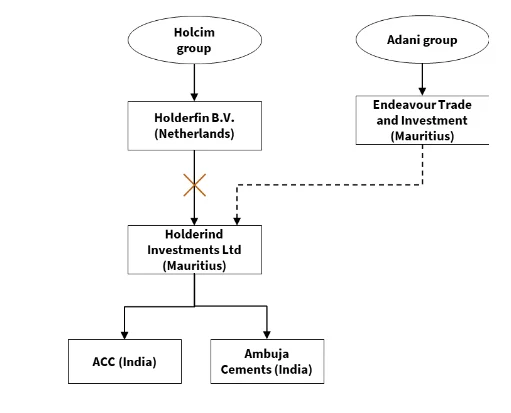
This seems to be a classic case of “indirect transfer” i.e. transfer of shares of foreign entities owning shares / assets in India instead of a direct transfer of such Indian shares / assets.
Indian tax treaties with Mauritius, Singapore, Netherlands, etc continue to have a capital gains tax exemption for such indirect transfers of Indian shares. In other words, as per these treaties, capital gains arising on sale of shares of a non-Indian entity are taxable only in the country in which the seller is a resident i.e. in Mauritius / Singapore / Netherlands.
Applying the above mentioned laws to the facts of this deal, considering that even though substantial value of Holcim’s Mauritius company arises from assets located in India (i.e. Ambuja Cements and ACC), India may not be entitled to collect tax on the gains arising on this transaction as per the India-Netherlands tax treaty.
]]>