| A deep-dive for seed-stage founders preparing for their first institutional raise. This report covers the financial infrastructure, investor-grade systems, and strategic frameworks that separate startups that close Series A in 4 months from those that take longer time. |
Section 1: The Series A Gap Why Good Startups Don’t Always Raise
Every founder who has been through a Series A fundraise will tell you the same thing: it takes longer than expected, reveals more blind spots than you anticipated, and exposes financial gaps that should have been addressed months earlier. The problem is structural, not anecdotal.
India’s startup ecosystem has matured significantly over the past decade. Series A investors whether domestic VCs, global funds, or family offices now apply institutional-grade financial scrutiny to every deal they evaluate. They have seen hundreds of pitch decks. They know when numbers don’t reconcile. They know when a projection is a wish rather than a model. And they know when a founder doesn’t deeply understand the financial mechanics of their own business.
According to CB Insights data, 29% of startups globally fail due to cash flow mismanagement not product failure or market timing. Among startups that do reach the fundraising stage, financial due diligence failure is the most common reason term sheets are withdrawn or valuations are marked down. Yet most seed-stage founders spend the bulk of their preparation time perfecting their pitch deck rather than fixing their financial foundation.
The Three Stages of Financial Unreadiness
Most seed-stage startups fall into one of three financial readiness profiles when they approach Series A:
- Stage 1 Chaotic: Books exist, but they’re not investor-grade. Revenue recognition is informal, costs are lumped together, and there’s no clear MIS or reporting structure.
- Stage 2 Compliant But Thin: Basic accounting is in place, monthly reports exist, but there are no investor-grade financial models, no unit economics tracking, and no data room.
- Stage 3 Almost There: Clean books, structured reporting, financial model exists, but it hasn’t been stress-tested, the narrative doesn’t align with numbers, and due diligence will surface issues.
A Virtual CFO operates across all three stages taking startups from wherever they are to investor-ready, typically in 9–12 months. The earlier the engagement, the stronger the outcome.
What Series A Investors Actually Evaluate
Beyond the pitch, Series A investors conduct a structured financial evaluation that most founders are unprepared for. Here is what they are actually looking at:
- Revenue Quality & Predictability: Can management accurately forecast their own business 12–18 months out?
- Unit Economics: Is growth efficient or is the startup buying revenue at any cost?
- Cash Runway Under Scenarios: At current burn, how much runway remains? At 1.5x burn after Series A capital is deployed?
- Cap Table & Equity Structure: Does the cap table have clean ownership records, proper ESOP structure, and room for a new investor without complexity?
- Regulatory & Compliance Backbone: Are GST, TDS, ROC, FEMA, and labour compliance fully current?
- Revenue Recognition Integrity: How are revenues recognised? Is ARR calculation consistent with industry standards?
- Management Depth on Financials: Can founders answer granular questions about cohorts, retention, and customer economics on the spot?
| KEY INSIGHT: Series A is not a fundraising event. It is a financial examination of your systems, your discipline, and your understanding of your own business. The pitch deck gets you the meeting. The financial infrastructure gets you the term sheet. |
Section 2: What a Virtual CFO Does and Doesn’t Do
The term ‘Virtual CFO’ is used loosely in the market. Some firms mean glorified bookkeeping. Others mean monthly financial reporting. At Treelife, a Virtual CFO engagement means something specific: a senior finance professional embedded in your startup’s strategic decision-making, building the financial infrastructure that institutional investors require.
The VCFO Value Stack – Where Strategy Meets Execution
Think of finance talent in a startup as a layered stack. Each layer serves a purpose, but only the top layer creates investor-grade outcomes:
The Finance Talent Value Stack
Proportion of strategic investor-readiness value delivered by each role:
| Bookkeeper | Transaction recording only |
| Accountant | Compliance & historical reporting |
| Finance Manager | Budgeting, control & team management |
| Virtual CFO | Strategy, investor readiness & narrative |
A Virtual CFO’s scope is fundamentally different from the layers below. Their mandate includes:
- Designing and maintaining a 3-statement financial model (P&L, Balance Sheet, Cash Flow) linked to operational assumptions
- Building the MIS dashboard with investor-grade KPIs tracked weekly and monthly
- Conducting an internal ‘investor lens’ financial audit to proactively identify due diligence red flags
- Structuring the cap table, managing ESOP grants, and modelling post-round dilution scenarios
- Building and maintaining the data room the organised repository of all due diligence materials
- Preparing the financial narrative that supports the investor pitch deck
- Supporting negotiations: term sheet analysis, valuation modelling, anti-dilution provisions, liquidation preferences
- Acting as the interface between founders and investors during due diligence fielding financial questions, bridging gaps
- Providing post-raise financial reporting, investor update templates, and board pack infrastructure
| TREELIFE LENS: At Treelife, our VCFO practice is integrated with startup legal, company secretarial, and compliance services which means the same team that builds your financial model also manages your cap table, ROC filings, FEMA compliance, and ESOP documentation. This single-window approach eliminates coordination gaps that surface as deal-breakers in due diligence. |
Section 3: Virtual CFO vs. Full-Time CFO – The Trade-Off Every Founder Must Understand
One of the most common mistakes seed-stage founders make is hiring a full-time CFO too early before the business has the revenue, the financial complexity, or the team depth to justify it. The cost is not just the salary and equity. It is the opportunity cost of locking in one person’s network, experience, and approach at a stage where flexibility matters most.
| Dimension | Full-Time CFO | Virtual CFO (Treelife) |
|---|---|---|
| Annual All-In Cost | ₹60L – ₹1.5Cr salary + 1–3% equity | ₹6L – ₹20L retainer zero equity |
| Time to First Impact | 3–6 months to fully onboard | 2–4 weeks to live MIS & model |
| Series A Experience | Varies by individual; often 1–2 rounds | Portfolio exposure across 50+ rounds |
| Fundraising Network | Depends on personal relationships | Warm intros to VCs, angels, bankers |
| Availability | Full-time; single startup focus | On-demand; senior expertise when needed |
| Best Fit Stage | Post-Series B, ₹50Cr+ ARR | Seed → Series A, ₹5–40Cr ARR |
| Legal/Compliance Integration | Separate hires needed | Bundled at Treelife one roof |
| Equity Saved at Series A | ₹0 (equity already given) | ₹1–3Cr+ at typical Series A valuations |
The equity dimension deserves special attention. A seed-stage startup offering a CFO 1.5% equity at a pre-Series A valuation of ₹25Cr is giving away ₹37.5L in equity today at a time when the company is most likely to raise a Series A at ₹75–150Cr, making that equity worth ₹1.1–2.25Cr. A Virtual CFO, engaged at ₹8–15L per year with zero equity, delivers the same strategic output at a fraction of the real cost.
| The right time to hire a full-time CFO is when you are post-Series A, ARR has crossed ₹15–20Cr, you have 3–5 direct reports for the CFO to manage, and the financial complexity genuinely requires a dedicated full-time senior leader. Until then, a Virtual CFO is structurally superior in cost, speed, and depth of Series A experience. |
Section 4: The 5 Pillars of Series A Financial Readiness
Based on Treelife’s experience working with 100+ Indian startups across SaaS, fintech, D2C, edtech, and marketplace models, we have identified five non-negotiable financial pillars that every Series A investor evaluates and that a Virtual CFO systematically constructs. Each pillar is both a standalone deliverable and a component of the broader investor-readiness narrative.
Pillar 1 – The Investor-Grade Financial Model
A financial model is not a revenue projection in a spreadsheet. At Series A, investors expect a fully integrated 3-statement model Profit & Loss, Balance Sheet, and Cash Flow Statement that is interconnected, dynamic, and built from operational ground truths. Here is what separates an investor-grade model from what most startups actually have:
- Bottom-up revenue projections: Built from individual pricing, product mix, customer count, and conversion rates not from ‘we’ll grow at X% because the market is large.’ Investors immediately test the assumptions behind every revenue line.
- Multi-scenario stress testing: A base case, a bull case, and a bear case that reflects what happens if CAC rises 40%, if one key customer churns, or if hiring takes 3 months longer than planned.
- Operational integration: Headcount plan linked to revenue assumptions; capex and working capital requirements derived from operational projections; not treated as independent line items.
- Cohort-level modelling: For subscription businesses, revenue waterfall by cohort showing exactly how MRR at any point in time is composed of retained plus new cohorts minus churned revenue.
- Runway calculation under deployment: Series A capital deployment plan showing how the new capital will be spent, over what timeline, and what inflection it is expected to create.
| FOUNDER MISTAKE: Building a financial model the week before a VC meeting and presenting projections that have never been challenged internally. Investors have seen this hundreds of times. They will stress-test your assumptions in the room and if you can’t defend them, the conversation ends. |
Pillar 2 – Unit Economics That Tell the True Story of Your Business
Unit economics are the most scrutinised metric set at Series A. They are the lens through which investors determine whether the startup’s growth is building value or destroying it. Strong unit economics don’t just attract investment they justify premium valuations. Below are the benchmarks a VCFO targets and the actions taken to get there:
| KPI | Early Traction | Series A Benchmark | Series B Benchmark | VCFO Action |
|---|---|---|---|---|
| LTV : CAC | < 2x | ≥ 3x (ideally 4–5x) | ≥ 5x | Segment by channel; improve retention levers |
| CAC Payback | > 24 months | < 18 months | < 12 months | Map CAC components; identify high-ROI channels |
| Gross Margin | 30–45% | > 60% (SaaS), >50% (D2C) | > 70% | Renegotiate COGS, automate low-margin processes |
| Net Rev Retention | < 90% | > 100% | > 115% | Build cohort NRR dashboard; identify churn triggers |
| Monthly Burn Multiple | > 2.5x | < 1.5x | < 1x | Efficiency audit; prioritise revenue-generating spend |
| Revenue Concentration | > 40% in top customer | < 25% in top 3 | < 15% in top 3 | Client diversification roadmap with sales team |
A VCFO doesn’t just calculate these metrics, they build them into the monthly MIS dashboard so that by the time fundraising begins, you have 6–12 months of historical unit economics data. That history is what separates a compelling case from a speculative one. Investors do not trust a single month’s LTV:CAC calculation. They trust a trend.
Pillar 3 – Cash Flow Visibility and Disciplined Burn Management
Nothing erodes investor confidence faster than a founder who cannot answer, with precision, how much runway they have. Burn management is not just a survival skill, it is a governance signal. A startup that tracks its cash position weekly, reconciles actual burn against forecast, and can model the impact of hiring decisions on runway is signalling management quality.
A VCFO installs three layers of cash flow infrastructure:
- 13-Week Rolling Forecast: A 13-week rolling cash flow forecast the institutional gold standard for cash management. Updated weekly, reconciled against actuals, with variance analysis explaining every deviation.
- Monthly Burn Dashboard: Monthly burn rate dashboards showing gross burn, net burn, and burn multiple. Gross burn is the honest number net burn (after revenue) is what VCs focus on when assessing efficiency.
- Multi-Scenario Runway: Runway scenarios: At current burn, at 1.5x burn (deployment of Series A), and at 0.75x burn (if cost discipline improves). Investors want to see all three.
A useful benchmark: Series A investors in India generally expect a startup to have at least 12–15 months of runway at the time of closing a round enough time to deploy capital meaningfully and hit the milestones that will justify a Series B. If your runway is shorter, that becomes the central negotiation point and founders negotiate poorly when they are running out of cash.
Pillar 4 – Clean Books and a Compliance Backbone
Due diligence will find every accounting inconsistency that has been swept under the rug. Revenue booked before it was earned. Vendor invoices delayed for quarter-end manipulation. Director loans not documented. GST returns not filed. Related-party transactions without board approval. Each of these is not just an accounting problem, it is a governance problem that signals to investors that the business is not ready for institutional capital.
A VCFO-led compliance cleanup typically involves:
- Revenue recognition audit ensuring all revenue is recognised per Ind AS standards; deferred revenue properly shown on the balance sheet; ARR/MRR calculated consistently
- GST, TDS, PF, and ESIC full current compliance, all pending notices cleared, all returns filed
- ROC compliance annual returns, board minutes, special resolutions, and statutory registers fully updated
- FEMA compliance for startups with foreign investment: ODI filings, FDI reporting, share transfer filings all in order
- Director loan and related-party transaction cleanup all amounts either fully documented, converted to equity, or repaid before fundraising begins
- Vendor contract and customer contract audit ensuring commercial terms are documented, enforceable, and reflected accurately in the financial statements
| In Treelife’s experience across 100+ engagements, over 70% of seed-stage Indian startups have at least one material compliance or accounting issue that would surface as a red flag in Series A due diligence. The good news: almost all are fixable in 60–90 days but only if identified and addressed proactively. |
Pillar 5 – Cap Table Clarity and Equity Structure Readiness
A messy cap table is one of the most reliable deal-killers at Series A. Investors conduct a detailed equity audit examining every share transfer, every convertible instrument, every ESOP grant, and every shareholder agreement. Any gap in documentation, any unauthorised transfer, any ambiguity in ownership translates into legal conditions that can delay a close by weeks or months or kill a deal outright.
A VCFO, working with legal counsel, ensures:
- Complete cap table accuracy: All historical share issuances documented with board resolutions, stamp duty paid, and share certificates issued
- ESOP pool properly sized and structured: Typically 10–15% pre-money for Series A; all grants board-approved; exercise price correctly set; vesting schedules documented
- Convertible instruments modelled: Any SAFEs, CCDs, or compulsory convertible preference shares from previous rounds modelled into the post-Series A cap table with anti-dilution mechanics shown
- Founder vesting in place: Most Series A investors require founders to have vesting schedules (typically 4 years with a 1-year cliff) the absence of vesting is a negotiation risk
- New investor waterfall modelled: Post-money ownership, liquidation preferences, and pro-rata rights for the new investor clearly mapped
Section 5: The Investor-Grade MIS Dashboard
One of the most tangible early deliverables of a VCFO engagement is the Monthly Information System (MIS) dashboard, a structured, standardised report that tracks the financial and operational KPIs that investors care about. This is not a P&L summary. It is a purpose-built dashboard that communicates the health of the business in the language of institutional capital.
Below is the full taxonomy of KPIs that belong in a Series A-ready MIS dashboard, and why each one matters:
| KPI Category | Metric | Reporting Frequency | Why It Belongs in Investor Reporting |
|---|---|---|---|
| Revenue | ARR / MRR, New MRR, Expansion MRR, Churned MRR | Monthly | Shows growth quality not just top-line, but net health |
| Revenue | Revenue by segment / geography / product | Monthly | Proves diversification and scalability of revenue engine |
| Unit Economics | Blended & channel-level CAC | Monthly | VCs test if growth can continue at scale without CAC explosion |
| Unit Economics | LTV by cohort (6M, 12M, 18M) | Quarterly | Longest-running cohorts prove product-market fit durability |
| Cash & Burn | Gross burn, Net burn, Cash runway (months) | Weekly | Runway determines urgency of raise VCs calibrate accordingly |
| Cash & Burn | 13-week cash flow forecast vs. actuals | Weekly | Demonstrates financial control; variance > 10% raises red flags |
| Efficiency | Burn multiple, Magic number, Rule of 40 | Monthly | Capital efficiency is the new growth especially post-2023 |
| Customers | NRR, GRR, Churn rate, DAU/MAU | Monthly | Retention is the proxy for product-market fit at Series A |
| Team & Ops | Headcount by function, Revenue per employee | Monthly | Hiring efficiency signals operational maturity to investors |
A well-constructed MIS dashboard serves two purposes simultaneously: it gives founders real-time visibility into business performance, and it becomes the foundation of investor reporting post-raise. Building it before the round means investors see 6–12 months of historical data, not a new dashboard created for the pitch.
| TREELIFE APPROACH: We build MIS dashboards that auto-populate from accounting software (Zoho Books, Tally, QuickBooks), reducing manual data entry and ensuring data integrity. The same dashboard that management reviews on Day 5 of each month becomes the board pack on Day 10 with narrative commentary added by the VCFO. |
Section 6: The 8 Financial Red Flags That Kill Series A Deals
Based on Treelife’s direct experience supporting founders through Series A due diligence, these are the most common financial issues that cause deals to stall, valuations to be marked down, or term sheets to be withdrawn. Each is preventable but only if identified months in advance.
Frequency of Financial Red Flags in Series A Due Diligence
Percentage of deals where each issue surfaced (Treelife observations, 2022–2025)–
| Revenue recognition inconsistencies | 78% of deals |
| Unrealistic / top-down projections | 72% of deals |
| Cap table documentation gaps | 65% of deals |
| No structured unit economics data | 61% of deals |
| Compliance gaps (GST/TDS/ROC) | 57% of deals |
| Director loan / RPT irregularities | 48% of deals |
| Burn rate misrepresentation | 45% of deals |
| No pre-prepared data room | 82% of deals |
The table below maps each red flag to how it surfaces in due diligence and how a VCFO prevents or resolves it:
| Red Flag | How It Appears in Due Diligence | How VCFO Prevents / Resolves It |
|---|---|---|
| Revenue Recognition Issues | ARR includes churned customers; SaaS contracts counted upfront; deferred revenue not separated | Implement Ind AS-compliant revenue policy; restate historicals; build clean ARR waterfall |
| Unrealistic Projections | Hockey stick with no bottom-up support; CAC ignored in growth assumptions; no churn modelled | Rebuild model bottom-up from pipeline, capacity, and pricing; stress-test with bear/bull scenarios |
| Cap Table Problems | Missing transfer approvals; unauthorised share issuances; ESOP grants not board-approved | Full cap table audit; legal regularisation; pre-round clean-up memo |
| Undefined Unit Economics | No LTV/CAC data; margin at customer level unknown; no cohort retention tracked | Build customer-level economics; install cohort dashboard; identify profitable segments |
| Compliance Gaps | Pending GST notices; TDS defaults; ROC filings late; FEMA compliance for foreign investment | 30-day compliance sprint; clear all open items before investor DD begins |
| Director Loan / RPT Issues | Loans from founders to company; related-party transactions without board approval | Audit all related-party transactions; convert or clear loans; document with board minutes |
| Burn Misrepresentation | Net burn reported as gross burn; product costs hidden in capex; team costs understated | Build gross/net burn reconciliation; fully-loaded cost model by department |
| No Data Room | Investors wait 3–4 weeks for documents; different versions of financials surface | Build and version-control data room 6 months before raise; simulate due diligence in advance |
| The single most important intervention a VCFO makes: conducting an internal due diligence simulation 6–9 months before the actual raise. This ‘pre-DD’ process surfaces every red flag under controlled conditions when the founders have time to fix them. By the time real investors arrive, the data room is complete, the answers are prepared, and there are no surprises. |
Section 7: The 12-Month VCFO-Led Series A Roadmap
Series A readiness is not built in a sprint. It requires a structured, phased approach that builds financial infrastructure systematically and then deploys it strategically during the fundraise. Below is the exact framework Treelife uses with seed-stage founders who are 9–15 months from a target raise date.
| Phase | Timeline | VCFO Actions | Investor Signal Created |
|---|---|---|---|
| AUDIT | Months 1–2 | Full financial audit with investor lensIdentify all accounting, compliance, cap table gapsBaseline MIS setup and data source mappingGap analysis report with prioritised fix roadmap | Founders know exactly what needs to be fixed before any investor sees the books |
| BUILD | Months 3–4 | 3-statement financial model (3-year)Bottom-up revenue model with scenario analysisUnit economics framework: LTV, CAC, NRR by cohort13-week cash flow forecast installed | Investors can stress-test the model and it holds up to scrutiny |
| CLEAN | Months 5–6 | Compliance sprint: GST, TDS, ROC, FEMA clearedCap table regularisation with legal teamESOP pool structure finalisedRevenue recognition policy documented | Due diligence surfaces no material compliance or legal issues |
| ORGANISE | Months 7–8 | Data room built and version-controlled12-month MIS history compiled and formattedInternal pre-DD simulation conductedBoard pack template installed | Investors receive a complete, organised data room on Day 1 of DD |
| NARRATE | Months 9–10 | Financial narrative aligned with pitch deckValuation support: comparable analysis, revenue multiplesInvestor Q&A prep: 60+ anticipated questions with answersFundraising strategy: target investor list, round structure | Founders pitch with full confidence numbers and story are seamlessly integrated |
| CLOSE | Months 11–12 | Active deal support during investor meetingsFollow-up financial analysis for specific investorsTerm sheet analysis and negotiation supportCap table modelling for final deal structure | Term sheet negotiated from a position of financial strength; deal closes faster |
Founders who engage a VCFO 12–18 months before their target close date consistently close faster, at better valuations, with fewer conditions than those who begin financial preparation 3–4 months before a raise. The compounding effect of 6–12 months of clean MIS history, combined with a pre-DD data room and a polished investor narrative, is the difference between a competitive process and a single-investor situation.
Section 8: The Series A Readiness Scorecard
Use the table below to assess where your startup currently stands across the nine financial dimensions that Series A investors evaluate. A VCFO’s primary mission is to systematically move every row from the ‘Pre-VCFO Baseline’ column to the ‘Series A Ready’ column typically within 9–12 months.
| Financial Metric / Signal | Pre-VCFO Baseline | Series A Ready (With VCFO) | Why VCs Care |
|---|---|---|---|
| Monthly P&L Reporting | Quarterly, often delayed 4–6 wks | Monthly close by Day 5, automated | Investors need real-time visibility into performance drift |
| Revenue Projections | Top-down, ±40–60% variance | Bottom-up, ±10–15% variance, 3 scenarios | Proves you understand your own business engine |
| Burn Rate Tracking | No formal system; gut feel | 13-week rolling cash forecast, weekly update | Critical: burn mismanagement is #1 seed-stage failure mode |
| Unit Economics | Not tracked or calculated | LTV:CAC by channel & cohort, 12-month history | Evidence that the growth model is fundamentally sound |
| Cap Table Clarity | Informally maintained, gaps exist | Fully modelled post-round, ESOP carved out | A single cap table error can stall a term sheet for weeks |
| Due Diligence Data Room | Assembled reactively post-term sheet | Prepared 6–9 months in advance | Speed of due diligence signals management quality |
| Board/Investor Reporting | Ad-hoc email updates | Structured monthly board pack + dashboard | Institutional investors expect governance from Day 1 |
| Compliance Status (GST/TDS/ROC) | Often partially current | Fully current, no pending notices | Clean compliance = no deal conditions, faster close |
| Financial Narrative | Verbal; not tied to financials | Written, numbers-backed, scenario-explained | VCs present to their LPs they need a coherent story |
If your startup has four or more rows still in the ‘Pre-VCFO Baseline’ column, you are 6–12 months away from being genuinely investor-ready regardless of your traction or product quality. The financial infrastructure must precede the fundraise, not race to catch up with it.
Section 9: Financial Storytelling
Numbers alone do not close funding rounds. The most well-funded startups at Series A don’t just have good metrics; they have a coherent, compelling story about why those metrics exist, where they are headed, and what the capital will unlock. The financial narrative is as important as the financial model.
A Virtual CFO helps founders build this narrative across five dimensions:
- Explaining burn as investment, not cost: Every rupee of burn should be traceable to a growth lever. A VCFO builds the ‘investment case’ for each cost category so when an investor asks why burn is ₹80L/month, the answer is a precise breakdown, not a vague reference to ‘building the team.’
- Gross margin expansion story: Investors know that early-stage margins are often compressed. What they want to see is a credible roadmap to margin expansion of the specific operational levers (automation, volume discounts, pricing power) that will expand margins over 24–36 months.
- LTV:CAC improvement trajectory: It is acceptable to have an LTV:CAC of 2.5x today if the cohort data shows it improving. A VCFO builds the cohort retention dashboard that makes this improvement visible and credible.
- Series A to Series B bridge: The best founders can articulate not just what this round does, but how it sets up the next one. A VCFO builds the ‘milestone map’ of specific, measurable achievements that will justify a Series B at a 3–4x step-up valuation.
- Capital allocation precision: VCs fund specific deployments. A VCFO builds the capital allocation plan 40% engineering, 30% GTM, 20% operations, 10% runway buffer with milestones attached to each tranche. This specificity signals operational maturity.
| FOUNDER INSIGHT: VCs present their investment thesis to their LPs. When you give a VC a clear, numbers-backed financial narrative, you are giving them the tools to champion your deal internally. The easier you make that job, the faster and stronger your term sheet. |
Section 10: How a VCFO Strengthens Your Valuation
Valuation at Series A in India is largely driven by revenue multiples typically 4–12x ARR for SaaS, 2–5x GMV for marketplaces, and 3–8x revenue for other models. But multiples are not fixed: they are shaped by the quality of what is being valued. A VCFO systematically improves every driver of valuation quality.
| Valuation Driver | Weak Position | Strong Position | VCFO Builds This By… |
|---|---|---|---|
| Revenue Quality | High one-time / project revenue | 80%+ recurring, growing MRR | Reclassifying revenue; pushing recurring contracts |
| Growth Rate | 30–40% YoY, slowing | 80–120% YoY, consistent | Modelling growth levers; tying GTM to financial plan |
| Margin Profile | Gross margin < 40% | Gross margin > 65% | COGS audit; vendor renegotiation; automation roadmap |
| Predictability | High variance month-to-month | Low variance; pipeline-driven | Installing revenue forecasting; pipeline-to-revenue bridge |
| Capital Efficiency | Burn multiple > 2x | Burn multiple < 1.5x | Prioritising high-ROI spend; cutting low-leverage costs |
| Management Depth | Founder-only financial knowledge | Team can answer detailed questions | Training leadership on financial KPIs; building reporting culture |
To illustrate the valuation impact: a SaaS startup with ₹5Cr ARR might be valued at ₹30–35Cr (6–7x ARR) with average metrics. With VCFO-driven improvements, gross margin from 45% to 68%, burn multiple from 2.2x to 1.3x, NRR from 94% to 108% the same revenue base might command ₹50–60Cr (10–12x ARR). That is ₹15–25Cr in additional valuation created by financial infrastructure improvement at a cost of ₹8–15L in VCFO fees.
| The math is compelling: every rupee invested in building the right financial infrastructure before a Series A raise can return ₹10–20 in valuation improvement. No other pre-fundraise investment delivers that kind of leverage. |
Section 11: How Founders Should Engage a Virtual CFO
The question is not whether a seed-stage startup needs a Virtual CFO. The question is when. Here is a practical framework for making that decision and for structuring the engagement effectively.
When to Engage: The Trigger Checklist
- You have raised a seed round of ₹2Cr+ and are planning Series A within 12–24 months
- Monthly revenue exceeds ₹15–20L but financial reporting is still informal or delayed
- You have a board, angels, or institutional seed investors who expect structured reporting
- You have had investor conversations and been asked questions you couldn’t answer precisely
- Your burn rate is above ₹30L/month and you don’t have a 13-week cash forecast
- You are losing founder time to financial firefighting compliance queries, auditor queries, investor queries
- Your cap table has had multiple rounds and you’re not confident it is clean
How to Structure the Engagement
A well-structured VCFO engagement for Series A readiness follows a defined scope:
- Core Retainer: Monthly retainer covering: MIS dashboard maintenance, board pack preparation, investor reporting, cash flow management, and ongoing financial advisory
- Project Components: Project-based milestones: Financial model build, data room preparation, cap table cleanup, compliance sprint, due diligence simulation each with clear timelines and deliverables
- Fundraise Support: Active fundraise support: Investor Q&A preparation, term sheet analysis, valuation modelling, and deal structuring engaged from first investor meeting to close
What to Look for in a VCFO Partner
- Direct experience supporting Indian startups through Series A not just general CFO experience
- Understanding of Indian regulatory landscape: Ind AS, FEMA, SEBI, DPIIT, Companies Act
- Integration with legal and compliance services so financial and legal due diligence are coordinated
- A track record of specific outcomes: deals closed, valuations achieved, data rooms built, compliance sprints completed
- Founder-friendly communication translating financial complexity into language that is actionable for non-finance founders
Closing: The Gap Between Traction and Trust
Every founder who has built a product people love and assembled a team that can execute deserves a fair shot at Series A capital. But institutional investors do not fund potential, they fund evidence. Evidence of financial discipline. Evidence of management depth. Evidence that this team can be trusted with a ₹10–25Cr cheque.
A Virtual CFO does not build that evidence overnight. But engaged 12–18 months before a fundraise, they build it systematically one financial model, one MIS dashboard, one compliance sprint, one data room at a time. And by the time the founder sits across from a VC partner, the numbers speak for themselves.
The founders who raise Series A in 4–6 months rather than 14–18 are rarely the ones with the most impressive traction. They are the ones whose financial story is complete, consistent, and compelling. That story is built before the raise, not during it.
]]>Most Indian founders treat Series A Fundraising as a pitch problem. It is not. It is a financial readiness problem with a narrative layer on top and the two are not interchangeable.
The Indian VC market in 2024–25 has raised its bar materially. Fewer deals are getting done, selectivity is up, and the quality gap between fundable and unfundable has widened. A compelling story attached to a weak finance function does not close rounds; it wastes six months and damages investor relationships that are hard to rebuild.
Series A success is largely determined before the first investor meeting. Whether your ARR reconciles to audited accounts, whether your cohort analysis is defensible, whether your cap table is clean, whether your ESOP pool is formally documented, whether your GST returns match your revenue these are the things that determine outcomes in DD. Companies at Finance Readiness Tier 4 close rounds at roughly 3x the rate of Tier 2 companies, faster, and on better terms because they have the leverage that comes from preparation and time.
The report covers what investors are actually evaluating beneath the pitch deck, how Indian founders typically miscalculate their metrics, the legal and compliance gaps that quietly kill deals, the raise timing math that determines your negotiating position, and a 25-point readiness checklist to self-assess before beginning outreach.
The founders who close well are not the luckiest or the most articulate. They are the most prepared.
1. The Problem With How Indian Founders Approach Series A
Most Indian founders treat Series A as a destination. They spend 18 months building a product, 6 months building revenue, and then 3 weeks building a pitch deck before walking into conversations with tier-1 VCs who have reviewed hundreds of companies and can identify a preparation gap in the first 20 minutes.
Series A is not a pitch competition. It is a financial and operational audit with a narrative layer on top. The founders who close rounds quickly and at good terms are not necessarily the ones with the best products. They are the ones whose financials are clean, whose metrics are defensible, whose legal house is in order, and whose data room can be handed over on 24 hours’ notice without scrambling.
This report is not about how to write a pitch deck. There are enough resources on that. This is about the finance, metrics, and operational readiness that determines whether you close and on what terms.
| 2025 India Context: The Indian VC market in 2024–25 has materially raised its bar. Deal counts are down, selectivity is up, and median Series A cheque sizes in India cluster in the ₹15–60Cr range. Fewer deals are getting done but those that close are closing at higher valuations, which means the quality gap between fundable and unfundable has widened significantly. |
Why This Is a Finance Problem, Not Just a Story Problem
The most common narrative among founders who fail to close Series A is: ‘The investor just didn’t get our vision.’ Occasionally that is true. More often, it masks a harder truth: the financials raised questions that the story could not answer.
In India specifically, the finance function at most seed-to-Series-A startups is an afterthought. Accounting is outsourced to a CA who does compliance work. MIS is a founder-built spreadsheet that no one else understands. Metrics are cited in board updates but not reconciled to the actual revenue in the P&L. GST returns are a source of low-grade anxiety. This is the state most Indian founders are in when they begin fundraising and it is the state most investors see through immediately.
2. What ‘Series A Ready’ Actually Means
Readiness for Series A is not a binary, it is a spectrum. Chart 1 below maps finance readiness tiers against close rates. The insight is uncomfortable but important: most Indian founders start the process at Tier 2 or 3, which corresponds to a close rate of 22–44%. The move to Tier 4 investment-grade requires finance infrastructure work, not better storytelling.
Chart 1: Finance Readiness Score vs Series A Raise Success Rate
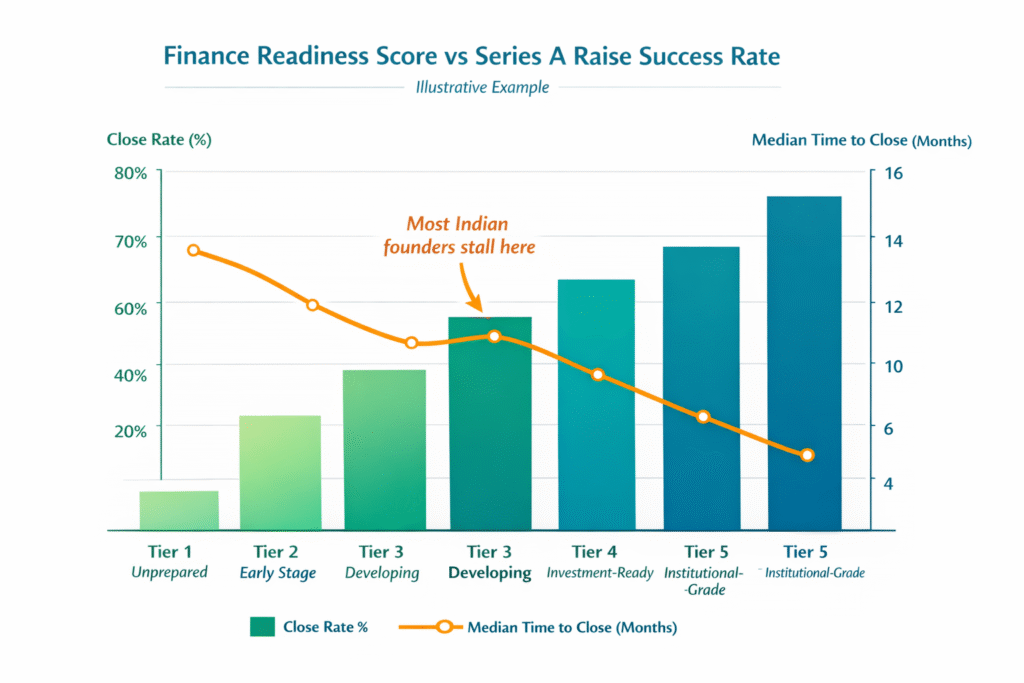
| Readiness Tier | Label | Close Rate % | Median Close (Months) | Typical Finance State |
| Tier 1 Unprepared | < 15% | 8% | N/A | No MIS, unaudited books, no metrics |
| Tier 2 Early stage | 15–30% | 22% | 14+ | Basic P&L, no cohort/unit economics |
| Tier 3 Developing | 30–50% | 44% | 10 | Metrics exist but inconsistent; gaps in DD |
| Tier 4 Investment-ready | 50–70% | 67% | 6 | Clean books, data room live, metrics board-ready |
| Tier 5 Institutional-grade | 70%+ | 81% | 4 | Audited, automated MIS, clean cap table, 24M model |
How to interpret: Most Indian growth-stage founders enter the fundraising process at Tier 2 or Tier 3. The jump from Tier 3 to Tier 4 is not about revenue it is about finance infrastructure. That gap is entirely closeable with 60–90 days of focused work. The close rate difference between Tier 3 and Tier 4 is dramatic.
The Five Things Every Series A Investor Is Actually Evaluating
Strip away the deck structure, the market size slides, and the competitive moat narrative. Every institutional investor is assessing five things:
1. Is the revenue real, recurring, and growing predictably?
‘Real’ means reconciled to audited financials not a founder’s definition of ARR that includes one-time project fees and consulting retainers. ‘Recurring’ means contractually committed, not habitual. ‘Predictable’ means you can show a cohort chart and explain why your retention is what it is. If your ARR calculation is not backed by a schedule that ties to your revenue in the accounts, it will unravel in DD.
2. Are the unit economics positive and improving?
An investor who gives you ₹20Cr is betting that your customer acquisition machine works that when you pour ₹1Cr into sales and marketing, you generate more than ₹1Cr in long-term gross profit. LTV:CAC, CAC payback, and gross margin per customer segment are the language of this conversation. If you cannot speak it fluently with supporting data, the conversation stalls.
3. Is the business efficient with capital?
Post-2022, burn multiple net cash burned divided by net new ARR added has become a primary efficiency signal. A burn multiple of 1.0 means you spent ₹1 of cash to add ₹1 of new ARR. A burn multiple of 3.0 means you spent ₹3 to add ₹1 of ARR. In the current environment, Indian VCs are cautious about businesses burning heavily relative to growth. This does not mean you cannot burn it means you need to be able to explain why, and show a credible path to improving the ratio.
4. Is the legal and compliance house clean?
In India, the legal and secretarial DD is where many rounds quietly die. Founders with informally allocated founder equity, ESOPs granted without a board-approved trust deed, IP held personally instead of in the company, incomplete ROC filings, or FEMA non-compliance from foreign-origin seed investment create problems that delay or kill deals. These are not strategic issues they are execution issues that signal carelessness. Investors interpret them as leading indicators of how the company will be run post-investment.
5. Does the finance team have institutional capacity?
A founder who is personally doing the accounting, or whose finance function consists of a part-time bookkeeper and a statutory CA, signals significant execution risk to an investor who will be on the board. The finance function needs to be able to close books monthly within 10 days, produce board-ready reports without the founder assembling them, and manage a statutory audit without a crisis. If that capability does not exist, build it or bring in a fractional CFO before you begin fundraising.
3. The Metrics That Matter And How Indian Founders Get Them Wrong
Every founder going into Series A will claim to know their metrics. The problem is not knowledge it is definition discipline and reconciliation hygiene.
The ARR Definition Problem
Annual Recurring Revenue is the most commonly cited and most commonly miscalculated metric in Indian startups. The correct definition: ARR is the annualised value of only recurring, contracted revenue not total revenue, not one-time projects, not revenue from customers whose contracts have lapsed but who are still paying month-to-month informally.
In India, this gets further complicated by the common practice of multi-year contracts with annual payment. A customer who signs a 3-year contract and pays ₹30L upfront each year contributes ₹30L to ARR not ₹90L. The annualised contracted value is what goes into ARR. Any investor who sees ARR that cannot be reconciled to the revenue schedule in the audited accounts will immediately discount the entire metrics package.
| The ARR Hygiene Test: Can you hand an investor a spreadsheet that shows every contract, its start date, end date, monthly MRR contribution, and contract status and have that roll up to match the revenue line in your P&L? If not, your ARR number is not investment-grade. |
NRR and GRR The Metrics Most Indian Founders Under-report
Net Revenue Retention measures the percentage of ARR from existing customers retained and grown at the end of a period, including expansions and upsells. Gross Revenue Retention measures the same but excluding expansion i.e., what percentage of last year’s revenue from existing customers stayed, before any upsell.
NRR above 100% is one of the single most powerful signals in a Series A pitch because it means the product is growing revenue from the existing base without new customer acquisition your installed base is compounding. Most Indian B2B SaaS founders can quote a rough NRR number, but very few have built a proper cohort analysis that shows it by vintage, by customer segment, and reconciled to actual revenue. Building this analysis is a three-to-four-week project. Do it before you start fundraising, not during DD.
The Burn Multiple Conversation You Will Have
Burn Multiple = Net Cash Burned (₹) ÷ Net New ARR Added (₹) in the same period.
A reading below 1.5x in the current market is strong. Above 2.5x requires an explanation. Above 3.0x without a near-term inflection will raise serious flags.
Indian founders often deflect this with: ‘We are investing in growth.’ That is fine but the investor needs to see a credible path to improvement. Your financial model should show burn multiple declining as you scale GTM efficiency. If it does not, the model is not believable.
Table 2: Series A Metrics Benchmarks What Indian Investors Are Looking For
Reference benchmarks as of 2025. India-specific context where materially different from global benchmarks. These are indicative ranges sector, business model, and investor thesis matter significantly.
| Metric | Minimum Threshold | Good | Excellent | Red Flag | India Note |
| ARR / Revenue Run Rate | ₹3–5Cr | ₹8–15Cr | ₹20Cr+ | <₹2Cr | Many Indian VCs set ₹5Cr as informal floor |
| YoY ARR Growth | 2x | 2.5–3x | 3x+ | <80% YoY | Growth rate matters more than absolute ARR at this stage |
| Gross Margin (SaaS / Services) | 60%+ | 70–75% | 80%+ | <50% | India SaaS often has higher employee cost base; flag proactively |
| Net Revenue Retention (NRR) | 95%+ | 105–115% | 120%+ | <90% | NRR >100% = product earns its own growth; investors love this |
| Gross Revenue Retention (GRR) | 85%+ | 90%+ | 95%+ | <80% | For SMB-focused products, 85% GRR is acceptable; enterprise should be 90%+ |
| CAC Payback Period | <24M | 12–18M | <12M | >36M | Lower is better; shows GTM efficiency |
| Burn Multiple (Net Burn ÷ Net New ARR) | <2.0x | <1.5x | <1.0x | >3.0x | Key efficiency signal post-2022; Indian VCs increasingly focus here |
| Cash Runway at Raise | 12M+ | 15–18M | 18M+ | <9M | Sub-9M signals desperation expect worse terms |
| Customer Concentration | Top 3 <40% | Top 3 <25% | Top 3 <15% | 1 customer >30% | Indian enterprise deals tend toward concentration; be prepared to explain |
| Team (Finance function) | Finance manager or fractional CFO in place | Full-time finance head, monthly close <10 days | CFO with investor reporting experience | Founder doing books themselves | Indian investors flag this in DD; a weak finance function signals execution risk |
These benchmarks reflect the 2024–25 Indian VC environment where investors have materially raised the bar on unit economics and finance function quality compared to the 2020–21 era. Raising at lower metrics is possible with extraordinary growth or a unique market narrative but it requires active explanation, not silence.
4. Where Indian Founders Lose the Room The DD Drop-off Map
Chart 2 maps the drop-off points across a typical Series A process for Indian startups. The shape of this funnel should alarm most founders and motivate the right preparation response.
Chart 2: Investor DD Drop-off Where Indian Founders Lose the Room (Illustrative Example)
| Stage | Survivors (of 100) | Drop-off | Primary Reason for Drop-off |
| Initial investor interest / intro meeting | 100 | ||
| Pitch deck review / first meeting | 62 | 38 | Weak narrative, unclear unit economics, no differentiation story |
| Metrics deep-dive (MIS / dashboard review) | 38 | 24 | Metrics inconsistent, no cohort data, ARR/MRR definition mismatch |
| Financial due diligence (data room) | 22 | 16 | Unaudited books, cap table errors, deferred revenue accounting, GST mismatches |
| Legal / compliance / secretarial DD | 16 | 6 | ESOP not formalised, ROC filings incomplete, shareholder agreements not clean |
| Term sheet issued / valuation negotiation | 10 | 4 | Valuation mismatch, founder equity too diluted, liquidation preferences conflict |
| Round closed ✓ | 6–8 | Successfully funded finance, legal, metrics, and narrative all aligned |
How to interpret: Of every 100 companies that attract enough interest to enter a formal Series A process, roughly 6–8 close a round. The biggest drop-offs are not at the ‘story’ stage they are at the metrics and financial DD stages, where preparation gaps become visible. Both of these are fixable.
The Financial DD Blockers: What Kills Deals in India
Based on the typical issues surfacing in Indian Series A financial due diligence, there are five blockers that appear most frequently:
Deferred Revenue Misclassification
For subscription and SaaS businesses, annual contracts paid upfront must be recorded as deferred revenue on the balance sheet and recognised monthly as the service is delivered. Founders who book the entire annual contract as revenue in Month 1 are overstating their revenue. When an investor’s CA runs a revenue quality analysis and finds this, it raises questions about financial controls not just accounting and typically results in downward revision of the revenue figure that anchors valuation.
GST Reconciliation Gaps
In India, every sophisticated investor’s DD process includes a GST reconciliation comparing GSTR-1 (sales filed with government), GSTR-3B (tax paid), and the revenue in the books. If these three numbers do not match a common situation where invoicing is ad hoc or invoice cancellations are not reflected it raises questions about the completeness and accuracy of revenue reporting. Resolve this before fundraising, not during.
ESOP Informality
Indian startup founders routinely promise equity informally ‘I’ll give you 0.5% when we raise Series A.’ When DD arrives, these informal commitments surface as contingent liabilities and cap table uncertainty. Every equity promise, including ESOPs, must be documented with a board-approved plan, individual grant letters at defined exercise prices, and vesting schedules. The absence of this is an immediate red flag for any institutional investor.
Cap Table Complexity Without Documentation
Convertible notes, SAFEs, and bridge rounds are common in Indian startups. What is uncommon is clean documentation of how these convert at various valuation thresholds, what their liquidation preferences are, and how they interact with the Series A terms. Investors who find themselves doing the cap table math during DD because the founders cannot produce a clean model typically lose confidence quickly.
Related Party Transactions
Founder salaries above market rate, office space leased from a family entity, or loans to founders recorded as receivables these are all related party transactions that require specific disclosure in Indian financial statements. When they appear without disclosure in the audited accounts, or when they appear disclosed but unexplained, they create friction in DD and require significant time to resolve.
5. Raise Timing: Your Single Most Underrated Lever
The decision of when to start fundraising is one of the most consequential financial decisions a founder makes. It is almost universally made too late.
Chart 3: Raise Timing vs Cash Runway The Danger Zone
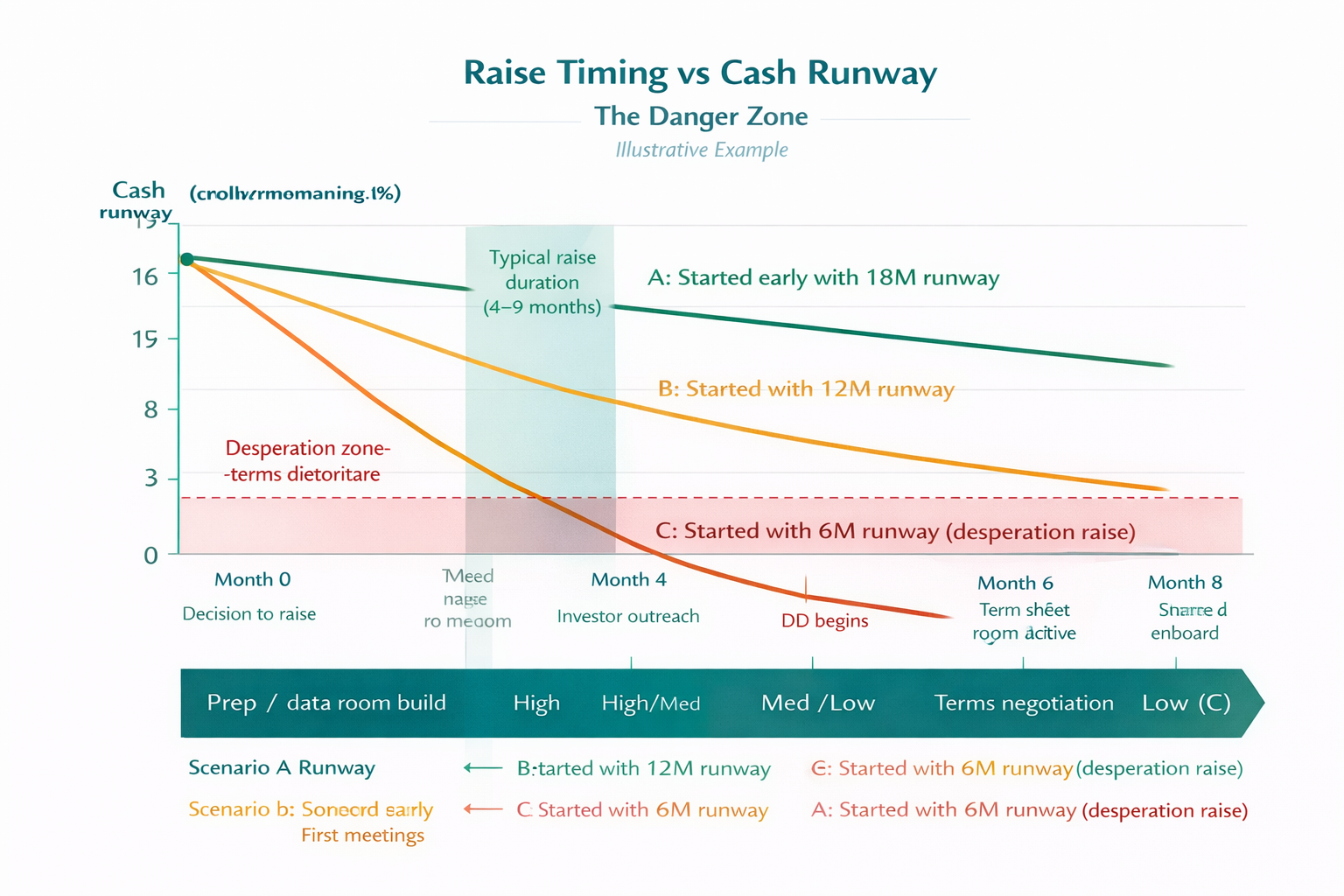
| Month from Decision | Scenario A Runway | Scenario B Runway | Scenario C Runway | Typical Raise Activity | Leverage |
| Month 0 Decision to raise | 18M | 12M | 6M | Prep / data room build | High |
| Month 2 Investor outreach | 16M | 10M | 4M | First meetings | High/Med |
| Month 4 DD begins | 14M | 8M | 2M | Data room active | Med/Low |
| Month 6 Term sheet negotiation | 12M | 6M | 0M  | Terms negotiation | Low (C) |
| Month 8 Close | 10M remaining + new capital | 4M remaining + new capital | Bridge / distress | Close and onboard | Strong (A&B) |
How to interpret: Scenario C founders have no negotiating leverage by Month 4 investors know it, and terms reflect it. The single best thing a founder can do for their Series A outcome is to start the process early. Every month of additional runway at the start of the process is leverage on your term sheet.
The Math of Negotiating Leverage
Investors know your runway. It is in the data room. When you have 6 months of cash left and you are asking for a term sheet, every investor in the room knows you have no walk-away power. The term sheet reflects that. Liquidation preferences get heavier. Anti-dilution ratchets appear. Board seat demands increase. Valuation expectations shift downward.
When you have 15 months of cash and multiple investors in parallel process, the dynamic inverts entirely. You can take a competing term sheet to another investor. You can walk away from unfavourable terms and come back 30 days later with a counter. You can be selective about which investors to prioritise. That optionality is worth real money typically several crores in valuation uplift on a ₹20–40Cr round.
| The Timing Rule: The right time to begin Series A preparation is 12 months before you need the money. The right time to begin active investor outreach is 9 months before you need the money. Most Indian founders begin 3–4 months before they need the money. This gap is where terms are lost. |
The 12-Month Fundraising Calendar for Indian Founders
Months 12–9 Before Target Close
- Complete financial readiness checklist (Table 1). Fix all Critical items.
- Build the 24-month financial model with 3 scenarios. This takes longer than you think start early.
- Commission statutory audit if not already underway. In India, audits for growth-stage companies take 6–10 weeks.
- Resolve any cap table, ESOP, or legal compliance gaps. Engage a VC-experienced law firm, not just your standing corporate counsel.
- Begin building the cohort and metrics database. This is a finance team project requiring 3–4 weeks of dedicated effort.
Months 9–6 Before Target Close
- Start building warm relationships with target investors. Attend 2–3 events per month. Get introductions through existing angels or advisors.
- Share a brief company update (not a pitch) with 8–10 target investors to begin relationship without fundraising pressure.
- Engage a CFO (full-time or fractional) if not already in place. A founder-only finance function will not survive Series A DD.
- Assemble the data room. Organise it so that any investor request can be fulfilled within 24 hours, not 5 days.
Months 6–3 Before Target Close
- Begin formal fundraising process. Run it as a structured sales process: target list, outreach, first meetings, follow-ups, DD tracking.
- Aim to have 3–5 investors in parallel DD at any point this creates the competitive dynamic that improves terms.
- Do not share projections before you have a lead investor’s serious interest. Early oversharing allows investors to wait and use your own numbers against you later.
Months 3–0 Close
- Negotiate term sheet with lead investor. Get a VC-experienced lawyer to review standard terms in India include liquidation preferences, anti-dilution provisions, information rights, and board composition. Each is negotiable.
- Complete DD in parallel. Your finance team should be able to respond to investor DD requests in 48 hours anything longer signals unpreparedness and creates doubt.
- Close, file requisite ROC and RBI (FEMA) filings post-investment. FC-GPR must be filed within 30 days of receiving foreign investment.
6. The Financial Readiness Checklist
Table 1 below is a complete pre-fundraising audit template. Use it 60–90 days before you plan to begin investor outreach. Every ‘No’ in the Critical column is a deal risk not a minor gap.
Table 1: Series A Financial & Legal Readiness Checklist
Ready-to-use self-assessment. Complete this 60 days before you plan to start investor outreach. Any ‘No’ in the Critical column is a blocker fix it before you begin.
| Readiness Item | Critical? | Status (✓ / ✗ / WIP) | Notes / Owner |
| FINANCIAL RECORDS & REPORTING | |||
| Last 2 years audited financial statements (P&L, Balance Sheet, Cash Flow) | CRITICAL | ||
| Current year management accounts (monthly MIS current month minus 30 days max lag) | CRITICAL | ||
| GST returns filed and reconciled (GSTR-1, GSTR-3B) for last 24 months. No pending notices. | CRITICAL | ||
| TDS filings current. Form 16/16A issued for all employees and vendors. | Important | ||
| Revenue recognition policy documented (especially deferred revenue for SaaS / subscription businesses) | CRITICAL | ||
| Deferred revenue correctly classified on balance sheet (not booked as revenue upfront) | CRITICAL | ||
| METRICS & UNIT ECONOMICS | |||
| ARR / MRR defined consistently and reconciled to revenue in accounts | CRITICAL | ||
| Cohort retention analysis: monthly/annual by revenue cohort (GRR and NRR) | CRITICAL | ||
| CAC calculated correctly (all S&M costs ÷ new customers in period) | CRITICAL | ||
| LTV:CAC ratio computed and documented. CAC payback period stated. | CRITICAL | ||
| Burn multiple tracked monthly (net burn ÷ net new ARR) | Important | ||
| Gross margin tracked by product/customer segment, not just blended | Important | ||
| CAP TABLE, LEGAL & COMPLIANCE | |||
| Cap table clean, current, no phantom shares or undocumented agreements | CRITICAL | ||
| ESOP pool formalised with board approval, trust deed, and grant letters issued | CRITICAL | ||
| ROC / MCA filings current (annual return, financial statements). No pending penalties. | CRITICAL | ||
| IP (software, brand, patents) formally assigned to the company not held personally by founders | CRITICAL | ||
| Existing SHA / investor agreements reviewed for pre-emption rights, consent rights, anti-dilution | CRITICAL | ||
| FEMA / RBI compliances met for any foreign investment received (FC-GPR, FC-TRS filed) | CRITICAL | ||
| FINANCIAL MODEL & DATA ROOM | |||
| 24-month operating model with 3 scenarios (base, upside, downside). Revenue buildable from unit assumptions. | CRITICAL | ||
| Use-of-funds plan mapped to hiring, GTM, product milestones not a generic pie chart | CRITICAL | ||
| Data room organised (Docsend / Google Drive with access controls). Ready to share on 24hr notice. | Important | ||
| Customer contracts / MSAs available for top 10 accounts | Important | ||
Scoring: 0 Critical items unresolved = Investment-grade. 1–2 = Significant gaps; fix before outreach. 3+ = Do not begin investor outreach you are funding your failure to prepare.
7. Four India Scenarios What Readiness Looks Like Across Business Models
Scenario A: B2B SaaS, ₹8Cr ARR, SMB-Focused, 18 Months Post-Seed
A SaaS founder with strong top-line growth 2.8x YoY but 60% of revenue from annual contracts booked upfront without deferred revenue treatment. NRR is quoted at 108% but is not backed by a cohort analysis. ESOP pool has verbal commitments to 4 senior hires but no formal grant letters. The founder is doing MIS personally in Google Sheets.
What needs to happen before fundraising: Fix deferred revenue accounting this will reduce reported ARR by approximately 15% and is better disclosed proactively than discovered in DD. Build the cohort analysis; the NRR of 108%, if real, is a powerful asset. Formalise ESOPs. Hire a fractional CFO to own the finance function and investor reporting. This business can raise at good terms but only after 60–90 days of finance clean-up.
Scenario B: D2C Brand, ₹20Cr Revenue, Profitable, No Institutional Funding
A bootstrapped consumer brand with healthy EBITDA margins (18%) and strong brand recognition in 2 categories. Has never raised institutional capital. Books are clean audited annually by a Big 4 firm but the company has never tracked LTV:CAC, does not have a formal financial model, and the founding team has no investor relations experience.
What needs to happen: This business has excellent fundamentals but is presenting in a language investors do not read natively. Build the LTV:CAC framework (D2C version: contribution margin per order × repeat purchase frequency ÷ blended CAC). Develop a financial model that shows the reinvestment case how ₹15Cr of capital converts to revenue growth over 24 months. Engage an advisor with D2C fundraising experience in India. The finance function is not the bottleneck here the narrative construction and investor targeting are.
Scenario C: SaaS with International Revenue (US/SEA), ₹12Cr ARR
A founder with 40% of ARR from international customers billed in USD. The business has multiple legal entities an Indian operating company and a Singapore holdco set up informally without proper share transfer documentation. FEMA compliance is unclear. The cap table has a convertible note from a US angel that has never been properly registered with the RBI.
What needs to happen: This is a structural cleanup situation before fundraising not a metrics or narrative problem. Engage a VC-experienced law firm with cross-border expertise immediately. The entity structure, FEMA compliance, and convertible note registration must be resolved first. This will take 60–90 days and is non-negotiable for institutional investors who will flag it in DD. The business metrics are strong; the legal gaps are the only barrier.
Scenario D: Manufacturing / Hardware SaaS, ₹6Cr ARR, High CAPEX
A hardware-plus-software business where the software (₹3Cr ARR) is high-margin but the hardware installation component (₹3Cr revenue) is low-margin and capital-intensive. Investors see blended gross margins of 38% and price it as a hardware company below SaaS multiples. The founder insists it is a SaaS business.
What needs to happen: Disaggregate the P&L before the investor conversation present software ARR and hardware revenue separately with distinct margin profiles. The software segment at 72% gross margin qualifies for SaaS multiples; the hardware segment should be presented as a distribution mechanism that drives software attach rate, not as a revenue stream to be valued independently. This is a financial reporting and narrative design problem and a CFO who has seen hardware-SaaS fundraising in India is the right resource to structure it.
8. How Treelife Gets You to the Room And Keeps You There
Most founders approaching Series A need three things simultaneously: clean financials that survive institutional DD, a metrics framework that tells a coherent story, and a finance function that can operate at board-company pace. Treelife delivers all three not as a one-time project, but as an embedded partner through the fundraising process and beyond.
The Treelife Series A Readiness Programme
| Phase | Timeline | Deliverables | Success Metric |
| 1. Readiness Audit | Week 1–2 | Complete financial and legal readiness assessment against Table 1 checklist. Metrics audit ARR reconciliation, cohort analysis gaps, deferred revenue review. DD risk register with prioritised remediation plan. | Readiness score delivered. All Critical gaps identified with owner and timeline. |
| 2. Finance Clean-up | Weeks 3–8 | Fix accounting gaps (deferred revenue, related party disclosures, GST reconciliation). ESOP formalisation support. MIS build monthly close process, board reporting template. Cap table verification and documentation. | Auditor sign-off on accounts. MIS live and monthly close within 10 days. Zero Critical gaps on readiness checklist. |
| 3. Investor Package | Weeks 6–10 | 24-month financial model (3 scenarios, revenue buildable from unit assumptions). Metrics dashboard with ARR schedule, cohort analysis, LTV:CAC, NRR, burn multiple. Data room organisation and population. Valuation benchmarking. | Data room ready. Financial model investor-reviewed. Metrics reconciled to audited accounts. |
| 4. DD Support | Active raise period | Dedicated point of contact for investor DD queries. 48-hour response SLA on all DD requests. Ongoing MIS and metrics updates during raise. Term sheet financial modelling (dilution, cap table post-round scenarios). | DD queries closed within 48hr. No investor drops out citing financial information quality. |
| 5. Post-Round CFO Support | Ongoing | Monthly board reporting. Investor update templates. Use-of-funds tracking. Runway monitoring. MIS enhancement as scale demands. Statutory compliance (ROC, FEMA post-funding filings). | Board reporting live within 10 days of month-end. Investor confidence in finance function. |
Key Takeaways for Founders
Your metrics are only as credible as their reconciliation to your audited accounts. An ARR number that lives in a founder’s spreadsheet and cannot be tied to the revenue line in your P&L will unravel in DD. Build the ARR schedule first; everything else follows from it.
The biggest drop-offs in a Series A process happen at the metrics and financial DD stage not the pitch stage. Most founders over-invest in deck design and under-invest in data room readiness. Flip that ratio by at least 60 days before you start outreach.
Your burn multiple is now a primary signal, not a secondary one. Post-2022, Indian VCs are scrutinising capital efficiency with a rigour that did not exist in the 2020–21 era. A burn multiple above 2.5x without a credible path to improvement will slow or kill conversations regardless of growth rate.
Legal and compliance gaps are not paperwork problems, they are confidence problems. An investor who finds undocumented ESOPs, incomplete ROC filings, or FEMA non-compliance in DD does not see an administrative oversight. They see a founding team that does not run a tight ship. Fix these before outreach, not during.
Every month of additional runway at the start of your raise is negotiating leverage on your term sheet. Founders who start raising with 6 months of cash have no walk-away power. Founders who start with 15–18 months do. That difference shows up directly in valuation, liquidation preferences, and board composition not as a minor rounding issue but as a material difference in what you give up.
The jump from ‘not ready’ to ‘investment-grade’ is a 60–90 day project, not a 12-month transformation. The gap is almost always finance infrastructure and legal hygiene not revenue, not product, not market size. Those can be fixed with focused effort and the right team. Start that work now, before you need the capital.
]]>The 5 Core Risk Categories Every Founder Must Actively Manage
Every growth-stage company consistently faces five recurring risk domains:
- Strategic Risk
Misaligned goals, failed pivots, pricing errors, or incorrect market assumptions. Poor strategic risk management leads to revenue collapse and capital inefficiency. - Operational Risk
Process breakdowns, supplier disruption, talent turnover, or system failures. Startups with single vendor dependencies or undocumented SOPs face disproportionate exposure. - Financial Risk
Cash flow volatility, receivable delays, interest rate spikes, FX exposure, and asset price fluctuations. Research across startup case studies shows that cash exhaustion often results from receivable delays rather than burn rate alone. - Regulatory and Legal Risk
Missed statutory filings, tax non-compliance, labor violations, poorly drafted contracts, and unresolved founder disputes. Penalties, prosecution risk, and due diligence failures directly impact valuation. - Reputational and Cyber Risk
Data breaches, social media allegations, customer complaints, and vendor security failures. Most breaches stem from basic control failures such as lack of multi factor authentication.
Strong risk hygiene increases fundraising success. During due diligence, investors routinely flag issues such as undocumented IP ownership, pending litigation, tax non compliance, weak internal controls, and data protection gaps. Companies with structured compliance calendars, defined governance, clear contracts, and financial oversight close deals faster and negotiate stronger terms.
Organizations with formal risk systems consistently:
- Detect issues early through monitoring and reporting
- Reduce litigation exposure through documented controls
- Preserve cash runway with disciplined forecasting and receivables management
- Accelerate fundraising with clean governance and compliance records
Risk management is not overhead. It is growth infrastructure. Companies that engineer resilience protect valuation, maintain operational stability, and scale with confidence.
Why Risk Management Is Now a Strategic Growth Lever Not Compliance Paperwork
Risk management has shifted from regulatory formality to strategic infrastructure. Growth stage startups operate in a volatile environment shaped by regulatory expansion, funding cycles, cyber threats, vendor concentration, and increasing investor scrutiny. Companies that treat risk as paperwork react to crises. Companies that treat risk as architecture scale with stability.
Investors evaluate governance, compliance hygiene, contractual protections, and cybersecurity maturity during due diligence. Weak controls result in valuation discounts, escrow demands, or delayed closings. Strong systems signal lower execution risk and higher governance maturity.
Risk management today directly influences:
- Capital access
- Operational continuity
- Cash runway protection
- Founder control
- Exit readiness
The cost of prevention is consistently lower than the cost of remediation.
The Modern Founder Risk Landscape
Founders consistently face five recurring risk categories. These risks are interconnected and compound when ignored.
Core Startup Risk Categories
| Risk Type | Description | Real World Impact | Core Mitigation |
| Strategic Risk | Market pivots, pricing errors, misaligned goals | Revenue collapse, failed product direction | OKRs, quarterly scenario modeling |
| Operational Risk | Process failures, key employee loss, vendor disruption | Delivery breakdown, client churn | Documented SOPs, supplier redundancy |
| Financial Risk | Cash volatility, delayed receivables, interest and FX exposure | Runway exhaustion, funding distress | Maintain 3 to 6 month cash reserves, disciplined forecasting |
| Compliance and Legal Risk | Missed statutory filings, tax non compliance, lawsuits | Penalties, prosecution, due diligence red flags | Compliance calendar, documented governance, registered agent |
| Reputational Risk | Data breach, unresolved complaints, public allegations | Customer loss, investor distrust | Structured complaint handling, rapid response protocols |
Why These Risks Are Increasing
Recent regulatory developments such as expanded data protection requirements and stricter labor compliance enforcement increase exposure for scaling companies. At the same time:
- Cyber incidents often stem from basic control gaps such as lack of multi factor authentication
- Vendor concentration creates single point failure risk
- Cash flow strain frequently results from receivable delays rather than burn rate alone
- Founder disputes and unclear vesting terms trigger governance instability
Startups that lack structured risk systems face amplified impact when disruptions occur.
The Founder’s Risk Operating System FROS: A Continuous Risk Framework
High growth startups cannot rely on informal judgment to manage risk. They require a structured, repeatable system that operates continuously across departments. The Founder’s Risk Operating System FROS converts risk management from reactive firefighting into an operational discipline embedded in daily execution.
FROS aligns legal, financial, operational, and cybersecurity controls into one unified framework. It ensures risks are prevented where possible, detected early when they arise, escalated with clarity, and resolved without destabilizing the business.
This system is particularly critical in growth stage companies where:
- Cash runway sensitivity increases
- Vendor and customer concentration risk rises
- Regulatory obligations expand
- Investor due diligence scrutiny intensifies
The 4 Stage Risk Lifecycle
Every startup risk can be managed through four structured stages.
| Stage | Objective | Implementation Examples |
| Prevent | Reduce incident likelihood | Well drafted contracts, compliance calendar, multi factor authentication |
| Detect | Surface early signals | Weekly financial reconciliations, receivables aging review, centralized security logging |
| Respond | Structured escalation | Legal notice protocol, defined incident response team, internal investigation procedures |
| Recover | Restore operations | Automated backups, insurance coverage, documented business continuity plans |
Prevent
Prevention focuses on reducing exposure before damage occurs. Examples include:
- Limitation of liability clauses in contracts
- Compliance tracking for statutory filings
- Dual approval thresholds for payments
- Role based system access
Preventive controls reduce legal exposure, fraud risk, and regulatory penalties.
Detect
Detection systems surface anomalies early when resolution costs are lower.
- Cash flow forecasting prevents runway surprises
- Receivables aging analysis identifies payment delays
- Security alerts detect unauthorized access
- Complaint tracking reveals reputational risk patterns
Early detection materially reduces impact severity.
Respond
Response mechanisms prevent escalation.
- Legal notice acknowledgment protocols
- Defined authority thresholds for dispute settlement
- Incident escalation paths
- Document preservation procedures
Clear response structures reduce litigation exposure and operational confusion.
Recover
Recovery capability determines resilience.
- Offsite automated backups
- Tested recovery time objectives
- Insurance alignment with risk profile
- Continuity documentation
Companies that rehearse recovery avoid prolonged operational shutdowns.
4 Step Implementation Model
FROS is operationalized through a structured four step model.
1. Map Exposure
Identify vulnerabilities across:
- People including founders and key employees
- Systems including financial tools and cloud infrastructure
- Vendors including single supplier dependencies
- Legal obligations including compliance filings
Mapping converts abstract risk into visible exposure points.
2. Quantify Likelihood and Impact
Score each risk based on:
- Probability of occurrence
- Financial impact
- Operational disruption
- Reputational damage
Prioritize high likelihood and high impact risks for immediate mitigation.
3. Assign Risk Owners
Every material risk must have a designated owner.
- CFO for financial and compliance risk
- CTO for cybersecurity and vendor systems
- CEO or Board for governance and founder disputes
- HR for employment and POSH compliance
Unassigned risk becomes unmanaged risk.
4. Automate Monitoring Signals
Risk systems must be visible and continuously monitored.
- Dashboard tracking for compliance deadlines
- Real time financial forecasting tools
- Centralized log monitoring
- Project management tools such as Notion or ClickUp for risk registers
Automation reduces dependence on memory and manual oversight.
Regulatory and Legal Risk Management for Startups
Regulatory non compliance is one of the fastest ways to destroy valuation and trigger penalties. Most violations occur due to lack of structured oversight, not intent. In India, startups must manage company law, taxation, labor compliance, and data protection simultaneously. Proactive compliance is significantly less expensive than retrospective remediation during inspection or investor due diligence.
Company Law Compliance Checklist
Private limited companies must maintain statutory discipline throughout the financial year. Core requirements include:
- Annual returns filed within prescribed timelines
- Board resolutions documented for material decisions
- Statutory registers properly maintained including members, directors, and charges
- Related party transactions approved as per regulatory requirements
- Share issuances and transfers formally documented
Failure in these areas creates governance red flags during fundraising.
Common founder failure is reactive compliance after receiving notices from authorities. By that stage, penalties, interest, and reputational damage may already be triggered.
Tax and GST Risk Exposure
Tax compliance extends beyond income tax filings. Growth stage startups face layered exposure across TDS, GST, transfer pricing, and advance tax.
Major risks include:
- TDS non deduction on contractor payments, professional fees, and rent
- GST threshold misjudgment leading to delayed registration
- Transfer pricing documentation gaps in related party or cross border transactions
- Advance tax underpayment penalties and interest accumulation
- Improper invoicing and accounting inconsistencies
These risks often surface during assessment proceedings or investor diligence.
Mitigation system:
- Automated TDS deduction and deposit workflows
- Quarterly tax advisory review instead of year end scrambling
- Strict GST reconciliation discipline to prevent input credit mismatch
Early tax governance reduces financial leakage and regulatory friction.
Labor and Employment Compliance 10 to 20 Employee Threshold Risk Zone
As startups scale beyond 10 employees, regulatory exposure increases significantly. Many founders underestimate labor law obligations until inspection notices arrive.
Core compliance areas include:
- Provident Fund and ESI registration when thresholds are met
- Shops and Establishment registration and display compliance
- Professional tax registration and deduction in applicable states
- Maintenance of attendance records and wage registers
- Written employment contracts clearly defining terms and termination conditions
Lack of documentation exposes companies to wrongful termination claims, back payments, and penalties.
DPDP Act 2023 Digital Personal Data Protection Readiness
The Digital Personal Data Protection Act introduces formal obligations for businesses processing personal data of Indian residents. Even before full enforcement, startups must prepare foundational systems.
Mandatory preparation includes:
- Data mapping exercise to identify what personal data is collected and for what purpose
- Clear consent mechanisms aligned with data usage
- Vendor agreements containing data protection clauses
- Designation of internal responsibility for breach response
- Data deletion workflows for access, correction, and erasure requests
Early readiness reduces regulatory exposure and strengthens investor confidence.
POSH Compliance 10 Plus Employees
Companies with 10 or more employees must comply with Prevention of Sexual Harassment requirements.
Mandatory components include:
- Constitution of an Internal Complaints Committee with an external member
- Written anti harassment policy circulated to employees
- Annual reporting to district authorities
- Regular awareness and training sessions
Non compliance exposes founders to legal liability and reputational risk. Implementation before crossing the employee threshold prevents enforcement challenges.
Contract Risk Management Preventing Disputes Before They Happen
Most commercial disputes originate from poorly drafted contracts rather than bad intent. For startups, ambiguous agreements create cash flow strain, legal exposure, and investor red flags. Contract risk management is not legal formality. It is revenue protection.
Well structured contracts reduce litigation probability, clarify expectations, and strengthen negotiation leverage during disputes.
Master Service Agreements MSAs
The Master Service Agreement governs long term client or vendor relationships. Weak MSAs are a primary cause of scope disputes and payment delays.
Critical clauses every startup must include:
- Clear scope definition to prevent scope creep and undocumented deliverables
- Measurable service level agreements such as uptime percentages or response time thresholds
- Defined change management process for scope and pricing adjustments
- Objective acceptance criteria to determine when deliverables are complete
- Escalation path specifying operational and executive level resolution steps
Ambiguous scope definitions account for a significant portion of commercial disagreements in growth stage companies. Investing time in clarity at signing prevents costly conflict during execution.
Liability and Indemnity Controls
Liability provisions determine financial exposure when things go wrong. Founders frequently accept template clauses without assessing downside risk.
| Clause | Founder Risk if Ignored |
| No liability cap | Unlimited financial exposure beyond contract value |
| No consequential damages exclusion | Exposure to loss of profit and business interruption claims |
| One sided indemnity | Asymmetric financial risk without reciprocal protection |
Market standard in many service contracts is a liability cap equal to 12 months of fees. Without caps, even a single dispute can exceed annual revenue.
Indemnity provisions must be carefully reviewed. Startups should seek mutual indemnities for intellectual property infringement and avoid open ended obligations disconnected from insurance coverage.
Payment Risk Controls
Payment disputes are a leading cause of startup cash flow strain. Structured billing terms reduce working capital pressure.
Key protective mechanisms include:
- Milestone billing tied to objective deliverables
- Advance payments or deposits for new or unfamiliar clients
- 18 percent annual late payment interest clause, common in Indian contracts
- Right to suspend services for non payment after defined notice period
- Parent company guarantees or bank guarantees for high value engagements
Cash flow discipline in contracts supports runway protection and reduces receivable aging risk.
Intellectual Property and Confidentiality Protection
Intellectual property allocation is critical for long term value creation and fundraising readiness.
Founders must ensure:
- Clear distinction between client owned deliverables and company retained background IP
- License rights allowing reuse of tools, methodologies, or reusable components
- Mutual confidentiality obligations with defined exceptions
- Non solicitation clauses preventing client poaching of key employees
- Survival clauses ensuring IP, confidentiality, and limitation provisions remain effective post termination
Overly broad IP transfer provisions can prevent startups from leveraging core assets across multiple clients, directly affecting scalability and valuation.
Financial Risk Management and Cash Flow Protection
Financial risk is the most immediate threat to startup survival. Revenue growth does not guarantee stability. Poor cash discipline, uncollected receivables, or unmanaged exposure to market variables can exhaust runway even in otherwise profitable businesses.
Effective financial risk management focuses on liquidity protection, disciplined forecasting, internal controls, and visibility over contingent exposure.
7 Core Financial Risk Factors
Every founder must actively monitor the following financial risk categories:
- Credit Risk
Customers refusing or delaying payment of invoices, directly affecting working capital. - Supplier Price Shocks
Sudden increases in raw material or vendor costs reducing margins. - Demand Decline
Market shifts or customer churn impacting predictable revenue streams. - Foreign Exchange Risk
Currency fluctuations affecting cross border revenue or foreign denominated debt. - Interest Rate Spikes
Increased borrowing costs on working capital loans or credit lines. - Asset Collateral Depreciation
Decline in pledged asset value leading to reduced credit limits. - Economic Slowdown
Broader market contraction reducing customer spending and contract renewals.
Not all risks apply equally to every startup, but awareness and prioritization are essential. Financial fragility often results from ignoring one or more of these exposures.
Cash Runway Discipline
Liquidity protection is non negotiable. Startups must treat runway management as a weekly exercise, not a quarterly review.
Core disciplines include:
- Maintain a minimum of 3 to 6 months operating reserve
- Conduct weekly cash flow forecasting covering receivables and payables
- Review receivables aging reports to identify overdue accounts
- Initiate payment follow ups before invoices become materially overdue
Startups fail more frequently from receivable delays than from burn rate alone. Even profitable companies can collapse when collections slow and obligations continue.
Structured invoicing, disciplined collection processes, and diversified client concentration reduce runway volatility.
Fraud and Internal Controls
Internal financial leakages often occur in expense reimbursement, vendor payments, and authorization gaps. Even early stage companies must implement basic safeguards.
Essential controls include:
- Dual approvals for payments above ₹50,000 to ₹1,00,000 thresholds
- Independent bank reconciliation separate from payment execution authority
- Vendor master controls preventing unauthorized vendor creation
- Periodic surprise audits of petty cash, expense claims, and inventory
Trust without oversight increases fraud risk. Defined approval hierarchies reduce exposure while maintaining operational efficiency.
Contingent Liability Tracking
Financial exposure is not limited to cash balances. Off balance sheet obligations affect valuation and investor confidence.
Founders must maintain visibility over:
- Indemnity register tracking contractual financial exposure
- Quarterly litigation exposure review assessing potential settlement impact
- Directors and Officers insurance audit aligned with governance risk
- Transparent investor disclosure of pending claims or disputes
Undisclosed contingent liabilities discovered during due diligence frequently lead to valuation reductions or transaction delays.
Founder and Governance Risk
Internal disputes and governance gaps can destabilize a startup faster than market competition. Founder misalignment, unclear equity structures, and poorly administered employee stock plans often surface during growth or fundraising, when stakes are highest.
Strong governance reduces conflict probability, protects valuation, and strengthens investor confidence.
Founders’ Agreement Essentials
A written founders’ agreement is foundational risk protection. Verbal understandings frequently lead to disputes over equity, roles, and exit rights.
Essential components include:
- Vesting schedules to align long term commitment with equity ownership
- Deadlock resolution mechanisms such as mediation, arbitration, or predefined decision authority
- Exit clauses defining treatment of voluntary departures versus termination for cause
- Buy sell mechanisms establishing clear valuation and transfer procedures
- Non compete and non solicitation protection safeguarding company interests
Early documentation prevents expensive disputes and preserves governance stability during scaling or fundraising.
ESOP Administration Risk
Employee Stock Option Plans are powerful retention tools but introduce legal and administrative complexity. Poorly structured ESOPs create dissatisfaction and potential claims.
Common failures include:
- Unclear vesting schedules or exercise timelines
- Poor communication leading to unrealistic expectations about valuation
- Tax misalignment affecting employee liabilities
- Confusion over exercise rights upon termination or exit
Solution:
- Professionally drafted ESOP schemes with clear eligibility and vesting terms
- Detailed grant letters specifying exercise price, vesting period, and termination treatment
- Annual audit of ESOP ledger to track vesting, exercises, and compliance
Transparent communication and disciplined documentation reduce disputes and improve retention outcomes.
Key Person Dependency Risk
Early stage startups often depend heavily on founders or a small number of critical employees. Over reliance on a single individual for sales, technical architecture, or client relationships creates continuity risk.
Mitigation strategies include:
- Cross training team members on critical systems and accounts
- Process documentation to preserve institutional knowledge
- Succession planning for leadership roles
- Key person insurance to offset financial impact of sudden loss
Reducing single point dependency strengthens operational resilience and reassures investors evaluating execution risk.
Vendor and Operational Risk
Operational continuity depends heavily on third party vendors, infrastructure providers, and outsourced partners. Over concentration or weak contractual safeguards can trigger delivery failures, revenue loss, and reputational damage.
Single Vendor Dependency Concentration Risk
Relying on a single vendor for critical services such as cloud hosting, payment processing, or core inputs creates systemic vulnerability.
Mitigation strategies include:
- Multi vendor architecture for mission critical systems
- Alternative suppliers to ensure no single vendor accounts for more than 30 percent of production or operational dependency
- Service level agreements with enforceable penalties
Vendor concentration risk becomes acute during outages, price renegotiations, or vendor financial distress. Diversification reduces operational fragility.
SLA Enforcement Table
Service level agreements must be measurable and enforceable.
| SLA Metric | Why It Matters |
| Uptime percentage | Prevent service disruption and customer churn |
| Response time | Protect delivery timelines and client satisfaction |
| Service credits | Create financial accountability for performance failure |
SLAs without penalties are ineffective. Structured service credits and escalation rights provide leverage during sustained underperformance.
Offshore and Outsourcing Risk
Outsourcing introduces additional layers of operational and legal exposure.
Primary risks include:
- Intellectual property theft or ownership disputes
- Confidentiality breaches involving customer or proprietary data
- Knowledge centralization within vendor teams
Mitigation requires:
- Strong IP assignment clauses covering vendor employees
- Internal technical oversight to prevent total dependency
- Gradual knowledge distribution to maintain in house capability
Outsourcing should reduce cost, not transfer strategic control.
Cybersecurity Risk Management for Startups
Cyber incidents frequently stem from basic control failures rather than sophisticated attacks. Foundational controls significantly reduce exposure.
Access Control Foundations
Unauthorized access remains a leading cause of data breaches. Core controls include:
- Mandatory multi factor authentication on all critical systems
- Role based access limiting employees to necessary data
- Immediate termination offboarding procedures
- Centralized identity management to prevent credential sprawl
Access governance must be proactive, not reactive after compromise.
Backup Strategy
Ransomware and accidental deletions can halt operations. Effective backup architecture includes:
- Daily automated backups of code, databases, and financial records
- Offsite cloud storage separate from primary infrastructure
- Quarterly recovery testing to validate restoration capability
- Immutable backup systems that cannot be altered by ransomware
Backups are only effective if recovery is tested under controlled conditions.
Incident Response Plan Structure
Preparedness determines damage severity.
A structured incident response plan should include:
- Detection protocol identifying abnormal activity
- Containment steps to isolate affected systems
- Legal and regulatory response procedures
- Customer communication strategy
- Post incident audit identifying root cause and control improvements
Tabletop simulations help identify response gaps before live incidents occur.
Security Logging and Monitoring
Early detection reduces impact.
Essential monitoring practices include:
- Authentication anomaly alerts for unusual login patterns
- Regular API key rotation and access logging
- Quarterly vendor access audits removing unused integrations
Forgotten integrations and unmanaged credentials are common breach vectors.
Reputation Risk and Crisis Management
Reputation damage spreads rapidly through digital channels. Structured response systems reduce escalation.
Complaint Escalation Framework
Customer complaints must be systematically managed to prevent public disputes.
Core components include:
- Centralized complaint tracking system
- Root cause analysis for recurring issues
- Transparent communication during investigation
- Closure confirmation ensuring resolution satisfaction
Most escalations occur when customers feel ignored rather than unheard.
Social Media Crisis Playbook
Public allegations require timely and measured response.
Best practices include:
- Acknowledge serious concerns within 24 hours
- Avoid defensive or inflammatory tone
- Publish holding statements while investigating
- Investigate facts before debating publicly
Silence often amplifies suspicion. Structured engagement reduces reputational damage and preserves stakeholder trust.
Risk Register Template Operational Implementation
A risk register transforms abstract awareness into structured accountability. It is a living document that identifies material risks, assigns ownership, and tracks mitigation progress. Companies that review risk registers quarterly detect vulnerabilities early and reduce escalation costs.
Sample Risk Register Table
| Risk | Likelihood | Impact | Current Controls | Owner | Review |
| Cloud dependency | Medium | High | Multi region deployment | CTO | Quarterly |
| Key sales exit | Low | High | Equity vesting | CEO | Quarterly |
| DPDP compliance gap | Medium | Medium | Privacy policy framework | Legal | Quarterly |
Key components every risk register must include:
- Specific risk description rather than vague categories
- Likelihood assessment based on operational context
- Impact assessment covering financial and reputational damage
- Current controls already implemented
- Named owner accountable for monitoring
- Defined review frequency
Risk registers should be updated whenever business models, regulations, funding stages, or vendor relationships change.
Dispute Readiness and Legal Notice Protocol
Disputes are inevitable in scaling businesses. Preparedness determines outcome quality and cost.
Legal Notice Response Framework
Receiving a legal notice requires structured action. Ad hoc responses often weaken legal position.
Core steps include:
- Immediate acknowledgment to avoid claims of evasion
- Document preservation directive to relevant employees
- Engagement of legal counsel before substantive response
- Timeline tracking of statutory deadlines and limitation periods
- Internal investigation to establish factual chronology
Responding without counsel risks admissions that may be used in formal proceedings.
Settlement vs Litigation Decision Matrix
Not every dispute should escalate to court. Structured evaluation prevents emotional decision making.
| Factor | Litigation | Settlement |
| Timeline | Years | Months |
| Cost | High legal fees and management time | Controlled and predictable |
| Confidentiality | Public proceedings | Private resolution |
| Distraction | Severe executive bandwidth drain | Limited operational disruption |
For claims below significant financial thresholds, prolonged litigation frequently costs more than settlement.
Fundraising Risk Hygiene and Valuation Protection
Investors price risk into valuation. Poor governance hygiene surfaces during due diligence and directly impacts deal terms.
Common Deal Killers in Due Diligence
Frequent red flags include:
- Undisclosed or pending litigation
- Intellectual property ownership gaps
- ESOP irregularities or unclear vesting
- Tax non compliance or outstanding notices
- Poor cap table hygiene and undocumented share transfers
- Data protection readiness gaps
Hidden risks discovered late often result in valuation discounts, escrow requirements, or deal termination.
6 Month Pre Fundraising Cleanup Checklist
Proactive preparation accelerates closing timelines and strengthens negotiation position.
Founders should ensure:
- Updated and reconciled cap table
- Board resolutions complete and properly documented
- Signed employment agreements and confidentiality clauses in place
- Intellectual property assignments confirmed from employees and contractors
- Tax filings current with no unresolved statutory gaps
- Comprehensive compliance audit completed
Pre transaction cleanup reduces last minute remediation under investor pressure and signals governance maturity.
Diversification Strategy Across Risk Categories
Concentration risk is one of the most underestimated threats in early stage companies. Over reliance on a single client, vendor, channel, or individual creates structural fragility. When that single dependency fails, revenue and operations are immediately exposed.
Founders should systematically avoid concentration in the following areas:
- Clients
Avoid having a majority of revenue tied to one or two large customers. Client concentration increases vulnerability to contract termination or delayed payments. - Vendors
Do not rely on a single provider for critical infrastructure such as cloud hosting or payment processing. - Revenue Channels
Diversify revenue streams to reduce exposure to market specific shocks. - Marketing Platforms
Exclusive reliance on a single channel such as search algorithms can lead to sudden traffic and revenue loss if ranking dynamics change. - Geography
Geographic concentration exposes companies to political, regulatory, or economic instability. - Talent
Over reliance on a small core team without cross training increases operational disruption risk.
Diversification reduces volatility and enhances resilience across financial, operational, and strategic dimensions.
Contingency Planning for Founders Business and Personal Wealth
For many entrepreneurs, business wealth and personal wealth are deeply intertwined. Effective contingency planning protects both.
Three Layer Contingency Model
| Layer | Coverage |
| Operational | Liquidity buffers to sustain operations during disruption |
| Financial | Access to credit lines and alternate funding sources |
| Governance | Succession planning and defined decision authority |
Operational contingency includes maintaining adequate cash reserves and alternative suppliers. Financial contingency includes accessible savings and credit facilities. Governance contingency ensures business continuity if a founder becomes unavailable.
Structured contingency planning shifts companies from reactive panic to controlled response.
Common Founder Mistakes in Risk Management
Recurring founder errors increase exposure unnecessarily.
| Mistake | Consequence | Correct Approach |
| Verbal founder agreements | Equity disputes and governance deadlock | Written founders agreement with vesting |
| No multi factor authentication | Data breach and system compromise | Mandatory MFA across critical systems |
| Ignoring compliance until notice | Penalties and retrospective remediation | Structured compliance calendar |
| One vendor dependency | Operational shutdown during outage | Vendor redundancy and diversification |
Most crises are not unforeseeable. They are unmanaged.
Final Takeaway Risk Is Architecture Not Defense
Risk maturity evolves with company maturity. Early stage startups can operate with simple controls, but growth stage companies require structured governance and monitoring.
Key principles:
- Investors price risk into valuation decisions
- Strong risk systems accelerate deal velocity
- Preventive controls cost less than litigation or crisis recovery
- Documented governance increases investor confidence
- Resilience creates competitive advantage
Risk management is not defensive bureaucracy. It is operational architecture that preserves valuation, protects continuity, and enables sustainable scale.
]]>Empowering India’s Private Sector Growth
The Government of India has built one of the world’s most comprehensive support ecosystems for private limited companies, offering targeted financial assistance, innovation grants, tax incentives, and export-linked subsidies. These government schemes for private limited companies are not only designed to fuel entrepreneurship but also to position India as a global hub for manufacturing, technology, and innovation.
As of 2025, India has:
- 1.4 million active private limited companies registered with the Ministry of Corporate Affairs (MCA).
- 63+ million MSMEs contribute over 30% to India’s GDP and nearly 48% to exports (MSME Annual Report 2024).
- 125,000+ DPIIT-recognized startups under the Startup India initiative, generating 12 lakh+ jobs nationwide.
These numbers underline how government schemes for businesses in India are the backbone of sustainable growth and formalization across industries.
How the Government Supports Private Limited Companies
1. Financial Assistance and Credit Access
Private limited companies benefit from low-cost financing and collateral-free loans under schemes such as:
- Pradhan Mantri Mudra Yojana (PMMY) – loans up to ₹20 lakh for MSMEs.
- Credit Guarantee Fund Trust for Micro & Small Enterprises (CGTMSE) – up to 85% guarantee cover for eligible loans.
- Stand-Up India Scheme – loans between ₹10 lakh–₹1 crore for women and SC/ST founders.
- Self-Reliant India (SRI) Fund – ₹10,000 crore fund-of-funds to support MSME equity expansion.
Over ₹25 lakh crore in credit has been disbursed to Indian enterprises through government-backed programs since 2015.
2. Innovation, R&D and Startup Support
Schemes like Startup India, Atal Innovation Mission (AIM), and Multiplier Grants Scheme (MGS) drive R&D and innovation, offering:
- Seed grants up to ₹50 lakh.
- R&D matching grants up to ₹2 crore.
- Tax holidays for three consecutive years under Section 80-IAC.
- Faster IP registration and patent fee rebates up to 80%.
These govt. schemes for pvt ltd companies foster innovation across fintech, biotech, AI, and electronics sectors.
3. Tax Incentives and Infrastructure
- Production Linked Incentive (PLI) Scheme offers 4–6% incentive on incremental sales to boost manufacturing.
- Software Technology Parks (STP) and Special Economic Zones (SEZs) provide income tax exemptions and customs duty waivers for export-oriented units.
- Make in India and Digital India enhance digital infrastructure and ease of doing business, propelling India’s private limited ecosystem to global competitiveness.
4. Market Access and Global Expansion
The government promotes exports and market linkages via:
- Procurement and Marketing Support (PMS) Scheme for MSMEs.
- International Cooperation (IC) Scheme for overseas trade exposure.
- myScheme and JanSamarth portals unified digital platforms connecting businesses with 2,000+ verified central and state-level government schemes.
Sectors Benefiting from Government Schemes
| Sector | Key Supporting Schemes | Focus Areas |
| Manufacturing & MSME | PMEGP, PLI, MSME Champions | Capacity building, tech upgradation |
| Fintech & Startups | Startup India, CGSS, AIM | Innovation funding, regulatory ease |
| Agri-Tech & Food Processing | PM-FME, NABARD, DIDF | Infrastructure & processing support |
| Information Technology (IT) | STP Scheme, TIDE | Software exports, tech incubation |
| Export-oriented Units | SEZ, IC, PMS | Market access, global trade facilitation |
Key Statistics: Growth Enabled by Government Schemes
| Scheme / Initiative | Key Impact (as of 2025) | Source / Governing Body |
| Udyam Registration (MSME) | 12+ crore MSMEs registered, collectively employing over 110 million people | Ministry of MSME (Annual Report 2024) |
| Pradhan Mantri Mudra Yojana (PMMY) | ₹25 lakh crore+ sanctioned; 40% of beneficiaries are women entrepreneurs | Ministry of Finance & MUDRA Ltd. |
| Startup India Initiative | 1.25 lakh+ recognized startups generating 12 lakh+ direct jobs across 55 sectors | DPIIT (Startup India Portal 2025) |
| Production Linked Incentive (PLI) Scheme | ₹7.5 lakh crore+ investment commitments; 14 sectors covered including electronics, pharma, textiles, and EVs | NITI Aayog & DPIIT |
| Digital Credit Platforms (JanSamarth & myScheme) | 2,000+ government schemes integrated; 15+ lakh applications processed digitally | Ministry of Finance (Digital Governance Report 2024) |
List of Top Government Schemes for Private Limited Companies in India (2025 Update)
India’s business ecosystem thrives on a robust network of government schemes for private limited companies that fuel credit access, innovation, exports, and job creation. Below is a data-driven breakdown of top government schemes for businesses in India, organized by their focus areas: credit, employment, innovation, and manufacturing.
1. Pradhan Mantri Mudra Yojana (PMMY)
Launched: 2015
Governing Body: Ministry of Finance & MUDRA Ltd.
Objective:
Provide affordable loans to non-corporate, non-farm micro and small enterprises to strengthen India’s entrepreneurial base.
Highlights:
- Three loan tiers – Shishu (≤ ₹50,000), Kishor (₹50,000–₹5 lakh), and Tarun (₹5–₹20 lakh), catering to micro and small enterprises at different stages of growth.
- Interest rates: Typically range from 9.6% to 12.45%, depending on the applicant’s credit profile and the lending institution.
- Collateral-free loans, backed by the Credit Guarantee Fund for Micro Units (CGFMU), ensuring smoother credit access for small businesses.
- Available through banks, NBFCs, RRBs, small finance banks, and MFIs, offering wide institutional reach across India.
- No processing fee for Shishu loans and simplified documentation, promoting ease of application and faster disbursal.
- Flexible repayment tenure, generally up to 5 years, depending on the borrower’s business type and loan category.
Key Benefits:
- Easy access to finance for startups and small businesses.
- Digital processing via public-sector and NBFC channels.
Impact:
₹25 lakh crore+ sanctioned; 40% of beneficiaries are women entrepreneurs.
2. Prime Minister’s Employment Generation Programme (PMEGP)
Launched: 2008
Governing Body: Ministry of MSME & Khadi and Village Industries Commission (KVIC).
Objective:
Encourage self-employment and micro-enterprise creation across rural and urban India.
Highlights:
- Project cost limit: Up to ₹25 lakh for manufacturing units and ₹10 lakh for service sector projects, encouraging small-scale entrepreneurship across India.
- Margin-money subsidy: Ranges between 15% and 35%, based on applicant category and project location (higher subsidy for rural and special category applicants such as women, SC/ST, and minorities).
- Bank-financed scheme – the remaining project cost is covered through term loans and working capital assistance provided by recognized banks and financial institutions.
- Collateral-free loans up to ₹10 lakh under the CGTMSE coverage, reducing the financial burden for first-time entrepreneurs.
- Training support: Mandatory Entrepreneurship Development Programme (EDP) of 10 days before loan disbursal to build managerial and operational capability.
Key Benefits:
- Subsidized bank finance and skill-training support.
- Employment generation in tier-II/III markets.
Impact:
8 lakh+ projects funded; 70 lakh+ jobs created (MSME Report 2024).
3. Stand-Up India Scheme
Launched: 2016
Governing Body: SIDBI
Objective:
Promote entrepreneurship among women and SC/ST founders.
Highlights:
- Loan range: From ₹10 lakh to ₹1 crore, designed to financially support innovative and scalable greenfield ventures under the Startup India Initiative.
- Focus on first-time entrepreneurs setting up greenfield enterprises in manufacturing, services, or trading sectors.
- Interest rates: Linked to the bank’s base rate, ensuring competitive lending terms for eligible startups.
- Collateral-free loans, backed by the Credit Guarantee Fund Trust for Micro and Small Enterprises (CGTMSE), minimizing risk for new founders.
- Eligible institutions: Funding available through Scheduled Commercial Banks, Regional Rural Banks (RRBs), and Small Finance Banks.
- Repayment tenure: Up to 7 years, offering flexibility to align repayments with business cash flows.
- Support for women entrepreneurs: Preference given to women-led startups, promoting gender-inclusive entrepreneurship.
Key Benefits:
- Priority-sector lending.
- Handholding through SIDBI portal.
Impact:
₹40,000 crore+ sanctioned to 2 lakh entrepreneurs nationwide.
4. Startup India Initiative
Launched: 2016
Governing Body: DPIIT, Ministry of Commerce
Objective:
Create an enabling environment for innovation-driven private limited companies.
Highlights:
- Startup recognition valid up to 10 years from incorporation.
- Simplified compliance via Startup India Hub.
Key Benefits:
- 3-year tax holiday under Sec. 80-IAC.
- 80% patent-fee rebate and access to ₹10,000 crore Fund of Funds.
Impact:
1.25 lakh+ startups recognized; 12 lakh+ direct jobs generated.
5. Startup India Seed Fund Scheme
Launched: 2021
Governing Body: DPIIT
Objective:
Provide early-stage capital for proof-of-concept and product development.
Highlights:
- Funding support: Provides seed funding up to ₹20 lakh as a grant for validation of Proof of Concept (PoC), prototype development, and product trials, and up to ₹50 lakh as convertible debentures or debt-linked instruments for market entry and commercialization.
- Focus on early-stage startups particularly those developing innovative, technology-driven solutions with high growth potential.
- Eligibility: Startups must be recognized by DPIIT and incorporated within the past 10 years, with no prior funding from any other central government seed scheme.
- Funds disbursed through incubators selected by the Department for Promotion of Industry and Internal Trade (DPIIT), ensuring transparent and merit-based evaluation.
- Support channelled through 300+ accredited incubators.
Key Benefits:
- Quick funding for prototype or MVP validation.
- Reduces dependency on external venture capital.
Impact:
2,500+ startups funded through incubators under the scheme.
6. MSME Champions Scheme
Launched: 2021 (restructured from CLCS-TUS)
Governing Body: Ministry of MSME
Objective:
Enhance MSME competitiveness through technology and design improvement.
Highlights:
- Covers lean manufacturing, intellectual property rights (IPR) protection, and digital upgradation, aimed at boosting the competitiveness and efficiency of micro, small, and medium enterprises (MSMEs).
- Provides cluster-based financial assistance of up to ₹15 lakh per unit, depending on the component and project scope.
- Designed to integrate multiple existing schemes such as Lean Manufacturing Competitiveness, Design Intervention, ZED Certification, and Digital MSME — under a unified framework.
- Encourages adoption of Industry 4.0 technologies, including AI, IoT, and cloud-based systems, to enhance production efficiency and quality.
Key Benefits:
- Boosts export readiness and tech adoption.
- Strengthens MSME cluster networks.
Impact:
50,000+ MSMEs supported under digital & lean-manufacturing initiatives.
7. Credit Guarantee Fund Trust for Micro & Small Enterprises (CGTMSE)
Launched: 2000
Governing Body: SIDBI & Ministry of MSME
Objective:
Offer collateral-free loans to MSMEs.
Highlights:
- Loan limit: Provides credit guarantee cover for loans up to ₹5 crore extended to micro and small enterprises (MSEs).
- Guarantee cover: Up to 85% of the sanctioned amount for micro enterprises, and up to 75% for others, minimizing lender risk and enabling wider credit flow.
- Collateral-free credit: Allows entrepreneurs to access term loans and working capital without the need for third-party guarantees or collateral.
- Applicable institutions: Coverage extended to scheduled commercial banks, regional rural banks (RRBs), small finance banks, and NBFCs, ensuring broad financing access.
- Credit guarantee fee: Ranges between 0.37% and 1.35% per annum, depending on the loan size and enterprise category.
- Revamped scheme features: Introduced larger guarantee caps and faster claim settlements under the updated CGTMSE 2.0 framework to enhance ease of doing business.
Key Benefits:
- Collateral-free loans: It allows micro and small enterprises (MSEs) to secure loans up to ₹10 crore without providing collateral or third-party guarantees.
- Encourages entrepreneurship: The scheme promotes entrepreneurship by making credit accessible to first-generation entrepreneurs and startups who may lack the necessary assets to pledge.
- Reduces lending risk for banks: CGTMSE provides a credit guarantee covering up to 85% of the loan amount, which encourages financial institutions to lend more confidently to the MSME sector.
Impact:
75 lakh+ units financed nationwide.
8. Production Linked Incentive (PLI) Scheme
Launched: 2020
Governing Body: Respective sectoral ministries
Objective:
Increase domestic manufacturing and export competitiveness.
Highlights:
- Covers 14 key sectors including electronics, pharmaceuticals, automobiles, textiles, telecom, food processing, and renewable energy, aimed at enhancing India’s global manufacturing competitiveness.
- Incentive range: Offers 4%–6% on incremental sales of goods manufactured in India for a period of five years, encouraging domestic production and exports.
- Designed to attract both domestic and foreign investments, reducing import dependency and boosting employment opportunities.
- Sector-specific targets: Each PLI component has defined production thresholds and localization goals to strengthen the “Make in India” initiative.
- Encourages technology transfer and scale-up, enabling MSMEs and large enterprises to modernize production and integrate into global value chains.
Key Benefits:
- Long-term cash incentives for production.
- Encourages global supply-chain integration.
Impact:
₹7.5 lakh crore investment commitments; 700+ companies approved.
9. Credit Guarantee Scheme for Startups (CGSS)
Launched: 2022
Governing Body: SIDBI & DPIIT
Objective:
Facilitate collateral-free loans for DPIIT-recognized startups.
Highlights:
- Guarantee cover: Up to ₹10 crore per borrower, providing risk-free credit access for eligible startups recognized by the Department for Promotion of Industry and Internal Trade (DPIIT).
- Collateral-free loans, enabling startups to raise term loans, working capital, or hybrid instruments without third-party guarantees.
- Loan sanction: Processed through authorized Scheduled Commercial Banks, Non-Banking Financial Companies (NBFCs), and Alternative Investment Funds (AIFs).
- Guarantee coverage: Up to 75–85% of the sanctioned credit amount, depending on the category and risk profile of the borrower.
- Credit guarantee fee: Levied annually on the guaranteed amount, ensuring the scheme’s sustainability while keeping costs reasonable for borrowers.
Key Benefits:
- Enables debt funding without equity dilution.
- Supports credit access for growth-stage startups.
Impact:
1,000+ startups availed credit guarantee within the first year.
10. PM Formalisation of Micro Food Processing Enterprises (PM-FME)
Launched: 2020
Governing Body: Ministry of Food Processing Industries
Objective:
Modernize India’s micro food processing sector under “One District One Product (ODOP)”.
Highlights:
- Capital subsidy: Offers 35% credit-linked subsidy on eligible project cost, capped at ₹10 lakh per unit, for modernization or expansion of micro food processing units.
- Branding and marketing support: Provides a 50% grant to strengthen common branding, packaging, and marketing efforts, especially for products under the One District One Product (ODOP) initiative.
- Focus areas: Encourages technology upgradation, product standardization, and FSSAI compliance, enhancing food safety and quality.
- Cluster-based approach: Promotes creation of common infrastructure and incubation centres to benefit local micro-enterprises and SHGs collectively.
- Skill and capacity building: Includes entrepreneurship training and technical assistance to improve efficiency and scale in the food processing ecosystem.
- Implementation period: 2020–2029, aligning with India’s goal of strengthening rural food-based enterprises and generating employment.
Key Benefits:
- Supports food clusters and FPOs.
- Promotes local value addition and exports.
Impact:
2 lakh+ units formalized across districts.
11. Multiplier Grants Scheme (MGS)
Launched: 2013
Governing Body: Ministry of Electronics & IT (MeitY)
Objective:
Encourage industry-academia collaboration for R&D in electronics and IT.
Highlights:
- Funding support: The Government matches industry contribution in a 1:1 ratio, with a maximum limit of ₹2 crore per project, to promote collaborative research and product development.
- Project duration: Up to 3 years per project, allowing sufficient time for research, prototype development, and commercialization.
- Encourages industry–academia collaboration by funding joint R&D projects between industry partners and academic/research institutions.
- Focuses on development of indigenous technologies and intellectual property (IP) to strengthen India’s innovation ecosystem.
- Applicable across high-impact sectors such as electronics, telecom, cybersecurity, semiconductors, and emerging technologies.
Key Benefits:
- Accelerates applied research and commercial prototypes.
- Lowers innovation risk for private limited companies.
Impact:
200+ joint R&D projects completed since launch.
12. Atal Innovation Mission (AIM)
Launched: 2016
Governing Body: NITI Aayog
Objective:
Foster innovation and entrepreneurship through incubation and R&D support.
Highlights:
- 75+ Atal Incubation Centres (AICs).
- Grants up to ₹1 crore for New India Challenges.
Key Benefits:
- Access to mentoring and infrastructure.
- Builds innovation culture among youth and startups.
Impact:
Over 3,000 startups nurtured under the AIM ecosystem.
13. Technology Incubation and Development of Entrepreneurs (TIDE)
Launched: 2019 (Revamped)
Governing Body: MeitY
Objective:
Promote ICT-based entrepreneurship through incubators and seed support.
Highlights:
- 51+ incubation centres established across India, fostering innovation and entrepreneurship through technology-driven startups.
- Focus areas include Internet of Things (IoT), Artificial Intelligence (AI), Blockchain, and Cybersecurity, aligned with India’s digital transformation priorities.
- Provides financial and technical assistance for prototype development, product validation, and commercialization.
- Supports idea-stage and early-stage startups through grants, mentorship, and market linkage under the Digital India initiative.
Key Benefits:
- Seed funding, mentoring, and infrastructure.
- Bridges research-to-market gap for deep-tech startups.
Impact:
1,200+ startups supported since revamp.
14. Dairy Processing and Infrastructure Development Fund (DIDF)
Launched: 2017
Governing Body: NABARD
Objective:
Upgrade dairy infrastructure and boost processing capacity.
Highlights:
- ₹11,184 crore fund under NABARD.
- Long-term low-interest loans for cooperatives.
Key Benefits:
- Enhances cold-chain and packaging capacity.
- Reduces post-harvest losses in the dairy sector.
Impact:
500+ projects implemented across states.
15. Pradhan Mantri Kaushal Vikas Yojana (PMKVY)
Launched: 2015
Governing Body: Ministry of Skill Development & Entrepreneurship
Objective:
Provide skill training to enhance workforce employability.
Highlights:
- 1.4 crore youth trained in 37 sectors.
- Training partners include corporates and NSDC institutes.
Key Benefits:
- Reimbursement of training costs for employers.
- Ready access to certified skilled talent.
Impact:
70% placement rate post-training under PMKVY 3.0.
16. Self-Reliant India (SRI) Fund
Launched: 2020
Governing Body: Ministry of MSME & SIDBI
Objective:
Provide equity support for MSME growth and expansion post-pandemic.
Highlights:
- ₹10,000 crore fund-of-funds leveraging ₹50,000 crore equity.
- Focus on manufacturing, healthcare, and logistics.
Key Benefits:
- Strengthens MSME capital base.
- Promotes Atmanirbhar Bharat vision.
Impact:
3,500+ enterprises benefited with growth equity.
17. Software Technology Parks (STP) Scheme
Launched: 1991
Governing Body: Ministry of Electronics & IT (MeitY)
Objective:
Promote software exports and IT infrastructure development.
Highlights:
- 100% Export-Oriented Unit status.
- Customs and excise duty exemptions for IT exports.
Key Benefits:
- Fiscal and tax incentives for IT and SaaS firms.
- Access to state-of-the-art data communication infrastructure.
Impact:
7,000+ IT companies operating under 60+ STP centres nationwide.
All Government Schemes for Private Limited Companies
This comprehensive table consolidates the top government schemes for private limited companies in India, giving a clear snapshot of eligibility, coverage, and benefits. It’s designed for founders, MSMEs, and startups seeking quick insights into available support for financing, innovation, and expansion.
| Scheme Name | Launched | Governing Body | Ideal For | Key Benefits |
| Pradhan Mantri Mudra Yojana (PMMY) | 2015 | Ministry of Finance | MSMEs, small service & trade units | Collateral-free loans up to ₹20 lakh under Shishu, Kishor & Tarun categories |
| Prime Minister’s Employment Generation Programme (PMEGP) | 2008 | Ministry of MSME | Micro-enterprises | 15%–35% subsidy on project cost; self-employment generation |
| Stand-Up India Scheme | 2016 | SIDBI | Women and SC/ST entrepreneurs | Bank loans from ₹10 lakh–₹1 crore for greenfield projects |
| Startup India Initiative | 2016 | DPIIT, Ministry of Commerce | Registered startups & private limited companies | 3-year tax holiday, easy compliance, Fund of Funds access |
| Startup India Seed Fund Scheme | 2021 | DPIIT | Early-stage startups | Grants up to ₹20 lakh and investments up to ₹50 lakh |
| MSME Champions Scheme | 2021 | Ministry of MSME | Small & medium manufacturing units | Support for design improvement, digital adoption & lean manufacturing |
| Credit Guarantee Fund Trust for MSEs (CGTMSE) | 2000 | SIDBI & MSME Ministry | MSMEs seeking loans | 85% collateral-free credit guarantee for loans up to ₹5 crore |
| Production Linked Incentive (PLI) Scheme | 2020 | Sectoral Ministries | Manufacturing & export-oriented firms | 4%–6% incentive on incremental sales for five years |
| Credit Guarantee Scheme for Startups (CGSS) | 2022 | SIDBI & DPIIT | DPIIT-recognized startups | Collateral-free credit guarantee up to ₹10 crore |
| PM Formalisation of Micro Food Processing Enterprises (PM-FME) | 2020 | Ministry of Food Processing Industries | Food processing units & FPOs | 35% capital subsidy (up to ₹10 lakh) + 50% branding grant |
| Multiplier Grants Scheme (MGS) | 2013 | MeitY | R&D & electronics startups | Matching grants up to ₹2 crore per project for innovation |
| Atal Innovation Mission (AIM) | 2016 | NITI Aayog | Innovators & research-based startups | Seed & infrastructure support through 75+ Atal Incubation Centres |
| Technology Incubation & Development of Entrepreneurs (TIDE) | 2019 | MeitY | ICT, AI & IoT startups | Incubation & seed funding support for deep-tech innovation |
| Dairy Processing & Infrastructure Development Fund (DIDF) | 2017 | NABARD | Dairy cooperatives & processors | Low-interest loans, subsidy on processing & cold-chain infra |
| Pradhan Mantri Kaushal Vikas Yojana (PMKVY) | 2015 | Ministry of Skill Development & Entrepreneurship | Employers & MSMEs | Workforce training, skill certification, cost reimbursement |
| Self-Reliant India (SRI) Fund | 2020 | Ministry of MSME & SIDBI | MSMEs & manufacturing units | ₹10,000 crore fund-of-funds leveraging ₹50,000 crore equity |
| Software Technology Parks (STP) Scheme | 1991 | MeitY | IT & SaaS exporters | 100% EOU benefits, customs exemptions, and fiscal incentives |
Insights & Trends
- Over ₹35 lakh crore in benefits disbursed collectively under these govt. schemes for private limited companies.
- MSMEs and startups remain the primary beneficiaries, contributing 30%+ to India’s GDP.
- Schemes like PLI and CGTMSE have driven manufacturing scale-up and credit access across sectors.
- Digital initiatives such as JanSamarth and myScheme simplify multi-scheme access, making it easier for businesses to discover and apply for support.
How to Apply for Government Schemes for Private Limited Companies
Applying for government schemes for private limited companies is now paperless and centralized through official portals designed for startups and MSMEs.
1. myScheme Portal
- Purpose: One-stop discovery platform for 2,000+ central and state-level government schemes.
- Link: myscheme.gov.in
- Use: Enter business details → get a list of eligible schemes → apply directly via linked portals.
2. JanSamarth Portal
- Purpose: Apply for credit-linked government schemes like PMMY, PMEGP, and Stand-Up India.
- Link: jansamarth.in
- Process:
- Register using PAN and Aadhaar.
- Choose the scheme and lender.
- Upload documents and track approval.
3. MSME Champions Portal
- Purpose: Register MSMEs and access financial or technical support.
- Link: champions.gov.in
- Use: Provides Udyam registration, grievance redressal, and scheme updates for MSME units.
4. Startup India Portal
- Purpose: Apply for DPIIT recognition and startup-specific schemes like Seed Fund or CGSS.
- Link: startupindia.gov.in
- Steps:
- Create an account and upload incorporation certificate.
- Get recognized under Startup India.
- Apply for funding, tax exemption, or mentoring programs.
We have helped startups with legal, finance & compliance requirements Let’s Talk
Treelife serves as a strategic partner ensuring businesses can qualify for and fully benefit from such schemes. Treelife specializes in legal, financial, tax, and regulatory consulting, helping startups and private limited companies maintain the right structure and compliance standards to access funding, incentives, or credit-linked benefits under government initiatives. From company incorporation, due diligence, and transaction advisory to FEMA, GST, and ROC compliance, Treelife offers a single-window solution that bridges the gap between policy opportunities and operational readiness. With expertise across India’s startup, MSME, and investment ecosystem,
Conclusion: Empowering Businesses Through Government Schemes
In India’s rapidly evolving business landscape, government schemes for private limited companies play a pivotal role in driving innovation, employment, and global competitiveness. From startup funding and MSME credit support to manufacturing incentives under the Production Linked Incentive (PLI) scheme, these programs form the financial and operational backbone of the nation’s growth story. By leveraging initiatives like PMEGP, Startup India, and CGTMSE, companies can access low-cost credit, technology upgradation, and market expansion opportunities that were once limited to large corporations. With more than ₹35 lakh crore in benefits disbursed and over 12 crore MSMEs registered under Udyam, these schemes have transformed India’s entrepreneurial ecosystem.
For founders, tech innovators, and manufacturers alike, aligning with these govt. schemes ensure long-term sustainability and scalability. Whether you’re seeking access to finance, R&D grants, or export markets, these initiatives are designed to help Indian businesses grow beyond borders, powering the country’s vision of becoming a $5 trillion economy.
Disclaimer:
Treelife provides legal, financial, and compliance advisory services to startups and investors. We do not offer direct funding, grants, or financial assistance under any government schemes, including those mentioned in this article. For funding support, please refer to the official government portals or authorized incubators associated with each scheme.
]]>What is GITEX Dubai?
GITEX Dubai, officially known as GITEX GLOBAL, is the world’s largest technology, AI, and startup exhibition, held annually in Dubai, UAE. Since its inception in 1981, GITEX has transformed into a global hub where innovators, policymakers, enterprises, and startups come together to showcase emerging technologies, strike partnerships, and set future trends.
- Event Nature: B2B and B2G technology trade show.
- Focus Areas: Artificial Intelligence, Cybersecurity, Fintech, Semiconductors, Data Centres, Quantum Computing, HealthTech, and more.
- Audience: Tech leaders, investors, government delegations, and startups from across 180+ countries.
Legacy & Global Impact Since 1981
- History: Launched as “Gulf Information Technology Exhibition” in 1981 at the Dubai World Trade Centre (DWTC).
- Growth: From a regional IT fair to a global powerhouse, drawing 180,000+ visitors and 6,000+ exhibitors annually.
- Innovation Platform: Known for first launches of revolutionary tech in the Middle East, from early internet rollouts to cutting-edge AI solutions.
- Government Support: Endorsed by UAE ministries and global governments, making it one of the most influential policy and tech dialogue platforms.
Chart: GITEX Evolution Over 4 Decades
| Year | Key Milestone |
| 1981 | First GITEX held at DWTC |
| 2000s | Expansion into telecom, ICT & enterprise tech |
| 2016 | Launch of North Star Dubai (startups focus) |
| 2021 | Rebranded as GITEX GLOBAL with 7 co-located shows |
| 2025 | 45th edition with 180,000+ visitors and 6,000+ exhibitors |
Why GITEX GLOBAL 2025 is Special
The 2025 edition marks the 45th anniversary of GITEX Dubai, reinforcing its position as the largest global tech and AI show. Unlike traditional expos, GITEX serves as both:
- A business accelerator for startups raising capital.
- A policy stage where AI ethics, cybersecurity, and digital sovereignty are debated.
- A showcase of the latest in deep tech, from quantum computing to Web3 finance.
Key highlights for GITEX Dubai 2025:
- More than 1,400+ speakers including Fortune 500 CEOs, unicorn founders, and ministers.
- Dedicated stages for AI in Digital Finance, Cybersecurity Threats, Sustainable Data Centres, and Healthcare Innovation.
- North Star Dubai hosting 2,000+ startups and 1,000+ investors.
Quick Facts – GITEX Dubai 2025
At a Glance
| Attribute | Details |
| Event Name | GITEX GLOBAL 2025 – GITEX Dubai |
| Edition | 45th |
| Dates | 13–17 October 2025 |
| Venue / Location | Dubai World Trade Centre (DWTC), Sheikh Zayed Road, Dubai |
| Visitors Expected | 180,000+ tech professionals |
| Countries | 180+ |
| Exhibitors | 6,000+ (AWS, Microsoft, Huawei, Nokia, governments & startups) |
| Co-Located Shows | AI Stage, Cyber Valley, Global Data Centres, Quantum Expo, DigiHealth & Biotech, Fintech Surge |
| Official Website | https://www.gitex.com |
| Registrations | https://visit.gitex.com/web/registration-portal/event-detail?eventId=252175 |
GITEX Dubai 2025 Dates & Timings
Official Event Dates
GITEX Dubai 2025 will be held from 13 October 2025 (Monday) to 17 October 2025 (Friday) at the Dubai World Trade Centre (DWTC). This five-day mega technology event will mark the 45th edition of GITEX GLOBAL, bringing together exhibitors, startups, and decision-makers from across 180+ countries.
Daily Event Timings
- Opening Hours: 10:00 AM – 6:00 PM (Gulf Standard Time, GST).
- Venue Hours: Access to exhibition halls, summits, and workshops follow DWTC’s official schedule.
- Check-in Recommendation: Arrive 30–45 minutes early to clear registration and security checks, especially during the opening days.
Trade Visitors vs. Public Access
GITEX Dubai operates primarily as a B2B (Business-to-Business) and B2G (Business-to-Government) event, with certain limitations on general public entry:
- Trade Visitors & Delegates
- Full access to exhibition halls, keynote stages, and co-located summits.
- Networking lounges and investor–startup meetups are reserved for professional attendees.
- Delegate passes unlock entry to premium sessions like AI, Cybersecurity, Fintech, and Quantum Computing.
- Public Access
- Restricted to specific areas of the exhibition halls.
- Access to North Star Dubai (startup showcase) and certain open-stage sessions.
- Workshops and certified training sessions require separate ticketed entry.
For full summit access, choose a Delegate Pass (starting from AED 250), while the Visitor Pass (AED 580) grants access to exhibition halls only.
Event Schedule at a Glance
| Date | Day | Timings (GST) | Focus Themes |
| 13 Oct 2025 | Monday | 10:00 – 18:00 | Opening Keynotes, AI Summit |
| 14 Oct 2025 | Tuesday | 10:00 – 18:00 | Data Centres, Cyber Valley |
| 15 Oct 2025 | Wednesday | 10:00 – 18:00 | DigiHealth, Fintech Surge |
| 16 Oct 2025 | Thursday | 10:00 – 18:00 | Quantum Expo, Workshops |
| 17 Oct 2025 | Friday | 10:00 – 18:00 | Startup Pitch Competitions |

GITEX Dubai 2025 Location & Venue
Official Venue
The GITEX Dubai 2025 venue is the Dubai World Trade Centre (DWTC), located on Sheikh Zayed Road, Dubai, UAE. As the city’s premier exhibition hub, DWTC has hosted GITEX since its inception in 1981 and offers world-class infrastructure to accommodate 180,000+ visitors and 6,000+ exhibitors expected in 2025.
Address:
Dubai World Trade Centre (DWTC)
Sheikh Zayed Road, Dubai, United Arab Emirates
Accessibility & Transport Options
DWTC is centrally located, making it easily reachable by multiple transport modes:
- Dubai Metro: The World Trade Centre Metro Station (Red Line) is directly linked to DWTC, providing fast and affordable access.
- Taxis & Ride-hailing: Widely available through Dubai Taxi, Careem, and Uber, with drop-off points directly at the venue gates.
- Car Parking: Multiple on-site and nearby parking zones available, including VIP and valet services for delegates.
- Shuttle Buses: Official GITEX shuttles connect major partner hotels to the venue during event days.
Accommodation & Partner Hotels
The GITEX travel desk collaborates with partner hotels across Dubai to provide discounted rates for attendees. These hotels are located within 5–15 minutes of DWTC, ensuring convenience for delegates.
Hotel Categories Near DWTC
| Hotel Type | Average Cost/Night (AED) | Distance to Venue |
| 5-Star Luxury | 1,000 – 2,000 | Walking distance |
| 4-Star Business | 500 – 900 | 5–10 min drive |
| Budget-Friendly | 250 – 500 | 10–15 min drive |
Visa Assistance for International Visitors
International attendees can avail official visa support through the GITEX Travel Desk. The process includes:
- Invitation Letter: Generated after successful registration and ticket purchase.
- Application Support: Coordination with UAE embassies or consulates for faster processing.
- On-ground Help: Visa counters and assistance desks at Dubai International Airport (DXB).
Tip for Exhibitors & Delegates: Apply for visas at least 4–6 weeks in advance to avoid delays during peak travel season.
Looking Ahead – GITEX Dubai 2026
Due to unprecedented growth, GITEX Global 2026 will relocate to Dubai Expo City, offering larger exhibition spaces and enhanced infrastructure. This marks a new milestone in the event’s expansion journey.
GITEX Dubai 2025 Tickets & Pricing
Ticket Categories & Costs
Attending GITEX Dubai 2025 requires advance registration, with multiple ticket types tailored for professionals, students, and industry delegates. Pricing is transparent and varies based on the level of access required.
- Visitor Pass → AED 580 (approx. USD 160)
- Grants access to all exhibition halls and general entry areas.
- Ideal for visitors who want to explore exhibitor booths and technology showcases.
- Delegate Pass → From AED 250 (per summit/day)
- Access to summit sessions (AI, Cybersecurity, Fintech, Quantum Expo).
- Best for professionals seeking targeted insights in specific industries.
- Certified Training Pass → From AED 4,000
- Full access to hands-on certified workshops and advanced training programs.
- Designed for IT specialists and executives seeking industry-recognized certification.
- Student Pass → Discounted rates (varies)
- Provides entry to student innovation tracks and startup showcases.
- Perfect for university students, researchers, and young innovators.
Gitex Dubai 2025 Ticket Price Breakdown
| Pass Type | Price (AED) | Access Level |
| Visitor Pass | 580 | Exhibition halls & general entry |
| Delegate Pass | 250+ | Summit sessions (per day) |
| Certified Training Pass | 4,000+ | Full access to certified training workshops |
| Student Pass | Varies | Student innovation & startup tracks |
- For General Visitors: Go with the Visitor Pass to explore cutting-edge tech from 6,000+ exhibitors.
- For Industry Leaders: Pick the Delegate Pass to attend summits led by global CEOs, policymakers, and innovators.
- For Professionals: Opt for the Certified Training Pass if you want to upskill with AI, cybersecurity, or cloud certifications.
- For Students: Leverage the Student Pass for exposure to startup ecosystems and innovation labs.
GITEX Dubai 2025 Exhibitor List & Industry Segments
Scale of Participation
GITEX Dubai 2025 will showcase 6,000+ exhibitors across more than 41 technology sectors, making it one of the most diverse technology expos in the world. The exhibitor list includes global tech giants, unicorn startups, government delegations, and industry disruptors, all under one roof at the Dubai World Trade Centre (DWTC).
Key Industry Segments at GITEX 2025
Attendees will be able to explore a broad spectrum of cutting-edge technologies that are shaping the digital economy:
- Artificial Intelligence (AI): Smart applications, generative AI tools, robotics, and AI in finance & healthcare.
- Cybersecurity: Enterprise defense, digital identity, quantum security solutions.
- Cloud Computing & Data Centres: Scalable infrastructure, green data centres, edge computing.
- Telecom & 6G: Next-generation connectivity and IoT innovations.
- Blockchain & Web3: Decentralized finance (DeFi), NFTs, and enterprise blockchain applications.
- Semiconductors: Chip manufacturing, design innovations, and quantum processors.
- Fintech: Open banking, central bank digital currencies (CBDCs), and digital payment solutions.
- HealthTech & Biotech: AI-enabled diagnostics, digital-first hospitals, and biotech research breakthroughs.
- Quantum Computing: Early-stage quantum applications for industries like finance, logistics, and pharmaceuticals.
Country Pavilions & Global Representation
GITEX Dubai 2025 will feature dedicated country pavilions where governments and trade associations highlight national innovation and startups. Key pavilions include:
- United States – Cloud, AI, and cybersecurity leaders.
- United Arab Emirates (UAE) – Smart city, fintech, and government digital transformation projects.
- India – IT services, software innovation, and deep-tech startups.
- European Union (EU) – Sustainability-driven AI, green tech, and regulatory insights.
- Türkiye – Gaming, AI, and defense tech.
- China – Hardware manufacturing, telecom, and 5G.
- Japan – Robotics, quantum computing, and mobility solutions.
Sectoral Breakdown of Exhibitors
Below is an indicative distribution of exhibitor focus areas at GITEX Global 2025:
| Sector | Approx. Share of Exhibitors (%) |
| Artificial Intelligence (AI) | 25% |
| Cybersecurity | 20% |
| Fintech | 15% |
| HealthTech | 15% |
| Cloud Computing | 15% |
| Quantum & Others | 10% |
This breakdown highlights how AI and Cybersecurity dominate the exhibitor focus, while Fintech, HealthTech, and Cloud remain strong growth areas.
Spotlight on Co-Located Shows at GITEX Dubai 2025
One of the reasons GITEX Dubai 2025 stands out globally is its six co-located shows, each focusing on niche but high-impact industries. These parallel events provide professionals with tailored content, networking, and insights into rapidly evolving sectors.
AI Stage (Hall 10) – Future of Artificial Intelligence
- Theme: AI in business, governance, and financial services.
- Key Insight: By 2025, 85% of financial institutions are expected to adopt AI, pushing the AI-in-finance market above $900 billion by 2026.
- Focus Areas:
- Generative AI in customer experience.
- AI-powered risk management in banking.
- Ethical frameworks for large-scale AI deployment.
Cyber Valley – Securing the Digital World
- Theme: Cybersecurity and resilience in the AI and quantum era.
- Highlights:
- Discussions on AI-driven threats and advanced cyber defense.
- Strategies for quantum risk management.
- Global governance dialogues to harmonize cybersecurity laws across countries.
- Key Participants: International cyber agencies, enterprise CISOs, and regulators.
Global Data Centres – Powering AI & Cloud Infrastructure
- Theme: Sustainability, compute power, and data resilience.
- Focus: Tackling the AI Data Paradox—how to balance skyrocketing data needs with energy efficiency.
- Exhibitors & Speakers: AWS, Alibaba Cloud, Equinix among global data leaders.
- Discussion Points:
- Green data centres.
- Resilient digital infrastructure for smart economies.
- Edge computing adoption.
DigiHealth & Biotech – The Future of Healthcare
- Theme: Rewriting the code of care with digital-first healthcare.
- Core Topics:
- AI diagnostics and precision medicine.
- Regenerative therapies and biotech breakthroughs.
- Hospital systems shifting to digital-first models.
- Key Players: Amgen, Cleveland Clinic Abu Dhabi, biotech startups, and health policymakers.
Quantum Expo – Computing Beyond Limits
- Theme: Unlocking quantum computing breakthroughs for industry and government.
- Focus Areas:
- Early applications of quantum computing in finance, logistics, and pharma.
- Building strategies for post-quantum cybersecurity.
- Collaboration between hardware manufacturers and software developers.
Fintech Surge – Redefining Finance
- Theme: The evolution of digital financial ecosystems.
- Key Topics:
- Financial inclusion strategies using digital wallets.
- Web3 & blockchain adoption in mainstream banking.
- Central Bank Digital Currencies (CBDCs) and regulatory frameworks.
- Open banking APIs driving global financial integration.
- Audience: Startups, banks, investors, and regulators.
At-a-Glance: Co-Located Show Themes
| Co-Located Show | Core Focus Area | Industry Impact |
| AI Stage | Future of AI in digital finance | $900B+ AI finance market by 2026 |
| Cyber Valley | AI threats & quantum risks | Global cybersecurity resilience |
| Global Data Centres | Green computing & infrastructure | Energy-efficient AI data scaling |
| DigiHealth & Biotech | Precision medicine & digital care | Healthcare innovation |
| Quantum Expo | Quantum breakthroughs & strategies | Next-gen computing |
| Fintech Surge | Web3, CBDCs, open banking | Financial inclusion & innovation |
GITEX Dubai 2025 Agenda & Conferences
The agenda for GITEX Dubai 2025 is designed to deliver deep insights into the technologies shaping our future while creating platforms for collaboration, learning, and investment. Each conference track is built around industries experiencing exponential growth, making the agenda relevant for professionals, startups, and policymakers alike.
Power Summit – AI, Geopolitics & Industrial Futures
- Theme: Exploring how AI intersects with geopolitics, energy sovereignty, and industrial innovation.
- Key Focus Areas:
- AI & Geopolitics: Understanding how nations are leveraging AI for economic competitiveness and security.
- Energy Sovereignty: Discussions on AI-driven sustainable energy systems.
- Industrial AI: Real-world applications of AI in manufacturing, logistics, and supply chains.
- Expected Audience: Senior policymakers, AI researchers, Fortune 500 leaders, and government delegations.
Startup Pitch Competitions – North Star Dubai
- Platform: North Star Dubai, GITEX’s dedicated startup ecosystem.
- Highlight: Pitch Battles where 2,000+ startups from 100+ countries present to 1,000+ investors and VCs.
- Tracks Include: Fintech, HealthTech, AI startups, and Web3.
- Why It Matters: Acts as a launchpad for unicorns and disruptive innovations, offering direct access to investors, accelerators, and global media.
Training Workshops – Hands-On Certifications
GITEX 2025 offers certified training workshops aimed at skill-building in high-demand domains:
- Artificial Intelligence (AI): Building and deploying generative AI models.
- Cybersecurity: Incident response, ethical hacking, and advanced threat detection.
- Blockchain & Web3: Developing decentralized applications (dApps) and understanding enterprise blockchain.
- Data & Cloud Computing: Certifications from AWS, Microsoft Azure, and Google Cloud partners.
Certified training passes (AED 4,000+) offer globally recognized credentials and are ideal for professionals seeking career advancement.
Side Events & Networking Platforms
Beyond the official summits and workshops, GITEX creates unique networking opportunities to connect with the global tech ecosystem:
- Networking Mixers: Informal gatherings to meet peers and exchange ideas.
- Investor-Founder Meetups: Curated sessions enabling startups to pitch directly to venture capitalists and angel investors.
- Government Roundtables: Policymakers and regulators sharing future frameworks for AI, cybersecurity, and digital finance.
- Corporate Innovation Lounges: Spaces for enterprises to announce partnerships and sign MoUs.
Agenda Highlights Snapshot
| Track / Event | Focus Areas | Audience |
| Power Summit | AI & geopolitics, energy, industrial AI | Leaders, policymakers |
| Startup Pitch Competitions | Global startup pitch battles (North Star) | Startups, VCs |
| Training Workshops | AI, cybersecurity, blockchain certifications | Professionals, IT experts |
| Side Events | Mixers, investor-founder meetups, roundtables | Founders, investors, corporates |
Treelife at GITEX Dubai 2025
Our Presence at GITEX Global 2025
Treelife is proud to be part of GITEX Dubai 2025, the world’s largest technology and innovation showcase. As a leading legal and financial advisory firm for startups, investors, and global companies, Treelife is leveraging GITEX to connect with ambitious founders, growth-stage companies, and international businesses expanding into India and the Middle East.

What to Expect from Treelife at GITEX
- Expert Consultations: On fundraising, venture debt, ESOPs, and governance.
- Guidance for Global Expansion: Advisory on entering India’s high-growth market.
- Partnership Opportunities: Exploring collaborations with accelerators, incubators, and corporates.
- Showcasing Our Edge: Demonstrating Treelife’s unique approach of combining legal precision with financial expertise.
GITEX Asia 2026 – Expanding the GITEX Legacy into Asia
Introduction to GITEX Asia
Following the success of GITEX Global in Dubai, the brand is expanding into Asia with GITEX Asia x AI Everything Singapore, scheduled for 9–10 April 2026 at Marina Bay Sands, Singapore. Marketed as Asia’s largest and most global tech, startup, and digital investment event, it positions Singapore as the epicenter for technology adoption, innovation, and collaboration in the Asia-Pacific region.
Why Singapore as the Host City?
- Ranked #1 AI City in the World by Counterpoint Research 2025 Index.
- Strong government policies for digital transformation and public–private partnerships.
- Marina Bay Sands provides state-of-the-art infrastructure to host thousands of participants from over 50+ countries.
Accommodation & Travel Guide for GITEX Dubai 2025
Attending GITEX Dubai 2025 is an incredible opportunity, but ensuring you have the right accommodation and travel arrangements is crucial to make the most of your experience. Here’s a complete travel and accommodation guide to help you plan your trip to GITEX Dubai 2025.
Where to Stay – Recommended Hotels Near DWTC
As GITEX Dubai is hosted at the Dubai World Trade Centre (DWTC), choosing a nearby hotel will save time and provide you with easy access to the event. GITEX attendees will find a range of luxury, business, and budget hotels located within walking distance or just a short drive from the venue.
- 5-Star Luxury Hotels:
- Shangri-La Hotel Dubai (Walking distance to DWTC)
- Conrad Dubai (Walking distance to DWTC)
- JW Marriott Marquis Dubai (Walking distance to DWTC)
- 4-Star Business Hotels:
- Novotel World Trade Centre (5-10 min drive)
- Holiday Inn Express Dubai (5-10 min drive)
- Ibis Styles Dubai (5-10 min drive)
- Budget-Friendly Options:
- Citymax Hotel Dubai (10-15 min drive)
- Premier Inn Dubai (10-15 min drive)
- Rove Downtown Dubai (10-15 min drive)
Visa Services for International Visitors
- Official GITEX Visa Assistance:
For international attendees, GITEX offers visa assistance through official partners to make the process smoother. You can apply for a UAE business visa through the GITEX visa desk or official portal.- Visa Requirements: Valid passport (at least 6 months), invitation letter from GITEX (available after registration).
- Processing Time: It is advisable to apply at least 4–6 weeks before the event to avoid last-minute delays.
Transport Tips for GITEX Dubai 2025
Dubai’s world-class transport infrastructure makes getting to DWTC convenient, whether you’re coming from the airport, your hotel, or other parts of Dubai.
- Metro:
The Red Line of the Dubai Metro stops directly at the World Trade Centre Metro Station, located just steps away from the DWTC venue.- The Metro is the fastest way to avoid traffic congestion, especially during rush hours.
- Cost: AED 5-10 for a single ride within the city limits.
- Taxis & Ride-Hailing Services:
- Careem/Uber: Promo codes for discounted rides to DWTC are often available during GITEX.
- Taxi Services: Taxis are readily available at all major hotels and Dubai International Airport (DXB).
- Parking:
- On-Site Parking: Available at DWTC, with various parking zones.
- Cost: Expect parking charges of around AED 50–100 per day depending on availability.
- Pro Tip: Arrive early to secure parking near the entrance or use the shuttle service.
Average Hotel Costs (Per Night During GITEX 2025)
| Hotel Category | Price Range (AED) | Proximity to DWTC |
| 5-Star Luxury | 1,000–2,000 | Walking distance |
| 4-Star Business | 500–900 | 5–10 min drive |
| Budget Hotels | 250–500 | 10–15 min drive |
Why Attend GITEX Dubai 2025?
With its global reputation and cutting-edge tech showcases, GITEX Dubai 2025 is not just an event but a major industry milestone. Here’s why you should attend:
- Largest Tech, AI & Startup Showcase in the world, bringing together the biggest names in technology, AI, and digital transformation.
- Networking Opportunities: Meet 180,000+ global professionals from diverse sectors, including AI, cybersecurity, healthtech, and fintech.
- Insights from Top CEOs and Policymakers: Attend keynotes and panels with industry leaders such as Nokia, Microsoft, Huawei, AWS, and UAE Ministries.
- Partnerships & Collaborations: Forge connections and partnerships with international startups, investors, and enterprise leaders.
- Future-Focused: Learn about AI, semiconductors, sustainability, digital health, and other groundbreaking technologies that will shape the future.
In conclusion, GITEX Dubai 2025 stands as a premier global event for showcasing the latest in technology, AI, and digital innovation, offering unparalleled opportunities for networking, learning, and collaboration. With its expansive exhibitor list, insightful conferences like the Power Summit, and a diverse range of co-located shows such as AI Stage and Fintech Surge, GITEX provides a platform for startups, investors, and industry leaders to connect and shape the future of tech. The event’s strategic location at Dubai World Trade Centre, coupled with easy access through Dubai Metro, makes it an essential destination for anyone looking to stay ahead in the rapidly evolving tech landscape. Whether you’re a tech professional, entrepreneur, or investor, attending GITEX Dubai 2025 will give you exclusive insights, business opportunities, and direct access to the cutting-edge trends that are defining tomorrow’s digital economy.
]]>The Global Fintech Fest (GFF) Mumbai 2025 is set to be the world’s largest fintech conference, making it a cornerstone event for the global financial technology ecosystem. Scheduled for 7–9 October 2025 at the Jio World Convention Centre (JWCC), Bandra Kurla Complex, Mumbai, the fest will gather stakeholders across banking, fintech, regulatory bodies, venture capital, and technology to shape the future of finance.
Why is GFF Mumbai 2025 Important?
- Global Scale: More than 100,000+ attendees expected, including founders, investors, policymakers, and technologists.
- Cross-Border Reach: Participation from 8,000+ organisations across 125+ countries, cementing its reputation as a truly international forum.
- Authoritative Backing: Organised by the Payments Council of India (PCI), Fintech Convergence Council (FCC), and National Payments Corporation of India (NPCI) the custodians of India’s fintech growth story.
- Thematic Focus: The 2025 theme is “Empowering Finance for a Better World – Powered by AI”, underscoring the role of artificial intelligence in digital public infrastructure, payments, credit, compliance, and sustainable finance.
Why This Guide Matters
This complete guide is designed to help:
- Fintech leaders – identify new opportunities in AI-led finance.
- Startups & scaleups – navigate investment pitches, hackathons, and product showcases.
- Investors – discover high-growth companies across payments, lending, cybersecurity, and ESG finance.
- Policy makers & regulators – engage in global dialogues shaping future-ready regulations.
GFF Mumbai 2025 – Key Details at a Glance
| Detail | Information |
| Event Name | Global Fintech Fest (GFF) 2025 |
| Dates | 7th to 9th October 2025 |
| Location / Address | Jio World Convention Centre (JWCC), Bandra Kurla Complex, Mumbai, India |
| Mode | Hybrid (In-person + Virtual) |
| Organisers | Payments Council of India (PCI), Fintech Convergence Council (FCC), National Payments Corporation of India (NPCI) |
| Official Website | https://www.globalfintechfest.com/ |
| Registrations | https://register.globalfintechfest.com/select-pass |
| Become a GFF Partner | https://www.globalfintechfest.com/express-interest |
| Become a Speaker | https://www.globalfintechfest.com/become-speaker |
| Partner / Exhibit at GFF 2025 | partnerships@globalfintechfest.com |
Quick Takeaways for Attendees
- Event Type: Hybrid – accessible both physically in Mumbai and virtually worldwide.
- Backed by Government: The event is strongly backed by MEITY, RBI, IFSCA, and other ministries, emphasizing its national significance and support for India’s fintech ecosystem
- Venue Advantage: JWCC, one of Asia’s most advanced convention centres, centrally located in BKC, Mumbai.
- Global Pull: Expected to host delegates from central banks, IMF, BIS, global investors, and Fortune 500 fintech partners.
- Participation Spectrum: From startup founders to unicorn CEOs, regulators to AI innovators, the event bridges every corner of the fintech ecosystem.
Why Attend GFF Mumbai 2025?
The Global Fintech Fest (GFF) Mumbai 2025 isn’t just another conference it is the largest fintech gathering worldwide, designed to create real opportunities for networking, investment, innovation, and policy collaboration. The GFF began in 2020 during the pandemic as a virtual event and has evolved into the world’s largest fintech gathering. Whether you’re a startup founder, investor, policymaker, or enterprise leader, here’s why this event should be on your calendar.
1. Network with Global Fintech Leaders, Regulators & Investors
- Attendees: Over 100,000 participants representing 125+ countries.
- Leaders & Institutions: Engage directly with CEOs of leading fintechs, global VCs, sovereign wealth funds, and policymakers.
- Value: Build cross-border partnerships, access new markets, and connect with decision-makers who shape global fintech strategies.
2. Policy Dialogues with RBI, SEBI, IFSCA & Global Regulators
- Regulatory participation:
- RBI (Reserve Bank of India) on payments innovation & digital lending frameworks.
- SEBI (Securities and Exchange Board of India) on capital markets & investor protection.
- IFSCA (International Financial Services Centres Authority) on cross-border finance & GIFT City opportunities.
- Global Regulators: Delegations from IMF, World Bank, BIS, and central banks of major economies.
3. Product Showcases from 600+ Fintechs, Banks & Startups
- Scale of exhibition: 600+ companies spanning payments, lending, insurtech, regtech, cybersecurity, and AI in BFSI.
- Innovation spotlight: Live demos of AI-driven fraud detection, instant cross-border payments, and embedded finance platforms.
- Opportunities: Explore potential partnerships, collaborations, and tech adoption across verticals.
Exhibitor Snapshot (2025 projections):
| Category | No. of Exhibitors | Examples |
| Fintech Startups | 300+ | AI lending, insurtech, regtech |
| Banks & NBFCs | 150+ | HDFC Bank, SBI, HSBC |
| Tech Partners | 100+ | Google, Microsoft, Nvidia |
| Global Delegates | 50+ | Cross-border payments & ESG finance |
4. Global Fintech Awards 2025
- Recognising excellence in:
- Payments Innovation (UPI, cross-border rails)
- Lending & Embedded Finance
- AI in BFSI – adoption of Generative & Agentic AI
- Financial Inclusion & Women in Fintech Leadership
- Prestigious jury comprising regulators, industry leaders & global experts.
5. Exposure to Investments – Curated Investment Pitches
- Investor presence: VCs, private equity firms, family offices, sovereign wealth funds.
- Pitch tracks:
- Early Stage Pitch (Oct 8) – spotlighting AI, cybersecurity, digital payments.
- Later Stage & Sustainability Pitches – introduced for 2025.
- Impact: Startups gain access to capital, mentorship, and global scaling opportunities.
6. Hackathons, AI Zone & Roundtables
- Hackathons: Challenges in rural fintech, securities innovation, and AI-driven banking solutions.
- Bharat AI Experience Zone: Powered by NPCI & Nvidia, featuring live AI demos in payments, KYC, and fraud detection.
- Exclusive Roundtables: Invite-only sessions for CXOs on compliance automation, cross-border finance, and Agentic AI adoption.
Attending GFF Mumbai 2025 means more than just being part of an event. In 2024, the event reached a significant milestone with Prime Minister Narendra Modi’s address, elevating GFF’s stature globally. It’s about networking with global fintech leaders, engaging with regulators like RBI & SEBI, exploring 600+ fintech showcases, winning awards, pitching to investors, and diving into AI-powered hackathons and roundtables.

GFF Mumbai 2025 Agenda & Tracks
The Global Fintech Fest (GFF) Mumbai 2025 agenda is structured to answer the most pressing questions in global finance and technology. With the theme “Empowering Finance for a Better World – Powered by AI”, the conference features curated tracks and sessions that combine innovation, regulation, and sustainability.
Key Agenda Tracks for GFF Mumbai 2025
1. AI-powered Finance – Generative AI & Agentic AI in BFSI
- Focus Areas:
- Generative AI in compliance, KYC, and fraud monitoring.
- Agentic AI for autonomous banking workflows and customer support.
- Ethical AI deployment in financial services.
- Why It Matters: AI is projected to contribute $1.2 trillion to global banking by 2030, and India is positioning itself as a leader in responsible AI finance.
2. Digital Transformation & Payments Innovation
- Sessions will cover:
- UPI 2.0 & cross-border integration.
- Tokenisation, CBDCs, and digital wallets.
- Embedded finance for e-commerce & MSMEs.
- Impact: India already processes 10+ billion monthly digital transactions (NPCI, 2025) these tracks showcase the next wave of scalable payment solutions.
3. Financial Inclusion & Sustainable Finance
- Agenda Highlights:
- Expanding credit access in rural Bharat.
- Digital microfinance platforms and cooperative banking innovation.
- Inclusive models for women and underbanked communities.
- Key Stat: Over 190 million Indians remain unbanked (World Bank, 2024) making inclusion a critical focus at GFF Mumbai 2025.
4. Cybersecurity & Fraud Prevention
- Coverage:
- AI-driven fraud detection models.
- Global frameworks for data protection (aligning with India’s DPDP Act 2023).
- Resilience strategies against deepfake-driven financial frauds.
- Relevance: As digital fraud cases in India crossed ₹1,500 crore in 2024 (RBI data), this track provides solutions for securing fintech ecosystems.
5. Cross-border Payments & Digital Public Infrastructure (DPI)
- Discussion Topics:
- India’s DPI exports: UPI, Aadhaar, ONDC as global models.
- Bilateral UPI linkages with Singapore, UAE, France and beyond.
- Interoperability for seamless remittances.
- Stat Check: India received $125 billion in remittances in 2023 (World Bank) the highest globally, making cross-border tracks highly significant.
6. Climate Finance & ESG in Fintech
- Agenda Focus:
- Green bonds, carbon credit marketplaces, and sustainability-linked loans.
- ESG data-driven fintech solutions for investors.
- Financing models for renewable energy and clean mobility.
- Why Important: Climate finance demand in India is projected at $170 billion annually until 2030 (MoF, India), and GFF 2025 positions fintech as a driver of this shift.
At-a-Glance: GFF Mumbai 2025 Tracks
| Track | Key Themes | Impact Area |
| AI-powered Finance | Generative AI, Agentic AI | Compliance, Customer Service, Fraud Detection |
| Digital Payments | UPI 2.0, CBDCs, Embedded Finance | Transaction Scale, MSME Empowerment |
| Financial Inclusion & Fintech Innovation | Rural credit, Women in Fintech | Banking the Unbanked |
| Cybersecurity | AI fraud tools, DPDP Act | Digital Trust & Resilience |
| Cross-border & DPI | UPI Linkages, Global DPI exports | Global Remittances & Trade |
| Climate & ESG Finance | Green bonds, ESG investing | Sustainability, Climate Goals |
The GFF Mumbai 2025 agenda is designed to address the future of finance through AI, payments innovation, sustainability, and cross-border collaboration. These tracks ensure you don’t just attend an event you witness the blueprint for global financial transformation.
Daily Flow of GFF Mumbai 2025 (7–9 October)
The Global Fintech Fest (GFF) Mumbai 2025 is structured across three high-impact days to maximize learning, networking, and deal-making.
Day 1 – Inaugural Sessions, Keynote Addresses & Report Launches
- Inaugural Ceremony: Opening by Indian and global dignitaries, including senior policymakers, RBI and SEBI leadership, and global fintech voices.
- Keynotes: Sessions on the central theme “Empowering Finance for a Better World – Powered by AI”.
- Report Releases: Launch of industry-defining reports on AI adoption in BFSI, financial inclusion metrics, and digital public infrastructure.
- Highlight: Macro view of global fintech, AI regulations, and India’s leadership in Digital Public Infrastructure (DPI).
Day 2 – Sector-Focused Discussions, Product Showcases & Investment Pitches
- Sector Panels: Deep dives into payments, lending, insurtech, regtech, cybersecurity, and climate finance.
- Product Showcases: 600+ fintechs, banks, and startups demonstrate solutions from instant cross-border UPI linkages to AI-led lending models.
- Investment Pitches: Early-stage and later-stage pitch tracks where startups present to VCs, PE funds, sovereign wealth funds, and family offices.
- Networking Spaces: Curated matchmaking between investors, founders, and policymakers.
Day 2 Snapshot:
| Focus Area | Key Activity | Target Audience |
| Payments & Digital Transformation | Live product demos | Banks, regulators, fintechs |
| Investment Pitches | Early + growth stage | Startups, VCs, PE funds |
| Sector Dialogues | Cybersecurity, ESG, lending | Industry experts, regulators |
Day 3 – Hackathon Finales, Global Fintech Awards & Closing Plenary
- Hackathon Finales: Presentation of solutions from Rural Innovation Hackathon, Securities Innovation Hackathon, and Banking AI Hackathon.
- Global Fintech Awards 2025: Recognition of innovation across categories like Payments, AI in BFSI, and Financial Inclusion.
- Closing Plenary: Wrap-up sessions with reflections on policy roadmaps, cross-border fintech cooperation, and future of AI in finance.
Notable Highlight: The Global Fintech Awards are among the most prestigious in the industry, drawing maximum media and stakeholder attention.
Speakers at GFF Mumbai 2025
One of the biggest draws of the Global Fintech Fest (GFF) Mumbai 2025 is its stellar lineup of speakers, bringing together government leaders, global regulators, industry veterans, and fintech innovators.
Government & Regulators
- Shri Narendra Modi – Hon’ble Prime Minister of India (virtual keynote)
- Smt. Nirmala Sitharaman – Finance Minister of India
- Shaktikanta Das – Governor, Reserve Bank of India (RBI)
- Securities and Exchange Board of India (SEBI) leaders – updates on market regulation & investor protection
- International Financial Services Centres Authority (IFSCA) – insights into cross-border finance & GIFT City initiatives
Industry Leaders
- Sanjiv Bajaj – Chairman & MD, Bajaj Finserv
- Madhusudan Ekambaram – Co-founder & CEO, KreditBee
- Rajesh Gopinathan – Former CEO, TCS
- Jitesh Agarwal – Founder Treelife
- 350+ CEOs, founders, investors, and unicorn leaders across fintech, banking, AI, and venture capital.
Industry Representation (2025 projections):
| Category | Leaders Expected | Examples |
| Banks & NBFCs | 80+ | HDFC, SBI, HSBC |
| Fintech Startups | 150+ | Razorpay, Paytm, KreditBee |
| VCs & Investors | 70+ | Accel, Sequoia, sovereign funds |
| Tech & AI Giants | 50+ | Google, Microsoft, Nvidia |
Global Voices
- International Monetary Fund (IMF) delegates on global digital finance standards.
- World Bank representatives on inclusion and climate finance.
- Bank for International Settlements (BIS) leaders on cross-border regulation.
- Central banks from 20+ countries, including Singapore, UAE, UK, and France.
The speakers at GFF Mumbai 2025 represent a unique blend of Indian policymakers, industry pioneers, and global financial institutions. From PM Narendra Modi’s vision to IMF’s global perspective, attendees gain direct insights into the future of AI-powered, inclusive, and sustainable finance.

GFF Mumbai Hackathons 2025
The Global Fintech Fest (GFF) Mumbai 2025 hackathons are designed to push the boundaries of financial innovation by solving real-world challenges in India’s fintech landscape.
Rural Innovation Hackathon
- Objective: Develop financial tools tailored for rural Bharat, addressing credit access, low-cost payments, and agri-fintech.
- Impact: With 65% of India’s population living in rural areas (World Bank, 2024), this hackathon aims to bridge the rural digital divide.
Securities Market Solutions Hackathon
- Led by: SEBI (Securities and Exchange Board of India).
- Focus: Building innovative regtech and market infrastructure solutions from fraud detection to transparent trading platforms.
- Why important: India’s securities market crossed ₹300 trillion in market cap (NSE, 2024), demanding cutting-edge compliance tools.
Banking Innovation Hackathon
- Theme: AI-led, real-time banking solutions.
- Solutions: Autonomous credit scoring, AI fraud detection, and instant KYC.
- Future impact: Positioned to improve efficiency, security, and customer experience in India’s rapidly scaling digital banking ecosystem.
Outcomes from all three hackathons will be presented on Day 3 (9 Oct) at JWCC, offering visibility to investors, regulators, and banks.
Bharat AI Experience Zone (AI Zone)
The Bharat AI Experience Zone is a joint initiative by NPCI & Nvidia to highlight responsible AI adoption in BFSI.
- Live Demos: AI in payments, KYC automation, fraud prevention, and credit risk assessment.
- Deep-tech Showcase: Stage for startups building scalable AI fintech solutions.
- Strategic Value: India’s AI in fintech market is projected to reach $5 billion by 2030 (NASSCOM, 2024) making this a critical zone for innovation scouting.
Investment Pitches at GFF 2025
The investment pitches at GFF Mumbai 2025 connect startups with global capital pools.
Early-stage Pitch (8 Oct at JWCC)
- Spotlight sectors: AI, cybersecurity, sustainable fintech, regtech.
- Audience: VCs, PE funds, angel investors, sovereign wealth funds.
Later-stage & Sustainability Pitch Tracks (2025 Debut)
- Focus on growth-stage startups and climate-fintech solutions.
- Designed to attract larger cheque sizes from institutional investors and ESG-focused funds.
Why it matters:
| Pitch Type | Focus Area | Key Outcome |
| Early Stage | AI, Cybersecurity, Regtech | Seed & Series A funding |
| Later Stage | Growth-stage fintechs | Scaling capital & global expansion |
| Sustainability | ESG & climate finance | Green capital, impact funding |
From hackathons solving rural and securities challenges, to the AI Zone showcasing live innovations, and investment pitches linking startups with global VCs, GFF Mumbai 2025 is a hub for building, scaling, and funding the next wave of fintech innovation.
Roundtables & Exclusive Dialogues at GFF Mumbai 2025
The Global Fintech Fest (GFF) Mumbai 2025 is more than large-scale sessions; it also features closed-door, invite-only CXO roundtables for decision-makers. These high-level discussions are built to answer critical questions for the future of finance
Key CXO Roundtable Themes
- AI-driven Fraud Prevention: Strategies to combat deepfake scams, phishing, and synthetic identity fraud.
- Compliance Automation & RegTech: Leveraging AI to meet DPDP Act, SEBI, and RBI compliance standards efficiently.
- Agentic AI in Banking Workflows: Using autonomous AI agents for lending, payments, and risk management.
- Cross-border Payments Innovation: Policy and tech frameworks for UPI linkages with Singapore, UAE, and other nations.
Participants: Policy makers, global central bankers, unicorn founders, and fintech CXOs shaping regulations and business strategies.
Global Fintech Awards 2025
The Global Fintech Awards at GFF Mumbai 2025 are among the most prestigious recognitions in the financial technology sector. Scheduled for 9 October 2025, the awards spotlight innovation, impact, and leadership.
Award Categories
- Payments Innovation – UPI 2.0, instant settlement, and cross-border rails.
- Lending & Embedded Finance – Inclusive digital credit and BNPL solutions.
- AI in BFSI – Use of Generative & Agentic AI to transform compliance, underwriting, and customer engagement.
- Women in Fintech Leadership – Celebrating impactful women leaders driving inclusion.
Winning a GFF award provides global visibility and validates solutions before regulators, investors, and enterprise partners.
Partners & Exhibitors at GFF Mumbai 2025
The strength of GFF Mumbai 2025 lies in its ecosystem of partners and exhibitors. With 600+ companies from 125+ countries, the exhibition floor is the largest fintech marketplace in the world.
Key Partners
- Organisers & Strategic Partners: Payments Council of India (PCI), Fintech Convergence Council (FCC), National Payments Corporation of India (NPCI).
- Tech & AI Partners: Google, Microsoft, Nvidia, AWS – showcasing AI-led financial infrastructure.
- Banking Partners: HDFC Bank, Kotak Mahindra Bank, HSBC, SBI – highlighting digital-first banking journeys.
Global Exhibitors
- Startups: 300+ early and growth-stage fintechs.
- Corporates: Fortune 500 companies showcasing regtech, insurtech, and cybersecurity.
- International Delegates: Firms from 125+ countries, reinforcing GFF’s global reach.
Exhibitor Breakdown (2025 projections):
| Category | Count | Examples |
| Startups & Fintechs | 300+ | Razorpay, Paytm, KreditBee |
| Banks & NBFCs | 150+ | HDFC, HSBC, Kotak, SBI |
| Tech Giants | 100+ | Google, Microsoft, Nvidia |
| Global Delegates | 50+ | Singapore, UAE, UK firms |
Treelife at GFF Mumbai 2025
Treelife is proud to be a participant at GFF Mumbai 2025, offering legal, financial, and compliance advisory for:
- Startups – entity structuring, fundraising, ESOPs.
- VCs & Investors – due diligence, deal structuring, AIF setup, regulatory advisory.
- Cross-border entrants – GIFT City setups, FEMA compliance, and global expansion.
From exclusive CXO roundtables and high-impact fintech awards to global partnerships and 600+ exhibitors, GFF Mumbai 2025 offers unmatched opportunities for collaboration. With Treelife participating, it’s also a chance to access specialized advisory services at the world’s largest fintech gathering.
Visitor Information – Tickets, Travel & Stay
Planning your visit to the Global Fintech Fest (GFF) Mumbai 2025? Here’s everything you need to know about tickets, venue, travel, and accommodation.
Tickets for GFF Mumbai 2025
Types of Passes
GFF Mumbai 2025 offers several pass categories to suit different attendee needs:
- Platinum Pass: Provides comprehensive access, including conference sessions (excluding invite-only), high-impact workshops, masterclasses, exhibition areas, the Global Fintech Awards evening, GFF mobile app, priority access to GFF Night Fest, gourmet lunch, access to the Platinum Lounge, Speaker Lounge (401), all-day complimentary refreshments, fast-track registration, and reserved seating at NMACC Grand Theatre (first-come, first-served).
- Gold Pass: Includes similar benefits to the Platinum Pass but without access to the Platinum Lounge and Speaker Lounge (401).
- Silver Pass: Offers access to conference sessions, workshops, masterclasses, exhibition areas, the Global Fintech Awards evening, GFF mobile app, priority access to GFF Night Fest, gourmet lunch, all-day complimentary refreshments, fast-track registration, and reserved seating at NMACC Grand Theatre (first-come, first-served).
- Enterprise Pass: Designed for bulk bookings. For more information, contact the event organizers.
Please note that all passes are valid for the full duration of the three-day conference, and there are no separate day-specific access passes available.
Availability
Tickets can be purchased directly from the official website: GlobalFintechFest.com.
Recommendation
Given the extensive benefits and exclusive access provided, securing a Platinum Pass is highly recommended for those seeking a comprehensive GFF experience. However, considering the high demand, it’s advisable to register early to ensure availability and preferred pass selection.
Venue – GFF Mumbai Address
- Event Location:
Jio World Convention Centre (JWCC), Bandra Kurla Complex (BKC), Mumbai, Maharashtra, India. - Why JWCC?
- One of Asia’s largest convention centres.
- State-of-the-art facilities with advanced digital infrastructure.
- Centrally located in Mumbai’s financial hub, making it ideal for fintech networking.
Getting There – Travel & Connectivity
- By Air: Just 20 minutes’ drive from Chhatrapati Shivaji Maharaj International Airport (CSMIA).
- By Metro: Convenient access via the Mumbai Metro Line 3 (Colaba-Bandra-SEEPZ), connecting JWCC to key parts of the city.
- By Road: Well-connected through major arterial roads and highways.
- Local Transport: App-based cabs (Ola, Uber) and prepaid taxi services available 24/7.
Accommodation – Stay Near JWCC
Delegates can avail special discounts at partner hotels near the venue.
- BKC Hotels (Premium): Trident BKC, Sofitel Mumbai BKC.
- Lower Parel (Mid-range): St. Regis Mumbai, Four Seasons Hotel.
- Powai (Business-friendly): Meluha The Fern, Lakeside Chalet Marriott.
- Budget Options: Multiple boutique hotels and serviced apartments within 5–10 km of the venue.
Booking early ensures better rates and proximity to the venue.
Key Numbers – GFF Mumbai 2025 Projections
| Metric | Number |
| Attendees | 100,000+ |
| Countries | 125+ |
| Organisations | 8,000+ |
| Speakers | 350+ |
| Exhibitors | 600+ |
These figures make GFF Mumbai 2025 the largest fintech gathering worldwide, attracting diverse stakeholders from across the globe.
The Global Fintech Fest (GFF) Mumbai 2025, scheduled from 7–9 October at the Jio World Convention Centre, BKC, Mumbai, is set to be the world’s largest fintech gathering, bringing together 100,000+ attendees, 8,000+ organisations, 600+ exhibitors, and 350+ speakers from 125+ countries. With a strong focus on AI-powered finance, digital payments innovation, cross-border solutions, financial inclusion, and climate finance, GFF Mumbai 2025 offers unmatched opportunities for networking with global leaders, exploring product showcases, attending exclusive roundtables, and participating in hackathons and investment pitches. Whether you are a startup founder, policymaker, investor, or enterprise leader, this is the definitive platform to understand the future of finance and technology.
]]>To help founders navigate this process seamlessly, we’ve outlined some key legal considerations and compliance steps you should follow to raise capital responsibly and avoid future complications.
Valuation Reports
When raising funds through private placement, one of the most crucial aspects is determining and justifying the price at which shares are being offered. This price must reflect the Fair Market Value (FMV) of the shares.
Key Legal Requirements:
- Under the Companies Act, 2013, a valuation report from a Registered Valuer is required to justify the pricing of shares during private placement.
- If funds are being raised from non-resident investors, compliance with FEMA (Foreign Exchange Management Act) mandates that the valuation report be issued by a SEBI-registered Merchant Banker or a Chartered Accountant.
Why this matters:
Issuing shares below or above FMV without proper valuation can result in tax implications, non-compliance with regulatory norms, and challenges in future funding rounds.
Secretarial Compliance
Raising capital through private placement is governed by a set of specific secretarial compliance obligations that must be met to maintain the legality of the transaction.
Mandatory Filings and Documents:
- 𝐅𝐨𝐫𝐦 𝐒𝐇-7
To be filed when increasing the authorized share capital of the company—a necessary step before issuing additional shares. - 𝐌𝐆𝐓-14 Filing
This form must be filed with the Registrar of Companies (RoC) when a private placement is approved. It provides legal backing to the offer and includes the Offer Letter to investors. - 𝐏𝐀𝐒-4
This is the Offer Letter for private placement and must be provided to all prospective investors. It includes the terms of the offer and is required to be maintained in company records. - 𝐏𝐀𝐒-3
Once shares are allotted, this form is filed to inform the RoC of the allotment. It is critical to note that funds received through private placement cannot be utilized until PAS-3 is filed, ensuring transparency in the flow of investment.
Why this matters:
Missing or delaying these filings can invalidate the funding round, attract penalties, and disrupt future compliance and audit processes.
Investment Agreements
When raising capital from friends and family, it is easy to assume that formal agreements are unnecessary. However, this is a common pitfall that can lead to misunderstandings or legal disputes.
What Should the Agreement Cover?
A well-structured Investment Agreement must clearly articulate:
- Terms and nature of the investment (e.g., equity, preference shares)
- Equity distribution and shareholding structure
- Voting rights and investor protections
- Exit mechanisms and timelines
- Dispute resolution clauses and jurisdiction
- Restrictions on share transfer or dilution
Why this matters:
Documenting these terms helps establish clear expectations and protects both the founder and investors, especially as the company grows or brings in institutional investors.
Raising funds from friends and family is a valuable and often necessary step for early-stage startups. However, even these seemingly informal transactions must comply with legal frameworks to ensure smooth growth and investor confidence.
Ensure Your Startup’s Legal and Compliance Readiness
Avoid costly mistakes and ensure your startup is legally sound. If you’re unsure about your current compliance status or need assistance in addressing legal oversights, our experts are here to help. Get in touch with us today to ensure your startup is fully compliant and prepared for growth and investment.
]]>Whether you’re preparing for your first funding round, onboarding co-founders, or expanding your team, ensuring your startup is legally compliant is essential to minimize risks, maintain investor confidence, and scale sustainably.
Below are a few points which founders and startups should keep in mind:
1. Missing or Inadequate Legal Documentation
Lack of proper documentation—including employment contracts, NDAs, or investment agreements—is one of the most common red flags investors uncover during due diligence.
Why it matters:
Ambiguity in roles, compensation, or IP ownership can lead to internal disputes and loss of investor trust.
What you should do:
Ensure every key relationship—employee, advisor, vendor, or investor—is governed by a clearly drafted and executed agreement, reviewed periodically for updates.
2. Unpaid or Underpaid Stamp Duty
All transaction documents—Shareholders’ Agreements (SHA), Share Subscription Agreements (SSA), property agreements—are subject to mandatory stamp duty under applicable laws.
Why it matters:
Failure to pay stamp duty can invalidate contracts, reduce enforceability in court, and result in penalties or delays in future funding rounds.
What you should do:
Engage legal counsel to accurately calculate and pay stamp duty on time for all relevant agreements.
3. Equity Promises Without Written Records
Founders often make informal equity promises—especially in the early stages—to co-founders, employees, or advisors, with no legal backing.
Why it matters:
Undocumented equity commitments can lead to disputes or unexpected dilution, particularly during fundraising or exits.
What you should do:
All equity arrangements should be documented formally through mechanisms like ESOPs, SAFEs, or written agreements approved by the board and shareholders.
4. Inadequate Protection of Intellectual Property (IP)
Intellectual property is one of a startup’s most valuable assets—yet it is often poorly protected or left unassigned.
Why it matters:
If IP created by employees, consultants, or developers is not assigned to the company, the company may not own it—leading to legal vulnerabilities during investment or acquisition.
What you should do:
Implement IP assignment clauses in employment and contractor agreements, register key IP assets, and conduct regular IP audits.
5. Non-Maintenance of Statutory Registers and Board Minutes
As per the Companies Act, 2013, private limited companies are required to maintain:
- Statutory registers (of members, directors, charges, etc.)
- Proper minutes of board and shareholder meetings
Why it matters:
Failure to maintain statutory records can result in penalties, scrutiny from regulators, and poor investor perception.
What you should do:
Outsource compliance or engage an in-house Company Secretary to ensure records are updated and aligned with statutory requirements.
6. Non-Issuance or Dematerialization of Share Certificates
Startups must issue share certificates to shareholders and comply with dematerialization norms within regulatory timelines.
Why it matters:
Delays or lapses in share issuance or conversion into demat format can create hurdles in share transfers, exits, and fundraising.
What you should do:
Issue share certificates within 60 days of allotment and coordinate with a registered depository for dematerialization.
7. Failure to Secure Mandatory Government Registrations
Startups operating in regulated industries—such as fintech, healthtech, insurance, or food delivery—often forget to obtain sector-specific licenses or approvals.
Why it matters:
Non-compliance can lead to business license suspensions, fines and other penal implications.
What you should do:
Assess applicable local and sectoral regulations early and complete all statutory registrations before commencing operations.
Ensure Your Startup’s Legal and Compliance Readiness
Avoid costly mistakes and ensure your startup is legally sound. If you’re unsure about your current compliance status or need assistance in addressing legal oversights, our experts are here to help. Get in touch with us today to ensure your startup is fully compliant and prepared for growth and investment.
]]>Definition and Concept of Equity in a Startup
Startup equity refers to the ownership interest in a startup company, typically represented by shares or stock options. It signifies the portion of the company that is owned by an individual or entity, giving them a stake in the company’s potential success. Equity is often granted to founders, employees, advisors, and investors in exchange for their contributions, which could be in the form of capital, effort, expertise, or time.
Equity holders benefit from the company’s growth, as their shares become more valuable when the business succeeds. This ownership is crucial in the early stages of a startup, especially when cash flow is limited. Equity holders are typically entitled to a proportion of profits, potential dividends, and, in some cases, voting rights on key decisions.
How Startup Equity Differs from Salaries and Profit-Sharing
While salaries and profit-sharing are common methods of compensating employees, startup equity works quite differently. Here’s how:
- Salaries: A salary is a fixed, regular payment made to employees for their work, and it is typically not tied to the success of the company. Salaries are predictable, and employees are paid irrespective of the company’s performance.
- Profit-Sharing: Profit-sharing offers employees a percentage of the company’s profits, often paid out at the end of a fiscal year. While it aligns employee interests with company performance, it’s still a form of compensation that is not tied to ownership.
- Equity: In contrast, equity represents actual ownership in the company. Instead of receiving fixed wages or a share of profits, equity holders benefit from the company’s future value growth. If the startup scales and becomes valuable, the equity holders’ stakes can increase significantly.
Equity rewards individuals for their long-term commitment to the startup’s growth, offering them a direct financial benefit tied to the company’s success. Unlike salaries or profit-sharing, equity allows individuals to participate in the appreciation of the company’s value.
Who Can Get Equity in a Startup?
Founders
Founders are the individuals who establish a startup and take on the primary responsibility for its vision, direction, and initial development. Founders typically receive a significant portion of the startup equity, often in the form of founder’s equity. This equity represents their stake in the company, compensating them for their time, effort, and capital invested in starting and growing the business.
Founder equity is usually split based on the agreement among the founding team and can vary depending on factors such as contributions, expertise, and risks taken. Founders are often subject to a vesting schedule, ensuring that they remain committed to the company over time. A standard vesting period is 4 years, with a 1-year cliff, meaning founders need to stay with the company for at least one year before their equity begins to vest.
Employees
One of the most common ways to offer equity in a startup is through ESOPs (Employee Stock Ownership Plans) or stock options. Startups often use employee equity pools to attract and retain top talent, especially when cash compensation is limited. ESOPs give employees the right to purchase company shares at a predetermined price after a certain vesting period.
Why Offer ESOPs?
- Retention: Employees are incentivized to stay long-term as they accumulate equity over time.
- Alignment of Interests: When employees own a piece of the company, they become more motivated to contribute to its success.
Typically, employee equity is vested over 4 years, with a 1-year cliff, ensuring that employees stay committed and actively contribute to the company’s growth.
Advisors and Mentors
Equity for advisors is a common way to compensate experienced individuals who provide strategic guidance and mentorship to startups. Advisors often play a crucial role in shaping business strategy, navigating challenges, and connecting startups with networks and resources. In return, they are typically granted advisor equity, which compensates them for their time, expertise, and industry knowledge.
The vesting period for advisor equity is generally shorter than that of employees. It ranges from 1 to 2 years, allowing advisors to earn their equity over a shorter duration. The terms of the equity agreement for advisors are typically outlined in an advisory agreement, which specifies their roles, contributions, and the amount of equity granted.
Angel Investors and VC/PE Firms
Angel investors and venture capital (VC) or private equity (PE) firms play a pivotal role in the growth of startups by providing the necessary funding in exchange for equity. These investors help startups scale by injecting capital that enables product development, marketing, and expansion.
Investors are usually granted preferred shares, which give them certain rights over common equity holders, such as priority in case of liquidation or liquidation preferences. Unlike employees or advisors, investors typically receive their equity immediately upon making the investment, without any vesting period.
VC/PE firms often negotiate terms related to the amount of equity, the valuation of the company, and their rights in the startup’s governance. They are also crucial in subsequent funding rounds, where they may influence the startup equity dilution.
Quick Table: Stakeholders vs Equity Type vs Common Vesting Terms
| Stakeholder | Type of Equity | Typical Vesting |
| Founders | Founder’s Equity | 4 years with 1-year cliff |
| Employees | ESOPs/Stock Options | 4 years |
| Advisors | Advisor Equity | 1–2 years |
| Investors | Preferred Shares | Immediate on investment |
How to Share Equity in a Startup?
Legal Framework for Sharing Equity
1. Shareholders’ Agreement (SHA)
A Shareholders’ Agreement (SHA) is a legally binding document that outlines the rights and responsibilities of the equity holders in a startup. It defines how equity is allocated among shareholders, the governance structure, decision-making processes, and exit terms. The SHA is essential for protecting the interests of founders, employees, investors, and other stakeholders.
Key components of an SHA:
- Equity distribution and ownership percentages.
- Vesting schedules and cliff periods for founders and key employees.
- Terms for dilution, exit options, and liquidation preferences.
2. ESOP Scheme
An ESOP (Employee Stock Ownership Plan) is another key element of the equity-sharing framework, especially for startups offering equity to employees. It allows employees to purchase or receive shares in the company, often at a discounted price, after a certain period of time.
Key Elements of an ESOP Scheme:
- Vesting period: Employees gain ownership of shares over time, typically over 4 years with a 1-year cliff.
- Exit options: What happens when the company is sold, goes public, or a major shareholder exits.
- Tax implications: The treatment of ESOPs under the Income Tax Act in India, including the perquisite tax.
Founder Vesting and Cliffs
Founder vesting ensures that equity is not given away immediately, which can be problematic if a founder leaves the company early. A vesting schedule ensures that founders and key employees earn their equity over time based on continued involvement and contribution to the company’s growth.
- Vesting Period: A typical vesting period for founders is 4 years. This means they will gradually earn their equity over a four-year period.
- Cliff: The 1-year cliff means that the founder or employee must remain with the company for at least one year before any equity vests. This protects the company from giving equity to individuals who may leave too soon.
Founder vesting is crucial for maintaining team stability and ensuring that key players stay motivated to grow the business.
Startup Equity Distribution: Best Practices in India
Startup Equity Cap Table Overview
A cap table (short for capitalization table) is a crucial tool for managing startup equity distribution. It provides a clear breakdown of ownership stakes in the company, detailing who owns what percentage of the business. The cap table is an essential document for founders, employees, and investors, helping to track the ownership structure and understand potential dilution.
The cap table typically includes:
- Founders’ equity: The ownership percentages held by the company’s founders.
- Employee equity: Equity allocated to employees via ESOPs (Employee Stock Ownership Plans) or stock options.
- Investors’ equity: Equity granted to investors in exchange for their funding.
- Options pool: A pool of equity set aside for future employees, usually ranging between 10% to 15%.
A well-structured cap table is crucial for keeping track of how equity is allocated, and it ensures transparency when raising future rounds of funding or managing equity dilution.
How to Give Equity in a Startup: Legal and Compliance Guide
Issuing Equity Under Indian Law
In India, issuing equity in a startup is governed by several laws, primarily the Companies Act, 2013, and the Foreign Exchange Management Act (FEMA). The process is designed to ensure that startups comply with regulatory requirements when distributing ownership.
- Companies Act, 2013: This act outlines the procedures for issuing equity shares, including the authorization of shares by the board, shareholder resolutions, and the filing of necessary forms with the Registrar of Companies (ROC).
- FEMA: For startups raising capital from foreign investors or operating through foreign subsidiaries, FEMA regulations apply, ensuring compliance with foreign direct investment (FDI) rules.
ESOP vs RSU vs Sweat Equity Shares
When issuing equity to employees, founders, or advisors, there are different types of equity instruments to consider:
- ESOPs (Employee Stock Ownership Plans): These allow employees to buy stock at a set price after a vesting period, offering incentives for long-term commitment to the company.
- RSUs (Restricted Stock Units): RSUs grant employees actual shares after a specific vesting period, usually without requiring them to pay for the shares.
- Sweat Equity Shares: These are issued to employees, directors, or consultants in exchange for their contributions in the form of skills, expertise, or time rather than cash.
Compliance for Foreign Investors or Foreign Subsidiaries
Startups in India looking to offer equity to foreign investors or set up foreign subsidiaries must ensure compliance with specific regulations under FEMA. Foreign investment is generally allowed in sectors permissible under FDI rules, but certain conditions must be met:
- FDI Compliance: Foreign investors must comply with sectoral caps and FDI policies.
- Investment Route: Investors can invest under the automatic route (no government approval required) or the government route (approval required).
- FEMA Filings: Startups must file forms like FC-GPR (Foreign Currency-Gross Provisional Return) with the RBI to report equity inflows from foreign investors.
Board and Shareholder Approvals
Before issuing equity, it is essential to obtain board approval and, in many cases, shareholder approval. This process ensures that all equity issuances are legitimate and in line with the company’s goals.
- Board Approval: The board must pass a resolution approving the issuance of equity shares or options.
- Shareholder Approval: For certain types of equity issuances (e.g., increasing the authorized share capital), a special resolution may be required by the shareholders during a general meeting.
Checklist for Issuing Equity in a Startup
To ensure compliance and avoid legal pitfalls when issuing equity, follow this checklist:
- Draft the equity scheme (ESOP, RSUs, sweat equity) and clearly outline terms and conditions.
- Get board/shareholder approval: Obtain the necessary resolutions to authorize the issuance.
- File relevant ROC forms: Ensure you file forms like SH-7, PAS-3, and MGT-14 with the ROC to update the company’s records.
- Maintain an updated cap table: Regularly track ownership stakes to avoid discrepancies and facilitate future fundraising.
Valuation and Legal Documents Involved
Before any equity is bought or sold, the valuation of the startup must be determined. This valuation reflects the current market value of the company and dictates how much equity is being exchanged for the amount of investment. Startup valuations typically rely on methods like comparable company analysis, discounted cash flow (DCF), or market comps.
Legal documents play a crucial role in these transactions:
- Term Sheets: Outline the terms of the investment, including valuation, equity percentage, and rights.
- Shareholder Agreements (SHA): Define the rights and obligations of equity holders.
- Stock Purchase Agreement (SPA): Governs the sale of equity, detailing the terms and conditions of the transaction.
Proper legal documentation ensures that both the buyer and seller are protected and that the transaction is compliant with local laws and company regulations.
Understanding Startup Equity Dilution
What Is Dilution and How It Happens?
Startup equity dilution occurs when a company issues new shares, typically during fundraising rounds. This increases the total number of shares outstanding, reducing the ownership percentage of existing shareholders. Dilution happens as a result of new investments, where angel investors, venture capitalists (VCs), or other parties purchase equity in exchange for capital, thus lowering the percentage of the company that existing shareholders own.
Dilution is a common occurrence, especially in startups, as they raise additional funds to grow and scale. It’s important for founders and early investors to understand how dilution affects their control and stake in the company.
How to Protect Your Stake
There are several ways to protect your stake in a startup and minimize the impact of equity dilution:
- Anti-Dilution Rights: Protects investors from dilution by adjusting the price at which their equity was purchased. There are two types of anti-dilution rights:
- Full Ratchet: Adjusts the price to the lowest price at which new shares are sold.
- Weighted Average: Adjusts the price based on the average price of new shares.
- Full Ratchet: Adjusts the price to the lowest price at which new shares are sold.
- Pro-Rata Rights: Allow existing shareholders to maintain their percentage of ownership by purchasing additional shares in future fundraising rounds, protecting their stake from dilution.
1. FDI Limit and Route
India has opened up its manufacturing sector to foreign investment, permitting up to 100% FDI through the automatic route. This means that foreign investors do not require prior approval from the Government of India or the Reserve Bank of India (RBI). This liberalization significantly simplifies market entry for foreign entities looking to set up operations in India.
2. Modes of Manufacturing
Foreign investors have two primary options for setting up manufacturing operations in India:
Self-Owned Manufacturing Operations: Investors can choose to establish their own manufacturing facilities within India.
Contract Manufacturing: Investors can also opt for contract manufacturing, which can be structured either on a Principal-to-Principal or Principal-to-Agent basis. This option allows manufacturers to collaborate with Indian entities under legally enforceable contracts.
Important Note: Contract manufacturing must take place within India to qualify under the automatic route. Offshore manufacturing arrangements do not fall under this framework.
3. Sales and Distribution Channels
Once a foreign manufacturer sets up operations in India, they can sell their products through various channels, including wholesale, retail, and e-commerce platforms. No additional approvals are required for the downstream retailing of products manufactured in India. This enables seamless integration of operations — from manufacturing to final consumer sales — all under a single investment framework.
4. Prohibited Sectors
While the manufacturing sector is largely open to FDI, there are certain restrictions:
Prohibited Sectors: FDI is not allowed in the manufacturing of cigars, cheroots, cigarillos, and cigarettes of tobacco or tobacco substitutes.
5. Compliance Snapshot
Despite the liberalized entry process, investors must still adhere to the following compliance requirements:
Sectoral Caps: Compliance with applicable sectoral caps is mandatory, which may limit the amount of foreign investment in certain sectors.
Security and Regulatory Conditions: Companies must comply with India’s security regulations and other applicable regulatory conditions.
Timely Reporting: Investors must report the issuance of equity instruments to the RBI by filing Form FC-GPR (Foreign Currency-Gross Provisional Report), ensuring timely submission of the prescribed filings.
6. Final Thoughts
India’s manufacturing sector offers a plug-and-play FDI environment, making it an attractive destination for global players and domestic manufacturers alike. The liberalized FDI regime, combined with flexible manufacturing options and ease of market access, ensures that foreign investors can enter the market with minimal regulatory hurdles.
- FDI Limits & Approval Process
100% FDI is permitted in SBRT under the automatic route (since Jan 2018), eliminating the need for government approval. Earlier, government approval was required for FDI beyond 49%.
- Local Sourcing Requirement (30% Mandate)
If FDI exceeds 51%, at least 30% of the goods’ value must be sourced from India, with a portion mandatorily procured from MSMEs, village and cottage industries, artisans, and craftsmen.
To ease compliance, for the first 5 years, global sourcing from India (for both Indian and international operations) can be counted toward this requirement. After this period, the 30% sourcing rule must be fulfilled solely for the brand’s Indian operations.
- E-Commerce Allowed but physical store needed in 2 Years
Retailers can sell online but need to set up physical store within two years from date of start of online retail. The brand must be owned or globally licensed under the same name (e.g., Apple & IKEA).
- Branding & Product Categories
Products must be sold under a single brand, registered globally. Franchise models are allowed subject to filing of agreements.
- Impact of FDI Liberalization in SBRT
- Boosts consumer choices with better access to global brands.
- Encourages local manufacturing & supply chains through mandatory sourcing.
- Creates jobs across retail, logistics, and infrastructure sectors.
- Enhances warehousing & distribution networks, strengthening retail expansion.
- Challenges & Key Considerations
- Balancing local sourcing compliance with maintaining global quality standards.
- Navigating India’s regulatory framework & periodic policy updates.
- Competing with domestic retailers & e-commerce giants.
- Final Thoughts
India’s liberalized SBRT FDI policy presents significant opportunities for global brands. However, careful planning around sourcing, compliance, and local market strategy is crucial for long-term success.
If you’re an entrepreneur looking to scale your business in India, Startup India registration is your gateway to a host of benefits. Launched by the Government of India, the Startup India Scheme aims to foster innovation, support budding startups, and boost job creation by simplifying regulatory hurdles and offering tax exemptions.
What is the Startup India Scheme?
The Startup India Scheme is a flagship initiative by the Department for Promotion of Industry and Internal Trade (DPIIT) that provides recognition and benefits to eligible startups. With a focus on innovation and economic growth, the scheme helps startups access funding, legal support, mentorship, and fast-track regulatory approvals.
Who Should Register Under Startup India?
Any business entity—Private Limited Company, Limited Liability Partnership (LLP), or Partnership Firm—that is less than 10 years old, has an annual turnover below ₹100 crores, and is working on an innovative product, service, or process can apply for Startup India registration. Whether you’re just starting up or scaling your venture, getting recognized under this scheme can be a game-changer.
Importance of DPIIT Recognition Certificate
One of the most critical aspects of Startup India registration is obtaining the DPIIT Recognition Certificate. This certificate validates your business as a recognized startup and makes you eligible for key benefits like:
- Income Tax and Capital Gains Exemptions
- Faster IP (Trademark & Patent) Processing
- Access to Government Tenders and Grants
- Self-Certification under Labour and Environmental Laws
Without DPIIT recognition, your startup won’t be able to avail these benefits, even if it’s incorporated under MCA.
Company Incorporation vs Startup India Registration
Many founders confuse company incorporation with Startup India recognition. It’s important to understand that:
- Company registration is the legal formation of your business entity under the Companies Act or LLP Act.
- Startup India registration (via DPIIT) is an additional recognition that provides government-backed startup benefits.
In short, incorporation is the first step, and Startup India recognition is the growth booster that follows.
Benefits of Startup India Registration
Wondering why so many businesses are opting for Startup India registration? Getting DPIIT recognition under the Startup India Scheme unlocks a range of benefits that can significantly ease your startup journey. From tax exemptions to funding support, the scheme is designed to empower entrepreneurs and foster innovation.
Key Benefits of Startup India Registration
- Tax Exemptions (Income Tax & Capital Gains)
Recognized startups are eligible for a 3-year income tax holiday and exemption on long-term capital gains, helping you reinvest profits back into your business. - Self-Certification for Labour & Environmental Laws
Avoid unnecessary inspections—DPIIT-recognized startups can self-certify under six labour laws and three environment laws, reducing compliance burden. - Access to Government Grants, Funds & Tenders
Gain access to a ₹10,000 crore Fund of Funds, and exclusive government tenders reserved for startups—no prior experience required. - Fast-track IPR Filing (Trademarks & Patents)
Get up to 80% rebate on patent fees and expedited processing for trademarks and intellectual property filings. - Startup India Hub & Mentorship Support
Get connected to incubators, mentors, investors, and corporate partners via the Startup India platform to accelerate your growth. - Easier Public Procurement Access
Startups recognized under the scheme get relaxed criteria for public procurement, making it easier to secure government projects.
Eligibility Criteria – Who Can Apply Under the Startup India Scheme?
Before you start the Startup India registration process, it’s essential to ensure your business meets the eligibility norms defined by the government. The DPIIT recognition is granted only to startups that fulfill certain criteria related to business structure, innovation, and turnover.
Startup India Registration Eligibility – Key Requirements
| Criteria | Description |
| Business Type | Your entity must be a Private Limited Company, Limited Liability Partnership (LLP), or Partnership Firm. |
| Business Age | The business should be less than 10 years old from the date of incorporation. |
| Annual Turnover | The company’s turnover must not exceed ₹100 crores in any financial year since incorporation. |
| Innovation Requirement | The startup must be working towards innovation, development, or improvement of products, services, or processes. It can also be a scalable business model with potential for employment generation or wealth creation. |
| Not Formed by Splitting | The entity must not be formed by splitting or restructuring an existing business. Only genuinely new ventures qualify. |
Meeting these Startup India registration eligibility criteria is the first step toward gaining access to exclusive startup benefits and government support.
Documents Required for Startup India Registration
Before applying for Startup India registration, make sure you have all the necessary documents in place. A well-prepared application with the right paperwork increases your chances of quick DPIIT recognition approval.
Here’s a quick checklist of documents required for Startup India registration:
Startup India Registration Document Checklist
- Certificate of Incorporation
Incorporation or registration certificate issued by MCA (for Private Limited, LLP, or Partnership Firm). - Company PAN Card
Permanent Account Number (PAN) issued in the name of the entity. - Founders’ KYC Documents
PAN, Aadhaar card, and contact details of all directors or partners. - Brief Description of Business/Product/Service
Clearly mention your business idea, innovation, or product offering. - Pitch Deck / Website / Patent (if available)
Supporting documents that highlight your innovation or scalability. - MSME Registration Certificate (Optional)
While not mandatory, an MSME certificate can help strengthen your application. - Authorization Letter (If applying via consultant)
A signed letter authorizing a consultant to file the application on your behalf.
Submitting these documents accurately will ensure a smooth and faster approval process from DPIIT. Missing or incorrect documents can lead to unnecessary delays.
Decoding Key Documents for Your Indian Startup: DSC, DIN, MOA, and AOA
Registering a startup in India involves navigating several crucial documents and designations. Understanding the purpose and significance of each – the Digital Signature Certificate (DSC), Director Identification Number (DIN), Memorandum of Association (MOA), and Articles of Association (AOA) – is fundamental for a smooth and compliant registration process.
1. Digital Signature Certificate (DSC): Your Digital Identity
In an increasingly digital landscape, the Digital Signature Certificate (DSC) acts as your secure online identity. It’s the electronic equivalent of a physical signature, providing both authentication and integrity for electronic documents.
- What it is: A DSC is a cryptographically secured digital certificate issued by certifying authorities (CAs) authorized by the Indian government. It contains your identity details (name, email, public key) and is used to digitally sign documents.
- Why it’s essential for startups: For startup registration, a DSC is mandatory for all proposed directors. It’s used to digitally sign e-forms submitted to the Ministry of Corporate Affairs (MCA), ensuring the authenticity of the information provided. This eliminates the need for physical presence and manual signatures for numerous filings.
- Key uses in startup registration:
- Signing e-forms like SPICe+ (Simplified Proforma for Incorporating Company Electronically Plus) for company incorporation.
- Filing various compliance documents with the MCA post-incorporation.
- Types: DSCs are typically issued in different classes (e.g., Class 2, Class 3), with Class 3 being commonly required for company registration and e-filing with the MCA due to its higher level of security.
2. Director Identification Number (DIN): A Unique Identifier for Directors
The Director Identification Number (DIN) is a unique 8-digit identification number assigned by the Ministry of Corporate Affairs (MCA) to individuals who intend to be or are already directors of a company.
- What it is: A permanent and unique identification number for every director, akin to a social security number for directors in other countries.
- Why it’s essential for startups: Every individual who wishes to be appointed as a director in a company in India must possess a valid DIN. It’s a prerequisite for applying for company incorporation and for any subsequent director appointments.
- Key uses in startup registration:
- Mandatory for all proposed directors in the incorporation forms.
- Ensures that a director’s information is uniquely tracked across various companies.
- Acquisition: A DIN can be obtained by filing an application with the MCA (e-form DIR-3). However, often, it is applied for simultaneously with the company incorporation application (SPICe+ form) if the individual does not already have one.
3. Memorandum of Association (MOA): The Company’s Charter
The Memorandum of Association (MOA) is a foundational legal document that defines the scope of a company’s activities and its relationship with the outside world. It’s often referred to as the company’s “charter.”
- What it is: A public document outlining the fundamental objectives, powers, and limitations of the company. It essentially states what the company is allowed to do.
- Why it’s essential for startups: The MOA is a mandatory document for company incorporation. It informs the public, shareholders, and creditors about the company’s core business and its boundaries.
- Key Clauses: The MOA typically includes the following crucial clauses:
- Name Clause: States the full name of the company.
- Registered Office Clause: Specifies the state where the company’s registered office will be located.
- Objects Clause: This is the most critical part, detailing the main business activities the company intends to undertake and any ancillary activities necessary to achieve those main objects.
- Liability Clause: Declares the limited liability of the company’s members (shareholders).
- Capital Clause: Specifies the authorized share capital of the company and its division into shares.
- Subscription Clause: Lists the names of the first subscribers (promoters) to the memorandum and the number of shares they agree to take.
- Significance: Any action taken by the company outside the scope defined in its MOA can be deemed ultra vires (beyond its powers) and potentially void.
4. Articles of Association (AOA): The Company’s Internal Rulebook
While the MOA defines the company’s external scope, the Articles of Association (AOA) lays down the internal rules and regulations for the management and governance of the company. It’s the company’s “internal constitution.”
- What it is: A legal document that governs the internal management of the company and defines the rights, duties, and powers of its members (shareholders) and directors.
- Why it’s essential for startups: The AOA is a mandatory document for company incorporation, working in conjunction with the MOA. It provides a framework for how the company will operate on a day-to-day basis.
- Key areas covered: The AOA typically includes provisions related to:
- Share capital: Issuance, transfer, and forfeiture of shares.
- Directors: Appointment, removal, powers, and duties of directors.
- Meetings: Procedures for holding board meetings and general meetings (AGMs, EGMs).
- Voting rights: Rights of shareholders to vote at meetings.
- Dividends: Declaration and payment of dividends.
- Accounts and audit: Maintenance of books of accounts and auditing procedures.
- Borrowing powers: The company’s ability to borrow funds.
- Common seal: Usage of the company’s common seal.
- Relationship with MOA: The AOA is subordinate to the MOA. If there’s any conflict between the MOA and AOA, the MOA prevails. The AOA cannot contain anything contrary to the MOA or the provisions of the Companies Act, 2013.
By understanding these four foundational elements – DSC, DIN, MOA, and AOA – aspiring entrepreneurs can confidently navigate the initial stages of company registration in India, setting a strong and compliant foundation for their startup’s journey.
Startup India Registration Process – Step-by-Step Guide
Planning to register your innovative venture under the coveted Startup India Scheme? Unlocking government benefits and recognition starts here! This comprehensive, step-by-step breakdown demystifies the Startup India registration process, empowering you to navigate it swiftly and successfully.
Whether you’re a budding entrepreneur or an established founder aiming for official recognition, this guide reveals how to register on the Startup India portal and secure your invaluable DPIIT recognition certificate with ease.
How to Register Your Startup on the Startup India Portal
The journey to becoming a DPIIT-recognized startup is streamlined and entirely online. Follow these clear steps to achieve your Startup India recognition:
Step 1: Incorporate Your Business Entity (Prerequisite for Startup India)
Before applying for Startup India recognition, your business must be legally established. This is a foundational step.
- Action: Officially register your business entity. The most common structures chosen by startups include:
- Private Limited Company: Ideal for scalability and attracting investment, governed by the Companies Act, 2013.
- Limited Liability Partnership (LLP): Offers the benefits of limited liability with the flexibility of a partnership, governed by the LLP Act, 2008.
- Registered Partnership Firm: While less common for startups seeking external funding, it’s a simpler structure for smaller ventures.
- Why it’s crucial: The DPIIT recognition requires a valid incorporation or registration certificate. This step legitimizes your business in the eyes of the law.
Step 2: Create Your Profile on the Official Startup India Portal
Your digital gateway to Startup India benefits begins with portal registration.
- Action: Visit the official Startup India website (startupindia.gov.in). Click on “Register” or “Sign Up” and choose the “Startup” user type.
- Information Required: You’ll need to provide basic details such as your name, email address, and phone number to create your user account.
- Why it’s crucial: This establishes your online identity within the Startup India ecosystem, allowing you to access the application forms and track your status.
Homepage of Startup India Website
Register & Signup Page
Step 3: Complete the DPIIT Recognition Application Form (Detailed Business Information)
This is where you showcase your startup’s potential and innovation.
- Action: Log in to your newly created account and navigate to the “DPIIT Recognition” section. Fill out the comprehensive application form with accurate and detailed information about your venture.
- Key Sections to Focus On:
- Entity Details: Legal name, CIN/LLPIN, date of incorporation/registration.
- Address Details: Your registered office address.
- Directors/Partners Details: Information about all founders and directors/partners, including their DIN/DPIN and PAN.
- Startup Details:
- Industry & Sector: Clearly categorize your business.
- Innovation & Scalability: This is critical. Explain how your product, process, or service is new or significantly improved. Describe your business model’s potential for high employment generation or wealth creation.
- Problem Solved: Articulate the problem your startup addresses and how your solution provides value.
- Product/Service Description: A clear overview of what you offer.
- Team Information: Details about your core team’s experience and expertise.
- Why it’s crucial: This form is your primary submission for assessment. A well-articulated application demonstrating genuine innovation and scalability is key to approval.
DPIT Form for Information of Startups
Step 4: Upload All Mandatory Supporting Documents
Accuracy and completeness of documents are paramount for a smooth application.
- Action: Digitally upload all required supporting documents as specified on the portal. Ensure all documents are clear, legible, and in the prescribed format (usually PDF).
- Essential Documents Typically Include:
- Certificate of Incorporation/Registration: Your company’s legal birth certificate (e.g., Certificate of Incorporation for a Private Limited Company, LLP Registration Certificate).
- PAN Card: Of the company/LLP.
- Director/Partner Details: PAN and Aadhar of all directors/partners.
- Memorandum of Association (MOA) and Articles of Association (AOA) for companies, or LLP Agreement for LLPs.
- Proof of Innovation: This is a crucial element. It could be a brief pitch deck, a detailed business plan, a patent application, a screenshot of your website/app, or a link to a video demonstrating your product/service. Clearly highlight the innovative aspects.
- Authority Letter: If the application is being submitted by an authorized signatory.
- Why it’s crucial: These documents validate the information provided in your application and prove your eligibility. Incomplete or incorrect submissions can lead to delays or rejection.
Step 5: Self-Certify the Eligibility Criteria
Confirming your adherence to the scheme’s guidelines is a critical step.
- Action: Carefully review the Startup India registration eligibility norms on the portal. You will need to self-certify that your business meets all the defined criteria.
- Key Eligibility Criteria to Verify (as of current guidelines, subject to change):
- Age of Entity: Not older than 10 years from the date of incorporation/registration.
- Type of Entity: Must be a Private Limited Company, LLP, or Registered Partnership Firm.
- Annual Turnover: Turnover must not have exceeded INR 100 Crores in any of the preceding financial years.
- Originality & Innovation: Must be working towards innovation, development, or improvement of products, processes, or services, or be a scalable business model with a high potential for employment generation or wealth creation.
- Not Formed by Splitting/Reconstruction: Should not be a result of a split or reconstruction of an existing business.
- Why it’s crucial: This self-declaration is a legal affirmation of your compliance with the scheme’s requirements.
Step 6: Submit Your Application for DPIIT Review
The final click initiates the official review process.
- Action: Once all sections of the form are completed, documents uploaded, and eligibility self-certified, click the “Submit” button.
- What happens next: Your application will be sent to the Department for Promotion of Industry and Internal Trade (DPIIT) for verification and approval. You will typically receive an acknowledgment of your submission.
Step 7: Receive Your Startup India DPIIT Recognition Certificate
The culmination of your efforts – official recognition!
- Action: Upon successful verification and approval by the DPIIT, your Startup India DPIIT Recognition Certificate will be issued. This certificate is typically available for download directly from your Startup India portal dashboard.
- Timeline: While processing times can vary, many applicants receive their certificate within 7-10 working days if all information and documents are accurate and complete.
- Why it’s crucial: This certificate is your official proof of Startup India recognition, unlocking a multitude of government-backed benefits, including tax exemptions, intellectual property (IP) benefits, funding opportunities, and simplified compliance.
Startup India Registration Certificate
The entire Startup India registration online process is designed to be smooth, paperless, and free of cost. This invaluable recognition not only legitimizes your startup but also opens doors to a powerful ecosystem of government support, tax incentives, and crucial funding avenues, propelling your venture forward.
Startup India Registration Fees – What Does It Cost?
One of the biggest advantages of the Startup India Scheme is its cost-effectiveness. If you’re wondering about the Startup India registration fees, here’s a quick breakdown to help you plan better.
Cost Structure for Startup India Registration
| Service | Fees |
| DPIIT Recognition Certificate | ₹0 (Completely Free of Cost) |
| Company Incorporation (MCA Filing) | As per Ministry of Corporate Affairs (MCA) norms |
| Consultant/Professional Assistance (Optional) | ₹2,000 – ₹10,000 approx. |
You don’t need to pay any government fee to get your DPIIT recognition certificate. The only mandatory cost is company incorporation, which varies based on the type of entity and MCA filings.
If you choose to seek help from experts or legal consultants, the professional fees may vary depending on the services offered.
So, if you’re a bootstrapped founder or early-stage entrepreneur, rest assured — the Startup India registration fees are minimal, and the process offers maximum benefits at zero cost from the government side.
Startup India Registration Timeline – How Long Does It Take?
One of the key advantages of the Startup India registration process is its quick turnaround time. Once you submit your application with the required documents, the recognition is typically granted within a few working days.
How Much Time Does Startup India Registration Take?
- Average Processing Time: 7–10 working days
- Factors That May Affect Timeline:
- Accuracy of submitted documents
- Quality of your business description or pitch deck
- Any additional clarification requested by DPIIT
If all documents are in order and eligibility criteria are met, most startups receive their DPIIT recognition certificate within a week.
So, if you’re planning to get your startup registered, you won’t have to wait long to access all the benefits of the scheme.
Common Mistakes to Avoid in Startup India Registration
While the Startup India registration process is simple and online, even minor errors can lead to application rejection or delays. Avoiding these common mistakes can help you get your DPIIT recognition certificate without hassles.
Top Startup India Registration Mistakes to Avoid
- Incomplete or Incorrect Documentation
Missing or inaccurate documents are the most common reason for application rejections. Ensure your incorporation certificate, PAN, and business description are submitted correctly. - Wrong Business Category Selection
Choosing the incorrect entity type (e.g., Sole Proprietorship instead of Pvt Ltd/LLP/Partnership Firm) can make you ineligible under the Startup India Scheme. - Poor Innovation Summary or Missing Pitch Deck
DPIIT focuses on innovation. A weak or unclear business summary, or not uploading a pitch deck or product overview, may lead to rejection. - Not Checking Self-Certification Boxes
The portal requires you to self-declare eligibility. Missing out on these checkboxes is a common oversight that can delay approval.
By avoiding these mistakes, you can ensure a smooth Startup India registration online experience and get access to benefits faster.
Conclusion – Why Startup India Registration is a Smart Move
Registering your business under the Startup India Scheme is more than just a formality — it’s a growth catalyst. From tax exemptions and funding access to IPR benefits and regulatory ease, the advantages are both strategic and practical.
The Startup India registration process is simple, online, and free — making it an easy first step to scale your startup efficiently and professionally.
So, if you’re building a startup that’s innovative and growth-driven, don’t miss the opportunity to get DPIIT recognition and unlock exclusive government support.
]]>Understanding RUVs and Syndicates
Roll-Up Vehicles (RUVs)
RUVs serve as a mechanism for founders to consolidate investments from multiple angel investors into a single entity, which then invests in the startup. This approach prevents a crowded cap table, making it easier for startups to manage investor relationships and future funding rounds. RUVs are particularly beneficial for early-stage startups that seek funding from numerous smaller investors but want to keep their capitalization structure simple and manageable.
Syndicates
Syndicates operate differently in that they are led by a seasoned lead investor who identifies investment opportunities, conducts due diligence, and negotiates deal terms. Once a startup is deemed a viable investment, the lead investor presents it to syndicate members, who can choose to participate in the deal. This model allows individual investors to access high-quality startup investments with the benefit of professional deal evaluation and guidance.
Platforms like AngelList India and LetsVenture have played a pivotal role in facilitating RUVs and Syndicates, offering a marketplace that connects startups with a network of angel investors. These platforms simplify the investment process, ensuring compliance with regulations while enabling efficient deal execution.
Comparison with Other Investment Models
While RUVs and Syndicates offer streamlined investment mechanisms, they differ significantly from traditional models such as direct angel investments and venture capital (VC). Here’s how they compare:
| Investment Model | Structure | Investor Involvement | Risk Profile | Regulatory Complexity |
| Direct Angel Investment | Individual angel investors directly invest in startups | High – investors negotiate terms and conduct due diligence themselves | High – individual exposure to risk | Moderate – direct investment with fewer intermediaries |
| Syndicates | Led by a lead investor who sources deals and manages the investment | Medium – syndicate members rely on lead investor’s expertise | Medium – risk is spread among multiple investors | Higher – structured under SEBI’s AIF framework |
| Roll-Up Vehicles (RUVs) | Pooling of multiple angel investors into a single investment vehicle | Low – investors contribute capital without direct negotiation | Medium – risk is diversified through structured pooling | Higher – compliance with SEBI’s AIF norms |
RUVs and Syndicates sit between direct angel investments and venture capital in terms of structure and investor involvement. They provide individual investors with access to curated startup deals without requiring deep involvement in due diligence or negotiations, while still offering better diversification than direct angel investments.
Regulatory Challenges & Compliance
RUVs and Syndicates in India typically operate under SEBI’s Alternative Investment Fund (AIF) regulations, specifically under the Category I – Angel Funds framework. While these structures enable smoother investment pooling, they must adhere to specific compliance requirements:
SEBI Regulations Governing RUVs and Syndicates
- Minimum Investment Requirement – Angel Funds must ensure that each investor contributes at least INR 25 lakh.
- Qualified Investors – Angel investors participating in these structures must meet SEBI-defined criteria for eligible investors.
- Investment Holding Period – Investments made by Angel Funds must be held for a minimum of 1 year before an exit.
- Eligible Startups – Angel Funds can only invest in registered startups
- Diversification Limits – Investments in a single startup cannot exceed 25% of the fund’s corpus, ensuring risk diversification.
These regulations aim to balance investor protection with the flexibility needed to foster startup growth. However, the regulatory landscape is still evolving, and compliance requirements may change as SEBI refines its oversight on angel fund structures.
The Future of RUVs and Syndicates in India
The increasing adoption of RUVs and Syndicates reflects a broader trend of democratizing startup investments. With India already home to over 125 angel networks and syndicates, projections suggest this number will surpass 200 by 2030 (Source: Inc42). As more investors seek diversified exposure to high-growth startups, these structures will likely continue gaining traction.
For investors, understanding the nuances of RUVs and Syndicates—along with their compliance requirements—is crucial to navigating India’s evolving startup investment landscape. As regulatory frameworks mature, these vehicles could become even more structured, providing an efficient bridge between angel investing and institutional venture capital.
Conclusion
RUVs and Syndicates are reshaping the way early-stage startups raise capital while providing investors with a streamlined and professionally managed investment avenue. As platforms like AngelList India and LetsVenture continue to support these models, and as SEBI refines its regulatory framework, these structures will likely play a pivotal role in India’s startup funding ecosystem.
For founders, these models offer an opportunity to secure funding without burdening their cap tables. For investors, they provide a way to participate in high-potential startups with reduced administrative complexities. The key to success lies in understanding the regulatory requirements and choosing the right structure that aligns with investment goals.
If you’re an investor exploring syndicate-backed or RUV investments, or a founder considering these structures for your startup, ensuring compliance with SEBI’s regulations will be critical in making informed and successful investment decisions.
]]>What is Market Size?
Simply put, market size refers to the total number of potential customers/buyers for a product or service and the revenue they may generate. The broad concept of “market sizing” is broken down further into the following sets in order to estimate what the total potential market is, vis-a-vis the realistic goals that the business can set by determining what is achievable and what can be potentially captured:
(i) TAM – Total Addressable Market
(ii) SAM – Serviceable Available Market
(iii) SOM – Serviceable Obtainable Market
What is ‘Total Addressable Market’ (TAM)?
TAM represents the total demand or revenue opportunity available for a product or service, in a specific market. It refers to the total market size without any consideration for competition or market share. TAM is an estimation of the maximum potential for a particular product or service if there were no constraints or limitations.
Remember: TAM represents the total market size!
What is ‘Serviceable Available Market’ (SAM)?
SAM is a subset of the TAM and represents the portion of the total market that a business can realistically target and serve with its products or services. It takes into account factors such as geographical restrictions, customer segmentation, and the company’s ability to reach and effectively serve a specific segment of the market.
Remember: SAM represents the market that is within the reach of a business given its resources, capabilities, and strategy.
What is ‘Serviceable Obtainable Market’ (SOM)?
SOM represents a portion of the SAM that a business can realistically capture or obtain. It takes into account the company’s competitive landscape, market share goals, and its ability to effectively position and differentiate itself in the market – i.e., the unique selling point of this business.
Remember: SOM represents the market share or percentage of the SAM that a business can potentially capture.
How is Market Sizing Determined?
Market sizing can be determined using either: (i) Top Down Approach; or (ii) Bottom Up Approach:
(i) Top Down Approach
The Top Down Approach starts with the overall market size (TAM) and then progressively narrows it down to estimate the target market or the company’s potential market share. This method typically utilizes existing industry reports, market research data, and macroeconomic indicators to make assumptions and calculations.
Steps for Top Down Approach :
- Identify Total Market Size (i.e. TAM) based on market research and publicly available information;
- Determine the relevant segments and target customer base for Company’s products and service out of the total market (i.e. SAM); and
- Estimate the percentage of serviceable market portion (SAM) that can be realistically captured and serviced (i.e. SOM).
When to adopt Top Down Approach: Useful and feasible when comprehensive and exhaustive industry data and market research reports are readily available.
(ii) Bottom Up Approach
When detailed market data or industry research reports are not readily or easily available, a Bottom Up Approach to market sizing can be followed. It is more granular in nature and starts with a data driven approach. A bottom up analysis is a reliable method because it relies on primary market research to calculate the TAM estimates. It typically uses existing data about current pricing and usage of a product.
Why to adopt Bottom Up Approach: The advantage of using a bottom up approach is that the company can explain why it selected certain customer segments and left out others. The company might be required to conduct its own market study and research for this purpose.
Formula and Examples: Calculation of TAM, SAM and SOM
Facts and Assumptions
Identify specific customer segments or target markets. Let’s consider three hypothetical segments – Segment A, Segment B, and Segment C:
| Particulars | A | B | C |
| Number of potential customers | 10,000 | 5,000 | 500 |
| Estimated average revenue per customer | $500 | $2,000 | $10,000 |
| Segment Market Size | $5,000,000 | $10,000,000 | $5,000,000 |
| TAM | $20,000,000 | ||
Calculation of segment market size: number of potential customers x average revenue per customer
Total market size = market size of Segment A + market size of Segment B + market size of Segment C.
Calculation of SAM and SOM
SAM – Represents the portion of TAM that a company can effectively target with its products of services.
SAM = TAM x (Market Penetration Percentage/100)
Market Penetration Percentage is the estimated percentage of the TAM that the business can realistically serve based on its resources and capabilities.
SOM – Represents the portion of the SAM that a business can realistically capture or obtain.
SOM = SAM x (Market Share Percentage/100)
Market Share Percentage is the estimated percentage of the SAM that the business can capture based on its competitive advantage, brand strength and market positioning.
Illustration: Mepto’s Market Size Analysis
This illustrative analysis provides a clear roadmap for Mepto (online grocery delivery startup) to strategically plan its market entry, marketing initiatives, and growth strategies within the competitive landscape of online grocery shopping in India:
| Particulars | % | Details |
| Target Cities – Major indian cities with high online shopping adoption | Mumbai, Delhi, Bangalore, Gurgaon, Noida and Hyderabad | |
| Estimated Urban households | 5 million | |
| Average Monthly Household Spend on Groceries | INR 6,000 | |
| Average Annual Household Spend on Groceries | INR 72,000 | |
| Annual Market Potential – Mepto’s TAM | 100% | INR 360 billion(5,000,000 x 72,000) |
| Online Shopping Penetration – Mepto’s SAM | 50% | INR 180 billion(10% of INR 360 billion) |
| Realistic Market Share (due to competition from players like BigBasket, BlinkIt, Swiggy Instamart and other quick commerce startups) Mepto’s SOM | 10% | INR 18 billion(10% of INR 180 billion) |
Conclusion
Market sizing is fundamentally, an analytical exercise to: (i) firstly determine the total available market size (TAM); (ii) secondly determine the serviceable market that can be realistically targeted (SAM); and (iii) lastly determine the serviceable obtainable market that can be realistically captured (SOM), by a business. This is a critical exercise to determine the viability of a business venture, the potential revenue and the existing competition that would impact the portion of the market size a particular business is able to achieve.
It is crucial that businesses understand the fundamentals of market sizing in order to effectively market their products and services.
Frequently Asked Questions on Market Size
1. What is market size, and why is it important?
Market size refers to the total number of potential customers and the revenue they might generate for a product or service. It’s vital for businesses to understand their target audience, estimate potential revenue, and set achievable growth goals.
2. What do TAM, SAM, and SOM stand for, and how do they differ?
- TAM (Total Addressable Market): Represents the total market demand for a product or service without any limitations.
- SAM (Serviceable Available Market): The portion of TAM that a business can realistically target based on its resources and strategy.
- SOM (Serviceable Obtainable Market): The share of SAM that a business can capture, considering its competitive positioning and market dynamics.
3. How is the Total Addressable Market (TAM) calculated?
TAM is calculated by multiplying the total number of potential customers by the average revenue per customer. It estimates the overall revenue opportunity for a market.
4. What is the significance of SAM in market sizing?
SAM helps businesses identify the realistic portion of the market they can target, factoring in geographical restrictions, customer segmentation, and operational capabilities.
5. What methods can be used for market sizing?
- Top-Down Approach: Starts with the overall market size (TAM) and narrows it down to SAM and SOM using market reports and existing data.
- Bottom-Up Approach: Builds estimates from primary data, focusing on detailed insights about customer segments and pricing.
6. Which approach—Top-Down or Bottom-Up—is better for market sizing?
- Use the Top-Down Approach when comprehensive industry data is available.
- Opt for the Bottom-Up Approach when detailed market research is needed, as it provides granular insights and data-driven estimates.
7. How is the Serviceable Obtainable Market (SOM) determined?
SOM is calculated by applying a company’s market share percentage to the SAM. This calculation considers competitive factors, brand strength, and the business’s positioning.
8. Can you provide an example of TAM, SAM, and SOM calculation?
Consider a grocery delivery startup targeting urban households:
- TAM: Total households × annual spend on groceries.
- SAM: TAM × online shopping penetration percentage.
- SOM: SAM × expected market share percentage.
9. Why is market sizing critical for businesses?
Market sizing helps in:
Assessing competition and identifying target customer segments.
Evaluating the feasibility of a business venture.
Understanding potential revenue opportunities.
]]>The rising pressure came to a head in August 2024, when the All India Consumer Products Distributors Federation (AICPDF) wrote to the Commerce and Industry Minister, Piyush Goyal, urging government security of quick commerce platform, citing threats to small retailers and potential FDI violations1. Seeking an immediate investigation into the operational models of these QCom platforms, the AICPDF urged implementation of protective measures for traditional distributors. With the release of a white paper by the Confederation of All India Traders (CAIT) alleging unfair trade practices and potential violation of Foreign Direct Investment (FDI) policy by QCom players, immediate regulatory intervention has been urged, leading to speculation on the continued growth of these QCom platforms2.
In these Treelife Insights pieces, we break down how QComs like Blinkit and Swiggy Instamart work, the impact of this sector on traditional distributors, the issues raised by AICPDF and CAIT and what the future for QCom could hold.
How does Quick Commerce work?
Fundamentally, QCom is an innovative retail model that emphasizes speed and convenience in delivery of goods, designed to meet consumers’ immediate needs. The process chart below showcases how the QCom model operates:
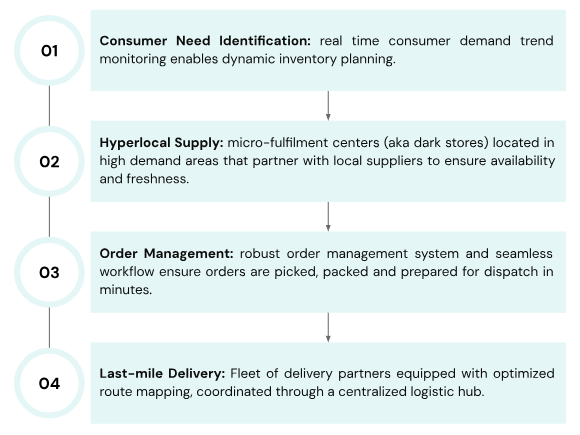
However, QCom is limited in its ability to replicate value focused items available in traditional stores or larger retailers, such as staples (with higher price sensitivity) or open stock keeping units, or personalized khata systems for customers3.
Impact of QCom on Traditional Distributors
The rapid expansion of QCom taps into the consumer’s need for instant gratification in the Fast Moving Consumer Goods (FMCG) sector. Leveraging significant funding, advanced technology, and a network of dark stores, these platforms expanded from metros to Tier-2 cities, offering essentials within 10–15 minutes, and eliminating the need to approach traditional mom-and-pop shops or kirana stores to purchase their daily needs.
- Loss of Business for Traditional Distributors: Given the consumer preference for convenience, wide product range and speedy delivery, there is a decline in foot traffic for traditional stores. Further, AICPDF in its August 2024 letter cited a shift in the FMCG distribution landscape itself, with QCom platforms being increasingly appointed as director distributors by major FMCG companies, sidelining traditional distributors4.
- Pricing Competition: When backed by heavy investment, QCom platforms are able to offer deep discounts on the products, which make it difficult for traditional distributors to compete.
- Inventory Turnover: Given the lack of sales, these traditional stores are sitting on high levels of inventory which results in delayed payments to distributors. This is impacted further by the fact that traditional stores cater to the impulse purchase vertical of consumers, who are now turning to QCom5.
- Technology Gap: QCom fundamentally employs advanced technology to analyze trends, manage inventory and logistics, and boost customer retention. Traditional stores are unable to invest in such infrastructural developments.
Legal Background
Further to its August 2024 letter, AICPDF filed a complaint with the Department of Promotion of Industry and Internal Trade (DPIIT) in September 2024, which was forwarded to the Competition Commission of India (CCI)6. AICPDF then formally complained to the CCI in October 20247 following which, CAIT released a white paper calling for a probe into the top 3 QCom players in the country8 for possible violations of the FDI Policy and the Competition Act, 20029. 10
Background of FDI Policy as applicable to e-commerce sector
1. Permissible Transactions
- Marketplace e-commerce entities are permitted to enter into B2B transactions with registered sellers.
- E-commerce marketplace entities may provide support services to sellers (e.g., logistics, warehousing, marketing).
2. Ownership and Control
- Marketplace e-commerce entities must not exercise ownership over the inventory.
- Control is deemed if over 25% of a vendor’s purchases are from the marketplace entity or its group companies.
- Entities with equity participation or inventory control by a marketplace entity cannot sell on that entity’s platform.
3. Seller Responsibility
- Seller details (name, address, contact) must be displayed for goods/services sold online.
- Delivery and customer satisfaction post-sale are the seller’s responsibility.
- Warranty/guarantee of goods/services rests solely with the seller.
4. Fair Competition
- Marketplace entities cannot influence pricing of goods/services and must ensure fair competition.
- Services like fulfillment, logistics, and marketing must be provided fairly and at arm’s length.
- Cashbacks by group companies must be fair and non-discriminatory.
- Sellers cannot be forced to sell products exclusively on any platform.
5. Restrictions
- FDI is not allowed in inventory-based e-commerce models.
Alleged Violations of the FDI Policy
- Misuse of FDI Funds: The white paper states that the top 3 QCom platforms have collectively received over INR 54,000 crore in FDI, with only a minimal portion allocated to infrastructure development. Instead, a substantial amount is purportedly used to subsidize operational losses and fund deep discounts, which CAIT argues is a deviation from the intended use of FDI for asset creation and long-term growth.
- Inventory Control via Preferred Sellers: The white paper states that QCom platforms operate dark stores through a network of preferred sellers, effectively controlling inventory. This practice is seen as a circumvention of FDI regulations that prohibit foreign-backed marketplaces from holding inventory or influencing pricing directly.
Alleged Violations of the Competition Act
- Predatory Pricing and Market Distortion: Through the deep discounts (funded by FDI) offered by these QCom players, CAIT alleges undermining of traditional retailers and distortion of fair market competition. Such practices are viewed as detrimental to the survival of small businesses, including the estimated 30 million kirana stores in India.
- Restricted Market Access: The white paper highlights that exclusive agreements with a select group of sellers limit market access for other vendors, thereby reducing competition and consumer choice. This strategy is alleged to create an uneven playing field, favoring certain sellers and marginalizing others.
Concluding Thoughts
CAIT’s white paper calls for immediate regulatory intervention to address these issues, emphasizing the need to protect the interests of small traders and maintain a fair competitive environment in India’s retail sector. However, formal updates in the regulatory space are still pending, any regulatory intervention would likely arise from the potential contravention of the FDI policy. The fundamental issue of whether or not the QCom model operates as an inventory-based e-commerce model will need to be determined to assess whether or not there has been a violation of the FDI Policy. As such, any regulatory intervention will have a sizeable impact on the market, and the Central Government has yet to formally respond to the CAIT and AICPDF calls for intervention.
FAQs on Quick Commerce in India
- What is Quick Commerce (QCom)?
QCom refers to an innovative retail model that delivers goods to consumers within a short time frame, often 10–15 minutes, leveraging hyperlocal supply chains, advanced logistics, and micro-fulfillment centers (dark stores). - What impact does QCom have on traditional Kirana stores and distributors?
QCom has disrupted traditional retail by reducing foot traffic to Kirana stores, introducing aggressive pricing competition, and capturing consumer preference for speed and convenience. This shift has led to inventory turnover challenges, delayed payments, and reduced profitability for traditional distributors. - What are the key legal concerns raised against QCom platforms?
Key concerns include:- Misuse of FDI funds for operational losses and deep discounts instead of infrastructure development.
- Predatory pricing practices that distort market competition.
- Restricted market access through exclusive agreements with select sellers.
- Alleged circumvention of FDI regulations by controlling inventory via preferred sellers.
- What is the role of AICPDF and CAIT in addressing these concerns?
The All India Consumer Products Distributors Federation (AICPDF) and the Confederation of All India Traders (CAIT) have highlighted the challenges posed by QCom platforms. They have filed complaints and published a white paper, urging regulatory intervention to protect traditional retailers and ensure compliance with FDI and competition laws. - How does the QCom model differ from traditional retail?
QCom focuses on hyperlocal supply chains, real-time inventory management, and last-mile delivery using advanced technology, whereas traditional retail relies on physical storefronts, human-driven processes, and personalized consumer relationships like credit-based “khata” systems.
- [1] https://economictimes.indiatimes.com/industry/cons-products/fmcg/quick-commerce-fmcg-distributors-raise-red-flags-seek-scrutiny-over-rapid-expansion-of-platforms-like-blinkit-zepto-instamart-fdi-rule-violations/articleshow/112763093.cms?from=mdr
 ︎
︎ - [2] https://www.lokmattimes.com/business/cait-releases-white-paper-with-allegations-of-unfair-trade-practices-against-quick-commerce-companies/
︎ - [3] https://www.moneycontrol.com/news/business/startup/is-quick-commerce-eating-into-kiranas-or-e-commerce-blinkit-swiggy-zepto-dmart-delhivery-weigh-in-12795319.html
︎ - [4] https://economictimes.indiatimes.com/industry/cons-products/fmcg/quick-commerce-fmcg-distributors-raise-red-flags-seek-scrutiny-over-rapid-expansion-of-platforms-like-blinkit-zepto-instamart-fdi-rule-violations/articleshow/112763093.cms?from=mdr
︎ - [5] https://retail.economictimes.indiatimes.com/news/e-commerce/e-tailing/kirana-stores-hit-hard-as-quick-commerce-surges-distributors-struggle-to-recover-dues-report/114461769#:~:text=Traditional%20Kirana%20stores%20in%20India,millions%20of%20small%20business%20owners.
︎ - [6] https://www.cnbctv18.com/business/quick-commerce-companies-violate-fdi-norms-aicpdf-19480198.htm
︎ - [7] https://www.cnbctv18.com/business/quick-commerce-companies-violate-fdi-norms-aicpdf-19480198.htm
︎ - [8] Including Blinkit, Zepto and Swiggy Instamart.
︎ - [9] https://www.deccanherald.com/business/quick-commerce-platforms-using-fdi-to-fund-deep-discounts-cait-3275356
︎ - [10] Guidelines on cash and carry wholesale trading to apply ︎
Eligibility for Angel Fund Investments
SEBI guidelines specify the kind of startups that are eligible for angel fund investments. Here are some key points:
- Independent Startups: The company must not be promoted or sponsored by, or related to, an industrial group with a group turnover exceeding INR 300 crore.
- Avoiding Familial Conflicts: Angel funds cannot invest in companies where there’s a family connection between any of the investors and the startup founders.
Investment Thresholds, Lock-in Period, Restrictions and Global Investment
SEBI regulations further outline the minimum and maximum investment amounts, along with a lock-in period:
- Minimum Investment: Angel funds must invest a minimum of INR 25 lakhs (INR 2.5 million) in any venture capital undertaking.
- Maximum Investment: The investment in any single startup cannot exceed INR 10 crore (INR 100 million). This encourages diversification across various promising ventures.
- Lock-in Period: Investments made by angel funds in a startup are locked-in for a period of one year.
- Restrictions on Investments: To ensure responsible investment practices, SEBI imposes specific restrictions:
- Investing in Associates: Angel funds are not permitted to invest in their associates.
- Concentration Risk: Angel funds cannot invest more than 25% of their total corpus in a single venture.
- Global Investment Opportunities:While the focus remains on nurturing Indian startups, SEBI allows angel funds to invest in the securities of companies incorporated outside India. However, such investments are subject to conditions and guidelines stipulated by RBI (Reserve Bank of India) and SEBI. This flexibility allows angel funds to explore promising global opportunities while adhering to regulatory frameworks.
- Unlisted Units: It’s important to note that units of angel funds are not permitted to be listed on any recognized stock exchanges. This is because angel investments are typically illiquid, meaning they are not easily tradable like publicly traded stocks.
SEBI regulations play a critical role in fostering a healthy and transparent environment for angel fund investments in India. These regulations attract investors, protect startups, and ultimately contribute to the growth of the Indian startup ecosystem.
Navigating the startup ecosystem can be a daunting task, especially for new entrepreneurs trying to turn innovative ideas into viable businesses. Understanding key terms and concepts in the startup world is essential for anyone aiming to succeed in this dynamic environment. Here, we break down some of the most important terms that every startup founder, investor, and enthusiast should be familiar with.
1. Product-Market Fit: This term refers to the degree to which a product satisfies a strong market demand. Achieving product-market fit is crucial for the success of any startup, as it signifies that the product meets the needs of the target audience. An example of this is Zomato, which successfully identified the need for a reliable platform for restaurant discovery and food delivery, thereby catering to the urban consumer’s demand for convenience and variety.
2. Minimum Viable Product (MVP): MVP is the simplest version of a product that can be launched to test a new business idea and gauge consumer interest. The goal is to validate the product concept early in the development cycle with minimal investment. Paytm is a prime example, initially launching as a simple mobile recharge platform before expanding into a full-fledged digital wallet and financial services provider.
3. Go-To-Market Strategy: This strategy outlines how a company plans to sell its product to customers, including its sales strategy, marketing, and distribution channels. It is essential for effectively reaching and engaging the target market. For instance, a well-known ride-hailing company used aggressive marketing and deep partnerships with banks and manufacturers to penetrate the Indian market by offering significant discounts and loans to drivers.
4. Customer Acquisition Cost (CAC): CAC is the total cost incurred by a company to acquire a new customer, including expenses related to marketing, advertising, promotions, and sales efforts. It is a critical metric for assessing the efficiency of a startup’s customer acquisition strategies. According to a 2022 report by IMAP India, the average CAC for Indian startups across various sectors is approximately ₹1,200-1,500.
5. Lifetime Value (LTV): LTV represents the total revenue a business can expect from a single customer account over the entirety of their relationship with the company. For instance, Swiggy evaluates LTV through its Swiggy One membership, analyzing factors such as average order value, order frequency, and subscription renewals to determine the enhanced value brought by members compared to typical customers.
6. Freemium Model: This business model offers basic services for free, with advanced features or functionalities available for a fee. LinkedIn is a prominent example, providing free networking services while offering premium subscriptions for enhanced job search features and LinkedIn Learning.
7. Runway: The runway is the length of time a company can continue operating before needing additional funding, based on its current cash reserves and burn rate. For instance, Unacademy recently made financial adjustments that reduced its cash burn by 60%, securing a financial runway of over four years.
8. Burn Rate: Burn rate refers to the rate at which a company spends its cash reserves or venture capital to cover operating expenses before achieving positive cash flow. Monitoring burn rate is crucial for ensuring a startup’s long-term sustainability. A notable example is WeWork, which in 2018 lost $1.6 billion despite generating $1.8 billion in revenue, indicating a burn rate that far exceeded its ability to generate profit.
9. Fundraising: This is the process of securing financial investments from investors to support and expand business operations. A significant example is Flipkart’s $2.5 billion investment in August 2017, which played a critical role in scaling its operations and strengthening its position in the competitive e-commerce market against global players like Amazon.
By understanding these essential terms, startup founders can better navigate the complexities of the entrepreneurial landscape, make informed decisions, and increase their chances of building a successful business.
Here are some frequently asked questions about e-commerce in India:
- What are the benefits of starting an e-commerce business in India? – The government of India has been promoting e-commerce initiatives such as Startup India, Digital India, allocating funds for the BharatNet Project, and promoting a cashless economy. Registering an e-commerce business in India is a fairly open space, with no entry barriers imposed on domestic and foreign direct investment.
- What are the steps to start an e-commerce business in India? – The most basic step is to create a business plan designed according to market research, financial budget, and profit margin. Next, register the business for tax compliance and establish a payment gateway on the website. It is also mandatory to register with the Shops and Establishment Act, 1948 and the Employees State Insurance Act, 1948, if applicable. Finally, registration for domain name, Microsoft software licenses, and other software licenses is also needed.
- What are the benefits of MSME registration for e-commerce businesses? – MSME registration comes with its own set of benefits and is required for any e-commerce business falling within the limits of maximum investment for service providers to be INR 100 crore to appropriately register under MSME.
- What are the legal compliances needed for setting up an e-commerce business in India? – Legal compliances include registration for tax compliance, payment gateway establishment, registration for licenses such as the Shops and Establishment Act, 1948, Employees State Insurance Act, 1948, and registering the business for domain name and software licenses.
FAQs about Setting up E-commerce Business in India
- What is FDI in e-commerce?
FDI (Foreign Direct Investment) in e-commerce refers to the investment made by a foreign company in an Indian e-commerce business. The government has formulated certain guidelines and regulations that govern FDI in India’s e-commerce industry.
- Is FDI allowed in inventory-based e-commerce models?
No, FDI is not permitted in the inventory-based model of e-commerce.
- What are the conditions that e-commerce entities need to fulfill?
E-commerce entities must follow specific conditions, such as not directly or indirectly influencing the sale price of goods or services and not exercising ownership or control over the inventory beyond a particular limit.
- Who is responsible for post-sales services and customer satisfaction in e-commerce?
The responsibility for post-sales services and customer satisfaction lies with the seller, as mentioned in the FDI guidelines.
- Can entities with equity participation or control over inventory sell their products on the marketplace run by the marketplace entity?
No, entities with equity participation or control over inventory cannot sell their products on the platform run by the marketplace entity.
- What consumer protection measures are emphasised in the e-commerce policy?
Genuine reviews and ratings, anti-counterfeiting and privacy measures, and e-courts for grievance redressal are some of the consumer protection measures highlighted in the draft e-commerce policy.
- What is the emphasis on Made-In-India in e-commerce?
The Indian government intends to promote the Made-In-India initiative by allowing foreign MNCs to invest in Indian e-commerce companies that hold inventory, with a condition that 100% of the products in the inventory must be Made In India.
- Are foreign companies allowed to operate e-commerce businesses in India?
Foreign companies are allowed to operate e-commerce businesses in India, subject to compliance with Indian laws and regulations.
]]>Thrasio, a US-based unicorn, has created a lot of buzz in the startup ecosystem because of its unique operations of buying and scaling up select online brands. Thrasio follows an acquisition-entrepreneurship template, by surfing Amazon’s third-party ecosystem. The company focuses on acquiring Amazon sellers’ businesses and scaling them up, earning $100 million in profit last year. In the startup ecosystem Thrasio’s success is now known as the Thrasio Model.
What is the Thrasio Business Model?
Thrasio’s business model revolves around the fast acquisition of different online businesses from Amazon sellers. The company follows a multi-brand and multi-product strategy, which is consumer-brand-focused. After acquiring the businesses, Thrasio overhauls them by customizing their product portfolio, changing the branding, and developing a long-term revenue growth strategy. Thrasio has over 50 experts working on improving the brand and turning it into a profit-doubling machine.
In the words of Thrasio itself “We don’t optimize, we mastermind ”. Informed by billions of rows of data sourced from hundreds of APIs every day, Thrasio’s teams make the best possible decisions to maximize sales of every product they own and purchase
Even though Thrasio runs the ecommerce business full-time, the previous owner still benefits long-term as they continue to get a percentage of future revenues. Thrasio’s acquisition platform is a win-win for every party involved, as there is a continuous revenue stream for both Thrasio and the previous business owner.
Success of Thrasio
Thrasio was founded by entrepreneurs Carlos Cashman and Josh Silberstein in mid-2018 and have built a business that has been profitable since inception and growing multifold. Thrasio is a digital consumer goods company that acquires other third-party private label Amazon FBA (fulfilment by Amazon) businesses. The company operates by way of acquiring these businesses after which it optimizes the operations of these businesses. This is done in an attempt to expand their reach through the market, develop the product, as well as the supply chain management. This in turn leads to the expansion of the sales, improvement in financial growth and ultimately scales up the business under the umbrella of the acquiring company.
Thrasio’s success reflects in its most recent earnings. The company reported $300 million in revenues and obtained $260 million in public funding, giving it a $1 billion valuation, earning the company unicorn status.
Startup Ecosystem in India
Based on the Thrasio Model’s proven success, many startups in India have adopted this concept for their success and attracted investor interest. These startups have a similar pitch to that of Thrasio, making fast-growing online brand acquisitions and building their portfolio. These startups have their own strategy, offering unparalleled market expertise, a founder-friendly relationship, or guaranteeing media coverage. Funding has been the main activity in this sector in India, with over $300 million invested in Indian startups.
Thrasio is becoming the fastest-growing e-commerce acquisition company worldwide, with its current portfolio comprising 60 Amazon business acquisitions, 6,000 products, and a spot in Amazon’s top 25 sellers’ list. The company has already paid out over $100 million to sellers. The Thrasio Model’s success has been emulated across many startups in India, with each one having a unique strategy for acquisitions and portfolio building.
Thrasio Model: Pros and Cons for Small Businesses
Pros
i. Big cash payouts – these startups pay the businesses money based on the valuation done which usually is much more than they make in a year through their sales in the e-commerce space.
ii. Speedy Exit – for those founders who wish to get an easy, hassle free exit from their businesses, this seems the best bet. The entire process is smooth and quicker as compared to the traditional exit mechanisms and completed within 4-6 weeks.
iii. Legacy and Goodwill – the most important thing any founder could be worried about is the brand image and the goodwill attached. The Thrasio Model focuses on scaling up the acquired businesses and also smoothening the supply chain. With this being the main objective of these startups, the interest of the founders in terms of brand image is protected.
Cons
i. Losing long-term profitability – the most important reason for these startups to acquire smaller businesses is the potential they see in the business. They will make the business reach new heights with their expertise but the founders also lose out on the long term profitability attached to the businesses growth.
ii. Losing your ownership – eventually when the startups functioning with this model purchase controlling stakes in the business, the founders lose their controlling rights in all future operations. The fact that most of these startups work collaboratively with the founders to scale up the business, the founders in that case have negligible say in the operations of the business and are bound by the decisions taken by these startups.
Viability of Thrasio Business Model in Indian Startup Ecosystem
When it comes to implementing the Thrasio Model in India, it’s important to understand that the success of the model depends on numbers. The USA’s large number of brands, even the smallest of which can generate millions of dollars in revenue, makes the Thrasio Model perfect. India, on the other hand, has a smaller online market and many consumers prefer traditional retail markets, which may limit the success of startups using the model in India.
Maintaining the balance between online and offline businesses is critical for success. Startups need to consider acquiring offline-led brands as well to enter the large offline market. Investors should also weigh the risks of entering into deals at extremely high valuations, as it may not be commensurate with the company’s growth.
Investors are contemplating a valuation fight and warning startups of the sameas all startups may approach the same top sellers and have more leverage to command prices. They will then be in the position to command the price as they wish and that’s where the problems begin. The future of these startups based on the Thrasio Model will be determined by what price they buy the brands at, and how they buy them – using equity or debt. Companies usually prefer using debt to fund acquisitions. Using share capital for buyouts results in founders diluting their stake more than needed and is less efficient.
While the Thrasio Model offers many benefits, there are also risks to consider. By understanding both the advantages and disadvantages of this model, small business owners can make an informed decision about their exit strategy.
FAQs on Thrasio Business Model
- How does Thrasio identify potential acquisition targets?
Thrasio employs a rigorous evaluation process, considering various factors such as revenue, profit margins, market demand, product quality, and brand potential to identify viable Amazon FBA businesses that align with their acquisition strategy
- What happens to the acquired Amazon FBA businesses after Thrasio’s acquisition?
Once acquired, Thrasio integrates the acquired businesses into its operational infrastructure, streamlining processes, enhancing marketing efforts, optimizing supply chains, and implementing data-driven strategies to drive revenue growth and improve profitability.
- How does Thrasio monetize the acquired Amazon businesses?
Thrasio generates revenue by leveraging its expertise and resources to scale the acquired businesses. This involves optimizing product listings, implementing marketing campaigns, expanding distribution channels, and driving operational efficiencies to increase sales and profitability.
]]>1. Basic knowledge of the law
Knowing the startup laws and rules that apply to your business and why they are so crucial is the first and most critical step you should take when attempting to handle the startup finances
You should be aware of the following:
• What startup registrations are necessary to launch the startup business?
• What details and records are necessary to record your earnings and outgoings?
• What taxes are levied on income and outgoing costs?
• By what deadlines must taxes be paid and filed?
• How long should invoice copies be kept on file?
It is better to be prepared beforehand during tax season.
2. Knowledge of startup accounting methods
Running a startup business involves more than just keeping track of the money that comes in and goes out. Instead, the timing of when you record income and expenses i.e, whether you use cash basis accounting or accrual basis accounting, influences how you manage your company’s finances.
In cash-basis accounting, you only record income and costs when money has changed hands. If you raise an invoice to someone for a project, the funds will only be recorded as income once it is deposited into your account. The same goes for startup expenses.
Contrarily, under accrual accounting, income is recognised when it is earned and expenses are recognised as they are incurred. If you are employed for a job, you record the money once it has been completed.
While each accounting method has its own advantages and disadvantages, accrual-basis accounting provides a more realistic view of your company’s finances and performance.
Accrual accounting is also better from a tax standpoint since you can claim company expenses on your tax return in the year you incur them rather than the year you actually pay them.
3. Knowledge of basic bookkeeping terminologies
Undoubtedly, you’ll encounter new words and phrases, from startup balance sheets to income statements. You should be aware of certain words and expressions.
Here are five of the most common bookkeeping phrases you should be aware of, since it is impossible to list them all here.
- Balance Sheet: This report analyses the financial position of your company. It covers the startup’s capital as well as its assets and liabilities. Its goal is to make clear what your company owes and what it possesses.
- Chart of Accounts: A complete list of the accounts that are utilised by your company to classify financial activities. Assets, Liabilities, equity, revenues, and various expenses can all fall under this category.
- Expense: These are the costs that a startup business may experience as a result of its activities, whether they are fixed, variable, accruing, or ongoing.
- Trial Balance: A startup business document that lists all ledgers in columns for debit and credit. This is done to ensure the mathematical accuracy of a company’s bookkeeping system.
- Profit and Loss: A financial report that details the revenue and expenses over a period of time.
4. Distinguish your personal and business finances
It’s a common error in startup business bookkeeping to mix together personal and business finances. Your company will have trouble as a result in the future. So, as soon as you decide to move forward with your startup, it is always advised to register a separate startup business bank account. This makes it easier to keep track of all your earnings and outgoing costs, and it also helps your company establish its own credit rating.
5. Automate whatever you can
Use cloud-based bookkeeping software, and do your business banking online. That way, you can sync your bookkeeping software with your company’s bank account so you always have accurate, up-to-the-date records. Additionally, your essential financial data is securely backed up off-site via the cloud.
6. Retain all documents
Startup expenses can be claimed only if the invoices are available in the name of the startup business. Invoices determine the nature of the expenses incurred, whether it’s a Capital or a Revenue expenditure. Hence, if it is incurred for your business, then it has to be retained either to balance your accounts, to determine tax liabilities or to claim tax deductions!
7. Make a schedule for bookkeeping review
If you need to make a crucial call, you will make time for it. Why not schedule time to review your bookkeeping as well?
Plan to review your books every week or every month. This will ultimately save you time. Additionally, it guarantees that you won’t be stressed out at the end of the fiscal year!
Setting aside time for your books is a wise move, even if you outsource your accounting. By monitoring your bookkeeping, you can control your cash flow. You may find it useful when making decisions.
8. Set aside funds to pay the taxes
Even though the majority of individuals are aware they must pay business taxes, very few startup business owners prepare for taxes. The issue is that many startup business owners find they don’t have enough cash in hand to pay their taxes when tax season rolls around. As a result, they end up paying the taxes after the expiry of the due date along with Interest & penalty. This adds to the financial burden.
As a result, one of the ideal cash flow management tactics is to set aside money for all of the business taxes you’ll have to pay during the year.
9. Create a budget for your company
The last thing you would want to do when running a startup business is to rely on guesswork. Many startup business owners find they are in the middle of a project and have no money to continue. And by the time the understanding sinks in, it’s too late to make arrangements for money.
That is where creating a thorough business budget is really helpful. It provides you with a clear picture of potential charges. You can take a number of steps to stabilize your financial situation once you’ve accepted the amount needed to attain your future ambitions. Additionally, it will equip you for future unforeseen difficulties.
10. Work with a Professional
You might become proficient at handling your startup’s financial accounting with time and some learning. But as it develops, you won’t be able to match the knowledge of someone with a professional accounting degree.
Even a few hours each week or month of professional assistance will make a significant difference. He or she will assist you in accurately filing your taxes by informing you of any potential fees and helping you locate loopholes to reduce deductions and save time and money.
You ought to employ a startup specialist who might serve as your valued startup advisor. He or she can offer knowledgeable guidance on how to accomplish your short- term and long-term startup business goals.
]]>We firmly believe that a unique template is needed for every startup, keeping that in mind,we have attempted to build a fundamental framework around which customisations and further additions/deletions can be done for every startup.
Broad framework:
- Impactful mission statement
The startup’s mission and objective statement should ideally encapsulate what the founders aim to achieve with its business. This should be short and crisp (8-10 words) so that it is impactful and precisely conveys to the investors what the startup is trying to solve.s
- Why Now?
This slide should essentially denote the reason that makes the startup attractive and lucrative right now i.e what tailwinds have occurred within the space in which they are operating in which has made the business idea more relevant in the present than in the previous months or years.
- The Product
This slide is where the founders need to accurately denote what business the startup is in. It can include essential features of the product, photos / videos, screenshots of the UI and how the end user will experience the product. The slide should convey why the product idea is viable and competitive and demonstrate what the founders are trying to build and what the investors are putting money towards.
- Customer Journey
Mapping the customer journey gives the investors a complete idea of the customer experience. It illustrates how the end user will interact with the app or website and use the product of the company. Mapping a customer journey can be advantageous for the founders as well by giving them a clear idea of how the product experience is like from the point of view of the end-user.
- Competitive Differentiation
With the emergence of multiple startups in each field, this slide should represent the differentiating factor(s) in the product that this startup has built that makes it stand out from the existing competition. This is the slide that outlines the startup’s competitors, positioning in the market, and the business strategy it has adopted to try and succeed. It can also talk about any exclusive or unique feature or user experience within the product which is not yet implemented by any other startup in the current market.
- Revenue Streams
This slide is one of the most important slides that an investor will look at from a “ROI” perspective. Every possible channel of revenue streams of the startup should be explained in this slide, even if the startup is pre-revenue. It is usually an added advantage if the startup is already generating revenue, the slide can then include customer-wise and category-wise breakdown of revenue along with any existing clients working with them.
- Product Timelines
The Product timeline slide will help the investor understand the product deployment by the startup. Including a timeslide slide in the pitch deck will convey to the investors when the product will start generating revenue, what is the most critical or time-taking phase, what are the important milestones for the startup, when will the investor’s capital be deployed to hit the milestones and goals over the coming months and years, etc.
- Market Sizing
Investors give importance to Market size because it allows them to estimate the future potential of the product and how big can the startup get. This slide usually includes Total Addressable Market (TAM), Service Addressable Market (SAM) and Service Obtainable Market (SOM).
- Marketing strategies
The slide should denote the marketing plan of the founders towards marketing the product to the target audiences.
- Founders and Management Team
The face behind the idea and the execution of the product can be denoted to the investors with the Founders & Management Team slide. The contents of this slide usually include a short bio of the co-founders, their previous work experience, the roles and responsibilities undertaken by them respectively in the company, and a photo. If the Key Management team has been identified and is in place(COO, CTO etc.), the pitch deck can also include details about them.
Keeping these factors in mind while creating a pitch deck can help you be well-prepared for anything and everything that an investor might want to know before investing in your company.
]]>B2B SaaS or Business to Business Software as a Service is a cloud-based software distribution model that allows companies to sell access to their software to other businesses. Rather than downloading software to a desktop PC, businesses can access SaaS products through an internet application or web browser. B2B SaaS products can include any kind of software such as office management, customer support or communication software used within a business.
Here are some advantages of B2B SaaS that make it valuable to a business:
- Accessibility: B2B SaaS products can be accessed from any web browser, allowing businesses to manage operations effectively without the need to be at a specific location or operating system.
- Automatic updates: As a cloud-based service, B2B SaaS businesses can automatically update the product without impacting the user’s operations. Additionally, with cloud-based applications, there is no requirement for storage or hardware on the end-users side.
- Data capture and analytics: Since B2B SaaS software is centralized and automated, it is easier to capture data and provide in-depth analytics.
- Cost-effective: B2B SaaS eliminates the need for businesses to own products, systems, and hardware that can be costly.
- Efficient operations: B2B SaaS allows businesses to automate internal functions and operations at a relatively low cost.
Examples of some B2B SaaS Companies are:
- HubSpot: A cloud-based inbound marketing and sales platform that provides tools for CRM, web analytics, content management, SEO, and social media analytics.
- Google: Famous for its search engine, Google also owns and operates more than 130 different SaaS products. Some of Google’s services include a search engine, online advertising, document creation, digital analytics, and other services.
While B2B SaaS and B2C SaaS sales and marketing share the same end goal of helping customers, there are many differences in the process that make the need for a strong sales strategy important.
The B2B SaaS sales cycle is much longer and more complex than the B2C SaaS sales cycle. Businesses generally have more than one buyer on a team communicating with many sales reps and maybe even sales teams, where consumer purchases are usually done between one customer and one sales rep. With B2C SaaS, a user can directly input their credit card information and start using the product, while a B2B SaaS deal often requires a demo and onboarding process.
As B2B SaaS companies grow, they usually deploy an enterprise sales team that enables them to effectively target enterprise-sized companies who have unique needs.
B2B SaaS Selling Tactics
For startups finding the right marketing strategy that will attract new sales and build brand awareness can be challenging. From targeting the right audience to preparing sales teams for a competitive market, marketers may find it challenging to get their SaaS product in customers’ hands.
Some of the sales tips and marketing strategies used in B2B SaaS sales that can help any startup succeed are:
- Position your software around competitor brands: The SaaS market is incredibly competitive. To meet company sales goals, marketers need to elevate their company above the competition. To do so, this often requires positioning your software above and against your competitors. Use data-based metrics to prove why your SaaS products are the superior choice for meeting your client’s needs. This could mean using case studies or conducting surveys.
- Focus on customer retention: As business needs and software solutions are constantly changing, building a strategy that includes customer retention could set your business apart from others. To ensure that your business is well-positioned, continue to prove to customers why your software fits their needs. To encourage customer retention, SaaS sales reps
Best Practices for Selling B2B SaaS Effectively
Curate a Targeted Portfolio
In a digital marketplace flooded with too many options, B2B SaaS buyers can quickly become overwhelmed. To effectively address their pain points and boost revenue, start small with software that is highly targeted to potential customers. By curating the choices buyers have, you act as an expert advisor, steering them to solutions that will work best for them. As your software ecosystem evolves with services targeted to different buyer segments, you can significantly increase your marketplace’s revenue.
Highlight the Value of Your App
Never assume potential buyers understand the value of your app. To stand out from the competition, clearly communicate how your B2B SaaS offerings are relevant and different. Don’t overlook the obvious benefits your app provides, as these may not be as clear to potential buyers as they are to you.
Bundle Apps with Core Services
While buyers love a good deal, multi-app bundles can complicate the sales message and cycle in B2B SaaS. Instead, package apps with your core services. For instance, a telecom provider bundled a mobile broadband subscription with a tablet device and Microsoft Office 365, generating 1,500 active users in just a few months. Avoid attempting to solve too many challenges simultaneously, which makes the offer too complex and the business use unclear.
Use a Human Touch to Sell
While consumer devices have programmed us to believe apps sell themselves, this isn’t the case with B2B SaaS. Buyers need human assistance to make informed decisions.
Sell Solutions
To effectively sell B2B SaaS, put potential customers and their challenges first. Sales teams need to adopt a different mindset and focus on how the SaaS product can help customers solve their issues, leading to further growth for both the customer and the company. By prioritizing solutions, instead of speeds and feeds, you can sell B2B SaaS effectively.
]]>A convertible note is a short-term debt instrument that startups can use to raise funding. It allows holders to convert their debt into equity in the company at a future date. The biggest advantage of convertible notes for early-stage startups is that they don’t need to determine the value of the company when issuing them.
Unlike traditional equity financing, issuing a convertible note is quick and efficient. There’s only one document to deal with, which saves time and money for both the company and investors.
Until 2016, convertible notes were not legally recognized in India. However, the Companies (Acceptance of Deposits) Rules, 2014 were amended to recognize them as a fundraising instrument for startups.
DPIIT-registered startups can now raise funding through convertible notes, subject to certain conditions. The investment amount must be at least INR 25 lakhs in a single note and converted within 10 years. The terms of conversion must also be determined upfront.
By linking convertible notes to expected returns instead of valuation and percentage of ownership, startups can avoid the valuation quagmire that often comes with very early-stage investments.
]]>The Notification of the Telemedicine Practice Guidelines (“Telemedicine Guidelines”/ “Guidelines”) as a part of Appendix 5 of the Indian Medical Council (Professional Conduct, Etiquette & Ethics) Regulations, 2002 (“MCI Code”), has made: (a) the practice of the medical profession; and (b) provision of medical care over technology platforms, legal and regulated. These Guidelines impact a cross-section of stakeholders, such as medical professionals (“MP”), registered medical practitioners (“RMPs”), patients, caregivers and med-tech platforms.
While med-tech platforms are primarily responsible for ensuring that the MPs providing services comply with the ethical and legal aspects of telemedicine, they must also abide by the relevant laws and regulations. The Guidelines are for guidance purposes, laying out the primary principles, i.e. the contours within which telemedicine practice in India is to be followed. However, the Guidelines need to be read in conjunction with other applicable laws.
The laws that med-tech offering telemedicine services in India must comply with include: (a) the Indian Medical Council Act, 1956 (MCI Act) and the MCI Code; the Drugs and Cosmetics Act, 1945 and Rules made thereunder (D&C Act); the Telecom Commercial Communication Customer Preference Regulations, 2018 (TCCP Regulations); the Consumer Protection Act, 2019 (CPA); and the Foreign Exchange Management Act, 1999 (FEMA).
In conclusion, while the Guidelines are crucial, the med-tech platforms offering telemedicine services must comply with the necessary ethical and legal aspects of telemedicine in order to avoid penalties and potential liabilities. Before implementing tech-based solutions for telemedicine, businesses should evaluate the mandatory requirements and ensure compliance with relevant laws and regulations, in order to reduce potential liabilities
FAQ’s
Q: How to start a telemedicine service in India?
A: Before starting telemedicine services in India, med-tech platforms must comply with telemedicine requirements laid out by the Ministry of Health and Family Welfare and NITI Aayog. They must evaluate the nature of services and ensure compliance with the relevant laws and regulations, such as the Indian Medical Council Act, 1956 and the Indian Medical Council (Professional Conduct, Etiquette & Ethics) Regulations, 2002 the Drugs and Cosmetics Act, 1945 and Rules made thereunder; the Telecom Commercial Communication Customer Preference Regulations, 2018; the Consumer Protection Act, 2019; and the Foreign Exchange Management Act, 1999.
Q: What are the requirements of telemedicine standards?
A: The requirements of telemedicine standards in India contain a set of Telemedicine Practice Guidelines (“Guidelines”) as part of Appendix 5 of the Indian Medical Council (Professional Conduct, Etiquette & Ethics) Regulations, 2002, which outlines the legal and regulatory aspects with respect to the practice of medical professionals through med-tech platforms, for medical care and consultations. These guidelines provide legal and ethical frameworks and impact various stakeholders like medical professionals, registered medical practitioners, patients, caregivers, and med-tech platforms.
Q: What are the protocols used in telemedicine services?
A: Telemedicine services transmit medical information from the patient to the doctor via telecommunication technology as per the applicable laws. The protocol used in telemedicine services depends on the type of service provided, including audio-only consultation, video consultation, or text-based services. These protocols combine the use of equipment such as smartphones, tablets, laptops, and medical devices to assist edical professionals in providing the necessary healthcare services.
Q: Are telemedicine services legal in India?
A: Yes, telemedicine services are legal in India provided that the businesses offering med-tech platforms comply with the Telemedicine Practice Guidelines (“Guidelines”) as a part of Appendix 5 of the Indian Medical Council (Professional Conduct, Etiquette & Ethics) Regulations, 2002, in addition to other relevant applicable laws and regulations. Med-tech platforms offering telemedicine services must evaluate the nature of services and comply with necessary legal and ethical aspects of telemedicine, in order to reduce potential liabilities and ensure better and qualitative healthcare.
]]>Such Telemedicine Platforms must be cognisant of: (a) their practices relating to handling data of patients, Medical Professional(s) (“MP(s)”) and other caregivers (hereinafter referred to as “User Data”); and (b) what impact mishandling of such User Data would have.
In India: (a) the Information Technology Act, 2000 (“IT Act”); (b) the Information Technology (Reasonable security practices and procedures and sensitive personal data or information) Rules, 2011 (“Data Protection Rules”); and (c) the Information Technology (Intermediaries Guidelines) Rules, 2011 (“Intermediary Guidelines”), presently regulate how Platforms providing telemedicine services handle the data of its users.
Platforms which: (a) provide services that enable recording of Sensitive Personal Data or Information (“SPDI”); and (b) place cookies to record user behaviour, could become liable under the IT Act, the Data Protection Rules and the Intermediary Guidelines.
Given the sensitivity of health care data, the Indian Government proposed the Digital Information Security in Healthcare Act (“DISHA“) in the year 2018, and has been deliberating upon the establishment of a National e-health Authority (“NeHA”) since 2015 with a goal to ensure the development of an e-health ecosystem and enable people centric health services in a cost-effective manner. DISHA aims to establish NeHA and State e-health Authorities (SeHA). Moreover, the enactment of the Digital Personal Data Protection Bill, 2022 (“DPDP Bill”), and its consequent effect will be something that would impact how Platforms provide their services.
Role of Platforms as Intermediaries: Active or Passive?
The applicability of the IT Act is slightly different for Platforms which are set up to only facilitate the interaction between the patient and the MP, and are not directly involved in the provision of medical care. In such cases the Platform would be considered as an ‘Intermediary’ under the IT Act and the Intermediary Guidelines. Under the Indian legal framework, Intermediaries are exempt from many of the liabilities/obligations placed by the IT Act on entities processing personal data.
As per section 79 of the IT Act, an Intermediary is not liable for any third party information, data, or communication link made available or hosted by it. This exemption applies only if:
- the function of the intermediary is limited to providing access to a communication system over which information made available by third parties is transmitted or temporarily stored or hosted;
- the intermediary does not – initiate the transmission; select the receiver of the transmission AND select or modify the information contained in the transmission; and
- the intermediary observes due diligence (as prescribed under the Intermediaries Guidelines) while discharging its duties under the IT Act.
One of the key elements of section 79 of the IT Act is that a Platform must not, (a) initiate the transmission of communication/data by, between its users; and (b) select the receiver of the transmission; and (c) select or modify the information contained in the transmission.
The manner in which a Telemedicine Platform provides its services, would more often than not, require it to facilitate a transaction and/or transmission of data initiated by their users (i.e. MPs and patients), and thereby, many a times, placing more responsibility on a Telemedicine Platform than would be applicable to an Intermediary, under the IT Act. Since a Platform would need to build their tech framework in a manner that facilitates transactions/transmissions, this circumstance may seem harsh.
However, when it comes to initiating a transmission, selecting the receiver of a transmission or selecting or modifying the information contained in the transmission, the Courts in India have laid down the test of passivity.
Essentially, the following are the factors that could determine that a Telemedicine Platform is playing a passive role in the ecosystem, and is therefore granted the protection of an Intermediary:
- Whether the role played by that service provider is neutral, in the sense that its conduct is merely technical, automatic and passive, pointing to a lack of knowledge or control of the data which it stores;
- Whether the platform is responsible for initiating the transmission, i.e., placing the listing on the website (for Platforms the important question would be whether there is any active uploading, suggesting or placing on such Tech Platform, the services of an MP);
- Whether the platform is involved selecting the persons who receive the information (for Platforms this would mean whether they choose/have a say (apart from legally mandated due diligence requirements on MPs) in who/what gains access to their services); and
- Does the entity controlling the platform have the power to select or modify the information that is being exchanged on its platform.
Thus, Platforms would only be considered as Intermediaries if their conduct is passive, technical and automatic in their facilitation of Telemedicine based care.
Privacy related Protocols to be followed by Telemedicine Platforms
1. A Platform would be required to have in place a set of rules and regulations in place that determine how data of users of its Platform will be used. This would require the publishing of a privacy policy, user agreement, terms and conditions et al. that determine the terms of access and use of the service provided by the Platform.
2. The privacy policy and terms of use/user agreement of a Tech Platform, should be designed and stated in such a way that the patients using the Platform, are aware of the type of SPDI collected, the purpose for which the same is done, the intended recipients of the SPDI and the requirement and the persons/parties to whom SPDI will be disclosed to.
3. Before the SPDI of a patient/user is disclosed to a third party, or before the same is transferred, consent of such patient/user must be acquired.
4. The Platform shall be required to have in place a grievance officer, the details of which are provided on the user agreement/privacy policy of the Platform, and such an officer shall be required to deal with the grievances of the patients/users in relation to their processing of the SPDI.
5. The Platform shall be required to comply with ‘reasonable security procedures and practices’ under the IT Act. A Platform will be deemed compliant with such procedures and practices if it implements the data security standard afforded by the IS/ISO/IEC 27001 on “Information Technology– Security Techniques – Information Security Management System – Requirements” or similar standards, in order to protect the SPDI.
]]>