



ESG Compliance in India – BRSR, SEBI Regulations, Reporting & All Founders Need to Know
Written By

Treelife
Share
-
Link copied to clipboard!https://treelife.in/compliance/esg-compliance-in-india/

-

-

-

-

AI Summary
- ESG compliance in India now applies broadly, covering large listed companies under SEBI's BRSR Core requirements, growth-stage startups raising institutional rounds, and foreign companies entering the Indian market.
- ESG stands for Environmental, Social, and Governance, covering carbon emissions and climate risk, employee welfare and supply chain ethics, and board composition and anti-corruption practices respectively.
- CSR under Section 135 of the Companies Act 2013 is a spending mandate requiring eligible companies to allocate 2% of average net profits, which is distinct from ESG, a reporting and governance discipline.
- SEBI's Business Responsibility and Sustainability Reporting (BRSR) framework has been mandatory for the top 1,000 listed companies by market capitalisation since FY 2022-23.
- BRSR reporting is structured across three sections: Section A for general company disclosures, Section B for management and process disclosures across the nine National Guidelines on Responsible Business Conduct, and Section C for principle-wise essential and leadership performance indicators.
- Listed companies beyond the top 1,000 currently face voluntary BRSR disclosure, though phased mandatory expansion is expected.
- Large unlisted companies with net worth of ₹500 crore or more are not yet mandated to file BRSR but commonly face ESG diligence from private equity and institutional investors.
- BRSR must be filed as part of a company's Annual Report and submitted to SEBI and the stock exchanges, aligning with the April to March financial year.
- Founders should treat ESG readiness as a fundraising requirement rather than only a regulatory one, since Series B and Series C investors backed by global LPs often apply internal ESG policies when evaluating and structuring deals.
Blog Content Overview
- 1 Introduction
- 2 What Is ESG Compliance? (And What It Isn’t)
- 3 Who Does ESG Compliance Apply to in India?
- 4 The ESG Regulatory Framework in India (2026 Update)
- 5 RBI, IFSCA and Sector-Specific ESG Obligations
- 6 EPR Compliance: What It Means for Your Due Diligence Exposure
- 7 CBAM and the Cross-Border ESG Obligations Indian Companies Now Face
- 8 BRSR vs. Voluntary ESG Reporting
- 9 How ESG Affects Fundraising, Due Diligence & Exit Readiness
- 10 ESG Compliance Checklist for Founders
- 11 Common ESG Mistakes Companies Make
- 12 ESG Implementation Roadmap for Founders
- 13 Why ESG Compliance Is Strategic, Not Just Regulatory
- 14 Penalties for ESG Non-Compliance in India: Specific Figures
- 15 Treelife Practitioner Note
- 16 Frequently Asked Questions (FAQs) on ESG Compliance in India
Introduction
ESG used to be something listed enterprises stuck into their annual reports. In 2026, that’s no longer true. ESG compliance in India is now relevant across the board for large listed companies navigating SEBI’s BRSR Core requirements, for growth-stage startups managing their first institutional round, and for foreign companies entering the Indian market. If you’re a founder, understanding the ESG landscape isn’t optional it directly shapes how investors assess your business.
This guide covers what the law actually requires, who it applies to, where voluntary disclosure ends and mandatory reporting begins, and most practically what you should do now to build ESG readiness into your company’s foundation.
What Is ESG Compliance? (And What It Isn’t)
ESG (Environmental, Social, and Governance) is a framework for measuring a company’s impact and conduct. Environmental covers carbon emissions, energy, water, and climate risk. Social covers employee welfare, supply chain ethics, and diversity. Governance covers board composition, transparency, anti-corruption practices, and decision-making quality.
ESG compliance in India, strictly defined, means adhering to regulations set by SEBI, MCA, and related authorities that govern how companies must measure, report, and demonstrate ESG performance. This is distinct from voluntary sustainability reporting, ESG ratings, and CSR spending which are related but separate concepts.
| Founder’s Distinction to Know: CSR ≠ ESG. CSR (under Companies Act Section 135) is a spending mandate eligible companies must allocate 2% of average net profits. ESG is a reporting and governance discipline it requires measuring, disclosing, and improving performance across environmental, social, and governance metrics. You can spend generously on CSR and still fail ESG diligence. |
|---|
Who Does ESG Compliance Apply to in India?
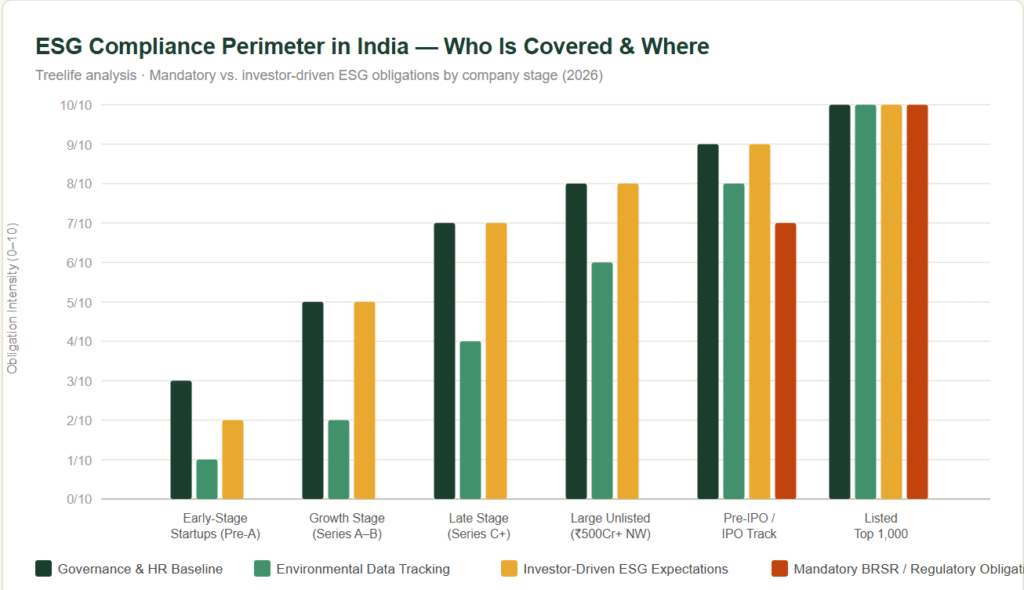
There are mandatory obligations primarily driven by SEBI and investor-driven expectations that function as soft requirements even where the law doesn’t mandate disclosure.
| Entity Type | Mandatory BRSR? | CSR Mandate? | ESG in Practice |
|---|---|---|---|
| Top 1,000 listed companies (by market cap) | Yes – since FY 2022-23 | If eligible | Full BRSR + BRSR Core assurance |
| Listed companies beyond top 1,000 | Voluntary (expanding) | If eligible | Phased mandatory expansion expected |
| Large unlisted (₹500Cr+ net worth) | No (yet) | Yes | PE/investor ESG diligence is common |
| Growth-stage startups (Series A-C) | No | Usually no | Investor-driven ESG expectations apply |
| Foreign entities entering India | Depends on structure | If subsidiary qualifies | Global ESG commitments cascade down |
| Companies on IPO track | Yes from listing | If eligible | ESG readiness is part of pre-IPO checklist |
The important nuance for founders: even if you are not legally required to file a BRSR today, your Series B or Series C investors especially those backed by global LPs almost certainly have internal ESG policies that affect how they evaluate and structure deals. ESG readiness is becoming a fundraising requirement before it becomes a regulatory one.
The ESG Regulatory Framework in India (2026 Update)
SEBI and the BRSR Framework
The most significant ESG regulatory development in India remains SEBI’s Business Responsibility and Sustainability Reporting (BRSR) framework, introduced in 2021 and made mandatory for the top 1,000 listed companies from FY 2022-23 onward. BRSR replaced the earlier Business Responsibility Report (BRR) with far more granular reporting requirements.
BRSR requires companies to report across three sections: Section A covers general company disclosures; Section B covers management and process disclosures across the nine National Guidelines on Responsible Business Conduct (NGRBCs); Section C covers principle-wise performance indicators split between essential (mandatory) and leadership (aspirational) disclosures.
Filing deadline: BRSR must be filed as part of a company’s Annual Report, submitted to SEBI and the stock exchanges. For companies following the April-March financial year, this means filing by June-July of the following year.
BRSR section structure: essential vs leadership indicators
Understanding the internal architecture of a BRSR report is important before you start data collection. Section C, the performance section, splits disclosures into two tiers.
Essential indicators are mandatory quantitative and qualitative disclosures. Every company in the top 1,000 must report these. Examples include total energy consumed, waste generated by category, number of employees covered by a health and safety system, percentage of women in the workforce, and details of related-party transactions with ESG implications.
Leadership indicators are aspirational and voluntary. They signal ESG maturity beyond minimum compliance. Examples include life cycle assessments of products, biodiversity risk assessments, breakdown of employee well-being expenditure, and details of advocacy positions on public policy. Companies that report leadership indicators consistently attract higher ESG ratings and create more favourable impressions in investor due diligence.
The practical implication: if your company is approaching the top 1,000 threshold or is on an IPO track, start with essential indicators. Do not wait until you understand every leadership indicator before beginning data collection. Get the mandatory layer right first.
In December 2024, SEBI issued Industry Standards on Reporting of BRSR Core, developed jointly by ASSOCHAM, FICCI, and CII (SEBI Circular, December 2024). These standards clarified how to compute intensity ratios, how to handle PPP-adjusted revenue for intensity denominator calculations, and what constitutes acceptable boundary-setting for emissions reporting. Companies still relying on their own interpretation without consulting these standards are likely computing certain metrics incorrectly. If you are a top-150 or top-250 company preparing for BRSR Core assurance, these standards are the working reference, not just the SEBI circular.
BRSR Core: The 2023 Addition That Matters
In 2023, SEBI introduced BRSR Core a distilled set of KPIs across nine ESG attributes that require independent third-party assurance. Companies can no longer simply self-declare their ESG performance on these parameters. The nine BRSR Core attributes are:
| # | BRSR Core Attribute | Category |
|---|---|---|
| 1 | Greenhouse Gas (GHG) Emissions — Scope 1, 2, and 3 | Environmental |
| 2 | Water Consumption & Intensity | Environmental |
| 3 | Energy Consumption & Intensity | Environmental |
| 4 | Waste Generated & Management | Environmental |
| 5 | Employee Health & Safety Metrics | Social |
| 6 | Gender & Social Diversity in Pay & Workforce | Social |
| 7 | Job Creation in Smaller Districts & Towns | Social |
| 8 | Openness of Business (Anti-Corruption) | Governance |
| 9 | Supplier & Customer Engagement (Fair Practices) | Governance |
SEBI has also indicated it may introduce value chain reporting obliging large companies to collect ESG data from key suppliers which would significantly expand the compliance perimeter.
March 2025 update on assurance language: In March 2025, SEBI amended its Master Circular (SEBI LODR Regulations 2015, amendment dated 28/03/2025) to replace the word “assurance” with “assessment or assurance” for BRSR Core verification. This was a deliberate, practical move. There are not enough traditional audit firms with sustainability expertise in India to cover 1,000 companies by FY 2026-27. Opening the market to professionals beyond Chartered Accountants, including sustainability assessors and technically qualified reviewers, increases supply and brings down costs. If you are selecting a provider for BRSR Core verification, you are no longer restricted to a statutory auditor.
| 2026 Development to Watch: SEBI is reviewing whether to extend BRSR mandatory requirements beyond the top 1,000 listed entities, and is separately consulting on ESG Rating Providers (ERPs) regulation. If you are on an IPO track or being acquired by a listed entity, ESG disclosure will apply to you sooner than you may expect. |
|---|
BRSR mandatory timeline: FY 2022-23 to FY 2026-27 and beyond
The phased expansion of BRSR Core assurance is the most operationally important timeline for compliance teams. The table below consolidates the current notified schedule.
| Financial Year | BRSR Core Assurance | Value Chain Disclosure | Companies in Scope |
|---|---|---|---|
| FY 2022-23 | Not required | Not required | Top 1,000: full BRSR filing mandatory |
| FY 2023-24 | Voluntary (top 150) | Not required | Top 150: first BRSR Core voluntary cycle |
| FY 2024-25 | Voluntary (top 250) | Voluntary (top 250) | Top 250: enhanced BRSR Core cycle |
| FY 2025-26 | Mandatory (top 500) | Voluntary (top 250) | Top 500: assurance mandatory; value chain voluntary |
| FY 2026-27 | Mandatory (top 1,000) | Assessment/assurance voluntary (top 250) | Top 1,000: full assurance; value chain assessment begins |
| Beyond FY 2026-27 | Further expansion expected | Mandatory assurance scope to widen | SEBI has signalled ongoing expansion |
Value chain scope: when value chain disclosure applies, it covers a company’s top upstream and downstream partners that individually account for 2% or more of the company’s purchases or sales by value, collectively making up at least 75% of total procurement and sales value (SEBI LODR Regulations, as amended March 2025). Companies are not required to provide prior-year data in the first year of mandatory value chain disclosure, easing the transition.
The practical implication for companies currently outside the top 500: do not treat FY 2026-27 as your start date. BRSR Core requires at least two years of historical baseline data for meaningful assurance. If you begin data collection in FY 2024-25, your first assurance cycle will have credible comparatives. Starting in FY 2026-27 forces estimation, which assurance providers flag as a red flag.
Companies Act, 2013 – CSR as the Governance Floor
Section 135 mandates CSR spending for companies with a net worth of ₹500 crore or more, a turnover of ₹1,000 crore or more, or a net profit of ₹5 crore or more in any preceding financial year requiring 2% of average net profit to be spent on Schedule VII activities. MCA has been tightening CSR compliance; unspent amounts must be transferred to specific government funds, and companies must file CSR-2 forms disclosing activities in detail.
Other Applicable Regulations
The Environmental Protection Act, 1986, and rules under it form the hard environmental compliance floor for businesses with direct environmental footprints. POSH, the Factories Act, and the Code on Wages are the social compliance floor. POSH compliance in particular is increasingly reviewed in investor due diligence.
SEBI ESG Rating Providers (ERPs) Regulation: SEBI notified the regulatory framework for ESG Rating Providers on 04/07/2023 by amending the SEBI (Credit Rating Agencies) Regulations 1999. Any agency providing ESG ratings in India must now be registered with SEBI. The regulation mandates dual disclosure: the agency must disclose its ratings to both the company being rated and to subscribers. It also prohibits conflicts of interest and sets competence requirements for raters. For companies seeking external ESG ratings to present to investors or lenders, this means you should only engage a SEBI-registered ERP. As of 2026, the list of registered ERPs is maintained on SEBI’s website and includes a small number of specialist agencies. This matters at due diligence: investors increasingly ask whether your ESG rating was assigned by a SEBI-registered provider.
RBI, IFSCA and Sector-Specific ESG Obligations
SEBI and MCA are not the only regulators with active ESG mandates. Founders with banking relationships, companies in financial services, and any company that has received foreign investment into an IFSC structure need to understand two additional frameworks.
RBI Climate Disclosure Framework
The Reserve Bank of India (RBI) issued its Climate Risk and Sustainability Disclosures framework for Regulated Entities (REs) in 2024, with implementation scheduled from FY 2025-26. The framework initially applies to Specified Regulated Entities: Scheduled Commercial Banks (SCBs) with assets above a specified threshold and certain systematically important Non-Banking Financial Companies (NBFCs). These entities are required to disclose climate-related financial risks, including physical risks (how climate events affect their asset portfolios) and transition risks (how decarbonisation policy changes affect their loan books).
The RBI also issued the Framework for Acceptance of Green Deposits in April 2023 (effective 01/06/2023), which allows REs to raise funds designated as green deposits. These deposits must be exclusively allocated to eligible green projects across categories including renewable energy, green transport, sustainable water management, and green buildings. Deployment must be verified by an independent third party. If your company is seeking green deposit-backed financing from a bank, your project must qualify under these categories and be structured for third-party verification.
The practical implication for founders: banks subject to the RBI Climate Disclosure Framework are now required to assess the climate risk profile of their borrowers as part of credit decisions. If you are seeking a large loan or sustainability-linked facility from a scheduled commercial bank, expect ESG-related questions to appear in your credit assessment from FY 2025-26 onward.
IFSCA ESG Obligations for Fund Management Entities
The International Financial Services Centres Authority (IFSCA) (Fund Management) Regulations 2025, under Regulation 72, require Fund Management Entities (FMEs) operating in IFSCs (including GIFT City) with assets under management exceeding USD 3 billion to disclose in their annual reports how they identify, assess, and manage sustainability-related risks, and how these are integrated into their investment strategies. FMEs must establish governance policies for managing sustainability risks and comply with additional requirements set by IFSCA. ESG schemes launched by FMEs must also disclose investment objectives, policies, risks, and benchmarks, with annual ESG performance reporting.
This matters for founders in two ways. First, if your company is structured with a GIFT City holding entity or has received investment from a GIFT City fund, the fund’s own IFSCA ESG obligations will cascade disclosure expectations down to portfolio companies. Second, it signals where Indian institutional money is heading: funds large enough to face ESG obligations will increasingly select and manage portfolio companies through an ESG lens.
SEBI ESG Debt Securities: Social and Sustainability-Linked Bonds
In June 2025, SEBI expanded the green bonds framework through a new circular, Framework for Environment, Social and Governance (ESG) Debt Securities. This created a broader category of ESG-labelled bonds under SEBI (Issue and Listing of Non-Convertible Securities) Regulations 2021, covering:
- Social bonds (proceeds used for social outcomes)
- Sustainability bonds (combination of green and social)
- Sustainability-linked bonds (SLBs), where financial terms such as coupon rates are linked to the issuer’s ESG performance targets
All three instruments require detailed disclosure of use of proceeds, periodic impact reporting, and third-party verification. The June 2025 circular also introduced safeguards against “purpose-washing”: misleading, false, or incomplete claims made by the issuer on the purpose for which sustainability or social bonds are issued attract regulatory action.
For companies looking at alternative debt capital, this is the framework that governs access to India’s growing ESG debt market. If you are a large unlisted company or a listed entity exploring sustainability-linked financing, your governance and ESG data infrastructure needs to be in place before you approach this instrument.
EPR Compliance: What It Means for Your Due Diligence Exposure
Extended Producer Responsibility (EPR) is a regulatory principle that places accountability for the entire product lifecycle on the producer, including collection, recycling, and safe disposal. In India, EPR has evolved from a single rule covering e-waste in 2011 to a set of parallel frameworks across multiple waste streams.
The regulations currently in force in India:
| Regulation | Waste Category | Key Obligation |
|---|---|---|
| Plastic Waste Management Rules, 2016 (as amended) | Plastic packaging and single-use plastics | Register with State Pollution Control Board; meet annual collection and recycling targets; obtain EPR certificates |
| E-Waste (Management) Rules, 2022 | Electrical and electronic equipment | Register on the centralised EPR portal; meet take-back and recycling targets; file annual returns |
| Battery Waste Management Rules, 2022 | All battery types (portable, industrial, automotive, EV) | EPR registration; collection and recycling targets; report to CPCB |
| Hazardous and Other Wastes (Management and Transboundary Movement) Rules, 2016 | Hazardous process waste | Authorisation from State Pollution Control Board; manifest-based tracking |
| Environment (Construction and Demolition) Waste Management Rules, 2025 | C&D waste from projects above a notified threshold | Registration; waste management plan; authorised recycler tie-ups |
| Environment Protection (End-of-Life Vehicles) Rules, 2025 | Vehicles at end of life | Producer registration; collection network setup; targets phased from 2025 |
Why EPR matters for fundraising and M&A
EPR compliance has moved from an environmental operations question to a transaction due diligence question. In mergers, acquisitions, and PE/VC deals involving manufacturing, consumer goods, D2C brands, logistics, electronics, and FMCG companies, investors and acquirers now review EPR alongside financial statements.
During ESG due diligence in these transactions, buyers ask for:
- Valid EPR registration certificates and annual authorisations from the relevant pollution control board
- Historical compliance with annual collection and recycling targets (shortfalls are recorded and publicly accessible)
- Any pending fines, legal notices, show-cause orders, or expired certifications
- Estimates of liability for past non-compliance, calculated through the Environmental Compensation (EC) formula prescribed by the Central Pollution Control Board (CPCB)
Non-compliance can directly depress valuations. Acquirers factor in the cost of penalties, environmental remediation, and reputational exposure. Conversely, a clean EPR record across three or more compliance years is a positive due diligence signal.
EPR penalties: what the Environment Protection Act says
Section 15 of the Environment Protection Act, 1986, prescribes imprisonment of up to five years or a fine of up to ₹1 lakh, or both, for contraventions of EPR rules. For continued contravention after a first conviction, an additional daily fine of up to ₹5,000 applies. The CPCB and State Pollution Control Boards also levy Environmental Compensation (EC) calculated through sector-specific formulas, which can substantially exceed the statutory fine ceiling in cases of multi-year non-compliance.
If you are a founder in any sector that generates plastic packaging, electronic products, batteries, or construction activity above notified thresholds, EPR registration is not optional. The question at due diligence is not whether you have to register, but whether you registered on time and whether your annual targets are current.
CBAM and the Cross-Border ESG Obligations Indian Companies Now Face
The European Union’s Carbon Border Adjustment Mechanism (CBAM) imposes a carbon price on certain goods imported into the EU from countries where equivalent domestic carbon pricing does not apply. CBAM is now in force and will reach its full implementation phase from 2026.
Which sectors and products are covered under CBAM?
CBAM currently covers imports of cement, iron and steel, aluminium, fertilisers, electricity, and hydrogen. The European Parliament has signalled potential future expansion to other sectors. For Indian exporters in these sectors, CBAM is no longer a future risk. It is a live cost.
The mechanism works as follows: EU importers must purchase CBAM certificates corresponding to the carbon price that would have been paid under EU carbon pricing rules (the EU Emissions Trading System, or EU ETS) for the embedded emissions in the imported product. For Indian exporters, the embedded emissions are calculated using either verified emissions data from the production facility or default values set by the European Commission. Default values are significantly higher than actual emissions for most efficient Indian producers, making verified data the economically rational choice.
What Indian exporters must do
Indian companies exporting to the EU in covered sectors need to:
- Commission a verified emissions report for their production installations, using internationally accepted verification standards (ISO 14065 is the applicable standard)
- Ensure their EU importers have access to accurate embedded emissions data to avoid reliance on default values, which carry a significant cost premium
- Build MRV (Monitoring, Reporting, and Verification) infrastructure capable of producing auditable emissions records on a production-unit basis
- Factor in the India-EU Free Trade Agreement signed on 27/01/2026, which did not contain CBAM carve-outs. The only path to cost mitigation is verified actual emissions data and genuine decarbonisation
The connection to BRSR: for BRSR-obligated companies that are also CBAM-exposed, Scope 1 and Scope 2 emissions data collected for BRSR Core feeds directly into CBAM compliance. There is one data set serving two regulatory requirements. Companies that have built clean GHG inventory systems for BRSR are ahead on CBAM too.
Carbon Credit Trading Scheme (CCTS) and its ESG intersection
India’s Carbon Credit Trading Scheme (CCTS) is the domestic mechanism that links directly to both CBAM and BRSR. It was introduced under the Energy Conservation (Amendment) Act, 2022, formally notified in June 2023, and became enforceable from FY 2025-26 for the first batch of designated entities.
The CCTS imposes legally binding Greenhouse Gas Emission Intensity (GEI) targets on large industrial entities. Companies assigned targets that reduce emissions below their GEI benchmark earn Carbon Credit Certificates (CCCs), which are tradeable on designated exchanges. Companies that exceed their GEI targets must purchase CCCs to cover the shortfall or face statutory penalties: forced purchase of CCCs at 2x the average market price for the compliance period (Energy Conservation Act, 2022).
Sectors currently obligated under CCTS (FY 2025-26 targets notified):
- Aluminium
- Cement
- Chlor-alkali
- Pulp and paper
- Petroleum refining
- Petrochemicals
- Textiles
Approximately 490 industrial units across these seven sectors have legally binding targets for FY 2026 and FY 2027, using FY 2023-24 as the baseline. The Indian Carbon Market Portal was launched in March 2026 for registration, MRV reporting, and verification. The first CCC trading is expected to begin by mid-2026.
Note on iron and steel: Emission intensity targets for the iron and steel sector have not yet been notified by the Ministry of Environment, Forest and Climate Change (MoEFCC) as of early 2026. Companies in this sector should monitor MoEFCC notifications. The iron and steel inclusion is expected in the near term.
CCTS and BRSR connection: For BRSR-obligated companies that are also CCTS-designated entities, the verified GHG emissions data generated under CCTS directly satisfies BRSR Core Attribute 1 (GHG Emissions, Scope 1 and 2). Companies should structure their MRV systems to produce data usable for both obligations from a single collection workflow, reducing the cost of compliance.
CCTS and CBAM connection: CBAM Article 9 allows Indian exporters to deduct carbon prices already paid under a domestic carbon market from their CBAM certificate obligation. Once CCTS compliance trading begins (expected mid-2026), Indian exporters in CCTS-obligated sectors can use verified CCTS performance to offset a portion of their CBAM exposure. This makes CCTS engagement a trade competitiveness decision, not just a domestic regulatory one, for export-oriented companies.
Green Credit Programme and BRSR Principle 6: SEBI has embedded the Green Credit Programme (GCP), launched by the Ministry of Environment, Forest and Climate Change in 2023, into BRSR Core under Principle 6. Listed entities must now disclose green credits generated or procured by themselves and their top 10 value chain partners. Activities that generate green credits include renewable energy adoption, afforestation, water conservation, recycling, and pollution control. This is the first time green credits have formally entered BRSR mandatory disclosure architecture. For companies that have invested in renewable energy or planted trees under Schedule VII CSR, this is an opportunity to translate those investments into disclosable ESG performance metrics, not just CSR expenditure.
BRSR vs. Voluntary ESG Reporting
Many companies adopt voluntary ESG frameworks before mandatory BRSR obligations kick in or alongside them for richer disclosures.
| Framework | Type | Who Uses It | India Relevance |
|---|---|---|---|
| BRSR | Mandatory (top 1,000) | Listed companies | Primary regulatory standard |
| GRI | Voluntary | MNCs, large Indian cos | Globally recognized; maps to BRSR |
| TCFD | Voluntary | Finance-sector heavy | Relevant for companies with global investors |
| SASB | Voluntary | US-investor-backed cos | Used in cross-border due diligence |
| CDP | Voluntary | Climate-focused | Growing with net-zero commitments |
For most Indian startups and growth-stage companies, voluntary reporting even a simple internal ESG data tracker is the right starting point. Mapping it to BRSR or GRI categories from the outset means you won’t need to rebuild your data infrastructure when mandatory obligations arrive.
Build an ESG-compliant structure. Let’s Talk
How ESG Affects Fundraising, Due Diligence & Exit Readiness
This is where ESG gets directly relevant for founders not yet thinking about regulatory compliance. ESG is now a deal-shaping variable in Indian venture and private equity markets particularly for funds with global LPs subject to European or US sustainability disclosure rules.
What Investors Are Actually Looking For in ESG Diligence
- Governance foundations: Clean cap table, board composition, independent oversight, documented related-party transactions, compliant ESOP plans.
- Employee practices: POSH policy and ICC in place, standardized employment contracts, PF/ESIC/gratuity current, diversity metrics tracked.
- Environmental footprint: For most software companies this is light. For manufacturing, consumer goods, or logistics emissions, waste, and compliance history are material.
- Data governance: PDPB-aligned data privacy policies. Increasingly treated as a governance metric.
- Supply chain: For B2B companies with manufacturing or outsourcing exposure responsible sourcing policies and fair supplier contracts.
| ESG in Exit Transactions: In M&A and secondary transactions, ESG gaps discovered late in due diligence often result in price adjustments, escrow holdbacks, R&W requirements, or deal failure. Companies that have clean ESG documentation command smoother exits and better terms. |
|---|
ESG Compliance Checklist for Founders
Governance
- Board composition documented independent directors where applicable
- Related-party transactions logged and board-approved
- Cap table maintained and share certificates issued correctly
- ESOP plan established, compliant, and documented
- Annual board and shareholder meetings held and minutes maintained
- Anti-bribery and anti-corruption policy in writing
- Whistleblower mechanism in place
- Data protection / privacy policy aligned with PDPB requirements
Social / HR
- POSH policy in place and Internal Complaints Committee (ICC) formed
- Standardized, legally reviewed employment contracts
- PF, ESIC, and gratuity contributions current
- Leave, maternity/paternity policies documented
- Pay equity data tracked internally
- Diversity metrics (gender, differently-abled) tracked
- Employee health and safety policy in place
- Contractor/third-party workforce covered by compliant agreements
Environmental
- Energy consumption tracked (office/operations)
- Waste generation and disposal documented
- Carbon footprint estimate available (Scope 1 and Scope 2 at minimum)
- Environmental clearances current (for manufacturing/physical operations)
- Supplier environmental due diligence (for supply-chain heavy companies)
- EPR registration obtained and annual targets current (if applicable to your waste stream)
Regulatory Filings
- MCA annual filings current (AOC-4, MGT-7)
- GST filings current
- CSR-2 filed if CSR obligations are triggered
- FEMA / RBI filings current if foreign investment received
- BRSR filed (if in top 1,000 listed companies)
- BRSR Core assurance obtained (if in top 150-500 companies per applicable FY)
- EPR registration certificates and annual compliance returns filed (manufacturing, consumer goods, electronics, logistics)
- CCTS MRV reporting current (if in a designated sector under the Energy Conservation Amendment Act, 2022)
Common ESG Mistakes Companies Make
1. Treating ESG as a marketing function, not a governance function
ESG reports drafted by the marketing team without underlying data infrastructure or board oversight create legal liability in due diligence not just reputational risk. ESG has to be owned at the CFO and board level.
2. Confusing CSR spend with ESG compliance
A company can donate generously and file its CSR-2 on time while having a board with zero independent directors, POSH non-compliance, and no environmental data. CSR activity does not substitute for governance, environmental, and HR compliance disciplines.
3. Starting data collection too late
BRSR Core requires historical baseline data going back at least two years. Companies that start tracking only when a compliance deadline looms are forced into estimation, which raises assurance red flags. Data collection should start at the pre-Series B stage.
4. Ignoring value chain obligations
As SEBI moves toward value chain disclosures, companies that haven’t started engaging suppliers on ESG metrics will face last-minute scrambles. For complex supply chains, this is a 12-18 month program, not a form-filling exercise.
5. Treating POSH as a checkbox
POSH non-compliance no ICC, no policy, no training records is one of the most common investor diligence findings in Indian startups. Beyond legal exposure, it signals deeper cultural and governance weaknesses. It is also easily preventable.
6. Assuming ESG doesn’t apply until listing
Investor ESG expectations precede listing by several years. Growth-stage companies being evaluated by institutional investors particularly those with global LP bases face ESG diligence questions well before any IPO consideration.
ESG Implementation Roadmap for Founders
| Stage | Focus Area | Key Actions |
|---|---|---|
| Pre-Series A | Governance Foundations | Clean cap table, ESOP plan, POSH policy & ICC, employment contracts, board minutes, related-party documentation. |
| Series A-B | Data Baseline | Start tracking energy, headcount diversity, safety incidents. Establish Scope 1 & 2 GHG baseline. Begin responding to investor ESG questionnaires. |
| Series B-C | Framework Alignment | Map internal tracking to BRSR or GRI categories. Draft first internal ESG report. Engage Virtual CFO to own the process. |
| Pre-IPO / Large Unlisted | BRSR Readiness | Begin BRSR-format disclosure prep. Close BRSR Core data gaps. Engage assurance provider early. Brief board on ESG obligations. |
| Listed Entity | Full Compliance | File mandatory BRSR. Obtain BRSR Core assurance. Publish standalone sustainability report. Engage ESG rating agencies proactively. Assess CBAM exposure if exporting to EU. |
Why ESG Compliance Is Strategic, Not Just Regulatory
- Investor Confidence: ESG-ready companies close institutional rounds faster with fewer surprises in diligence.
- Access to Capital: Green bonds, sustainability-linked loans, and DFI funding are available only to companies with credible ESG track records.
- Operational Efficiency: Energy tracking and waste reduction initiatives consistently surface cost savings founders didn’t know existed.
- Talent & Culture: Top-tier talent increasingly evaluates employers on ESG dimensions. Strong governance is a recruitment advantage.
- Market Access: EU buyers now apply ESG requirements to Indian suppliers. BRSR readiness facilitates international B2B relationships.
- Valuation Premium: ESG-aligned companies in comparable M&A and IPO transactions consistently command measurable premiums.
Penalties for ESG Non-Compliance in India: Specific Figures
Understanding the financial consequences of non-compliance is as important as understanding what to do. The penalties framework spans multiple regulators.
BRSR non-compliance: SEBI LODR penalties
Listed companies that fail to file a BRSR or file it with material deficiencies face action under the Securities and Exchange Board of India (Listing Obligations and Disclosure Requirements) Regulations, 2015 (SEBI LODR). Under Regulation 98 and SEBI’s penalty structure for non-compliance with listing obligations, a penalty of ₹2,000 per day of non-compliance applies for each violation, alongside potential suspension of trading in the company’s securities for continued non-compliance. SEBI also retains the power to issue show-cause notices, adjudication orders, and refer matters to its enforcement division for repeated or wilful non-compliance.
CSR non-compliance: Companies Act penalties
Under Section 135(7) of the Companies Act, 2013, companies that fail to spend the mandated CSR amount and do not transfer unspent amounts to the prescribed government funds within the stipulated timeframe face:
- A penalty on the company of twice the amount required to be transferred, or ₹1 crore, whichever is less
- A penalty on every officer in default of one-tenth of the amount required to be transferred, or ₹2 lakh, whichever is less
Environment Protection Act penalties: EPR and direct environmental compliance
Under Section 15 of the Environment Protection Act, 1986, any person who fails to comply with or contravenes any provision of the Act or its rules (including EPR rules) is liable to:
- Imprisonment for a term up to five years, or a fine up to ₹1 lakh, or both
- Where the failure or contravention continues after conviction: an additional fine of up to ₹5,000 for every day during which such failure or contravention continues
The Central Pollution Control Board (CPCB) additionally levies Environmental Compensation (EC) through sector-specific formulas for EPR non-compliance. EC amounts are calculated on the basis of the weight of unrecycled or uncollected waste multiplied by a prescribed rate per tonne. Multi-year non-compliance in high-volume sectors (e-waste, plastics) can result in EC liability running to several crores.
CCTS non-compliance: Energy Conservation Act penalties
Under the Energy Conservation (Amendment) Act, 2022, entities that fail to meet their GEI targets and do not purchase sufficient Carbon Credit Certificates to cover the shortfall must purchase CCCs at 2x the average market price prevailing during the compliance period. This is a statutory obligation, not a discretionary fine. Repeated non-compliance can attract additional regulatory scrutiny from the Bureau of Energy Efficiency (BEE) and affect environmental clearance renewals.
Summary of key penalty figures
| Regulation | Violation | Penalty |
|---|---|---|
| SEBI LODR (BRSR non-filing) | Failure to file BRSR | ₹2,000 per day + possible trading suspension |
| Companies Act Section 135(7) (CSR) | Unspent CSR not transferred | Up to 2x amount or ₹1 crore (company); up to 1/10th amount or ₹2 lakh (officer) |
| Environment Protection Act Section 15 (EPR) | Non-compliance with EPR rules | Up to ₹1 lakh + up to ₹5,000 per day continued; plus Environmental Compensation |
| Energy Conservation Amendment Act 2022 (CCTS) | Failure to meet GEI target | CCCs purchased at 2x prevailing market price |
Treelife Practitioner Note
In the ESG compliance and fundraising readiness engagements we have run at Treelife, the single most common gap we find at the Series B and Series C stage is not the absence of an ESG policy. It is the absence of data. Founders often have sustainability commitments written into their board presentations and investor decks. What they do not have is a two-year emissions baseline, a recorded waste disposal trail, or a documented POSH complaint resolution log. When an investor’s ESG questionnaire arrives during due diligence, the founder’s team realises they are being asked to reconstruct data, not report it.
The BRSR Core assurance requirement makes this gap expensive. Under the December 2024 Industry Standards on BRSR Core Reporting (developed by ASSOCHAM, FICCI, and CII), intensity ratios must be computed on a specific boundary basis. Estimated data does not pass a reasonable assurance standard. We have seen deals where BRSR Core data gaps have been treated by acquirers as governance concerns, not just compliance gaps, because they signal that the board is not operationally in control of the company’s environmental footprint.
The EPR angle is the other one founders miss. A D2C or consumer goods company that generates plastic packaging waste from its fulfilment operations is an EPR-obligated entity from the day it exceeds the prescribed tonnage threshold. We have seen companies in late-stage due diligence discover multi-year EPR non-compliance. The Environmental Compensation formula under CPCB rules can produce liability figures that surprise founders who assumed EPR was only for large manufacturers.
Start early. A simple energy and waste tracking spreadsheet, a Scope 1 and 2 emissions estimate, and a confirmed EPR registration status check takes a few weeks. Rebuilding that picture under time pressure during a fundraise takes much longer and costs more.
Frequently Asked Questions (FAQs) on ESG Compliance in India
Q: What is ESG compliance and why is it important for businesses in India?
A: ESG compliance refers to a company’s adherence to Environmental, Social, and Governance standards, ensuring it operates sustainably, ethically, and transparently. In India, ESG compliance is becoming increasingly important as investors, consumers, and regulators demand businesses to prioritise sustainability and responsible corporate practices. By aligning with ESG principles, businesses can improve their reputation, attract investment, and ensure long-term success.
Q: What are the key ESG regulations in India?
A: Key ESG regulations include the Companies Act, 2013 (CSR mandate under Section 135), SEBI’s BRSR framework (mandatory for top 1,000 listed companies), the Environmental Protection Act, 1986 (EPR rules and direct environmental compliance), the Energy Conservation Amendment Act, 2022 (CCTS for designated industrial entities), the RBI Climate Disclosure Framework (applicable from FY 2025-26 to Specified Regulated Entities), and the IFSCA Fund Management Regulations, 2025 (applicable to large FMEs in GIFT City).
Q: How does the BRSR framework affect ESG reporting in India?
A: The BRSR framework, introduced by SEBI, mandates that the top 1,000 listed companies disclose detailed information on their ESG performance. It enhances transparency and helps businesses align with global sustainability standards. The framework ensures companies report on key aspects like carbon emissions, water usage, and employee welfare, driving accountability and improving investor confidence.
Q: What are the benefits of ESG compliance for Indian businesses?
A: ESG compliance offers several benefits for Indian businesses, including enhanced reputation (companies that adopt sustainable practices improve their brand image and build customer trust), investor attraction (strong ESG performance appeals to investors focusing on sustainability, opening doors to capital and favourable financing terms), and operational efficiency (implementing ESG initiatives helps businesses reduce costs through improved resource management and waste reduction).
Q: How can ESG compliance impact access to capital for businesses?
A: ESG compliance can significantly improve access to capital. As investors increasingly prioritise sustainability, companies with strong ESG performance are more likely to attract funding from ESG-focused investment funds. This opens up opportunities for green financing, social bonds, sustainability-linked loans, and DFI funding, ensuring businesses have the financial resources to grow while maintaining ethical and sustainable practices.
Q: How is ESG integrated into business strategy in India?
A: Indian companies are increasingly integrating ESG principles into their core business strategies. This includes adopting sustainable business models, improving corporate governance, and aligning operations with social responsibility goals. By embedding ESG factors into their strategy, companies can improve their long-term viability, meet regulatory requirements, and attract ethical investors.
Q: What is the future of ESG compliance in India?
A: The future of ESG compliance in India is set to evolve with stronger regulations and an increasing focus on sustainability. Regulatory bodies like SEBI are expected to introduce more comprehensive ESG disclosure requirements, while businesses will integrate sustainability and social responsibility more deeply into their strategies. The CCTS carbon market, CBAM exposure for exporters, and potential expansion of BRSR beyond the top 1,000 listed entities will widen the compliance perimeter significantly over the next three to five years.
Q: How does ESG impact the reputation of companies in India?
A: Adopting ESG principles enhances a company’s reputation by demonstrating its commitment to sustainability and ethical governance. As consumers become more conscious of environmental and social issues, companies with strong ESG practices gain a competitive edge. A positive brand image and consumer trust are key benefits of integrating ESG strategies into business operations.
Q: What is the BRSR, and which companies must file it?
A: The Business Responsibility and Sustainability Report (BRSR) is SEBI’s mandatory ESG disclosure framework. The top 1,000 listed companies by market capitalisation must file a BRSR as part of their Annual Report from FY 2022-23. It requires detailed disclosures on environmental impact, social practices, and governance. SEBI has been progressively expanding BRSR scope.
Q: Does ESG compliance apply to startups in India?
A: Not in the mandatory regulatory sense BRSR is currently mandatory only for the top 1,000 listed companies, and CSR obligations only kick in at defined thresholds. However, institutional investors especially those backed by global LPs routinely assess ESG readiness during due diligence from Series A onwards. Startups that build ESG foundations early face fewer issues at fundraise and exit stages.
Q: What is BRSR Core, and how is it different from BRSR?
A: BRSR Core is a subset of BRSR consisting of nine key ESG performance indicators that require independent third-party assessment or assurance. Companies cannot self-declare these. It was mandatory for the top 150 listed companies from FY 2023-24, expanding to the top 250 from FY 2024-25, the top 500 from FY 2025-26, and the full top 1,000 from FY 2026-27.
Q: What is the difference between CSR and ESG in India?
A: CSR under Section 135 of the Companies Act is a spending mandate: eligible companies must allocate 2% of average net profits to social or environmental causes. ESG is a measurement, reporting, and governance discipline: it requires tracking, disclosing, and improving performance across defined parameters. You can fulfil your CSR obligation and still have poor ESG performance.
Q: How do investors assess ESG during due diligence in India?
A: Investors assess governance (board structure, related-party transactions, ESOP compliance, cap table hygiene), social and HR compliance (POSH, employment contracts, PF/ESIC, diversity), environmental data (energy, waste, emissions), EPR compliance status, and regulatory compliance history. ESG gaps discovered late in the process often result in price reductions, R&W requirements, or deal conditions.
Q: What are the penalties for non-compliance with BRSR?
A: Listed companies that fail to file a BRSR face a penalty of ₹2,000 per day of non-compliance under SEBI LODR Regulations, along with potential suspension of trading in securities. For CSR non-compliance, companies face a penalty of up to twice the unspent amount or ₹1 crore, whichever is less (Section 135(7), Companies Act 2013). For EPR non-compliance, Environment Protection Act Section 15 prescribes fines up to ₹1 lakh plus ₹5,000 per day for continued violations, alongside Environmental Compensation levied by CPCB.
Q: What is EPR compliance and which companies need it?
A: Extended Producer Responsibility (EPR) requires producers, importers, and brand owners to take responsibility for the end-of-life management of their products. Companies that manufacture or import products that generate plastic packaging waste, e-waste, batteries, or other notified waste streams must register with the relevant pollution control board, set up collection systems, meet annual recycling targets, and file compliance returns. Non-compliance is reviewed in ESG due diligence for manufacturing, consumer goods, D2C, logistics, and electronics companies.
Q: What is CBAM and does it affect Indian exporters?
A: The EU Carbon Border Adjustment Mechanism (CBAM) imposes a carbon price on imports of cement, steel, aluminium, fertilisers, electricity, and hydrogen entering the EU from countries without equivalent domestic carbon pricing. Indian exporters in these sectors must provide verified embedded emissions data (using ISO 14065-compliant verification) to EU importers. Default CBAM values set by the European Commission are substantially higher than actual emissions for most Indian producers, making verified data financially necessary. The India-EU Free Trade Agreement signed in January 2026 did not exempt Indian exports from CBAM.
Regulatory References
- Securities and Exchange Board of India (Listing Obligations and Disclosure Requirements) Regulations, 2015
- SEBI Circular on BRSR framework, 2021 (as amended through 2025)
- SEBI Master Circular amendment dated 28/03/2025 (assessment or assurance language; value chain disclosure)
- SEBI Circular on Industry Standards for BRSR Core Reporting, December 2024 (developed by ASSOCHAM, FICCI, CII)
- SEBI ESG Rating Providers Regulations, 2023 (amendment to SEBI Credit Rating Agencies Regulations, 1999, effective 04/07/2023)
- SEBI Circular: Framework for ESG Debt Securities (other than green debt securities), June 2025
- Companies Act, 2013, Section 135 (CSR) and Section 135(7) (CSR penalties)
- Environmental Protection Act, 1986, Section 15 (penalties)
- Plastic Waste Management Rules, 2016 (as amended)
- E-Waste (Management) Rules, 2022
- Battery Waste Management Rules, 2022
- Hazardous and Other Wastes (Management and Transboundary Movement) Rules, 2016
- Environment (Construction and Demolition) Waste Management Rules, 2025
- Environment Protection (End-of-Life Vehicles) Rules, 2025
- Energy Conservation (Amendment) Act, 2022
- Carbon Credit Trading Scheme notification, June 2023
- MoEFCC sector GEI target notifications (October 2025 and January 2026)
- RBI Framework for Acceptance of Green Deposits, April 2023 (effective 01/06/2023)
- RBI Climate Risk and Sustainability Disclosures Framework, 2024
- IFSCA (Fund Management) Regulations, 2025, Regulation 72
About the Author
Share
-
Link copied to clipboard!https://treelife.in/compliance/esg-compliance-in-india/

-

-

-

-

Treelife

Treelife Team | support@treelife.in
We are a legal and finance firm with a deep focus on the startup ecosystem. We offer a wide range of services, including Virtual CFO, Legal Support, Tax & Regulatory, and Global Expansion assistance.
Our goal at Treelife is to provide you with peace of mind and ease in business.

Garima Mitra
Co-founder
Spearheads Transactions, Contracts, and Compliance verticals at Treelife, combining expertise in business law with a focus on startup legal and governance.

Sanmita Poojari
Senior Associate | Compliance
Corporate compliance specialist with deep expertise in secretarial practices, regulatory filings, corporate governance, and advisory for startups.
We Are Problem Solvers. And Take Accountability.
Related Posts

Contract Labour Compliance in India – Licence, Applicability
Contract labour license registration in India no longer runs through the Contract Labour (Regulation and Abolition) Act, 1970. That Act...
Learn More

Data Localisation in India: RBI Payment Data, DPDP Rules
Data localisation requirements in India are not a single law. They are a stack of sectoral directions layered on top...
Learn More

Set up EV Manufacturing in India: Entities, Licenses, Incentives
Setting up EV manufacturing in India in 2026 means running two parallel tracks at once: a standard industrial setup track...
Learn More

Bonus Issue of Shares under Section 63: Conditions, Reserves
A bonus issue converts a company's accumulated reserves into paid-up share capital and hands the additional shares to existing shareholders...
Learn More

Appointment and Resignation of a Director: DIR-12, DIR-11, Consent
Every change to a company's board, whether a new appointment, a resignation, or a designation change, has to be reported...
Learn More

Holding Company Structure in India: Compliance, Investment, Tax
A holding company structure lets a promoter group consolidate ownership of several operating businesses under one entity, ring-fence liability, and...
Learn More

PAS-6 Share Reconciliation: Applicability, Half yearly filing, Penalties
Form PAS-6 is the half-yearly Reconciliation of Share Capital Audit Report that reconciles a company's internal share register with the...
Learn More

Capital Reduction under Section 66: NCLT Process, Creditor consent, Timeline
A company that reduces its share capital under section 66 of the Companies Act, 2013 is permanently cutting down its...
Learn More

Board Resolution Formats for Company Decisions: Founder’s Guide
A board resolution is the written record of a decision taken by a company's board of directors, and under the...
Learn More

LEI Registration in India: Who needs it, Thresholds, Process
A Legal Entity Identifier is a 20 character alphanumeric code that uniquely identifies a company, LLP, trust or other non-individual...
Learn More

Increase Authorised Share Capital: Process, Form SH-7 & Stamp duty
Authorised share capital is the ceiling on how many shares a company is legally permitted to issue, and it is...
Learn More

CSR-1 Verification and Schedule VII Classification
Once a company has confirmed it is covered under Section 135 and has a CSR budget to deploy, two checks...
Learn More
© 2026 Treelife Ventures Services Private Limited. All Rights Reserved.