
MCA Replaces Annual Director KYC with Triennial Abridged KYC under Companies Act, 2013
Written By

Treelife
Share
-
Link copied to clipboard!https://treelife.in/compliance/mca-replaces-annual-director-kyc-with-triennial-abridged-kyc/

-

-

-

-

AI Summary
- The Ministry of Corporate Affairs has replaced the annual Director KYC requirement under the Companies Act, 2013 with a triennial abridged KYC framework.
- Under the earlier regime, every Director Identification Number holder had to file form DIR-3 KYC every financial year regardless of whether personal details had changed.
- Director KYC covers verification of personal identity, contact details such as email and mobile number, residential address, and Aadhaar and PAN linkage where applicable.
- The old annual system applied uniformly to executive, non-executive, nominee, independent, resident, and non-resident directors and required certification by a practising professional for each filing.
- Non-filing of annual KYC led to automatic deactivation of the DIN along with a mandatory late fee, creating compliance risk even for inadvertent delays.
- Under the new framework, directors must complete KYC only once every three years, provided there is no change in their personal or contact information during that period.
- The triennial system uses an abridged and unified KYC form focused on confirming unchanged data rather than requiring full resubmission each time.
- The reform is intended to reduce repetitive filings, lower administrative overhead for companies with multiple directors, and ease compliance burden while still keeping director data verifiable.
- Companies and boards, particularly those with large or group structures, should reassess their internal DIN and KYC tracking processes to align with the revised triennial compliance calendar.
Blog Content Overview
- 1 MCA Director KYC Changes
- 2 Understanding Director KYC under the Companies Act, 2013
- 3 What Was Annual Director KYC?
- 4 Introduction of Triennial Abridged KYC: What Has Changed?
- 5 What is Triennial Abridged KYC?
- 6 Key Features of the Triennial Abridged KYC Framework
- 7 Applicability and Transitional Provisions
- 8 What Remains Unchanged Under the New Regime
- 9 The 30-day event-based obligation: the compliance risk most directors will miss
- 10 What happens when a DIN is deactivated and why it matters beyond the individual director
- 11 Special considerations: nominee directors and foreign nationals
- 12 Strategic Impact on Businesses and Boards
- 13 Quantifying the Compliance Relief
- 14 How to file Form DIR-3 KYC Web: step by step
- 15 Policy Intent and Regulatory Direction
- 16 What Companies Should Do Going Forward
- 17 Common mistakes directors make with DIR-3 KYC
- 18 Concluding Perspective
A Regulatory Analysis for Founders, Boards, and Compliance Leaders
MCA Director KYC Changes
The Ministry of Corporate Affairs (MCA) has introduced a significant compliance reform under the Companies Act, 2013 by replacing the annual Director KYC requirement with a triennial abridged KYC framework. This amendment fundamentally alters how directors maintain their identification and verification records with the government.
The change is aimed at eliminating repetitive filings, reducing procedural friction, and improving ease of doing business while still ensuring that director information remains accurate, verifiable, and current. For established businesses, high-value founders, private equity-backed companies, and large boards, this reform has long-term operational and governance implications.
Understanding Director KYC under the Companies Act, 2013
What is Director KYC?
Director Know Your Customer (KYC) is a statutory compliance mechanism introduced to ensure that individuals holding a Director Identification Number (DIN) are traceable, verifiable, and accountable. The objective is to prevent misuse of DINs, eliminate shell directorships, and enhance corporate governance standards.
Director KYC requires disclosure and verification of:
- Personal identity details
- Contact information such as email and mobile number
- Residential address
- Aadhaar and PAN linkage (where applicable)
These details are maintained in the MCA registry and are relied upon by regulators, financial institutions, investors, and enforcement agencies.
What Was Annual Director KYC?
Annual Director KYC Explained
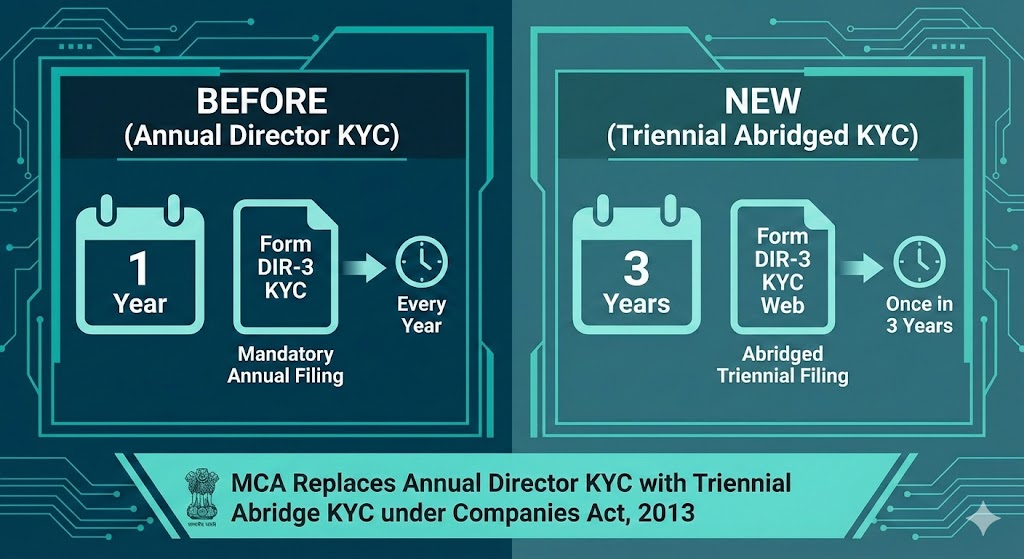
Under the earlier compliance regime, every individual holding a DIN was required to file DIR-3 KYC on an annual basis, irrespective of whether there were any changes in personal details.
Key characteristics of Annual Director KYC included:
- Mandatory yearly filing
Every DIN holder had to submit KYC information every financial year, even if their data remained unchanged. This led to repetitive compliance without incremental regulatory value. - Uniform applicability
The requirement applied to all directors equally executive, non-executive, nominee, independent, resident, and non-resident directors. - Professional certification requirement
Each filing had to be digitally verified by the director and certified by a practicing professional, adding time, cost, and coordination complexity. - Strict penalties for non-compliance
Failure to file resulted in automatic DIN deactivation along with a mandatory late fee, creating compliance risk even for inadvertent delays.
Practical Challenges with Annual KYC
For companies with multiple directors or group structures, annual KYC filings resulted in:
- High administrative overhead
- Repeated professional engagements
- Increased risk of technical non-compliance
- Last-minute compliance pressures close to due dates
Introduction of Triennial Abridged KYC: What Has Changed?
The MCA has replaced the annual framework with a Triennial Abridged KYC system, fundamentally shifting the compliance philosophy from frequency-driven to relevance-driven reporting.
What is Triennial Abridged KYC?
Concept and Purpose
Triennial Abridged KYC requires directors to complete their KYC once every three years, provided there are no changes in their personal or contact details during the intervening period.
The abridged format focuses on confirmation rather than re-submission of unchanged information, thereby reducing duplication while preserving data integrity.
Key Features of the Triennial Abridged KYC Framework
1. KYC Filing Once Every Three Years
Directors are now required to complete KYC only once in a three-year cycle. This change significantly reduces compliance frequency while maintaining periodic validation of director data.
Why this matters:
This lowers compliance fatigue, especially for senior professionals serving on multiple boards, and aligns Indian regulations with global governance norms.
2. Abridged and Unified KYC Form
The revised KYC form has been designed as a multi-purpose compliance tool, capable of handling both periodic KYC and event-based updates.
The same form can now be used for:
- Scheduled triennial KYC confirmation
- Updating mobile numbers
- Updating email addresses
- Updating residential addresses
- Reactivating deactivated DINs
Why this matters:
A unified form reduces procedural confusion, minimizes documentation overlap, and allows faster updates when director information changes.
3. Relaxation in Digital Signature and Certification Requirements
Under the new framework, digital signatures and professional certification are required only when there is a change in director details or when DIN reactivation is sought.
For routine triennial KYC confirmation where no data has changed:
- Director digital signature is not mandatory
- Professional certification is not mandatory
Why this matters:
This significantly reduces compliance costs and dependency on professionals for routine filings, without compromising regulatory oversight where changes occur.
Applicability and Transitional Provisions
Directors Who Have Already Filed KYC
Directors who are already compliant under the earlier regime automatically transition to the new framework.
- Directors who completed KYC on or before 31 March 2026 are automatically covered under the new framework. Their next mandatory filing is due by 30 June 2028. No filing is required for FY 2026-27 or FY 2027-28, provided no event-based changes occur in the interim.
- Directors whose DIN was deactivated as on 31 March 2026 were permitted to reactivate under the old process until that date. After 31 March 2026, reactivation requires filing Form DIR-3 KYC Web with the ₹5,000 reactivation fee under the new framework.
- All DIR-3 KYC filings that were in draft, pending, or pending-for-DSC-upload status as on 31 March 2026 were cancelled by MCA. Directors in that position must file fresh under the updated Form DIR-3 KYC Web.
- For DINs allotted on or after 1 April 2026, the triennial clock starts from the end of the financial year of allotment. A director receiving a DIN in FY 2026-27 will have their first filing due by 30 June 2030.
Transition scenarios at a glance
| Scenario | Next DIR-3 KYC due date |
|---|---|
| Filed KYC for FY 2024-25 (DIN active as on 31 March 2026) | 30 June 2028 |
| DIN deactivated as on 31 March 2026, reactivated post that date | Enters new triennial cycle from reactivation year |
| DIN allotted in FY 2026-27 | 30 June 2030 |
| Director changes mobile number in FY 2027-28 | Must file within 30 days of change; triennial cycle continues from original year |
This provides predictability and stability in long-term compliance planning.
Directors Who Have Never Filed Director KYC
Directors who have not completed KYC at all are allowed to continue filing under the existing mechanism until a specified cut-off date.
- DIN reactivation and KYC filing can be completed under the old process until the transition deadline
- After this period, non-compliant DINs may face restrictions
This ensures a smooth migration without penalizing legacy or inactive DIN holders abruptly.
What Remains Unchanged Under the New Regime
While the filing frequency has been reduced, certain compliance principles remain intact:
- Director information must always be accurate and up to date
- Any change in email, mobile number, or address must be reported promptly
- DIN deactivation remains a consequence of non-compliance
- Regulatory scrutiny and enforcement powers are unaffected
Key insight:
The reform simplifies compliance execution, not compliance responsibility.
The 30-day event-based obligation: the compliance risk most directors will miss
The triennial cycle is only half of the 2026 framework. The substituted Rule 12A(2) creates a parallel, ongoing obligation that runs independently of the three-year calendar.
Any change in a director’s personal mobile number, email address, or residential address triggers a mandatory Form DIR-3 KYC Web filing within 30 days of the change, along with the applicable fee under the Companies (Registration Offices and Fees) Rules, 2014. This obligation applies immediately, regardless of whether the director filed their triennial KYC six months ago or six weeks ago.
By reducing filing frequency to once in three years, MCA has effectively removed the annual forcing function that previously surfaced missed updates. Under the old annual regime, a director who changed their mobile number in May would catch and correct it during the September KYC filing at the latest. Under the triennial regime, that same director could go two-and-a-half years without touching the MCA portal — long enough for a missed event-based obligation to result in DIN deactivation with no prior warning.
The practical implication: treat any change to personal contact details as a compliance trigger with the same urgency as a GST registration amendment. The 30-day window under Rule 12A(2) is shorter than most directors assume, and completing the filing requires DSC and professional certification, which takes 3-5 working days in a well-organised setup. Starting on day 28 is not a comfortable position.
What happens when a DIN is deactivated and why it matters beyond the individual director
Failure to file within the prescribed timeline results in the DIN being marked “Deactivated due to non-filing of KYC” in the MCA registry. For a director sitting on multiple company boards which is common in the VC-backed startup ecosystem the consequences extend well beyond personal inconvenience.
A deactivated DIN cannot sign any MCA form. This includes annual filings (MGT-7, AOC-4), share allotment forms (PAS-3), director appointment and change forms (DIR-12), and any secretarial filing that requires the director’s digital signature. The MCA portal will reject every such form until the DIN is reactivated.
The block applies across all companies simultaneously. A founder sitting on three boards with one deactivated DIN will find filings blocked across all three entities. The deactivation is personal, not company-specific.
Reactivation requires ₹5,000 and a fresh filing. There is no waiver available for this fee, regardless of the reason for the lapse. Form DIR-3 KYC Web must be filed with the fee, after which MCA typically restores active status within a few working days.
The fundraise-timing risk is specific and underappreciated. During a funding round, MCA approvals share allotments (PAS-3), board changes, and shareholder filings require active DINs of every signing director. A deactivated DIN discovered mid-round can delay closing timelines and create friction with investors who expect clean, uninterrupted secretarial records. Verifying DIN status and KYC currency for every board member should be part of pre-deal compliance review, before investor due diligence begins.
Special considerations: nominee directors and foreign nationals
Nominee directors appointed by investors whether VC funds, PE firms, or angel syndicates are directors under the Companies Act, 2013 regardless of the nominative structure. They hold DINs in their personal name and are personally responsible for triennial KYC compliance. The nominating entity’s secretarial team cannot complete the filing without the nominee’s own DSC and real-time OTP verification on their registered mobile and email.
This creates an explicit coordination obligation. When an investor nominates a board director, best practice at onboarding is to verify that the nominee’s DIN is active, their KYC is current, and the mobile number and email registered on MCA are ones they actively use. A nominee director with a lapsed KYC cannot sign the board resolutions or MCA filings needed to formalise their own appointment a circular problem that tends to surface only when there is a time-sensitive filing.
Foreign nationals and NRIs holding an Indian DIN must comply with the triennial KYC requirements on the same basis as Indian nationals. The documentation differs: a valid passport serves as identity proof, and address proof from the country of residence is required. OTP verification uses the mobile number registered with the MCA, which must be accessible in real time. Foreign directors based outside India should confirm their registered mobile is a number they can receive OTPs on not a number that has since been deactivated or reassigned.
Strategic Impact on Businesses and Boards
Impact on Founders and Promoters
- Reduced repetitive compliance allows greater focus on business strategy
- Lower risk of inadvertent DIN deactivation
- Simplified governance during fundraising and restructuring
Impact on Investors and Nominee Directors
- Easier onboarding of investor nominees
- Fewer recurring compliance representations
- Improved diligence confidence due to stable DIN status
Impact on Large Corporates and Group Structures
- Substantial reduction in aggregate compliance volume
- Lower internal coordination and tracking effort
- Better allocation of compliance resources to higher-risk areas
Quantifying the Compliance Relief
| Parameter | Earlier Annual KYC | Triennial Abridged KYC |
|---|---|---|
| Filing frequency | Every year | Once in three years |
| Forms per 6-year period | 6 | 2 |
| Certification instances | Every filing | Only on changes |
| Compliance cost | High recurring | Significantly reduced |
| Risk of missed deadlines | Frequent | Substantially lower |
How to file Form DIR-3 KYC Web: step by step
Standard triennial filing (no change in personal details)
- Log in to the MCA21 portal at mca.gov.in using director credentials tied to the registered email address.
- Navigate to Form DIR-3 KYC Web under MCA services. The form pre-fills personal details from the MCA database name, PAN, date of birth, nationality, and current address.
- Verify that the pre-filled details match current records. For a standard triennial filing with no changes, no document uploads are required.
- Complete OTP verification on both the registered mobile number and registered email address. OTPs are generated by the MCA system and must be verified in real time.
- Submit using the director’s digital signature. Professional (CA/CS/CMA) certification is not required for standard triennial filings.
- Retain the System Reference Number (SRN) as acknowledgement. An approval email from MCA confirms the filing is complete.
Event-based update filing (change in mobile, email, or residential address)
The process mirrors the above with two additional steps: the updated information is entered manually, and certification by a practising CA, CS, or Cost Accountant using their DSC is mandatory. The filing must be completed within 30 days of the change under Rule 12A(2).
Documents to keep ready
- PAN card (identity)
- Aadhaar card for Indian nationals; passport for foreign nationals
- Current residential address proof not older than 2 months: utility bill, bank statement, or rental agreement
- Director’s valid Digital Signature Certificate (DSC), linked to the DIN
- For event-based filings: DSC and credentials of the certifying professional
Policy Intent and Regulatory Direction
This reform reflects a broader shift in India’s corporate law framework toward:
- Risk-based regulation
- Reduced non-financial compliance burden
- Enhanced ease of doing business
- Greater reliance on event-based disclosures
The move acknowledges that regulatory effectiveness is driven more by quality of data than by frequency of filings.
What Companies Should Do Going Forward
- Re-align internal compliance calendars to the triennial cycle
- Create internal triggers for event-based KYC updates
- Review DIN status of all directors periodically
- Update board onboarding and exit checklists
- Educate directors on their continuing disclosure obligations
Common mistakes directors make with DIR-3 KYC
Assuming resignation ends the obligation. A director who has resigned from all company boards often assumes the KYC obligation ends with the resignation. It does not. The obligation runs with the DIN, not the appointment. A resigned director must continue filing until the DIN is formally surrendered by filing Form DIR-5 with the MCA. Most resigned directors are unaware Form DIR-5 exists.
Missing the 30-day event-based window. Directors who change their mobile number or residential address sometimes without connecting the change to a compliance obligation let the 30-day Rule 12A(2) window lapse. The window runs from the date of the change, not from when the director becomes aware of the obligation.
Using an inaccessible email on the MCA portal. Many directors registered their DIN with an email address that has since been deactivated a former employer’s domain, a defunct startup email, or an old account. OTP-based verification requires real-time access to that registered address. If it is inaccessible, the director is locked out of routine filings and must route through an event-based update which itself requires OTP verification on the old address. This becomes circular.
Treating a pending-status filing as complete. All DIR-3 KYC filings in draft, pending, or pending-for-DSC-upload status as on 31 March 2026 were cancelled by MCA. Directors who initiated but did not complete a filing before that date found their DIN deactivated. A filing is complete only when an SRN is issued and an MCA approval email is received.
Nominee directors assuming someone else is managing it. DIR-3 KYC requires the director’s personal DSC and their own mobile and email OTPs. A company secretary or secretarial firm cannot complete the filing without these. In practice, nominee directors at portfolio companies sometimes assume the portfolio company’s team is managing their personal KYC, while the secretarial team assumes the nominee’s parent firm is handling it. The result is a lapse that belongs to everyone and no one. Assign explicit ownership at onboarding.
Concluding Perspective
Key Takeaways
- The Ministry of Corporate Affairs replaced the annual DIR-3 KYC requirement with a triennial cycle under the Companies (Appointment and Qualification of Directors) Amendment Rules, 2025, notified on 31 December 2025 and effective from 31 March 2026.
- Every DIN holder who completed KYC up to FY 2025-26 does not need to file again until 30 June 2028 the MCA confirmed this transition in its press release dated 31 December 2025.
- A separate event-based obligation under the substituted Rule 12A(2) requires any director who changes their mobile number, email address, or residential address to file Form DIR-3 KYC Web within 30 days of the change, irrespective of the triennial cycle.
- A deactivated DIN blocks every MCA filing requiring that director’s digital signature across all companies on whose board they sit not just the company where the compliance lapse occurred.
- Disqualified directors under Section 164 of the Companies Act, 2013, and foreign nationals holding an Indian DIN, are not exempt from the triennial KYC obligation.
- The only way to permanently exit the KYC obligation is to surrender the DIN by filing Form DIR-5 with the MCA.
The replacement of Annual Director KYC with Triennial Abridged KYC is a meaningful structural reform under the Companies Act, 2013. It reduces compliance noise, preserves regulatory intent, and improves governance efficiency particularly for sophisticated businesses and seasoned boards.
For companies that treat compliance as an enabler of governance rather than a procedural obligation, this change offers long-term strategic value with minimal regulatory trade-off.
FAQs on Triennial Abridged Director KYC under Companies Act, 2013
-
What is Director KYC under the Companies Act, 2013?
Director KYC is a statutory compliance requirement that ensures all individuals holding a Director Identification Number (DIN) have their identity, contact details, and address verified with the Ministry of Corporate Affairs. The purpose of Director KYC is to maintain accurate director data, prevent misuse of DINs, and strengthen corporate governance and regulatory oversight.
-
What was Annual Director KYC and why was it introduced?
Annual Director KYC required every DIN holder to submit their KYC details every financial year, regardless of whether any information had changed. It was introduced to regularly validate director identities and curb the use of inactive or fraudulent DINs. Over time, however, it led to repetitive filings and increased compliance burden without proportionate regulatory benefit.
-
What is Triennial Abridged KYC and how is it different from Annual KYC?
Triennial Abridged KYC requires directors to complete KYC once every three years instead of annually. Unlike the earlier system, the abridged framework focuses on confirmation of existing details rather than re-submission of unchanged information. This reduces compliance frequency while ensuring that director records remain current and reliable.
-
Is Director KYC still required if there is no change in details?
Yes, Director KYC is still mandatory even if there is no change in personal or contact details. However, under the triennial abridged KYC framework, such confirmation is required only once every three years instead of every year, provided there are no intervening changes.
-
When is Director KYC required to be filed under the new framework?
Under the new framework, directors who have already completed KYC will be required to file their next KYC at the end of the applicable three-year cycle. Directors who have never completed KYC must do so within the prescribed transition period to avoid DIN deactivation.
-
What happens if a director changes their email, mobile number, or address?
If there is any change in a director’s email address, mobile number, or residential address, the updated information must be filed using the abridged KYC form. In such cases, digital signature verification and professional certification become mandatory to ensure the authenticity of the update.
-
What are the consequences of not complying with Triennial Abridged KYC?
Failure to comply with the triennial abridged KYC requirements can result in deactivation of the Director Identification Number. A deactivated DIN restricts a director from participating in board decisions, filings, and corporate actions until compliance is restored.
-
Does Triennial Abridged KYC reduce regulatory oversight?
No. While the filing frequency has been reduced, regulatory oversight remains intact. The reform shifts the focus from repetitive annual filings to meaningful, event-based disclosures, ensuring that director information remains accurate, traceable, and enforceable at all times.
About the Author
Share
-
Link copied to clipboard!https://treelife.in/compliance/mca-replaces-annual-director-kyc-with-triennial-abridged-kyc/

-

-

-

-

Treelife

Treelife Team | support@treelife.in
We are a legal and finance firm with a deep focus on the startup ecosystem. We offer a wide range of services, including Virtual CFO, Legal Support, Tax & Regulatory, and Global Expansion assistance.
Our goal at Treelife is to provide you with peace of mind and ease in business.
We Are Problem Solvers. And Take Accountability.
Related Posts

Trademark Objection Reply & Opposition: TM-O Drafting, Hearing, Timelines
A trademark objection reply is the formal, deadline-bound response an applicant files when the Trade Marks Registry or a third...
Learn More

BIS Certification & CRS Registration for Importers and D2C Brands
BIS certification is the umbrella term for the licences and registrations issued by the Bureau of Indian Standards (BIS) before...
Learn More

NBFC-MFI Licence in India: Qualifying Assets and RBI Norms
A Non-Banking Financial Company-Microfinance Institution (NBFC-MFI) is a distinct RBI-regulated lending category built around collateral-free credit to low-income households. It...
Learn More

UK Company Registration from India: Incorporation, ODI, PE
An Indian company or resident individual can register a UK private limited company in two to four weeks through Companies...
Learn More

OIDAR Registration in India for Foreign SaaS Providers
If your SaaS platform bills an Indian credit card, UPI handle, or wallet directly, without routing the sale through an...
Learn More

CDSCO Medical Device Licence & import Registration – A Legal Guide
A medical device cannot be legally manufactured, sold, distributed or imported into India without the correct authorisation from the Central...
Learn More

Registering a Web3 or VDA Business in India: FIU-IND & PMLA
Any business in India that exchanges, transfers, safe-keeps, or helps issue virtual digital assets is a reporting entity under the...
Learn More

Setting up a Manufacturing Entity in India: Approvals, Licences and Incentives
A manufacturing entity in India needs four things to run legally: a valid corporate structure, land with the right zoning,...
Learn More

EPR Registration for Plastic Packaging: CPCB Process, Returns, Penalties
Every brand that ships a physical product wrapped, cushioned or sealed in plastic is a Producer, Importer or Brand Owner...
Learn More

STPI Registration for IT and GCC Units: Process, Benefits
A foreign parent setting up a software delivery centre or Global Capability Centre (GCC) in India will hit the STPI...
Learn More

Semiconductor & Electronics Setup in India: Manufacturing Approval
Setting up a semiconductor or electronics manufacturing unit in India runs across four tracks that have to be sequenced correctly:...
Learn More

Singapore Company Incorporation from India: A Step by Step Guide
Setting up a Singapore Pte Ltd from India is not a single filing. It is two regulatory processes running on...
Learn More
© 2026 Treelife Ventures Services Private Limited. All Rights Reserved.