





Setting up an offshore subsidiary from India
Written By

Priya Kapasi Shah
Share
-
Link copied to clipboard!https://treelife.in/legal/setting-up-an-offshore-subsidiary-from-india/

-

-

-

-

AI Summary
- Indian companies and individuals can set up foreign subsidiaries under the Overseas Direct Investment (ODI) framework, governed by the Foreign Exchange Management (Overseas Investment) Rules, 2022 and Regulations, 2022, which replaced the older ODI regime under FEMA Notification No. 120 in August 2022.
- Under Rule 19 of the OI Rules, 2022, the automatic route permits an Indian entity to invest in a foreign entity up to 400% of its net worth as per the last audited balance sheet, without prior RBI approval.
- Individuals investing overseas are subject to the Liberalised Remittance Scheme (LRS) limit of USD 250,000 per financial year under RBI's Master Direction on LRS.
- RBI Form ODI-Part I must be filed before any funds are remitted offshore, and investing before filing can trigger compounding proceedings under FEMA.
- The approval route becomes mandatory when investment exceeds the 400% net worth cap, when the investor is under regulatory investigation, when prior Annual Performance Reports (APRs) have not been filed, or when the target jurisdiction is FATF non-cooperative.
- Post-investment, filing Annual Performance Reports (APRs) is mandatory on an ongoing basis, and missing APR deadlines can also trigger compounding proceedings under FEMA.
- Delaware, Singapore, and UAE are the three jurisdictions most commonly chosen by Indian founders and companies, each suited to different structural objectives.
- Indian companies set up offshore subsidiaries for three main reasons: operational expansion into foreign markets, creating a fundraising holding structure (commonly a flip structure) preferred by US or Singapore-based VC and PE funds, and holding intellectual property in a low-tax jurisdiction.
- Migrating intellectual property from India to a foreign subsidiary requires careful income tax analysis under Section 9 of the Income Tax Act, 1961, along with the indirect transfer provisions and transfer pricing considerations.
Blog Content Overview
- 1 Introduction
- 2 Why Indian companies and founders set up offshore subsidiaries
- 3 The FEMA ODI framework: what you need to know before you move a rupee
- 4 Choosing the right jurisdiction: Delaware, Singapore, or UAE
- 5 Step-by-step: how to set up the offshore subsidiary
- 6 The flip structure: special considerations
- 7 Ongoing compliance obligations
- 8 Frequently asked questions
- 9 Conclusion
Summary:
- An Indian company or individual can set up a foreign subsidiary under the Overseas Direct Investment (ODI) rules, subject to FEMA compliance.
- The automatic route allows investment up to 400% of the Indian entity’s net worth without RBI approval, under Rule 19 of the Foreign Exchange Management (Overseas Investment) Rules, 2022.
- Delaware, Singapore, and UAE are the three most common jurisdictions chosen by Indian founders and companies, each for different reasons.
- RBI Form ODI-Part I must be filed before remitting any funds offshore. Post-investment, Annual Performance Reports (APRs) are mandatory.
- Missing APR deadlines or investing before filing triggers compounding proceedings under FEMA.
Introduction
Setting up an offshore subsidiary from India is one of the more common requests we handle at Treelife, whether it comes from a founder looking to incorporate a US parent for VC fundraising, a mid-size company opening a Singapore sales office, or a group planning to acquire a foreign business. The legal and regulatory framework is workable, but it has specific sequencing requirements and ongoing compliance obligations that trip up even sophisticated operators. Get the FEMA filings right before you move a rupee, and the rest is largely mechanical.
Why Indian companies and founders set up offshore subsidiaries
There are three distinct reasons, and they drive very different structural choices.
Operational expansion. A company opening a sales office, hiring engineers, or acquiring customers in the US, Southeast Asia, or the Gulf sets up a foreign subsidiary to hold those operations. The offshore entity employs local staff, signs local contracts, and holds local bank accounts. The Indian parent owns it and remits capital as needed.
Fundraising structure. Many VC and PE funds, particularly US and Singapore-based funds, prefer to invest in a holding company incorporated in their home jurisdiction rather than directly into an Indian entity. A Delaware C-Corp or a Singapore Pte Ltd sitting above the Indian operating company makes the cap table familiar to those investors and avoids complications around FCCB issuance, pricing guidelines, and downstream investment approvals. This is commonly called a flip structure and involves more regulatory complexity than a straightforward ODI.
IP and holding structures. Companies that generate valuable intellectual property sometimes hold that IP in a low-tax jurisdiction and license it back to operating entities. This is a legitimate structure but gets into transfer pricing territory quickly. Any IP migration from India to a foreign subsidiary also requires careful income tax analysis under Section 9 of the Income Tax Act, 1961 and the indirect transfer provisions.
All three of these structures are governed on the Indian side by the Foreign Exchange Management (Overseas Investment) Rules, 2022 (the OI Rules) and the Foreign Exchange Management (Overseas Investment) Regulations, 2022. The old ODI framework under FEMA Notification No. 120 was replaced by this consolidated regime in August 2022. If you are working off pre-2022 guidance, update your reading.
The FEMA ODI framework: what you need to know before you move a rupee
The automatic route is available for most standard overseas investment. No RBI approval is needed, but the procedural requirements are non-negotiable.
Under Rule 19 of the OI Rules, 2022, an Indian entity can invest in a foreign entity through the automatic route up to 400% of its net worth as per the last audited balance sheet. For individuals, the limit under the Liberalised Remittance Scheme (LRS) is USD 250,000 per financial year under RBI’s Master Direction on LRS.
The approval route applies when the investment exceeds the 400% net worth cap, when the investor is under investigation by any regulatory authority, when the Indian entity has not filed its APRs for prior investments, or when the investment is in a jurisdiction identified by FATF as non-cooperative.
RBI Form ODI-Part I must be filed through the authorised dealer bank before the first remittance. This is not optional and not retrospective. The sequence is: board resolution, shareholder approval if required, Form ODI-Part I filed with the AD bank, AD bank submits to RBI, funds remitted. Reversing this sequence is a FEMA violation.
After the investment, the Indian entity must file an Annual Performance Report (APR) by 31 December each year, covering the financial position of the foreign entity, dividends received, and details of further investments. The APR is filed in Form ODI-Part II. Missing this deadline is a compoundable offence under FEMA.
One practical point: the 400% net worth limit applies to the Indian investing entity, not the group. If an LLP is the investing vehicle, its net worth is typically lower than a Pvt Ltd company’s, which shrinks the automatic route headroom. Many founders set up the ODI through the operating company rather than through personal LRS remittances to preserve flexibility.
Choosing the right jurisdiction: Delaware, Singapore, or UAE
The information below is based on publicly available desktop research on these jurisdictions. Local legal and tax advice in the target jurisdiction is essential before incorporation. Treelife advises on the India side of these structures; for foreign jurisdiction specifics, we work with our correspondent network.
Delaware, USA
Delaware is the default for Indian startups seeking US VC money. The Delaware General Corporation Law is flexible, the Court of Chancery has deep jurisprudence on corporate disputes, and every US VC fund’s lawyers are comfortable with a Delaware C-Corp. Incorporation takes 24 to 48 hours through a registered agent, the minimum capital requirement is negligible, and annual franchise tax is low for early-stage companies (though it scales with authorised shares, so cap table hygiene matters).
The practical reason to choose Delaware over another US state is not tax. Delaware has no income tax on companies that do not operate within the state, but a Delaware C-Corp with Indian operations will still have US federal tax obligations once it generates US-source income. The real reason is investor and legal familiarity. SAFEs, standard Series A term sheets, and US legal documentation are all built around Delaware.
For the flip structure specifically, the Indian founder’s transfer of shares in the Indian company to the Delaware parent triggers Indian capital gains tax and requires a valuation from a registered valuer under Rule 11UA of the Income Tax Rules, 1962. The swap must be at fair market value; any shortfall can be treated as income under Section 56(2)(x).
Singapore
Singapore is the preferred jurisdiction when the business has Southeast Asian operations, when the founders want a more tax-efficient holding structure, or when they want access to India’s tax treaty with Singapore. The India-Singapore DTAA was amended in 2016 and the capital gains exemption for pre-2017 investments was grandfathered, but new investments do not benefit from that exemption. Treaty shopping using a Singapore holding company for pure Indian income is much harder to sustain post-2017.
What Singapore still offers: a territorial tax system where foreign-sourced dividends and capital gains are generally exempt, a network of 90+ tax treaties, a well-regulated corporate environment (ACRA registration, annual filing requirements), and a credible jurisdiction for fund structures. Singapore is also the jurisdiction of choice when the fund manager or general partner wants to be based outside India while managing India-focused strategies.
Incorporating a Singapore Pte Ltd takes two to three days. A local resident director is required. Paid-up capital can be as low as SGD 1. Annual compliance involves filing with ACRA and maintaining a registered office address.
UAE
The UAE has become a serious option post-2023, particularly after the introduction of the corporate tax regime at 9% on taxable income above AED 375,000. For Indian founders and HNIs who have relocated to Dubai or Abu Dhabi, the UAE now offers a zero personal income tax environment combined with a reasonable corporate tax rate, 100% foreign ownership in most free zones, and a simplified business environment.
For offshore subsidiary purposes, the UAE is most relevant when the business has genuine commercial operations in the Gulf or when the founders are personally based in the UAE. A pure brass-plate structure with no substance will attract scrutiny under the OECD’s substance requirements and India’s General Anti-Avoidance Rules (GAAR) under Chapter X-A of the Income Tax Act, 1961.
Free zone entities (DIFC, ADGM, DMCC, JAFZA among others) offer specific sector advantages. DIFC and ADGM are particularly used for financial services businesses and fund structures given their common law frameworks and independent regulatory bodies.
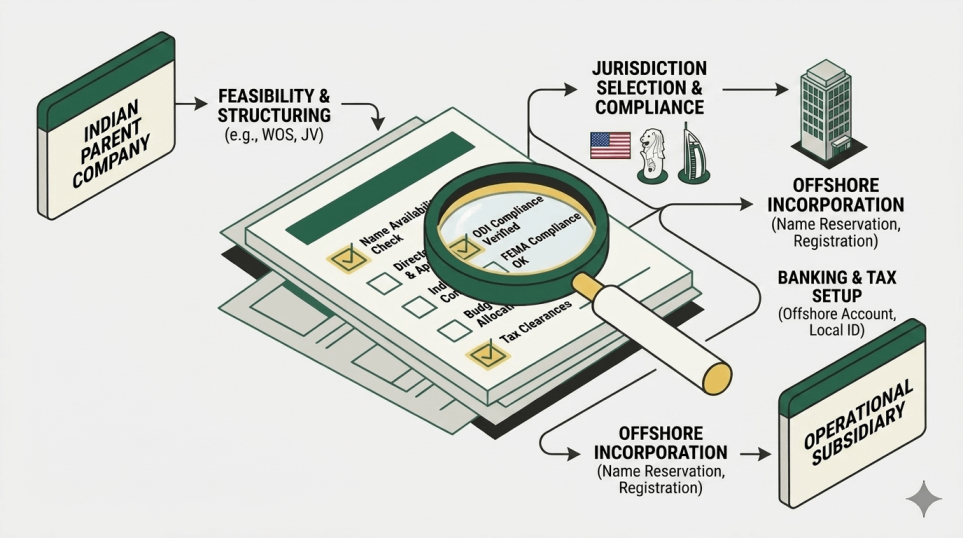
Step-by-step: how to set up the offshore subsidiary
The steps below cover the India-side process. Foreign jurisdiction incorporation runs in parallel.
- Board resolution of the Indian entity approving the overseas investment, specifying amount, jurisdiction, and purpose.
- Shareholders’ resolution if required under the Companies Act, 2013 (Section 186 applies to investments by companies; check whether the investment exceeds limits requiring special resolution).
- Valuation of the foreign entity if acquiring an existing company; not required for greenfield incorporation.
- Filing of Form ODI-Part I through the AD bank. The bank submits to RBI and issues a Unique Identification Number (UIN).
- Remittance of funds through the AD bank, referencing the UIN.
- Incorporation documents of the foreign entity (certificate of incorporation, share certificate) to be submitted to the AD bank within 30 days of incorporation.
- Annual Performance Report (APR) filed by 31 December each year.
- Foreign Liabilities and Assets (FLA) return filed with RBI by 15 July each year, covering the Indian company’s overseas assets and liabilities.
The FLA return and APR are separate filings and both are mandatory once you hold a foreign subsidiary.
Check what happens when ODI filings are missed and how to regularise. Let’s Talk
The flip structure: special considerations
A flip structure is where an Indian founder incorporates a foreign holding company and makes it the parent of the Indian operating entity, rather than the Indian entity owning the foreign subsidiary. This is the reverse of a standard ODI.
On the Indian side, the transfer of shares in the Indian company to the foreign holdco is governed by FEMA 20(R), specifically the Foreign Exchange Management (Non-Debt Instruments) Rules, 2019. The Indian founder transfers their Indian company shares to the foreign holdco in exchange for shares in the foreign holdco. This is treated as a foreign investment in India (FDI inbound) and as an overseas investment (ODI outbound) simultaneously.
The income tax implications are material. The swap is a transfer for capital gains purposes under Section 2(47) of the Income Tax Act, 1961. The consideration is the fair market value of the foreign shares received, which must equal the fair market value of the Indian shares transferred. Any discount is taxable as deemed gift income under Section 56(2)(x). The capital gains arising in the Indian founder’s hands may be long-term or short-term depending on the holding period.
Additionally, once a foreign holdco sits above an Indian operating company, any future sale of shares in the foreign holdco is an indirect transfer of Indian assets and may be taxable in India under Section 9(1)(i), depending on whether the value of Indian assets exceeds 50% of total assets.
Flips are doable, but they require careful execution and sequencing. The valuation, FEMA filings, and tax analysis need to happen in the right order.
Ongoing compliance obligations
Setting up the offshore subsidiary is the start, not the end.
The Indian parent must maintain a register of overseas investments. Every financial year, the APR must be filed reflecting the audited financials of the foreign entity. If the foreign entity makes further downstream investments, those must also be reported. Dividends received from the foreign subsidiary must be repatriated to India within the timeline specified under the OI Rules (currently within 90 days of declaration.
Any change in the shareholding of the foreign entity, any fresh investment, any loan to the foreign entity, or any guarantee issued by the Indian entity on behalf of the foreign entity requires fresh ODI filings or prior RBI approval depending on the nature of the transaction.
FEMA violations, including delayed APR filings, investing before filing Form ODI-Part I, or remitting more than the approved amount, are compoundable offences. The compounding amount depends on the quantum of contravention and the duration of the delay, and can be significant on large investments.
Frequently asked questions
Can an Indian individual set up a foreign subsidiary without RBI approval?
Yes, through the Liberalised Remittance Scheme (LRS) up to USD 250,000 per financial year per individual. Beyond that limit, RBI approval is required. The LRS route is commonly used by founders at an early stage before the Indian entity has sufficient net worth to use the corporate ODI automatic route.
What is the 400% net worth limit for ODI?
Under Rule 19 of the OI Rules, 2022, an Indian entity can invest up to 400% of its net worth (as per the last audited balance sheet) in overseas entities through the automatic route without RBI approval. Net worth is defined as paid-up capital plus free reserves.
Do I need RBI approval for a Singapore or Delaware subsidiary?
Not under the automatic route, provided the investment is within the 400% net worth limit and the investing entity is not under investigation and has no outstanding APR defaults. Form ODI-Part I must still be filed through the AD bank before remitting.
What happens if I miss the APR deadline?
Missing the 31 December APR deadline is a FEMA violation. It can be regularised through the compounding process with the RBI. Repeat defaults or large quantum violations attract higher compounding amounts. More practically, an entity with outstanding APR defaults cannot make further overseas investments until the defaults are cleared.
Is a flip structure the same as ODI?
A flip involves inbound FDI (the foreign holdco investing into India) and outbound ODI (the Indian founder investing into the foreign holdco) simultaneously. It is more complex than a standard ODI because it triggers FEMA 20(R), Section 186 of the Companies Act, and capital gains tax in the hands of the transferring founders. Each component has separate compliance requirements.
Can the offshore subsidiary invest back into India?
Yes, but this creates a round-tripping concern that FEMA and the income tax authorities scrutinise. Any downstream investment from the foreign subsidiary into India must comply with FDI regulations, sectoral caps, pricing guidelines, and entry routes applicable to that sector. Investments from jurisdictions with specific treaty positions (Mauritius, Singapore, Cyprus) face additional scrutiny post-2016.
Conclusion
Setting up an offshore subsidiary from India is straightforward when the regulatory sequencing is followed correctly. The FEMA ODI framework under the 2022 Rules provides a clear pathway for both the automatic route and the approval route. The choice between Delaware, Singapore, and UAE comes down to investor expectations, operational geography, and the personal situation of the founders. The ongoing compliance obligations, particularly APRs and FLA returns, are non-negotiable and should be built into the company’s annual compliance calendar from day one.
For flip structures and more complex holding arrangements, the income tax and FEMA analysis needs to happen before the first step is taken, not after.
About the Author
Share
-
Link copied to clipboard!https://treelife.in/legal/setting-up-an-offshore-subsidiary-from-india/

-

-

-

-

Priya Kapasi Shah

Associate Partner | Tax & Regulatory | priya.k@treelife.in
Heads Treelife’s Financial Advisory practice, specializing in investment structuring, cross-border transactions, and tax and regulatory advisory. Also leads on AIF setups and advisory services for GIFT IFSC.
We Are Problem Solvers. And Take Accountability.
Related Posts

ESOP Compensation Committee in India: Governance Guide
An ESOP scheme approved by shareholders is an enabling document, not an operating system. The shareholder resolution authorises the pool....
Learn More

Vendor and Client Invoice Management as part of a CFO Retainer
Five regulatory frameworks touch every vendor invoice that flows through an Indian business: the GST e-invoicing mandate, the Invoice Management...
Learn More

Phantom Stocks in India – 2026 Guide for Startup Founders
Phantom stock is one of the most misunderstood compensation tools in the Indian startup ecosystem. Most founders encounter it when...
Learn More
© 2026 Treelife Ventures Services Private Limited. All Rights Reserved.