



Compliances For One Person Company (OPC) in India- Complete List
Written By

Sanmita Poojari
Share
-
Link copied to clipboard!https://treelife.in/compliance/compliances-for-one-person-company/

-

-

-

-

AI Summary
- An OPC must appoint a practising Chartered Accountant as its first auditor within 30 days of incorporation.
- Form INC-20A, the Commencement of Business Declaration confirming receipt of subscription money, must be filed within 180 days of incorporation.
- Form MGT-7A, the annual return, and Form AOC-4, the audited financial statements, must each be filed within 180 days from the end of the financial year.
- Every director must complete DIR-3 KYC annually by 30th September of the subsequent financial year.
- MBP-1, disclosing a director's interest in company assets or financial dealings, must be filed at the first board meeting of the year.
- MSME-I half-yearly returns reporting dues to micro and small enterprises are due by 31st October for April-September and 30th April for October-March.
- DIR-8, the director's annual declaration of non-disqualification under the Companies Act 2013, must be filed every year.
- Income tax return ITR-6 must be filed annually by 30th September, disclosing all income, deductions, and exemptions.
- Section 173, Section 92, and Section 137 of the Companies Act 2013 govern board meetings, annual return filings, and AOC-4 filings respectively for OPCs.
Blog Content Overview
- 1 What is a One Person Company (OPC) in India?
- 2 OPC compliance exemptions under Section 122 and small company status
- 3 OPC vs Private Limited Company: compliance comparison
- 4 Nominee compliance in OPC: Form INC-3 and changes to nominee
- 5 OPC conversion: post-2021 amendment and current position
- 6 What are Compliances for One Person Company (OPC) in India?
- 7 Key registrations required for a One Person Company
- 8 List of Important Compliances for One Person Company in India
- 9 Detailed List of OPC Compliances in India
- 9.1 Board Meeting Requirements for OPC
- 9.2 Appointment of Auditor
- 9.3 Filing of Annual Return
- 9.4 Form MGT-7A vs Form MGT-7: which form applies to your OPC and what is the correct deadline?
- 9.5 Financial Statement Submission
- 9.6 Disclosure of Interest by Directors
- 9.7 KYC Compliance for Directors
- 9.8 Filing Form DPT-3
- 9.9 Maintaining Statutory Registers
- 9.10 Commencement of Business Declaration (Form INC-20A)
- 9.11 PAN Application
- 9.12 Corporate Stationery Requirements
- 9.13 Opening an OPC Bank Account
- 9.14 DIR-8 (Director’s Declaration)
- 9.15 MSME-I Half-Yearly Return
- 9.16 Board’s Report Contents
- 9.17 Income Tax Filing
- 9.18 GST Compliance
- 9.19 TDS compliance for OPC: deduction, deposit, and quarterly returns
- 9.20 Professional Tax compliance: state-wise obligations
- 10 Penalties for non-compliance: consolidated reference table
- 11 Annual Compliance Checklist for One Person Company (OPC)
- 12 AGM exemption for OPC: How resolutions are passed without a meeting
- 13 Benefits of One Person Company Compliance
- 14 Common compliance mistakes that cost OPC founders time and money
- 15 Treelife practitioner note
- 16 Documents Required for One Person Company (OPC) Compliance in India
- 17 Conclusion and Way Ahead
- 18 FAQs on One Person Company (OPC) Compliances in India
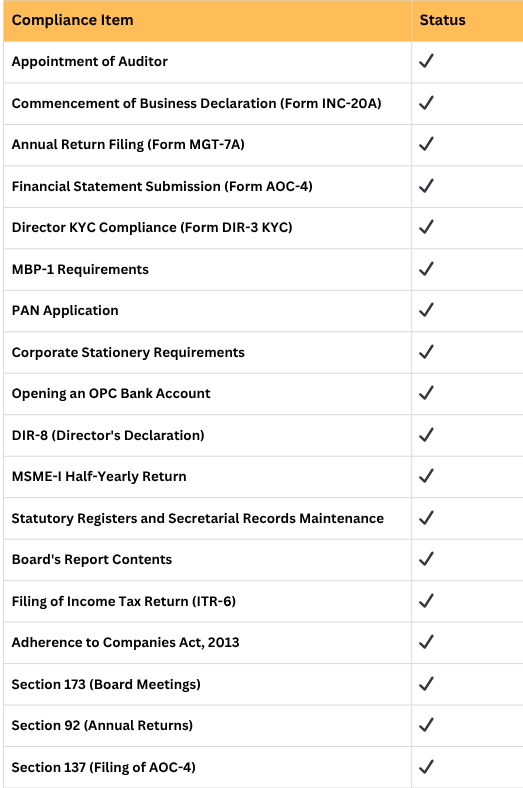
Ensuring compliance for a One Person Company (OPC) in India is essential for maintaining its legal standing and operational efficiency. Key obligations include:
- Appointment of Auditor: Within 30 days of incorporation, an OPC must appoint a practicing Chartered Accountant as its first auditor.
- Commencement of Business Declaration (Form INC-20A): This declaration must be filed within 180 days of incorporation, confirming the receipt of subscription money.
- Annual Return Filing (Form MGT-7A): OPCs are required to file their annual return within 180 days from the end of the financial year, detailing the company’s financial performance and other pertinent information.
- Financial Statement Submission (Form AOC-4): Audited financial statements must be filed within 180 days from the end of the financial year.
- Director KYC Compliance (Form DIR-3 KYC): Directors must complete their KYC process annually by September 30th of the subsequent financial year.
- MBP-1 Requirements: MBP-1 must be filed by the director during the first board meeting of the year to disclose their interest in the company’s assets or financial dealings.
- PAN Application: Once the OPC is incorporated, the next step is to apply for the PAN (Permanent Account Number). This can be done online through the NSDL website. After the allotment, the PAN application letter should be signed by the director and sent along with the company seal to NSDL.
- Corporate Stationery Requirements: After the incorporation of an OPC, it is mandatory to procure essential stationery, which includes a company name board that should clearly state the company name along with “One Person Company” in brackets. Additionally, an official rubber stamp and a company letterhead with these details should be prepared.
- Opening an OPC Bank Account: For opening a bank account for the OPC, several documents are required, including the certificate of incorporation, the Memorandum and Articles of Association (MOA/AOA), the PAN card, a board resolution for account opening, and the director’s ID proof. It is crucial that these documents are self-attested and include the company seal.
- DIR-8 (Director’s Declaration): DIR-8 is a statutory requirement for OPCs, where the director must file a declaration confirming that they are not disqualified from being a director under the provisions of the Companies Act, 2013. This filing is mandatory and should be done annually.
- MSME-I Half-Yearly Return: OPCs must file an MSME-I form twice a year to report their dues to micro and small enterprises. The deadlines for filing the MSME-I return are 31st October for April-September and 30th April for October-March.
- Statutory Registers and Secretarial Records Maintenance: It is mandatory for OPCs to maintain various statutory registers, including the register of members, directors, and charges. In addition, OPCs must maintain a minute book and keep copies of annual returns and resolutions passed by the company.
- Board’s Report Contents: The Board’s Report of an OPC should include key disclosures such as the company’s web address, director’s responsibility statement, fraud reporting details, auditor’s remarks, and financial highlights. The report should also cover changes in directorship, significant orders passed, and the state of affairs of the company.
- Filing of Income Tax Return (ITR-6): OPCs must file their income tax return (ITR-6) annually by 30th September. This form is specifically designed for companies, and OPCs must disclose all income, deductions, and exemptions in their tax return.
- Adherence to Companies Act, 2013: Relevant sections of the Companies Act, 2013 to ensure legal accuracy and authority. For instance:
- Section 173: Pertains to the board meetings of a company, ensuring that the board meetings are conducted according to legal requirements.
- Section 92: Relates to the filing of annual returns, specifying what should be included and when these filings must occur.
- Section 137: Requires the filing of AOC-4 (Annual Accounts) by the company, ensuring that the company complies with regulatory filing requirements for financial statements.
Adhering to these compliance requirements not only ensures legal conformity but also enhances the credibility and smooth functioning of the OPC.
What is a One Person Company (OPC) in India?
A One Person Company (OPC) in India is a business structure that allows a single individual to establish and operate a company under the provisions of the Companies Act, 2013. This concept was introduced to support entrepreneurs who are capable of starting a venture by allowing them to create a single-person economic entity. Before this Act, at least two directors and shareholders were required to form a company.
Here are some key features of an OPC:
- Single Shareholder: An OPC has only one member or shareholder, distinguishing it from other types of companies which require at least two shareholders.
- Management and Ownership: The same individual holds complete control over the company, managing its operations while also owning all the company’s shares.
- Directors: While an OPC can have only one member, it can appoint up to fifteen directors to facilitate its business operations, a number that can be increased beyond fifteen through a special resolution.
- Legal Status: An OPC is registered as a private limited company. This classification subjects it to all legal provisions applicable to private limited companies, including specific compliance requirements related to annual filings, financial statement audits, and more.
- Advantages Over Sole Proprietorship: An OPC provides limited liability protection to its sole owner, separating personal assets from the business’s liabilities. This is a significant advantage over a sole proprietorship, where personal assets can be at risk in case of business failure.
- Compliance Requirements: Like other private limited companies, an OPC must comply with various statutory requirements set out by the Companies Act. These include filing annual returns, maintaining books of accounts, and other regulatory compliances.
In essence, an OPC combines the simplicity of a sole proprietorship with the protective features of a company, making it an attractive option for entrepreneurs who prefer to work independently while enjoying the corporate veil.
OPC compliance exemptions under Section 122 and small company status
An OPC carries a lighter compliance load than a standard Private Limited Company, and understanding exactly which exemptions apply helps a solo founder plan time and budget accurately. The Companies Act, 2013 grants OPCs specific relief through Section 122, read with Section 2(62), Chapter II, and various Ministry of Corporate Affairs (MCA) notifications.
The key statutory exemptions available to an OPC are:
- No Annual General Meeting (AGM) required under Section 96(1). The sole member’s decisions, signed and entered into the minutes book under Section 122(3), constitute valid resolutions.
- No cash flow statement required as part of financial statements under Section 2(40).
- Annual return under Section 92 can be signed by the director directly, without a company secretary, under the proviso to Section 92(1).
- Sections 98 and 100 to 111 (general meeting procedures, quorum, voting) do not apply under Section 122(1).
- Secretarial Standard SS-2 on General Meetings does not apply to OPCs.
- Section 102 (explanatory statements for AGM business) does not apply.
- Auditor rotation provisions do not apply to OPCs under Section 139.
- If only one director is on the board, no board meeting is required at all. The sole director’s resolution, entered in the minutes book and signed and dated, is treated as a board resolution under Section 122(4).
Small company status and its additional benefits
Most OPCs also qualify as small companies under Section 2(85) of the Companies Act, 2013. As of the current threshold, a company qualifies as a small company if its paid-up capital does not exceed ₹4 crore and its turnover does not exceed ₹40 crore. An OPC that meets these thresholds (which the vast majority do) gets further benefits including reduced MCA filing fees, simplified abridged financial statements, and lower penalty ceilings for certain defaults under Section 446B (penalties are one-half of those applicable to larger companies).
It is important to flag that these exemptions are conditional on the OPC maintaining a clean filing record. Defaults on AOC-4 or MGT-7A can expose the company to the full compliance regime applicable to non-exempt companies.
OPC vs Private Limited Company: compliance comparison
A founder choosing between an OPC and a Private Limited Company is making a compliance-cost and governance decision, not just a structure decision. The table below shows every major compliance point side by side.
Table: OPC vs Private Limited Company compliance comparison
| Compliance area | One Person Company (OPC) | Private Limited Company |
|---|---|---|
| AGM | Not required (Section 96) | Mandatory every year |
| Board meetings | 1 per half-year if multiple directors; nil if single director | Minimum 4 per year |
| Annual return form | MGT-7A (simplified) | MGT-7 (full) |
| Cash flow statement | Not required (Section 2(40)) | Required |
| Auditor rotation | Not applicable | Applicable after 2 terms of 5 years each |
| Company secretary in practice (signing annual return) | Director can sign (Section 92 proviso) | CS signature required above threshold |
| AGM-equivalent resolutions | Signed minutes by sole member | Ordinary/special resolution at AGM |
| Minimum members | 1 | 2 |
| ESOP issuance to employees | Not permitted | Permitted |
| FDI | Not permitted | Permitted |
| Compliance cost estimate (annual professional fees) | ₹15,000 to ₹40,000 | ₹40,000 to ₹1,20,000+ |
The compliance gap is most visible in board and general meeting requirements. An OPC founder with a single director needs zero formal board meetings and no AGM, saving administrative effort and professional charges for minutes and filing. The trade-off is that an OPC cannot issue ESOPs, cannot raise FDI, and cannot add investors without converting to a Private Limited Company.
Nominee compliance in OPC: Form INC-3 and changes to nominee
The nominee is a compliance obligation unique to OPCs, and it is one that founders frequently overlook after incorporation. Under Rule 3 of the Companies (Incorporation) Rules, 2014, the sole member of an OPC must nominate another person to become the member of the OPC in the event of the member’s death or incapacity to contract. This nomination must be made at the time of incorporation itself.
At incorporation: Form INC-3
The nominee’s written consent must be filed in Form INC-3 along with the memorandum of association and other incorporation documents. The nominee must be a natural person, a resident of India, and must not already be a member or nominee of another OPC. Without a valid Form INC-3, the OPC registration is incomplete.
Changing or withdrawing the nominee: Form INC-4
If the nominee wishes to withdraw consent, the sole member must be notified. Within 15 days of receiving that notice, the sole member must nominate a replacement. The OPC then has 30 days from the date of the withdrawal notice to file Form INC-4 with the Registrar of Companies (ROC), along with the notice of withdrawal, the name and consent of the new nominee, and fresh Form INC-3 from the new nominee.
A nominee can also be changed at any time by the sole member by filing Form INC-4. There is no restriction on how frequently a nominee can be changed, but each change must be filed with the ROC within the prescribed timeline.
Failure to maintain a valid nominee or to notify the ROC of a change is a contravention of the Companies (Incorporation) Rules and attracts a penalty that may extend to ₹10,000 and a further ₹1,000 per day of continuing default.
OPC conversion: post-2021 amendment and current position
This is one of the most frequently misunderstood areas of OPC law, and it matters practically because a founder who believes they will be forced to convert once turnover crosses ₹2 crores may be making structuring decisions on outdated information.
What changed in 2021
The Companies (Incorporation) Second Amendment Rules, 2021, notified by the MCA, made two significant changes effective from 01/04/2021:
- The mandatory conversion thresholds (paid-up capital exceeding ₹50 lakhs or average annual turnover exceeding ₹2 crores over three consecutive financial years) have been deleted. An OPC can now continue operating as an OPC regardless of its size or turnover.
- The minimum 2-year lock-in period for voluntary conversion has been removed. An OPC can voluntarily convert into a Private Limited or Public Limited Company at any time after incorporation.
Current conversion process
Both voluntary and (if ever applicable) conversion filings now use only Form INC-6. Form INC-5 (previously used for intimation of mandatory conversion) has been deleted. The process for voluntary conversion requires:
- A board resolution approving the conversion.
- The resolution communicated to the sole member, entered in the minutes book, and signed and dated by the member.
- Filing of Form MGT-14 with the ROC within 30 days of passing the resolution, with the altered MOA and AOA attached.
- Filing of Form INC-6 within 30 days of filing MGT-14, with required attachments including the latest audited financial statements and declaration by directors.
- Appointment of at least one additional director and one additional member before conversion, since a Private Limited Company requires a minimum of 2 directors and 2 members.
The conversion does not affect existing debts, liabilities, obligations, or contracts of the OPC. The company retains its CIN and previous filings history.
One practical note: although FDI is not permitted in an OPC, once converted to a Private Limited Company, the entity can receive foreign investment through the automatic route in most sectors.
What are Compliances for One Person Company (OPC) in India?
Compliances for a One Person Company (OPC) in India are legal requirements that every company with a single owner must meet to maintain its status as a separate legal entity. These obligations, overseen by the Ministry of Corporate Affairs (MCA), are essential for the company to uphold its operational integrity and meet the regulatory standards established by the government. Annually, every registered OPC is required to fulfill these duties, which include the filing of an annual return and audited financial statements that provide a detailed account of the company’s activities and financial status over the previous financial year. The deadlines for these filings are determined by the date of the Annual General Meeting (AGM). Failure to comply can result in severe repercussions, including the removal of the company from the Registrar of Companies (RoC) register and the disqualification of its directors. Therefore, adhering to these annual compliance requirements is crucial for the sustainability and legal compliance of an OPC in India.
Key registrations required for a One Person Company
Filing annual returns is only one part of the compliance picture. Several registrations are required either at incorporation or as the business begins operations. Missing these creates exposure that does not show up on an ROC default list but can still attract penalties.
PAN and TAN registration
Every OPC must obtain a Permanent Account Number (PAN) from the Income Tax Department for filing tax returns and conducting financial transactions. In addition, if the OPC makes payments that attract Tax Deducted at Source (TDS) such as salary, professional fees, rent, or contractor payments it must also obtain a Tax Deduction and Collection Account Number (TAN). TAN is mandatory before the first TDS deduction is made. Applications for both can be filed online through the NSDL portal. The PAN allotment letter must be signed by the director with the company seal before being sent to NSDL.
GST registration
GST registration under the Central Goods and Services Tax Act, 2017 is mandatory if the OPC’s aggregate annual turnover exceeds ₹20 lakhs (₹10 lakhs for special category states), or if the OPC supplies goods or services in more than one state regardless of turnover. OPCs in e-commerce must register under GST without any turnover threshold. Registration is done through the GST portal (gstin.gov.in), and the GSTIN must be displayed on all invoices and letterheads.
Shop and Establishment registration
Most states require commercial establishments including OPCs operating from office premises to register under the respective state’s Shop and Establishment Act. The registration must be obtained from the local municipal authority or labour department, typically within 30 days of commencing business. The specific requirements, fees, and renewal timelines vary by state. In Maharashtra, registration is under the Maharashtra Shops and Establishments (Regulation of Employment and Conditions of Service) Act, 2017; in Karnataka, it is under the Karnataka Shops and Commercial Establishments Act, 1961.
Professional Tax registration
In states that levy Professional Tax including Maharashtra, Karnataka, West Bengal, Gujarat, and Madhya Pradesh an OPC that employs staff must register for Professional Tax with the state authority. The employer (the OPC) must obtain an Enrollment Certificate and, separately, a Registration Certificate if the OPC has employees whose salary crosses the threshold. The tax and filing frequency vary by state: in Maharashtra, employers file monthly returns; in Karnataka, the return cycle is monthly or annual depending on the number of employees.
EPF and ESI registration
If the OPC employs 20 or more persons, registration under the Employees’ Provident Funds and Miscellaneous Provisions Act, 1952 (EPF) is mandatory. If the OPC employs 10 or more persons and the gross wages of employees are below ₹21,000 per month, registration under the Employees’ State Insurance Act, 1948 (ESI) is required. Both registrations must be obtained before the first payroll cycle that crosses the respective threshold. Contribution rates are 12% of basic wages for EPF (employer and employee each) and 3.25% employer plus 0.75% employee for ESI.
List of Important Compliances for One Person Company in India
| Compliance Name | Compliance Description | Associated Forms | Deadline | Penalty | Additional Notes |
|---|---|---|---|---|---|
| Appointment of First Auditor | Appoint a practicing Chartered Accountant as the first auditor within 30 days of incorporation. | ADT-1 | Within 30 days of incorporation | The Company shall be punishable with fine which shall not be less than Rs. 25,000/- but which may extend to Rs. 5,00,000/- and every officer who is in default shall be punishable with fine which shall not be less than Rs. 10,000/- but may extend to Rs. 1,00,000/- | |
| Commencement of Business (Form INC-20A) | File a declaration for commencement of business within 180 days of OPC incorporation. | INC-20A | Within 180 days of incorporation | The Company shall be liable to a penalty of Rs. 50,000/- and every officer who is in default shall be liable to a penalty of Rs. 1,000/- for each day during which such default continues but not exceeding Rs. 1,00,000/-. If no such declaration has been filed with the RoC and the RoC has reasonable cause to believe that the Company is not carrying on any business or operations, he may initiate action for the removal of the name of the Company From the register of Companies | |
| Annual Board Meetings | Conduct a minimum of one board meeting in each half of the calendar year, with a gap of at least 90 days between the meetings. | Not Applicable | At least once a year; Minimum 90 days gap between meetings | Every officer whose duty was to give notice of Board Meeting and who fails to do so shall be liable to a penalty of Rs. 25,000/-; Rs. 25,000 for the company; Rs. 5,000 for officer in default | Not mandatory to hold Board Meeting where there is only one director in such One Person Company. Not mandatory to hold an AGM, but recommended for good corporate governance. |
| Annual Return (Form MGT-7A) | File the annual return with the Registrar of Companies (ROC) within 60 days from the deadline of 27th September (i.e., 180 days from 31st March financial year-end). Includes details about shareholders/members and directors. | MGT-7A | Within 60 days of 27th September (the six-month mark from FY-end) | Company and every officer who is in default shall be liable to a penalty of Rs. 10,000/- and in case of continuing failure, with a further penalty of Rs. 100/- for each day during which such failure continues subject to a maximum of Rs. 2,00,000/- in case of Company and Rs. 50,000/- in case of an officer who is in default. | |
| Appointment of Subsequent Auditor | Appoint a new auditor using Form ADT-1 within 15 days of the conclusion of the first Annual General Meeting (AGM). | ADT-1 | Within 15 days of concluding the first AGM | The Company shall be punishable with fine which shall not be less than Rs. 25,000/- but which may extend to Rs. 5,00,000/- and every officer who is in default shall be punishable with fine which shall not be less than Rs. 10,000/- but may extend to Rs. 1,00,000/- | |
| Auditor Tenure | The appointed auditor holds office until the conclusion of the 6th AGM. | Not Applicable | Not Applicable | Auditor rotation provision does not apply to OPCs. | |
| Director KYC (Form DIR-3 KYC) | Individuals holding Director Identification Number (DIN) as of March 31st of the financial year must submit KYC for the respective financial year by September 30th of the next financial year. | DIR-3 KYC | By September 30th of the next financial year | Rs. 5,000/- | |
| Disclosure of Interest (Form MBP-1) | Directors must disclose their interest in other entities at the first board meeting in each financial year. | MBP-1 | First board meeting of the financial year | The Director shall be liable to a Penalty of Rs. 1,00,000/-; Up to 1 year imprisonment for non-compliance | |
| E-form DPT-3 (Return of Deposits) | File a return annually detailing deposits and particulars not considered deposits as of March 31st. Deadline for filing is on or before June 30th. | DPT-3 | On or before June 30th | The Company and every officer of the Company who is in default or such other person shall be liable to a penalty of Rs. 10,000/- and in case of continuing contravention, with a further penalty of Rs. 1000/- for each day after the first during which the contravention continues, subject to a maximum of Rs. 2,00,000/- in case of a Company and Rs. 50,000/- in case of an officer who is in default or any other person. | |
| Financial Statements (Form AOC-4) | File audited financial statements electronically with the ROC within 180 days of the financial year-end. Includes balance sheet, profit and loss account, audit report, and notes to accounts. | AOC-4 | Within 180 days of financial year-end (i.e., by 27th September for FY ending 31st March) | The Company shall be liable to a penalty of Rs. 10,000/- and in case of a continuing failure, with a further penalty of Rs. 100/- per day during which such failure continues, subject to a maximum of Rs. 2,00,000/- and the managing director and the Chief Financial Officer, any other director who is charged by the Board with the responsibility of complying with the provisions of this section, and in the absence of any such director, all the directors of the Company, shall be liable to a penalty of Rs. 10,000/- and in case of a continuing failure, with further penalty of Rs. 100/- for each day after the first during which such failure continues subject to a maximum of Rs. 50,000/- | OPC statutory audit involves a review report certification. |
| Income Tax Filing | File income tax returns (ITR) annually by the due date (July 31st for individuals, September 30th for businesses; October 31st if tax audit is applicable). Reports income, expenses, and deductions for the financial year. | Not Applicable | July 31st for individuals; September 30th for businesses; October 31st if tax audit applicable | Rs. 10,000 for non-filing | OPC requires a valid Permanent Account Number (PAN). |
| Maintenance of Statutory Registers | Maintain statutory registers as required by Section 88 of the Companies Act 2013. Update for events like share transfer, director changes, etc. | Not Applicable | Ongoing | Non-maintenance can attract liabilities under respective provisions of the Companies Act, 2013. Includes registers like Register of Members, Register of Directors, and Register of Share Certificates. | |
| Payment of Stamp Duty on Share Certificates | Pay stamp duty on share certificates within 30 days from the date of issue. | Not Applicable | Within 30 days of issuing share certificates | Not Specified | |
| Statutory Audit | A Chartered Accountant firm conducts an audit of the company’s accounts and issues a review report certification using Form AOC-4 for filing. | AOC-4 | Before filing the accounts of OPC in Form AOC-4 | The Auditor shall be punishable with fine which shall not be less than Rs. 25,000/- but which may extend to Rs. 1,00,000/- | OPCs are exempt from a full statutory audit, but a review report is required. |
| TDS, GST, PF, and ESI Compliance | Comply with regulations concerning Tax Deducted at Source (TDS), Goods and Services Tax (GST), Provident Fund (PF), and Employees’ State Insurance (ESI) based on the applicable thresholds. | Applicable forms under respective laws | As per the respective laws | Penalties as per the respective regulations |
We take care of all your OPC Compliances. Let’s Talk
Detailed List of OPC Compliances in India
Board Meeting Requirements for OPC
According to Section 173 of the Companies Act 2013, a One-Person Company (OPC) is required to hold at least 1 meeting of the Board of Directors in each half of a calendar year and the gap between 2 meetings shall be not less than 90 days. must conduct at least one Board meeting annually. These meetings should occur every six months and be spaced at least 90 days apart. It is important to note that the usual requirements regarding the quorum for meetings of the Board of Directors do not apply if the OPC has only one director. Every officer whose duty is to give notice of Board meeting and who fails to do so shall be liable to a penalty of Rs. 25,000/-. Should an OPC fail to meet compliance requirements, the company faces a penalty of ₹25,000. Additionally, any officer in default will incur a penalty of ₹5,000.
Note: An OPC is not required to hold any Board meeting if there is only one Director on its Board of Directors.
Appointment of Auditor
Under Section 139 of the Companies Act, an OPC must appoint an auditor. This auditor, typically a Chartered Accountant firm, is responsible for auditing the company’s accounts and issuing an audit report. The rules regarding auditor rotation do not apply to OPCs.
Filing of Annual Return
Under the Section 92 of the Companies Act, An OPC is required to file its Annual Return within 180 days from the end of the Financial Year using Form MGT-7. This return includes details about the company’s shareholders or members and its directors.
Form MGT-7A vs Form MGT-7: which form applies to your OPC and what is the correct deadline?
This distinction causes more missed deadlines than almost any other OPC compliance, and it is worth addressing directly.
From FY 2021-22 onwards, OPCs must file their annual return using Form MGT-7A and not the standard Form MGT-7. MGT-7A is a simplified form tailored for OPCs and small companies, with fewer disclosure fields than the full MGT-7. It was introduced following the Ministry of Corporate Affairs notification under the Companies (Management and Administration) Amendment Rules, 2021.
On the deadline, the calculation is specific to OPCs because they are not required to hold an AGM. For a standard company, the annual return is due within 60 days of the AGM. Since an OPC has no AGM, the reference date is the end of the six-month period from the close of the financial year. For a financial year ending 31st March, six months from that date is 27th September. The MGT-7A must be filed within 60 days of that date, making the effective deadline approximately 26th November. The AOC-4 deadline is 27th September itself (180 days from 31st March).
The penalty for late filing of MGT-7A is ₹100 per day for each day of default, with no upper cap for continuing defaults. The same rate applies to late AOC-4 filing.
Financial Statement Submission
Under the Section 137 of the Companies Act, OPCs must file Financial Statements including the Balance Sheet, Profit and Loss Account, and Director’s Report using Form AOC-4, within 180 days from the financial year-end.
Disclosure of Interest by Directors
Directors must disclose any interest in other entities annually, during the first Board meeting of the year, using Form MBP-1. Failure in compliance could lead to imprisonment for up to one year for any director in default.
KYC Compliance for Directors
Directors holding a Director Identification Number (DIN) must submit Form DIR-3-KYC by September 30th of the following financial year.
Filing Form DPT-3
Form DPT-3, detailing returns of deposits and particulars not considered as deposits as of March 31st, must be filed by June 30th annually.
Maintaining Statutory Registers
OPCs must maintain statutory registers and comply with event-based requirements such as share transfers, director appointments or resignations, register of members, directors, and charges, changes in nominee or bank signatories, and auditor changes. Non-compliance in filing the annual financial statements using Form AOC-4 can attract a daily penalty of ₹100, with a maximum fine up to ₹10,00,000. In addition, OPCs must maintain a minute book and keep copies of annual returns and resolutions passed by the company.
Commencement of Business Declaration (Form INC-20A)
After incorporating a One Person Company (OPC), the company must file a Commencement of Business Declaration (Form INC-20A) within 180 days. This form confirms that the company has received the subscription money for its shares and is ready to commence operations. Failing to file this form within the stipulated period may result in penalties and could affect the company’s legal status.
PAN Application
Once your One Person Company (OPC) is officially incorporated, the next crucial step is applying for a Permanent Account Number (PAN). This can be done online through the NSDL website. After the PAN is allotted, the company’s director must sign the PAN application letter, affix the company’s seal, and send it to NSDL for final processing. Obtaining a PAN is necessary for conducting financial transactions and for tax purposes.
Corporate Stationery Requirements
After registering an OPC, it is mandatory to procure specific corporate stationery. This includes creating a name board that clearly displays the company name along with the words “One Person Company” in brackets. Additionally, the company must create an official rubber stamp and letterhead, both of which must contain the company’s name and details, ensuring legal and professional branding.
Opening an OPC Bank Account
Opening a bank account for a One Person Company (OPC) involves submitting key documents, including the certificate of incorporation, MOA/AOA (Memorandum and Articles of Association), PAN card, a board resolution for account opening, and proof of identity of the director. It is essential that these documents are self-attested and bear the official company seal. These documents are necessary for the smooth operation of the company’s financial activities.
DIR-8 (Director’s Declaration)
As per the Companies Act, 2013, it is mandatory for the director of an OPC to submit a DIR-8 declaration annually. This form confirms that the director is not disqualified from holding office as per the provisions of the Companies Act. The DIR-8 filing ensures compliance with statutory regulations and confirms that the company is operating within the legal framework.
MSME-I Half-Yearly Return
Every One Person Company (OPC) must file an MSME-I form twice a year. This return provides details about the company’s outstanding dues to micro and small enterprises. The MSME-I return must be filed by 31st October for the period April to September, and by 30th April for the period October to March. Timely filing helps maintain transparency and avoid penalties.
Board’s Report Contents
The Board’s Report of an OPC is an essential document that should provide comprehensive details about the company’s activities and financial health. It should include the company’s website address, a director’s responsibility statement, auditor’s remarks, financial highlights, and fraud reporting details. The report must also cover any changes in the directorship, significant orders passed, and the overall state of affairs of the company. This report ensures transparency and regulatory compliance.
Income Tax Filing
OPCs must file income tax returns (ITR-6) annually by July 31st for individuals and September 30th for businesses, reporting their income, expenses, and deductions. If the OPC is subject to a tax audit under Section 44AB of the Income Tax Act (applicable if turnover exceeds ₹1 crore for business or ₹50 lakhs for a professional service OPC, or ₹10 crore if cash transactions are below 5% of total turnover), the due date is 31st October. Failure to file ITR can result in a fee of ₹10,000. This form is specifically designed for companies, and OPCs must disclose all income, deductions, and exemptions in their tax return.
GST Compliance
OPCs registered under GST must file returns periodically through the GST portal. OPCs with an annual turnover up to ₹5 crores file quarterly returns, while those above ₹5 crores file monthly. If annual turnover exceeds ₹2 crores, OPCs must also file an annual return and have their accounts audited. Timely and accurate filing is essential to avoid penalties and interest charges.
TDS compliance for OPC: deduction, deposit, and quarterly returns
If an OPC makes payments that attract TDS under the Income Tax Act (such as salary under Section 192, professional or technical fees under Section 194J, rent under Section 194I, or contractor payments under Section 194C), it must hold a TAN and comply with the following obligations:
- Deduct TDS at the prescribed rate at the time of credit or payment, whichever is earlier.
- Deposit TDS with the government by the 7th of the following month (for most payments). For March, the deposit deadline is 30th April.
- File quarterly TDS returns using Form 24Q (for salary TDS) and Form 26Q (for all other TDS), by the dates specified below:
Table: Quarterly TDS return filing deadlines
| Quarter | Period | Due date |
|---|---|---|
| Q1 | April to June | 31st July |
| Q2 | July to September | 31st October |
| Q3 | October to December | 31st January |
| Q4 | January to March | 31st May |
Non-deduction of TDS attracts disallowance of the relevant expenditure under Section 40(a)(ia) of the Income Tax Act, plus interest under Section 201(1A) at 1.5% per month from the date TDS was deductible to the date of deposit. A penalty equal to the amount of TDS not deducted can also be levied under Section 271C.
Professional Tax compliance: state-wise obligations
Professional Tax is levied by certain state governments and applies to OPCs that have employees on payroll. The OPC (as employer) must obtain both an Enrollment Certificate (for the proprietor/director) and a Registration Certificate (for the employees) from the respective state authority. The applicable states and their broad requirements are:
Table: Professional Tax applicability by state
| State | Applicable act | Filing frequency | Employer liability |
|---|---|---|---|
| Maharashtra | Maharashtra State Tax on Professions, Trades, Callings and Employments Act, 1975 | Monthly | Monthly returns and payment by the last day of the month |
| Karnataka | Karnataka Tax on Professions, Trades, Callings and Employments Act, 1976 | Monthly | Monthly payment; annual return by 30th April |
| West Bengal | West Bengal State Tax on Professions, Trades, Callings and Employments Act, 1979 | Monthly | Monthly by 21st of the following month |
| Gujarat | Gujarat State Tax on Professions, Trades, Callings and Employments Act, 1976 | Annual | Annual by 15th March |
| Madhya Pradesh | MP Vritti Kar Adhiniyam, 1955 | Monthly | Monthly by 10th of following month |
Penalty for non-registration or non-payment varies by state. In Maharashtra, the penalty is 10% of the tax due plus interest at 1.25% per month for delayed payments. OPCs operating across multiple states must register separately in each applicable state.
Penalties for non-compliance: consolidated reference table
Missing a compliance deadline costs money, and repeated defaults can result in director disqualification and strike-off of the company. The table below consolidates the key penalties in one place for quick reference.
Table: OPC non-compliance penalties
| Non-compliance | Applicable form | Penalty |
|---|---|---|
| Non-filing of financial statements | AOC-4 | ₹10,000 plus ₹100 per day of default; maximum ₹2,00,000 for company and ₹50,000 for officer |
| Non-filing of annual return | MGT-7A | ₹10,000 plus ₹100 per day of default; maximum ₹2,00,000 for company and ₹50,000 for officer |
| Failure to appoint first auditor | ADT-1 | Company: ₹25,000 to ₹5,00,000; officer in default: ₹10,000 to ₹1,00,000 |
| Director KYC not filed | DIR-3 KYC | DIN deactivated; ₹5,000 to reactivate |
| Non-filing of ITR | ITR-6 | ₹1,000 to ₹10,000 under Section 234F of the Income Tax Act, depending on income and delay |
| Failure to maintain statutory registers | Ongoing | Penalty may extend to ₹25,000 |
| Non-filing of DPT-3 | DPT-3 | ₹10,000 plus ₹1,000 per day; maximum ₹2,00,000 for company and ₹50,000 for officer |
| Non-filing of INC-20A | INC-20A | Company: ₹50,000; officer: ₹1,000 per day up to ₹1,00,000 |
| Non-filing of MSME-I | MSME-1 | ₹20,000 (company and directors) |
| Non-disclosure by director (MBP-1) | MBP-1 | ₹1,00,000; up to 1 year imprisonment |
| Non-deduction of TDS | Form 26Q/24Q | Disallowance of expenditure; interest at 1.5% per month; penalty equal to TDS amount under Section 271C |
| Nominee non-compliance | INC-3/INC-4 | ₹10,000 plus ₹1,000 per day of continuing default |
The Ministry of Corporate Affairs and Income Tax Department enforce deadlines strictly. Repeated defaults can lead to director disqualification under Section 164(2) of the Companies Act, 2013, strike-off of the company from the ROC register, or prosecution under the relevant provisions.
Annual Compliance Checklist for One Person Company (OPC)
Annual compliance for a One Person Company (OPC) in India involves fulfilling a set of mandatory regulatory obligations to maintain its legal standing and operational legitimacy. These requirements include the filing of annual returns and financial statements with the Registrar of Companies (RoC), tax filings, and ensuring adherence to statutory record-keeping practices. This guide outlines the critical annual tasks that OPCs must complete, aiming to help business owners navigate through these legal complexities efficiently and effectively.
✔ Form INC-20A — Declaration for commencement of business within 180 days of incorporation.
✔ Board Meetings — Minimum one meeting annually, with at least 90 days gap between meetings. (Not mandatory to hold an AGM, but recommended for good corporate governance.)
✔ Statutory Registers — Maintain registers as required by the Companies Act, including register of members, directors, and share certificates.
✔ E-form DPT-3 (Return of Deposits) — File annually, detailing deposits and particulars not considered deposits as of March 31st. Deadline for filing is on or before June 30th.
✔ DIR-3 KYC — KYC for Directors (by September 30th of the next financial year for DIN holders as of March 31st).
✔ Income Tax Return of the Company — File annually by the due date (July 31st for individuals, September 30th for businesses, October 31st if tax audit applies).
✔ Form AOC-4 — Financial Statements — File audited financial statements electronically within 180 days of the financial year-end (i.e., by 27th September for FY ending 31st March).
✔ Form MGT-7A — Annual Return — File within 60 days of 27th September (approximately 26th November for FY ending 31st March). Note: use MGT-7A, not MGT-7.
✔ ADT-1 (for subsequent auditors only) — Appointment of Auditor — Appoint a new auditor within 15 days of concluding the first AGM (not required for the first auditor).
✔ TDS returns (if applicable) — File Form 24Q and Form 26Q quarterly if the OPC deducts TDS.
✔ GST returns (if registered) — Monthly or quarterly depending on turnover, filed through the GST portal.
✔ Professional Tax (if applicable by state) — Monthly or annual returns depending on state, plus employer registration maintenance.
✔ MSME-I — Half-yearly return if the OPC has outstanding dues to MSME vendors beyond 45 days.
✔ MCA Master Data — Keep registered office address, director details, and share capital updated on the MCA portal to avoid data discrepancy notices.
AGM exemption for OPC: How resolutions are passed without a meeting
One of the practical advantages of the OPC structure is the full exemption from holding an Annual General Meeting. Under Section 96(1) of the Companies Act, 2013, the AGM requirement applies to every company “other than a One Person Company.” This means an OPC never needs to convene a formal general meeting.
The mechanism that replaces the AGM is set out in Section 122(3). Any matter that would ordinarily require an ordinary or special resolution at a general meeting is transacted in an OPC when the sole member communicates the resolution to the company. That resolution is then entered in the minutes book maintained under Section 118, signed and dated by the member. The date of signing is treated as the date of the meeting for all purposes under the Act.
This has specific implications for routine annual matters. Adoption of financial statements, appointment of auditor, and approval of the Director’s Report all of which would be AGM business for a Pvt Ltd company are handled in an OPC by the sole member signing the relevant resolutions in the minutes book. No notice period, no quorum requirement, and no explanatory statement (Section 102 does not apply to OPCs).
For board-level decisions where the OPC has only one director, Section 122(4) applies the same principle. The sole director enters the resolution in the minutes book, signs and dates it, and that date is deemed the date of the board meeting. This effectively means a single-director OPC has near-zero administrative overhead for formal governance the compliance burden is almost entirely in the annual filings with MCA and the Income Tax Department.
Benefits of One Person Company Compliance
There are numerous advantages to ensuring your One-Person Company (OPC) adheres to all required compliances. Here’s a breakdown of the key benefits:
- Enhanced Credibility and Investor Confidence: Following compliance regulations, including those related to the Companies Act, Income Tax, and GST, demonstrates transparency and good governance. This builds trust with potential investors, making it easier to secure financial backing for your OPC.
- Smoother Operations and Active Status: Timely and proper compliance helps maintain your OPC’s active status with the government. This ensures smooth business operations and avoids potential disruptions.
- Accurate Financial Records and Reduced Penalties: Regular compliance procedures necessitate accurate data collection and record-keeping. This not only provides valuable insights for your own decision-making but also helps you avoid hefty fines and penalties associated with non-compliance.
- Easier Access to Funds: Financial institutions are more likely to consider loan applications from OPCs that demonstrate a history of compliance. Proper annual filings project a responsible image and make it easier to raise capital.
- Simplified Compliance Burden: Compared to other company structures, OPCs benefit from fewer compliance requirements. The Companies Act of 2013 offers exemptions for certain tasks, reducing administrative burdens for the director.
- Perpetual Succession: Even with a single member, OPCs must follow the principle of perpetual succession. This ensures business continuity by designating a nominee who takes over company operations in case of the sole member’s absence or demise.
- Straightforward Incorporation Process: Setting up an OPC is relatively simple. It requires only a director (who can also be the nominee) and a minimum authorized capital of Rs. 1 lakh, with no mandatory paid-up capital requirement. This makes OPCs a more accessible structure compared to other company types.
- Increased Funding Opportunities: Compliance opens doors to various funding options. OPCs that demonstrate responsible compliance practices are more likely to attract venture capital, angel investors, and even secure loans from financial institutions with a streamlined process.
Common compliance mistakes that cost OPC founders time and money
These are not hypothetical errors. They come up repeatedly in the OPC engagements Treelife handles and consistently result in avoidable penalties or administrative clean-up work.
Mistake 1: Filing MGT-7 instead of MGT-7A Some founders or their service providers continue filing the old MGT-7 form for OPCs, either from habit or from using outdated checklists. MGT-7A has been the mandatory form for OPCs from FY 2021-22 onwards. An MGT-7 filed for an OPC will be rejected by the MCA portal, and the company may incur late filing penalties while the error is corrected.
Mistake 2: Calculating the MGT-7A deadline from the AGM date Because OPCs do not hold an AGM, the filing window for MGT-7A runs from the six-month mark from FY close, not from any AGM date. For a 31st March FY, the reference date is 27th September and the filing deadline is 60 days after that (approximately 26th November). Founders who assume the deadline is 60 days after the AGM effectively have no deadline to track, which leads to defaults.
Mistake 3: Not filing INC-20A before operating An OPC that begins operations without filing the Commencement of Business Declaration within 180 days of incorporation faces a company-level penalty of ₹50,000 and a continuing daily penalty on the officer in default. More critically, an OPC operating without INC-20A can have its name removed from the ROC register if the Registrar has reason to believe the company is not carrying on business.
Mistake 4: Ignoring TDS obligations because the OPC is small Size does not exempt an OPC from TDS compliance. If the OPC pays rent above ₹2.4 lakhs per year, professional or technical fees above ₹30,000 per year, or contractor payments above ₹30,000 per transaction (or ₹1 lakh per year to a single contractor), TDS must be deducted and deposited. Failure to deduct leads to disallowance of the expenditure under Section 40(a)(ia) of the Income Tax Act and interest at 1.5% per month from the date of deductibility to the date of deposit.
Mistake 5: Not updating MCA Master Data after changes Changes in registered office address, director details, or email IDs must be updated on the MCA portal through the appropriate forms. An OPC that receives ROC notices at an outdated address and misses them risks escalating penalties. The MCA’s automated systems treat non-response to notices as confirmation of default.
Treelife practitioner note
In the OPC compliance engagements we run at Treelife, the filings themselves are rarely the hard part. What creates exposure is the sequence of first-year obligations that founders either miss entirely or delay because there is no visible consequence in the early months.
The INC-20A deadline of 180 days from incorporation creates the first risk window. An OPC that is operationally busy from day one often pushes this filing back, not realising that the RoC can initiate a strike-off proceeding under Section 248 of the Companies Act, 2013 if there is reasonable cause to believe the company has not commenced business. We have seen this happen to OPCs that were very much active, simply because the paperwork was not filed on time.
The second pattern we see consistently is TDS non-compliance. An OPC that rents office space, engages a freelance developer, or pays a CA for professional services is almost certainly making TDS-liable payments from month one. The founders assume TDS applies only above a certain company size. It does not. Section 194J of the Income Tax Act applies to any company that pays fees for professional or technical services exceeding ₹30,000 in a financial year, regardless of the company’s own turnover.
The third area is MGT-7A timing. The post-amendment deadline calculation is specific to OPCs and differs from what most standard checklists show. We recommend that every OPC founder get a compliance calendar built for their specific incorporation date during the first engagement, rather than relying on generic annual deadlines that may be off by weeks.
Documents Required for One Person Company (OPC) Compliance in India
For a One Person Company (OPC) in India, adhering to annual compliance is essential for maintaining its legal standing and financial transparency. The following documents are crucial for OPC compliance:
- Receipts of Purchases and Sales: All receipts related to purchases and sales throughout the financial year must be documented and submitted. This helps in verifying the financial transactions the company has engaged in.
- Invoices of Expenses: All invoices for expenses incurred during the year need to be collected and submitted. These invoices provide a clear account of the outflows and are necessary for financial audits and tax calculations.
- Bank Statements: Bank statements from April 1st to March 31st for all bank accounts held in the name of the company are required. These statements are used to reconcile financial records and verify the cash flows of the company.
- Details of GST Returns: If the OPC is registered under GST, details of all GST returns filed during the year must be submitted. This includes sales and purchase invoices linked to GST filings.
- Details of TDS Challans and TDS Returns: If applicable, details of all TDS (Tax Deducted at Source) challans deposited and TDS returns filed need to be submitted. This is essential for compliance with the tax laws and helps in claiming tax credits.
- Financial Statements: The preparation and submission of financial statements, including a balance sheet and a profit and loss account, are mandatory. These documents provide a snapshot of the company’s financial health and performance over the financial year.
- Director’s Report: A director’s report is required, outlining the overall health of the company, its compliance with various statutory requirements, and other relevant details concerning the company’s operations during the year.
- Details of the Member/Shareholder: Since an OPC usually has a single member, detailed information about the member/shareholder, including their shareholding pattern, must be maintained and submitted.
- Details of Directors: Information about the director(s) of the OPC, including their responsibilities and activities throughout the year, must be documented.
These documents collectively help in maintaining a transparent and compliant operational framework for the OPC. They are crucial not only for fulfilling statutory obligations but also for enhancing the credibility of the company with financial institutions, investors, and other stakeholders.
Conclusion and Way Ahead
Compliance for One Person Companies (OPCs) in India represents a vital aspect of maintaining the integrity and operational efficacy of these entities. The streamlined compliance requirements, while simpler than those of larger corporations, play a crucial role in safeguarding the legal and financial aspects of the company. Through meticulous documentation and adherence to regulatory norms, OPCs ensure limited liability protection, increased investor confidence, and enhanced opportunities for financial growth. The systematic approach to maintaining detailed financial records, annual filings, and transparency not only fortifies the company’s standing but also builds a foundation of trust with stakeholders.
Looking ahead, the landscape for OPCs in India is poised for evolution. With ongoing reforms in corporate governance and compliance regulations, OPCs can anticipate more streamlined processes and perhaps even further reductions in compliance burdens. This could encourage more entrepreneurs to adopt the OPC structure as it becomes increasingly conducive to innovative business models and rapid scaling. Additionally, as digital transformation continues to permeate the regulatory framework, OPCs might find it easier to manage their compliances through automated systems, reducing manual effort and increasing accuracy. The future holds a promising prospect for OPCs to not only flourish in a dynamic economic environment but also to drive forward the entrepreneurial spirit of India with robust compliance and governance as their backbone.
FAQs on One Person Company (OPC) Compliances in India
Q: What are the mandatory compliances for an OPC in India?
A: One-Person Companies (OPCs) enjoy fewer compliance requirements compared to other company structures. However, some essential annual compliances remain mandatory. These include:
- Filing Annual Return (Form MGT-7A): File the annual return with the Registrar of Companies (ROC) within 60 days of 27th September (the six-month mark from financial year-end).
- Filing Audited Financial Statements (Form AOC-4): Audited balance sheet, profit and loss account, and director’s report within 180 days of the financial year-end (by 27th September for FY ending 31st March).
- Maintaining Statutory Registers: As mandated by the Companies Act, 2013 (e.g., Register of Members, Directors, and Share Certificates).
- Income Tax Return Filing: Filing income tax returns by the due date (July 31st for individuals, September 30th for businesses, October 31st if tax audit applies).
- Director KYC (Form DIR-3 KYC): KYC submission for directors with a DIN by September 30th of the next financial year.
Q: What happens if I don’t comply with OPC regulations in India?
A: Non-compliance with OPC regulations can lead to penalties like:
- Financial Penalties: Ranging from a daily penalty (e.g., Rs. 100 per day for delayed AOC-4 filing) to fixed amounts for non-filing of annual returns.
- Loss of Company Status: In severe cases, non-compliance can lead to the company being struck off from the Registrar of Companies (ROC) register.
Q: How often do I need to conduct board meetings for my OPC?
A: OPCs are required to hold a minimum of one board meeting in each half of the calendar year, with a gap of at least 90 days between meetings. If there is only one director on the board, no board meeting is required at all.
Q: Do I need to have an Annual General Meeting (AGM) for my OPC?
A: No, an OPC is not required to hold an AGM under Section 96(1) of the Companies Act, 2013. Resolutions that would normally be passed at an AGM are instead recorded in the minutes book, signed and dated by the sole member, under Section 122(3).
Q: Is there a minimum capital requirement to set up an OPC?
A: There is no minimum paid-up capital requirement to set up an OPC. The minimum authorized capital for an OPC is Rs. 1 lakh. However, there is no requirement for a minimum paid-up capital, making it an attractive option for entrepreneurs starting small.
Q: Can an OPC convert into a Private Limited Company?
A: Yes, and the position changed materially with the Companies (Incorporation) Second Amendment Rules, 2021. The mandatory conversion thresholds (₹50 lakh paid-up capital and ₹2 crore turnover) have been deleted, and the 2-year lock-in period for voluntary conversion has also been removed. An OPC can now convert into a Private Limited Company at any time by passing a special resolution, appointing at least one additional director and member, and filing Form INC-6 with the ROC.
Q: What are the benefits of maintaining OPC compliance?
A: Adhering to OPC compliances offers several advantages, including:
- Enhanced Credibility and Investor Confidence: Compliance showcases responsible business practices, attracting potential investors.
- Smoother Operations and Active Status: Timely filings ensure your OPC’s active status with the government, preventing disruptions.
- Accurate Financial Records and Reduced Penalties: Compliance ensures accurate data collection, minimises errors, and avoids hefty penalties.
- Easier Access to Funds: Financial institutions are more likely to consider loan applications from compliant OPCs.
Q: Where can I find the latest information on OPC compliances?
A: The Ministry of Corporate Affairs (MCA) website (https://www.mca.gov.in) is a valuable resource for the latest updates on OPC compliances and company law in India.
Q: Do I need a professional Chartered Accountant to handle OPC compliances?
A: While not mandatory for all aspects, it is advisable to engage a Company Secretary or a Chartered Accountant for statutory audits, filing audited financial statements, and for interpreting compliance obligations arising from regulatory changes.
Q: What are the recent changes in OPC compliance requirements in India?
A: The most significant recent change is the Companies (Incorporation) Second Amendment Rules, 2021, which removed the mandatory conversion thresholds and the 2-year lock-in for voluntary conversion. Form MGT-7A replaced MGT-7 for OPC annual returns from FY 2021-22 onwards. The Income Tax Act 2025 has also updated certain due dates; OPCs subject to tax audit now file ITR by 31st October. Staying updated with the MCA website and the Income Tax Department portal is recommended for any further revisions.
Q: Is an OPC required to maintain MCA Master Data?
A: Yes. While not a separate filing, OPCs must keep their MCA Master Data current at all times. Changes in registered office address, director details, contact information, and share capital must be updated through the appropriate MCA forms. Inaccurate master data can result in the OPC missing official ROC notices, which can escalate defaults.
Q: Does an OPC need to deduct TDS?
A: Yes, if the OPC makes payments that cross the thresholds under the relevant TDS provisions of the Income Tax Act (such as salary, professional fees, rent, or contractor payments). Size of the OPC does not exempt it from TDS obligations. The OPC must hold a TAN, deduct TDS at source, deposit it by the 7th of the following month, and file quarterly returns in Form 24Q or 26Q.
Q: Is Professional Tax applicable to an OPC?
A: Professional Tax applies in states that levy it including Maharashtra, Karnataka, West Bengal, Gujarat, and Madhya Pradesh if the OPC has employees on payroll. The OPC must register as an employer with the respective state authority and file returns on the prescribed frequency. The director/sole member may also be separately liable for Professional Tax in the applicable state.
Regulatory references
- Section 2(62), Companies Act, 2013 — definition of One Person Company
- Section 2(40), Companies Act, 2013 — exemption from cash flow statement for OPCs
- Section 2(85), Companies Act, 2013 — small company definition
- Section 92, Companies Act, 2013 — annual return; proviso for OPC director signing
- Section 96, Companies Act, 2013 — AGM exemption for OPCs
- Section 122, Companies Act, 2013 — applicability of meeting provisions to OPCs
- Section 137, Companies Act, 2013 — filing of financial statements
- Section 139, Companies Act, 2013 — auditor appointment; rotation exemption for OPCs
- Section 164(2), Companies Act, 2013 — director disqualification
- Section 173, Companies Act, 2013 — board meeting requirements
- Section 248, Companies Act, 2013 — strike-off proceedings
- Rule 3, Companies (Incorporation) Rules, 2014 — nominee requirement for OPC
- Companies (Incorporation) Second Amendment Rules, 2021 — removal of mandatory conversion thresholds and 2-year lock-in
- Section 18, Companies Act, 2013 — conversion of OPC to other class of company
- Section 44AB, Income Tax Act, 1961 — tax audit threshold
- Section 192, 194C, 194I, 194J, Income Tax Act, 1961 — TDS provisions
- Section 201(1A), Income Tax Act, 1961 — interest for TDS default
- Section 271C, Income Tax Act, 1961 — penalty for non-deduction of TDS
- Section 40(a)(ia), Income Tax Act, 1961 — disallowance for TDS non-compliance
- Central Goods and Services Tax Act, 2017 — GST registration threshold
- Employees’ Provident Funds and Miscellaneous Provisions Act, 1952 — EPF threshold
- Employees’ State Insurance Act, 1948 — ESI threshold
- Maharashtra State Tax on Professions, Trades, Callings and Employments Act, 1975
- Karnataka Tax on Professions, Trades, Callings and Employments Act, 1976
External sources
- Ministry of Corporate Affairs: https://www.mca.gov.in
- Income Tax Department: https://www.incometaxindia.gov.in
- GSTN portal: https://www.gst.gov.in
- EPFO: https://www.epfindia.gov.in
- ESIC: https://www.esic.in
About the Author
Share
-
Link copied to clipboard!https://treelife.in/compliance/compliances-for-one-person-company/

-

-

-

-

Sanmita Poojari

Senior Associate | Compliance | sanmita.p@treelife.in
A compliance expert with a strong foundation in corporate legal and secretarial practices. Excels in corporate governance, regulatory filings, and advisory services on legal and financial matters, ensuring seamless corporate law compliance for clients.

Garima Mitra
Co-founder
Spearheads Transactions, Contracts, and Compliance verticals at Treelife, combining expertise in business law with a focus on startup legal and governance.
Sanmita Poojari
Senior Associate | Compliance
Corporate compliance specialist with deep expertise in secretarial practices, regulatory filings, corporate governance, and advisory for startups.
We Are Problem Solvers. And Take Accountability.
Related Posts

Monthly MIS Reporting Services for Businesses
MIS reporting services in India sit between the accountant who closes the books and the board that has to act...
Learn More

Interim CFO After CFO Resignation: Handover, Interim Cover, Hiring
A CFO resignation sets two clocks running at once. The first is operational: bank mandates, payroll sign-offs, audit queries and...
Learn More



Finance Function Setup After Seed Funding: Team, Systems, Controls
Finance function setup after seed funding is a sequencing problem, not a hiring problem. The cash arrives together with obligations:...
Learn More

Virtual CFO vs Accountant: Role, Deliverables & Which you need
A startup's first finance hire is almost always an accountant, and that is the right call. Books, GST and TDS...
Learn More

Virtual CFO Accounting & GST Filing: Scope, Handoffs, Controls
Virtual CFO accounting and GST filing in India work as one system, not two services. The books feed the invoice...
Learn More

Virtual CFO Payroll & TDS Compliance: Scope, Filing Controls
Virtual CFO payroll and TDS compliance covers the full cycle, from salary structuring to the last salary TDS certificate handed...
Learn More

Virtual CFO Audit Coordination Services: Scope, Deliverables
Every company in India must get its accounts audited every year, and for a company without a finance team the...
Learn More

Startup Financial Controls: Approvals, Duties, Review cycle
Startup financial controls decide whether a founder learns about a wrong payment, a duplicate vendor or a missed TDS deposit...
Learn More

Cash Flow Forecasting for Startups: Method, Template, Review Cycle
Cash flow forecasting for startups is the weekly and monthly projection of when cash will enter and leave the bank...
Learn More

Working Capital Management for Startups: Cycle, Levers, Controls
Working capital management for startups is the discipline of timing cash in and cash out so that growth does not...
Learn More
© 2026 Treelife Ventures Services Private Limited. All Rights Reserved.