MCA Replaces Annual Director KYC with Triennial Abridged KYC under Companies Act, 2013
Written By

Treelife
Share
-
Link copied to clipboard!https://treelife.in/compliance/mca-replaces-annual-director-kyc-with-triennial-abridged-kyc/

-

-

-

-

Blog Content Overview
- 1 Executive Overview – MCA Director KYC amendment
- 2 Understanding Director KYC under the Companies Act, 2013
- 3 What Was Annual Director KYC?
- 4 Introduction of Triennial Abridged KYC: What Has Changed?
- 5 What is Triennial Abridged KYC?
- 6 Key Features of the Triennial Abridged KYC Framework
- 7 Applicability and Transitional Provisions
- 8 What Remains Unchanged Under the New Regime
- 9 Strategic Impact on Businesses and Boards
- 10 Quantifying the Compliance Relief
- 11 Policy Intent and Regulatory Direction
- 12 What Companies Should Do Going Forward
- 13 Concluding Perspective
AI Summary
The Ministry of Corporate Affairs (MCA) has revamped the Director KYC process under the Companies Act, 2013, replacing the annual requirement with a triennial abridged KYC framework. This amendment aims to streamline compliance, minimize paperwork, and enhance operational efficiency for directors. Key features include a singular KYC filing every three years with simplified updates for unchanged details, significantly lowering compliance burdens, especially for businesses with multiple directors. The new system improves data integrity while maintaining regulatory oversight, allowing companies to focus more on strategic initiatives rather than repetitive filing. This reform aligns India with global governance standards, fostering a more favorable business environment. Companies are encouraged to adapt their compliance strategies to align with this substantial regulatory shift.
A Regulatory Analysis for Founders, Boards, and Compliance Leaders
Executive Overview – MCA Director KYC amendment
The Ministry of Corporate Affairs (MCA) has introduced a significant compliance reform under the Companies Act, 2013 by replacing the annual Director KYC requirement with a triennial abridged KYC framework. This amendment fundamentally alters how directors maintain their identification and verification records with the government.
The change is aimed at eliminating repetitive filings, reducing procedural friction, and improving ease of doing business while still ensuring that director information remains accurate, verifiable, and current. For established businesses, high-value founders, private equity-backed companies, and large boards, this reform has long-term operational and governance implications.
Understanding Director KYC under the Companies Act, 2013
What is Director KYC?
Director Know Your Customer (KYC) is a statutory compliance mechanism introduced to ensure that individuals holding a Director Identification Number (DIN) are traceable, verifiable, and accountable. The objective is to prevent misuse of DINs, eliminate shell directorships, and enhance corporate governance standards.
Director KYC requires disclosure and verification of:
- Personal identity details
- Contact information such as email and mobile number
- Residential address
- Aadhaar and PAN linkage (where applicable)
These details are maintained in the MCA registry and are relied upon by regulators, financial institutions, investors, and enforcement agencies.
What Was Annual Director KYC?
Annual Director KYC Explained
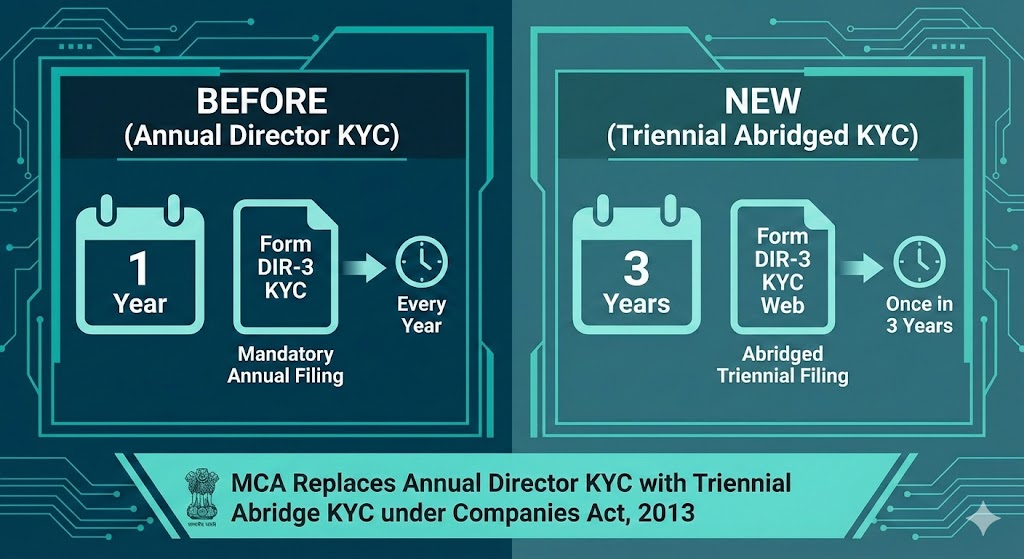
Under the earlier compliance regime, every individual holding a DIN was required to file DIR-3 KYC on an annual basis, irrespective of whether there were any changes in personal details.
Key characteristics of Annual Director KYC included:
- Mandatory yearly filing
Every DIN holder had to submit KYC information every financial year, even if their data remained unchanged. This led to repetitive compliance without incremental regulatory value. - Uniform applicability
The requirement applied to all directors equally executive, non-executive, nominee, independent, resident, and non-resident directors. - Professional certification requirement
Each filing had to be digitally verified by the director and certified by a practicing professional, adding time, cost, and coordination complexity. - Strict penalties for non-compliance
Failure to file resulted in automatic DIN deactivation along with a mandatory late fee, creating compliance risk even for inadvertent delays.
Practical Challenges with Annual KYC
For companies with multiple directors or group structures, annual KYC filings resulted in:
- High administrative overhead
- Repeated professional engagements
- Increased risk of technical non-compliance
- Last-minute compliance pressures close to due dates
Introduction of Triennial Abridged KYC: What Has Changed?
The MCA has replaced the annual framework with a Triennial Abridged KYC system, fundamentally shifting the compliance philosophy from frequency-driven to relevance-driven reporting.
What is Triennial Abridged KYC?
Concept and Purpose
Triennial Abridged KYC requires directors to complete their KYC once every three years, provided there are no changes in their personal or contact details during the intervening period.
The abridged format focuses on confirmation rather than re-submission of unchanged information, thereby reducing duplication while preserving data integrity.
Key Features of the Triennial Abridged KYC Framework
1. KYC Filing Once Every Three Years
Directors are now required to complete KYC only once in a three-year cycle. This change significantly reduces compliance frequency while maintaining periodic validation of director data.
Why this matters:
This lowers compliance fatigue, especially for senior professionals serving on multiple boards, and aligns Indian regulations with global governance norms.
2. Abridged and Unified KYC Form
The revised KYC form has been designed as a multi-purpose compliance tool, capable of handling both periodic KYC and event-based updates.
The same form can now be used for:
- Scheduled triennial KYC confirmation
- Updating mobile numbers
- Updating email addresses
- Updating residential addresses
- Reactivating deactivated DINs
Why this matters:
A unified form reduces procedural confusion, minimizes documentation overlap, and allows faster updates when director information changes.
3. Relaxation in Digital Signature and Certification Requirements
Under the new framework, digital signatures and professional certification are required only when there is a change in director details or when DIN reactivation is sought.
For routine triennial KYC confirmation where no data has changed:
- Director digital signature is not mandatory
- Professional certification is not mandatory
Why this matters:
This significantly reduces compliance costs and dependency on professionals for routine filings, without compromising regulatory oversight where changes occur.
Applicability and Transitional Provisions
Directors Who Have Already Filed KYC
Directors who are already compliant under the earlier regime automatically transition to the new framework.
- Their next mandatory KYC filing will fall due at the end of the new three-year cycle
- No immediate action is required unless there is a change in personal details
This provides predictability and stability in long-term compliance planning.
Directors Who Have Never Filed Director KYC
Directors who have not completed KYC at all are allowed to continue filing under the existing mechanism until a specified cut-off date.
- DIN reactivation and KYC filing can be completed under the old process until the transition deadline
- After this period, non-compliant DINs may face restrictions
This ensures a smooth migration without penalizing legacy or inactive DIN holders abruptly.
What Remains Unchanged Under the New Regime
While the filing frequency has been reduced, certain compliance principles remain intact:
- Director information must always be accurate and up to date
- Any change in email, mobile number, or address must be reported promptly
- DIN deactivation remains a consequence of non-compliance
- Regulatory scrutiny and enforcement powers are unaffected
Key insight:
The reform simplifies compliance execution, not compliance responsibility.
Strategic Impact on Businesses and Boards
Impact on Founders and Promoters
- Reduced repetitive compliance allows greater focus on business strategy
- Lower risk of inadvertent DIN deactivation
- Simplified governance during fundraising and restructuring
Impact on Investors and Nominee Directors
- Easier onboarding of investor nominees
- Fewer recurring compliance representations
- Improved diligence confidence due to stable DIN status
Impact on Large Corporates and Group Structures
- Substantial reduction in aggregate compliance volume
- Lower internal coordination and tracking effort
- Better allocation of compliance resources to higher-risk areas
Quantifying the Compliance Relief
| Parameter | Earlier Annual KYC | Triennial Abridged KYC |
|---|---|---|
| Filing frequency | Every year | Once in three years |
| Forms per 6-year period | 6 | 2 |
| Certification instances | Every filing | Only on changes |
| Compliance cost | High recurring | Significantly reduced |
| Risk of missed deadlines | Frequent | Substantially lower |
Policy Intent and Regulatory Direction
This reform reflects a broader shift in India’s corporate law framework toward:
- Risk-based regulation
- Reduced non-financial compliance burden
- Enhanced ease of doing business
- Greater reliance on event-based disclosures
The move acknowledges that regulatory effectiveness is driven more by quality of data than by frequency of filings.
What Companies Should Do Going Forward
- Re-align internal compliance calendars to the triennial cycle
- Create internal triggers for event-based KYC updates
- Review DIN status of all directors periodically
- Update board onboarding and exit checklists
- Educate directors on their continuing disclosure obligations
Concluding Perspective
The replacement of Annual Director KYC with Triennial Abridged KYC is a meaningful structural reform under the Companies Act, 2013. It reduces compliance noise, preserves regulatory intent, and improves governance efficiency particularly for sophisticated businesses and seasoned boards.
For companies that treat compliance as an enabler of governance rather than a procedural obligation, this change offers long-term strategic value with minimal regulatory trade-off.
FAQs on Triennial Abridged Director KYC under Companies Act, 2013
-
What is Director KYC under the Companies Act, 2013?
Director KYC is a statutory compliance requirement that ensures all individuals holding a Director Identification Number (DIN) have their identity, contact details, and address verified with the Ministry of Corporate Affairs. The purpose of Director KYC is to maintain accurate director data, prevent misuse of DINs, and strengthen corporate governance and regulatory oversight.
-
What was Annual Director KYC and why was it introduced?
Annual Director KYC required every DIN holder to submit their KYC details every financial year, regardless of whether any information had changed. It was introduced to regularly validate director identities and curb the use of inactive or fraudulent DINs. Over time, however, it led to repetitive filings and increased compliance burden without proportionate regulatory benefit.
-
What is Triennial Abridged KYC and how is it different from Annual KYC?
Triennial Abridged KYC requires directors to complete KYC once every three years instead of annually. Unlike the earlier system, the abridged framework focuses on confirmation of existing details rather than re-submission of unchanged information. This reduces compliance frequency while ensuring that director records remain current and reliable.
-
Is Director KYC still required if there is no change in details?
Yes, Director KYC is still mandatory even if there is no change in personal or contact details. However, under the triennial abridged KYC framework, such confirmation is required only once every three years instead of every year, provided there are no intervening changes.
-
When is Director KYC required to be filed under the new framework?
Under the new framework, directors who have already completed KYC will be required to file their next KYC at the end of the applicable three-year cycle. Directors who have never completed KYC must do so within the prescribed transition period to avoid DIN deactivation.
-
What happens if a director changes their email, mobile number, or address?
If there is any change in a director’s email address, mobile number, or residential address, the updated information must be filed using the abridged KYC form. In such cases, digital signature verification and professional certification become mandatory to ensure the authenticity of the update.
-
What are the consequences of not complying with Triennial Abridged KYC?
Failure to comply with the triennial abridged KYC requirements can result in deactivation of the Director Identification Number. A deactivated DIN restricts a director from participating in board decisions, filings, and corporate actions until compliance is restored.
-
Does Triennial Abridged KYC reduce regulatory oversight?
No. While the filing frequency has been reduced, regulatory oversight remains intact. The reform shifts the focus from repetitive annual filings to meaningful, event-based disclosures, ensuring that director information remains accurate, traceable, and enforceable at all times.
About the Author
Share
-
Link copied to clipboard!https://treelife.in/compliance/mca-replaces-annual-director-kyc-with-triennial-abridged-kyc/

-

-

-

-

Treelife

Treelife Team | support@treelife.in
We are a legal and finance firm with a deep focus on the startup ecosystem. We offer a wide range of services, including Virtual CFO, Legal Support, Tax & Regulatory, and Global Expansion assistance.
Our goal at Treelife is to provide you with peace of mind and ease in business.
We Are Problem Solvers. And Take Accountability.
Related Posts

Compliance Calendar April 2026 – GST, TDS, PF, ESI & Advance Tax Deadlines
Sync with Google Calendar Sync with Apple Calendar Plan your April filings in one place. Figures and forms are mapped...
Learn More

The Income Tax Act, 2025 Is Live – Here’s What You Actually Need to Know
Effective 1 April 2026, the Income Tax Act, 2025 replaces the Income Tax Act, 1961 and the Income Tax Rules,...
Learn More

India Entry for SaaS and Tech Companies – A Complete Guide
India is no longer a market to "watch." For global SaaS and tech companies, it has crossed the threshold from...
Learn More