




Co-founder Equity Structure in India: A Co-Founders’ Agreement may not be enough
Written By

Priya Kapasi Shah
Share
-
Link copied to clipboard!https://treelife.in/legal/co-founder-equity-structure-in-india/

-

-

-

-

AI Summary
- Co-founder equity is the ownership stake each founder holds, formally recorded in the register of members maintained under Section 88 of the Companies Act, 2013.
- The equity split should be decided and documented at or before incorporation, since it sets the trajectory for every future ownership conversation.
- Economic rights determine each founder's share of proceeds at exit, during dividend distribution, or in a liquidation event, based on their shareholding after dilution from investors and ESOP pools.
- Voting rights are threshold based, a founder holding 51 percent can pass ordinary resolutions alone, while a founder holding less than 26 percent loses the power to block a special resolution.
- The dilution baseline set at incorporation determines how steeply a founder's stake shrinks over funding rounds, so a founder starting at 50 percent in a two person company will hold considerably less by Series A.
- Investors evaluate the founding equity structure before committing capital, and a cap table showing uneven contribution without documented rationale, or a co-founder stake with no vesting, is treated as a governance risk.
- Correcting an equity split before an investor is on the cap table is structurally easier and commercially cheaper than fixing it afterward.
- Indian startups typically use one of four co-founder equity split models, chosen based on team composition, relative contribution, and long term role of each founder.
- An equal equity split works only when all founders join on the same day, take equivalent financial risk, and hold roles of similar scope, and without a deadlock clause in the AOA providing a casting vote or tiebreaker, a 50:50 split can leave contested decisions with no internal resolution path.
Blog Content Overview
- 1 What is co-founder equity and why does the split matter?
- 2 Types of co-founder equity split models
- 3 How to decide the co-founder equity split
- 3.1 Step 1: Agree on roles before discussing percentages
- 3.2 Step 2: Evaluate contributions honestly
- 3.3 Step 3: Incorporate the CEO premium
- 3.4 Step 4: Set the vesting schedule as part of the same conversation
- 3.5 Step 5: Model the split through dilution before treating it as final
- 3.6 Step 6: Document the rationale before executing the SHA
- 4 Common mistakes in co-founder equity splits
- 5 Why a co-founder agreement alone will not protect the cap table
- 6 What the co-founder equity structure should look like at incorporation
- 7 When and how to revisit the equity split
- 8 What actually happens when a co-founder exits
- 9 FAQs on co-founder equity structure in India
- 10 Conclusion
The co-founder agreement is the easy part. The hard part is making sure the AOA, the shareholders’ agreement, and the cap table can actually deliver the outcome the agreement promises, particularly when a co-founder leaves.
A co-founder equity structure India founders often inherit from templates or peer advice tends to fail at exactly the moment it is needed most: a separation, a buyout, or a restructuring after external capital comes in. The agreement says one thing, the corporate documents say another, and the tax and FEMA rules dictate the actual commercial outcome. In this blog, we walk through what co-founder equity is, how to decide and document the split, the structural choices at incorporation, and the exit routes when a co-founder leaves, including the tax and regulatory price tag on each.
What is co-founder equity and why does the split matter?
Co-founder equity is the ownership stake each founder holds in the company, recorded in the register of members maintained under Section 88 of the Companies Act, 2013. The split is the agreed distribution of that ownership, decided at or before incorporation, and it shapes every ownership conversation that follows.
Three rights attach to each founder’s stake from the moment shares are allotted.
Economic rights determine the share of proceeds each founder receives at exit, during a dividend distribution, or in a liquidation event. The percentage held at each stage, after accounting for dilution from investors and ESOP pools, translates directly into rupees at the exit table.
Voting rights determine the influence each founder has over board and shareholder resolutions. A founder holding 51% can pass ordinary resolutions alone. A founder holding less than 26% loses the ability to block a special resolution. These thresholds matter when key decisions, including changes to the AOA, approval of significant transactions, or removal of a director, come to a vote.
Dilution baseline is the starting point from which a founder’s percentage decreases over time as new shares are issued. A founder who starts at 50% in a two-person company will hold considerably less by Series A, and the founding ratio sets the proportional trajectory of that decline.
The split also carries long-term consequences for investor confidence. Investors assess the founding structure before committing capital. A cap table that reflects uneven contribution without documented rationale, or one where a co-founder holds a significant stake without vesting, signals governance risk. Getting the split right at incorporation is structurally easier and commercially cheaper than correcting it after an investor is already on the cap table.
Types of co-founder equity split models
There is no single correct model. The right structure depends on the composition of the founding team, the relative contributions of each founder, and the long-term role each will occupy. Four models are used in Indian startups.
Equal equity split
An equal split (50:50 or 33:33:33) divides ownership identically among co-founders. It works when all founders join on the same day, take equivalent financial risk, and will occupy roles of similar scope and responsibility over the long term.
In practice, equal splits are popular because they feel fair and avoid an awkward negotiation. But they carry two structural problems that grow in severity as the company scales.
First, roles diverge. One founder typically assumes the CEO function, leads fundraising, and takes on disproportionate external responsibility. The equal economic and governance split remains fixed while those responsibilities expand, which is what makes an uncorrected equal split feel inequitable at scale.
Second, a 50:50 split creates a deadlock on contested decisions with no internal resolution path. Without a deadlock clause in the AOA (a provision that gives a designated founder a casting vote, or establishes a tiebreaker mechanism), any fundamental disagreement between founders has no corporate resolution mechanism.
The fix is not always to reject an equal split. A 51:49 or a casting vote for the CEO-designated founder in the AOA achieves practical differentiation without a large economic gap.
Weighted contribution split
A weighted split (60:40, 65:35, 70:30) reflects genuine differences in what each founder contributes. Where founding contributions differ in kind or timing, a weighted split is more accurate than an equal one.
Factors that justify a higher share include full-time versus part-time commitment at founding, prior IP or product work brought into the company before other founders joined, capital invested by one founder, the relative scarcity of each founder’s skill, and the opportunity cost each founder bears by joining.
A founder who built the product for six months before bringing in a co-founder is not on equal footing with someone who joined at incorporation. The split should reflect that.
A role-based split allocates equity in proportion to the long-term importance of each founder’s function. A technical co-founder building the core product may receive a different share from a commercial co-founder who owns revenue and partnerships, based on the projected contribution of each role to company value over time.
A CEO premium is an additional equity allocation to the founder who will occupy the CEO role, reflecting that the role expands disproportionately as the company scales. The CEO typically drives fundraising, manages investors, and becomes the company’s principal external representative. The premium is negotiated as part of the founding split conversation rather than benchmarked against a fixed percentage range.
Dynamic equity split
A dynamic split allows ownership to adjust over time based on ongoing contributions rather than fixing shares at incorporation. This model works in early-stage situations where founding team composition or contribution levels are expected to change frequently.
A contribution-tracked dynamic split is a structured version of this approach. It calculates each founder’s equity based on actual contributions (time, money, resources) tracked in real time, adjusting ownership as contributions change. The model prevents situations where a co-founder receives equity but then reduces involvement. Its limitation is administrative complexity: tracking contributions requires a transparent, agreed-upon system, and the model needs to be converted into a fixed structure before external capital comes in, since investors will not accept a cap table where ownership is still in flux.
Comparison of co-founder equity split models
| Model | Best suited for | Key advantage | Key risk |
|---|---|---|---|
| Equal split (50:50 / 33:33:33) | Founders joining same day, equivalent roles | Simple, avoids negotiation friction | Deadlock risk, role divergence over time |
| Weighted contribution split | Founders with different joining dates, IP, or capital contributions | Reflects actual value brought in | Harder negotiation upfront |
| Role-based with CEO premium | Teams with clearly differentiated long-term functions | Aligns economic stake to long-term responsibility | Requires role clarity before incorporation |
| Dynamic / contribution-tracked | Very early stage, uncertain contribution levels | Adjusts to real contributions | Complex tracking, must be fixed before external investment |
How to decide the co-founder equity split
The split ratio is not a guess. It is the output of a structured conversation that founders often skip because it feels uncomfortable. Skipping it does not avoid the discomfort; it defers it to a moment when the stakes are higher and positions are more entrenched.
Step 1: Agree on roles before discussing percentages
Before any number is proposed, each founder should define their long-term responsibilities: who makes the final call on product, on revenue, on engineering, on fundraising. Role clarity makes the split conversation tractable. It also removes the ambiguity that generates disputes later when one founder believes they are doing more than the equity reflects.
Step 2: Evaluate contributions honestly
The founding split should reflect not just what each founder brings today but what their role will look like as the company scales. A technical co-founder whose product work is largely complete at launch is in a different position from one whose responsibilities grow with every hire and funding round.
Prior contribution matters equally. A founder who built the product, developed early customer relationships, or brought IP into the company before the other founder joined has already absorbed risk and created value that the split should reflect. Time invested before the other co-founder arrived does not disappear because both founders are now working full-time.
Capital invested and opportunity cost also belong in this conversation. A founder who puts in ₹20 lakhs of personal savings takes a different financial risk from one contributing only time. A founder leaving a ₹30 lakh per year salary bears a different opportunity cost from one leaving freelance work.
If one founder will clearly occupy the CEO role over the long term, include a premium above what a contribution-weighted split alone would produce. The CEO role expands as the company scales, and the equity should reflect that from the start rather than being renegotiated later when it is considerably harder to do.
Step 4: Set the vesting schedule as part of the same conversation
The split ratio and the vesting schedule are one decision, not two. A vesting schedule is the timeline over which each founder earns their equity. The market standard in India is four years with a one-year cliff: no equity vests in the first year, after which 25% vests immediately and the remainder vests monthly or quarterly over the following three years.
Agreeing on the vesting structure, the cliff period, and the conditions that apply if a founder leaves at the same time as the split ratio produces fewer disputes than introducing vesting as a separate conversation after the ratio is already agreed.
Step 5: Model the split through dilution before treating it as final
Once the ratio feels equitable, run it through anticipated dilution events before finalising. A standard model adds a 10% ESOP pool, then applies a 20% seed round and a further 20% at Series A. The example below uses a 60:40 founding split.
Dilution model for a 60:40 founding split
| Stage | Founder A | Founder B | ESOP pool | Seed investor | Series A investor |
|---|---|---|---|---|---|
| At incorporation | 60% | 40% | Nil | Nil | Nil |
| After 10% ESOP pool | 54% | 36% | 10% | Nil | Nil |
| After seed round (20%) | 43.2% | 28.8% | 8% | 20% | Nil |
| After Series A (20%) | 34.56% | 23.04% | 6.4% | 16% | 20% |
A founder who is comfortable holding 40% at incorporation may feel differently when that number sits at 23% post-Series A. Working through this in advance prevents the split from feeling unfair once funding begins. The 60:40 ratio between the founders is preserved throughout; only absolute stakes decline.
Note: this model assumes the ESOP pool is not refreshed at each round. Investors may require a pool top-up before closing, which would produce lower founder percentages than the figures above at each stage.
Step 6: Document the rationale before executing the SHA
Once the split and vesting terms are agreed, record the reasoning in writing. The document does not need to be formal, but there should be a written record acknowledged by all parties: what each founder contributes, why the ratio reflects that, and what roles each founder will hold. This record becomes valuable during investor due diligence, when a new co-founder joins and needs context, and when the founding team revisits the decision years later.
Common mistakes in co-founder equity splits
The equal split trap
An even split might seem like the fairest outcome, but it rarely reflects the realities of how startups are built. Not all contributions are equal during the early stages. Some founders bring technical expertise; others bring business connections or financial resources. An inflexible equal split can produce resentment and misalignment when those contributions diverge over time.
No founders’ agreement executed after agreeing on the split
The register of members records who holds how many shares, but without a founders’ agreement, no rules exist for what happens next: no transfer restrictions, no vesting schedule, and no mechanism to recover equity from a founder who leaves. The split is recorded on paper but entirely unprotected.
Skewed split with no documented rationale
A 75:25 split is not inherently problematic. A 75:25 split with no record of why that ratio reflects the founders’ relative contributions is a different matter. The shareholders’ agreement or a separate founders’ agreement should record the basis for the split, including roles, prior contributions, and capital invested, so the cap table tells a coherent story during due diligence.
Neglecting future contributions
Many founders allocate shares based solely on what each co-founder brings at the moment of incorporation. A split that does not account for each founder’s expected future role and long-term commitment will feel inaccurate within 18 to 24 months.
Lack of vesting mechanisms
Without a vesting schedule, a co-founder who leaves after 18 months keeps the full equity stake allocated at incorporation. The remaining founders carry the operational burden while the departing co-founder retains economic upside. A standard four-year schedule with a one-year cliff is a minimum structural protection.
Not modelling dilution before agreeing on the split
Founders who agree on a ratio without running it through a dilution model may feel the split is unfair once funding begins. The conversation is easier before the SHA is signed than after a Series A investor is on the cap table.
Avoiding the difficult conversation
Many founding teams defer the equity discussion because it is uncomfortable. This avoidance leads to unspoken expectations, misunderstandings, and disputes that surface at the worst possible moment. Open, transparent conversations about each founder’s value, expected contributions, and departure scenarios are structurally cheaper than litigation or a cap table restructuring.
Why a co-founder agreement alone will not protect the cap table
A co-founder agreement is a contract between founders. It is not a corporate action mechanism. The company and other shareholders are not bound by it unless the same rights and obligations are written into the Articles of Association and the shareholders’ agreement.
Take the most common example. The co-founder agreement says “if a founder leaves within four years, unvested shares revert to the company.” If the AOA does not contain a share repurchase right tied to this trigger, the leaving founder can simply refuse to transfer the shares. The remaining founders are left with a damages claim under contract law, not the shares back.
Indian courts have been reluctant to grant specific performance of share transfer obligations where the AOA does not authorise the repurchase, particularly post the V.B. Rangaraj line of decisions on the supremacy of the AOA over private agreements.
The fix is structural, not contractual. Founder vesting, leaver provisions, drag-along, tag-along, ROFR and ROFO must live in the AOA, with the SHA providing the inter-shareholder mechanics. The co-founder agreement then becomes a layered document: the founder-employee terms, the IP assignment, the non-compete, the conduct expectations. The corporate enforcement engine sits in the AOA and SHA.
This matters even more once a venture investor comes in. A Series A investor will not rely on a side agreement between founders to enforce founder retention. The investor will demand that founder vesting, share repurchase rights on departure, and bad-leaver mechanics are baked into the Articles, with the SHA carrying matching consent rights. Founders who arrive at Series A with only a co-founder agreement end up redrafting from scratch, often on terms less favourable than they would have negotiated at incorporation.
What the co-founder equity structure should look like at incorporation
The day-zero structuring decisions outlast almost everything else. Here is what a co-founder equity structure India founders should actually start with looks like.
The corporate documents that record it. Two documents establish the initial ownership framework at incorporation. The Memorandum of Association (MoA) is the constitutional document filed with the Registrar of Companies that records the company’s scope and the initial subscribers, including the number of shares each agrees to take. The Articles of Association (AoA) govern the company’s internal management, including the rights and obligations attached to different share classes, transfer restrictions, and repurchase rights. Legal title to shares arises on allotment and is reflected in the register of members maintained under Section 88 of the Companies Act, 2013. The MoA and AoA together define the framework; the register of members records who actually holds what. Any vesting or repurchase mechanism that is not written into the AoA is not enforceable as a corporate action, regardless of what the co-founder agreement or SHA says.
The split itself. Equal splits are popular and usually wrong. A 50:50 between two co-founders creates a deadlock with no tiebreaker. A 33:33:33 between three creates the same problem with extra steps. The fix is either a small differentiation (51:49, or 34:33:33) or a casting vote in the AOA for a designated CEO-founder. Differentiation should reflect actual contribution, opportunity cost, and full-time commitment, not just who came up with the idea.
Reverse vesting. The standard Indian construct is reverse vesting: founders are issued the full equity upfront, but the AOA gives the company a right to repurchase a defined portion at par value (or a nominal price) if the founder leaves before the vesting period ends. Four years with a one-year cliff is the market standard. The repurchase right needs to be in the AOA, not just the SHA, to be enforceable against the founder’s shares.
One issue reverse vesting structures rarely address upfront: the AOA may allow the company to buy back a bad leaver’s shares at par value, but the income tax rules will still tax the departing founder as if they received full market value. The gap between what they actually receive and what they are taxed on can be significant. Who bears that cost, and how, is worth agreeing at incorporation.
IP, non-compete, and employment. Founder share allocation should be conditional on signing a founder employment or consultancy agreement that contains the IP assignment, the non-compete (subject to enforceability limits under Section 27 of the Indian Contract Act, which restricts post-employment non-competes), and the non-solicit. Without IP assignment, the company does not own what the founder built. This is the single most expensive oversight in early-stage Indian startups.
ESOP pool, carved out early. A 10 to 15% ESOP pool, created and approved before the first external round, is standard. Carving it out post Series A means founders bear the dilution alone instead of sharing it with the new investor, since term sheets typically require the pool top-up to come pre-money.
Founder share class and rights. Most early-stage Indian startups issue founders ordinary equity. As the cap table matures, some structures introduce a separate founder class with weighted voting on specified matters, though this requires careful drafting under Section 43 of the Companies Act 2013.
When and how to revisit the equity split
The founding split is not a one-time decision. As a company grows, the roles founders occupy, the time they commit, and the contributions they make can diverge significantly from what the original split assumed. When that divergence becomes material, the split deserves a structured review.
There is no automatic mechanism under the Companies Act, 2013 that adjusts a founder’s equity based on performance or commitment. Any change to ownership must be agreed upon by the affected parties and executed through a formal legal process, typically a share transfer, a buyback of unvested shares under the repurchase right, or a new share issuance. This means the founding team must identify when a review is warranted, rather than waiting for a legal trigger.
Scenarios that require revisiting the split
- A co-founder takes on significantly more responsibility than the original split reflected
- A founder’s involvement decreases materially due to other commitments or a change in role
- The startup secures major funding that changes the ownership structure and creates a mismatch between economic stake and operational contribution
- A new co-founder joins the founding team and needs equity allocation
- One founder assumes an externally-facing leadership role (CEO, CTO) that was not anticipated at incorporation
How to approach the review
Schedule a formal review rather than raising the subject informally. Start from a shared understanding of what each founder’s current contribution looks like versus what the original split assumed. Frame the conversation around the company’s best interests rather than individual entitlement.
Any adjustment agreed must be documented and executed through a formal legal process: an amended SHA, a share transfer at an agreed price with the associated tax and stamp duty compliance, or a new allotment. A verbal agreement to change the split is not enforceable. The same AOA supremacy principle that undermines an unregistered co-founder agreement will undermine an undocumented split revision.
If the conversation is difficult, a neutral third party such as a startup advisor or legal professional familiar with the cap table can help structure the discussion and ensure both sides are working from the same facts.
What actually happens when a co-founder exits
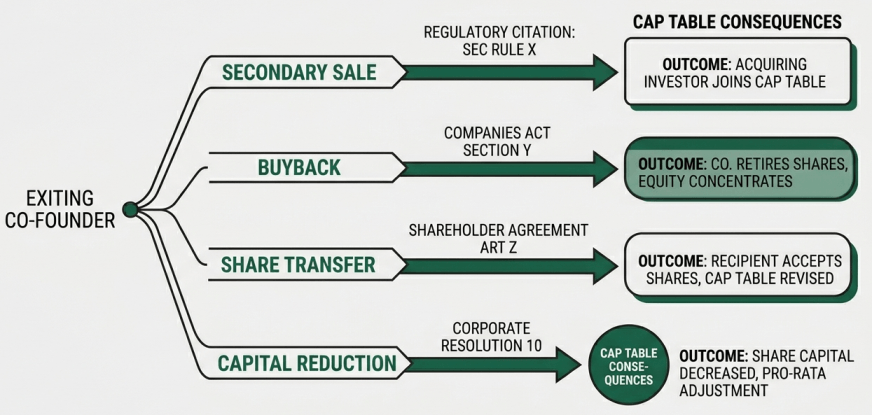
When a co-founder exits, there are broadly three ways to structure it: secondary sale to an incoming investor or third party, buyback by the company, or share transfer to remaining co-founders. Each has a different cap table consequence, a different tax treatment, and a different regulatory load. The right choice depends on who is buying, what the SHA permits, and what the founders are trying to achieve on the cap table.
One threshold point before walking through the routes: most Series A SHAs require investor consent for any founder share transfer or buyback above a defined threshold. The exit route is rarely the founders’ choice alone. Walking through the SHA consent mechanics before initiating anything is the first step, not an afterthought.
Route 1: Secondary sale to an incoming investor or third party
This is usually the cleanest route. The exiting co-founder sells their shares to an incoming investor (often as part of a primary-plus-secondary round) or a strategic third party. The company is not a party to the transaction. No dilution to other shareholders, since the cap table percentages stay intact. The exiting co-founder gets liquidity in their personal hands. The new investor gets a meaningful stake without the company having to issue fresh shares.
What the SHA must permit. Pre-emptive rights, ROFR, ROFO and tag-along rights typically attach to founder shares. The exiting co-founder cannot just transfer to a third party without offering the shares first to the existing shareholders or obtaining waivers. Most well-drafted SHAs carve out an exception for sales as part of a board-approved fundraising round, which is how secondary transactions usually clear the consent gates.
Tax treatment, seller side. The exiting co-founder pays capital gains under Section 67 of the Income-tax Act, 2025 (Section 45 of the Income-tax Act, 1961). Holding period for unlisted shares is 24 months for long-term classification. Long-term capital gains on unlisted shares are taxed at 12.5% under Section 197 of the ITA 2025 (Section 112 of the ITA 1961) without indexation. Short-term gains are taxed at the applicable slab rate.
Two tax traps apply on pricing. If shares are transferred below fair market value computed under Rule 11UA of the Income-tax Rules, 1962, Section 73 of the ITA 2025 (Section 50CA of the ITA 1961) deems the consideration to be FMV in the seller’s hands, and Section 92 of the ITA 2025 (Section 56(2)(x) of the ITA 1961) taxes the shortfall as income from other sources in the buyer’s hands. Both provisions apply to the same transaction, from opposite sides. A Rule 11UA-compliant valuation report, referenced against the Income-tax Rules 2026 as notified, is non-negotiable before pricing is agreed.
FEMA layer, if a non-resident is involved. If the buyer is non-resident, the transaction is a transfer from resident to non-resident under the Foreign Exchange Management (Non-debt Instruments) Rules, 2019. Pricing must comply with the entry pricing guidelines (price not less than FMV computed under internationally accepted methodology). Reporting via Form FC-TRS within 60 days of receipt of consideration. If the seller is non-resident exiting to a resident buyer, the same rules apply with the pricing direction reversed (price not more than FMV).
Stamp duty. Transfer of shares typically attracts stamp duty under the Indian Stamp Act 1899, depending on the state, generally at 0.015% of consideration.
Route 2: Buyback by the company
Buyback is the route most founders reach for first and the one that disappoints most often. After Finance Act 2026, the disappointment now has a tax cost.
Companies Act limits. Section 68 of the Companies Act 2013 caps buyback at 25% of paid-up capital plus free reserves in a financial year, with a separate cap that the buyback in any year cannot exceed 25% of paid-up equity capital. Post-buyback debt-equity ratio must not exceed 2:1. There is a one-year cooling-off period between two buybacks. Procedural load includes a special resolution under Section 68(2) (or a board resolution if buyback is up to 10%), filing of SH-8 and SH-9 with the Registrar, declaration of solvency, and SH-11 return of buyback within 30 days of completion.
The proportional dilution problem. In a 30/30/30 plus 10% ESOP scenario, a 30% buyback moves the remaining co-founders from 30% each to roughly 43%, and the ESOP from 10% to roughly 14%. If a Series A investor at 15% is on this cap table, they also move from 15% to roughly 21%. The buyback consolidates partially among founders but also enlarges the investor’s stake. If consolidation among founders was the goal, secondary almost certainly serves it better.
The Finance Act 2026 shift. From 01 April 2026, buyback proceeds are taxed as capital gains in the shareholder’s hands under Section 69 of the ITA 2025 (Section 46A of the ITA 1961), not as deemed dividend. Section 69 imposes an additional tax on promoter buybacks designed to take the effective rate to 22% for corporate promoters and 30% for non-corporate promoters (i.e., individuals).
The cap. Even setting aside tax, Section 68’s 25% ceiling on buyback in a year often cannot accommodate a co-founder holding 30% or more. The structure may need to combine a partial buyback with a secondary.
Conceptually clean: the exiting co-founder sells directly to one or more remaining co-founders. In practice, this route fails on liquidity. Remaining co-founders rarely have the personal cash to buy out a departing co-founder’s stake at FMV. A 30% stake in a venture-backed company at Series A pricing could be a significant personal expenditure. Founders typically do not have this cash.
Where it works: small holdings (a co-founder with 5 to 10%), early-stage companies before significant valuation appreciation, or where a friendly third party finances the buyout.
Tax treatment. Same as secondary in Route 1. Capital gains under Section 67 of the ITA 2025 (Section 45 of the ITA 1961) in the seller’s hands. Section 73 of the ITA 2025 (Section 50CA of the ITA 1961) FMV deeming if priced low. Section 92 of the ITA 2025 (Section 56(2)(x) of the ITA 1961) gift tax risk on the buyer side. Rule 11UA valuation needed. FEMA pricing and FC-TRS reporting if either side is non-resident. Stamp duty on transfer.
SHA mechanics. ROFR/ROFO usually applies first to existing shareholders, which is how this route gets initiated. The remaining co-founders accept the offer at the proposed price (or trigger a valuation mechanism in the SHA) and the transfer proceeds.
What founders and early investors should actually do
- Get the SHA and AOA right at seed, not at Series A. Retrofitting founder vesting, leaver provisions, and share repurchase rights at Series A means doing it under investor pressure, on terms not negotiated by you. Doing it at seed costs a fraction and leaves you in control of the drafting.
- Build good leaver and bad leaver mechanics into the AOA. The leaver framework (good leaver gets vested shares plus a defined consideration, bad leaver gets only paid-up value or par) is the operational backbone of founder vesting. Without it, vesting is a slogan.
- Model at least one co-founder exit scenario before signing the SHA. Run the numbers on a 30/30/30 plus ESOP, plus a hypothetical Series A investor. See what each exit route does to the cap table. The model surfaces the proportional dilution problem before it hits you in real life.
- Align all the documents. Co-founder agreement, SHA, AOA, founder employment agreements, ESOP plan, IP assignment. They must say the same thing. Conflicts between documents are exploited at the worst possible moment.
Investors should also pressure-test the founder structure during diligence. A founder cap table without enforceable vesting, without good leaver mechanics in the AOA, without IP assignment, and without aligned employment agreements is a structural risk that will surface eventually. Fixing it pre-investment, when founders are motivated to close, is dramatically easier than fixing it after a co-founder dispute breaks out.
FAQs on co-founder equity structure in India
Q: Can a co-founder be removed if there is no shareholder agreement?
A: Removal as a director follows Section 169 of the Companies Act 2013, which allows shareholders to remove a director by ordinary resolution after special notice. Removal as a director does not extinguish the co-founder’s shareholding. Without an SHA or AOA-backed share repurchase right, the removed founder keeps their shares and the resulting cap table tension remains.
Q: What is the tax on a co-founder buyback in India in 2026?
A: For buybacks on or after 01 April 2026, proceeds are taxed as capital gains in the shareholder’s hands under Section 69 of the Income-tax Act, 2025 (Section 46A of the 1961 Act). Co-founders typically meet the promoter test (under Section 2(69) of the Companies Act or the over 10% shareholding threshold in Section 69 of the ITA 2025) and pay an additional tax that takes the effective rate to roughly 30% for individuals and 22% for corporate promoters.
Q: How does FEMA apply when a non-resident co-founder exits?
A: The transfer is governed by the Foreign Exchange Management (Non-debt Instruments) Rules, 2019. Pricing must follow the exit pricing guideline (consideration not more than FMV under internationally accepted methodology). Reporting via Form FC-TRS within 60 days of receipt of consideration. The Authorised Dealer bank handles the filing, but the parties remain liable for accuracy.
Q: Can a co-founder agreement override the AOA?
A: No. The AOA is the constitutional document of the company and prevails. Any provision in the co-founder agreement that is not mirrored in the AOA may not be enforceable against the company or other shareholders.
Q: What is the standard vesting schedule for co-founders in India?
A: The market standard is a four-year vesting schedule with a one-year cliff. No equity vests in the first year. At the one-year mark, 25% vests at once. The remaining 75% vests monthly or quarterly over the following three years. The repurchase right enabling the company to recover unvested shares must be in the AOA to be enforceable, not just in the co-founder agreement or SHA.
Q: What is the difference between a good leaver and a bad leaver in co-founder equity?
A: A good leaver is a founder who departs for reasons outside their control or with the company’s consent, typically death, long-term illness, or a mutually agreed exit. A good leaver typically retains their vested shares and receives a defined consideration for any unvested portion. A bad leaver is a founder who resigns without cause, is removed for misconduct, or breaches the founder agreement. A bad leaver typically forfeits unvested shares and may receive only par value for them. The precise definitions must be written into the AOA and SHA, not left to interpretation at the time of departure.
Q: How does a 50/50 equity split create problems in an Indian company?
A: A 50:50 split between two founders gives neither founder a majority for ordinary resolutions. Any contested decision on the board or at a shareholder meeting becomes a deadlock if both founders hold equal voting rights with no tiebreaker. Under the Companies Act 2013, certain resolutions (including amendments to the AOA) require a special resolution passed by 75% of votes. In a 50:50 company, neither founder can pass or block such resolutions alone. Without a casting vote clause for a designated CEO-founder in the AOA, or a formal deadlock resolution mechanism, the company may be unable to make fundamental decisions.
Q: What is a founders’ agreement and how is it different from a shareholders’ agreement?
A: A founders’ agreement is a contract between the co-founders only, typically executed at or before incorporation. It records the agreed equity split, vesting schedule, IP assignment, each founder’s roles and responsibilities, decision-making authority, and time commitment. It does not bind the company or external shareholders. A shareholders’ agreement (SHA) is a contract between all shareholders (including, after a funding round, the investors) and the company. It governs transfer restrictions, anti-dilution rights, board composition, information rights, and the mechanics of how founder vesting is enforced corporately. Both documents are needed: the founders’ agreement records the founding intent; the SHA and AOA deliver the corporate enforcement mechanism.
Q: Is a shareholders’ agreement legally required for a co-founder equity split in India?
A: The Companies Act, 2013 does not mandate a shareholders’ agreement. The register of members records who holds how many shares, and that record alone satisfies the statutory requirement. An SHA becomes operationally necessary because it governs transfer restrictions, vesting, and board composition in ways the register of members cannot. Investors typically require a properly executed SHA as a condition of investment, which means companies that have not executed one will need to do so before closing a funding round.
Q: What documents must be aligned for a co-founder equity structure to be enforceable?
A: Five documents must say the same thing: the co-founder agreement, the shareholders’ agreement, the Articles of Association, each founder’s employment or consultancy agreement (for IP assignment and non-compete), and the ESOP plan if one exists. Conflicts between these documents are routinely exploited at the worst possible moment: a co-founder departure, a funding round, or a dispute. A provision in the co-founder agreement that is not mirrored in the AOA is likely unenforceable against the company. A vesting schedule in the SHA that does not match the repurchase right in the AOA creates an enforcement gap.
Q: When should co-founders revisit their equity split?
A: A formal review is warranted when a founder’s role, time commitment, or contribution changes materially from what the original split assumed. Common triggers include one founder taking on the CEO function without a premium being priced in at incorporation, a founder reducing their involvement due to other commitments, a new co-founder joining the team, or the company securing significant external funding that changes the governance dynamics. Any agreed adjustment must be executed as a formal share transfer or allotment with proper documentation, stamp duty, and valuation compliance. A verbal understanding to change the split is not enforceable.
Conclusion
A co-founder equity structure India founders can rely on is one where the agreement, the AOA, the SHA, the employment terms, and the ESOP plan all say the same thing. The decision starts well before incorporation: which model fits the founding team, how the split is calculated, and whether the cap table will still feel equitable at Series A. The exit route choices, whether secondary, buyback, transfer, or capital reduction, each carry a different regulatory load and a different tax bill. Picking the right co-founder equity structure before the exit, not during it, is what separates clean co-founder transitions from messy ones.
Note: Tax rates referenced in this blog are as per the Income-tax Act, 2025, applicable from 01 April 2026, and are exclusive of applicable surcharge and health and education cess.
Regulatory references
- Companies Act, 2013: Section 43 (classes of share capital), Section 68 (buyback of shares), Section 88 (register of members), Section 169 (removal of director), Section 2(69) (definition of promoter)
- Income-tax Act, 2025: Section 67 (capital gains charge), Section 69 (additional tax on promoter buybacks), Section 73 (FMV deeming on undervalued transfers), Section 92 (gift tax on shortfall), Section 197 (LTCG rate on unlisted shares)
- Income-tax Act, 1961 (cross-references): Section 45, Section 46A, Section 50CA, Section 56(2)(x), Section 112
- Income-tax Rules, 1962: Rule 11UA (FMV computation for unlisted shares)
- Indian Contract Act, 1872: Section 27 (restraint of trade, non-compete enforceability)
- Foreign Exchange Management (Non-debt Instruments) Rules, 2019 (pricing guidelines, FC-TRS reporting)
- Indian Stamp Act, 1899 (stamp duty on share transfers)
- Finance Act, 2026 (buyback tax treatment change effective 01 April 2026)
External sources
About the Author
Share
-
Link copied to clipboard!https://treelife.in/legal/co-founder-equity-structure-in-india/

-

-

-

-

Priya Kapasi Shah

Associate Partner | Tax & Regulatory | priya.k@treelife.in
Heads Treelife’s Financial Advisory practice, specializing in investment structuring, cross-border transactions, and tax and regulatory advisory. Also leads on AIF setups and advisory services for GIFT IFSC.
Garima Mitra
Co-founder
Spearheads Transactions, Contracts, and Compliance verticals at Treelife, combining expertise in business law with a focus on startup legal and governance.

Pooja Savla
Principal Associate | Transactions
Specialises in transaction advisory, mergers and acquisitions, investment structuring, and corporate legal matters for startups and growth-stage companies.
We Are Problem Solvers. And Take Accountability.
Related Posts

Virtual CFO vs Accountant: Role, Deliverables & Which you need
A startup's first finance hire is almost always an accountant, and that is the right call. Books, GST and TDS...
Learn More

Virtual CFO Accounting & GST Filing: Scope, Handoffs, Controls
Virtual CFO accounting and GST filing in India work as one system, not two services. The books feed the invoice...
Learn More

Virtual CFO Payroll & TDS Compliance: Scope, Filing Controls
Virtual CFO payroll and TDS compliance covers the full cycle, from salary structuring to the last salary TDS certificate handed...
Learn More

Virtual CFO Audit Coordination Services: Scope, Deliverables
Every company in India must get its accounts audited every year, and for a company without a finance team the...
Learn More

Startup Financial Controls: Approvals, Duties, Review cycle
Startup financial controls decide whether a founder learns about a wrong payment, a duplicate vendor or a missed TDS deposit...
Learn More

Cash Flow Forecasting for Startups: Method, Template, Review Cycle
Cash flow forecasting for startups is the weekly and monthly projection of when cash will enter and leave the bank...
Learn More

Working Capital Management for Startups: Cycle, Levers, Controls
Working capital management for startups is the discipline of timing cash in and cash out so that growth does not...
Learn More

Form 5471 Filing Services India
Form 5471 filing India work begins when a US citizen, green card holder or US company controls an Indian company...
Learn More

US India Tax Advisory Services
US India tax advisory covers the tax positions that arise when income, capital or people move between the two countries,...
Learn More

US Parent India Subsidiary Structure: How to Set it Up
A US parent India subsidiary structure puts a US corporation, usually a Delaware C corporation, above an Indian private limited...
Learn More

Cap Table Cleanup Services in India
Cap table cleanup services in India exist because the spreadsheet founders send to investors is rarely the document that proves...
Learn More

Delaware Flip Services in India: Scope, Process
A Delaware flip places a new US parent above your Indian company, so US investors, US customers and US equity...
Learn More
© 2026 Treelife Ventures Services Private Limited. All Rights Reserved.