




Setting Up a Wholly Owned Subsidiary in India – Full Incorporation Guide
Written By

Treelife
Share
-
Link copied to clipboard!https://treelife.in/legal/setting-up-a-wholly-owned-subsidiary-in-india/

-

-

-

-

Blog Content Overview
- 1 Why India is a top destination for foreign direct investment in 2026
- 2 What is a Wholly Owned Subsidiary (WOS) in India?
- 3 Who can set up a wholly owned subsidiary in India?
- 4 Prerequisites for setting up a WOS in India
- 5 Private limited vs Public Limited: Choosing the right company type
- 6 Three structures for setting up a wholly owned subsidiary in India
- 7 Documents required for incorporation of a wholly owned subsidiary in India
- 8 Step-by-step process: incorporation of a wholly owned subsidiary in India
- 9 Post-incorporation compliance for WOS in India
- 10 RBI and FEMA compliance for Wholly Owned Subsidiary in India
- 11 Taxation of a wholly owned subsidiary in India
- 12 Ongoing compliance and governance requirements
- 13 Advantages of Incorporating a WOS in India
- 14 Common mistakes that create delays and penalties
- 15 Case study: US-based SaaS company incorporating Indian WOS
- 16 Timeline for setting up a wholly owned subsidiary in India
- 17 WOS vs EOR vs Branch office: Which structure fits your India entry stage?
- 18 Reverse flip and downstream investments: What changed in 2026
- 19 Challenges in starting a wholly owned subsidiary in India
- 20 FAQs on How to Setup Wholly Own Subsidiary in India
Setting up a wholly owned subsidiary in India has become the most preferred market-entry structure for foreign companies seeking long-term presence, operational control, and regulatory flexibility. A wholly owned subsidiary (WOS) is an Indian company in which 100% of the share capital is held by a foreign parent entity, incorporated under the Companies Act, 2013. The application is processed by the Central Registration Centre (CRC), Ministry of Corporate Affairs (MCA). This structure allows global businesses to fully participate in India’s economic growth while operating as a separate legal entity with limited liability.
Why India is a top destination for foreign direct investment in 2026
India continues to strengthen its position as one of the world’s most attractive destinations for foreign direct investment (FDI), driven by policy reforms, digital governance, and a large consumer market.
Key economic signals for 2026: India’s GDP growth projection stands at 7%, among the fastest-growing major economies globally. 71% of multinational corporations consider India a priority market for global expansion. The government has pushed aggressively through schemes such as Make in India, Digital India, and sector-specific FDI liberalisation. Access to a large talent pool, cost-efficient operations, and improving ease of doing business rankings make incorporation of a wholly owned subsidiary in India a strategic move for companies targeting Asia-Pacific and emerging markets.
Why foreign companies prefer a WOS over branch or liaison offices
Foreign businesses consistently choose setting up a WOS in India over branch or liaison offices for five structural reasons. First, full operational control: unlike branch or liaison offices, which are restricted in activity scope, a WOS can conduct commercial, revenue-generating operations without RBI pre-approvals in most sectors. Second, separate legal entity and limited liability: the parent company’s liability is limited to its capital investment, protecting global assets. Third, easier regulatory and tax compliance: a WOS is treated as a domestic company for taxation, unlike branch offices that face a 35% base tax rate (reduced from 40% by the Finance Act, 2024, effective FY 2024-25). Fourth, FDI flexibility and repatriation: profits and dividends are freely repatriable under the direct FDI route. Fifth, access to government incentives and local contracts: many government tenders and state-level benefits are accessible only to Indian-incorporated entities.
What is a Wholly Owned Subsidiary (WOS) in India?
A wholly owned subsidiary in India is an Indian-incorporated company in which 100% of the share capital is owned by a foreign or Indian parent company. It operates as a separate legal entity with limited liability and is the most preferred structure for foreign companies setting up a wholly owned subsidiary in India for long-term operations.
Legal definition under Indian laws
Meaning under the Companies Act, 2013
The Companies Act, 2013 does not explicitly define a “wholly owned subsidiary.” Section 2(87) defines a subsidiary company as one in which the holding company either controls the composition of the Board of Directors or exercises or controls more than one-half of the total share capital, directly or indirectly. A WOS is a subset of a subsidiary where the holding company owns 100% shareholding. Indian corporate law recognises the WOS through interpretation and practice, not a standalone statutory definition. Regulatory compliance, governance, and reporting are identical to any Indian company under the Companies Act, 2013.
Interpretation under FEMA and RBI regulations
Under the Foreign Exchange Management Act (FEMA) 1999 and Reserve Bank of India (RBI) regulations, a foreign company may incorporate a wholly owned subsidiary in India, set up a joint venture or associate, or establish a branch, liaison, or project office. A WOS is treated as FDI and is permitted only in sectors allowing 100% FDI, either via the automatic route or the government approval route depending on the sector. This regulatory clarity makes incorporation of a wholly owned subsidiary in India the most compliant and scalable entry option.
Wholly owned subsidiary vs subsidiary company
In India, the difference between a subsidiary company and a wholly owned subsidiary turns on the extent of shareholding and control. A subsidiary company is one in which the parent holds more than 50% of the equity share capital or controls board composition. This permits minority shareholders, which is common in joint ventures, strategic alliances, or FDI models under Indian corporate regulations.
A wholly owned subsidiary is a special type of subsidiary where 100% of the share capital is held by the parent company. This provides complete ownership, operational control, and strategic flexibility. While both forms are treated as separate legal entities under Indian law, a wholly owned subsidiary offers stronger control, simplified decision-making, and easier alignment with the parent company’s long-term business objectives.
Wholly owned subsidiary vs subsidiary company
| Criteria | Wholly owned subsidiary | Subsidiary company |
|---|---|---|
| Shareholding | 100% | 51%-99% |
| Control | Full control by parent | Majority control |
| Minority shareholders | No | Yes |
| Strategic autonomy | High | Medium |
| Decision-making speed | Faster | Moderated |
| Risk exposure | Lower (no minority disputes) | Higher |
Who can set up a wholly owned subsidiary in India?
Setting up a wholly owned subsidiary in India is legally permitted for a wide range of foreign and non-resident entities, subject to sectoral FDI rules under FEMA and RBI regulations.
The following entities are eligible: foreign companies incorporated outside India under foreign law; international organisations such as multilateral institutions and global bodies engaging in permitted activities; foreign governments or government agencies including departments, authorities, or state-owned enterprises; and non-resident Indians (NRIs) and Persons of Indian Origin (PIOs), who can act as shareholders with no residency restriction and as directors provided at least one director is an Indian resident.
Sector eligibility: 100% FDI requirement
A wholly owned subsidiary in India can be incorporated only in sectors where 100% FDI is permitted. Sectoral caps and conditions are prescribed under India’s Consolidated FDI Policy.
FDI routes for setting up a WOS in India
| FDI route | RBI / government approval | Applicability |
|---|---|---|
| Automatic route | Not required | IT, software, manufacturing, consultancy, R&D, trading |
| Approval route | Required | Defence, telecom, media, financial services (sector-specific) |
The Consolidated FDI Policy (issued by DPIIT, last consolidated circular October 2020, continuously amended via Press Notes) remains the definitive reference. Notable recent liberalisations: 100% FDI under the automatic route is now permitted in telecom, and the Union Budget 2025-26 announced raising the insurance sector cap from 74% to 100% automatic route subject to the condition that the entire premium is invested in India. The space sector was opened to 100% FDI under the automatic route for manufacturing of satellite components in February 2024. The article’s sector eligibility table should be verified against the current DPIIT Press Notes before any sector-specific incorporation decision.
Most foreign companies prefer incorporation of a wholly owned subsidiary in India under the automatic route, as it allows faster setup and minimal regulatory friction.
Prerequisites for setting up a WOS in India
Before incorporating a wholly owned subsidiary in India, foreign companies must meet minimum statutory requirements under the Companies Act, 2013. These conditions are straightforward and designed to facilitate faster market entry.
Holding company actions required before incorporation:
- Pass a board resolution authorising the setup of a WOS in India and identifying the proposed name(s), paid-up capital, and authorised signatories or nominees of the WOS
- Check if RBI or government approval is required for receiving FDI in the relevant sector
- Identify a minimum of 2 directors, 1 of whom must be a Resident Director
- Identify an Authorised Representative on behalf of the holding company to sign all documents submitted for incorporation
- Identify a Nominee Shareholder of the holding company who will hold the minimum shares in the WOS on behalf of the holding company
Critical note: The Authorised Representative and the Nominee Shareholder cannot be the same person. This is a point that frequently creates delays during name reservation and incorporation when document sets arrive with conflicting designations.
Directors
To set up a wholly owned subsidiary in India, at least 2 directors are mandatory. At least 1 director must be an Indian resident, defined as someone who has stayed in India for 182 days or more in the previous calendar year. Foreign nationals, NRIs, and PIOs are permitted to act as directors. All directors must obtain a Director Identification Number (DIN) and a Class-3 Digital Signature Certificate (DSC).
Shareholding requirements for registering a wholly owned subsidiary in India are minimal. A minimum of 2 shareholders is required at incorporation. There is no residency restriction for shareholders. A nominee shareholder is permitted and is used specifically to satisfy the two-member requirement under Section 3(1)(c) of the Companies Act, 2013, while the nominee holds shares on behalf of the parent company. This structure enables 100% ownership by the foreign parent despite the two-shareholder requirement.
In practice, the shareholding split is: the foreign parent company holds 99.99% of the equity shares as both the registered and beneficial owner. The nominee shareholder holds 0.01% with no beneficial rights, purely to satisfy the statutory two-member requirement. The nominee has no economic interest and cannot exercise the shares against the parent’s instructions.
Capital requirements
No minimum paid-up capital is mandated, as per the Companies (Amendment) Act, 2015. The Articles of Association (AOA) may prescribe the initial share capital. Capital can be infused later via direct FDI, rights issue, or additional share allotment.
Mandatory AOA clauses for a private limited WOS
The AOA of the Indian private limited company must include three specific restrictions under Section 2(68) of the Companies Act, 2013. First, a limitation on the transfer of shares; shares cannot be freely transferred without board approval or as per the transfer mechanism specified in the AOA. Second, a cap of 200 shareholders. Third, a prohibition on any invitation to the public to subscribe for securities of the company. These clauses are non-negotiable for a private limited company and must be drafted correctly; an AOA that omits them will not satisfy the Registrar’s review.
Private limited vs Public Limited: Choosing the right company type
Before filing any incorporation form, the foreign parent must decide on the type of Indian company. The two options are a private limited company and a public limited company. For a wholly owned subsidiary, private limited is the standard and strongly preferred choice.
Private limited company
A private limited company requires a minimum of 2 subscribers (shareholders) at incorporation. It has fewer regulatory compliance requirements compared to a public limited company, making it suited for medium to large foreign-owned operations. The AOA of a private limited company must mandatorily include three charter restrictions under Section 2(68) of the Companies Act, 2013: a limitation on the transfer of shares, a ceiling of 200 shareholders, and a prohibition on public subscription of its securities or debentures. A private limited company cannot raise funds from the public and is not subject to Securities and Exchange Board of India (SEBI) listing regulations. Financial statements must be audited within 6 months of the financial year-end.
Public limited company
A public limited company requires a minimum of 7 subscribers at incorporation. It must comply with SEBI regulations and can raise funds through public share offerings. The compliance burden is significantly higher. Foreign companies rarely set up their Indian WOS as a public limited company unless they have a specific intention to list on Indian stock exchanges.
For almost all foreign company India entry situations, the private limited company is the correct form. The rest of this article assumes private limited company formation.
Private limited vs public limited: quick comparison
| Parameter | Private limited company | Public limited company |
|---|---|---|
| Minimum subscribers | 2 | 7 |
| Public share offering | Not permitted | Permitted |
| SEBI compliance | Not applicable | Mandatory if listed |
| Max shareholders | 200 | Unlimited |
| Share transfer restriction | Mandatory in AOA | Not required |
| Compliance burden | Lower | Higher |
| Preferred for WOS | Yes | Rarely |
Three structures for setting up a wholly owned subsidiary in India
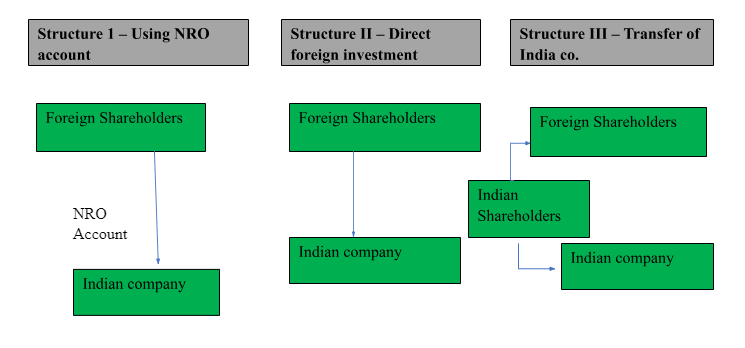
Foreign companies setting up a wholly owned subsidiary in India can choose from three legally recognised structures under the Companies Act, 2013 and FEMA regulations. The optimal structure depends on capital source, repatriation flexibility, RBI compliance requirements, and timeline.
Structure I: Using an NRO account
This structure is commonly used by NRIs and foreign shareholders with existing Indian income. Initial capital is funded from a Non-Resident Ordinary (NRO) account from income sources such as rent, dividends, or pension. No RBI filings are required at the time of incorporation. Repatriation from an NRO account is restricted to USD 1 million per financial year, and funds are maintained in Indian Rupees.
Best suited for small or India-income-funded investments where immediate free repatriation is not critical.
Structure II: Direct Foreign Investment (FDI)
This is the most preferred structure for foreign companies incorporating a wholly owned subsidiary in India. Capital is remitted from an overseas bank account into the Indian company’s bank account and is treated as FDI under FEMA. Form FC-GPR is mandatory and must be filed within 30 days of share allotment. Profits and dividends are freely repatriable after applicable taxes, with no annual cap.
Best suited for foreign companies seeking full control, scalability, and unrestricted capital movement.
Structure III: Transfer of an Existing Indian Company
This structure involves acquiring 100% ownership in an already incorporated Indian company. The Indian company is initially incorporated with Indian shareholders, and shares are subsequently transferred to the foreign parent. A valuation report is mandatory for share transfer. Form FC-TRS must be filed for the share transfer, and Form FC-GPR for any additional foreign investment.
Best suited for businesses seeking faster market entry using an existing Indian entity.
Comparative table: structures for setting up a WOS in India
| Parameter | NRO route | Direct FDI | Transfer route |
|---|---|---|---|
| RBI filing | Not required | FC-GPR | FC-TRS + FC-GPR |
| Valuation report | Not required | Not required | Required |
| Repatriation | Restricted (USD 1M/year) | Freely repatriable | Freely repatriable |
| Approx. timeline | ~3 weeks | ~3 weeks | ~5 weeks |
Documents required for incorporation of a wholly owned subsidiary in India
For setting up a wholly owned subsidiary in India, accurate documentation is critical. All foreign documents must be notarised and apostilled (or consularised where applicable) before submission to the MCA. If a document is in a language other than English, it must be translated by a professional translator.
Foreign parent company documents
- Board resolution (apostilled): approving incorporation of the Indian WOS and authorising a representative or signatory
- Memorandum and Articles of Association (MOA and AOA) of the parent company (apostilled)
- Certificate of Incorporation or Registration of the foreign company
- Charter documents of the holding company
- Trademark Registration Certificate (apostilled, if the Indian entity will use the parent’s brand name)
- No Objection Certificate (NOC) for use of the parent company’s name in India
- Passport (mandatory for foreign nationals)
- Address proof not older than 2 months (utility bill, bank statement, or government-issued ID)
- Class-3 DSC application details
- Indian mobile number and valid email ID (mandatory for DSC and MCA filings)
- PAN undertaking for directors and subscribers who do not possess any PAN in India
- Specimen signature cards of the directors (required for Form AGILE PRO S)
Indian registered office documents
- Lease deed, rent agreement, or ownership documents
- Utility bill (electricity, water, or gas) not older than 2 months
- NOC from the property owner if premises are rented
Step-by-step process: incorporation of a wholly owned subsidiary in India
Foreign companies setting up a wholly owned subsidiary in India must follow a streamlined, MCA-driven process under the Companies Act, 2013. The entire incorporation is executed digitally through the SPICe+ (Simplified Proforma for Incorporating Company Electronically Plus) framework.
Step 1: Obtain Digital Signature Certificate (DSC)
A Class-3 Digital Signature Certificate is mandatory for all proposed directors and authorised signatories. Documents required include: passport (mandatory for foreign nationals), address proof not older than 2 months, email ID and Indian mobile number for OTP-based verification, and a photograph. DSC enables secure and authenticated filing on the MCA portal.
Step 2: Name Reservation via SPICe+ Part A
Application is submitted through SPICe+ Part A on the MCA portal. Two proposed names can be submitted per application. The name may be the same as the foreign parent company or a variation with “India” or “Private Limited” as suffix.
Initial validity of an approved name is 20 days, extendable to 60 days with additional fees.
Supporting documents required at this stage (apostilled):
- Resolution passed by the holding company authorising the setup of a WOS in India
- Details of the proposed main objects of the WOS and the applicable NIC Code(s)
- Charter documents of the holding company
- NOC for use of a registered trademark (in the form of a letter or resolution, as applicable), along with certified copies of the trademark certificate(s)
Step 3: Preparation and execution of documents for Incorporation
The directors, subscribers, and nominee shareholders must submit the following documents:
- Memorandum of Association (MOA) and Articles of Association (AOA) with duly signed subscribers’ sheets
- Declaration by Directors and Subscribers in Form INC-9
- Proof of registered office address and NOC for use of premises
- Consent of Directors in Form DIR-2
- PAN undertaking for directors and subscribers who do not possess any PAN in India
- Specimen signature cards of the directors (for Form AGILE PRO S)
- Identity and address proof of the directors, shareholders (individual and non-individual), Authorised Representatives, and nominees of the shareholders
All documents executed outside India must be duly notarised and apostilled or consularised.
Step 4: Filing SPICe+ Part B and AGILE PRO S with the CRC
SPICe+ Part B and C is a single consolidated application covering corporate, tax, and statutory registrations.
Corporate registrations included:
- Company incorporation under the Companies Act, 2013
- DIN allotment for first-time directors
- Issuance of Certificate of Incorporation
Tax registrations included:
- Permanent Account Number (PAN)
- Tax Deduction and Collection Account Number (TAN)
Operational registrations included:
- GST registration (optional, based on business model)
- Bank account opening through MCA-integrated banks
- EPFO registration (mandatory once employee threshold is met)
- ESIC registration (mandatory once salary threshold applies)
Key attachments:
- MOA and AOA
- Subscriber declarations
- Proof of registered office
- All apostilled foreign documents
Estimated timeline for this stage: 7-10 working days.
Step 5: Certificate of Incorporation and CIN allotment
Upon payment of requisite fee and stamp duty and complete and satisfactory submission, the CRC issues the Certificate of Incorporation (COI), which includes the date of incorporation, Corporate Identification Number (CIN), PAN, and TAN of the company. This certificate serves as conclusive evidence that the company is legally incorporated. From the date on the COI, the company is a separate legal entity eligible to open operational bank accounts, receive foreign investment, enter into contracts, and hire employees.
Post-incorporation compliance for WOS in India
After incorporation of a wholly owned subsidiary in India, strict post-registration compliances apply under the Companies Act, 2013, FEMA, and RBI regulations. Timely compliance is critical to avoid penalties, restriction on business commencement, and regulatory scrutiny.
Mandatory compliance timeline
| Compliance | Statutory time limit |
|---|---|
| First board meeting | Within 30 days of incorporation |
| Appointment of first auditor | Within 30 days of incorporation |
| Establish registered office | Within 30 days of incorporation (Section 12(1)) |
| Director disclosure of interest in Form MBP-1 | At first board meeting (Section 184(1)) |
| Open current bank account, capitalise funds, and allot shares | As soon as practicable after incorporation |
| Report receipt of FDI in Form FC-GPR with the RBI | Within 30 days from the date of allotment |
| Seek BEN-2 declarations from significant beneficial owners | Within 30 days of incorporation |
| Seek MGT-6 declarations from shareholders and nominees | Within 30 days of incorporation |
| INC-20A (Declaration of Commencement of Business) | Within 180 days of incorporation |
| Issue of share certificates to shareholders | Within 60 days of incorporation |
Key execution notes:
- Business operations cannot commence until INC-20A is filed
- Subscription money must be deposited before filing INC-20A
- The auditor holds office until the first Annual General Meeting (AGM)
- Form BEN-2 (Return of Declaration of Significant Beneficial Ownership) must be filed after collecting BEN-1 declarations from significant beneficial owners, if any
- Form MGT-6 (Return of Declaration of Registered and Beneficial Ownership) must be filed after collecting declarations from shareholders and nominees
- At the first board meeting, each director must disclose their interest in any entity using Form MBP-1 under Section 184(1) of the Companies Act, 2013
- The registered office must be established within 30 days of incorporation under Section 12(1); Form INC-22 is required to notify the registered office address, and must be accompanied by a photograph of any one director taken at the registered office premises
Statutory and operational requirements
To remain compliant after setting up a wholly owned subsidiary in India, the following ongoing obligations apply:
Company name, registered office address, CIN, contact details, and GST number (if applicable) must be displayed at every place of business.
Mandatory statutory registers include: register of members, register of directors and KMP, register of charges, and share transfer records. Electronic maintenance of registers is legally permitted.
Depending on operations, additional licences and registrations required include: GST registration, Importer Exporter Code (IEC), Shops and Establishment Act licence, and Professional Tax (PT). IEC must be obtained before any import or export activity commences and cannot be applied for without an active company PAN and bank account.
Bank account activation and capital remittance: the operational sequence
The bank account selected during SPICe+ AGILE PRO S is an account selection, not an activation. After the Certificate of Incorporation is issued, the company must activate the account by submitting a physical or digital document set to the chosen bank. Documents required for bank account activation include: Certificate of Incorporation, MOA, AOA, and identity and address proofs of all directors and authorised signatories.
Once the bank account is active, the capital remittance and RBI compliance sequence runs in this order:
- The foreign parent remits the subscription amount from its overseas bank account to the Indian company’s bank account
- The Indian bank issues a Foreign Inward Remittance Certificate (FIRC) confirming receipt of funds
- The remitter’s bank provides KYC documents confirming the identity of the foreign investor
- The company allots shares to the subscribers after receipt of funds; shares must not be allotted before funds are received
- Form FC-GPR is filed with the RBI through the authorised dealer (AD) bank via the PRAVAAH portal (rbi.org.in/PRAVAAH) within 30 days of the date of allotment
- The company files INC-20A with the ROC with the bank statement as proof of capital deposit, within 180 days of incorporation
This sequence is non-negotiable. Allotting shares before funds arrive, or filing INC-20A before the bank account reflects the deposit, are both grounds for ROC objection or FEMA contravention.
RBI and FEMA compliance for Wholly Owned Subsidiary in India
Foreign capital infusion into a WOS is governed by FEMA and RBI reporting norms. Non-compliance can attract monetary penalties and compounding proceedings under FEMA.
What qualifies as foreign direct investment (FDI)
Any capital contribution from a non-resident into the Indian company’s share capital qualifies as FDI. This includes equity shares, compulsorily convertible instruments, and additional infusions of capital.
Mandatory RBI compliance workflow
- Foreign Inward Remittance Certificate (FIRC): issued by the Indian bank receiving foreign funds
- KYC from remitter bank: confirms identity of the foreign investor
- Allotment of shares: must be completed after receipt of funds
- Form FC-GPR filing: mandatory within 30 days of share allotment, filed through the authorised dealer (AD) bank
Form FC-TRS applies when shares are transferred from a resident to a non-resident or vice versa. A valuation report is required. Filing responsibility lies with the buyer or seller as per the transaction type. Form FC-GPR is additionally required for any subsequent foreign investment.
Common confusion: FC-GPR vs FC-TRS
FC-GPR (Foreign Currency Gross Provisional Return) applies to fresh issue of equity instruments by an Indian company to a non-resident investor. FC-TRS (Foreign Currency Transfer of Shares) applies to transfer of existing shares between a resident and a non-resident. For a new WOS under direct FDI, only FC-GPR is required for the initial share allotment. FC-TRS does not apply to fresh issuance. It becomes relevant only if an existing Indian company’s shares are subsequently transferred to the foreign parent (Structure III above) or if a resident director holds nominal shares that are later transferred.
Compliance risk: delays in FC-GPR and FC-TRS filings
For foreign companies, delays in FC-GPR or FC-TRS filings are among the most penalised FEMA violations. Under Section 13 of FEMA 1999, the maximum statutory penalty is up to 300% of the sum involved in the contravention. The RBI’s Foreign Exchange (Compounding Proceedings) Rules, 2024 (notified 12/09/2024) and the updated Compounding Master Direction (RBI/FED/2025-26/135, dated 22/04/2025) have rationalised the compounding framework: for non-reporting contraventions including delayed FC-GPR, a fixed penalty of INR 50,000 per regulation or rule contravened applies under the April 2025 directions, with the compounding amount capped at INR 2 lakhs for miscellaneous non-reporting contraventions. Proper sequencing of remittance, then allotment, then reporting is essential after registering a wholly owned subsidiary in India. The 2025 reforms favour first-time voluntary disclosures, but the 30-day FC-GPR deadline remains non-negotiable.
Taxation of a wholly owned subsidiary in India
A wholly owned subsidiary in India is taxed as a domestic company, making it significantly more tax-efficient than branch or liaison offices. Understanding corporate tax, MAT, and available incentives is critical when setting up a wholly owned subsidiary in India.
Corporate income tax
Under Section 115BAA of the Income Tax Act, 1961, a domestic company may opt for a concessional tax rate of 22% plus applicable surcharge and cess, resulting in an effective rate of approximately 25.17% (22% base + 10% surcharge flat under 115BAA + 4% cess). This compares favourably to the 35% base rate applicable to foreign companies (reduced from 40% by the Finance Act, 2024, effective FY 2024-25), plus the applicable surcharge of 2-5% and 4% cess. This lower domestic rate is a primary reason foreign entities prefer incorporation of a wholly owned subsidiary in India over branch offices.
Other applicable taxes
Minimum Alternate Tax (MAT) under Section 115JB applies at 15% of book profits if the company does not opt for a concessional tax regime. Surcharge on income tax is 2% for taxable income between INR 1 crore and INR 10 crore and 5% above INR 10 crore. Health and Education Cess is 4% on income tax plus surcharge.
Tax incentives for wholly owned subsidiaries
Foreign companies incorporating a wholly owned subsidiary in India may benefit from several incentives. Presumptive taxation exemptions are available to specific sectors such as shipping, air transport, oil exploration, and turnkey construction. Eligible startup and expansion costs can be amortised over 5 years. Dividends received by the Indian WOS from Indian or foreign companies are now taxed at normal corporate rates after the Finance Act, 2022 discontinued Section 115BBD from AY 2023-24. Group-level tax efficiency is better planned through Section 80M (deduction for dividends redistributed to shareholders within the prescribed timeline) rather than via the erstwhile concessional rate.
Ongoing compliance and governance requirements
After registering a wholly owned subsidiary in India, continuous governance compliance is mandatory to remain legally active.
Annual and periodic compliance checklist:
- Minimum 4 board meetings per year with a maximum gap of 120 days between any two meetings (Section 173, Companies Act, 2013)
- Annual General Meeting mandatory once every financial year
- Statutory audit conducted by a practising Chartered Accountant
- Books of accounts maintained under Section 128 presenting a true and fair view of financial position
- Form AOC-4: filing of financial statements with the ROC within 30 days of the AGM
- Form MGT-7 / MGT-7A: annual return filing with the ROC within 60 days of the AGM
- Form ADT-1: intimation of auditor appointment filed within 15 days of the AGM
- SEBI and FEMA reporting applicable if listed securities, foreign investment, or cross-border transactions are involved
Form CRL-1: subsidiary layering disclosure (effective 14/07/2025)
The MCA notified the Companies (Restriction on Number of Layers) Amendment Rules, 2025 (Notification G.S.R. 427(E), dated 27/06/2025), which came into force on 14/07/2025. The revised Form CRL-1 now mandates detailed layer-wise disclosure of subsidiary structures, including the CIN, registered office, ownership percentages, and holding company details at each layer. Under the underlying 2017 Rules, Indian companies (other than banks, NBFCs, insurance companies, and government companies) cannot operate through more than two layers of subsidiaries.
For a simple WOS structure where a foreign parent directly holds one Indian company, Form CRL-1 layering compliance is straightforward and the two-layer restriction is not triggered. However, if the Indian WOS itself sets up or acquires sub-subsidiaries, the layering rules apply and CRL-1 must be filed on the MCA21 portal with digital signature. Note: one layer of wholly owned subsidiaries is excluded when counting layers for the restriction, which benefits standard WOS structures.
CCFS-2026: one-time compliance relief window (15/04/2026 to 15/07/2026)
The MCA introduced the Companies Compliance Facilitation Scheme, 2026 (CCFS-2026) via General Circular No. 01/2026 dated 24/02/2026. The scheme is active from 15/04/2026 to 15/07/2026. It allows companies with overdue ROC filings to regularise pending annual returns (MGT-7, MGT-7A) and financial statements (AOC-4) by paying only 10% of the otherwise applicable additional fees, along with normal statutory filing fees. Companies can also opt for dormancy or strike-off at concessional fees under this window.
For a WOS that has missed one or more annual filings since incorporation, this window is a significant cost-saving opportunity. After 15/07/2026, ROC offices are directed to initiate action against continuing defaulters, including strike-off proceedings.
Advantages of Incorporating a WOS in India
Incorporating a wholly owned subsidiary under the Companies Act, 2013 is a structured process that allows the parent company to establish a separate yet controlled entity. Proper adherence to the procedural and regulatory requirements is essential to avoid legal and operational issues.
Strategic and operational advantages
Full managerial control: the parent company owns 100% shareholding, enabling complete control over operations, policies, and governance. Faster decision-making: the absence of minority shareholders means quicker approvals, streamlined execution, and agile business expansion. Brand continuity and global goodwill: a WOS can operate under the parent company’s name, using existing brand value and international reputation. Local market credibility: Indian customers, regulators, and partners show higher trust in Indian-incorporated entities compared to foreign branches.
Legal and risk advantages
Separate legal entity status under the Companies Act, 2013 protects the parent company from Indian operational risks. Limited liability: the parent’s exposure is capped at its capital investment. Asset ring-fencing: Indian operational risks, litigation, and liabilities remain confined to the subsidiary. The structure helps establish a clear presence in India while protecting the holding company’s global assets.
Financial and tax advantages
Profit repatriation under the direct FDI route is freely repatriable subject to applicable taxes. Consolidated tax planning allows losses and profits to be aligned with global tax strategies. R&D deductions and amortisation benefits allow eligible startup, expansion, and R&D expenses to be amortised over 5 years under Indian tax laws. MAT exemptions are available for companies in presumptive taxation sectors. Dividend income received by the WOS is taxed at normal corporate rates (Section 115BBD was discontinued from AY 2023-24); group-level tax planning via Section 80M remains available for dividends redistributed to shareholders.
Common mistakes that create delays and penalties
1. Treating the Authorised Representative and Nominee Shareholder as interchangeable
The Companies Act, 2013 requires that these be two distinct individuals. If the same person is designated for both roles, the application will be rejected at the CRC stage. Many first-time incorporations from jurisdictions such as Singapore and the UAE flag this only after name reservation is approved, adding 2-3 weeks to the process.
2. Starting apostille after name reservation
Apostille in the foreign company’s home country typically takes 7-15 working days depending on jurisdiction. If this is started after the MCA name approval (which is valid for only 20 days), the window often lapses. Apostille must start in parallel with the name reservation filing.
3. Missing the Form FC-GPR deadline
Form FC-GPR must be filed within 30 days of share allotment. Late filing is treated as a FEMA contravention and attracts compounding proceedings. The sequence is non-negotiable: receive FIRC, get KYC from remitter bank, allot shares, then file FC-GPR within 30 days. Do not allot shares before the FIRC is in hand.
4. Not filing INC-20A before commencing business
Under Section 10A of the Companies Act, 2013, a company incorporated after 02/11/2018 cannot commence business or exercise borrowing powers until the Declaration of Commencement of Business (Form INC-20A) is filed. Violating this attracts a penalty of INR 50,000 on the company and INR 1,000 per day on each officer in default, capped at INR 1 lakh per officer. Multiple adjudication orders from ROC offices in 2023-24 (including orders from ROC Delhi, ROC Telangana, and ROC Kerala) confirm this penalty structure is being actively enforced.
5. Skipping BEN-2 and MGT-6 post-incorporation filings
BEN-2 and MGT-6 are often overlooked because they are not part of the SPICe+ process. BEN-2 (filed under Section 90 of the Companies Act, 2013) captures significant beneficial owners. MGT-6 captures registered and beneficial ownership of shareholders and nominees. Missing these creates compliance gaps that surface during regulatory audits and due diligence before funding rounds.
Case study: US-based SaaS company incorporating Indian WOS
Situation: A mid-stage SaaS company based in San Francisco, preparing to open an Indian engineering and sales entity as part of a Series B expansion plan.
Challenge: The founding team had assumed the Authorised Representative could double as the nominee shareholder. The board resolution named one individual for both roles. Additionally, no apostille had been initiated before name reservation was filed. The approved name had a 20-day window and was at risk of lapsing.
What Treelife did: Revised the board resolution to designate two separate individuals for the two roles, re-coordinated apostille in parallel, and filed DSC applications for the two new directors. Simultaneously ran SPICe+ Part B preparation so it was ready within 24 hours of apostille completion.
Outcome: Certificate of Incorporation issued within 11 working days of the corrected apostille landing. FC-GPR filed 12 days after share allotment. No FEMA contravention.
Timeline for setting up a wholly owned subsidiary in India
Foreign companies planning to set up a wholly owned subsidiary in India typically complete the process within 3-5 weeks when documentation and apostilles are prepared in advance.
Estimated timeline breakdown
| Activity | Estimated time |
|---|---|
| Document preparation and apostille | 7-10 days |
| Name approval (SPICe+ Part A) | 2-5 days |
| Incorporation (SPICe+ Part B and C) | 7-10 days |
| RBI filings (FDI-related) | Parallel |
| Total time to set up a WOS in India | 3-5 weeks |
Delays typically arise due to incomplete documentation or apostille requirements for foreign documents. The transfer route adds approximately 2 additional weeks due to the valuation report requirement and FC-TRS filing.
WOS vs EOR vs Branch office: Which structure fits your India entry stage?
This question comes up in almost every foreign company’s India entry conversation. The three options serve different stages and risk profiles.
An Employer of Record (EOR) is not an Indian entity owned by the foreign company. It is a third-party Indian company that employs staff on the foreign company’s behalf. No incorporation, no CIN, no Indian legal entity. It is the right choice when a foreign company wants to hire 1-5 people in India quickly for market testing, without committing to a permanent presence. The trade-off is no IP ownership in India, no Indian contracts, no government incentives, and the EOR takes a fee per employee.
A branch office is a direct extension of the foreign company. It is permitted only in sectors approved by the RBI and can conduct limited activities specified in the RBI approval letter. It cannot generate profits in India (except in certain permitted sectors). It is taxed at the foreign company rate (35% base under Finance Act 2024), not the domestic rate. The parent company bears unlimited liability for the branch’s Indian operations.
A WOS is the right choice once the foreign company has validated the India opportunity and is ready for commercial operations, IP holding, local contracting, and long-term hiring. It is a separate Indian legal entity with limited liability, taxed as a domestic company, and eligible for all government incentives and tenders.
WOS vs EOR vs branch office: decision matrix
| Parameter | WOS | EOR | Branch office |
|---|---|---|---|
| Indian legal entity | Yes | No | No (extension of foreign co.) |
| Liability | Limited to capital | None (EOR bears it) | Unlimited for foreign parent |
| Tax rate | 25.17% (Sec 115BAA) | N/A | 35% base (Finance Act 2024) |
| IP ownership in India | Yes | No | Limited |
| Government tenders | Eligible | Not eligible | Restricted |
| Setup time | 3-5 weeks | 1-2 weeks | 4-8 weeks (RBI approval) |
| Best for | Scale phase, long-term | Pilot hiring, 1-5 people | Specific RBI-approved activities |
The common founder pattern Treelife sees: EOR for the first 6-12 months while product-market fit is being tested, then WOS incorporation once headcount crosses 5-10 and commercial contracting with Indian clients begins.
Reverse flip and downstream investments: What changed in 2026
Two developments in 2026 are directly relevant to foreign companies with Indian WOS structures and are missed by most incorporation guides.
Reverse flip via fast-track merger
The Ministry of Corporate Affairs amended Rule 25A of the Companies (Compromises, Arrangements and Amalgamations) Rules, 2016 to enable “reverse flip” structures through the fast-track merger route. A reverse flip is when an Indian company (which was originally a subsidiary of a foreign holding company) merges with the foreign parent to shift the holding structure back to India. This became operationally relevant in 2024-25 as several startups that had flipped to Singapore or Delaware structures were exploring shifting their holding back to India ahead of domestic IPOs. If your WOS may eventually become the parent entity in a restructured group, this is worth flagging to your legal counsel early.
Downstream investments by FOCCs
The RBI’s updated Master Direction on Foreign Investment in India (20/01/2025) clarified the framework for downstream investments by Foreign Owned or Controlled Companies (FOCCs). An Indian WOS that is 100% foreign-owned is itself an FOCC. If that WOS subsequently invests in another Indian entity, it is making a downstream investment governed by specific pricing, reporting, and sectoral cap rules. The January 2025 update confirmed that FOCCs may now make downstream investments through mechanisms such as equity share swaps and deferred payment arrangements, aligning them with direct foreign investors. If your India WOS plans to invest in or acquire other Indian entities, the FOCC downstream investment framework under the NDI Rules applies and FC-GPR or Form DI filings are required.
Challenges in starting a wholly owned subsidiary in India
Despite a streamlined process, incorporating a wholly owned subsidiary in India presents practical challenges for foreign entities.
Key risks and mitigation measures:
- Regulatory complexity: engage India-focused legal and compliance experts before the board resolution stage, not after name reservation
- Apostille delays: initiate apostille of parent company documents before name reservation is filed
- RBI and FEMA compliance risks: follow strict sequencing of remittance, then allotment, then FC-GPR or FC-TRS filing
- State-wise labour law variations: assess local Shops Act, PT, and labour requirements at the registered office location before finalising the address
- Infrastructure and cost challenges: use serviced offices or employer of record (EOR) partners during the initial phase before permanent premises are secured
Setting up a wholly owned subsidiary in India is a legally robust, tax-efficient, and operationally flexible option for foreign companies seeking long-term presence, revenue generation, and full control under Indian law. With simplified incorporation, competitive corporate tax rates (effective 25.17% under Section 115BAA), and clear FEMA and RBI pathways, a WOS is preferable to a branch office for scalable operations and to an EOR for businesses moving beyond pilot hiring into IP ownership, contracting, and market expansion. A WOS suits companies entering a growth or scale phase, while EOR fits early testing and branches suit limited, non-revenue activities, making the WOS the optimal choice for sustained India-focused growth.
FAQs on How to Setup Wholly Own Subsidiary in India
Q: Who can set up a WOS in India?
A: Any foreign company, international organisation, foreign government agency, or eligible NRI or PIO can set up a wholly owned subsidiary in India, subject to sectoral FDI rules permitting 100% foreign ownership. The entity must incorporate under the Companies Act, 2013 and comply with FEMA 1999 for capital infusion.
Q: Is RBI approval required for setting up a WOS?
A: Not usually. If the sector falls under 100% FDI via the automatic route, no prior RBI or government approval is needed. Approval is required only for sectors under the Government Approval Route as specified in India’s Consolidated FDI Policy.
Q: What is the minimum capital required to set up a wholly owned subsidiary?
A: No minimum paid-up capital is prescribed under the Companies (Amendment) Act, 2015. Capital levels can be defined in the Articles of Association and infused later via direct FDI or rights issue.
Q: Can WOS profits be repatriated?
A: Yes. Profits and dividends are freely repatriable after payment of applicable taxes when funded through direct FDI. Repatriation is restricted to USD 1 million per financial year if capital is routed through an NRO account.
Q: Can foreign nationals be directors in a WOS?
A: Yes. Foreign nationals can be directors, provided at least one director is an Indian resident under Section 149(3) of the Companies Act, 2013, meaning someone who has stayed in India for 182 days or more in the previous calendar year.
Q: What is the difference between a WOS and a branch office in India?
A: A WOS is an Indian-incorporated company with limited liability, allowed to conduct full commercial operations and taxed as a domestic company at an effective rate of 25.17% under Section 115BAA. A branch office is an extension of the foreign company with restricted activities, a 35% base tax rate (Finance Act 2024, effective FY 2024-25), and unlimited liability for the foreign parent.
Q: What are the three structures for setting up a WOS in India?
A: The three structures are: (1) funding through an NRO account (with restricted repatriation of USD 1 million per year), (2) direct foreign investment through overseas remittance (most preferred, freely repatriable, requires FC-GPR within 30 days), and (3) acquisition or transfer of an existing Indian company (requires valuation report and FC-TRS plus FC-GPR filings). The choice depends on capital source, timelines, and repatriation flexibility.
Q: What is the role of a Nominee Shareholder and can it be the same person as the Authorised Representative?
A: The Nominee Shareholder holds the minimum shares in the WOS on behalf of the holding company to satisfy the two-member requirement under the Companies Act, 2013. The Authorised Representative signs incorporation documents on behalf of the holding company. These must be two distinct individuals. Using the same person for both roles will result in rejection of the incorporation application at the CRC.
Q: Are valuation reports or apostilles required for setting up a WOS?
A: Apostille or consularisation is mandatory for all foreign documents submitted to the MCA (e.g. parent company board resolutions, MOA and AOA). Valuation reports are not required for initial incorporation under direct FDI but are mandatory for share transfers between residents and non-residents under FEMA regulations (FC-TRS route).
Q: What are the key post-incorporation filings and when must they be completed?
A: The first board meeting must be held within 30 days, the first auditor appointed within 30 days, share certificates issued within 60 days, Form FC-GPR filed within 30 days of share allotment, BEN-2 and MGT-6 declarations obtained and filed within 30 days, and INC-20A (Commencement of Business) filed within 180 days of incorporation. Business cannot commence before INC-20A is filed.
Q: What RBI filings are required after a WOS receives foreign investment?
A: For direct FDI, Form FC-GPR must be filed within 30 days of share allotment through the authorised dealer bank. Supporting documents include the Foreign Inward Remittance Certificate (FIRC) and KYC from the remitter bank. For share transfers, Form FC-TRS is additionally required along with a valuation report.
Q: What is the key difference between a subsidiary company and a wholly owned subsidiary in India?
A: A subsidiary company in India is one where the parent holds more than 50% but less than 100% of share capital, permitting minority shareholders. A wholly owned subsidiary is fully owned by the parent with 100% shareholding, giving complete control over management, operations, and strategic decisions with no minority disputes.
Q: Which structure is better for foreign companies entering the Indian market?
A: A wholly owned subsidiary is generally preferred as it offers full ownership, faster decision-making, and greater strategic autonomy. A subsidiary company may be more suitable for businesses seeking local partnerships, shared risk, or regulatory advantages under specific FDI policies in India.
Q: What happens if FC-GPR is filed late?
A: Late FC-GPR filing is a FEMA contravention under Section 13 of FEMA 1999 and requires compounding with the RBI. The maximum statutory penalty under Section 13 is 300% of the transaction amount. Under the updated Compounding Master Direction (RBI/FED/2025-26/135, April 2025), a fixed penalty of INR 50,000 per regulation contravened applies for non-reporting contraventions, with miscellaneous non-reporting contraventions capped at INR 2 lakhs compounding amount. Compounding must be completed within 180 days of the application under the Foreign Exchange (Compounding Proceedings) Rules, 2024. File proactively rather than wait for an RBI notice.
Q: Can a WOS operate under the parent company’s brand name?
A: Yes, provided the parent company grants a NOC for use of its name and, where applicable, provides the apostilled trademark registration certificate. This is submitted as a supporting document at the SPICe+ Part A name reservation stage.
Q: Should a WOS be registered as a private limited or public limited company?
A: For virtually all foreign companies setting up a WOS in India, a private limited company is the correct choice. It requires only 2 subscribers, has lower compliance requirements, and is not subject to SEBI listing regulations. A public limited company requires 7 subscribers and is only relevant if the foreign company plans to list its Indian entity on Indian stock exchanges.
Q: What is the exact shareholding split between the foreign parent and the nominee shareholder?
A: The foreign parent company holds 99.99% of the equity shares as both registered and beneficial owner. The nominee shareholder holds 0.01% with no beneficial rights. This structure satisfies the two-member requirement under the Companies Act, 2013 while preserving 100% effective ownership with the foreign parent.
Q: What are the three mandatory AOA restrictions for a private limited WOS?
A: Under Section 2(68) of the Companies Act, 2013, the AOA of a private limited company must include: (1) a restriction on the right to transfer shares, (2) a limit of 200 shareholders, and (3) a prohibition on any invitation to the public to subscribe for the company’s securities. All three must be present in the AOA or the Registrar will raise an objection.
Q: When should a foreign company use an EOR instead of incorporating a WOS?
A: An EOR is appropriate when the foreign company is in the pilot phase with 1-5 employees and wants fast, low-commitment India presence without incorporating. Once commercial operations, Indian client contracting, IP holding, or a headcount of 5-10 employees is anticipated, a WOS is the correct structure. EOR costs more per employee over time and does not provide the legal or tax benefits of an Indian entity.
Q: What is a reverse flip and is it relevant for an Indian WOS?
A: A reverse flip is when a startup or company that had shifted its holding structure to a foreign jurisdiction (Singapore, Delaware) restructures its holding back to India. The MCA’s 2024 amendment to Rule 25A of the Companies Rules now enables reverse flips through the fast-track merger route. This is relevant for Indian WOS structures where the eventual goal is a domestic IPO or a restructuring in which the Indian entity becomes the parent. It requires advance planning and legal advice on the merger scheme.
Q: What is the PRAVAAH portal and is it required for FC-GPR filing?
A: PRAVAAH (Platform for Regulatory Application, Validation and Authorisation) is the RBI’s digital portal for foreign exchange-related filings and approvals, including Form FC-GPR. FC-GPR is filed through the authorised dealer (AD) bank using the PRAVAAH portal. The applicant must register on the portal and the AD bank submits the form on the company’s behalf. DSC (Class 3) is mandatory for portal access.
Q: How do I incorporate a subsidiary company in India as a foreign company?
A: The process has five stages: (1) obtain Class-3 DSCs for all proposed directors; (2) reserve the company name via SPICe+ Part A with the holding company board resolution and supporting documents; (3) prepare and execute MOA, AOA, Form INC-9, Form DIR-2, and all apostilled foreign documents; (4) file SPICe+ Part B and AGILE PRO S for incorporation, DIN, PAN, TAN, and other registrations; (5) receive the Certificate of Incorporation and CIN from the CRC. Post-incorporation: open bank account, remit capital, allot shares, file FC-GPR with the RBI within 30 days of allotment, and file INC-20A within 180 days. Total timeline is 3-5 weeks for a private limited WOS under direct FDI.
Q: What does it cost to set up a wholly owned subsidiary in India?
A: The total cost has three components. Government and statutory fees (MCA filing, stamp duty on MOA and AOA) typically range from INR 25,000 to INR 40,000 depending on the state of incorporation and authorised capital; stamp duty varies significantly by state. Professional fees for a full-service incorporation with FEMA compliance (DSC, SPICe+ filing, FC-GPR, INC-20A) from a qualified CA or legal firm range from INR 50,000 to INR 1,50,000 domestically, or USD 7,500 to USD 20,000 through international advisory firms. Apostille and courier costs for foreign documents are additional and depend on the home jurisdiction, typically USD 200 to USD 600 for a standard document set.
Q: What is Form CRL-1 and does it apply to a WOS?
A: Form CRL-1 is filed under the Companies (Restriction on Number of Layers) Rules, 2017, to disclose subsidiary structures. A revised Form CRL-1 with expanded disclosures came into force on 14/07/2025 (MCA Notification G.S.R. 427(E), 27/06/2025). For a standard WOS where the foreign parent directly holds one Indian company, the two-layer restriction is not triggered and CRL-1 compliance is simple. It becomes substantive if the Indian WOS itself creates or acquires sub-subsidiaries. One layer of wholly owned subsidiaries is excluded from the layer count.
Q: What is CCFS-2026 and is it relevant for a WOS with overdue filings?
A: The Companies Compliance Facilitation Scheme 2026 (CCFS-2026), introduced by MCA General Circular No. 01/2026, runs from 15/04/2026 to 15/07/2026. It allows companies to file overdue MGT-7, AOC-4, and ADT-1 by paying normal fees plus only 10% of the otherwise applicable additional late fees. For a WOS that missed annual filings, this is a meaningful cost-saving window. After 15/07/2026, ROC offices are directed to initiate strike-off and penalty proceedings against remaining defaulters.
Regulatory references:
- Companies Act, 2013: Section 2(68) (private company definition and mandatory AOA restrictions), Section 2(87) (subsidiary company definition), Section 3(1)(c) (two-member requirement), Section 10A (commencement of business; penalty INR 50,000 on company + INR 1,000 per day per officer in default capped at INR 1 lakh), Section 12(1) (registered office within 30 days), Section 80M (deduction for redistribution of dividends), Section 90 (significant beneficial ownership), Section 128 (books of accounts), Section 149(3) (resident director requirement), Section 173 (board meetings), Section 184(1) (director disclosure of interest in Form MBP-1)
- Companies (Amendment) Act, 2015: removal of minimum paid-up capital requirement
- Companies (Restriction on Number of Layers) Rules, 2017 as amended by Companies (Restriction on Number of Layers) Amendment Rules, 2025 (G.S.R. 427(E), 27/06/2025, effective 14/07/2025): revised Form CRL-1 requiring layer-wise disclosure of subsidiary structures
- MCA General Circular No. 01/2026 (24/02/2026): Companies Compliance Facilitation Scheme 2026 (CCFS-2026), active 15/04/2026 to 15/07/2026; 10% of additional fees for pending MGT-7, AOC-4, ADT-1 filings
- Companies (Compromises, Arrangements and Amalgamations) Rules, 2016: Rule 25A as amended (2024) enabling reverse flip via fast-track merger
- Foreign Exchange Management Act (FEMA) 1999: Section 13 (penalties for contravention, up to 300% of sum involved)
- FEMA (Non-Debt Instruments) Rules, 2019 as amended by NDI Amendment Rules, 2024
- RBI Master Direction on Foreign Investment in India (updated 20/01/2025): clarifications on downstream investments by FOCCs, cross-border share swaps, and benefit-based equity instruments; Form DI for reclassification of FOCC investments
- Foreign Exchange (Compounding Proceedings) Rules, 2024 (notified 12/09/2024): replaces 2000 Rules; governs compounding of FEMA contraventions
- RBI Master Direction on Compounding of Contraventions under FEMA 1999 (RBI/FED/2025-26/135, dated 22/04/2025): caps miscellaneous non-reporting contravention compounding amount at INR 2 lakhs; INR 50,000 fixed penalty per regulation contravened for non-reporting
- Form FC-GPR: filing for foreign equity investment within 30 days of allotment; filed via PRAVAAH portal through AD bank
- Form FC-TRS: filing for transfer of shares between residents and non-residents; valuation report mandatory
- Form INC-22: registered office notification with photograph of director at premises
- Form MBP-1: director disclosure of interest at first board meeting under Section 184(1)
- Form AOC-4: filing of financial statements with ROC within 30 days of AGM
- Form MGT-7 / MGT-7A: annual return filing with ROC within 60 days of AGM
- Form ADT-1: intimation of auditor appointment within 15 days of AGM
- Income Tax Act, 1961: Section 115BAA (concessional corporate tax rate 22%; effective 25.17%), Section 115JB (MAT at 15% of book profits), Section 115BBD (discontinued from AY 2023-24 by Finance Act, 2022)
- Finance Act (No. 2), 2024: reduction of foreign company base tax rate from 40% to 35%, effective FY 2024-25
- SPICe+ (MCA notification): integrated incorporation framework
- India’s Consolidated FDI Policy (DPIIT), October 2020, as amended by periodic Press Notes including Press Note No. 2 (2025 Series)
External sources:
- Ministry of Corporate Affairs
- Reserve Bank of India
- Department for Promotion of Industry and Internal Trade (DPIIT)
- Income Tax India
About the Author
Share
-
Link copied to clipboard!https://treelife.in/legal/setting-up-a-wholly-owned-subsidiary-in-india/

-

-

-

-

Treelife

Treelife Team | support@treelife.in
We are a legal and finance firm with a deep focus on the startup ecosystem. We offer a wide range of services, including Virtual CFO, Legal Support, Tax & Regulatory, and Global Expansion assistance.
Our goal at Treelife is to provide you with peace of mind and ease in business.
We Are Problem Solvers. And Take Accountability.
Related Posts

Private Placement Memorandum for an AIF: Structure, Requirements, Drafting
The Private Placement Memorandum is the most consequential document an Alternative Investment Fund produces. Before a single rupee is raised,...
Learn More

Winding up a Wholly Owned Subsidiary in India: The Complete Guide
Winding up a wholly owned subsidiary (WOS) in India involves more steps than winding up an ordinary domestic company. The...
Learn More

Buyback Tax in India: What changed for Founders and Promoters Finance Act 2024
The rules on how buyback proceeds are taxed in India have changed twice in eighteen months, and the version currently...
Learn More
© 2026 Treelife Ventures Services Private Limited. All Rights Reserved.