


RSU vs ESOP – The Complete India Guide for Founders, HR Leaders & Employees (2026)
Written By

Treelife
Share
-
Link copied to clipboard!https://treelife.in/legal/rsu-vs-esop/

-

-

-

-

Blog Content Overview
- 1 1. What is an ESOP? Employee Stock Option Plans Explained
- 2 2. What is an RSU? Restricted Stock Units Explained
- 3 3. RSU vs ESOP The Complete Side-by-Side Comparison
- 4 4. ESOP & RSU Taxation in India – Complete 2026 Guide
- 5 5. Pros and Cons ESOP vs RSU
- 6 6. ESOP or RSU – Which is Right for Your Situation?
- 7 7. Real-World Case Studies How Equity Compensation Works in Practice
- 8 8. Common ESOP & RSU Mistakes and How to Avoid Them
- 9 9. How Treelife Helps with ESOP & RSU Structuring
- 10 Conclusion
India’s startup ecosystem has entered a golden era and equity compensation sits at the heart of it. Whether you are a first-time founder figuring out how to build your ESOP pool, an HR leader benchmarking your company’s equity offering against peers, or an employee who just received a stock option grant and has no idea what it means, this guide is written for you.
Over the next ten sections, we break down everything you need to know about Employee Stock Option Plans (ESOPs) and Restricted Stock Units (RSUs) , the two dominant forms of equity compensation in India today. We cover what they are, how they work, how they are taxed under India’s 2026 rules, which one suits your situation, and how leading Indian companies like Flipkart, Swiggy, and Infosys have used them to create extraordinary employee wealth.
| 70% Indian unicorns expanded ESOP pools in the last 5 years | ₹900Cr+ Swiggy ESOP buyback (2022) pre-IPO liquidity milestone | 200+ Startups helped by Treelife on ESOP structuring | 10–15% Standard ESOP pool size expected by VC investors |
1. What is an ESOP? Employee Stock Option Plans Explained
An Employee Stock Option Plan universally referred to as an ESOP is a contractual right granted by a company to selected employees, allowing them to purchase a specified number of the company’s shares at a pre-determined price, known as the exercise price or strike price. The key word here is right: an ESOP does not transfer ownership immediately. The employee must affirmatively exercise the option by paying the exercise price before they become a shareholder. Until then, they hold a promise, not shares.
In India, ESOPs are primarily governed by Section 62(1)(b) of the Companies Act, 2013, and the Companies (Share Capital and Debentures) Rules, 2014 for private and unlisted companies. Listed companies must additionally comply with SEBI (Share Based Employee Benefits and Sweat Equity) Regulations, 2021. DPIIT-recognised startups benefit from a special tax deferral provision under Section 192 of the Income Tax Act, one of the most significant advantages available to employees of early-stage Indian startups.
The exercise price is typically set at the Fair Market Value (FMV) of the share on the date of grant, as determined by a SEBI-registered Category I Merchant Banker or a Registered Valuer. For early-stage companies, this FMV can be very low, sometimes just a few rupees per share. This is precisely what makes early ESOPs so powerful: by locking in a low exercise price today, employees stand to gain enormously if the company’s valuation grows over time.
| An ESOP is the RIGHT to BUY shares at a fixed exercise price, not the shares themselves.› Ownership is created only AFTER exercise i.e., after paying the exercise price to the company.› No tax is triggered at grant or during the vesting period tax events occur only at exercise and sale.› Governed by Companies Act 2013, SEBI SBEB Regulations, and DPIIT guidelines (for startups).› Exercise prices for early-stage companies can be as low as ₹1–₹10 per share, creating massive upside potential. |
Key ESOP Terms Every Employee Must Understand
Before you can meaningfully evaluate an ESOP offer or decide when to exercise, you need to understand the vocabulary. These terms will appear in your grant letter, the company’s ESOP scheme document, and every conversation you have with your employer or tax advisor about your equity.
| Term | Plain-English Explanation |
| Grant Date | The official date on which the company formally awards the options. No money changes hands and no tax is triggered. |
| Exercise Price | The fixed per-share price at which you can buy shares. Typically the FMV on the grant date. Lower = better for you. |
| Vesting Period | The time schedule over which your options become exercisable. Standard in India: 4 years with a 1-year cliff (25% per year). |
| Cliff | A mandatory waiting period before any options vest. If you leave before the cliff (usually 12 months), all unvested options lapse. |
| Exercise Window | The period after vesting during which you can exercise your options. Usually 5–10 years from grant. Post-resignation, typically 30–90 days. |
| Good / Bad Leaver | Scheme clauses defining what happens to unvested and unexercised options if you resign (bad leaver) vs leave due to disability or retirement (good leaver). |
| FMV | Fair Market Value the per-share value on a specific date, as certified by a SEBI-registered valuer. This is the benchmark for all tax calculations. |
| ESOP Trust | A separate legal entity that holds shares for employees. Common in larger startups for administrative convenience and employee protection. |
Why Indian Startups Use ESOPs: The Strategic Logic
ESOPs exist because startups face a structural hiring disadvantage. A Series A startup cannot match the cash salaries, benefits packages, and job security that a Tata, Infosys, or Google subsidiary can offer. What they can offer and what cash-rich incumbents cannot replicate is a meaningful ownership stake in a company that might be worth ten or a hundred times more in five years.
This asymmetry is the entire foundation of startup equity compensation. The employee accepts a degree of financial risk in exchange for the chance to participate in value creation at scale. When it works as it did for hundreds of Flipkart employees, dozens of Swiggy early hires, and thousands of employees across India’s unicorn ecosystem the wealth creation is genuinely life-changing. When it does not work, the options simply expire worthless. No gain, but no loss either, the employee kept their salary throughout.
- Cash conservation – Startups can offer competitive total compensation without burning precious runway on salary increments.
- Retention – Multi-year vesting schedules with cliffs ensure employees stay through critical growth milestones before cashing out.
- Ownership mindset – Employees with equity think and act like owners with more initiative, better decisions, stronger accountability to outcomes.
- VC alignment – Institutional investors expect and validate a 10–15% ESOP pool at every funding round. It signals founder maturity.
- Wealth creation – Early employees at Flipkart, Swiggy, Zomato, and Nykaa built multi-crore wealth through timely ESOP grants.
- Downside protection – Unlike equity investments, ESOPs that go underwater are simply not exercised; the employee loses nothing except the opportunity.
The ESOP Lifecycle: 4 Stages from Grant to Wealth
How an ESOP Works – The Complete Journey
| STEP 1 – GRANT | STEP 2 – VESTING | STEP 3 – EXERCISE | STEP 4 – SALE |
| The company issues a grant letter. Exercise price fixed (e.g. ₹50/share). No cash needed. No tax. The clock starts on your vesting schedule. | Options vest over time typically 1-year cliff + monthly/quarterly vesting over 3 more years. You accumulate the right to buy. | You pay the exercise price to the company. Tax is triggered on the ‘spread’ (FMV − Exercise Price). You now own actual shares. | You sell shares in a buyback, secondary transaction, or post-IPO. Capital gains tax applies on profit above FMV at exercise. |
Worked Example: ESOP in Action
Scenario: 2,000 ESOPs granted at ₹50 exercise price. FMV at the time of exercise = ₹300 per share. Shares later sold at ₹450 per share.
Here is how the numbers work through each stage:
| Stage | What Happens Financially | Tax Treatment |
| Grant | 2,000 options granted. Exercise price locked at ₹50/share. Total exercise cost = ₹1,00,000. | No tax. Nothing to pay at this stage. |
| Vesting | Options vest 25% per year. After Year 1: 500 options exercisable. After Year 4: all 2,000 vested. | No tax. The vesting event itself does not trigger any liability. |
| Exercise | Employee pays ₹50 × 2,000 = ₹1,00,000. FMV at exercise = ₹300. Perquisite = (₹300 − ₹50) × 2,000 = ₹5,00,000. | ₹5,00,000 added to salary income. TDS deducted by employer at slab rate (~30% = ₹1,50,000). |
| Sale | Shares sold at ₹450. Capital gain = (₹450 − ₹300) × 2,000 = ₹3,00,000 (FMV at exercise is the cost basis). | Capital gains tax at applicable rate (LTCG: 12.5% on ₹3,00,000 above ₹1.25L exemption). |
| Net Outcome | Gross gain: (₹450 − ₹50) × 2,000 = ₹8,00,000. Total tax paid: ~₹1,77,000. Net in hand: ~₹6,23,000. | Without ESOPs, this wealth could not have been created on a salary alone. |
| The DPIIT Tax Deferral Benefit – A Major Advantage for Startup Employees Normally, TDS on the perquisite at exercise is deducted from the employee’s salary in the month of exercise even if shares cannot yet be sold.› DPIIT-recognised startups can apply for a special TDS deferral: the perquisite tax is deferred for up to 48 months from the exercise date, or until IPO/sale whichever comes first.› This eliminates the ‘pay tax now, sell shares later’ cash flow problem that affects many startup employees.› To benefit: your startup must hold a valid DPIIT recognition certificate. Ask your HR or finance team to confirm eligibility before you exercise.› Once the deferral window closes, the TDS falls directly on the employee’s plan for your personal cash flow well in advance of the deadline. |
2. What is an RSU? Restricted Stock Units Explained
A Restricted Stock Unit, or RSU, is a company’s promise to deliver a specific number of shares to an employee after they meet defined vesting conditions typically serving for a set period, hitting performance targets, or both. The critical difference from an ESOP is that RSUs cost the employee nothing. There is no exercise price to pay, no cash outflow required. When your RSUs vest, shares are simply delivered to your demat account, valued at their current market price on that date.
Because RSUs carry no exercise price, they are mathematically simpler than ESOPs. An RSU granted at any price will always have value as long as the company’s shares are worth anything at all; they cannot go ‘underwater’ the way stock options can. This predictability and simplicity makes RSUs the preferred instrument in large, stable organisations where employees need certainty rather than asymmetric upside. This is precisely why every major MNC technology employer Google, Amazon, Microsoft, Meta grants RSUs as a central component of their compensation, and why Indian IT giants like Infosys and Wipro have increasingly incorporated RSUs and Performance RSUs (PSUs) into their senior leadership pay.
In India, RSUs granted by listed Indian companies are regulated under SEBI’s Share Based Employee Benefits and Sweat Equity Regulations, 2021. Cross-border RSU grants from foreign parent companies to Indian employees fall under the Foreign Exchange Management Act (FEMA), with specific obligations around reporting and compliance that many employees are unaware of a gap that creates significant tax and regulatory risk.
| An RSU is a FREE GRANT of shares, no purchase price, no cash required from the employee, ever.› Shares are delivered (settled) only after vesting conditions are met time-based or performance-based.› Tax is triggered at vesting: the full Fair Market Value of the vested shares is treated as salary income.› Standard in MNCs worldwide: Google, Amazon, Microsoft, Wipro, Infosys all use RSU programmes.› Cross-border RSU grants (foreign parent to Indian employee) have additional FEMA and Schedule FA obligations. |
The Two Types of RSUs You Will Encounter in India
Not all RSUs are structured the same way. Understanding which type you have been granted matters for both your expectations and your tax planning.
| RSU Type | How Vesting Works | Who Gets These |
| Time-Based RSU | Shares vest on a fixed time schedule e.g., 25% per year over 4 years, or 6.25% every quarter. The only condition is continued employment. | Most employees at MNCs. Predictable, easy to model, and strong retention tool at all seniority levels. |
| Performance RSU (PSU) | Shares vest only if pre-agreed performance metrics are achieved e.g., revenue targets, profit thresholds, TSR (Total Shareholder Return), or ESG goals. | Senior and C-suite executives. Aligns leadership compensation directly with company performance and shareholder value creation. |
The RSU Lifecycle: 4 Stages from Promise to Portfolio
How an RSU Works The Complete Journey
| STEP 1 – GRANT | STEP 2 – VESTING | STEP 3 – SETTLEMENT | STEP 4 – SALE |
| Company issues a grant agreement: X RSUs over Y years. No money changes hands. No tax. Vesting schedule begins. | Shares vest per schedule (time or performance). Each vesting date is a potential tax event. | Vested shares credited to your demat account. Full FMV on vesting date is taxed as salary. Employer deducts TDS. | You sell vested shares on exchange, via buyback, or in the secondary market. Capital gains tax applies on appreciation. |
Worked Example: RSU Taxation Over 4 Years
Scenario: 1,200 RSUs granted, vesting 300 per year over 4 years. FMV at each annual vesting date = ₹400/share. Shares sold in Year 5 at ₹500/share.
| Vesting Year | Shares Vested | Perquisite (₹) | TDS @30% (₹) | Capital Gain at Sale |
| Year 1 | 300 @ ₹400 | 1,20,000 | 36,000 | 300 × ₹100 = ₹30,000 |
| Year 2 | 300 @ ₹400 | 1,20,000 | 36,000 | 300 × ₹100 = ₹30,000 |
| Year 3 | 300 @ ₹400 | 1,20,000 | 36,000 | 300 × ₹100 = ₹30,000 |
| Year 4 | 300 @ ₹400 | 1,20,000 | 36,000 | 300 × ₹100 = ₹30,000 |
| TOTAL | 1,200 shares | ₹4,80,000 | ₹1,44,000 | ₹1,20,000 gains |
Notice that the employee pays ₹1,44,000 in TDS across four years, spread evenly. This is one of the key practical advantages of RSU vesting over a lump-sum ESOP exercise: the tax liability is distributed over time, making it more manageable. However, for employees in private companies where shares cannot yet be sold, each vesting date creates a real cash outflow with no corresponding inflow from the shares, a significant cash flow pressure.
| Important: RSU Cash Flow Risk in Private Companies If you work at a private (unlisted) company and receive RSUs: you will owe salary tax at each vesting event even though you CANNOT sell the shares yet.› Unlike ESOPs (where DPIIT startups can defer TDS for 48 months), RSUs in private companies have NO tax deferral benefit available.› The entire TDS must be funded from your other salary income or personal savings. This can be a substantial amount.› Always verify liquidity timelines, buyback windows, secondary sale access, IPO roadmap before accepting a large RSU grant in a private company. |
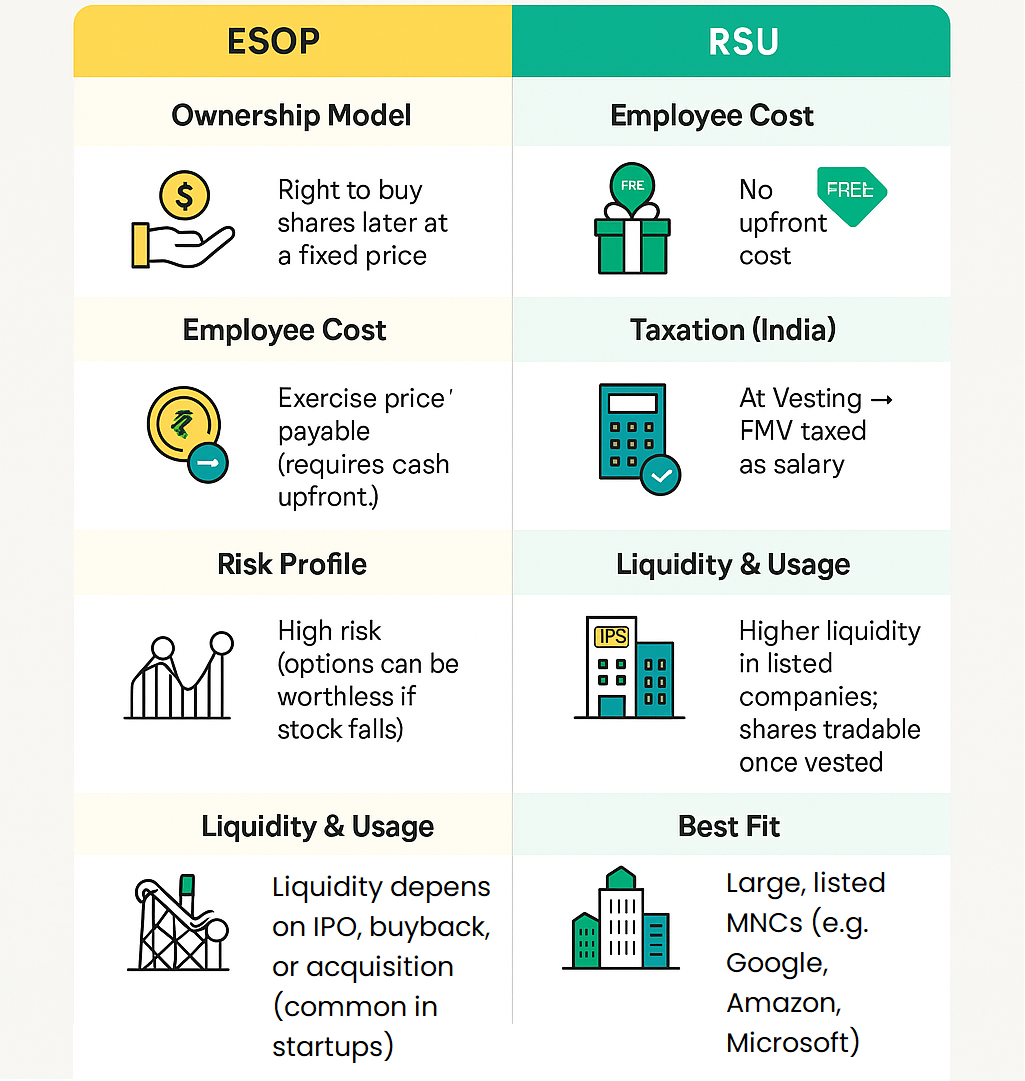
3. RSU vs ESOP The Complete Side-by-Side Comparison
At this point, you understand how each instrument works individually. Now let us place them side by side across the dimensions that matter most to employees and founders. This comparison will help you immediately identify which instrument is better aligned with your situation.
| ESOP | RSU |
| Right to BUY shares at fixed price | FREE grant shares delivered at vesting |
| Cash required: exercise price + tax | No cash ever required from employee |
| Ownership created only after exercise | Ownership created at vesting (automatic) |
| Potentially massive upside (startup growth) | Moderate, predictable value growth |
| DPIIT TDS deferral available (48 months) | No TDS deferral full tax at vesting |
| Tax: exercise (perquisite) + sale (CG) | Tax: vesting (full FMV) + sale (CG) |
| Risk: option goes underwater if FMV drops | Risk: tax bill without liquidity (private cos) |
| Complexity: scheme, filings, valuations | Simpler: global programme, clear mechanics |
| Best for: early-stage startup employees | Best for: MNCs and listed company employees |
16-Point Detailed Comparison
| Attribute | ESOP | RSU |
| Nature | Right to purchase shares at fixed price | Unconditional share grant upon vesting |
| Employee Cost | Yes exercise price must be paid | None shares are free of charge |
| Ownership Trigger | Only on exercise (paying the exercise price) | Automatically on vesting / settlement |
| Perquisite Tax | FMV minus Exercise Price at exercise date | Full FMV at vesting date |
| Capital Gains Tax | Sale Price minus FMV at exercise date | Sale Price minus FMV at vesting date |
| DPIIT TDS Deferral | Yes up to 48 months for recognised startups | Not applicable to RSUs |
| Underwater Risk | Yes if FMV falls below exercise price | No RSU always retains full FMV value |
| Wealth Upside | Highest locked-in low exercise price + growth | Moderate taxed on entire FMV at vesting |
| Cash Flow Impact | Exercise price + TDS = significant outflow | Only TDS at vesting (no exercise cost) |
| Administrative Complexity | High scheme doc, MCA filings, valuations | Lower global program, standard terms |
| Dilution Timing | Dilution occurs at the point of exercise | Dilution occurs at vesting / settlement |
| Vesting Structures | Time-based, milestone, cliff + graded options | Time-based (most common) or PSU (performance) |
| Regulatory Framework | Companies Act 2013, SEBI SBEB, Income Tax Act | FEMA, SEBI SBEB, Income Tax Act, Companies Act |
| Most Common In | Indian startups, unicorns, VC-backed companies | MNCs, large listed IT companies globally |
| LTCG Holding Period | Unlisted: 24 months from exercise; Listed: 12 | Unlisted: 24 months from vesting; Listed: 12 |
| IPO Impact | Pre-IPO options often create the highest wealth | Typically already vested before IPO listing |
4. ESOP & RSU Taxation in India – Complete 2026 Guide
Taxation is where most employees and founders make mistakes and where the financial consequences can be severe. Understanding exactly when tax is triggered, how much you owe, and what you can do to legitimately reduce your liability is not optional if you hold equity in an Indian company. This section gives you the complete picture.
A foundational principle to grasp before we go further: both ESOPs and RSUs are taxed at two separate, independent stages in India. The first tax event is when you access the equity exercise for ESOPs, vesting for RSUs. This income is treated as salary and taxed at your applicable slab rate, with TDS deducted by your employer. The second tax event is when you eventually sell the shares. The profit on sale is treated as capital gains and taxed at rates that depend on whether the shares are listed or unlisted, and how long you held them.
The Finance Act 2024 introduced significant changes to capital gains tax rates for equity, effective from 23 July 2024. Short-term capital gains (STCG) on equity were raised from 15% to 20%, and long-term capital gains (LTCG) were raised from 10% to 12.5%. The LTCG exemption threshold was simultaneously raised from ₹1 lakh to ₹1.25 lakh. All calculations in this guide use these current 2026 rates.
| The Two-Stage Tax Rule The Single Most Important Concept› Stage 1 Access Event: When you exercise (ESOP) or vest (RSU), the ‘spread’ or ‘full FMV’ is taxed as SALARY at your slab rate.› Stage 2 Sale Event: When you sell the shares, any price appreciation above the FMV at Stage 1 is taxed as CAPITAL GAINS.› Your employer deducts TDS on Stage 1 automatically. Stage 2 is your personal responsibility via advance tax or self-assessment.› Crucially: you can owe Stage 1 tax even if you NEVER sell the shares, the tax liability is not contingent on liquidity.› Good planning means understanding both stages before you exercise or receive RSUs, not after the TDS is already deducted. |
How ESOPs Are Taxed – Stage by Stage
When you exercise an ESOP, your employer is required to calculate the ‘perquisite value’ , the difference between the Fair Market Value (FMV) on the exercise date and your exercise price. This amount is added to your salary income for that financial year and taxed at your marginal slab rate. For most startup employees, this means 30% plus applicable cess.
The employer deducts TDS on this perquisite in the month of exercise. For employees of DPIIT-recognised startups, this TDS can be deferred for up to 48 months or until IPO/secondary sale whichever is sooner. Once you have paid the exercise price and the TDS is settled, you become the owner of the shares. The FMV on the exercise date becomes your cost basis for the second stage of taxation.
When you eventually sell those shares, the profit above your cost basis (FMV at exercise) is taxed as capital gains. If you hold listed shares for more than 12 months from the exercise date, you qualify for LTCG treatment at 12.5%. For unlisted company shares, the holding period for LTCG is 24 months.
How RSUs Are Taxed – Stage by Stage
For RSUs, the perquisite is simpler to calculate but often higher in absolute terms: the full FMV of the shares on the vesting date is treated as salary income. There is no exercise price to offset it. If 300 RSUs vest when the share price is ₹400, you have received ₹1,20,000 of salary income regardless of whether you sell a single share. TDS is deducted by the employer or the Indian subsidiary of the foreign company.
Your cost basis for the second stage is the FMV on the vesting date. When you sell, the gain is taxed as capital gains on the difference between sale price and vesting FMV. For foreign RSUs (e.g., NASDAQ-listed shares from a US parent company), you may have taxes withheld in the US as well. In that case, you need to claim a Foreign Tax Credit (FTC) under the India-US DTAA to avoid double taxation; this requires filing Form 67 before your ITR due date.
Capital Gains Tax Rates – India 2026
| Share Type | Holding Period | Gain Type | Tax Rate (2026) |
| Listed Shares | Less than 12 months | STCG | 20% |
| Listed Shares | More than 12 months | LTCG | 12.5% (above ₹1.25L) |
| Unlisted Shares | Less than 24 months | STCG | Applicable slab rate |
| Unlisted Shares | More than 24 months | LTCG | 12.5% (no indexation) |
| Tax Without Liquidity The Most Painful ESOP/RSU Problem› In PRIVATE companies, both ESOP exercise and RSU vesting trigger a real tax bill before you can sell a single share.› ESOP employees must fund: (a) the exercise price itself, and (b) TDS on the perquisite often a substantial combined outflow.› RSU employees in private companies must fund TDS on the full FMV at vesting from salary, savings, or personal borrowings.› DPIIT TDS deferral exists for ESOPs in recognised startups but this benefit does NOT extend to RSUs.› The lesson: always model your full tax liability before agreeing to exercise or accepting a private company RSU grant. |
Head-to-Head Tax Comparison: ESOP vs RSU
Common assumptions: 1,000 shares. FMV at access event = ₹300. Exercise price (ESOP only) = ₹50. Sale price = ₹450. Income tax slab = 30%. Listed shares held 15 months (LTCG applies).
| Tax Component | ESOP (₹) | RSU (₹) |
| Perquisite / Spread Value | (₹300 − ₹50) × 1,000 = ₹2,50,000 | ₹300 × 1,000 = ₹3,00,000 |
| Salary Tax at 30% | ₹75,000 | ₹90,000 |
| Exercise Price Outflow | ₹50,000 (paid to company) | ₹0 (no exercise cost) |
| Capital Gain on Sale | (₹450 − ₹300) × 1,000 = ₹1,50,000 | (₹450 − ₹300) × 1,000 = ₹1,50,000 |
| LTCG Tax @12.5% (above ₹1.25L) | ₹3,125 (taxable CG = ₹25,000) | ₹3,125 |
| Total Tax Paid | ~₹78,125 | ~₹93,125 |
| Total Cash Outflow (tax + exercise) | ~₹1,28,125 | ~₹93,125 |
| Reading the Numbers Correctly› ESOP total TAX is lower (₹78K vs ₹93K) because the exercise price reduces the perquisite.› But ESOP total CASH OUTFLOW is higher (₹1.28L vs ₹93K) because you also pay the exercise price.› For early-stage startups with very low exercise prices (₹1–₹10), the ESOP tax advantage is even more pronounced.› The real ESOP wealth engine: if FMV grows to ₹1,000+ from an exercise price of ₹10, the tax on a ₹990 spread is still less than RSU tax on the full ₹1,000.› Always model both tax AND cash flow before deciding when and whether to exercise. |
5. Pros and Cons ESOP vs RSU
Every equity instrument involves trade-offs. The right choice is rarely about which is objectively ‘better’ , it is about which fits your company stage, your risk tolerance, and your financial situation. Here is a balanced view of both instruments.
ESOP: Advantages
- Extraordinary wealth potential – With a low exercise price and a high-growth startup, the ESOP spread can be 50x–200x the cost. No other compensation instrument creates this scale of wealth.
- DPIIT TDS deferral – Employees of recognised startups can defer the salary tax at exercise for up to 48 months solving the cash flow problem unique to private company ESOPs.
- Lower perquisite tax – The exercise price directly reduces the taxable spread. An option with a ₹10 exercise price and ₹400 FMV is taxed on ₹390 not on ₹400.
- VC ecosystem standard – A well-structured ESOP pool is a signal of founder maturity. Investors expect and value it. Employees recognise it as industry-standard.
- Ownership culture – Nothing aligns an employee’s mindset with the company’s success more than actual equity ownership. ESOPs create long-term, mission-aligned teams.
ESOP: Disadvantages
- Cash required at exercise – You must pay the exercise price out of pocket before owning shares. For large grants, this can run into lakhs of rupees.
- Tax without liquidity – Even with DPIIT deferral, the tax clock eventually runs out. In private companies without buyback programmes, employees can be left holding illiquid shares with pending TDS.
- Underwater risk – If the company’s valuation stalls or declines, the FMV can fall below the exercise price. Options become worthless and are typically allowed to lapse.
- Compliance complexity – Operating an ESOP scheme requires MCA filings, annual valuations by registered valuers, a properly drafted scheme document, and increasingly, an ESOP trust structure.
RSU: Advantages
- No cost, no risk of loss – RSUs always have value as long as the company’s shares are worth anything. There is no scenario where vested RSUs expire worthless.
- Predictable and simple – Employees can model their expected equity income with high accuracy. No exercise decisions, no strike price calculations, just shares at FMV on vesting.
- Instant liquidity (listed cos) – In listed companies, vested RSU shares can be sold immediately without waiting for an IPO or buyback window.
- Global programme compatibility – MNCs can run a single RSU programme across dozens of countries. Consistency reduces admin burden and creates equitable treatment globally.
RSU: Disadvantages
- Full FMV taxed at vesting – The entire market value of vested shares is taxed as salary income a larger perquisite than ESOPs (no exercise price to offset it).
- No deferral in private companies – RSUs in private companies have no TDS deferral equivalent to the DPIIT ESOP benefit. Tax falls due at vesting regardless of liquidity.
- Lower upside ceiling – In a startup that grows 50x, an ESOP with a low exercise price creates far more wealth than RSUs granted at the same company’s current FMV.
- Schedule FA compliance (foreign) – Indian employees with foreign RSUs must disclose them annually in Schedule FA, a compliance obligation many miss, triggering ₹10L penalties.
6. ESOP or RSU – Which is Right for Your Situation?
The question ‘ESOP or RSU?’ does not have a universal answer. The right instrument depends on four variables: the type of company you work for, its stage of growth, your personal risk tolerance, and your financial liquidity. Use the framework below to identify where you stand.
What type of organisation do you work for?
| Early-Stage Startup ESOPs are the industry standard. Exercise prices are low, upside is potentially massive. This is where equity wealth is built. | Growth Unicorn ESOPs + buyback windows. Balance high upside with periodic liquidity. Ensure your scheme includes a buyback or secondary sale mechanism. | MNC / Global Tech RSUs are the norm. Guaranteed value, liquid shares, no exercise cost. Focus on optimising tax timing and Schedule FA compliance. | Listed Indian Company Either RSU or ESOP, depending on seniority. Senior leaders increasingly receive RSU/PSU. Ensure SEBI SBEB compliance. |
The Equity Compensation Stage Matrix
Your company’s funding stage and trajectory should directly inform which equity instrument it uses and how it is structured. This table shows the industry consensus at each stage.
| Company Stage | Best Instrument | ESOP Pool Size | Strategic Rationale |
| Seed / Angel Round | ESOP | 10–12% | Exercise prices are lowest here. Maximum upside potential for early employees. Foundational for talent attraction. |
| Series A–B | ESOP | 12–15% | VC standard. Investors validate and may require ESOP pool top-up as a term-sheet condition. |
| Series C–E | ESOP + Buyback | Up to 15% | Add periodic buyback windows to retain employees who need liquidity without waiting for IPO. |
| Pre-IPO / Late Stage | ESOP + RSU | Refreshes | Begin transitioning senior leadership to RSU grants. ESOP pool remains for junior-mid employees. |
| Post-IPO / Listed | RSU / PSU | Refresh | Shares are now liquid and publicly valued. RSU and performance-linked PSU become optimal instruments. |
| MNC Subsidiary | RSU | Global prog | The parent company runs a global RSU programme. Indian entities add a local FEMA + tax compliance layer. |
7. Real-World Case Studies How Equity Compensation Works in Practice
Theory is useful, but nothing clarifies the power and the complexity of equity compensation like real examples. The four case studies below draw from India’s most prominent ESOP outcomes and cross-border RSU scenarios, giving you a practical lens on how these instruments play out in the real world.
Case Study 1: Flipkart – How ESOPs Created an ESOP Millionaire Factory
Flipkart is the benchmark ESOP success story for the entire Indian startup ecosystem. During the company’s early years when it was still a scrappy, capital-efficient e-commerce operation competing against established retailers it distributed ESOPs generously to employees at exercise prices in the range of ₹5 to ₹10 per share. At that valuation, even senior employees often received grants they assumed were largely symbolic.
When Walmart acquired a majority stake in Flipkart in 2018 at an enterprise valuation of $20.8 billion, the per-share value had grown by orders of magnitude from those early exercise prices. The result was transformational: estimates suggest more than 300 employees received ESOP payouts of ₹1 crore or more, with some senior early hires receiving tens of crores. Engineers, product managers, operations leads, and even certain support function employees found themselves suddenly wealthy in a way that had no precedent in Indian corporate history at that scale.
| Flipkart ESOP: Key Numbers› Exercise prices at early grant: approximately ₹5 to ₹10 per share.› Effective per-share value at Walmart acquisition: estimated multi-hundred rupees.› Employees who became crorepatis (₹1 crore+ payout): 300+.› Core lesson: the earlier the ESOP grant, the lower the exercise price, and the greater the compounded upside. |
The Flipkart playbook has since been studied and replicated across India’s unicorn ecosystem. The key structural ingredients: a substantial ESOP pool (10–15%), low exercise prices validated by conservative early-stage valuations, a 4-year vesting schedule that kept the team together through the critical growth phase, and ultimately a large-scale liquidity event (acquisition or IPO) that allowed employees to actually realise the value. Every element was necessary. Any missing piece would have diminished the outcome.
Case Study 2: Swiggy – The Pre-IPO Buyback Strategy
Swiggy’s ESOP story illustrates a different dimension of equity compensation: the strategic management of employee liquidity expectations in a company that is approaching but has not yet reached a public listing. By 2022, Swiggy had been operating for eight years and had built a significant employee base, many of whom had been holding vested ESOP options for years with no clear near-term IPO timeline. Employee satisfaction and retention were being affected by the lack of any liquidity pathway.
Swiggy’s response was to conduct one of India’s largest pre-IPO ESOP buybacks: offering eligible employees the chance to sell their exercised shares back to the company at a valuation-based price, unlocking over ₹900 crore in total proceeds. This was not just a financial transaction, it was a deliberate cultural signal that equity compensation at Swiggy was real, valuable, and realisable. Employees who participated secured life-changing liquidity years before the IPO.
When Swiggy listed on the NSE and BSE in November 2024, employees who had retained their shares through the IPO experienced a second, larger wave of liquidity. The two-stage approach pre-IPO buyback for immediate monetisation, followed by IPO for long-term upside has become the template that other late-stage Indian unicorns are now adopting.
| Swiggy’s ESOP Lesson for Founders› Pre-IPO buyback windows are now an accepted and expected feature of mature Indian startup ESOP programmes.› Offering periodic liquidity is not a giveaway; it reduces retention risk and increases employee commitment through the IPO journey.› Build buyback provisions into your ESOP scheme from the beginning, even if you do not plan to use them for years. |
Case Study 3: Google India – The Cross-Border RSU Compliance Challenge
Google grants RSUs to its Indian employees through a standard global equity compensation programme. These RSUs vest quarterly over four years and settle as shares of Alphabet Inc. (NASDAQ: GOOGL). On the surface, this is an excellent compensation package: fully liquid shares in one of the world’s most valuable companies, no exercise cost, and predictable quarterly income in the form of vesting shares.
In practice, however, Indian employees face a multi-layered compliance obligation that creates real financial risk if handled incorrectly. When RSUs vest, Google India’s payroll system deducts TDS on the full FMV of the vested shares as a salary prequisite. Separately, the US may withhold its own taxes on the same income. Without a properly filed Foreign Tax Credit (FTC) claim under the India-US Double Tax Avoidance Agreement (DTAA), the employee ends up paying tax twice on the same income, a legally avoidable but practically common outcome.
The second compliance layer is Schedule FA the Foreign Asset disclosure schedule within India’s ITR. Every Indian tax resident who holds foreign assets (including unvested RSUs, vested-but-unsold shares, and foreign brokerage accounts) must disclose them annually. The penalties for non-disclosure under the Black Money (Undisclosed Foreign Income and Assets) and Imposition of Tax Act, 2015 are ₹10 lakh per assessment year per undisclosed asset, a punishing amount for what is often an accidental omission.
| Indian Employees with Foreign RSUs: Critical Compliance Checklist› Schedule FA: Disclose ALL foreign assets (unvested RSUs, shares, brokerage accounts) in your annual ITR. Penalty for non-disclosure: ₹10 lakh per default.› TDS: Your Indian employer/subsidiary deducts TDS on the RSU perquisite at each vesting date. Verify this is happening correctly each quarter.› DTAA / FTC: If US taxes are withheld, file Form 67 before your ITR due date to claim the Foreign Tax Credit and avoid double taxation.› Timing: FTC claims must be made in the same year as the income. Missing the Form 67 deadline permanently forfeits your credit. |
Case Study 4: Indian IT Sector – The ESOP-to-RSU Transition Post-Listing
India’s large IT services companies Infosys, Wipro, HCL Technologies present an instructive case study in the natural evolution of equity compensation as a company matures. In their early growth phases, these companies used ESOPs heavily to attract and retain technical talent in a competitive market. The low exercise prices of the 1990s and early 2000s, combined with explosive revenue growth, created genuine wealth for thousands of employees.
As these companies became large, stable, publicly listed organisations with relatively predictable earnings growth, the case for ESOPs weakened. The scope for the 50x–100x upside that makes ESOPs transformative becomes very limited at a ₹5 lakh crore market cap. What senior employees needed instead was performance-linked pay that was liquid, certain, and directly tied to shareholder value creation. The answer was a shift toward RSU and Performance RSU (PSU) structures for CXOs and senior VPs, while maintaining ESOP or ESOP-equivalent grants for mid-level technical and management employees.
The strategic lesson for Indian startup founders is clear: the equity compensation instrument appropriate for your company today will not be the right instrument at every future stage. Build flexibility into your scheme design, and plan for the transition from ESOP-heavy to RSU-balanced compensation as your company approaches listing and beyond.
8. Common ESOP & RSU Mistakes and How to Avoid Them
The most expensive ESOP and RSU errors are almost always avoidable with a little advance planning and the right professional advice. The following mistakes appear repeatedly across the startups and employees Treelife advises do not let them happen to you.
For Employees: 5 Costly Mistakes
1. Not reading the ESOP scheme document before accepting a grant The scheme document is the legal contract governing your equity. It contains the vesting schedule, exercise window (often just 30–90 days post-resignation), good leaver vs bad leaver definitions, anti-dilution provisions, and the company’s buyback rights. Many employees sign their grant letter without ever asking for or reading the scheme document then discover unfavourable terms only when they try to exercise or after they resign.
2. Being unprepared for the tax at exercise The perquisite tax at exercise can be a shock if you haven’t modelled it in advance. For 10,000 options with a ₹10 exercise price and ₹300 FMV, the perquisite is ₹29 lakh generating ~₹8.7 lakh in TDS at a 30% slab rate. Your employer will deduct this from your salary. If your monthly salary is ₹5 lakh, you could have zero take-home for two months after a large exercise. Plan cash flow well in advance.
3. Exercising options without a clear liquidity plan Exercising in a private company means paying the exercise price and triggering TDS and then holding illiquid shares with no guarantee of when you will be able to sell. Unless there is a buyback window, a secondary sale, or an IPO timeline clearly in view, exercising early can tie up significant capital with no return date. Exercise only when there is a realistic near-term liquidity event.
4. Missing Schedule FA for foreign RSUs This is a growing problem as more Indian employees receive RSUs from foreign-listed parent companies. Every Indian tax resident with foreign assets must file Schedule FA annually in their ITR. This includes unvested RSU grants, vested shares held in foreign brokerages, and the brokerage account itself. Non-disclosure carries a ₹10 lakh penalty per assessment year under the Black Money Act regardless of intent.
5. Poor holding period timing for capital gains Selling shares immediately after exercise or vesting is the most expensive approach from a capital gains perspective. For listed shares, waiting just 12 months from exercise/vesting converts a 20% STCG liability into a 12.5% LTCG liability. For unlisted shares, the holding period for LTCG is 24 months. The tax saving from waiting the holding period can run into lakhs on a significant equity position.
For Founders: 5 Critical ESOP Scheme Mistakes
1. Granting ESOPs without a formal scheme document Many early-stage founders issue informal ESOP commitments: a line in an offer letter, a promise in an email, a verbal assurance. None of these are legally enforceable without a formal ESOP scheme adopted by the Board and shareholders under Section 62(1)(b) of the Companies Act. Without a scheme, you cannot legally allot shares against option exercise, and your employees have no enforceable rights.
2. Setting exercise prices arbitrarily The exercise price must be the Fair Market Value of the company’s shares on the grant date, as certified by a SEBI-registered Category I Merchant Banker or a Registered Valuer. Setting a price lower than FMV without proper valuation support creates tax and regulatory risk. Setting it higher than FMV reduces the incentive value of the options for employees.
3. Not structuring an ESOP Trust As your employee headcount and ESOP pool grow, administering individual option grants, exercise requests, and share allotments directly becomes operationally complex. An ESOP Trust acts as an intermediary; it holds the shares, manages exercises, and simplifies the employee experience. It also provides employee protection in M&A scenarios. Startups beyond Series B should seriously consider ESOP Trust structures.
4. Sizing the ESOP pool incorrectly An ESOP pool that is too small (under 8%) will require repeated dilutive top-ups that frustrate existing shareholders and employees. A pool that is too large (over 20%) creates unnecessary upfront dilution. The industry benchmark of 10–15% of fully diluted capital is well-established for a reason: it satisfies VC expectations, provides enough headroom for key hires and fresh grants, and maintains a sensible capital structure.
5. Designing the scheme with no exit provisions Employees need to know when and how they will be able to convert their options into cash. An ESOP scheme with no buyback provision, no secondary sale window, and no defined liquidity pathway creates growing frustration as vesting periods conclude with no monetisation opportunity. Design your scheme with explicit buyback triggers (e.g., annual windows post-Series C), secondary sale provisions, and a clearly communicated IPO roadmap.
9. How Treelife Helps with ESOP & RSU Structuring
Treelife is a full-service legal, tax, and compliance firm with deep specialisation in equity compensation for Indian startups and growth-stage companies. We have worked with more than 200 Indian startups from seed-stage companies issuing their first ESOP grants to late-stage unicorns preparing for IPO to design, implement, and administer compliant, tax-efficient equity programmes.
Equity compensation in India is governed by an interlocking web of regulations: the Companies Act 2013, SEBI SBEB Regulations 2021, the Foreign Exchange Management Act (for cross-border grants), the Income Tax Act (for perquisite, capital gains, and TDS), and DPIIT guidelines (for the 48-month TDS deferral benefit). Getting any one of these wrong can result in regulatory penalties, disqualification of option grants, employee grievances, or unexpected tax exposure. Our job is to make sure that your equity programme is structured correctly, maintained compliantly, and optimised for both the company and its employees.
Our ESOP & RSU Services – What We Do
| ESOP Scheme Drafting | Cap Table & Equity | Regulatory Filings | Tax Advisory |
| Scheme document drafting, vesting schedule design, exercise price advisory, cliff and graded structures, good/bad leaver clauses, ESOP trust deed and administration. | ESOP pool sizing and dilution modelling, option grant tracking, cap table management, investor ESOP expectation advisory, pre-fundraise cap table cleanup. | MCA annual return filings, FEMA compliance and reporting, SEBI SBEB filings, DPIIT recognition applications, TDS deferral applications for eligible employees. | Exercise timing strategy, holding period planning for LTCG, perquisite tax modelling, Schedule FA filing, Foreign Tax Credit (FTC) claims, cross-border tax opinions. |
Who We Work With
- Seed to Series B founders – Designing your first ESOP scheme, setting the right exercise price and pool size, drafting the scheme document, and advising on your first option grants.
- Series C to pre-IPO startups — ESOP pool refreshes, buyback window structuring, secondary sale provisions, ESOP trust establishment, and pre-IPO scheme rationalisation.
- Post-IPO listed companies – Transitioning from ESOP to RSU/PSU structures, SEBI SBEB compliance, performance-linked vesting design for senior leadership.
- MNC India subsidiaries – Cross-border RSU compliance, FEMA reporting, TDS on foreign equity grants, Schedule FA advisory, and DTAA-based FTC planning.
- Individual employees – Personal ESOP exercise timing advice, ITR filing with complex equity income, capital gains planning, and Schedule FA compliance.
Conclusion
ESOPs and RSUs are both powerful tools for building employee wealth, retaining talent, and aligning your team with company success but they work in fundamentally different ways and are suited to different contexts. In India’s startup ecosystem, ESOPs remain the dominant pre-IPO instrument: their low exercise prices, high-growth upside, and DPIIT tax deferral benefit make them uniquely powerful for early-stage companies. RSUs are the standard for MNCs and post-IPO companies, where simplicity, predictability, and liquidity are more valuable than asymmetric upside.
Understanding the mechanics, the taxation, the compliance obligations, and the strategic logic behind each instrument is no longer optional it is essential for every founder designing a scheme, every HR leader building a compensation strategy, and every employee evaluating or holding equity. The decisions you make around exercise timing, holding periods, Schedule FA compliance, and liquidity planning can add or subtract lakhs from your actual wealth outcome.
If you would like to design a world-class ESOP programme, optimise your personal equity tax position, or navigate the complexities of cross-border RSU compliance, Treelife’s equity compensation team is here to help.
Build a Compliant, Tax-Efficient ESOP Programme with Treelife200+ Indian startups trust Treelife for ESOP scheme design, compliance, and advisory. Let’s Talk
FAQs on differences between RSU and ESOP
-
How do RSUs and ESOPs differ?
The key difference lies in what you receive. RSUs are a grant of shares, meaning you receive actual company stock (after a vesting period) at no cost to you. ESOPs (Employee Stock Option Plans) are options, giving you the right to buy company stock at a predetermined price (the “strike price”) in the future. With ESOPs, you must pay money to exercise the option and acquire the shares.
-
How is the taxation of RSUs handled?
RSUs are typically taxed in two stages. The first taxable event occurs when your shares vest. At this time, the fair market value of the shares is considered ordinary income and is subject to income tax and employment taxes. The second taxable event happens when you sell the shares. Any increase in value from the vesting date to the sale date is a capital gain, which is taxed at either the short-term or long-term capital gains rate depending on how long you held the shares.
-
What is the taxation process for ESOPs?
ESOPs also involve two potential taxable events. The first is when you exercise the options. The difference between the fair market value of the stock and your lower strike price is considered a taxable perquisite and is added to your salary income. The second taxable event occurs when you sell the shares. The profit you make from the sale (the difference between the sale price and the fair market value on the exercise date) is a capital gain, taxed at the appropriate rate.
-
Which is a better choice for an employee, RSU or ESOP?
There’s no single “better” option; it depends on your financial goals and risk tolerance. RSUs are generally considered less risky because you receive the shares at no cost, guaranteeing you value as long as the company’s stock has any value. This makes them a great choice for employees at established, publicly-traded companies. ESOPs offer a potentially higher reward but also carry more risk. If the company’s stock price falls below your strike price, the options become worthless. They are often used by startups to incentivize employees with the potential for massive gains if the company goes public or is acquired.
-
Why do startups prefer to offer ESOPs instead of RSUs?
Startups often use ESOPs because they allow the company to conserve cash. Instead of granting valuable stock outright (like with RSUs), they are granting the option to buy stock later. This helps them attract and retain early talent without putting a strain on their limited financial resources. ESOPs also align employee interests with the company’s long-term success, as the value of the options is directly tied to the company’s growth.
-
What is vesting, and how does it relate to RSUs and ESOPs?
Vesting is the process by which an employee earns full ownership rights to their equity compensation over time. It’s a common feature in both RSU and ESOP plans, designed to act as a retention tool. For example, a 4-year vesting schedule means you only gain full ownership of the equity after working at the company for four years. If you leave before the end of the vesting period, you may forfeit any unvested shares or options.
-
Do I have to pay to get shares from an RSU?
No, you do not have to pay anything to receive shares from an RSU. RSUs are a grant of stock, and the shares are given to you as a form of compensation after the vesting requirements are met. Your employer will automatically handle the grant, and taxes will be withheld from the value of the shares when they vest.
-
Can an ESOP have a negative value?
Yes, an ESOP can have a negative value in a practical sense. If the company’s stock price on the day you want to exercise is lower than your predetermined strike price, your options are “underwater” or “out of the money.” In this scenario, it would cost you more to buy the shares than they are worth, so the options are essentially worthless. This is a key risk of ESOPs that doesn’t exist with RSUs.
-
Is an RSU a real share of stock?
An RSU is not a real share of stock until it vests. It’s a “unit” that represents the promise of a future grant of stock. Once the vesting conditions (usually time or performance-based) are met, the RSU converts into a physical share of the company’s stock, at which point you become a full shareholder with all the associated rights.
-
How does ESPP differ from both RSUs and ESOPs?
An ESPP (Employee Stock Purchase Plan) is a different type of equity. With an ESPP, you use your own money to buy company stock, typically through payroll deductions, at a discount (often 15%) from the market price. The key difference from RSUs is that you pay to acquire the stock, and the key difference from ESOPs is that you are purchasing the stock directly at a discount, not acquiring the option to buy at a fixed price. .
About the Author
Share
-
Link copied to clipboard!https://treelife.in/legal/rsu-vs-esop/

-

-

-

-

Treelife

Treelife Team | support@treelife.in
We are a legal and finance firm with a deep focus on the startup ecosystem. We offer a wide range of services, including Virtual CFO, Legal Support, Tax & Regulatory, and Global Expansion assistance.
Our goal at Treelife is to provide you with peace of mind and ease in business.
We Are Problem Solvers. And Take Accountability.
Related Posts
![FDI in India: Sectors, Limits, and the Complete Investment Process [2026]](https://cdn.treelife.in/2026/04/FDI-in-India-Sectors-Limits-and-the-Complete-Investment-Process.jpeg)
FDI in India: Sectors, Limits, and the Complete Investment Process [2026]
Foreign Direct Investment (FDI) in India has entered one of its most consequential phases. With gross FDI inflows reaching US$81.04...
Learn More

Compliance Calendar April 2026 – GST, TDS, PF, ESI & Advance Tax Deadlines
Sync with Google Calendar Sync with Apple Calendar Plan your April filings in one place. Figures and forms are mapped...
Learn More

The Income Tax Act, 2025 Is Live – Here’s What You Actually Need to Know
Effective 1 April 2026, the Income Tax Act, 2025 replaces the Income Tax Act, 1961 and the Income Tax Rules,...
Learn More