




Selling Founder Shares in India: Tax, Process, Secondary
Written By

Jitesh Agarwal
Share
-
Link copied to clipboard!https://treelife.in/legal/selling-founder-shares-in-india-tax-process-secondary/

-

-

-

-

AI Summary
- Indian VCs cleared over $1 billion in founder secondaries in 2025, making secondary sales a standard clause in many Series B and C term sheets.
- Long term capital gains on unlisted startup shares held for more than 24 months are taxed at 12.5% (plus applicable surcharge and cess), with no indexation benefit for transfers made on or after 23 July 2024.
- Short term capital gains on shares held under 24 months are taxed at the founder's slab rate, which can go up to 39% including surcharge and cess.
- Section 54F of the Income Tax Act can help a founder eliminate LTCG liability if the sale proceeds are reinvested in a residential house, subject to prescribed caps.
- On a ₹10 crore exit, tax outgo can range from about ₹1.25 crore at the 12.5% LTCG rate for a 3 year holding to about ₹3.9 crore at the 39% STCG rate for an 18 month holding.
- A cross border buyer triggers an FC-TRS filing requirement under FEMA, which must be completed within 60 days of the fund remittance.
- A full strategic exit typically takes 60 to 90 days from term sheet to closing, while a secondary sale within a funding round takes 30 to 45 days.
- Most Indian VCs currently permit founders to sell 5% to 15% of their stake as a secondary in Series B and later rounds, alongside the incoming investor's primary investment.
- A company buyback of founder shares is taxed differently, attracting deemed dividend treatment under Section 2(22)(d) and buyback tax under Section 115QA, and requires careful structuring to avoid double taxation.
Blog Content Overview
- 1 How founder secondaries and exits actually work in India
- 2 What is a founder secondary and when does it make sense
- 3 How much tax will I pay when I sell my founder shares
- 4 Can I save tax by gifting shares to family before the sale
- 5 What paperwork do I need for a secondary or full exit
- 6 What happens when the buyer is a foreign fund or company
- 7 What does an actual exit timeline look like
- 8 Mistakes founders make(and the money left on the table)
- 9 How Treelife handles it end to end
- 10 Case study: a SaaS founder’s $12M exit to a US acquirer
- 11 FAQs on Founder Secondaries and Exits
How founder secondaries and exits actually work in India
Three years ago, asking your lead investor for a secondary was awkward. Today it’s table stakes. Indian VCs cleared over $1B in founder secondaries in 2025 alone, and if you’re in the middle of a Series B or C raise, there’s a real chance your term sheet already has a secondary line in it.
But secondary or full exit, the outcome depends almost entirely on whether you’ve handled the tax, documentation and FEMA requirements correctly. Get it right and you walk away with close to your headline number. Get it wrong and you leave 20% to 40% on the table before anyone’s taken a rupee of margin. We’ve seen both. This guide is from the Treelife CA team, 250+ transactions, $500M+ in deal value.
- LTCG on unlisted startup shares: 12.5% if held over 24 months (plus applicable surcharge and cess)
- STCG: your slab rate, up to 39% including surcharge and cess
- Section 54F can wipe out LTCG if you buy a residential house with proceeds
- Cross-border buyer means FC-TRS filing within 60 days of fund remittance
- Full exit takes 60 to 90 days from term sheet. Secondary in a round: 30 to 45 days
What is a founder secondary and when does it make sense
A founder secondary is you selling a portion of your existing shares to an incoming or existing investor for cash. You continue to run the company. The money goes to you, not the company.
Founders take secondaries to de-risk personally, fund a house, diversify net worth, or settle a co-founder exit. Most Indian VCs now allow 5% to 15% secondary in Series B and later rounds. Do it too early and signalling weakens. Do it too late and you’ve missed the window of peak valuation. The sweet spot is when the company has cleared product-market fit and is raising from a lead that values founder retention.
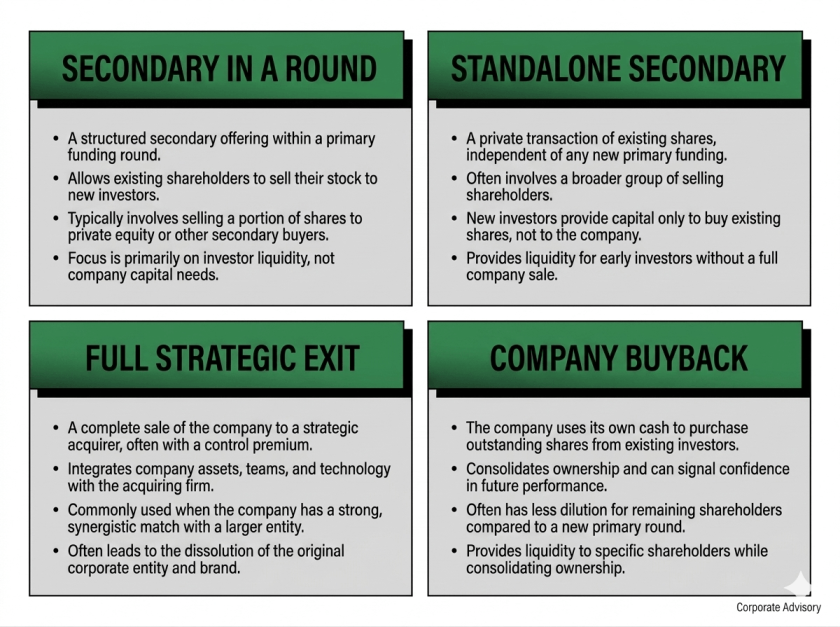
Four common exit patterns for Indian founders today:
- Secondary in a round. You sell 5% to 15% of your stake to the incoming VC alongside their primary investment. Most common in Series B and later.
- Standalone secondary. Existing cap table buying out a portion of your holding, usually led by growth funds or secondaries specialists.
- Full strategic exit. Acquisition by a competitor, larger operator, or PE fund doing a platform play. 100% of founder stake sold.
- Buyback by the company. The company uses cash to repurchase your shares. Rare, taxed differently (deemed dividend under Section 2(22)(d) and buyback tax under Section 115QA), and needs specific structuring to avoid double taxation.
Each pattern has different tax, documentation and compliance requirements. The mistake is assuming one playbook fits all.
12.5% if you’ve held the shares for more than 24 months. Slab rate (up to 39%) if under 24 months.
Post Budget 2024, LTCG on unlisted shares is a flat 12.5% without indexation benefit, for transfers made on or after 23 July 2024. Before that, it was 20% with indexation. Short-term gains (shares held less than 24 months) get taxed at your applicable slab rate plus surcharge and cess.
Here’s what the math actually looks like on a ₹10 crore exit:
| Scenario | Holding period | Tax rate | Tax outgo |
| ₹10cr exit, 3 years held | 24+ months | 12.5% LTCG | ₹1.25 crore |
| ₹10cr exit, 18 months held | Under 24 months | Up to 39% STCG | ₹3.9 crore |
| ₹10cr exit with Section 54F house | 24+ months | Exempt up to cap | ~₹0 |
Note: the numbers above are on the gain, not the acquisition value. If you paid ₹1 crore for shares worth ₹10 crore at exit, the taxable gain is ₹9 crore, not ₹10 crore. Also, surcharge and cess are on top of the base rate, so the effective LTCG rate is closer to 14.25% for most founders (12.5% + 10% surcharge + 4% cess on that), and STCG can hit 39% or higher depending on your total income.
The 24-month window is the single most consequential number in your exit planning. A few weeks on either side of it can mean ₹2 to ₹3 crore in tax difference on a ₹10 crore deal.
A common trap: sweat equity shares and shares issued via ESOP exercise have separate holding period triggers. The clock starts when shares are allotted, not when options are granted. For founders who incorporated with partly-paid shares and later fully paid them up, the clock may also re-start depending on how it was structured.
Yes, if done right. Gifting shares to parents or adult children before a sale can shift the gain to a lower tax bracket.
Gifts to specified relatives are exempt under Section 56(2)(x). But there’s a catch. Section 64 clubs back income from assets gifted to a spouse, so gifting to a spouse doesn’t help on tax. Gifting to adult children or parents works. Timing matters too. Gift at least 24 months before sale to preserve LTCG treatment on the donee’s hands. Last-minute gifting triggers scrutiny and often gets disallowed.
A few ways founders use family members to reduce exit tax liability:
Gifting shares to adult children or parents. Shares gifted to adult children or parents are exempt from tax in the recipient’s hands under Section 56(2)(x). When they sell at exit, the gain is taxed at their slab rate, which, if they have no other significant income, can be much lower than yours. The key conditions: gift at least 24 months before the sale to preserve LTCG treatment, execute a registered gift deed, get a valuation certificate at the date of gift, and update the cap table. Last-minute gifting gets disallowed at assessment.
Section 54F deployment by family members. If the family member receiving the gift has no residential property and uses sale proceeds to buy a house, their LTCG can be exempted under Section 54F. This stacks well with the income-splitting benefit above.
Spousal gifting doesn’t work. Section 64 clubs the gain back to your income when you gift assets to your spouse. The tax benefit is neutralised.
All of this needs clean paperwork, registered gift deed, FMV valuation on gift date, updated Form MGT-7, separate bank accounts for each recipient, and proper cap table reflection. Poorly documented gifts get struck down at assessment.
What paperwork do I need for a secondary or full exit
Eight documents minimum. SPA, escrow agreement, board resolutions, shareholder consent, updated shareholders’ agreement, valuation certificate, non-compete undertaking, and tax residency declarations.
What each document does and where founders get burned:
The deal document. Where 80% of the risk sits. Key clauses to negotiate hard:
- Indemnity cap (should not exceed 10% to 15% of consideration)
- Indemnity survival period (18 to 24 months for general, longer for tax and fundamental reps)
- Escrow holdback (typically 10% to 20%, released in tranches)
- Non-compete scope (geography and duration, commonly 2 to 3 years)
- Representations and warranties (get a knowledge qualifier on business reps, push back on absolute reps)
Escrow agreement (where applicable)
Not every deal has one, but if the buyer insists on an escrow holdback, this document governs how and when the held-back amount is released. Push for milestone-linked releases over time-linked ones. A milestone like 12-month revenue retention or closure of a specific litigation gets you access faster than a flat 18-to-24-month waiting period.
Section 42 and Section 62 under Companies Act 2013 for any share-related resolutions, Section 179 for board authorisations. Get these right the first time. Corrections later mean re-filings with MCA, which delays fund release.
Updated SHA
Tag-along, drag-along, ROFR, and ROFO provisions decide whether you can even sell. Also governs what rights the incoming or remaining investor gets post-transaction. If the existing SHA has a pre-emptive right, you need to waive or work through it before signing the SPA.
Valuation certificate
Required for FEMA compliance if buyer is non-resident, and often required by tax auditors. Merchant banker valuation under Rule 11UA (for tax purposes) or under FEMA pricing guidelines (for cross-border). Often one valuer issues both certificates.
Non-compete undertaking
Usually 2 to 3 years, tied to geography and business segment. Consideration for non-compete can be structured separately and is sometimes taxed as business income rather than capital gains, depending on how it’s framed.
Tax residency declaration
Confirms whether you’re a resident, non-resident, or RNOR for the transaction year. Determines treaty eligibility and withholding obligations on the buyer.
You have one shot at getting the tax structure right before the term sheet is signed. Let’s Talk
What happens when the buyer is a foreign fund or company
FC-TRS filing within 60 days. FEMA pricing guidelines must be complied with. Valuation certificate from a SEBI-registered merchant banker or a chartered accountant.
If you’re selling to a non-resident, the transfer is governed by FEMA (Non-Debt Instruments) Rules 2019. Key compliance:
- Transfer price cannot be below fair value when selling to a non-resident, or above fair value when selling to a resident
- Form FC-TRS filed through AD Category-I bank within 60 days of fund remittance
- Valuation done as per internationally accepted pricing methodology (DCF most common, sometimes comparables)
- If sectoral caps apply (for example multi-brand retail, insurance, defence), additional approvals kick in
Miss the FC-TRS window and you’re looking at compounding penalties under Section 13 of FEMA. Not fatal, but annoying and expensive.
Treaty benefits come into play if the buyer is based in a jurisdiction with a favourable Double Tax Avoidance Agreement (DTAA) with India. The Mauritius treaty (grandfathering for pre-April 2017 investments), Singapore treaty, and Netherlands treaty are most commonly used. Treaty claims need the buyer to provide a Tax Residency Certificate and Form 10F. Get this done before signing, not after.
What does an actual exit timeline look like
60 to 90 days from term sheet for a full exit. 30 to 45 days for a secondary in a round. Here’s what happens week by week.
Weeks 1 to 2: Term sheet and scoping. Non-binding term sheet signed. Exclusivity clause kicks in (usually 45 to 60 days). Treelife scopes tax exposure, reviews existing SHA, identifies holding period traps.
Weeks 3 to 4: Due diligence. Buyer’s counsel runs legal, financial, tax, and operational DD. Founder-side prep includes cap table history, past fundraise docs, IP assignments, ESOP pool mechanics, and compliance filings.
Weeks 4 to 6: Documentation. SPA, escrow, SHA amendments negotiated. Most deals go through 4 to 6 versions of the SPA before sign-off.
Weeks 6 to 8: Signing and regulatory. Deal signed. For cross-border: valuation locked, FC-TRS prepared, board and shareholder approvals obtained.
Weeks 8 to 12: Closing and post-closing. Funds wired, FC-TRS filed within 60 days of remittance, cap table updated, MCA filings done. Escrow sits until release milestones.
Deals that run longer usually get stuck on indemnity negotiation, FEMA valuation disputes, or CCI approvals (if deal value crosses thresholds under the Competition Act).
Mistakes founders make(and the money left on the table)
The biggest exit losses happen in the 30 days after signing. Five recurring mistakes:
- Accepting uncapped indemnity. We’ve seen deals where founders signed unlimited indemnity exposure for 7 years on tax issues they didn’t even know existed. Cap it at 10 to 15% of consideration with an 18 to 24 month survival period. Tax indemnity can be longer but should still be capped in quantum.
- Ignoring escrow release mechanics. Time-linked escrow means your money sits for 18 to 24 months regardless. Milestone-linked escrow with clear carve-outs gets you 50% to 70% released within 6 months.
- Missing the Section 54F deployment window. You have 1 year before or 2 years after the sale to buy a house (3 years if under construction). Founders forget and lose a potential ₹1 crore plus exemption.
- Not locking tax residency before signing. Moving to Dubai or Singapore mid-deal triggers a different tax regime. If you become non-resident before the transaction closes, capital gains treatment changes, treaty benefits kick in, and withholding obligations shift. Decide before, not during.
- Running three vendors in parallel. Tax advisor, lawyer, and company secretary working in silos means nothing reconciles. The lawyer drafts without knowing the tax structure. The CA files without knowing the SPA language. Deals close 30 days late and cost 15% more. Single point of accountability saves time and money.
Every week of delay on holding period planning costs real money. Let’s Talk
How Treelife handles it end to end
One point of contact. Tax structuring, SPA review, FEMA filings, valuation coordination, escrow setup, and buyer liaison.
We run your exit as a single workstream, not three vendors running in parallel. The Treelife team includes CAs, CSs, and FEMA specialists who have closed deals from $500K to $50M plus. We:
- Map your holding period across every tranche (direct allotment, ESOPs, sweat equity, bonus shares)
- Draft or redline your SPA with clause-by-clause commentary and fallback positions
- File your FC-TRS within the 60-day window
- Coordinate merchant banker valuation (for FEMA) and CA valuation (for tax)
- Negotiate your indemnity cap and escrow mechanics with the buyer’s counsel
- Track your Section 54F investment window and deploy proceeds on time
- Handle all MCA and RBI filings
- Liaise with the buyer’s team so you don’t have to chase three parties
You focus on the conversation with the buyer. We handle everything else.
Case study: a SaaS founder’s $12M exit to a US acquirer
- Situation. A Series B SaaS founder based in Bengaluru, selling 100% of their stake to a US-listed acquirer.
- Challenge. Three blockers. One, the founder had a mix of direct-issued shares and ESOP-exercised shares with different holding period clocks. Two, the US buyer wanted escrow in a US bank, which the founder’s AD bank pushed back on. Three, the founder was mid-way through a relocation to Dubai.
- What Treelife did. Mapped holding periods across all tranches to preserve LTCG on 85% of proceeds. Negotiated a split escrow (30% in India, rest in US). Locked the founder’s Indian tax residency for FY 2024-25 so the full sale stayed under the 12.5% LTCG regime rather than becoming a dual-jurisdiction mess. Deployed Section 54F against a residential property purchase in Bengaluru.
- Outcome. Effective tax of 8.2% against a headline rate of 12.5%. Deal closed in 47 days from term sheet. Founder received 80% of proceeds within 60 days.
All three routes require advance planning. You can’t deploy proceeds into a house or fund after the fact and expect the exemption to hold. The investment window runs from the date of transfer.
Section 54GB, invest net consideration in equity shares of a new eligible startup (where you hold more than 50% post-investment) and use those funds to purchase new plant and machinery. The startup must be DPIIT-recognised and incorporated before the date of asset transfer. More conditions apply, this route works best when a founder is genuinely rolling capital into a new venture.
Section 54EE, invest up to ₹50 lakh in units of a notified fund of funds within 6 months of the transfer. Exemption is limited to ₹50 lakh per financial year. Available only to DPIIT-recognised startups. Not many funds have been notified yet, so check the current list before relying on this.
Section 54F, invest net consideration in a residential property within 1 year before or 2 years after the sale (3 years if under construction), and your LTCG is exempt in proportion to the investment. There’s a cap of ₹10 crore (introduced in Budget 2023) and you can’t own more than one residential house on the date of sale. This is the most commonly used route.
Tax planning on an exit isn’t just about the rate. It’s about what you do with the proceeds. Three provisions founders use most:
FAQs on Founder Secondaries and Exits
Q. How much tax do I pay on a founder secondary in India?
12.5% LTCG if shares are held over 24 months. Slab rate (up to 39%) for shorter holding. Surcharge and cess extra. DPIIT-recognised startup status doesn’t change the rate but affects eligibility for some exemptions.
Q. Can I take secondary in my Series B round?
Usually yes. Most Indian VCs allow 5% to 15% founder secondary in Series B and later. Pre-Series A is rare and signals badly. Terms get negotiated as part of the SHA amendment, not a separate doc.
Q. What is the difference between primary and secondary in a funding round?
Primary means new shares issued, money goes to the company. Secondary means existing shares sold, money goes to the seller (founder, angel, or early VC). A round can have both. An 80/20 primary-secondary split means 80% of the investment buys new shares, 20% buys yours.
Q. Do I pay LTCG or STCG on selling my startup shares?
LTCG if held over 24 months. STCG if under. Holding period starts from the date of allotment, not the date of incorporation. For ESOP-exercised shares, clock starts on exercise date.
Q. Can I gift shares to my spouse before selling?
You can, but Section 64 clubs the gain back to your income. Gifting to adult children or parents works better. Do it at least 24 months before the sale to preserve LTCG.
Q. Is DPIIT startup exit taxed differently?
Rate is the same. But DPIIT startups get access to Section 54EE (investment in notified funds) and Section 54GB (investment in eligible startups) for LTCG exemption. Angel Tax protection under Section 56(2)(viib) is also only available to DPIIT-recognised entities.
Q. How long does a founder exit actually take?
Secondary in a round: 30 to 45 days from term sheet. Full exit or strategic acquisition: 60 to 90 days. Cross-border deals add 15 to 20 days for FEMA and FC-TRS work. Add another 30 to 45 days if the deal involves CCI approval.
Q. What is a typical indemnity cap?
10% to 15% of consideration for general indemnity. Tax indemnity is often longer in survival but should still be capped in quantum (typically 25% to 50% of consideration, time-limited to 7 years). Fundamental reps (title, authority, capitalisation) are often uncapped with longer survival. Everything is negotiable.
Q. Do I need a valuation certificate if selling to an existing investor?
Yes, for any transfer involving a non-resident or for transfers at a price that could be questioned by tax authorities. Valuation is done by a SEBI-registered merchant banker (for FEMA) or a CA (for tax). Often one valuer does both.
Q. Can I use Section 54F to save tax after selling startup shares?
Yes. If you invest net consideration in a residential house within 1 year before or 2 years after the sale (3 years if under construction), the LTCG gets exempted in proportion to the investment. Cap is one residential house, and total exemption cap is ₹10 crore (post Budget 2023).
Q. What happens if the buyer is a foreign company?
FC-TRS filing within 60 days, FEMA pricing guidelines compliance, and a merchant banker valuation. If the buyer is from a jurisdiction with a tax treaty, you may claim treaty benefits (reduced withholding or capital gains exemption). Mauritius, Singapore, and Netherlands treaties are most commonly triggered.
Q. Can I exit if my co-founder doesn’t want to?
Depends on the SHA. Most SHAs have tag-along rights (forcing a co-founder to sell alongside) and drag-along rights (forcing a minority to sell). If the SHA is silent, you can only sell your stake, but ROFR and ROFO clauses often need to be worked through first.
Q. What if I’m holding ESOPs, not direct founder shares?
You need to exercise options before you can sell the underlying shares. Exercise triggers perquisite tax on the spread (FMV on exercise date minus exercise price), taxed at your slab rate. The shares then get a fresh holding period from exercise date. Most founders in this position end up with a mix of slab-rate tax on the perquisite and capital gains tax on the sale. Plan the exercise window carefully.
Q. What happens if the deal falls through after signing the term sheet?
Depends on the term sheet. Most term sheets are non-binding on the commercial terms but binding on exclusivity, confidentiality, and break-fee (if any). If the buyer walks, you may owe them nothing or you may owe reasonable diligence costs. If you walk to another buyer during exclusivity, you risk a break-fee claim. Get your lawyer to mark up the exclusivity and break-fee clauses before signing.
Q. How are exit advisory fees typically structured?
Two models are common. One, a fixed fee based on deal complexity (tax structuring, documentation, FEMA filings bundled). Two, a fixed fee plus a success fee tied to closing. For a standard founder secondary, end-to-end advisory usually ranges ₹8 lakh to ₹35 lakh depending on deal size, cross-border complexity, and whether the buyer-side DD is heavy. Treelife quotes fixed fees with a clear scope so you know the number upfront.
About the Author
Share
-
Link copied to clipboard!https://treelife.in/legal/selling-founder-shares-in-india-tax-process-secondary/

-

-

-

-

Jitesh Agarwal

Founder | jitesh@treelife.in
Leads the VCFO, finance tax, and regulatory functions at Treelife. Responsible for the firm’s non-operational growth and providing strategic advisory in GIFT City, helping clients navigate complex regulatory landscapes effectively.

Garima Mitra
Co-founder
Spearheads Transactions, Contracts, and Compliance verticals at Treelife, combining expertise in business law with a focus on startup legal and governance.

Pooja Savla
Principal Associate | Transactions
Specialises in transaction advisory, mergers and acquisitions, investment structuring, and corporate legal matters for startups and growth-stage companies.
We Are Problem Solvers. And Take Accountability.
Related Posts

Cash Flow Forecasting for Startups: Method, Template, Review Cycle
Cash flow forecasting for startups is the weekly and monthly projection of when cash will enter and leave the bank...
Learn More

Working Capital Management for Startups: Cycle, Levers, Controls
Working capital management for startups is the discipline of timing cash in and cash out so that growth does not...
Learn More

Form 5471 Filing Services India
Form 5471 filing India work begins when a US citizen, green card holder or US company controls an Indian company...
Learn More

US India Tax Advisory Services
US India tax advisory covers the tax positions that arise when income, capital or people move between the two countries,...
Learn More

US Parent India Subsidiary Structure: How to Set it Up
A US parent India subsidiary structure puts a US corporation, usually a Delaware C corporation, above an Indian private limited...
Learn More

Cap Table Cleanup Services in India
Cap table cleanup services in India exist because the spreadsheet founders send to investors is rarely the document that proves...
Learn More

Delaware Flip Services in India: Scope, Process
A Delaware flip places a new US parent above your Indian company, so US investors, US customers and US equity...
Learn More

Compliance Calendar October 2026: GST TDS PF ESI Deadlines
October 2026 is a quarter-end filing month. On top of the regular monthly GST, TDS, PF and ESI cycle, it...
Learn More

ESOP Expense Under Ind AS 102: Method, Journal Entries, Disclosure
Every option granted to an employee costs the company something, and Ind AS 102 puts that cost in the profit...
Learn More

Form 5472 filing Services in India
Form 5472 filing India queries come from Indian-resident owners of US companies who have just heard about a USD 25,000...
Learn More

Tax on Sale of ESOP Shares in India: Capital Gains, Rate, Holding Period
ESOP tax on sale of shares in India is a capital gains calculation that starts from a number most employees...
Learn More

ESOP Vesting Schedule for Startups: Cliff, Structure, Timeline
An ESOP vesting schedule for startups is the timetable on which granted options become exercisable; the cliff is the opening...
Learn More
© 2026 Treelife Ventures Services Private Limited. All Rights Reserved.