


Adani-Holcim deal: Tax free deal for Holcim?
Written By

Share
-
Link copied to clipboard!https://treelife.in/news/adani-holcim-deal-tax-free-deal-for-holcim/

-

-

-

-

First Published on 18th May, 2023
The Adani-Holcim deal where the Adani group will acquire Holcim’s Indian assets for $10.5 billion is pegged to be India’s largest-ever merger and acquisition transaction in the infrastructure and materials space. In this deal, Adani will acquire ~63% stake in Ambuja Cements and ~55% stake in ACC both being Indian listed companies.
Holcim’s CEO in his address to investors mentioned that this deal is likely to be tax free for Holcim.
Before discussing whether gains arising to Holcim will be tax free or not, it would be key to first understand the facts (as per publicly available information):
- The selling entity is likely to be Holcim’s Dutch investment company which holds investment in Holcim’s investment company in Mauritius.
- This Mauritius investment company, in turn, holds stake in Ambuja Cements and ACC.
- The Dutch company will sell the shares in the Mauritius investment company to Adani’s Mauritius based investment company.
- To represent this diagrammatically,
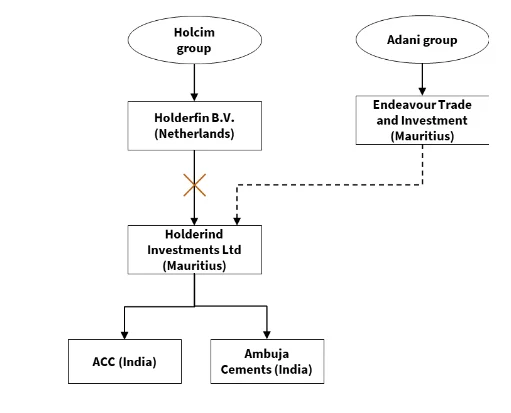
This seems to be a classic case of “indirect transfer” i.e. transfer of shares of foreign entities owning shares / assets in India instead of a direct transfer of such Indian shares / assets.
Indian tax treaties with Mauritius, Singapore, Netherlands, etc continue to have a capital gains tax exemption for such indirect transfers of Indian shares. In other words, as per these treaties, capital gains arising on sale of shares of a non-Indian entity are taxable only in the country in which the seller is a resident i.e. in Mauritius / Singapore / Netherlands.
Applying the above mentioned laws to the facts of this deal, considering that even though substantial value of Holcim’s Mauritius company arises from assets located in India (i.e. Ambuja Cements and ACC), India may not be entitled to collect tax on the gains arising on this transaction as per the India-Netherlands tax treaty.
About the Author
Share
-
Link copied to clipboard!https://treelife.in/news/adani-holcim-deal-tax-free-deal-for-holcim/

-

-

-

-

We Are Problem Solvers. And Take Accountability.
Related Posts

Compliance Calendar April 2026 – GST, TDS, PF, ESI & Advance Tax Deadlines
Sync with Google Calendar Sync with Apple Calendar Plan your April filings in one place. Figures and forms are mapped...
Learn More

The Income Tax Act, 2025 Is Live – Here’s What You Actually Need to Know
Effective 1 April 2026, the Income Tax Act, 2025 replaces the Income Tax Act, 1961 and the Income Tax Rules,...
Learn More

India Entry for SaaS and Tech Companies – A Complete Guide
India is no longer a market to "watch." For global SaaS and tech companies, it has crossed the threshold from...
Learn More