


The Series A Fundraising Playbook – What Founders Get Wrong And How to be Investor-Ready
Written By

Treelife
Share
-
Link copied to clipboard!https://treelife.in/startups/the-series-a-fundraising-playbook/

-

-

-

-

Blog Content Overview
- 1 Executive Summary
- 2 1. The Problem With How Indian Founders Approach Series A
- 3 2. What ‘Series A Ready’ Actually Means
- 4 3. The Metrics That Matter And How Indian Founders Get Them Wrong
- 5 4. Where Indian Founders Lose the Room The DD Drop-off Map
- 6 5. Raise Timing: Your Single Most Underrated Lever
- 7 6. The Financial Readiness Checklist
- 8 7. Four India Scenarios What Readiness Looks Like Across Business Models
- 9 8. How Treelife Gets You to the Room And Keeps You There
- 10 Key Takeaways for Founders
Executive Summary
Most Indian founders treat Series A Fundraising as a pitch problem. It is not. It is a financial readiness problem with a narrative layer on top and the two are not interchangeable.
The Indian VC market in 2024–25 has raised its bar materially. Fewer deals are getting done, selectivity is up, and the quality gap between fundable and unfundable has widened. A compelling story attached to a weak finance function does not close rounds; it wastes six months and damages investor relationships that are hard to rebuild.
Series A success is largely determined before the first investor meeting. Whether your ARR reconciles to audited accounts, whether your cohort analysis is defensible, whether your cap table is clean, whether your ESOP pool is formally documented, whether your GST returns match your revenue these are the things that determine outcomes in DD. Companies at Finance Readiness Tier 4 close rounds at roughly 3x the rate of Tier 2 companies, faster, and on better terms because they have the leverage that comes from preparation and time.
The report covers what investors are actually evaluating beneath the pitch deck, how Indian founders typically miscalculate their metrics, the legal and compliance gaps that quietly kill deals, the raise timing math that determines your negotiating position, and a 25-point readiness checklist to self-assess before beginning outreach.
The founders who close well are not the luckiest or the most articulate. They are the most prepared.
1. The Problem With How Indian Founders Approach Series A
Most Indian founders treat Series A as a destination. They spend 18 months building a product, 6 months building revenue, and then 3 weeks building a pitch deck before walking into conversations with tier-1 VCs who have reviewed hundreds of companies and can identify a preparation gap in the first 20 minutes.
Series A is not a pitch competition. It is a financial and operational audit with a narrative layer on top. The founders who close rounds quickly and at good terms are not necessarily the ones with the best products. They are the ones whose financials are clean, whose metrics are defensible, whose legal house is in order, and whose data room can be handed over on 24 hours’ notice without scrambling.
This report is not about how to write a pitch deck. There are enough resources on that. This is about the finance, metrics, and operational readiness that determines whether you close and on what terms.
| 2025 India Context: The Indian VC market in 2024–25 has materially raised its bar. Deal counts are down, selectivity is up, and median Series A cheque sizes in India cluster in the ₹15–60Cr range. Fewer deals are getting done but those that close are closing at higher valuations, which means the quality gap between fundable and unfundable has widened significantly. |
Why This Is a Finance Problem, Not Just a Story Problem
The most common narrative among founders who fail to close Series A is: ‘The investor just didn’t get our vision.’ Occasionally that is true. More often, it masks a harder truth: the financials raised questions that the story could not answer.
In India specifically, the finance function at most seed-to-Series-A startups is an afterthought. Accounting is outsourced to a CA who does compliance work. MIS is a founder-built spreadsheet that no one else understands. Metrics are cited in board updates but not reconciled to the actual revenue in the P&L. GST returns are a source of low-grade anxiety. This is the state most Indian founders are in when they begin fundraising and it is the state most investors see through immediately.
2. What ‘Series A Ready’ Actually Means
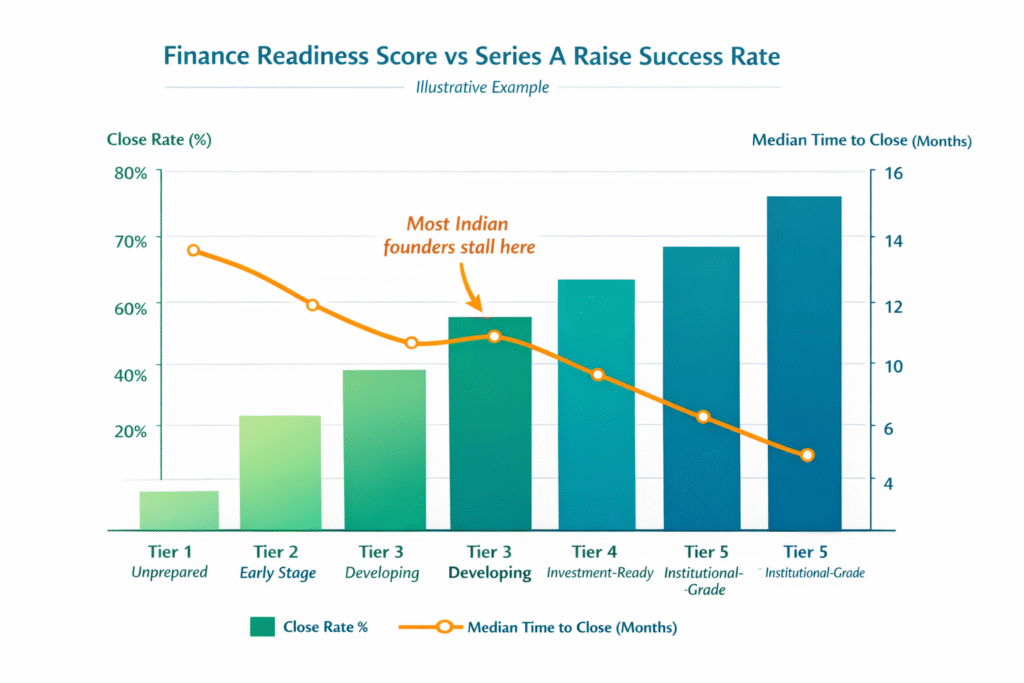
Readiness for Series A is not a binary, it is a spectrum. Chart 1 below maps finance readiness tiers against close rates. The insight is uncomfortable but important: most Indian founders start the process at Tier 2 or 3, which corresponds to a close rate of 22–44%. The move to Tier 4 investment-grade requires finance infrastructure work, not better storytelling.
Chart 1: Finance Readiness Score vs Series A Raise Success Rate
| Readiness Tier | Label | Close Rate % | Median Close (Months) | Typical Finance State |
| Tier 1 Unprepared | < 15% | 8% | N/A | No MIS, unaudited books, no metrics |
| Tier 2 Early stage | 15–30% | 22% | 14+ | Basic P&L, no cohort/unit economics |
| Tier 3 Developing | 30–50% | 44% | 10 | Metrics exist but inconsistent; gaps in DD |
| Tier 4 Investment-ready | 50–70% | 67% | 6 | Clean books, data room live, metrics board-ready |
| Tier 5 Institutional-grade | 70%+ | 81% | 4 | Audited, automated MIS, clean cap table, 24M model |
How to interpret: Most Indian growth-stage founders enter the fundraising process at Tier 2 or Tier 3. The jump from Tier 3 to Tier 4 is not about revenue it is about finance infrastructure. That gap is entirely closeable with 60–90 days of focused work. The close rate difference between Tier 3 and Tier 4 is dramatic.
The Five Things Every Series A Investor Is Actually Evaluating
Strip away the deck structure, the market size slides, and the competitive moat narrative. Every institutional investor is assessing five things:
1. Is the revenue real, recurring, and growing predictably?
‘Real’ means reconciled to audited financials not a founder’s definition of ARR that includes one-time project fees and consulting retainers. ‘Recurring’ means contractually committed, not habitual. ‘Predictable’ means you can show a cohort chart and explain why your retention is what it is. If your ARR calculation is not backed by a schedule that ties to your revenue in the accounts, it will unravel in DD.
2. Are the unit economics positive and improving?
An investor who gives you ₹20Cr is betting that your customer acquisition machine works that when you pour ₹1Cr into sales and marketing, you generate more than ₹1Cr in long-term gross profit. LTV:CAC, CAC payback, and gross margin per customer segment are the language of this conversation. If you cannot speak it fluently with supporting data, the conversation stalls.
3. Is the business efficient with capital?
Post-2022, burn multiple net cash burned divided by net new ARR added has become a primary efficiency signal. A burn multiple of 1.0 means you spent ₹1 of cash to add ₹1 of new ARR. A burn multiple of 3.0 means you spent ₹3 to add ₹1 of ARR. In the current environment, Indian VCs are cautious about businesses burning heavily relative to growth. This does not mean you cannot burn it means you need to be able to explain why, and show a credible path to improving the ratio.
4. Is the legal and compliance house clean?
In India, the legal and secretarial DD is where many rounds quietly die. Founders with informally allocated founder equity, ESOPs granted without a board-approved trust deed, IP held personally instead of in the company, incomplete ROC filings, or FEMA non-compliance from foreign-origin seed investment create problems that delay or kill deals. These are not strategic issues they are execution issues that signal carelessness. Investors interpret them as leading indicators of how the company will be run post-investment.
5. Does the finance team have institutional capacity?
A founder who is personally doing the accounting, or whose finance function consists of a part-time bookkeeper and a statutory CA, signals significant execution risk to an investor who will be on the board. The finance function needs to be able to close books monthly within 10 days, produce board-ready reports without the founder assembling them, and manage a statutory audit without a crisis. If that capability does not exist, build it or bring in a fractional CFO before you begin fundraising.
3. The Metrics That Matter And How Indian Founders Get Them Wrong
Every founder going into Series A will claim to know their metrics. The problem is not knowledge it is definition discipline and reconciliation hygiene.
The ARR Definition Problem
Annual Recurring Revenue is the most commonly cited and most commonly miscalculated metric in Indian startups. The correct definition: ARR is the annualised value of only recurring, contracted revenue not total revenue, not one-time projects, not revenue from customers whose contracts have lapsed but who are still paying month-to-month informally.
In India, this gets further complicated by the common practice of multi-year contracts with annual payment. A customer who signs a 3-year contract and pays ₹30L upfront each year contributes ₹30L to ARR not ₹90L. The annualised contracted value is what goes into ARR. Any investor who sees ARR that cannot be reconciled to the revenue schedule in the audited accounts will immediately discount the entire metrics package.
| The ARR Hygiene Test: Can you hand an investor a spreadsheet that shows every contract, its start date, end date, monthly MRR contribution, and contract status and have that roll up to match the revenue line in your P&L? If not, your ARR number is not investment-grade. |
NRR and GRR The Metrics Most Indian Founders Under-report
Net Revenue Retention measures the percentage of ARR from existing customers retained and grown at the end of a period, including expansions and upsells. Gross Revenue Retention measures the same but excluding expansion i.e., what percentage of last year’s revenue from existing customers stayed, before any upsell.
NRR above 100% is one of the single most powerful signals in a Series A pitch because it means the product is growing revenue from the existing base without new customer acquisition your installed base is compounding. Most Indian B2B SaaS founders can quote a rough NRR number, but very few have built a proper cohort analysis that shows it by vintage, by customer segment, and reconciled to actual revenue. Building this analysis is a three-to-four-week project. Do it before you start fundraising, not during DD.
The Burn Multiple Conversation You Will Have
Burn Multiple = Net Cash Burned (₹) ÷ Net New ARR Added (₹) in the same period.
A reading below 1.5x in the current market is strong. Above 2.5x requires an explanation. Above 3.0x without a near-term inflection will raise serious flags.
Indian founders often deflect this with: ‘We are investing in growth.’ That is fine but the investor needs to see a credible path to improvement. Your financial model should show burn multiple declining as you scale GTM efficiency. If it does not, the model is not believable.
Table 2: Series A Metrics Benchmarks What Indian Investors Are Looking For
Reference benchmarks as of 2025. India-specific context where materially different from global benchmarks. These are indicative ranges sector, business model, and investor thesis matter significantly.
| Metric | Minimum Threshold | Good | Excellent | Red Flag | India Note |
| ARR / Revenue Run Rate | ₹3–5Cr | ₹8–15Cr | ₹20Cr+ | <₹2Cr | Many Indian VCs set ₹5Cr as informal floor |
| YoY ARR Growth | 2x | 2.5–3x | 3x+ | <80% YoY | Growth rate matters more than absolute ARR at this stage |
| Gross Margin (SaaS / Services) | 60%+ | 70–75% | 80%+ | <50% | India SaaS often has higher employee cost base; flag proactively |
| Net Revenue Retention (NRR) | 95%+ | 105–115% | 120%+ | <90% | NRR >100% = product earns its own growth; investors love this |
| Gross Revenue Retention (GRR) | 85%+ | 90%+ | 95%+ | <80% | For SMB-focused products, 85% GRR is acceptable; enterprise should be 90%+ |
| CAC Payback Period | <24M | 12–18M | <12M | >36M | Lower is better; shows GTM efficiency |
| Burn Multiple (Net Burn ÷ Net New ARR) | <2.0x | <1.5x | <1.0x | >3.0x | Key efficiency signal post-2022; Indian VCs increasingly focus here |
| Cash Runway at Raise | 12M+ | 15–18M | 18M+ | <9M | Sub-9M signals desperation expect worse terms |
| Customer Concentration | Top 3 <40% | Top 3 <25% | Top 3 <15% | 1 customer >30% | Indian enterprise deals tend toward concentration; be prepared to explain |
| Team (Finance function) | Finance manager or fractional CFO in place | Full-time finance head, monthly close <10 days | CFO with investor reporting experience | Founder doing books themselves | Indian investors flag this in DD; a weak finance function signals execution risk |
These benchmarks reflect the 2024–25 Indian VC environment where investors have materially raised the bar on unit economics and finance function quality compared to the 2020–21 era. Raising at lower metrics is possible with extraordinary growth or a unique market narrative but it requires active explanation, not silence.
4. Where Indian Founders Lose the Room The DD Drop-off Map
Chart 2 maps the drop-off points across a typical Series A process for Indian startups. The shape of this funnel should alarm most founders and motivate the right preparation response.
Chart 2: Investor DD Drop-off Where Indian Founders Lose the Room (Illustrative Example)
| Stage | Survivors (of 100) | Drop-off | Primary Reason for Drop-off |
| Initial investor interest / intro meeting | 100 | ||
| Pitch deck review / first meeting | 62 | 38 | Weak narrative, unclear unit economics, no differentiation story |
| Metrics deep-dive (MIS / dashboard review) | 38 | 24 | Metrics inconsistent, no cohort data, ARR/MRR definition mismatch |
| Financial due diligence (data room) | 22 | 16 | Unaudited books, cap table errors, deferred revenue accounting, GST mismatches |
| Legal / compliance / secretarial DD | 16 | 6 | ESOP not formalised, ROC filings incomplete, shareholder agreements not clean |
| Term sheet issued / valuation negotiation | 10 | 4 | Valuation mismatch, founder equity too diluted, liquidation preferences conflict |
| Round closed ✓ | 6–8 | Successfully funded finance, legal, metrics, and narrative all aligned |
How to interpret: Of every 100 companies that attract enough interest to enter a formal Series A process, roughly 6–8 close a round. The biggest drop-offs are not at the ‘story’ stage they are at the metrics and financial DD stages, where preparation gaps become visible. Both of these are fixable.
The Financial DD Blockers: What Kills Deals in India
Based on the typical issues surfacing in Indian Series A financial due diligence, there are five blockers that appear most frequently:
Deferred Revenue Misclassification
For subscription and SaaS businesses, annual contracts paid upfront must be recorded as deferred revenue on the balance sheet and recognised monthly as the service is delivered. Founders who book the entire annual contract as revenue in Month 1 are overstating their revenue. When an investor’s CA runs a revenue quality analysis and finds this, it raises questions about financial controls not just accounting and typically results in downward revision of the revenue figure that anchors valuation.
GST Reconciliation Gaps
In India, every sophisticated investor’s DD process includes a GST reconciliation comparing GSTR-1 (sales filed with government), GSTR-3B (tax paid), and the revenue in the books. If these three numbers do not match a common situation where invoicing is ad hoc or invoice cancellations are not reflected it raises questions about the completeness and accuracy of revenue reporting. Resolve this before fundraising, not during.
ESOP Informality
Indian startup founders routinely promise equity informally ‘I’ll give you 0.5% when we raise Series A.’ When DD arrives, these informal commitments surface as contingent liabilities and cap table uncertainty. Every equity promise, including ESOPs, must be documented with a board-approved plan, individual grant letters at defined exercise prices, and vesting schedules. The absence of this is an immediate red flag for any institutional investor.
Cap Table Complexity Without Documentation
Convertible notes, SAFEs, and bridge rounds are common in Indian startups. What is uncommon is clean documentation of how these convert at various valuation thresholds, what their liquidation preferences are, and how they interact with the Series A terms. Investors who find themselves doing the cap table math during DD because the founders cannot produce a clean model typically lose confidence quickly.
Related Party Transactions
Founder salaries above market rate, office space leased from a family entity, or loans to founders recorded as receivables these are all related party transactions that require specific disclosure in Indian financial statements. When they appear without disclosure in the audited accounts, or when they appear disclosed but unexplained, they create friction in DD and require significant time to resolve.
5. Raise Timing: Your Single Most Underrated Lever
The decision of when to start fundraising is one of the most consequential financial decisions a founder makes. It is almost universally made too late.
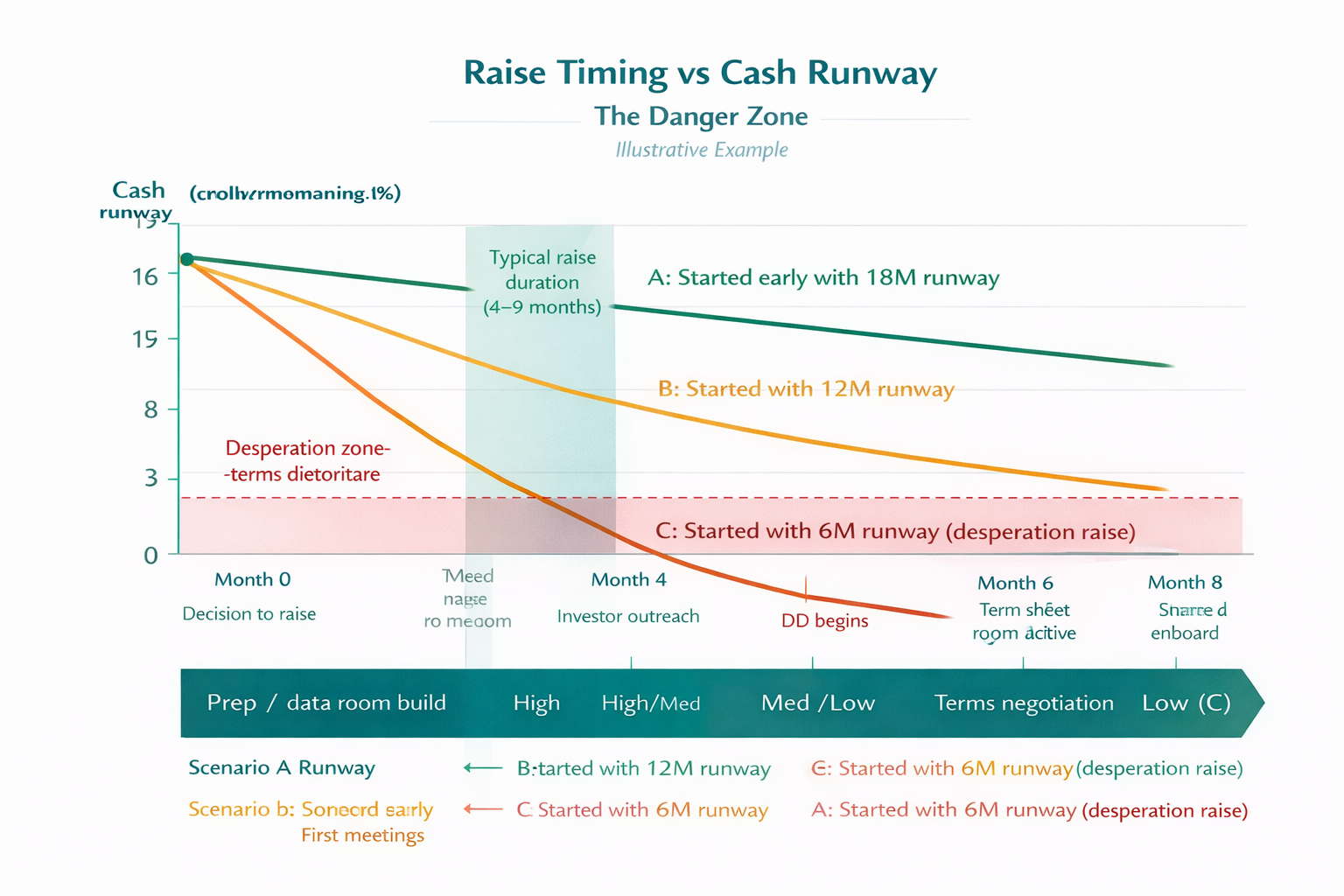
Chart 3: Raise Timing vs Cash Runway The Danger Zone
| Month from Decision | Scenario A Runway | Scenario B Runway | Scenario C Runway | Typical Raise Activity | Leverage |
| Month 0 Decision to raise | 18M | 12M | 6M | Prep / data room build | High |
| Month 2 Investor outreach | 16M | 10M | 4M | First meetings | High/Med |
| Month 4 DD begins | 14M | 8M | 2M | Data room active | Med/Low |
| Month 6 Term sheet negotiation | 12M | 6M | 0M ⚠ | Terms negotiation | Low (C) |
| Month 8 Close | 10M remaining + new capital | 4M remaining + new capital | Bridge / distress | Close and onboard | Strong (A&B) |
How to interpret: Scenario C founders have no negotiating leverage by Month 4 investors know it, and terms reflect it. The single best thing a founder can do for their Series A outcome is to start the process early. Every month of additional runway at the start of the process is leverage on your term sheet.
The Math of Negotiating Leverage
Investors know your runway. It is in the data room. When you have 6 months of cash left and you are asking for a term sheet, every investor in the room knows you have no walk-away power. The term sheet reflects that. Liquidation preferences get heavier. Anti-dilution ratchets appear. Board seat demands increase. Valuation expectations shift downward.
When you have 15 months of cash and multiple investors in parallel process, the dynamic inverts entirely. You can take a competing term sheet to another investor. You can walk away from unfavourable terms and come back 30 days later with a counter. You can be selective about which investors to prioritise. That optionality is worth real money typically several crores in valuation uplift on a ₹20–40Cr round.
| The Timing Rule: The right time to begin Series A preparation is 12 months before you need the money. The right time to begin active investor outreach is 9 months before you need the money. Most Indian founders begin 3–4 months before they need the money. This gap is where terms are lost. |
The 12-Month Fundraising Calendar for Indian Founders
Months 12–9 Before Target Close
- Complete financial readiness checklist (Table 1). Fix all Critical items.
- Build the 24-month financial model with 3 scenarios. This takes longer than you think start early.
- Commission statutory audit if not already underway. In India, audits for growth-stage companies take 6–10 weeks.
- Resolve any cap table, ESOP, or legal compliance gaps. Engage a VC-experienced law firm, not just your standing corporate counsel.
- Begin building the cohort and metrics database. This is a finance team project requiring 3–4 weeks of dedicated effort.
Months 9–6 Before Target Close
- Start building warm relationships with target investors. Attend 2–3 events per month. Get introductions through existing angels or advisors.
- Share a brief company update (not a pitch) with 8–10 target investors to begin relationship without fundraising pressure.
- Engage a CFO (full-time or fractional) if not already in place. A founder-only finance function will not survive Series A DD.
- Assemble the data room. Organise it so that any investor request can be fulfilled within 24 hours, not 5 days.
Months 6–3 Before Target Close
- Begin formal fundraising process. Run it as a structured sales process: target list, outreach, first meetings, follow-ups, DD tracking.
- Aim to have 3–5 investors in parallel DD at any point this creates the competitive dynamic that improves terms.
- Do not share projections before you have a lead investor’s serious interest. Early oversharing allows investors to wait and use your own numbers against you later.
Months 3–0 Close
- Negotiate term sheet with lead investor. Get a VC-experienced lawyer to review standard terms in India include liquidation preferences, anti-dilution provisions, information rights, and board composition. Each is negotiable.
- Complete DD in parallel. Your finance team should be able to respond to investor DD requests in 48 hours anything longer signals unpreparedness and creates doubt.
- Close, file requisite ROC and RBI (FEMA) filings post-investment. FC-GPR must be filed within 30 days of receiving foreign investment.
6. The Financial Readiness Checklist
Table 1 below is a complete pre-fundraising audit template. Use it 60–90 days before you plan to begin investor outreach. Every ‘No’ in the Critical column is a deal risk not a minor gap.
Table 1: Series A Financial & Legal Readiness Checklist
Ready-to-use self-assessment. Complete this 60 days before you plan to start investor outreach. Any ‘No’ in the Critical column is a blocker fix it before you begin.
| Readiness Item | Critical? | Status (✓ / ✗ / WIP) | Notes / Owner |
| FINANCIAL RECORDS & REPORTING | |||
| Last 2 years audited financial statements (P&L, Balance Sheet, Cash Flow) | CRITICAL | ||
| Current year management accounts (monthly MIS current month minus 30 days max lag) | CRITICAL | ||
| GST returns filed and reconciled (GSTR-1, GSTR-3B) for last 24 months. No pending notices. | CRITICAL | ||
| TDS filings current. Form 16/16A issued for all employees and vendors. | Important | ||
| Revenue recognition policy documented (especially deferred revenue for SaaS / subscription businesses) | CRITICAL | ||
| Deferred revenue correctly classified on balance sheet (not booked as revenue upfront) | CRITICAL | ||
| METRICS & UNIT ECONOMICS | |||
| ARR / MRR defined consistently and reconciled to revenue in accounts | CRITICAL | ||
| Cohort retention analysis: monthly/annual by revenue cohort (GRR and NRR) | CRITICAL | ||
| CAC calculated correctly (all S&M costs ÷ new customers in period) | CRITICAL | ||
| LTV:CAC ratio computed and documented. CAC payback period stated. | CRITICAL | ||
| Burn multiple tracked monthly (net burn ÷ net new ARR) | Important | ||
| Gross margin tracked by product/customer segment, not just blended | Important | ||
| CAP TABLE, LEGAL & COMPLIANCE | |||
| Cap table clean, current, no phantom shares or undocumented agreements | CRITICAL | ||
| ESOP pool formalised with board approval, trust deed, and grant letters issued | CRITICAL | ||
| ROC / MCA filings current (annual return, financial statements). No pending penalties. | CRITICAL | ||
| IP (software, brand, patents) formally assigned to the company not held personally by founders | CRITICAL | ||
| Existing SHA / investor agreements reviewed for pre-emption rights, consent rights, anti-dilution | CRITICAL | ||
| FEMA / RBI compliances met for any foreign investment received (FC-GPR, FC-TRS filed) | CRITICAL | ||
| FINANCIAL MODEL & DATA ROOM | |||
| 24-month operating model with 3 scenarios (base, upside, downside). Revenue buildable from unit assumptions. | CRITICAL | ||
| Use-of-funds plan mapped to hiring, GTM, product milestones not a generic pie chart | CRITICAL | ||
| Data room organised (Docsend / Google Drive with access controls). Ready to share on 24hr notice. | Important | ||
| Customer contracts / MSAs available for top 10 accounts | Important | ||
Scoring: 0 Critical items unresolved = Investment-grade. 1–2 = Significant gaps; fix before outreach. 3+ = Do not begin investor outreach you are funding your failure to prepare.
7. Four India Scenarios What Readiness Looks Like Across Business Models
Scenario A: B2B SaaS, ₹8Cr ARR, SMB-Focused, 18 Months Post-Seed
A SaaS founder with strong top-line growth 2.8x YoY but 60% of revenue from annual contracts booked upfront without deferred revenue treatment. NRR is quoted at 108% but is not backed by a cohort analysis. ESOP pool has verbal commitments to 4 senior hires but no formal grant letters. The founder is doing MIS personally in Google Sheets.
What needs to happen before fundraising: Fix deferred revenue accounting this will reduce reported ARR by approximately 15% and is better disclosed proactively than discovered in DD. Build the cohort analysis; the NRR of 108%, if real, is a powerful asset. Formalise ESOPs. Hire a fractional CFO to own the finance function and investor reporting. This business can raise at good terms but only after 60–90 days of finance clean-up.
Scenario B: D2C Brand, ₹20Cr Revenue, Profitable, No Institutional Funding
A bootstrapped consumer brand with healthy EBITDA margins (18%) and strong brand recognition in 2 categories. Has never raised institutional capital. Books are clean audited annually by a Big 4 firm but the company has never tracked LTV:CAC, does not have a formal financial model, and the founding team has no investor relations experience.
What needs to happen: This business has excellent fundamentals but is presenting in a language investors do not read natively. Build the LTV:CAC framework (D2C version: contribution margin per order × repeat purchase frequency ÷ blended CAC). Develop a financial model that shows the reinvestment case how ₹15Cr of capital converts to revenue growth over 24 months. Engage an advisor with D2C fundraising experience in India. The finance function is not the bottleneck here the narrative construction and investor targeting are.
Scenario C: SaaS with International Revenue (US/SEA), ₹12Cr ARR
A founder with 40% of ARR from international customers billed in USD. The business has multiple legal entities an Indian operating company and a Singapore holdco set up informally without proper share transfer documentation. FEMA compliance is unclear. The cap table has a convertible note from a US angel that has never been properly registered with the RBI.
What needs to happen: This is a structural cleanup situation before fundraising not a metrics or narrative problem. Engage a VC-experienced law firm with cross-border expertise immediately. The entity structure, FEMA compliance, and convertible note registration must be resolved first. This will take 60–90 days and is non-negotiable for institutional investors who will flag it in DD. The business metrics are strong; the legal gaps are the only barrier.
Scenario D: Manufacturing / Hardware SaaS, ₹6Cr ARR, High CAPEX
A hardware-plus-software business where the software (₹3Cr ARR) is high-margin but the hardware installation component (₹3Cr revenue) is low-margin and capital-intensive. Investors see blended gross margins of 38% and price it as a hardware company below SaaS multiples. The founder insists it is a SaaS business.
What needs to happen: Disaggregate the P&L before the investor conversation present software ARR and hardware revenue separately with distinct margin profiles. The software segment at 72% gross margin qualifies for SaaS multiples; the hardware segment should be presented as a distribution mechanism that drives software attach rate, not as a revenue stream to be valued independently. This is a financial reporting and narrative design problem and a CFO who has seen hardware-SaaS fundraising in India is the right resource to structure it.
8. How Treelife Gets You to the Room And Keeps You There
Most founders approaching Series A need three things simultaneously: clean financials that survive institutional DD, a metrics framework that tells a coherent story, and a finance function that can operate at board-company pace. Treelife delivers all three not as a one-time project, but as an embedded partner through the fundraising process and beyond.
The Treelife Series A Readiness Programme
| Phase | Timeline | Deliverables | Success Metric |
| 1. Readiness Audit | Week 1–2 | Complete financial and legal readiness assessment against Table 1 checklist. Metrics audit ARR reconciliation, cohort analysis gaps, deferred revenue review. DD risk register with prioritised remediation plan. | Readiness score delivered. All Critical gaps identified with owner and timeline. |
| 2. Finance Clean-up | Weeks 3–8 | Fix accounting gaps (deferred revenue, related party disclosures, GST reconciliation). ESOP formalisation support. MIS build monthly close process, board reporting template. Cap table verification and documentation. | Auditor sign-off on accounts. MIS live and monthly close within 10 days. Zero Critical gaps on readiness checklist. |
| 3. Investor Package | Weeks 6–10 | 24-month financial model (3 scenarios, revenue buildable from unit assumptions). Metrics dashboard with ARR schedule, cohort analysis, LTV:CAC, NRR, burn multiple. Data room organisation and population. Valuation benchmarking. | Data room ready. Financial model investor-reviewed. Metrics reconciled to audited accounts. |
| 4. DD Support | Active raise period | Dedicated point of contact for investor DD queries. 48-hour response SLA on all DD requests. Ongoing MIS and metrics updates during raise. Term sheet financial modelling (dilution, cap table post-round scenarios). | DD queries closed within 48hr. No investor drops out citing financial information quality. |
| 5. Post-Round CFO Support | Ongoing | Monthly board reporting. Investor update templates. Use-of-funds tracking. Runway monitoring. MIS enhancement as scale demands. Statutory compliance (ROC, FEMA post-funding filings). | Board reporting live within 10 days of month-end. Investor confidence in finance function. |
Key Takeaways for Founders
Your metrics are only as credible as their reconciliation to your audited accounts. An ARR number that lives in a founder’s spreadsheet and cannot be tied to the revenue line in your P&L will unravel in DD. Build the ARR schedule first; everything else follows from it.
The biggest drop-offs in a Series A process happen at the metrics and financial DD stage not the pitch stage. Most founders over-invest in deck design and under-invest in data room readiness. Flip that ratio by at least 60 days before you start outreach.
Your burn multiple is now a primary signal, not a secondary one. Post-2022, Indian VCs are scrutinising capital efficiency with a rigour that did not exist in the 2020–21 era. A burn multiple above 2.5x without a credible path to improvement will slow or kill conversations regardless of growth rate.
Legal and compliance gaps are not paperwork problems, they are confidence problems. An investor who finds undocumented ESOPs, incomplete ROC filings, or FEMA non-compliance in DD does not see an administrative oversight. They see a founding team that does not run a tight ship. Fix these before outreach, not during.
Every month of additional runway at the start of your raise is negotiating leverage on your term sheet. Founders who start raising with 6 months of cash have no walk-away power. Founders who start with 15–18 months do. That difference shows up directly in valuation, liquidation preferences, and board composition not as a minor rounding issue but as a material difference in what you give up.
The jump from ‘not ready’ to ‘investment-grade’ is a 60–90 day project, not a 12-month transformation. The gap is almost always finance infrastructure and legal hygiene not revenue, not product, not market size. Those can be fixed with focused effort and the right team. Start that work now, before you need the capital.
About the Author
Share
-
Link copied to clipboard!https://treelife.in/startups/the-series-a-fundraising-playbook/

-

-

-

-

Treelife

Treelife Team | support@treelife.in
We are a legal and finance firm with a deep focus on the startup ecosystem. We offer a wide range of services, including Virtual CFO, Legal Support, Tax & Regulatory, and Global Expansion assistance.
Our goal at Treelife is to provide you with peace of mind and ease in business.
We Are Problem Solvers. And Take Accountability.
Related Posts

Digital Personal Data Protection (DPDP) Rules, 2025 – A Deep Dive
On November 14, 2025, the Ministry of Electronics and Information Technology (MeitY) notified the Digital Personal Data Protection (DPDP) Rules,...
Learn More

GST Amendments Effective from 1st April 2026
The Goods and Services Tax (GST) framework in India is undergoing sweeping changes in 2026. Key highlights include: GST 2.0:...
Learn More

RSU vs ESOP – The Complete India Guide for Founders, HR Leaders & Employees (2026)
India's startup ecosystem has entered a golden era and equity compensation sits at the heart of it. Whether you are...
Learn More