



Founder liquidity in India: Routes, Tax rates, and What to do before you sell
Written By

Priya Kapasi Shah
Share
-
Link copied to clipboard!https://treelife.in/legal/founder-liquidity-in-india/

-

-

-

-

AI Summary
- Founders can extract cash from a startup through four routes, a secondary sale of shares, salary and bonus, dividend, or share buyback, each carrying a different tax rate and regulatory trigger.
- A secondary sale of shares held for over 24 months is taxed as long term capital gains at 12.5% under Section 112 of the Income Tax Act, without indexation, effective from 23 July 2024 under the Finance Act 2024.
- In a secondary sale the company issues no new shares; the founder sells existing shares directly to an incoming investor, an existing investor exercising a right of first offer, or a secondary fund and receives cash personally.
- Where the buyer is a foreign entity or NRI, FEMA Notification 20(R) applies, and the sale price must be at or above the RBI notified fair value computed by DCF or net asset value, with a below fair value sale to a foreign buyer treated as a FEMA violation.
- Under Section 56(2)(x) of the Income Tax Act, selling shares below fair market value makes the shortfall taxable as income in the buyer's hands, so founders must also check SHA lock in periods and ROFR or co sale clauses before any secondary sale.
- Salary and board approved performance bonuses are taxed at the founder's income slab rate, rising to 30% once total income exceeds ₹15 lakh per year, with no indexation or concessional rate available.
- Since the Finance Act 2020 abolished the 15% dividend distribution tax with effect from 1 April 2020, dividends are now taxed in the shareholder's hands at slab rate, making them no more efficient than salary for a founder in the 30% bracket and without the company's deduction benefit.
- A company may declare dividends only from distributable profits after providing for depreciation and prior losses, so early stage or loss making startups cannot use this route regardless of their cash balance.
- Share buyback taxation has changed twice in quick succession, so founders must confirm which set of rules applies based on the specific date of their buyback transaction.
Blog Content Overview
You have raised a couple of rounds. You have been running on a founder salary for three years and the cap table is finally working in your favour. The question that nobody in your investor meeting asks out loud: can I take some chips off the table?
Yes, you can. The route you choose will determine whether you pay 12.5%, or up to 30% on what you extract. All rates in this article are base rates and exclude applicable surcharge and health and education cess, which increase the effective rate.
At Treelife, we have structured founder liquidity across multiple transactions. This blog covers broad route for extracting cash from your startup, the tax treatment for each, and the common structuring errors founders make when they try to do it in a hurry.
What does ‘cash extraction from a startup’ actually mean?
It means moving money from your company to your personal account – legally, tax-efficiently, and with investor consent where required. It is a structured decision across four possible routes: secondary sale of your shares, salary and performance bonus, dividend declaration, or buyback of shares by the company.
Each route has a different tax treatment, a different timeline, different regulatory triggers, and a different impact on your cap table.
12.5% on long-term gains under Section 112 (Finance Act 2024, effective 23 July 2024). No indexation. This is almost always the most tax-efficient route for founders who have held shares for over 24 months.
A secondary sale means you sell a portion of your existing shares to a new investor (incoming in the round), an existing investor exercising a right of first offer, or a secondary fund. The company does not issue new shares. You receive cash directly.
Key conditions and compliance triggers:
- FEMA Notification 20(R) applies if the buyer is a foreign entity or NRI. Pricing must be at or above the RBI-notified fair value (DCF or net asset value, as applicable). Sale below fair value to a foreign buyer is a FEMA violation.
- Section 56(2)(x) of the IT Act applies to the buyer: if you sell below fair market value, the difference is taxable as income in the buyer’s hands.
- Section 112 of the IT Act governs LTCG on unlisted shares at 12.5% without indexation (effective 23 July 2024).
- Lock-in periods and investor consent clauses in your SHA must be checked before any secondary. Most institutional term sheets include a right of first refusal (ROFR) or co-sale right.
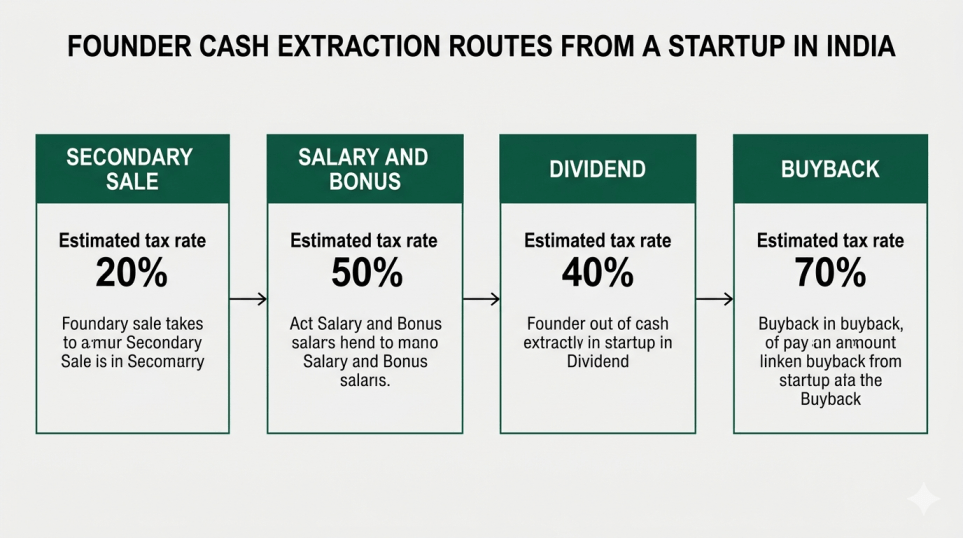
Salary and bonus: simple, but the most expensive route
Taxed at your income slab rate – 30% if your total income exceeds INR 15 lakhs per year. There is no indexation or concessional rate.
Salary is the most visible form of compensation and rarely triggers investor pushback, but it is the least efficient from a tax standpoint. Most founders use salary to cover personal running costs and rely on secondary or dividend routes for larger extractions.
A performance bonus declared by the board is treated as salary and taxed the same way. The only scenario where salary becomes relatively efficient is when the founder is in a lower slab and the company needs the deduction (salary is a deductible expense for the company).
Dividend: limited use post-Finance Act 2020
Dividends are now taxable in the hands of the shareholder at their applicable slab rate – the earlier dividend distribution tax (DDT) of 15% paid by the company no longer applies after 01 April 2020.
For a founder in the 30% slab, a dividend is no more efficient than a salary, and it comes without the company’s deduction benefit.
The company can only declare a dividend from distributable profits (after providing for depreciation and previous losses). Early-stage and loss-making startups cannot use this route regardless of cash balance.
The tax treatment of buybacks has changed twice in quick succession – founders must apply the correct rules for the date of their transaction.
From 1 April 2026 (current regime – Finance Act 2026, under Income Tax Act 2025): Buyback proceeds are now taxed as capital gains, not dividend. For non-promoter shareholders: 12.5% LTCG (if held over 12 months, listed) or applicable STCG rate. For founder-promoters (non-corporate individuals): effective rate of approximately 30% -comprising standard LTCG tax plus an additional tax under Section 69 of the IT Act 2025. The additional tax applies only to buybacks conducted under Section 68 of the Companies Act 2013. Cost of acquisition is now deductible (no longer treated as a phantom capital loss).
For founders, the current regime means buyback proceeds are taxed at roughly the same effective rate as salary – the route remains unattractive relative to a secondary sale at 12.5% LTCG.
Section 68 of the Companies Act 2013 governs buybacks. The company cannot buy back more than 25% of its paid-up capital and free reserves in a single financial year. A board resolution suffices for buybacks up to 10% of paid-up capital and free reserves; a special resolution is required for buybacks above that threshold. A buyback cannot be made out of the proceeds of an earlier issue of the same kind of shares.
For startups, buybacks are less common because most companies are still deploying capital. The route works best for bootstrapped profitable companies or companies post-acquisition where cash has accumulated on the balance sheet.
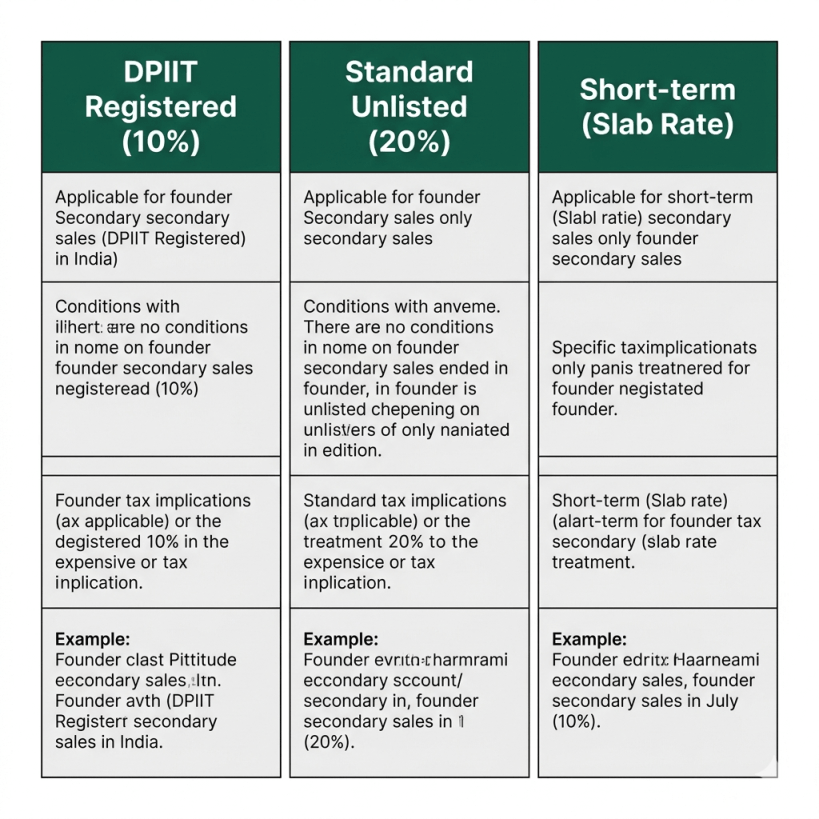
Four mistakes founders make when planning for liquidity
Mistake 1: Selling below fair market value to a friendly buyer. Section 56(2)(x) treats the shortfall as income in the buyer’s hands.
Mistake 2: Ignoring FEMA when the buyer is an NRI or foreign entity. Even a casual secondary to a foreign buyer without proper pricing documentation and FC-TRS filing is a FEMA violation.
Mistake 3: Not checking SHA restrictions before announcing a sale. Most institutional investors have ROFR, tag-along, or information rights clauses that require advance notice before any share transfer. Executing without this invalidates the transaction and damages investor relationships.
Mistake 4: Treating salary and secondary as alternatives rather than complements. The most tax-efficient structure often combines a modest salary increase (to cover personal costs) with a secondary sale (to extract larger capital). Founders who try to extract everything via salary or everything via secondary without modelling both end up paying more than they need to.
Taking money out of your startup and not sure which route makes sense for your cap table? Let’s Talk
Frequently asked questions
What is the tax rate on a secondary sale of unlisted startup shares?
12.5% LTCG under Section 112 (no indexation) if you have held the shares over 24 months, effective for transfers on or after 23 July 2024. Shares held under 24 months are taxed at slab rates (up to 30%).
What documents are needed for a secondary sale?
Share purchase agreement, board resolution, ROFR waiver or investor consent letters, valuation certificate from a chartered accountant, share transfer form (SH-4), stamp duty payment, and Form FC-TRS if the buyer is foreign.
My buyer is based in Singapore. What FEMA compliance is required?
The sale must be at or above the fair market value determined by a CA using DCF or net asset value method. A Form FC-TRS must be filed with the AD bank within 60 days of receipt of funds. The buyer must be from a FEMA-permissible country (Singapore qualifies under the automatic route for most sectors). Sector-specific caps must also be verified.
I have signed an SPA and the buyer backed out. What happens to the advance?
This depends on the terms of your SPA. Most well-drafted SPAs include a break fee or earnest money provision. Any advance received and retained is taxable as income in the year received. If it is subsequently refunded, you can claim a deduction in that year.
Can a VC fund buy secondary shares from a founder directly?
Yes. Many Series A and B rounds include a secondary component where the incoming VC buys a portion of founder shares alongside the primary subscription. This is increasingly common and investors often prefer it as it aligns incentives. The same FEMA and IT Act compliance applies based on the fund’s jurisdiction and structure.
I have unvested ESOPs that are in-the-money. Can I include them in a secondary?
No. You can only sell shares you own. Unvested ESOPs are not exercised and therefore not shares. Once vested, you can exercise at the exercise price (taxed as perquisite at FMV minus exercise price at the time of exercise under Section 17(2)), and then sell the resulting shares as a secondary. The two events carry different tax treatments and must be planned separately.
What if the company has multiple classes of shares and I hold preference shares?
Secondary sale rules apply equally to preference shares. However, FMV computation becomes more complex when preference shares carry liquidation preferences.
Every founder’s tax outcome depends on hold period, DPIIT status, and deal structure. Let’s Talk
Regulatory references:
- Note: The Income Tax Act, 1961 was replaced by the Income Tax Act, 2025 with effect from 1 April 2026. Section numbers have been renumbered throughout. The provisions cited below refer to their IT Act 1961 section numbers (applicable to transactions up to 31 March 2026) and remain substantively operative under the corresponding renumbered provisions of IT Act 2025 for transactions from 1 April 2026 onwards. Readers transacting from FY 2026-27 onwards should verify the equivalent IT Act 2025 section numbers using the CBDT section mapping utility at incometaxindia.gov.in.
- Section 112A, Income Tax Act 1961: LTCG on transfer of equity shares
- Section 112, Income Tax Act 1961: LTCG on transfer of unlisted shares
- Section 56(2)(x), Income Tax Act 1961: Taxability of shares received below FMV
- Section 17(2), Income Tax Act 1961: Perquisite valuation for ESOPs
- Section 115QA, Income Tax Act 1961: Tax on distributed income on buyback
- Section 68, Companies Act 2013: Buyback of shares
- FEMA Notification 20(R): Transfer or issue of security by a person resident outside India
- RBI Master Direction on Foreign Investment in India (updated periodically)
- Startup India / DPIIT Notification: Tax benefits for recognised startups
About the Author
Share
-
Link copied to clipboard!https://treelife.in/legal/founder-liquidity-in-india/

-

-

-

-

Priya Kapasi Shah

Associate Partner | Tax & Regulatory | priya.k@treelife.in
Heads Treelife’s Financial Advisory practice, specializing in investment structuring, cross-border transactions, and tax and regulatory advisory. Also leads on AIF setups and advisory services for GIFT IFSC.
We Are Problem Solvers. And Take Accountability.
Related Posts

Franchise Agreement Review: A Legal Vetting Guide for Franchise
A franchise agreement is not a standard commercial contract. It is the entire legal foundation of your business: your right...
Learn More

HealthTech IoT Remote Patient Monitoring Platform Contracts
A remote patient monitoring (RPM) platform is not a SaaS product that happens to sit in a hospital. It is...
Learn More

Contract review retainer for a SaaS company: How to set one up properly
A SaaS company at Series A is typically signing 3-8 significant commercial agreements every month: customer MSAs, enterprise addendums, vendor...
Learn More

Why Institutional VCs Flag a Founder-Drafted Co-Founder Agreement
Institutional venture capitalists conduct legal due diligence on a co-founder agreement before they finalise a term sheet, not after. The...
Learn More

RSU Taxation in India for US stocks: The Complete Guide
Tens of thousands of Indian residents employed by US technology companies receive Restricted Stock Units as a core part of...
Learn More

Building a Simple Revenue Model for a Very Early, Small Startup
Before a spreadsheet, before an investor, and certainly before a pitch deck, a startup needs one thing with precision: a...
Learn More

Financial Model Validation before a Data Room: What to fix for Investors
A financial model built internally is not the same as a model that is ready for investor scrutiny. The gap...
Learn More

ESOP Compensation Committee in India: Governance Guide
An ESOP scheme approved by shareholders is an enabling document, not an operating system. The shareholder resolution authorises the pool....
Learn More

Vendor and Client Invoice Management as part of a CFO Retainer
Five regulatory frameworks touch every vendor invoice that flows through an Indian business: the GST e-invoicing mandate, the Invoice Management...
Learn More

Phantom Stocks in India – 2026 Guide for Startup Founders
Phantom stock is one of the most misunderstood compensation tools in the Indian startup ecosystem. Most founders encounter it when...
Learn More

VCFO Tax Optimisation: The retainer add-on that pays for itself
Most VCFO retainers cover compliance: TDS working, GST oversight, advance tax scheduling, ITR filing. That work keeps the business legal....
Learn More

Deep-Tech Maritime Startups: Legal Structure, Compliance & Funding
India's maritime sector handles more than 95% of trade by volume across 7,500 kilometres of coastline, yet the technology layer...
Learn More
© 2026 Treelife Ventures Services Private Limited. All Rights Reserved.