



Adani-Holcim deal: Tax free deal for Holcim?
Written By

Share
-
Link copied to clipboard!https://treelife.in/news/adani-holcim-deal-tax-free-deal-for-holcim/

-

-

-

-

First Published on 18th May, 2023
The Adani-Holcim deal where the Adani group will acquire Holcim’s Indian assets for $10.5 billion is pegged to be India’s largest-ever merger and acquisition transaction in the infrastructure and materials space. In this deal, Adani will acquire ~63% stake in Ambuja Cements and ~55% stake in ACC both being Indian listed companies.
Holcim’s CEO in his address to investors mentioned that this deal is likely to be tax free for Holcim.
Before discussing whether gains arising to Holcim will be tax free or not, it would be key to first understand the facts (as per publicly available information):
- The selling entity is likely to be Holcim’s Dutch investment company which holds investment in Holcim’s investment company in Mauritius.
- This Mauritius investment company, in turn, holds stake in Ambuja Cements and ACC.
- The Dutch company will sell the shares in the Mauritius investment company to Adani’s Mauritius based investment company.
- To represent this diagrammatically,
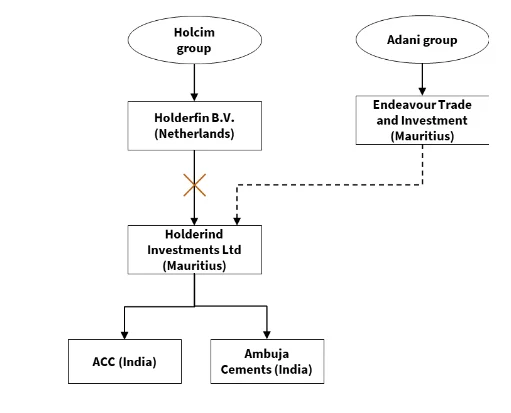
This seems to be a classic case of “indirect transfer” i.e. transfer of shares of foreign entities owning shares / assets in India instead of a direct transfer of such Indian shares / assets.
Indian tax treaties with Mauritius, Singapore, Netherlands, etc continue to have a capital gains tax exemption for such indirect transfers of Indian shares. In other words, as per these treaties, capital gains arising on sale of shares of a non-Indian entity are taxable only in the country in which the seller is a resident i.e. in Mauritius / Singapore / Netherlands.
Applying the above mentioned laws to the facts of this deal, considering that even though substantial value of Holcim’s Mauritius company arises from assets located in India (i.e. Ambuja Cements and ACC), India may not be entitled to collect tax on the gains arising on this transaction as per the India-Netherlands tax treaty.
About the Author
Share
-
Link copied to clipboard!https://treelife.in/news/adani-holcim-deal-tax-free-deal-for-holcim/

-

-

-

-

We Are Problem Solvers. And Take Accountability.
Related Posts

Financial Planning and Analysis Services in India
Financial planning and analysis services in India cover the forward-looking half of finance: the annual operating plan, the rolling forecast,...
Learn More

Budget Forecasting Services for Startups
Many startups reach Series A with a monthly MIS pack and no approved annual budget. Lead investors usually ask for...
Learn More

Monthly MIS Reporting Services for Businesses
MIS reporting services in India sit between the accountant who closes the books and the board that has to act...
Learn More

Interim CFO After CFO Resignation: Handover, Interim Cover, Hiring
A CFO resignation sets two clocks running at once. The first is operational: bank mandates, payroll sign-offs, audit queries and...
Learn More



Finance Function Setup After Seed Funding: Team, Systems, Controls
Finance function setup after seed funding is a sequencing problem, not a hiring problem. The cash arrives together with obligations:...
Learn More

Virtual CFO vs Accountant: Role, Deliverables & Which you need
A startup's first finance hire is almost always an accountant, and that is the right call. Books, GST and TDS...
Learn More

Virtual CFO Accounting & GST Filing: Scope, Handoffs, Controls
Virtual CFO accounting and GST filing in India work as one system, not two services. The books feed the invoice...
Learn More

Virtual CFO Payroll & TDS Compliance: Scope, Filing Controls
Virtual CFO payroll and TDS compliance covers the full cycle, from salary structuring to the last salary TDS certificate handed...
Learn More

Virtual CFO Audit Coordination Services: Scope, Deliverables
Every company in India must get its accounts audited every year, and for a company without a finance team the...
Learn More

Startup Financial Controls: Approvals, Duties, Review cycle
Startup financial controls decide whether a founder learns about a wrong payment, a duplicate vendor or a missed TDS deposit...
Learn More
© 2026 Treelife Ventures Services Private Limited. All Rights Reserved.