




Introduction to Startup India Registration
If you’re an entrepreneur looking to scale your business in India, Startup India registration is your gateway to a host of benefits. Launched by the Government of India, the Startup India Scheme aims to foster innovation, support budding startups, and boost job creation by simplifying regulatory hurdles and offering tax exemptions.
What is the Startup India Scheme?
The Startup India Scheme is a flagship initiative by the Department for Promotion of Industry and Internal Trade (DPIIT) that provides recognition and benefits to eligible startups. With a focus on innovation and economic growth, the scheme helps startups access funding, legal support, mentorship, and fast-track regulatory approvals.
Who Should Register Under Startup India?
Any business entity Private Limited Company, Limited Liability Partnership (LLP), or Partnership Firm—that is less than 10 years old, has an annual turnover below ₹100 crores, and is working on an innovative product, service, or process can apply for Startup India registration. Whether you’re just starting up or scaling your venture, getting recognized under this scheme can be a game-changer.
Importance of DPIIT Recognition Certificate
One of the most critical aspects of Startup India registration is obtaining the DPIIT Recognition Certificate. This certificate validates your business as a recognized startup and makes you eligible for key benefits like:
- Income Tax and Capital Gains Exemptions
- Faster IP (Trademark & Patent) Processing
- Access to Government Tenders and Grants
- Self-Certification under Labour and Environmental Laws
Without DPIIT recognition, your startup won’t be able to avail these benefits, even if it’s incorporated under MCA.
Company Incorporation vs Startup India Registration
Many founders confuse company incorporation with Startup India recognition. It’s important to understand that:
- Company registration is the legal formation of your business entity under the Companies Act or LLP Act.
- Startup India registration (via DPIIT) is an additional recognition that provides government-backed startup benefits.
In short, incorporation is the first step, and Startup India recognition is the growth booster that follows.
Which business structure should you choose before Startup India registration?
Before you can apply for DPIIT recognition, your business must be legally incorporated. The structure you choose affects your tax treatment, compliance burden, fundraising ability, and eligibility for certain schemes. This decision deserves more than a passing thought.
Only three structures are eligible for Startup India registration: Private Limited Company, Limited Liability Partnership (LLP), and Registered Partnership Firm. Sole Proprietorships and Hindu Undivided Families (HUFs) are not eligible. Here is how the eligible and near-eligible structures compare:
Comparison of business structures for startups
| Structure | Eligible for DPIIT Recognition | Liability Protection | Fundraising Suitability | Compliance Burden | Ideal For |
|---|---|---|---|---|---|
| Private Limited Company | Yes | Limited | Best (VC, Angel, institutional) | Moderate to high | Tech startups, product cos, any startup planning external funding |
| Limited Liability Partnership (LLP) | Yes | Limited | Moderate (some investors resist LLP structure) | Low | Service businesses, consulting, bootstrapped startups |
| Registered Partnership Firm | Yes | Unlimited | Low (rare for investors) | Low | Small ventures with known co-founders, no external funding planned |
| One Person Company (OPC) | Yes (it is a sub-type of Private Limited Company under the Companies Act, 2013) | Limited | Low | Moderate | Solo founders who want limited liability without a co-founder |
| Sole Proprietorship | No | Unlimited | Not applicable | Minimal | Not suitable for Startup India |
A few practical notes worth knowing from the engagements Treelife handles:
- If you plan to raise angel or venture capital, incorporate as a Private Limited Company. Most term sheets are written assuming this structure. Investors in India rarely write cheques into LLPs because of pass-through taxation complexity at the LP level.
- An OPC is technically a Private Limited Company and is DPIIT-eligible, but it must be converted to a regular Private Limited Company once paid-up capital crosses ₹50 lakhs or turnover crosses ₹2 crores (Section 18, Companies Act, 2013). Factor this conversion event into your early planning.
- An LLP works well for service businesses, but if you issue ESOPs to employees later, LLPs cannot issue stock options in the same way as companies. This is a constraint that trips founders up at Series A.
If you are still deciding, the default recommendation for innovation-driven startups is a Private Limited Company. The compliance cost is higher than an LLP, but the structure unlocks the full range of startup benefits, investor-ready documentation, and ESOP frameworks.
Benefits of Startup India Registration
Wondering why so many businesses are opting for Startup India registration? Getting DPIIT recognition under the Startup India Scheme unlocks a range of benefits that can significantly ease your startup journey. From tax exemptions to funding support, the scheme is designed to empower entrepreneurs and foster innovation.
Key Benefits of Startup India Registration
- Tax Exemptions (Income Tax & Capital Gains) Recognized startups are eligible for a 3-year income tax holiday and exemption on long-term capital gains, helping you reinvest profits back into your business.
- Self-Certification for Labour & Environmental Laws Avoid unnecessary inspections—DPIIT-recognized startups can self-certify under six labour laws and three environment laws, reducing compliance burden.
- Access to Government Grants, Funds & Tenders Gain access to a ₹10,000 crore Fund of Funds, and exclusive government tenders reserved for startups—no prior experience required.
- Fast-track IPR Filing (Trademarks & Patents) Get up to 80% rebate on patent fees and expedited processing for trademarks and intellectual property filings.
- Startup India Hub & Mentorship Support Get connected to incubators, mentors, investors, and corporate partners via the Startup India platform to accelerate your growth.
- Easier Public Procurement Access Startups recognized under the scheme get relaxed criteria for public procurement, making it easier to secure government projects.
How to apply for income tax exemption under Section 80-IAC (this is separate from DPIIT recognition)
DPIIT recognition and the 3-year income tax exemption are two different things. This is the distinction that most guides, including many CA advisors, gloss over. Getting it wrong means paying tax you were entitled to skip.
Here is how the two relate:
DPIIT recognition confirms your startup’s eligibility for the Startup India Scheme. It is issued by the Department for Promotion of Industry and Internal Trade and is what most of this article covers.
Section 80-IAC income tax exemption requires a separate application to the Inter-Ministerial Board (IMB), which functions under DPIIT. The IMB reviews your application and, if satisfied, certifies your startup for tax exemption. DPIIT recognition is a precondition, but it does not automatically grant the exemption.
Who can apply for Section 80-IAC exemption?
- The startup must have obtained DPIIT recognition first.
- It must be incorporated on or after 01/04/2016.
- The exemption applies for any 3 consecutive years out of the first 10 years from incorporation.
- Turnover in the year of claim must not exceed ₹100 crores.
How to apply for Section 80-IAC exemption
- Log in to the National Single Window System (NSWS) portal at nsws.gov.in.
- Navigate to the “Startup India” section and select “Apply for Tax Exemption (80-IAC).”
- Fill in your entity details, DPIIT recognition number, financial statements, and a description of your innovation.
- Submit. The IMB reviews the application and may call for a presentation or additional documents.
- On approval, the IMB issues a certificate specifying the years for which the exemption applies.
Important nuances
- Not all DPIIT-recognized startups are automatically approved for 80-IAC. The IMB applies its own scrutiny on the innovation and scalability claim.
- Startups that have already filed returns for the relevant years without claiming the exemption can file a revised return after IMB approval, subject to revision time limits under Section 139(5) of the Income Tax Act, 1961.
- Capital gains exemptions under Sections 54EE and 54GB are different again and do not require IMB approval. They apply on satisfaction of conditions specified in those sections.
Flag for verification: IMB processing timelines vary. As of the date of this article, processing can range from a few weeks to several months depending on application volume. Engage a tax advisor to track your application status.
Eligibility Criteria – Who Can Apply Under the Startup India Scheme?
Before you start the Startup India registration process, it’s essential to ensure your business meets the eligibility norms defined by the government. The DPIIT recognition is granted only to startups that fulfill certain criteria related to business structure, innovation, and turnover.
Startup India Registration Eligibility – Key Requirements
| Criteria | Description |
|---|---|
| Business Type | Your entity must be a Private Limited Company, Limited Liability Partnership (LLP), or Partnership Firm. |
| Business Age | The business should be less than 10 years old from the date of incorporation. |
| Annual Turnover | The company’s turnover must not exceed ₹100 crores in any financial year since incorporation. |
| Innovation Requirement | The startup must be working towards innovation, development, or improvement of products, services, or processes. It can also be a scalable business model with potential for employment generation or wealth creation. |
| Not Formed by Splitting | The entity must not be formed by splitting or restructuring an existing business. Only genuinely new ventures qualify. |
Meeting these Startup India registration eligibility criteria is the first step toward gaining access to exclusive startup benefits and government support.
Documents Required for Startup India Registration
Before applying for Startup India registration, make sure you have all the necessary documents in place. A well-prepared application with the right paperwork increases your chances of quick DPIIT recognition approval.
Here’s a quick checklist of documents required for Startup India registration:
Startup India Registration Document Checklist
- Certificate of Incorporation Incorporation or registration certificate issued by MCA (for Private Limited, LLP, or Partnership Firm).
- Company PAN Card Permanent Account Number (PAN) issued in the name of the entity.
- Founders’ KYC Documents PAN, Aadhaar card, and contact details of all directors or partners.
- Brief Description of Business/Product/Service Clearly mention your business idea, innovation, or product offering.
- Pitch Deck / Website / Patent (if available) Supporting documents that highlight your innovation or scalability.
- MSME Registration Certificate (Optional) While not mandatory, an MSME certificate can help strengthen your application.
- Authorization Letter (If applying via consultant) A signed letter authorizing a consultant to file the application on your behalf.
Submitting these documents accurately will ensure a smooth and faster approval process from DPIIT. Missing or incorrect documents can lead to unnecessary delays.
Decoding Key Documents for Your Indian Startup: DSC, DIN, MOA, and AOA
Registering a startup in India involves navigating several crucial documents and designations. Understanding the purpose and significance of each – the Digital Signature Certificate (DSC), Director Identification Number (DIN), Memorandum of Association (MOA), and Articles of Association (AOA) – is fundamental for a smooth and compliant registration process.
1. Digital Signature Certificate (DSC): Your Digital Identity
In an increasingly digital landscape, the Digital Signature Certificate (DSC) acts as your secure online identity. It’s the electronic equivalent of a physical signature, providing both authentication and integrity for electronic documents.
- What it is: A DSC is a cryptographically secured digital certificate issued by certifying authorities (CAs) authorized by the Indian government. It contains your identity details (name, email, public key) and is used to digitally sign documents.
- Why it’s essential for startups: For startup registration, a DSC is mandatory for all proposed directors. It’s used to digitally sign e-forms submitted to the Ministry of Corporate Affairs (MCA), ensuring the authenticity of the information provided. This eliminates the need for physical presence and manual signatures for numerous filings.
- Key uses in startup registration:
- Signing e-forms like SPICe+ (Simplified Proforma for Incorporating Company Electronically Plus) for company incorporation.
- Filing various compliance documents with the MCA post-incorporation.
- Types: DSCs are typically issued in different classes (e.g., Class 2, Class 3), with Class 3 being commonly required for company registration and e-filing with the MCA due to its higher level of security.
2. Director Identification Number (DIN): A Unique Identifier for Directors
The Director Identification Number (DIN) is a unique 8-digit identification number assigned by the Ministry of Corporate Affairs (MCA) to individuals who intend to be or are already directors of a company.
- What it is: A permanent and unique identification number for every director, akin to a social security number for directors in other countries.
- Why it’s essential for startups: Every individual who wishes to be appointed as a director in a company in India must possess a valid DIN. It’s a prerequisite for applying for company incorporation and for any subsequent director appointments.
- Key uses in startup registration:
- Mandatory for all proposed directors in the incorporation forms.
- Ensures that a director’s information is uniquely tracked across various companies.
- Acquisition: A DIN can be obtained by filing an application with the MCA (e-form DIR-3). However, often, it is applied for simultaneously with the company incorporation application (SPICe+ form) if the individual does not already have one.
3. Memorandum of Association (MOA): The Company’s Charter
The Memorandum of Association (MOA) is a foundational legal document that defines the scope of a company’s activities and its relationship with the outside world. It’s often referred to as the company’s “charter.”
- What it is: A public document outlining the fundamental objectives, powers, and limitations of the company. It essentially states what the company is allowed to do.
- Why it’s essential for startups: The MOA is a mandatory document for company incorporation. It informs the public, shareholders, and creditors about the company’s core business and its boundaries.
- Key Clauses: The MOA typically includes the following crucial clauses:
- Name Clause: States the full name of the company.
- Registered Office Clause: Specifies the state where the company’s registered office will be located.
- Objects Clause: This is the most critical part, detailing the main business activities the company intends to undertake and any ancillary activities necessary to achieve those main objects.
- Liability Clause: Declares the limited liability of the company’s members (shareholders).
- Capital Clause: Specifies the authorized share capital of the company and its division into shares.
- Subscription Clause: Lists the names of the first subscribers (promoters) to the memorandum and the number of shares they agree to take.
- Significance: Any action taken by the company outside the scope defined in its MOA can be deemed ultra vires (beyond its powers) and potentially void.
4. Articles of Association (AOA): The Company’s Internal Rulebook
While the MOA defines the company’s external scope, the Articles of Association (AOA) lays down the internal rules and regulations for the management and governance of the company. It’s the company’s “internal constitution.”
- What it is: A legal document that governs the internal management of the company and defines the rights, duties, and powers of its members (shareholders) and directors.
- Why it’s essential for startups: The AOA is a mandatory document for company incorporation, working in conjunction with the MOA. It provides a framework for how the company will operate on a day-to-day basis.
- Key areas covered: The AOA typically includes provisions related to:
- Share capital: Issuance, transfer, and forfeiture of shares.
- Directors: Appointment, removal, powers, and duties of directors.
- Meetings: Procedures for holding board meetings and general meetings (AGMs, EGMs).
- Voting rights: Rights of shareholders to vote at meetings.
- Dividends: Declaration and payment of dividends.
- Accounts and audit: Maintenance of books of accounts and auditing procedures.
- Borrowing powers: The company’s ability to borrow funds.
- Common seal: Usage of the company’s common seal.
- Relationship with MOA: The AOA is subordinate to the MOA. If there’s any conflict between the MOA and AOA, the MOA prevails. The AOA cannot contain anything contrary to the MOA or the provisions of the Companies Act, 2013.
By understanding these four foundational elements DSC, DIN, MOA, and AOA aspiring entrepreneurs can confidently navigate the initial stages of company registration in India, setting a strong and compliant foundation for their startup’s journey.
Startup India Registration Process – Step-by-Step Guide
Planning to register your innovative venture under the coveted Startup India Scheme? Unlocking government benefits and recognition starts here! This comprehensive, step-by-step breakdown demystifies the Startup India registration process, empowering you to navigate it swiftly and successfully.
Whether you’re a budding entrepreneur or an established founder aiming for official recognition, this guide reveals how to register on the Startup India portal and secure your invaluable DPIIT recognition certificate with ease.
How to Register Your Startup on the Startup India Portal
The journey to becoming a DPIIT-recognized startup is streamlined and entirely online. Follow these clear steps to achieve your Startup India recognition:
Step 1: Incorporate Your Business Entity (Prerequisite for Startup India)
Before applying for Startup India recognition, your business must be legally established. This is a foundational step.
- Action: Officially register your business entity. The most common structures chosen by startups include:
- Private Limited Company: Ideal for scalability and attracting investment, governed by the Companies Act, 2013.
- Limited Liability Partnership (LLP): Offers the benefits of limited liability with the flexibility of a partnership, governed by the LLP Act, 2008.
- Registered Partnership Firm: While less common for startups seeking external funding, it’s a simpler structure for smaller ventures.
- Why it’s crucial: The DPIIT recognition requires a valid incorporation or registration certificate. This step legitimizes your business in the eyes of the law.
Step 2: Create Your Profile on the Official Startup India Portal
Your digital gateway to Startup India benefits begins with portal registration.
- Action: Visit the official Startup India website (startupindia.gov.in). Click on “Register” or “Sign Up” and choose the “Startup” user type.
- Information Required: You’ll need to provide basic details such as your name, email address, and phone number to create your user account.
- Why it’s crucial: This establishes your online identity within the Startup India ecosystem, allowing you to access the application forms and track your status.
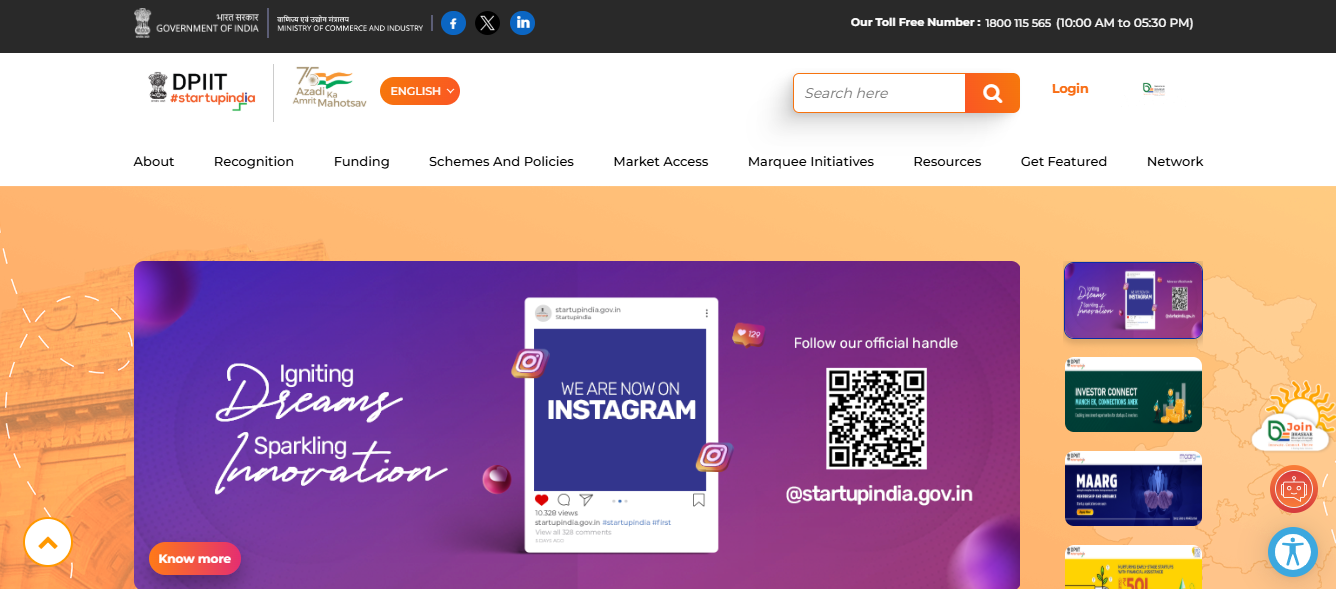
Homepage of Startup India Website
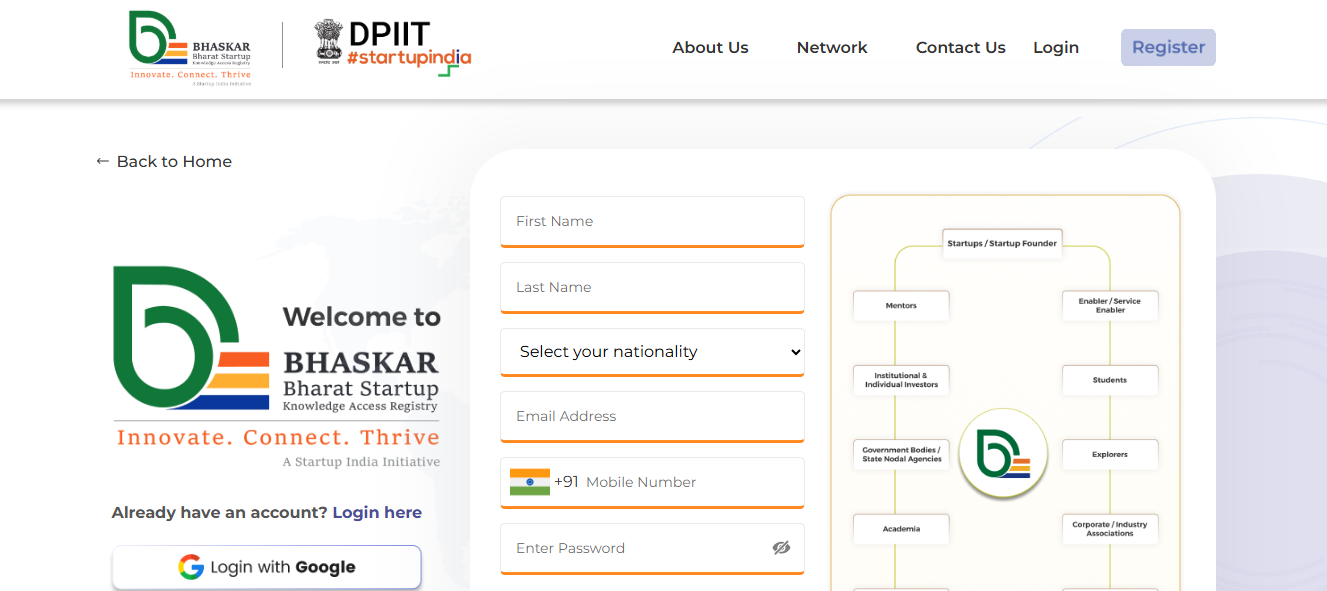
Register & Signup Page
Step 3: Complete the DPIIT Recognition Application Form (Detailed Business Information)
This is where you showcase your startup’s potential and innovation.
- Action: Log in to your newly created account and navigate to the “DPIIT Recognition” section. Fill out the comprehensive application form with accurate and detailed information about your venture.
A note on the NSWS portal redirect
When you click “Apply for DPIIT Recognition” on the Startup India portal, the system redirects Private Limited Companies and LLPs to the National Single Window System (NSWS) portal at nsws.gov.in. This surprises many founders who expect to complete everything on the Startup India site.
On the NSWS portal, you create a separate account, add the form titled “Registration as a Startup,” and complete the Startup Recognition Form there. Partnership Firms may follow a slightly different path depending on the state; check the NSWS portal for updated instructions. Once submitted via NSWS, your recognition status reflects back on your Startup India dashboard.
- Key Sections to Focus On:
- Entity Details: Legal name, CIN/LLPIN, date of incorporation/registration.
- Address Details: Your registered office address.
- Directors/Partners Details: Information about all founders and directors/partners, including their DIN/DPIN and PAN.
- Startup Details:
- Industry & Sector: Clearly categorize your business.
- Innovation & Scalability: This is critical. Explain how your product, process, or service is new or significantly improved. Describe your business model’s potential for high employment generation or wealth creation.
- Problem Solved: Articulate the problem your startup addresses and how your solution provides value.
- Product/Service Description: A clear overview of what you offer.
- Team Information: Details about your core team’s experience and expertise.
- Why it’s crucial: This form is your primary submission for assessment. A well-articulated application demonstrating genuine innovation and scalability is key to approval.
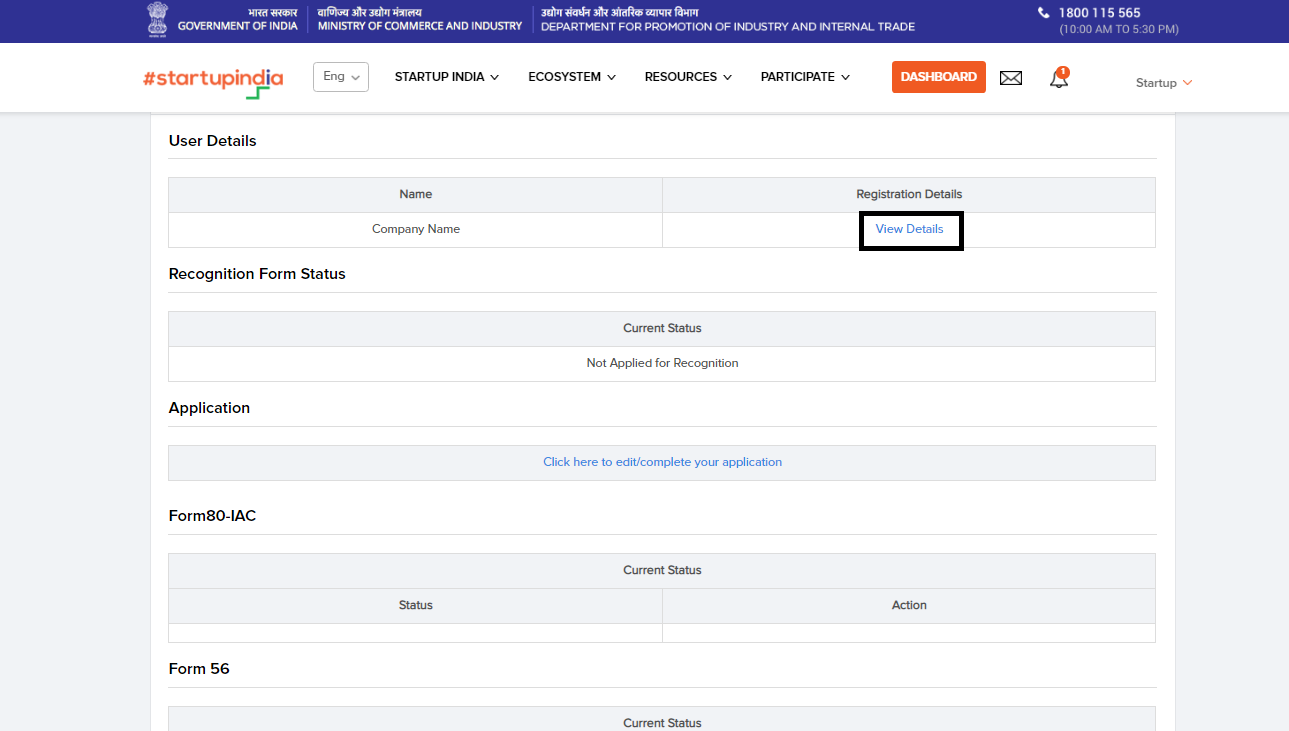
DPIT Form for Information of Startups
Step 4: Upload All Mandatory Supporting Documents
Accuracy and completeness of documents are paramount for a smooth application.
- Action: Digitally upload all required supporting documents as specified on the portal. Ensure all documents are clear, legible, and in the prescribed format (usually PDF).
- Essential Documents Typically Include:
- Certificate of Incorporation/Registration: Your company’s legal birth certificate (e.g., Certificate of Incorporation for a Private Limited Company, LLP Registration Certificate).
- PAN Card: Of the company/LLP.
- Director/Partner Details: PAN and Aadhar of all directors/partners.
- Memorandum of Association (MOA) and Articles of Association (AOA) for companies, or LLP Agreement for LLPs.
- Proof of Innovation: This is a crucial element. It could be a brief pitch deck, a detailed business plan, a patent application, a screenshot of your website/app, or a link to a video demonstrating your product/service. Clearly highlight the innovative aspects.
- Authority Letter: If the application is being submitted by an authorized signatory.
- Why it’s crucial: These documents validate the information provided in your application and prove your eligibility. Incomplete or incorrect submissions can lead to delays or rejection.
Step 5: Self-Certify the Eligibility Criteria
Confirming your adherence to the scheme’s guidelines is a critical step.
- Action: Carefully review the Startup India registration eligibility norms on the portal. You will need to self-certify that your business meets all the defined criteria.
- Key Eligibility Criteria to Verify (as of current guidelines, subject to change):
- Age of Entity: Not older than 10 years from the date of incorporation/registration.
- Type of Entity: Must be a Private Limited Company, LLP, or Registered Partnership Firm.
- Annual Turnover: Turnover must not have exceeded INR 100 Crores in any of the preceding financial years.
- Originality & Innovation: Must be working towards innovation, development, or improvement of products, processes, or services, or be a scalable business model with a high potential for employment generation or wealth creation.
- Not Formed by Splitting/Reconstruction: Should not be a result of a split or reconstruction of an existing business.
- Why it’s crucial: This self-declaration is a legal affirmation of your compliance with the scheme’s requirements.
Step 6: Submit Your Application for DPIIT Review
The final click initiates the official review process.
- Action: Once all sections of the form are completed, documents uploaded, and eligibility self-certified, click the “Submit” button.
- What happens next: Your application will be sent to the Department for Promotion of Industry and Internal Trade (DPIIT) for verification and approval. You will typically receive an acknowledgment of your submission.
Step 7: Receive Your Startup India DPIIT Recognition Certificate
The culmination of your efforts – official recognition!
- Action: Upon successful verification and approval by the DPIIT, your Startup India DPIIT Recognition Certificate will be issued. This certificate is typically available for download directly from your Startup India portal dashboard.
- Timeline: While processing times can vary, many applicants receive their certificate within 7-10 working days if all information and documents are accurate and complete.
- Why it’s crucial: This certificate is your official proof of Startup India recognition, unlocking a multitude of government-backed benefits, including tax exemptions, intellectual property (IP) benefits, funding opportunities, and simplified compliance.
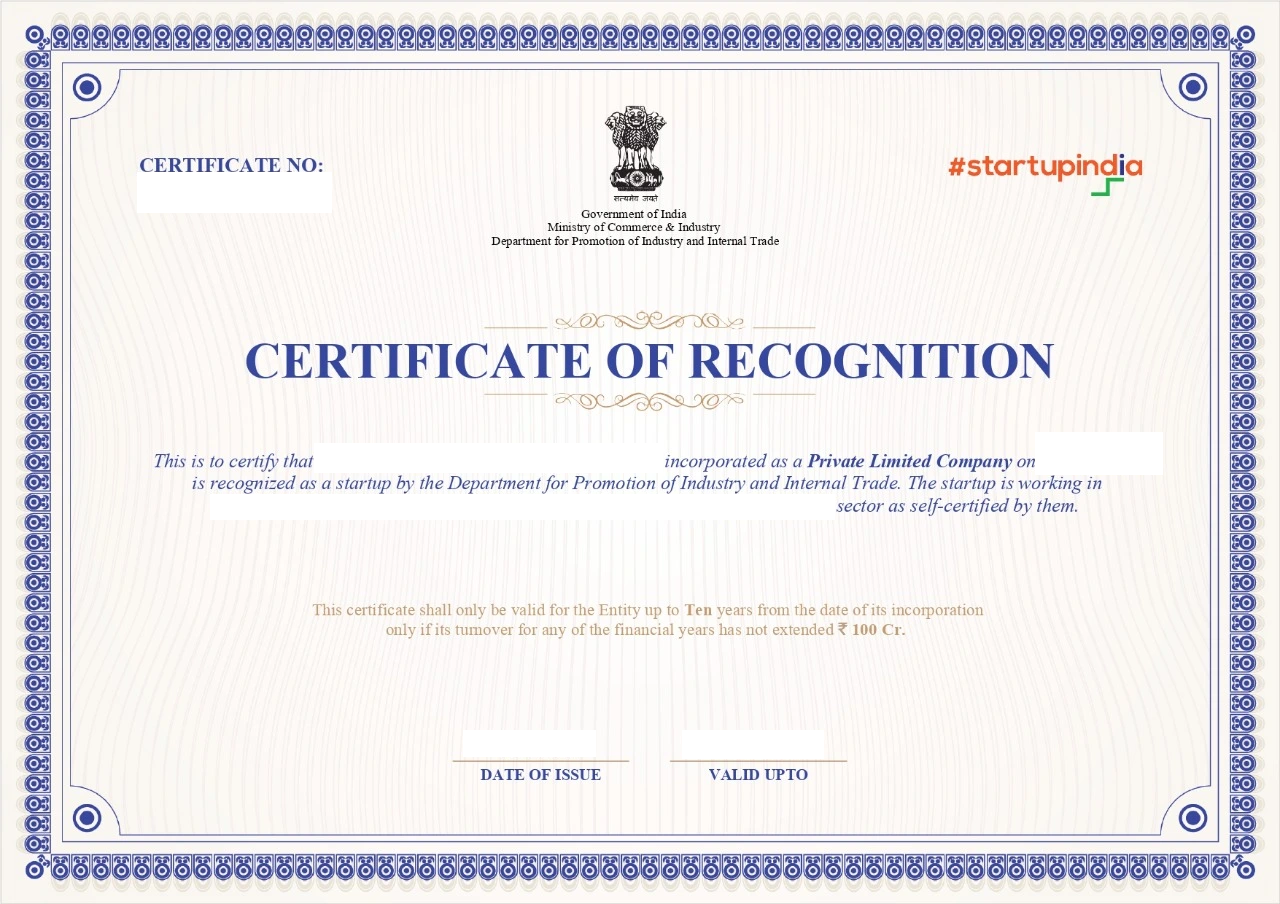
Startup India Registration Certificate
The entire Startup India registration online process is designed to be smooth, paperless, and free of cost. This invaluable recognition not only legitimizes your startup but also opens doors to a powerful ecosystem of government support, tax incentives, and crucial funding avenues, propelling your venture forward.
What happens after you receive your DPIIT recognition certificate?
Most guides stop at the certificate. That is where the real work begins.
DPIIT recognition is the key that opens several doors, but each door has its own process. Here is what to do in the weeks following your recognition:
1. Apply separately for Section 80-IAC income tax exemption
As covered earlier in this article, DPIIT recognition and the 3-year income tax exemption are not the same thing. Log in to the NSWS portal, navigate to the Startup India section, and submit your Form 80-IAC application for IMB review. Do this early; the IMB process takes time and the exemption can only be claimed for years in which you have the certificate.
2. Access government-backed funding schemes
Once recognised, your startup becomes eligible for the following schemes, all accessible through the Startup India portal or linked government portals:
Key funding schemes for DPIIT-recognised startups
| Scheme | What it provides | Managed by |
|---|---|---|
| Startup India Seed Fund Scheme (SISFS) | Grants and soft loans for proof of concept, prototype and market entry (up to ₹20 lakhs as grant and up to ₹50 lakhs as convertible debentures, subject to incubator allocation) | DPIIT via selected incubators |
| Fund of Funds for Startups (FFS) | Domestic capital routed through SEBI-registered venture capital funds that invest in eligible startups | Small Industries Development Bank of India (SIDBI) |
| Credit Guarantee Scheme for Startups (CGSS) | Collateral-free debt funding backed by a government guarantee; reduces the credit risk barrier for early-stage startups seeking bank loans | DPIIT via National Credit Guarantee Trustee Company (NCGTC) |
Apply through the Startup India portal or SISFS portal. Each scheme has its own eligibility conditions and application timeline.
3. Claim IPR benefits: the 80% rebate on patent fees
DPIIT-recognised startups can approach any of the government-empanelled patent facilitators for filing patents. The startup pays only the statutory fees (which are themselves discounted for startups) and the facilitator’s fees are reimbursed by the government. The net saving is approximately 80% compared to standard patent filing costs. The Controller General of Patents, Designs and Trade Marks (CGPDTM) maintains the updated list of empanelled facilitators on ipindia.gov.in.
For trademark registration, DPIIT-recognised startups are eligible for a 50% reduction in the trademark application fee (₹4,500 instead of ₹9,000 for e-filing, as per the Trade Marks Rules, 2017, Schedule I). Expedited examination is also available on payment of the prescribed fee.
4. Self-certification under labour and environment laws
DPIIT-recognised startups can self-certify compliance under the following laws, removing the risk of inspection for the specified period:
- Under six labour laws (including the Building and Other Constructions Workers Act, 1996; the Inter-State Migrant Workmen Act, 1979; the Payment of Gratuity Act, 1972; the Contract Labour Act, 1970; the Employees Provident Funds and Miscellaneous Provisions Act, 1952; and the Employees State Insurance Act, 1948) for a period of 3 to 5 years from incorporation.
- Under three environment laws for 3 years, if the startup operates in one of the 36 white category industries as published by the Central Pollution Control Board (CPCB). White category industries are those with the lowest pollution potential. If your industry is on this list, you do not require prior environmental clearance for 3 years.
Check the CPCB’s white category list to confirm your industry’s classification before relying on this exemption.
5. GST registration (if applicable)
If your startup’s annual turnover crosses ₹20 lakhs (₹10 lakhs for special category states) or if you are engaged in interstate supply of goods or services, you are required to register under the Goods and Services Tax (GST). Even below the threshold, voluntary GST registration is useful if you are selling to GST-registered businesses who need to claim input tax credit on your invoices. Register through the GST portal at gst.gov.in.
6. Access learning resources and the Startup India Hub
The Startup India portal offers curated learning modules, ready-to-use document templates (term sheets, shareholder agreements, pitch decks), and access to a network of incubators and mentors through the Startup India Hub. Startups can request connections with up to three enablers per week through the platform.
Startup India Registration Timeline – How Long Does It Take?
One of the key advantages of the Startup India registration process is its quick turnaround time. Once you submit your application with the required documents, the recognition is typically granted within a few working days.
How Much Time Does Startup India Registration Take?
- Average Processing Time: 7–10 working days
- Factors That May Affect Timeline:
- Accuracy of submitted documents
- Quality of your business description or pitch deck
- Any additional clarification requested by DPIIT
If all documents are in order and eligibility criteria are met, most startups receive their DPIIT recognition certificate within a week.
So, if you’re planning to get your startup registered, you won’t have to wait long to access all the benefits of the scheme.
Common Mistakes to Avoid in Startup India Registration
While the Startup India registration process is simple and online, even minor errors can lead to application rejection or delays. Avoiding these common mistakes can help you get your DPIIT recognition certificate without hassles.
Top Startup India Registration Mistakes to Avoid
- Incomplete or Incorrect Documentation Missing or inaccurate documents are the most common reason for application rejections. Ensure your incorporation certificate, PAN, and business description are submitted correctly.
- Wrong Business Category Selection Choosing the incorrect entity type (e.g., Sole Proprietorship instead of Pvt Ltd/LLP/Partnership Firm) can make you ineligible under the Startup India Scheme.
- Poor Innovation Summary or Missing Pitch Deck DPIIT focuses on innovation. A weak or unclear business summary, or not uploading a pitch deck or product overview, may lead to rejection.
- Not Checking Self-Certification Boxes The portal requires you to self-declare eligibility. Missing out on these checkboxes is a common oversight that can delay approval.
By avoiding these mistakes, you can ensure a smooth Startup India registration online experience and get access to benefits faster.
Can DPIIT recognition be revoked?
Yes, it can. This is not widely discussed but is important to understand before you file.
The DPIIT recognition certificate carries an explicit revocation clause. If DPIIT subsequently finds that recognition was obtained on the basis of false or misleading information, or without uploading the required documents, it can revoke the recognition certificate and the tax exemption certificate without prior notice. This is stated in the terms and conditions of the Startup Recognition Form on the NSWS portal.
Revocation has two material consequences:
- The startup immediately loses all scheme benefits including any self-certification protections under labour and environment laws.
- If a Section 80-IAC income tax exemption was availed, the income tax department can reopen assessments for the years in which the exemption was claimed. Tax, interest, and penalties under the Income Tax Act, 1961 would then apply.
The practical implication: do not self-certify innovation or scalability claims you cannot substantiate. If your innovation is thin, improve the application narrative with documented evidence before filing rather than overstating and risking revocation later. A pitch deck, a working prototype link, a filed patent application, or a signed customer agreement all serve as credible proof.
One additional note: DPIIT recognition lapses automatically when the startup completes 10 years from incorporation or when turnover crosses ₹100 crores in any financial year, whichever occurs first. This is not a penalty; it is the natural end of the startup phase as defined under the scheme.
Conclusion – Why Startup India Registration is a Smart Move
Registering your business under the Startup India Scheme is more than just a formality it’s a growth catalyst. From tax exemptions and funding access to IPR benefits and regulatory ease, the advantages are both strategic and practical.
The Startup India registration process is simple, online making it an easy first step to scale your startup efficiently and professionally.
So, if you’re building a startup that’s innovative and growth-driven, don’t miss the opportunity to get DPIIT recognition and unlock exclusive government support.
FAQs on How to Register in Startup India Scheme
- What is Startup India Hub?
A platform that connects startups, investors, mentors, and enablers to collaborate and grow. - How can I register my startup under Startup India?
You can register your startup by creating a profile on the Startup India portal, filling the DPIIT recognition form, uploading the required documents, and submitting your application online. - Is Startup India registration free?
Yes, DPIIT recognition under Startup India is completely free. There are no government charges for the registration process. - Who is eligible for Startup India registration?
Startups incorporated as Private Limited Companies, LLPs, or Partnership Firms with turnover below ₹100 crore and not older than 10 years are eligible, provided they are working on innovation or scalable business models. - Can a sole proprietorship register under Startup India?
No, sole proprietorships are not eligible for Startup India registration. Only Private Limited Companies, LLPs, and Partnership Firms can apply. - How long does Startup India registration take?
On average, DPIIT recognition is granted within 7–10 working days, provided all documents are in order. - How do investors support startups?
Investors help with fundraising, talent acquisition, marketing, mergers & acquisitions, and business structuring. - Why do investors invest in startups?
Startups offer high growth potential, with venture capital often yielding higher returns than public equities. - Is Startup India registration mandatory?
No, Startup India registration is not mandatory. However, it is highly beneficial for startups looking to access government incentives, tax exemptions, and funding support. - How to create a profile on Startup India Hub?
Register via “mygov,” verify your email, and log in to create your profile. - How do startups connect with enablers?
The platform suggests relevant connections, and startups can request to connect (limited to three per week). - Can foreign companies register?
Only entities with an office in India can register, but global access may be available in the future. - Where can I track the status of my application?
You can log in to your Startup India dashboard and monitor your DPIIT recognition status under your profile. - Can an existing business register under Startup India?
Yes, as long as it meets the eligibility criteria related to age of incorporation, turnover limits, and innovation-driven business model. - What are the main documents required for DPIIT recognition?
- Certificate of Incorporation/Registration
- Details of Directors/Partners
- Brief write-up on business innovation
- Optional: Pitch deck, website, product video
- What are the tax benefits available under Startup India? Recognized startups can avail:
- Income tax exemption for 3 consecutive years under Section 80-IAC
- Capital gains tax exemption under Sections 54EE/54GB
- Can a startup apply for government funding through Startup India?
Yes, DPIIT-recognized startups can apply for schemes like:- Startup India Seed Fund Scheme (SISFS)
- Fund of Funds for Startups (FFS)
- Can an OPC (One Person Company) register under Startup India?
Yes. An OPC is a sub-type of Private Limited Company under the Companies Act, 2013, and is eligible for DPIIT recognition. However, an OPC must convert to a regular Private Limited Company once paid-up capital crosses ₹50 lakhs or turnover crosses ₹2 crores (Section 18, Companies Act, 2013). Plan for this conversion if you expect to scale. - Is DPIIT recognition the same as the Section 80-IAC income tax exemption?
No. These are two separate certifications. DPIIT recognition is issued by the Department for Promotion of Industry and Internal Trade and confirms your startup status. The Section 80-IAC income tax exemption requires a separate application to the Inter-Ministerial Board (IMB) via the NSWS portal. IMB approval is needed to actually claim the 3-year income tax exemption in your returns. - What is the NSWS portal and why does it matter for Startup India registration?
The National Single Window System (NSWS) at nsws.gov.in is the government’s unified portal for business licences and registrations. For Private Limited Companies and LLPs, the DPIIT recognition application (Startup Recognition Form) is now filed through NSWS. The Startup India portal redirects you there after you click “Apply for DPIIT Recognition.” You will need a separate NSWS account. - Can DPIIT recognition be cancelled or revoked?
Yes. DPIIT can revoke recognition without prior notice if it finds that the certificate was obtained on false information or without adequate documentation. Revocation also triggers potential reopening of tax assessments for years in which Section 80-IAC exemption was claimed. File accurate, well-documented applications and retain your supporting evidence.
Regulatory references
- Companies Act, 2013 (Sections 2, 18, 149)
- LLP Act, 2008
- Income Tax Act, 1961 (Sections 80-IAC, 54EE, 54GB, 139(5))
- DPIIT Notification G.S.R. 127(E) dated 19/02/2019 (Startup India recognition criteria)
- Trade Marks Rules, 2017 (Schedule I, fee structure)
- Building and Other Constructions Workers Act, 1996
- Inter-State Migrant Workmen Act, 1979
- Payment of Gratuity Act, 1972
- Contract Labour (Regulation and Abolition) Act, 1970
- Employees Provident Funds and Miscellaneous Provisions Act, 1952
- Employees State Insurance Act, 1948
- Central Pollution Control Board (CPCB) white category industry classification
External sources
- startupindia.gov.in
- nsws.gov.in
- mca.gov.in
- incometaxindia.gov.in
- ipindia.gov.in
- gst.gov.in