




What is a Fractional CFO?
A Fractional CFO, also known as a part-time CFO, is a highly experienced financial consultant and senior financial executive who provides high-level financial leadership and strategic guidance to businesses on a part-time, contract, or outsourced basis. They are typically engaged by small to medium-sized businesses, startups, or fast-growing companies that require senior financial expertise but are not yet ready for the commitment or expense of a full-time hire.
Unlike a full-time Chief Financial Officer, who is a permanent in-house employee overseeing all general financial strategy, a Fractional CFO works with multiple clients simultaneously, dedicating only a portion of their time to each organization. This model allows businesses to access top-tier financial management without the associated in-house costs, such as salary, health benefits, and bonuses. Furthermore, a Fractional CFO differs from an interim CFO, who typically steps in temporarily to perform duties before or between permanent hires; a Fractional CFO’s engagement is often project-based and tailored to specific challenges or ongoing strategic financial needs rather than a temporary full-time replacement.
Definition of Fractional CFO / Part-Time CFO
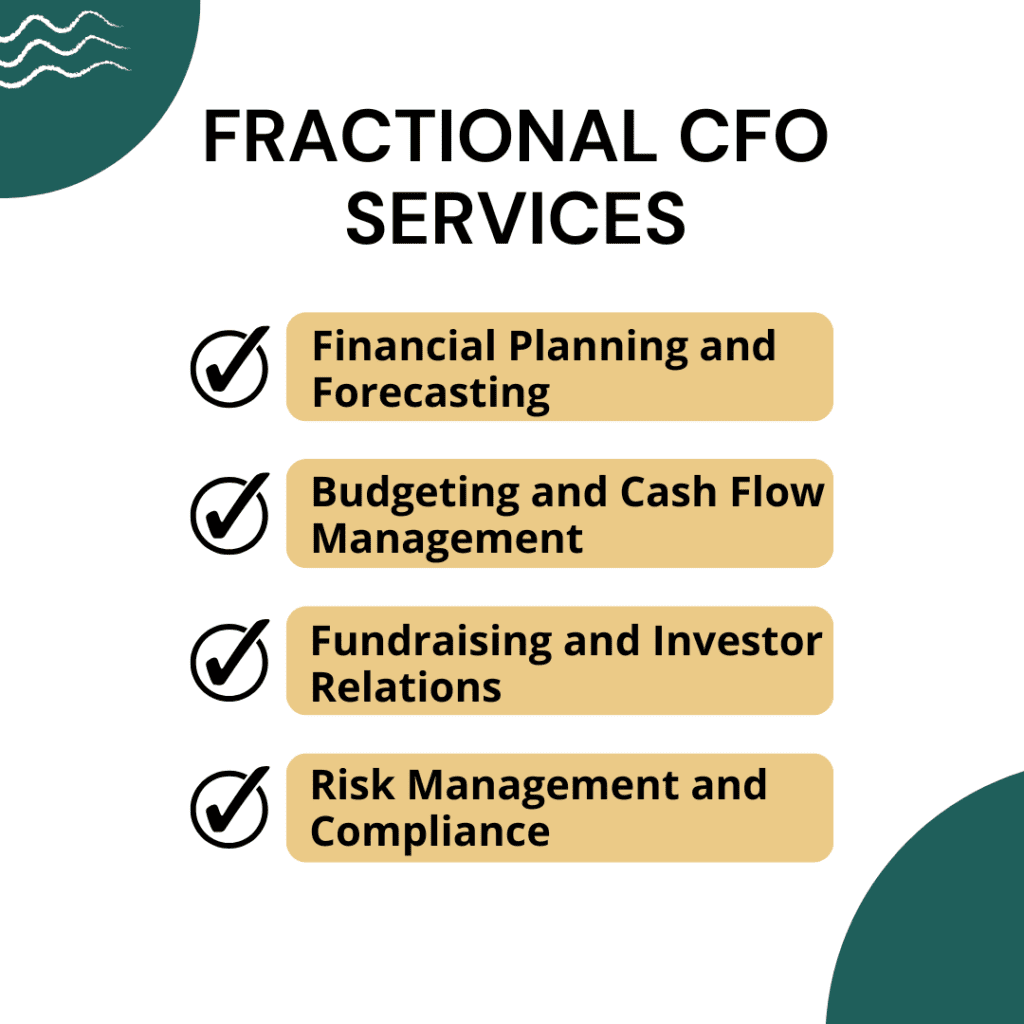
- A fractional CFO is a seasoned financial professional who delivers CFO-level expertise, including financial planning, risk management, fundraising, and compliance oversight, without the cost or commitment of a full-time hire.
- They typically work on flexible terms (monthly retainers, project basis, or hourly engagements), making top-tier financial management accessible to startups, SMEs, and fast-growing companies.
- This model enables businesses to access experienced CFO skills tailored to their current needs, budget, and growth stage.
A fractional CFO is a senior finance leader who works for a company for a fixed share of their time, under a contract for services rather than employment, and owns the CFO agenda: cash, capital, controls and board reporting. “Fractional” describes the share of time the company buys, not the seniority of the person. In India, the engagement is usually a monthly retainer billed as a professional fee.
Core Value Proposition of Fractional CFO Services
The core value proposition of a Fractional CFO lies in providing businesses with seasoned, CFO-level expertise, including financial planning, risk management, fundraising, and compliance oversight, without the significant cost or long-term commitment of a full-time executive. They typically work on flexible terms such as monthly retainers, a project basis, or hourly engagements making sophisticated financial management accessible and affordable.
This model empowers businesses to:
- Overcome Financial Challenges: Address specific issues like cash flow management problems, optimize low gross margins, and improve profitability.
- Enhance Financial Visibility: Focus on future financial planning, develop robust financial models, and provide clearer insights into financial performance.
- Drive Strategic Growth: Assist in scaling the business by reinventing financial tools, optimizing processes, and improving vendor relationships for profitable expansion.
- Achieve Financial Goals: Provide expert guidance for significant financial events, including raising capital, preparing for a company sale, or navigating mergers and acquisitions.
Difference Between Full-Time CFO and Fractional CFO
| Aspect | Full-Time CFO | Fractional CFO (Part-Time CFO) |
| Employment Status | Permanent employee | Contractual or outsourced consultant |
| Time Commitment | 40+ hours per week | Part-time, usually 10–20 hours per week or as agreed |
| Cost | High fixed salary + incentives | Pay-as-you-go; lower fixed costs and no incentives |
| Scope of Work | Broad, company-wide financial management | Focused on specific priorities and projects |
| Availability | Always on-site or fully dedicated | Remote or on-site; availability depends on contract |
| Suitability | Large enterprises or companies needing constant CFO presence | Startups, SMEs, or companies requiring flexible CFO support |
In monthly terms, 10 to 20 hours a week is 40 to 80 hours a month, which is the load a fractional CFO carries for a company in an active fundraise, audit or acquisition. Early-stage engagements usually start lower, with a fixed monthly hour bank that scales up around those events.
How Does a Part-Time CFO Fit Into the Business?
- A part-time CFO fulfills many of the same responsibilities as a full-time CFO but works fewer hours, providing financial leadership tailored to the business’s evolving needs.
- This role fits perfectly for startups and growing businesses in India that require expert financial oversight but are not yet ready to bear the cost or commitment of hiring a full-time CFO.
- Part-time CFOs bring strategic insights on budgeting, cash flow, fundraising, compliance, and risk management, helping businesses make informed decisions without the overhead of a full-time executive.
- They can seamlessly integrate into the leadership team, providing flexible financial stewardship during key growth phases or transitions.
- The part-time CFO model promotes cost-efficiency while ensuring access to experienced financial management, essential for Indian startups navigating dynamic markets and regulatory environments.
Why Do Indian Startups Need Fractional CFO Services?
Indian startups operate in a dynamic and often complex financial environment. Navigating rapid growth, regulatory compliance, and capital management requires experienced financial leadership but hiring a full-time CFO may not always be feasible or cost-effective. This is where fractional CFO services become essential.
Specific Financial Challenges Faced by Indian Startups
Startups in India commonly encounter the following financial and operational hurdles:
- Limited Budget for Senior Financial Talent: Early-stage startups often lack the funds to hire a full-time CFO with the requisite experience.
- Complex Regulatory Compliance: Frequent updates in tax laws, GST regulations, and foreign exchange controls demand expert guidance to avoid penalties.
- Cash Flow Management: Balancing operational costs with irregular revenues makes cash flow forecasting critical.
- Fundraising and Investor Relations: Preparing accurate financial models and reports to attract and satisfy investors can be challenging without professional oversight.
- Rapid Scaling: Managing financial controls and systems while scaling operations requires strategic planning and risk management expertise.
Two regime changes sit behind the compliance load in 2026. From 01/04/2026, the Income-tax Act, 2025 replaced the Income-tax Act, 1961 for tax year 2026-27 onwards, renumbering TDS, deduction and audit provisions; the 1961 Act still governs earlier years.
From 21/11/2025, the four Labour Codes (the Code on Wages, 2019, the Industrial Relations Code, 2020, the Code on Social Security, 2020 and the Occupational Safety, Health and Working Conditions Code, 2020) replaced 29 central labour laws, which changes how payroll, provident fund and gratuity are computed and reported.
Cost-Effectiveness of Hiring a Fractional CFO vs. Full-Time CFO
Hiring a full-time CFO in India can cost anywhere between ₹25 lakhs to ₹60 lakhs per annum, including salary, benefits, and overheads a significant burden for startups. In contrast, fractional CFO services offer:
- Lower Fixed Costs: Pay only for the time and expertise you need, typically through monthly retainers or hourly fees.
- No Employee Benefits or Overheads: Eliminate expenses like bonuses, health insurance, and retirement benefits.
- Access to Senior-Level Expertise Without Full-Time Commitment: Obtain CFO-level guidance without long-term contracts or employment liabilities.
Flexibility and Scalability Offered by Fractional CFO Services
Startups experience fluctuating financial needs depending on growth stage, fundraising cycles, and market conditions. Fractional CFOs provide:
- Diverse Expertise: Fractional CFOs bring cross-industry experience, offering tailored financial strategies suited to startup growth challenges in India.
- Quick Onboarding: Fractional CFOs integrate swiftly with existing teams, minimizing downtime and delivering immediate impact.
- Remote and Hybrid Support: Flexible work models align with evolving startup work cultures and geographical preferences.
Engaging a fractional CFO for startups in India is a strategic decision that balances expert financial leadership with budget-conscious flexibility. The benefits of fractional CFO services include optimized financial management, risk mitigation, and a trusted partner for navigating India’s complex startup ecosystem all while controlling costs and adapting to growth.
How to Engage a Fractional CFO with Treelife?
Engaging a fractional CFO involves understanding your business needs, defining clear expectations, and selecting a professional whose expertise aligns with your growth objectives. Here’s a step-by-step guide to effectively engage fractional CFO services:
Step 1: Assess Your Financial Leadership Needs
- Identify key areas where expert financial guidance is required (e.g., fundraising, cash flow, compliance).
- Determine the estimated hours or level of involvement needed part-time, project-based or retainer model.
Step 2: Define the Scope of Work and Objectives
- Outline the fractional CFO services you expect, such as budgeting, financial reporting, or investor relations.
- Set measurable goals and timelines for deliverables to ensure accountability.
Step 3: Formalize Engagement with a Service Agreement
- Draft a fractional CFO services agreement specifying scope, duration, fees, confidentiality, and termination terms.
- Agree on communication protocols and reporting structures to maintain transparency.
Step 4: Onboard and Collaborate
- Integrate the fractional CFO into your team and systems promptly to maximize impact.
- Establish regular check-ins and reviews to align financial strategies with business growth.
Core Responsibilities and Work of a Fractional CFO
A Fractional CFO in India provides a dynamic range of executive-level financial management services, offering strategic guidance and operational expertise tailored to the unique economic, regulatory, and cultural landscape of the Indian market. While not a full-time employee, their specialized experience is instrumental in addressing an organization’s financial challenges and driving sustainable growth.
Strategic Financial Planning & Execution
- Strategic Planning: Collaborate with the executive management team to develop comprehensive financial strategies aligned with overall business objectives and long-term vision, accounting for Indian market dynamics and growth opportunities.
- Key Performance Indicators (KPIs) Definition & Monitoring: Identify, define, and track crucial financial and operational KPIs tailored to the Indian business context, enabling effective analysis of business operational effectiveness and performance against strategic goals.
- Business Plans and Pitch Decks for Capital Raising: Craft compelling and compliant business plans and detailed pitch decks specifically designed to attract and secure venture capital, private equity, or debt financing from Indian and international investors, incorporating local market insights.
- Financial Modeling & Valuation: Develop sophisticated and compliant financial models to rigorously evaluate business performance, project feasibility, asset valuation, and potential investments, ensuring accuracy and alignment with Indian accounting standards. Help solidify the business’s market valuation, considering local market multiples and investor expectations.
Mergers, Acquisitions, and Corporate Transactions
- M&A Due Diligence: Design and set up the Mergers & Acquisitions (M&A) due diligence process for a healthy and thorough evaluation of target companies, specifically navigating Indian legal, financial, and regulatory complexities.
- Deal Room Documents Preparation: Develop and organize all necessary Virtual Data Room (VDR) or Deal Room documents – a secure online repository crucial during M&A processes for storing and sharing confidential information required for due diligence.
- Negotiations (M&A & Business Terms): Lead or assist in critical business negotiations, meticulously analyzing financial propositions, structuring deals, securing favourable terms, and ensuring alignment with strategic business goals, including specific M&A and financing agreements.
Robust Financial Operations & Control
- Forecasting and Budgeting with Variance Analysis: Develop comprehensive forecasting and budgeting models to predict future financial performance, revenue, expenses, and capital requirements. Conduct detailed variance analysis to compare predictions to actual results, promptly identifying discrepancies and informing corrective actions.
- Cash Flow Management & Optimization: Implement robust processes for monitoring, analyzing, and optimizing the organization’s cash flow to ensure continuous liquidity, address working capital challenges common in the Indian market, and avoid funding gaps.
- Banking Relationships Management: Cultivate and manage strong relationships with local and international banks, negotiating favorable business terms, financing arrangements, account structures, and ensuring ongoing compliance with financial agreements and banking regulations in India.
Data-Driven Insights & Reporting
- Business Intelligence & Data Analysis: Leverage business intelligence tools and financial data analysis to provide deep insights into performance improvement opportunities, support strategic decision-making, and drive informed financial plans.
- Financial Planning & Analysis (FP&A) Oversight: Oversee the entire FP&A function, offering valuable inputs on critical business aspects such as budgeting, forecasting, performance monitoring, strategic financial decision-making processes, and profitability analysis tailored for the Indian context.
- Reports and Presentations to Stakeholders: Prepare clear, concise, and impactful financial reports and presentations for all internal and external stakeholders (management, board, investors, regulators), ensuring seamless communication of financial insights and adherence to Indian reporting standards.
- Decision-Support: Offer critical decision support through rigorous analysis of financial data, translating complex information into actionable strategic insights for making informed and timely business decisions.
Risk Management and Compliance in the Indian Context
- Risk Mitigation: Identify potential financial risks, including market volatility, regulatory changes, and operational inefficiencies specific to the Indian environment, and establish proactive mitigation strategies.
- Regulatory Compliance: Ensure meticulous adherence to India’s extensive and evolving regulatory framework, including the Goods and Services Tax (GST), Companies Act, SEBI guidelines, Foreign Exchange Management Act (FEMA) for international transactions, and other industry-specific regulations.
- Internal Controls & Audit Oversight: Implement and oversee robust internal controls to safeguard assets and ensure financial integrity. Manage relationships with external auditors and facilitate smooth audit processes, ensuring compliance with Indian Accounting Standards (Ind AS/AS).
Investor Relations and Stakeholder Engagement
- Investor Relations Management: Take responsibility for managing relations with investors, communicating financial performance transparently, proactively addressing stakeholder concerns, providing regular updates, and fostering confidence in the business strategy.
- Stakeholder Communication: Maintain open and transparent communication with all key stakeholders, including shareholders, board members, and lenders, providing financial insights and building long-term trust.
This comprehensive set of services ensures that a Fractional CFO acts as a strategic financial backbone, helping Indian businesses navigate complexities, optimize performance, and achieve their growth ambitions.
Benefits of Hiring a Fractional CFO in India
For startups and SMEs in India, a Fractional CFO offers a strategic advantage, combining top-tier financial expertise with unparalleled efficiency. This model empowers businesses to navigate India’s unique market complexities, achieve sustainable growth, and enhance financial health.
Here are the core benefits:
- Significant Cost Savings: Access executive-level financial leadership without the hefty burden of a full-time CFO’s salary, benefits, and overheads. Pay only for the hours or projects needed, ideal for budget-conscious Indian startups.
- Expert Financial Leadership & Strategic Insights: Gain access to seasoned professionals with deep experience across industries and a nuanced understanding of India’s regulatory landscape (e.g., GST, Companies Act, SEBI). Benefit from high-level financial planning, risk assessment, customized financial modeling, and data-driven strategic advice typically reserved for large enterprises.
- Enhanced Financial Control & Risk Management: Improve cash flow management, ensure stringent compliance with Indian tax laws and regulations, and strengthen internal controls. Fractional CFOs identify potential vulnerabilities and implement proactive measures, significantly reducing financial risks.
- Strategic Growth Guidance & Performance Optimization: Receive actionable advice on fundraising within the Indian ecosystem, optimal capital allocation, and effective scaling strategies tailored to local market conditions. Drive profitability through performance analysis, operational efficiency improvements, and benchmarking against industry standards.
- Unmatched Flexibility & Reduced Commitment: Scale financial support up or down based on evolving business needs without long-term contracts. This agility is crucial for fast-paced Indian business environments, enabling quick adaptation to market changes.
- Swift Onboarding & Immediate Impact: Benefit from rapid integration into your leadership team, with Fractional CFOs often delivering tangible value and identifying critical opportunities or efficiencies within days or weeks, thanks to their objective, outsider perspective.
- Optimized Budgeting & Accounting: Develop robust accounting models that align with your budget, efficiently managing salaries, costs, and expenditures.
- Enhanced Profitability & Resource Utilization: Implement strategies to use resources judiciously, eliminate wastage, and drive bottom-line growth.
- Critical Feedback & KPI Monitoring: Gain valuable insights into company finances and operations through expert analysis, identifying and tracking key performance indicators for continuous improvement.
- Proactive Risk Assessment: Identify impending financial and operational risks specific to the Indian market and implement effective mitigation strategies.
- Focused Success & Market Responsiveness: Leverage real-time market monitoring to develop and execute success models, ensuring the business remains competitive and responsive.
- Strategic Growth Mentorship: Receive customized and sustainable business and market strategies designed for long-term organizational growth in India.
- Streamlined Investor Access & Business Valuation: Play a pivotal role in identifying investor options and accessing funding. Benefit from expert assistance in business valuations, including analysis of assets, liabilities, securities, and market equity/debt instruments.
- Organizational Structuring Support: Receive guidance on adjusting the hierarchical structure to boost efficiency and growth.
How much does a fractional CFO cost in India?
A fractional CFO in India is usually paid a monthly retainer, with hourly or project fees for defined pieces of work. The ₹5 lakhs to ₹15 lakhs annual range works out to roughly ₹42,000 to ₹1.25 lakh a month, with the final figure set by scope. Because the fee is a professional fee, the paying company deducts TDS at 10% and the CFO charges GST at 18% on the invoice.
Fractional CFO pricing models in India
| Model | How it is billed | Fits when | Watch for |
|---|---|---|---|
| Monthly retainer | Fixed fee for agreed hours and deliverables | Ongoing MIS, cash planning, board reporting | Scope creep; write down hours and outputs |
| Hourly | Per hour against a timesheet | Ad hoc advice, board meeting preparation | Unpredictable monthly cost |
| Project fee | Fixed fee per mandate | Data room build, annual budget, financial due diligence | A clear definition of “done” |
| Retainer with project top-up | Base retainer plus a fixed fee for a one-off workstream | A raise or audit lands mid-engagement | Agree the top-up rate before it is needed |
What moves the fee:
- Stage and complexity: revenue, transaction volume, number of entities and whether there is a foreign parent or subsidiary.
- Execution scope: oversight only, or bookkeeping, payroll and statutory filings as well.
- External presence: how often the CFO meets the board, investors, bankers and auditors.
- Cross-border work: FEMA reporting, transfer pricing and foreign investor reporting add specialist time.
- Urgency: a data room needed in three weeks costs more than one built over a quarter.
When should you hire a fractional CFO?
Hire a fractional CFO when finance decisions start costing more than the CFO fee: a raise is six to twelve months away, cash is tightening while revenue grows, investors want monthly reporting, or a statutory threshold is about to change your obligations. Hire a whole-time CFO instead when the law requires one, which applies to listed companies and public companies with ₹10 crore or more paid-up capital (Section 203, Companies Act, 2013).
Signals that a business needs a fractional CFO
| Signal | What it usually means | First CFO deliverable |
|---|---|---|
| A fundraise in the next 6 to 12 months | Investors will test every number | Financial model, data room index, cap table reconciliation |
| Revenue rising, bank balance falling | The working capital cycle is broken | A 13-week cash forecast and a receivables plan |
| Board or investors asking for monthly numbers | There is no reporting rhythm | MIS pack and KPI dashboard |
| Tax audit, Ind AS or a paid-up capital threshold approaching | Statutory obligations are about to change | Compliance calendar and KMP review |
| First foreign investment, overseas subsidiary or ODI | FEMA reporting starts | FEMA filing map and transfer pricing review |
| Founders spending a day a week on finance | Founder time is the hidden cost | Finance function design and hiring plan |
A fractional CFO is the wrong fit when the company needs a whole-time Key Managerial Personnel (KMP) under the Companies Act, 2013, runs daily treasury across several group entities, or is in the final year before listing and needs the CFO on site every day.
Tax, GST and contract terms when paying a fractional CFO
Fees paid to a resident fractional CFO are fees for professional services. The paying company deducts TDS at 10% once payments to that person cross ₹50,000 in the tax year (Section 393(1), Table Sl. No. 6(iii), Income-tax Act, 2025, which replaced Section 194J of the Income-tax Act, 1961 from 01/04/2026). If the fractional CFO also sits on the board, non-salary fees paid as a director attract 10% with no threshold. The CFO’s invoice carries GST at 18% for management consulting services (SAC 998311, heading 9983, Notification 11/2017-Central Tax (Rate), as amended), which a registered company can usually claim as input tax credit.
The agreement should cover:
- Scope and deliverables: a named list (MIS, forecasts, board pack, fundraise support), not “CFO services”.
- Time and response: monthly hours, meeting cadence and turnaround for urgent requests.
- Authority limits: no bank mandate, signing power or statutory designation unless the board passes a resolution for it.
- Data and confidentiality: access to accounting systems, with personal data handled in line with the Digital Personal Data Protection Act, 2023.
- Ownership: models, dashboards and templates built for the company belong to the company.
- Fees and taxes: retainer, top-ups, TDS and GST stated separately.
- Exit and handover: notice period, handover of files and credentials, and a non-solicit for finance staff.
Keep the relationship a contract for services. Fixed office hours, salary-style monthly pay without an invoice, and reporting lines identical to employees invite the argument that the fractional CFO is an employee, with provident fund and gratuity exposure under the Code on Social Security, 2020.
What a fractional CFO delivers in the first 90 days
First 90 days of a fractional CFO engagement
| Window | Focus | Deliverables | Founder input |
|---|---|---|---|
| Days 1 to 30 | Diagnose | Books health check, cash position, compliance gap list, KPI shortlist | System access, last 24 months of financials, cap table |
| Days 31 to 60 | Build | MIS format, 13-week cash forecast, annual budget, compliance calendar | Sign-off on KPIs and budget assumptions |
| Days 61 to 90 | Run | First monthly close review, board reporting pack, fundraise or banking plan | Board and investor calendar |
| Day 90 onwards | Review | Scope and hours reset against what the business now needs | Decision on scaling hours up or down |
Fractional CFO vs. Interim CFO: Understanding the Key Distinctions
While both Fractional CFOs and Interim CFOs provide high-level financial expertise, their roles, engagement models, and objectives differ significantly. Understanding these distinctions is crucial for businesses deciding which type of financial leadership best suits their immediate and long-term needs.
Interim CFO: A Temporary Bridge or Project Specialist
An Interim CFO steps into a company for a temporary, defined period. Their primary function is often to fill a critical leadership void that arises when a business loses its full-time Chief Financial Officer. This temporary placement ensures continuity in financial operations and strategic oversight while the organization undertakes the search for a permanent replacement.
Key characteristics of an Interim CFO’s role include:
- Temporary Nature: The engagement is time-bound, serving as a stop-gap measure.
- Gap-Filling: They maintain financial stability and leadership during transitions between permanent CFOs.
- Internal Candidacy: In some cases, an existing employee with strong financial acumen might be temporarily promoted to an “acting CFO” role. This can serve as a tryout, allowing the company to assess their capabilities and cultural fit before potentially considering them for the permanent CFO position, alongside external candidates.
- Project-Specific Focus: Interim CFOs can also be brought in for specific, short-term projects (typically a few months). Examples include leading financial aspects of mergers & acquisitions (M&A), orchestrating large-scale capital raises, overseeing the implementation of finance automation for digital transformation, or managing other bespoke financial initiatives.
Fractional CFO: Ongoing Strategic Partnership on a Part-Time Basis
In contrast, a Fractional CFO (also known as a part-time CFO) provides continuous, ongoing financial leadership and strategic guidance, but on a flexible, part-time or outsourced basis. Their services are designed to offer consistent high-level expertise without the full cost and commitment of a permanent executive hire.
Key characteristics of a Fractional CFO’s role include:
- Ongoing Engagement: Their relationship with the company is continuous, providing consistent support over the long term.
- Part-Time Commitment: They dedicate a limited number of hours per week or month to a client, often serving multiple businesses simultaneously.
- Strategic & Operational Support: They integrate into the leadership team to offer strategic financial planning, forecasting, risk management, and operational insights on an continuous basis.
- Cost-Efficiency: Ideal for small to medium-sized businesses and startups that require senior financial expertise but are not ready for a full-time CFO.
In essence, an Interim CFO is a short-term solution for immediate, often transitional, needs or specific projects, while a Fractional CFO offers a sustained, part-time strategic partnership designed for continuous financial growth and stability.
Cost and Benefit Comparison: Full-Time CFO vs Fractional CFO
| Feature | Full-Time CFO | Fractional CFO |
| Annual Cost (INR) | ₹25 – ₹60 Lakhs + benefits | ₹5 – ₹15 Lakhs (based on scope) |
| Employment Overheads | Yes | No |
| Flexibility | Low | High |
| Access to Expertise | Dedicated to one company | Multiple industries experience |
| Scalability | Fixed role | Adjustable hours and services |
| Speed of Onboarding | Moderate to slow | Fast |
| Risk Management Focus | Comprehensive | Targeted based on needs |
Can a fractional CFO be your company’s statutory CFO?
Not in every company. Listed companies and public companies with paid-up share capital of ₹10 crore or more must have a whole-time Chief Financial Officer as Key Managerial Personnel (Section 203(1), Companies Act, 2013 read with Rule 8, Companies (Appointment and Remuneration of Managerial Personnel) Rules, 2014). A whole-time KMP cannot hold office in more than one company at the same time, other than a subsidiary (Section 203(3)), which rules out a multi-client fractional CFO in that seat.
Whether a company must appoint a whole-time CFO
| Company type | Whole-time CFO required? | Provision | Where a fractional CFO fits |
|---|---|---|---|
| Private company, any size | No | Rule 8 does not cover private companies | Can lead finance; any CFO designation needs a board resolution |
| Private company, paid-up capital ₹10 crore or more | No, but a whole-time Company Secretary is required | Rule 8A | Same as above |
| Unlisted public company, paid-up capital below ₹10 crore | No | Rule 8 | Same as above |
| Unlisted public company, paid-up capital ₹10 crore or more | Yes | Section 203(1), Rule 8 | Supports the whole-time CFO; cannot be the KMP |
| Listed company, main board or SME platform | Yes | Section 203(1), Rule 8; Regulation 17(8), SEBI (Listing Obligations and Disclosure Requirements) Regulations, 2015 (CEO and CFO compliance certificate) | Advisory, IPO readiness, cover during a vacancy |
When a whole-time KMP leaves, the board must fill the vacancy at a board meeting within six months (Section 203(4)). A fractional CFO can run the finance function in that window but does not satisfy the requirement. In private companies, think before using the CFO designation in board minutes and MCA filings: a person appointed as CFO falls within Section 2(19) and becomes Key Managerial Personnel under Section 2(51) and an officer of the company under Section 2(59), with the personal exposure that follows. A contract title such as “fractional CFO (consultant)” with defined authority limits avoids that by design.
Top 5 Essential Characteristics of an Effective Fractional CFO
A Fractional CFO is often pivotal in transforming a startup’s financial trajectory, guiding it from initial challenges towards sustainable growth and scalability. This crucial role demands not only years of experience but also a unique blend of personal and professional attributes. Here are the top 5 characteristics that define an exceptional Fractional CFO:
1. Broad Financial Expertise
An outstanding Fractional CFO possesses extensive knowledge of financial management, spanning various industries and business models. This deep well of expertise allows them to draw upon diverse experiences, applying best practices and innovative solutions to complex financial challenges, regardless of the sector a business operates in.
2. High Adaptability
The ability to quickly understand and adapt to the unique dynamics, specific needs, and evolving challenges of different businesses is paramount. A good Fractional CFO can seamlessly integrate into various organizational cultures and swiftly grasp the nuances of a new business, ensuring their advice is always relevant and impactful.
3. Exceptional Communication Skills
Effective communication is a cornerstone of this role. A Fractional CFO must be an excellent communicator, capable of breaking down complex financial concepts into clear, concise, and understandable terms for all stakeholders from founders and employees to investors and board members. This clarity fosters informed decision-making and builds trust.
4. Strong Analytical Acumen
With superior analytical skills, a Fractional CFO can dissect financial data, identify underlying trends, and pinpoint critical insights. They leverage this capability to provide data-driven financial insights that are crucial for strategic decision-making, optimizing performance, and identifying new opportunities for growth.
5. Flexibility & Responsiveness
Operating within a dynamic business ecosystem requires a Fractional CFO to be inherently flexible and highly responsive. They must be able to adjust their approach based on changing priorities, market conditions, and business needs, offering timely support and strategic guidance that keeps pace with the fast-evolving demands of growing companies.
How to choose a fractional CFO in India
Choose on relevant engagements, not titles. Ask for two companies at your stage that the CFO has taken through the same event you face next, whether that is a Series A, a bank limit, an audit clean-up or an acquisition, and speak to both founders.
Qualifications to look for:
- A professional qualification: Chartered Accountant (ICAI), Cost and Management Accountant, CFA or CPA, or an MBA in finance with operating CFO experience.
- Indian regulatory depth: GST, TDS under the Income-tax Act, 2025, FEMA reporting and Companies Act filings.
- Systems: hands-on with the accounting and reporting tools your team already uses.
Questions to ask before signing:
- Who leads my engagement, and how many hours a month will that person personally spend on it?
- Which deliverables are in the retainer, and which are billed separately?
- Who executes: your team, the provider’s team, or both?
- How does the handover work if the engagement ends?
Common mistakes when hiring a fractional CFO
- Buying hours instead of outcomes. The retainer runs and reports arrive, but nothing changes. Tie each quarter to two or three named outcomes.
- Hiring after the problem. A CFO brought in after the term sheet builds the data room in weeks, and it shows in diligence findings and valuation.
- Giving the CFO title without a board decision. Designating a contract CFO in filings can make them KMP under Section 2(51), Companies Act, 2013, with officer exposure.
- Skipping TDS on the retainer. Missing the 10% deduction under Section 393 of the Income-tax Act, 2025 exposes the company to interest on the default and a disallowance of 30% of the expense (Section 35(b), Income-tax Act, 2025, which replaced Section 40(a)(ia) of the 1961 Act).
- Ignoring MSME payment timelines. Paying micro and small vendors after 45 days defers the deduction under Section 37(2)(g), Income-tax Act, 2025.
Choosing the Right Fractional CFO Service in India – Why Treelife?
Selecting the right fractional CFO service in India is crucial for startups and SMEs aiming for sustainable growth. Treelife stands out as a trusted partner offering expert financial leadership tailored to the unique challenges of Indian businesses.
Treelife’s Value Proposition for Startups and SMEs
- Comprehensive VCFO Services: Treelife provides Virtual CFO (VCFO) solutions, with fractional CFO services forming an integral part. This ensures flexible, scalable financial leadership aligned with your evolving business needs.
- Cost-Effective Expertise: Access seasoned CFO professionals without the overhead of full-time hires, enabling startups to optimize financial management within budget.
Deep Experience with the Indian Startup Ecosystem
- Treelife’s team understands the intricacies of India’s regulatory landscape, taxation, and investor expectations.
- Proven track record supporting startups across sectors, from technology to manufacturing, providing relevant and actionable financial strategies.
Customized Fractional CFO Solutions Aligned with Business Goals
- Tailored financial planning, budgeting, fundraising, and risk management strategies specific to your startup’s stage and industry.
- Collaborative approach ensuring your financial leadership evolves in tandem with your business growth.
Trusted Partner for Compliance, Reporting, and Financial Strategy
- End-to-end support for statutory compliance, financial reporting, and audit readiness, reducing regulatory risks.
- Strategic advisory focused on maximizing profitability, managing cash flows, and preparing for investment rounds.
Regulatory references:
- Companies Act, 2013: Sections 2(19), 2(51), 2(59), 134(1), 143(3)(i), 144 and 203
- Companies (Appointment and Remuneration of Managerial Personnel) Rules, 2014: Rules 8 and 8A
- SEBI (Listing Obligations and Disclosure Requirements) Regulations, 2015: Regulation 17(8) read with Part B of Schedule II
- Income-tax Act, 2025: Sections 35(b), 37(2)(g) and 393(1); Income-tax Act, 1961: Sections 40(a)(ia), 43B(h) and 194J
- Micro, Small and Medium Enterprises Development Act, 2006: Sections 7, 15 and 16; Notification S.O. 1364(E), 21/03/2025
- Code on Wages, 2019 (Section 2(y)) and Code on Social Security, 2020, in force from 21/11/2025
- Central Goods and Services Tax Act, 2017; Notification 11/2017-Central Tax (Rate), as amended