




FDI & ODI Swap following Budget 2024
Written By


Jitesh Agarwal, Priya Kapasi Shah
Share
-
Link copied to clipboard!https://treelife.in/finance/fdi-odi-swap-following-budget-2024/

-

-

-

-

AI Summary
- The Department of Economic Affairs has amended the FEMA (Non-debt Instruments) Rules 2019 to simplify FDI and ODI regulations following the Union Budget 2024 announcement.
- A new provision now permits FDI-ODI swaps, allowing an Indian company to acquire shares of a foreign company by issuing its own equity shares as consideration rather than cash.
- Under the swap mechanism, a foreign company transfers its shares in a foreign subsidiary to an Indian company, which issues its own shares in return, becoming the new holding company under the ODI Rules.
- Investments by Overseas Citizens of India (OCIs) on a non-repatriable basis are now excluded from the calculation of indirect foreign investment, a relief earlier available only to NRI investments.
- The aggregate Foreign Portfolio Investor (FPI) cap of 49% of paid-up capital on a fully diluted basis has been removed, and FPIs now only need to comply with applicable sectoral or statutory caps.
- White Label ATM Operations has been recognised as a new sector permitting 100% FDI under the automatic route, benefiting players such as India1 Payments, Indicash ATM (Tata Communications), Vakrangee, and Hitachi Payments.
- Non-resident to non-resident share transfers will now require prior government approval wherever applicable, widening the earlier requirement that applied only to sectors needing prior approval.
- The term control has been consolidated and defined under Rule 2, and the definition of startup company has been aligned with the DPIIT startup recognition notification dated 19 February 2019.
- Businesses structuring outbound investments should evaluate the FDI-ODI swap route as a non-cash alternative for cross-border share acquisitions, subject to compliance with FEMA and sectoral conditions.
Blog Content Overview
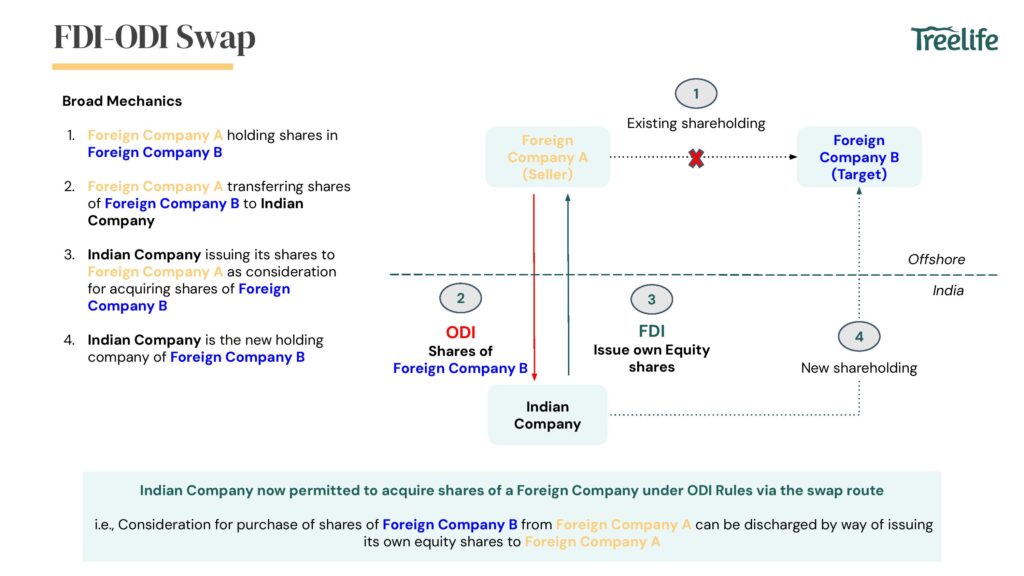
Following the recent budget announcement, which aimed to simplify regulations for Foreign Direct Investment (FDI) and Overseas Investment (ODI), the Department of Economic Affairs has amended the FEMA (Non-debt Instruments) Rules 2019. A significant aspect of this amendment is the introduction of a new provision that enables FDI-ODI swaps. We have curated a slide below to help you understand this better.
Broad Mechanics
- Foreign Company A holding shares in Foreign Company B.
- Foreign Company A transferring shares of Foreign Company B to Indian Company.
- Indian Company issuing its shares to Foreign Company A as consideration for acquiring shares of Foreign Company B.
- Indian Company is the new holding company of Foreign Company B.
Indian Company now permitted to acquire shares of a Foreign Company under ODI Rules via the swap route.
i.e., Consideration for purchase of shares of Foreign Company B from Foreign Company A can be discharged by way of issuing its own equity shares to Foreign Company A.
𝘖𝘵𝘩𝘦𝘳 𝘢𝘮𝘦𝘯𝘥𝘮𝘦𝘯𝘵𝘴:
1. Investment by OCIs on non-repat basis 𝐞𝐱𝐜𝐥𝐮𝐝𝐞𝐝 from calculation of indirect foreign investment. Earlier only NRI investment was excluded.
2. Aggregate FPI cap of 49% of paid-up capital on a fully diluted basis has now been removed. FPIs now required to 𝐨𝐧𝐥𝐲 𝐜𝐨𝐦𝐩𝐥𝐲 𝐰𝐢𝐭𝐡 𝐬𝐞𝐜𝐭𝐨𝐫𝐚𝐥 𝐨𝐫 𝐬𝐭𝐚𝐭𝐮𝐭𝐨𝐫𝐲 𝐜𝐚𝐩.
3. ‘White Label ATM Operations’ has been recognized as a new sector, with 100% 𝐅𝐃𝐈 𝐧𝐨𝐰 𝐚𝐥𝐥𝐨𝐰𝐞𝐝 𝐮𝐧𝐝𝐞𝐫 𝐭𝐡𝐞 𝐚𝐮𝐭𝐨𝐦𝐚𝐭𝐢𝐜 𝐫𝐨𝐮𝐭𝐞.
Key Indian players in this sector: India1 Payments, Indicash ATM (Tata Communications), Vakrangee, and Hitachi Payments.
4. NR to NR transfer will require prior Govt approval 𝐰𝐡𝐞𝐫𝐞𝐯𝐞𝐫 𝐚𝐩𝐩𝐥𝐢𝐜𝐚𝐛𝐥𝐞. In the erstwhile provisions, it was required only if investment in the specific sector required prior Govt approval.
5. Definitions – Control now defined in Rule 2, and definition of “startup company” has been aligned with “startups” recognised by DPIIT vide notification dated February 19, 2019. Definitions of “control” and “startup company” elsewhere have been deleted.
About the Author
Share
-
Link copied to clipboard!https://treelife.in/finance/fdi-odi-swap-following-budget-2024/

-

-

-

-

Jitesh Agarwal

Founder | jitesh@treelife.in
Leads the VCFO, finance tax, and regulatory functions at Treelife. Responsible for the firm’s non-operational growth and providing strategic advisory in GIFT City, helping clients navigate complex regulatory landscapes effectively.
Priya Kapasi Shah
Associate Partner | Tax & Regulatory | priya.k@treelife.in
Heads Treelife’s Financial Advisory practice, specializing in investment structuring, cross-border transactions, and tax and regulatory advisory. Also leads on AIF setups and advisory services for GIFT IFSC.
Jitesh Agarwal
Founder
Leads VCFO, finance, tax, and regulatory functions at Treelife. Advises on GIFT City structuring and strategic financial decisions for startups and scale-ups.
Priya Kapasi Shah
Associate Partner | Tax & Regulatory
Heads Financial Advisory at Treelife, specialising in investment structuring, cross-border transactions, AIF setups, and tax and regulatory advisory.
We Are Problem Solvers. And Take Accountability.
Related Posts

Financial Dashboard Services for Startups
Financial dashboard services for startups in India work on top of the ledger, not beside it. A provider connects the...
Learn More

Investor Relations and Reporting Services
Investor reporting services in India sit between the fund accountant who closes the books and the manager who has to...
Learn More

Financial Planning and Analysis Services in India
Financial planning and analysis services in India cover the forward-looking half of finance: the annual operating plan, the rolling forecast,...
Learn More

Budget Forecasting Services for Startups
Many startups reach Series A with a monthly MIS pack and no approved annual budget. Lead investors usually ask for...
Learn More

Monthly MIS Reporting Services for Businesses
MIS reporting services in India sit between the accountant who closes the books and the board that has to act...
Learn More

Interim CFO After CFO Resignation: Handover, Interim Cover, Hiring
A CFO resignation sets two clocks running at once. The first is operational: bank mandates, payroll sign-offs, audit queries and...
Learn More



Finance Function Setup After Seed Funding: Team, Systems, Controls
Finance function setup after seed funding is a sequencing problem, not a hiring problem. The cash arrives together with obligations:...
Learn More

Virtual CFO vs Accountant: Role, Deliverables & Which you need
A startup's first finance hire is almost always an accountant, and that is the right call. Books, GST and TDS...
Learn More

Virtual CFO Accounting & GST Filing: Scope, Handoffs, Controls
Virtual CFO accounting and GST filing in India work as one system, not two services. The books feed the invoice...
Learn More

Virtual CFO Payroll & TDS Compliance: Scope, Filing Controls
Virtual CFO payroll and TDS compliance covers the full cycle, from salary structuring to the last salary TDS certificate handed...
Learn More
© 2026 Treelife Ventures Services Private Limited. All Rights Reserved.