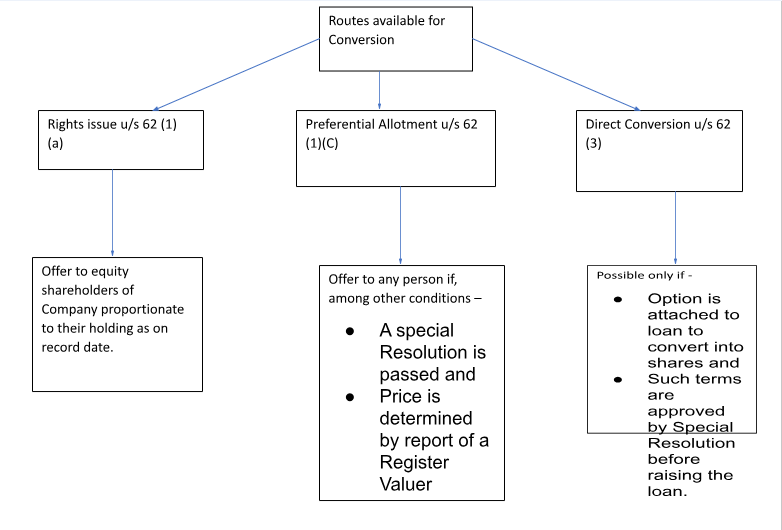

Conversion of loan into equity under the Companies Act, 2013 is a structured mechanism that allows a company to extinguish a debt obligation by issuing equity shares to the lender in lieu of repayment. This debt-to-equity swap is governed by Section 62(3), and requires the conversion option to be built into the original loan terms and approved by shareholders through a special resolution before the loan is accepted. The company then files Form MGT-14 at loan acceptance and Form PAS-3 at conversion. The conversion ratio (the number of shares issued per unit of loan extinguished) must be determinable from the loan agreement, either as a fixed number or through a pricing formula referencing a future valuation. This approach is common in startup financing, where directors or promoters have extended working capital loans and wish to formalise their economic contribution as share capital. It is also used in restructuring situations where cash repayment is not feasible.
Picture this: A company, in its quest for financial sustenance, may find solace in loans from its director, their kin, or even other corporate entities. These funds serve myriad purposes, from greasing the wheels of day-to-day operations to amplifying existing infrastructures. Now, here’s the kicker: while obligated to settle its debts within agreed-upon terms, this company has a sneaky little ace up its sleeve. Instead of the mundane ritual of repayment, it can charm its lenders by offering to morph those loans into shares, a sort of financial shape shifting, if you will.
And guess what?
It’s all legit, courtesy of Section 62(3) of the Companies Act of 2013.
Talk about turning debt into dividends, right?
Limits of Borrowings & Approvals required, if any
Pursuant to MCA Notification dated 05/06/2015, the provisions of Section 180 of the Companies Act, 2013 are not applicable to private limited companies.
| Sections | Requirements |
|---|---|
| Section 180(1)(c) of the Act, 2013 | This section states that the Board of Directors of a company shall exercise the borrowing powers only with the consent of the company by a special resolution where the money to be borrowed, together with the money already borrowed by the company, will exceed aggregate of its paid-up share capital, free reserves and securities premium, apart from temporary loans obtained from the company’s bankers in the ordinary course of business. |
| Section 180(2) | Every special resolution passed by the company in general meeting in relation to the exercise of the powers referred to in clause (c) of sub-section (1) shall specify the total amount up to which monies may be borrowed by the Board of Directors. |
| Section 180(5) | No debt incurred by the company in excess of the limit imposed by clause (c) of sub-section (1) shall be valid or effectual, unless the lender proves that he advanced the loan in good faith and without knowledge that the limit imposed by that clause had been exceeded. |
Because Section 180 does not apply to private limited companies, a private company’s board can approve borrowings at any quantum without a shareholder resolution for that specific purpose. The shareholder approval that matters for conversion purposes is the special resolution required specifically under Section 62(3), discussed below.
We help with conversions of loans to equity. Let’s Talk
Who can give a loan to a company that can be converted into equity?
Before getting into the conversion mechanics, the source of the loan matters. The Companies Act, 2013 treats loans from different categories of persons differently.
| Particulars | Descriptions |
|---|---|
| Can the director or their relative give a loan to the company? | Section 73(2) read with Companies (Acceptance of Deposits) Rules, 2014: “Loan received from the Directors of the Company shall be considered as Exempted Deposit.” Loans accepted by a private limited company from its directors or their relatives are allowed out of their own funds and are treated as an exempt category deposit. A declaration must be obtained from the director confirming the funds are not borrowed, as per Rule 2(c)(viii) of the Companies (Acceptance of Deposits) Rules, 2014. |
| Can the Shareholders give loans to a Company? | Rule 3 of Companies (Acceptance of Deposits) Rules, 2014 , restricts company from accepting or renewing deposit from its members if the amount of such deposits together with the amount of other deposits outstanding as on the date of acceptance or renewal of such deposits exceeds 35% [thirty-five per cent] of the aggregate of the Paid-up share capital, free reserves and securities premium account of the company. Notification issued by MCA dated June 13, 2017 exempts Private Limited Companies from the restriction of accepting deposit only up to 35% from its members and they can accept it beyond 35% but subject to the following conditions listed below. |
i) The amount of deposit should not exceed 100% of the aggregate of the paid up share capital, free reserves and securities premium account; or
ii) It is a start-up, for five years from the date of its incorporation; or
iii) which fulfills all of the following conditions, namely: –
(a) Which is not an associate or a subsidiary company of any other company;
(b) The borrowings of such a company from banks or financial institutions or any Body corporate is less than twice of its paid-up share capital or fifty crore rupees, whichever is less; and
(c) such a company has not defaulted in the repayment of such borrowings subsisting at the time of accepting deposits under section 73
Provided also that all the companies accepting deposits shall file the details of monies so accepted to the Registrar in Form DPT-3.
Section 62(3) under the Companies Act of 2013 Groundbreaking shift in the financial landscape
The introduction of Section 62(3) under the Companies Act of 2013 marked a groundbreaking shift in the financial landscape. This provision allows companies to metamorphose loans into equity, but with a quirky catch. Only loans that come with an in-built option for future equity conversion, approved by shareholders through a special resolution, can take this magical transformational journey.
Now, let’s delve into the spellbinding process of converting these loans. Suppose a company has borrowed an unsecured loan from its directors and dreams of turning it into equity down the line. To make this enchantment happen, it must first forge a debt conversion agreement with said directors, sealing the pact. Then, through the mystical power of a special resolution, the company can set the wheels in motion for the conversion.
But wait, there’s more! Before the magic unfolds, the company must seek a declaration from the director or their kin, as per Rule 2(c)(viii) of the Companies (Acceptance of Deposits) Rules, 2014. This declaration is like a potion, ensuring that the borrowed sum isn’t conjured from thin air but has a tangible source i.e. such amount is not being given out of borrowed funds and the same is disclosed in the board report.
And thus, through this bewitching procedure, loans are transmuted into equity, weaving a tale of financial alchemy that dances between the realms of loans and shares.
The statutory text of Section 62(3) reads: “Nothing in this section shall apply to the increase of the subscribed capital of a company caused by the exercise of an option as a term attached to the debentures issued or loan raised by the company to convert such debentures or loans into shares in the company: Provided that the terms of issue of such debentures or loan containing such an option have been approved before the issue of such debentures or the raising of the loan by a special resolution passed by the company in general meeting.”
Three conditions must all be met for conversion to be valid under this provision:
- The conversion option must be a term attached to the loan at the time the loan is accepted.
- That term must be approved by shareholders via a special resolution. A special resolution requires a majority of not less than three-fourths (75%) of the members voting at a general meeting, under Section 114(2) of the Companies Act, 2013.
- The special resolution must be passed before the loan is raised, not after.
If any one of these is absent, the conversion cannot proceed under Section 62(3). The provision does not allow for retrospective curing.
Can a loan be converted into preference shares under Section 62(3)?
No. Section 62(3) permits conversion of a loan only into equity shares. It cannot be used to convert a loan into preference shares.
Section 62 as a whole addresses the further issue of share capital in the context of rights issues, ESOPs, and the carve-out under sub-section (3). The provision consistently refers to equity shares. Preference shares are separately governed under Section 55 of the Companies Act, 2013. There is no mechanism under Section 62(3) that authorises loan conversion into preference shares, and this position is consistent with the legislative intent of the provision.
If a company and its lender have agreed on a conversion into preference shares, a separate route under the terms of issue of preference shares, read with the company’s articles of association, would need to be considered. Treelife recommends getting this structuring question addressed before the loan agreement is executed, not at the time of conversion.
What if the special resolution was not passed at the time of loan acceptance?
This is one of the most common structuring errors Treelife encounters. The answer under Section 62(3) is unambiguous: if the special resolution was not passed before the loan was raised, the loan cannot be converted into equity under Section 62(3), even if the company passes a special resolution now.
The law requires the option to be embedded in the original loan terms and ratified by shareholders before the loan is raised. The words of the proviso are clear: “approved before the issue of such debentures or the raising of the loan.” Passing a retroactive special resolution at the time of conversion does not satisfy this condition.
What are the practical options if the SR was missed?
- Repay the loan as a loan. If cash is available, this is the cleanest resolution.
- Convert through a fresh rights issue or preferential allotment under Section 62(1)(c), where the existing lender participates as a new investor. This requires a fresh valuation, FEMA compliance if the lender is a foreign entity, and potentially a new shareholder agreement.
- Seek legal advice on whether the original loan agreement, read purposively, can be construed as containing the conversion option, and document accordingly before taking any steps.
This is a situation where acting without advice compounds the risk. An informal conversion of a loan that did not carry an SR-backed conversion clause is a potential violation of Section 62(3) and can be challenged by the Registrar of Companies or by other shareholders.
Converting unsecured vs. secured loans into equity: what changes?
Unsecured loans convert more straightforwardly. For secured loans, two additional layers apply.
Unsecured loans: Where the loan is unsecured (no charge registered on the company’s assets), conversion proceeds through the standard Section 62(3) route described in this article.
Secured loans: Where the loan is secured by a registered charge under Section 77 of the Companies Act, 2013, the following additional steps are required:
- The lender must consent to release the security as part of the conversion.
- The charge must be satisfied and Form CHG-4 (Intimation of Satisfaction of Charge) must be filed with the Registrar of Companies within 30 days of satisfaction.
- If the lender does not release the security, the conversion cannot happen without legal resolution of the security interest.
Director loans extended to private companies are almost always unsecured, so in the startup context this distinction rarely applies. Where a promoter or corporate body has extended a secured loan, this step cannot be skipped.
Compliances to be undertaken at the time of taking loans
1) Hold a Board Meeting & pass a resolution
- For accepting a loan with an option to convert it to equity in future.
- To fix time, date and place of extra ordinary general meeting & to approve the draft notice along with explanatory statement of extra ordinary general meeting.
2) Hold Extra Ordinary General Meeting and Pass a special resolution for accepting the loan with an option to convert it to equity in future and giving authority to enter into loan conversion agreement
- Execute a loan conversion agreement between the company and lenders.
- File form MGT-14 within 30 days of passing the special resolution.
A few practical points on each step:
The board meeting notice must be given at least 7 days in advance as per Secretarial Standard SS-1. The EGM notice must be given at least 21 days in advance, or shorter notice with the written consent of at least 95% of shareholders entitled to vote. The loan conversion agreement must explicitly state the conversion option as a term of the loan, and should specify at minimum a pricing mechanism (a formula, a floor price, or a reference to a future valuation) so that the number of shares to be issued at conversion is determinable. MGT-14 must be filed within 30 days of the special resolution under Section 117 of the Companies Act, 2013. Late filing attracts a penalty of Rs. 100 per day subject to a maximum of Rs. 5 lakhs.
Compliances to be undertaken at the time of Converting loans to Equity
This is Phase 2, triggered when the conversion option is exercised.
Hold a Board Meeting & Pass a Resolution for Allotment of Shares by converting the loan to equity
- Finalize list of allottee to whom the allotment is to be made pursuant to such conversions.
- File Return of Allotment in Form PAS-3 within 30 days of passing Board Resolutions.
- Payment of stamp duty & issue share certificates to the lender.
- Enter the name of the Member in the Statutory Registers of Members.
The board meeting for conversion must also cover the following additional agenda items:
- Confirm that all pre-conditions are satisfied: the loan agreement had a conversion clause, the special resolution was passed before loan acceptance, and the conversion terms (price, ratio, time period) are being met.
- Take note of the conversion request or trigger event from the lender (in writing).
- Consider and approve the valuation report (see below for when this is required).
- Pass a board resolution approving the conversion of the loan into equity shares and allotment of shares to the lender.
- Approve the number of shares to be allotted based on the outstanding loan amount and the agreed price per share.
- Authorise filing of Form PAS-3 with the ROC.
- Authorise issuance of share certificates in Form SH-1.
Additional post-board steps:
- Update the Register of Allotments.
- If the loan was secured, file Form CHG-4 to intimate satisfaction of charge.
- If the lender is a director or related party, update Form MBP-1 (notice of interest) as relevant.
Note on MGT-14 at conversion stage: A fresh MGT-14 is not required at the conversion stage because no fresh special resolution is passed at this point. The special resolution was already filed at the time of loan acceptance.
Step-by-step procedure for conversion of loan into equity shares
Process overview table
| Step | Activity | Statutory reference | Responsible party | Timeline |
|---|---|---|---|---|
| 1 | Draft loan agreement with conversion clause | Section 62(3) | Legal / Finance team | Before loan acceptance |
| 2 | Convene board meeting to approve loan and EGM notice | Section 173, SS-1 | Board of Directors | Before loan acceptance |
| 3 | Pass special resolution at EGM approving loan with conversion option | Section 62(3) proviso | Shareholders in general meeting | Before loan acceptance |
| 4 | Execute loan conversion agreement | Loan agreement terms | Board / Legal team | At time of loan acceptance |
| 5 | File Form MGT-14 | Section 117 | Company Secretary / CS firm | Within 30 days of SR |
| 6 | Accept loan as per approved terms | Section 179(3) | Board of Directors | Post SR |
| 7 | Obtain director declaration (own funds) | Rule 2(c)(viii), Deposit Rules | Director / Lender | Before disbursement |
| 8 | File Form DPT-3 (if applicable) | Rule 16, Deposit Rules | Company Secretary | As applicable |
| 9 | Initiate conversion upon exercise of option | Loan agreement terms | Company management | At conversion trigger |
| 10 | Obtain valuation report | Practical / tax / FEMA requirement | Registered Valuer (IBBI) | At time of conversion |
| 11 | Convene board meeting for allotment of shares | Section 62, Section 179 | Board of Directors | At conversion |
| 12 | File Form PAS-3 (Return of Allotment) | Section 39(4), Rule 12 of PAS Rules | Company Secretary | Within 30 days of allotment |
| 13 | Update Register of Members and Register of Allotments | Section 88, Rule 5 of MGT Rules | Company Secretary | Immediately post allotment |
| 14 | Issue share certificates in Form SH-1 | Section 56, Rule 5 of SH Rules | Company Secretary | Within 2 months of allotment |
| 15 | Pay stamp duty on share certificates | State Stamp Acts | Company | At time of issue |
| 16 | File Form CHG-4 (if secured loan) | Section 82 | Company Secretary | Within 30 days of satisfaction |
Is a valuation certificate mandatory for conversion under Section 62(3)?
Section 62(3) does not explicitly require a valuation at either stage. The provision simply permits the conversion if the option was pre-agreed and approved by special resolution. However, valuation is practically and legally necessary at the time of conversion for three distinct reasons.
Valuation is not required at loan acceptance. No shares are being issued at that point. The conversion is a contingent right for the future. Prescribing a price at the time of acceptance is not mandatory under Section 62(3), though the loan agreement typically should contain at least a pricing mechanism (a formula, a floor price, or a reference to a future valuation).
Valuation is required at the time of conversion. The actual issuance of shares happens at conversion, which triggers the following requirements:
- Fair price per share must be determined to justify the number of shares allotted against the loan amount.
- Under the Companies (Share Capital and Debentures) Rules, 2014, a valuation report is required where shares are issued for a consideration other than cash. Conversion of a loan into shares is effectively a non-cash consideration for shares.
- The valuation report should be prepared by a registered valuer under the Insolvency and Bankruptcy Board of India (IBBI) Valuation Rules.
- If there is a FEMA angle (where the lender is a non-resident or the company has foreign investment), RBI pricing guidelines apply and a merchant banker or chartered accountant valuation is required.
- For income tax purposes, if shares are issued below fair market value, Section 56(2)(x) of the Income Tax Act, 1961 can be triggered. This is discussed in the tax section below.
Summary:
| Aspect | Valuation required? |
|---|---|
| At time of loan acceptance | No |
| At time of conversion (to determine fair share price) | Yes, practically and under SH Rules |
| For FEMA compliance (foreign lender) | Yes, mandatory |
| For income tax (Section 56(2)(x)) | Yes, to determine FMV and avoid deemed income |
Benefits and Drawbacks of Converting Loan into Equity
Transforming loans into shares presents a tantalizing array of benefits for both companies and lenders alike. For companies, this maneuver provides a convenient escape from the burdens of debt repayments, potentially bolstering their financial metrics in the process. Meanwhile, lenders stand to gain a foothold in the company’s ownership structure, forging a symbiotic relationship wherein their fortunes are intricately tied to the company’s prosperity.
Yet, amid the allure of these advantages, it is crucial to cast a discerning eye on the potential pitfalls lurking in the shadows. The conversion process may cast a spell of dilution upon existing shareholders, diminishing their ownership stakes and potentially stirring unrest within the company’s ranks. Additionally, the mercurial nature of equity ownership introduces an element of unpredictability for lenders, as they navigate the turbulent waters of market fluctuations and volatility.
Thus, while the alchemy of converting loans into shares may promise riches, it is prudent for both companies and lenders to tread carefully, weighing the glittering rewards against the shadows of potential risks. After all, in the realm of finance, every enchantment carries its own set of enchantments and perils.
Breaking this down further:
Benefits for the company:
- The debt obligation is extinguished without a cash outflow. This directly improves the company’s cash position and reduces working capital strain.
- The liability on the balance sheet converts into equity, improving the debt-to-equity ratio. This matters for future lenders and investors who look at net worth and leverage.
- The company’s paid-up share capital increases, which can increase the cap for future deposits and borrowings.
- For startups approaching a fundraise, a cleaner balance sheet with fewer outstanding loans reduces friction in due diligence.
Benefits for the lender:
- The lender acquires an ownership stake and participates in the company’s upside as a shareholder.
- Instead of waiting for debt repayment from a company that may be cash-constrained, the lender converts a receivable into an asset with growth potential.
- If the company performs well, the equity stake can be significantly more valuable than the original loan amount.
Drawbacks and risks:
- Existing shareholders face dilution. Their percentage ownership decreases when new shares are issued. If the conversion is at a price lower than the current fair market value of the shares, the dilution effect is more pronounced and can create friction with other shareholders.
- The lender takes on equity risk. As a shareholder, the lender’s returns are no longer fixed. If the company performs poorly, the equity could be worth less than the original loan amount.
- The lender loses priority in a liquidation. Debt holders rank above equity holders in a winding-up. Once converted to equity, the former lender has no priority claim.
- Governance dynamics can shift if the converted shareholding is significant. A new shareholder with meaningful equity may influence board composition and decision-making.
- The conversion is permanent. It cannot be reversed without a buyback of shares under Section 68 of the Companies Act, 2013, which is a separate, complex process with its own compliance requirements.
Post-conversion implications: what changes after loan converts to equity share capital
Once the conversion is complete, the company’s financial and governance structure changes in ways that need to be actively managed.
Post-conversion summary
| Area | Post-conversion implication |
|---|---|
| Capital structure | Increase in paid-up share capital |
| Debt position | Reduction in liability; debt-to-equity ratio improves |
| Shareholding | Dilution or change in control possible |
| ROC filings | PAS-3, SH-1, CHG-4 (if secured loan), DPT-3 |
| Income tax | FMV check under Section 56(2)(x); no deemed dividend on conversion itself |
| Financial ratios | Improved net worth, lower leverage |
| Governance | New shareholders may gain board influence depending on shareholding percentage |
| Disclosures | MBP-1 update if lender is a related party; update financial statements |
| Cap table | Update shareholders’ agreement and cap table with new entry |
Reporting and compliance post-conversion:
- The statutory Register of Members must be updated immediately.
- Share certificates in Form SH-1 must be issued within two months of allotment.
- If the converted shareholding crosses certain thresholds (e.g., where the company has a shareholders’ agreement with anti-dilution provisions or consent rights), those triggers must be reviewed.
- If the company has foreign investment, the new cap table must be assessed for compliance with FDI sectoral caps and any applicable FEMA filings.
Tax implications of converting a loan into equity
This is the area most companies handle poorly. The conversion of a loan into equity can create a tax event, and the risk sits with both the company and the shareholder.
Section 56(2)(x) of the Income Tax Act, 1961:
Where a company issues shares for consideration that is less than the fair market value (FMV) of those shares, the difference between the FMV and the consideration paid is taxable as “income from other sources” in the hands of the recipient (the new shareholder). This applies from the assessment year 2018-19 onwards.
In a loan-to-equity conversion, the consideration for the shares is the loan amount being extinguished. If the FMV of the shares at the time of conversion is higher than the price at which they are being issued (i.e., the per-share value implied by the loan conversion), the difference could be treated as a deemed gift and taxed under Section 56(2)(x).
Example: A director has given a loan of Rs. 50 lakhs to the company. The company agrees to issue 5,000 shares at Rs. 1,000 per share (implied conversion value Rs. 50 lakhs). If the FMV of the shares on the date of conversion, as determined by a registered valuer, is Rs. 1,500 per share, the deemed income in the hands of the director-turned-shareholder could be Rs. 25 lakhs (5,000 shares x Rs. 500 difference). This amount becomes taxable.
What this means in practice:
- Get a valuation done before conversion, not after. If the conversion price is at or above FMV, Section 56(2)(x) is not triggered.
- The valuation should be as of the date of conversion, not the date of the original loan.
- If the loan was given by the director at an earlier date and the company’s valuation has risen significantly since then, the gap between the loan amount and the current FMV could be large. In such situations, the conversion price may need to be set higher than the original loan amount to avoid a deemed income issue, which means the director would be contributing additional equity or the number of shares issued would be reduced.
Goods and Services Tax (GST): The conversion of a loan into equity shares does not attract GST. The issuance of shares is not a supply of goods or services under the GST framework.
Stamp duty on share certificates: Stamp duty is payable on the issuance of share certificates. Rates vary by state. In Maharashtra, for example, the stamp duty on share certificates is 0.1% of the total market value of the shares issued. This is a cash cost that must be factored in at the time of conversion.
Common mistakes in director loan to equity conversion that cost companies time and money
1. Accepting the loan before passing the special resolution
This is the single most common error. Once the loan is received without an SR-backed conversion clause, Section 62(3) is not available. The correction is expensive and disruptive. Pass the SR and execute the loan agreement before the funds are transferred.
2. Not filing Form MGT-14 within 30 days
The penalty for non-filing within 30 days is Rs. 100 per day for every day of default, up to a maximum of Rs. 5 lakhs, under Section 117 of the Companies Act, 2013. In addition, the MCA can levy a penalty of up to Rs. 25 lakhs on the company and up to Rs. 5 lakhs on each director and other officer in default. This is a disproportionate cost relative to the filing fee.
3. Not getting a valuation at the time of conversion
Skipping valuation saves money at the time but creates a Section 56(2)(x) exposure that may only surface at a tax assessment, often years later. The interest and penalty on undisclosed income can far exceed the cost of a registered valuer’s certificate.
4. Converting a secured loan without satisfying the charge
If the loan is secured and a charge is registered with the ROC, converting the loan without filing Form CHG-4 leaves a stale charge on the company’s charge register. This creates problems in future due diligence and can delay fundraising or M&A transactions.
5. Assuming the conversion cures an undocumented loan
If the original loan was not properly documented (no loan agreement, no board resolution, informal transfer), converting it into equity does not retroactively legitimise the transaction. The ROC and tax authorities can still question the origin and nature of the funds. All prior documentation gaps must be addressed before proceeding with conversion.
Penalties for non-compliance
Non-compliance at any stage of the conversion process carries specific statutory consequences.
| Default | Penalty provision | Quantum |
|---|---|---|
| Non-filing of Form MGT-14 within 30 days of SR | Section 117, Companies Act 2013 | Rs. 100/day, max Rs. 5 lakhs on company; up to Rs. 5 lakhs on each defaulting officer |
| Non-filing of Form PAS-3 within 30 days of allotment | Section 39(4), Companies Act 2013 | Rs. 1,000/day, max Rs. 25 lakhs on company; up to Rs. 1 lakh on each defaulting officer |
| MCA penalty on company for procedural non-compliance | Section 450 | Up to Rs. 25 lakhs on the company |
| Non-filing of Form DPT-3 where applicable | Rule 21A, Companies (Acceptance of Deposits) Rules | Rs. 5,000/day during which failure continues |
| Tax underpayment under Section 56(2)(x) | Income Tax Act, 1961 | Tax on deemed income at applicable slab / rate, plus interest under Sections 234A, 234B, 234C, and a penalty up to 200% of tax on under-reported income |
Is debt-to-equity conversion reversible? What happens after loan-to-equity conversion
No. Once a loan is converted into equity shares and allotted, the conversion is permanent.
The only mechanism to undo it is a buyback of shares under Section 68 of the Companies Act, 2013. A buyback requires the company to have sufficient free reserves or securities premium, imposes restrictions on the buyback size (maximum 25% of total paid-up capital and free reserves in a financial year), and requires board and shareholder approvals. It is a separate statutory process, not a simple reversal.
If the parties are uncertain about whether conversion is the right step, they should address that uncertainty before executing the allotment. After the shares are issued and PAS-3 is filed, there is no clean unwinding.
Treelife practitioner note
In the loan-to-equity conversion engagements we have run at Treelife, the most consistent pattern we see is a gap between Phase 1 (loan acceptance) and Phase 2 (conversion) that is longer than expected, sometimes by years. A director gives a loan when the company needs cash, the SR and loan agreement are executed properly at that point, and then the conversion is initiated during a fundraise preparation, when the investor’s due diligence team wants a cleaner balance sheet.
By the time conversion is initiated, the company’s valuation has often increased significantly. This creates the Section 56(2)(x) question: the shares being issued to the director at the implied loan conversion price may be well below the current FMV. Getting a registered valuer’s certificate dated to the conversion date is not optional in this scenario. It is the only way to defend the conversion price and avoid a deemed income addition in the director’s tax assessment.
The second recurring issue is the DPT-3 filing. Many companies accept director loans correctly, execute the SR and loan agreement, file MGT-14, but forget DPT-3. Rule 16A of the Companies (Acceptance of Deposits) Rules, 2014 requires every company (other than a government company) to file Form DPT-3 on or before 30 June of each year, disclosing the amounts that are not deposits. Unsatisfied charges on DPT-3 filings surface in ROC searches and can complicate due diligence.
A third pattern: the loan agreement is executed but does not specify a conversion price or a pricing mechanism. When conversion is triggered, there is ambiguity about how many shares to issue. The board then sets a price retrospectively, which creates a documentation gap. The loan agreement must, at minimum, specify a formula or a reference valuation methodology.
Treelife has supported over 250 transactions across fundraising, corporate restructuring, and compliance. If you are planning a loan-to-equity conversion and want to walk through your specific structure, Book a Free Call with our Team.
Conclusion
Converting loans into shares stands as a strategic financial maneuver, but it demands meticulous scrutiny and compliance with legal and regulatory frameworks. To embark on this journey successfully, one must grasp the benefits and drawbacks, meticulously weigh practicalities, and seek expert guidance.
Through such diligent navigation of complexities, companies and lenders can unlock the unique advantages inherent in loan-to-share conversions while effectively managing associated risks. In essence, it’s a delicate dance where careful steps pave the way to financial opportunity and compliance.
That said, the sequencing at loan acceptance is the single most important variable. The special resolution and the conversion clause in the loan agreement must precede the disbursement. If that foundation is in place, the conversion itself is a straightforward compliance exercise: a second board meeting, a valuation certificate, Form PAS-3, share certificates in Form SH-1, and updated statutory registers.
The tax angle under Section 56(2)(x) of the Income Tax Act, 1961 is the most frequently overlooked risk. Where the company’s valuation has risen since the loan was extended, the conversion price must be tested against the current FMV. Post-conversion, the cap table, governance documents, and ROC records must all be updated. For secured loans, the charge must be satisfied and Form CHG-4 filed.
Companies and their directors who have extended informal or undocumented loans should address the documentation before attempting conversion. Treelife handles both the compliance sequencing and the tax structuring for these transactions.
FAQs on Conversion of Loan into Equity under Companies Act, 2013
Here is the full list, no separators, original 10 FAQs word for word:
Q. Can a company convert a loan into equity?
A. Yes, a company can convert a loan into equity shares under Section 62(3) of the Companies Act, 2013. However, this is only permitted if the loan agreement includes a clause for conversion into equity and such a proposal is approved by the shareholders through a special resolution.
Q. Who can provide loans to a company that can later be converted into equity?
A. Loans can be received from directors, their relatives, or other corporate entities. Loans from directors and their relatives (out of their own funds) are treated as “exempt deposits” under Section 73(2) read with the Companies (Acceptance of Deposits) Rules, 2014, making them legally permissible for conversion subject to conditions.
Q. Can shareholders provide loans to a company?
A. Yes, shareholders can lend to a company. However, under Rule 3 of the Companies (Acceptance of Deposits) Rules, 2014, such loans are subject to a cap of 35% of the company’s paid-up share capital, free reserves, and securities premium. Notably, private companies have been granted certain exemptions, allowing them to accept loans exceeding this limit under specific conditions notified by the Ministry of Corporate Affairs (MCA) on June 13, 2017.
Q. What conditions must be met for a loan to be converted into equity?
A. The loan agreement must include a clear clause permitting future conversion into equity. A special resolution must be passed by shareholders authorizing such conversion. A formal loan conversion agreement must be executed. The lender (director or relative) must declare that the loan is from their own funds and not borrowed from others, as per Rule 2(c)(viii) of the Companies (Acceptance of Deposits) Rules, 2014.
Q. What compliances are required at the time of accepting a convertible loan?
A. Convene a Board Meeting and approve the acceptance of the loan with an option to convert it into equity. Conduct an Extraordinary General Meeting (EGM) and pass a special resolution for the same. Execute a loan conversion agreement between the company and the lender. File Form MGT-14 with the Registrar of Companies (ROC) within 30 days of passing the special resolution.
Q. What formalities must be completed when converting a loan into equity?
A. Conduct a Board Meeting to approve the allotment of equity shares against the loan amount. Prepare and finalize the list of allottees. File Form PAS-3 (Return of Allotment) with the ROC within 30 days. Issue share certificates to the lenders and ensure their names are entered in the statutory register of members. Pay applicable stamp duty on share certificates.
Q. Are there borrowing limits for private companies under the Companies Act, 2013?
A. No, as per MCA Notification dated June 5, 2015, the provisions of Section 180 relating to borrowing limits do not apply to private limited companies. Therefore, private companies can borrow without the need for shareholder approval under this section.
Q. What are the advantages of converting loans into equity shares?
A. Reduces the company’s debt obligations, thereby improving its financial health. Strengthens the company’s balance sheet by enhancing equity capital. Lenders gain ownership interest and may benefit from the company’s future growth and profitability.
Q. What are the potential drawbacks of loan-to-equity conversion?
A. Dilution of existing shareholders’ equity and control. Lenders take on equity risks, including exposure to market volatility and performance-based returns. It may impact internal dynamics or decision-making due to the change in ownership structure.
Q. Is payment of stamp duty necessary after conversion?
A. Yes, stamp duty must be paid on the issuance of share certificates as per applicable state laws. The company is also required to deliver share certificates to the respective shareholders and update its statutory registers accordingly.
Q. Can a loan be converted into preference shares under Section 62(3)?
A. No. Section 62(3) permits conversion only into equity shares. Preference shares are separately governed by Section 55 of the Companies Act, 2013. There is no mechanism under Section 62(3) that authorises loan conversion into preference shares. If a conversion into preference shares is intended, a separate route must be considered at the time of structuring the loan, not at conversion.
Q. What if the company did not pass a special resolution before accepting the loan?
A. The conversion cannot proceed under Section 62(3) if the special resolution was not passed before the loan was raised. A retroactive special resolution at the time of conversion does not satisfy the statutory requirement. The company must consider alternative routes such as a fresh preferential allotment under Section 62(1)(c), which requires a fresh valuation and its own compliance process.
Q. Is a valuation certificate mandatory for conversion under Section 62(3)?
A. Section 62(3) does not explicitly mandate valuation. However, a valuation by a registered valuer (IBBI) is practically necessary at the time of conversion to determine the fair share price, comply with the Companies (Share Capital and Debentures) Rules, 2014, address Section 56(2)(x) income tax exposure, and comply with FEMA pricing guidelines if the lender is a foreign entity.
Q. Can a secured loan be converted into equity?
A. Yes, but additional steps apply. The lender must consent to release the security, and Form CHG-4 (Intimation of Satisfaction of Charge) must be filed with the ROC within 30 days of satisfaction of the charge. An unsatisfied charge cannot be carried forward post-conversion.
Q. Is loan-to-equity conversion reversible?
A. No. Once shares are allotted and Form PAS-3 is filed, the conversion is permanent. The only mechanism to undo it is a buyback of shares under Section 68 of the Companies Act, 2013, which is a separate statutory process requiring sufficient free reserves, board and shareholder approvals, and compliance with buyback size restrictions.
Q. What are the tax implications of converting a loan into equity?
A. If shares are issued below their fair market value at the time of conversion, Section 56(2)(x) of the Income Tax Act, 1961 may treat the difference between the FMV and the issue price as deemed income in the hands of the recipient shareholder. A valuation certificate dated to the conversion date, confirming that the issue price is at or above FMV, is the primary protection against this exposure. The conversion itself does not attract GST.
Regulatory references:
- Section 62(3), Companies Act, 2013 (conversion of loan into equity shares)
- Section 73(2), Companies Act, 2013 (exempted deposits from directors)
- Section 117, Companies Act, 2013 (filing of resolutions, penalty for non-filing of MGT-14)
- Section 39(4), Companies Act, 2013 (return of allotment, penalty for non-filing of PAS-3)
- Section 55, Companies Act, 2013 (preference shares)
- Section 56, Companies Act, 2013 (share certificates)
- Section 68, Companies Act, 2013 (buyback of shares)
- Section 77, Companies Act, 2013 (registration of charges)
- Section 82, Companies Act, 2013 (satisfaction of charges)
- Section 88, Companies Act, 2013 (register of members)
- Section 173, Companies Act, 2013 (board meetings)
- Section 179(3), Companies Act, 2013 (powers of board)
- Section 180(1)(c), Section 180(2), Section 180(5), Companies Act, 2013 (borrowing limits)
- Rule 2(c)(viii), Companies (Acceptance of Deposits) Rules, 2014 (director declaration)
- Rule 3, Companies (Acceptance of Deposits) Rules, 2014 (deposits from members)
- Rule 16A, Companies (Acceptance of Deposits) Rules, 2014 (Form DPT-3)
- Rule 5, Companies (Share Capital and Debentures) Rules, 2014 (SH-1 share certificates)
- Section 56(2)(x), Income Tax Act, 1961 (deemed income on shares issued below FMV)
- MCA Notification dated 05/06/2015 (Section 180 not applicable to private companies)
- MCA Notification dated 13/06/2017 (exemption from 35% deposit cap for private companies)
- IBBI Registered Valuers Rules (valuation requirement for share issuance)
- Secretarial Standards SS-1 (board meetings)