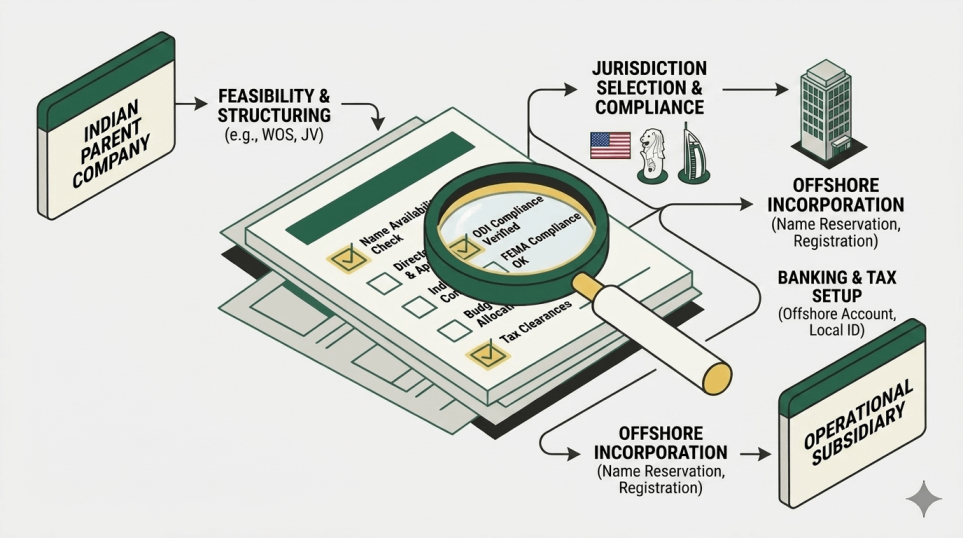

When an Indian startup sets up a wholly owned subsidiary in Singapore, incorporates a Delaware holding company, or invests in a foreign entity as part of a global expansion, it has made an Overseas Direct Investment (ODI) under the Foreign Exchange Management Act (FEMA), 1999. The moment the first outbound remittance or financial commitment is made, a compliance clock starts. Most founders only discover it after an AD bank flags a missing filing or an investor’s due diligence team raises a red flag. This guide walks through every element of the FEMA ODI framework as it stands in 2026: the governing instruments, investment limits, permitted funding modes, reporting obligations, startup-specific restrictions, and the real cost of non-compliance.
What is the FEMA ODI framework and what changed in August 2022?
Overseas Direct Investment from India is governed by a three-instrument framework notified by the Ministry of Finance and the Reserve Bank of India (RBI) on 22 August 2022, replacing the decades-old Foreign Exchange Management (Transfer or Issue of Any Foreign Security) Regulations, 2004 (FEMA 120) and the 2015 immovable property regulations in their entirety.
The three instruments are:
- Foreign Exchange Management (Overseas Investment) Rules, 2022: issued by the Central Government, setting the legal framework, definitions, and outer boundaries of permissible investment.
- Foreign Exchange Management (Overseas Investment) Regulations, 2022: issued by the RBI (FEMA 400/2022-RB dated 22 August 2022), providing operational clarity on eligibility, limits, and conditions.
- Foreign Exchange Management (Overseas Investment) Directions, 2022: issued by the RBI to Authorised Dealer (AD) Category-I banks, prescribing how transactions are processed and reported through the banking system.
The 2022 framework replaced the narrow “Joint Venture/Wholly Owned Subsidiary” terminology with the broader concept of “Foreign Entity,” expanding the scope of permissible investments. It also introduced a unified classification: all outbound investments are now either Overseas Direct Investment (ODI) or Overseas Portfolio Investment (OPI), governed under a single consolidated umbrella rather than separate notification silos.
The key structural improvements the new framework introduced over FEMA 120 include: enhanced definitional clarity, the formal introduction of the concept of “strategic sector” investments, explicit regulation of round-tripping structures (previously handled only through RBI FAQs), dispensing with several categories of prior approval, and introducing a late submission fee mechanism to regularise reporting delays without forcing full compounding.
What counts as ODI?
Under the 2022 Rules, an investment qualifies as ODI in four scenarios:
- Acquisition of any unlisted equity capital of a foreign entity.
- Subscription to the Memorandum of Association of a foreign entity at the time of incorporation.
- Investment of 10% or more of the paid-up equity capital of a foreign entity that is listed on a recognised stock exchange abroad.
- Investment of less than 10% of the paid-up equity capital of a listed foreign entity, where the investor has “control” over that entity (meaning the right to appoint majority directors or control management/policy decisions, including through voting agreements of 10% or more).
A common misconception among early-stage founders is that simply incorporating a Delaware LLC or a Singapore Pte Ltd without remitting cash does not trigger ODI. The RBI’s position, consistent with the 2022 framework, is that where an Indian resident has “control” over a foreign entity, even if no cash has been remitted, the transaction constitutes ODI and must be reported through the AD bank via Form FC. A controlled zero-capital Delaware incorporation, for example, would still need to be reported.
ODI versus OPI
Table 1: ODI vs OPI: classification at a glance
| Parameter | Overseas Direct Investment (ODI) | Overseas Portfolio Investment (OPI) |
|---|---|---|
| Nature of security | Unlisted equity (any %); listed equity (10% or more) | Listed securities only (less than 10%) |
| Control rights | Investment with control, regardless of percentage held | No control rights permitted |
| Eligible instruments | Equity, loans, guarantees, other financial commitments | Listed equity/debt, units of AIFs or VCFs |
| Reporting requirements | Comprehensive (Form FC, APR, FLA) | Simplified reporting obligations |
| Investment route | Automatic or approval, based on limits | Generally automatic route |
For most startup structures involving a wholly owned subsidiary or a controlling stake in a foreign entity, the relevant classification is ODI. OPI applies to passive minority positions in listed foreign companies.
Who can make ODI under FEMA?
Eligible Indian entities for ODI purposes under the 2022 Rules include:
- A company incorporated under the Companies Act, 2013.
- A Limited Liability Partnership (LLP) formed under the Limited Liability Partnership Act, 2008.
- Any other entity recognised by the Central Government for this purpose.
Resident individuals can also make overseas investments, but only through the Liberalised Remittance Scheme (LRS) at a limit of USD 2,50,000 per financial year (April to March). Under LRS, individual investors can invest only in operating entities and cannot use LRS funds to invest in financial services businesses or to create step-down subsidiaries.
Registered trusts and societies can make ODI only with prior RBI approval, and only for activities consistent with charitable or religious purposes.
Entities that are wilful defaulters, classified as NPAs, or under active investigation by the Central Bureau of Investigation, Directorate of Enforcement, SEBI, or any other regulatory authority in India are not eligible for the automatic route and will need specific RBI clearance.
What about DPIIT-recognised startups?
Startups with a valid DPIIT recognition certificate are permitted to undertake ODI under the 2022 framework, subject to all applicable conditions. However, they are subject to one critically important restriction that differs from the treatment of established companies, which is discussed in detail in the funding modes section below.
What is the 400% net worth cap and how does it apply to early-stage startups?
The single most important financial constraint in the ODI framework is the financial commitment ceiling. An Indian entity’s total financial commitment across all overseas investments, including equity, loans extended to the foreign entity, and guarantees issued on behalf of the foreign entity, must not exceed 400% of the entity’s net worth as per the last audited balance sheet.
The formula is:
Maximum permissible financial commitment = Net worth (last audited balance sheet, not older than 18 months) × 4
Net worth here means paid-up capital plus free reserves, calculated from the most recently completed audited balance sheet. The RBI requires that the balance sheet used for this calculation be not more than 18 months old at the time of the investment. A startup whose last audit was finalised more than 18 months ago cannot rely on it to calculate the 400% ceiling and must first close and audit its latest financial year. The net worth calculation does not include the net worth of any subsidiary or holding company of the investing entity. This is a key change from the pre-2022 framework.
For a startup that has just completed a seed round and has a paid-up capital of ₹25 lakhs with accumulated losses, the net worth may effectively be negligible or even negative, making the 400% cap extremely tight. A company with a net worth of ₹10 lakhs can make a total financial commitment of only ₹40 lakhs under the automatic route. This is a structural constraint that many early-stage founders underestimate when planning to set up a Singapore or US subsidiary.
What counts towards the ceiling?
Four categories of financial commitment are aggregated:
- Equity invested in the foreign entity (100% of the amount).
- Loans extended to the foreign entity, whether or not disbursed (100% of the sanctioned amount).
- Guarantees issued on behalf of the foreign entity, including contingent guarantees not yet called (100% of the guarantee amount).
- Pledges or charges created on the assets of the Indian entity or its subsidiary for the benefit of the foreign entity (100% of the amount secured).
A common mistake is to monitor only equity deployed and ignore guarantees and pledges. If an Indian parent company guarantees a USD 5,00,000 facility for its Singapore subsidiary, that guarantee consumes headroom against the 400% cap from the date of issuance, not from the date of potential invocation. Similarly, pledging Indian assets as security for a foreign entity’s borrowing counts dollar-for-dollar against the ceiling.
Table 2: Illustrative 400% cap scenarios for early-stage Indian startups
| Net worth of Indian entity | Maximum ODI headroom (400%) | Practical implication |
|---|---|---|
| ₹5 lakhs | ₹20 lakhs | Only a very small equity contribution to a foreign entity |
| ₹25 lakhs | ₹1 crore | Modest subsidiary capitalisation; no headroom for guarantees |
| ₹1 crore | ₹4 crore | Moderate; adequate for initial Singapore/UAE setup |
| ₹10 crore | ₹40 crore | Substantial headroom for larger operations or multiple entities |
| ₹50 crore | ₹200 crore | Full flexibility under automatic route for most structures |
Investments beyond the 400% ceiling require the approval route, where the Indian entity must submit a detailed application through its AD bank to the RBI’s Foreign Exchange Department.
Automatic route versus approval route: which applies to your structure?
Most ODI by Indian companies qualifies for the automatic route, meaning no prior RBI approval is required. Under the automatic route, the Indian entity proceeds through its designated AD Category-I bank, which processes the Form FC filing and remittance.
Automatic route conditions (all must be met):
- Total financial commitment across all overseas investments does not exceed 400% of net worth.
- The investment is not in a prohibited sector (gambling, real estate trading, or activities dealing in financial products linked to the Indian Rupee without specific RBI permission).
- The foreign entity is engaged in bona fide business activities.
- The Indian entity is not a wilful defaulter, NPA, or under regulatory investigation.
- The structure does not result in more than two layers of subsidiaries (Rule 19(3) of the OI Rules, 2022).
- For investments in the “strategic sector” (as notified by the Central Government from time to time, currently covering oil and gas, minerals, critical minerals, and certain infrastructure categories), prior government approval may be required regardless of the quantum.
Approval route triggers:
- Total financial commitment exceeds 400% of net worth.
- The investment is in a restricted activity or restricted jurisdiction.
- The investor entity is not otherwise eligible for the automatic route.
- The structure requires RBI clearance for specific reasons such as a complex round-tripping question.
Under the approval route, the AD bank prepares a detailed report on the viability and economic rationale of the proposed investment, together with its observations, and forwards the application to the RBI’s Foreign Exchange Department. Processing timelines at the RBI are discretionary and can run from several weeks to several months depending on complexity and completeness of documentation.
What funding modes are permitted under ODI?
The 2022 framework allows the following funding modes for an ODI investment:
- Remittance of foreign exchange through the AD bank from the Indian entity’s authorised bank account.
- Capitalisation of receivables, including export proceeds and fees due from the foreign entity.
- Share swap (swap of shares of the Indian entity for shares in the foreign entity, or vice versa), subject to valuation conditions.
- Proceeds from External Commercial Borrowings (ECBs) raised by the Indian entity, subject to the RBI’s ECB framework.
- Reinvestment of retained earnings of the foreign entity (for subsequent rounds of investment in the same entity).
- Transfer of tangible assets (plant, machinery) or intangible assets (IP, brand) as a capital contribution.
- Deferred payment arrangements, where consideration is paid in tranches after the initial investment date. This mode was previously restricted to the approval route; the 2022 framework brought it under the automatic route, which is particularly useful for acquisitions with earn-out clauses or phased payment structures.
The startup-specific restriction on borrowed funds
This is the provision that catches founders most off guard. Rule 19(2) of the Foreign Exchange Management (Overseas Investment) Rules, 2022 states that ODI in a foreign entity incorporation that is itself a startup (meaning a recently incorporated entity engaged in business activities without an established track record) shall not be made from funds borrowed from others.
In practice, this means: if an Indian startup is making an ODI into another startup abroad, for example acquiring a stake in a foreign early-stage company, the Indian entity must use only internal accruals (its own cash generated from operations or from equity raised by the Indian entity itself). It cannot borrow funds domestically or externally and route them as ODI into a foreign startup.
This restriction applies to the target being a startup, not necessarily to the investing entity. An established Indian company with a three-year profit track record is subject to the same restriction if the target is a foreign startup. The rationale is to prevent borrowed capital from being directed into high-risk, unproven ventures abroad.
For Indian startups setting up a wholly owned subsidiary, which has an established investment relationship with the Indian parent, this restriction is typically less of a concern because the subsidiary is not itself a new “startup investment.” The structure is a controlled subsidiary, not an arm’s-length investment in a third-party startup. However, this interpretation should be confirmed with FEMA counsel on the specific facts.
Valuation requirements
All ODI transactions must be conducted at arm’s length price (ALP). Valuation of the shares of the foreign entity must be conducted using internationally accepted pricing methodologies: discounted cash flow, comparable company multiples, or net asset value, depending on the stage and nature of the entity. The AD bank is responsible for verifying ALP compliance. For acquisitions of foreign companies, a valuation certificate from a Category I Merchant Banker or a registered valuer is required.
What is the two-layer subsidiary rule and why does it matter for flip structures?
Rule 19(3) of the Foreign Exchange Management (Overseas Investment) Rules, 2022 states:
“No person resident in India shall make financial commitment in a foreign entity that has invested or invests into India, at the time of making such financial commitment or at any time thereafter, resulting in a structure with more than two layers of subsidiaries.”
This provision was introduced to replace the vague, FAQ-based anti-round-tripping prohibition under FEMA 120 with an explicit, measurable rule. The 2022 framework moved from “no round-tripping at all” to “limited round-tripping permitted, but only within two layers.”
What does “two layers” mean in practice?
Consider a typical flip structure used by Indian SaaS founders raising funds from US investors:
- Layer 1: Delaware HoldCo (foreign entity; Indian founder controls it via ODI)
- Layer 2: Indian Pvt Ltd (which receives FDI from the Delaware HoldCo)
In this structure, the Delaware entity has invested back into India. Rule 19(3) permits this structure, provided it does not result in more than two layers of subsidiaries below the Indian resident’s investment.
Where the rule creates problems is in more complex structures:
- Indian Pvt Ltd → Delaware HoldCo (Layer 1) → Singapore OpCo (Layer 2) → India SubsidiaryCo (Layer 3)
Adding a third layer to a structure that already has India as a downstream investment triggers a Rule 19(3) violation.
Important nuance for existing pre-2022 structures
The OI Directions, 2022 clarify that the Revised Framework applies prospectively. Existing structures that already have two or more layers as of August 2022 cannot have any further layer added post-notification. The OI Directions do not grandfather new additions to already non-compliant multi-layer structures.
Round-tripping prohibition: the remaining hard restriction
Even within the two-layer permission, the economic substance of round-tripping remains tightly monitored. An Indian entity cannot invest in a foreign entity that will then route those funds back into the same Indian entity, or into a related Indian entity, as a disguised capital injection. The RBI scrutinises structures where a foreign subsidiary provides loans or makes equity investments into Indian companies that are directly or indirectly connected to the Indian investing entity. Compounding cases from 2016 to 2025 show penalties ranging from ₹1.95 crore to ₹4.5 crore for round-tripping violations.
What are the reporting obligations after making an ODI?
This is where most founders underestimate the ongoing burden. ODI is not a one-time filing. It generates three recurring reporting obligations that run for as long as the overseas investment exists.
Form FC: the foundational filing
Form FC must be filed with the designated AD Category-I bank at the time of making the financial commitment, or at the time of the first outward remittance, whichever is earlier, and in any case within 30 days of the transaction. The RBI’s position (consistent with the Form FC undertaking) is that a financial commitment is made not at the point of remittance, but at the point when a binding legal obligation arises, such as upon signing incorporation documents or an acquisition agreement.
Before the first remittance can be processed, the AD bank must generate a Unique Identification Number (UIN) for the overseas investment. The UIN is a reference number that attaches to the specific foreign entity and must be quoted in all subsequent filings (APRs, event-based reports, and disinvestment filings) for that entity. No remittance to a foreign entity can be processed without a valid UIN being in place. Founders should factor the UIN generation step into their remittance timelines, as the AD bank requires a complete Form FC and supporting documentation before generating it.
Form FC covers six key sections:
- Details of the Indian investing entity.
- Details of the foreign entity being invested in.
- Details of any step-down subsidiaries (if applicable).
- Nature and quantum of financial commitment.
- Declaration and certificate from statutory auditors confirming the commitment is within the 400% limit.
- Details to be reported at the time of restructuring or disinvestment.
The form must be filed through the AD bank, and the AD bank submits it to the RBI. Share certificates or equivalent documentary evidence of investment must be submitted to the AD bank within six months of the remittance.
Subsequent event-based filings
The following events trigger fresh filings within 30 days of the relevant decision or occurrence:
- Additional equity investment or fresh loan in the same foreign entity.
- Change in shareholding pattern of the foreign entity.
- Change in the foreign entity’s name, registered address, directors, or business activity.
- Disinvestment or transfer of shares in the foreign entity.
- Invocation of a guarantee previously issued on behalf of the foreign entity.
On disinvestment, sale proceeds must be repatriated to India within 90 days of the date of sale. Failure to repatriate on time is a separate FEMA contravention.
Annual Performance Report (APR): due 31 December every year
Every Indian entity with outstanding ODI must file an Annual Performance Report for each foreign entity in which it holds equity, by 31 December of the year following the relevant accounting year. Where the accounting year of the foreign entity itself ends on 31 December, the APR is due by 31 December of the following calendar year.
The APR is filed through the AD bank and must be accompanied by:
- Audited financials of the foreign entity for the relevant year. If the audited accounts are not ready, unaudited financials may be submitted, but with a clear disclosure of this in the APR.
- A certification from the Indian entity’s statutory auditor confirming that the financial commitment remains within the 400% net worth limit.
There is no exemption for dormant subsidiaries. An Indian startup that incorporated a Delaware LLC two years ago, never conducted operations, and has a zero-balance bank account still needs to file the APR every year until the entity is wound up and disinvestment is reported.
The APR deadline is a calendar year deadline (31 December), not a financial year deadline. This is the most common source of confusion; founders assume the deadline is 31 March.
FLA Return: due 15 July every year
The Foreign Liabilities and Assets (FLA) Return must be filed with the RBI on or before 15 July each year on the RBI’s FLAIR portal (flair.rbi.org.in). The obligation applies to every Indian entity that has outstanding ODI as at the end of the previous financial year (31 March). It also applies to Indian entities with outstanding FDI (foreign investment received into India).
The FLA return captures the Indian entity’s complete cross-border balance sheet position: both what it has invested abroad (assets) and what foreign capital it has received (liabilities). It is a statistical return used by the RBI for balance of payments reporting and is separate from the compliance-oriented Form FC and APR.
Late FLA filing attracts a Late Submission Fee of ₹7,500 plus ₹5,000 per day for continued delay.
Table 3: Complete ODI reporting calendar for an Indian startup with a foreign subsidiary
| Form/Return | Filed with | Deadline | Trigger |
|---|---|---|---|
| Form FC | AD Category-I bank | Before first remittance or binding commitment | Initial ODI or subsequent increase |
| Share certificate submission | AD Category-I bank | Within 6 months of remittance | Post-remittance |
| APR (Annual Performance Report) | AD bank, forwarded to RBI | 31 December every year | Ongoing, per foreign entity |
| FLA Return | RBI FLAIR portal | 15 July every year | Ongoing, if ODI outstanding at 31 March |
| Event-based reporting | AD Category-I bank | Within 30 days of event | Change in holding, name, activity, disinvestment |
| Disinvestment repatriation | AD Category-I bank | Within 90 days of sale date | Exit from foreign entity |
What are the documentation requirements for an ODI transaction?
Before the AD bank will process the Form FC and remittance, the Indian entity must submit:
- Certificate of Incorporation of the Indian entity.
- PAN card and KYC documents.
- Board resolution authorising the ODI and specifying the amount and entity.
- Audited balance sheet for the last completed financial year (to calculate net worth and verify the 400% headroom).
- Certificate from the statutory auditor confirming net worth calculation and that the proposed commitment is within the 400% limit.
- KYC documents, Certificate of Incorporation, Memorandum of Association, and Articles of Association of the foreign entity.
- Valuation certificate (Category I Merchant Banker or registered valuer) for share-based transactions or acquisitions.
- Undertaking from the Indian entity confirming FEMA compliance and Prevention of Money Laundering Act (PMLA) compliance.
- Undertaking that the foreign entity is engaged in bona fide business activities.
- Undertaking that the structure does not result in more than two layers of subsidiaries.
For startups making ODI in a foreign startup under Rule 19(2), an additional undertaking confirming that the funds are from internal accruals and not borrowed from third parties is required.
What are the penalties for non-compliance with FEMA ODI rules?
FEMA, unlike its predecessor FERA, is a civil law. Violations result in compounding proceedings, not criminal prosecution. Penalties under Section 13(1) of FEMA, 1999 can go up to three times the amount involved in the contravention, or ₹2 lakhs, whichever is higher, plus a continuing default penalty of ₹5,000 per day for each day the contravention persists.
Late Submission Fee (LSF) for reporting delays
For delays of up to three years from the original due date, the Indian entity can regularise the reporting default by paying a Late Submission Fee. Beyond three years, the entity must apply for compounding.
The LSF formula for transactional reporting delays (such as a delayed Form FC) is:
LSF = ₹7,500 + (0.025% × Amount involved × n)
Where “n” is the number of years of delay (rounded up to the nearest month, expressed to two decimal places) and “Amount” is the value of the delayed reporting.
For periodic reporting delays (such as a delayed APR), the fee is a flat ₹7,500 per delayed return.
Example calculation: delayed Form FC
An Indian company remitted USD 1,00,000 (approximately ₹83 lakhs at current rates) to its Singapore subsidiary but filed Form FC 18 months late (n = 1.5 years).
LSF = ₹7,500 + (0.025% × ₹83,00,000 × 1.5) = ₹7,500 + ₹31,125 = ₹38,625
This is relatively manageable, but for a ₹10 crore investment with a two-year delay, the LSF would be substantially higher.
April 2025 compounding reforms
Following amendments to the FEMA compounding framework in April 2025, two significant changes took effect:
- Penalties for miscellaneous non-reporting contraventions (where the violation is a reporting failure without underlying economic harm) are now capped at ₹2,00,000 per contravention.
- The 50% penalty increase for reapplications (where an entity has previously sought compounding for the same type of contravention) has been removed.
These changes make proactive regularisation more predictable and significantly cheaper than waiting for enforcement action. The compounding proceedings mechanism under Section 15 of FEMA, 1999 allows the entity to approach the RBI voluntarily, confess the contravention, and pay the compounding amount to close the matter.
The August 2025 RBI directive: the hardest consequence of reporting lapses
In August 2025, the RBI issued a directive requiring that all past ODI reporting violations be fully resolved before an Indian entity can make any new overseas investment. This means: if a startup incorporated a Singapore subsidiary three years ago, never filed the APR, and now wants to set up a second subsidiary in the UAE, it cannot proceed with the UAE ODI until all delinquent APRs for the Singapore entity have been filed (with applicable LSF) or compounded.
This directive has a direct impact on fundraising and expansion timelines. Many founders discover this blockage only when the AD bank refuses to process the new Form FC. Regularising multiple years of missed APRs while simultaneously trying to execute a new overseas transaction creates significant operational pressure.
What are the prohibited activities for Indian ODI?
Indian entities cannot make ODI in the following sectors, even if the target is otherwise a bona fide operating company:
- Real estate business (meaning buying and selling of real estate or trading in Transferable Development Rights). The exclusion does not cover development of townships, construction of residential or commercial premises, roads, or bridges for sale or lease.
- Gambling, including casinos and betting.
- Dealing in financial products linked to the Indian Rupee (such as currency derivatives on the INR) without specific RBI approval.
For entities in the financial services sector (NBFCs, banks, insurance companies), separate and more restrictive RBI guidelines apply and these entities cannot use the standard ODI framework without specific clearances.
Indian entities in non-financial services that want to make ODI in a foreign financial services entity (a foreign NBFC, fintech, or investment management company) must satisfy a condition under the 2022 framework: the investing Indian entity must have a net profit in at least three out of the last five financial years.
Common mistakes that cost Indian startups time and money
Mistake 1: Filing Form FC after the remittance, not before
A large number of compounding applications involve Form FC filed after the fact. The RBI’s position is unambiguous: Form FC must be filed before the financial commitment (or remittance, whichever comes first). Signing a subscription agreement to invest in a foreign entity creates the “financial commitment” even if no money has moved. Founders who sign term sheets and incorporation documents first, then ask their CA to “sort out the FEMA compliance” later, are already in violation by the time the CA is engaged.
Mistake 2: Missing the December 31 APR deadline
The APR deadline is 31 December, not 31 March. This confusion is widespread because most Indian compliance deadlines follow the financial year (April to March). Missing even one APR triggers an LSF, and under the August 2025 RBI directive, a missed APR can block all future ODI until regularised.
Mistake 3: Not tracking guarantees against the 400% cap
Guarantees consume ODI headroom from the date of issuance, not from the date of invocation. A startup that has guaranteed its overseas subsidiary’s bank facility for USD 5,00,000 (approximately ₹4.15 crore) must count that full guarantee amount against its 400% net worth limit, even if the subsidiary has not drawn down the facility.
Mistake 4: Not reporting step-down subsidiaries
If the Indian entity’s foreign subsidiary (Layer 1) then incorporates or acquires its own subsidiary (Layer 2), that step-down subsidiary must also be reported in Form FC and in the APR. Many startups report only the direct subsidiary and ignore the step-down entities, creating a reporting gap that surfaces during due diligence.
Mistake 5: Using borrowed funds for ODI into a foreign startup
As discussed, Rule 19(2) prohibits ODI into a foreign startup from borrowed funds. An Indian startup that raises a venture debt facility from an NBFC and then routes those proceeds as equity into a foreign early-stage company is in direct violation of Rule 19(2). The correct funding source is internal accruals or equity capital raised by the Indian entity from its shareholders.
Treelife practitioner note
In the ODI engagements we handle at Treelife, the most underestimated compliance dimension is the interaction between the APR cycle and the startup’s fundraising calendar.
A typical scenario: a founder incorporates a Singapore entity in September. The financial year of the Singapore entity runs January to December. The first APR for the Singapore entity is therefore due by 31 December of the following year, roughly 15 months after incorporation. Many founders (and their accountants) are unaware of this because, unlike the FLA Return which is due 15 July and aligns with post-year-end reporting, the APR uses a calendar year deadline.
By the time the startup hits Series A and an investor’s legal team runs a FEMA audit, there are typically two missed APRs, a delayed FLA, and sometimes a Form FC that was filed weeks after the first remittance. None of these individually is catastrophic. Together, they trigger the August 2025 RBI blockage rule, which means the startup cannot make any further ODI until all defaults are regularised, including a second tranch of investment into the same Singapore entity that the Series A term sheet may have contemplated.
The correct approach is to set up a compliance calendar at the point of incorporation of the foreign entity, not retrospectively. Under the OI Rules, 2022, the Indian entity is also responsible for ensuring that the foreign entity is engaged in bona fide business activities at all times. This is not a one-time declaration at Form FC stage; it is an ongoing obligation. A dormant subsidiary with no revenue and no activity, kept alive purely for optionality, creates an increasing regulatory question mark with each passing APR cycle.
The one rule that resolves most issues proactively: treat the foreign subsidiary’s compliance obligations as part of the Indian startup’s quarterly compliance review, not as a separate exercise done only when a filing deadline arrives.
What happens at exit or disinvestment?
When an Indian entity divests its stake in a foreign entity, whether through a sale to a third party, a share buyback by the foreign entity, or a winding-up, the following steps are required:
- File a disinvestment report with the AD bank within 30 days of the sale or transfer.
- Repatriate sale proceeds to India within 90 days of the date of transfer or distribution.
- Submit documentary evidence of repatriation to the AD bank.
- Confirm that the overseas entity has been operational for at least one full year and that all APRs up to the point of disinvestment have been filed, before the AD bank will process the disinvestment filing.
Proceeds from disinvestment cannot be retained offshore or reinvested in another foreign entity without specific RBI approval. The presumption is repatriation first; any exception requires a clear regulatory basis.
FAQs on FEMA ODI Rules and Regulations
Q: Does every Indian startup that incorporates a foreign entity need to file under FEMA ODI?
A: Yes, without exception. Any Indian resident entity that acquires equity in a foreign entity, whether by remitting cash, capitalising receivables, or exercising control without capital contribution, has made an ODI under the 2022 framework and must file Form FC through the AD bank.
Q: Can a startup make ODI if its net worth is negative?
A: Technically, a negative net worth makes the 400% cap zero or negative, which means no ODI is permissible under the automatic route. The entity would need to apply through the approval route and demonstrate adequate justification for the investment. In practice, a startup with investor-backed paid-up capital but accumulated losses should carefully calculate net worth (paid-up capital plus free reserves minus accumulated losses) to confirm headroom before making any commitment.
Q: How are transfer pricing norms relevant to ODI structures?
A: Once an Indian entity has an overseas subsidiary, all transactions between the two entities, including intercompany loans, service fees, royalty payments, and supply arrangements, must be conducted at arm’s length price under Sections 92 to 92F of the Income Tax Act, 1961. The Income Tax department’s Transfer Pricing Officer can scrutinise these transactions during assessment. The FEMA obligation to price ODI at ALP and the Income Tax obligation to maintain arm’s length in intercompany transactions operate independently but must be satisfied simultaneously.
Q: Can I use my startup’s foreign subsidiary to invest back into India?
A: Yes, subject to the two-layer rule under Rule 19(3) of the OI Rules, 2022. The foreign subsidiary can invest into the Indian parent (or a related Indian entity) as FDI, as long as the resulting structure does not produce more than two layers of subsidiaries. Any investment back into India by the foreign entity is subject to FEMA’s FDI framework and applicable sectoral caps.
Q: What is the timeline from starting the FEMA process to completing the first remittance?
A: For a straightforward automatic route ODI, for example incorporating a Singapore Pte Ltd, the realistic timeline from engaging the AD bank to completing the remittance is three to six weeks. This includes: preparing documentation (one to two weeks), AD bank review and Form FC submission (five to ten working days), AD bank processing and clearance (three to seven working days), and remittance (one to two working days). Complex structures or those with valuation complications take longer.
Q: Is there a minimum net worth or minimum age requirement for an Indian startup to make ODI?
A: No. Any registered private limited company or LLP can make ODI regardless of age or turnover, as long as the 400% net worth limit is satisfied and all other conditions are met. A company incorporated last month with ₹5 lakhs net worth can make ODI of up to ₹20 lakhs under the automatic route.
Q: What happens if the AD bank makes a processing error in the Form FC filing?
A: The AD bank bears responsibility for the accuracy of the Form FC submission to the RBI. However, the Indian entity is ultimately responsible for ensuring the information submitted is correct and complete. If an error is discovered post-submission, an amended Form FC should be filed with the AD bank with an explanation. Proactive disclosure of errors is treated more favourably than errors discovered during RBI inspection.
Q: Can a resident individual use LRS funds to invest in a startup abroad?
A: Yes, under LRS up to USD 2,50,000 per financial year. However, the target must be an operating entity engaged in bona fide business activities. LRS investments cannot be used to invest in entities in the financial services sector without specific RBI approval, and the individual investor cannot create a step-down subsidiary structure through an LRS investment. LRS investments also do not allow the individual to provide guarantees to or on behalf of the foreign entity.
Q: What is the cost of a typical FEMA ODI compliance setup for a startup?
A: Costs vary significantly based on complexity. For a clean straightforward setup (one foreign subsidiary, one jurisdiction, automatic route) the professional fees for the FEMA filings typically range from ₹50,000 to ₹1.5 lakhs for the initial Form FC and documentation, plus ₹25,000 to ₹75,000 per year for ongoing APR and FLA compliance. Regularisation of historical lapses (LSF payments plus professional time) depends entirely on the quantum involved and the length of the delay.
Q: What happens if the foreign entity winds up before the Indian entity files all APRs?
A: The Indian entity must still file APRs up to the point of winding up, along with the disinvestment filing (within 30 days of the final distribution by the liquidator) and confirm repatriation of the winding-up proceeds within 90 days. A winding up of the foreign entity does not extinguish the APR obligation for prior years that were missed.
Q: Can I structure my ODI through GIFT City to benefit from relaxed norms?
A: Yes. Investments into units operating within IFSC GIFT City are permitted with relaxed norms under the IFSCA framework. This creates planning opportunities for certain fund structures and holding company arrangements. However, GIFT IFSC structures involve their own specific regulatory requirements under the International Financial Services Centres Authority Act, 2019 and applicable IFSCA regulations. The ODI into a GIFT IFSC unit is still required to be reported through the AD bank.
Q: Does FEMA ODI compliance affect the startup’s ability to raise domestic funding?
A: FEMA compliance status is a standard item in investor due diligence. Missing APRs, delayed Form FC filings, or unresolved compounding matters are red flags that delay or condition funding rounds. Under the August 2025 RBI directive, unresolved ODI reporting violations also block new outbound investments, which may affect the startup’s ability to expand internationally using fresh capital from the domestic fundraise.
Q: What is the treatment of co-founder equity in a foreign entity?
A: Where an Indian resident co-founder holds shares in a foreign entity, whether directly from incorporation or through a transfer, that holding constitutes an ODI by the individual. The co-founder must separately comply with the LRS-ODI framework (up to USD 2,50,000 per year) or arrange for the Indian company to be the investing entity. Indian resident co-founders who have received shares in a foreign holding entity without following the ODI framework are in a common but serious compliance gap that needs regularisation before any fundraising process.
Regulatory references:
- Foreign Exchange Management Act, 1999: Sections 6, 13, 15, 37A
- Foreign Exchange Management (Overseas Investment) Rules, 2022: Rule 19(2), Rule 19(3)
- Foreign Exchange Management (Overseas Investment) Regulations, 2022: FEMA 400/2022-RB dated 22 August 2022
- Foreign Exchange Management (Overseas Investment) Directions, 2022
- RBI Master Direction on Reporting under FEMA
- RBI Circular on Late Submission Fee for Reporting Delays under FEMA
- Income Tax Act, 1961: Sections 92 to 92F (Transfer Pricing)
- International Financial Services Centres Authority Act, 2019 (for GIFT IFSC structures)
- RBI Directive on ODI Reporting Regularisation (August 2025)
- Foreign Exchange Management (Borrowing and Lending) (First Amendment) Regulations, 2026 (March 2026)
- FEMA Compounding Framework amendments (April 2025)
External sources: