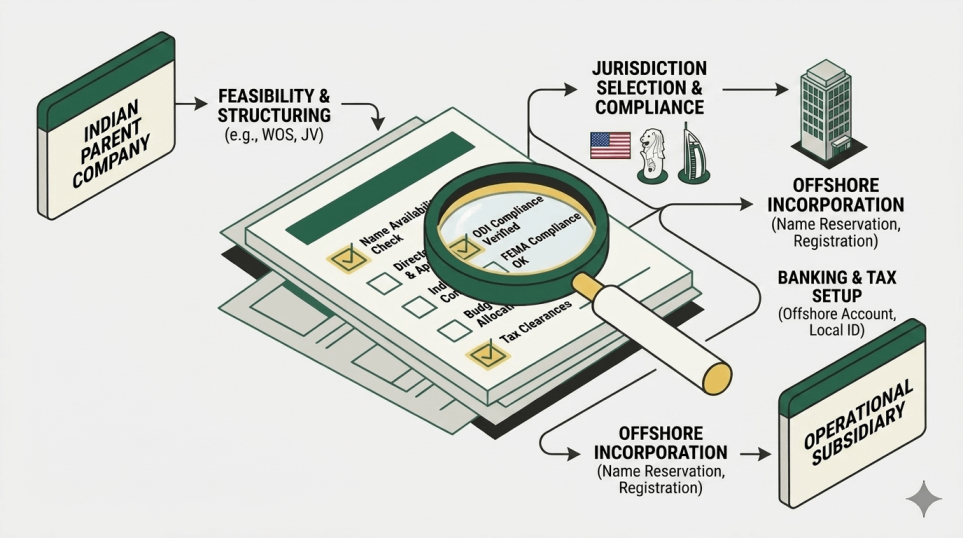

Setting up a Delaware C Corporation is often the first structural decision an Indian founder faces when chasing US venture capital or scaling into American markets. The Delaware piece is, in practice, the simpler half. The India side of the transaction is where most of the compliance risk sits: the Foreign Exchange Management Act (FEMA) 1999 filings, the two separate RBI reporting obligations (the Annual Performance Report and the Foreign Liabilities and Assets Return), transfer pricing documentation under the Income-tax Act 2025, and the inbound FDI compliance when the Delaware entity eventually invests back into its Indian subsidiary. Get the Delaware paperwork wrong and you face a USD 25,000 IRS penalty. Get the India paperwork wrong and you face FEMA compounding, restrictions on all future overseas investments, and an open-ended income tax audit exposure. This guide covers both sides in full.
Why Delaware? The honest answer for Indian founders
Delaware is not the only US state you can incorporate in. It is the state that US venture capital firms and institutional lawyers have standardised around for over four decades, which means the legal precedents, term sheet templates, SAFE agreements, and preferred stock mechanics your investors will use are all designed around Delaware’s General Corporation Law (DGCL). Delaware’s Court of Chancery is a specialised business court with no jury, and disputes are resolved faster and more predictably than in general state courts. Over 68% of Fortune 500 companies and the vast majority of US VC-backed startups are incorporated in Delaware (Delaware Division of Corporations data, 2026).
For Indian founders, the practical reasons to choose Delaware are three. First, if a US VC is leading your round, their standard investment documents (Series A Preferred Stock Purchase Agreement, Voting Agreement, Investors’ Rights Agreement) are drafted for a Delaware C Corp. Asking them to modify for a different structure costs time and legal fees. Second, leading US accelerator programmes require Delaware C Corp status for participation. Third, Delaware franchise tax is calculated on authorised shares or assets, not on profits earned outside Delaware, which means a startup with no US revenue does not trigger a large Delaware state tax bill in its early years.
Delaware matters less if you are building a bootstrapped business with no plans for US institutional funding, if your only US business is a sales subsidiary rather than a parent holding entity, or if your investors are exclusively India or Singapore-based funds comfortable with an Indian holding company. Structure the decision around your capital plan, not around what other founders did.
When a Singapore Pte Ltd makes more sense
A common framework used by India-based advisors is: start with a Singapore Pte Ltd as the operating entity for Asia-Pacific customers and operational efficiency, then layer a Delaware C Corp above it as a holding entity when a US VC round is imminent. Singapore offers a 17% corporate tax rate, GDPR-compatible data regime, and neutral jurisdiction recognition across Asia. If you are not raising from a US VC in the next 12 to 18 months, this two-entity approach often makes more operational sense than a Delaware entity sitting dormant. The trade-off is a more complex three-layer structure: Indian entity, Singapore entity, Delaware entity, which triggers the two-layer cap under the OI Rules 2022 and requires careful planning before execution.
Delaware C Corp vs LLC: why the C Corp is the right choice for fundraising
The short answer: a Delaware LLC is structurally incompatible with institutional venture investment.
A Delaware C Corporation can issue multiple classes of shares: common stock for founders and employees, and preferred stock for investors with liquidation preferences, anti-dilution rights, and board seats. SAFEs and convertible notes, the standard early-stage instruments, convert into preferred stock in a C Corp. LLCs cannot issue preferred stock in the same form and do not support these instruments without complex restructuring.
LLCs also use pass-through taxation, meaning profits flow through to the individual owners and are taxed at their personal tax rates. For an Indian founder who is a tax resident of India, this creates a compliance problem: US LLC income taxable in the US on a pass-through basis, with complex foreign tax credit reconciliation in India. A C Corp pays US federal corporate tax at 21% on its US-sourced profits at the entity level. Indian founders receive dividends or salary, not pass-through income, which is a cleaner structure from an India income tax perspective.
Delaware C Corp vs LLC comparison
| Feature | Delaware C Corp | Delaware LLC |
|---|---|---|
| Preferred stock for VC | Yes (standard) | Not in standard form |
| SAFE / convertible note | Yes | Structurally complex |
| Pass-through taxation | No | Yes (problematic for Indian founders) |
| ESOPs for employees | Yes (standard scheme) | Difficult, rarely used |
| US federal corporate tax | 21% at entity level | Pass-through to owners |
| Annual franchise tax | USD 400 minimum (Assumed Par Value method) | USD 300 flat |
| VC investor familiarity | Very high | Low for institutional VC |
| Suitability for Indian VC-backed startups | Yes | No |
For a consultant or service business with US clients and no institutional fundraising plans, a Delaware LLC or Wyoming LLC provides simpler setup and lower annual maintenance costs. It is not appropriate for VC-backed startups.
How to incorporate a Delaware C Corp: step-by-step
Step 1: Decide your share structure before filing
Most VC-backed startups authorise 10 million shares at a par value of USD 0.0001 per share. Delaware’s filing fee is partly a function of authorised shares, and a higher share count means a higher initial filing fee, reaching USD 1,000 or more for 10 million shares. Founders typically receive common stock. Future investors receive preferred stock. An ESOP pool of 10 to 15% of fully diluted shares is reserved at formation.
The decision on share count and ESOP pool size should be made before filing, not after. It is expensive to amend the Certificate of Incorporation.
Step 2: File the Certificate of Incorporation
The Certificate of Incorporation is filed with the Delaware Division of Corporations. It specifies the company name, registered agent’s address in Delaware, authorised shares, and par value. Standard filing takes 1 to 7 business days. State filing fees range from USD 89 for standard processing to USD 1,089 for immediate same-day service. Indian founders do not need to be physically present in the US to incorporate.
Incorporation service comparison
| Service | One-time cost | Legal docs | Bank account | Cross-border focus | Form 5472 as ongoing service |
|---|---|---|---|---|---|
| Self-service platform A | USD 500 | Template-based | Fintech bank partnership | Moderate | No |
| Legal-document-focused platform | USD 799 | Attorney-reviewed | No (guides only) | Low | No |
| India-US cross-border platform | USD 999 | Template-based | Assistance | Strong (India-US) | Yes (USD 100/form) |
| Low-cost platform | USD 297-597 | Template-based | Yes | Moderate | Add-on |
| Traditional registered agent service | USD 379+ | Basic templates | No | Low | No |
Pricing from platform websites as of March 2026. State filing fees (USD 89 to USD 1,089 depending on processing speed) are additional for all services. Attorney-reviewed documents justify the premium for founders raising a priced VC round within 12 months, as they are designed to survive investor due diligence. For ongoing India-US cross-border compliance, confirm whether your chosen service bundles Form 5472 filing as a standard offering or charges separately.
Step 3: Apply for an EIN
The Employer Identification Number (EIN) is the US tax identification number for the corporation, equivalent to India’s PAN. Indian founders apply using IRS Form SS-4 without a US Social Security Number, by fax or mail. EIN processing for foreign founders takes 4 to 6 weeks. Without an EIN, you cannot open a US bank account or enter into most commercial contracts.
Step 4: Open a US bank account
Several US fintech banks allow account opening for non-resident founders with no US address or Social Security Number requirement. You need the Certificate of Incorporation, EIN confirmation letter, and a valid passport. The bank conducts KYC checks on all beneficial owners. Some Indian founders experience delays at AML screening for India-incorporated parent entities. Having your FEMA compliance documentation ready before the bank application speeds up approval.
Step 5: Issue founder shares and file the 83(b) election
Immediately after incorporation, founders receive their shares. If shares vest over time (standard four-year vesting with a one-year cliff), the 83(b) election must be filed with the IRS within 30 days of the share grant date. This election locks in the cost basis of restricted stock at the time of grant, when the value is effectively zero, rather than deferring recognition to each vest event. The practical result is that most future share appreciation is taxed at long-term capital gains rates rather than ordinary income rates when shares are eventually sold.
Missing the 30-day window is irreversible. There is no late filing provision. Founders who miss it face potentially large ordinary income tax bills in the US as shares vest and appreciate. This is the single most time-critical step after incorporation and, unlike most other compliance items, cannot be remedied after the deadline passes.
FinCEN BOI update: what changed in March 2025
A common point of confusion for Indian-founded Delaware entities is the Beneficial Ownership Information (BOI) reporting requirement under the Corporate Transparency Act (CTA). The rule changed materially in March 2025 and the current position is straightforward.
On 26 March 2025, FinCEN published an interim final rule that exempted all entities created under the laws of a US state, including Delaware C Corps and LLCs, from the BOI reporting requirement. A Delaware C Corp formed by Indian founders is a domestic US entity and is therefore exempt from CTA reporting regardless of who owns it.
The BOI obligation now applies only to foreign entities that have registered to do business in a US state. If your structure includes a Cayman, BVI, or Mauritius holding company that has registered as a foreign entity to do business in Delaware, that foreign entity must file a BOI report with FinCEN within 30 days of registration. It reports only non-US persons as beneficial owners.
Practical implication: if your structure is simply Indian founders owning a Delaware C Corp directly (or through an Indian entity via ODI), there is no FinCEN BOI obligation on the Delaware entity as of 2026. Verify the current FinCEN position directly at fincen.gov/boi before filing or skipping a BOI report, as the rules changed in March 2025.
The India-side FEMA framework: what changes once you set up the Delaware entity
What triggers ODI and why it applies
Once an Indian company or Indian individual makes an investment in a foreign entity (by subscribing to shares, providing a loan, or issuing a guarantee), that transaction is classified as Overseas Direct Investment (ODI) under the Foreign Exchange Management (Overseas Investment) Rules, 2022 (“OI Rules 2022”), notified on 22 August 2022. The OI Rules 2022 replaced the older FEMA 120/2004 framework and introduced a consolidated framework covering ODI (investments above 10% of foreign entity’s equity) and Overseas Portfolio Investment or OPI (up to 10%).
For the typical Indian startup setting up a Delaware parent entity, the Indian company or its Indian founders are making an ODI into the Delaware C Corp. This triggers mandatory reporting and compliance obligations.
The 400% net worth cap
The total financial commitment, covering equity investment, loans extended, and guarantees issued by the Indian entity across all overseas investments, cannot exceed 400% of the Indian entity’s net worth as per the last audited balance sheet, not older than 18 months (OI Rules 2022, Rule 10). For early-stage startups with low paid-up capital and accumulated losses, this cap can be binding quickly.
Guarantees issued by the Indian entity to support its overseas subsidiary’s borrowings count toward the same 400% cap. Investments beyond this limit require prior RBI approval under the approval route, involving project reports and financial justifications submitted to the RBI via the AD bank.
What counts toward the 400% cap
| Component | Counts toward the cap |
|---|---|
| Equity investment in overseas entity | Yes |
| Compulsorily convertible instruments | Yes |
| Loans to overseas subsidiary or JV | Yes |
| Guarantees issued by Indian entity | Yes |
| Overseas Portfolio Investment (OPI, up to 10%) | Separate framework |
| Reinvested earnings of the overseas subsidiary | No |
| Dividends received from overseas entity | No |
Form FC and the filing sequence
Every financial commitment to a foreign entity must be reported to the RBI via the Authorised Dealer (AD) Category I bank before the remittance of funds. The form is Form FC (which replaced the older Form ODI under the 2022 framework).
The sequence:
- Board resolution of the Indian entity authorising the investment, specifying amount, foreign entity details, and nature of commitment (equity or loan).
- Valuation certificate from a Category I Merchant Banker or registered valuer for the foreign entity’s shares.
- Statutory auditor certificate confirming the financial commitment is within the 400% net worth limit.
- KYC documents of the Indian entity: Certificate of Incorporation, PAN, audited financials not older than 18 months.
- Undertaking confirming FEMA compliance and PMLA compliance.
- Filing of Form FC with the AD bank. The bank generates a Unique Identification Number (UIN) for the overseas investment, which must be quoted in all subsequent reporting.
Funds are remitted only after the AD bank processes the Form FC and allows the transaction.
Annual Performance Report: the December 31 deadline
Once an overseas investment exists, the Indian entity must file an Annual Performance Report (APR) with the RBI by 31 December every year for each foreign entity. This is a calendar-year deadline, not a financial-year deadline. It is the most commonly missed compliance obligation in the entire ODI framework.
The APR must include financial statements of the overseas entity for the relevant year. Audited financials are preferred. If unavailable by December 31, unaudited financials may be used with a disclosure, but if audited figures differ significantly when available, a revised APR must be filed.
Failure to file the APR attracts a Late Submission Fee (LSF) starting at ₹7,500 plus 0.025% of the transaction amount per year of delay. The LSF facility is available only for delays up to 3 years. Delays beyond 3 years require FEMA compounding proceedings before the RBI Enforcement Directorate, with negotiated penalties and reputational scrutiny.
A May 2025 RBI directive stated explicitly that entities with historic ODI reporting lapses must regularise before initiating any new overseas investments, or face restrictions on all future outbound transactions.
Two-layer restriction and round-tripping risk
The OI Rules 2022 prohibit creating more than two layers of overseas subsidiaries without RBI approval. A Delaware C Corp (layer 1) can have one operating subsidiary such as a Singapore entity or a Delaware LLC (layer 2), but adding a third-tier entity requires prior approval.
The RBI scrutinises structures that look like round-tripping: Indian money going out as ODI and returning to India as FDI. A Delaware parent that then invests into the same Indian operating entity creates a circular loop that will face RBI questions and potentially GAAR challenges under the Income Tax Act.
The FLA Return: the second RBI filing that founders routinely overlook
The Annual Performance Report and the Foreign Liabilities and Assets (FLA) Return are two separate RBI filings. The APR gets the most attention in compliance discussions. The FLA Return is equally mandatory under FEMA 1999, notified via AP (DIR Series) Circular No. 45 dated 15 March 2011, yet it is consistently missed in practice.
What it is: The FLA Return is an annual statistical return filed with the RBI by all Indian entities that have outstanding FDI received from abroad or outstanding ODI made abroad, as on 31 March of the reporting year. It captures the stock of foreign liabilities (inward FDI) and foreign assets (outward ODI) on the Indian entity’s balance sheet.
Who must file: Any Indian company, LLP, SEBI-registered AIF, partnership firm, or PPP that has FDI or ODI outstanding on 31 March, even if there were no new transactions during the year. If you set up a Delaware entity three years ago and made no new investments since, you still must file the FLA Return every year until the ODI is fully exited and no longer appears on your balance sheet.
Deadline: 15 July each year, reporting the position as on 31 March. If audited accounts are not ready by 15 July, the return must be filed on unaudited (provisional) figures by 15 July and revised with audited figures by 30 September. Non-filing because your audit is pending is a FEMA violation.
Where to file: The FLAIR (Foreign Liabilities and Assets Information Reporting) portal at flair.rbi.org.in. Email submissions and offline Excel sheet submissions are no longer accepted. First-time filers must register on FLAIR using the entity’s CIN and PAN, and upload a signed Authority Letter and Verification Letter in RBI’s prescribed format, along with a Class 3 DSC.
Penalty for non-filing: Up to 300% of the contravention amount under FEMA Section 13. If unquantifiable, a flat ₹2,00,000 penalty plus ₹5,000 per day for continuing default. The RBI also levies an LSF of ₹7,500 for late submission.
How the FLA differs from the APR:
| FLA Return | Annual Performance Report (APR) | |
|---|---|---|
| Filed with | RBI (FLAIR portal directly) | RBI via AD bank |
| Triggered by | Outstanding FDI or ODI on balance sheet | Having made ODI (each overseas entity) |
| Deadline | 15 July (position as on 31 March) | 31 December (calendar year) |
| Covers | All FDI received and all ODI made (stock) | Performance of specific overseas JV/WOS |
| Mandatory even if dormant | Yes | Yes |
| Penalty regime | Up to 3x amount + ₹5,000/day | LSF ₹7,500 + 0.025% per year of delay |
A startup that received FDI from a US angel investor into its Indian entity, and also made ODI into a Delaware entity, must file both: the FLA Return (covering both the FDI and the ODI position) by 15 July, and the APR for the Delaware entity by 31 December. These are not the same filing.
Our FEMA and RBI compliance team manages Form FC, APR, and FLA Return filings under a single annual compliance programme. If you are mid-year and unsure whether your filings are current, reach out to our FEMA advisory team.
FC-GPR: when your Delaware entity invests back into India
This direction of capital flow is where a separate and distinct compliance obligation arises. In a standard flip structure, the Delaware C Corp raises funds from US VCs and then deploys that capital into India, either as equity into the Indian subsidiary, or as an intercompany loan.
When the Delaware entity invests equity into the Indian subsidiary, the Indian subsidiary must file Form FC-GPR (Foreign Currency-Gross Provisional Return) with the RBI through its AD bank within 30 days of receiving the funds and within 60 days of allotting shares to the Delaware entity. Late FC-GPR filing attracts compounding penalties of up to 300% of the transaction amount under FEMA.
The FC-GPR filing requires a valuation certificate from a SEBI-registered Category I Merchant Banker confirming that the issue price of the Indian shares is not lower than the fair market value determined using internationally accepted pricing methodologies (typically the DCF method for unlisted companies). This valuation requirement applies every time the Delaware entity subscribes to new shares in the Indian subsidiary, including at each funding round.
The Indian subsidiary receiving FDI from the Delaware parent must also report this investment in its FLA Return. Both the inbound FDI into the Indian entity and the outbound ODI from the Indian founders into the Delaware entity appear in the same FLA Return, each in different sections.
Transfer pricing: the obligation most founders discover too late
Why it applies from year one
Once you have a Delaware parent and an Indian subsidiary, every transaction between the two (management fees, software development service fees, IP licensing fees, intercompany loans, reimbursements) is an “international transaction” between “associated enterprises” under Chapter X of the Income Tax Act. Under the Income-tax Act 2025 (effective from 01/04/2026), Section 161(1) reproduces the arm’s-length principle: all such transactions must be priced as if they were between unrelated parties.
The Transfer Pricing Officer (TPO) at the Indian Income Tax Department actively reviews intercompany pricing for Indian subsidiaries of foreign-parented entities. Adjustments can result in additional taxable income attributed to the Indian entity, interest on the adjustment amount, and penalty of 2% of the transaction value for failure to maintain TP documentation, with a further penalty of 50% of additional tax where income is under-reported.
What you must prepare every year
The Indian entity must:
- Prepare a contemporaneous TP study (the “local file”) documenting functions performed, assets employed, and risks assumed by each party (the FAR analysis), identifying comparable uncontrolled transactions, and benchmarking the intercompany price.
- File Form 48 (formerly Form 3CEB, renamed under the Income-tax Act 2025, the CA certificate in respect of international transactions) with the income tax return by 30 November for companies subject to TP audit requirements.
- Disclose TP details under Clause 14AA of the tax audit report (Form 3CD).
CBDT Notification No. 157/2025 (dated 06/11/2025) prescribes tolerance bands of 1% for wholesale trading and 3% for all other transactions for AY 2025-26. No corresponding notification had been issued for AY 2026-27 as of the date of this article. Taxpayers should not assume automatic carryforward.
The Income-tax Act 2025 repeat-transaction mechanism
The Finance Act 2025 introduced a “repeat-transaction” mechanism, reflected in the Income-tax Act 2025 (Section 167 equivalent). From AY 2026-27 onwards, a taxpayer may opt to apply the arm’s-length price determined for a particular year to similar transactions in the two immediately following years, subject to TPO validation within one month. This reduces documentation burden for stable recurring intercompany arrangements such as fixed-fee software development contracts. It is particularly valuable for captive development arrangements where the pricing model does not change year on year.
Common intercompany arrangements and how to price them
The most frequent arrangement between a Delaware parent and an Indian subsidiary is a captive service model: the Indian entity provides software development, product management, or business process services to the US parent on a cost-plus basis. Benchmark gross margins for cost-plus captive arrangements in India typically range from 17 to 25% over total costs, depending on functions performed and sector. Margins outside this range attract TPO scrutiny.
If the Delaware entity licenses IP to the Indian subsidiary, the royalty rate must also be benchmarked and supported by a separate functional analysis. Royalties at non-arm’s-length rates are a primary target for Indian TP adjustments.
Safe harbour under the Income-tax Act 2025
Section 167 introduces safe harbour provisions. The CBDT may notify specific pricing guidelines that, if followed, are deemed arm’s-length. CBDT Notification No. 21/2025 (dated 25/03/2025) expanded safe harbour thresholds: the transaction value threshold for eligibility increased from ₹200 crore to ₹300 crore for AY 2025-26 and AY 2026-27. For startups with smaller intercompany transaction volumes, safe harbour routes provide certainty without a full benchmarking exercise, but they require acceptance of fixed margins that may exceed actual profitability, so the commercial trade-off must be assessed.
US tax obligations for the Indian-owned Delaware C Corp
Delaware franchise tax: avoid the default calculation trap
Every Delaware corporation owes an annual franchise tax to the State of Delaware, due by 1 March. There are two calculation methods:
The Authorised Shares Method is Delaware’s default. For a startup that authorised 10 million shares, this method produces a franchise tax bill of USD 85,000 or more because the formula applies a flat rate per 10,000 shares. Most startup incorporations result in an automatic over-billing under this method.
The Assumed Par Value Capital Method produces a far lower bill for most startups. Under this method, the tax is calculated based on the company’s total assets divided by issued shares, multiplied by authorised shares, multiplied by USD 400 per USD 1 million of assumed par value capital. For a startup with USD 500,000 in total assets, this typically produces a franchise tax of USD 400 to USD 500, the minimum.
Founders must actively elect the Assumed Par Value method or instruct their US CPA to calculate using that method. Delaware does not apply it automatically. Every startup running a Delaware C Corp should verify which method is being used. Most early-stage entities should pay the minimum franchise tax, not the default five-figure bill that the Authorised Shares Method generates.
| Method | Default? | Typical bill for early-stage startup | Election required |
|---|---|---|---|
| Authorised Shares Method | Yes | USD 85,000+ (for 10M shares) | No (this is default) |
| Assumed Par Value Method | No | USD 400-500 | Yes (must elect or request) |
Late franchise tax filing incurs a USD 200 penalty plus 1.5% monthly interest on the unpaid amount.
Form 5472 and Form 1120
A Delaware C Corp must file IRS Form 1120 (US Corporation Income Tax Return) annually, due 15 April for calendar-year entities. Because most Indian-owned Delaware C Corps have Indian founders or an Indian entity owning at least 25% of shares, they must also file Form 5472 attached to Form 1120. Form 5472 reports all “reportable transactions” between the US corporation and its foreign related parties (IRS Sections 6038A and 6038C). Reportable transactions include:
- Equity infusion from Indian founders or Indian entity.
- Intercompany service fees, licensing fees, or management charges.
- Loans between the US and Indian entities.
- Any transfer of money or property to/from a foreign related party.
A separate Form 5472 must be filed for each foreign related party. Three Indian founders each owning the Delaware entity directly means three separate Form 5472 filings. The penalty for failure to file a complete and accurate Form 5472 is USD 25,000 per form, per year, with no statutory cap. There is no statute of limitations on the underlying tax return year if Form 5472 was not filed, meaning the IRS can audit that year indefinitely.
Form 5472 cannot be e-filed for foreign-owned disregarded entities (Delaware LLCs). For C Corps, it is filed as part of the standard Form 1120 package.
Delaware registered agent
Every Delaware entity must maintain a registered agent with a physical Delaware address. Registered agent services range from USD 60 per year (some providers bundle this into monthly plans) to USD 300 per year at traditional providers. Failure to maintain a registered agent causes the company to lose “good standing” status, blocking fundraising and banking.
Full cost picture: US side and India side
| Cost item | One-time or annual | Estimated amount |
|---|---|---|
| Delaware Certificate of Incorporation | One-time | USD 89 to USD 1,089 (state fee, speed-dependent) |
| Incorporation service fee | One-time | USD 297 to USD 999 |
| EIN application | One-time | Free (IRS) |
| Registered agent | Annual | USD 60 to USD 300 |
| Delaware franchise tax | Annual | USD 400 minimum (Assumed Par Value method) |
| Form 1120 (US CPA fee) | Annual | USD 1,500 to USD 3,000 |
| Form 5472 per related party | Annual | USD 100 to USD 500 per form (CPA fee) |
| Form FC / AD bank charges (India) | Per transaction | ₹2,000 to ₹5,000 per transaction |
| APR filing (India) | Annual | ₹75,000 to ₹3,50,000 (includes overseas audit cost) |
| FLA Return filing (India) | Annual | ₹10,000 to ₹30,000 (CA fee) |
| TP study and Form 48 (India) | Annual | ₹1,50,000 to ₹5,00,000 |
| FC-GPR valuation and filing (per round) | Per transaction | ₹75,000 to ₹2,00,000 |
POEM risk: when your Delaware entity may be treated as an Indian tax resident
This risk is often not assessed at the time of entity formation and tends to surface only during a tax audit.
Under Section 6(3) of the Income Tax Act (maintained in the Income-tax Act 2025), a foreign company is deemed to be an Indian tax resident if its Place of Effective Management (POEM) is in India in that year. POEM is defined as the place where key management and commercial decisions necessary for the conduct of the entity’s business as a whole are, in substance, made.
For an Indian-founded Delaware C Corp whose founders are all based in India, who conduct all board meetings from India (even via Zoom), who make all product, investment, and commercial decisions from India, and whose registered Delaware office is occupied only by a registered agent. The POEM analysis points squarely to India. If the Income Tax Department concludes the Delaware entity’s POEM is in India, it becomes an Indian tax resident and must pay Indian corporate tax at 25% (for companies with turnover up to ₹400 crore) on its worldwide income.
The CBDT issued POEM guidelines in 2017 under Circular No. 6/2017. Key factors that indicate India POEM:
- Board meetings predominantly held in India.
- Key executives (CEO, CTO, CPO) resident in India and making decisions for the Delaware entity.
- Core banking decisions, contract approvals, and business strategy determined from India.
- Delaware entity has no employees of its own; all human capital sits in the Indian subsidiary.
To mitigate POEM risk, at least some board meetings of the Delaware entity should be held outside India (even in Singapore or the UAE), key corporate decisions should be documented as having been made in Delaware or another foreign jurisdiction, and the Delaware entity should ideally have at least one director who is not an India-resident. These are not cosmetic steps. They require genuine substance and documentation.
India-US DTAA: how it interacts with intercompany flows
India and the US have a Double Tax Avoidance Agreement (DTAA) in force. Key provisions for intercompany flows:
Dividends: The DTAA reduces US withholding tax on dividends paid by the Delaware entity to Indian resident shareholders from the default 30% to 15% (if the recipient holds at least 10% of voting shares) or 25% otherwise. The Indian resident claims credit for the US withholding tax under Section 90 of the Income Tax Act.
Royalties and technical service fees: Payments from the Indian subsidiary to the Delaware parent for IP licensing or technical services are taxed at 15% withholding under the DTAA.
Interest on intercompany loans: Interest is typically taxed at 15% under the DTAA.
MAP: Where the Indian TP authority and the IRS reach different arm’s-length conclusions on the same transaction, the Mutual Agreement Procedure under the DTAA provides a binding resolution mechanism. India has concluded bilateral APAs with the US under this treaty. For founders with large, stable intercompany arrangements, entering an APA provides certainty for five prospective years with a four-year rollback option.
PE risk from the DTAA perspective: Founders working from India for the Delaware entity may inadvertently create a permanent establishment of the Delaware entity in India under Article 5 of the DTAA, subjecting it to Indian corporate tax on attributed profits. This overlaps with but is distinct from the POEM analysis: POEM makes the entire Delaware entity an Indian resident, while a PE creates a deemed India-business of an otherwise non-resident entity.
ESOPs in a flip structure: what Indian employees need to know
If the Delaware C Corp issues stock options to employees of the Indian subsidiary (a forward flip ESOP), the compliance spans three regimes.
FEMA classification at exercise: When an Indian employee exercises options and acquires Delaware shares, the acquisition is classified under the FEMA OI Framework. If the shares acquired represent less than 10% of the Delaware entity’s paid-up equity capital individually, the acquisition is OPI under Rule 7 of the OI Rules 2022. Above 10%, it is ODI under Rule 9. For most employee grants, OPI classification applies. The employee must track OPI limits and file with their AD bank annually.
LRS limit at exercise: The exercise price remittance by the Indian employee to the Delaware entity is treated as an outward remittance under the Liberalised Remittance Scheme (LRS). The LRS limit is USD 250,000 per financial year per individual, covering all purposes including travel and education. For high-value grants or accumulated multi-year options, this limit can become binding. The Indian subsidiary acts as TDS deductor under Section 192(1) on the perquisite at exercise.
Perquisite taxation: The difference between the fair market value (FMV) of the Delaware shares on the exercise date and the exercise price paid is a perquisite taxable as salary income in India. FMV for the US parent must be determined by a 409A valuation (annual, or on material events). The 409A valuation is converted to INR at the RBI reference rate on the exercise date.
83(b) election for Indian employees receiving restricted stock: If the Delaware entity grants restricted stock (not options) to an Indian employee, the 83(b) election in the US is the employee’s choice, not just the founder’s. The India-side tax treatment follows separately. Restricted stock grants to Indian tax residents are governed by Section 17(2) of the Income Tax Act, with perquisite value determined at vesting unless the ESOP is an SEBI-compliant scheme.
Common mistakes that cost founders time and money
Remitting funds to Delaware before filing Form FC. Many founders wire money from their Indian company to the newly formed Delaware entity through their regular bank as an “advance for services” or “intercompany transfer” without routing it through an AD bank and without filing Form FC. This is a FEMA violation. Penalties can reach 300% of the transaction amount. Even small amounts must be regularised through the LSF mechanism before any new overseas investment can be made.
Assuming APR and FLA Return are the same filing. They are not. The APR is filed via the AD bank by 31 December and covers the performance of each overseas entity. The FLA Return is filed directly on the FLAIR portal by 15 July and covers the stock of all FDI and ODI outstanding on the Indian entity’s balance sheet. Missing either is a FEMA violation. Missing both in the same year compounds the exposure.
Not filing Form 5472 because the Delaware entity had no revenue. Form 5472 is triggered by reportable transactions, not revenue. Any capital contribution from an Indian founder or entity to the Delaware entity in the year is a reportable transaction. Most early-stage Delaware C Corps receive capital from Indian founders in year one and must file Form 5472 as part of Form 1120. The USD 25,000 penalty applies regardless of entity size or revenue.
Using the Authorised Shares Method for franchise tax by default. The Delaware Secretary of State’s system defaults to the Authorised Shares Method when calculating franchise tax. For a startup with 10 million authorised shares, this produces a bill of USD 85,000 or more. The Assumed Par Value Method typically produces a USD 400 minimum franchise tax for early-stage entities. Most founders who do not have a US CPA reviewing their annual report discover this error only after being billed.
Ignoring TP documentation in year one. The obligation to maintain contemporaneous documentation and file Form 48 applies from the first year any international transaction occurs between the Indian entity and the Delaware entity, including the first software development service agreement or management fee arrangement. There is no revenue threshold. The statute of limitations does not protect against penalties for missing TP documentation in year one.
Missing the FC-GPR on FDI received by the Indian subsidiary. When the Delaware entity (post-fundraising) invests capital into the Indian operating subsidiary, the Indian entity must file Form FC-GPR within 30 days of receiving the funds and 60 days of allotting shares. Many founders focus entirely on the outbound ODI compliance and overlook the inbound FC-GPR obligation when capital flows back into India. Late FC-GPR filing attracts compounding penalties of up to 300% of the transaction amount.
Treelife practitioner note
In the Delaware C Corp engagements we have run at Treelife, the most consistent pattern is a timing disconnect. Founders complete the Delaware incorporation in two to four weeks using a self-service tool and then spend three to six months fixing the India-side structure retroactively.
The most serious version of this we handled was a Bengaluru-based SaaS founder who had wired USD 50,000 from the Indian company to the Delaware entity as “advance for services”, not classified as ODI, no Form FC filed, no AD bank involved. By the time we were engaged, the Delaware entity had entered into a services agreement with the Indian subsidiary with no TP documentation, had issued ESOPs to the Indian team, and had received a small FDI inflow from the US VC into the Indian subsidiary for which no FC-GPR had been filed. Three separate FEMA violations across two entities, a TP documentation gap, and a US Form 5472 that had not been filed. The FLA Return had also not been filed for the two years the structure had been in existence. The regularisation process took four months, involved LSF payments across multiple violations, a revised intercompany services agreement with a fresh benchmarking study, two years of delinquent Form 5472s filed by a US CPA, and FC-GPR late filings compounded by the RBI.
The FEMA provisions engaged were Rule 9 of the OI Rules 2022, Regulation 4 of the Overseas Investment Directions 2022, and Section 6 of FEMA 1999 for the unauthorised outward remittance. The TP obligation rested in Section 92C of the Income Tax Act (Section 161 under the Income-tax Act 2025). None of these are obscure provisions. The structural problem is that US-side incorporation advice and India-side FEMA and TP compliance are almost never handled by the same team, leaving the cross-border layer unowned.
At Treelife, we handle both sides under one engagement. The Form FC, APR, FLA Return, TP study, Form 48, FC-GPR, and US-India DTAA structuring are coordinated, not sequential.
Frequently asked questions on Setting up Delaware Entity
Q: Can a sole proprietor or unregistered Indian entity make an ODI into a Delaware C Corp?
A: A sole proprietorship or unregistered partnership can make ODI only if it holds “Status Holder” classification under the Foreign Trade Policy. For most startups, ODI must originate from a registered Indian entity (private limited company, LLP) or from the Indian founders in their individual capacity under the LRS up to USD 250,000 per year per individual.
Q: What is the LRS limit for an individual Indian founder investing personally into a Delaware C Corp?
A: USD 250,000 per financial year (April to March). All LRS remittances in that year across all purposes (travel, education, investment, maintenance of close relatives abroad) count toward this combined limit. Amounts above USD 250,000 per founder per year must use the corporate ODI route through the Indian entity.
Q: How is the Delaware C Corp taxed in the US?
A: At the US federal corporate tax rate of 21% on net US-sourced income (IRC Section 11). Delaware state does not levy a state income tax on corporations that do not conduct business inside Delaware, which applies to most Indian-founded Delaware holding entities with all operations in India.
Q: What is the timeline from decision to a fully operational Delaware entity with Indian ODI in place?
A: Typically 6 to 10 weeks. Delaware incorporation: 1 to 7 business days. EIN for foreign applicants: 4 to 6 weeks. Form FC with the AD bank: 5 to 10 business days once documents are ready. Bank account at a US fintech bank: 1 to 4 weeks. Running these steps in parallel, allow 10 weeks total.
Q: Can the Delaware C Corp hire employees directly in India?
A: No. A foreign company cannot hire employees directly in India without a legal entity or a Professional Employer Organisation (PEO) arrangement. The Indian subsidiary handles employment, payroll, and statutory compliance (PF, ESI, TDS) for India-based employees. The Delaware entity contracts with the Indian subsidiary for services.
Q: Do I need to file the FLA Return if my Indian company only made ODI (no FDI received)?
A: Yes. The FLA Return covers both foreign liabilities (FDI received) and foreign assets (ODI made). If your Indian company has outstanding ODI on its balance sheet as on 31 March, whether or not any FDI has been received, the FLA Return is mandatory.
Q: Does setting up a Delaware entity create a permanent establishment risk in India?
A: Yes, potentially. If Indian-resident founders or employees exercise decision-making authority, habitually conclude agreements, or perform the core commercial functions of the Delaware entity from India, the Delaware entity may have a PE in India under Article 5 of the India-US DTAA. PE determination is fact-specific and requires structuring advice before the entity begins operations.
Q: Can the Indian entity provide a guarantee for borrowings by the Delaware entity?
A: Yes, under the OI Rules 2022, but the guarantee counts toward the 400% net worth cap. For startups with low net worth, guarantees can exhaust headroom needed for direct equity investment.
Q: Do ESOPs issued by the Delaware entity to Indian employees require RBI approval?
A: No, prior RBI approval is not required. But the acquisition of the Delaware parent’s shares at exercise is governed by the FEMA OI Rules 2022 (classified as OPI if below 10% threshold individually). The Indian subsidiary must deduct TDS on the perquisite at exercise and maintain LRS tracking for each employee.
Q: What happens to the ODI compliance if the Delaware entity is dissolved?
A: Dissolution proceeds must be repatriated to India within 60 days of receipt and reported to the RBI through the AD bank. Failure to repatriate disinvestment proceeds is a FEMA violation. The Indian entity must file a disinvestment report confirming no dues are outstanding to the overseas entity. The FLA Return obligation ceases only once the ODI no longer appears as a foreign asset on the Indian balance sheet.
Q: What changed about the FinCEN BOI filing requirement in 2025?
A: On 26 March 2025, FinCEN issued an interim final rule exempting all entities created under the laws of a US state, including Delaware C Corps, from the Corporate Transparency Act beneficial ownership reporting requirement. Your domestic Delaware C Corp has no BOI filing obligation with FinCEN regardless of who owns it. The requirement now applies only to foreign entities (Cayman, BVI, Mauritius, etc.) that have registered as foreign entities to do business in a US state.
Q: When should an Indian startup consider a reverse flip?
A: A reverse flip (bringing the holding company back to India) is worth considering when US VC participation is no longer the dominant constraint, Indian capital markets or strategic acquirers become the exit path, or the business has enough Indian revenue to justify an Indian holding structure. The reverse flip involves a scheme of arrangement under Sections 230-234 of the Companies Act 2013, NCLT approval, and Section 47 income tax exemption subject to conditions including a no-transfer lock-in period. It is a 12 to 18-month process and should be planned well in advance of any liquidity event.
Q: How does the Income-tax Act 2025 change transfer pricing obligations?
A: The Income-tax Act 2025, effective from 01/04/2026, reproduces the arm’s-length principle in Section 161(1). The key change of direct practical benefit is that Section 167 expressly clarifies that the tolerance band (3% for most transactions, 1% for wholesale trading) applies even where only a single comparable exists, resolving a long-standing controversy under the older Section 92C. The repeat-transaction mechanism from AY 2026-27 onwards reduces annual documentation burden for stable intercompany arrangements. Core obligations (Form 48, formerly Form 3CEB, filing, contemporaneous documentation, APA/MAP access) remain unchanged.
Q: Is a Delaware entity the right first step or should we incorporate in India first?
A: It depends on where your seed capital is coming from. If your first funding is from an Indian angel or Indian family and friends, incorporating in India first and doing the ODI flip later is simpler and avoids premature FEMA obligations. If your first funding is from a US angel or you are applying to YC or a US accelerator, form the Delaware entity from day one. The structure should follow the money, not the other way around.
Regulatory references:
- Foreign Exchange Management Act (FEMA), 1999: Sections 6, 9, 11, 13, 13(IA), 37A
- Foreign Exchange Management (Overseas Investment) Rules, 2022: Rules 7, 9, 10, notified 22/08/2022
- Foreign Exchange Management (Overseas Investment) Regulations, 2022: RBI circular 22/08/2022
- Foreign Exchange Management (Overseas Investment) Directions, 2022: AD bank instructions
- Foreign Exchange Management (Borrowing and Lending) (First Amendment) Regulations, 2026: RBI notification, March 2026
- AP (DIR Series) Circular No. 45 dated 15/03/2011: FLA Return notification
- Form FC-GPR: FDI reporting under FEMA (Reporting) Regulations 2000
- Income Tax Act, 1961: Sections 6(3), 90, 92, 92C, 92CA, 92CC, 112A
- Income-tax Act, 2025: Sections 161(1), 167, effective 01/04/2026
- CBDT Notification No. 157/2025 dated 06/11/2025: TP tolerance ranges AY 2025-26
- CBDT Notification No. 21/2025 dated 25/03/2025: Safe harbour threshold expansion
- CBDT Circular No. 6/2017: POEM guidelines
- Finance Act 2025: Amendment to Section 92CA (repeat-transaction mechanism)
- Internal Revenue Code (IRC): Sections 11, 6038A, 6038C
- Delaware General Corporation Law (DGCL)
- IRS Form 5472 Instructions (December 2024)
- FinCEN Interim Final Rule, 26/03/2025: BOI exemption for domestic reporting companies
External sources: