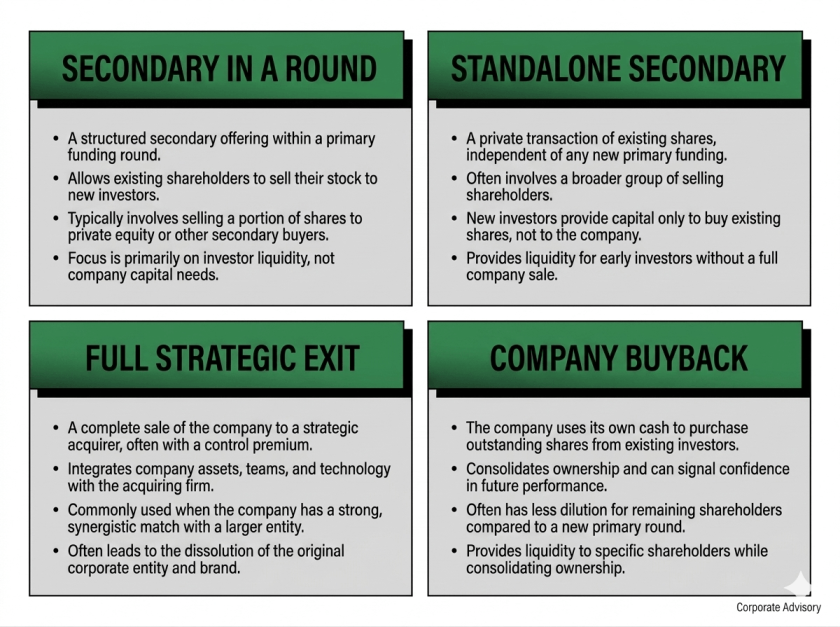

The rules on how buyback proceeds are taxed in India have changed twice in eighteen months, and the version currently in force after Finance Act 2026 is neither what founders planned around in 2023 nor what the market was navigating in late 2024. If you are a founder holding more than 10% of your company’s equity and are looking at a buyback as a partial exit route, the tax arithmetic is now materially different from what your cap table model probably assumes.
This article covers the three regimes that have applied since October 2024, explains which one governs your transaction depending on when payment was received, and works through the specific position of founders and promoter-group shareholders under the Finance Act 2026 framework. It also compares buyback against a secondary sale at the same price, covers the ESOP intersection, and sets out the planning decisions that are worth making before a buyback is signed off.
How was share buyback taxed before October 2024?
Before 1 October 2024, the company bore the entire tax burden on a share buyback under Section 115QA of the Income Tax Act, 1961. The company paid buyback distribution tax at 20% on “distributed income,” defined as the buyback price paid to shareholders minus the original issue price received by the company when those shares were allotted. With a 12% surcharge and a 4% health and education cess, the effective company-level rate was 23.296%. The shareholder received the buyback proceeds completely free of income tax under Section 10(34A).
This created a known arbitrage. After dividends became fully taxable in shareholders’ hands following the abolition of Dividend Distribution Tax in FY 2020-21, buybacks became structurally more efficient for high-bracket shareholders: the company paid a flat 23.296% regardless of whether the shareholder would have been taxed at 30%-plus-surcharge on dividend income. For a founder in the highest bracket (effective rate around 42.74%), the company-level buyback tax saved roughly 20 percentage points of tax relative to a dividend.
This advantage was visible to the finance ministry, and it is the direct reason the regime changed.
What did Finance Act 2024 change, and why does it still matter?
The Finance (No. 2) Act, 2024 abolished Section 115QA for buybacks on or after 1 October 2024. The company no longer pays any tax. The entire liability moved to the shareholder through a mechanism that characterised buyback proceeds as deemed dividend.
Section 2(22)(f) of the Income Tax Act, 1961 was amended to include consideration paid on buyback within the definition of dividend. The practical consequences were significant:
- The entire buyback proceeds (not just the gain) were taxable in the shareholder’s hands at their applicable income tax slab rate.
- No deduction for the cost of acquisition was permitted against this dividend income.
- The cost of the shares survived as a capital loss under Section 46A, which the shareholder could carry forward for eight years to set off against other capital gains.
- Companies were required to deduct TDS: 10% for resident shareholders where proceeds exceeded ₹5,000, and 20% for non-residents, under Section 194 and Section 195 respectively.
For a founder who received buyback proceeds of ₹5 crore between 1 October 2024 and 31 March 2026, the full ₹5 crore was taxable as income, with TDS already deducted and the balance payable at slab rates. The cost of the shares (say ₹50 lakhs at FMV at the time of original subscription) was lost as a deduction on the dividend income and survived only as a capital loss. This was widely criticised as economically distortive because a buyback is, in legal character, a disposal of shares, not a distribution of profits.
This regime applies to all buybacks where the payment date fell between 1 October 2024 and 31 March 2026. If your company executed a buyback in that window, your tax obligation is assessed under the deemed dividend rules regardless of what Finance Act 2026 subsequently changed.
Table 1: Buyback tax regimes at a glance
| Regime period | Tax character | Who bears tax | Governing section | Cost of acquisition deductible? |
|---|---|---|---|---|
| Until 30 Sep 2024 | Buyback distribution tax | Company | Section 115QA | No (company pays on distributed income) |
| 1 Oct 2024 to 31 Mar 2026 | Deemed dividend | Shareholder | Section 2(22)(f) | No (treated as capital loss u/s 46A) |
| From 1 Apr 2026 | Capital gains + promoter additional tax | Shareholder | Finance Act 2026, Section 69 of IT Act 2025 | Yes (gain = proceeds minus cost of acquisition) |
How does Finance Act 2026 change the position?
Finance Act 2026, effective from 1 April 2026, reversed the deemed dividend characterisation and restored capital gains as the correct head of income for buyback proceeds. The shareholder is now taxed on the actual gain: buyback price received minus the cost of acquisition of the shares tendered.
Listed shares
- Long-term capital gains (holding period exceeding 12 months): 12.5% above the ₹1.25 lakh annual exemption under Section 112A.
- Short-term capital gains (holding period 12 months or less): 20% under Section 111A.
Unlisted shares
For founders in most startups before an IPO, unlisted share treatment applies:
- Long-term capital gains (holding period exceeding 24 months): 12.5% without indexation benefit.
- Short-term capital gains (holding period 24 months or less): applicable income tax slab rate.
Critically, Finance Act 2026 is not a return to the pre-October 2024 regime. Section 115QA does not revive. The company pays no buyback distribution tax. Tax is assessed in the shareholder’s hands on the gain, not on the distributed amount.
The one significant addition relative to the pre-2024 framework is the promoter penalty: an additional income tax levy imposed on shareholders who meet the definition of “promoter” for the purpose of this provision.
What is the promoter penalty and who does it catch?
The promoter-specific additional tax is contained in Clause 34 of the Finance Bill, 2026, which amended Section 69 of the Income-tax Act, 2025. Where the shareholder is a promoter, the total tax on buyback capital gains consists of two components: the normal capital gains tax payable under the Act, plus an additional income tax computed at prescribed rates. A clarificatory amendment confirmed during the passage of the Finance Bill restricts this additional tax strictly to buybacks undertaken in accordance with Section 68 of the Companies Act, 2013. Buybacks by foreign companies, redemptions of preference shares, and capital return structures outside the Section 68 route are not subject to the additional promoter levy, though capital gains may still apply under general provisions.
The rates under Finance Act 2026 are:
- Non-corporate promoters: additional tax at 30% on the buyback capital gains, plus a 12% surcharge applied specifically on this additional tax component (not on the underlying capital gains). The aggregate effective tax rate inclusive of normal capital gains tax, the additional levy, the surcharge on the additional levy, and cess is approximately 42%+ on the buyback gain.
- Corporate promoters: effective tax rate of 22% on the buyback capital gains.
- Foreign shareholders: effective tax rate capped at 30% overall, making it lower than for Indian non-corporate promoters.
The definition of “promoter” for this purpose tracks SEBI’s and the Companies Act, 2013 definition but extends further. It includes shareholders holding 10% or more of the equity share capital of the company. This extension is the detail that founders need to understand carefully.
Most startup founders hold well above 10%. A founder who holds 40% of an unlisted company and receives buyback proceeds is classified as a promoter under this provision, regardless of whether they have exercised any operational control, been designated as promoter in any filing, or signed any document labelling themselves a promoter. The shareholding quantum alone triggers the classification.
Why does this matter for co-investors and early backers too? Financial investors who hold above 10% often insist on contractual language explicitly stating that they are not promoters for any purpose under the Companies Act or SEBI regulations. That contractual position offers no protection under the Finance Act 2026 additional tax provision, which uses its own statutory definition. A Series A institutional investor holding 12% who participates in a buyback is caught by the promoter penalty whether or not their investment agreement says they are not a promoter.
The statutory test is direct or indirect holding above 10%. “Indirect” in this context means shares held through entities controlled by the shareholder, such as a wholly owned holding company or a trust where the shareholder is the sole beneficiary. It does not automatically extend to shares held by relatives or persons acting in concert, which is a broader concept used in takeover regulations but not adopted here. A founder who holds 6% personally but controls a holding entity that holds a further 7% crosses the 10% threshold on an indirect basis and is caught by the promoter classification.
How does a buyback compare to a secondary sale for a founder?
A secondary sale involves the founder selling shares directly to a buyer (another investor, an employee trust, or an incoming institutional investor) rather than to the company. The tax treatment is capital gains in both cases under the post-April 2026 framework, but the promoter penalty attaches to buybacks and not to secondary sales.
For a founder selling shares in a secondary transaction, the gain is taxed at normal capital gains rates: 12.5% LTCG for unlisted shares held beyond 24 months, or slab rate STCG for shares held under 24 months. The additional promoter levy does not apply. The company is not a party to the tax computation.
This creates a direct comparison for a founder evaluating the two exit routes at the same valuation:
Table 2: Net proceeds comparison on ₹10 crore exit (unlisted shares, held 3+ years, pre-tax cost of acquisition ₹50 lakhs)
| Exit route | Buyback (pre-Oct 2024) | Buyback (Oct 2024 to Mar 2026) | Buyback (post-Apr 2026, promoter) | Secondary sale (post-Apr 2026) |
|---|---|---|---|---|
| Gross proceeds | ₹10 cr | ₹10 cr | ₹10 cr | ₹10 cr |
| Cost of acquisition deductible? | No (company-level tax on distributed income) | No (capital loss separately) | Yes | Yes |
| Taxable gain | N/A (company pays) | ₹10 cr (full proceeds as dividend) | ₹9.5 cr | ₹9.5 cr |
| Tax rate applied | 23.296% at company | ~42.74% slab rate | ~42%+ (CG + promoter levy) | 12.5% LTCG |
| Estimated tax outflow (shareholder) | Nil | ~₹4.27 cr | ~₹3.99 cr | ~₹1.19 cr |
| Estimated net proceeds | ₹10 cr | ~₹5.73 cr | ~₹6.01 cr | ~₹8.81 cr |
Note: these figures are illustrative. The secondary sale LTCG calculation does not account for the ₹1.25 lakh annual exemption under Section 112A, which marginally reduces the tax outflow in that column. Actual liability depends on total income in the financial year, applicable surcharge slab, and the structure of the company. Verify with a tax adviser before signing term sheets.
The comparison highlights a structural preference for secondary sale over company buyback for founders post-April 2026, on a tax-efficiency basis. The promoter penalty absorbs most of the benefit that was expected from the restoration of capital gains treatment.
Does the holding period for unlisted shares affect your tax rate significantly?
For unlisted shares, the classification between short-term and long-term capital gains depends on a holding period of 24 months from the date of acquisition. Shares held for more than 24 months qualify as long-term assets. This is different from listed shares, where the holding period threshold is 12 months.
For founders who received shares at incorporation or at an early FMV, the 24-month threshold is typically crossed well before any buyback conversation begins. But a founder who received fresh shares as part of an ESOP conversion, an ESOPs-to-equity swap, or a reissuance at a restructuring event may have a more recent acquisition date, particularly if the restructuring happened within the last two financial years.
The holding period clock starts on the date of acquisition of the specific tranche of shares, not the founding date. If a founder holds three tranches acquired at different points, each tranche’s holding period is assessed independently. A buyback that is pro-rata across all tranches will have blended tax treatment.
What happens to ESOP shares in a buyback?
Employees (and this includes co-founders or early team members who received ESOPs rather than promoter-category equity) face a specific double-taxation structure that the Finance Act changes have not resolved cleanly.
When an employee exercises options, the perquisite value (fair market value on the exercise date minus the exercise price) is taxed as salary income under Section 17(2)(vi) of the Income Tax Act. The FMV on the exercise date becomes the cost of acquisition for capital gains purposes when the shares are later sold or tendered in a buyback.
When those exercised shares are then tendered in a buyback, the capital gains are computed on the gain above that FMV cost-of-acquisition. Under the post-April 2026 framework, if the employee holds below 10%, normal capital gains rates apply and there is no promoter penalty. If the employee or co-founder holds above 10% (which is possible for very early-stage option grantees at small companies), the promoter classification would apply.
One edge case worth flagging explicitly: employees who exercised options and then tendered shares in a buyback between 1 October 2024 and 31 March 2026 faced the worst-case double taxation scenario under the deemed dividend framework. They had already paid perquisite tax at slab rates on the full FMV-minus-exercise-price gain at the time of exercise. When those shares were then bought back, the full proceeds (not just the gain above FMV) were taxed again as deemed dividend at slab rates, with no deduction for the FMV cost-of-acquisition. The shares’ cost survived only as a capital loss under Section 46A. This means the same economic gain was effectively subject to tax twice, once as salary income at exercise, and once as dividend income at buyback, with the cost recovery deferred to whenever that capital loss could be utilised. Employees in this window should confirm whether the Section 46A capital loss has been correctly captured in their ITR for the relevant assessment year before it is inadvertently lost.
The key planning point: for employees in DPIIT-recognised startups that also hold Section 80-IAC Inter-Ministerial Board (IMB) certification, the perquisite tax at exercise can be deferred for up to 48 months or until the shares are sold, whichever is earlier. As of April 2026, approximately 3,700 startups out of 1.97 lakh-plus DPIIT-recognised companies hold this certification. For those startups, timing the exercise to coincide with the buyback event collapses the perquisite and the sale into the same financial year, simplifying the tax calendar.
For employees without deferral eligibility, exercising options in a period of high income (such as an IPO year or a large secondary) compounds the effective rate significantly. Founders building liquidity programmes for employees should model the combined perquisite-plus-capital-gains effective rate before pricing the buyback.
What are the common planning mistakes that cost founders on a buyback exit?
Not confirming which regime applies before calculating liability
The date of payment to the shareholder (not the date the board resolution is passed, not the date the buyback offer opens) determines which regime applies. A buyback that opened in March 2026 but pays out in April 2026 is assessed under the Finance Act 2026 capital gains regime, not under the deemed dividend framework. This distinction has significant tax consequences and requires precise documentation.
Assuming the promoter classification can be avoided contractually
Inserting language in the SHA or buyback offer document stating that the founder is “not a promoter for any purpose” has no bearing on the Finance Act 2026 additional tax. The statutory definition applies to this provision independently of any contractual representation.
Not tracking acquisition cost per tranche
Founders who have received shares at different times (at incorporation, through rights issues, through bonus share allotments, or through share splits) have different cost-of-acquisition figures and different holding periods for each tranche. Applying an incorrect blended cost reduces the deductible basis and inflates the taxable gain. The share register and allotment records need to be reconciled against the specific shares being tendered before the buyback offer is accepted.
Tendering shares before the 24-month threshold when proceeds are large
For shares that are four months away from crossing the LTCG threshold, accepting a buyback in the short-term window means paying slab rate on the gain rather than 12.5% LTCG. On a ₹5 crore gain, the incremental tax cost of not waiting can exceed ₹80 lakhs. Founders should compare the present value of the tax saving against the opportunity cost of deferring exit.
Ignoring the capital loss from the October 2024 to March 2026 window
Founders who participated in a buyback between 1 October 2024 and 31 March 2026 have a capital loss equal to the cost of the shares they tendered, arising under Section 46A. This loss can be set off against other capital gains for eight years. If a subsequent buyback or secondary sale is planned, the existing capital loss from the deemed-dividend-era exit can be applied. Many founders have not tracked this correctly in their advance tax calculations.
Did you do a buyback between October 2024 and March 2026? The capital loss you still hold
If you participated in a company buyback with a payment date between 1 October 2024 and 31 March 2026, you were taxed under the deemed dividend framework: the full buyback proceeds were assessed as income at your slab rate, and the cost of your shares was converted into a capital loss under Section 46A of the Income Tax Act, 1961. That capital loss does not expire quickly. It can be carried forward for eight financial years from the year in which the buyback was completed.
This is a live asset that many founders have not cleanly documented. For a founder who tendered shares with a cost of acquisition of ₹80 lakhs in a buyback that paid out in December 2024, the ₹80 lakh capital loss is available for set-off against capital gains on any future transaction: a secondary sale, a subsequent buyback, ESOPs sold post-IPO, or any other capital gain. The character of the loss is determined by the holding period of the shares at the time of the buyback, not by the deemed-dividend treatment. Shares held beyond the relevant threshold (12 months for listed shares, 24 months for unlisted shares) produce a long-term capital loss; shares held below the threshold produce a short-term capital loss. A short-term capital loss can be set off against both short-term and long-term capital gains. A long-term capital loss can only be set off against long-term capital gains. Most founders who have held shares since incorporation will carry a long-term capital loss from that window. Confirm the character before modelling the set-off against any planned exit.
Three things to check if you were in that window:
- Confirm the Section 46A capital loss has been reported in Schedule CFL (Carry Forward of Losses) in your ITR for the assessment year in which the buyback payment occurred.
- Ensure the ITR was filed before the due date, as capital losses cannot be carried forward if the return was filed late (Section 80 of the Income Tax Act, 1961).
- Map the remaining carry-forward balance against any planned exit in the next one to two financial years and factor it into the net-of-tax modelling on the new transaction.
Treelife Practitioner Note
In the buyback engagements we have run at Treelife, the single most consequential issue we see is founder shareholding structure entering a buyback without any advance mapping of which tranches are being tendered, at what cost of acquisition, and whether the 24-month holding period has been satisfied tranche by tranche. In one Series B transaction we advised on, a founder had received shares through three events: original incorporation, a further allotment at Series A, and a bonus issue on a rights round. The third tranche had a cost-of-acquisition of zero (as a bonus issue is a notional allotment), which effectively converted that tranche’s LTCG computation into a near-full-gain scenario. The founder’s total tax liability was 18% higher than the initial estimate because the blended-cost assumption underestimated the zero-cost tranche.
The promoter penalty under Finance Act 2026 has also changed how secondary transactions are being structured. We are seeing term sheets from investors that explicitly route partial founder liquidity through secondary sale rather than company buyback, specifically to sidestep the additional levy. This creates some commercial complexity, as the company is not involved in a secondary sale and there is no TDS obligation at company level, but the net-of-tax outcome for the founder is materially better. The decision turns on whether a buyer is available at the right price, which is a different constraint than a company-led buyback where pricing is set in the offer.
On TDS compliance: under the post-April 2026 framework, TDS obligations on buybacks need to be rethought. The company must now deduct TDS on the gain amount (not the full proceeds) at the applicable rate, including the promoter differential. CBDT is expected to issue a circular clarifying the exact TDS mechanism under the new regime, and companies conducting buybacks in FY 2026-27 should not proceed on the assumption that the October 2024 TDS mechanism (TDS on full proceeds) still applies.
Planning a partial founder exit through buyback? Let’s Talk
Case study: Pre-IPO Buyback, Series B founder, Bengaluru
Situation: SaaS founder, Series B, Bengaluru, holding 22% of the company. Company offered a 5% buyback to provide partial founder liquidity ahead of a planned IPO filing in 18 months.
Challenge: The founder’s shareholding was split across two tranches: one from incorporation (FMV ₹1 per share) and one from a further allotment at Series A pricing (FMV ₹180 per share). The higher-cost tranche had been allotted 14 months earlier, putting it in the short-term capital gains category. The full amount was to be tendered pro-rata.
What Treelife did: Mapped the holding-period status of each tranche separately. Restructured the buyback acceptance to tender only from the incorporation tranche in the current year, deferring the Series A tranche by 10 months until it crossed the 24-month LTCG threshold. Confirmed promoter classification applied, computed the applicable additional levy, and modelled the net-of-tax comparison against a secondary sale at the same price.
Outcome: The restructured acceptance timing reduced the effective tax rate on the gain by approximately 14 percentage points on the deferred tranche. On a ₹3.2 crore gain attributable to that tranche, the saving was approximately ₹45 lakhs. The secondary sale comparison confirmed that the promoter penalty made a partial secondary to an incoming LP a better outcome net of tax on the later tranche.
Running an ESOP buyback programme for employees? Let’s Talk
FAQ’s on Buyback Tax in India for Startups and Founders
Q: Which regime applies if my buyback offer opened in March 2026 but payment was made in April 2026?
A: The date of payment to the shareholder determines the applicable regime. If the buyback proceeds were credited or paid on or after 1 April 2026, Finance Act 2026 applies and the gain is taxable as capital gains, with the promoter penalty if applicable. Documentation of the payment date is essential and should be captured in the buyback offer letter and the company’s bank records.
Q: I hold 8% of the company. Does the promoter penalty apply to me?
A: No, the 10% threshold for deemed promoter classification under Finance Act 2026 is not crossed at 8%. Your buyback gain is taxable as normal capital gains without the additional levy. However, if family member holdings are aggregated and the combined total exceeds 10%, you should take advice on whether aggregation applies.
Q: I participated in a buyback in December 2024. What was my tax position?
A: Buybacks with payment dates between 1 October 2024 and 31 March 2026 were governed by the deemed dividend framework under Section 2(22)(f). The full proceeds were taxable at your income tax slab rate. The cost of your shares was treated as a capital loss under Section 46A, which you can carry forward for eight years to set off against future capital gains. Check whether you have correctly reported this in your ITR for the relevant assessment year.
Q: Can I set off the capital loss from a 2024 buyback against the capital gains on a 2026 buyback?
A: Yes. Capital losses arising under Section 46A from the deemed dividend era (1 October 2024 to 31 March 2026) survive as capital losses with an eight-year carry-forward. They can be set off against capital gains arising on subsequent buybacks or secondary sales. The character of the loss (short-term or long-term) determines which gains it can offset: a short-term capital loss can offset both short-term and long-term capital gains, while a long-term capital loss can offset only long-term capital gains.
Q: What is the tax position for a co-founder who holds 3% after dilution through Series A and B rounds?
A: Below the 10% threshold, the co-founder is not classified as a promoter under the Finance Act 2026 provision. Buyback gains are taxed as normal capital gains: 12.5% LTCG if unlisted shares held beyond 24 months, or applicable slab rate for short-term gains. No additional levy applies.
Q: Is there a TDS obligation on the company in a post-April 2026 buyback?
A: Yes, but the TDS mechanism has changed. Under the deemed dividend regime (October 2024 to March 2026), TDS was applied on the full proceeds. Under the post-April 2026 capital gains framework, TDS should be computed on the gain, not on the full buyback price. CBDT is expected to issue clarificatory guidance on the precise TDS rate matrix, including the promoter differential. Until that circular is issued, companies should take professional advice before determining the TDS deduction, as applying the wrong rate creates deposit shortfall liability with interest under Section 201.
Q: My company is incorporated in Singapore. Does the buyback of its shares attract Indian tax in the hands of an Indian founder?
A: The taxability of a foreign company’s buyback in the hands of an Indian resident depends on whether the shares are treated as a capital asset situated in India. Shares of a foreign company whose substantial value is derived from Indian assets are taxable in India under Section 9(1)(i) of the Income Tax Act, 1961, following the indirect transfer provisions introduced in 2012 and amended subsequently. The applicable regime and promoter definitions under Finance Act 2026 may not apply directly to foreign company shares, but tax treaty analysis under the India-Singapore Double Taxation Avoidance Agreement is required. This is not a straightforward determination and requires a specific opinion.
Q: How is the cost of acquisition determined for ESOP shares tendered in a buyback?
A: For shares allotted on exercise of ESOPs, the cost of acquisition for capital gains purposes is the FMV on the date of exercise, not the exercise price. The difference between the FMV and the exercise price was already taxed as a perquisite at the time of exercise under Section 17(2)(vi). The capital gain is therefore the buyback price minus the FMV at exercise. This applies regardless of whether the exercise occurred in the current financial year or a prior year.
Q: What is the holding period for ESOP shares: counted from grant, vesting, or exercise?
A: The holding period for capital gains purposes starts from the date of allotment of shares, which is the date of exercise (when the employee pays the exercise price and the company allots shares). It does not count from the grant date or the vesting date.
Q: I hold shares through a private limited company rather than personally. How is a buyback taxed at the holding company level?
A: The holding company, as a corporate shareholder, is taxed on buyback gains as capital gains. If the holding company is classified as a promoter (holding 10% or more), the additional levy under Finance Act 2026 applies. The corporate additional tax rate is 22%. From a planning standpoint, the effective rate differential between corporate and individual promoter is meaningful: corporates are taxed at 22% additional rate versus 30% for individuals. Whether the holding company structure generates a net benefit depends on the dividend distribution tax position at the time profits are eventually distributed to individual shareholders.
Q: Can an NRI founder claim treaty protection to reduce or eliminate the buyback tax?
A: The treaty analysis depends on the shareholder’s country of residence and the applicable Double Taxation Avoidance Agreement with India. Under Finance Act 2026’s capital gains framework, the relevant treaty article is the capital gains article (typically Article 13 in most treaties India has signed). Many treaties give India the right to tax gains from shares of an Indian company. Treaty claims that were more clearly available under the deemed dividend regime (dividend articles) may not apply in the same form under the capital gains characterisation. NRI founders should not assume that a treaty position that applied between October 2024 and March 2026 will apply unchanged post-April 2026.
Q: Does the buyback count against the 25% buyback limit under Section 68 of the Companies Act, 2013?
A: Yes. The company cannot buy back shares in excess of 25% of its paid-up share capital and free reserves in any financial year under Section 68(2)(c) of the Companies Act, 2013. A buyback that breaches this limit is legally invalid, and any tax position built on an invalid buyback faces enforcement risk. Board resolution, shareholder approval (by special resolution if the buyback exceeds 10% of paid-up capital and free reserves), and debt-equity ratio confirmation must precede any buyback offer.
Q: Is the buyback gain from unlisted shares eligible for indexation?
A: No. Under Finance Act 2026, long-term capital gains on unlisted shares from buybacks are taxed at 12.5% without the benefit of indexation. Indexation was removed as a general benefit for most asset classes, and this applies to unlisted equity as well.
Q: We are a DPIIT-recognised startup. Does that change anything on the buyback tax?
A: DPIIT recognition by itself does not change the buyback tax applicable to founders. The DPIIT-startup tax benefit for ESOPs (deferral of perquisite tax under the Income Tax Act for eligible DPIIT and IMB-certified startups) applies to the exercise stage, not to the subsequent buyback of shares. Founders receiving buyback proceeds are assessed at capital gains rates with the promoter levy applicable where shareholding exceeds 10%, regardless of DPIIT status.
Regulatory references
- Section 115QA, Income Tax Act, 1961 (abolished for buybacks on or after 1 October 2024)
- Section 10(34A), Income Tax Act, 1961 (exemption for shareholders under pre-October 2024 regime; no longer applies)
- Section 2(22)(f), Income Tax Act, 1961 (as amended by Finance (No. 2) Act, 2024: deemed dividend characterisation, applicable October 2024 to March 2026)
- Section 46A, Income Tax Act, 1961 (capital loss on cost of shares under deemed dividend regime)
- Section 112A, Income Tax Act, 1961 (LTCG on listed shares at 12.5%)
- Section 111A, Income Tax Act, 1961 (STCG on listed shares at 20%)
- Section 17(2)(vi), Income Tax Act, 1961 (ESOP perquisite taxation at exercise)
- Section 69, Income-tax Act, 2025 (as amended by Finance Act 2026: promoter additional tax on buyback capital gains; equivalent to Section 46A of the Income Tax Act, 1961 which it replaced effective 1 April 2026)
- Clause 34, Finance Bill, 2026 (promoter-specific levy and prescribed rates)
- Section 68, Companies Act, 2013 (company’s power to buy back shares, 25% limit, conditions; the additional promoter tax under Finance Act 2026 applies only to buybacks conducted under this section)
- SEBI (Buy-Back of Securities) Regulations, 2018 (listed company procedural requirements)
- Rule 12, Companies (Share Capital and Debentures) Rules, 2014 (ESOP eligibility: promoters excluded)
- Section 9(1)(i), Income Tax Act, 1961 (indirect transfer: foreign company shares deriving value from Indian assets)
- Finance (No. 2) Act, 2024 (full text of amendments effective October 2024)
- Finance Act, 2026 (restoration of capital gains treatment and promoter additional tax)
- Note on section numbering: the Income Tax Act, 2025 replaced the Income Tax Act, 1961 with effect from 1 April 2026. Section numbers changed. Section 46A of the 1961 Act is now Section 69 of the 2025 Act. Where this article cites sections from both statutes, the operative law for transactions from 1 April 2026 onward is the 2025 Act.
External sources