This guide is designed for foreign investors, legal professionals, startup founders, and policymakers who need an understanding of how FDI works in India in 2026: which sectors are open, at what limits, through which routes, and what the step-by-step process looks like from the moment an investment decision is made to the moment capital is deployed.
Key Takeaways
- India’s cumulative FDI since April 2000 has crossed US$1.14 trillion, covering 170+ countries, 33 states, and 63 sectors.
- More than 90% of all FDI inflows come through the Automatic Route, requiring zero prior government approval.
- Insurance FDI has been raised to 100% (from 74%), defense allows up to 74% under the Automatic Route (with 100% available with government approval).
- The SEBI SWAGAT-FI digital onboarding framework becomes effective June 1, 2026, further simplifying entry for institutional investors.
- Sectors where FDI remains prohibited include gambling, lottery businesses, tobacco manufacturing, and atomic energy.
Why India’s FDI Story seeks attention
The Macro Backdrop: Supply Chain Realignment and Investor Search for Alternatives
The global investment landscape has been reshaped by US-China trade tensions, post-pandemic supply chain vulnerabilities, and accelerating geopolitical fragmentation. India sits at the intersection of every major tailwind: a large and growing domestic market, a young workforce, a maturing digital infrastructure, and a government that is actively using FDI liberalization as a tool of economic statecraft.
According to UNCTAD’s World Investment Report (2025), Asia as a whole attracted US$605 billion in FDI, representing 40% of global flows and 70% of total investment in developing economies. Within South Asia, India was the dominant destination, maintaining its lead position for greenfield investment even as overall flows moderated by 2% globally. This performance is particularly significant because it came in a year marked by global interest rate volatility and persistent geopolitical risk.
The Economic Survey 2025-26 reported FDI inflows growing by 17.9% year-on-year to reach US$55.6 billion, attributing the performance to India’s robust GDP growth, stable macroeconomic fundamentals, and progressive ease-of-doing-business reforms. The survey also introduced an important nuance: the focus is increasingly shifting from attracting FDI volumes to attracting quality FDI that transfers technology, builds capabilities, and integrates Indian enterprises into global value chains (GVCs).
From 2013 to 2026: The Scale of Transformation
The transformation of India’s FDI regime over the past decade is striking. In FY 2013-14, total FDI inflows stood at US$36.05 billion. By FY 2024-25, that figure had more than doubled to US$81.04 billion. This growth was not accidental. It was the direct result of a series of deliberate, sequenced policy liberalizations:
- 2014-2019: Increased FDI caps in defense, insurance, and pension sectors; liberalized policies in construction, civil aviation, and single-brand retail.
- 2019-2024: 100% FDI under the Automatic Route opened for coal mining, contract manufacturing, and insurance intermediaries.
- 2025-2026: Insurance cap raised to 100%; defense Automatic Route limit raised from 49% to 74%; SWAGAT-FI digital gateway announced; angel tax abolished; new PLI incentives activated.
The government’s overarching framework follows a negative list approach: barring a select few prohibited sectors, FDI is permitted up to 100% under the Automatic Route across the economy.
India’s FDI Policy Architecture: The Legal and Regulatory Framework
The Governing Laws
FDI in India is regulated by a layered framework of laws, regulations, and policy instruments:
- Foreign Exchange Management Act, 1999 (FEMA): The primary legislation governing all foreign exchange transactions, including FDI. The Reserve Bank of India (RBI) administers FEMA and issues specific regulations for different categories of investment.
- Consolidated FDI Policy (DPIIT): Issued by the Department for Promotion of Industry and Internal Trade (DPIIT), this policy document is updated periodically and serves as the master reference for sectoral caps, entry routes, and conditions. The most recent comprehensive version is the Circular dated October 15, 2020, amended through subsequent press notes and budget announcements.
- Companies Act, 2013: Governs corporate structure, share issuance, and governance requirements for Indian entities receiving FDI.
- SEBI Regulations: Applicable to publicly listed companies and portfolio-linked foreign investments.
The Two Routes: Automatic and Government
Every FDI transaction into India flows through one of two entry routes. The applicable route depends on the sector and the proposed extent of foreign ownership.
Automatic Route: The investor does not require any prior approval from the Government of India or the RBI. The investor and the Indian company simply ensure compliance with sectoral caps, pricing guidelines, and documentation requirements. Post-investment reporting to the RBI is required within 30 days of receipt of funds. More than 90% of FDI inflows into India come through this route.
Government Route (Approval Route): Prior approval is required from the relevant Administrative Ministry or Department. Applications are filed through the Foreign Investment Facilitation Portal (FIFP), routed through DPIIT, and evaluated by the concerned ministry in consultation with the RBI, Ministry of Home Affairs (for security clearances), and Ministry of External Affairs. The process typically takes up to 90 days.
The Foreign Investment Promotion Board (FIPB), which historically processed Government Route approvals, was abolished in May 2017. Since then, the relevant Administrative Ministries and Departments process applications directly, with DPIIT playing a coordinating role.
Sector-by-Sector FDI Limits in India
Understanding where and how much a foreign investor can own is the first and most critical step. The table below summarizes the current FDI limits across major sectors as of April 2026.
| Sector | FDI Cap | Route |
|---|---|---|
| Agriculture and Horticulture | 100% | Automatic |
| Plantation (Tea, Coffee, Rubber) | 100% | Automatic |
| Manufacturing (General) | 100% | Automatic |
| Defense Manufacturing | 74% | Automatic |
| Defense Manufacturing (Modern Tech) | 100% | Government |
| Telecom | 100% | Automatic |
| E-Commerce (B2B) | 100% | Automatic |
| E-Commerce (B2C Inventory-based) | 0% | Prohibited |
| Railway Infrastructure | 100% | Automatic |
| Roads and Highways | 100% | Automatic |
| Construction Development | 100% | Automatic |
| Industrial Parks | 100% | Automatic |
| Airport Infrastructure | 100% | Automatic |
| Insurance (Post-2025 reform) | 100% | Government |
| Insurance Intermediaries | 100% | Automatic |
| NBFCs | 100% | Automatic |
| Asset Reconstruction Companies | 100% | Automatic |
| Private Sector Banking | 74% | Automatic |
| Public Sector Banking | 20% | Government |
| Pharmaceuticals (Greenfield) | 100% | Automatic |
| Pharmaceuticals (Brownfield) | 74% | Automatic |
| Pharmaceuticals (Brownfield, above 74%) | 100% | Government |
| Single Brand Retail Trading | 100% | Automatic |
| Multi-Brand Retail Trading | 51% | Government |
| Civil Aviation (Scheduled Airlines) | 100% | Automatic |
| Civil Aviation (Air Transport Services) | 74% | Automatic |
| Print Media | 26% | Government |
| Digital Media | 26% | Government |
| Broadcasting (FM Radio) | 49% | Government |
| Space (Satellites) | 74% | Government |
| Space (Launch Vehicles) | 49% | Government |
| Petroleum and Natural Gas | 100% | Automatic |
| Renewable Energy | 100% | Automatic |
| Gambling, Lottery, Betting | 0% | Prohibited |
| Atomic Energy | 0% | Prohibited |
| Tobacco (Cigarettes) | 0% | Prohibited |
Sectors Attracting the Highest FDI Equity Inflows in FY 2024-25
The sectoral distribution of FDI tells an important story about where global capital is finding the highest conviction in India:
- Services Sector: US$9.35 billion (19% of total equity inflows), a 40.77% increase year-on-year.
- Computer Software and Hardware: 16% share of total equity inflows.
- Trading: 8% share.
- Manufacturing (Aggregate): US$19.04 billion, an 18% increase from FY 2023-24.
- Telecommunications: 5% of cumulative equity inflows since 2000.
From April 2000 to December 2025, India’s service sector attracted the highest cumulative FDI equity inflow: approximately US$127.26 billion, representing 16% of total cumulative inflows. Computer software and hardware was nearly equal at US$121.40 billion.
Key Sectors in Detail
Financial Services: Insurance, Banking, and NBFCs
The financial services space has seen the most dramatic liberalization in the 2025-2026 cycle. The Union Budget 2025 proposed raising the insurance sector FDI cap from 74% to 100%, with the condition that companies investing under the expanded limit reinvest their entire premium income within India. A bill to enable this legislative change was introduced in Parliament in December 2025, and according to the Economic Survey 2025-26, insurance was formally opened to 100% FDI during this period.
For banking, the rules remain differentiated: private banks allow 74% FDI under the Automatic Route, while public sector banks are capped at 20% under the Government Route. NBFCs, asset reconstruction companies (ARCs), and insurance intermediaries allow 100% FDI under the Automatic Route, making them attractive entry points into India’s broader financial ecosystem.
Defense: Strategic but Increasingly Open
Defense manufacturing has historically been among India’s most guarded sectors. The current framework allows 74% FDI under the Automatic Route for companies seeking new industrial licenses (up from 49%), with the ability to go up to 100% under the Government Route where access to modern technology is demonstrated. This is a deliberate policy signal: India wants to attract foreign OEMs and defense technology companies, particularly those willing to transfer technology and manufacture domestically under the “Make in India” framework.
Pharmaceuticals: Greenfield vs. Brownfield Distinction
The pharmaceutical sector applies a critical distinction between new investments and acquisitions. Greenfield investments (new manufacturing facilities) allow 100% FDI under the Automatic Route without restriction. Brownfield investments (acquisition of or merger with existing pharmaceutical companies) allow 74% under the Automatic Route, with amounts exceeding 74% requiring Government approval. This asymmetry reflects the government’s desire to encourage new manufacturing capacity while maintaining oversight over the transfer of existing healthcare assets.
Telecom: Fully Open Post-2021 Reforms
The telecom sector allows 100% FDI under the Automatic Route following reforms that removed the earlier requirement for government approval beyond 49%. The US, Singapore, and Cyprus are among the largest sources of telecom FDI. The Bharti Airtel-Google partnership announced in October 2025, involving approximately Rs. 1,25,000 crore (US$15 billion) in planned investment over 2026-2030 for AI infrastructure, data centers, and subsea cable connectivity, is indicative of the scale of capital that a fully open telecom-adjacent sector can attract.
Retail: Single Brand vs. Multi-Brand
The treatment of retail FDI remains one of the most politically nuanced areas of India’s investment policy. Single Brand Retail Trading allows 100% FDI under the Automatic Route, but comes with local sourcing conditions (at least 30% of goods must be sourced from India for investments beyond 51%). Multi-Brand Retail Trading (supermarkets, hypermarkets) is capped at 51% under the Government Route, and even then requires compliance with state-level approvals since retail is a concurrent subject.
E-commerce follows a marketplace model only for 100% FDI: foreign investors can operate platforms that connect buyers and sellers, but cannot hold inventory or directly sell goods (inventory-based B2C e-commerce is prohibited). This policy effectively shapes the operating model of every major e-commerce platform operating in India.
Space: An Emerging Frontier
India opened the space sector to private and foreign investment in a structured way through the Indian Space Policy 2023. Under the current FDI framework, satellites allow up to 74% FDI under the Government Route, while launch vehicle manufacturing is capped at 49%. This sector is expected to receive growing investor attention through 2026 as India’s commercial space ecosystem matures.
Source Countries: Where Does India’s FDI Come From?
Understanding the origin of FDI flows helps investors benchmark their own country’s treaty benefits and routing strategies.
- Singapore: Consistently the largest source of FDI inflows into India, partly reflecting the routing of global capital through Singapore-domiciled holding structures. India-Singapore bilateral trade and investment ties are among the deepest in the Asia-Pacific.
- United States: The second-largest source, concentrated in technology, services, and financial sectors.
- Cyprus and Mauritius: Historically significant due to favorable double taxation avoidance agreements (DTAAs). Mauritius’s role has diminished since the renegotiation of the India-Mauritius tax treaty, which removed capital gains exemptions for investments routed through the island nation.
- Netherlands, Japan, UAE: All significant contributors, particularly in infrastructure, manufacturing, and energy.
According to RBI data, the US, Cyprus, and Singapore together contributed more than three-fourths of total FDI inflows in June 2025.
The FDI Investment Process: A Step-by-Step Guide
Knowing the sectoral limits is only part of the picture. The mechanics of executing an FDI transaction in India involves a specific sequence of legal, regulatory, and compliance steps. The process differs between the Automatic Route and the Government Route.
Process Under the Automatic Route
Step 1: Pre-Investment Due Diligence
Before committing capital, the foreign investor must confirm that the target sector is eligible for the Automatic Route and identify the applicable FDI cap. This involves reviewing the current DPIIT Consolidated FDI Policy, any recent press notes, and sector-specific regulations (e.g., SEBI regulations for listed companies, RBI regulations for banking entities, IRDAI for insurance). Legal and tax due diligence should also cover the Indian investee company’s corporate structure, shareholding pattern, and existing foreign investment approvals.
Step 2: Determine the Investment Instrument
FDI can be made through equity shares, fully and mandatorily convertible debentures (FCDs), or fully and mandatorily convertible preference shares. Non-convertible or optionally convertible instruments are treated as debt (external commercial borrowings or ECBs) and governed by separate regulations. The pricing of equity shares must comply with FEMA pricing guidelines: the price cannot be less than the fair value determined by a SEBI-registered merchant banker or a chartered accountant using internationally accepted valuation methodologies.
Step 3: Receive the Investment
The foreign investor remits the investment amount to the Indian company’s designated bank account. The remittance must come through normal banking channels (wire transfer) or from the investor’s Non-Resident External (NRE) account in India.
Step 4: Report to the RBI (FC-GPR Filing)
Within 30 days of receiving the investment, the Indian company must report the inflow to the Regional Office of the RBI (under whose jurisdiction the Registered Office is located) using the Form FC-GPR (Foreign Currency-Gross Provisional Return). This is now done through the RBI’s FIRMS (Foreign Investment Reporting and Management System) portal. The FC-GPR must include details of the amount received, the number of shares proposed to be issued, and the valuation certificate.
Step 5: Issue Shares and File FC-GPR (Final)
Within 60 days of receiving the investment, the Indian company must issue the shares (or convertible instruments) to the non-resident investor and file the final FC-GPR with the RBI confirming allotment.
Step 6: Update the Shareholding Pattern
Following the share allotment, the company must update its shareholder register, notify the Registrar of Companies (RoC) through Form PAS-3 (Return of Allotment), and maintain a clear record of foreign versus domestic ownership for ongoing compliance.
Step 7: Ongoing Compliance
On an annual basis, Indian companies with FDI must file the Annual Return on Foreign Liabilities and Assets (FLA Return) with the RBI by July 15 each year. Significant changes to the shareholding pattern involving non-residents may also require fresh FC-GPR filings or FC-TRS (Foreign Currency Transfer of Shares) filings as applicable.
Process Under the Government Route
For sectors requiring prior government approval, the process involves additional steps and a longer timeline. Investors should plan for approximately 90 days from application to approval, though complex proposals or those requiring security clearances can take longer.
Step 1: File the Application on the FIFP
The foreign investor or the Indian investee company files an online application on the Foreign Investment Facilitation Portal (FIFP), maintained by DPIIT. The application must include all mandatory information: details of the investor, the investee company, the proposed investment amount, the purpose, and all supporting documents (certificates of incorporation, memoranda of association, audited financials, board resolutions).
Step 2: DPIIT Routes the Application (Within 2 Days)
After receiving the online submission, DPIIT identifies the concerned Administrative Ministry or Department and electronically transfers the proposal to the competent authority within 2 working days. DPIIT simultaneously circulates the proposal to the RBI for comments from a FEMA compliance perspective.
Step 3: Security and External Affairs Clearance
Proposals involving certain sectors or investor nationalities are forwarded to the Ministry of Home Affairs (MHA) for security clearance and to the Ministry of External Affairs for information and comments. MHA must provide clearance within 6 weeks. If MHA cannot meet this timeline, it must communicate the expected timeframe to the concerned ministry.
Step 4: Ministry Review and Comments (Within 4 Weeks)
The concerned Administrative Ministry processes the application internally, seeks inputs from sector regulators (e.g., IRDAI for insurance, TRAI for telecom), and provides its recommendation. If comments are not received within the 4-week window, the ministry is deemed to have no objection.
Step 5: Decision and Communication
The concerned ministry or department takes the final decision on approval or rejection. For investments involving foreign equity of up to a threshold level, the decision may be made by the Minister of Finance (in their capacity as the authority overseeing FDI approvals). Proposals involving very large investments may be referred to the Cabinet Committee on Economic Affairs (CCEA). The applicant is notified of the decision through the FIFP portal.
Step 6: Receive Investment and File with RBI
Once the government approval is granted, the process largely mirrors the Automatic Route: the investor remits funds, the Indian company files the FC-GPR within 30 days, and shares are issued within 60 days.
Ready to structure your India entry the right way? Let’s Talk
Instruments and Structures: How FDI Capital Is Deployed
Beyond the route and the sector, investors must also select the appropriate legal structure and instrument for their FDI:
Equity Shares: The most common instrument. Must be priced at or above fair market value (for inbound investments). Offers voting rights and economic participation.
Compulsorily Convertible Debentures (CCDs) and Preference Shares (CCPS): Treated as equity for FDI purposes. Must be fully and mandatorily convertible; the conversion ratio must be fixed upfront. Popular in venture capital and private equity transactions.
Limited Liability Partnerships (LLPs): FDI in LLPs is permitted under the Automatic Route in sectors where 100% FDI is allowed. Conversion of a company with FDI into an LLP requires Government approval.
Joint Ventures: Foreign investors may form joint ventures with Indian partners. The shareholding structure must comply with applicable sectoral caps. JVs are common in defense, retail, and broadcasting.
Branch Offices and Liaison Offices: Governed separately by RBI regulations under FEMA. A Branch Office can conduct limited commercial activities. A Liaison Office can only conduct communication and coordination activities and cannot engage in any commercial, trading, or industrial activity.
The SWAGAT-FI Framework: India’s FDI Onboarding Revolution
One of the most significant structural developments for foreign institutional investors in 2026 is the activation of the SWAGAT-FI framework. Formally notified by SEBI on December 1, 2025, the SWAGAT-FI framework becomes effective from June 1, 2026, and functions as a unified digital gateway for eligible foreign investors.
The framework is designed to provide single-window onboarding and compliance for foreign portfolio and institutional investors, reducing onboarding friction, enhancing transaction certainty, and streamlining the regulatory touchpoints that foreign capital must navigate. For large institutional investors such as sovereign wealth funds, pension funds, and global asset managers, SWAGAT-FI is expected to materially reduce the time and cost of establishing an investment presence in India.
Prohibited Sectors: Where FDI Is Not Permitted
India’s FDI framework follows an explicit prohibition list. The following sectors are closed to FDI under both the Automatic Route and the Government Route:
- Lottery businesses: Including government and private lotteries, online lotteries.
- Gambling and betting: Including casinos of all kinds.
- Chit funds.
- Nidhi companies (a type of non-banking financial company operating under mutual benefit).
- Trading in Transferable Development Rights (TDRs).
- Real estate business or construction of farmhouses (distinct from real estate construction development projects, which are open).
- Manufacturing of cigars, cheroots, cigarillos, and cigarettes made from tobacco or tobacco substitutes.
- Atomic energy and related activities: Governed by the Atomic Energy Act, 1962.
- Railway operations: Except for specific permitted activities such as construction of railway infrastructure, high-speed rail, suburban corridors, and mass rapid transit systems.
Note that foreign technology collaboration (licensing, franchise, trademark, management contracts) is also prohibited in lottery and gambling businesses.
Current Trends and What to Watch in 2026
Green Energy as a New FDI Magnet
India has committed to achieving 500 GW of non-fossil fuel power capacity by 2030, and the renewable energy sector allows 100% FDI under the Automatic Route. The government has allocated over Rs. 11.21 lakh crore (3.11% of GDP) for infrastructure development in Budget 2025-26, and renewable energy infrastructure is a significant component. Solar, wind, and green hydrogen projects are attracting growing FDI from Japan, South Korea, UAE, and European institutional investors.
Manufacturing: PLI Schemes as FDI Amplifiers
The Production Linked Incentive (PLI) Scheme, covering 14 sectors with an aggregate outlay of Rs. 1.97 lakh crore (over US$26 billion), has become one of the most effective tools for attracting manufacturing FDI. Electronics and EV manufacturing have been allocated over Rs. 9,000 crore in PLI incentives for FY 2025-26 alone. The combination of 100% Automatic Route FDI, PLI subsidies, and lower corporate tax rates (15% for new manufacturing companies under Section 115BAB) creates a compelling case for production-linked investment.
Startup Ecosystem: Angel Tax Abolished
The abolition of angel tax for all classes of investors, effective from FY 2025-26, eliminates one of the most persistent pain points for early-stage foreign investment in Indian startups. The Union Budget 2025 also announced a new Fund of Funds worth Rs. 10,000 crore to expand startup support. These measures, combined with India’s deep pool of engineering talent and a rapidly growing consumer market, position India’s startup ecosystem as a priority destination for cross-border venture capital.
Bilateral Investment Treaties and Trade Agreements
India’s expanding FTA network, including agreements with the UAE, Australia, and ongoing negotiations with the EU and UK, is reshaping the terms on which foreign capital can access the Indian market. India’s 2025 Budget also announced a review of the 2015 Model Bilateral Investment Treaty (BIT) to make future treaties more investor-friendly while preserving domestic regulatory space. Investors from FTA partner countries benefit from preferential duty rates on inputs and, in some cases, streamlined investment access.
Digital and Data-Driven Sectors: Evolving Oversight
Investors in digital platforms, data centers, and AI infrastructure should monitor India’s evolving framework for data localization, digital taxation, and FDI screening in strategically sensitive digital sectors. The government has signaled a heightened interest in ensuring that investments in critical digital infrastructure are subject to appropriate national security review, particularly where technology transfer, data storage, or platform control is involved.
Common Challenges and How Investors Navigate Them
Despite the significant liberalization of recent years, FDI in India is not without its friction points. Experienced investors and advisors identify several recurring challenges:
Regulatory Layering: Even when FDI is permitted under the Automatic Route, sectoral regulators (IRDAI for insurance, SEBI for capital markets, TRAI for telecom, RBI for banking) impose their own licensing, ownership, and operational conditions. Compliance requires coordination across multiple regulatory bodies.
State-Level Approvals: For sectors like retail and real estate, FDI policy may be permissive at the central level while state-level regulations (rent control, zoning laws, municipal approvals) create implementation delays. Investors need to map both central and state-level requirements before committing.
Pricing and Valuation Disputes: The requirement that inbound FDI be priced at or above fair market value (and that outbound transfers be at or below fair market value for tax purposes) creates complex valuation negotiations, particularly in early-stage or unlisted company transactions.
Transfer of Shares: Transfer of shares from residents to non-residents or vice versa requires filing of Form FC-TRS with the authorized dealer bank within 60 days of transfer. Delays in filing attract penalties under FEMA.
Downstream Investment Rules: When a foreign-owned Indian entity invests in another Indian entity, the downstream investment is also governed by FDI rules. The level of indirect foreign investment is calculated on a proportionate basis and must remain within applicable sectoral caps.
Multi-Brand Retail Restrictions: Despite a 51% cap being technically permitted, the requirement for state government approval means that the effective policy on multi-brand retail FDI varies significantly by geography, creating implementation risk.
Conclusion: India’s FDI Opportunity in 2026
India’s FDI trajectory in 2026 is defined by a productive tension between openness and strategic direction. The government has made an unambiguous choice to compete aggressively for global capital, evidenced by cumulative inflows exceeding US$1.14 trillion since April 2000, by its willingness to raise sectoral caps in politically sensitive areas like insurance and defense, and by its investment in the institutional infrastructure that makes investing easier: the FIFP portal, the FIRMS reporting system, the SWAGAT-FI onboarding gateway.
At the same time, India retains a clear set of strategic priorities. Quality FDI that transfers technology, builds domestic manufacturing capability, creates skilled employment, and integrates Indian industry into global value chains is preferred over passive portfolio investment or round-tripping. The PLI schemes, the angel tax abolition, and the FTA strategy all reflect this orientation.
Key takeaways for investors considering India in 2026:
- More than 90% of sectors are open at 100% under the Automatic Route with no prior government approval needed.
- Insurance is now fully open to FDI following 2025-26 reforms, subject to domestic premium reinvestment conditions.
- The SWAGAT-FI framework, effective June 2026, will substantially reduce institutional investor onboarding time.
- The PLI scheme, combined with 100% FDI in manufacturing, makes India one of the most incentive-rich manufacturing FDI environments in Asia.
- Prohibited sectors are narrow and well-defined: gambling, lottery, tobacco manufacturing, atomic energy, and certain forms of real estate and retail.
For investors who understand the framework, plan their entry structure carefully, and engage with sector regulators proactively, India in 2026 offers a combination of scale, regulatory clarity, growth potential, and government support that is difficult to match anywhere in the world.
]]>Plan your April filings in one place. Figures and forms are mapped for monthly GST filers, TDS deductors, PF and ESI registrants, and businesses navigating the newly enforced Labour Codes. Use this single-page tracker to plan all India statutory filings and deposits for April 2026.
The April 2026 Compliance Calendar provides a comprehensive, date-wise checklist of statutory compliances applicable during the month, helping businesses stay compliant as they step into a new financial year.
At a Glance
- Labour Codes Registration deadline? – 1 April 2026. Single registration under Shram Suvidha 2.0 replaces 100+ state labour licences. First 10,000 registrations are free.
- When to deposit TDS (Government Deductors)? – 7 April 2026 for March 2026 deductions. Non-government deductors get time until 30 April 2026.
- When are GSTR-7 and GSTR-8 due? – 10 April 2026 for March 2026.
- When is GSTR-1 due? – 11 April 2026 for March 2026 (monthly filers with turnover above Rs. 5 crores).
- PF and ESI deadlines? – 15 April 2026 for March 2026 salary contributions.
- When is GSTR-3B due? – 20 to 24 April 2026 in state-wise batches. Maharashtra, Karnataka, and Gujarat file on the 20th; other states split between 22nd and 24th.
- Month-end compliance? – TDS payment for non-government deductors and MSME-1 (H1 Oct 2025 to Mar 2026) are both due 30 April 2026.
Who is this Calendar for
- Founders, CFOs, finance and compliance teams managing GST, TDS, PF, ESI
- MSMEs and startups on monthly GST or QRMP
- Employers registered under the new Labour Codes (Wages, Social Security, Industrial Relations, OSH Code)
- Accounting firms handling multi-client calendars across India
- E-commerce operators and government contractors with TCS/TDS obligations
- Private companies, LLPs, and proprietorships with MSME vendor payment obligations
Key Statutory Compliance Due Dates – April 2026
Here is a tabular compliance calendar for April 2026.
Compliance Calendar Table (Date-wise)
| Date | Law | Form or Action | For Period | Who must do this | What to do now |
|---|---|---|---|---|---|
| 1 Apr 2026 (Wed) | Labour Codes | Shram Suvidha 2.0 Registration | New FY enforcement | All employers under the 4 Labour Codes | Link Udyam and PAN before registering. First 10,000 registrations are free. |
| 7 Apr 2026 (Tue) | Income Tax | Deposit TDS | March 2026 | Government deductors only | Verify challan details and section mapping immediately after payment. Non-govt deductors have until 30 April. |
| 10 Apr 2026 (Fri) | GST | GSTR-7 | March 2026 | Government contract TDS deductors (2% or 5%) | Reconcile deductee entries before filing. Penalty applies even on Nil returns. |
| 10 Apr 2026 (Fri) | GST | GSTR-8 | March 2026 | E-commerce operators (Amazon, Flipkart, etc.) | Match TCS collections (0.5% or 1%) with marketplace payouts before filing. |
| 11 Apr 2026 (Sat) | GST | GSTR-1 (Monthly) | March 2026 | Monthly filers with turnover above Rs. 5 crores | Include 6-digit HSN codes and validated B2B GSTINs. Confirm export shipping bills and LUT are in order to avoid ITC blocks. |
| 15 Apr 2026 (Wed) | PF | Contribution + ECR filing | March 2026 salary | EPFO registered employers | Ensure Aadhaar/PAN validation is complete on ECR. Delayed employee PF attracts 12-25% interest penalties. |
| 15 Apr 2026 (Wed) | ESI | Contribution + return | March 2026 salary | ESIC registered employers | Reconcile payroll wages and challans. Applicable on salaries up to Rs. 21,000. |
| 20–24 Apr 2026 (Mon–Fri) | GST | GSTR-3B | March 2026 | Monthly GST filers (state-wise batches) | Reconcile ITC before filing. RCM liabilities for transporters and legal services must be settled here. |
| 30 Apr 2026 (Thu) | Income Tax | TDS Deposit | March 2026 | All non-government deductors (rent, professional fees, contractors) | Interest of 1.5% per month applies if missed. Confirm challan accuracy before submission. |
| 30 Apr 2026 (Thu) | Companies Act | MSME-1 (H1) | Oct 2025 to Mar 2026 | Companies with delayed payments to registered Micro/Small vendors beyond 45 days | No Nil return is needed if all vendor payments were cleared on time. |
GSTR-3B Due Date Note (State-wise / Group-wise)
For monthly filers, GSTR-3B is due in batches between 20 and 24 April 2026 for March 2026 transactions. Maharashtra, Karnataka, and Gujarat fall on 20 April. Other states are split between 22 April and 24 April. Taxpayers should reconcile input tax credit and clear all reverse charge mechanism liabilities before filing.
Note on Professional Tax
If your state mandates monthly Professional Tax, align payments with payroll processing. Due dates remain state-specific and must be verified locally.
Actionable Planning Checklist
Two weeks before due dates
- Confirm Labour Codes registration is complete and Udyam/PAN linkage is in order
- Lock March outward supplies before filing GSTR-1
- Prepare TDS payment files, section mapping, and approvals
- Reconcile payroll with PF and ESI calculations
- Review MSME vendor payment records from October 2025 to March 2026 to determine MSME-1 applicability
Filing week workflow
- 1st: Complete Shram Suvidha 2.0 registration if not already done
- 7th: Government deductors deposit TDS and verify challan status
- 10th: File GSTR-7 and GSTR-8 after reconciliation. Penalty of Rs. 100 per day plus 18% interest applies even on Nil returns
- 11th: File GSTR-1 with HSN codes and validated GSTINs. Check LUT and shipping bill status for exporters
- 15th: Complete PF and ESI contributions. Validate Aadhaar and PAN on ECR before submitting
- 20th to 24th: File GSTR-3B in your state’s batch window. Clear RCM liabilities for transporters and legal services
- 30th: Non-government deductors deposit March TDS. File MSME-1 if vendor payments were delayed beyond 45 days
New This Month: Labour Codes Enforcement
April 2026 marks the start of enforcement under Shram Suvidha 2.0, which consolidates registration requirements across the four new Labour Codes: the Code on Wages, the Code on Social Security, the Industrial Relations Code, and the Occupational Safety, Health and Working Conditions Code.
Key things to confirm before enforcement begins:
- Single registration replaces 100+ state-level labour licences
- Udyam registration and PAN must be linked to the new portal before applying
- The first 10,000 registrations are free
- Existing registered entities should verify their details carry over correctly
Summary of Key Forms and Their Purpose
| Form | Law | Applicability | Purpose |
|---|---|---|---|
| Shram Suvidha 2.0 | Labour Codes | All covered employers | Single registration replacing multiple state labour licences |
| GSTR-1 | GST | Monthly filers (turnover above Rs. 5 cr) | Statement of outward supplies |
| GSTR-3B | GST | Registered taxpayers | Monthly tax payment return |
| GSTR-7 | GST | GST TDS deductors | TDS reporting under GST |
| GSTR-8 | GST | E-commerce operators | TCS reporting |
| TDS Challan | Income Tax | Government deductors (7th), Non-govt deductors (30th) | Monthly tax remittance for March deductions |
| PF ECR | PF | EPFO registered employers | Monthly PF contribution filing |
| ESI Return | ESI | ESIC registered employers | Employee insurance contributions |
| MSME-1 | Companies Act | Companies with delayed MSME vendor payments | Half-yearly disclosure of outstanding dues to Micro/Small enterprises |
Other Compliance and Corporate Reminders
- File pending board resolutions or ROC items that were deferred from Q4.
- Review and sign off on financial statements for FY 2025-26 before the audit commences.
- Ensure GST reconciliations are aligned with accounting records for the full year.
- Prepare documentation for statutory audits covering FY 2025-26.
Corporate compliance timelines may vary depending on entity structure and event-based triggers. Confirm applicability before filing.
Official Portals to Monitor for Updates
Track any extensions or clarifications on the portals of the Goods and Services Tax Network (GSTN), Income Tax Department, Employees’ Provident Fund Organisation (EPFO), Employees’ State Insurance Corporation (ESIC), and the Shram Suvidha portal under the Ministry of Labour. We track all updates from these portals and keep you posted.
Conclusion
April 2026 opens not just a new month but a new financial year, making it a high-stakes period for compliance teams. The addition of Labour Codes enforcement alongside the usual GST, TDS, PF, and ESI deadlines means the workload is heavier than a typical month. Early preparation, thorough reconciliations, and careful attention to the new Shram Suvidha 2.0 process will keep businesses clean as FY 2026-27 begins.
For startups and growing businesses, working with experienced compliance professionals ensures accuracy, audit readiness, and uninterrupted operations.
Why Choose Treelife
Treelife has been one of India’s most trusted legal and financial firms for over 10 years. We are proud to be trusted by over 1,000 startups and investors for solving their problems and taking accountability.
Our team ensures:
- Zero missed deadlines
- Clean audit trails
- Investor-ready compliance
- Full statutory coverage across GST, Income Tax, Labour Laws and MCA
The scale of the cleanup is significant. The Act has been compressed from roughly 800+ sections across 47 chapters to 536 sections across 23 chapters. The Income Tax Rules, 1962, which ran to 500+ rules, are simultaneously replaced by the Income Tax Rules, 2026 with just 333 rules. Provisos within provisos, explanations within explanations, gone. Plain language throughout.
Here is everything you need to know, broken down by who you are.
The Structural Shifts
“Tax Year” replaces Previous Year and Assessment Year
The old system, where you earned income in the Previous Year 2025-26 and got assessed in Assessment Year 2026-27, is gone. From 1 April 2026, the year in which you earn income is simply the Tax Year. Tax Year 2026-27 runs from 1 April 2026 to 31 March 2027. This eliminates a long-running source of confusion, especially in multi-year legal documents and fund agreements.
All section references are now stale
Every SHA, PPM, contribution agreement, ESOP scheme document, tax opinion, employment agreement, or compliance checklist that cites a section of the Income Tax Act, 1961 carries an invalid reference from 01 April 2026. This is not a tax change, but it is a real documentation task. Start the audit now.
Two frameworks run in parallel for now
The new Act governs income earned from 1 April 2026 onwards. All pending assessments, appeals, and proceedings relating to earlier years continue under the 1961 Act. Returns for FY 2025-26, filed in July 2026, are still filed under the old Act. Your first return under the Income Tax Act, 2025 will be filed in July 2027.
For Founders and Startups
Startup tax holiday: incorporation deadline extended
Eligible startups can claim a 100% profit deduction for any three consecutive years within the first ten years of incorporation. The eligibility cut-off for incorporation has been extended to April 1, 2030, from the earlier April 1, 2025. If your startup was incorporated after April 2025 and fulfils the eligibility criteria, you now qualify. Verify eligibility with your tax advisor, as conditions around DPIIT recognition and business type still apply.
ESOPs: no change in tax treatment
Perquisite valuation at exercise is unchanged. ESOPs continue to be taxed as a perquisite in the hands of the employee at the time of exercise, based on fair market value minus the exercise price. However, ESOP scheme documents and employment agreements referencing old section numbers will need to be updated.
For HNIs and Angel Investors
Capital gains: rates and holding periods unchanged
Short-term capital gains on equity remain at 20%. Long-term capital gains on equity remain at 12.5%, with a Rs. 1.25 lakh annual exemption. The provisions are now consolidated under Clauses 67 and 196-198. No substantive change, but your references in filings will need to reflect the new clause numbers.
Buyback proceeds: now taxed as capital gains, not dividends
This is a Budget 2026 change now coming into effect. Previously, buyback proceeds were treated as deemed dividends and taxed at slab rates. From 01 April 2026, they are taxed as capital gains. The impact varies significantly by shareholder type:
| Shareholder Type | Tax Treatment from 1 April 2026 |
|---|---|
| Retail / non-promoter investors | Capital gains: LTCG at 12.5% or STCG at 20% depending on holding period |
| Individual promoters | Effective rate of 30% (inclusive of additional tax) |
| Corporate promoters | Effective rate of 22% |
For most retail investors this is likely more favourable. Companies using buyback as an alternative to dividend distribution need to recalibrate their capital return strategy.
Interest deduction against dividend and mutual fund income: removed
Previously, you could deduct interest expenses of up to 20% of income incurred to earn dividend or mutual fund income. From 1 April 2026, no deduction is permitted, regardless of actual borrowing. If you have a leveraged structure built around dividend-yielding stocks or mutual fund distributions, your taxable income goes up. Review such arrangements and assess the post-tax impact.
Sovereign Gold Bonds: capital gains exemption narrowed
The CGT exemption on SGB redemption now applies only to bonds purchased at the original issue and held to maturity. If you bought SGBs on the secondary market, redemption gains will be taxed as capital gains. This significantly affects investors who have been acquiring SGBs on exchanges expecting tax-free exits.
Gift and deemed gift provisions: retained, renumbered
No substantive change. The existing framework for taxation of gifts and deemed gifts is carried over intact. Documentation references simply need to be updated to the new clause numbers.
For AIFs and Fund Managers
PPMs, contribution agreements, investor communications: all carry stale citations
The governing section for AIF pass-through taxation, previously Section 115UB, has been renumbered under the new Act. Every fund document referencing the 1961 Act needs to be updated before your next close, LP communication, or investor report. This is an immediate documentation task, not a future one.
TDS provisions: consolidated
What were 65+ TDS sections under the 1961 Act are now 9 clauses (390-398) under the 2025 Act. Coordinate with your fund administrator and accountants to update withholding workflows and compliance checklists. Technology systems processing TDS deductions should also be reviewed for mapping accuracy under the new numbering.
The new Act is live, your old section references are invalid, and every day you wait is a compliance risk waiting to surface. Let’s Talk
For Salaried Individuals
Tax slabs and rates: unchanged
The new regime remains the default. Income up to Rs. 12 lakh is tax-free; Rs. 12.75 lakh for salaried individuals after the Rs. 75,000 standard deduction. The old regime remains available via Form 10-IEA.
Form 16 is now Form 130
Several key tax forms have been renamed. They are functionally identical, same purpose, same issuance timelines, just new numbers. Here is what has changed:
| Old Form | New Form | Purpose |
|---|---|---|
| Form 16 | Form 130 | TDS certificate for salary / pension income (annual) |
| Form 16A | Form 131 | TDS certificate for non-salary income: rent, interest, fees (quarterly) |
| Form 26AS | Form 168 | Annual tax statement |
| Form 24Q | Form 138 | Quarterly TDS return for salaries |
In June 2026, you will still receive the old Form 16 for FY 2025-26 as usual. The first Form 130 will be issued in June 2027 for Tax Year 2026-27.
HRA: 50% exemption extended to 8 cities
The 50% HRA exemption, previously available only in Delhi, Mumbai, Kolkata, and Chennai, now extends to four additional cities: Bengaluru, Pune, Hyderabad, and Ahmedabad. Additionally, HRA claimants must now disclose their relationship with the landlord in the new Form 124, specifically targeting rent paid to family members.
Perquisite values revised
Company-provided car perquisite values, unchanged for years, have finally been updated:
| Vehicle Engine Capacity | Monthly Taxable Perquisite Value |
|---|---|
| Up to 1.6L | Rs. 8,000/month |
| Above 1.6L | Rs. 10,000/month |
Employer-borne commuting costs, including reimbursements and not just employer-provided vehicles, are now also excluded from taxable perquisites. Review your salary structure if you have a car lease or company vehicle arrangement.
Education and hostel allowances revised upward
The education allowance has been updated to Rs. 3,000 per month per child, up from Rs. 100, a figure that had not been revised in decades. Hostel allowance limits have also been revised. These allowances are relevant under the old tax regime only.
Filing deadlines: ITR-3 and ITR-4 extended
Non-audit taxpayers filing ITR-3 or ITR-4 now have until August 31, extended from July 31. ITR-1 and ITR-2 remain due on July 31. The revised return window has been extended to 12 months from the end of the Tax Year, with a fee applicable for revisions filed after the 9-month mark.
The Bottom Line
The Income Tax Act, 2025 is a structural overhaul more than a policy one. For most taxpayers, the immediate obligation is documentation: audit your agreements, update your section references, and familiarise yourself with the new form names and clause numbers. The substantive changes that actually move the needle are the buyback taxation shift, the removal of the interest deduction on dividend income, the narrowing of the SGB exemption, and the HRA city expansion. Everything else is largely housekeeping.
But entering India is not the same as entering Germany or Australia. The compliance architecture is deeper, the regulatory touchpoints are more numerous, and the structural decisions you make at entry have downstream consequences that play out over years, in your tax exposure, your ability to repatriate profits, your cap table flexibility, your hiring strategy, and your relationship with Indian regulators.
This guide is written specifically for founders, CFOs, legal counsels, and operators at foreign SaaS and tech companies who are moving from “we should enter India” to “here is how we do it correctly.” It covers the four main entity structures available to foreign companies, the tax and regulatory framework that governs them, the intercompany and transfer pricing obligations that come with running a cross-border tech operation, and the most common structural mistakes that create expensive problems later.
Why India Is a Compulsory Market for Global SaaS and Tech Companies in 2025
The macro numbers justify the attention, but the directional signals are what should drive urgency.
India’s digital economy is projected to reach $1 trillion by 2030, up from approximately $200 billion in 2017, according to a joint report by Google, Temasek, and Bain. India’s SaaS market alone is expected to grow from $13 billion in 2023 to $35 billion by 2030, per Bessemer Venture Partners and SaaSBoomi research. Enterprise software spending is growing at 18 to 22% CAGR, driven by digital transformation across BFSI, manufacturing, healthcare, logistics, and retail sectors.
On the supply side, India produced approximately 1.5 million engineering graduates in 2023 (NASSCOM). Fully-loaded engineering talent costs in India remain 60 to 70% below comparable US talent pools while quality in product engineering, data science, and cloud infrastructure has materially converged. For SaaS companies looking to build global product capabilities at a sustainable cost structure, India is not optional.
The enterprise buyer profile has also changed. Mid-market and large enterprise buyers across Indian industries are actively procuring cloud infrastructure, CRM and sales automation tools, data analytics platforms, HR tech, and vertical SaaS solutions. Deal sizes have grown. Procurement sophistication has improved. The “India won’t pay for software” narrative belongs to a different decade.
India is also home to 100+ unicorns and one of the deepest pools of VC and PE capital outside the US and China. This matters for SaaS companies that want a local fundraising option or acquisition currency for India-focused growth.
The Regulatory Architecture You Must Understand Before Choosing a Structure
Before selecting an entity type, foreign companies need to understand the five regulatory pillars that govern every India entry decision.
Foreign Direct Investment Policy
India’s FDI policy, administered by the Department for Promotion of Industry and Internal Trade (DPIIT), allows 100% FDI under the automatic route in most technology, software, and SaaS-adjacent sectors. The automatic route means no prior government approval is required. You incorporate the entity, inject capital through proper banking channels, and file post-facto reports with the RBI. Sectors requiring government approval such as defense, certain financial services, and multi-brand retail are increasingly narrow and rarely relevant to SaaS companies.
FEMA (Foreign Exchange Management Act, 1999)
FEMA is the foundational law governing all cross-border transactions involving Indian entities and residents. Administered by the RBI, FEMA covers inward equity investment, intercompany payments, royalties, management fees, dividend repatriation, and any other flow of funds between an Indian entity and a foreign party. Non-compliance with FEMA is treated seriously, as penalties can run up to three times the amount involved in the contravention. Every foreign company establishing an India presence must have FEMA compliance built into its operational workflow from day one, not patched in after a notice arrives.
Permanent Establishment Risk
This is the most underestimated risk for foreign companies that operate in India without a formal entity while they “test the market.” Under Indian tax law (Section 9 of the Income Tax Act) and the relevant Double Taxation Avoidance Agreement (DTAA), a Permanent Establishment (PE) arises when a foreign enterprise has a fixed place of business in India, or when a person habitually exercises authority to conclude contracts in India on behalf of the foreign enterprise.
If your sales representatives, business development employees, or technical consultants in India are concluding or significantly contributing to contracts with Indian customers, India’s tax authorities can assert a PE and tax your global profits attributable to that PE. The exposure is retrospective, and Indian transfer pricing and PE assessments have covered periods of 3 to 6 years. This is not a theoretical risk. Multiple global SaaS companies have faced PE-related tax demands in India.
Transfer Pricing Regulations
India has had a comprehensive transfer pricing regime since 2001, codified under Sections 92 to 92F of the Income Tax Act. Any Indian entity transacting with its foreign associated enterprise, whether for software licenses, management fees, shared services, technical support, or IP royalties, must price those transactions at arm’s length. The arm’s length principle is enforced through benchmarking studies, comparability analysis, and documentation requirements. India’s transfer pricing authorities are sophisticated and aggressive, particularly in technology and IT/ITES sectors.
GST on Digital Services
Under India’s Goods and Services Tax framework, foreign companies supplying Online Information and Database Access or Retrieval (OIDAR) services to Indian customers, which includes virtually every SaaS product, must register for GST and charge 18% on B2C supplies, regardless of whether the foreign company has an Indian entity. Once an Indian entity is established, it becomes the GST-registered supplier and manages compliance through its own GSTIN.
The Four India Entry Structures for Foreign SaaS and Tech Companies
India offers four primary structures for foreign company entry. Each has a different legal character, tax treatment, FDI eligibility profile, and operational scope. Understanding the differences is not merely an academic exercise. The wrong choice creates tax inefficiency, compliance drag, and structural constraints that are expensive to fix.
Structure 1: Wholly Owned Subsidiary (Private Limited Company)
What it is
A Private Limited Company incorporated under the Companies Act, 2013, in which the foreign parent holds 100% of the equity shares. The Indian company is a separate legal person. It can own assets, enter contracts, hire employees, generate revenue, hold bank accounts, and be a party to litigation independently of its foreign parent.
Why it is the right structure for most SaaS companies
The wholly owned subsidiary (WOS) model gives a foreign SaaS company the full range of commercial capabilities in India while maintaining clear legal separation between the Indian operations and the parent. The Indian entity’s liabilities do not automatically become the parent’s liabilities, unlike in a branch model.
From a tax perspective, Indian domestic companies that elect into the concessional tax regime under Section 115BAA of the Income Tax Act pay a base corporate tax rate of 22%, which with applicable surcharge and health and education cess translates to an effective rate of approximately 25.17%. This is significantly more favorable than the 40% (plus surcharge) rate applied to branch offices of foreign companies.
The WOS structure also supports:
- Issuance of Employee Stock Options (ESOPs) to Indian employees under a compliant ESOP scheme, which is critical for hiring senior engineering and product talent in a competitive market
- The ability to receive equity investment from Indian or foreign investors into the India entity specifically, creating the possibility of a separately funded India business
- Clean intercompany documentation for transfer pricing, as the arm’s length transactions between the WOS and its foreign parent are straightforward to structure and document
- A recognizable, investor-friendly structure for any future M&A process or IPO consideration
Corporate governance requirements
A Private Limited Company must have a minimum of two directors, with at least one director being an Indian resident (a person who has stayed in India for at least 182 days in the immediately preceding calendar year, per Companies Act requirements). It must have a registered office address in India. The company must hold a minimum of four board meetings per year, with not more than 120 days between consecutive meetings.
Annual compliance includes filing financial statements (Form AOC-4) and an Annual Return (Form MGT-7) with the Registrar of Companies (RoC). A statutory audit by a Chartered Accountant registered with the Institute of Chartered Accountants of India (ICAI) is mandatory regardless of revenue size. The auditor must be appointed at the first Annual General Meeting (AGM) and replaced through a shareholder resolution at the AGM every five years under mandatory rotation rules for certain company categories.
FDI compliance obligations
When the foreign parent injects equity capital into the Indian WOS, the remittance must come through normal banking channels via wire transfer from the parent’s account to the Indian entity’s bank account. The Indian entity must issue shares within 60 days of receiving the remittance. The FC-GPR (Foreign Currency-Gross Provisional Return) must be filed with the RBI through the AD Category I bank within 30 days of allotment of shares. Failure to file FC-GPR on time triggers a compounding application with the RBI, which involves filing fees and penalties and takes several months to resolve.
Subsequently, any change in shareholding, secondary transfers, or additional capital injection triggers additional FEMA filings, including FC-TRS for share transfers between residents and non-residents, and other transaction-specific forms.
Typical incorporation timeline
| Milestone | Estimated Timeframe |
|---|---|
| Name approval via RUN/SPICe+ | 2 to 4 business days |
| DSC and DIN for directors | 3 to 5 business days |
| Certificate of Incorporation | 5 to 10 business days |
| PAN and TAN allotment | 5 to 7 business days |
| Bank account opening | 15 to 25 business days |
| GST registration | 7 to 14 business days |
| Total estimated timeline | 6 to 10 weeks end-to-end |
Bank account opening is consistently the longest step for newly incorporated foreign-owned entities. Indian banks conduct thorough KYC on the foreign parent company and its ultimate beneficial owners. Having KYC documentation ready, including certified copies of the parent’s certificate of incorporation, constitutional documents, UBO declarations, and director passports, accelerates this materially.
Structure 2: Branch Office
What it is
A Branch Office (BO) is not a separate legal entity. It is an extension of the foreign parent company in India. The foreign parent bears full legal liability for all obligations of the branch.
Regulatory requirements
A Branch Office requires prior approval from the Reserve Bank of India, submitted through an AD Category I bank in Form FNC. The RBI evaluates the applicant’s profitability track record, typically profitable in the immediately preceding five years, and the net worth of the foreign entity. For tech companies with venture capital funding but no profitability, this can be a barrier.
The approved activities for a Branch Office in India are circumscribed. They include export and import of goods, provision of professional or consultancy services, research in areas in which the parent company is engaged, promoting technical or financial collaborations, representing the parent company in India, and acting as buying or selling agent in India. Branch Offices cannot carry out manufacturing activities.
The tax problem for SaaS companies
The Branch Office’s fundamental structural problem for foreign tech companies is the tax rate. Foreign company branches in India are taxed at 40% plus a 2% surcharge on the tax amount above INR 1 crore, plus a 4% health and education cess. The effective tax rate for a profitable branch exceeds 43%, compared to approximately 25% for a domestic subsidiary. On a business generating INR 5 crore in annual profit, that tax rate differential represents approximately INR 90 lakh in additional annual tax liability.
Branch Offices also cannot issue ESOPs, cannot raise external equity, and carry the parent company’s full legal exposure directly into the Indian jurisdiction.
When a Branch Office makes sense
Branch Offices are occasionally appropriate for foreign financial services companies such as banks and insurance companies where sectoral regulation specifically requires or prefers a branch model, or for companies in sectors with FDI restrictions where a subsidiary is not permitted. For the overwhelming majority of SaaS and tech companies, the Branch Office is the structurally inferior choice.
Structure 3: Liaison Office
What it is
A Liaison Office (LO) is the most restricted form of India presence available to foreign companies. It exists exclusively to facilitate communication, promote the parent company’s products or services, undertake market research, and act as a communication channel between the parent and Indian parties. It is strictly prohibited from undertaking commercial, trading, or industrial activities of any kind, earning income in India, or entering into contracts on behalf of the parent.
Regulatory requirements
A Liaison Office also requires prior RBI approval through Form FNC, submitted via an AD Category I bank. The initial approval is typically granted for three years and is extendable. All expenses of the Liaison Office must be funded by inward remittances from the foreign parent in freely convertible foreign currency. The LO must submit an Annual Activity Certificate (AAC) to its AD bank and the RBI, certifying that all activities were within permitted limits.
Practical utility for SaaS companies
The Liaison Office is a market intelligence and relationship-building instrument, not a commercial vehicle. It is appropriate when a foreign company wants to assign one or two people to India to study the market, build relationships with potential customers or partners, and assess viability before committing to full entry, without taking on the compliance overhead of a full subsidiary.
It is explicitly not appropriate if those individuals are engaging in any sales activity, negotiating commercial terms, or representing the company in customer discussions with any authority to bind the parent. Those activities trigger PE risk and potentially push the arrangement outside what the RBI has approved.
For most growth-stage SaaS companies that have already established product-market fit in their home market and are entering India with commercial intent, the Liaison Office is a transitional structure at best and an inappropriate one at worst.
Structure 4: Limited Liability Partnership (LLP)
What it is
A Limited Liability Partnership registered under the Limited Liability Partnership Act, 2008 combines the limited liability protection of a company with the operational flexibility and reduced compliance overhead of a partnership. It is a separate legal entity from its partners, can own assets and enter contracts, and partners’ liability is limited to their agreed contribution.
FDI in LLPs
FDI in LLPs is permitted under the automatic route for sectors where 100% FDI is allowed and there are no performance-linked conditions attached to FDI. Most technology and SaaS-related sectors qualify. However, foreign investment in LLPs cannot come from entities in countries that share a land border with India (FEMA Notification 395), which in practice means restrictions on Chinese and Pakistani entities.
Tax treatment
LLPs are taxed at 30% of their taxable income plus applicable surcharge and cess, giving an effective rate of approximately 34.94% for LLPs with income above INR 1 crore. The historical advantage of LLPs, that profit distributions to partners were not subject to Dividend Distribution Tax (DDT), became less relevant after India abolished DDT in the Finance Act 2020 and shifted the tax burden to the recipient shareholder who pays tax at applicable slab rates or applicable treaty rates. The structural tax advantage of LLPs over private limited companies has therefore narrowed considerably.
Why LLPs rarely work for foreign SaaS companies
LLPs cannot issue ESOPs to employees. This alone is typically disqualifying for any tech company that wants to build a serious India-based engineering or product team. LLPs also face more limited institutional investor appetite, as most venture capital and private equity investors operating under FEMA-compliant structures prefer equity shares in a private limited company. Converting an LLP to a private limited company, while legally possible, involves a regulatory process under Section 366 of the Companies Act and triggers tax and compliance considerations.
LLPs are best suited to professional services firms, consulting arrangements, or small-scale India operations that will not hire equity-compensated employees and do not anticipate institutional equity investment.
Comparing the Four Structures: The Decision Framework
| Parameter | WOS (Pvt Ltd) | Branch Office | Liaison Office | LLP |
|---|---|---|---|---|
| Separate legal entity | Yes | No | No | Yes |
| Revenue-generating operations | Yes | Yes (restricted) | No | Yes |
| 100% FDI automatic route | Yes | RBI approval needed | RBI approval needed | Yes (most sectors) |
| Effective corporate tax rate | ~25.17% | ~43%+ | N/A | ~34.94% |
| ESOP issuance | Yes | No | No | No |
| External equity investment | Yes | No | No | Limited |
| Profit repatriation | Yes (after tax) | Yes (restricted) | Not applicable | Yes (profit share) |
| Transfer pricing applicability | Yes | Yes | No | Yes |
| Compliance complexity | Medium-High | High | Medium | Low-Medium |
| Recommended for growth SaaS | Strongly Yes | Rarely | Occasionally | Rarely |
The Holding Layer Decision: Where Should the Parent Sit?
India entity selection cannot be made in isolation from the global holding structure. For foreign SaaS companies, particularly those with US or Singapore parents, the interaction between the holding jurisdiction and the Indian subsidiary has significant implications for capital gains tax on exit, withholding tax on dividends and royalties, and the overall efficiency of the global tax structure.
The India-Singapore Stack
Many global SaaS companies use a Singapore holding company with an Indian wholly owned subsidiary. Singapore offers a favorable corporate tax rate of 17%, with significant exemptions for qualifying new startup companies, an extensive treaty network, and a business-friendly regulatory environment. The India-Singapore DTAA historically provided favorable capital gains treatment. However, since 2017, the Indian government inserted a Principal Purpose Test (PPT) and the General Anti-Avoidance Rule (GAAR) into its treaty application framework. Treaty benefits are now denied where the principal purpose of an arrangement was to obtain those benefits rather than for genuine commercial reasons. Singapore structures must have genuine economic substance, including actual offices, employees, and decision-making, to withstand GAAR scrutiny.
The India-US Stack
For companies with US parents targeting US institutional capital, a Delaware C-Corp parent with an Indian subsidiary is the standard structure. The US-India DTAA provides withholding tax rates of 15% on dividends and 10 to 15% on royalties depending on the nature of the royalty, compared to the domestic withholding rates of 20% that apply in the absence of a treaty. US tech companies with India operations also need to navigate GILTI (Global Intangible Low-Taxed Income) provisions under US tax law, which affect how Indian subsidiary profits are treated in the US parent’s tax return.
The Mauritius Story
The India-Mauritius DTAA was historically the most popular treaty route for India investment, particularly for private equity. The treaty provided zero capital gains tax on sale of Indian shares. This benefit was substantially curtailed by the 2016 protocol, which phased in source-based taxation of capital gains from April 1, 2017. Mauritius structures for new tech company India entries are now materially less advantageous and are largely being replaced by Singapore or direct investment.
Transfer Pricing: The Technical Discipline Foreign Companies Cannot Ignore
Transfer pricing is the area where foreign tech companies most frequently create significant and avoidable compliance risk. Every intercompany transaction between the Indian subsidiary and its foreign parent or associated enterprises must be priced at arm’s length.
Common intercompany transactions in SaaS companies and applicable TP methods
| Transaction Type | Common TP Method | Key Benchmarking Challenge |
|---|---|---|
| Software license / SaaS subscription fee | CUP or TNMM | Finding sufficiently comparable external CUP transactions |
| Management fee / overhead allocation | Cost-plus or TNMM | Justifying allocation key and markup |
| Shared IT infrastructure / platform costs | Cost contribution arrangement or cost-plus | Participant benefit analysis |
| R&D / engineering services | Cost-plus with markup (TNMM) | Determining appropriate PLI |
| IP royalty | CUP, Profit Split, or TNMM | Valuation of IP, royalty benchmarking |
| Sales support / marketing services | TNMM on cost base | Functional comparability |
India’s CBDT has issued Safe Harbour Rules (Rule 10TD of the Income Tax Rules) that provide a simplified compliance option for certain transaction categories. For software development and ITES services rendered to foreign associated enterprises where the Indian entity is a predominantly routine service provider:
- Transactions up to INR 200 crore: Safe harbour margin of 17% on total costs
- Transactions between INR 200 crore and INR 300 crore: Safe harbour margin of 18%
- Transactions above INR 300 crore: Safe harbour does not apply and full TP benchmarking is required
The safe harbour is a unilateral Indian concession and does not bind the treaty partner’s tax authority. Companies using safe harbour should evaluate the interplay with their home country’s thin capitalization rules, controlled foreign corporation (CFC) rules, and similar provisions.
Documentation requirements
Indian TP regulations require a Master File (Form 3CEAA) and Local File (Form 3CEB) for entities whose consolidated group revenue exceeds INR 500 crore, or whose Indian entity’s aggregate intercompany transactions exceed INR 50 crore. Country-by-Country Reporting (CbCR, Form 3CEAC/3CEAD) is required where the consolidated group revenue exceeds INR 5,500 crore (approximately USD 660 million). The Local File and Form 3CEB must be filed annually by the due date for the Indian entity’s tax return, typically November 30 for companies with international transactions.
TP documentation is not merely a filing obligation. It is the evidentiary foundation of your defense if the Indian tax authorities select your entity for TP scrutiny. India operates a risk-based scrutiny selection system, and foreign-owned tech companies with significant intercompany transactions are systematically higher risk. Documentation prepared contemporaneously, at the time the transactions are entered into rather than after an assessment notice, is materially more defensible.
Advance Pricing Agreements
India’s Advance Pricing Agreement (APA) program, administered by the CBPA (Competent Authority and APA division of the CBDT), allows companies to agree in advance on the TP methodology and arm’s length price for specified intercompany transactions for up to five years, with rollback provisions covering the four preceding years. For companies with predictable and significant intercompany transaction profiles, an APA provides certainty and eliminates the annual benchmarking burden for covered transactions. The process takes 12 to 36 months but is increasingly used by foreign tech companies with established India operations.
Setting up in India? Get your entity structure right before the first hire costs you. Let’s Talk
GST Compliance Architecture for SaaS Companies
Pre-entity GST obligations for foreign SaaS companies
A foreign SaaS company supplying digital services to Indian customers must evaluate GST applicability before it has an Indian entity.
For B2C supplies to individuals and unregistered businesses in India, OIDAR provisions under the IGST Act require the foreign supplier to register under a simplified registration mechanism and remit 18% GST to the Indian government. There is no threshold exemption for OIDAR suppliers, as the obligation applies from the first rupee of B2C supply.
For B2B supplies to GST-registered Indian businesses, the recipient is liable to pay GST under the reverse charge mechanism. The foreign supplier does not need to register in India for pure B2B OIDAR supplies where the recipient is GST-registered.
Post-entity GST structure
Once the Indian WOS is established, it becomes the taxable person for Indian GST purposes. It registers for GST, obtains a GSTIN (GST Identification Number), and manages monthly or quarterly return filings:
- GSTR-1: Outward supplies return, monthly for turnover above INR 5 crore and quarterly under the QRMP scheme for smaller turnover
- GSTR-3B: Monthly summary return and tax payment
- GSTR-9: Annual return
- GSTR-9C: Reconciliation statement and certification, required if aggregate turnover exceeds INR 5 crore
Input tax credit (ITC) on GST paid for business expenses including office rent, software tools, and professional services can be claimed and offset against output GST liability, reducing the effective GST cost of running the India operation.
Structural Mistakes That Foreign Tech Companies Make on India Entry
Operating without an entity while having India-based employees
This is the most consequential error. Every month a foreign company has India-based employees conducting sales, engineering, or operations without a local entity is a month of potential PE exposure. Indian tax assessments are typically opened for the preceding 6 assessment years. The tax demand, once raised, includes interest under Section 234A/B/C and can be accompanied by penalty proceedings.
Misconfiguring the intercompany arrangement
Foreign SaaS companies frequently set up the Indian entity as a “cost centre,” where the Indian subsidiary incurs all costs and is reimbursed by the parent at cost-plus a margin. This is a legitimate structure, but the margin must be benchmarked and documented. Many companies either use an arbitrary margin without benchmarking or use no margin at all, both of which are red flags for TP scrutiny.
Missing FC-GPR filing deadlines
The 30-day window for FC-GPR filing post-share allotment is consistently missed by companies that incorporate the entity but delay the capital injection or fail to coordinate between their Indian CA, the AD bank, and the parent’s finance team. Late FC-GPR filings require a compounding application, which involves a one-time compounding fee calculated as a percentage of the delayed amount, plus months of administrative delay.
Appointing a non-resident as the sole director
The Companies Act requires at least one director to be a resident of India (182 days in the preceding calendar year). Companies that appoint only foreign directors, or that appoint an Indian director who subsequently becomes non-resident, create an annual compliance failure under Section 149 that triggers penalty proceedings and can affect the company’s active status with the RoC.
Underestimating bank account timelines
Indian banks, particularly private sector banks like HDFC, ICICI, and Kotak, conduct extensive KYC on newly incorporated foreign-owned entities. The process involves KYC on the Indian entity, the foreign parent, and all ultimate beneficial owners. Documents must often be apostilled or notarized depending on the jurisdiction of origin. First-time India entrants routinely discover that their first India payroll is due before the bank account is operational. Engaging the bank in parallel with incorporation rather than after, and having all KYC documentation pre-prepared, is essential.
The Sequencing of a Correct India Entry
The optimal sequencing for a foreign SaaS company entering India typically follows this order:
- Determine the global holding structure and its interaction with the Indian entity before incorporation, not after
- Appoint an India-resident director (often an independent professional director at the outset) and identify the registered office
- Complete SPICe+ incorporation and obtain PAN, TAN, and the Certificate of Incorporation
- Prepare and submit KYC documentation to the chosen bank in parallel with RoC registration
- Inject the initial authorized share capital via wire transfer from the parent and file FC-GPR within 30 days of share allotment
- Register for GST, set up payroll compliance covering PF, ESI, TDS, and Professional Tax as applicable, and execute the intercompany service agreement between the Indian WOS and the foreign parent
- Prepare the foundational TP policy and document the methodology before the first intercompany transaction is processed
This sequencing is not bureaucratic formalism. Each step has regulatory deadlines that, if missed, require remediation processes. Planning the sequence reduces the compliance remediation cost that many first-time India entrants absorb unnecessarily.
Conclusion: Structure Is Strategy for India Entry
India rewards preparation and punishes improvisation. The foreign SaaS and tech companies that have scaled successfully in India, from enterprise sales operations to global product centers, are disproportionately the ones that invested in getting the structure right before hiring the first employee or signing the first customer contract.
For the vast majority of foreign SaaS and tech companies entering India with commercial intent, the wholly owned private limited subsidiary remains the structurally superior choice. It provides full operational flexibility, the most competitive corporate tax rate available to a foreign-owned entity, ESOP capability essential for talent strategy, a clean FDI and FEMA compliance pathway, and a structure recognized by institutional investors and acquirers globally.
Overlay that subsidiary with a coherent holding structure, whether US Delaware or Singapore depending on your investor base and exit aspirations, a documented intercompany arrangement priced at arm’s length from the first transaction, a FEMA compliance calendar that tracks every filing deadline, and a GST setup that reflects your actual India sales model, and you have a foundation that grows with your India business rather than creating friction against it.
The compliance architecture of India is detailed, but it is navigable. The companies that struggle are rarely those with inferior products. They are the ones that delayed entity setup, created PE exposure, missed FEMA deadlines, or built intercompany arrangements on instinct rather than documentation. These are avoidable problems, and the window to avoid them is before you start.
India is a market that will test your operational rigor and reward your patience. Building the right structure from day one is not overhead. It is the first strategic decision of your India business.
]]>The three structures that come up in almost every foreign entry conversation are the Wholly Owned Subsidiary (WOS), the Branch Office (BO), and the Liaison Office (LO). They are not interchangeable. They sit under different regulators, carry different legal personalities, permit different activities, attract different tax treatment, and impose different compliance obligations. Choosing the wrong one does not just create inconvenience. It creates structural risk that compounds over time.
India received FDI equity inflows of approximately USD 44.42 billion in FY 2023-24, as per DPIIT data. The vast majority of that capital flows through subsidiaries. Understanding why requires understanding the full technical picture of each structure.
The Regulatory Architecture Behind Foreign Entity Registration in India
Before comparing the three structures, it is important to understand the legal foundations they each rest on. Foreign entry into India is governed by two separate but overlapping regulatory regimes.
The Companies Act, 2013 governs the incorporation and ongoing operation of Indian companies, including a WOS incorporated by a foreign parent. The WOS, once incorporated, is treated as an Indian company for virtually all purposes.
The Foreign Exchange Management Act (FEMA), 1999, along with the Foreign Exchange Management (Establishment in India of a Branch Office or Liaison Office or Project Office or any other place of business) Regulations, 2016, governs Branch Offices and Liaison Offices. These are not Indian companies. They are foreign entities establishing a place of business in India, and they report to the Reserve Bank of India (RBI) through Authorised Dealer Category-I Banks.
This distinction in regulatory architecture is not cosmetic. It determines everything from the applicable tax rate to repatriation mechanics to winding-up procedures. Foreign companies that treat this as a purely procedural question often discover the substantive implications later, at significant cost.
Wholly Owned Subsidiary (WOS): Full Commercial Presence
A WOS is an Indian Private Limited Company incorporated under the Companies Act, 2013, where 100% of the equity shareholding is held by the foreign parent entity, either directly or through its nominees. The WOS is a distinct legal entity, separate from the foreign parent, with its own legal personality, rights, and obligations under Indian law.
Incorporation and Structural Requirements
Incorporation is done through the MCA21 portal. The key structural requirements are:
- Minimum two directors, with at least one director who is a resident of India (as defined under the Companies Act: a person who has stayed in India for at least 182 days during the immediately preceding calendar year)
- Minimum two shareholders (the foreign parent and one nominee, or two wholly-owned entities of the parent)
- A registered office address in India
- A Memorandum of Association (MoA) and Articles of Association (AoA) defining the objects and governance of the company
There is no statutory minimum paid-up capital for most sectors. However, sector-specific FDI norms may impose minimum capitalisation requirements. For example, Non-Banking Financial Companies (NBFCs) with foreign investment have specific net-owned fund requirements. Single-brand retail trading requires meeting FDI-linked investment conditions before opening stores beyond a certain threshold.
FDI Compliance at the Time of Incorporation
When the foreign parent remits funds into the WOS against equity, this constitutes a Foreign Direct Investment under FEMA. The reporting obligations are specific and time-bound:
- The WOS must receive the investment amount and issue shares within 60 days of receipt of funds
- Within 30 days of share allotment, the WOS must file Form FC-GPR (Foreign Currency General Permission Route) with the RBI through its AD Category-I Bank
- The FC-GPR filing requires submission of a Company Secretary certificate, a valuation certificate from a SEBI-registered Category-I Merchant Banker or a Chartered Accountant, and the relevant KYC documents of the foreign investor
Failure to file FC-GPR within 30 days constitutes a FEMA violation and attracts compounding under the RBI’s compounding guidelines. The compounding amount is calculated based on the delay period and the transaction value and can be substantial.
What a WOS Can Do
The WOS can engage in any business activity that is permissible under India’s FDI policy for its sector. This includes:
- Generating revenue from Indian customers through the sale of goods or services
- Entering into commercial contracts with Indian entities
- Hiring employees on Indian payroll under Indian labour law
- Owning moveable and immoveable property in India (subject to FEMA restrictions for certain property types)
- Opening and operating Indian bank accounts
- Importing and exporting goods and services
- Applying for licences, registrations, and approvals in its own name
- Repatriating profits to the parent as dividend, subject to applicable withholding tax and FEMA compliance
Tax Treatment of a WOS
A WOS is taxed as a domestic company under the Income Tax Act, 1961. Under the concessional tax regime introduced by the Taxation Laws (Amendment) Ordinance, 2019:
- Domestic companies opting under Section 115BAA are taxed at 22% plus 10% surcharge plus 4% health and education cess, effective rate approximately 25.17%
- New manufacturing companies opting under Section 115BAB are taxed at 15% plus applicable surcharge and cess, effective rate approximately 17.01%, subject to conditions including commencement of manufacturing before March 31, 2024 (this deadline has since been extended; current extensions should be verified at the time of incorporation)
Dividends declared by the WOS to the foreign parent are subject to withholding tax under Section 195 at the applicable DTAA rate (typically 10% to 15% depending on the treaty). The parent must furnish a Tax Residency Certificate (TRC) to claim treaty benefits.
Transfer Pricing Obligations
Any transaction between the WOS and its foreign parent or associated enterprises is an international transaction subject to Transfer Pricing (TP) regulations under Chapter X of the Income Tax Act. If the aggregate value of international transactions exceeds INR 1 crore in a financial year, the WOS is mandatorily required to:
- Maintain contemporaneous TP documentation as prescribed under Rule 10D of the Income Tax Rules
- File Form 3CEB, a report from a Chartered Accountant certifying the TP documentation, along with the income tax return
- Apply an acceptable TP method (CUP, RPM, CPM, TNMM, PSM, or Other method) to demonstrate that transactions are at arm’s length
Non-compliance with TP documentation requirements attracts a penalty of 2% of the transaction value. If the TP officer makes an adjustment and the taxpayer fails to maintain documentation, an additional 50% penalty on the tax on the adjusted income may apply. These are significant numbers for companies with high intercompany transaction volumes.
Branch Office (BO): Limited Commercial Presence Without a Separate Entity
A Branch Office is not a separate legal entity. It is an extension of the foreign parent company, established in India with RBI approval to carry out specific, enumerated activities. The foreign parent is directly and fully liable for all acts, obligations, and liabilities of the Branch Office.
Eligibility to Establish a Branch Office
The RBI evaluates the foreign entity’s financial standing before granting approval. The minimum thresholds are:
- A profit-making track record in the home country for the five immediately preceding financial years
- Net worth of not less than USD 100,000, as certified by the latest audited balance sheet or account statement
Entities from countries sharing a land border with India, including China, Pakistan, Bangladesh, Nepal, Bhutan, Myanmar, and Afghanistan, additionally require prior approval from the Government of India (Ministry of Finance or relevant ministry) before the RBI processes the application.
Application Process for Branch Office Registration
The application is made in Form FNC (Foreign Company) through an AD Category-I Bank, which forwards it to the RBI’s Foreign Exchange Department. Supporting documents include:
- Certificate of Incorporation of the foreign parent, with apostille or notarisation and embassy attestation
- Latest audited financial statements of the parent
- Bankers’ certificate from the foreign parent’s bank certifying net worth and track record
- Board resolution authorising the establishment of the Branch Office in India
- Details of the principal officer and authorised representative in India
The RBI issues a Unique Identification Number (UIN) upon approval. The Branch Office must then register with the ROC within 30 days of receiving the RBI approval, under Section 380 of the Companies Act, 2013.
Permitted Activities for a Branch Office
The Branch Office is strictly limited to the following activities as prescribed by RBI:
- Export and import of goods
- Rendering professional or consultancy services
- Carrying out research work in which the parent company is engaged
- Promoting technical or financial collaborations between Indian companies and parent or overseas group companies
- Representing the parent company in India and acting as a buying or selling agent in India
- Rendering services in Information Technology and development of software in India
- Rendering technical support to the products supplied by parent or group companies
- Conducting foreign airline or shipping company operations in India
Activities outside this list are not permitted. A Branch Office cannot engage in manufacturing or processing in India directly. It cannot retail products to end consumers. It cannot engage in real estate activities. And critically, it cannot expand its permitted activities without fresh RBI approval.
Tax Treatment of a Branch Office
This is where the Branch Office carries a structural disadvantage for most foreign companies. Because it is not an Indian company, it is taxed as a foreign company under the Income Tax Act. The applicable tax rate for a foreign company is 40% plus applicable surcharge and cess, which results in an effective tax rate in the range of 42% to 43% depending on income levels.
Additionally, remittance of profits from a Branch Office to the parent constitutes a deemed dividend and is subject to an additional withholding tax. Under most DTAAs, a branch profit tax (also referred to as additional withholding tax on remittances) is applicable, typically at 10% to 15%, though this varies by treaty. The combined tax burden on Branch Office profits, compared to a WOS, can be substantially higher.
For companies where tax efficiency on Indian profits matters, the Branch Office is rarely the optimal structure.
Annual Compliance: Annual Activity Certificate
The most distinctive compliance obligation of a Branch Office is the Annual Activity Certificate (AAC). This is a certificate issued by a Chartered Accountant in India confirming the activities carried out by the Branch Office during the preceding financial year and certifying that all activities are within the scope of RBI approval.
The AAC must be submitted to the AD Category-I Bank by September 30 each year, along with the audited financial statements of the Branch Office. The AD Bank forwards this to RBI. Non-submission or delay in submission is a FEMA violation and can result in the RBI initiating action against the Branch Office, including cancellation of the UIN.
Liaison Office (LO): Non-Commercial Presence Only
A Liaison Office is the most restricted form of entity a foreign company can establish in India. It has no commercial function whatsoever. It exists solely to facilitate communication and coordination between the foreign parent and Indian counterparts. It cannot earn any income, directly or indirectly, from any source in India.
Every single rupee spent by the Liaison Office must be funded through inward remittances from the foreign parent in freely convertible foreign currency. This is not a technicality. It is the defining characteristic of the LO structure, and it is enforced rigorously.
Eligibility and Approval
The financial thresholds for LO registration are:
- Profit-making track record in the home country for the five immediately preceding financial years
- Net worth of not less than USD 50,000 as per the latest audited accounts
As with the Branch Office, entities from land-border countries require Government of India approval in addition to RBI approval. Certain sectors, including banking and insurance, require approval from the respective sectoral regulator (RBI for banks, IRDAI for insurance) before applying to RBI for LO registration.
The application process mirrors that of the Branch Office, filed through an AD Category-I Bank in Form FNC, with supporting documents certifying the parent’s financials and establishing the purpose of the Liaison Office.
Permitted Activities for a Liaison Office
The LO is restricted to the following four activities:
- Representing the parent company and group companies in India
- Promoting export and import from or to India
- Promoting technical and financial collaborations between parent or group companies and Indian companies
- Acting as a communication channel between the parent company and Indian companies
No contractual commitments in India’s name. No revenue generation. No fee collection. No commission income even for facilitating transactions between the parent and Indian entities. If the Liaison Office receives any payment in India for any service, it has breached its RBI approval conditions.
Validity and Renewal of Liaison Office Approval
RBI grants Liaison Office approval for an initial period of three years. Before the expiry of this period, the LO must apply for an extension through the AD Bank. Extensions are typically granted for three years at a time, provided the LO has complied with all annual compliance requirements.
If the foreign company eventually decides to operationalise its India presence, the LO cannot be converted or upgraded. It must be closed, the winding-up process followed with RBI and the AD Bank, and a fresh entity (WOS or BO) incorporated or registered separately.
The Annual Activity Certificate for Liaison Offices
Like Branch Offices, Liaison Offices must file an Annual Activity Certificate with the AD Bank by September 30 each year. This certificate, issued by a Chartered Accountant, confirms that:
- The LO has not undertaken any activities beyond those permitted by RBI
- All expenses of the LO have been funded through inward remittances from the foreign parent
- The LO has not earned any income in India
Even though no income tax return is required (since there is no taxable income), the LO must file the Foreign Liabilities and Assets (FLA) return with RBI by July 15 each year. Filing obligations with ROC under Section 380 and 381 of the Companies Act are also applicable.
A Detailed Comparison: WOS vs Branch Office vs Liaison Office
| Parameter | WOS | Branch Office | Liaison Office |
|---|---|---|---|
| Legal Personality | Separate Indian entity | Extension of foreign parent | Extension of foreign parent |
| Regulatory Authority | MCA / ROC | RBI via AD Category-I Bank | RBI via AD Category-I Bank |
| Parent Liability | Limited to capital contributed | Unlimited | Unlimited |
| Permitted Commercial Activities | All (per FDI policy) | Enumerated list only | None |
| Revenue Generation in India | Yes | Yes (within permitted scope) | No |
| Hiring Employees | Yes (full Indian payroll) | Yes | Yes (limited, administrative) |
| Ownership of Indian Assets | Yes | Limited | No |
| Import / Export | Yes | Yes | No |
| Tax Residency | Domestic company | Foreign company | Not applicable |
| Effective Tax Rate on Profits | ~25.17% (Sec 115BAA) | ~42% to 43% | Nil |
| Transfer Pricing Applicability | Yes | Yes | No |
| FDI Reporting (FC-GPR) | Yes | No | No |
| Annual Activity Certificate | No | Yes (by Sep 30) | Yes (by Sep 30) |
| FLA Return to RBI | Yes | Yes | Yes |
| ROC Registration Required | Yes (primary incorporation) | Yes (within 30 days of RBI approval) | Yes (within 30 days of RBI approval) |
| Validity | Perpetual (ongoing compliance) | Ongoing (subject to AAC compliance) | 3 years (renewable) |
| Winding Up | Companies Act (ROC strike-off or voluntary liquidation) | RBI closure process | RBI closure process |
| Conversion to Another Structure | Not applicable | Cannot be converted; must be closed | Cannot be converted; must be closed |
| Minimum Parent Net Worth | Sector-specific FDI norms | USD 100,000 | USD 50,000 |
| Minimum Parent Track Record | Not prescribed | 5-year profit-making | 5-year profit-making |
Setting up in India? Get the structure right the first time. Let’s Talk
Sector-Specific FDI Policy Considerations for WOS
The FDI policy in India, administered by DPIIT under the Department for Promotion of Industry and Internal Trade, determines whether a foreign investment in a WOS goes through the automatic route or requires prior government approval. This directly affects how quickly the WOS can be operationalised and what conditions apply.
Key sector-level rules relevant to foreign companies evaluating a WOS:
- Automatic Route (100% FDI, no prior approval needed): IT and ITeS services, manufacturing (most categories), logistics, warehousing, e-commerce marketplace model, hospitality, education, construction development, healthcare (greenfield and brownfield with conditions), food processing.
- Government Approval Route (partial or full FDI requiring prior approval): Defence manufacturing (above 74%), print and digital media with specific caps, banking (private sector FDI up to 74% under automatic route beyond which government approval is needed), satellite establishment and operation, multi-brand retail trading.
- FDI Prohibited Sectors: Lottery business, gambling and betting, chit funds, Nidhi companies, trading in Transferable Development Rights (TDRs), real estate business or construction of farmhouses, manufacturing of cigars, cigarettes or tobacco substitutes, activities or sectors not open to private sector investment.
Branch Offices and Liaison Offices do not receive FDI and are therefore not directly subject to the automatic versus government approval route distinction. However, the activities of the foreign parent must still align with sectors that are not prohibited for private or foreign participation.
Which Structure to Set Up: A Decision Framework
The decision between WOS, Branch Office, and Liaison Office is not about preference. It is driven by three questions that need honest answers before any application is filed.
Question 1: What will the India entity actually do?
If the India entity will generate revenue, sign contracts with Indian clients, sell products, or deliver services to Indian customers, only a WOS or a Branch Office is legally permissible. Between those two, the Branch Office is appropriate only if the activities fall within the RBI’s enumerated list and if the foreign parent does not want a separate Indian legal entity. In all other cases, the WOS is the structurally correct choice.
If the India entity will not generate any revenue and exists only to represent the parent, meet counterparts, and facilitate communication, a Liaison Office is sufficient. But this should be a deliberate, time-limited decision with a clear plan for transition once the market opportunity is validated.
Question 2: What is the foreign parent’s liability appetite?
A WOS creates a legal separation between the Indian operations and the foreign parent. The parent’s liability is limited to its capital contribution. If the WOS defaults on a contract, incurs regulatory penalties, or faces litigation, the exposure of the foreign parent is significantly contained.
A Branch Office carries no such protection. The foreign parent is fully and directly liable for everything the Branch Office does in India. This unlimited liability exposure is not hypothetical. It has real consequences when the Branch Office enters into service agreements, employment contracts, or vendor arrangements that go wrong.
Question 3: What is the tax efficiency requirement?
At an effective rate of approximately 42-43% for foreign companies versus approximately 25.17% under the Section 115BAA concessional rate for domestic companies, the tax differential between a Branch Office and a WOS is not marginal. Over a multi-year horizon, for a business generating meaningful profits in India, this differential is a structural cost that compounds annually.
For any business that expects to be profitable in India within a reasonable timeframe, the WOS is the tax-efficient structure. The Branch Office tax rate made sense in an era when the domestic company tax rate was also high. With India’s concessional domestic company tax regime, the gap has widened substantially.
The Liaison Office as a Transitional Tool
The Liaison Office occupies a specific role in foreign market entry strategy: it is a time-limited tool for de-risked market exploration. Foreign companies that are genuinely uncertain about the Indian market opportunity, do not yet have an identified revenue model, and want a legal presence without operational commitment, can use the LO period to build relationships, assess regulatory requirements, and identify potential customers or partners.
The constraint is that this exploration must remain genuinely non-commercial. The moment the foreign company wants to close a transaction, provide a service in India, or receive any payment from an Indian entity, the LO structure is exhausted and a WOS or BO must be set up.
Given the time required to set up a WOS (typically 4 to 8 weeks from start to a fully operational entity), the transition from LO to WOS is not instantaneous. Companies using the LO as a transitional structure should initiate the WOS incorporation process well before they are ready to go commercial.
Specific Scenarios: Matching Structure to Reality
- Foreign SaaS company entering India for sales and delivery: WOS. The company will hire account executives, sign subscription agreements with Indian enterprise clients, and invoice them in INR. All of this requires a commercial entity. The WOS also allows the company to avail the benefits of India’s network of tax treaties for software licensing income.
- Foreign manufacturing company wanting to understand the Indian market before committing to a plant: Liaison Office initially, transitioning to WOS once a commercial opportunity is identified. The LO can be used to meet potential distributors, assess regulatory requirements, and evaluate JV partners without triggering commercial obligations.
- Foreign consulting firm wanting to deliver advisory services to Indian clients: WOS, unless the consulting firm’s activities fall precisely within the Branch Office’s permitted list (professional or consultancy services is a permitted BO activity). However, the unlimited parent liability and the higher tax rate make the WOS more appropriate for most consulting firms with long-term India plans.
- Foreign bank establishing a presence in India: Branch Office, under the RBI’s banking regulations. Foreign banks in India operate as branches of the parent entity, subject to the Banking Regulation Act, 1949, and separate RBI regulations for foreign bank branches. This is a specialised structure with its own regulatory requirements beyond the general FEMA framework.
- Foreign airline establishing ticketing operations in India: Branch Office, which is specifically permitted under the enumerated activity list. Foreign airlines routinely operate as Branch Offices in India.
- Foreign company with Chinese or Pakistani ownership entering India: Government of India approval is required regardless of structure. The Press Note 3 of 2020 made it mandatory for all investments from entities in countries sharing land borders with India to obtain prior government approval. This applies to the WOS (for the FDI), and to the BO and LO (for the RBI application). Timeline for government approval is variable and can be significantly longer than the standard regulatory timelines.
Compliance Architecture Post-Registration
Choosing the right structure is the first step. Operating within it correctly over time is where most foreign companies encounter regulatory risk.
For a WOS, the ongoing compliance architecture includes ROC filings (financial statements and annual return), income tax return, GST returns, Transfer Pricing documentation and Form 3CEB where applicable, FC-GPR and other FEMA filings for subsequent FDI rounds, FLA return to RBI by July 15, secretarial compliance (board meetings, statutory registers, beneficial ownership disclosures under Section 90 of the Companies Act), and applicable labour law registrations depending on employee headcount and state of operation.
For a Branch Office or Liaison Office, the compliance architecture centres on the Annual Activity Certificate, ROC filings under Section 380 and 381, FLA return, and ongoing adherence to the activity restrictions set by the RBI. Any change in the nature of activities must be approved by RBI before implementation, not after.
Both structures require a Permanent Account Number (PAN) and a TAN (Tax Deduction and Collection Account Number) in India. Both structures are required to deduct TDS on applicable payments including salaries, professional fees, rent, and vendor payments above threshold amounts.
Critical Risk: Activity Drift
The most common enforcement risk for Branch Offices and Liaison Offices is activity drift: the practical reality of operations gradually extending beyond the RBI-approved scope without anyone formally recognising the boundary has been crossed.
A Liaison Office employee who starts closing deals or signing non-disclosure agreements on behalf of the company is creating FEMA exposure. A Branch Office that starts offering a service not listed in its RBI approval is operating in violation of its registration. The RBI, through its inspections and the AD Bank’s monitoring of transactions, has mechanisms to detect this.
The consequence of detected activity drift is not just a fine. It can result in cancellation of the UIN, enforcement action under FEMA including adjudication and imposition of penalties up to three times the sum involved, and reputational risk that affects future regulatory approvals for the foreign group in India.
Final Assessment: Which Structure to Set Up
For the overwhelming majority of foreign companies entering India with commercial intent, whether that is selling software, delivering services, manufacturing products, or building a team, the WOS is the correct structure. It is the only structure that provides full commercial freedom, a separate legal identity, limited parent liability, and tax-efficient profit repatriation. The FDI framework is well-established, the ROC compliance is manageable with the right advisors, and the structure scales with the business.
The Branch Office serves a narrow set of use cases where the foreign parent’s activities fall precisely within the permitted list and where the entity specifically wants to avoid incorporating an Indian company. Foreign banks, airlines, shipping companies, and certain IT service firms have historically used this structure, but even within these categories, the WOS is increasingly being considered due to the tax rate differential.
The Liaison Office serves one purpose: time-limited, non-commercial market presence for validation before commitment. It is not a business operating entity. It should never be treated as one.
Get the structure right before you incorporate, not after. The transition costs and regulatory exposure from restructuring are far more significant than the time spent getting the decision right at the outset.
]]>What that calculation must also account for, however, is the compliance environment that comes with incorporation. A foreign subsidiary in India does not operate in a simplified regulatory space by virtue of being foreign-owned. It is, in every material sense, an Indian legal entity, subject to the full architecture of Indian corporate, tax, foreign exchange, labour, and sector-specific regulation. Layered on top of that are additional obligations that arise precisely because of the foreign ownership, most notably in the domain of FEMA reporting and transfer pricing.
For boards, CFOs, and in-house counsel who manage India operations from a global headquarters, the gap between what they assume India compliance involves and what it actually demands is often substantial. That gap carries real consequences: financial penalty, director disqualification, regulatory scrutiny, and in the most serious cases, criminal liability. The purpose of this guide is to close that gap with a structured, authoritative account of the obligations foreign subsidiaries must meet as of 2026.
Understanding the Legal Character of a Foreign Subsidiary
The foundational point from which all compliance obligations flow is this: a foreign subsidiary incorporated in India is not a foreign entity with an Indian presence. It is an Indian company with a foreign parent. That distinction, simple as it sounds, has profound regulatory implications.
A foreign subsidiary is incorporated under the Companies Act, 2013. It holds its own PAN, files its own tax returns, maintains its own statutory records, and carries independent legal obligations that cannot be delegated upward to the parent entity. The most common forms through which foreign corporations establish subsidiary presence in India include:
- Wholly Owned Subsidiary (WOS): The foreign parent holds the entire share capital, directly or through an intermediate entity.
- Joint Venture Company: Equity is shared between the foreign investor and one or more Indian partners, with governance rights typically negotiated through a shareholders’ agreement.
- Step-Down Subsidiary: An Indian company in which another Indian subsidiary, rather than the foreign parent directly, holds the controlling stake.
Each of these structures attracts the same core compliance obligations. The differences lie in the complexity of related party relationships, the number of entities involved in FEMA reporting, and the governance arrangements that flow from the shareholding structure.
The Regulatory Architecture: Who Governs What
Foreign subsidiaries in India do not answer to a single regulator. Their operations are overseen by a matrix of authorities, each with distinct jurisdiction and enforcement powers. Effective compliance management requires a clear understanding of this structure.
| Regulatory Authority | Domain of Oversight |
|---|---|
| Ministry of Corporate Affairs (MCA) | Incorporation, annual filings, corporate governance, insolvency |
| Reserve Bank of India (RBI) | Foreign investment reporting, ECBs, cross-border remittances, pricing compliance |
| Central Board of Direct Taxes (CBDT) | Corporate income tax, transfer pricing, withholding tax |
| Central Board of Indirect Taxes and Customs (CBIC) | GST, customs duties, anti-dumping |
| Directorate General of Foreign Trade (DGFT) | Import/export licensing, advance authorisations, SEIS/RoDTEP |
| Employees’ Provident Fund Organisation (EPFO) | PF contributions, pension obligations |
| Employees’ State Insurance Corporation (ESIC) | Employee health insurance |
| Securities and Exchange Board of India (SEBI) | Capital market activity, listed entity obligations |
| Sector-Specific Regulators (IRDAI, TRAI, etc.) | Industry-specific licensing and ongoing compliance |
The challenge for foreign subsidiaries is not only the number of regulators involved, but the absence of a single coordination mechanism between them. A transaction that triggers a FEMA filing obligation may simultaneously create a withholding tax obligation, a GST obligation under the reverse charge mechanism, and a transfer pricing documentation requirement. Each of these obligations sits with a different authority and carries its own deadline and consequence for non-compliance.
Companies Act, 2013: The Foundation of Corporate Compliance
The Companies Act, 2013 is the bedrock statute governing all Indian companies, and its requirements define the annual rhythm of corporate compliance for foreign subsidiaries. These obligations exist independent of business activity and cannot be suspended on the grounds that the company is dormant, pre-revenue, or in the process of restructuring.
Annual Statutory Filings
The following filings constitute the mandatory annual compliance calendar for a private limited foreign subsidiary:
| Form | Purpose | Due Date |
|---|---|---|
| AOC-4 | Filing of financial statements with the MCA | Within 30 days of AGM |
| MGT-7A | Annual Return (for companies not required to certify by CS) | Within 60 days of AGM |
| ADT-1 | Intimation of auditor appointment | Within 15 days of AGM |
| DIR-3 KYC | Annual KYC for all DIN holders | 30 September each year |
| DPT-3 | Return of deposits or transactions not treated as deposits | 30 June each year |
| MSME-1 | Half-yearly return on outstanding dues to MSME vendors | 30 April and 31 October |
| BEN-2 | Declaration of Significant Beneficial Ownership | On occurrence and annually |
Late filing of core forms such as AOC-4 and MGT-7A attracts per-day penalties that accumulate without cap on certain forms, making delay disproportionately expensive relative to the cost of timely compliance.
Board and General Meetings
- A minimum of four board meetings per financial year, with no gap exceeding 120 days between consecutive meetings
- The Annual General Meeting must be held within six months of the close of the financial year, i.e., by 30 September
- First AGM for newly incorporated companies must be held within nine months of the close of the first financial year
- Board meetings may be held through video conferencing for most agenda items, subject to prescribed procedural requirements
Governance Obligations That Frequently Fall Through the Gaps
Several compliance requirements under the Companies Act are structural in nature but routinely handled less rigorously than filing deadlines:
- Related Party Transaction approvals: Transactions with the foreign parent, fellow subsidiaries, or associated entities require prior board approval, and in cases meeting prescribed thresholds, prior shareholder approval. The approval must precede the transaction, not ratify it after the fact.
- Statutory Registers: The registers of members, directors and KMP, charges, and contracts involving directors must be maintained accurately and kept current. These registers are legal records, not administrative conveniences.
- Director Interest Disclosures: Every director must file Form MBP-1 at the first board meeting of each financial year disclosing interests in other entities. Where interests change, fresh disclosure is required.
- Company Secretary Appointment: Companies with paid-up share capital meeting the prescribed threshold are required to appoint a whole-time Company Secretary as Key Managerial Personnel. This is a mandatory appointment, not a discretionary one.
Foreign Exchange Management Act, 1999: The FEMA Compliance Dimension
FEMA compliance is the area where foreign subsidiaries most distinctively differ from purely domestic entities. The Reserve Bank of India administers a comprehensive reporting framework that governs the entry of foreign capital into the Indian entity, the transfer of shares between residents and non-residents, cross-border payments, and borrowings from foreign lenders. Contraventions of FEMA are not treated as technical breaches. They carry substantial penalties and require formal compounding before they can be regularised.
Investment Reporting Obligations
| Form | Trigger | Deadline |
|---|---|---|
| FC-GPR | Allotment of shares to a foreign investor | Within 30 days of allotment |
| FC-TRS | Transfer of shares between resident and non-resident | Within 60 days of receipt of consideration or transfer, whichever is earlier |
| FLA | Annual return on outstanding foreign investment | 15 July each year |
The Form FLA is consistently the most commonly missed FEMA filing across the foreign subsidiary landscape. It is required annually for any Indian company that has received foreign direct investment, regardless of whether new shares were allotted during the year. The obligation persists for as long as outstanding foreign investment exists in the company’s capital structure.
Cross-Border Payment Compliance
Every payment made by an Indian entity to a non-resident is a regulated event under both FEMA and the Income Tax Act. The compliance obligations include:
- Withholding tax deduction under Section 195 of the Income Tax Act at the applicable rate, which may be reduced under a Double Taxation Avoidance Agreement if the recipient qualifies
- Form 15CA: An online declaration filed by the remitter confirming the nature and tax treatment of the remittance
- Form 15CB: A certificate from a Chartered Accountant confirming the tax computations underlying the remittance, required in most cases where a tax treaty benefit is claimed or the payment is above the prescribed threshold
- Treaty benefit documentation: Where a reduced withholding rate is applied under a DTAA, the recipient must furnish a Tax Residency Certificate, Form 10F, and satisfy the Principal Purpose Test and beneficial ownership conditions increasingly scrutinised by Indian tax authorities
Common payment types that attract these obligations include management fees, technical service fees, royalties, software licence fees, dividend remittances, and intercompany loan interest. Each must be reviewed individually rather than treated as a category.
External Commercial Borrowings
Where the Indian subsidiary borrows from its foreign parent or from offshore lenders, the ECB framework applies. This includes:
- Filing of Form ECB with the RBI before drawdown
- Monthly submission of Form ECB-2 for the duration of the borrowing
- Compliance with end-use restrictions, minimum average maturity requirements, and the all-in cost ceiling prescribed by the RBI
- Adherence to FEMA pricing norms on interest rates, which must be at arm’s length and within the permitted ceiling
Corporate Taxation and Transfer Pricing
Income Tax Compliance Calendar
A foreign subsidiary taxed as a domestic company in India is subject to the following core annual obligations:
| Compliance Item | Form / Instrument | Due Date |
|---|---|---|
| Advance tax (four instalments) | Challan | June, September, December, March |
| Tax Audit Report | Form 3CA / 3CD | 30 September |
| Transfer Pricing Audit Report | Form 3CEB | 30 September |
| Income Tax Return (with TP audit) | ITR-6 | 31 October |
| Master File | Form 3CEAA | On or before ITR due date |
| Country-by-Country Report | Form 3CEAD | Within 12 months of group accounting year end |
The concessional tax regimes available under Sections 115BAA and 115BAB provide materially lower effective rates for qualifying companies. The choice between the standard regime and a concessional regime must be made carefully and, in the case of manufacturing companies, is irrevocable once exercised.
Ready to set up your subsidiary in India and want to get it right from day one? Let’s Talk
Transfer Pricing: The Highest-Risk Compliance Discipline
Transfer pricing is the area of greatest sustained enforcement attention from the CBDT, and it represents the compliance discipline where foreign subsidiaries face the most significant financial exposure.
Every international transaction between the Indian subsidiary and its associated enterprises must be:
- Governed by a written intercompany agreement executed before the transaction commences
- Priced on an arm’s length basis, determined using one of the prescribed transfer pricing methods
- Supported by contemporaneous documentation prepared before the filing of the income tax return
The documentation framework in India operates at three levels:
Local File – The Local File requires transaction-by-transaction analysis and must include:
- A functional analysis identifying the functions performed, assets employed, and risks assumed by each party
- A comparability analysis demonstrating that the selected comparable transactions or entities reflect arm’s length conditions
- A reasoned defence of the chosen transfer pricing method and the arm’s length range applied
Master File (Form 3CEAA) – The Master File provides a group-level overview covering:
- The group’s organisational structure and business description
- The group’s intangibles strategy and significant intercompany arrangements
- The group’s intercompany financing structure
This obligation applies to constituent entities of groups whose consolidated revenue meets the prescribed threshold.
Country-by-Country Report (Form 3CEAD) – Applicable to the largest multinational groups, the CbCR maps the group’s revenue, profits, taxes paid, and economic activity across all jurisdictions of operation. Where the ultimate parent is resident in India, the filing obligation falls on the parent. Where the Indian entity is a constituent of a foreign-parented group, the Indian subsidiary must file a surrogate or notification report as applicable.
High-Risk Transaction Categories
Certain types of intercompany transactions attract disproportionate CBDT scrutiny and require particularly robust documentation:
- Management and advisory fee arrangements, where the CBDT frequently challenges both the quantum of the charge and whether the Indian entity demonstrably benefitted from the services rendered
- Royalty payments for use of intellectual property owned by the parent, particularly where the IP value has not been benchmarked against comparable licences
- Cost allocation arrangements under shared service models, where the allocation key must be defensible and consistently applied
- Intercompany loans and guarantees, where arm’s length pricing must reflect genuine credit risk and market comparables
GST Compliance
Filing Obligations
Foreign subsidiaries registered under GST are subject to an ongoing cycle of returns that requires systematic management:
| Return | Purpose | Frequency / Due Date |
|---|---|---|
| GSTR-1 | Outward supplies declaration | Monthly (by 11th) or quarterly under QRMP |
| GSTR-3B | Summary return and tax payment | Monthly (by 20th) |
| GSTR-9 | Annual return | By 31 December following the financial year |
| GSTR-9C | Reconciliation statement | Filed with GSTR-9 (above threshold turnover) |
Reverse Charge on Import of Services
The import of services from a foreign group entity is a GST event that is routinely missed by foreign subsidiaries, particularly those where the India finance team does not interact directly with the group treasury or shared services centre that manages intercompany charges.
When an Indian subsidiary receives services from its foreign parent or fellow subsidiaries, including management advisory, information technology support, shared human resources services, or brand licensing, GST is payable under the Reverse Charge Mechanism. The liability is self-assessed and self-paid by the Indian recipient, and it arises regardless of whether the foreign supplier has any GST registration in India.
Input tax credit on RCM payments is available to the extent the Indian entity makes taxable outward supplies, but the credit must be taken in the correct tax period and is subject to the reconciliation requirements applicable to all input tax credit claims.
GSTR-2B Reconciliation
The automated credit ledger in GSTR-2B is generated from supplier filings and constitutes the primary basis for input tax credit availability. Mismatches between GSTR-2B and the company’s books arise where suppliers have not filed their returns, have filed late, or have reported invoice details incorrectly. The GST department’s data analytics infrastructure is now sufficiently developed to identify these mismatches at scale, and reconciliation notices are a growing feature of the compliance environment. Monthly reconciliation is not optional for companies that wish to avoid credit reversals and interest exposure.
Labour Law and Employment Compliance
Statutory Obligations Framework
India’s labour law framework covers the full employment lifecycle and imposes obligations that are both financially material and, in the case of certain statutes, carry personal liability for management:
| Statute | Core Obligation | Compliance Rhythm |
|---|---|---|
| EPF and MP Act, 1952 | Monthly PF contributions for eligible employees | 15th of each month |
| ESI Act, 1948 | Contributions for employees within the wage ceiling | 15th of each month |
| Payment of Gratuity Act, 1972 | Gratuity payable on separation after prescribed service period | On exit; actuarial provisioning ongoing |
| Maternity Benefit Act, 1961 | Paid maternity leave and related protections | Ongoing |
| Payment of Bonus Act, 1965 | Annual bonus for qualifying employees | Annual |
| Shops and Establishments Act | Registration, renewal, working hours compliance | State-specific |
| Professional Tax | Employee salary deductions and employer levy | State-specific, typically monthly |
The Four Labour Codes: An Evolving Landscape
The central government has enacted four Labour Codes that consolidate and replace a significant body of legacy labour legislation:
- Code on Wages, 2019
- Industrial Relations Code, 2020
- Code on Social Security, 2020
- Occupational Safety, Health and Working Conditions Code, 2020
While the Codes have been enacted at the central level, their operationalisation requires state governments to publish their own rules and notify operative dates. As of 2026, implementation remains uneven across states. The critical compliance consequence is that legacy statutes continue to apply in states where the Codes have not been notified, meaning companies must track their obligations on a state-by-state basis and be prepared for a transition that may require changes to payroll structures, social security contribution calculations, and employment contracts.
POSH Compliance
The Prevention of Sexual Harassment of Women at Workplace Act, 2013 imposes statutory obligations on all employers with ten or more employees:
- Constitution of an Internal Complaints Committee (ICC) with a majority of women members and an external independent member
- Display of the POSH policy in visible locations in the workplace
- Conducting annual awareness and sensitisation programmes for all employees
- Submission of an annual report to the District Officer by 31 January
- Maintenance of records relating to complaints and ICC proceedings
Boards of foreign-headquartered groups frequently underestimate POSH as a compliance obligation, treating it as a HR policy matter rather than a legal requirement. The exposure from non-compliance, including regulatory penalties and reputational risk in a market where ESG scrutiny of group practices is growing, makes this treatment increasingly difficult to justify.
Sector-Specific Compliance Considerations
Foreign subsidiaries operating in regulated sectors are subject to compliance layers that sit entirely outside the general framework described above. The most significant regulated sectors from a foreign investment compliance perspective include:
Financial Services and Insurance: Foreign investment in banking, non-banking financial companies, and insurance is subject to sector-specific caps, RBI and IRDAI licensing conditions, and ongoing prudential reporting obligations. The entry conditions attached to sectoral approvals carry live compliance implications throughout the life of the investment.
Telecommunications: TRAI and DoT licensing conditions impose obligations around spectrum usage, infrastructure sharing, and domestic data localisation that are material and ongoing.
Pharmaceuticals and Medical Devices: Foreign investment conditions in brownfield pharmaceutical activities and medical device manufacturing carry post-investment compliance obligations including manufacturing condition compliance and pricing regulations under the DPCO framework.
Defence and Aerospace: Sectoral FDI caps, security clearance requirements, and conditions relating to domestic content and technology transfer are live compliance obligations, not historical transactional conditions.
Media and Broadcasting: Investment conditions imposed by the Ministry of Information and Broadcasting carry ongoing compliance requirements relating to content standards and ownership structure.
The common thread across regulated sectors is that the compliance obligation does not end at the point of receiving investment approval. Approval conditions must be tracked, monitored, and reported on for as long as the investment exists.
The Compliance Management Imperative
The breadth and complexity of the compliance obligations described in this guide make a compelling case for what Big 4 advisory practice has long advocated: compliance management in India must be an organised, resourced, and technology-enabled function, not a best-efforts exercise delegated to whoever is available.
The foundations of an effective compliance management architecture for a foreign subsidiary include the following:
Annual Compliance Calendar – A comprehensive, entity-specific calendar mapping every obligation across every regulator to a deadline, a designated owner, and an escalation protocol. This calendar must be maintained dynamically and reviewed at the start of each quarter.
Transfer Pricing Governance Framework – A governance rhythm that addresses intercompany pricing at the beginning of each financial year, not in the month before the return filing deadline. This includes a review of all intercompany agreements against current benchmarks, identification of new transaction types that require analysis, and alignment between the India tax team and the group treasury or transfer pricing function.
Intercompany Agreement Repository – Written agreements, executed before transactions commence, for every category of intercompany arrangement, including services, IP licensing, cost sharing, loans, and guarantees. These agreements are the first document an Indian transfer pricing officer will request in an audit, and their absence is treated as evidence of non-arm’s length dealing.
FEMA Transaction Monitoring – A workflow mechanism that identifies FEMA reporting obligations at the point of the underlying transaction. FC-GPR filings delayed because the finance team was unaware of the allotment event, or FLA filings missed because the obligation was not calendared, are systemic failures, not individual errors.
GST Reconciliation Process – A monthly reconciliation between GSTR-2B credits and books of accounts, with a defined process for following up with vendors whose filings are missing or incorrect. Given the department’s investment in data analytics, this reconciliation is no longer a year-end exercise.
In-Country Professional Infrastructure – The appointment of qualified professionals, including a statutory auditor registered with ICAI, a Company Secretary where mandated, and experienced tax and regulatory advisors with deep India expertise, is the minimum necessary professional infrastructure for a foreign subsidiary that takes its compliance obligations seriously. Advisory relationships of convenience, where Indian compliance is managed through a single generalist contact rather than a team with specialist depth, consistently produce compliance gaps.
]]>Overview of AIFs in India
Alternative Investment Funds, often abbreviated as AIFs, have become a buzzword among sophisticated investors, especially High Net Worth Individuals (HNIs).
As of February 2026, there are 1,768 registered AIFs in India1. This domain has witnessed remarkable growth, underscored by an almost 110% surge in commitments which escalated to Rs. 13.49 trillion in the fiscal year 2024-25 from Rs. 6.41 trillion in 2021-22.2. This growth translated to a substantial Rs. 7.07 trillion jump within three years. AIFs have shown superior IRRs (Internal Rate of Returns) compared to traditional Asset Management Companies (AMCs). This higher performance has led to a higher valuation premium for AIFs over traditional AMCs.
The total assets under management (AUM) of AIFs have grown at a CAGR (Compound Annual Growth Rate) of 28% between June FY19 and June FY24s3. 75% of AIFs have successfully generated positive alpha, compared to a lower alpha generation in equity AMCs, where 51% of large-cap funds and 26% of mid-cap funds were unable to deliver alpha over the past year4.
Equity AIFs have outperformed the BSE Sensex TRI index PME+ for five consecutive years. 80% of registered AIFs fall under Category I & II (venture capital, private equity, debt funds). ~₹4.4Tn invested, with ~70% allocated to unlisted securities. 44% of new schemes (2022–2024) were launched by first-time fund managers, highlighting strong market confidence.5.
The breakdown of the alternatives market is dominated by Private Equity (PE) and Real Assets, which are USD 250 billion and USD 125 billion, respectively. Private Credit, a growing segment, stands at USD 25 billion in the Indian market. AIFs are projected to represent 15% of the total AUM in India’s wealth management industry by 2027.
In light of the burgeoning AIF industry, its regulatory authority, the Securities and Exchange Board of India (SEBI), hasn’t remained a silent observer. SEBI has proactively been fortifying protocols to guarantee investor safety, heighten transparency, and ensure fair practices within the AIF guidelines.
So, the question arises, what exactly are AIFs? And how do they function within the Indian regulatory landscape?
What are Alternative Investment Funds (AIFs)?
Meaning and Definition
An Alternative Investment Fund (AIF) is a privately pooled and managed investment vehicle established in India structured as a trust, company, Limited Liability Partnership (LLP), or body corporate that gathers funds from sophisticated Indian or foreign investors for investment according to a defined investment policy for their benefit. These funds are explicitly regulated by the Securities and Exchange Board of India (SEBI) under the SEBI (Alternative Investment Funds) Regulations, 2012, and focus on non-traditional, less liquid assets such as private equity, venture capital, and real estate. Unlike mutual funds, AIFs are characterized by higher minimum investment requirements, longer lock-in periods, and a focus on specialized investment strategies.
AIFs are becoming a favoured choice for discerning investors, including High Net Worth Individuals (HNIs), Institutional Buyers and Family Offices. With their promise of high returns across diverse asset classes, AIFs are attractive for those aiming to diversify and enhance their portfolios. While these funds often involve complex strategies and higher risk, they provide unique opportunities for capital appreciation and exposure to non-traditional asset classes.
Some key terms used in AIFs
- Carry – Carry or carried interest in AIF is akin to performance fees which is paid to the investment manager as a share of the AIF’s profits which the investment manager is entitled to if they exceed a specific threshold return. Carry is typically in the range of 15-20% of the profits earned by the AIF in excess of the specified threshold.
- Hurdle / Preferred rate of return – Minimum percentage of returns that an investor earns before the Investment Manager can catch-up and charge carry to investor.
- Catch-up – Catch-up allows the investment manager to earn the hurdle rate of return on its investment in the AIF but only after the investors have received their investment along with the hurdle rate of return on such investment.
- Distribution waterfall – Provides for an order of specified priority in which the distributions are made by AIF which includes the capital contributions, fees, hurdle, catch up (if any), carry, etc.
- Closing – Closing is the date fixed by the Investment Manager as a cut-off date to obtain capital commitment from investors.
Important Characteristics of AIFs
To better understand how AIFs differ from traditional investments, consider these core features:
- Lower Liquidity: AIFs often have lower liquidity compared to traditional securities, which can make it challenging to access or sell investments quickly.
- Higher Risk Profile: These funds are specifically designed for investors seeking higher returns, though this potential comes with increased risk.
- Unique Fee Structures: While AIFs generally have higher management fees and minimum investment requirements than traditional mutual funds or ETFs, they often benefit from lower transaction costs.
- Complex Valuation: Due to the unique nature of alternative assets and less standardized reporting, valuing these investments can be a complex process.
- Diverse Asset Classes: AIFs provide broad diversification by investing in various assets, including private equity, real estate, commodities, and infrastructure.
- Distinct Risk-Return Profiles: These funds exhibit different risk and return characteristics than traditional stocks or bonds, offering the potential for enhanced returns alongside elevated risk.
- Regulatory Framework: Every AIF operates within a specific regulatory framework, and its legal structure may vary depending on local regulations and jurisdiction.
Regulatory Framework for AIF in India
In India, AIFs operate under the purview of the Securities and Exchange Board of India (SEBI).
Since their establishment in the late 1980s, Venture Capital Funds (VCFs) have been a significant focus for the government to bolster the growth of specific sectors and early-stage companies. However, the desired outcomes in supporting emerging sectors and startups were not realized, largely due to regulatory uncertainties. Recognizing this challenge, in 2012, the Securities and Exchange Board of India unveiled the SEBI (Alternative Investment Funds) Regulations. This was done to categorize AIFs as a unique asset class, similar to Private Equities (PEs) and VCFs.
Any entity wishing to function as an AIF must seek registration with SEBI. While there are various legal structures under which an AIF can be established – such as a trust, a company, an LLP, or a body corporate – trusts are the most commonly chosen form in India.
A typical AIF structure looks like the following –
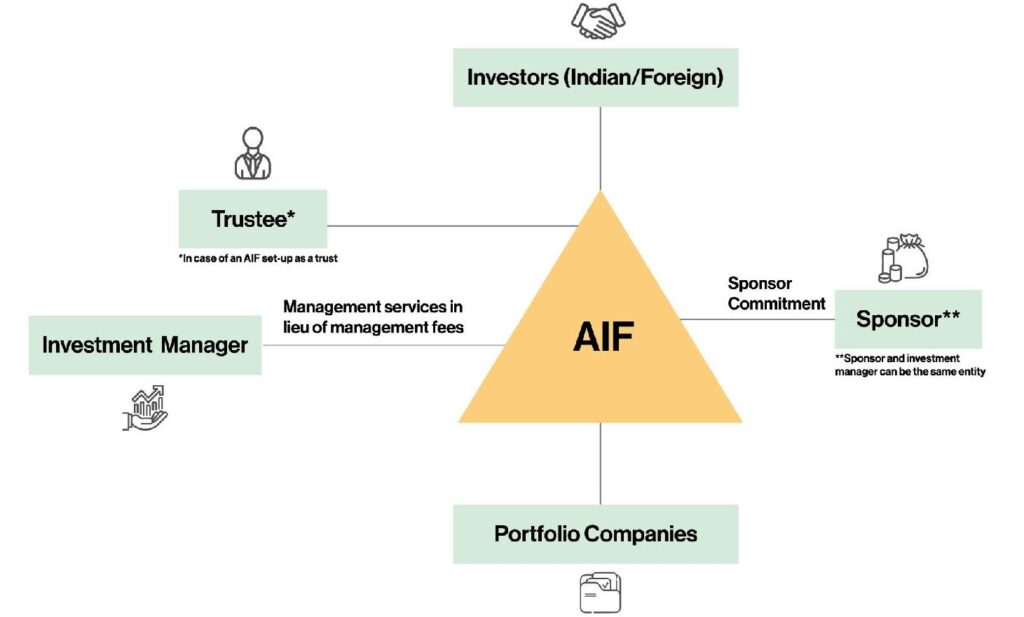
The entities are:
- Settlor – Person who settles the trust with a nominal initial settlement
- Trustee – Person in charge of the overall administration and management of the Trust. In practice, this responsibility is then outsourced to the investment manager.
- Contributor – Investor to the Trust (AIF) and makes a capital commitment to the AIF
- Sponsor – Face of the AIF i.e. Person who sets up the AIF
- Investment Manager – Brain of the AIF i.e. Person who is appointed to manage the investments
- Custodian – Safeguards the securities and assets of the AIF and facilitates settlement of transactions.
- Merchant Banker – Assists with due diligence certification for PPM.
- Registrar and Transfer Agent (RTA) – Maintains investor records, processes capital calls and distributions, and handles investor communications and reporting.
It’s noteworthy that the roles of the Sponsor and Investment Manager can be unified, with one entity performing both functions.
3 Categories of AIFs in India
Under the SEBI AIF Regulations, AIFs are classified into 3 distinct categories namely Category 1, Category 2 and Category 3 AIFs. Each category serves a unique purpose and is characterized by specific investment conditions and varying degrees of regulatory oversight. Below is an overview of the categories, highlighting their primary purpose and key conditions:
| Parameters | Category I AIF | Category II AIF | Category III AIF |
| Definitions | Funds with strategies to invest in start-up or early stage ventures or social ventures or SMEs or infrastructure or other sectors or areas which the government or regulators consider as socially or economically desirable. Includes: Venture Capital Funds (angel funds are a sub-category of VCFs)SME fundsSocial Impact FundsInfrastructure FundsSpecial Situation Funds | Funds that cannot be categorized as Category I AIFs or Category III AIFs. These funds do not undertake leverage or borrowing other than to meet day-to-day operational requirements and as permitted in the AIF Regulations. Examples – Private Equity or Debt Funds | Funds which employ diverse or complex trading strategies and may employ leverage including through investment in listed or unlisted derivatives. Examples – Hedge funds or funds which trade with a view to make short-term returns |
| AIF Minimum ticket size | INR 1 crore | INR 1 crore | INR 1 crore |
| AIF Minimum fund size | INR 20 crore | INR 20 crore | INR 20 crore |
| Open or close ended AIF | Close-ended fund | Close-ended fund | Can be open or close-ended fund |
| Tenure | Minimum tenure of 3 years | Minimum tenure of 3 years | NA |
| Continuing interest of Sponsor / Manager (a.k.a skin in the game) | Lower of:2.5 % of corpusINR 5 crores | Lower of:2.5 % of corpusINR 5 crores | Lower of:5 % of corpusINR 10 crore |
| Investment outside India | Permissible subject to SEBI approval | Permissible subject to SEBI approval | Permissible subject to SEBI approval |
| Concentration norms | Cant invest more than 25% in 1 investee company | Cant invest more than 25% in 1 investee company | Cant invest more than 10% in 1 investee company |
| Borrowing | To not borrow funds except for : (a) temporary funds not more than 30 days (b) less than 4 occasions in a year Borrowing shall be limited to the lower of:i) 10% of investable fundsii) 20% of the proposed investment in the investee companyiii) undrawn commitment from investors other than the defaulting investors | (Same as Category 1 AIF) | Can engage in leverage & borrowing as per prescribed rules |
| Overall restrictions / compliances | Low | Medium | High |
| SEBI registration fees | INR 500,000 | INR 1,000,000 | INR 1,500,000 |
| Per scheme filing fees | INR 100,000 | INR 100,000 | INR 100,000 |
Table 1: Categories of AIFs
Apart from the categories mentioned above, any of the three categories of AIFs can be classified as a large-value fund (LVFs), provided that each investor is an “accredited investor” as per the AIF Regulations and invests a minimum of INR 70 crores in the AIF. LVFs have certain investment and compliance related exemptions.
Category I AIFs : Nurturing Growth and Social Impact
Category I Alternative Investment Funds (AIFs) are investment vehicles designed to promote economic development, entrepreneurship, innovation, and social impact. These funds channel capital into sectors that are considered socially or economically desirable by regulators and the government, and therefore often receive policy support, incentives, or concessions.
Regulated by Securities and Exchange Board of India (SEBI), Category I AIFs primarily focus on long-term value creation rather than short-term liquidity.
Investment Focus of Category I AIFs
Category I AIFs invest in areas that contribute directly to nation-building and economic expansion, including:
- Startups and early-stage ventures
- Venture capital and angel-backed businesses
- Social ventures with measurable impact
- Small and Medium Enterprises (SMEs)
- Infrastructure projects
- Special situation and stressed asset opportunities
These investments are typically unlisted, early-stage, or financially complex, which increases both risk and return potential.
Fund Structure & Tenure of Category I AIFs
- Fund Type: Strictly close-ended
- Unit Listing: Optional, permitted only after final fund closure
- Minimum Tenure:
- 3 years
- Extendable by up to 2 additional years with approval of two-thirds of investors (by value)
This structure aligns investor capital with long-term developmental outcomes.
Leverage, Borrowing & Risk Profile of Category I AIFs
- Leverage for Investments: Not permitted
- Temporary Borrowing:
- Allowed only for operational needs
- Limited to 10% of the investable corpus
- Maximum duration: 30 days
Key Risk Characteristics:
- High growth potential
- Low liquidity
- Elevated risk due to early-stage, distressed, or impact-oriented investments
Taxation of Category I AIFs
Category I AIFs enjoy pass-through tax status:
- Income (excluding business income) is taxed directly in the hands of investors
- Taxation applies as per the investor’s applicable income tax slab
- The fund itself does not bear tax at the entity level for pass-through income
Sponsor Commitment Requirements
To ensure alignment of interest between fund managers and investors:
- Minimum Sponsor Contribution:
- 2.5% of the fund corpus or ₹5 crore (whichever is lower)
- Angel Funds:
- 2.5% of corpus or ₹50 lakh (whichever is lower)
Custodianship Requirement
- Mandatory custodian appointment only if:
- Fund corpus exceeds ₹500 crore
- Below this threshold, custodianship remains optional
Sub-Categories of Category I AIFs
1. Venture Capital Funds (VCFs)
Venture Capital Funds invest in early-stage and high-growth unlisted companies with scalable business models. These funds play a vital role in:
- Promoting innovation and entrepreneurship
- Supporting companies until IPO, acquisition, or strategic exit
- Generating long-term capital appreciation
VCFs carry higher risk, but also the potential for outsized returns.
2. Angel Funds
Angel Funds are a specialized sub-category of Venture Capital Funds focused on seed-stage and early-stage startups.
Key Characteristics:
- Capital pooled from individual or institutional angel investors
- Minimum investment per investor: ₹25 lakh
- Provide not only funding but also:
- Mentorship
- Industry expertise
- Strategic networking
Angel Funds act as the first institutional capital for many startups. Angel Funds also hold a distinct categorization under the AIF Regulations. These funds are a sub-category of Category I AIFs – VCFs, primarily designed to acknowledge and support the unique role of angel investors in the startup ecosystem. The key characteristics of Angel funds are summarised below:
| Parameters | Category 1 AIFs |
| Conditions | Minimum corpus – None Minimum number of investors – 5 Accredited Investors to declare first closeMaximum investors per scheme – No limit |
| Continuing interest of Sponsor / Manager(a.k.a skin in the game) | Minimum continuing interest to be maintained in each investment of the Angel Fund at higher of:0.5% of investment amount or INR 50,000 |
| Angel Investor | An Accredited Investor or KMP of an angel fund / manager |
| Accredited Investor (AIs) | “accredited investor” means any person who is granted a certificate of accreditation by an accreditation agency and who:Individuals, HUFs, Family trusts and sole proprietorship meeting any of the following criteria:Annual income >= INR 2 crore; or Net-worth >= INR 7.5 crore (with >= INR 3.75 crore in financial assets); orAnnual income >= INR 1 crore and net-worth >= INR 5 crore (with >= INR 2.5 crore in financial assets)Partnership firms: Eligible only if each partner meets the above criteriaTrusts (excluding family trusts) and Body-corporates: Net-worth >= INR 50 crores |
| Investments | Can invest directly in startups (without launching separate schemes)Minimum investment: Rs. 10 lakhs Maximum investment: Rs. 25 croresLock-in: 1 year (Reduced to 6 months if its a third party sale)Can invest 25% of the Fund corpus outside India subject to SEBI approvalCan invest entirely into one startup (with minimum 2 Accredited Investors) |
| Open or close ended fund | Close-ended |
| Investor Approval | Manager to obtain prior approval from each angel investor before making investment |
| SEBI registration fees | INR 200,000 |
Table 2: Angel Funds
3. Special Situation Funds (SSFs)
Special Situation Funds invest in financially distressed assets, including:
- Stressed loans acquired under Reserve Bank of India (RBI) Master Directions
- Security Receipts issued by RBI-registered Asset Reconstruction Companies (ARCs)
- Companies undergoing insolvency under the Insolvency and Bankruptcy Code (IBC)
Additional Conditions:
- 6-month lock-in on acquired security receipts
- Investments often linked to resolution plans or restructuring outcomes
These funds aim to unlock value from distressed but viable businesses.
4. Social Venture Funds
Social Venture Funds pursue a dual mandate:
- Financial returns
- Measurable social or environmental impact
They invest in organizations addressing challenges such as:
- Education
- Healthcare
- Sustainable development
- Livelihood generation
- Environmental conservation
These funds demonstrate that profitability and social good can coexist.
We help setup AIF in India, navigating complex regulatory requirements Let’s Talk
Category II: Private Equity & Debt Funds (Residual)
Category II Alternative Investment Funds (AIFs) represent the most widely used AIF category and include all funds that do not fall under Category I or Category III. These funds are designed to provide investors with structured exposure to private markets while operating under defined regulatory constraints. Category II AIFs are funds that neither qualify for incentives under Category I nor engage in leverage or complex trading strategies like Category III. They are not permitted to use leverage for investment purposes, except for temporary borrowing strictly to meet day-to-day operational requirements. These funds typically invest in unlisted entities, real estate, or distressed assets and are structured as close-ended vehicles with a defined tenure.
Investment Focus of Category II AIFs
Category II AIFs primarily invest in:
- Private Equity (PE)
- Debt Instruments of Unlisted Companies
- Real Estate Assets
- Distressed or Stressed Assets
This investment approach offers diversification through unlisted private markets and is generally associated with moderate-to-high risk and stable long-term return potential.
Fund Structure and Tenure of Category II AIFs
- Structure: Strictly close-ended
- Minimum Tenure: 3 years
- Extension: Up to 2 additional years with approval
- Listing: Optional
The close-ended nature aligns with the long-term investment horizon required for private market value creation.
Leverage and Borrowing:
- Investment Leverage: Prohibited
- Permitted Borrowing: Allowed only for temporary operational requirements
This restriction ensures lower systemic risk and preserves the long-term investment focus of the fund.
Taxation of Category II AIFs
- Tax Status: Pass-through
- Capital Gains Taxation (at investor level):
- Long-Term Capital Gains (LTCG): 12.5%
- Short-Term Capital Gains (STCG): 20%
The pass-through mechanism ensures that income is taxed directly in the hands of investors rather than at the fund level.
Sponsor Commitment
- Minimum Contribution: 2.5% of the total fund corpus or ₹5 Crore, whichever is lower
This requirement ensures sponsor alignment with investor interests.
Custodianship
- Mandatory: Only if the fund corpus exceeds ₹500 Crore
Custodianship provides an additional layer of asset safety and oversight for large funds.
Key Sub-Types of Category II AIFs
1. Private Equity Funds (PEFs)
Private Equity Funds form a major component of Category II AIFs. These funds invest in mature, unlisted companies with the objective of growth, expansion, acquisitions, or restructuring. Investments are typically made by acquiring controlling or significant minority stakes. Fund managers actively engage with portfolio company management to enhance operational efficiency and value creation.
- Typical Lock-in Period: 4 to 7 years
- Investment Horizon: Long-term, reflecting private company growth cycles
2. Debt Funds
Debt Funds under Category II focus on investing in debt instruments issued by unlisted companies. These may include structured debt, mezzanine financing, or convertible debt. Such funds provide alternative financing solutions for companies that may not rely solely on traditional bank funding.
- Use of Capital: Expansion, working capital, or project-specific needs
- Return Profile: Interest income and potential capital appreciation
3. Fund of Funds (FoFs)
Fund of Funds under the AIF framework invest in other AIFs instead of directly investing in companies or assets. This structure enables diversification across multiple strategies and fund managers through a single investment.
- Key Advantage: Broader exposure to alternative investment strategies
- Investor Benefit: Reduced individual due diligence effort
Category III AIFs: Complex Strategies and Short-Term Returns
Category III AIFs are designed to capitalize on short-term and medium-term market opportunities through active trading strategies. Unlike Category I and II AIFs, these funds are permitted to use leverage and sophisticated financial instruments. Their goal is not merely to outperform a benchmark but to achieve positive returns in both rising and falling markets.
Investment Focus of Category III AIFs
Category III AIFs primarily invest in:
- Hedge Funds
- PIPE Funds (Private Investment in Public Equity)
- Derivative-based trading strategies
These funds actively trade across asset classes and market segments to exploit inefficiencies and price movements.
Trading Strategies and Risk Profile of Category III AIFs
Category III AIFs employ diverse and complex trading strategies, including but not limited to:
- Long-short equity
- Market-neutral strategies
- Arbitrage strategies
- Global macro strategies
- Event-driven strategies
They frequently use leverage (borrowed capital to amplify returns) and derivatives such as futures, options, and swaps for both hedging and speculative purposes. Due to these characteristics, Category III AIFs exhibit high volatility and complex valuation methodologies, making them suitable only for sophisticated investors with higher risk tolerance.
Fund Structure and Tenure of Category III AIFs
- Structure: Flexible – Open-ended or Close-ended
- Minimum Tenure: No fixed minimum tenure for open-ended schemes
This flexibility allows fund managers to dynamically adjust portfolios based on market conditions.
Leverage and Borrowing
- Leverage: Permitted
- Purpose: Active trading and hedging
- Conditions: Subject to regulatory limits and mandatory disclosures
The ability to employ leverage differentiates Category III AIFs from other AIF categories.
Taxation of Category III AIFs
- Tax Treatment: Fund-level taxation (No pass-through status)
- Tax Rate: Maximum Marginal Rate (approximately 42.7%)
- Impact: Tax is paid by the fund before distributions are made to investors
Sponsor Commitment
- Minimum Requirement: 5% of the total corpus or ₹10 Crore, whichever is lower
This higher sponsor contribution reflects the elevated risk and complexity of Category III AIFs.
Custodianship
- Requirement: Mandatory for all Category III AIFs
- Applicability: Irrespective of the fund corpus size
Custodianship ensures enhanced transparency, asset safety, and regulatory oversight.
Hedge Funds within Category III AIFs
Hedge Funds are the most prominent segment of Category III AIFs. They operate with flexible investment mandates and typically charge higher fees due to their active management style and use of advanced financial instruments. Their primary objective is to generate alpha, or market-beating returns, irrespective of overall market direction.
Key Investment Team of AIFs
The key investment team of the Investment Manager of all AIFs have to comply with certain qualification conditions which are specified below:
| Experience | Minimum 1 key person to obtain certification from the NISM by passing the NISM Series-XIX-C: Alternative Investment Fund Managers Certification Examination or NISM Series-XIX-D: AIF Cat I and II examination or NISM Series-XIX-E: AIF Cat III examination |
| Educational Qualification | Minimum 1 key person with professional qualification in any of the below from a university or an institution recognized by Central Government or any State Government or a foreign university – Finance Accountancy Business management Commerce Economics Capital markets or Banking CFA charter from the CFA institute |
Table 3: Criteria for Key Investment Team
The experience and education qualification criteria may be satisfied by the same person.
Taxation of Alternative Investment Funds (AIFs)
The taxation of Alternative Investment Funds (AIFs) in India depends on whether the fund enjoys pass-through status or is taxed at the fund level:
Category I and II AIFs: Pass-Through Status
Category I and II AIFs are granted pass-through status from an income-tax perspective, whereby any income earned by these AIFs (other than profits or gains from business) is not taxed at the AIF level, but directly taxed as income at the hands of the investors as if these investors had directly received this income from the investments.
Unabsorbed losses (other than business losses) of the AIF may be allocated to the investors for them to set off against their respective individual incomes, subject to such investors having held the units in the AIF for at least 12 months.
Further, the distributions from Category I and II AIFs are subject to a withholding tax of 10% in the case of resident investors, and at the rates in force in the case of non-resident investors (after giving due consideration to any benefit available to them under the applicable tax treaty).
The Finance Act, 2025 has introduced a clarificatory amendment to the definition of ‘capital asset’ by expressly including investments made by Category I and II AIFs. This amendment resolves the long-standing ambiguity regarding the characterization of income clarifying that gains from investments made by Category I and II AIF shall be taxable under the head ‘Capital Gains’.
- Income Taxed at Investor Level: Capital gains, dividends, and interest income are passed through and taxed in the investor’s hands.
- Exception: Business Income: Any income classified as “profits and gains from business or profession” is taxed at the AIF level (at corporate rates for companies/LLPs or the Maximum Marginal Rate (MMR) for trusts).
- Unabsorbed Losses: Business losses are retained by the AIF and can be carried forward at the fund level.
- Withholding Tax (TDS): AIFs typically deduct 10% TDS on passed-through income for resident investors, while in case of non-resident investors, it is as per DTAA.
Category III AIFs : Non-Pass-Through Status
Category III AIFs have not been granted statutory pass-through status. Typically, they are set up as “determinate and irrevocable trusts.” This means the trusts have identifiable beneficiaries, and their respective beneficial interests can be determined at any given time. In such trusts, the trustee can discharge the tax obligation for the income of the trust on behalf of its beneficiaries (i.e., the investors) in a representative capacity. This is similar to the tax liability an investor would face if they had received the income directly. However, there’s an exception: trusts with any business income must pay tax at the MMR i.e., 39% where the trust pays tax under the new regime. As per income-tax law, tax authorities can recover tax either from the trustee or directly from the beneficiaries. Given this flexibility, a trustee might opt to pay the entire tax amount at the AIF level. Moreover, the law permits the trustee (acting as a representative assessee) to recover from investors any taxes it has paid on their behalf.
- Fund Pays Tax: All income (capital gains, interest, dividends, business income) earned by a Category III AIF is taxed at the fund level.
- Tax Rate: Often, particularly if structured as a trust, this income is taxed at the Maximum Marginal Rate (MMR) (depending on the nature of income).
- Distributions to Investor: Since tax is already paid at the fund level, distributions received by investors from Category III AIFs are generally tax-exempt in their hands. The tax can be collected from the trustee or, in certain circumstances, directly from the investor.
We have not covered tax implications for investment managers and sponsor entities above.
Key Documents
Private Placement Memorandum (PPM):
The PPM provides comprehensive details about the AIF. Contents include information about the manager, key investment team, targeted investors, proposed fees and expenses, scheme tenure, redemption conditions or limits, investment strategy, risk factors and management, conflict of interest procedures, disciplinary history, service terms and conditions by the manager, affiliations with intermediaries, winding up procedures, and any other relevant details helping investors make informed decisions about investing in an AIF scheme.
SEBI has introduced mandatory templates for PPMs (for and) which provides for two parts:
- Part A – section for minimum disclosures
- Part B – supplementary section to allow full flexibility to the AIF in order to provide any additional information, which it may deem fit.
There are two templates – one for Category I and II AIFs and the other for Category III AIFs.
Angel Funds, LVFs and AIFs in which each investor commits to a minimum capital contribution of INR 70 crores are exempted from following the aforementioned template.
Indenture of Trust / Trust Deed:
This document is an agreement between the settlor and the trustee. It involves the settlor transferring an initial settlement (can be nominal) to the trustee to create the fund’s assets. The Indenture details the roles and responsibilities of the trustee.
Investment Management Agreement:
This agreement is entered between the trustee and the investment manager. Here, the trustee designates the investment manager and transfers most of its management powers regarding the fund to them. However, certain powers retained by the trustee are outlined in the Indenture of Trust.
Contribution Agreement:
This agreement is between the contributor (investor), the trustee, and the investment manager. It mentions the terms of an investor’s participation in the fund, covering areas like beneficial interest computation, distribution mechanism, expense list to be borne by the fund, and the investment committee’s powers. SEBI mandates that the Contribution Agreement’s terms should align with the PPM and shouldn’t exceed its provisions.
Investment Process for AIFs (India)
- Check eligibility first. Investors must meet the minimum investment requirement of ₹1 crore and be prepared for a long-term commitment of 3–7 years, as AIFs are largely illiquid.
- Choose the right AIF category.
Category I focuses on start-ups, venture capital, and infrastructure.
Category II covers private equity, private credit, and real assets.
Category III uses complex strategies, including leverage, suited for higher-risk appetites.
- Evaluate the fund manager. Review the manager’s track record, sector expertise, risk management approach, and alignment of interests. Historical performance helps with assessment but is not a guarantee of future returns.
- Complete KYC and banking setup. Investors must submit PAN, identity and address proofs. NRIs additionally require passport details and an operational NRE or NRO account with an Indian bank.
- Study the PPM carefully. The Private Placement Memorandum outlines strategy, fees, risks, governance standards, and exit timelines—making it a critical due-diligence document.
- Sign agreements and invest. Execute the contribution agreement and transfer capital to the designated AIF account as per the drawdown schedule.
Tenure and Listing of Alternative Investment Funds / Schemes
Understanding the tenure and liquidity aspects of AIFs is crucial for investors, as it dictates the duration of their capital commitment and the ease with which they can exit an investment.
Fund Tenure and Structure
The tenure of an Alternative Investment Fund, or its individual schemes, varies based on its category:
- Category I and Category II AIFs: These funds are typically structured as close-ended schemes. This means they have a predetermined lifespan.
- Minimum Tenure: The regulations stipulate a minimum tenure of three years from the date of final closing of the scheme.
- Extension: The tenure can be extended, generally by a maximum of two years, provided there is investor consent (usually requiring approval from a specified percentage, often two-thirds, of unit holders by value). This extension allows the fund manager more time to achieve investment objectives or liquidate assets optimally.
- Category III AIFs: Unlike Categories I and II, Category III AIFs offer more flexibility in their structure. They can be either open-ended or close-ended.
- Open-ended Category III AIFs allow investors to enter and exit at various points, subject to the fund’s terms and conditions (e.g., specific redemption windows, lock-in periods).
- Close-ended Category III AIFs operate similarly to Category I and II in terms of fixed tenure, often with a minimum of three years if structured as such. The choice between open-ended and close-ended depends on the fund’s investment strategy and the nature of its underlying assets.
Listing of AIF Units on Stock Exchanges
While AIFs are primarily private investment vehicles, SEBI regulations permit the optional listing of AIF units on recognized stock exchanges. This provision aims to offer a potential avenue for liquidity to investors.
- Optional Listing: Fund managers may choose to list the units of their AIF schemes on an exchange, but it is not mandatory. This decision is often influenced by investor demand and the fund’s strategy.
- Minimum Tradable Lot: For any listed AIF units, the minimum tradable lot is stipulated at ₹1 crore (Rupees One Crore). This ensures that trading remains restricted to sophisticated investors, aligning with the nature of AIFs.
- Reality of Limited Liquidity: Despite the option for listing, it’s crucial for investors to understand the reality of limited liquidity for AIF units on stock exchanges.
- Thin Trading Volumes: AIF units, even when listed, often experience thin trading volumes compared to mainstream equities or mutual funds. This is due to the nature of their underlying illiquid assets, the limited number of eligible sophisticated buyers and sellers, and the long-term investment horizon of many AIF investors.
- Investor Base: The investor base for AIFs primarily consists of HNIs and institutional investors, who typically have a longer investment horizon and are not engaged in frequent trading. This further contributes to lower trading activity.
- Impact on Exit: Consequently, while listing provides a theoretical exit route, actually selling units at a fair price and in a timely manner can be challenging. Investors should primarily view AIFs as long-term, illiquid investments and not rely on exchange listing for immediate or easy exit liquidity.
How to get registered with SEBI?
To register an AIF with SEBI, the fund needs to make an application to SEBI on its online portal.
The trust deed i.e. incorporation document of the fund where it is set up as a trust, needs to be registered with the local authorities. Further, the PAN needs to be obtained before making the application to SEBI.
The application to SEBI has the following key documents to be submitted:
- Application form in Form A
- Private Placement Memorandum (PPM)
- Trust Deed
- Declarations and KYC documents of the entities involved i.e. investment manager, sponsor, trustee (if the AIF is structured as a trust), and the AIF itself
Further, before submitting the application to SEBI, the AIF must engage a merchant banker who performs due diligence on the PPM and subsequently provides a certification that needs to be filed with SEBI. However, there’s an exemption for LVFs and Angel Funds for this requirement.
Once the application is submitted, SEBI will evaluate the application. Generally, the entire AIF setup and registration process, including SEBI’s assessment, spans around four to six months.
Broadly, the process flow looks as follows:
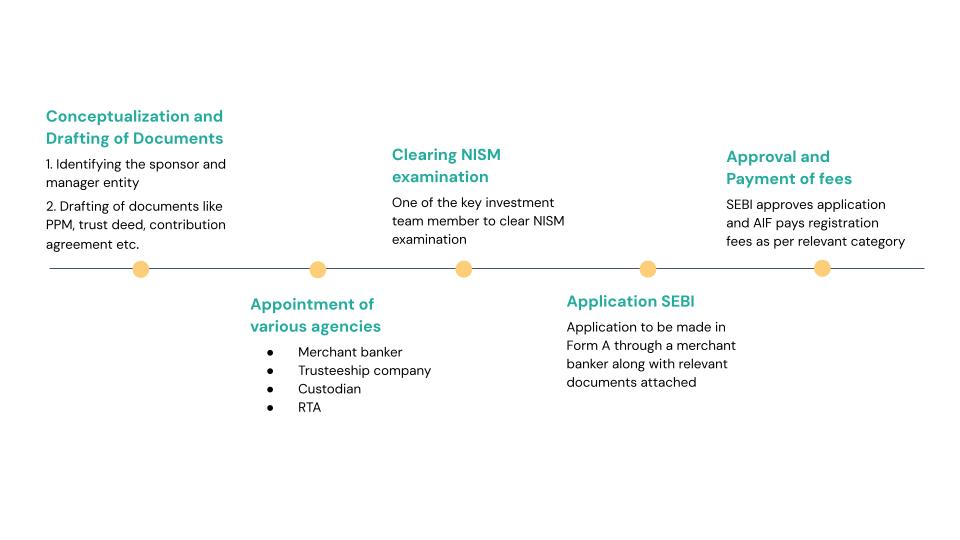
AIF Process Flow
Who Can Invest in an AIF?
- Beyond HNIs/UHNIs, explicitly state eligibility for Resident Indians, NRIs, and foreign nationals. Include precise minimum investment limits (Rs. 1 crore for investors, Rs. 25 lakh for employees/directors) and the maximum investor cap (1,000, except Angel Funds at 49).
- AIFs are “Not for Retail Investors” due to their inherent high risk, substantial costs, and lock-in period constraints.
Alternative Investment Funds (AIFs) are designed for high-net-worth individuals (HNWI), institutional investors, and sophisticated investors. These investors typically include:
- High-net-worth individuals (HNWI)
- Corporate bodies
- Foreign investors (including NRIs and foreign nationals)
- Venture capital funds, private equity firms, and insurance companies
For a broader audience of investors looking to diversify their portfolios, it is important to understand that AIFs generally require a minimum investment of ₹1 crore (approximately $135,000), a barrier to entry for retail investors. Moreover, certain funds like Category III AIFs, which invest in more volatile assets like hedge funds, require highly experienced investors to take calculated risks.
Factors to Consider Before Investing in AIFs
Investing in Alternative Investment Funds (AIFs) requires careful consideration due to their unique nature. Before investing, assess these critical factors:
- Risk Appetite and Tolerance: AIFs generally carry higher risk due to illiquid assets, early-stage investments, or complex strategies. Ensure your comfort with potential capital loss and volatility aligns with the AIF’s profile.
- Investment Horizon: AIFs typically involve long lock-in periods (often 3-7+ years). Confirm your financial goals allow for this extended capital commitment.
- Minimum Investment Requirement: Most AIFs mandate a minimum investment of ₹1 crore (or ₹25 lakh for Angel Funds). Ensure you meet this substantial entry barrier comfortably.
- Fund Manager’s Expertise: The fund’s success hinges on the manager’s experience, track record, and specialized knowledge. Thoroughly research their performance, strategy, and team.
- Liquidity Constraints: AIFs invest in illiquid assets. Even if listed, the ₹1 crore minimum tradable lot and thin trading volumes mean liquidity is severely limited. Do not rely on quick exits.
- Regulatory and Tax Implications: Understand the specific SEBI regulations and the tax treatment (pass-through for Cat I & II, non-pass-through/MMR for Cat III) to gauge post-tax returns and compliance.
Taxation of AIFs in India
Taxation plays a significant role in the decision-making process for potential investors in AIFs. Understanding the structure of taxation on both the fund and the investor level is crucial:
- Tax Structure for AIFs
- Category I & II AIFs are generally exempt from tax at the fund level. However, taxes are levied at the investor level when returns are distributed.
- Category III AIFs face higher tax rates due to the speculative nature of the investments. These funds are taxed at the fund level before returns are distributed.
- Taxation on Investors
- Investors in AIFs are subject to tax based on the type of income they receive.
- Income from AIFs may be classified as capital gains, dividends, or interest income, and the tax rate will depend on the holding period (short-term or long-term).
- Long-term capital gains (LTCG) from investments held for over three years are taxed at a reduced rate of 10% without indexation.
Benefits of Investing in AIFs in India
AIFs offer several attractive benefits for high-net-worth individuals and institutional investors looking to diversify their portfolios. The key benefits include:
- High Return Potential
With their focus on private equity, venture capital, and infrastructure, AIFs present higher growth potential than traditional investment vehicles like mutual funds. - Diversification
AIFs allow investors to diversify their portfolios beyond equity markets and debt instruments into alternative asset classes such as real estate, commodities, and startup investments. - Professional Fund Management
AIFs are managed by seasoned professionals who have a deep understanding of the market and provide strategic oversight of the investments, leading to better risk management and potentially higher returns. - Lower Correlation with Stock Markets
AIFs are often less correlated with equity market movements, providing a hedge against market volatility.
Final Thoughts
With their ability to diversify investment portfolios and provide potential high returns, AIFs undeniably present an attractive avenue for investment in today’s dynamic market scenario.The regulatory framework, set by SEBI, ensures transparency, credibility, and alignment with global best practices, further instilling confidence among stakeholders. However, AIFs can be tricky to understand because of the different types, how they are taxed, and the many documents involved. It’s like trying to put together a puzzle with lots of pieces.
India’s AIF industry continues its strong upward trajectory, driven by rising domestic capital, technology adoption, and regulatory maturity. As of September 2025, total AIF commitments crossed ₹15 lakh crore (USD ~180 billion), reflecting robust year-on-year growth of around 18–20%. Fund managers are increasingly leveraging advanced analytics, AI-led risk monitoring, and automated compliance systems, with adoption expanding steadily through 2025. Private credit has solidified its position as a core strategy, contributing roughly 15% of total AIF commitments, supported by tighter bank lending and demand for structured yield products. The investor mix is now firmly dominated by HNWIs and family offices, which account for nearly 80–90% of total inflows; HNI investments alone reached approximately ₹5.38 lakh crore by March 2025, growing over 30% year-on-year. On the regulatory front, SEBI continues to strengthen disclosure, valuation, and governance norms while simplifying accreditation frameworks, reinforcing AIFs as a cornerstone of sophisticated portfolio construction in India.
For both potential AIF managers and investors, understanding this intricate ecosystem is crucial. It is recommended to talk to experts who know the details. They can guide you through the process, help you understand the rules, and make sure you’re making the best decisions. As the world of AIFs keeps changing, staying informed and getting the right advice will be key to success.
Need Expert Guidance in Setting up AIF?
At Treelife, we specialize in helping investors and fund managers navigate the complexities of the AIF landscape. Whether it’s SEBI registration, fund structuring, or regulatory compliance, our team of experts is here to guide you through every step of the process.
Reach out to us today and ensure your AIF investment strategies are aligned with the latest regulations and market trends.
Contact Us: support@treelife.in
Call Us: +91 99301 56000
References:
- [1] SEBI Website https://www.sebi.gov.in/
 ︎
︎ - [2] According to the ‘Data relating to activities of Alternative Investment Funds (AIFs)’ by SEBI ︎
- [3] https://aifpms.com/blog/growth-of-aif-pms-investments-in-india/ ︎
- [4] India goes Alternatives report by Avendus published in December 2024 ︎
- [5] Crisil intelligence and oister global report on AIFs published in January 2025 ︎
What are AIFs (Alternative Investment Funds)?
Alternative Investment Funds (AIFs) are pooled investment vehicles that collect capital from accredited investors to invest in a range of asset classes, such as equity, debt, real estate, or commodities. Unlike traditional investment vehicles like mutual funds, AIFs provide a broader investment universe, often focusing on sectors like infrastructure, private equity, hedge funds, and venture capital.
AIFs are regulated by the Securities and Exchange Board of India (SEBI), and they provide investors with the opportunity to invest in unconventional asset classes while navigating less-liquid markets. However, knowing the taxation implications of AIF investments is important for maximizing returns and complying with Indian tax laws.
Definition and Types of AIFs (Category I, II, III)
AIFs are classified into three broad categories based on the nature of their investment activities and the corresponding regulatory framework. These categories are defined under SEBI’s AIF regulations and directly influence the taxability and treatment of these funds.
Category I AIFs
- Description: These funds primarily invest in sectors that are considered socially or economically beneficial. They include funds investing in start-ups, infrastructure, and social ventures.
- Taxation: Category I AIFs benefit from a pass-through status, meaning the income earned by the fund is not taxed at the fund level. Instead, it is taxed at the investor level based on their tax profile.
- Examples: Venture capital funds, social impact funds, infrastructure funds.
Category II AIFs
- Description: These funds invest in sectors that have a higher risk, but do not qualify for the special treatment of Category I AIFs. They may invest in unlisted companies and debt securities.
- Taxation: Similar to Category I AIFs, Category II funds also have pass-through taxation. However, investors may still be subject to capital gains tax on their income.
- Examples: Private equity funds, hedge funds, structured funds.
Category III AIFs
- Description: These funds engage in more complex strategies, including investments in listed or unlisted derivatives, and may use leverage to enhance returns.
- Taxation: Category III AIFs are taxed at the fund level on income earned. Unlike Categories I and II, they do not receive pass-through taxation, meaning they are subject to corporate tax rates on their profits before distributing earnings to investors.
- Examples: Hedge funds, arbitrage funds, long-short equity funds.
Key Differences Between Each Category of AIF
| Category | Investment Focus | Taxation Type | Example |
|---|---|---|---|
| Category I | Socially & economically beneficial sectors | Pass-through taxation | Venture capital funds, Infrastructure funds |
| Category II | High-risk sectors, unlisted companies, debt | Pass-through taxation | Private equity funds, hedge funds |
| Category III | Listed and unlisted derivatives, leveraged strategies | Fund-level taxation | Arbitrage funds, long-short equity |
- Pass-Through Taxation (Category I & II): Investors in these AIFs are taxed based on their own tax brackets, with income not being taxed at the fund level.
- Fund-Level Taxation (Category III): AIFs themselves are taxed on the income generated, and only the remaining profits are distributed to investors.
Why AIF Taxation Matters for Investors
Understanding the taxation rules for AIFs is essential for investors because it directly impacts the returns they receive. Here’s why AIF taxation matters:
- Optimization of Investment Strategies: Tax rules play a major role in shaping investment decisions. A clearer understanding of AIF taxation helps investors structure their portfolios efficiently to minimize tax liabilities while maximizing returns.
- Tax Liability Planning: Depending on the category of AIF, investors may either face tax at the fund level or investor level. Knowing when and where taxes are levied helps investors plan and manage their liabilities more effectively.
- Risk Management: Incorrect tax handling can significantly affect the overall returns of an AIF. For instance, not considering the implications of capital gains tax for Category III funds could lead to underperformance relative to market expectations.
Implications of Tax on Returns and Investment Strategies
The tax treatment of AIFs has far-reaching consequences on investor returns and portfolio strategies. Here’s how taxes on AIFs can affect investment outcomes:
- Capital Gains Tax: The taxation of capital gains (short-term and long-term) can significantly influence the profitability of an investment in AIFs. For example:
- Long-Term Capital Gains (LTCG) on investments held for more than three years are generally taxed at a lower rate (10%) for Category I and II AIFs.
- Short-Term Capital Gains (STCG) on investments held for less than three years are taxed at a higher rate (15%) for both Category I and Category II AIFs.
- Dividend and Interest Income: AIFs may also distribute dividends or interest income to investors, which are subject to taxes at varying rates based on the investor’s tax residency.
- Impact of Carrying Interest Taxation for Fund Managers: In addition to taxes on investor returns, fund managers’ carried interest (a percentage of profits earned by the fund) is often subject to higher tax rates (typically treated as income or capital gains, depending on the structure of the AIF).
Importance of Understanding Tax Rules for Optimizing Investments
Incorporating tax efficiency into your investment strategy is a key driver for maximizing long-term returns. Here are some strategies investors can use based on tax implications:
- Selecting the Right AIF Category: Investors should assess the tax implications of each AIF category before committing. Category I and II AIFs offer tax pass-through status, which may be more beneficial for certain investor profiles.
- Timing of Investment and Exit: Long-term investments in Category I and II AIFs may be eligible for preferential long-term capital gains tax rates. Timing the entry and exit from an AIF can therefore make a big difference in the net returns.
- Leveraging Tax Deductions: Investors in AIFs can take advantage of tax deductions and exemptions available under the Income Tax Act, particularly for investments in infrastructure and social sectors.
- Tax Filing & Documentation: Proper documentation of income earned from AIFs, including TDS certificates and capital gains statements, is crucial to ensure compliance and avoid unnecessary tax liabilities.
Key AIF Taxation Terms and Rules in India
What is AIF Taxability?
AIF taxability refers to how the income generated by Alternative Investment Funds (AIFs) is treated under Indian tax law. AIFs are regulated by the Securities and Exchange Board of India (SEBI) and classified into three categories based on their investment strategies and the tax rules that apply to them. In India, AIFs typically benefit from a pass-through tax mechanism for certain categories, which means the tax is not levied at the fund level but is passed on to the investors, who are then taxed based on their individual tax profiles.
Explaining the Taxability of AIFs Under Indian Law
The taxability of AIFs in India is governed by several provisions under the Income Tax Act, and the specific tax treatment depends on the category of AIF and the type of income generated. Here are the core aspects:
- Pass-Through Taxation (Categories I & II): For Category I and II AIFs, the income generated is not taxed at the fund level. Instead, the tax is passed on to the investors based on their individual tax status. This is beneficial for investors because it avoids double taxation.
- Fund-Level Taxation (Category III): Category III AIFs, however, are taxed at the fund level on income generated. The income distributed to investors is subject to taxes based on the investors’ individual tax status.
- Types of Income and Tax Treatment: The income generated by AIFs can be categorized as:
- Capital Gains: Taxed at different rates depending on whether the gains are short-term (less than 36 months) or long-term (more than 36 months).
- Interest and Dividends: Income from debt securities or dividends is subject to tax at the investor level.
- Business Income: For AIFs investing in unlisted companies or conducting trading activities, income may be categorized as business income and taxed accordingly.
Types of Income Generated by AIFs and Their Tax Treatment
AIFs can generate different types of income, each with its unique tax treatment. Here’s a breakdown of the primary income types and their tax implications:
| Type of Income | Tax Treatment |
|---|---|
| Capital Gains | – Long-term Capital Gains (LTCG): Taxed at 10% (above INR 1 lakh) for Category I and II AIFs. |
| – Short-term Capital Gains (STCG): Taxed at 15% for Category I and II AIFs. | |
| Dividend Income | – Taxed as per individual tax slab rates for investors, subject to withholding tax. |
| Interest Income | – Taxed as per investor’s individual tax slab rates, subject to TDS deductions at source. |
| Business Income | – Income from trading, derivatives, or unlisted shares is taxed as business income at the fund level for Category III AIFs. |
Capital Gains Tax on AIFs
- Long-Term Capital Gains (LTCG): Taxed at 10% for investments held longer than three years for Category I and II AIFs.
- Short-Term Capital Gains (STCG): Taxed at 15% for Category I and II AIFs if held for less than three years.
Common Misconceptions in AIF Tax Rules
Understanding the nuances of AIF taxation is critical, as there are several common misconceptions that can lead to unintended tax consequences:
- Misconception: All AIFs Are Taxed at the Fund Level
- Reality: Only Category III AIFs are taxed at the fund level. Categories I and II have pass-through taxation, where income is taxed at the investor level, not the fund level.
- Misconception: Investors in AIFs Do Not Pay Taxes
- Reality: While AIFs in Categories I and II enjoy pass-through taxation, investors must still pay taxes on their share of income, including capital gains, dividends, and interest income.
- Misconception: Only Category I AIFs Are Tax-Exempt
- Reality: While Category I AIFs enjoy tax exemptions for certain types of income (like infrastructure investments), Category II also offers tax pass-through benefits. The tax treatment depends on the nature of income and the category of AIF.
- Misconception: Tax on Carrying Interest is Always Favorable
- Reality: The taxation of carried interest (the percentage of profit earned by fund managers) is a complex issue and is subject to higher tax rates in some cases, depending on how it’s classified (as capital gains or business income).
Overview of AIF Tax Rules for Different Categories
Category I AIFs: Tax Pass-Through Status, Eligible Exemptions
Category I AIFs primarily invest in socially or economically beneficial sectors, such as startups, infrastructure, and social ventures. These funds enjoy pass-through taxation, meaning the fund itself is not taxed, and investors are directly taxed on their share of income.
- Tax Pass-Through Benefit: Investors are taxed based on their individual income tax brackets.
- Eligible Exemptions: Income from investments in infrastructure or social sectors may qualify for exemptions under Section 10 of the Income Tax Act.
- Common Investments: Venture capital, social impact funds, infrastructure funds.
Category II AIFs: Tax Treatment, Special Provisions
Category II AIFs invest in unlisted companies, private equity, hedge funds, and structured debt. These funds also benefit from pass-through taxation, although they are subject to more complex tax rules than Category I AIFs.
- Taxation of Income: Pass-through taxation applies, but certain incomes like business income are subject to tax at the investor level.
- Special Provisions: AIFs in this category may qualify for certain tax incentives for sectors like manufacturing or agriculture, depending on their investment focus.
Category III AIFs: Fund-Level Taxation and Investor-Level Taxation
Category III AIFs include hedge funds, arbitrage funds, and funds that use more complex strategies such as leverage or derivatives. These funds do not enjoy pass-through taxation. Instead, the fund is taxed at the corporate tax rate on its income, and the investor is taxed on the distribution they receive.
- Fund-Level Taxation: These AIFs are taxed on the income they generate, including capital gains, interest, and business income.
- Investor-Level Taxation: Once the income is distributed, investors are taxed on their share of profits, which may include dividends, interest, and capital gains, depending on the nature of the fund’s investments.
| AIF Category | Taxation Structure | Examples of Funds |
|---|---|---|
| Category I | Pass-through taxation, tax exemptions | Venture Capital Funds, Infrastructure Funds |
| Category II | Pass-through taxation, business income | Private Equity Funds, Hedge Funds |
| Category III | Fund-level taxation, investor-level taxation | Hedge Funds, Arbitrage Funds |
We help Investors navigate AIF taxes with ease Let’s Talk
AIF Taxation in India: Rates and Regulations
AIF Tax Rates at the Fund Level
The taxation of AIFs in India varies depending on the category of the fund. AIFs are subject to different tax structures based on their investment focus and the type of income generated. These tax rates are important for both fund managers and investors.
Taxation Structure for Category I, II, and III AIFs
AIFs are divided into three categories by SEBI, each with distinct tax implications.
- Category I AIFs:
- Tax Structure: These funds benefit from pass-through taxation, meaning income is not taxed at the fund level. Instead, the tax burden is passed on to the investors, who are taxed based on their individual tax status.
- Common Investments: Infrastructure, venture capital, social impact sectors.
- Exemption: Certain incomes, such as those from infrastructure investments, are exempt under Section 10 of the Income Tax Act.
- Category II AIFs:
- Tax Structure: Similar to Category I, these funds also enjoy pass-through taxation. However, investors may be taxed on business income or capital gains depending on the type of investment.
- Common Investments: Private equity, hedge funds, and debt-focused funds.
- Category III AIFs:
- Tax Structure: Unlike Categories I and II, Category III AIFs are taxed at the fund level. The fund itself pays taxes on the income generated, and then the profits are distributed to investors, who are then taxed on the amount received.
- Common Investments: Hedge funds, arbitrage funds, and funds with complex strategies using derivatives or leverage.
| AIF Category | Tax Structure | Examples |
|---|---|---|
| Category I | Pass-through taxation | Venture Capital Funds, Infrastructure Funds |
| Category II | Pass-through taxation | Private Equity Funds, Hedge Funds |
| Category III | Fund-level taxation | Hedge Funds, Arbitrage Funds |
Capital Gains Tax:
Capital gains tax is one of the most significant tax considerations for AIFs and their investors. The tax rate depends on the holding period of the assets and whether the gains are classified as short-term or long-term.
Short-term and Long-term Capital Gains Tax for AIFs and Investors
- Short-term Capital Gains (STCG):
- Category I & II AIFs: STCG is taxed at 15% if the investment is held for less than three years.
- Category III AIFs: Similar treatment, but tax is applied at the fund level, and then distributed to investors.
- Long-term Capital Gains (LTCG):
- Category I & II AIFs: LTCG is taxed at 10% for investments held longer than three years (exceeding INR 1 lakh).
- Category III AIFs: LTCG is taxed at the fund level, and then investors are taxed based on their individual tax profile.
| Type of Capital Gain | Tax Rate for Category I & II AIFs | Tax Rate for Category III AIFs |
|---|---|---|
| Short-Term Capital Gains | 15% (if held < 36 months) | 15% (at fund level, passed to investors) |
| Long-Term Capital Gains | 10% (if held > 36 months, above INR 1L) | 10% (at fund level, passed to investors) |
Recent Updates Under the 2025 Budget on Capital Gains
- The 2025 Union Budget introduced significant changes to long-term capital gains (LTCG) tax for AIFs:
- Increased LTCG Exemption Threshold: Investors in AIFs will now benefit from a higher exemption limit on LTCG.
- Clarification on Carrying Interest Taxation: The budget has clarified the taxation of carried interest for fund managers, ensuring a more predictable tax liability.
The updates are aimed at making India an attractive destination for global investors and ensuring the alignment of AIF taxation with international standards.
Other Taxes on AIF Funds:
AIFs in India are subject to several other taxes beyond capital gains. Investors need to know these to ensure compliance and optimize returns.
Securities Transaction Tax (STT)
- What is STT?: STT is a tax levied on the purchase and sale of securities listed on recognized stock exchanges in India.
- Tax Implication for AIFs: AIFs investing in listed securities or derivatives are subject to STT on each transaction, which affects the fund’s returns. The rate of STT varies depending on the type of transaction.
| Transaction Type | STT Rate |
|---|---|
| Equity Shares (Sale) | 0.1% of the transaction value |
| Equity Shares (Purchase) | 0.1% of the transaction value |
| Derivatives | 0.05% of the transaction value |
Dividend Distribution Tax (DDT)
- What is DDT?: DDT is a tax imposed on the dividends declared by a company.
- Tax Implication for AIFs: AIFs investing in companies that declare dividends will be subject to DDT at the rate applicable. This tax is paid by the company before distributing dividends to AIFs or investors.
Current DDT Rate:
- 15% on dividends paid by domestic companies.
Tax on Carried Interest for Fund Managers
Carried interest is the share of the profits that fund managers receive for successfully managing an AIF. The taxation of carried interest is complex and often a source of confusion.
- Tax Treatment of Carried Interest:
- Capital Gains: If carried interest is treated as a share of the profits, it is typically taxed as capital gains, subject to LTCG/STCG rates.
- Business Income: In some cases, carried interest may be classified as business income and taxed at a higher rate.
Fund managers must structure their carried interest compensation carefully to minimize their tax liabilities while ensuring compliance with Indian tax laws.
TDS Obligations for AIFs
AIFs in India are subject to Tax Deducted at Source (TDS) obligations, which require them to deduct tax before distributing income to their investors. The rates for TDS depend on the type of income.
| Type of Income | TDS Rate for Residents | TDS Rate for Non-Residents |
|---|---|---|
| Interest Income | 10% | 20% (unless a lower rate applies) |
| Dividend Income | 10% | 20% (unless a lower rate applies) |
| Capital Gains (Short-Term) | 15% | 15% |
| Capital Gains (Long-Term) | 10% (above INR 1L) | 10% (above INR 1L) |
- TDS Deduction: AIFs are required to comply with TDS regulations by deducting tax at source and submitting it to the government. This ensures that tax is paid at the correct rate for investors.
AIF Taxation at Investor Level: Resident vs Non-Resident
In India, the tax obligations for investors in AIFs differ significantly based on their residency status. This section will break down the key tax rules for both resident and non-resident investors, including capital gains tax, TDS implications, and other key considerations.
Tax on AIF in India: Resident Investors
Resident investors in India are subject to tax on their share of the income generated by their investments in AIFs. The tax treatment varies depending on the type of income and the investor’s individual tax bracket.
Tax Rates Applicable to Resident Investors
- Capital Gains Tax:
- Short-Term Capital Gains (STCG): Taxed at 15% if the investment is held for less than three years.
- Long-Term Capital Gains (LTCG): Taxed at 10% if held for more than three years and the gains exceed INR 1 lakh.
- Interest Income: Taxed according to the individual’s income tax slab, which can range from 5% to 30% depending on the income level.
- Dividend Income: Taxed according to the investor’s income tax slab. TDS is generally deducted at 10% on dividends paid by Indian companies.
Tax on Income from AIFs for Individuals and Entities
- Individual Investors: Individuals pay tax on income derived from AIFs, including capital gains, interest, and dividends. These are added to their total income and taxed based on their tax bracket.
- Corporate Entities: Corporate investors are subject to the same tax treatment as individuals, but corporate tax rates may differ. Corporate entities also pay tax on capital gains at 15% for short-term and 10% for long-term gains.
TDS Deductions and Compliance for Residents
- TDS on Income:
- Short-term and long-term capital gains: TDS is typically deducted at 15% for short-term capital gains and 10% for long-term capital gains, applicable for both residents and non-residents.
- Interest and Dividend Income: TDS is deducted at 10% for interest and dividend income for resident investors, subject to tax exemptions under Section 10.
| Type of Income | TDS Rate for Resident Investors |
|---|---|
| Interest Income | 10% |
| Dividend Income | 10% |
| Short-Term Capital Gains | 15% |
| Long-Term Capital Gains | 10% (above INR 1 lakh) |
Capital Gains Tax for Residents
Short-Term Capital Gains (STCG):
- Tax Rate: 15% for assets held for less than three years.
- Applicable to: Investments in equities, bonds, and other securities by resident investors.
Long-Term Capital Gains (LTCG):
- Tax Rate: 10% for assets held for more than three years, with gains exceeding INR 1 lakh.
- Taxable on: Equity investments, real estate, and listed securities.
Example Table: Breakdown of Tax Treatment for Resident Investors
| Investment Type | Holding Period | Tax Treatment for Resident Investors |
|---|---|---|
| Equity Shares | Less than 3 years (STCG) | 15% on gains |
| More than 3 years (LTCG) | 10% on gains exceeding INR 1 lakh | |
| Real Estate | Less than 3 years | 30% (for individual tax slab) |
| More than 3 years | 20% with indexation |
Taxes on AIF in India: Non-Resident Investors
Non-resident investors, including NRIs and foreign entities, are subject to different tax rules when investing in AIFs in India. These rules mainly concern the rates of TDS (Tax Deducted at Source) and the applicability of tax exemptions based on their country of residence.
Tax Rates for Non-Residents, Including NRIs and Foreign Investors
- Short-Term Capital Gains (STCG):
- TDS Rate: 15% for investments held for less than three years. For non-residents, the TDS rate is generally higher due to the lack of exemptions and lower tax treaties.
- Long-Term Capital Gains (LTCG):
- TDS Rate: 10% for long-term capital gains exceeding INR 1 lakh. For non-residents, this is subject to tax treaties that may lower the rate further.
- Interest Income: Taxed at 20% for non-resident investors, and this rate may vary depending on the Double Taxation Avoidance Agreements (DTAA) between India and the investor’s country.
- Dividend Income: Taxed at 20% on dividend income distributed by Indian companies, but DTAA may reduce this rate for foreign investors.
TDS Implications and Exemptions for Non-Residents
Non-residents are subject to TDS on various types of income generated by AIF investments. The following TDS rules apply:
| Type of Income | TDS Rate for Non-Residents | DTAA Exemption |
|---|---|---|
| Interest Income | 20% | Exemption if applicable under DTAA |
| Dividend Income | 20% | Reduced rates under DTAA |
| Short-Term Capital Gains | 15% | Based on applicable treaty |
| Long-Term Capital Gains | 10% | Based on applicable treaty |
Key Considerations for Foreign Investors in AIFs
Foreign investors in AIFs should consider the following key points when investing:
- Tax Treaties: Double Taxation Avoidance Agreements (DTAA) between India and the investor’s home country can help reduce the TDS rate on dividends, capital gains, and interest income.
- Filing Requirements: Non-resident investors must comply with India’s tax filing requirements, including the submission of Form 15CA/15CB for remittance of funds to foreign entities.
- Repatriation of Funds: Non-residents should be aware of the restrictions and requirements for repatriating profits from AIFs to their home countries. Repatriation requires complying with FEMA (Foreign Exchange Management Act) guidelines.
Chart/Graph: Tax Rates Comparison for Residents and Non-Residents
| Income Type | TDS Rate for Resident Investors | TDS Rate for Non-Resident Investors |
|---|---|---|
| Interest Income | 10% | 20% |
| Dividend Income | 10% | 20% |
| Short-Term Capital Gains | 15% | 15% |
| Long-Term Capital Gains | 10% (above INR 1 lakh) | 10% (above INR 1 lakh) |
AIF Tax Exemptions and Deductions
Tax Exemptions for Certain Types of Income
India offers specific tax exemptions for AIFs, primarily aimed at promoting investments in sectors that contribute to the country’s growth, such as infrastructure and social ventures. These exemptions are designed to incentivize investments that are aligned with national economic and social development goals.
Exemptions Available Under Section 10 of the Income Tax Act
- Section 10 Exemption: Section 10 of the Income Tax Act provides exemptions for income generated from investments in certain sectors. AIFs focusing on infrastructure, social welfare, and other specific sectors can benefit from these exemptions. For example:
- Infrastructure Investment Funds (Category I AIFs): Income generated from investments in infrastructure projects may qualify for tax exemptions under Section 10 of the Income Tax Act.
- Social Venture Funds: AIFs that invest in sectors like healthcare, education, or renewable energy can also avail of similar exemptions to encourage socially responsible investments.
Income Generated from Certain Investments (Like Infrastructure or Social Ventures)
- Infrastructure Investments: AIFs that focus on infrastructure projects, such as roads, bridges, ports, and renewable energy, are eligible for exemptions under Section 10. These exemptions are part of India’s initiative to boost infrastructure development.
- Social Venture Investments: AIFs that focus on investments in healthcare, education, and other social ventures may also receive exemptions to encourage investments in these socially impactful sectors. This is a key feature of Category I AIFs, where tax incentives are provided for supporting sectors of national interest.
AIF Tax Exemptions Chart: Summary of Exempt Income Categories
| Type of Income | Exemption Criteria | Applicable AIF Categories |
|---|---|---|
| Infrastructure Income | Exempt under Section 10 for infrastructure investments | Category I AIFs |
| Social Venture Income | Exempt under Section 10 for investments in social ventures | Category I AIFs |
| Income from Startups | Exempt for investments in startups, under specific conditions | Category I AIFs |
| Income from Venture Capital | Exempt under certain conditions for supporting innovation | Category I AIFs |
This exemption structure helps make investments in India’s critical sectors more attractive by lowering the tax burden on income derived from these sectors.
Deductions Available to AIFs and Investors
AIFs and their investors can also benefit from various deductions under Indian tax laws, which can further optimize their tax liabilities. These deductions primarily cover administrative expenses and investment-linked benefits for investors.
Deduction Options for AIFs on Administrative Expenses
- Administrative Expenses: AIFs can claim deductions on expenses related to fund management, including:
- Management fees
- Legal and audit fees
- Regulatory compliance costs
- Employee salaries
These deductions are important for AIFs to minimize their taxable income, particularly for Category III AIFs, which are taxed at the fund level.
- Operational Costs: AIFs may also claim deductions for other operational costs related to maintaining the fund, such as office rent and technology infrastructure, which directly reduce the fund’s taxable income.
Investment-Linked Deductions for Investors
Investors in AIFs can also take advantage of investment-linked deductions under the Income Tax Act, particularly in Category I AIFs investing in infrastructure and social ventures.
- Tax Benefits for Category I AIFs: Investors in Category I AIFs may claim deductions under Section 80C for investments made in socially beneficial sectors.
- Long-Term Capital Gains: Investors in AIFs can benefit from lower long-term capital gains tax rates (10%) when holding investments for more than three years, especially for infrastructure or socially responsible projects.
Bullet Points: Key Deductions Available to Investors in AIFs
- Deduction under Section 80C: For investments made in infrastructure or social impact AIFs (Category I).
- Capital Gains Tax Exemption: Lower tax rates (10%) for long-term capital gains (held for over three years).
- Deductions on Administrative Expenses: AIFs can deduct management, legal, audit, and operational costs from taxable income.
- Tax Deducted at Source (TDS): Investors can claim a refund of TDS deducted on interest, dividends, and capital gains if the tax deducted exceeds the actual tax liability.
- Carry Forward of Losses: Investors can carry forward losses from one fiscal year to offset future taxable income.
AIF Tax Filing & Compliance in India
AIF Tax Filing for Funds
Tax filing for AIFs in India is a critical part of regulatory compliance. It involves the accurate reporting of income, deductions, and taxes paid on behalf of investors. Here’s a detailed overview of the tax filing process for AIFs, including forms, deadlines, and penalties for non-compliance.
Tax Filing Process for AIFs in India
- Annual Tax Filing: AIFs are required to file tax returns annually under Section 139(1) of the Income Tax Act, 1961. This applies to all registered AIFs, including Category I, II, and III.
- Filing at the Fund Level: For Category III AIFs, taxes are paid at the fund level, and returns are filed by the fund manager. The income earned by the fund is reported along with deductions, such as administrative expenses, and tax payments.
- Pass-Through Taxation: For Category I and II AIFs, the income generated is passed on to investors and taxed at the investor level. However, AIFs must still file tax returns, detailing the income earned and its distribution among investors.
Key Forms and Deadlines for Tax Filing
- Income Tax Return (ITR) Forms:
- ITR-7: AIFs are required to file their returns using ITR-7 for trusts, associations, and specific other entities.
- ITR-5: This form is used for partnership firms, LLPs, and other similar entities that are not trusts but have investors.
- Filing Deadlines:
- AIF Tax Return Deadline: The deadline for filing tax returns for AIFs is generally 30th September of the assessment year, unless extended by the tax authorities.
- Audit Requirement: AIFs with a turnover of over INR 1 crore must undergo an audit and submit the audit report by the same deadline.
Penalties for Non-Compliance
Failure to file tax returns on time or improper reporting of income can lead to significant penalties:
- Late Filing Penalty: A late fee of up to INR 5,000 for returns filed after the due date but before 31st December of the assessment year.
- Underreporting of Income: If there is an underreporting of income, AIFs may be penalized with a fine of 50% of the tax under-reported.
- Non-Filing: Failure to file tax returns can result in penalties up to INR 10,000 or higher, depending on the severity of the violation.
Step-by-Step Guide: Filing Taxes as an AIF in India
- Collect Financial Data: Ensure all income generated by the AIF, including capital gains, interest, and dividends, is accurately recorded.
- Determine Applicable Taxes: Identify the tax treatment based on the AIF category (pass-through or fund-level taxation).
- Fill the Relevant ITR Form: Use ITR-7 or ITR-5, depending on the AIF’s structure, and ensure all income and expenses are included.
- Submit Supporting Documents: Attach financial statements, tax audits, and Form 15CA/15CB (for non-resident investors).
- Pay Taxes: If applicable, ensure the tax is paid before submission.
- Submit the Return: File the return electronically or manually by the due date.
Investor Compliance and Reporting
Investors in AIFs also need to comply with tax reporting requirements, particularly when it comes to TDS (Tax Deducted at Source) certificates and other documentation for accurate tax filing.
What Investors Need to Report on Their Tax Returns
Investors in AIFs must report the income received from their investments on their annual tax returns. This includes:
- Capital Gains: Report any long-term or short-term capital gains from AIF investments, based on the holding period and tax treatment.
- Interest Income: Include interest income received from AIFs, subject to TDS deductions at source.
- Dividend Income: Report any dividends received from investments in AIFs.
TDS Certificates and Their Significance
TDS certificates are necessary for investors to verify the tax already paid on their behalf by the AIF. Investors must ensure that they receive the TDS certificate, as it is essential for filing tax returns and claiming refunds if excess tax has been deducted.
- For Resident Investors: The TDS rate is typically 10% for dividends and 15% for capital gains.
- For Non-Resident Investors: The TDS rate may be higher (20%) unless reduced by the Double Taxation Avoidance Agreement (DTAA).
Checklist: Investor Tax Filing Documentation for AIFs
For a smooth tax filing process, investors should gather the following documents:
- Form 15CA/15CB: Required for non-resident investors when remitting funds.
- TDS Certificates: To verify the tax deducted on dividends, interest, and capital gains.
- Investment Statements: A statement from the AIF detailing the income received, TDS deductions, and other relevant details.
- Capital Gains Reports: A breakdown of short-term and long-term capital gains, including the dates of purchase and sale.
- Bank Statements: To confirm the amounts received from AIFs.
- PAN Card and Aadhaar Details: For verification and linking of tax filings.
| Document Type | Purpose |
|---|---|
| Form 15CA/15CB | For non-resident investors’ tax remittance |
| TDS Certificate | To verify tax deductions at source |
| Investment Statement | To summarize income and TDS from AIFs |
| Capital Gains Reports | To calculate and report capital gains |
| Bank Statements | To verify income received from AIFs |
Impact of Recent Changes in AIF Tax Laws
2025 Budget Impact on AIF Taxation
The 2025 Union Budget has introduced several key changes to AIF taxation in India, reflecting the government’s efforts to simplify tax processes and attract more investment into the Indian market. These changes have significant implications for both domestic and foreign investors involved in Alternative Investment Funds (AIFs).
Summary of Changes to Tax on AIFs in the Latest Budget
- Long-Term Capital Gains (LTCG) Exemption: The exemption limit for LTCG has been raised, allowing investors in AIFs to benefit from lower tax rates on long-term gains exceeding INR 1 lakh.
- Taxation on Carried Interest: The taxation of carried interest has been clarified, ensuring that fund managers are taxed at a favorable capital gains rate rather than at a higher income tax rate.
- Reduced Tax Rate for Non-Residents: For foreign investors, the TDS rate has been reduced on interest, dividends, and capital gains, aligning with India’s international tax treaties.
Key Shifts for Both Domestic and Foreign Investors
- Domestic Investors:
- LTCG Tax Reduction: Domestic investors will benefit from a reduced LTCG tax rate of 10% on gains from investments held longer than three years. This makes Category I and II AIFs, particularly those investing in infrastructure and startups, more attractive for long-term investors.
- Carry-forward of Losses: The Budget introduces provisions for carried-forward losses to be adjusted against future capital gains, providing better tax planning opportunities for domestic investors.
- Foreign Investors:
- Reduced TDS on Capital Gains: Foreign investors in AIFs will now face a lower TDS rate of 10% on long-term capital gains, which has been brought in line with India’s Double Taxation Avoidance Agreements (DTAA) with major countries like the USA, UK, and Singapore.
- Interest and Dividend Exemptions: Tax rates on dividends and interest for foreign investors have been reduced, allowing for higher returns on investments in Category I and II AIFs.
Comparison Table: Tax Rates Before and After the 2025 Budget
| Tax Type | Before 2025 Budget | After 2025 Budget |
|---|---|---|
| Long-Term Capital Gains (LTCG) | 20% (with indexation) | 10% (on gains above INR 1L) |
| Short-Term Capital Gains (STCG) | 15% | 15% |
| TDS on Capital Gains for Foreign Investors | 15% | 10% |
| TDS on Dividends for Foreign Investors | 20% | 15% |
| Carry-forward of Losses | Not allowed | Allowed for capital gains |
These changes are designed to make AIF investments more tax-efficient and appealing, particularly for foreign investors looking to enter India’s growing investment market.
Future Trends in AIF Taxation
Looking ahead, India’s approach to AIF taxation is expected to evolve further, with more reforms likely to take place in response to global investment trends and domestic economic needs. Here’s how the Indian government is likely to handle AIF tax laws moving forward.
How the Indian Government is Likely to Handle AIF Tax Laws Moving Forward
- Focus on Attracting Foreign Capital: India will likely continue to ease tax regulations for foreign investors in AIFs, creating a favorable environment to attract global capital. This may include further reductions in TDS rates, simplifying tax filing processes for international investors, and ensuring that India remains competitive with other investment hubs like Singapore and Dubai.
- Promotion of Socially Responsible Investing: The government may increase incentives for AIFs focusing on socially responsible investments (SRI), such as renewable energy, affordable housing, and healthcare. This could include enhanced tax exemptions for AIFs investing in these sectors, in line with the government’s sustainability goals.
- Streamlining Fund-Level Taxation: There is a possibility that the government will introduce further reforms to simplify fund-level taxation, especially for Category III AIFs, where the taxation process can be complex and burdensome for fund managers.
Predictions for Future Tax Reforms
- Further Reduction in Capital Gains Tax: It is expected that the Indian government will continue to reduce capital gains tax rates to align with global tax trends and make India a more attractive destination for long-term investments.
- Harmonizing Tax Laws with International Standards: India is likely to continue aligning its tax laws with international standards, particularly through bilateral tax treaties (DTAAs). This will reduce the tax burden on foreign investors and encourage more international capital to flow into Indian AIFs.
- Digital Taxation Reforms: As digital platforms for AIFs and online investments grow, the government might introduce reforms to tax digital transactions involving AIFs, ensuring the taxation structure is well-suited to the evolving financial ecosystem.
Expert Opinions on the Impact of Changes to Investors
AIF Experts believe the 2025 Budget reforms will significantly impact both domestic and foreign investors in AIFs:
- Capital Markets Expert: “The reduction in capital gains tax and the lower TDS rates for foreign investors will likely boost the inflow of global funds into Indian AIFs, particularly in sectors like infrastructure and social enterprises.”
- Tax Consultant: “The carry-forward of capital losses provision for AIF investors will provide greater flexibility in tax planning, allowing for more efficient use of tax-saving strategies across multiple years.”
- Fund Manager: “The introduction of clearer guidelines for carried interest taxation will make India an attractive destination for international fund managers, who will benefit from more predictable tax obligations.”
Exploring AIF taxation in India is essential for investors seeking to optimize returns while ensuring compliance with the country’s tax regulations. From understanding the differences in tax treatment for Category I, II, and III AIFs to leveraging tax exemptions and deductions under the Income Tax Act, investors can benefit from significant tax efficiency. Recent changes, including updates in the 2025 Budget, further enhance the attractiveness of AIFs by offering reduced capital gains tax and lower TDS rates for foreign investors. As AIF tax laws continue to evolve, staying informed about these regulatory changes will help both domestic and international investors make well-informed decisions, minimize tax liabilities, and maximize investment potential.
]]>India’s GST framework has crossed a critical inflection point. From January 1, 2026, the compliance ecosystem became fully system-driven the GST portal auto-enforces late fees, blocks overdue returns permanently, validates ledger conditions before allowing filings, and flags mismatches using AI-powered cross-referencing across returns, e-invoices, e-way bills, and income tax data.
Non-compliance no longer just attracts penalties it can mean permanent loss of Input Tax Credit, suspension of GST registration, blocked e-way bill generation, and irreversible gaps in return history. For businesses of all sizes, 2026 demands a shift from reactive to proactive compliance.
Key Changes in 2026 – What’s New
The following significant changes have come into effect for 2026, many of which were not applicable in 2025:
1. 3-Year Return Filing Time Limit (Hard Block from December 2025)
The GST portal now permanently blocks filing of any return that is more than 3 years past its original due dates. Returns from 2021-22 or earlier that were not filed cannot be filed at all the window is permanently closed. This is a critical new enforcement that businesses with any compliance backlogs must address immediately.
2. E-Invoicing Threshold Lowered to ₹5 Crore
Mandatory e-invoicing now applies to all businesses with Aggregate Annual Turnover (AATO) ≥ ₹5 Crore (reduced from ₹10 Crore). Affected businesses must generate invoices through the Invoice Registration Portal (IRP), receive a unique IRN, and comply with the 30-day reporting window for invoice registration.
3. Invoice Management System (IMS) Mandatory from October 2024, Fully Active in 2026
The IMS dashboard on the GST portal allows recipients to Accept, Reject, or mark as Pending all invoices uploaded by their suppliers via GSTR-1/IFF/GSTR-1A. Draft GSTR-2B is generated on the 14th of each month based on IMS actions. Inaction = deemed acceptance. Businesses must actively manage their IMS to ensure correct ITC flows.
4. New GSTR-1A Form for Supplier Amendments
Suppliers can now amend filed GSTR-1 invoices through GSTR-1A before filing their GSTR-3B for the same period. This allows corrections to flow through IMS to the recipient’s GSTR-2B. This form did not exist in 2025 and represents a significant change in the amendment workflow.
5. Automatic Late Fee Calculation for Annual Returns
From 2026, filing GSTR-9 or GSTR-9C late triggers instant, automated late fee calculation by the portal, based on the filer’s turnover slab. Larger businesses face proportionately higher fees. The December 31 deadline must be treated as a hard deadline with no flexibility.
6. GST Slab Rationalization – New Rate Structure
The GST rate structure has been rationalized. The standard slabs are now 0%, 5%, 18%, and 40%. The 12% and 28% slabs no longer apply to most goods and services. All businesses must update their billing systems, HSN-rate mappings, and price labels to reflect the correct rates from the applicable effective dates.
7. Stricter ITC Matching – Near-Complete Supplier Match Required
The provisional ITC allowance (previously 5% of matched ITC) has been further restricted. ITC claims must now nearly completely match supplier-filed GSTR-1 data. If your supplier has not filed their GSTR-1, you cannot claim ITC on those purchases. Supplier compliance monitoring is now a business-critical activity.
8. Mandatory Multi-Factor Authentication (MFA) on GST Portal
MFA is now mandatory for all GST portal logins. Businesses must ensure all authorized signatories and GST practitioners are set up with MFA to avoid disruption to return filing.
9. Mandatory Bank Account Verification for GST Registration
GST registrations without updated and verified bank account details are subject to automatic suspension. During suspension, return filing and e-way bill generation are not possible. All businesses must verify and update their bank details on the GST portal.
10. Expanded Reverse Charge Mechanism (RCM)
RCM has been expanded to cover additional categories of goods and services in 2026. Crucially, the portal now blocks GSTR-3B submission if any unpaid reverse charge liabilities or negative credit ledger balances are detected. These must be cleared before filing.
11. GST Treatment for Cryptocurrency & Digital Assets
From 2026, cryptocurrency exchange commissions and service charges attract 18% GST. The underlying crypto asset transfer is treated as a supply of goods for GST purposes on Indian exchanges. Crypto trading platforms must register under GST, file returns, and implement e-invoicing where applicable.
12. Clarified GST Rules for Digital Services (SaaS, Cloud, AI Tools)
Updated guidelines clarify the place of supply for subscription-based software, cloud computing, data analytics, and AI-powered tools. B2B digital services follow the recipient’s location; B2C digital services follow the consumer’s location. Businesses in these sectors must review their IGST vs CGST+SGST classification.
13. Budget 2026: Refund & Procedural Clarity
Budget 2026 implemented changes from the 56th GST Council Meeting: the minimum refund threshold for exports with GST payment has been removed (refunds processed regardless of amount); provisional refunds introduced for inverted duty structures; and valuation rules for post-sale discounts clarified, reducing litigation.
14. AATO Reassessment Obligation
Businesses must reassess their Aggregate Annual Turnover at the start of 2026. Crossing registration or e-invoicing thresholds creates immediate mandatory obligations even if they were not applicable in earlier years.
15. 6-Digit HSN Code Mandatory for Higher Turnover Filers
Businesses with AATO > ₹5 Crore must report 6-digit HSN/SAC codes on all invoices and in GST returns. Businesses with AATO > ₹1.5 Crore (up to ₹5 Crore) require 4-digit HSN codes. Smaller businesses require 2-digit codes.
GST Compliance Checklist for 2026
The table below covers all GST compliance obligations for 2026, including new requirements. Items marked in red under ‘Status (2026)’ are new or significantly changed from 2025.
| Task | Description | Frequency | Status (2026) |
| GST Registration & AATO Review | Register under GST if turnover exceeds threshold. Critically, reassess Aggregate Annual Turnover (AATO) at start of 2026 crossing the threshold mandates registration. | Once / Annual Review | Mandatory |
| Accurate Tax Invoicing (6-digit HSN) | Issue GST-compliant invoices with GSTIN, 6-digit HSN/SAC codes (mandatory for turnover > ₹5 Cr), correct GST rates, reverse charge notation, and sequential invoice numbering. | Ongoing | Enhanced 2026 |
| E-Invoicing via IRP (≥ ₹5 Cr) | Mandatory for businesses with AATO ≥ ₹5 Cr (threshold lowered from ₹10 Cr). Generate IRN through IRP within 30 days of invoice date. Auto-populates GSTR-1. | Ongoing | NEW threshold |
| Timely GSTR-1 Filing | File monthly (11th) or quarterly IFF/GSTR-1 (13th for QRMP). IRN auto-populates for e-invoice filers. | Monthly (11th) / Quarterly (13th) | Ongoing |
| Timely GSTR-3B Filing & Payment | File summary return and pay taxes. Monthly filers: 20th. QRMP Group 1 states: 22nd; Group 2 states: 24th of month following quarter. | Monthly (20th) / Quarterly (22nd/24th) | Ongoing |
| IMS (Invoice Management System) | Review supplier invoices on IMS dashboard. Accept, Reject, or mark Pending before GSTR-3B filing. Draft GSTR-2B available on 14th of each month. | Monthly (before 20th) | NEW 2025 onwards |
| GSTR-1A Filing (Amendment) | Suppliers must amend incorrect invoices via GSTR-1A. File after GSTR-1 but before GSTR-3B for the same period. | As needed | NEW form |
| PMT-06 Payment (QRMP Scheme) | QRMP taxpayers (turnover ≤ ₹5 Cr) must pay monthly tax via PMT-06 challan for the first 2 months of the quarter. | Monthly (25th, M1 & M2) | QRMP |
| CMP-08 Filing (Composition Dealers) | Composition taxpayers file quarterly CMP-08 statement declaring tax liability. | Quarterly (18th of next month) | Ongoing |
| GSTR-4 (Composition Annual Return) | Annual return for composition dealers covering the full financial year. | Yearly (30th April) | Ongoing |
| GSTR-5 (Non-Resident Taxable Person) | Non-resident taxable persons file monthly return for supplies made in India. | Monthly (20th / within 7 days of expiry) | Ongoing |
| GSTR-6 (Input Service Distributor) | ISDs file monthly return for ITC distribution to branches. | Monthly (13th) | Ongoing |
| GSTR-7 (TDS under GST) | Government entities / notified persons deducting TDS under GST file GSTR-7. | Monthly (10th) | Ongoing |
| GSTR-8 (E-Commerce Operators) | E-commerce operators collecting TCS file GSTR-8. | Monthly (10th) | Ongoing |
| GSTR-9 (Annual Return) | All regular taxpayers file annual return. Automatic late fees apply from 2026 system calculates per-day fee based on turnover slab instantly. | Yearly (31st December) | Stricter 2026 |
| GSTR-9C (Reconciliation Statement) | Mandatory for taxpayers with AATO > ₹5 Cr. Self-certified reconciliation of annual return with audited financials. | Yearly (31st December) | Ongoing |
| 3-Year Return Filing Time Limit | CRITICAL: GST portal permanently blocks filing any return more than 3 years past its original due date. Returns blocked from Dec 2025 onwards for older periods. | Ongoing monitor backlog | NEW 2026 rule |
| ITC Matching & GSTR-2B Reconciliation | Reconcile GSTR-2B (auto-generated ITC statement) with purchase register. ITC claims require near-complete match with supplier’s GSTR-1. No provisional ITC for unmatched invoices. | Monthly | Stricter 2026 |
| E-Way Bill Compliance | Generate EWB for goods movement above ₹50,000. Match EWB with GSTR-1. New document age restrictions apply e-way bill documents cannot be older than prescribed limits. | Per consignment | Enhanced 2026 |
| Mandatory MFA on GST Portal | Multi-Factor Authentication (MFA) is now mandatory for all GST portal logins. | Ongoing | NEW 2026 |
| Bank Account Verification | Ensure bank details linked to GSTIN are updated and verified. Unverified/missing bank details trigger automatic registration suspension. | Ongoing / Annual Check | NEW 2026 |
| Reverse Charge Mechanism (RCM) Compliance | RCM expanded to additional goods/services categories. Verify and discharge RCM liability before filing GSTR-3B (portal blocks filing if RCM liabilities are unpaid). | Monthly | Expanded 2026 |
| GST Rate Updates Compliance | GST slab rationalized in 2026: standard slabs now 0%, 5%, 18%, 40%. 12% and 28% slabs removed for most items. Update billing systems and HSN-rate mapping accordingly. | Immediate & Ongoing | NEW rates 2026 |
| Crypto / Digital Asset GST Compliance | Cryptocurrency exchange commissions and service charges attract 18% GST. Crypto trading platforms must register, file returns, and implement e-invoicing where applicable. | Ongoing | NEW 2026 |
| Digital Services / SaaS GST (B2B/B2C) | Updated guidelines for place of supply for cloud, SaaS, AI tools, and data analytics. B2B: recipient location; B2C: consumer location. Ensure correct IGST/CGST+SGST classification. | Ongoing | Clarified 2026 |
| Maintain GST Records (6 Years) | Keep all sales, purchase, tax payment, ITC, e-invoice, EWB, and IMS records for minimum 6 years. | Ongoing | Ongoing |
| GST Portal & Rate Notification Monitoring | Regularly check GST Council notifications, rate changes, and GSTN portal updates. Subscribe to official alerts. | Ongoing | Critical 2026 |
GST Compliance Calendar for 2026
This calendar covers all key GST return filing deadlines for FY 2026–27. Color coding: Orange = Annual/Critical; Green = QRMP Scheme; Blue = Quarterly; White = Monthly.
| Month | Task | Deadline | Return Type |
| January | GSTR-1 (Monthly – Sales Return) | 11th January | Monthly |
| GSTR-3B (Monthly – Tax Payment) | 20th January | Monthly | |
| GSTR-8 / GSTR-7 (TCS/TDS) | 10th January | Monthly | |
| GSTR-6 (ISD) | 13th January | Monthly | |
| CMP-08 Q3 (Composition Dealers, Oct–Dec quarter) | 18th January | Quarterly | |
| Quarterly GSTR-3B for Q3 (QRMP – Group 1 states) | 22nd January | QRMP | |
| Quarterly GSTR-3B for Q3 (QRMP – Group 2 states) | 24th January | QRMP | |
| February | GSTR-1 (Monthly – Sales Return) | 11th February | Monthly |
| GSTR-3B (Monthly – Tax Payment) | 20th February | Monthly | |
| PMT-06 for Q4 Month 1 (QRMP) | 25th February | QRMP | |
| March | GSTR-1 (Monthly – Sales Return) | 11th March | Monthly |
| GSTR-3B (Monthly – Tax Payment) | 20th March | Monthly | |
| PMT-06 for Q4 Month 2 (QRMP) | 25th March | QRMP | |
| Financial Year End – Reconcile all ITC & GSTR-2B vs books | 31st March | Critical | |
| April | GSTR-1 Q4 (Quarterly filers, Jan–Mar) | 13th April | QRMP |
| GSTR-3B (Monthly – Tax Payment) | 20th April | Monthly | |
| GSTR-3B Q4 Group 1 (QRMP – Group 1 states) | 22nd April | QRMP | |
| GSTR-3B Q4 Group 2 (QRMP – Group 2 states) | 24th April | QRMP | |
| PMT-06 for Q4 Month 3 (QRMP) | 25th April | QRMP | |
| GSTR-4 (Composition Annual Return FY 2025–26) | 30th April | Annual | |
| May | GSTR-1 (Monthly – Sales Return) | 11th May | Monthly |
| GSTR-3B (Monthly – Tax Payment) | 20th May | Monthly | |
| PMT-06 for Q1 Month 1 (QRMP) | 25th May | QRMP | |
| June | GSTR-1 (Monthly – Sales Return) | 11th June | Monthly |
| GSTR-3B (Monthly – Tax Payment) | 20th June | Monthly | |
| PMT-06 for Q1 Month 2 (QRMP) | 25th June | QRMP | |
| July | GSTR-1 Q1 (Quarterly filers, Apr–Jun) | 13th July | QRMP |
| GSTR-3B (Monthly – Tax Payment) | 20th July | Monthly | |
| CMP-08 Q1 (Composition Dealers, Apr–Jun quarter) | 18th July | Quarterly | |
| GSTR-3B Q1 Group 1 (QRMP – Group 1 states) | 22nd July | QRMP | |
| GSTR-3B Q1 Group 2 (QRMP – Group 2 states) | 24th July | QRMP | |
| August | GSTR-1 (Monthly – Sales Return) | 11th August | Monthly |
| GSTR-3B (Monthly – Tax Payment) | 20th August | Monthly | |
| PMT-06 for Q2 Month 1 (QRMP) | 25th August | QRMP | |
| September | GSTR-1 (Monthly – Sales Return) | 11th September | Monthly |
| GSTR-3B (Monthly – Tax Payment) | 20th September | Monthly | |
| PMT-06 for Q2 Month 2 (QRMP) | 25th September | QRMP | |
| October | GSTR-1 Q2 (Quarterly filers, Jul–Sep) | 13th October | QRMP |
| GSTR-3B (Monthly – Tax Payment) | 20th October | Monthly | |
| CMP-08 Q2 (Composition Dealers, Jul–Sep quarter) | 18th October | Quarterly | |
| GSTR-3B Q2 Group 1 (QRMP – Group 1 states) | 22nd October | QRMP | |
| GSTR-3B Q2 Group 2 (QRMP – Group 2 states) | 24th October | QRMP | |
| November | GSTR-1 (Monthly – Sales Return) | 11th November | Monthly |
| GSTR-3B (Monthly – Tax Payment) | 20th November | Monthly | |
| PMT-06 for Q3 Month 1 (QRMP) | 25th November | QRMP | |
| December | GSTR-1 (Monthly – Sales Return) | 11th December | Monthly |
| GSTR-3B (Monthly – Tax Payment) | 20th December | Monthly | |
| PMT-06 for Q3 Month 2 (QRMP) | 25th December | QRMP | |
| GSTR-9 (Annual Return FY 2025–26) | 31st December | Annual | |
| GSTR-9C (Reconciliation Statement, AATO > ₹5 Cr) | 31st December | Annual |
Note: QRMP Group 1 States/UTs: Chhattisgarh, MP, Gujarat, Maharashtra, Karnataka, Goa, Kerala, Tamil Nadu, Telangana, Andhra Pradesh, Daman & Diu, Dadra & Nagar Haveli, Puducherry, Andaman & Nicobar Islands, Lakshadweep.
Note: QRMP Group 2 States/UTs: J&K, Himachal Pradesh, Punjab, Uttarakhand, Haryana, Rajasthan, Delhi, Uttar Pradesh, Bihar, Sikkim, Arunachal Pradesh, Nagaland, Manipur, Mizoram, Tripura, Meghalaya, Assam, West Bengal, Jharkhand, Odisha, Chandigarh, Ladakh.
All GST Returns – Overview for 2026
| Return | Who Files | Frequency | Due Date | 2026 Status |
| GSTR-1 | Regular taxpayers (outward supplies) | Monthly / Quarterly (QRMP) | 11th (monthly) / 13th (quarterly) | Auto-populates via e-invoice |
| GSTR-1A | Suppliers amending invoices post GSTR-1 | As needed | Before GSTR-3B of same period | NEW form 2025 onwards |
| IFF | QRMP taxpayers (invoice furnishing) | Monthly (M1 & M2 of quarter) | 13th of month | Ongoing |
| GSTR-2B | Auto-generated ITC statement for recipients | Monthly / Quarterly (QRMP) | Available 14th of next month | Enhanced via IMS |
| GSTR-3B | All regular taxpayers (tax payment summary) | Monthly / Quarterly (QRMP) | 20th (monthly); 22nd/24th (quarterly) | Portal blocks if RCM unpaid |
| PMT-06 | QRMP taxpayers (monthly tax payment) | Monthly (M1 & M2 of quarter) | 25th of month | QRMP scheme |
| GSTR-4 | Composition dealers (annual) | Yearly | 30th April | Ongoing |
| CMP-08 | Composition dealers (quarterly tax payment) | Quarterly | 18th of month after quarter end | Ongoing |
| GSTR-5 | Non-resident taxable persons | Monthly | 20th / within 7 days of expiry | Ongoing |
| GSTR-6 | Input Service Distributors | Monthly | 13th | Ongoing |
| GSTR-7 | TDS deductors under GST | Monthly | 10th | Ongoing |
| GSTR-8 | E-commerce operators (TCS) | Monthly | 10th | Ongoing |
| GSTR-9 | All regular taxpayers (annual summary) | Yearly | 31st December | Auto late fee from 2026 |
| GSTR-9C | Taxpayers with AATO > ₹5 Cr (reconciliation) | Yearly | 31st December | Self-certified reconciliation |
Understanding the Invoice Management System (IMS)
The IMS is a critical new compliance layer that all businesses must actively manage. It functions as follows:
- Suppliers upload invoices to GSTR-1 / IFF / GSTR-1A these immediately appear in the recipient’s IMS dashboard.
- Recipients must Accept, Reject, or mark as Pending each invoice between upload and their GSTR-3B filing (20th/22nd/24th of the month).
- Draft GSTR-2B is auto-generated on the 14th of the month based on actions taken. If any action is taken after the 14th, GSTR-2B must be recomputed.
- Inaction = deemed acceptance: invoices with no action taken are automatically treated as accepted and included in GSTR-2B.
- Pending invoices can be held for a maximum of one tax period (one month for monthly filers; one quarter for QRMP filers).
- GSTR-1A allows suppliers to amend filed invoices amendments appear in the next month’s GSTR-2B for the recipient.
- Rejected invoices: supplier liability increases for the rejected period. Supplier must amend via GSTR-1A or issue a fresh invoice.
E-Invoicing Compliance in 2026
E-invoicing is mandatory for businesses with AATO ≥ ₹5 Crore. Key operational requirements:
- All B2B invoices, export invoices, and supplies to SEZ units must be registered on the Invoice Registration Portal (IRP).
- The IRP assigns a unique Invoice Reference Number (IRN) and QR code to each validated invoice.
- The 30-day reporting window: invoices must be registered with IRP within 30 days of the invoice date. Invoices older than 30 days cannot be registered.
- E-invoices auto-populate GSTR-1 no separate manual filing needed for those invoices.
- Non-compliant invoices (without IRN) are treated as invalid buyers cannot claim ITC on them.
- Exemptions continue for banks, financial institutions, insurance companies, and SEZ units.
Penalties & Enforcement in 2026
The penalty framework has been significantly strengthened and is now system-automated:
- Late fee for regular returns: ₹50 per day (₹20 per day for nil returns), subject to caps based on turnover.
- GSTR-9/9C late filing: automatic calculation and instant levy by the portal; larger businesses face proportionately higher fees.
- 3-Year hard block: returns more than 3 years overdue cannot be filed loss of that compliance period is permanent.
- ITC denial: ITC is denied where supplier has not filed GSTR-1 or where IMS matching fails.
- Registration suspension: triggered automatically for missing bank details, persistent non-filing, or AATO threshold breach without registration.
- Blocked GSTR-3B: portal prevents filing if there are uncleared RCM liabilities or negative credit ledger balances.
- E-Way Bill restriction: GST registration suspension automatically blocks e-way bill generation, disrupting logistics operations.
Conclusion
GST compliance in 2026 is no longer a matter of meeting deadlines it is a real-time, system-enforced obligation. The shift to automation, stricter ITC matching, the IMS framework, the 3-year return filing hard block, mandatory e-invoicing for a wider set of businesses, and the expanded penalty structure collectively mean that even small compliance gaps now carry significant financial and operational consequences.
Businesses that build structured, proactive compliance processes with regular reconciliation, active IMS management, timely e-invoice generation, and supplier compliance monitoring will be best positioned to avoid disruptions and leverage the system’s efficiencies. Those that continue with reactive, last-minute approaches face growing risk of blocked filings, denied ITC, and suspended registrations.
Always verify deadlines and rate changes on the official GST Portal (www.gst.gov.in) and consult a qualified Chartered Accountant or GST practitioner for advice specific to your business.
]]>What Is the Corporate Laws (Amendment) Bill, 2026?
The Corporate Laws (Amendment) Bill, 2026 was introduced in Lok Sabha on 18 March 2026 by Finance Minister Nirmala Sitharaman. It proposes to amend two foundational statutes governing Indian businesses: the Companies Act, 2013 and the Limited Liability Partnership (LLP) Act, 2008.
The Bill contains 107 clauses, decriminalises over 20 sections, doubles the small company threshold, and reduces the fast-track merger approval requirement to 75%. It is designed to reduce compliance burden, modernise governance, and create a more business-friendly regulatory environment, particularly for startups, funds, and IFSC/GIFT City entities.
Key headline numbers at a glance:
| Metric | Detail |
| Total clauses | 107 |
| Sections decriminalised | 20+ |
| Small company threshold change | 2x increase |
| Fast-track merger approval | Reduced to 75% |
| Acts amended | Companies Act, 2013 and LLP Act, 2008 |
Important note: The Bill has been introduced but is not yet law. Different provisions will be notified on different dates, and many changes depend on rules that are yet to be prescribed.
Changes for Startups and Small Companies
Small Company Definition Has Been Doubled
The Bill raises the statutory ceiling for qualifying as a “small company” under Section 2(85) of the Companies Act, 2013.
| Parameter | Earlier (S.2(85)) | Proposed |
| Paid-up capital ceiling | Rs. 10 crore | Rs. 20 crore |
| Turnover ceiling | Rs. 100 crore | Rs. 200 crore |
Critical caveat: The currently operative prescribed limits under the Companies (Specification of Definitions Details) Rules remain Rs. 4 crore (paid-up capital) and Rs. 40 crore (turnover). The government must separately amend those rules before higher thresholds apply in practice. Until that rule amendment comes through, nothing changes automatically.
When the rule amendment does come, a significantly larger pool of private companies will qualify for lighter compliance on board meetings, audit requirements, penalties, and CSR obligations.
CSR: Higher Thresholds and More Breathing Room
The Bill raises multiple CSR thresholds under Section 135, giving early-stage and growth-stage startups meaningful relief.
| CSR Parameter | Earlier | Proposed |
| Net profit trigger | Rs. 5 crore | Rs. 10 crore |
| Committee not needed if spend up to | Rs. 50 lakh | Rs. 1 crore |
| Transfer to unspent CSR account | 30 days from FY end | 90 days from FY end |
| Full exemption for a class of companies | Not available | Now possible (to be prescribed) |
Most startups with net profit between Rs. 5 crore and Rs. 10 crore will now fall outside CSR applicability entirely. For those just above the threshold, the compliance burden has been eased with more time and fewer committee requirements.
Statutory Audit Exemption for Small Companies
Section 139 gets a new sub-section (12), which allows a prescribed class of companies to skip appointing a statutory auditor under Chapter X altogether. This provision is aimed at very small companies where the cost of audit exceeds its utility.
Until the rules under Section 139(12) are notified, statutory audit remains mandatory for all companies regardless of size. This is a future benefit, not an immediate one.
Board Meetings Reduced to One Per Year for OPC, Small, and Dormant Companies
Section 173(5) is amended to require only one board meeting per calendar year for One Person Companies (OPCs), small companies, and dormant companies. Earlier, these entities were required to hold one board meeting per half of the calendar year, with at least a 90-day gap between the two.
This cuts the minimum requirement from two meetings to one, reducing procedural overhead for companies that do not need frequent board governance.
Incorporation: Professional Certification Now Optional
Section 7(1)(b) is amended so that the mandatory declaration by a CA, CS, CMA, or advocate at the time of incorporation is now required only if the company actually engaged such professionals in its formation. A declaration by the proposed director alone is sufficient. The same change applies to LLP incorporation under Section 11 of the LLP Act.
This reduces cost and friction for straightforward incorporations, while professional certification remains available when the services were actually used.
AGMs and EGMs: Video Conferencing Is Now Legally Recognised
Sections 96 and 100 are amended to permit companies to hold Annual General Meetings (AGMs) and Extraordinary General Meetings (EGMs) wholly or partly through video conferencing or audio-visual means.
Key details:
- One physical AGM is mandatory every three years
- EGMs conducted fully via video conferencing can be called with just 7 days’ notice (versus the usual 21 days)
- Members can requisition hybrid mode
This formalises what most companies have been doing since COVID-19 and provides a significant speed advantage for EGMs, particularly in time-sensitive governance decisions.
RSUs, SARs, and Phantom Stock Formally Recognised
Sections 42, 62, and 68 now reference “schemes linked to the value of share capital” alongside ESOPs and sweat equity. This brings Restricted Stock Units (RSUs), Stock Appreciation Rights (SARs), and similar instruments within the statutory framework for issuance with shareholder approval.
This means founders can now design employee compensation structures beyond plain-vanilla ESOPs with full statutory backing. SEBI is expected to follow with corresponding regulations for listed companies.
Other Changes That Matter for Startups
| Change | Section | What It Means |
| Charge registration: 120 days for small companies | S.77(1) | 60 extra days to file charge forms (was 60, now 120 for prescribed class) |
| Additional filing fees capped at Rs. 2 lakh | S.403(1) | For prescribed class of companies. Prevents runaway late fees. |
| Penalty reduction below 50% for small/startup | S.446B | Government can prescribe a percentage lower than 50% of penalty for OPC, small, startup, and producer companies |
| KMP resignation framework | S.203A (new) | Non-director KMPs (CFO, CS) can resign by notice. Can file directly with Registrar if company does not |
| Company loans/guarantees: LLPs now covered | S.185(1)(b) | A company can no longer advance loans or give guarantees for loans taken by any LLP in which a director or relative is a partner |
| Penalty appeal: 10% deposit required upfront | S.454D (new) | No appeal against NFRA, Valuation Authority, or adjudicating officer penalty orders will be admitted unless the appellant first deposits 10% of the penalty amount |
| Financial year realignment | S.2(41) | Companies can apply to Central Government to shift FY to end 31 March. No Tribunal needed |
Founders using LLPs as personal holding vehicles or investment entities should specifically review their inter-company financial arrangements in light of the changes to Section 185(1)(b).
Waited to set up your AIF, the 2026 amendments make now the best time to move Let’s Talk
Changes for Funds, GIFT City, and IFSC Entities
The Bill creates a proper statutory framework for companies and LLPs operating in IFSC/GIFT City. Until now, these entities were accommodated within the main Companies Act and LLP Act, which created friction on currency denomination, filings, and partner changes.
Share Capital and Books of Account in Foreign Currency
New Section 43A (Companies Act) mandates that IFSC companies must issue and maintain share capital in a permitted foreign currency specified by IFSCA. Books of account, financial statements, and all records must also be maintained in foreign currency. Fees, fines, and penalties remain payable in INR.
Section 32 of the LLP Act receives the same treatment for Specified IFSC LLPs. Partner contributions must be in permitted foreign currency, and existing IFSC entities get a transition window to convert from INR.
This removes the INR conversion overhead for entities that operate entirely in USD or other foreign currencies, enabling cleaner books and cleaner reporting.
AIF Trusts Can Now Convert to LLPs
New Section 57A and the Fifth Schedule of the LLP Act allow a “specified trust” registered with SEBI or IFSCA to convert into an LLP. All assets, liabilities, contracts, and proceedings transfer automatically. The conversion requires consent of 75% of investors.
This enables fund managers running AIFs as trusts to restructure into LLPs for better governance flexibility, clearer ownership, and potentially better tax treatment. This has been a long-standing industry ask.
AIF LLPs: Relaxed Partner Change Filings
Sections 23 and 25 of the LLP Act are amended so that for LLPs regulated by SEBI or IFSCA (i.e., AIFs), changes to the LLP agreement and partner additions or exits need to be reported to the Registrar only on an annual basis. The earlier requirement of filing within 30 days of every change made fund structures impractical given the volume of investor onboarding and exits.
Annual filing aligns with how fund LLPs actually operate and removes a major compliance pain point for AIF managers.
Summary of IFSC and Fund-Related Changes
| IFSC/Fund Change | Act/Section | Key Detail |
| IFSC companies: foreign currency capital | S.43A (new) | Mandatory for new IFSC companies. Transition window for existing |
| IFSC LLPs: foreign currency contribution | S.32, LLP Act | Partner contribution in permitted foreign currency |
| IFSC LLP naming | S.15, LLP Act | Must use suffix “International Financial Services Centre LLP” |
| AIF trust to LLP conversion | S.57A + Fifth Schedule | Full asset/liability transfer. 75% investor consent required |
| AIF LLP: annual partner filings | S.23, 25, LLP Act | Changes filed annually, not within 30 days |
| Valuation: Companies Act S.247 applies to LLPs | S.33A (new), LLP Act | Registered valuers required for LLP valuations |
Governance and Compliance Changes
Decriminalisation: Criminal to Civil, Across the Board
The single biggest theme of the Bill is decriminalisation. Over 20 sections across the Companies Act and LLP Act have been amended to replace criminal penalties (imprisonment plus fine) with civil penalties (monetary only, adjudicated by officers, not courts). This continues the reform trend from the 2019 and 2020 amendments.
New mechanisms have been introduced to support this shift:
| Mechanism | Section | What It Does |
| Settlement | S.454C (new) | Apply before the penalty order is passed. Once an order is made, the settlement window closes permanently. No appeal lies against a settlement order under S.454C(8) |
| Recovery Officer | S.454B (new) | If penalty is unpaid, Recovery Officer can attach bank accounts, movable/immovable property, and even arrest. Powers mirror Income Tax recovery provisions |
| Suo moto adjudication | S.454(1A), S.76A(1A) | Companies can apply for penalty adjudication themselves, incentivising voluntary compliance |
| Pending criminal cases | S.454(10), S.76A(10) | Government to notify a scheme for withdrawal and transfer of pending criminal complaints to civil adjudication |
Directors and officers now face monetary penalties rather than jail time for procedural defaults. However, the Recovery Officer mechanism means that non-payment of penalties is no longer consequence-free.
Directors: Tighter Rules on Independence and Disqualification
The Bill tightens the rules governing who can serve as a director and how they maintain their qualification.
| Director Change | Section | Detail |
| DIN deactivation/cancellation | S.154(2)-(7) | DIN can be deactivated for KYC non-compliance, disqualification under S.164, or Tribunal order. A director cannot function with a deactivated DIN |
| Disqualification: non-filing period shortened | S.164(2)(a) | Reduced from 3 consecutive years to 2 consecutive years of not filing financials or annual returns |
| Auditors, valuers, IPs cannot be directors | S.164(1)(j) (new) | If you have been auditor, cost auditor, secretarial auditor, registered valuer, or insolvency professional of the company (or its holding/subsidiary/associate) in the preceding 3 years, you are disqualified from directorship |
| Fit and proper test | S.164(1)(k) (new) | Board must assess each director as “fit and proper” per criteria to be prescribed. Different criteria can apply to different classes of companies |
| Independent director: cooling-off expanded | S.149(11) | 3-year cooling-off now applies to holding, subsidiary, and associate companies, not just the company where you served |
| Additional director tenure counts | S.149, Expl. 2 | Period served as additional director is included in independent director tenure calculation |
| RPT penalty: disqualification trigger expanded | S.164(1)(g) | A civil penalty order for an RPT default under S.188 now triggers director disqualification. Previously required a court conviction |
| Disqualification: 6-month grace before vacation of office | S.167(1)(a) | Director now has 6 months from the date of default (or tenure expiry, whichever is earlier) before office becomes vacant. For a founder on multiple boards, this is a meaningful window to fix the default |
| Additional/casual vacancy directors: 3-month cap | S.161(1),(4) | Hold office up to next general meeting or 3 months, whichever is earlier |
Mergers and Amalgamations: Faster and Simpler
Three key changes make corporate restructuring significantly easier:
Single NCLT bench: All scheme applications under Sections 230 to 233 must now be filed with the Tribunal having jurisdiction over the transferee company. One bench handles the entire scheme for all companies involved, eliminating parallel applications in different benches and the jurisdictional delays they cause.
Lower fast-track merger approval threshold: Under Section 233, the member approval requirement drops from 90% of total shares to 75% of shares held by members present and voting. Creditor approval drops from 9/10th to 3/4th in value. This aligns with Section 230 scheme approval requirements and reduces holdout problems.
Official Liquidator filing removed for demergers: The copy of scheme no longer needs to be filed with the Official Liquidator if the scheme is a transfer or division of undertaking.
NFRA: Body Corporate Status and Broader Enforcement Powers
The National Financial Reporting Authority (NFRA) receives a full statutory upgrade under this Bill:
- It becomes a body corporate with perpetual succession (S.132(1A))
- It gets its own fund (S.132B), regulation-making power (S.132J), and the ability to hire experts (S.132(17))
- New enforcement tools include advisory/censure/warning to auditors, mandatory additional training, and referral to Central Government
- Penalties for non-compliance: up to Rs. 50 lakh for individuals and Rs. 1 crore for firms
- Auditors of prescribed companies must now register with NFRA and file returns (S.132A)
- Non-compliance with NFRA orders can lead to imprisonment of up to 6 months
NFRA effectively moves from a quasi-regulator to a full-fledged statutory body, and auditors and audit firms face a meaningfully stronger oversight regime.
Valuation: IBBI Becomes the Valuation Authority
Section 247 has been overhauled. The Insolvency and Bankruptcy Board of India (IBBI) is now designated as the Valuation Authority. Its new powers include:
- Granting and renewing certificates of recognition to valuers’ organisations
- Registering individual valuers
- Recommending valuation standards
- Inspecting and investigating valuers and organisations
Penalties are up to Rs. 10 lakh for registered valuers and Rs. 1 crore for organisations. Fraud by a valuer can attract imprisonment of up to 1 year plus a fine of up to Rs. 25 lakh. Appeals go to NCLAT.
Companies must ensure that their valuers hold valid IBBI-issued registrations going forward.
Voluntary Strike-Off: Broader and Simpler
Section 248 is amended to expand the grounds for strike-off to include companies that have not filed financial statements or annual returns for two consecutive years, or have not made significant accounting transactions for two years. Applications under Section 248(2) no longer need to cite specific grounds from Section 248(1).
Section 252 is also amended so that restoration applications now go to the Regional Director instead of NCLT. Dormant companies under Section 455 must now apply for dormant status (previously optional). The inactive company definition is also clarified.
The net effect is that it becomes easier to both close and restore a company, and the Regional Director route avoids NCLT queues entirely.
Other Governance Changes Worth Noting
| Change | Section | Detail |
| Auditor non-audit services: 3-year cooling-off | S.144 | Auditor or firm cannot provide non-audit services for 3 years after completing audit term. Prescribed class may face a full ban |
| Board report: auditor observations mandatory | S.134(3)(fa) | Board must explain or comment on every adverse auditor observation. Audit committee composition must also be disclosed |
| Trust as beneficial owner | S.88(2A) | No notice of trust to be entered in register of members. Trust registered as beneficial owner; trustee as member |
| Compounding threshold raised | S.441 | Regional Director can compound offences with fine up to Rs. 1 crore (was Rs. 25 lakh). Reduces NCLT burden |
| Fraud threshold raised | S.447 | Minimum fraud amount for imprisonment: Rs. 25 lakh (was Rs. 10 lakh). Non-public interest fraud cap: Rs. 1 crore (was Rs. 50 lakh) |
| Special NCLT benches | S.419(4A) | President can constitute special benches for specific cases under Companies Act or IBC |
| Non-trading entities: registration as companies | S.366, 374 | Non-trading entities (including those registered with State Governments) can now register as companies under Part I of Chapter XXI |
| Disclosure: only when changed | S.184(1) | Directors no longer need to disclose interests at the first board meeting every FY. Only required when there is a change |
| Electronic service of documents | S.20(2) | Prescribed companies must serve documents to members only via electronic mode |
| Website mandatory for prescribed companies | S.12A (new) | Prescribed class of companies must maintain a website, email, and communication modes. Details to be filed with Registrar |
Check if your startup crosses the new small company threshold. Let’s Talk
What Should You Do Now?
The Bill is introduced but not yet law. Different provisions will be notified on different dates, and many of the most significant changes (such as the small company audit exemption and the expanded small company definition) depend on rules that are yet to be prescribed.
Key things to watch for:
- Amendment to the Companies (Specification of Definitions Details) Rules for the small company threshold to take practical effect
- Notification under Section 139(12) prescribing which companies are exempt from statutory audit
- Rules prescribing the “fit and proper” criteria for directors under Section 164(1)(k)
- IBBI regulations for the new valuation registration regime
- Government scheme for withdrawal and transfer of pending criminal complaints under Sections 454(10) and 76A(10)
Founders on multiple boards, promoter-directors with pending or potential RPT defaults, AIF managers using trust structures, and companies with LLP-related inter-company financial arrangements should seek legal review of their specific situations now, ahead of the rules being notified.
Disclaimer:
This note is for informational purposes only and does not constitute legal or professional advice. Positions in the Bill are subject to change and may vary based on individual circumstances. Consult your advisor before acting on any of the above. If you spot a discrepancy or would like to flag something, write to us at
What Is Press Note 3 (2020) and Why Was It Introduced
Press Note 3 was enacted on 17 April 2020 as a direct response to the COVID-19 economic crisis. The Government of India introduced it to prevent opportunistic acquisitions of financially distressed Indian companies by investors from land bordering countries (LBCs).
Which Countries Are Classified as Land Bordering Countries Under PN3
The seven countries classified as LBCs under PN3 are:
- China
- Pakistan
- Bangladesh
- Nepal
- Myanmar
- Bhutan
- Afghanistan
Any investment where the beneficial owner traced back to any one of these countries required mandatory government approval, regardless of how small that ownership stake was. This was not limited to direct investments. A fund domiciled in Singapore or the United States with even a minor Chinese limited partner (LP) was captured by the rule.
The Unintended Consequence That Led to the 2026 Amendment
The broad sweep of PN3 (2020) created a significant structural problem for global private equity and venture capital funds. Many global funds have Chinese LP participation as a standard part of their investor base. Under the original rule, any such fund was effectively locked out of investing in India through the automatic route, regardless of how small the Chinese LP’s share actually was.
This was widely acknowledged as an unintended outcome that dampened legitimate foreign capital flows into India at a time when the country was actively seeking to attract global investment. The March 2026 amendment is the government’s correction to this specific structural friction.
The March 2026 Amendment to PN3: What Exactly Changed
The Cabinet’s amendment introduces two discrete and targeted changes to the existing framework. Neither of them constitutes a blanket liberalisation of FDI rules.
Change 1: The 10% Beneficial Ownership Carve-Out
This is the most significant change introduced by the amendment. Under the revised rules:
- LBC investors who hold non-controlling beneficial ownership of up to 10% in an investing entity may now invest in Indian companies via the automatic route
- The investee entity is required to report relevant details to the Department for Promotion of Industry and Internal Trade (DPIIT) at the time of receiving capital
- The beneficial ownership test is applied at the level of the investor entity, not at the level of the fund’s ultimate LP base
- All applicable sectoral caps and entry conditions continue to apply
This carve-out directly addresses the situation of global funds with minority Chinese LP exposure. Where that exposure remains below 10% and is non-controlling, the fund is now eligible for the automatic route into India.
Change 2: 60-Day Clearance Timeline for Specified Manufacturing Sectors
The second change introduces a defined approval timeline for LBC investment proposals in a specific list of manufacturing sectors. Key details include:
- A decision will now be issued within 60 days of receipt of the proposal
- Previously, approval timelines were entirely open-ended, creating planning and deal-structuring uncertainty
- Majority Indian shareholding and control must be maintained at all times in all such investments
- The Committee of Secretaries under the Cabinet Secretary has the authority to revise and expand the list of eligible sectors over time
The Five Manufacturing Sectors Eligible for 60-Day Fast-Track Approval
| Sector | Fast-Track Eligible |
|---|---|
| Capital goods | Yes |
| Electronic capital goods | Yes |
| Electronic components | Yes |
| Polysilicon | Yes |
| Ingot-wafer | Yes |
No other sectors currently qualify for the 60-day fast-track. Misclassification into an ineligible sector does not trigger this timeline and restarts the approval clock from the beginning.
How PN3 Works After the March 2026 Amendment: A Complete Framework
The table below captures the full investment route matrix under PN3 as amended in March 2026.
| LBC Investor Type | Beneficial Ownership Threshold | Investment Route |
|---|---|---|
| Non-controlling beneficial owner | Up to 10% | Automatic Route + mandatory DPIIT reporting |
| Any LBC investor | Above 10% BO | Government Route (approval required) |
| Any LBC investor | Controlling stake (any size) | Government Route (approval required) |
Critical note: Majority Indian shareholding and control must be maintained at all times across all categories of LBC investment.
Who Is Directly Affected by the PN3 Amendment
The amendment is precisely targeted. Understanding who it does and does not affect is essential before making any structuring or compliance decisions.
Stakeholders Directly Affected
- Global PE and VC funds with Chinese LP exposure: This group was previously fully blocked from the automatic route due to any LBC beneficial ownership in their LP base. The 10% carve-out now makes India-focused allocations viable for such funds, provided the Chinese LP’s stake is non-controlling and stays below 10%
- Manufacturing joint ventures in the specified sectors: Polysilicon, ingot-wafer, electronics, and capital goods ventures that need Chinese technology partners or capital can now plan around a defined 60-day approval window rather than an open-ended government process
- Capital goods and electronics ventures: Any promoter or fund managing investments in these sectors who previously faced planning uncertainty due to indefinite LBC approval timelines now has a more predictable regulatory pathway
Stakeholders Not Affected by This Change
- SaaS, fintech, consumer, and other tech or services startups raising standard VC rounds from non-LBC domiciled funds
- FDI originating from funds domiciled in the United States, Singapore, Mauritius, the UAE, or any other non-LBC country with no LBC beneficial ownership
- Companies and funds operating entirely outside the five listed manufacturing sectors
- Any LBC investor seeking a controlling position in an Indian company
Raising From a Global Fund? Structure It Right the First Time. Let’s Talk
What the PN3 Amendment Does Not Do
This section is critical to read carefully, given how the amendment has been characterised in mainstream coverage. The March 2026 change does not:
- Alter FDI rules for investors from non-LBC countries in any way
- Remove the government route requirement for any LBC investor holding more than 10% beneficial ownership
- Remove the government route requirement for any LBC investor seeking a controlling stake, regardless of ownership size
- Compress fundraising timelines for a standard startup raising from a US or Singapore-domiciled VC fund
- Create a new automatic route for Chinese entities seeking majority or controlling positions in Indian companies
- Apply the 60-day fast-track to any sector outside the five specified manufacturing categories
Compliance and Structuring Action Framework
Regulatory clarity on paper does not automatically translate into compliance or correct structuring in practice. The following five-step action framework applies to founders, fund managers, and legal counsel working with affected investments.
Step 1: Audit Your Cap Table and LP Structure
If your company has raised from a global fund, the first step is to trace that fund’s LP base for any LBC beneficial ownership. Key considerations include:
- The beneficial ownership test is applied at the investor entity level
- SPVs and HoldCos carry their own BO implications and must be assessed separately
- Assumptions about clean LP structures should be verified with written confirmation from the fund manager
Step 2: Map Beneficial Ownership Against the 10% Threshold Before Claiming Automatic Route
Claiming automatic route eligibility with LBC beneficial ownership above 10%, or where a controlling LBC stake exists, constitutes a FEMA (Foreign Exchange Management Act) violation. Consequences include:
- Compounding penalties that are expensive and time-consuming
- Delays in closing future fundraising rounds
- Regulatory scrutiny of the entire cap table going forward
Do not assume eligibility. Map it precisely with legal counsel before funds are received.
Step 3: Build DPIIT Reporting Into Your Compliance Calendar from Day One
Mandatory reporting on LBC investment receipts must happen at the time of capital receipt, not at year-end or during a subsequent compliance review. Important points:
- The penalty window opens the moment funds are credited to the investee entity
- Retrofitting compliance documentation after the fact is significantly more complex and costly
- Reporting obligations should be built into the term sheet negotiation and closing process
Step 4: Manufacturing Sector Founders Must Confirm PN3 Sector Eligibility Before Filing
For founders operating in or adjacent to the five listed manufacturing sectors:
- Confirm in writing, with a legal opinion, that your specific business activity falls within one of the five eligible sectors
- Misclassification does not extend a timeline. It restarts the approval process entirely
- The Committee of Secretaries may revise the sector list over time, so eligibility must be confirmed at the time of the specific transaction
Step 5: Fund Managers Should Revisit India Allocation Decisions Blocked by LBC LP Exposure
For fund managers who had previously concluded that Indian allocations were not viable due to LBC LP exposure in their fund structure:
- The 10% carve-out may now make India-focused investments possible for the first time
- A full structure review and formal legal opinion are recommended before committing or deploying capital
- Fund documents and side letters may need to be reviewed to confirm how the BO threshold is calculated and represented to Indian regulators
The Broader Policy Context: Why This Amendment Matters for India’s FDI Ecosystem
India has been systematically working to improve the predictability and transparency of its FDI framework for global capital. The PN3 amendment fits into this broader trajectory in two important ways.
Removing Structural Friction for Global Capital Pools
The global LP base for large PE and VC funds is internationally diversified. Chinese LP participation in global funds is common and does not, in most cases, confer any operational influence or strategic control over investee companies. The 10% carve-out acknowledges this commercial reality and removes a friction that was deterring a meaningful segment of legitimate global capital from entering India.
Improving Regulatory Predictability for Strategic Manufacturing Investment
India’s manufacturing ambitions, particularly in electronics, semiconductors, and clean energy supply chains, require partnership with countries and entities that hold specific technology and production expertise. The 60-day fast-track is a signal that the government is willing to create structured pathways for this capital while maintaining majority Indian control requirements. The open-ended approval timeline that previously existed was a material deterrent to deal structuring and investment commitment in these sectors.
Summary: Key Takeaways from the March 2026 PN3 Amendment
The following points summarise the essential content of this policy update:
- The amendment introduces a 10% non-controlling beneficial ownership carve-out that allows qualifying LBC investors to use the automatic FDI route for the first time
- A 60-day approval timeline is introduced for LBC investment proposals in five specified manufacturing sectors: capital goods, electronic capital goods, electronic components, polysilicon, and ingot-wafer
- Majority Indian shareholding and control must be maintained at all times for investments using the new pathways
- The amendment does not liberalise FDI broadly, does not affect non-LBC investors, and does not apply to most technology and services companies
- The most affected group is global PE and VC funds with minority Chinese LP exposure that were previously blocked from the automatic route
- DPIIT reporting at the time of capital receipt is mandatory and non-negotiable
- Incorrect beneficial ownership mapping or sector misclassification carries serious FEMA compliance consequences
Status as of March 2026: SEBI enforcement proceedings ongoing. Based on publicly available SEBI interim order. This case study will be updated as proceedings conclude.
The Assumption That Broke
You probably assumed SME listing meant lighter SEBI scrutiny. That the forensic rigour applied to a Nifty 50 company didn’t reach BSE SME or NSE Emerge. That smaller companies had more room to breathe.
DroneAcharya Aerial Innovations ended that assumption.
The Pune-based drone services company listed on BSE SME in December 2022. Two years later, SEBI’s investigation concluded that approximately 35% of its FY24 revenue had been fabricated booked against two clients who had never received drones or services, whose registered addresses turned out to be ordinary residences and small retail shops.
The ‘lighter touch’ perception of SME oversight is operationally incorrect. This case makes that clear.
India’s SME IPO market grew rapidly between 2022 and 2024. Hundreds of companies listed, raising capital on sector growth stories and accessible listing requirements. A quiet assumption ran through most of it: that post-listing scrutiny was manageable. DroneAcharya is what happens when that assumption meets reality.
What Happened and How SEBI Found It
The fraud did not occur during the IPO process. It occurred in FY24 a full financial year after listing when DroneAcharya was subject to continuing disclosure and financial reporting obligations as a listed entity. That distinction matters.
SEBI’s investigation combined two techniques that, together, are difficult to counter:
- Financial surveillance: SEBI identified anomalous revenue acceleration in DroneAcharya’s quarterly filings a spike in revenue from specific clients in FY24 disproportionate to the company’s historical performance and operational scale.
- Physical verification: Investigators visited the addresses of the clients generating the contested revenue. They found residences and small commercial establishments not entities capable of entering into material drone services contracts.
No matching cash receipts. No service delivery records. Unverifiable client addresses. SEBI had a clean evidentiary basis for its fraud finding.
How the Revenue Was Fabricated
Revenue was recognised for drone services allegedly provided to two specific clients, with income booked in FY24 under post-IPO reporting obligations. No actual drones or services were delivered. The client addresses in company records were residential properties and small shops indicating these were shell or non-commercial entities used as counterparties to fictitious transactions.
The ~35% revenue fabrication figure is significant. Large enough to materially change how investors assessed the company’s growth trajectory. Calibrated below the level that would trigger an immediate operational breakdown. This calibration is a common feature of revenue inflation: sized to be consequential, not operationally impossible.
The Structural Pressure Nobody Talks About
Revenue fraud at SME-listed companies rarely emerges from nowhere. The pressure that enables it is typically present before listing and amplifies after it.
Promoters under pressure to demonstrate the growth trajectory implicit in their listing valuation face structural incentives to inflate revenue numbers. That is the human reality of post-IPO pressure. The governance failures below are what make acting on that pressure possible:
- A finance function too thin for the obligation where the same person generating revenue also records and approves it, the controls needed to surface fabrication internally do not exist.
- Auditors with insufficient professional skepticism longstanding auditor-promoter relationships compromise independence. A statutory auditor’s sign-off is necessary but not sufficient.
- A board that treats quarterly reviews as ceremonial where no director has ever asked to see the contracts underlying the top five revenue lines, the oversight function is not operating.
- Revenue concentration in a small number of clients this creates the structural opportunity to fabricate a single large client’s numbers with limited operational disruption. Exactly what happened at DroneAcharya.
What SEBI’s Enforcement Framework Actually Covers
The DroneAcharya action clarifies several important points about how SEBI approaches SME-listed company oversight.
- Post-listing financial accuracy is actively monitored. SEBI does not treat the IPO as the end of its scrutiny. Quarterly financial results filed under LODR Regulation 4(1)(f) are reviewed. Anomalous revenue patterns trigger investigation.
- Physical verification is a core technique in fraud investigations. Low-tech, but highly effective against companies booking revenue from non-commercial counterparties.
- The continuing obligation is permanent. Listing creates a permanent disclosure and financial accuracy obligation. Founders who view the IPO as a one-time compliance event are operating under a fundamental misunderstanding of securities law.
- Post-IPO fraud carries more severe consequences. DroneAcharya’s fraud occurred after listing making it a potential violation of LODR regulations, Section 12A of the SEBI Act, 1992, and SEBI’s PFUTP Regulations. Penalties, trading suspensions, and referral to enforcement agencies are all within scope.
Note: SEBI proceedings against DroneAcharya are ongoing as of March 2026. Final orders, penalties, and any criminal referrals will be updated when publicly confirmed.
The Five Things SEBI Will Look For
The question is not ‘will SEBI investigate us?’ the answer is increasingly yes. The right question is: can your books survive the kind of scrutiny applied to DroneAcharya?
A genuinely IPO-ready financial statement meets five non-negotiable standards:
- Every material revenue line is traceable end-to-end. Signed contract → delivery confirmation → invoice → bank receipt. Each link must exist independently of management’s say-so. A missing link in any material revenue item is a vulnerability.
- Counterparty identity is verifiable. Every client generating material revenue must be a genuine commercial entity with a verifiable address, PAN, and GST registration. Revenue from entities that cannot be verified at an address visit does not belong on your balance sheet.
- Revenue recognition policy is consistently applied and documented. The accounting note in your financial statements describes how you recognise revenue. Your actual practice must match that description exactly, not approximately. Policy-practice gaps are what auditors and forensic investigators look for first.
- Related party transactions are disclosed and priced at arm’s length. Post-IPO, every transaction between the listed company and any entity connected to its promoters must be disclosed, approved by the audit committee, and priced at arm’s length with supporting documentation.
- The audit trail operates independently of management. A forensic investigator should be able to reconstruct every material transaction from documentation alone, without any assistance from management.
What Every SME IPO Founder Should Take Away
- The IPO is not the finish line. Post-listing, every quarterly result you file is a representation to the market. Filing false information after listing carries more severe consequences than pre-IPO misstatement. Treat listing as the start of a permanent compliance obligation.
- DroneAcharya is the first, not the last. SEBI’s enforcement posture toward SME platforms has shifted. Founders who enter the SME IPO process assuming lighter oversight are taking a risk the regulatory environment no longer supports.
- Your statutory auditor’s sign-off is necessary but not sufficient. An auditor can sign accounts that later contain fabricated revenue. The question is whether your internal controls would have caught the fabrication before the auditor’s visit.
- 12–24 months of preparation is the minimum. The financial statements in your DRHP must have been produced under listing-grade standards. Retrofitting accounting quality after filing does not work and SEBI’s historical financials review will find the gap.
Your Books Need to Survive This Before You File
The DroneAcharya case demonstrates precisely where SME IPO preparation fails: companies that list without building the financial infrastructure to sustain post-listing scrutiny.
Treelife helps founders planning an SME IPO stress-test their financial governance Let’s Talk
Treelife helps founders planning an SME IPO stress-test their financial governance and disclosure readiness against the standard SEBI now applies.
]]>This guide isn’t a sales pitch. It’s a clear-eyed, practical breakdown of everything you need to know before you make the decision what to outsource, how much you can save, what compliance rules apply, and how to find a partner you can actually trust.
Why US CPA Firms Are Turning to India Right Now
The US accounting profession is facing a structural workforce crisis. The number of accounting graduates sitting for the CPA exam has dropped sharply over the past decade, and nearly 75% of today’s CPAs are approaching retirement age. Firms of all sizes from solo practitioners to mid-size regionals are struggling to find qualified staff.
At the same time, India has built one of the world’s largest pools of accounting talent. Indian Chartered Accountants (CAs) and CPAs are trained to international standards, work fluently in English, and are deeply familiar with US GAAP, QuickBooks, Xero, and major tax software platforms.
This isn’t a fringe trend. Large firms like RSM US, Moss Adams, and Cohn Reznick have expanded India operations significantly. What was once seen as a cost-cutting move for small firms is now mainstream strategy across the profession.
| Key Stat: India produces over 300,000 commerce and accounting graduates annually, with a significant portion trained specifically to serve US and UK accounting markets. |
What Can You Actually Outsource to India?
One of the most common misconceptions is that outsourcing means handing over your entire practice. In reality, the most effective model is selective outsourcing delegating high-volume, process-driven tasks while keeping client relationships and advisory work in-house.
Safe to Outsource
- Individual and business tax return preparation (1040, 1065, 1120, 1120-S)
- Bookkeeping and monthly close processes
- Payroll processing and reconciliation
- Accounts payable and receivable management
- Bank and credit card reconciliations
- Audit support and working paper preparation
- Financial statement preparation
Keep In-House
- Final review and sign-off on all returns and filings
- Client-facing advisory and planning conversations
- Tax strategy and complex planning engagements
- Relationship management and business development
The licensed CPA at your firm remains responsible for everything. Outsourcing handles the preparation; your team handles the judgment and the signature.
How Much Can You Save? The Real Cost Numbers
Cost savings are real, but the range varies depending on the complexity of work, the size of the engagement, and whether you hire through a managed outsourcing firm or directly.
| Role | US Fully-Loaded Cost (Annual) |
| Staff Accountant (US) | $65,000 – $85,000 |
| Equivalent Indian CA/Accountant | $18,000 – $28,000 |
| Senior Accountant (US) | $85,000 – $110,000 |
| Equivalent Indian Senior | $25,000 – $40,000 |
| Tax Preparer (US) | $50,000 – $70,000 |
| Equivalent Indian Tax Preparer | $14,000 – $22,000 |
Most CPA firms report total savings of 40 to 60 percent when accounting for salary, benefits, office space, software licenses, and training costs. The savings are largest for high-volume, repeatable work like 1040 preparation, where Indian firms have refined efficient workflows over many years.
Important caveat: the lowest-price provider is rarely the best option. A $12/hour tax preparer who requires constant rework will cost you more than a $22/hour CA who delivers clean files the first time.
Is It Legal? Compliance and Ethics Rules You Must Know
This is where many CPA firms hesitate and rightly so. Outsourcing accounting work to a foreign country involves real regulatory obligations that you cannot ignore.
AICPA Ethics and Responsibility
Under AICPA professional standards, you cannot outsource your responsibility. The CPA supervising the engagement is professionally and ethically accountable for all work product, regardless of who prepared it. This means your quality control processes must be rigorous.
IRC Section 7216 Client Disclosure
This is the most important compliance requirement to get right. Under IRC §7216 and related Treasury regulations, US taxpayer information cannot be disclosed to a third party outside the United States without explicit written consent from the client. This applies even when the third party is your own outsourcing partner.
In practice, this means updating your engagement letters and obtaining signed disclosure authorizations from clients before sending any tax information offshore. This is a straightforward process, but it must be done consistently and documented properly.
State-Level Variations
Some states have additional requirements beyond federal rules. Review your state’s CPA licensing board guidance on outsourcing before you begin. In most cases, the requirements are similar to federal standards, but it’s worth confirming.
| Action Item: Update your standard engagement letter with an explicit outsourcing disclosure clause before onboarding your first offshore client file. Have your attorney review it once. |
How to Evaluate and Vet an Indian Outsourcing Partner
This is the step where most due diligence falls short. Choosing the wrong partner one who cuts corners on security or delivers inconsistent quality creates far more problems than it solves.
Credentials and Qualifications
- Look for firms staffed primarily with qualified CAs (Chartered Accountants) India’s equivalent of the CPA
- Ask for CVs and qualification certificates for the staff who will work on your files
- Verify experience with US tax software: UltraTax, Lacerte, Drake, ProSeries, CCH Axcess
References and Trial Engagement
- Request references from US CPA firms of similar size and practice focus
- Call the references don’t rely on written testimonials
- Start with a 60-90 day paid trial on low-complexity returns before committing to a full engagement
- Evaluate turnaround time, error rate, communication responsiveness, and cultural fit
Red Flags to Watch For
- No clear security certifications or vague answers about data handling
- Unwillingness to sign a detailed service-level agreement (SLA)
- Pricing that seems implausibly low
- Lack of US-specific software experience
- Communication delays exceeding 24 hours during the vetting process
Making It Work: Workflow, Tools, and Communication
The firms that struggle with outsourcing usually have a process problem, not a partner problem. Clear workflows and consistent communication protocols are the difference between a seamless operation and a frustrating one.
Cloud Platforms That Work Well
- QuickBooks Online, Xero, and Sage Intacct for bookkeeping clients
- UltraTax CS, Lacerte, Drake, and CCH Axcess for tax preparation
- Karbon, Financial Cents, or Jetpack Workflow for job tracking and status visibility
- ShareFile or SmartVault for secure file exchange (avoid standard email for sensitive documents)
Communication Cadence
India Standard Time (IST) is 10.5 hours ahead of Eastern Time and 13.5 hours ahead of Pacific Time. This time difference is actually an advantage for many firms: files sent at the end of the US business day can be completed and waiting for review the next morning.
- Establish a daily handoff process what goes out at end of day, what comes back by morning
- Use asynchronous tools like Loom for video instructions on complex returns
- Hold a weekly sync call during the overlapping business hours (early morning US / early evening India)
Quality Control
Your in-house reviewer should treat every offshore-prepared return as a draft, not a final product at least until you’ve built enough history to calibrate quality. Create a review checklist that covers the most common error types and track patterns over time.
Is Your Firm Ready? A Decision Checklist
Before you begin, run through these questions honestly:
| Readiness Factor | Your Status |
| Engagement letters updated with §7216 disclosure | Yes / No / In Progress |
| Client consent process defined | Yes / No / In Progress |
| Cloud-based tax/accounting software in use | Yes / No / In Progress |
| Secure file transfer system in place | Yes / No / In Progress |
| Internal reviewer identified for offshore work | Yes / No / In Progress |
| Budget allocated for trial engagement | Yes / No / In Progress |
| Leadership aligned on outsourcing strategy | Yes / No / In Progress |
If you answered ‘No’ or ‘In Progress’ to more than two of these, spend 30 days getting the foundations right before approaching any outsourcing partner. Starting with weak infrastructure leads to poor outcomes that unfairly get blamed on the offshore model itself.
The Bottom Line
Outsourcing accounting work to India is not a shortcut it’s a strategic operational decision that, done right, can meaningfully expand your firm’s capacity, reduce your cost structure, and free up your senior staff for the advisory work that actually grows revenue.
The firms that do it successfully share a few common traits: they invest time in finding the right partner, they get the compliance foundations right before they start, and they treat outsourcing as a workflow system to be managed, not a problem to be delegated and forgotten.
Start with a 60-90 day pilot on low-risk work. Build your quality control process. Measure results. Then scale what works.
]]>War is often viewed only through a humanitarian and geopolitical lens, yet its economic implications are profound. Every major conflict reshapes financial systems, government budgets, trade flows, investment patterns, and corporate strategies.
For founders and startup leaders, war introduces an environment of extreme volatility. Costs rise unexpectedly, supply chains fracture, capital markets tighten, and customer demand shifts.
However, history shows that wartime periods also create some of the most significant economic realignments. Entire industries emerge, technological innovation accelerates, and new capital flows are created.
Startups that understand these financial shifts can position themselves strategically to benefit from emerging opportunities.
This is where a Virtual CFO (VCFO) plays a crucial role. A VCFO helps founders interpret macroeconomic signals, redesign financial models, strengthen cash management, and capitalize on opportunities created by global disruptions.
Recent geopolitical tensions involving Iran, Israel, and the United States demonstrate how quickly war related developments influence global markets, energy prices, currencies, and venture capital sentiment.
For startups operating in a globally connected economy, these events cannot be ignored. Financial preparedness and strategic forecasting become essential capabilities.
This report explores the financial impact of war and identifies hidden opportunities for startups. It also outlines how a VCFO framework enables founders to transform geopolitical uncertainty into strategic advantage.
The Economic Cost of War: A Global Perspective
Wars impose massive economic costs on nations. Governments increase defense spending, financial markets become volatile, and global trade flows change rapidly.
At the same time, government stimulus and industrial mobilization often inject enormous liquidity into certain sectors.
Global Military Spending Trends
Global military expenditure has been rising steadily in response to geopolitical tensions.
| Year | Global Military Spending (USD Trillion) | Growth Rate |
| 2015 | 1.78 | 1.5% |
| 2018 | 1.92 | 3.0% |
| 2020 | 1.98 | 2.6% |
| 2022 | 2.24 | 3.7% |
| 2023 | 2.44 | 6.8% |
The increase from 2020 to 2023 represents one of the fastest accelerations in defense spending since the Cold War.
For startups, this spending translates into opportunities in technology, cybersecurity, logistics, and defense adjacent services.
Wartime Economic Expansion
During large scale conflicts, government spending can represent a significant share of national GDP.
| Country | Defense Spending as % of GDP (Peace Time) | Defense Spending During Conflict |
| United States | 3.2% | Up to 9% during major wars |
| Israel | 5% | Up to 20% during intense conflict periods |
| Russia | 4% | Estimated above 10% during the Ukraine conflict |
| NATO Average | 2% | Rapidly increasing toward 3% |
This shift creates massive capital movement toward industries that support defense infrastructure and national security.
Market Reactions to War: Financial Indicators
Financial markets react almost immediately to geopolitical conflict.
Investors shift capital into assets perceived as safe while sectors exposed to global instability experience volatility.
Typical Financial Market Reactions
| Financial Indicator | Typical Wartime Movement | Average Change Observed |
| Oil Prices | Sharp spike due to supply uncertainty | 20% to 60% increase |
| Gold Prices | Safe haven demand increases | 10% to 25% rise |
| Global Equity Markets | Short term volatility | 5% to 15% correction |
| Government Bonds | Increased demand | Yield compression |
| Emerging Market Currencies | Depreciation | 3% to 12% decline |
For startups, these shifts influence operating costs, investor behavior, and macroeconomic stability.
Energy Price Volatility
Energy markets are particularly sensitive to Middle East conflicts.
| Conflict | Oil Price Change |
| Gulf War 1990 | Oil prices increased by 65% in three months |
| Iraq War 2003 | Oil prices rose 35% before stabilizing |
| Russia Ukraine War 2022 | Brent crude surged from $78 to $130 |
| Middle East tensions 2024 | Short term spikes of 10% to 20% |
Energy inflation directly affects logistics, manufacturing, and operational costs for startups.
A VCFO can model these cost changes in financial forecasts.
The Startup Funding Landscape During Conflict
Wars reshape investor psychology. Venture capital firms become more cautious, yet they also increase investment in strategic sectors.
Venture Capital Investment Trends
| Period | Global VC Investment | Change |
| 2019 | $294 Billion | Growth cycle |
| 2021 | $621 Billion | Record high |
| 2022 | $445 Billion | Market correction |
| 2023 | $344 Billion | Investor caution |
| 2024 | ~$360 Billion estimated | Selective growth |
During uncertain periods, investors prefer startups with strong financial discipline and clear revenue pathways.
Funding Metrics Investors Prioritize
Investors closely examine financial health indicators.
| Metric | Healthy Benchmark |
| Cash Runway | 18 to 24 months |
| Gross Margin | Above 50% for SaaS |
| Burn Multiple | Below 1.5 |
| Revenue Growth | Above 50% annually for early stage |
A VCFO helps startups align financial operations with these expectations.
We help manage accounts and financials for startups & founders Let’s Talk
Cost Pressures Faced by Startups During War
Operational expenses often rise during wartime due to inflation and supply chain disruption.
Cost Inflation Breakdown
| Cost Category | Average Wartime Increase |
| Energy | 15% to 40% |
| Logistics | 20% to 70% |
| Raw Materials | 10% to 35% |
| Insurance | 8% to 20% |
| Currency Hedging | 5% to 12% |
Startups with thin margins are especially vulnerable.
Without financial forecasting, these changes can rapidly deplete cash reserves.
Example: Startup Cost Impact Scenario
Consider a startup with $1M annual operating cost.
| Cost Category | Before War | After Cost Increase |
| Energy | $120,000 | $160,000 |
| Logistics | $200,000 | $300,000 |
| Raw Materials | $250,000 | $325,000 |
| Salaries | $350,000 | $350,000 |
| Miscellaneous | $80,000 | $95,000 |
| Total | $1,000,000 | $1,230,000 |
The company experiences a 23 percent cost increase.
Without proactive financial planning, this can significantly reduce runway.
The Iran Israel US Conflict: Economic Ripple Effects
Geopolitical tensions between Iran, Israel, and the United States carry global financial implications because of the Middle East’s strategic importance in energy supply.
Why the Region Matters Economically
The Middle East accounts for a significant share of global oil production.
| Region | Share of Global Oil Supply |
| Middle East | ~31% |
| United States | ~20% |
| Russia | ~12% |
| Other regions | ~37% |
Any conflict risk in the region triggers energy market volatility.
Immediate Financial Effects of Escalation
| Economic Area | Impact |
| Energy markets | Oil and gas prices spike |
| Shipping | Insurance premiums rise |
| Aviation | Flight routes disrupted |
| Financial markets | Increased volatility |
These shifts cascade into startup operating costs and investment flows.
However, they also accelerate investment in alternative technologies.
Hidden Opportunities Emerging from Wartime Economies
Despite the disruption caused by wars, several sectors consistently experience accelerated growth.
Technology Acceleration
Many transformative technologies originated during wartime research programs.
| Technology | Origin | Economic Impact |
| Internet | Military communication networks | Multi trillion dollar digital economy |
| GPS | Defense navigation systems | Global logistics and mobility |
| Jet Engines | Military aviation | Commercial aviation industry |
| Semiconductors | Defense electronics | Global technology sector |
These examples demonstrate how conflict driven innovation eventually reshapes commercial markets.
Government Technology Procurement
Government contracts often expand rapidly during conflicts.
| Category | Spending Increase Potential |
| Defense technology | 20% to 40% |
| Cybersecurity | 25% to 60% |
| Intelligence software | 30% to 70% |
| Logistics systems | 15% to 35% |
Startups building enterprise technology solutions can benefit from these spending increases.
Sector Opportunities for Startups
Certain sectors historically attract higher investment during geopolitical instability.
Cybersecurity
Cyber warfare is now a critical component of modern conflicts.
| Metric | Value |
| Global cybersecurity market 2023 | $190 Billion |
| Projected market 2030 | $500 Billion |
| CAGR | ~14% |
Startups developing threat detection, data protection, and infrastructure security solutions benefit from rising demand.
Energy Technology
Energy security becomes a national priority during conflict.
| Market Segment | Projected Market Size by 2030 |
| Energy storage | $500 Billion |
| Smart grid technology | $150 Billion |
| Renewable infrastructure | $2 Trillion |
Energy startups addressing grid resilience and energy independence receive increased funding.
Supply Chain Technology
Supply chain disruptions force companies to invest in better logistics systems.
| Metric | Value |
| Global supply chain tech market 2022 | $23 Billion |
| Forecast 2030 | $75 Billion |
Startups offering predictive analytics, route optimization, and supply chain visibility gain strategic relevance.
Artificial Intelligence
AI plays a growing role in defense, intelligence, and logistics.
| AI Market Segment | Estimated Value |
| Global AI market 2023 | $196 Billion |
| Projected 2030 | $1.8 Trillion |
AI startups can benefit from increased government and enterprise investment.
Financial Strategy for Startups During War
To navigate geopolitical volatility effectively, startups must strengthen financial strategy.
A VCFO typically implements the following framework.
Scenario Based Financial Forecasting
Instead of relying on a single financial projection, startups should build multiple scenarios.
| Scenario | Revenue Growth | Cost Inflation |
| Conservative | 10% | 25% |
| Moderate | 25% | 15% |
| Aggressive | 50% | 10% |
This approach helps founders prepare contingency strategies.
Cash Runway Management
Maintaining sufficient runway is critical.
| Startup Stage | Recommended Runway |
| Seed | 18 months |
| Series A | 18 to 24 months |
| Growth stage | 24 months |
Burn Rate Optimization
Reducing burn without sacrificing growth requires careful prioritization.
Key areas include
• vendor contract renegotiation
• automation of financial operations
• operational efficiency improvements
A VCFO ensures that cost reductions do not undermine strategic growth.
Strategic Role of VCFO in Wartime Financial Planning
Virtual CFO services provide financial leadership that helps startups navigate macroeconomic uncertainty.
Core VCFO Responsibilities
| Responsibility | Impact |
| Financial modeling | Predicts cost fluctuations |
| Capital allocation | Ensures efficient spending |
| Risk analysis | Identifies geopolitical exposure |
| Investor relations | Builds funding confidence |
VCFO Financial Dashboard Metrics
A typical wartime financial dashboard includes
| Metric | Importance |
| Burn rate | Determines runway stability |
| Gross margin | Indicates profitability resilience |
| Customer acquisition cost | Evaluates growth efficiency |
| Revenue concentration | Identifies risk exposure |
This real time financial visibility enables faster strategic decisions.
Case Studies: Companies That Benefited from Conflict Driven Innovation
Technology Growth After World War II
Defense driven research produced technologies that later powered the modern digital economy.
Examples include
• early computing systems
• radar technology
• satellite communication
These innovations laid the foundation for modern technology giants.
Cybersecurity Growth After 2001
After the 2001 terrorist attacks, governments dramatically increased digital surveillance and security spending.
Cybersecurity startups experienced strong investment inflows.
Today the industry is worth hundreds of billions of dollars.
Supply Chain Innovation After the Ukraine War
European supply chain disruptions triggered investment in logistics technology and alternative manufacturing hubs.
Startups building supply chain analytics tools gained global traction.
Founder Financial Playbook for Geopolitical Uncertainty
Startup leaders should adopt disciplined financial practices during volatile periods.
Strengthen Liquidity
Companies should maintain sufficient cash reserves.
Target runway
18 to 24 months.
Diversify Supply Chains
Reducing reliance on single geographic suppliers reduces geopolitical risk.
Monitor Macro Indicators
Key indicators to track include
• oil prices
• interest rates
• inflation
• defense spending trends
Improve Financial Reporting
Investors expect transparency during uncertain periods.
Strong reporting improves fundraising outcomes.
The Strategic Value of VCFO for Founders
Startups often delay hiring financial leadership due to cost constraints.
A Virtual CFO provides strategic expertise without the cost of a full time executive.
Cost Comparison
| Role | Annual Cost |
| Full time CFO | $180,000 to $350,000 |
| VCFO service | $24,000 to $120,000 |
This makes high level financial expertise accessible to early stage startups.
Strategic Advantages
A VCFO enables startups to
• build investor ready financial models
• anticipate macroeconomic shocks
• allocate capital strategically
• identify emerging opportunities
These capabilities become particularly valuable during geopolitical instability.
Treelife turns financial models into strategic growth opportunities. Let’s Talk
Conclusion: Turning Geopolitical Crisis into Strategic Growth
War introduces uncertainty into the global economy, disrupting trade, financial markets, and investment patterns.
Yet history consistently demonstrates that periods of conflict also trigger technological breakthroughs, industrial transformation, and new capital flows.
For startups and founders, the challenge lies in understanding these financial dynamics and responding strategically.
Companies that focus solely on survival risk missing opportunities created by structural economic shifts.
In contrast, startups supported by strong financial leadership can adapt quickly, allocate capital intelligently, and position themselves in emerging high growth sectors.
A VCFO framework provides the financial intelligence required to navigate these complex environments.
By combining disciplined financial planning with strategic foresight, founders can transform geopolitical uncertainty into a catalyst for innovation and long term growth.
In a world where geopolitical volatility is becoming the norm rather than the exception, financial strategy is no longer a back office function.
It is a core driver of competitive advantage.
]]>On November 14, 2025, the Ministry of Electronics and Information Technology (MeitY) notified the Digital Personal Data Protection (DPDP) Rules, 2025 operationalising India’s first comprehensive data protection law, the DPDP Act, 2023. With this notification, India officially joined the ranks of the European Union, the United Kingdom, and China in establishing a legally enforceable, rights-based privacy framework.
For Indian startups and growth-stage companies, this is not a theoretical shift. The Data Protection Board of India (DPBI) is now constituted and operational. The penalty framework is live. A hard compliance deadline of May 13, 2027 just 18 months from notification applies to every entity processing digital personal data of individuals in India, with no exceptions for company size, sector, or funding stage.
Non-compliance is not a risk to be footnoted. Penalties of up to ₹250 Crore per violation apply from Day 1 post-deadline. Yet a significant number of Indian startups have not yet initiated a structured compliance programme. Those who act now have time to build, test, and embed privacy governance. Those who wait, do not.
This report is designed for founders, general counsels, CFOs, and compliance leads at Indian startups. It decodes the key obligations under the DPDP Rules, maps the compliance timeline, quantifies the financial exposure, and provides a structured 18-month action roadmap. This is your operating manual for India’s new data era.
| KEY TAKEAWAY: The 18-month window is a compliance runway, not a waiting period. Startups that treat May 2027 as a future problem will face the same fate as companies that treated GDPR as an EU concern, scrambling, penalties, and loss of investor and customer trust. |
Section 1: The Legislative Journey From Puttaswamy to DPDP Rules
India’s path to a comprehensive data protection framework has been long, iterative, and deeply consequential. It began in 2017, when a nine-judge constitutional bench of the Supreme Court unanimously upheld privacy as a fundamental right under Article 21 in the landmark Justice K.S. Puttaswamy (Retd.) v. Union of India judgment. That ruling compelled Parliament to act.
A Decade in the Making
Following the Puttaswamy judgment, India went through multiple rounds of public consultation and failed legislative attempts. The Justice B.N. Srikrishna Committee published its comprehensive recommendations in 2018, leading to successive draft bills in 2018, 2019, and 2021 each withdrawn or revised after industry and civil society pushback.
The Digital Personal Data Protection Act, 2023 was finally passed by both Houses of Parliament in August 2023 and received Presidential assent. However, the Act required subsidiary rules to become enforceable. That gap was bridged on November 14, 2025, when MeitY notified the DPDP Rules, 2025, following a wide public consultation process involving 6,915 stakeholder inputs from startups, MSMEs, industry bodies, civil society groups, and government departments across seven cities.
Where India Stands Globally
The DPDP framework draws structural inspiration from global precedents while introducing uniquely Indian elements. The EU’s GDPR established the global benchmark anchored in data subject rights, explicit consent, and significant fines. China’s Personal Information Protection Law (PIPL), enacted in 2021, combines data protection with data sovereignty. India’s framework sits closer to GDPR in philosophy, but introduces consent-first architecture, a negative-list model for cross-border transfers, and tiered obligations based on data volume and risk.
The critical difference is enforcement design. Unlike GDPR, which empowers independent supervisory authorities in each EU member state, India’s DPBI is a single, digital-first, centrally administered body. All complaints will be filed online, decisions tracked through a portal, and appeals heard by the Telecom Disputes Settlement and Appellate Tribunal (TDSAT). This architecture is operationally leaner and potentially swifter in enforcement action.
| EXTRATERRITORIAL SCOPE: The DPDP Act applies not only to Indian entities but also to any foreign organisation that offers goods or services to individuals located in India and processes their personal data in connection with such activities. If your startup has even one Indian user, you are in scope. |
Section 2: Decoding the DPDP Rules What Has Actually Changed
The DPDP Rules, 2025 transform the Act’s broad principles into specific, measurable, and auditable obligations. There are eight core operational domains every startup must understand.
2.1 Standalone Consent Notices (Rule 3)
Every Data Fiduciary must issue a notice to Data Principals before processing their personal data. Critically, this notice must be standalone; it cannot be buried in terms-of-service agreements, embedded in cookie banners, or combined with other communications. The notice must contain, in plain and accessible language:
- An itemised list of all categories of personal data to be collected
- The specific, stated purpose for which each data category is being collected
- A direct link to withdraw consent, exercise data rights, and file complaints with the Board
- Contact details of the designated point of contact or Data Protection Officer
The notice and consent framework under the DPDP Rules is philosophically comparable to the GDPR’s requirement for consent to be “free, specific, informed, unconditional, and unambiguous.” For many Indian startups accustomed to broad, omnibus consent models collecting all data for all purposes in a single checkbox, this requires a fundamental redesign of user onboarding and data collection flows.
“Ease of withdrawal must be comparable to ease with which consent was given.” DPDP Rules, 2025, Rule 3
This last requirement is particularly impactful for consumer-facing startups. If a user can give consent in two clicks, they must be able to withdraw it in two clicks. This is not a design aspiration, it is a legal obligation.
2.2 Consent Manager Framework (Rule 4)
The Rules introduce the concept of a Consent Manager, a registered, Board-approved intermediary that enables Data Principals to manage, grant, review, and withdraw their consents across multiple Data Fiduciaries through a single interface. This is a new regulatory ecosystem within the DPDP framework, and it has significant implications for platforms that aggregate data from multiple sources.
To register as a Consent Manager, an entity must be incorporated in India, maintain a minimum net worth of ₹2 Crore, demonstrate technical and operational capacity, and receive approval from the Data Protection Board. Foreign platforms including global consent management vendors such as OneTrust and TrustArc are ineligible to register as Consent Managers, opening a significant market opportunity for Indian privacy-tech companies.
2.3 Security Safeguards & Breach Notification (Rules 6 & 7)
Security is where the DPDP Rules carry their sharpest teeth. Rule 6 mandates that every Data Fiduciary implement “reasonable security safeguards” to prevent personal data breaches. While the Rules do not prescribe a specific technical standard, the operational expectation aligns with industry standards such as ISO 27001 encompassing encryption, access controls, vulnerability assessments, penetration testing, and incident response capabilities.
On breach notification, the Rules are precise and unforgiving:
- Upon becoming aware of a personal data breach, the Data Fiduciary must notify the DPBI without delay with an initial intimation
- A detailed breach report must be submitted within 72 hours, covering the nature, extent, timing, location, and impact of the breach
- Affected Data Principals must be informed in plain language at the earliest opportunity
- The report must include circumstances, mitigation steps taken, and contact details for affected users
The Board may grant extensions to the 72-hour window in exceptional circumstances but organisations must design for 72 hours as their default operating assumption. Failure to notify attracts a penalty of up to ₹200 Crore. Inadequate security safeguards carry an even higher penalty of up to ₹250 Crore.
| CRITICAL DEADLINE: 72 hours is not a soft target. GDPR enforcement globally shows that breach notification delays are among the most frequently penalised violations. Indian startups must build automated detection, internal escalation, and notification workflows before the May 2027 deadline. |
2.4 Data Retention & Erasure (Rule 8)
The DPDP Rules introduce strict data minimisation and purpose limitation requirements through enforceable retention rules. A Data Fiduciary must erase personal data once the purpose for which it was collected is served unless retention is mandated by law. The Rules also specify:
- A minimum one-year retention of traffic logs and processing logs for statutory and security purposes
- A 48-hour advance warning must be sent to the Data Principal before any data erasure under time-based deletion triggers
- Large-scale digital platforms including e-commerce, gaming, and social media intermediaries face a defined 3-year maximum deletion timeline for user data based on the “last approach” date
For many startups, this will require a complete overhaul of their data lifecycle management architecture. Manual deletion processes are not scalable or auditable automated workflows are non-negotiable.
2.5 Children’s Data & Parental Consent (Rules 10–12)
The Rules impose heightened obligations for processing the personal data of children (individuals below the age of 18). Any Data Fiduciary that may interact with minors must implement verifiable parental consent mechanisms before collecting or processing a child’s data. Verifiable consent means using identity verification data, voluntarily provided details, or Board-authorised tokens not a simple checkbox.
Certain categories of entities receive targeted exemptions, including accredited healthcare institutions, educational platforms, and childcare services but the exemption is narrow and conditional. Startups in edtech, gaming, social media, and children’s content should conduct an urgent assessment of their current consent flows.
2.6 Data Principal Rights
The DPDP framework places the individual at the centre of the data governance system. Under the Act and Rules, Data Principals are granted the following enforceable rights:
- Right to access receive a summary of personal data held and how it is being processed
- Right to correction and erasure request correction of inaccurate data and erasure of data no longer required
- Right to grievance redressal raise complaints with the Data Fiduciary and escalate to the Data Protection Board
- Right to nominate designate a nominee to exercise rights in the event of death or incapacity
Data Fiduciaries must implement a 90-day response SLA for data rights requests. This requires dedicated infrastructure, not just a policy document. Organisations that cannot operationally respond to rights requests within 90 days face significant compliance exposure.
2.7 Cross-Border Data Transfers
The DPDP framework adopts a negative-list model for international data transfers, a material departure from GDPR’s positive-list adequacy regime. By default, personal data may be transferred outside India. The Central Government may, however, restrict transfers to specific countries or entities by issuing a blacklist notification. This architecture provides greater operational flexibility for Indian startups, particularly those using global cloud infrastructure.
However, startups and technology companies must account for sectoral overlay: the Reserve Bank of India (RBI), Securities and Exchange Board of India (SEBI), and Insurance Regulatory and Development Authority of India (IRDAI) may impose stricter data localisation requirements for regulated entities. DPDP compliance is the floor, not the ceiling.
2.8 Significant Data Fiduciaries (SDFs)
The Central Government holds the power to designate any Data Fiduciary as a Significant Data Fiduciary (SDF) based on the volume and sensitivity of data processed, the risk to data principals, national security considerations, and the impact on sovereignty or public order. SDFs face the highest tier of compliance obligations under the DPDP framework:
- Mandatory annual Data Protection Impact Assessment (DPIA) conducted and reviewed by a qualified officer
- Independent data protection audit at least once every 12 months
- Algorithmic and technical due diligence obligations, including assessment of AI-driven decision-making systems
- Enhanced data localisation obligations for categories of data notified by the Central Government
While no SDF designations have been issued to date, high-growth startups in fintech, healthtech, edtech, and social platforms should build governance infrastructure aligned with SDF requirements as a proactive measure. Being designated without infrastructure in place creates a compliance crisis.
Section 3: The Penalty Regime Understanding Your Financial Exposure
The DPDP Act’s penalty framework is designed to make non-compliance financially indefensible. The Data Protection Board is vested with powers of a civil court including the ability to summon attendance, examine witnesses, inspect data and documents, and direct urgent remedial measures in cases of breach. The Board does not need to wait for the May 2027 deadline to act on breach notifications.
| Violation | Maximum Penalty |
| Failure to maintain reasonable security safeguards | ₹250 Crore |
| Failure to notify the Board or affected individuals of a data breach | ₹200 Crore |
| Violations relating to processing children’s personal data | ₹200 Crore |
| Non-compliance with obligations of Significant Data Fiduciaries | ₹150 Crore |
| Failure to fulfil obligations of Data Principals | ₹10,000 |
| Any other violation of the Act or Rules | ₹50 Crore |
To contextualise the scale: the ₹250 Crore maximum penalty for security failures is approximately USD 30 million. This is not a theoretical ceiling; GDPR enforcement history demonstrates that regulators levy landmark fines in early enforcement cycles to establish deterrence. The Board is expected to pursue exemplary actions against high-profile violators in its initial operational phase.
Beyond regulatory fines, a recent IBM Cost of a Data Breach report estimates the average cost of a data breach in India at approximately ₹22 Crore driven by incident response costs, operational downtime, and customer trust erosion. The combined financial exposure from a breach of regulatory penalties, remediation costs, and reputational damage makes early investment in compliance architecture economically rational, not merely legally necessary.
| PENALTY DETERMINATION FACTORS: The Board will consider the nature, gravity, and duration of the violation; the type and sensitivity of personal data affected; the repetitive nature of the breach; any financial gain realised; and the effectiveness of mitigation actions taken. Proactive compliance investments and documented remediation efforts will be material factors in penalty adjudication. |
Section 4: The 18-Month Compliance Timeline A Phased Architecture
The DPDP Rules adopt a deliberately phased commencement model, recognising the scale of operational change required. However, the phased structure is an implementation roadmap, not a deferral of accountability. The regulator is already operational.
| Milestone | Key Obligations | Status |
| Immediate (Nov 14, 2025) | Data Protection Board of India constituted. Board fully operational. Penalty framework activated. Definitions, grievance redress, and transparency obligations live. | NOW |
| +12 Months (Nov 13, 2026) | Consent Manager registration regime opens. Only India-incorporated entities with minimum ₹2 Crore net worth are eligible to register as Consent Managers. | PREPARE |
| +18 Months (May 13, 2027) | Full operational compliance is mandatory. Standalone notices, security safeguards, breach protocols, data retention, children’s protections, Data Subject Rights infrastructure all must be live. NO GRACE PERIOD. | DEADLINE |
The 18-month window mirrors the experience of organisations that went through GDPR implementation between 2016 and 2018. The consistent lesson from that cycle: organisations that began compliance programmes in Month 1 completed structured, auditable frameworks. Those that waited until Month 15 produced checkbox exercises that failed in enforcement.
For a mid-to-large startup, completing data mapping, redesigning consent architecture, implementing security controls, renegotiating vendor contracts, building rights-exercise infrastructure, and achieving audit validation typically consumes 12–14 months of active, cross-functional effort. The window is tight. It begins today.
Become DPDP Compliant. Let’s Talk Let’s Talk
Section 5: Sector-Specific Implications for Indian Startups
While all entities processing personal data of Indian individuals are in scope, certain startup sectors carry disproportionately higher compliance complexity and risk exposure.
Fintech & Lending Platforms
Fintech startups face a dual compliance burden: DPDP obligations overlay existing RBI frameworks including the Digital Lending Guidelines, the Account Aggregator ecosystem regulations, and RBI’s data localisation requirements for payments data. Personal data processed in fintech contexts income, credit behaviour, transaction history, device identifiers is highly sensitive and carries the highest regulatory scrutiny.
Consent architecture must be redesigned to align with both DPDP’s granularity requirements and RBI’s financial data protection standards. Particular attention must be paid to third-party data sharing with credit bureaus, analytics vendors, and financial intermediaries all of whom must be bound by DPDP-compliant data processing agreements.
Healthtech & Telemedicine
Health data occupies a special category of sensitivity under the DPDP framework. While the Rules do not formally create a special category of “sensitive personal data” in the manner of GDPR’s Article 9, the government is empowered to notify enhanced protections for specific data categories and health data is widely expected to feature in such notifications. Healthtech startups must build consent flows capable of meeting the highest tier of requirements.
Additionally, the exemption for healthcare institutions from verifiable parental consent obligations is narrow and applies specifically to accredited healthcare providers. Edtech-health hybrids and wellness platforms must conduct a careful legal analysis of their applicability.
Edtech & Children’s Platforms
The DPDP Rules’ provisions for children’s data are among the most operationally challenging for edtech startups. Verifiable parental consent is mandatory for any processing of a minor’s data that does not fall within the specific exemptions for educational or healthcare services. For consumer edtech platforms particularly those serving K-12 students this requires identity verification infrastructure for parents, which adds friction to user acquisition flows.
Edtech platforms must also prepare for the possibility that the government’s SDF notification criteria may capture large-scale edtech companies that process data for millions of child users.
SaaS & B2B Technology Platforms
SaaS startups operating as Data Processors processing personal data on behalf of their enterprise clients carry a distinct compliance profile. Under the DPDP framework, Data Fiduciaries (the enterprise clients) retain primary accountability for compliance, but must contractually ensure that their processors implement reasonable security safeguards. This creates both a compliance obligation and a commercial opportunity for SaaS startups: those with documented DPDP-aligned security controls will be preferred vendors in procurement processes.
SaaS companies should proactively update their Data Processing Agreements (DPAs), security schedules, and audit right provisions to reflect DPDP requirements positioning compliance as a competitive differentiator in enterprise sales cycles.
Consumer Internet & Social Platforms
Consumer platforms that aggregate large user bases face the highest combined compliance burden. The 3-year deletion timeline for large-scale intermediaries, the robust consent withdrawal requirements, the children’s data provisions, and the likelihood of SDF designation create an obligation profile comparable to GDPR’s requirements for large platforms. Early-stage startups in this segment should build privacy-by-design principles into their core product architecture; retrofitting is significantly more expensive than building correctly from the outset.
Section 6: The Treelife 18-Month DPDP Action Roadmap
Based on our advisory experience with data protection frameworks globally and our understanding of the DPDP Rules, Treelife has developed the following structured compliance roadmap for Indian startups. This checklist is designed to be adopted by your compliance team as an internal action tracker.
| Action Item | Timeline | Priority |
| Appoint a DPDP Compliance Owner / DPO with board-level mandate | Immediate | High |
| Conduct enterprise-wide Personal Data Inventory (PDI) & data mapping | Within 60 days | High |
| Redesign consent notices standalone, itemised, plain language (Rule 3) | Within 90 days | High |
| Build automated consent withdrawal & rights-exercise mechanisms | Within 90 days | High |
| Implement 72-hour breach detection, notification & reporting playbook | Within 90 days | Critical |
| Audit and remediate security safeguards (cloud, access, encryption, VAPT) | Within 120 days | Critical |
| Set up automated data retention, erasure & 3-year deletion workflows | By Month 12 | High |
| Review and update all vendor / processor contracts with DPDP clauses | By Month 12 | High |
| Deploy verifiable parental consent system for under-18 user flows | By Month 14 | High |
| Register with Consent Manager framework (if operating as intermediary) | By Month 12 | Medium |
| Conduct first independent DPIA + Data Protection Audit (if SDF) | By Month 15 | High |
| Complete staff training across Legal, HR, Marketing, IT, Operations | By Month 15 | Medium |
| Full compliance go-live + external audit validation | Before May 13, 2027 | Critical |
Phase 1 Foundation (Months 1–3): Assess & Govern
The first 90 days must be used to establish the governance foundation. This begins with appointing a cross-functional DPDP Compliance Owner ideally a senior legal, compliance, or technology leader with board-level mandate and budget authority. Without executive sponsorship and dedicated resources, compliance programmes fail in execution.
The most important technical exercise in this phase is the Personal Data Inventory (PDI) , a comprehensive mapping of all personal data collected, processed, stored, and shared across the organisation. This includes user-facing data (names, emails, phone numbers, device IDs, location data), operational data (employee records, vendor contracts), and derived data (analytics, behavioural profiles). Without a complete data map, no compliance programme can be designed effectively.
Phase 2 Implementation (Months 4–14): Build & Redesign
The implementation phase is the most resource-intensive. Consent flows must be redesigned, standalone notices built, withdrawal mechanisms implemented, and data rights request infrastructure deployed. Security teams must conduct gap assessments against a recognised standard, remediate identify weaknesses, and build and test breach response playbooks with 72-hour notification capability.
All vendor and processor contracts must be reviewed and updated to include DPDP-specific provisions: security safeguard obligations, breach cooperation requirements, audit rights, and data deletion commitments. This review typically spans dozens or hundreds of contracts for a scaled startup; it must begin in Month 4, not Month 15.
Phase 3 Validation (Months 15–18): Audit & Launch
The final phase is validation and go-live. Independent external audits should be commissioned to verify that implemented controls meet DPDP standards. Staff training programmes must be deployed across all functions, privacy compliance cuts across marketing, HR, IT, operations, and customer service. This training is not a one-time event; it is an ongoing function of mature compliance programmes.
By May 1, 2027 two weeks before the hard deadline organisations should have completed external audit sign-off, finalised all documentation, and activated continuous monitoring dashboards. May 13, 2027 must be a governance milestone, not a scramble.
Section 7: DPDP Compliance as a Strategic Asset
The most sophisticated founders and investors in India’s startup ecosystem are beginning to recognise DPDP compliance not merely as a regulatory obligation, but as a source of competitive and commercial advantage.
Investor Confidence & Due Diligence
Regulatory compliance has become a core component of startup due diligence for institutional investors, particularly in the Series B and beyond. DPDP non-compliance will increasingly appear as a material risk in data room reviews analogous to the treatment of GDPR compliance gaps in European fundraising processes. Startups with documented DPDP compliance frameworks will command higher valuation multiples and encounter fewer legal obstacles in term sheet negotiations and closing processes.
Enterprise Customer Requirements
Large enterprise customers, particularly multinational corporations, BFSI institutions, and government bodies are beginning to incorporate DPDP compliance requirements into their vendor qualification frameworks. SaaS startups that can demonstrate DPDP-aligned security controls, data processing agreements, and audit readiness will win mandates that their non-compliant competitors cannot access. Privacy compliance is becoming a procurement prerequisite.
Cross-Border Market Access
India’s DPDP framework is designed to achieve mutual recognition with global privacy regimes over time. Startups with DPDP-compliant data governance are better positioned to seek adequacy recognition and expand into markets with equivalent privacy requirements particularly the EU, UK, and ASEAN. This alignment between domestic compliance and international market access creates a long-term strategic case for early investment.
Customer Trust as a Moat
In an environment of growing consumer awareness about data privacy driven by media coverage of breaches, the activation of the DPBI, and the rights granted under the DPDP framework, startups that visibly and credibly demonstrate responsible data stewardship will build stronger customer loyalty. Privacy is becoming a brand attribute, particularly for consumer-facing platforms in fintech, healthtech, and edtech.
| TREELIFE PERSPECTIVE: We advise our clients to approach DPDP compliance as a governance investment with measurable ROI not as a cost centre. The cost of building a robust privacy programme today is a fraction of the cost of regulatory penalties, data breach remediation, and reputation management after a compliance failure. |
Conclusion: The Clock Is Running
India’s digital economy processes over a billion data points every day across hundreds of millions of users. The DPDP Rules, 2025 represent the most significant transformation of the data governance landscape in India’s history and the most consequential regulatory shift for Indian startups in a generation.
The 18-month compliance window ends on May 13, 2027. The Data Protection Board of India is operational. The penalty framework is live. There is no grace period, no startup exemption, and no sector that is out of scope.
The question for every founder, general counsel, and board member today is not whether to comply, it is whether to comply well, or to comply badly and under time pressure. Early movers will have audit-ready frameworks, investor confidence, enterprise mandates, and customer trust. Late movers will have regulatory exposure, rushed implementations, and costly retrofits.
“May 13, 2027 is not a technical deadline. It is a governance deadline. Preparation begins now.”
Treelife’s regulatory and compliance advisory practice is equipped to guide Indian startups through every phase of the DPDP compliance journey from initial data mapping and gap assessments to consent architecture design, vendor contract remediation, employee training, and independent audit preparation. We combine deep knowledge of India’s legal and regulatory landscape with practical experience in operationalising compliance frameworks for high-growth technology companies.
DISCLAIMER
This report has been prepared by Treelife for general informational and educational purposes only. It does not constitute legal, regulatory, or compliance advice. The regulatory landscape described herein is subject to change, and readers should not rely on this report as a substitute for independent legal counsel. Specific compliance requirements vary significantly by organisation, sector, and data processing activities. Treelife recommends that organisations engage qualified legal and compliance professionals to assess their individual obligations under the DPDP Act and Rules.
]]>Key highlights include:
- GST 2.0: A rationalized four-slab structure (0%, 5%, 18%, 40%) replacing the earlier 5-12-18-28% system with additional cess.
- Tobacco & Cigarettes: New GST rate assignments (18% or 40%) and elimination of the GST Compensation Cess from February 2026.
- Intermediary Services: Services to overseas clients reclassified as exports no GST levy and ITC now available.
- Compliance: Hard validations on the GST portal from January 2026 can block GSTR-3B filing for ITC mismatches.
- Budget 2026 Reforms: Minimum threshold for export refunds removed; clarified credit note treatment and new appellate mechanisms.
The Union Budget 2026-27 and subsequent GST Council decisions have ushered in one of the most significant overhauls of the GST framework since its inception in 2017. These GST Changes span rate rationalization, export facilitation, stricter compliance enforcement, and improved procedural fairness. Below is a detailed analysis of each change and its implications for businesses across sectors.
1. GST 2.0 – Rate Rationalization
The most consequential change of 2026 is the complete restructuring of the GST rate slabs. The earlier five-tier system 0%, 5%, 12%, 18%, and 28% (plus cess) has been replaced with a cleaner four-slab framework effective September 22, 2025, now widely referred to as GST 2.0.
Revised Rate Structure
| GST Rate | Applicable Goods & Services |
| 0% | Essentials: dairy products, 33 lifesaving drugs, educational materials, school books |
| 5% | Common goods: packaged food, toothpaste, soap, shampoo, hair oil, bicycles, economy air tickets, butter, ghee, cheese |
| 18% | Most goods & services: consumer electronics, compact cars, restaurant dining |
| 40% | Luxury/sin goods: premium cars, motorcycles (350cc+), aerated beverages, online gaming, betting |
Key Implications
- The 12% slab has been abolished. Goods previously taxed at 12% have been redistributed to either 5% or 18% based on their category.
- The 28% slab with additional cess on luxury and sin goods is now replaced by a unified 40% slab, simplifying computation and invoicing.
- Businesses in affected sectors must update ERP systems, invoicing software, and tax computation workflows to reflect the new rates immediately.
- Companies supplying goods that have moved from 12% to 18% may see an increase in input costs or need to renegotiate contracts with customers.
- Sectors like packaged food (5%) and consumer electronics (18%) must review their product classification to avoid inadvertent misclassification and associated penalties.
2. Tobacco & Cigarette Taxation Changes (February 2026)
Tobacco products have long been subject to a complex interplay of GST, compensation cess, and Central Excise Duty. The February 2026 amendments bring significant restructuring to this sector.
Key Changes
- Cigarettes and tobacco products are now assigned specific GST rates of either 18% or 40%, depending on the product category.
- The GST Compensation Cess on tobacco products is being eliminated. This cess, originally introduced to compensate states for revenue loss, is replaced by the revised GST rates within the new structure.
- Central Excise valuation and levy mechanisms have been revamped to align with the new GST rate assignments.
- The effective tax incidence is designed to be revenue-neutral for the government while simplifying the calculation methodology for manufacturers, importers, and traders.
Implications for the Industry
- Tobacco manufacturers and importers must recalibrate pricing models and update product-level tax mappings.
- Retailers and distributors should verify that their billing systems reflect the correct new rate to avoid non-compliance.
- Businesses that have availed ITC on cess paid in the past must reconcile their credit ledgers in light of the cess discontinuation.
3. Intermediary Services – Reclassification as Exports
In a landmark and long-awaited relief for the Indian services export industry, Budget 2026-27 has fundamentally altered the place of supply rules for intermediary services.
What Has Changed
- Previously, the place of supply for intermediary services was the location of the supplier (i.e., India), making them taxable at 18% GST even when the client was overseas.
- With the amendment, the place of supply for intermediary services is now aligned with the recipient’s location. When the recipient is outside India, the supply qualifies as an export of service.
- This means no GST is levied on such services, and businesses can now claim Input Tax Credit (ITC) on inputs used for providing these services.
Who Benefits
- IT/ITES companies, consulting firms, marketing agencies, back-office service providers, and any Indian entity acting as an intermediary for overseas clients.
- This change eliminates the long-standing dispute between taxpayers and tax authorities on whether intermediary services constituted exports.
- Businesses that had paid GST on such services and did not claim refunds should now evaluate eligibility for retrospective claims or adjustments.
Action Points for Businesses
- Review all service agreements with overseas clients to determine if the intermediary classification applies.
- Update GST returns and ITC claims accordingly, and consult a tax professional to assess the impact on ongoing contracts.
- Document the nature of services carefully to substantiate the export classification in the event of scrutiny.
4. Compliance & Portal Changes (January 2026 Onwards)
The GST portal has evolved from issuing warnings to enforcing hard validations, representing a significant tightening of the compliance framework that all registered taxpayers must be aware of.
GSTR-3B Filing Restrictions
- From January 2026 returns onwards, the GST portal will block the filing of GSTR-3B in cases where ITC reported does not match the eligible balances in GSTR-2B.
- Earlier, such mismatches generated warnings but did not prevent filing. The shift to hard validations means non-reconciled returns simply cannot be submitted.
- Penalties for missed deadlines now include: late fees, interest on unpaid tax, loss of ITC, suspension of GST registration, and higher tax outgo.
ITC Reconciliation- Now Critical
- Businesses must ensure that purchase invoices are reflected in GSTR-2B before claiming ITC in GSTR-3B. Auto-population errors or supplier non-filing will directly block your returns.
- Monthly reconciliation between GSTR-2A (dynamic) and GSTR-2B (static, cut-off based) is now a business-critical process, not merely a good practice.
- Where discrepancies arise, taxpayers should proactively follow up with suppliers to ensure timely invoice reporting on the portal.
Practical Steps for Compliance
- Set up automated alerts for GSTR-2B mismatches at least one week before filing deadlines.
- Implement a formal vendor compliance policy ensure key suppliers file returns on time, failing which, ITC may be disallowed.
- Engage a GST compliance tool or ERP module that auto-reconciles GSTR-2B with purchase registers on a real-time basis.
5. Budget 2026 – Procedural Reforms
Beyond rate and compliance changes, Budget 2026-27 introduces several procedural clarifications and reforms that improve the overall taxpayer experience.
Export Refunds – Threshold Removed
- The minimum monetary threshold for sanctioning GST refund claims on exports made with payment of tax has been removed.
- Previously, very small refund claims were often held up or rejected due to minimum processing thresholds. Businesses can now claim refunds regardless of the amount, improving cash flows for small exporters.
Credit Note Treatment – Clarified
- The rules governing credit note issuance and ITC reversal have been clarified to resolve longstanding disputes.
- Post-sale discount valuation rules have been eased, providing clearer guidance on when a credit note triggers ITC reversal for the recipient versus when it does not.
- Recipients of credit notes must continue to accept or reject them through the Integrated Management System (IMS) to maintain accurate ITC records.
Interim Appellate Mechanisms
- New interim appellate procedures have been introduced to provide taxpayers with a faster route to challenge tax demands, particularly during the pendency of appeals.
- This is expected to reduce the burden on GST tribunals and provide businesses with greater certainty and cash flow relief while disputes are being resolved.
- Taxpayers should review pending demand notices to determine whether the new appellate options provide a more favorable route for resolution.
Conclusion
The GST changes of 2026 represent the government’s continued commitment to simplifying India’s indirect tax architecture while simultaneously strengthening compliance infrastructure. From the sweeping rate rationalization under GST 2.0 to the portal-level hard validations and the significant relief for service exporters, these amendments impact virtually every registered taxpayer.
It is imperative for businesses to proactively review their tax classifications, update billing and ERP systems, reconcile ITC records, and engage qualified GST professionals to navigate the evolving landscape. Organizations that adapt early will benefit from the simplified framework; those that delay risk penalties, blocked filings, and disrupted cash flows.
]]>Over the next ten sections, we break down everything you need to know about Employee Stock Option Plans (ESOPs) and Restricted Stock Units (RSUs) , the two dominant forms of equity compensation in India today. We cover what they are, how they work, how they are taxed under India’s 2026 rules, which one suits your situation, and how leading Indian companies like Flipkart, Swiggy, and Infosys have used them to create extraordinary employee wealth.
| 70% Indian unicorns expanded ESOP pools in the last 5 years | ₹900Cr+ Swiggy ESOP buyback (2022) pre-IPO liquidity milestone | 200+ Startups helped by Treelife on ESOP structuring | 10–15% Standard ESOP pool size expected by VC investors |
1. What is an ESOP? Employee Stock Option Plans Explained
An Employee Stock Option Plan universally referred to as an ESOP is a contractual right granted by a company to selected employees, allowing them to purchase a specified number of the company’s shares at a pre-determined price, known as the exercise price or strike price. The key word here is right: an ESOP does not transfer ownership immediately. The employee must affirmatively exercise the option by paying the exercise price before they become a shareholder. Until then, they hold a promise, not shares.
In India, ESOPs are primarily governed by Section 62(1)(b) of the Companies Act, 2013, and the Companies (Share Capital and Debentures) Rules, 2014 for private and unlisted companies. Listed companies must additionally comply with SEBI (Share Based Employee Benefits and Sweat Equity) Regulations, 2021. DPIIT-recognised startups benefit from a special tax deferral provision under Section 192 of the Income Tax Act, one of the most significant advantages available to employees of early-stage Indian startups.
The exercise price is typically set at the Fair Market Value (FMV) of the share on the date of grant, as determined by a SEBI-registered Category I Merchant Banker or a Registered Valuer. For early-stage companies, this FMV can be very low, sometimes just a few rupees per share. This is precisely what makes early ESOPs so powerful: by locking in a low exercise price today, employees stand to gain enormously if the company’s valuation grows over time.
| An ESOP is the RIGHT to BUY shares at a fixed exercise price, not the shares themselves.› Ownership is created only AFTER exercise i.e., after paying the exercise price to the company.› No tax is triggered at grant or during the vesting period tax events occur only at exercise and sale.› Governed by Companies Act 2013, SEBI SBEB Regulations, and DPIIT guidelines (for startups).› Exercise prices for early-stage companies can be as low as ₹1–₹10 per share, creating massive upside potential. |
Key ESOP Terms Every Employee Must Understand
Before you can meaningfully evaluate an ESOP offer or decide when to exercise, you need to understand the vocabulary. These terms will appear in your grant letter, the company’s ESOP scheme document, and every conversation you have with your employer or tax advisor about your equity.
| Term | Plain-English Explanation |
| Grant Date | The official date on which the company formally awards the options. No money changes hands and no tax is triggered. |
| Exercise Price | The fixed per-share price at which you can buy shares. Typically the FMV on the grant date. Lower = better for you. |
| Vesting Period | The time schedule over which your options become exercisable. Standard in India: 4 years with a 1-year cliff (25% per year). |
| Cliff | A mandatory waiting period before any options vest. If you leave before the cliff (usually 12 months), all unvested options lapse. |
| Exercise Window | The period after vesting during which you can exercise your options. Usually 5–10 years from grant. Post-resignation, typically 30–90 days. |
| Good / Bad Leaver | Scheme clauses defining what happens to unvested and unexercised options if you resign (bad leaver) vs leave due to disability or retirement (good leaver). |
| FMV | Fair Market Value the per-share value on a specific date, as certified by a SEBI-registered valuer. This is the benchmark for all tax calculations. |
| ESOP Trust | A separate legal entity that holds shares for employees. Common in larger startups for administrative convenience and employee protection. |
Why Indian Startups Use ESOPs: The Strategic Logic
ESOPs exist because startups face a structural hiring disadvantage. A Series A startup cannot match the cash salaries, benefits packages, and job security that a Tata, Infosys, or Google subsidiary can offer. What they can offer and what cash-rich incumbents cannot replicate is a meaningful ownership stake in a company that might be worth ten or a hundred times more in five years.
This asymmetry is the entire foundation of startup equity compensation. The employee accepts a degree of financial risk in exchange for the chance to participate in value creation at scale. When it works as it did for hundreds of Flipkart employees, dozens of Swiggy early hires, and thousands of employees across India’s unicorn ecosystem the wealth creation is genuinely life-changing. When it does not work, the options simply expire worthless. No gain, but no loss either, the employee kept their salary throughout.
- Cash conservation – Startups can offer competitive total compensation without burning precious runway on salary increments.
- Retention – Multi-year vesting schedules with cliffs ensure employees stay through critical growth milestones before cashing out.
- Ownership mindset – Employees with equity think and act like owners with more initiative, better decisions, stronger accountability to outcomes.
- VC alignment – Institutional investors expect and validate a 10–15% ESOP pool at every funding round. It signals founder maturity.
- Wealth creation – Early employees at Flipkart, Swiggy, Zomato, and Nykaa built multi-crore wealth through timely ESOP grants.
- Downside protection – Unlike equity investments, ESOPs that go underwater are simply not exercised; the employee loses nothing except the opportunity.
The ESOP Lifecycle: 4 Stages from Grant to Wealth
How an ESOP Works – The Complete Journey
| STEP 1 – GRANT | STEP 2 – VESTING | STEP 3 – EXERCISE | STEP 4 – SALE |
| The company issues a grant letter. Exercise price fixed (e.g. ₹50/share). No cash needed. No tax. The clock starts on your vesting schedule. | Options vest over time typically 1-year cliff + monthly/quarterly vesting over 3 more years. You accumulate the right to buy. | You pay the exercise price to the company. Tax is triggered on the ‘spread’ (FMV − Exercise Price). You now own actual shares. | You sell shares in a buyback, secondary transaction, or post-IPO. Capital gains tax applies on profit above FMV at exercise. |
Worked Example: ESOP in Action
Scenario: 2,000 ESOPs granted at ₹50 exercise price. FMV at the time of exercise = ₹300 per share. Shares later sold at ₹450 per share.
Here is how the numbers work through each stage:
| Stage | What Happens Financially | Tax Treatment |
| Grant | 2,000 options granted. Exercise price locked at ₹50/share. Total exercise cost = ₹1,00,000. | No tax. Nothing to pay at this stage. |
| Vesting | Options vest 25% per year. After Year 1: 500 options exercisable. After Year 4: all 2,000 vested. | No tax. The vesting event itself does not trigger any liability. |
| Exercise | Employee pays ₹50 × 2,000 = ₹1,00,000. FMV at exercise = ₹300. Perquisite = (₹300 − ₹50) × 2,000 = ₹5,00,000. | ₹5,00,000 added to salary income. TDS deducted by employer at slab rate (~30% = ₹1,50,000). |
| Sale | Shares sold at ₹450. Capital gain = (₹450 − ₹300) × 2,000 = ₹3,00,000 (FMV at exercise is the cost basis). | Capital gains tax at applicable rate (LTCG: 12.5% on ₹3,00,000 above ₹1.25L exemption). |
| Net Outcome | Gross gain: (₹450 − ₹50) × 2,000 = ₹8,00,000. Total tax paid: ~₹1,77,000. Net in hand: ~₹6,23,000. | Without ESOPs, this wealth could not have been created on a salary alone. |
| The DPIIT Tax Deferral Benefit – A Major Advantage for Startup Employees Normally, TDS on the perquisite at exercise is deducted from the employee’s salary in the month of exercise even if shares cannot yet be sold.› DPIIT-recognised startups can apply for a special TDS deferral: the perquisite tax is deferred for up to 48 months from the exercise date, or until IPO/sale whichever comes first.› This eliminates the ‘pay tax now, sell shares later’ cash flow problem that affects many startup employees.› To benefit: your startup must hold a valid DPIIT recognition certificate. Ask your HR or finance team to confirm eligibility before you exercise.› Once the deferral window closes, the TDS falls directly on the employee’s plan for your personal cash flow well in advance of the deadline. |
2. What is an RSU? Restricted Stock Units Explained
A Restricted Stock Unit, or RSU, is a company’s promise to deliver a specific number of shares to an employee after they meet defined vesting conditions typically serving for a set period, hitting performance targets, or both. The critical difference from an ESOP is that RSUs cost the employee nothing. There is no exercise price to pay, no cash outflow required. When your RSUs vest, shares are simply delivered to your demat account, valued at their current market price on that date.
Because RSUs carry no exercise price, they are mathematically simpler than ESOPs. An RSU granted at any price will always have value as long as the company’s shares are worth anything at all; they cannot go ‘underwater’ the way stock options can. This predictability and simplicity makes RSUs the preferred instrument in large, stable organisations where employees need certainty rather than asymmetric upside. This is precisely why every major MNC technology employer Google, Amazon, Microsoft, Meta grants RSUs as a central component of their compensation, and why Indian IT giants like Infosys and Wipro have increasingly incorporated RSUs and Performance RSUs (PSUs) into their senior leadership pay.
In India, RSUs granted by listed Indian companies are regulated under SEBI’s Share Based Employee Benefits and Sweat Equity Regulations, 2021. Cross-border RSU grants from foreign parent companies to Indian employees fall under the Foreign Exchange Management Act (FEMA), with specific obligations around reporting and compliance that many employees are unaware of a gap that creates significant tax and regulatory risk.
| An RSU is a FREE GRANT of shares, no purchase price, no cash required from the employee, ever.› Shares are delivered (settled) only after vesting conditions are met time-based or performance-based.› Tax is triggered at vesting: the full Fair Market Value of the vested shares is treated as salary income.› Standard in MNCs worldwide: Google, Amazon, Microsoft, Wipro, Infosys all use RSU programmes.› Cross-border RSU grants (foreign parent to Indian employee) have additional FEMA and Schedule FA obligations. |
The Two Types of RSUs You Will Encounter in India
Not all RSUs are structured the same way. Understanding which type you have been granted matters for both your expectations and your tax planning.
| RSU Type | How Vesting Works | Who Gets These |
| Time-Based RSU | Shares vest on a fixed time schedule e.g., 25% per year over 4 years, or 6.25% every quarter. The only condition is continued employment. | Most employees at MNCs. Predictable, easy to model, and strong retention tool at all seniority levels. |
| Performance RSU (PSU) | Shares vest only if pre-agreed performance metrics are achieved e.g., revenue targets, profit thresholds, TSR (Total Shareholder Return), or ESG goals. | Senior and C-suite executives. Aligns leadership compensation directly with company performance and shareholder value creation. |
The RSU Lifecycle: 4 Stages from Promise to Portfolio
How an RSU Works The Complete Journey
| STEP 1 – GRANT | STEP 2 – VESTING | STEP 3 – SETTLEMENT | STEP 4 – SALE |
| Company issues a grant agreement: X RSUs over Y years. No money changes hands. No tax. Vesting schedule begins. | Shares vest per schedule (time or performance). Each vesting date is a potential tax event. | Vested shares credited to your demat account. Full FMV on vesting date is taxed as salary. Employer deducts TDS. | You sell vested shares on exchange, via buyback, or in the secondary market. Capital gains tax applies on appreciation. |
Worked Example: RSU Taxation Over 4 Years
Scenario: 1,200 RSUs granted, vesting 300 per year over 4 years. FMV at each annual vesting date = ₹400/share. Shares sold in Year 5 at ₹500/share.
| Vesting Year | Shares Vested | Perquisite (₹) | TDS @30% (₹) | Capital Gain at Sale |
| Year 1 | 300 @ ₹400 | 1,20,000 | 36,000 | 300 × ₹100 = ₹30,000 |
| Year 2 | 300 @ ₹400 | 1,20,000 | 36,000 | 300 × ₹100 = ₹30,000 |
| Year 3 | 300 @ ₹400 | 1,20,000 | 36,000 | 300 × ₹100 = ₹30,000 |
| Year 4 | 300 @ ₹400 | 1,20,000 | 36,000 | 300 × ₹100 = ₹30,000 |
| TOTAL | 1,200 shares | ₹4,80,000 | ₹1,44,000 | ₹1,20,000 gains |
Notice that the employee pays ₹1,44,000 in TDS across four years, spread evenly. This is one of the key practical advantages of RSU vesting over a lump-sum ESOP exercise: the tax liability is distributed over time, making it more manageable. However, for employees in private companies where shares cannot yet be sold, each vesting date creates a real cash outflow with no corresponding inflow from the shares, a significant cash flow pressure.
| Important: RSU Cash Flow Risk in Private Companies If you work at a private (unlisted) company and receive RSUs: you will owe salary tax at each vesting event even though you CANNOT sell the shares yet.› Unlike ESOPs (where DPIIT startups can defer TDS for 48 months), RSUs in private companies have NO tax deferral benefit available.› The entire TDS must be funded from your other salary income or personal savings. This can be a substantial amount.› Always verify liquidity timelines, buyback windows, secondary sale access, IPO roadmap before accepting a large RSU grant in a private company. |
3. RSU vs ESOP The Complete Side-by-Side Comparison
At this point, you understand how each instrument works individually. Now let us place them side by side across the dimensions that matter most to employees and founders. This comparison will help you immediately identify which instrument is better aligned with your situation.
| ESOP | RSU |
| Right to BUY shares at fixed price | FREE grant shares delivered at vesting |
| Cash required: exercise price + tax | No cash ever required from employee |
| Ownership created only after exercise | Ownership created at vesting (automatic) |
| Potentially massive upside (startup growth) | Moderate, predictable value growth |
| DPIIT TDS deferral available (48 months) | No TDS deferral full tax at vesting |
| Tax: exercise (perquisite) + sale (CG) | Tax: vesting (full FMV) + sale (CG) |
| Risk: option goes underwater if FMV drops | Risk: tax bill without liquidity (private cos) |
| Complexity: scheme, filings, valuations | Simpler: global programme, clear mechanics |
| Best for: early-stage startup employees | Best for: MNCs and listed company employees |
16-Point Detailed Comparison
| Attribute | ESOP | RSU |
| Nature | Right to purchase shares at fixed price | Unconditional share grant upon vesting |
| Employee Cost | Yes exercise price must be paid | None shares are free of charge |
| Ownership Trigger | Only on exercise (paying the exercise price) | Automatically on vesting / settlement |
| Perquisite Tax | FMV minus Exercise Price at exercise date | Full FMV at vesting date |
| Capital Gains Tax | Sale Price minus FMV at exercise date | Sale Price minus FMV at vesting date |
| DPIIT TDS Deferral | Yes up to 48 months for recognised startups | Not applicable to RSUs |
| Underwater Risk | Yes if FMV falls below exercise price | No RSU always retains full FMV value |
| Wealth Upside | Highest locked-in low exercise price + growth | Moderate taxed on entire FMV at vesting |
| Cash Flow Impact | Exercise price + TDS = significant outflow | Only TDS at vesting (no exercise cost) |
| Administrative Complexity | High scheme doc, MCA filings, valuations | Lower global program, standard terms |
| Dilution Timing | Dilution occurs at the point of exercise | Dilution occurs at vesting / settlement |
| Vesting Structures | Time-based, milestone, cliff + graded options | Time-based (most common) or PSU (performance) |
| Regulatory Framework | Companies Act 2013, SEBI SBEB, Income Tax Act | FEMA, SEBI SBEB, Income Tax Act, Companies Act |
| Most Common In | Indian startups, unicorns, VC-backed companies | MNCs, large listed IT companies globally |
| LTCG Holding Period | Unlisted: 24 months from exercise; Listed: 12 | Unlisted: 24 months from vesting; Listed: 12 |
| IPO Impact | Pre-IPO options often create the highest wealth | Typically already vested before IPO listing |
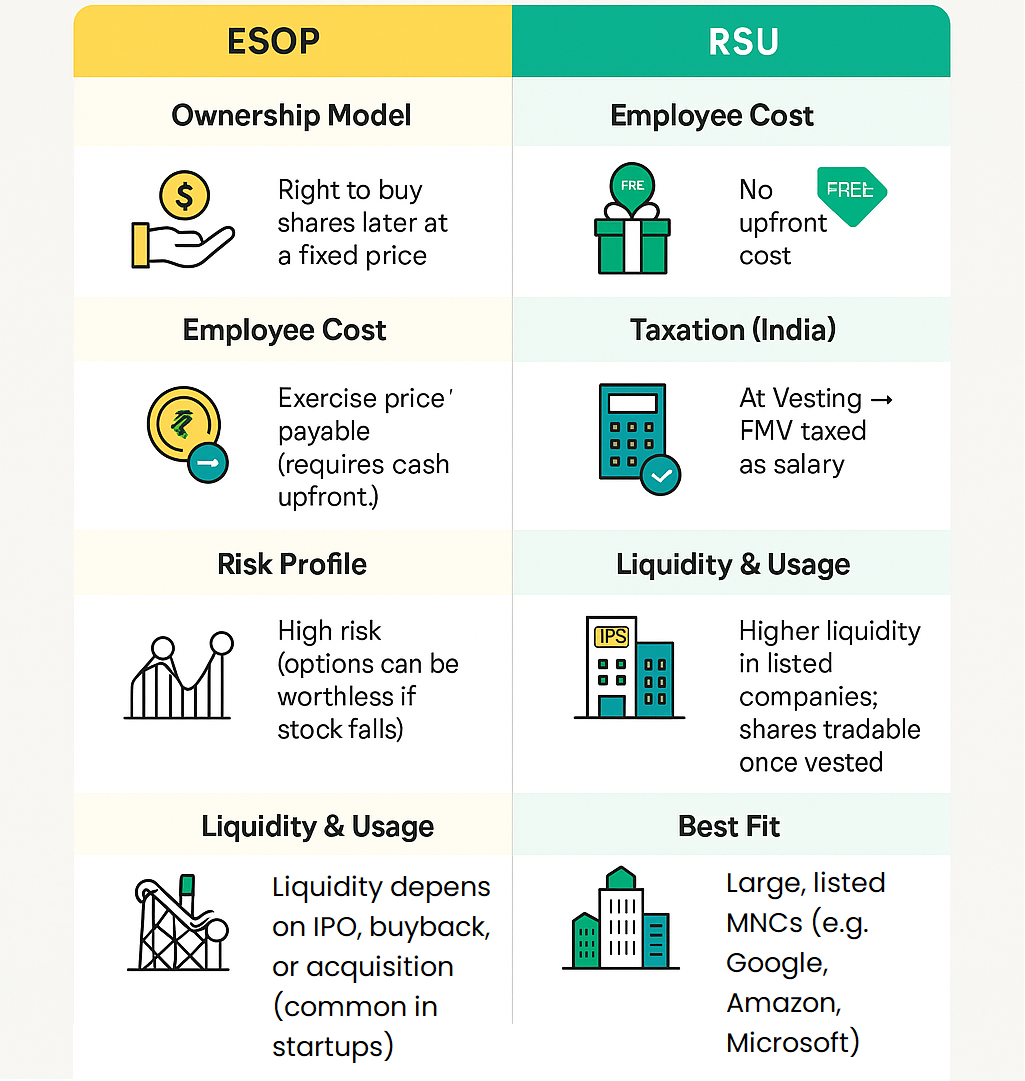
4. ESOP & RSU Taxation in India – Complete 2026 Guide
Taxation is where most employees and founders make mistakes and where the financial consequences can be severe. Understanding exactly when tax is triggered, how much you owe, and what you can do to legitimately reduce your liability is not optional if you hold equity in an Indian company. This section gives you the complete picture.
A foundational principle to grasp before we go further: both ESOPs and RSUs are taxed at two separate, independent stages in India. The first tax event is when you access the equity exercise for ESOPs, vesting for RSUs. This income is treated as salary and taxed at your applicable slab rate, with TDS deducted by your employer. The second tax event is when you eventually sell the shares. The profit on sale is treated as capital gains and taxed at rates that depend on whether the shares are listed or unlisted, and how long you held them.
The Finance Act 2024 introduced significant changes to capital gains tax rates for equity, effective from 23 July 2024. Short-term capital gains (STCG) on equity were raised from 15% to 20%, and long-term capital gains (LTCG) were raised from 10% to 12.5%. The LTCG exemption threshold was simultaneously raised from ₹1 lakh to ₹1.25 lakh. All calculations in this guide use these current 2026 rates.
| The Two-Stage Tax Rule The Single Most Important Concept› Stage 1 Access Event: When you exercise (ESOP) or vest (RSU), the ‘spread’ or ‘full FMV’ is taxed as SALARY at your slab rate.› Stage 2 Sale Event: When you sell the shares, any price appreciation above the FMV at Stage 1 is taxed as CAPITAL GAINS.› Your employer deducts TDS on Stage 1 automatically. Stage 2 is your personal responsibility via advance tax or self-assessment.› Crucially: you can owe Stage 1 tax even if you NEVER sell the shares, the tax liability is not contingent on liquidity.› Good planning means understanding both stages before you exercise or receive RSUs, not after the TDS is already deducted. |
How ESOPs Are Taxed – Stage by Stage
When you exercise an ESOP, your employer is required to calculate the ‘perquisite value’ , the difference between the Fair Market Value (FMV) on the exercise date and your exercise price. This amount is added to your salary income for that financial year and taxed at your marginal slab rate. For most startup employees, this means 30% plus applicable cess.
The employer deducts TDS on this perquisite in the month of exercise. For employees of DPIIT-recognised startups, this TDS can be deferred for up to 48 months or until IPO/secondary sale whichever is sooner. Once you have paid the exercise price and the TDS is settled, you become the owner of the shares. The FMV on the exercise date becomes your cost basis for the second stage of taxation.
When you eventually sell those shares, the profit above your cost basis (FMV at exercise) is taxed as capital gains. If you hold listed shares for more than 12 months from the exercise date, you qualify for LTCG treatment at 12.5%. For unlisted company shares, the holding period for LTCG is 24 months.
How RSUs Are Taxed – Stage by Stage
For RSUs, the perquisite is simpler to calculate but often higher in absolute terms: the full FMV of the shares on the vesting date is treated as salary income. There is no exercise price to offset it. If 300 RSUs vest when the share price is ₹400, you have received ₹1,20,000 of salary income regardless of whether you sell a single share. TDS is deducted by the employer or the Indian subsidiary of the foreign company.
Your cost basis for the second stage is the FMV on the vesting date. When you sell, the gain is taxed as capital gains on the difference between sale price and vesting FMV. For foreign RSUs (e.g., NASDAQ-listed shares from a US parent company), you may have taxes withheld in the US as well. In that case, you need to claim a Foreign Tax Credit (FTC) under the India-US DTAA to avoid double taxation; this requires filing Form 67 before your ITR due date.
Capital Gains Tax Rates – India 2026
| Share Type | Holding Period | Gain Type | Tax Rate (2026) |
| Listed Shares | Less than 12 months | STCG | 20% |
| Listed Shares | More than 12 months | LTCG | 12.5% (above ₹1.25L) |
| Unlisted Shares | Less than 24 months | STCG | Applicable slab rate |
| Unlisted Shares | More than 24 months | LTCG | 12.5% (no indexation) |
| Tax Without Liquidity The Most Painful ESOP/RSU Problem› In PRIVATE companies, both ESOP exercise and RSU vesting trigger a real tax bill before you can sell a single share.› ESOP employees must fund: (a) the exercise price itself, and (b) TDS on the perquisite often a substantial combined outflow.› RSU employees in private companies must fund TDS on the full FMV at vesting from salary, savings, or personal borrowings.› DPIIT TDS deferral exists for ESOPs in recognised startups but this benefit does NOT extend to RSUs.› The lesson: always model your full tax liability before agreeing to exercise or accepting a private company RSU grant. |
Head-to-Head Tax Comparison: ESOP vs RSU
Common assumptions: 1,000 shares. FMV at access event = ₹300. Exercise price (ESOP only) = ₹50. Sale price = ₹450. Income tax slab = 30%. Listed shares held 15 months (LTCG applies).
| Tax Component | ESOP (₹) | RSU (₹) |
| Perquisite / Spread Value | (₹300 − ₹50) × 1,000 = ₹2,50,000 | ₹300 × 1,000 = ₹3,00,000 |
| Salary Tax at 30% | ₹75,000 | ₹90,000 |
| Exercise Price Outflow | ₹50,000 (paid to company) | ₹0 (no exercise cost) |
| Capital Gain on Sale | (₹450 − ₹300) × 1,000 = ₹1,50,000 | (₹450 − ₹300) × 1,000 = ₹1,50,000 |
| LTCG Tax @12.5% (above ₹1.25L) | ₹3,125 (taxable CG = ₹25,000) | ₹3,125 |
| Total Tax Paid | ~₹78,125 | ~₹93,125 |
| Total Cash Outflow (tax + exercise) | ~₹1,28,125 | ~₹93,125 |
| Reading the Numbers Correctly› ESOP total TAX is lower (₹78K vs ₹93K) because the exercise price reduces the perquisite.› But ESOP total CASH OUTFLOW is higher (₹1.28L vs ₹93K) because you also pay the exercise price.› For early-stage startups with very low exercise prices (₹1–₹10), the ESOP tax advantage is even more pronounced.› The real ESOP wealth engine: if FMV grows to ₹1,000+ from an exercise price of ₹10, the tax on a ₹990 spread is still less than RSU tax on the full ₹1,000.› Always model both tax AND cash flow before deciding when and whether to exercise. |
ESOP Taxation Can Cost You Lakhs If Handled Incorrectly. Our tax advisors have helped 200+ startups and employees navigate exercise timing, TDS deferral, and capital gains planning Let’s Talk
5. Pros and Cons ESOP vs RSU
Every equity instrument involves trade-offs. The right choice is rarely about which is objectively ‘better’ , it is about which fits your company stage, your risk tolerance, and your financial situation. Here is a balanced view of both instruments.
ESOP: Advantages
- Extraordinary wealth potential – With a low exercise price and a high-growth startup, the ESOP spread can be 50x–200x the cost. No other compensation instrument creates this scale of wealth.
- DPIIT TDS deferral – Employees of recognised startups can defer the salary tax at exercise for up to 48 months solving the cash flow problem unique to private company ESOPs.
- Lower perquisite tax – The exercise price directly reduces the taxable spread. An option with a ₹10 exercise price and ₹400 FMV is taxed on ₹390 not on ₹400.
- VC ecosystem standard – A well-structured ESOP pool is a signal of founder maturity. Investors expect and value it. Employees recognise it as industry-standard.
- Ownership culture – Nothing aligns an employee’s mindset with the company’s success more than actual equity ownership. ESOPs create long-term, mission-aligned teams.
ESOP: Disadvantages
- Cash required at exercise – You must pay the exercise price out of pocket before owning shares. For large grants, this can run into lakhs of rupees.
- Tax without liquidity – Even with DPIIT deferral, the tax clock eventually runs out. In private companies without buyback programmes, employees can be left holding illiquid shares with pending TDS.
- Underwater risk – If the company’s valuation stalls or declines, the FMV can fall below the exercise price. Options become worthless and are typically allowed to lapse.
- Compliance complexity – Operating an ESOP scheme requires MCA filings, annual valuations by registered valuers, a properly drafted scheme document, and increasingly, an ESOP trust structure.
RSU: Advantages
- No cost, no risk of loss – RSUs always have value as long as the company’s shares are worth anything. There is no scenario where vested RSUs expire worthless.
- Predictable and simple – Employees can model their expected equity income with high accuracy. No exercise decisions, no strike price calculations, just shares at FMV on vesting.
- Instant liquidity (listed cos) – In listed companies, vested RSU shares can be sold immediately without waiting for an IPO or buyback window.
- Global programme compatibility – MNCs can run a single RSU programme across dozens of countries. Consistency reduces admin burden and creates equitable treatment globally.
RSU: Disadvantages
- Full FMV taxed at vesting – The entire market value of vested shares is taxed as salary income a larger perquisite than ESOPs (no exercise price to offset it).
- No deferral in private companies – RSUs in private companies have no TDS deferral equivalent to the DPIIT ESOP benefit. Tax falls due at vesting regardless of liquidity.
- Lower upside ceiling – In a startup that grows 50x, an ESOP with a low exercise price creates far more wealth than RSUs granted at the same company’s current FMV.
- Schedule FA compliance (foreign) – Indian employees with foreign RSUs must disclose them annually in Schedule FA, a compliance obligation many miss, triggering ₹10L penalties.
6. ESOP or RSU – Which is Right for Your Situation?
The question ‘ESOP or RSU?’ does not have a universal answer. The right instrument depends on four variables: the type of company you work for, its stage of growth, your personal risk tolerance, and your financial liquidity. Use the framework below to identify where you stand.
What type of organisation do you work for?
| Early-Stage Startup ESOPs are the industry standard. Exercise prices are low, upside is potentially massive. This is where equity wealth is built. | Growth Unicorn ESOPs + buyback windows. Balance high upside with periodic liquidity. Ensure your scheme includes a buyback or secondary sale mechanism. | MNC / Global Tech RSUs are the norm. Guaranteed value, liquid shares, no exercise cost. Focus on optimising tax timing and Schedule FA compliance. | Listed Indian Company Either RSU or ESOP, depending on seniority. Senior leaders increasingly receive RSU/PSU. Ensure SEBI SBEB compliance. |
The Equity Compensation Stage Matrix
Your company’s funding stage and trajectory should directly inform which equity instrument it uses and how it is structured. This table shows the industry consensus at each stage.
| Company Stage | Best Instrument | ESOP Pool Size | Strategic Rationale |
| Seed / Angel Round | ESOP | 10–12% | Exercise prices are lowest here. Maximum upside potential for early employees. Foundational for talent attraction. |
| Series A–B | ESOP | 12–15% | VC standard. Investors validate and may require ESOP pool top-up as a term-sheet condition. |
| Series C–E | ESOP + Buyback | Up to 15% | Add periodic buyback windows to retain employees who need liquidity without waiting for IPO. |
| Pre-IPO / Late Stage | ESOP + RSU | Refreshes | Begin transitioning senior leadership to RSU grants. ESOP pool remains for junior-mid employees. |
| Post-IPO / Listed | RSU / PSU | Refresh | Shares are now liquid and publicly valued. RSU and performance-linked PSU become optimal instruments. |
| MNC Subsidiary | RSU | Global prog | The parent company runs a global RSU programme. Indian entities add a local FEMA + tax compliance layer. |
7. Real-World Case Studies How Equity Compensation Works in Practice
Theory is useful, but nothing clarifies the power and the complexity of equity compensation like real examples. The four case studies below draw from India’s most prominent ESOP outcomes and cross-border RSU scenarios, giving you a practical lens on how these instruments play out in the real world.
Case Study 1: Flipkart – How ESOPs Created an ESOP Millionaire Factory
Flipkart is the benchmark ESOP success story for the entire Indian startup ecosystem. During the company’s early years when it was still a scrappy, capital-efficient e-commerce operation competing against established retailers it distributed ESOPs generously to employees at exercise prices in the range of ₹5 to ₹10 per share. At that valuation, even senior employees often received grants they assumed were largely symbolic.
When Walmart acquired a majority stake in Flipkart in 2018 at an enterprise valuation of $20.8 billion, the per-share value had grown by orders of magnitude from those early exercise prices. The result was transformational: estimates suggest more than 300 employees received ESOP payouts of ₹1 crore or more, with some senior early hires receiving tens of crores. Engineers, product managers, operations leads, and even certain support function employees found themselves suddenly wealthy in a way that had no precedent in Indian corporate history at that scale.
| Flipkart ESOP: Key Numbers› Exercise prices at early grant: approximately ₹5 to ₹10 per share.› Effective per-share value at Walmart acquisition: estimated multi-hundred rupees.› Employees who became crorepatis (₹1 crore+ payout): 300+.› Core lesson: the earlier the ESOP grant, the lower the exercise price, and the greater the compounded upside. |
The Flipkart playbook has since been studied and replicated across India’s unicorn ecosystem. The key structural ingredients: a substantial ESOP pool (10–15%), low exercise prices validated by conservative early-stage valuations, a 4-year vesting schedule that kept the team together through the critical growth phase, and ultimately a large-scale liquidity event (acquisition or IPO) that allowed employees to actually realise the value. Every element was necessary. Any missing piece would have diminished the outcome.
Case Study 2: Swiggy – The Pre-IPO Buyback Strategy
Swiggy’s ESOP story illustrates a different dimension of equity compensation: the strategic management of employee liquidity expectations in a company that is approaching but has not yet reached a public listing. By 2022, Swiggy had been operating for eight years and had built a significant employee base, many of whom had been holding vested ESOP options for years with no clear near-term IPO timeline. Employee satisfaction and retention were being affected by the lack of any liquidity pathway.
Swiggy’s response was to conduct one of India’s largest pre-IPO ESOP buybacks: offering eligible employees the chance to sell their exercised shares back to the company at a valuation-based price, unlocking over ₹900 crore in total proceeds. This was not just a financial transaction, it was a deliberate cultural signal that equity compensation at Swiggy was real, valuable, and realisable. Employees who participated secured life-changing liquidity years before the IPO.
When Swiggy listed on the NSE and BSE in November 2024, employees who had retained their shares through the IPO experienced a second, larger wave of liquidity. The two-stage approach pre-IPO buyback for immediate monetisation, followed by IPO for long-term upside has become the template that other late-stage Indian unicorns are now adopting.
| Swiggy’s ESOP Lesson for Founders› Pre-IPO buyback windows are now an accepted and expected feature of mature Indian startup ESOP programmes.› Offering periodic liquidity is not a giveaway; it reduces retention risk and increases employee commitment through the IPO journey.› Build buyback provisions into your ESOP scheme from the beginning, even if you do not plan to use them for years. |
Case Study 3: Google India – The Cross-Border RSU Compliance Challenge
Google grants RSUs to its Indian employees through a standard global equity compensation programme. These RSUs vest quarterly over four years and settle as shares of Alphabet Inc. (NASDAQ: GOOGL). On the surface, this is an excellent compensation package: fully liquid shares in one of the world’s most valuable companies, no exercise cost, and predictable quarterly income in the form of vesting shares.
In practice, however, Indian employees face a multi-layered compliance obligation that creates real financial risk if handled incorrectly. When RSUs vest, Google India’s payroll system deducts TDS on the full FMV of the vested shares as a salary prequisite. Separately, the US may withhold its own taxes on the same income. Without a properly filed Foreign Tax Credit (FTC) claim under the India-US Double Tax Avoidance Agreement (DTAA), the employee ends up paying tax twice on the same income, a legally avoidable but practically common outcome.
The second compliance layer is Schedule FA the Foreign Asset disclosure schedule within India’s ITR. Every Indian tax resident who holds foreign assets (including unvested RSUs, vested-but-unsold shares, and foreign brokerage accounts) must disclose them annually. The penalties for non-disclosure under the Black Money (Undisclosed Foreign Income and Assets) and Imposition of Tax Act, 2015 are ₹10 lakh per assessment year per undisclosed asset, a punishing amount for what is often an accidental omission.
| Indian Employees with Foreign RSUs: Critical Compliance Checklist› Schedule FA: Disclose ALL foreign assets (unvested RSUs, shares, brokerage accounts) in your annual ITR. Penalty for non-disclosure: ₹10 lakh per default.› TDS: Your Indian employer/subsidiary deducts TDS on the RSU perquisite at each vesting date. Verify this is happening correctly each quarter.› DTAA / FTC: If US taxes are withheld, file Form 67 before your ITR due date to claim the Foreign Tax Credit and avoid double taxation.› Timing: FTC claims must be made in the same year as the income. Missing the Form 67 deadline permanently forfeits your credit. |
Case Study 4: Indian IT Sector – The ESOP-to-RSU Transition Post-Listing
India’s large IT services companies Infosys, Wipro, HCL Technologies present an instructive case study in the natural evolution of equity compensation as a company matures. In their early growth phases, these companies used ESOPs heavily to attract and retain technical talent in a competitive market. The low exercise prices of the 1990s and early 2000s, combined with explosive revenue growth, created genuine wealth for thousands of employees.
As these companies became large, stable, publicly listed organisations with relatively predictable earnings growth, the case for ESOPs weakened. The scope for the 50x–100x upside that makes ESOPs transformative becomes very limited at a ₹5 lakh crore market cap. What senior employees needed instead was performance-linked pay that was liquid, certain, and directly tied to shareholder value creation. The answer was a shift toward RSU and Performance RSU (PSU) structures for CXOs and senior VPs, while maintaining ESOP or ESOP-equivalent grants for mid-level technical and management employees.
The strategic lesson for Indian startup founders is clear: the equity compensation instrument appropriate for your company today will not be the right instrument at every future stage. Build flexibility into your scheme design, and plan for the transition from ESOP-heavy to RSU-balanced compensation as your company approaches listing and beyond.
8. Common ESOP & RSU Mistakes and How to Avoid Them
The most expensive ESOP and RSU errors are almost always avoidable with a little advance planning and the right professional advice. The following mistakes appear repeatedly across the startups and employees Treelife advises do not let them happen to you.
For Employees: 5 Costly Mistakes
1. Not reading the ESOP scheme document before accepting a grant The scheme document is the legal contract governing your equity. It contains the vesting schedule, exercise window (often just 30–90 days post-resignation), good leaver vs bad leaver definitions, anti-dilution provisions, and the company’s buyback rights. Many employees sign their grant letter without ever asking for or reading the scheme document then discover unfavourable terms only when they try to exercise or after they resign.
2. Being unprepared for the tax at exercise The perquisite tax at exercise can be a shock if you haven’t modelled it in advance. For 10,000 options with a ₹10 exercise price and ₹300 FMV, the perquisite is ₹29 lakh generating ~₹8.7 lakh in TDS at a 30% slab rate. Your employer will deduct this from your salary. If your monthly salary is ₹5 lakh, you could have zero take-home for two months after a large exercise. Plan cash flow well in advance.
3. Exercising options without a clear liquidity plan Exercising in a private company means paying the exercise price and triggering TDS and then holding illiquid shares with no guarantee of when you will be able to sell. Unless there is a buyback window, a secondary sale, or an IPO timeline clearly in view, exercising early can tie up significant capital with no return date. Exercise only when there is a realistic near-term liquidity event.
4. Missing Schedule FA for foreign RSUs This is a growing problem as more Indian employees receive RSUs from foreign-listed parent companies. Every Indian tax resident with foreign assets must file Schedule FA annually in their ITR. This includes unvested RSU grants, vested shares held in foreign brokerages, and the brokerage account itself. Non-disclosure carries a ₹10 lakh penalty per assessment year under the Black Money Act regardless of intent.
5. Poor holding period timing for capital gains Selling shares immediately after exercise or vesting is the most expensive approach from a capital gains perspective. For listed shares, waiting just 12 months from exercise/vesting converts a 20% STCG liability into a 12.5% LTCG liability. For unlisted shares, the holding period for LTCG is 24 months. The tax saving from waiting the holding period can run into lakhs on a significant equity position.
For Founders: 5 Critical ESOP Scheme Mistakes
1. Granting ESOPs without a formal scheme document Many early-stage founders issue informal ESOP commitments: a line in an offer letter, a promise in an email, a verbal assurance. None of these are legally enforceable without a formal ESOP scheme adopted by the Board and shareholders under Section 62(1)(b) of the Companies Act. Without a scheme, you cannot legally allot shares against option exercise, and your employees have no enforceable rights.
2. Setting exercise prices arbitrarily The exercise price must be the Fair Market Value of the company’s shares on the grant date, as certified by a SEBI-registered Category I Merchant Banker or a Registered Valuer. Setting a price lower than FMV without proper valuation support creates tax and regulatory risk. Setting it higher than FMV reduces the incentive value of the options for employees.
3. Not structuring an ESOP Trust As your employee headcount and ESOP pool grow, administering individual option grants, exercise requests, and share allotments directly becomes operationally complex. An ESOP Trust acts as an intermediary; it holds the shares, manages exercises, and simplifies the employee experience. It also provides employee protection in M&A scenarios. Startups beyond Series B should seriously consider ESOP Trust structures.
4. Sizing the ESOP pool incorrectly An ESOP pool that is too small (under 8%) will require repeated dilutive top-ups that frustrate existing shareholders and employees. A pool that is too large (over 20%) creates unnecessary upfront dilution. The industry benchmark of 10–15% of fully diluted capital is well-established for a reason: it satisfies VC expectations, provides enough headroom for key hires and fresh grants, and maintains a sensible capital structure.
5. Designing the scheme with no exit provisions Employees need to know when and how they will be able to convert their options into cash. An ESOP scheme with no buyback provision, no secondary sale window, and no defined liquidity pathway creates growing frustration as vesting periods conclude with no monetisation opportunity. Design your scheme with explicit buyback triggers (e.g., annual windows post-Series C), secondary sale provisions, and a clearly communicated IPO roadmap.
9. How Treelife Helps with ESOP & RSU Structuring
Treelife is a full-service legal, tax, and compliance firm with deep specialisation in equity compensation for Indian startups and growth-stage companies. We have worked with more than 200 Indian startups from seed-stage companies issuing their first ESOP grants to late-stage unicorns preparing for IPO to design, implement, and administer compliant, tax-efficient equity programmes.
Equity compensation in India is governed by an interlocking web of regulations: the Companies Act 2013, SEBI SBEB Regulations 2021, the Foreign Exchange Management Act (for cross-border grants), the Income Tax Act (for perquisite, capital gains, and TDS), and DPIIT guidelines (for the 48-month TDS deferral benefit). Getting any one of these wrong can result in regulatory penalties, disqualification of option grants, employee grievances, or unexpected tax exposure. Our job is to make sure that your equity programme is structured correctly, maintained compliantly, and optimised for both the company and its employees.
Our ESOP & RSU Services – What We Do
| ESOP Scheme Drafting | Cap Table & Equity | Regulatory Filings | Tax Advisory |
| Scheme document drafting, vesting schedule design, exercise price advisory, cliff and graded structures, good/bad leaver clauses, ESOP trust deed and administration. | ESOP pool sizing and dilution modelling, option grant tracking, cap table management, investor ESOP expectation advisory, pre-fundraise cap table cleanup. | MCA annual return filings, FEMA compliance and reporting, SEBI SBEB filings, DPIIT recognition applications, TDS deferral applications for eligible employees. | Exercise timing strategy, holding period planning for LTCG, perquisite tax modelling, Schedule FA filing, Foreign Tax Credit (FTC) claims, cross-border tax opinions. |
Who We Work With
- Seed to Series B founders – Designing your first ESOP scheme, setting the right exercise price and pool size, drafting the scheme document, and advising on your first option grants.
- Series C to pre-IPO startups — ESOP pool refreshes, buyback window structuring, secondary sale provisions, ESOP trust establishment, and pre-IPO scheme rationalisation.
- Post-IPO listed companies – Transitioning from ESOP to RSU/PSU structures, SEBI SBEB compliance, performance-linked vesting design for senior leadership.
- MNC India subsidiaries – Cross-border RSU compliance, FEMA reporting, TDS on foreign equity grants, Schedule FA advisory, and DTAA-based FTC planning.
- Individual employees – Personal ESOP exercise timing advice, ITR filing with complex equity income, capital gains planning, and Schedule FA compliance.
Conclusion
ESOPs and RSUs are both powerful tools for building employee wealth, retaining talent, and aligning your team with company success but they work in fundamentally different ways and are suited to different contexts. In India’s startup ecosystem, ESOPs remain the dominant pre-IPO instrument: their low exercise prices, high-growth upside, and DPIIT tax deferral benefit make them uniquely powerful for early-stage companies. RSUs are the standard for MNCs and post-IPO companies, where simplicity, predictability, and liquidity are more valuable than asymmetric upside.
Understanding the mechanics, the taxation, the compliance obligations, and the strategic logic behind each instrument is no longer optional it is essential for every founder designing a scheme, every HR leader building a compensation strategy, and every employee evaluating or holding equity. The decisions you make around exercise timing, holding periods, Schedule FA compliance, and liquidity planning can add or subtract lakhs from your actual wealth outcome.
If you would like to design a world-class ESOP programme, optimise your personal equity tax position, or navigate the complexities of cross-border RSU compliance, Treelife’s equity compensation team is here to help.
Build a Compliant, Tax-Efficient ESOP Programme with Treelife200+ Indian startups trust Treelife for ESOP scheme design, compliance, and advisory. Let’s Talk
| 9 in 10 Indian listed companies are family-owned or controlled | 63% of family businesses have any formal governance structure in place | 1,539 UHNWIs in India as of 2024, up from just 140 in 2013 | 30% of family businesses survive to the third generation |
About This Report
This report is on Succession Planning in Indian Family Businesses is produced by Treelife’s tax and regulatory advisory team based on our experience advising promoter families, second-generation leaders, and investors across India. It is structured as a practical guide not a legal memorandum. Our aim is to give founders the conceptual architecture to think clearly about succession before they sit down with legal and tax advisors, so that advisory time is used to solve real problems rather than explain basics.
Who this report is for: Family business founders approaching a generational transition. Promoters of listed or PE-backed companies. Second-generation leaders preparing to take over. Investors evaluating governance quality in promoter-led companies.
The Governance Gap at the Heart of Indian Business
The Scale of the Opportunity and the Risk
India is in the middle of an extraordinary wealth-creation cycle. The Hurun India Rich List 2024 counted 1,539 Ultra High Net-Worth Individuals, a staggering tenfold increase from 140 in 2013. A new billionaire emerged every five days that year. The High Net-Worth Individual population, defined as those with investable assets exceeding $1 million, recorded 4.5% year-on-year growth in 2022.
A new generation of wealth creators from established industrial families to first-generation startup founders like Harshil Mathur of Razorpay and Kaivalya Vohra of Zepto is reshaping what Indian family wealth looks like. But wealth creation and wealth preservation require fundamentally different skill sets, structures, and disciplines.
Here is the uncomfortable truth: nine out of ten publicly traded Indian companies are family-owned or family-controlled, yet only 63% of their leaders report having any formal governance structures, shareholder agreements, family constitutions, or even a basic will. That gap between ownership scale and governance maturity is where generational wealth quietly erodes.
What Happens Without a Plan
Without a clear succession plan, family businesses across India routinely encounter a predictable set of crises: disputes over ownership shares that split families and destabilise boards; leadership vacuums that allow competitors to gain ground; poorly timed transitions that trigger key employee exits; and tax-inefficient transfers that destroy significant value during the handover itself.
India has seen dramatic examples of what happens when family businesses fail to institutionalise governance from high-profile boardroom battles in prominent industrial groups to quietly contested wills in mid-market family enterprises. The common thread is not a shortage of wealth, but a shortage of planning.
| Why this matters to investors: Promoter-led companies with unclear succession plans carry latent governance risk that is increasingly material. A leadership vacuum, contested ownership, or family dispute can trigger management instability, regulatory scrutiny under SEBI Takeover Regulations, lender covenant reviews, and significant destruction of shareholder value. Succession risk is now a recognised ESG governance factor and should be part of any serious diligence of promoter-led businesses. |
The Two Distinct Challenges
A common mistake is treating succession as a single problem. It is two: an ownership challenge and a management challenge. These require different tools, different timelines, and different conversations. Conflating them is one of the main reasons succession processes stall.
- Succession of Ownership: The legal and financial transfer of business interests, shares, and assets from the current generation to the next. It defines who owns what and the legal structure through which they own it.
- Succession of Management: The transition of operational control, decision-making authority, and leadership responsibility. It defines who runs the business entirely independently of who owns it.
Critically, these two can and often should be decoupled. A second-generation family member may inherit ownership while professional management is retained externally, a structure increasingly common in large Indian conglomerates and listed family groups.
Succession of Ownership: Framework and Execution
What Ownership Succession Actually Involves
Ownership succession means transferring the legal title to the business or to the vehicles that hold the business, such as shares in a private company, LLP interests, or directly held assets from one generation to the next. Done well, it is one of the most powerful acts of wealth stewardship a founder can perform. Done poorly, it can trigger tax liabilities, family disputes, and regulatory consequences that take years to unwind.
A robust ownership succession process has four distinct phases. Families that skip or rush any of them typically pay for it later.
PHASE 01 – STRATEGY & DESIGN
 Build the Architecture Before Writing Any Documents
The first mistake families make is rushing into documentation drafting a will or setting up a trust before the fundamental decisions have been made. Before any legal instrument is created, the family needs to answer: Who are the successors? What does each branch of the family receive? How is the business valued? Who decides in the event of a dispute? What legal structure will hold the assets going forward? This design phase should involve the family, and often benefits from an independent facilitator who has no stake in the outcome.
PHASE 02 – STRUCTURE EVALUATION
Assess the Current Ownership Architecture
Most families that approach succession have accumulated ownership structures organically, shares held individually, assets in HUF, unlisted holding companies layered over operating businesses, cross-holdings between family members. Before succession can be planned, this structure must be mapped and evaluated. Often, a rationalisation is needed before the succession itself can proceed efficiently. This phase also requires a formal business valuation from an independent, credentialled valuer; disagreements over valuation are among the most common causes of succession failure.
PHASE 03 – LEGAL, TAX & REGULATORY PLANNING
Build the Transfer Mechanism That Minimises Cost and Risk
Once the architecture is designed and the current structure evaluated, the technical work begins. This means determining the mode of succession trust, will, or hybrid and modelling the tax and regulatory implications of each path. For listed company promoters, this phase must specifically address SEBI Takeover Regulation exposure and any FEMA implications if family members are resident outside India. Stamp duty modelling is essential for families with significant real estate. The goal is to achieve the family’s desired outcome at the lowest total cost, with the cleanest regulatory profile.
PHASE 04 – FAMILY GOVERNANCE & ALIGNMENT
Build the Framework That Makes the Legal Documents Stick
No legal document survives a sufficiently fractured family relationship. Lawyers and tax advisors can build technically perfect structures that collapse in practice because the family was never truly aligned on the underlying decisions. This phase involves the creation of a family governance charter documenting roles, responsibilities, decision rights, dividend policies, entry and exit policies for family members in the business, and dispute resolution mechanisms. This is the phase most often underestimated and under-resourced, and it is the one that most often determines whether a succession plan succeeds or fails.
Key Building Blocks of a Sound Ownership Succession Plan
- Successor selection and share determination: Deciding who inherits what and in what proportion is the foundational decision. Where there are multiple children or family branches, this requires explicit, documented consensus. Assumptions that ‘everyone agrees’ are rarely correct.
- Asset and business inventory: A comprehensive list of all assets operating businesses, investment holdings, real estate, financial instruments, intellectual property with current valuations. This is the starting point for any structural planning.
- Legal structure selection: Choosing between a private family trust, will, hold-co structure, or hybrid of multiple instruments. Each has different legal, tax, and governance characteristics that must be matched to the family’s specific situation.
- Tax and regulatory modelling: Calculating the total cost of each structural option, capital gains, stamp duty, registration charges, ongoing compliance costs so that the family can make an informed choice between alternatives.
- Migration strategy: For families with existing complex structures, planning the step-by-step migration from the current structure to the target structure, in an order that minimises tax leakage and regulatory exposure at each step.
- Family charter and governance framework: The non-legal document that governs how the family makes decisions about the business going forward roles, compensation, board composition, dividend policy, and dispute resolution.
Trust vs. Will: The Structural Choice That Defines Everything
The single most consequential structural decision in ownership succession is whether to use a private family trust, a will, or a combination of both. This choice determines when the succession takes effect, how it interacts with tax and regulatory frameworks, the level of privacy it provides, and how much ongoing control the family retains. Understanding the trade-offs is essential before any documentation begins.
| Dimension | Private Family Trust | Will |
|---|---|---|
| Legal Definition | An obligation annexed to ownership of property, held by a trustee for the benefit of beneficiaries. Governed by the Indian Trust Act, 1882. | A legal declaration of testamentary intention regarding property to be carried into effect after death. Governed by the Indian Succession Act, 1925. |
| When It Takes Effect | Immediately upon creation assets can be transferred and managed during the settlor’s lifetime. | Only after the testator’s death and completion of the probate process. |
| Probate Requirement | Not Required. Trust remains a private document between parties. | Required in most Indian states. Contents become public record through the High Court. |
| Ownership/Management Split | Possible. Trustee holds legal title; beneficiaries hold beneficial interest. Allows separation of control from economic benefit. | Not Possible. Ownership and benefit vest together in the legatee. |
| Asset Protection | Strong for irrevocable trusts assets are ring-fenced from personal creditors of the settlor and beneficiaries. | Limited. Assets remain in individual ownership until death and are exposed to creditor claims. |
| Capital Gains Tax on Transfer | Irrevocable trust: Exempt under Section 47(iii), ITA. Revocable trust: Not exempt capital gains tax applies. | Transfer under will is exempt under Section 47(iii). Recipients are also exempt under Section 56(2)(x), ITA. |
| Income Taxation | Discretionary trust: Taxed at trust level at ~39% MMR. Specific/determinate trust: Pass-through income taxed in beneficiaries’ hands at their applicable slab rates. | Not applicable during lifetime. Post-inheritance, income is taxed in the legatee’s hands. |
| Stamp Duty | Payable on trust deed creation. Also payable on settlement of properties into the trust. Rate varies significantly by state. | Will itself is not chargeable under the Central Stamp Act. Court fee applies when presented for a probate amount varies by court. |
| SEBI Takeover Regulations (Listed Companies) | Migration to a trust structure may trigger scrutiny even if economic promoter holding is unchanged. New trusts do not qualify for the automatic inheritance exemption. SEBI informal guidance or specific exemption application is advisable before migrating listed shares. | Explicit exemption available for acquisition by succession or inheritance from mandatory public offer. Standard Regulation 29-30 disclosures still apply to the legatee. No known restriction under SEBI Insider Trading Regulations. |
| FEMA Implications | If trustees or beneficiaries are resident outside India, or if the trust holds foreign assets, specific FEMA permissions and potentially RBI approval may be needed. | Resident Indians may hold inherited foreign property. Non-resident Indians may hold inherited Indian property. More straightforward foreign exchange treatment. |
| Flexibility | Revocable trust: Can be amended or cancelled during the settlor’s lifetime. Irrevocable trust: Cannot be altered, amended, or revoked once assets are transferred. | Can be modified or revoked at any time while the testator is mentally competent. The most recent valid will supersede all prior versions. |
| Complexity and Cost | Higher upfront complexity and professional cost to establish. Typically saves significant cost, delay, and dispute in the long run. | Lower upfront cost and simpler to create. The probate process adds cost, delay, and public disclosure post-death. |
| Best Suited For | Larger families with complex portfolios. Listed company promoters. Families with cross-border members or assets. Situations requiring long-term control and governance. | Simpler estates. Clear, uncontested heirs. Single-generation asset transfers. Situations where upfront cost is a constraint. |
| Treelife Perspective: The Case for a Hybrid Approach Most promoter families benefit from using both instruments in a co-ordinated structure. A private irrevocable trust holds business assets and listed company shares providing ring-fencing, control continuity, and SEBI-compliant promoter holding structures. A will catches personal assets not settled into the trust residential property, jewellery, personal investment portfolios. The two documents must be drafted with awareness of each other to avoid gaps (assets falling outside both) and conflicts (the same asset purportedly transferred by both). This requires legal counsel experienced in both estate planning and corporate structuring; they are different disciplines that are rarely combined well in practice. For families with significant real estate, stamp duty on property settlement into a trust can be the dominant cost driver. In such cases, retaining property outside the trust and contributing the sale proceeds upon liquidation is often the more cost-efficient path. |
Private Family Trusts: Structure, Parties, and Practical Design
Given the prevalence of trust structures in Indian promoter succession planning, it is worth examining the mechanics in depth beyond the headline comparison with wills.
Parties to a Trust and Their Roles
| Party | Role | Key Considerations |
|---|---|---|
| Settlor / Contributor | The person who creates the trust and contributes assets to it. The settlor defines the trust’s purpose, beneficiaries, and governance rules in the trust deed. | The settlor may also be a trustee or beneficiary. After the initial contribution, subsequent contributors are referred to as contributors rather than settlers. |
| Trustee(s) | The person(s) or entity entrusted with holding and managing the trust’s assets for the benefit of the beneficiaries. The trustee is the legal owner of trust property. | Can be individual family members, external advisors, or a professional corporate trustee company. Corporate trustees offer continuity (not affected by death), expertise, and independence. Individual trustees are more common in smaller families but create continuity risk. |
| Beneficiaries | The persons for whose benefit the trust is established. They hold the beneficial (economic) interest in the trust assets. | Beneficiaries can be current members of the family, future descendants, or defined categories of persons. In discretionary trusts, the trustee determines distribution amounts. In specific trusts, each beneficiary’s share is defined upfront. |
| Protector / Advisory Board | An optional but increasingly common role is typically a trusted external advisor or senior family member who monitors the trustee’s execution and can exercise specific reserved powers. | Particularly valuable in larger families where the beneficiary group is large and diverse. The protector can instruct or direct trustees, replace trustees, and ensure adherence to the settlor’s intentions. Enhances governance without adding operational complexity. |
Types of Trusts: Choosing the Right Structure
| Revocable Trust The settlor retains the right to cancel or amend the trust during their lifetime. Assets can be reclaimed. Used when the settlor wants to begin the transfer process but is not ready to fully relinquish control. Note: Capital gains tax applies on transfer; no Section 47(iii) exemption. | Irrevocable Trust Once assets are transferred, the transfer cannot be altered, amended, or revoked. The settler permanently parts with ownership. Provides strong asset protection and capital gains tax exemption under Section 47(iii) ITA. The preferred structure for serious long-term succession planning. |
| Discretionary Trust The trustee has full discretion over the amount and timing of distributions to beneficiaries. Beneficial interests are not fixed. Income is taxed in the trust at ~39% MMR. Preferred when the family has not yet decided on final allocation between branches or individuals. | Specific / Determinate Trust Each beneficiary’s share is precisely defined in the trust deed. Distributions follow a set formula. Income is treated as pass-through and taxed in beneficiaries’ hands at their slab rates potentially more tax-efficient than a discretionary trust depending on beneficiary profiles. |
Single Trust vs. Multiple Trusts
One structural decision families often overlook is whether to consolidate all assets into a single trust or to establish separate trusts for different asset classes or family branches. There is no single right answer; it depends on the family’s specific situation.
- Arguments for multiple trusts: Different asset classes may have different beneficiary groups, governance needs, or risk profiles. Business operating assets are often better held separately from passive investment portfolios. Multiple trusts allow ring-fencing a dispute or liability in one trust that does not infect the others. Each family branch can have its own trust, reducing inter-branch governance complexity.
- Arguments for a single trust: Lower setup and maintenance costs. Simpler governance structure. Greater flexibility to reallocate assets between beneficiaries. Easier for a single trustee or corporate trustee to administer.
| Practical Note: Most large promoter families Treelife has worked with ultimately operate multiple trusts typically one for the operating business and listed company shares (the ‘business trust’) and one or more for passive assets and real estate (the ‘wealth trusts’). The architecture should reflect the actual complexity of the asset base, not an idealised simplicity that creates governance problems later. |
Succession of Management: The Harder Half
If ownership succession is primarily a legal and tax engineering challenge, management succession is primarily a human one. It involves identifying who will lead the business, grooming them over years, managing the psychology of transition for both the outgoing and incoming leaders, and maintaining organisational confidence throughout. It is harder to plan, harder to execute, and harder to get right which is why it fails more often.
The data is stark: only 30% of family businesses make it to the third generation, and the most common cause of failure is not market dynamics or strategic error; it is an unresolved management transition. The business is often fundamentally sound. The transition is what breaks it.
Why Management Succession Is Different
| Dimension | Management Succession | Ownership Succession |
|---|---|---|
| Primary Focus | Leadership quality, operational decision-making, cultural continuity, strategic direction. | Legal ownership, asset distribution, regulatory compliance, tax efficiency. |
| Timing | Can happen at any time independent of ownership events. Non-family professionals may take over management while the family retains ownership. | Typically triggered by specific life events: retirement, death, incapacity. |
| Key Risk | The wrong person in the role destroys culture and competitive position. Poor timing creates a leadership vacuum or premature handover. | Incorrect structure creates tax liability, regulatory exposure, or family dispute over asset allocation. |
| Emotional Charge | Extremely high. Touches daily involvement, identity, relationships, and the founder’s sense of legacy. | High, but more amenable to professional resolution through legal and financial advisors. |
| Success Metric | Business performance continues or improves. Key talent is retained. Stakeholder confidence is maintained. | Assets are transferred as intended with minimal tax leakage, no legal challenge, and family harmony preserved. |
The Four Non-Negotiables of Management Succession
| Get the Timing Right Too early, and the incoming leader lacks credibility and experience to command the organisation. Too late, and the business stagnates waiting for clarity of leadership. Timing should be determined by leadership readiness, current market conditions, the outgoing leader’s genuine psychological readiness to transfer authority not just title and the organisation’s overall health. | Separate Merit from Lineage The hardest governance decision in any family business: evaluating whether a family member is actually the best person for the leadership role. The answer is not always no but it must be arrived at through honest, ideally independent, assessment rather than assumption. Meritocracy in selection is what separates family businesses that grow from those that decline in the second generation. |
| Invest in the Pipeline Early The successor’s development programme should begin 5–10 years before the planned transition. This means structured mentorship, cross-functional exposure within the business, meaningful external work experience outside the family business, progressive accountability with real consequences, and formal leadership development. A successor announced without this preparation destroys internal and external confidence. | Define Roles with Legal Precision When multiple family members are involved in the business siblings, cousins, spouses role ambiguity is the single largest driver of conflict. Every family member in a management role should have a formally defined scope, measurable KPIs, and compensation benchmarked against market rates for equivalent roles. The family charter should be explicit about who has decision authority over what, and what the process is when there is disagreement. |
Building the Leadership Pipeline: A Practical Approach
Grooming a successor is not a passive process. It requires a structured programme that builds capability, credibility, and contextual knowledge over time. Below is the framework Treelife recommends for families beginning this process:
| Phase | Timeline | Key Activities | Success Indicator |
|---|---|---|---|
| Foundation | Years 1–2 | External work experience in a different industry or function. MBA or relevant postgraduate education if appropriate. Deep immersion in the family business not as an heir, but as a junior employee learning the business. | Demonstrates genuine interest and commitment independent of the family expectation. |
| Development | Years 3–5 | Rotational exposure across all key business functions. Responsibility for a defined P&L or business unit. Mentorship from both the current generation and external business leaders. First exposure to board-level governance. | Produces measurable results in their area of responsibility. Earns respect from the non-family leadership team. |
| Leadership Transition | Years 5–7 | Progressive assumption of senior leadership responsibilities. Joint decision-making with the current generation in a defined co-leadership structure. Formal announcement of succession timeline to internal and external stakeholders. | Stakeholder confidence is maintained. Business performance does not deteriorate during transition. |
| Full Transition | Year 7+ | Complete handover of operational and strategic leadership. The current generation moves to an advisory or board role with clearly defined and limited scope. Successors established their own leadership style and relationships. | Business continues to grow. The prior generation does not undermine the new leadership through informal channels. |
Why Succession Plans Fail: Eight Systemic Challenges
Understanding the failure modes is as important as understanding the framework. Each of the challenges below is drawn from real patterns in Indian family business succession. Each has a structural fix but the fix requires honest diagnosis first.
| Communication Gap Generational differences in communication style, hierarchy, and formality create chronic misalignment that compounds over time. What each generation assumes is ‘understood’ typically is not. Fix: Structured family councils with documented decisions and a defined meeting cadence. | Conflicting Values & Vision G1 built the business on one set of convictions and risk appetite. G2 arrives with different priorities, ambitions, and ideas about what the business should be. Fix: Facilitated vision-alignment workshops before succession documentation begins. Unresolved vision conflict makes all structural planning premature. | Cultural Shift Incoming leaders inevitably change culture in ways that are not always intentional or visible until the damage is done. Long-serving employees who were loyal to the founder may disengage. Fix: Explicit culture-continuity planning, including direct communication from the outgoing leader validating the incoming one. |
| Skill Gaps Second-generation leaders may have significant formal education but lack domain expertise, stakeholder relationships, or the operational judgment that comes from experience not credentials. Fix: Structured 5–10 year development programmes with external benchmarking and genuine accountability. | Role Ambiguity Multiple family members, undefined mandates, overlapping authorities, and informal hierarchies create daily friction that escalates into structural conflict over time. Fix: A formal family charter that documents roles, decision rights, and escalation paths reviewed annually. | Emotional Dynamics When professional decisions are filtered through personal relationships, sibling rivalries, perceived parental favouritism, in-law tensions, outcomes are systematically distorted. Fix: Independent board members and a family governance structure that creates a buffer between family relationships and business decisions. |
| Resistance to Letting Go The founder’s identity is often inseparable from the business. Genuine transfer of authority, not just title, requires a psychological transition that many founders struggle with, sometimes indefinitely. Fix: Executive coaching for the outgoing leader, and a phased transition timeline with irreversible milestones. | External Perceptions Leadership transitions are watched closely by customers, suppliers, lenders, and institutional investors. Poorly managed transitions can trigger credit reviews, customer attrition, and talent exits. Fix: A proactive stakeholder communication strategy that runs concurrently with the internal succession process. |
Full spectrum of succession planning from initial governance diagnostics through to completed trust structures Let’s Talk
Tax & Regulatory Framework: What Founders Need to Know
Tax planning is not optional in succession, it is a core design constraint that shapes which structural options are viable. A succession plan that achieves the family’s governance objectives but creates avoidable tax liabilities of tens of crores is not a good plan. Below is a structured overview of the key tax and regulatory dimensions relevant to Indian family business succession.
Income-Tax: Key Provisions and Implications
| Transaction | Mode / Type | Tax Treatment | Governing Provision |
|---|---|---|---|
| Transfer of capital assets to trust | Irrevocable trust | Exempt No capital gains for the contributor / settlor | Section 47(iii), Income-tax Act, 1961 |
| Transfer of capital assets to trust | Revocable trust | Taxable Capital gains apply to the contributor | Section 47(iii) exemption not applicable |
| Assets received by trust without consideration | Trust for benefit of settlor’s relatives | Exempt Not taxed as income of the trust | Section 56(2)(x) specific exemption for family trusts |
| Transfer of assets under will | Will / inheritance | Fully Exempt No tax on transferor or recipient | Section 47(iii) + Section 56(2)(x), ITA |
| Income earned within trust | Discretionary trust | ~39% Maximum Marginal Rate taxed in the trust’s hands | Section 164, ITA (subject to applicable surcharge and cess) |
| Income earned within trust | Specific / determinate trust | Pass-through proportionate share taxed in each beneficiary’s hands at their applicable slab rate | Section 161, ITA |
| Capital gains on assets within trust | Long-term or short-term | Taxed at applicable concessional rates (long-term) or slab rates (short-term) capital gain character is preserved through the trust structure | Per nature of asset and holding period |
| Planning Note: The choice between a discretionary and specific trust has significant income tax implications over time. A discretionary trust paying ~39% MMR on all income may be less efficient than a specific trust where beneficiaries are in lower tax brackets. However, a specific trust locks in allocation decisions upfront a constraint that not all families are ready for. This trade-off should be modelled explicitly before structure selection. |
SEBI Takeover Regulations: Listed Company Promoters
| Via Will or Inheritance: Acquisition by way of transmission, succession, or inheritance is explicitly exempt from mandatory public offer provisions under SEBI Takeover Regulations. No disclosure requirement applies for claiming this exemption at the time of the transfer. Standard disclosures under Regulations 29 and 30 are required once the legatee acquires the shares. No known restriction under SEBI Insider Trading Regulations for inheritance-based transfers. Relatively clean regulatory path for listed company share succession via will | Via Trust Migration: Change in registered shareholding on migration to a trust structure may trigger SEBI scrutiny even if the promoter’s economic interest is entirely unchanged. New trusts do not automatically qualify for the inheritance exemption available to wills. Most practitioners recommend applying to SEBI for specific exemption or seeking informal guidance before executing the migration. Indirect transfers via promoter holdcos or unlisted intermediary companies also attract this analysis and are not automatically exempt. Early engagement with SEBI counsel is essential attempting to migrate listed shares without regulatory advice is a significant risk |
Stamp Duty: The Underestimated Cost
Stamp duty is frequently the largest cash cost in a trust-based succession, yet it is often considered only after the structural decisions have already been made which limits the options available to manage it.
- Trust deed: Stamp duty is payable at the time a trust deed is created. The rate is governed by the relevant state Stamp Act, not the central Stamp Act, and varies materially between states.
- Property settlement into trust: Stamp duty is separately payable when assets particularly real estate are formally settled into the trust. For families with significant property holdings, this can represent a very large cost.
- Strategic management: Families can mitigate stamp duty exposure by selectively excluding short-term investment properties from the trust and instead contributing the cash proceeds after sale. This requires advance planning once a property is included in the trust structure, the duty cost has already been incurred.
- Wills and probate: Wills are not chargeable instruments under the central Stamp Act. However, when presented for probate or letters of administration, court fees apply. The quantum varies by court and jurisdiction.
| Treelife Note: We consistently recommend that stamp duty modelling be completed before any trust structure is finalised not after. The difference in total stamp duty cost between structuring options can be significant enough to change the preferred approach entirely. For families with real estate assets in multiple states, this requires state-by-state analysis. |
Foreign Exchange Management Act (FEMA) Considerations
FEMA adds complexity to succession planning for families with cross-border elements, members who are non-resident Indians, assets held outside India, or businesses with international operations.
- Succession via will resident to non-resident: A person resident outside India may hold, own, or transfer Indian currency, securities, or immovable property situated in India if such property was inherited from a person resident in India. This provides a relatively clean path for NRI family members inheriting Indian assets.
- Succession via will non-resident to resident: A person resident in India may hold, own, or transfer foreign currency, foreign securities, or immovable property situated outside India if inherited from a person resident outside India. NRI parents leaving foreign assets to resident children is permitted on this basis.
- Trust structures with cross-border elements: The FEMA framework does not comprehensively address the trust structure scenario. Where trustees or beneficiaries are resident outside India and hold Indian assets, or where Indian-resident trustees hold foreign assets, RBI approval may be required. This is an area requiring specific regulatory advice general principles do not apply cleanly.
The Treelife Succession Readiness Diagnostic
Before engaging advisors to begin documentation, every founder and promoter family should conduct an honest internal assessment of where they stand across the key dimensions of succession readiness. This diagnostic framework is the starting point for every succession engagement at Treelife.
The purpose is not to identify failure, it is to focus advisory effort on the dimensions that actually need work, rather than spending time and cost on documentation for problems that have not been properly diagnosed.
| Dimension | Diagnostic Question | Green Ready | Red Flag Needs Work |
|---|---|---|---|
| Ownership Clarity | Is every significant asset clearly titled, documented, and accounted for? | All assets are formally titled in known names. Shareholding records are current and accurate. | Informal ownership arrangements. Undivided HUF property. Cross-holdings not documented. Share registers out of date. |
| Business Valuation | Has the business been independently valued in the last 24 months? | Recent independent valuation exists. Family is broadly aligned on the figure. | No formal valuation. Significant disagreement between family members on what the business is worth. |
| Family Alignment | Do all material family members agree on who receives what and who runs what? | Explicit consensus exists and has been documented, even if informally. | Undisclosed expectations. Assumed agreement that has never been tested. Active conflict. |
| Tax Modelling | Has the total tax cost of the proposed succession been modelled? | Capital gains, stamp duty, and income tax implications have been quantified for the preferred structural option and at least one alternative. | No tax modelling. Single structure assumed without alternatives considered. Stamp duty not yet factored in. |
| Regulatory Exposure | For listed companies has SEBI Takeover Regulation exposure been assessed? | SEBI counsel has reviewed the proposed structure and confirmed compliance or a path to compliance. | Assumption that all family transfers are automatically exempt. No regulatory review conducted. |
| Legal Documentation | Are the key governance documents trust deed, SHA, family charter, will in place and current? | Key documents exist, have been reviewed in the last 3 years, and reflect the current family and business situation. | Outdated documents. No will. No family charter. No shareholder agreement between family members. |
| Leadership Pipeline | Is there a named successor with a documented development programme and transition timeline? | Named successor with a multi-year development plan. Transition timeline announced internally. | Multiple undeclared candidates. No development programme. No timeline. The founder has no retirement plan. |
| External Governance | Is there an independent board or advisory committee providing checks and balances? | Independent directors or advisors with genuine authority. Regular formal governance process. | Fully family-controlled board. All decisions made informally. No independent voice in strategic decisions. |
| What We Observe in Practice: Most founders and promoter families score well on Ownership Clarity assets exist and are broadly known. Legal Documentation is also usually partially in place, though often outdated. The most common gaps and the ones that most often cause succession to fail are Family Alignment, Leadership Pipeline, and External Governance. These are not legal or tax problems. They require facilitation, honest conversation, and often a trusted external voice to resolve. The insight that changes the most conversations: structuring cannot fix misalignment. A family trust or a shareholder agreement built on unresolved disagreement about fundamental questions about who runs the business, how profits are distributed, what the role of in-laws is will collapse under the first serious dispute. Alignment must precede structure. |
When Should You Start? A Stage-by-Stage Guide
The most common answer Treelife gives to founders who ask when they should begin succession planning: earlier than you think, and certainly before you feel like you need to. Succession planning initiated under pressure following a health event, a family dispute, or a regulatory trigger is invariably more expensive, less effective, and more likely to create the conflicts it was meant to prevent.
The right time to build a succession plan is when the business is strong, the family is broadly aligned, and no one is in a hurry. Urgency is the enemy of good succession planning.
| Business / Life Stage | Priority Actions | What Not to Do |
|---|---|---|
| Early Growth(Founder-led, pre-institutional capital, sub-₹100Cr) | Draft a basic will. Ensure shareholding is formally documented with up-to-date share registers. Create a simple family charter documenting ownership intentions. Identify potential future successors, even informally. | Assume that the business is too small or too early to need a succession plan. The time to create habits of governance is when the stakes are lower. |
| Scale Phase(₹100–500Cr revenue, multiple family members in the business) | Formalise the family governance charter. Consider establishing a private trust for business assets. Define roles, responsibilities, and compensation for all family members in the business. Introduce independent advisory voices. Begin the successor development programme. | Add family members to the business without defined roles. Allow informal hierarchies and unspoken expectations to substitute for documented governance. |
| Institutionalisation(Listed, PE-backed, or family office stage) | Complete trust structuring with full SEBI and FEMA compliance review. Establish an independent board with genuine authority. Formalise the management succession plan with a named successor and timeline. Engage with institutional shareholders about governance plans. | Treat succession planning as a compliance exercise. Institutional investors and institutional lenders are watching governance quality and will price it positively or negatively. |
| Active Transition(G1 to G2 handover actively underway) | Activate the succession plan as documented. Communicate proactively to all stakeholders employees, customers, lenders, co-investors. Execute the legal ownership transfers. Begin the formal co-leadership phase with defined milestones for the complete handover. | Announce a succession and then delay the actual transfer of authority. The credibility cost of a protracted, indeterminate transition is significant with every stakeholder group. |
| Post-Transition(New generation in leadership) | Establish new governance routines appropriate to the new generation’s leadership style. Review and update the family charter to reflect the new ownership and management reality. Ensure the prior generation’s advisory or board role has clearly defined and limited scope. | Allow the prior generation to continue exercising informal authority outside their defined advisory role. The single biggest risk in post-transition family businesses is the founder who cannot truly let go. |
Family Governance: Protocols, Charters, and Frameworks
One of the most undervalued elements of succession planning is the family governance framework, the set of agreed rules, processes, and institutions that govern how the family makes decisions about the business. Legal documents define what happens to assets. Family governance documents define how the family makes decisions, resolves disputes, and evolves its relationship with the business over time.
Without family governance, every decision no matter how routine has the potential to become a source of conflict, because there is no agreed framework for making it.
Core Elements of a Family Governance Framework
- Family Charter or Family Constitution: The foundational document that records the family’s shared values, vision for the business, principles for family member participation in the business, ownership philosophy, and high-level decision-making processes. This is not a legally binding document, it is a statement of intent and shared commitment. Its authority derives from buy-in, not enforcement.
- Family Council: A regular forum typically quarterly for all family members with a material interest in the business to discuss family-business matters. The council is distinct from the board of directors. It is the mechanism through which the family speaks to the business with one voice, and through which the business reports to the family ownership group.
- Shareholder Agreement: The legally binding document that governs the rights and obligations of family members as shareholders pre-emption rights, tag and drag provisions, valuation mechanisms for buy-outs, restrictions on transfer of shares to non-family members, and governance rights attached to different share classes. This is a legal document and should be drafted by counsel with corporate structuring experience.
- Entry and Exit Policies: Documented policies governing how family members can join the business (qualification requirements, application process, entry level), what compensation they receive (market-benchmarked, not based on relationship), and how they can exit either voluntarily or in the event of a dispute.
- Dispute Resolution Framework: An agreed process for resolving disagreements within the family starting with direct discussion, escalating to the family council, and ultimately to an independent mediator or arbitrator. Having this process agreed in advance dramatically reduces the cost and destructiveness of disputes when they arise.
- Dividend and Distribution Policy: A documented policy on how the business distributes profits to the family ownership group. Disagreements about distributions particularly between family members active in the business who prefer reinvestment and those who are passive owners who prefer dividends are one of the most common sources of family business conflict. A written policy reduces this significantly.
| Note on the Family Charter: We have observed that families who invest time in creating a genuine family charter not a perfunctory document, but one that reflects real conversation and real agreement navigate succession significantly better than those who do not. The process of creating the charter is often as valuable as the document itself. It forces the conversations that everyone has been avoiding, in a structured context where those conversations are expected and appropriate. |
The Role of Independent Advisors and Mediators
One of the most consistent findings from family business research and from Treelife’s own advisory experience is that families navigating succession benefit significantly from trusted, independent external voices. Not because family members lack the intelligence to figure it out, but because the emotional complexity of these conversations makes independent facilitation invaluable.
An independent mediator or family business advisor serves several specific functions: they can say things that no family member can say without triggering a defensive reaction; they can hold multiple family members’ perspectives simultaneously without taking sides; they have pattern recognition from other succession processes that the family does not have; and they create a context a formal advisory process in which difficult conversations are expected rather than surprising.
The selection of this advisor matters enormously. The advisor needs to be trusted by all material family members, experienced in family business dynamics, and genuinely independent with no material interest in any particular outcome. This is a small and specific category of advisors, and finding the right one is worth significant effort.
Working with Treelife on Succession Planning
Treelife’s tax and regulatory advisory team has advised promoter families, second-generation leaders, and family businesses across industries on the full spectrum of succession planning from initial governance diagnostics through to completed trust structures, SEBI-compliant ownership migrations, and ongoing family governance support.
What We Do
- Succession Readiness Assessment: We begin every engagement with an honest diagnostic mapping the current ownership structure, identifying legal and tax exposure, assessing family alignment, and identifying the key decisions that need to be made before documentation can begin.
- Trust and Ownership Structuring: We design and implement private family trust structures, including coordination of trust deed drafting, tax modelling, stamp duty analysis, and SEBI / FEMA regulatory clearances where required.
- Will and Estate Planning: We advise on will drafting, executor selection, probate navigation, and the co-ordination of will-based succession with any complementary trust or hold-co structures.
- Family Governance: We facilitate the creation of family charters, family councils, shareholder agreements, entry/exit policies, and dispute resolution frameworks. We also provide ongoing governance advisory to families post-implementation.
- SEBI and Regulatory Advisory: For listed company promoters, we provide specific regulatory guidance on SEBI Takeover Regulation exposure and navigate the formal exemption application or informal guidance process where required.
- Intergenerational Tax Planning: We model total succession costs across all structural options capital gains, stamp duty, income tax, and ongoing compliance costs to help families make informed structural choices.
Disclaimer: This report is for informational and educational purposes only and does not constitute professional legal, tax, financial, or regulatory advice. The information presented reflects general principles and the authors’ observations from advisory practice; it does not account for individual circumstances. Readers should seek qualified professional advice before making any succession planning decisions. © 2026 Treelife Ventures Services Private Limited. All rights reserved.
]]>| A deep-dive for seed-stage founders preparing for their first institutional raise. This report covers the financial infrastructure, investor-grade systems, and strategic frameworks that separate startups that close Series A in 4 months from those that take longer time. |
Section 1: The Series A Gap Why Good Startups Don’t Always Raise
Every founder who has been through a Series A fundraise will tell you the same thing: it takes longer than expected, reveals more blind spots than you anticipated, and exposes financial gaps that should have been addressed months earlier. The problem is structural, not anecdotal.
India’s startup ecosystem has matured significantly over the past decade. Series A investors whether domestic VCs, global funds, or family offices now apply institutional-grade financial scrutiny to every deal they evaluate. They have seen hundreds of pitch decks. They know when numbers don’t reconcile. They know when a projection is a wish rather than a model. And they know when a founder doesn’t deeply understand the financial mechanics of their own business.
According to CB Insights data, 29% of startups globally fail due to cash flow mismanagement not product failure or market timing. Among startups that do reach the fundraising stage, financial due diligence failure is the most common reason term sheets are withdrawn or valuations are marked down. Yet most seed-stage founders spend the bulk of their preparation time perfecting their pitch deck rather than fixing their financial foundation.
The Three Stages of Financial Unreadiness
Most seed-stage startups fall into one of three financial readiness profiles when they approach Series A:
- Stage 1 Chaotic: Books exist, but they’re not investor-grade. Revenue recognition is informal, costs are lumped together, and there’s no clear MIS or reporting structure.
- Stage 2 Compliant But Thin: Basic accounting is in place, monthly reports exist, but there are no investor-grade financial models, no unit economics tracking, and no data room.
- Stage 3 Almost There: Clean books, structured reporting, financial model exists, but it hasn’t been stress-tested, the narrative doesn’t align with numbers, and due diligence will surface issues.
A Virtual CFO operates across all three stages taking startups from wherever they are to investor-ready, typically in 9–12 months. The earlier the engagement, the stronger the outcome.
What Series A Investors Actually Evaluate
Beyond the pitch, Series A investors conduct a structured financial evaluation that most founders are unprepared for. Here is what they are actually looking at:
- Revenue Quality & Predictability: Can management accurately forecast their own business 12–18 months out?
- Unit Economics: Is growth efficient or is the startup buying revenue at any cost?
- Cash Runway Under Scenarios: At current burn, how much runway remains? At 1.5x burn after Series A capital is deployed?
- Cap Table & Equity Structure: Does the cap table have clean ownership records, proper ESOP structure, and room for a new investor without complexity?
- Regulatory & Compliance Backbone: Are GST, TDS, ROC, FEMA, and labour compliance fully current?
- Revenue Recognition Integrity: How are revenues recognised? Is ARR calculation consistent with industry standards?
- Management Depth on Financials: Can founders answer granular questions about cohorts, retention, and customer economics on the spot?
| KEY INSIGHT: Series A is not a fundraising event. It is a financial examination of your systems, your discipline, and your understanding of your own business. The pitch deck gets you the meeting. The financial infrastructure gets you the term sheet. |
Section 2: What a Virtual CFO Does and Doesn’t Do
The term ‘Virtual CFO’ is used loosely in the market. Some firms mean glorified bookkeeping. Others mean monthly financial reporting. At Treelife, a Virtual CFO engagement means something specific: a senior finance professional embedded in your startup’s strategic decision-making, building the financial infrastructure that institutional investors require.
The VCFO Value Stack – Where Strategy Meets Execution
Think of finance talent in a startup as a layered stack. Each layer serves a purpose, but only the top layer creates investor-grade outcomes:
The Finance Talent Value Stack
Proportion of strategic investor-readiness value delivered by each role:
| Bookkeeper | Transaction recording only |
| Accountant | Compliance & historical reporting |
| Finance Manager | Budgeting, control & team management |
| Virtual CFO | Strategy, investor readiness & narrative |
A Virtual CFO’s scope is fundamentally different from the layers below. Their mandate includes:
- Designing and maintaining a 3-statement financial model (P&L, Balance Sheet, Cash Flow) linked to operational assumptions
- Building the MIS dashboard with investor-grade KPIs tracked weekly and monthly
- Conducting an internal ‘investor lens’ financial audit to proactively identify due diligence red flags
- Structuring the cap table, managing ESOP grants, and modelling post-round dilution scenarios
- Building and maintaining the data room the organised repository of all due diligence materials
- Preparing the financial narrative that supports the investor pitch deck
- Supporting negotiations: term sheet analysis, valuation modelling, anti-dilution provisions, liquidation preferences
- Acting as the interface between founders and investors during due diligence fielding financial questions, bridging gaps
- Providing post-raise financial reporting, investor update templates, and board pack infrastructure
| TREELIFE LENS: At Treelife, our VCFO practice is integrated with startup legal, company secretarial, and compliance services which means the same team that builds your financial model also manages your cap table, ROC filings, FEMA compliance, and ESOP documentation. This single-window approach eliminates coordination gaps that surface as deal-breakers in due diligence. |
Section 3: Virtual CFO vs. Full-Time CFO – The Trade-Off Every Founder Must Understand
One of the most common mistakes seed-stage founders make is hiring a full-time CFO too early before the business has the revenue, the financial complexity, or the team depth to justify it. The cost is not just the salary and equity. It is the opportunity cost of locking in one person’s network, experience, and approach at a stage where flexibility matters most.
| Dimension | Full-Time CFO | Virtual CFO (Treelife) |
|---|---|---|
| Annual All-In Cost | ₹60L – ₹1.5Cr salary + 1–3% equity | ₹6L – ₹20L retainer zero equity |
| Time to First Impact | 3–6 months to fully onboard | 2–4 weeks to live MIS & model |
| Series A Experience | Varies by individual; often 1–2 rounds | Portfolio exposure across 50+ rounds |
| Fundraising Network | Depends on personal relationships | Warm intros to VCs, angels, bankers |
| Availability | Full-time; single startup focus | On-demand; senior expertise when needed |
| Best Fit Stage | Post-Series B, ₹50Cr+ ARR | Seed → Series A, ₹5–40Cr ARR |
| Legal/Compliance Integration | Separate hires needed | Bundled at Treelife one roof |
| Equity Saved at Series A | ₹0 (equity already given) | ₹1–3Cr+ at typical Series A valuations |
The equity dimension deserves special attention. A seed-stage startup offering a CFO 1.5% equity at a pre-Series A valuation of ₹25Cr is giving away ₹37.5L in equity today at a time when the company is most likely to raise a Series A at ₹75–150Cr, making that equity worth ₹1.1–2.25Cr. A Virtual CFO, engaged at ₹8–15L per year with zero equity, delivers the same strategic output at a fraction of the real cost.
| The right time to hire a full-time CFO is when you are post-Series A, ARR has crossed ₹15–20Cr, you have 3–5 direct reports for the CFO to manage, and the financial complexity genuinely requires a dedicated full-time senior leader. Until then, a Virtual CFO is structurally superior in cost, speed, and depth of Series A experience. |
Section 4: The 5 Pillars of Series A Financial Readiness
Based on Treelife’s experience working with 100+ Indian startups across SaaS, fintech, D2C, edtech, and marketplace models, we have identified five non-negotiable financial pillars that every Series A investor evaluates and that a Virtual CFO systematically constructs. Each pillar is both a standalone deliverable and a component of the broader investor-readiness narrative.
Pillar 1 – The Investor-Grade Financial Model
A financial model is not a revenue projection in a spreadsheet. At Series A, investors expect a fully integrated 3-statement model Profit & Loss, Balance Sheet, and Cash Flow Statement that is interconnected, dynamic, and built from operational ground truths. Here is what separates an investor-grade model from what most startups actually have:
- Bottom-up revenue projections: Built from individual pricing, product mix, customer count, and conversion rates not from ‘we’ll grow at X% because the market is large.’ Investors immediately test the assumptions behind every revenue line.
- Multi-scenario stress testing: A base case, a bull case, and a bear case that reflects what happens if CAC rises 40%, if one key customer churns, or if hiring takes 3 months longer than planned.
- Operational integration: Headcount plan linked to revenue assumptions; capex and working capital requirements derived from operational projections; not treated as independent line items.
- Cohort-level modelling: For subscription businesses, revenue waterfall by cohort showing exactly how MRR at any point in time is composed of retained plus new cohorts minus churned revenue.
- Runway calculation under deployment: Series A capital deployment plan showing how the new capital will be spent, over what timeline, and what inflection it is expected to create.
| FOUNDER MISTAKE: Building a financial model the week before a VC meeting and presenting projections that have never been challenged internally. Investors have seen this hundreds of times. They will stress-test your assumptions in the room and if you can’t defend them, the conversation ends. |
Pillar 2 – Unit Economics That Tell the True Story of Your Business
Unit economics are the most scrutinised metric set at Series A. They are the lens through which investors determine whether the startup’s growth is building value or destroying it. Strong unit economics don’t just attract investment they justify premium valuations. Below are the benchmarks a VCFO targets and the actions taken to get there:
| KPI | Early Traction | Series A Benchmark | Series B Benchmark | VCFO Action |
|---|---|---|---|---|
| LTV : CAC | < 2x | ≥ 3x (ideally 4–5x) | ≥ 5x | Segment by channel; improve retention levers |
| CAC Payback | > 24 months | < 18 months | < 12 months | Map CAC components; identify high-ROI channels |
| Gross Margin | 30–45% | > 60% (SaaS), >50% (D2C) | > 70% | Renegotiate COGS, automate low-margin processes |
| Net Rev Retention | < 90% | > 100% | > 115% | Build cohort NRR dashboard; identify churn triggers |
| Monthly Burn Multiple | > 2.5x | < 1.5x | < 1x | Efficiency audit; prioritise revenue-generating spend |
| Revenue Concentration | > 40% in top customer | < 25% in top 3 | < 15% in top 3 | Client diversification roadmap with sales team |
A VCFO doesn’t just calculate these metrics, they build them into the monthly MIS dashboard so that by the time fundraising begins, you have 6–12 months of historical unit economics data. That history is what separates a compelling case from a speculative one. Investors do not trust a single month’s LTV:CAC calculation. They trust a trend.
Pillar 3 – Cash Flow Visibility and Disciplined Burn Management
Nothing erodes investor confidence faster than a founder who cannot answer, with precision, how much runway they have. Burn management is not just a survival skill, it is a governance signal. A startup that tracks its cash position weekly, reconciles actual burn against forecast, and can model the impact of hiring decisions on runway is signalling management quality.
A VCFO installs three layers of cash flow infrastructure:
- 13-Week Rolling Forecast: A 13-week rolling cash flow forecast the institutional gold standard for cash management. Updated weekly, reconciled against actuals, with variance analysis explaining every deviation.
- Monthly Burn Dashboard: Monthly burn rate dashboards showing gross burn, net burn, and burn multiple. Gross burn is the honest number net burn (after revenue) is what VCs focus on when assessing efficiency.
- Multi-Scenario Runway: Runway scenarios: At current burn, at 1.5x burn (deployment of Series A), and at 0.75x burn (if cost discipline improves). Investors want to see all three.
A useful benchmark: Series A investors in India generally expect a startup to have at least 12–15 months of runway at the time of closing a round enough time to deploy capital meaningfully and hit the milestones that will justify a Series B. If your runway is shorter, that becomes the central negotiation point and founders negotiate poorly when they are running out of cash.
Pillar 4 – Clean Books and a Compliance Backbone
Due diligence will find every accounting inconsistency that has been swept under the rug. Revenue booked before it was earned. Vendor invoices delayed for quarter-end manipulation. Director loans not documented. GST returns not filed. Related-party transactions without board approval. Each of these is not just an accounting problem, it is a governance problem that signals to investors that the business is not ready for institutional capital.
A VCFO-led compliance cleanup typically involves:
- Revenue recognition audit ensuring all revenue is recognised per Ind AS standards; deferred revenue properly shown on the balance sheet; ARR/MRR calculated consistently
- GST, TDS, PF, and ESIC full current compliance, all pending notices cleared, all returns filed
- ROC compliance annual returns, board minutes, special resolutions, and statutory registers fully updated
- FEMA compliance for startups with foreign investment: ODI filings, FDI reporting, share transfer filings all in order
- Director loan and related-party transaction cleanup all amounts either fully documented, converted to equity, or repaid before fundraising begins
- Vendor contract and customer contract audit ensuring commercial terms are documented, enforceable, and reflected accurately in the financial statements
| In Treelife’s experience across 100+ engagements, over 70% of seed-stage Indian startups have at least one material compliance or accounting issue that would surface as a red flag in Series A due diligence. The good news: almost all are fixable in 60–90 days but only if identified and addressed proactively. |
Pillar 5 – Cap Table Clarity and Equity Structure Readiness
A messy cap table is one of the most reliable deal-killers at Series A. Investors conduct a detailed equity audit examining every share transfer, every convertible instrument, every ESOP grant, and every shareholder agreement. Any gap in documentation, any unauthorised transfer, any ambiguity in ownership translates into legal conditions that can delay a close by weeks or months or kill a deal outright.
A VCFO, working with legal counsel, ensures:
- Complete cap table accuracy: All historical share issuances documented with board resolutions, stamp duty paid, and share certificates issued
- ESOP pool properly sized and structured: Typically 10–15% pre-money for Series A; all grants board-approved; exercise price correctly set; vesting schedules documented
- Convertible instruments modelled: Any SAFEs, CCDs, or compulsory convertible preference shares from previous rounds modelled into the post-Series A cap table with anti-dilution mechanics shown
- Founder vesting in place: Most Series A investors require founders to have vesting schedules (typically 4 years with a 1-year cliff) the absence of vesting is a negotiation risk
- New investor waterfall modelled: Post-money ownership, liquidation preferences, and pro-rata rights for the new investor clearly mapped
Section 5: The Investor-Grade MIS Dashboard
One of the most tangible early deliverables of a VCFO engagement is the Monthly Information System (MIS) dashboard, a structured, standardised report that tracks the financial and operational KPIs that investors care about. This is not a P&L summary. It is a purpose-built dashboard that communicates the health of the business in the language of institutional capital.
Below is the full taxonomy of KPIs that belong in a Series A-ready MIS dashboard, and why each one matters:
| KPI Category | Metric | Reporting Frequency | Why It Belongs in Investor Reporting |
|---|---|---|---|
| Revenue | ARR / MRR, New MRR, Expansion MRR, Churned MRR | Monthly | Shows growth quality not just top-line, but net health |
| Revenue | Revenue by segment / geography / product | Monthly | Proves diversification and scalability of revenue engine |
| Unit Economics | Blended & channel-level CAC | Monthly | VCs test if growth can continue at scale without CAC explosion |
| Unit Economics | LTV by cohort (6M, 12M, 18M) | Quarterly | Longest-running cohorts prove product-market fit durability |
| Cash & Burn | Gross burn, Net burn, Cash runway (months) | Weekly | Runway determines urgency of raise VCs calibrate accordingly |
| Cash & Burn | 13-week cash flow forecast vs. actuals | Weekly | Demonstrates financial control; variance > 10% raises red flags |
| Efficiency | Burn multiple, Magic number, Rule of 40 | Monthly | Capital efficiency is the new growth especially post-2023 |
| Customers | NRR, GRR, Churn rate, DAU/MAU | Monthly | Retention is the proxy for product-market fit at Series A |
| Team & Ops | Headcount by function, Revenue per employee | Monthly | Hiring efficiency signals operational maturity to investors |
A well-constructed MIS dashboard serves two purposes simultaneously: it gives founders real-time visibility into business performance, and it becomes the foundation of investor reporting post-raise. Building it before the round means investors see 6–12 months of historical data, not a new dashboard created for the pitch.
| TREELIFE APPROACH: We build MIS dashboards that auto-populate from accounting software (Zoho Books, Tally, QuickBooks), reducing manual data entry and ensuring data integrity. The same dashboard that management reviews on Day 5 of each month becomes the board pack on Day 10 with narrative commentary added by the VCFO. |
Section 6: The 8 Financial Red Flags That Kill Series A Deals
Based on Treelife’s direct experience supporting founders through Series A due diligence, these are the most common financial issues that cause deals to stall, valuations to be marked down, or term sheets to be withdrawn. Each is preventable but only if identified months in advance.
Frequency of Financial Red Flags in Series A Due Diligence
Percentage of deals where each issue surfaced (Treelife observations, 2022–2025)–
| Revenue recognition inconsistencies | 78% of deals |
| Unrealistic / top-down projections | 72% of deals |
| Cap table documentation gaps | 65% of deals |
| No structured unit economics data | 61% of deals |
| Compliance gaps (GST/TDS/ROC) | 57% of deals |
| Director loan / RPT irregularities | 48% of deals |
| Burn rate misrepresentation | 45% of deals |
| No pre-prepared data room | 82% of deals |
The table below maps each red flag to how it surfaces in due diligence and how a VCFO prevents or resolves it:
| Red Flag | How It Appears in Due Diligence | How VCFO Prevents / Resolves It |
|---|---|---|
| Revenue Recognition Issues | ARR includes churned customers; SaaS contracts counted upfront; deferred revenue not separated | Implement Ind AS-compliant revenue policy; restate historicals; build clean ARR waterfall |
| Unrealistic Projections | Hockey stick with no bottom-up support; CAC ignored in growth assumptions; no churn modelled | Rebuild model bottom-up from pipeline, capacity, and pricing; stress-test with bear/bull scenarios |
| Cap Table Problems | Missing transfer approvals; unauthorised share issuances; ESOP grants not board-approved | Full cap table audit; legal regularisation; pre-round clean-up memo |
| Undefined Unit Economics | No LTV/CAC data; margin at customer level unknown; no cohort retention tracked | Build customer-level economics; install cohort dashboard; identify profitable segments |
| Compliance Gaps | Pending GST notices; TDS defaults; ROC filings late; FEMA compliance for foreign investment | 30-day compliance sprint; clear all open items before investor DD begins |
| Director Loan / RPT Issues | Loans from founders to company; related-party transactions without board approval | Audit all related-party transactions; convert or clear loans; document with board minutes |
| Burn Misrepresentation | Net burn reported as gross burn; product costs hidden in capex; team costs understated | Build gross/net burn reconciliation; fully-loaded cost model by department |
| No Data Room | Investors wait 3–4 weeks for documents; different versions of financials surface | Build and version-control data room 6 months before raise; simulate due diligence in advance |
| The single most important intervention a VCFO makes: conducting an internal due diligence simulation 6–9 months before the actual raise. This ‘pre-DD’ process surfaces every red flag under controlled conditions when the founders have time to fix them. By the time real investors arrive, the data room is complete, the answers are prepared, and there are no surprises. |
Section 7: The 12-Month VCFO-Led Series A Roadmap
Series A readiness is not built in a sprint. It requires a structured, phased approach that builds financial infrastructure systematically and then deploys it strategically during the fundraise. Below is the exact framework Treelife uses with seed-stage founders who are 9–15 months from a target raise date.
| Phase | Timeline | VCFO Actions | Investor Signal Created |
|---|---|---|---|
| AUDIT | Months 1–2 | Full financial audit with investor lensIdentify all accounting, compliance, cap table gapsBaseline MIS setup and data source mappingGap analysis report with prioritised fix roadmap | Founders know exactly what needs to be fixed before any investor sees the books |
| BUILD | Months 3–4 | 3-statement financial model (3-year)Bottom-up revenue model with scenario analysisUnit economics framework: LTV, CAC, NRR by cohort13-week cash flow forecast installed | Investors can stress-test the model and it holds up to scrutiny |
| CLEAN | Months 5–6 | Compliance sprint: GST, TDS, ROC, FEMA clearedCap table regularisation with legal teamESOP pool structure finalisedRevenue recognition policy documented | Due diligence surfaces no material compliance or legal issues |
| ORGANISE | Months 7–8 | Data room built and version-controlled12-month MIS history compiled and formattedInternal pre-DD simulation conductedBoard pack template installed | Investors receive a complete, organised data room on Day 1 of DD |
| NARRATE | Months 9–10 | Financial narrative aligned with pitch deckValuation support: comparable analysis, revenue multiplesInvestor Q&A prep: 60+ anticipated questions with answersFundraising strategy: target investor list, round structure | Founders pitch with full confidence numbers and story are seamlessly integrated |
| CLOSE | Months 11–12 | Active deal support during investor meetingsFollow-up financial analysis for specific investorsTerm sheet analysis and negotiation supportCap table modelling for final deal structure | Term sheet negotiated from a position of financial strength; deal closes faster |
Founders who engage a VCFO 12–18 months before their target close date consistently close faster, at better valuations, with fewer conditions than those who begin financial preparation 3–4 months before a raise. The compounding effect of 6–12 months of clean MIS history, combined with a pre-DD data room and a polished investor narrative, is the difference between a competitive process and a single-investor situation.
Section 8: The Series A Readiness Scorecard
Use the table below to assess where your startup currently stands across the nine financial dimensions that Series A investors evaluate. A VCFO’s primary mission is to systematically move every row from the ‘Pre-VCFO Baseline’ column to the ‘Series A Ready’ column typically within 9–12 months.
| Financial Metric / Signal | Pre-VCFO Baseline | Series A Ready (With VCFO) | Why VCs Care |
|---|---|---|---|
| Monthly P&L Reporting | Quarterly, often delayed 4–6 wks | Monthly close by Day 5, automated | Investors need real-time visibility into performance drift |
| Revenue Projections | Top-down, ±40–60% variance | Bottom-up, ±10–15% variance, 3 scenarios | Proves you understand your own business engine |
| Burn Rate Tracking | No formal system; gut feel | 13-week rolling cash forecast, weekly update | Critical: burn mismanagement is #1 seed-stage failure mode |
| Unit Economics | Not tracked or calculated | LTV:CAC by channel & cohort, 12-month history | Evidence that the growth model is fundamentally sound |
| Cap Table Clarity | Informally maintained, gaps exist | Fully modelled post-round, ESOP carved out | A single cap table error can stall a term sheet for weeks |
| Due Diligence Data Room | Assembled reactively post-term sheet | Prepared 6–9 months in advance | Speed of due diligence signals management quality |
| Board/Investor Reporting | Ad-hoc email updates | Structured monthly board pack + dashboard | Institutional investors expect governance from Day 1 |
| Compliance Status (GST/TDS/ROC) | Often partially current | Fully current, no pending notices | Clean compliance = no deal conditions, faster close |
| Financial Narrative | Verbal; not tied to financials | Written, numbers-backed, scenario-explained | VCs present to their LPs they need a coherent story |
If your startup has four or more rows still in the ‘Pre-VCFO Baseline’ column, you are 6–12 months away from being genuinely investor-ready regardless of your traction or product quality. The financial infrastructure must precede the fundraise, not race to catch up with it.
Section 9: Financial Storytelling
Numbers alone do not close funding rounds. The most well-funded startups at Series A don’t just have good metrics; they have a coherent, compelling story about why those metrics exist, where they are headed, and what the capital will unlock. The financial narrative is as important as the financial model.
A Virtual CFO helps founders build this narrative across five dimensions:
- Explaining burn as investment, not cost: Every rupee of burn should be traceable to a growth lever. A VCFO builds the ‘investment case’ for each cost category so when an investor asks why burn is ₹80L/month, the answer is a precise breakdown, not a vague reference to ‘building the team.’
- Gross margin expansion story: Investors know that early-stage margins are often compressed. What they want to see is a credible roadmap to margin expansion of the specific operational levers (automation, volume discounts, pricing power) that will expand margins over 24–36 months.
- LTV:CAC improvement trajectory: It is acceptable to have an LTV:CAC of 2.5x today if the cohort data shows it improving. A VCFO builds the cohort retention dashboard that makes this improvement visible and credible.
- Series A to Series B bridge: The best founders can articulate not just what this round does, but how it sets up the next one. A VCFO builds the ‘milestone map’ of specific, measurable achievements that will justify a Series B at a 3–4x step-up valuation.
- Capital allocation precision: VCs fund specific deployments. A VCFO builds the capital allocation plan 40% engineering, 30% GTM, 20% operations, 10% runway buffer with milestones attached to each tranche. This specificity signals operational maturity.
| FOUNDER INSIGHT: VCs present their investment thesis to their LPs. When you give a VC a clear, numbers-backed financial narrative, you are giving them the tools to champion your deal internally. The easier you make that job, the faster and stronger your term sheet. |
Section 10: How a VCFO Strengthens Your Valuation
Valuation at Series A in India is largely driven by revenue multiples typically 4–12x ARR for SaaS, 2–5x GMV for marketplaces, and 3–8x revenue for other models. But multiples are not fixed: they are shaped by the quality of what is being valued. A VCFO systematically improves every driver of valuation quality.
| Valuation Driver | Weak Position | Strong Position | VCFO Builds This By… |
|---|---|---|---|
| Revenue Quality | High one-time / project revenue | 80%+ recurring, growing MRR | Reclassifying revenue; pushing recurring contracts |
| Growth Rate | 30–40% YoY, slowing | 80–120% YoY, consistent | Modelling growth levers; tying GTM to financial plan |
| Margin Profile | Gross margin < 40% | Gross margin > 65% | COGS audit; vendor renegotiation; automation roadmap |
| Predictability | High variance month-to-month | Low variance; pipeline-driven | Installing revenue forecasting; pipeline-to-revenue bridge |
| Capital Efficiency | Burn multiple > 2x | Burn multiple < 1.5x | Prioritising high-ROI spend; cutting low-leverage costs |
| Management Depth | Founder-only financial knowledge | Team can answer detailed questions | Training leadership on financial KPIs; building reporting culture |
To illustrate the valuation impact: a SaaS startup with ₹5Cr ARR might be valued at ₹30–35Cr (6–7x ARR) with average metrics. With VCFO-driven improvements, gross margin from 45% to 68%, burn multiple from 2.2x to 1.3x, NRR from 94% to 108% the same revenue base might command ₹50–60Cr (10–12x ARR). That is ₹15–25Cr in additional valuation created by financial infrastructure improvement at a cost of ₹8–15L in VCFO fees.
| The math is compelling: every rupee invested in building the right financial infrastructure before a Series A raise can return ₹10–20 in valuation improvement. No other pre-fundraise investment delivers that kind of leverage. |
Section 11: How Founders Should Engage a Virtual CFO
The question is not whether a seed-stage startup needs a Virtual CFO. The question is when. Here is a practical framework for making that decision and for structuring the engagement effectively.
When to Engage: The Trigger Checklist
- You have raised a seed round of ₹2Cr+ and are planning Series A within 12–24 months
- Monthly revenue exceeds ₹15–20L but financial reporting is still informal or delayed
- You have a board, angels, or institutional seed investors who expect structured reporting
- You have had investor conversations and been asked questions you couldn’t answer precisely
- Your burn rate is above ₹30L/month and you don’t have a 13-week cash forecast
- You are losing founder time to financial firefighting compliance queries, auditor queries, investor queries
- Your cap table has had multiple rounds and you’re not confident it is clean
How to Structure the Engagement
A well-structured VCFO engagement for Series A readiness follows a defined scope:
- Core Retainer: Monthly retainer covering: MIS dashboard maintenance, board pack preparation, investor reporting, cash flow management, and ongoing financial advisory
- Project Components: Project-based milestones: Financial model build, data room preparation, cap table cleanup, compliance sprint, due diligence simulation each with clear timelines and deliverables
- Fundraise Support: Active fundraise support: Investor Q&A preparation, term sheet analysis, valuation modelling, and deal structuring engaged from first investor meeting to close
What to Look for in a VCFO Partner
- Direct experience supporting Indian startups through Series A not just general CFO experience
- Understanding of Indian regulatory landscape: Ind AS, FEMA, SEBI, DPIIT, Companies Act
- Integration with legal and compliance services so financial and legal due diligence are coordinated
- A track record of specific outcomes: deals closed, valuations achieved, data rooms built, compliance sprints completed
- Founder-friendly communication translating financial complexity into language that is actionable for non-finance founders
Closing: The Gap Between Traction and Trust
Every founder who has built a product people love and assembled a team that can execute deserves a fair shot at Series A capital. But institutional investors do not fund potential, they fund evidence. Evidence of financial discipline. Evidence of management depth. Evidence that this team can be trusted with a ₹10–25Cr cheque.
A Virtual CFO does not build that evidence overnight. But engaged 12–18 months before a fundraise, they build it systematically one financial model, one MIS dashboard, one compliance sprint, one data room at a time. And by the time the founder sits across from a VC partner, the numbers speak for themselves.
The founders who raise Series A in 4–6 months rather than 14–18 are rarely the ones with the most impressive traction. They are the ones whose financial story is complete, consistent, and compelling. That story is built before the raise, not during it.
]]>| India’s wealth is no longer just stored in family businesses and fixed deposits. By 2026, over 300 family offices will manage more than $30 billion across India and the number is rising fast. This guide cuts through the noise: what a family office actually does, how to set one up in India, what it costs, and whether you really need one. |
1. What Is a Family Office And Why Should You Care?
Most Indian HNIs have heard the term. Very few understand what it actually means in the Indian context and how different it is from hiring a wealth manager or a CA firm.
A family office is not a product. It is a private institution built around your family that manages wealth, investments, tax, succession, philanthropy, and even lifestyle, all under one roof. Think of it as having your own Goldman Sachs, but working exclusively for you, not for commissions.
The concept originated in the 19th century with industrialists like the Rockefellers and Rothschilds. In India, it is firmly a 21st-century phenomenon and a fast-growing one.
The Indian Context: Why This Isn’t Just a Western Concept Anymore
India’s first-generation wealth creators promoters who built Rs. 500 crore to Rs. 5,000 crore+ businesses are now facing problems that a standard CA or private banker simply cannot solve:
- How do I separate my personal wealth from my business without tax leakage?
- How do I invest in startups without triggering FEMA issues?
- How do I ensure my children get wealth, not just assets and know what to do with it?
- How do I plan succession without splitting the family?
- How do I invest globally under the Liberalised Remittance Scheme (LRS) correctly?
A family office answers all of these. A private banker answers none of them.
| Quick Fact: India had ~45 family offices in 2015. By 2023: 300+ expected, managing $30+ billion AUM.By 2028, this number is expected to cross 1,000 as wealth formalisation accelerates.India added a new billionaire every 5 days in 2024 (Hurun Rich List 2024). |
2. Single Family Office vs. Multi-Family Office: Which One Is for You?
This is the most practical decision you will make. Both structures serve different wealth levels and appetite for control.
| Feature | Single Family Office (SFO) | Multi-Family Office (MFO) |
|---|---|---|
| Who it serves | One family exclusively | Multiple unrelated families |
| Minimum wealth | ₹500 crore+ (realistic) | ₹50 crore – ₹500 crore |
| Customisation | Fully bespoke | Standardised + some flexibility |
| Control | 100% your team, your rules | Shared governance with provider |
| Cost | ₹2–5 crore/year to run | Shared costs; more affordable |
| Privacy | Maximum fully private | Moderate shared infrastructure |
| Best for | Large promoter families, business exits, UHNIs | HNIs, first-generation wealth creators, NRIs |
The Emerging Middle Ground: Embedded Family Office
A newer model gaining traction in India: wealthy families embed a family office function inside their existing corporate group without setting up a separate entity immediately. This is a cost-effective way to start, especially for families with Rs. 100–500 crore in personal wealth, before graduating to a full SFO.
3. What Does an Indian Family Office Actually Do?
The standard definition covers investment management and succession. But what Indian family offices actually navigate day-to-day is far more complex:
3a. Investment & Portfolio Management
- Multi-asset allocation: listed equities, unlisted equity (startups), AIFs, REITs, InvITs, international funds (via LRS)
- Consolidated reporting across all accounts, brokers, and entities
- Portfolio Management Services (PMS) oversight and due diligence
- Startup and VC fund investments direct and through AIFs
3b. Tax Planning & Compliance (India-specific)
- Structuring personal and business income to minimise blended tax rates
- Managing LTCG, STCG, and dividend income across entities
- FEMA compliance for overseas remittances, investments, and property
- Tax planning for ESOPs (especially relevant for promoters of listed companies)
- Advance tax planning and quarterly compliance calendars
3c. Succession & Estate Planning
- Drafting family constitutions and governance frameworks
- Creating Wills, Private Trusts, and Family Trusts under Indian Trust Act
- Business succession planning separating operating businesses from family wealth
- ESOP and sweat equity structuring for NextGen members joining the business
3d. Legal & Regulatory Shield
- Structuring holding companies and investment vehicles (LLP, Trust, Pvt Ltd)
- AIF registration and compliance if pooling capital for external investing
- SEBI compliance if family members hold significant stakes in listed entities
- RBI regulations for NRI family members and cross-border transactions
3e. Philanthropy & Impact
- Setting up Section 8 Companies or Public Charitable Trusts
- CSR advisory for group companies under Companies Act 2013
- Impact investing deploying capital where it earns both return and purpose
4. How to Set Up a Family Office in India: A Realistic Roadmap
Most online guides make this sound simpler than it is. Here is what actually happens and in what order.
Step 1: Wealth Audit & Goal Setting (Weeks 1–4)
Before choosing a structure, map everything: where your wealth sits, in what entities, and what your 3–5 year goals are. This includes business interests, personal assets, NRI holdings, and cross-border investments.
Step 2: Choose Your Legal Structure (Weeks 4–8)
| Structure | Best Use Case | Key Consideration |
|---|---|---|
| Private Trust | Succession, estate planning, asset protection | Irrevocable plan carefully before transferring assets |
| LLP | Investment holding, flexible profit-sharing | Entity-level taxation; no dividend distribution tax |
| Private Limited Company | Active investment management, hiring staff | Compliant, professional image; higher compliance cost |
| AIF (Cat I/II/III) | Pooling capital, investing in startups or debt | SEBI registration required; strict reporting norms |
| GIFT City Structure | Global investing, NRI participation, tax efficiency | IFSCA regulated; special tax incentives available |
Important: Many families use a combination e.g., a Trust for succession + an LLP for investments + an AIF for startup exposure. There is no one-size-fits-all answer.
Step 3: Hire the Right Team
This is where most family offices stumble. The common mistake: hiring friends or loyalty-based appointments over competence. A functional Indian family office needs:
| Role | What They Actually Do |
|---|---|
| Family Office Head / CEO | Coordinates all functions; reports to the family patriarch/board |
| CIO / Investment Head | Manages portfolio allocation, due diligence, performance review |
| Tax & FEMA Specialist | Keeps the family compliant; prevents costly errors |
| Legal Counsel | Handles structures, contracts, estate documents |
| NextGen Liaison | Engages younger family members; manages learning and transition |
| External Advisors | Bankers, auditors, SEBI-registered advisors on retainer |
Step 4: Set Up Technology Infrastructure
Modern Indian family offices are increasingly tech-first. Minimum viable stack:
- Portfolio management software with consolidated reporting across all entities
- Compliance dashboard (GST, TDS, advance tax, FEMA deadlines)
- Document vault encrypted storage for Wills, title deeds, agreements
- Family governance portal for decision-making, meeting records, and succession documents
Step 5: Governance & Family Constitution
This is the most underrated step. A family constitution is not just a document it is the operating agreement of your family. It covers:
- Who can participate in investment decisions?
- How are disputes resolved without going to court?
- What are the rules for NextGen members entering the family business?
- How is philanthropy decided and governed?
5. Investment Strategy: How Indian Family Offices Actually Deploy Capital
The old model: 60% real estate, 30% FDs, 10% in stocks. That era is over. Indian family offices today are building globally diversified, multi-asset portfolios here is what that looks like in practice:
Asset Class Mix (Indicative for a ₹500 crore+ Family Office)
| Asset Class | Typical Allocation | Key Instruments |
|---|---|---|
| Indian Public Equities | 20–30% | Direct stocks, PMS, mutual funds |
| Alternative Investments (AIFs) | 15–25% | Cat II debt, Cat III long-short funds |
| Real Estate | 10–20% | Commercial, warehousing, REITs, InvITs |
| Startups & VC Funds | 10–20% | Direct angel, AIF LP participation, co-investment |
| International Investments (LRS) | 10–15% | Global equities, US ETFs, offshore funds |
| Fixed Income & Bonds | 5–15% | G-Secs, corporate bonds, structured products |
| Gold & Commodities | 2–5% | SGBs, gold ETFs, commodity funds |
https://www.fensory.com/insights
The Startup Play: Why Family Offices Are India’s Hottest Angel Investors
Indian family offices have become a powerful force in early-stage startup funding often preferred over traditional VCs by founders because they offer patient capital without the exit pressure.
| Why Founders Prefer Family Office Capital: No quarterly return pressure family offices can hold for 7–10 yearsStrategic value addition network, credibility, business introductionsFaster decision-making compared to fund investment committeesOften co-invest with top-tier VCs, adding credibility to the round |
Top sectors Indian family offices target for startup investments in 2025–26:
- FinTech payments, lending, InsurTech, wealth-tech
- HealthTech diagnostics, digital health, biotech
- Consumer & D2C brands sustainable FMCG, premium lifestyle
- AI & SaaS enterprise automation, B2B platforms
- Climate Tech EVs, solar, agritech
Setup family office in India. Book a 30-min free consultation Let’s Talk
6. Regulatory & Tax Framework: What Every Indian Family Office Must Know
This is where the complexity lives and where most families need specialist guidance. Here is the regulatory landscape that every Indian family office must navigate:
SEBI
- If your family office manages money for third parties, it may need to register as an Investment Adviser (IA) or Portfolio Manager
- AIF registration under SEBI (Alternative Investment Funds) Regulations 2012 is required if you pool capital from multiple family members or external investors
- SEBI Insider Trading regulations apply if family members hold shares in listed companies
RBI & FEMA
- Overseas investments (beyond LRS limit of $250,000/year per individual) require RBI approval
- Foreign investments into Indian family office entities must be structured carefully under FEMA
- NRI participation in family wealth structures requires specific account types and reporting
Income Tax Act
- Trusts taxed differently from companies and LLPs choice of structure has major tax impact
- Surcharge of 25–37% applies to individuals with income above Rs. 2 crore entities can reduce blended rates
- LTCG on listed equities (10% above Rs. 1 lakh), unlisted shares (20% with indexation) structure matters
- Deemed income provisions under Sec 56(2) apply to certain share transfers must plan in advance
GIFT City: A Strategic Option for Indian Family Offices
GIFT City (Gujarat International Finance Tec-City) has become an important jurisdiction for Indian family offices looking at global diversification.
Rather than setting up a separate structure in GIFT City, many families now invest through outbound Alternative Investment Funds (AIFs) based in GIFT IFSC. These structures allow access to international investment opportunities within a regulated framework overseen by the International Financial Services Centres Authority.
It is important to note that capital gains tax benefits are generally not available in such outbound AIF structures. Therefore, the decision to invest should be based on overall strategic fit, regulatory clarity, and operational considerations not solely on tax expectations.
Careful evaluation and specialist advice are essential before proceeding.
7. Succession Planning: The Real Reason Most Indian Families Set Up a Family Office
Wealth creation in India often follows a pattern: one founder, one business, one generation of extraordinary effort. The failure point is transition.
India’s business history is littered with family disputes that destroyed businesses worth thousands of crores Ambani vs. Ambani, Mistry vs. Tata, Bajaj family divisions. These are the visible ones. For every high-profile split, hundreds of smaller family conflicts silently destroy wealth.
A family office properly structured is the single most powerful tool to prevent this.
The Four Pillars of Succession in an Indian Family Office
| Pillar | What It Covers |
|---|---|
| Legal Succession | Wills, Trusts, nominations ensuring assets go where intended |
| Business Succession | Leadership transition plan; separating ownership from management |
| Wealth Education | Preparing NextGen to manage, not just inherit |
| Governance | Family council, family constitution, dispute resolution mechanism |
| The NextGen Shift: Many Indian family offices now include a formal ‘NextGen programme’ structured exposure to investment decisions, governance, and philanthropy for children aged 18–30.This is not just education, it is onboarding the next generation as stakeholders, not beneficiaries.Young Indians educated abroad are bringing ESG, impact, and startup-first thinking back to family portfolios. |
8. The Cost of a Family Office in India: Is It Worth It?
This is the question every HNI asks and the one most advisors avoid answering directly. Here is a realistic breakdown:
Single Family Office: Annual Cost Estimate
| Cost Component | Estimated Annual Cost (INR) |
|---|---|
| Core team (4–6 people: CIO, legal, tax, admin) | ₹1.5 – 3 crore |
| Office space & infrastructure | ₹20 – 50 lakh |
| Technology (portfolio mgmt, compliance tools) | ₹10 – 30 lakh |
| External advisors (auditors, bankers, specialists) | ₹30 – 75 lakh |
| Regulatory & compliance costs | ₹15 – 40 lakh |
| Total (approximate) | ₹2.5 – 5 crore per year |
The ROI Question: A family office managing ₹500 crore at even 1% better returns generates ₹5 crore annually already covering its cost. Add tax savings, litigation prevention, and succession security and the ROI argument becomes compelling above ₹300–400 crore in personal wealth.
Multi-Family Office: The ₹50–300 Crore Solution
For families below ₹300–400 crore in investable wealth, a Multi-Family Office offers 80% of the benefits at 20–30% of the cost. Shared infrastructure, shared advisory, with individual portfolio management. This is the fastest-growing segment in India’s wealth management industry right now.
9. Mistakes Indian Family Offices Make And How to Avoid Them
After working with family offices across Mumbai, Delhi, Bangalore, and GIFT City, these are the most common pitfalls:
| Mistake | What It Costs You |
|---|---|
| Mixing business and personal wealth in one entity | Tax inefficiency, liability risk, compliance headaches |
| Setting up a Trust without proper legal drafting | Assets may not transfer as intended; court disputes possible |
| Hiring based on loyalty, not expertise | Missed opportunities, compliance failures, conflict of interest |
| Ignoring FEMA for cross-border investments | Penalties, compounding applications, reputational damage |
| No governance framework for NextGen | Family disputes, wealth dissipation in one generation |
| Over-concentrating in legacy business | Single-point failure business downturn wipes out family wealth |
| Delaying succession conversations | Unplanned transition destroys both business value and family harmony |
10. Who Needs a Family Office in India in 2026?
A family office is not for everyone. Here is a realistic self-assessment:
You Likely Need a Full Family Office If:
- Personal investable wealth exceeds ₹300–500 crore
- You have complex cross-border assets, NRI family members, or global business interests
- You are navigating a major liquidity event IPO, PE exit, business sale
- You have multiple adult children with diverging financial interests
- You are actively investing in startups or alternative assets at significant scale
A Multi-Family Office Is Probably Right If:
- Personal investable wealth is ₹30–300 crore
- You want professional oversight without building internal infrastructure
- You are a first-generation wealth creator still active in your primary business
- You want access to institutional-grade investments (AIFs, offshore funds) not available to retail investors
You Don’t Need a Family Office Yet If:
- Your wealth is primarily locked in one business and not yet liquid
- Total personal assets are below ₹20–30 crore
- A good CA, SEBI-registered investment advisor, and estate lawyer can still handle your needs
1. THE CLAUSE NOBODY READS UNTIL IT’S TOO LATE
Every SHA signed during a fundraising round contains a representations and warranties section. Founders sign it. Almost none of them read it carefully.
This section contains contractual statements of fact about your company: that the financial statements are accurate, that there are no undisclosed liabilities, that the business is FEMA-compliant, that there is no pending material litigation. These are not aspirational declarations they are legally binding representations. If they turn out to be materially false, investors have the right to invoke indemnity provisions and seek compensation.
Medikabazaar a B2B healthcare supply chain startup that raised Series C capital is where this became ₹279 crore of lived reality.
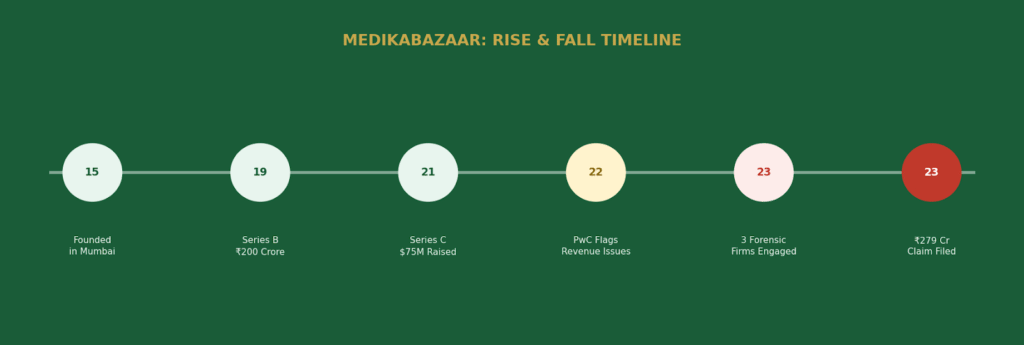
Figure 1: Medikabazaar — Rise & Fall Timeline
2. WHAT HAPPENED: COLLAPSE TIMELINE
Medikabazaar operated in B2B healthcare procurement, connecting hospitals and clinics with medical suppliers across India. The company had raised multiple rounds of institutional capital and was considered a meaningful player in health-tech supply chain.
| Stage | Event |
| Series C Fundraise | Medikabazaar raises institutional capital; founders sign SHA with representations & warranties |
| PwC Flags Issue | Statutory auditor flags revenue recognition inconsistencies — the highest-risk line in any financial statement |
| Board Commissions Forensics | Three independent forensic firms (Uniqus India, A&M, Rashmikant) engaged simultaneously |
| Unanimous Findings | All three firms confirm CEO breached fiduciary duty; gross negligence & misappropriation established |
| PwC Resigns | Formal auditor resignation signals to market that signed accounts cannot be relied upon |
| ₹279 Cr Claim Filed | Series C investors invoke SHA indemnity provisions based on materially false representations |
3. FORENSIC INVESTIGATION: ALL THREE FIRMS AGREED
The board commissioned three independent forensic investigations after PwC flagged revenue recognition inconsistencies. The unanimity of findings left no room for ambiguity.
| Forensic Firm | Key Finding |
| Uniqus India | CEO breached fiduciary duty; gross negligence and misappropriation confirmed |
| Alvarez & Marsal | Material misstatements in financial statements; revenue recognition manipulated |
| Rashmikant & Partners | Corroborated findings of misappropriation and financial irregularities |
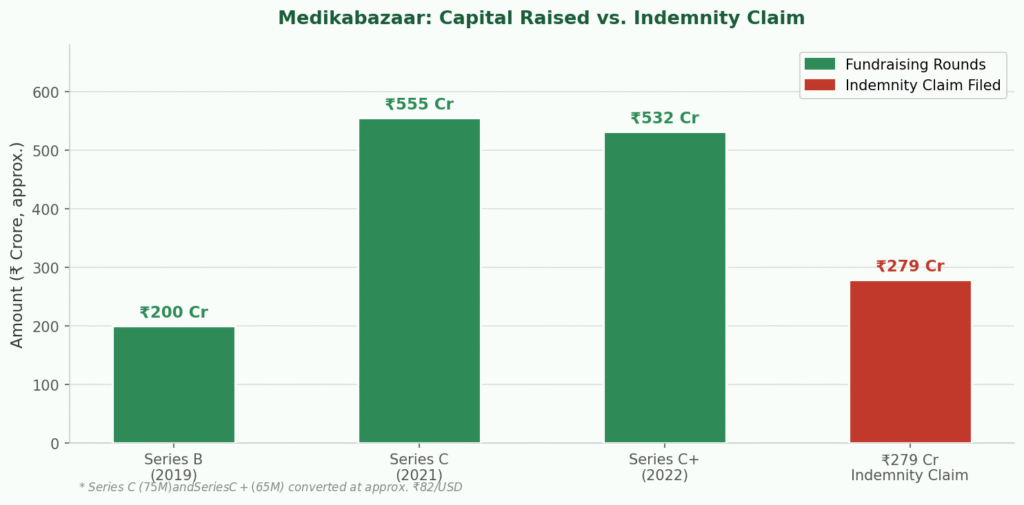
Figure 2: Capital Raised vs. Indemnity Claim (₹ Crore, approx.)
4. HOW AN INDEMNITY CLAIM ACTUALLY WORKS
Founders often treat the indemnity section of an SHA as a formality. It is not. Below is how the mechanism functions in practice when investors invoke it.
| SHA Mechanism | How It Works | Risk to Founder |
| Representations Lock-in | Statements about financials, compliance & liabilities are locked at signing | HIGH |
| Materiality Waivers | Fraud or willful misstatement removes basket/deductible protections | CRITICAL |
| Survival Periods | Claims survive 18–36 months; fraud can extend or remove limits entirely | HIGH |
| Claim Quantum | Tied to investor loss: investment value lost + valuation difference had truth been known | VERY HIGH |
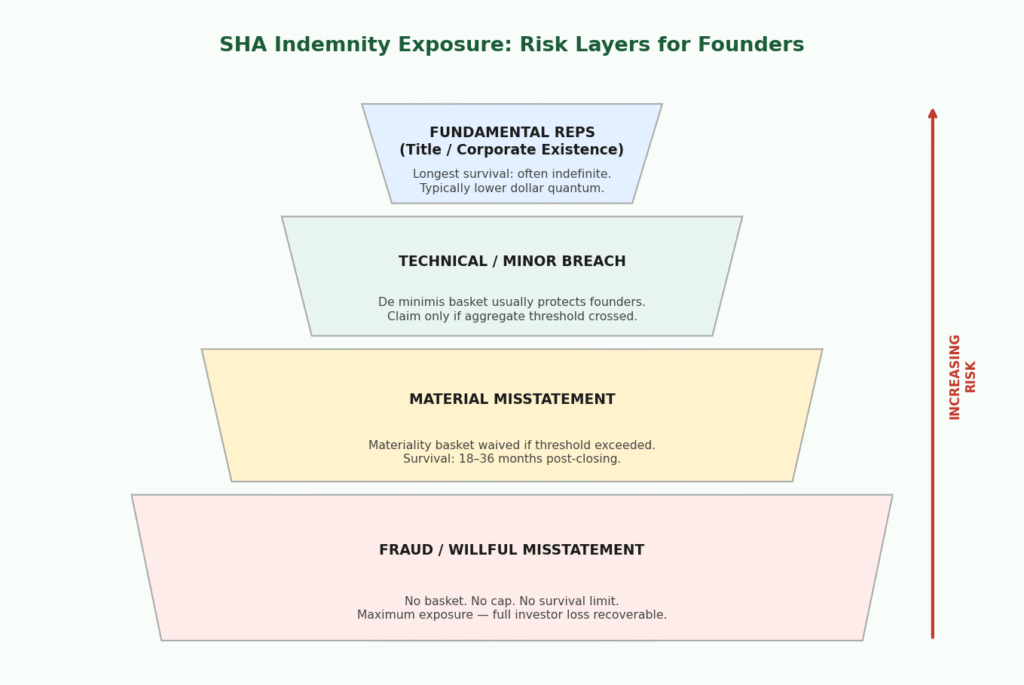
Figure 3: SHA Indemnity Exposure — Risk Layers for Founders
5. WHERE GOVERNANCE FAILED: THE THREE GAPS
The Medikabazaar situation reflects a failure pattern that repeats in funded startups: aggressive revenue recognition during fundraising periods, with internal oversight too weak to catch it before investors do.
| Governance Gap | What Was Missing | What Should Exist |
| No Functional Audit Committee | Quarterly substantive review of accounts | Active committee that flags issues before external auditors do |
| Auditor Familiarity Risk | Auditor independence from management | Rotation policy & arm’s length auditor relationship |
| Weak Finance Function | Audit-ready books at every stage, not just year-end | CFO-grade finance team capable of institutional-level scrutiny |
6. REVENUE RECOGNITION: THE HIGHEST-RISK LINE
 CRITICAL RISK AREA: CRITICAL RISK AREA:Revenue recognition is the single most scrutinised line in any investor due diligence. Whether revenue is recognised on delivery, on invoicing, on cash receipt, or over a contract period directly shapes the financial picture presented to investors. An auditor flagging inconsistencies in revenue recognition triggers an immediate governance response and may constitute a material misstatement under your SHA representations. |
7. WHAT EVERY FUNDED FOUNDER SHOULD TAKE AWAY
| # | Key Lesson | Implication |
| 1 | SHA Representations Are Legal Commitments | Not aspirational they are the legal foundation of your investors’ investment decision. Incorrect financials = legal claim. |
| 2 | Clean Books Are Non-Negotiable at Series B+ | Institutional investors conduct forensic-grade due diligence. Aggressive revenue recognition will be found during DD or after. |
| 3 | Auditor Resignation Is a Material Event | It creates a documented compliance trail visible to all future investors, acquirers, and regulators. It cannot be managed quietly. |
| 4 | Respond Through the Board, Not Around It | Board-level documentation of every governance response is both the right action and the best legal protection in a dispute. |
Setting up an AIF Category II fund in India is one of those processes that looks straightforward on paper and then quietly consumes six months of your life if you go in underprepared.
The regulatory framework is well-defined. SEBI’s AIF Regulations, 2012 have been around long enough that the process is predictable. But predictable doesn’t mean simple. Between entity formation, PPM drafting, SEBI queries, KIT certifications, sponsor structuring, and scheme launch mechanics, there are easily a dozen points where a misstep causes delays or worse, a SEBI objection that forces you to restructure before you’ve even raised a rupee.
This guide is built for fund managers and sponsors who are past the “should we do this?” stage and into the “how do we actually do this, correctly, the first time?” stage. We cover the full setup process, legal structure decisions, SEBI registration step-by-step, PPM requirements, key personnel obligations, launch mechanics, and the ongoing compliance calendar you’ll live with for the life of the fund.
If you’re raising a PE fund, a debt fund, a real estate fund, or a fund of funds under the Cat II umbrella, this is your operational playbook.
What Is a Category II AIF?
Under the SEBI (Alternative Investment Funds) Regulations, 2012, a Category II AIF is defined as any fund that does not fall under Category I or Category III. In practice, this covers:
- Private equity funds
- Debt funds (including credit funds, distressed debt)
- Real estate funds
- Fund of Funds (investing in other AIFs)
- Infrastructure debt funds not qualifying as Cat I
Key Cat II Characteristics
Mandatory close-ended structure with minimum 3-year tenure. Cannot use leverage or borrow funds for investment purposes (except for meeting temporary shortfalls). No tax pass-through at fund level for income other than business income. Investments in listed and unlisted securities permitted. Minimum scheme corpus: ₹20 crore. Minimum investor commitment: ₹1 crore (other than employees/directors of the manager).
Step-by-Step Guide : Category II AIF Registration Process
The registration process has eight distinct stages. From the time you begin entity formation to receiving your SEBI certificate, expect 10–16 weeks if your documentation is clean and there are minimal SEBI queries.
Stage 1: Entity Formation
A Category II AIF must be established as a Trust, Limited Liability Partnership (LLP), Company, or Body Corporate. In practice, the overwhelming majority of Cat II AIFs in India are set up as trusts specifically, an irrevocable private trust registered under the Indian Trusts Act, 1882 (or the relevant state Registration Act).
Why Trust? The trust structure gives maximum flexibility on investor rights, distributions, and governance. It is also the most SEBI-familiar structure and faces fewer regulatory uncertainties than LLP or company structures for pooled vehicles.
Key formation documents: Trust Deed (registered), PAN for the Trust, bank account in the trust’s name. The trust deed must explicitly prohibit public solicitation of funds.
| Important: The trust deed must include specific language prohibiting public invitations to subscribe; this is a SEBI eligibility requirement. Any invitation to the public to subscribe to fund units disqualifies the entity from AIF registration. |
Stage 2: Appoint Manager and Sponsor
Every AIF must have a Manager and a Sponsor. These can be the same entity. Here’s how they differ:
| Role | Function | Key SEBI Requirement |
| Manager | Makes investment decisions, manages the fund day-to-day | Net worth ≥ ₹5 crore; NISM Series XIX-A or XIX-C + NISM Series III-C (Compliance Officer) by 1 January 2027 certified Key Investment Team (KIT) |
| Sponsor | Sets up the AIF, contributes seed capital | Minimum 2.5% of corpus or ₹5 crore (whichever is lower) as continuing interest |
| Trustee | Holds assets on behalf of investors (for trust structure) | Cannot be the Manager; must be independent or a SEBI-registered debenture trustee |
| NISM Certification Requirement: From May 2024, all Key Investment Team (KIT) members of the Manager must hold the NISM Series XIX-A or XIX-C (AIF) certification plus one additional NISM examination specifically, NISM Series III-C for the Compliance Officer, with full compliance required by 1 January 2027. Existing AIF managers had until May 2025 to comply with the XIX-C requirement. This is now non-negotiable for new registrations to get KIT certifications sorted before filing. |
Stage 3: Draft the Private Placement Memorandum (PPM)
The PPM is the most critical document in your registration file. It defines what the fund can and cannot do, and SEBI scrutinizes it closely. A weak or vague PPM is the single most common reason for SEBI queries and delays.
PPM must cover:
- Fund strategy, sectors, geographies, investment thesis in specific, not generic terms
- Investment restrictions, concentration limits, co-investment policy
- Fee structure: management fee, performance fee (hurdle rate, carry, catch-up)
- Waterfall mechanism and distribution policy
- Governance: LPAC / advisory committee composition and powers
- Valuation policy (must reference SEBI-specified methodology)
- Risk factors specific to the strategy
- Conflict of interest policy
- Exit strategy and fund wind-up provisions
| PPM Drafting Caution: Avoid using generic template language lifted from other AIFs. SEBI has increasingly flagged PPMs with strategy descriptions that are too broad or inconsistent with the fund’s stated investment focus. Your legal team should tailor the PPM to your specific thesis. |
Stage 4 : PPM Due Diligence by Merchant Banker
Before filing on the SEBI SI Portal, the PPM must undergo due diligence by a SEBI-registered Merchant Banker. This is a mandatory step introduced to ensure that the PPM meets all disclosure and compliance standards before formal submission.
The Merchant Banker reviews the PPM for:
- Adequacy and accuracy of disclosures regarding the fund strategy, risks, and fee structure
- Compliance with Schedule II of the SEBI (AIF) Regulations, 2012
- Consistency between the investment thesis, restrictions, and the stated category
- Adequacy of conflict of interest and related-party disclosures
Upon completion, the Merchant Banker issues a due diligence certificate that must be included in the Form A filing package. Ensure this step is planned into your pre-filing timeline, as it can take 2–3 weeks.
| Tip: Engage your Merchant Banker early ideally in parallel with PPM drafting so the due diligence process does not delay your filing date. |
Stage 5: File on SEBI SI Portal Form A
The application is filed online on SEBI’s Intermediary (SI) Portal at siportal.sebi.gov.in. Steps:
- Create entity account on SI Portal; SEBI generates a Login ID
- Click ‘Fresh Registration’ under the AIF tab
- Fill Form A per Schedule I of SEBI (AIF) Regulations, 2012
- Upload all supporting documents (see checklist below)
- Pay application fee of ₹1,00,000 + 18% GST (online, exact amount no rounding)
Document Checklist for Form A :
| Document | Notes |
| Trust Deed / LLP Agreement / MOA-AOA | Registered; must include anti-solicitation clause |
| Private Placement Memorandum (PPM) | Final draft with Merchant Banker due diligence certificate; will be reviewed by SEBI |
| Investment Management Agreement | Between AIF (Trust) and Manager |
| KYC documents of all entities | AIF, Manager, Sponsor, Trustees PAN, registration certs |
| Net worth certificate of Manager | CA-certified; must show ≥ ₹5 crore net worth |
| NISM Certification of KIT members | Series XIX-A or XIX-C + NISM Series III-C (Compliance Officer) by 1 January 2027 |
| Fit & Proper declaration | For all key persons |
| Bank account details of AIF | Trust bank account, account opening letter |
| Sponsor continuing interest undertaking | Commitment of minimum 2.5% or ₹5 crore |
| Merchant Banker Due Diligence Certificate | Mandatory certifying PPM compliance with SEBI AIF Regulations |
Stage 6: SEBI Review Handling Queries
After filing, SEBI’s Investment Management Department reviews the application. If queries are raised (which is common, especially for first-time managers), you will receive them on the SI Portal. Typical SEBI query areas include:
- Strategy clarity if the investment thesis is too broad or ambiguous
- Manager’s track record or relevant experience
- PPM provisions that appear inconsistent with Cat II restrictions
- KIT qualifications and team sufficiency
- Conflict of interest disclosures
Respond to queries within the timeline specified by SEBI (usually 21–30 days). Multiple rounds of queries are possible. Having a SEBI-experienced legal advisor handle the query response significantly reduces turnaround time.
Stage 7: Pay Registration Fee and Receive Certificate
Once SEBI is satisfied, you will receive an in-principle approval and an invoice for the registration fee. Category II AIF registration fee is ₹10,00,000 (non-refundable). Upon payment on the SI Portal, SEBI issues the Registration Certificate. The certificate is valid until the fund is wound up there is no periodic renewal requirement, but the fund must remain in continuous compliance.
Stage 8 : Launch Your First Scheme
An AIF may launch multiple schemes under the same registration. For the first scheme of a new AIF, no additional scheme fee is payable to SEBI. For subsequent schemes, ₹1,00,000 must be paid at least 30 days prior to the scheme launch, along with a scheme-specific placement memorandum filed with SEBI.
Scheme launch triggers: Final PPM to investors, execution of Contribution Agreements (side letters), capital drawdowns as per the drawdown schedule, and appointment of custodian.
Fund Structure: Key Decisions Before You Register
Before filing, you need to lock down several structural decisions that will be hard (and SEBI-process-intensive) to change later.
Legal Structure: Trust vs. LLP
| Factor | Trust | LLP |
| Most common? | Yes dominant structure for Cat II | Less common; used for specific tax/investor structures |
| Investor rights | More flexible defined by Trust Deed | Defined by LLP Agreement |
| Tax treatment | Pass-through for eligible income (capital gains, interest) | Similar pass-through treatment |
| Foreign investors | More familiar structure globally; easier for FPI onboarding | Possible but less preferred |
| Governance | Trustee provides oversight; LPAC common | Designated partners; governance via agreement |
Single-Scheme vs. Multi-Scheme
You can register one AIF and run multiple schemes under it each with different strategies, investor bases, or vintages. This is common for managers who plan to raise successive funds. The advantage is one registration umbrella; the challenge is maintaining clean separation between schemes in terms of books, investor reporting, and SEBI filings.
Domestic vs. International Feeder Structure
If you are raising capital from offshore investors (FPIs, family offices, endowments), consider whether a GIFT IFSC feeder fund structure makes sense. A GIFT IFSC AIF-equivalent (registered with IFSCA under the Fund Management Regulations 2025) feeding into a domestic Cat II AIF can offer tax and regulatory advantages for foreign LPs. Treelife advises on GIFT IFSC setups separately.
Custodian Requirement
A custodian is now mandatory for all Category II AIFs, irrespective of corpus size. This requirement applies from the point of scheme launch and is no longer conditional on the ₹500 crore threshold. Custodians must be SEBI-registered.
| Updated Requirement: The custodian appointment requirement for Category I and II AIFs has been revised and is now compulsory irrespective of the scheme corpus. The earlier threshold of ₹500 crore no longer determines custodian applicability for Cat II AIFs. |
We help setup AIF in India. Book a 30 min free consultation. Let’s Talk
Ongoing Compliance Obligations
Registration is the beginning. Cat II AIFs carry significant ongoing compliance obligations quarterly, annual, and event-based. Missing any of these can result in SEBI notices, penalties, and investor trust issues.
Quarterly SEBI Reporting
Every AIF scheme must submit a quarterly report to SEBI within 7 calendar days from the end of each quarter. The report covers fund corpus, number of investors, portfolio details, drawdown status, and NAV. From 2024, filings must also be made on the AIF Data Repository (ADR) platform, which aggregates AIF data for SEBI’s market surveillance.
Annual Compliance Test Report (CTR)
From May 2024 (per SEBI Master Circular), the Manager must prepare an annual Compliance Test Report (CTR) and submit it along with the annual compliance certificate. The CTR is a self-assessment of compliance across all SEBI AIF Regulation provisions. A compliance professional or internal audit must sign off on it.
Valuation Policy
Cat II AIFs must value their portfolio at fair value, using SEBI-prescribed methodologies. Listed securities are marked to market. Unlisted securities must be valued using recognized approaches (DCF, market multiples, etc.) consistently applied and independently reviewed annually.
PPM Amendments
Any material change to the fund strategy, fee structure, key personnel, or other PPM provisions requires filing an updated PPM with SEBI and notifying existing investors. SEBI review of amendments can take 4–8 weeks. Plan strategy changes well in advance.
Investor Obligations
Category II AIFs can have up to 1,000 investors per scheme (excluding accredited investors in Accredited Investor-only schemes, which have no such cap under the 2024 Third Amendment). Each investor (other than employees/directors of the manager) must commit a minimum of ₹1 crore.
Common Mistakes in AIF Category II Setup
1. Vague investment strategy in the PPM
SEBI expects a well-defined, specific investment thesis not a laundry list of sectors and instruments. A PPM that says ‘the fund may invest in equity, debt, real estate, or any other asset class’ will generate queries. Be specific about your mandate.
2. Underestimating the net worth requirement for the Manager
The Manager entity must have a minimum net worth of ₹5 crore at the time of registration and must maintain it on an ongoing basis. Many first-time managers set up a new company as the Manager and discover they need to capitalize it adequately before filing.
3. KIT members not NISM-certified before filing
NISM Series XIX-A or XIX-C certification takes time, and KIT members must also ensure the NISM Series III-C (Compliance Officer) requirement is met by 1 January 2027. If your key investment team is not certified at the time of filing, SEBI will raise it as a query and you cannot use the waiting period productively. Get all required certifications in place before you file.
4. Sponsor continuing interest structuring it wrong
The sponsor’s 2.5% or ₹5 crore (whichever is lower) continuing interest must be in the form of units of the AIF not a loan or a cash deposit. First-time managers sometimes structure this incorrectly, requiring restructuring that delays the timeline.
5. Not accounting for the 30-day scheme filing window
You cannot launch a second (or third) scheme immediately after registration. For each subsequent scheme, a placement memorandum must be filed with SEBI at least 30 days prior to launch. Build this into your fundraising calendar.
6. Missing the AIF Data Repository (ADR) filing requirement
The ADR filing is a 2024 addition that many older AIF compliance checklists don’t include. It is now a mandatory quarterly obligation. Ensure your compliance calendar captures it explicitly.
7. Not completing PPM due diligence by a Merchant Banker before filing
A Merchant Banker due diligence certificate is now a required document for Form A submission. Skipping or delaying this step will result in an incomplete filing. Engage your Merchant Banker in parallel with PPM drafting.
]]>Plan your March filings in one place. Figures and forms are mapped for monthly GST filers, QRMP taxpayers, TDS deductors, PF and ESI registrants, and businesses closing the financial year. Use this single-page tracker to plan all India statutory filings and deposits for March 2026.
The March 2026 Compliance Calendar provides a comprehensive, date-wise checklist of statutory compliances applicable during the month, helping businesses remain compliant and financially prepared before the financial year closes.
At a Glance:
- When is GSTR-1 due? – 11 March 2026 for February 2026 (monthly filers).
- When are GSTR-7 and GSTR-8 due? – 10 March 2026 for February 2026.
- When is GSTR-3B due? – 20 March 2026 for February 2026 (monthly filers).
- When to deposit TDS/TCS? – 7 March 2026 for February deductions and collections.
- PF and ESI deadlines? – 15 March 2026 for February 2026 contributions. Since the due date falls on Sunday, complete payments by Friday, 13 March.
- Advance Tax deadline? – 15 March 2026 4th instalment (100% of FY 2025–26 tax liability).
- Month-end compliance? – Challan-cum-statements (Forms 26QB, 26QC, 26QD, 26QE) due 28 March 2026.
- Year-end reminder? – 31 March 2026 marks the close of FY 2025–26 reconcile books, close invoices, and complete pending filings.
Who is this Calendar for
- Founders, CFOs, finance and compliance teams managing GST, TDS, PF, ESI
- MSMEs and startups on monthly GST or QRMP
- Accounting firms handling multi-client calendars across India
- Listed entities tracking SEBI timelines
- Companies with FEMA reporting (e.g., ECB)
- Private companies/LLPs tracking Companies Act filing timelines
Key Statutory Compliance Due Dates – March 2026
Here is a tabular compliance calendar for March 2026.
Compliance Calendar Table (Date-wise)
| Date | Law | Form or Action | For Period | Who must do this | What to do now |
|---|---|---|---|---|---|
| 7 Mar 2026 (Sat) | Income Tax | Deposit TDS / TCS | Feb 2026 | All deductors / collectors | Verify challan details and section mapping immediately after payment. |
| 10 Mar 2026 (Tue) | GST | GSTR-7 | Feb 2026 | GST TDS deductors | Reconcile deductee entries before filing. |
| 10 Mar 2026 (Tue) | GST | GSTR-8 | Feb 2026 | E-commerce operators | Match collections with marketplace payouts. |
| 11 Mar 2026 (Wed) | GST | GSTR-1 (Monthly) | Feb 2026 | Monthly GST filers | Freeze outward supplies and validate invoices. |
| 15 Mar 2026 (Sun) | PF | Contribution + ECR filing | Feb 2026 | EPFO registered employers | Complete payments before Friday due to weekend banking cut-offs. |
| 15 Mar 2026 (Sun) | ESI | Contribution + return | Feb 2026 | ESIC registered employers | Reconcile payroll wages and challans. |
| 15 Mar 2026 (Sun) | Income Tax | Advance Tax – 4th Instalment | FY 2025–26 | All eligible taxpayers | Pay 100% of tax liability after final estimation. |
| 20 Mar 2026 (Fri) | GST | GSTR-3B | Feb 2026 | Monthly GST filers | Reconcile ITC before filing to avoid mismatches. |
| 20 Mar 2026 (Fri) | GST | GSTR-5A | Feb 2026 | OIDAR providers | Confirm forex conversions and supply location. |
| 28 Mar 2026 (Sat) | Income Tax | 26QB / 26QC / 26QD / 26QE | As applicable | Specified deductors | Match PAN, property and transaction details carefully. |
| 31 Mar 2026 (Tue) | Year-End | Financial Year Closing Activities | FY 2025–26 | All businesses | Close books, reconcile GST and complete pending entries. |
GSTR-3B Due Date Note (State-wise / Group-wise)
For monthly filers, GSTR-3B is due on 20 March 2026 for February transactions.
Taxpayers should reconcile input tax credit thoroughly before filing to prevent notices or reversals during year-end assessments.
Note on Professional Tax
If your state mandates monthly Professional Tax, align payments with payroll processing. Due dates remain state-specific and must be verified locally.
Actionable planning checklist
Two weeks before due dates
- Lock February outward supplies before filing GSTR-1
- Prepare TDS payment files and approvals
- Reconcile payroll with PF and ESI calculations
- Estimate final advance tax liability for FY 2025–26
- Begin financial year-end reconciliations
Filing week workflow
- 7th: Deposit TDS/TCS and verify challan status
- 10th: File GSTR-7 and GSTR-8 after reconciliation
- 11th: File GSTR-1 and confirm invoice accuracy
- 15th: Complete PF, ESI and Advance Tax payments before weekend cut-offs
- 20th: File GSTR-3B and GSTR-5A
- 28th: Submit challan-cum-statements for applicable TDS sections
- 31st: Finalise books and close financial year entries
Year-End Corner Cases to Watch
- March is the financial year closing month, increasing reconciliation risks.
- Ensure all TDS deductions are recorded before year end.
- Clear pending GST amendments before closing books.
- Verify advance tax computations to avoid interest under Sections 234B and 234C.
- Complete audit preparation and documentation early.
This calendar applies to:
- Private Limited Companies & OPCs
- Startups & MSMEs
- LLPs, Firms & Proprietorships
- GST-registered businesses
- TDS/TCS deductors
- Employers registered under PF, ESI & Professional Tax
- OIDAR service providers & non-resident taxpayers
- NBFCs and Ind-AS compliant entities
Summary of Key Forms & Their Purpose
| Form | Law | Applicability | Purpose |
|---|---|---|---|
| GSTR-1 | GST | Monthly filers | Statement of outward supplies |
| GSTR-3B | GST | Registered taxpayers | Monthly tax payment return |
| GSTR-7 | GST | GST TDS deductors | TDS reporting under GST |
| GSTR-8 | GST | E-commerce operators | TCS reporting |
| GSTR-5A | GST | OIDAR providers | Cross-border digital services reporting |
| TDS/TCS Challan | Income Tax | Deductors/collectors | Monthly tax remittance |
| Advance Tax | Income Tax | Eligible taxpayers | Final instalment of annual tax liability |
| 26QB/26QC/26QD/26QE | Income Tax | Specified transactions | Combined payment and statement filing |
| PF ECR | PF | Employers | Monthly PF contribution filing |
| ESI Return | ESI | Employers | Employee insurance contributions |
Other Compliance & Corporate Reminders
- File pending board resolutions or ROC items from February if applicable.
- Review financial statements before year closing.
- Ensure GST reconciliations match accounting records.
- Prepare audit documentation for FY 2025–26.
Corporate compliance timelines may vary depending on entity structure and event-based triggers. Confirm applicability before filing.
Official Portals to Monitor for Updates
Track any extensions or clarifications on the portals of Goods and Services Tax Network (GSTN), Income Tax Department, Employees’ Provident Fund Organisation (EPFO) and Employees’ State Insurance Corporation (ESIC). We however track all updates from these portals and keep you posted.
Conclusion
March 2026 is one of the most critical compliance months of the year as it coincides with the financial year closing. Advance planning, accurate reconciliations, and timely filings help businesses avoid penalties while entering the new financial year with clean books.
For startups and growing businesses, working with experienced compliance professionals ensures accuracy, audit readiness, and uninterrupted operations.
Why Choose Treelife?
Treelife has been one of India’s most trusted legal and financial firms for over 10 years. We are proud to be trusted by over 1000 startups and investors for solving their problems and taking accountability.
Our team ensures:
- Zero missed deadlines
- Clean audit trails
- Investor-ready compliance
- Full statutory coverage across GST, Income Tax & MCA
Need Help with March 2026 Compliances? Let’s Talk
The landscape for Indian startups has fundamentally shifted. A growing number of founders are making a deliberate choice to re-domicile their businesses from offshore jurisdictions like Delaware, Singapore, or Mauritius back to India. This strategic move, known as a “reverse flip” or re-domiciliation, is no longer niche its becoming mainstream.
But what’s driving this trend? And more importantly, is it right for your company?
Understanding the Reverse Flip
At its core, a reverse flip is a straightforward concept: migrating your offshore holding company structure so that an Indian entity becomes the consolidated parent of your group. What sounds simple in theory, however, involves navigating complex legal, tax, regulatory, and operational dimensions.
For many founders, this process unlocks significant strategic advantages that were previously unavailable to them.
The Five Key Reasons Founders Are Coming Back
IPO Readiness
SEBI doesn’t negotiate on this point: if you want to list on the NSE, BSE, or GIFT City exchanges, your listing entity must be Indian-incorporated. For any founder with IPO ambitions within the next three to five years, a reverse flip isn’t optional it’s essential.
Access to Indian Institutional Capital
The domestic investment landscape has matured dramatically. Large family offices, alternative investment funds (AIFs), and strategic investors now deploy substantial capital into Indian startups. Many of these investors have FEMA-linked mandates that restrict or prohibit direct investment into foreign entities. By flipping to India, you’re removing a structural barrier to accessing this growing pool of capital.
Eliminating POEM Risk
One of the most underestimated tax risks for Indian-operated companies with foreign holding structures is POEM (Place of Effective Management) exposure. If your entire management team, operations, and decision-making centers are in India, the Indian tax authority can argue that your offshore entity itself is an Indian tax resident potentially subjecting it to Indian taxation on global income at rates exceeding 40%. A reverse flip eliminates this uncertainty permanently.
Government Incentives and Scheme Eligibility
PLI scheme eligibility. DPIIT startup benefits including the 80-IAC three-year profit deduction. Government procurement preferences. These aren’t marginal advantages; they can materially impact your unit economics and growth trajectory. Offshore-incorporated entities are excluded from all of them.
Operational Simplification and Cost Savings
Maintaining dual-entity structures across two jurisdictions requires parallel audits, transfer pricing studies, FEMA compliance filings, and coordinated governance. The annual cost of this dual-jurisdiction burden typically ranges from ₹30 to 60 lakhs per year. A single-jurisdiction Indian structure reduces this to ₹10 to 25 lakhs annual savings that recover the entire cost of the flip within two to three years.
Before You Commit: The Readiness Assessment
Not every company should flip immediately. A few critical questions should guide your decision:
Is 90 percent or more of your revenue, operations, or customer base already in India? If yes, you’re a strong candidate. If your business is genuinely global or primarily offshore-focused, the economics shift.
Are you planning an India IPO in the next three to five years? This is a binary yes-or-no question with clear implications.
Do you hold material intellectual property, contracts, or international business operations offshore? Complexity here doesn’t kill the flip, but it does require careful planning. You may want to consider IP migration or partial flip strategies first.
Do key investors have FEMA restrictions or RBI approval requirements? This is often the longest-lead-time item in a flip. Mapping it early is critical.
Is your ESOP pool primarily held by Indian resident employees? Post-flip ESOP plans are cleaner for Indian residents. Foreign ESOP holders require additional FEMA structuring.
The Three Legal Routes: Which One Fits Your Situation?
The tax code and corporate law provide three distinct pathways to execute a reverse flip, each with different timelines, costs, and implications.
Route One: Cross-Border Merger (NCLT)
This is the legally cleanest route. Your offshore entity merges into your Indian subsidiary through a National Company Law Tribunal (NCLT) scheme, and the merged entity survives as your new Indian holding company.
The timeline is the longest, typically nine to eighteen months because NCLT approval is required. But the benefits are substantial: Section 47 tax neutrality is often available, the offshore entity is fully eliminated, and the structure is IPO-ready from day one.
This route is ideal if you have a clean cap table and aligned investors. It’s the preferred path for companies seriously tracking toward an IPO.
Route Two: Share Swap / Share Exchange
Here, offshore shareholders exchange their shares for shares in a new Indian holding company. The offshore entity may be retained as a subsidiary or wound down over time.
The legal basis is found in FEMA regulations and the Income Tax Act. Section 47(viab) can provide tax neutrality if structuring conditions are met, though arm’s-length valuation is required.
The timeline is considerably faster four to nine months because NCLT isn’t involved. This makes it attractive for companies with tight funding timelines or complex cap tables where NCLT consensus is harder to achieve.
Route Three: Liquidation Plus Asset Transfer
The fastest route, typically three to six months. The offshore entity is liquidated, its assets and IP are distributed to the Indian company, and the offshore entity is wound up.
This works best for early-stage companies with simple structures, few active investors, and limited offshore assets. The tradeoff: potential capital gains tax on asset transfers, and valuation of IP becomes critical. It’s the most tax-exposed route but operationally the simplest.
Thinking of flipping your startup back to India? Treelife helps founders structure reverse flips, manage FEMA compliance, and execute cross-border transitions smoothly. Let’s Talk
The Tax Landscape: What Every Founder Must Know
A reverse flip triggers multiple tax checkpoints. Understanding them upfront prevents surprises.
Capital gains on the share swap or merger: Depending on the route chosen and how it’s structured, this could be entirely tax-neutral (Section 47 treatment) or trigger capital gains tax. Proper structuring and advance tax opinions are essential.
ESOP perquisite tax for employees: ESOPs held by employees are subject to perquisite tax upon exercise, typically at slab rates up to 30%. However, employees of registered DPIIT startups can defer this tax to the earlier of five years from exercise, exit, or sale of securities. This is a powerful but often-overlooked benefit.
Indirect transfer tax exposure: Non-resident shareholders may face Indian indirect transfer tax under Section 9 if the flip results in a change of control over an Indian asset. DTAA (Bilateral Tax Treaty) protections may apply, but this requires early assessment.
IP transfer and royalty implications: If intellectual property is migrating from offshore to India, transfer pricing arm’s-length valuation is mandatory, and withholding tax may apply.
POEM-based taxation: This is perhaps the single biggest tax risk in the pre-flip state. If your offshore holding company has established a place of effective management in India which it likely has if all operations and management are Indianit’s already a taxable resident of India. A flip eliminates this exposure.
The Execution Timeline: What to Expect
A reverse flip is not a three-week process. Depending on the route, expect a total timeline of three to eighteen months from start to finish.
The process breaks into six overlapping phases:
Phase One: Diagnostic and Structuring (4-8 weeks) – Cap table audit, POEM risk assessment, tax exposure mapping, and route selection.
Phase Two: Board and Investor Approvals (6-10 weeks) – Board resolutions, investor consent letters, SHA review, and waiver of rights from minority shareholders.
Phase Three: Regulatory Filings (8-16 weeks) – NCLT petitions (if merger), RBI and FEMA filings, MCA filings, and tax authority notifications.
Phase Four: Execution and Asset Migration (4-8 weeks) – Share issuance and cancellation, contract novation, IP transfer, and banking restructuring.
Phase Five: ESOP Restructuring (4-6 weeks) – New Indian ESOP plan adoption, employee communications, and option conversion or buyout mechanics.
Phase Six: Post-Flip Compliance (4-8 weeks) – DPIIT registration (do this within the first 30 days), updated statutory registers, first-year audit, and offshore entity wind-down.
The Cost Reality
Professional fees for a complete reverse flip typically range from ₹25 to 95 lakhs, depending on complexity.
Legal fees (NCLT and documentation) run ₹15 to 60 lakhs. This varies significantly based on cap table complexity and whether NCLT is required.
Tax advisory and transfer pricing studies cost ₹8 to 25 lakhs. This scales with the value of IP being transferred and the number of tax jurisdictions involved.
Regulatory and FEMA filings add ₹3 to 10 lakhs, driven primarily by the number of offshore investors and jurisdictions.
These are significant costs, but remember: dual-jurisdiction compliance costs typically recover this entire investment within two to three years.
The Risks You Need to Manage
A reverse flip introduces several material risks that require proactive mitigation.
NCLT and regulatory timeline overruns are the highest-probability risk. Build a four-month buffer into your planning. Maintain bridge financing capacity. Communicate transparently with investors about timeline variability.
Investor consent bottlenecks can be the critical path item. Map all consent rights and investor veto provisions at the start. Engage your top investors at least 90 days before your target flip date. Provide them with a clear, written information memorandum outlining the rationale, tax implications, and timeline.
Unexpected tax liabilities can emerge from careful examination of capital gains treatment or Section 56(2)(x) gift tax on asset transfers. Commission a comprehensive tax opinion from a Big Four firm or specialist early. If stakes are high, consider requesting an advance ruling from the tax authority.
ESOP valuation disputes can create employee dissatisfaction. Engage a registered valuer for the conversion. Conduct transparent employee Q&A sessions. Provide written FAQs. Consider offering independent employee counsel during the process.
Contract continuity risks with customers and vendors require proactive legal review of change-of-control clauses and novation mechanics. Provide customers and vendors with 90 days notice and clear communication about the structural change.
Investor Communication: Your Longest Lead-Time Item
The biggest operational risk in a reverse flip is often not legal or tax, its investor alignment.
Begin investor outreach at least 90 days before your target flip date. Surprises generate resistance. Early engagement builds consensus.
Provide investors with a written information memorandum that covers the strategic rationale for the flip, the specific legal route you’ve chosen, the detailed tax analysis for their specific share class (different shareholders have different tax exposures), and the expected timeline with buffers.
Address FEMA and repatriation concerns head-on. Many offshore investors worry about their ability to get money out of India post-flip. Provide them with a clear FEMA compliance roadmap and RBI approval timeline upfront. This preempts the biggest objection before it hardens.
Segment your investor base. Angels, VCs, strategic investors, and ESOP holders all have different concerns and information needs. Tailor your communication accordingly rather than sending a single all-hands memo.
Identify potential dissenters early and engage directly. If your structure requires NCLT approval, understand the fair exit mechanisms available to minority shareholders who object.
Document everything. Board resolutions, consents, waivers, shareholder communication keep detailed records. This documentation is critical for RBI filings, NCLT proceedings, and future due diligence.
What Success Looks Like
When a reverse flip is executed well, the benefits compound quickly.
You gain immediate eligibility for government schemes like PLI and DPIIT startup registration. The 80-IAC three-year profit deduction can be worth multiples of the flip’s cost.
You unlock access to domestic institutional capital that was previously unavailable or reluctant to invest. This often results in higher valuation multiples from Indian AIFs compared to foreign-focused structures.
You eliminate POEM tax risk permanently, providing both certainty and long-term tax efficiency.
You simplify operations, reduce annual compliance costs, and accelerate your readiness for IPO-track activities like financial restatement and governance upgrades.
Most importantly, you position your company as an Indian-owned and Indian-headquartered signal that increasingly matters to customers, regulators, and capital providers.
The Bottom Line
A reverse flip is not right for every company. But for founders with substantial Indian operations, strong domestic market positioning, and medium-term growth ambitions, it’s increasingly a strategic necessity rather than an optional step.
The window to execute a flip is often narrow. Timing matters you want to flip before you become too large or too complex, but after you’ve achieved enough scale that the cost is justified.
If you’re considering a reverse flip, the time to assess feasibility is now. The longer you wait, the more complex your cap table becomes, the more difficult investor alignment grows, and the larger your tax exposure potentially becomes.
The best flips happen quietly, well-planned and well-executed, with full investor buy-in and clear strategic purpose. That takes time to set up correctly.
]]>The angel tax, introduced by Section 56(2)(viib) of the Income Tax Act, 1961, applies to unlisted companies (startups whose shares are not publicly traded) that receive funding exceeding the Fair Market Value (FMV) determined by the government. This excess investment is considered “income from other sources” and is taxed at a rate of 30.9% (inclusive of a 30% income tax rate and 3% cess). Section 56(2)(viib) of the Income Tax Act 1961 encompasses a provision that pertains to closely-held companies issuing shares to resident investors at a value exceeding the “fair market value” of those shares. In such cases, the surplus amount of the issue price over the fair value is subject to taxation as the income of the company issuing the shares. Hence, angel tax is a built-up concept inculcated in the Finance Act, 2012 over the foundational block of provisions of the Income Tax Act, 1961.
The core issue lies in determining a startup’s FMV. Unlike established companies with a track record, startups are young and often lack a readily available market value. This makes the government’s FMV assessment subjective and potentially inaccurate. Imagine a scenario where an investor believes your innovative idea has immense potential and offers Rs 15 crore for shares whose FMV is estimated at Rs 10 crore by the government. Under the angel tax, that Rs 5 crore difference would be taxed, creating a significant financial burden on an early-stage company.
Which Investment Falls Under the Angel Tax Category?
Any funding a startup receives from an investor, if it exceeds the FMV determined by the government, falls under the angel tax category. This can include investments from angel investors, individuals who provide early-stage capital, or even venture capitalists if the startup is still unlisted. The key factor is the difference between the investment amount and the government’s FMV assessment, not the specific type of investor.
What is an Angel Tax Exemption?
The Indian government has introduced exemptions to the angel tax. The new policy exempts startups registered under the Department for Promotion of Industry and Internal Trade (DPIIT) from the angel tax.
The primary route to tax benefits lies in obtaining recognition from the Department for Promotion of Industry and Internal Trade (DPIIT). This involves submitting an application along with supporting documents to the Central Board of Direct Taxes (CBDT). Once approved, your startup can breathe a sigh of relief and be shielded from the angel tax.
Eligibility Criteria for Angel Tax Exemption
In order to get an exemption, the government has laid down eligibility criteria for angel tax exemption in a two-fold structure. A startup has to be first recognized and registered as prescribed under G.S.R. notification 127 (E) are eligible to apply for recognition under the program. The two-fold structure includes:
- Eligibility Criteria for Startup Recognition
- Eligibility Criteria for Tax Exemption under Section 56 of the Income Tax Act, 1961
Eligibility Criteria for Startup Recognition (DPIIT)
While DPIIT (Department for Promotion of Industry and Internal Trade) recognition for a startup unlocks the exemption door, there are specific criteria a startup needs to fulfill:
The company must be incorporated as a private limited company or registered as a partnership firm or a limited liability partnership.
The company’s turnover should not exceed INR 100 Crore in any of the previous financial years.
A company shall be considered as a startup up to 10 years from the date of its incorporation.
The company should demonstrate a focus on innovation or improvement of existing products, services, or processes. Additionally, it should have the potential for job creation or wealth generation.
Companies formed by splitting up or restructuring an existing business are not eligible for this recognition.
Eligibility Criteria for Tax Exemption under Section 56 of the Income Tax Act, 1961
After getting recognition, a startup may apply for an angel tax exemption. The eligibility criteria are as follows:
The startup must be recognized by the Department for Promotion of Industry and Internal Trade (DPIIT).
The aggregate amount of the startup’s paid-up share capital and share premium (the additional amount paid by investors over the face value of the shares) cannot exceed INR 25 Crore after the proposed investment. However, the calculation of the paid-up capital shall not include the consideration received in respect of shares issued to a non-resident, a venture capital fund, and a venture capital company.
What is the Angel Tax Exemption Declaration?
Angel tax declaration is a formal statement submitted alongside your exemption application. It serves as a commitment from your startup to adhere to specific investment restrictions for a set period. The declaration outlines several asset categories where your startup cannot invest for a period of seven years following the end of the financial year when the shares are issued. These restrictions aim to ensure that the funds raised are used for core business purposes and not for personal gains. Here’s a breakdown of the restricted asset categories:
Residential Property: Investments in residential houses (except those used for business purposes or held as stock-in-trade) are prohibited.
Non-Business Land and Buildings: Land or buildings not directly used for business operations, renting, or held as stock-in-trade cannot be purchased.
Non-Business Loans: Loans and advances outside the ordinary course of your business are restricted (unless lending money is your core business).
Capital Contributions: Investing in other entities is not permitted.
Shares and Securities: Investments in other companies’ shares or securities are off-limits.
Luxury Vehicles: Vehicles exceeding Rs 10 lakh in value (except those used for business purposes) cannot be purchased.
Non-Business Assets: Investments in jewelry (outside of stock-in-trade), art collections, or bullion are prohibited.
The angel tax exemption declaration is a critical component of securing relief from the angel tax. By submitting this declaration, your startup demonstrates its commitment to responsible use of the raised funds, fostering trust with the government and investors.
Please ensure that the declaration is on the letterhead of the company.
How to Apply for Angel Tax Exemption?
Recognizing the complexities involved, the government has taken steps to simplify the process. Now, DPIIT-recognized startups can directly apply for angel tax exemption with the Department of Industrial Policy and Promotion (DIPP).
Login to https://www.startupindia.gov.in/ and insert your login credentials.
Click on the ‘Dashboard’ tab and then, click on ‘DPIIT RECOGNITION’.
Scroll down the page and come to Form 56, then click on ‘Click Here To Apply Form 56’.
Once the form opens, all details but: (i) point 9 (where you have to upload a signed declaration); and (ii) point 10 (declaration signing date), will be pre-filled, based on the information provided at the time of filing the Startup India registration.
Please ensure that the signed angel tax exemption declaration has complete and accurate details and that the declaration is on the company’s letterhead.
Upload the signed declaration in .pdf format and insert the date of signing of the declaration. Once done, click on ‘Submit’.
DIPP will then forward your application to CBDT, who are mandated to respond (approval or rejection) within 45 days of receipt. As a confirmation of the company having received the angel-tax exemption, the startup will receive an email from CBDT at the email ID submitted on the Startup India portal, within 1 to 3 weeks from the date of filing the application.
Applying for Angel Tax exemption? We handle documentation, valuation reports, and DPIIT coordination end-to-end. Let’s Talk
Benefits of Angel Tax Exemption
The angel tax exemption in India offers a breath of fresh air for both startups and angel investors. Here’s a breakdown of the key advantages:
Reduced Financial Burden: Exemption eliminates the hefty 30.9% tax on excess investment, allowing startups to retain more capital for growth.
Easier Access to Funding: Reduced tax liability attracts more angel investors, widening funding options for startups, especially in their crucial early stages.
Focus on Growth: Saved funds can be directed towards vital areas like product development, marketing, and team expansion, accelerating growth and innovation.
Disadvantages of Angel Tax for Startups in India
The angel tax, while intended to curb money laundering, has several drawbacks that hinder the growth of startups in India. Here’s a breakdown of its key issues:
Valuation Discrepancies: Unlike established companies, startups are valued based on future potential. This makes determining a fair market value (FMV) subjective. Subsequently taxing at a high rate (30.9%), potentially depleting crucial startup capital.
Discouraging Investment: The hefty angel tax rate discourages potential angel investors to fund promising startups due to the fear of a substantial tax bill, hindering the flow of essential funding for young companies.
Unequal Access to Capital: The angel tax initially only applies to investments from resident Indians. However, the updated regime includes the applicability of the exemption to foreign investors as well. Besides, no explicit inclusion of Non-Resident Indians (NRIs) is mentioned. Startups receiving funding from venture capitalists or Non-Resident Indians (NRIs) are exempt. This creates an uneven playing field, potentially limiting access to diverse funding sources for some companies.
Stifled Growth: A hefty angel tax bill can significantly impact a startup’s growth trajectory. Funds are diverted away from critical areas like product development, marketing, and hiring, hindering innovation and market competitiveness.
Angel Tax Example for Indian Startups
Imagine your startup’s revolutionary new app catches the eye of an angel investor who offers a substantial Rs 15 crore for shares. While this sounds like a dream come true, the Indian government might have a different take. If they value those shares at a lower Rs 10 crore, the difference (Rs 5 crore) is considered excess investment and taxed a hefty 30.9% under the angel tax. This unexpected Rs 1.54 crore tax bill can significantly impact funding, making the angel’s investment a double-edged sword for your young companies. However, if a startup is recognized and registered under the requisites of angel tax exemption, i.e., DPIIT startup recognition, it benefits from the significant tax liability that would otherwise be incurred on investments received at valuations higher than fair market value.
Conclusion
The angel tax in India, while initially intended to curb money laundering, has become a double-edged sword for startups. The high tax rate on investments exceeding the government’s Fair Market Value (FMV) assessment can significantly deplete crucial funding. However, the introduction of exemptions for DPIIT-registered startups offers a ray of hope. This exemption not only reduces the financial burden on startups but also fosters a more vibrant angel investor ecosystem by providing tax benefits to qualified investors. While some complexities remain in the application process, navigating them with the help of tax advisors can unlock the true potential of the exemption. Ultimately, striking a balance between encouraging legitimate investment and upholding tax regulations is key to fostering India’s burgeoning startup scene.
Common Mistakes Founders Make (And How to Avoid Them)
Mistake 1: Applying for Angel Tax Exemption Before Getting DPIIT Recognition
What founders do: Excited to fundraise, many founders try to apply directly for angel tax exemption without realizing they need DPIIT recognition first. This creates a chicken-and-egg problem, and their Form 56 application gets rejected immediately.
Why it matters: DPIIT recognition is a prerequisite, not optional. Without it, you have zero eligibility for exemption, and your application will be flat-out rejected within days.
How to fix it: Always follow the two-step process: (1) Get DPIIT recognition from the Department for Promotion of Industry and Internal Trade. (2) Only then apply for angel tax exemption via Form 56. The first step takes 30 to 60 days, so plan accordingly before raising capital.
Mistake 2: Ignoring the Rs 25 Crore Paid-Up Capital Cap
What founders do: Startups routinely exceed the Rs 25 crore aggregate cap on paid-up share capital and share premium (post-investment) without realizing it. They raise multiple rounds, add share premium freely, and suddenly discover mid-fundraise that they are ineligible.
Why it matters: Once you exceed Rs 25 crore, you cannot claim angel tax exemption, even if you have DPIIT recognition. The exemption is binary, all-or-nothing. This is especially painful for high-growth or venture-backed startups that cross this threshold fast.
How to fix it: Before each fundraising round, calculate your post-investment paid-up capital plus share premium. Keep a running cap table. If you are approaching the Rs 25 crore limit, plan accordingly. Foreign investor capital and VC fund investments are excluded from this calculation, so structure accordingly if possible. Consult your tax advisor to model different fundraising scenarios.
Mistake 3: Submitting an Incomplete or Unsigned Angel Tax Declaration
What founders do: Founders rush through the angel tax declaration, forget to print it on company letterhead, or submit it unsigned. CBDT rejects these outright. Many then resubmit the same incomplete document, wasting weeks.
Why it matters: The declaration is not a suggestion. It must be signed by an authorized director or signatory, on company letterhead, with the exact date of signing. A single missing element triggers automatic rejection.
How to fix it: Treat the declaration as a legal contract, because it is. Have your company secretary or director sign it in person. Print on official company letterhead with your company logo and registered address. Double-check that the signatory is authorized to sign (usually the MD or a director designated in board resolutions). Upload the PDF only after verifying all details are complete and the signature is legible.
Mistake 4: Not Understanding What Assets You Cannot Invest In for Seven Years
What founders do: Founders get exemption, then six months later buy a luxury vehicle for the company or invest in real estate thinking it is fine. Tax authorities flag it as a violation of the angel tax exemption declaration, and penalties follow.
Why it matters: The exemption declaration is binding for seven years from the end of the financial year in which shares were issued. Violating it nullifies your exemption and exposes you to back taxes plus penalties. The restrictions cover residential property, non-business land and buildings, luxury vehicles exceeding Rs 10 lakh, loans and advances outside ordinary business, capital contributions to other entities, and shares or securities in other companies.
How to fix it: Read the declaration carefully before signing. Understand that these are seven-year restrictions, not suggestions. Add a note in your finance or procurement policy that certain asset purchases are prohibited during the seven-year window. Brief your CFO and board on the restrictions. If you need to buy a vehicle or invest in assets, ensure it is directly for business purposes and documented as such.
Mistake 5: Underestimating the Fair Market Value (FMV) Problem
What founders do: Founders assume that as long as they have angel tax exemption, the FMV issue disappears. They raise at valuations way above any reasonable market comparable and assume they are protected. Then CBDT questions the valuation, and the founder realizes exemption does not mean immunity from scrutiny.
Why it matters: Even with exemption, tax authorities can challenge the valuation behind the investment. If the government’s FMV assessment is reasonable and your issue price is wildly inflated, exemption may not save you. Additionally, if you raise without proper valuation documentation, future investors and acquirers will question your cap table credibility.
How to fix it: Get an independent valuation report from a recognized valuator before fundraising. Use methodologies like discounted cash flow (DCF), comparable company analysis, or precedent transactions. If raising at a premium to FMV, document the reasons: strong product-market fit, impressive traction, talented team, large addressable market. When you apply for exemption, attach this valuation report to justify your issue price. This shifts the burden of proof to the government and makes challenges harder.
Mistake 6: Raising Money Before DPIIT Recognition Is Approved
What founders do: Founders close an investment round before DPIIT recognition comes through, assuming they can apply for exemption afterward. This is a critical timing error.
Why it matters: Exemption applications are evaluated based on the investment and DPIIT status at the time of filing Form 56. If you received investment before DPIIT approval, the exemption application becomes murky, and CBDT may interpret it as ineligible because your startup was not recognized when the investment was made.
How to fix it: Reverse the sequence: get DPIIT recognition first, then close the investment round. Yes, this adds 30 to 60 days to your fundraising timeline, but it eliminates legal and tax risk. Communicate with investors upfront that you are securing this approval first. Most serious investors understand and will wait. If they will not, it is a red flag about their sophistication.
Mistake 7: Forgetting About the Turnover Cap and Seven-Year Startup Window
What founders do: Founders get DPIIT recognition in year 2, raise Series A in year 4, and do not think to recheck eligibility. By year 8, they cross the Rs 100 crore turnover threshold and realize they are out of the 10-year startup window. If they need to raise again, they discover they are ineligible.
Why it matters: DPIIT recognition is valid only up to 10 years from incorporation. After that, you are no longer a startup and cannot claim exemption. Similarly, if turnover exceeds Rs 100 crore in any previous financial year, you lose startup status. This is a permanent disqualification for exemption purposes.
How to fix it: Mark your calendar on your incorporation anniversary minus one year. At year 9, understand that you are no longer eligible for new exemptions. If you are still raising capital and turnover is approaching Rs 100 crore, close funding rounds before that threshold. Work backward from your incorporation date and plan fundraising windows accordingly.
Mistake 8: Not Consulting a Tax Advisor Before Applying
What founders do: DIY-minded founders fill out Form 56 themselves, skip consulting a tax professional, and submit. Rejection comes within 45 days, and they waste critical time reapplying.
Why it matters: Angel tax exemption rules are complex, and CBDT has discretion in interpreting eligibility. A single misunderstanding about capital calculations, FMV methodology, or declaration language can sink your application. Tax advisors know the nuances and can anticipate CBDT objections.
How to fix it: Budget for a one-time consultation with a tax advisor (roughly Rs 10,000 to Rs 25,000) before submitting Form 56. They will review your cap table, valuation, DPIIT recognition documents, and declaration. They will catch mistakes that could cost you months and potentially hundreds of crores in tax liability. This is not optional for serious founders.
Mistake 9: Misunderstanding What “Non-Resident Investment” Means
What founders do: Founders assume non-resident investors (NRIs, foreign angels) are automatically exempt from triggering angel tax. They are not. The rules are nuanced: investments from non-residents and VC funds are excluded from the Rs 25 crore paid-up capital calculation, but the investment itself may still trigger angel tax on the startup if FMV is exceeded.
Why it matters: This confusion leads to either underestimating the impact on your cap table or miscalculating whether you are still under the Rs 25 crore cap. Either way, you file inaccurate applications.
How to fix it: Get clarity on the specific rule: non-resident and VC fund investments are excluded from the paid-up capital cap calculation (helping you stay under Rs 25 crore), but the startup still needs exemption if the issue price exceeds FMV. Work with your tax advisor to structure rounds accordingly.
Mistake 10: Filing Form 56 Without a Clear Picture of Your Entire Cap Table
What founders do: Founders file exemption applications based on a single investment round, forgetting about ESOP pools, sweat equity, or previous rounds. CBDT reviews the full cap table, spots inconsistencies, and rejects the application for incomplete information.
Why it matters: Form 56 requires disclosure of all shares issued, valuations, and cumulative paid-up capital. Omitting even one previous round or not accounting for ESOP dilution makes your application incomplete.
How to fix it: Before applying, build a complete and accurate cap table showing every share class, round, valuation, and issuance. Have your company secretary or cap table manager verify it. Share it with your tax advisor. Only then file Form 56. This foundational work takes a day but prevents weeks of delays and rejections.
Final Takeaway
Angel tax exemption is powerful when executed correctly, but the process demands precision. Get DPIIT recognition first, maintain accurate cap tables, keep valuations defensible, and treat the declaration as binding. Work with a tax advisor, plan your fundraising timeline around the 30 to 60-day DPIIT window, and verify eligibility before you raise a single rupee. The difference between a smooth exemption approval (1 to 3 weeks) and a frustrating rejection (45 days wasted) often comes down to these foundational steps. Start early, document everything, and you will unlock significant tax relief for your startup.
]]>ESG used to be something listed enterprises stuck into their annual reports. In 2026, that’s no longer true. ESG compliance in India is now relevant across the board for large listed companies navigating SEBI’s BRSR Core requirements, for growth-stage startups managing their first institutional round, and for foreign companies entering the Indian market. If you’re a founder, understanding the ESG landscape isn’t optional it directly shapes how investors assess your business.
This guide covers what the law actually requires, who it applies to, where voluntary disclosure ends and mandatory reporting begins, and most practically what you should do now to build ESG readiness into your company’s foundation.
What Is ESG Compliance? (And What It Isn’t)
ESG (Environmental, Social, and Governance) is a framework for measuring a company’s impact and conduct. Environmental covers carbon emissions, energy, water, and climate risk. Social covers employee welfare, supply chain ethics, and diversity. Governance covers board composition, transparency, anti-corruption practices, and decision-making quality.
ESG compliance in India, strictly defined, means adhering to regulations set by SEBI, MCA, and related authorities that govern how companies must measure, report, and demonstrate ESG performance. This is distinct from voluntary sustainability reporting, ESG ratings, and CSR spending which are related but separate concepts.
| Founder’s Distinction to Know: CSR ≠ ESG. CSR (under Companies Act Section 135) is a spending mandate eligible companies must allocate 2% of average net profits. ESG is a reporting and governance discipline it requires measuring, disclosing, and improving performance across environmental, social, and governance metrics. You can spend generously on CSR and still fail ESG diligence. |
Who Does ESG Compliance Apply to in India?
There are mandatory obligations primarily driven by SEBI and investor-driven expectations that function as soft requirements even where the law doesn’t mandate disclosure.
| Entity Type | Mandatory BRSR? | CSR Mandate? | ESG in Practice |
|---|---|---|---|
| Top 1,000 listed companies (by market cap) | Yes — since FY 2022-23 | If eligible | Full BRSR + BRSR Core assurance |
| Listed companies beyond top 1,000 | Voluntary (expanding) | If eligible | Phased mandatory expansion expected |
| Large unlisted (₹500Cr+ net worth) | No (yet) | Yes | PE/investor ESG diligence is common |
| Growth-stage startups (Series A-C) | No | Usually no | Investor-driven ESG expectations apply |
| Foreign entities entering India | Depends on structure | If subsidiary qualifies | Global ESG commitments cascade down |
| Companies on IPO track | Yes from listing | If eligible | ESG readiness is part of pre-IPO checklist |
The important nuance for founders: even if you are not legally required to file a BRSR today, your Series B or Series C investors especially those backed by global LPs almost certainly have internal ESG policies that affect how they evaluate and structure deals. ESG readiness is becoming a fundraising requirement before it becomes a regulatory one.
The ESG Regulatory Framework in India (2026 Update)
SEBI and the BRSR Framework
The most significant ESG regulatory development in India remains SEBI’s Business Responsibility and Sustainability Reporting (BRSR) framework, introduced in 2021 and made mandatory for the top 1,000 listed companies from FY 2022-23 onward. BRSR replaced the earlier Business Responsibility Report (BRR) with far more granular reporting requirements.
BRSR requires companies to report across three sections: Section A covers general company disclosures; Section B covers management and process disclosures across the nine National Guidelines on Responsible Business Conduct (NGRBCs); Section C covers principle-wise performance indicators split between essential (mandatory) and leadership (aspirational) disclosures.
BRSR Core: The 2023 Addition That Matters
In 2023, SEBI introduced BRSR Core a distilled set of KPIs across nine ESG attributes that require independent third-party assurance. Companies can no longer simply self-declare their ESG performance on these parameters. The nine BRSR Core attributes are:
| # | BRSR Core Attribute | Category |
|---|---|---|
| 1 | Greenhouse Gas (GHG) Emissions — Scope 1, 2, and 3 | Environmental |
| 2 | Water Consumption & Intensity | Environmental |
| 3 | Energy Consumption & Intensity | Environmental |
| 4 | Waste Generated & Management | Environmental |
| 5 | Employee Health & Safety Metrics | Social |
| 6 | Gender & Social Diversity in Pay & Workforce | Social |
| 7 | Job Creation in Smaller Districts & Towns | Social |
| 8 | Openness of Business (Anti-Corruption) | Governance |
| 9 | Supplier & Customer Engagement (Fair Practices) | Governance |
BRSR Core assurance was phased in from FY 2023-24 for the top 150 listed companies, expanding to the top 250 from FY 2024-25, with further expansion expected. SEBI has also indicated it may introduce value chain reporting obliging large companies to collect ESG data from key suppliers which would significantly expand the compliance perimeter.
| 2026 Development to Watch: SEBI is reviewing whether to extend BRSR mandatory requirements beyond the top 1,000 listed entities, and is separately consulting on ESG Rating Providers (ERPs) regulation. If you are on an IPO track or being acquired by a listed entity, ESG disclosure will apply to you sooner than you may expect. |
Companies Act, 2013 – CSR as the Governance Floor
Section 135 mandates CSR spending for companies with a net worth of ₹500 crore or more, a turnover of ₹1,000 crore or more, or a net profit of ₹5 crore or more in any preceding financial year requiring 2% of average net profit to be spent on Schedule VII activities. MCA has been tightening CSR compliance; unspent amounts must be transferred to specific government funds, and companies must file CSR-2 forms disclosing activities in detail.
Other Applicable Regulations
The Environmental Protection Act, 1986, and rules under it form the hard environmental compliance floor for businesses with direct environmental footprints. POSH, the Factories Act, and the Code on Wages are the social compliance floor. POSH compliance in particular is increasingly reviewed in investor due diligence.
BRSR vs. Voluntary ESG Reporting
Many companies adopt voluntary ESG frameworks before mandatory BRSR obligations kick in or alongside them for richer disclosures.
| Framework | Type | Who Uses It | India Relevance |
|---|---|---|---|
| BRSR | Mandatory (top 1,000) | Listed companies | Primary regulatory standard |
| GRI | Voluntary | MNCs, large Indian cos | Globally recognized; maps to BRSR |
| TCFD | Voluntary | Finance-sector heavy | Relevant for companies with global investors |
| SASB | Voluntary | US-investor-backed cos | Used in cross-border due diligence |
| CDP | Voluntary | Climate-focused | Growing with net-zero commitments |
For most Indian startups and growth-stage companies, voluntary reporting even a simple internal ESG data tracker is the right starting point. Mapping it to BRSR or GRI categories from the outset means you won’t need to rebuild your data infrastructure when mandatory obligations arrive.
Build an ESG Compliant structure. Book a 30 min consultation Let’s Talk
How ESG Affects Fundraising, Due Diligence & Exit Readiness
This is where ESG gets directly relevant for founders not yet thinking about regulatory compliance. ESG is now a deal-shaping variable in Indian venture and private equity markets particularly for funds with global LPs subject to European or US sustainability disclosure rules.
What Investors Are Actually Looking For in ESG Diligence
- Governance foundations: Clean cap table, board composition, independent oversight, documented related-party transactions, compliant ESOP plans.
- Employee practices: POSH policy and ICC in place, standardized employment contracts, PF/ESIC/gratuity current, diversity metrics tracked.
- Environmental footprint: For most software companies this is light. For manufacturing, consumer goods, or logistics emissions, waste, and compliance history are material.
- Data governance: PDPB-aligned data privacy policies. Increasingly treated as a governance metric.
- Supply chain: For B2B companies with manufacturing or outsourcing exposure responsible sourcing policies and fair supplier contracts.
| ESG in Exit Transactions: In M&A and secondary transactions, ESG gaps discovered late in due diligence often result in price adjustments, escrow holdbacks, R&W requirements, or deal failure. Companies that have clean ESG documentation command smoother exits and better terms. |
ESG Compliance Checklist for Founders
Governance
- Board composition documented independent directors where applicable
- Related-party transactions logged and board-approved
- Cap table maintained and share certificates issued correctly
- ESOP plan established, compliant, and documented
- Annual board and shareholder meetings held and minutes maintained
- Anti-bribery and anti-corruption policy in writing
- Whistleblower mechanism in place
- Data protection / privacy policy aligned with PDPB requirements
Social / HR
- POSH policy in place and Internal Complaints Committee (ICC) formed
- Standardized, legally reviewed employment contracts
- PF, ESIC, and gratuity contributions current
- Leave, maternity/paternity policies documented
- Pay equity data tracked internally
- Diversity metrics (gender, differently-abled) tracked
- Employee health and safety policy in place
- Contractor/third-party workforce covered by compliant agreements
Environmental
- Energy consumption tracked (office/operations)
- Waste generation and disposal documented
- Carbon footprint estimate available (Scope 1 and Scope 2 at minimum)
- Environmental clearances current (for manufacturing/physical operations)
- Supplier environmental due diligence (for supply-chain heavy companies)
Regulatory Filings
- MCA annual filings current (AOC-4, MGT-7)
- GST filings current
- CSR-2 filed if CSR obligations are triggered
- FEMA / RBI filings current if foreign investment received
- BRSR filed (if in top 1,000 listed companies)
- BRSR Core assurance obtained (if in top 150-250 companies)
Common ESG Mistakes Companies Make
1. Treating ESG as a marketing function, not a governance function
ESG reports drafted by the marketing team without underlying data infrastructure or board oversight create legal liability in due diligence not just reputational risk. ESG has to be owned at the CFO and board level.
2. Confusing CSR spend with ESG compliance
A company can donate generously and file its CSR-2 on time while having a board with zero independent directors, POSH non-compliance, and no environmental data. CSR activity does not substitute for governance, environmental, and HR compliance disciplines.
3. Starting data collection too late
BRSR Core requires historical baseline data going back at least two years. Companies that start tracking only when a compliance deadline looms are forced into estimation, which raises assurance red flags. Data collection should start at the pre-Series B stage.
4. Ignoring value chain obligations
As SEBI moves toward value chain disclosures, companies that haven’t started engaging suppliers on ESG metrics will face last-minute scrambles. For complex supply chains, this is a 12-18 month program, not a form-filling exercise.
5. Treating POSH as a checkbox
POSH non-compliance no ICC, no policy, no training records is one of the most common investor diligence findings in Indian startups. Beyond legal exposure, it signals deeper cultural and governance weaknesses. It is also easily preventable.
6. Assuming ESG doesn’t apply until listing
Investor ESG expectations precede listing by several years. Growth-stage companies being evaluated by institutional investors particularly those with global LP bases face ESG diligence questions well before any IPO consideration.
ESG Implementation Roadmap for Founders
| Stage | Focus Area | Key Actions |
|---|---|---|
| Pre-Series A | Governance Foundations | Clean cap table, ESOP plan, POSH policy & ICC, employment contracts, board minutes, related-party documentation. |
| Series A–B | Data Baseline | Start tracking energy, headcount diversity, safety incidents. Establish Scope 1 & 2 GHG baseline. Begin responding to investor ESG questionnaires. |
| Series B–C | Framework Alignment | Map internal tracking to BRSR or GRI categories. Draft first internal ESG report. Engage Virtual CFO to own the process. |
| Pre-IPO / Large Unlisted | BRSR Readiness | Begin BRSR-format disclosure prep. Close BRSR Core data gaps. Engage assurance provider early. Brief board on ESG obligations. |
| Listed Entity | Full Compliance | File mandatory BRSR. Obtain BRSR Core assurance. Publish standalone sustainability report. Engage ESG rating agencies proactively. |
Why ESG Compliance Is Strategic, Not Just Regulatory
- Investor Confidence: ESG-ready companies close institutional rounds faster with fewer surprises in diligence.
- Access to Capital: Green bonds, sustainability-linked loans, and DFI funding are available only to companies with credible ESG track records.
- Operational Efficiency: Energy tracking and waste reduction initiatives consistently surface cost savings founders didn’t know existed.
- Talent & Culture: Top-tier talent increasingly evaluates employers on ESG dimensions. Strong governance is a recruitment advantage.
- Market Access: EU buyers now apply ESG requirements to Indian suppliers. BRSR readiness facilitates international B2B relationships.
- Valuation Premium: ESG-aligned companies in comparable M&A and IPO transactions consistently command measurable premiums.
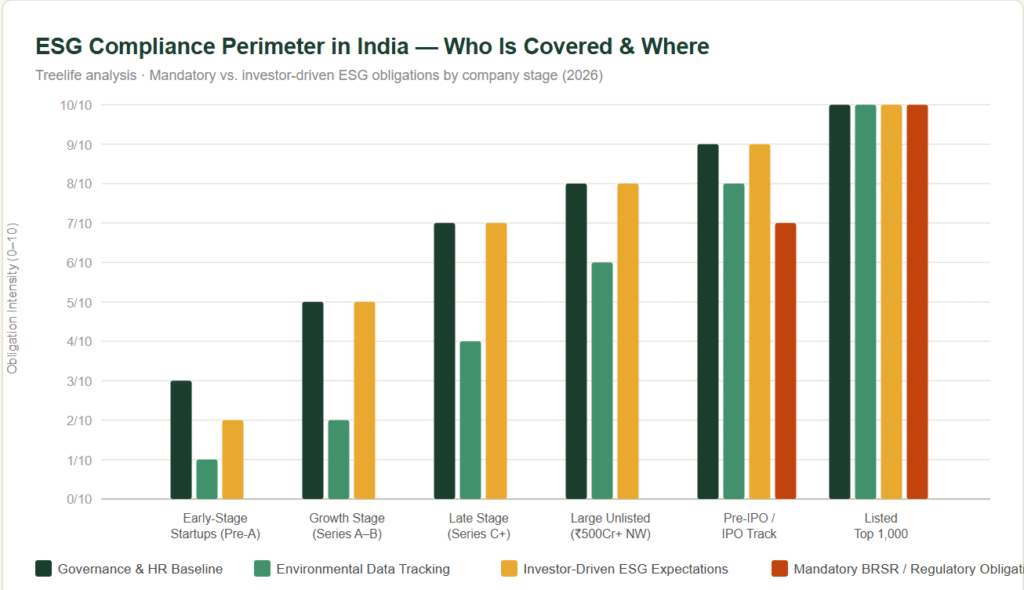
Employee Stock Option Plans (ESOPs) have become an essential tool for businesses, especially startups and growth-stage companies, to attract, retain, and motivate talent. Understanding the taxation of ESOPs in India is crucial for both employees and employers to ensure compliance with tax laws and make informed financial decisions.
What is ESOP?
Employee Stock Option Plans (ESOPs) are programs that allow employees to purchase company stock at a predetermined price, typically lower than the market value, after a certain period or upon achieving specific milestones. ESOPs serve as a form of compensation, providing employees with the opportunity to benefit from the company’s growth and success.
Key Features of ESOPs:
- Eligibility: Usually granted to key employees, directors, and senior management.
- Vesting Period: A specified period during which employees must be associated with the company before they can exercise their options.
- Exercise Price: The price at which employees can buy the shares, which is often lower than the market price.
- Market Price: The current market value of the shares when employees choose to sell.
Importance of ESOPs in Compensation Structures, Especially for Startups and Growth-Stage Companies
ESOPs play a vital role in startup and growth-stage companies’ compensation strategies. Since startups typically cannot afford to pay competitive salaries, they use ESOPs as an alternative form of compensation to attract top talent. These plans align the interests of employees with those of the company, fostering long-term commitment and performance.
Benefits of ESOPs for Startups and Growth-Stage Companies:
- Attracts Talent: ESOPs make compensation packages more attractive, helping startups compete with larger companies.
- Employee Motivation: Employees are more likely to be motivated and work towards the company’s success, knowing they have a stake in its future.
- Retention: The vesting period ensures that employees stay with the company for a specified time, which reduces turnover and enhances long-term stability.
Why Understanding ESOP Taxation in India is Important?
Relevance of Taxation for Employees and Employers
The taxation of ESOPs can significantly impact both employees and employers in India. Employees may not realize the full tax liability associated with their stock options, especially at the time of exercise or sale. Understanding ESOP taxation ensures that they are not caught off guard by high tax bills.
For employers, properly structuring and communicating the tax implications of ESOPs helps in managing the company’s payroll, compliance, and accounting processes. Employers also need to ensure that TDS (Tax Deducted at Source) is accurately calculated and deposited.
Key Tax Considerations:
- Employee’s Responsibility: Employees must understand how ESOPs will be taxed at the time of exercise and sale.
- Employer’s Responsibility: Employers must withhold TDS at the time of exercise and ensure compliance with the tax laws to avoid penalties.
Implications of ESOP Taxation on Financial Planning
ESOP taxation in India has significant implications on an individual’s and company’s financial planning. For employees, understanding the tax implications can help them optimize the timing of when they exercise their options or sell their shares to minimize their tax burden.
Key Points for Employees:
- Tax at Exercise: Employees must account for perquisite taxation, which is treated as salary income and taxed according to the applicable income tax slabs.
- Tax at Sale: The sale of ESOP shares in future is subject to capital gains tax, either as Short-Term Capital Gains (STCG) or Long-Term Capital Gains (LTCG), depending on the holding period.
- Tax Planning: Employees should consider the timing of both exercising and selling their options to optimize tax outcomes, potentially deferring tax liability until a more favorable time.
Key Points for Employers:
- Compliance with Tax Regulations: Employers should ensure the correct TDS is withheld on ESOP benefits and that the proper documentation is maintained.
- Tax Liabilities and Reporting: ESOPs need to be reported under the company’s books as part of compensation, which can affect profit-sharing and other financial strategies.

ESOP Taxability in India: A Detailed Overview
Employee Stock Option Plans (ESOPs) provide employees with an opportunity to purchase company shares at a preferential price. However, ESOPs are subject to taxation at various stages under the Indian Income Tax Act. It is essential for both employees and employers to understand how ESOPs are taxed in India to effectively plan for tax liabilities and ensure compliance.
ESOP Taxation under the Income Tax Act
Under the Indian Income Tax Act, ESOPs are taxed as perquisites when they are granted or exercised, and the tax treatment may vary depending on the stage of the ESOP lifecycle. The taxation of ESOPs falls under Section 17(2) of the Income Tax Act, which deals with perquisites provided to employees.
Taxability of ESOP under Income Tax Act:
- Grant Stage: There is no tax at the time of granting the options. Employees only pay tax when they exercise the options or sell the shares.
- Exercise Stage: ESOPs are taxed as perquisites at the time of exercise, based on the difference between the exercise price and the market value (Fair Market Value / FMV) of the shares on the date of exercise.
- Sale Stage: When ESOP shares are sold, the difference between the sale price and the FMV at the time of exercise is subject to capital gains tax.
The perquisite value of ESOPs (which is treated as income) is calculated based on the FMV of shares as on date of exercise, and employees are required to pay income tax on this value.
Tax on ESOPs in India: Key Considerations
Understanding the taxability of ESOPs in India requires a clear distinction between the tax events that occur at different stages: the grant, exercise, and sale of ESOPs. Below is a detailed breakdown of these stages:
Taxation at the Time of Grant
- When is tax applied?
There is no immediate tax liability at the time of granting ESOPs in India. Employees are not required to pay tax when the options are granted, as there is no transfer of shares or money involved at this stage. - Valuation Impact
The valuation of the shares only comes into play at the exercise stage. However, the difference between exercise price and Fair Market Value (FMV) on date of exercise of the shares will determine the amount taxable as perquisite.
Taxation at the Time of Exercise
At the time of exercising the ESOPs, employees are taxed on the perquisite value, which is the difference between the FMV and the exercise price.
- How is perquisite taxation calculated?
The perquisite value is calculated as:
Perquisite Value=FMV of Shares at Exercise−Exercise Price
This amount is added to the employee’s income and taxed at the applicable income tax rates. - Impact on Employees:
- The perquisite taxation at the time of exercise can significantly increase the employee’s taxable income, as the perquisite value is taxed as a part of salary.
- Employees must pay tax on the perquisite value, even though they have not yet sold the shares.
Taxation at the Time of Sale
When employees sell their ESOP shares, they are subject to capital gains tax on the difference between the sale price and the FMV at the time of exercise.
- Short-Term vs. Long-Term Capital Gains:
- Short-Term Capital Gains (STCG): If the shares are sold within three years from the date of exercise, the gains are considered short-term, and taxed at 15%.
- Long-Term Capital Gains (LTCG): If the shares are held for more than three years, the gains are considered long-term and taxed at 10% if the total gain exceeds ₹1 lakh in a financial year.
- How is the capital gain calculated?
Capital Gain=Sale Price−FMV at Exercise
If the sale price is higher than the FMV at exercise, the employee must pay tax on the capital gains. If the shares are sold at a loss, there may be an opportunity for tax relief under set-off provisions.
Key Points to Remember:
- ESOP taxation is not triggered at the time of grant, but it is triggered at the time of exercise and sale.
- The exercise price and the FMV at exercise play a critical role in determining the tax liability.
- Perquisite tax is applicable when options are exercised, based on the difference between FMV and exercise price.
- Capital gains tax applies when the shares are sold, with different rates for short-term and long-term gains.
- Employees must carefully plan the timing of exercise and sale to optimize their tax liabilities.
Quick Reference Table: Taxation Breakdown
| Stage | Tax Type | Tax Calculation |
| Grant | No tax liability at grant | No tax at this stage. |
| Exercise | Perquisite Tax | Taxable as income = FMV at exercise – exercise price. |
| Sale | Capital Gains Tax | Taxable as capital gains = Sale price – FMV at exercise. |
| Short-Term CG | Short-Term Capital Gains | 15% if sold within 3 years from exercise. |
| Long-Term CG | Long-Term Capital Gains | 10% if sold after 3 years, subject to ₹1 lakh exemption limit. |
Example of ESOP Taxation in India
Here’s a example of how ESOP tax perquisites and capital gains tax are calculated for employees holding ESOPs of unlisted company in India.
Example:
- Grant Date: 1st April 2020
- Exercise Date: 1st April 2023
- Number of Options Exercised: 700
- Fair Market Value (FMV) on 1st April 2023: ₹150
- Amount Collected from Employee (Exercise Price): ₹50
1. Taxation at the Time of Exercise (Perquisite Tax)
At the time of exercising the options, the employee is taxed on the perquisite value, which is the difference between the FMV and the exercise price.
Perquisite Value Calculation:
- FMV at Exercise: ₹150
- Exercise Price: ₹50
- Perquisite Value: ₹150 – ₹50 = ₹100 per share
Taxable Perquisite Amount:
- 700 shares × ₹100 = ₹70,000
The employee will be taxed on ₹70,000 as perquisites under the salary income head.
2. Taxation at the Time of Sale (Capital Gains Tax)
When the employee sells or transfers the shares, they will be taxed on the capital gains (the difference between the sale price and the FMV at exercise).
Example:
- Sale Price in October 2024: ₹200
- FMV at Exercise: ₹150
- Capital Gain per Share: ₹200 – ₹150 = ₹50
- Total Capital Gain: 700 shares × ₹50 = ₹35,000
Since the shares are sold within 24 months of exercise, the capital gain is considered Short-Term Capital Gain (STCG) and will be taxed at applicable rates.
3. Tax Implications in the Hands of the Employer
The perquisite value (₹70,000) is considered a salary cost for the employer and is an allowable expenditure. However, the employer is required to deduct TDS on the perquisite amount, as per the provisions for TDS on salary.
If the perquisite amount is large compared to the employee’s salary (e.g., ₹13 lakhs perquisite vs ₹9 lakhs salary), the employer must ensure the correct documentation and compliance for TDS deduction.
4. Deferral Option for Tax Liability (Available to Eligible Startups)
For eligible startups holding an Inter-Ministerial Board (IMB) Certificate, there is an option to defer the perquisite tax liability until the sale, termination of employment, or five years from the date of allotment of the ESOP shares.
The deferral option applies only if the employee is working in an eligible startup.
Deferral Example for 2026:
| Date of Allotment | Date of Sale | Date of Termination of Employment | Expiry of 5 Years | Perquisite Tax Triggering Event | Perquisite Tax Triggering Date |
| 01-Oct-2021 | 01-Jul-2025 | 01-Jan-2026 | 01-Apr-2026 | Date of Sale | 01-Jul-2025 |
| 01-Oct-2021 | 01-Feb-2026 | 01-Jan-2026 | 01-Apr-2026 | Date of Termination of Employment | 01-Jan-2026 |
| 01-Oct-2021 | 01-Oct-2026 | 01-Oct-2026 | 01-Apr-2026 | Expiry of 5 Years | 01-Apr-2026 |
How is TDS on ESOP Calculated?
Understanding how TDS on ESOPs is calculated is crucial for employees and employers to ensure compliance with tax regulations. Tax Deducted at Source (TDS) is the amount deducted by the employer from the employee’s income and paid to the government. For ESOPs, TDS applies when employees exercise their stock options, and the employer is responsible for withholding this tax.
TDS on ESOPs: Understanding the Withholding Tax
When an employee exercises their ESOP options, they are taxed on the perquisite value (difference between the market price and exercise price). TDS is applicable to this perquisite value, and the employer is required to withhold tax at the time of exercise.
Who is responsible for paying TDS on ESOP?
- Employer’s Responsibility: The employer is responsible for calculating, withholding, and remitting TDS to the government.
- Employee’s Responsibility: Employees are not required to directly pay TDS on ESOPs but should report the deducted tax when filing their income tax returns.
Calculation of TDS: Step-by-Step Guide with Examples
The TDS on ESOPs is calculated as follows:
- Determine Perquisite Value:
Formula:
Perquisite Value = FMV at Exercise – Exercise Price
Example:
- FMV at exercise = ₹500
- Exercise Price = ₹300
Perquisite Value = ₹500 – ₹300 = ₹200 per share
- TDS Rate: The TDS rate is typically set at effective tax rate depending on overall income estimate furnished by an employee to employer.
- TDS Deduction:
Formula:
TDS = Perquisite Value × TDS Rate
Using the above example, if an employee exercises 100 shares:
TDS = ₹200 × 100 × 30% (assumed highest slab rate) = ₹6,000 - Payment: The employer then remits the calculated TDS to the government on behalf of the employee.
TDS on ESOP for Listed Companies vs Unlisted Companies
There are key differences in how TDS is handled for ESOPs in listed companies vs unlisted companies:
| Criteria | Listed Companies | Unlisted Companies |
| Valuation of Shares | Fair Market Value (FMV) determined based on stock exchange prices. | FMV is determined through a valuation report to be procured from Merchant Banker. |
| TDS Calculation | Based on the stock’s market value on the exercise date. | Based on the valuation report provided. |
| Taxability at Exercise | Employees are taxed on the difference between FMV and exercise price. | Same, but FMV calculation may vary. |
ESOP Tax Perquisite Valuation
Understanding perquisite tax on ESOPs is crucial for employees and employers alike to comply with tax regulations and optimize financial planning. This section delves into the key aspects of ESOP tax perquisite valuation, including the process of determining the fair market value (FMV) of ESOPs and how it affects tax liabilities.
What is Perquisite Tax on ESOP in India?
Perquisite tax on ESOPs refers to the tax levied on the benefit an employee receives from exercising their stock options. The tax is calculated based on the difference between the exercise price and the Fair Market Value (FMV) of the company’s shares at the time of exercise.
Key Points:
- Taxable Perquisite: The perquisite value of ESOPs is treated as part of the employee’s income.
- Taxable Amount: Employees are taxed on the difference between the FMV of shares at the time of exercise and the exercise price.
ESOP Tax Perquisite Valuation and Its Importance
The ESOP tax perquisite valuation determines the amount on which employees will be taxed. The higher the FMV of the shares, the higher the tax burden on the employee at the time of exercise. This makes accurate valuation essential for both tax compliance and financial planning.
- Importance of FMV: The FMV is the basis for calculating the perquisite value, which directly impacts the tax liability.
- Impact on Employees: Accurate valuation ensures employees are not overtaxed and can plan their finances better.
How the Fair Market Value (FMV) of ESOPs is Determined
The FMV of ESOPs is crucial for determining the perquisite tax at the time of exercise. Here’s how it is determined:
- For Listed Companies: The FMV is the market price of the company’s shares on the stock exchange on the day of exercise.
- For Unlisted Companies: The FMV is determined through an independent valuation to be done by a merchant banker based on various factors such as the company’s financial performance, market conditions, and comparable company data.
Perquisite Tax on ESOP for Listed and Unlisted Companies
ESOP Tax Perquisites for Listed Companies
For listed companies, the FMV is easily determined because it is based on the market price of the shares, which fluctuates according to the stock exchange.
- How Valuation is Determined: The valuation is straightforward, as it is the closing price of the stock on the stock exchange at the time of exercise.
- Tax Calculation: The FMV at exercise minus the exercise price determines the taxable perquisite value, which is taxed as part of the employee’s income.
ESOP Tax Perquisites for Unlisted Companies
Valuation for unlisted companies is more complex because there is no publicly available market price.
- Challenges in Valuation: The FMV of shares in unlisted companies is determined through a valuation report by a qualified valuer, considering various factors like financials, growth potential, and industry benchmarks.
- Key Differences:
- The FMV in unlisted companies may be subjective and vary from one valuation report to another.
- Employees may face higher uncertainty regarding the actual value of their options, which affects their tax planning.
ESOP vs RSU vs Phantom Stock – What Should Founders Choose?
When structuring equity compensation, founders must choose between ESOPs, Restricted Stock Units (RSUs), and Phantom Stock. Each has distinct tax, dilution, and governance implications.
Tax Treatment
ESOPs are taxed at exercise (as perquisite income on the FMV-exercise price difference) and again at sale (as capital gains). Eligible startup employees can defer perquisite tax until sale, termination, or five years from allotment a major advantage. Short-Term Capital Gains (within 3 years) are taxed at 15%; Long-Term Capital Gains (after 3 years) at 10%.
RSUs are taxed only at vesting as salary income (on the full FMV). No subsequent capital gains tax applies appreciation accrues tax-free. This creates a simpler tax profile but a larger upfront tax bill.
Phantom Stock creates zero income tax at grant or exercise. Instead, the company pays a tax gross-up at settlement, treating it as bonus compensation subject to TDS. This shifts the tax burden to the company but eliminates employee tax complexity.
Dilution Impact
ESOPs create real dilution: exercised options expand your fully diluted share count and appear on your cap table. Phantom Stock creates zero dilution it’s a contractual liability, not equity. RSUs create dilution if settled in shares, but can be settled in cash to avoid dilution.
For early-stage companies, ESOPs are appropriate. For well-funded or pre-IPO companies, phantom stock minimizes dilution while maintaining employee incentives.
Accounting Impact
ESOPs result in lower accounting expense relative to economic value (favorable for P&L). RSUs and Phantom Stock require mark-to-market accounting each period, creating volatility and growing liabilities on your balance sheet as valuation increases. Phantom Stock must be classified as a liability rather than equity, further distorting leverage ratios.
Investor Perception
ESOPs are the gold standard for early-stage companies. Investors expect them, view them as tax-efficient and aligned, and scrutinize documentation closely. RSUs raise questions at early stage (why not use the simpler ESOP?). Phantom Stock signals founder reluctance to dilute, raising red flags unless clearly justified and documented.
For fundraising success, use ESOPs with tight documentation and transparent communication.
What Investors Check During ESOP Due Diligence
ESOP due diligence is critical during funding rounds and M&A. Investors assess governance quality, identify hidden liabilities, and verify cap table accuracy.
Pool Size and Authorized Allocation
Seed companies should maintain a 5-8% fully diluted ESOP pool; Series A, 10-15%; Series B+, 15-20%. Investors flag undersized pools (future dilution risk) or oversized pools (mismanagement signal). Verify that your Articles of Association authorize the pool and that allocated shares don’t exceed authorized shares over-allocation is a compliance violation requiring shareholder approval.
Vesting Schedule and Documentation
Industry standard is 4-year vest with 1-year cliff. Investors pull all grant letters, board resolutions (Form MGT-14), and vesting schedules. They verify consistency, proper documentation, and acceleration clauses. Missing or informal vesting documentation (spreadsheets only) raises red flags and delays funding.
Documentation Gaps and ROC Compliance
Common red flags:
- Missing or delayed Form PAS-3 filings (every ESOP grant must file within 30 days; ₹100/day penalty for delays)
- Missing Form MGT-14 board resolutions
- No formal ESOP plan document
- Cap table inconsistencies with Form MGT-7 (Annual Return)
- Directors with deactivated DINs (DIR-3 KYC non-compliance)
Investors use documentation gaps as valuation negotiation points. Fix compliance issues before due diligence begins.
Tax Exposure and Perquisite Valuation
Investors verify your FMV valuations are defensible. For unlisted companies, an understated FMV invites IT department challenges and back-tax liability. Ensure your most recent valuation comes from a credible merchant banker and reflects current company value.
Check for exercise prices significantly below FMV (large perquisite tax liability). Document ESOP tax deferral elections if applicable. Disclose any past IT audits or queries related to ESOP valuations unresolved issues delay funding.
Setting Up ESOP After Series A
Series A demands institutional-grade ESOP governance. Formalize processes, align with investor requirements, and ensure ROC compliance.
ESOP Governance Framework
Adopt a formal ESOP Plan Document defining: eligibility, grant authority, vesting schedule (standard 4-year with 1-year cliff), exercise price methodology, acceleration provisions, deferral elections, and settlement terms. Document all Board approvals in Form MGT-14 filings with ROC. This creates an audit trail investors can verify.
Cap Table Reconciliation
Migrate from spreadsheets to cap table software (Carta, Pulley, Eqvista). Audit all pre-Series A grants and file any missing PAS-3 forms retroactively. Reconcile your cap table with Form MGT-7 annual filings. Establish quarterly cap table reviews and implement automated vesting tracking. Maintain a fully diluted share count that always includes unvested and unexercised options.
Valuation and FMV Documentation
Conduct annual independent merchant banker valuations (409A equivalent) within 90 days of fiscal year-end. Set ESOP exercise prices at or near FMV to minimize perquisite tax. Maintain all valuation reports and be prepared to produce them during audits or investor due diligence. Valuations are typically valid for 12 months.
Tax Compliance and Employee Communication
Calculate TDS liability on all ESOP exercises and remit on time. If your company qualifies for ESOP tax deferral (eligible startup with Inter-Ministerial Board certificate), include deferral language in grant letters and maintain election records. Provide clear grant letters to all employees explaining options, vesting, and tax implications. Host annual ESOP education sessions and publish FAQs to reduce confusion and disputes.
Investor Alignment and Terms
Align your ESOP structure with Series A investor terms, which typically mandate: minimum pool size (e.g., 15% fully diluted reserved), weighted-average anti-dilution adjustments in future rounds, full acceleration on change of control, and 1-year vesting cliffs. Document these in your ESOP plan and employee grant letters.
Documentation Audit
Post-Series A, ensure you have: signed ESOP Plan Document, Board resolutions (Form MGT-14) for all grants filed with ROC, signed grant letters for all employees, PAS-3 filings for all exercises, current cap table, annual FMV valuation, TDS records, deferral elections (if applicable), and annual cap table reconciliation with Form MGT-7. Fix any gaps immediately.
Taxation of Foreign ESOPs in India
Understanding the taxation of foreign ESOPs in India is crucial for Indian residents working with international companies. Foreign ESOPs are subject to Indian tax laws, and Indian employees must ensure they comply with all reporting and tax payment obligations. Here’s a comprehensive breakdown of the key factors to consider for employees holding foreign ESOPs.
Taxation of Foreign ESOPs in India for Indian Residents
Taxability of Foreign ESOPs:
Indian residents holding foreign ESOPs are taxed on the perquisite value (difference between the exercise price and the FMV) in India. The taxability applies when the employee exercises their options or sells the shares.
- Perquisite Tax: At the time of exercise, employees are taxed on the perquisite value, which is calculated based on the FMV of the foreign company’s shares and the exercise price.
- Capital Gains Tax: When employees sell the foreign ESOP shares, they are subject to capital gains tax based on the difference between the sale price and the FMV at the time of exercise.
Reporting and Taxation Responsibilities for Indian Residents Holding Foreign ESOPs
- Reporting in India: Indian residents must report their foreign ESOP income under their Income Tax Return (ITR), declaring the perquisite value at the time of exercise and the capital gains when the shares are sold.
- Foreign Tax Credit: Employees may also claim a foreign tax credit for any taxes paid abroad on the foreign ESOP income, depending on the tax treaties between India and the country where the foreign company is based.
Cross-Border Taxation: Key Factors to Consider
The taxation of foreign ESOPs involves several key international and domestic tax considerations. Here’s a breakdown of the main factors:
- Tax Treaties:
India has Double Tax Avoidance Agreements (DTAAs) with several countries. These agreements help prevent double taxation on income derived from foreign ESOPs. Employees can claim foreign tax credits for taxes paid in the foreign country. - Source of Income:
The country in which the foreign company is based may impose taxes on the ESOPs. Employees need to assess whether the foreign country withholds tax on the exercise or sale of ESOP shares and understand how this impacts their Indian tax filings. - Capital Gains Tax:
The Indian tax authorities tax capital gains from foreign ESOPs. However, depending on the country of origin, the rate and rules for capital gains taxation may vary.
What Steps Employees Need to Take When Receiving ESOPs from a Foreign Entity
- Consult a Tax Advisor: Employees should consult a tax professional familiar with cross-border taxation to understand their tax liabilities in India and the foreign country.
- Track Foreign Tax Payments: Employees should keep a record of any taxes paid in the foreign country on their ESOP income to claim foreign tax credits.
- Report Foreign ESOPs in ITR: Ensure that all foreign ESOP-related income is reported accurately in the Indian Income Tax Return to avoid penalties for non-disclosure.
We provide ESOP Advisory Services, to help you navigate with ease Let’s Talk
Taxability of ESOP in the Hands of Employees
The taxability of ESOPs in the hands of employees involves taxation at different stages of the ESOP lifecycle: grant, exercise, and sale. Below is a breakdown of how employees are taxed at each stage.
How ESOP Tax is Treated for Employees
- At the Time of Grant:
There is no tax at the time of granting ESOPs to employees. The tax liability only arises when the employee exercises the option or sells the shares. - At the Time of Exercise:
- Perquisite Tax: The perquisite value is taxed as part of the employee’s salary at the time of exercise. The perquisite value is calculated as:
Perquisite Value = FMV at Exercise – Exercise Price
The perquisite value is added to the employee’s total income and taxed at the applicable income tax rate.
- Perquisite Tax: The perquisite value is taxed as part of the employee’s salary at the time of exercise. The perquisite value is calculated as:
- At the Time of Sale:
- Capital Gains Tax: When the employee sells the shares, the difference between the sale price and the FMV at the time of exercise is subject to capital gains tax.
- Short-Term Capital Gains (STCG): If the shares are sold within 3 years of exercise, STCG is applied at 15%.
- Long-Term Capital Gains (LTCG): If sold after 3 years, LTCG is taxed at 10% (subject to exemptions).
- Capital Gains Tax: When the employee sells the shares, the difference between the sale price and the FMV at the time of exercise is subject to capital gains tax.
The Role of the Employee in Reporting and Paying Taxes on ESOP Income
- Accurate Reporting: Employees must report ESOP-related income under their income tax returns, which includes:
- Perquisite value at the time of exercise.
- Capital gains from the sale of shares.
- Claiming Foreign Tax Credit: Employees who paid tax on foreign ESOPs should claim foreign tax credit when filing their returns, ensuring they are not taxed twice on the same income.
ESOP Taxation in Startups vs Large Corporations
Here’s a comparison of ESOP taxation in startups and large corporations, highlighting the key tax considerations for employees in both scenarios.
| Aspect | Startups | Large Corporations |
| Tax Considerations for ESOPs | – Unique Challenges: Startups often face high valuation volatility, making FMV determination difficult.- Employees may receive stock at a lower exercise price, leading to a larger perquisite tax at the time of exercise. | – Stable Valuation: Established companies have easier FMV calculations due to consistent stock prices.- Employees in large corporations often benefit from stable stock prices, reducing the volatility in tax liabilities. |
| Tax Benefits for Employees | – Deferred Taxation: Employees in eligible startups can defer perquisite tax for a specified period, subject to conditions.- Tax Planning: Potential for lower perquisite tax at exercise if the exercise price is significantly below market value. | – More Predictable Taxation: Larger corporations offer more predictable tax liabilities due to market-driven prices and established plans.- Capital Gains: Employees may face long-term capital gains tax if the shares are held for over 1 year (for listed companies). |
| Tax Challenges for Employees | – Liquidity Issues: Employees may struggle with liquidity to pay the perquisite tax, especially in the case of unlisted startups.- Uncertain FMV: Valuations can fluctuate, leading to uncertainty in tax implications. | – Complex TDS Compliance: Large corporations need to manage complex TDS deductions due to a larger number of employees and varying compensation structures. |
| ESOP India (Specific to Startups) | – Startups in India may offer ESOPs as part of attractive compensation packages to attract talent, but they also need to manage the taxation complexities that arise from equity-based rewards. | – ESOPs in large companies may involve stock options with lower perquisite tax implications, but are subject to strict regulatory compliance. |
| Perquisite Tax on ESOPs | – ESOPs in startups are taxed as perquisites, which could create a significant tax liability at exercise, depending on the FMV vs exercise price. | – Large companies typically have more predictable tax liabilities based on stable stock prices, reducing unexpected tax burdens on employees |
Four Things Every Founder Must Know Right Now
| 1. Budget 2026 fixed buyback taxation. Minority shareholders (holding < 10%) now pay capital gains on buyback proceeds 12.5% if long-term instead of punishing slab rates of up to 42%. This is huge for ESOP liquidity. Founders holding ≥ 10% are classified as ‘promoters’ and face a higher effective rate (22–30%). |
| 2. Your 24-month clock for unlisted shares still matters. Selling secondary shares before month 24 means slab-rate taxation, not the 12.5% LTCG rate. Time your exits carefully. |
| 3. Slump sales remain the cleanest carve-out tool no GST on transfer of a going concern, no asset-by-asset allocation, and far simpler than a full NCLT scheme for most startup restructurings. |
| 4. If you have a Chinese or Pakistani UBO anywhere in your cap table even three layers deep every FDI round needs government approval regardless of sector. Discover this early, not at term-sheet stage. |
Why Startup M&A in India Just Got More Interesting
India’s startup ecosystem did more deals in 2025 than in any previous year. Technology alone accounted for 119 transactions in Q3 2025. Acquisition offers, strategic investment rounds that blur into control deals, and acqui-hires are now everyday events for founders at Series B and beyond.
But the legal framework underneath these deals has shifted materially. The Union Budget 2026-27 overhauled buyback taxation, the new Income Tax Act 2025 takes effect from 1 April 2026, and SEBI and RBI have issued clarifications that directly affect how founders, ESOPs, and early investors exit. This guide cuts through the noise and tells you what actually matters if you are a founder, CEO or early-stage investor thinking about a deal in 2026.
1. What Kind of Deal Are You Actually Doing?
Before any negotiation, you need to know which legal structure your deal falls into because each one has completely different tax, liability and approval consequences. Indian corporate law does not define ‘merger.’ The Income Tax Act defines ‘amalgamation’ for tax purposes, and a transaction that looks like a merger commercially may not qualify for tax-neutral treatment unless it is structured precisely.
The five structures founders most commonly encounter:
| Structure | What It Means for You as a Founder / Early Investor |
| Share Acquisition (most common) | Acquirer buys your shares directly. You pay capital gains tax. Clean, fast, no court process. Your liabilities stay in the company. |
| Asset / Business Acquisition | Acquirer buys specific assets or the business unit. GST applies on asset transfers. Good if acquirer wants to ring-fence liability — often used in distressed situations. |
| Slump Sale | Transfer of an entire business unit as a going concern — no GST, no asset-by-asset pricing needed. Ideal for carving out a product or vertical for sale without selling the whole company. |
| Scheme of Arrangement (NCLT) | Court-supervised merger/demerger. Binding on all shareholders including dissenters once approved. Powerful but slow (4–9 months). Used for complex restructurings or where minority shareholders must be dragged along. |
| Acqui-hire | Acquirer buys the company primarily for the team. Often structured as asset purchase + employment agreements. Tax treatment depends on how the consideration is split between business and employment income. |
Founder tip: If the acquirer says ‘we just want to buy the product,’ push back on asset-sale framing if you can a slump sale of the relevant business unit is usually more tax-efficient and administratively cleaner.
2. Tax: The Numbers That Actually Determine Your Net Payout
Tax is not a post-closing formality. It is a deal variable. A founder receiving INR 10 crore for shares held for 20 months versus 25 months faces a materially different net outcome. Here is the complete 2026 picture.
Capital Gains on Share Sales – The Core Framework
| Your Situation | Tax Rate (2026) |
| Unlisted shares, held > 24 months (LTCG) | 12.5% — no indexation (+ surcharge + 4% cess) |
| Unlisted shares, held ≤ 24 months (STCG) | Your income tax slab rate (up to 30% + surcharge + cess) |
| Listed shares, held > 12 months (LTCG, STT paid) | 12.5% — first INR 1.25 lakh exempt |
| Listed shares, held ≤ 12 months (STCG, STT paid) | 20% (+ surcharge + cess) |
| ESOPs — exercise to sale on unlisted shares | Perquisite tax on exercise + capital gains at above rates on eventual sale |
The 24-month rule for unlisted shares is the single most important timing variable in a secondary transaction or acqui-hire exit. If you are 20 months into holding, it is worth asking whether a short bridge or deferral of closing is feasible the tax saving on a large exit can be substantial.
Budget 2026: The Buyback Fix Founders Have Been Waiting For
Prior to 1 April 2026, buyback proceeds were taxed as dividend income at slab rates of up to 42%+ for high-earning founders and angel investors. That is now gone. From 1 April 2026:
- Shareholders holding less than 10% of the company (most ESOP holders, angels, seed investors): buyback proceeds are taxed as capital gains 12.5% if you have held the shares for more than 24 months. This is a dramatic improvement.
- Shareholders holding 10% or more (most founders, lead investors, promoter-classified holders): capital gains apply, but the company also pays an additional income tax resulting in an effective combined rate of around 22% for corporate holders and 30% for individuals or HUFs.
- The promoter / non-promoter split is based on your holding percentage at the time of the buyback not at the time you first invested. Watch for dilution effects if you are close to the 10% line.
Practical implication: For ESOP buyback programmes, this reform is genuinely transformative. Companies that have been delaying employee liquidity events because of the old tax regime should model the new numbers now. For founders planning to use a buyback as their own partial exit, compare the effective rate against a straight secondary sale in many cases a secondary is still cleaner.
The New Income Tax Act 2025 – What Changes from 1 April 2026
The Income Tax Act 1961 is replaced by the Income Tax Act 2025 from 1 April 2026. The substantive capital gains provisions carry over, but simplified rules, restructured sections and new disclosure formats apply. If you are signing a Share Purchase Agreement or SHA in 2026, make sure your legal documents reference the correct Act. Tax representations, indemnity clauses and warranty language in older templates will need to be updated.
GST, Stamp Duty & Slump Sales – Quick Reference
- Share transfers: no GST. Stamp duty: 0.015% of consideration. Simple.
- Slump sale (going concern transfer): no GST a major structural advantage for product/vertical carve-outs.
- Asset sales: GST at 5%–28% depending on asset type. Immovable property additionally attracts stamp duty per state law this can be 3%–10% of value and is almost never modelled early enough.
3. ESOPs in M&A – What Happens to Your Team’s Equity
ESOPs become a live deal issue the moment an acquisition offer arrives. Founders and CEOs must understand what happens to unvested options, how the acquirer will treat the ESOP pool, and what the tax consequences are for employees on exit.
The Three Things That Happen to ESOPs in an Acquisition
- Accelerated vesting: Some ESOP plans have single-trigger (change of control alone) or double-trigger (change of control + termination) acceleration clauses. Check your ESOP scheme documents before signing any term sheet.
- Cashout / buyout: The acquirer or the company pays cash to option-holders for their vested options. Under the new 2026 regime, if this is structured as a buyback, employees holding < 10% get capital gains treatment at 12.5% LTCG. If structured as a cash settlement at exercise, it is perquisite income on exercise and capital gains on any subsequent appreciation.
- Rollover into acquirer equity: Options convert into acquirer’s stock options or restricted stock units. Tax consequences are deferred until the new instruments vest or are exercised. Common in all-stock deals.
Founder CEO note: If you have significant unvested options as a working founder, negotiate double-trigger acceleration single-trigger acceleration may trigger a large tax event at closing even if you are still employed by the combined entity.
ESOP Liquidation Events – Tax Treatment at a Glance
| Event | Tax Treatment (2026) |
| Exercise of options (unlisted shares) | Perquisite = FMV on exercise date minus exercise price — taxed as salary |
| Sale after exercise (held > 24 months) | 12.5% LTCG on gains above FMV at exercise |
| Sale after exercise (held ≤ 24 months) | Slab rate on gains above FMV at exercise |
| Company buyback (holder < 10%) | Capital gains: 12.5% LTCG or slab rate STCG (new from April 2026) |
| Cashout at acquisition — treated as employment income | Slab rate; can be structured differently with appropriate documentation |
4. Foreign Investors in Your Cap Table – What Every Founder Must Check
If you have taken foreign capital – even a small angel cheque from an NRI or a Singapore fund FEMA compliance is not optional. And the consequences of getting it wrong surface at the worst possible time: during due diligence for your exit.
The Five FEMA Issues That Derail Startup Deals
- Pricing non-compliance on past rounds: every issuance to a non-resident must be at or above fair market value (as certified by a registered valuer or CA using DCF/NAV). If an early round was priced below FMV even a friends-and-family angel round it can require compounding (regularisation) before a clean exit is possible.
- FCGPR not filed, or filed late: every issuance of shares to a non-resident must be reported to RBI through the FIRMS portal (Form FCGPR) within 30 days of allotment. Late filings require compounding. Buyers run FEMA compliance as a standard diligence item.
- Transfer pricing on FCTRS: when shares are transferred from a resident to a non-resident (or vice versa), the price must comply with FMV norms. The transfer must be reported on Form FCTRS. Secondary transactions including founder share sales to foreign PE funds trigger this requirement.
- Press Note 3 (the China / land-border rule): any investment where the ultimate beneficial owner is from a land-border country (China, Pakistan, Bangladesh, Nepal, Myanmar, Bhutan, Afghanistan) requires government (DPIIT / FIPB) approval regardless of sector or investment size. This applies through multiple holding layers. A fund incorporated in Mauritius but with a Chinese LP that holds more than 25% can trigger this. Identify all UBOs at the start of every round.
- Convertible instruments not converted on time: CCDs and CCPS must convert into equity within the stipulated period. If they have not, or if the conversion price was not fixed upfront, regulatory exposure exists.
The bottom line: a clean FEMA audit trail is a material valuation driver. Founders who maintain proper filings from round one avoid costly compounding proceedings and diligence delays at exit.
5. Competition Law – A Quick Snapshot for Startups
For most startup M&A transactions, the Competition Commission of India (CCI) is not a concern. The mandatory filing thresholds are designed for large-scale deals. However, there are two scenarios where even a growth-stage startup deal can land in CCI territory:
- Deal Value Threshold (DVT): if the total consideration globally exceeds INR 20 billion (approximately USD 240 million) AND the target has meaningful Indian operations (≥ 10% of global users, GMV or turnover), a CCI filing is required regardless of asset or turnover size. This is the scenario most relevant to high-value acqui-hires or acqui-acquisitions of data-rich platforms.
- You are being acquired by a large corporate group: if the acquirer’s group has combined India assets exceeding INR 25 billion or turnover exceeding INR 75 billion, their acquisition of your startup may trigger a combined threshold even if your own revenues are modest.
If neither of these applies to your deal, you can set competition law aside. If they might apply, the CCI now offers informal pre-filing consultation a practical first step before engaging in formal process.
6. NCLT & Company Law – When You Actually Need the Court
Most startup deals — share acquisitions, asset deals, slump sales do not require NCLT involvement. The court becomes relevant in two situations: you are doing a formal merger/demerger scheme, or you need to use squeeze-out or capital reduction mechanics.
Fast-Track Merger (Section 233) – The Startup-Friendly Route
If your startup is merging with a holding company, a sister company, or another small company, the fast-track merger route under Section 233 is substantially quicker than a full NCLT scheme. It does not require a full NCLT hearing unless objections arise. Requirements: 90% shareholder consent and creditors holding 9/10ths in value must agree. Small company definition: paid-up capital ≤ INR 4 crore and turnover ≤ INR 40 crore.
From 2025, foreign parent companies can also merge into their Indian wholly-owned subsidiaries under an expanded fast-track route. This has opened a path for startups that initially incorporated abroad (Singapore, Delaware, Cayman) to ‘reverse flip’ their holding structure into India – particularly relevant as Indian public market valuations have improved and the domestic PE/VC market has deepened.
Minority Squeeze-Out – What Happens to Small Shareholders
If you are acquiring a company and reach 90% equity shareholding, you can offer to buy out the remaining minority at a registered-valuer-determined price they cannot refuse once the threshold is crossed. For unlisted companies, shareholders holding 75% of voting securities can also pursue a minority squeeze-out via NCLT. This matters for founders negotiating full control in secondary transactions.
Practical Implications: What to Do Right Now
If You Are Selling or Considering an Exit
Check your FEMA filing history before any buyer does. Run a quick internal audit of all FCGPR and FCTRS filings gaps will surface in diligence anyway, and addressing them proactively gives you leverage rather than costing you negotiating position. Also check the 24-month clock on your share holding dates. If you are within a few months of crossing from STCG to LTCG treatment, the difference in net proceeds can be meaningful enough to influence deal timing.
If You Are Raising a Strategic Round That May Give an Investor Significant Influence
A strategic investor acquiring a meaningful minority stake (even 15–20%) with strong governance rights board seat, consent rights, information rights can look a lot like a partial acquisition. Structure the investment instruments carefully. FEMA pricing compliance, sectoral caps, and the nature of the consent rights all need to be mapped before term sheet.
If You Are Acquiring Another Startup
Map the target’s FEMA and ESOP compliance posture in your first week of diligence these are the two areas most likely to contain hidden liability. Also decide early whether you want a share deal (liability comes with the company) or an asset/slump sale deal (you buy only what you want). For talent-driven acquisitions, the ESOP treatment for the target’s team is often more important to the negotiation than the headline price.
The Founder’s M&A Checklist: 6 Things to Do Before You Sign
- Check your holding period. Confirm the date of allotment for every block of shares you hold. If you are close to the 24-month LTCG threshold for unlisted shares, model the tax impact of closing now versus in a few weeks.
- Run a FEMA compliance audit. Pull all FCGPR and FCTRS filings from FIRMS. Identify any late filings, pricing issues, or unconverted instruments. Get compounding done before diligence starts.
- Review your ESOP scheme for acceleration and buyout provisions. Know whether your plan has single-trigger or double-trigger acceleration and what the tax consequence is for your team at closing.
- Identify all UBOs in your cap table. Map every foreign investor to its ultimate beneficial owner. Flag any land-border country exposure under Press Note 3 and tell your lawyer immediately if you find any.
- Decide your deal structure before negotiating price. Slump sale, share sale, or asset sale each has different GST, stamp duty, and liability implications. The structure affects what the acquirer is willing to pay.
- Update your corporate documents to reference the Income Tax Act 2025. Any SPA, SHA or scheme petition signed from 1 April 2026 should reference the new Act. Tax representations and indemnity language need to be updated.
How Treelife Can Help
Treelife works with founders, CEOs and startup investors across the full deal journey from pre-deal structuring and FEMA compliance audits, through ESOP planning and SPA negotiation, to NCLT filings, CCI assessments and post-merger integration. If you are looking at a deal in 2026, the best time to talk to us is before you receive a term sheet.
Sources & Endnotes:
- EY India M&A Report Q3 2025 — deal activity up 37% YoY to US$26 billion, 119 technology deals: https://www.ey.com/en_in/insights/mergers-acquisitions/why-india-s-deal-market-in-q3-signals-long-term-m-a-resilience
- Union Budget 2026-27 — buyback proceeds reclassified as capital gains; 10% promoter threshold; MAT rate cut to 14%: https://www.pib.gov.in/PressReleasePage.aspx?PRID=2221455
- Business Standard — Union Budget 2026-27: Buyback proceeds to be treated as capital gains (1 February 2026): https://www.business-standard.com/budget/news/budget-2026-buyback-proceeds-to-be-treated-as-capital-gains-126020101050_1.html
- Inc42 — Union Budget 2026: The Buyback Blowback for Founders (10% promoter classification, effective rates): https://inc42.com/resources/union-budget-2026-the-buyback-blowback-for-founders/
- Alvarez & Marsal — Union Budget 2026 Tax Alert (MAT, IFSC, buyback, TP analysis): https://www.alvarezandmarsal.com/thought-leadership/union-budget-2026
- Income Tax Act 2025 / New IT Act replacing 1961 Act from 1 April 2026 — PIB: https://www.pib.gov.in/PressReleasePage.aspx?PRID=2221416
- FEMA Non-Debt Instruments Rules 2019 and FIRMS portal (FCGPR / FCTRS reporting requirements): https://rbi.org.in/Scripts/NotificationUser.aspx?Id=11722
- Press Note 3 (2020) — Ministry of Commerce (land-border country FDI approval requirement): https://dpiit.gov.in/sites/default/files/pn3_2020.pdf
- Singhania & Co — Recent M&A Reforms in India: FOCC downstream, share-for-share, fast-track cross-border route: https://singhania.in/blog/recent-m-a-reforms-in-india-what-dealmakers-need-to-know
- CCI (Combinations) Regulations 2024 — Deal Value Threshold, expanded control definition, 30-day prima facie window: https://cci.gov.in/faqs
- Nagashima — CCI de minimis threshold (INR 4.5Bn assets / INR 12.5Bn turnover), effective March 2024 for two years: https://www.noandt.com/en/publications/publication20240424-1/
- Companies Act 2013 — Section 233 (fast-track merger), Section 234 (cross-border merger), Section 68 (buyback): https://www.mca.gov.in/content/mca/global/en/acts-rules/ebooks/acts.html
1. What a Cap Table Actually Is and What It Isn’t
A capitalization table is the authoritative record of every equity interest in your company who owns it, in what form, at what price, and under what conditions. That definition sounds administrative. It isn’t. Every investor you bring on, every employee you grant options to, every SAFE you sign, and every convertible note you raise modifies your cap table and with it, the economics and control dynamics of your business.
Think of your cap table as three things at once.
- First, it is a legal record. It documents who owns what at any given moment shares issued, securities outstanding, and the rights attached to each class of equity. In the event of a dispute, an acquisition, or a regulatory inquiry, the cap table is exhibit A.
- Second, it is a planning instrument. A well-structured cap table lets you model what happens to ownership percentages when you raise a new round, create or refresh an ESOP pool, convert a SAFE, or get acquired at various valuations. Without this forward-looking capability, you are negotiating blind.
- Third, it is a communication tool. Investors, acquirers, and board members use your cap table to understand the company’s equity structure before committing capital or signing documents. A clean, current, professionally maintained cap table signals operational maturity. A messy, outdated, or internally inconsistent one signals the opposite and it can trigger renegotiated terms, delayed closings, or outright deal failures.
| FOUNDER PRINCIPLE: Founders who treat the cap table as a strategic asset not a spreadsheet chore consistently negotiate better terms, retain more equity, and close transactions faster. The cost of getting it wrong compounds with every funding round. |
The earlier you treat your cap table seriously, the more control you retain over the economics of your company, over the narrative you present to investors, and over your own financial outcome at exit.
2. The Core Components of a Cap Table
Before you can read, model, or negotiate around a cap table, you need to speak its language fluently. These terms appear on every professional cap table, are frequently confused with each other, and carry very different financial implications.
Authorized Shares
Authorized shares represent the maximum number of shares your company is legally permitted to issue, as defined in your Memorandum of Association. At incorporation, most founders authorize a significantly larger number than they immediately need commonly 10,000,000 or more to preserve flexibility for future rounds without requiring shareholder approval at each step.
Authorizing shares does not dilute anyone. Issuing them does. This distinction matters when founders are negotiating equity structures with early investors who want to see a well-capitalized authorization to accommodate growth.
Issued Shares
Issued shares are those that have been formally allotted to a specific shareholder, founders, investors, or employees. A board resolution and formal share certificate (or digital equivalent) backs every issued share. Not all authorized shares need to be issued; the gap between authorized and issued shares is the company’s reserved headroom for future equity events.
Outstanding Shares
Outstanding shares are the issued shares currently held by shareholders net of any buybacks or cancellations. This is the number used in basic ownership percentage calculations. It tells you who owns the company today, but it does not tell you who will own it tomorrow once convertible instruments convert and options vest.
Reserved Shares
Reserved shares are authorized but not yet issued set aside for future issuance, most commonly for an ESOP pool. They do not appear in basic ownership calculations but are critical to fully diluted ownership calculations. A 15% ESOP pool that is ‘reserved’ is, in practice, already diluting founders even if not a single option has been granted yet.
| Term | What It Means | Basic % | Diluted % | Key Implication |
|---|---|---|---|---|
| Authorized Shares | Max shares legally permitted to issue | No | No | Headroom for future equity events |
| Issued Shares | Formally allotted to shareholders | Yes | Yes | Legal ownership today |
| Outstanding Shares | Currently held (net of buybacks) | Yes | Yes | Basis of basic % calculations |
| Reserved (ESOP) | Set aside for future option grants | No | Yes | Dilutes founders at pool creation |
| Options / Warrants | Rights to purchase shares at fixed price | No | Yes | Included upon exercise |
| Convertible Securities | SAFEs and notes before conversion | No | Yes | Shadow equity must be modeled |
Table 1: Share Count Terminology Quick Reference
3. Share Classes: Common, Preferred, and ESOP
Not all equity is created equal. The class of share a holder receives determines their voting rights, their economic priority in a sale or winding up, and their ability to block or approve major decisions. Understanding share class dynamics is not a legal nicety; it directly affects how much money you see at exit and how much control you exercise along the way.
Common Shares The Founder’s Equity
Common shares are the equity held by founders and employees. They carry voting rights and participate in the company’s upside, but they sit at the bottom of the liquidation waterfall. When the company is sold or wound up, common shareholders receive their proceeds only after all liquidation preferences held by preferred shareholders have been satisfied in full.
This is not inherently a problem at high exit valuations, where preferences are a small fraction of total proceeds. It becomes acutely relevant at moderate exit valuations, where preferences can absorb most or all available proceeds before founders see a rupee. Every founder should know, precisely, the exit valuation at which their common equity starts to generate real returns.
Employees receive equity through ESOPs in the form of rights to purchase common shares at a fixed strike price. The value of those options and the tax implications of exercising them depends entirely on the difference between the strike price and the fair market value at exercise.
Preferred Shares The Investor’s Instrument
Preferred shares are issued to external investors from angel rounds onward. They are not simply ‘better’ common shares, they are structurally different instruments with contractually negotiated rights that fundamentally alter the company’s economic and governance architecture.
The four most consequential preferred share rights are:
- Liquidation Preference. Preferred shareholders receive their invested capital typically 1x, sometimes 2x the investment amount before common shareholders receive anything in a sale or wind-up. Non-participating preferred investors take their preference and exit. Participating preferred investors take their preference and then share in remaining proceeds pro-rata with common shareholders. Participation is significantly more investor-friendly and materially dilutes founder returns at lower exit valuations.
- Anti-Dilution Protection. If new shares are issued at a lower price than a preferred investor paid, a down round anti-dilution provisions automatically adjust the investor’s conversion ratio, increasing the number of shares they can convert into. Full ratchet anti-dilution is the most aggressive form, recalculating the entire preferred position at the new lower price. Broad-based weighted average anti-dilution is more balanced and is the more commonly negotiated standard in the Indian market.
- Voting and Veto Rights. Preferred shareholders often carry enhanced voting rights, including veto rights over material decisions, new fundraising rounds, acquisitions, changes to the ESOP pool, executive hires, and budget approvals above a specified threshold. These rights can significantly constrain founder decision-making authority as the investor base grows.
- Information Rights. Preferred investors typically have contractual rights to quarterly financial statements, audited annual accounts, and inspection rights over the company’s records. These are standard and reasonable. The specificity and granularity of reporting requirements, however, varies substantially and should be reviewed carefully at term sheet stage.
ESOPs Equity for the People Who Build the Company
Employee Stock Option Plans represent a pool of shares reserved for employees, advisors, and key contractors. Options are the right not the obligation to purchase shares at a fixed strike price, typically equal to the fair market value at the time of grant, after satisfying a vesting schedule.
The standard vesting schedule in the Indian startup ecosystem is four years with a one-year cliff: an employee must complete at least twelve months of service before any options vest. After the cliff, the remaining options typically vest in equal monthly installments over the following three years.
The strike price, vesting schedule, and exercise window post-departure are the three variables that determine the actual value of an ESOP grant to an employee. Founders who communicate these clearly at the time of grant build trust and reduce departure disputes. Those who obscure or delay the conversation face higher attrition and legal exposure.
| INDIA REGULATORY NOTE: India-Specific Tax Note: Under Section 192 of the Income Tax Act, ESOP perquisites are taxed as salary income at the time of exercise not at grant or vesting. For DPIIT-recognised startups, this tax can be deferred to the earliest of: sale of shares, cessation of employment, or 48 months from the end of the assessment year of exercise. This deferral is a material benefit that should be communicated clearly in every ESOP grant letter. |
ESOP pools are created before investment rounds at institutional investor insistence, specifically to avoid diluting the incoming investor. When a 10% ESOP pool is carved out pre-money, the dilution is borne entirely by founders not the investor. This is the option pool shuffle: one of the most consequential dynamics in a term sheet that founders consistently underestimate.
4. Convertible Instruments: SAFEs and Convertible Notes
Many Indian startups raise their first external capital through convertible instruments rather than a priced equity round. These instruments defer equity conversion to a later, priced round which is why they don’t immediately appear on the cap table as shares. But make no mistake: they absolutely belong in your cap table as outstanding obligations that will become equity. Treating them otherwise is one of the most damaging cap table errors a founder can make.
SAFEs Simple Agreement for Future Equity
A SAFE is a contractual commitment to issue equity to an investor at a future priced round, at a price determined by a discount, a valuation cap, or both. SAFEs were originally designed by Y Combinator as a simplified, founder-friendly alternative to the convertible note with no interest rate, no maturity date, no debt liability on the balance sheet.
The four parameters that govern SAFE economics are:
- Valuation Cap. The maximum pre-money valuation at which the SAFE converts to equity. If the SAFE has a ₹5 crore cap and the Series A is priced at a ₹20 crore pre-money, the SAFE investor converts at ₹5 crore receiving four times the shares of a Series A investor for each rupee invested. The lower the cap, the more equity the investor receives, and the more dilution founders experience at conversion.
- Discount Rate. A percentage discount on the share price at the priced round. A SAFE with a 20% discount converts at 80% of the Series A price per share. When both a cap and a discount exist, the investor typically takes whichever produces more shares the more favorable outcome for them.
- MFN Clause. If better terms are offered to a subsequent SAFE investor, the earlier investor with an MFN clause automatically receives those same terms. This can create unexpected complexity when multiple SAFEs with different economics are converting simultaneously at a Series A.
- Pre-Money vs. Post-Money SAFE. A pre-money SAFE converts before calculating post-money ownership, diluting founders alongside the new Series A investment. A post-money SAFE specifies the exact percentage the investor will own post-conversion, regardless of round size or other SAFEs converting simultaneously. Post-money SAFEs are now the international standard and offer investors more certainty, but they can create significantly more dilution for founders when multiple post-money SAFEs convert concurrently.
Convertible Notes Debt That Becomes Equity
A convertible note is a debt instrument, a formal loan that converts into equity at a triggering event, typically the next priced round. Unlike SAFEs, convertible notes carry an interest rate (typically 8–15% per annum), a maturity date by which repayment or conversion must occur, and conversion mechanics governed by a discount and/or valuation cap.
Because convertible notes are technically loans, they create a liability on the balance sheet. This can affect the company’s financial presentation and, in some cases, covenant or compliance obligations. If a convertible note reaches maturity without a qualifying conversion event, the investor has the right to demand repayment creating a liquidity risk that founders need to proactively manage.
| CRITICAL RULE: Both SAFEs and convertible notes are shadow equity. They must be entered into your cap table immediately upon signing and included in your fully diluted share count from day one even before conversion. A cap table that doesn’t reflect outstanding SAFEs is not a cap table. It is a fiction that will cost you at your next funding round. |
5. Fully Diluted vs. Basic Ownership The Number That Actually Matters
Every sophisticated investor, acquirer, and board member evaluates ownership on a fully diluted basis. Every founder should too. The gap between basic ownership and fully diluted ownership is where financial reality diverges from founder intuition often dramatically.
Basic ownership counts only the shares currently outstanding. It is the simplest calculation, and it is also the least accurate picture of actual economic ownership. It ignores every future equity event that is already contractually committed.
Fully diluted ownership includes all issued shares, plus all reserved shares in the ESOP pool (whether granted or not), plus all shares that would result from converting every outstanding convertible security. This is the number that governs every material financial calculation: your ownership at exit, the investor’s percentage in a term sheet, the dilutive impact of a new ESOP pool.
The practical stakes of this distinction are significant. Imagine you believe you own 60% of your company based on issued shares. Once you factor in a 15% ESOP pool, two SAFE rounds, and a convertible note, your fully diluted ownership might be 36%. That 36% is the number your investor’s term sheet is pricing. It is what determines your proceeds at exit.
| THE RULE: Model your cap table on a fully diluted basis at all times. No exceptions. Founders who negotiate from basic share counts are working with incomplete data and they consistently give up more equity than they intended to. |
Basic vs. Fully Diluted: A Comparison
| Ownership Type | What’s Included | When It Applies |
|---|---|---|
| Basic (Issued) | Issued & outstanding shares only | Internal reference only not investor-grade |
| Fully Diluted | Issued + ESOP pool + all convertibles | All investor calculations, term sheets, exits |
Table 2: Ownership Calculation Comparison
6. Pre-Money vs. Post-Money Valuation The Cap Table Consequence
Few terms in a startup term sheet are more consequential or more frequently misunderstood than the distinction between pre-money and post-money valuation. Getting this wrong does not just lead to intellectual confusion; it leads to founders owning less of their company than they thought they agreed to.
Pre-money valuation is what investors agree the company is worth before their capital arrives. Post-money valuation is the pre-money valuation plus the investment amount. The investor’s ownership percentage is always calculated on the post-money valuation.
| Post-Money Valuation = Pre-Money Valuation + Investment AmountInvestor Ownership % = Investment Amount ÷ Post-Money Valuation |
Worked Example
Pre-money valuation: ₹9 crore. Investment amount: ₹1 crore. Post-money valuation: ₹10 crore. Investor ownership: 10% (₹1 Cr ÷ ₹10 Cr, fully diluted).
| Shareholder | Shares | Pre-Round % | Post-Round % |
|---|---|---|---|
| Founder A | 600,000 | 60% | 48% |
| Founder B | 400,000 | 40% | 32% |
| New Investor | 250,000 | 20% | |
| Total | 1,250,000 | 100% | 100% |
Table 3: Pre-Money ₹4 Cr, Investment ₹1 Cr, Post-Money ₹5 Cr (20% investor ownership)
The ESOP Pool Shuffle – The Hidden Dilution
The term sheet says the pre-money valuation is ₹9 crore. It also says: ‘10% ESOP pool to be created pre-closing.’ Here is what that sentence does to your cap table. Before the investor’s shares are issued, a 10% ESOP pool is carved out from the existing share pool. That dilution is borne entirely by the existing shareholders, primarily founders. The investor’s 10% is then calculated on the post-money cap table, which already includes the ESOP pool.
In practice, this means founders are effectively valuing the ESOP pool creation as part of their own contribution to the round. A founder who doesn’t model this before entering a term sheet negotiation will end up owning meaningfully less equity than the headline pre-money valuation implied.
| NEGOTIATION INTELLIGENCE: Always model the ESOP pool creation and SAFE conversion before calculating your post-round ownership. The pre-money valuation on the term sheet is the beginning of the analysis, not the end. |
7. How a Cap Table Evolves Across Funding Rounds
A cap table is a living document. It changes with every equity event, share issuances, option grants, SAFE closings, conversions, transfers, and buybacks. Understanding how it evolves from incorporation through institutional rounds gives founders the context to make informed decisions at each stage, rather than reacting to surprises.
At Incorporation Day Zero
The cap table begins the moment you issue founder shares. Even a two-person company with a simple 60/40 split has a cap table. From this point forward, every equity commitment formal or informal must be reflected in it.
One non-negotiable principle: all founder equity should vest over a three-to-four-year schedule with a one-year cliff, beginning from the date of incorporation. This protects the company and the remaining founders if a co-founder exits early. Institutional investors will require founder vesting as a condition of any Series A. Establishing it at incorporation before it becomes a negotiation point demonstrates operational maturity and protects everyone.
| Shareholder | Shares Held | Ownership % |
|---|---|---|
| Founder A | 600,000 | 60% |
| Founder B | 400,000 | 40% |
| Total | 1,000,000 | 100% |
Table 4: Illustrative Cap Table at Incorporation
Post-Seed SAFE Round
The company raises ₹50 lakhs on a SAFE with a ₹5 crore post-money valuation cap. No new shares are issued at this point the SAFE is recorded as a convertible obligation on the cap table. But on a fully diluted basis, the founders’ percentages have already shifted. The SAFE investor’s estimated ownership is reflected as shadow equity.
This is where many early-stage founders make their first cap table error: they record the SAFE in a side document and forget to update the cap table. By the time the Series A investor requests a full cap table with all outstanding obligations, the conversion dynamics of multiple SAFEs at different caps create complexity that the founders haven’t modeled and can’t easily explain.
ESOP Pool Creation – Pre-Series A
Institutional investors at Series A require a 10–15% ESOP pool to be created before the round closes. The pool is created from existing shareholders’ stakes, primarily founders before the investor’s shares are issued. This is the option pool shuffle in practice, and it is standard, expected, and non-negotiable at institutional rounds.
The strategic question for founders is not whether to create the pool, but what size to create it and how to negotiate the composition. A well-prepared founder can credibly argue for a smaller pool by demonstrating a hire-by-hire plan for the next 18–24 months. An unprepared founder accepts whatever the investor proposes, typically the larger number.
Series A – The First Institutional Round
At Series A, multiple equity events occur simultaneously. New preferred shares are issued to the institutional investor. Outstanding SAFE holders convert at their capped or discounted price which is typically more favorable than the Series A price, meaning SAFE investors receive more shares per rupee than Series A investors. The ESOP pool is formally established as reserved shares. And every existing shareholder’s percentage is recalculated on the new fully diluted share count.
| Shareholder | Incorporation | Post-SAFE | Post-ESOP Pool | Post-Series A |
|---|---|---|---|---|
| Founder A | 60.0% | 54.0% | 46.8% | 38.5% |
| Founder B | 40.0% | 36.0% | 31.2% | 25.7% |
| Seed SAFE Investor | 10.0% | 9.0% | 7.1% | |
| ESOP Pool | 13.0% | 12.0% | ||
| Series A Investor | 16.7% | |||
| Total | 100% | 100% | 100% | 100% |
Table 5: Illustrative Cap Table Evolution Incorporation Through Series A (Fully Diluted). Figures are simplified for illustration.
8. Understanding Dilution – The Full Mechanics
Dilution is the reduction in an existing shareholder’s percentage ownership that occurs when new shares are issued. It is not inherently negative. Dilution in exchange for capital that builds company value and that increases the absolute value of each remaining share is the fundamental mechanism of venture-backed growth. What matters is whether the dilution is economically justified by the value that capital creates.
The question founders need to answer before any equity event is not ‘how much am I diluted?’ but ‘does this dilution make my remaining equity worth more than my current equity is worth?’ Owning 30% of a ₹200 crore company is a better outcome than owning 60% of a ₹50 crore company.
The Mechanics of Dilution – A Step-by-Step Illustration
Starting point: Founder A holds 600,000 shares (60%). Founder B holds 400,000 shares (40%). Total outstanding: 1,000,000 shares.
Event: The company raises ₹1 crore at a ₹4 crore pre-money valuation (₹5 crore post-money). The investor receives 20% post-money ownership.
New shares to issue:
Existing 1,000,000 shares represent 80% of the post-investment total. Therefore:
Total shares post-investment = 1,000,000 ÷ 0.80 = 1,250,000
New investor shares = 1,250,000 − 1,000,000 = 250,000
![Cap Table for Startups - The Founder's Complete Guide [2026] - Treelife](https://cdn.treelife.in/2026/02/image-1024x683.png "Cap Table for Startups - The Founder's Complete Guide [2026]")
| Shareholder | Shares | Pre-Investment % | Post-Investment % |
|---|---|---|---|
| Founder A | 600,000 | 60% | 48% |
| Founder B | 400,000 | 40% | 32% |
| New Investor | 250,000 | 20% | |
| Total | 1,250,000 | 100% | 100% |
Table 6: Dilution Mechanics ₹1 Cr raise at ₹4 Cr pre-money
Compounding Dilution Across Rounds
The table above shows dilution from a single event. In practice, dilution compounds across multiple events seed SAFEs, an angel round, ESOP pool creation, Series A, a pool refresh, Series B. Each event is individually modest; the cumulative effect on founder ownership is significant.
A founder who starts with 60% at incorporation may own 30–35% by Series A on a fully diluted basis and 18–22% by Series B, assuming standard market terms. This is not exceptional or problematic; it is the expected trajectory. What matters is that the company’s valuation has grown sufficiently to make that smaller percentage worth more in absolute terms.
The founders who are surprised by their post-round ownership are those who didn’t model it in advance. The founders who negotiated better terms are those who modeled multiple scenarios before entering any term sheet discussion.
| THE CORE TRADE-OFF: Dilution is a percentage story. Value creation is an absolute story. A smaller percentage of a much larger company is the goal not the problem. |
9. The Cap Table Template – A Structured Framework
A cap table is only as useful as its structure. A well-built template does more than list shareholders; it organizes every category of equity, calculates ownership on a fully diluted basis, and surfaces the information you need to answer investor questions in real time.
The framework below is organized into five sections that correspond to the five categories of equity every funded startup must track. Use this structure as the foundation of your own cap table, whether you maintain it in Excel at early stages or migrate to dedicated software as you scale.
| SECTION A: SHARE CAPITAL OVERVIEW | |||||
| Shareholder / Class | Shares Held | Issued % | Fully Diluted % | Investment (₹) | Share Price (₹) |
| Founder A | [●] | [●]% | [●]% | [●] | |
| Founder B | [●] | [●]% | [●]% | [●] | |
| Founder C | [●] | [●]% | [●]% | [●] | |
| Total Founder Shares | [●] | [●]% | [●]% | ||
| SECTION B: INVESTOR SHARES (PREFERRED) | |||||
| Investor / Round | Shares Held | Issued % | Fully Diluted % | Investment (₹) | Share Price (₹) |
| Angel Round | [●] | [●]% | [●]% | [●] | [●] |
| Seed Round [Investor Name] | [●] | [●]% | [●]% | [●] | [●] |
| Series A [Lead Investor] | [●] | [●]% | [●]% | [●] | [●] |
| Total Investor Shares | [●] | [●]% | [●]% | [●] | |
| SECTION C: CONVERTIBLE INSTRUMENTS (SAFEs / NOTES) | |||||
| Investor | Type | Amount (₹) | Val. Cap (₹) | Discount % | Converted Shares (est.) |
| [SAFE Investor 1] | Post-Money SAFE | [●] | [●] | [●]% | [●] est. |
| [SAFE Investor 2] | Pre-Money SAFE | [●] | [●] | [●]% | [●] est. |
| [Note Investor 1] | Convertible Note | [●] | [●] | [●]% | [●] est. |
| Total Shadow Equity (est.) | [●] | [●] est. | |||
| SECTION D: ESOP POOL | |||||
| ESOP Category | Options | Issued % | Fully Diluted % | Strike Price (₹) | Vesting Status |
| Granted Vested | [●] | [●]% | [●] | Active | |
| Granted Unvested | [●] | [●]% | [●] | In Vesting | |
| Unallocated Pool | [●] | [●]% | Reserved | ||
| Total ESOP Pool | [●] | [●]% | |||
| SECTION E: FULLY DILUTED CAPITALISATION SUMMARY | |||||
| Category | Shares / Units | Fully Diluted % | Current Value (₹) | Notes | |
| Founder Shares (Common) | [●] | [●]% | [●] | Subject to vesting | |
| Investor Shares (Preferred) | [●] | [●]% | [●] | Liquidation preference applies | |
| ESOP Pool (Total) | [●] | [●]% | [●] | Includes unvested | |
| Convertible Instruments (est.) | [●] | [●]% | [●] | Pre-conversion estimate | |
| TOTAL FULLY DILUTED | [●] | 100% | [●] | ||
Cap Table Template: Structured across five sections Share Capital, Investor Shares, Convertible Instruments, ESOP Pool, and Fully Diluted Summary. Replace [●] placeholders with actual values. Download the Excel version at treelife.in/finance/cap-table-for-startups
How to Use This Template
Section A captures the foundational equity founder shares by individual, their current issued percentage, and their fully diluted percentage. This section should be updated at every equity event and should always reflect current vesting status.
Section B captures all investor shares, organized by round. Each investor’s share price is the reference point for anti-dilution calculations and pro-rata right calculations at subsequent rounds.
Section C is where most early-stage cap tables are incomplete. Every SAFE and convertible note must be entered here immediately upon signing, with its cap, discount, and estimated converted share count. This section makes shadow equity visible which is the only way to manage it.
Section D captures the ESOP pool in granular detail: granted and vested options (which have economic claims in an exit), granted and unvested options (which represent future dilution), and the unallocated pool (which is reserved but not yet granted). Each sub-category has different implications for dilution modeling and exit waterfall calculations.
Section E is the summary that investors will ask to see first. It aggregates the fully diluted ownership across all categories and presents the total capitalization picture in a single view. This section should update automatically from the rows above it with no manual entry, no opportunity for error.
Download a Sample Cap Table for Startups from Treelife here
10. Cap Table Modelling Running Scenarios Before They Happen
A well-structured cap table is not just a record of what has happened. It is a modelling tool for what will happen. Running scenarios before you enter a negotiation room or before you make an equity commitment is what separates founders who negotiate from knowledge from founders who negotiate from reaction.
Fundraising Scenario Modelling
Before entering any term sheet negotiation, model at least three scenarios: the deal as proposed, a more founder-favorable alternative, and a more investor-favorable alternative. Key variables to stress-test include:
- The difference in founder ownership at a ₹20 crore pre-money versus a ₹30 crore pre-money at the same investment amount and whether the valuation gap is worth the negotiation capital required to close it.
- The impact of a 10% ESOP pool refresh versus a 15% pool on fully diluted founder ownership, and whether the size of the pool can be justified by a specific hire plan.
- What happens when outstanding SAFEs convert at their valuation cap versus at the priced round valuation and which scenario the SAFE investors are likely to benefit from most.
- The fully diluted ownership impact if the round is oversubscribed and additional investors participate at the same price a scenario founders rarely model but should.
ESOP Planning and Pool Refresh
ESOP modelling answers a specific operational question: do you have enough unallocated options in your current pool to make competitive offers to the next tier of critical hires over the next 18–24 months? If not, you need a pool refresh which means dilution, typically at the least convenient moment.
Build your ESOP model hire by hire. For each planned hire VP Engineering, Head of Sales, CFO, Head of Product what is the market rate grant at your current stage? What does the vesting timeline look like, and what is the cliff? How many unallocated options do you currently have, and how long does that pool last against your hiring plan?
Presenting this analysis to a Series A investor demonstrates that you’ve thought rigorously about equity as a compensation tool not just as a line item on a spreadsheet.
Exit and Liquidation Waterfall Modelling
Exit modelling is where cap table precision becomes most financially consequential. The liquidation waterfall determines the order in which sale proceeds flow and at lower exit valuations, the preferred investor’s liquidation preference can consume the majority of available proceeds before founders see a rupee.
Model the waterfall at multiple exit valuations, the valuation at which you are currently operating, two times that valuation, and five times. At each point, answer these questions:
- What do preferred investors receive from their liquidation preferences before common equity participates?
- Do any preferred investors hold participating preferred rights that allow them to take their preference and also participate in remaining proceeds?
- At what exit valuation do founders first see meaningful proceeds and how does that valuation compare to current market conditions in your sector?
- What is the effective return to each SAFE investor at various exit valuations, given their conversion economics?
- How do ESOP holders’ vested options figure into the waterfall, and what is the blended strike price that determines their net proceeds?
This analysis is not academic. Knowing the answers before you sign a term sheet is what allows you to distinguish between a term sheet with a favorable headline valuation and aggressive economics, and one with a slightly lower headline valuation and more founder-friendly terms.
Closing a round? We review your cap table, model dilution, and align it with your term sheet Let’s Talk
11. Cap Table Hygiene – The Mistakes That Cost Founders Money
Treelife’s advisory work across hundreds of funding rounds reveals the same errors surfacing repeatedly. Each of these mistakes is avoidable. Each has a real financial cost in equity surrendered, in deals delayed, or in legal exposure that surfaces at the worst possible moment.
Mistake 1: Founder Equity Without Vesting
Splitting founder equity with no vesting schedule is a structural risk that surfaces the moment a co-founder exits. Without vesting, a departing co-founder walks away with their full allocation, leaving the remaining founders and the company with no mechanism to recover that equity and no ability to grant it to replacement talent. Every founder’s equity including the CEO’s must vest over three to four years with a one-year cliff, from the date of incorporation. This is non-negotiable at institutional rounds, and establishing it at formation is far easier than retrofitting it under investor pressure at Series A.
Mistake 2: Thinking in Issued Shares Rather Than Fully Diluted
Founders who reference their issued share percentage in investor meetings or in internal strategy discussions are working with an incomplete and misleading number. Every analysis of ownership, every evaluation of term sheet economics, and every exit scenario model should start with full dilution. This is the only number that reflects economic reality.
Mistake 3: Untracked SAFEs and Convertible Notes
Early SAFEs are often raised informally: a founder relationship, an angel at a pitch event, a family office that moves quickly. By the time a Series A investor requests a complete cap table, multiple SAFEs at different valuation caps and discount rates create conversion dynamics that founders haven’t modeled and can’t immediately explain. Every convertible instrument must be entered into the cap table immediately upon signing not at conversion, not at the next round, immediately.
Mistake 4: No Formal ESOP Framework
Issuing equity to employees without a board-approved ESOP policy, clear vesting schedules, documented grant letters, and an exercise window creates legal exposure and invariably leads to disputes when employees depart. Your ESOP framework must be compliant with Section 62(1)(b) of the Companies Act 2013, reviewed by legal counsel, and communicated clearly to every grantee at the time of grant.
Mistake 5: Letting the Cap Table Go Stale
A cap table that hasn’t been updated in six months is a liability. Every share issuance, option grant, SAFE conversion, and share transfer must be reflected immediately. During due diligence, investors will compare your cap table to your board resolutions, your shareholder agreements, and your ROC filings. Any discrepancy, even an innocent one, raises a red flag that can delay or derail a transaction.
Mistake 6: Missing Board and Shareholder Approvals
Every share issuance, ESOP grant, and share transfer requires proper board resolutions and, in many cases, shareholder resolutions and regulatory filings. Equity events executed without supporting documentation are legally fragile and can surface as material defects in M&A due diligence triggering indemnity demands or price adjustments that cost founders significantly more than the original approval process would have.
Mistake 7: Unstructured Advisor Equity
Advisors can deliver real value introductions, domain expertise, strategic counsel at critical inflection points. But advisory equity should be structured with a defined vesting schedule, a contribution cliff, and a total grant that is calibrated to actual value delivered. Grants of 0.5–1% with no vesting and no accountability framework create dilution with no return and compound across multiple rounds as the unvarnished percentages accumulate on the fully diluted cap table.
12. Excel vs. Cap Table Software – When to Make the Switch
A well-built Excel cap table is entirely adequate for the earliest stages of a company through incorporation, a first SAFE round, and possibly an angel round. A formula-driven spreadsheet with clear tabs for share summary, ESOP grants, and convertible instruments covers the ground you need at this stage.
The limitations of Excel become consequential as complexity grows. Multiple share classes with differing liquidation preferences. SAFE investors with different valuation caps and discount rates converting simultaneously. ESOP vesting schedules across twenty employees at different grant dates and strike prices. International investors with FEMA and FDI compliance requirements. Anti-dilution provisions that need to be modeled against future round scenarios. Manual spreadsheets at this stage introduce errors and a cap table error discovered in Series A due diligence signals operational immaturity to the very investors whose confidence you need.
When to Move to Dedicated Software
The trigger points are well-defined. You should evaluate purpose-built cap table software when:
- You have more than 15–20 shareholders or equity stakeholders across all categories.
- You have outstanding SAFEs or convertible notes with different conversion terms that will convert simultaneously at the next round.
- You are approaching a Series A or any institutional round that will require investor-grade reporting.
- You have a live ESOP plan with active vesting across multiple employees at different grant dates.
- You have international investors with cross-border equity structures requiring FEMA or FDI compliance.
- Your shareholder agreement includes anti-dilution, pro-rata rights, or ROFR provisions that need to be modeled for each new equity event.
13. Cap Table Governance Legal Compliance and Audit Readiness
A cap table is not just a financial model. It is a legal record. Every equity event reflecting share issuances, option grants, SAFE conversions, transfers, buybacks must be supported by proper board resolutions, shareholder approvals where required, and regulatory filings. A cap table without supporting legal documentation is not a complete cap table; it is a partial record with material gaps.
Board Resolutions and Shareholder Approvals
Under the Companies Act 2013, share issuances and ESOP grants require board resolutions, and in many cases special resolutions approved by shareholders. The specific requirements depend on the nature of the equity event issuance to existing shareholders, issuance to new investors, preferential allotment to employees, and cross-border transactions each carry distinct procedural requirements. Ensuring that every equity event is properly documented before the shares are listed on the cap table is a governance discipline that pays dividends in due diligence.
ROC Filings
Certain equity events including allotments of shares, changes to authorized capital, and creation of new share classes require filings with the Registrar of Companies. ROC records are publicly accessible and are reviewed by investors and acquirers during due diligence. Discrepancies between your cap table and ROC records are a material red flag. Maintain alignment between your internal cap table and your statutory filings as a matter of standing discipline.
FEMA Compliance for Cross-Border Equity
If your investor base includes non-residents angel investors in the diaspora, foreign institutional investors, or international VCs all equity transactions are subject to FEMA and RBI regulations governing foreign direct investment. Price reporting requirements, sectoral caps, and downstream investment restrictions each impose compliance obligations that must be reflected in the cap table and maintained with supporting regulatory filings. Cross-border equity events without proper FEMA compliance can create legal exposure that invalidates the equity issuance, a risk that is entirely avoidable with proper advisory support.
Due Diligence Readiness
When a term sheet arrives, the clock starts. Investors and their legal teams will conduct equity due diligence reviewing your cap table, your shareholder register, your board minutes, your ESOP grant documentation, your SAFE and convertible note agreements, and your ROC filings. Any inconsistency between these sources creates a deficiency that must be remediated often under time pressure and at legal cost.
The founders who close rounds quickly and on favorable terms are those who maintain due-diligence-ready documentation as an ongoing discipline, not those who scramble to reconstruct it when a term sheet arrives. A clean, current, fully-documented cap table is a competitive advantage in a fundraising process.
| GOVERNANCE PRINCIPLE: Due diligence is not a test you study for at the last minute. It is an audit of how you have been running your equity governance since incorporation. The time to prepare for it is the day you issue your first share. |
Conclusion: Your Cap Table Is Your Equity Strategy
| TREELIFE DATA: Founders who model their cap tables proactively before entering term sheet negotiations retain 15–20% more equity post-Series A than those who engage reactively. Source: Treelife advisory data, 2024–2025. |
A well-structured, accurately maintained cap table is not administrative overhead. It is a strategic asset that tells you where you stand today, helps you plan where you are going, and gives the people you need to trust investors, acquirers, and key employees the transparency they require to engage with confidence.
The founders who raise at better terms, retain meaningful ownership through multiple rounds, and achieve stronger outcomes at exit are, almost without exception, those who take their cap table seriously from day one. They model dilution before entering negotiations. They structure ESOP pools with precision and intention. They maintain their equity records as a living, current, legally sound document not as a spreadsheet they update reluctantly before investor meetings.
If your cap table needs a first build, a post-round refresh, or full preparation for institutional due diligence, Treelife’s equity advisory team works with founders at every stage from seed structuring through Series B and beyond.
]]>Most Indian founders treat Series A Fundraising as a pitch problem. It is not. It is a financial readiness problem with a narrative layer on top and the two are not interchangeable.
The Indian VC market in 2024–25 has raised its bar materially. Fewer deals are getting done, selectivity is up, and the quality gap between fundable and unfundable has widened. A compelling story attached to a weak finance function does not close rounds; it wastes six months and damages investor relationships that are hard to rebuild.
Series A success is largely determined before the first investor meeting. Whether your ARR reconciles to audited accounts, whether your cohort analysis is defensible, whether your cap table is clean, whether your ESOP pool is formally documented, whether your GST returns match your revenue these are the things that determine outcomes in DD. Companies at Finance Readiness Tier 4 close rounds at roughly 3x the rate of Tier 2 companies, faster, and on better terms because they have the leverage that comes from preparation and time.
The report covers what investors are actually evaluating beneath the pitch deck, how Indian founders typically miscalculate their metrics, the legal and compliance gaps that quietly kill deals, the raise timing math that determines your negotiating position, and a 25-point readiness checklist to self-assess before beginning outreach.
The founders who close well are not the luckiest or the most articulate. They are the most prepared.
1. The Problem With How Indian Founders Approach Series A
Most Indian founders treat Series A as a destination. They spend 18 months building a product, 6 months building revenue, and then 3 weeks building a pitch deck before walking into conversations with tier-1 VCs who have reviewed hundreds of companies and can identify a preparation gap in the first 20 minutes.
Series A is not a pitch competition. It is a financial and operational audit with a narrative layer on top. The founders who close rounds quickly and at good terms are not necessarily the ones with the best products. They are the ones whose financials are clean, whose metrics are defensible, whose legal house is in order, and whose data room can be handed over on 24 hours’ notice without scrambling.
This report is not about how to write a pitch deck. There are enough resources on that. This is about the finance, metrics, and operational readiness that determines whether you close and on what terms.
| 2025 India Context: The Indian VC market in 2024–25 has materially raised its bar. Deal counts are down, selectivity is up, and median Series A cheque sizes in India cluster in the ₹15–60Cr range. Fewer deals are getting done but those that close are closing at higher valuations, which means the quality gap between fundable and unfundable has widened significantly. |
Why This Is a Finance Problem, Not Just a Story Problem
The most common narrative among founders who fail to close Series A is: ‘The investor just didn’t get our vision.’ Occasionally that is true. More often, it masks a harder truth: the financials raised questions that the story could not answer.
In India specifically, the finance function at most seed-to-Series-A startups is an afterthought. Accounting is outsourced to a CA who does compliance work. MIS is a founder-built spreadsheet that no one else understands. Metrics are cited in board updates but not reconciled to the actual revenue in the P&L. GST returns are a source of low-grade anxiety. This is the state most Indian founders are in when they begin fundraising and it is the state most investors see through immediately.
2. What ‘Series A Ready’ Actually Means
Readiness for Series A is not a binary, it is a spectrum. Chart 1 below maps finance readiness tiers against close rates. The insight is uncomfortable but important: most Indian founders start the process at Tier 2 or 3, which corresponds to a close rate of 22–44%. The move to Tier 4 investment-grade requires finance infrastructure work, not better storytelling.
Chart 1: Finance Readiness Score vs Series A Raise Success Rate

| Readiness Tier | Label | Close Rate % | Median Close (Months) | Typical Finance State |
| Tier 1 Unprepared | < 15% | 8% | N/A | No MIS, unaudited books, no metrics |
| Tier 2 Early stage | 15–30% | 22% | 14+ | Basic P&L, no cohort/unit economics |
| Tier 3 Developing | 30–50% | 44% | 10 | Metrics exist but inconsistent; gaps in DD |
| Tier 4 Investment-ready | 50–70% | 67% | 6 | Clean books, data room live, metrics board-ready |
| Tier 5 Institutional-grade | 70%+ | 81% | 4 | Audited, automated MIS, clean cap table, 24M model |
How to interpret: Most Indian growth-stage founders enter the fundraising process at Tier 2 or Tier 3. The jump from Tier 3 to Tier 4 is not about revenue it is about finance infrastructure. That gap is entirely closeable with 60–90 days of focused work. The close rate difference between Tier 3 and Tier 4 is dramatic.
The Five Things Every Series A Investor Is Actually Evaluating
Strip away the deck structure, the market size slides, and the competitive moat narrative. Every institutional investor is assessing five things:
1. Is the revenue real, recurring, and growing predictably?
‘Real’ means reconciled to audited financials not a founder’s definition of ARR that includes one-time project fees and consulting retainers. ‘Recurring’ means contractually committed, not habitual. ‘Predictable’ means you can show a cohort chart and explain why your retention is what it is. If your ARR calculation is not backed by a schedule that ties to your revenue in the accounts, it will unravel in DD.
2. Are the unit economics positive and improving?
An investor who gives you ₹20Cr is betting that your customer acquisition machine works that when you pour ₹1Cr into sales and marketing, you generate more than ₹1Cr in long-term gross profit. LTV:CAC, CAC payback, and gross margin per customer segment are the language of this conversation. If you cannot speak it fluently with supporting data, the conversation stalls.
3. Is the business efficient with capital?
Post-2022, burn multiple net cash burned divided by net new ARR added has become a primary efficiency signal. A burn multiple of 1.0 means you spent ₹1 of cash to add ₹1 of new ARR. A burn multiple of 3.0 means you spent ₹3 to add ₹1 of ARR. In the current environment, Indian VCs are cautious about businesses burning heavily relative to growth. This does not mean you cannot burn it means you need to be able to explain why, and show a credible path to improving the ratio.
4. Is the legal and compliance house clean?
In India, the legal and secretarial DD is where many rounds quietly die. Founders with informally allocated founder equity, ESOPs granted without a board-approved trust deed, IP held personally instead of in the company, incomplete ROC filings, or FEMA non-compliance from foreign-origin seed investment create problems that delay or kill deals. These are not strategic issues they are execution issues that signal carelessness. Investors interpret them as leading indicators of how the company will be run post-investment.
5. Does the finance team have institutional capacity?
A founder who is personally doing the accounting, or whose finance function consists of a part-time bookkeeper and a statutory CA, signals significant execution risk to an investor who will be on the board. The finance function needs to be able to close books monthly within 10 days, produce board-ready reports without the founder assembling them, and manage a statutory audit without a crisis. If that capability does not exist, build it or bring in a fractional CFO before you begin fundraising.
3. The Metrics That Matter And How Indian Founders Get Them Wrong
Every founder going into Series A will claim to know their metrics. The problem is not knowledge it is definition discipline and reconciliation hygiene.
The ARR Definition Problem
Annual Recurring Revenue is the most commonly cited and most commonly miscalculated metric in Indian startups. The correct definition: ARR is the annualised value of only recurring, contracted revenue not total revenue, not one-time projects, not revenue from customers whose contracts have lapsed but who are still paying month-to-month informally.
In India, this gets further complicated by the common practice of multi-year contracts with annual payment. A customer who signs a 3-year contract and pays ₹30L upfront each year contributes ₹30L to ARR not ₹90L. The annualised contracted value is what goes into ARR. Any investor who sees ARR that cannot be reconciled to the revenue schedule in the audited accounts will immediately discount the entire metrics package.
| The ARR Hygiene Test: Can you hand an investor a spreadsheet that shows every contract, its start date, end date, monthly MRR contribution, and contract status and have that roll up to match the revenue line in your P&L? If not, your ARR number is not investment-grade. |
NRR and GRR The Metrics Most Indian Founders Under-report
Net Revenue Retention measures the percentage of ARR from existing customers retained and grown at the end of a period, including expansions and upsells. Gross Revenue Retention measures the same but excluding expansion i.e., what percentage of last year’s revenue from existing customers stayed, before any upsell.
NRR above 100% is one of the single most powerful signals in a Series A pitch because it means the product is growing revenue from the existing base without new customer acquisition your installed base is compounding. Most Indian B2B SaaS founders can quote a rough NRR number, but very few have built a proper cohort analysis that shows it by vintage, by customer segment, and reconciled to actual revenue. Building this analysis is a three-to-four-week project. Do it before you start fundraising, not during DD.
The Burn Multiple Conversation You Will Have
Burn Multiple = Net Cash Burned (₹) ÷ Net New ARR Added (₹) in the same period.
A reading below 1.5x in the current market is strong. Above 2.5x requires an explanation. Above 3.0x without a near-term inflection will raise serious flags.
Indian founders often deflect this with: ‘We are investing in growth.’ That is fine but the investor needs to see a credible path to improvement. Your financial model should show burn multiple declining as you scale GTM efficiency. If it does not, the model is not believable.
Table 2: Series A Metrics Benchmarks What Indian Investors Are Looking For
Reference benchmarks as of 2025. India-specific context where materially different from global benchmarks. These are indicative ranges sector, business model, and investor thesis matter significantly.
| Metric | Minimum Threshold | Good | Excellent | Red Flag | India Note |
| ARR / Revenue Run Rate | ₹3–5Cr | ₹8–15Cr | ₹20Cr+ | <₹2Cr | Many Indian VCs set ₹5Cr as informal floor |
| YoY ARR Growth | 2x | 2.5–3x | 3x+ | <80% YoY | Growth rate matters more than absolute ARR at this stage |
| Gross Margin (SaaS / Services) | 60%+ | 70–75% | 80%+ | <50% | India SaaS often has higher employee cost base; flag proactively |
| Net Revenue Retention (NRR) | 95%+ | 105–115% | 120%+ | <90% | NRR >100% = product earns its own growth; investors love this |
| Gross Revenue Retention (GRR) | 85%+ | 90%+ | 95%+ | <80% | For SMB-focused products, 85% GRR is acceptable; enterprise should be 90%+ |
| CAC Payback Period | <24M | 12–18M | <12M | >36M | Lower is better; shows GTM efficiency |
| Burn Multiple (Net Burn ÷ Net New ARR) | <2.0x | <1.5x | <1.0x | >3.0x | Key efficiency signal post-2022; Indian VCs increasingly focus here |
| Cash Runway at Raise | 12M+ | 15–18M | 18M+ | <9M | Sub-9M signals desperation expect worse terms |
| Customer Concentration | Top 3 <40% | Top 3 <25% | Top 3 <15% | 1 customer >30% | Indian enterprise deals tend toward concentration; be prepared to explain |
| Team (Finance function) | Finance manager or fractional CFO in place | Full-time finance head, monthly close <10 days | CFO with investor reporting experience | Founder doing books themselves | Indian investors flag this in DD; a weak finance function signals execution risk |
These benchmarks reflect the 2024–25 Indian VC environment where investors have materially raised the bar on unit economics and finance function quality compared to the 2020–21 era. Raising at lower metrics is possible with extraordinary growth or a unique market narrative but it requires active explanation, not silence.
4. Where Indian Founders Lose the Room The DD Drop-off Map
Chart 2 maps the drop-off points across a typical Series A process for Indian startups. The shape of this funnel should alarm most founders and motivate the right preparation response.
Chart 2: Investor DD Drop-off Where Indian Founders Lose the Room (Illustrative Example)
| Stage | Survivors (of 100) | Drop-off | Primary Reason for Drop-off |
| Initial investor interest / intro meeting | 100 | ||
| Pitch deck review / first meeting | 62 | 38 | Weak narrative, unclear unit economics, no differentiation story |
| Metrics deep-dive (MIS / dashboard review) | 38 | 24 | Metrics inconsistent, no cohort data, ARR/MRR definition mismatch |
| Financial due diligence (data room) | 22 | 16 | Unaudited books, cap table errors, deferred revenue accounting, GST mismatches |
| Legal / compliance / secretarial DD | 16 | 6 | ESOP not formalised, ROC filings incomplete, shareholder agreements not clean |
| Term sheet issued / valuation negotiation | 10 | 4 | Valuation mismatch, founder equity too diluted, liquidation preferences conflict |
| Round closed ✓ | 6–8 | Successfully funded finance, legal, metrics, and narrative all aligned |
How to interpret: Of every 100 companies that attract enough interest to enter a formal Series A process, roughly 6–8 close a round. The biggest drop-offs are not at the ‘story’ stage they are at the metrics and financial DD stages, where preparation gaps become visible. Both of these are fixable.
The Financial DD Blockers: What Kills Deals in India
Based on the typical issues surfacing in Indian Series A financial due diligence, there are five blockers that appear most frequently:
Deferred Revenue Misclassification
For subscription and SaaS businesses, annual contracts paid upfront must be recorded as deferred revenue on the balance sheet and recognised monthly as the service is delivered. Founders who book the entire annual contract as revenue in Month 1 are overstating their revenue. When an investor’s CA runs a revenue quality analysis and finds this, it raises questions about financial controls not just accounting and typically results in downward revision of the revenue figure that anchors valuation.
GST Reconciliation Gaps
In India, every sophisticated investor’s DD process includes a GST reconciliation comparing GSTR-1 (sales filed with government), GSTR-3B (tax paid), and the revenue in the books. If these three numbers do not match a common situation where invoicing is ad hoc or invoice cancellations are not reflected it raises questions about the completeness and accuracy of revenue reporting. Resolve this before fundraising, not during.
ESOP Informality
Indian startup founders routinely promise equity informally ‘I’ll give you 0.5% when we raise Series A.’ When DD arrives, these informal commitments surface as contingent liabilities and cap table uncertainty. Every equity promise, including ESOPs, must be documented with a board-approved plan, individual grant letters at defined exercise prices, and vesting schedules. The absence of this is an immediate red flag for any institutional investor.
Cap Table Complexity Without Documentation
Convertible notes, SAFEs, and bridge rounds are common in Indian startups. What is uncommon is clean documentation of how these convert at various valuation thresholds, what their liquidation preferences are, and how they interact with the Series A terms. Investors who find themselves doing the cap table math during DD because the founders cannot produce a clean model typically lose confidence quickly.
Related Party Transactions
Founder salaries above market rate, office space leased from a family entity, or loans to founders recorded as receivables these are all related party transactions that require specific disclosure in Indian financial statements. When they appear without disclosure in the audited accounts, or when they appear disclosed but unexplained, they create friction in DD and require significant time to resolve.
5. Raise Timing: Your Single Most Underrated Lever
The decision of when to start fundraising is one of the most consequential financial decisions a founder makes. It is almost universally made too late.
Chart 3: Raise Timing vs Cash Runway The Danger Zone
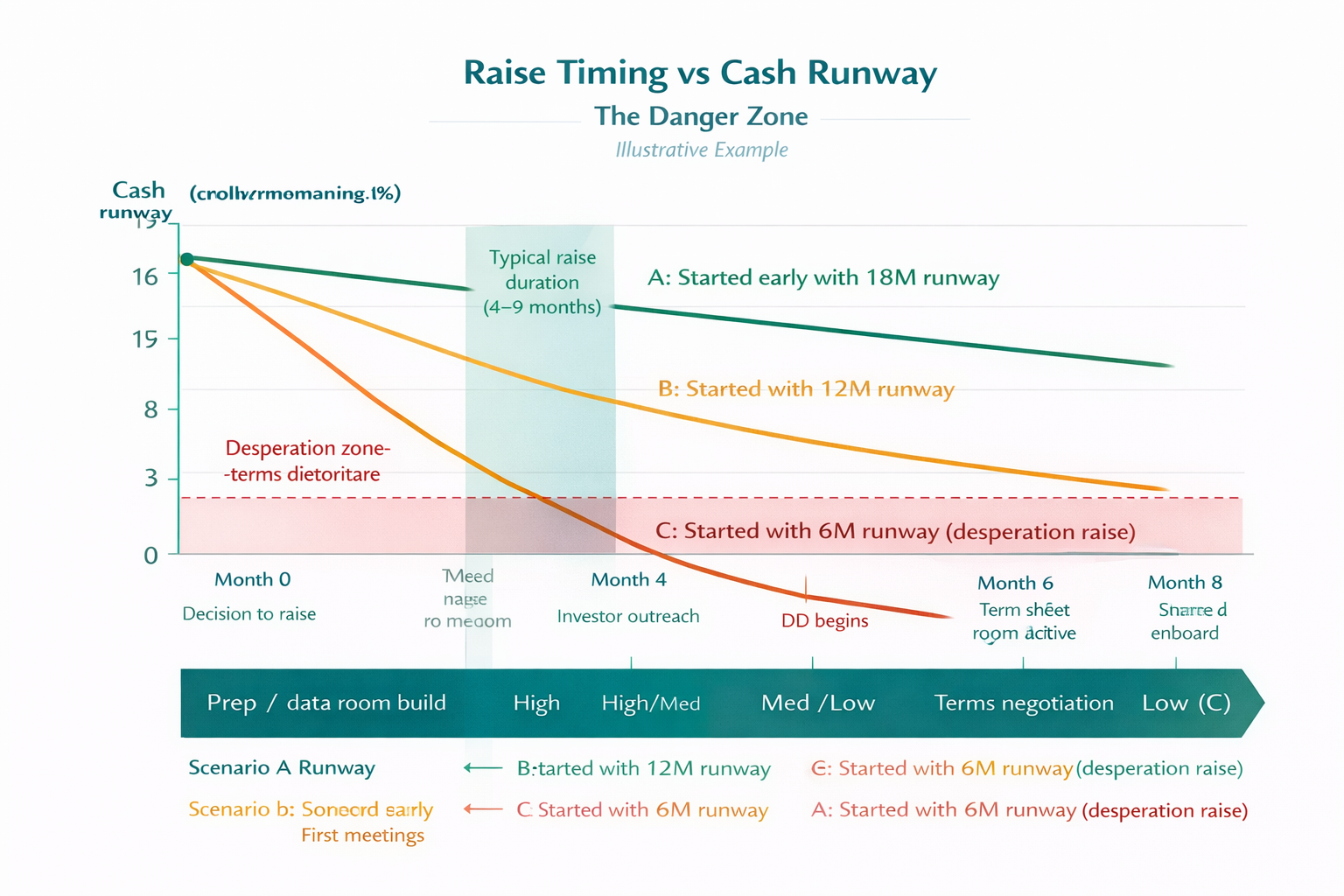
| Month from Decision | Scenario A Runway | Scenario B Runway | Scenario C Runway | Typical Raise Activity | Leverage |
| Month 0 Decision to raise | 18M | 12M | 6M | Prep / data room build | High |
| Month 2 Investor outreach | 16M | 10M | 4M | First meetings | High/Med |
| Month 4 DD begins | 14M | 8M | 2M | Data room active | Med/Low |
| Month 6 Term sheet negotiation | 12M | 6M | 0M | Terms negotiation | Low (C) |
| Month 8 Close | 10M remaining + new capital | 4M remaining + new capital | Bridge / distress | Close and onboard | Strong (A&B) |
How to interpret: Scenario C founders have no negotiating leverage by Month 4 investors know it, and terms reflect it. The single best thing a founder can do for their Series A outcome is to start the process early. Every month of additional runway at the start of the process is leverage on your term sheet.
The Math of Negotiating Leverage
Investors know your runway. It is in the data room. When you have 6 months of cash left and you are asking for a term sheet, every investor in the room knows you have no walk-away power. The term sheet reflects that. Liquidation preferences get heavier. Anti-dilution ratchets appear. Board seat demands increase. Valuation expectations shift downward.
When you have 15 months of cash and multiple investors in parallel process, the dynamic inverts entirely. You can take a competing term sheet to another investor. You can walk away from unfavourable terms and come back 30 days later with a counter. You can be selective about which investors to prioritise. That optionality is worth real money typically several crores in valuation uplift on a ₹20–40Cr round.
| The Timing Rule: The right time to begin Series A preparation is 12 months before you need the money. The right time to begin active investor outreach is 9 months before you need the money. Most Indian founders begin 3–4 months before they need the money. This gap is where terms are lost. |
The 12-Month Fundraising Calendar for Indian Founders
Months 12–9 Before Target Close
- Complete financial readiness checklist (Table 1). Fix all Critical items.
- Build the 24-month financial model with 3 scenarios. This takes longer than you think start early.
- Commission statutory audit if not already underway. In India, audits for growth-stage companies take 6–10 weeks.
- Resolve any cap table, ESOP, or legal compliance gaps. Engage a VC-experienced law firm, not just your standing corporate counsel.
- Begin building the cohort and metrics database. This is a finance team project requiring 3–4 weeks of dedicated effort.
Months 9–6 Before Target Close
- Start building warm relationships with target investors. Attend 2–3 events per month. Get introductions through existing angels or advisors.
- Share a brief company update (not a pitch) with 8–10 target investors to begin relationship without fundraising pressure.
- Engage a CFO (full-time or fractional) if not already in place. A founder-only finance function will not survive Series A DD.
- Assemble the data room. Organise it so that any investor request can be fulfilled within 24 hours, not 5 days.
Months 6–3 Before Target Close
- Begin formal fundraising process. Run it as a structured sales process: target list, outreach, first meetings, follow-ups, DD tracking.
- Aim to have 3–5 investors in parallel DD at any point this creates the competitive dynamic that improves terms.
- Do not share projections before you have a lead investor’s serious interest. Early oversharing allows investors to wait and use your own numbers against you later.
Months 3–0 Close
- Negotiate term sheet with lead investor. Get a VC-experienced lawyer to review standard terms in India include liquidation preferences, anti-dilution provisions, information rights, and board composition. Each is negotiable.
- Complete DD in parallel. Your finance team should be able to respond to investor DD requests in 48 hours anything longer signals unpreparedness and creates doubt.
- Close, file requisite ROC and RBI (FEMA) filings post-investment. FC-GPR must be filed within 30 days of receiving foreign investment.
6. The Financial Readiness Checklist
Table 1 below is a complete pre-fundraising audit template. Use it 60–90 days before you plan to begin investor outreach. Every ‘No’ in the Critical column is a deal risk not a minor gap.
Table 1: Series A Financial & Legal Readiness Checklist
Ready-to-use self-assessment. Complete this 60 days before you plan to start investor outreach. Any ‘No’ in the Critical column is a blocker fix it before you begin.
| Readiness Item | Critical? | Status (✓ / ✗ / WIP) | Notes / Owner |
| FINANCIAL RECORDS & REPORTING | |||
| Last 2 years audited financial statements (P&L, Balance Sheet, Cash Flow) | CRITICAL | ||
| Current year management accounts (monthly MIS current month minus 30 days max lag) | CRITICAL | ||
| GST returns filed and reconciled (GSTR-1, GSTR-3B) for last 24 months. No pending notices. | CRITICAL | ||
| TDS filings current. Form 16/16A issued for all employees and vendors. | Important | ||
| Revenue recognition policy documented (especially deferred revenue for SaaS / subscription businesses) | CRITICAL | ||
| Deferred revenue correctly classified on balance sheet (not booked as revenue upfront) | CRITICAL | ||
| METRICS & UNIT ECONOMICS | |||
| ARR / MRR defined consistently and reconciled to revenue in accounts | CRITICAL | ||
| Cohort retention analysis: monthly/annual by revenue cohort (GRR and NRR) | CRITICAL | ||
| CAC calculated correctly (all S&M costs ÷ new customers in period) | CRITICAL | ||
| LTV:CAC ratio computed and documented. CAC payback period stated. | CRITICAL | ||
| Burn multiple tracked monthly (net burn ÷ net new ARR) | Important | ||
| Gross margin tracked by product/customer segment, not just blended | Important | ||
| CAP TABLE, LEGAL & COMPLIANCE | |||
| Cap table clean, current, no phantom shares or undocumented agreements | CRITICAL | ||
| ESOP pool formalised with board approval, trust deed, and grant letters issued | CRITICAL | ||
| ROC / MCA filings current (annual return, financial statements). No pending penalties. | CRITICAL | ||
| IP (software, brand, patents) formally assigned to the company not held personally by founders | CRITICAL | ||
| Existing SHA / investor agreements reviewed for pre-emption rights, consent rights, anti-dilution | CRITICAL | ||
| FEMA / RBI compliances met for any foreign investment received (FC-GPR, FC-TRS filed) | CRITICAL | ||
| FINANCIAL MODEL & DATA ROOM | |||
| 24-month operating model with 3 scenarios (base, upside, downside). Revenue buildable from unit assumptions. | CRITICAL | ||
| Use-of-funds plan mapped to hiring, GTM, product milestones not a generic pie chart | CRITICAL | ||
| Data room organised (Docsend / Google Drive with access controls). Ready to share on 24hr notice. | Important | ||
| Customer contracts / MSAs available for top 10 accounts | Important | ||
Scoring: 0 Critical items unresolved = Investment-grade. 1–2 = Significant gaps; fix before outreach. 3+ = Do not begin investor outreach you are funding your failure to prepare.
7. Four India Scenarios What Readiness Looks Like Across Business Models
Scenario A: B2B SaaS, ₹8Cr ARR, SMB-Focused, 18 Months Post-Seed
A SaaS founder with strong top-line growth 2.8x YoY but 60% of revenue from annual contracts booked upfront without deferred revenue treatment. NRR is quoted at 108% but is not backed by a cohort analysis. ESOP pool has verbal commitments to 4 senior hires but no formal grant letters. The founder is doing MIS personally in Google Sheets.
What needs to happen before fundraising: Fix deferred revenue accounting this will reduce reported ARR by approximately 15% and is better disclosed proactively than discovered in DD. Build the cohort analysis; the NRR of 108%, if real, is a powerful asset. Formalise ESOPs. Hire a fractional CFO to own the finance function and investor reporting. This business can raise at good terms but only after 60–90 days of finance clean-up.
Scenario B: D2C Brand, ₹20Cr Revenue, Profitable, No Institutional Funding
A bootstrapped consumer brand with healthy EBITDA margins (18%) and strong brand recognition in 2 categories. Has never raised institutional capital. Books are clean audited annually by a Big 4 firm but the company has never tracked LTV:CAC, does not have a formal financial model, and the founding team has no investor relations experience.
What needs to happen: This business has excellent fundamentals but is presenting in a language investors do not read natively. Build the LTV:CAC framework (D2C version: contribution margin per order × repeat purchase frequency ÷ blended CAC). Develop a financial model that shows the reinvestment case how ₹15Cr of capital converts to revenue growth over 24 months. Engage an advisor with D2C fundraising experience in India. The finance function is not the bottleneck here the narrative construction and investor targeting are.
Scenario C: SaaS with International Revenue (US/SEA), ₹12Cr ARR
A founder with 40% of ARR from international customers billed in USD. The business has multiple legal entities an Indian operating company and a Singapore holdco set up informally without proper share transfer documentation. FEMA compliance is unclear. The cap table has a convertible note from a US angel that has never been properly registered with the RBI.
What needs to happen: This is a structural cleanup situation before fundraising not a metrics or narrative problem. Engage a VC-experienced law firm with cross-border expertise immediately. The entity structure, FEMA compliance, and convertible note registration must be resolved first. This will take 60–90 days and is non-negotiable for institutional investors who will flag it in DD. The business metrics are strong; the legal gaps are the only barrier.
Scenario D: Manufacturing / Hardware SaaS, ₹6Cr ARR, High CAPEX
A hardware-plus-software business where the software (₹3Cr ARR) is high-margin but the hardware installation component (₹3Cr revenue) is low-margin and capital-intensive. Investors see blended gross margins of 38% and price it as a hardware company below SaaS multiples. The founder insists it is a SaaS business.
What needs to happen: Disaggregate the P&L before the investor conversation present software ARR and hardware revenue separately with distinct margin profiles. The software segment at 72% gross margin qualifies for SaaS multiples; the hardware segment should be presented as a distribution mechanism that drives software attach rate, not as a revenue stream to be valued independently. This is a financial reporting and narrative design problem and a CFO who has seen hardware-SaaS fundraising in India is the right resource to structure it.
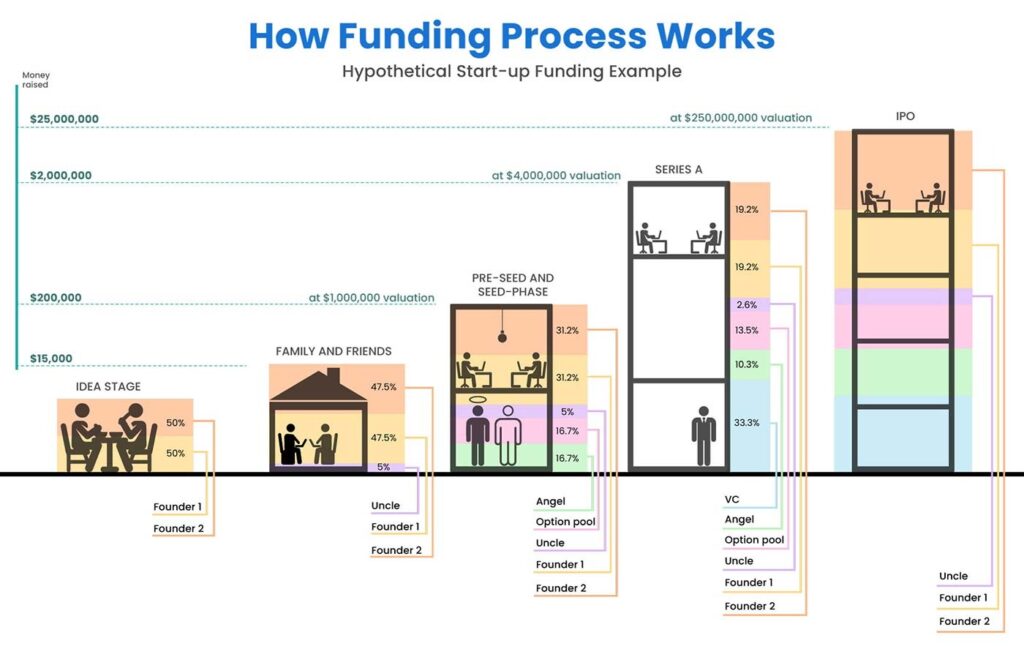
8. How Treelife Gets You to the Room And Keeps You There
Most founders approaching Series A need three things simultaneously: clean financials that survive institutional DD, a metrics framework that tells a coherent story, and a finance function that can operate at board-company pace. Treelife delivers all three not as a one-time project, but as an embedded partner through the fundraising process and beyond.
The Treelife Series A Readiness Programme
| Phase | Timeline | Deliverables | Success Metric |
| 1. Readiness Audit | Week 1–2 | Complete financial and legal readiness assessment against Table 1 checklist. Metrics audit ARR reconciliation, cohort analysis gaps, deferred revenue review. DD risk register with prioritised remediation plan. | Readiness score delivered. All Critical gaps identified with owner and timeline. |
| 2. Finance Clean-up | Weeks 3–8 | Fix accounting gaps (deferred revenue, related party disclosures, GST reconciliation). ESOP formalisation support. MIS build monthly close process, board reporting template. Cap table verification and documentation. | Auditor sign-off on accounts. MIS live and monthly close within 10 days. Zero Critical gaps on readiness checklist. |
| 3. Investor Package | Weeks 6–10 | 24-month financial model (3 scenarios, revenue buildable from unit assumptions). Metrics dashboard with ARR schedule, cohort analysis, LTV:CAC, NRR, burn multiple. Data room organisation and population. Valuation benchmarking. | Data room ready. Financial model investor-reviewed. Metrics reconciled to audited accounts. |
| 4. DD Support | Active raise period | Dedicated point of contact for investor DD queries. 48-hour response SLA on all DD requests. Ongoing MIS and metrics updates during raise. Term sheet financial modelling (dilution, cap table post-round scenarios). | DD queries closed within 48hr. No investor drops out citing financial information quality. |
| 5. Post-Round CFO Support | Ongoing | Monthly board reporting. Investor update templates. Use-of-funds tracking. Runway monitoring. MIS enhancement as scale demands. Statutory compliance (ROC, FEMA post-funding filings). | Board reporting live within 10 days of month-end. Investor confidence in finance function. |
Key Takeaways for Founders
Your metrics are only as credible as their reconciliation to your audited accounts. An ARR number that lives in a founder’s spreadsheet and cannot be tied to the revenue line in your P&L will unravel in DD. Build the ARR schedule first; everything else follows from it.
The biggest drop-offs in a Series A process happen at the metrics and financial DD stage not the pitch stage. Most founders over-invest in deck design and under-invest in data room readiness. Flip that ratio by at least 60 days before you start outreach.
Your burn multiple is now a primary signal, not a secondary one. Post-2022, Indian VCs are scrutinising capital efficiency with a rigour that did not exist in the 2020–21 era. A burn multiple above 2.5x without a credible path to improvement will slow or kill conversations regardless of growth rate.
Legal and compliance gaps are not paperwork problems, they are confidence problems. An investor who finds undocumented ESOPs, incomplete ROC filings, or FEMA non-compliance in DD does not see an administrative oversight. They see a founding team that does not run a tight ship. Fix these before outreach, not during.
Every month of additional runway at the start of your raise is negotiating leverage on your term sheet. Founders who start raising with 6 months of cash have no walk-away power. Founders who start with 15–18 months do. That difference shows up directly in valuation, liquidation preferences, and board composition not as a minor rounding issue but as a material difference in what you give up.
The jump from ‘not ready’ to ‘investment-grade’ is a 60–90 day project, not a 12-month transformation. The gap is almost always finance infrastructure and legal hygiene not revenue, not product, not market size. Those can be fixed with focused effort and the right team. Start that work now, before you need the capital.
]]>Sectors: SaaS | Services | Manufacturing | Wholesale Distribution
Executive Summary
Most Indian B2B businesses are unknowingly financing their customers. They offer Net 60 or Net 90 terms to close deals, let exceptions pile up without scrutiny, and then wonder why the bank balance is tight despite strong revenue. The problem is not the customers it is the absence of a payment terms strategy.
This report makes the case that payment terms are a capital allocation decision. Every additional 30 days of DSO traps meaningful cash in receivables. A ₹10Cr ARR business moving from Net 30 to Net 90 locks up approximately ₹1.6Cr extra at a financing cost of roughly ₹19L per year if you are servicing an overdraft. That cost is invisible on the P&L but very visible on your cash flow.
The report covers four things a growth-stage business needs to get right: a risk-based segmentation framework to decide who deserves which terms; a policy design that sales teams will actually follow, including exception governance and GST invoice hygiene standards; a 30–60 day implementation plan with a collections cadence and dispute management protocol; and the failure modes that cause even well-designed policies to quietly collapse. Four India-specific scenarios SaaS, manufacturing/dealer network, professional services, and PSU wholesale show how the framework applies in practice.
The businesses that manage this well do not just collect faster. They reduce bad debt, improve fundraising readiness, and gain optionality on working capital financing because their AR book is clean enough to pledge or discount at favourable rates.
What Are Net Payment Terms?
Net payment terms are predefined credit conditions that specify the number of days a buyer has to pay an invoice after it is issued. In B2B transactions, these terms function as short-term trade credit extended by the supplier to the buyer.
Unlike advance payments or cash-on-delivery models, net terms allow buyers to receive goods or services first and pay later within an agreed timeframe. This structure supports commercial flexibility while maintaining formal payment discipline. In the B2B ecosystem, net terms are a foundational element of procurement contracts, vendor agreements, and enterprise supply chains.
What Are Net 30, Net 60, and Net 90 Payment Terms?
The numbers attached to “Net” indicate the number of calendar days within which payment must be made from the invoice date.
Net 30
Payment is due within 30 calendar days from the invoice date.
If an invoice is raised on 1 April, payment is expected by 30 April.
Net 60
Payment is due within 60 calendar days.
An invoice dated 1 April would be payable by 31 May.
Net 90
Payment is due within 90 calendar days.
An invoice issued on 1 April would be due by 30 June.
These standardized credit terms are widely used across industries such as:
- Manufacturing and industrial supply chains
- FMCG distribution networks
- Infrastructure and EPC projects
- IT services and SaaS companies
- Wholesale trade and enterprise procurement
They act as structured trade credit arrangements between suppliers and buyers, enabling smoother commercial operations without immediate cash exchange.
Key Benefits of Net 30/60/90 Payment Terms
Well-structured net payment terms deliver strategic advantages for Indian B2B finance leaders by balancing growth with financial discipline.
- Stronger customer acquisition and retention – Flexible credit terms reduce upfront payment pressure and encourage long-term B2B partnerships.
- Competitive advantage in enterprise deals – Extended payment windows act as a non-price differentiator in competitive Indian markets.
- Optimized working capital management – Buyers gain liquidity flexibility, while suppliers maintain predictable receivables with disciplined Net 30 cycles.
- Improved financial visibility and forecasting – Clear timelines enhance tracking of cash inflows, receivable aging, collections, and credit exposure.
- Scalable growth enablement – Standardized Net 30/60/90 structures align with enterprise procurement norms, supporting operational scalability.
1. The Real Problem: Payment Terms Are a Strategy Decision, Not a Collections Task
Most Indian B2B businesses discover their payment terms are a problem when the bank balance dips unexpectedly and collections start chasing seven different customers simultaneously. By that point, the policy is already costing them money. The phrasing ‘we’ll sort it out after the deal closes’ has become embedded culture and it is expensive culture.
Payment terms are not a collections instrument. They are a working capital strategy decision with direct implications for your Days Sales Outstanding (DSO), Cash Conversion Cycle (CCC), fundraising readiness, and the effective cost of your business. The CFO who treats them as an afterthought is implicitly subsidising customers with cheap capital their customers’ working capital, funded from their own balance sheet.
The DSO and CCC Connection
Two formulas matter here. Commit them to memory – or at least to your monthly dashboard.
| DSO = (Total Receivables ÷ Total Revenue) × Number of Days A DSO of 75 on Net 45 terms means customers are taking 30 extra days on average. That gap is your enforcement problem or your policy problem. | CCC = DIO + DSO – DPO(Days Inventory Outstanding + Days Sales Outstanding – Days Payable Outstanding). Every day of DSO reduction compresses CCC meaning faster cash recycling and lower dependence on external credit. |
For service businesses with minimal inventory, DSO is essentially CCC. A 30-day DSO reduction at ₹10Cr ARR frees approximately ₹82L in cash – cash that otherwise sits with customers earning returns in their treasury while you service your OD account at 11–13%.
| Critical Insight: DSO is your single most actionable working capital metric. Before you discuss payment terms with any customer, know your current DSO per customer segment. Most finance heads discover they have never calculated it at the account level. |
Why This is Important for Fundraising
Investors, whether PE, venture debt, or institutional lenders use your DSO and receivables aging as a direct proxy for business quality. A company presenting for Series A or a working capital line with 25% of AR in the 90+ days bucket will face sharper questions, higher interest rates, or reduced limits. Receivables quality is also a due diligence point in M&A and secondary transactions. The discipline you impose on payment terms today shapes your valuation narrative tomorrow.
Additionally, many NBFCs and banks offering invoice discounting or factoring in India price their rates based on aging quality. Businesses with clean AR mostly current, low overdue access capital at 9–11% versus 14–18% for those with messy books. The spread is significant at any meaningful scale.
2. The Framework: Who Gets Net 30, Net 60, or Net 90
The single most common mistake is setting payment terms based on what the customer asks for – or what sales believes will close the deal. The correct approach is a risk-adjusted segmentation framework that balances revenue importance, credit quality, margin profile, and tenure. Once built, this framework does two things: it removes the subjectivity that sales teams exploit, and it gives finance a defensible basis for pushback.
The Four-Axis Segmentation Model
Assign every customer (or customer segment) along four axes before deciding on terms:
- Revenue Importance: What is the account’s annual contribution, and how concentrated is your revenue? A customer representing 20%+ of revenue may deserve operational flexibility but that concentration itself is a risk you should be managing, not rewarding with loose terms.
- Payment History: The cleanest predictor of future behaviour. A customer who has consistently paid within terms, even if they occasionally request extensions, is fundamentally different from one who treats 90-day terms as a 120-day starting point.
- Gross Margin on the Account: Net 60 terms cost you the time-value of money. If a customer is a 12% gross margin account, that carrying cost is a meaningful chunk of your profit. High-margin accounts can justify extended terms; low-margin accounts cannot, the math simply does not work.
- Customer Tenure and Relationship Depth: New customers default to conservative terms. This is not about distrust; it is about data. You have no payment behaviour to evaluate. Tenure earns trust incrementally.
Customer Segmentation Scorecard – Payment Terms Eligibility
Ready-to-use template. Score each customer. Total score determines maximum terms tier.
| Criterion | Score 1 | Score 2 | Score 3 | Score 4 | Score 5 | Weight |
| Annual Revenue with You (₹) | <5L | 5–20L | 20–75L | 75L–2Cr | >2Cr | 25% |
| Payment History (last 12M) | 3+ late>60d | 2 late>60d | 1 late>30d | Occasional delay | Always on time | 30% |
| Customer Tenure | New (<3M) | 3–6M | 6–12M | 1–3 yrs | >3 yrs | 15% |
| Creditworthiness / CIBIL / References | Unknown | Poor (<650) | Fair (650–700) | Good (700–750) | Excellent (>750) | 20% |
| Gross Margin on Account | <10% | 10–20% | 20–35% | 35–50% | >50% | 10% |
| Scoring Key: Weighted score 1–2.4 → Net 30 max | 2.5–3.4 → Net 60 max | 3.5+ → Net 90 eligible (with CFO sign-off) | ||||||
New customers default to Net 30 regardless of score. All Net 90 approvals require CFO countersignature and quarterly review. Score resets trigger automatic downgrade to lower tier on next renewal.
The MSME Buyer Reality in India
A specific India consideration: if your buyers include MSME-registered entities, you are legally subject to MSMED Act provisions that cap payment timelines at 45 days (or as agreed, not exceeding 45 days) for MSME suppliers. However, if you are the MSME supplier being paid by a large enterprise buyer, the same law protects you and the MSME Samadhaan portal offers a dispute resolution mechanism. Know which side of this equation you sit on for each relationship.
For wholesale and manufacturing businesses, PO-to-GRN (Goods Receipt Note) timelines also affect effective payment days. An invoice dated at dispatch, where GRN is only signed 7–12 days later, effectively means your Net 45 is functioning as Net 33. Build GRN timelines into your terms negotiation, not just the payment days.
| India-Specific Watch Point: Standard practice for enterprise buyers in India: their payment terms run from the date of GRN acceptance, not invoice date. If you are invoicing on dispatch and they are counting from GRN, negotiate the GRN SLA explicitly – or your ‘Net 45’ is actually Net 55+. |
Margin vs Terms: The Hard Trade-off
The cleanest decision rule: if your gross margin on an account does not comfortably absorb the financing cost of extended terms, you should not offer them without a compensatory adjustment, either a price increase, an early payment discount, or a security deposit. A 15% gross margin account on Net 90 terms, financed at 12% COD, means your effective margin is approximately 11%. Offer that account Net 90 routinely and you may be serving a relationship at near-zero economic value.
Get credit line financial design ready in minutes. Let’s Talk Let’s Talk
3. Policy Design That Sales Teams Can Live With
Payment terms policy fails when it is either too rigid (sales works around it) or too vague (everyone makes exceptions). The design goal is a policy that is specific enough to enforce, flexible enough to accommodate genuine strategic accounts, and governed enough to prevent exception creep.
The Policy Architecture
A functional payment terms policy has five components:
- Default Terms by Segment: Published, clear, non-negotiable starting position for each customer tier. Example: new customers get Net 30 regardless of size. SMB accounts get Net 30 as standard. Mid-market gets Net 45. Enterprise accounts with 2+ year tenure and clean history may qualify for Net 60.
- Approval Tiers for Exceptions: Net 30 extensions up to Net 45 – Account Manager with Finance Ops sign-off. Net 60 – Finance Head approval required. Net 90 – CFO countersignature and documented business case. No exceptions beyond Net 90 without board-level disclosure.
- Expiry and Review: All exception approvals expire at contract renewal or after 12 months, whichever is earlier. The burden of re-approval lies with sales, not finance. Terms approved once do not auto-renew.
- Credit Limits: Every account with extended terms must have a defined credit exposure limit. Breach of credit limit triggers automatic hold on new orders/deliveries regardless of relationship history. Finance sets limits; sales cannot override.
- Early Payment Incentives: Offer a 1–2% discount for payment within 7–10 days on accounts that are margin-healthy. This converts a concession (extended terms) into an active lever. Document it clearly in the invoice and contract.
The GST Invoice Hygiene Requirement
In India, a payment dispute frequently begins with an invoice hygiene problem not a customer relationship problem. Enterprise buyers routinely delay payment citing missing or incorrect GSTINs, wrong HSN codes, mismatched PO references, or invoices not linked to the correct supply state. Every delayed invoice costs you money. Build a pre-invoice checklist into your billing process:
- Buyer GSTIN verified and matched against the PO or MSA.
- Supply state correctly identified – IGST vs CGST/SGST applied correctly.
- HSN/SAC code aligned with current GST classification for your product or service.
- E-invoice (IRN) generated on IRP for applicable turnovers (currently mandatory above ₹5Cr).
- PO number, GRN reference (for product), and contract reference included on invoice face.
- Bank details and payment instructions clearly stated on every invoice.
A buyer’s accounts payable team that has to chase your GST details is a buyer whose 7-day internal approval cycle just became 21 days. Invoice hygiene is a collections strategy.
The Exception Management Trap
Chart (below) illustrates the relationship between exception rate and overdue rate across sales teams. The data is illustrative but the pattern is real: teams with high exception rates where sales regularly negotiates beyond standard terms consistently show disproportionately high overdue rates. The causality is direct. Extended terms granted without credit assessment are extended terms that customers have not demonstrated the discipline to honour.
Exception Rate vs Overdue Rate by Sales Team (Illustrative Example)
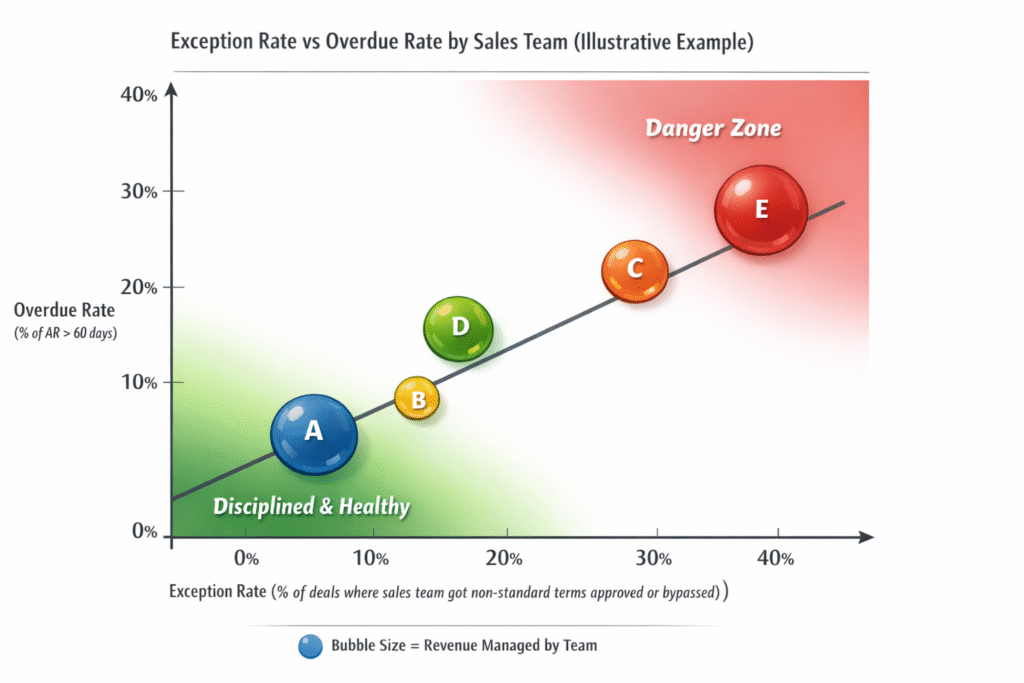
| Sales Team | Exception Rate % | Overdue Rate % (>60d) | AR Managed (₹L) | Zone |
| Team A — Enterprise | 6% | 7% | 320 | ✓ Healthy |
| Team B — Mid-Market | 14% | 18% | 180 | Watch |
| Team C — SMB | 28% | 32% | 90 | ✕ Danger |
| Team D — Channel | 9% | 11% | 140 | ✓ Healthy |
| Team E — Govt/PSU | 41% | 38% | 210 | ✕ Danger |
How to interpret: Exception rate is the leading indicator; overdue rate is the lagging outcome. Teams with exception rates above 20% consistently show 2-3x the overdue rate of disciplined teams. This is not coincidence it is a policy enforcement problem dressed as a customer problem.
The control mechanism is not to eliminate exceptions, strategic accounts genuinely warrant flexibility. The control is to make exceptions visible, time-bound, and tied to accountability. When a sales person requests Net 90 for a new customer, the approval process should require them to document the strategic rationale and accept co-accountability if the account goes overdue. This single change shifts the culture from ‘finance is the obstacle’ to ‘we share the credit risk together’.
4. The Data Behind the Decision
The charts in this section are designed for your next finance or board review. Use them to anchor the business case for policy change or to illustrate the cost of the status quo.
DSO Sensitivity to Cash Tied Up
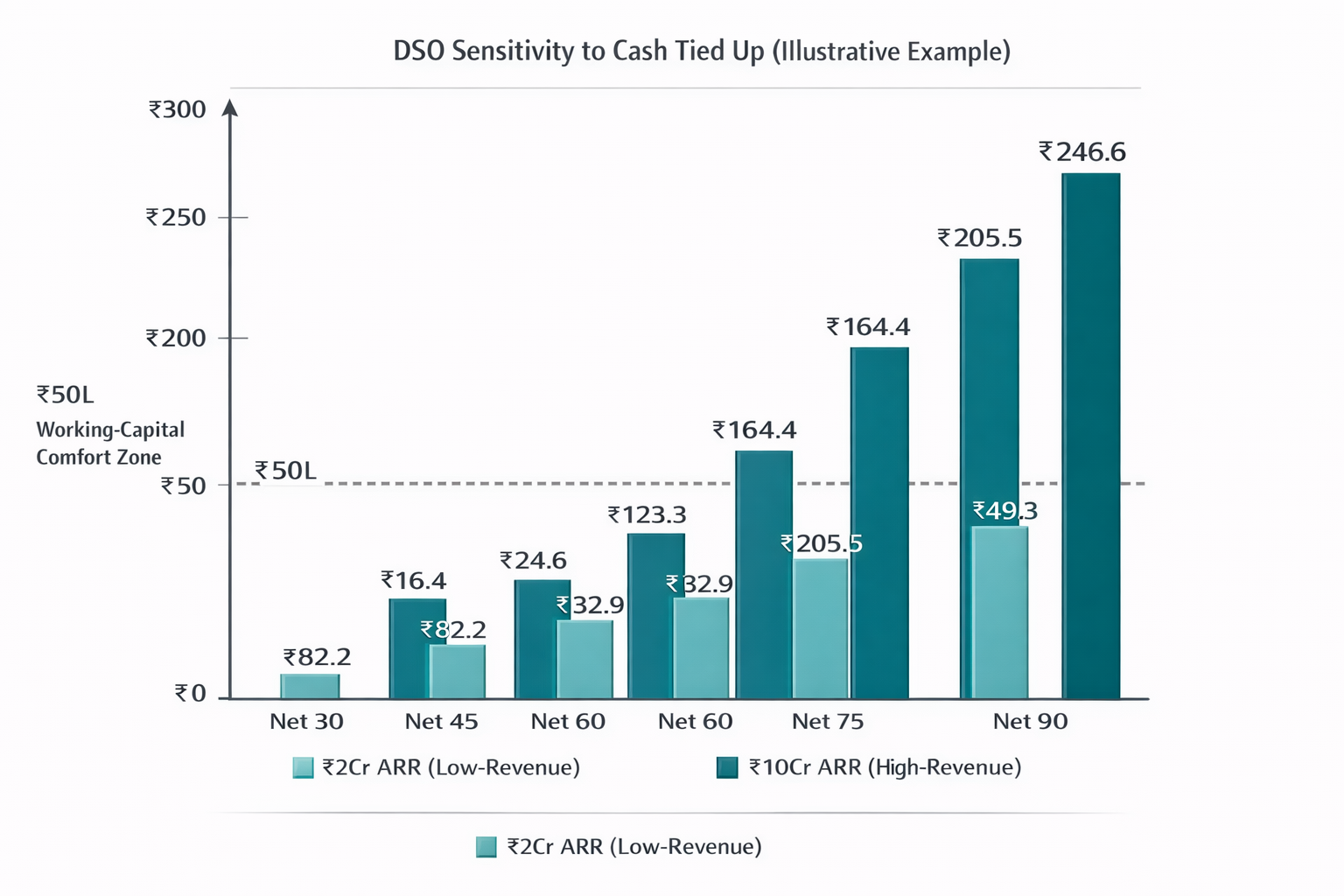
| DSO / Terms | Net 30 | Net 45 | Net 60 | Net 75 | Net 90 |
| ₹2Cr ARR — Cash locked (₹L) | 16.4 | 24.6 | 32.9 | 41.1 | 49.3 |
| ₹10Cr ARR — Cash locked (₹L) | 82.2 | 123.3 | 164.4 | 205.5 | 246.6 |
| ₹25Cr ARR — Cash locked (₹L) | 205.5 | 308.2 | 410.9 | 513.7 | 616.4 |
Formula: Cash locked = (Annual Revenue ÷ 365) × DSO. Assumes consistent monthly billing, no early payment.
How to interpret: Every 30-day extension of your payment terms is not a relationship favour it is a capital allocation decision. A ₹10Cr ARR business moving from Net 30 to Net 90 traps an additional ₹1.6Cr in receivables. At a cost of debt of 12%, that is ₹19L in annual financing cost absorbed quietly unless you measure it.
Receivables Aging Mix – Before vs After Policy Implementation (Illustrative Example)
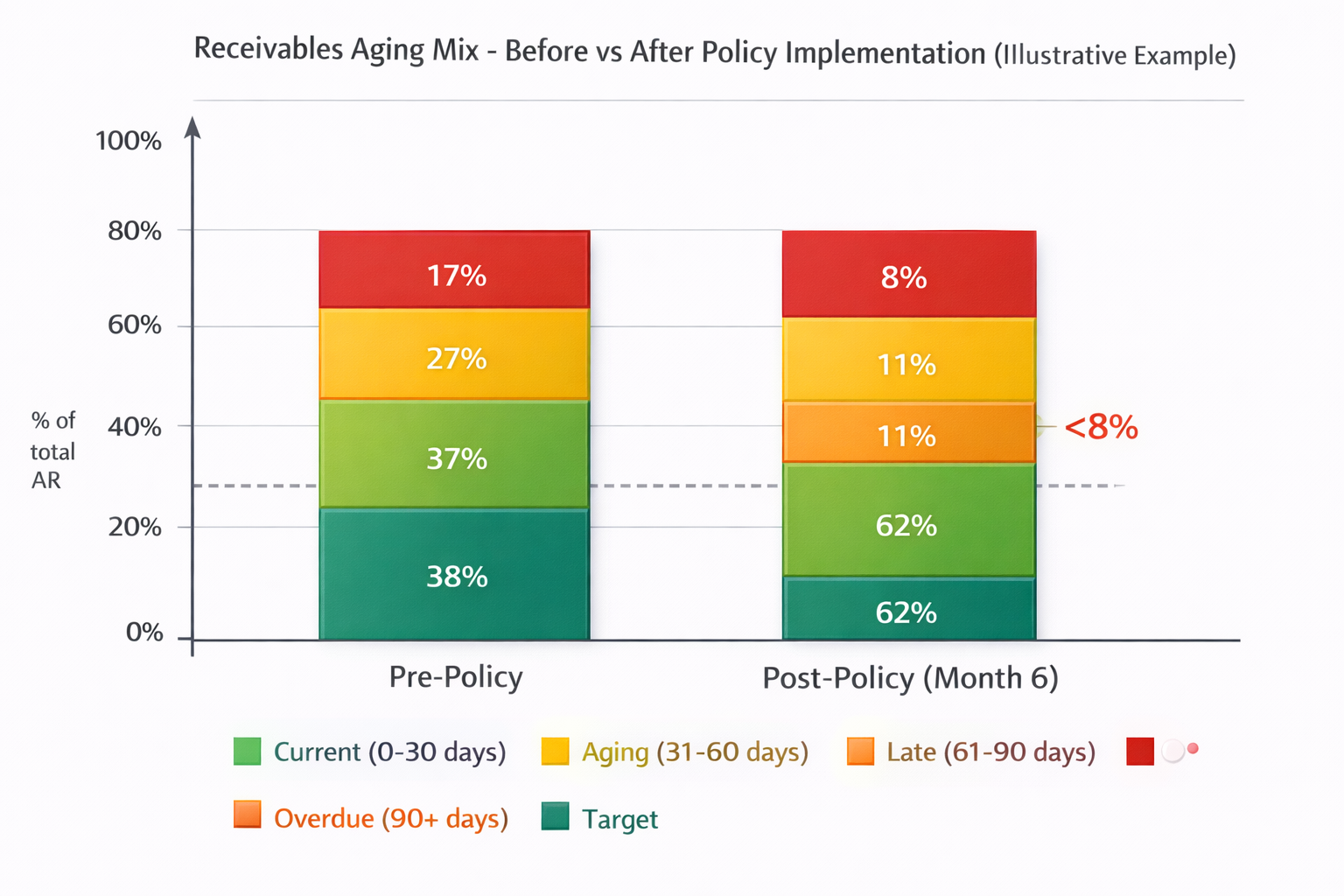
| Aging Bucket | Pre-Policy % | Month 2 % | Month 4 % | Month 6 % | Target |
| Current (0–30 days) | 38% | 44% | 51% | 62% | 65%+ |
| Aging (31–60 days) | 27% | 25% | 22% | 19% | <20% |
| Late (61–90 days) | 18% | 16% | 14% | 11% | <12% |
| Overdue (90+ days) | 17% | 15% | 13% | 8% | <8% |
How to interpret: A well-implemented policy compresses the overdue bucket within 60–90 days. The gains show first in Month 4 as systematic follow-up and escalation protocols kick in. Businesses with >20% in the 90+ bucket typically have a policy gap, not a customer quality gap.
5. Implementation Plan: 30–60 Days to a Functioning Policy
A payment terms policy that exists in a document but does not change behaviour is not a policy, it is a filing exercise. Implementation requires sequencing: first, get the data right; then, design the policy; then, operationalise collections; finally, automate.
Week 1–2: Diagnostic and Baseline
- Pull your AR aging report by customer, segment, and invoice date (not due date).
- Calculate DSO per customer segment. Identify your top 20 overdue accounts by value.
- Map every active customer’s current terms against the scorecard in Table 1. Identify mismatches – accounts on Net 90 that score below 3.0.
- Identify invoice hygiene failures in the last 6 months: how many invoices were disputed for non-payment-related reasons (GSTIN error, PO mismatch, etc.)? This number will surprise most finance teams.
- Interview sales heads: what is the actual exception rate, and for which customers? Get the anecdotal data before you build the formal process.
Week 3–4: Policy Design and Stakeholder Alignment
- Draft the segmentation scorecard (Table 1 as baseline). Calibrate cutoffs with finance head and one senior sales leader – buy-in matters.
- Write the exception approval SOP. Single page. Approval tiers, timelines, expiry rules. Publish to all sales and finance staff.
- Design the collections cadence (Table 2 as baseline). Assign named owners to each step. Ambiguity about who sends the Day +15 email is why it never gets sent.
- Set credit limits for top 30 accounts. Build the discipline of credit limit monitoring into your AR review.
- Review and update all standard contract templates to include: payment terms, late payment interest clause (MSMED Act reference where applicable), dispute resolution timeline, and credit limit breach triggers.
Week 5–8: Rollout and Collections Operationalisation
- Notify customers of any terms changes with minimum 30-day notice. For strategic accounts, have the finance head or CFO make a brief call this positions it as governance, not penalty.
- Activate the collections cadence. In the first month, do this manually before automating you will identify gaps in the cadence design that automation would have locked in.
- Implement a weekly AR review meeting: 30 minutes, Finance + Sales Ops. Review overdue accounts, agree on owner actions for each, record commitments. This meeting is your enforcement mechanism.
- Build or configure basic automation: automated invoice dispatch, pre-due reminders (Day -5), and overdue notifications (Day +1, +7).
- Track your first-month metrics: DSO change, overdue rate by aging bucket, exception rate vs prior quarter.
Dispute Management: The Overlooked Bottleneck
A dispute whether about invoice accuracy, delivery quality, or GST computation pauses payment without pausing your cost base. Most businesses handle disputes reactively, which means they sit unresolved for 30–60 days while your aging clock ticks. Implement a structured dispute fast-track:
- All disputes acknowledged within 48 hours. Assign a named resolver.
- Simple disputes (invoice errors, GSTIN corrections) resolved within 5 business days.
- Complex disputes (quality, delivery, contractual) escalated to a joint buyer-seller working group with a 15-business-day resolution SLA.
- Partial payments on undisputed invoice amounts should not wait for dispute resolution on disputed portions. Build this into your contract language.
6. Four India Scenarios – Terms in Practice
Scenario A: B2B SaaS, ₹8Cr ARR, Mixed Customer Base
A 4-year-old SaaS business sells to a mix of mid-size enterprises and SMBs. Current DSO is 68 days against standard Net 45 terms. Top 5 enterprise customers represent 55% of revenue and are all on informal ‘Net 60–90’ terms that were never documented. SMB customers are on Net 30 but average payment is Day 42.
Recommended approach: Formalise enterprise terms at Net 60 with documented credit limits and annual review. Apply the scorecard to identify which of the 5 accounts should be on Net 45 vs Net 60 based on payment history. For SMB accounts, implement automated reminders at Day -5 and Day +1 most SMB late payments are reminder failures, not cash problems. Target: DSO to 52 days within 90 days, releasing approximately ₹62L in cash.
Scenario B: Industrial Manufacturing, ₹35Cr Revenue, Dealer Network
A mid-size manufacturer sells through 80+ dealers across 3 states. Trade credit is the norm dealers expect 60–90 days as a competitive necessity. Bad debt write-offs have averaged 1.8% of revenue annually over 3 years. GST input credit delays at the dealer level are routinely cited as payment excuses.
Recommended approach: Segment dealers into Tier 1 (high volume, clean history) and Tier 2 (smaller, patchy history). Tier 1 gets Net 60; Tier 2 gets Net 30 with an option to earn Net 45 after 6 clean months. Introduce a security deposit equivalent to 30 days of purchases for Tier 2 dealers. Tie inventory allocation priorities to payment compliance this is a powerful lever manufacturers underuse. Implement a dealer portal for e-invoicing that eliminates GSTIN disputes at source.
Scenario C: Professional Services Firm (CA/Legal/Consulting), ₹4Cr Revenue
A growing consulting firm bills on project milestones. Current practice: single invoice at project end after 3–4 months of work. DSO is effectively 120+ days. Two clients from last year are still unpaid at 9 months.
Recommended approach: Restructure billing to milestone-based invoicing 30% on engagement, 40% at mid-project, 30% on delivery. This converts a DSO problem into a structural fix. For any project above ₹10L, require a retainer upfront equal to 20% of project value. Build late payment interest clauses (2% per month) into engagement letters most professional services firms do not have these and have no legal mechanism for pursuit. Net 30 from each milestone invoice, enforced.
Scenario D: Wholesale Distributor, Large Enterprise Buyer (PSU/MNC)
A distributor supplies a large PSU that has a rigid 90-day payment cycle baked into their procurement policy. The distributor’s own supplier terms are Net 30. The structural mismatch creates a 60-day financing gap on every transaction.
Recommended approach: This is a DPO-DSO mismatch problem. Three levers: (1) Negotiate extended terms with your own suppliers to 60 days reduce the gap. (2) Use invoice discounting or bill discounting against the PSU receivables PSU paper is typically high-quality and discountable at 9–10.5%. (3) Price the financing cost into your margin with the PSU if the 60-day gap costs you 1.5% per transaction, recover it in your pricing. Treat the relationship as a standalone P&L and ensure it is actually profitable after financing costs.
7. Failure Modes and Controls
Every policy has predictable failure points. Knowing them in advance is your best defence.
Failure Mode 1: Exception Creep
Sales teams approve exceptions informally (‘I’ll just let this one go as Net 75’), which bypasses the formal approval chain. Within two quarters, exceptions are the norm and the policy exists only on paper. Control: monthly exception rate tracking by team and manager, published in the AR review. Set a hard ceiling if the team-level exception rate exceeds 15%, no further exceptions are approved that month.
Failure Mode 2: Disputed Invoices as a Stall Tactic
Some buyers particularly large enterprises raise technical disputes (GST mismatches, PO reference errors) as a cash management tactic, not a genuine concern. They delay payment across 50 vendors simultaneously at quarter-end. Control: track dispute-to-resolution time per buyer. A buyer who raises disputes consistently in months 2 and 3 of every quarter is managing their payables, not genuinely disputing your invoices. Adjust your credit terms and negotiation posture accordingly.
Failure Mode 3: Collections Cadence Breaks Down
The Day +7 call does not happen because the AR executive is busy. The Day +15 escalation email is never sent because no one owns it. Within 6 weeks, the cadence has quietly collapsed. Control: automate the first three touchpoints. The remaining human-touch escalations should be calendar-blocked, not ad hoc.
Failure Mode 4: Sales Uses Terms as a Discount
Extended payment terms have measurable financial cost. When a sales person offers Net 90 to close a deal, they are effectively offering a discount one that does not show in the CRM but absolutely shows in your bank account and DSO. Control: build a ‘terms cost calculator’ into your deal approval process. When a deal requests Net 90 instead of Net 30, the approval form should show the estimated financing cost. This one change makes the economic trade-off visible and changes the conversation.
Key KPIs to Monitor Monthly
- DSO: overall and by segment.
- Overdue rate: % of AR beyond due date.
- Aging distribution: % of AR in each bucket (0–30, 31–60, 61–90, 90+).
- Exception rate: % of accounts on non-standard terms by sales team.
- Dispute-to-resolution cycle time: average days.
- Bad debt provision as % of revenue: quarterly.
- CCC: quarterly, compared to prior period.
8. How Treelife Implements This: Diagnostic to Ongoing Review
Most businesses have the intent to fix their payment terms framework. The gap is bandwidth, expertise, and the credibility to push back on sales and customers simultaneously while maintaining relationships. That is where Treelife’s finance consulting practice operates.
We are not a collections agency and we are not generic advisory. We work embedded with your finance team as outsourced CFO, finance controller, or project-based implementation partners to design and operationalise frameworks that actually hold.
What We Deliver, and When
| Phase | Timeline | Deliverables | Success Metric |
| 1. Diagnostic | Weeks 1–2 | AR aging analysis by customer/segment, DSO calculation, invoice hygiene audit, exception rate mapping, current contract terms review. | Baseline DSO, overdue rate, and exception rate documented. Key risk accounts identified. |
| 2. Policy Design | Weeks 3–4 | Customer segmentation scorecard, payment terms policy document, exception approval SOP, credit limit matrix, contract language updates. | Policy ratified by CFO and Sales Head. Exception approval workflow live. |
| 3. Rollout | Weeks 5–8 | Collections cadence operationalisation, automation setup (invoice dispatch, reminders, escalation triggers), customer communication plan, staff training (finance + sales). | Collections cadence live. Automated reminders active. First month AR review completed. |
| 4. Monthly Review | Ongoing | Monthly AR review facilitation, KPI dashboard maintenance, exception rate monitoring, policy enforcement advisory, dispute management support, periodic scorecard recalibration. | DSO reduction of 15–25 days within 90 days. Overdue rate below target. Exception rate controlled. |
Key Takeaway for the Founder
Your payment terms are a silent line of credit you are extending to every customer whether you intended to or not. Unlike a bank loan, this one has no documentation, no interest income, and no enforceable recall mechanism unless your contracts are tight.
The founders who fix this early stop thinking about it as a “collections problem” and start treating it as a financial design problem. The fix is not chasing customers harder. It is building a system a scored segmentation, a policy with teeth, a collections cadence that runs automatically, and a monthly review that keeps the discipline alive.
One number to remember: your DSO should not exceed your stated payment terms by more than 10–12 days. If the gap is larger than that, you do not have a customer quality problem. You have a policy enforcement problem. And that is entirely within your control to solve.
Our Commitment on Outcomes
We do not promise results we cannot control your customers pay when they pay. What we commit to is this: within 90 days of engagement, you will have a functioning policy that your team uses, a collections cadence that is followed, and a monthly review process that keeps the discipline alive. Based on our experience with similar-scale Indian B2B businesses, this translates to DSO improvement of 15–25 days and meaningful reduction in the 90+ days overdue bucket with the cash impact that entails.
We also do not walk away after the framework is built. Our ongoing support model ensures the policy does not decay as new customers are onboarded, new sales hires join, or business conditions change.
Next Step
If your DSO is higher than your stated payment terms, your exception rate is unknown, or your AR aging has not been reviewed in the last 30 days this is the conversation to have now, not after the next cash crunch.
Disclaimer: This report is prepared by Treelife for informational purposes. All illustrative examples and scenario data are constructed for illustration only and do not constitute actual client results or market data. Terms, legal positions, and GST rules referenced reflect publicly available information as of 2026 and should be verified with appropriate advisors for your specific situation.
]]>Financial modeling for startups in 2026 is no longer optional. It is the core operating system that connects vision to viability. A startup financial model is a forward-looking, assumption-driven framework that translates your strategy into quantified outcomes across revenue, costs, cash flow, and funding needs. It enables founders to see not just how the business grows, but how long it survives under different scenarios.
In today’s funding environment, investors expect structured financial projections supported by realistic drivers, clear runway visibility, and downside preparedness. A well-built financial model helps founders answer critical questions with confidence:
- How many months of runway do we actually have?
- What are the primary revenue drivers and how sensitive are they?
- When should we raise our next funding round?
- What happens to burn rate if hiring accelerates or growth slows?
By the end of this guide, founders will understand how to build investor-ready financial projections, design runway planning models, structure scenario analysis, and create a clear fundraising view aligned with business milestones.
What Is Financial Modeling for Startups?
Financial modeling for startups is the structured process of converting business assumptions into a dynamic, driver-based forecast that produces financial statements, cash runway analysis, and key performance metrics used for strategic decision-making.
Unlike static projections, a startup financial modeling allows founders to change inputs such as pricing, hiring timelines, conversion rates, or churn and immediately see the impact on revenue, gross margin, burn rate, and runway. It is designed to support operational discipline and fundraising readiness.
A strong startup financial model typically includes:
- A funding requirement analysis that maps capital raised to milestones
- A 3 to 5 year financial projection covering income statement, cash flow, and balance sheet
- A detailed 12-month monthly cash flow forecast to manage operational runway
- Scenario planning to test best case, base case, and downside outcomes
Financial Modeling vs Accounting vs Budgeting vs Business Plan
Many founders confuse these tools. Each serves a different function within financial planning for startups.
Accounting
Accounting records historical financial performance. It ensures compliance, produces financial statements from actuals, and reflects what has already happened.
Budgeting
Budgeting sets spending targets and performance expectations. It is primarily a control tool used to compare actual results against planned expenditures.
Business Plan
A business plan outlines the market opportunity, product strategy, competitive positioning, and execution roadmap. It explains why the business should succeed.
Financial Model
A financial model quantifies the business plan. It converts strategy into assumptions, assumptions into drivers, and drivers into financial outcomes. It shows how decisions affect revenue growth, profitability, and most importantly, cash runway.
| Tool | What it is | Main use |
|---|---|---|
| Accounting | Records past actuals | Compliance + financial statements |
| Budgeting | Sets spending targets | Control spend vs actuals |
| Business Plan | Explains the strategy | Communicate “why/how we’ll win” |
| Financial Model | Quantifies the plan | Forecast outcomes + runway scenarios |
Core Forecasting Principles for Startup Financial Models
A credible financial model follows disciplined forecasting principles:
- Driver-based modeling
Revenue and costs are built from measurable inputs such as customer acquisition, conversion rates, pricing, churn where applicable, utilization rates for services, and detailed headcount planning. - Consistency across statements
Revenue projections must align with cash collection timing. Hiring assumptions must match payroll expenses. All outputs should reconcile without contradictions. - Auditability
Inputs are clearly separated from calculations. Every output can be traced back to a defined assumption. Errors are detectable through checks and reconciliations. - Scenario flexibility
The model should allow founders to simulate base, upside, and downside cases by adjusting a controlled set of variables, such as growth rate, launch timing, hiring speed, or payment cycles.
What a High-Quality Startup Financial Model Looks Like
A strong financial model demonstrates financial discipline and operational understanding.
- It is clear – Assumptions are labeled. Time periods are consistent. Monthly and annual views are logically structured.
- It is traceable – Investors can follow revenue growth back to pricing, volume, and conversion drivers without ambiguity.
- It is realistic – Growth assumptions reflect market adoption constraints and sales cycles. Hiring ramps consider onboarding time. Cash flow projections account for payment terms and working capital timing.
- It is easy to update – Monthly actuals can be inserted without restructuring formulas. Scenarios can be adjusted quickly without rebuilding the model.
| Concept | What it is | Founder use-case |
| Forecast | Projection of outcomes | Plan runway, hiring, spend |
| Budget | Target spending plan | Control burn, track variance |
| Model | Driver-based engine | Raise funds, decide strategy |
6 Types of Financial Models
- Discounted Cash Flow (DCF): Values a business by discounting forecasted future cash flows. Best for valuation discussions; very assumption-sensitive.
- Three-Statement Model: Links P&L, Balance Sheet, and Cash Flow. Best all-purpose startup model for planning, diligence, and runway tracking.
- M&A Model: Evaluates an acquisition (price, synergies, integration costs) and shows pro forma impact.
- LBO Model: Buyout model funded largely with debt; focuses on debt paydown and investor returns (more common in private equity).
- Sum-of-the-Parts (SOTP): Values separate business segments individually, then adds them up for total valuation.
- Option Pricing Model (OPM): Option-based valuation used for complex cap tables and allocating value across share classes (common in 409A contexts).
When Startups Should Build a Financial Model (and How Detailed It Should Be)
The right time to build a startup financial model is when decisions begin to affect cash runway and fundraising timing. In practice, this occurs earlier than most founders expect. Hiring the first team members, committing to marketing spend, or setting pricing strategy all create financial consequences that must be modeled.
Do Pre-Revenue Startups Need a Financial Model?
Yes. Pre-revenue startups need financial modeling even more urgently because they rely entirely on existing capital.
At this stage, the model is not about forecasting revenue precision. It is about:
- Defining fixed and variable cost structure
- Calculating monthly burn rate
- Estimating runway duration
- Mapping milestones required before the next funding round
- Stress testing delays or cost overruns
A pre-revenue financial model should prioritize a detailed 12-month monthly cash flow forecast. Even without revenue, working capital timing and hiring commitments can materially impact survival.
For example, if product development extends by six months, the model should immediately show:
- Additional burn required
- New fundraising trigger month
- Required cost adjustments
Seed vs Series A: How Modeling Requirements Evolve
Seed Stage Financial Modeling
At Seed stage, the model must be simple yet defensible. Investors expect clear logic behind revenue assumptions and transparent cost planning.
Seed-stage focus areas:
- Revenue built from a limited number of explainable drivers
- Headcount plan tied directly to burn rate
- Runway sensitivity analysis around hiring pace and growth ramp
- Clear funding requirement aligned with 18 to 24 months of runway
Series A Financial Modeling
At Series A, expectations increase significantly. The model must demonstrate scalable economics and operational predictability.
Series A enhancements include:
- KPI-driven revenue logic connected to measurable funnel metrics
- Clear unit economics where historical data supports it
- Detailed hiring plan aligned with scaling strategy
- Pipeline assumptions grounded in conversion data
- Sensitivity analysis on growth rate, churn, margin, and hiring pace
The progression from Seed to Series A is not about complexity for its own sake. It is about improving financial clarity as operational data becomes available.
Monthly vs Quarterly Modeling Cadence
Early-stage startups should operate on a monthly financial modeling cadence.
Monthly modeling allows:
- Accurate runway tracking
- Immediate burn rate monitoring
- Faster reaction to deviations from plan
- Realistic hiring and expense management
Quarterly projections can mask cash timing risks. Since payroll, vendor payments, and customer receipts operate monthly, runway management must also operate monthly.
Example runway structure:
| Month | Revenue | Expenses | Net Burn | Ending Cash | Runway Remaining |
| Month 1 | |||||
| Month 2 | |||||
| Month 3 |
Decision Tree: Stage → Complexity → Required Outputs
| Stage | Complexity / decision focus | Required outputs (what you must build) |
|---|---|---|
| Pre-Revenue | Keep it assumption-led and cash-first so you can test runway under uncertainty | Assumptions tab (key inputs + notes); Headcount and cost structure (roles, start dates, fully loaded costs); 12-month monthly cash flow forecast (cash in/out, ending cash); Base and downside scenario (runway impact) |
| Seed | Move to driver-based planning and add basic controls to avoid model breakage | Driver-based revenue model (pricing, volume, conversion drivers); Operating expense breakdown (by function/category); Cash runway analysis (months of runway, burn trend); Scenario comparison (base/downside/upside where relevant); Basic reconciliation checks (totals tie-outs, cash vs P&L sanity checks) |
| Series A | Build a scalable planning system tied to KPIs, hiring, and milestone-based funding | KPI dashboard linked to drivers (growth + efficiency metrics); Unit economics where defensible (CAC, LTV, gross margin, payback); Detailed hiring plan (org-by-month, cost roll-up); Funnel or pipeline modeling (stage conversion, cycle times); Sensitivity analysis on key growth and cost levers (price, churn, CAC, headcount); Funding need breakdown aligned to milestones (cash required to hit targets) |
![Financial Modeling for Startups & Founders - Complete Guide [2026] - Treelife](https://cdn.treelife.in/2026/02/how-should-a-financial-model-made.jpg "Financial Modeling for Startups & Founders - Complete Guide [2026]")
A well-structured startup financial model evolves with the company, but its purpose remains constant: to transform assumptions into informed decisions that protect runway and increase the probability of long-term success.
Core Outputs Every Startup Financial Model Must Produce
A startup financial model is only useful if it produces outputs that drive decisions and can withstand investor scrutiny. The minimum standard is a linked set of financial statements, a cash runway view, and a KPI layer that translates the numbers into operating signals.
Income Statement (P&L): Revenue, Gross Margin, Operating Expenses, EBITDA and Operating Profit
The P&L shows how the business performs over time, whether you are building toward sustainable margins, and when the business can become operationally profitable. In startup models, the P&L is typically shown on a yearly basis for multi-year projections, with the underlying driver build often modeled monthly for accuracy.
Key items your P&L must show clearly
- Revenue, driven by measurable inputs such as customers, pricing, utilization, or volume drivers
- Cost of goods sold and gross margin, so margin expansion assumptions are explicit
- Operating expenses by function, especially people costs driven by a headcount plan
- EBITDA and operating profit, so investors can see when operating leverage appears and whether the path to profitability is credible
Quick P&L structure founders can use
- Revenue – Money earned from customers in the period (subscription, usage, services, one-time fees). Ideally track drivers like customers × price.
- COGS – Direct costs to deliver the product/service (hosting tied to usage, payment processing, fulfillment, materials, per-customer tools).
- Gross profit and gross margin percentage – Gross Profit = Revenue − COGS (what’s left after delivery). Gross Margin % = Gross Profit ÷ Revenue (delivery efficiency / unit economics signal).
- Operating expenses – Costs to run and grow the company (R&D/engineering, sales, marketing, G&A). Mostly payroll + tools + rent + legal/accounting.
- EBITDA – Operating performance before non-cash D&A. EBITDA = Gross Profit − Operating Expenses (excluding depreciation & amortization).
- Depreciation and amortization (if applicable) – Non-cash charges that spread asset costs over time (equipment depreciation, amortization of certain capitalized costs/intangibles).
- Operating profit – Profit from core operations after D&A. Operating Profit (EBIT) = EBITDA − Depreciation & Amortization
Cash Flow: Burn, Runway, and Cash Needs Timing
Startups do not fail on P&L first, they fail on cash. That is why high-quality startup models include an operational cash flow forecast for the coming 12 months for day-to-day management, alongside longer-term statement projections.
Your cash flow output should answer
- What is monthly net burn and how does it change as hiring and spend ramp
- How many months of runway remain at any point
- When cash falls below a minimum buffer and fundraising must start
- How timing differences create cash gaps, even when revenue is growing
What to include in the cash flow view
- Operating cash flows: collections, payroll, vendor payments, marketing spend
- Investing cash flows if relevant: equipment, tooling, product investments
- Financing cash flows: equity raised, debt, interest, repayments
Simple runway chart layout to make cash timing obvious –
| Metric \ Month | M1 | M2 | M3 | M4 | M5 | M6 |
|---|---|---|---|---|---|---|
| Ending Cash (₹/$) | 100 | 90 | 78 | 62 | 45 | 30 |
| Monthly Burn (₹/$) | 10 | 12 | 16 | 16 | 17 | 15 |
| Runway cue | Value |
|---|---|
| Start Cash (M1) | 100 |
| Lowest Cash (M6) | 30 |
| Average Burn (M1–M6) | 14.3 |
| Estimated runway at M6 burn rate (Cash ÷ Burn) | 2.0 months |
Balance Sheet: Working Capital Logic, Cash Reconciliation, Debt and Equity Movements
The balance sheet is the integrity check of your model. It ensures your model reflects what the business owns and owes, and that cash reconciles correctly between statements.
Balance sheet elements founders should model based on relevance
- Cash and cash equivalents, tied to the cash flow statement ending cash
- Accounts receivable and accounts payable, reflecting payment terms and timing
- Deferred revenue if you bill upfront for subscriptions or retainers
- Inventory for product businesses where stock cycles matter
- Debt and equity movements, reflecting funding rounds, repayments, and any interest
A practical rule
- If a line item can materially change cash timing, it should be modeled rather than assumed away
KPIs Dashboard: Growth, Retention Where Relevant, Margin, Burn Efficiency, Runway
A KPI dashboard turns financial outputs into operating signals. Investors expect to see a small set of metrics that explain performance, efficiency, and capital needs.
Minimum KPI set that works for most startups
- Revenue growth rate
- Gross margin percentage
- EBITDA margin or operating margin
- Burn rate and net burn
- Runway in months
- Funding need breakdown and timing
KPI additions by business model
- Subscription and repeat revenue models: retention or churn metrics where relevant
- Businesses with sales pipelines: conversion rates and cycle length
- Product businesses: contribution margin and returns where relevant
- Burn efficiency metrics used by many investors, such as burn multiple, where applicable to the business context
KPI dashboard layout example
| KPI | Current | Next 12 months trend | Notes on drivers |
| Revenue growth | Pricing, volume, conversion | ||
| Gross margin | COGS structure, scale effects | ||
| Net burn | Hiring pace, spend discipline | ||
| Runway | Ending cash and burn path |
The Anatomy of an Investor-Ready Startup Financial Model (Workbook Structure)
An investor-ready model is not judged only by outputs, but by how cleanly it is built. A clear workbook structure reduces errors, speeds diligence, and makes updates straightforward.
Recommended Tab Layout (Clean and Scalable)
A clean, scalable structure from pre-revenue through Series A+
1) ReadMe / Model Guide
A single-page orientation that explains purpose, scope, and navigation. Include: model objective (runway, fundraising, operating plan), time period, currency, version/date, definitions (e.g., “burn,” “ARR”), and instructions for where inputs live and what should never be edited.
2) Inputs & Assumptions
The model’s “source of truth.” Assumptions should be clearly labeled, dated, unit-defined, and sourced (notes like “pricing test Jan 2026” or “historical avg last 3 months”). This tab should be the only place where manual inputs are entered.
3) Revenue Model
A driver-based build that matches the business model (SaaS, marketplace, usage-based, services, etc.). Keep assumptions separate from calculations, and show the logic chain from leads/customers → conversion/retention → volume → pricing → revenue so growth is explainable and testable.
4) COGS & Gross Margin
Explicitly distinguish variable vs fixed costs. Investors will want to understand what scales with revenue (processing fees, hosting per user, fulfillment) versus what is capacity/overhead. Include a simple margin bridge so it’s obvious what improves or compresses gross margin over time.
5) Operating Expenses
Structured by function (R&D, Sales, Marketing, G&A) with a headcount plan driving payroll. Use fully loaded cost logic (salary + benefits + taxes + any recurring employee costs) and show start dates, role counts, and ramp assumptions where relevant.
6) Capex & Depreciation (if applicable)
For asset-heavy or hardware components: capture purchase timing, useful life, and depreciation schedule. Even when small, this prevents misstatements between cash flow and P&L.
7) Working Capital
Only include if it’s real for your business. Model the mechanics of accounts receivable, accounts payable, inventory, deferred revenue using days/turns assumptions. This is where many “profitable but out of cash” situations show up.
8) Financing & Cap Table
Funding rounds, dilution, option pool assumptions, and any debt schedules. This tab should clearly show how financing changes cash runway and who owns what post-round (pre/post-money, new shares, option pool refresh, etc.).
9) Three Statements (Fully Linked)
Investor-ready means the P&L, Balance Sheet, and Cash Flow reconcile and are driven by the same underlying mechanics. No “plug” numbers without explanation. Cash should move correctly through working capital, capex, and financing.
10) KPI Dashboard
A top-level view of what matters: growth metrics (ARR/MRR, net revenue retention), unit economics, margin profile, cash burn, runway, and fundraising metrics. It should read like a control panel one page that tells the story.
11) Scenarios & Sensitivities
At minimum: base / upside / downside, plus sensitivity tables for the variables that actually drive outcomes (price, conversion, churn/retention, CAC, headcount pace, gross margin). This is where the model becomes decision-support, not just a forecast.
12) Checks & Sanity Tests
A dedicated section for error flags and reconciliations: balance sheet balances, cash ties out, statement link checks, growth/margin reasonableness checks, and alerts for negative cash or broken formulas. This is what makes a model dependable in diligence.
Modeling Best Practices Founders Should Follow
Investor-ready models share a consistent build discipline that prevents the most common diligence red flags.
Build discipline that improves trust and reduces errors
- Keep all inputs in one place and avoid hardcodes inside calculation sheets
- Use consistent signs for inflows and outflows, and maintain a consistent time axis across tabs
- Use clear units, such as currency, monthly versus annual, and percentages
- Maintain version control and an assumptions log so changes can be explained
| Best practice | Why it matters | Investor impact |
| Separate inputs, calculations, and outputs | Reduces errors and improves traceability | More confidence in numbers |
| Driver-based revenue | Updates fast and scales with new data | Easier diligence and faster Q&A |
| Checks sheet with error flags | Catches breaks before sharing | Fewer red flags and rework |
Step-by-Step: How to Build a Startup Financial Model
A founder-ready model is built in layers. Start with scope and inputs, then build revenue and costs, then tie everything to cash, and only then add balance sheet logic and full statement linkages. This sequencing reduces errors and keeps the model decision-first.
Step 1: Set scope (purpose, horizon, granularity)
Start by defining what the model is for. The same company can maintain different views depending on the audience and decision cycle.
Choose the model type
- Fundraise model
- Goal: communicate opportunity, capital needs, and milestone path
- Output emphasis: clean 3 to 5 year statements, KPI story, scenarios, funding plan
- Operating model
- Goal: manage burn, runway, hiring, and monthly execution
- Output emphasis: monthly cash movement, department spend, headcount timing, sensitivity levers
- Board model
- Goal: performance tracking and decision support at governance level
- Output emphasis: KPI dashboard, variance vs plan, scenario updates, key risks
Choose horizon and granularity
- A typical forecast period is 3 to 5 years for financial statements.
- For day-to-day control, include an operational cash flow forecast for the coming 12 months.
- Use more granularity in early years:
- Build near-term using bottom-up detail for 1 to 2 years
- Use a more directional, top-down approach for the longer term 3 to 5 years
Step 2: Define assumptions (what must be explicit)
Assumptions are the foundation investors will test first. Make them explicit, labeled, and easy to update.
Growth assumptions
- Volume drivers (customers, orders, users, usage units)
- Conversion rates (lead to customer, visit to purchase, demo to close)
- Retention metrics where relevant (churn, renewal, repeat purchase)
- Expansion drivers where relevant (upsell, cross-sell, price increases)
Pricing assumptions
- Price points by plan or product line
- Discounts, promotions, refunds, returns
- Take rate or platform fee if applicable
Hiring plan assumptions
- Roles and start months
- Base pay and fully loaded costs (taxes, benefits)
- Annual increments and timing
- Ramp assumptions for productivity if relevant
Payment terms assumptions (cash timing)
- Collection timing (cash vs invoice, days to collect)
- Vendor payment timing (days to pay)
- Upfront billing and deferred revenue where applicable
Step 3: Build the revenue model (driver-based)
Revenue must be built from the few drivers that truly move the business. Choose the block that matches your business type and keep it driver-led.
| Business model | Core logic (driver chain) | Minimum outputs (what the model must produce) |
|---|---|---|
| SaaS | Customers → ARPA → churn → expansion → MRR/ARR waterfall | Customer roll-forward: new customers, lost customers, ending customers. MRR movement: starting MRR, new MRR, churned MRR, expansion MRR, ending MRR. ARR: convert from ending MRR |
| Marketplace | GMV → take rate → refunds/chargebacks → net revenue | GMV by category or cohort. Net revenue after refunds and incentives. Contribution margin layer if transaction-linked costs exist |
| E-commerce / D2C | Traffic → conversion → AOV → repeat rate → returns → net revenue | Orders, gross revenue, returns, net revenue. Contribution margin per order if unit economics are tracked |
| Services / Agency | Billable headcount → utilization → blended rate → revenue | Billable hours, realized rate, revenue. Delivery capacity vs pipeline assumptions |
| Usage-based | Usage volume → unit price → cohorts & retention → net revenue | Usage per cohort, retention curves, revenue by cohort. Expansion from usage growth (if applicable) |
Example revenue driver table
| Driver | Definition | Where it comes from |
| Conversion rate | Lead to customer | Funnel data or benchmarks |
| Churn | Customer loss rate | Historical data or proxy |
| ARPA or AOV | Pricing outcome | Pricing strategy |
Step 4: Model COGS and gross margin correctly
Gross margin is where models often lose credibility. Separate what scales with revenue from what scales with team size or infrastructure.
COGS structure
- Variable COGS
- Payment fees, shipping, fulfillment, per-transaction costs, usage-linked infrastructure
- Fixed or semi-fixed COGS
- Support teams, base infrastructure, minimum vendor commitments
If relevant, include hosting and support logic
- Hosting can scale with usage, customers, or data volume
- Support can scale with customer count, ticket volume, or service tiers
Margin expansion assumptions
- Explicitly define why margin improves
- pricing power, procurement scale, process efficiency, product mix shifts
- Avoid forcing margin improvement without a clear mechanism
Step 5: Build Operating Expenses (OPEX)
OPEX is usually the biggest driver of burn in early-stage startups. Build it from a headcount plan plus non-people costs, organized in a way investors can read quickly.
| Area | Item | What to capture (practical fields) |
|---|---|---|
| Foundational categories | People | Payroll-driven costs by function/team, built from the headcount plan |
| Marketing | Paid spend, brand/content, events, tools, agencies—separate fixed vs variable where possible | |
| General & Administration (G&A) | Finance, legal, HR, admin, office, insurance, compliance, company-wide software | |
| R&D / Product | Engineering/product costs, research, product tooling, testing, technical infrastructure not already in COGS | |
| Headcount plan essentials | Role and team | Job title + functional bucket (R&D/Sales/Marketing/G&A), level/seniority, location (if it changes cost) |
| Start month | Hire month, ramp timing (optional), and whether it’s replacement vs net-new | |
| Salary and fully loaded cost | Base salary plus employer costs; store both salary and fully loaded rate so totals roll up cleanly | |
| Taxes and benefits assumptions | Employer taxes, benefits %, bonus/commission assumptions, insurance/allowances—document as % or fixed per head | |
| Annual increment assumptions | Annual raise %, promotion step-ups, or market adjustment timing (e.g., every 12 months from start date) | |
| Non-people costs to include | Tools and software | Per-seat SaaS, shared subscriptions, security tools—note pricing basis (per user / fixed) |
| Rent and utilities (where applicable) | Lease cost, utilities, internet, office services—note lease start/end and escalation if any | |
| Professional services | Legal, accounting, tax, recruiting, audit—note monthly retainer vs one-time spikes | |
| Cloud and infrastructure | Hosting, data, observability, storage—note drivers (users, usage, revenue) and whether it sits in COGS vs OpEx | |
| Contractors and agencies | Engineering/ops contractors, marketing agencies—note hourly/day rates, expected months, and deliverables scope |
Headcount plan table (example)
| Team | Role | Start month | Fully loaded cost | Notes |
Step 6: Tie to cash (runway and burn mechanics)
A model becomes actionable when it produces a cash runway view that founders can manage monthly.
Gross burn vs net burn
- Gross burn: total monthly cash outflows
- Net burn: cash outflows minus cash inflows in the same month
Runway calculation
- Runway in months = current cash divided by expected net burn, adjusted for changing burn over time
- Use a monthly cash balance view because burn typically changes with hiring and spend ramps
Fundraising trigger month
- Define a minimum cash buffer
- Identify the month cash falls near that buffer
- Work backward for fundraising lead time so you are not raising under pressure
Cash buffers and contingency planning
- Include a downside scenario that reduces discretionary spend or slows hiring
- Use buffer logic to prevent optimistic cash planning
Burn and runway chart layout example
| Month | Net burn | Ending cash |
| M1 | ||
| M2 | ||
| M3 | ||
| M4 |
Step 7: Add balance sheet essentials (only what matters)
Add only the balance sheet items that materially affect cash timing or investor understanding.
Key essentials
- Accounts receivable and payable timing
- Deferred revenue if you bill upfront for subscriptions or retainers
- Inventory if you hold physical stock
- Capex and depreciation if you have meaningful equipment or capitalized costs
Step 8: Build the 3-statement engine
A robust model links P&L, cash flow, and balance sheet so they reconcile automatically.
Flow logic
- P&L drives profitability and non-cash items
- Cash flow converts profit into cash movement using working capital and investing and financing activity
- Balance sheet updates assets, liabilities, and equity, and must reconcile ending cash
Reconciliation requirement
- Ending cash must match across:
- cash flow ending cash
- balance sheet cash
- any cash runway dashboard value
![Financial Modeling for Startups & Founders - Complete Guide [2026] - Treelife](https://cdn.treelife.in/2026/02/financial-model-to-valuation.jpg "Financial Modeling for Startups & Founders - Complete Guide [2026]")
Startup KPIs and Metrics to Include (Investor-Relevant)
A KPI dashboard should translate your model into signals investors use to judge growth quality, capital efficiency, and risk. Keep it small, consistent, and directly tied to model drivers.
KPI dashboard: what to show by default
Core KPIs most investors expect
- Revenue growth rate
- Gross margin
- Operating margin where relevant
- Burn rate and net burn
- Runway in months
- Burn efficiency metrics such as burn multiple where applicable
- Cash conversion timing where applicable, especially if invoicing or working capital is material
KPI dashboard layout mock
| KPI | Current | Next 12 months | Notes and assumptions |
| Revenue growth rate | Driver assumptions | ||
| Gross margin | COGS structure | ||
| Operating margin | OPEX ramp | ||
| Net burn | Hiring and spend | ||
| Runway | Cash balance path | ||
| Burn multiple | Efficiency lens |
Metrics by business model (include only what fits)
| Business model | Metrics to track |
|---|---|
| SaaS | MRR & ARR; Churn and retention (where defensible); Net Revenue Retention (NRR) (if applicable); CAC payback & LTV (only when inputs are credible) |
| Marketplace | GMV; Take rate; Contribution margin |
| E-commerce / D2C | AOV; Repeat rate; Contribution margin; Returns rate |
| Services / Agency | Utilization; Gross margin per head |
Scenario Planning and Sensitivity Analysis (Founder Control System)
Scenario planning is how founders avoid being surprised by runway changes. Sensitivity analysis is how investors assess whether you understand your risk levers.
The 3 scenarios founders should run
Base case
- Best estimate of drivers and execution plan
Upside case
- Stronger performance on a small number of credible drivers, not across everything
Downside case
- Slower traction or delayed milestones plus a concrete mitigation plan such as slower hiring or reduced discretionary spend
A good scenario setup changes only a few drivers, such as:
- Growth rate
- Conversion rate
- Churn or retention where relevant
- Hiring pace
- Gross margin improvement pace
Sensitivity analysis investors actually care about
High-signal sensitivity tests
- Revenue growth vs churn or retention where applicable
- Pricing vs conversion
- Hiring speed vs runway
- Gross margin improvement vs burn efficiency
Sensitivity table
| Variable | Low | Base | High | Impact on runway |
| Revenue growth | ||||
| Churn or retention | ||||
| Pricing | ||||
| Hiring speed | ||||
| Gross margin |
Fundraising Modeling: How Your Model Supports a Round
Fundraising modeling is not about making the business look perfect. It is about making capital needs and timing defensible, and showing how funds convert into milestones.
How to model funding needs
A fundraising view should link three things clearly:
- Current cash runway path
- Planned milestones and timing
- Capital required to reach those milestones with buffer
Use of funds should be structured in categories investors can diligence:
- Product and engineering
- Go-to-market and growth
- Hiring ramp by function
- Operating buffer for timing risk and downside protection
Cap table basics founders should include
At minimum, include:
- Current ownership structure
- Option pool assumptions
- New round dilution mechanics
- Pre-money, raise amount, post-money outcomes
Cap table table
| Holder | Pre-round % | New shares | Post-round % |
| Founders | |||
| Employees and option pool | |||
| Existing investors | |||
| New investors |
How investors read your model
Investors look for cohesion and controllability.
What creates confidence
- Story aligns with drivers
- Drivers roll into outputs cleanly
- Cash timing is explicit and reconciled
- Scenarios show you understand risks and levers
Common red flags in fundraising models
- Unrealistic growth without driver logic
- Missing cash timing effects from payment terms, receivables, or refunds
- Projections that improve margins without an operational mechanism
- A steep hockey-stick curve that is not supported by conversion, capacity, or hiring assumptions
Valuation in Startup Models Practical Not Theoretical
Valuation is not a separate exercise from modeling. Your valuation is only as credible as the assumptions and cash flows your model can defend. In early-stage fundraising, valuation discussions often happen before stable revenue exists, which is why the model must clearly connect the story to measurable drivers and cash outcomes.
Common startup valuation approaches and where modeling fits
Venture-style thinking milestones and future outcomes
Many startup valuations are negotiated around milestone progress and future outcomes rather than today’s earnings. Your model supports this by translating milestones into time and cash requirements.
What founders should show in the model
- Milestone timeline tied to hiring and spend
- Cash runway to reach the next proof point
- Scenario outcomes if milestones slip, for example a launch delayed by six months is a common stress test scenario in startup models
- Funding needed to reach a milestone with buffer, not just to survive
Comparable multiples where relevant
Comparable multiples are most useful when your business has enough stable metrics to compare against similar companies. Even when you use multiples, the model is still essential because it produces the forward metrics the multiple is applied to.
How the model supports multiples
- Clean definition of the metric being valued, such as revenue, gross profit, contribution margin, or EBITDA depending on stage
- Forward view that reconciles with cash needs, not just a headline multiple output
- Scenario ranges to avoid a single-point valuation
DCF when it can be useful later-stage or as a sanity check
Once you have a defensible forecast, a Discounted Cash Flow valuation can be built directly from your model. DCF is especially aligned with startups because it values the company based on future performance, not past results. It is also extremely sensitive to input variables, so it must be used with disciplined assumptions and scenario ranges.
DCF steps that your model should already enable
- Create financial projections
- Determine projected free cash flows
- Determine the discount factor
- Calculate net present value of free cash flows and terminal value
- Sum the present values to estimate enterprise value
How to present valuation outputs responsibly
A responsible valuation section does two things: it presents a range and it explains exactly what must be true for each point in that range.
Best practice presentation
- Provide range-based outcomes linked to scenarios, not a single number
- Clearly identify the few variables that change across scenarios
- Show what operational actions correspond to the downside case, such as slowing hiring or reducing discretionary spend
Assumptions transparency rules
- List the key value drivers in one place
- Ensure the valuation output can be traced back to those drivers
- Maintain evidence for key assumptions in a structured file set to support diligence
Model QA Sanity Checks Error Proofing and Auditability
A startup model should be built to survive investor diligence. A dedicated QA approach reduces the fastest way models lose trust: broken links, hidden assumptions, and cash that does not reconcile.
Sanity checks sheet must-have
Cash tie-out checks
- Ending cash in the cash flow output matches cash on the balance sheet
- Cash movement equals cash-in minus cash-out in the operational cash view
Balance sheet balances
- Assets equal liabilities plus equity for every period
- Debt and equity movements reconcile to financing inputs
Growth and margin reasonableness checks
- Revenue cannot exceed market or capacity constraints implied by your own drivers
- Margin assumptions must have a mechanism, not a hope
- Hiring ramps should reflect realistic onboarding and output timing
Negative and blank flagging
- Highlight negative headcount, missing prices, blank drivers, or negative COGS
- Flag sudden step-changes that are not explained by assumptions
Common startup modeling mistakes and how to avoid them
- Mixing assumptions into calculations
- Avoid: Inputs buried inside formulas or spread across many tabs
- Fix: Separate Inputs → Calculations → Outputs
- Keep: Assumptions editable in one place; lock/protect calculation areas
- Ignoring cash timing (AR/AP/deferred revenue)
- Avoid: Treating revenue timing as if it equals cash collection
- Fix: Model payment terms, collections, and upfront billing where relevant
- Check: Revenue recognition timing ≠ cash receipt timing
- Overcomplicated tabs with no driver clarity
- Avoid: Tabs that look detailed but don’t change outcomes or decisions
- Fix: Use a small set of core drivers with a clean structure
- Rule: Remove any tab that doesn’t improve accuracy or change a decision
- Not linking the hiring plan to payroll taxes and benefits
- Avoid: Headcount costs that only include salary
- Fix: Model fully loaded cost per role
- Apply: Consistent taxes/benefits assumptions across all headcount
Error checklist before sending to investors
- Cash on the balance sheet equals ending cash from the cash flow statement
- Balance sheet balances every period
- Statements are fully linked with no manual overrides in output tabs
- Assumptions are in one place and clearly labeled with units
- No hardcoded numbers inside calculation blocks
- Revenue is built from explicit drivers (not plugs)
- Revenue timing aligns with cash collection assumptions
- COGS is split into variable and fixed where relevant
- Gross margin changes have a stated mechanism (why it moves)
- OPEX includes all major categories and aligns with strategy
- Headcount plan ties to payroll taxes and benefits
- Working capital drivers are modeled where material
- Scenario switch changes outputs consistently across all statements
- Sensitivity tables update without breaking formulas
- All blanks, negatives, and circular references are flagged and reviewed
How to Use the Model as an Operating System Monthly Founder Workflow
A financial model creates leverage when it becomes part of the monthly operating rhythm. The goal is not to produce perfect forecasts. The goal is to detect deviations early, protect runway, and decide faster.
Monthly financial model update routine
- Update actuals: load real revenue, expenses, and cash movements; confirm ending cash and major receipts/payments.
- Re-forecast key drivers: adjust only the drivers that changed (conversion, pricing, churn, hiring start dates), not the whole model.
- Re-run scenarios: refresh base/upside/downside; re-check cash buffer and the funding trigger month.
- Act on runway changes: if runway shrinks, slow hiring, cut discretionary spend, adjust pricing, or reset milestones then document what changed.
Decisions your model should drive
- Hiring pace: hire to milestones and runway; use timing to shape burn, not just total headcount.
- GTM spend & ROI: tie spend to measurable outputs (pipeline, conversions, repeat rate) and test scenario impact.
- Pricing: run sensitivity on price vs conversion; model timing realistically.
- Fundraise timing: anchor to the funding trigger month and start early enough to raise before cash pressure sets terms.
Operating cadence timeline
| Week of month | Activity | Output |
| Week 1 | Close and validate actuals | Clean actuals and cash confirmation |
| Week 2 | Update drivers and forecast | Updated base forecast and KPIs |
| Week 3 | Run scenarios and sensitivities | Updated runway and risk view |
| Week 4 | Decide actions and communicate | Hiring and spend decisions, investor updates if needed |
Sample Financial Model for Startups
To ease the effort, Treelife is sharing a sample format of the financial model, which assists the founders/others to work out the outcome at one go. We believe that a financial model example should be clear, self-explanatory, and very pragmatic in its approach.
Download the Financial Model Worksheet by Treelife here.
Glossary of Financial Modelling Terms for Founders
- Burn rate –
The rate at which cash is spent, typically measured monthly. Net burn considers cash inflows in the same period. - Runway –
How many months current cash can support operations based on projected net burn, best assessed using a monthly cash balance forecast. - Gross margin –
Revenue minus COGS, divided by revenue. It shows how efficiently the business produces its core product or service before operating expenses. - Contribution margin –
Revenue minus variable costs directly tied to each unit, order, or transaction. Useful for understanding unit-level profitability. - Working capital –
The short-term cash timing gap created by receivables, payables, inventory, and other timing items. It affects funding need even when P&L looks healthy. - Deferred revenue –
Cash collected before revenue is recognized, common in upfront subscription billing. It impacts cash flow and balance sheet presentation. - CAC –
Customer acquisition cost. Early-stage CAC can be noisy, so use cautiously unless tracking is consistent. - LTV –
Lifetime value of a customer. Only defensible when retention, margins, and customer behavior are stable enough to forecast. - Scenario vs sensitivity –
A scenario changes a set of assumptions together, such as downside performance with slower growth and slower hiring. Sensitivity changes one variable at a time to measure impact on outcomes like runway. - Pre-money and post-money –
Pre-money is the company valuation before new capital is added. Post-money is pre-money plus the amount raised, used to determine dilution.
Conclusion The Founder’s Next Steps
A startup financial model becomes valuable when it is built to inform decisions, updated monthly, and packaged for investor diligence.
Action plan
- Choose model type and scope with an appropriate forecasting period and near-term granularity
- Build driver-based revenue and a hiring plan with fully loaded costs
- Tie everything to cash and runway, including timing effects where relevant
- Add scenarios and sanity checks so the model remains reliable under change
- Package the model for investors and use it monthly to drive hiring, spend, pricing, and fundraising timing
Every LLP registered under the LLP Act, 2008 is required to comply with annual, quarterly, monthly, and event-based filings to remain in good standing with the:
- Ministry of Corporate Affairs (MCA)
- Income Tax Department
- GST Authorities
- Ministry of MSME
- EPFO and ESIC (where applicable)
Failure to comply does not merely result in minor penalties in many cases, penalties accrue daily with no upper limit, and prolonged non-compliance may trigger prosecution or strike-off proceedings.
The most critical annual statutory due dates for FY 2026-27 are:
- Form 11 (Annual Return) – 30th May 2027
- Form 8 (Statement of Account & Solvency) – 30th October 2027
- Income Tax Return (ITR-5) –
- 31st July 2027 (Non-audit cases)
- 31st October 2027 (Audit cases)
- 30th November 2027 (Transfer pricing / international transactions)
- Tax Audit Report (Form 3CA/3CB & 3CD) – 30th September 2027 (where applicable)
- DIR-3 KYC (Designated Partner KYC) – 30th September 2026
Even if the LLP has: No turnover, No transactions, Not commenced operations or Remained dormant, the above filings (Form 11, Form 8, ITR-5, DIR-3 KYC) remain mandatory under law.
What is an LLP?
A Limited Liability Partnership (LLP) is a hybrid business structure governed by the LLP Act, 2008. It combines the operational flexibility of a partnership with the limited liability protection typically associated with companies.
Key characteristics of an LLP include:
- Separate Legal Entity – The LLP is legally distinct from its partners and can own property, enter into contracts, and sue or be sued in its own name.
- Limited Liability – Partners’ liability is restricted to their agreed capital contribution and they are not personally liable for business debts.
- Perpetual Succession – The LLP continues to exist irrespective of changes in partners.
- Flexible Internal Governance – Managed through an LLP Agreement that defines roles, rights, duties, and profit-sharing arrangements.
- Lower Compliance Requirements – No mandatory board meetings or annual general meetings, making LLPs more cost-effective compared to private limited companies.
LLPs are widely adopted by professional firms, consulting businesses, startups, and service-oriented enterprises due to their relatively lower compliance burden compared to private limited companies.
What is an LLP Compliance Calendar?
An LLP Compliance Calendar is a structured timeline of all statutory obligations that Limited Liability Partnerships must fulfill throughout the financial year. It includes filing deadlines for annual returns, financial statements, tax returns, GST filings, and other regulatory requirements mandated by authorities like the Ministry of Corporate Affairs (MCA), Income Tax Department, and GST Network.
Key Regulatory Authorities Governing LLPs in India
| Regulatory Authority | Governing Law | Compliance Areas |
| Ministry of Corporate Affairs (MCA) | LLP Act, 2008 | Form 11, Form 8, Event-based filings |
| Income Tax Department | Income Tax Act, 1961 | ITR-5, TDS, Advance Tax, Tax Audit |
| GST Network | CGST Act, 2017 | GSTR-1, GSTR-3B, GSTR-9 |
| Ministry of MSME | MSME Act | MSME-1 reporting |
| EPFO | EPF Act | Monthly PF returns |
| ESIC | ESI Act | Monthly ESI returns |
Quarterly LLP Compliance Calendar – FY 2026-27
Quarter 1 (April–June 2026) Key Compliances
This quarter includes the most critical LLP ROC filing Form 11 along with recurring tax and GST obligations.
| Due Date | Compliance Requirement | Applicable Form | Authority |
| 7th of each month | TDS/TCS payment for previous month | Challan No. ITNS-281 | Income Tax Dept. |
| 10th of each month | GST TDS Return | GSTR-7 | GST Network |
| 10th of each month | GST TCS Return | GSTR-8 | GST Network |
| 11th of each month | GST Return (Monthly filers) | GSTR-1 | GST Network |
| 15th of each month | PF Payment and Return | ECR | EPFO |
| 15th of each month | ESI Payment and Return | ESI Challan | ESIC |
| 20th of each month | GST Return (Monthly filers with turnover >₹5 crore) | GSTR-3B | GST Network |
| 30th April 2026 | MSME Payments Reporting (Oct 2025–Mar 2026) | Form MSME-1 | MCA |
| 30th May 2026 | Annual Return of LLP | Form 11 | MCA |
| 15th June 2026 | First Advance Tax Installment (15%) | Challan No. ITNS-280 | Income Tax Dept. |
| 30th June 2026 | Return of Deposits (if applicable) | DPT-3 | MCA |
Quarter 2 (July–September 2026) Key Compliances
The second quarter is compliance-intensive due to quarterly TDS returns, DIR-3 KYC, tax audit completion, and ITR filing for non-audit cases.
| Due Date | Compliance Requirement | Applicable Form | Authority |
| 7th of each month | TDS/TCS payment for previous month | Challan No. ITNS-281 | Income Tax Dept. |
| 10th of each month | GST TDS Return | GSTR-7 | GST Network |
| 10th of each month | GST TCS Return | GSTR-8 | GST Network |
| 11th of each month | GST Return (Monthly filers) | GSTR-1 | GST Network |
| 15th of each month | PF Payment and Return | ECR | EPFO |
| 15th of each month | ESI Payment and Return | ESI Challan | ESIC |
| 15th July 2026 | Annual Return on Foreign Liabilities and Assets | FLA Return | RBI |
| 31st July 2026 | Quarterly TDS Return (Apr–Jun 2026) | Form 24Q/26Q/27Q | Income Tax Dept. |
| 31st July 2026 | Income Tax Return (Non-Audit Cases) | ITR-5 | Income Tax Dept. |
| 15th September 2026 | Second Advance Tax Installment (45%) | Challan No. ITNS-280 | Income Tax Dept. |
| 30th September 2026 | Director/Designated Partner KYC | DIR-3 KYC | MCA |
| 30th September 2026 | Tax Audit Report Filing (if applicable) | Form 3CA/3CB/3CD | Income Tax Dept. |
Quarter 3 (October–December 2026) Key Compliances
This quarter includes the crucial Form 8 filing and income tax return filing for audit and international transaction cases.
| Due Date | Compliance Requirement | Applicable Form | Authority |
| 7th of each month | TDS/TCS payment for previous month | Challan No. ITNS-281 | Income Tax Dept. |
| 10th of each month | GST TDS Return | GSTR-7 | GST Network |
| 10th of each month | GST TCS Return | GSTR-8 | GST Network |
| 11th of each month | GST Return (Monthly filers) | GSTR-1 | GST Network |
| 15th of each month | PF Payment and Return | ECR | EPFO |
| 15th of each month | ESI Payment and Return | ESI Challan | ESIC |
| 30th October 2026 | Statement of Account & Solvency | Form 8 | MCA |
| 31st October 2026 | Income Tax Return (Audit Cases) | ITR-5 | Income Tax Dept. |
| 31st October 2026 | MSME Payments Reporting (Apr–Sep 2026) | Form MSME-1 | MCA |
| 30th November 2026 | Income Tax Return (International Transactions) | ITR-5 + Form 3CEB | Income Tax Dept. |
| 15th December 2026 | Third Advance Tax Installment (75%) | Challan No. ITNS-280 | Income Tax Dept. |
| 31st December 2026 | Belated/Revised Income Tax Return (AY 2027-28, as permitted under law) | ITR-5 | Income Tax Dept. |
| 31st December 2026 | Annual GST Return | GSTR-9 | GST Network |
Quarter 4 (January–March 2027) Key Compliances
The final quarter focuses on closing tax liabilities and ensuring compliance completion before the financial year end.
| Due Date | Compliance Requirement | Applicable Form | Authority |
| 7th of each month | TDS/TCS payment for previous month | Challan No. ITNS-281 | Income Tax Dept. |
| 10th of each month | GST TDS Return | GSTR-7 | GST Network |
| 10th of each month | GST TCS Return | GSTR-8 | GST Network |
| 11th of each month | GST Return (Monthly filers) | GSTR-1 | GST Network |
| 15th of each month | PF Payment and Return | ECR | EPFO |
| 15th of each month | ESI Payment and Return | ESI Challan | ESIC |
| 31st January 2027 | Quarterly TDS Return (Oct–Dec 2026) | Form 24Q/26Q/27Q | Income Tax Dept. |
| 15th March 2027 | Fourth Advance Tax Installment (100%) | Challan No. ITNS-280 | Income Tax Dept. |
Monthly LLP Compliance Calendar 2026–27
The following month-wise compliance tracker ensures LLPs can monitor recurring statutory obligations under the LLP Act, Income Tax Act, GST laws, and allied regulations.
April 2026
- TDS/TCS Payment for March 2026 – Due by 7th April
(Deposit using Challan No. ITNS-281) - GSTR-7 & GSTR-8 Filing – Due by 10th April
(Applicable for GST TDS/TCS deductors) - GSTR-1 Monthly Filing – Due by 11th April
(For monthly GST filers) - TDS Certificate Issuance (Form 16A) – Due by 14th April
- PF/ESI Payment and Returns – Due by 15th April
- GSTR-3B Filing – Due by 20th/22nd April
(Based on turnover and state classification) - Form MSME-1 (Oct 2025–Mar 2026 period) – Due by 30th April
(Reporting delayed payments exceeding 45 days to MSME vendors) - GSTR-4 Annual Return (Composition Scheme) – Due by 30th April
May 2026
- TDS/TCS Payment for April 2026 – Due by 7th May
- GSTR-7 & GSTR-8 Filing – Due by 10th May
- GSTR-1 Monthly Filing – Due by 11th May
- TDS Certificate Issuance (Form 16A) – Due by 15th May
- PF/ESI Payment and Returns – Due by 15th May
- GSTR-3B Filing – Due by 20th/22nd May
- Form 11 – Annual Return of LLP – Due by 30th May 2026
(For FY 2025–26; mandatory even if LLP has NIL activity) - Quarterly TDS/TCS Returns & Certificates (Q4 FY 2025–26) – Due by 30th/31st May
June 2026
- TDS/TCS Payment for May 2026 – Due by 7th June
- GSTR-7 & GSTR-8 Filing – Due by 10th June
- GSTR-1 Monthly Filing – Due by 11th June
- TDS Certificate Issuance – Due by 14th June
- First Advance Tax Installment (15%) for FY 2026–27 – Due by 15th June
(Deposit via Challan No. ITNS-280) - PF/ESI Payment and Returns – Due by 15th June
- GSTR-3B Filing – Due by 20th/22nd June
- DPT-3 (Return of Deposits) – Due by 30th June (if applicable)
July 2026
- TDS/TCS Payment for June 2026 – Due by 7th July
- GSTR-7 & GSTR-8 Filing – Due by 10th July
- GSTR-1 Monthly Filing – Due by 11th July
- GSTR-6 (ISD Return) – Due by 13th July
- Annual Return on Foreign Liabilities and Assets (FLA Return) – Due by 15th July
(Applicable if LLP has foreign investment or overseas assets) - PF/ESI Payment and Returns – Due by 15th July
- CMP-08 Filing (Composition Scheme) – Due by 18th July
- GSTR-3B Filing – Due by 20th/22nd July
- Quarterly TDS/TCS Returns (Q1 FY 2026–27) – Due by 31st July
- Income Tax Return (Non-Audit Cases) – Due by 31st July 2026
(Filed using ITR-5)
August 2026
- TDS/TCS Payment for July 2026 – Due by 7th August
- GSTR-7 & GSTR-8 Filing – Due by 10th August
- GSTR-1 Monthly Filing – Due by 11th August
- PF/ESI Payment and Returns – Due by 15th August
- GSTR-3B Filing – Due by 20th/22nd August
September 2026
- TDS/TCS Payment for August 2026 – Due by 7th September
- GSTR-7 & GSTR-8 Filing – Due by 10th September
- GSTR-1 Monthly Filing – Due by 11th September
- Second Advance Tax Installment (45%) – Due by 15th September
- PF/ESI Payment and Returns – Due by 15th September
- GSTR-3B Filing – Due by 20th/22nd September
- DIR-3 KYC Filing – Due by 30th September
(Mandatory for all Designated Partners holding DIN) - Tax Audit Report Filing (if applicable) – Due by 30th September
(Form 3CA / 3CB along with Form 3CD)
October 2026
- TDS/TCS Payment for September 2026 – Due by 7th October
- GSTR-7 & GSTR-8 Filing – Due by 10th October
- GSTR-1 Monthly Filing – Due by 11th October
- GSTR-1 Quarterly Filing (Jul–Sep 2026) – Due by 13th October
- PF/ESI Payment and Returns – Due by 15th October
- GSTR-3B Filing – Due by 20th/22nd October
- Form 8 – Statement of Account & Solvency – Due by 30th October 2026
(For FY 2025–26; penalty of ₹100 per day applies for delay) - MSME-1 Filing (Apr–Sep 2026 period) – Due by 31st October
- Quarterly TDS Return (Q2 FY 2026–27) – Due by 31st October
- Income Tax Return (Audit Cases) – Due by 31st October 2026
(Filed using ITR-5)
November 2026
- TDS/TCS Payment for October 2026 – Due by 7th November
- GSTR-7 & GSTR-8 Filing – Due by 10th November
- GSTR-1 Monthly Filing – Due by 11th November
- PF/ESI Payment and Returns – Due by 15th November
- GSTR-3B Filing – Due by 20th/22nd November
- Income Tax Return (International Transactions / Transfer Pricing Cases) – Due by 30th November
(Filed using ITR-5 along with Form 3CEB)
December 2026
- TDS/TCS Payment for November 2026 – Due by 7th December
- GSTR-7 & GSTR-8 Filing – Due by 10th December
- GSTR-1 Monthly Filing – Due by 11th December
- Third Advance Tax Installment (75%) – Due by 15th December
- PF/ESI Payment and Returns – Due by 15th December
- GSTR-3B Filing – Due by 20th/22nd December
- Annual GST Return (GSTR-9) – Due by 31st December
- Belated / Revised Income Tax Return (as permitted under law) – Due by 31st December
January 2027
- TDS/TCS Payment for December 2026 – Due by 7th January
- GSTR-7 & GSTR-8 Filing – Due by 10th January
- GSTR-1 Monthly Filing – Due by 11th January
- GSTR-1 Quarterly Filing (Oct–Dec 2026) – Due by 13th January
- PF/ESI Payment and Returns – Due by 15th January
- CMP-08 Filing – Due by 18th January
- GSTR-3B Filing – Due by 20th/22nd January
- Quarterly TDS Return (Q3 FY 2026–27) – Due by 31st January
February 2027
- TDS/TCS Payment for January 2027 – Due by 7th February
- GSTR-7 & GSTR-8 Filing – Due by 10th February
- GSTR-1 Monthly Filing – Due by 11th February
- TDS Certificate Issuance (Form 16A) – Due by 14th February
- PF/ESI Payment and Returns – Due by 15th February
- GSTR-3B Filing – Due by 20th/22nd February
March 2027
- TDS/TCS Payment for February 2027 – Due by 7th March
- GSTR-7 & GSTR-8 Filing – Due by 10th March
- GSTR-1 Monthly Filing – Due by 11th March
- Fourth Advance Tax Installment (100%) – Due by 15th March
- PF/ESI Payment and Returns – Due by 15th March
- GSTR-3B Filing – Due by 20th/22nd March
- CSR-2 Filing (if applicable) – Due by 31st March
Critical Annual Compliances for LLPs (FY 2026–27)
While monthly and quarterly filings ensure operational continuity, the backbone of LLP statutory compliance lies in its annual ROC and Income Tax filings. These are non-negotiable obligations under the LLP Act, 2008 and the Income Tax Act, 1961.
Failure to comply triggers daily penalties, interest, disallowances, and in extreme cases, prosecution.
1. Form 11 – Annual Return Filing
(Section 35 of the LLP Act, 2008)
What is Form 11?
Form 11 is the Annual Return that every LLP must file with the Registrar of Companies (ROC). It provides a summary of the LLP’s:
- Business activities
- Number of partners and designated partners
- Contribution received from partners
- Changes in partners during the year
- Details of corporate partners (if any)
- Principal place of business
The filing requirement applies to all LLPs, irrespective of turnover or activity level.
Due Date for Form 11
Form 11 must be filed within 60 days from the close of the financial year. For FY 2026–27 → Due by 30th May 2027
Key Information Required
- Total contribution received
- Details of all partners and designated partners
- Changes in partners during the year
- Summary of business activities
- Details of any body corporate partner
Certification Requirements
- If turnover ≤ ₹5 crore and partner contribution ≤ ₹50 lakh → Digitally signed by Designated Partner.
- If turnover > ₹5 crore OR partner contribution > ₹50 lakh → Must be certified by a Practicing Company Secretary (PCS).
Penalty for Non-Compliance
- ₹100 per day of delay
- No upper limit
- Applies until filing is completed
The penalty is automatic and accumulates daily without cap.
2. Form 8 – Statement of Account & Solvency
(Section 34(3) of the LLP Act, 2008 read with Rule 24 of LLP Rules, 2009)
What is Form 8?
Under Section 34(3), every LLP is required to prepare and file a Statement of Account and Solvency annually. Rule 24 of the LLP Rules, 2009 prescribes the manner and timeline of filing.
Form 8 consists of:
- Part A – Statement of Solvency
- Part B – Statement of Accounts, Income & Expenditure
Due Date for Form 8
Form 8 must be filed within 30 days from the end of six months of the financial year. For FY 2026–27 → Due by 30th October 2027
Contents of Form 8
- Balance Sheet
- Statement of Income & Expenditure
- Cash Flow Statement
- Statement of Partners’ Capital Account
- Disclosure of contingent liabilities
- MSME dues disclosure
- Solvency declaration by Designated Partners
Certification Requirements
Form 8 must be:
- Digitally signed by two Designated Partners, and
- Certified by a Chartered Accountant (CA), Company Secretary (CS), or Cost & Management Accountant (CMA) in practice, where audit is applicable.
Responsibility of Partners (Rule 24 Compliance)
Where audit is not mandatory, the partners must include a declaration acknowledging responsibility for:
- Maintaining proper books of account
- Preparing financial statements accurately
- Ensuring compliance with LLP Act and Rules
This acknowledgment requirement flows directly from Rule 24 of the LLP Rules, 2009.
Penalty for Non-Compliance
- ₹100 per day
- No upper limit
- Applies separately from Form 11 penalty
Non-filing of both Form 11 and Form 8 can result in dual daily penalties.
3. Income Tax Return – ITR-5
Every LLP must file its Income Tax Return in Form ITR-5, regardless of income level or activity status.
Due Dates for FY 2026–27
- Non-audit cases → 31st July 2027
- Audit cases → 31st October 2027
- Transfer Pricing / International transactions → 30th November 2027
Penalties for Late Filing
Under Section 234F:
- Up to ₹5,000
- Restricted to ₹1,000 if total income ≤ ₹5 lakh
Interest under Section 234A:
- 1% per month on unpaid tax
Other consequences:
- Loss carry forward disallowed (except house property losses)
- Possible prosecution under Section 276CC
4. MSME Reporting – Form MSME-1
Under Section 405 of the Companies Act, 2013 (as applicable to specified entities), reporting is required where payment to a Micro or Small Enterprise (MSE) remains outstanding for more than 45 days from the date of acceptance or deemed acceptance. Reporting is done through Form MSME-1.
Due Dates
| Reporting Period | Due Date |
| April – September | 31st October |
| October – March | 30th April |
Applicability
MSME-1 must be filed if:
- Goods or services are received from a registered Micro or Small Enterprise, and
- Payment remains unpaid beyond 45 days.
Filing is mandatory even if there is a single qualifying outstanding amount.
Penalty for Non-Filing
- LLP Fine → Up to ₹25,000
- Designated Partner Fine → Up to ₹3,00,000
- Continuing Default → ₹1,000 per day
Given the expanded MSME thresholds effective 2025 onward, LLPs should closely monitor vendor classification and payment timelines.
5. Mandatory Designated Partner KYC (DIR-3 KYC)
Every individual holding a DIN (including LLP Designated Partners) must complete KYC annually.
Due Date
The due date for Designated Partner KYC is 30th September 2026
Modes of Filing Designated Partner KYC
- DIR-3 KYC e-form
- Web-based KYC (if no changes)
Consequences of Non-Compliance
- DIN marked as “Deactivated”
- Cannot sign MCA forms
- Reactivation requires payment of ₹5,000 late fee
6. Audit Requirements for LLPs
LLPs are subject to two types of audit thresholds:
A. Statutory Audit under LLP Act
(Section 34 read with Rule 24 of LLP Rules, 2009)
Audit is mandatory if:
- Turnover exceeds ₹40 lakh, OR
- Partner contribution exceeds ₹25 lakh
If neither threshold is crossed, audit is not mandatory, but financial statements must still be prepared and filed.
B. Income Tax Audit under Section 44AB
Income Tax audit applies independently of LLP Act thresholds.
Audit becomes mandatory if:
- Business turnover exceeds ₹1 crore
- ₹10 crore if cash transactions ≤5% of total receipts/payments
- Professional receipts exceed ₹50 lakh
Tax Audit Report Forms
Where audit is applicable, the following must be filed:
- Form 3CA (if accounts audited under another law)
- Form 3CB (if not audited under another law)
- Form 3CD (Statement of particulars)
Due Date for Tax Audit Report
- 30th September 2027
Penalty for Failure to Conduct Tax Audit (Section 271B)
Penalty is lower of:
- 0.5% of total turnover, OR
- ₹1,50,000
Meaning of “Profession” (Section 44AA read with Rule 6F)
For determining audit applicability under professional receipts threshold:
“Profession” includes: Legal, Medical, Engineering, Architectural, Accountancy, Technical consultancy, Interior decoration, Authorized representatives, Company secretaries, IT professionals (as notified)
Meaning of Authorized Representative
A person who represents another person for remuneration before any tribunal or authority constituted under law, excluding:
- Employees, Legal professionals and Accountancy professionals
If professional receipts exceed ₹50 lakh in a financial year, tax audit under Section 44AB becomes mandatory.
Managing this yourself? See how our Virtual CFO team handles compliance for 50+ startups. Let’s Talk
Event-Based LLP Compliances
Apart from annual and recurring filings, LLPs are also required to submit statutory forms whenever specific structural, managerial, or operational changes occur. These are referred to as event-based compliances.
Unlike annual filings that follow fixed calendar dates, event-based filings are triggered by the occurrence of a particular event and must generally be filed within 30 days from the date of such event.
Key Event-Based Filings for LLPs
| Event | Form to be Filed | Timeline |
| Change in LLP Agreement | Form 3 | Within 30 days of change |
| Appointment, Resignation, or Cessation of Partner/Designated Partner | Form 4 | Within 30 days |
| Change of LLP Name | Form 5 | Within 30 days |
| Change of Registered Office | Form 15 | Within 30 days |
Form 4
Required for filing any change in the partnership structure, including:
- Admission of a new partner
- Resignation of an existing partner
- Cessation due to death or disqualification
- Change in designation to Designated Partner
Form 3
Mandatory when there is any modification to the LLP Agreement. This typically includes:
- Change in profit-sharing ratio
- Change in capital contribution
- Rights and duties of partners
- Execution of Supplementary LLP Agreement
If a change in partnership structure results in alteration of the LLP Agreement, both Form 4 and Form 3 may be required.
Form 15
Required when the registered office of the LLP is shifted. Supporting documents such as proof of new address and consent/NOC must be attached.
Form 5
Filed when the LLP undergoes a change in its name after approval from the Registrar.
First Financial Year Rule for Newly Incorporated LLPs
Under the LLP framework, newly incorporated LLPs are provided flexibility in determining their first financial year.
If an LLP is incorporated after 30th September of a financial year, it may extend its first financial year up to 31st March of the following year, resulting in a financial year of up to 18 months.
Example:
If an LLP is incorporated on 5th October 2026, its first financial year may end on 31st March 2028. This extension provides operational breathing space before the first round of annual filings such as Form 11 and Form 8 become due.
LLP vs Private Limited Company: Compliance Comparison
While LLPs have fewer compliance obligations compared to private limited companies, the penalty structure under the LLP Act is significantly stricter in terms of daily accrual.
| Parameter | LLP | Private Limited Company |
| Annual Return | Form 11 (30th May) | MGT-7 (29th November) |
| Financial Statements | Form 8 (30th October) | AOC-4 (30th October) |
| AGM Requirement | Not Required | Mandatory |
| Board Meetings | Not Mandatory | Minimum 4 annually |
| Audit | Conditional | Mandatory |
| Late Filing Penalty | ₹100 per day (No cap) | Subject to capped penalties |
Under the LLP framework, the ₹100 per day penalty for Form 11 and Form 8 continues indefinitely until filing is completed.
LLP Taxation in 2026: Key Rates and Obligations
Income Tax Rates for LLPs in FY 2025-26 (AY 2026-27)
| Type of Tax | Rate | Applicable Conditions |
| Base Income Tax Rate | 30% | Flat rate on total income |
| Surcharge | 12% | When total income exceeds ₹1 crore |
| Health and Education Cess | 4% | On income tax + surcharge |
| Alternate Minimum Tax (AMT) | 18.5% | On adjusted total income (if applicable) |
| Long-Term Capital Gains Tax | 12.5% | Taxed as per capital gains provisions |
Effective Tax Rates with Surcharge and Cess:
| Income Range | Effective Tax Rate |
| Up to ₹1 crore | 31.2% (30% + 4% Cess) |
| Above ₹1 crore | 34.944% (30% + 12% Surcharge + 4% Cess) |
AMT Calculation:
- Effective AMT Rate (up to ₹1 crore): 19.24% (18.5% + 4% Cess)
- Effective AMT Rate (above ₹1 crore): 21.55% (18.5% + 12% Surcharge + 4% Cess)
LLPs must pay higher normal tax or AMT.
Recent Update: Under the final provisions applicable from FY 2025-26, AMT applies only where specified deductions are claimed. LLPs earning solely long-term capital gains without claiming such deductions are not forced into AMT and can continue to be taxed at 12.5% on eligible LTCG.
TDS Obligations for LLPs
LLPs must deduct TDS on various payments as per the following rates:
| Nature of Payment | TDS Section | TDS Rate | Threshold Limit |
| Salary to Employees | 192 | As per slab rates | Basic exemption limit |
| Professional/Technical Services | 194J | 10% (2% for technical services) | ₹30,000 per annum |
| Rent for Plant & Machinery | 194I | 2% | ₹2,40,000 per annum |
| Rent for Land/Building | 194I | 10% | ₹2,40,000 per annum |
| Contract Payments | 194C | 1% (Individual/HUF), 2% (Others) | ₹30,000 per contract, ₹1,00,000 per annum |
| Commission/Brokerage | 194H | 5% | ₹15,000 per annum |
| Interest | 194A | 10% | ₹5,000 per annum (₹40,000 for banks) |
| Payments to Partners | 194T | 10% | ₹20,000 in a financial year |
TDS Compliance Timeline:
- TDS Payment: 7th of the following month
- TDS Returns: Quarterly (31st July, 31st October, 31st January, 31st May)
- TDS Certificates: Quarterly for non-salary (Form 16A) and annually for salary (Form 16)
Penalties for TDS Non-Compliance:
- Late payment interest: 1.5% per month
- Late filing fee: ₹200 per day (capped at TDS amount)
- Failure to deduct/collect TDS: Interest at 1% per month
GST Compliance for LLPs
GST Registration Requirements
An LLP must register under GST if:
- Aggregate turnover exceeds ₹20 lakh (₹10 lakh for special category states)
- It makes inter-state taxable supplies (subject to specific notified exemptions for certain service providers)
- It operates through e-commerce platforms (mandatory registration except where specifically exempted for notified service categories)
Documents Required for GST Registration:
- PAN of the LLP
- Aadhaar cards of partners
- Photos of partners
- Address proof of principal place of business
- Bank account details
- Digital Signature Certificate (DSC) of authorized signatory
Regular GST Filings for LLPs
| Return Type | Description | Frequency | Due Date |
| GSTR-1 | Outward supplies | Monthly/Quarterly | 11th of next month (monthly)13th of next month after quarter (quarterly under QRMP) |
| GSTR-3B | Summary return | Monthly/Quarterly | 20th of next month (monthly, turnover > ₹5 crore)22nd or 24th of next month after quarter (QRMP, based on state) |
| GSTR-7 | TDS return | Monthly | 10th of next month |
| GSTR-8 | TCS return | Monthly | 10th of next month |
| CMP-08 | Composition scheme | Quarterly | 18th of month following quarter |
| GSTR-9 | Annual return | Annually | 31st December following the financial year |
QRMP Scheme Eligibility
LLPs with aggregate turnover up to ₹5 crore in the preceding financial year can opt for the Quarterly Return Monthly Payment (QRMP) scheme.
This allows:
- Quarterly filing of GSTR-1 and GSTR-3B
- Monthly tax payment through PMT-06 (fixed sum or self-assessment method)
Recent Regulatory Updates for LLPs in 2026
1. AMT Position for LLPs with LTCG
Alternate Minimum Tax (AMT) continues to apply only where specified deductions are claimed. LLPs earning solely long-term capital gains without claiming such deductions remain outside AMT and can avail the 12.5% LTCG tax rate.
2. FDI Policy Review and Sectoral Liberalisation
FDI in LLPs remains permitted only in sectors allowing 100% FDI under the automatic route and without performance-linked conditions.
In 2026, policy discussions are underway to review Press Note 3 (border-sharing country investments) and introduce de-minimis thresholds for small-value investments. However, no formal relaxation specific to LLPs has been notified yet.
3. FEMA Compliance Updates
Proposed FEMA regulatory changes in 2026 aim to streamline export and service remittance rules, extend timelines for realisation of export proceeds, and simplify reporting for cross-border transactions. LLPs engaged in international trade should monitor updated RBI notifications.
4. GST Litigation & Compliance Environment
Recent judicial developments under GST (including input tax credit eligibility and procedural compliance matters) are shaping compliance practices. LLPs should ensure robust documentation to mitigate litigation risk, particularly in high-value or inter-state supply structures.
Mandatory Books & Records Maintenance under LLP Act
Every LLP must maintain proper books of account reflecting a true and fair view of its financial position as per Rule 24 of the LLP Rules, 2009.
LLPs must maintain:
- Books of account (cash or accrual basis)
- Statement of assets and liabilities
- Statement of income and expenditure
- Details of partner contributions
- Records of loans and advances
- Minutes book of partner meetings
Books must be preserved for at least 8 years.
Penalty for Non-Maintenance:
Non-compliance may attract penalties ranging from ₹25,000 to ₹5,00,000, and designated partners may face additional liability in case of deliberate misstatement.
Compliance for Dormant or NIL Activity LLPs
A common misconception is that LLPs with no business activity are exempt from compliance requirements. This is incorrect.
Even if the LLP:
- Has not commenced operations
- Has zero turnover
- Has no financial transactions
- Is temporarily inactive
The following filings remain mandatory:
- Form 11
- Form 8
- ITR-5
- DIR-3 KYC
Failure to comply can result in:
- Daily compounding penalties
- DIN deactivation
- Strike-off proceedings by Registrar
Dormancy does not eliminate statutory filing responsibility.
Penalties Categorized by Regulatory Authority
Understanding penalty structure authority-wise helps in risk assessment.
A. Ministry of Corporate Affairs (MCA)
| Non-Compliance | Penalty |
| Form 11 Late Filing | ₹100 per day (No upper limit) |
| Form 8 Late Filing | ₹100 per day (No upper limit) |
| MSME-1 Non-Filing | LLP up to ₹25,000 + DP up to ₹3 lakh |
| Non-Maintenance of Books | ₹25,000 to ₹5 lakh |
B. Income Tax Department
| Non-Compliance | Penalty |
| Late ITR Filing | Up to ₹5,000 (Section 234F) |
| Late Payment of Tax | 1% per month (Section 234A) |
| Advance Tax Default | 1% per month (Section 234B/234C) |
| Failure to Conduct Tax Audit | Lower of 0.5% turnover or ₹1,50,000 (Section 271B) |
| Late TDS Filing | ₹200 per day (Section 234E) |
| Failure to Deduct TDS | 1%–1.5% per month interest |
| Wilful Failure to File ITR | 3 months–7 years imprisonment (Section 276CC) |
C. GST Authorities
| Non-Compliance | Penalty |
| Late GST Return | ₹50 per day |
| Nil GST Return | ₹20 per day |
| Maximum Late Fee | ₹10,000 |
Persistent GST non-compliance may result in registration suspension or cancellation.
Filing Process for LLP Compliances (Step-by-step)
All LLP statutory filings are done online via government portals.
1) MCA Filings (Form 11, Form 8, Event-based Forms)
- Log in to MCA V3 portal and select the relevant LLP form.
- Keep ready: DSC of Designated Partner, DIN (active), LLP agreement/event documents, and required attachments.
- Fill the form, attach documents (properly signed/scanned), and validate.
- If required, get professional certification (CA/CS/CMA) in the form.
- Digitally sign, upload, pay fees, and submit.
- Download and store SRN/acknowledgement + challan for records.
2) Income Tax Filings (ITR-5)
- Log in to the Income Tax e-filing portal and choose ITR-5.
- Prepare financial statements and compute tax/AMT where applicable.
- If tax audit applies: upload audit report (Form 3CA/3CB + 3CD) first, then file ITR-5.
- File ITR-5 with DSC/e-verification, then save the acknowledgement.
3) GST Filings (GSTR-1 / GSTR-3B etc.)
- Log in to the GST portal using GSTIN credentials.
- Reconcile sales (outward) and purchases (inward/ITC) before filing.
- File returns as applicable and pay tax liability on time.
- Keep return acknowledgements and ledgers saved to support ITC and avoid compliance issues.
Benefits of Following an LLP Compliance Calendar
- Penalty Avoidance: Timely compliance prevents hefty penalties that can reach up to ₹5 lakh for certain violations.
- Business Reputation: Maintains good standing with regulatory authorities and business partners.
- Operational Efficiency: Prevents last-minute rushes and ensures smooth business operations.
- Financial Planning: Helps in budgeting for tax payments and compliance costs.
- Legal Protection: Safeguards the limited liability status of partners.
Implementing a Robust LLP Compliance Management System
1. Centralized Compliance Calendar – Maintain a digital tracker with automated reminders, clearly separating monthly, quarterly, and annual filings to ensure nothing is missed.
2. Designated Compliance Responsibility – Assign a responsible person either an internal compliance lead or an external professional to ensure clear ownership and timely execution.
3. Structured Document Management – Keep a secure digital repository for financial statements, tax returns, audit reports, MSME records, LLP agreements, and meeting minutes to ensure readiness for audits, funding, or scrutiny.
4. Periodic Internal Compliance Review – Conduct quarterly reviews to verify statutory payments, reconcile taxes, update partner records, and review registers to proactively reduce compliance risks.
5. Technology Integration – Use integrated accounting and GST software, automated TDS systems, and compliance tools to minimize manual errors and improve efficiency.
Partner Awareness and Governance Discipline
Partners should clearly understand statutory duties and governance expectations.
Recommended actions:
- Share an annual compliance calendar with all partners
- Conduct periodic compliance briefings
- Document internal procedures
- Maintain a proper Minutes Book
- Record all major financial and structural decisions
Strong governance strengthens credibility and reduces regulatory exposure.
LLP compliance is more than routine filing; it is a governance framework that safeguards credibility, operational continuity, and regulatory standing. Beyond statutory submissions, it requires structured monitoring, accurate documentation, internal accountability, and proactive risk management. Non-compliance can result in financial penalties, reputational damage, and heightened scrutiny from authorities. A disciplined, technology-enabled, and professionally supervised approach ensures clean records, reduced risk exposure, and long-term sustainability. At Treelife, our objective is to simplify regulatory complexity and deliver structured compliance solutions, enabling founders and partners to focus on business growth while we safeguard statutory integrity.
For 2026 Compliance Calendar for all Business Types visit, Compliance Calendar 2026
]]>Download Compliance Calendar 2026-27 in Excel Format
What is a Compliance Calendar?
A compliance calendar is a structured, date-wise schedule that lists all statutory, regulatory, and tax-related obligations a business must comply with during a financial year. It acts as a single reference point for tracking due dates, forms, returns, and filings mandated under various Indian laws.
A statutory compliance calendar focuses on mandatory obligations prescribed under laws such as the Companies Act, Income Tax Act, GST law, labour laws, and FEMA, helping businesses avoid penalties and regulatory action. A well-maintained compliance calendar ensures that no legal, tax, or regulatory requirement is missed.
Scope of the Compliance Calendar for Business and Startups
A comprehensive business compliance calendar covers obligations across multiple regulatory frameworks, including:
- GST Compliance – GSTR-1, GSTR-3B, QRMP, composition returns, GST payments
- Income Tax Compliance – TDS/TCS, advance tax, income tax returns, tax audit reports
- ROC & MCA Compliance – AOC-4, MGT-7/7A, DIR-3 KYC/Web KYC, DPT-3, LLP filings
- Labour Law Compliance – PF, ESI, Professional Tax, POSH reporting
- Regulatory Compliance – SEBI disclosures, corporate governance filings
- Foreign Exchange & Trade Compliance – FEMA filings, FLA, ECB, IEC renewal under DGFT
Statutory Compliance Calendar FY 2026-27 – Checklist & Deadlines
Master Compliance Calendar (With Due Dates & Penalty)
| Due Date | Month / Period | Compliance Name | Applicable Form / Return | Governing Act / Law | Applicability (Who must file) | Penalty / Consequence |
| 7th | Every Month | TDS/TCS Deposit (Income Tax Compliance) | Challan | Income Tax Act, 1961 | All deductors & collectors | Interest @1–1.5% per month + penalty |
| 10th | Every Month | GST TDS Return | GSTR-7 | CGST Act, 2017 | GST TDS deductors | ₹100/day per Act (max ₹10,000) |
| 10th | Every Month | GST TCS Return (E-commerce) | GSTR-8 | CGST Act, 2017 | E-commerce operators | ₹100/day per Act (max ₹10,000) |
| 11th | Every Month | GST Outward Supplies (Monthly) | GSTR-1 | CGST Act, 2017 | Monthly GST filers | ₹200/day (CGST+SGST), max ₹10,000 |
| 13th | Every Month | GST Return – Non-Resident Taxable Person | GSTR-5 | CGST Act, 2017 | Non-resident GST registrants | Late fee + interest |
| 13th | Every Month | GST ISD Return | GSTR-6 | CGST Act, 2017 | Input Service Distributors | Late fee + interest |
| 13th | Quarterly Months | GST QRMP Outward Supplies | GSTR-1 (QRMP) | CGST Act, 2017 | QRMP taxpayers | Late fee + interest |
| 15th | Every Month | PF Contribution Payment | PF Challan / ECR | EPF Act, 1952 | Employers under EPF | Interest + damages up to 25% |
| 15th | Every Month | ESI Contribution Payment | ESI Challan | ESI Act, 1948 | Employers under ESI | Interest @12% + penalty |
| 15th | Jun / Sep / Dec / Mar | Advance Tax Payment | Challan | Income Tax Act, 1961 | Advance-tax liable taxpayers | Interest u/s 234B/234C |
| 18th | Quarterly Months | GST Composition Payment | CMP-08 | CGST Act, 2017 | Composition dealers | Late fee + interest |
| 20th | Every Month | GST Summary Return & Payment | GSTR-3B | CGST Act, 2017 | All regular GST taxpayers | ₹200/day, interest @18% |
| 22nd | Quarterly Months | GST QRMP GSTR-3B (Category X States) | GSTR-3B | CGST Act, 2017 | QRMP taxpayers | Late fee + interest |
| 24th | Quarterly Months | GST QRMP GSTR-3B (Category Y States) | GSTR-3B | CGST Act, 2017 | QRMP taxpayers | Late fee + interest |
| 25th | Quarterly Months | GST Job Work Reporting | ITC-04 | CGST Rules, 2017 | Applicable manufacturers | Late fee up to ₹50/day |
| 30th | Every Month | TDS Challan-cum-Statement (Property/Rent/Contract/Crypto) | 26QB / 26QC / 26QD / 26QE | Income Tax Act, 1961 | Specified deductors | ₹200/day (max TDS amount) |
| 30th / 31st | Every Month | Professional Tax Payment | State PT Challan | State PT Laws | Employers (state-wise) | State-specific penalty |
| 30 April & 31 Oct | Apr / Oct | MSME Outstanding Payment Return | MSME-1 | Companies Act, 2013 | Companies with MSME dues >45 days | ₹25,000 – ₹3,00,000 |
| 30 May | May | LLP Annual Return | LLP Form 11 | LLP Act, 2008 | LLPs | ₹100/day (no cap) |
| 30 Jun | June | Return of Deposits | DPT-3 | Companies Act, 2013 | Companies with deposits/loans | ₹5,000 + ₹500/day |
| 30 Jun | June | IEC Renewal / Update | IEC Update | DGFT / FTP | Importers & Exporters | IEC deactivation |
| 15 Jul | July | Foreign Liabilities & Assets Return | FLA Return | FEMA, 1999 | Companies with FDI/ODI | ₹7,500 per delay |
| 31 Jul | July | Income Tax Return (Non-Audit) | ITR Forms | Income Tax Act, 1961 | Individuals & entities (non-audit) | ₹1,000–₹5,000 late fee |
| Quarterly | Jul / Oct / Jan / May | TDS Return Filing | 24Q / 26Q / 27Q | Income Tax Act, 1961 | All deductors | ₹200/day |
| Quarterly | Jul / Oct / Jan / May | TCS Return Filing | 27EQ | Income Tax Act, 1961 | TCS collectors | ₹200/day |
| 30 Sep | September | DIN KYC Compliance | DIR-3 KYC | Companies Act Rules | DIN holders | DIN deactivation + ₹5,000 |
| 30 Sep | September | Annual General Meeting | AGM | Companies Act, 2013 | Companies (except OPC) | ₹1 lakh + ₹5,000/day |
| 30 Days from AGM | Post-AGM | Financial Statements Filing | AOC-4 | Companies Act, 2013 | Companies | ₹100/day (max ₹2 lakh) |
| 60 Days from AGM | Post-AGM | Annual Return Filing | MGT-7 / MGT-7A | Companies Act, 2013 | Companies | ₹100/day (max ₹2 lakh) |
| 15 Days from AGM | Post-AGM | Auditor Appointment | ADT-1 | Companies Act, 2013 | Companies | ₹25,000 – ₹5 lakh |
| First Board Meeting | April | Director Interest Disclosure | MBP-1 | Companies Act, 2013 | Directors | ₹1 lakh |
| Appointment Event | Event-based | Director Non-Disqualification | DIR-8 | Companies Act, 2013 | Directors | ₹50,000 |
| 180 Days from Incorporation | Event-based | Commencement of Business | INC-20A | Companies Act, 2013 | Newly incorporated companies | ₹50,000 + ₹1,000/day |
| Throughout Year | As Applicable | Board Meetings | Minutes / Records | Companies Act, 2013 | All companies | ₹25,000 per default |
| Along with AOC-4 | Post-AGM | CSR Reporting | CSR-2 | Companies Act, 2013 | CSR-applicable companies | ₹50,000 (company) |
| 31 Dec | December | Overseas Direct Investment Report | APR (ODI) | FEMA Regulations | ODI investors | ₹7,500 + per-day fee |
| 31 Jan | January | POSH Annual Report | POSH Report | POSH Act, 2013 | Employers with ≥10 employees | ₹50,000 |
Annual Compliance Requirements for 2026-27 – Month-by-Month Breakdown
Here’s a detailed, month-by-month breakdown of critical compliance deadlines for the financial year 2026-27
April 2026
| Due Date | Compliance Type | Description | Applicable Form / Act |
| 7 Apr | Income Tax | Deposit TDS/TCS deducted/collected during March 2026 to the Central Government within the prescribed time. | Income Tax Act, 1961 |
| 10 Apr | GST | File GST TDS return for deductors reporting tax deducted under GST for the month. | GSTR-7 / CGST Act |
| 10 Apr | GST | File GST TCS return by e-commerce operators reporting supplies made and TCS collected for the month. | GSTR-8 / CGST Act |
| 11 Apr | GST | Report monthly outward supplies (B2B/B2C/exports) for taxpayers filing GSTR-1 monthly (generally non-QRMP). | GSTR-1 / CGST Act |
| 13 Apr | GST | File quarterly outward supplies under QRMP for Jan–Mar 2026 quarter. | GSTR-1 / CGST Act |
| 13 Apr | GST | File monthly return by Non-Resident Taxable Person for supplies made in India. | GSTR-5 / CGST Act |
| 13 Apr | GST | File monthly return by Input Service Distributor (ISD) for distribution of input tax credit to units. | GSTR-6 / CGST Act |
| 15 Apr | Labour Law | Deposit EPF (employee + employer contribution) for wages of March 2026. | EPF Act, 1952 |
| 15 Apr | Labour Law | Deposit ESI contribution for salary/wages of March 2026. | ESI Act, 1948 |
| 18 Apr | GST | Pay and file CMP-08 for composition taxpayers for the Jan–Mar 2026 quarter (statement-cum-challan). | CMP-08 / CGST Act |
| 20 Apr | GST | File GSTR-3B monthly summary return with tax payment and ITC utilization for the tax period. | GSTR-3B / CGST Act |
| 22/24 Apr | GST | File quarterly GSTR-3B for QRMP taxpayers (due date differs by category/state grouping as notified). | CGST Act |
| 25 Apr | GST | File ITC-04 disclosing goods/capital goods sent to job workers and received back for the relevant quarter/period. | ITC-04 / CGST Rules |
| 30 Apr | ROC | File half-yearly return for outstanding dues to Micro/Small enterprises (for the relevant half-year) by specified companies. | MSME-1 / MSMED Act |
| 30 Apr | Labour Law | Pay Professional Tax for the applicable period (exact due date varies state-wise). | State PT Acts |
May 2026
| Due Date | Compliance Type | Description | Applicable Form / Act |
| 7 May | Income Tax | Deposit TDS/TCS deducted/collected during April 2026 within the due date. | Income Tax Act, 1961 |
| 10 May | GST | File GST TDS (GSTR-7) and GST TCS (GSTR-8) monthly returns for the tax period. | GSTR-7, GSTR-8 / CGST Act |
| 11 May | GST | File GSTR-1 (monthly) reporting outward supplies for the month (non-QRMP / monthly filers). | GSTR-1 / CGST Act |
| 13 May | GST | File returns for Non-Resident Taxable Persons and ISD for the month. | GSTR-5, GSTR-6 / CGST Act |
| 15 May | Labour Law | Deposit EPF and ESI contributions for wages of April 2026. | EPF Act / ESI Act |
| 15 May | Income Tax | Issue TDS certificates for property purchase/rent/contractor-type specified payments covered under relevant sections (as applicable). | Form 16B/16C/16D / Income Tax Act |
| 20 May | GST | File GSTR-3B monthly summary return with payment of GST liability and ITC set-off. | GSTR-3B / CGST Act |
| 30 May | Income Tax | File challan-cum-statement for TDS on specified transactions (property/rent/certain payments) for April 2026. | 26QB/26QC/26QD/26QE / Income Tax Act |
| 30 May | ROC | File LLP Annual Return for the relevant financial year as per LLP compliance timeline. | Form 11 / LLP Act |
| 30 May | ROC | File Reconciliation of Share Capital Audit Report for applicable unlisted public companies for the relevant half-year. | PAS-6 / Companies Act |
| 31 May | Income Tax | File quarterly TDS statements (Q4) for the quarter ending 31 March (as applicable to deductors). | 24Q/26Q/27Q / Income Tax Act |
| 31 May | Income Tax | File donation statement and issue donation certificates for eligible entities for the relevant FY. | Form 10BD/10BE / Income Tax Act |
June 2026
| Due Date | Compliance Type | Description | Applicable Form / Act |
| 7 Jun | Income Tax | Deposit TDS/TCS deducted/collected during May 2026. | Income Tax Act, 1961 |
| 10 Jun | GST | File monthly GSTR-7 (GST TDS) and GSTR-8 (GST TCS by e-commerce operators). | GSTR-7, GSTR-8 / CGST Act |
| 11 Jun | GST | File GSTR-1 (monthly) outward supplies statement for the month. | GSTR-1 / CGST Act |
| 13 Jun | GST | File GSTR-5 (NRTP) and GSTR-6 (ISD) monthly returns. | GSTR-5, GSTR-6 / CGST Act |
| 15 Jun | Income Tax | Pay 1st advance tax instalment for the financial year (generally 15% of estimated tax liability, as applicable). | Income Tax Act, 1961 |
| 15 Jun | Labour Law | Deposit EPF & ESI contributions for wages of May 2026. | EPF Act / ESI Act |
| 15 Jun | Income Tax | Issue annual Form 16 (salary) and Form 16A (non-salary TDS certificates) for the relevant FY where applicable. | Income Tax Act, 1961 |
| 20 Jun | GST | File GSTR-3B monthly return and discharge GST liability for the tax period. | GSTR-3B / CGST Act |
| 30 Jun | ROC | File return on deposits / exempt deposits and related transactions for the relevant FY. | DPT-3 / Companies Act |
| 30 Jun | DGFT | Complete IEC renewal / update as applicable under the prevailing Foreign Trade Policy requirements. | Foreign Trade Policy / DGFT |
| 30 Jun | ROC | Submit annual/periodic director disclosures and declarations for the new FY (as applicable). | MBP-1, DIR-8 / Companies Act |
July 2026
| Due Date | Compliance Type | Description | Applicable Form / Act |
| 7 Jul | Income Tax | Deposit TDS/TCS deducted/collected during June 2026. | Income Tax Act, 1961 |
| 10 Jul | GST | File GSTR-7 (GST TDS) and GSTR-8 (GST TCS) monthly returns. | GSTR-7, GSTR-8 / CGST Act |
| 11 Jul | GST | File GSTR-1 (monthly) outward supplies details for the month. | GSTR-1 / CGST Act |
| 13 Jul | GST | File QRMP GSTR-1 (quarterly) for outward supplies for Apr–Jun 2026 (Q1) by QRMP taxpayers. | GSTR-1 / CGST Act |
| 15 Jul | Labour Law | Deposit EPF & ESI contributions for wages of June 2026. | EPF Act / ESI Act |
| 15 Jul | Income Tax | File quarterly TCS statement for quarter ending 30 June 2026. | Form 27EQ / Income Tax Act |
| 20 Jul | GST | File GSTR-3B monthly summary return and pay GST. | GSTR-3B / CGST Act |
| 22/24 Jul | GST | File QRMP GSTR-3B (quarterly) for Apr–Jun 2026, due date depends on notified state category. | CGST Act |
| 31 Jul | Income Tax | File ITR (non-audit cases) for the relevant assessment year, where applicable. | Income Tax Act, 1961 |
| 31 Jul | Income Tax | File quarterly TDS statements (Q1) for quarter ending 30 June 2026 (as applicable). | 24Q/26Q/27Q / Income Tax Act |
| 31 Jul | FEMA | File FLA Return by eligible entities with FDI/ODI reporting obligations for the relevant FY. | FLA Return / FEMA |
August 2026
| Due Date | Compliance Type | Description | Applicable Form / Act |
| 7 Aug | Income Tax | Deposit TDS/TCS deducted/collected during July 2026. | Income Tax Act, 1961 |
| 10 Aug | GST | File monthly GSTR-7 and GSTR-8 returns (GST TDS/TCS). | GSTR-7, GSTR-8 / CGST Act |
| 11 Aug | GST | File GSTR-1 (monthly) reporting outward supplies for the month. | GSTR-1 / CGST Act |
| 13 Aug | GST | File GSTR-5 (NRTP) and GSTR-6 (ISD) for the tax period. | GSTR-5, GSTR-6 / CGST Act |
| 15 Aug | Labour Law | Deposit EPF & ESI contributions for wages of July 2026. | EPF Act / ESI Act |
| 15 Aug | Income Tax | Issue Form 16A (non-salary TDS certificate) for the quarter ending 30 June 2026, where applicable. | Form 16A / Income Tax Act |
| 20 Aug | GST | File GSTR-3B monthly return with GST payment and ITC utilization. | GSTR-3B / CGST Act |
September 2026
| Due Date | Compliance Type | Description | Applicable Form / Act |
| 7 Sep | Income Tax | Deposit TDS/TCS deducted/collected during August 2026. | Income Tax Act, 1961 |
| 10 Sep | GST | File GSTR-7 and GSTR-8 monthly GST TDS/TCS returns. | GSTR-7, GSTR-8 / CGST Act |
| 11 Sep | GST | File GSTR-1 (monthly) outward supplies for the month. | GSTR-1 / CGST Act |
| 15 Sep | Income Tax | Pay 2nd advance tax instalment for the financial year (generally 45% cumulative, as applicable). | Income Tax Act, 1961 |
| 15 Sep | Labour Law | Deposit EPF & ESI contributions for wages of August 2026. | EPF Act / ESI Act |
| 20 Sep | GST | File GSTR-3B monthly summary return and pay GST for the period. | GSTR-3B / CGST Act |
| 30 Sep | ROC | Hold Annual General Meeting (AGM) by companies as per statutory timeline (unless extension granted). | Companies Act, 2013 |
| 30 Sep | ROC | File DIR-3 KYC for eligible DIN holders to keep DIN active (where applicable). | DIR-3 KYC |
| 30 Sep | Income Tax | Submit Tax Audit Report for applicable assessees required to get accounts audited. | Form 3CA/3CB & 3CD / Income Tax Act |
October 2026
| Due Date | Compliance Type | Description | Applicable Form / Act |
| 7 Oct | Income Tax | Deposit TDS/TCS deducted/collected during September 2026. | Income Tax Act, 1961 |
| 11 Oct | GST | File GSTR-1 (monthly) outward supply details for the month. | GSTR-1 / CGST Act |
| 13 Oct | GST | File QRMP GSTR-1 (quarterly) for Jul–Sep 2026 (Q2) by QRMP taxpayers. | GSTR-1 / CGST Act |
| 15 Oct | Labour Law | Deposit EPF & ESI contributions for wages of September 2026. | EPF Act / ESI Act |
| 20 Oct | GST | File GSTR-3B monthly summary return and pay GST for the period. | GSTR-3B / CGST Act |
| 30 Oct | ROC | File MSME-1 half-yearly return for outstanding payments to Micro/Small enterprises for the relevant half-year. | MSME-1 / MSMED Act |
| 30 days from AGM | ROC | File company financial statements with ROC within 30 days of AGM (timeline based on actual AGM date). | AOC-4 / Companies Act |
November 2026
| Due Date | Compliance Type | Description | Applicable Form / Act |
| 7 Nov | Income Tax | Deposit TDS/TCS deducted/collected during October 2026. | Income Tax Act, 1961 |
| 11 Nov | GST | File GSTR-1 (monthly) outward supplies statement for the month. | GSTR-1 / CGST Act |
| 15 Nov | Labour Law | Deposit EPF & ESI contributions for wages of October 2026. | EPF Act / ESI Act |
| 20 Nov | GST | File GSTR-3B monthly return with tax payment and ITC utilization. | GSTR-3B / CGST Act |
| 29 Nov | ROC | File PAS-6 share capital reconciliation for applicable companies for the relevant half-year. | PAS-6 / Companies Act |
December 2026
| Due Date | Compliance Type | Description | Applicable Form / Act |
| 7 Dec | Income Tax | Deposit TDS/TCS deducted/collected during November 2026. | Income Tax Act, 1961 |
| 11 Dec | GST | File GSTR-1 (monthly) outward supply details for the month. | GSTR-1 / CGST Act |
| 15 Dec | Income Tax | Pay 3rd advance tax instalment (generally 75% cumulative, as applicable) for the financial year. | Income Tax Act, 1961 |
| 15 Dec | Labour Law | Deposit EPF & ESI contributions for wages of November 2026. | EPF Act / ESI Act |
| 20 Dec | GST | File GSTR-3B monthly summary return and pay GST. | GSTR-3B / CGST Act |
| 31 Dec | FEMA | File ODI Annual Performance Report (APR) where applicable for overseas investments as per reporting requirements. | FEMA Regulations |
January 2027
| Due Date | Compliance Type | Description | Applicable Form / Act |
| 7 Jan | Income Tax | Deposit TDS/TCS deducted/collected during December 2026. | Income Tax Act, 1961 |
| 11 Jan | GST | File GSTR-1 (monthly) outward supplies statement for the month. | GSTR-1 / CGST Act |
| 13 Jan | GST | File QRMP GSTR-1 (quarterly) for Oct–Dec 2026 (Q3) outward supplies. | GSTR-1 / CGST Act |
| 15 Jan | Labour Law | Deposit EPF & ESI contributions for wages of December 2026. | EPF Act / ESI Act |
| 18 Jan | GST | File and pay CMP-08 for composition taxpayers for Oct–Dec 2026 quarter. | CMP-08 / CGST Act |
| 20 Jan | GST | File GSTR-3B monthly return and discharge GST liability. | GSTR-3B / CGST Act |
| 31 Jan | Labour Law | Submit POSH Annual Report by applicable establishments/companies as per internal committee requirements and local rules (where applicable). | POSH Act |
February 2027
| Due Date | Compliance Type | Description | Applicable Form / Act |
| 7 Feb | Income Tax | Deposit TDS/TCS deducted/collected during January 2027. | Income Tax Act, 1961 |
| 11 Feb | GST | File GSTR-1 (monthly) outward supplies for the month. | GSTR-1 / CGST Act |
| 15 Feb | Labour Law | Deposit EPF & ESI contributions for wages of January 2027. | EPF Act / ESI Act |
| 20 Feb | GST | File GSTR-3B monthly summary return and pay GST. | GSTR-3B / CGST Act |
March 2027
| Due Date | Compliance Type | Description | Applicable Form / Act |
| 7 Mar | Income Tax | Deposit TDS/TCS deducted/collected during February 2027. | Income Tax Act, 1961 |
| 11 Mar | GST | File GSTR-1 (monthly) outward supplies statement for the month. | GSTR-1 / CGST Act |
| 15 Mar | Income Tax | Pay final advance tax instalment for the financial year (generally 100% cumulative, as applicable). | Income Tax Act, 1961 |
| 15 Mar | Labour Law | Deposit EPF & ESI contributions for wages of February 2027. | EPF Act / ESI Act |
| 20 Mar | GST | File GSTR-3B monthly return and pay GST liability for the period. | GSTR-3B / CGST Act |
GST Compliance Calendar 2026
GST compliance applies to everyone registered under GST, including regular taxpayers, composition dealers, e-commerce operators, non-resident taxable persons, ISDs, and entities liable to deduct or collect tax under GST.
- Monthly vs Quarterly (QRMP)
- Large taxpayers and those opting monthly filing must file monthly GST returns.
- Small taxpayers opting for the QRMP scheme file quarterly returns with monthly tax payment.
- Composition Scheme Compliance
- Composition dealers follow a simplified quarterly payment and annual return structure with restricted ITC benefits.
- Composition dealers follow a simplified quarterly payment and annual return structure with restricted ITC benefits.
| Due Date | GST Return / Compliance | Form No. | Frequency | Applicable Taxpayer |
| 10th | GST TDS Return | GSTR-7 | Monthly | GST TDS deductors |
| 10th | GST TCS Return (E-commerce) | GSTR-8 | Monthly | E-commerce operators |
| 11th | Outward Supplies (Monthly) | GSTR-1 | Monthly | Regular GST taxpayers |
| 13th | Outward Supplies (QRMP) | GSTR-1 | Quarterly | QRMP taxpayers |
| 13th | Non-Resident GST Return | GSTR-5 | Monthly | Non-resident taxable persons |
| 13th | ISD Return | GSTR-6 | Monthly | Input Service Distributors |
| 20th | Summary Return & Tax Payment | GSTR-3B | Monthly | Regular GST taxpayers |
| 22nd / 24th | QRMP Summary Return (state-wise) | GSTR-3B | Quarterly | QRMP taxpayers |
| 18th | Composition Tax Payment | CMP-08 | Quarterly | Composition dealers |
| 25th | Job Work Reporting | ITC-04 | Quarterly | Manufacturers / principals |
| 25th | Monthly Tax Payment (QRMP) | PMT-06 | Monthly | QRMP taxpayers |
| 30 Apr | Annual Return (Composition) | GSTR-4 | Annual | Composition dealers |
| 31 Dec* | GST Annual Return | GSTR-9 | Annual | Regular taxpayers |
| 31 Dec* | GST Audit Return (if applicable) | GSTR-9C | Annual | Audit-applicable taxpayers |
*Subject to government notifications / extensions.
Tax Compliance Calendar 2026 (Income Tax, TDS, TCS)
India’s direct tax compliance framework covers income tax filings, advance tax payments, and tax deduction/collection at source.
- TDS vs TCS
- TDS is tax deducted at the time of payment (salary, rent, contracts, property, etc.).
- TCS is tax collected at the time of receipt (sale of specified goods/services).
- Advance Tax
- Taxpayers with significant tax liability must pay tax in four installments during the financial year instead of a lump-sum payment at year-end.
- Taxpayers with significant tax liability must pay tax in four installments during the financial year instead of a lump-sum payment at year-end.
| Due Date | Compliance Type | Particulars | Form No. | Applicable Section | Applicability |
| 7th | TDS / TCS | Monthly deposit of TDS/TCS | Challan | Ch. XVII-B / XVII-BB | All deductors / collectors |
| 15 Jun | Income Tax | 1st Advance Tax installment | Challan | Sections 208–211 | Advance-tax liable taxpayers |
| 15 Sep | Income Tax | 2nd Advance Tax installment | Challan | Sections 208–211 | Advance-tax liable taxpayers |
| 15 Dec | Income Tax | 3rd Advance Tax installment | Challan | Sections 208–211 | Advance-tax liable taxpayers |
| 15 Mar | Income Tax | Final Advance Tax installment | Challan | Sections 208–211 | Advance-tax liable taxpayers |
| 31 Jul | Income Tax | Income Tax Return (non-audit cases) | ITR Forms | Section 139(1) | Individuals / entities (non-audit) |
| 30 Sep | Income Tax | Tax Audit Report | 3CA / 3CB | Section 44AB | Audit-applicable taxpayers |
| Quarterly | TDS | Quarterly TDS return | 24Q / 26Q / 27Q | Section 200(3) | All deductors |
| Quarterly | TCS | Quarterly TCS return | 27EQ | Section 206C(3) | TCS collectors |
| 15 Jun | TDS | Issue of TDS certificates (salary) | Form 16 | Section 203 | Employers |
| Quarterly | TDS | Issue of TDS certificates (non-salary) | Form 16A | Section 203 | Deductors |
| Quarterly | TCS | Issue of TCS certificates | Form 27D | Section 206C(5) | TCS collectors |
| Monthly | TDS | Challan-cum-statement (property, rent, etc.) | 26QB / 26QC / 26QD / 26QE | Sections 194-IA/IB/M/S | Specified deductors |
Regulatory Compliance Calendar 2026 (ROC, SEBI, MCA)
Regulatory compliance under MCA / Companies Act and SEBI (LODR) ensures proper corporate governance, disclosures, and statutory transparency. This includes:
- Company compliances (AOC-4, MGT-7, DIR filings, deposits)
- LLP compliances (Form 8, Form 11)
- Listed entity disclosures under SEBI LODR (quarterly governance and shareholding)
| Due Date | Compliance | Form | Governing Law | Applicability | Frequency |
| First Board Meeting of FY | Director interest disclosure | MBP-1 | Companies Act, 2013 | Directors of companies | Annual / Event |
| At appointment / reappointment | Director non-disqualification | DIR-8 | Companies Act, 2013 | Directors | Event-based |
| 30 Jun | Return of deposits | DPT-3 | Companies Act, 2013 | Companies with deposits/loans | Annual |
| 30 May & 29 Nov | Share capital reconciliation | PAS-6 | Companies Act, 2013 | Applicable companies with ISIN | Half-yearly |
| 30 Sep | DIN KYC | DIR-3 KYC | Companies Act Rules | DIN holders | Annual |
| 30 Sep | Annual General Meeting | AGM | Companies Act, 2013 | Companies (except OPC) | Annual |
| Within 30 days of AGM | Financial statements filing | AOC-4 | Companies Act, 2013 | Companies | Annual |
| Within 60 days of AGM | Annual return filing | MGT-7 / MGT-7A | Companies Act, 2013 | Companies | Annual |
| Within 15 days of AGM | Auditor appointment / reappointment | ADT-1 | Companies Act, 2013 | Companies | Event-based |
| 30 May | LLP Annual Return | LLP Form 11 | LLP Act, 2008 | LLPs | Annual |
| 30 Oct | LLP Statement of Accounts | LLP Form 8 | LLP Act, 2008 | LLPs | Annual |
| Quarterly (30 days from quarter end) | Shareholding pattern disclosure | Reg 31 | SEBI LODR | Listed entities | Quarterly |
| Quarterly (30 days from quarter end) | Corporate governance report | Reg 27(2) | SEBI LODR | Listed entities | Quarterly |
| Quarterly (30 days from quarter end) | Grievance redressal statement | Reg 13(3) | SEBI LODR | Listed entities | Quarterly |
Labour Laws Compliance Calendar 2026 (PF, ESI, PT, POSH)
Employers in India must comply with multiple statutory labour laws covering social security, employee welfare, and workplace safety. These obligations include monthly remittances and annual disclosures under central and state laws.
- Monthly compliances focus on PF, ESI, and Professional Tax payments
- Annual compliances cover disclosures such as POSH reporting and labour welfare contributions
| Due Date | Compliance | Applicable Act | Form / Challan | Applicability |
| 15th of every month | EPF contribution payment | EPF Act, 1952 | PF Challan / ECR | Employers covered under EPF |
| 15th of every month | ESI contribution payment | ESI Act, 1948 | ESI Challan | Employers covered under ESI |
| Monthly / State-specific | Professional Tax payment | State PT Acts | PT Challan | Employers / employees (state-wise) |
| Annual (31 Jan) | POSH annual report | POSH Act, 2013 | POSH Report | Employers with ≥10 employees |
| Annual / State-specific | Labour Welfare Fund contribution | State LWF Acts | LWF Challan | Applicable employers |
Foreign Trade & FEMA Compliance Calendar 2026
FEMA & Foreign Trade Compliance Overview
Businesses involved in cross-border transactions must comply with FEMA regulations, RBI reporting, and DGFT requirements to avoid regulatory violations and operational restrictions.
| Due Date | Compliance | Form | Authority | Applicability |
| 15 Jul | Foreign Liabilities & Assets return | FLA Return | RBI | Entities with FDI / ODI |
| Monthly (7 working days) | ECB reporting | ECB-2 | RBI / AD Bank | Entities with ECB |
| 31 Dec | Overseas Direct Investment report | APR (ODI) | RBI | Residents with ODI |
| 30 Jun | IEC renewal / update | IEC Update | DGFT | Importers & exporters |
| Event-based | FEMA reporting (other transactions) | Relevant FEMA forms | RBI | FEMA-regulated entities |
Important Annual & Specific Compliances (Others for Businesses & Startups)
Apart from routine statutory filings, certain governance-driven, threshold-based, or one-time compliances require separate tracking due to their event-based nature and higher regulatory impact.
- Board Meetings
Companies must comply with minimum Board Meeting requirements and prescribed intervals between meetings, with limited relaxations for OPCs, startups, and small companies. - CSR Reporting
Companies crossing statutory thresholds must prepare and file annual CSR disclosures as part of their corporate reporting obligations. - MSME Payment Reporting
Businesses with delayed payments to Micro and Small Enterprises must submit periodical disclosures for outstanding dues beyond the prescribed timeline. - Audit-Triggered Compliances
Certain filings are triggered only when audit or turnover thresholds are crossed, requiring close monitoring at year-end. - One-Time / Lifecycle Compliances
Specific filings arise due to incorporation, structural changes, or statutory events and must be completed within prescribed timelines.
Forms, Documents & Key Legal Provisions – Quick Reference
| Law / Area | Form / Document | Purpose | Key Provision / Notes |
| Companies Act | MBP-1 | Disclosure of director’s interest | To be filed annually at first Board Meeting and on every new appointment/change |
| Companies Act | ADT-1 | Appointment / reappointment of auditor | Mandatory for subsequent auditors under Section 139 |
| Companies Act | AOC-4 | Filing of financial statements | Filed within 30 days of AGM |
| Companies Act | MGT-7 / MGT-7A | Filing of annual return | Filed within 60 days of AGM |
| Companies Act | DIR-3 KYC | DIN KYC compliance | Mandatory for all DIN holders |
| Companies Act | DPT-3 | Return of deposits / loans | Covers deposits and non-deposit transactions |
| Companies Act | PAS-6 | Share capital reconciliation | Applicable to companies with dematerialised shares |
| Companies Act | INC-20A | Commencement of business | One-time filing after incorporation |
| GST Law | GSTR-1 | Outward supply return | Monthly or quarterly (QRMP) |
| GST Law | GSTR-3B | Summary return & tax payment | Mandatory for all regular taxpayers |
| GST Law | GSTR-7 / GSTR-8 | GST TDS / GST TCS returns | For deductors and e-commerce operators |
| GST Law | CMP-08 / GSTR-4 | Composition scheme compliance | Quarterly payment, annual return |
| GST Law | ITC-04 | Job work reporting | Quarterly compliance |
| Income Tax | 24Q / 26Q / 27Q | Quarterly TDS returns | Salary / non-salary / non-resident payments |
| Income Tax | Form 16 / 16A / 27D | TDS / TCS certificates | Issued quarterly / annually |
| Income Tax | 3CA / 3CB / 3CD | Tax audit reports | Applicable where audit thresholds are met |
| Labour Laws | PF / ESI Challans | Social security contributions | Monthly employer compliance |
| Labour Laws | POSH Report | Workplace harassment reporting | Annual filing |
| FEMA / DGFT | FLA / ECB-2 / APR (ODI) | Foreign investment reporting | RBI / FEMA compliance |
| DGFT | IEC Update | Import–export registration | Annual update requirement |
Managing this yourself? See how our Virtual CFO team handles compliance for 50+ startups. Let’s Talk
Why Compliance Calendar is Important for Your Business?
A compliance calendar helps businesses systematically track statutory due dates and ensure timely filings under multiple laws. It plays a critical role in reducing regulatory risk and maintaining smooth business operations.
- Avoid penalties, late fees & interest by tracking GST returns, TDS deposits, ROC filings, and PF–ESI dues on time.
- Maintain legal & regulatory standing under the Companies Act, GST law, labour laws, FEMA, and SEBI regulations.
- Improve cash flow & tax planning by anticipating GST payments, advance tax installments, and statutory outflows.
- Ensure audit readiness for GST audit, income tax audit, and ROC audit through consistent compliance.
- Strengthen internal controls & governance with clear responsibility and compliance visibility.
- Reduce compliance risk for startups, SMEs, and corporates managing multiple statutory obligations.
Who Is This Compliance Calendar For?
This Compliance Calendar 2026 is designed for:
- Startups & growing businesses managing multiple statutory obligations
- SMEs & corporates requiring structured GST, tax, ROC, and labour law compliance
- Founders, CFOs, and finance teams responsible for regulatory oversight
- HR & payroll teams handling PF, ESI, and labour compliances
- Chartered Accountants, Company Secretaries, and compliance professionals supporting clients across industries
It serves as a single reference point for tracking statutory, tax, and regulatory deadlines in India.
Conclusion
Staying compliant in India requires tracking multiple laws, forms, and due dates across the year. A well-structured Compliance Calendar 2026 simplifies this process by consolidating GST, Income Tax, ROC, labour, and FEMA compliances into one actionable framework.
By using this calendar as a planning and execution tool, businesses can avoid penalties, improve governance, and maintain regulatory discipline allowing them to focus on growth while staying fully compliant.
]]>Most Founders Enter M&A Six Quarters Too Late
The valuation range for your business was effectively locked in before you hired your advisor. Before you built the CIM. Before you identified buyers.
Consider two SaaS businesses, both generating ₹200 crore ARR at 25% growth. Buyer A offers 4.2x revenue. Buyer B offers 7.1x. The difference isn’t positioning magic it’s that Company One has 68% revenue concentration in its top five accounts, month-to-month contracts, and founder-dependent sales relationships. Company Two has <15% concentration, annual contracts with auto-renewal, and a documented sales playbook that has successfully onboarded three AEs in the past year.
The buyers saw the same revenue number. They priced entirely different businesses.
This is the central insight most founders miss: Mergers and Acquisitions preparation isn’t about making your company look attractive. It’s about making your company transferable. And transferability is built through hundreds of operational decisions that accumulate over years, not through deck optimization over weeks.
The Preparation Gap
When founders reach ₹50–100 crore revenue, three assumptions typically solidify:
“We’ll clean up the cap table when we need to.” By the time due diligence begins, you’ll discover that the 2.3% phantom equity promised to your third employee requires board consent you don’t have, and the ESOP pool created in 2019 has vesting schedules that conflict with acquisition earnout structures.
“Our contracts are fine-we’ve never had issues.” Then diligence reveals that 40% of your agreements have non-standard termination clauses, your largest customer has a change-of-control provision you forgot existed, and your IP assignment agreements from 2020 don’t meet current buyer standards.
“Documentation can wait-we’re focused on growth.” Until you realize that the absence of board resolutions for three key financing rounds, the informal approval processes that worked at ₹20 crore, and the tribal knowledge locked in your head create integration uncertainty that gets priced as a 35% discount.
These aren’t edge cases. They are the median founder experience.
The Structural Reality of Indian Mid-Market M&A
India’s M&A landscape in H1 2025 recorded US$50 billion in deal value across 1,285 transactions (EY India H1 2025). But volume is misleading. The market has bifurcated sharply:
- 10 deals exceeded $1 billion, capturing disproportionate value
- Domestic transactions represented 86% of deal volume
- PE dry powder remains substantial, but deployment is increasingly selective
- Deal timelines have compressed from 8–12 months to 5–7 months for prepared companies
The implication: buyers now move faster on ready companies and walk more readily from unprepared ones. The window between initial interest and collapsed process has narrowed to weeks, not months.
Outcome Determinant
Founders typically believe outcome is determined by:
- Timing (selling at market peak)
- Multiple buyers (competitive tension)
- Advisor quality (negotiation leverage)
These matter. But they are amplifiers of a base valuation that was already established by how you built the business.
The Transferability Premium
Acquirers don’t buy revenue-they buy the probability of retaining that revenue post-close. They don’t buy your product roadmap-they buy the organizational capability to execute it without you. Every element of diligence maps to a single question: “How much of this company’s value is portable?”
The transferability premium manifests across four dimensions:
Revenue Quality and Concentration
- Customer concentration analysis (top 5, top 10, top 20)
- Contract duration and renewal mechanics (month-to-month vs annual)
- Revenue predictability and churn patterns
- Pricing power and elasticity (ability to increase prices without attrition)
- Channel dependencies (direct vs partner-led)
Example: A ₹150 crore education technology business had 32% of revenue from one state government contract, renewable annually based on “satisfactory performance” a phrase without defined metrics. During diligence, buyers modeled a 40% probability of non-renewal and priced accordingly. The founder lost ₹180 crore in enterprise value because a single contract lacked structural protection.
Organizational Transferability
- Leadership depth beyond founder (documented succession)
- Process documentation and tribal knowledge capture
- Talent retention risk and key person dependencies
- Hiring velocity and onboarding effectiveness
- Cultural artifacts and decision-making frameworks
Example: A logistics business had built exceptional unit economics but operated with founder-led approvals for every transaction above ₹5 lakh. The founder believed this was “maintaining quality.” Buyers saw integration paralysis and priced in an 18-month founder earnout with punitive milestones.
Technical and IP Infrastructure
- Code quality and technical debt assessment
- IP ownership clarity (assignments, work-for-hire agreements)
- Data infrastructure and analytics maturity
- Security posture and compliance frameworks
- Platform scalability and architectural decisions
Example: A B2B SaaS company had excellent product-market fit but had built core infrastructure on a now-deprecated AWS service, creating a ₹12 crore technical debt overhang. The founder didn’t realize this until week three of diligence, when the buyer’s technical team flagged migration risk.
Financial and Operational Rigor
- Accounting quality and audit history
- Gross margin consistency and cost structure transparency
- Working capital management and cash conversion
- Budget vs actual variance analysis
- KPI definition, tracking, and historical accuracy
The India-Specific Complexity Layer
Indian mid-market M&A carries structural considerations that don’t exist in developed markets:
Regulatory Compliance Debt: Companies that grew rapidly during 2019–2023 often deferred GST structuring, TDS compliance, or FEMA documentation. Buyers price every open compliance item as if it will require maximum penalty, not because they believe it will, but because uncertainty gets priced at worst case.
Related Party Transactions: Family-owned holding structures, loans between entities, shared service arrangements without transfer pricing documentation-these create diligence nightmares that extend timelines and erode trust.
Real Estate and Fixed Asset Chains: Property titles in India often have 40-year documentation chains. If your business owns real estate, expect 6–8 weeks of title diligence that can collapse deals if defects emerge.
Founder Centralization: Indian businesses disproportionately concentrate authority in founders. This is cultural and often effective during growth phases, but it creates acute integration risk that acquirers price heavily.
The Founder Readiness Model for Mergers and Acquisitions
Preparation is systematic, not aspirational. The Readiness Model provides a structured assessment across the dimensions that determine outcome.
Readiness Diagnostic Matrix
| Dimension | Unprepared (1) | Partially Ready (2) | Transaction-Ready (3) | Best-in-Class (4) |
| Revenue Structure | >40% concentration in top 5 customers; month-to-month contracts | 25–40% concentration; annual contracts without auto-renewal | <25% concentration; annual contracts with 75%+ renewal rates | <15% concentration; multi-year contracts; NRR >110% |
| Contract Quality | Informal agreements; customer-specific terms; no standard MSA | Standard terms for 50%+ customers; some non-standard clauses | 80%+ contracts from standard template; change-of-control addressed | Standardized globally; buyer-compatible terms; documented variations |
| Financial Rigor | Unaudited financials; inconsistent accounting; founder expense mixing | Audited once; basic MIS; some non-standard practices | 3+ years audited by tier-1 firm; clean opinion; tight close process | Monthly board-quality financials; variance analysis; multi-year budgets |
| Organizational Depth | Founder-led everything; no succession plans; tribal knowledge | Functional heads hired; some documentation; partial delegation | Strong #2s in each function; documented processes; 70% decisions not founder-dependent | Proven leadership team; low founder dependency; executed succession previously |
| IP and Tech Infrastructure | Unclear IP ownership; undocumented agreements; technical debt | Assignments in place for key IP; some technical debt managed | Clean IP chain; documented architecture; manageable technical debt | Comprehensive IP audit complete; modern tech stack; security certifications |
Using the Readiness Model
Founders should assess themselves 24–36 months before anticipated process launch. The goal isn’t perfection-it’s identifying the 3–5 highest-impact gaps and systematically addressing them.
Impact Hierarchy:
Tier 1 (Must-Fix): Items that create deal-breaking risk
- Revenue concentration >40%
- Missing or defective IP assignments
- Material compliance violations
- Financial statement restatement risk
Tier 2 (High-Value): Items that create 20%+ valuation impact
- Contract quality and standardization
- Founder dependency in revenue or operations
- Technical debt requiring immediate remediation
- Weak working capital management
Tier 3 (Optimization): Items that create 5–15% valuation impact
- Organizational documentation depth
- Board governance formalization
- Customer concentration in 25–40% range
- MIS quality and KPI tracking
The 18-Month Preparation Timeline
Months 1–6: Diagnostic and Prioritization
- Complete readiness assessment using diagnostic matrix
- Engage transaction counsel to audit contracts, IP, corporate structure
- Commission compliance review across tax, labor, regulatory domains
- Identify top 5 value-destructive gaps
Months 7–12: Foundational Remediation
- Address Tier 1 gaps (compliance, IP, existential risks)
- Standardize top 80% of customer contracts
- Formalize board governance and create complete minute books
- Begin leadership development and founder delegation
Months 13–18: Transaction Preparation
- Complete virtual data room population (750+ documents is standard)
- Execute remaining contract amendments and customer conversations
- Finalize audited financials through most recent fiscal year
- Prepare management presentation and detailed operational metrics
- Engage advisor selection process (if using external support)
This timeline assumes a business already at ₹50+ crore revenue with functional operations. Earlier-stage companies may require 24–30 months.
Designing Process Architecture for Maximum Outcome
Once prepared, the process itself becomes the mechanism for outcome optimization. This is where preparation converts to results.
Buyer Psychology and Selection Strategy
Not all buyers are equal-and not all buyers value the same things.
| Buyer Type | Primary Value Driver | Timeline Expectation | Typical Structure | Deal Certainty |
| Strategic – Core Business | Revenue synergies; immediate integration | 12–24 months earnout | 60–75% cash at close | High (if strategic fit clear) |
| Strategic – Adjacent | Capability acquisition; talent | Longer earnout (24–36 months) | 50–60% cash at close | Medium (integration complexity) |
| Financial – PE/Growth Equity | Multiple expansion; operational improvement | Build to next exit (3–5 years) | Variable (debt + equity) | Medium (returns threshold) |
Buyer type should align with your business maturity and personal objectives.
If you’ve built product-market fit but limited operational scale, strategic buyers who can inject distribution may create more value than financial buyers seeking operational leverage. If you’ve built a cash-generating machine with growth optionality, PE buyers may offer better total consideration through multiple expansion.
Selection Criteria Framework:
For each potential buyer, assess:
- Strategic Logic: How does your business fit their thesis? (Avoid “nice to have” positioning)
- Cultural Compatibility: Can you work with this team for 18–36 months?
- Integration Capacity: Do they have the infrastructure to absorb your business?
- Historical Behavior: How have they treated prior acquisitions and founders?
- Financing Certainty: Can they close without contingencies?
Sequencing and Competitive Tension
The order in which you engage buyers determines the competitive dynamic you create.
The Ideal Sequencing:
- Phase I – Market Mapping (3–4 weeks):
- Identify 12–18 qualified buyers across strategic and financial categories
- Develop tailored positioning for each buyer type
- Warm up 2–3 relationships through informal conversations
- Phase II – Parallel Outreach (2–3 weeks):
- Launch simultaneous conversations with all qualified buyers
- Provide identical information packages and timeline expectations
- Set clear milestones: NDA execution, management meeting, IOI submission
- Phase III – Selective Deepening (4–6 weeks):
- Advance 4–6 buyers to management presentations
- Facilitate site visits and customer reference calls
- Drive to non-binding IOI (Indication of Interest) submission
- Phase IV – Confirmatory Diligence (6–8 weeks):
- Select 2–3 finalists based on IOI quality and buyer capability
- Open virtual data room access
- Manage parallel diligence processes
- Negotiate LOI (Letter of Intent) terms
- Phase V – Exclusivity and Close (8–12 weeks):
- Grant exclusivity to selected buyer
- Navigate confirmatory diligence and purchase agreement negotiation
- Close transaction
The Power of Real Competitive Tension:
Competitive processes generate 20–40% valuation premiums over bilateral negotiations, but only if buyers believe competition is real. The requirements:
- Simultaneous timing: All buyers must believe others are evaluating concurrently
- Transparent milestones: Buyers understand when decisions will be made
- Credible alternatives: Each buyer must believe you can close with another party
- Process discipline: Stick to timelines and don’t give preferential treatment
When Competitive Processes Fail:
Competition backfires when:
- Your business isn’t prepared (buyers discover issues and credibility evaporates)
- You lack genuine alternatives (buyers sense desperation)
- You’ve already signaled preference (one buyer believes they’ll win regardless)
- Market conditions deteriorate mid-process (buyers retrade or walk)
Market Timing vs Internal Momentum
Founders obsess over market timing. “Should we wait for rates to drop?” “Is tech M&A recovering?” “Will next year’s multiple environment be better?”
These questions matter less than founders believe.
The Timing Paradox
External market conditions determine the absolute level of valuation multiples, but internal business momentum determines whether you capture premium or discount pricing within that range.
Consider:
- 2021 Peak Market: Median SaaS valuations of 12x revenue. But unprepared companies still traded at 6–8x because internal issues compressed valuation
- 2023 Trough Market: Median SaaS valuations of 4–6x revenue. But exceptional companies with clean structures, strong growth, and operational excellence traded at 8–10x
The range within which you trade is determined by preparation and momentum. The absolute level is determined by market.
Market vs Internal Momentum Assessment
| Scenario | Market Condition | Internal Momentum | Recommended Action | Expected Outcome |
| Strong-Strong | High multiples; active buyers | Accelerating growth; strong margins | Execute immediately | Premium valuation |
| Strong-Weak | High multiples; active buyers | Decelerating growth; margin pressure | Delay 6–12 months to fix momentum | Risk missing cycle |
| Weak-Strong | Low multiples; cautious buyers | Accelerating growth; margin expansion | Execute selectively with long-term buyers | Fair valuation; relationship value |
| Weak-Weak | Low multiples; cautious buyers | Decelerating growth; margin pressure | Do not enter market | Value destruction likely |
When to Override Market Timing
Execute in weak markets when:
- You have a relationship-driven strategic buyer opportunity (market conditions become less relevant)
- Your business faces structural headwinds that time won’t improve (competitive threat, regulatory change)
- You need scale/resources to survive and growth capital isn’t available
Delay in strong markets when:
- You can fix high-impact preparation gaps in 6–12 months
- Growth is accelerating and next year’s financials will be materially better
- You lack organizational readiness and would enter process unprepared
The India-Specific Timing Considerations
Fiscal Year Dynamics: Indian buyers (strategic corporates especially) often have heightened M&A activity in Q4 (Jan–Mar) as they deploy annual budgets. Q1 (Apr–Jun) is typically slower as new budgets are established.
Regulatory Cycles: Budget announcements, GST changes, and sectoral policy shifts can create windows of heightened or depressed activity. The renewable energy M&A surge in H1 2025 (US$8.5 billion in the Power sector per EY India data) was driven by policy clarity around solar and wind investments.
PE Fund Cycles: PE funds often have deployment pressure in years 2–4 of their fund life and exit pressure in years 6–8. Understanding where potential buyers are in their fund cycle can inform timing.
Where Founders Destroy Value
Value destruction in M&A typically happens through founder behavior, not market conditions or buyer opportunism.
The Behavioral Traps
1. Valuation Anchoring to Fundraising Multiples
The Trap: Founders anchor to the valuation from their last funding round, believing M&A should deliver a premium to that number.
The Reality: Fundraising and M&A price different things. VCs price future potential with acceptance of binary outcomes. Acquirers price probability-weighted cash flows with integration risk discounts.
A company valued at ₹400 crore in its Series C (at 15x forward revenue) might receive M&A offers at ₹300 crore (at 6x trailing revenue) because:
- Growth has decelerated from 80% to 35%
- The acquirer faces integration costs and risk
- Public market comparables have compressed
- The business has concentration risks that weren’t priced in the funding round
The Fix: Separate fundraising valuation from M&A value. Get independent valuation opinions 6 months before process. Understand that some businesses raise at valuations they cannot achieve in M&A.
2. Overconfidence in Buyer Competition
The Trap: Founders believe that 10 interested buyers means 10 competitive bids.
The Reality: Most buyers are doing initial exploration. Of 10 buyers, perhaps 6 will request data rooms, 3 will complete diligence, and 1–2 will submit credible offers. The others are gathering market intelligence or aren’t serious.
The Fix: Qualify buyers ruthlessly before investing time. Ask direct questions: “What’s your acquisition capacity this year?” “Have you closed deals in our sector?” “What’s your typical timeline?” Weak answers indicate weak buyers.
3. Negotiating Against Yourself
The Trap: Founders pre-emptively make concessions to “keep the deal moving.”
The Reality: Every concession sends a signal about your negotiating position and alternatives. Once you start moving on price, structure, or terms, buyers sense weakness and push harder.
The Fix: Make buyers articulate specific concerns before addressing them. When they say “the price is high,” respond with “relative to what?” Make them explain their valuation model. Many times, concerns evaporate when buyers realize you understand value drivers better than they do.
4. Emotional Decision-Making
The Trap: Founders make decisions based on how buyers make them feel, not on objective criteria.
The Reality: Buyers are professional. They’re trained to build rapport. A buyer who compliments your vision and promises partnership may deliver the lowest bid and toughest terms. A buyer who asks hard questions and challenges assumptions may be doing rigorous diligence that leads to a premium offer.
The Fix: Create a written decision framework before process begins. Define what matters (valuation, terms, cultural fit, growth support) and weight each factor. Score each buyer against the framework. This forces objective analysis during emotionally charged moments.
5. Over-Optimizing Structure Over Certainty
The Trap: Founders pursue creative deal structures (earn-outs, ratchets, seller financing) to maximize headline valuation.
The Reality: Complex structures introduce execution risk. Earn-outs require you to hit targets under new ownership, often without full control. Ratchets create misaligned incentives. Seller notes may not get paid if the business underperforms.
The Fix: In most cases, founders should prioritize cash at close and deal certainty over structure optimization. An offer of ₹250 crore in cash is better than ₹300 crore with ₹100 crore dependent on hitting 40% growth for two years under new ownership.
The Structural Value Destroyers
Beyond behavioral traps, certain structural decisions destroy value:
Late-Stage Capitalization Changes
Taking on debt, making dividend distributions, or executing secondary sales in the 12 months before M&A complicates deal structure and creates buyer concerns about motivation and financial management.
Customer Concentration Growth
Companies that grow revenue concentration (rather than diversifying) into an M&A process face escalating valuation discounts as concentration increases.
Deferred Technology Investment
Accumulating technical debt during growth phases with plans to “fix it later” creates massive value destruction when “later” arrives during diligence and buyers price 18–24 months of re-platforming.
Informal Related-Party Arrangements
Using personal credit cards for business expenses, intercompany loans without documentation, or shared service arrangements between portfolio companies create diligence friction that extends timelines and erodes trust.
India-Specific Execution Realities
Indian M&A processes carry unique execution challenges that don’t exist in developed markets.
Regulatory and Compliance Complexity
Transfer Pricing Documentation: Any related-party transactions require TP documentation. Buyers will assume worst-case TP adjustments if documentation is missing.
GST and Indirect Tax Positions: Open assessments, pending litigations, or aggressive GST interpretations get priced at maximum exposure because buyers cannot estimate outcome probability.
FEMA Compliance: Foreign investment structures must have clean FEMA compliance. Discovering that your Singapore holding company didn’t file required annual returns can delay closing by 8–12 weeks while you remediate.
Labor and Employment Compliance: PF/ESI contribution accuracy, proper employment contracts, and contractor vs employee classification errors create post-close liabilities that buyers price heavily.
Title and Asset Verification
Real Estate Title Chains: If your business owns property, expect 6–8 weeks of title verification. Issues discovered late in diligence can collapse deals. Begin title verification 12 months before process.
Intellectual Property Registration: Trademark and copyright registrations should be in the company’s name, not the founder’s personal name. Assignment deeds should be executed and registered.
Family Business Complexity
Many Indian mid-market companies have family business origins, even if they’ve professionalized. This creates unique challenges:
Multiple Entity Structures: Businesses often operate through 3–5 legal entities for tax or historical reasons. Buyers want to acquire one entity. Restructuring pre-transaction takes 6–12 months.
Family Member Employment: Family members in the business without clear roles or market-rate compensation create integration challenges. Address this 18 months before M&A.
Shared Services and Assets: Family-owned real estate leased to the business, shared administrative staff, or intercompany services need to be formalized with market-rate transfer pricing 12+ months before process.
Founder Transition Expectations
Indian buyers (both strategic and financial) almost universally expect 18–36 month founder transition periods. This is longer than typical US/Europe transitions (12–18 months).
The reasons:
- Relationship-driven customer bases require founder presence for retention
- Organizational depth is typically lower in Indian mid-market
- Buyers want to ensure knowledge transfer and cultural continuity
Implication: Founders should plan for 2–3 years post-close involvement and structure earnouts/retention accordingly.
Strategic FAQs for Decision Calibration
1. “We’re growing 60% year-over-year. Should we wait another 2–3 years to sell at higher revenue?”
Framework for Decision:
The answer depends on whether growth is sustainable and whether it’s creating or consuming cash.
Consider M&A now if:
- Growth requires continued capital injections you’re uncertain you can raise
- Competition is intensifying and you need scale/resources to maintain position
- Your market is consolidating and buyer appetite is high (may not persist)
- Growth is masking structural issues (concentration, churn, margin pressure) that will emerge at higher scale
Consider waiting if:
- Growth is capital-efficient and you can reach next major milestone (₹200cr, ₹500cr) without additional dilution
- Your preparation gaps require 18+ months to remediate
- Current growth trajectory will materially improve business quality (margins, retention, diversity)
- Market conditions are unfavorable and you have runway to wait out cycle
The Math: Two years of 60% growth takes you from ₹100 crore to ₹256 crore revenue. But if your valuation multiple compresses from 6x to 4x due to market conditions or if you dilute 35% in two more funding rounds to achieve that growth, you may not create incremental value for yourself.
2. “Should we optimize for headline valuation or cash at close?”
Headline valuation includes earnouts, retention bonuses, and contingent consideration. Cash at close is what you receive on closing date.
Prioritize cash at close when:
- You have limited confidence in hitting earnout targets under new ownership
- You want to minimize future risk and prefer certainty
- You plan to start another venture and want capital immediately
- The buyer has weak track record of achieving earn-out payments
Accept structure when:
- Earnout metrics are truly in your control post-close
- The buyer has strong track record of achieving earn-outs with prior sellers
- Tax efficiency of structure is materially favorable
- You’re confident in your ability to hit targets and believe the upside is worth the risk
Rule of Thumb: Discount earnout value by 40–60% when comparing offers. An offer of ₹200 crore cash vs ₹275 crore with ₹100 crore earnout is effectively ₹200cr vs ₹215–235 crore after risk-adjustment.
3. “How do we know if we’re getting a fair valuation?”
Fair valuation is determined by:
Comparable Transactions: What have similar businesses (size, sector, growth, geography) traded for in the past 18 months?
Market Multiples: What are public comparables trading at, and what discount should private companies expect?
Buyer-Specific Synergies: What value can this specific buyer create that others cannot?
Process Quality: Was there genuine competitive tension, or was this a bilateral negotiation?
Action Steps:
- Hire a valuation firm to produce a fairness opinion based on comparable transactions and DCF analysis
- Engage with 3–5 advisors (even if not hiring them) to get market feedback on realistic valuation ranges
- Understand the buyer’s valuation methodology—ask them to walk you through their model
- Pressure-test earnout assumptions against historical achievement rates
If you have competitive offers from 2–3 credible buyers clustered around similar valuations, you’re likely at market. If you have one offer with no alternatives, you cannot know if it’s fair.
4. “The buyer wants 18-month exclusivity for diligence. Should we agree?”
No. Industry-standard exclusivity is 60–90 days from LOI signing.
18 months of exclusivity means:
- The buyer faces no competitive pressure to close
- You cannot re-engage other buyers if diligence uncovers issues or if the buyer retrades
- The business environment may deteriorate, and you’ll be locked to one buyer
Counter-offer:
- 60 days exclusivity with two 30-day extensions if diligence is proceeding in good faith
- Breakup fee if buyer terminates without cause
- Reconfirmation of valuation at end of exclusivity if initial assumptions hold
Buyers who are serious will accept reasonable exclusivity periods. Buyers seeking to tie you up indefinitely are either unsure of their commitment or planning to retrade.
5. “Our largest competitor wants to acquire us. Is this a good outcome?”
It can be-but proceed with extreme caution.
Advantages:
- Strategic buyer typically pays highest multiples
- Deep understanding of your business reduces diligence risk
- Integration synergies are real and quantifiable
Risks:
- Information asymmetry: They learn everything about your business; you learn nothing about their intentions
- Customer concern: Key customers may worry about consolidation and consider alternatives
- Integration risk: Competitors often underestimate cultural friction and integration complexity
- No BATNA: If the deal doesn’t close, you’ve educated your primary competitor
Protection Mechanisms:
- Strong NDA with specific carveouts about use of information
- Separate deal teams from operational teams (information barriers)
- Exclusivity only after LOI with material terms locked
- Customer communication strategy planned pre-announcement
When to avoid: If you’re growing faster than the competitor and taking share, you may be worth more independent. Strategic acquisition often makes sense when scale matters more than differentiation.
6. “What role should our investors/board play in the M&A process?”
They should be informed, consulted, and ultimately aligned-but not leading the process.
Investor Roles:
Early Stage (Preparation): Provide input on valuation expectations, connect to potential buyers, review preparation gaps
Process Design: Help evaluate advisor selection, provide feedback on buyer list and sequencing
Negotiation: Review offer terms, provide perspective on market standards, help pressure-test buyer credibility
Closing: Vote in favor of transaction, support through regulatory approvals
What Investors Should Not Do:
- Directly negotiate with buyers (creates confusion about who has authority)
- Set minimum valuation thresholds publicly (limits your negotiating flexibility)
- Back-channel to buyers independently (creates information asymmetry)
Key Principle: Investors have economic interests that may not align perfectly with yours. You own a specific percentage at a specific price. They own a portfolio and care about returns relative to fund strategy. A deal that is acceptable to you may be unattractive to them (if below their entry price) or vice versa.
7. “The buyer wants us to sign a 3-year non-compete. Is this standard?”
Yes, in India, 2–3 year non-competes are standard for founder-sellers.
Negotiation Dimensions:
Geographic Scope: Limit to territories where the business actually operates (India + specific international markets)
Activity Scope: Define prohibited activities narrowly (direct competitive business in same sector) vs broadly (any technology business)
Exceptions: Carve out investment/advisory activities, board seats in non-competing businesses
Compensation: Some founders negotiate explicit non-compete payments separate from purchase price
What’s Acceptable:
- 2–3 years duration
- Limited to direct competition
- Geographic scope matching current operations
- Explicit carve-outs for planned activities
What’s Unreasonable:
- 5+ year terms
- Global non-compete for a regional business
- Prohibition on any business activity
- Non-compete without explicit consideration
Enforcement Risk: Non-competes are difficult to enforce in India, but signing one still creates legal risk and reputational damage if violated.
8. “We’ve received an unsolicited inbound offer. Should we engage?”
Engage in exploration, but don’t commit to exclusivity without running a process.
Unsolicited offers typically fall into three categories:
Type 1 – Serious Strategic Interest: The buyer has been watching your company, sees clear synergies, and is ready to move quickly.
Type 2 – Opportunistic Lowball: The buyer wants to acquire assets cheaply and is testing your willingness to sell without competition.
Type 3 – Fishing Expedition: The buyer wants to learn about your business, understand your financials, and gather competitive intelligence.
Response Framework:
- Take the Meeting: Understand their interest, strategic rationale, and timeline
- Assess Seriousness: Ask about their acquisition capacity, recent deals, and whether they can move to an IOI quickly
- Request IOI Without Granting Data Access: Say you’re willing to explore but need a non-binding indication of valuation range before opening your data room
- Use as Catalyst: If the offer seems credible, use it to accelerate your M&A preparation and potentially launch a competitive process
Don’t:
- Provide detailed financial information before understanding their seriousness
- Grant exclusivity before you’ve explored alternatives
- Assume the first offer is the best you’ll receive
- Get emotionally anchored to this buyer before testing market
Conclusion: M&A as Strategic Discipline, Not Event
The difference between founders who achieve exceptional outcomes and those who accept mediocre ones isn’t luck, timing, or negotiation skill. It’s the recognition that M&A outcome is the accumulated result of hundreds of decisions made long before process launch.
The preparation calculus is unforgiving:
- Customer concentration decisions made in year two determine valuation multiples in year six
- Contract standardization choices made during rapid growth determine deal certainty during diligence
- Organizational investment decisions about hiring senior leadership determine founder dependency discounts
- Financial and compliance rigor practiced during scaling determines whether diligence extends 8 weeks or 24 weeks
Founders who understand this begin preparing 24–36 months before they enter market. They treat preparation as strategic investment, not as transaction cost. They build transferability into the business model from the beginning, not as an afterthought.
The Indian mid-market M&A environment in 2025 rewards prepared companies and punishes unprepared ones. With $50 billion in H1 deal value but only 10 transactions exceeding $1 billion, the market has bifurcated. Capital is concentrating on ready companies while walking away from companies that require heavy lifting.
For growth-stage founders at the ₹50–500 crore revenue range, the implications are clear:
- Start preparation now. Even if you’re 3–4 years from process, begin building the infrastructure that creates transferability.
- Understand your readiness gaps. Use the diagnostic framework to identify the 3–5 highest-impact issues and create a systematic remediation plan.
- Design process for competitive tension. When you do enter market, create genuine alternatives and manage process with discipline.
- Avoid behavioral traps. Separate fundraising valuation from M&A value, qualify buyers ruthlessly, and make decisions based on frameworks rather than emotion.
- Navigate India-specific complexity proactively. Address regulatory, compliance, title, and family business issues before they emerge in diligence.
M&A isn’t the end of building. It’s the moment when the quality of everything you built gets priced. Founders who internalize this truth and act accordingly don’t just achieve acceptable outcomes they engineer exceptional ones.
The calculus is clear. The preparation is systematic. The outcome is determined by decisions you make today.
]]>The 5 Core Risk Categories Every Founder Must Actively Manage
Every growth-stage company consistently faces five recurring risk domains:
- Strategic Risk
Misaligned goals, failed pivots, pricing errors, or incorrect market assumptions. Poor strategic risk management leads to revenue collapse and capital inefficiency. - Operational Risk
Process breakdowns, supplier disruption, talent turnover, or system failures. Startups with single vendor dependencies or undocumented SOPs face disproportionate exposure. - Financial Risk
Cash flow volatility, receivable delays, interest rate spikes, FX exposure, and asset price fluctuations. Research across startup case studies shows that cash exhaustion often results from receivable delays rather than burn rate alone. - Regulatory and Legal Risk
Missed statutory filings, tax non-compliance, labor violations, poorly drafted contracts, and unresolved founder disputes. Penalties, prosecution risk, and due diligence failures directly impact valuation. - Reputational and Cyber Risk
Data breaches, social media allegations, customer complaints, and vendor security failures. Most breaches stem from basic control failures such as lack of multi factor authentication.
Strong risk hygiene increases fundraising success. During due diligence, investors routinely flag issues such as undocumented IP ownership, pending litigation, tax non compliance, weak internal controls, and data protection gaps. Companies with structured compliance calendars, defined governance, clear contracts, and financial oversight close deals faster and negotiate stronger terms.
Organizations with formal risk systems consistently:
- Detect issues early through monitoring and reporting
- Reduce litigation exposure through documented controls
- Preserve cash runway with disciplined forecasting and receivables management
- Accelerate fundraising with clean governance and compliance records
Risk management is not overhead. It is growth infrastructure. Companies that engineer resilience protect valuation, maintain operational stability, and scale with confidence.
Why Risk Management Is Now a Strategic Growth Lever Not Compliance Paperwork
Risk management has shifted from regulatory formality to strategic infrastructure. Growth stage startups operate in a volatile environment shaped by regulatory expansion, funding cycles, cyber threats, vendor concentration, and increasing investor scrutiny. Companies that treat risk as paperwork react to crises. Companies that treat risk as architecture scale with stability.
Investors evaluate governance, compliance hygiene, contractual protections, and cybersecurity maturity during due diligence. Weak controls result in valuation discounts, escrow demands, or delayed closings. Strong systems signal lower execution risk and higher governance maturity.
Risk management today directly influences:
- Capital access
- Operational continuity
- Cash runway protection
- Founder control
- Exit readiness
The cost of prevention is consistently lower than the cost of remediation.
The Modern Founder Risk Landscape
Founders consistently face five recurring risk categories. These risks are interconnected and compound when ignored.
Core Startup Risk Categories
| Risk Type | Description | Real World Impact | Core Mitigation |
| Strategic Risk | Market pivots, pricing errors, misaligned goals | Revenue collapse, failed product direction | OKRs, quarterly scenario modeling |
| Operational Risk | Process failures, key employee loss, vendor disruption | Delivery breakdown, client churn | Documented SOPs, supplier redundancy |
| Financial Risk | Cash volatility, delayed receivables, interest and FX exposure | Runway exhaustion, funding distress | Maintain 3 to 6 month cash reserves, disciplined forecasting |
| Compliance and Legal Risk | Missed statutory filings, tax non compliance, lawsuits | Penalties, prosecution, due diligence red flags | Compliance calendar, documented governance, registered agent |
| Reputational Risk | Data breach, unresolved complaints, public allegations | Customer loss, investor distrust | Structured complaint handling, rapid response protocols |
Why These Risks Are Increasing
Recent regulatory developments such as expanded data protection requirements and stricter labor compliance enforcement increase exposure for scaling companies. At the same time:
- Cyber incidents often stem from basic control gaps such as lack of multi factor authentication
- Vendor concentration creates single point failure risk
- Cash flow strain frequently results from receivable delays rather than burn rate alone
- Founder disputes and unclear vesting terms trigger governance instability
Startups that lack structured risk systems face amplified impact when disruptions occur.
The Founder’s Risk Operating System FROS: A Continuous Risk Framework
High growth startups cannot rely on informal judgment to manage risk. They require a structured, repeatable system that operates continuously across departments. The Founder’s Risk Operating System FROS converts risk management from reactive firefighting into an operational discipline embedded in daily execution.
FROS aligns legal, financial, operational, and cybersecurity controls into one unified framework. It ensures risks are prevented where possible, detected early when they arise, escalated with clarity, and resolved without destabilizing the business.
This system is particularly critical in growth stage companies where:
- Cash runway sensitivity increases
- Vendor and customer concentration risk rises
- Regulatory obligations expand
- Investor due diligence scrutiny intensifies
The 4 Stage Risk Lifecycle
Every startup risk can be managed through four structured stages.
| Stage | Objective | Implementation Examples |
| Prevent | Reduce incident likelihood | Well drafted contracts, compliance calendar, multi factor authentication |
| Detect | Surface early signals | Weekly financial reconciliations, receivables aging review, centralized security logging |
| Respond | Structured escalation | Legal notice protocol, defined incident response team, internal investigation procedures |
| Recover | Restore operations | Automated backups, insurance coverage, documented business continuity plans |
Prevent
Prevention focuses on reducing exposure before damage occurs. Examples include:
- Limitation of liability clauses in contracts
- Compliance tracking for statutory filings
- Dual approval thresholds for payments
- Role based system access
Preventive controls reduce legal exposure, fraud risk, and regulatory penalties.
Detect
Detection systems surface anomalies early when resolution costs are lower.
- Cash flow forecasting prevents runway surprises
- Receivables aging analysis identifies payment delays
- Security alerts detect unauthorized access
- Complaint tracking reveals reputational risk patterns
Early detection materially reduces impact severity.
Respond
Response mechanisms prevent escalation.
- Legal notice acknowledgment protocols
- Defined authority thresholds for dispute settlement
- Incident escalation paths
- Document preservation procedures
Clear response structures reduce litigation exposure and operational confusion.
Recover
Recovery capability determines resilience.
- Offsite automated backups
- Tested recovery time objectives
- Insurance alignment with risk profile
- Continuity documentation
Companies that rehearse recovery avoid prolonged operational shutdowns.
4 Step Implementation Model
FROS is operationalized through a structured four step model.
1. Map Exposure
Identify vulnerabilities across:
- People including founders and key employees
- Systems including financial tools and cloud infrastructure
- Vendors including single supplier dependencies
- Legal obligations including compliance filings
Mapping converts abstract risk into visible exposure points.
2. Quantify Likelihood and Impact
Score each risk based on:
- Probability of occurrence
- Financial impact
- Operational disruption
- Reputational damage
Prioritize high likelihood and high impact risks for immediate mitigation.
3. Assign Risk Owners
Every material risk must have a designated owner.
- CFO for financial and compliance risk
- CTO for cybersecurity and vendor systems
- CEO or Board for governance and founder disputes
- HR for employment and POSH compliance
Unassigned risk becomes unmanaged risk.
4. Automate Monitoring Signals
Risk systems must be visible and continuously monitored.
- Dashboard tracking for compliance deadlines
- Real time financial forecasting tools
- Centralized log monitoring
- Project management tools such as Notion or ClickUp for risk registers
Automation reduces dependence on memory and manual oversight.
Regulatory and Legal Risk Management for Startups
Regulatory non compliance is one of the fastest ways to destroy valuation and trigger penalties. Most violations occur due to lack of structured oversight, not intent. In India, startups must manage company law, taxation, labor compliance, and data protection simultaneously. Proactive compliance is significantly less expensive than retrospective remediation during inspection or investor due diligence.
Company Law Compliance Checklist
Private limited companies must maintain statutory discipline throughout the financial year. Core requirements include:
- Annual returns filed within prescribed timelines
- Board resolutions documented for material decisions
- Statutory registers properly maintained including members, directors, and charges
- Related party transactions approved as per regulatory requirements
- Share issuances and transfers formally documented
Failure in these areas creates governance red flags during fundraising.
Common founder failure is reactive compliance after receiving notices from authorities. By that stage, penalties, interest, and reputational damage may already be triggered.
Tax and GST Risk Exposure
Tax compliance extends beyond income tax filings. Growth stage startups face layered exposure across TDS, GST, transfer pricing, and advance tax.
Major risks include:
- TDS non deduction on contractor payments, professional fees, and rent
- GST threshold misjudgment leading to delayed registration
- Transfer pricing documentation gaps in related party or cross border transactions
- Advance tax underpayment penalties and interest accumulation
- Improper invoicing and accounting inconsistencies
These risks often surface during assessment proceedings or investor diligence.
Mitigation system:
- Automated TDS deduction and deposit workflows
- Quarterly tax advisory review instead of year end scrambling
- Strict GST reconciliation discipline to prevent input credit mismatch
Early tax governance reduces financial leakage and regulatory friction.
Labor and Employment Compliance 10 to 20 Employee Threshold Risk Zone
As startups scale beyond 10 employees, regulatory exposure increases significantly. Many founders underestimate labor law obligations until inspection notices arrive.
Core compliance areas include:
- Provident Fund and ESI registration when thresholds are met
- Shops and Establishment registration and display compliance
- Professional tax registration and deduction in applicable states
- Maintenance of attendance records and wage registers
- Written employment contracts clearly defining terms and termination conditions
Lack of documentation exposes companies to wrongful termination claims, back payments, and penalties.
DPDP Act 2023 Digital Personal Data Protection Readiness
The Digital Personal Data Protection Act introduces formal obligations for businesses processing personal data of Indian residents. Even before full enforcement, startups must prepare foundational systems.
Mandatory preparation includes:
- Data mapping exercise to identify what personal data is collected and for what purpose
- Clear consent mechanisms aligned with data usage
- Vendor agreements containing data protection clauses
- Designation of internal responsibility for breach response
- Data deletion workflows for access, correction, and erasure requests
Early readiness reduces regulatory exposure and strengthens investor confidence.
POSH Compliance 10 Plus Employees
Companies with 10 or more employees must comply with Prevention of Sexual Harassment requirements.
Mandatory components include:
- Constitution of an Internal Complaints Committee with an external member
- Written anti harassment policy circulated to employees
- Annual reporting to district authorities
- Regular awareness and training sessions
Non compliance exposes founders to legal liability and reputational risk. Implementation before crossing the employee threshold prevents enforcement challenges.
Contract Risk Management Preventing Disputes Before They Happen
Most commercial disputes originate from poorly drafted contracts rather than bad intent. For startups, ambiguous agreements create cash flow strain, legal exposure, and investor red flags. Contract risk management is not legal formality. It is revenue protection.
Well structured contracts reduce litigation probability, clarify expectations, and strengthen negotiation leverage during disputes.
Master Service Agreements MSAs
The Master Service Agreement governs long term client or vendor relationships. Weak MSAs are a primary cause of scope disputes and payment delays.
Critical clauses every startup must include:
- Clear scope definition to prevent scope creep and undocumented deliverables
- Measurable service level agreements such as uptime percentages or response time thresholds
- Defined change management process for scope and pricing adjustments
- Objective acceptance criteria to determine when deliverables are complete
- Escalation path specifying operational and executive level resolution steps
Ambiguous scope definitions account for a significant portion of commercial disagreements in growth stage companies. Investing time in clarity at signing prevents costly conflict during execution.
Liability and Indemnity Controls
Liability provisions determine financial exposure when things go wrong. Founders frequently accept template clauses without assessing downside risk.
| Clause | Founder Risk if Ignored |
| No liability cap | Unlimited financial exposure beyond contract value |
| No consequential damages exclusion | Exposure to loss of profit and business interruption claims |
| One sided indemnity | Asymmetric financial risk without reciprocal protection |
Market standard in many service contracts is a liability cap equal to 12 months of fees. Without caps, even a single dispute can exceed annual revenue.
Indemnity provisions must be carefully reviewed. Startups should seek mutual indemnities for intellectual property infringement and avoid open ended obligations disconnected from insurance coverage.
Payment Risk Controls
Payment disputes are a leading cause of startup cash flow strain. Structured billing terms reduce working capital pressure.
Key protective mechanisms include:
- Milestone billing tied to objective deliverables
- Advance payments or deposits for new or unfamiliar clients
- 18 percent annual late payment interest clause, common in Indian contracts
- Right to suspend services for non payment after defined notice period
- Parent company guarantees or bank guarantees for high value engagements
Cash flow discipline in contracts supports runway protection and reduces receivable aging risk.
Intellectual Property and Confidentiality Protection
Intellectual property allocation is critical for long term value creation and fundraising readiness.
Founders must ensure:
- Clear distinction between client owned deliverables and company retained background IP
- License rights allowing reuse of tools, methodologies, or reusable components
- Mutual confidentiality obligations with defined exceptions
- Non solicitation clauses preventing client poaching of key employees
- Survival clauses ensuring IP, confidentiality, and limitation provisions remain effective post termination
Overly broad IP transfer provisions can prevent startups from leveraging core assets across multiple clients, directly affecting scalability and valuation.
Financial Risk Management and Cash Flow Protection
Financial risk is the most immediate threat to startup survival. Revenue growth does not guarantee stability. Poor cash discipline, uncollected receivables, or unmanaged exposure to market variables can exhaust runway even in otherwise profitable businesses.
Effective financial risk management focuses on liquidity protection, disciplined forecasting, internal controls, and visibility over contingent exposure.
7 Core Financial Risk Factors
Every founder must actively monitor the following financial risk categories:
- Credit Risk
Customers refusing or delaying payment of invoices, directly affecting working capital. - Supplier Price Shocks
Sudden increases in raw material or vendor costs reducing margins. - Demand Decline
Market shifts or customer churn impacting predictable revenue streams. - Foreign Exchange Risk
Currency fluctuations affecting cross border revenue or foreign denominated debt. - Interest Rate Spikes
Increased borrowing costs on working capital loans or credit lines. - Asset Collateral Depreciation
Decline in pledged asset value leading to reduced credit limits. - Economic Slowdown
Broader market contraction reducing customer spending and contract renewals.
Not all risks apply equally to every startup, but awareness and prioritization are essential. Financial fragility often results from ignoring one or more of these exposures.
Cash Runway Discipline
Liquidity protection is non negotiable. Startups must treat runway management as a weekly exercise, not a quarterly review.
Core disciplines include:
- Maintain a minimum of 3 to 6 months operating reserve
- Conduct weekly cash flow forecasting covering receivables and payables
- Review receivables aging reports to identify overdue accounts
- Initiate payment follow ups before invoices become materially overdue
Startups fail more frequently from receivable delays than from burn rate alone. Even profitable companies can collapse when collections slow and obligations continue.
Structured invoicing, disciplined collection processes, and diversified client concentration reduce runway volatility.
Fraud and Internal Controls
Internal financial leakages often occur in expense reimbursement, vendor payments, and authorization gaps. Even early stage companies must implement basic safeguards.
Essential controls include:
- Dual approvals for payments above ₹50,000 to ₹1,00,000 thresholds
- Independent bank reconciliation separate from payment execution authority
- Vendor master controls preventing unauthorized vendor creation
- Periodic surprise audits of petty cash, expense claims, and inventory
Trust without oversight increases fraud risk. Defined approval hierarchies reduce exposure while maintaining operational efficiency.
Contingent Liability Tracking
Financial exposure is not limited to cash balances. Off balance sheet obligations affect valuation and investor confidence.
Founders must maintain visibility over:
- Indemnity register tracking contractual financial exposure
- Quarterly litigation exposure review assessing potential settlement impact
- Directors and Officers insurance audit aligned with governance risk
- Transparent investor disclosure of pending claims or disputes
Undisclosed contingent liabilities discovered during due diligence frequently lead to valuation reductions or transaction delays.
Founder and Governance Risk
Internal disputes and governance gaps can destabilize a startup faster than market competition. Founder misalignment, unclear equity structures, and poorly administered employee stock plans often surface during growth or fundraising, when stakes are highest.
Strong governance reduces conflict probability, protects valuation, and strengthens investor confidence.
Founders’ Agreement Essentials
A written founders’ agreement is foundational risk protection. Verbal understandings frequently lead to disputes over equity, roles, and exit rights.
Essential components include:
- Vesting schedules to align long term commitment with equity ownership
- Deadlock resolution mechanisms such as mediation, arbitration, or predefined decision authority
- Exit clauses defining treatment of voluntary departures versus termination for cause
- Buy sell mechanisms establishing clear valuation and transfer procedures
- Non compete and non solicitation protection safeguarding company interests
Early documentation prevents expensive disputes and preserves governance stability during scaling or fundraising.
ESOP Administration Risk
Employee Stock Option Plans are powerful retention tools but introduce legal and administrative complexity. Poorly structured ESOPs create dissatisfaction and potential claims.
Common failures include:
- Unclear vesting schedules or exercise timelines
- Poor communication leading to unrealistic expectations about valuation
- Tax misalignment affecting employee liabilities
- Confusion over exercise rights upon termination or exit
Solution:
- Professionally drafted ESOP schemes with clear eligibility and vesting terms
- Detailed grant letters specifying exercise price, vesting period, and termination treatment
- Annual audit of ESOP ledger to track vesting, exercises, and compliance
Transparent communication and disciplined documentation reduce disputes and improve retention outcomes.
Key Person Dependency Risk
Early stage startups often depend heavily on founders or a small number of critical employees. Over reliance on a single individual for sales, technical architecture, or client relationships creates continuity risk.
Mitigation strategies include:
- Cross training team members on critical systems and accounts
- Process documentation to preserve institutional knowledge
- Succession planning for leadership roles
- Key person insurance to offset financial impact of sudden loss
Reducing single point dependency strengthens operational resilience and reassures investors evaluating execution risk.
Vendor and Operational Risk
Operational continuity depends heavily on third party vendors, infrastructure providers, and outsourced partners. Over concentration or weak contractual safeguards can trigger delivery failures, revenue loss, and reputational damage.
Single Vendor Dependency Concentration Risk
Relying on a single vendor for critical services such as cloud hosting, payment processing, or core inputs creates systemic vulnerability.
Mitigation strategies include:
- Multi vendor architecture for mission critical systems
- Alternative suppliers to ensure no single vendor accounts for more than 30 percent of production or operational dependency
- Service level agreements with enforceable penalties
Vendor concentration risk becomes acute during outages, price renegotiations, or vendor financial distress. Diversification reduces operational fragility.
SLA Enforcement Table
Service level agreements must be measurable and enforceable.
| SLA Metric | Why It Matters |
| Uptime percentage | Prevent service disruption and customer churn |
| Response time | Protect delivery timelines and client satisfaction |
| Service credits | Create financial accountability for performance failure |
SLAs without penalties are ineffective. Structured service credits and escalation rights provide leverage during sustained underperformance.
Offshore and Outsourcing Risk
Outsourcing introduces additional layers of operational and legal exposure.
Primary risks include:
- Intellectual property theft or ownership disputes
- Confidentiality breaches involving customer or proprietary data
- Knowledge centralization within vendor teams
Mitigation requires:
- Strong IP assignment clauses covering vendor employees
- Internal technical oversight to prevent total dependency
- Gradual knowledge distribution to maintain in house capability
Outsourcing should reduce cost, not transfer strategic control.
Cybersecurity Risk Management for Startups
Cyber incidents frequently stem from basic control failures rather than sophisticated attacks. Foundational controls significantly reduce exposure.
Access Control Foundations
Unauthorized access remains a leading cause of data breaches. Core controls include:
- Mandatory multi factor authentication on all critical systems
- Role based access limiting employees to necessary data
- Immediate termination offboarding procedures
- Centralized identity management to prevent credential sprawl
Access governance must be proactive, not reactive after compromise.
Backup Strategy
Ransomware and accidental deletions can halt operations. Effective backup architecture includes:
- Daily automated backups of code, databases, and financial records
- Offsite cloud storage separate from primary infrastructure
- Quarterly recovery testing to validate restoration capability
- Immutable backup systems that cannot be altered by ransomware
Backups are only effective if recovery is tested under controlled conditions.
Incident Response Plan Structure
Preparedness determines damage severity.
A structured incident response plan should include:
- Detection protocol identifying abnormal activity
- Containment steps to isolate affected systems
- Legal and regulatory response procedures
- Customer communication strategy
- Post incident audit identifying root cause and control improvements
Tabletop simulations help identify response gaps before live incidents occur.
Security Logging and Monitoring
Early detection reduces impact.
Essential monitoring practices include:
- Authentication anomaly alerts for unusual login patterns
- Regular API key rotation and access logging
- Quarterly vendor access audits removing unused integrations
Forgotten integrations and unmanaged credentials are common breach vectors.
Reputation Risk and Crisis Management
Reputation damage spreads rapidly through digital channels. Structured response systems reduce escalation.
Complaint Escalation Framework
Customer complaints must be systematically managed to prevent public disputes.
Core components include:
- Centralized complaint tracking system
- Root cause analysis for recurring issues
- Transparent communication during investigation
- Closure confirmation ensuring resolution satisfaction
Most escalations occur when customers feel ignored rather than unheard.
Social Media Crisis Playbook
Public allegations require timely and measured response.
Best practices include:
- Acknowledge serious concerns within 24 hours
- Avoid defensive or inflammatory tone
- Publish holding statements while investigating
- Investigate facts before debating publicly
Silence often amplifies suspicion. Structured engagement reduces reputational damage and preserves stakeholder trust.
Risk Register Template Operational Implementation
A risk register transforms abstract awareness into structured accountability. It is a living document that identifies material risks, assigns ownership, and tracks mitigation progress. Companies that review risk registers quarterly detect vulnerabilities early and reduce escalation costs.
Sample Risk Register Table
| Risk | Likelihood | Impact | Current Controls | Owner | Review |
| Cloud dependency | Medium | High | Multi region deployment | CTO | Quarterly |
| Key sales exit | Low | High | Equity vesting | CEO | Quarterly |
| DPDP compliance gap | Medium | Medium | Privacy policy framework | Legal | Quarterly |
Key components every risk register must include:
- Specific risk description rather than vague categories
- Likelihood assessment based on operational context
- Impact assessment covering financial and reputational damage
- Current controls already implemented
- Named owner accountable for monitoring
- Defined review frequency
Risk registers should be updated whenever business models, regulations, funding stages, or vendor relationships change.
Dispute Readiness and Legal Notice Protocol
Disputes are inevitable in scaling businesses. Preparedness determines outcome quality and cost.
Legal Notice Response Framework
Receiving a legal notice requires structured action. Ad hoc responses often weaken legal position.
Core steps include:
- Immediate acknowledgment to avoid claims of evasion
- Document preservation directive to relevant employees
- Engagement of legal counsel before substantive response
- Timeline tracking of statutory deadlines and limitation periods
- Internal investigation to establish factual chronology
Responding without counsel risks admissions that may be used in formal proceedings.
Settlement vs Litigation Decision Matrix
Not every dispute should escalate to court. Structured evaluation prevents emotional decision making.
| Factor | Litigation | Settlement |
| Timeline | Years | Months |
| Cost | High legal fees and management time | Controlled and predictable |
| Confidentiality | Public proceedings | Private resolution |
| Distraction | Severe executive bandwidth drain | Limited operational disruption |
For claims below significant financial thresholds, prolonged litigation frequently costs more than settlement.
Fundraising Risk Hygiene and Valuation Protection
Investors price risk into valuation. Poor governance hygiene surfaces during due diligence and directly impacts deal terms.
Common Deal Killers in Due Diligence
Frequent red flags include:
- Undisclosed or pending litigation
- Intellectual property ownership gaps
- ESOP irregularities or unclear vesting
- Tax non compliance or outstanding notices
- Poor cap table hygiene and undocumented share transfers
- Data protection readiness gaps
Hidden risks discovered late often result in valuation discounts, escrow requirements, or deal termination.
6 Month Pre Fundraising Cleanup Checklist
Proactive preparation accelerates closing timelines and strengthens negotiation position.
Founders should ensure:
- Updated and reconciled cap table
- Board resolutions complete and properly documented
- Signed employment agreements and confidentiality clauses in place
- Intellectual property assignments confirmed from employees and contractors
- Tax filings current with no unresolved statutory gaps
- Comprehensive compliance audit completed
Pre transaction cleanup reduces last minute remediation under investor pressure and signals governance maturity.
Diversification Strategy Across Risk Categories
Concentration risk is one of the most underestimated threats in early stage companies. Over reliance on a single client, vendor, channel, or individual creates structural fragility. When that single dependency fails, revenue and operations are immediately exposed.
Founders should systematically avoid concentration in the following areas:
- Clients
Avoid having a majority of revenue tied to one or two large customers. Client concentration increases vulnerability to contract termination or delayed payments. - Vendors
Do not rely on a single provider for critical infrastructure such as cloud hosting or payment processing. - Revenue Channels
Diversify revenue streams to reduce exposure to market specific shocks. - Marketing Platforms
Exclusive reliance on a single channel such as search algorithms can lead to sudden traffic and revenue loss if ranking dynamics change. - Geography
Geographic concentration exposes companies to political, regulatory, or economic instability. - Talent
Over reliance on a small core team without cross training increases operational disruption risk.
Diversification reduces volatility and enhances resilience across financial, operational, and strategic dimensions.
Contingency Planning for Founders Business and Personal Wealth
For many entrepreneurs, business wealth and personal wealth are deeply intertwined. Effective contingency planning protects both.
Three Layer Contingency Model
| Layer | Coverage |
| Operational | Liquidity buffers to sustain operations during disruption |
| Financial | Access to credit lines and alternate funding sources |
| Governance | Succession planning and defined decision authority |
Operational contingency includes maintaining adequate cash reserves and alternative suppliers. Financial contingency includes accessible savings and credit facilities. Governance contingency ensures business continuity if a founder becomes unavailable.
Structured contingency planning shifts companies from reactive panic to controlled response.
Common Founder Mistakes in Risk Management
Recurring founder errors increase exposure unnecessarily.
| Mistake | Consequence | Correct Approach |
| Verbal founder agreements | Equity disputes and governance deadlock | Written founders agreement with vesting |
| No multi factor authentication | Data breach and system compromise | Mandatory MFA across critical systems |
| Ignoring compliance until notice | Penalties and retrospective remediation | Structured compliance calendar |
| One vendor dependency | Operational shutdown during outage | Vendor redundancy and diversification |
Most crises are not unforeseeable. They are unmanaged.
Final Takeaway Risk Is Architecture Not Defense
Risk maturity evolves with company maturity. Early stage startups can operate with simple controls, but growth stage companies require structured governance and monitoring.
Key principles:
- Investors price risk into valuation decisions
- Strong risk systems accelerate deal velocity
- Preventive controls cost less than litigation or crisis recovery
- Documented governance increases investor confidence
- Resilience creates competitive advantage
Risk management is not defensive bureaucracy. It is operational architecture that preserves valuation, protects continuity, and enables sustainable scale.
]]>On one side were Mutual Funds transparent, tax-efficient, tightly regulated, but strategically constrained.
On the other were Category III AIFs flexible and strategy-rich, but operationally complex and often tax-heavy.
For high-net-worth individuals (HNIs), the real challenge was not access to strategies. It was access to the right structure for those strategies.
The introduction of Specialized Investment Funds (SIFs) as a new asset class by the Securities and Exchange Board of India marks a structural shift in how sophisticated capital can be deployed.
This is not about inventing new strategies. It is about allowing similar strategies to compound differently.
The Investment Puzzle India’s HNIs Faced
For a long time, the decision tree looked like this:
Option 1: Mutual Funds
- Strong governance and disclosure
- Taxation at redemption
- Low minimums
- Limited derivatives and short exposure
- Mandates designed for broad retail suitability
Option 2: Category III AIFs
- Flexible long–short and derivatives-heavy strategies
- Higher entry thresholds (often ₹1 crore or more)
- Performance-linked fees
- Transaction-level taxation in many cases
- Operational and structural complexity
Neither option was flawed.But neither perfectly suited sophisticated capital seeking both flexibility and tax efficiency.
What Are SIFs In Practical Terms?
SIFs are positioned as a “middle layer” between mutual funds and AIFs.
They offer:
- Entry thresholds often cited around ₹10 lakh (significantly below AIF minimums)
- Strategic flexibility beyond traditional mutual funds
- Governance, disclosure, and regulatory oversight aligned closer to mutual fund frameworks
In essence: More strategy freedom than mutual funds. Less structural friction than AIFs.
This positioning allows SIFs to run strategies such as:
- Long–short equity
- Absolute return frameworks
- Market-neutral allocations
- Volatility-based strategies
The strategy toolkit overlaps with Category III AIFs. The taxation and compounding experience may not.
The Real Differentiator: Structural Tax Arbitrage
Here is where the conversation becomes meaningful.
Assume three vehicles run broadly similar long–short equity strategies with moderate to high portfolio churn.
Pre-tax performance may look similar.
Post-tax outcomes can diverge significantly.
Mutual Funds: Efficient but Guardrailed
Mutual funds typically:
- Tax investors at redemption
- Do not create transaction-level tax leakage for investors
- Operate under defined derivative limits
This makes them tax-efficient from a structure standpoint.
However, their regulatory guardrails restrict full strategy expression in aggressive long–short or derivatives-heavy approaches.
Tax efficiency is high. Strategy freedom is limited.
Category III AIFs: Flexible but Tax-Drag Prone
Category III AIFs are designed for sophisticated strategies.
They allow:
- Active shorting
- High derivative exposure
- Rapid portfolio turnover
- Complex positioning
However:
- Gains may be taxed at the transaction level.
- High turnover can trigger repeated tax events.
- Performance fees may further affect net outcomes.
- Compounding happens on a progressively reduced base.
Even if pre-tax alpha is strong, transaction-level taxation creates “tax leakage.”
Over multi-year horizons, this leakage compounds.
The investor does not just pay tax they lose the ability to reinvest that taxed capital.
SIFs: Strategy Flexibility + Redemption-Based Taxation
SIFs effectively combine:
- Flexibility closer to Category III AIFs
- Taxation mechanics more aligned with mutual funds
Meaning:
- Internal trades typically do not trigger investor-level tax each time.
- Tax is applied at redemption.
- Capital compounds inside the structure until exit.
If two managers run similar long–short strategies one inside a Category III AIF and one inside a SIF the SIF structure may allow capital to compound more efficiently due to deferred taxation.
This is the structural arbitrage.
Not a new strategy. A different compounding pathway.
Tax Impact on Compounding: Mutual Fund vs SIF vs Category III AIF
Even if three vehicles generate the same pre-tax return, the tax structure changes how capital compounds.
Assumptions (Illustrative)
- Investment: ₹1 Crore
- Annual Return: 12%
- Tenure: 5 Years
- Category III AIF: 20% tax applied annually on gains
- Mutual Fund & SIF: Tax only at redemption
Year 1 – Reinvestment Base
| Structure | Value Before Tax | Tax During Year | Amount Reinvested |
| Mutual Fund | ₹1.12 Cr | Nil | ₹1.12 Cr |
| SIF | ₹1.12 Cr | Nil | ₹1.12 Cr |
| Category III AIF | ₹1.12 Cr | ₹2.4 Lakh | ₹1.096 Cr |
Key Difference: Mutual Funds and SIFs reinvest full gross returns. Category III AIF reinvests post-tax returns.
5-Year Outcome (Illustrative)
| Structure | Approx. Value After 5 Years |
| Mutual Fund | ₹1.76 Cr |
| SIF | ₹1.76 Cr |
| Category III AIF | ~₹1.45 Cr |
What This Shows
- Mutual Funds and SIFs allow deferred taxation, improving compounding efficiency.
- Category III AIFs may face transaction-level taxation, reducing reinvestable capital each year.
- Over time, this creates measurable tax drag.
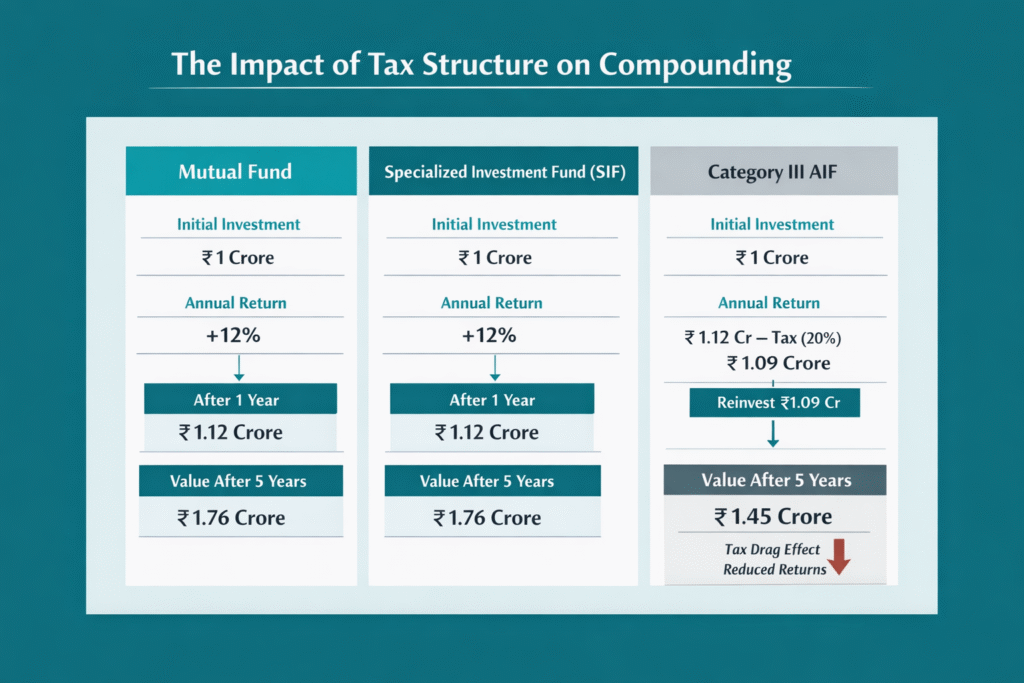
Why This Matters More Over Time
Tax drag does not hurt in a single year.
It hurts over multiple years.
Consider a high-turnover strategy generating consistent gains:
- In an AIF, taxes reduce reinvestable capital every cycle.
- In a SIF, gains remain invested until redemption.
Even small differences in reinvested capital can create meaningful divergence over 5–7 years.
Compounding magnifies structural efficiency.
Reducing Strategy Risk Without Going Solo
Another dimension often overlooked is execution risk.
Regulatory observations have consistently shown that a large majority of retail futures and options traders incur losses.
Sophisticated investors may want exposure to:
- Volatility
- Tactical positioning
- Long–short strategies
But they may not want:
- Execution mistakes
- Operational burdens
- Tax inefficiencies
- Compliance complexities
SIFs provide institutional management of complex strategies within a monitored regulatory framework.
The investor gains strategy exposure without self-trading risk or structural drag.
Why Mutual Funds Alone Weren’t Enough
Mutual funds are built for scale and retail protection.
This means:
- Derivatives largely limited to hedging frameworks
- Strict exposure caps
- Uniform mandates suitable for mass investors
Many HNIs trusted fund managers.
They simply did not want the structural limits placed on those managers.
SIFs loosen those constraints without removing oversight.
Why AIFs Alone Weren’t Optimal for Everyone
AIFs serve an important role in India’s ecosystem.
But for many HNIs:
- ₹1 crore minimums restrict allocation flexibility
- Fee structures can be layered
- Taxation can be transaction-sensitive
- Documentation and administration add friction
SIFs reduce entry barriers while maintaining sophistication.
A Signal of Ecosystem Maturity
SIFs are not startup funding vehicles.
Yet they signal something broader about India’s financial markets.
As the Securities and Exchange Board of India refines asset categories:
- Capital becomes more tax-aware
- Structures become more efficient
- Sophisticated investors receive better-aligned tools
- The gap between global and domestic frameworks narrows
For founders and executives managing post-exit wealth, this evolution matters.
It strengthens the personal wealth management ecosystem.
The Core Insight: Structure Drives Outcome
If strategy is the engine,Structure is the chassis.
Two identical strategies placed inside different regulatory and tax frameworks will not compound identically.
SIFs represent a structural evolution:
- Strategy flexibility closer to AIFs
- Tax mechanics closer to mutual funds
- Entry thresholds more accessible to sophisticated capital
They do not replace mutual funds. They do not eliminate AIFs. They fill the gap between them.
For India’s HNIs, that missing layer may be the most important addition to the investment puzzle in recent years.
]]>Plan your February filings in one place. Figures and forms are mapped for monthly GST filers, QRMP taxpayers, TDS deductors, PF and ESI registrants. Use this single-page tracker to plan all India statutory filings and deposits for February 2026.
The February 2026 Compliance Calendar provides a comprehensive, date-wise checklist of all statutory compliances applicable for the month, helping businesses stay fully compliant and audit-ready.
At a Glance:
- When is GSTR-1 due? 11 Feb 2026 for January 2026 (monthly filers); IFF for QRMP available till 13 Feb.
- When is GSTR-3B due? 20 Feb 2026 for January 2026 (monthly filers). No quarterly GSTR-3B falls in February 2026.
- When are GSTR-7 and GSTR-8 due? 10 Feb 2026 for January 2026.
- What about QRMP taxpayers? Pay tax via PMT-06 for January by 25 Feb 2026; IFF (optional) till 13 Feb 2026.
- By when to deposit TDS/TCS? 7 Feb 2026 for January deductions/collections.
- PF and ESI? Deposit January 2026 contributions by 15 Feb 2026.
- Any month-end items? Challan-cum-statements for specified TDS sections (26QB/26QC/26QD/26QE) due 28 Feb 2026; GSTR-11 for UIN holders also due 28 Feb 2026.
Who is this Calendar for
- Founders, CFOs, finance and compliance teams managing GST, TDS, PF, ESI
- MSMEs and startups on monthly GST or QRMP
- Accounting firms handling multi-client calendars across India
- Listed entities tracking SEBI timelines
- Companies with FEMA reporting (e.g., ECB)
- Private companies/LLPs tracking Companies Act filing timelines
Key Statutory Compliance Due Dates – February 2026
Here is a tabular compliance calendar for February 2026-
Compliance Calendar Table (Date-wise)
| Date | Law | Form or action | For period | Who must do this | What to do now |
|---|---|---|---|---|---|
| 7 Feb 2026 (Sat) | Income Tax | Deposit TDS / TCS | Jan 2026 | All deductors / collectors | Verify TAN, challan CIN and section mapping the same day of payment. |
| 10 Feb 2026 (Tue) | GST | GSTR 7 | Jan 2026 | GST TDS deductors | Reconcile deductee wise entries before filing. |
| 10 Feb 2026 (Tue) | GST | GSTR 8 | Jan 2026 | E-commerce operators TCS | Match tax collected with gross supplies and payouts. |
| 11 Feb 2026 (Wed) | GST | GSTR 1 monthly | Jan 2026 | Monthly GST filers | Freeze outward supplies and confirm all IRNs generated. |
| 13 Feb 2026 (Fri) | GST | IFF optional | Jan 2026 | QRMP taxpayers | Upload B2B invoices to pass ITC early to customers. |
| 13 Feb 2026 (Fri) | GST | GSTR 5 / GSTR 6 | Jan 2026 | Non-resident taxable persons / Input Service Distributors | Validate ISD credit distribution and NRP transactions. |
| 14 Feb 2026 (Sat) | Income Tax | Issue TDS certificates 194-IA 194-IB 194M 194S for Dec 2025 | Dec 2025 | Deductors for property rent professional and specified digital asset payments | Generate and deliver certificates to payees on time. |
| 15 Feb 2026 (Sun) | PF | Deposit contribution file ECR | Jan 2026 | EPFO registered employers | Because the 15th is Sunday complete bank transfers by Friday 13th. |
| 15 Feb 2026 (Sun) | ESI | Deposit contribution file return | Jan 2026 | ESIC registered employers | Reconcile gross wages and ensure portal challan success. |
| 15 Feb 2026 (Sun) | Income Tax | Form 24G | Jan 2026 | Government deductors without challan | Furnish 24G for January remittances without challan. |
| 15 Feb 2026 (Sun) | Income Tax | Quarterly TDS certificate other than salary | Oct–Dec 2025 | All deductors | Prepare and issue within the quarter close timeline. |
| 20 Feb 2026 (Fri) | GST | GSTR 3B | Jan 2026 | Monthly GST filers | Pay interest if filing late on net cash liability. |
| 20 Feb 2026 (Fri) | GST | GSTR 5A | Jan 2026 | OIDAR providers | Confirm forex conversions and place of supply. |
| 25 Feb 2026 (Wed) | GST | PMT 06 | Jan 2026 | QRMP taxpayers | Deposit January tax for QRMP to be set off in quarterly 3B. |
| 28 Feb 2026 (Sat) | Income Tax | 26QB 26QC 26QD 26QE challan-cum-statements | As applicable | Sections 194-IA 194-IB 194M 194S | File statements and align PAN property bank details. |
| 28 Feb 2026 (Sat) | GST | GSTR 11 | Jan 2026 | UIN holders claiming refund on inward supplies | File statement for inward supplies eligible for refund. |
GSTR-3B Due Date Note (State-wise / Group-wise)
For monthly filers, GSTR-3B is due on 20 Feb 2026 for January 2026.
Important: For taxpayers who file GSTR-3B based on state grouping (commonly applicable to quarterly filers in some calendars), due dates may be reflected as 22 Feb / 24 Feb depending on the prescribed group. Always verify your applicable grouping before you plan filing and payment.
Note on Professional Tax
If your state mandates monthly PT, plan it with payroll; PT dates are state specific so confirm your state’s rule before remitting.
Actionable planning checklist
Two weeks before due dates
- Lock January outward supplies and e-invoices for GSTR 1 by the 9th
- Prepare TDS payment file and bank approval workflow for 7th
- Run payroll-to-PF and payroll-to-ESI reconciliations for January
Filing week workflow
- 7th: Pay TDS TCS and verify challan on OLTAS the same day
- 10th: File GSTR 7 and GSTR 8 after cross-checking deductee and marketplace ledgers
- 11th: File GSTR 1 and circulate 2B visibility note to buyers
- 13th: Use IFF if on QRMP so customers get ITC without waiting for quarter end
- 15th: Ensure PF ECR and ESI challans are successful even though it is Sunday
- 20th: File GSTR 3B and 5A
- 25th: Generate PMT 06 for QRMP January liability
- 28th: Upload 26QB 26QC 26QD 26QE and file GSTR 11 where applicable
Corner cases to watch
- No CMP 08 or quarterly GSTR 3B falls in February 2026 for QRMP taxpayers
- Monthly due date split by groups does not apply to QRMP quarterly returns in February; treat 25 Feb PMT 06 as the QRMP obligation this month
- PF and ESI remain hard deadlines at the 15th, independent of weekends or banking cut-offs in practice, so schedule payments two days early
This calendar applies to:
- Private Limited Companies & OPCs
- Startups & MSMEs
- LLPs, Firms & Proprietorships
- GST-registered businesses
- TDS/TCS deductors
- Employers registered under PF, ESI & Professional Tax
- OIDAR service providers & non-resident taxpayers
- NBFCs and Ind-AS compliant entities
Summary of Key Forms & Their Purpose
| Form or challan | Law | Who it applies to | Purpose or description |
|---|---|---|---|
| GSTR-1 | GST | Registered taxpayers on monthly filing | Statement of outward supplies for the month; basis for recipients’ ITC. |
| IFF (Invoice Furnishing Facility) | GST | QRMP taxpayers | Optional upload of monthly B2B invoices so buyers can claim ITC before quarterly filing. |
| GSTR-3B | GST | Registered taxpayers on monthly filing | Monthly summary return with tax payment of net cash liability. |
| PMT-06 | GST | QRMP taxpayers | Monthly tax deposit for the QRMP scheme; set off in quarterly GSTR-3B. |
| GSTR-7 | GST | GST TDS deductors | Monthly return for tax deducted at source under GST. |
| GSTR-8 | GST | E-commerce operators (TCS) | Monthly return for tax collected at source by marketplaces. |
| GSTR-6 | GST | Input Service Distributors (ISD) | Monthly statement distributing eligible input tax credit to units. |
| GSTR-5 | GST | Non-resident taxable persons | Monthly GST return for NRTP transactions in India. |
| GSTR-5A | GST | OIDAR service providers (non-resident) | Monthly return for online information/database access or retrieval services supplied from outside India. |
| GSTR-11 | GST | UIN holders (embassies, UN bodies, etc.) | Statement of inward supplies to claim refund of taxes paid. |
| TDS/TCS deposit (Challan) | Income Tax | All deductors/collectors | Monthly remittance of TDS/TCS deducted/collected for the prior month. |
| Form 24G | Income Tax | Government deductors paying without challan | Monthly statement when TDS/TCS is remitted without a challan. |
| Form 16A issuance (quarterly TDS certificate) | Income Tax | All deductors | Quarterly certificate of TDS deducted on payments other than salary. |
| 26QB/26QC/26QD/26QE (challan-cum-statements) | Income Tax | Deductors under sections 194-IA, 194-IB, 194M, 194S | One-time combined payment + statement for specified TDS on property, rent, specified services, and virtual digital assets. |
| PF ECR + payment | PF | EPFO-registered employers | Electronic Challan-cum-Return and payment of PF contributions for the month. |
| ESI contribution + return | ESI | ESIC-registered employers | Monthly deposit and filing of ESI contributions for covered employees. |
Other Statutory Compliances Due in February 2026 (SEBI, FEMA, Companies Act)
SEBI (Listed Entities)
- 14 Feb 2026: Integrated Filing – Financials (Regulation 33 (3)(a) Financial Results along with Limited review report / Auditor’s report)
- 14 Feb 2026: Statement of deviation(s) or variation(s) (Regulation 32 (1))
FEMA (ECB Reporting)
- FORM ECB 2: Borrower is required to report actual ECB transaction on monthly basis through AD category I bank within 7 working days (timeline depends on the transaction date)
Companies Act, 2013
- MGT-7 / MGT-7A: Filing of Annual Return due by 28 Feb 2026 in cases where applicable timelines arise from AGM timelines (e.g., certain AGM extension cases / first AGM timelines)
Note: Corporate compliance dates can depend on entity type, listing status, and event-based triggers. Use this section as a planning cue and confirm applicability for your company.
Official portals to monitor for changes
Track any extensions or clarifications on the portals of Goods and Services Tax Network (GSTN), Income Tax Department, Employees’ Provident Fund Organisation (EPFO) and Employees’ State Insurance Corporation (ESIC). We however track all updates from these portals and keep you posted.
Treelife quick tips for February
- Build a “Friday finish” buffer: Because 15 Feb 2026 is a Sunday, complete PF/ESI transfers by Friday the 13th to avoid banking cut-offs.
- Reconcile early: Match PAN, TAN, and challans the same day you pay TDS/TCS to prevent CPC notices.
- Lock invoices by the 9th: This leaves a cushion for GSTR-1 validations and e-invoice corrections before 11 Feb.
Conclusion
February 2026 is a compliance-heavy month where planning filings in advance and maintaining accurate records can save businesses from penalties and last-minute stress.
For startups, SMEs, and growing enterprises, outsourcing compliance to experienced professionals ensures accuracy, peace of mind, and uninterrupted business growth.
Why Choose Treelife?
Treelife has been one of India’s most trusted legal and financial firms for over 10 years. We are proud to be trusted by over 1000 startups and investors for solving their problems and taking accountability.
Our team ensures:
- Zero missed deadlines
- Clean audit trails
- Investor-ready compliance
- Full statutory coverage across GST, Income Tax & MCA
Need Help with February 2026 Compliances? Let’s Talk
Overview: Why Budget 2026 Is a Structural Inflection Point
Union Budget 2026–27 signals a decisive strategic pivot: India is moving from being a consumer and services executor of global digital technologies to becoming a producer, owner, and exporter of AI-driven digital infrastructure.
Three structural themes dominate the budget’s technology agenda:
- Data centres elevated as Strategic National Infrastructure (not merely IT “support” assets).
- Artificial Intelligence operationalised as governance and productivity utility (“AI as infrastructure,” not lab experimentation).
- Long-horizon fiscal certainty anchored to 2047 designed to unlock hyperscale capital and irreversible infrastructure commitments. This is linked to Viksit Bharat @ 2027 vision of Govt. of India.
The macro logic
India currently generates ~20% of the world’s data, yet ~95% of Indian-origin data is processed or stored overseas creating security, competitiveness, latency, and economic leakage risks.
Budget 2026–27 directly targets this mismatch through tax architecture, compliance simplification, and infrastructure constraints (power, water, materials) that govern real-world feasibility.
Key numbers at a glance
- Data centre capacity: 1.5 GW installed (2025); expected to exceed ~1.7 GW by end-2026.
- India’s DC capacity footprint is concentrated across 7 major clusters: Mumbai, Chennai, Hyderabad, NCR, Bengaluru, Pune, Noida.
- Global cloud infrastructure concentration: ~63% controlled by AWS, Microsoft Azure, and Google Cloud.
- Hyperscaler announced investments in India: >$30 billion over 14 years.
- Data centre resource constraints: power is ~50% of operating cost; water consumption 150+ billion litres in 2025, projected to rise to ~358 billion litres within five years.
- Tax + compliance era shift: Income Tax Act, 2025 effective April 1, 2026, with simplification and automation.
What this means for stakeholders
- Founders: compute economics and infrastructure risk improve over time; AI-native businesses operate on nationally prioritised infrastructure (not rented policy space).
- Investors: the budget creates a long-duration compounding window, but returns will be shaped as much by power/water/material constraints as by tax incentives.
- Businesses and GCCs: India is positioned to move from execution hubs to ownership centres for mission-critical platforms, enabled by stable transfer pricing and simplified compliance.
1. Macroeconomic Baseline: The Digital State of the Nation (2025–26)
Budget 2026–27 builds on a digital economy that already has scale but is constrained by physical and regulatory dependencies.
1.1 Data centre baseline and geographic clustering
As of Q3 2025, India’s data centre capacity reached 1.5 GW, distributed primarily across seven urban clusters: Mumbai, Chennai, Hyderabad, NCR, Bengaluru, Pune, GIFT City and Noida.
Interpretation:
- Capacity clustering is a strategic advantage for connectivity and enterprise proximity, but also concentrates grid and water stress.
- Next-phase growth (toward 8–10 GW potential by 2030 referenced in the material) will likely depend on extending infrastructure corridors beyond current cluster saturation and enabling tier-1 periphery buildouts.
1.2 Sector market dynamics and scaling projections
The attached Report provides a concise sector table with market sizes, projections, and growth drivers.
Table 1: India Technology Segment Outlook
| Sector | 2025 Market Size (Estimated) | 2030–2033 Projection | Anticipated CAGR | Primary Growth Driver |
| Artificial Intelligence | $13.05B | $325.3B (by 2033) | 38.1%–39% | Social AI, Enterprise GenAI, GPU clusters |
| Cybersecurity Products | $4.46B | $6.0B (by 2026) | 25% annual | DPDP Act, AI-powered threat defense |
| Data Center Services | $3.88B | $21.03B (by 2031) | 13.59%–15.3% | Data localisation, 5G, hyperscale cloud |
| IT Spending (Total) | $159B | $176.3B (by 2026) | 10.6% | Software + data centre systems |
| SaaS Market | $15.5B | $50.0B (by 2030) | High (Trend) | AI integration, global SMB demand |
Implications for strategy:
- AI’s projected expansion is not purely a software story; it is a compute, storage, networking, and energy story.
- Cybersecurity growth is tied to enforcement readiness and DPDP-era accountability (see Section 7).
- Data centre services growth is structurally linked to tax certainty, safe harbour predictability, and physical constraints.
1.3 India’s AI talent base: scale and pressure points
India is cited as having the second-highest AI talent base globally, with 420,000+ employees in AI-specific job functions, expected to grow at ~15% CAGR till 2027, with demand rising to ~1.25 million professionals.
What this signals for businesses:
- Talent availability is a competitive edge, but the constraint shifts to “where the models run” (compute access), “how they are governed” (risk/accountability), and “how quickly deployments scale” (public utility and enterprise integration).
Founder lens (practical):
- If your product requires GPU/accelerator-intensive workloads, you should treat infrastructure access and energy resilience as core components of product viability not procurement afterthoughts.
2. Data Centres as Strategic National Infrastructure
Budget 2026–27 reframes data centres from support facilities into the foundational layer for digital architecture across sectors.
2.1 Strategic infrastructure status: why it changes the investment equation
The report explicitly positions technology infrastructure data centres, cloud platforms, cybersecurity, and digital public infrastructure on the same footing as roads, power, and logistics.
This implies:
- Longer policy horizons and lower midstream regulatory surprise
- Governance-first design expectations, including security-by-default
- A clearer path for long-duration infrastructure capital
2.2 The sovereignty gap: “India produces data, others process value”
The documents highlight a structural mismatch:
- India generates ~20% of the world’s data
- Yet ~95% of Indian-origin data is stored/processed overseas
Why it matters beyond compliance:
- Security and resilience: externalised processing increases systemic dependency risk
- Economic capture: compute and storage value accrues outside India
- Startup economics: higher latency and higher costs reduce domestic innovation efficiency
2.3 Capacity trajectory: from 1.5 GW to a multi-GW decade
Capacity snapshot:
- 1.5 GW installed (2025)
- Expected to cross ~1.7 GW by end-2026
The Report references a policy-driven expectation of capacity expansion citing a shift from ~1 GW baseline in the projection logic toward ~10 GW potential under investment attraction expectations.
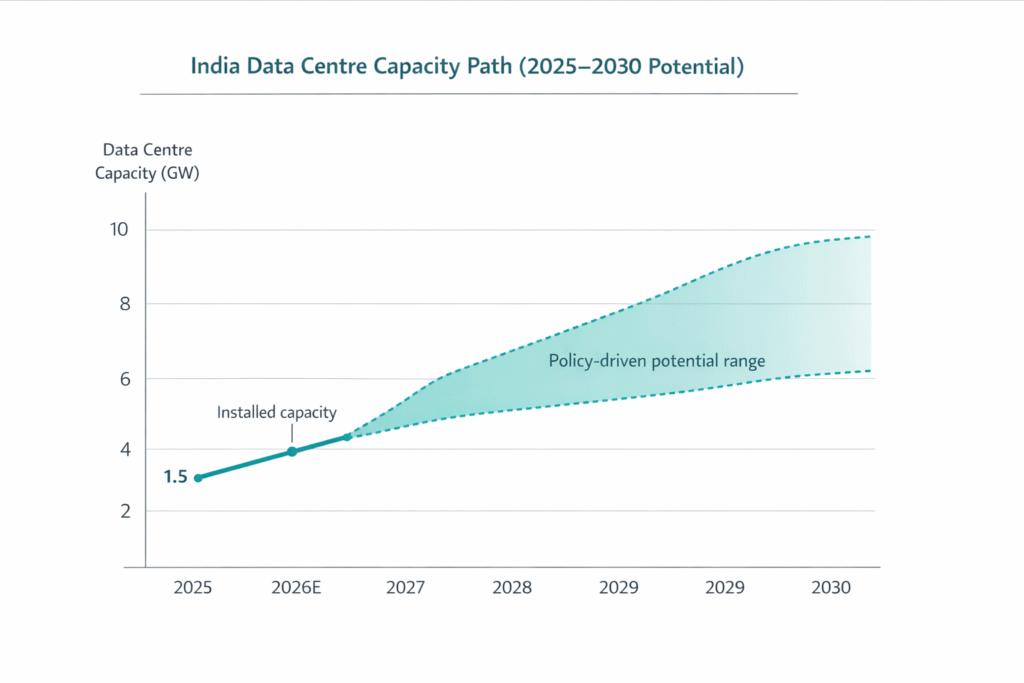
3. The 21-Year Tax Holiday Till 2047: Mechanism, Conditions, and Strategic Intent
The budget’s headline move is a 21-year tax holiday until March 31, 2047 for foreign companies providing global cloud services via India-based data centres.
3.1 What was announced
- Tax holiday applies whether the foreign firm:
- builds its own India footprint (as part of the structure), or
- procures services from an Indian data centre operator
- Mandatory routing of Indian customer services via local reseller entities.
3.2 Operating framework and eligibility conditions
The Report adds structure to eligibility, including:
- Use of “Specified Data Centers” in India, set up under an approved government scheme and notified by MeitY
- The DC must be owned and operated by an Indian company
- Indian customer services must be routed via an Indian reseller entity, taxed at 25.7% corporate tax
- Foreign entity remains asset-light and does not own/operate physical infrastructure
Table 2: 2047 Tax Holiday Qualification Checklist
| Requirement | What it means for operators | Why it exists |
| Specified DCs notified under MeitY scheme | Use approved/nominated DCs | Ensures compliance and strategic alignment |
| Indian-owned and operated DC | Physical asset anchored in India | Builds domestic infrastructure capability |
| Local Indian reseller for Indian customers | Domestic tax base preserved (25.7%) | Balances investment attraction + revenue |
| Foreign provider asset-light | Cloud provider avoids owning DC assets | Encourages rapid entry + local partnership |
3.3 Investment scale expectations referenced
Reports state an expectation to attract >$70 billion in cumulative investments over 5–7 years, potentially expanding capacity toward ~10 GW (from the baseline cited in the projection logic).
Investor interpretation:
- This is designed to compress the risk premium historically applied to India compute investments.
- However, capital deployment will still be bounded by power availability, water intensity, and supply chain constraints.
4. Safe Harbour and Transfer Pricing Predictability: De-risking Scale
Budget 2026–27 introduces a 15% cost-based safe harbour margin for Indian data centre entities providing services to related foreign companies.
4.1 The 15% data centre safe harbour
Key impact:
- Eliminates transfer pricing uncertainty
- Levels playing field between foreign-owned and Indian-promoted operators
- Encourages faster capacity expansion and pricing competitiveness
4.2 IT services safe harbour modernization and scale expansion
- IT-enabled services grouped under “Information Technology Services”
- Uniform safe harbour margin: 15.5%
- Eligibility threshold raised: ₹300 crore → ₹2,000 crore
- Automated approvals and faster APAs, with APA process concluded within two years
Table 3: Safe Harbour Reform Summary
| Element | Budget 2026–27 Change | Who benefits most |
| DC related-party services | 15% cost-based safe harbour | DC operators, foreign affiliates, infra investors |
| IT services safe harbour | Single category + 15.5% | Mid/large IT + GCC service providers |
| Threshold expansion | ₹300cr → ₹2,000cr | Scaled firms previously outside safe harbour |
| Process | Automated approvals + faster APAs | CFOs and tax teams; improves predictability |
5. Hyperscalers and India’s Emerging Role as a Global Compute Base
5.1 Global cloud concentration and India relevance
AWS, Azure, and Google Cloud control ~63% of global cloud infrastructure.
Combined announced investments in India exceeding $30 billion over 14 years.
5.2 What changes post-budget
Post-budget India becomes viable for:
- AI training
- Inference
- Cross-border workloads
- Disaster recovery zones
Strategic shift: India moves from “regional node” to “global compute base.”
5.3 Takeaway for Founders
A large share of startup unit economics especially in AI-native businesses depends on compute price stability, predictable data localisation, and scalable infrastructure access.
Budget-induced implications:
- Compute cost curve: medium-term improvement as capacity expands and policy risk declines.
- Market access: globally competitive backend capability enables Indian companies to build for cross-border compute use-cases.
5.4 Takeaway for Investors
The structural opportunity is not only in DC real estate, but in:
- power/cooling innovation
- grid storage and renewable PPAs
- optical networking and transceivers
- cybersecurity governance tools
- semiconductor equipment/materials
6. AI: From Innovation Narrative to Governance Utility
Budget 2026–27 reframes AI as a general-purpose governance and productivity engine a “utility layer,” not a lab experiment.
6.1 “Social AI” and flagship implementation: Bharat-VISTAAR
Bharat-VISTAAR is presented as a multilingual AI integrating AgriStack with ICAR data for farmer advisories.
Why this is strategically meaningful:
- It signals AI deployment at population scale
- It implies that success metrics are operational: accuracy, latency, governance, and trust, not novelty
6.2 AI as a governance engine: applied deployments
The AI-driven use-cases including:
- worker-job matching
- container risk scanning at ports
- assistive devices under Divyang Sahara Yojana
- phased expansion of non-intrusive scanning using advanced AI technology across major ports, targeting 100% container scanning to improve risk assessment and reduce dwell time.
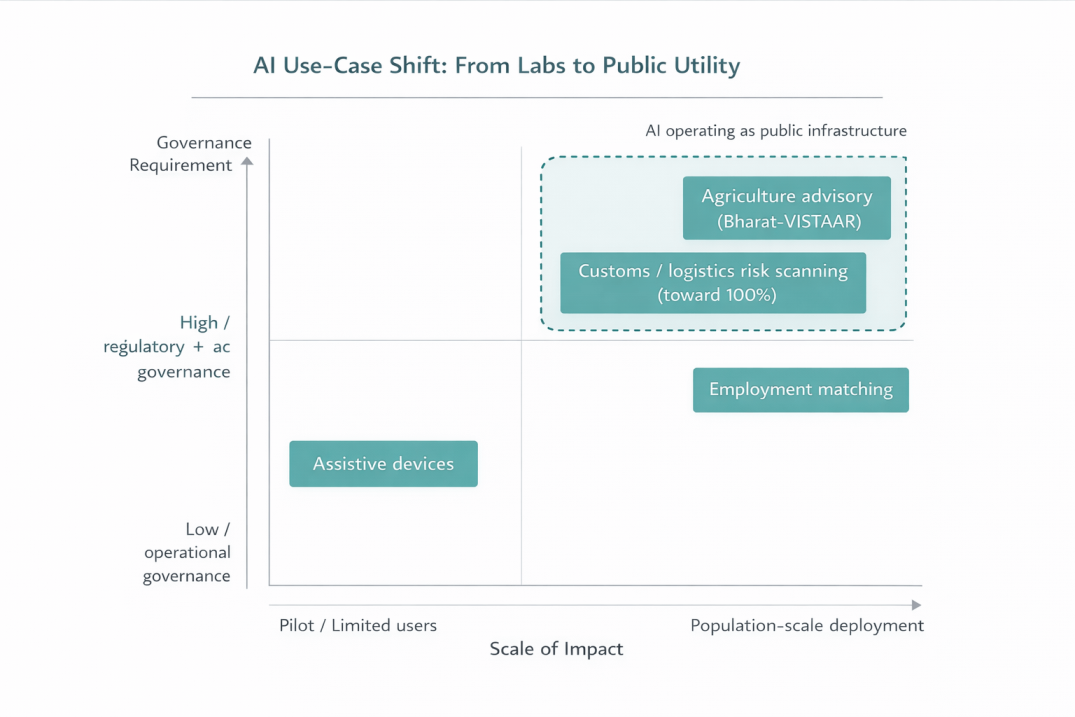
6.3 AI market expansion and compute dependency
AI market scaling cited in the sector outlook table $13.05B (2025) to $325.3B (by 2033) with ~38–39% CAGR implies enormous compute scaling, tightening the coupling between AI growth and data centre buildout, power availability, and cooling innovation.
7. Cybersecurity: From Compliance to Decision-Grade Governance
Budget 2026–27 embeds cybersecurity into digital governance, shifting from compliance checklists to continuous, decision-grade visibility and accountability.
7.1 Structural shift in operating model
- periodic audits → continuous visibility
- checklists → impact/exposure insight
- compliance → accountability
- cybersecurity becomes board-level decision input
7.2 Market growth and enforcement readiness
Growth projected as below:
- cybersecurity product market projected to reach $6B by 2026 (from $4.46B baseline)
- Data Protection Board allocation increased fivefold to ₹10 crore, signalling movement from legislation toward enforcement and adjudication
- AI-driven cyberattacks cited as rising, with projected global losses of $18.6B by end-2025 (threat context)
Table 4: Cybersecurity Shift Governance Implications
| Dimension | Legacy posture | Budget-era posture |
| Visibility | Periodic assessment | Continuous risk visibility |
| Objective | Compliance | Exposure reduction + accountability |
| Stakeholder | IT/security team | Board + business leadership |
| Driver | Audit cycles | DPDP enforcement + AI threat evolution |
8. Infrastructure Nexus: Energy, Water, Cooling, Materials, and Real Estate
The budget recognizes that compute sovereignty cannot be achieved through tax provisions alone; it must be executed through the physical layer.
8.1 Power: the dominant operating constraint
- Power accounts for ~50% of data centre operating cost
- Data centres may consume ~2% of total electricity supply
- Data centres are expected to consume ~3% of India’s national power supply by 2030, up from less than 1% currently.
8.2 Nuclear + renewables + storage: policy measures cited
Key measures described include:
- customs duty exemption for nuclear power equipment till 2035
- solar allocation increased 32% to ₹30,539 crore
- duty exemptions on capital goods for BESS cell manufacturing, plus ₹10,000 crore allocation strengthening container manufacturing, supporting modular BESS and edge DC solutions
Investor implication:
The investable universe expands from DC shells into integrated energy + compute platforms: PPAs, grid storage, modular edge units, and cooling innovation.
8.3 Water and cooling: the hidden bottleneck
- Data centres consumed 150+ billion litres of water in 2025
- Projected to reach 358 billion litres within five years
- cooling can account for nearly 40% of total energy use
- a 1 MW data centre consumes roughly 26 million liters of water annually
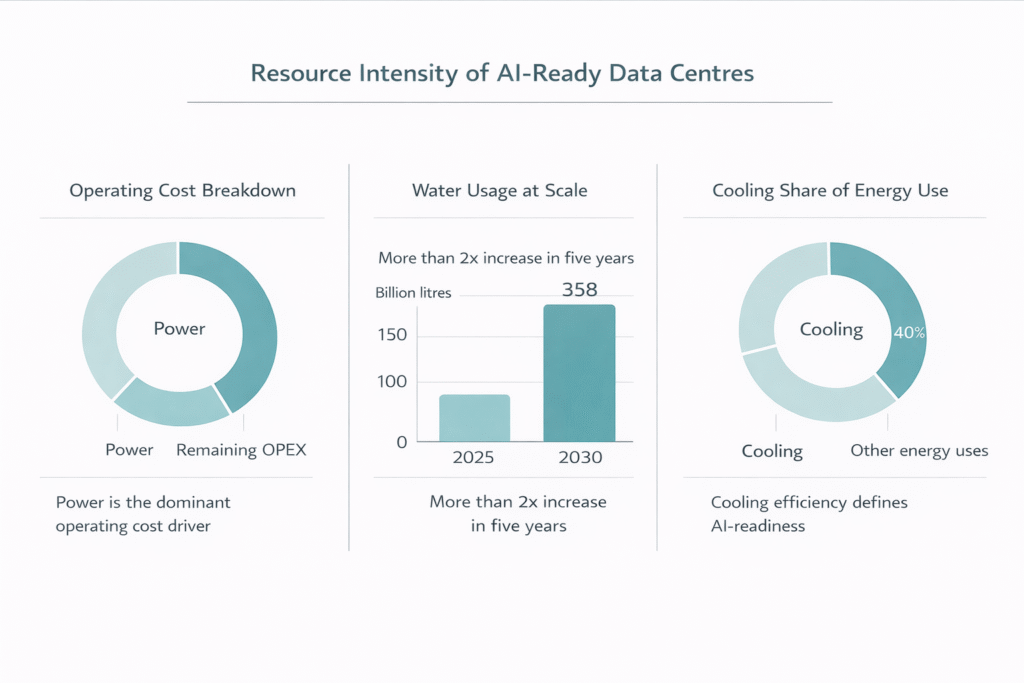
8.4 Materials and real estate: secondary constraints that become primary at scale
Table 5: Materials and Real Estate Demand Linked to DC Expansion
| Material/Resource | Projected Demand/Impact | Strategic relevance |
| Copper | 330,000–420,000 tonnes annually by 2030 | Supply constraint; 5x–6x higher than standard buildings |
| Fiber optic cable | 36x higher demand for AI clusters | Transceivers + optical networking boom |
| Real estate | 50–55 million sq ft by 2030 | Shift toward tier-1 peripheries + dedicated tech parks |
| Power consumption | ~3% of national grid by 2030 | Renewable PPAs + industrial grid storage opportunity |
9. Semiconductors & ISM 2.0: Owning the Physical AI Stack
Budget 2026–27 strengthens the thesis that AI sovereignty is not only about models; it is about compute, storage, and hardware control.
9.1 ISM 2.0 direction of travel
ISM 2.0 is positioned as moving beyond assembly toward:
- equipment manufacturing
- materials
- full-stack Indian IP
9.2 Outlay and strategic intent
The Electronic Component Scheme outlay is cited as increased to ₹40,000 crore.
Investor lens:
The opportunity is not limited to fabs; it includes equipment, materials, and supply chain resilience layers that reduce exposure to global disruptions.
10. IT & GCC Ecosystem: Moving Up the Value Chain
Budget 2026–27 includes reforms that encourage India’s IT sector and GCC ecosystem to evolve from execution to ownership design, build, run, and govern mission-critical platforms globally.
10.1 IT service classification and safe harbour coherence
The data states:
- all IT-enabled services grouped under “Information Technology Services”
- common safe harbour: 15.5%
- threshold raised: ₹300 crore to ₹2,000 crore
- automated approvals + faster APAs
10.2 GCC implication
GCCs increasingly become:
- product and platform ownership centres
- deep-tech and R&D nodes
- operational governance hubs for global infrastructure
Business takeaway:
For multinationals, India’s positioning becomes less “cost centre” and more “operational command centre,” supported by regulatory simplification and tax predictability.
11. Talent Mobility & Global Expertise: Attracting Specialists and Cleaning Legacy Compliance
Budget 2026–27 introduces targeted measures to attract global expertise and remove friction for returning Indians and non-resident professionals.
11.1 Global Talent Exemption (5-year overseas income exemption)
Non-resident professionals relocating to India under government-notified schemes receive:
- five-year tax exemption on income earned outside India
- eligibility condition: must have been non-resident for five consecutive tax years preceding arrival
11.2 FAST-DS 2026 (Foreign Asset Disclosure Scheme)
The Report describes:
- a six-month window allowing voluntary disclosure of previously unreported foreign assets
- thresholds referenced: up to ₹1 crore or ₹5 crore (category dependent)
- payment: 30% tax + 30% additional tax (in lieu of penalty), with immunity from criminal prosecution
This is positioned as a mechanism to clean up legacy compliance issues tied to foreign bank accounts, RSUs, ETFs, and other overseas holdings.
12. Startups, MSMEs, and the “Champion” Manufacturing Pivot
Budget 2026–27 signals a deliberate shift toward manufacturing-led entrepreneurship and scalable, compliance-forward MSMEs.
12.1 Capital allocation and intent
The Report references:
- approximately ₹32,000 crore allocated for the startup and small business sector
12.2 The ₹10,000 crore SME Growth Fund (equity-first intervention)
This fund is presented as a move from credit-heavy interventions to equity and structured support:
- objective: identify and nurture “future champions” capable of global competition
- nature of capital: longer-tenure funding, flexible repayment, plus mentoring and governance advisory
- “champion status”: preferential access linked to compliance standards and growth potential
12.3 Funding pipeline via SIDBI-anchored routes
The Report lists three primary entry routes:
- SIDBI-anchored VC funds
- sector-focused venture funds (manufacturing, agribusiness, clean technology)
- structured debt or quasi-equity for asset-heavy MSMEs with predictable cash flows
12.4 Startup tax holiday extension (Section 80-IAC)
The report notes:
- Section 80-IAC tax holiday (100% deduction for 3 years) extended to entities incorporated until March 31, 2030
This functions as a financial cushion during formative years, but it is most valuable when paired with improved compute access, governance readiness, and scalable infrastructure.
13. Comparative Analysis: India as an Emerging Regional Powerhouse (vs Malaysia, Vietnam, Japan)
13.1 Cost and yield dynamics
India’s development costs for data centres are stated as:
- 40–50% lower per MW compared with the US
- up to 60% cheaper than Japan
Power costs are cited as 30–40% cheaper than mature markets due to high renewable components.
13.2 Incentives, stability, and renewable headroom
The report provides comparative indicators, including:
- India’s primary incentive: 21-year tax holiday
- renewable headroom advantage: “substantial headroom” referenced
- competitor markets facing tighter renewable output growth vs demand
Table 6: Regional Competitive Snapshot
| Metric | India (2026) | Malaysia (Johor) | Vietnam | Japan |
| Primary tax incentive | 21-year tax holiday | 5–10 year ITA/PS | Effective ~1% tax | Limited |
| Yield on cost | Moderate (7–8% cap rate) | ~6–7% | High (17.5–18.8%) | Moderate |
| Renewable capacity | High headroom (10% demand headroom) | Tight supply (grid pressure) | 30% pledges | Transitioning |
| Regulatory stability | New IT Act 2025 | Established | Evolving | High |
| Digital sovereignty stance | Strong Data-in-India focus | Emerging | Emerging | Moderate |
14. “What India Is Set to Witness”: Five Major Transformations
This hereby frames the budget as catalysing a “re-contracting” between the state and the technology ecosystem.
14.1 The “Orange Economy” (AVGC) as a strategic employment engine
The report cites:
- 15,000 secondary school labs and 500 college creator labs
- industry projected to require ~2 million professionals by 2030
Business opportunity implication:
This creates structured pipeline conditions for:
- creative tech tooling
- immersive storytelling platforms
- gaming and real-time engines
- creator economy infrastructure
14.2 Transition from assembling to owning the stack
ISM 2.0 plus the 2047 horizon signals India is building for the next quarter century moving from service destination to “intelligence engine room” framing.
14.3 Integrated energy–digital infrastructure
Future infrastructure will integrate:
- dedicated power corridors
- BESS systems
- modular containerised facilities
enabling rapid “edge” DC deployment closer to point-of-use.
14.4 Precision logistics and AI-managed trade
AI-powered scanning expansion targets full container scanning across major ports, with implications for logistics costs, risk, dwell times, and export competitiveness for “Champion MSMEs.”
14.5 GIFT City as a global financial hub
The report cites:
- tax holiday extension for IFSC units to 20 consecutive years
- positioning GIFT City as an alternative to Singapore and Hong Kong for aircraft leasing, treasury centres, and international banking units.
15. Investor Lens: Where Capital Will Flow (2026–2047)
The data sources provide a clear investor framing of high-conviction themes.
15.1 High-conviction themes (as stated)
- hyperscale and edge data centres
- power and cooling innovation
- AI infrastructure platforms
- cybersecurity governance tools
- semiconductor equipment and materials
- GCC-led deep-tech R&D
15.2 Why the opportunity is durable
- 2047 fiscal horizon
- multi-party policy continuity positioning
- infrastructure-led strategy (not incentive-only)
15.3 Risk pricing: what investors must model explicitly
The data sources collectively signal that investors must price “infrastructure externalities,” not just tax benefits.
Key risk variables:
- grid availability and reliability
- energy cost volatility and PPA structure
- water access and cooling tech maturity
- materials supply (copper, optical)
- compliance enforcement trajectory (DPDP + cybersecurity governance)
- execution capability for MeitY-notified “specified DC” frameworks
16. Final Synthesis: India’s New Digital Contract (Founders • Businesses • Investors)
Budget 2026–27 functions as a declaration of intent and a scaffolding for execution:
- Data is a strategic asset
- AI is national infrastructure
- Cloud is sovereign capability
- Technology is no longer optional policy it is the growth substrate
Action implications by stakeholder
For founders
Prioritise opportunities where budget architecture reduces structural friction:
- AI-native products that benefit from domestic compute expansion
- governance-first solutions (cybersecurity, DPDP-ready architectures)
- power/cooling/water efficiency tooling for DC ecosystems
- B2G and infrastructure-aligned platforms that ride population-scale utility deployments
Founder operating principle: build on nationally prioritised infrastructure with security and governance baked in not bolted on later.
For business owners and GCC leaders
Use the tax and compliance simplification to accelerate structural upgrades:
- adopt continuous risk governance models for cybersecurity
- redesign data architectures for sovereignty and resilience
- treat AI governance and security as board-level capability
- leverage safe harbour certainty to expand global delivery ownership
For investors
The compounding window is real, but returns will favour players that integrate policy advantage with physical execution:
- DC + energy-integrated platforms
- sustainable cooling and water resilience stacks
- semiconductor equipment/material ecosystems
- governance-grade cybersecurity and compliance tooling
- long-duration infra capital aligned to 2047 certainty
References:
- https://www.pwc.in/budget/union-budget-2026.html
- https://www.financialexpress.com/money/your-income-tax-this-year-will-still-be-assessed-under-old-rules-despite-new-law-coming-from-april-1-4131064/
- https://www.marknteladvisors.com/research-library/india-data-center-market.html
- https://www.businesstoday.in/technology/news/story/economic-survey-2026-projects-indias-data-centre-boom-to-8-gw-by-2030-513504-2026-01-29
- https://www.ipsr.org/blog/indian-it-industry-heads-to-350-billion-by-2025-nasscom
- https://www.einpresswire.com/article/889295838/india-data-center-market-size-to-hit-usd-21-03-bn-by-2031-growth-concentrated-in-mumbai-noida-chennai-and-bengaluru
- https://economictimes.indiatimes.com/news/india/digital-infra-emerges-as-indias-defining-opportunity/articleshow/128082630.cms
- https://www.fortunebusinessinsights.com/india-artificial-intelligence-market-113969
- https://www.grandviewresearch.com/horizon/outlook/artificial-intelligence-market/india
- https://economictimes.indiatimes.com/tech/technology/cybersecurity-product-companies-revenue-to-reach-6-billion-by-2026-dsci/articleshow/125761300.cms
- https://www.ibef.org/news/india-s-it-spending-to-hit-us-176-billion-in-2026-on-data-centre-ai-boom-gartner
- https://www.aninews.in/news/business/as-ai-reshapes-indian-business-iim-raipur-launches-ai-integrated-advanced-general-management-programme20260209111834
- https://www.resiindia.org/post/billions-in-investments-emerging-projects-and-policy-pathways-for-economic-growth-in-india-s-data
- https://www.india-briefing.com/news/india-union-budget-2026-cloud-data-centers-tax-incentives-42311.html/
- https://www.thehindu.com/business/budget/budget-2026-government-to-provide-tax-holiday-for-foreign-companies-offering-cloud-services-using-india-datacentres/article70577258.ece
- https://economictimes.indiatimes.com/tech/technology/foreign-cloud-companies-will-get-20-year-tax-rebate-but-conditions-apply/articleshow/127918162.cms
Proposed amendments to the LLP Act, 2008 signal a policy push to allow more Alternative Investment Funds to operate through LLP vehicles instead of trusts. The objective is to simplify compliance, clarify liability frameworks and make Indian fund structures more familiar to global institutional investors, thereby supporting fundraising at scale. The timing is significant. India’s AIF ecosystem has grown rapidly, with ₹15.74 trillion in commitments as of December 2025, growing at about 20 percent year on year, ₹6.45 trillion already invested with 27 percent year on year growth, and an estimated 30 percent CAGR since March 2019. At this pace, the industry is widely projected to approach ₹100 lakh crore by 2030. Against this backdrop, structural inefficiencies in fund vehicles have become more visible, especially for managers targeting offshore capital.
From a structuring perspective, LLPs offer statutory limited liability, clearer governance and closer alignment with global LP or LLP fund models. Trusts, which currently dominate the market, are faster to set up and offer higher investor privacy, but rely heavily on bespoke trust deeds and do not provide the same level of liability ring fencing under statute. The proposed LLP Act tweaks are therefore aimed at rebalancing this trade-off, particularly for institutional and cross-border capital.
Core policy intent behind Limited Liability partnership Act tweaks
- Enable LLPs to be used more seamlessly for AIF pooling and fund operations
- Reduce structural friction compared to trust-based fund documentation
- Clarify limited liability for investors and designated partners
- Standardise governance, roles and decision rights within the LLP framework
- Simplify partner admission and exit to support secondary transfers and GP commitments
- Improve global investor comfort by aligning with widely used LP or LLP fund structures
Market context driving the changes
| Metric | Value | Period |
| AIF commitments | ₹15.74 trillion | Dec 2025 |
| Investments | ₹6.45 trillion | Dec 2025 |
| Commitments growth | ~20 percent YoY | Dec 2025 |
| Investments growth | 27 percent YoY | Dec 2025 |
| Commitments CAGR | ~30 percent | Since Mar 2019 |
| Industry trajectory | Toward ₹100 lakh crore | By 2030 |
Trust AIF vs LLP AIF trade-off
| Dimension | Trust AIF | LLP AIF post-tweak intent |
| Investor liability | Not expressly ring fenced under trust law | Limited liability inherent to partners |
| Governance | Flexible, deed driven | Roles and duties codified in statute |
| Setup speed | Typically faster | More upfront process, offset by clarity |
| Transparency | Higher investor privacy | Greater public filings and comparability |
| Global alignment | Limited | High, aligned with LP or LLP markets |
What is changing in the LLP Act for AIFs?
At a post-Budget interaction, Anuradha Thakur (Secretary (DEA), Department of Economic Affairs, Ministry of Finance) indicated that the government is actively considering amendments to the LLP Act, 2008 to better align LLP structures with the functional and regulatory needs of AIFs. The intent is not to replace existing trust structures but to provide a credible, institution-friendly alternative that works at scale.
Likely areas of change
- Removal of structural frictions that currently limit LLP usage for AIFs
- Simplified and standardised processes for partner admission and exit
- Clear statutory recognition of limited liability for fund investors
- Codification of governance roles such as designated partners and decision-making bodies
- Structural alignment with globally recognised fund partnership models to enable foreign inflows
What this means in practice
| Area | Current position | Post-tweak direction |
| Investor liability | Largely contractual under trust deeds | Statutorily limited under LLP framework |
| Governance | Heavily customised documentation | Defined roles and decision rights |
| Onboarding and exit | Bespoke and time-intensive | Standardised partner pathways |
| Cross-border fundraising | Wrapper less familiar to some LPs | Structure closer to global norms |
Industry and regulatory outlook
Industry participants, including leadership associated with IVCA and Gaja Capital, have emphasised the need for flexibility within a robust regulatory framework, balancing ease of fundraising with strong compliance standards. From a regulatory standpoint, the evolution of LLP-based AIF structures will be shaped primarily by Ministry of Corporate Affairs, which oversees LLP legislation, and Securities and Exchange Board of India, which continues to govern AIF operations, disclosures and investor protection.
Why do LLP Act changes matter for AIF structures?
Fundraising and LP comfort
- LLPs closely resemble globally accepted LP or LLP fund structures used by institutional investors
- Greater structural familiarity reduces friction for offshore LPs during diligence and onboarding
- Improved comfort can directly support cross-border commitments, especially from pension funds, sovereign funds and global asset managers
- This is critical in a market that has already reached ₹15.74 trillion in AIF commitments and is projected to scale sharply toward ₹100 lakh crore by 2030
Governance and liability clarity
- LLPs statutorily codify limited liability for partners, unlike trust-based AIFs that rely heavily on contractual protections
- Clear definition of designated partners and decision-making roles improves accountability and oversight
- Reduced ambiguity around liability helps lower perceived tail risk for institutional LPs
- Stronger governance frameworks align better with global fund governance expectations
Operational efficiency and lifecycle management
- Potential simplification of partner admission and exit processes lowers friction in fund lifecycle events
- Easier onboarding and exit supports secondary LP transfers and GP commitment restructuring
- Standardised LLP documentation can reduce bespoke drafting and negotiation time compared to trust deeds
- Over time, this can improve fund agility without materially increasing regulatory burden
AIF Trusts vs LLPs – structural comparison
Tabular overview
| Dimension | Trust-AIF (status quo) | LLP-AIF (post-tweak intent) |
| Investor liability | Not expressly codified under Indian Trusts Act, 1882 | Limited liability inherent to partners |
| Market share today | ~97% of AIFs use trusts | Tweaks expected to unlock LLP adoption |
| Transparency | Higher privacy for beneficiaries | Depends on the amendments to be made under LLP Act |
| Formation and operations | Favoured for speed with flexible deeds | Clear partner roles with easier admission and exit |
| Global alignment | More aligned to estate or planning uses | Closer to Delaware-style LP and UK LLP norms |
How big is the market size affected?
Tabular overview
| Metric | Value | Period/Note |
| Commitments | ₹15.74 trillion | Dec 2025, ~20% YoY |
| Investments | ₹6.45 trillion | Dec 2025, 27% YoY |
| Commitments CAGR | ~30% | Since Mar 2019 |
| 2030 outlook | ₹100 lakh crore | Industry projection |
Impact Analysis
- The addressable pool is large and accelerating, so vehicle efficiency has outsized effects on fundraising and deployment velocity.
- Even small reductions in structural friction can unlock meaningful capital, especially from cross-border LPs.
- Policy clarity now influences how quickly managers scale strategies across Category I, II and III.
SEBI rulebook if vehicles shift to LLP
Operating perimeter remains constant
- The AIF Master Circular applies irrespective of trust or LLP wrapper.
- Core obligations continue: Private Placement Memorandum standards, valuation methodology, performance benchmarking, reporting cadence, audit and investor disclosures.
- Managers should map LLP governance to existing requirements and maintain alignment with the encumbrance framework where applicable.
- Expect no relaxation on compliance intensity simply by switching vehicles. The shift is about structural clarity, not lighter regulation.
Tax lens if AIFs move to LLP
Current vs intended treatment
- Today under trust-based AIFs, in the case of Category I and Category-II AIF, income is generally taxed in the hands of investors with withholding at the fund level according to prevailing provisions.
- The LLP pathway aims to preserve single-layer taxation, retain character look-through and provide clarity on whether LLP interests are treated as unit equivalent for withholding and reporting.
Manager actions
- Build side-by-side models for distributions and withholding across trust and LLP options, including domestic and foreign LP profiles.
- Test capital gains, interest and dividend streams for character retention and timing differences.
- Recheck treaty access, filing workflows and investor statements to avoid leakage or compliance gaps.
- Align waterfall mechanics and partner admission or exit procedures with the intended tax outcomes.
Category-wise impact (Cat I, Cat II & Cat III)
Strategy bucket
| AIF Category | Upside from LLP Act tweaks | Key watch-outs |
| Cat I (VC, SME, Infra) | Cleaner co-invest structures and LLP-SPVs; easier integration with encumbrance frameworks for security packages | Reduced privacy due to partner disclosures; align carry terms and Investment Committee design |
| Cat II (Private equity, credit) | Greater familiarity for foreign LPs; clearer liability ring-fence; smoother secondary transfers of LP interests | Maintain tax parity with trust pass-through and withholding mechanics |
| Cat III (Hedge, long-short) | Operational clarity for prime broker documentation and margining workflows | Conformity with leverage limits and encumbrance norms; controls for frequent partner turnover |
What managers should action
- Map fund documentation to LLP governance so secondaries and co-invests move with fewer bespoke amendments
- Pre-test withholding and investor reporting to preserve look-through outcomes alongside operational changes
- Build playbooks for partner onboarding and exits that meet Category-specific constraints on leverage, pledges and disclosures
Decision checks before choosing the offshore–onshore route
| Checkpoint | Considerations |
| Target LP profile | Institutional or cross-border LPs tilt toward LLP familiarity |
| Asset class and leverage | Category III leverage and encumbrance rules may drive wrapper and SPV design |
| Tax residence and control | Treaty use, POEM risk and manager location determine the optimal stack |
| Lifecycle events | Ease of secondary LP transfers, co-invests and GP commitment adjustments under LLP pathways |
Operating notes
- Standardise partner admission and exit templates across IFSC and onshore entities
- Align disclosure thresholds so investor privacy expectations and statutory filings are balanced across jurisdictions
- Pre-clear bank, broker and custodian documentation to ensure a consistent approach to pledges, margin and security creation across the stack
For managers evaluating an LLP shift, the priority is disciplined execution: map fund documents to current AIF requirements across PPM, valuation, benchmarking and reporting cadence, clarify the split between the Investment Committee and designated partners to prevent governance ambiguity and shadow director exposure, run side-by-side cash flow and withholding models for trust versus LLP while testing treaty access and investor profiles such as FPI, FVCI and HNI, and align privacy expectations with anchor investors since LLP filings are inherently more public than trust beneficiary records.
If the LLP Act is refined to support AIF use, India gains a fund wrapper that pairs statutory liability protection with institution-grade governance and familiar global norms, improving the odds of deeper cross-border participation as the market scales. Success will hinge on execution details across legislation, tax parity and operating rules. Teams that standardise governance, model cash flows and withholding outcomes, and communicate disclosure expectations clearly will be best placed to convert structural clarity into faster fundraising, smoother secondaries and more resilient fund operations.
]]>India is entering a decisive phase of direct tax reform with the Income-tax Act, 2025 scheduled to come into force from 1 April 2026. To operationalize the new Act, the Central Board of Direct Taxes has issued the Draft Income-tax Rules, 2026 along with revised income-tax forms for public consultation. The consultation window remains open for 15 days and closes on 22 February 2026.
The Draft Income-tax Rules, 2026 are not merely procedural supplements. They form the operational framework that determines how the new law will be applied in practice. From return filing and verification to certifications, disclosures, and administrative processes, the draft rules define the compliance experience under the new tax regime.
Purpose of releasing the draft rules
The draft rules have been released with clearly defined objectives:
- to translate the Income-tax Act, 2025 into executable procedures
- to provide early operational clarity to taxpayers and professionals
- to enable stakeholder participation before final notification
- to reduce transition-related friction by identifying implementation gaps early
This approach reflects a deliberate move toward consultative and transparent tax governance.
How the Draft Income-tax Rules, 2026 Impact Significantly
The Draft Income-tax Rules, 2026 play a decisive role because they determine how statutory provisions are interpreted and applied. While the Act lays down principles, the rules govern execution, compliance mechanics, and administrative discipline.
Alignment with the New Income-tax Act, 2025
The draft rules are closely aligned with the reform objectives of the new Act, particularly simplification and predictability. The drafting approach reflects:
- simplified and clearer statutory language
- structured presentation through tables and standardized formats
- reduced reliance on explanatory narrative text
- elimination of interpretational overlap across provisions
This alignment ensures consistency between legislative intent and administrative execution.
Structural upgrades overview
| Focus Area | Outcome |
| Language clarity | Easier interpretation and lower dispute risk |
| Modern structure | Logical sequencing and standardized layouts |
| Redundancy removal | Obsolete and overlapping provisions eliminated |
Collectively, these upgrades support a cleaner, technology-ready compliance framework.
Participatory Governance and Public Consultation
The Draft Income-tax Rules, 2026 are issued as part of a participatory rulemaking process. CBDT has explicitly invited feedback from taxpayers, professionals, industry bodies, and other stakeholders to improve clarity and implementation feasibility.
Key features of the consultation process
The consultation framework has been designed to be structured and outcome-driven:
- digital submission through the e-filing portal
- OTP-based verification to ensure authenticity
- rule-wise and form-wise feedback capture
- classification of suggestions into intent-based categories
This structure enables focused review and minimizes generic or non-actionable inputs.
Major Structural Changes: Rules and Forms Overhaul
The Draft Income-tax Rules, 2026 introduce one of the most extensive restructurings of India’s tax compliance architecture since the Income-tax Rules, 1962.
Reduction in Total Rules and Forms
| Category | Earlier Framework (1962 Rules) | Draft 2026 Rules | Percent Reduction |
| Total Rules | 511 | 333 | Approximately 35 percent |
| Total Forms | 399 | 190 | Approximately 52 percent |
The reduction is significant and reflects a conscious policy shift toward rationalization rather than incremental amendment.
What Enabled This Rationalisation
The reduction in volume has been achieved through multiple design interventions:
- consolidation of multiple rules governing similar subject matter
- removal of provisions no longer relevant in a digital environment
- simplification of drafting to reduce cross-referencing
- replacement of narrative explanations with structured tables and formulas
Policy Intent Behind the Overhaul
The underlying policy objectives include:
- lowering compliance burden without diluting controls
- reducing ambiguity that often leads to litigation
- aligning procedural rules with centralized and faceless tax systems
- improving administrative efficiency and predictability
Smarter, Technology-Enabled Income-tax Forms
Introduction of Smart Forms
A key feature of the Draft Income-tax Rules, 2026 is the introduction of smart income-tax forms. These forms are designed as system-driven compliance tools rather than static reporting documents.
Key upgrades in form design
The proposed forms incorporate several technology-enabled features:
- automated reconciliation across interconnected fields
- prefilled data using system-available information
- standardized common sections to avoid repeated disclosures
- simplified instructions and notes for user clarity
- compatibility with centralized processing and verification systems
Expected Benefits
For individual taxpayers
- cleaner prefilled returns
- reduced manual data entry
- fewer mismatches and validation errors
- faster processing and reduced follow-up queries
For businesses and professionals
- lower documentation and reconciliation effort
- improved consistency in disclosures
- faster assessments due to standardized data
- reduced compliance risk from inadvertent errors
Navigate taxation complexities for your startup Let’s Talk
Key Policy Shifts and Notable Rationalisations
Simplification of Rules and Language
The draft rules adopt a uniform drafting style with clearer definitions and consistent terminology. Structured layouts replace dense legal text, making provisions easier to interpret and apply.
Clean-up of Outdated or Irrelevant Provisions
Several legacy thresholds and procedures that no longer reflect current economic or administrative realities have been rationalized. This ensures that compliance requirements remain proportionate and relevant.
Revised Definition of Accountant
| Requirement | Updated Threshold |
| Minimum experience | 10 years |
| Annual receipts (individual) | More than 50 lakh rupees |
| Annual receipts (partnership firm) | More than 3 crore rupees |
The revised definition strengthens professional accountability and aims to improve the quality of certifications under the tax framework.
Stakeholder Consultation Process: How Inputs Can Be Submitted
Online Portal Details
Stakeholders can submit feedback through the e-filing portal using OTP-based verification. Each submission must clearly identify:
- the relevant rule or sub-rule
- the applicable form number, where relevant
- the specific issue or suggestion
This precision improves the usability of feedback during rule finalization.
Four Categories of Feedback
Feedback is requested under four structured categories:
- simplified and clearer statutory language
- minimization of litigation and interpretational disputes
- reduction of compliance burden
- identification of redundant or outdated rules and forms
Mapping Navigators Released
CBDT has issued mapping navigators that link the existing rules and forms with their proposed counterparts. These tools help stakeholders understand restructuring and assess practical impact more efficiently.
Implications for Taxpayers and Corporates
For individual taxpayers, the draft rules promise:
- simplified procedural requirements
- smart prefilled returns
- clearer thresholds and definitions
- reduced physical interaction with tax authorities
For corporates and professionals, the implications include:
- standardized documentation formats
- lower interpretational ambiguity
- reduced litigation exposure
- improved compliance predictability and planning certainty
Comparative Snapshot: 1962 Rules vs 2026 Draft Rules
| Parameter | 1962 Rules | Draft 2026 Rules | Change Highlight |
| Total Rules | 511 | 333 | Consolidation and rationalisation |
| Total Forms | 399 | 190 | Significant reduction |
| Language Style | Dense legal drafting | Simplified modern language | Improved clarity |
| Technology Use | Limited | Smart forms and automation | Digital-first design |
| Public Consultation | Minimal | Structured and integrated | Strong participatory approach |
Expected Impact on Compliance, Litigation and Tax Governance
Improved Ease of Doing Business
Standardized procedures and automation are expected to reduce turnaround time, compliance costs, and administrative friction.
Reduction in Litigation
Clearer drafting, defined thresholds, and removal of obsolete provisions reduce ambiguity, which is a primary driver of tax disputes.
Better Taxpayer Services
Smart forms and centralized processing improve accuracy, consistency, and user experience, strengthening trust in the tax system.
Transition Timeline and What Happens Next
| Event | Date |
| Stakeholder feedback portal activated | 4 February 2026 |
| Public consultation window closes | 22 February 2026 |
| Income-tax Act, 2025 effective date | 1 April 2026 |
Next Steps
CBDT is expected to review stakeholder feedback and notify the final Income-tax Rules, 2026 along with corresponding forms. Taxpayers and professionals should prepare for revised workflows, system updates, and transitional guidance.
Expert Commentary and Industry Reactions
Early expert commentary generally views the Draft Income-tax Rules, 2026 as a long-overdue structural reform. Tax professionals have highlighted the reduction in rules and forms as a meaningful step toward lowering procedural complexity and compliance fatigue.
Industry observers have particularly noted the following themes:
- appreciation for simplified drafting and structured formats
- positive response to smart forms and automated reconciliation
- expectation of reduced litigation due to clearer definitions
- support for the consultative approach adopted by CBDT
From a governance perspective, experts consider the structured feedback mechanism and mapping navigators as tools that improve transparency and implementation readiness. While stakeholders expect refinements during finalization, there is broad agreement that the draft rules establish a strong foundation for a modern, predictable, and technology-enabled tax administration.
Conclusion: A Foundational Shift in India’s Tax Compliance Framework
The Draft Income-tax Rules, 2026 represent a foundational shift in India’s tax compliance framework. By rationalizing rules and forms, simplifying language, and embedding technology into compliance processes, the framework aims to improve governance, reduce disputes, and enhance taxpayer experience. Stakeholder engagement during the consultation phase will be critical in refining the rules before the new income-tax regime becomes effective from 1 April 2026.
]]>Most founders approach cost management reactively. They wait until board pressure forces across-the-board cuts that damage growth, or they spend aggressively during expansion only to realise their cost base has become fundamentally misaligned with their business model and stage.
Cost optimization is not about spending less. It is about spending better. It means allocating resources to capabilities that genuinely drive competitive differentiation, while tightening or eliminating expenditure that does not contribute to strategic outcomes.
The stakes are high. Failure is not rare. Globally, close to 90% of startups eventually shut down, with more than one in five failing within the first year. Post-mortem analyses consistently indicate that financial issues, including weak cost discipline and cash flow mismanagement, contribute to roughly 15–20% of these failures. Cost structure, therefore, is not a hygiene decision. It is a strategic one.
This guide provides a strategic framework for cost management, benchmarking, and performance evaluation based on patterns observed across growth-stage companies.
Spend asymmetrically: protect, optimize, eliminate
- Protect spend tied to differentiation and revenue defensibility; validate impact with outcome metrics before altering.
- Optimize table-stakes activities with quality, reliability, and risk guardrails.
- Eliminate non-essential costs via vendor rationalization, tool overlap removal, and zero-value activities.
Treat benchmarking as diagnosis, not prescription
- Use benchmarks to surface performance gaps, then run root-cause analysis before setting targets.
- Compare only with peers that match your stage, business model, go-to-market, and geography.
- Track a short list of value-driving metrics to avoid metric overload.
People and vendor costs move fastest
- People costs have risen due to premiums for niche skills, retention incentives, and higher re-/up-skilling spend; prioritize internal upskilling and a disciplined hiring mix.
- Consolidate suppliers, negotiate bundles, and shift repetitive work to managed services or automation where quality can be maintained.
- Rebalance footprint toward efficient locations with strong utilization; keep real estate flexible.
- Reduce travel with virtual collaboration and pooled demand; reserve in-person for high-impact interactions.
Fast facts to anchor the narrative
| Metric | Trend | Practical implication |
| Workforce cost per FTE in India centers | increased from about 12.5L to about 20.3L between 2019 and 2022 | plan for higher steady-state people costs and protect productivity investments that offset them |
| People cost growth and niche-skill premiums | grew about 9.9 percent year over year in FY2017–2018; niche skills commanded about 1.8x salary increases with higher re-/up-skilling investment | prioritize internal upskilling and clear hire triggers for scarce roles |
| Tier-2 location shift | moving from Tier-1 to Tier-2 delivered about 30 to 50 percent infrastructure cost savings with better seat utilization and lower rent growth | evaluate location strategy before reducing service levels |
Strategic Cost Management – the founder’s playbook
Principles that prevent bad cuts
- Anchor spend to strategy. Fund capabilities that create defensibility, speed, reliability, or measurable customer value.
- Avoid uniform cuts. Broad reductions erode quality and slow growth when input and talent costs are volatile.
- Prioritize unit economics over line-item reductions. Tie every change to CAC payback, gross margin, NRR, cycle time, or SLA impact.
- Convert fixed to variable where signal is weak. Use flexible capacity until the business case is proven.
- Review quarterly. Re-benchmark, reclassify, and reset targets as market and wage dynamics shift.
Treelife Three-Bucket model
Differentiating – protect or increase
Invest where performance directly drives acquisition, retention, or operating leverage. Examples
- Product and data: low-latency core data pipelines, secure data platforms, reliability engineering, ML training workloads
- Customer experience: onboarding automation that improves time-to-value, advanced support tooling tied to CSAT and NRR
- Revenue systems: ICP enrichment, pricing experimentation infrastructure, RevOps analytics that shorten payback
Table-stakes – optimize with guardrails
Meet baseline expectations at the lowest sustainable cost. Examples
- GTM: paid and field mix tuned to CAC payback, SDR tooling consolidation, partner program spend optimized to ROI
- IT and security: device lifecycle management, baseline compliance automation, identity and access controls
- Finance and operations: billing accuracy, close automation, procurement controls that maintain throughput
Non-essential – eliminate decisively
Remove spend that does not move core KPIs or risk thresholds. Examples
- G&A: overlapping productivity apps, low-use licenses, vanity subscriptions
- Facilities and travel: excess seat capacity, unmanaged travel, premium space without utilization
- Projects: initiatives with no KPI linkage, unclear owner, or stale business case
Cost Classification Cheat Sheet
| Function | Typical Spend | Bucket | Decision Rule | Review Cadence |
| Product or Data | Core data infrastructure, reliability engineering | Differentiating | do not risk SLAs or developer velocity | Monthly |
| GTM | Paid and field mix, SDR tooling | Table-stakes | stay within CAC payback guardrail by channel | Monthly |
| Customer Success | Onboarding automation, support platform | Differentiating | protect if NRR or CSAT improves on trend | Monthly |
| Engineering | CI or CD, test automation | Table-stakes | maintain deploy frequency and lead time targets | Monthly |
| Analytics or RevOps | Attribution, pricing experiment tools | Differentiating | keep if it shortens sales cycle or lifts win rate | Quarterly |
| IT | Device lifecycle, collaboration suite | Table-stakes | meet reliability and security baselines at lowest TCO | Quarterly |
| Finance | Close automation, AP or AR tools | Table-stakes | reduce days to close and DSO without manual effort growth | Quarterly |
| Facilities | Excess seats, premium leases | Non-essential | cut unless utilization clears threshold | Now |
| G&A | Overlapping productivity apps | Non-essential | consolidate or deprecate duplicates | Now |
| Travel | Non-critical trips | Non-essential | default to virtual unless revenue critical | Now |
Benchmarking Fundamentals – Reduce costs without harming outcomes
Three types that matter and when to use them
Use the right lens for the decision at hand. Start internal, then compare externally only with truly comparable peers by stage, model, go to market, and geography.
| Benchmark type | Best used for | Typical metrics | Output you need |
| Performance | Target setting and variance detection | conversion rates, CAC payback, gross margin, NRR, OPEX as percent of revenue | a small set of gaps with size and direction |
| Process | Complexity and capability comparison | lead time, deploy frequency, ticket backlog, first contact resolution, time to close | bottlenecks and waste to remove without harming outcomes |
| Strategic | Capital allocation and operating model choices | cost to serve by segment, channel mix efficiency, location footprint economics | invest, hold, or exit decisions linked to strategy |
Six mistakes to avoid with practical fixes
Keep the scope tight, the data recent, and the peer set truly comparable. Convert insights into owned targets.
| Pitfall | What it looks like | Fix to apply |
| Ambiguous scope | vague goals and shifting questions | write one problem statement, success criteria, and data definitions before analysis |
| Outdated data | pre shift numbers driving today’s targets | timebox recency and refresh quarterly for fast moving cost items |
| Apples to oranges peers | different models and geographies | enforce comparability gates on stage, model, go to market, and location |
| Too many metrics | dashboards without decisions | shortlist value drivers that link to margin, growth, and risk |
| Variance with no context | copying the top quartile number | run root cause and isolate mix, quality, and scale effects before targeting |
| Bias and soloing | one function setting targets alone | require cross functional reviews and assign a single owner per target |
One page checklist
- Define the decision: what will change if a gap is confirmed
- Write the data dictionary: metric names, formula, source, time window
- Select peers with gates for stage, model, go to market, geography
- Compute deltas on a short list of value drivers
- Run cause analysis: mix effects, quality thresholds, scale and timing
- Classify each gap as strategic or efficiency
- Convert into targets with an owner, baseline, and deadline
- Schedule a quarterly refresh and track lift and drift
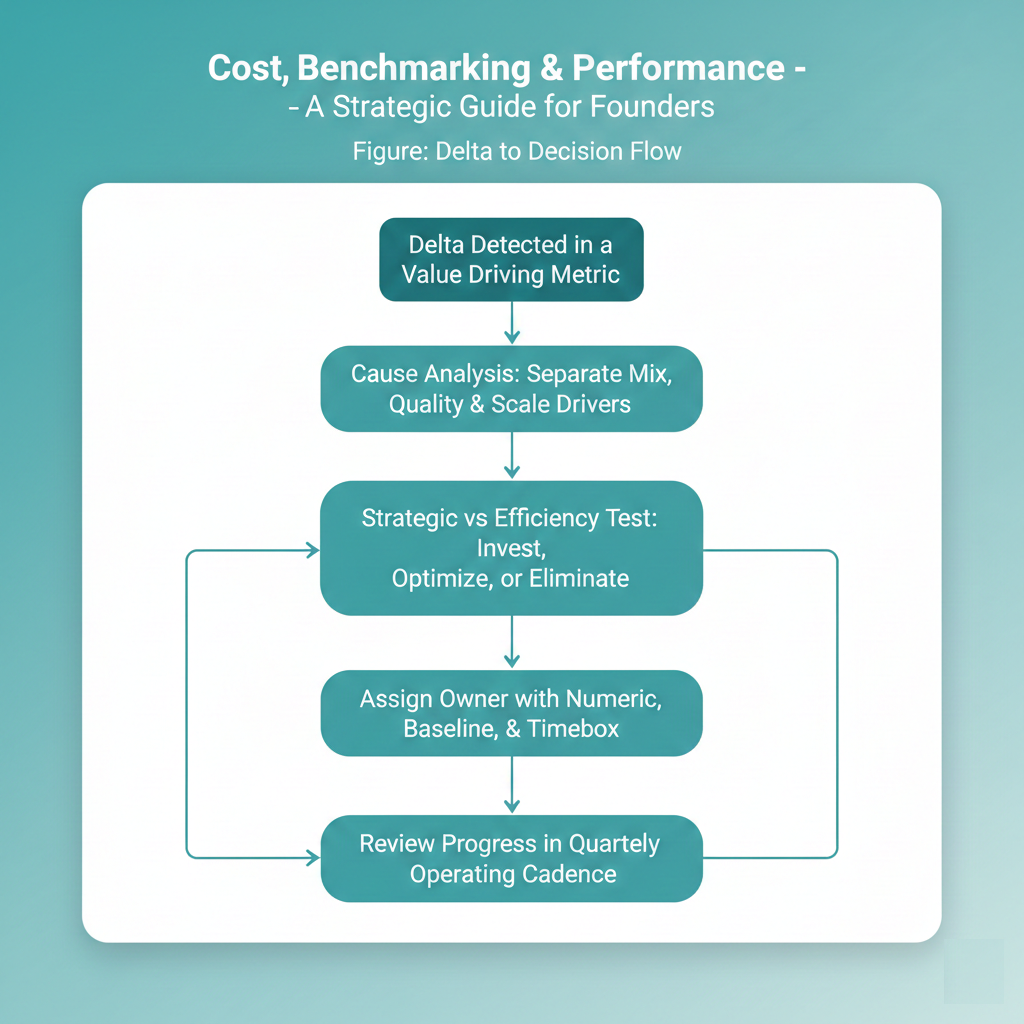
KPI and Benchmark Map – What to measure first
Internal KPIs to baseline before looking out
- CAC payback by channel
- Definition: months for gross margin from a new customer to recover fully loaded acquisition cost.
- Use: prioritize channels, throttle spend when payback extends.
- Sales productivity
- Definition: new ARR per seller per period, normalized by ramp and quota coverage.
- Use: diagnose pipeline health, pricing, enablement.
- Gross margin mix-adjusted
- Definition: gross margin after isolating product, segment, and contract term effects.
- Use: reveals true delivery efficiency and pricing power.
- Support cost per customer vs CSAT and retention
- Definition: all-in support expense divided by active customers, tracked with service quality outcomes.
- Use: reduce cost to serve without compromising experience.
- Engineering lead time and deploy frequency
- Definition: median commit-to-production time and successful releases per period.
- Use: tie platform investments to delivery velocity and incident reduction.
Minimum Viable KPI Set
| Area | KPI | Exact definition | Guardrail or target | Why it matters |
| Growth | CAC payback | months to recover CAC from gross margin | ≤ X months by channel and segment | capital efficiency and runway control |
| Revenue quality | NRR | percent including expansion and contraction | ≥ Y percent by cohort | compounding and pricing power |
| Delivery | Support dollar per account | total support costs ÷ active accounts | trend down quarter over quarter while CSAT ≥ Z | scale quality and cost to serve |
| Engineering | Lead time | median time from commit to production | trend down quarter over quarter | product velocity and risk |
| Profit engine | Gross margin mix-adjusted | GM after product and segment normalization | stable or improving with volume | operating leverage |
| Sales | Productivity per seller | net new ARR per fully ramped seller | rising with consistent win rate | go-to-market effectiveness |
Notes for accurate measurement
- Lock a data dictionary with metric formulas, sources, and time windows.
- Separate cohort effects and mix shifts before drawing conclusions.
- Refresh quarterly where people and vendor costs move fastest.
External comparison rules that keep benchmarks useful
- Match on company stage, business model, go-to-market motion, and operating geography.
- Normalize methodology for CAC, gross margin, and cost allocations before computing deltas.
- Compare a short list of value drivers instead of full dashboards.
- Translate gaps into actions: invest where differentiation wins, optimize table-stakes, eliminate non-essential.
Operating Model Levers – Where savings typically hide
People and talent
- Niche skills drove the sharpest wage inflation, amplified by joining and retention bonuses and higher re or upskilling spend.
- Mitigate through internal academies and clearer hiring triggers that gate external hires to proven revenue or reliability signals.
- Use automation to shift repetitive work, freeing capacity without lowering service levels.
Quick wins
- Hiring mix rules: prioritize internal mobility and apprenticeships before external niche hires.
- Bonus guardrails: link joining and retention incentives to milestone-based vesting and productivity thresholds.
- Skills taxonomy and academy: standardize roles, map skill gaps, and run quarterly sprints to fill them.
- Make versus buy: insource repeatable work, buy short-lived niche expertise on outcome terms.
Vendors and tooling
- Consolidate contracts to 1–2 strategic suppliers per category; negotiate bundles with tiered usage and shared success outcomes.
- Deprecate overlaps in analytics, collaboration, and DevOps; reclaim idle licenses monthly.
- Use outcome-based models for niche capabilities and time-bound initiatives.
Facilities
- Enforce seat-utilization thresholds and space standards by role type; switch underused areas to flex arrangements.
- Use a blend of flexible and long-term leases to match demand cycles.
- Where talent depth allows, shift from Tier 1 to Tier 2 locations and pair with utilization discipline to capture 30 to 50 percent infrastructure savings.
Technology and IT
- Prefer device and software as a service to reduce capex and improve refresh agility.
- Upgrade selectively where it enables strategic services, reliability, or security baselines.
- Rationalize monitoring, CI or CD, and collaboration stacks to one primary per need.
Travel
- Keep post-pandemic gains: default to virtual collaboration for internal and low-value meetings.
- Reopen travel with supplier consolidation, advance-purchase rules, and pooled demand for negotiated discounts.
- Prioritize in-person for revenue-critical, customer-facing, or leadership alignment events.
Levers by cost theme
| Theme | Lever | Evidence or insight | Effort | Typical impact |
| People | Upskill versus hire niche | wage pressure in scarce skills and higher L and D spend | M | Med |
| Vendors | Consolidate 3 to 1 | tighter onshore management and outcome-based models reduce waste | M | Med to High |
| Facilities | Tier 2 plus utilization | infrastructure savings in the 30 to 50 percent range with seat discipline | M | High |
| Travel | Policy plus virtual plus pooling | cost per FTE stabilization from virtual defaults and supplier consolidation | L | Med |
| Tech | Device or software as a service | lower capex and faster refresh improve total cost of ownership | L | Med |
Stage-Aligned Cost Architecture – Keep option value while scaling
Validation (under 2M ARR)
- Cost posture: mostly variable to preserve flexibility. Favor pay-as-you-go cloud, contractors, short-term tooling.
- Where to invest: rapid iteration capacity, observability for reliability, foundational data capture for future insight.
- What to rent: niche expertise, non-core operations, point tools with monthly terms where the signal is weak.
- Decision triggers: lock costs only when a channel, segment, or feature shows repeatable conversion, stable unit economics, and predictable support load.
- KPIs to watch: CAC payback by channel, time-to-value, defect rates, incident minutes, deploy frequency.
Early Growth (2M to 10M ARR)
- Cost posture: selectively fix costs in proven areas while keeping flexibility elsewhere.
- Where to invest: data pipelines for consistent metrics, customer success tooling that improves onboarding and retention, core security and identity.
- How to optimize: clean up tool overlap in GTM and engineering, introduce vendor tiers and volume discounts, track license utilization monthly.
- Decision triggers: protect spend that shortens payback or lifts retention; shift variable to fixed only where demand and quality are stable.
- KPIs to watch: sales productivity, gross margin after mix adjustment, support cost per customer with CSAT, lead time to production.
Growth (10M to 50M ARR)
- Cost posture: standardize processes and consolidate vendors to unlock scale effects.
- Where to invest: automation for repetitive workflows, platform reliability, data quality, and shared services.
- How to optimize: move to category leaders in tooling, reduce suppliers per category, formalize procurement and refresh cycles.
- Decision triggers: if outcomes hold as volume rises, convert more spend to fixed to reduce unit costs; if outcomes drift, pause commitments and fix process bottlenecks first.
- KPIs to watch: OPEX as a percent of revenue by function, NRR cohorts, defect escape rate, first-contact resolution, days to close.
Scale (50M ARR and above)
- Cost posture: pursue operating leverage with sublinear SG&A growth.
- Where to invest: automation at scale, centralized platforms, standardized data models, resilience and security baselines.
- How to optimize: shared services for back-office, location strategy with utilization discipline, structured vendor ecosystems with outcome-linked agreements.
- Decision triggers: when incremental revenue can be served without proportional headcount or tool growth, redeploy savings to differentiation.
- KPIs to watch: SG&A growth versus revenue growth, cost to serve by segment, platform uptime, change failure rate.
Fixed versus variable mix by stage
| Stage | Primary cost posture | Typical fixed focus | Typical variable focus | Decision checkpoints |
| Validation | variable dominant | none beyond compliance and baseline reliability | contractors, on-demand tools, pay-as-you-go cloud | repeatability of conversion and support load |
| Early Growth | mixed with selective fixes | data pipelines, core CS tooling, baseline security | channel tests, pilots, niche expertise | stable payback and retention trends |
| Growth | increasing fixed in proven paths | shared services, platform reliability, standardized tooling | overflow capacity, spikes in demand | quality holds as volume scales |
| Scale | fixed platform plus selective variable | automation, centralized platforms, common services | specialized projects, seasonal demand | SG&A growth below revenue growth |
Six-Step Quarterly Cadence from slides to savings
What this cadence delivers
A repeatable, twelve-week loop that converts benchmarks and cost data into owned targets, measurable savings, and protection for differentiating capabilities. It prioritizes fast-moving cost items such as people and vendors while preserving service levels.
The six steps
- Clarify differentiating capabilities
- Identify the 3 to 5 activities that directly drive retention, conversion, reliability, or margin.
- Pre approve spend that sustains SLAs and unit economics in these areas.
- Classify every major cost into buckets
- Assign each top cost line to differentiating, table stakes, or non essential.
- Set a decision rule per line: protect, optimize with guardrails, or eliminate.
- Link KPIs to activities and shortlist value drivers
- Map each cost line to one KPI.
- Keep 6 to 8 value drivers such as CAC payback by channel, mix adjusted gross margin, NRR, lead time, deploy frequency, support cost per account with CSAT.
- Run external benchmarking with comparability gates
- Match peers on stage, model, go to market, and geography.
- Normalize methodology for CAC and margin before computing deltas.
- Convert deltas into owned targets
- For each gap, choose invest, optimize, or eliminate.
- Set baseline, numeric target, timebox, and a single accountable owner.
- Re run quarterly and watch drift and second order effects
- Refresh fast moving assumptions in people and vendor costs.
- Validate that savings do not degrade reliability, CSAT, or growth velocity.
Checklist with owner, inputs, outputs
| Step | Primary owner | Key inputs | Required outputs | Review SLA |
| Differentiate | CEO or COO | product and customer outcome metrics, reliability reports | list of differentiating capabilities with KPI linkage | week 1 |
| Bucket costs | Finance | top 20 cost lines, contracts, utilization | bucketed list with protect or optimize or eliminate tags | week 2 |
| KPI map | RevOps | data dictionary, dashboard extracts | shortlist of 6 to 8 value drivers with owners | week 3 |
| External compare | Finance | peer list, normalized formulas | delta table with context notes | week 5 |
| Target setting | Exec sponsor | delta table, risk thresholds | owned targets with baseline and timebox | week 6 |
| Execute and monitor | Ops PMO | target tracker, QA, CSAT | progress updates, drift flags, corrective actions | weeks 7 to 12 |
Quarterly timeline guide
| Week | Focus | Outcome |
| 1 to 2 | differentiation and bucket pass | protected list and immediate eliminations queued |
| 3 | KPI linkage and value driver shortlist | single page KPI map |
| 4 to 5 | external benchmarking | delta to peer set with context |
| 6 | target setting and approvals | owned targets with dates |
| 7 to 10 | execution sprints | vendor exits, overlap removal, automation pilots |
| 11 to 12 | results readout and drift check | savings verified, quality guardrails intact |
RACI table
| Step | Exec | Finance | Ops | Product | RevOps |
| Bucket review | A | R | C | C | C |
| KPI refresh | C | R | C | C | A |
| Benchmark deltas | A | R | C | C | C |
| Investment triggers | A | R | C | R | C |
Evidence-led vignettes – Anonymous, Lesson-first
Flexibility premium in customer support
Context
- Demand was volatile and people costs were rising, with niche skills attracting premium pay and bonuses.
- The objective was to protect service quality without locking into higher fixed costs.
Action
- Retained outsourced customer support during volatility to keep variable capacity.
- Set guardrails for experience and reliability using NRR, CSAT, and incident minutes.
- After volume and quality stabilized, transitioned core tiers in-house at an efficient location while enforcing seat-utilization discipline.
Outcomes
- Service quality held through spikes while avoiding premature headcount commitments.
- On stabilization, the in-house shift paired with Tier-2 footprint delivered infrastructure savings in the 30 to 50 percent range and reduced cost to serve.
- COGS improved as work moved to standardized processes and automation.
Lesson
- Pay the flexibility premium when signal is weak; convert to fixed only after repeatability is proven and location/utilization advantages can be captured.
KPI tracker
| KPI | Baseline | Guardrail | Outcome trend |
| NRR | set by cohort | no decline through transition | maintained or improved |
| CSAT | rolling 90-day | at or above threshold | maintained |
| Cost to serve | current run rate | reduce post-stabilization | down after in-house move |
| Incident minutes | current average | no regression | stable or better |
Vendor model shift for niche digital skills
Context
- Scarce skills carried salary premiums and incentives, increasing unit costs and time to ramp.
- The objective was to accelerate capability build while safeguarding ROI.
Action
- Replaced time-and-materials staffing with outcome-based engagements tied to milestones and acceptance criteria.
- Limited internal hiring to roles that compound value; funded internal upskilling where capability durability was high.
- Applied monthly license and tool overlap reviews to keep the stack lean.
Outcomes
- Faster delivery on critical milestones without paying long-term niche premiums.
- Clear ROI visibility from milestone-linked payments and acceptance.
- Internal teams absorbed repeatable work; vendors focused on short-lived spikes and specialized problems.
Lesson
- Use outcome models to buy short-lived, high-skill capacity; reserve permanent hiring and platform spend for durable, differentiating capabilities.
Decision worksheet
| Decision input | Threshold | Action |
| Skill scarcity and wage premium | elevated | buy outcomes, time-box engagement |
| Capability durability | high | build internally and upskill |
| Tool utilization | sub-80 percent | consolidate or deprecate |
| Payback on capability | within target months | proceed with permanent investment |
Founder Diagnostic Scorecard
Use this scorecard to assess your cost management maturity. For each statement, rate your organization: Strong (2 points), Developing (1 point), or Weak (0 points).
| Assessment Criteria | Score (0-2) |
| We can clearly articulate the 3-5 capabilities that differentiate our business from competitors. | |
| Every major cost category is classified as differentiating, table stakes, or non-essential. | |
| Our resource allocation clearly reflects strategic priorities rather than historical patterns. | |
| Our fixed/variable cost mix is appropriate for our current stage and revenue level. | |
| We maintain comprehensive internal benchmarks tracking key performance metrics over time. | |
| When using external benchmarks, we ensure true comparability in stage, model, and market. | |
| We investigate variance drivers rather than accepting benchmark differences at face value. | |
| We have clear, objective triggers determining when to make permanent hires or commitments. | |
| We maintain a complete vendor inventory with costs, renewal dates, and utilization metrics. | |
| Our compensation philosophy is clearly defined and applied consistently across teams. | |
| Before attributing issues to headcount, we systematically test for process problems. | |
| We focus on outcome metrics (CAC payback, NRR, sales productivity) rather than cost percentages. | |
| We systematically assess risks from cost decisions including technical debt and key person dependency. | |
| We review cost structure quarterly to ensure alignment with evolving strategy and priorities. | |
| We can identify which costs create competitive advantage versus which are merely necessary. | |
| TOTAL SCORE |
Scoring interpretation:
- 24-30 points: Strong cost management discipline with strategic coherence
- 16-23 points: Developing capabilities with specific improvement opportunities
- 8-15 points: Reactive cost management requiring systematic strengthening
- 0-7 points: Immediate attention needed to avoid strategic misalignment
Founder Takeaway – Strategic Coherence Over Simplistic Optimization
The Core Principle
Cost optimization is not about spending less – it is about spending better. Allocate resources to capabilities that genuinely drive competitive differentiation while tightening or eliminating expenditure that does not contribute to strategic outcomes.
The Three-Bucket Framework
- Differentiating costs: Build or protect competitive advantage → Protect or increase
- Table stakes costs: Necessary but don’t differentiate → Optimize to sensible levels
- Non-essential costs: Don’t support outcomes → Eliminate
Stage-Aligned Cost Balance
- Early stage (<$2M): Maximize variability and optionality
- Early growth ($2M-$10M): Selectively fix costs in proven areas
- Growth stage ($10M-$50M): Accept higher fixed costs for proven model
- Scale stage ($50M+): Focus on operating leverage and margin expansion
Benchmarking as Diagnosis
- Start with internal benchmarks – more reliable than external comparisons
- Use external benchmarks cautiously, ensuring true comparability
- Investigate variance drivers, not just percentages
- Determine if variance reflects strategic choice or inefficiency
- Link benchmarking to capabilities, not just costs
Six-Step Action Framework
- 1. Establish strategic clarity on differentiating capabilities
- 2. Classify all major costs into three buckets
- 3. Allocate resources asymmetrically based on strategic contribution
- 4. Set clear, objective triggers for permanent investments
- 5. Use benchmarking to guide investigation, not dictate decisions
- 6. Review cost structure quarterly as strategy evolves
Key Insights
- Winning companies often spend more than peers – but asymmetrically on what matters
- Premature scaling and chronic underinvestment both destroy value
- Process problems often masquerade as people problems
- Vendor consolidation typically reduces costs 20-30% without harming operations
- Technical debt costs 3-5X more to fix than to prevent
- Outcome metrics matter more than static cost percentages
References:
- https://ijrpr.com/uploads/V6ISSUE11/IJRPR55400.pdf
- https://yanpeichen.com/professional/BenchmarkingPitfallsIEEE.pdf
- https://www.geckoboard.com/best-practice/kpi-examples/cac-payback-period
- https://stripe.com/resources/more/net-revenue-retention
- https://media.zinnov.com/wp-content/uploads/2023/03/nasscom-zinnov-gcc-report-q4-2022-v2.pdf
- https://www.blueprism.com/resources/case-studies/op-financial-emea-longstanding-innovation
- https://www.vendr.com/blog/vendor-consolidation
The India-US trade deal is a strategic tariff reset and economic understanding aimed at expanding bilateral trade and geopolitical alignment. At its core, the deal:
- Slashes US tariffs on Indian goods to 18%, down from an effective ~50% rate.
- Signals India’s intent to gradually reduce Russian oil dependency, although no formal commitment has been made.
- Opens the path to over $500 billion in Indian purchases from the US across energy, tech, agriculture, coal, and more.
- Positions India as a key trading partner in the West’s supply chain diversification efforts
The Facts Behind the Headlines
Tariff Slash and Strategic Exchange
- Tariff Drop: US cuts duties on Indian goods to 18%, from ~50% (25% base + 25% punitive Russian-oil-linked surcharge).
- Geopolitical Context: President Trump’s claim India to curb Russian oil imports in return. PM Modi acknowledged tariff cut but has not confirmed the oil exit.
- The Wild Card: The real swing factor is energy the trade win is clear, but India’s oil source shift could reshape cost structures.
Who Gains in the Short Term?
Competitive Price Edge
- Textiles, Pharma, Steel: Gain 30–35% competitiveness overnight in the US market.
- Export Surge Potential: India’s $81–85.5 billion export base to the US (2024) offers immediate headroom for scaling exports
- Macro Advantage: India’s $46 billion trade surplus with the US could widen, strengthening the rupee and improving current account dynamics
Risk Note: Energy Cost Impact
- If India reduces discounted Russian crude (priced $15–25 lower per barrel), manufacturers may face $8–12 billion in extra energy costs annually
The India-Russia-US Triangle: Rebalancing Energy and Trade
| Factor | Detail |
|---|---|
| Russia’s Crude Share | ~40% of India’s oil (1.8M barrels/day) |
| Price Advantage Lost | $15–25/barrel more expensive for US/Gulf crude |
| Potential Cost Impact | $8–12 billion/year additional import burden |
| Likely Indian Strategy | Phased diversification, not an abrupt shift |
| Long-Term Insight | Trade shift to US may rise as energy ties with Russia dip |
Deep Sector Analysis: Who Benefits Most?
Textiles & Apparel
- US is the single largest destination for Indian textiles.
- Tariff drop boosts pricing power and demand.
- Action: Requote US buyers, secure medium-term volume contracts.
Pharmaceuticals & Chemicals
- Lower duties benefit price-sensitive generics and ingredients.
- Action: Rework landed cost models, accelerate US FDA filings.
Engineering, Electronics & Capital Goods
- Largest export category by value. Even a small margin gain is material.
- Action: Align with India’s PLI incentives, lock production for US-bound SKUs.
Gems, Jewellery & Marine
- High-value verticals where minor tariff tweaks impact final pricing.
- Action: Tighten inventory cycles, hedge currency exposure.
Steel & Metals
- Relief from general tariffs, but Section 232 duties may still apply.
- Action: Map HS codes carefully before pricing and exporting.
Founder & Investor Playbook
| Profile | Key Strategies |
|---|---|
| Exporters (Goods/SaaS) | Leverage 18% duty floor to price aggressively in US markets |
| Manufacturers | Model for 8–12% energy cost increase; optimize operations to offset |
| Investors | Overweight textiles, pharma, engineering expect margin expansion |
Deal Summary Table
| Indicator | Value/Details |
|---|---|
| New US tariff on Indian goods | 18% (from ~50%) |
| India’s exports to US (2024 est.) | $81–85.5 billion |
| India’s imports from US (2024 est.) | $46.1 billion |
| Total two-way trade | $212.3 billion |
| India’s crude from Russia | ~40% (1.8M barrels/day) |
| Cost impact if switching oil | $8–12 billion/year |
| Estimated purchase commitments | $500+ billion (multi-sector, phased) |
Implementation Timelines & Uncertainties
Key Unknowns
- Product-level tariff lists under the 18% cap.
- Zero-duty carve-outs and timelines for implementation.
- Section 232 tariffs on steel, aluminum, copper, autos may persist.
- Regulatory clarity pending: Rules of Origin, SPS/TBT norms, NTBs.
What Businesses Should Do Now
- Re-quote SKUs for top US-bound categories assuming new 18% duty.
- Secure logistics capacity for the next two quarters to meet revived US demand.
- Map HS codes to Section 232 and prepare alternative mixes.
- Build energy hedging strategies if Russian crude share drops.
- MSMEs should align with PLI and export finance windows to scale efficiently.
Who Wins in the Short Term?
- Price Edge: Textiles, Pharma, and Steel gain 30-35% price competitiveness in the US overnight.
- Export Surge: India’s ~$81B exports to US (2024) provide substantial foundation for growth if tariff relief is implemented. Source: USTR
- Macro Impact: Potential to widen India’s $46B trade surplus with the US, strengthening rupee and current account. Source: US Census Bureau
Risk Note: Energy-heavy sectors may face higher costs if discounted Russian crude ($15-25/barrel cheaper) is replaced.
Strategic Outlook: Long-Term Alignment
- The deal complements India’s broader push for trade diversification including agreements with the EU and Indo-Pacific partners.
- It sets India on a path to deepen integration with Western economies, while carefully managing energy sovereignty.
- Sectors ready to act fast will likely lead in capturing share in the world’s largest consumer market.
Summary
- US tariffs on Indian goods cut to 18% from ~50%, catalyzing export growth.
- Textiles, pharma, engineering, and steel set for significant upside.
- Energy cost sensitivity is the main risk, tied to India’s Russian crude exposure.
- Implementation phase is underway businesses should prepare pricing, capacity, and compliance strategies immediately.
India now stands at a critical juncture: ready to scale global trade presence while navigating energy transitions. The deal is a historic step but what comes next will be shaped by how quickly businesses adapt and how strategically India rebalances its global partnerships.
]]>India’s Union Budget 2026 signals a strategic evolution in economic policy one that emphasizes macroeconomic stability, sectoral capability building, and technology-enabled competitiveness over short-term tax reliefs or cash incentives. For startups, investors, and founders, India’s 2026 Budget, offers critical insights into where the government is steering the economy between 2026–2031.
This report explores the Union Budget 2026 highlights, core implications for the startup ecosystem, and actionable recommendations for the innovation economy.
1. Budget 2026: Strategic Vision & Core Themes
Budget 2026 is designed around three “Kartavyas” (duties), forming the backbone of the government’s approach toward economic acceleration, financial inclusion, and digital innovation:
| Kartavya | Focus Area |
|---|---|
| First | Structural reforms to accelerate economic growth |
| Second | Strengthening the financial sector to meet aspirations |
| Third | Inclusive development using cutting-edge technologies |
Union Budget 2026 highlights a policy of “ambition with inclusion” balancing a ~7% GDP growth trajectory with fiscal discipline and moderate inflation.
Implications for Startups
- Predictable regulatory climate supports fundraising and expansion
- Capex push of ₹12.2 lakh crore fuels infra-tech, logistics tech demand
- AI, SaaS, and automation startups benefit from focus on productivity tech
2. Key Economic Indicators & Fiscal Performance
Macro Snapshot
| Indicator | Value (2026-27 BE) | Notes |
|---|---|---|
| GDP Growth Target | ~7% | Driven by manufacturing scale-up and tech adoption |
| Fiscal Deficit | 4.3% of GDP | Down from 4.4% (2025-26 RE) |
| Debt-to-GDP | Targeting ~50% by 2030 | Currently at 55.6% |
| Inflation | Moderate & stable | Supports consumer spending |
Capital vs. Revenue Expenditure
| Category | 2025–26 (RE) | 2026–27 (BE) | % Change |
|---|---|---|---|
| Capital Receipts | ₹16.2 L Cr | ₹18.1 L Cr | +11.7% |
| Revenue Receipts | ₹33.4 L Cr | ₹35.3 L Cr | +5.7% |
| Effective Capital Expend. | ₹14.0 L Cr | ₹17.1 L Cr | +22.1% |
| Revenue Expenditure | ₹38.7 L Cr | ₹41.3 L Cr | +6.7% |
6x growth in Capex since FY15 (₹2 lakh cr to ₹12.2 lakh cr) underlines an infrastructure-led growth model.
3. Startup & Technology-Specific Announcements
Union Budget 2026 key announcements reflect a targeted strategy to deepen India’s capabilities in semiconductors, climate-tech, electronics, and MSME financing.
Major Initiatives
- ₹10,000 Cr SME Growth Fund: Equity infusion for high-growth MSMEs
- BharatVISTAAR (AgriStack + AI): Boosting agri productivity via ICAR framework
- ₹2,000 Cr top-up to Self-Reliant India Fund
- India Semiconductor Mission: Expansion into fab, ATMP, and chip design
- Electronics Components Scheme: PCBA, sensor, connector manufacturing
- Rare Earth Magnet Scheme: Critical for EVs, climate-tech, and electronics
- Corporate Mitras: Compliance support for Tier 2/3 MSMEs via ICAI & ICSI
- BESS Incentives: Duty-free imports for lithium-ion cell capital goods
- Hi-Tech Tool Rooms in CPSEs: For industrial automation & precision manufacturing
4. Structural Reforms Impacting Startups & MSMEs
TReDS Mandate for CPSEs
| Reform | Impact |
|---|---|
| TReDS Usage Mandate | Reduces payment delays to startups & MSMEs from CPSEs |
| CGTMSE-backed Invoices | Enables discounted working capital via credit guarantees |
| GeM-TReDS Link | Facilitates quick financing for govt suppliers |
| Securitization of Receivables | Enables new asset class for fintech lending platforms |
Transfer Pricing Safe Harbor (IT/ITeS)
- Safe harbor margin set at 15.5%
- Threshold increased from ₹300 Cr → ₹2,000 Cr
- Lock-in for 5 years, boosting global expansion planning
Data Center Tax Holiday (Till 2047)
- Only applies if:
- Owned/operated by Indian Co.
- Services to Indian users routed via reseller (15% margin)
GIFT IFSC – Tax Holiday Extension
- 100% tax holiday for 20 years (out of 25) for IFSC and OBU units
- Post-holiday income taxed at 15%
5. Union Budget 2026: Tax & Regulatory Updates
Direct Taxation
Income Tax (Unchanged)
- New Regime: ₹4L exemption, 5-30% slabs
- Corporate Tax:
- 25% (Turnover ≤ ₹400 Cr)
- 22% (No incentives under 115BAA)
- 30% (Turnover > ₹400 Cr)
- 35% for foreign companies
MAT Rationalization
- MAT now final tax (no further credits accumulate)
- Existing MAT credits usable only under new regime (25% cap/year, 15-year window)
Buyback Taxation
| Investor Type | Tax (STCG) | Tax (LTCG) | Additional for Promoters |
|---|---|---|---|
| Non-Promoter | 20% | 12.5% | – |
| Promoter (Domestic) | 22% | 22% | +2–9.5% |
| Promoter (Foreign) | 30% | 30% | +10–17.5% |
ESOP holders and angel investors benefit from capital gains treatment.
Unexplained Income
- Tax reduced from 60% → 30%
- 25% surcharge retained, 10% penalty removed
Compliance Easing Measures
- Return Filing Deadline for non-audit businesses extended to Aug 31
- Revised Return window increased from 9 to 12 months
- Foreign Asset Disclosure amnesty for small taxpayers
- Automated TDS Certificates for small taxpayers
- PF/NPS Contributions deductible if paid by return filing deadline
GST Reform
- Export of intermediary services now zero-rated (no IGST payable)
- Enables full ITC and export benefit claims
6. What’s Missing in Union Budget 2026?
Missed Areas
- No Section 80-IAC expansion (still limited to DPIIT startups <10 years old)
- No ESOP tax deferral reforms
- No AI infrastructure fund or patent box regime
- No R&D weighted deduction increase
- No simplification of 50+ compliance filings for small companies
- Labor law codes still not implemented
7. Union Budget 2026: Implications for Founders & Investors
Who Benefits?
- IT/ITeS Exporters: Transfer pricing certainty
- Semiconductor Startups: Fab & design ecosystem incentives
- Electronics & Climate-tech: PLI schemes + component incentives
- GIFT IFSC Units: Extended 20-year tax holiday
- MSMEs in Govt Contracts: TReDS liquidity boost
Strategic Recommendations
- Align with National Priorities
- Semiconductors, AI, clean energy, electronics manufacturing
- Optimize Compliance Posture
- Leverage new MAT rules, safe harbors, filing timelines
- Fundraising Readiness
- Favor capital-efficient models; VC/PEs favor macro-stable markets
8. Conclusion: Navigating a Post-Incentive Growth Model
Union Budget 2026 analysis makes it clear: the era of blanket subsidies and incentives is ending. Instead, Budget 2026 insights reveal a maturing economy with long-term capability building at its core.
Startups that focus on productivity, export-readiness, and capital efficiency will thrive.
“Budget 2026 reflects a maturing ecosystem. The government is providing what startups need most: macroeconomic stability and regulatory predictability.”
– Jitesh Agarwal, Founder, Treelife
Scope and scale of Free Trade Agreement
The India-EU Free Trade Agreement 2026 links two large economic blocs into a near two-billion-people marketplace. The combined output is estimated at about 24 trillion dollars, roughly one quarter of global GDP. For exporters and investors, the agreement is a rules-based platform to integrate with a deep, high-income market while preserving policy space for sensitive sectors.
Status: Negotiations have concluded on the India–EU Free Trade Agreement (FTA). The text now moves to legal scrubbing and approvals EU institutions and Member States on one side, and the Indian Parliament on the other. The provisions below reflect the negotiated package and will take effect only after ratification and entry into force.
Key takeaways
- Market size: ~2 billion consumers; ~USD 24 trillion GDP (as referenced in official factsheets).
- Design: Tariff cuts plus disciplines on services, mobility, and standards.
- Balance: Market opening with calibrated protection for sensitive sectors.
- Timing: All market-access effects begin post-approval and on agreed implementation schedules.
What market access actually means (Post Approval)
EU access for Indian goods (negotiated package)
The EU to open 97 percent of its tariff lines, covering 99.5 percent of India’s exports by value. This creates immediate price certainty for labour-intensive sectors and a clear schedule for the remainder.
- Day one (entry into force): ~70.4% of lines at zero duty (~90.7% of current exports). Immediate-zero lines include textiles, apparel, leather, toys, gems & jewellery, and many marine items.
- Transition window: ~20.3% of lines to zero over 3–5 years.
- Calibrated items: ~6.1% with partial cuts/TRQs (e.g., cars, steel).
India’s offer to EU goods
India to reduce tariffs across 92.1 percent of its tariff lines, covering 97.5 percent of EU export value. The offer blends immediate liberalisation with phased schedules for sensitive categories.
- Day one (entry into force): ~49.6% of lines to zero.
- Phasing: ~39.5% of lines to zero over 5/7/10 years; small, sensitive farm items under limited TRQs.
- Autos: Finished cars to glide from ~110% toward ~10% over time; parts to zero within 5–10 years.
Who wins first
Early gains are expected in India’s labour-intensive goods with immediate duty elimination and strong EU demand. Roughly USD 33 billion of current shipments in apparel, leather & footwear, marine, toys, sports goods, and gems would face zero duty improving price competitiveness and predictability.
On services, the EU schedules liberalisation across 144 subsectors and a structured mobility regime (business visitors, ICTs, contractual suppliers, independent professionals). Predictable entry/stay and social-security coordination can support Indian IT, engineering, and professional services upon entry into force.
Sensitive areas and the real risks
- Automotive & premium segments: Tariff glide paths could intensify competition in India’s mid-to-premium vehicle market; parts liberalisation deepens supply-chain integration.
- Agriculture & fisheries: Opening must be sequenced with safeguards/standards support to mitigate pressures on small dairy producers and small-scale fishers.
- EU regulatory compliance: CBAM, the EU Deforestation Regulation, and CSDDD may offset tariff gains without workable flexibilities and technical support. MFN-style assurances and cooperation are noted, but near-term compliance costs remain material for metals and agri value chains.
How this is strategic
The FTA is positioned to enable supply-chain diversification in pharmaceuticals, automotive, and clean energy; streamline pharma compliance for EU healthcare supply chains; lower component costs for autos; and expand joint opportunities in solar, wind, grids, and green hydrogen supporting export-led growth and scale manufacturing once operative.
Quick view: what opens when (effective after ratification)
| Side | Immediate zero duty | Zero in 3–5 years | Zero in 5–10 years | TRQ or partial cuts | Coverage by value |
| EU market for Indian goods | 70.4% of tariff lines | 20.3% | n.a. | 6.1% | 99.5% of India’s exports |
| India market for EU goods | 49.6% of tariff lines | part of 39.5% phased | part of 39.5% phased | limited farm and autos | 97.5% of EU exports |
Sector-level signals to watch
- Textiles & apparel: Zero-duty access to a ~USD 263.5B EU import market; India’s 15–20% manufacturing cost edge in key hubs could accelerate sourcing shifts.
- Leather & footwear: Removal of tariffs up to 17% opens a ~USD 100B EU market.
- Marine products: Tariffs up to 26% eliminated on several lines; some products under TRQ.
- Pharma & med-tech: Lower tariff frictions and regulatory cooperation to deepen integration into EU healthcare supply chains.
- Automotive: Parts to zero strengthens links with EU OEM networks; calibrated car tariffs reshape the premium segment over time.
- Services: 144 subsectors with mobility commitments and time-bound social-security arrangements across EU Members once in force.
India–EU FTA: What opens when (share of tariff lines)
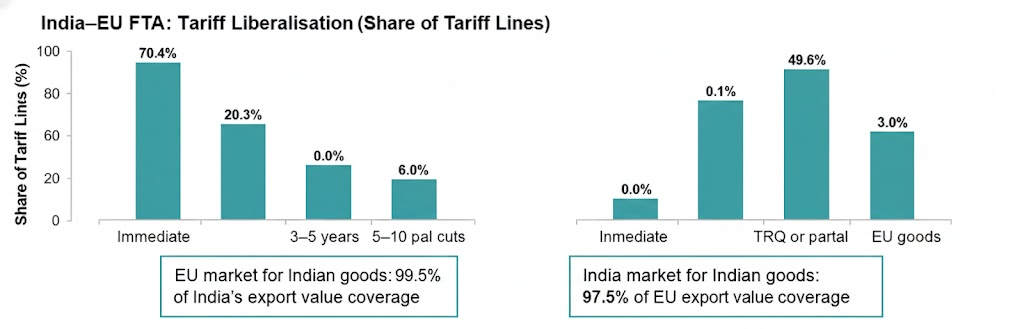
The Story behind India-EU Trade: How We Got Here
From first talks to a concluded deal
The India–EU Free Trade Agreement has been nearly two decades in the making. Talks began in 2007, paused in 2013 after 15 rounds, and restarted in 2022 with a wider scope covering goods, services, digital trade and sustainable development. Negotiations concluded on 27 January 2026 alongside the 16th India–EU Summit, reflecting convergence on market access, professional mobility and standards cooperation. Unlike tariff-only pacts, this agreement embeds SPS and TBT problem-solving and structured pathways to manage EU sustainability rules, while allowing phased liberalisation where India requires transition time.
Negotiation timeline at a glance
| Milestone | What changed | Why it was important |
| 2007 | Formal launch of FTA negotiations | Set ambition for a comprehensive agreement on goods and services |
| 2013 | Talks suspended after 15 rounds | Divergences on autos, wines and spirits, visas for professionals, regulatory frictions |
| 2022 | Talks revived with upgraded scope | Added services mobility framework, sustainability, and standards cooperation |
| 27 January 2026 | Negotiations concluded at the 16th India–EU Summit | Locked market access schedules and regulatory workstreams; moved to legal steps |
Why Now: Resilience, Diversification, and Friend-Shoring
A trade landscape shaped by geopolitical rivalry, trade remedies, and supply shocks is pushing firms toward multi-node supply chains and policymakers toward de-risking. The negotiated India–EU FTA 2026 aligns with this shift by setting up a de-risked corridor between a ~€22.5 trillion integrated market and a large, fast-growing manufacturing and services base.
- For Europe: early-mover position in Asia and a second export engine as China exposure is managed.
- For India: stronger investment case in autos, electronics, clean tech, and pharmaceuticals, complementing PLI-type incentives.
What Would Change on the Ground
- Pharmaceuticals – Streamlined regulatory compliance and stronger IP disciplines to move Indian firms deeper into EU healthcare sourcing.
- Automotive – Components to zero duty on agreed schedules, tightening India–EU production links. Calibrated access for finished vehicles to protect sensitive segments.
- Clean Energy – Cooperation that aligns the EU Green Deal with India’s 2030 target of 500 GW renewables, opening joint opportunities in solar, wind, grids, and green hydrogen.
- Apparel and Footwear – Zero-duty access and predictable rules can pivot sourcing to Indian hubs (e.g., Tiruppur, Surat) where manufacturing costs are reported 15–20% lower supporting friend-shored capacity.
Signals Policy Teams Track
- Re-routing of EU retail and med-tech sourcing pipelines toward India.
- Early investments in component lines co-located with Indian OEMs.
- Expansion of services delivery centers using mobility categories and social-security coordination windows.
What Happens Next: Legal Scrubbing to Ratification
- Legal scrubbing & language finalisation of the negotiated text.
- Translation into all EU languages.
- EU approval pathway: European Parliament and all 27 Member States.
- Indian approval pathway: Parliamentary processes.
These steps provide legal certainty across the EU single market. Provisions take effect only after all approvals and the agreement’s entry into force.
Backdrop: India–EU Trade Snapshot (Pre-FTA)
Where the relationship stood before the India–EU Free Trade Agreement 2026
Before tariff schedules take effect, the corridor is already large and diversified. In FY24–25, goods trade reached about 136.54 billion USD (India exports to EU 75.85 billion USD, India imports from EU 60.69 billion USD). In 2024, services trade added 83.10 billion USD, reflecting strong ties in IT, engineering, finance and professional services. The European Union consistently ranks among India’s top trading partners, which is why the India EU trade deal targets rules, standards and mobility in addition to tariffs.
Table 1: India–EU trade baseline
| Indicator | Value |
| Goods trade (FY24–25) | 136.54 billion USD |
| India → EU exports (FY24–25) | 75.85 billion USD |
| India ← EU imports (FY24–25) | 60.69 billion USD |
| Services trade (2024) | 83.10 billion USD |
What sits inside the numbers
Pre-FTA relationship profile
The EU is among India’s largest partners in goods and services, with deep corporate footprints in capital goods, clean tech, automotive and healthcare. Trade is broad-based rather than commodity heavy, so the India–EU Free Trade Agreement is structured to address non-tariff frictions and service-mobility bottlenecks alongside tariff cuts.
Composition highlights for analysis and outreach
- India’s manufactured exports to the EU include textiles, apparel, leather and footwear, gems and jewellery, engineering goods and select marine products that meet a high-income, standards-driven market.
- India’s imports from the EU skew toward technology- and capital-intensive goods such as machinery, automotive, medical devices and chemicals, supporting domestic upgrading and investment cycles.
Services corridor signal
The 83.10 billion USD services figure covers IT and business services, engineering R&D, education and professional mobility that already connect Indian talent with EU demand. The India EU FTA 2026 builds on this base with clearer access rules and social-security coordination.
What Was Traded: Top Buckets (Pre-FTA)
India to EU: the manufactured core with agri-processed depth
Before the India–EU Free Trade Agreement 2026, India’s exports to the EU were already led by manufactured goods, with meaningful depth in agri-processed products and pharmaceuticals that meet EU quality and SPS thresholds. The India-EU FTA is expected to amplify these established lanes where tariff preferences and standards/SPS cooperation bite fastest, so zero-duty access would accelerate existing flows rather than create demand from scratch, enabling quicker conversion into production, jobs, and shipment growth.
India → EU: key buckets and indicative products
- Manufactured goods and energy: textiles and apparel, leather and footwear, gems and jewellery, engineering items, refined petroleum, marine products, pharma formulations
- Agri-processed and speciality foods: tea, coffee, spices, table grapes, gherkins and cucumbers, dried onion, fresh fruits and vegetables, processed foods
Table: illustrative India → EU product mix
| Bucket | Typical examples |
| Textiles and apparel | Knitwear, woven garments, home textiles, accessories |
| Leather and footwear | Fashion footwear, leather goods, gloves |
| Gems and jewellery | Cut and polished diamonds, studded jewellery |
| Marine | Shrimp, frozen fish, processed seafood |
| Pharma | Generic formulations and APIs supplying EU healthcare systems |
| Agri-processed | Tea, coffee, spices, grapes, gherkins, dried onion, processed foods |
EU to India: high-tech, capital goods and premium consumer segments
India’s pre-FTA imports from the EU were concentrated in technology- and capital-intensive lines aircraft/aerospace, nuclear-reactor components, precision and general machinery, automotive vehicles and parts, chemicals, and medical devices; with negotiations concluded and approvals pending, the India–EU FTA is expected once in force to lower landed costs for investment goods as tariffs phase down, deepen integration with European technology supply chains, and support India’s industrial upgrading and Make in India priorities through cheaper, more predictable access to machinery, med-tech, and specialised chemicals, while calibrated timelines on sensitive finished autos preserve space for domestic manufacturers even as parts liberalisation encourages localisation.
EU → India: key buckets and indicative products
- High-tech and capital goods: nuclear and aircraft parts, turbines, machine tools, process equipment, industrial automation
- Autos and components: premium vehicles, transmissions, electronics, braking systems
- Chemicals and med-tech: intermediates, specialty chemicals, medical instruments and devices that previously faced tariffs up to 6.7 percent
Table: illustrative EU → India product mix
| Bucket | Typical examples |
| Aircraft and nuclear components | Airframe parts, avionics sub-assemblies, reactor hardware |
| Precision machinery | CNC machine tools, compressors, material-handling equipment |
| Automotive | Luxury cars, hybrid and EV models, drivetrains, safety electronics |
| Chemicals | Industrial and specialty chemicals used by MSMEs and large plants |
| Medical devices | Lenses, spectacles, diagnostic and measuring instruments |
What Becomes Duty-Free Now on the EU Side
Immediate impact for Indian exporters
The India–EU Free Trade Agreement 2026 represents the largest negotiated single-step tariff gain India has lined up in a developed market; upon entry into force, the EU would drop duties on a large share of India’s export basket, with the deepest relief in categories where Indian firms already compete at scale. A very high share of labour-intensive lines that previously faced 4–26% tariffs would fall to zero, reinforcing manufacturing clusters and coastal export hubs while converting existing competitiveness into price advantages and predictable market access.
How the EU market would open (post-ratification)
Immediate zero duty (from entry into force)
- Coverage: ~70.4% of tariff lines; ~90.7% of India’s export value
- Core winners: textiles & apparel, leather & footwear, sports goods, toys, gems & jewellery, several marine items
- Scale: ~USD 33 billion of current labour-intensive exports shift to zero duty on day one
Zero duty in 3–5 years
- Coverage: ~20.3% of tariff lines; ~2.9% of export value
- Examples: processed foods and selected marine products that graduate to duty-free on short phase-outs
Preferential access / TRQs
- Coverage: ~6.1% of tariff lines; ~6.0% of export value
- Examples: partial tariff cuts or tariff-rate quotas in sensitive areas such as cars, steel, and specific shrimp/prawn lines
Table 2: EU market access for Indian goods
| Access bucket | Tariff lines | Share of India’s export value | Examples |
| Immediate zero | 70.4% | 90.7% | Textiles, leather, toys, gems, marine |
| Zero in 3–5 years | 20.3% | 2.9% | Processed foods, marine |
| Preferential or TRQ | 6.1% | 6.0% | Cars, steel, certain seafood |
India-EU Trade Deal Tariff Comparison
| Product | Current Tariffs | Expected Tariffs After India-EU Deal |
| Pearls, Precious Stones & Metals | 22.5% | 0% (for 20% of products; others reduced) |
| Aircraft & Spacecraft | 11% | 0% |
| Optical, Medical & Surgical Equipment | 27.5% | 0% (for 80% of products) |
| Machinery & Electrical Equipment | 44% | 0% |
| Iron & Steel | 22% | 0% |
| Motor Vehicles | 110% | 10% (quota of 25k) |
| Pharmaceuticals | 11% | 0% |
| Spirits | 150% | 40% |
| Wine | 150% | 20% (Premium) / 30% (Medium) |
| Beer | 110% | 50% |
| Chemicals | 22% | 0% |
| Plastics | 16.5% | 0% |
| Sheep Meat | 33% | 0% |
| Kiwis & Pears | 33% | 10% (in quota) |
| Processed Food | 50% | 0% |
| Fruit Juices & Non-Alcoholic Beer | 55% | 0% |
| Sausages & Other Meat Preparations | 110% | 50% |
| Olive Oil, Margarine & Other Vegetable Oils | 45% | 0% |
Quick summary for commercial teams
Apparel and home textiles
- Zero duty at entry into force across all lines
- Addresses tariffs up to 12 percent and opens a 263.5 billion USD EU market
Leather and footwear
- Tariffs up to 17 percent eliminated from day one
- Operates in a market near 100 billion USD with India’s current exports around 2.4 billion USD as a base
Gems and jewellery
- Preferential access across the full trade value improves pricing for cut and polished diamonds and studded jewellery
Marine products
- Duty relief up to 26 percent with full-value preferential access
- Unlocks a 53.6 billion USD EU marine import market for shrimp, frozen fish and value-added seafood
Chemicals and medical instruments
- Eliminates duties up to 12.8 percent in chemicals and up to 6.7 percent in medical devices across very high coverage
- Supports competitiveness and regulatory-ready expansion into EU healthcare and industrial supply chains
India’s Offer to the EU
The scale of India’s market opening
India’s offer grants broad access while ring-fencing a small sensitive list: about 92.1% of tariff lines, covering roughly 97.5% of EU export value, are included; 49.6% drop to zero at entry into force, another 39.5% phase out over 5, 7, or 10 years, around 3% receive partial cuts, and a narrow fruit set apples, pears, peaches, kiwifruit enters via TRQs. The design lowers input costs, supports capex, and deepens India–EU supply-chain ties while preserving safeguards through timelines, partial cuts, and quotas; effects commence only after ratification.
How the tariff timeline works
- Immediate elimination: 49.6% of lines across industrial inputs, capital goods and consumer items.
- Phased to zero: 39.5% over 5, 7 or 10 years to smooth adjustment for domestic value chains.
- Partial reductions: 3% where full elimination is not suitable.
- TRQs are confined to a handful of fruits to protect farm incomes while enabling predictable EU access.
Autos: calibrated liberalisation with a long runway
Under the negotiated package, finished EU cars would glide from ~110% duty toward ~10% over time, while auto parts move to zero within 5–10 years; this sequencing steers EU OEMs toward CKD assembly, component sourcing, and engineering in India, even as calibrated car timelines preserve space for domestic manufacturers in mass-market price bands.
Table 3: What opens in India for EU goods
| Coverage element | Share of tariff lines | Share of EU export value | Illustrative impact |
| Immediate zero duty | 49.6% | Included within 97.5% | Faster commissioning for projects using EU machinery, instruments |
| Phased to zero (5/7/10 yrs) | 39.5% | Included within 97.5% | Predictable glide path for local supply chains to adapt |
| Partial reductions | 3.0% | Small share | Price relief without full elimination |
| TRQs on select fruits | Narrow set | Minimal | Seasonal access with farm safeguards |
| Overall offer | 92.1% | 97.5% | Broad market access package to a developed partner |
Industry-wise Tariff Outcomes (Snapshot)
Sectoral tariff changes and outlook
| Sector | Outcome | India impact | EU or market impact |
| Textiles and apparel | Zero duty entry into EU; India retains calibrated access for EU goods domestically | Scale and jobs in clusters; stronger price competitiveness into a 263.5 billion USD EU market | EU brands diversify sourcing to India; deeper vendor development |
| Leather and footwear | EU duties up to 17 percent eliminated for Indian exports; India opens inputs and select lines | Export surge potential; MSME upgrading and design-led shift | Cost-effective sourcing and resilient supply for EU retailers |
| Gems and jewellery | Preferential access across full trade value on EU side; India keeps import stance balanced | Margin and volume uplift for cut and polished and studded lines | Wider product variety and steady supply for EU retail |
| Marine | EU duty elimination up to 26 percent on several lines; India manages TRQs in sensitive items | Gains for shrimp and processed seafood with value addition | Stable supplies to EU’s 53.6 billion USD marine market |
| Autos | India phases EU car duty from about 110 percent to about 10 percent; parts to zero in 5 to 10 years | Competitive pressure in premium segments; localisation push for components | Market expansion for EU OEMs; deeper India EU auto value chains |
| Chemicals, machinery, medical devices | India lowers barriers, including med device tariffs previously up to 6.7 percent | Cheaper capital goods and med tech; faster tech diffusion | Stronger high tech export growth into India |
| Pharma | Low tariffs and regulatory cooperation frameworks from both sides | Tighter integration into EU healthcare supply chains | Affordable, reliable sourcing and collaborative R&D |
Services, Mobility and Digital
Why services are the quiet big story
- Scope: The EU schedules market access in 144 services subsectors (IT/ITES, professional services, education, financial services, tourism, construction). India schedules commitments across 102 subsectors, establishing a predictable, non-discriminatory regime once in force.
- Mobility framework: Covers business visitors, intra-corporate transferees, contractual service suppliers, and independent professionals, with a time-bound goal to conclude Social Security Agreements with all EU states within five years.
- Operational impact (post-approval): Easier talent deployment, reduced double social-security costs, and stronger scaling of digitally delivered services into a high-value EU market.
At a glance: services and mobility commitments
| Pillar | EU commitments | India commitments | Practical effect |
| Market access breadth | 144 subsectors | 102 subsectors | Wider certainty for cross border supply and establishment in priority services |
| Mobility categories | Business visitors, ICTs, CSS, Independent Professionals | Mirror lanes for EU providers | Faster deployments, fewer visa hurdles, clearer stays |
| Targeted access windows | 37 subsectors for CSS; 17 for Independent Professionals | Opens EU priority services in professional, business, telecom, maritime, financial, environmental | Contract delivery visibility for IT, R&D, higher education |
| Social Security Agreements | Enable with all EU states in 5 years or less | Reciprocal coordination | Lower total cost of deployment; no double contributions |
What changes in day to day operations
- Smoother short term work and study pathways for engineers, IT consultants, researchers and students, with clearer post study work options.
- Predictable entry and stay for project teams across software, R&D, design and higher education, improving ramp up times for client delivery.
- Easier movement for spouses and dependents in intra corporate transfers, improving the attractiveness of EU postings for Indian professionals.
- Digital trade emphasis plus regulatory cooperation reduces friction for online service delivery and knowledge based exports.
Agriculture and Processed Food: Access with Safeguards
What opens in Europe for Indian agri and food
Tea, coffee, spices, table grapes, gherkins/cucumbers, dried onion, fresh fruits and vegetables, and a wide range of processed foods receive preferential access under the negotiated package taking effect after approvals. For producers, this can lift pricing power in a high-income, standards-driven market that rewards quality, traceability, and consistent supply. Parallel SPS and TBT cooperation is designed to speed conformity assessment and make clearances more predictable, reducing time-to-market and compliance friction.
Indicative agri processed opportunity set
| Product group | Access outcome | Execution lever |
| Tea, coffee, spices | Preferential access | Align residues and labelling; leverage GI and premium branding |
| Table grapes, fresh fruit and vegetables | Preferential access | Pre clearances, cold chain, farm to packhouse compliance |
| Gherkins, cucumbers, dried onion | Preferential access | Contract farming, processing standards, EU retail ready packs |
| Processed foods | Preferential access | Reformulate to EU ingredient lists and nutrition panels |
Safeguards that ring fence sensitive sectors
- Protected farm lines: Dairy, cereals, poultry, and soymeal remain shielded to balance farm incomes with export growth; fisheries sensitivities are recognised.
- Faster, credible compliance: Product-specific rules and origin self-certification aim to speed clearances without compromising integrity.
- Food-security lever: India retains the option to use export taxes as a food-security instrument, even as some EU stakeholders prefer their removal.
Risk dashboard from stakeholder analyses
- Dairy: competition from efficient European producers could pressure small cooperatives if opening is not carefully sequenced.
- Fisheries: livelihoods of small scale fishers and sustainability are key concerns to monitor during implementation.
- Export taxes: calls to lift them could limit India’s ability to manage availability and prices during supply shocks.
India Access to the EU vs India’s Offer to the EU
Reciprocity in a snapshot
The India–EU Free Trade Agreement 2026 is reciprocal in architecture: India secures near-complete duty-free access to the EU for its export basket, while offering a calibrated opening at home that front-loads inputs and investment-heavy lines and shields a narrow set of sensitive products; with negotiations concluded and approvals pending, the design is intended once in force to translate quickly into orders for Indian manufacturers and services firms and to lower domestic production costs via predictable access to European technology, components, and capital goods.
Table 4: Reciprocity dashboard
| Dimension | EU → India (what India gets) | India → EU (what EU gets) |
| Goods market access | 97% of tariff lines, covering 99.5% of India’s export value; large immediate zero duty tranche across labour intensive and industrial lines | 92.1% of tariff lines, covering 97.5% of EU export value; 49.6% immediate elimination, 39.5% phased over 5, 7 or 10 years; limited TRQs for select farm items |
| Services access | 144 subsectors with strong mobility lanes for business visitors, intra corporate transferees, contractual service suppliers and independent professionals | 102 subsectors bound by India, aligned with domestic regulatory space and talent needs |
| Sensitive areas | TRQs or caps for cars, steel and certain seafood products | Autos on a glide path for finished vehicles; selective TRQs for apples, pears, peaches and kiwifruit |
| Regulatory | SPS and TBT cooperation plus MFN style CBAM flexibility with technical assistance and transition pathways | Structured dialogue on standards and Quality Control Orders to reduce non tariff frictions |
Key Growth Drivers and Supply-Chain Rewiring
The package is built for diversification. Near-zero tariffs (once in force), regulatory cooperation, and talent mobility enable end-to-end sector networks from design to after-sales. Firms assessing India–EU FTA 2026 opportunities should prioritise the spokes below.
Pharma: From vendor to essential supplier
- Streamlined compliance and predictable IP are set to cut time-to-market for generics and complex formulations.
- Expected post-approval outcomes: faster onboarding to EU procurement, better utilisation of FDA-compliant plants for Europe-bound runs, and scaling of CDMO services.
Automotive: Parts to zero, platforms go regional
- With parts phasing to zero and finished vehicles on a glide path, Indian component ecosystems can plug into EU platforms with shorter lead times and lower BOMs.
- EU OEMs in India gain incentives to localise critical modules; Indian tier-1/2 suppliers move up into higher-value sub-assemblies.
Clean energy: Financing a green buildout
- Joint opportunities in solar, wind, grid equipment, and green hydrogen align EU decarbonisation goals with India’s 2030 500-GW target.
- Lower capital-goods costs and technology partnerships can accelerate commissioning for IPPs and state utilities once provisions take effect.
Textiles & fashion: Speed-to-shelf with cost advantage
- EU brands de-risking single-country exposure gain a sourcing base in hubs like Tiruppur and Surat, where 15–20% cost advantages and stronger design/compliance capabilities are reported.
- Zero-duty access plus deeper vendor development can compress sampling-to-bulk cycles and improve OTIF performance after entry into force.
Quick matrix: where value is created
| Sector | Tariff end state | EU → India benefit | India → EU benefit | Likely KPI uplifts |
| Pharma | Low tariffs plus regulatory cooperation | Stable access to affordable formulations and CDMO | Expanded EU procurement and co-development | Faster approvals, higher OTIF |
| Automotive | Parts to zero; cars phased | Lower BoM for local assembly; tech transfer | Wider model variety; deeper supply chains | Higher localisation, shorter lead times |
| Clean energy | Capital goods cheaper | Faster commissioning of RE projects | Larger addressable market for EU OEMs | Lower LCOE, better capacity factors |
| Textiles/fashion | Zero duty into EU | Higher EU order wins for India | De-risked, competitive sourcing for EU retailers | Better margin realisation, higher fill rates |
Winners vs. Losers
What shifts with the India–EU FTA 2026
- Incentives reset across labour-intensive goods, premium consumer segments, and capital-intensive industries.
- Indian exporters gain where tariffs + scale already intersect; exposure rises where EU brands have entrenched advantages.
- For the EU, the deal opens a structurally growing market for autos, capital goods, medical devices, and chemicals, with investment-led access to raw materials and local supply chains once in force.
Likely winners in India
- Textiles & apparel; leather & footwear; gems & jewellery; select marine: zero or preferential EU duty → sharper landed prices and faster order wins post-approval.
- IT/ITeS & professional services: EU binds 144 subsectors and sets mobility lanes (business visitors, ICTs, CSS, independent professionals) → smoother deployment and scale.
- Engineering goods & electronics: medium-term tailwinds as EU buyers diversify; tariff relief + compliance alignment support move-up the value chain.
Pressure points in India
- Premium autos: tougher competition as fully built EU cars glide to lower tariffs; mid-to-premium domestic segments must answer with localisation and partnerships.
- Wines & spirits; specialty cheeses; gourmet foods: stronger EU price competitiveness challenges Indian premium and artisanal brands.
- Talent dynamics: mobility gains without parallel upskilling/retention could accelerate brain-drain risks alongside clear opportunities.
Vulnerable segments to watch
- Dairy & small fisheries: scale asymmetries vs. EU players; outcomes hinge on safeguards and sequencing.
- Autos, chemicals, precision machinery: intensified industrial competition as duties fall and EU firms expand locally.
Likely winners in the EU
- Autos & components; capital goods; medical devices; chemicals: deeper access to a high-growth market with clearer tariff paths and standards alignment.
- Investment-led diversification: improved access to Indian resources and manufacturing bases reduces single-source risk.
Table: Winners vs losers snapshot
| Side | Likely winners | Exposure and risks |
| India | Textiles and apparel, leather and footwear, gems and jewellery, select marine, IT, ITeS and professional services | Premium autos, wines and spirits, gourmet foods, potential brain drain |
| EU | Autos and components, capital goods, medical devices, chemicals, upstream resource access via investment | Political economy sensitivities around Indian standards and QCOs; need to localise to hit price points |
India–EU Perspectives: What Each Side Wants
India’s priorities in the India European Union Trade Agreement
- Preferential access for labour intensive goods with rapid zero duty entry in the EU to lift jobs and MSME competitiveness
- Services and mobility as force multipliers, including time bound Social Security Agreements to lower deployment costs
- Regulatory cooperation on SPS and TBT to reduce non tariff barriers and speed conformity assessment
- Flexibility on carbon related measures and room to preserve domestic policy space in sensitive sectors
EU priorities in the India EU FTA 2026
- Market opening in autos, alcohol and capital goods, with standards alignment and transparent, predictable rules
- Progress on public procurement and an investment led pathway to secure raw materials and industrial inputs
- A strategic partnership that embeds India into European value chains and strengthens the EU role in global trade governance
Rules, Standards and the Non-Tariff Terrain
Why rules can outweigh tariffs
Even after duties fall under the India–EU Free Trade Agreement 2026, regulatory costs can shape real market access. Three EU pillars matter most: Carbon Border Adjustment Mechanism (CBAM), EU Deforestation Regulation (EUDR) and Corporate Sustainability Due Diligence Directive (CSDDD). India has an MFN-style CBAM assurance so any flexibilities offered to others extend to India, plus joint work on carbon pricing recognition, verification standards and finance support for exporters in steel and aluminium. Uncertainty is lower, but firms still need workable carve outs and transition timelines.
A second friction point is alignment between India’s Quality Control Orders (QCOs) and EU non tariff regimes. The pathway is operational SPS/TBT cooperation and a Rapid Response Forum to resolve issues early.
Finally, tariff asymmetry matters: EU average tariffs ~3–4 percent vs India ~10–12 percent. Headline EU goods gains are smaller, shifting the real prize toward services, mobility and investment.
Where deals succeed or fail
| Issue | What creates risk | What the FTA provides | What firms should do next |
| CBAM | Extra carbon cost on metal exports | MFN-type assurance; joint work on carbon pricing and verification | Build product-level emissions data; use finance windows to decarbonise |
| EUDR | Traceability burdens in coffee, rubber, wood | Transition dialogue under sustainability and SPS tracks | Deploy plot geotagging and supplier-trace tools; aggregate smallholders |
| CSDDD | Supply chain audits and data-sharing obligations | Regulatory cooperation forum | Set confidentiality clauses; standardise due diligence templates |
| QCOs vs EU NTBs | Dual audits and certification delays | SPS/TBT cooperation and Rapid Response Forum | Pre-certify to EU norms; escalate bottlenecks early via the forum |
Significance for India–EU Relations and Geopolitics
A strategic anchor in a fracturing world
The pact goes beyond tariffs. It creates a rules based bridge between India’s scale in manufacturing and services and the EU’s high income single market, strengthening investment, technology flows and standard setting. Well negotiated terms can lift trade and FDI, embed Indian firms in European value chains and reinforce the EU’s role in global trade governance.
Global positioning and knock on effects
By reducing single country dependence and building resilient supply chains, the corridor aligns Europe’s de risking with India’s export led growth. It can spur parallel initiatives, including possible US–India frameworks, as partners react to the EU–India axis. For businesses, this means earlier access to finance, standards partnerships and customers across autos, clean energy, defence and digital services.
Implementation Roadmap: What to Track Next
Milestones from text to trade
The agreement advances through formal steps before entry into force. Plan as if timelines are short and align pricing, staffing and compliance to published schedules.
Timeline checkpoints
- Legal scrubbing and language finalisation, then translation and ratification by all 27 EU Member States and the European Parliament
- Publication of product level phase outs and TRQs that convert headline shares into SKU duty paths
- Release of services protocols detailing mobility categories, subsector coverage and a five year roadmap to conclude Social Security Agreements across member states
Operational workstreams to stand up now
- CBAM cooperation plus SPS and TBT recognition pilots so conformity assessments are accepted faster with less duplication
- Supply chain moves by EU firms into India in autos, med tech, clean energy and apparel as tariffs fall and vendor development accelerates
Action list for commercial teams
- Map your top ten HS codes to phase out tables to lock pricing ladders and tenders
- Stand up cross functional squads for CBAM, EUDR and CSDDD with carbon accounting, traceability and supplier due diligence playbooks
- Pre qualify with EU notified bodies where SPS and TBT recognition is planned to shorten time to market
- Build mobility calendars for ICT, CSS and Independent Professionals to sequence deployments with services openings
Appendix: Key Data Points from the India–EU Free Trade Agreement 2026
A. Big number to remember
Nearly 33 billion USD of India’s labour-intensive exports enter the EU at zero duty on day one.
What this includes
- Textiles and apparel, leather and footwear, marine products, gems and jewellery, toys, sports goods, select engineering products
- Previously faced 4% to 26% EU tariffs; sectors employ millions, especially MSMEs and women
B. Automobiles: how tariffs change
| Product | Before the FTA | After the FTA |
| Fully built EU cars | ~110% import duty | Reduced toward ~10% gradually |
| Auto components | 10–15% (varies) | 0% duty over 5–10 years |
C. Sustainability and compliance: how EU rules are handled
| Issue | What the agreement ensures |
| Carbon Border Adjustment Mechanism | MFN-type, non-discriminatory treatment |
| EU standards (SPS and TBT) | Technical cooperation and equivalence pathways |
| Climate transition | Dedicated cooperation channels for gradual adjustment |
| Regulatory friction | Transparency, data sharing and recognition of conformity assessment |
References:
- https://www.pib.gov.in/PressReleasePage.aspx?PRID=2219065
- https://www.commerce.gov.in/wp-content/uploads/2026/01/Factsheet-on-India-EU-trade-deal-27.1.2026.pdf
- https://policy.trade.ec.europa.eu/eu-trade-relationships-country-and-region/countries-and-regions/india/eu-india-agreements/memo-eu-india-free-trade-agreement-chapter-chapter-summary_en
- https://policy.trade.ec.europa.eu/eu-trade-relationships-country-and-region/countries-and-regions/india/eu-india-agreements/factsheet-eu-india-free-trade-agreement-main-benefits_en
- https://policy.trade.ec.europa.eu/eu-trade-relationships-country-and-region/countries-and-regions/india/eu-india-agreements/factsheets-and-guides_en
- https://www.mea.gov.in/bilateral-documents.htm?dtl/40614/India__EU_Joint_Statement_on_the_State_Visit_of_President_of_the_European_Council_and_President_of_the_European_Commission_to_India_and_the_16th_India_EU_Summit
- https://www.reuters.com/business/autos-transportation/india-eu-slash-tariffs-autos-spirits-textile-landmark-deal-2026-01-27/
- https://www.reuters.com/world/india/details-eu-india-trade-deal-tariffs-quotas-market-access-2026-01-27/
- https://www.theguardian.com/business/2026/jan/27/eu-and-india-sign-free-trade-agreement
- https://timesofindia.indiatimes.com/business/india-business/india-eu-fta-finalised-top-15-frequently-asked-questions-faqs-on-trade-deal-answered/articleshow/127609699.cms
The mandate originates from Rule 9B of the Companies (Prospectus and Allotment of Securities) Rules, 2014 which was introduced in October 05, 2023. This rule requires all private companies, except for specific exempt categories, to issue securities exclusively in dematerialized form and to facilitate the conversion of all existing physical holdings. As the corporate environment moves toward 100% digitization, startups must align their internal processes with these requirements to ensure seamless operations and maintain investor trust.
Understanding Rule 9B and Its Impact on Private Limited Companies
Rule 9B signifies the end of the era of physical share certificates for most private entities. Previously, dematerialization was primarily a requirement for public companies, while private firms could choose to maintain physical registers. The new rule ensures that every transaction involving securities be it a fresh issue, a transfer, or a buyback is recorded electronically through authorized depositories like NSDL and CDSL.
For most Indian startups (i.e., private companies that are not classified as small companies), shares must be held in dematerialised (demat) form. Before issuing any new shares, conducting a rights issue, bonus issue, or buyback, the company must ensure that the shareholding of its promoters, directors, and key managerial personnel (KMP) is already dematerialised. This pre-offer demat compliance is mandatory and must be completed before undertaking such corporate actions.
Is Your Startup Exempt? The Small Company Threshold
Not every private company is immediately hit by this mandate. The MCA has provided a clear exemption for “Small Companies” as defined under Section 2(85) of the Companies Act, 2013. However, startups are often designed for rapid growth, and once they cross certain financial milestones, the exemption lapses, and the 18-month compliance clock begins.
Small vs. Non-Small: Thresholds at a Glance
| Metric | Small Company Threshold (Exempt) | Non-Small Company (Mandatory Demat) |
| Paid-up Share Capital | Up to INR 10 Crore | Exceeding INR 10 Crore |
| Annual Turnover | Up to INR 100 Crore | Exceeding INR 100 Crore |
In addition to the financial thresholds, certain entities such as Government companies and Nidhi companies are exempt from Rule 9B. However, holding companies and subsidiary companies are not treated as “small companies” under the Companies Act, 2013 and therefore cannot claim this exemption, regardless of their paid-up capital or turnover. Companies should review their audited financial statements each year to confirm their eligibility status. If a company ceases to qualify as a “small company” at the end of a financial year, it must comply with the mandatory dematerialisation requirements.
Critical Deadlines for Dematerialization
For companies that were already “non-small” as of March 31, 2023, the initial deadline for compliance was set for September 30, 2024. Subsequent extensions and specific rules for growing startups have clarified the timeline.
- Initial Compliance Date: September 30, 2024, for companies exceeding thresholds in FY 2022-23.
- Extended Deadline: Some regulatory updates pointed toward June 30, 2025, as a final grace period for certain entities to complete the transition.
- Rolling Deadline: For startups growing out of the “small” category today, the deadline is exactly 18 months from the end of the financial year in which the thresholds were breached.
Step-by-Step Compliance Guide for Startups
Navigating the dematerialization process requires coordination between the company, its legal advisors, and SEBI-registered intermediaries. Founders should follow this structured approach to ensure 100% compliance.
1. Amendment of Articles of Association (AoA)
The first legal step is to review the company’s AoA. Most older AoAs may only mention physical certificates. Startups must pass a special resolution to amend their AoA, authorizing the company to issue and hold securities in electronic form as per the Depositories Act, 1996.
2. Appointment of Registrar and Transfer Agent (RTA)
A startup must appoint a SEBI-registered RTA. The RTA acts as the vital bridge between the company and the depositories. They handle the technical aspects of share creation, transfers, and corporate actions. While larger companies always use RTAs, startups now find them essential for managing their digital cap tables.
3. Obtaining the International Securities Identification Number (ISIN)
The company must apply for a unique ISIN for each type of security issued (e.g., Equity Shares, Series A Preference Shares, CCPS). This identification number is required for the shares to be recognized and traded within the NSDL or CDSL systems.
4. Facilitating Shareholder Conversion
Once the ISIN is active, the company must notify its shareholders. Each shareholder must open a Demat account with a Depository Participant (DP) if they do not already have one. They then submit a Dematerialization Request Form (DRF) along with their physical certificates to the DP, who coordinates with the RTA to credit the electronic shares.
Mandatory Reporting: The Role of Form PAS-6
Compliance does not end with the conversion of shares. To ensure ongoing transparency, the MCA requires half-yearly reporting. This is done through Form PAS-6, which tracks the reconciliation of the company’s share capital.
PAS-6: Key Compliance Snapshot
| Requirement | Details for Startup Compliance |
| Filing Frequency | Half-yearly (within 60 days of the end of each half-year) |
| Filing Deadlines | May 30 (for March ending) and November 29 (for Sept ending) |
| Key Information | Total shares held in NSDL, CDSL, and physical form |
| Certification | Must be certified by a practicing CA or CS |
| Purpose | To identify discrepancies between issued and demat capital |
Strategic Benefits of Dematerialization for Founders
While seen as a compliance burden, dematerialization offers significant strategic advantages for a growing startup. It professionalizes the company’s image in the eyes of institutional investors and venture capitalists.
- Elimination of Risks: Digital shares cannot be lost, stolen, or forged, which is a common issue with physical certificates during relocation or office shifts.
- Efficiency in Funding: During a fresh funding round, issuing new shares to investors is near-instantaneous once the ISIN is in place, reducing the closing time for deals.
- Easier Transfers: Founders and early employees can transfer shares (subject to lock-ins) with much less paperwork and zero stamp duty on transfers in demat mode (in certain jurisdictions/scenarios).
- Enhanced Transparency: A digital cap table managed by a depository provides a “single version of truth,” preventing disputes over shareholding percentages.
Consequences of Non-Compliance
Ignoring the mandate can lead to operational paralysis. Beyond the residual penalties under Section 450 of the Companies Act, which include fines for the company and its officers, the practical implications are more severe. Non-compliance with Rule 9B restricts a company from issuing new securities, undertaking rights or bonus issues, or carrying out buybacks. Shareholders holding shares in physical form are also prohibited from transferring their shares or subscribing to new securities until dematerialisation is completed. In addition, the company and its officers in default may be subject to monetary penalties, and such non-compliance can delay or block fundraising, exits, and other corporate transactions. A startup in default will find it impossible to raise new capital because it cannot legally issue new shares or process a rights issue. Furthermore, existing shareholders will be unable to transfer their stake to any third party until their holdings are dematerialized. For a founder looking for an exit or a secondary sale, this lack of compliance can become a deal-breaker. Ensuring your startup is “Demat-ready” is therefore not just about following the law; it is about protecting the liquidity and future growth of your venture.
]]>Section 1: Macroeconomic Overview
India enters FY 2025–26 with a strong and unusually balanced macroeconomic position. Real GDP growth is estimated at ~7.4%, with real GVA growth at ~7.3%, reaffirming India’s position as the fastest-growing major economy. Growth is broad-based, supported simultaneously by consumption recovery, sustained investment, and improving financial stability.
- Private consumption (PFCE) grew ~7%, accounting for ~61.5% of GDP
- Gross Fixed Capital Formation (investment) grew ~7.8%, with investment intensity around 30% of GDP
- Headline inflation moderated sharply, with average CPI at ~1.7% (Apr–Dec 2025)
- Banking sector health strengthened, with GNPA declining to ~2.2% (Sept 2025)
This combination of growth, low inflation, and financial system resilience creates a more predictable operating environment for businesses and investors.
Section 2: India’s Economy
At the national level, India’s economic scale has itself become a structural advantage. The domestic market is now deep enough to support large, scalable businesses without over-dependence on exports or global capital cycles. The Economic Survey characterises FY26 growth as being driven by a “double engine” of consumption and investment, rather than short-term policy stimulus.
- India remains the fastest-growing large economy for the fourth consecutive year
- Financial participation continues to widen, with 12+ crore unique investors
- Household savings are gradually shifting from traditional bank fixed deposits toward mutual funds and SIP-led investments, improving risk capital availability for businesses
- Demat accounts exceed 21 crore, reflecting deepening capital markets and household formalisation
Section 3: India on the Global Stage
India’s global economic position continues to strengthen, particularly through services, remittances, and capital inflows. While global trade remains fragmented, India’s services-led model provides relative insulation from external shocks.
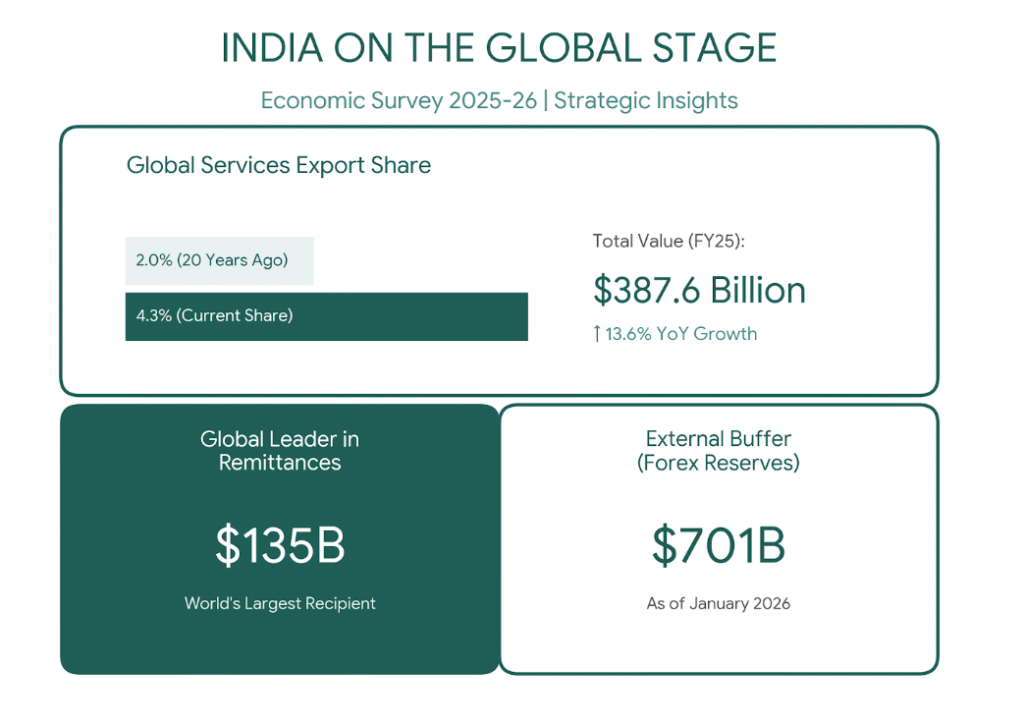
Section 4: GSDP Composition
India’s growth composition remains structurally diversified, with services continuing to lead while manufacturing shows clear signs of revival. This diversification reduces vulnerability to sector-specific or cyclical shocks.
- Services GVA grew ~9%+ in FY26, remaining the primary growth driver
- Manufacturing GVA accelerated, growing ~7.7% in Q1 and ~9.1% in Q2 FY26
- Agriculture provided stability supported by normal monsoons and steady output
Section 5: Fiscal Health
India’s fiscal strategy reflects a deliberate shift toward asset creation and long-term productivity enhancement. Public finances are increasingly geared toward capital expenditure rather than consumption-led spending, while medium-term debt sustainability indicators have improved.
- Effective capital expenditure increased from ~2.7% of GDP (pre-pandemic) to ~4%
- Central government capex expanded nearly 4× since FY18
- Combined government debt-to-GDP has declined by ~7 percentage points since 2020
- State-level fiscal deficits remain broadly stable in the post-pandemic period
Section 6: FDI Inflows
India continues to attract sustained foreign capital, with inflows increasingly directed toward services, manufacturing, and technology-led sectors.
- Total FDI inflows (FY25 provisional): ~USD 81.0 billion, ~14% YoY growth
- Manufacturing FDI: ~USD 19.0 billion, ~18% YoY growth
- Key recipient sectors include services, software & hardware, trading, and manufacturing
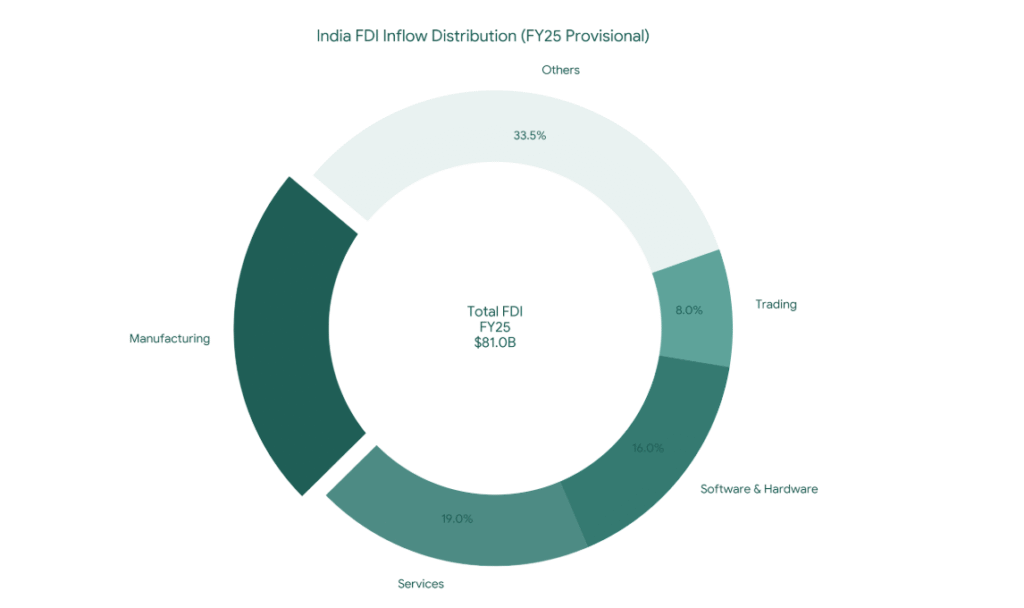
Section 7: Startup Capital of India
India’s startup ecosystem has transitioned from rapid expansion to a phase of consolidation and maturity.
- 200,000+ DPIIT-recognised startups (as of Dec 2025)
- ~125 unicorns across fintech, SaaS, consumer internet, and deep tech
- Increased focus on unit economics, governance, and sustainable growth
Section 8: Domestic Investment Momentum
Domestic investment remains a central pillar of India’s medium-term growth trajectory, supported by policy-led manufacturing and infrastructure creation.
- Investment (GFCF) growth: ~7.8% in FY26
- Investment intensity sustained at ~30% of GDP
- PLI schemes (14 sectors) have delivered:
- India Semiconductor Mission: 10 approved projects with ~₹1.6 lakh crore committed investment
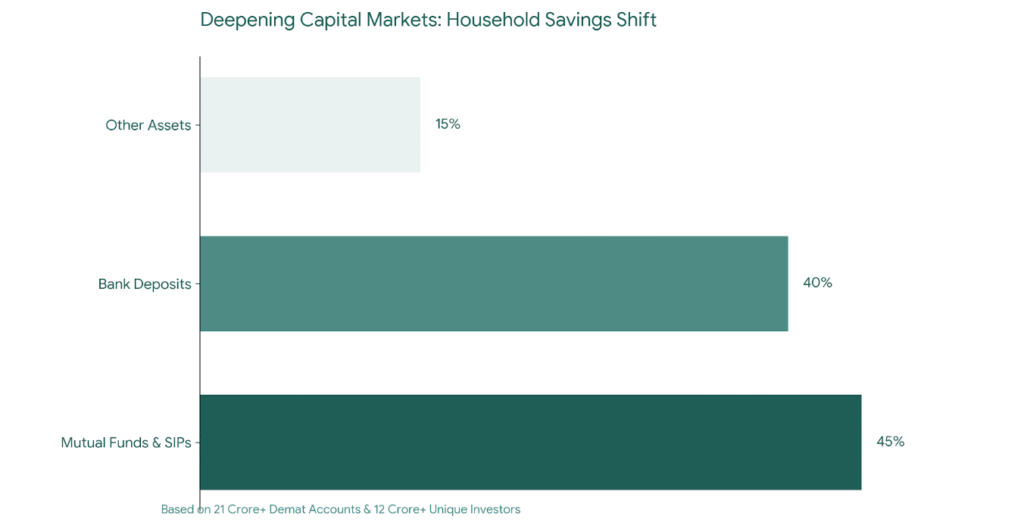
Section 9: Export Performance & Infrastructure Edge
India’s export resilience is increasingly driven by services and supported by large-scale infrastructure upgrades that reduce logistics and transaction costs.
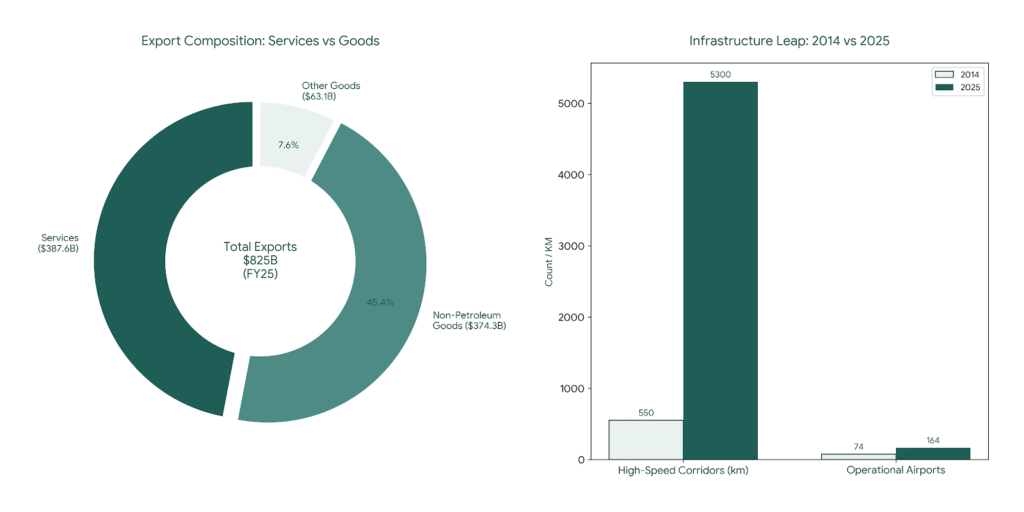
- Total exports (FY25): ~USD 825 billion, a record high
- Services exports: ~USD 387.6 billion
- Non-petroleum exports: ~USD 374.3 billion
- Infrastructure expansion highlights:
- High-speed corridors: ~550 km (2014) → ~5,300+ km (2025)
- Airports: 74 (2014) → 164 (2025)
Section 10: What This Means for Businesses & Investors
India’s FY 2025–26 economic environment offers a rare combination of growth visibility, financial stability, and execution capacity. Strong domestic demand, improving credit conditions, and sustained public and private investment create a favourable backdrop for scaling businesses and deploying long-term capital.
- Lower inflation and healthier banks improve operating and financing conditions
- Policy continuity supports manufacturing, infrastructure, and startups
- Export-oriented businesses benefit from services growth and logistics upgrades
- AI adoption is accelerating globally, and Indian enterprises are increasingly embedding AI into finance, compliance, operations, and decision-making rather than treating it as a pilot layer
- However, the Economic Survey’s probability matrix indicates that a global recession is a plausible worst-case scenario, with an estimated likelihood in the range of 15–20%, based on scenario-driven analysis.
References :-
- https://www.indiabudget.gov.in/economicsurvey/
- https://www.pib.gov.in/economicsurvey/2026/en/index.aspx?reg=3&lang=2
- https://www.thehindu.com/business/budget/highlights-of-economic-survey-2025-26/article70564629.ece
- https://www.indiatoday.in/business/story/economic-survey-2026-news-which-jobs-are-immune-to-artificial-intelligence-india-2859857-2026-01-29
About Treelife:
Treelife is one of India’s most trusted legal and financial consulting firms, we simplify complex legal and financial challenges faced by startups, investors, and global businesses, by offering a wide range of services, including Virtual CFO, Legal Support, Tax & Regulatory, and Global Expansion assistance.
We have our offices in 4 cities, Mumbai, Delhi, Bangalore and GIFT City (Gujarat).
Our clients span diverse sectors such as technology, fintech, D2C, and foreign businesses. A few notable names include CleverTap, Rentomojo, Piper Serica, Snapwork, The Souled Store, and more.
]]>This note is not meant to be a legal dissection of the ruling. Instead, it is our attempt to explain, in simple terms, what has changed and what founders should be mindful of going forward.
1. The structure in brief – how Tiger Global invested in Flipkart
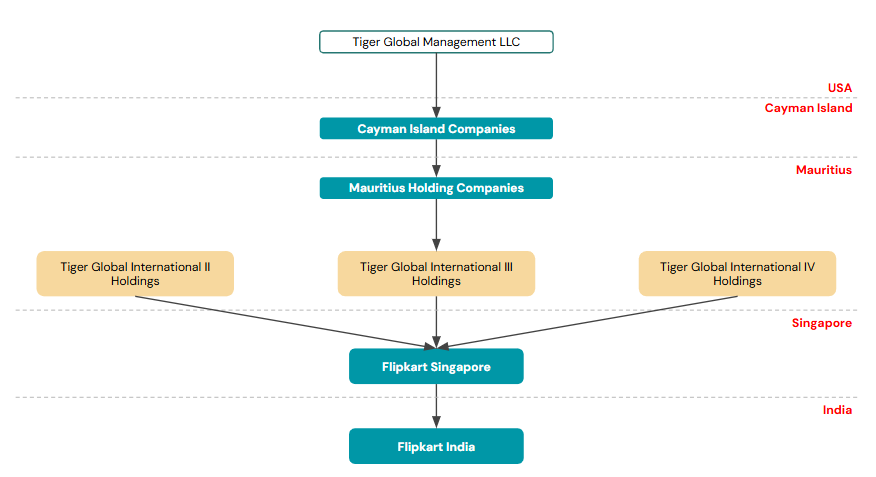
Tiger Global’s investment into Flipkart was not made directly into India. Like many global funds, the investment was routed through a multi-layer offshore structure.
In simple terms, capital was pooled through entities in Cayman and Mauritius. The Mauritius entities (Tiger Global International II, III and IV Holdings) invested into Flipkart’s Singapore holding company, which in turn held Flipkart India. The exit in 2018 happened through the sale of shares of the Singapore entity as part of Walmart’s acquisition of Flipkart.
The Mauritius entities claimed that the capital gains from this sale were not taxable in India under the India–Mauritius tax treaty, relying heavily on the fact that they held valid Tax Residency Certificates (TRCs) and that the investments were made prior to April 2017, which technically speaking, are grandfathered from General Anti Avoidance Rules (GAAR) provisions.
The tax department challenged this at the threshold itself, arguing that the structure was designed for tax avoidance and that the Mauritius entities were not entitled to invoke the treaty at all.
2. What the Supreme Court has now held
The Supreme Court has reversed the Delhi High Court’s decision and has effectively agreed with the tax department’s approach.
At the heart of the ruling are three important messages.
- First, a TRC is not a shield.
The Court has made it clear that a Tax Residency Certificate is relevant, but it is not conclusive. It is only an entry condition. Tax authorities are entitled to go behind the TRC and examine where real control lies, how decisions are taken, and whether the entity has genuine commercial substance. The days of assuming that “TRC = treaty protection” are clearly behind us. - Second, substance and control will drive outcomes.
The Court accepted the AAR’s prima facie findings that effective control and key commercial decision-making were not really in Mauritius. On that basis, it held that the Mauritius entities could be treated as conduit entities and denied treaty entitlement itself, even before going into detailed computation or merits.
In other words, the question is no longer only “where is the entity incorporated?”, but “where is its head and brain actually functioning from?”
- Third, GAAR is very much in play.
A significant part of the judgment deals with GAAR. The Court has affirmed that even if investments were originally made before 1 April 2017, arrangements that continue to yield tax benefits after that date can still be examined under GAAR. Grandfathering is not a blanket immunity. Entire structures and their ongoing tax outcomes can be tested holistically.
3. Why this ruling matters beyond Tiger Global
Although this case arises from a large global fund structure, the principles laid down are directly relevant for startup groups and founders as well.
In our reading, the judgment sends a fairly unambiguous signal: India’s courts are now far more comfortable allowing the tax department to examine offshore structures not just on paper, but on how they actually function in practice.
Treaty benefits can be denied at the starting line itself if a structure appears to be set up mainly to obtain a tax outcome without corresponding commercial and governance substance. This applies not only to new structures, but potentially also to older ones that are approaching exits, secondaries or internal reorganisations.
4. Practical takeaways for founders and management teams
From a founder and group perspective, a few clear themes emerge.
- Structures must be built around real substance, not just location.
Where are key business and investment decisions taken? Who actually controls bank accounts, exits, large transactions and strategic calls? How independent is the offshore board in practice? These questions now matter far more than before. - Governance design is as important as tax design: Board composition, approval thresholds, veto rights, and the role of offshore directors are not cosmetic anymore. They will be examined to see whether the offshore entity truly functions as a decision-making centre or merely signs what is decided elsewhere.
- Documentation will make or break outcomes.
In a GAAR-driven world, contemporaneous records, board minutes, investment rationales, control frameworks, and functional documentation will often determine whether a structure is respected or recharacterised. - Pre-2017 structures should not assume they are “safe”.
Any group with legacy offshore structures and future liquidity events should seriously consider a pre-exit review through a GAAR and treaty entitlement lens.
Closing thoughts
The Tiger Global ruling is not just about Mauritius or one fund. It reflects a broader shift: Indian tax jurisprudence is moving decisively from form-based comfort to substance-based scrutiny.
For founders, this is less about fearing offshore structures and more about building them correctly with commercial logic, credible governance, and defensible substance from day one.
At Treelife, we are already seeing increased interest from founders and investors in reviewing existing holding structures, fund-raise setups and exit pathways in light of this judgment. We will be sharing more detailed guidance as the implications of the ruling continue to evolve.
]]>Setting up a wholly owned subsidiary in India has emerged as the most preferred market-entry strategy for foreign companies seeking long-term presence, operational control, and regulatory flexibility. A wholly owned subsidiary (WOS) is an Indian company in which 100% of the share capital is held by a foreign parent entity, incorporated under the Companies Act, 2013. This structure enables global businesses to fully participate in India’s economic growth while operating as a separate legal entity with limited liability.
Why India Is a Top Global Investment Destination
India continues to strengthen its position as one of the world’s most attractive destinations for foreign direct investment (FDI), driven by policy reforms, digital governance, and a large consumer market.
Key Economic & Market Indicators
- India’s GDP growth projection (in 2026): 7%, among the fastest-growing major economies globally
- 71% of multinational corporations (MNCs) consider India a priority market for global expansion
- Strong government push through initiatives such as Make in India, Digital India, and sector-specific FDI liberalisation
- Access to a large talent pool, cost-efficient operations, and improving ease of doing business rankings
These factors make incorporation of a wholly owned subsidiary in India a strategic move for companies targeting Asia-Pacific and emerging markets.
Why Foreign Companies Prefer a Wholly Owned Subsidiary Over Branch or Liaison Offices
Foreign businesses consistently choose setting up a WOS in India over branch or liaison offices due to the following structural advantages:
- Full operational control
Unlike branch or liaison offices (which are restricted in activities), a WOS can conduct commercial, revenue-generating operations without RBI pre-approvals in most sectors. - Separate legal entity & limited liability
The parent company’s liability is limited to its capital investment, protecting global assets. - Easier regulatory and tax compliance
A WOS is treated as a domestic company for taxation and business operations, unlike branch offices which face higher tax rates and restrictions. - FDI flexibility and repatriation benefits
Profits and dividends are freely repatriable (subject to applicable taxes) under the direct FDI route. - Access to incentives and local contracts
Many government tenders, incentives, and state-level benefits are accessible only to Indian-incorporated entities.
What Is a Wholly Owned Subsidiary (WOS) in India?
A wholly owned subsidiary in India (WOS) is an Indian-incorporated company in which 100% of the share capital is owned by a foreign or Indian parent company. It operates as a separate legal entity with limited liability and is the most preferred structure for foreign companies setting up a wholly owned subsidiary in India for long-term operations.
Legal Definition Under Indian Laws
Meaning Under the Companies Act, 2013
- The Companies Act, 2013 does not explicitly define a “wholly owned subsidiary.”
- However, Section 2(87) defines a subsidiary company as one in which the holding company:
- Controls the composition of the Board of Directors, or
- Exercises or controls more than one-half of the total share capital (directly or indirectly).
- A WOS is a subset of a subsidiary, where the holding company owns 100% shareholding.
No Explicit Statutory Definition of “Wholly Owned Subsidiary”
- Indian corporate law recognizes WOS through interpretation and practice, not a standalone definition.
- Regulatory compliance, governance, and reporting are identical to any Indian company under the Companies Act, 2013.
Interpretation Under FEMA & RBI Regulations
- Under FEMA and RBI regulations, a foreign company may:
- Incorporate a wholly owned subsidiary in India
- Set up a joint venture, associate, or
- Establish a branch, liaison, or project office
- A WOS is treated as FDI (Foreign Direct Investment) and is permitted only in sectors allowing 100% FDI, either via:
- Automatic route, or
- Government approval route, depending on the sector.
This regulatory clarity makes incorporation of a wholly owned subsidiary in India the most compliant and scalable entry option.
Wholly Owned Subsidiary vs Subsidiary Company
In India, the difference between a subsidiary company and a wholly owned subsidiary is mainly based on the extent of shareholding and control exercised by the parent company. A subsidiary company is one in which the parent company holds more than 50% of the equity share capital or controls the composition of the board of directors. This structure allows the parent to influence key business decisions while still permitting minority shareholders, which is common in joint ventures, strategic alliances, or foreign direct investment (FDI) models operating under Indian corporate regulations.
A wholly owned subsidiary, on the other hand, is a special type of subsidiary where 100% of the share capital is held by the parent company. This provides complete ownership, operational control, and strategic flexibility, making it a preferred structure for foreign companies entering the Indian market. While both forms are treated as separate legal entities under Indian law, a wholly owned subsidiary offers stronger control, simplified decision-making, and easier alignment with the parent company’s long-term business objectives.
| Criteria | Wholly Owned Subsidiary | Subsidiary Company |
| Shareholding | 100% | 51%–99% |
| Control | Full control by parent | Majority control |
| Minority shareholders | No | Yes |
| Strategic autonomy | High | Medium |
| Decision-making speed | Faster | Moderated |
| Risk exposure | Lower (no minority disputes) | Higher |
Who Can Set Up a Wholly Owned Subsidiary in India?
Setting up a wholly owned subsidiary in India is legally permitted for a wide range of foreign and non-resident entities, subject to sectoral FDI rules under FEMA and RBI regulations.
Eligible Entities for Incorporation of a Wholly Owned Subsidiary in India
The following entities are eligible to set up a WOS in India:
- Foreign companies
Any company incorporated outside India under foreign law - International organizations
Multilateral institutions and global bodies engaging in permitted activities - Foreign governments or government agencies
Including departments, authorities, or state-owned enterprises - NRIs and PIOs
- Can act as shareholders (no residency restriction)
- Can be directors, provided at least one director is an Indian resident
Sector Eligibility: 100% FDI Requirement
- A wholly owned subsidiary in India can be incorporated only in sectors where 100% FDI is permitted
- Sectoral caps and conditions are prescribed under India’s Consolidated FDI Policy
FDI Routes for Setting Up a WOS in India
| FDI Route | RBI / Government Approval | Applicability |
| Automatic Route | Not required | IT, software, manufacturing, consultancy, R&D, trading |
| Approval Route | Required | Defence, telecom, media, financial services (sector-specific) |
Most foreign companies prefer incorporation of a wholly owned subsidiary in India under the automatic route, as it allows faster setup and minimal regulatory friction.
Structures for Setting Up a Wholly Owned Subsidiary in India
Foreign companies setting up a wholly owned subsidiary in India can choose from three legally recognised structures under the Companies Act, 2013 and FEMA regulations. The optimal structure depends on capital source, repatriation flexibility, RBI compliance, and timeline.
Structure I – Using NRO Account
This structure is commonly used by NRIs and foreign shareholders with existing Indian income.
Key Features
- Initial capital is funded from an NRO (Non-Resident Ordinary) account
- Income includes rent, dividends, pension, or other India-sourced earnings
- RBI filings: Not applicable at the time of incorporation
Repatriation Rules
- Repatriation from NRO account is restricted to USD 1 million per financial year
- Funds are maintained in Indian Rupees
Best suited for: Small or India-income-funded investments where immediate free repatriation is not critical.
Structure II – Direct Foreign Investment (FDI)
This is the most preferred structure for foreign companies incorporating a wholly owned subsidiary in India.
Key Features
- Capital remitted from overseas bank account into Indian company’s bank account
- Treated as Foreign Direct Investment (FDI) under FEMA
- Form FC-GPR is mandatory and must be filed within 30 days of share allotment
Repatriation
- Freely repatriable, subject to applicable taxes
- No annual cap on profit or dividend repatriation
Best suited for: Foreign companies seeking full control, scalability, and unrestricted capital movement
Structure III – Transfer of Existing Indian Company
This structure involves acquiring 100% ownership in an already incorporated Indian company.
Key Features
- Indian company initially incorporated with Indian shareholders
- Shares subsequently transferred to the foreign parent company
- Valuation report is mandatory for share transfer
RBI Filings
- Form FC-TRS for share transfer
- Form FC-GPR for any additional foreign investment
Best suited for: Businesses seeking faster market entry using an existing Indian entity.
Comparative Table: Structures for Setting Up a WOS in India
| Parameter | NRO Route | Direct FDI | Transfer Route |
| RBI filing | Not required | FC-GPR | FC-TRS + FC-GPR |
| Valuation report | Not required | Not required | Required |
| Repatriation | Restricted (USD 1M/year) | Freely repatriable | Freely repatriable |
| Approx. timeline | ~3 weeks | ~3 weeks | ~5 weeks |
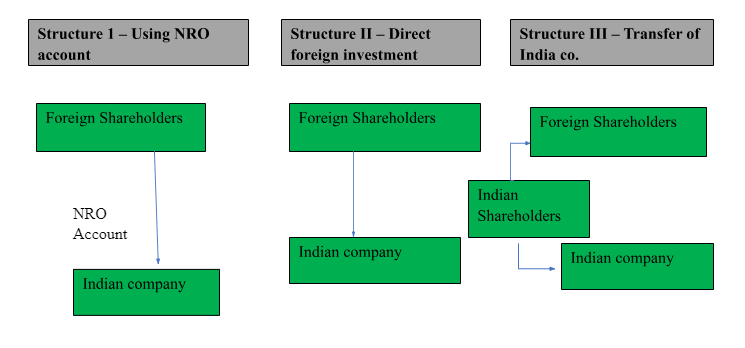
Pre-Incorporation Requirements for WOS in India
Before incorporating a wholly owned subsidiary in India, foreign companies must meet minimum statutory requirements under the Companies Act, 2013. These conditions are straightforward and designed to facilitate faster market entry.
Directors
To set up a wholly owned subsidiary in India, the following director requirements apply:
- Minimum 2 directors are mandatory
- At least 1 director must be an Indian resident
- Resident = stayed in India for ≥182 days in the previous calendar year
- Foreign nationals, NRIs, and PIOs are permitted to act as directors
- Directors must obtain DIN and Class-3 DSC
Shareholders
Shareholding requirements for registering a wholly owned subsidiary in India are minimal:
- Minimum 2 shareholders required at incorporation
- No residency restriction for shareholders
- Nominee shareholder permitted
- Used to satisfy the two-member requirement
- Nominee holds shares on behalf of the parent company
This structure enables 100% ownership by the foreign parent despite the two-shareholder rule.
Capital Requirements
- No minimum paid-up capital mandated
- As per the Companies (Amendment) Act, 2015
- The Articles of Association (AOA) may prescribe the initial share capital
- Capital can be infused later via:
- Direct FDI
- Rights issue
- Additional share allotment
Documents Required for Incorporation of a Wholly Owned Subsidiary in India
For setting up a wholly owned subsidiary in India, accurate documentation is critical. All foreign documents must be notarized and apostilled (or consularised, where applicable) before submission to the Ministry of Corporate Affairs (MCA).
Foreign Parent Company Documents
Mandatory documents from the foreign holding entity for incorporation of a wholly owned subsidiary in India:
- Board Resolution (apostilled)
- Approving incorporation of the Indian WOS
- Authorising a representative/signatory
- Memorandum & Articles of Association (MOA & AOA) of the parent company (apostilled)
- Certificate of Incorporation / Registration of the foreign company
- Trademark Registration Certificate (apostilled, if Indian entity uses parent’s brand name)
- No Objection Certificate (NOC) for use of parent company’s name in India
Director & Shareholder Documents
Required for all proposed directors and shareholders when registering a wholly owned subsidiary in India:
- Passport (mandatory for foreign nationals)
- Address proof (not older than 2 months)
- Utility bill / bank statement / government-issued ID
- Class-3 DSC application details
- Indian mobile number and valid email ID (mandatory for DSC and MCA filings)
Indian Registered Office Documents
Proof of registered office address in India is mandatory at incorporation or within statutory timelines:
- Lease deed / rent agreement or ownership documents
- Utility bill (electricity / water / gas)
- Must be ≤ 2 months old
- NOC from property owner (if premises are rented)
Step-by-Step Process: Incorporation of a Wholly Owned Subsidiary in India
Foreign companies setting up a wholly owned subsidiary in India must follow a streamlined, MCA-driven process under the Companies Act, 2013. The entire incorporation of a wholly owned subsidiary in India is executed digitally through the SPICe+ (Simplified Proforma for Incorporating Company Electronically Plus) framework.
Step 1: Obtain Digital Signature Certificate (DSC)
- Class-3 Digital Signature Certificate (DSC) is mandatory
- Required for all proposed directors and authorised signatories
- Documents typically include:
- Passport (mandatory for foreign nationals)
- Address proof (not older than 2 months)
- Email ID and Indian mobile number (mandatory for OTP-based verification)
- Photograph
DSC enables secure and authenticated filing of incorporation and compliance forms on the MCA portal.
Step 2: Name Reservation via SPICe+ Part A
- Application submitted through SPICe+ Part A on the MCA portal
- Two proposed names can be submitted per application
- Name may be:
- Same as foreign parent company, or
- A variation with “India” / “Private Limited” suffix
Validity of Approved Name
- Initial validity: 20 days
- Extendable up to 60 days with additional fees
Supporting documents (apostilled) may include:
- Parent company resolution
- NOC for name usage
- Trademark certificate (if applicable)
Step 3: Filing SPICe+ Part B & C (Integrated Incorporation)
This is the core incorporation stage for setting up a wholly owned subsidiary in India. SPICe+ Part B & C is a single consolidated application covering corporate, tax, and statutory registrations.
Inclusions Under SPICe+ Part B & C
Corporate Registrations
- Company incorporation under Companies Act, 2013
- DIN allotment for first-time directors
- Issuance of Certificate of Incorporation
Tax Registrations
- Permanent Account Number (PAN)
- Tax Deduction & Collection Account Number (TAN)
Operational Registrations
- GST registration (optional, based on business model)
- Bank account opening through MCA-integrated banks
- EPFO registration (mandatory once employee threshold is met)
- ESIC registration (mandatory once salary threshold applies)
Key Attachments
- Memorandum of Association (MOA)
- Articles of Association (AOA)
- Subscriber declarations
- Proof of registered office
- Apostilled foreign documents
Estimated timeline: 7–10 working days
This integrated filing significantly reduces setup time and compliance burden.
Step 4: Certificate of Incorporation & CIN Allotment
Once the Registrar of Companies (RoC) verifies the application:
- Certificate of Incorporation (COI) is issued
- Corporate Identification Number (CIN) is allotted
- PAN and TAN are generated simultaneously
Legal Effect
- The company becomes a separate legal entity from the date mentioned on the COI
- Eligible to:
- Open operational bank accounts
- Receive foreign investment
- Enter into contracts
- Hire employees
Post-Incorporation Compliance for WOS in India
After incorporation of a wholly owned subsidiary in India, strict post-registration compliances apply under the Companies Act, 2013, FEMA, and RBI regulations. Timely compliance is critical to avoid penalties, restriction on business commencement, and regulatory scrutiny.
Mandatory Compliance Timeline
| Compliance | Statutory Time Limit |
| First Board Meeting | Within 30 days of incorporation |
| Appointment of First Auditor | Within 30 days of incorporation |
| INC-20A (Commencement of Business) | Within 180 days of incorporation |
| Issue of Share Certificates | Within 60 days of incorporation |
Key Execution Notes
- Business operations cannot commence until INC-20A is filed
- Subscription money must be deposited before filing INC-20A
- Auditor holds office until the first Annual General Meeting (AGM)
Statutory & Operational Requirements
To remain compliant after setting up a wholly owned subsidiary in India, the following ongoing obligations apply:
- Name board display
Company name, registered office address, CIN, contact details, and GST number (if applicable) must be displayed at every place of business. - Statutory registers
Mandatory registers include:- Register of members
- Register of directors & KMP
- Register of charges
- Share transfer records
- Electronic maintenance of registers is legally permitted.
- Business licences & registrations
Depending on operations:- GST registration
- Importer Exporter Code (IEC)
- Shops & Establishment Act licence
- Professional Tax (PT)
RBI & FEMA Compliance for Wholly Owned Subsidiary in India
Foreign capital infusion into a WOS is governed by FEMA and RBI reporting norms. Non-compliance can attract monetary penalties and compounding proceedings.
What Qualifies as Foreign Direct Investment (FDI)
- Any capital contribution from a non-resident into the Indian company’s share capital
- Includes equity shares, compulsorily convertible instruments, and additional infusions
Mandatory RBI Compliance Workflow
- Foreign Inward Remittance Certificate (FIRC)
Issued by the Indian bank receiving foreign funds - KYC from Remitter Bank
Confirms identity of foreign investor - Allotment of shares
Must be completed after receipt of funds - Form FC-GPR filing
- Mandatory within 30 days of share allotment
- Filed through the authorised dealer (AD) bank
FC-TRS for Share Transfers
- Applicable when:
- Shares are transferred from resident to non-resident, or vice versa
- Valuation report required
- Filing responsibility lies with:
- Buyer or seller (as per transaction type)
Compliance Risk Insight
For foreign companies, delays in FC-GPR or FC-TRS filings are among the most penalised FEMA violations. Proper sequencing of remittance → allotment → reporting is essential after registering a wholly owned subsidiary in India.
Taxation of Wholly Owned Subsidiary in India
A wholly owned subsidiary in India is taxed as a domestic company, making it significantly more tax-efficient than branch or liaison offices. Understanding corporate tax, MAT, and incentives is critical when setting up a wholly owned subsidiary in India.
Corporate Income Tax
- Standard corporate tax rate:
22% + surcharge & cess = 25.17%
(Applicable if the company opts for Section 115BAA) - Foreign company tax (specific incomes):
40% on royalty, technical services, and certain other incomes
This lower domestic rate is a key reason foreign entities prefer incorporation of a wholly owned subsidiary in India over branch offices.
Other Applicable Taxes
- Minimum Alternate Tax (MAT):
15% on book profits
Applicable if the company does not opt for concessional tax regimes - Surcharge on income tax:
- INR 1–10 crore: 2%
- Above INR 10 crore: 5%
- Health & Education Cess:
4% on income tax plus surcharge
Tax Incentives for Wholly Owned Subsidiaries
Foreign companies incorporating a wholly owned subsidiary in India may benefit from:
- Presumptive taxation exemptions
Available to specific sectors such as shipping, air transport, oil exploration, and turnkey construction - Amortisation of startup & expansion costs
Eligible expenses can be amortised over five years - Dividend tax relief
Dividends received from foreign subsidiaries where shareholding is 26% or more are taxed at a reduced 15% rate, improving group-level tax efficiency
Ongoing Compliance & Governance Requirements
After registering a wholly owned subsidiary in India, continuous governance compliance is mandatory to remain legally active.
Annual & Periodic Compliance Checklist
- Minimum 4 board meetings per year
Maximum gap between meetings: 120 days - Annual General Meeting (AGM)
Mandatory once every financial year - Statutory audit
Conducted by a practising Chartered Accountant - Books of accounts (Section 128)
Must present a true and fair view of financial position - Annual ROC filings
Includes financial statements and annual return - SEBI & FEMA reporting
Applicable if listed securities, foreign investment, or cross-border transactions are involved
Benefits of a Wholly Owned Subsidiary in India
Foreign companies setting up a wholly owned subsidiary in India gain strategic, legal, and financial advantages that are not available through branch or liaison office structures. This is why incorporation of a wholly owned subsidiary in India remains the most scalable and risk-efficient entry model.
Strategic & Operational Advantages
- Full managerial control
The parent company owns 100% shareholding, enabling complete control over operations, policies, and governance. - Faster decision-making
No minority shareholders → quicker approvals, streamlined execution, and agile business expansion. - Brand continuity & global goodwill
A WOS can operate under the parent company’s name, leveraging existing brand value and international reputation. - Local market credibility
Indian customers, regulators, and partners show higher trust in Indian-incorporated entities compared to foreign branches.
Legal & Risk Advantages
- Separate legal entity
A WOS is distinct from the parent company under the Companies Act, 2013. - Limited liability protection
Parent company’s exposure is limited to its capital investment. - Asset ring-fencing
Indian operational risks, litigation, and liabilities remain confined to the subsidiary.
Financial & Tax Advantages
- Profit repatriation (structure-dependent)
Profits and dividends are freely repatriable under the direct FDI route, subject to applicable taxes. - Consolidated tax planning
Losses and profits can be aligned with global tax strategies for efficiency. - R&D deductions & amortisation benefits
Eligible startup, expansion, and R&D expenses can be amortised over five years under Indian tax laws. - MAT exemptions for certain sectors
Companies under presumptive taxation (shipping, air transport, oil exploration, turnkey projects) are exempt from Minimum Alternate Tax (MAT), which otherwise applies at 15% of book profits.
Timeline for Setting Up a Wholly Owned Subsidiary in India
Foreign companies planning setting up a wholly owned subsidiary in India typically complete the process within 3–5 weeks, provided documentation and apostilles are prepared in advance.
Estimated Timeline Breakdown
| Activity | Estimated Time |
| Document preparation & apostille | 7–10 days |
| Name approval (SPICe+ Part A) | 2–5 days |
| Incorporation (SPICe+ Part B & C) | 7–10 days |
| RBI filings (FDI-related) | Parallel |
| Total time to set up a WOS in India | 3–5 weeks |
Delays typically arise due to incomplete documentation or apostille requirements for foreign documents.
Challenges in Starting a Wholly Owned Subsidiary(WOS) in India
Despite a streamlined process, incorporating a wholly owned subsidiary in India presents practical challenges for foreign entities.
Key Risks & Mitigation Measures
- Regulatory complexity
Mitigation: Engage India-focused legal and compliance experts early. - Apostille delays
Mitigation: Initiate apostille of parent company documents before name reservation. - RBI & FEMA compliance risks
Mitigation: Follow strict sequencing—remittance → allotment → FC-GPR/FC-TRS filing. - State-wise labour law variations
Mitigation: Assess local Shops Act, PT, and labour requirements at the registered office location. - Infrastructure & cost challenges
Mitigation: Use serviced offices or EOR partners during the initial phase.
Setting up a wholly owned subsidiary in India is a legally robust, tax-efficient, and operationally flexible option for foreign companies seeking long-term presence, revenue generation, and full control under Indian law. With simplified incorporation, competitive corporate tax rates (effective 25.17%), and clear FEMA/RBI pathways, a WOS is preferable to a branch office for scalable operations and to an EOR for businesses moving beyond pilot hiring into IP ownership, contracting, and market expansion. Strategically, a WOS suits companies entering a growth or scale phase, while EOR fits early testing and branches suit limited, non-revenue activities making the WOS the optimal choice for sustained India-focused growth.
]]>Overview of India’s Business Environment
In 2026, India presents a highly dynamic and lucrative business environment for foreign companies. With a rapidly growing economy, diverse consumer base, and increasing digital infrastructure, the country is one of the top destinations for international business expansion. Here are some key factors driving Foreign Company Registration in India:
- Market Size: India is the world’s 5th largest economy, with a population of over 1.4 billion people. This provides a vast consumer base for businesses to tap into.
- Growth Rate: India’s GDP growth rate has consistently outpaced many developed nations, with projections indicating growth of around 7% annually, making it one of the fastest-growing major economies.
- High-Potential Sectors: Several industries in India present high growth potential, including:
- Automotive: India is the 4th largest automotive market globally, with a significant shift towards electric vehicles (EVs) and smart technologies.
- Technology: The tech sector is booming, with India being a global hub for software development, AI, fintech, and digital transformation.
- Services: The service sector, including IT, business process outsourcing (BPO), and consulting, is one of the largest contributors to India’s GDP.
- Retail & E-commerce: With an expanding middle class and a young, tech-savvy population, India’s retail and e-commerce markets are experiencing rapid growth.
Why Foreign Companies Should Register in India
Advantages of Setting Up a Business in India
India has rapidly positioned itself as one of the most attractive global destinations for foreign companies. From a vast consumer base to favorable government policies, there are numerous strategic advantages to setting up operations in India.
This section outlines the most compelling business, legal, financial, and talent-based benefits of foreign company registration in India.
Key Benefits of Registering a Foreign Company in India
| Benefit | Why It Matters |
|---|---|
| 1. Access to a Large Consumer Market | India has a population of over 1.4 billion, with a growing middle class of 400+ million and increasing urbanization. Businesses can tap into rising disposable incomes, a young population (average age 28), and demand for premium and tech-driven products. |
| 2. Legal Recognition & Business Credibility | Registration under the Companies Act, 2013 offers legitimacy. This builds trust with Indian customers, banks, investors, and regulators. |
| 3. 100% FDI-Friendly Policies | India permits 100% Foreign Direct Investment in most sectors (e.g., IT, manufacturing, retail) under the automatic route, minimizing red tape. |
| 4. Skilled Workforce at Competitive Costs | India provides access to a large, English-speaking talent pool. Roles in tech, finance, healthcare, and R&D are globally competitive. For instance, average software developer salaries in India are significantly lower than in the US or Europe, without compromising on skill. |
| 5. Tax Incentives for Foreign Businesses | – Eligible startups can benefit from 3-year tax holidays under the Startup India scheme. – Businesses in Special Economic Zones (SEZs) enjoy corporate tax exemptions and faster clearances. |
| 6. Strategic Location & Market Access | India serves as a gateway to South Asia, offering logistical advantages for companies targeting Asian, Middle Eastern, and African markets. |
| 7. Strong Legal and IP Protection | Indian laws safeguard intellectual property rights (IPR) and provide legal recourse for contract enforcement, essential for international operations. |
| 8. Access to Government Incentives | Initiatives like Make in India, Digital India, and PLI Schemes (Production Linked Incentives) support manufacturing, electronics, pharma, and other sectors. |
| 9. Banking & Financial Access | Registration enables opening of Indian bank accounts, access to INR-denominated transactions, and easier compliance with foreign exchange rules (FEMA, RBI). |
| 10. Favorable Tax Treaties | India has Double Taxation Avoidance Agreements (DTAA) with over 90 countries, reducing tax burden on cross-border income and dividends. |
Ideal for These Foreign Business Types
- Tech companies looking to establish development centers or offshore teams
- Manufacturing units wanting to tap into Make in India incentives
- E-commerce brands aiming to reach Indian consumers
- Consulting, financial, and legal firms expanding into South Asia
- Joint venture or B2B businesses partnering with Indian companies
What Is a Foreign Company Under the Companies Act, 2013?
Definition:
As per Section 2(42) of the Companies Act, 2013, a foreign company is defined as:
“Any company or body corporate incorporated outside India which—
(a) has a place of business in India whether by itself or through an agent, physically or through electronic mode; and
(b) conducts any business activity in India in any other manner.”
Key Statutory Criteria for Foreign Business Recognition
| Criteria | Explanation |
|---|---|
| Incorporated outside India | Must be legally registered in a country other than India |
| Has a place of business in India | Can be physical (e.g. office, branch) or virtual (e.g. website, online platform) |
| Engages in business in India | Includes sales, services, consultancy, project execution, or any business activity |
Understanding the Types of Foreign Company Registrations in India
India offers several options for foreign companies to establish their presence, each with distinct advantages and requirements. Below is a breakdown of the most common types of foreign company registrations in India, including their eligibility, registration process, and the pros and cons of each.
1. Wholly-Owned Subsidiary (WOS) Setup in India
Definition and Process
A Wholly-Owned Subsidiary (WOS) is an Indian company where 100% of the shares are owned by a foreign parent company. This structure gives foreign investors full control over the operations and direction of the business in India.
Process:
- Choose a company name and get approval from the Ministry of Corporate Affairs (MCA).
- Obtain Director Identification Numbers (DIN) for directors and Digital Signature Certificates (DSC).
- Prepare the Memorandum of Association (MOA) and Articles of Association (AOA).
- Submit the incorporation application through SPICe+ form and get the Certificate of Incorporation.
- Obtain PAN and TAN for tax purposes.
Eligibility and FDI Compliance
- Foreign Direct Investment (FDI) is allowed up to 100% under the automatic route in many sectors.
- The foreign parent company should ensure that the business activities comply with FEMA (Foreign Exchange Management Act).
Advantages
- Full Control: The foreign parent company has complete authority over decision-making, ensuring alignment with global business strategies.
- Legal Entity Status: The subsidiary is a separate legal entity, providing protection from the parent company’s liabilities.
- The Employee Linked Incentive (ELI) Scheme, benefits businesses setting up a wholly-owned subsidiary (WOS) in India by providing incentives for generating employment from August 1, 2025, to July 31, 2027
Disadvantages
- Complex Documentation: Extensive paperwork and compliance with Indian regulations like FEMA and FDI policies.
- Requirements of appointing a nominee as a shareholder.
- More Compliance: Requires maintaining regular filings, audits, and tax returns.
2. Joint Venture (JV)
Overview and Process
A Joint Venture (JV) is a business partnership between a foreign company and an Indian entity. The JV operates under a detailed agreement outlining capital contributions, profit-sharing, and management structure.
Process:
- Identify a local partner with complementary strengths.
- Draft and negotiate the Joint Venture Agreement (JVA).
- Choose the legal structure: Private Limited Company, LLP, or Partnership.
- Register with the Registrar of Companies (RoC).
- Apply for PAN, TAN, and GST registration.
Local Partnerships and Shared Risks
The local partner brings market knowledge, established networks, and an understanding of regulatory compliance. Shared risks and responsibilities help mitigate the challenges of entering a foreign market.
Advantages
- Access to Local Expertise: Leverage the local partner’s knowledge of the Indian market, legal environment, and consumer behavior.
- Market Reach: Gain access to established distribution channels, customer bases, and regional networks.
Disadvantages
- Potential Conflicts: Disagreements on management, strategy, or profit-sharing can disrupt operations.
- Imbalance in Resources: Unequal contributions from partners can lead to operational inefficiencies.
3. Liaison Office
Purpose and Restrictions
A Liaison Office (LO) acts as a representative office for a foreign company in India. It is meant to conduct non-commercial activities such as promoting business, collecting information, and coordinating communication between the parent company and local stakeholders.
Restrictions:
- Non-commercial Activities Only: Cannot engage in direct revenue-generating activities, sign contracts, or deal with goods.
Eligibility: Profit Track Record, Minimum Net Worth
- The foreign parent must have a profit-making track record for the past three years.
- A minimum net worth of USD 50,000 is required to establish a liaison office.
Registration Process and RBI Approval
- Apply to the Reserve Bank of India (RBI) through an authorized dealer bank.
- Submit documents, including the audited financials of the parent company and the intended scope of operations in India.
- Obtain an RBI UIN and register with the MCA.
Advantages
- Low-Cost Entry: Setting up a liaison office is more cost-effective than setting up a subsidiary or branch office.
- Minimal Compliance: Simplified regulatory requirements compared to other entity types.
Disadvantages
- No Revenue Generation: The office cannot engage in profit-making activities or sign contracts.
- Limited Scope: It serves only as a point of communication and coordination, limiting business expansion.
4. Branch Office
Definition and Permitted Activities
A Branch Office is an extension of the foreign parent company that can carry out business activities like market research, consultancy, sales, and acting as an agent for the parent company. It is not allowed to engage in manufacturing or retail trading.
Permitted Activities:
- Represent the parent company’s business in India.
- Provide consultancy and research services.
- Engage in wholesale trading and export-import activities.
Eligibility: Profit Record and Net Worth Requirements
- The parent company must have a profit-making record for the last five years.
- Net worth of at least USD 100,000 is required.
Process and Requirements
- Submit an application to the RBI via an authorized dealer bank.
- Provide necessary documents, including the Certificate of Incorporation, MoA, Board Resolution, and KYC of directors.
- Register with MCA, obtain PAN and TAN, and comply with GST if applicable.
Advantages
- Direct Business Operations: A branch office allows the foreign company to run operations in India under the same business identity.
- Brand Presence: Establishes the parent company’s brand directly in India, improving visibility.
Disadvantages
- Tax Rate: Branch offices are subject to corporate tax of 35%, which is higher than for subsidiaries.
- Activity Restrictions: Cannot engage in manufacturing or retail activities without additional approvals.
5. Project Office
Temporary Setup for Specific Projects (Construction, Infrastructure, etc.)
A Project Office is a temporary setup established by foreign companies to execute specific projects such as construction, infrastructure, and research-based projects in India.
Eligibility:
- The foreign company must have a contract with an Indian company or financial institution.
- The project must be funded through inward remittances or multilateral funding.
Advantages
- Quick Setup: Ideal for executing time-bound projects, facilitating faster entry into the market.
- Cost-Effective: The project office structure is more affordable for short-term operations compared to a subsidiary.
Disadvantages
- Limited to Project Activities: The office can only conduct operations related to the specific project and must cease operations once the project is completed.
- Requires Closure: After the project ends, the office must be closed, and any funds or assets must be repatriated.
Entry Options for Foreign Companies in India
Foreign companies looking to establish a presence in India can choose from several legal and operational entry routes based on their business goals, capital commitment, and operational control. Below is a comprehensive comparison of the most common entry modes available for foreign entities.
| Entry Route / Type | Eligibility | Permitted Activities | Key Approvals & Conditions | Advantages | Major Limitations / Disadvantages |
|---|---|---|---|---|---|
| Wholly Owned Subsidiary (WOS) | 100% FDI compliance; minimum two directors | Any permitted commercial activity (manufacturing, trading, IT, services, etc.) | Registrar of Companies (ROC) registration under Companies Act, 2013; FDI allowed in most sectors under automatic route | Full control, separate legal entity, tax benefits, easier repatriation of profits | Complex documentation and higher compliance burden under Companies Act and FEMA |
| Joint Venture (JV) | Local Indian partner required | Activities depend on JV terms; suitable for sector-specific or local market expertise | ROC registration; government approval if FDI is in a restricted sector; governed by JV Agreement | Access to local market, shared risks and expertise | Shared ownership may cause conflicts or slow decision-making; imbalance in resource contribution |
| Branch Office (BO) | Profit track record; net worth ≥ USD 100,000 | Import/export, consultancy, professional services, research, IT support, etc. | Prior approval from RBI via Authorized Dealer (AD) Bank | Direct business operations in India, established brand presence | Cannot manufacture or retail; income taxable at ~40%; activity-specific restrictions |
| Liaison Office (LO) | Profit track record; net worth ≥ USD 50,000 | Non-income generating activities — promotion, communication channel, brand building, market research | Prior approval from RBI via AD Bank; profitability track record of 3 years | Low-cost entry, simple setup, minimal compliance | Cannot generate revenue, sign contracts, or undertake commercial operations |
| Project Office (PO) | Valid project contract from Indian company or funded by inward remittance | Execution of a specific project in India | RBI approval not required if funded by inward remittance or bilateral funding; otherwise, approval needed | Quick setup, cost-effective for short-term projects | Limited to project duration; cannot perform unrelated activities; requires closure after project completion |
MCA Portal Registration: Creating a Business User Account
Before initiating the incorporation process for a foreign company in India, it is mandatory to register on the Ministry of Corporate Affairs (MCA) portal. This registration allows you to access digital forms, upload documents, and digitally sign and track company filings.
![Foreign Company Registration in India - Complete Guide [2026] - Treelife](https://cdn.treelife.in/2025/10/image-3-1024x470.png "Foreign Company Registration in India - Complete Guide [2026]")
This is a crucial pre-filing step for all foreign promoters, directors, and authorized representatives.
Why Register on the MCA Portal?
- Required to access and submit incorporation forms like SPICe+, RUN, Form FC-1, etc.
- Enables Digital Signature Certificate (DSC) integration and form validation
- Ensures authenticated user login and document traceability
- Allows real-time tracking of application status and post-registration filings
Step-by-Step: How to Create an MCA Business User Account
| Step | Action | Details |
|---|---|---|
| 1 | Go to MCA Portal | Visit www.mca.gov.in |
| 2 | Click on “Register” | Located at the top-right of the homepage |
| 3 | Choose User Category | Select ‘Business User’ (NOT registered user) |
| 4 | Enter User Details | – Full Name (as per passport) – Date of Birth – Email ID – Mobile Number – PAN (if Indian) |
| 5 | Provide Role Type | Select from: • Director • Authorized Representative • Manager/Secretary • Practicing Professional (for consultants) |
| 6 | Upload ID Proof | Foreign directors must upload notarized & apostilled passport copy |
| 7 | Create Login Credentials | Choose username, password, and security questions |
| 8 | Submit and Activate | Verify via OTP (for Indian numbers) or email confirmation for foreign users |
Who Should Register as a Business User?
- Foreign Directors planning to hold office in the Indian company
- Authorized Representatives of foreign parent companies
- Chartered Accountants / Company Secretaries managing the incorporation process
- Indian Directors who will digitally sign and submit forms
Step-by-Step Guide to Registering a Foreign Company in India
Registering a foreign business in India can be a lucrative opportunity, but the process requires careful planning and adherence to legal and regulatory requirements. This step-by-step guide outlines the essential procedures for registering a foreign company in India. From selecting the right business structure to post-incorporation compliance, each step is designed to ensure a smooth and compliant entry into the Indian market.
Step 1: Choose the Right Business Structure
Choosing the right structure is crucial to ensure that your foreign business aligns with your operational goals and compliance needs. There are several types of foreign business entities you can register in India:
- Wholly-Owned Subsidiary (WOS): A WOS allows a foreign parent company to have full control over operations and decision-making in India.
- Joint Venture (JV): A JV is a partnership between a foreign company and an Indian entity, sharing risks and resources.
- Branch Office: A branch office acts as an extension of the parent company and is suitable for non-manufacturing activities like research, consultancy, and sales.
Comparison of Business Structures
| Factor | Wholly-Owned Subsidiary (WOS) | Joint Venture (JV) | Branch Office |
| Complexity | Moderate | High | Low |
| Control | Full control | Shared control | Full control by parent |
| Funding | Self-funded or through FDI | Joint capital funding | Funded by parent company |
| Regulatory Requirements | High | Moderate | Moderate |
Decision Matrix:
If your goal is full control and you have the necessary capital, a WOS is the best choice. If you want to share risks and leverage local expertise, a JV is ideal. For lower complexity and direct operations, a branch office can be a suitable option.
Step 2: Document Requirements for Foreign Entity Registration in India
Proper documentation is critical to ensure a smooth registration process. Here are the key documents required:
Key Documents
- Certificate of Incorporation from the parent company.
- MOA (Memorandum of Association) and AOA (Articles of Association) outlining the business’s objectives and rules.
- Board Resolution authorizing the incorporation of the business in India.
- Proof of Registered Office in India (lease/rental agreement or utility bill).
- KYC Documents for all directors (passport, identity proof, address proof).
Additional Documents for Specific Structures
- Joint Venture Agreement for Joint Ventures, specifying capital contributions, profit sharing, and management responsibilities.
- Project Contract for Project Offices, outlining the details of the specific project and funding arrangements.
Legalization and Notarization
- Apostille or Notarization: Documents executed abroad must be notarized or apostilled to confirm authenticity.
- Translation: Non-English documents must be translated and certified by an advocate or a competent authority.
Step 3: Apply for Digital Signature and Director Identification Number (DIN)
Digital Signature Certificate (DSC)
- A Digital Signature Certificate (DSC) is mandatory for online filings with the Ministry of Corporate Affairs (MCA).
- It is required to sign the incorporation documents and other forms electronically.
Director Identification Number (DIN)
- Each director must have a DIN, which is a unique identification number issued by the MCA.
- It is necessary for all individuals serving as directors in the company.
Step 4: Name Reservation and Approval
Choosing a Company Name
- The company name must be unique and in line with the MCA’s naming guidelines.
- Avoid using names that are identical or similar to existing businesses or trademarks.
Name Approval Process
- Submit the name for approval through SPICe+ (Simplified Proforma for Incorporating Company Electronically) on the MCA portal.
- The approval process typically takes 2-4 working days.
Step 5: Incorporation Application and Filing
SPICe+ Form Filing
- Once the name is approved, you need to file the SPICe+ form with the Registrar of Companies (RoC) for company incorporation.
- Attach the required documents, including MOA, AOA, proof of address, and director KYC.
Filing Fee Structure
| Authorized Capital | Fee |
| Up to Rs 50 Lakh | Rs 5,000 |
| Rs 50 Lakh – Rs 5 Crore | Rs 50,000 |
| Above Rs 5 Crore | Rs 1 Lakh |
Estimated Time:
- The filing and verification process generally takes 10-15 days.
Step 6: Obtain Certificate of Incorporation (COI), PAN, and TAN
Certificate of Incorporation (COI)
- The COI signifies that the company has been legally incorporated. It is issued by the Registrar of Companies (RoC).
PAN (Permanent Account Number)
- A PAN is required for tax purposes and to file income tax returns.
TAN (Tax Deduction and Collection Account Number)
- A TAN is needed for tax deduction at source (TDS) when making payments like salaries, rent, etc.
GST Registration
- If your company deals with goods or services above the turnover threshold, it is mandatory to get GST registration.
Step 7: Post-Incorporation Compliance
After your company is officially incorporated, there are several compliance requirements to follow:
Bank Account Setup
- Open a corporate bank account in India with all necessary KYC documents from directors and shareholders.
F-GPR Filings
- FC-GPR filing is a mandatory Indian regulatory submission for companies that receive Foreign Direct Investment (FDI) by issuing shares to foreign investors, using the RBI’s FIRMS (Foreign Investment Reporting and Management System) portal to report details of share allotment within 30 days of issuance.
Filing Annual Returns
- File the first annual return within 60 days from the end of the financial year.
Tax Filing and Audits
- Ensure that you file annual tax returns, maintain proper financial statements, and conduct statutory audits.
Post-Incorporation Compliance Checklist
| Requirement | Timeline | Remarks |
| Bank Account Setup | Immediately post-COI | KYC documentation required |
| First Annual Return | 60 days from FY-end | File with MCA |
| Income Tax Filing | Annually | Comply with Indian tax law |
We help with Foreign Company Registration in India Let’s Talk
Pre-Incorporation Requirements for Foreign Company Registration in India
Before initiating the registration of a foreign company in India whether as a Wholly Owned Subsidiary, Joint Venture, or foreign office there are several legal, logistical, and compliance prerequisites to fulfill. These ensure your application meets the Companies Act, FEMA, and RBI standards from the outset.
Pre-Incorporation Checklist for Foreign Companies
| Requirement | Details |
|---|---|
| Minimum Capital | – No statutory minimum capital for Private Limited Companies. – FDI-linked capital thresholds apply in regulated sectors (e.g., banking, NBFCs, telecom). – For example, NBFCs require a minimum net owned fund of ₹2 crore (~USD 250,000). |
| RBI Approval (When Required) | – Needed only if the business falls outside the automatic FDI route. – Mandatory for setting up Branch, Liaison, or Project Offices. – Processed via an Authorized Dealer (AD) Bank under FEMA guidelines. |
| Detailed Business Plan | – Required to support FDI applications, structure selection, and internal compliance. – Should include: business model, Indian market focus, funding route, legal structure (WOS/JV/BO), and projected revenues/expenses. |
| Registered Office Address in India | – A physical Indian address is mandatory for ROC filings and communication. – Submit address proof (e.g., lease agreement, utility bill) at the time of incorporation. |
| Indian Resident Director | – At least one director must be a resident of India (≥182 days in previous year), per Section 149(3) of the Companies Act, 2013. – Applies to Private Limited and Public Companies. |
| Digital Signature Certificate (DSC) | – Required to e-sign incorporation forms. – Must be obtained from a licensed Indian Certifying Authority. – Foreign directors are eligible post identity verification. |
| Director Identification Number (DIN) | – DIN is mandatory for each director. – Can be applied for using the SPICe+ incorporation form. |
| Name Reservation | – File SPICe+ Part A via the MCA portal for name approval. – Proposed name must comply with Companies (Incorporation) Rules and reflect the business activity. |
| Documentation Compilation | – Notarized & apostilled/attested documents required for: • Foreign directors’ identity/address proof • Charter documents of foreign parent company • Board resolution approving Indian investment • Proof of Indian office address |
Documents Required from Foreign Directors & Shareholders
| Document | For | Authentication Required |
|---|---|---|
| Passport (Mandatory ID Proof) | All foreign directors | Notarized + Apostilled / Consular Attested |
| Proof of Address (bank statement, utility bill) | Residential verification | Notarized + Apostilled / Attested |
| Photograph | MCA filings | Plain JPEG |
| DSC (Digital Signature Certificate) | E-filing on MCA portal | Must be issued by Indian DSC provider after identity verification |
| DIN (Director Identification Number) | All directors | Applied during SPICe+ form submission |
| Board Resolution (for nominee directors) | Authorizing director to act on behalf of foreign company | On official letterhead; notarized and certified |
| PAN Card (for Indian directors) | Tax identity | Mandatory; must be valid and linked with Aadhaar |
| Corporate Shareholder Documents (if applicable) | When parent company holds shares | – Certificate of Incorporation – MOA & AOA – Board Resolution for investment – KYC of Authorized Signatory All documents notarized + apostilled or consular attested |
RBI Approval Quick Reference
| Structure | Is RBI Approval Required? | Notes |
|---|---|---|
| Wholly Owned Subsidiary (WOS) | Not required if sector is under automatic route | FDI filing still required after incorporation |
| Joint Venture (JV) | Not required for automatic route sectors | JV agreement must be submitted |
| Branch Office | Yes | Must show profitability & net worth criteria |
| Liaison Office | Yes | Cannot generate income in India |
| Project Office | Conditional | Approval not needed if funded via inward remittance or Indian bank loan |
Legal Framework Governing Foreign Company Registration in India
If you’re planning to register a foreign company in India, it’s essential to understand the legal ecosystem that governs the process. Several Indian laws and regulatory guidelines apply, ensuring that foreign entities operate in a transparent and compliant manner.
Key Legal Acts and Guidelines You Must Know
| Legal Framework | What It Governs | Applicability to Foreign Companies |
|---|---|---|
| Companies Act, 2013 | Corporate registration, structure, governance | Defines “foreign company” (Section 2(42)), registration procedures (Chapter XXII), and ongoing compliance for foreign companies operating in India |
| Companies (Registration of Foreign Companies) Rules, 2014 | Filing processes, documents, timelines | Lays down procedural rules for registering a foreign company under the Companies Act, including formats like Form FC-1, FC-2, and FC-3 |
| Foreign Exchange Management Act (FEMA), 1999 | Cross-border capital flow and foreign investments | Regulates foreign direct investment (FDI), repatriation of profits, and ensures currency transaction compliance through RBI mandates |
| Reserve Bank of India (RBI) Guidelines | Entry route approvals and sectoral caps | Mandatory for setting up branch offices, liaison offices, and project offices in India. RBI approval is needed under certain conditions (e.g. sector restrictions, capital thresholds) |
| Income Tax Act, 1961 | Tax liabilities and transfer pricing | Determines how foreign companies are taxed in India, including permanent establishment (PE) rules, withholding tax, and TP documentation |
| Goods and Services Tax (GST) Act, 2017 | Indirect taxation | If a foreign company supplies goods/services in India, GST registration and compliance may be mandatory |
Which Authority Does What?
| Authority | Role in Foreign Company Setup |
|---|---|
| Ministry of Corporate Affairs (MCA) | Company registration, digital filings, ongoing corporate compliance |
| Reserve Bank of India (RBI) | Approval for setting up liaison, branch, or project offices; FDI regulations |
| Department for Promotion of Industry and Internal Trade (DPIIT) | FDI policy formation and sector-specific rules |
| Authorized Dealer Banks | Act as intermediaries between foreign companies and RBI for approvals and filings |
| Income Tax Department | Direct tax compliance, PAN issuance, and tax deduction at source (TDS) administration |
| Goods and Services Tax (GST) Authorities | GST registration and compliance for foreign suppliers and Indian branches |
Post-Incorporation Compliance Checklist for Foreign Companies in India
Receiving your Certificate of Incorporation (COI) is a major milestone but it’s not the end. Foreign companies must complete several critical regulatory and operational steps to legally begin business in India and stay compliant with Indian laws.
Key Post-Incorporation Steps (Required for All Entities)
| Compliance Task | Description | Responsible Authority |
|---|---|---|
| 1. Open an Indian Corporate Bank Account | Required for capital infusion, vendor payments, and salary disbursal | RBI-regulated Indian banks |
| 2. Deposit Initial Capital | Share capital must be deposited by shareholders (including foreign) into the company bank account | Bank + Auditor Verification |
| 3. File Form INC-20A (Declaration of Commencement of Business) | Must be filed within 180 days of incorporation (for companies with share capital) | MCA (Ministry of Corporate Affairs) |
| 4. Apply for GST Registration (if applicable) | Required if turnover crosses threshold (₹40 lakh for goods / ₹20 lakh for services), or for e-commerce or inter-state transactions | GST Portal (CBIC) |
| 5. Register for Shops & Establishments Act | Mandatory in most states to operate a physical office and employ staff | State Labour Department |
| 6. ESIC and EPFO Registration | Mandatory if the company has 10+ (ESIC) or 20+ (EPF) employees | Ministry of Labour |
| 7. Issue Share Certificates to Subscribers | Must be issued within 60 days from the date of allotment | Board of Directors |
| 8. Maintain Statutory Registers & Minutes | Includes Registers of Members, Directors, Share Allotment, etc. | Internal corporate records (auditable) |
| 9. Appoint First Auditor | Required within 30 days of incorporation | Board of Directors / ROC |
| 10. Apply for Import Export Code (IEC) | Only if the company plans to import/export goods or services | DGFT (Directorate General of Foreign Trade) |
Bank Account Setup: Important Notes
- Foreign capital remitted to India must be reported to the RBI through the Authorized Dealer (AD) Bank
- The company must maintain proper FIRC (Foreign Inward Remittance Certificates) for compliance under FEMA
- KYC and board resolution must be submitted to the bank to activate the account
GST Registration: When Is It Required?
| Condition | Is GST Required? |
|---|---|
| Annual turnover exceeds ₹40 lakh (goods) / ₹20 lakh (services) | Yes |
| Business involves inter-state supply | Yes |
| Selling via e-commerce platforms | Yes |
| Providing online services to Indian consumers | Yes |
| Only dealing in exempted goods/services | Not required |
Voluntary registration is also allowed to claim input tax credits (ITC).
Compliance Timeline Overview
| Timeline | Action Required |
|---|---|
| Within 15–30 Days | Open bank account, appoint auditor |
| Within 60 Days | Issue share certificates |
| Within 180 Days | File Form INC-20A |
| Ongoing | Maintain registers, conduct board meetings, file annual returns, tax filings, etc. |
Estimated Timeline for Foreign Company Incorporation in India
Understanding the time involved in registering a foreign company in India helps plan operations, capital inflow, and market entry strategies. While the timeline may vary based on the type of entity (Wholly Owned Subsidiary, Branch Office, etc.) and quality of documentation, here’s what to expect under ideal conditions.
Average Timeline Under Ideal Conditions
| Stage | Process | Estimated Time |
|---|---|---|
| Step 1 | Document Collection & Authentication (apostille/attestation) | 3–7 working days (depends on country of origin) |
| Step 2 | Digital Signature Certificate (DSC) Application | 1–2 working days |
| Step 3 | Director Identification Number (DIN) Application via SPICe+ | Same day (via SPICe+ form) |
| Step 4 | MCA Name Reservation (SPICe+ Part A) | 1–2 working days |
| Step 5 | Filing Incorporation Forms (SPICe+ Part B, MOA, AOA, AGILE-Pro) | 1–2 working days |
| Step 6 | MCA Review & Certificate of Incorporation (COI) Issuance | 3–5 working days after submission |
| Step 7 | PAN, TAN, EPFO, ESIC, GSTIN Allotment (auto-generated) | 1–3 working days post COI |
Total Estimated Time: 10–15 working days (approximately 2–3 weeks), assuming all documents are in order and approvals are automatic.
Setting Up a Foreign Company Office in India (Branch, Liaison, or Project Office)
If you are a foreign company looking to establish a non-subsidiary presence in India, you can do so by opening a:
- Branch Office (BO)
- Liaison Office (LO)
- Project Office (PO)
Each structure allows for different levels of business engagement and comes with its own eligibility conditions and RBI/MCA compliance requirements.
Procedure to Set Up a Foreign Office in India (BO/LO/PO)
| Step | Action Required | Details |
|---|---|---|
| 1 | Determine Suitable Office Type | Choose between Branch, Liaison, or Project Office based on business intent |
| 2 | Obtain RBI Approval (if required) | Apply via an Authorized Dealer (AD) Bank using the FNC Form (Foreign Entity – New Connection) |
| 3 | Prepare Documents | – Board resolution – Certificate of incorporation – Company charter – Audited financials – Director passports – Authority letter |
| 4 | File Form FC-1 on MCA Portal | Once RBI approval is granted, file Form FC-1 (within 30 days) for Registrar of Companies (RoC) compliance |
| 5 | Set Up Indian Bank Account | Mandatory for operational and capital infusion purposes |
| 6 | Register for PAN, TAN, GST (if applicable) | Required for statutory and tax compliance |
Liaison Office (LO): Setup Criteria & Operational Restrictions
A Liaison Office, also called a Representative Office, is a non-income-generating setup used to build initial presence.
| Requirement | Details |
|---|---|
| Permitted Activities | – Brand promotion – Market research – Acting as communication channel – Liaising with Indian stakeholders |
| Eligibility Criteria | – Foreign parent company must have: • 3 years of profitability track record • Net worth ≥ USD 50,000 |
| Approval Authority | Reserve Bank of India (via AD Bank) |
| Taxability | No taxation as it cannot earn revenue |
| Restrictions | Cannot: • Sign commercial contracts • Raise invoices • Import/export • Earn income |
Any revenue-generating or contractual activities will result in regulatory non-compliance.
Branch Office (BO): Criteria & Permitted Business Activities
A Branch Office allows foreign companies to carry out limited commercial activities in India under RBI supervision.
| Requirement | Details |
|---|---|
| Permitted Activities | – Import/export of goods – Professional services – IT support – Research & development – Technical collaboration support – Acting as buying/selling agent for parent company |
| Eligibility Criteria | – Foreign parent company must have: • 5 years of profitable operations • Net worth ≥ USD 100,000 |
| Approval Authority | Reserve Bank of India (via AD Bank) |
| Taxability | Yes, as per Indian corporate tax laws |
| Restrictions | Cannot: • Manufacture goods directly • Retail products to Indian consumers |
Branch offices are ideal for companies wanting partial commercial engagement without full incorporation.
Project Office (PO): Criteria for Setup Without RBI Approval
A Project Office is a temporary establishment set up to execute a specific contract or project in India.
| Requirement | Details |
|---|---|
| When RBI Approval Is NOT Needed | If the project is funded by: • Inward remittance from abroad • Indian company or entity • Multilateral/bilateral international funding agencies • Loan from Indian bank or public financial institution |
| Permitted Activities | – Execute the specific project only |
| Restrictions | Cannot engage in unrelated commercial activity |
| Taxability | Subject to tax on income generated through project execution |
POs are ideal for EPC contractors, infrastructure firms, and short-term foreign engagement.
Summary Table: Foreign Office Options in India
| Office Type | Income Allowed? | RBI Approval Required? | Key Conditions |
|---|---|---|---|
| Liaison Office | No | Yes | 3-year profit + USD 50K net worth |
| Branch Office | Yes (restricted) | Yes | 5-year profit + USD 100K net worth |
| Project Office | Yes (project-specific) | No (subject to funding source) | Linked to specific contract |
FDI Reporting and FEMA Compliance After Incorporation
Once a foreign company is incorporated in India either as a Wholly Owned Subsidiary, Joint Venture, or via capital infusion it must report foreign direct investment (FDI) to the Reserve Bank of India (RBI) under the Foreign Exchange Management Act (FEMA), 1999.
This ensures transparency of cross-border investments and compliance with India’s foreign exchange laws.
Why FDI Reporting Is Mandatory
- RBI tracks all capital inflows into Indian entities from foreign sources.
- Failure to report FDI in time may attract penalties under FEMA, including compounding fines.
- Timely filing builds credibility with regulators and banks and is essential for repatriation of dividends, future funding, and statutory audits.
FDI Reporting Requirements After Incorporation
| Step | Action | Time Limit | Filing Mode |
|---|---|---|---|
| 1 | Receipt of foreign share capital into Indian bank account | Immediate (within incorporation phase) | Via FIRC (issued by AD Bank) |
| 2 | File Advance Remittance Form (ARF) | Within 30 days of receiving inward remittance | RBI’s FIRMS Portal (https://firms.rbi.org.in) |
| 3 | Allot shares to foreign investors | Within 60 days of receiving funds | Company records & board resolution |
| 4 | File Form FC-GPR (Foreign Currency-Gross Provisional Return) | Within 30 days of share allotment | FIRMS Portal – RBI |
| 5 | Annual Return on Foreign Liabilities and Assets (FLA) | Every year by 15th July | RBI FLAIR Portal (https://flair.rbi.org.in) |
Note: All filings must be digitally signed by an authorized representative of the company.
Required Documents for FC-GPR Filing
- Board resolution for allotment of shares
- Certificate of incorporation & MOA
- KYC report of foreign investor (from remitting bank)
- FIRC (Foreign Inward Remittance Certificate)
- CS/CA certificate confirming compliance with FDI norms
- Share valuation certificate (if applicable)
FEMA Penalties for Non-Compliance
| Violation | Possible Consequences |
|---|---|
| Late or non-filing of FC-GPR/ARF | Penalty up to 3x the amount involved or ₹2 lakh + ₹5,000/day |
| Misreporting of investment details | Regulatory scrutiny, restrictions on future capital infusion |
| No share allotment within 60 days | Capital must be refunded to foreign investor within 15 days or attract penal interest |
Compounding of offences may be required to regularize the non-compliance.
Common Challenges for Foreign Companies in India and How to Overcome Them
Expanding into India offers vast opportunities, but foreign companies often face several regulatory, cultural, and compliance-related challenges. Understanding these in advance helps ensure a smooth market entry and long-term success.
1. Regulatory and Legal Complexities
India’s legal and business framework can appear intricate to newcomers.
- FEMA and FDI Compliance: The Foreign Exchange Management Act (FEMA) regulates foreign investment, capital repatriation, and cross-border transactions. In addition, Foreign Direct Investment (FDI) policies vary by sector, with some industries requiring prior government approval.
- Approval Processes: Certain restricted sectors mandate clearances from ministries or the Reserve Bank of India (RBI), making it essential to understand sector-specific FDI caps and procedures.
- How to Overcome: Collaborate with experienced local legal and compliance advisors who specialize in FEMA and FDI regulations. Use digital filing platforms and subscribe to government updates (DPIIT, RBI, MCA) to stay compliant and avoid delays.
2. Cultural and Business Environment Differences
India’s business culture blends tradition and modernity, which can be unfamiliar to foreign entities.
- Cultural Nuances: Business relationships in India are often built on trust, patience, and personal rapport. Decision-making can be hierarchical, and negotiations may take time.
- Regional Diversity: Each region has unique customs, languages, and consumer behaviors, requiring localized business strategies.
- How to Overcome: Invest in cross-cultural training and hire local leadership to bridge communication gaps. Building long-term partnerships and demonstrating cultural respect enhance credibility and negotiation outcomes.
3. Taxation and Compliance Challenges
India’s multi-layered tax system requires careful attention to ensure full compliance.
- GST and Corporate Tax: The Goods and Services Tax (GST) framework involves multiple tax slabs, while foreign companies are subject to a corporate tax rate of 40%.
- Transfer Pricing & Reporting: Complex transfer pricing rules, audit requirements, and annual filings under the Companies Act demand accuracy and timely execution.
- How to Overcome: Engage a local tax advisory or VCFO partner to handle filings, automate returns using digital compliance tools, and schedule regular reviews to prevent penalties.
Despite the challenges, India remains a top destination for foreign business due to its strong legal framework and pro-business reforms. The government’s push for ‘ease of doing business’, combined with competitive tax rates, a vast consumer market, and a skilled workforce, offers a solid foundation for international expansion. By proactively addressing potential hurdles and leveraging local expertise, foreign companies can tap into India’s immense growth opportunities and build a sustainable and profitable presence. India is not just an emerging market; it’s a long-term strategic partner for global growth.
We help navigate foreign company incorporation compliances. Let’s Talk
India’s Economic Landscape
India has solidified its position as one of the world’s most attractive investment destinations, driven by rapid economic expansion, digital transformation, and sustained policy reforms. According to the International Monetary Fund (IMF, 2025), India is now the 5th largest economy globally, surpassing the UK and France, and contributes over 7% to global GDP growth.
With an estimated GDP growth rate of ~6.8% in FY2024–25, India remains the fastest-growing major economy, significantly outperforming global peers such as the U.S. (2.4%) and China (4.6%) (World Bank, 2025).
Key Growth Drivers Attracting Foreign Companies
1. Expansive Market & Demographics
- 1.4 billion consumers with rising disposable incomes and a growing middle class.
- Over 65% of the population is under 35, making India one of the world’s youngest consumer markets.
- Urbanisation rate growing at ~2.3% annually, boosting demand across sectors.
2. Competitive Talent Advantage
- India produces over 1.5 million engineers and 3 million graduates annually (AICTE, 2024).
- Availability of skilled, English-speaking professionals drives cost efficiency for multinational operations.
3. Policy-Led Ease of Doing Business
- Streamlined business reforms under Make in India, Digital India, and Startup India.
- Decriminalisation of minor corporate offences and integration of digital filings via the MCA V3 portal simplify compliance.
- 100% FDI permitted in most sectors under the Automatic Route (DPIIT, 2025).
4. Infrastructure & Digital Transformation
- $1.4 trillion investment pipeline under the National Infrastructure Pipeline (NIP).
- Digital Public Infrastructure (DPI) such as UPI, ONDC, Aadhaar, and DigiLocker supports seamless business operations.
Quick Snapshot: India’s Investment Landscape (FY2025)
| Factor | Detail |
|---|---|
| GDP Growth (FY25) | ~6.8% (IMF & World Bank Estimates) |
| Global Rank (GDP) | 5th Largest Economy |
| DPIIT-Recognised Startups | 1,25,000+ |
| Total FDI Inflows (FY24) | USD 70 Billion (DPIIT Data) |
| Top Sectors for FDI | Services (18%), Manufacturing (17%), IT (12%), Renewable Energy (10%) |
| Ease of Doing Business Trend | 63rd globally (World Bank, 2024) |
| Digital Payment Adoption | 90+ billion UPI transactions in FY24 |
| Median Labor Cost Advantage | ~60% lower than OECD average |
What is the Process for Setting Up a Foreign Business in India?
Setting up a foreign business in India involves navigating a structured legal and regulatory framework that ensures compliance, transparency, and investor protection. India offers multiple entry routes including wholly owned subsidiaries, joint ventures, branch offices, liaison offices, and project offices each governed by specific laws and approval mechanisms. Understanding the Foreign Direct Investment (FDI) policy, sectoral caps, and business laws is essential for smooth establishment and operations.
Core Regulatory Framework
| Legislation / Authority | Purpose | Key Highlights (as of 2025) |
|---|---|---|
| Foreign Exchange Management Act (FEMA), 1999 | Governs all cross-border capital and current account transactions | Regulated by RBI; all FDI inflows, repatriation, and share allotments must comply with FEMA and be reported via the Single Master Form (SMF) within 30 days |
| Companies Act, 2013 | Governs incorporation, operation, and compliance of companies | Applicable to wholly owned subsidiaries and JVs; requires at least 1 Indian resident director and filings through the MCA V3 Portal |
| DPIIT’s FDI Policy (Rev. Oct 2020) | Defines sectoral FDI caps and entry routes | Up to 100% FDI under automatic route in most sectors; government approval required in restricted sectors like defense, media, and multi-brand retail |
Key Authorities Involved
| Authority | Primary Function |
|---|---|
| Reserve Bank of India (RBI) | Regulates FEMA compliance, approvals for branch, liaison, and project offices, and manages foreign exchange transactions |
| Department for Promotion of Industry and Internal Trade (DPIIT) | Frames and updates FDI Policy and sectoral investment guidelines |
| Ministry of Corporate Affairs (MCA) | Administers company incorporation and annual compliance filings under the Companies Act |
| Foreign Investment Facilitation Portal (FIFP) | Acts as a single-window clearance platform for FDI proposals under the Government Route |
Business Structures Available for Foreign Companies
| Structure | Key Features | Regulatory Authority |
|---|---|---|
| Wholly Owned Subsidiary (WOS) | 100% foreign control, no minimum capital, full operational freedom | MCA & FEMA |
| Joint Venture (JV) | Shared ownership with Indian partner, access to local expertise | MCA & DPIIT |
| Branch Office (BO) | Revenue-generating entity; limited to permitted activities | RBI Approval |
| Liaison Office (LO) | Non-commercial presence for networking and communication | RBI Approval |
| Project Office (PO) | Temporary setup for specific projects; activity-limited | RBI Approval |
Compliance Essentials Post Incorporation
- GST Registration: Mandatory for entities crossing turnover thresholds (₹40 lakh for goods, ₹20 lakh for services).
- PAN & TAN: Required for income tax and TDS compliance.
- Labor Law Registrations: Provident Fund (PF), Employee State Insurance (ESI), and Shops & Establishments Act.
- Annual Filings: AOC-4, MGT-7, and FEMA filings through RBI FIRMS Portal.
Summary for Foreign Investors
- FEMA governs money flow and FDI compliance.
- Companies Act defines how to legally set up and operate.
- DPIIT’s FDI Policy decides investment limits and approval needs.
- RBI, MCA, and FIFP ensure a streamlined, transparent process.
What is a Foreign Company in India?
A foreign company is a business entity established outside of India but seeking to conduct business within the country. It can be a parent company, a branch office, or a subsidiary operating in India. As per Indian law, a foreign company is defined under the Companies Act, 2013, and Foreign Exchange Management Act (FEMA).
Why Set Up a Business in India?
What Are the Benefits of Starting a Business in India
India is one of the fastest-growing and most liberalized economies in the world, offering vast opportunities for foreign businesses to expand, innovate, and grow sustainably.
1. Massive Market Potential & Economic Scale
- 5th largest economy globally and 3rd largest in Asia by nominal GDP (IMF, 2025).
- GDP Growth: ~6.8% (FY2024–25), driven by technology, manufacturing, and services.
- Consumer Base: 1.4 billion people with rapidly rising incomes.
- Middle Class: Expected to double by 2030, fueling domestic demand.
India provides unmatched scalability and diversification across almost every sector.
2. Young & Diverse Consumer Base
- Demographics: 50% of India’s population is under 25 years of age.
- Cultural Diversity: 28 states, 22 official languages, and 700+ districts enable regional product innovation.
- Demand Boom: Strong appetite for technology, retail, healthcare, and digital services.
Ideal for foreign companies looking to localize products and reach varied consumer preferences.
3. Strategic Location & Global Trade Access
- Geographical Advantage: Serves as a trade hub for Asia, the Middle East, and Africa.
- Trade Agreements:
- Comprehensive Economic Partnership Agreement (CEPA) with Japan and South Korea.
- Strong partnerships with ASEAN and the EU.
- Infrastructure: 12 major ports and new logistics corridors under the National Infrastructure Pipeline (NIP).
India offers foreign investors a strategic base for exports and regional operations.
4. FDI-Friendly Environment & Government Support
- 100% FDI allowed in most sectors under the Automatic Route.
- Key Government Programs: Make in India, Startup India, Atmanirbhar Bharat, and Digital India.
- FDI Inflows: Over USD 70 billion in FY2024, placing India among the top global destinations.
- Ease of Doing Business Rank: 63 (World Bank).
Continuous policy reforms have made India one of the easiest emerging markets to invest in.
5. Expanding Sectors & High-Growth Industries
| Sector | Opportunity | 2025 Projection |
|---|---|---|
| IT & Software | Global technology hub and outsourcing leader | $350 billion market |
| Retail & E-commerce | Expanding consumer base and online growth | $1.3 trillion market |
| Pharmaceuticals | Leading producer of generic medicines | 3rd largest globally |
| Manufacturing | Growth under Make in India initiative | 17% of GDP |
| Renewable Energy | Target of 450 GW by 2030 | Major global investment area |
India’s economic diversity ensures long-term growth across multiple industries.
6. Resilient Economy & Future Growth Outlook
- GDP Growth Rate: 6–7% projected annually through 2030.
- Leading FDI Sectors: Services (18%), Manufacturing (17%), IT (12%), Renewable Energy (10%).
- Digital Economy: Over 90 billion UPI transactions in FY24, making it the world’s most used payment system. India’s economic stability, ongoing reforms, and vast market potential make it a future-ready investment hub.
Key Entry Options for Foreign Companies in India
Foreign companies looking to set up a business in India can invest through two primary Foreign Direct Investment (FDI) routes the Automatic Route and the Government (Approval) Route. The FDI framework, governed by the Foreign Exchange Management Act (FEMA), 1999 and the Department for Promotion of Industry and Internal Trade (DPIIT), allows investors flexibility while maintaining regulatory oversight.
FDI Routes in India
Automatic Route
- Under the Automatic Route, foreign investors can invest up to 100% FDI in most sectors without prior government approval.
- Investors only need to report their investment to the Reserve Bank of India (RBI) through the Single Master Form (SMF) within 30 days of share allotment.
- Sectors like IT & software, manufacturing, renewable energy, and services fall under this route.
- This is the preferred mode of entry for most global businesses due to ease, speed, and minimal regulatory hurdles.
Government (Approval) Route
- Certain strategic or sensitive sectors require prior government approval before investment.
- Applications are submitted online through the Foreign Investment Facilitation Portal (FIFP), reviewed by the concerned ministry and the Department for Promotion of Industry and Internal Trade (DPIIT).
- Sectors such as defense manufacturing, multi-brand retail, print media, and broadcasting are subject to this route.
- Typical processing time for approvals: 6–8 weeks, depending on sector and investment structure.
Summary Table: FDI Entry Routes
| Route | Approval Requirement | Examples of Eligible Sectors | Regulating Authority |
|---|---|---|---|
| Automatic | No prior approval | IT, software, manufacturing, renewable energy | RBI & DPIIT |
| Government | Approval via FIFP | Defense, retail, media, insurance (beyond limit) | DPIIT & Concerned Ministry |
Prohibited Sectors for FDI (as of 2025)
While India maintains a liberal FDI policy, certain sectors remain closed to foreign investment due to ethical, security, or policy reasons.
| Prohibited Sector | Description |
|---|---|
| Lottery and Gambling | Includes online and offline lotteries, betting, and casinos |
| Chit Funds & Nidhi Companies | Involves unregulated deposit schemes and mutual benefit funds |
| Real Estate Trading | Speculative trading prohibited (except for REITs and construction development) |
| Tobacco Manufacturing | Production of tobacco and related products restricted |
| Atomic Energy | Exclusive domain of the Government of India |
| Railway Operations | Core railway operations restricted; however, infrastructure and logistics are open to FDI |
Note: Activities like real estate development, renewable energy projects, and logistics are permitted under automatic routes if they comply with sectoral guidelines and FEMA regulations.
Sector-Wise FDI Limits and Routes (Updated for 2025)
| Sector | FDI Limit | Route | Remarks |
|---|---|---|---|
| IT & Software Services | 100% | Automatic | Covers IT-enabled services, SaaS, and BPO/KPO sectors |
| Manufacturing | 100% | Automatic | Encouraged under Make in India initiative |
| Defense Manufacturing | 74% (Automatic) / 100% (Govt) | Hybrid | Strategic defense projects may require security clearance |
| Insurance | 74% | Automatic | Liberalized from 49% to 74% under 2021 reforms |
| Single Brand Retail Trading (SBRT) | 100% (49% Auto) | Hybrid | Beyond 49% requires approval; sourcing norms apply |
| Multi-Brand Retail Trading (MBRT) | 51% | Government | Subject to conditions on local sourcing and infrastructure investment |
| Renewable Energy (Solar/Wind/Bio) | 100% | Automatic | Fully liberalized to promote clean energy investments |
Different Types of Business Structures for Foreign Companies in India
Foreign businesses can establish a presence in India through different structures. Each structure has unique advantages, limitations, and compliance requirements. These include:
Separate Entity Type
- Wholly Owned Subsidiary (WOS)
- Joint Venture (JV)
Non-Separate Entity type
- Branch Office
- Liaison Office
- Project Office
1. Wholly Owned Subsidiary (WOS)
What is a Wholly Owned Subsidiary?
A Wholly Owned Subsidiary (WOS) is a company where the parent foreign company owns 100% of the shares. This structure allows full control over operations, financial decisions, and management.
Key Features of WOS:
- 100% foreign ownership is permitted in most sectors under the Automatic FDI Route.
- No minimum capital requirement exists.
- The subsidiary is treated as a separate legal entity.
- Subject to Indian laws such as the Companies Act, 2013, FEMA regulations, and RBI requirements.
Advantages of WOS:
- Full control over the operations and decision-making.
- Easier profit repatriation.
- Simplified reporting and compliance compared to joint ventures.
Limitations of WOS:
- More complex regulatory requirements.
- Higher compliance costs.
- Requires adherence to Indian tax laws, including GST and transfer pricing regulations.
2. Joint Venture (JV)
What is a Joint Venture?
A Joint Venture (JV) involves a partnership between a foreign company and an Indian entity. This structure is often chosen when foreign companies want to leverage local knowledge, resources, and distribution networks.
Key Features of JV:
- A JV may be either equity-based (joint ownership) or contract-based (sharing resources and profits).
- The Indian partner must own a portion of the business.
- Foreign ownership is limited by sectoral FDI caps.
Advantages of JV:
- Shared risk and investment.
- Local partner’s knowledge of the market, culture, and regulations.
- Easier access to Indian government contracts and other local opportunities.
Limitations of JV:
- Possible conflicts over business decisions and profit-sharing.
- Limited control over operations.
- Profits must be shared with the Indian partner.
3. Branch Office
What is a Branch Office?
A Branch Office is an extension of the parent foreign company. It is set up to carry out similar operations in India as in the parent company’s home country.
Key Features of Branch Office:
- Requires RBI approval to set up.
- Limited to activities like representative functions, import/export of goods, and consulting services.
- Cannot directly engage in manufacturing or sales unless permitted by specific government regulations.
Advantages of Branch Office:
- Cost-effective setup for conducting specific business functions.
- No requirement for a separate legal entity.
- Easier to operate in the Indian market with less local regulatory burden compared to other structures.
Limitations of Branch Office:
- Cannot generate income in India beyond approved activities.
- Limited scope of operations.
- Profits are subject to higher taxes than those of a subsidiary.
4. Liaison Office
What is a Liaison Office?
A Liaison Office is primarily used for non-commercial activities. It acts as a representative office to promote business between India and the foreign company.
Key Features of Liaison Office:
- It can conduct market research, promote business activities, and handle communication but cannot engage in commercial activities.
- Requires approval from RBI and Ministry of Finance.
- Must be funded through inward remittance from the parent company.
Advantages of Liaison Office:
- Simplest and least expensive structure.
- Limited regulatory requirements.
- No income tax liabilities as it does not generate income in India.
Limitations of Liaison Office:
- Cannot undertake income-generating activities.
- Must comply with Indian regulatory requirements for operation, including annual reporting.
5. Project Office
What is a Project Office?
A Project Office is set up to execute a specific project in India, such as construction, development, or other contracts. It is typically used by foreign companies involved in long-term projects.
Key Features of Project Office:
- It can undertake a single, specific project and is not permitted to engage in commercial business outside of the project.
- Requires RBI approval.
- The parent company must have a contract with an Indian company or government entity to execute the project.
Advantages of Project Office:
- Useful for foreign companies involved in large, specific contracts (e.g., infrastructure projects).
- Simple process for setting up if the project is already awarded.
Limitations of Project Office:
- Only permitted to operate within the scope of the project.
- Cannot engage in other commercial activities or establish multiple projects without additional approvals.
Comparative Table: Key Differences, Advantages, and Limitations
| Business Structure | Ownership | Activities | Approval Required | Advantages | Limitations |
| Wholly Owned Subsidiary (WOS) | 100% foreign ownership | Full operations (manufacturing, services, etc.) | ROC, FEMA, RBI | Full control, easy profit repatriation | Complex compliance, higher costs |
| Joint Venture (JV) | Shared ownership (foreign + Indian partner) | Joint operations | FDI approval | Shared risk, local knowledge | Limited control, profit-sharing |
| Branch Office | Parent company owns 100% | Limited to representative functions | RBI | Cost-effective, easy market access | Cannot engage in full business activities |
| Liaison Office | Parent company owns 100% | Market research, promotion | RBI, Ministry of Finance | Simple setup, low cost | Cannot generate income, limited scope |
| Project Office | Parent company owns 100% | Specific projects | RBI | Useful for project-based contracts | Limited to specific project activities |
Setting Up a Wholly Owned Subsidiary (WOS)
How to Set Up a Wholly Owned Subsidiary in India?
A Wholly Owned Subsidiary (WOS) is a business entity where the parent company owns 100% of the shares. Establishing a WOS in India offers foreign companies full control over operations and decision-making. This structure is often chosen for businesses that want complete ownership and operational control in India while maintaining adherence to local laws and regulations.
Step-by-Step Process for Setting Up a WOS in India
1. Minimum Capital and Documentation Requirements
- Minimum Capital:
There is no statutory minimum capital requirement for setting up a WOS in India. However, the parent company must demonstrate sufficient capital to cover initial operational expenses. - Required Documents:
- Passport copy and proof of address of all foreign directors.
- Certificate of Incorporation of the parent company.
- Board Resolution approving the subsidiary formation in India.
- Memorandum of Association (MOA) and Articles of Association (AOA) of the WOS.
- Digital Signature Certificate (DSC) and Director Identification Number (DIN) for Indian directors.
- Proof of registered office address in India.
- Apostilled/Notarized copies of all foreign documents.
2. Incorporation Process (MCA Portal – SPICe+)
| Step | Action | Details / Forms |
|---|---|---|
| Step 1: Obtain DSC | For directors & authorized signatories to digitally sign incorporation documents | Obtain from government-authorized agencies |
| Step 2: Apply for DIN | Mandatory unique ID for directors | Can be applied along with SPICe+ form |
| Step 3: Name Reservation | Reserve company name through SPICe+ Part A on MCA portal | May use parent company’s prefix or a new name; validity 20 days |
| Step 4: Draft and File Incorporation Documents | Submit MOA, AOA, INC-9, NOC, address proof | Filed via SPICe+ Part B with prescribed fees |
| Step 5: Receive Certificate of Incorporation (COI) | Issued by the Registrar of Companies (ROC) after verification | COI includes Corporate Identity Number (CIN), PAN, and TAN |
| Timeline | 4–6 weeks on average | Includes registration, verification, and issuance of COI |
3. Post-Incorporation Registrations and Compliance
After incorporation, several statutory registrations are required to begin operations:
| Registration / Requirement | Purpose / Description | Authority |
|---|---|---|
| PAN (Permanent Account Number) | Mandatory for tax filings and financial transactions | Income Tax Department |
| TAN (Tax Deduction and Collection Account Number) | Required for deducting TDS | Income Tax Department |
| GST Registration | Mandatory for businesses exceeding ₹40 lakh (goods) or ₹20 lakh (services) turnover | GST Department |
| Bank Account Opening | For operational and capital transactions | Authorized Dealer (AD) Bank |
| IEC (Import Export Code) | Required for cross-border trade | DGFT |
| Professional Tax Registration | State-specific tax on professionals | State Tax Authority |
| Shops & Establishments Registration | Mandatory for commercial offices | Local Municipal Authority |
4. Registering the WOS with the Registrar of Companies (ROC)
Once the MOA and AOA are finalized and name approval is received:
- File incorporation documents online with the ROC.
- On successful verification, the Certificate of Incorporation (COI) is issued, establishing the WOS as a legal entity in India.
- The company can now commence operations.
5. Compliance with FEMA and RBI Regulations
Foreign-owned subsidiaries must adhere to FEMA and RBI guidelines governing foreign investment, capital inflows, and repatriation.
FEMA Compliance:
- All foreign investment in the WOS must comply with sectoral caps and entry routes (Automatic or Government Route).
- File Form FC-GPR with the RBI through the FIRMS portal within 30 days of share allotment.
- Report any overseas direct investment (ODI) made by the Indian subsidiary via Form ODI.
RBI Compliance:
- Annual return on foreign liabilities and assets (FLA Return) to be filed with RBI.
- Follow repatriation guidelines for dividend distribution and foreign exchange transactions.
- Maintain FEMA-compliant documentation for audits and inspections.
Non-compliance with FEMA or RBI directions may lead to penalties or restrictions on future remittances and investments.
Setting Up a Joint Venture (JV)
What Are the Steps to Forming a Joint Venture in India?
A Joint Venture (JV) is a business partnership where a foreign company collaborates with an Indian company or entity. This structure is widely used to mitigate risks, access local market knowledge, and leverage resources in India. Forming a JV in India involves several steps, including finding a local partner, structuring the agreement, and obtaining necessary approvals.
Key Requirements for JV Registration
To successfully set up a Joint Venture (JV) in India, you must meet certain legal, financial, and regulatory requirements. These steps ensure that both foreign and Indian partners can operate under the defined terms of the JV agreement.
1. Partnership with an Indian Company or Entity
The first step in setting up a JV in India is forming a partnership with an Indian company or entity. This local partner will bring invaluable knowledge of the Indian market, culture, and regulations. You’ll need to establish trust, mutual goals, and clear responsibilities.
Choosing the Right Indian Partner:
- Due Diligence: Conduct thorough research to select the right partner. The partner should have an established reputation, experience in your industry, and alignment with your business goals.
- Legal Structure: The JV can be formed as a Private Limited Company, Limited Liability Partnership (LLP), or other entity types, depending on the structure agreed upon with the Indian partner.
2. Structuring the JV Agreement
The JV agreement is the foundation of your partnership. It defines the terms of collaboration, roles, and responsibilities of each party, profit-sharing, governance, and dispute resolution.
Key Points to Include in the JV Agreement:
- Capital Contributions: Clarify the financial contributions from each party. This can be in the form of cash, assets, intellectual property, or services.
- Ownership Structure: Define the ownership percentage, whether the JV will be equally shared or whether one partner will have a controlling interest.
- Governance: Determine how decisions will be made, the formation of a management committee, and roles of directors.
- Profit Sharing: Define the percentage of profits that will be shared among the partners.
- Exit Strategy: Outline the process for one party to exit or dissolve the JV, including timelines and compensation.
3. FDI Approval, if Applicable
If the JV involves foreign direct investment (FDI), you may need to obtain approval from India’s Foreign Investment Promotion Board (FIPB) or comply with FDI regulations under the FEMA (Foreign Exchange Management Act).
FDI Approval Process:
- Automatic vs. Government Route: FDI in India is permitted under two routes:
- Automatic Route: No prior approval is needed for foreign investments in sectors where FDI limits are not exceeded.
- Government Route: If the sector has restrictions on FDI or exceeds the permissible limit, prior approval from the Department for Promotion of Industry and Internal Trade (DPIIT) is required.
FDI Limitations:
- Some sectors, such as defense, news media, and retail (multi-brand), have FDI restrictions or caps. For instance, retail FDI is limited to 51% in multi-brand retail but is allowed up to 100% in single-brand retail under the automatic route.
Once FDI approval is granted (if necessary), the JV can proceed with the business setup and operational activities.
Steps to Forming a Joint Venture in India
- Find a Local Partner:
Conduct due diligence to choose a trustworthy and experienced local partner who understands the Indian market and regulations. - Negotiate and Structure the JV Agreement:
Define the terms, ownership structure, capital contributions, and governance procedures in a detailed agreement. - Obtain Necessary Approvals:
If the JV involves foreign investment, submit the required documents to the FIPB or DPIIT for FDI approval. - Register the JV Entity:
Register the JV as a private limited company, LLP, or another suitable entity with the Registrar of Companies (ROC). Submit the necessary incorporation documents, including the MOA (Memorandum of Association) and AOA (Articles of Association). - Obtain Tax Registrations:
Apply for PAN (Permanent Account Number), TAN (Tax Deduction and Collection Account Number), and GST registration as needed, depending on the nature of the JV’s business. - Compliance with FEMA and RBI Regulations:
Ensure that the JV complies with FEMA regulations governing foreign investments and any applicable RBI guidelines for profit repatriation and transactions.
Setting Up a Branch Office in India
How to Establish a Branch Office in India?
A Branch Office is an extension of the parent company in India, allowing foreign businesses to operate without creating a separate legal entity. Setting up a branch office in India offers several advantages, such as easier entry into the market and maintaining control over operations, while still benefiting from local resources and networks. However, branch offices are subject to specific regulations and approvals.
Eligibility Criteria for Branch Offices
Foreign companies can establish a branch office in India, provided they meet the eligibility criteria defined by the Reserve Bank of India (RBI) and Foreign Exchange Management Act (FEMA).
Key Eligibility Criteria:
- Parent Company: The foreign company must be a profit-making entity for the last five years.
- Net Worth: The parent company must have a positive net worth and adequate financial backing to support the branch office’s operations.
- Permitted Activities: The activities of the branch office must be restricted to those allowed under Indian regulations. These typically include representing the parent company, conducting market research, and promoting business operations.
Required Documentation for Establishing a Branch Office
Establishing a branch office in India requires submitting specific documents to the Registrar of Companies (ROC), RBI, and other relevant authorities. The following documents are typically required:
- Parent Company’s Certificate of Incorporation: A certified copy of the parent company’s certificate.
- Board Resolution: A resolution from the parent company’s board of directors approving the establishment of the branch office.
- Power of Attorney: A power of attorney appointing a representative to act on behalf of the branch office.
- Financial Statements: The parent company’s audited financial statements for the last three years to demonstrate profitability.
- Proof of Registered Office in India: The branch office must have a registered office in India. Documents proving the lease or ownership of the office are required.
These documents must be submitted to the RBI or relevant approval authorities before starting the registration process.
RBI Approval, PAN, TAN, GST Registration
To legally operate a branch office in India, foreign companies must obtain the necessary approvals and registrations.
1. RBI Approval
Foreign companies must obtain approval from the Reserve Bank of India (RBI) to establish a branch office. The application must include detailed information about the parent company’s financials, activities in India, and the scope of operations of the branch office. Approval from RBI ensures compliance with the Foreign Exchange Management Act (FEMA).
2. PAN (Permanent Account Number)
Once the branch office is approved by the RBI, it must apply for a Permanent Account Number (PAN) with the Income Tax Department. PAN is required for tax filings, business transactions, and opening a bank account in India.
3. TAN (Tax Deduction and Collection Account Number)
A Tax Deduction and Collection Account Number (TAN) is also required for the branch office if the company will be deducting taxes at source (TDS). This is necessary for compliance with Indian tax laws.
4. GST Registration
If the branch office is involved in the sale of goods or services, it must obtain Goods and Services Tax (GST) registration. The GST registration process ensures that the branch office can legally collect tax on transactions and file periodic returns.
Branch Office Activities Allowed under Indian Law
Branch offices in India are subject to restrictions on the types of activities they can perform. Indian regulations specifically limit branch offices to non-commercial activities, ensuring that they function as an extension of the parent company and not as a fully operational business entity.
Permitted Activities for Branch Offices:
- Market Research: A branch office can conduct market research, promotional activities, and business development.
- Export/Import Activities: Branch offices can engage in activities such as import/export of goods, conducting business and financial transactions related to these goods.
- Providing Consultancy: Providing consultancy services, especially in fields like IT, engineering, and finance, is allowed under the scope of branch office activities.
- Representing Parent Company: The primary role of the branch office is to represent the parent company’s interests in India, including conducting business on its behalf.
Prohibited Activities:
- Manufacturing: Branch offices are not permitted to engage in manufacturing or production activities in India.
- Income Generation: The activities of branch offices must remain limited to those defined above. Income generation beyond these specified activities may violate RBI and FEMA regulations.
Setting Up a Liaison Office in India
What is a Liaison Office and How to Set It Up?
A Liaison Office (also known as a representative office) is a non-commercial entity that allows foreign companies to establish a presence in India without engaging in direct business activities. It serves as a communication and promotional link between the parent company and the Indian market. This type of office is ideal for market research, brand promotion, and fostering business relations but cannot engage in profit-generating activities.
Purpose of a Liaison Office
A liaison office functions as a bridge between the parent company and potential Indian customers, suppliers, or partners. Its key purpose includes:
- Market Research: A liaison office conducts market research to understand consumer behavior, preferences, and industry trends in India.
- Promotional Activities: The office acts as a channel to promote the parent company’s products and services without selling or directly generating income.
- Communication Hub: It serves as the point of contact for any inquiries, information sharing, or coordination between the parent company and its Indian stakeholders.
Liaison offices help foreign companies test the waters in India before deciding to set up a more extensive presence, such as a branch or subsidiary.
Process and Approval Requirements (RBI Clearance, Required Documents, PAN)
Establishing a liaison office in India requires compliance with the Reserve Bank of India (RBI) guidelines and the Foreign Exchange Management Act (FEMA). The process involves several steps:
1. RBI Approval
Foreign companies must seek approval from the Reserve Bank of India (RBI) before setting up a liaison office. This ensures that the foreign investment adheres to FEMA regulations. RBI approval is granted after reviewing the parent company’s financial position and intended activities in India.
RBI Application:
- Submit the Form FNC to the RBI.
- Provide the necessary documentation to demonstrate the parent company’s financial health.
2. Required Documents
To register a liaison office, the foreign company must provide the following documents:
- Certificate of Incorporation of the parent company.
- Memorandum of Association (MOA) and Articles of Association (AOA) of the parent company.
- Board Resolution authorizing the setting up of a liaison office in India.
- Proof of Address of the parent company.
- Financial Statements of the parent company for the last three years (audited).
These documents need to be submitted to the RBI for approval.
3. PAN and TAN Registration
After obtaining RBI approval, the liaison office must apply for Permanent Account Number (PAN) and Tax Deduction and Collection Account Number (TAN) with the Income Tax Department. PAN is necessary for tax purposes, while TAN is required for deducting taxes at source (TDS).
4. GST Registration
If the liaison office engages in any activities that fall under Goods and Services Tax (GST), it will need to obtain GST registration. However, since liaison offices are non-commercial and primarily involved in promotional activities, GST registration may not be necessary unless specific conditions apply.
Setting Up a Project Office in India
What is a Project Office and How Can Foreign Companies Set It Up?
A Project Office is a temporary establishment set up by foreign companies to carry out a specific project in India. This structure is typically used for large-scale, contract-based projects such as construction, engineering, or consultancy. Unlike a subsidiary or branch office, a project office is not intended for general business activities but for executing a pre-defined project or contract. A Project Office is ideal for foreign companies that have secured a contract in India and need to manage project-related activities. This office setup allows the foreign company to operate within India while maintaining its legal status abroad. The project office can only carry out activities directly related to the execution of a specific project or contract.
Key points about a Project Office:
- Temporary Nature: It exists only for the duration of the project and is expected to wind up once the project is completed.
- Limited Scope: The office can only conduct activities related to the project, such as execution, coordination, and reporting.
- Regulatory Approval: Like other foreign offices, the project office requires approval from the Reserve Bank of India (RBI) and must comply with FEMA (Foreign Exchange Management Act) regulations.
Process for Establishing a Project Office in India
Setting up a project office in India involves a clear, structured process, ensuring compliance with Indian regulations. Foreign companies must follow these key steps:
1. Obtain Contracts or Project Agreement
Before applying for a project office, the foreign company must have a contract or agreement in place for the project. The project can be with an Indian entity, government, or private sector. Key points for contract-based operations:
- Project Scope: The contract must outline the project’s nature, deliverables, and timelines.
- Financial Requirements: Proof of the project’s financial backing, including funding and financial statements, may be required.
2. Apply for RBI Approval
Foreign companies must obtain RBI approval to set up a project office. This process ensures compliance with India’s foreign exchange laws under FEMA. The application for approval includes:
- Project Details: A description of the project, contract documents, and the financial backing.
- Company Credentials: Details of the parent company, including its incorporation certificate, audited financial statements, and the scope of business.
- Project Duration: The office must state its anticipated duration based on the project timeline.
Once the application is reviewed, the RBI grants approval, allowing the project office to be established.
3. Register with the Registrar of Companies (ROC)
After obtaining RBI approval, the project office must be registered with the Registrar of Companies (ROC). The process for registration is:
- Submit Documents: Provide documents such as the Memorandum of Association (MOA) and Articles of Association (AOA) for the parent company.
- Office Address: The office must provide proof of its registered office in India.
- Incorporation Filing: The necessary forms, including Form 49C (for foreign companies), need to be submitted to the ROC.
4. Apply for PAN and TAN
To operate legally in India, the project office must obtain a Permanent Account Number (PAN) and Tax Deduction and Collection Account Number (TAN). These numbers are needed for tax reporting and compliance purposes.
- PAN: Required for filing taxes and performing financial transactions in India.
- TAN: Necessary for deducting and collecting taxes at source (TDS), particularly if the project office employs local staff or makes payments subject to withholding tax.
5. GST Registration (if applicable)
If the project office is involved in providing taxable services or goods, it must obtain Goods and Services Tax (GST) registration. This is required if the office exceeds the annual turnover threshold or is involved in taxable business activities.
6. Open a Bank Account
The project office will need to open a local bank account in India for receiving payments, managing project funds, and conducting financial transactions. A bank account is also required for repatriating funds to the parent company once the project is completed.
Branch Office Activities Allowed Under Indian Law
A Project Office in India is restricted to specific, project-related activities as outlined by the parent company’s contract.
Permitted Activities:
- Execution of Projects: The office can undertake operations directly related to the project, such as construction, design, development, consultancy, or project management.
- Coordination with Contractors and Clients: The office is allowed to liaise with contractors, suppliers, and clients involved in the project.
- Hiring of Local Staff: The project office can hire local employees to manage operations, adhere to local labor laws, and ensure smooth project execution.
Prohibited Activities:
- General Commercial Activities: The office cannot engage in commercial activities outside the scope of the approved project.
- Income Generation: Unlike branch offices or subsidiaries, a project office cannot generate income beyond project-specific activities. It cannot sell products, offer services, or undertake general business operations.
What Are the Rules for Repatriating Profits from India?
Repatriation of profits from India is governed by the Foreign Exchange Management Act, 1999 (FEMA). The Reserve Bank of India (RBI) oversees these regulations. Repatriation refers to the process of converting foreign currency earned in India into the currency of the home country. It also includes transferring these funds out of India.
Guidelines on Profit Repatriation under FEMA
FEMA allows for the free repatriation of profits from India. This applies to foreign investors and companies. The process is subject to certain conditions and documentation. The key principle is that the profits must be earned through legitimate business activities.
Key conditions for profit repatriation:
- Profits must be declared: The company must declare profits through a formal board resolution.
- All taxes must be paid: The company must pay all applicable taxes in India. This includes corporate tax, dividend distribution tax (if any), and other levies.
- Compliance with all regulations: The company must be compliant with all Indian laws and regulations.
- Authorized dealer banks: All fund transfers must be routed through authorized dealer banks. These are banks authorized by the RBI to handle foreign exchange transactions.
Types of profits that can be repatriated:
- Dividends: Profits distributed to shareholders.
- Royalties: Payments for the use of intellectual property.
- Interest: Payments on loans.
- Sale proceeds: Funds from the sale of shares or assets.
How to Transfer Funds from India to Your Home Country
Transferring funds from India involves a structured process. It requires proper documentation and compliance.
Steps for fund transfer:
- Board Resolution: The board of directors must pass a resolution. It should authorize the dividend payment or other form of repatriation.
- Tax Clearance: Obtain a tax clearance certificate or C.A. certificate. This confirms that all taxes have been paid. For dividends, this includes withholding tax.
- Required Documents: Submit the necessary documents to the authorized dealer bank. These include the board resolution, audited financial statements, and tax payment proofs.
- Application to the Bank: The company applies to the bank for the outward remittance. The bank then verifies the documents and the transaction.
- Remittance: The bank processes the transfer after verification. The funds are sent to the foreign bank account.
FEMA Regulations on Repatriation:
- Schedule 1 of Foreign Exchange Management (Current Account Transactions) Rules, 2000: This schedule lists the transactions that are prohibited for remittance.
- Schedule 2: This lists transactions that require government approval.
- Schedule 3: This specifies transactions that require prior approval from the RBI.
The repatriation process is generally straightforward for genuine business profits. It is crucial to maintain accurate records and ensure full compliance. Consulting with a chartered accountant or a legal expert is highly recommended. This helps ensure adherence to all relevant regulations.
What Are the Estimated Costs for Foreign Companies Setting Up in India?
Setting up a business in India involves several costs, which vary based on the chosen business structure. These costs include one-time incorporation fees and ongoing operational expenses. While the total can vary, a breakdown helps in financial planning.
Breakdown of Costs:
- Incorporation Costs: These are one-time fees paid to government authorities.
- Government Filing Fees: Fees for name approval and incorporation documents. These are determined by the company’s authorized capital. For example, a Private Limited Company with an authorized capital up to ₹1 lakh has a lower fee than one with higher capital.
- Stamp Duty: This is a state-specific tax on legal documents. The amount varies significantly from state to state.
- Digital Signature Certificate (DSC) & Director Identification Number (DIN): A DSC is mandatory for online filings. Each director needs a DIN. The cost for these is per person.
- Legal & Professional Fees: These cover services from chartered accountants (CAs) or lawyers.
- Incorporation Services: Professionals charge for drafting the Memorandum of Association (MoA) and Articles of Association (AoA) and filing the forms.
- Advisory Fees: Fees for legal and tax advice on the best business structure.
- Ongoing Operational Costs: These are recurring expenses after incorporation.
- Registered Office Rent: The cost of physical office space.
- Annual Compliance Fees: Fees for mandatory annual filings with the Registrar of Companies (RoC).
- Statutory Audit Fees: Audits are required annually and the fees depend on the company’s turnover and complexity.
- Bookkeeping and Accounting: Costs for maintaining financial records.
- Payroll & HR: Expenses related to employee salaries and benefits.
How Long Does it Take to Set Up a Business in India?
The time it takes to set up a business in India has been significantly reduced due to government initiatives. The process is now streamlined through online platforms. The total time depends on the business structure and the accuracy of documentation.
Time Estimates for Different Business Structures:
| Business Structure | Average Time to Set Up | Key Factors Affecting Timeline |
| Wholly Owned Subsidiary (WOS) | 15-20 days | This structure is a Private Limited Company. The time depends on name approval and the accuracy of incorporation documents. |
| Joint Venture (JV) | 15-20 days | Similar to WOS, the timeline depends on the legal agreements between partners and regulatory approvals. |
| Branch Office (BO) | 20-30 days | Requires approval from the Reserve Bank of India (RBI). The parent company must have a five-year profit-making track record. |
| Liaison Office (LO) | 20-30 days | Also requires RBI approval. The parent company needs a three-year profit track record. An LO cannot conduct any commercial activity. |
| Project Office (PO) | 15-25 days | Set up for a specific project. The time depends on the project’s nature and required approvals. |
The most common structure for foreign companies is a Wholly Owned Subsidiary. The key steps in this process and their timelines are as follows:
- Obtaining Digital Signature Certificate (DSC) and Director Identification Number (DIN): 1-3 days.
- Name Approval: 2-5 days. If the proposed name is rejected, this can add to the timeline.
- Filing of Incorporation Documents (SPICe+ Form): 5-10 days.
- Issuance of Certificate of Incorporation: 1-3 days after document verification.
These timelines are estimates. Delays can occur due to incomplete documents or government processing backlogs. A company can be set up much faster if all documents are in order and the name is approved on the first attempt.
Regulatory Approvals and Compliance for Foreign Companies in India
When setting up a foreign business in India, navigating the regulatory framework is essential. This involves obtaining specific approvals from relevant authorities such as the Reserve Bank of India (RBI), complying with the Foreign Exchange Management Act (FEMA), adhering to Foreign Direct Investment (FDI) guidelines, and following the Indian Companies Act, 2013. Here’s a step-by-step guide to the key regulatory approvals and compliance requirements that foreign companies must follow.
Reserve Bank of India (RBI) Approvals
Liaison, Branch, and Project Offices: Documentation Requirements
Foreign companies wishing to establish a Liaison Office (RO), Branch Office (BO), or Project Office (PO) in India must first obtain approval from the RBI. The RBI regulates foreign businesses’ operations in India, and specific documentation is required to ensure compliance.
Key Documents for RBI Approval:
- Application Form: Completed via the Reserve Bank of India for office establishment.
- Parent Company’s Financial Statements: Audited accounts for the last 3–5 years.
- Parent Company’s Net Worth: The company must meet the minimum net worth requirements, depending on the type of office being established.
- Business Plan: A detailed proposal outlining the office’s objectives and operations in India.
Once approved, these offices can operate in specific business activities (e.g., market research, sales) depending on the office type.
Compliance with FEMA: Foreign Exchange Management Act
The Foreign Exchange Management Act (FEMA) regulates all foreign investments and transactions in India. Any foreign company entering India must adhere to FEMA’s guidelines to ensure that the foreign exchange and capital inflows are handled correctly.
Key Points of FEMA Compliance:
- Foreign Investment: Ensure all foreign investments, including capital contributions and repatriations, comply with FEMA guidelines.
- Repatriation of Profits: Profits earned in India by foreign entities must be repatriated in accordance with FEMA regulations.
- RBI Monitoring: Any remittance of profits or capital needs to be done through approved banking channels and must adhere to RBI guidelines.
Indian Companies Act Compliance
Company Registration: Complying with the Companies Act, 2013
Foreign companies that choose to establish a subsidiary or joint venture in India must comply with the Indian Companies Act, 2013. This law governs the registration, administration, and operations of companies in India.
Key Requirements:
- Incorporation Process: The foreign company must file the Memorandum of Association (MOA) and Articles of Association (AOA) along with other necessary forms through the Ministry of Corporate Affairs (MCA) portal.
- Registrar of Companies (ROC): Once the company is incorporated, it must file with the Registrar of Companies (ROC) for the official Certificate of Incorporation.
Corporate Governance & Ongoing Compliance
Foreign companies incorporated in India through Wholly Owned Subsidiaries (WOS), Joint Ventures (JV), or Branch/Liaison Offices must follow a comprehensive set of governance and compliance obligations under the Companies Act, 2013, FEMA (1999), Income Tax Act, and RBI guidelines. These ensure transparency, accuracy, and legal conformity.
1. Director Appointment: Procedures for Indian Directors
Appointing directors is one of the first governance steps when setting up a business in India.
Key Requirements:
- Director Identification Number (DIN): Must be obtained through the Ministry of Corporate Affairs (MCA).
- Minimum Directors:
- Private Limited Company – at least 2 directors
- Public Limited Company – at least 3 directors
- Resident Director Requirement: At least one director must be a resident of India (182 days or more in the previous year).
- Digital Signature Certificate (DSC): Mandatory for digitally signing incorporation and compliance documents.
- Reporting Changes: Any appointment or resignation must be filed using Form DIR-12 within 30 days.
Ongoing Governance:
- Maintain a Register of Directors and Key Managerial Personnel (KMP).
- Obtain annual disclosures of interest from directors under Section 184 of the Companies Act.
2. Board Governance and Meetings
- Minimum Board Meetings: Four per year, with a maximum gap of 120 days between two meetings.
- Quorum: One-third of total directors or two directors, whichever is higher.
- Agenda Focus:
- Approval of audited financials
- Review of internal controls and compliance
- Policy review (CSR, risk management)
- Mode: Virtual meetings via video conferencing allowed under MCA rules.
3. Annual ROC Filings & Financial Compliance
All foreign subsidiaries must file annual returns and audited statements with the Registrar of Companies (ROC) through the MCA portal.
| Form | Purpose | Due Date |
|---|---|---|
| AOC-4 | Filing audited financial statements | Within 30 days of AGM |
| MGT-7 / MGT-7A | Annual Return (shareholding & governance) | Within 60 days of AGM |
| ADT-1 | Auditor appointment or reappointment | Within 15 days of AGM |
Audit Requirement:
- Every company must undergo a statutory audit annually by a registered auditor in India.
- Audit reports must comply with Indian Accounting Standards (Ind-AS) and be filed with the MCA.
4. Ongoing Compliance and Reporting Obligations
Foreign companies must adhere to annual filings, tax reporting, and regulatory submissions to avoid penalties.
a. Annual Filings with ROC:
- Annual Return: Includes details of directors, shareholding, and financials.
- Financial Statements: Must be audited and submitted electronically to the MCA.
b. Tax and Financial Reporting:
- Income Tax Returns: Filed annually with the Income Tax Department.
- Corporate Tax Rate: 40% (plus surcharge and cess) for foreign companies.
- GST Returns: Filed monthly or quarterly based on turnover.
- GST Rates: Range between 5% and 28%, depending on goods/services.
c. Audits:
- Statutory Audit: Mandatory for all Indian companies, including foreign-owned entities.
- Audit Report: Must confirm compliance with accounting standards and legal requirements.
5. FEMA & RBI Reporting Obligations
Foreign investment-related filings under FEMA (1999) are mandatory through the RBI’s FIRMS Portal.
| Form / Return | Purpose | Timeline |
|---|---|---|
| Single Master Form (SMF) | Consolidated reporting of foreign investment | Within 30 days of share allotment |
| FC-GPR | Reporting of shares issued to non-residents | Within 30 days of issue |
| FC-TRS | Transfer of shares between resident and non-resident | Within 60 days |
| FLA Return | Annual reporting of foreign assets and liabilities | By 15 July |
| Annual Activity Certificate (AAC) | Reporting by branch/liaison/project offices | Annually |
6. Employment & Labor Law Compliance
| Compliance Area | Requirement |
|---|---|
| Employment Contracts | Full-time, part-time, or contractual agreements must comply with the Indian Contract Act |
| Employee Benefits | ESOPs, bonuses, health, and retirement benefits as per company policy |
| Provident Fund (PF) | 12% employer contribution to retirement savings |
| Employee State Insurance (ESI) | Mandatory for establishments with 10+ employees in specified sectors |
| Gratuity | Payable to employees completing 5+ years of service |
Foreign companies must also comply with labor registration laws, such as Shops & Establishments, and ensure employee welfare adherence under local statutes.
7. Role of Company Secretaries (CS)
A Company Secretary ensures smooth compliance and corporate governance across multiple regulatory layers.
Responsibilities Include:
- Timely filing of ROC, FEMA, and RBI returns.
- Maintenance of statutory registers and minutes.
- Advisory on board governance and secretarial standards (SS-1, SS-2).
- Coordination with regulators, auditors, and directors for compliance accuracy.
- Conducting Secretarial Audits under Section 204 for applicable companies.
8. Annual Compliance Calendar Snapshot for Foreign Companies
| Category | Compliance Focus | Frequency |
|---|---|---|
| Director & Board Governance | Appointment, DIR-12 filings, quarterly board meetings | Ongoing / Quarterly |
| ROC Filings | AOC-4, MGT-7, ADT-1 | Annual |
| Audit & Financial Reporting | Annual statutory audit and financial disclosure | Annual |
| FEMA/RBI Reporting | FC-GPR, FC-TRS, FLA, AAC | Periodic / Annual |
| Tax & GST | ITR filing, TDS, GST returns | Monthly / Annual |
| Labor Compliance | PF, ESI, Gratuity, Shops & Establishments | Ongoing |
FDI Policy and How Does it Affect Business Setup in India?
What is FDI?
Foreign Direct Investment (FDI) refers to the investment made by a foreign entity in a business located in India. This can include investments in existing businesses, forming joint ventures, or setting up wholly-owned subsidiaries. The FDI policy in India regulates foreign investments and is a crucial factor in determining the ease with which foreign companies can enter the Indian market. India’s FDI regulations play a significant role in attracting global investment, boosting economic growth, and creating job opportunities. The government offers a liberalized FDI policy with a clear set of guidelines to promote investment across various sectors.
Introduction to FDI Regulations and Sectors Open to 100% FDI
The Indian government has relaxed restrictions on foreign investments, making India one of the top destinations for FDI. India allows up to 100% FDI in most sectors under the automatic route, where no prior government approval is needed.
Key Sectors Open to 100% FDI:
- Manufacturing: Foreign companies can invest fully in the Indian manufacturing sector, including automobile, electronics, and consumer goods.
- Retail: 100% FDI is permitted in single-brand retail, while multi-brand retail is capped at 51% under the automatic route.
- Information Technology (IT): FDI up to 100% is allowed in the IT sector, including software development, IT services, and hardware manufacturing.
- Telecommunications: FDI of up to 100% is allowed in telecommunications, with some restrictions in certain areas.
- Aviation: The aviation sector permits up to 100% FDI in air transport services and ground handling services.
India’s liberalized FDI policy encourages foreign companies to invest in various industries, providing them with growth opportunities.
Importance of FDI in Making India an Attractive Business Hub
FDI plays a vital role in strengthening India’s position as a global business hub. It fosters economic development, creates employment opportunities, and facilitates the transfer of technology and knowledge. The Indian government’s pro-business policies have created a favorable environment for foreign companies.
Key Reasons Why FDI is Crucial for India:
- Economic Growth: FDI contributes to India’s GDP, stimulates industrial development, and creates a ripple effect across various sectors.
- Job Creation: FDI leads to job creation in sectors like manufacturing, retail, and services, contributing to the reduction of unemployment.
- Infrastructure Development: Foreign investment supports infrastructure development, such as transportation, logistics, and urbanization.
- Innovation and Technology Transfer: FDI enables foreign companies to bring cutting-edge technology and advanced management practices to India, boosting productivity and innovation.
FDI is essential in transforming India into a competitive and innovative economy, creating a conducive environment for global business activities.
How FDI Affects Business Operations
FDI in India influences business operations in several ways. Foreign companies can establish subsidiaries, joint ventures, or branches in India, depending on their level of investment, industry sector, and operational needs.
Key Impacts of FDI on Business Operations:
- Expansion into New Markets: FDI enables foreign companies to enter the growing Indian market, leveraging India’s large consumer base.
- Access to Local Resources: FDI allows foreign companies to tap into India’s skilled labor force, natural resources, and favorable geographic location.
- Regulatory Compliance: Businesses must comply with Indian regulations, such as the Companies Act, 2013, FEMA, and RBI guidelines, to ensure legal operations.
- Operational Flexibility: FDI allows foreign companies to decide the level of control they wish to maintain. For example, wholly-owned subsidiaries provide full control, while joint ventures involve shared decision-making with Indian partners.
Understanding the Automatic and Government Approval Routes for FDI
India has two main routes for FDI:
1. Automatic Route
Under the automatic route, foreign companies can invest in most sectors without prior approval from the Indian government. This route simplifies the investment process and allows businesses to begin operations quickly.
Key Features:
- No government approval required for investment in most sectors.
- Eligible Sectors: Manufacturing, IT, telecom, retail (single-brand), and more.
- Faster Processing: Investment can proceed without waiting for approval from government authorities.
2. Government Route
The government route requires prior approval from the Indian government or the Department for Promotion of Industry and Internal Trade (DPIIT). This route applies to sectors with certain restrictions or caps on foreign ownership.
Key Features:
- Approval from the Indian government is necessary before investing.
- Restricted Sectors: Areas like defense, retail (multi-brand), media, and aviation may require government approval for foreign investments.
- Sector-Specific Conditions: Government restrictions may apply depending on the nature of the business and the percentage of FDI.
Understanding which route applies to your sector is crucial to ensure compliance with FDI regulations.
Industry-Specific FDI Caps and Restrictions
While India offers generous FDI policies, there are sector-specific caps and restrictions that foreign companies must be aware of. These limitations are imposed to protect domestic industries and ensure national security.
Common FDI Restrictions:
- Defense: FDI is limited to 49% under the automatic route in the defense sector. Investment beyond 49% requires government approval.
- Multi-Brand Retail: FDI in multi-brand retail is capped at 51% under the government route, with certain conditions like mandatory sourcing from small and medium enterprises.
- Media: FDI in the print media is capped at 26%, while in broadcasting, it can go up to 49%.
- Agriculture: Foreign investment is prohibited in agricultural activities, except for certain areas like agri-business, food processing, and animal husbandry.
These restrictions vary by sector and should be carefully reviewed before proceeding with investment in India.
Statistical Insights on FDI in India
India has witnessed substantial FDI inflows over the past few years, contributing significantly to the economy. Here are some key statistics on FDI in India:
- FDI Inflows: India attracted $81 billion in FDI in 2020, making it one of the largest FDI destinations in Asia.
- Top FDI Sectors: The technology, manufacturing, and retail sectors received the highest FDI inflows, with significant investments in software development, electronics manufacturing, and consumer goods retail.
- Key FDI Sources: The United States, Singapore, and Mauritius are among the top foreign investors in India.
Recent FDI Inflows in Key Sectors:
- Technology: The technology sector attracted over $20 billion in FDI in 2020, with major investments in IT services, software development, and digital infrastructure.
- Retail: Single-brand retail received significant FDI inflows, with major global brands entering the Indian market through the automatic route.
- Manufacturing: The manufacturing sector saw a surge in FDI, especially in automobile, consumer electronics, and textiles.
These figures highlight the growing attractiveness of India as an investment destination, especially in high-growth sectors.
Summary of Regulatory Compliance and Approvals
| Regulatory Authority | Approval/Compliance Requirement |
| Reserve Bank of India (RBI) | Approval for Liaison, Branch, and Project Offices. |
| FEMA | Ensure foreign investment complies with foreign exchange regulations. |
| Foreign Direct Investment (FDI) | Compliance with FDI guidelines on sector-specific investments. |
| Indian Companies Act, 2013 | Registration with MCA, appointing Indian directors, annual compliance filings. |
Financial and Tax Considerations for Foreign Companies in India
When establishing a foreign business in India, understanding the financial and tax implications is crucial for ensuring compliance and optimizing profitability. In this section, we will explore the minimum capital requirements for various business structures and provide an overview of the key taxation aspects, including corporate tax, GST, transfer pricing, and withholding tax.
Minimum Capital Requirements for Foreign Companies in India
The minimum capital requirement for setting up a foreign company in India varies depending on the type of business structure you choose. Here’s a breakdown of the capital requirements for different setups:
Key Requirements:
- Liaison Office (RO): Typically, there is no fixed capital requirement for a Liaison Office, but the parent company must demonstrate its financial capability to fund the operations in India.
- Branch Office (BO): Similar to a Liaison Office, the Branch Office must be adequately funded by the parent company.
- Wholly Owned Subsidiary (WOS): A minimum capital requirement of INR 50,000 is typically ideal for setting up a subsidiary. The actual capital may vary depending on the scale of operations and business plan.
- Joint Venture (JV): The capital requirement for a joint venture depends on the agreement between the foreign parent and the Indian partner. There’s no fixed amount but it’s typically higher than a subsidiary.
Taxation for Foreign Companies in India
Corporate Tax Rates for Foreign Companies
Foreign companies generating income in India are subject to corporate tax rates based on their income sources within the country. Here’s an overview of the tax landscape:
- Tax Rate for foreign companies: Foreign companies in India are subject to a corporate tax rate of 35% (plus applicable surcharge and cess) on income derived from Indian operations.
- Branch Office Tax Rate: Branch offices are taxed at the same rate as domestic companies—35% (plus surcharge and cess).
- Tax Treaties: India has Double Taxation Avoidance Agreements (DTAAs) with several countries, allowing foreign companies to claim tax relief on income earned from India in their home country.
GST (Goods and Services Tax) for Foreign Businesses
Foreign businesses providing goods and services in India must comply with GST regulations, which is a value-added tax applicable to the sale of goods and services.
- GST Registration: Foreign companies must register for GST if they are doing inter state supply of goods (including exports) irrespective of turnover. In other cases, they are required to register if there taxable turnover exceeds INR 20 lakhs (INR 10 lakhs for special category states).
- GST Rates: GST is levied at various rates depending on the product or service, ranging from 5% to 28%.
- Input Tax Credit (ITC): Foreign businesses registered under GST can claim an input tax credit for taxes paid on business expenses.
Transfer Pricing Rules
Foreign companies with related-party transactions in India must comply with Indian transfer pricing regulations to ensure that the pricing of goods, services, or intellectual property transferred between related entities is consistent with market rates.
- Arm’s Length Principle: The transactions between the foreign company and its Indian subsidiary must adhere to the arm’s length principle, ensuring fair and market-based pricing.
- Documentation: Transfer pricing documentation must be maintained and submitted annually to the Income Tax Department if the aggregate value of international transactions exceeds INR 1 crore.
Withholding Tax on Remittances Abroad
When foreign companies remit profits, dividends, or interest payments to their home country, withholding tax applies. The rate of withholding tax depends on the nature of the payment and the applicable Double Taxation Avoidance Agreement (DTAA) between India and the foreign company’s home country.
- Dividends: Withholding tax on dividends is 20% (reduced under the DTAA).
- Interest: Interest payments on loans or debt are subject to 20% withholding tax (subject to reductions under DTAA).
- Royalties/Fees for Technical Services: Withholding tax is generally 20% on royalties and fees for technical services, subject to exemptions or reductions based on treaties.
Setting Up a Bank Account in India for Foreign Businesses
Opening a business bank account in India is a crucial step for foreign companies to conduct operations, manage finances, and ensure smooth transactions. Whether you’re a subsidiary, branch office, or joint venture, having a local business bank account will facilitate easier operations and ensure compliance with Indian financial regulations. In this section, we will walk you through the process of setting up a business bank account in India, including required documents, account types, and important considerations.
Process for Opening a Business Account in India
Setting up a business bank account for a foreign company in India involves several steps, each essential to ensuring compliance and smooth banking operations. Here’s a step-by-step guide:
Step 1: Choose a Bank
- Major Banks in India: Choose a reputable bank that offers services tailored to foreign companies. Some of the leading banks include:
- State Bank of India (SBI)
- HDFC Bank
- ICICI Bank
- Axis Bank
- Yes Bank
- Considerations: Ensure that the bank provides services like international transactions, multi-currency accounts, and online banking to support your business needs.
Step 2: Gather Required Documents
To open a business bank account in India, you’ll need to submit specific documents. These are required by banks to verify the legitimacy of the business and ensure regulatory compliance.
Documents Required:
- PAN Card (Permanent Account Number): Essential for all tax-related matters in India.
- Proof of Address: This could be a utility bill or a rental agreement for the business premises.
- Certificate of Incorporation: This verifies that the business is officially registered under the Indian Companies Act.
- Memorandum of Association (MOA) and Articles of Association (AOA): Required for companies incorporated in India.
- Director Identification Number (DIN): For directors of the company.
- Board Resolution: A resolution from the applicant company, authorizing the opening of the account and appointing signatories.
Step 3: Submit the Application
Once you have gathered all the required documents, submit them to the bank. The bank will typically review the application and may require additional information or clarification.
Step 4: Verification and Account Opening
- The bank will verify the submitted documents and may request an in-person verification of the business and its representatives.
- Once approved, the bank will provide you with an account number, checkbook, and debit cards (if applicable), and you can start using your account for business transactions.
Hiring Employees and Labour Compliance for Foreign Companies in India
When establishing a foreign business in India, understanding labor laws, employee benefits, and statutory compliance is essential for building a workforce that operates within the legal framework. This section will guide you through the types of employment contracts, key employee benefits, and statutory compliance requirements that foreign companies must follow to ensure a smooth and legally compliant operation in India.
Types of Employment Contracts
Foreign companies hiring employees in India must offer contracts that align with Indian labor laws. These contracts should cover terms of employment, rights, and obligations, ensuring both the employer and employee understand their duties.
Key Elements of Employment Contracts:
- Employment Type: Clearly define the nature of employment, whether it’s full-time, part-time, contractual, or temporary.
- Salary & Benefits: Specify the salary structure, including base salary, bonuses, allowances, and incentives.
- Working Hours & Leave: Define working hours and leave entitlements, which are regulated by Indian labor laws.
- Probation Period: Many contracts have a probation period (typically 3-6 months), during which the employee’s performance is assessed.
- Termination Clause: Clearly state the terms under which the contract can be terminated, including notice periods and severance pay.
Labour Laws in India:
India’s labour laws set forth minimum wage, leave entitlements, and working conditions that employers must adhere to:
- Minimum Wage: Employers must pay employees at least the minimum wage set by the government, which varies by state and industry.
- Leave Entitlements:
- Casual Leave: Typically 7-12 days per year.
- Sick Leave: Varies by employer policy but typically ranges from 12-15 days annually.
- Earned Leave: Statutory leave of 15 days per year under the Factories Act, though it can vary across industries.
Employee Benefits
Foreign companies operating in India must offer a comprehensive package of employee benefits to attract and retain talent. Benefits are not only important for employee satisfaction but are also mandated by Indian labour laws.
Common Employee Benefits:
- Employee Stock Ownership Plans (ESOPs):
- Many foreign companies offer ESOPs as part of their compensation structure to encourage employee loyalty and retention.
- Taxation on ESOPs: Under Indian law, ESOPs are taxed at the time of exercise, i.e., when employees buy shares at a discounted rate.
- Bonuses:
- Performance-linked bonuses are common in India, and foreign companies often provide these to incentivize employees.
- Bonus Act: Companies with 20 or more employees must pay a bonus to eligible employees under the Payment of Bonus Act, 1965.
- Health & Insurance Benefits:
- Providing health insurance, life insurance, and accident insurance is common for foreign companies in India.
- Medical benefits often include reimbursement of medical expenses for employees and their families.
- Retirement Benefits:
- Foreign companies must contribute to the Provident Fund (PF), which is managed by the Employees’ Provident Fund Organization (EPFO).
- Contributions to Gratuity: If the employee has worked for 5 years or more, they are entitled to gratuity payments as per Indian labor laws.
Statutory Compliance for Foreign Companies
India’s labor laws require foreign companies to comply with various statutory obligations to ensure the welfare and protection of employees. Here are the key compliance requirements that foreign companies need to follow:
Key Statutory Compliance Requirements:
- Provident Fund (PF):
- What it is: The Provident Fund is a retirement savings scheme where both the employer and employee contribute a percentage of the employee’s salary.
- Contribution: The employer is required to contribute 12% of the employee’s basic salary to the PF account.
- Employee State Insurance (ESI):
- What it is: A health insurance scheme for employees that provides benefits like medical care, maternity leave, and disability.
- Applicability: ESI is mandatory for companies with 10 or more employees in certain sectors, especially those earning less than ₹21,000 per month.
- Gratuity:
- What it is: Gratuity is a financial benefit given to employees upon leaving the company after working for more than 5 years.
- Eligibility: Employees are eligible for 15 days of salary for each year of service once they meet the eligibility criteria.
Incentives, SEZs & GIFT City
India offers a wide range of fiscal incentives, regulatory relaxations, and policy-driven benefits to attract foreign investment. These incentives are provided at both the central and state levels, particularly within Special Economic Zones (SEZs) and the GIFT City International Financial Services Centre (IFSC)—two of India’s most investor-friendly zones.
Special Economic Zones (SEZs)
SEZs are specially designated areas that provide a simplified regulatory and tax framework to boost exports, manufacturing, and service-oriented investments.
Key Benefits for Foreign Companies:
- 100% Income Tax Exemption on export income for the first 5 years, followed by 50% for the next 5 years, and 50% of reinvested profits for the subsequent 5 years.
- GST and Customs Duty Exemptions on imports and procurements from the domestic tariff area (DTA).
- Single-Window Clearance mechanism for faster approvals and ease of business.
- Relaxed Land Norms: Semiconductor and electronics SEZs now require only 10 hectares of land (reduced from 50 hectares) to promote high-tech manufacturing.
- Infrastructure Incentives: Access to dedicated power, logistics, and warehousing zones.
Top Performing SEZs (as of 2025):
| SEZ Name | Location | Primary Sectors |
|---|---|---|
| Santacruz Electronics Export Processing Zone (SEEPZ) | Maharashtra | Gems, electronics, IT |
| Kandla SEZ | Gujarat | Manufacturing, engineering, chemicals |
| MEPZ Chennai | Tamil Nadu | Textiles, electronics |
| Noida SEZ | Uttar Pradesh | IT & ITeS, electronics |
State-Level Investment Incentives
Indian states actively compete to attract FDI by offering sector-specific incentives, tax concessions, and land subsidies.
| State | Key Policy / Incentive Scheme | Highlights |
|---|---|---|
| Karnataka | Karnataka Digital Economy Mission (KDEM) & Beyond Bengaluru | IT parks expansion, R&D incentives, capital subsidies |
| Telangana | ICT Policy 2021–26 | Land at concessional rates, power subsidies, stamp duty waivers |
| Uttar Pradesh | IT & ITeS Policy 2022 | Capital subsidies up to 25%, 100% stamp duty exemption for IT units |
| Andhra Pradesh | Industrial Policy 2023–27 | Reimbursement on power cost, land lease discounts, investment subsidy |
Other Leading States: Maharashtra, Tamil Nadu, and Gujarat—offering incentives under their State Industrial Promotion Policies, including SGST refunds, employment subsidies, and logistics support.
GIFT City (Gujarat International Finance Tec-City)
GIFT City, located in Gandhinagar, Gujarat, is India’s first and only International Financial Services Centre (IFSC) designed to attract global financial institutions, fintechs, and foreign investors.
Key Features & Incentives:
- 10-Year Tax Holiday: 100% income-tax exemption for any 10 consecutive years within a 15-year window.
- Zero GST and Customs Duties on goods and services supplied to or from IFSC units.
- Full Capital Repatriation Freedom with no foreign exchange restrictions under IFSC norms.
- Regulated by IFSCA (International Financial Services Centres Authority): Single unified regulator for banking, insurance, capital markets, and fund management.
- Global Connectivity: GIFT City hosts offshore banking units, aircraft leasing companies, AIFs (Alternative Investment Funds), and fintech startups.
For most families, this famous quote feels philosophical until it becomes painfully real.
Often, it is only after receiving a notice from the Income Tax Department that families realise a crucial legal truth: tax responsibilities do not automatically end when a person passes away. This article discusses Tax Return After Death in India, explaining how income tax obligations continue even after a taxpayer’s death. It highlights who is responsible for filing the final Income Tax Return, how income earned before and after death is treated, and the legal protections available to heirs under Indian tax law. The article also covers deadlines, documentation, and the consequences of non-compliance to help families avoid penalties and loss of refunds.
Now, To understand this scenario better, let’s look at a fictional example.
A Fictional Case Illustration
Amit (a fictional example used purely for illustration) passed away on 10th September 2025 at the age of 60. While his family was dealing with the emotional and administrative challenges following his death, income tax compliance was understandably not their immediate priority.
However, Amit had earned income while he was alive. Under Indian income tax law, that income remains taxable, and the responsibility to comply with tax filing requirements does not disappear with death.
Ironically, Amit may also have been eligible for a tax refund, and the law is equally clear on this point death does not extinguish a taxpayer’s right to receive money legally owed to them.
This brings us to an often-overlooked but extremely important topic: filing the final Income Tax Return (ITR) of a deceased person.
This guide explains:
- What the final ITR is and why it matters
- Who is legally responsible for filing it
- How income before and after death is treated
- What Section 159 of the Income Tax Act actually means
- What happens if the return is not filed on time
What Is the Final Income Tax Return of a Deceased Person?
The Final Income Tax Return (Final ITR) is the income tax return that must be filed on behalf of a person who has passed away, covering the income earned up to the date of death within the relevant financial year.
Why the Final ITR Is Required
Income tax liability in India is based on income earned, not on whether the taxpayer is alive at the time of filing. If income was generated during the financial year and it crosses the basic exemption limit, the return must be filed.
This applies even if the individual passed away mid-year.
Case Snapshot: Amit (Fictional Example)
| Particulars | Details |
|---|---|
| Name | Amit (fictional) |
| Age | 60 |
| Date of Death | 10 September 2025 |
| Financial Year | FY 2025–26 |
| ITR Filing Starts | 1 April 2026 |
| Last Date (Regular Filing) | 31 July 2026 |
| Belated Return Deadline | 31 December 2026 |
This snapshot helps illustrate how tax timelines continue independently of personal life events.
Who Is Responsible for Filing the Final ITR?
Who Is a Legal Representative?
Under Indian income tax law, the responsibility of filing the deceased person’s ITR shifts to a legal representative. This individual effectively steps into the shoes of the taxpayer for compliance purposes.
A legal representative can be:
- A legal heir such as a spouse, child, or parent
- An executor named in the will
- An administrator appointed by a court
Who Files Which Income?
| Type of Income | Who Files |
|---|---|
| Income before death | Legal representative |
| Salary earned till date of death | Legal representative |
| Rental income after death | Legal heir / executor |
| Bank FD interest after death | Legal heir |
| Dividends / capital income post-death | Legal heir |
Correct classification ensures accurate reporting and avoids future disputes or notices.
Income Classification: Before vs After Death
Income Earned Before Death
All income earned or accrued up to the date of death must be reported in the deceased person’s ITR using their PAN.
This includes:
- Salary income
- Business or professional income
- Capital gains concluded before death
- Interest accumulated till the date of death
Income Earned After Death
Income generated after death does not belong to the deceased and must be taxed in the hands of:
- The legal heir, or
- The estate of the deceased
Examples include:
- Rental income from inherited property
- Interest on bank deposits post-death
- Dividends from inherited investments
How to File ITR for a Deceased Person on the Income Tax Portal
The Income Tax Department allows filing through authorised representative access, ensuring legal compliance.
Step-by-Step Process
- Log in using the legal representative’s PAN
- Navigate to Authorised Partners
- Select Register as Representative Assessee
- Choose Deceased Person as the category
- Upload required supporting documents
- Submit the request for approval
- After approval, file the ITR on behalf of the deceased
Documents Required to File Final ITR
| Document | Purpose |
|---|---|
| Death Certificate | Proof of death |
| PAN of deceased | Mandatory for filing |
| PAN of legal representative | Identity verification |
| Legal heir certificate / will | Proof of authority |
| Bank statements | Income confirmation |
| Form 16 / AIS | Salary and tax details |
Note: Documentation requirements may vary slightly depending on the facts of the case.
Section 159 of the Income Tax Act Explained
What Section 159 States
Section 159 ensures continuity of tax proceedings while protecting legal heirs.
It provides that:
- The legal representative is responsible for pending tax dues
- Tax proceedings continue after death
- Liability is limited to the value of the inherited estate
Protection for Legal Heirs
A legal representative cannot be held personally liable beyond the assets inherited from the deceased.
What If There Is a Will vs No Will?
If There Is a Will
- The executor named in the will manages tax compliance
- Filing continues until assets are distributed
If There Is No Will
- Assets pass under applicable succession laws
- Legal heirs jointly handle tax obligations
What Happens If the Final ITR Is Not Filed?
Non-filing can create serious and long-lasting consequences.
Consequences Explained
- Income tax notices issued in the legal heir’s name
- Accumulation of interest and late fees
- Penalties for non-compliance
- Loss of eligible tax refunds
- Recovery proceedings from the estate
Can a Tax Refund Be Claimed After Death?
Yes. Any refund due legally belongs to the estate of the deceased.
Conditions to Claim Refund
- ITR must be filed before 31 December
- Legal representative registration must be approved
- Bank account details must be validated
Missing the deadline results in permanent forfeiture of the refund.
Important Deadlines You Must Not Miss
| Event | Date |
|---|---|
| Start of ITR Filing | 1 April 2026 |
| Regular Filing Deadline | 31 July 2026 |
| Belated Return Deadline | 31 December 2026 |
Key Takeaways for Families
- Tax obligations do not end with death
- Filing the final ITR ensures legal closure
- Refunds are recoverable only through timely filing
- Section 159 protects heirs from unlimited liability
- Early compliance prevents future legal complications
Final Thoughts
This example of Amit reflects a real situation faced by thousands of families across India.
Filing the Final Income Tax Return of a deceased person is not just a statutory requirement it is a critical step to safeguard heirs, recover refunds, and prevent avoidable disputes with the tax authorities.
Timely compliance ensures financial clarity and peace of mind during an otherwise difficult period.
]]>Introduced by Securities and Exchange Board of India, the Accredited Investor framework allows high-net-worth individuals (HNIs) and sophisticated investors to participate in exclusive, high-value, and lightly regulated investment structures.
Latest data update (2026)
The number of Accredited Investor registrations has crossed 1,300, representing a 5× jump from just 298 registrations in March 2025. This sharp rise signals growing confidence and adoption among India’s wealthy investor base.
This long-form guide explains what the AI license is, why it exists, how it lowers minimum investment thresholds, what regulatory relaxations apply, and which products are accessible only to Accredited Investors, using tables, timelines, quantitative data, and regulatory context for maximum clarity.
What Is an Accredited Investor (AI) License?
An Accredited Investor (AI) is an individual or entity formally recognized as financially capable of understanding and bearing higher investment risks, including potential capital loss and illiquidity.
An AI license, formally known as the Accredited Investor (AI) license, is a regulatory recognition granted to an individual or entity that is deemed financially sophisticated and capable of independently assessing and bearing higher investment risks. Investors holding an AI license are considered capable of understanding complex investment structures, including exposure to potential capital loss, long investment lock-ins, illiquidity, and concentrated risk. Because of this presumed financial capability, Accredited Investors are allowed access to exclusive investment opportunities such as AI-only Alternative Investment Funds (AIFs), Large Value Funds (LVFs), angel funds, and co-investment vehicles and are granted regulatory relaxations that are not available to retail investors.
Unlike retail investors, Accredited Investors:
- Are presumed to have financial sophistication
- Do not require the same level of regulatory protection
- Can evaluate complex investment structures independently
Why the Accredited Investor Framework Was Introduced
The AI framework was introduced to:
- Encourage capital flow into alternative assets
- Reduce regulatory friction for sophisticated investors
- Allow fund managers to design innovative and flexible investment products
- Align Indian regulations with global best practices
Accredited Investor License: Core Benefits for High-Net-Worth Individuals
Why High-Net-Worth Individuals Are Rapidly Opting In AI
High-net-worth individuals (HNIs) in India are rapidly opting for the Accredited Investor (AI) license because it fundamentally reshapes how capital can be deployed with greater flexibility, efficiency, and access. The primary driver is exclusive access to investment opportunities such as AI-only AIFs, Large Value Funds (LVFs), angel funds, and co-investment vehicles that are legally unavailable to non-accredited investors and often target higher risk-adjusted returns. Equally important is the ability to invest smaller amounts in high-ticket products, allowing HNIs to diversify across multiple fund managers, strategies, and asset classes instead of locking ₹1 crore or more into a single vehicle. Regulatory relaxations granted by SEBI including reduced disclosure requirements, extended fund tenures, higher concentration limits, and faster fund launches further enhance capital efficiency and speed of execution. As alternative investments increasingly outperform traditional assets in a low-yield environment, the AI license has evolved from a niche credential into a strategic necessity, reflected in the sharp rise in registrations to over 1,300 Accredited Investors, marking a structural shift in how India’s wealthy approach private and alternative markets.
1. Access to Exclusive Investment Opportunities
One of the most important benefits of holding an AI license is eligibility to invest in products that are legally restricted to Accredited Investors only.
These opportunities often:
- Target higher returns
- Involve concentrated or illiquid strategies
- Operate in early-stage, private, or unlisted markets
Examples of AI-access-only products include:
- Large Value Funds (LVF – AIFs)
- AI-only Alternative Investment Funds
- Angel Funds
- Co-Investment Vehicles (CIVs)
These structures are not available to retail or even standard HNI investors without accreditation.
2. Lower Minimum Ticket Size Across High-Value Investment Products
Another major advantage of AI status is the ability to invest smaller amounts in otherwise high-ticket products, improving portfolio diversification and capital efficiency.
Minimum Investment Comparison: With vs Without AI Status
| Product Category | Standard Minimum Investment | Minimum with AI License |
|---|---|---|
| AIF (Category I, II, III) | ₹1 crore | ₹25–50 lakh |
| Portfolio Management Services (PMS) | ₹50 lakh | ₹10–25 lakh |
| Special Investment Funds (SIF) | ₹10 lakh | No minimum |
| GIFT City AIFs | $150,000 | No minimum (as low as $10,000) |
Why this matters for HNIs:
Instead of deploying large capital into a single fund, Accredited Investors can spread investments across multiple managers, strategies, and asset classes, reducing concentration risk.
3. Regulatory Relaxations Under SEBI for Accredited Investors
SEBI provides specific regulatory relaxations when investors in a fund or product are entirely Accredited Investors.
These relaxations exist because:
- Accredited Investors are assumed to understand risks
- Disclosure-heavy compliance may slow innovation
- Managers can operate with greater flexibility
This creates a lighter regulatory framework without compromising investor accountability.
![Accredited Investor (AI) License in India: Benefits, Rules, Eligibility [2026] - Treelife](https://cdn.treelife.in/2026/01/AI-Investment-Options.jpg "Accredited Investor (AI) License in India: Benefits, Rules, Eligibility [2026]")
Products Where Only Accredited Investors Can Participate
AI-Exclusive Investment Vehicles Explained
| Product Type | Minimum Ticket Size | Investor Eligibility |
|---|---|---|
| Large Value Funds (LVF – AIFs) | ₹25 crore* | Only Accredited Investors |
| Large Value AI PMS | ₹10 crore | Only Accredited Investors |
| Angel Funds | ₹25 lakh | Only Accredited Investors |
| AI-only AIFs | Not specified | Only Accredited Investors |
| Co-Investment Vehicles (CIVs) | Not specified | Only Accredited Investors |
*Prior to AI relaxations, the LVF minimum ticket size was ₹70 crore.
- Large Value Funds (LVF – AIFs)
Large Value Funds are specialized Alternative Investment Funds structured for high-conviction, concentrated investment strategies, allowing fund managers to allocate a significant portion of capital to a limited number of opportunities. These funds are restricted to Accredited Investors because they involve elevated concentration risk, limited liquidity, and relaxed regulatory oversight, making them suitable only for investors with strong risk-bearing capacity and long-term capital commitments. - Large Value AI PMS
Large Value Accredited Investor Portfolio Management Services are designed for sophisticated investors seeking highly customized and discretionary portfolio strategies. These PMS structures permit larger position sizes, tactical asset allocation, and flexible investment mandates, which require investors to understand market volatility, drawdowns, and manager-specific risks—hence their availability only to Accredited Investors. - Angel Funds
Angel Funds provide exposure to early-stage startups and emerging businesses, often at pre-IPO or seed stages. These funds are restricted to Accredited Investors due to the high probability of capital loss, long investment horizons, valuation uncertainty, and limited exit visibility, requiring investors who can withstand both financial and liquidity risks. - AI-only Alternative Investment Funds (AI-only AIFs)
AI-only AIFs are investment funds in which all participants are Accredited Investors, enabling the fund to operate under a relaxed regulatory framework. These funds can pursue bespoke, niche, or complex investment strategies such as private credit, special situations, structured deals, or deep-value opportunities, with fewer compliance and disclosure requirements than standard AIFs. - Co-Investment Vehicles (CIVs)
Co-Investment Vehicles allow Accredited Investors to invest directly alongside fund managers or AIFs in specific deals or companies, providing deal-level exposure and potential fee efficiencies. These structures are restricted to Accredited Investors because they involve high concentration risk, limited diversification, and dependency on manager expertise, making them suitable only for financially sophisticated investors.
New Relaxed Rules for AI-Only Funds and Large Value Funds (LVF)
Regulatory Comparison: Common AIF vs AI-Only AIF
| Regulatory Parameter | Common AIF | AI-only AIF |
|---|---|---|
| Minimum Investor Commitment | ₹1 crore | No minimum |
| Placement Memorandum (PPM) | Mandatory | Not required |
| NISM Certification | Mandatory | Not required |
| Maximum Investors | 1,000 | No cap |
| Tenure Extension | Up to 2 years | Up to 5 years |
| Trustee Oversight | Trustee responsible | Responsibility shifts to fund manager |
Practical impact:
- Faster fund launches
- Reduced compliance cost
- Greater flexibility in fund strategy and duration
Large Value Funds (LVF – AIF): Why They Are Attractive to Accredited Investors
Large Value Funds are designed for high-conviction investing, allowing fund managers to make concentrated bets.
LVF Features Enabled by AI Relaxations
- Reduced minimum investment: ₹25 crore instead of ₹70 crore
- Higher exposure limits per company:
- Up to 50% in a single company (Category I & II AIFs) vs 25%
- Up to 20% in Category III AIFs vs 10%
- Exemptions from PPM audits and certain disclosure requirements
- Greater flexibility in unlisted, private, and early-stage investments
Timeline: Evolution of the Accredited Investor Framework in India
Key Regulatory Milestones
- February 2021: Consultation paper on Accredited Investors released
- August 2021: Accredited Investor framework formally introduced
- December 2021: AI-only PMS funds and flexible AIF structures permitted
- June 2024: Guidelines issued for Large Value Funds under AIF regulations
- June 2025: AI status made mandatory for angel funds and co-investments
- August 2025: Consultation paper on AI-only funds released
- December 2025: Further relaxations for AI-only AIFs and LVFs
- 2026: Accredited Investor registrations cross 1,300+
Growth in Accredited Investor Registrations: Data Snapshot
| Time Period | Registered Accredited Investors |
|---|---|
| March 2025 | 298 |
| December 2025 | ~1,000 |
| 2026 (Current) | 1,300+ |
Growth Insight:
A 5× increase within a year reflects growing awareness, regulatory clarity, and increased appetite for alternative investments among Indian HNIs.
Who Should Consider an Accredited Investor License?
Ideal Investor Profiles
- High-net-worth individuals with large deployable capital
- Angel investors active in startup ecosystems
- Family offices seeking direct co-investment access
- Investors aiming to optimize minimum ticket sizes
- Individuals comfortable with illiquidity and long-term capital lock-ins
Important Risks Accredited Investors Must Understand
Despite regulatory relaxations, AI investors must conduct independent due diligence.
Key risks include:
- High capital concentration
- Illiquid investment structures
- Manager-specific execution risk
- Limited regulatory safeguards
Accredited Investors are expected to rely on financial advisors, legal experts, and personal judgment.
Why the Accredited Investor License Is Becoming Essential for HNIs
The Accredited Investor license is more than a regulatory classification it is a strategic enabler for sophisticated investors.
Summary of Key Advantages:
- Access to exclusive, high-alpha investment opportunities
- Significantly lower minimum investment thresholds
- Regulatory flexibility enabling innovative fund structures
- Rapid adoption with over 1,300 registered AIs
- Increasing relevance as India’s alternative investment ecosystem matures
For many high-net-worth individuals, the AI license is no longer optional it is becoming a core requirement to participate meaningfully in private and alternative markets.
]]>While this wealth creation is real and powerful, it also introduces three serious financial risks that are frequently underestimated:
- Indian tax & compliance exposure (Schedule FA)
- US estate tax risk (up to 40%)
- Extreme concentration risk in a single company’s stock
This guide breaks down these risks quantitatively and practically, and shows how resident Indians can legally optimize tax, remain compliant, and diversify RSU wealth without breaking USD exposure or long-term compounding.
Why RSUs & ESOPs Are Creating Massive Wealth for Indians
India’s Equity Compensation Boom (Data Snapshot)
- Over 1.5 million Indians receive ESOPs or RSUs annually (NASSCOM estimates)
- Big tech RSU allocations grew 3–5× between 2018–2024
- In senior roles, equity = 40–60% of CTC
- Long bull runs (US tech) have turned ₹20–30 lakh annual grants into ₹2–5 crore portfolios
RSU: Restricted Stock Units
These are company shares granted to employees that vest over time or upon meeting specific conditions (such as tenure or performance). Once vested, RSUs are treated as shares, taxed as salary income at vesting, and can usually be sold immediately or held as an investment.
ESOP: Employee Stock Option Plan
This is a benefit that gives employees the right (but not the obligation) to buy company shares at a predetermined price after a vesting period. Taxation typically occurs at exercise (as a perquisite) and again at sale (as capital gains).
This is not theoretical wealth it is vested, liquid, and taxable.
RSU Taxation in India (For Resident Individuals)
Restricted Stock Units (RSUs) are one of the most common forms of equity compensation offered by multinational companies to Indian employees. From a tax perspective, RSUs are taxed at two distinct stages in India, and both stages need to be clearly understood to avoid underpayment of tax or compliance issues.
How RSUs Are Taxed at Vesting in India
When RSUs vest, the value of the shares received is treated as salary income under Indian income tax law.
- The Fair Market Value (FMV) of the shares on the vesting date is added to the employee’s taxable salary.
- This income is taxed according to the individual’s applicable income tax slab (old or new regime).
- Employers usually deduct Tax Deducted at Source (TDS) at the time of vesting, but this may not always cover the full tax liability, especially for high-income earners.
Key point: Even if you do not sell the shares after vesting, tax is still payable in India.
How RSUs Are Taxed at Sale in India
When vested RSUs are sold, capital gains tax applies.
- The cost of acquisition is the FMV considered at vesting.
- The holding period is calculated from the vesting date to the date of sale.
- For foreign shares:
- Short-term capital gains (STCG): Holding period ≤ 24 months, taxed at slab rates.
- Long-term capital gains (LTCG): Holding period > 24 months, taxed at 20% with indexation.
Example: RSU Taxation in India
| Stage | Tax Treatment |
|---|---|
| Vesting | FMV taxed as salary income |
| Sale | Capital gains on price appreciation |
| Reporting | Mandatory disclosure in Schedule FA |
This two-layer taxation makes tax planning and timing of sale critical, especially when RSUs form a large part of total compensation.
ESOP Taxation in India (Employee Stock Option Plans)
Employee Stock Option Plans (ESOPs) work differently from RSUs and involve three potential tax events, making them more complex from a taxation standpoint.
How ESOPs Are Taxed at Exercise in India
When an employee exercises ESOPs, the difference between the market value and the exercise price is taxed as a perquisite.
- Perquisite value = FMV on exercise date – Exercise price
- This amount is added to salary income and taxed as per the applicable tax slab.
- TDS is typically deducted by the employer at the time of exercise.
Important: Tax is payable even though the shares may not be sold and no cash is received.
How ESOPs Are Taxed at Sale in India
When ESOP shares are sold, capital gains tax applies.
- The cost of acquisition is the FMV used at the time of exercise.
- Holding period starts from the exercise date.
- Tax rates:
- Short-term capital gains: Taxed at slab rates
- Long-term capital gains: 20% with indexation for foreign shares
Example: ESOP Taxation Flow
| Stage | Tax Trigger |
|---|---|
| Grant | No tax |
| Exercise | Perquisite tax as salary |
| Sale | Capital gains tax |
ESOP vs RSU Taxation: Key Difference
- RSUs are taxed at vesting and sale.
- ESOPs are taxed at exercise and sale.
- ESOPs can create cash-flow strain, since tax is payable before liquidity.
The Hidden Problem: RSU Wealth Is Not “Set and Forget”
Despite high income sophistication, RSU holders often:
- Focus only on vesting and selling
- Ignore cross-border tax implications
- Delay diversification because of loyalty or optimism
- Underestimate regulatory reporting risk
That’s where problems begin.
Risk #1: Schedule FA – India’s Most Ignored Compliance Trap
What Is Schedule FA?
Schedule FA (Foreign Assets) is a mandatory disclosure in Indian income tax returns for resident individuals holding:
- Foreign shares (including RSUs & ESOPs)
- Foreign brokerage accounts
- Stock options
- Overseas cash balances
Why RSUs Automatically Trigger Schedule FA
If you hold RSUs in:
- US brokerage accounts (E*TRADE, Fidelity, Morgan Stanley, etc.)
- Company-administered foreign equity plans
You must report them annually, even if:
- You haven’t sold
- No tax is payable that year
- The value is small
Penalties for Non-Compliance (Very Real)
| Violation | Penalty |
|---|---|
| Non-disclosure of foreign assets | ₹10,00,000 per year |
| Wilful misreporting | Prosecution possible |
| Retroactive scrutiny | 16-year lookback under Black Money Act |
Key insight: Many professionals only discover this when they receive tax notices years later.
Risk #2: US Estate Tax – The Silent 40% Wealth Killer
What Is US Estate Tax?
The US imposes estate tax on US-situs assets owned by non-residents upon death.
How RSUs Trigger US Estate Tax
US-situs assets include:
- US-listed company shares
- RSUs vested in US entities
- US brokerage account holdings
Estate Tax Exposure for Indians
| Category | Amount |
|---|---|
| Exemption for non-residents | USD 60,000 only |
| Estate tax rate | Up to 40% |
| Treaty protection (India–US) | None |
Example (Simplified)
- RSU portfolio value: USD 1,000,000
- Exempt: USD 60,000
- Taxable: USD 940,000
- Potential estate tax: USD 376,000 (~₹3.1 crore)
This applies even if heirs live in India.
Risk #3: Concentration Risk – When Salary & Wealth Depend on One Company
The Real RSU Concentration Problem
Many professionals unknowingly have:
- Salary from Company X
- Bonus from Company X
- RSUs from Company X
- Career risk tied to Company X
This is single-point failure risk.
Historical Reality Check
- Enron, Lehman, Yahoo, Meta (2022), PayPal (2023)
- Even strong companies can lose 40–70% value in short cycles
- Employees are always last to exit
Quantitative Rule of Thumb
If >25–30% of net worth is in one stock, risk-adjusted returns deteriorate sharply.
Why “Staying in USD” Still Makes Sense
Diversification does not mean exiting USD assets.
USD Advantages for Indian Investors
- Long-term INR depreciation: ~3–4% annually
- Global exposure & inflation hedge
- Access to world’s best businesses & funds
- Lower correlation vs Indian equity cycles
The solution is smart USD diversification, not liquidation.
Smart RSU Diversification Framework (Resident Indians)
Step-by-Step Strategic Approach
1. Tax-Aware Selling Strategy
- Vesting tax vs capital gains timing
- Offset with capital loss harvesting
- Spread sales across financial years
2. USD Reallocation (Post-Sale)
Diversify into:
- Global equity ETFs
- Factor-based portfolios
- USD bonds & treasuries
- Structured risk-controlled strategies
3. Estate Tax Risk Mitigation
- Reduce US-situs exposure
- Reconstruct holdings via compliant structures
- Align with Indian succession planning
4. Schedule FA Optimization
- Clean reporting structure
- Brokerage rationalization
- Annual compliance automation
Comparison: “Do Nothing” vs Strategic Diversification
| Aspect | Do Nothing | Strategic Approach |
|---|---|---|
| Tax efficiency | Low | High |
| Compliance risk | High | Minimal |
| Estate tax exposure | Severe | Controlled |
| Portfolio volatility | Very high | Optimized |
| Long-term compounding | Fragile | Sustainable |
Common Myths That Hurt RSU Holders
- “I’ll diversify later when the stock peaks”
- “Estate tax won’t apply to me”
- “Schedule FA is optional if I don’t sell”
- “Holding RSUs long-term is always best”
Each of these has cost professionals crores.
Who This Guide Is For
This framework is especially relevant if you are:
- A resident Indian with US RSUs or ESOPs
- A senior professional in tech, finance, consulting, or SaaS
- Holding ₹50 lakh – ₹10+ crore in foreign equity
- Planning long-term wealth, not short-term trading
- Concerned about compliance, succession, and risk
Final Takeaway
RSUs have made Indian professionals wealthy but unmanaged RSUs can quietly destroy wealth through taxes, penalties, and concentration risk.
The difference between a ₹5 crore portfolio and a ₹10 crore legacy often comes down to:
- Compliance discipline
- Strategic diversification
- Early estate tax planning
Smart wealth is not about earning more it’s about keeping, protecting, and compounding what you’ve already earned.
]]>Income tax for NRI in India is governed by the Income-tax Act, 1961, which follows a fundamentally different approach compared to resident taxation. NRIs are taxed only on income that is earned, accrued, or received in India, while foreign income generally remains outside the Indian tax net. However, recent regulatory changes have made NRI taxation more compliance-heavy and less forgiving of errors.
Even small mistakes such as choosing the wrong tax regime, ignoring excess TDS, or misclassifying residential status can lead to higher tax outgo or delayed refunds. This makes proactive tax planning essential for NRIs.
Key Change Drivers Impacting NRI Taxation
New Tax Regime as Default
The new tax regime now applies automatically, offering lower slab rates but removing most deductions. NRIs must actively compare regimes to optimise how to save tax as NRI.
Stricter TDS and Reporting
Income such as rent, NRO interest, and property sales attracts high TDS. Filing an income tax return is often the only way to recover excess tax.
Enhanced Global Income Tracking
Increased cross-border data sharing has improved monitoring of foreign income and assets, making accurate disclosure and compliance essential for NRIs.
Who This Guide Is For
- NRIs earning income in India, including rent, capital gains, salary, or interest
- Returning NRIs (RNORs) transitioning back to India and reassessing tax exposure
- Overseas Indians with Indian investments seeking compliant and tax-efficient planning
This guide helps decode income tax for NRI in a clear, practical manner focusing on compliance, tax efficiency, and long-term financial clarity.
Who is an NRI Under the Income-tax Act, 1961? (Residential Status Explained)
Understanding residential status is the starting point for determining income tax for NRI in India. Under the Income-tax Act, 1961, tax liability is not based on citizenship, but on the number of days an individual stays in India during a financial year. This classification directly decides whether only Indian income is taxed or global income becomes taxable.
Residential Status Rules for NRIs (FY 2025–26)
Residential status is determined using physical presence tests, applied every financial year (1 April to 31 March).
Residential Status Criteria Table
| Condition | Residential Status |
| Stayed in India for 182 days or more | Resident |
| Stayed in India for less than 182 days | Non-Resident Indian (NRI) |
| Stayed 60 days in current year + 365 days in last 4 years | Resident (with specific exceptions) |
For Indian citizens leaving India for employment or as crew members, the 60-day rule is relaxed, making the 182-day rule the primary test.
Explanation of Residential Categories
Resident
An individual is classified as a Resident if they meet either of the stay conditions.
- Tax implication: Global income (Indian + foreign) becomes taxable in India
- Applies to individuals who substantially reside in India during the year
Non-Resident Indian (NRI)
An individual is considered an NRI if they do not meet resident conditions.
- Tax implication: Only income earned, accrued, or received in India is taxable
- Foreign salary, overseas business income, and offshore investments are not taxed in India
- This status forms the base for most NRI tax planning and how to save tax as NRI
Resident Not Ordinarily Resident (RNOR)
RNOR is a transitional status, typically applicable to returning NRIs.
- Granted when an individual becomes resident after long-term overseas stay
- Tax implication:
- Indian income is taxable
- Foreign income is taxable only if derived from an Indian business or profession
- RNOR status provides temporary tax relief on global income, making it highly valuable for return planning
What Income is Taxable for NRIs in India?
Understanding what income is taxable for NRIs is central to calculating income tax for NRI in India and planning how to save tax as NRI. The Income-tax Act, 1961 follows a source-based taxation principle for non-residents, which clearly limits the tax scope.
Income Tax Scope for NRIs
Key Rule:
NRIs are taxed only on income that is earned in India, accrued in India, or is received in India during a financial year.
This means:
- Income connected to Indian assets, employment, or business is taxable
- Income earned and received outside India generally remains outside Indian tax liability
This rule applies regardless of the currency in which income is paid or the bank account into which it is credited.
Fully Taxable Income for NRIs
The following income categories are fully taxable in India for NRIs and must be reported while filing returns:
- Salary for services rendered in India
Salary is taxable if the work is performed in India, even if payment is credited to a foreign bank account. - Rental income from Indian property
Rent from residential or commercial property located in India is taxable after allowing standard deductions. - Capital gains from Indian assets
Gains from sale of Indian real estate, shares, mutual funds, or other capital assets are taxable based on holding period. - Interest from NRO accounts
Interest earned on NRO savings or fixed deposits is taxable and subject to high TDS. - Income from business controlled or set up in India
Profits from businesses operated or managed in India are taxable, even if the NRI resides abroad.
Income Not Taxable in India for NRIs
Certain income remains fully exempt from Indian taxation, making it a key component of how to save tax as NRI:
- Foreign salary for services rendered outside India
Income earned from overseas employment and received abroad is not taxable in India. - Overseas business income
Profits from businesses operated and controlled outside India are not taxed, provided there is no Indian nexus. - Tax-free interest income, including:
- NRE accounts – Interest is exempt as long as NRI status is maintained
- FCNR deposits – Interest earned in foreign currency deposits remains tax-free in India
Income Tax Slabs for NRIs – Old vs New Regime [FY 2025–26]
For FY 2025–26, NRIs can choose between the old tax regime (with deductions) and the new tax regime (lower rates but fewer benefits). The new regime is the default option, making conscious selection essential for those planning how to save tax as NRI.
Old Tax Regime – NRI Slabs
The old tax regime allows NRIs to claim deductions such as Section 80C, 80D, home loan interest, and capital gains exemptions.
Old Regime Income Tax Slabs for NRIs
| Income (₹) | Tax Rate |
| Up to 2.5 lakh | Nil |
| 2.5 – 5 lakh | 5% |
| 5 – 10 lakh | 20% |
| Above 10 lakh | 30% |
Best suited for: NRIs with significant deductions from investments, insurance premiums, home loans, or pension contributions.
New Tax Regime (Default) – NRI Slabs
The new regime offers lower slab rates but removes most exemptions and deductions. It applies automatically unless the taxpayer opts out.
New Regime Income Tax Slabs for NRIs
| Income (₹) | Tax Rate |
| Up to 4 lakh | Nil |
| 4 – 8 lakh | 5% |
| 8 – 12 lakh | 10% |
| 12 – 16 lakh | 15% |
| 16 – 20 lakh | 20% |
| 20 – 24 lakh | 25% |
| Above 24 lakh | 30% |
Best suited for: NRIs with minimal deductions or those earning income primarily subject to flat TDS such as interest or dividends.
Key Differences for NRIs: Old vs New Regime
- No rebate under Section 87A for NRIs
Even if total income is below exemption limits, NRIs cannot claim tax rebate under either regime. - Maximum surcharge capped at 25% in the new regime
This benefits high-income NRIs by limiting surcharge exposure compared to the old regime. - Deductions allowed only in the old regime
Popular tax-saving options like:- Section 80C (ELSS, insurance, NPS)
- Section 80D (health insurance)
- Home loan interest are not available under the new regime.
Old Tax Regime vs New Tax Regime for NRIs (Can NRIs Select Either?)
Choosing between the old and new tax regime directly impacts income tax for NRI in India. Although the new tax regime is the default, NRIs are allowed to opt for the regime that results in a lower tax liability, subject to eligibility rules.
Old Tax Regime for NRIs
- Higher slab rates but allows deductions and exemptions
- Key benefits include:
- Section 80C (ELSS, insurance, home loan principal)
- Section 80CCD(1B) – additional ₹50,000 via NPS
- Section 80D (health insurance)
- Home loan interest under Section 24
- Capital gains exemptions remain available
Best suited for: NRIs with investments, insurance, or home loans
New Tax Regime for NRIs (Default)
- Lower slab rates with minimal tax planning options
- No major deductions (80C, 80CCD, 80D not allowed)
- Capital gains exemptions still allowed
- Maximum surcharge capped at 25%
Best suited for: NRIs with few deductions or flat-TDS income
Can NRIs Choose Between Regimes?
- NRIs without business income: Can switch between regimes every year
- NRIs with business income: Can opt for the old regime only once; switching to new is irreversible unless business income stops
How to Calculate Income Tax for NRIs in India (Step-by-Step)
Calculating income tax for NRI in India follows a structured process defined under the Income-tax Act, 1961. Since NRIs are taxed only on Indian-source income, correct computation helps avoid overpayment and supports effective planning on how to save tax as NRI, especially when high TDS is already deducted.
NRI Tax Calculation Formula (Step-by-Step)
Follow these steps sequentially to compute your final tax liability:
- Add all Indian-source income
Include salary for services rendered in India, rental income from Indian property, capital gains from Indian assets, interest from NRO accounts, and business income linked to India. - Reduce eligible exemptions
Apply exemptions such as standard deduction on rental income or capital gains exemptions where applicable. - Claim deductions (only if old tax regime is chosen)
Deductions commonly claimed by NRIs include:- Section 80C (ELSS, insurance, home loan principal)
- Section 80D (health insurance)
- Section 80E (education loan interest)
- Apply applicable income tax slab rates
Calculate tax based on old or new regime slabs selected for the year. - Add surcharge (if applicable)
Surcharge applies when total income exceeds prescribed thresholds, with a capped rate under the new regime. - Add 4% Health & Education Cess
This is mandatory and calculated on the total tax plus surcharge. - Adjust TDS / TCS already deducted
Subtract TCS collected / TDS deducted on rent, NRO interest, or property sale to arrive at:- Final tax payable, or
- Refund due
Sample NRI Tax Calculation (Worked Example)
Scenario:
An NRI earns rental income and NRO interest during FY 2025–26 and opts for the old tax regime.
Income Details
- Rental income from Indian property: ₹6,00,000
- NRO fixed deposit interest: ₹1,00,000
- Gross Indian income: ₹7,00,000
Deductions Claimed
- Section 80C investments: ₹1,00,000
- Section 80D health insurance: ₹25,000
- Total deductions: ₹1,25,000
Taxable Income
- ₹7,00,000 – ₹1,25,000 = ₹5,75,000
Tax Calculation (Old Regime)
- Tax up to ₹2.5 lakh: Nil
- ₹2.5 – ₹5 lakh @ 5% = ₹12,500
- Remaining ₹75,000 @ 20% = ₹15,000
- Total tax: ₹27,500
- Health & Education Cess @ 4% = ₹1,100
- Total tax liability: ₹28,600
TDS Already Deducted
- TDS on rent and NRO interest: ₹45,000
Final Outcome
- Refund due: ₹16,400
TDS Rules for NRIs (Most Common Compliance Issue)
Tax Deducted at Source (TDS) is one of the biggest pain points in income tax for NRI in India. Unlike resident Indians, NRIs are subject to higher, flat TDS rates on most Indian income, regardless of their actual tax slab. Understanding TDS rules is essential for accurate tax calculation and for learning how to save tax as NRI through refunds and proper filing.
TDS Rates Applicable to NRIs
For NRIs, TDS is deducted by the payer before income is credited, and rates are significantly higher than those applicable to residents.
TDS Rates for Common NRI Income Types
| Income Type | TDS Rate |
| Rent from Indian property | 30% |
| Interest from NRO account | 30% |
| Dividend income | 20% |
| Property sale (Long-Term Capital Gains) | 12.5% |
| Property sale (Short-Term Capital Gains) | Up to 30% |
Key points NRIs must note:
- TDS is deducted on the gross amount, not on net taxable income
- Surcharge and cess may apply over and above base TDS rates
- TDS applies even if total income is below the basic exemption limit
Why NRIs Often Face Excess TDS
NRIs frequently end up paying more tax upfront than their actual liability, leading to blocked funds until a refund is claimed.
Main Reasons for Excess TDS on NRI Income
- TDS is applied on gross income
For example, rent TDS is deducted before allowing standard deductions or home loan interest. - No slab benefit at the deduction stage
Banks, tenants, and buyers deduct tax at fixed rates without considering income slabs, deductions, or exemptions. - Refund can be claimed only through ITR filing
Filing an Income Tax Return is mandatory to:- Adjust actual tax liability
- Claim excess TDS as a refund
- Maintain compliance under Indian tax laws
Capital Gains Tax for NRIs in India
Capital gains form a major component of income tax for NRI in India, especially for those holding real estate, shares, or mutual funds. The tax rate depends on the type of asset and the holding period, making correct classification essential for how to save tax as NRI.
Capital Gains on Property
- Long-Term Capital Gains (LTCG)
Applies if property is held for more than 24 months
Tax rate: 12.5% (plus cess and applicable surcharge) - Short-Term Capital Gains (STCG)
Applies if property is held for 24 months or less
Tax rate: Taxed as per applicable income tax slab
Capital Gains on Shares & Mutual Funds
- Listed Equity
- Long term Capital gains up to ₹1.25 lakh in a financial year are exempt under new regime while gains up to ₹1 lakh are exempt under old regime
- Long term Capital gains above ₹1.25 lakh (in case of new regime) / ₹1 lakh (in case of old regime) are taxed at 12.5%
- Short term capital gains in a financial year are taxed at 20%
- Debt mutual funds
- Short-term gains taxed as per slab rates
- Unlisted shares
- Taxed based on holding period
- Long-term gains taxed at 12.5%
- Short-term gains taxed as per slab rates
Capital Gains Exemptions for NRIs
NRIs can reduce or eliminate capital gains tax by reinvesting gains under specific sections of the Income Tax Act.
| Section | Investment Option | Maximum Limit |
| 54 | Purchase or construction of residential property | Up to ₹10 crore |
| 54EC | Investment in notified government bonds | ₹50 lakh |
| 54F | Purchase of residential house from sale of other assets | Proportional subject to upper cap of ₹10 crore |
How to Save Tax as NRI – Best Tax Saving Options (2026)
Effective planning is essential to reduce income tax for NRI in India, particularly because NRIs face higher TDS and are not eligible for certain rebates. Tax-saving options differ significantly under the old tax regime and the new tax regime, making regime selection critical in 2026.
Tax Saving Options Under the Old Tax Regime (NRIs)
The old tax regime allows NRIs to reduce taxable income through multiple deductions and exemptions.
Section 80C – Tax Saving Investments (Up to ₹1.5 Lakh)
NRIs can claim deductions for the following:
- ELSS Mutual Funds
Equity-oriented funds with a 3-year lock-in, offering tax deduction and long-term capital appreciation. - Life Insurance Premiums
Premiums paid for self, spouse, or children qualify within prescribed limits. - Unit Linked Insurance Plans (ULIPs)
Combine investment growth and insurance coverage with tax-deductible premiums. - Home Loan Principal Repayment
Principal repaid on housing loans for property in India is deductible. - National Pension System (NPS – Section 80CCD)
Contributions qualify within the overall Section 80C ceiling.
Additional ₹50,000 Deduction – Section 80CCD(1B)
- Exclusive deduction for NPS contributions
- Available over and above the ₹1.5 lakh Section 80C limit
- Enables total deductions up to ₹2 lakh in a financial year
This is one of the most effective tools for NRIs to save tax under the old regime.
Other Key Deductions for NRIs (Old Regime Only)
| Section | Benefit |
| 80D | Health insurance premiums for self and family |
| 80E | Interest paid on education loan |
| 80G | Eligible charitable donations |
| 80TTA | Savings account interest up to ₹10,000 |
| Section 24 | Home loan interest deduction up to ₹2 lakh |
Tax Saving Options Under the New Tax Regime (NRIs)
The new tax regime focuses on lower slab rates and simplified compliance.
- No deductions available under Sections 80C, 80CCD(1B), 80D, or Section 24
- Capital gains exemptions under Sections 54, 54EC, and 54F continue to apply
- Tax savings arise mainly from lower slab rates, not investment-linked deductions
Best suited for:
NRIs with minimal deductions or income largely subject to flat TDS.
NRI Investment Options in India & Tax Treatment
| Investment Category | Includes | Tax Treatment in India | Key Tax Insight |
| Tax-Free Bank Deposits | NRE FDs, FCNR FDs, GIFT City FDs | Interest fully tax-free | Fully repatriable; lowest risk |
| Taxable Bank Deposits | NRO FDs, NRO savings | Interest taxable at 30% TDS | Refund claim possible via ITR |
| Equity Investments | Direct shares, equity mutual funds, ELSS | LTCG 12.5% (above ₹1.25 lakh), STCG 20% | ELSS deduction only under old regime |
| Debt & Hybrid Funds | Debt MFs, balanced funds | Short term Capital gains as per applicable slab rates | No indexation for recent investments |
| Retirement & Pension Products | NPS | Taxable on withdrawal | Deductions only under old regime |
| Insurance-Linked Investments | Life insurance, ULIPs | Maturity generally tax-free (conditions apply) | Premium–sum assured rules apply |
| Real Assets | Residential & commercial property | Rental income & capital gains taxable | High TDS on rent and sale |
| Gold-Based Investments | Sovereign Gold Bonds, Gold ETFs | Interest taxable; gains vary | SGB redemption gains exempt |
| Market-Linked Managed Products | PMS, AIF Category I & II | Pass-through; taxable in investor’s hands | Wealth creation, not tax saving |
| Aggressive Alternative Funds | AIF Category III | Taxed at fund level (maximum rate) | Least tax-efficient option |
- Tax-Free Bank Deposits for NRIs
This category includes NRE Fixed Deposits, FCNR Fixed Deposits, and GIFT City Fixed Deposits. Interest earned on these deposits is fully exempt from Indian income tax as long as the NRI status is maintained. These instruments are fully repatriable, carry minimal risk, and are commonly used for capital protection and predictable returns. - Taxable Bank Deposits Through NRO Accounts
NRO Fixed Deposits and NRO savings accounts fall under this category. Interest income earned is taxable in India at 30% TDS, along with applicable surcharge and cess. However, NRIs may claim a refund by filing an Indian Income Tax Return if their actual tax liability is lower, including cases where DTAA relief is available. - Equity Investments in Indian Markets
Equity investments include direct listed shares, equity mutual funds, and ELSS funds. Long-term capital gains are taxed at 12.5% on gains exceeding ₹1.25 lakh, while short-term capital gains are taxed at 20%. ELSS funds continue to offer tax deductions only under the old tax regime, making them relevant primarily for long-term tax planning rather than liquidity. - Debt and Hybrid Mutual Funds
This category covers debt mutual funds, balanced funds, and hybrid schemes. Capital gains are taxed based on the holding period, with short-term gains taxed according to the investor’s applicable slab rate. Following recent tax amendments, indexation benefits are no longer available for new investments, significantly reducing the post-tax returns for NRIs. - Retirement and Pension-Oriented Investments
The National Pension System (NPS) is the primary product in this segment. While NPS offers structured retirement savings, withdrawals are taxable as per prevailing rules. Tax deductions for contributions are available only under the old tax regime, limiting its usefulness for NRIs who have minimal Indian taxable income. - Insurance-Linked Investment Products
This includes life insurance policies and ULIPs. Maturity proceeds are generally exempt from tax, provided specific conditions are met. These conditions mainly relate to premium limits in relation to the sum assured, and violations can result in the maturity amount becoming taxable. - Real Asset Investments in India
Real assets include residential and commercial properties. Rental income earned from property in India is fully taxable, and capital gains are taxed based on holding period. NRIs face higher TDS obligations on rent received and on sale of property, which often necessitates filing a return to claim refunds. - Gold-Based Investment Options
This segment includes Sovereign Gold Bonds (SGBs) and Gold ETFs. Interest earned on SGBs is taxable, while capital gains treatment depends on the mode of exit. A key advantage is that capital gains on redemption of SGBs at maturity are exempt from tax, making them relatively efficient for long-term gold exposure. - Market-Linked Managed Investment Products
Products such as Portfolio Management Services (PMS) and AIF Category I and II funds fall under this category. These investments follow a pass-through taxation structure, meaning income is taxed in the investor’s hands. They are primarily designed for wealth creation and professional management, rather than tax efficiency. - Aggressive Alternative Investment Funds
AIF Category III funds employ complex and high-turnover strategies. These funds are taxed at the fund level at the maximum marginal rate, regardless of the investor’s personal tax slab. From a taxation perspective, this makes them the least efficient option for NRIs, despite their potential for higher returns.
Investments NOT Allowed for NRIs
While planning income tax for NRI in India, it is equally important to know which tax-saving instruments are not permitted for NRIs. Investing in restricted schemes can lead to regulatory non-compliance and loss of expected tax benefits.
NRIs cannot make fresh investments in the following instruments:
- Public Provident Fund (PPF – new accounts)
NRIs are not allowed to open new PPF accounts. Existing accounts opened while resident can continue only till maturity. - National Savings Certificate (NSC)
This government-backed tax-saving instrument is available exclusively to resident Indians. - Senior Citizen Savings Scheme (SCSS)
Restricted to resident senior citizens; NRIs are not eligible even if age criteria are met. - Sukanya Samriddhi Yojana
This scheme for the girl child is not permitted once the parent or guardian attains NRI status. - Post Office 5-Year Deposit Scheme
Not available to NRIs for fresh investments.
NRE vs NRO vs FCNR – Tax Impact Comparison
Choosing the right bank account is crucial for optimising income tax for NRI in India, as interest taxability and repatriation rules differ significantly.
Account-wise Taxation Comparison
| Account Type | Interest Tax in India | Repatriation |
| NRE Account | Tax-free | Fully repatriable |
| NRO Account | Taxable | Limited, subject to conditions |
| FCNR Account | Tax-free | Fully repatriable |
Key Takeaways for NRIs
- NRE and FCNR accounts are ideal for parking foreign income due to tax-free interest.
- NRO accounts should be used for Indian-source income, despite taxable interest.
- Proper account structuring plays a major role in long-term tax efficiency for NRIs.
DTAA – How NRIs Avoid Double Taxation
Double taxation is a common concern in income tax for NRI in India, especially for NRIs earning income in both India and their country of residence. To prevent the same income from being taxed twice, India has entered into Double Taxation Avoidance Agreements (DTAA) with more than 90 countries, making DTAA a critical tool for how to save tax as NRI.
What is DTAA?
DTAA is a bilateral tax treaty between India and another country that:
- Allocates taxing rights between the two countries
- Prevents double taxation of the same income
- Provides clarity on tax rates for income such as salary, interest, dividends, and capital gains
For NRIs, DTAA ensures that Indian income is either taxed in one country or credit is given for tax paid in the other.
Methods of Relief Under DTAA
NRIs can claim DTAA relief using one of the following methods, depending on the treaty provisions:
- Exemption Method
Income is taxed in only one country and fully exempt in the other. - Tax Credit Method
Income is taxed in both countries, but tax paid in India is allowed as a credit against foreign tax liability.
Key requirement: A valid Tax Residency Certificate (TRC) from the country of residence is mandatory to claim DTAA benefits.
DTAA for US, UK, UAE, and Canada NRIs
- US & UK NRIs
Indian income is taxable in India, but tax paid can be claimed as a foreign tax credit in the US or UK. - UAE NRIs
Since UAE has no personal income tax, Indian income is generally taxed only in India, reducing overall tax burden. - Canada NRIs
Indian tax paid can be adjusted against Canadian tax liability through foreign tax credit mechanisms.
UAE Tax Residents Investing in Indian Mutual Funds (DTAA Clarification)
- A UAE tax resident investing in Indian mutual funds may claim benefits under the India–UAE DTAA, particularly Article 13(4) (capital gains), subject to conditions.
- To avail DTAA benefits, the investor must furnish a valid Tax Residency Certificate (TRC) issued by the UAE tax authorities for the relevant financial year.
- Where applicable, this can result in relief from or reduction in Indian capital gains tax, depending on the nature of the mutual fund (equity vs non-equity) and the specific DTAA interpretation adopted by Indian tax authorities.
ITR Filing Rules for NRIs (FY 2025–26)
Filing an Income Tax Return (ITR) is a key compliance requirement under income tax for NRI in India. Even though NRIs are taxed only on Indian-source income, filing becomes mandatory in several situations especially when TDS is deducted at higher rates.
When Filing an ITR is Mandatory for NRIs
NRIs must file an ITR in India if any of the following conditions apply:
- Total Indian income exceeds the basic exemption limit
This applies irrespective of the tax regime chosen. - Claiming a refund of excess TDS
High TDS on rent, NRO interest, or property sale can be recovered only by filing an ITR. - Capital gains earned in India
Sale of property, shares, or mutual funds requires return filing, even if tax is fully deducted.
ITR Forms Applicable for NRIs
Choosing the correct ITR form is essential for accurate reporting and compliance.
| ITR Form | Applicable Use Case |
| ITR-2 | Salary income, house property, capital gains |
| ITR-3 | Business or professional income |
| ITR-5 / ITR-6 | Firms, LLPs, and companies |
Important: NRIs cannot file ITR-1 or ITR-4.
Due Date for NRI ITR Filing
- 31 July 2026 for FY 2025–26
- Extensions may be announced, but timely filing avoids late fees and interest.
Special Cases & Advanced NRI Tax Implications
Certain scenarios require additional attention while managing income tax for NRI in India.
Returning NRIs & RNOR Benefits
- Returning NRIs may qualify for Resident Not Ordinarily Resident (RNOR) status
- RNORs enjoy temporary relief where foreign income remains largely non-taxable
Advance Tax Applicability
- Advance tax is mandatory if total tax liability exceeds the prescribed threshold
- Non-payment can attract interest and penalties
FEMA & Reporting Compliance
- Correct classification of NRE/NRO accounts
- Disclosure of foreign assets where applicable
- Compliance is essential to avoid regulatory issues
FATCA & FBAR for US NRIs
- US-based NRIs must report Indian bank accounts and financial assets
- Non-compliance can lead to severe penalties under US regulations
Common Mistakes NRIs Make in Tax Planning
Errors in planning income tax for NRI in India often lead to excess tax payments, compliance issues, and missed refunds. Avoiding the following common mistakes is essential for anyone looking to understand how to save tax as NRI in 2026.
Most Frequent NRI Tax Planning Mistakes
- Not updating residential status
Tax liability depends on days stayed in India, not citizenship. Incorrect status can unintentionally make global income taxable. - Using the wrong bank accounts
Continuing resident savings accounts or misusing NRE/NRO accounts can trigger tax and FEMA non-compliance. - Ignoring DTAA benefits
Failure to claim tax relief under Double Taxation Avoidance Agreements often results in paying tax twice on the same income. - Skipping ITR filing
Many NRIs assume TDS deduction ends their tax responsibility. In reality, filing ITR is necessary to remain compliant and claim refunds. - Overlooking tax refunds
High TDS on rent, interest, and property sales often exceeds actual tax liability, leaving refundable money unclaimed.
Smart NRI Tax Planning Can Save Lakhs in 2026
Strategic planning plays a decisive role in reducing income tax for NRI in India, especially amid higher scrutiny and changing regimes.
Key Takeaways for NRIs
- Choose the right tax regime every year
Comparing old vs new regimes helps optimise deductions and slab benefits. - Plan investments for long-term tax efficiency
ELSS, NPS, insurance, and tax-efficient bank accounts improve post-tax returns. - Track compliance proactively
Timely ITR filing, correct account structuring, and DTAA usage prevent penalties and cash flow blockages. - Seek professional guidance when needed
NRI taxation involves cross-border rules, making expert advice valuable for accurate compliance and optimal savings.
With the right strategy, NRIs can legally reduce tax liability, avoid common pitfalls, and save substantial amounts in 2026. Smart planning is the most effective way to manage income tax for NRI in India while building long-term financial security.
]]>On January 09, 2026, the Securities and Exchange Board of India (SEBI) issued a pivotal circular that materially simplifies the investor accreditation framework for Alternative Investment Funds (AIFs).
This is not a cosmetic update. It is a structural recalibration aimed at eliminating procedural friction without compromising prudential safeguards.
For fund managers, trustees, sponsors, and sophisticated investors, this circular fundamentally changes how quickly capital can be onboarded, how documentation is structured, and how compliance risk is managed all with immediate effect. SEBI’s latest reform transforms accreditation for investors by enabling faster onboarding and reducing procedural friction without weakening safeguards.
With simplified documentation and interim execution flexibility, accreditation for investors in India’s AIF ecosystem is now significantly faster and easier.
Why This Circular Matters: The Strategic Context
The Accreditation Bottleneck Problem
Since the introduction of the Accredited Investor framework in August 2021, market participants consistently flagged three core issues:
- Deal execution delays due to accreditation timelines
- Operational uncertainty during capital raise cycles
- Over-documentation without proportional regulatory benefit
Despite earlier simplifications in December 2023, friction persisted particularly in time-sensitive transactions involving high-net-worth and institutional capital.
SEBI’s January 2026 circular directly addresses these structural inefficiencies.
Snapshot: SEBI Circular at a Glance
| Parameter | Details |
|---|---|
| Circular Date | January 09, 2026 |
| Effective Date | Immediate |
| Applicable To | AIFs, Trustees, Sponsors, Managers, SEBI-recognized Accreditation Agencies |
| Legal Basis | Section 11(1), SEBI Act, 1992 read with Regulations 2(1)(ab) & 36 of AIF Regulations |
| Objective | Speed, flexibility, and reduced procedural burden while preserving prudential discipline |
Key Regulatory Changes Explained (With Practical Impact)
1. Interim Execution of Contribution Agreements
(Pre-Accreditation Execution Permitted)
What Has Changed
AIF managers may now:
- Execute contribution agreements
- Initiate operational procedures
before the investor formally receives the accreditation certificate based on the manager’s eligibility assessment.
Why This Is a Game-Changer
- Enables parallel processing instead of sequential approvals
- Reduces deal latency in competitive fund raises
- Aligns Indian AIF practices closer to global private fund standards
Important: This is a permission to proceed, not to receive funds.
2. Exclusion of Pre-Accreditation Commitments from Corpus
Regulatory Safeguard Introduced
Any commitment made before accreditation:
- Cannot be counted towards the scheme’s corpus
SEBI’s Rationale
Several prudential norms such as:
- Minimum corpus thresholds
- Leverage calculations
- Investment concentration limits
are corpus-linked. SEBI has preserved their integrity by isolating pre-accreditation commitments.
Practical Implication
Managers must maintain dual tracking:
- Committed capital (commercial view)
- Accredited corpus (regulatory view)
3. Absolute Bar on Receiving Funds Before Accreditation
Non-Negotiable Rule
Regardless of agreement execution: No funds may be accepted until the investor receives a valid accreditation certificate from a SEBI-recognized agency.
Compliance Risk
Any violation here would constitute:
- Breach of AIF Regulations
- Potential enforcement action under Section 11B
Documentation Overhaul: Where the Real Relief Lies
4. Net-Worth Documentation Simplified
What Has Been Removed
- Mandatory detailed break-up of net worth as an annexure to the CA certificate
What Remains
- A net-worth certificate not older than 6 months
- Confirmation that the prescribed eligibility threshold is met
This significantly reduces:
- Time spent on valuation disclosures
- Privacy concerns of ultra-HNI investors
5. Optional Disclosure of Exact Net-Worth Figures
Clarification Issued
Chartered Accountants may:
- Certify threshold compliance
- Without specifying the actual net-worth amount
Why This Matters
For high-profile founders and institutional principals:
- Protects confidentiality
- Reduces over-exposure of personal balance sheets
- Aligns with global accreditation practices
Modified Annexure A: Updated Accreditation Document Checklist
SEBI has issued a revised Annexure A consolidating documentation requirements.
Core Document Categories
1. Proof of Identity & Address
- PAN Card (mandatory across entities)
- Officially Valid Document (individuals)
- Incorporation / Trust Deed (entities)
2. Authorization (Entities & Trusts)
- Letter from authorized signatory
3. Financial Information
(Determines validity period of accreditation)
Any one of:
- Income Tax Returns / ITR Acknowledgement
- Audited Financial Statements
- Net-Worth Certificate (≤ 6 months old)
4. Undertaking
- Declaration of truth and accuracy of submissions
5. Residual Powers
- Accreditation agencies may seek additional documents in suspicious or contradictory cases
(All sourced directly from Annexure A, Page 3 of the Circular) 1767957421021
Compliance & Reporting: No Dilution of Accountability
Mandatory Inclusion in Compliance Test Report
SEBI has expressly mandated that:
- Compliance with this circular must be covered
- In the Compliance Test Report under Chapter 15 of the AIF Master Circular
Who Is Responsible?
- Trustee
- Sponsor
- Manager
Failure to report accurately may expose fiduciaries to regulatory scrutiny.
What This Means for Different Stakeholders
For AIF Managers
- Faster capital onboarding
- Better deal certainty
- Reduced operational drag
For Trustees & Sponsors
- Clearer risk demarcation
- Corpus integrity preserved
- Stronger compliance defensibility
For Accredited Investors
- Faster access to funds
- Less intrusive documentation
- Higher confidentiality
Strategic Takeaway: Regulatory Intelligence, Not Relaxation
SEBI has not “relaxed” the law.
It has re-engineered the workflow.
The circular reflects:
- Regulatory maturity
- Market responsiveness
- A deliberate balance between speed and systemic stability
For sophisticated market participants, the opportunity now lies in execution excellence designing internal processes that leverage flexibility without crossing compliance red lines.
How Treelife Helps You Stay Ahead
At Treelife, we work with:
- Fund managers
- Institutional investors
- Promoters & founders
to:
- Redesign capital onboarding workflows
- Align contribution documentation with SEBI’s latest position
- Audit accreditation-linked compliance risks
In a regime where process precision equals regulatory safety, strategic legal architecture is no longer optional.
Final Word
SEBI’s January 2026 circular is a decisive inflection point in India’s private capital ecosystem.
Those who adapt early will:
- Raise capital faster
- Close deals with certainty
- Operate with defensible compliance
Those who don’t will continue to lose time not to regulation, but to inefficiency.
]]>A Regulatory Analysis for Founders, Boards, and Compliance Leaders
Executive Overview – MCA Director KYC amendment
The Ministry of Corporate Affairs (MCA) has introduced a significant compliance reform under the Companies Act, 2013 by replacing the annual Director KYC requirement with a triennial abridged KYC framework. This amendment fundamentally alters how directors maintain their identification and verification records with the government.
The change is aimed at eliminating repetitive filings, reducing procedural friction, and improving ease of doing business while still ensuring that director information remains accurate, verifiable, and current. For established businesses, high-value founders, private equity-backed companies, and large boards, this reform has long-term operational and governance implications.
Understanding Director KYC under the Companies Act, 2013
What is Director KYC?
Director Know Your Customer (KYC) is a statutory compliance mechanism introduced to ensure that individuals holding a Director Identification Number (DIN) are traceable, verifiable, and accountable. The objective is to prevent misuse of DINs, eliminate shell directorships, and enhance corporate governance standards.
Director KYC requires disclosure and verification of:
- Personal identity details
- Contact information such as email and mobile number
- Residential address
- Aadhaar and PAN linkage (where applicable)
These details are maintained in the MCA registry and are relied upon by regulators, financial institutions, investors, and enforcement agencies.
What Was Annual Director KYC?
Annual Director KYC Explained
Under the earlier compliance regime, every individual holding a DIN was required to file DIR-3 KYC on an annual basis, irrespective of whether there were any changes in personal details.
Key characteristics of Annual Director KYC included:
- Mandatory yearly filing
Every DIN holder had to submit KYC information every financial year, even if their data remained unchanged. This led to repetitive compliance without incremental regulatory value. - Uniform applicability
The requirement applied to all directors equally executive, non-executive, nominee, independent, resident, and non-resident directors. - Professional certification requirement
Each filing had to be digitally verified by the director and certified by a practicing professional, adding time, cost, and coordination complexity. - Strict penalties for non-compliance
Failure to file resulted in automatic DIN deactivation along with a mandatory late fee, creating compliance risk even for inadvertent delays.
Practical Challenges with Annual KYC
For companies with multiple directors or group structures, annual KYC filings resulted in:
- High administrative overhead
- Repeated professional engagements
- Increased risk of technical non-compliance
- Last-minute compliance pressures close to due dates
Introduction of Triennial Abridged KYC: What Has Changed?
The MCA has replaced the annual framework with a Triennial Abridged KYC system, fundamentally shifting the compliance philosophy from frequency-driven to relevance-driven reporting.
What is Triennial Abridged KYC?
Concept and Purpose
Triennial Abridged KYC requires directors to complete their KYC once every three years, provided there are no changes in their personal or contact details during the intervening period.
The abridged format focuses on confirmation rather than re-submission of unchanged information, thereby reducing duplication while preserving data integrity.
Key Features of the Triennial Abridged KYC Framework
1. KYC Filing Once Every Three Years
Directors are now required to complete KYC only once in a three-year cycle. This change significantly reduces compliance frequency while maintaining periodic validation of director data.
Why this matters:
This lowers compliance fatigue, especially for senior professionals serving on multiple boards, and aligns Indian regulations with global governance norms.
2. Abridged and Unified KYC Form
The revised KYC form has been designed as a multi-purpose compliance tool, capable of handling both periodic KYC and event-based updates.
The same form can now be used for:
- Scheduled triennial KYC confirmation
- Updating mobile numbers
- Updating email addresses
- Updating residential addresses
- Reactivating deactivated DINs
Why this matters:
A unified form reduces procedural confusion, minimizes documentation overlap, and allows faster updates when director information changes.
3. Relaxation in Digital Signature and Certification Requirements
Under the new framework, digital signatures and professional certification are required only when there is a change in director details or when DIN reactivation is sought.
For routine triennial KYC confirmation where no data has changed:
- Director digital signature is not mandatory
- Professional certification is not mandatory
Why this matters:
This significantly reduces compliance costs and dependency on professionals for routine filings, without compromising regulatory oversight where changes occur.
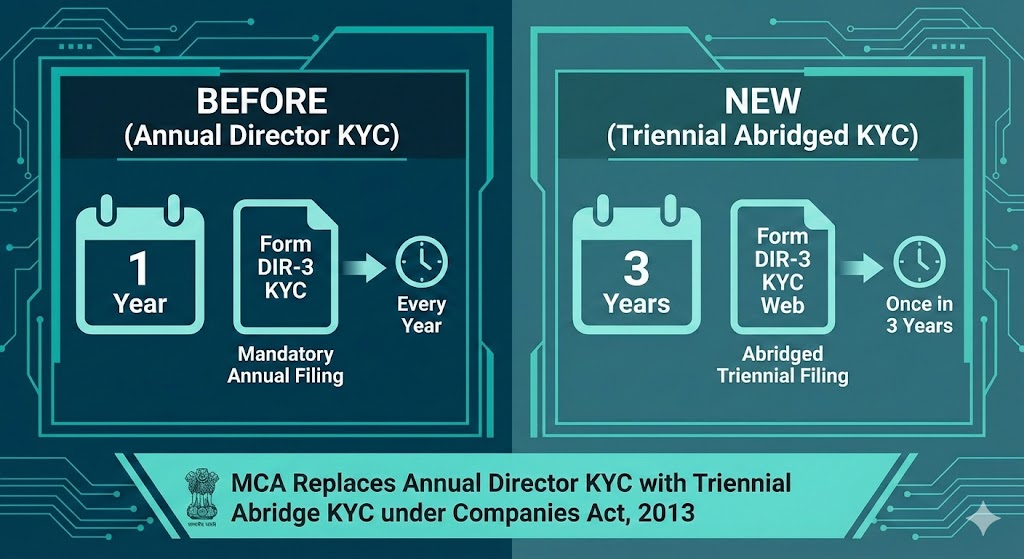
Applicability and Transitional Provisions
Directors Who Have Already Filed KYC
Directors who are already compliant under the earlier regime automatically transition to the new framework.
- Their next mandatory KYC filing will fall due at the end of the new three-year cycle
- No immediate action is required unless there is a change in personal details
This provides predictability and stability in long-term compliance planning.
Directors Who Have Never Filed Director KYC
Directors who have not completed KYC at all are allowed to continue filing under the existing mechanism until a specified cut-off date.
- DIN reactivation and KYC filing can be completed under the old process until the transition deadline
- After this period, non-compliant DINs may face restrictions
This ensures a smooth migration without penalizing legacy or inactive DIN holders abruptly.
What Remains Unchanged Under the New Regime
While the filing frequency has been reduced, certain compliance principles remain intact:
- Director information must always be accurate and up to date
- Any change in email, mobile number, or address must be reported promptly
- DIN deactivation remains a consequence of non-compliance
- Regulatory scrutiny and enforcement powers are unaffected
Key insight:
The reform simplifies compliance execution, not compliance responsibility.
Strategic Impact on Businesses and Boards
Impact on Founders and Promoters
- Reduced repetitive compliance allows greater focus on business strategy
- Lower risk of inadvertent DIN deactivation
- Simplified governance during fundraising and restructuring
Impact on Investors and Nominee Directors
- Easier onboarding of investor nominees
- Fewer recurring compliance representations
- Improved diligence confidence due to stable DIN status
Impact on Large Corporates and Group Structures
- Substantial reduction in aggregate compliance volume
- Lower internal coordination and tracking effort
- Better allocation of compliance resources to higher-risk areas
Quantifying the Compliance Relief
| Parameter | Earlier Annual KYC | Triennial Abridged KYC |
|---|---|---|
| Filing frequency | Every year | Once in three years |
| Forms per 6-year period | 6 | 2 |
| Certification instances | Every filing | Only on changes |
| Compliance cost | High recurring | Significantly reduced |
| Risk of missed deadlines | Frequent | Substantially lower |
Policy Intent and Regulatory Direction
This reform reflects a broader shift in India’s corporate law framework toward:
- Risk-based regulation
- Reduced non-financial compliance burden
- Enhanced ease of doing business
- Greater reliance on event-based disclosures
The move acknowledges that regulatory effectiveness is driven more by quality of data than by frequency of filings.
What Companies Should Do Going Forward
- Re-align internal compliance calendars to the triennial cycle
- Create internal triggers for event-based KYC updates
- Review DIN status of all directors periodically
- Update board onboarding and exit checklists
- Educate directors on their continuing disclosure obligations
Concluding Perspective
The replacement of Annual Director KYC with Triennial Abridged KYC is a meaningful structural reform under the Companies Act, 2013. It reduces compliance noise, preserves regulatory intent, and improves governance efficiency particularly for sophisticated businesses and seasoned boards.
For companies that treat compliance as an enabler of governance rather than a procedural obligation, this change offers long-term strategic value with minimal regulatory trade-off.
]]>India has recently undertaken a significant reform in its succession framework by removing the requirement of compulsory probate rule for certain categories of wills. Previously, in metropolitan jurisdictions such as Mumbai, Kolkata, and Chennai, beneficiaries could not legally act upon a will unless it was first validated by a court through probate a procedure that was frequently time-consuming, expensive, and procedurally intensive. Pursuant to the Repealing and Amending Act, 2025, which amends the Indian Succession Act, 1925, this mandatory requirement has been dispensed with. As a result, a validly executed will may now be implemented without prior court confirmation, while probate continues to remain available as a voluntary protective mechanism in cases involving heightened risk, uncertainty, or potential disputes. In effect, the reform simplifies and accelerates inheritance for families and businesses, places greater emphasis on accurate will-drafting and documentation, and enables courts to concentrate judicial resources on matters that genuinely require adjudication.
India’s Succession Law Reform under the Repealing and Amending Act, 2025
India’s succession law framework has undergone a structural reset with the formal notification of the Repealing and Amending Act, 2025 in December 2025. The most consequential outcome of this legislation is the complete omission of Section 213 of the Indian Succession Act, 1925, which for nearly a century imposed a mandatory probate requirement on wills executed by certain communities in the former Presidency Towns of Mumbai, Kolkata, and Chennai.
This reform dismantles a long-criticised geographical and religious anomaly, replacing a court-mandated gatekeeping regime with a choice-based, risk-calibrated succession framework. Probate has not been abolished. Instead, it has transitioned from a compulsory procedural hurdle into a strategic legal instrument, to be deployed selectively where estate complexity, dispute risk, or asset value demands judicial certainty.
For founders, family offices, high-net-worth individuals (HNIs), banks, housing societies, trustees, and corporate stakeholders, this change materially alters:
- estate administration timelines and costs
- institutional compliance models
- litigation risk allocation
- succession planning strategies
- property and securities transmission workflows
In parallel, financial-market reforms such as SEBI’s Transmission to Legal Heirs (TLH) reporting code (effective January 2026) indicate a coordinated regulatory shift toward trust-based, friction-reduced asset transmission.
This merged report-blog provides a complete legal, operational, and strategic analysis of the reform, supported by legislative history, case law evolution, quantitative impact assessment, stakeholder-specific implications, global comparisons, and a practitioner-ready playbook.
1. What Is Probate and Why It Historically Mattered in India
Probate is a judicial certification of a will that confirms:
- the authenticity of the will, and
- the authority of the executor to administer the estate
Once granted, probate operates as a judgment in rem, conclusively binding on the world at large.
The pre-2025 mandatory probate regime
Before the 2025 reform:
- Section 213 of the Indian Succession Act, 1925 created a statutory bar: no right under a will could be enforced in court without probate or letters of administration.
- This mandate applied only in the former Presidency Towns:
- Mumbai (Bombay)
- Kolkata (Calcutta)
- Chennai (Madras)
- It applied selectively to Hindus, Sikhs, Jains, Buddhists, and Parsis, while Muslims and residents of cities such as Delhi or Bengaluru were exempt.
Practical consequences of mandatory probate
- High Court filings even for uncontested estates
- Ad-valorem court fees
- Procedural hearings and public notices
- Typical timelines of 2–5 years in complex cases
- Costs that often exceeded the value of modest estates
2. The 2025 Succession Law Reform: What Changed
Core legislative action – Omission of Section 213, Indian Succession Act, 1925
The Second Schedule of the Repealing and Amending Act, 2025 explicitly directs that “Section 213 of the Indian Succession Act, 1925 shall be omitted.”
This removes the condition precedent that previously treated wills in Presidency Towns as legally “suspect” unless judicially validated.
Consequential statutory amendments
To prevent interpretational gaps, Parliament simultaneously amended:
- Section 3(1) – removing references to Section 213 from state-exemption powers
- Section 370(1) and (2) – expanding access to Succession Certificates for debts and securities
- Retained Section 212 (intestacy) and Section 273 (conclusive nature of probate)
What remains unchanged
- Probate continues to exist
- Courts retain probate jurisdiction
- Probate still delivers the highest level of legal certainty
The reform does not weaken probate; it repositions it.
3. Why This Reform Matters: Ending a Colonial Anomaly
The mandatory probate rule originated in late-19th-century colonial administration. Its survival into modern India created formal inequality across geography and religion.
Before vs After (Structural Comparison)
| Dimension | Pre-2025 | Post-2025 |
| Geography | Mandatory in 3 cities | Optional nationwide |
| Religion | Selective communities | Uniform application |
| Institutional practice | Probate-driven | Risk-based discretion |
| Cost & time | High, court-centric | Reduced, flexible |
| Citizen autonomy | Limited | Restored |
By removing mandatory probate, the reform restores testamentary autonomy, reduces scope for procedural abuse, and aligns succession law with contemporary ease-of-living objectives.
4. Legal Mechanics: How the Burden of Proof Has Shifted
From court-first to challenge-based scrutiny
Under the old regime, judicial scrutiny occurred upfront. Post-reform, scrutiny is deferred and triggered only if a dispute arises.
Interpretation risks
- Different institutions may evaluate the same will differently
- Mutation is not proof of title
- Revenue authorities conduct only summary inquiries
- Litigation risk now depends heavily on drafting quality and documentation
This makes preventive legal design more critical than ever.
5. Probate vs Succession Certificate: Practical Distinctions
| Factor | Probate | Succession Certificate |
| Purpose | Validates will & executor | Enables collection of debts/securities |
| Judicial depth | High | Summary |
| Typical duration | 6–18+ months | 2–4 months |
| Use case | High-value, complex, disputed estates | Financial assets |
| Legal conclusiveness | Judgment in rem | Limited |
Post-2025, Succession Certificates are now accessible in situations previously blocked by mandatory probate.
6. Quantitative Impact: Time, Cost, and Court Burden
| Metric | Earlier Regime | Post-Reform |
| Median estate settlement | 12–24 months | 2–8 months |
| Court hearings | Multiple | Only if disputed |
| High Court load | Heavy | Expected to decline |
7. Stakeholder-Wise Operational Impact
Banks and Financial Institutions
- Faster claim settlements
- Increased payout.
- Nominees remain trustees, not owners
- Likely adoption of valuation-based thresholds
- Indemnities and affidavits gain prominence
Housing Societies & Real Estate
- Bye-laws must be updated
- Reliance shifts to:
- registered wills
- indemnity bonds
- title search reports
- Buyers may still demand probate for “clean title”
Corporate Trustees & Family Offices
- Trusts remain superior for probate-free succession
- Voluntary probate recommended for:
- blended families
- estranged heirs
- large real-estate portfolios
Startups & Founders
- Share transmission under Companies Act, 2013 becomes faster
- SHAs must be reviewed to remove probate-contingent clauses
- Voting control during succession improves materially
8. Risk Scenarios and Decision Tree (2026)
High-risk scenarios (probate strongly advised)
- Handwritten or copy wills
- Exclusion of spouse/child
- Multiple wills or suspicious circumstances
- Large debts or ongoing litigation
Medium-risk scenarios
- High-value real estate
- Third-party executors
- Unequal distributions
Low-risk scenarios
- Registered wills
- Aligned nominations
- Amicable Class-I heirs
- Assets under ₹50 lakh
9. International Comparison: Where India Now Stands
The move toward optional probate aligns India with international trends where judicial intervention is reserved for higher-risk or high-value cases.
| Jurisdiction | Probate Trigger Mechanism | Strategic Parallel to India |
| United Kingdom | Determined by individual banks/institutions; typically £5k to £50k thresholds. | India’s banks are expected to adopt similar “risk-based” internal limits. |
| Singapore | Mandatory for most asset transfers; “Resealing” allowed for Commonwealth grants. | Singapore still maintains a robust mandatory regime, showing India is now “more liberal” than its neighbor. |
| United States (UPC) | Dual “Informal” and “Formal” tracks based on size and complexity ($25k threshold common). | India’s “optional probate” is akin to the UPC’s “Informal Probate” where the court role is minimal for uncontested estates. |
The US Massachusetts Uniform Probate Code (MAUPC) provides a glimpse into India’s future. In the US, “Voluntary Administration” is a simplified process for small estates with no real estate.
India has gone a step further by removing the mandatory requirement even for real estate in the Presidency Towns, effectively trusting the “Deed” unless challenged. India has effectively leapfrogged into a trust-first, court-last succession model.
10. Market Synergy: SEBI’s TLH Code (Effective Jan 2026)
The 2025 probate reform does not exist in a vacuum. It is supported by financial market reforms aimed at “Ease of Doing Investment”
- TLH = Transmission to Legal Heirs – Effective January 1, 2026, SEBI has introduced the “TLH” reporting code for market intermediaries (RTAs, DPs).
- Enables tax-neutral securities transfer – Previously, when a nominee transferred securities to a legal heir, it was sometimes wrongly taxed as a “transfer” (Capital Gains). The TLH code signals to the CBDT that the transaction is an exempt inheritance under Section 47(iii) of the Income Tax Act.
- Prevents misclassification as capital gains
- Complements probate reform by:
- clarifying who inherits
- simplifying how assets transfer
By first ensuring who should inherit through nomination reforms and now ensuring a tax-neutral, probate-free transfer path, the regulators are creating a “seamless loop” for financial assets.
11. Practitioner Playbook
Before death (testator)
- Drafting Quality: Ensure the will explicitly mentions Section 63 formalities. Since there is no automatic court audit, the “internal robustness” of the document is the only defense.
- Video Attestation: Record a video of the signing ceremony to prove “testamentary capacity” and “sound mind”.
- Registration: Although not mandatory, register the will at the Sub-Registrar’s office. This provides a “public record” that can satisfy housing societies even without probate.
- Nomination Audit: Ensure all financial nominees match the legatees in the will to minimize “Trustee vs. Owner” friction.
After death (executor/heirs)
- Succession Certificate Route: For debts/securities, evaluate if a Succession Certificate (now easier post-Section 370 update) is faster than a full probate.
- SEBI TLH Reporting: Ensure your DP uses the “TLH” code for share transfers to avoid capital gains tax demands.
- Property Mutation: Apply for mutation at the Municipal Corporation (e.g., KMC or MCGM) using an affidavit of “No Other Legal Heirs” and a copy of the will.
- Indemnity Strategy: Prepare standard indemnity bonds for banks and housing societies to offset their perceived risk of paying out without a court order.
12. Policy & Market Implications
- Judicial capacity unlocked for substantive adjudication:
By eliminating compulsory probate for uncontested wills, the High Courts of Mumbai, Kolkata, and Chennai are relieved of a significant volume of routine, procedural probate filings. Judicial time and institutional capacity can now be reallocated toward complex civil, commercial, insolvency, and constitutional matters that genuinely require adjudication. - Accelerated liquidity and operational continuity for families and enterprises:
Heirs and executors can access immovable property, bank deposits, securities, and business interests without prolonged court timelines. This materially improves cash flow availability for household needs, debt servicing, succession-driven business continuity, and founder-led enterprise stability. - Reduction in unclaimed and dormant financial assets:
Easier execution of valid wills reduces friction in succession, directly addressing the chronic accumulation of unclaimed balances held by banks, insurance companies, mutual funds, and depositories. Faster transmission of assets limits dormancy, improves capital circulation in the financial system, and reduces administrative and compliance burdens on financial institutions. - Greater emphasis on precision-driven estate planning:
With courts no longer functioning as an automatic validation layer, outcomes increasingly depend on the technical quality of will drafting, asset identification, nomination alignment, and record integrity. This is likely to drive higher demand for structured estate planning, particularly among founders, business families, and high-net-worth individuals. - Professional evolution from probate processing to succession strategy:
Legal and advisory services are shifting away from volume-driven probate filings toward integrated succession advisory. The focus moves to risk mitigation, dispute avoidance, instrument selection (wills, trusts, voluntary probate), intergenerational governance, and long-term ownership continuity for family enterprises and institutional wealth.
13. Strategic Conclusion
The scrapping of mandatory probate is not deregulation, it is re-regulation by design.
The law has reduced compulsion, but increased responsibility. Those who plan well gain speed and efficiency. Those who plan poorly face amplified litigation risk.
The scrapping of the mandatory probate rule is a victory for legal uniformity and administrative efficiency in India. However, as the “compulsion” of the law recedes, the “responsibility” of the individual increases. The 2025 reforms have handed the keys to estate administration back to the families, but they must now navigate the landscape without the automatic “certification” of the court.
Treelife is uniquely positioned to assist stakeholders in this transition. Our expertise in estate planning, corporate governance, and succession strategy ensures that your legacy is not only legally valid but operationally seamless.
- Legacy Audits: Is your 20-year-old will still the best way to protect your heirs under the new law?
- Institutional Liaising: We manage the “paperwork war” with banks and housing societies so you don’t have to.
- Strategic Succession: For founders and HNIs, we design trust structures that render probate questions entirely moot.
References & Sources:
All statutory analysis, data, frameworks, and conclusions above incorporate and rely upon Treelife’s internal report and the following publicly available sources:
- https://prsindia.org/files/bills_acts/bills_parliament/2025/Repealing_And_Amending_Bill,2025.pdf
- https://prsindia.org/files/bills_acts/acts_parliament/2025/The_Repealing_and_Amending_Act_2025.pdf
- https://economictimes.indiatimes.com/wealth/plan/probate-no-longer-mandatory-in-these-three-metros-what-repealing-section-213-means-for-wills-and-estates/articleshow/126309769.cms
- https://economictimes.indiatimes.com/wealth/legal/will/govt-scraps-mandatory-probate-of-wills-is-voluntary-probate-still-a-smart-move/articleshow/126137433.cms
- https://trilegal.com/knowledge_repository/trilegal-update-removal-of-the-mandatory-probate-requirement-under-the-indian-succession-act/
- https://www.khaitanco.com/thought-leadership/Probate-no-longer-mandatory-Impact-of-the-Repealing-and-Amending-Act-2025-on-Testamentary-Succession
- https://ssrana.in/articles/a-long-overdue-reform-repeal-of-section-213-of-the-indian-succession-act-1925/
- https://www.sebi.gov.in/legal/circulars/sep-2025/smooth-transmission-of-securities-from-nominee-to-legal-heir_77204.html
- https://www.taxmann.com/post/blog/sebi-introduces-tlh-reporting-code-for-transmission-of-securities
Staying compliant is not optional it is a legal and financial necessity. January marks the start of the calendar year, but from a compliance perspective, it is one of the busiest months for businesses, startups, professionals, and employers in India. With multiple GST returns, quarterly TDS/TCS filings, PF–ESI payments, and MCA annual filings, missing deadlines can lead to interest, penalties, and notices.
This January 2026 Compliance Calendar provides a comprehensive, date-wise checklist of all statutory compliances applicable for the month, helping businesses stay fully compliant and audit-ready.
Why a Compliance Calendar Matters in January 2026
January is particularly important because it includes:
- Quarterly filings for Oct–Dec 2025
- Regular monthly GST and TDS obligations
- Annual MCA filings for FY 2024–25 (where applicable)
- PF & ESI statutory payments
The calendar marks due dates for GST, TDS, PF, ESI & MCA Filings. Delays during this month can compound compliance risks for the entire year.
Key Statutory Compliance Due Dates – January 2026
Here is a tabular compliance calendar for January 2026-
| Due Date | Compliance Requirement | Period Covered | Applicable To |
|---|---|---|---|
| 7 Jan 2026 | TDS / TCS Deposit | December 2025 | All deductors & collectors |
| GSTR-7 Filing | December 2025 | GST TDS deductors | |
| GSTR-8 Filing | December 2025 | E-commerce operators | |
| 11 Jan 2026 | GSTR-1 (Monthly) | December 2025 | Monthly GST filers |
| 15 Jan 2026 | Issuance of Form 16A & 27D | Oct – Dec 2025 | Deductors & collectors |
| PF & ESI Payments / Returns | December 2025 | Employers | |
| Form 27EQ (Quarterly TCS Return) | Oct – Dec 2025 | TCS filers | |
| 18 Jan 2026 | CMP-08 Filing | Oct – Dec 2025 | Composition scheme taxpayers |
| 20 Jan 2026 | GSTR-3B (Monthly) | December 2025 | Regular GST taxpayers |
| GSTR-5A Filing | December 2025 | OIDAR service providers | |
| 22 Jan 2026 | GSTR-3B (Quarterly – QRMP) | Oct – Dec 2025 | QRMP taxpayers (selected states) |
| 24 Jan 2026 | GSTR-3B (Quarterly – QRMP) | Oct – Dec 2025 | QRMP taxpayers (remaining states) |
| 30 Jan 2026 | Form 26QB / 26QC / 26QD / 26QE | December 2025 | Specified TDS deductors |
| 31 Jan 2026 | Form 24Q, 26Q, 27Q (Quarterly TDS Returns) | Oct – Dec 2025 | Employers & deductors |
| AOC-4 & MGT-7 (Annual Filings) | FY 2024–25 | Companies (where applicable) |
7th January 2026 (Wednesday)
1. TDS / TCS Deposit – December 2025
- Deposit tax deducted or collected during December 2025
- Applicable to all deductors and collectors
2. GST Returns – GSTR-7 & GSTR-8 (December 2025)
- GSTR-7: For taxpayers required to deduct TDS under GST
- GSTR-8: For e-commerce operators collecting TCS
11th January 2026 (Sunday)
GSTR-1 Filing (Monthly) – December 2025
- Details of outward supplies
- Applicable to normal GST taxpayers under monthly filing
15th January 2026 (Thursday)
1. Issuance of TDS Certificates
- Form 16A – TDS on non-salary payments
- Form 27D – TCS certificate
- For the quarter Oct–Dec 2025
2. PF & ESI Payments / Returns – December 2025
- Mandatory for all employers covered under EPF & ESI laws
- Delay attracts interest and penalties
3. Quarterly TCS Return – Form 27EQ
- For the quarter October to December 2025
18th January 2026 (Sunday)
CMP-08 Filing – Composition Dealers
- Applicable for taxpayers under the Composition Scheme
- For the quarter Oct–Dec 2025
20th January 2026 (Tuesday)
1. GSTR-3B Filing (Monthly) – December 2025
- Summary return with tax payment
- Mandatory for regular GST taxpayers
2. GSTR-5A – December 2025
- Applicable to OIDAR service providers supplying services from outside India
22nd January 2026 (Thursday)
GSTR-3B (Quarterly – QRMP)
- For the quarter Oct–Dec 2025
- Due date depends on the state category
24th January 2026 (Saturday)
GSTR-3B (Quarterly – QRMP)
- Alternate due date for remaining QRMP states
- Ensure correct state-wise applicability
30th January 2026 (Friday)
Challan-cum-Statement for Specified TDS Sections
Applicable for December 2025 transactions:
- Section 194-IA – Sale of immovable property
- Section 194-IB – Rent payment by individuals/HUF
- Section 194-M – Payments to contractors/professionals
- Section 194S – Transfer of virtual digital assets
Forms to be filed:
- Form 26QB
- Form 26QC
- Form 26QD
- Form 26QE
31st January 2026 (Saturday)
1. Quarterly TDS Returns – Oct–Dec 2025
- Form 24Q – Salary TDS
- Form 26Q – Non-salary domestic payments
- Form 27Q – Payments to non-residents
2. MCA Annual Filings (Where Applicable)
- AOC-4 – Filing of financial statements
- MGT-7 – Annual return
- For FY 2024–25
Who Must Follow the January 2026 Compliance Calendar?
This calendar applies to:
- Private Limited Companies & OPCs
- Startups & MSMEs
- LLPs, Firms & Proprietorships
- GST-registered businesses
- TDS/TCS deductors
- Employers registered under PF, ESI & Professional Tax
- OIDAR service providers & non-resident taxpayers
- NBFCs and Ind-AS compliant entities
Summary of Key Forms & Their Purpose
| Form Name | Applicable Law | Purpose / Description |
|---|---|---|
| GSTR-1 | GST | Monthly return for reporting outward supplies (sales details) made by registered taxpayers |
| GSTR-3B | GST | Summary return for declaring tax liability and paying GST |
| GSTR-5A | GST | Return for OIDAR service providers supplying services from outside India |
| GSTR-7 | GST | Return for taxpayers required to deduct TDS under GST |
| GSTR-8 | GST | Return for e-commerce operators collecting TCS |
| CMP-08 | GST | Quarterly statement-cum-challan for taxpayers under the Composition Scheme |
| Form 24Q | Income Tax | Quarterly TDS return for tax deducted on salary payments |
| Form 26Q | Income Tax | Quarterly TDS return for tax deducted on domestic non-salary payments |
| Form 27Q | Income Tax | Quarterly TDS return for payments made to non-residents |
| Form 27EQ | Income Tax | Quarterly TCS return filed by tax collectors |
| Form 16A | Income Tax | TDS certificate for non-salary payments issued to deductees |
| Form 27D | Income Tax | TCS certificate issued to collectees |
| Form 26QB | Income Tax | Challan-cum-statement for TDS on purchase of immovable property |
| Form 26QC | Income Tax | Challan-cum-statement for TDS on rent paid by individuals/HUF |
| Form 26QD | Income Tax | Challan-cum-statement for TDS on payments to contractors/professionals by individuals |
| Form 26QE | Income Tax | Challan-cum-statement for TDS on transfer of virtual digital assets |
| AOC-4 | Companies Act | Filing of financial statements with the Registrar of Companies |
| MGT-7 | Companies Act | Filing of annual return of a company |
Why Staying Compliant Matters
Non-compliance can lead to:
- Missing quarterly TDS/TCS filings
- Delayed PF & ESI payments
- Incorrect QRMP state-wise GSTR-3B dates
- Forgetting MCA annual filings
- Late issuance of TDS certificates
For startups and scaling businesses, a clean compliance record directly impacts valuations and fund-raising success.
Conclusion
January 2026 is a compliance-heavy month with monthly, quarterly, and annual obligations converging together. Planning filings in advance and maintaining accurate records can save businesses from penalties and last-minute stress.
For startups, SMEs, and growing enterprises, outsourcing compliance to experienced professionals ensures accuracy, peace of mind, and uninterrupted business growth.
Why Choose Treelife?
Treelife has been one of India’s most trusted legal and financial firms for over 10 years. We are proud to be trusted by over 1000 startups and investors for solving their problems and taking accountability.
Our team ensures:
- Zero missed deadlines
- Clean audit trails
- Investor-ready compliance
- Full statutory coverage across GST, Income Tax & MCA
Need Help with January 2026 Compliances? Let’s Talk
The International Financial Services Centres Authority (IFSCA) has demonstrated exceptional regulatory dynamism during the April-October 2025 period, introducing transformative frameworks that position GIFT IFSC as a globally competitive financial hub. This comprehensive newsletter provides detailed explanations of all regulatory developments, circulars, and notifications issued by IFSCA during this crucial period, ensuring readers understand not just what changed, but how these changes impact operations and compliance requirements.
Chronological Summary with Detailed Explanations
April 3, 2025 – Direction for All Regulated Entities
IFSCA issued comprehensive operational directions to all regulated entities operating in IFSC. These directions established uniform compliance standards across banking units, capital market intermediaries, insurance entities, and fund management companies. The directions covered areas including reporting requirements, governance standards, and operational protocols to ensure consistent regulatory oversight across the ecosystem.
April 4, 2025 – Enhanced Corporate Governance Framework for Finance Companies
This framework introduced stringent corporate governance requirements for Finance Companies and Finance Units. Key provisions include:
- Board Composition: Mandatory appointment of independent directors comprising at least one-third of board strength
- Committee Formation: Compulsory establishment of Audit Committee, Nomination & Remuneration Committee, and Risk Committee
- CEO/CFO Certification: Annual certification of financial statements by Chief Executive and Chief Financial Officers
- Disclosure Requirements: Enhanced transparency in related party transactions and risk management practices
April 4, 2025 – Global/Regional Corporate Treasury Centres Framework
A comprehensive framework was established allowing Finance Companies and Finance Units to undertake Global/Regional Corporate Treasury Centre activities. This framework enables:
- Multi-currency Operations: Ability to handle treasury operations in multiple foreign currencies
- Cross-border Cash Management: Centralized cash management for multinational corporate groups
- Risk Management Services: Provision of hedging and risk management solutions to group companies
- Investment Activities: Authority to invest surplus funds in permissible instruments globally
April 7, 2025 – Ship Leasing Framework Amendments
Significant amendments were introduced to enhance the operational flexibility of ship leasing entities:
- Currency Flexibility: Lessors can now raise invoices and receive payments in any foreign currency permitted under IFSCA Banking Regulations, 2020
- SNRR Account Opening: Permission to open Special Non-Resident Rupee (SNRR) accounts with authorized dealers outside IFSC for enhanced operational efficiency
- Documentation Simplification: Streamlined documentation requirements for lease agreements
April 8, 2025 – Fund Management Regulations Transition Guidelines
IFSCA issued crucial transition guidelines for the new Fund Management Regulations, 2025, which introduced several business-friendly changes:
Key Modifications for Non-Retail Schemes:
- Reduced Minimum Corpus: Lowered from USD 5 million to USD 3 million for Venture Capital and Restricted Schemes
- Extended PPM Validity: Private Placement Memorandum validity increased from 6 to 12 months, providing more time for fund raising
- FME Investment Flexibility: Fund Management Entities can now invest up to 100% in their own schemes (previously limited to 10%), subject to conditions
- Open-ended Scheme Benefits: Open-ended schemes can commence investment activities with just USD 1 million, with 12 months to achieve minimum corpus
April 17, 2025 – Capital Market Intermediaries Regulations, 2025
This landmark regulation introduced comprehensive changes to the capital market ecosystem:
New Intermediary Categories:
- Research Entity: New category for entities providing equity research and advisory services
- ESG Ratings and Data Products Providers (ERDPP): Formal regulation of ESG rating agencies previously governed by circulars
- Account Aggregator Removal: This category was eliminated from the regulatory framework
Enhanced Qualification Requirements:
- Principal Officer Standards: Minimum qualifications and experience requirements for key personnel
- Compliance Officer Norms: Dedicated compliance officers for each registration category
- Net Worth Requirements: Differentiated minimum net worth based on activity type
May 21, 2025 – Co-investment Framework
IFSCA introduced a framework facilitating co-investment by Venture Capital Schemes and Restricted Schemes. This framework allows:
- Joint Investment Opportunities: Multiple schemes can participate in single investment opportunities
- Risk Sharing: Enhanced risk distribution across participating schemes
- Due Diligence Sharing: Streamlined due diligence processes for co-invested deals
- Exit Coordination: Coordinated exit strategies for co-investing schemes
May 22, 2025 – International Payment Systems Participation
The Authority enabled IFSC Banking Units to participate in international payment systems, significantly expanding:
- Cross-border Payment Capabilities: Direct participation in global payment networks
- Settlement Efficiency: Reduced settlement times for international transactions
- Cost Optimization: Lower transaction costs through direct participation
- Currency Coverage: Enhanced support for multiple foreign currencies
May 24, 2025 – Custodian Appointment Extension
Timeline extensions were provided for custodian appointments under the Fund Management Regulations, 2025:
- Compliance Timeline: Extended deadline from 6 to 12 months for existing FMEs
- Exemption Criteria: Fund of Funds exempted if underlying funds already have custodians
- Operational Continuity: Ensuring uninterrupted fund operations during transition
May 30, 2025 – Global Access Framework Consultation
IFSCA released a revised consultation paper on the Global Access regulatory framework with key proposals:
- Broadened Provider Definition: Expanded definition to include various types of market access facilitators
- Differentiated Net Worth: Tiered capital requirements based on activity scope
- Client Fund Protection: Mandatory routing of investor funds through IFSC bank accounts
- Risk Management Standards: Enhanced risk management and internal control requirements
June 5, 2025 – AML Guidelines Modifications
Comprehensive modifications were introduced to the Anti Money Laundering, Counter-Terrorist Financing and Know Your Customer Guidelines, 2022:
- Enhanced Due Diligence: Strengthened customer identification and verification processes
- Transaction Monitoring: Improved systems for detecting suspicious transactions
- Reporting Requirements: Updated suspicious transaction reporting formats and timelines
- Record Keeping: Enhanced documentation and record retention requirements
June 6, 2025 – Payment Service Providers Framework
IFSCA enabled Payment Service Providers to participate in international payment systems:
- Service Expansion: PSPs can now offer cross-border payment services
- Technology Integration: Integration with global payment networks and platforms
- Regulatory Compliance: Adherence to international payment standards and protocols
- Customer Protection: Enhanced customer protection measures for cross-border transactions
June 13, 2025 – KYC Registration Agencies Fee Structure
A detailed fee structure was established for KYC Registration Agencies:
- Application Fees: Standardized fees for initial registration applications
- Annual Charges: Recurring fees for maintaining registration status
- Transaction-based Fees: Charges based on volume of KYC services provided
- Penalty Framework: Fee structures for non-compliance and violations
July 1, 2025 – Finance Company Guidance Framework
IFSCA issued comprehensive procedural guidance for Finance Companies and Finance Units:
- Approval Processes: Standardized procedures for seeking regulatory approvals
- Documentation Requirements: Clear specifications for submission formats and supporting documents
- Timeline Clarity: Defined processing timelines for different types of applications
- Intimation Procedures: Streamlined processes for regulatory notifications
July 10, 2025 – Video-Based KYC Consultation
A consultation paper proposing modifications to Video-based Customer Identification Process:
- Process Enhancement: Improved video KYC procedures for Indian nationals
- Technology Standards: Specifications for video quality, recording, and storage
- Security Protocols: Enhanced security measures for remote customer identification
- Compliance Requirements: Updated compliance obligations for entities conducting video KYC
July 11, 2025 – Master Circulars Consultation
IFSCA initiated consultation on Master Circulars for Capital Market Intermediaries:
- Consolidated Guidance: Single-source reference for all applicable regulations
- Operational Clarity: Simplified compliance procedures for intermediaries
- Regular Updates: Framework for periodic updates to maintain currency
- Stakeholder Input: Mechanism for incorporating industry feedback
July 24, 2025 – Regulations Making Procedure
The Authority established a transparent rule-making framework:
- Public Consultation Mandate: Minimum 30-day public consultation period for all new regulations
- Stakeholder Engagement: Structured processes for industry input and feedback
- Impact Assessment: Requirement for regulatory impact analysis before implementation
- Publication Standards: Standardized formats for regulatory publications
July 25, 2025 – TechFin and Ancillary Services Regulations
A comprehensive regulatory framework for technology and support service providers:
Registration Requirements:
- Entity Eligibility: Companies, LLPs, foreign branches, and partnership firms can apply for registration
- FATF Compliance: Entities must not be from high-risk jurisdictions identified by FATF
- 12-Month Transition: Existing providers have 12 months to comply with new registration requirements
Governance Standards:
- Principal Officer: Full-time IFSC-based principal officer appointment mandatory
- Compliance Officer: Dedicated compliance officer for regulatory adherence
- Fit and Proper Criteria: All key personnel must meet prescribed standards
- Code of Conduct: Comprehensive behavioral and operational guidelines
Operational Framework:
- Currency Requirements: Financial reporting in USD or designated foreign currencies
- Service Scope: Covers AI, blockchain, cybersecurity, IoT, and various ancillary services
- SWIT Platform: Registration through Single Window IT System for streamlined processing
July 29, 2025 – Transition Bonds Framework
IFSCA introduced a groundbreaking framework for ESG-labelled Transition Bonds:
Core Requirements:
- Entity-Level Transition Plan: Comprehensive decarbonization strategy aligned with Paris Agreement goals
- Taxonomy Alignment: Proceeds must align with recognized taxonomies (EU Taxonomy, Climate Bonds Taxonomy, IEA Roadmaps)
- Quantified Targets: Measurable GHG emission reduction targets covering Scope 1 and 2 emissions
- Governance Framework: Strong climate governance with board oversight
Independent Review Mechanism:
- External Validation: Mandatory appointment of independent external reviewers
- Review Types: Second Party Opinion, Verification, or Certification processes
- Eligible Reviewers: Registered credit rating agencies and ESG rating providers
- Ongoing Monitoring: Continuous assessment of transition plan implementation
Disclosure Requirements:
- Initial Disclosures: Comprehensive information at issuance including use of proceeds and transition plans
- Annual Reporting: Regular updates on progress toward decarbonization goals
- Impact Reporting: Quantitative reporting on environmental and social impacts
- Transparency Standards: Public disclosure of transition progress and challenges
July 31, 2025 – TechFin Transition Guidelines
Detailed guidelines for entities transitioning to new TechFin regulations:
- Migration Timeline: Clear timelines for transitioning from previous frameworks
- Fee Structure: Transparent fee schedules for registration and compliance
- Grandfathering Provisions: Protection for existing arrangements during transition
- Support Mechanisms: Regulatory guidance and support during migration process
August 5, 2025 – Master Circulars for Capital Market Intermediaries
IFSCA issued seven comprehensive Master Circulars providing consolidated guidance:
- Credit Rating Agencies: Comprehensive framework covering rating methodologies, independence requirements, and disclosure obligations
- Debenture Trustees: Guidelines for trustee responsibilities, conflict management, and investor protection measures
- Distributors: Regulatory framework for distribution activities, sales practices, and customer protection
- ESG Ratings and Data Products Providers: Standards for ESG rating methodologies, data quality, and transparency requirements
- Investment Advisers: Advisory service standards, client relationship management, and fiduciary responsibilities
- Investment Bankers: Underwriting standards, due diligence requirements, and market making obligations
- Research Entities: Research quality standards, independence requirements, and disclosure obligations
August 12, 2025 – Global Access Framework Notification
The regulatory framework for Global Access in IFSC was formally notified with detailed provisions:
Provider Categories:
- Global Access Providers (GAPs): Direct interface with foreign brokers for market access
- Introducing Brokers: IFSC broker dealers acting as intermediaries referring clients to GAPs
- Introducers: Any entity referring clients to GAPs for fee or compensation
Net Worth Requirements:
- GAP (Exchange Subsidiary): USD 500,000 minimum net worth
- GAP (Client Trading): USD 500,000 for entities handling client transactions
- GAP (Proprietary Trading): USD 200,000 for proprietary-only operations
- Introducing Brokers: USD 100,000 minimum requirement
Operational Standards:
- Client Fund Protection: Mandatory routing through IFSC bank accounts or authorized PSPs
- Risk Management: Adequate infrastructure and risk controls commensurate with operations
- Foreign Broker Agreements: Formal agreements with compliant foreign trading members
- Disclosure Requirements: Clear disclosure of investor protection limitations
August 13, 2025 – Opening of Accounts by Indian Residents
Corrigendum issued to correct reference dates in the circular concerning foreign currency account opening by Indian residents with International Banking Units in IFSC, ensuring clarity on applicable timelines and procedures.
September 3, 2025 – SWIT Portal for TechFin
IFSCA operationalized the Single Window IT System for TechFin and Ancillary Services entities:
- Digital Onboarding: Streamlined online registration and application processes
- Document Management: Centralized document submission and tracking system
- Status Tracking: Real-time application status updates for applicants
- Integration Benefits: Seamless integration with existing IFSCA systems
September 4, 2025 – Capital Market Intermediaries Compliance Extensions
Two significant deadline extensions were granted recognizing implementation challenges:
- Principal and Compliance Officer Norms: Extended compliance deadline to December 31, 2025, allowing entities adequate time to identify and appoint qualified personnel meeting revised standards
- Net Worth Compliance: Similar extension for meeting enhanced net worth requirements, ensuring operational continuity during transition
September 8, 2025 – Third-Party Fund Management Fee Structure
Detailed fee structures were specified for Fund Management Entities offering third-party services:
- Application Fee: USD 2,500 for initial application processing
- Authorization Fee: USD 7,500 upon grant of authorization
- Additional Net Worth: USD 500,000 additional capital requirement for third-party services
- Ongoing Charges: Annual fees based on assets under management
September 11, 2025 – Bullion Exchange Market Access
Market access frameworks were extended to Bullion Exchanges and Trading Members:
- Investor Access: Clear pathways for investor participation through Authorized Persons
- Cross-border Access: Access available through entities in India or foreign jurisdictions
- Risk Management: Enhanced risk management standards for bullion trading
- Settlement Mechanisms: Streamlined settlement processes for bullion transactions
September 12, 2025 – Global Access Framework Amendments
Critical amendments enhanced operational flexibility:
- Payment Options: GAPs and Introducing Brokers can maintain client accounts with IFSC Banking Units or authorized Payment Service Providers
- Operational Efficiency: Greater flexibility in payment processing and fund management
- Cost Optimization: Competitive options for payment service providers
- Regulatory Clarity: Clear guidelines on fund segregation and account management requirements
September 18, 2025 – Convertible Debt Securities Clarification
IFSCA clarified listing requirements for convertible debt securities:
- Listing Framework: Convertible debt securities may be listed under debt security norms until conversion
- Conversion Process: Clear procedures for handling conversion from debt to equity
- Disclosure Requirements: Enhanced disclosure standards for conversion features
- Investor Protection: Specific protections for holders of convertible securities
September 18, 2025 – Payments Regulatory Board Regulations
Comprehensive regulations established the Payments Regulatory Board:
- Board Composition: Clear membership structure including IFSCA representation and industry experts
- Governance Framework: Standards for board conduct, decision-making, and accountability
- Regulatory Oversight: Framework for overseeing payment systems under PSS Act, 2007
- Stakeholder Engagement: Mechanisms for industry consultation and feedback
October 3, 2025 – Foreign Currency Settlement System
A major milestone with the notification of comprehensive FCSS framework:
System Architecture:
- CCIL IFSC Operation: CCIL IFSC Limited authorized to operate the settlement system under PSS Act, 2007
- Multi-currency Support: Initial USD support with scope for additional foreign currencies
- Real-time Settlement: Immediate settlement of foreign currency transactions between IBUs
- Local Settlement: Reduced dependence on correspondent banking relationships
Risk Management Framework:
- Default Management: Robust procedures for handling participant defaults
- Netting Arrangements: Efficient netting mechanisms to reduce settlement volumes
- Liquidity Safeguards: Adequate liquidity provisions for smooth operations
- Collateral Management: Comprehensive collateral frameworks for risk mitigation
Operational Benefits:
- Cost Efficiency: Reduced transaction costs compared to traditional correspondent banking
- Speed Enhancement: Faster settlement times for cross-border transactions
- Regulatory Certainty: Clear legal framework under Indian jurisdiction
- Market Development: Enhanced attractiveness of GIFT IFSC for international banks
October 7, 2025 – Video-Based KYC for NRIs
IFSCA Chairman announced imminent guidelines for video-based KYC for Non-Resident Indians:
- Digital Onboarding: Complete elimination of paper-based account opening requirements
- Global Accessibility: NRIs can open accounts from any global location through video KYC
- Technology Standards: Specifications for video quality, security, and recording requirements
- November Launch: Guidelines to be issued by November 2025 for implementation
October 19, 2025 – FinTech Sandbox Framework
Consultation paper released for comprehensive FinTech Sandbox Framework:
- Multi-sector Coverage: Dedicated approaches for banking, capital markets, insurance, and related technologies
- Innovation Testing: Safe environment for testing innovative financial solutions
- Regulatory Relaxations: Specific regulatory relaxations for sandbox participants
- Graduation Pathways: Clear pathways from sandbox to full regulatory authorization
October 22, 2025 – Consultation Paper on Differential Distribution Framework for Blended Finance
IFSCA released a comprehensive consultation paper proposing a framework to facilitate blended finance and other fund structures in IFSC by permitting differential distribution in Venture Capital Schemes and Restricted Schemes:
Blended Finance Context:
- Concept: Strategic deployment of concessional or philanthropic capital to mobilize private capital towards sustainable development projects
- Global Momentum: USD 262 billion mobilized globally through blended finance; growth from USD 11.5 billion to USD 18.3 billion annually (2020-2024)
- Leverage Ratio: Each dollar of concessional capital mobilizes USD 3.76 in commercial capital; larger transactions attract USD 5.46 per dollar
- Indian Need: India requires USD 10.1 trillion financing for net zero by 2070
Proposed Framework:
- Eligible Schemes: Venture Capital and Restricted Schemes permitted to issue multiple classes of units with differential distribution rights (Senior units, Junior/Subordinate units, Mezzanine units)
- ESG Schemes: Permitted to accept up to 20% of corpus as grants from donors/DFIs
- Minimum Investment: USD 2 million for junior/subordinate classes; USD 1 million for accredited investors
- Investment Restrictions: Maximum 25% of corpus in single investee company; prohibition on using funds to discharge obligations to investors or associates
Risk Mitigation Safeguards:
- Ever-greening Prevention: Mandatory restriction preventing investee companies from using scheme investments to repay obligations to scheme investors or associates
- Valuation: Independent valuer mandated to compute NAV for each class of units
- Disclosure Requirements: Detailed PPM disclosures with examples in tabular format; enhanced risk disclosures for junior/subordinate class investors
October 27, 2025 – Consultation Paper on Dematerialisation of Securities by IFSC Entities
IFSCA issued a consultation paper proposing mandatory dematerialization of securities through IFSC depositories rather than domestic depositories:
Core Mandate:
- ISIN Requirement: All IFSC entities must obtain International Securities Identification Numbers (ISINs) from IFSCA-registered depositories instead of domestic depositories
- Rationale: Securities issued by IFSC entities are treated as foreign securities under FEMA; regulatory coherence requires alignment with IFSC depository infrastructure
- ICSD Exception: Issuers may continue using International Central Securities Depositories for issuance and listing as permitted under IFSCA (Listing) Regulations, 2024
Transition Timeline:
- Migration Deadline: Existing IFSC entities with securities dematerialized through domestic depositories must migrate by March 31, 2026
- Depository Responsibilities: IFSC depositories must ensure seamless migration, minimize disruption, and provide adequate disclosures on migration process
- Compliance Reporting: IFSC depositories must submit compliance report by April 30, 2026
October 28, 2025 – Consolidated IFSCA (Listing) Regulations, 2024 (Amended up to October 14, 2025)
IFSCA published a consolidated version of the Listing Regulations incorporating amendments effective October 14, 2025:
Key Amendments:
- SPAC Timeline Extension: Business combination information disclosure timeline extended from 5 to 8 working days
- DR Allotment Timeline: Depository receipt allotment and refund completion timeline extended from 5 to 8 working days from issue closure
- Quarterly Reporting: Enhanced flexibility in quarterly financial statement disclosure timelines with audit committee review requirements
Regulatory Framework:
- Applicability: Covers IPOs, FPOs, SPACs, rights/preferential issues, QIPs, DRs, debt securities, secondary listings, and other permitted financial products
- Eligible Issuers: Entities incorporated in IFSC, India, or foreign jurisdictions complying with home jurisdiction laws
- Clarifications: Authority empowered to issue clarifications through guidance notes or circulars for interpretation
October 31, 2025 – Modifications to AML/CFT/KYC Guidelines – Video-Based Customer Identification Process
IFSCA introduced comprehensive modifications enabling Video-based Customer Identification Process (V-CIP) for onboarding Indian nationals and Non-Resident Indians:
V-CIP for Indian Nationals:
- Authorized Operators: V-CIP may be operated by regulated entity officials, financial group entities in India supervised by financial regulators, or KYC Registration Agencies
- Infrastructure Requirements: Technology infrastructure housed within regulated entity or financial group premises; end-to-end encryption; anti-spoofing capabilities
- IP Address Restrictions: Resident Indians must have IP emanating from India
- Technology Standards: Face liveness/spoof detection; AI anti-deep fake checks; live GPS coordinates; date-time stamping
V-CIP for NRIs (Pilot Phase):
- Eligible Jurisdictions: Low-risk NRIs residing in 11 specified countries: USA, Japan, South Korea, UK (excluding British Overseas Territories), France, Germany, Canada, UAE, Singapore, Australia, European Union (excluding Croatia)
- Verification Requirements: IP address must emanate from jurisdiction in current address proof; bank account details from specified jurisdiction required for verification
- Debit Freeze Mechanism: Account opened in debit freeze mode upon identity verification; activation only upon receipt and verification of first credit from provided bank account
- Pilot Duration: 4-month pilot phase; expansion to additional countries after completion
Security and Compliance:
- Audit Requirements: Vulnerability Assessment, Penetration Testing, and Security Audit by CERT-In empaneled auditors
- Concurrent Audit: All V-CIP accounts operational only after concurrent audit ensuring process integrity
- Record Management: Video recordings stored securely with date-time stamps; activity logs preserved
November 3, 2025 – Consultation Paper on Amendments to CMI Regulations
IFSCA proposed multiple amendments to Capital Market Intermediaries Regulations, 2025 addressing industry concerns:
Principal Officer / Compliance Officer Eligibility Relaxations :
- Qualification Expansion: Post-graduate degrees in fintech, science, technology, engineering, and mathematics (STEM) added as valid qualifications
- Experience Reduction: Minimum experience for graduate degree holders reduced from 10 years to 5 years in financial services market
- Rationale: Addresses talent shortage in nascent IFSC capital markets ecosystem
Common Principal Officer for Multiple Registrations :
- Expanded Scope: Entities with registrations as broker dealers, clearing members, depository participants, custodians, and registered distributors may have same principal officer
- Distribution Vertical Head: Entities conducting distribution must appoint separate official with adequate financial services experience as vertical head for distribution activities
- Operational Benefits: Reduces impediments for entities offering complementary services
Net Worth Clarifications :
- Excluded from Liquid Assets: Base minimum capital and interest-free deposits with stock exchanges/clearing corporations
- Included in Liquid Assets: Margins deposited with clearing members and clearing corporations
- Custodian Net Worth: Unified USD 1 million minimum net worth requirement for all custodians (replacing complex tiered structure); existing custodians have until January 31, 2026 to comply
Umbrella Registration Framework :
- Singapore Model: IFSCA exploring unified Capital Markets Services (CMS) License model allowing entities to seek multiple activity registrations through single application
- Objective: Enhance ease of doing business and streamline registration processes
November 4, 2025 – Consultation Paper on Proposed IFSCA (Pension Fund) Regulations, 2025
IFSCA released comprehensive proposed regulations for establishing pension fund ecosystem in IFSC targeting NRIs and foreign citizens:
Regulatory Background:
- Expert Committee: Expert Committee on Sustainable Finance (chaired by Prof. Mukul G. Asher) recommended IFSCA-regulated pension products with non-INR denomination
- Government Notifications: Scheme operated by pension fund notified as ‘financial product’ (December 5, 2024); Section 25 of PFRDA Act 2013 exempted for IFSC (October 1, 2025)
Pension Fund Manager (PFM) Eligibility:
- Legal Structure: Company or branch in IFSC
- Experience Requirement: Applicant/parent/associate must have 10 years’ experience managing pension fund, retail fund, or insurance business
- Minimum Net Worth: USD 1 million at all times
- Infrastructure: Robust IT infrastructure, secure systems, defined processes for fund management, record keeping, administration, grievance redressal, cybersecurity, and compliance
- Staffing: Minimum three employees (including compliance officer) with specified qualifications and 3+ years’ relevant experience
Scheme Features:
- Voluntary Participation: Open exclusively to NRIs and foreign citizens above 18 years
- Contribution Flexibility: Subscribers determine frequency (monthly, quarterly, annually, lump sum) and amount
- Multiple Scheme Types: Distinct investment options with varied objectives, strategies, and risk profiles
- Exit Options: Systematic Withdrawal Plans (SWP) and annuity options
Governance and Compliance:
- Fit and Proper Criteria: All directors, key managerial personnel, and controlling shareholders must meet fit and proper criteria continuously
- Office Requirements: Dedicated, fully functional IFSC office with adequate infrastructure
- Technology Systems: Robust, scalable, secure systems for investment analysis, trading, risk monitoring, valuation, record-keeping, and cybersecurity
- Policy Framework: Comprehensive internal policies covering investment decisions, risk management, compliance, grievance redressal, AML/CFT
Value Propositions:
- Global Asset Access: Investment in wide range of global assets with high allocation permitted to Indian markets
- Healthcare Integration: Optional healthcare benefit integration
- Regulatory Oversight: Robust subscriber protection framework with operational flexibility
November 11, 2025 – Additional Reporting Directions for IFSC Banking Units (External Account Statistics)
IFSCA issued supplementary directions enhancing fortnightly Banking Asset Liability (BAL) statement reporting by IBUs:
Vostro Account Reporting Mandate:
- New Requirement: IBUs must report balances in foreign currency accounts of overseas banks (Vostro accounts) held/maintained with the IBU
- Rationale: IBUs have started maintaining such accounts which were not captured in existing BAL reporting framework
- Effective Period: Fortnightly reporting from second fortnight of November 2025
Vostro Account Reporting Instructions:
- Current Account Component: Report either net credit balance under Credit (Ct) or net debit balance under Debit (Dt) without negative sign; no simultaneous entries
- Book Value Reporting: Report book value of balances in respective currency
- Country/Currency Fields: “Country” represents overseas bank’s country; “Currency” represents account maintenance currency
Compliance and Enforcement:
- Accuracy Requirement: Failure to furnish mandated information accurately and timely will be viewed seriously
- Legal Basis: Issued under Section 35A of Banking Regulation Act, 1949 and Section 13(1) of IFSCA Act, 2019
- Platform: Reporting through RBI’s BoP portal (https://bop.rbi.org.in/)
Analysis of regulatory trends
Digital Transformation Leadership
The period demonstrates IFSCA’s commitment to digital-first regulation with initiatives including video-based KYC, SWIT portal operationalization, and FCSS implementation. These developments position GIFT IFSC as a digitally advanced financial center capable of serving global markets efficiently.
Regulatory Harmonization and Simplification
The introduction of Master Circulars and consolidated frameworks reflects strategic regulatory maturity. By moving from fragmented guidelines to comprehensive frameworks, IFSCA has significantly enhanced regulatory clarity and ease of compliance for market participants.
Sustainable Finance Innovation
The Transition Bonds Framework positions GIFT IFSC at the forefront of sustainable finance innovation, addressing the critical USD 100+ trillion funding gap for decarbonizing hard-to-abate sectors while maintaining rigorous environmental and governance standards.
Global Market Integration
Multiple initiatives including the Global Access Framework, international payment system participation, and foreign currency settlement capabilities demonstrate IFSCA’s vision of positioning GIFT IFSC as a truly global financial hub with seamless cross-border connectivity.
Technology-Enabled Financial Services
The TechFin and Ancillary Services Regulations recognize the critical role of technology in modern financial services delivery, providing a structured framework for fintech innovation while maintaining appropriate oversight and risk management standards.
Conclusion
The April-October 2025 period represents a transformative phase in IFSCA’s regulatory evolution, characterized by comprehensive framework modernization, digital innovation leadership, and strategic positioning for global competitiveness. The Authority has successfully balanced innovation enablement with robust risk management, creating an ecosystem that supports diverse financial services while maintaining international regulatory standards.
The detailed nature of these regulatory updates demonstrates IFSCA’s proactive approach to addressing evolving market needs while maintaining high standards of governance, transparency, and investor protection. As these frameworks become fully operational, they are expected to significantly enhance GIFT IFSC’s attractiveness as a premier destination for international financial services and contribute substantially to India’s emergence as a global financial hub.
The comprehensive coverage of digital infrastructure, sustainable finance, global market access, and technology integration positions GIFT IFSC to compete effectively with established international financial centers while serving the unique needs of the Indian and global financial services ecosystem.
]]>1.1. The Exit Imperative and Liquidity Pathways
Every business owner will eventually navigate a liquidity event. The choice of exit strategy whether an Initial Public Offering (IPO), a Merger and Acquisition (M&A) transaction, or a more straightforward trade sale profoundly influences the founder’s financial future and the company’s legacy. Regardless of the chosen path, achieving an optimal return requires a demonstrable and defensible financial track record. The transition from private company operations to an exit process is complex, high-stakes, and subject to intense scrutiny, demanding financial preparation that begins years before the transaction announcement.
An M&A transaction often provides immediate liquidity and certainty, insulating the seller from future market volatility, though it may involve relinquishing control.1 Conversely, an IPO offers access to long-term capital and allows owners to maintain some control, but necessitates a lengthy preparation process, extensive regulatory compliance, and exposure to ongoing market fluctuations. The common thread across all these scenarios is that financial transparency and organizational rigor are the non-negotiable foundations upon which valuation is built and defended2.
1.2. Financial Hygiene: The Non-Negotiable Foundation of Value Creation
The concept of financial hygiene extends far beyond basic bookkeeping. It is defined as the establishment of decision-ready, transparent financial infrastructure capable of withstanding the deep dives of buyer due diligence.3 While basic compliance involves timely payroll and statutory filings, true transaction-grade financial hygiene encompasses consistent accounting policies, accurate historical records, and clean working capital reporting.
This strategic level of preparedness is mission-critical because the exit process is fundamentally a transfer of risk. Buyers utilize due diligence to identify, quantify, and price this risk. When financial records are unreliable, inconsistent, or poorly documented, they introduce organizational risk and provide significant negotiation leverage against the seller, almost inevitably leading to a material valuation discount.4 The valuation premium, therefore, is directly related to the seller’s ability to reduce the perceived uncertainty and risk for the buyer.
1.3. The VCFO’s Role as a Strategic Enhancer
The Virtual or Fractional CFO (VCFO) model is uniquely positioned to address the specific, time-bound mission of exit readiness and value acceleration. Unlike a traditional, full-time CFO who manages operational, day-to-day transaction processing, the strategic VCFO focuses on value acceleration and strategic financial leadership.
The VCFO proactively builds the investor-grade financial reporting necessary to satisfy sophisticated buyers and public market analysts. By leading proactive diligence readiness activities such as establishing robust internal controls, standardizing KPIs, and executing a sell-side Quality of Earnings (QoE) review the VCFO performs the essential de-risking work for the founder. Financial leadership that embeds this strategic rigor significantly improves the likelihood of achieving higher valuations and smoother exits, validating the core proposition that strategic preparedness translates directly into realized enterprise value.
2. The Exit Landscape: Current Environment
The current M&A and IPO environment is characterized by market volatility, intense scrutiny, and an expansion of due diligence scope, demanding comprehensive preparation far beyond previous market cycles.
2.1. Market Trends and Exit Windows
Macroeconomic volatility continues to shape global M&A activity, leading to persistent valuation gaps between buyers and sellers. Despite these conditions, global transaction value remains substantial; for instance, Q2 2025 saw global M&A transaction value reaching approximately $780.7 billion across 10,521 deals. While overall deal volume and value remain strong globally, regional activity can vary; Europe, for example, saw transaction value decrease by 28% year-over-year in Q2 20255.
The Indian M&A landscape for 2025 demonstrated a bifurcated trend, characterized by a subdued period followed by a strong rebound. In Q2 2025, India’s M&A deal value declined significantly to $5.4 billion across 197 deals, marking the lowest value since Q2 2023, primarily due to the absence of mega-deals and an 81% plunge in domestic M&A values6. Despite the overall slowdown in this quarter, domestic deals remained the dominant force, constituting 70% of the total M&A deal volumes, and the Banking sector was the value leader, driven by a key $1.57 billion investment in YES Bank. However, this cautious sentiment reversed sharply in Q3 2025, as the total deal market surged to a six-quarter high, with M&A alone seeing an 80% increase in value and a 26% rise in volume quarter-on-quarter. The Q3 M&A value reached approximately $28.4 billion across 518 deals, powered by a renewed confidence in the stable macroeconomic environment and strategic transactions, notably the Technology sector leading in volume with 146 deals and $13.3 billion in value7. The quarter’s momentum was further underscored by significant cross-border activity, including a major $4.45 billion outbound acquisition by Tata Motors in the Automotive sector. This rapid swing highlights that while global uncertainty influences investor caution, India’s fundamental economic strength and focus on strategic, mid-to-large-sized deals are actively driving consolidation and growth8.
A notable trend observed in recent periods is that due diligence processes have become noticeably longer, with data room providers reporting record volumes of documents being disclosed. This is often because, without the intense pressure of highly contested auctions, buyers are utilizing the market conditions to “dive deeper” into target businesses. This extended timeline and granular assessment allow buyers to gain a comprehensive understanding of operational risks and intricacies before committing to a valuation, underscoring that an exit is not an event but a journey beginning years before the transaction is announced.
2.2. Evolving Buyer Expectations and Due Diligence Intensity
Modern due diligence has experienced a phenomenon referred to as “diligence creep,” shifting from a focused financial ticking exercise to a more rigorous, holistic, and forward-looking assessment of risk and value. Core areas of evaluation now extend well beyond financial health to include legal and regulatory compliance, tax obligations, operational efficiency, technology systems, intellectual property, and human capital.
Crucially, due diligence now often incorporates non-financial factors such as Environmental, Social, and Governance (ESG) performance, cybersecurity, culture, and regulation. Buyers are not just assessing historical compliance; they are seeking evidence to mitigate hidden risks and identify opportunities to unlock future value.
This expansion of scope requires extreme data readiness and granularity. Buyers, particularly sophisticated financial buyers like Private Equity (PE) firms, prioritize verifiable data that supports the financial narrative.
The technological advancements in the field necessitate organizational maturity. There is an increased use of Artificial Intelligence (AI) in the diligence process, specifically for high-volume tasks such as contract reviews, helping to identify problematic clauses (e.g., change of control clauses) and producing contract summaries. This reliance on AI demands that the VCFO ensures the target company’s digital documentation is not only accurate but also machine-readable and traceable within the data room. If documentation is disorganized, siloed, or non-standardized, the AI-driven review process will slow significantly, introduce friction, require manual intervention, and ultimately increase transaction costs and the risk of deal fatigue.
2.3. Strategic vs. Financial Buyer Prioritization
The priorities of potential acquirers determine the focus of the VCFO’s preparatory work9.
Financial Buyers (e.g., PE firms): These groups focus intensely on quantifiable financial levers. They require clear visibility into normalized earnings (Quality of Earnings), operational efficiency, and scalability, seeking paths for cost reduction and growth maximization within a fixed investment horizon. They demand robust systems that allow for easy financial modeling and scenario planning.
Strategic Buyers: While financials are fundamental, strategic buyers place a higher value on synergy potential, market position, client portfolio quality (long-term contracts, recurring revenue), cultural fit, and talent retention post-close. The VCFO, in this context, must focus on aligning the financial narrative with the demonstrable strategic advantages and integration readiness.
The current trend of longer due diligence periods means the VCFO must embed strong internal controls and compliance checks that resemble IPO-level readiness, even when pursuing an M&A exit. This proactive establishment of a rigorous framework reduces the likelihood of late-stage regulatory or operational discoveries derailing the transaction.
3. What Does Financial Hygiene Really Mean?
Transaction-grade financial hygiene is the discipline of presenting a company’s performance history in a clear, consistent, and defensible manner that minimizes buyer risk and maximizes the integrity of the valuation methodology.
3.1. Core Elements of Transaction-Grade Financials
The foundation of value creation rests on several core elements:
- Accurate and Compliant Financials: Adherence to standard accounting principles (GAAP) is the starting point for any external valuation. Compliance mitigates legal risks and penalties post-acquisition.
- Reliable Historical Records: Financial records must be traceable and auditable over the required look-back period, typically spanning three to five years. This traceability supports the validation of reported figures during the Quality of Earnings (QoE) analysis.
- Consistent Accounting Policies: Uniform application of accounting policies is critical. Inconsistencies or errors in applying policies are prime targets for buyer-led QoE adjustments, which invariably lead to a lower final valuation.
- Clean Cash Flow and Working Capital Reporting: Buyers need a clear, accurate identification of true operating cash flow and the normalization of required working capital. This level of clarity is vital for decision-making and for assessing the target’s ability to service debt or fund future growth.
3.2. Operational vs. Strategic Financial Hygiene: The Virtual CFO Distinction
It is critical to differentiate between the two tiers of financial management:
- Operational (Bookkeeping): This focuses on backward-looking compliance: processing invoices, managing payroll, and fulfilling statutory filing requirements. This function ensures the company remains legally operational but does little to proactively prepare for an exit.
- Strategic (Decision-Ready Infrastructure): This is the domain of the VCFO. The focus shifts to forward-looking planning, building investor-grade systems, and establishing infrastructure robust enough for external audit and investor scrutiny. This includes establishing fast closing abilities and utilizing attractive IT systems to meet the rigorous financial disclosure periods required by a transaction timeline. The VCFO transforms the finance function from a necessary cost center into a strategic value accelerator.
For companies in specialized sectors, such as Software as a Service (SaaS), core financial hygiene is magnified. SaaS valuations are driven by Annual Recurring Revenue (ARR) multipliers, currently around 6x ARR for private companies. If a company bundles professional services into contracts or applies inconsistent discounts, proper revenue recognition (e.g., AS 9, Ind AS 115) becomes complex.10 If the VCFO does not proactively clean up these contracts and align revenue recognition consistently, the QoE process will strip out improperly recognized or non-recurring revenue, severely damaging the defendable ARR base and collapsing the valuation.
3.3. Risk Mitigation through Financial Clarity
The seller’s primary objective must be to eliminate information asymmetry. Due diligence thrives on clarity and traceability. When sellers present “numbers with missing or jumbled information,” buyer expectations are lowered, leading to a direct discount on the valuation multiple. Furthermore, a lack of demonstrable assurance such as failing to provide clean legal and compliance reviews can expose the buyer to significant post-acquisition costs, penalties, or reputational damage. By proactively establishing robust financial hygiene, the Virtual CFO removes the incentive for the buyer to impose punitive terms or lower the purchase price based on uncertainty.
The required level of financial sophistication can be categorized using a maturity model, which defines the path from basic compliance to transaction readiness.
Financial Cleanliness Maturity Model
| Maturity Level | Focus Area | Characteristic | VCFO Action Required |
| Level 1: Foundational | Accounting Compliance | Basic GAAP adherence; reliance on manual processes; non-recurring items not tracked. | Implement consistent accounting policies; automate core processes; establish a clean chart of accounts. |
| Level 2: Compliant | Operational Reporting | Timely reports, but limited insight; historical focus; some internal controls present. | Develop strategic KPIs; implement fast closing ability; improve forecasting systems. |
| Level 3: Transaction-Ready | Strategic Value Acceleration | Investor-grade reporting; fully normalized EBITDA; robust internal controls; proactive risk mitigation. | Lead sell-side QoE; prepare detailed diligence data packages; establish transparent group structure. |
This framework demonstrates that a Virtual CFO’s mandate is to drive the company from Level 1 or 2 to Level 3, a state where the financial function actively supports, rather than hinders, the transaction process.
4. Financial Due Diligence: Anatomy and Impact
Financial due diligence is the structured process of verifying and validating the financial representations made by the target company. The Quality of Earnings (QoE) report is the central instrument in this validation process, fundamentally anchoring valuation and shaping deal terms.
4.1. The Criticality of Quality of Earnings (QoE)
A standard financial audit only confirms compliance with accounting standards (GAAP). However, it does not assess the sustainability or quality of a company’s earnings. Therefore, a QoE report is essential for providing the comprehensive, nuanced understanding of financial health required for confident deal-making.
For the seller, performing a sell-side QoE is a tactical imperative. It is advised to begin this analysis two to three months before entering the market. This allows the VCFO and the finance team sufficient time to identify, quantify, and remediate internal issues (e.g., inconsistent policies or questionable revenue recognition practices) and present the business in the most compelling, defensible manner possible, thereby pre-empting buyer skepticism.
4.2. What Due Diligence Evaluates (QoE Core Components)
The QoE report provides practical, decision-focused insights that go beyond traditional accounting analysis. The core components evaluated include:
- Normalized EBITDA (Adjusted Earnings): This is the foundation of enterprise valuation. The QoE process meticulously analyzes earnings sustainability by making adjustments for anomalies, nonrecurring items, discretionary expenses, or income that is owner-related, resulting in a “Normalized EBITDA” figure. If the seller has not proactively tracked and justified these adjustments, the buyer’s QoE will often result in a significant downward revision, directly reducing the valuation.
- Revenue Quality and Sustainability: This component assesses the resilience of the company’s revenue streams, reviewing client concentration risk, churn rates, pricing dynamics, and, critically, proper revenue recognition practices. For technology companies, this means ensuring that revenue projections for each stream are accurate and defensible.
- Working Capital Analysis: The QoE evaluates required working capital and liquidity trends. Buyers seek to normalize the working capital requirements to ensure they are not inheriting a business artificially starved of cash before closing. This analysis is crucial for defining the working capital peg, a key component of post-close negotiation.
- Forecast Validation: Buyers rigorously review the seller’s multi-year strategic forecasts against historical performance, market trends, and demonstrable operational capacity.
The VCFO’s QoE preparation is a mechanism for defending future cash flow, which is paramount for valuation, especially in volatile markets. When market certainty is low, buyers scrutinize the quality of recurring revenue and true operating cash flow. By performing a rigorous sell-side QoE, the VCFO provides the evidence necessary to support the multi-year forecast, justifying the investment thesis and minimizing the risk associated with future performance.
4.3. Impact on Valuation and Deal Structure
Due diligence is not optional; it is fundamental to validating valuation and negotiating deal terms.
- Anchoring Valuation: QoE findings anchor all valuation negotiations. Adjustments made to normalize EBITDA directly determine the value base upon which the multiplier is applied, which can lead to more precise valuations and purchasing prices that better correspond with actual performance and risk.
- Shaping Deal Structure and Buyer Protections: Due diligence uncovers risks and contingent liabilities that must be mitigated through deal structure. This can lead to the implementation of complex mechanisms such as earn-outs (used to bridge valuation gaps where payment is contingent on future performance) or significant escrow holdbacks for indemnification.
- Warranties and Indemnity (W&I) Insurance: Sellers and their advisors, guided by the VCFO, are increasingly initiating the W&I insurance process early using a ‘hard’ or ‘hybrid’ staple process. This tactical move facilitates the auction and provides the seller with control and visibility over the likely coverage position, mitigating post-close liability. The emergence of Synthetic Warranties requires particularly rigorous preparation; under this structure, the insurer covers their own set of warranties based on the quality of diligence provided. This necessitates that the VCFO ensures the sell-side diligence package is immaculate, as its quality directly determines the scope and availability of the insurance coverage, which, in turn, accelerates the exit and provides a cleaner financial break for the founders.
5. VCFO / Fractional CFO: Strategic Financial Leadership
The strategic demands of an exit require a level of financial leadership that often exceeds the capacity or specific expertise of an in-house team. The VCFO model fills this gap, providing specialized experience tailored to transaction success.
5.1. Role Segmentation: CFO vs. VCFO
The differentiation between the operational CFO and the strategic Virtual CFO is crucial to understanding the VCFO’s unique value proposition:
- Operational CFO (Full-time): This executive is typically embedded in daily operations, focusing on historical compliance, managing internal accounting staff, and ensuring the accuracy of monthly/quarterly closes. They focus on reporting what happened.
- Strategic VCFO (Fractional/Interim): This executive is engaged specifically for strategic value acceleration and exit readiness. They leverage decades of experience in complex corporate finance, M&A, and public company readiness. They focus on reporting why it matters and orchestrating what needs to happen next to achieve strategic goals. The fractional model provides flexible engagement, allowing companies to scale this high-level expertise without the long-term fixed commitment of a full-time hire. The VCFO’s engagement is intrinsically aligned with the exit timeline.
5.2. The VCFO Mandate: Pre-Transaction Execution
The VCFO acts as the quarterback of the pre-transaction process, ensuring the company’s financial narrative is robust and compelling for external stakeholders:
- Building Investor-Grade Reporting: The VCFO develops insightful, action-oriented reporting and key performance indicators (KPIs) tailored for external stakeholders, including bankers, investors, boards of directors, and valuation firms. Late or unreliable financial reports hinder strategic decision-making and impair investor confidence.
- Leading Proactive Diligence Readiness: Rather than simply reacting to buyer requests, the VCFO leads the internal sell-side QoE, organizing the data room, coordinating internal teams, and ensuring that all systems and documentation are prepared for immediate, intense scrutiny.
- Strategic Forecasting and Planning: The VCFO develops a well-defined one-year operating budget linked to a multi-year strategic forecast. This comprehensive approach is essential for sharing the company’s trajectory with stakeholders and valuation firms. Additionally, the VCFO implements short-term financial rigor, such as 13-week cash flow projections and a rolling quarterly view, ensuring clear liquidity positioning and effective risk mitigation.
5.3. Value Creation Mechanisms Driven by the Virtual CFO
The VCFO generates value by transforming the company’s infrastructure and narrative:
- Structuring Robust Metrics and KPIs: This involves defining and standardizing verifiable metrics (e.g., Gross Margin, Customer Retention, Lifetime Value/Customer Acquisition Cost) that align with industry benchmarks. For instance, the VCFO ensures the company can credibly report against industry averages, such as a 74% gross margin for the average SaaS company. Optimized financial reporting gives clear visibility into the potential levers that drive shareholder value.
- Fixing Data Quality and Consistency: This involves leading the implementation of strong internal controls, governance structures, and, if required, GAAP or IFRS conversion. The VCFO ensures the data is clean, traceable, and consistent across reporting periods.
- Preparing Documentation and Systems for Review: This includes improving the organization’s fast closing ability and ensuring IT systems are attractive and efficient enough to meet stringent financial disclosure periods.
- The Transformation of Management and Governance: Strategic finance leadership extends beyond numbers into organizational structure. Investors place immense value on a strong management team often considering it “more important than anything else”. The VCFO often audits and strengthens leadership structures, accountability frameworks, and operational efficiency to create scalable, resilient companies. By proactively structuring the leadership team or bringing in “repetitive” CEOs who have experience buying, selling, and growing businesses, the VCFO significantly de-risks the management transition for a prospective buyer, justifying a higher valuation multiplier based on organizational maturity and execution certainty.11
6. Equity Structuring and Capital Strategy
The management of a company’s capital structure, the blend of debt and equity used to finance operations and the clarity of its equity ownership are critical factors that influence buyer valuation, negotiation leverage, and the perceived risk profile of the asset.
6.1. Equity Ownership and Transfer Dynamics
A clean and transparent ownership structure is a non-negotiable prerequisite for M&A or IPO readiness.
- Cap Table Hygiene: The capitalization table must be meticulously accurate, detailing all current owners, vesting schedules, and shareholder rights. Undisputed ownership structures help to reduce friction and eliminate legal uncertainties that can stall a transaction.
- Internal Restructuring: The VCFO often guides necessary internal preparation steps, ranging from obtaining necessary shareholder consents or amending constitutional documents to carrying out internal restructures and carve-outs well ahead of the transaction process. Establishing a transparent group structure is a key preparation phase for a potential IPO.
6.2. Capital Stack Optimization and Negotiation Leverage
Buyers closely examine a company’s financial health, including its debt levels and cash flow, as the foundation of valuation. The choice of financing significantly impacts the risk and return profile of the deal for the buyer.
- Debt vs. Equity Impact on Buyer Valuation: The existing capital structure heavily influences the buyer’s financing decisions post-acquisition.
- Debt Financing (Loans): Taking on a loan allows the buyer to retain full ownership, offering potentially higher returns as profits are not shared with investors. However, this option requires the acquired business to have strong, predictable cash flow to support regular repayments and interest. A high debt load can limit reinvestment opportunities and is contingent on providing tangible assets as collateral.
- Equity Financing: Selling ownership stakes (e.g., to private equity firms or corporate investors) reduces the immediate financial strain on the buyer but means relinquishing some control and sharing future profits, reducing potential gains. Equity financing introduces new decision-makers into the company.
- Capital Structure as a Negotiation Tool: The VCFO’s role involves assessing and optimizing the company’s liquidity and capital structure in advance. They conduct detailed cash flow analyses to ensure the business can support potential debt payments, a primary concern for buyers utilizing traditional bank loans. This proactive validation of debt capacity de-risks the asset for the buyer.
- Strategic Use of Seller Financing: The VCFO analyzes the feasibility of using seller financing for a portion of the purchase price. This hybrid structure provides greater flexibility and can be used as a key tool to bridge valuation gaps in M&A transactions, making the deal more affordable for the buyer.
A well-optimized and managed capital structure signals sophisticated financial management to the market. By ensuring predictable cash flow and clear documentation of any collateralized assets, the VCFO reduces the perceived risk associated with acquiring and financing the entity. This de-risked financial profile makes the target company more attractive to lenders and investors, which often translates into more favorable deal terms and a higher valuation.12
7. IPO vs M&A Preparation Checklist
The required preparation for an M&A exit differs substantially from that for an IPO, demanding specialized focus from the VCFO team depending on the ultimate strategic goal. The IPO path is a fundamental organizational transformation, while M&A focuses on immediate financial proof points.
Strategic Comparison of M&A vs. IPO Exits
| Factor | M&A Exit (Acquisition/Sale) | IPO Exit (Initial Public Offering) |
| Speed and Complexity | Generally faster and less complex; confidential until finalized. | Lengthy preparation (12-24 months); intensive regulatory/audit process. |
| Liquidity & Certainty | Immediate, fixed liquidity; eliminates market volatility exposure. | Access to long-term capital; valuation subject to ongoing market volatility. |
| Control & Ownership | High likelihood of relinquishing operational control post-close. | Allows founders to maintain some control while gradually exiting. |
| Financial Disclosure | Minimal public disclosure until close; focuses on diligence data. | Extensive, ongoing public financial and operational disclosure required. |
| VCFO Focus | Quality of Earnings (QoE), diligence readiness, risk mitigation (W&I), synergy modeling. | GAAP conversion, robust internal controls, corporate governance, investor relations, long-term forecasting, ESG reporting. |
7.1. M&A Specific Requirements
For M&A, the VCFO focuses on creating an airtight diligence package tailored to the specific deal and buyer type:
- Deal-Specific Diligence Packaging: Preparation centers around creating a detailed, secure, and easily navigable data room. Documentation must directly address the core components of the QoE review (Normalized EBITDA, working capital, revenue quality).
- Risk Mitigation Documentation: Documentation must clearly outline contingent liabilities, legal compliance, and tax obligations. This ensures the company can effectively manage the buyer’s assessment of risks and support the use of W&I insurance.
- Integration Readiness: The VCFO works to showcase operational efficiency and scalable business models, which reduce post-acquisition integration costs for the buyer, justifying a premium valuation.
7.2. IPO Specific Requirements
An IPO is a transformational process, requiring the company to adopt the standards and behaviors of a public entity at least one year before the actual listing.
- Regulatory Filing Readiness and GAAP Conversion: The VCFO must lead the mandatory conversion of accounting records into accounting standards. This process is complex and requires establishing consistent, compliant accounting policies that can withstand public scrutiny.
- Robust Earnings Narrative and Forecasting: Preparation involves business modeling to fine-tune the company’s “equity story” and KPI reporting, and preparing detailed valuation analysis for discussions with market analysts. IPO readiness extends beyond sheer financial transparency; investor perception matters as much as the raw numbers. The narrative must convey growth potential and operational stability. The VCFO must also establish systems capable of providing reliable, long-term forecasts for analyst guidance.
- Internal Controls and Governance: IPO preparation necessitates the establishment of sophisticated corporate governance structures, internal audit functions, and risk and compliance management systems. This involves fundamental organizational change, including adjustments to leadership responsibilities and ownership structure.
- ESG Integration: Modern IPO readiness demands that the VCFO integrate Environmental, Social, and Governance (ESG) metrics and sustainability planning into the core financial narrative years in advance. Robust ESG disclosure practices positively impact IPO valuation. Pre-IPO candidates must articulate their ESG position in anticipation of emerging directives, demonstrating a commitment to sustainability that appeals to long-term investors.
8. Case Evidence & Patterns
Real-world evidence consistently demonstrates that the level of financial discipline directly correlates with exit timing, valuation outcomes, and deal completion certainty.
8.1. Consequences of Financial Neglect
Weak finance processes consistently introduce risks that buyers quantify as punitive valuation adjustments:
- Devaluation via QoE Adjustments: A common failure pattern involves inconsistent revenue recognition, particularly prevalent in bundled service offerings for SaaS companies. If the Virtual CFO has not enforced strict adherence to revenue recognition standards (e.g., separating subscription revenue from non-recurring professional services), the QoE will strip out that non-recurring income. Similarly, the failure to consistently track and separate excessive owner-related, discretionary expenses from true operational expenses results in a significantly lower normalized EBITDA. These downward adjustments collapse the valuation multiple, confirming the evidence-based principle that poor financial hygiene introduces leverage against the seller.
- Stalled or Failed Transactions: Deals frequently stall or fail when due diligence uncovers hidden, material risks. This can include missing or inaccurate documentation, unresolved legal liabilities (e.g., intellectual property disputes or unresolved lawsuits), or non-compliance with regulations. These failures result in significant costs, reputational damage, and loss of momentum, often causing buyers to walk away.
- Management Team Risk: Investors acquire a team and a future trajectory, not just historical assets. If the CEO or founder lacks proven management experience a common issue in early-stage, founder-led SaaS companies where the founder is primarily the inventor investor apprehension about the scalability and future execution risk can lead to a lower valuation multiple.
8.2. The Acceleration Effect: Disciplined Finance Leadership
Cases where disciplined finance leadership, often spearheaded by a VCFO, have accelerated exit timing and boosted valuation share common patterns:
- Defense of Valuation Multiples: By proactively performing a sell-side QoE and implementing investor-grade reporting, companies can successfully benchmark against the higher end of industry comparables (e.g., achieving higher than the average 6.5x ARR multiple for SaaS). High-quality data ensures the strategic narrative the potential for growth and synergy is supported by undeniable, traceable evidence.
- Operational Efficiency Justifying Premium: Businesses that implement operational efficiency and scalable business models are more attractive to strategic and financial buyers. When the VCFO introduces standardized workflows and technology integration, the buyer perceives lower integration costs and higher potential for synergy, justifying a premium valuation.
- Demonstrated Organizational Maturity: When a VCFO ensures the financials are clean, transparent, and decision-ready, it signals to the buyer that the entire organization is disciplined, scalable, and well-governed. This perceived organizational maturity mitigates execution risk post-transaction. The presence of “repetitive CEOs” or experienced management teams, often structured or advised by the VCFO, provides investors with high confidence that the company can execute on its growth promises. The valuation premium received is essentially the market reward for reducing buyer uncertainty.
9. Strategic Recommendations
Based on the evidence that early preparation and high-quality data infrastructure materially improve exit outcomes, founders and investors must adopt a strategy of continuous, proactive readiness.
9.1. Implement Continuous Readiness Cycles
Companies must shift the mindset from viewing an exit as a one-time transactional cleanup event to achieving a perpetual state of continuous readiness. This involves embedding cyclical internal audits, performing quarterly mock QoE exercises, and rigorously tracking non-recurring items throughout the year, not just in the lead-up to a sale. This ensures the organization is ready to move swiftly when favorable market conditions or an attractive buyer emerge.
9.2. Embed the VCFO Early into Finance Leadership
The timing of the Virtual CFO engagement is critical. To transition the company to a Transaction-Ready state (Level 3 on the Financial Cleanliness Maturity Model), the VCFO should be engaged 18 to 24 months prior to the anticipated exit window. This timeframe allows the VCFO to execute the foundational work: fixing accounting policies, leading GAAP conversion, establishing internal controls, and developing long-term forecasts that require time to prove accuracy. The VCFO must be empowered to execute these strategic initiatives alongside the team, rolling up their sleeves and operating in the trenches, not merely providing academic advice.
9.3. Build Data Infrastructure and Governance
In the era of AI-driven diligence, robust digital infrastructure is non-negotiable. Organizations must prioritize the implementation of attractive IT systems, centralized data governance, and automated reporting capabilities. This infrastructure must support the VCFO’s mandates, including the capability for rapid financial closing and the ability to produce high-granularity, searchable data rooms that facilitate AI review.
9.4. Aligning Cross-Functional Workflows
Exit readiness is a cross-functional undertaking that the VCFO must orchestrate. It requires the mandatory integration and alignment of finance, tax, legal, and operational workflows. The VCFO must coordinate with legal teams to ensure compliance checks, intellectual property protection, and thorough contract review are completed proactively. By addressing the holistic scope of modern due diligence including legal, tax, and increasingly ESG compliance the Virtual CFO ensures the entire organization is presenting a unified, low-risk profile to the market.
Embedding the VCFO early optimizes value not just through remedial cleanup, but through strategic optimization that informs long-term capital allocation. By starting early, the VCFO can identify and exploit opportunities to improve core metrics (e.g., boosting gross margins or improving client retention) that compound over time, substantially increasing the final enterprise valuation base long before the transaction process even begins.
10. Conclusion
The success of any corporate exit be it M&A, IPO, or trade sale is materially determined by two factors- robust financial hygiene and strategic financial leadership. The evidence overwhelmingly demonstrates that founders who proactively invest in high-quality data infrastructure and engage experienced VCFO expertise years in advance achieve higher valuations and execute smoother transactions.
The modern diligence environment, characterized by deeper dives, longer timelines, and the incorporation of holistic risk factors (including ESG and cybersecurity), necessitates a state of continuous operational excellence. Financial preparedness is not merely a task to be checked off; it is the fundamental mechanism through which uncertainty is reduced and shareholder value is maximized. Early preparation and a commitment to transaction-grade financial maturity are fundamental to validating valuation, defending negotiation positions, and securing a successful liquidity event.
11. Appendix / Tools
11.1. Due Diligence Readiness Scorecard
This structured checklist helps assess a company’s preparation level across the core evaluation areas prioritized by sophisticated buyers.
| Diligence Area | Key Criteria | Ideal Benchmark | Readiness Status |
| Financial (QoE) | Normalized EBITDA calculation methodology defined; GAAP/IFRS compliance achieved; 3-5 years of auditable historical data available. | 5+ years of audited financials (GAAP); No material QoE adjustments required; Revenue recognition policies fully documented and validated. | |
| Cash Flow & Working Capital | 13-week cash flow projections implemented; Working Capital normalization completed; Liquidity optimization strategies documented. | Forecast accuracy $\pm 5\%$ for 13-week cash flow; Zero difference between target and actual working capital at close; Clear Cash Conversion Cycle (CCC) optimization plan. | |
| Operational & Systems | Scalable business model documented; Technology integration and IT systems optimized; Fast closing ability demonstrated. | Complete Tier 1 ERP system integration (e.g., SAP, Oracle); Fully documented fast-close process (5 days or less); Demonstrated system capacity for $2\times$ current volume. | |
| Legal & Compliance | All contracts machine-readable/summarized; Change-of-control clauses identified; IP ownership and regulatory compliance verified. | Virtual Data Room (VDR) completeness; Zero material legal findings (litigation/IP); All material contracts have favorable change-of-control clauses or none. | |
| Human Capital & Governance | Key employee retention plans documented; Leadership and accountability structures validated; Formal corporate governance established. | Key executive retention agreements signed; Org chart with clear succession plan for all C-suite roles; Audit and Compensation Committees fully operational with independent directors. |
11.2. Financial Cleanliness Maturity Model
As detailed in Section 3, this model defines the VCFO’s role in elevating the company’s financial function from compliance to strategic value creation.
- Level 1: Foundational (Compliance Focus): The company meets basic legal requirements but relies heavily on manual processes. Historical data integrity is questionable, and non-recurring expenses are not systematically tracked. VCFO Goal: Implement strict, consistent accounting policies and automate core processes.
- Level 2: Compliant (Operational Reporting Focus): The company produces timely financial reports but lacks strategic foresight. Internal controls exist but are inconsistent. VCFO Goal: Establish strong internal controls (6-12 months prior to transaction), develop strategic KPIs, and implement enhanced forecasting systems to prepare for external review.
- Level 3: Transaction-Ready (Strategic Value Acceleration Focus): The company operates with investor-grade reporting. Normalized EBITDA is continuously calculated and defensible. The organization is structurally prepared for an IPO or M&A diligence. VCFO Goal: Execute sell-side QoE, finalize data room preparation, and align all cross-functional workflows to support the transaction.
11.3. VCFO Engagement Blueprint (12-18 Month Timeline)
A phased approach maximizes the VCFO’s impact and ensures resources are allocated efficiently across the pre-transaction cycle.
Phase I (0-6 months): Assessment & Remediation
- Readiness Health Check: Conduct initial gap analysis against GAAP/IFRS standards and M&A requirements.
- Accounting Cleanup: Fix historical errors, standardize accounting policies, and ensure clean separation of owner expenses.
- System Implementation: Begin upgrading IT systems and centralizing data infrastructure for traceability.
Phase II (6-12 months): Value Acceleration & Infrastructure
- KPI Structuring: Define, implement, and start tracking strategic KPIs aligned with valuation benchmarks (e.g., ARR multiples, gross margins).
- Forecasting & Liquidity: Develop the multi-year strategic forecast and implement 13-week cash flow projections.
- Governance & Controls: Establish formal corporate governance structures, including internal audit and risk management systems, often necessary for public market readiness.
Phase III (12-18 months): Transaction Readiness
- Sell-Side QoE Execution: Complete the formal, independent Quality of Earnings review to validate normalized EBITDA and identify any residual issues.
- Diligence Finalization: Prepare and populate the data room with categorized, traceable, and AI-ready documentation.
- Capital Strategy & Narrative: Coordinate legal and tax reviews, finalize capital structure optimization strategy, and ensure the financial narrative supports the required equity story and analyst discussions.
References:
- [1] Exit Strategy Showdown: M&A vs. IPO – WhichOne’s Your Golden …, accessed December 11, 2025, https://nowcapitalpartners.com/exit-strategy-showdown-ma-vs-ipo-whichones-your-golden-ticket/ ︎
- [2] The Fractional CFO Advantage in Private Equity Exits, accessed December 11, 2025, https://growthoperators.com/resources_insights/the-fractional-cfo-advantage-in-private-equity-exits/ ︎
- [3] Quality of Earnings Report: Essential Financial Due Diligence for M&A, accessed December 11, 2025, https://calvettiferguson.com/understanding-quality-of-earnings/ ︎
- [4] Due Diligence M&A: Trends, Risks, and Future Value, accessed December 11, 2025, https://magistralconsulting.com/due-diligence-ma-in-2025-risk-valuation-market-insights/ ︎
- [5] M&A due diligence, deeper dives required | Key trends explained, accessed December 11, 2025, https://www.hsfkramer.com/insights/reports/2025/global-ma-report-2025/due-diligence-deeper-dives ︎
- [6] Grant Thornton Bharat, “India Inc records fewer big-ticket deals in Q2 at USD 17 bn, Banking and PE hold momentum” ︎
- [7] PwC India / IBEF, “India records 999 deals worth US$ 44.3 billion in Q3 CY25” (M&A component) ︎
- [8] EY India, “India’s M&A activity surges 37% to US$26 billion in Q3 2025…” (Automotive and Technology figures) ︎
- [9] 10 Factors That Impact Valuation in M&A Transactions – Merge, accessed December 11, 2025, https://gomerge.com/blog/factors-affecting-m-and-a-valuation/ ︎
- [10] IPO readiness assessment | EY – Global, accessed December 11, 2025, https://www.ey.com/en_gl/services/ipo/readiness-assessment ︎
- [11] Financial Due Diligence Report Pwc – Profnit, accessed December 11, 2025, https://sga.profnit.org.br/index_htm_files/virtual-library/aUdovX/Financial_Due_Diligence_Report_Pwc.pdf ︎
- [12] Capital Structure in M&A: A Buy-Side Client’s Guide – True North M&A, accessed December 11, 2025, https://www.tnma.com/blog/capital-structure-ma-buy-side/ ︎
This updated guide includes all essential income tax deadlines, TDS/TCS compliance, investment cut-offs, advance tax deadlines, and statutory filings for FY 2025–26.
At a Glance: Key Deadlines Before 31 March 2026
| Category | Compliance Task | FY / Period | Due Date |
|---|---|---|---|
| Individuals (Old Regime) | Tax-saving investments (80C, 80D, 80G, NPS, ELSS, PPF, etc.) | FY 2025–26 | 31 March 2026 |
| Salaried Individuals | Submission of investment proofs to employer | FY 2025–26 | Feb–Mar 2026 (Employer-specific) |
| Businesses / Companies | Booking expenses & year-end provisions | FY 2025–26 | 31 March 2026 |
| Companies (Maharashtra) | Filing Annual PTRC Return | Mar 2025–Feb 2026 | 31 March 2026 |
| All Assessees | 4th Installment of Advance Tax | FY 2025–26 | 15 March 2026 |
| Presumptive Taxpayers (44AD/44ADA) | Full Advance Tax Payment | FY 2025–26 | 15 March 2026 |
| ITR-U Updated Return | Last date to file ITR-U for FY 2021–22 (AY 2022–23) | FY 2021–22 | 31 March 2026 |
Year-End Compliance for Individuals (FY 2025–26)
Complete All Tax-Saving Investments (Old Regime)
If you have opted for the old tax regime, ensure your tax-saving investments for FY 2025–26 are completed by 31 March 2026 to claim deductions.
Eligible Sections & Popular Instruments
- Section 80C
- PPF, LIC Premium, ELSS Funds, Tax-saving FD, NSC, Tuition Fees.
- Section 80D
- Medical Insurance Premium for self, family, and parents.
- Section 80CCD(1B)
- Additional ₹50,000 deduction for NPS.
- Section 80G / 80GGC
- Donations to registered charities or political parties.
- Section 80E / 80EEA
- Education loan interest and affordable housing interest (if eligible).
Submit Investment Proofs to Employer (Salaried Individuals)
Employers adjust taxes (TDS) based on declarations submitted via Form 12BB. Most organisations have cut-off dates such as:
- 15 February 2026
- 15 March 2026
If proofs are not submitted in time:
- Higher TDS will be deducted in March payroll.
- You can still claim the refund at return-filing stage, but cash flow impact remains.
Key Compliance Tasks for Companies (FY 2025–26)
Annual PTRC Return (Maharashtra)
Companies registered under Maharashtra Professional Tax (PTRC) must file the Annual PTRC return (March 2025 – February 2026) on or before: 31 March 2026
Penalty for delay:
- ₹1,000 minimum and can extend based on duration of default.
Provisioning of Expenses & Closing Books
Before closing FY 2025–26, companies must ensure:
- All year-end expenses are booked (rent, utilities, audit fees, professional charges, marketing costs, etc.)
- Unpaid expenses are accrued.
- TDS is deducted and deposited as per applicable timelines.
- Vendor invoices for March are recorded before 31 March.
- Reconciliation of:
- Accounts receivable/payable
- GST ledgers
- TDS ledgers
- Bank statements
Why this matters:
Incorrect provisioning impacts:
- Profit calculations
- Tax liabilities
- Audit reports
- Next year’s opening balances
Tasks Applicable to Individuals, Firms & Companies
Advance Tax – Final Installment (15 March 2026)
Who Needs to Pay?
- Individuals with taxable income exceeding ₹10,000 (excluding salary where employer deducts TDS properly)
- Companies
- Partnership firms
- Freelancers & consultants
- Taxpayers receiving:
- Interest income
- Capital gains
- Rental income
- Business income
Important Notes
- The 4th instalment of advance tax is due on 15 March 2026.
- For presumptive taxation under:
- Section 44AD (Small businesses)
- Section 44ADA (Professionals)
Entire advance tax must be paid in one single instalment by 15 March 2026.
Updated Return (ITR-U) – Last Date 31 March 2026
The Updated Return (ITR-U) allows taxpayers to correct or disclose missed income within 2 years from the end of the relevant assessment year.
Deadline Now Applicable
- Last date to file ITR-U for FY 2021–22 (AY 2022–23) is 31 March 2026
When to Use ITR-U
- Missed reporting income
- Underpaid tax
- Incorrectly claimed deductions
- Filed return but want to revise financial information
- Missed filing return originally
Additional Tax on ITR-U
| Return Filing Timing | Additional Tax Payable |
|---|---|
| Within 12 months | 25% of additional tax + interest |
| Within 24 months | 50% of additional tax + interest |
Not allowed if:
- Search/seizure proceedings are initiated
- Assessment is already completed
- You are reducing tax liability
Staying compliant is not optional it is a legal and financial necessity. December 2025 brings multiple critical due dates for GST, TDS, advance tax, PF, ESI, ROC filings, and quarterly tax returns. Missing these deadlines can result in heavy penalties, interest, and compliance red flags for businesses and individuals alike.
This December 2025 Compliance Calendar provides a consolidated, easy-to-track list of all major statutory due dates applicable under GST, Income Tax, Companies Act, PF/ESI, and Professional Tax laws in India.
Why a Compliance Calendar Matters in December 2025
- Ensures timely GST return filing, TDS payments, and ROC filings
- Helps avoid late fees, penal interest, and prosecution risks
- Supports year-end financial closure and audit preparedness
- Enables proper advance tax planning before the financial year end
- Improves investor confidence and due-diligence readiness
Key Statutory Compliance Due Dates – December 2025
Here is a tabular compliance calendar for December 2025-
| Due Date | Form / Compliance | Applicable To | Description / Purpose |
|---|---|---|---|
| 7th December 2025 (Sunday) | TDS / TCS Deposit | All deductors & collectors | Deposit of tax deducted or collected at source for November 2025 |
| 10th December 2025 (Wednesday) | GSTR-7 & GSTR-8 | Government deductors & e-commerce operators | GST TDS/TCS return for November 2025 |
| 11th December 2025 (Thursday) | GSTR-1 (Monthly) | Regular GST taxpayers | Outward supply return for November 2025 |
| 13th December 2025 (Saturday) | GSTR-1 IFF (Optional) | QRMP scheme taxpayers | Optional B2B invoice upload for November 2025 |
| GSTR-5 & GSTR-6 | Non-resident taxpayers & ISDs | Monthly GST returns for November 2025 | |
| 15th December 2025 (Monday) | Form 16A & Form 27D | All deductors & collectors | Issue of TDS/TCS certificates for Aug–Oct 2025 |
| Professional Tax Payment / Return | Employers (state-wise) | Monthly professional tax for November 2025 | |
| PF & ESI Payment / Return | All employers | Payroll compliance for November 2025 | |
| Third Installment of Advance Tax | Individuals & corporates liable to advance tax | Advance tax payment for FY 2025–26 | |
| 20th December 2025 (Saturday) | GSTR-3B (Monthly) | Regular GST taxpayers | Summary GST return for November 2025 |
| GSTR-5A | OIDAR service providers | GST return for online service providers for November 2025 | |
| 29th December 2025 (Monday) | Forms 26QB / 26QC / 26QD / 26QE | Property buyers, professionals, contractors, crypto traders | TDS challan-cum-statement under Sections 194-IA, 194-IB, 194M & 194S for November 2025 |
| 31st December 2025 (Wednesday) | Form 27EQ (Quarterly TCS Return) | TCS collectors | TCS return for Q3 FY 2025–26 |
| Forms 24Q / 26Q / 27Q (Quarterly TDS Returns) | All TDS deductors | TDS returns for Q3 FY 2025–26 | |
| Form 3BB | Stock brokers | Statement for November 2025 | |
| AOC-4 / AOC-4 XBRL / AOC-4 NBFC (Ind AS) | Companies & NBFCs | Filing of financial statements for FY 2024–25 (Extended Due Date) | |
| MGT-7 & MGT-7A | Companies & OPCs | Annual return for FY 2024–25 (Extended Due Date) |
7th December 2025 (Sunday)
- TDS/TCS Deposit – All deductors/collectors
Deposit tax deducted or collected at source for November 2025.
10th December 2025 (Wednesday)
- GSTR-7 & GSTR-8 – Government deductors & e-commerce operators
GST TDS/TCS return for November 2025.
11th December 2025 (Thursday)
- GSTR-1 (Monthly) – Regular GST taxpayers
Outward supply return for November 2025.
13th December 2025 (Saturday)
- GSTR-1 IFF (Optional) – QRMP scheme taxpayers
- GSTR-5 & GSTR-6 – Non-resident taxpayers & ISDs
Invoice uploads & monthly returns for November 2025.
15th December 2025 (Monday)
- Form 16A & Form 27D – All deductors/collectors
Issue of TDS/TCS certificates for Aug–Oct 2025. - Professional Tax Payment / Return – Employers
(Due date varies by state, e.g., Maharashtra). - PF & ESI Payment / Return – All employers
For wages of November 2025. - Third Installment of Advance Tax – FY 2025–26
Mandatory for individuals and corporates liable to advance tax.
20th December 2025 (Saturday)
- GSTR-3B (Monthly) – Regular GST taxpayers
- GSTR-5A – OIDAR service providers
Summary GST returns for November 2025.
29th December 2025 (Monday)
- Forms 26QB / 26QC / 26QD / 26QE
(TDS on property rent, professional payments, crypto, etc.)
TDS challan-cum-statements for November 2025 under Sections 194-IA, 194-IB, 194M & 194S.
31st December 2025 (Wednesday)
- Quarterly TCS Return – Form 27EQ (Q3 FY 2025–26)
- Quarterly TDS Returns – Forms 24Q / 26Q / 27Q (Q3 FY 2025–26)
- Form 3BB – Statement by Stock Brokers for November 2025
- AOC-4 / AOC-4 XBRL / AOC-4 NBFC (Ind AS)
Extended due date for FY 2024–25. - MGT-7 & MGT-7A (Annual ROC Return)
Extended due date for FY 2024–25.
Who Must Follow the December 2025 Compliance Calendar?
This calendar applies to:
- Private Limited Companies & OPCs
- Startups & MSMEs
- LLPs, Firms & Proprietorships
- GST-registered businesses
- TDS/TCS deductors
- Employers registered under PF, ESI & Professional Tax
- OIDAR service providers & non-resident taxpayers
- NBFCs and Ind-AS compliant entities
Summary of Key Forms & Their Purpose
| Form | Purpose | Frequency |
|---|---|---|
| GSTR-1, GSTR-3B, GSTR-5, GSTR-5A, GSTR-7, GSTR-8 | GST Returns | Monthly |
| Forms 24Q, 26Q, 27Q, 27EQ | Quarterly TDS/TCS Returns | Quarterly |
| Form 16A, 27D | TDS/TCS Certificates | Quarterly |
| PF & ESI | Employee Welfare Contributions | Monthly |
| AOC-4 / MGT-7 / MGT-7A | ROC Annual Filings | Annually |
| Advance Tax | Income-tax Liability | Quarterly |
Why Staying Compliant Matters
Non-compliance can lead to:
- Heavy interest and late fees under GST & Income-tax Act
- Director disqualification under the Companies Act
- Blocked refund claims & GST credit mismatches
- Adverse impact on funding, audits & investor due diligence
- Litigation and departmental scrutiny
For startups and scaling businesses, a clean compliance record directly impacts valuations and fund-raising success.
Compliance Tips from Treelife Experts
- Set up automated compliance alerts for all statutory deadlines.
- Reconcile GSTR-1 vs GSTR-3B before filing.
- Cross-check TDS entries with AIS & Form 26AS.
- Begin ROC annual filing well in advance of December deadlines.
- Maintain proper documentation for advance tax computation.
Conclusion
The December 2025 Compliance Calendar is one of the most critical months of the financial year, covering GST returns, quarterly TDS/TCS filings, advance tax, PF/ESI, and extended ROC filings. Proactive planning is essential to avoid year-end bottlenecks, regulatory scrutiny, and financial exposure.
For startups, SMEs, and growing enterprises, outsourcing compliance to experienced professionals ensures accuracy, peace of mind, and uninterrupted business growth.
Why Choose Treelife?
Treelife has been one of India’s most trusted legal and financial firms for over 10 years. We are proud to be trusted by over 1000 startups and investors for solving their problems and taking accountability.
Our team ensures:
- Zero missed deadlines
- Clean audit trails
- Investor-ready compliance
- Full statutory coverage across GST, Income Tax & MCA
Need Help with December 2025 Compliances? Let’s Talk
India has introduced a historic regulatory change with the new labour law in India 2025. For the first time since Independence, 29 separate labour legislations have been consolidated into four unified Labour Codes, transforming how organisations manage employment, wages, social security, and workplace safety.
This represents a paradigm shift from fragmented regulation to integrated compliance.
What Is the New Indian Labour Law 2025?
The new labour law framework operationalised on 21 November 2025 restructures India’s employment regulatory landscape by replacing legacy sector-specific statutes with four comprehensive labour codes:
| Labour Code | Year | Acts Merged | Key Outcomes |
|---|---|---|---|
| Code on Wages | 2019 | Payment of Wages Act, Minimum Wages Act, Payment of Bonus Act, Equal Remuneration Act | Universal wage definition, removal of sector-wise exemptions |
| Industrial Relations Code | 2020 | Trade Unions Act, Standing Orders Act, Industrial Disputes Act | Fixed-term employment formalised, retrenchment threshold raised 100→300 |
| Code on Social Security | 2020 | EPF Act, ESIC Act, Maternity Benefit Act, Gratuity Act & others | Social security extended to gig & platform workers |
| Occupational Safety, Health and Working Conditions (OSH) Code | 2020 | Factories Act, Contract Labour Act, Inter-State Migrant Workers Act | Unified PAN-India registration & licensing |
How the New Labour Law Differs from Earlier Legislation
1. Fixed-Term Employment Now Has Full Benefit Parity
Fixed-term workers are now legally recognised and must receive the same wages, allowances, and benefits as permanent staff. They also qualify for pro-rata gratuity after one year, lowering the previous five-year requirement.
2. Gig & Platform Workers Included Under Social Security
For the first time, gig and platform workers are eligible for life insurance, health insurance, accident cover, and maternity benefits.
Aggregators must contribute 1–2% of annual turnover (capped at 5% of payouts) to a Social Security Fund.
3. New Wage Definition – No More Allowance-Inflation Loophole
If allowances (HRA, conveyance, bonus, etc.) exceed 50% of CTC, the excess gets added back to wages for PF, ESIC, and gratuity calculations.
This prevents under-reporting of wages for statutory contributions.
4. Retrenchment Threshold Increased 100 → 300
Employers can restructure establishments up to 300 workers without prior government approval. But new obligations accompany this flexibility:
| New Mandatory Requirements | Applicability |
|---|---|
| Grievance Redressal Committee with gender diversity | 20+ employees |
| Standing Orders | 300+ employees |
| Worker Re-Skilling Fund (15-day wages per retrenched worker) | All establishments |
| Women allowed in night shifts with consent & safety provisions | All establishments |
5. Unified Registration and Licensing
Instead of multiple registrations under multiple acts, organisations now receive a single unified PAN-India licence within 60 days.
Offences are compoundable at 50–75% of maximum penalties, reducing litigation risk.
Impact of the New Labour Law 2025 on Employers
| Operational Area | Impact Summary |
|---|---|
| Workforce cost planning | Gratuity payable for fixed-term employees and recomputation of wage structure |
| HR documentation | Appointment letters mandatory for all categories of workers |
| Technology & payroll systems | Systems must support the 50% wage-definition rule |
| Compliance structure | Aggregator contribution + unified registration + grievance committees |
| Risk management | New penalties, but compounding reduces punitive exposure |
Priority Action Checklist for Employers in 2025
To remain compliant with the new labour law in India 2025, organisations should act immediately:
- Issue appointment letters to all categories of workers (including contract, gig and fixed-term).
- Audit wage structures to ensure excluded allowances do not artificially exceed 50%.
- Establish a Grievance Redressal Committee (20+ employees) with prescribed gender representation.
- Apply for unified PAN-India licence and registration within 60 days.
- Onboard all workers under PF, ESIC and statutory social security frameworks.
- Recompute gratuity eligibility for fixed-term workers with one-year tenure.
What Employers Should Monitor Next
State-specific notifications will define procedural details on:
- Working hours and weekly rest
- Trade union verification
- Inter-state migrant worker housing and allowances
- Leave matrix under OSH vs state laws
- Model Standing Orders formats
Early preparation reduces costs, disputes and audit complications.
Conclusion — Why the New Labour Law Matters
The new labour law 2025 is not just an HR update; it is a structural transformation of India’s employment ecosystem. By simplifying compliance, expanding social security, and modernising labour flexibility, the Codes aim to protect both workers and business continuity.
Adapting early will protect employers from penalties while creating a transparent, future-ready workforce framework.
Background
The Halting International Relocation of Employment (HIRE) Act was introduced in the U.S. Senate on October 6, 2025 by Senator Bernie Moreno (R–Ohio). According to Senator Moreno’s official statement, the bill was introduced to address decades of “globalist politicians and C-Suite executives” shipping “good-paying jobs overseas in pursuit of slave wages and immense profits.”1
What the Bill says:
Under the Bill2, The U.S. Internal Revenue Code would be amended to create a new Chapter 50B “Outsourcing Payments.” The key operative provisions, discussed below, introduce both an excise levy and a denial of tax deductions:
Outsourcing payment defined – The term ‘outsourcing payment’ has been defined as follows:
“The term ‘outsourcing payment’ means any premium, fee, royalty, service charge, or other payment made—
(A) in the course of a trade or business,
(B) to a foreign person, and
(C) with respect to labor or services the benefit of which is directed, directly or indirectly, to consumers located in the United States”
Imposition of tax – There is hereby imposed on each outsourcing payment a tax equal to 25% of the amount of such payment.
Additional no tax deduction – Section 280I provides that no deduction shall be allowed for such outsourcing payment
Domestic Workforce Fund: The bill creates a Domestic Workforce Fund in the U.S. Treasury, financed by the 25% outsourcing tax and related penalties which will support workforce development, retraining and apprenticeship programs to boost domestic employment in sectors affected by outsourcing.
Effective date: The amendments made by this Act shall apply to payments made after December 31, 2025.
Reporting and Penalties: The bill requires persons making such outsourcing payments to file returns providing details of these payments, with substantial penalties prescribed for failure to pay or report the tax correctly.
Conclusion: The HIRE Act proposes a 25% excise tax on payments by U.S. companies to foreign service providers benefiting U.S. customers, with no deduction allowed for such payments leading to additional tax cost of upto 58%.
What’s the current status?
As of the current date, the bill is merely proposed legislation and has not proceeded beyond the introduction stage.
While the Bill may still take time – or face dilution – it clearly signals a shift in the U.S. policy environment and reinforces a clear policy direction: offshore cost arbitrage seems under political pressure.
What does it mean for Indian back office service providers?
IT services, including hardware, account for $224 billion of export revenue, 62% of which comes from the U.S., according to estimates by Nasscom3.
A combination of the 25% outsourcing tax and the loss of deductibility (resulting in 21% federal tax plus applicable state taxes) would raise the U.S. client’s effective outsourcing cost in the range of 46% to 58% depending on the state in which the U.S. client is domiciled.
In the absence of any exemption for related-party transactions means even intra-group service payments may be caught and any captive cost-plus models and “flip” structures (U.S. hold-co with Indian delivery arm) would be also be exposed.
Independent service providers and consulting firms working with U.S. clients could face price renegotiations or slower new deal flow.
Illustrative Computation – Impact on a Delaware-Based U.S. Entity
Assume a U.S. company incorporated in Delaware engages an Indian firm for back-office support and pays USD 100,000 for services benefiting U.S. customers.
| Particulars | Amount (USD) | Remarks |
| Base payment to Indian provider | 100,000 | Contracted service fee |
| Add: 25 % Excise Tax (HIRE Act) | 25,000 | Payable by the U.S. entity on the outsourcing payment |
| Subtotal (cash outflow) | 125,000 | Service fee including excise duty |
| Add: Tax cost from non-deductibility – Federal | 21,000 | U.S. federal corporate rate ≈ 21 % → lost deduction on 100,000 |
| Add: Tax cost from non-deductibility – State (Delaware) | 0 | Assuming no business in Delaware, no corporate income tax in Delaware has been considered |
| Total effective cost | ≈ 146,000 | Combined impact of excise + lost deductions |
| Effective cost increase over base | ≈ 46 % | Compared to USD 100,000 base cost |
Result: A service engagement costing USD 100,000 today could cost nearly USD 147,000 once the HIRE Act applies.
Possible Alternatives to fund the India Co
Businesses might consider funding captive entities as equity investments or evaluating FDI or loan-based funding (ECB) as temporary alternatives to service fee flows. However, these approaches must be carefully assessed for Transfer Pricing and FEMA compliance, ensuring that transactions continue to reflect arm’s length principles and genuine commercial substance.
Disclaimer:
This note has been prepared by Treelife for general informational purposes only. It should not be treated as legal, tax, or investment advice. Readers are advised to seek professional guidance tailored to their specific circumstances.
References:
]]>Empowering India’s Private Sector Growth
The Government of India has built one of the world’s most comprehensive support ecosystems for private limited companies, offering targeted financial assistance, innovation grants, tax incentives, and export-linked subsidies. These government schemes for private limited companies are not only designed to fuel entrepreneurship but also to position India as a global hub for manufacturing, technology, and innovation.
As of 2025, India has:
- 1.4 million active private limited companies registered with the Ministry of Corporate Affairs (MCA).
- 63+ million MSMEs contribute over 30% to India’s GDP and nearly 48% to exports (MSME Annual Report 2024).
- 125,000+ DPIIT-recognized startups under the Startup India initiative, generating 12 lakh+ jobs nationwide.
These numbers underline how government schemes for businesses in India are the backbone of sustainable growth and formalization across industries.
How the Government Supports Private Limited Companies
1. Financial Assistance and Credit Access
Private limited companies benefit from low-cost financing and collateral-free loans under schemes such as:
- Pradhan Mantri Mudra Yojana (PMMY) – loans up to ₹20 lakh for MSMEs.
- Credit Guarantee Fund Trust for Micro & Small Enterprises (CGTMSE) – up to 85% guarantee cover for eligible loans.
- Stand-Up India Scheme – loans between ₹10 lakh–₹1 crore for women and SC/ST founders.
- Self-Reliant India (SRI) Fund – ₹10,000 crore fund-of-funds to support MSME equity expansion.
Over ₹25 lakh crore in credit has been disbursed to Indian enterprises through government-backed programs since 2015.
2. Innovation, R&D and Startup Support
Schemes like Startup India, Atal Innovation Mission (AIM), and Multiplier Grants Scheme (MGS) drive R&D and innovation, offering:
- Seed grants up to ₹50 lakh.
- R&D matching grants up to ₹2 crore.
- Tax holidays for three consecutive years under Section 80-IAC.
- Faster IP registration and patent fee rebates up to 80%.
These govt. schemes for pvt ltd companies foster innovation across fintech, biotech, AI, and electronics sectors.
3. Tax Incentives and Infrastructure
- Production Linked Incentive (PLI) Scheme offers 4–6% incentive on incremental sales to boost manufacturing.
- Software Technology Parks (STP) and Special Economic Zones (SEZs) provide income tax exemptions and customs duty waivers for export-oriented units.
- Make in India and Digital India enhance digital infrastructure and ease of doing business, propelling India’s private limited ecosystem to global competitiveness.
4. Market Access and Global Expansion
The government promotes exports and market linkages via:
- Procurement and Marketing Support (PMS) Scheme for MSMEs.
- International Cooperation (IC) Scheme for overseas trade exposure.
- myScheme and JanSamarth portals unified digital platforms connecting businesses with 2,000+ verified central and state-level government schemes.
Sectors Benefiting from Government Schemes
| Sector | Key Supporting Schemes | Focus Areas |
| Manufacturing & MSME | PMEGP, PLI, MSME Champions | Capacity building, tech upgradation |
| Fintech & Startups | Startup India, CGSS, AIM | Innovation funding, regulatory ease |
| Agri-Tech & Food Processing | PM-FME, NABARD, DIDF | Infrastructure & processing support |
| Information Technology (IT) | STP Scheme, TIDE | Software exports, tech incubation |
| Export-oriented Units | SEZ, IC, PMS | Market access, global trade facilitation |
Key Statistics: Growth Enabled by Government Schemes
| Scheme / Initiative | Key Impact (as of 2025) | Source / Governing Body |
| Udyam Registration (MSME) | 12+ crore MSMEs registered, collectively employing over 110 million people | Ministry of MSME (Annual Report 2024) |
| Pradhan Mantri Mudra Yojana (PMMY) | ₹25 lakh crore+ sanctioned; 40% of beneficiaries are women entrepreneurs | Ministry of Finance & MUDRA Ltd. |
| Startup India Initiative | 1.25 lakh+ recognized startups generating 12 lakh+ direct jobs across 55 sectors | DPIIT (Startup India Portal 2025) |
| Production Linked Incentive (PLI) Scheme | ₹7.5 lakh crore+ investment commitments; 14 sectors covered including electronics, pharma, textiles, and EVs | NITI Aayog & DPIIT |
| Digital Credit Platforms (JanSamarth & myScheme) | 2,000+ government schemes integrated; 15+ lakh applications processed digitally | Ministry of Finance (Digital Governance Report 2024) |
List of Top Government Schemes for Private Limited Companies in India (2025 Update)
India’s business ecosystem thrives on a robust network of government schemes for private limited companies that fuel credit access, innovation, exports, and job creation. Below is a data-driven breakdown of top government schemes for businesses in India, organized by their focus areas: credit, employment, innovation, and manufacturing.
1. Pradhan Mantri Mudra Yojana (PMMY)
Launched: 2015
Governing Body: Ministry of Finance & MUDRA Ltd.
Objective:
Provide affordable loans to non-corporate, non-farm micro and small enterprises to strengthen India’s entrepreneurial base.
Highlights:
- Three loan tiers – Shishu (≤ ₹50,000), Kishor (₹50,000–₹5 lakh), and Tarun (₹5–₹20 lakh), catering to micro and small enterprises at different stages of growth.
- Interest rates: Typically range from 9.6% to 12.45%, depending on the applicant’s credit profile and the lending institution.
- Collateral-free loans, backed by the Credit Guarantee Fund for Micro Units (CGFMU), ensuring smoother credit access for small businesses.
- Available through banks, NBFCs, RRBs, small finance banks, and MFIs, offering wide institutional reach across India.
- No processing fee for Shishu loans and simplified documentation, promoting ease of application and faster disbursal.
- Flexible repayment tenure, generally up to 5 years, depending on the borrower’s business type and loan category.
Key Benefits:
- Easy access to finance for startups and small businesses.
- Digital processing via public-sector and NBFC channels.
Impact:
₹25 lakh crore+ sanctioned; 40% of beneficiaries are women entrepreneurs.
2. Prime Minister’s Employment Generation Programme (PMEGP)
Launched: 2008
Governing Body: Ministry of MSME & Khadi and Village Industries Commission (KVIC).
Objective:
Encourage self-employment and micro-enterprise creation across rural and urban India.
Highlights:
- Project cost limit: Up to ₹25 lakh for manufacturing units and ₹10 lakh for service sector projects, encouraging small-scale entrepreneurship across India.
- Margin-money subsidy: Ranges between 15% and 35%, based on applicant category and project location (higher subsidy for rural and special category applicants such as women, SC/ST, and minorities).
- Bank-financed scheme – the remaining project cost is covered through term loans and working capital assistance provided by recognized banks and financial institutions.
- Collateral-free loans up to ₹10 lakh under the CGTMSE coverage, reducing the financial burden for first-time entrepreneurs.
- Training support: Mandatory Entrepreneurship Development Programme (EDP) of 10 days before loan disbursal to build managerial and operational capability.
Key Benefits:
- Subsidized bank finance and skill-training support.
- Employment generation in tier-II/III markets.
Impact:
8 lakh+ projects funded; 70 lakh+ jobs created (MSME Report 2024).
3. Stand-Up India Scheme
Launched: 2016
Governing Body: SIDBI
Objective:
Promote entrepreneurship among women and SC/ST founders.
Highlights:
- Loan range: From ₹10 lakh to ₹1 crore, designed to financially support innovative and scalable greenfield ventures under the Startup India Initiative.
- Focus on first-time entrepreneurs setting up greenfield enterprises in manufacturing, services, or trading sectors.
- Interest rates: Linked to the bank’s base rate, ensuring competitive lending terms for eligible startups.
- Collateral-free loans, backed by the Credit Guarantee Fund Trust for Micro and Small Enterprises (CGTMSE), minimizing risk for new founders.
- Eligible institutions: Funding available through Scheduled Commercial Banks, Regional Rural Banks (RRBs), and Small Finance Banks.
- Repayment tenure: Up to 7 years, offering flexibility to align repayments with business cash flows.
- Support for women entrepreneurs: Preference given to women-led startups, promoting gender-inclusive entrepreneurship.
Key Benefits:
- Priority-sector lending.
- Handholding through SIDBI portal.
Impact:
₹40,000 crore+ sanctioned to 2 lakh entrepreneurs nationwide.
4. Startup India Initiative
Launched: 2016
Governing Body: DPIIT, Ministry of Commerce
Objective:
Create an enabling environment for innovation-driven private limited companies.
Highlights:
- Startup recognition valid up to 10 years from incorporation.
- Simplified compliance via Startup India Hub.
Key Benefits:
- 3-year tax holiday under Sec. 80-IAC.
- 80% patent-fee rebate and access to ₹10,000 crore Fund of Funds.
Impact:
1.25 lakh+ startups recognized; 12 lakh+ direct jobs generated.
5. Startup India Seed Fund Scheme
Launched: 2021
Governing Body: DPIIT
Objective:
Provide early-stage capital for proof-of-concept and product development.
Highlights:
- Funding support: Provides seed funding up to ₹20 lakh as a grant for validation of Proof of Concept (PoC), prototype development, and product trials, and up to ₹50 lakh as convertible debentures or debt-linked instruments for market entry and commercialization.
- Focus on early-stage startups particularly those developing innovative, technology-driven solutions with high growth potential.
- Eligibility: Startups must be recognized by DPIIT and incorporated within the past 10 years, with no prior funding from any other central government seed scheme.
- Funds disbursed through incubators selected by the Department for Promotion of Industry and Internal Trade (DPIIT), ensuring transparent and merit-based evaluation.
- Support channelled through 300+ accredited incubators.
Key Benefits:
- Quick funding for prototype or MVP validation.
- Reduces dependency on external venture capital.
Impact:
2,500+ startups funded through incubators under the scheme.
6. MSME Champions Scheme
Launched: 2021 (restructured from CLCS-TUS)
Governing Body: Ministry of MSME
Objective:
Enhance MSME competitiveness through technology and design improvement.
Highlights:
- Covers lean manufacturing, intellectual property rights (IPR) protection, and digital upgradation, aimed at boosting the competitiveness and efficiency of micro, small, and medium enterprises (MSMEs).
- Provides cluster-based financial assistance of up to ₹15 lakh per unit, depending on the component and project scope.
- Designed to integrate multiple existing schemes such as Lean Manufacturing Competitiveness, Design Intervention, ZED Certification, and Digital MSME — under a unified framework.
- Encourages adoption of Industry 4.0 technologies, including AI, IoT, and cloud-based systems, to enhance production efficiency and quality.
Key Benefits:
- Boosts export readiness and tech adoption.
- Strengthens MSME cluster networks.
Impact:
50,000+ MSMEs supported under digital & lean-manufacturing initiatives.
7. Credit Guarantee Fund Trust for Micro & Small Enterprises (CGTMSE)
Launched: 2000
Governing Body: SIDBI & Ministry of MSME
Objective:
Offer collateral-free loans to MSMEs.
Highlights:
- Loan limit: Provides credit guarantee cover for loans up to ₹5 crore extended to micro and small enterprises (MSEs).
- Guarantee cover: Up to 85% of the sanctioned amount for micro enterprises, and up to 75% for others, minimizing lender risk and enabling wider credit flow.
- Collateral-free credit: Allows entrepreneurs to access term loans and working capital without the need for third-party guarantees or collateral.
- Applicable institutions: Coverage extended to scheduled commercial banks, regional rural banks (RRBs), small finance banks, and NBFCs, ensuring broad financing access.
- Credit guarantee fee: Ranges between 0.37% and 1.35% per annum, depending on the loan size and enterprise category.
- Revamped scheme features: Introduced larger guarantee caps and faster claim settlements under the updated CGTMSE 2.0 framework to enhance ease of doing business.
Key Benefits:
- Collateral-free loans: It allows micro and small enterprises (MSEs) to secure loans up to ₹10 crore without providing collateral or third-party guarantees.
- Encourages entrepreneurship: The scheme promotes entrepreneurship by making credit accessible to first-generation entrepreneurs and startups who may lack the necessary assets to pledge.
- Reduces lending risk for banks: CGTMSE provides a credit guarantee covering up to 85% of the loan amount, which encourages financial institutions to lend more confidently to the MSME sector.
Impact:
75 lakh+ units financed nationwide.
8. Production Linked Incentive (PLI) Scheme
Launched: 2020
Governing Body: Respective sectoral ministries
Objective:
Increase domestic manufacturing and export competitiveness.
Highlights:
- Covers 14 key sectors including electronics, pharmaceuticals, automobiles, textiles, telecom, food processing, and renewable energy, aimed at enhancing India’s global manufacturing competitiveness.
- Incentive range: Offers 4%–6% on incremental sales of goods manufactured in India for a period of five years, encouraging domestic production and exports.
- Designed to attract both domestic and foreign investments, reducing import dependency and boosting employment opportunities.
- Sector-specific targets: Each PLI component has defined production thresholds and localization goals to strengthen the “Make in India” initiative.
- Encourages technology transfer and scale-up, enabling MSMEs and large enterprises to modernize production and integrate into global value chains.
Key Benefits:
- Long-term cash incentives for production.
- Encourages global supply-chain integration.
Impact:
₹7.5 lakh crore investment commitments; 700+ companies approved.
9. Credit Guarantee Scheme for Startups (CGSS)
Launched: 2022
Governing Body: SIDBI & DPIIT
Objective:
Facilitate collateral-free loans for DPIIT-recognized startups.
Highlights:
- Guarantee cover: Up to ₹10 crore per borrower, providing risk-free credit access for eligible startups recognized by the Department for Promotion of Industry and Internal Trade (DPIIT).
- Collateral-free loans, enabling startups to raise term loans, working capital, or hybrid instruments without third-party guarantees.
- Loan sanction: Processed through authorized Scheduled Commercial Banks, Non-Banking Financial Companies (NBFCs), and Alternative Investment Funds (AIFs).
- Guarantee coverage: Up to 75–85% of the sanctioned credit amount, depending on the category and risk profile of the borrower.
- Credit guarantee fee: Levied annually on the guaranteed amount, ensuring the scheme’s sustainability while keeping costs reasonable for borrowers.
Key Benefits:
- Enables debt funding without equity dilution.
- Supports credit access for growth-stage startups.
Impact:
1,000+ startups availed credit guarantee within the first year.
10. PM Formalisation of Micro Food Processing Enterprises (PM-FME)
Launched: 2020
Governing Body: Ministry of Food Processing Industries
Objective:
Modernize India’s micro food processing sector under “One District One Product (ODOP)”.
Highlights:
- Capital subsidy: Offers 35% credit-linked subsidy on eligible project cost, capped at ₹10 lakh per unit, for modernization or expansion of micro food processing units.
- Branding and marketing support: Provides a 50% grant to strengthen common branding, packaging, and marketing efforts, especially for products under the One District One Product (ODOP) initiative.
- Focus areas: Encourages technology upgradation, product standardization, and FSSAI compliance, enhancing food safety and quality.
- Cluster-based approach: Promotes creation of common infrastructure and incubation centres to benefit local micro-enterprises and SHGs collectively.
- Skill and capacity building: Includes entrepreneurship training and technical assistance to improve efficiency and scale in the food processing ecosystem.
- Implementation period: 2020–2029, aligning with India’s goal of strengthening rural food-based enterprises and generating employment.
Key Benefits:
- Supports food clusters and FPOs.
- Promotes local value addition and exports.
Impact:
2 lakh+ units formalized across districts.
11. Multiplier Grants Scheme (MGS)
Launched: 2013
Governing Body: Ministry of Electronics & IT (MeitY)
Objective:
Encourage industry-academia collaboration for R&D in electronics and IT.
Highlights:
- Funding support: The Government matches industry contribution in a 1:1 ratio, with a maximum limit of ₹2 crore per project, to promote collaborative research and product development.
- Project duration: Up to 3 years per project, allowing sufficient time for research, prototype development, and commercialization.
- Encourages industry–academia collaboration by funding joint R&D projects between industry partners and academic/research institutions.
- Focuses on development of indigenous technologies and intellectual property (IP) to strengthen India’s innovation ecosystem.
- Applicable across high-impact sectors such as electronics, telecom, cybersecurity, semiconductors, and emerging technologies.
Key Benefits:
- Accelerates applied research and commercial prototypes.
- Lowers innovation risk for private limited companies.
Impact:
200+ joint R&D projects completed since launch.
12. Atal Innovation Mission (AIM)
Launched: 2016
Governing Body: NITI Aayog
Objective:
Foster innovation and entrepreneurship through incubation and R&D support.
Highlights:
- 75+ Atal Incubation Centres (AICs).
- Grants up to ₹1 crore for New India Challenges.
Key Benefits:
- Access to mentoring and infrastructure.
- Builds innovation culture among youth and startups.
Impact:
Over 3,000 startups nurtured under the AIM ecosystem.
13. Technology Incubation and Development of Entrepreneurs (TIDE)
Launched: 2019 (Revamped)
Governing Body: MeitY
Objective:
Promote ICT-based entrepreneurship through incubators and seed support.
Highlights:
- 51+ incubation centres established across India, fostering innovation and entrepreneurship through technology-driven startups.
- Focus areas include Internet of Things (IoT), Artificial Intelligence (AI), Blockchain, and Cybersecurity, aligned with India’s digital transformation priorities.
- Provides financial and technical assistance for prototype development, product validation, and commercialization.
- Supports idea-stage and early-stage startups through grants, mentorship, and market linkage under the Digital India initiative.
Key Benefits:
- Seed funding, mentoring, and infrastructure.
- Bridges research-to-market gap for deep-tech startups.
Impact:
1,200+ startups supported since revamp.
14. Dairy Processing and Infrastructure Development Fund (DIDF)
Launched: 2017
Governing Body: NABARD
Objective:
Upgrade dairy infrastructure and boost processing capacity.
Highlights:
- ₹11,184 crore fund under NABARD.
- Long-term low-interest loans for cooperatives.
Key Benefits:
- Enhances cold-chain and packaging capacity.
- Reduces post-harvest losses in the dairy sector.
Impact:
500+ projects implemented across states.
15. Pradhan Mantri Kaushal Vikas Yojana (PMKVY)
Launched: 2015
Governing Body: Ministry of Skill Development & Entrepreneurship
Objective:
Provide skill training to enhance workforce employability.
Highlights:
- 1.4 crore youth trained in 37 sectors.
- Training partners include corporates and NSDC institutes.
Key Benefits:
- Reimbursement of training costs for employers.
- Ready access to certified skilled talent.
Impact:
70% placement rate post-training under PMKVY 3.0.
16. Self-Reliant India (SRI) Fund
Launched: 2020
Governing Body: Ministry of MSME & SIDBI
Objective:
Provide equity support for MSME growth and expansion post-pandemic.
Highlights:
- ₹10,000 crore fund-of-funds leveraging ₹50,000 crore equity.
- Focus on manufacturing, healthcare, and logistics.
Key Benefits:
- Strengthens MSME capital base.
- Promotes Atmanirbhar Bharat vision.
Impact:
3,500+ enterprises benefited with growth equity.
17. Software Technology Parks (STP) Scheme
Launched: 1991
Governing Body: Ministry of Electronics & IT (MeitY)
Objective:
Promote software exports and IT infrastructure development.
Highlights:
- 100% Export-Oriented Unit status.
- Customs and excise duty exemptions for IT exports.
Key Benefits:
- Fiscal and tax incentives for IT and SaaS firms.
- Access to state-of-the-art data communication infrastructure.
Impact:
7,000+ IT companies operating under 60+ STP centres nationwide.
All Government Schemes for Private Limited Companies
This comprehensive table consolidates the top government schemes for private limited companies in India, giving a clear snapshot of eligibility, coverage, and benefits. It’s designed for founders, MSMEs, and startups seeking quick insights into available support for financing, innovation, and expansion.
| Scheme Name | Launched | Governing Body | Ideal For | Key Benefits |
| Pradhan Mantri Mudra Yojana (PMMY) | 2015 | Ministry of Finance | MSMEs, small service & trade units | Collateral-free loans up to ₹20 lakh under Shishu, Kishor & Tarun categories |
| Prime Minister’s Employment Generation Programme (PMEGP) | 2008 | Ministry of MSME | Micro-enterprises | 15%–35% subsidy on project cost; self-employment generation |
| Stand-Up India Scheme | 2016 | SIDBI | Women and SC/ST entrepreneurs | Bank loans from ₹10 lakh–₹1 crore for greenfield projects |
| Startup India Initiative | 2016 | DPIIT, Ministry of Commerce | Registered startups & private limited companies | 3-year tax holiday, easy compliance, Fund of Funds access |
| Startup India Seed Fund Scheme | 2021 | DPIIT | Early-stage startups | Grants up to ₹20 lakh and investments up to ₹50 lakh |
| MSME Champions Scheme | 2021 | Ministry of MSME | Small & medium manufacturing units | Support for design improvement, digital adoption & lean manufacturing |
| Credit Guarantee Fund Trust for MSEs (CGTMSE) | 2000 | SIDBI & MSME Ministry | MSMEs seeking loans | 85% collateral-free credit guarantee for loans up to ₹5 crore |
| Production Linked Incentive (PLI) Scheme | 2020 | Sectoral Ministries | Manufacturing & export-oriented firms | 4%–6% incentive on incremental sales for five years |
| Credit Guarantee Scheme for Startups (CGSS) | 2022 | SIDBI & DPIIT | DPIIT-recognized startups | Collateral-free credit guarantee up to ₹10 crore |
| PM Formalisation of Micro Food Processing Enterprises (PM-FME) | 2020 | Ministry of Food Processing Industries | Food processing units & FPOs | 35% capital subsidy (up to ₹10 lakh) + 50% branding grant |
| Multiplier Grants Scheme (MGS) | 2013 | MeitY | R&D & electronics startups | Matching grants up to ₹2 crore per project for innovation |
| Atal Innovation Mission (AIM) | 2016 | NITI Aayog | Innovators & research-based startups | Seed & infrastructure support through 75+ Atal Incubation Centres |
| Technology Incubation & Development of Entrepreneurs (TIDE) | 2019 | MeitY | ICT, AI & IoT startups | Incubation & seed funding support for deep-tech innovation |
| Dairy Processing & Infrastructure Development Fund (DIDF) | 2017 | NABARD | Dairy cooperatives & processors | Low-interest loans, subsidy on processing & cold-chain infra |
| Pradhan Mantri Kaushal Vikas Yojana (PMKVY) | 2015 | Ministry of Skill Development & Entrepreneurship | Employers & MSMEs | Workforce training, skill certification, cost reimbursement |
| Self-Reliant India (SRI) Fund | 2020 | Ministry of MSME & SIDBI | MSMEs & manufacturing units | ₹10,000 crore fund-of-funds leveraging ₹50,000 crore equity |
| Software Technology Parks (STP) Scheme | 1991 | MeitY | IT & SaaS exporters | 100% EOU benefits, customs exemptions, and fiscal incentives |
Insights & Trends
- Over ₹35 lakh crore in benefits disbursed collectively under these govt. schemes for private limited companies.
- MSMEs and startups remain the primary beneficiaries, contributing 30%+ to India’s GDP.
- Schemes like PLI and CGTMSE have driven manufacturing scale-up and credit access across sectors.
- Digital initiatives such as JanSamarth and myScheme simplify multi-scheme access, making it easier for businesses to discover and apply for support.
How to Apply for Government Schemes for Private Limited Companies
Applying for government schemes for private limited companies is now paperless and centralized through official portals designed for startups and MSMEs.
1. myScheme Portal
- Purpose: One-stop discovery platform for 2,000+ central and state-level government schemes.
- Link: myscheme.gov.in
- Use: Enter business details → get a list of eligible schemes → apply directly via linked portals.
2. JanSamarth Portal
- Purpose: Apply for credit-linked government schemes like PMMY, PMEGP, and Stand-Up India.
- Link: jansamarth.in
- Process:
- Register using PAN and Aadhaar.
- Choose the scheme and lender.
- Upload documents and track approval.
3. MSME Champions Portal
- Purpose: Register MSMEs and access financial or technical support.
- Link: champions.gov.in
- Use: Provides Udyam registration, grievance redressal, and scheme updates for MSME units.
4. Startup India Portal
- Purpose: Apply for DPIIT recognition and startup-specific schemes like Seed Fund or CGSS.
- Link: startupindia.gov.in
- Steps:
- Create an account and upload incorporation certificate.
- Get recognized under Startup India.
- Apply for funding, tax exemption, or mentoring programs.
We have helped startups with legal, finance & compliance requirements Let’s Talk
Treelife serves as a strategic partner ensuring businesses can qualify for and fully benefit from such schemes. Treelife specializes in legal, financial, tax, and regulatory consulting, helping startups and private limited companies maintain the right structure and compliance standards to access funding, incentives, or credit-linked benefits under government initiatives. From company incorporation, due diligence, and transaction advisory to FEMA, GST, and ROC compliance, Treelife offers a single-window solution that bridges the gap between policy opportunities and operational readiness. With expertise across India’s startup, MSME, and investment ecosystem,
Conclusion: Empowering Businesses Through Government Schemes
In India’s rapidly evolving business landscape, government schemes for private limited companies play a pivotal role in driving innovation, employment, and global competitiveness. From startup funding and MSME credit support to manufacturing incentives under the Production Linked Incentive (PLI) scheme, these programs form the financial and operational backbone of the nation’s growth story. By leveraging initiatives like PMEGP, Startup India, and CGTMSE, companies can access low-cost credit, technology upgradation, and market expansion opportunities that were once limited to large corporations. With more than ₹35 lakh crore in benefits disbursed and over 12 crore MSMEs registered under Udyam, these schemes have transformed India’s entrepreneurial ecosystem.
For founders, tech innovators, and manufacturers alike, aligning with these govt. schemes ensure long-term sustainability and scalability. Whether you’re seeking access to finance, R&D grants, or export markets, these initiatives are designed to help Indian businesses grow beyond borders, powering the country’s vision of becoming a $5 trillion economy.
Disclaimer:
Treelife provides legal, financial, and compliance advisory services to startups and investors. We do not offer direct funding, grants, or financial assistance under any government schemes, including those mentioned in this article. For funding support, please refer to the official government portals or authorized incubators associated with each scheme.
]]>Why the Partnership Matters Now
The collaboration between India and South Korea is entering a pivotal phase, especially in the tech & digital services arena. Here’s why:
- Korea brings deep strengths in semiconductors, electronics & hardware design, 5G/6G infrastructure, smart-factory automation and EV-component manufacturing. These align directly with India’s strategic push under initiatives such as Digital India, Make in India and the Production Linked Incentive (PLI) scheme.
- India offers scale (1.4 billion + population), a booming tech services ecosystem (IT/BPM exports, fintech innovation) and cost-competitive manufacturing. For Korean digital companies and chaebol, the Indian market presents both consumer-demand opportunity and manufacturing-base potential for global supply chains.
- With global supply-chain realignments (amid semiconductor/geopolitical stress) and India’s target to build its tech/manufacturing base, the India-Korea axis offers a clear win-win: Korea’s tech + India’s scale/localisation = strategic value.
Setting up a South Korean business in India unlocks significant tech and market opportunities, leveraging India’s growing consumer base and favorable policies like “Make in India.” With high valuation multiples and access to a skilled workforce, South Korean firms are capitalizing on India’s strategic advantages for local manufacturing and tech collaboration.
Snapshot of Major Numbers
| Metric | Value | Insight for Tech & Business Entry |
| Bilateral trade (India-Korea, FY25) | ~ US$ 26.89 billion | Indicates growing economic engagement; tech/hardware trade is key. |
| Korean FDI into India (Apr 2000 – Mar 2025) | ~ US$ 6.69 billion | Shows Korea as 13ᵗʰ largest investor in Indiaroom to grow especially in tech/manufacturing. |
| India’s tech sector share of GDP (FY24) | ~ 7.3 % | Demonstrates the size and relevance of India’s digital economy for Korean firms. |
| Korea’s exports to India (2024) | US$ 18.66 billion | Highlights Korea’s export footprint in electronics/hardware as potential origin of tech collaboration. |
| India’s exports to Korea (2024) | US$ 5.88 billion | Implies an existing trade imbalance and opportunity for India to deepen its tech-exports (and for Korea to invest). |
These figures set the foundation for why the partnership is timely and relevant for Korean digital companies, Indian investors and start-ups eyeing cross-border collaboration.
Market Sizing & Context: Indian IT Market, India’s Digital Economy & Korea’s Role
Indian IT & Tech Ecosystem
Key Figures & Growth Metrics
- India’s electronic goods exports surged by 40.63 % during April-August 2025, rising by USD 5.51 billion over the same period in the prior year.
- During July 2025, electronic goods exports rose by 33.89 % (US$ 3.77 billion) over July 2024 (US$ 2.81 billion).
- As of FY2024-25, India’s IT services exports reached approximately US$ 224.4 billion, representing growth of around 12.5% year-on-year.
- India’s startup ecosystem: over 185,000 startups recognised under the Startup India initiative.
- Key policy-drivers: Digital India, Make in India and the Production Linked Incentive (PLI) Scheme for electronics & manufacturing, all actively shaping India’s tech-manufacturing growth.
Why This Matters for Korean Firms
- The rapid growth in electronics exports underlines India’s rising manufacturing capability and global integration making it an attractive site for localisation of Korean digital companies, electronics system design & manufacturing (ESDM), and smart-factory deployment.
- The strong IT services base (US$ 224 billion exports) indicates a resilient services ecosystemKorean firms in fintech, cybersecurity, digital platforms can tap India both as a market and as a development base.
- The large number of start-ups (~185,000) means India is not just an execution market but a source of innovation. Korean companies can partner, co-innovate and bridge Korea’s hardware/semiconductor strength with India’s software/start-up momentum.
Korea’s Technology Strength & India Relevance
South Korea’s Core Capabilities
- Electronics manufacturing and systems: Korea is home to major chaebol with global leadership in displays, memory, hardware design and manufacturing.
- Semiconductor prowess: Korean companies dominate memory, logic, and advanced packaging providing technology transfer opportunities into India’s emerging chip ecosystem.
- 5G/6G infrastructure & smart-factory automation: Korea is globally advanced in deploying next-generation networks and Industry 4.0 capabilities.
- EV components and green-tech: Korean firms are active in EV battery/parts manufacturing, aligning with India’s clean-energy and EV-supply-chain push.
How Korea Can Leverage India
| Strategy | Indian Opportunity | Korean Firm Advantage |
| Manufacturing localisation (ESDM/semiconductors/EV parts) | India’s PLI-driven incentives and rising electronics export growth (40.63% jump) | Korean hardware & parts expertise; potential to serve global markets via India base |
| Technology transfer & smart-factory deployment | India’s manufacturing upgrading under Make in India; electronics exports up ~33–40% in key months | Korean smart-factory systems and automation expertise |
| Digital services, fintech & cybersecurity | Large Indian IT/export ecosystem (US$ 224 billion) and startup pool ~185k; mobile/Internet penetration high | Korean digital companies can collaborate with Indian software/start-ups to offer joint solutions |
| 5G/6G & network infrastructure | India’s next-gen network rollout will require ecosystem partners | Korea’s network OEMs and system integrators can enter India’s build-and-operate cycle |
Why The Timing Is Right
- Global supply-chain re-shoring and geopolitical diversification push India to become a manufacturing plus innovation hub; Korea is seeking to diversify from China-centric production.
- India-Korea bilateral frameworks and startup-hub initiatives are now operational reducing entry friction for Korean tech/investment players.
- The scale of India’s digital economy and fast-growing electronics export base offer a growth platform rather than just a local market.
India-Korea Bilateral Trade & Investment Framework
Bilateral Trade Snapshot – India & South Korea
Key Figures
- The total bilateral trade between India and South Korea in FY 24-25 reached US$ 26.89 billion.
- India’s exports to South Korea stood at approximately US$ 5.82 billion in FY 25.
- India’s imports from South Korea in the same period were around US$ 21.07 billion.
- Outlook: Bilateral trade is projected to reach US$ 50 billion by 2030.
Trade Composition – Key Product Categories
 Korea
KoreaWhy These Figures Matter for Tech & Business Entry
- The large trade imbalance (India imports ~4× from Korea than it exports) underscores the depth of Korea’s hardware/electronics supply into India, a direct pathway for Korean IT and digital companies to plug into Indian manufacturing and services value-chain.
- A trade volume target of US$ 50 billion by 2030 signals strong growth momentum, making this a timely entry point for Korean firms in areas like ESDM (Electronics System Design & Manufacturing), semiconductor inputs, EV components and digital services.
- The composition data shows that electronics, electrical machinery, chemicals and mechanical goods are key sectors very much aligned with the priority technologies (5G/6G, smart factory, AI/tech transfer) where Korean firms operate.
Korean FDI in India & CEPA Framework
Korean FDI in India
- From April 2000 to March 2025, cumulative Korean FDI into India stood at US$ 6.69 billion.
- South Korea is India’s 13ᵗʰ largest investor among countries for the period.
- Sectors attracting Korean FDI include metallurgy, automobile, electronics, machine-tools, hospitals/diagnostic centres.
Role of CEPA (Comprehensive Economic Partnership Agreement)
- The Comprehensive Economic Partnership Agreement between India and South Korea (India-Korea CEPA) was signed on 7 August 2009 and implemented from 1 January 2010.
- CEPA’s key objectives include liberalising trade in goods & services, strengthening investment frameworks, expanding economic cooperation in manufacturing and services.
- Under CEPA:
Recent High-Tech Collaboration Agreements
- In 2024 H2, bilateral trade volume reached ~US$ 25.1 billion; Korean exports to India ~US$ 18.7 billion. Investment from Korea increased by ~20% in Jan-Sep 2024 (to ~US$ 420 million).
- The Governments of India and Korea are actively negotiating joint initiatives in high-tech sectors electronics manufacturing, EV components and digital supply-chains as part of deeper CEPA expansion and strategic collaboration.
Implications for Korean Digital / Tech Firms
- CEPA provides preferential market access and a structured framework that supports Korean firms’ entry into India’s services, electronics, smart-factory and digital supply-chain sectors.
- The existing FDI quantum (US$ 6.69 billion) is modest relative to the size of the opportunity; therefore first-mover advantage remains.
- The alignment of high-tech collaboration (semiconductors, EV parts, 5G/6G rollout, technology transfer) makes India an attractive strategic expansion choice for Korean IT and digital companies.
Strategic Technology Sectors for Korean Companies in India
Semiconductor Manufacturing & Technology Transfer
- India’s semiconductor market is projected to grow from around US$38 billion in 2023 to US$45–50 billion by end-2025, and further to US$100–110 billion by 2030.
- The governments of India and South Korea have resolved to set new industrial ambitions in semiconductors, AI, clean energy and digital supply chains.
- Korean firms with advanced chip design, memory and packaging technologies are ideally positioned to localise production in India under India’s “Make in India” and PLI (Production Linked Incentive) schemes. This includes:
- Setting up fab/assembly & test facilities in India.
- Transferring technology in packaging, IP-blocks, display and system-on-chip design where Korea excels.
- Leveraging India’s large market, talent pool, and growing supply-chain localisation mandate to serve both Indian and global demand.
- Business-opportunity highlights for Korean companies:
- First-mover advantage in India’s semiconductor ecosystem (fabrication + design + supply-chain).
- Incentive advantage: India’s Scheme for Semiconductor Mission plus localisation push.
- Partnership model: tie-up with Indian start-ups or electronics/manufacturing clusters to accelerate setup.
Electronics System Design & Manufacturing (ESDM)
- Indian export data: Electronic goods exports increased by 25.93% to US$ 2.93 billion in August 2025 (from US$ 2.32 bn in August 2024).
- Earlier in April 2025, electronic goods exports grew by 39.51% year-on-year (US$ 3.69 billion vs US$ 2.65 billion) for the month.
- For Korean hardware/IoT/display companies:
- India’s PLI scheme for electronics manufacturing offers production-linked incentivesKorean companies can qualify by localising manufacturing and supply-chain.
- Korean design-to-manufacture capability can add value in India’s ESDM sector: from components to smart devices.
- Local design-centres + assembly units in India enable access to both Indian demand and export markets, aligning with “India business setup” and “market entry strategy India”.
Electric Vehicle (EV) Components & Green Tech
- In October 2025, India and South Korea agreed to explore joint initiatives in electronics, EV components and digital supply chains.
- India’s clean-tech and green-energy manufacturing ambition aligns with Korean strengths in EV-components, battery technology, smart factory lines for automotive manufacturing.
- Strategic entry modes for Korean companies:
- Set up manufacturing units for EV components (motors, battery management, power electronics) in India: tapping “Korean EV components India”.
- Deploy “smart factory technology” in EV-parts manufacturing – Korean automation + Indian cost/scale base.
- Leverage India’s green-tech incentives and tie-up with Indian automotive/EV firms for localisation.
5G/6G, AI Collaboration & Smart Factory Technologies
- The India-Korea high-tech collaboration agenda explicitly includes AI, semiconductors, ship-building and clean energy in the new industrial ambition.
- Korean firms can bring global leadership in 5G/6G network infrastructure, Industry 4.0 smart-factory solutions, and AI-driven automation to the Indian manufacturing ecosystem.
- Key value propositions:
- Establish joint R&D hubs or startup-incubators under the “India-Korea Startup Hub” initiative to develop AI, smart-factory, cybersecurity & IoT solutions.
- Offer turnkey “smart factory” deployments for Indian manufacturers under Make in India/PLI: sensor networks, predictive maintenance, robotics, AI-driven quality control.
- Introduce next-gen network/5G/6G infrastructure services: positioning “Korean digital companies” as ecosystem partners for India’s digital economy.
Cybersecurity, FinTech & Digital Services
- With India’s digital economy growing rapidly and its startup ecosystem scaling, there is strong demand for cybersecurity, fintech and digital-services solutions.
- Korean digital companies can tap this via:
- Partnerships/Joint-ventures in FinTech, digital-payments and embedded finance in India’s consumer and enterprise segments.
- Export and localisation of cybersecurity solutions: protecting India’s digital supply‐chains, manufacturing plants (smart factories), and 5G/6G networks.
- Co-innovation with Indian start-ups through the India-Korea startup-hub framework: combining Indian software services / fintech scale + Korean technology depth.
Market Entry Strategy & Business Setup for Korean Firms in India
Business Setup Options & Regulatory Considerations
Legal entity options:
- Wholly-owned subsidiary (Private Limited Company): Enables 100% foreign direct investment (FDI) under the automatic route in most manufacturing and IT services sectors.
- Joint venture (JV) with Indian partner: Useful for localisation, tapping existing networks, meeting “Make in India” or PLI-scheme eligibility.
- Branch office/Representative office: Suitable for limited operations such as market research, liaison; not for full manufacturing or trading activities.
Key recommendations for Korean chaebol and digital companies:
- Establish a Design & Development (R&D) Centre in India to access talent, cost arbitrage and innovation in the Indian IT/start-up ecosystem.
- Set up a local manufacturing base (assembly/ESDM/EV components/semiconductors) to qualify for India’s Production Linked Incentive (PLI) scheme and “Make in India” benefits.
- Leverage the Comprehensive Economic Partnership Agreement between India and South Korea (India-Korea CEPA) for services and IT business entry:
- Preferential access for Korean firms in Indian services and Korean legal/regulatory recognition of Indian services.
- Reduced tariff/barrier benefits in goods, enabling smoother import/export of components or finished goods.
Regulatory checklist for Korean firms:
- FDI rules (sector-specific caps; automatic route vs government route)
- Incorporation via National Single Window System (NSWS) for ease of approvals.
- Compliance under Foreign Exchange Management Act (FEMA), accounting, tax registration (GST, corporate tax), local labour laws.
- IP protection, local data-law compliance (cybersecurity, fintech), localisation norms under “Make in India”.
Choosing the Location, Ecosystem & Manufacturing Hubs
Key Indian states/regions favoured by Korean investment:
- National Capital Region (NCR – Delhi/Gurgaon) – strong services, IT-ESDM ecosystem.
- Mumbai / Maharashtra – strong service base for AI-IT ecosystem.
- Hyderabad / Andhra Pradesh – Tech and IT service base for cloud infrastructures
- Bangalore – IT & Tech base for AI, Cloud, latest technologies.
- Chennai / Tamil Nadu – strong manufacturing base (electronics, auto/EV components).
- Pune / Maharashtra – automotive and electronics cluster, smart-factory zones.
Why locate in manufacturing/tech hubs:
- Infrastructure advantage: dedicated electronics parks, SEZs, smart-factory zones.
- Incentive access: state and central policies aligned with central PLI/semiconductor missions.
- Supply-chain proximity: access to Indian component manufacturers, logistics hubs, skilled workforce.
- Korean-friendly clusters: Korean firms already present in Tamil Nadu, Maharashtra, enabling ecosystem synergies.
Partnering with Indian Start-ups & Tech Ecosystem
Why this matters:
- India’s start-up ecosystem (>185,000 recognised start-ups) provides innovation, software talent, domestic consumer-market access.
- Korean digital companies and chaebol can co-innovate, co-invest, or acquire Indian start-ups to strengthen localisation, R&D and market reach.
Collaboration benefits table:
| Indian Start-up Metric | Korean Collaboration Benefit |
| ~185,000 start-ups (India) | Tap Indian software/fintech talent; offset cost-base |
| Fast-growing mobile/digital consumer market | Korean firms access large base + localisation insights |
| India-Korea Startup Hub initiative | Platform for joint incubation, tech-transfer, joint ventures |
Incentives, PLI & Government Support
Key scheme: India’s Production Linked Incentive (PLI) for Electronics & IT-Hardware
- Incentives of 4%-6% on incremental domestic sales of specified goods under target segments.
- By June 2025, the PLI schemes had attracted US$ 21 billion in investments and disbursed about US$ 2.4 billion in incentives across 14 sectors.
- New PLI component launched for electronic components/passive electronics (INR 22,919 crore ≈ US$ 2.7 billion) announced March 2025.
Incentive matrix (relevant to Korean digital/manufacturing firms):
| Scheme | Target Sectors | How Korean Firms Can Tap |
| PLI for Electronics/IT Hardware | Laptops, Servers, IoT devices, displays | Establish manufacturing in India, localise supply-chain for Korean hardware/IoT firms |
| PLI for Electronic Components | PCBs, sensors, passive components | Korean component specialists can set up plants, act as supply-chain for Korean and Indian OEMs |
| Make in India | Broad manufacturing push | Combine Korean brand/quality + Indian cost/manufacturing base |
| CEPA Scheme | Trade & service facilitation India-Korea | Korean firms in IT services / digital business can enter via preferential treatment |
Risk Management & Localisation Strategy
Key risks:
- Local regulatory/land/clearance delays and state-policy heterogeneity.
- Supply-chain risks: component localisation, import dependence.
- Mandates under “Make in India” for local manufacturing or value-addition.
- Cultural, management and market-entry adaptation risks.
Mitigation strategies:
- Form a JV or local partner leverages Indian local knowledge, network, regulatory navigation.
- Plan early for technology transfer and localisation fulfil local value-addition norms, align with PLI eligibility.
- Use Korean brand and high-quality reputation + Indian cost base/manufacturing scale to build competitive advantage.
- Leverage India-Korea CEPA, Korea Plus programme (for Korean investors) and engage professional Indian legal/financial advisors for compliance.
Bottom line: For South Korean IT, digital and manufacturing firms aiming at India, a clear market-entry blueprint exists: choose the right legal vehicle, pick a location aligned with your sector, partner with Indian start-ups/ ecosystem, tap central/state incentives (especially PLI), and execute a localisation strategy that blends Korean tech strength with India’s manufacturing and market scale.
Setup a Korean Business in India Let’s Talk
Quantitative Opportunity Map & Forecasts
Projected Growth of India’s Digital Economy & Strategic Sectors
Here are key forecasts and figures that highlight the scale of opportunity for Korean IT & tech firms entering India:
Key Sectors + Expected Korea-India Opportunity Size by 2030
This table summarises the major sectors relevant to Korean firms, and rough order-of-magnitude opportunity size by 2030:
| Sector | India’s 2030 Target / Forecast | Korean Firms’ Opportunity | Comments |
| Semiconductors & chip design | US$ 100-108 billion market in India by 2030 | Potential share of US$10-20 billion for Korean partners in manufacturing, design-services & localisation | Korea’s strength in memory/packaging + India’s localisation push |
| Electronics System Design & Manufacturing (ESDM) | Up to US$ 282-500 billion manufacturing output in India by 2030 | Korean hardware/IoT/display suppliers could target US$20-30 billion incremental capacity via India base | Localisation and PLI-linked incentives critical |
| EV Components & Green Tech | Indian EV component market (embedded in semis + electronics) forecast high double-digit CAGR | Korean EV parts + battery systems + smart-factory lines could capture US$5-10 billion India-based output | Strategic alignment with Korea’s EV supply-chain strength |
| 5G/6G, AI & Smart Factory Technologies | Indian digital economy growth; manufacturing modernisation projected US$1.7-2 trillion revenue in “future arenas” by 2030 | Korean firms in network infra, AI platforms and smart-factory solutions could target US$3-5 billion India business | Early-mover advantage in digital services + localisation |
| Cybersecurity, FinTech & Digital Services | Indian fintech & digital services exports rising (India’s services exports US$387.5 bn FY25) | Korean digital companies + fintech/cybersecurity players could aim for US$1-3 billion revenue in India by 2030 | Korea can bring tech + India provides market/talent base |
Strategic Implication & Action-Points for Korean Firms
- Secure a base early: With market potential spread across dozens of billions of dollars by 2030, being among the first Korean players in India’s semiconductor/ESDM sectors offers long-term advantage.
- Localise + scale: To capture any meaningful share of the US$100-500 billion manufacturing and export opportunity, Korean firms must build local factories/design centres, and qualify for India’s PLI/Make in India incentives.
- Integrate value-chains: Korea’s expertise in hardware, semiconductors, network infra, EV components aligns richly with India’s scale and policy push; synergy = sustainable competitive edge.
- Leverage bilateral frameworks: The India-Korea trade & investment trajectory targeting US$50 billion bilateral trade by 2030 underscores the supportive macro-policy backdrop.
Case Studies: Korean Firms in India
Overview
Korean conglomerates have established deep roots in India’s manufacturing and technology landscape. From consumer electronics to automotive and EV components, these firms have leveraged India’s policy incentives, cost advantages, and growing consumer market to achieve scale and valuation success unmatched in other jurisdictions.
Short Profiles of Major Korean Tech & Manufacturing Firms
Samsung Electronics
Presence in India:
Entered India in 1995; operates a smartphone and mobile-device factory in Uttar Pradesh described as the world’s largest mobile factory and an appliances/TV plant near Chennai.
Key Success Factors:
- Massive local manufacturing scale
- R&D centres in Noida and Bengaluru
- Strong brand localisation and deep supply-chain integration
LG Electronics
Presence in India:
Investing ₹5,000 crore (~US$600 million) in a new plant at Sri City, Andhra Pradesh, to expand its local manufacturing footprint.
Key Success Factors:
- Large-scale localisation and “Make in India” alignment
- Indian workforce integration and manufacturing focus
- Expansion supported by government production-linked incentive (PLI) schemes
Valuation Impact:
LG’s India business has emerged as a significant contributor to its global portfolio. With its expanding local operations and dominant market share in consumer electronics, LG’s Indian arm now commands valuation multiples that far exceed those seen in comparable emerging markets. Analysts note that the price-to-earnings (P/E) multiples of Indian-listed manufacturing peers are significantly higher, a signal that LG’s India operations, if ever spun off or listed, could unlock valuation premiums rarely achievable in other jurisdictions.
Hyundai Motor Company & Kia Corporation
Presence in India:
Entered India in 1996; Hyundai operates one of its largest global production facilities in Chennai and another in Sriperumbudur, while Kia has set up an advanced manufacturing unit in Anantapur, Andhra Pradesh.
Key Success Factors:
- Deep localisation of EV and automotive components
- Collaboration with Exide Industries (2024 MoU) to establish a domestic EV-battery manufacturing ecosystem
- Leveraging Korea’s EV tech with India’s cost-efficient supply chain
IPO Milestone & Valuation Uplift:
In 2024, Hyundai’s India unit filed for an IPO estimated between US$2.5–3 billion, positioning it among India’s largest automotive listings. The potential valuation based on India’s higher P/E multiples compared to Korea and other global markets demonstrates investor confidence in India’s domestic consumption story and manufacturing ecosystem.
The listing underscores a broader trend: Korean companies in India are achieving valuations far beyond what similar assets would command in Korea, ASEAN, or other emerging markets.
Highlighting Success Factors
1. Localisation of Manufacturing & Supply Chain
Korean firms have embedded production capabilities in India to reduce costs, strengthen market presence, and export regionally — notably demonstrated by Samsung and LG.
2. Technology Transfer & Design-Centre Strategy
Establishing R&D and design hubs in Noida and Bengaluru has enabled Korean firms to tap India’s engineering talent pool while aligning product design to Indian consumers.
3. Policy Alignment & Incentive Utilisation
Large Korean investments align with India’s “Make in India” and PLI frameworks, particularly across electronics, EVs, and green-tech sectors.
4. Operational Excellence in Local Conditions
Adapting Korea’s precision-driven manufacturing culture to India’s operational realities has enabled scalable, high-quality output across multiple product categories.
5. Leveraging Bilateral Regulatory Frameworks
The India–Korea CEPA and bilateral startup/innovation partnerships have created smooth pathways for cross-border investments, technology transfer, and service collaborations.
Real-World Example: Smart Factory & EV Component JV
Project: Hyundai Motor & Kia – Exide JV (2024)
Details:
- MoU signed with Exide Energy Solutions Ltd. to localise EV battery manufacturing in India
- Investment size: ~₩3.25 trillion (~US$2.4 billion) over 10 years starting 2023
- Scope: EV model development, advanced battery production, and technology transfer
Significance:
This joint venture exemplifies the synergy between Korean engineering excellence and India’s manufacturing cost advantage. It is part of a broader pattern of Korean-Indian collaboration in EV and smart factory technologies, positioning India as a global hub for green-tech manufacturing.
Key Takeaway: India as a Valuation Multiplier for Korean Companies
India is not just a production base it’s a valuation growth engine.
For companies like LG and Hyundai, the combination of local manufacturing depth, a robust domestic market, and India’s premium equity valuations has transformed the country into a strategic market that outperforms global benchmarks in investor perception and capital value creation.
How to Set Up a Korean Business in India Step-by-Step Guide
Designed for Korean chaebol, tech manufacturers, digital companies, investors and start-ups planning India business setup under Make in India, PLI, and CEPA benefits.
Step 1 – Decide the Entry Route (entity type & permissions)
Pick the right legal form (typical choices):
Tip: For Korean semiconductor/ESDM/EV plays, prefer subsidiary or JV to access PLI and state incentives.
Step 2 – Incorporate the Company (subsidiary/JV)
- Use MCA SPICe+ integrated webform (name reservation + incorporation + DIN + PAN/TAN + optional GSTIN) on the MCA portal.
- Prepare charter docs (MoA/AoA), India-resident director (as required under Companies Act), registered office proof, and KYC.
- Post-incorporation: open bank account, issue share certificates, and make initial FDI reporting as applicable under FEMA.
Step 3 – Obtain Core Business Registrations
- GST (indirect tax): online application (REG-01), with faster turnarounds for non-risky taxpayers per recent GST Council reforms; check document checklist.
- IEC (Importer-Exporter Code) for any import/export (components, devices).
- DPIIT Startup Recognition (optional but valuable for tech/AI/ESDM start-ups; tax & compliance benefits).
Step 4 – Map Approvals with Single-Window Systems
- Use NSWS (National Single Window System) to identify and apply for central/state pre-establishment & pre-operation approvals (factory, land, pollution, utilities). Its KYA module covers 32 central depts & 35 states.
- Check state single-window portals (e.g., Nivesh Mitra in Uttar Pradesh; many states digitised approvals to speed timelines).
Step 5 – Choose Location & Cluster (manufacturing/tech hubs)
- Proven Korean-friendly regions: NCR (Gurugram/Noida) for IT/ESDM; Chennai/Tamil Nadu and Pune/Maharashtra for auto/EV & electronics clusters (per Exim/industry data). Align with PLI states for incentives and supplier depth.
Step 6 – Align to CEPA & FDI Policy
- CEPA (India–Korea) eases trade in goods & services; useful for IT services, electronics, components movement and market access.
- Confirm sectoral caps/routes in Consolidated FDI Policy (DPIIT) before investing; most IT/ESDM/EV-components under automatic route.
Step 7 – PLI, Make in India & Localisation Plan
- Map your product lines to PLI schemes (Electronics/IT hardware, components, semiconductors, EV ecosystem) to unlock 4–6% production-linked incentives and state add-ons.
- Structure local value-addition, vendor development, and technology transfer roadmap to meet PLI and state policy thresholds.
Step 8 – Compliance, Banking & FEMA/RBI touchpoints
- For LO/BO/PO: secure AD-I bank approval, file reports (Annual Activity Certificate), and follow closure/upgrade norms (e.g., LO→BO).
- For FDI inflows into a company: adhere to FEMA reporting timelines via AD bank in line with DPIIT policy.
Step 9 – Build the India Operating Model (people, partners, incentives)
- Design & Development Centre (Bengaluru/Noida/Pune) for AI/5G/ESDM design; pair with plant in a PLI-eligible state for scale.
- Use India–Korea Startup Hub to source partners for smart factory, cybersecurity, fintech, ESDM co-innovation.
Step 10 – Risk Management & Fast-track Checklist
Top risks: approvals sequencing, land & utilities, supply-chain localisation, and multi-state compliance.
Mitigation:
- JV with a reputable Indian partner; phased capex tied to milestone-based incentives; early NSWS KYA run-through.
- Lock vendor development/MoUs; plan duty/GST impact with IEC in place; keep RBI/DPIIT filings current.
Key Insights & Strategic Takeaways for Investors
1. Early-Mover Advantage in India’s Tech & Manufacturing Push
- India’s electronics manufacturing is projected to reach US$ 282–500 billion by 2030.
- Korean companies that localize now particularly in semiconductors, ESDM, EV components, and digital infrastructure can lock in PLI and state incentives while competition remains limited.
2. Perfect Alignment of Korea’s Strengths with India’s Digital Economy
- Korea leads in semiconductor design, smart-factory automation, EV batteries, and 5G/6G; India is driving a US$ 1 trillion digital economy by 2030.
- Combining these creates a mutually reinforcing ecosystem where Korean tech excellence meets India’s scale and software capabilities.
3. Leverage CEPA for Preferential Market Access
- The India-Korea Comprehensive Economic Partnership Agreement (CEPA) reduces tariffs and eases market entry for goods and services sectors including IT and electronics exports.
- Firms using CEPA benefit from simpler customs procedures and dual-country R&D/service mobility rights, accelerating cross-border operations.
4. Capitalise on PLI Schemes and State Incentives
- India’s Production Linked Incentive (PLI) program has already attracted over US$ 21 billion in investments across 14 sectors.
- Korean digital and hardware firms can qualify for 4–6% production subsidies, especially in electronics, semiconductors, and EV manufacturing.
5. Smart Localisation & Risk Management as a Differentiator
- Local value-addition, supply-chain integration and compliance under Make in India reduce regulatory risk.
- Korean companies using JV structures or technology-transfer models mitigate entry risks and qualify for local incentives sooner.
6. Strategic Cluster Entry = Faster Scalability
- NCR (Noida), Chennai and Pune have become the preferred locations for Korean investments, backed by sector-specific industrial corridors, smart-factory zones and export parks.
- Locating within these clusters ensures access to vendor networks and reduces operational costs by up to 20-25 %.
7. Winning Formula for Korean Firms
Korean Technology Excellence + Indian Market Scale + Manufacturing Cost Arbitrage = Sustainable Global Advantage
- Korea’s innovation and engineering capability paired with India’s low-cost manufacturing and massive consumer base creates a high-return investment environment.
- The India-Korea partnership is not just a bilateral playit’s a strategic gateway to global supply-chain realignment across Asia and the Indo-Pacific.
Establishing a successful presence in India requires more than technology and investment; it demands strategic legal and financial planning from the outset. For South Korean tech, manufacturing, and digital firms, navigating India’s regulatory landscape covering FDI, FEMA, CEPA, and Production Linked Incentive (PLI) norms can be complex without localized expertise. Partnering with experienced Indian advisors ensures smooth incorporation, compliance, and capital structuring aligned with both Indian and Korean regulations.
Treelife stands out as a trusted legal and financial advisory partner for Korean businesses expanding into India. With deep expertise across corporate law, finance, and startup-investor transactions, Treelife offers end-to-end support from entity setup, FEMA filings, and tax structuring to due diligence, VCFO, and regulatory compliance. By combining India-entry advisory with operational and strategic financial guidance, Treelife helps Korean companies confidently scale in India’s high-growth digital and manufacturing sectors while unlocking the full benefits of CEPA, PLI, and Make in India initiatives.
References:
- https://ibef.org/indian-exports/india-korea-trade
- https://en.wikipedia.org/wiki/Comprehensive_Economic_Partnership_Agreement_between_India_and_South_Korea
- https://business-standard.com/article/economy-policy/india-south-korea-set-50-billion-bilateral-trade-target-before-2030-122011101624_1.html
- https://eikomp.com/charting-the-business-symphony-india-and-south-koreas-vibrant-bilateral-trade-dance/
- https://commerce.gov.in/wp-content/uploads/2023/05/INDIA-KOREA-CEPA-2009.pdf
- https://overseas.mofa.go.kr/in-en/brd/m_2673/view.do?page=1&seq=55
- https://www.pib.gov.in/PressReleasePage.aspx?PRID=2175702
- https://www.pib.gov.in/PressReleasePage.aspx?PRID=2156504
- https://www.india-briefing.com/news/india-semiconductor-sector-outlook-2025-39067.html/
- https://timesofindia.indiatimes.com/business/india-business/electronics-boom-ahead-indias-production-may-hit-282500-billion-by-2030-supply-chain-shift-to-boost-mobiles-semiconductors/articleshow/121881313.cms
- https://communicationstoday.co.in/indias-electronics-exports-projected-to-surpass-50b-by-2030/
- https://www.india-briefing.com/news/indias-pli-schemes-bring-in-us21-billion-in-investment-in-2025-38796.html/
- https://www.india-briefing.com/news/india-launches-pli-scheme-for-passive-electronics-36728.html/
- https://outlookbusiness.com/planet/industry/india-south-korea-resolve-to-set-new-industrial-ambition-in-high-tech-sectors
- https://outlookbusiness.com/news/india-korea-agree-to-explore-joint-initiatives-in-electronics-ev-components
- https://www.reuters.com/business/autos-transportation/hyundai-motor-kia-partner-with-indias-exide-energy-ev-batteries-2024-04-08/
- https://www.startupindia.gov.in/content/sih/en/international/India_Korea_startup_hub.html
- https://www.mckinsey.com/featured-insights/future-of-asia/indias-future-arenas-engines-of-growth-and-dynamism
- https://www.meity.gov.in/offerings/schemes-and-services/details/production-linked-incentive-scheme-pli-for-large-scale-electronics-manufacturing
- https://www.vjmglobal.com/blog/south-korean-business-setup-india-guide-bsic
- https://indiantradeportal.in/vs.jsp?id=0%2C959%2C10581%2C28177%2C28179&lang=0
- https://www.india-briefing.com/news/india-south-korea-trade-and-investment-trends-and-opportunities-23900.html/
- https://www.india-briefing.com/news/indias-semiconductor-market-to-hit-us108-billion-by-2030-report-36926.html/
- https://www.ibef.org/exports/electronic-and-computer-software-industry-in-india
- https://www.pinebridge.com/en/insights/indias-markets-can-weather-rising-us-tariffs-heres-why
- https://www.reuters.com/world/asia-pacific/what-are-indian-operations-strike-hit-samsung-electronics-2024-09-10/
- https://timesofindia.indiatimes.com/business/india-business/lg-begins-work-on-massive-rs-5000-crore-plant-in-andhras-sri-city/articleshow/121028818.cms
Introduction: India’s Visionary IPO Story
The Lenskart IPO has marked a defining chapter in India’s startup and retail evolution. Valued at an ambitious ₹70,000 crore ($8 billion), this initial public offering wasn’t just a fundraising event it was a statement of confidence in India’s maturing consumer-tech ecosystem.
Lenskart, India’s largest organized eyewear retailer, raised approximately ₹7,278 crore, pricing shares at ₹402 apiece. The offering commanded an eye-popping valuation multiple 235x–285x its FY25 earnings sparking intense discussion over whether the company was “priced for perfection.” Yet, the overwhelming investor response proved otherwise.
Lenskart’s Journey from Startup to Market Leader
Founded as an online eyewear platform, Lenskart has transformed into an omnichannel powerhouse with over 2,800 stores across 14 countries. Its evolution represents a paradigm shift in Indian retail integrating technology, in-house manufacturing, and physical presence to solve long-standing inefficiencies in the eyewear market.
Key Milestones
| Year | Milestone | Strategic Outcome |
|---|---|---|
| 2010 | Launch of Lenskart.com | Democratized access to eyewear in India |
| 2018 | Expansion to Tier-2 & Tier-3 cities | Captured unorganized market share |
| 2022 | Acquisition of Owndays (Japan) | Strengthened global presence |
| 2025 | IPO at ₹70,000 crore valuation | Established Lenskart as India’s optical leader |
The Pre-IPO Valuation Strategy: A Masterclass in Financial Positioning
Before its public debut, Lenskart executed a strategic three-phase valuation build-up that bridged its private-market credibility with public-market expectations.
1. Internal Baseline (July 2025)
Founder Peyush Bansal purchased 17 million shares at ₹52, establishing a conservative internal benchmark.
2. Anchor Investment by Radhakishan Damani
DMart founder Radhakishan Damani invested ₹90–₹100 crore pre-IPO a move that validated Lenskart’s valuation narrative and reassured investors.
3. Public Valuation Execution
IPO launched at ₹382–₹402 per share, almost 8x the founder’s purchase price, signaling strong growth conviction.
By securing a respected anchor investor before listing, Lenskart effectively de-risked valuation concerns and built market confidence ensuring a blockbuster IPO launch.
The Investment Thesis: Why Investors Paid a Premium
Vertical Integration Creates Superior Margins
Lenskart’s Manufacturer-to-Consumer (M2C) model eliminates middlemen, capturing value across manufacturing, distribution, and retail.
Core advantages:
- 70% in-house production at Bhiwadi & Gurugram facilities
- Gross margins near 70%
- Store payback period < 1 year (vs. 18–24 months industry norm)
- Advanced AI-driven virtual try-ons and precision assembly
This vertical control drives efficiency, ensuring faster scalability and consistent product quality key factors behind the company’s lofty valuation.
Dominant Market Position in a Growing Sector
India’s eyewear market, worth ₹74,000–₹78,800 crore, remains 77% unorganized. Lenskart’s structured approach gives it a first-mover advantage in formalizing the segment.
Market Snapshot
| Category | FY25 Share | FY30 Projection |
|---|---|---|
| Organized Retail | 20% | >30% |
| Unorganized Retail | 80% | Declining share |
With an estimated 4–6% overall market share and dominance in organized retail, Lenskart’s expansion potential remains massive. Its international reach (669 stores) and ownership of brands like Owndays, John Jacobs, and Vincent Chase enhance its global identity.
Planning an IPO? Treelife advises pre-IPO founders on cap table structuring, ESOP design, and DRHP readiness. Let’s Talk
Market Response: 28× Oversubscription Signals Investor Trust
The ₹7,278 crore IPO received an overwhelming response across all investor categories:
| Investor Category | Subscription Level | Key Motivation |
|---|---|---|
| Qualified Institutional Buyers (QIBs) | 40× | Confidence in scalability and business model |
| Non-Institutional Investors (NIIs) | 18× | Strong faith in listing gains |
| Retail Investors | 8× | Trust in Lenskart’s brand and growth story |
The grey market premium (GMP) indicated potential listing gains of 8–18%, reaffirming Lenskart’s credibility as a growth-driven consumer brand.
Post-IPO Strategy: What Lies Ahead for Lenskart
The ₹2,150 crore raised through fresh issue will fund expansion across three focus areas domestic growth, international scaling, and technology upgrades.
1. Deepening Domestic Reach
- Launch of 620+ new stores by FY29 (CoCo model)
- ₹272 crore allocated for setup; ₹591 crore for leases
- Target: Tier-2, Tier-3, and smaller cities with untapped eyewear demand
This expansion aims to bridge India’s accessibility gap while enhancing brand penetration.
2. Expanding Global Footprint
- Presence in 14 countries with 669 international outlets
- Strong foothold in Singapore, UAE, and Japan
- Objective: diversify revenues and validate scalability globally
3. Strengthening Technology & Supply Chain
- ₹213 crore allocated to AI, cloud infrastructure, and R&D
- Focus on smart inventory management, personalized virtual fittings, and enhanced logistics efficiency
This ensures Lenskart sustains its technological edge while driving profitability.
The Road Ahead: Balancing Growth and Public Market Expectations
Going public brings new responsibilities and scrutiny.
Key Challenges
- Profit Quality: FY25 profits included non-recurring accounting gains.
- Lease Liabilities: Over ₹1,700 crore in CoCo model commitments.
- Execution Risk: Adapting omnichannel expansion to Tier-3 and overseas markets.
- Competition: Intensifying rivalry from Titan Eye+ and D2C brands.
What Investors Expect
- Consistent quarterly earnings visibility
- Efficient cost management
- Sustained cash flow growth without compromising innovation
Delivering predictable results will determine whether Lenskart can justify its premium valuation long-term.
Conclusion: Setting a New Benchmark for Indian IPOs
The Lenskart IPO represents a maturing moment for India’s startup ecosystem proving that local consumer-tech companies can achieve scale, profitability, and investor confidence simultaneously.
From a ₹5 billion private valuation to a ₹70,000 crore public listing, Lenskart’s journey exemplifies:
- Strategic financial storytelling
- Superior operating efficiency
- Robust investor alignment
This success sets the tone for upcoming Indian startup IPOs, inspiring companies to build not just for valuation but for sustainable leadership.
References:
https://www.bqprime.com/markets/lenskart-ipo-details-valuation-growth-outlook
]]>India–US Tech and Trade Synergy
The India–US relationship has evolved into a robust strategic and economic partnership, with technology and innovation as its strongest pillar. As of 2025, the U.S. is one of the top three foreign investors in India, driving growth in sectors like software services, fintech, AI, and cloud infrastructure. India, in turn, has emerged as a global hub for digital talent, offering a cost-effective, scalable platform for U.S. companies to expand their operations, R&D, and customer bases.
This guide is a short, high-impact blueprint for USA IT and tech companies looking to enter or scale in India. It outlines the legal, operational, and regulatory roadmap for foreign company registration in India, focusing on setting up USA IT companies, tech companies, and digital businesses as wholly-owned subsidiaries or operational arms.
Why India is the Preferred Destination for USA Tech & IT Companies
Strategic Market Advantages
- 750+ million internet users in India (2025), second only to China.
- $4.1 trillion GDP, with 7% projected growth – led by digital services and manufacturing.
- English-speaking, digitally savvy customer base drives product localization.
Talent & Cost Advantage
- Over 5 million STEM graduates annually; world’s largest pool of software developers after the U.S.
- Operational cost savings of 40–60% compared to U.S. hiring for R&D, support, and tech roles.
- 2 million+ people already employed by foreign entities in India, including major U.S. firms.
Seamless Company Registration & FDI Access
- 100% foreign ownership permitted in IT/Tech under the automatic route (no RBI approval needed).
- Online incorporation within 7–12 business days, thanks to MCA’s digital filing system (SPICe+).
- No minimum capital requirement; single Indian resident director mandatory.
Strong Policy Backing
- FDI inflows in India hit $81.72 billion (FY24), with the U.S. contributing ~11%.
- IT & Tech sectors attracted $110+ billion in cumulative FDI since 2000.
- Supportive schemes: Startup India, Digital India, Make in India, and GIFT City incentives.
Gateway to Global Expansion
- India is not just a back-office hub, it’s a launchpad for Asia-Pacific growth.
- Time-zone leverage enables 24/7 global support.
- Major U.S. companies (Microsoft, Stripe, Zoom, Apple) have scaled R&D and go-to-market operations from India.
India–US Economic and Tech Corridor: 2026 Outlook
Why U.S. Tech Companies Are Entering India
U.S. tech and IT companies are accelerating their India entry plans in 2025 & 2026 due to a powerful combination of economic scale, digital readiness, and policy alignment. India offers not only a massive consumer market, but also a talent-rich, low-cost environment for R&D and global delivery.
Key Growth Drivers
| Indicator | Value / Rank | Relevance to U.S. Tech Firms |
| FDI Inflows into India | $81.72 billion (FY24–25) | Among top global FDI destinations |
| FDI from USA | ~$9B annually; top 3 FDI sources since 2021. It is important to note that this figure represents only direct FDI inflows from the US into India. In several cases, however, US-origin capital is routed through intermediate jurisdictions such as Singapore, Mauritius, or the UAE via special purpose vehicles (SPVs) before being invested in India. Accordingly, the actual FDI attributable to US-based beneficial owners is likely to be significantly higher than the reported figure. | U.S. among largest contributors |
| IT & Tech Sector FDI (2000–2025) | $110+ billion cumulative | Largest share of sectoral FDI in India |
| Internet Users | 750+ million | Scalable market for digital services, SaaS, e-commerce |
| Population | 1.4+ billion | Second-largest in the world |
| GDP | $4.1 trillion; 6.5–7% projected growth | Strong economic outlook for B2C & B2B technology |
| Digital Greenfield Investment | 36% of aggregate U.S. outbound investment to dev. nations | U.S. firms prefer India for digital-first expansion |
India’s Startup and Digital Economy Boom
India is now the 3rd largest startup ecosystem globally, with:
- Over 115,000 registered startups (DPIIT, 2025)
- 110+ unicorns, with many in fintech, SaaS, and edtech.
- Government-led platforms like ONDC, Account Aggregator, and Digital Health Stack enabling open digital ecosystems.
Why it matters to U.S. tech companies:
- Thriving B2B SaaS, AI, and cloud-native startups offer partnership and acquisition opportunities.
- India’s population is mobile-first and digitally transacting, creating massive product-market-fit potential for U.S. apps, tools, and platforms.
India’s FDI-Friendly Reforms & Legal Infrastructure
India allows:
- 100% FDI in IT, SaaS, cloud, and software development via the automatic route
- No government approval needed for most tech sectors
- Online incorporation via SPICe+, GST/TDS integration, and one-day PAN/TAN issuance
Key legal frameworks enabling foreign tech entry:
- Companies Act, 2013: Protects shareholder rights and enables tech-friendly structuring
- FEMA: Provides structured compliance for inbound foreign capital
- DPDP Act (2023): Offers clarity on cross-border data flows and privacy governance
U.S. companies registering in India as subsidiaries or LLPs enjoy full legal rights as Indian companies for funding, IP protection, and bidding
Bilateral India–US Tech Cooperation
India–U.S. ties are tech-centric and future-ready:
- ICT Working Group: Addresses regulatory friction, promotes collaboration in semiconductors, AI, and quantum tech
- U.S.–India Strategic Trade Dialogue (2023–24): Enables secure tech supply chains, cross-border data flows, and export control alignment
- Digital Public Infrastructure (DPI) MoUs: U.S. firms are integrating with IndiaStack (e.g., Aadhaar, UPI, DigiLocker) for embedded finance and compliance
Insight: U.S. companies investing in India aren’t just outsourcing they’re co-creating with India’s digital infrastructure and regulatory sandbox.
The AI Boom in India: Global Giants and Indigenous Innovation
India is currently witnessing an unprecedented AI boom, driven by a convergence of rapid digital adoption, a vast talent pool, and aggressive strategic investment from global tech leaders and the Indian government. The country has quickly emerged as a global hub for AI talent, leading the world in AI skill penetration, and is projected to see its AI industry reach $28.8 billion by 2025.
This surge is characterized by intense competition between international large language model (LLM) providers and a strong push for indigenous, multilingual AI development.
The Generative AI Battleground: ChatGPT and Gemini
The Indian market has become a crucial battleground for the world’s leading generative AI platforms, primarily ChatGPT and Gemini. India is recognized as the second-largest and fastest-growing market for OpenAI, only behind the US. This has led to aggressive user acquisition strategies:
- ChatGPT’s Offensive: OpenAI has strategically offered its mid-tier subscription, ChatGPT Go, free for a year to all users across India, aiming to expand its reach and accelerate adoption. The company has also partnered with India’s Ministry of Education to distribute 5 lakh ChatGPT licenses to students and teachers nationwide.
- Gemini’s Ecosystem Integration: Google has intensified its presence by leveraging its existing ecosystem, making its Gemini AI Pro plan free for students for a year. Most notably, Google partnered with Reliance Jio to offer the premium AI Pro plan free to its 505 million users, demonstrating a massive effort to democratize AI access and build user loyalty.
This fierce competition, which includes similar moves by other players like Perplexity, signals India’s central role in the global AI market, making advanced AI tools widely accessible to its 750+ million internet users.
Government and Indigenous LLM Development
The AI boom is heavily supported by significant government initiatives, focusing on creating a robust domestic AI ecosystem:
- IndiaAI Mission: The government has approved the IndiaAI Mission, allocating ₹10,300 crore over five years. A core component of this mission is the development of a massive, common high-end computing facility equipped with 18,693 Graphics Processing Units (GPUs), which is set to be one of the most extensive AI compute infrastructures globally.
- Funding for R&D: The ₹1 lakh crore Research, Development and Innovation (RDI) Scheme Fund explicitly targets AI as a strategic technology.
- Focus on Multilingual AI (Digital India BHASHINI): Recognizing India’s linguistic diversity, there is a strong push for localized Large Language Models that support multiple Indian languages. This effort is epitomized by:
- Krutrim AI: India’s first AI unicorn, which focuses on multilingual models and local compute infrastructure.
- Sarvam-1 AI Model: A large language model optimized for Indian languages, supporting ten major Indian languages.
- Hanooman’s Everest 1.0: A multilingual system with plans to support up to 90 Indian languages.
This dual strategy of attracting major global players while aggressively fostering sovereign AI capabilities positions India not only as an AI consumer market but also as a future leader in global AI innovation.
How India Compares to Other Outsourcing Destinations
India vs Vietnam, Philippines, and Poland: Expansion Decision Matrix
For U.S. IT and tech companies exploring foreign company registration in India or other offshore locations, here’s a data-driven comparison of top global destinations based on cost, talent availability, legal transparency, and market access.
Comparative Snapshot – India vs Other Tech Hubs
| Factor | India | Vietnam | Philippines | Poland |
| IT Talent Pool | 5.8M+ tech workers | ~500K engineers | ~1.3M IT-BPO employees | ~450K developers |
| STEM Graduates/Year | 2.5M+ (largest globally) | ~300K | ~150K | ~100K |
| Labor Cost (Monthly Avg) | $400–$1,200 for mid-level engineers | $500–$1,000 | $600–$1,200 | $1,500–$2,500 |
| Time Zone Advantage | UTC+5:30 (ideal for US + Europe overlap) | UTC+7 | UTC+8 | UTC+1 (great for EU, partial US overlap) |
| English Proficiency | Widespread; official language for business | Moderate | High (95%+ fluency) | Moderate |
| Legal & IP Protection | Strong (Common Law, DPDP Act, IP Act) | Developing | Adequate | Very strong (EU-compliant) |
| Ease of FDI in IT/Tech | 100% FDI via automatic route | FDI friendly, but sector-wise limits | FDI allowed; slower processing | 100% FDI; EU framework applies |
| Incorporation Time | 7–12 business days (MCA SPICe+) | 20–30 days | 30+ days | 20–30 days |
| Market Access Potential | 1.4B consumers, 750M+ internet users | 97M population | 115M population | 38M population + EU access |
| Digital Infrastructure | Advanced (UPI, ONDC, India Stack) | Basic | Moderate | Strong (EU standards) |
Why India Leads as a strategic and first choice for USA based Companies global expansion plans
- Talent Density: India produces more engineers per year than Vietnam, Philippines, and Poland combined.
- Legal Infrastructure: India’s legal system is aligned with U.S. frameworks, ensuring IP protection, contract enforcement, and regulatory clarity.
- Speed & Simplicity: Company registration in India is among the fastest globally with integrated PAN, TAN, GST, and DIN under a single form (SPICe+).
- Market Size Advantage: Beyond outsourcing, India is also a consumer and growth market for tech products (SaaS, fintech, cloud).
- 100% FDI Access in Tech: Full ownership is allowed without prior approvals critical for tech founders and investors.
Why Setup a USA IT/Tech Company in India?
India has become the top destination for U.S.-based IT and tech companies looking to expand globally. From ownership freedom to operational cost savings, the India opportunity is defined by regulatory clarity, digital infrastructure, and unmatched talent availability.
Top 5 Reasons to Setup a USA Tech Company in India
100% Foreign Ownership Permitted (Automatic Route)
- U.S. companies can fully own their Indian subsidiaries in IT, SaaS, cloud, or consulting.
- No need for prior government or RBI approval.
- Simplified incorporation under FDI automatic route (as per DPIIT and FEMA norms).
Large English-Speaking Talent Pool
- ~2 million employees currently work in India for foreign companies, including major U.S. tech firms.
- India produces 2.5M+ STEM graduates annually, second only to China.
- Communication, compliance, and offshore delivery made easy due to high English fluency.
Up to 60% Operational Cost Savings
- Set up R&D centers, customer support, or software engineering teams at 40–60% lower cost than U.S. benchmarks.
- Average monthly salary for tech talent: $500–$1,200, depending on region and role.
- Helps extend runway and accelerate product timelines without quality compromise.
Robust IP Protection & Legal Framework
- India’s legal system (based on common law, like the U.S.) ensures strong contract enforcement.
- Laws such as the Information Technology Act and Intellectual Property Rights Act safeguard patents, software code, and trademarks.
- India is a TRIPS-compliant jurisdiction (under WTO), ensuring international IP obligations.
Simplified Cross-Border Capital Movement under FEMA
- Repatriate profits or royalty payments with ease through LRS and FEMA-compliant channels.
- RBI’s FC-GPR and FC-TRS processes are now digitized via FIRMS portal.
- No dividend repatriation restrictions for wholly owned subsidiaries.
Best Structures for USA Company India Entry
Entity Structures for USA Companies Expanding into India
Setting up operations in India starts with choosing the right entity structure. U.S.-based tech founders and investors must align their choice with compliance needs, scale of operations, and long-term goals. This section compares the top four entry structures available for USA company registration in India.
Comparative Table – Business Structures for USA Tech Companies in India
| Structure Type | Foreign Ownership | Approval Needed? | Activities Allowed | Ideal For |
| Private Limited Company | 100% | No (FDI automatic route) | Full business operations – sales, hiring, contracts | Long-term presence, R&D, product launches |
| LLP | 100% (in IT/Tech) | No (if FDI allowed in sector) | Service delivery, consulting, backend | Small-scale setups, low compliance overhead |
| Branch Office | 100% | Yes (RBI prior approval) | Liaison, support, research (no direct sales) | Short-term or pilot operations |
| Joint Venture (JV) | Shared with Indian partner | No (if sector allows 100% FDI) | Strategic alliances, co-branded products | Market access via Indian networks |
What’s the Best Structure for Tech Businesses from the U.S.?
Private Limited Company (Most Preferred)
- Recognized under the Companies Act, 2013
- Enables 100% U.S. ownership under the automatic FDI route
- Allows access to local funding, hiring, contracts, and IP protection
- Incorporation time: 7–12 business days via SPICe+ digital process
Best suited for: SaaS, software development, fintech, AI startups, and product companies looking at India as a tech base or revenue market.
LLP (Limited Liability Partnership)
- Lower compliance than companies
- 100% FDI allowed in IT/Tech and consulting sectors
- No dividend withholding on profits distribution to shareholders, but cannot raise equity capital easily
Best suited for: U.S.-based consultants or boutique tech agencies running a lean India backend
Branch Office (Regulated)
- Requires RBI approval and limited scope of activities
- Cannot directly invoice or sell in India
- Allowed to conduct market research, support, or liaising
- Not ideal for tech product companies aiming for customer acquisition
- Higher tax rate of 35% (plus surcharge and cess) on profits from India operations
Joint Venture (Optional)
- Useful if U.S. company wants to leverage a local partner’s distribution, government access, or sector-specific license
- Shared ownership structure, often used in telecom, defense tech, or regulated sectors
- Requires a clear shareholders’ agreement and rights management
Quick Decision Guide
| Your Goal | Recommended Structure |
| Full control, scale-up, long-term India plan | Private Limited Company |
| Lean entry, consulting/services-only setup | LLP |
| Test market or back-office support only | Branch Office (RBI approval) |
| Partner-led distribution or licensing | Joint Venture |
Step-by-Step: USA Tech Company Registration in India
Setting up a tech business in India is now faster, digital-first, and 100% foreign investment-friendly. This section outlines the complete incorporation process for U.S.-based founders planning a USA IT company registration in India specifically through a Private Limited Company, which remains the most preferred route.
Pre-Incorporation – Prepare Before You Register
Before applying for incorporation, U.S. companies must complete these 3 key prerequisites:
1. Choose Legal Structure & Check FDI Eligibility
- Most U.S. tech firms choose a Private Limited Company (100% foreign ownership allowed under automatic route).
- FDI in IT/software, SaaS, cloud services does not require RBI/Government approval.
2. Appoint a Resident Indian Director
- Indian law requires at least one director to be resident in India (i.e., stays ≥182 days in a financial year).
- This director can be an employee, local partner, or nominee service.
3. Apostille Requirement for U.S. Documents
For corporate shareholders (i.e., U.S. parent company), apostilled versions of the following are required:
- Certificate of Incorporation
- Charter documents (Bylaws/MoA/AoA)
- Board resolution authorizing India entry and investment
All foreign-origin documents must be notarized and apostilled in the U.S. for MCA approval.
Registration Process – How to Register a USA Tech Company in India
| Step | What It Involves | Approx. Time |
| 1. Digital Signature (DSC) | Required for directors and U.S. signatory to e-sign MCA forms | 1–2 days |
| 2. DIN Application | Director Identification Number is allotted while filing incorporation | Integrated |
| 3. Name Reservation (SPICe+ A) | Propose 2 names via MCA portal; names must be unique and relevant to business | 1–3 days |
| 4. Company Registration (SPICe+ B) | Upload all details + attach docs; integrated with PAN, TAN, PF, ESIC, GST allotment | 3–5 days |
| 5. Foreign Capital Receipt | After incorporation, U.S. parent remits share capital to Indian company’s current account | Real-time |
| 6. RBI FC-GPR Filing | Report share allotment within 30 days of receiving investment via RBI’s FIRMS portal | 2–3 days |
| 7. Commencement of Business (INC-20A) | File declaration within 180 days of incorporation, post capital infusion | 1 day |
The entire process is 100% online via the MCA21 V3 Portal, and can be completed in 7–12 business days if documents are ready.
Checklist: Documents Required
| For Foreign Shareholders | For Directors (Indian or Foreign) | Company-Related |
| Apostilled COI, MoA, AoA (U.S. company) | Passport (notarized), ID + address proof | Proof of Registered Office in India |
| Board Resolution (investment authorization) | PAN (if Indian) / Passport (if foreign) | NOC from property owner |
| Identity/address proof of U.S. signatory | Passport-sized photos | Proposed business activity code (NIC code) |
Frequently Asked Questions related to US Foreign Company Registration in India
Q. How long does it take to register a U.S. company in India?
A. Typically 7–12 business days if documentation is complete and pre-screened.
Q. Do I need to be in India physically for registration?
A. No. The entire process is digital. Apostilled documents and DSC are sufficient.
Q. Can a U.S. company own 100% of the Indian entity?
A. Yes. 100% FDI is allowed in IT, software, and tech via the automatic route.
Q. What is FC-GPR?
A. It’s an RBI filing required to report foreign capital investment in exchange for shares.
We help US Tech Companies Start Operations in India Let’s Talk
Post-Incorporation Requirements & Compliance for USA Companies in India
Setting up a tech business is only the first step. Once your Indian subsidiary is registered, ongoing compliance is mandatory under Indian laws and FEMA regulations. This section outlines the key post-incorporation requirements for U.S.-based tech firms to ensure a compliant and fully operational entity in India.
Key Compliance Checklist After Incorporation
| Compliance Requirement | Description | Timeline |
| 1. Auditor Appointment | Appoint a statutory auditor (Chartered Accountant) | Within 30 days of incorporation |
| 2. INC 20 filing | Filing of intimation for commencement of business | Within 180 days of incorporation |
| 3. Annual ROC Filings | Submit AOC-4 (financials) and MGT-7 (annual return) to Registrar of Companies (RoC) | Annually |
| 4. Income Tax Filing & TDS | File ITR, deduct and deposit TDS (e.g. on salaries, vendor payments) | Quarterly + Annually |
| 5. GST Registration & Returns | Mandatory if turnover > ₹20 lakhs or if engaged in inter-state supply or exports | Monthly / Quarterly returns |
| 6. RBI FC-GPR Filing | Report foreign capital received in exchange for shares via RBI’s FIRMS portal | Within 30 days of share allotment |
| 7. RBI FLA Return | Annual return of foreign liabilities and assets | Due July 15 each year |
| 8. RBI FC-TRS (if shares are transferred) | File when shares move between resident and non-resident shareholders | Within 60 days of transfer |
| 9. Payroll Compliances | Deduct and deposit contributions for:PF (Provident Fund)ESIC (Employee State Insurance)Professional Tax (state-specific) | Monthly or as applicable |
Critical Insight – Don’t Miss This Filing
Before filing the FC-GPR, ensure:
- The USA parent company has received share certificates issued by the Indian subsidiary.
- A Foreign Inward Remittance Certificate (FIRC) is obtained from the receiving bank.
Failing to complete FC-GPR within the 30-day window can lead to penalties under FEMA and delay your compliance standing with RBI.
Monthly, Quarterly & Annual Calendar (Sample Format)
| Compliance | Frequency | Form/Portal | Regulatory Body |
| TDS Deduction & Deposit | Monthly | TRACES, IT Portal | Income Tax Dept. |
| GST Filing | Monthly/Quarterly | GSTR-1, GSTR-3B | GSTN |
| Payroll Compliance | Monthly | PF/ESIC/PT returns | EPFO, ESIC, State Depts. |
| ROC Annual Return | Annually | AOC-4, MGT-7 | Ministry of Corporate Affairs (MCA) |
| FC-GPR Filing | As Needed | FIRMS Portal | RBI |
| FLA Return | Annually | FLAIR Portal | RBI |
Why This Matters for U.S. Tech Firms
- Maintaining compliance ensures:
- No penalties from MCA, GST, RBI, or Income Tax authorities
- Smooth fund transfers from/to the U.S. parent
- Continued DPIIT/Startup India benefits
- Better valuation, due diligence readiness for funding or M&A
Sectoral Incentives & Market Advantages for USA Tech Companies in India
India’s current business landscape offers targeted sectoral incentives and regulatory support for U.S.-based tech companies entering the Indian market. Whether you’re a SaaS startup, fintech firm, or semiconductor player, India’s ecosystem combines cost-efficiency with innovation-focused policies.
Key Incentive Zones and Schemes for U.S. Tech Firms
SEZ Benefits for IT/ITES Companies
India’s Special Economic Zones (SEZs) continue to attract offshore development, BPO, and global tech delivery units from U.S. companies.
Key Benefits of SEZ Setup:
- Exemption from GST on exports and services between SEZ units
- World-class infrastructure, faster customs clearances
- Units can be 100% foreign-owned with no cap on repatriation
Top SEZ locations for tech: Bengaluru, Hyderabad, Pune, Chennai, Noida
GIFT City – The New Gateway for Fintech, SaaS & Offshore Ops
GIFT IFSC (Gujarat International Finance Tec-City) offers a low-tax, globally regulated environment ideal for:
- Fintech startups doing cross-border payments or foreign currency transactions
- SaaS companies serving global BFSI clients from India
- Offshore captive units, fund management, and global treasury operations
Key GIFT City Incentives:
- Zero GST on services rendered to foreign clients
- 10-year income tax holiday (100% for 10 consecutive years out of 15)
- No capital gains tax on listed securities, no stamp duty
- Regulated by IFSCA – offers fast-track approvals and fintech sandbox access
Popular among U.S. VCs, Web3 firms, and AI/ML service providers targeting APAC
DPIIT & Startup India Recognition Benefits
U.S.owned Indian subsidiaries are eligible for Startup India benefits, provided they meet innovation and turnover criteria:
DPIIT-Recognized Startup Perks:
- 3-year income tax exemption (under Section 80-IAC)
- Self-certification under 9 labor & 3 environmental laws
- Faster patent examination and 80% rebate on patent filing fees
- Access to Fund of Funds for Startups (FFS) and government tenders
Recognition available to Indian-registered private limited companies including wholly-owned subsidiaries of U.S. firms.
Growth Opportunities in Priority Tech Sectors
India is aggressively pushing policies to become a global tech powerhouse in:
| Sector | Opportunity for U.S. Firms | Govt Support |
| AI & ML | NLP, predictive analytics, LLMs | National AI Mission, R&D grants |
| Cybersecurity | Infrastructure protection, threat intelligence | Data protection regulations (DPDP Act) |
| SaaS | Scalable B2B and B2C platforms for India & export markets | Lower GST on SaaS exports |
| Semiconductors | Design, fabless models, R&D centers | $10B PLI scheme for chip ecosystem |
India’s 2025 semiconductor and AI policies aim to attract global tech IPs and engineering talent into the country.
Common Challenges in Setting Up a USA Tech Company in India (and How to Navigate Them)
While India offers a business-friendly climate for foreign tech companies, first-time U.S. entrants often face operational and regulatory hurdles. This section outlines common roadblocks for USA company India entry and actionable solutions based on current compliance and market conditions.
1. Finding a Resident Indian Director
Challenge:
Under Section 149(3) of the Companies Act, 2013, every private limited company must appoint at least one director who resides in India for ≥182 days during the financial year.
Solutions:
- Appoint an Indian employee, advisor, or professional as resident director.
- Engage nominee director services through licensed firms (used widely for initial compliance).
- Transition to an internal team member once operations mature.
2. Understanding Post-FDI Reporting Timelines
Challenge:
Many U.S. companies miss critical FEMA/RBI deadlines after bringing capital into India.
Key Compliance Timeline:
| Filing | Description | Deadline |
| FC-GPR | Filing of share allotment after foreign capital received | Within 30 days of allotment |
| FIRC | Bank certificate confirming receipt of foreign funds | Must be obtained before FC-GPR |
| FLA Return | Annual report of foreign liabilities and assets | 15 July of following FY |
| FC-TRS | For share transfers between resident/non-resident | Within 60 days of transfer |
Solutions:
- Use a FEMA-compliance checklist with date-based tracking.
- Appoint a CA or legal partner to manage filings via the RBI FIRMS portal.
- Collect FIRC + KYC from bank as soon as capital is received.
3. Choosing the Right Indian City for Tech Setup
Challenge:
India’s tech ecosystem is spread across several hubs with varying infrastructure, talent, and costs.
Top Cities Comparison Table:
| City | Known For | Avg Tech Salary | Key Advantage |
| Bengaluru | SaaS, AI/ML, deep tech | $1,000–$2,000/month | Large startup ecosystem |
| Pune | Enterprise tech, product R&D | $800–$1,500/month | Cost-efficient infra & talent |
| Hyderabad | Cloud, enterprise services | $850–$1,600/month | Telangana’s pro-tech policy |
| Noida | BPO, fintech, support services | $700–$1,300/month | NCR market access |
| Mumbai | BPO, fintech, SaaS, Cloud and enterprise services | $1,000–$2,000/month | Strategic hub for IT players |
| GIFT City, Gandhinagar | FinTech and TechFin players serving global clients | $800–$1,500/month | Tax incentives and light touch regulatory regime |
Solutions:
- Base your R&D or engineering team in Bengaluru or Pune.
- Use Noida/Gurgaon for proximity to government clients or fintech.
- Consider dual presence: HQ + satellite office based on function.
4. Managing Dual Taxation & Transfer Pricing
Challenge:
Transactions between U.S. parent and Indian subsidiary (e.g., royalties, services, IP usage) trigger transfer pricing rules and potential double taxation.
Risks:
- Transfer pricing scrutiny by Indian tax authorities.
- Withholding taxes on cross-border payments.
- PE (Permanent Establishment) risks for U.S. entity if structuring is unclear.
Solutions:
- Sign a valid intercompany agreement with clear pricing benchmarks.
- Conduct TP Study Report annually to justify related-party transactions.
- Utilize the India–U.S. Double Taxation Avoidance Agreement (DTAA) for credit and relief.
- Consult with a tax advisor to structure royalty, licensing, or support fee flows efficiently.
USA–India Business Success Stories: Tech Expansion Case Studies
India isn’t just a back-office location anymore it’s a strategic hub for U.S. tech companies building global products. From Silicon Valley SaaS firms to AI unicorns, several U.S. companies have successfully leveraged India’s engineering talent, cost advantages, and growing digital market to scale operations.
Zoom – Scaled Support and Product Engineering from India
- India Entry: 2020
- Use Case: Customer support, R&D center
- Why India: Scalable video infrastructure development for global markets
- Results: India became Zoom’s second-largest engineering hub after the U.S.
Zoom uses India for 24/7 support coverage and localization for Asian languages and bandwidth environments.
Stripe – India as an Engineering & GTM Launchpad
- India Entry: Early 2021
- Use Case: Product localization and compliance
- Why India: To adapt its global payment APIs for Indian UPI, GST, and MDR regulations
- Results: Deployed customized checkout, UPI integration, and built India-first partnerships (e.g., Razorpay, Paytm)
India is now a regional innovation and compliance sandbox for Stripe’s expansion into other emerging markets.
Databricks – R&D and Machine Learning Ops in Bengaluru
- India Entry: 2023
- Use Case: Data engineering and machine learning development
- Why India: To access AI/ML engineers and build Spark-based tooling cost-effectively
- Results: Bengaluru office scaled to 300+ engineers within 18 months
Databricks uses its India unit to accelerate its lakehouse platform features and integrations.
Other Notable Successes
| Company | India Strategy | Core Operations |
| Microsoft | 20,000+ employees in India | R&D, AI, cloud, support |
| 10,000+ employees in India | Cloud, AI, Business Support | |
| Uber | Engineering center in Hyderabad | Marketplace algorithms, safety |
| ServiceNow | India as the second HQ | AI ops, backend dev |
| Intuit | Early entrant in Bengaluru | Fintech innovation, TurboTax localization |
| Meta (Facebook) | Leveraging IndiaStack, WhatsApp Pay | Payments, compliance, content moderation |
Why These Strategies Work
- Talent Depth: Access to AI/ML, cloud, and full-stack engineers
- Cost Efficiency: 40–60% lower operating costs for R&D and GTM execution
- Regulatory Sandbox: Indian units help U.S. firms navigate emerging markets (UPI, GST, DPDP Act)
- 24/7 Operations: Supports global teams with “follow-the-sun” support models
Conclusion: Why it’s the Best Time to Setup a USA Company in India
India offers a rare convergence of legal clarity, digital readiness, and economic momentum making it the most strategic destination for U.S.-based tech companies to expand. Legally, India allows 100% foreign ownership in IT, SaaS, and digital services through the automatic route, with no RBI or government approval required. The incorporation process is streamlined and digital-first, with SPICe+ enabling end-to-end company registration (including PAN, TAN, GST, PF, and FC-GPR) in just 7–12 business days.
Economically, India’s GDP has surpassed $4.1 trillion with projected growth between 6.5–7% this year. It is home to over 750 million internet users and a population exceeding 1.4 billion, offering unparalleled access to digital consumers. The IT and software sector has attracted more than $110 billion in cumulative FDI since 2000, with the U.S. consistently among India’s top three FDI sources. U.S. companies can tap into both massive operational scale and fast-growing B2B and B2C markets.
India’s digital infrastructure is another major draw. Platforms like India Stack (UPI, Aadhaar, DigiLocker), ONDC, and public digital rails have lowered the cost of compliance, onboarding, and distribution for SaaS and fintech firms. Government-led tech parks, cloud hosting infrastructure, and startup schemes further reduce barriers to entry for tech-first businesses.
Strategically, India is also a trusted partner to the United States. The two nations have formalized digital cooperation through initiatives like the U.S.–India Strategic Trade Dialogue, bilateral semiconductor agreements, and joint AI task forces. With a robust legal system, a stable currency, and tax benefits available under the U.S.–India DTAA, American companies enjoy a high level of business continuity and cross-border efficiency.
In summary, it’s the best time for U.S. founders, SaaS operators, and tech investors to set up, scale, and succeed in India. From legal ease and digital infrastructure to market opportunity and bilateral trust, all signals point to India as the next launchpad for global tech expansion.
]]>India is fast emerging as the strategic destination for UAE tech and IT companies looking to scale globally. With the India-UAE CEPA agreement unlocking seamless cross-border access and 100% FDI allowed in India’s IT sector, UAE firms can now enter and operate in India with ease. Backed by 5M+ skilled tech professionals, reduced setup timelines, and a booming digital economy projected to cross $1 trillion by 2025, India offers unmatched opportunity for business expansion, talent sourcing, and innovation development.
Key Benefits at a Glance
- Tap into 5M+ highly skilled IT professionals across AI, cloud, DevOps & SaaS
- Leverage CEPA-driven access to 100+ Indian service sectors with zero tariffs and IP protections
- Launch your Indian entity in under 10 working days via SPICe+ and automatic FDI approval
- Scale operations seamlessly from Dubai to Delhi with shared business ecosystems, bilateral MoUs, and mutual VC interest
Why UAE Tech Companies Are Expanding into India
Unlock India’s Tech Talent: The #1 Competitive Advantage
India offers a scale, skill depth, and cost-efficiency in tech talent that is unmatched across the MENA and APAC regions. For UAE tech companies facing rising costs and talent shortages, India is a strategic solution for team expansion, R&D development, and offshore delivery.
Why India’s Tech Talent is the Global Gold Standard
- 1.5 million engineering graduates annually, making it the world’s largest STEM pipeline
- 5M+ IT professionals skilled in AI, cloud, DevOps, SaaS, cybersecurity
- English-speaking, globally deployable workforce ideal for cross-border collaboration
- 50–70% lower hiring costs compared to UAE, with no compromise on quality
- India holds a 59% global share in the IT outsourcing industry, reinforcing trust and maturity
India combines volume, versatility, and value making it the go-to tech hiring destination for UAE businesses scaling beyond borders.
UAE vs India – Tech Talent Cost Comparison (2025)
| Metric | UAE | India |
| Avg. Software Engineer Cost | $45,000/year | $14,000/year |
| Annual Talent Pipeline | ~100,000 | 1.5 million |
| Total IT Workforce | ~100,000–150,000 | 5 million+ |
| AI/ML Specialization Depth | Limited | Rapidly expanding |
| Outsourcing Ecosystem | Nascent | Mature (59% share) |
Key Takeaways for UAE IT Entrepreneurs
- Build a skilled India tech team at 1/3 the cost
- Plug into ready talent across AI, cloud, and mobile
- Hire faster and scale product teams without borders
- Use India as a global R&D and delivery base from day one
India’s tech talent isn’t just affordable, it’s strategic, scalable, and startup-ready. For UAE founders and CTOs aiming to optimize engineering velocity without ballooning costs, India offers an immediate and long-term advantage.
Beyond CEPA: India as a Strategic IT Expansion Market
India is no longer just a back-office outsourcing hub, it’s a strategic digital economy that UAE tech companies can enter, operate in, and scale from. Thanks to the India-UAE Comprehensive Economic Partnership Agreement (CEPA), Emirati IT firms now enjoy direct, frictionless access to India’s booming tech and digital services market, while benefiting from policy, tax, and IP protections.
India’s Digital Economy: A $1 Trillion Opportunity by 2025
- India’s digital economy is expected to exceed USD $1 trillion by 2025, fueled by:
- Over 900 million internet users
- National digitization programs including Digital India and Make in India
- Growth in AI, fintech, e-commerce, and deep tech sectors
- In FY 2023–24, India’s IT-BPM exports hit $194 billion, with strong momentum in SaaS, cybersecurity, and cloud computing
- India is now home to 110+ tech unicorns and among the top 3 startup ecosystems globally
“UAE is looking to significantly invest in India’s high-tech sectors, including AI, digital infrastructure, and fintech. We are building a corridor of innovation between the two nations.”
– Shri Piyush Goyal, Indian Minister of Commerce & Industry
CEPA: Opening the Indian Services Market for UAE Tech
The India-UAE CEPA, signed in 2022 and fully in force by 2023, is unlocking new pathways for bilateral digital trade:
- Zero-tariff access on 80%+ traded goods & frictionless services entry
- Market access to 100+ Indian service subsectors, including:
- IT/ITES & consulting
- Software exports and offshore development
- Fintech, SaaS, blockchain, and cloud platforms
- 100% FDI under automatic route for information technology and BPO services
- Preferential access to Indian government digital procurement tenders
Built-in Protections for UAE Firms Under CEPA
- IPR Security: CEPA enforces WIPO-aligned IP protection, critical for SaaS/IP-heavy ventures
- Data Flow Clarity: Supports cross-border digital trade and data processing rules
- CEPA Joint Committee: Institutional platform for:
- Fast dispute resolution
- Regulatory clarification
- Bilateral IT policy coordination
Strategic Wins for UAE Tech Businesses
- Launch faster and operate securely in India’s tech ecosystem
- Serve Indian and global clients from a CEPA-enabled Indian base
- Minimize legal and compliance risk with structured redressal mechanisms
- Grow through bilateral VCs, incubators, and G2G-backed accelerator programs
Real India-UAE Business Partnerships (As of 2025)
India and the UAE have evolved from energy-focused trade partners into strategic collaborators across innovation, IT, fintech, and smart infrastructure. By FY 2024–25, their partnership has become one of the most dynamic bilateral trade relationships in Asia, directly benefitting UAE tech and IT companies entering the Indian market.
India-UAE Trade Snapshot (FY 2024–25)
| Metric | Value / Rank |
| Bilateral Trade Volume | $100+ Billion |
| UAE Rank in India’s Trade | 3rd Largest Trading Partner |
| UAE Rank in India’s Exports | 2nd Largest Destination |
| UAE FDI in India (Total) | $24+ Billion |
| Target Trade by 2030 | $150 Billion |
“We are witnessing historic momentum in the India-UAE economic relationship… UAE investment is now flowing into India’s most critical tech and innovation sectors.”
– Shri Piyush Goyal, Commerce & Industry Minister
Sectors of Strategic Collaboration: MoUs Signed
Between 2023–2025, the UAE-India Business Council (UIBC) and various trade bodies signed multiple Memoranda of Understanding (MoUs) aimed at building robust B2B, G2G, and startup ecosystems . These collaborations go beyond commodities to focus on core tech verticals:
AI & Innovation
- UAE-backed innovation funds are partnering with Indian deep tech incubators.
- Joint R&D programs initiated in machine learning, NLP, and intelligent automation.
- India’s AI workforce supports pilot deployments for UAE smart government projects.
Fintech & Digital Payments
- MoUs signed between Dubai International Financial Centre (DIFC) and Indian fintech councils.
- UAE fintechs are integrating with India’s UPI, AEPS, and API infrastructure.
- Local Currency Settlement System (INR–AED) launched to ease cross-border fintech trade.
Cloud Infrastructure
- Emirates-based cloud providers partnering with Indian IT service leaders for:
- Data center construction in tier-1 cities
- Cloud-native enterprise solutions for GCC firms
- Edge and hybrid cloud solutions co-developed for government and healthtech use cases
Logistics & Smart Cities
- UAE investments in India’s National Logistics Policy (NLP) corridors
- Support for smart infrastructure projects in Delhi NCR, Ahmedabad, and Pune
- Joint tech ventures in urban mobility, traffic AI, and predictive logistics analytics
Institutional Support Driving Expansion
- UIBC & UAE-India CEPA Council facilitate private sector deals in IT/ITES and smart infrastructure
- MoUs between SEPC India and UAE industry bodies enable smoother services trade entry for UAE tech firms
- India-UAE Startup Bridge launched in 2024 to fund and co-incubate companies across Dubai, Bengaluru, and Abu Dhabi
From Dubai to Delhi: Momentum Post-GITEX
The India-UAE tech corridor gained exponential traction post-GITEX GLOBAL 2025, where India emerged as the largest international participant. This flagship event catalyzed a wave of UAE-to-India business expansion, particularly in the IT and digital services sectors. UAE startups, venture capitalists, and government agencies are now actively engaging with Indian tech talent and startup ecosystems.
GITEX 2025: India Takes Center Stage
- 450+ Indian tech companies participated at GITEX GLOBAL 2025 (Dubai), the largest international contingent at the event.
- Sectors represented included:
- SaaS & cloud platforms
- Fintech and cross-border payment tech
- AI & machine learning tools
- Web3 and blockchain apps
- Healthtech and logistics automation
- India’s representation was led by MeitY Startup Hub, STPI, and Invest India, alongside state delegations from Karnataka, Telangana, and Maharashtra.
“India’s presence at GITEX 2025 wasn’t just symbolic it was strategic. We are building deep, two-way bridges between Dubai and Delhi in innovation.”
– UAE-India Business Council Official, GITEX Closing Day Briefing
UAE Startups Tapping Indian Developer Teams
Post-GITEX, there’s been a visible spike in UAE startups outsourcing product development, engineering, and R&D to India. Why?
- Access to cost-effective, high-quality talent
- Faster MVP development through pre-vetted Indian firms
- Flexibility to build hybrid teams across Dubai and Bengaluru
Top tech cities for hiring by UAE firms in 2025:
- Bengaluru – AI, DevOps, cybersecurity
- Hyderabad – Cloud, analytics, blockchain
- Pune – Product development, embedded systems
- Gurugram – Enterprise SaaS and fintech backend
Cross-Border Government & Startup Deals
At GITEX 2025, bilateral agreements were inked between:
- India’s DPIIT & UAE Ministry of Economy
- UIBC & Abu Dhabi Investment Office (ADIO)
- DIFC Innovation Hub & Startup India
These partnerships now support:
- Cross-border startup accelerators
- Co-investment frameworks for digital innovation
- Sandboxed regulatory pilots in fintech & AI
India-UAE Startup Exchange Platforms launched post-GITEX have already onboarded over 150 founders, co-developing projects in logistics, retail tech, and EdTech.
UAE-Based VC Capital Flows to Indian Delivery Hubs
Following the event, multiple UAE venture funds have started investing in Indian tech teams, especially to scale delivery, support, and backend engineering:
- Shorooq Partners, Chimera Capital, and VentureSouq are among the top UAE funds now co-building engineering bases in India
- Average team sizes range from 15–50 developers per company, set up within 30–45 days
- Most delivery centers operate under wholly-owned Indian subsidiaries or EOR partnerships for speed and compliance
Impact Summary: Why GITEX 2025 Was a Turning Point
| Key Outcome | Post-GITEX Trend (Q1–Q3 FY2025–26) |
| India-UAE Startup MoUs Signed | 20+ agreements |
| UAE Tech Firms Hiring Indian Teams | 300% YoY growth |
| New India Delivery Centers (UAE-backed) | 100+ launched since Nov 2025 |
| VC Co-Investment Platforms Created | 5 bilateral VC programs |
How to Capitalize on the India-UAE IT Partnership
India’s IT ecosystem is primed for foreign investment, and UAE tech companies are uniquely positioned to leverage this opportunity under the CEPA framework. From policy-level incentives to operational scalability, India offers a high-growth, low-friction environment for UAE-based IT and information technology businesses to launch, hire, innovate, and serve global markets.
Strategic Advantages for UAE IT Businesses
100% FDI Allowed Under the Automatic Route
- UAE companies can incorporate a wholly-owned Indian subsidiary in IT/ITES without any prior government approval.
- No cap or local equity partnership required in software development, SaaS, and IT consulting sectors.
CEPA-Driven Policy Incentives
- Simplified licensing for cross-border services
- Export benefits via duty-free status for IT hardware and software exports
- Tax credits and bilateral tax treaty protections for UAE firms operating in India
- Dispute resolution managed via CEPA Joint Committee (active since 2023) ensures predictable trade facilitation
National Schemes Supporting UAE Investors
- Startup India: Tax breaks, self-certification, and funding support for registered startups
- Digital India: Infrastructure for AI, 5G, cloud, and smart city platforms
- Make in India: R&D incentives and PLI schemes for hardware, SaaS, and electronics manufacturing
How UAE Tech Companies Can Launch and Scale Faster
| Setup Channel | Description | Timeline |
| SPICe+ Company Incorporation | Integrated digital platform for registration, PAN, TAN, GST | < 7 business days |
| Invest India Facilitation | Government-backed support for site selection, permits, MoUs | Immediate |
| State-Level Fast-Track Units | Karnataka, Telangana, Gujarat offer investor facilitation | 1–2 weeks |
| Employer of Record (EOR) | Hire Indian tech talent without an entity via legal EOR firms | 2–5 business days |
Speed Tips
- Use EORs like Remunance or Deel for rapid staffing while your entity is being incorporated.
- Apply for pre-approved company names to avoid MCA name rejections.
- Use Digital Signature Certificates (DSC) for instant e-filing of registration forms.
Leverage India’s Scale for Talent & Innovation
India’s top innovation hubs offer world-class infrastructure, talent density, and government-backed accelerators:
Key Tech Cities for UAE Firms
| City | Specialty Sectors | Ideal For UAE Firms In |
| Bengaluru | AI/ML, SaaS, cybersecurity | Deep tech, cloud, product R&D |
| Hyderabad | Data analytics, biotech, smart mobility | HealthTech, logistics SaaS |
| Pune | Embedded systems, edtech, fintech | Smart devices, digital banking |
| NCR (Gurgaon) | Enterprise IT, legaltech, regtech | B2B SaaS, GovTech |
Build World-Class Teams
- Establish R&D centers, global delivery hubs, or 24/7 support teams
- India’s AI and cybersecurity workforce is scaling at 2x YoY, driven by NASSCOM-led skilling programs
- 300+ AI-focused startups and 1,500+ engineering colleges feeding new talent annually
India’s Tech-Driven Market Demand
India isn’t just a hiring hub, it’s a high-consumption IT market driven by digital-first users and government-scale tech adoption.
Market Size Highlights
- 2nd largest internet base globally: 900M+ users as of 2025
- $1T digital economy projection by 2025 (source: MeitY & RBI)
- 70% of Indian SMBs plan to adopt digital tools by 2026
High-Growth Sectors for UAE Tech Involvement
| Sector | Market Value (2025 est.) | UAE Opportunity |
| HealthTech | $50B+ | AI diagnostics, telemedicine SaaS |
| EdTech | $30B+ | Virtual classrooms, LMS exports |
| Fintech | $120B+ | UPI integration, digital wallets |
| AI/SaaS | $70B+ | Platform licensing, DevOps tools |
UAE IT firms can offer B2B solutions, white-labeled SaaS, and managed services to Indian startups and enterprises with high digital maturity.
The India-UAE IT partnership isn’t just bilateral it’s transformational. For UAE companies ready to build, hire, or expand, India delivers market access, speed, and scale at unmatched efficiency.
Setting Up in India for UAE Businesses: Step-by-Step Guide
For UAE tech and IT businesses entering India, the setup process has become faster, simpler, and fully digital. With 100% FDI allowed under the automatic route in IT/ITES, UAE firms can establish a wholly-owned Indian subsidiary or branch office without prior government approval. Here’s a step-by-step, breakdown of how to set up your company in India and go from incorporation to operations in as little as 7–10 working days.
Step-by-Step Company Setup Process for UAE Tech & IT Companies
Step 1: Choose the Right Business Structure
| Business Type | Key Features | Ideal For |
| Private Limited Company | 100% foreign ownership, limited liability, separate legal entity | Most UAE tech firms (SaaS, product, R&D) |
| Branch Office | Extension of UAE parent; limited scope; higher tax (35%+) | Banks, liaison offices with no local sales |
| Liaison Office | Cannot earn revenue; only for promotion/representation | Market testing, relationship building |
Most UAE IT firms prefer the Private Limited (Pvt Ltd) route due to operational flexibility, tax efficiency, and eligibility for government tenders.
Step 2: Reserve Company Name via MCA Portal
- Visit India’s Ministry of Corporate Affairs (MCA) portal.
- File RUN (Reserve Unique Name) form with 2 name options.
- Ensure the name complies with Companies Act naming guidelines.
- Approval timeline: typically 1–2 business days.
Step 3: Register Online via SPICe+ Form
Use the SPICe+ (Simplified Proforma for Incorporating a Company Electronically) form on the MCA portal to integrate the following in one application:
- Certificate of Incorporation (COI)
- PAN (Permanent Account Number)
- TAN (Tax Deduction Account Number)
- GST Registration (if applicable)
- EPFO & ESIC Registration (social security)
- Bank account initiation (with selected banks)
Incorporation Timeframe: 5–7 business days (if documents are accurate and digitally signed)
Step 4: Obtain Statutory Registrations
Once incorporated, the following statutory IDs are issued automatically or need final activation:
| Registration | Purpose | Applicability |
| PAN & TAN | Income tax and TDS payments | All companies |
| GSTIN | Goods & Services Tax (18% on software services) | If annual revenue > ₹20L or billing overseas clients |
| EPFO & ESIC | Provident Fund & Employee State Insurance | Mandatory after hiring 10+ employees (ESIC), 20+ (EPFO) |
Step 5: Open Indian Corporate Bank Account
- Submit COI, PAN, and resolution from board of directors
- Recommended banks with UAE relationships:
- ICICI Bank, HDFC Bank, HSBC India, Emirates NBD India
- Account approval within 2–5 business days
Step 6: Capital Infusion & FC-GPR Filing
- Transfer share capital (as declared in incorporation docs) from UAE to Indian company account
- File Form FC-GPR via RBI’s FIRMS portal within 30 days of capital allotment
- This step reports foreign direct investment (FDI) under FEMA compliance
Failing to file FC-GPR on time may lead to penalties under RBI rules.
Timeline Summary: From Dubai to Delhi in Days
| Step | Duration |
| Business structure & name approval along with office space finalization | 2–3 business days |
| SPICe+ registration | 5–7 business days |
| Bank account opening | 2–5 business days |
| FDI remittance & FC-GPR filing | Within 30 days post-funding |
What UAE IT Firms Gain
- Speed: Setup in under 2 weeks with full regulatory compliance
- Ownership: 100% control under India’s automatic route
- Integration: One-stop registration with tax and social IDs
- Scalability: Eligible for hiring, invoicing, government tenders, and cross-border operations
We help UAE Businesses & Companies Enter India Let’s Talk
Free Zone vs Mainland: Which Is Better for UAE Tech Firms?
Choosing the right business structure is a critical first step for UAE tech companies entering the Indian market. India offers two primary options Mainland (Private Limited) and Free Zones like GIFT City or Special Economic Zones (SEZs). Each comes with distinct regulatory, tax, and operational implications depending on your business goals.
Free Zone vs Mainland India – Quick Comparison for UAE IT Companies
| Feature | Mainland (Private Ltd) | Free Zone (GIFT City) |
| Ownership | 100% UAE Ownership | 100% UAE Ownership |
| Tax Benefits | 22–25% Corporate Tax | Up to 10-Year Tax Holiday. However, only those companies which are into FinTech / TechFin space are eligible to open their offices in GIFT IFSC |
| Domestic Sales | Allowed | Restricted (Primarily Export Focused) |
| Regulatory Complexity | Moderate | High (Strict Export & Reporting Norms) |
| Ideal For | Domestic + Export Focus | Global SaaS, Fintech R&D, BPO/ITES |
| Export Obligation | None | Minimum 51% export requirement |
Compliance & Regulations: What UAE Founders Must Know
For UAE tech founders entering India, navigating local compliance is key to smooth operations, legal safety, and cross-border profit management. India’s business laws are transparent but layered across corporate, tax, labor, and data domains. Here’s an updated regulatory guide tailored for UAE IT firms.
The Essential India Compliance Map for UAE IT Firms
| Regulatory Area | Authority | What UAE Founders Must Do |
| Corporate Law | MCA (Ministry of Corporate Affairs) | – File annual returns (Form AOC-4, MGT-7)- Hold at least 1 board meeting every 6 months- Appoint auditor within 30 days of incorporation- Appoint at least 1 director who is a resident Indian |
| FDI Reporting | RBI (Reserve Bank of India) | – File Form FC-GPR within 30 days of foreign capital receipt- FC-TRS required for share transfers |
| Labor Laws | EPFO, ESIC, Labor Ministry | – PF & ESIC mandatory after 10+ employees- Gratuity Act applies after 5 years of service |
| Data Compliance | MeitY under DPDP Act, 2023 | – Store sensitive user data in India- Appoint a Data Protection Officer (DPO) if large-scale processing |
| IP Protection | IP India (CGPDTM) | – Register Trademarks, Logos, Source Code (Copyright)– Use NDAs & IP assignment clauses with Indian teams |
Tip: UAE firms using Employer of Record (EOR) models can partially offload payroll & labor compliance but must still manage IP and FDI filings directly.
Taxation & Profit Repatriation for UAE Companies in India
Corporate Tax Structure
- Base Corporate Tax: 22% (for domestic companies opting out of exemptions)
- Effective Tax (with surcharge & cess): ~25.17%
- Startup Tax Exemptions: 3-year tax holiday under DPIIT recognition available for eligible tech startups. However, this benefit is not available for wholly owned subsidiaries of foreign parent company.
Goods & Services Tax (GST)
| Service Type | GST Rate |
| Domestic SaaS & IT services | 18% |
| Export of Services | 0% (Zero-rated) subject to filing of LUT |
UAE firms billing overseas clients from India can claim full GST refund (IGST credit), enhancing cash flow.
DTAA: Double Taxation Avoidance Agreement (India–UAE)
The India-UAE DTAA ensures profits aren’t taxed twice in both countries:
- Applicable to income, dividends, royalties, technical service fees
- Allows UAE-resident founders to claim credit in UAE for taxes paid in India
Repatriating Profits to UAE
| Mode | Tax Applied (Post-DTAA) |
| Dividend Payouts | 10% withholding tax |
| Royalty/Service Fees | 0% (under DTAA provisions in absence of Royalty / FTS article under India UAE DTAA) |
| Capital Gains | Varies by duration & asset class |
Repatriation must be routed via authorized dealer banks (AD Cat-I) and backed by audited financials and board resolutions.
Licensing Requirements by Sector: What UAE IT Companies Must Know
India offers a liberal regime for most IT and SaaS businesses, but certain tech sectors like fintech, telecom, and media require specific licenses or regulatory approvals. Below is a sector-wise breakdown of licensing obligations to help UAE companies plan their India entry smoothly.
Sector-Wise Licensing Table for UAE IT Firms
| Sector | License Needed? | Issuing Authority | Remarks |
| SaaS / IT Services | No | No license required; operate under Companies Act | |
| Fintech (Lending, Wallets) | Yes | RBI (Reserve Bank of India) | Requires NBFC or PPI (Prepaid Payment Instruments) registration |
| Telecom SaaS / Infra | Yes | DoT (Department of Telecommunications) | Requires ISP or Unified License (UL) for VOIP, SMS gateways, etc. |
| E-commerce Platforms | Yes (FDI restrictions apply) | DPIIT (Department for Promotion of Industry and Internal Trade) | Must comply with FDI Press Note 2/2018 & B2B vs. B2C rules |
| EdTech / Streaming | Yes (Content License) | MIB (Ministry of Information & Broadcasting) | For OTT, media streaming, or educational content monetization platforms |
Tip: UAE SaaS and IT service providers typically don’t need sectoral licenses, unless offering financial, telecom, or media-related services.
UAE Business Setup Checklist (India Entry Edition)
Here’s a quick-action checklist for UAE tech companies planning to set up operations in India. This streamlined path ensures regulatory compliance, speed, and scalability:
India Entry Checklist for UAE Tech Founders
- Define Business Model: B2B SaaS, DevOps, Fintech API, AI Services, etc.
- Choose Indian Tech City:
- Bengaluru – AI, cloud, product engineering
- Mumbai – AI, Cloud, R&D, IT, SaaS
- Hyderabad – Analytics, smart cities, healthtech
- Pune – Embedded systems, edtech, R&D
- Gurgaon (NCR) – SaaS, enterprise IT, fintech
- Appoint One Indian Resident Director (mandatory for Pvt Ltd structure)
- Register via SPICe+ (Form INC-32) through the MCA portal
- Open an Indian Bank Account with KYC-compliant documents
- Remit Share Capital and File FC-GPR via RBI FIRMS portal
- Set Up Payroll + Social Compliance (EPFO, ESIC) for 10+ employees
- Apply for GST if turnover > ₹20 lakh or billing Indian clients
Fastest Way for UAE Tech Firms to Incorporate in India
Speed is often critical for UAE founders testing the Indian market. Here’s how to fast-track your incorporation while remaining 100% compliant:
Speed Setup Strategy
- Use SPICe+ form with pre-filled incorporation templates
- Hire a registered CA or CS firm for digital submission and DSC (Digital Signature Certificate)
- Apply for all IDs in one go: PAN, TAN, GST, ESIC, EPFO, bank account, and MCA compliance
- Consider an Employer of Record (EOR) solution like Deel, Remunance, or Globalization Partners for:
- Instant local hiring without an entity
- Market testing while incorporation is underway
| Action | Estimated Time |
| Name Approval (RUN) | 1–2 days |
| SPICe+ Form & Digital Incorporation | 5–7 days |
| Bank Account Setup | 2–5 days |
| FC-GPR Filing Post-FDI | Within 30 days |
Total Incorporation Time: 5–10 working days if documents are in order
Additional Insights for UAE Tech Entrepreneurs
Building Your India Tech Team: Legal & Logistical Essentials
Hiring in India offers UAE tech firms access to a vast, affordable, and highly skilled workforce. Whether you’re building a product team in Bengaluru or setting up a support center in Pune, it’s essential to comply with India’s labor laws and recruitment norms to ensure long-term operational success.
Talent Acquisition Channels for UAE IT Companies
To find and recruit qualified tech professionals in India, UAE firms commonly use:
- LinkedIn & GitHub – Ideal for tech talent sourcing, particularly full-stack, DevOps, and AI engineers.
- Naukri.com – India’s largest job portal with 70M+ resumes.
- Specialist Recruitment Agencies – Tech-specific firms in Bengaluru, Hyderabad, and NCR.
- Offshore staffing partners / Employer of Record (EOR) – For fast hiring without a local entity.
Employment Contracts in India – Key Requirements
India mandates standardized employment contracts with specific legal clauses:
| Clause | Details Required |
| Compensation & Benefits | Gross salary, bonus structure, tax breakdown |
| Termination Clause | Minimum 30-day notice (standard), severance terms |
| Working Hours | Typically 9 hours/day, 6 days/week or 5 days (tech) |
| IP & Confidentiality | NDA + IP assignment must be explicitly included |
| Probation Period | 3–6 months (common for initial hiring) |
Contracts should be governed under the Indian Contract Act, 1872 and aligned with Shops & Establishment Act of the relevant state.
Mandatory Statutory Benefits for Indian Employees
Under Indian labor law, the following benefits are compulsory when headcount crosses certain thresholds:
| Benefit | Employer Contribution | Applicability |
| Provident Fund (PF) | 12% of basic salary | Mandatory for companies with 20+ employees |
| Employee State Insurance (ESI) | 3.25% by employer (4% total) | Required for employees earning < ₹21,000/month |
| Gratuity | 15 days salary per year | Payable after 5 years of continuous service |
| Professional Tax | Nominal (state-dependent) | Applies in Maharashtra, Karnataka, etc. |
Use payroll platforms like RazorpayX, Keka, or Zoho Payroll to automate PF, ESI, and TDS deductions.
Hybrid & Remote Team Setup Options
India’s digital infrastructure supports flexible work arrangements, especially post-2020. UAE firms can easily build:
- Fully Remote Teams: Hire from anywhere (common in Tier 2 cities like Jaipur, Indore, Kochi)
- Hybrid Models: Combine co-working spaces in Tier 1 cities + remote engineers in smaller hubs
- GCC + India Split Teams: Use Indian backend + UAE client-facing product or sales team
| Model | Best For | Pros |
| Onsite (in India) | R&D, core engineering | Team cohesion, faster iteration |
| Remote/Hybrid | Support, testing, cloud ops | Cost-efficient, scalable |
| EOR Staffed Teams | MVP, early-stage pilots | Zero entity, fast market entry |
Founder’s Checklist for Building Your India Tech Team
- Finalize hiring model: Direct vs EOR
- Draft compliant employment contracts
- Register for PF, ESI, and labor codes
- Choose tech cities based on talent & cost
- Set up payroll and compliance platform
- Protect IP with NDAs and assignment clauses
By aligning your hiring with Indian norms and leveraging its distributed tech ecosystem, UAE companies can build agile, compliant, and high-impact teams from day one.
India Entry Licensing & Tax for UAE Founders
Setting up an IT or SaaS company in India as a UAE founder is now simpler and faster especially under the CEPA regime. However, depending on the nature of your business, some sectors require prior licensing. In addition, smart tax planning ensures UAE firms can operate profitably and repatriate earnings efficiently under the India-UAE Double Taxation Avoidance Agreement (DTAA).
Do You Need a Business License in India?
No License Required for:
- Standard IT/ITES services
- B2B SaaS platforms
- AI/ML development
- Tech consulting & DevOps
If your business delivers software or cloud-based services, no sector-specific license is needed. Incorporation as a private limited company is sufficient to start operations.
Licenses Required for Regulated Sectors:
| Sector | Is License / regulatory approval needed? | Authority | Remarks |
| Fintech (lending, wallets, NBFC) | Yes | Reserve Bank of India (RBI) | Apply for NBFC or PPI license before operations |
| Telecom SaaS (VoIP, SMS, infra) | Yes | Department of Telecommunications (DoT) | Requires Unified License (UL) or ISP registration |
| E-commerce | Yes (for FDI) | DPIIT / MCA | FDI Press Note 2 rules apply to B2C and inventory models |
| Media / EdTech | Sometimes | Ministry of I&B | Content-based platforms must adhere to OTT guidelines |
Tip: Use legal advisors familiar with FDI-regulated sectors to avoid delays in approval and regulatory red flags.
Tax Strategy for UAE-Owned Indian Companies
India’s tax system is transparent and offers treaty-based relief to avoid double taxation for UAE founders.
Corporate Tax Rates (As of FY 2025–26)
| Company Type | Effective Corporate Tax Rate |
| Domestic Pvt Ltd (no exemptions) | 22% base + cess/surcharge = ~25.17% |
GST on IT Services
| Service Type | GST Rate | Input Tax Credit (ITC) |
| Domestic SaaS / IT | 18% | Yes |
| Exported SaaS / IT | 0% (zero-rated) | Yes (with refund claim) |
UAE companies billing global clients from India pay 0% GST and can claim input credits, improving cost efficiency.
Repatriation of Profits to UAE
Under the India-UAE Double Taxation Avoidance Agreement (DTAA):
| Income Type | Withholding Tax (Post-DTAA) |
| Dividend | 10% |
| Royalty / Technical Fees | 0% provided no PE |
| Capital Gains | Based on holding period |
- Profits can be repatriated via dividends, royalties, or service fees
- Ensure proper documentation, board resolution, and use of Authorized Dealer Category-I banks for forex transfer
Seamless Business Setup: Why Partnering Is Key
For UAE tech firms entering India, the difference between a smooth launch and months of delays often lies in one factor: the right local partner. While India offers liberal FDI policies and simplified digital processes, navigating incorporation, compliance, and HR without on-ground expertise can slow down your go-to-market momentum.
That’s where “Seamless Business Setup” becomes not just a buzzword but a strategic necessity.
Why Seamless Setup Matters for UAE Tech Founders
- India’s regulatory stack is multilayered from MCA to RBI, GST to labor laws
- Missed deadlines (e.g., FC-GPR) lead to fines or FDI blocks
- Minor mistakes in incorporation documents can cause 4–6 week delays
- Data security, NDAs, and IP protection vary across Indian states
A trusted Indian setup partner ensures speed, compliance, and risk-free expansion from Dubai to Delhi.
What Treelife Offers: Seamless India Setup Guide
Treelife enables UAE-based IT, SaaS, and digital service firms to incorporate and scale in India within 10–15 business days, handling everything from entity formation to hiring.
End-to-End Setup & Compliance for UAE IT Firms
| Service Area | What’s Included |
| Company Incorporation | SPICe+ form submission, DSC setup, MoA/AoA drafting, bank account liaison |
| FDI Compliance | Capital remittance support, FC-GPR filing via RBI FIRMS, FEMA alignment |
| Tax & Regulatory | PAN/TAN, GST registration, ESIC/PF enrollment, statutory filings setup |
| IP & Legal | Trademark registration, NDAs, IP assignment agreements, board resolutions |
| Talent & Payroll | Employment contracts, labor law onboarding, EOR support, payroll & TDS automation |
Launch Fast, Stay Compliant, Scale Confidently
- Setup in <15 days via structured roadmap
- Legal & financial experts to guide each step
- Build your Indian dev or SaaS team faster with ready-to-hire templates
- IP and data protected under Indian & UAE-compliant frameworks
Expand from Dubai to Delhi in Under 15 Days Let’s Talk
Final Takeaways: The India-UAE Tech Corridor Is Open
The India-UAE business partnership is no longer limited to trade and logistics; it’s rapidly evolving into a technology corridor, linking Dubai’s innovation capital with India’s digital engine. For UAE-based tech companies, this moment marks a strategic inflection point.
India: From Outsourcing Destination to Innovation Powerhouse
- India now accounts for 59% of global IT and BPM outsourcing but the value lies far beyond cost arbitrage.
- With over 5 million tech professionals, and 1.5 million STEM graduates annually, India offers deep R&D, product engineering, and AI/ML specialization.
- Cities like Bengaluru, Hyderabad, Pune, and NCR are ranked among the top 10 global tech ecosystems for talent, startup density, and digital infrastructure.
UAE companies are no longer just outsourcing they are building core products, managing infrastructure, and running global SaaS delivery from India.
Why Now Is the Best Time for UAE Tech to Expand Into India
Three game-changers have converged:
- CEPA (Comprehensive Economic Partnership Agreement)
- Eliminates tariffs on IT services
- Guarantees IP protections and faster FDI approvals
- Opens 100+ service sub-sectors to UAE entities
- GITEX & Post-2025 Momentum
- 450+ Indian firms showcased in GITEX Dubai 2025
- Surge in cross-border VC activity, startup MoUs, and hiring of Indian tech teams by UAE startups
- UAE is India’s third-largest trading partner, with $100B+ bilateral trade
- India’s Regulatory & Digital Reforms
- 100% FDI in IT via automatic route
- Incorporation in <10 days via SPICe+
- Tax-efficient routes for dividend repatriation under DTAA
What UAE Firms Can Achieve in India
| Metric | UAE | India |
| Avg. Developer Salary | $45,000/year | $14,000/year |
| Entity Setup Time | ~3–4 weeks | 5–10 business days |
| Market Reach | ~10M+ GCC users | 800M+ internet users |
| Talent Scalability | Limited locally | Access to 5M+ IT engineers |
The India-UAE tech corridor is now fully operational, offering an open, fast, and founder-friendly gateway for growth. With the signing of the Comprehensive Economic Partnership Agreement (CEPA) and recent post-GITEX acceleration, the current moment represents the optimal window to incorporate, hire, and scale your business in India. This powerful partnership establishes India as your new strategic hub for innovation, agile delivery, and unparalleled global reach.
Don’t wait activate your India entry strategy now.
References:
- https://www.moet.gov.ae/en/cepa_india
- https://www.commerce.gov.in/international-trade/trade-agreements/comprehensive-economic-partnership-agreement-between-the-government-of-the-republic-of-india-and-the-government-of-the-united-arab-emirates-uae/
- https://www.startupindia.gov.in/content/sih/en/international/india-uae-bridge.html
- https://www.pib.gov.in/PressReleaseIframePage.aspx?PRID=1825135
- https://start-upseries.cepacouncil.com/
- https://cepacouncil.com/
- https://www.eci.gov.ae/en/cepa-benefits
- https://m.economictimes.com/news/economy/foreign-trade/uae-india-cepa-has-transformed-trade-and-startup-collaborations-uae-minister-of-economy-abdulla-bin-touq-al-marri/articleshow/112056479.cms
- https://www.orfonline.org/research/uncharted-territories-the-promise-of-deep-tech-for-india-and-the-uae
- https://exhibitionglobe.com/india-uae-startup-bridge-empowering-cross-border-innovation-and-growth/
- https://nasscom.in/knowledge-center/publications/technology-sector-india-2022-strategic-review
- https://www.dqindia.com/india-is-now-home-to-200-billion-revenue-worth-tech-industry-says-nasscom-there-was-59-share-in-global-sourcing-market/
Staying compliant isn’t optional it’s essential. Whether you’re a startup founder, CFO, or compliance officer, November 2025 brings critical GST, TDS, income tax, and ROC filing deadlines you can’t afford to miss.
This monthly compliance calendar highlights all important statutory due dates for GST returns, TDS payments, professional tax, PF/ESI, and company annual filings as per Indian regulations.
Why a Compliance Calendar Matters for November 2025
- Ensures timely filing of GST returns, TDS, and MCA forms
- Avoids late fees, interest, and penalties under Income Tax Act, Companies Act, and GST law
- Simplifies regulatory management for startups, SMEs, corporates, and LLPs
- Helps CFOs, compliance officers, and founders plan finance and accounting workflows
Key Compliance Dates for November 2025
| Date | Compliance / Form | Applicable For | Description / Notes |
|---|---|---|---|
| 7th Nov (Friday) | TDS/TCS Deposit | All deductors/collectors | Deposit tax deducted or collected at source for October 2025. |
| 10th Nov (Monday) | GSTR-7 & GSTR-8 | Govt deductors & e-commerce operators | File GST returns for TDS/TCS collected under GST for October 2025. |
| 11th Nov (Tuesday) | GSTR-1 (Monthly) | Regular taxpayers | File outward supplies for October 2025. |
| 13th Nov (Thursday) | GSTR-1 IFF (Optional) | QRMP scheme taxpayers | Upload B2B invoices for October 2025 using Invoice Furnishing Facility. |
| GSTR-5 / GSTR-6 | Non-resident & Input Service Distributors | Return filing for October 2025. | |
| 15th Nov (Saturday) | Form 16A / 27D | All deductors/collectors | Issue TDS & TCS certificates for Q2 (July–Sept 2025). |
| Professional Tax Return / Payment | Employers (state-wise) | Monthly due date varies by state (e.g., Maharashtra). | |
| PF & ESI Payments / Returns | All employers | Deposit and file for October 2025. | |
| 20th Nov (Thursday) | GSTR-3B (Monthly) | Regular taxpayers | Summary return for outward & inward supplies. |
| GSTR-5A | OIDAR service providers | Return for non-resident online service providers. | |
| 29th Nov (Saturday) | Form 26QB / 26QC / 26QD / 26QE | Property buyers, individuals, contractors | Furnish challan-cum-statement for TDS under sections 194-IA, 194-IB, 194M, 194S for October 2025. |
| Form PAS-6 | Unlisted public / certain private cos. | Half-yearly return for reconciliation of share capital. | |
| 30th Nov (Sunday) | MGT-7A (Annual Return) | Companies (Small & OPC) | Annual ROC return for FY 2024–25. |
| AOC-4 / AOC-4-XBRL | Companies | Filing of financial statements for FY 2024–25. | |
| Form 3CEAA / 3CEAB | Entities with transfer pricing transactions | Furnishing detailed transfer pricing documentation. | |
| Form 29C | Companies under MAT/AMT | Chartered Accountant report u/s 115JB/115JC. | |
| ITR-7 | Trusts, political parties, institutions | Income Tax Return for AY 2025–26. |
Who Needs to Follow This Calendar?
This compliance calendar is applicable to:
- Non-resident and OIDAR entities filing GSTR-5/5A
** For April–June 2025 quarter - Private Limited Companies (including unlisted ones)
- Startups and MSMEs registered under the Companies Act
- LLPs, Firms, and Proprietorships liable for GST, TDS, or PF/ESI
- Employers registered under Professional Tax Acts of their respective states
Summary of Key Forms & Their Purpose
| Form | Purpose | Filing Frequency |
|---|---|---|
| GSTR-1 / GSTR-3B / GSTR-5 / GSTR-5A / GSTR-7 / GSTR-8 | Monthly GST returns | Monthly |
| Form 16A / 27D | Issue of TDS/TCS Certificates | Quarterly |
| PF / ESI | Payment of contributions | Monthly |
| Form PAS-6 | Reconciliation of share capital | Half-yearly |
| MGT-7A / AOC-4-XBRL | ROC Annual Filings | Annually |
| Form 3CEAA / 3CEAB / 29C / ITR-7 | Income-tax compliance | Annually |
Why Staying Compliant Matters
Failure to meet due dates can lead to:
- Penalties, interest, and late fees under GST, Income Tax & Companies Act
- Disqualification of directors for persistent non-compliance
- Negative impact on investor due diligence and funding readiness
For startups and growing businesses, compliance discipline builds investor trust and ensures smooth audits and funding rounds.
Compliance Tips from Treelife Experts
- Automate reminders in your compliance management system to avoid missed deadlines.
- Reconcile GST data between GSTR-1, 3B, and books before filing.
- Cross-verify TDS deductions with Form 26AS & AIS for accuracy.
- Start annual filing prep early late filing of MGT-7A/AOC-4 invites heavy penalties.
Conclusion
The Compliance Calendar for November 2025 includes critical GST, Income Tax, MCA, and labor law deadlines. Businesses should plan filings well in advance to avoid penalties and stay audit-ready.
For startups, SMEs, and corporates, outsourcing compliance management to professionals ensures peace of mind and uninterrupted growth.
Why Choose Treelife?
Treelife has been one of India’s most trusted legal and financial firms for over 10 years. We are proud to be trusted by over 1000 startups and investors for solving their problems and taking accountability.
Need Help with November 2025 Compliances? Let’s Talk
What Are Annual Compliances for Startups?
Annual Compliances for Startups refer to the mandatory legal and financial filings that every registered business in India must complete each financial year. These include submissions under:
- Ministry of Corporate Affairs (MCA): Company Law filings such as AOC-4, MGT-7, DIR-3 KYC, etc.
- Income Tax Department: Filing ITR-6, Tax Audit Report (Form 3CD), TDS Returns, etc.
- Labour Laws: Regular EPF, ESI, and Professional Tax filings.
These compliances for startups in india ensure transparency, protect investor interests, and maintain business legitimacy under Indian law.
Why MCA, Income Tax, and Labour Laws Mandate Them
The MCA, CBDT, and labour authorities require startups to:
- Maintain corporate accountability: Section 92 and 134 of the Companies Act, 2013 make filing of Annual Return and Financial Statements compulsory.
- Ensure fair tax contribution: The Income Tax Act mandates timely tax filings and audits for accurate revenue recognition.
- Protect employees’ welfare: Labour laws ensure EPF/ESI deductions and payments are made regularly to safeguard employee benefits.
Startup India Snapshot (2025)
| Metric | Data (2025) | Source |
| DPIIT-recognised startups | 1,80,683 (as of July 25, 2025) | Economic Times |
| Share of Private Limited Companies | ~70% | MCA Statistics |
| Average compliance filings per startup | 8–12 per year | Startup India |
| Common defaults reported | Late AOC-4, missed DIR-3 KYC | Startup India |
This data highlights that while India’s startup ecosystem is growing exponentially, compliance adherence remains a critical pillar for long-term stability.
Cost of Non-Compliance
Failure to meet annual compliance deadlines can severely impact operations:
- Monetary penalties:
- Up to ₹1,00,000 per defaulting company, plus ₹100 per day of continued delay (MCA Sec. 92 & 134).
- Director disqualification: Under Section 164(2), directors of non-compliant companies can be barred for 5 years.
- Operational disruptions: Funding rounds and due diligence processes are often delayed or rejected due to compliance lapses.
Benefits of Timely Annual Compliances for Startups
- Credibility & Trust: Builds transparency with investors, banks, and regulators.
- Funding Readiness: Compliance records are a key part of VC and PE due diligence.
- Smooth Audits: Timely filings simplify statutory and tax audits.
- Reduced Penalties: Avoids cumulative interest and daily late fees.
- Investor Confidence: Ensures valuation integrity and legal hygiene for global investors.
Legal Annual Compliances for Startups in India
India’s startup landscape is growing rapidly but this growth also brings an essential responsibility: maintaining legal annual compliances. These are mandatory filings and disclosures that ensure transparency, governance, and investor confidence. Non-compliance can lead to penalties, director disqualification, or even strike-off under Section 248 of the Companies Act, 2013.
Company Law (MCA) Compliances
Every startup registered as a Private Limited Company or LLP must follow the Ministry of Corporate Affairs (MCA) regulations to stay in “Active” status.
Key MCA Annual Compliances:
- INC-20A (Commencement of Business):
- Must be filed within 180 days of incorporation.
- Confirms receipt of paid-up share capital.
- Penalty: ₹50,000 for company + ₹1,000/day for delay.
- Board Meetings:
- Minimum 4 meetings per year (Private Limited) or 2 (Small Companies).
- Gap between meetings ≤ 120 days.
- Penalty: ₹25,000 per officer in default.
- Annual General Meeting (AGM):
- Must be held by September 30 (within 6 months of financial year-end).
- Approves audited accounts and appoints auditors.
- Penalty: ₹1 lakh + ₹5,000/day of delay.
- AOC-4 (Financial Statement Filing):
- Due within 30 days of AGM.
- Includes Balance Sheet, P&L, Auditor’s Report.
- Penalty: ₹100 per day.
- MGT-7 / MGT-7A (Annual Return):
- Due within 60 days of AGM.
- Covers shareholding, directorships, and company structure.
- Penalty: ₹100 per day.
- ADT-1 (Auditor Appointment):
- Filed within 15 days of AGM.
- Auditor appointed for a 5-year term.
- Penalty: ₹10,000 + ₹100/day.
- DIR-3 KYC (Director KYC):
- Mandatory by September 30 every year.
- Ensures updated identification for all directors.
- Penalty: ₹5,000 per director.
Data Insight (2025):
According to MCA statistics, nearly 18% of active startups missed filing one or more annual forms in FY 2024–25, primarily AOC-4 and DIR-3 KYC.
Event-Based Compliances
Event-based compliances are triggered by specific corporate actions or changes. These ensure the ROC is informed of structural or managerial updates within a defined timeline.
Common Event-Based Compliances:
- Share Allotment – Form PAS-3: Filed within 15 days of allotment.
- Change in Registered Office – Form INC-22: Filed within 15 days of address change.
- Director Appointment/Resignation – Form DIR-12: Filed within 30 days of the event.
- Increase in Authorised Capital – Form SH-7: Filed within 30 days of resolution.
- Creation or Modification of Charge – Form CHG-1: Filed within 30 days of loan or security creation.
Note: These filings are critical during investor due diligence, as investors verify that all statutory events are properly recorded.
Labour & Employment Law Compliances
Startups with employees must comply with social security and labour laws under EPFO, ESIC, and state-specific statutes. These ensure employee welfare and prevent legal liabilities.
Essential Labour Compliances:
- EPF (Employees’ Provident Fund):
- File ECR monthly by the 15th of the next month.
- Penalty: Interest @12% + damages up to 25%.
- ESI (Employees’ State Insurance):
- Deposit monthly contributions by the 15th of next month.
- Penalty: ₹10,000 or prosecution under ESI Act.
- Professional Tax:
- Pay monthly or quarterly (as per state).
- Penalty: ₹1,000–₹5,000 per default.
- Shops & Establishment Act Renewal:
- Annual or biennial renewal as per state law.
- Penalty: Varies by state.
- POSH Act, 2013 (Prevention of Sexual Harassment):
- Form Internal Committee (IC).
- Submit annual report by 31st January to the District Officer.
- Penalty: ₹50,000; repeated non-compliance can lead to license cancellation.
Trend (2025):
Nearly 65% of DPIIT-registered startups use HRMS automation tools for EPF, ESI, and payroll compliance (Source: NASSCOM Startup Report 2025).
Data Privacy and IT Compliances (DPDP Act, 2024)
With the implementation of India’s Digital Personal Data Protection (DPDP) Act, 2024, startups especially in fintech, edtech, and SaaS sectors must adhere to stringent data protection obligations.
Key IT & Privacy Obligations:
- Appoint a Data Protection Officer (DPO): Required if processing large-scale or sensitive personal data.
- Publish a Privacy Policy: Disclose how data is collected, used, stored, and shared.
- Obtain Explicit User Consent: Opt-in consent before processing personal data.
- Report Data Breaches: Notify the Data Protection Board within 72 hours.
- Comply with Cross-Border Data Transfer Rules: Allowed only to notified countries.
Penalty for Non-Compliance:
Up to ₹250 crore per violation for major data breaches under the DPDP Act, 2024.
Startups should conduct annual Data Protection Impact Assessments (DPIA) before new product launches or funding rounds involving user data.
Keep your Startup 100% Compliant Let’s Talk
Financial Annual Compliances for Startups in India
For any startup operating in India, financial annual compliances are as crucial as legal ones. They ensure tax transparency, prevent penalties, and maintain investor confidence. These compliances span income tax filings, GST submissions, accounting audits, and Startup India reporting under DPIIT regulations.
Income Tax Compliances
The Income Tax Act, 1961 governs these annual financial obligations. Every registered startup whether profit-making or loss-incurring must file returns and reports accurately and within prescribed timelines.
Key Income Tax Compliances:
- Income Tax Return (ITR-6):
- Applicable to companies other than those claiming exemption under Section 11.
- Due Date: October 31 each year (extended to November 30 for companies under tax audit).
- Must include audited financial statements, P&L account, and balance sheet.
- Tax Audit Report (Form 3CA/3CB + 3CD):
- Required if turnover exceeds ₹10 crore (for non-cash transactions) or ₹1 crore (for cash-intensive businesses).
- Due Date: September 30 each financial year.
- Penalty for delay: ₹1.5 lakh or 0.5% of turnover (whichever is lower).
- Advance Tax Payments:
Startups expecting tax liability ≥ ₹10,000 must pay in instalments:- 15% by June 15
- 45% by September 15
- 75% by December 15
- 100% by March 15
- TDS/TCS Returns:
- Forms: 24Q (salaries), 26Q (non-salaries), 27EQ (TCS).
- Frequency: Quarterly.
- Penalty for late filing: ₹200/day under Section 234E.
- Form 16 & 16A:
- Form 16 issued to employees by June 15.
- Form 16A for vendors or consultants within 15 days of quarter end.
- Essential for tax credit claims and audit accuracy.
Startup Tax Snapshot (FY 2024–25):
- Average corporate tax rate: 22% (domestic companies) under Section 115BAA.
- Startups under Section 80-IAC enjoy 100% tax exemption for 3 consecutive years within 10 years of incorporation.
GST Compliances
The Goods and Services Tax (GST) regime mandates regular filing to track transactions, claim input tax credit, and maintain fiscal transparency.
Key GST Requirements:
- Monthly Returns:
- GSTR-1 (sales) → by 11th of every month.
- GSTR-3B (summary return) → by 20th or 22nd, depending on turnover.
- Penalty for delay: ₹50/day (₹25 CGST + ₹25 SGST).
- Annual Return:
- GSTR-9 (summary) and GSTR-9C (reconciliation statement) due by December 31 of the next financial year.
- Penalty: ₹200/day (₹100 CGST + ₹100 SGST).
- E-Invoicing Compliance:
- Mandatory for startups with aggregate turnover above ₹5 crore (as per CBIC Notification No. 10/2023).
- Ensures real-time invoice reporting to the IRP (Invoice Registration Portal).
Accounting & Audit Compliances
Financial discipline and credibility depend on proper bookkeeping and auditing, as mandated by the Companies Act, 2013.
Essential Accounting Compliances:
- Statutory Audit:
- Mandatory for all companies, regardless of turnover or profit.
- Conducted by an independent Chartered Accountant to verify accuracy of books and compliance with accounting standards.
- Internal Audit:
- Required if turnover exceeds ₹200 crore or outstanding borrowings exceed ₹100 crore.
- Helps identify financial risks, inefficiencies, and fraud.
- Bookkeeping & Record Retention:
- As per Section 128 of the Companies Act, companies must maintain financial records for 8 years from the last financial year.
- Includes vouchers, invoices, minutes, and ledgers.
Why It Matters:
Timely audits increase startup valuation accuracy and investor trust during funding rounds or M&A due diligence.
Startup India and DPIIT-Specific Compliances
Startups recognised under the Department for Promotion of Industry and Internal Trade (DPIIT) enjoy multiple tax benefits and regulatory relaxations but only if they maintain compliance discipline.
Key DPIIT / Startup India Compliances:
- Annual Status Update:
- Mandatory update of operational and financial details on the Startup India portal every year.
- Failure may lead to suspension of recognition and benefits.
- Annual Report of IP Filings:
- Startups availing IP facilitation must submit a report on trademarks, patents, or designs filed during the year.
- Intimation of Fundraising or Exit:
- Startups claiming tax exemption under Section 80-IAC must notify DPIIT and CBDT about fundraising or exits to maintain exemption eligibility.
- Maintenance of Valuation Reports & Angel Tax Records:
- Mandatory for all share issuances and capital infusions.
- Helps ensure compliance with FEMA and Income Tax Section 56(2)(viib) (Angel Tax).
Checklist – Annual Compliances for Startups in India
The following comprehensive annual compliance checklist provides a one-stop reference for startups in India. It integrates the latest MCA, Income Tax, GST, Labour, and Startup India requirements (as of FY 2024–25) and is designed to help founders, CFOs, and compliance teams stay organized and penalty-free.
Each compliance activity below is fact-checked against the Companies Act, 2013, Income Tax Act, 1961, GST Rules, 2017, EPF/ESI Regulations, and Startup India DPIIT Guidelines.
Annual Compliance Master Table (2025)
| Compliance Type | Form (if any) | Description / Due Date | Penalty for Default |
| Commencement of Business | INC-20A | Declaration of business commencement within 180 days of incorporation. | ₹50,000 + ₹1,000/day of delay. |
| Board Meetings | – | Minimum 2 per year for Small Companies; 4 per year for others, with max 120 days gap between meetings. | ₹25,000 per defaulting officer. |
| Annual General Meeting (AGM) | – | Must be held within 6 months from FY end (by September 30). | ₹1 lakh + ₹5,000/day of delay. |
| Financial Statements Filing | AOC-4 | Submit audited financials within 30 days of AGM. | ₹100/day for delay. |
| Annual Return Filing | MGT-7 / MGT-7A | File annual return within 60 days of AGM. | ₹100/day for delay. |
| Auditor Appointment / Reappointment | ADT-1 | File within 15 days of AGM for a 5-year appointment term. | ₹10,000 + ₹100/day of delay. |
| Director KYC | DIR-3 KYC | Annual KYC for directors due by September 30 each year. | ₹5,000 per director late fee. |
| Income Tax Return (Companies) | ITR-6 | File by October 31 (extended to November 30 for audited entities). | ₹5,000 if filed ≤ Dec 31; ₹10,000 if filed later. |
| Tax Audit Report | 3CA / 3CB + 3CD | Due by September 30 for entities exceeding prescribed turnover thresholds. | ₹1.5 lakh or 0.5% of turnover. |
| Advance Tax Payments | – | Paid quarterly on June 15, Sept 15, Dec 15, and March 15. | 1% interest per month u/s 234B/C. |
| TDS / TCS Returns | 24Q / 26Q / 27EQ | Quarterly filing of tax deducted or collected at source. | ₹200/day under Sec 234E. |
| GST Monthly Returns | GSTR-1 / GSTR-3B | GSTR-1 by 11th and GSTR-3B by 20th/22nd of the month. | ₹50/day (₹25 CGST + ₹25 SGST). |
| GST Annual Return | GSTR-9 / GSTR-9C | Filed by December 31 of the next FY with audit reconciliation. | ₹200/day (₹100 CGST + ₹100 SGST). |
| E-Invoicing | – | Mandatory for businesses with turnover > ₹5 crore. | ₹10,000 per invoice + denial of input tax credit. |
| EPF Contribution Filing | ECR | Filed by 15th of the next month. | Interest @12% + damages up to 25%. |
| ESI Contribution Filing | – | Filed by 15th of the next month. | ₹10,000 or prosecution. |
| Professional Tax | – | Paid monthly or quarterly as per state laws. | ₹1,000–₹5,000 per default. |
| POSH Annual Report | – | Submit report by Jan 31 to District Officer detailing cases handled. | ₹50,000; repeated offence can lead to licence suspension. |
| Maintenance of Accounting Books | – | Books must be retained for 8 years under Sec 128 of Companies Act. | ₹50,000 – ₹3,00,000. |
| Startup India Annual Renewal | – | Annual update on Startup India portal to retain DPIIT recognition. | Loss of tax benefits and recognition. |
| Valuation Reports & Angel Tax Records | – | Maintain updated records of share issuances and capital infusions. | Penalties under Sec 56(2)(viib) & FEMA violations. |
This Annual Compliance Checklist for Startups in India acts as a roadmap for maintaining transparency, funding eligibility, and operational credibility. Timely compliance not only avoids penalties but also builds the legal and financial hygiene investors look for in a growing business.
Penalty & Consequences of Non-Compliance
Ignoring annual compliances for startups can lead to severe monetary and operational repercussions. Non-filing affects your startup’s credibility, funding opportunities, and even its legal standing with the Ministry of Corporate Affairs (MCA) and tax authorities.
Key Penalties and Impacts
- MCA (Companies Act, 2013):
- Late filing fees of ₹100 per day per form (AOC-4, MGT-7, etc.).
- Possible strike-off under Section 248 after prolonged non-filing.
- Income Tax Department:
- Interest @1% per month for late payment under Sections 234A/B/C.
- Penalty under Section 271B (up to ₹1.5 lakh) for delayed tax audit.
- Penalty under Section 271F for non-filing of returns.
- GST Non-Compliance:
- ₹200 per day (₹100 CGST + ₹100 SGST) until return is filed.
- Input Tax Credit (ITC) denial for missed filings or mismatched invoices.
- Director Disqualification:
- Under Section 164(2), failure to file annual returns for 3 consecutive years leads to 5-year disqualification and restriction from holding directorship in any company.
- Reputation & Funding Loss:
- Investors review MCA and Income Tax filing history during due diligence.
- Delayed or missing filings often trigger red flags and may stall funding rounds.
How to Simplify Annual Compliances for Startups
Startups can streamline their legal and financial compliances using technology and professional assistance:
- Hire a Compliance Partner:
Track MCA, Income Tax, and GST deadlines through an integrated compliance calendar. Treelife provides detailed compliance audits and helps with all requirements. - Automate Filings:
Use ERP tools (e.g., Tally, QuickBooks, Zoho Books) to automate GST filings, TDS payments, and audit reconciliations. - Maintain Digital Records:
Store board resolutions, ledgers, and audit reports securely for at least 8 years under Section 128 of the Companies Act. - Quarterly Compliance Audits:
Conduct internal checks every 3 months to ensure filings are up-to-date before due diligence or funding rounds.
Stay Compliant and Fund-Ready
Annual compliances for startups are not just a legal formality they’re a foundation for sustainable growth. A structured compliance calendar prevents penalties, supports investor trust, and enhances valuation during fundraising.
We take care of all your compliances Let’s Talk
Why Compliance Matters for Private Limited Companies & Funded Startups in India
Compliance is the backbone of sound corporate governance in India. For a Private Limited Company (Pvt. Ltd.), adhering to statutory regulations under the Companies Act, 2013 ensures transparency, accountability, and trust among stakeholders. It’s not just about meeting deadlines it’s about protecting directors from penalties, safeguarding company credibility, and maintaining good standing with the Registrar of Companies (ROC). Failing to comply with ROC requirements can lead to hefty fines, director disqualification, and even company strike-off under Section 248 of the Act. According to the Ministry of Corporate Affairs (MCA), companies that neglect annual filings can face daily penalties of up to ₹100 per form per day of delay, underscoring the significance of timely compliance.
When it comes to funded startups, compliance becomes even more critical. Startups that have secured funding from venture capitalists, angel investors, or institutional investors are under heightened scrutiny. Investors conduct thorough due diligence before and after investing, and any lapse in statutory filings, board governance, or financial reporting can impact valuation, future funding rounds, and investor confidence. For funded startups, maintaining accurate cap tables, issuing share certificates on time, filing PAS-3 for allotments, and complying with FEMA regulations in case of foreign investment are essential components of corporate discipline. Non-compliance not only attracts regulatory penalties but can also trigger investor rights such as indemnities, anti-dilution protections, or even exit clauses. Therefore, for funded startups, compliance is not merely a legal formality it is a strategic necessity that supports sustainable growth and long-term credibility.
Legal Foundation: Companies Act, 2013
The Companies Act, 2013, governs all private limited companies incorporated in India.
It sets forth legal obligations related to:
- Formation & Registration – Minimum two shareholders and directors.
- Statutory Filings – Annual returns, financial statements, and board resolutions.
- Corporate Governance – Transparent management, board accountability, and reporting.
- Penalties & Enforcement – Sections 92, 129, 137, and 441 prescribe penalties for defaults in filing or disclosure.
This act ensures that private limited companies operate within India’s legal and financial framework, aligning business integrity with national compliance standards.
Current Landscape: MCA Statistics (2025)
As per MCA’s Annual Report (2025):
- As of March 2025, India has over 1.85 million active companies, out of a total of 2.85 million registered entities, according to data released by the Ministry of Corporate Affairs (MCA). Nearly 65% of all registered entities fall under the Private Limited Company category reflecting the continued dominance of this structure among Indian businesses.
- Nearly 70% of registered entities fall under the “Private Limited” category.
- A significant number of these are startups and SMEs in sectors like fintech, manufacturing, and professional services.
- With the MCA V3 portal transitioning to fully web-based e-filing (including 38 forms for annual filings and audits), compliance efficiency and accuracy are expected to rise further through automation, pre-validation, and real-time error checks. With the MCA V3 portal simplifying filings, compliance rates have improved by 22% year-on-year (YOY) between FY 2023–2024.
What is a Private Limited Company?
Definition under the Companies Act, 2013 (Section 2(68))
A Private Limited Company (Pvt. Ltd.) is defined under Section 2(68) of the Companies Act, 2013 as a company that:
“by its Articles of Association, restricts the right to transfer its shares and limits the number of its members to two hundred.”
This form of entity is the most preferred business structure in India, combining operational flexibility with limited liability protection. It is regulated by the Ministry of Corporate Affairs (MCA) and governed by the Companies Act, 2013 and the Companies (Incorporation) Rules, 2014.
What Are Compliances for a Private Limited Company?
Meaning of Compliance
In simple terms, compliance means adhering to the statutory rules, regulations, and deadlines set by government authorities. For a Private Limited Company (Pvt. Ltd.), this includes following the legal framework established under the Companies Act, 2013, and meeting periodic filing obligations with the Registrar of Companies (ROC) and other regulatory bodies such as the Income Tax Department, GST, and Labour Authorities.
A compliant company is considered credible, transparent, and trustworthy by investors, regulators, and financial institutions making compliance a cornerstone of good corporate governance.
Categories of Compliance for Private Limited Company (Pvt. Ltd.)
| Categories of Compliance | Description | Key ROC Forms / Examples |
| Annual Compliance | Yearly ROC filings & statutory disclosures to maintain active status. | AOC-4, MGT-7/MGT-7A, DIR-3 KYC |
| Event-Based Compliance | Triggered by specific corporate events like director change or share allotment. | PAS-3, DIR-12, INC-22 |
| Financial Compliance | Covers statutory audit, tax filing & GST returns under Indian tax laws. | ITR-6, GSTR-1, GSTR-3B, TDS Returns |
| Regulatory Compliance | Industry or activity-specific registrations and periodic filings. | FSSAI, MSME, PF/ESIC, Environmental Permits |
| Secretarial Compliance | Maintenance of statutory registers, minutes & resolutions. | Board/AGM Minutes, MGT-14, Statutory Registers |
Key Aspects of Compliance for Private Limited Companies
| Aspect | What It Covers | Examples / Key Filings |
| Legal Compliance | Fulfilling mandatory filings and procedures under the Companies Act, 2013. | AOC-4, MGT-7, DIR-3 KYC, board meetings, AGM minutes. |
| Financial Compliance | Ensuring accuracy in financial reporting, audits, and tax filings. | Statutory Audit, ITR-6, GST Returns, TDS filings. |
| Regulatory Compliance | Following sector-specific laws and operational regulations. | FSSAI, SEBI (for startups), MSME, PF/ESIC, Environmental NOC. |
| Governance | Maintaining transparency through record-keeping and timely ROC filings. | Registers, MGT-14, financial statements circulation. |
Importance(Benefits) of Compliance for Private Limited Companies
Compliance isn’t just a legal necessity it’s what keeps a private limited company credible, investment-ready, and operationally sound. Here’s why it matters:
- Legal Protection: Timely compliance shields directors and companies from heavy fines, legal notices, and disqualification under the Companies Act, 2013.
Missing ROC filings can lead to daily penalties (₹100 per form) or even company strike-off under Section 248. - Investor Confidence: Transparent financials and ROC filings build trust among investors, VCs, and banks.
Companies with a clean compliance record close funding rounds faster and command better valuations. - Operational Efficiency: Regular filings ensure accurate records, structured reporting, and smoother decision-making.
A compliant company avoids last-minute scrambling during audits or due diligence. - Financial Health: Consistent compliance improves creditworthiness, allowing easier access to loans and credit lines.
Banks and investors view compliance as a sign of disciplined financial management. - Reputation Management: A company marked as “Active” on the MCA portal signals reliability.
Public visibility of compliance builds brand trust and enhances long-term business credibility.
Types of Compliances under the Companies Act, 2013
Compliances for a Private Limited Company (Pvt. Ltd.) in India fall into two broad categories Registrar-Related (ROC) Compliances and Non-Registrar Compliances. Understanding the difference helps ensure all legal, tax, and labour obligations are met accurately and on time.
Registrar-Related (ROC) Compliances
These are filings made directly with the Registrar of Companies (ROC) under the Companies Act, 2013 and are monitored by the Ministry of Corporate Affairs (MCA).
- Annual Compliances:
- Yearly disclosures like financial statements and annual returns.
- Forms: AOC-4, MGT-7/MGT-7A, DIR-3 KYC, ADT-1.
- Event-Based Compliances:
- Triggered by specific corporate events such as share allotment, director change, or change in registered office.
- Forms: PAS-3, DIR-12, INC-22, SH-7.
Purpose: To maintain transparency, ensure compliance with the Companies Act, 2013, and keep the company’s MCA status “Active.”
Non-Registrar Compliances
These are operational and regulatory compliances governed by other laws beyond the Companies Act. They ensure the company meets tax, labour, and industry-specific obligations.
- Tax Filings: Income Tax Return (ITR-6), TDS/TCS, Advance Tax.
- Indirect Tax: Monthly or quarterly GST Returns (GSTR-1, GSTR-3B).
- Labour Laws: Provident Fund (PF), Employees’ State Insurance (ESIC).
- Professional Tax (PT): State-wise monthly or annual returns.
- Sector-Specific Filings: FSSAI, MSME, SEBI, or Environmental permissions depending on business type.
Purpose: To ensure lawful operation under Income Tax Act, GST Act, Labour Codes, and other industry laws.
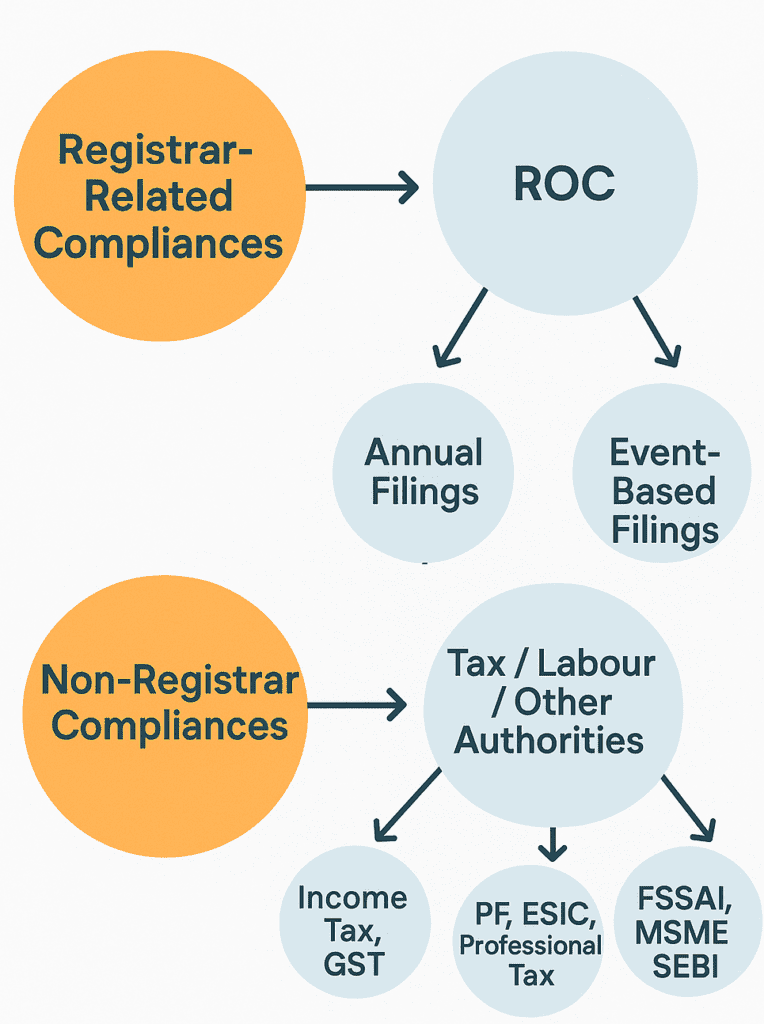
List of Compliances for Private Limited Company in India
A Private Limited Company (Pvt. Ltd.) must adhere to multiple annual, ROC, event-based, and tax compliances under the Companies Act, 2013, Income Tax Act, 1961, GST Act, 2017, and other allied laws. Below is a comprehensive and much detailed compliance list with each activity containing category, forms & penalty.
1. INC-20A – Declaration for Commencement of Business
Category: ROC / Event-Based
Description: This is a mandatory declaration filed by companies incorporated after November 2018, confirming that the company has received its paid-up capital. It must be filed within 180 days of incorporation using Form INC-20A with the Registrar of Companies (ROC).
Penalty: ₹50,000 for the company and ₹1,000 per day for each officer in default until filed; ROC may strike off the company if not filed within the prescribed time.
2. Appointment of Auditor – Form ADT-1
Category: Annual / ROC
Description: Every company must appoint its first statutory auditor within 30 days of incorporation, and subsequent auditors at the first Annual General Meeting (AGM). The appointment is filed with ROC in Form ADT-1 within 15 days of the AGM.
Penalty: Non-compliance may attract penalties under Section 139 and disqualification from submitting financial statements.
3. First Board Meeting
Category: Event-Based / Governance
Description: The first board meeting must be held within 30 days of incorporation, as required under Section 173 of the Companies Act. The agenda typically includes appointment of the first auditor, adoption of the common seal, and authorization of share certificates.
Penalty: ₹25,000 per director for failure to hold the meeting on time.
4. Subsequent Board Meetings (4 per Year)
Category: Annual / Governance
Description: A minimum of four board meetings must be conducted every financial year, with a maximum gap of 120 days between any two meetings. Proper minutes must be recorded and maintained in statutory registers.
Penalty: ₹25,000 per defaulting director under Section 173(4).
5. Annual General Meeting (AGM)
Category: Annual / Governance
Description: Every company must hold its first AGM within 9 months from the close of its first financial year, and subsequently within 6 months after the end of every financial year. Business includes adoption of financial statements, appointment of auditors, and declaration of dividends.
Penalty: ₹1,00,000 and ₹5,000 per day of continuing default under Section 99.
6. AOC-4 – Filing of Financial Statements
Category: ROC / Annual
Description: Companies must file their audited financial statements (Balance Sheet, P&L, and Directors’ Report) in Form AOC-4 within 30 days of the AGM.
Penalty: ₹100 per day of delay; directors may face additional prosecution under Section 137.
7. MGT-7 / MGT-7A – Annual Return
Category: ROC / Annual
Description: Companies must file their annual return containing shareholding pattern, directors, and key managerial data in Form MGT-7 (regular companies) or MGT-7A (small companies / OPCs) within 60 days of the AGM.
Penalty: ₹100 per day of delay under Section 92(5).
8. DIR-12 – Appointment / Resignation of Directors
Category: Event-Based / ROC
Description: Whenever a director is appointed or resigns, the company must file Form DIR-12 within 30 days of the event. It records changes in the company’s directorship.
Penalty: ₹500 per day of delay and potential fines up to ₹50,000.
9. DIR-3 KYC – Director Verification
Category: Annual / ROC
Description: Every director with a DIN must submit KYC verification annually using Form DIR-3 KYC or via DIR-3 KYC Web (if no changes) by September 30 each year.
Penalty: ₹5,000 for non-filing; DIN becomes “Deactivated” until compliance.
10. DPT-3 – Return of Deposits / Loans
Category: Annual / ROC
Description: Companies must disclose all outstanding loans, advances, and deposits (secured or unsecured) through Form DPT-3 by June 30 each year.
Penalty: ₹5,000 to ₹25,000; continuing default attracts ₹500 per day.
11. MGT-14 – Filing of Board Resolutions
Category: Event-Based / ROC
Description: Certain board resolutions, such as borrowing limits, share issue, or alteration of MOA/AOA, must be filed with ROC in Form MGT-14 within 30 days of passing the resolution.
Penalty: ₹1 lakh for company and ₹50,000 for every officer in default.
12. Directors’ Report
Category: Annual / Governance
Description: Prepared under Section 134 of the Companies Act, the Directors’ Report summarizes company performance, CSR, and risk disclosures. It must be circulated before the AGM and filed with AOC-4.
Penalty: ₹3 lakh for the company and ₹50,000 for each defaulting officer.
13. Maintenance of Statutory Registers
Category: Annual / Secretarial
Description: Every company must maintain updated statutory registers such as Register of Members, Directors, Charges, and Contracts under Sections 88 and 189.
Penalty: ₹50,000 and ₹1,000 per day for continuing default.
14. Circulation of Financial Statements (21 Days Before AGM)
Category: Annual / Governance
Description: Financial statements, auditor’s report, and director’s report must be circulated to all shareholders at least 21 days prior to the AGM under Section 136.
Penalty: ₹25,000 per defaulting officer.
15. Filing of Income Tax Return (Form ITR-6)
Category: Annual / Tax
Description: All companies (other than those claiming exemption under Section 11) must file Form ITR-6 by October 31 every year, irrespective of profit or loss.
Penalty: ₹5,000 under Section 234F; ₹10,000 if income exceeds ₹5 lakh and filed after the due date.
16. GST Returns (GSTR-3B / GSTR-1)
Category: Tax / Indirect
Description: Companies registered under GST must file GSTR-1 (outward supplies) and GSTR-3B (summary return) monthly or quarterly, depending on turnover.
Penalty: ₹50 per day of delay (₹20 for nil returns) and interest at 18% per annum.
17. TDS Returns (Form 24Q, 26Q)
Category: Tax / Statutory
Description: Companies deducting tax at source must file quarterly TDS returns using Forms 24Q (salaries) and 26Q (other payments).
Penalty: ₹200 per day of delay under Section 234E, capped at TDS amount.
18. PF & ESI Returns
Category: Labour / Regulatory
Description: Companies employing eligible workers must contribute to and file returns under the Employees’ Provident Fund (EPF) and Employees’ State Insurance (ESI) Acts. Returns are due monthly.
Penalty: Late deposit attracts interest at 12% and damages up to 25% of default amount.
19. Professional Tax Return (State Specific)
Category: State / Labour
Description: Applicable in select states (e.g., Maharashtra, Karnataka, West Bengal). Employers must deduct and pay professional tax monthly or annually.
Penalty: ₹5 per day of delay or up to 10% of tax amount depending on state law.
20. CSR Report (If Applicable)
Category: Annual / Regulatory
Description: Companies meeting CSR thresholds under Section 135 (Net worth ₹500 crore+, Turnover ₹1,000 crore+, or Net Profit ₹5 crore+) must submit an Annual CSR Report along with the Board Report.
Penalty: Twice the unspent CSR amount or imprisonment for officers in severe defaults.
Managing this yourself takes 15+ hours/month. See how funded startups outsource compliance. Let’s Talk
Tabular View of Private Limited Company Compliances
Incorporation Compliances
| Compliance | Description | Forms | Deadline and Penalty |
| Declaration of Commencement of Business | Since November 2018, companies in India with a share capital need to file a declaration with the Registrar of Companies (ROC) for the receipt of subscription money in the Bank account of the Company upon incorporation before starting operations or borrowing. Essentially, it acts as a go-ahead signal for the company to officially begin functioning. | INC-20A | Within 180 days of incorporation. Penalty of Rs. 50,000 for the company & Rs. 1000 per day for the directors for each day of default not exceeding Rs. 100,000/- |
| Auditor Appointment | Getting your finances in order is crucial right from the start for companies in India. Appointing a statutory auditor ensures proper oversight of your company’s financial health. | ADT-1 Filing | Within 30 days of incorporation. Penalty of Rs. 25,000/- but which may extend to Rs. 500,000/- for the Company and Rs. 10,000/- but which may extend to Rs. 100,000/- for the Director or officer of the Company who is in default. |
| Holding First Board Meeting | Newly formed PLCs in India have a crucial meeting on their agenda within the first month. This initial board meeting focuses on setting up the company’s financial foundation. Key items on the discussion table include opening a company bank account to deposit the share capital collected from shareholders, PLC’s incorporation certificate, seal, directors’ disclosures, etc. Additionally, the board will address issuing share certificates, | – | Within 30 days of incorporation. Rs. 25,000/- on the officer of the Company whose duty was to give notice for holding such meeting |
| Company Merchandise | All business letters, envelopes, invoices, etc. should have: Full name of PLC, Corporate Identification Number [CIN], Registered office address, Contact details – Telephone number &; Email id | – | As soon as the PLC is incorporated |
| Labour & Other Laws | Obtaining registration under labour laws if applicable and other laws etc. | – | – |
Director KYC & Disclosures
| Compliance | Description | Forms | Deadline and Penalty |
| KYC Filing for Directors | Keeping Director information up-to-date is essential in India. When filing the KYC form (DIR-3 KYC), both email and mobile phone one-time passwords (OTPs) are required for verification. If a Director’s email or phone number changes, they need to re-file the DIR-3 KYC form to update their information. For other changes in Director details, such as address, a different form (DIR-6) needs to be submitted. | DIR-3 KYC / Web KYC | Before 30th September of every year (Annual) Deactivation of Director Identification Number (DIN) |
| Disclosure of Directors’ Interest | Indian company directors must disclose their financial interests annually. This includes: – Directorships in other companies, bodies corporate, Partnership firms, association of individuals, | MBP-1 | Every First Board Meeting of the Financial Year (Annual) and whenever there is any change in the disclosures already made then at the first Board meeting held after such change The Director shall be liable to a penalty of Rs. 100,000/- |
| Disclosure of Non-Disqualification by Directors | Indian company directors must file a “Director Non-Disqualification Disclosure” | DIR-8 | At the time of appointment or reappointment Rs. 50,000/- on the Company and every officer of the Company who is in default and in case of continuing failure, a further penalty of Rs. 500/- per day during which such failure continues, subject to a maximum of Rs. 300,000/- in case of Company and Rs. 100,000/- in case of an officer who is in default |
Financial Statements & Filings
| Compliance | Description | Forms | Deadline and Penalty |
| Financial Statements & Audit Report | Indian companies are required to file their financial health report with the government within 30 days of holding their annual general meeting (AGM) . This report includes the balance sheet, profit and loss statement, cash flow statement, a director’s report, and an auditor’s report. However, only companies with a paid-up capital of Rs. 5 crore or more or turnover of Rs. 100 crore or more need to file this information electronically in a specific format called XBRL (eXtensible Business Reporting Language). | AOC-4 / AOC-4 XBRL | Within 30 days of AGM Penalty of Rs. 10,000/- and in case of continuing failure, with a further penalty of Rs. 100/- per day during which such failure continues, subject to a maximum of Rs. 200,000/- on Company and a penalty of Rs. 10,000/- and in case of continuing failure, with a further penalty of Rs. 100/- per day during which such failure continues, subject to a maximum of Rs. 50,000/- on directors and officers of the Company |
| Annual Return | In India, companies file an annual return summarizing their activities for the financial year (April 1st to March 31st). This report details the registered office, principal business activities, particulars of holding, subsidiary and associate Companies, shares, debentures and other securities, shareholding pattern, its members, and debenture-holders, promoters, Directors, Key Managerial Personnel (KMP), meetings of members or a class thereof, Board, Remuneration details of the Directors and KMP, penalty or punishment imposed on the Company, its directors or officers and details of compounding of offenses, matters relating to certification of compliances | MGT-7 | Within 60 days of AGM. Penalty of Rs. 10,000/- on the Company and every officer who is in default and in case of continuing failure, a further penalty of Rs. 100/- per day for each day during which such failure continues subject to a maximum of Rs. 200,000/- on in case of Company and Rs. 50,000/- in case of an officer in default |
Meetings & Resolutions
| Compliance | Description | Forms | Deadline and Penalty |
| Board Meetings | Board meetings in India are CEO summits. Directors discuss strategy, vote on key decisions, and oversee company management. Regular meetings ensure transparency and guide the company’s direction. | – | Minimum 4 meetings per year with max 120 days gap between meetings Rs. 25,000/- on the officer of the Company whose duty was to give notice for holding such meeting |
| Notice of AGM | In India, convening an annual general meeting (AGM) requires a proper notice sent to all entitled participants. This notice follows strict guidelines set out in Section 101 of the Companies Act, 2013, and further elaborated in Secretarial Standard-II. This ensures everyone receives timely information about the meeting, allowing them to prepare and participate effectively. | – | 21 clear days before AGM A penalty of upto Rs. 100,000/- and in case of continuing default, with a further fine upto Rs. 5,000/- for every day during which such default continues on the Company and every officer who is in default |
| Circulation of Financial Statements & Reports | -. | – | 21 clear days before AGM |
| AGM (Annual General Meeting) | Annual General Meetings (AGMs) are yearly gatherings mandated by the Indian Companies Act, 2013. Here, shareholders convene to discuss and approve company matters. AGMs serve a dual purpose: Transparency & Accountability: Financial statements are presented, allowing shareholders to assess the company’s health. They can then vote on proposals like electing directors, appointing auditors, and approving dividend payments.Shareholder Engagement: This forum provides a platform for shareholders to ask questions, voice concerns, and offer feedback on the company’s performance and direction. This interaction fosters better communication and strengthens corporate governance. | – | Within 9 months from the first financial year-end Within 6 months from the financial year-end A penalty of upto Rs. 100,000/- and in case of continuing default, with a further fine upto Rs. 5,000/- for every day during which such default continues on the Company and every officer who is in default |
| Appointment/Resignation/Change in Designation of Director | Director changes in India require specific procedures to ensure transparency and smooth company operation. Any appointment, resignation, or designation change of a director must be filed with the Registrar of Companies (ROC) within 30 days. Additionally, for resignations, a specific notice period must be provided. | DIR-12 | Within 30 days of appointment Penalty of Rs. 50,000/- and in case of continuing offense, a further penalty which may extend to Rs. 500/- for each day during which such default continues on every Director. Rs. 50,000/- and in case of continuing offense, a further penalty which may extend to Rs. 500/- for each day during which such default continues subject to a maximum of Rs. 300,000/- on Company. |
| Filing Special Resolutions (Board Report & Annual Accounts) | Special resolutions in India hold significant weight when it comes to company decisions. These require a higher approval threshold compared to regular resolutions, typically needing over 75% of voting members in agreement. . These documents detail the company’s performance, finances, and future direction, providing crucial information for shareholders to make informed decisions on matters like mergers, substantial asset sales, or changes to the company’s capital structure. | MGT-14 | Within 30 days of AGM A Penalty of Rs. 10,000/- and in case of continuing failure with a further penalty of Rs. 100/- for each day during which such failure continues subject to a maximum of Rs. 2,00,000/- on the Company. Penalty of Rs. 10,000/- for each day during which such failure continues subject to a maximum of Rs. 50,000/- on every officer who is in default |
Tax Compliances
| Compliance | Description | Forms | Deadline and Penalty |
| Advance Tax Calculation and Payment | To avoid a year-end tax crunch, private limited companies in India pre-pay a portion of their estimated annual tax liability through advance tax installments. Calculating your advance tax involves estimating your taxable income for the financial year (April 1st to March 31st) and applying the relevant tax rate. | – | Quarterly Missing these deadlines attracts a penalty of 1% monthly interest on the unpaid amount |
| Income Tax Returns | Private limited companies in India are required to file income tax returns every year, ensuring transparency and timely tax contributions. Filing income tax returns accurately reflects the company’s income and allows for proper tax assessment and payment. | – | The deadline for filing these returns typically falls on September 30th of the assessment year (following the financial year ending March 31st) Minimum penalty of Rs. 10,000 to a maximum of Rs. 1,00,000 |
| Tax Audit(Only if Turnover exceeds Rs. 10 Crore) | This annual audit by a qualified professional ensures the company’s financial records and tax calculations are accurate. By undergoing a tax audit, companies not only fulfill their legal obligation but also gain valuable insights into their financial health and potential tax optimization strategies. | – | Deadline 30th September Monetary penalties and may also involve delaying processing of the company’s tax return |
| GST filing (if applicable) | Private limited companies in India need to register for Goods and Services Tax (GST) if their annual turnover surpasses Rs. 40 lakh (for goods) or Rs. 20 lakh (for services) in a specific state (certain special category states have a Rs. 10 lakh threshold). Once registered, GST filing becomes mandatory. | – | Monthly Filing (for Turnover exceeding Rs. 1.5 crore) Quarterly Filing (for Turnover between Rs. 40 lakh and Rs. 1.5 crore) Penalties apply |
| TDS/TCS (if any) | Private limited companies in India act as tax collection agents for the government through Tax Deducted at Source (TDS) and Tax Collected at Source (TCS) on specific payments they make. This applies when the company makes payments like salaries, rent, or professional fees.Filing TDS/TCS returns becomes mandatory if the company deducts tax during the financial year. These filings detail the deducted tax information, including the payee’s details, the amount deducted, and the nature of the payment. | – | The deadline for filing TDS/TCS returns depends on the quarter in which the tax was deducted: 1st Quarter (April-June): 15th of July2nd Quarter (July-September): 15th of October3rd Quarter (October-December): 15th of January4th Quarter (January-March): 15th of May |
Other Compliances
| Compliance | Description | Forms | Deadline and Penalty |
| Delay in Payment to MSME Vendor | Avoiding delayed payments to MSME vendors is a crucial compliance concern for private limited companies in India. The MSMED Act mandates payment within 45 days of accepting goods or services (or 15 days if no written agreement exists). Failing to comply can result in hefty penalties, including compounded monthly interest on the outstanding amount. This not only impacts your company’s financial standing but also disrupts your supply chain and potentially damages your reputation with smaller vendors. | MSME-1 | Half-yearly (April-Sep: Oct 1st; Oct-Mar: April 30th) Penalty of Rs. 25,000/- and in case of continuing failure, with a further penalty of Rs. 1,000/- for each day during which such default continues subject to a maximum of Rs. 300,000/- on the Company and every officer in default. No filing fee |
| Return of Deposits | For private limited companies in India that accept public deposits, complying with “Return of Deposits” regulations is crucial. An annual form, DPT-3, needs to be filed with the Registrar of Companies (ROC) by June 30th, detailing all deposit activity for the previous financial year. This includes amounts received, interest paid, and outstanding deposits, along with non-deposit transactions like loans. Filing the DPT-3 ensures transparency and responsible financial management for handling public funds. | DPT-3 | Every year on or before 30th June Penalty of Rs. 5,000/- and in case of continuing failure, a further fine of Rs. 100/- for every day after the first day during which the default continues on the Company and every officer of the Company who is in default. |
| Active Company Tagging (Companies registered before Dec 31, 2017) | Private limited companies registered in India before December 31, 2017, need to be aware of a specific compliance requirement called “Active Company Tagging” (ACT). Introduced in 2019, this is a one-time process to verify the company’s registration details and registered office address. The deadline to file the e-form (INC-22A) for ACT was April 25, 2019. However, companies that missed the deadline can still file it. | INC-22A | On or before 25th April 2019 (one-time filing) Penalty of Rs. 10,000 |
| Significant Beneficial Owner (SBO) Declaration (if applicable) | Significant Beneficial Owners (SBOs) – individuals with major control or influence. SBOs are obliged to file a declaration with the Company on acquiring any significant beneficial ownership and on receipt of such declaration the Company shall file a return with the Registrar of Companies This transparency strengthens corporate governance and deters malpractice, but failing to comply can result in penalties for both the SBO and the company. | BEN-1 & BEN-2 | BEN-1: To be filed with the Company within 30 days of acquiring any significant beneficial ownership or any change therein BEN-2: To be filed with the Registrar of Companies (ROC) Within 30 days from the date of receipt of declaration by SBO in form BEN-1 A penalty of Rs. 50,000/- and in case of continuing failure, then with a further penalty of Rs. 1,000/- for each day during which such failure continues, subject to a maximum of Rs. 200,000/- on the person failing to make a declaration. A Penalty of Rs. 100,000/- and in case of continuing failure, then with a further penalty of Rs. 500/- for each day during which such failure continues, subject to a maximum of Rs. 500,000/- on the Company and a penalty of Rs. 200/- for each day, in case of continuing failure subject to a maximum of Rs. 100,000/- on the officer who is in default. |
| Appointment of Company Secretary (if applicable) | Mandatory Appointment: Companies with a paid-up capital of Rs. 10 crore or more (listed or public).Every Private Limited Companies having paid up share capital of Rs. 10 crore or more must appoint a whole-time company secretary. Board Meeting: Convene a board meeting and pass a resolution appointing a qualified company secretary.File the requisites form electronically with the Registrar of Companies (ROC) within 30 days of the appointment. Compliance Benefits: A company secretary plays a crucial role in ensuring good corporate governance, legal compliance, and smooth functioning. They handle tasks like managing board meetings, maintaining statutory records, and filing various legal documents. | DIR-12 | Within 30 days of appointment of Company Secretary. Failure in appointment of a Company Secretary shall make the Company liable to a penalty of Rs. 500,000/- and every director and KMP who is in default shall be liable to a penalty of Rs. 50,000/- and in case of a continuing default, with a further penalty of Rs. 1,000/- for each day during which such default continues but not exceeding Rs. 500,000/- |
| Maintaining Employee related Compliances like ESI, PF | – | – | Annual |
What Founders Usually Get Wrong
Many early-stage founders and their teams inadvertently neglect critical compliance requirements that later create friction during fundraising, investor due diligence, or regulatory audits. Understanding these common pitfalls helps you avoid costly mistakes and maintain a legally sound operation.
Missing Board Meetings
One of the most frequently overlooked compliance obligations is holding regular board meetings. Founders often operate in “execution mode” and postpone formal board governance, viewing it as administrative overhead. However, the Companies Act mandates a minimum of four board meetings per year with a maximum gap of 120 days between meetings. Missing this requirement not only attracts a penalty of ₹25,000 per defaulting director, but it also signals weak governance to investors and creates legal vulnerabilities. Proper board meetings establish a documented decision-making process, protect directors from personal liability, and demonstrate institutional maturity—all critical when raising capital.
ESOP-Related ROC Filings
Employee Stock Option Plans (ESOPs) are integral to startup compensation strategies, yet many founders fail to file the requisite ROC forms when issuing ESOPs or stock options. Forms like PAS-3 (for share allotment) and MGT-14 (for board resolutions authorizing ESOP issuance) must be filed within 30 days of the corporate action. Non-compliance can result in daily penalties and, more importantly, creates ambiguity around employee ownership—a major red flag during investor due diligence. Additionally, inconsistent ESOP documentation weakens your cap table credibility and can delay funding rounds.
Cap Table Inconsistencies
Your cap table is the single source of truth for ownership. Many early-stage companies maintain cap tables in spreadsheets that diverge from their actual ROC records due to untracked ESOP grants, forgotten share transfers, or misaligned board resolutions. These inconsistencies create legal and financial risk: they confuse investor valuations, complicate future fundraising, and expose the company to shareholder disputes. The discipline of maintaining a cap table that mirrors your ROC filings (shareholding pattern in MGT-7, share issuances in PAS-3) is non-negotiable for any founder seeking institutional capital.
Investor Reporting Gaps
Once you raise capital, investors expect transparent and timely reporting. Yet many founders fail to establish consistent governance around cap table updates, quarterly financial disclosures, and board-level decision documentation. Missing or delayed investor updates erode trust and create compliance friction when follow-on investors or acquirers conduct due diligence. Establishing a rhythm of annual AGMs, timely financial statement filings (AOC-4 within 30 days of AGM), and transparent board minutes ensures your company remains investor-ready at all times.
If You’ve Raised Capital
Raising capital fundamentally elevates your compliance obligations. Investors bring not only capital but also governance expectations and legal accountability. Understanding how compliance intersects with investor protection ensures smoother operations and reduces friction during future fundraising or exit events.
Compliance as Investor Governance
When you accept investor capital, compliance transforms from a regulatory checkbox to a governance mechanism that protects investor interests. Annual filings like AOC-4 (financial statements) and MGT-7 (annual return) provide investors with transparent records of company performance, shareholding, and board activity. Regular board meetings document decision-making and strategic discussions, assuring investors that the company is well-managed. Timely filing of director and auditor appointments (DIR-12, ADT-1) signals organizational stability. Non-compliance in these areas doesn’t just expose the company to penalties—it breaches the implicit governance covenant investors expect, eroding their confidence and creating grounds for investor disputes or follow-on investment delays.
Risk of Non-Compliance During Due Diligence
Investor due diligence is your compliance audit. When investors (or acquirers in an M&A scenario) review your company, they scrutinize every ROC filing, shareholding record, and governance document. Missing or delayed filings, inconsistent cap table records, absent board minutes, or unresolved director KYC submissions (DIR-3 KYC) become deal-breakers. These gaps create legal uncertainty, increase acquisition risk, and often necessitate expensive remedial filings or board resolutions to “cure” historical non-compliance. In worst cases, undisclosed compliance violations discovered during due diligence can lead to deal termination, valuation haircuts, or post-closing indemnification claims. Maintaining pristine compliance throughout your company’s lifecycle ensures you enter due diligence with clean records, faster investor approval, and better valuation outcomes.
Event-Based and Other Statutory Compliances for Private Limited Companies
Event-Based Compliances for Private Limited Company
Event-based compliances are triggered whenever specific business or structural changes occur within the company. These filings ensure that every internal modification is legally recorded with the Registrar of Companies (ROC) as per the Companies Act, 2013.
Key Events Requiring Compliance:
- Change in Authorized or Paid-up Capital: File Form SH-7 for authorized capital and PAS-3 for share allotment.
- Allotment or Transfer of Shares: File Form PAS-3 within 30 days of allotment.
- Change in Directors or Auditors: File Form DIR-12 for director appointment/resignation and ADT-1 for auditor change.
- Loan to Director or Other Entities: Ensure board approval and file MGT-14 under Section 179.
- Change in Registered Office: File Form INC-22 within 30 days of the move.
- Change in Bank Account or Signatories: File a board resolution in MGT-14 and update bank authorities.
Key ROC Forms: MGT-14, SH-7, DIR-12, INC-22, PAS-3
Penalty: ₹100 per day of delay per form, plus possible disqualification for repeated defaults.
Non-Registrar (Other Statutory) Compliances
These compliances fall outside the ROC’s purview but are essential for a company’s tax, labour, and regulatory obligations. They ensure ongoing legal and fiscal conformity across departments.
Major Non-Registrar Compliances:
- GST Filings: Monthly/Quarterly/Annual returns (GSTR-1, GSTR-3B).
- TDS/TCS Returns: Quarterly filings (Form 24Q, 26Q).
- Income Tax Return (ITR-6): Annual filing by October 31 each year.
- PF and ESIC Returns: Monthly/half-yearly returns under labour laws.
- Professional Tax: State-wise monthly or annual filings.
- Other Acts: Factory Act, Environmental Regulations, and Shops & Establishment Act compliance depending on business activity.
Penalty: Varies by law e.g., late GST attracts ₹50 per day, TDS delays ₹200 per day (Sec. 234E, IT Act), and PF delays incur up to 25% damages of dues.
Penalties for Non-Compliance (Quantitative Overview)
| Non-Compliance | Penalty | Governing Provision |
| INC-20A Delay | ₹50,000 (Company) + ₹1,000/day (Director) | Section 10A, Companies Act |
| DIR-3 KYC Non-Filing | ₹5,000 per Director | Rule 12A, Companies Rules |
| AOC-4 / MGT-7 Delay | ₹100 per day each | Section 403, Companies Act |
| Continuous Default | Company Strike-off | Section 248, Companies Act |
Annual Compliance Checklist for a Private Limited Company
Below is a summarized Checklist for Annual Compliances of a Private Limited Company (PLC)
- Filing MSME Form 1 (Due by 30th April for the half year October to March and Due by 31st October for the half year April to September)
- Filing Return of Deposits (DPT-3) (Due by 30th June of every year)
- Holding Annual General Meeting (AGM) (Typically within 6 months of financial year-end)
- Filing Annual Financial Statements (AOC-4) (Due within 30 days of AGM)
- Filing Annual Return (MGT-7) (Due within 60 days of AGM)
- Holding Board Meetings during a Financial Year (At Least 4 meetings in a calendar year with a gap of not more than 120 days between 2 meetings)
- Filing Income Tax Return (ITR) (Due by September 30th as specified by Income Tax Department)
- Filing Tax Audit Report (if applicable) (Due within specified time frame after tax audit is conducted)
- Payment of Advance Tax (Quarterly throughout the financial year)
- Filing GST Returns (if applicable) (Frequency depends on turnover – monthly, quarterly, or annually)
- Filing TDS/TCS Returns (if applicable) (Quarterly with the Income Tax Department)
- Renewal of Licenses and Permits
- Employee-related compliances (ESI & PF) (For companies with employees)
Documents required for Online Private Limited Company Compliance
Here are some essential documents required for online Private Limited Company (PLC) compliance in India:
- Director’s Identity and Address Proof: Passport or PAN Card copy for Indian Nationals and apostille/notarized Passport copy for Foreign Nationals (all self-attested)
- Director’s DIN (Director Identification Number)
- PAN Card of the Company
- Subscription Details and Share Allotment Proof
- Memorandum of Association (MOA)
- Articles of Association (AOA)
- Digital Signature Certificate (DSC) of Directors
- Proof of Registered Office Address (Rent Agreement, No Objection Certificate from Landlord)
- Form MGT-7 (Annual Return) (within 60 days of holding the AGM)
- Form AOC-4 (Financial Statements) (within 30 days of holding the AGM) – includes Balance Sheet, Profit & Loss Account, and Director’s Report
- Changes in shareholding or capital structure
- Appointment or removal of directors or auditors
- Loans or advances given to other companies or directors
- Opening or closing of bank accounts or changes in signatories
- Income Tax Return Documents (as per specific requirements)
- TDS/TCS Return filing documents (if applicable)
Streamline Company Compliance (MCA V3 Portal)
Managing company compliance doesn’t have to be complex. With the right digital tools and expert support, private limited companies can simplify their filing processes and stay audit-ready year-round.
Use MCA V3 for Real-Time Compliance Tracking
The MCA V3 portal, launched by the Ministry of Corporate Affairs, offers real-time tracking of ROC compliances, form submissions, and document status.
- Log in with your Director Identification Number (DIN) or company credentials.
- Use the “My Application” dashboard to view filed forms like AOC-4, MGT-7, or DIR-3 KYC.
- Set alerts for upcoming due dates to avoid penalties under the Companies Act, 2013.
Adopt Digital Compliance Dashboards
Tools such as LEDGERS, Zoho Books, and QuickBooks help automate financial and compliance tasks:
- Generate GST, TDS, and ROC reports automatically.
- Sync accounting data with compliance trackers for error-free filings.
- Maintain secure cloud-based documentation for audit readiness.
We take care of all your compliances Let’s Talk
In the context of businesses, compliances refer to the actions a company or firm must take to adhere to a set of rules and regulations established by various governing bodies. These regulations can come from the government, industry standards organizations, or even the company itself (internal policies). Partnership firm compliances are the mandatory actions a partnership firm must take to operate legally and smoothly in India. A partnership firm in India is governed by the Indian Partnership Act of 1932. While the process of forming a partnership firm is relatively simple, several compliance requirements ensure its legal and financial stability. These obligations are primarily aimed at maintaining transparency in operations, paying taxes, and adhering to labor laws. Compliances for Partnership Firm help strengthen a transparent and credible figure of firms in Public, as well as support in a lot of business activities.
What are Partnership Firms in India?
Partnership firms, a prevalent business structure in India, offer an attractive option for small and medium-sized businesses. They combine the ease of setup with the flexibility of shared ownership and management. Here, we’ll delve into what partnership firms are, how to register one, and the essential compliances to navigate.
Understanding Partnership Firms:
A partnership firm is a business entity formed by an agreement between two or more individuals (partners) who come together to carry on a business and share the profits or losses. The key aspects of a partnership firm include:
- Minimum and Maximum Partners: A minimum of two partners is required to form a partnership firm, and the maximum number of partners cannot exceed 20 (except for banking firms).
- Shared Ownership and Management: Partners share ownership of the firm’s assets and liabilities in accordance with the partnership deed, a legal document outlining the rights, responsibilities, profit-sharing ratio, and dispute resolution mechanisms between partners.
- Unlimited Liability: A crucial characteristic of partnership firms is unlimited liability. This means that partners are personally liable for the firm’s debts and obligations beyond the extent of their capital contribution.
Registration Process for Partnership Firms:
While registration of a partnership firm is not mandatory under the Indian Partnership Act, 1932, it offers several benefits, including:
- Enhanced Credibility: Registration lends legitimacy to the firm, fostering trust with potential clients and investors.
- Easier Access to Loans: Banks and financial institutions are more likely to provide loans to registered firms.
- Limited Liability for Incoming Partners: If a new partner joins a registered firm, their liability for pre-existing debts is limited to their capital contribution.
Here’s a simplified breakdown of the registration process:
- Drafting a Partnership Deed: A well-drafted partnership deed is crucial. It’s advisable to consult a lawyer for this step.
- Registration with the Registrar of Firms (RoF): The partnership deed needs to be registered with the RoF in the state where the firm’s main office is located. The process typically involves submitting the deed, along with a prescribed fee and application form.
- Obtaining a PAN Card: Every registered partnership firm requires a Permanent Account Number (PAN) from the Income Tax Department.
List of Important Compliances For a Partnership Firm
Partnership firms, a popular choice for small and medium businesses, offer a relatively simple setup process. However, ensuring smooth operations and avoiding legal roadblocks necessitates staying compliant with various regulations. This section outlines the key compliance requirements for partnership firms in India.
Income Tax Compliances:
- PAN Card: Every partnership firm needs a Permanent Account Number (PAN) from the. Every partnership firm needs a Permanent Account Number (PAN) from the Income Tax Department. This unique identifier is crucial for tax purposes. It is used for filing tax returns, tracking financial transactions, and ensuring transparency.
- Income Tax Return Filing: Partnership firms must file an Income Tax Return (ITR) irrespective of their income or loss. The designated form for them is ITR-5. This ITR captures the firm’s total income, expenses, deductions, and tax liabilities. Timely filing of ITRs ensures transparency and avoids penalties for late filing.
- Understanding Tax Implications: Partnership firms are taxed at a flat rate of 30% on their total income. However, each partner’s share of profit/loss is reflected in their individual tax returns, and they are taxed according to their income tax slabs. This ensures a fair distribution of tax burden based on each partner’s income level.
Tax Audit Requirements: When to File and Audit Compliance
According to the Income Tax Act, a tax audit is required if a partnership firm’s turnover exceeds ₹1 crore in the financial year. For firms that receive more than 5% of their turnover as cash, the tax audit threshold is reduced to ₹50 lakh.
Choosing the Right ITR Form
- ITR-4: Applicable for firms with a total income up to ₹50 lakh and income recorded on a presumptive basis. Presumptive taxation offers a simplified method of calculating taxable income based on an estimated profit margin for specific business categories.
- ITR-5: Mandatory for firms exceeding ₹1 crore in turnover or requiring a tax audit. ITR-5 is a more comprehensive form capturing detailed income and expenditure information.
Income Tax Slabs for Individual Taxpayers (Partner) in India for Assessment Year (AY) 2025-26:
| Partner’s Income | Tax Rate | Surcharge (if applicable) | Total Tax |
|---|---|---|---|
| Up to ₹3,00,000 | Nil | – | Nil |
| ₹3,00,001 – ₹6,00,000 | 5% | – | 5% of income exceeding ₹3,00,000 |
| ₹6,00,001 – ₹9,00,000 | 10% | – | ₹15,000 + 10% of income exceeding ₹6,00,000 |
| ₹9,00,001 – ₹12,00,000 | 15% | – | ₹45,000 + 15% of income exceeding ₹9,00,000 |
| ₹12,00,001 – ₹15,00,000 | 20% | – | ₹1,35,000 + 20% of income exceeding ₹12,00,000 |
| Above ₹15,00,000 | 30% | 12% of tax payable (if income exceeds ₹1,00,00,000) | As per slab and applicable surcharge |
- This table reflects the individual income tax slabs for partners in a partnership firm. Each partner’s share of the firm’s profit or loss is reflected in their individual tax returns.
- The partnership firm itself is taxed at a flat rate of 30% on its total income.
- Health and Education cess @ 4% is also levied on the total tax amount.
- Surcharge of 12% is levied on income exceeding ₹ 1 crore, subject to marginal relief provisions.
GST Compliances:
- GST Registration and Return Filing: Partnership firms with an annual turnover exceeding ₹40 lakh (subject to change) must register for Goods and Services Tax (GST). GST is a destination-based tax levied on the supply of goods and services. Registered firms need to file regular GST returns:
- GSTR-1: This monthly return details outward supplies made by the firm.
- GSTR-3B: This consolidated return summarizes the firm’s tax liability for a specific month.
- GSTR-9 (Annual Return): This annual return provides a comprehensive overview of the firm’s GST transactions throughout the financial year.
- GSTR-4: Quarterly Filing for Composition Scheme
For partnership firms registered under the GST composition scheme, GSTR-4 is mandatory. The GSTR-4 return must be filed quarterly, covering total taxable income, tax paid, and input credits.
TDS Return Filing
Firms acting as deductors (with a valid TAN) need to deduct tax at source (TDS) on specific payments exceeding prescribed limits (rent, interest, professional fees, etc.). TDS challans must be deposited with the government within stipulated timelines. Different forms are used for TDS returns depending on the payment nature.
TDS Return Forms
A partnership firm must file TDS returns using specific forms based on the nature of its payments. Form 24Q is for salaries, while Form 26QB applies to payments related to property transactions. Regular filing of TDS returns helps ensure the firm is in good standing with tax authorities.
EPF Return Filing
Partnership firms employing 20 or more employees are obligated to register for EPF under the Employees’ Provident Funds and Miscellaneous Provisions Act, 1952. Monthly EPF contributions need to be deposited to the EPF account of employees. The EPF scheme contributes towards employees’ retirement savings. Employers and employees contribute a specific percentage of their salary towards the EPF. Regular filing of EPF challans ensures timely deposits into employee accounts.
Accounting and Bookkeeping
Proper books of accounts are mandatory if annual sales/turnover/gross receipts exceed ₹25 lakh or income from business surpasses ₹2.5 lakh in any of the preceding three financial years. Maintaining accurate books of account facilitates financial reporting, tax calculations, and helps assess the firm’s financial health.
Partnership Deed: Modifications and Registering Changes
Any modifications to the partnership deed (addition/removal of partners, capital contribution changes, or dissolution) must be intimated to the Registrar of Firms within 90 days. This also includes updates to the firm name, principal place of business, nature of business, and changes in partner information. Most of these services can be accessed at https://services.india.gov.in/
| Compliance Type | Details | Forms/Returns Required | Due Dates |
|---|---|---|---|
| Income Tax Compliance | |||
| PAN Card | Every partnership firm must obtain a Permanent Account Number (PAN) from the Income Tax Department. | – | As per registration |
| Income Tax Return Filing | Partnership firms must file ITR-5 for income/loss, detailing total income, deductions, and liabilities. | ITR-5 | By July 31st of the assessment year |
| Tax Audit | Firms with turnover exceeding ₹1 crore must file for a tax audit. For firms with cash receipts exceeding 5% of turnover, the threshold is reduced to ₹50 lakh. | Tax Audit Report | Within 30 days of the due date for ITR |
| Choosing the Right ITR Form | |||
| ITR-4 (Presumptive Taxation) | For firms with income up to ₹50 lakh under presumptive taxation. | ITR-4 | Same as ITR-5 |
| ITR-5 | For firms exceeding ₹1 crore turnover or requiring a tax audit. | ITR-5 | As per Income Tax return deadline |
| GST Compliance | |||
| GST Registration & Return Filing | Firms with turnover exceeding ₹40 lakh must register for GST. GST returns include GSTR-1, GSTR-3B, GSTR-9 (Annual Return), and GSTR-4 (if under composition scheme). | GSTR-1, GSTR-3B, GSTR-9, GSTR-4 (quarterly) | GSTR-1: 10th of the following month |
| TDS Return Filing | Firms need to deduct TDS on specific payments. TDS returns must be filed using relevant forms like 24Q (salaries) and 26QB (property transactions). | Form 24Q, Form 26QB | By the 7th of the following month |
| EPF Compliance | Firms with 20 or more employees must register for EPF. Regular EPF challans need to be filed. | EPF Return | By the 15th of every month |
| Accounting and Bookkeeping | Partnership firms with annual sales/turnover exceeding ₹25 lakh must maintain proper books of accounts. | – | Ongoing |
| Partnership Deed Modifications | Any changes to the partnership deed must be reported to the Registrar of Firms within 90 days. | – | Within 90 days of change |
Types of Compliances: Annual vs Periodic Obligations
Annual Compliance Requirements
Every partnership firm must fulfill certain annual obligations, including filing returns and maintaining records that provide an overview of business operations. The annual compliance includes tasks like registering changes in partnership deeds or renewing licenses.
Periodic Compliance Requirements
Periodic compliance involves submitting certain documents and returns at regular intervals. These are usually more frequent, such as quarterly or monthly filings for taxes or employee-related contributions.
Penalties and Consequences of Non-Compliance for Partnership Firms
Adhering to important compliances is essential for smooth functioning and avoiding legal roadblocks for Partnership Firms. If a partnership firm fails to adhere to legal requirements like tax filing, GST returns, or EPF contributions, it may incur penalties, which could include fines, interest on delayed payments, or even prosecution for severe violations. But what happens if a partnership firm neglects these requirements? Let’s explore the potential consequences of non-compliance:
- Financial Penalties: Regulatory bodies take non-compliance seriously. Partnership firms failing to meet their compliance obligations can face hefty monetary penalties. The severity and nature of the non-compliance will determine the size of the fine.
- Legal Action and Lawsuits: Non-compliance can escalate to legal action against the partnership firm. This could involve lawsuits filed by government authorities or even disgruntled stakeholders. The resulting litigation expenses and potential damage awards can significantly impact the firm’s finances.
- Reputational Damage: In today’s competitive landscape, a good reputation is paramount. Non-compliance can severely tarnish a partnership firm’s image, eroding trust among customers, suppliers, and potential investors. This can lead to lost business opportunities and hinder future growth prospects.
- Operational Disruptions: Regulatory actions or legal proceedings triggered by non-compliance can significantly disrupt a partnership firm’s day-to-day operations. These disruptions can manifest as financial losses, operational inefficiencies, and delays in business activities.
- Loss of Licenses and Registrations: Obtaining licenses and registrations are often crucial for legal business operations. However, non-compliance can lead to regulatory bodies revoking these licenses or registrations. This can severely restrict the firm’s ability to conduct specific business activities legally.
- Injunctions and Further Legal Issues: Courts may impose injunctions, essentially court orders prohibiting the partnership firm from engaging in certain activities until compliance is achieved. Violating these injunctions can lead to even more severe legal consequences.
- Criminal Charges: In extreme cases of deliberate non-compliance or fraudulent activities, individuals associated with the partnership firm, like partners or designated officials, may face criminal charges. These charges can result in fines, imprisonment, or even both, depending on the severity of the offense.
Benefits of Compliance for Partnership Firms
For partnership firms in India, adhering to compliances offers a multitude of benefits that go beyond just avoiding penalties. Here’s how staying compliant can empower your firm to thrive:
Enhanced Credibility and Reputation: Demonstrating compliance highlights a commitment to ethical business practices, cultivating trust and confidence among stakeholders such as customers, suppliers, potential investors, and financial institutions. A compliant firm is recognized as dependable and trustworthy, which can open doors to more business opportunities and partnerships.
Smoother Access to Credit and Funding: Financial institutions are more inclined to offer loans and credit lines to partnership firms with a solid compliance track record. Exhibiting financial transparency and adherence to regulations makes your firm more appealing to lenders, which may result in more favorable loan conditions and interest rates.
Reduced Risk of Legal Disputes and Penalties: Compliance significantly lowers the likelihood of legal actions or substantial fines from regulatory bodies due to non-compliance. This can lead to considerable cost savings and prevent the disruptions and stress associated with legal conflicts.
Streamlined Operations and Decision-Making: Proper accounting practices, timely tax filings, and compliance with labor laws contribute to more efficient and well-organized business processes. This enables better financial planning, informed decision-making, and helps allocate resources effectively for business growth.
Improved Risk Management: Compliance procedures often incorporate internal controls and strategies to mitigate risk. By adhering to regulatory standards, partnership firms can identify potential risks, such as tax liabilities or labor law infractions, early. This facilitates the implementation of proactive measures to address these risks and minimize their business impact.
Peace of Mind and Focus on Growth: Operating within the legal framework provides peace of mind, allowing you to focus on your core business activities with confidence. You can dedicate more energy to strategic planning, marketing, and product development, knowing that your firm’s legal foundation is secure.
Attract and Retain Talent: A partnership firm with a strong compliance history is more likely to attract and retain top-tier talent. Employees value working for a company that respects labor laws and social security regulations, fostering a positive workplace culture and supporting employee well-being.
Documents required for Online Partnership Compliance
For Online Partnership Firm Registration:
- Proof of Identity and Address for Partners:
- PAN Card (copy) of each partner. This is a crucial document for tax purposes.
- Aadhaar Card (copy) of each partner. This serves as a valid address and identity proof.
- Passport (copy) or Voter ID (copy) can be submitted as alternatives to Aadhaar Card if not available.
- Partnership Deed: A well-drafted partnership deed is the foundation of your firm. It outlines the rights, responsibilities, profit-sharing ratios, and dispute resolution mechanisms between partners. Ensure you have a digital copy of the deed for online submission.
- Address Proof for the Firm’s Registered Office: You can use any of the following documents as address proof:
- Rent Agreement (copy) for the office space, if rented.
- Utility Bill (copy) like electricity bill or water bill for the office address, not older than 3 months.
- NOC (No Objection Certificate) from the landlord (if applicable).
Online Compliance Filing:
Once registered, your partnership firm needs to adhere to various regulations. Here’s a rundown of the documents typically required for online compliance filing:
- PAN Card of the Partnership Firm: Similar to partners, the firm itself needs a PAN card.
- Bank Account Details: This includes a copy of a cancelled cheque from the firm’s bank account.
- ITR (Income Tax Return) Documents: While filing your firm’s ITR (typically ITR-5), you may need supporting documents like sale and purchase invoices, depending on the nature of your business.
]]>
- Appointment of Auditor: Within 30 days of incorporation, an OPC must appoint a practicing Chartered Accountant as its first auditor.
- Commencement of Business Declaration (Form INC-20A): This declaration must be filed within 180 days of incorporation, confirming the receipt of subscription money.
- Annual Return Filing (Form MGT-7A): OPCs are required to file their annual return within 180 days from the end of the financial year, detailing the company’s financial performance and other pertinent information.
- Financial Statement Submission (Form AOC-4): Audited financial statements must be filed within 180 days from the end of the financial year.
- Director KYC Compliance (Form DIR-3 KYC): Directors must complete their KYC process annually by September 30th of the subsequent financial year.
- MBP-1 Requirements: MBP-1 must be filed by the director during the first board meeting of the year to disclose their interest in the company’s assets or financial dealings.
- PAN Application: Once the OPC is incorporated, the next step is to apply for the PAN (Permanent Account Number). This can be done online through the NSDL website. After the allotment, the PAN application letter should be signed by the director and sent along with the company seal to NSDL.
- Corporate Stationery Requirements: After the incorporation of an OPC, it’s mandatory to procure essential stationery, which includes a company name board that should clearly state the company name along with “One Person Company” in brackets. Additionally, an official rubber stamp and a company letterhead with these details should be prepared.
- Opening an OPC Bank Account: For opening a bank account for the OPC, several documents are required, including the certificate of incorporation, the Memorandum and Articles of Association (MOA/AOA), the PAN card, a board resolution for account opening, and the director’s ID proof. It is crucial that these documents are self-attested and include the company seal.
- DIR-8 (Director’s Declaration): DIR-8 is a statutory requirement for OPCs, where the director must file a declaration confirming that they are not disqualified from being a director under the provisions of the Companies Act, 2013. This filing is mandatory and should be done annually.
- MSME-I Half-Yearly Return: OPCs must file an MSME-I form twice a year to report their dues to micro and small enterprises. The deadlines for filing the MSME-I return are 31st October for April-September and 30th April for October-March.
- Statutory Registers and Secretarial Records Maintenance: It is mandatory for OPCs to maintain various statutory registers, including the register of members, directors, and charges. In addition, OPCs must maintain a minute book and keep copies of annual returns and resolutions passed by the company.
- Board’s Report Contents: The Board’s Report of an OPC should include key disclosures such as the company’s web address, director’s responsibility statement, fraud reporting details, auditor’s remarks, and financial highlights. The report should also cover changes in directorship, significant orders passed, and the state of affairs of the company.
- Filing of Income Tax Return (ITR-6): OPCs must file their income tax return (ITR-6) annually by 30th September. This form is specifically designed for companies, and OPCs must disclose all income, deductions, and exemptions in their tax return.
- Adherence to Companies Act, 2013: Relevant sections of the Companies Act, 2013 to ensure legal accuracy and authority.
For instance:- Section 173: Pertains to the board meetings of a company, ensuring that the board meetings are conducted according to legal requirements.
- Section 92: Relates to the filing of annual returns, specifying what should be included and when these filings must occur.
- Section 137: Requires the filing of AOC-4 (Annual Accounts) by the company, ensuring that the company complies with regulatory filing requirements for financial statements.
Adhering to these compliance requirements not only ensures legal conformity but also enhances the credibility and smooth functioning of the OPC.
What is a One Person Company (OPC) in India?
A One Person Company (OPC) in India is a business structure that allows a single individual to establish and operate a company under the provisions of the Companies Act, 2013. This concept was introduced to support entrepreneurs who are capable of starting a venture by allowing them to create a single-person economic entity. Before this Act, at least two directors and shareholders were required to form a company.
Here are some key features of an OPC:
- Single Shareholder: An OPC has only one member or shareholder, distinguishing it from other types of companies which require at least two shareholders.
- Management and Ownership: The same individual holds complete control over the company, managing its operations while also owning all the company’s shares.
- Directors: While an OPC can have only one member, it can appoint up to fifteen directors to facilitate its business operations, a number that can be increased beyond fifteen through a special resolution.
- Legal Status: An OPC is registered as a private limited company. This classification subjects it to all legal provisions applicable to private limited companies, including specific compliance requirements related to annual filings, financial statement audits, and more.
- Advantages Over Sole Proprietorship: An OPC provides limited liability protection to its sole owner, separating personal assets from the business’s liabilities. This is a significant advantage over a sole proprietorship, where personal assets can be at risk in case of business failure.
- Compliance Requirements: Like other private limited companies, an OPC must comply with various statutory requirements set out by the Companies Act. These include filing annual returns, maintaining books of accounts, and other regulatory compliances.
In essence, an OPC combines the simplicity of a sole proprietorship with the protective features of a company, making it an attractive option for entrepreneurs who prefer to work independently while enjoying the corporate veil.
What are Compliances for One Person Company (OPC) in India?
Compliances for a One Person Company (OPC) in India are legal requirements that every company with a single owner must meet to maintain its status as a separate legal entity. These obligations, overseen by the Ministry of Corporate Affairs (MCA), are essential for the company to uphold its operational integrity and meet the regulatory standards established by the government. Annually, every registered OPC is required to fulfill these duties, which include the filing of an annual return and audited financial statements that provide a detailed account of the company’s activities and financial status over the previous financial year. The deadlines for these filings are determined by the date of the Annual General Meeting (AGM). Failure to comply can result in severe repercussions, including the removal of the company from the Registrar of Companies (RoC) register and the disqualification of its directors. Therefore, adhering to these annual compliance requirements is crucial for the sustainability and legal compliance of an OPC in India.
List of Important Compliances for One Person Company in India
| Compliance Name | Compliance Description | Associated Forms | Deadline | Penalty | Additional Notes |
| Appointment of First Auditor | Appoint a practicing Chartered Accountant as the first auditor within 30 days of incorporation. | ADT-1 | Within 30 days of incorporation | The Company shall be punishable with fine which shall not be less than Rs. 25,000/- but which may extend to Rs. 5,00,000/- and every officer who is in default shall be punishable with fine which shall not be less than Rs. 10,000/- but may extend to Rs. 1,00,000/- | |
| Commencement of Business (Form INC-20A) | File a declaration for commencement of business within 180 days of OPC incorporation. | INC-20A | Within 180 days of incorporation | The Company shall be liable to a penalty of Rs. 50,000/- and every officer who is in default shall be liable to a penalty of Rs. 1,000/- for each day during which such default continues but not exceeding Rs. 1,00,000/-. If no such declaration has been filed with the RoC and the RoC has reasonable cause to believe that the Company is not carrying on any business or operations, he may initiate action for the removal of the name of the Company From the register of Companies | |
| Annual Board Meetings | Conduct a minimum of one board meeting in each half of the calendar year, with a gap of at least 90 days between the meetings. | Not Applicable | – At least once a year – Minimum 90 days gap between meetings | – Every officer whose duty was to give notice of Board Meeting and who fails to do so shall be liable to a penalty of Rs. 25,000/- Rs. 25,000 for the company – Rs. 5,000 for officer in default | Not mandatory to hold Board Meeting where there is only one director in such One Person CompanyNot mandatory to hold an AGM, but recommended for good corporate governance. |
| Annual Return (Form MGT-7A) | File the annual return with the Registrar of Companies (ROC) within 60 days 180 days of the September 30 of every year financial year-end. Includes details about shareholders/members and directors. | MGT-7A | Within 60180 days of September 30financial year-end | Company and every officer who is in default shall be liable to a penalty of Rs. 10,000/- and in case of continuing failure, with a further penalty of Rs. 100/- for each day during which such failure continues subject to a maximum of Rs. 2,00,000/- in case of Company and Rs. 50,000/- in case of an officer who is in default. Not Specified | |
| Appointment of Subsequent Auditor | Appoint a new auditor using Form ADT-1 within 15 days of the conclusion of the first Annual General Meeting (AGM). | ADT-1 | Within 15 days of concluding the first AGM | The Company shall be punishable with fine which shall not be less than Rs. 25,000/- but which may extend to Rs. 5,00,000/- and every officer who is in default shall be punishable with fine which shall not be less than Rs. 10,000/- but may extend to Rs. 1,00,000/- | |
| Auditor Tenure | The appointed auditor holds office until the conclusion of the 6th AGM. | Not Applicable | Not Applicable | Auditor rotation provision doesn’t apply to OPCs. | |
| Director KYC (Form DIR-3 KYC) | Individuals holding Director Identification Number (DIN) as of March 31st of the financial year must submit KYC for the respective financial year by September 30th of the next financial year. | DIR-3 KYC | By September 30th of the next financial year | Rs. 5,000/-Not Specified | |
| Disclosure of Interest (Form MBP-1) | Directors must disclose their interest in other entities at the first board meeting in each financial year. | MBP-1 | First board meeting of the financial year | The Director shall be liable to a Penalty of Rs. 1,00,000/-Up to 1 year imprisonment for non-compliance | |
| E-form DPT-3 (Return of Deposits) | File a return annually detailing deposits and particulars not considered deposits as of March 31st. Deadline for filing is on or before June 30th. | DPT-3 | On or before June 30th | The Company and every officer of the Company who is in default or such other person shall be liable to a penalty of Rs. 10,000/- and in case of continuing contravention, with a further penalty of Rs. 1000/- for each day after the first during which the contravention continues, subject to a maximum of Rs. 2,00,000/- in case of a Company and Rs. 50,000/- in case of an officer who is in default or any other person. Not Specified | |
| Financial Statements (Form AOC-4) | File audited financial statements electronically with the ROC within 180 days of the financial year-end. Includes balance sheet, profit and loss account, audit report, and notes to accounts. | AOC-4 | Within 180 days of financial year-end | The Company shall be liable to a penalty of Rs. 10,000/- and in case of a continuing failure, with a further penalty of Rs. 100/- per day during which such failure continues, subject to a maximum of Rs. 2,00,000/- and the managing director and the Chief Financial Officer, any other director who is charged by the Board with the responsibility of complying with the provisions of this section, and in the absence of any such director, all the directors of the Company, shall be liable to a penalty of Rs. 10,000/- and in case of a continuing failure, with further penalty of Rs. 100/- for each day after the first during which such failure continues subject to a maximum of Rs. 50,000/- Rs. 100 daily (maximum Rs. 10,000,000) | OPC statutory audit involves a review report certification. |
| Income Tax Filing | File income tax returns (ITR) annually by the due date (July 31st for individuals, September 30th for businesses). Reports income, expenses, and deductions for the financial year. | Not Applicable | – July 31st for individuals – September 30th for businesses | Rs. 10,000 for non-filing | OPC requires a valid Permanent Account Number (PAN). |
| Maintenance of Statutory Registers | Maintain statutory registers as required by Section 88 of the Companies Act 2013. Update for events like share transfer, director changes, etc. | Respective provisions of the Companies Act, 2013Not Applicable | These are the internal documents of the Company and are to be maintained and updated by the Company.Ongoing | Not Specified | Non Maintenance of such registers can attract liabilities under respective provisions of the Companies Act, 2013Includes registers like Register of Members, Register of Directors, and Register of Share Certificates. |
| Payment of Stamp Duty on Share Certificates | Pay stamp duty on share certificates within 30 days from the date of issue. | Not Applicable | Within 30 days of issuing share certificates | Not Specified | |
| Statutory Audit | A Chartered Accountant firm conducts an audit of the company’s accounts and issues a review report certification using Form AOC-4 for filing. | AOC-4 | Before filing the accounts of OPC in Form AOC-4 Not Applicable (but filing of AOC-4 is mandatory) | The Auditor shall be punishable with fine which shall not be less than Rs. 25,000/- but which may extend to Rs. 1,00,000/-Not Applicable | OPCs are exempt from a full statutory audit, but a review report is required. |
| TDS, GST, PF, and ESI Compliance | Comply with regulations concerning Tax Deducted at Source (TDS), Goods and Services Tax (GST), Provident Fund (PF), and Employees’ State Insurance (ESI) based on the |
We take care of all your OPC Compliances Let’s Talk
Detailed List of OPC Compliances in India
Board Meeting Requirements for OPC
According to Section 173 of the Companies Act 2013, a One-Person Company (OPC) is required to hold at least 1 meeting of the Board of Directors in each half of a calendar year and the gap between 2 meetings shall be not less than 90 days. must conduct at least one Board meeting annually. These meetings should occur every six months and be spaced at least 90 days apart. It is important to note that the usual requirements regarding the quorum for meetings of the Board of Directors do not apply if the OPC has only one director. Every officer whose duty is to give notice of Board meeting and who fails to do so shall be liable to a penalty of Rs. 25,000/-. Should an OPC fail to meet compliance requirements, the company faces a penalty of ₹25,000. Additionally, any officer in default will incur a penalty of ₹5,000.
Note: An OPC is not required to hold any Board meeting if there is only one Director on its Board of Directors
Appointment of Auditor
Under Section 139 of the Companies Act, an OPC must appoint an auditor. This auditor, typically a Chartered Accountant firm, is responsible for auditing the company’s accounts and issuing an audit report. The rules regarding auditor rotation do not apply to OPCs.
Filing of Annual Return
Under the Section 92 of the Companies Act, An OPC is required to file its Annual Return within 180 days from the end of the Financial Year using Form MGT-7. This return includes details about the company’s shareholders or members and its directors.
Financial Statement Submission
Under the Section 137 of the Companies Act, OPCs must file Financial Statements including the Balance Sheet, Profit and Loss Account, and Director’s Report using Form AOC-4, within 180 days from the financial year-end.
Disclosure of Interest by Directors
Directors must disclose any interest in other entities annually, during the first Board meeting of the year, using Form MBP-1. Failure in compliance could lead to imprisonment for up to one year for any director in default.
KYC Compliance for Directors
Directors holding a Director Identification Number (DIN) must submit Form DIR-3-KYC by September 30th of the following financial year.
Filing Form DPT-3
Form DPT-3, detailing returns of deposits and particulars not considered as deposits as of March 31st, must be filed by June 30th annually.
Maintaining Statutory Registers
OPCs must maintain statutory registers and comply with event-based requirements such as share transfers, director appointments or resignations, register of members, directors, and charges, changes in nominee or bank signatories, and auditor changes. Non-compliance in filing the annual financial statements using Form AOC-4 can attract a daily penalty of ₹100, with a maximum fine up to ₹10,00,000. In addition, OPCs must maintain a minute book and keep copies of annual returns and resolutions passed by the company.
Commencement of Business Declaration (Form INC-20A)
After incorporating a One Person Company (OPC), the company must file a Commencement of Business Declaration (Form INC-20A) within 180 days. This form confirms that the company has received the subscription money for its shares and is ready to commence operations. Failing to file this form within the stipulated period may result in penalties and could affect the company’s legal status.
PAN Application
Once your One Person Company (OPC) is officially incorporated, the next crucial step is applying for a Permanent Account Number (PAN). This can be done online through the NSDL website. After the PAN is allotted, the company’s director must sign the PAN application letter, affix the company’s seal, and send it to NSDL for final processing. Obtaining a PAN is necessary for conducting financial transactions and for tax purposes.
Corporate Stationery Requirements
After registering an OPC, it is mandatory to procure specific corporate stationery. This includes creating a name board that clearly displays the company name along with the words “One Person Company” in brackets. Additionally, the company must create an official rubber stamp and letterhead, both of which must contain the company’s name and details, ensuring legal and professional branding.
Opening an OPC Bank Account
Opening a bank account for a One Person Company (OPC) involves submitting key documents, including the certificate of incorporation, MOA/AOA (Memorandum and Articles of Association), PAN card, a board resolution for account opening, and proof of identity of the director. It is essential that these documents are self-attested and bear the official company seal. These documents are necessary for the smooth operation of the company’s financial activities.
DIR-8 (Director’s Declaration)
As per the Companies Act, 2013, it is mandatory for the director of an OPC to submit a DIR-8 declaration annually. This form confirms that the director is not disqualified from holding office as per the provisions of the Companies Act. The DIR-8 filing ensures compliance with statutory regulations and confirms that the company is operating within the legal framework.
MSME-I Half-Yearly Return
Every One Person Company (OPC) must file an MSME-I form twice a year. This return provides details about the company’s outstanding dues to micro and small enterprises. The MSME-I return must be filed by 31st October for the period April to September, and by 30th April for the period October to March. Timely filing helps maintain transparency and avoid penalties.
Board’s Report Contents
The Board’s Report of an OPC is an essential document that should provide comprehensive details about the company’s activities and financial health. It should include the company’s website address, a director’s responsibility statement, auditor’s remarks, financial highlights, and fraud reporting details. The report must also cover any changes in the directorship, significant orders passed, and the overall state of affairs of the company. This report ensures transparency and regulatory compliance.
Income Tax Filing
OPCs must file income tax returns (ITR-6) annually by July 31st for individuals and September 30th for businesses, reporting their income, expenses, and deductions. Failure to file ITR can result in a fee of ₹10,000. This form is specifically designed for companies, and OPCs must disclose all income, deductions, and exemptions in their tax return.
GST Compliance
OPCs registered under GST must file returns periodically through the GST portal. OPCs with an annual turnover up to ₹5 crores file quarterly returns, while those above ₹5 crores file monthly. If annual turnover exceeds ₹2 crores, OPCs must also file an annual return and have their accounts audited. Timely and accurate filing is essential to avoid penalties and interest charges.
Annual Compliance Checklist for One Person Company (OPC)
Annual compliance for a One Person Company (OPC) in India involves fulfilling a set of mandatory regulatory obligations to maintain its legal standing and operational legitimacy. These requirements include the filing of annual returns and financial statements with the Registrar of Companies (RoC), tax filings, and ensuring adherence to statutory record-keeping practices. This guide outlines the critical annual tasks that OPCs must complete, aiming to help business owners navigate through these legal complexities efficiently and effectively.
 Form INC-20A – Declaration for commencement of business within 180 days of incorporation.
Board Meetings – Minimum one meeting annually, with at least 90 days gap between meetings. (Not mandatory to hold an AGM, but recommended for good corporate governance)
Statutory Registers – Maintain registers as required by the Companies Act, including register of members, directors, and share certificates.
E-form DPT-3 (Return of Deposits) – File annually, detailing deposits and particulars not considered deposits as of March 31st. Deadline for filing is on or before June 30th.
DIR-3 KYC – KYC for Directors (by September 30th of the next financial year for DIN holders as of March 31st).
Income Tax Return of the Company – File annually by the due date (July 31st for individuals, September 30th for businesses).
Form AOC-4 – Financial Statements – File audited financial statements electronically within 180 days of the financial year-end (includes balance sheet, profit/loss, and director report).
ADT-1 (for subsequent auditors only) – Appointment of Auditor – Appoint a new auditor within 15 days of concluding the first AGM (not required for the first auditor).
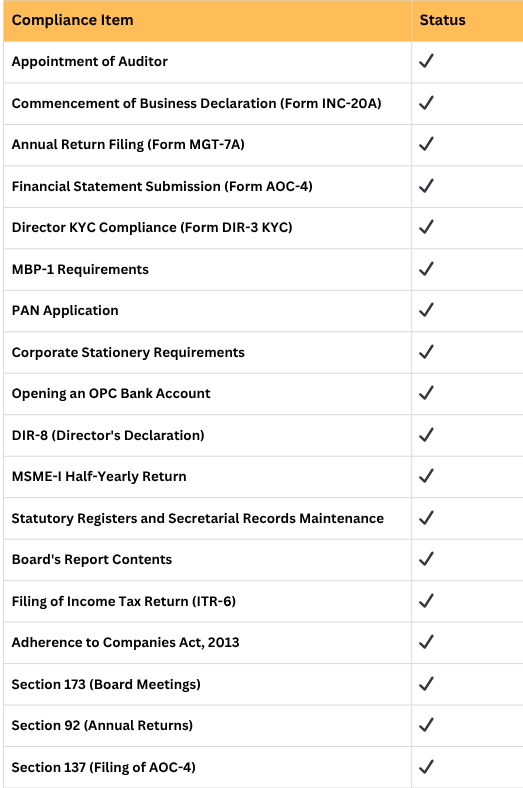
Benefits of Compliances for One Person Company
There are numerous advantages to ensuring your One-Person Company (OPC) adheres to all required compliances. Here’s a breakdown of the key benefits:
- Enhanced Credibility and Investor Confidence: Following compliance regulations, including those related to the Companies Act, Income Tax, and GST, demonstrates transparency and good governance. This builds trust with potential investors, making it easier to secure financial backing for your OPC.
- Smoother Operations and Active Status: Timely and proper compliance helps maintain your OPC’s active status with the government. This ensures smooth business operations and avoids potential disruptions.
- Accurate Financial Records and Reduced Penalties: Regular compliance procedures necessitate accurate data collection and record-keeping. This not only provides valuable insights for your own decision-making but also helps you avoid hefty fines and penalties associated with non-compliance.
- Easier Access to Funds: Financial institutions are more likely to consider loan applications from OPCs that demonstrate a history of compliance. Proper annual filings project a responsible image and make it easier to raise capital.
- Simplified Compliance Burden: Compared to other company structures, OPCs benefit from fewer compliance requirements. The Companies Act of 2013 offers exemptions for certain tasks, reducing administrative burdens for the director.
- Perpetual Succession: Even with a single member, OPCs must follow the principle of perpetual succession. This ensures business continuity by designating a nominee who takes over company operations in case of the sole member’s absence or demise.
- Straightforward Incorporation Process: Setting up an OPC is relatively simple. It requires only a director (who can also be the nominee) and a minimum authorized capital of Rs. 1 lakh, with no mandatory paid-up capital requirement. This makes OPCs a more accessible structure compared to other company types.
- Increased Funding Opportunities: Compliance opens doors to various funding options. OPCs that demonstrate responsible compliance practices are more likely to attract venture capital, angel investors, and even secure loans from financial institutions with a streamlined process.
Documents Required for One Person Company(OPC) Compliance in India
For a One Person Company (OPC) in India, adhering to annual compliance is essential for maintaining its legal standing and financial transparency. The following documents are crucial for OPC compliance:
- Receipts of Purchases and Sales: All receipts related to purchases and sales throughout the financial year must be documented and submitted. This helps in verifying the financial transactions the company has engaged in.
- Invoices of Expenses: All invoices for expenses incurred during the year need to be collected and submitted. These invoices provide a clear account of the outflows and are necessary for financial audits and tax calculations.
- Bank Statements: Bank statements from April 1st to March 31st for all bank accounts held in the name of the company are required. These statements are used to reconcile financial records and verify the cash flows of the company.
- Details of GST Returns: If the OPC is registered under GST, details of all GST returns filed during the year must be submitted. This includes sales and purchase invoices linked to GST filings.
- Details of TDS Challans and TDS Returns: If applicable, details of all TDS (Tax Deducted at Source) challans deposited and TDS returns filed need to be submitted. This is essential for compliance with the tax laws and helps in claiming tax credits.
- Financial Statements: The preparation and submission of financial statements, including a balance sheet and a profit & loss account, are mandatory. These documents provide a snapshot of the company’s financial health and performance over the financial year.
- Director’s Report: A director’s report is required, outlining the overall health of the company, its compliance with various statutory requirements, and other relevant details concerning the company’s operations during the year.
- Details of the Member/Shareholder: Since an OPC usually has a single member, detailed information about the member/shareholder, including their shareholding pattern, must be maintained and submitted.
- Details of Directors: Information about the director(s) of the OPC, including their responsibilities and activities throughout the year, must be documented.
These documents collectively help in maintaining a transparent and compliant operational framework for the OPC. They are crucial not only for fulfilling statutory obligations but also for enhancing the credibility of the company with financial institutions, investors, and other stakeholders.
Conclusion and Way Ahead
Compliance for One Person Companies (OPCs) in India represents a vital aspect of maintaining the integrity and operational efficacy of these entities. The streamlined compliance requirements, while simpler than those of larger corporations, play a crucial role in safeguarding the legal and financial aspects of the company. Through meticulous documentation and adherence to regulatory norms, OPCs ensure limited liability protection, increased investor confidence, and enhanced opportunities for financial growth. The systematic approach to maintaining detailed financial records, annual filings, and transparency not only fortifies the company’s standing but also builds a foundation of trust with stakeholders.
Looking ahead, the landscape for OPCs in India is poised for evolution. With ongoing reforms in corporate governance and compliance regulations, OPCs can anticipate more streamlined processes and perhaps even further reductions in compliance burdens. This could encourage more entrepreneurs to adopt the OPC structure as it becomes increasingly conducive to innovative business models and rapid scaling. Additionally, as digital transformation continues to permeate the regulatory framework, OPCs might find it easier to manage their compliances through automated systems, reducing manual effort and increasing accuracy. The future holds a promising prospect for OPCs to not only flourish in a dynamic economic environment but also to drive forward the entrepreneurial spirit of India with robust compliance and governance as their backbone.
We have helped OPCs navigate compliance needs Let’s Talk
In today’s fast-paced business environment, choosing the right legal structure is pivotal for business owners in India. One such popular structure is the Limited Liability Partnership (LLP) which essentially functions as a hybrid of a partnership and a corporate entity. The key benefit to the LLP structure is that the business can retain the benefits of limited liability while retaining operational flexibility. Consequently, LLPs have gained immense traction among entrepreneurs and professionals for their simplicity and efficiency in operation.
However, with this flexibility comes the responsibility of maintaining LLP compliances in India, which are mandatory for safeguarding the legal standing and operational credibility of the entity. Adhering to these compliances for LLPs ensures that the LLP operates within the framework of the law, avoids hefty penalties, and maintains its goodwill among stakeholders and regulatory bodies. Failing to comply with these regulations can lead to severe repercussions, including financial penalties, legal disputes, and even the dissolution of the LLP. Therefore, understanding and adhering to LLP filing requirements and deadlines is not just a legal obligation but also a cornerstone of sustainable business management. This blog serves as a comprehensive guide to LLP annual compliance and filing requirements in India, detailing the steps, benefits, and consequences of non-compliance.
What is LLP in India?
LLPs in India are governed by the Limited Liability Partnership Act, 2008 (“LLP Act”). As defined thereunder, an LLP is a separate legal entity distinct from its partners. This means that the LLP can own assets, incur liabilities, and enter into contracts in its name, providing a level of security and independence not found in traditional partnerships. One of its hallmark features is limited liability, ensuring that the personal assets of the partners are not at risk beyond their agreed contributions to the business.
An LLP is further governed by an LLP agreement executed between the partners and filed as part of the incorporation documents to be provided to the Ministry of Corporate Affairs under the LLP Act. Accordingly, critical terms such as the extent of liability, obligations of each partner and their capital contributions to the LLP are captured therein.
Key Characteristics of an LLP
- Separate Legal Entity: An LLP has its own legal identity, distinct from its partners, allowing it to function independently.
- Limited Liability: The partners’ liabilities are limited to their contributions, offering a layer of financial protection.
- Flexibility in Management: Unlike corporations, LLPs provide greater flexibility in internal operations and decision-making processes.
- No Minimum Capital Requirement: LLPs do not mandate a minimum capital requirement, making them accessible for startups and small businesses.
How is an LLP Different from a Private Limited Company?
While both LLPs and Private Limited Companies offer limited liability protection, they differ in various ways:
- Ownership and Control: In an LLP, the partners manage the business directly, whereas in a Private Limited Company, directors manage operations on behalf of shareholders.
- Compliance Burden: LLPs have fewer compliance requirements and lower operational costs compared to Private Limited Companies.
- Tax Advantages: LLPs generally benefit from a simplified tax structure, avoiding dividend distribution tax applicable to Private Limited Companies.
Regulatory Oversight
LLPs in India fall under the purview of the Ministry of Corporate Affairs (MCA), as designated by the LLP Act. Key regulations include registration, annual filings, and periodic updates for changes in partnership structure or business operations. The Registrar of Companies (RoC) monitors compliance, ensuring that LLPs adhere to the legal framework established under the LLP Act.
By combining the best aspects of partnerships and corporations, LLPs have emerged as a favored structure for entrepreneurs seeking a balance of flexibility, liability protection, and operational efficiency.
What are Compliances for LLP in India?
Compliances for Limited Liability Partnerships (LLPs) in India refer to the set of mandatory legal, financial, and procedural obligations that LLPs must adhere to in order to maintain their legal standing and operational credibility. Governed by the Limited Liability Partnership Act, 2008, these compliances ensure that LLPs operate transparently, fulfill their tax obligations, and align with the regulations set by the Ministry of Corporate Affairs (MCA).
Importance of LLP Compliance
Maintaining compliance for a Limited Liability Partnership (LLP) is not just a legal obligation—it’s a cornerstone for ensuring the smooth operation and longevity of the business. LLP compliance encompasses all the mandatory filings and procedural requirements that safeguard the LLP’s legal standing and financial integrity.
Why Compliance is Crucial for an LLP
- Preserving Legal Status
Timely compliance is essential to uphold an LLP’s status as a legally recognized entity. Non-compliance can lead to severe consequences, such as disqualification of partners, restrictions on business activities, and even the dissolution of the LLP by regulatory authorities. - Ensuring Smooth Business Operations
Compliance helps in maintaining organized and transparent business practices. Adhering to LLP filing requirements, such as submitting financial statements and annual returns, ensures that the LLP operates within the boundaries of the law, minimizing disruptions. - Avoiding Penalties and Legal Complications
Non-compliance with mandatory LLP requirements can result in hefty penalties, with additional penalty levied on a per day basis for any delays/contraventions that are not rectified. Additionally, prolonged non-compliance can escalate into legal complications, tarnishing the LLP’s reputation and creating obstacles for future business dealings. It is crucial to note that the ROC through the LLP Act, is empowered to strike off LLPs that are deemed to be defunct or not carrying on operations in accordance with the LLP Act.
The Role of Timely Filings
- Maintaining Transparency
Filing annual returns (Form 11) and financial statements (Form 8) on time fosters transparency in financial and operational activities. This builds trust among stakeholders, clients, and regulatory bodies. - Enhancing Credibility
A compliant LLP is viewed as reliable and trustworthy, which can be a critical factor when securing investments, loans, or partnerships. Timely compliance reflects professionalism and adherence to business ethics. - Tax Benefits
Compliance also plays a significant role in tax planning and benefits. Filing accurate income tax returns on time helps avoid interest, penalties, and scrutiny from tax authorities. LLPs that adhere to tax filing requirements can also access incentives and deductions applicable to compliant businesses.
One-Time Mandatory Compliance for LLPs
When establishing a Limited Liability Partnership (LLP) in India, there are specific one-time compliance requirements that ensure a strong legal and operational foundation. These steps must be completed immediately after incorporation to maintain transparency and align with regulatory expectations.
1. LLP Form-3: Filing the LLP Agreement
The LLP Agreement serves as the governing document for the partnership, outlining the roles, responsibilities, and operational rules for the partners. As per the Limited Liability Partnership Act, 2008, this agreement must be filed using Form-3 with the Registrar of Companies (ROC) within 30 days of incorporation.
- Why it’s important: Filing the LLP Agreement ensures clarity in the partnership’s functioning and establishes legal protections for all partners.
- Failure to file: Delays in filing Form-3 attract penalties, which can escalate daily until the agreement is submitted.
2. Opening a Current Bank Account
To streamline financial transactions and maintain accountability, every LLP must open a current bank account in its name with a recognized bank in India.
- Purpose: This account is essential for conducting all business-related financial activities, from payments to receipts.
- Transparency in operations: Using a dedicated LLP bank account ensures clear separation of personal and business transactions, reducing the risk of financial discrepancies.
3. Obtaining PAN and TAN Numbers
Each LLP must obtain a Permanent Account Number (PAN) and Tax Deduction and Collection Account Number (TAN) from the Income Tax Department.
- Ease of compliance: With the introduction of the LLP (Second Amendment) Rules, 2022, PAN and TAN numbers are now automatically generated and issued alongside the Certificate of Incorporation, simplifying this step.
- Purpose of PAN and TAN: PAN is required for income tax filings, while TAN is mandatory for deducting and remitting tax at source (TDS) when applicable.
4. GST Registration (If Applicable)
While not mandatory at the time of incorporation, an LLP must obtain GST registration if its annual turnover exceeds ₹40 lakhs (or ₹20 lakhs for service providers).
- When to register: LLPs can register under the Goods and Services Tax (GST) Act as soon as their turnover threshold is crossed.
- Benefits of GST compliance: Timely GST registration allows LLPs to claim input tax credits and ensures they comply with tax collection and remittance requirements.
Mandatory Compliances for LLPs in India
For Limited Liability Partnerships (LLPs) in India, adhering to mandatory compliance requirements is crucial for maintaining their legal standing and ensuring smooth operations. These obligations, governed by the Limited Liability Partnership Act, 2008, apply to all LLPs, irrespective of their business activity or scale. Below is a comprehensive list of the mandatory filings and compliance requirements that every LLP must meet.
1. Annual Return Filing (Form 11)
Every LLP must file Form 11 annually, even if it has not conducted any business during the year.
- What it includes: Form 11 provides a summary of the LLP’s management affairs, including details about its partners.
- Deadline: This form must be filed by May 30th each year.
- Penalty for non-compliance: Failing to file Form 11 on time results in a fine of ₹100 per day until compliance is achieved.
2. Statement of Accounts and Solvency (Form 8)
Form 8 is a critical compliance requirement, documenting the LLP’s financial performance and solvency status.
- What it includes: It covers profit-and-loss statements, balance sheets, and a declaration of solvency.
- Audit requirement: LLPs with a turnover exceeding ₹40 lakhs or a contribution exceeding ₹25 lakhs must get their accounts audited by a Chartered Accountant (CA).
- Deadline: Form 8 must be filed within 30 days from the end of six months of the financial year, i.e., by October 30th.
- Penalty for non-compliance: Missing the deadline incurs a penalty of ₹100 per day, which continues until the filing is completed.
3. Income Tax Filing (ITR-5)
Filing Income Tax Returns (ITR-5) is mandatory for all LLPs, with deadlines varying based on the need for a tax audit.
- Deadline for non-audited LLPs: LLPs not requiring a tax audit must file their ITR by July 31st.
- Deadline for audited LLPs: LLPs requiring an audit must complete their ITR filing by September 30th after the audit is performed by a practicing CA.
- Special cases: LLPs engaged in international or specified domestic transactions must file Form 3CEB and complete their tax filing by November 30th.
4. Other Miscellaneous Compliances
In addition to the major filings, LLPs must meet several routine compliance requirements, including:
- Director Identification Number (DIN) Updates: Ensuring that DINs of all designated partners remain active and updated.
- Event-Based Filings: Filing relevant forms with the Ministry of Corporate Affairs (MCA) for changes such as partner additions or exits, amendments to the LLP agreement, or changes in contributions.
- Maintenance of Statutory Records: LLPs must maintain accurate and updated records of financial transactions, partner details, and minutes of meetings.
We help LLPs with all compliance requirements Let’s Talk
Compliances for Limited Liability Partnership (LLP) in India (Checklist)
| Compliance Requirement | Form Associated | Deadline | Frequency | Penalties for Non- Compliance | Other Remarks |
|---|---|---|---|---|---|
| Annual Return Filing | Form 11 | May 30th every year | Annual | ₹100 per day until compliance | Mandatory for all LLPs, irrespective of business activity. Provides a summary of LLP’s management affairs. |
| Statement of Accounts and Solvency | Form 8 | October 30th every year | Annual | ₹100 per day until compliance | Must include profit-and-loss statements and balance sheets. Audit required for LLPs with turnover > ₹40 lakhs or contribution > ₹25 lakhs. |
| Income Tax Filing | ITR-5 | July 31st (non-audited LLPs) | Annual | Interest on due tax, penalties, and legal consequences for non-filing | Tax-audited LLPs must file by September 30th. LLPs with international/domestic transactions must file Form 3CEB and complete filing by November 30th. |
| LLP Agreement Filing | Form-3 | Within 30 days of incorporation | One-Time | ₹100 per day until compliance | Filing the LLP Agreement ensures clarity in roles, responsibilities, and rules of operation. |
| GST Registration | GST Registration Form | Upon reaching turnover threshold of ₹40L/₹20L | Event-Based | Penalty of 10% of the tax amount due (minimum ₹10,000) | Not mandatory at incorporation. Registration is required when annual turnover exceeds ₹40 lakhs (₹20 lakhs for service providers). |
| DIN Updates | NA | As required | Event-Based | NA | Ensure Director Identification Numbers (DINs) are active and updated for all designated partners. |
| Event-Based Filings | Various MCA Forms | Within the prescribed timeline | Event-Based | ₹100 per day until compliance | Applies to changes in LLP agreement, partner details, or contributions. |
| Form 3CEB Filing | Form 3CEB | November 30th (if applicable) | Annual (if applicable) | Penalties and scrutiny by tax authorities | Mandatory for LLPs engaged in international or specific domestic transactions. |
Key Insights:
- Timeliness is critical: Most filings have daily penalties for delays, so adhering to deadlines is crucial to avoid unnecessary financial burdens.
- Audit requirements: LLPs with higher turnover or contributions must have their accounts audited by a Chartered Accountant.
- Professional assistance recommended: Engaging a CA or compliance expert, like Treelife can help LLPs stay on top of all legal and tax obligations.
Benefits of LLP Compliance
Timely compliance with regulatory requirements offers several advantages for an LLP:
- Legal Protection: Compliance helps maintain the limited liability status of partners, ensuring the business remains a separate legal entity and protecting personal assets.
- Credibility: Meeting filing deadlines boosts the credibility of the LLP with clients, investors, and regulatory bodies, enhancing trust and reputation.
- Avoiding Penalties: Adhering to compliance prevents costly fines, interest charges, and legal consequences, helping avoid disruptions to business operations.
- Tax Benefits: Timely filing of income tax returns and maintaining proper records can provide tax advantages, including deductions and exemptions, reducing the business’s tax liability.
Steps to Ensure LLP Compliance
To maintain a compliant LLP, following a structured approach is crucial. Here’s an LLP compliance safety checklist to help your business stay on track:
- Regular Bookkeeping: Accurate financial record-keeping is essential. Even if no business activity occurs, LLPs must maintain detailed books throughout the year. This ensures readiness for filings and audits, and helps avoid penalties for non-compliance.
- Set Reminders for Filing Deadlines: It’s important to establish a system to track key filing dates. Use calendar alerts or professional services to ensure timely submission of required returns and documents to avoid delays and fines.
- Engage Professionals: Consult with a Chartered Accountant (CA) or compliance expert to manage filings, audits, and overall compliance. Professionals can guide you through complex regulatory requirements, ensuring that your LLP adheres to all legal obligations.
- Stay Updated: Regularly update your LLP’s forms with the Ministry of Corporate Affairs (MCA) whenever there are changes in partners, capital contributions, or corporate structure. Timely updates prevent issues with legal filings and keep your records accurate.
By following these steps to ensure LLP compliance, you can avoid legal pitfalls and maintain smooth business operations.
How to File LLP Compliances in India
Filing LLP compliances in India involves several important steps to ensure your business adheres to regulatory requirements. Here’s a guide on how to file LLP returns and the LLP compliance filing process:
- Filing the Statement of Accounts & Solvency (Form 8):
To file Form 8 online on the Ministry of Corporate Affairs (MCA) portal, follow these steps:- Login to the MCA portal (https://www.mca.gov.in/content/mca/global/en/home.html) using your credentials.
- Navigate to the ‘e-Forms’ section and select Form 8.
- Fill in details like LLP’s financial status, assets, liabilities, and solvency.
- Attach the certification from a practicing Chartered Accountant (CA) confirming the accuracy of the details.
- Submit the form and pay the filing fees.
This form must be filed annually to confirm the financial health of the LLP.
- Filing Annual Return (Form 11):
To file Form 11, follow these steps:- Log in to the MCA portal (https://www.mca.gov.in/content/mca/global/en/mca/llp-e-filling.html).
- Select Form 11 under the ‘e-Forms’ section.
- Fill in details about the LLP’s registered office, partners, and capital contributions.
- Submit the form along with the prescribed fees. This form provides the government with an annual update on the LLP’s operational status and structure.
- Income Tax Filing (ITR-5):
For filing income tax returns for an LLP, follow these steps:- Prepare the financial records and details for ITR-5, which is specifically designed for LLPs.
- Ensure that the LLP’s digital signature is ready for filing.
- Visit the Income Tax Department’s e-filing portal and log in.
- Choose ITR-5 from the available forms and fill in the necessary details.
- Submit the return after ensuring all the required information is accurately entered.
LLPs must file their tax returns by the due date to avoid penalties.
- Form 3CEB Filing:
If your LLP is involved in international or domestic transactions subject to transfer pricing regulations, you may need to file Form 3CEB. To file this form:- Engage a CA to certify the transfer pricing report.
- Prepare the form by providing details on the transactions with related parties.
- Submit the form through the MCA portal as part of your compliance.
LLP e-filing streamlines these processes, making it easier for businesses to stay compliant. By following these steps and filing the necessary forms, you ensure that your LLP remains in good standing with regulatory authorities in India.
Filing and Audit Requirements Under the Income Tax Act
Understanding the filing requirements for LLPs under the Income Tax Act is crucial for maintaining compliance and avoiding penalties. Here’s a breakdown of key LLP tax audit and filing requirements:
- Audit Requirements for LLPs:
According to the LLP Act, 2008, any LLP with a turnover exceeding Rs. 40 lakhs or capital contributions exceeding Rs. 25 lakhs is required to have its books audited. The audit must be conducted by a qualified Chartered Accountant (CA) to ensure financial transparency and compliance with statutory regulations. - Income Tax Filing Deadlines:
LLPs must adhere to specific deadlines for filing income tax returns:- For audited LLPs, the filing deadline is September 30th of the assessment year.
- For non-audited LLPs, the deadline is July 31st.
Filing after these dates can result in penalties and interest charges, so it’s essential to keep track of these important dates.
- Tax Audit Threshold:
The threshold for a tax audit under the Income Tax Act has changed in recent years. Starting from the financial year 2020-21, the limit has increased from Rs. 1 crore to Rs. 5 crore for LLPs with cash receipts and payments exceeding the specified limit. This change means that LLPs with a turnover of Rs. 5 crore or less may not require a tax audit, provided their cash transactions remain within the prescribed limits. - Form 3CEB Filing:
If your LLP engages in specified transactions (such as international or domestic transactions involving related parties), you are required to file Form 3CEB. This form, certified by a Chartered Accountant, provides details on the transfer pricing policies and transactions. It must be filed along with the income tax return.
Wrapping things up, LLP compliance in India is essential for ensuring smooth business operations and legal protection. By adhering to the required compliances, such as filing annual returns, maintaining proper financial records, and conducting audits, an LLP can enjoy significant benefits, including legal protection, increased credibility, and tax advantages. Timely compliance also helps avoid penalties and legal consequences that could disrupt business growth. Understanding the LLP compliance checklist and meeting the necessary filing deadlines is crucial for maintaining regulatory adherence and safeguarding your business’s future in India.
]]>Starting a business is an exciting journey, but one of the first critical decisions every entrepreneur faces is choosing the right business structure. This choice isn’t merely administrative; it lays the foundation for how the business will operate, grow, and be perceived. The corporate structure being selected can impact the business and founders’ liability, taxation, compliance requirements, and even the ability to raise funds.
In India, the three most popular business structures are Private Limited Companies (Pvt. Ltd.), Limited Liability Partnerships (LLP), and One Person Companies (OPC). Each has its unique advantages and limitations, catering to different types of entrepreneurs and business goals.
- A Private Limited Company offers a separate legal entity capable of scaling, credibility with investors, and with limited liability for shareholders.
- An LLP combines the flexibility of a partnership with the benefits of limited liability for the partners.
- An OPC is a perfect fit for solo entrepreneurs, offering the advantages of limited liability and a separate legal entity.
Choosing an ill-suited structure can lead to unnecessary financial, legal, and operational complications. Conversely, choosing the right one can help a business thrive from the outset. A significant contributor to business struggles is rooted in a lack of understanding of the distinction between Pvt. Ltd., LLP and OPC structures. In this blog, we breakdown the key differences between these structures and facilitate entrepreneurs to make informed decisions that align with the business vision.
Understanding the Basics
What is a Private Limited Company?
A Private Limited Company (Pvt Ltd) is one of the most popular business structures in India, governed primarily by the Companies Act, 2013 and regulated by the Ministry of Corporate Affairs (MCA). It is a preferred choice for startups and growth-oriented businesses due to its structured ownership model, limited liability protection, and credibility among investors. Additionally, Private Limited startups are given certain concessions and favourable benefits under the regulatory framework, as part of an ongoing government initiative to foster growth, development and innovation – particularly in underrepresented sectors of the economy.
Key Features of a Private Limited Company
- Liability: Pvt Ltd’s formed can either be limited by shares or by guarantee. Consequently shareholders’ personal assets are protected, as their liability is limited to their shareholding or the extent of their contribution to the assets of the company. PLCs can also be an unlimited company, which can attach personal assets of shareholders.
- Separate Legal Entity: The company is a distinct legal entity, capable of owning assets, entering contracts, and conducting business under its name. This distinction is critical where any penalties for contravention of the law are levied, as both the Private Limited Company and the officers in charge face penal action for default.
- Ownership: Owned by shareholders with a statutory minimum requirement of two members. Ownership can be transferred through the sale of shares.
- Management: Managed by a board of directors, with operational decisions often requiring shareholder approval.
- Credibility: Given the robust regulatory framework governing their operation, Pvt Limiteds are highly regarded by investors and financial institutions, making them suitable for fundraising.
Registration Process for a Private Limited Company
The MCA has simplified company incorporation through the SPICe+ (Simplified Proforma for Incorporating Company Electronically Plus) platform. A non-exhaustive list of certain mandatory compliances for incorporation of a Private Limited Company are:
- Obtain DSC: Secure a Digital Signature Certificate for directors.
- Name Approval: Reserve a company name using SPICe+ Part A.
- Submit Incorporation Forms: Complete Part B of SPICe+ to file for incorporation, including Director Identification Number (DIN), PAN, and TAN applications. This will also include the memorandum and articles of association of the company.
- Bank Account Setup: Open a current account in the company’s name for business transactions.
- Commencement of Business: File Form INC-20A within 180 days of incorporation to begin operations officially.
Upon successful approval, the Registrar of Companies issues a Certificate of Incorporation (COI) with the company’s details.
What is an LLP?
A Limited Liability Partnership (LLP) blends the operational flexibility of a partnership with the limited liability advantages of a company. It is governed by the Limited Liability Partnership Act, 2008, making it a preferred structure for professional services, small businesses, and startups seeking simplicity and cost efficiency.
Key Features of an LLP
- Limited Liability: Partners’ liabilities are restricted to their capital contributions, ensuring personal asset protection.
- Separate Legal Entity: The LLP is treated as a body corporate, and is a legal entity separate from the partners. The LLP can own assets, enter contracts, and sue or be sued in its own name.
- Ownership: Owned by partners (minimum two partners required), with ownership terms and extent of contribution to capital being defined in the LLP agreement executed between them.
- Management: Managed collaboratively, as detailed in the LLP agreement, with flexibility in decision-making. Every LLP shall have a minimum of 2 designated partners who are responsible for ensuring compliance with the applicable regulatory framework.
- Compliance: Requires annual return filings and maintenance of financial records, with lower compliance requirements than companies.
Registration Process for an LLP
The registration and governance of LLPs is also handled by the MCA, with a non-exhaustive list of certain mandatory compliances for incorporation of an LLP as follows:
- Obtain DSC: Secure a Digital Signature Certificate for designated partners.
- Name Reservation: Submit the LLP-RUN form to reserve a unique name.
- Incorporation Filing: File the FiLLiP form (Form for Incorporation of LLP) with required documents, including the Subscriber Sheet and partners’ consent.
- LLP Agreement Filing: Draft and file the LLP Agreement using Form 3 within 30 days of incorporation.
Upon approval, the Registrar of Companies issues a Certificate of Incorporation for the LLP.
What is an OPC?
A One Person Company (OPC) is a revolutionary business structure introduced under the Companies Act, 2013, catering to individual entrepreneurs. It combines the benefits of sole proprietorship and private limited companies, offering limited liability and a separate legal entity for single-owner businesses.
Key Features of an OPC
- Single Ownership: Managed and owned by one individual, with a nominee appointed to take over in case of incapacity.
- Limited Liability: The owner’s personal assets are protected from business liabilities.
- Separate Legal Entity: An OPC enjoys legal distinction from its owner, enabling it to own property and enter contracts independently.
- Simplified Compliance: OPCs face fewer compliance requirements compared to Private Limited Companies, such as exemption from mandatory board meetings.
Registration Process for an OPC
The registration process is similar to that of a Private Limited and is also governed by the MCA, facilitated the SPICe+ platform:
- Obtain DSC: Get a Digital Signature Certificate for the sole director.
- Name Approval: Apply for name reservation via SPICe+ Part A.
- Draft MoA and AoA: Draft the Memorandum of Association (MoA) and Articles of Association (AoA).
- Submit Incorporation Forms: Complete Part B of SPICe+ and submit required documents, including nominee consent.
- Commencement of Business: File Form INC-20A within 180 days of incorporation to officially start operations.
After approval, the MCA issues a Certificate of Incorporation, marking the official establishment of the OPC.
Eligibility Criteria for Setting Up Pvt Ltd, LLP, and OPC
Private Limited Company (Pvt Ltd)
- A Private Limited Company can be established by at least two individuals and is suitable for those seeking liability protection and structured governance. Importantly, it requires at least two directors, and the shareholders and directors must be Indian citizens or residents.
- Key Requirement: At least one director must be a resident of India, as per the Companies Act, 2013.
Limited Liability Partnership (LLP)
- LLPs can be registered by at least two individuals or entities, with no upper limit on the number of partners. There is no requirement for a resident director, making it more flexible for foreign investors or NRIs.
- Key Benefit: The liability of each partner is limited to their contribution to the LLP, ensuring financial security without personal exposure.
One Person Company (OPC)
- An OPC can be registered by a single person, ideal for small businesses that want the benefit of limited liability but with fewer formalities compared to a Pvt Ltd.
- Eligibility Criteria: The individual must be a citizen and resident of India. This structure is most beneficial for solo entrepreneurs.
Key Differences Between Private Limited Company, LLP, and OPC
When choosing a business structure, understanding the distinctions between Private Limited Companies (Pvt. Ltd.), Limited Liability Partnerships (LLP), and One Person Companies (OPC) is crucial. Below is a comparison of these structures based on key parameters:
1. Governing Laws and Regulatory Authority
- Private Limited: Governed primarily by the Companies Act, 2013 and rules formulated thereunder.
- LLP: Operates under the Limited Liability Partnership Act, 2008 and rules formulated thereunder.
- OPC: Governed by the Companies Act, 2013 and rules formulated thereunder.
- Each of the above corporate structures are regulated by the Ministry of Corporate Affairs (MCA).
2. Minimum Members and Management
- Private Limited: Requires at least two shareholders and two directors, who can be the same individuals. At least one director must be a resident Indian.
- LLP: Needs a minimum of two designated partners, one of whom must be an Indian resident.
- OPC: Involves a single shareholder and director, with a mandatory nominee.
3. Maximum Members and Directors
- Private Limited: Allows up to 200 shareholders and 15 directors.
- LLP: Has no cap on the number of partners but limits partners with managerial authority to the number specified in the LLP agreement.
- OPC: Limited to one shareholder and a maximum of 15 directors.
4. Liability
- Private Limited: Shareholders’ liability is limited to their share capital.
- LLP: Partners’ liability is confined to their contribution in the LLP and does not extend to acts of other partners.
- OPC: The director’s liability is restricted to the extent of the paid-up share capital.
5. Compliance Requirements
- Private Limited: High compliance needs, including statutory audits, board meetings, maintenance of minutes, and annual filings with the Registrar of Companies (RoC).
- LLP: Moderate compliance; audits are required only if turnover exceeds ₹40 lakhs or capital contribution exceeds ₹25 lakhs.
- OPC: Requires annual filings and statutory audits similar to a Private Limited but without the necessity of board meetings.
6. Tax Implications
- Private Limited: Subject to a corporate tax rate of 22% plus applicable surcharges and cess. Dividend Distribution Tax (DDT) and Minimum Alternate Tax (MAT) also apply.
- LLP: Taxed at 30% with fewer additional taxes; no DDT or MAT, making it tax-efficient for higher earnings.
- OPC: Taxed similarly to Private Limited Companies at 22% plus surcharges and cess.
7. Startup and Maintenance Costs
- Private Limited: Incorporation costs range from ₹8,000 upwards, with annual compliance costs of around ₹13,000.
- LLP: Lower setup costs of approximately ₹5,000, and minimal compliance costs unless turnover or contributions exceed thresholds.
- OPC: Similar to Private Limited Companies, with incorporation costs starting at ₹7,000.
8. Ease of Fundraising
- Private Limited: Ideal for raising equity funding as it allows issuing shares to investors.
- LLP: Limited options for funding; investors must become partners.
- OPC: Challenging for equity funding as it allows only one shareholder.
9. Business Continuity and Transferability
- Private Limited: Operates as a separate legal entity; ownership transfer is possible through share transfers.
- LLP: Offers perpetual succession; economic rights can be transferred.
- OPC: Exists independently of the director; ownership can be transferred with changes to the nominee.
10. Best Fit for Entrepreneurs
- Private Limited: Suited for startups looking to scale, attract investors, or issue ESOPs.
- LLP: Ideal for professional firms or businesses requiring flexibility and lower compliance.
- OPC: Best for solo entrepreneurs with simple business models and limited liability.
Table: Comparison between Pvt. Ltd., LLP and OPC
| Aspect | Private Limited Company (Pvt. Ltd.) | Limited Liability Partnership (LLP) | One Person Company (OPC) |
|---|---|---|---|
| Governing Act | Companies Act, 2013 | Limited Liability Partnership Act, 2008 | Companies Act, 2013 |
| Suitable For | Financial services, tech startups, and medium enterprises | Consultancy firms and professional services | Franchises, retail stores, and small businesses |
| Shareholders/Partners | Minimum: 2 ShareholdersMaximum: 200 Shareholders | Minimum: 2 PartnersMaximum: Unlimited Partners | Minimum: 1 ShareholderMaximum: 1 Shareholder (with up to 15 Directors) |
| Nominee Requirement | Not required | Not required | Mandatory |
| Minimum Capital | No minimum requirement, but suggested to authorize INR 1,00,000 | No minimum requirement, but advisable to start with INR 10,000 | No minimum paid-up capital; minimum authorized capital of INR 1,00,000 |
| Tax Rates | 25% (excluding surcharge and cess) | 30% (standard fixed rate) | 25% (excluding surcharge and cess) |
| Fundraising | Easier due to investor preference for shareholding | Challenging, as partners typically fund LLPs | Limited, as only a single shareholder is allowed |
| DPIIT Recognition | Eligible | Eligible | Not eligible |
| Transfer of Ownership | Shares can be transferred easily by amending the Articles of Association (AOA) | Requires partner consent and is more complex | Direct transfer is not possible; ownership transfer occurs with nominee involvement |
| ESOPs (Employee Stock Options) | Can issue ESOPs to employees | Not allowed | Not allowed |
| Governing Agreements | Duties, responsibilities, and clauses outlined in MOA (Memorandum of Association) and AOA | Duties and responsibilities specified in an LLP Agreement | Duties, responsibilities, and clauses outlined in MOA and AOA |
| Compliance | • High compliance costs• Mandatory 4 board meetings• Annual filings (AOC-4, MGT-7)• Statutory audit mandatory | • Low compliance costs• No board meeting requirements• Statutory audit not required if turnover < INR 40 lakhs or capital contribution < INR 25 lakhs• Annual filings in Form 8 and 11 | • Lower compliance costs• Minimum 2 board meetings annually• Mandatory statutory audit |
| Foreign Directors/Partners | NRIs and Foreign Nationals can be Directors | NRIs and Foreign Nationals can be Partners | Not allowed |
| Foreign Direct Investment (FDI) | Eligible through automatic route | Eligible through automatic route | Not eligible |
| Mandatory Conversion of corporate structure | Not applicable | Not applicable | Mandatory to convert into Private Limited if turnover exceeds INR 2 crores or paid-up capital exceeds INR 50 lakhs |
Conversion Process and Conditions for Pvt Ltd, LLP, and OPC
Private Limited Company to LLP Conversion
- Transitioning from a Private Limited Company to an LLP is a formal process that involves approval from the Registrar of Companies (ROC) and adherence to the provisions under the Limited Liability Partnership Act, 2008. It can be done only if the company has no outstanding liabilities and all shareholders agree to the conversion.
- Key Steps: Filing of forms like FiLLiP (Form for Incorporation of a Limited Liability Partnership), and approval from the ROC.
LLP to Pvt Ltd Conversion
- Converting an LLP to a Private Limited Company is a slightly more complicated process, requiring an agreement from all members and a formal approval from the Registrar. This is often considered when the business scales up and requires a more structured framework.
- Key Steps: Filing with Form 18 and Form 27 with the ROC, along with submission of the resolution to change the nature of the business.
OPC to Pvt Ltd Conversion
- Conversion of an OPC to a Private Limited Company is allowed once the OPC meets the criteria of having at least two members (directors and shareholders). This often occurs as the business grows.
- Key Requirements: Minimum of two shareholders and directors, filing with Form INC-6 for conversion.
Statutory Compliance Requirements for Pvt Ltd, LLP, and OPC
Private Limited Company
- Must file annual financial statements and tax returns with ROC under Section 137 of the Companies Act.
- Mandatory Audits: An audit is required for Pvt Ltd regardless of the turnover.
- Tax Filing: Corporate tax returns need to be filed annually under Income Tax Act, 1961.
- Board Meetings: A minimum of 4 board meetings must be conducted annually.
LLP
- Statutory Compliance: LLPs must file annual returns and maintain proper accounts.
- Tax Filing: LLPs are required to file annual tax returns. While the structure provides flexibility, tax benefits may be limited.
- Audit: An audit is only required if the turnover exceeds INR 40 Lakhs or the capital contribution is above INR 25 Lakhs.
OPC
- As a simplified structure, OPCs are required to hold only one board meeting annually. Financial statements must be filed with the Registrar of Companies every year.
- Tax Filing: Annual returns under Section 92 of the Income Tax Act, similar to Pvt Ltd.
Liability Protection in Pvt Ltd, LLP, and OPC
Private Limited Company
- Shareholders of a Pvt Ltd company enjoy limited liability, meaning their personal assets are protected. The company’s debts are separate from personal finances, providing a strong shield for investors.
LLP
- LLPs provide similar liability protection as Pvt Ltd companies but with more flexibility in management. Each partner’s liability is limited to the extent of their contribution, which is ideal for businesses with multiple investors.
OPC
- An OPC provides limited liability, protecting the sole owner’s personal assets, while also being a more cost-effective structure than a Pvt Ltd for small businesses.
Tax Benefits and Advantages in Pvt Ltd, LLP, and OPC
Private Limited Company
- Corporate Tax Rate: Pvt Ltd companies pay corporate tax on their income. Current tax rates are 25% for turnover below INR 400 Crores, and 30% for higher turnovers.
- Tax Deducted at Source (TDS): Pvt Ltd must deduct TDS for payments above a certain threshold as per the Income Tax Act.
LLP
- LLPs enjoy pass-through taxation, meaning the profits are not taxed at the company level but at the individual partner level. This avoids double taxation and can be beneficial for smaller companies.
- Tax Filing: LLPs are taxed at 30%, similar to Pvt Ltd companies, but the pass-through benefits can reduce overall tax liabilities.
OPC
- OPCs are taxed as sole proprietorships, but with limited liability protection. This is advantageous for solo entrepreneurs.
- Tax Filing: The income of the OPC is taxed at the individual tax rates, but they are also eligible for certain exemptions.
Loan and Fundraising in Pvt Ltd, LLP, and OPC
Private Limited Company
- Fundraising: Pvt Ltd companies can raise funds through equity, debt, and venture capital investments. They are also eligible for listing on stock exchanges if they meet the criteria.
- Loan Facilities: Access to loans from financial institutions and banks is easier for Pvt Ltd companies due to their structured corporate governance.
LLP
- Fundraising: LLPs can raise funds through partners and may also borrow money from financial institutions. However, venture capitalists often prefer Pvt Ltd companies for investment.
- Loan Facilities: Banks and financial institutions may provide loans to LLPs, but the terms might be less favorable than for Pvt Ltd companies.
OPC
- Fundraising: Fundraising for OPCs can be challenging due to the lack of multiple shareholders. Most OPCs rely on personal funds or loans from financial institutions.
- Loan Facilities: OPCs can avail loans, but the interest rates may be higher compared to Pvt Ltd companies.
Filing of Annual Returns and Other Documents
Private Limited Company
- Pvt Ltd companies must file annual returns, financial statements, and various other documents with the Registrar of Companies (ROC). These include Form AOC-4 and Form MGT-7.
LLP
- LLPs must file Form 11 for annual returns and Form 8 for financial statements, but they are not as stringent as Pvt Ltd companies.
OPC
- OPCs must file Form AOC-4 for financial statements and Form MGT-7 for annual return.
Which Structure is Right for You?
Setting up the right business structure is crucial for long-term success, as it impacts compliance, taxation, scalability, and operational ease. Here’s a detailed guide to help you decide:
Private Limited Company (Pvt. Ltd.): Best for High-Growth Startups
A Private Limited Company is the go-to choice for businesses aiming for rapid scalability, significant funding, and enhanced investor trust. Its advantages include limited liability, a professional corporate structure, and the ability to issue shares, making it easier to attract venture capitalists and angel investors.
When to Choose a Pvt. Ltd.:
- You are planning to raise funds from institutional investors or venture capitalists.
- Scalability and expansion are primary goals.
- You need to offer Employee Stock Ownership Plans (ESOPs) to attract and retain top talent.
Key Advantages:
- Easy access to funding from equity investors.
- A separate legal entity ensures perpetual existence, unaffected by changes in ownership or management.
- Higher credibility and brand value in the business ecosystem.
However, this structure comes with more compliance requirements and higher initial costs, making it ideal for businesses prepared for a robust operational framework.
Limited Liability Partnership (LLP): Ideal for Professional Firms and Partnerships
An LLP combines the simplicity of a partnership with the benefits of limited liability. It is particularly suited for professional services, consultancies, and firms where equity funding is not a priority.
When to Choose an LLP:
- You are running a service-based business or a partnership firm.
- Compliance requirements need to be minimal.
- Tax efficiency is a priority for your business model.
Key Advantages:
- No limit on the number of partners, making it ideal for growing collaborative ventures.
- Lower compliance and operational costs compared to a Private Limited Company.
- Exemption from Dividend Distribution Tax (DDT) offers tax benefits.
While LLPs offer flexibility, their fundraising limitations make them less suitable for high-growth startups or businesses requiring significant capital investments.
One Person Company (OPC): Perfect for Solo Entrepreneurs
An OPC is designed for solo entrepreneurs who want to benefit from limited liability and a separate legal entity without involving additional shareholders or partners. It bridges the gap between sole proprietorship and a Private Limited Company.
When to Choose an OPC:
- You are an individual entrepreneur running a small business.
- Limited liability is crucial to safeguard your personal assets.
- Your business doesn’t require external funding or multiple shareholders.
Key Advantages:
- Simple structure with complete control under one individual.
- Low compliance compared to a Private Limited Company.
- Suitable for small-scale businesses and franchise operations.
However, mandatory conversion into a Private Limited Company is required if your revenue exceeds ₹2 crores or paid-up capital crosses ₹50 lakhs, making it more suited for businesses with modest growth plans.
Quick Recap: How to Choose the Right Structure
- Opt for Private Limited Company if funding and scalability are your primary objectives.
- Choose LLP if you need a flexible, low-compliance structure ideal for service-oriented partnerships.
- Go for OPC if you are a solo entrepreneur seeking limited liability with minimal operational complexities.
Ultimately, the best structure depends on your business goals, compliance readiness, and long-term vision. Take the time to assess your needs and align them with the right structure for sustainable growth.
In conclusion, choosing the right business structure, Private Limited Company, LLP, or OPC depends on your business’s unique needs, growth aspirations, and operational priorities. A Private Limited Company is ideal for startups seeking scalability and funding opportunities, while an LLP suits collaborative professional ventures prioritizing tax efficiency and operational flexibility. For solo entrepreneurs, an OPC offers the perfect blend of limited liability and simplicity. Each structure has its advantages and limitations, so it’s crucial to assess your goals, compliance readiness, and future plans carefully. By selecting the right entity, you can lay a strong foundation for your business’s success and sustainability.
]]>Staying compliant with statutory deadlines is critical for businesses in India. Missing due dates for GST, TDS, TCS, MCA, PF, ESI, or LLP filings can lead to penalties and unnecessary scrutiny.
This article provides a comprehensive Compliance Calendar for October 2025, covering all important tax, GST, corporate, and labor law deadlines.
Why a Compliance Calendar Matters for October 2025
- Ensures timely filing of GST returns, TDS, and MCA forms
- Avoids late fees, interest, and penalties under Income Tax Act, Companies Act, and GST law
- Simplifies regulatory management for startups, SMEs, corporates, and LLPs
- Helps CFOs, compliance officers, and founders plan finance and accounting workflows
Quick View: Compliance Calendar for October 2025
| Date | Compliance | Applicable Form / Return |
|---|---|---|
| 7th Oct (Tue) | Deposit of TDS/TCS for September 2025 | Challan ITNS-281 |
| 10th Oct (Fri) | GST Returns for TDS/TCS Deductors | GSTR-7 & GSTR-8 |
| 11th Oct (Sat) | Monthly GST Filing for September 2025 | GSTR-1 |
| 13th Oct (Mon) | GST IFF (QRMP, optional) | Invoice Furnishing Facility |
| GST Filing for NRTP & ISD | GSTR-5 & GSTR-6 | |
| 14th Oct (Tue) | Filing with MCA | Form ADT-1 (Auditor Appointment/Reappointment) |
| 15th Oct (Wed) | TDS Certificates for Q2 (July–Sept) | Form 16A & 27D |
| Professional Tax (Monthly) | State-specific | |
| PF & ESI Contributions | ECR Filing | |
| 20th Oct (Mon) | Monthly GST Filing | GSTR-3B |
| OIDAR Services Filing | GSTR-5A | |
| 29th Oct (Wed) | TDS Challan-cum-Statements | Forms 26QB, 26QC, 26QD, 26QE |
| 30th Oct (Thu) | LLP Filing with MCA | Form 8 LLP (Statement of Accounts) |
| 31st Oct (Fri) | Company Annual Return Filing | Form AOC-4 / AOC-4 XBRL* |
| MSME Return Filing | Form MSME-1 (HY Sept 2025) | |
| Quarterly TDS/TCS Returns (Q1 FY 25-26)** | Form 24Q, 26Q, 27Q, 27EQ |
* Applicable if AGM held on September 30, 2025
** For April–June 2025 quarter
Detailed Checklist of October 2025 Compliances
1. Income Tax & TDS/TCS Deadlines
- 7th Oct 2025 – Deposit TDS/TCS for September
- 15th Oct 2025 – Issue TDS Certificates (Form 16A & 27D) for Q2
- 29th Oct 2025 – Furnish Challan-cum-Statements for TDS u/s 194-IA, 194-IB, 194M, 194S
- 31st Oct 2025 – File Quarterly TDS/TCS Returns for Q1 (Forms 24Q, 26Q, 27Q, 27EQ)
2. GST Compliance for October 2025
- 10th Oct – GSTR-7 (TDS) & GSTR-8 (TCS)
- 11th Oct – GSTR-1 (Monthly filers)
- 13th Oct – GSTR-1 IFF (QRMP, optional), GSTR-5 (NRTP), GSTR-6 (ISD)
- 20th Oct – GSTR-3B (Monthly filers), GSTR-5A (OIDAR service providers)
3. MCA / Corporate Law Deadlines
- 14th Oct – Form ADT-1 for appointment/reappointment of Statutory Auditors (if AGM held in Sept)
- 30th Oct – LLP Form 8 (Statement of Accounts & Solvency for FY 24-25)
- 31st Oct – Form AOC-4 / AOC-4 XBRL for annual financial statements (if AGM held on Sept 30, 2025)
4. MSME & Labor Law Compliances
- 15th Oct –
- Professional Tax Payment/Return (varies by state)
- PF & ESI contributions for September 2025
- 31st Oct – MSME-1 filing for half year ended Sept 30, 2025
Key Takeaways for Businesses
- Track State-wise PT deadlines – dates may differ across states.
- PF/ESI must be filed on or before 15th Oct to avoid interest.
- Companies & LLPs must finalize audit and financial statements early to avoid last-minute rush.
- MSMEs must ensure vendor payments disclosure through MSME-1 filing.
Pro-Tips to Stay Compliant in October 2025
- Maintain a compliance tracker with responsibility allocation.
- Enable auto-reminders in your compliance calendar (Google/Outlook).
- Reconcile GST data with books before filing GSTR-3B.
- For MCA filings, check if AGM was held in September to determine AOC-4/ADT-1 applicability.
- Engage a VCFO or compliance partner to manage overlapping GST, TDS, and MCA deadlines.
Conclusion
The Compliance Calendar for October 2025 includes critical GST, Income Tax, MCA, and labor law deadlines. Businesses should plan filings well in advance to avoid penalties and stay audit-ready.
For startups, SMEs, and corporates, outsourcing compliance management to professionals ensures peace of mind and uninterrupted growth.
Why Choose Treelife?
Treelife has been one of India’s most trusted legal and financial firms for over 10 years. We are proud to be trusted by over 1000 startups and investors for solving their problems and taking accountability.
Need Assistance with October 2025 Compliances? Let’s Talk
Key Changes in the Revised Framework
1. Fund Raising and Investor Requirements
Accredited Investors Only
Under the new regulations, Angel Funds (registered after September 10, 2025) can only onboard Accredited Investors. This is a significant shift from previous guidelines, where Angel Funds could accept investments from a broader range of investors.
Transition Period for Existing Funds
Existing Angel Funds (registered before September 10, 2025) have until September 8, 2026, to comply with the new requirement. During this transition period, they can still accept investments from non-Accredited Investors but must limit the number of such investors to 200. After September 8, 2026, non-Accredited Investors will no longer be allowed to invest in Angel Funds.
Minimum Investor Requirement
To declare the first close, Angel Funds must onboard at least five Accredited Investors. This ensures that the fund has a solid foundation of investors before progressing.
First Close Timeline
The first close for Angel Funds must be declared within 12 months from the date SEBI communicates taking the Private Placement Memorandum (PPM) on record.
2. Investment Structure and Process
Direct Investments
Angel Funds will now make investments directly in investee companies. The requirement to launch separate schemes for each investment has been discontinued, streamlining the process.
No Term Sheet Filing
The earlier mandate to file term sheets with SEBI has been removed. However, Angel Funds must still maintain records of term sheets for each investment, ensuring transparency.
Follow-on Investments
Angel Funds are allowed to make follow-on investments in companies that are no longer considered startups, provided certain conditions are met:
- Post-issue shareholding percentage does not exceed the pre-issue percentage.
- Total investment in any investee company cannot exceed ₹25 Crore.
- Contributions for follow-on investments must come from existing investors, pro-rata to their initial investment.
Lock-in Period
The lock-in period for investments is set to one year. If the exit is through a sale to a third party, the lock-in period is reduced to six months.
3. Overseas Investments
Angel Funds are permitted to invest up to 25% of their total investments in foreign companies, subject to obtaining a SEBI No Objection Certificate (NOC). This provision is designed to give Angel Funds greater flexibility in their investment choices.
4. Investment Allocation and Returns
Defined Methodology for Allocation
Angel Fund managers are now required to disclose a clear methodology for allocating investments among investors in the Private Placement Memorandum (PPM). This ensures that the allocation process is transparent and fair.
Pro-rata Rights
Investors will have pro-rata rights in investments and distributions, based on their contributions. Exceptions apply for carried interest arrangements.
5. Regulatory Classification and Compliance
Reclassification to Category I AIF
Under the revised framework, Angel Funds will now be classified as a separate sub-category under Category I AIF, rather than as a sub-category under Venture Capital Funds.
Annual PPM Audit
Angel Funds with total investments exceeding ₹100 Crore will be required to conduct an annual audit of their compliance with the PPM terms, starting from the 2025-26 financial year.
Performance Benchmarking
Angel Funds are mandated to report investment-wise valuations and cash flow data to benchmarking agencies. These reports must be included in marketing materials and the PPM.
Calculation Basis for Limits
All limits and conditions applicable to Angel Funds will now be calculated based on total investments made (at cost), rather than corpus/investable funds. This ensures a more accurate and consistent approach to regulatory compliance.
Comparative Table: Angel Funds Revised Regulatory Framework
| ASPECT | ERSTWHILE REGULATIONS | REVISED FRAMEWORK (2025) |
|---|---|---|
| Investor Eligibility and Transition Period | Angel investors defined as: (a) Individual with net tangible assets ≥ ₹2 crore (excluding principal residence) with early-stage investment experience, serial entrepreneur experience, or senior management professional with ≥10 years’ experience; (b) Body corporate with net worth ≥ ₹10 crore; (c) Registered AIF or VCF. | Angel Funds shall raise funds only from Accredited Investors by way of issuing units. |
| Minimum Commitment/Contributions from Investor | Not less than ₹25 lakh from an angel investor. | No minimum value of investment. |
| Scheme Launch / Term Sheet | Angel Fund may launch schemes subject to filing term sheet with SEBI containing material information in specified format. | Angel Funds shall not launch any schemes. Maintain records of term sheets for each investment. |
| First Close Requirements | Not specified. | Angel Funds must onboard at least five Accredited Investors before declaring first close. |
| Investment Target | Angel funds shall invest in startups that are not promoted or sponsored by an industrial group whose turnover exceeds ₹300 crore. | Angel Funds must invest only in startups not related to any corporate group whose turnover exceeds ₹300 crore. |
| Lock-in Period per Portfolio Investment | 1-year lock-in period. | 1-year lock-in period, or 6 months if exit is by sale to a third party. |
| Follow-on Investments | Not specified. | Angel Funds may make follow-on investments subject to: post-issue shareholding not exceeding pre-issue, total investment not exceeding ₹25 crore, and contributions only from existing investors. |
| Manager and Sponsor Obligations | Manager must continue interest of not less than 2.5% of corpus or ₹50 lakh. | Manager must invest at least 0.5% of the investment amount or ₹50,000 in each investment. |
| Annual PPM Audit | Not applicable. | Annual audit of compliance with PPM terms for Angel Funds exceeding ₹100 crore in investments. |
| Performance Benchmarking | Not applicable. | Angel Funds must report investment-wise valuations to benchmarking agencies. |
| Overseas Investment | Permitted with SEBI NOC upto 25% of corpus. | Permitted with SEBI NOC upto 25% of total investment (at cost). |
Conclusion
The new 2025 Angel Fund regulations introduce more stringent investor eligibility criteria, enhance transparency, and refine the investment process. These changes are designed to strengthen the Angel Fund ecosystem, ensuring better governance and risk management while opening up more investment opportunities in India’s startup ecosystem. Angel Funds will now operate with greater clarity and regulatory compliance, paving the way for sustained growth in the sector.
By streamlining compliance requirements, providing clearer rules for overseas investments, and improving investor protections, the revised framework is expected to attract more Accredited Investors, leading to greater capital inflows into India’s startup ecosystem.
For Angel Funds, it is crucial to adhere to these new regulations to maintain their registration and avoid penalties. Investors can now participate in Angel Funds with a clearer understanding of the investment process, including detailed disclosure of terms and transparent allocation methodologies.
]]>What is the Conversion of Partnership Firm to LLP?
The conversion of partnership firm to LLP refers to the legal process through which an existing partnership registered under the Indian Partnership Act, 1932, transforms into a Limited Liability Partnership governed by the Limited Liability Partnership Act, 2008. This transformation allows businesses to retain their operational structure while gaining the benefits of limited liability and separate legal entity status.
Key Differences Between Partnership Firms and LLPs
| Parameter | Partnership Firm | Limited Liability Partnership |
| Legal Status | No separate legal entity | Separate legal entity |
| Liability | Unlimited; extends to personal assets | Limited to capital contribution |
| Number of Partners | Maximum 20 (10 for banking) | No upper limit |
| Perpetual Succession | No; dissolves with death/insolvency | Yes; continues regardless of partner changes |
| Statutory Compliance | Minimal | Moderate (annual filings required) |
| Digital Requirements | None | DSC and DPIN required |
| Foreign Investment | Restricted | Permitted in certain sectors |
Why Convert Your Partnership Firm to an LLP?
Benefits of Converting to an LLP Structure
A survey of 1,500 businesses that converted from partnership to LLP between 2022-2025 revealed the following advantages:
- Limited Liability Protection: Partners’ liability is limited to their agreed contribution, safeguarding personal assets from business debts and legal claims
- Perpetual Succession: The LLP continues to exist regardless of changes in partnership, ensuring business continuity even after the death, retirement, or insolvency of a partner
- Scalability: No restriction on the maximum number of partners allows for business expansion and inclusion of new partners
- Enhanced Credibility: The LLP structure is viewed more favorably by clients, vendors, and financial institutions
- Investment Attraction: The corporate structure makes LLPs more appealing to foreign investors and venture capital funds
- Professional Collaboration: LLPs allow professionals from different disciplines to work together, making them ideal for multidisciplinary practices
- Tax Benefits: Potential tax advantages under Section 47(xiii) of the Income Tax Act for qualifying conversions
Limitations and Considerations
Before proceeding with conversion, consider these potential drawbacks:
- FDI Restrictions: Foreign Direct Investment in LLPs is only permitted in sectors allowing 100% FDI under the automatic route without performance conditions
- Compliance Requirements: LLPs must maintain proper books of accounts and file annual returns (Form 8 and Form 11)
- Conversion Costs: The process involves registration fees (₹5,000-8,000), professional charges (₹15,000-25,000), and stamp duties (varies by state)
- Audit Requirements: Mandatory audit if turnover exceeds ₹40 lakhs or capital contribution exceeds ₹25 lakhs
- Restrictions on Capital Raising: LLPs cannot issue shares or debentures, limiting certain funding options
Legal Framework Governing Conversion of Partnership Firm to LLP
The conversion process is regulated by multiple statutes that work in tandem:
Limited Liability Partnership Act, 2008
- Section 55: Provides the legal basis for conversion
- Second Schedule: Details the effects of conversion on the firm’s assets, liabilities, and pending proceedings
- LLP Rules, 2009: Outlines the procedural requirements for conversion
Income Tax Act, 1961
- Section 47(xiii): Provides tax exemption for transfer of assets during conversion
- Section 47A(4): Specifies conditions under which tax benefits may be withdrawn
- Section 72A(6A): Allows carry forward of losses and depreciation under specific conditions
Registration of Firms and Societies Act
· Governs the dissolution of the partnership firm after conversion
Eligibility Criteria: Can Your Partnership Firm Convert to an LLP?
Not all partnership firms can convert to LLPs. Check if you meet these mandatory prerequisites:
Mandatory Requirements for Conversion
- Registration Status: The partnership firm must be registered under the Indian Partnership Act, 1932
- Partner Continuity: All partners of the firm must become partners of the LLP (no removal during conversion)
- Unanimous Consent: All partners must provide written consent for the conversion
- Digital Requirements: All partners must obtain valid Digital Signature Certificates (DSCs)
- Designated Partners: At least two partners must apply for and obtain Designated Partner Identification Numbers (DPINs)
- No Pending Legal Cases: The firm should ideally have no pending litigation that could affect conversion
Step-by-Step Process: How to Convert Partnership Firm to LLP in India
Follow this comprehensive roadmap to successfully convert your partnership firm to an LLP:
Phase 1: Pre-Conversion Preparation
1. Partner Consultation and Consensus
- Conduct a formal meeting with all partners
- Obtain written consent from all partners
- Document the decision in meeting minutes
2. Obtain Digital Signature Certificates (DSCs)
- Apply for Class 2 or Class 3 DSCs for all partners from certified agencies like eMudhra, nCode, or Capricorn
- Required documents: ID proof, address proof, and passport-size photographs
- Approximate cost: ₹1,500-2,500 per DSC
- Processing time: 3-5 working days
3. Apply for Designated Partner Identification Numbers (DPINs)
- At least two partners must apply for DPINs
- File Form DIR-3 on the MCA portal
- Required attachments: PAN card, Aadhar card, proof of address, passport-size photograph
- Fee: ₹500 per application
- Processing time: 1-2 working days
Phase 2: Name Reservation and Application
4. Reserve LLP Name
- Log into the MCA portal (www.mca.gov.in)
- Select “RUN-LLP” (Reserve Unique Name) service
- Choose “Conversion of Firm into LLP” option
- Provide up to two proposed names (must include “LLP” suffix)
- Pay the reservation fee of ₹200
- Validity of approved name: 90 days
- Tip: Check name availability using the MCA name check service before applying
5. Prepare Required Documents
- Statement of partners’ consent
- Statement of assets and liabilities certified by a CA
- Latest ITR acknowledgment of the partnership firm
- NOCs from secured creditors (if any)
- Partnership deed
- Draft LLP agreement
Phase 3: Filing and Registration
6. File Form 17 (Application for Conversion)
- Complete all details including SRN of name reservation
- Provide information about the partnership firm
- Details of partners and capital contribution
- Attach all required documents
- Filing fee: ₹2,000
7. File Form FiLLiP (Incorporation Document)
- Include details of designated partners
- Provide registered office address with proof
- Business activities and objectives
- Capital contribution details
- Attach subscriber sheets
- Filing fee: Based on capital contribution (₹500-5,000)
8. Certificate of Registration
- After reviewing applications, ROC issues Certificate of Registration in Form 19
- Average processing time: 15-20 working days
- This certificate is conclusive evidence of conversion
Phase 4: Post-Registration Compliance
- 9. Execute and File LLP Agreement
- Draft comprehensive LLP Agreement
- Execute it among all partners
- File Form 3 with ROC within 30 days of incorporation
- Attach signed LLP Agreement
- Filing fee: ₹50
10.Transfer Assets and Liabilities
- Execute formal asset transfer documents
- Update property records, vehicle registrations, etc.
- Inform banks and financial institutions
- Transfer intellectual property rights
11.Update Registrations and Licenses
- Apply for PAN and TAN in LLP’s name
- Transfer/update GST registration
- Update professional licenses and permits
- Inform regulatory authorities
12.Dissolve the Partnership Firm
- Inform Registrar of Firms about conversion
- File necessary dissolution documents
- Close partnership bank accounts after transferring balances
Timeline of Conversion
Understanding the time required helps in planning the conversion process effectively:
Estimated Timeline
| Stage | Approximate Time |
| Pre-conversion preparation | 1-2 weeks |
| Name approval | 3-7 days |
| Document preparation | 1-2 weeks |
| Filing forms and obtaining certificate | 15-20 days |
| Post-registration compliance | 2-4 weeks |
| Total duration | 6-10 weeks |
Tax Implications of Converting Partnership Firm to LLP
Understanding the tax consequences is crucial for a smooth conversion process:
Capital Gains Tax Exemption
Section 47(xiii) of the Income Tax Act provides exemption from capital gains tax on the transfer of assets from partnership firm to LLP, subject to these conditions:
Conditions for Tax-Exempt Conversion
- All assets and liabilities of the firm must become the assets and liabilities of the LLP
- All partners of the firm must become partners of the LLP in the same proportion as their capital accounts
- Partners must not receive any consideration or benefit other than share in profit and capital contribution
- The aggregate profit-sharing ratio of partners in the LLP must not be less than 50% for at least 5 years from conversion
- No amount should be paid to any partner out of the accumulated profit of the firm for 3 years from conversion
Consequences of Non-Compliance
If any conditions are not met, Section 47A(4) stipulates that:
- The capital gains exemption will be withdrawn
- Profits or gains from the transfer will become taxable in the year of non-compliance
- Both the LLP and the partners may face tax liability
Carry Forward of Losses and Depreciation
Section 72A(6A) allows the successor LLP to carry forward and set off:
- Accumulated losses of the partnership firm
- Unabsorbed depreciation
Note: These benefits are available only if all conditions under Section 47(xiii) are met.
Other Tax Considerations
| Tax Aspect | Partnership Firm | LLP |
| Income Tax Rate | 30% + applicable surcharge and cess | 30% + applicable surcharge and cess |
| Alternate Minimum Tax (AMT) | Not applicable | 18.5% of adjusted total income |
| Presumptive Taxation | Available under Section 44AD | Available under Section 44AD |
| Remuneration to Partners | Deductible within prescribed limits | Deductible within prescribed limits |
| Interest to Partners | Deductible up to 12% | Deductible up to 12% |
Essential Documentation for Conversion
Prepare these documents to ensure a smooth conversion process:
Pre-Conversion Documents
- Partnership Deed: Original deed with all amendments
- Partnership Firm Registration Certificate: Issued by Registrar of Firms
- Partners’ Resolution: Authorizing conversion with unanimous consent
- Financial Statements: Balance sheet and profit & loss accounts for the last 3 years
- Asset and Liability Statement: Certified by a practicing Chartered Accountant
- Income Tax Returns: Acknowledgments for the last 3 years
Conversion Application Documents
- Partners’ Identity Proofs: PAN cards, Aadhar cards
- Address Proofs: For all partners and registered office
- Consent Letters: From all secured creditors (if applicable)
- No Dues Certificates: From banks and financial institutions
- Property Documents: For all immovable assets owned by the firm
- LLP Agreement Draft: Comprehensive document outlining partner rights and responsibilities
Post-Conversion Documentation
- Certificate of Registration: Form 19 issued by ROC
- LLP Agreement: Final executed agreement filed with ROC
- Asset Transfer Deeds: For formal transfer of properties
- Bank Account Details: For the newly formed LLP
- Updated Licenses and Permits: In the name of LLP
Post-Conversion Compliance Requirements
After successfully converting to an LLP, ensure ongoing compliance with these requirements:
Mandatory Annual Filings
1. Form 8: Statement of Account & Solvency
- Due within 30 days from the end of 6 months of the financial year
- Must be certified by designated partners
- Late filing penalty: ₹100 per day of delay
2. Form 11: Annual Return
- Due within 60 days from the close of the financial year
- Contains details of partners, capital contribution, and changes during the year
- Late filing penalty: ₹100 per day of delay
Financial and Tax Compliance
- Books of Accounts: Maintain proper accounting records at the registered office
- Audit Requirements: Mandatory if turnover exceeds ₹40 lakhs or capital contribution exceeds ₹25 lakhs
- Income Tax Return: File ITR-5 annually by the due date
- TDS Returns: Quarterly filing if applicable
- GST Returns: Monthly/quarterly as per registration type
Event-Based Filings
- Form 3: For any changes to the LLP Agreement
- Form 4: For changes in partners or designated partners
- Form 5: For change of name
- Form 15: For change in registered office address
Common Challenges and Solutions
Based on a survey of 500 businesses that completed the conversion process, these were the most common challenges faced:
| Challenge | Solution |
| Name rejection (faced by 32%) | Research existing names thoroughly before application; keep 4-5 alternative names ready |
| Document discrepancies (faced by 27%) | Use professional services to review all documents before submission |
| Secured creditor NOCs (faced by 21%) | Engage with creditors early in the process; provide clear business continuity plans |
| Asset transfer complications (faced by 18%) | Consult with property law experts; prepare comprehensive transfer documentation |
| Partnership dissolution issues (faced by 15%) | File all dissolution documents simultaneously with conversion; ensure all partners sign |
| Tax compliance confusion (faced by 14%) | Engage tax professionals familiar with conversion processes; maintain detailed records |
Case Study: Successful Conversion of a Manufacturing Partnership to LLP
ABC Manufacturing Partners, a medium-sized manufacturing firm with 4 partners and an annual turnover of ₹75 lakhs, successfully converted to an LLP structure in January 2025. Here’s their experience:
Business Profile Before Conversion
- Founded: 2018
- Partners: 4
- Turnover: ₹75 lakhs annually
- Assets: ₹1.2 crore (including machinery, inventory, and property)
- Employees: 18
Conversion Process Timeline
- Initial Planning: 2 weeks (Partner meetings, professional consultation)
- Document Preparation: 3 weeks
- Name Approval: 5 days
- Form Filing and Processing: 18 days
- Post-Registration Compliance: 3 weeks
- Total Time: 9 weeks
Post-Conversion Benefits Realized
- Secured a business loan of ₹50 lakhs within 3 months of conversion (previously declined)
- Added 2 new partners, expanding expertise and capital base
- Entered into contracts with 3 multinational companies that preferred working with LLPs
- Reduced personal risk exposure for all partners
- Improved governance through a structured LLP Agreement
- Qualified for tax benefits under Section 47(xiii) by adhering to all conditions
“Converting our partnership firm to an LLP was one of the best business decisions we’ve made. The initial process required effort and investment, but the benefits in terms of limited liability, credibility, and growth opportunities have far outweighed the costs.” – Managing Partner, ABC Manufacturing LLP
Conclusion: Is Converting Your Partnership Firm to LLP Worth It?
The conversion of partnership firm to LLP offers significant advantages for businesses looking to scale while protecting personal assets. Data from the Ministry of Corporate Affairs shows that over 35,000 partnership firms converted to LLPs between 2020-2025, with a 94% satisfaction rate among business owners who completed the conversion.
For most businesses, especially those with growth ambitions, significant assets, or multiple partners, the benefits of limited liability, perpetual succession, and improved credibility make the conversion process worthwhile despite the initial investment of time and money.
When planning your conversion:
- Engage qualified professionals like Treelife to navigate the complex process
- Plan at least 2-3 months for the complete transition
- Maintain compliance with all tax conditions for at least 5 years post-conversion
- Update all stakeholders about your new business structure
With proper planning and professional guidance, the conversion of partnership firm to LLP can transform your business structure, providing a solid foundation for sustainable growth and expanded opportunities in India’s dynamic business landscape.
]]>DOWNLOAD PDF
Introduction: Why ONDC Matters?
The Open Network for Digital Commerce (ONDC) is India’s government-backed initiative designed to make online commerce as open and interoperable as UPI made digital payments. Instead of being locked into a single platform like Amazon or Flipkart, ONDC allows buyers and sellers to connect across multiple apps, ensuring wider choice for consumers and fairer access for startups, MSMEs, and kirana stores. Launched by the Department of Industry and Internal Trade (DPIIT), Ministry of Commerce and Industry, India and Incorporated under the Companies Act on December 30, 2021, ONDC is supported by leading banks including State Bank of India, Axis Bank, Kotak Mahindra Bank, HDFC Bank, ICICI Bank, and Punjab National Bank.
In 2026, this matters more than ever. India’s e-commerce sector is on track to exceed USD 200 billion by 2030, yet traditional platforms have often favored large players with high commissions and restrictive policies. Through ONDC, the government aims to democratize digital trade, reduce monopolistic control, and empower small businesses to participate equally in this booming market. For startups, this means lower costs, greater reach, and a level playing field in India’s fast-growing digital economy.
What is ONDC?
The Open Network for Digital Commerce (ONDC) is a government-backed interoperable network for digital commerce that allows buyers and sellers to transact across multiple apps, much like how UPI transformed digital payments in India. Instead of being restricted to one platform, ONDC creates a common, open ecosystem where startups, small businesses, and consumers can interact without monopolistic barriers.
Key Facts About ONDC
- Launched: 2021 by the Department for Promotion of Industry and Internal Trade (DPIIT).
- Legal Structure: A non-profit Section 8 company.
- Purpose: To democratize e-commerce in India by ensuring fair competition, reducing dependence on large marketplaces, and enabling micro, small, and medium enterprises (MSMEs) to sell online.
- Vision: Create an inclusive, transparent, and interoperable digital marketplace where every seller—from a local kirana to a D2C startup—gets equal visibility.
The Problems ONDC Aims to Solve
- Market concentration: Large e-commerce platforms hold too much power, limiting competition.
- Discoverability issues: Small sellers struggle to be visible across multiple platforms.
- Lack of interoperability: Reputation and ratings are not portable between platforms.
- Fragmented experience: Both buyers and sellers face difficulty connecting seamlessly.
ONDC vs UPI: A Simple Analogy
- UPI made sending money across banks simple and universal.
- ONDC aims to do the same for online shopping by allowing interoperability across multiple buyer apps (e.g., Paytm, PhonePe) and seller apps (e.g., Digiit, GoFrugal).
- This means: a buyer on Paytm can purchase from a seller listed on another app without being restricted by platform boundaries.
ONDC vs Traditional E-Commerce
| Feature | ONDC | Traditional Platforms (Amazon, Flipkart) |
| Ownership | Open Network, non-profit Section 8 | Private companies |
| Access | Open to any buyer or seller app | Walled garden, platform-locked |
| Pricing | Transparent, lower commissions (3–5%) | High commissions (15–30%) |
| Interoperability | Yes, cross-app connectivity | No, siloed ecosystems |
Why This Matters for India’s Digital Economy
- Reduces entry barriers for startups and MSMEs.
- Promotes fair pricing by lowering commission structures.
- Prevents market concentration in the hands of a few large players.
- Ensures consumers get wider choices across multiple apps.
In short, ONDC = open access, lower costs, and more opportunities a framework built to democratize digital commerce in India and fuel its projected $200+ billion e-commerce market by 2030
How Does ONDC Work? (Step-by-Step)
The Open Network for Digital Commerce (ONDC) is built to function like a digital marketplace infrastructure, connecting buyers, sellers, and logistics providers across multiple apps. Unlike traditional platforms where everything is locked within one ecosystem, ONDC ensures interoperability through the Beckn Protocol, an open-source framework designed for seamless discovery and transactions.
Step-by-Step Journey of an ONDC Transaction
- Buyer App – Product Search
- A customer opens a buyer app such as Paytm, PhonePe, or Magicpin.
- They search for a product or service (e.g., groceries, clothing, restaurant orders).
- The app sends this request into the ONDC network.
- ONDC Network Gateway – Discovery Layer
- The ONDC Gateway identifies all possible sellers across different seller apps.
- This ensures buyers can view prices, delivery times, and availability from multiple providers instead of being restricted to one platform.
- Seller App – Order Received
- Local kirana stores, startups, D2C brands, or SMEs registered on seller apps (like Digiit or GoFrugal) receive the order notification.
- Sellers update stock, pricing, and offers in real-time, making them visible to buyers instantly.
- Logistics Provider – Fulfillment
- Once an order is placed, logistics partners integrated with ONDC (Delhivery, Dunzo, Loadshare, etc.) handle pick-up and delivery.
- This allows small retailers to access nationwide logistics without individual tie-ups.
- Settlement – Digital Payments & Reconciliation
- Payments are processed securely through the buyer app.
- The ONDC settlement system ensures transparent reconciliation between the buyer, seller, and logistics partner.
Technology Backbone: Beckn Protocol
- Beckn Protocol is the open-source technology powering ONDC.
- It allows different apps to “talk” to each other, ensuring requests for discovery, ordering, payments, and delivery are standardized.
- Just like HTTP made websites interoperable, Beckn makes e-commerce interoperable.
Example Workflow Table
| Step | Traditional E-Commerce | ONDC (Open Network for Digital Commerce) |
| Product Search | Limited to one app’s sellers | Discovery across all registered seller apps |
| Seller Choice | Only platform-registered sellers | Any seller connected to ONDC network |
| Delivery | Platform’s own logistics only | Multiple third-party logistics partners |
| Payments | Platform-controlled checkout | Open network with secure reconciliation |
Why This Matters for Startups and SMEs
- Increased Visibility: Products can be discovered across multiple apps at once.
- Lower Dependence: No need to be tied to one marketplace’s rules.
- Shared Infrastructure: Logistics and payments are built-in, reducing costs.
- Scalability: A kirana in Jaipur can now sell to a customer in Delhi seamlessly.
In simple terms, ONDC works like the “UPI of commerce”—buyers and sellers use their preferred apps, but the network connects them all, ensuring open access, fair competition, and seamless delivery.
Benefits of ONDC for Startups & Small Businesses
The Open Network for Digital Commerce (ONDC) is designed to solve the biggest challenges faced by Indian startups, MSMEs, and kirana stores trying to sell online. By breaking platform monopolies and lowering entry barriers, ONDC empowers smaller players to compete fairly with large e-commerce giants.
Key Benefits of ONDC
1. Level Playing Field
- Traditional marketplaces often favor large sellers with deep discounts and exclusive tie-ups.
- ONDC ensures equal visibility for small shops, D2C brands, and kiranas, giving them a fair chance to compete.
- According to EY, this reduces dependency on dominant e-commerce platforms and prevents market concentration.
2. Lower Costs
- Existing platforms charge 15–30% commission on each order, which eats into margins of small sellers.
- ONDC reduces this to ~3–5%, making online selling financially viable for startups.
- Lower transaction costs mean businesses can offer better prices while still earning sustainable margins.
3. Wider Market Access
- Sellers on ONDC can reach customers pan-India, even without building their own app or paying for marketplace visibility.
- A kirana in Lucknow or a D2C brand in Jaipur can be discovered by a buyer in Bengaluru using apps like Paytm or PhonePe.
- This helps startups scale nationally without heavy marketing spends.
4. Integrated Logistics
- ONDC connects sellers with multiple third-party logistics providers (e.g., Dunzo, Delhivery, Loadshare).
- Startups no longer need separate logistics contracts.
- This reduces delivery time, improves reliability, and brings down costs.
5. Seamless Interoperability
- ONDC allows sellers to be visible across multiple buyer apps such as Paytm, PhonePe, Magicpin, and Mystore.
- This interoperability ensures customers can shop from any seller through their preferred app, boosting discoverability.
ONDC Growth Snapshot (2025)
| Metric | Value (Jan 2025) | Source |
| Sellers onboarded | 3.5 lakh+ | PIB |
| Monthly transactions | 1.2 crore+ | PIB |
| Average commission rate | 3–5% | Protean |
| Potential market size | $200B+ by 2030 | EY |
Why ONDC is a Game-Changer for Indian E-Commerce
The Open Network for Digital Commerce (ONDC) is more than just another digital initiative—it is a structural reform for India’s e-commerce sector. By creating an open, interoperable, and government-backed network, ONDC addresses long-standing challenges such as platform monopolies, high costs for small sellers, and limited consumer choices.
Key Reasons ONDC Transforms Indian E-Commerce
1. Democratization of Digital Commerce
- ONDC levels the playing field by giving equal digital visibility to small kirana stores, MSMEs, D2C startups, and farmer producer organizations (FPOs).
- Sellers don’t need to rely on expensive advertising or exclusive tie-ups with dominant platforms.
- As AU Bank highlights, ONDC brings grassroots participation into mainstream digital trade, ensuring inclusivity.
2. Empowering Kiranas, MSMEs, and FPOs
- India has 13 million+ kirana stores, most of which remain offline.
- ONDC enables them to go digital with minimal onboarding costs, connecting them to nationwide demand.
- FPOs and small manufacturers can also directly reach urban consumers, bypassing multiple intermediaries.
3. Tackling Monopolistic Practices
- Large e-commerce platforms often control pricing, visibility, and logistics, creating entry barriers for new sellers.
- ONDC breaks these silos by allowing interoperability across multiple apps, making it harder for any one platform to dominate the market.
- Business Standard notes that this transparency discourages predatory pricing and ensures fair competition.
4. Expanding Consumer Choice & Competitive Pricing
- Consumers benefit from wider product discovery, since ONDC connects multiple sellers on a single search.
- Price transparency allows buyers to compare options across apps, ensuring competitive pricing (Paytm, EY).
- This not only reduces dependence on a few large platforms but also improves trust and affordability for end-users.
ONDC’s Game-Changing Impact at a Glance
| Impact Area | Traditional Platforms | ONDC Advantage |
| Seller Visibility | Restricted to platform policies | Open & equal access |
| Participation of MSMEs/Kiranas | Limited due to costs & tech barriers | Inclusive onboarding |
| Market Structure | Oligopolistic, dominated by few players | Open, competitive |
| Consumer Benefits | Limited choice, high pricing | Wider options, transparent pricing |
ONDC is positioned as the “UPI moment for e-commerce”—breaking down barriers, fostering inclusivity, and ensuring that India’s projected $200B+ digital commerce market by 2030 is not controlled by a handful of players. For both startups and kiranas, it creates a sustainable path to growth, while consumers enjoy greater choice and better pricing.
How to Join ONDC as a Startup
For Indian startups, joining the Open Network for Digital Commerce (ONDC) is a straightforward process that opens doors to nationwide visibility, lower costs, and access to millions of digital buyers. Unlike traditional marketplaces, onboarding to ONDC does not require exclusive contracts or high platform fees.
Step-by-Step Process to Get Started
1. Choose a Seller App
- Startups can register with an ONDC-integrated Seller App such as GoFrugal, Digiit, Mystore, or eSamudaay.
- These apps act as the gateway for sellers to connect with the ONDC network.
2. Complete KYC & GST Registration
- Businesses need to provide Know Your Customer (KYC) details, PAN, Aadhaar (for proprietorships), and business documents.
- A valid GST registration is required for most product categories to comply with tax laws.
3. Upload Products & Business Details
- Add your product catalog, pricing, and delivery preferences directly on the seller app.
- Product listings are then made discoverable across multiple buyer apps on the ONDC network.
4. Go Live on ONDC Network
- Once verification is complete, your startup is “live” and visible to consumers on apps like Paytm, PhonePe, Magicpin, and Meesho.
- This allows you to instantly reach a pan-India customer base without building your own marketplace.
Pro Tip: Many startups choose to work with Technology Service Providers (TSPs), who offer API integration, catalog management, and logistics support—helping businesses onboard faster and scale efficiently.
ONDC Startup Onboarding Snapshot
| Step | Requirement | Outcome |
| Seller App Selection | GoFrugal, Digiit, Mystore, eSamudaay | Access to ONDC network |
| Compliance | KYC + GST registration | Verified business profile |
| Catalog Upload | Products, pricing, logistics preferences | Nationwide visibility across buyer apps |
| Go Live | Final approval on Seller App | Sales enabled via ONDC ecosystem |
Why Startups Should Join ONDC Now
- Faster market entry with minimal setup costs.
- Pan-India discoverability without high ad spends.
- Integrated logistics and payments built into the network.
- Scalable growth opportunity in India’s $200B+ e-commerce market by 2030.
For early-stage startups, ONDC is not just an alternative channel—it’s a gateway to compete with large players and build a sustainable digital presence.
How Consumers Use ONDC (Explained Simply)
The Open Network for Digital Commerce (ONDC) makes online shopping as easy and universal as UPI payments. Consumers don’t need to download a new app to use ONDC—instead, they can access it through familiar buyer apps like Paytm, PhonePe, Meesho, and Magicpin.
Step-by-Step Guide for Consumers
- Download a Buyer App
- Install any ONDC-enabled buyer app such as Paytm, PhonePe, Meesho, or Mystore.
- No separate ONDC app is required—these apps integrate directly with the ONDC network.
- Search for a Product or Service
- Type in what you want to buy—groceries, clothing, electronics, or even food.
- The ONDC gateway fetches results from multiple seller apps, showing you products from local kiranas, D2C startups, and big retailers all in one place.
- Select Seller and Add to Cart
- Compare prices, delivery timelines, and ratings across different sellers.
- Choose the seller that best suits your needs and add items to your cart.
- Checkout with Preferred Payment
- Pay securely using UPI, debit/credit cards, net banking, or wallet options.
- Payments are processed through the buyer app, making checkout familiar and seamless.
- Choose Delivery Option
- Select your delivery partner or opt for hyperlocal delivery (for food and groceries).
- Logistics partners like Delhivery, Loadshare, and Dunzo ensure doorstep service.
Real-Life Example
Imagine craving biryani in Delhi:
- Open Paytm app → Search “Biryani.”
- ONDC fetches results from local restaurants nearby, not just Zomato or Swiggy listings.
- You compare prices, select your preferred restaurant, pay via UPI, and choose express delivery.
- Result: More choices, better prices, and faster delivery.
Why Consumers Prefer ONDC
| Feature | Traditional Platforms | ONDC Advantage |
| App Dependence | Limited to one app (e.g., Amazon, Zomato) | Multiple apps connected to one network |
| Seller Visibility | Only platform-listed sellers | Access to local kiranas, startups, and FPOs |
| Pricing Options | Controlled by platforms | Transparent & competitive pricing |
| Payment Options | Platform checkout only | UPI + multiple digital payments |
Key Consumer Benefits
- Wider Choice: Access to both big brands and local sellers.
- Competitive Pricing: Compare offers across sellers in real time.
- Convenience: Use your existing apps without switching ecosystems.
- Trust & Security: Government-backed framework ensures safe payments and standardized processes.
In short, ONDC puts consumers at the center of digital commerce by offering choice, transparency, and convenience—all within apps they already use daily.
Challenges & Limitations
While the Open Network for Digital Commerce (ONDC) has made impressive progress onboarding over 3.5 lakh sellers and processing 1.2 crore+ monthly transactions as of January 2025, the network is still in its early growth phase. Startups and policymakers must be mindful of certain challenges and limitations that need to be addressed for ONDC to achieve its full potential.
Key Challenges Facing ONDC
1. Low Consumer Awareness Beyond Metros
- Adoption remains concentrated in metros like Delhi, Bengaluru, and Mumbai.
- In Tier 2 and Tier 3 cities, many consumers are still unaware that buyer apps like Paytm or PhonePe integrate ONDC.
- Expanding digital literacy and marketing campaigns will be critical to driving mass adoption.
2. Integration Complexity for Small Sellers
- Many kiranas and MSMEs face hurdles in digitizing product catalogs, managing GST compliance, and syncing inventory.
- Seller apps and Technology Service Providers (TSPs) are working to simplify onboarding, but the learning curve remains steep for first-time digital sellers.
3. Need for Strong Dispute Resolution & Trust-Building
- Unlike single-platform ecosystems (e.g., Amazon), ONDC transactions involve multiple stakeholders (buyer app, seller app, logistics provider).
- This raises questions such as: Who resolves complaints if an order is delayed or misdelivered?
- A robust grievance redressal framework and trust signals (ratings, verification badges) are essential for consumer confidence.
4. Logistics Standardization Still Evolving
- EY and Antler highlight that logistics integration remains fragmented.
- Smaller logistics providers may lack real-time tracking, leading to inconsistent service quality.
- Ensuring uniform service-level agreements (SLAs) across providers will be critical for reliability and scale.
Snapshot of ONDC’s Current Limitations
| Challenge | Impact on Ecosystem | Next Steps Needed |
| Low Awareness outside metros | Slower consumer adoption in Tier 2/3 | Awareness campaigns, digital literacy |
| Complex Seller Integration | Slower MSME onboarding | Simplified TSP tools, training support |
| Weak Dispute Resolution | Lower consumer trust | Strong grievance framework, verified ratings |
| Logistics Fragmentation | Inconsistent delivery experience | Standardized SLAs, nationwide partnerships |
ONDC in Numbers
As of January 2025, ONDC has moved from pilot phase to large-scale adoption, showing measurable traction across India. These figures highlight how the Open Network for Digital Commerce is rapidly shaping India’s e-commerce ecosystem.
Key ONDC Metrics (2025)
| Metric | Value (2025) | Source |
| Sellers onboarded | 3.5 lakh+ | PIB |
| Cities covered | 600+ | PIB |
| Monthly transactions | 1.2 crore+ | PIB |
| Commission range | 3–5% | Protean |
| Market potential (2030) | $200B+ | EY |
These numbers show that ONDC is already creating critical mass, reducing costs for sellers, and opening up nationwide access to consumers.
Future Outlook
The next phase of ONDC’s growth focuses on scale, inclusivity, and innovation. Industry experts (EY, Antler, PIB) project that ONDC could fundamentally transform India’s digital commerce landscape by 2030.
Key Growth Drivers for the Future
1. Integration with Financial Services
- ONDC is expected to embed loans, insurance, and credit access for MSMEs directly within the network.
- This will enable small sellers to access working capital and protect against risks, boosting financial inclusion.
2. Expansion into Rural & Tier 3 Cities
- Current adoption is strong in metros and Tier 1 cities, but the next growth wave will come from rural India.
- ONDC’s open infrastructure lowers entry barriers, allowing local kiranas and FPOs in small towns to reach digital buyers nationwide.
3. AI-Driven Personalization
- Future ONDC integrations will use AI to match consumers with relevant sellers, ensuring better product discovery and customer experience.
- This personalization will help small sellers compete effectively with larger brands.
4. Government’s Long-Term Vision
- The Government of India aims for ONDC to account for 25% of all e-commerce transactions in India by 2030.
- This aligns with the country’s vision of making digital commerce as universal as UPI payments.
What This Means for Startups & Investors
- Startups: Lower costs, embedded financial services, and access to rural consumers = sustainable growth.
- Investors: Opportunity to back ONDC-focused SaaS tools, logistics, and fintech solutions.
- Consumers: Wider choice, competitive pricing, and trust in a government-backed network.
Conclusion
The Open Network for Digital Commerce (ONDC) is India’s bold step towards building an open, transparent, and inclusive e-commerce ecosystem. By lowering commissions to 3–5%, enabling 3.5 lakh+ sellers across 600+ cities, and providing nationwide access through apps like Paytm, PhonePe, and Meesho, ONDC empowers startups, kiranas, MSMEs, and consumers alike. Much like UPI transformed digital payments, ONDC is set to democratize digital trade, reduce monopolistic control, and drive India’s $200B+ e-commerce market potential by 2030. For entrepreneurs and small businesses, joining ONDC today means securing a fair, scalable, and future-ready presence in India’s digital economy.
]]>What is a Contract of Indemnity?
A contract of indemnity is defined under Section 124 of the Indian Contract Act, 1872 as an agreement where one party promises to save the other from loss caused by the conduct of the promisor or any other person . In simple terms, it is a legal promise of protection against future losses, ensuring that the indemnified party does not bear the financial burden of risks beyond their control.
Key points:
- Parties involved: Indemnifier (promisor) and Indemnity-holder (promisee).
- Purpose: To safeguard against unanticipated financial losses .
- Scope: Covers losses arising from human conduct (Indian law) but in English law extends to accidents and unforeseen events .
Why is it Important?
Contracts of indemnity have become essential in modern commerce, insurance, and investment ecosystems:
- Businesses: Used in M&A agreements, vendor contracts, and joint ventures to allocate risks and reduce disputes.
- Insurers: The insurance industry (valued at ₹58 trillion in India, IRDAI 2024) relies on indemnity as its foundation, especially in general insurance like fire, marine, and health (excluding life insurance).
- Investors: Venture capital and private equity deals use indemnity clauses to protect against misrepresentations and hidden liabilities.
- Startups: Early-stage companies use indemnity in shareholder agreements, employment contracts, and fundraising documents to build investor trust while limiting founder liability.
What is a Contract of Indemnity? (Meaning & Definition)
Statutory Definition under Indian Law
As per Section 124 of the Indian Contract Act, 1872, a contract of indemnity is:
“A contract by which one party promises to save the other from loss caused to him by the conduct of the promisor himself, or by the conduct of any other person.”
Key takeaways:
- It is a bipartite contract between indemnifier (promisor) and indemnity-holder (promisee) .
- The liability of the indemnifier is primary and arises only when a loss occurs .
- Indian law recognizes only express contracts of indemnity, not implied ones .
Common Contexts Where Indemnity Applies
- Insurance Contracts (General Insurance)
- Fire, marine, motor, and health insurance are indemnity contracts.
- Notably, life insurance is excluded, as it deals with certainty of death and not pure loss .
- M&A and Commercial Transactions
- Indemnity clauses protect buyers/investors from misrepresentation, breach of warranties, or hidden liabilities.
- For instance, in private equity deals, indemnities often cover tax liabilities or undisclosed debts.
- Agency and Business Agreements
- Example: Principal indemnifying an agent for losses incurred while executing instructions.
- Basis: Section 222 of ICA also supplements indemnity principles in agency law.
Snapshot Table – Contextual Use
| Context | Example Use Case | Why It Matters |
| Insurance | Fire insurance covering factory loss | Protects insured from catastrophic risks |
| M&A Transactions | Buyer indemnified against tax claims | Allocates hidden risks fairly |
| Agency Relationship | Agent selling goods on behalf of principal | Ensures agent isn’t penalized for lawful acts |
| Commercial Contracts | Vendor/service indemnity clauses | Reduces disputes and ensures accountability |
The contract of indemnity under Indian law is a narrower statutory concept than under English law. While Indian law restricts indemnity to loss from human actions, English law extends it to accidents and unforeseen events, making it the backbone of insurance contracts.
Essential Elements of a Contract of Indemnity
A contract of indemnity under the Indian Contract Act, 1872 is a legally binding promise that transfers the risk of loss from one party to another. For such an agreement to be valid and enforceable, certain essential elements must be present. These elements ensure that the contract is not only legally sound but also capable of providing real protection in case of a loss.
Parties to the Contract
- Indemnifier (Promisor): The party who undertakes to compensate for the loss.
- Indemnified/Indemnity Holder (Promisee): The party who is protected under the contract and entitled to recover compensation.
Example: In an insurance policy, the insurance company acts as the indemnifier, while the policyholder is the indemnified.
Promise to Compensate
- The core of the contract is a clear and unequivocal promise by the indemnifier to make good the losses of the indemnified.
- This promise can be express (written contract, e.g., insurance policies) or, under English law, even implied from circumstances (e.g., agent-principal relationship).
- Under Indian law, only express indemnities are recognized.
Scope of Loss
- The loss must arise from an act or omission covered by the agreement.
- Indian law restricts indemnity to loss caused by human conduct (act of promisor or any other person) .
- English law is broader, extending indemnity to accidents, unforeseen events, and liabilities incurred without actual fault .
Illustrative Scope Table
| Jurisdiction | Scope of Loss Covered | Example |
| India (Sec. 124 ICA, 1872) | Loss caused by human acts (promisor or third parties) | Misrepresentation in business contracts |
| English Law | Human acts + accidents + unforeseen events | Fire accident destroying goods during transit |
Legality & Validity
Like any other contract, an indemnity must satisfy the general essentials of a valid contract under Sections 1–75 of the Indian Contract Act, 1872:
Checklist for a Valid Indemnity Contract
- Offer & Acceptance: Clear consent by both parties to the indemnity terms.
- Consideration: May include premiums (in insurance), payments, or reciprocal contractual promises.
- Free Consent: Parties must agree without coercion, undue influence, fraud, misrepresentation, or mistake.
- Lawful Object: The purpose of indemnity must not be illegal or against public policy.
Case Insight: In Gajanan Moreshwar v. Moreshwar Madan (1942), the Bombay High Court emphasized that indemnity contracts must operate within the framework of valid contract law and cannot be enforced if unlawful.
The essential elements of a contract of indemnity ensure it is not just a risk-allocation tool but also a legally enforceable instrument. By fulfilling these requirements, businesses, insurers, and investors can confidently rely on indemnity as a safeguard against financial losses.
Nature and Characteristics of a Contract of Indemnity
A contract of indemnity under the Indian Contract Act, 1872 is a special type of contract. Unlike a contract of guarantee, which is collateral in nature and involves three parties, indemnity is a bipartite arrangement with primary liability resting on the indemnifier.
Key Characteristics of a Contract of Indemnity
- Bipartite nature: Only two parties – the indemnifier and indemnified.
- Primary obligation: The indemnifier’s liability is original and not dependent on a third party’s default.
- Contingent contract: Enforceable only upon the occurrence of a specified loss.
- Risk-transfer mechanism: Designed to protect against financial harm from acts of promisor or third parties.
Commencement of Liability
A frequent question is: When does the indemnifier’s liability begin?
- Traditional Indian position (Sec. 124): Liability begins after the indemnified has actually suffered a loss.
- Judicial development: Courts recognized that this narrow interpretation defeats the purpose.
Case Reference – Gajanan Moreshwar v. Moreshwar Madan (AIR 1942 Bom 302):
The Bombay High Court held that indemnity must be effective when liability becomes absolute or imminent, not only after actual loss.
- Example: If a suit is filed against the indemnified, he can compel the indemnifier to step in before paying damages himself.
Rights of the Indemnity Holder (Section 125, ICA 1872)
The indemnity-holder (promisee) has clearly codified rights:
- Right to recover damages – All damages he is compelled to pay in a suit.
- Right to recover costs – Legal costs incurred in defending or bringing a suit, if:
- He acted prudently, and
- Did not contravene the promisor’s orders.
- Right to recover sums under compromise – Settlement amounts paid in good faith, provided the compromise was lawful and prudent.
Rights of Indemnity Holder under Section 125
| Right | Scope of Recovery | Example Case |
| Damages | Damages paid in suit | Gokuldas v. Gulab Rao (1926) |
| Costs | Reasonable litigation costs | Gopal Singh v. Bhawani Prasad (1888) |
| Compromise Sums | Payments made in lawful settlement | Osman Jamal & Sons v. Gopal Purshottam (1928) |
Duties and Rights of the Indemnifier
The indemnifier (promisor) carries key obligations but also enjoys rights once compensation is paid:
- Duty to compensate: Bound to indemnify for covered losses as per contract scope.
- Right to mitigation: May require the indemnified to act prudently and minimize avoidable losses.
- Right of subrogation: Once the indemnifier pays, he steps into the shoes of the indemnified and can recover from third parties responsible for the loss.
Case Reference – Jaswant Singh v. State of Bombay (14 Bom 299):
The court recognized indemnifier’s rights akin to a surety’s under Section 141, including the benefit of securities available against the principal wrongdoer.
The nature and characteristics of a contract of indemnity establish it as a risk-shield contract with primary liability on the indemnifier, judicially widened beyond Section 124 to ensure practical protection. Section 125 further secures the indemnity-holder’s rights, while duties of prudence and subrogation balance obligations between both parties.
Practical Examples of Indemnity Contracts
Indemnity contracts are not just theoretical concepts under the Indian Contract Act, 1872 – they are widely used across industries to allocate risks and protect parties from financial losses. Below are some real-world contexts where contracts of indemnity play a central role.
1. Insurance Contracts (Fire, Marine, Health)
- General insurance policies such as fire, marine, motor, and health insurance are classic examples of indemnity contracts.
- The insurer (indemnifier) promises to compensate the policyholder (indemnified) for losses suffered due to specified perils.
- Life insurance is excluded since it deals with certainty of death rather than indemnifying an uncertain financial loss.
Stat insight: As of 2024, India’s general insurance market crossed ₹3.3 trillion in gross direct premiums, with indemnity-based health insurance contributing over 35% to total non-life premiums (IRDAI data).
2. Business Agreements (M&A, Venture Capital, Founder Indemnities)
- Mergers & Acquisitions (M&A): Buyers often demand indemnity clauses to cover tax claims, pending litigation, or undisclosed liabilities.
- Venture Capital Deals: Investors require founders to indemnify against misrepresentations or regulatory non-compliance.
- Commercial service contracts: Vendors may indemnify clients against losses caused by negligence or breach of obligations.
Example: In a share purchase agreement, the seller indemnifies the buyer for any losses arising from breach of warranties, ensuring risk transfer post-closing.
3. Employment & Corporate Governance (D&O Indemnity)
- Companies frequently indemnify directors and officers (D&O) against legal claims arising in the course of performing their duties.
- This protection is crucial as directors may face personal liability for regulatory actions, shareholder suits, or compliance failures.
- Many Indian listed companies also purchase D&O insurance, an indemnity-based cover, to supplement contractual indemnities.
Fact check: Globally, over 90% of Fortune 500 companies carry D&O indemnity insurance; in India, uptake has accelerated post-2013 Companies Act, where directors can be held personally liable for statutory breaches.
Table: Types of Indemnity Contracts
| Type | Example | Legal Coverage |
| Insurance-based | Health, fire, marine insurance policies | Loss from specified covered events |
| Commercial transaction | Share purchase agreements, vendor contracts | Breach of warranty, negligence, misrepresentation |
| Corporate governance | Director & Officer (D&O) indemnity agreements | Liabilities of directors arising from regulatory or shareholder claims |
Contracts of indemnity act as the financial safety net across insurance, commerce, and corporate governance. Whether it’s protecting a family from hospital bills, an investor from hidden tax liabilities, or a director from personal lawsuits, indemnity ensures certainty in an uncertain world.
Difference Between Indemnity and Guarantee
Both contracts of indemnity and contracts of guarantee are recognized under the Indian Contract Act, 1872, but they serve different purposes and operate on distinct principles. Understanding the difference between these two is crucial for businesses, investors, and professionals dealing with commercial transactions, loans, and risk allocation.
Key Differences at a Glance
| Basis | Indemnity (Sec. 124–125, ICA 1872) | Guarantee (Sec. 126–129, ICA 1872) |
| Parties involved | 2 – Indemnifier & Indemnified | 3 – Creditor, Principal Debtor, Surety |
| Nature of liability | Primary – indemnifier directly liable once loss occurs | Secondary – surety liable only if principal debtor defaults |
| Objective | To protect against loss | To ensure performance of debt/obligation |
| Scope of liability | Covers compensation for actual loss | Covers payment upon default of principal debtor |
| Legal provision | Sections 124–125 of ICA, 1872 | Sections 126–129 of ICA, 1872 |
| Number of contracts | Only one contract between indemnifier & indemnified | Three contracts: (i) Creditor & Debtor, (ii) Creditor & Surety, (iii) Surety & Debtor |
| Example | Fire insurance covering factory damage | Bank guarantee for loan repayment |
Practical Understanding
- Indemnity is a risk-transfer mechanism: the indemnifier assumes direct responsibility for losses. Example: An insurer compensating for property damage.
- Guarantee is a credit-protection mechanism: the surety ensures the debtor fulfills obligations, stepping in only on default. Example: A guarantor paying the bank if the borrower defaults.
Case Law Insights
- Gajanan Moreshwar v. Moreshwar Madan (1942): clarified indemnity liability arises once loss is imminent.
- Bank of Bihar v. Damodar Prasad (1969): reinforced that a surety’s liability in a guarantee is immediate upon default, and the creditor is not obliged to first exhaust remedies against the debtor.
Contract of Guarantee: Meaning, Essentials, and Key Features
What is a Contract of Guarantee?
A Contract of Guarantee is a type of contract under the Indian Contract Act, 1872. It is an agreement where one party (the surety) promises to discharge the liability of a third party (the principal debtor) in case the debtor defaults in repaying the creditor.
In simple terms:
- Creditor – The person to whom the money is owed.
- Principal Debtor – The person who borrows money or incurs liability.
- Surety (Guarantor) – The person who assures the creditor that they will pay if the debtor fails.
This contract plays a vital role in loans, business financing, supply of goods on credit, and performance guarantees.
Essentials of a Valid Contract of Guarantee
For a guarantee to be legally enforceable, it must meet the following conditions:
- Agreement of Three Parties – There must be a creditor, a principal debtor, and a surety.
- Consideration – The guarantee must be supported by lawful consideration (e.g., loan given to debtor).
- Consent – Free consent of all three parties is required; coercion, fraud, or misrepresentation invalidates it.
- Written or Oral – It may be oral or written, though written contracts are preferred in practice.
- Lawful Object – The purpose of the contract must not be illegal or against public policy.
Types of Contract of Guarantee
- Specific Guarantee – Covers a single debt or transaction. Ends once the debt is repaid.
- Continuing Guarantee – Extends to a series of transactions or future debts. Can be revoked for future dealings.
- Conditional Guarantee – Becomes enforceable only upon the happening of a specified condition.
Rights of a Surety
A guarantor is not left without protection. The Indian Contract Act grants several rights, such as:
- Right to Indemnity – Surety can recover from the debtor any amount they pay to the creditor.
- Right of Subrogation – After paying the creditor, the surety steps into the shoes of the creditor and enjoys the same rights.
- Right to Benefit of Securities – If the creditor holds securities against the debtor, the surety is entitled to benefit from them.
Discharge of a Surety
A surety can be discharged (released) under certain situations:
- By revocation of the contract in case of a continuing guarantee.
- By variance in the contract terms without the surety’s consent.
- By release or discharge of the principal debtor by the creditor.
- By creditor’s act impairing surety’s rights (e.g., negligence in maintaining securities).
Contracts of guarantee are widely used in:
- Bank Loans – Personal or corporate guarantees required for repayment assurance.
- Trade Credit – Suppliers extending credit often demand a guarantee.
- Performance Contracts – Construction projects, government tenders, and service contracts often include performance guarantees.
Case Laws Shaping Contracts of Indemnity in India
Judicial interpretation has played a critical role in shaping how contracts of indemnity under the Indian Contract Act, 1872 are applied. While Section 124 defines indemnity, its scope and enforceability have been clarified through landmark judgments in India and influential English precedents.
Gajanan Moreshwar v. Moreshwar Madan (AIR 1942 Bom 302)
- Issue: Could the indemnified demand performance before actually paying damages?
- Court’s Ruling: The Bombay High Court held that indemnity would be meaningless if the indemnified had to first suffer an actual loss before enforcing it.
- Principle Laid Down:
- Liability of the indemnifier arises when the indemnified’s liability becomes absolute or imminent, not just after the loss has been discharged.
- Expanded the protective scope of indemnity in India, making it a practical risk-management tool.
Impact: This judgment aligned Indian law closer with English principles, ensuring indemnity contracts function effectively in commercial transactions.
Osman Jamal & Sons Ltd. v. Gopal Purshottam (AIR 1928 Cal 362)
- Issue: Whether costs incurred under a lawful settlement (compromise) are recoverable under indemnity.
- Court’s Ruling: The Calcutta High Court recognized that indemnity covers not just damages awarded by courts, but also reasonable compromise amounts, provided:
- The compromise was made prudently, and
- It was not contrary to law or promisor’s instructions.
- Principle Laid Down:
- Indemnity extends to compromise costs and settlements, strengthening Section 125 rights of the indemnity-holder.
Impact: Gave businesses flexibility to settle disputes without fear of losing indemnity coverage.
Key Takeaways from Case Law
| Case | Principle Established | Relevance Today |
| Gajanan Moreshwar (1942) | Liability arises when indemnified’s liability becomes absolute | Protects parties before actual payment |
| Osman Jamal (1928) | Costs under lawful compromises are indemnifiable | Encourages prudent settlements |
| Adamson v. Jarvis (1827, UK) | Indemnity may be express or implied | Influenced Indian courts’ liberal interpretation |
Modern Applications & Commercial Relevance of Indemnity
Contracts of indemnity have evolved beyond insurance to become a cornerstone of modern commercial agreements, especially in high-value transactions and cross-border deals. Their role in startups, venture capital (VC), M&A, and fintech contracts highlights how indemnity functions as a risk allocation and investor-protection tool.
Role in Startups, Venture Capital & Cross-Border Transactions
- Startups & VC Deals: Investors often demand indemnities to protect against:
- Misrepresentation of financials or compliance gaps.
- Undisclosed liabilities such as pending litigation or tax claims.
- Breach of founder warranties during fundraising.
- Cross-border deals: In cross-jurisdictional transactions, indemnities bridge differences in regulatory frameworks, providing certainty in enforcement.
- Fact check: A 2024 PwC report noted that over 70% of VC term sheets in India include specific indemnity clauses, reflecting heightened investor caution.
Indemnities in M&A Due Diligence & RWI Insurance
- M&A due diligence: Buyers rely on indemnity clauses to ensure sellers remain liable for:
- Historical tax exposures,
- Labour disputes, and
- Regulatory non-compliance.
- Representations & Warranties Insurance (RWI): Increasingly popular in India’s PE/VC space, RWI policies transfer indemnity risks to insurers.
- Example: In cross-border acquisitions, RWI provides comfort to foreign investors wary of Indian regulatory complexities.
- Market stat: Globally, the RWI insurance market has grown by 20% CAGR (2019–2024), with Asia-Pacific emerging as a key growth region (AON 2024).
Indemnity Clauses in Technology, Fintech & GIFT City IFSC
- Technology & SaaS contracts: Vendors indemnify clients for IP infringement, data breaches, and regulatory violations.
- Fintech agreements: Indemnities protect investors and partners from compliance risks under RBI and DPDP Act, 2023.
- GIFT City IFSC contracts: Cross-border contracts drafted under IFSCA regulations frequently include indemnity provisions for:
- Currency risk,
- Taxation disputes,
- Regulatory penalties.
Why it matters:
These indemnities enhance investor confidence in India’s global financial hub, GIFT IFSC, which saw $58+ billion in cumulative banking transactions by 2024 (IFSCA data).
Drafting Considerations for Indemnity Clauses
When drafting indemnity clauses, precision is critical to avoid disputes.
Scope of Indemnity
- Direct losses: Cover measurable financial damages.
- Consequential losses: Often negotiated, as they include indirect impacts like reputational harm or lost profits.
Caps, Baskets & Thresholds
- Cap: Maximum indemnity liability (e.g., 10–30% of deal value).
- Basket: Minimum aggregate claim amount before indemnity applies.
- Deductible vs. tipping basket: Determines whether claims below threshold are absorbed or trigger full liability.
Duration & Survival
- Indemnity obligations often survive beyond contract termination, typically 12–36 months post-closing in M&A deals.
Interaction with Limitation of Liability
- Clauses must clearly state whether indemnity is subject to or overrides general liability caps.
- Example: IP infringement indemnities in SaaS contracts are usually carved out of liability limits.
Indemnity Drafting Matrix
| Consideration | Best Practice | Commercial Impact |
| Scope of indemnity | Limit to direct losses unless negotiated | Avoids inflated claims |
| Cap on liability | 10–30% of contract/deal value | Balances fairness |
| Basket/threshold | ₹50 lakh–₹1 crore in mid-market deals | Filters trivial claims |
| Survival period | 12–36 months post-closing | Protects buyer long-term |
| Interaction with liability | Specify carve-outs (IP, fraud, regulatory) | Ensures enforceability |
Modern indemnity contracts are multi-sectoral tools protecting investors in startups, securing buyers in M&A, and shielding parties in fintech and GIFT City deals. Well-drafted clauses on scope, caps, survival, and liability carve-outs ensure enforceability and fairness, making indemnity one of the most powerful mechanisms in Indian and global commerce.
]]>The conversion of a Limited Liability Partnership (LLP) to a Private Limited Company represents a strategic evolution for growing businesses in India. As of 2026, many entrepreneurs are making this transition to facilitate expansion, attract investors, and enhance their business credibility in the market.
According to recent data from the Ministry of Corporate Affairs (MCA), there has been a 37% increase in LLP to Private Limited Company conversions between 2023 and 2025, highlighting this growing trend among Indian businesses seeking structured growth paths.
Key Statistic: In 2024-25, over 8,500 LLPs in India converted to Private Limited Companies, with the technology, manufacturing, and professional services sectors leading this transition.
This comprehensive guide outlines the complete process, legal requirements, advantages, and potential challenges of converting an LLP to a Private Limited Company in India, helping business owners, entrepreneurs, and legal professionals navigate this significant transition effectively.
Why Convert an LLP to a Private Limited Company?
Before diving into the conversion process, it’s essential to understand whether this transition aligns with your business goals. Here are scenarios where conversion makes strategic sense:
Business Scenarios Ideal for Conversion
- Scaling Operations: When your business has outgrown the LLP structure and requires more robust governance
- Seeking Investment: When you’re looking to attract venture capital, angel investors, or private equity
- Planning for IPO: When your long-term goal includes going public
- International Expansion: When global operations require a more recognized corporate structure
- Image Enhancement: When you need increased credibility with clients and stakeholders
LLP vs. Private Limited Company: Quick Comparison
| Parameter | Limited Liability Partnership (LLP) | Private Limited Company (Pvt. Ltd.) |
| Funding Opportunities | Limited (mainly debt financing) | Extensive (equity, debt, VC funding) |
| Ownership Transfer | Complex, requires partner consent | Simple through share transfer |
| Foreign Investment | Restricted, requires approval | Permitted under automatic route in most sectors |
| Compliance Burden | Moderate | High |
| Tax Rate (2025) | 30% + applicable surcharge | 22%/25% depending on turnover |
| Market Perception | Good for professional services | Higher credibility for all sectors |
Legal Framework and Eligibility Requirements
The conversion of an LLP to a Private Limited Company in India is governed by a specific legal framework that has undergone several amendments, with the latest updates in 2026.
Governing Laws and Regulations
The primary legal provisions governing this conversion include:
- Section 366 of the Companies Act, 2013: Establishes the framework for registering LLPs as companies.
- Companies (Authorised to Register) Rules, 2014: Outlines the procedural requirements.
- Companies (Authorised to Register) Amendment Rules, 2016: Specifically allows LLP to Company conversion via notification dated May 31, 2016.
- Companies (Authorised to Register) Amendment Rules, 2018: Reduced the minimum member requirement.
- Companies (Authorised to Register) Amendment Rules, 2024: Introduced streamlined digital processes for conversion.
- Limited Liability Partnership Act, 2008: Contains provisions related to LLP functioning.
- Legal Note: While the LLP Act, 2008 does not specifically address conversion to a company, Section 366 of the Companies Act, 2013 fills this gap by including LLPs under “Part I Companies” eligible for conversion.
Eligibility Criteria: Is Your LLP Qualified for Conversion?
Before initiating the conversion process, ensure your LLP meets these mandatory requirements:
- 1. Minimum Partners: The LLP must have at least two partners who will become directors and shareholders in the Private Limited Company.
- 2. Partner Consent: All partners must unanimously agree to the conversion through a formal resolution.
- 3. Compliance Status: All statutory filings must be up-to-date with no pending defaults.
- 4. No Pending Proceedings: There should be no ongoing legal proceedings against the LLP that could impede conversion.
- 5. Secured Debt Clearance: NOCs from all secured creditors must be obtained.
- 6. Regulatory Clearances: Sector-specific approvals must be secured (for regulated industries).
Key Benefits of Converting LLP to Private Limited Company
1. Enhanced Access to Funding and Capital
Private Limited Companies have significantly better access to funding options:
- Equity Financing: Ability to issue shares to raise capital from investors.
- Venture Capital: Greater appeal to VCs who prefer company structures for investment.
- FDI Advantage: Easier access to foreign direct investment through automatic routes in most sectors.
Data Point: In 2024, Private Limited Companies in India attracted 89% of all venture capital funding compared to just 2% for LLPs, according to DPIIT data.
2. Improved Business Credibility and Market Perception
A company structure enhances your market reputation:
- Enhanced Client Trust: Many large organizations and government entities prefer working with companies over LLPs.
- Corporate Image: The “Private Limited” suffix signals professionalism and stability.
- Vendor Relationships: Better terms from suppliers and business partners.
3. Flexible Ownership Structure
Companies offer more adaptable ownership arrangements:
- Share Transferability: Ownership can be easily transferred through share transactions.
- Ownership-Management Separation: Shareholders can be distinct from directors.
- Employee Stock Options: Ability to implement ESOPs to attract talent.
4. Perpetual Existence and Succession Planning
A Private Limited Company continues regardless of changes in membership:
- Business Continuity: Operations unaffected by ownership changes
- Simplified Succession: Shares can be transferred to heirs without disrupting business
- Legal Entity Status: Permanent existence independent of shareholders
5. Tax Advantages (Under Specific Conditions)
Potential tax benefits include:
- Lower Corporate Tax Rate: 22% for companies vs. 30% for LLPs.
- Tax-Neutral Conversion: Possible under Section 47(xiiib) when specific conditions are met.
- Carry Forward of Losses: Unabsorbed losses can be carried forward in certain cases.
6. Strategic Growth Capabilities
Companies have additional mechanisms for expansion:
- Merger & Acquisition Potential: Easier to participate in M&A activities.
- International Operations: Better recognition for global business activities.
- Corporate Alliances: More options for joint ventures and strategic partnerships.
7. Exit Options and Liquidity
More pathways to value realization:
- IPO Pathway: Potential to go public in the future
- Secondary Sales: Established mechanisms for share sales
- Strategic Buyouts: More attractive for acquisitions by larger entities
Potential Drawbacks to Consider Before Converting
1. Increased Compliance Requirements and Complexity
Private Limited Companies face more rigorous regulatory oversight:
- Mandatory Filings: Annual returns, financial statements, director reports, etc.
- Corporate Governance: Board meetings, minutes, statutory registers, and more
- Director Responsibilities: Greater fiduciary duties and potential liabilities
2. Higher Operational and Maintenance Costs
The company structure entails increased expenses:
- Initial Conversion Cost: ₹25,000-₹50,000 for the conversion process
- Annual Compliance Cost: ₹30,000-₹1,00,000 depending on company size
- Professional Service Fees: Required services from CS, CA, and legal professionals
3. Complex Tax Implications
Conversion can trigger tax considerations:
- Capital Gains Exposure: If conditions for tax-neutral transfer aren’t met
- Dividend Distribution Tax (DDT): Implications for profit distribution
- Minimum Alternate Tax: Potential exposure to MAT at 18.5%
4. Reduced Operational Flexibility
Companies face more restrictions on operations:
- Formal Decision Making: Major decisions require board approval
- Procedural Requirements: More formalities for business changes
- Regulatory Oversight: Greater scrutiny from government authorities
5. Historical Compliance Risks
Past issues may create challenges:
- Due Diligence Concerns: Historical lapses may resurface during investor scrutiny
- Document Trail: All past LLP records transfer to the company structure
- Regulatory Review: Conversion process may trigger deeper examination of past compliance
Step-by-Step Procedure: LLP to Private Limited Company Conversion
Follow this comprehensive, sequential process to convert your LLP to a Private Limited Company:
Step 1: Secure Partner Consent and Resolution
Begin with formal approval from all partners:
- 1. Convene a partners’ meeting to discuss the conversion
- 2. Pass a special resolution approving the conversion (require unanimous consent)
- 3. Designate authorized partners to manage the conversion process
- 4. Document the resolution in writing with all partner signatures
- 5. File the resolution with ROC within 30 days
Pro Tip: Have a legal expert draft the resolution to ensure it covers all required aspects including authorization for document execution and representation before authorities.
Step 2: Reserve Company Name via SPICe+ Part A
Secure your company name through the MCA portal:
- 1. Log into the MCA portal and access SPICe+ Part A form
- 2. Enter up to 2 name options (you can typically retain your LLP name with “Private Limited” suffix)
- 3. Attach a copy of the partners’ resolution and business objects
- 4. Pay the name reservation fee of ₹1,000
- 5. Wait for RUN (Reserve Unique Name) approval
Important: The approved name remains valid for only 20 days, during which all conversion forms must be filed. Plan your timeline accordingly!
Step 3: Publish Newspaper Advertisement (Form URC-2)
Announce the conversion publicly:
- 1. Prepare advertisement in Form URC-2 format
- 2. Publish in two newspapers:
a) One English language newspaper
b) One newspaper in the local language where the LLP’s registered office is located - 3. Allow 21 clear days for receiving objections from interested parties
- 4. Address any objections received during this period
- 5. Maintain copies of both newspaper publications as proof
Strategic Timing: Given the 20-day name validity and 21-day objection period, apply for name reservation after publishing the advertisement or request a name extension if needed.
Step 4: Prepare and File Form URC-1
Submit the primary conversion application:
- 1. Access Form URC-1 on the MCA portal after the 21-day advertisement period ends
- 2. Complete all required details about the LLP and proposed company
- 3. Attach all mandatory documents (see document checklist in next section)
- 4. Pay the filing fee (based on authorized capital of the proposed company)
- 5. Submit the form for processing
Step 5: Prepare and Submit Incorporation Forms
File company incorporation documents simultaneously:
- 1. Complete SPICe+ Part B form with company details
- 2. Prepare and attach SPICe+ MOA (Memorandum of Association)
- 3. Prepare and attach SPICe+ AOA (Articles of Association)
- 4. Complete AGILE-PRO form for GST, PF, ESIC registrations
- 5. File Form DIR-2 (Consent to act as director) for each proposed director
- 6. Submit Form INC-9 (Declaration by subscribers and first directors)
- 7. Submit proof of registered office address
Step 6: Receive Certificate of Incorporation
Complete the legal conversion:
- 1. After verification, ROC processes the application
- 2. Digital Certificate of Incorporation is issued
- 3. New Corporate Identity Number (CIN) is generated
- 4. The conversion is legally recognized and completed
Step 7: File Declaration for Commencement of Business
Final step to begin operations:
- 1. File Form INC-20A (Declaration for Commencement of Business)
- 2. Submit within 180 days of incorporation
- 3. Pay the prescribed filing fee
- 4. Receive acknowledgment of filing
Looking to convert your LLP into a Private Limited company? Treelife handles the full conversion process from compliance and documentation to MCA filings. Let’s Talk
Complete Checklist of Required Documents
Ensure you have all these documents prepared for a smooth conversion process:
For URC-1 Filing
Essential Attachments for Form URC-1
| Document Type | Description | Format Required |
| Partners List | Names, addresses, occupations, and proposed shareholding of all partners | PDF (Notarized) |
| Directors List | Details of proposed first directors including DIN, address, occupation | PDF (Notarized) |
| LLP Documents | LLP Agreement with all amendments, Certificate of Incorporation | PDF (Certified) |
| Financial Documents | Latest Income Tax Return, Statement of Accounts (not older than 15 days) | PDF (Auditor Certified) |
| Dissolution Affidavit | Affidavit from all partners confirming dissolution of LLP | PDF (Notarized) |
| Director Affidavits | Affidavit from each proposed director regarding non-disqualification | PDF (Notarized) |
| Newspaper Advertisements | Copies of published Form URC-2 in both newspapers | |
| Creditor NOCs | No Objection Certificates from all secured creditors | PDF (Original) |
| Compliance Certificate | Certificate from practicing professional regarding Indian Stamp Act | PDF (Signed) |
For SPICe+ and Related Forms
- Identity and Address Proof: For all subscribers and directors (Aadhar, PAN, Passport)
- DSC (Digital Signature Certificate): For all directors and subscribers
- Memorandum of Association: As per Table A of Schedule I
- Articles of Association: As per Table F of Schedule I
- Registered Office Proof: Rent agreement, utility bill (not older than 2 months)
- NOC from Property Owner: If registered office premises are rented
- Consent Letters: DIR-2 from all directors
- Declaration Forms: INC-9 from subscribers and directors
Post-Conversion Compliance Requirements
After successfully converting your LLP to a Private Limited Company, several crucial steps must be completed:
Immediate Post-Conversion Tasks (Within 30 Days)
1. PAN and TAN Application:
- Apply for new PAN and TAN in the company’s name
- Surrender the LLP’s PAN to the Income Tax Department
2. Bank Account Transition:
- Open new corporate bank account(s) under the company name
- Transfer funds from LLP accounts to company accounts
- Close all LLP bank accounts after fund transfer
3. Update Business Registrations:
- Apply for new GST registration for the company
- Update ESIC and PF registrations
- Revise Professional Tax registration
- Update import-export code (if applicable)
4. Update Business Documentation:
- Revise all letterheads, invoices, and business stationery
- Update website and digital presence
- Modify email signatures and business cards
Ongoing Compliance Requirements
Private Limited Companies have more rigorous compliance requirements than LLPs. Establish systems for:
Annual Compliance Calendar for Private Limited Companies
| Compliance Type | Form/Filing | Due Date | Penalty for Non-Compliance |
| Annual General Meeting | N/A (Meeting Minutes) | Within 6 months from FY end | Up to ₹1,00,000 + officer penalties |
| Annual Return | MGT-7 | Within 60 days from AGM | ₹100 per day (continues) |
| Financial Statements | AOC-4 | Within 30 days from AGM | ₹100 per day (continues) |
| Income Tax Return | ITR-6 | Oct 31 (non-audit) / Nov 30 (audit) | Min. ₹10,000 + interest |
| Board Meetings | N/A (Meeting Minutes) | Minimum 4 per year (1 per quarter) | Up to ₹25,000 |
| GST Returns | GSTR-3B & GSTR-1 | Monthly/Quarterly | Interest and penalties apply |
Director and KMP Obligations
Ensure all key management personnel understand their legal responsibilities:
- Director Fiduciary Duties: Act in good faith, exercise reasonable care and skill
- Disclosure Requirements: Disclose interests in contracts and arrangements
- KYC Updates: Annual DIR-3 KYC filing for all directors
- Insider Trading Prohibition: Comply with SEBI regulations if planning for eventual listing
Tax Implications: What Happens After Conversion?
Capital Gains Tax Considerations
The conversion may trigger capital gains tax unless it qualifies as tax-neutral under Section 47(xiiib) of the Income Tax Act. To qualify for tax-neutral status, the following conditions must be met:
- Asset-Liability Transfer: All assets and liabilities of the LLP must become assets and liabilities of the company
- Partner Continuity: All partners of the LLP must become shareholders of the company
- Proportionate Shareholding: Partners’ shareholding must be proportionate to their capital contribution in the LLP
- No Additional Consideration: Partners should not receive any consideration other than company shares
- Profit-Sharing Ratio: The aggregate profit-sharing ratio of partners in the LLP should not be less than 50% at any time during the 5 previous years
- Shareholder Retention: At least 50% of the shareholders must continue to be shareholders for a minimum of 5 years from conversion date
Important: If any condition is not met, the conversion may be treated as a transfer, potentially resulting in significant capital gains tax liability.
Corporate Tax Rate Comparison
Understanding the different tax structures is crucial for financial planning:
Tax Rate Comparison: LLP vs. Private Limited Company (FY 2025-26)
| Entity Type | Base Tax Rate | Surcharge | Cess | Effective Tax Rate |
| LLP | 30% | 12% (if income > ₹1 crore) | 4% | 34.944% |
| Private Limited Company (Turnover < ₹400 cr) | 25% | 7% (if income > ₹1 cr but < ₹10 cr) | 4% | 27.82% |
| Private Limited Company (Concessional Regime u/s 115BAA) | 22% | 10% | 4% | 25.168% |
Carry Forward of Losses
Under specific conditions, tax losses from the LLP can be carried forward:
- Unabsorbed Depreciation: Can be carried forward indefinitely
- Business Losses: Can be carried forward for up to 8 years
- Condition: The conversion must meet tax-neutral criteria under Section 47(xiiib)
Dividend Taxation
The way profits are distributed differs between the two structures:
- LLP: Share of profits is tax-free in partners’ hands
- Private Limited Company: Dividends are taxable in shareholders’ hands at their applicable slab rates
Minimum Alternate Tax (MAT) vs. Alternate Minimum Tax (AMT)
Understanding these minimum tax provisions is important:
- Private Limited Company: Subject to MAT at 15% (if not opted for concessional regime)
- LLP: Subject to AMT at 18.5%
Expected Timeline for Conversion
Understanding the typical timeline helps in planning the conversion process effectively:
1. Preparation Phase: 7-14 days
- Partner meetings and resolution: 1-2 days
- Document collection and preparation: 5-10 days
- Professional consultation: 1-2 days
2. Public Notice Period: 21 days
- Newspaper advertisement publication: 1-2 days
- Mandatory waiting period: 21 days
3. Name Approval: 3-7 days
- SPICe+ Part A filing: 1 day
- RUN processing time: 2-6 days
4. Form Filing and Processing: 15-25 days
- URC-1 and other form preparation: 3-5 days
- Form submission: 1 day
- ROC processing time: 10-20 days
5. Post-Conversion Compliance: 15-30 days
- PAN/TAN application: 7-10 days
- Bank account setup: 3-7 days
- Other registration updates: 5-15 days
Total Estimated Timeline: 60-90 days
The MCA has introduced expedited processing for conversion applications, potentially reducing the timeline by 10-15 days for applications with complete documentation and no objections.
Case Study: Successful LLP to Pvt Ltd Conversion
TechSolutions LLP to TechSolutions Private Limited
Company Profile:
- Industry: Software Development Services
- Size: 35 employees
- Annual Turnover: ₹4.5 crores
- Partners: 4 (with equal profit-sharing)
Conversion Motivation:
TechSolutions LLP sought conversion to attract venture capital investment for their innovative healthcare software product. The LLP structure was limiting their funding options, as most VCs preferred investing in Private Limited Companies.
Conversion Process Highlights:
- Partners unanimously approved the conversion in January 2025
- Completed all statutory filings and cleared pending compliances
- Published newspaper advertisements on February 5, 2025
- Applied for name reservation on February 25, 2025
- Filed URC-1 and other forms on March 1, 2025
- Received Certificate of Incorporation on March 20, 2025
Challenges Faced:
- Objection from a vendor during the public notice period (resolved through clarification)
- Coordination between four partners for document signing
- Timing constraints between name validity and advertisement period
Post-Conversion Benefits:
- Successfully secured ₹2.5 crore investment from a venture capital firm within 3 months
- Improved credibility with enterprise clients, resulting in two major contracts
- Implemented ESOP plan to attract key talent
- Streamlined ownership structure for future scaling
Key Lessons:
- Start collecting and organizing documents early in the process
- Work with experienced professionals familiar with the conversion process
- Plan for timing constraints between different regulatory requirements
- Address potential objections proactively
- Budget for both conversion costs and increased compliance expenses
Conclusion and Next Steps
Converting an LLP to a Private Limited Company is a significant strategic decision that can transform your business trajectory, particularly for organizations seeking growth, investment, and enhanced market credibility. As we’ve explored throughout this guide, the process involves careful planning, documentation, and compliance with various regulatory requirements.
Key Takeaways
- Strategic Assessment: Evaluate whether conversion aligns with your business goals, considering both advantages (funding access, credibility, ownership flexibility) and challenges (compliance burden, higher costs)
- Thorough Preparation: Organize all required documents, secure partner consent, and address any compliance issues before initiating the conversion
- Professional Guidance: Work with experienced professionals (CA, CS, legal advisors) who understand the nuances of the conversion process
- Tax Planning: Structure the conversion to meet tax-neutral conditions where possible, minimizing potential capital gains implications
- Post-Conversion Compliance: Prepare for the increased regulatory requirements that come with operating as a Private Limited Company
Next Steps for Business Owners
- Conduct an Internal Assessment: Evaluate your business needs, growth plans, and whether conversion is the right strategic move
- Consult with Experts: Arrange consultations with legal and financial advisors specialized in business conversions
- Prepare a Conversion Roadmap: Create a detailed timeline and checklist for the conversion process
- Address Any LLP Compliance Gaps: Ensure all LLP filings and compliances are up-to-date before beginning conversion
- Budget for Conversion: Allocate sufficient funds for both conversion costs and increased compliance expenses post-conversion
The conversion from LLP to Private Limited Company, while complex, offers tremendous potential for businesses ready to scale and attract investment. With careful planning, professional guidance, and thorough execution of each step, your business can successfully transition to a corporate structure that supports your long-term vision and growth objectives.
As regulatory frameworks continue to evolve, staying updated with the latest amendments and notifications from the Ministry of Corporate Affairs will ensure a smooth conversion process aligned with current legal requirements.
]]>Are you considering transforming your partnership firm into a private limited company? This strategic business decision can unlock numerous benefits including limited liability protection, enhanced fundraising capabilities, and improved tax efficiency. In India, a Partnership Firm has long been a popular choice for aspiring entrepreneurs and small businesses due to its ease of formation and limited initial compliance requirements. Forming a partnership often involves a simple deed, making it an accessible entry point into the business world for two or more individuals joining forces. According to recent market trends, over 65% of growing Indian businesses are now choosing the private limited company structure for its scalability advantages.
This comprehensive guide walks you through the complete process of Partnership Firm to Private Limited Company in India, with up-to-date information aligned with the Companies Act, 2013 and the latest tax regulations.
What is a Partnership Firm?
A Partnership Firm is a business structure where two or more individuals (partners) agree to share the profits or losses of a business carried on by all or any of them acting for all. Governed by the Indian Partnership Act, 1932, it is widely adopted for its:
- Ease of Formation: Setting up a partnership is relatively straightforward, often requiring just a partnership deed, which is a contractual agreement outlining the terms and conditions between partners. While registration with the Registrar of Firms is optional, it offers certain legal advantages.
- Limited Initial Compliance: Compared to corporate entities, partnership firms face significantly fewer regulatory filings and statutory compliances in their early stages, making them budget-friendly and less bureaucratic to operate initially.
- Shared Management & Capital: Partners jointly contribute capital, skills, and manage the business, fostering a collaborative environment.
However, as businesses mature and eye significant growth, the inherent limitations of a partnership firm can begin to outweigh its initial conveniences. Founders often encounter challenges related to personal liability, fundraising capabilities, and long-term continuity. This is precisely when the strategic decision to convert a Partnership Firm to a Private Limited Company becomes not just beneficial, but often crucial for sustainable expansion.
What is a Private Limited Company?
A Private Limited Company (Pvt. Ltd.) stands as a distinct legal entity separate from its owners (shareholders). Governed primarily by the Companies Act, 2013, it is the most popular corporate structure in India for growing and established businesses. Key features include:
- Separate Legal Entity: The company has its own legal existence, distinct from its shareholders and directors. It can own property, enter into contracts, sue, and be sued in its own name.
- Limited Liability: This is a hallmark advantage. The liability of shareholders is limited to the amount of capital they have invested or the unpaid value of their shares. Their personal assets are protected from business debts and obligations.
- Perpetual Succession: A Private Limited Company has an uninterrupted existence. Its operations continue regardless of the death, insolvency, or retirement of its shareholders or directors, ensuring long-term stability and continuity.
- Enhanced Credibility and Fundraising: Its organized structure, compliance requirements, and separate legal identity instill greater confidence in banks, investors (such as venture capitalists and angel investors), and customers. This makes it significantly easier to raise capital through equity or debt.
Why are businesses increasingly opting for the conversion of partnership firm to Private Limited Company?
The answer lies in unlocking a new realm of growth potential and gaining significant legal and financial advantages. While a partnership serves its purpose in the early days, a Private Limited Company (Pvt. Ltd.) offers a more robust and secure framework for scaling operations, attracting investment, and ensuring the business’s longevity. This transformation from a simpler structure to a more sophisticated corporate entity is a natural progression for ambitious Indian enterprises seeking to minimize risk and maximize opportunities.
Partnership Firm vs. Private Limited Company: A Quick Comparison
Understanding core differences between partnership firm and private limited company is key to making an informed decision about the conversion. Here’s a clear comparison to help you understand why businesses often convert partnership firm to Private Limited Company:
| Feature | Partnership Firm (Indian Partnership Act, 1932) | Private Limited Company (Companies Act, 2013) | Key Implication for Conversion |
| Legal Status | Not a separate legal entity (Partners are the firm) | Separate Legal Entity (Distinct from owners) | Enhanced legal standing, can own assets, sue/be sued. |
| Liability of Owners | Unlimited liability of partners (Personal assets at risk) | Limited liability of shareholders (Liability limited to share value) | Protects personal wealth, crucial for risk management. |
| Perpetual Succession | No (Existence tied to partners; dissolves on death/retirement) | Yes (Uninterrupted existence, independent of owners) | Ensures business continuity and longevity. |
| Capital Raising | Limited (Primarily partners’ contributions, loans) | Easier (Equity through shares, attracts VC/angel funding) | Boosts growth potential, facilitates expansion. |
| Transferability of Ownership | Difficult (Requires consent of all partners) | Easy (Share transfers, though private companies have restrictions) | Simplifies ownership changes and investor exits. |
| Compliance & Regulation | Minimal (Income Tax, GST, optional firm registration) | Higher (Mandatory annual filings with MCA, audits, board meetings) | Requires structured governance, but builds credibility. |
| Credibility & Perception | Lower (Less formal, can be perceived as less stable) | Higher (Professional image, preferred by banks, clients, investors) | Enhances brand reputation and market trust. |
| Taxation | Firm taxed at flat rate (e.g., 30% + cess); partners not taxed on profit share. | Company taxed at corporate rates (e.g., 25-30% + cess); dividends to shareholders may be taxed. | Different tax structures; potential for deductions/benefits for companies. |
| Minimum Members | 2 Partners (Maximum 50) | 2 Shareholders & 2 Directors (Maximum 200 Shareholders) | Defined structure for ownership and management. |
| Audit Requirement | Generally not mandatory (unless turnover exceeds limits for tax audit) | Mandatory annual statutory audit (irrespective of turnover) | Ensures transparency and financial discipline. |
What is the Conversion of a Partnership Firm to a Private Limited Company?
The conversion process involves transforming your existing partnership business structure into a private limited company, transferring all assets, liabilities, and business operations to the new entity while ensuring legal and regulatory compliance. This process is governed by Section 366 of the Companies Act, 2013, which specifically allows for such conversions.
Key Benefits of Converting to a Private Limited Company
| Benefit | Partnership Firm | Private Limited Company |
| Liability Protection | Unlimited personal liability | Limited to share capital contribution |
| Business Continuity | Affected by partner exit/death | Perpetual succession regardless of shareholder changes |
| Capital Raising | Limited to partner contributions | Multiple funding sources including equity investors |
| Tax Rates (2025) | 30% + surcharge (up to 35%) | As low as 15% for manufacturing companies |
| Brand Value & Credibility | Moderate | Enhanced market perception and client trust |
Legal Framework for Partnership Firm to Private Limited Company Conversion
The conversion is primarily governed by the following legal provisions:
- Section 366 of the Companies Act, 2013 – Provides the legal basis for registering partnerships as companies
- Companies (Authorised to Register) Rules, 2014 – Outlines the procedural requirements
- Section 47(xiii) of the Income Tax Act, 1961 – Governs the tax implications of conversion
As per the latest amendments, a partnership firm with a minimum of two partners can be converted into a private limited company, provided all statutory conditions are met.
Prerequisites & Eligibility for Conversion of a Partnership Firm into a Private Limited Company
Before starting the step-by-step process of converting a partnership firm into a Private Limited Company, it is important to check whether your firm meets the mandatory eligibility criteria and pre-conversion requirements. These prerequisites ensure compliance under the Companies Act, 2013, the Income Tax Act, 1961, and related rules, enabling a smooth and tax-efficient transition.
1. Partnership Deed and Conversion Clause
- Registered Deed: The firm must be registered with the Registrar of Firms. An unregistered firm is not eligible for conversion under Section 366 of the Companies Act, 2013.
- Conversion Clause: Ideally, the existing partnership deed should contain a provision permitting conversion into a company. If missing, the deed must be amended before applying for conversion.
2. Consent of Partners
- Partner Approval: At least 75% of the partners must provide written consent for the conversion. However, unanimous approval is strongly recommended to avoid disputes.
- Continuity of Ownership: All partners must become shareholders in the new Private Limited Company in the same proportion as their capital accounts stood in the firm’s books. This is also required for a tax-neutral conversion under Section 47(xiii) of the Income Tax Act, 1961.
3. Shareholder and Director Requirements
- Minimum Two Shareholders: A Private Limited Company must have at least two shareholders.
- Minimum Two Directors: At least two directors are required, with one director being a resident of India.
- Dual Roles Permitted: A partner can hold both shareholder and director positions in the new entity.
4. Consent of Creditors
- NOC from Secured Creditors: If the firm has loans or secured creditors, their written No Objection Certificate (NOC) is mandatory. This ensures creditors’ rights remain protected after conversion.
5. Financial & Documentation Requirements
- Updated Financials: The firm’s financial records must be up to date and duly audited by a Practicing Chartered Accountant.
- Statement of Assets and Liabilities: A certified statement (not older than 30 days from the date of filing Form URC-1) must be submitted.
- Capital Structure: The firm’s capital must be clearly divisible into units for conversion into company shares.
- No Revaluation Rule: Assets of the firm should not have been revalued in the three years preceding the conversion application.
Expert Tip
According to business registration experts, partnerships with clean financial records and unanimous partner consent typically complete the conversion process 40% faster than those with complex financial structures or partner disagreements.
Step-by-Step Guide to Convert a Partnership Firm into a Private Limited Company in India
The conversion of a Partnership Firm into a Private Limited Company in India is governed by the Companies Act, 2013 and related MCA rules. This process allows businesses to benefit from limited liability, better funding options, and greater credibility while maintaining continuity of operations.
Below is a detailed, practical, and legally compliant roadmap that merges both procedural requirements and timelines, ensuring you understand every stage of the conversion process.
Stage 1: Preparation & Partner Consent (Timeframe: 1–2 weeks)
Before starting the legal filings, the groundwork must be laid carefully.
- Partner Meeting: Hold a formal meeting with all partners to discuss and approve the conversion into a Private Limited Company.
- Resolution & Consent: Pass a resolution and secure at least 75% partner approval (though unanimous consent is strongly recommended).
- Settlement/Conversion Deed: Draft and execute a deed recording the agreement of partners for conversion.
- Creditor NOC: Obtain written No Objection Certificates (NOCs) from all secured creditors.
- Authorization: Nominate one or more partners as authorized representatives to manage the conversion process.
Expert Tip: Partnerships with unanimous consent and no pending disputes complete this stage 40% faster.
Stage 2: Digital Infrastructure Setup (Timeframe: 1–2 weeks)
Since company incorporation is now fully digital, secure the required credentials.
- Digital Signature Certificate (DSC): Mandatory for all proposed directors for signing e-forms on the MCA portal.
- Director Identification Number (DIN): DINs can be applied for via Form DIR-3 or directly through the SPICe+ incorporation form.
- Name Approval (RUN/Part A of SPICe+):
- Must end with “Private Limited” or “Pvt. Ltd.”
- Should not resemble an existing company/LLP/trademark.
- Once approved, the name is reserved for 20 days.
Stage 3: Public Notification (Timeframe: 3–4 weeks)
The Companies Act mandates public transparency when converting an existing entity.
- Public Notice Drafting: Prepare a notice in Form URC-2.
- Newspaper Advertisements: Publish in one English and one vernacular newspaper circulating in the district of the registered office.
- Objection Period: Allow 21 days for the public to raise objections.
Stage 4: Filing of Form URC-1 (Timeframe: 1–2 weeks)
This is the core step for registering the partnership as a company under Section 366 of the Companies Act, 2013.
Key Attachments Required with URC-1:
- Copy of the Registered Partnership Deed (and supplementary amendments, if any).
- List of all partners and proposed shareholders, including names, addresses, occupations, and shareholding ratios.
- Consent letters from partners for conversion.
- List of Directors with DIN, passport details, and addresses, along with DIR-2 consent forms.
- Financial Statements: A Statement of Assets and Liabilities certified by a Chartered Accountant (not older than 30 days).
- Latest Income Tax Return acknowledgment.
- Affidavits from partners verifying particulars and agreeing to dissolve the firm.
- Dissolution Affidavit (executed by all partners, notarized).
- NOCs from Creditors.
- Copies of newspaper advertisements (English + vernacular).
- Compliance Certificate from a CA/CS/CWA professional confirming adherence to the Stamp Act.
Stage 5: Incorporation Process (Timeframe: 2–3 weeks)
Once URC-1 is approved, move to final incorporation.
- SPICe+ Form (INC-32): Unified incorporation form.
- Includes e-MOA (INC-33) and e-AOA (INC-34).
- Attach office address proof, utility bills (<2 months old), and partner resolutions.
- AGILE-PRO (INC-35): Mandatory form for GST, EPFO, ESIC, Professional Tax (in states like Maharashtra), and opening a bank account.
- INC-9: Declaration by subscribers and first directors.
- Automatic PAN & TAN: Allotment happens simultaneously with incorporation.
Stage 6: Certificate of Incorporation & Transfer (Timeframe: 1–2 weeks)
This is the final approval stage.
- Certificate of Incorporation (COI): Issued by the ROC with the Corporate Identification Number (CIN), PAN, and TAN.
- Asset & Liability Transfer: By law, all assets, liabilities, contracts, licenses, and obligations automatically vest in the new company.
- Firm Dissolution: File dissolution documents with the Registrar of Firms to close the partnership legally.
Stage 7: Post-Conversion Compliances (Ongoing)
After incorporation, several statutory compliances must be fulfilled:
- Board Meeting: Hold the first board meeting within 30 days to appoint the statutory auditor, issue share certificates, and approve banking arrangements.
- Statutory Registers: Maintain registers of Members, Directors, and Charges at the registered office.
- Commencement of Business (INC-20A): File this form within 180 days of incorporation confirming that share capital has been deposited.
- Update Registrations: Update GST, MSME/Udyam, Import-Export Code (IEC), and sector-specific licenses with the new company details.
- Display Requirements: Display company details (name, CIN, address, phone, email) at all business premises.
Conversion Timeline Overview
- Preparation & Consent: 1–2 weeks
- Digital Setup: 1–2 weeks
- Public Notification: 3–4 weeks
- URC-1 Filing: 1–2 weeks
- Incorporation (SPICe+, AGILE-PRO, etc.): 2–3 weeks
- Certificate & Transfer: 1–2 weeks
Total Estimated Timeline: 8–12 weeks (MCA data shows ~70% of conversions are completed within this timeframe when documents are in order).
Essential Documents for MOA and AOA Drafting
Crafting proper constitutional documents for your new company is crucial for a successful conversion:
Memorandum of Association (MOA) Requirements
Your MOA must include these essential clauses:
- Name Clause: The company name with “Private Limited” suffix
- Registered Office Clause: The state where the office is located
- Objects Clause: Primary and ancillary business objectives
- Must specifically mention taking over the partnership business
- Should outline the business activities in detail
- Liability Clause: Statement limiting member liability to share capital
- Capital Clause: Authorized share capital amount and its division
- Subscription Clause: Details of initial subscribers and their shareholding
Articles of Association (AOA) Key Provisions
Your AOA should comprehensively cover:
- Share Capital Structure: Classes of shares and associated rights
- Share Transfer Rules: Procedures and restrictions on share transfers
- Board of Directors: Appointment procedures, powers, and meeting rules
- General Meetings: Notice requirements and voting procedures
- Dividend Distribution: Policies for declaring and distributing dividends
- Financial Management: Accounting practices and audit requirements
- Dissolution Procedures: Process for winding up the company
Tax Implications of Converting Partnership Firm to Private Limited Company
Understanding the tax consequences is crucial for planning your conversion strategy:
Capital Gains Tax Exemption
Section 47(xiii) of the Income Tax Act provides exemption from capital gains tax when transferring assets from a partnership firm to a company, subject to these conditions:
| Condition | Requirement | Compliance Period |
| Asset & Liability Transfer | All assets and liabilities must transfer to the company | Before succession |
| Shareholding Proportion | Partners must become shareholders in the same proportion as their capital accounts | At incorporation |
| Consideration Restriction | Partners must not receive any consideration other than shares | Throughout process |
| Voting Power Maintenance | Partners must hold minimum 50% of voting power in the company | For 5 years from conversion |
Important: If any of these conditions are violated, Section 47A(3) provides that previously exempted capital gains will become taxable in the year of non-compliance.
Carry Forward of Losses and Depreciation
A major tax advantage of conversion is the ability to carry forward accumulated losses and unabsorbed depreciation from the partnership firm to the new company.
- The successor company can utilize these losses for up to 8 years
- This can significantly reduce the tax burden in initial years after conversion
- According to tax experts, this provision alone can save businesses up to 25-30% in tax outflows in the post-conversion period
Corporate Tax Rate Benefits
The 2024-25 corporate tax structure offers significant advantages over partnership taxation:
| Business Type | Partnership Firm Rate | Private Limited Company Rate | Potential Savings |
| Manufacturing Units established after Oct 1, 2019 | 30% + surcharge (31.20-34.94%) | 15% + surcharge (17.16%) | Up to 17.78% |
| Other Businesses | 30% + surcharge (31.20-34.94%) | 22% + surcharge (25.17%) | Up to 9.77% |
Tax Planning Alert
According to a 2024 survey by the Federation of Indian Chambers of Commerce & Industry (FICCI), companies that properly planned their conversion timing to align with fiscal year boundaries reported 18% higher tax savings in the first year post-conversion compared to those that converted mid-year.
Post-Conversion Compliance Requirements and Business Continuity
After successful conversion, several critical steps are needed to ensure smooth business operations:
Statutory Registration Updates
Update these essential registrations promptly:
GST Registration: Apply for amendment in GST registration to reflect the new entity structure
- Submit Form REG-14 for amendment
- Attach Certificate of Incorporation and new PAN details
PAN & TAN: Update details with Income Tax department
- While the PAN number may remain the same, entity details need updating
- Apply for changes through the NSDL/UTITSL portal
Professional Licenses: Update all industry-specific licenses with new company details
- Submit amendment applications to respective regulatory bodies
- Typical processing time: 2-4 weeks
MSME Registration: If registered as MSME, update the Udyam registration
Banking and Financial Transitions
Ensure financial continuity through these steps:
1. Bank Account Updates:
- Submit Certificate of Incorporation to your bank
- Update account signatories as per board resolution
- Apply for new checkbooks and banking instruments
2. Financial Instrument Transfers:
- Transfer all investments, fixed deposits, and securities to the company name
- Update demat accounts if applicable
3. Loan Account Transitions:
- Notify lenders about the conversion
- Execute novation agreements for existing loans
Business Relationship Management
Maintain business continuity through proper stakeholder communication:
Client Notifications: Send formal letters informing clients about the conversion
- Provide new billing and contractual details
- Assure continuity of service terms and conditions
Vendor Updates: Inform all suppliers and service providers
- Update purchase orders and payment instructions
- Revise standing contracts through addendums
Employee Transitions:
- Issue fresh appointment letters under the company name
- Transfer employee benefits and service continuity
- Update payroll systems and tax deduction accounts
Ongoing Compliance Calendar
Adhere to these new compliance requirements as a private limited company:
| Compliance Type | Frequency | Form/Requirement | Due Date |
| Board Meetings | Quarterly (minimum) | Meeting minutes in company records | At least one per quarter with max gap of 120 days |
| Annual General Meeting | Annual | Meeting minutes + shareholder register | Within 6 months from financial year end |
| Annual Financial Statements | Annual | Form AOC-4 | Within 30 days of AGM |
| Annual Return | Annual | Form MGT-7 | Within 60 days of AGM |
| Income Tax Return | Annual | ITR-6 | October 31 (typical) |
| GST Returns | Monthly/Quarterly | GSTR-1, GSTR-3B | Varies based on turnover |
| Director KYC | Annual | DIR-3 KYC | September 30 |
Common Challenges and Troubleshooting Solutions
Be prepared to address these frequently encountered challenges during the conversion process:
Administrative and Procedural Challenges
| Challenge | Potential Impact | Solution |
| Name Rejection | Process delay of 1-2 weeks | Keep multiple name options ready; check trademark database before applying |
| Incomplete Documentation | Form rejection and resubmission delays | Use a comprehensive checklist; have documents pre-verified by a professional |
| Partner Disagreements | Conversion stalling or abandonment | Document agreements thoroughly; consider mediation for dispute resolution |
| Creditor Objections | Conversion blocking | Early engagement with creditors; offer additional security if needed |
| ROC Queries | Process delay of 2-4 weeks | Respond promptly with complete information; seek professional assistance |
Tax and Financial Challenges
- Asset Valuation Disputes: Have assets professionally valued by certified valuers
- Capital Gains Calculation: Consult tax professionals for proper computation
- Stamp Duty Assessment: Research state-specific requirements in advance
- Tax Filing Transitions: Prepare for dual filings in the year of conversion
Business Continuity Challenges
- Client Contract Concerns: Draft novation agreements for key contracts
- Employee Resistance: Conduct information sessions explaining benefits
- Operational Disruptions: Implement phased transition to minimize business impact
- Banking Relationship Issues: Pre-notify banks and establish transition protocols
Expert Insight:
According to a 2024 survey by the Association of Corporate Advisors, 73% of conversion challenges stem from inadequate preparation and documentation. Companies that engage professional advisors report 60% fewer delays in the conversion process.
Conclusion: Is Converting Your Partnership Firm to a Pvt Ltd Company Right for You?
Converting a partnership firm to a private limited company is a strategic decision that offers numerous advantages in terms of liability protection, fundraising capabilities, tax efficiency, and business credibility. The process, while structured and legally defined, requires careful planning and execution to ensure compliance with all statutory requirements.
The 2026 business landscape in India increasingly favors the corporate structure, with statistics showing that companies grow 1.5 times faster than partnership firms over a five-year period due to better access to capital and enhanced market perception.
However, the decision should be based on your specific business needs, growth aspirations, and partner consensus. The increased compliance requirements and governance structure of a private limited company demand greater administrative discipline and professional management.
By following the comprehensive step-by-step process outlined in this guide and addressing all compliance requirements, partnership firms can successfully transform into private limited companies, positioning themselves for sustainable growth and success in India’s competitive business environment.
For optimal results, consider engaging legal and financial professionals experienced in business entity conversions to navigate the process efficiently and maximize the benefits of your new corporate identity.
]]>In contract law, damages refer to the monetary compensation awarded to an aggrieved party when the other side breaches a contract. They ensure that the injured party is placed, as far as money can do, in the same position as if the contract had been performed.
Understanding the distinction between liquidated damages (pre-agreed sums written into contracts) and unliquidated damages (court-assessed compensation for actual loss) is critical. For businesses, it reduces financial risk and litigation costs. For lawyers, it frames negotiation and dispute strategy. For contracting parties, it determines whether compensation will be swift and certain or require proof of loss in court.
Did you know?
According to the FICCI Arbitration Study (2023), over 60% of construction disputes in India arise from damages claims linked to project delays or performance failures. This highlights why drafting and interpreting damages clauses correctly can directly impact dispute outcomes and financial exposure.
What Are Damages in Contract Law?
In simple terms, damages in contract law are the financial compensation awarded to a party who suffers a loss because the other party failed to honor their contractual obligations. They serve as a legal remedy that balances fairness: the injured party is restored to the position they would have been in had the contract been performed, while the defaulting party bears the financial consequence of their breach.
Definition under the Indian Contract Act, 1872
The Indian Contract Act codifies the rules on damages:
- Section 73: When a contract is broken, the party who suffers is entitled to compensation for losses that naturally arise from the breach or which the parties knew were likely at the time of entering into the contract. Losses that are remote or indirect are not recoverable.
- Section 74: If a contract specifies a sum payable on breach (liquidated damages), the aggrieved party can claim reasonable compensation not exceeding the pre-agreed amount. Courts will not enforce punitive or excessive sums.
Why Sections 73 & 74 Matter
- They form the statutory backbone for distinguishing unliquidated damages (court-determined) and liquidated damages (pre-agreed).
- They provide clarity to businesses and individuals on what kind of losses are legally compensable.
- They ensure damages are compensatory, not punitive, aligning Indian law with global contract law principles.
Quick Reference Table
| Provision | Covers | Key Rule |
| Section 73 | Unliquidated damages | Compensation for actual loss caused by breach; excludes remote/indirect loss |
| Section 74 | Liquidated damages | Enforces pre-agreed sum if reasonable; courts reduce excessive/penal sums |
What Are Liquidated Damages?
Definition
Liquidated damages are a pre-determined sum written into a contract, payable if one party breaches its obligations. Instead of leaving compensation to be decided later by a court, the parties agree upfront on the financial consequences of a breach.
This makes liquidated damages a powerful tool in contract drafting and dispute prevention.
Purpose of Liquidated Damages
The inclusion of a liquidated damages clause serves multiple objectives:
- Certainty – Both parties know in advance what the breach will cost.
- Risk Allocation – Financial risks are fairly distributed, especially in high-value projects.
- Efficiency – Avoids lengthy litigation over quantum of damages.
- Deterrence – Encourages timely and proper performance of contractual duties.
Practical Examples
Liquidated damages are common in construction, supply, and service contracts:
- Construction delays: A contractor agrees to pay ₹50,000 per day for each day of delay in completing a project.
- Supply contracts: A vendor pays a fixed penalty for late delivery of critical components.
- Software/IT projects: Fixed compensation for missing go-live deadlines.
According to the FICCI Arbitration Study (2023), delays and performance defaults account for over 60% of disputes in Indian construction projects, making liquidated damages clauses central to resolving claims quickly.
Statutory Position in India
Under Section 74 of the Indian Contract Act, 1872:
- Courts will enforce liquidated damages only if they represent a genuine pre-estimate of loss.
- If the stipulated amount is penal or excessive, courts may reduce it and award reasonable compensation instead.
- Key precedent: ONGC v. Saw Pipes Ltd. (2003) – the Supreme Court upheld liquidated damages where they were a fair and genuine estimate of probable loss.
Liquidated damages provide predictability and enforceability, but in India, they are never punitive. Courts act as gatekeepers to ensure parties only recover what is fair, not what is oppressive.
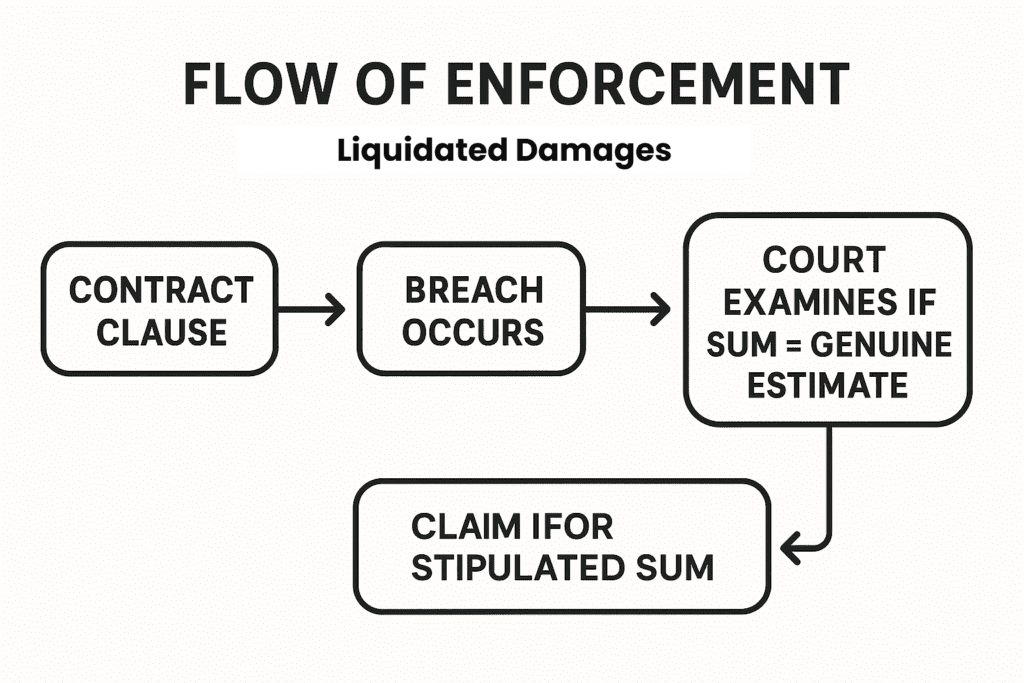
What Are Unliquidated Damages?
Definition
Unliquidated damages are damages not pre-decided in the contract. Instead, they are assessed by a court or arbitral tribunal after a breach occurs, based on the actual loss suffered. Unlike liquidated damages (where the amount is predetermined), unliquidated damages require the claimant to prove the extent of loss with evidence such as invoices, expert reports, or financial statements.
Purpose of Unliquidated Damages
The core purpose of unliquidated damages is flexibility:
- Covers unforeseen losses that were not, or could not be, predetermined when drafting the contract.
- Ensures fairness by compensating only the actual harm suffered.
- Protects claimants in complex situations where damages are uncertain or vary widely (e.g., reputational harm, loss of future profits).
This mechanism allows courts to tailor compensation to the specific facts of each dispute rather than relying on fixed formulas.
Practical Examples
Unliquidated damages commonly arise in disputes where losses are uncertain or variable:
- Professional negligence: A consultant gives faulty advice, causing financial loss to a business.
- Supply chain disruptions: A supplier’s failure to deliver raw materials forces a manufacturer to buy substitutes at a higher cost.
- Employment disputes: Wrongful termination leading to claims for lost salary and benefits.
- Service defaults: A software company’s system outage causes measurable business downtime and lost revenue.
In arbitration cases tracked by SCC Online (2019 study), nearly 40% of commercial disputes in India involve unliquidated damages, especially in supply chain and service contracts.
Case Law Spotlight
Union of India v. Raman Iron Foundry (1974):
The Supreme Court held that a claim for unliquidated damages does not become a debt until the court has determined the amount. This means that merely alleging breach is not enough—damages must be proven and quantified before they are recoverable.
Unliquidated damages ensure fair, evidence-based compensation where losses cannot be estimated in advance. They require proof, causation, and legal scrutiny, making them vital in disputes involving negligence, supply failures, or wrongful termination.
Key Differences Between Liquidated and Unliquidated Damages
Understanding the difference between liquidated damages and unliquidated damages is critical for anyone drafting, negotiating, or enforcing contracts. While both provide monetary relief for breach of contract, they operate very differently under the Indian Contract Act, 1872.
| Aspect | Liquidated Damages | Unliquidated Damages |
| Predetermined? | Yes – Fixed in the contract as a pre-agreed sum payable on breach | No – Assessed by court after breach, based on actual loss |
| Statutory Basis | Section 74 of the Contract Act | Section 73 of the Contract Act |
| Proof Required | Breach is assumed to cause loss, but party must show that some loss occurred | Actual loss must be proven through evidence (invoices, expert reports, financial records) |
| Purpose | Ensures certainty, efficiency, and faster enforcement | Provides fair compensation for unforeseen or hard-to-quantify losses |
| Flexibility | Low – Bound to contractual figure (subject to reasonableness test by courts) | High – Courts can tailor compensation to the facts of each dispute |
| Risk Allocation | Predominantly risk-shifting tool; loss is quantified upfront | Risk remains open; loss determined only after breach |
Why This Difference Matters
- For Businesses: A well-drafted liquidated damages clause minimizes disputes over calculation and gives financial predictability.
- For Lawyers: Choice of LD vs. ULD impacts litigation strategy, burden of proof, and settlement negotiations.
- For Courts: The distinction ensures that damages remain compensatory, not punitive, upholding fairness in commercial law.
Real-World Insight
According to FICCI Arbitration Study (2023), more than 60% of construction disputes in India involve damages claims for delays and performance defaults. Many of these disputes turn on whether a clause qualifies as liquidated damages or requires the court to award unliquidated damages.
Key Takeaway:
- Liquidated damages = Pre-decided certainty, governed by Section 74.
- Unliquidated damages = Court-decided fairness, governed by Section 73.
What are the Conditions to Claim Damages (Liquidated and Unliquidated)?
Not every contractual breach automatically entitles the aggrieved party to compensation. Courts and arbitral tribunals apply well-established legal tests to decide whether liquidated damages or unliquidated damages can be awarded. Meeting these conditions is critical to ensure enforceability.
1. Existence of a Valid Contract
- A legally enforceable agreement must exist with concluded terms.
- If terms are vague, incomplete, or not properly executed, claims for damages usually fail.
- Case reference: Vedanta Ltd. v. Emirates Trading Agency – the Supreme Court held that without a validly concluded contract, damages cannot be claimed.
2. Breach of Obligation
- The claimant must show that the other party failed to perform a contractual duty.
- Breach may be:
- Non-performance (e.g., failure to deliver goods).
- Defective performance (e.g., substandard construction work).
- Delay in performance (e.g., late completion of a project).
3. Proof of Causation
- There must be a direct link between the breach and the loss suffered.
- Courts use “common sense” and “dominant cause” tests to exclude remote or unrelated losses.
- Example: If a contractor delays a project, the employer can recover additional costs for substitute performance but not speculative losses like reputational harm.
4. Proof of Actual Loss (For Unliquidated Damages)
- Unliquidated damages require credible evidence of the loss:
- Financial records, invoices, or contracts for substitute performance.
- Expert testimony in cases of professional negligence.
- Audited accounts in claims involving loss of profit.
- Union of India v. Raman Iron Foundry: the Supreme Court held that unliquidated damages do not constitute a debt until the court determines liability and quantifies the loss.
5. Reasonableness (For Liquidated Damages)
- Under Section 74 of the Contract Act, even when a contract specifies a sum as liquidated damages, courts examine if it is a genuine pre-estimate of loss.
- If the amount is excessive or penal, it will be reduced to “reasonable compensation.”
- Key precedent: ONGC v. Saw Pipes Ltd. – liquidated damages clauses are enforceable if they represent a fair estimate of probable loss.
Checklist for Claimants
- Is there a valid and enforceable contract?
- Has a clear breach of obligation occurred?
- Can you demonstrate causation between breach and loss?
- Do you have documentary proof of actual loss (for unliquidated claims)?
- Is the claim amount fair and proportionate (for liquidated claims)?
Key Takeaway:
To succeed in claiming damages, parties must establish contract validity, breach, causation, quantifiable loss, and reasonableness. Without meeting these conditions, even strong claims risk rejection in court or arbitration.
How Are Liquidated Damages Calculated?
When a contract includes a liquidated damages clause, the calculation follows a structured approach. The goal is not punishment, but reasonable compensation for breach.
Step-by-Step Process
- Refer to the Clause in the Contract
- Identify the pre-agreed damages clause specifying compensation (e.g., per day of delay).
- Establish Breach
- Prove that the contractual obligation (e.g., delivery, performance, completion date) was breached.
- Demonstrate Loss (Though Not Exact)
- While exact quantification isn’t necessary, evidence that some loss occurred is required.
- Example: Additional costs, lost revenues, substitute performance expenses.
- Court Tests Reasonableness
- Under Section 74 of the Contract Act, courts enforce only reasonable compensation.
- Excessive or penal sums are reduced.
- Judicial Precedent
- ONGC v. Saw Pipes Ltd. (2003) – The Supreme Court upheld liquidated damages where they represented a genuine pre-estimate of loss, even if actual loss was difficult to quantify.
Example Calculation
- Clause: Contractor pays ₹50,000 per day of project delay.
- Breach: 10-day delay in completion.
- Claim: ₹50,000 × 10 = ₹5,00,000.
- Court Review: Award upheld if reasonable and reflective of probable loss.
Insight: In construction arbitration, daily LD clauses between 0.05%–0.1% of project value per day are common globally, ensuring proportionality.
How Are Unliquidated Damages Calculated?
Unlike liquidated damages, unliquidated damages are determined after breach, based on actual evidence of loss. Courts apply structured principles to avoid overcompensation.
Unliquidated Damages = Total Direct Loss – Mitigation + Expectation / Reliance Interest – Remote or Indirect Losses
Key Factors Considered
- Substitute Performance Costs
- If goods/services are not delivered, the injured party’s higher purchase costs are recoverable.
- Lost Profits
- Profits lost due to breach (e.g., buyer refuses contracted goods, seller loses resale margin).
- Costs to Remedy Defective Work
- Expenses to fix or replace faulty performance (e.g., repair defective construction).
- Interest on Delayed Payment
- Compensation for money withheld beyond due date.
Example Application
- The manufacturer fails to supply raw material.
- Buyer sources substitute at ₹12,00,000 (contract price = ₹10,00,000).
- Direct Loss = ₹2,00,000.
- Buyer also claims ₹50,000 for extra transport and ₹30,000 interest.
- Court awards ₹2,80,000, excluding remote claims like reputational harm.
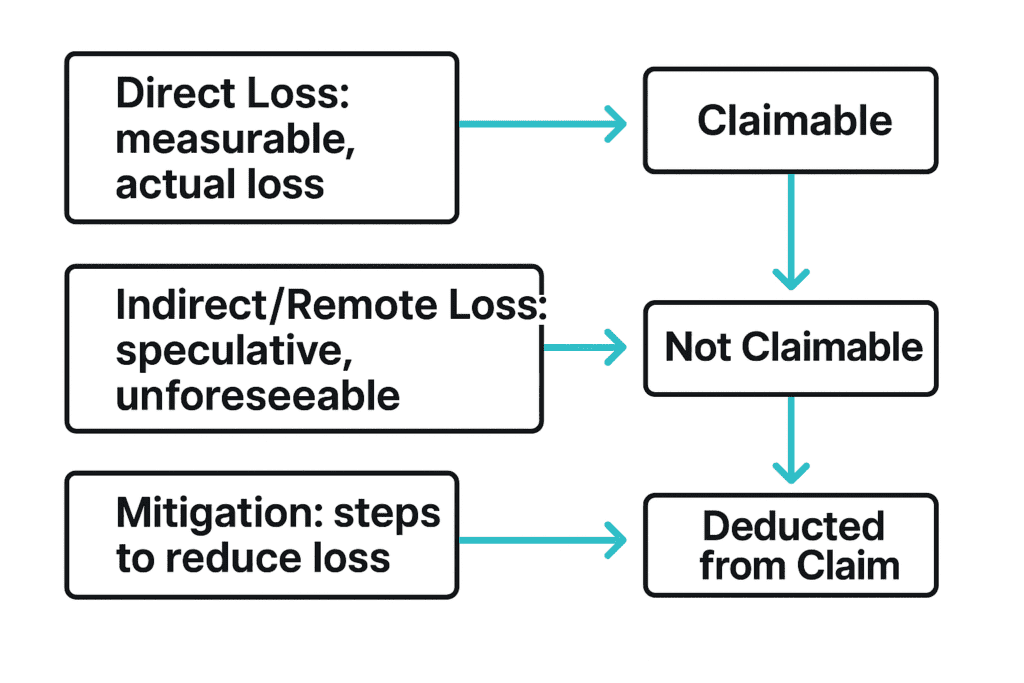
Before You Draft: Foundational Questions
Ask yourself these before writing any LD clause:
- Is this loss foreseeable and quantifiable at contract signing? (If not, use unliquidated damages instead)
- Can I justify this amount as a genuine pre-estimate of loss, not a penalty? (Indian courts will scrutinize this under Section 74)
- Does the amount proportionally relate to the contract value? (E.g., daily LD in construction = 0.05% to 0.1% of project value)
- What specific breach am I protecting against? (Be precise: delays, non-performance, defects, late payment)
- Have I documented the commercial reasoning behind this figure? (Courts want to see you considered actual loss)
- Is this the sole remedy, or are other damages still available? (Clarify in the contract)
Red Flag: If you can’t explain why you chose this number, a court won’t enforce it.
Essential Elements of an Enforceable Liquidated Damages Clause
Your clause MUST include these components:
Clear Trigger Event
“Liquidated damages shall be payable by [Party] to [Other Party] upon:
(i) Failure to deliver goods by [Date], or
(ii) Defective performance as defined in Section [X], or
(iii) Breach of Clause [Y]”
Why: Vague triggers make the clause unenforceable. Be specific about what causes the breach.
Amount and Calculation Method
“Liquidated damages shall be Rs [Amount] per [day/unit/occurrence].
In case of cumulative breaches, the maximum liability shall not exceed Rs [Cap].”
Genuine Pre-Estimate Language
“The parties acknowledge that:
(a) Actual loss from this breach is difficult to quantify in advance,
(b) This amount represents a reasonable and genuine pre-estimate of probable loss, and
(c) This is agreed compensation, not a penalty.”
Why: Under Section 74 of the Indian Contract Act, courts enforce only amounts that are genuine pre-estimates. This language protects you.
Causation and Mitigation Clause
“Liquidated damages are payable on breach of [Obligation]. The non-breaching party
shall take reasonable steps to mitigate losses and shall not allow damages to accumulate
beyond what is necessary.”
Why: Indian law requires both parties to act reasonably. If you don’t mitigate, courts may reduce your claim.
Exclusivity Statement (if applicable)
“The parties agree that payment of liquidated damages shall be the sole and exclusive
remedy for [specific breach], and unliquidated damages shall not be claimed for this breach.”
Why: This prevents double recovery and makes enforcement simpler.
Enforceable Amounts in India: Practical Benchmarks
What Indian courts have upheld (based on Section 74 jurisprudence):
| Contract Type | Typical LD Rate | Example | Courts’ Position |
|---|---|---|---|
| Construction Delays | 0.05% to 0.1% of project value/day | Rs 50,000/day on Rs 10 crore project | Generally enforceable if genuine |
| Supply/Vendor Contracts | 1% to 2% of contract value/month | Rs 2,00,000 for delayed delivery | Enforceable if loss is quantifiable |
| Software/IT Projects | 0.5% to 1% of project value/week | Fixed penalty for missed go-live | Enforceable if time-critical |
| Service Defaults | 0.1% to 0.5% per day of outage | Rs 25,000/day for downtime | Depends on business impact proof |
| Late Payment | 12% to 18% per annum interest | Statutory interest + penalty | Enforceable under Interest Act |
Key Precedent: ONGC v. Saw Pipes Ltd. (2003) – Supreme Court upheld LD as fair and genuine estimates even when actual loss was hard to quantify.
Red Flag: Amounts exceeding 5% to 10% of contract value per breach are often reduced by courts as “penal.”
What to Watch Out For in Term Sheets and Vendor Contracts
Questions to ask when the OTHER party’s LD clause comes at you:
Red Flags in Incoming Clauses:
- Excessive Caps? Is the maximum liability more than 10% of contract value? (Push back, argue it’s penal)
- Vague Trigger? Does it say “breach” without defining what constitutes a breach? (Ask for specificity)
- No Mitigation Language? Are they claiming damages even if they didn’t minimize loss? (Resist this)
- Cumulative Liability? Can breaches stack endlessly without a ceiling? (Negotiate a cap or sunset clause)
- Survives Termination? Do LD obligations continue after you end the contract? (Clarify end date)
- Applies to Both? Is it one-sided, only you pay, not them? (Insist on reciprocity or justify imbalance)
How to Negotiate Down Aggressive Clauses:
If they propose: Rs 1,00,000/day penalty for any software bug You counter with: “Rs 1,00,000/day applies only to critical bugs causing more than 4 hours downtime, capped at 10% of annual contract value”
If they propose: “Unlimited liability for service failure” You counter with: “Liability capped at fees paid in the preceding 12 months, excluding third-party losses”
If they propose: “LD clause survives 5 years post-termination” You counter with: “LD claims must be raised within 90 days of breach, not retroactively”
Specific Clauses for Common Startup Scenarios
For Investor/Funding Agreements:
“Misrepresentation Liquidated Damages: If a founder makes a material misrepresentation
in the investment agreement, the investor may recover liquidated damages of [Rs X or Y%
of investment], representing reasonable pre-estimate of investigation and legal costs,
capped at [Z]% of total investment.”
For Vendor/Service Contracts:
“Service Failure LD: If the vendor fails to maintain [X]% uptime in any calendar month,
the vendor shall pay Rs [Amount] per 1% of downtime below the SLA, capped at [Y]% of
monthly fees. This is the sole remedy for SLA breaches.”
For Supply/Manufacturing Agreements:
“Delay LD: Supplier shall pay buyer Rs [X] per day for deliveries exceeding agreed
delivery date, provided delay is within [Y] days. Beyond [Y] days, buyer may source
substitute goods at supplier’s cost, plus Rs [Z] per day for the shortfall.”
For Employment/Contractor Clauses:
“Non-Compete Breach: If contractor engages in competitive activity within [X km / Industry]
during employment plus [Y months] post-termination, contractor shall pay Rs [Amount] per day
of violation. This reflects loss of confidentiality and business opportunity.”
Enforcement Checklist: Before You Claim LD
When you need to actually enforce the clause, verify:
- Breach Established: Can you prove the other party actually breached the specific obligation?
- Documentation: Do you have emails, logs, invoices, or expert reports showing the breach?
- No Mitigation Failure: Did you take reasonable steps to minimize your loss? (If not, court may reduce award)
- Causation Clear: Is the loss directly caused by THIS breach, not by other factors? (Courts exclude remote losses)
- Amount Proportionate: Is your LD claim reasonable under Section 74, or will it look like a penalty? (Honestly assess)
- Timeline: Are you raising this claim promptly, or will courts view it as waived? (Delays invite challenges)
- No Double Recovery: Are you not also claiming unliquidated damages for the same breach? (Choose one remedy)
Key Law: Union of India v. Raman Iron Foundry (1974) – Unliquidated damages don’t become a debt until proven. Same applies to LD: you must still show the breach and causation, even if amount is pre-fixed.
India-Specific Considerations
What Makes a Clause ENFORCEABLE in India:
Under Section 74 of the Indian Contract Act, 1872, courts enforce LD only if:
- Genuine Pre-Estimate: Amount must be a reasonable forecast of probable loss, not a surprise punishment
- Not Excessive: Must be proportionate to contract value and foreseeable harm
- No Unconscionability: Amount must not be so harsh that it shocks the conscience of the court
- Causation Proven: Even with LD, you must still prove the breach caused loss
What Makes a Clause UNENFORCEABLE:
- Amounts that are 5-10x actual or probable loss (viewed as penal)
- LD that applies to breaches the drafter couldn’t have foreseen (vague triggers)
- Clauses designed explicitly to punish, not compensate
- Unlimited or open-ended LD with no cap
- Clauses that contradict statutory protections (e.g., trying to enforce LD despite no breach)
Courts’ Approach (Favorable to Startups):
Indian courts are generally reasonable about LD clauses if drafted carefully. Per FICCI Arbitration Study (2023), 60% of construction disputes involve LD claims. Most are resolved favorably when clauses are well-drafted.
Final Checklist for Founders
Before you sign ANY contract with an LD clause:
- Can I explain in 2 sentences why this LD amount is fair and based on actual risk?
- Does it pass the “would a court find this reasonable?” test?
- Is it proportionate to the contract value and business impact?
- Have I negotiated caps and exclusions to match my risk tolerance?
- Do I understand which party bears which risks?
- Have I checked if the clause is reciprocal or heavily one-sided?
- Is the trigger event clear enough that courts will understand when LD applies?
- Have I avoided language like “unlimited,” “punitive,” or “indefinite”?
- Do I have documentation to support the LD amount (cost analysis, expert opinion, market benchmarks)?
Bottom Line: A well-drafted LD clause protects you AND survives court scrutiny. A sloppy one wastes time in litigation and may be struck down entirely.
What Are the Legal Principles Governing Damages?
When courts decide whether to award liquidated damages or unliquidated damages, they rely on long-standing legal principles. These principles ensure that compensation is fair, proportionate, and rooted in evidence rather than speculation.
1. Principle of Causation
- The breach must be the real and effective cause of the loss.
- Courts exclude consequences that are too remote or unrelated.
- Example: If a supplier fails to deliver steel, damages may cover higher replacement costs but not speculative losses like “missed future projects.”
2. Principle of Remoteness
- Established in Hadley v. Baxendale (1854): only losses that naturally arise from the breach or were reasonably foreseeable at contract formation are recoverable.
- Reinforced in Victoria Laundry v. Newman Industries (1949): ordinary lost profits were recoverable, but extraordinary profits from special contracts were too remote.
- This principle prevents parties from claiming for unexpected, unforeseeable consequences.
3. Principle of Mitigation
- Claimants must take reasonable steps to reduce their losses.
- British Westinghouse v. Underground Electric Railways (1912): the claimant replaced defective turbines with more efficient ones, reducing losses; the court deducted the benefits gained.
- Failure to mitigate (e.g., not sourcing substitute goods) may reduce compensation.
4. Principle of Proof
- Damages must be backed by credible evidence:
- Contracts, invoices, and purchase orders.
- Expert testimony in technical disputes.
- Financial statements in profit-loss claims.
- Courts reject speculative or exaggerated claims without proof.
Common Scenarios Where Damages Are Claimed
Damages disputes are especially common in commercial, construction, and service contracts. Based on arbitration studies and reported cases, the following sectors dominate claims:
- Construction delays – disputes over project deadlines with or without liquidated damages clauses.
- Supply chain failures – higher replacement costs when suppliers default.
- Professional negligence – losses caused by consultants, auditors, or advisors giving faulty advice.
- Employment disputes – wrongful termination, delayed wages, or breach of employment contracts.
Damages in contract law are governed by principles of causation, remoteness, mitigation, and proof, ensuring that awards remain compensatory, not punitive. In practice, disputes often arise in construction and supply contracts, where the line between liquidated and unliquidated damages becomes crucial for financial outcomes.
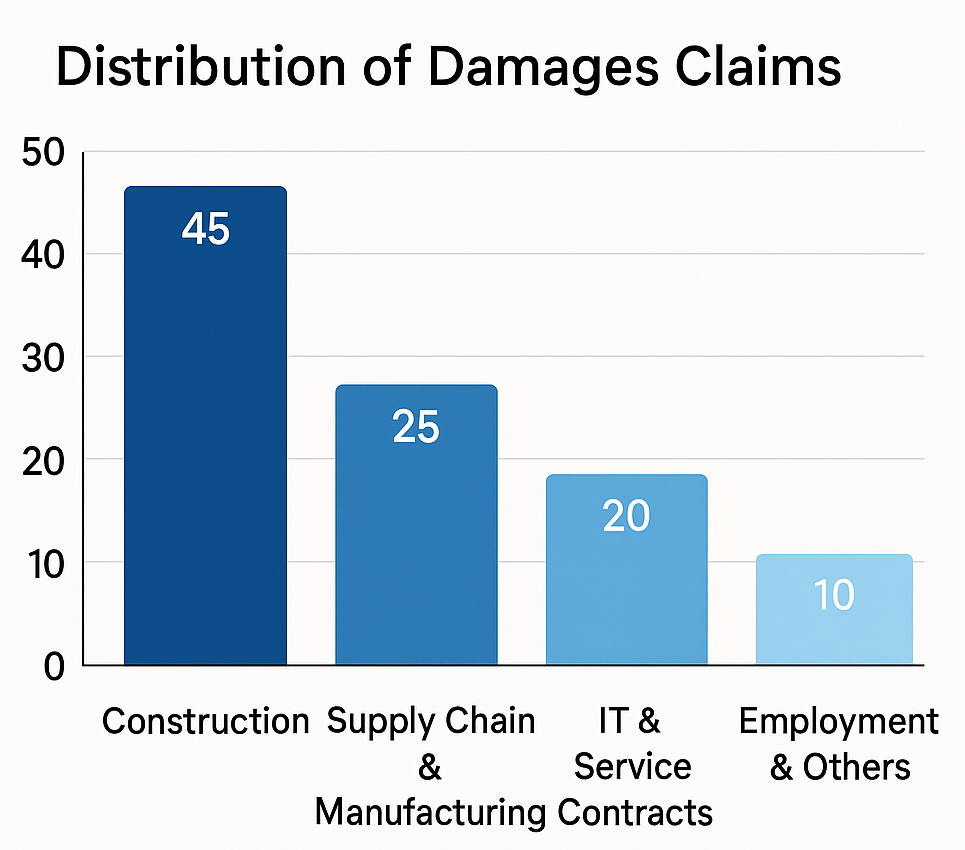
Global & Indian Perspectives on Damages
Understanding how liquidated damages and unliquidated damages operate across jurisdictions is crucial for companies engaged in both domestic and cross-border transactions. While Indian law emphasizes reasonableness, many international systems enforce clauses more strictly.
Indian Perspective
- Governed by the Indian Contract Act, 1872.
- Section 73: Provides for unliquidated damages, limited to losses that naturally arise or were in the contemplation of the parties.
- Section 74: Governs liquidated damages, but courts only enforce amounts that are reasonable compensation—never punitive.
- ONGC v. Saw Pipes Ltd. (2003) reinforced that pre-estimated damages are valid but subject to judicial review for fairness.
- Arbitration studies show that over 60% of construction disputes in India revolve around damages claims linked to delays or performance failures (FICCI, 2023).
International Perspective (English Law as Benchmark)
- English law enforces liquidated damages clauses as agreed, unless they amount to a penalty.
- Cavendish Square Holding BV v. Talal El Makdessi (2015, UKSC) clarified that a clause is enforceable if it protects a legitimate commercial interest and is not extravagant or unconscionable.
- This creates more certainty and predictability for contracting parties, with courts rarely interfering in agreed sums.
Cross-Border Contract Implications
For businesses operating across India and international markets:
- Adapt LD Clauses – Ensure clauses are drafted to meet the stricter reasonableness test in India, while still enforceable abroad.
- Choice of Law Provisions – Clearly specify governing law and jurisdiction in contracts to avoid disputes on enforceability.
- Risk Allocation Strategy – Use liquidated damages where losses are quantifiable (construction, supply contracts) and rely on unliquidated damages where risks are uncertain (services, consultancy).
Key Takeaway:
- India: Courts cap damages at reasonable compensation.
- International (English law): Courts enforce LD unless penal.
- Businesses with cross-border contracts must customize their damages clauses to ensure they are valid and enforceable in all relevant jurisdictions.
In summary, liquidated damages and unliquidated damages are the two cornerstone remedies under contract law that balance certainty with fairness. While liquidated damages provide pre-agreed compensation that ensures predictability and risk allocation, unliquidated damages allow courts to tailor awards based on actual loss, supported by proof and governed by principles of causation, remoteness, mitigation, and reasonableness. Under the Indian Contract Act, 1872, damages are capped at reasonable compensation, whereas international regimes like English law often enforce liquidated damages unless they are penal, making cross-border contract drafting critical. For businesses, lawyers, and contracting parties, understanding these distinctions not only helps minimize disputes but also ensures enforceable, fair, and commercially viable agreements—especially in high-dispute areas like construction, supply chain, and service contracts, where over 60% of arbitration cases in India involve damages claims.
]]>What is GITEX Dubai?
GITEX Dubai, officially known as GITEX GLOBAL, is the world’s largest technology, AI, and startup exhibition, held annually in Dubai, UAE. Since its inception in 1981, GITEX has transformed into a global hub where innovators, policymakers, enterprises, and startups come together to showcase emerging technologies, strike partnerships, and set future trends.
- Event Nature: B2B and B2G technology trade show.
- Focus Areas: Artificial Intelligence, Cybersecurity, Fintech, Semiconductors, Data Centres, Quantum Computing, HealthTech, and more.
- Audience: Tech leaders, investors, government delegations, and startups from across 180+ countries.
Legacy & Global Impact Since 1981
- History: Launched as “Gulf Information Technology Exhibition” in 1981 at the Dubai World Trade Centre (DWTC).
- Growth: From a regional IT fair to a global powerhouse, drawing 180,000+ visitors and 6,000+ exhibitors annually.
- Innovation Platform: Known for first launches of revolutionary tech in the Middle East, from early internet rollouts to cutting-edge AI solutions.
- Government Support: Endorsed by UAE ministries and global governments, making it one of the most influential policy and tech dialogue platforms.
Chart: GITEX Evolution Over 4 Decades
| Year | Key Milestone |
| 1981 | First GITEX held at DWTC |
| 2000s | Expansion into telecom, ICT & enterprise tech |
| 2016 | Launch of North Star Dubai (startups focus) |
| 2021 | Rebranded as GITEX GLOBAL with 7 co-located shows |
| 2025 | 45th edition with 180,000+ visitors and 6,000+ exhibitors |
Why GITEX GLOBAL 2025 is Special
The 2025 edition marks the 45th anniversary of GITEX Dubai, reinforcing its position as the largest global tech and AI show. Unlike traditional expos, GITEX serves as both:
- A business accelerator for startups raising capital.
- A policy stage where AI ethics, cybersecurity, and digital sovereignty are debated.
- A showcase of the latest in deep tech, from quantum computing to Web3 finance.
Key highlights for GITEX Dubai 2025:
- More than 1,400+ speakers including Fortune 500 CEOs, unicorn founders, and ministers.
- Dedicated stages for AI in Digital Finance, Cybersecurity Threats, Sustainable Data Centres, and Healthcare Innovation.
- North Star Dubai hosting 2,000+ startups and 1,000+ investors.
Quick Facts – GITEX Dubai 2025
At a Glance
| Attribute | Details |
| Event Name | GITEX GLOBAL 2025 – GITEX Dubai |
| Edition | 45th |
| Dates | 13–17 October 2025 |
| Venue / Location | Dubai World Trade Centre (DWTC), Sheikh Zayed Road, Dubai |
| Visitors Expected | 180,000+ tech professionals |
| Countries | 180+ |
| Exhibitors | 6,000+ (AWS, Microsoft, Huawei, Nokia, governments & startups) |
| Co-Located Shows | AI Stage, Cyber Valley, Global Data Centres, Quantum Expo, DigiHealth & Biotech, Fintech Surge |
| Official Website | https://www.gitex.com |
| Registrations | https://visit.gitex.com/web/registration-portal/event-detail?eventId=252175 |
GITEX Dubai 2025 Dates & Timings
Official Event Dates
GITEX Dubai 2025 will be held from 13 October 2025 (Monday) to 17 October 2025 (Friday) at the Dubai World Trade Centre (DWTC). This five-day mega technology event will mark the 45th edition of GITEX GLOBAL, bringing together exhibitors, startups, and decision-makers from across 180+ countries.
Daily Event Timings
- Opening Hours: 10:00 AM – 6:00 PM (Gulf Standard Time, GST).
- Venue Hours: Access to exhibition halls, summits, and workshops follow DWTC’s official schedule.
- Check-in Recommendation: Arrive 30–45 minutes early to clear registration and security checks, especially during the opening days.
Trade Visitors vs. Public Access
GITEX Dubai operates primarily as a B2B (Business-to-Business) and B2G (Business-to-Government) event, with certain limitations on general public entry:
- Trade Visitors & Delegates
- Full access to exhibition halls, keynote stages, and co-located summits.
- Networking lounges and investor–startup meetups are reserved for professional attendees.
- Delegate passes unlock entry to premium sessions like AI, Cybersecurity, Fintech, and Quantum Computing.
- Public Access
- Restricted to specific areas of the exhibition halls.
- Access to North Star Dubai (startup showcase) and certain open-stage sessions.
- Workshops and certified training sessions require separate ticketed entry.
For full summit access, choose a Delegate Pass (starting from AED 250), while the Visitor Pass (AED 580) grants access to exhibition halls only.
Event Schedule at a Glance
| Date | Day | Timings (GST) | Focus Themes |
| 13 Oct 2025 | Monday | 10:00 – 18:00 | Opening Keynotes, AI Summit |
| 14 Oct 2025 | Tuesday | 10:00 – 18:00 | Data Centres, Cyber Valley |
| 15 Oct 2025 | Wednesday | 10:00 – 18:00 | DigiHealth, Fintech Surge |
| 16 Oct 2025 | Thursday | 10:00 – 18:00 | Quantum Expo, Workshops |
| 17 Oct 2025 | Friday | 10:00 – 18:00 | Startup Pitch Competitions |

GITEX Dubai 2025 Location & Venue
Official Venue
The GITEX Dubai 2025 venue is the Dubai World Trade Centre (DWTC), located on Sheikh Zayed Road, Dubai, UAE. As the city’s premier exhibition hub, DWTC has hosted GITEX since its inception in 1981 and offers world-class infrastructure to accommodate 180,000+ visitors and 6,000+ exhibitors expected in 2025.
Address:
Dubai World Trade Centre (DWTC)
Sheikh Zayed Road, Dubai, United Arab Emirates
Accessibility & Transport Options
DWTC is centrally located, making it easily reachable by multiple transport modes:
- Dubai Metro: The World Trade Centre Metro Station (Red Line) is directly linked to DWTC, providing fast and affordable access.
- Taxis & Ride-hailing: Widely available through Dubai Taxi, Careem, and Uber, with drop-off points directly at the venue gates.
- Car Parking: Multiple on-site and nearby parking zones available, including VIP and valet services for delegates.
- Shuttle Buses: Official GITEX shuttles connect major partner hotels to the venue during event days.
Accommodation & Partner Hotels
The GITEX travel desk collaborates with partner hotels across Dubai to provide discounted rates for attendees. These hotels are located within 5–15 minutes of DWTC, ensuring convenience for delegates.
Hotel Categories Near DWTC
| Hotel Type | Average Cost/Night (AED) | Distance to Venue |
| 5-Star Luxury | 1,000 – 2,000 | Walking distance |
| 4-Star Business | 500 – 900 | 5–10 min drive |
| Budget-Friendly | 250 – 500 | 10–15 min drive |
Visa Assistance for International Visitors
International attendees can avail official visa support through the GITEX Travel Desk. The process includes:
- Invitation Letter: Generated after successful registration and ticket purchase.
- Application Support: Coordination with UAE embassies or consulates for faster processing.
- On-ground Help: Visa counters and assistance desks at Dubai International Airport (DXB).
Tip for Exhibitors & Delegates: Apply for visas at least 4–6 weeks in advance to avoid delays during peak travel season.
Looking Ahead – GITEX Dubai 2026
Due to unprecedented growth, GITEX Global 2026 will relocate to Dubai Expo City, offering larger exhibition spaces and enhanced infrastructure. This marks a new milestone in the event’s expansion journey.
GITEX Dubai 2025 Tickets & Pricing
Ticket Categories & Costs
Attending GITEX Dubai 2025 requires advance registration, with multiple ticket types tailored for professionals, students, and industry delegates. Pricing is transparent and varies based on the level of access required.
- Visitor Pass → AED 580 (approx. USD 160)
- Grants access to all exhibition halls and general entry areas.
- Ideal for visitors who want to explore exhibitor booths and technology showcases.
- Delegate Pass → From AED 250 (per summit/day)
- Access to summit sessions (AI, Cybersecurity, Fintech, Quantum Expo).
- Best for professionals seeking targeted insights in specific industries.
- Certified Training Pass → From AED 4,000
- Full access to hands-on certified workshops and advanced training programs.
- Designed for IT specialists and executives seeking industry-recognized certification.
- Student Pass → Discounted rates (varies)
- Provides entry to student innovation tracks and startup showcases.
- Perfect for university students, researchers, and young innovators.
Gitex Dubai 2025 Ticket Price Breakdown
| Pass Type | Price (AED) | Access Level |
| Visitor Pass | 580 | Exhibition halls & general entry |
| Delegate Pass | 250+ | Summit sessions (per day) |
| Certified Training Pass | 4,000+ | Full access to certified training workshops |
| Student Pass | Varies | Student innovation & startup tracks |
- For General Visitors: Go with the Visitor Pass to explore cutting-edge tech from 6,000+ exhibitors.
- For Industry Leaders: Pick the Delegate Pass to attend summits led by global CEOs, policymakers, and innovators.
- For Professionals: Opt for the Certified Training Pass if you want to upskill with AI, cybersecurity, or cloud certifications.
- For Students: Leverage the Student Pass for exposure to startup ecosystems and innovation labs.
GITEX Dubai 2025 Exhibitor List & Industry Segments
Scale of Participation
GITEX Dubai 2025 will showcase 6,000+ exhibitors across more than 41 technology sectors, making it one of the most diverse technology expos in the world. The exhibitor list includes global tech giants, unicorn startups, government delegations, and industry disruptors, all under one roof at the Dubai World Trade Centre (DWTC).
Key Industry Segments at GITEX 2025
Attendees will be able to explore a broad spectrum of cutting-edge technologies that are shaping the digital economy:
- Artificial Intelligence (AI): Smart applications, generative AI tools, robotics, and AI in finance & healthcare.
- Cybersecurity: Enterprise defense, digital identity, quantum security solutions.
- Cloud Computing & Data Centres: Scalable infrastructure, green data centres, edge computing.
- Telecom & 6G: Next-generation connectivity and IoT innovations.
- Blockchain & Web3: Decentralized finance (DeFi), NFTs, and enterprise blockchain applications.
- Semiconductors: Chip manufacturing, design innovations, and quantum processors.
- Fintech: Open banking, central bank digital currencies (CBDCs), and digital payment solutions.
- HealthTech & Biotech: AI-enabled diagnostics, digital-first hospitals, and biotech research breakthroughs.
- Quantum Computing: Early-stage quantum applications for industries like finance, logistics, and pharmaceuticals.
Country Pavilions & Global Representation
GITEX Dubai 2025 will feature dedicated country pavilions where governments and trade associations highlight national innovation and startups. Key pavilions include:
- United States – Cloud, AI, and cybersecurity leaders.
- United Arab Emirates (UAE) – Smart city, fintech, and government digital transformation projects.
- India – IT services, software innovation, and deep-tech startups.
- European Union (EU) – Sustainability-driven AI, green tech, and regulatory insights.
- Türkiye – Gaming, AI, and defense tech.
- China – Hardware manufacturing, telecom, and 5G.
- Japan – Robotics, quantum computing, and mobility solutions.
Sectoral Breakdown of Exhibitors
Below is an indicative distribution of exhibitor focus areas at GITEX Global 2025:
| Sector | Approx. Share of Exhibitors (%) |
| Artificial Intelligence (AI) | 25% |
| Cybersecurity | 20% |
| Fintech | 15% |
| HealthTech | 15% |
| Cloud Computing | 15% |
| Quantum & Others | 10% |
This breakdown highlights how AI and Cybersecurity dominate the exhibitor focus, while Fintech, HealthTech, and Cloud remain strong growth areas.
Spotlight on Co-Located Shows at GITEX Dubai 2025
One of the reasons GITEX Dubai 2025 stands out globally is its six co-located shows, each focusing on niche but high-impact industries. These parallel events provide professionals with tailored content, networking, and insights into rapidly evolving sectors.
AI Stage (Hall 10) – Future of Artificial Intelligence
- Theme: AI in business, governance, and financial services.
- Key Insight: By 2025, 85% of financial institutions are expected to adopt AI, pushing the AI-in-finance market above $900 billion by 2026.
- Focus Areas:
- Generative AI in customer experience.
- AI-powered risk management in banking.
- Ethical frameworks for large-scale AI deployment.
Cyber Valley – Securing the Digital World
- Theme: Cybersecurity and resilience in the AI and quantum era.
- Highlights:
- Discussions on AI-driven threats and advanced cyber defense.
- Strategies for quantum risk management.
- Global governance dialogues to harmonize cybersecurity laws across countries.
- Key Participants: International cyber agencies, enterprise CISOs, and regulators.
Global Data Centres – Powering AI & Cloud Infrastructure
- Theme: Sustainability, compute power, and data resilience.
- Focus: Tackling the AI Data Paradox—how to balance skyrocketing data needs with energy efficiency.
- Exhibitors & Speakers: AWS, Alibaba Cloud, Equinix among global data leaders.
- Discussion Points:
- Green data centres.
- Resilient digital infrastructure for smart economies.
- Edge computing adoption.
DigiHealth & Biotech – The Future of Healthcare
- Theme: Rewriting the code of care with digital-first healthcare.
- Core Topics:
- AI diagnostics and precision medicine.
- Regenerative therapies and biotech breakthroughs.
- Hospital systems shifting to digital-first models.
- Key Players: Amgen, Cleveland Clinic Abu Dhabi, biotech startups, and health policymakers.
Quantum Expo – Computing Beyond Limits
- Theme: Unlocking quantum computing breakthroughs for industry and government.
- Focus Areas:
- Early applications of quantum computing in finance, logistics, and pharma.
- Building strategies for post-quantum cybersecurity.
- Collaboration between hardware manufacturers and software developers.
Fintech Surge – Redefining Finance
- Theme: The evolution of digital financial ecosystems.
- Key Topics:
- Financial inclusion strategies using digital wallets.
- Web3 & blockchain adoption in mainstream banking.
- Central Bank Digital Currencies (CBDCs) and regulatory frameworks.
- Open banking APIs driving global financial integration.
- Audience: Startups, banks, investors, and regulators.
At-a-Glance: Co-Located Show Themes
| Co-Located Show | Core Focus Area | Industry Impact |
| AI Stage | Future of AI in digital finance | $900B+ AI finance market by 2026 |
| Cyber Valley | AI threats & quantum risks | Global cybersecurity resilience |
| Global Data Centres | Green computing & infrastructure | Energy-efficient AI data scaling |
| DigiHealth & Biotech | Precision medicine & digital care | Healthcare innovation |
| Quantum Expo | Quantum breakthroughs & strategies | Next-gen computing |
| Fintech Surge | Web3, CBDCs, open banking | Financial inclusion & innovation |
GITEX Dubai 2025 Agenda & Conferences
The agenda for GITEX Dubai 2025 is designed to deliver deep insights into the technologies shaping our future while creating platforms for collaboration, learning, and investment. Each conference track is built around industries experiencing exponential growth, making the agenda relevant for professionals, startups, and policymakers alike.
Power Summit – AI, Geopolitics & Industrial Futures
- Theme: Exploring how AI intersects with geopolitics, energy sovereignty, and industrial innovation.
- Key Focus Areas:
- AI & Geopolitics: Understanding how nations are leveraging AI for economic competitiveness and security.
- Energy Sovereignty: Discussions on AI-driven sustainable energy systems.
- Industrial AI: Real-world applications of AI in manufacturing, logistics, and supply chains.
- Expected Audience: Senior policymakers, AI researchers, Fortune 500 leaders, and government delegations.
Startup Pitch Competitions – North Star Dubai
- Platform: North Star Dubai, GITEX’s dedicated startup ecosystem.
- Highlight: Pitch Battles where 2,000+ startups from 100+ countries present to 1,000+ investors and VCs.
- Tracks Include: Fintech, HealthTech, AI startups, and Web3.
- Why It Matters: Acts as a launchpad for unicorns and disruptive innovations, offering direct access to investors, accelerators, and global media.
Training Workshops – Hands-On Certifications
GITEX 2025 offers certified training workshops aimed at skill-building in high-demand domains:
- Artificial Intelligence (AI): Building and deploying generative AI models.
- Cybersecurity: Incident response, ethical hacking, and advanced threat detection.
- Blockchain & Web3: Developing decentralized applications (dApps) and understanding enterprise blockchain.
- Data & Cloud Computing: Certifications from AWS, Microsoft Azure, and Google Cloud partners.
Certified training passes (AED 4,000+) offer globally recognized credentials and are ideal for professionals seeking career advancement.
Side Events & Networking Platforms
Beyond the official summits and workshops, GITEX creates unique networking opportunities to connect with the global tech ecosystem:
- Networking Mixers: Informal gatherings to meet peers and exchange ideas.
- Investor-Founder Meetups: Curated sessions enabling startups to pitch directly to venture capitalists and angel investors.
- Government Roundtables: Policymakers and regulators sharing future frameworks for AI, cybersecurity, and digital finance.
- Corporate Innovation Lounges: Spaces for enterprises to announce partnerships and sign MoUs.
Agenda Highlights Snapshot
| Track / Event | Focus Areas | Audience |
| Power Summit | AI & geopolitics, energy, industrial AI | Leaders, policymakers |
| Startup Pitch Competitions | Global startup pitch battles (North Star) | Startups, VCs |
| Training Workshops | AI, cybersecurity, blockchain certifications | Professionals, IT experts |
| Side Events | Mixers, investor-founder meetups, roundtables | Founders, investors, corporates |
Treelife at GITEX Dubai 2025
Our Presence at GITEX Global 2025
Treelife is proud to be part of GITEX Dubai 2025, the world’s largest technology and innovation showcase. As a leading legal and financial advisory firm for startups, investors, and global companies, Treelife is leveraging GITEX to connect with ambitious founders, growth-stage companies, and international businesses expanding into India and the Middle East.

What to Expect from Treelife at GITEX
- Expert Consultations: On fundraising, venture debt, ESOPs, and governance.
- Guidance for Global Expansion: Advisory on entering India’s high-growth market.
- Partnership Opportunities: Exploring collaborations with accelerators, incubators, and corporates.
- Showcasing Our Edge: Demonstrating Treelife’s unique approach of combining legal precision with financial expertise.
GITEX Asia 2026 – Expanding the GITEX Legacy into Asia
Introduction to GITEX Asia
Following the success of GITEX Global in Dubai, the brand is expanding into Asia with GITEX Asia x AI Everything Singapore, scheduled for 9–10 April 2026 at Marina Bay Sands, Singapore. Marketed as Asia’s largest and most global tech, startup, and digital investment event, it positions Singapore as the epicenter for technology adoption, innovation, and collaboration in the Asia-Pacific region.
Why Singapore as the Host City?
- Ranked #1 AI City in the World by Counterpoint Research 2025 Index.
- Strong government policies for digital transformation and public–private partnerships.
- Marina Bay Sands provides state-of-the-art infrastructure to host thousands of participants from over 50+ countries.
Accommodation & Travel Guide for GITEX Dubai 2025
Attending GITEX Dubai 2025 is an incredible opportunity, but ensuring you have the right accommodation and travel arrangements is crucial to make the most of your experience. Here’s a complete travel and accommodation guide to help you plan your trip to GITEX Dubai 2025.
Where to Stay – Recommended Hotels Near DWTC
As GITEX Dubai is hosted at the Dubai World Trade Centre (DWTC), choosing a nearby hotel will save time and provide you with easy access to the event. GITEX attendees will find a range of luxury, business, and budget hotels located within walking distance or just a short drive from the venue.
- 5-Star Luxury Hotels:
- Shangri-La Hotel Dubai (Walking distance to DWTC)
- Conrad Dubai (Walking distance to DWTC)
- JW Marriott Marquis Dubai (Walking distance to DWTC)
- 4-Star Business Hotels:
- Novotel World Trade Centre (5-10 min drive)
- Holiday Inn Express Dubai (5-10 min drive)
- Ibis Styles Dubai (5-10 min drive)
- Budget-Friendly Options:
- Citymax Hotel Dubai (10-15 min drive)
- Premier Inn Dubai (10-15 min drive)
- Rove Downtown Dubai (10-15 min drive)
Visa Services for International Visitors
- Official GITEX Visa Assistance:
For international attendees, GITEX offers visa assistance through official partners to make the process smoother. You can apply for a UAE business visa through the GITEX visa desk or official portal.- Visa Requirements: Valid passport (at least 6 months), invitation letter from GITEX (available after registration).
- Processing Time: It is advisable to apply at least 4–6 weeks before the event to avoid last-minute delays.
Transport Tips for GITEX Dubai 2025
Dubai’s world-class transport infrastructure makes getting to DWTC convenient, whether you’re coming from the airport, your hotel, or other parts of Dubai.
- Metro:
The Red Line of the Dubai Metro stops directly at the World Trade Centre Metro Station, located just steps away from the DWTC venue.- The Metro is the fastest way to avoid traffic congestion, especially during rush hours.
- Cost: AED 5-10 for a single ride within the city limits.
- Taxis & Ride-Hailing Services:
- Careem/Uber: Promo codes for discounted rides to DWTC are often available during GITEX.
- Taxi Services: Taxis are readily available at all major hotels and Dubai International Airport (DXB).
- Parking:
- On-Site Parking: Available at DWTC, with various parking zones.
- Cost: Expect parking charges of around AED 50–100 per day depending on availability.
- Pro Tip: Arrive early to secure parking near the entrance or use the shuttle service.
Average Hotel Costs (Per Night During GITEX 2025)
| Hotel Category | Price Range (AED) | Proximity to DWTC |
| 5-Star Luxury | 1,000–2,000 | Walking distance |
| 4-Star Business | 500–900 | 5–10 min drive |
| Budget Hotels | 250–500 | 10–15 min drive |
Why Attend GITEX Dubai 2025?
With its global reputation and cutting-edge tech showcases, GITEX Dubai 2025 is not just an event but a major industry milestone. Here’s why you should attend:
- Largest Tech, AI & Startup Showcase in the world, bringing together the biggest names in technology, AI, and digital transformation.
- Networking Opportunities: Meet 180,000+ global professionals from diverse sectors, including AI, cybersecurity, healthtech, and fintech.
- Insights from Top CEOs and Policymakers: Attend keynotes and panels with industry leaders such as Nokia, Microsoft, Huawei, AWS, and UAE Ministries.
- Partnerships & Collaborations: Forge connections and partnerships with international startups, investors, and enterprise leaders.
- Future-Focused: Learn about AI, semiconductors, sustainability, digital health, and other groundbreaking technologies that will shape the future.
In conclusion, GITEX Dubai 2025 stands as a premier global event for showcasing the latest in technology, AI, and digital innovation, offering unparalleled opportunities for networking, learning, and collaboration. With its expansive exhibitor list, insightful conferences like the Power Summit, and a diverse range of co-located shows such as AI Stage and Fintech Surge, GITEX provides a platform for startups, investors, and industry leaders to connect and shape the future of tech. The event’s strategic location at Dubai World Trade Centre, coupled with easy access through Dubai Metro, makes it an essential destination for anyone looking to stay ahead in the rapidly evolving tech landscape. Whether you’re a tech professional, entrepreneur, or investor, attending GITEX Dubai 2025 will give you exclusive insights, business opportunities, and direct access to the cutting-edge trends that are defining tomorrow’s digital economy.
]]>India is one of the fastest-growing major economies, and foreign capital inflows have become a cornerstone for sustaining this growth. Both Foreign Direct Investment (FDI) and Foreign Portfolio Investment (FPI) bring in overseas funds, but their impact, purpose, and stability differ significantly.
Why Foreign Capital Inflows Are Important
- Boosts GDP: FDI inflows into India touched USD 81.04 billion in FY 2024–25, a 14% year-on-year increase, underscoring their role in long-term economic growth.
- Enhances Liquidity: FPIs, despite volatility, contribute heavily to India’s capital markets, with assets under custody at USD 858 billion in July 2025.
- Job Creation & Innovation: FDI builds factories, IT hubs, and R&D centers, creating employment and technology transfer.
- Market Depth: FPI ensures stock market liquidity, helping companies raise quick funds and improving price discovery.
What Is Foreign Direct Investment (FDI)?
- Definition: Investment where a foreign entity acquires ≥10% equity stake or sets up physical assets such as factories, offices, or joint ventures.
- Nature: Long-term, strategic, with management control.
- Example: Walmart’s acquisition of Flipkart in India.
- Impact: Job creation, infrastructure growth, and transfer of global expertise.
What Is Foreign Portfolio Investment (FPI)?
- Definition: Investment by foreign entities in financial assets like stocks, bonds, or mutual funds, with less than 10% stake.
- Nature: Short-term, easily reversible, no management control.
- Example: US hedge funds purchasing Reliance Industries shares.
- Impact: Enhances liquidity in markets but subject to global sentiment shifts.
Why Understanding the Differences Between FDI and FPI Matters
For businesses, investors, students, and policymakers, clarity on FDI vs FPI is essential:
- Businesses: Helps in identifying stable funding sources (FDI) vs quick liquidity avenues (FPI).
- Investors: Understand risks FDI provides steady returns, FPI carries higher volatility.
- Policymakers: Balance capital inflows FDI for development, FPI for market strength.
- Students/Researchers: Essential for exams, interviews, and understanding India’s economic framework.
FDI vs FPI at a Glance
| Aspect | FDI (Foreign Direct Investment) | FPI (Foreign Portfolio Investment) |
| Time Horizon | Long-term (years to decades) | Short-term (days to months) |
| Control | Active management & operational influence | No control over management decisions |
| Impact | Employment, infrastructure, technology flow | Liquidity, market efficiency, capital mobility |
| Stability | Stable, less volatile | Highly volatile, prone to sudden reversals |
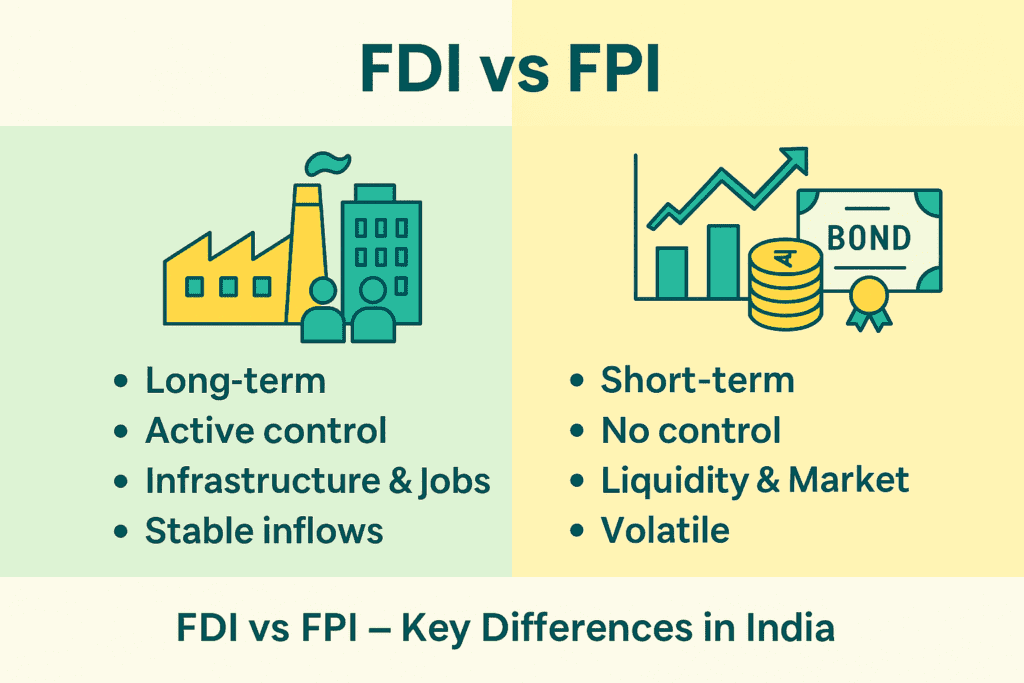
What is Foreign Direct Investment (FDI)?
Foreign Direct Investment, or FDI, is one of the most stable and influential forms of foreign capital inflow. It refers to long-term investments by foreign entities in the physical and operational assets of a country. FDI usually involves a long-term investment and can be in the form of establishing business operations, like setting up subsidiaries or joint ventures, or by acquiring a stake in an existing company. The key attraction of FDI for host countries is the potential for economic growth, technology transfer, and job creation. Unlike portfolio investments, FDI involves active participation and control, making it a critical driver of economic development.
Definition of FDI
- FDI means when a foreign investor acquires a significant equity stake (≥10%) in an Indian company or establishes physical assets like factories, subsidiaries, or offices.
- This threshold (10%) is as per RBI and IMF guidelines for differentiating FDI from FPI.
Types of FDI
- Horizontal FDI: This occurs when a company invests in the same industry in a foreign country. For example, a US-based car manufacturer opening a plant in India.
- Vertical FDI: This occurs when a company invests in different stages of the supply chain in another country. For example, an Indian software company setting up a development center in the US.
- Conglomerate FDI: This occurs when a company invests in a completely different industry in a foreign country, typically for diversification.
Real-World Examples of FDI in India
- Walmart–Flipkart Acquisition (2018): Walmart acquired a majority stake in Flipkart, showing how foreign investors can directly influence operations and strategy.
- Foxconn’s India Plants (Ongoing): The Taiwanese giant has invested in large-scale manufacturing hubs in Tamil Nadu and Karnataka, strengthening India’s electronics and EV supply chain.
Key Features of FDI
FDI stands out from other types of foreign investments due to its depth and strategic nature:
- Long-Term Orientation → Investments span decades, ensuring stability for the host economy.
- High Degree of Control → Investors actively participate in management and decision-making.
- Employment Creation → Generates jobs across industries, especially in manufacturing and services.
- Technology Transfer → Brings global expertise, R&D, and innovation into local markets.
- Infrastructure Boost → Leads to development of factories, logistics parks, and industrial hubs.
FDI Inflows in India [2025]
India continues to be one of the most attractive global destinations for FDI.
| Metric (FY 2024–25) | Value |
| Total Inflows | USD 81.04 billion |
| Growth Rate (YoY) | 14% increase |
| Top Sectors | Services, Technology, Manufacturing, Fintech |
| Leading Investors | Singapore, Mauritius, USA, Japan |
Data Source: IBEF (Indian Brand Equity Foundation)
Why FDI Matters for India’s Economy
- Stable Capital: Unlike volatile FPI flows, FDI remains anchored even during global uncertainty.
- Boost to GDP: Acts as a multiplier for growth by creating jobs and enhancing productivity.
- Strategic Value: Helps India position itself as a global manufacturing hub under “Make in India” and PLI schemes.
- Confidence Indicator: Rising inflows reflect international confidence in India’s regulatory and policy environment.
In short, FDI is long-term, stable, and transformative, making it essential for India’s sustainable growth. It is not just about money—it is about technology, jobs, and global integration.
What is Foreign Portfolio Investment (FPI)?
Foreign Portfolio Investment, or FPI, is a type of cross-border capital inflow where overseas investors invest in financial assets like shares, bonds, mutual funds, and exchange-traded funds (ETFs). Unlike FDI, FPIs do not involve control or management of the company they remain passive investors with stakes of less than 10%.
Definition of FPI
- FPI refers to short-term investments in financial securities without direct ownership or operational control.
- These flows are governed by SEBI and RBI regulations, ensuring compliance with sectoral caps and foreign exchange rules.
Types of FPI
- Foreign Institutional Investors (FII): These are large entities, such as hedge funds, pension funds, and investment trusts that invest in the stock market and other financial securities.
- Qualified Foreign Investors (QFI): This is a category for individuals, companies, and entities from other countries that wish to invest in India’s equity markets without requiring a custodian account.
- Sub-accounts: These are accounts created by FIIs to make investments on behalf of clients who wish to remain anonymous.
Real-World Example of FPI in India
- US hedge funds investing in Reliance Industries shares → large-scale but passive ownership in listed companies, with no involvement in daily management.
Key Features of FPI
FPI has characteristics that differentiate it sharply from FDI:
- Short-Term Orientation → Typically aimed at quick returns from stock or bond markets.
- Passive Investor Role → No boardroom presence or strategic influence.
- High Liquidity → Investors can easily enter or exit Indian markets via stock exchanges.
- Volatility Exposure → Sensitive to global events, interest rates, and sentiment changes.
FPI Trends in India [2025]
India has witnessed mixed FPI activity in 2025, reflecting the interplay of global and domestic factors:
| Period (2025) | FPI Flows in India | Key Insights |
| Jan–Aug 2025 | ₹1.3 trillion net equity outflows | Persistent selling due to US tariffs, high valuations, and global uncertainty. |
| Aug 2025 | ₹34,993 crore sell-off (largest since Feb 2025) | Triggered by global market turbulence and weak earnings in IT & FMCG sectors. |
| July 2025 | $959 million debt inflows | Shows diversification into Indian debt markets, despite equity outflows. |
| FPI Assets Under Custody | $858 billion (as of July 2025) | Indicates India’s importance in global investment portfolios. |
Why FPI Matters for India’s Markets
- Market Liquidity: FPIs ensure depth in equity and debt markets, helping companies raise quick funds.
- Price Discovery: Large-scale participation improves efficiency and valuation in stock markets.
- Volatility Factor: Sudden sell-offs can put pressure on the rupee, Sensex, and Nifty.
- Sectoral Impact: FPIs selectively invest 2025 data shows inflows in services, metals, and oil, but outflows from IT, FMCG, and automobile sectors.
In simple terms:
- FPI = Short-term, highly liquid, passive investment.
- It helps India’s markets grow but carries the risk of capital flight during global shocks.
Differences Between FDI and FPI
When analyzing FDI vs FPI, it is crucial to understand how these two forms of foreign investment operate differently. Both bring capital into India, but their structure, stability, and impact on the economy are distinct. Below is a detailed tabular comparison of the key differences between FDI and FPI in India.
Comparative Table: FDI vs FPI
| Parameter | FDI (Foreign Direct Investment) | FPI (Foreign Portfolio Investment) |
| Nature of Investment | Direct ownership in physical assets, factories, subsidiaries, or greenfield/brownfield projects | Indirect ownership via financial securities like stocks, bonds, ETFs, mutual funds |
| Equity Stake | ≥10% stake (with control rights as per RBI & IMF definition) | <10% stake (purely financial exposure without control) |
| Investor Role | Active participation in management, strategy, and long-term operations | Passive role, no involvement in management or daily decision-making |
| Time Horizon | Long-term commitment (often 5–20 years or more) | Short-term to medium-term (from days to a few months/years) |
| Risk & Return | Stable returns, linked to productivity, infrastructure growth, and market expansion | Highly volatile returns, influenced by stock market swings, currency movements, and global events |
| Impact on Economy | – Creates jobs and boosts manufacturing- Facilitates technology transfer & innovation– Increases GDP | – Enhances market liquidity– Provides capital for companies via stock exchanges- Can cause capital flight during uncertainty |
| Regulation | Subject to sectoral caps, FDI policy, FEMA regulations, and government approvals | Regulated by SEBI & RBI, easier compliance compared to FDI |
| Liquidity & Exit | Illiquid; divesting from physical assets is time-consuming and costly | Highly liquid; securities can be bought/sold instantly with a few clicks |
| Exit Route | Difficult and time-consuming – requires regulatory and government approvals | Easy entry & exit via stock markets, enabling quick liquidation |
| Examples | Walmart–Flipkart deal, Foxconn India plants, Kia Motors manufacturing unit | US hedge funds investing in Reliance shares, FPIs buying government bonds |
| Recent Trend (2025) | India received USD 81.04 billion in FDI inflows in FY 2024–25, led by services & manufacturing | FPIs saw ₹1.3 trillion net equity outflows between Jan–Aug 2025, but $959 million debt inflows. |
Key Insights
- FDI = Stability + Development: It drives infrastructure, technology transfer, and long-term GDP growth.
- FPI = Liquidity + Volatility: It strengthens financial markets but can cause sudden outflows during global uncertainty.
- Policy Angle: RBI mandates that any FPI holding above 10% automatically converts into FDI, ensuring consistency in classification.
FDI vs FPI: Key Differences
- Ownership vs. Control: FDI typically involves a significant stake in the company, usually over 10%, whereas FPI investments are usually minority stakes, with no direct control over the company.
- Investment Horizon: FDI is a long-term investment, while FPI is often short-term.
- Risk: FDI comes with higher risk due to the deeper involvement and long-term commitment, while FPI is more flexible and liquid.
In short:
- FDI = Long-term, control, structural growth.
- FPI = Short-term, liquid, market-driven flows.
RBI’s Framework for Reclassification of FPI into FDI (Updated)
The Reserve Bank of India (RBI), along with SEBI and the Ministry of Finance, has established a clear regulatory framework to avoid overlaps between Foreign Portfolio Investment (FPI) and Foreign Direct Investment (FDI). This framework ensures transparency, prevents regulatory arbitrage, and safeguards India’s economic interests.
Threshold Rule – The 10% Benchmark
- Any foreign portfolio investor (FPI) holding more than 10% equity stake in an Indian company is mandated to be reclassified as FDI.
- This aligns with IMF and international standards, providing clarity on when passive portfolio investment becomes direct, strategic investment.
Conversion Timeline
- Once the 10% threshold is breached, the conversion into FDI must be completed within 5 trading days.
- This prevents prolonged ambiguity in ownership classification and ensures timely compliance with FDI-specific rules.
Compliance Requirements
- Converted FPI investments must comply with Foreign Exchange Management (Non-Debt Instruments) Rules, 2019 (FEM NDI Rules).
- Key compliance areas include:
- Adherence to sectoral caps (e.g., 74% in telecom, 100% in certain manufacturing sectors).
- Mandatory reporting to RBI via Form FC-GPR and other filings.
- Observance of entry routes – automatic vs. government approval.
Sectoral Restrictions on FDI
Not all sectors are open to FDI, even after reclassification. The following sectors remain prohibited or restricted:
- Gambling and betting activities
- Chit funds and Nidhi companies
- Real estate businesses (excluding construction development)
- Lottery businesses
- Activities against national security or public interest
This ensures sensitive industries remain protected while India continues to welcome long-term capital.
SEBI Guidelines – Automatic Reclassification
- Under SEBI’s monitoring mechanism, the reclassification from FPI to FDI happens automatically once the threshold is crossed.
- SEBI works in tandem with custodians and depositories to track foreign holdings in listed companies.
- This automation minimizes compliance delays and enhances market transparency.
Why This Framework Matters
- Prevents Misuse: Stops investors from bypassing FDI rules by disguising as portfolio investors.
- Protects Market Integrity: Keeps ownership classifications transparent, aiding both regulators and stakeholders.
- Aligns with Global Norms: Brings India’s definitions of FDI vs FPI in line with IMF standards, boosting investor confidence.
- Policy Clarity for Businesses: Companies can better plan capital structures, knowing how foreign investments will be treated.
In summary: RBI’s updated framework ensures that any FPI crossing the 10% stake limit becomes FDI within 5 trading days, with full compliance to FEM NDI rules, sectoral caps, and SEBI oversight. This protects India’s regulatory ecosystem while allowing genuine foreign investors to deepen their participation in India’s growth story.
FDI Entry Routes
Foreign Direct Investment (FDI) allows foreign investors to invest directly in a country’s businesses. The three main entry routes are:
- Joint Ventures (JVs):
- What: Foreign company partners with a local company to create a new entity.
- Control: Shared.
- Benefit: Access to local knowledge and shared risk.
- Example: Ford and Mahindra & Mahindra.
- Mergers & Acquisitions (M&A):
- What: Foreign investor buys or merges with a local company.
- Control: Foreign investor typically gains control (especially in acquisitions).
- Benefit: Quick market entry using an established business.
- Example: Walmart’s acquisition of Flipkart.
- Subsidiaries:
- What: Foreign investor sets up a new, independent legal entity with a controlling stake.
- Control: Full control by the foreign investor.
- Benefit: Full operational control and IP protection.
- Example: Amazon India.
The choice of route depends on the desired level of control, risk tolerance, and business goals.
How to Choose Between FDI and FPI?
- Investment Goals: If you’re looking for a long-term involvement in the business, FDI is the way to go. FPI suits those looking for a quick financial return without wanting to control the business.
- Risk Tolerance: FDI is riskier due to higher exposure to the business’s performance, whereas FPI is considered less risky as it involves relatively smaller stakes and more liquid assets.
- Economic Impact: FDI tends to be more beneficial for the host country’s economy, contributing to infrastructure, employment, and technology transfer, while FPI helps in capital market development but without much impact on local job creation.
| Feature | FDI (Direct Investment) | FPI (Portfolio Investment) |
| Goal | Strategic (Build operations, gain market share). | Financial (Capital appreciation, diversification). |
| Time | Long-term commitment (Years). | Short-term flexibility and liquidity. |
| Control | High Control (Influence on management/strategy). | No Control (Passive financial stake). |
| Risk | Higher Risk, potential for Higher Returns. | Lower Risk, potential for Moderate Returns. |
| Regulations | More Complex regulatory and tax compliance. | More Simplified regulations and quick exit. |
Latest Trends in FDI vs FPI [2025]
The year 2025 has underscored how FDI (Foreign Direct Investment) and FPI (Foreign Portfolio Investment) play contrasting roles in India’s growth story. While FDI continues to flow in steadily, strengthening infrastructure and industry, FPIs have been more volatile, reflecting global uncertainties and domestic valuation concerns.
Foreign Direct Investment (FDI) Trends in 2025
FDI inflows into India remain robust, reaffirming the country’s status as one of the most attractive global investment destinations.
- Total Inflows FY 2024–25:
- India received USD 81.04 billion in FDI, a 14% year-on-year growth.
- India received USD 81.04 billion in FDI, a 14% year-on-year growth.
- Big-Ticket Commitments:
- Japan pledged a USD 68 billion investment package, targeting manufacturing, clean energy, and technology partnerships.
- Japan pledged a USD 68 billion investment package, targeting manufacturing, clean energy, and technology partnerships.
- Policy Drivers:
- Make in India and Production Linked Incentive (PLI) schemes continue to attract global manufacturers in sectors like electronics, EVs, and semiconductors.
- Make in India and Production Linked Incentive (PLI) schemes continue to attract global manufacturers in sectors like electronics, EVs, and semiconductors.
- Top Contributing Sectors:
- Services, Technology, Manufacturing, and Fintech remain the leading beneficiaries of foreign capital.
Insight: The focus on supply chain diversification post-COVID and India’s favorable demographics are encouraging multinationals to establish a long-term presence through FDI.
Foreign Portfolio Investment (FPI) Trends in 2025
In contrast, FPIs have shown volatility, with equity markets witnessing sharp outflows but selective opportunities in debt and IPO markets.
- Net Equity Outflows:
- Between Jan–Aug 2025, FPIs pulled out ₹1.3 trillion from Indian equities.
- Between Jan–Aug 2025, FPIs pulled out ₹1.3 trillion from Indian equities.
- Monthly Pressure Point:
- August 2025 alone saw a ₹34,993 crore sell-off, the largest since Feb 2025, triggered by US tariff hikes and weak corporate earnings.
- August 2025 alone saw a ₹34,993 crore sell-off, the largest since Feb 2025, triggered by US tariff hikes and weak corporate earnings.
- IPO Participation:
- Despite overall selling, FPIs invested over ₹40,000 crore into IPOs year-to-date, signaling confidence in India’s new-age companies and primary markets.
- Despite overall selling, FPIs invested over ₹40,000 crore into IPOs year-to-date, signaling confidence in India’s new-age companies and primary markets.
- Debt Market Flows:
- FPIs recorded $959 million debt inflows in July 2025, highlighting diversification into bonds and fixed-income instruments.
- FPIs recorded $959 million debt inflows in July 2025, highlighting diversification into bonds and fixed-income instruments.
- Assets Under Custody (AUC):
- FPI AUC stood at $858 billion as of July 2025, underlining India’s weight in global portfolios.
Insight: FPI flows remain sentiment-driven sensitive to global interest rates, inflation, and currency movements. While equity outflows raise concerns, debt inflows reflect continued global appetite for India’s financial markets.
Visualizing the Trend: FDI vs FPI Historical Data
To understand the divergence in flows, the following chart (sourced from MacroMicro) shows the historical movement of FDI vs FPI in India:
![FDI vs FPI – Key Differences, Latest Trends, Regulations in India [2026] - Treelife](https://cdn.treelife.in/2025/09/fdi-and-fpi-growth-trends.png "FDI vs FPI – Key Differences, Latest Trends, Regulations in India [2026]")
Key Takeaways for 2025
- FDI = Stability & Long-Term Growth: Strengthened by policy incentives, sectoral reforms, and global confidence in India.
- FPI = Liquidity & Volatility: Outflows driven by global headwinds, but IPO and debt markets remain attractive.
- Strategic Outlook: Policymakers should continue encouraging FDI inflows while creating stability for FPI participation to reduce market shocks.
In summary: India in 2025 showcases a dual narrative FDI inflows are expanding steadily, while FPI flows remain volatile but opportunistic. Together, they shape India’s financial stability and growth trajectory.
Impact on Indian Economy
Both Foreign Direct Investment (FDI) and Foreign Portfolio Investment (FPI) play vital but very different roles in shaping India’s economic growth. Understanding their impact helps policymakers, businesses, and investors balance stability with liquidity in the financial system.
Impact of FDI on the Indian Economy
FDI is widely regarded as a stable and long-term driver of growth because it is tied to physical assets, factories, and employment.
- GDP Growth Contribution:
- India attracted USD 81.04 billion in FDI in FY 2024–25, recording a 14% year-on-year increase.
- Consistent FDI inflows directly contribute to GDP expansion through capital formation.
- Employment & Skill Development:
- Large investments by global firms (e.g., Foxconn, Kia Motors, Walmart) create thousands of direct and indirect jobs.
- FDI also fosters skill transfer and managerial expertise.
- Infrastructure & Technology:
- Investment in core sectors like manufacturing, services, and fintech improves India’s industrial base.
- Technology transfer from multinational corporations enhances innovation and competitiveness.
- Strategic Advantage:
- Long-term commitments, such as Japan’s USD 68 billion investment pledge, strengthen India’s global positioning in supply chains.
FDI is not just capital inflow it is developmental investment that shapes India’s industrial ecosystem, boosts productivity, and ensures structural stability.
Impact of FPI on the Indian Economy
FPIs, though shorter-term in nature, are critical for India’s capital markets. They influence stock indices, liquidity, and investor sentiment.
- Market Liquidity & Depth:
- As of July 2025, FPI assets under custody stood at USD 858 billion.
- Their presence ensures smoother trading volumes, better price discovery, and access to capital for listed companies.
- Volatility & Capital Flight Risk:
- Between Jan–Aug 2025, FPIs withdrew ₹1.3 trillion from equities, including a sharp ₹34,993 crore sell-off in Aug 2025.
- These sudden outflows can pressure the rupee, widen the current account deficit, and strain forex reserves.
- Stock Market Influence:
- FPI flows directly move the Sensex and Nifty, amplifying rallies during inflows and triggering sell-offs during global uncertainty.
- Sector-specific exits (e.g., IT and FMCG in 2025) show their disproportionate effect on valuations.
While FPIs enhance liquidity and efficiency, their volatility can destabilize financial markets, making India more exposed to global shocks.
Key Takeaway
- FDI = Stability, Growth, Development → strengthens India’s GDP, jobs, infrastructure, and technology base.
- FPI = Liquidity, Market Depth, Volatility → boosts capital market efficiency but increases vulnerability to external risks.
Similarities between FDI & FDI
Foreign Direct Investment (FDI) and Foreign Portfolio Investment (FPI) are similar in that they both inject foreign capital and positively impact the host country’s economic growth and financial markets.
Here are the key similarities:
- Economic Growth: Both provide capital that supports infrastructure, job creation, and overall economic development.
- Attract Foreign Capital: Both bring foreign currency into the country—FDI for long-term business assets and FPI for financial securities.
- Impact on Financial Markets: Both improve market liquidity and depth, though FDI does so indirectly via business establishment, and FPI directly via trading stocks/bonds.
- Regulatory Oversight: In India, both are primarily regulated by SEBI (Securities and Exchange Board of India) to ensure fair practices.
- Currency Impact: Large inflows of either FDI or FPI can increase the demand for the local currency, affecting the exchange rate.
- Risk Exposure: Both are exposed to general market volatility risks, such as political instability and economic downturns.
- Taxation: Both are subject to the host country’s tax regulations and compliance requirements (e.g., taxes on capital gains and dividends).
Balance of Payments (BOP) Effects of FDI and FPI
The Balance of Payments (BOP) is a comprehensive record of a country’s economic transactions with the rest of the world. It includes the trade balance, capital flows, and financial transfers. Both Foreign Direct Investment (FDI) and Foreign Portfolio Investment (FPI) have significant effects on the BOP, particularly in terms of capital inflows and outflows. Understanding how these investments impact the BOP is crucial for assessing a country’s economic health and its integration into the global economy.
Here’s how FDI and FPI affect the Balance of Payments:
1. Foreign Direct Investment (FDI) and its Impact on BOP
FDI plays a major role in the capital account of the BOP. Since FDI involves long-term investment in physical assets such as factories, subsidiaries, or joint ventures, it has a more profound and lasting impact on the host country’s economic position.
How FDI Affects the Capital Account:
- Capital Inflows: When foreign investors inject capital into a business in the host country, the transaction is recorded as an inflow in the capital account. For example, when a foreign company sets up a subsidiary in India, the funds invested are counted as a positive entry in the capital account.
- Reinvestment of Earnings: In some cases, profits generated by foreign subsidiaries or joint ventures are reinvested into the host country. This reinvestment is also recorded as an inflow in the capital account and can strengthen the economy further.
- Positive BOP Effect: A substantial amount of FDI typically leads to a positive impact on the BOP, as it increases the capital inflows and strengthens the country’s foreign exchange reserves.
How FDI Affects the Current Account:
- Interest and Dividend Payments: Although FDI leads to long-term capital inflows, it can result in future outflows due to the need to pay interest or dividends to foreign investors. These outflows appear in the current account, particularly under the income section.
- Trade Balance Effects: FDI can enhance export capacity by providing capital for infrastructure and manufacturing, potentially improving the host country’s trade balance in the long run.
2. Foreign Portfolio Investment (FPI) and its Impact on BOP
FPI refers to investments made in a country’s financial markets, such as stocks, bonds, or other securities. Unlike FDI, FPI typically involves short-term capital flows and does not result in ownership or control of the companies in which the investment is made. As such, its impact on the BOP is more fluid and can change based on market conditions.
How FPI Affects the Capital Account:
- Capital Inflows: When foreign investors purchase domestic securities, the transaction is recorded as an inflow under the capital account. FPI investments can be volatile as investors buy and sell securities based on market movements.
- Capital Outflows: FPI can also result in capital outflows when foreign investors sell their securities and repatriate the funds back to their home country. These outflows can create negative entries in the capital account.
How FPI Affects the Current Account:
- Dividend and Interest Payments: Similar to FDI, FPI also results in payments such as interest on bonds or dividends from stock holdings, which are recorded as outflows in the income section of the current account.
- Market Liquidity and Capital Market Efficiency: FPI improves the liquidity of the financial markets, contributing to the efficiency and stability of capital markets in the host country. This can lead to better price discovery and potentially attract further investments, positively influencing the BOP.
FPI and its Short-Term Nature:
- Volatility: Since FPI is highly sensitive to market conditions and global economic factors, it tends to be more volatile than FDI. In times of global financial instability or market downturns, FPI outflows can worsen a country’s BOP position, particularly if foreign investors pull their investments.
3. Key Differences Between FDI and FPI in Terms of BOP
| Aspect | FDI | FPI |
|---|---|---|
| Capital Inflows | Significant, long-term, and stable. | Volatile and short-term. |
| Capital Outflows | Less frequent, mainly due to dividend repatriation and reinvested earnings. | Frequent outflows, primarily due to asset sales or dividend repatriation. |
| Impact on Current Account | Can create income outflows through dividends and interest payments. | Income outflows through dividend and interest payments, but more frequent. |
| Effect on Trade Balance | Can improve trade balance by increasing production capacity and exports. | Minimal effect, mainly improving liquidity in financial markets. |
The Advantages & Disadvantages of Foreign Direct Investment (FDI) and Foreign Portfolio Investment (FPI)
Advantages of FDI
- Long-term Capital: FDI brings stable, long-term funding for new projects and business expansion, unlike short-term FPI.
- Job Creation & Technology Transfer: Foreign companies create jobs and introduce new technology, skills, and management practices, benefiting the local workforce and industries.
- Enhanced Global Competitiveness: FDI helps local firms meet international standards, boosting a country’s export potential and global market position.
- Infrastructure Development: Often, FDI is directed at large-scale infrastructure projects like roads and power plants, building a country’s physical assets.
Disadvantages of FDI
- Regulatory Hurdles: The process can be slow and complex due to a host country’s regulations and political environment.
- Risk of Foreign Dominance: Excessive FDI can lead to foreign control over key domestic industries, potentially hurting local competition.
Advantages of FPI
- Increased Market Liquidity: FPI provides quick capital to a country’s stock and bond markets, making it easier for investors to trade securities.
- Quick Capital Access: Companies can rapidly raise funds from global investors through FPI.
- Attracts Global Investors: FPI attracts international investors, enhancing a country’s financial market reputation.
Disadvantages of FPI
- High Volatility: FPI is highly speculative and can be withdrawn quickly, potentially causing stock market crashes and economic instability.
- No Long-term Contribution: Unlike FDI, FPI does not build physical infrastructure or contribute to long-term economic development. It only invests in existing financial assets.
In conclusion, understanding the key differences between Foreign Direct Investment (FDI) and Foreign Portfolio Investment (FPI) is essential for businesses, policymakers, and investors in India. FDI remains a crucial driver for long-term economic growth, offering stability, job creation, and infrastructure development, while FPI provides market liquidity and capital efficiency, albeit with higher volatility and risk. As India continues to grow as a leading investment destination, balancing the strengths of both FDI and FPI will be crucial to fostering sustainable growth and financial stability. By strategically harnessing the benefits of both, India can maintain its competitive edge in the global economy, attract continued foreign capital, and foster a robust investment environment.
References:
]]>The Coastal Shipping Act, 2025, enacted on August 9, 2025, represents a landmark transformation in India’s maritime legal framework. This revolutionary legislation aims to consolidate and modernize laws governing coastal shipping, boost domestic participation in coasting trade, and ensure India’s maritime security through a citizen-owned coastal fleet. 1
This act replaces the outdated Part XIV of the Merchant Shipping Act, 1958, aligning India’s maritime regulations with global standards while unlocking the immense potential of India’s 11,098 km coastline – a strategic step toward achieving the twin national visions of “Viksit Bharat” (Developed India) and “Aatmanirbhar Bharat” (Self-Reliant India).
Key Statistics at a Glance
- Target for coastal cargo: 230 million metric tonnes by 2030
- Growth in coastal shipping (2015-2024): 133% increase (from 74 to 172.5 million tonnes)2
- India’s coastline: 11,098 kilometers
- Current coastal shipping freight share: 5% (compared to 40% in EU)
- Potential reduction in logistics costs: 3-4% of GDP3
Key Highlights of the Coastal Shipping Act 2025
The Coastal Shipping Act introduces several ground-breaking reforms that position India for maritime excellence:
- Simplified Licensing System: Removes license requirements for Indian vessels while maintaining strategic control over foreign vessels in Indian waters 4
- Strategic Planning Framework: Mandates a National Coastal and Inland Shipping Strategic Plan with biennial updates
- Data-Driven Governance: Establishes a comprehensive National Database for evidence-based policymaking
- Expanded Coasting Trade Definition: Includes services like exploration and research beyond just cargo and passenger transport5
- Multimodal Integration: Promotes synergy between coastal shipping and inland waterways
- Inclusive Stakeholder Participation: Creates a multi-stakeholder committee representing central and state interests
- Environmental Sustainability Focus: Encourages shift to more energy-efficient transportation modes
Historical Context and Need for Maritime Reform
India’s maritime sector has operated under increasingly obsolete regulations that failed to address contemporary challenges and opportunities. As the 16th largest maritime nation globally, handling 95% of trade by volume and 70% by value through its network of ports, India needed a modernized legal framework to improve its global competitiveness. 6
Critical Factors Driving the Need for Reform
| Factor | Challenge | Solution in Coastal Shipping Act 2025 |
| Economic Inefficiency | High logistics costs (13-14% of GDP vs. global average of 8-10%) | Promotes cost-effective coastal shipping to reduce overall logistics expenses |
| Environmental Impact | Transport sector contributes 10-11% of India’s GHG emissions (roads: 90%, rail: 3%, waterways: <1%) | Encourages modal shift to energy-efficient water transport |
| Infrastructure Underutilization | Indian ports operate below capacity potential | Strategic planning to optimize port usage and development |
| Foreign Dependence | Reliance on foreign vessels causes foreign exchange outflow | Promotes Indian-owned vessels for coastal trade |
| Regulatory Complexity | Outdated, fragmented regulatory framework | Streamlined, modern legal structure aligned with global standards |
| Regional Development Gaps | Uneven economic development in coastal regions | Catalyst for local economic growth and job creation |
India’s position in the World Bank’s Logistics Performance Index (38th in 2023) highlighted significant room for improvement, reinforcing the urgent need for the transformative Coastal Shipping Act.
Comprehensive Provisions of the Coastal Shipping Act
Scope and Applicability
The Coastal Shipping Act, 2025 has a comprehensive scope that covers:
- Vessel Types: All water craft used or capable of being used in the marine environment, whether self-propelled or not, including:
- Ships and boats
- Sailing vessels
- Fishing vessels
- Submersibles and semi-submersibles
- Mobile offshore drilling units
- Other marine vessels 7
- Geographical Coverage:
- Territorial waters (extending up to 12 nautical miles from coast)
- Adjoining maritime zones (extending up to 200 nautical miles)
- Trade Activities:
- Vessels engaged in coasting trade
- Chartered vessels as specified in Chapter IV
- Services including exploration, research, and commercial activities
Licensing Framework for Coasting Trade
Chapter II of the Act revolutionizes the licensing system for coastal shipping in India:
License Exemptions and Requirements
- Exempt from Licensing: Vessels wholly owned by Indian persons – a significant step toward reducing compliance burdens and enhancing ease of doing business
- License Required: All non-Indian vessels engaged in coasting trade
Director-General’s Licensing Considerations
When reviewing license applications, the Director-General of Shipping evaluates:
- Applicant’s historical compliance
- Previous violations of the Act
- Crew nationality
- Vessel build requirements
- Route availability analysis
- Safety and national security concerns
- Onboard equipment standards
- Transport cost efficiency
- Alignment with Strategic Plan
- Certification and insurance validity
Special Provisions for Inland Vessels
The Director-General can authorize vessels registered under the Inland Vessels Act, 2021 to engage in coastal trade through written orders, facilitating multimodal integration.
License Management and Reporting
- Validity and Classification: The Director-General specifies license validity periods and categories
- Regulatory Actions: Licenses can be suspended, revoked, or modified for violations or non-compliance
- Mandatory Reporting: Vessels must report:
- Ports of call during voyages
- Cargo and passenger details with drop-off locations
- Offshore operating areas
National Coastal and Inland Shipping Strategic Plan
Chapter III establishes a visionary planning framework through the National Coastal and Inland Shipping Strategic Plan:
Development Timeline and Update Cycle
- Initial development: Within 2 years of Act commencement
- Update frequency: Every 2 years via government notification
Strategic Plan Components
The comprehensive plan addresses:
- Route Assessment: Evaluation of existing coastal shipping routes including inland waterway connections
- Operational Improvements: Identification of enhancements needed for cost-efficient maritime transport
- Traffic Forecasting: Long-term projections for coastal and inland waterway traffic
- Best Practices: Performance optimization strategies and intermodal synergies
- Route Development: Identification of new routes and integration opportunities
- Fleet Expansion: Measures to promote building, registration, and participation of Indian vessels
- Inland-Coastal Integration: Guidelines for inland vessels in coastal operations
Multi-Stakeholder Planning Committee
The Act establishes a diverse committee to prepare the Strategic Plan, including:
- Central Government Representatives:
- Director-General of Shipping (Chairperson)
- Chairman of Inland Waterways Authority of India
- National Security Council Secretariat representative
- Port Authorities: Representatives from each Major Port Authority Board
- State Representatives: Members from State Maritime Boards
- Industry Stakeholders: Ship owners and seafarers representatives
- Subject Matter Experts: Maritime specialists appointed by the government
National Database of Coastal Shipping
The Act establishes a centralized information system to enhance transparency and facilitate evidence-based decision-making:
Database Structure and Access
- Maintained by: Director-General of Shipping
- Format: Electronic web portal
- Update frequency: Monthly
- Accessibility: Public access
Database Contents
The comprehensive repository includes:
- License applications and their status
- Approved licenses with terms and conditions
- Active coastal trade routes and services
- Applicant requirements documentation
- License expiration and revocation records
- Vessel-reported information
- Other relevant maritime data
This database enhances transparency, improves infrastructure planning, and builds investor confidence in India’s maritime sector. 8
Regulations for Chartered Vessels
Chapter IV extends the Act’s regulatory framework beyond coastal operations to international shipping:
Eligibility for Vessel Chartering
The Act expands chartering opportunities to:
- Indian citizens
- Non-resident Indians (NRIs)
- Overseas citizens of India (OCIs)
- Companies and cooperative societies
- Limited liability partnerships
- Other entities specified by the government
Operational Routes Covered
- Indian ports to international ports
- International ports to Indian ports
- Between international ports (when chartered by eligible Indian entities)
Licensing Exemptions
OCIs hiring vessels for operation exclusively outside India are exempt from licensing requirements, facilitating global operations by the Indian diaspora.
Offences, Penalties, and Enforcement
The Act establishes a robust enforcement framework to ensure compliance:
Punishable Offenses
- Unauthorized participation in coasting trade
- Operating with expired licenses
- Providing false or misleading information
- Violating license conditions
- Non-compliance with official directives
Enforcement Authorities
The following officials may detain vessels under the principal officer’s instructions:
- Naval, Coast Guard, or Police commissioned officers
- Port officers
- Pilots and harbor masters
- Port conservators
- Customs commissioners
Transition Provisions
While repealing Part XIV of the Merchant Shipping Act, 1958, the Act retains Section 411A regarding protection of Indian shipping interests from foreign intervention. A savings clause ensures smooth transition by maintaining validity of existing rules, regulations, and licenses until expiration or replacement.
Impact Assessment of the Coastal Shipping Act
Environmental Benefits and Sustainability
The Coastal Shipping Act, 2025 delivers significant environmental advantages by promoting modal shift to more sustainable transportation:
Carbon Footprint Reduction
- Current Emissions Profile: Transport contributes 10-11% of India’s greenhouse gas emissions
- Road transport: 90%
- Railways: 3%
- Waterways: Less than 1%
- Energy Efficiency Comparison: Waterways are significantly more energy-efficient than road and rail transport
- 1 liter of fuel can move:
- 24 ton-km by road
- 85 ton-km by rail
- 105 ton-km by inland water transport 9
- 1 liter of fuel can move:
Alignment with Climate Goals
The Act supports India’s alignment with:
- IMO’s mandate for net-zero maritime emissions by 2050
- India’s Nationally Determined Contributions under the Paris Agreement
- Green shipping initiatives like the India–Singapore Green & Digital Shipping Corridor
- Development of green hydrogen hubs at ports like Paradip, Kandla, and Tuticorin
Urban Environmental Benefits
- Reduced road congestion in port cities and major logistics corridors
- Lower particulate matter emissions in urban areas
- Decreased noise pollution from freight transport
- Minimized road infrastructure damage from heavy vehicles
Economic Impact and Growth Projections
The Coastal Shipping Act, 2025 promises transformative economic benefits across multiple dimensions:
Cargo Volume and Market Growth
- Target: 230 million tonnes of coastal cargo by 2030
- Historical Growth: 133% increase between 2015-2024 (74 million tonnes to 172.5 million tonnes)
- Current Modal Split: Road (66%), Rail (31%), Coastal (5%)
- EU Benchmark: 40% of freight moved by coastal shipping
Logistics Cost Reduction
- Current Logistics Cost: 13-14% of GDP
- Global Average: 8-10% of GDP
- Potential Savings: 3-4% of GDP through modal optimization
- Per-kilometer Cost Comparison:
- Road: ₹2.50 per ton-km
- Rail: ₹1.36 per ton-km
- Waterways: ₹1.06 per ton-km
Employment Generation
The expansion of coastal shipping will create jobs across multiple sectors:
- Direct Employment:
- Vessel operations and management
- Port operations and handling
- Maritime administration and support services
- Indirect Employment:
- Shipbuilding and repair
- Marine equipment manufacturing
- Maritime technology and digital services
- Logistics and supply chain management
Economic Security Benefits
- Foreign Exchange Conservation: Reduced dependence on foreign vessels prevents outflow of valuable foreign exchange
- Supply Chain Resilience: Domestic shipping fleet enhances security against international disruptions
- Regional Development: Economic growth in coastal areas through maritime-related industries and services
Transformation of Indian Ports and Infrastructure
The Coastal Shipping Act catalyzes significant improvements in India’s maritime infrastructure:
Port Capacity and Efficiency Enhancements
- Capacity Growth: 87% increase in major ports’ cargo-handling capacity (2014-2024), reaching 1,629.86 million tonnes
- Efficiency Improvements: Turnaround time reduction from 93.59 hours (2013-14) to 48.06 hours (2023-24)
- Cargo Handled: 819.22 million tonnes in FY24 across major ports
Multimodal Integration Benefits
- Seamless Cargo Movement: Integration of coastal shipping with inland waterways creates a comprehensive transportation network
- Last-Mile Connectivity: Reduced costs through optimized intermodal transfers
- Improved Port-Hinterland Connections: Enhanced rail and road links to inland destinations
Investment and Development Opportunities
- Private Sector Participation: 100% FDI under automatic route for port and harbor projects
- Public-Private Partnerships: Core strategy for modernizing facilities, with government’s $82 billion investment plan through 2035
- Sagarmala Initiative: 116 projects identified to unlock more than 100 million metric tonnes per annum capacity across 12 major ports
Reduction in Foreign Port Dependence
- Current Transshipment Reliance: 75% of India’s transshipment cargo handled at foreign ports
- Annual Revenue Loss: USD 200-220 million
- Strategic Projects: Development of domestic transshipment capabilities through projects like the Vizhinjam International Deepwater Seaport
Comparative Analysis: Old vs. New Maritime Regulations
The Coastal Shipping Act, 2025 represents a paradigm shift from the previous regulatory framework under the Merchant Shipping Act, 1958:
| Parameter | Merchant Shipping Act, 1958 (Part XIV) | Coastal Shipping Act, 2025 | Key Advantage |
| Legislative Approach | Vessel-centric provisions embedded within broader shipping law | Dedicated, standalone legislation focused specifically on coastal shipping | Greater policy focus and specialized governance |
| Vessel Coverage | Limited to ships other than sailing vessels engaged in coasting trade | All vessel types regardless of propulsion method, plus chartered vessels | Comprehensive regulation of diverse maritime assets |
| Coasting Trade Definition | Limited to goods and passenger transport between Indian ports | Expanded to include services such as exploration, research, and other commercial activities | Accommodates modern maritime business models |
| Licensing Requirements | All vessels in coasting trade required licenses | Indian vessels exempted; only foreign vessels require licenses | Reduced compliance burden for domestic operators |
| Chartering Eligibility | Limited provisions for chartered vessels | Expanded to NRIs, OCIs, LLPs; dedicated chapter on licensing | Greater opportunities for Indian diaspora investment |
| Strategic Planning | No formal planning provisions | Mandated Strategic Plan with biennial updates | Long-term vision and adaptability |
| Data Management | No centralized information system | National Database with public access | Transparency and evidence-based decision-making |
| Intermodal Integration | Limited coordination with other transport modes | Explicit promotion of coastal-inland waterway integration | Seamless multimodal transportation network |
| Stakeholder Involvement | Minimal provisions for stakeholder participation | Multi-stakeholder committee with state and industry representation | Inclusive governance and diverse expertise |
This comprehensive modernization addresses the limitations of the previous framework while creating a forward-looking foundation for sustainable growth in India’s maritime sector.
Implementation Challenges and Strategic Solutions
Despite its transformative potential, the Coastal Shipping Act, 2025 faces several implementation challenges that require strategic solutions:
Infrastructure and Connectivity Gaps
Challenge:
- Inadequate port infrastructure, especially at non-major ports
- Insufficient drafts for larger vessels at many ports
- Poor last-mile connectivity between ports and inland destinations
- Limited intermodal transfer facilities
Strategic Solutions:
- Accelerated investment in port modernization through public-private partnerships
- Development of dedicated freight corridors connecting ports to industrial centers
- Standardization of intermodal equipment and procedures
- Digital integration of multimodal transport systems 10
Human Resource Development
Challenge:
- Significant skills gap, especially in high-tech maritime operations
- Shortage of professionals familiar with advanced technologies
- Gender imbalance (less than 2% of Indian seafarers are female)
- Limited specialized maritime education facilities
Strategic Solutions:
- Establishment of specialized maritime technology training centers
- Industry-academia partnerships for curriculum development
- Gender diversity initiatives with targeted recruitment programs
- International exchange programs and certification standardization
Governance and Coordination
Challenge:
- Potential tensions between central and state authorities
- Complex clearance processes causing operational delays
- Regulatory overlap between different maritime agencies
- Resistance from stakeholders benefiting from status quo
Strategic Solutions:
- Implementation of cooperative federalism principles through regular consultations
- Digitalization of customs and regulatory procedures
- Single-window clearance systems for maritime operations
- Stakeholder education and change management programs
Financial and Economic Barriers
Challenge:
- High initial investment requirements for fleet expansion
- Limited availability of specialized maritime financing
- Competition from established international shipping lines
- Uncertainty during transition period
Strategic Solutions:
- Dedicated maritime development funds and credit enhancement mechanisms
- Tax incentives for coastal shipping investments
- Risk-sharing mechanisms for early adopters
- Clear transition guidelines with adequate preparation time
Addressing these challenges requires coordinated efforts from government agencies, industry stakeholders, and educational institutions, supported by adequate funding, technology adoption, and skill development initiatives.
Conclusion: The Future of Indian Maritime Sector
The Coastal Shipping Act, 2025 marks a watershed moment in India’s maritime history, laying the foundation for a new era of growth, efficiency, and sustainability in the coastal shipping sector. By replacing outdated regulations with a forward-looking framework, the Act addresses longstanding challenges while creating unprecedented opportunities for innovation and development.
The Act’s comprehensive approach—encompassing licensing reforms, strategic planning, data management, and multimodal integration—provides a robust platform for achieving ambitious goals such as increasing coastal cargo to 230 million tonnes by 2030 and reducing logistics costs to globally competitive levels.
As part of India’s broader maritime reform package that includes the Merchant Shipping Act, 2025, and the Carriage of Goods by Sea Bill, 2025, this legislation demonstrates a clear commitment to transforming India into a global maritime powerhouse. With this new legal foundation firmly established, the focus now shifts to implementation, where the National Coastal and Inland Shipping Strategic Plan will serve as the roadmap for translating vision into reality.
The success of the Coastal Shipping Act will ultimately be measured by its contribution to key national objectives: enhancing economic competitiveness, creating sustainable employment, improving environmental performance, strengthening supply chain security, and advancing the twin visions of “Viksit Bharat” (Developed India) and “Aatmanirbhar Bharat” (Self-Reliant India). With effective implementation and stakeholder collaboration, the Act has the potential to usher in a golden age for India’s maritime sector, with benefits that extend far beyond the coastline to touch the lives of all Indians.
Key Takeaways
- The Coastal Shipping Act 2025 revolutionizes India’s maritime legal framework by replacing outdated regulations with a modern, dedicated coastal shipping law
- It aims to increase coastal cargo to 230 million tonnes by 2030 through streamlined licensing, strategic planning, and data-driven governance
- Environmental benefits include reduced carbon emissions through modal shift from road (90% of transport emissions) to energy-efficient waterways
- Economic advantages include lower logistics costs, job creation, foreign exchange conservation, and regional development
- The Act creates a multi-stakeholder approach to maritime governance, balancing central coordination with state and industry participation
- Successful implementation requires addressing infrastructure gaps, human resource development, governance coordination, and financial barriers
References:
- mondaq: Modernizing India’s Maritime Sector: The Coastal Shipping Act, 2025 ︎
- indiatimes: A separate coastal shipping law could make India an attractive … ︎
- drishtiias: Coastal Shipping Bill & Protection of Interest in Aircraft Objects Bill ︎
- prsindia: The Coastal Shipping Bill, 2024 ︎
- scconline: Coastal Shipping Act, 2025 issued to streamline Coasting Trade … ︎
- drishtiias: (13 Aug, 2025) ︎
- prsindia: THE COASTAL SHIPPING BILL, 2024 ______ ︎
- drishtiias: Bills to Modernise India’s Maritime Laws ︎
- drishtiias: India’s Maritime Sector in Transformation ︎
- drishtiias: India’s Maritime Sector in Transformation ︎