What Is the Corporate Laws (Amendment) Bill, 2026?
The Corporate Laws (Amendment) Bill, 2026 was introduced in Lok Sabha on 18 March 2026 by Finance Minister Nirmala Sitharaman. It proposes to amend two foundational statutes governing Indian businesses: the Companies Act, 2013 and the Limited Liability Partnership (LLP) Act, 2008.
The Bill contains 107 clauses, decriminalises over 20 sections, doubles the small company threshold, and reduces the fast-track merger approval requirement to 75%. It is designed to reduce compliance burden, modernise governance, and create a more business-friendly regulatory environment, particularly for startups, funds, and IFSC/GIFT City entities.
Key headline numbers at a glance:
| Metric | Detail |
| Total clauses | 107 |
| Sections decriminalised | 20+ |
| Small company threshold change | 2x increase |
| Fast-track merger approval | Reduced to 75% |
| Acts amended | Companies Act, 2013 and LLP Act, 2008 |
Important note: The Bill has been introduced but is not yet law. Different provisions will be notified on different dates, and many changes depend on rules that are yet to be prescribed.
Changes for Startups and Small Companies
Small Company Definition Has Been Doubled
The Bill raises the statutory ceiling for qualifying as a “small company” under Section 2(85) of the Companies Act, 2013.
| Parameter | Earlier (S.2(85)) | Proposed |
| Paid-up capital ceiling | Rs. 10 crore | Rs. 20 crore |
| Turnover ceiling | Rs. 100 crore | Rs. 200 crore |
Critical caveat: The currently operative prescribed limits under the Companies (Specification of Definitions Details) Rules remain Rs. 4 crore (paid-up capital) and Rs. 40 crore (turnover). The government must separately amend those rules before higher thresholds apply in practice. Until that rule amendment comes through, nothing changes automatically.
When the rule amendment does come, a significantly larger pool of private companies will qualify for lighter compliance on board meetings, audit requirements, penalties, and CSR obligations.
CSR: Higher Thresholds and More Breathing Room
The Bill raises multiple CSR thresholds under Section 135, giving early-stage and growth-stage startups meaningful relief.
| CSR Parameter | Earlier | Proposed |
| Net profit trigger | Rs. 5 crore | Rs. 10 crore |
| Committee not needed if spend up to | Rs. 50 lakh | Rs. 1 crore |
| Transfer to unspent CSR account | 30 days from FY end | 90 days from FY end |
| Full exemption for a class of companies | Not available | Now possible (to be prescribed) |
Most startups with net profit between Rs. 5 crore and Rs. 10 crore will now fall outside CSR applicability entirely. For those just above the threshold, the compliance burden has been eased with more time and fewer committee requirements.
Statutory Audit Exemption for Small Companies
Section 139 gets a new sub-section (12), which allows a prescribed class of companies to skip appointing a statutory auditor under Chapter X altogether. This provision is aimed at very small companies where the cost of audit exceeds its utility.
Until the rules under Section 139(12) are notified, statutory audit remains mandatory for all companies regardless of size. This is a future benefit, not an immediate one.
Board Meetings Reduced to One Per Year for OPC, Small, and Dormant Companies
Section 173(5) is amended to require only one board meeting per calendar year for One Person Companies (OPCs), small companies, and dormant companies. Earlier, these entities were required to hold one board meeting per half of the calendar year, with at least a 90-day gap between the two.
This cuts the minimum requirement from two meetings to one, reducing procedural overhead for companies that do not need frequent board governance.
Incorporation: Professional Certification Now Optional
Section 7(1)(b) is amended so that the mandatory declaration by a CA, CS, CMA, or advocate at the time of incorporation is now required only if the company actually engaged such professionals in its formation. A declaration by the proposed director alone is sufficient. The same change applies to LLP incorporation under Section 11 of the LLP Act.
This reduces cost and friction for straightforward incorporations, while professional certification remains available when the services were actually used.
AGMs and EGMs: Video Conferencing Is Now Legally Recognised
Sections 96 and 100 are amended to permit companies to hold Annual General Meetings (AGMs) and Extraordinary General Meetings (EGMs) wholly or partly through video conferencing or audio-visual means.
Key details:
- One physical AGM is mandatory every three years
- EGMs conducted fully via video conferencing can be called with just 7 days’ notice (versus the usual 21 days)
- Members can requisition hybrid mode
This formalises what most companies have been doing since COVID-19 and provides a significant speed advantage for EGMs, particularly in time-sensitive governance decisions.
RSUs, SARs, and Phantom Stock Formally Recognised
Sections 42, 62, and 68 now reference “schemes linked to the value of share capital” alongside ESOPs and sweat equity. This brings Restricted Stock Units (RSUs), Stock Appreciation Rights (SARs), and similar instruments within the statutory framework for issuance with shareholder approval.
This means founders can now design employee compensation structures beyond plain-vanilla ESOPs with full statutory backing. SEBI is expected to follow with corresponding regulations for listed companies.
Other Changes That Matter for Startups
| Change | Section | What It Means |
| Charge registration: 120 days for small companies | S.77(1) | 60 extra days to file charge forms (was 60, now 120 for prescribed class) |
| Additional filing fees capped at Rs. 2 lakh | S.403(1) | For prescribed class of companies. Prevents runaway late fees. |
| Penalty reduction below 50% for small/startup | S.446B | Government can prescribe a percentage lower than 50% of penalty for OPC, small, startup, and producer companies |
| KMP resignation framework | S.203A (new) | Non-director KMPs (CFO, CS) can resign by notice. Can file directly with Registrar if company does not |
| Company loans/guarantees: LLPs now covered | S.185(1)(b) | A company can no longer advance loans or give guarantees for loans taken by any LLP in which a director or relative is a partner |
| Penalty appeal: 10% deposit required upfront | S.454D (new) | No appeal against NFRA, Valuation Authority, or adjudicating officer penalty orders will be admitted unless the appellant first deposits 10% of the penalty amount |
| Financial year realignment | S.2(41) | Companies can apply to Central Government to shift FY to end 31 March. No Tribunal needed |
Founders using LLPs as personal holding vehicles or investment entities should specifically review their inter-company financial arrangements in light of the changes to Section 185(1)(b).
Waited to set up your AIF, the 2026 amendments make now the best time to move Let’s Talk
Changes for Funds, GIFT City, and IFSC Entities
The Bill creates a proper statutory framework for companies and LLPs operating in IFSC/GIFT City. Until now, these entities were accommodated within the main Companies Act and LLP Act, which created friction on currency denomination, filings, and partner changes.
Share Capital and Books of Account in Foreign Currency
New Section 43A (Companies Act) mandates that IFSC companies must issue and maintain share capital in a permitted foreign currency specified by IFSCA. Books of account, financial statements, and all records must also be maintained in foreign currency. Fees, fines, and penalties remain payable in INR.
Section 32 of the LLP Act receives the same treatment for Specified IFSC LLPs. Partner contributions must be in permitted foreign currency, and existing IFSC entities get a transition window to convert from INR.
This removes the INR conversion overhead for entities that operate entirely in USD or other foreign currencies, enabling cleaner books and cleaner reporting.
AIF Trusts Can Now Convert to LLPs
New Section 57A and the Fifth Schedule of the LLP Act allow a “specified trust” registered with SEBI or IFSCA to convert into an LLP. All assets, liabilities, contracts, and proceedings transfer automatically. The conversion requires consent of 75% of investors.
This enables fund managers running AIFs as trusts to restructure into LLPs for better governance flexibility, clearer ownership, and potentially better tax treatment. This has been a long-standing industry ask.
AIF LLPs: Relaxed Partner Change Filings
Sections 23 and 25 of the LLP Act are amended so that for LLPs regulated by SEBI or IFSCA (i.e., AIFs), changes to the LLP agreement and partner additions or exits need to be reported to the Registrar only on an annual basis. The earlier requirement of filing within 30 days of every change made fund structures impractical given the volume of investor onboarding and exits.
Annual filing aligns with how fund LLPs actually operate and removes a major compliance pain point for AIF managers.
Summary of IFSC and Fund-Related Changes
| IFSC/Fund Change | Act/Section | Key Detail |
| IFSC companies: foreign currency capital | S.43A (new) | Mandatory for new IFSC companies. Transition window for existing |
| IFSC LLPs: foreign currency contribution | S.32, LLP Act | Partner contribution in permitted foreign currency |
| IFSC LLP naming | S.15, LLP Act | Must use suffix “International Financial Services Centre LLP” |
| AIF trust to LLP conversion | S.57A + Fifth Schedule | Full asset/liability transfer. 75% investor consent required |
| AIF LLP: annual partner filings | S.23, 25, LLP Act | Changes filed annually, not within 30 days |
| Valuation: Companies Act S.247 applies to LLPs | S.33A (new), LLP Act | Registered valuers required for LLP valuations |
Governance and Compliance Changes
Decriminalisation: Criminal to Civil, Across the Board
The single biggest theme of the Bill is decriminalisation. Over 20 sections across the Companies Act and LLP Act have been amended to replace criminal penalties (imprisonment plus fine) with civil penalties (monetary only, adjudicated by officers, not courts). This continues the reform trend from the 2019 and 2020 amendments.
New mechanisms have been introduced to support this shift:
| Mechanism | Section | What It Does |
| Settlement | S.454C (new) | Apply before the penalty order is passed. Once an order is made, the settlement window closes permanently. No appeal lies against a settlement order under S.454C(8) |
| Recovery Officer | S.454B (new) | If penalty is unpaid, Recovery Officer can attach bank accounts, movable/immovable property, and even arrest. Powers mirror Income Tax recovery provisions |
| Suo moto adjudication | S.454(1A), S.76A(1A) | Companies can apply for penalty adjudication themselves, incentivising voluntary compliance |
| Pending criminal cases | S.454(10), S.76A(10) | Government to notify a scheme for withdrawal and transfer of pending criminal complaints to civil adjudication |
Directors and officers now face monetary penalties rather than jail time for procedural defaults. However, the Recovery Officer mechanism means that non-payment of penalties is no longer consequence-free.
Directors: Tighter Rules on Independence and Disqualification
The Bill tightens the rules governing who can serve as a director and how they maintain their qualification.
| Director Change | Section | Detail |
| DIN deactivation/cancellation | S.154(2)-(7) | DIN can be deactivated for KYC non-compliance, disqualification under S.164, or Tribunal order. A director cannot function with a deactivated DIN |
| Disqualification: non-filing period shortened | S.164(2)(a) | Reduced from 3 consecutive years to 2 consecutive years of not filing financials or annual returns |
| Auditors, valuers, IPs cannot be directors | S.164(1)(j) (new) | If you have been auditor, cost auditor, secretarial auditor, registered valuer, or insolvency professional of the company (or its holding/subsidiary/associate) in the preceding 3 years, you are disqualified from directorship |
| Fit and proper test | S.164(1)(k) (new) | Board must assess each director as “fit and proper” per criteria to be prescribed. Different criteria can apply to different classes of companies |
| Independent director: cooling-off expanded | S.149(11) | 3-year cooling-off now applies to holding, subsidiary, and associate companies, not just the company where you served |
| Additional director tenure counts | S.149, Expl. 2 | Period served as additional director is included in independent director tenure calculation |
| RPT penalty: disqualification trigger expanded | S.164(1)(g) | A civil penalty order for an RPT default under S.188 now triggers director disqualification. Previously required a court conviction |
| Disqualification: 6-month grace before vacation of office | S.167(1)(a) | Director now has 6 months from the date of default (or tenure expiry, whichever is earlier) before office becomes vacant. For a founder on multiple boards, this is a meaningful window to fix the default |
| Additional/casual vacancy directors: 3-month cap | S.161(1),(4) | Hold office up to next general meeting or 3 months, whichever is earlier |
Mergers and Amalgamations: Faster and Simpler
Three key changes make corporate restructuring significantly easier:
Single NCLT bench: All scheme applications under Sections 230 to 233 must now be filed with the Tribunal having jurisdiction over the transferee company. One bench handles the entire scheme for all companies involved, eliminating parallel applications in different benches and the jurisdictional delays they cause.
Lower fast-track merger approval threshold: Under Section 233, the member approval requirement drops from 90% of total shares to 75% of shares held by members present and voting. Creditor approval drops from 9/10th to 3/4th in value. This aligns with Section 230 scheme approval requirements and reduces holdout problems.
Official Liquidator filing removed for demergers: The copy of scheme no longer needs to be filed with the Official Liquidator if the scheme is a transfer or division of undertaking.
NFRA: Body Corporate Status and Broader Enforcement Powers
The National Financial Reporting Authority (NFRA) receives a full statutory upgrade under this Bill:
- It becomes a body corporate with perpetual succession (S.132(1A))
- It gets its own fund (S.132B), regulation-making power (S.132J), and the ability to hire experts (S.132(17))
- New enforcement tools include advisory/censure/warning to auditors, mandatory additional training, and referral to Central Government
- Penalties for non-compliance: up to Rs. 50 lakh for individuals and Rs. 1 crore for firms
- Auditors of prescribed companies must now register with NFRA and file returns (S.132A)
- Non-compliance with NFRA orders can lead to imprisonment of up to 6 months
NFRA effectively moves from a quasi-regulator to a full-fledged statutory body, and auditors and audit firms face a meaningfully stronger oversight regime.
Valuation: IBBI Becomes the Valuation Authority
Section 247 has been overhauled. The Insolvency and Bankruptcy Board of India (IBBI) is now designated as the Valuation Authority. Its new powers include:
- Granting and renewing certificates of recognition to valuers’ organisations
- Registering individual valuers
- Recommending valuation standards
- Inspecting and investigating valuers and organisations
Penalties are up to Rs. 10 lakh for registered valuers and Rs. 1 crore for organisations. Fraud by a valuer can attract imprisonment of up to 1 year plus a fine of up to Rs. 25 lakh. Appeals go to NCLAT.
Companies must ensure that their valuers hold valid IBBI-issued registrations going forward.
Voluntary Strike-Off: Broader and Simpler
Section 248 is amended to expand the grounds for strike-off to include companies that have not filed financial statements or annual returns for two consecutive years, or have not made significant accounting transactions for two years. Applications under Section 248(2) no longer need to cite specific grounds from Section 248(1).
Section 252 is also amended so that restoration applications now go to the Regional Director instead of NCLT. Dormant companies under Section 455 must now apply for dormant status (previously optional). The inactive company definition is also clarified.
The net effect is that it becomes easier to both close and restore a company, and the Regional Director route avoids NCLT queues entirely.
Other Governance Changes Worth Noting
| Change | Section | Detail |
| Auditor non-audit services: 3-year cooling-off | S.144 | Auditor or firm cannot provide non-audit services for 3 years after completing audit term. Prescribed class may face a full ban |
| Board report: auditor observations mandatory | S.134(3)(fa) | Board must explain or comment on every adverse auditor observation. Audit committee composition must also be disclosed |
| Trust as beneficial owner | S.88(2A) | No notice of trust to be entered in register of members. Trust registered as beneficial owner; trustee as member |
| Compounding threshold raised | S.441 | Regional Director can compound offences with fine up to Rs. 1 crore (was Rs. 25 lakh). Reduces NCLT burden |
| Fraud threshold raised | S.447 | Minimum fraud amount for imprisonment: Rs. 25 lakh (was Rs. 10 lakh). Non-public interest fraud cap: Rs. 1 crore (was Rs. 50 lakh) |
| Special NCLT benches | S.419(4A) | President can constitute special benches for specific cases under Companies Act or IBC |
| Non-trading entities: registration as companies | S.366, 374 | Non-trading entities (including those registered with State Governments) can now register as companies under Part I of Chapter XXI |
| Disclosure: only when changed | S.184(1) | Directors no longer need to disclose interests at the first board meeting every FY. Only required when there is a change |
| Electronic service of documents | S.20(2) | Prescribed companies must serve documents to members only via electronic mode |
| Website mandatory for prescribed companies | S.12A (new) | Prescribed class of companies must maintain a website, email, and communication modes. Details to be filed with Registrar |
Check if your startup crosses the new small company threshold. Let’s Talk
What Should You Do Now?
The Bill is introduced but not yet law. Different provisions will be notified on different dates, and many of the most significant changes (such as the small company audit exemption and the expanded small company definition) depend on rules that are yet to be prescribed.
Key things to watch for:
- Amendment to the Companies (Specification of Definitions Details) Rules for the small company threshold to take practical effect
- Notification under Section 139(12) prescribing which companies are exempt from statutory audit
- Rules prescribing the “fit and proper” criteria for directors under Section 164(1)(k)
- IBBI regulations for the new valuation registration regime
- Government scheme for withdrawal and transfer of pending criminal complaints under Sections 454(10) and 76A(10)
Founders on multiple boards, promoter-directors with pending or potential RPT defaults, AIF managers using trust structures, and companies with LLP-related inter-company financial arrangements should seek legal review of their specific situations now, ahead of the rules being notified.
Disclaimer:
This note is for informational purposes only and does not constitute legal or professional advice. Positions in the Bill are subject to change and may vary based on individual circumstances. Consult your advisor before acting on any of the above. If you spot a discrepancy or would like to flag something, write to us at
Over the next ten sections, we break down everything you need to know about Employee Stock Option Plans (ESOPs) and Restricted Stock Units (RSUs) , the two dominant forms of equity compensation in India today. We cover what they are, how they work, how they are taxed under India’s 2026 rules, which one suits your situation, and how leading Indian companies like Flipkart, Swiggy, and Infosys have used them to create extraordinary employee wealth.
| 70% Indian unicorns expanded ESOP pools in the last 5 years | ₹900Cr+ Swiggy ESOP buyback (2022) pre-IPO liquidity milestone | 200+ Startups helped by Treelife on ESOP structuring | 10–15% Standard ESOP pool size expected by VC investors |
1. What is an ESOP? Employee Stock Option Plans Explained
An Employee Stock Option Plan universally referred to as an ESOP is a contractual right granted by a company to selected employees, allowing them to purchase a specified number of the company’s shares at a pre-determined price, known as the exercise price or strike price. The key word here is right: an ESOP does not transfer ownership immediately. The employee must affirmatively exercise the option by paying the exercise price before they become a shareholder. Until then, they hold a promise, not shares.
In India, ESOPs are primarily governed by Section 62(1)(b) of the Companies Act, 2013, and the Companies (Share Capital and Debentures) Rules, 2014 for private and unlisted companies. Listed companies must additionally comply with SEBI (Share Based Employee Benefits and Sweat Equity) Regulations, 2021. DPIIT-recognised startups benefit from a special tax deferral provision under Section 192 of the Income Tax Act, one of the most significant advantages available to employees of early-stage Indian startups.
The exercise price is typically set at the Fair Market Value (FMV) of the share on the date of grant, as determined by a SEBI-registered Category I Merchant Banker or a Registered Valuer. For early-stage companies, this FMV can be very low, sometimes just a few rupees per share. This is precisely what makes early ESOPs so powerful: by locking in a low exercise price today, employees stand to gain enormously if the company’s valuation grows over time.
| An ESOP is the RIGHT to BUY shares at a fixed exercise price, not the shares themselves.› Ownership is created only AFTER exercise i.e., after paying the exercise price to the company.› No tax is triggered at grant or during the vesting period tax events occur only at exercise and sale.› Governed by Companies Act 2013, SEBI SBEB Regulations, and DPIIT guidelines (for startups).› Exercise prices for early-stage companies can be as low as ₹1–₹10 per share, creating massive upside potential. |
Key ESOP Terms Every Employee Must Understand
Before you can meaningfully evaluate an ESOP offer or decide when to exercise, you need to understand the vocabulary. These terms will appear in your grant letter, the company’s ESOP scheme document, and every conversation you have with your employer or tax advisor about your equity.
| Term | Plain-English Explanation |
| Grant Date | The official date on which the company formally awards the options. No money changes hands and no tax is triggered. |
| Exercise Price | The fixed per-share price at which you can buy shares. Typically the FMV on the grant date. Lower = better for you. |
| Vesting Period | The time schedule over which your options become exercisable. Standard in India: 4 years with a 1-year cliff (25% per year). |
| Cliff | A mandatory waiting period before any options vest. If you leave before the cliff (usually 12 months), all unvested options lapse. |
| Exercise Window | The period after vesting during which you can exercise your options. Usually 5–10 years from grant. Post-resignation, typically 30–90 days. |
| Good / Bad Leaver | Scheme clauses defining what happens to unvested and unexercised options if you resign (bad leaver) vs leave due to disability or retirement (good leaver). |
| FMV | Fair Market Value the per-share value on a specific date, as certified by a SEBI-registered valuer. This is the benchmark for all tax calculations. |
| ESOP Trust | A separate legal entity that holds shares for employees. Common in larger startups for administrative convenience and employee protection. |
Why Indian Startups Use ESOPs: The Strategic Logic
ESOPs exist because startups face a structural hiring disadvantage. A Series A startup cannot match the cash salaries, benefits packages, and job security that a Tata, Infosys, or Google subsidiary can offer. What they can offer and what cash-rich incumbents cannot replicate is a meaningful ownership stake in a company that might be worth ten or a hundred times more in five years.
This asymmetry is the entire foundation of startup equity compensation. The employee accepts a degree of financial risk in exchange for the chance to participate in value creation at scale. When it works as it did for hundreds of Flipkart employees, dozens of Swiggy early hires, and thousands of employees across India’s unicorn ecosystem the wealth creation is genuinely life-changing. When it does not work, the options simply expire worthless. No gain, but no loss either, the employee kept their salary throughout.
- Cash conservation – Startups can offer competitive total compensation without burning precious runway on salary increments.
- Retention – Multi-year vesting schedules with cliffs ensure employees stay through critical growth milestones before cashing out.
- Ownership mindset – Employees with equity think and act like owners with more initiative, better decisions, stronger accountability to outcomes.
- VC alignment – Institutional investors expect and validate a 10–15% ESOP pool at every funding round. It signals founder maturity.
- Wealth creation – Early employees at Flipkart, Swiggy, Zomato, and Nykaa built multi-crore wealth through timely ESOP grants.
- Downside protection – Unlike equity investments, ESOPs that go underwater are simply not exercised; the employee loses nothing except the opportunity.
The ESOP Lifecycle: 4 Stages from Grant to Wealth
How an ESOP Works – The Complete Journey
| STEP 1 – GRANT | STEP 2 – VESTING | STEP 3 – EXERCISE | STEP 4 – SALE |
| The company issues a grant letter. Exercise price fixed (e.g. ₹50/share). No cash needed. No tax. The clock starts on your vesting schedule. | Options vest over time typically 1-year cliff + monthly/quarterly vesting over 3 more years. You accumulate the right to buy. | You pay the exercise price to the company. Tax is triggered on the ‘spread’ (FMV − Exercise Price). You now own actual shares. | You sell shares in a buyback, secondary transaction, or post-IPO. Capital gains tax applies on profit above FMV at exercise. |
Worked Example: ESOP in Action
Scenario: 2,000 ESOPs granted at ₹50 exercise price. FMV at the time of exercise = ₹300 per share. Shares later sold at ₹450 per share.
Here is how the numbers work through each stage:
| Stage | What Happens Financially | Tax Treatment |
| Grant | 2,000 options granted. Exercise price locked at ₹50/share. Total exercise cost = ₹1,00,000. | No tax. Nothing to pay at this stage. |
| Vesting | Options vest 25% per year. After Year 1: 500 options exercisable. After Year 4: all 2,000 vested. | No tax. The vesting event itself does not trigger any liability. |
| Exercise | Employee pays ₹50 × 2,000 = ₹1,00,000. FMV at exercise = ₹300. Perquisite = (₹300 − ₹50) × 2,000 = ₹5,00,000. | ₹5,00,000 added to salary income. TDS deducted by employer at slab rate (~30% = ₹1,50,000). |
| Sale | Shares sold at ₹450. Capital gain = (₹450 − ₹300) × 2,000 = ₹3,00,000 (FMV at exercise is the cost basis). | Capital gains tax at applicable rate (LTCG: 12.5% on ₹3,00,000 above ₹1.25L exemption). |
| Net Outcome | Gross gain: (₹450 − ₹50) × 2,000 = ₹8,00,000. Total tax paid: ~₹1,77,000. Net in hand: ~₹6,23,000. | Without ESOPs, this wealth could not have been created on a salary alone. |
| The DPIIT Tax Deferral Benefit – A Major Advantage for Startup Employees Normally, TDS on the perquisite at exercise is deducted from the employee’s salary in the month of exercise even if shares cannot yet be sold.› DPIIT-recognised startups can apply for a special TDS deferral: the perquisite tax is deferred for up to 48 months from the exercise date, or until IPO/sale whichever comes first.› This eliminates the ‘pay tax now, sell shares later’ cash flow problem that affects many startup employees.› To benefit: your startup must hold a valid DPIIT recognition certificate. Ask your HR or finance team to confirm eligibility before you exercise.› Once the deferral window closes, the TDS falls directly on the employee’s plan for your personal cash flow well in advance of the deadline. |
2. What is an RSU? Restricted Stock Units Explained
A Restricted Stock Unit, or RSU, is a company’s promise to deliver a specific number of shares to an employee after they meet defined vesting conditions typically serving for a set period, hitting performance targets, or both. The critical difference from an ESOP is that RSUs cost the employee nothing. There is no exercise price to pay, no cash outflow required. When your RSUs vest, shares are simply delivered to your demat account, valued at their current market price on that date.
Because RSUs carry no exercise price, they are mathematically simpler than ESOPs. An RSU granted at any price will always have value as long as the company’s shares are worth anything at all; they cannot go ‘underwater’ the way stock options can. This predictability and simplicity makes RSUs the preferred instrument in large, stable organisations where employees need certainty rather than asymmetric upside. This is precisely why every major MNC technology employer Google, Amazon, Microsoft, Meta grants RSUs as a central component of their compensation, and why Indian IT giants like Infosys and Wipro have increasingly incorporated RSUs and Performance RSUs (PSUs) into their senior leadership pay.
In India, RSUs granted by listed Indian companies are regulated under SEBI’s Share Based Employee Benefits and Sweat Equity Regulations, 2021. Cross-border RSU grants from foreign parent companies to Indian employees fall under the Foreign Exchange Management Act (FEMA), with specific obligations around reporting and compliance that many employees are unaware of a gap that creates significant tax and regulatory risk.
| An RSU is a FREE GRANT of shares, no purchase price, no cash required from the employee, ever.› Shares are delivered (settled) only after vesting conditions are met time-based or performance-based.› Tax is triggered at vesting: the full Fair Market Value of the vested shares is treated as salary income.› Standard in MNCs worldwide: Google, Amazon, Microsoft, Wipro, Infosys all use RSU programmes.› Cross-border RSU grants (foreign parent to Indian employee) have additional FEMA and Schedule FA obligations. |
The Two Types of RSUs You Will Encounter in India
Not all RSUs are structured the same way. Understanding which type you have been granted matters for both your expectations and your tax planning.
| RSU Type | How Vesting Works | Who Gets These |
| Time-Based RSU | Shares vest on a fixed time schedule e.g., 25% per year over 4 years, or 6.25% every quarter. The only condition is continued employment. | Most employees at MNCs. Predictable, easy to model, and strong retention tool at all seniority levels. |
| Performance RSU (PSU) | Shares vest only if pre-agreed performance metrics are achieved e.g., revenue targets, profit thresholds, TSR (Total Shareholder Return), or ESG goals. | Senior and C-suite executives. Aligns leadership compensation directly with company performance and shareholder value creation. |
The RSU Lifecycle: 4 Stages from Promise to Portfolio
How an RSU Works The Complete Journey
| STEP 1 – GRANT | STEP 2 – VESTING | STEP 3 – SETTLEMENT | STEP 4 – SALE |
| Company issues a grant agreement: X RSUs over Y years. No money changes hands. No tax. Vesting schedule begins. | Shares vest per schedule (time or performance). Each vesting date is a potential tax event. | Vested shares credited to your demat account. Full FMV on vesting date is taxed as salary. Employer deducts TDS. | You sell vested shares on exchange, via buyback, or in the secondary market. Capital gains tax applies on appreciation. |
Worked Example: RSU Taxation Over 4 Years
Scenario: 1,200 RSUs granted, vesting 300 per year over 4 years. FMV at each annual vesting date = ₹400/share. Shares sold in Year 5 at ₹500/share.
| Vesting Year | Shares Vested | Perquisite (₹) | TDS @30% (₹) | Capital Gain at Sale |
| Year 1 | 300 @ ₹400 | 1,20,000 | 36,000 | 300 × ₹100 = ₹30,000 |
| Year 2 | 300 @ ₹400 | 1,20,000 | 36,000 | 300 × ₹100 = ₹30,000 |
| Year 3 | 300 @ ₹400 | 1,20,000 | 36,000 | 300 × ₹100 = ₹30,000 |
| Year 4 | 300 @ ₹400 | 1,20,000 | 36,000 | 300 × ₹100 = ₹30,000 |
| TOTAL | 1,200 shares | ₹4,80,000 | ₹1,44,000 | ₹1,20,000 gains |
Notice that the employee pays ₹1,44,000 in TDS across four years, spread evenly. This is one of the key practical advantages of RSU vesting over a lump-sum ESOP exercise: the tax liability is distributed over time, making it more manageable. However, for employees in private companies where shares cannot yet be sold, each vesting date creates a real cash outflow with no corresponding inflow from the shares, a significant cash flow pressure.
| Important: RSU Cash Flow Risk in Private Companies If you work at a private (unlisted) company and receive RSUs: you will owe salary tax at each vesting event even though you CANNOT sell the shares yet.› Unlike ESOPs (where DPIIT startups can defer TDS for 48 months), RSUs in private companies have NO tax deferral benefit available.› The entire TDS must be funded from your other salary income or personal savings. This can be a substantial amount.› Always verify liquidity timelines, buyback windows, secondary sale access, IPO roadmap before accepting a large RSU grant in a private company. |
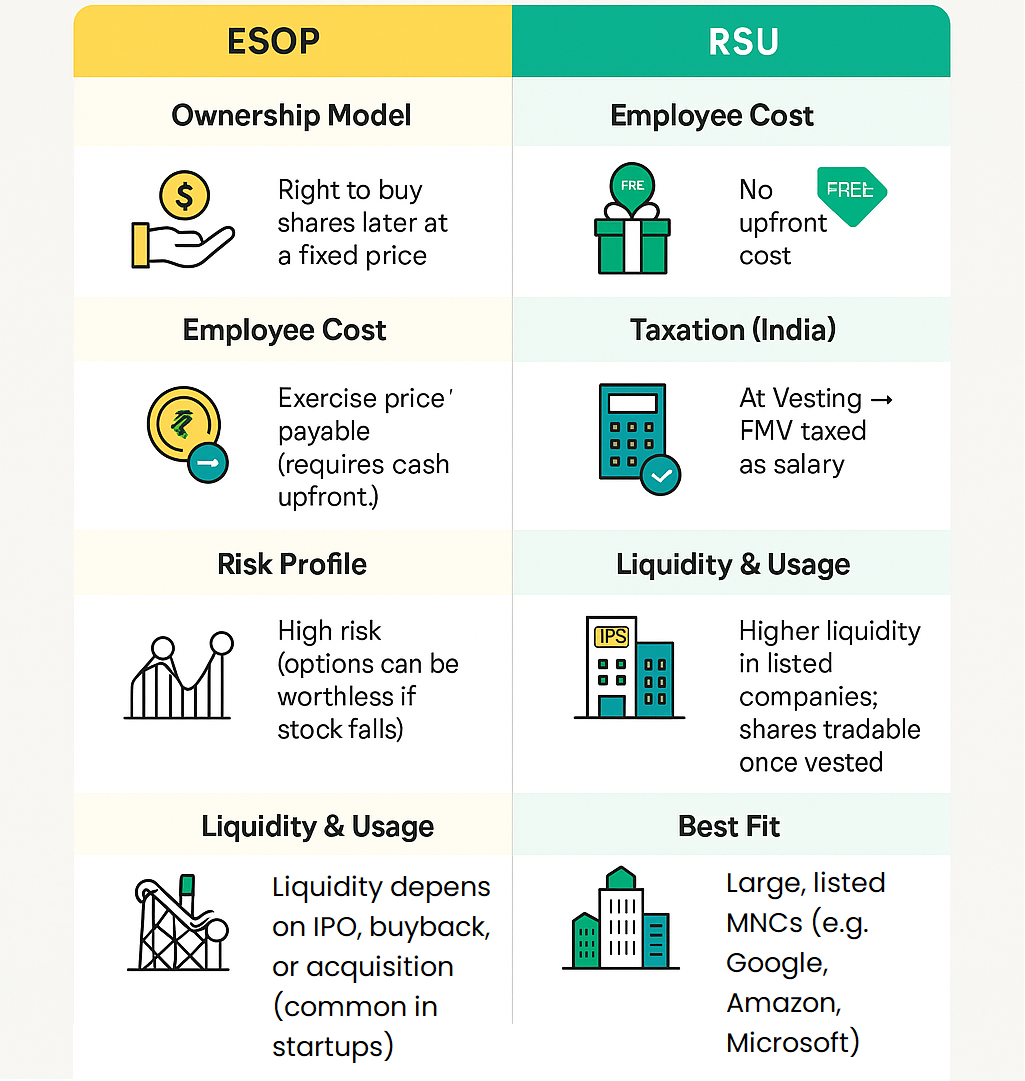
3. RSU vs ESOP The Complete Side-by-Side Comparison
At this point, you understand how each instrument works individually. Now let us place them side by side across the dimensions that matter most to employees and founders. This comparison will help you immediately identify which instrument is better aligned with your situation.
| ESOP | RSU |
| Right to BUY shares at fixed price | FREE grant shares delivered at vesting |
| Cash required: exercise price + tax | No cash ever required from employee |
| Ownership created only after exercise | Ownership created at vesting (automatic) |
| Potentially massive upside (startup growth) | Moderate, predictable value growth |
| DPIIT TDS deferral available (48 months) | No TDS deferral full tax at vesting |
| Tax: exercise (perquisite) + sale (CG) | Tax: vesting (full FMV) + sale (CG) |
| Risk: option goes underwater if FMV drops | Risk: tax bill without liquidity (private cos) |
| Complexity: scheme, filings, valuations | Simpler: global programme, clear mechanics |
| Best for: early-stage startup employees | Best for: MNCs and listed company employees |
16-Point Detailed Comparison
| Attribute | ESOP | RSU |
| Nature | Right to purchase shares at fixed price | Unconditional share grant upon vesting |
| Employee Cost | Yes exercise price must be paid | None shares are free of charge |
| Ownership Trigger | Only on exercise (paying the exercise price) | Automatically on vesting / settlement |
| Perquisite Tax | FMV minus Exercise Price at exercise date | Full FMV at vesting date |
| Capital Gains Tax | Sale Price minus FMV at exercise date | Sale Price minus FMV at vesting date |
| DPIIT TDS Deferral | Yes up to 48 months for recognised startups | Not applicable to RSUs |
| Underwater Risk | Yes if FMV falls below exercise price | No RSU always retains full FMV value |
| Wealth Upside | Highest locked-in low exercise price + growth | Moderate taxed on entire FMV at vesting |
| Cash Flow Impact | Exercise price + TDS = significant outflow | Only TDS at vesting (no exercise cost) |
| Administrative Complexity | High scheme doc, MCA filings, valuations | Lower global program, standard terms |
| Dilution Timing | Dilution occurs at the point of exercise | Dilution occurs at vesting / settlement |
| Vesting Structures | Time-based, milestone, cliff + graded options | Time-based (most common) or PSU (performance) |
| Regulatory Framework | Companies Act 2013, SEBI SBEB, Income Tax Act | FEMA, SEBI SBEB, Income Tax Act, Companies Act |
| Most Common In | Indian startups, unicorns, VC-backed companies | MNCs, large listed IT companies globally |
| LTCG Holding Period | Unlisted: 24 months from exercise; Listed: 12 | Unlisted: 24 months from vesting; Listed: 12 |
| IPO Impact | Pre-IPO options often create the highest wealth | Typically already vested before IPO listing |
4. ESOP & RSU Taxation in India – Complete 2026 Guide
Taxation is where most employees and founders make mistakes and where the financial consequences can be severe. Understanding exactly when tax is triggered, how much you owe, and what you can do to legitimately reduce your liability is not optional if you hold equity in an Indian company. This section gives you the complete picture.
A foundational principle to grasp before we go further: both ESOPs and RSUs are taxed at two separate, independent stages in India. The first tax event is when you access the equity exercise for ESOPs, vesting for RSUs. This income is treated as salary and taxed at your applicable slab rate, with TDS deducted by your employer. The second tax event is when you eventually sell the shares. The profit on sale is treated as capital gains and taxed at rates that depend on whether the shares are listed or unlisted, and how long you held them.
The Finance Act 2024 introduced significant changes to capital gains tax rates for equity, effective from 23 July 2024. Short-term capital gains (STCG) on equity were raised from 15% to 20%, and long-term capital gains (LTCG) were raised from 10% to 12.5%. The LTCG exemption threshold was simultaneously raised from ₹1 lakh to ₹1.25 lakh. All calculations in this guide use these current 2026 rates.
| The Two-Stage Tax Rule The Single Most Important Concept› Stage 1 Access Event: When you exercise (ESOP) or vest (RSU), the ‘spread’ or ‘full FMV’ is taxed as SALARY at your slab rate.› Stage 2 Sale Event: When you sell the shares, any price appreciation above the FMV at Stage 1 is taxed as CAPITAL GAINS.› Your employer deducts TDS on Stage 1 automatically. Stage 2 is your personal responsibility via advance tax or self-assessment.› Crucially: you can owe Stage 1 tax even if you NEVER sell the shares, the tax liability is not contingent on liquidity.› Good planning means understanding both stages before you exercise or receive RSUs, not after the TDS is already deducted. |
How ESOPs Are Taxed – Stage by Stage
When you exercise an ESOP, your employer is required to calculate the ‘perquisite value’ , the difference between the Fair Market Value (FMV) on the exercise date and your exercise price. This amount is added to your salary income for that financial year and taxed at your marginal slab rate. For most startup employees, this means 30% plus applicable cess.
The employer deducts TDS on this perquisite in the month of exercise. For employees of DPIIT-recognised startups, this TDS can be deferred for up to 48 months or until IPO/secondary sale whichever is sooner. Once you have paid the exercise price and the TDS is settled, you become the owner of the shares. The FMV on the exercise date becomes your cost basis for the second stage of taxation.
When you eventually sell those shares, the profit above your cost basis (FMV at exercise) is taxed as capital gains. If you hold listed shares for more than 12 months from the exercise date, you qualify for LTCG treatment at 12.5%. For unlisted company shares, the holding period for LTCG is 24 months.
How RSUs Are Taxed – Stage by Stage
For RSUs, the perquisite is simpler to calculate but often higher in absolute terms: the full FMV of the shares on the vesting date is treated as salary income. There is no exercise price to offset it. If 300 RSUs vest when the share price is ₹400, you have received ₹1,20,000 of salary income regardless of whether you sell a single share. TDS is deducted by the employer or the Indian subsidiary of the foreign company.
Your cost basis for the second stage is the FMV on the vesting date. When you sell, the gain is taxed as capital gains on the difference between sale price and vesting FMV. For foreign RSUs (e.g., NASDAQ-listed shares from a US parent company), you may have taxes withheld in the US as well. In that case, you need to claim a Foreign Tax Credit (FTC) under the India-US DTAA to avoid double taxation; this requires filing Form 67 before your ITR due date.
Capital Gains Tax Rates – India 2026
| Share Type | Holding Period | Gain Type | Tax Rate (2026) |
| Listed Shares | Less than 12 months | STCG | 20% |
| Listed Shares | More than 12 months | LTCG | 12.5% (above ₹1.25L) |
| Unlisted Shares | Less than 24 months | STCG | Applicable slab rate |
| Unlisted Shares | More than 24 months | LTCG | 12.5% (no indexation) |
| Tax Without Liquidity The Most Painful ESOP/RSU Problem› In PRIVATE companies, both ESOP exercise and RSU vesting trigger a real tax bill before you can sell a single share.› ESOP employees must fund: (a) the exercise price itself, and (b) TDS on the perquisite often a substantial combined outflow.› RSU employees in private companies must fund TDS on the full FMV at vesting from salary, savings, or personal borrowings.› DPIIT TDS deferral exists for ESOPs in recognised startups but this benefit does NOT extend to RSUs.› The lesson: always model your full tax liability before agreeing to exercise or accepting a private company RSU grant. |
Head-to-Head Tax Comparison: ESOP vs RSU
Common assumptions: 1,000 shares. FMV at access event = ₹300. Exercise price (ESOP only) = ₹50. Sale price = ₹450. Income tax slab = 30%. Listed shares held 15 months (LTCG applies).
| Tax Component | ESOP (₹) | RSU (₹) |
| Perquisite / Spread Value | (₹300 − ₹50) × 1,000 = ₹2,50,000 | ₹300 × 1,000 = ₹3,00,000 |
| Salary Tax at 30% | ₹75,000 | ₹90,000 |
| Exercise Price Outflow | ₹50,000 (paid to company) | ₹0 (no exercise cost) |
| Capital Gain on Sale | (₹450 − ₹300) × 1,000 = ₹1,50,000 | (₹450 − ₹300) × 1,000 = ₹1,50,000 |
| LTCG Tax @12.5% (above ₹1.25L) | ₹3,125 (taxable CG = ₹25,000) | ₹3,125 |
| Total Tax Paid | ~₹78,125 | ~₹93,125 |
| Total Cash Outflow (tax + exercise) | ~₹1,28,125 | ~₹93,125 |
| Reading the Numbers Correctly› ESOP total TAX is lower (₹78K vs ₹93K) because the exercise price reduces the perquisite.› But ESOP total CASH OUTFLOW is higher (₹1.28L vs ₹93K) because you also pay the exercise price.› For early-stage startups with very low exercise prices (₹1–₹10), the ESOP tax advantage is even more pronounced.› The real ESOP wealth engine: if FMV grows to ₹1,000+ from an exercise price of ₹10, the tax on a ₹990 spread is still less than RSU tax on the full ₹1,000.› Always model both tax AND cash flow before deciding when and whether to exercise. |
ESOP Taxation Can Cost You Lakhs If Handled Incorrectly. Our tax advisors have helped 200+ startups and employees navigate exercise timing, TDS deferral, and capital gains planning Let’s Talk
5. Pros and Cons ESOP vs RSU
Every equity instrument involves trade-offs. The right choice is rarely about which is objectively ‘better’ , it is about which fits your company stage, your risk tolerance, and your financial situation. Here is a balanced view of both instruments.
ESOP: Advantages
- Extraordinary wealth potential – With a low exercise price and a high-growth startup, the ESOP spread can be 50x–200x the cost. No other compensation instrument creates this scale of wealth.
- DPIIT TDS deferral – Employees of recognised startups can defer the salary tax at exercise for up to 48 months solving the cash flow problem unique to private company ESOPs.
- Lower perquisite tax – The exercise price directly reduces the taxable spread. An option with a ₹10 exercise price and ₹400 FMV is taxed on ₹390 not on ₹400.
- VC ecosystem standard – A well-structured ESOP pool is a signal of founder maturity. Investors expect and value it. Employees recognise it as industry-standard.
- Ownership culture – Nothing aligns an employee’s mindset with the company’s success more than actual equity ownership. ESOPs create long-term, mission-aligned teams.
ESOP: Disadvantages
- Cash required at exercise – You must pay the exercise price out of pocket before owning shares. For large grants, this can run into lakhs of rupees.
- Tax without liquidity – Even with DPIIT deferral, the tax clock eventually runs out. In private companies without buyback programmes, employees can be left holding illiquid shares with pending TDS.
- Underwater risk – If the company’s valuation stalls or declines, the FMV can fall below the exercise price. Options become worthless and are typically allowed to lapse.
- Compliance complexity – Operating an ESOP scheme requires MCA filings, annual valuations by registered valuers, a properly drafted scheme document, and increasingly, an ESOP trust structure.
RSU: Advantages
- No cost, no risk of loss – RSUs always have value as long as the company’s shares are worth anything. There is no scenario where vested RSUs expire worthless.
- Predictable and simple – Employees can model their expected equity income with high accuracy. No exercise decisions, no strike price calculations, just shares at FMV on vesting.
- Instant liquidity (listed cos) – In listed companies, vested RSU shares can be sold immediately without waiting for an IPO or buyback window.
- Global programme compatibility – MNCs can run a single RSU programme across dozens of countries. Consistency reduces admin burden and creates equitable treatment globally.
RSU: Disadvantages
- Full FMV taxed at vesting – The entire market value of vested shares is taxed as salary income a larger perquisite than ESOPs (no exercise price to offset it).
- No deferral in private companies – RSUs in private companies have no TDS deferral equivalent to the DPIIT ESOP benefit. Tax falls due at vesting regardless of liquidity.
- Lower upside ceiling – In a startup that grows 50x, an ESOP with a low exercise price creates far more wealth than RSUs granted at the same company’s current FMV.
- Schedule FA compliance (foreign) – Indian employees with foreign RSUs must disclose them annually in Schedule FA, a compliance obligation many miss, triggering ₹10L penalties.
6. ESOP or RSU – Which is Right for Your Situation?
The question ‘ESOP or RSU?’ does not have a universal answer. The right instrument depends on four variables: the type of company you work for, its stage of growth, your personal risk tolerance, and your financial liquidity. Use the framework below to identify where you stand.
What type of organisation do you work for?
| Early-Stage Startup ESOPs are the industry standard. Exercise prices are low, upside is potentially massive. This is where equity wealth is built. | Growth Unicorn ESOPs + buyback windows. Balance high upside with periodic liquidity. Ensure your scheme includes a buyback or secondary sale mechanism. | MNC / Global Tech RSUs are the norm. Guaranteed value, liquid shares, no exercise cost. Focus on optimising tax timing and Schedule FA compliance. | Listed Indian Company Either RSU or ESOP, depending on seniority. Senior leaders increasingly receive RSU/PSU. Ensure SEBI SBEB compliance. |
The Equity Compensation Stage Matrix
Your company’s funding stage and trajectory should directly inform which equity instrument it uses and how it is structured. This table shows the industry consensus at each stage.
| Company Stage | Best Instrument | ESOP Pool Size | Strategic Rationale |
| Seed / Angel Round | ESOP | 10–12% | Exercise prices are lowest here. Maximum upside potential for early employees. Foundational for talent attraction. |
| Series A–B | ESOP | 12–15% | VC standard. Investors validate and may require ESOP pool top-up as a term-sheet condition. |
| Series C–E | ESOP + Buyback | Up to 15% | Add periodic buyback windows to retain employees who need liquidity without waiting for IPO. |
| Pre-IPO / Late Stage | ESOP + RSU | Refreshes | Begin transitioning senior leadership to RSU grants. ESOP pool remains for junior-mid employees. |
| Post-IPO / Listed | RSU / PSU | Refresh | Shares are now liquid and publicly valued. RSU and performance-linked PSU become optimal instruments. |
| MNC Subsidiary | RSU | Global prog | The parent company runs a global RSU programme. Indian entities add a local FEMA + tax compliance layer. |
7. Real-World Case Studies How Equity Compensation Works in Practice
Theory is useful, but nothing clarifies the power and the complexity of equity compensation like real examples. The four case studies below draw from India’s most prominent ESOP outcomes and cross-border RSU scenarios, giving you a practical lens on how these instruments play out in the real world.
Case Study 1: Flipkart – How ESOPs Created an ESOP Millionaire Factory
Flipkart is the benchmark ESOP success story for the entire Indian startup ecosystem. During the company’s early years when it was still a scrappy, capital-efficient e-commerce operation competing against established retailers it distributed ESOPs generously to employees at exercise prices in the range of ₹5 to ₹10 per share. At that valuation, even senior employees often received grants they assumed were largely symbolic.
When Walmart acquired a majority stake in Flipkart in 2018 at an enterprise valuation of $20.8 billion, the per-share value had grown by orders of magnitude from those early exercise prices. The result was transformational: estimates suggest more than 300 employees received ESOP payouts of ₹1 crore or more, with some senior early hires receiving tens of crores. Engineers, product managers, operations leads, and even certain support function employees found themselves suddenly wealthy in a way that had no precedent in Indian corporate history at that scale.
| Flipkart ESOP: Key Numbers› Exercise prices at early grant: approximately ₹5 to ₹10 per share.› Effective per-share value at Walmart acquisition: estimated multi-hundred rupees.› Employees who became crorepatis (₹1 crore+ payout): 300+.› Core lesson: the earlier the ESOP grant, the lower the exercise price, and the greater the compounded upside. |
The Flipkart playbook has since been studied and replicated across India’s unicorn ecosystem. The key structural ingredients: a substantial ESOP pool (10–15%), low exercise prices validated by conservative early-stage valuations, a 4-year vesting schedule that kept the team together through the critical growth phase, and ultimately a large-scale liquidity event (acquisition or IPO) that allowed employees to actually realise the value. Every element was necessary. Any missing piece would have diminished the outcome.
Case Study 2: Swiggy – The Pre-IPO Buyback Strategy
Swiggy’s ESOP story illustrates a different dimension of equity compensation: the strategic management of employee liquidity expectations in a company that is approaching but has not yet reached a public listing. By 2022, Swiggy had been operating for eight years and had built a significant employee base, many of whom had been holding vested ESOP options for years with no clear near-term IPO timeline. Employee satisfaction and retention were being affected by the lack of any liquidity pathway.
Swiggy’s response was to conduct one of India’s largest pre-IPO ESOP buybacks: offering eligible employees the chance to sell their exercised shares back to the company at a valuation-based price, unlocking over ₹900 crore in total proceeds. This was not just a financial transaction, it was a deliberate cultural signal that equity compensation at Swiggy was real, valuable, and realisable. Employees who participated secured life-changing liquidity years before the IPO.
When Swiggy listed on the NSE and BSE in November 2024, employees who had retained their shares through the IPO experienced a second, larger wave of liquidity. The two-stage approach pre-IPO buyback for immediate monetisation, followed by IPO for long-term upside has become the template that other late-stage Indian unicorns are now adopting.
| Swiggy’s ESOP Lesson for Founders› Pre-IPO buyback windows are now an accepted and expected feature of mature Indian startup ESOP programmes.› Offering periodic liquidity is not a giveaway; it reduces retention risk and increases employee commitment through the IPO journey.› Build buyback provisions into your ESOP scheme from the beginning, even if you do not plan to use them for years. |
Case Study 3: Google India – The Cross-Border RSU Compliance Challenge
Google grants RSUs to its Indian employees through a standard global equity compensation programme. These RSUs vest quarterly over four years and settle as shares of Alphabet Inc. (NASDAQ: GOOGL). On the surface, this is an excellent compensation package: fully liquid shares in one of the world’s most valuable companies, no exercise cost, and predictable quarterly income in the form of vesting shares.
In practice, however, Indian employees face a multi-layered compliance obligation that creates real financial risk if handled incorrectly. When RSUs vest, Google India’s payroll system deducts TDS on the full FMV of the vested shares as a salary prequisite. Separately, the US may withhold its own taxes on the same income. Without a properly filed Foreign Tax Credit (FTC) claim under the India-US Double Tax Avoidance Agreement (DTAA), the employee ends up paying tax twice on the same income, a legally avoidable but practically common outcome.
The second compliance layer is Schedule FA the Foreign Asset disclosure schedule within India’s ITR. Every Indian tax resident who holds foreign assets (including unvested RSUs, vested-but-unsold shares, and foreign brokerage accounts) must disclose them annually. The penalties for non-disclosure under the Black Money (Undisclosed Foreign Income and Assets) and Imposition of Tax Act, 2015 are ₹10 lakh per assessment year per undisclosed asset, a punishing amount for what is often an accidental omission.
| Indian Employees with Foreign RSUs: Critical Compliance Checklist› Schedule FA: Disclose ALL foreign assets (unvested RSUs, shares, brokerage accounts) in your annual ITR. Penalty for non-disclosure: ₹10 lakh per default.› TDS: Your Indian employer/subsidiary deducts TDS on the RSU perquisite at each vesting date. Verify this is happening correctly each quarter.› DTAA / FTC: If US taxes are withheld, file Form 67 before your ITR due date to claim the Foreign Tax Credit and avoid double taxation.› Timing: FTC claims must be made in the same year as the income. Missing the Form 67 deadline permanently forfeits your credit. |
Case Study 4: Indian IT Sector – The ESOP-to-RSU Transition Post-Listing
India’s large IT services companies Infosys, Wipro, HCL Technologies present an instructive case study in the natural evolution of equity compensation as a company matures. In their early growth phases, these companies used ESOPs heavily to attract and retain technical talent in a competitive market. The low exercise prices of the 1990s and early 2000s, combined with explosive revenue growth, created genuine wealth for thousands of employees.
As these companies became large, stable, publicly listed organisations with relatively predictable earnings growth, the case for ESOPs weakened. The scope for the 50x–100x upside that makes ESOPs transformative becomes very limited at a ₹5 lakh crore market cap. What senior employees needed instead was performance-linked pay that was liquid, certain, and directly tied to shareholder value creation. The answer was a shift toward RSU and Performance RSU (PSU) structures for CXOs and senior VPs, while maintaining ESOP or ESOP-equivalent grants for mid-level technical and management employees.
The strategic lesson for Indian startup founders is clear: the equity compensation instrument appropriate for your company today will not be the right instrument at every future stage. Build flexibility into your scheme design, and plan for the transition from ESOP-heavy to RSU-balanced compensation as your company approaches listing and beyond.
8. Common ESOP & RSU Mistakes and How to Avoid Them
The most expensive ESOP and RSU errors are almost always avoidable with a little advance planning and the right professional advice. The following mistakes appear repeatedly across the startups and employees Treelife advises do not let them happen to you.
For Employees: 5 Costly Mistakes
1. Not reading the ESOP scheme document before accepting a grant The scheme document is the legal contract governing your equity. It contains the vesting schedule, exercise window (often just 30–90 days post-resignation), good leaver vs bad leaver definitions, anti-dilution provisions, and the company’s buyback rights. Many employees sign their grant letter without ever asking for or reading the scheme document then discover unfavourable terms only when they try to exercise or after they resign.
2. Being unprepared for the tax at exercise The perquisite tax at exercise can be a shock if you haven’t modelled it in advance. For 10,000 options with a ₹10 exercise price and ₹300 FMV, the perquisite is ₹29 lakh generating ~₹8.7 lakh in TDS at a 30% slab rate. Your employer will deduct this from your salary. If your monthly salary is ₹5 lakh, you could have zero take-home for two months after a large exercise. Plan cash flow well in advance.
3. Exercising options without a clear liquidity plan Exercising in a private company means paying the exercise price and triggering TDS and then holding illiquid shares with no guarantee of when you will be able to sell. Unless there is a buyback window, a secondary sale, or an IPO timeline clearly in view, exercising early can tie up significant capital with no return date. Exercise only when there is a realistic near-term liquidity event.
4. Missing Schedule FA for foreign RSUs This is a growing problem as more Indian employees receive RSUs from foreign-listed parent companies. Every Indian tax resident with foreign assets must file Schedule FA annually in their ITR. This includes unvested RSU grants, vested shares held in foreign brokerages, and the brokerage account itself. Non-disclosure carries a ₹10 lakh penalty per assessment year under the Black Money Act regardless of intent.
5. Poor holding period timing for capital gains Selling shares immediately after exercise or vesting is the most expensive approach from a capital gains perspective. For listed shares, waiting just 12 months from exercise/vesting converts a 20% STCG liability into a 12.5% LTCG liability. For unlisted shares, the holding period for LTCG is 24 months. The tax saving from waiting the holding period can run into lakhs on a significant equity position.
For Founders: 5 Critical ESOP Scheme Mistakes
1. Granting ESOPs without a formal scheme document Many early-stage founders issue informal ESOP commitments: a line in an offer letter, a promise in an email, a verbal assurance. None of these are legally enforceable without a formal ESOP scheme adopted by the Board and shareholders under Section 62(1)(b) of the Companies Act. Without a scheme, you cannot legally allot shares against option exercise, and your employees have no enforceable rights.
2. Setting exercise prices arbitrarily The exercise price must be the Fair Market Value of the company’s shares on the grant date, as certified by a SEBI-registered Category I Merchant Banker or a Registered Valuer. Setting a price lower than FMV without proper valuation support creates tax and regulatory risk. Setting it higher than FMV reduces the incentive value of the options for employees.
3. Not structuring an ESOP Trust As your employee headcount and ESOP pool grow, administering individual option grants, exercise requests, and share allotments directly becomes operationally complex. An ESOP Trust acts as an intermediary; it holds the shares, manages exercises, and simplifies the employee experience. It also provides employee protection in M&A scenarios. Startups beyond Series B should seriously consider ESOP Trust structures.
4. Sizing the ESOP pool incorrectly An ESOP pool that is too small (under 8%) will require repeated dilutive top-ups that frustrate existing shareholders and employees. A pool that is too large (over 20%) creates unnecessary upfront dilution. The industry benchmark of 10–15% of fully diluted capital is well-established for a reason: it satisfies VC expectations, provides enough headroom for key hires and fresh grants, and maintains a sensible capital structure.
5. Designing the scheme with no exit provisions Employees need to know when and how they will be able to convert their options into cash. An ESOP scheme with no buyback provision, no secondary sale window, and no defined liquidity pathway creates growing frustration as vesting periods conclude with no monetisation opportunity. Design your scheme with explicit buyback triggers (e.g., annual windows post-Series C), secondary sale provisions, and a clearly communicated IPO roadmap.
9. How Treelife Helps with ESOP & RSU Structuring
Treelife is a full-service legal, tax, and compliance firm with deep specialisation in equity compensation for Indian startups and growth-stage companies. We have worked with more than 200 Indian startups from seed-stage companies issuing their first ESOP grants to late-stage unicorns preparing for IPO to design, implement, and administer compliant, tax-efficient equity programmes.
Equity compensation in India is governed by an interlocking web of regulations: the Companies Act 2013, SEBI SBEB Regulations 2021, the Foreign Exchange Management Act (for cross-border grants), the Income Tax Act (for perquisite, capital gains, and TDS), and DPIIT guidelines (for the 48-month TDS deferral benefit). Getting any one of these wrong can result in regulatory penalties, disqualification of option grants, employee grievances, or unexpected tax exposure. Our job is to make sure that your equity programme is structured correctly, maintained compliantly, and optimised for both the company and its employees.
Our ESOP & RSU Services – What We Do
| ESOP Scheme Drafting | Cap Table & Equity | Regulatory Filings | Tax Advisory |
| Scheme document drafting, vesting schedule design, exercise price advisory, cliff and graded structures, good/bad leaver clauses, ESOP trust deed and administration. | ESOP pool sizing and dilution modelling, option grant tracking, cap table management, investor ESOP expectation advisory, pre-fundraise cap table cleanup. | MCA annual return filings, FEMA compliance and reporting, SEBI SBEB filings, DPIIT recognition applications, TDS deferral applications for eligible employees. | Exercise timing strategy, holding period planning for LTCG, perquisite tax modelling, Schedule FA filing, Foreign Tax Credit (FTC) claims, cross-border tax opinions. |
Who We Work With
- Seed to Series B founders – Designing your first ESOP scheme, setting the right exercise price and pool size, drafting the scheme document, and advising on your first option grants.
- Series C to pre-IPO startups — ESOP pool refreshes, buyback window structuring, secondary sale provisions, ESOP trust establishment, and pre-IPO scheme rationalisation.
- Post-IPO listed companies – Transitioning from ESOP to RSU/PSU structures, SEBI SBEB compliance, performance-linked vesting design for senior leadership.
- MNC India subsidiaries – Cross-border RSU compliance, FEMA reporting, TDS on foreign equity grants, Schedule FA advisory, and DTAA-based FTC planning.
- Individual employees – Personal ESOP exercise timing advice, ITR filing with complex equity income, capital gains planning, and Schedule FA compliance.
Conclusion
ESOPs and RSUs are both powerful tools for building employee wealth, retaining talent, and aligning your team with company success but they work in fundamentally different ways and are suited to different contexts. In India’s startup ecosystem, ESOPs remain the dominant pre-IPO instrument: their low exercise prices, high-growth upside, and DPIIT tax deferral benefit make them uniquely powerful for early-stage companies. RSUs are the standard for MNCs and post-IPO companies, where simplicity, predictability, and liquidity are more valuable than asymmetric upside.
Understanding the mechanics, the taxation, the compliance obligations, and the strategic logic behind each instrument is no longer optional it is essential for every founder designing a scheme, every HR leader building a compensation strategy, and every employee evaluating or holding equity. The decisions you make around exercise timing, holding periods, Schedule FA compliance, and liquidity planning can add or subtract lakhs from your actual wealth outcome.
If you would like to design a world-class ESOP programme, optimise your personal equity tax position, or navigate the complexities of cross-border RSU compliance, Treelife’s equity compensation team is here to help.
Build a Compliant, Tax-Efficient ESOP Programme with Treelife200+ Indian startups trust Treelife for ESOP scheme design, compliance, and advisory. Let’s Talk
| 9 in 10 Indian listed companies are family-owned or controlled | 63% of family businesses have any formal governance structure in place | 1,539 UHNWIs in India as of 2024, up from just 140 in 2013 | 30% of family businesses survive to the third generation |
About This Report
This report is on Succession Planning in Indian Family Businesses is produced by Treelife’s tax and regulatory advisory team based on our experience advising promoter families, second-generation leaders, and investors across India. It is structured as a practical guide not a legal memorandum. Our aim is to give founders the conceptual architecture to think clearly about succession before they sit down with legal and tax advisors, so that advisory time is used to solve real problems rather than explain basics.
Who this report is for: Family business founders approaching a generational transition. Promoters of listed or PE-backed companies. Second-generation leaders preparing to take over. Investors evaluating governance quality in promoter-led companies.
The Governance Gap at the Heart of Indian Business
The Scale of the Opportunity and the Risk
India is in the middle of an extraordinary wealth-creation cycle. The Hurun India Rich List 2024 counted 1,539 Ultra High Net-Worth Individuals, a staggering tenfold increase from 140 in 2013. A new billionaire emerged every five days that year. The High Net-Worth Individual population, defined as those with investable assets exceeding $1 million, recorded 4.5% year-on-year growth in 2022.
A new generation of wealth creators from established industrial families to first-generation startup founders like Harshil Mathur of Razorpay and Kaivalya Vohra of Zepto is reshaping what Indian family wealth looks like. But wealth creation and wealth preservation require fundamentally different skill sets, structures, and disciplines.
Here is the uncomfortable truth: nine out of ten publicly traded Indian companies are family-owned or family-controlled, yet only 63% of their leaders report having any formal governance structures, shareholder agreements, family constitutions, or even a basic will. That gap between ownership scale and governance maturity is where generational wealth quietly erodes.
What Happens Without a Plan
Without a clear succession plan, family businesses across India routinely encounter a predictable set of crises: disputes over ownership shares that split families and destabilise boards; leadership vacuums that allow competitors to gain ground; poorly timed transitions that trigger key employee exits; and tax-inefficient transfers that destroy significant value during the handover itself.
India has seen dramatic examples of what happens when family businesses fail to institutionalise governance from high-profile boardroom battles in prominent industrial groups to quietly contested wills in mid-market family enterprises. The common thread is not a shortage of wealth, but a shortage of planning.
| Why this matters to investors: Promoter-led companies with unclear succession plans carry latent governance risk that is increasingly material. A leadership vacuum, contested ownership, or family dispute can trigger management instability, regulatory scrutiny under SEBI Takeover Regulations, lender covenant reviews, and significant destruction of shareholder value. Succession risk is now a recognised ESG governance factor and should be part of any serious diligence of promoter-led businesses. |
The Two Distinct Challenges
A common mistake is treating succession as a single problem. It is two: an ownership challenge and a management challenge. These require different tools, different timelines, and different conversations. Conflating them is one of the main reasons succession processes stall.
- Succession of Ownership: The legal and financial transfer of business interests, shares, and assets from the current generation to the next. It defines who owns what and the legal structure through which they own it.
- Succession of Management: The transition of operational control, decision-making authority, and leadership responsibility. It defines who runs the business entirely independently of who owns it.
Critically, these two can and often should be decoupled. A second-generation family member may inherit ownership while professional management is retained externally, a structure increasingly common in large Indian conglomerates and listed family groups.
Succession of Ownership: Framework and Execution
What Ownership Succession Actually Involves
Ownership succession means transferring the legal title to the business or to the vehicles that hold the business, such as shares in a private company, LLP interests, or directly held assets from one generation to the next. Done well, it is one of the most powerful acts of wealth stewardship a founder can perform. Done poorly, it can trigger tax liabilities, family disputes, and regulatory consequences that take years to unwind.
A robust ownership succession process has four distinct phases. Families that skip or rush any of them typically pay for it later.
PHASE 01 – STRATEGY & DESIGN
 Build the Architecture Before Writing Any Documents
The first mistake families make is rushing into documentation drafting a will or setting up a trust before the fundamental decisions have been made. Before any legal instrument is created, the family needs to answer: Who are the successors? What does each branch of the family receive? How is the business valued? Who decides in the event of a dispute? What legal structure will hold the assets going forward? This design phase should involve the family, and often benefits from an independent facilitator who has no stake in the outcome.
PHASE 02 – STRUCTURE EVALUATION
Assess the Current Ownership Architecture
Most families that approach succession have accumulated ownership structures organically, shares held individually, assets in HUF, unlisted holding companies layered over operating businesses, cross-holdings between family members. Before succession can be planned, this structure must be mapped and evaluated. Often, a rationalisation is needed before the succession itself can proceed efficiently. This phase also requires a formal business valuation from an independent, credentialled valuer; disagreements over valuation are among the most common causes of succession failure.
PHASE 03 – LEGAL, TAX & REGULATORY PLANNING
Build the Transfer Mechanism That Minimises Cost and Risk
Once the architecture is designed and the current structure evaluated, the technical work begins. This means determining the mode of succession trust, will, or hybrid and modelling the tax and regulatory implications of each path. For listed company promoters, this phase must specifically address SEBI Takeover Regulation exposure and any FEMA implications if family members are resident outside India. Stamp duty modelling is essential for families with significant real estate. The goal is to achieve the family’s desired outcome at the lowest total cost, with the cleanest regulatory profile.
PHASE 04 – FAMILY GOVERNANCE & ALIGNMENT
Build the Framework That Makes the Legal Documents Stick
No legal document survives a sufficiently fractured family relationship. Lawyers and tax advisors can build technically perfect structures that collapse in practice because the family was never truly aligned on the underlying decisions. This phase involves the creation of a family governance charter documenting roles, responsibilities, decision rights, dividend policies, entry and exit policies for family members in the business, and dispute resolution mechanisms. This is the phase most often underestimated and under-resourced, and it is the one that most often determines whether a succession plan succeeds or fails.
Key Building Blocks of a Sound Ownership Succession Plan
- Successor selection and share determination: Deciding who inherits what and in what proportion is the foundational decision. Where there are multiple children or family branches, this requires explicit, documented consensus. Assumptions that ‘everyone agrees’ are rarely correct.
- Asset and business inventory: A comprehensive list of all assets operating businesses, investment holdings, real estate, financial instruments, intellectual property with current valuations. This is the starting point for any structural planning.
- Legal structure selection: Choosing between a private family trust, will, hold-co structure, or hybrid of multiple instruments. Each has different legal, tax, and governance characteristics that must be matched to the family’s specific situation.
- Tax and regulatory modelling: Calculating the total cost of each structural option, capital gains, stamp duty, registration charges, ongoing compliance costs so that the family can make an informed choice between alternatives.
- Migration strategy: For families with existing complex structures, planning the step-by-step migration from the current structure to the target structure, in an order that minimises tax leakage and regulatory exposure at each step.
- Family charter and governance framework: The non-legal document that governs how the family makes decisions about the business going forward roles, compensation, board composition, dividend policy, and dispute resolution.
Trust vs. Will: The Structural Choice That Defines Everything
The single most consequential structural decision in ownership succession is whether to use a private family trust, a will, or a combination of both. This choice determines when the succession takes effect, how it interacts with tax and regulatory frameworks, the level of privacy it provides, and how much ongoing control the family retains. Understanding the trade-offs is essential before any documentation begins.
| Dimension | Private Family Trust | Will |
|---|---|---|
| Legal Definition | An obligation annexed to ownership of property, held by a trustee for the benefit of beneficiaries. Governed by the Indian Trust Act, 1882. | A legal declaration of testamentary intention regarding property to be carried into effect after death. Governed by the Indian Succession Act, 1925. |
| When It Takes Effect | Immediately upon creation assets can be transferred and managed during the settlor’s lifetime. | Only after the testator’s death and completion of the probate process. |
| Probate Requirement | Not Required. Trust remains a private document between parties. | Required in most Indian states. Contents become public record through the High Court. |
| Ownership/Management Split | Possible. Trustee holds legal title; beneficiaries hold beneficial interest. Allows separation of control from economic benefit. | Not Possible. Ownership and benefit vest together in the legatee. |
| Asset Protection | Strong for irrevocable trusts assets are ring-fenced from personal creditors of the settlor and beneficiaries. | Limited. Assets remain in individual ownership until death and are exposed to creditor claims. |
| Capital Gains Tax on Transfer | Irrevocable trust: Exempt under Section 47(iii), ITA. Revocable trust: Not exempt capital gains tax applies. | Transfer under will is exempt under Section 47(iii). Recipients are also exempt under Section 56(2)(x), ITA. |
| Income Taxation | Discretionary trust: Taxed at trust level at ~39% MMR. Specific/determinate trust: Pass-through income taxed in beneficiaries’ hands at their applicable slab rates. | Not applicable during lifetime. Post-inheritance, income is taxed in the legatee’s hands. |
| Stamp Duty | Payable on trust deed creation. Also payable on settlement of properties into the trust. Rate varies significantly by state. | Will itself is not chargeable under the Central Stamp Act. Court fee applies when presented for a probate amount varies by court. |
| SEBI Takeover Regulations (Listed Companies) | Migration to a trust structure may trigger scrutiny even if economic promoter holding is unchanged. New trusts do not qualify for the automatic inheritance exemption. SEBI informal guidance or specific exemption application is advisable before migrating listed shares. | Explicit exemption available for acquisition by succession or inheritance from mandatory public offer. Standard Regulation 29-30 disclosures still apply to the legatee. No known restriction under SEBI Insider Trading Regulations. |
| FEMA Implications | If trustees or beneficiaries are resident outside India, or if the trust holds foreign assets, specific FEMA permissions and potentially RBI approval may be needed. | Resident Indians may hold inherited foreign property. Non-resident Indians may hold inherited Indian property. More straightforward foreign exchange treatment. |
| Flexibility | Revocable trust: Can be amended or cancelled during the settlor’s lifetime. Irrevocable trust: Cannot be altered, amended, or revoked once assets are transferred. | Can be modified or revoked at any time while the testator is mentally competent. The most recent valid will supersede all prior versions. |
| Complexity and Cost | Higher upfront complexity and professional cost to establish. Typically saves significant cost, delay, and dispute in the long run. | Lower upfront cost and simpler to create. The probate process adds cost, delay, and public disclosure post-death. |
| Best Suited For | Larger families with complex portfolios. Listed company promoters. Families with cross-border members or assets. Situations requiring long-term control and governance. | Simpler estates. Clear, uncontested heirs. Single-generation asset transfers. Situations where upfront cost is a constraint. |
| Treelife Perspective: The Case for a Hybrid Approach Most promoter families benefit from using both instruments in a co-ordinated structure. A private irrevocable trust holds business assets and listed company shares providing ring-fencing, control continuity, and SEBI-compliant promoter holding structures. A will catches personal assets not settled into the trust residential property, jewellery, personal investment portfolios. The two documents must be drafted with awareness of each other to avoid gaps (assets falling outside both) and conflicts (the same asset purportedly transferred by both). This requires legal counsel experienced in both estate planning and corporate structuring; they are different disciplines that are rarely combined well in practice. For families with significant real estate, stamp duty on property settlement into a trust can be the dominant cost driver. In such cases, retaining property outside the trust and contributing the sale proceeds upon liquidation is often the more cost-efficient path. |
Private Family Trusts: Structure, Parties, and Practical Design
Given the prevalence of trust structures in Indian promoter succession planning, it is worth examining the mechanics in depth beyond the headline comparison with wills.
Parties to a Trust and Their Roles
| Party | Role | Key Considerations |
|---|---|---|
| Settlor / Contributor | The person who creates the trust and contributes assets to it. The settlor defines the trust’s purpose, beneficiaries, and governance rules in the trust deed. | The settlor may also be a trustee or beneficiary. After the initial contribution, subsequent contributors are referred to as contributors rather than settlers. |
| Trustee(s) | The person(s) or entity entrusted with holding and managing the trust’s assets for the benefit of the beneficiaries. The trustee is the legal owner of trust property. | Can be individual family members, external advisors, or a professional corporate trustee company. Corporate trustees offer continuity (not affected by death), expertise, and independence. Individual trustees are more common in smaller families but create continuity risk. |
| Beneficiaries | The persons for whose benefit the trust is established. They hold the beneficial (economic) interest in the trust assets. | Beneficiaries can be current members of the family, future descendants, or defined categories of persons. In discretionary trusts, the trustee determines distribution amounts. In specific trusts, each beneficiary’s share is defined upfront. |
| Protector / Advisory Board | An optional but increasingly common role is typically a trusted external advisor or senior family member who monitors the trustee’s execution and can exercise specific reserved powers. | Particularly valuable in larger families where the beneficiary group is large and diverse. The protector can instruct or direct trustees, replace trustees, and ensure adherence to the settlor’s intentions. Enhances governance without adding operational complexity. |
Types of Trusts: Choosing the Right Structure
| Revocable Trust The settlor retains the right to cancel or amend the trust during their lifetime. Assets can be reclaimed. Used when the settlor wants to begin the transfer process but is not ready to fully relinquish control. Note: Capital gains tax applies on transfer; no Section 47(iii) exemption. | Irrevocable Trust Once assets are transferred, the transfer cannot be altered, amended, or revoked. The settler permanently parts with ownership. Provides strong asset protection and capital gains tax exemption under Section 47(iii) ITA. The preferred structure for serious long-term succession planning. |
| Discretionary Trust The trustee has full discretion over the amount and timing of distributions to beneficiaries. Beneficial interests are not fixed. Income is taxed in the trust at ~39% MMR. Preferred when the family has not yet decided on final allocation between branches or individuals. | Specific / Determinate Trust Each beneficiary’s share is precisely defined in the trust deed. Distributions follow a set formula. Income is treated as pass-through and taxed in beneficiaries’ hands at their slab rates potentially more tax-efficient than a discretionary trust depending on beneficiary profiles. |
Single Trust vs. Multiple Trusts
One structural decision families often overlook is whether to consolidate all assets into a single trust or to establish separate trusts for different asset classes or family branches. There is no single right answer; it depends on the family’s specific situation.
- Arguments for multiple trusts: Different asset classes may have different beneficiary groups, governance needs, or risk profiles. Business operating assets are often better held separately from passive investment portfolios. Multiple trusts allow ring-fencing a dispute or liability in one trust that does not infect the others. Each family branch can have its own trust, reducing inter-branch governance complexity.
- Arguments for a single trust: Lower setup and maintenance costs. Simpler governance structure. Greater flexibility to reallocate assets between beneficiaries. Easier for a single trustee or corporate trustee to administer.
| Practical Note: Most large promoter families Treelife has worked with ultimately operate multiple trusts typically one for the operating business and listed company shares (the ‘business trust’) and one or more for passive assets and real estate (the ‘wealth trusts’). The architecture should reflect the actual complexity of the asset base, not an idealised simplicity that creates governance problems later. |
Succession of Management: The Harder Half
If ownership succession is primarily a legal and tax engineering challenge, management succession is primarily a human one. It involves identifying who will lead the business, grooming them over years, managing the psychology of transition for both the outgoing and incoming leaders, and maintaining organisational confidence throughout. It is harder to plan, harder to execute, and harder to get right which is why it fails more often.
The data is stark: only 30% of family businesses make it to the third generation, and the most common cause of failure is not market dynamics or strategic error; it is an unresolved management transition. The business is often fundamentally sound. The transition is what breaks it.
Why Management Succession Is Different
| Dimension | Management Succession | Ownership Succession |
|---|---|---|
| Primary Focus | Leadership quality, operational decision-making, cultural continuity, strategic direction. | Legal ownership, asset distribution, regulatory compliance, tax efficiency. |
| Timing | Can happen at any time independent of ownership events. Non-family professionals may take over management while the family retains ownership. | Typically triggered by specific life events: retirement, death, incapacity. |
| Key Risk | The wrong person in the role destroys culture and competitive position. Poor timing creates a leadership vacuum or premature handover. | Incorrect structure creates tax liability, regulatory exposure, or family dispute over asset allocation. |
| Emotional Charge | Extremely high. Touches daily involvement, identity, relationships, and the founder’s sense of legacy. | High, but more amenable to professional resolution through legal and financial advisors. |
| Success Metric | Business performance continues or improves. Key talent is retained. Stakeholder confidence is maintained. | Assets are transferred as intended with minimal tax leakage, no legal challenge, and family harmony preserved. |
The Four Non-Negotiables of Management Succession
| Get the Timing Right Too early, and the incoming leader lacks credibility and experience to command the organisation. Too late, and the business stagnates waiting for clarity of leadership. Timing should be determined by leadership readiness, current market conditions, the outgoing leader’s genuine psychological readiness to transfer authority not just title and the organisation’s overall health. | Separate Merit from Lineage The hardest governance decision in any family business: evaluating whether a family member is actually the best person for the leadership role. The answer is not always no but it must be arrived at through honest, ideally independent, assessment rather than assumption. Meritocracy in selection is what separates family businesses that grow from those that decline in the second generation. |
| Invest in the Pipeline Early The successor’s development programme should begin 5–10 years before the planned transition. This means structured mentorship, cross-functional exposure within the business, meaningful external work experience outside the family business, progressive accountability with real consequences, and formal leadership development. A successor announced without this preparation destroys internal and external confidence. | Define Roles with Legal Precision When multiple family members are involved in the business siblings, cousins, spouses role ambiguity is the single largest driver of conflict. Every family member in a management role should have a formally defined scope, measurable KPIs, and compensation benchmarked against market rates for equivalent roles. The family charter should be explicit about who has decision authority over what, and what the process is when there is disagreement. |
Building the Leadership Pipeline: A Practical Approach
Grooming a successor is not a passive process. It requires a structured programme that builds capability, credibility, and contextual knowledge over time. Below is the framework Treelife recommends for families beginning this process:
| Phase | Timeline | Key Activities | Success Indicator |
|---|---|---|---|
| Foundation | Years 1–2 | External work experience in a different industry or function. MBA or relevant postgraduate education if appropriate. Deep immersion in the family business not as an heir, but as a junior employee learning the business. | Demonstrates genuine interest and commitment independent of the family expectation. |
| Development | Years 3–5 | Rotational exposure across all key business functions. Responsibility for a defined P&L or business unit. Mentorship from both the current generation and external business leaders. First exposure to board-level governance. | Produces measurable results in their area of responsibility. Earns respect from the non-family leadership team. |
| Leadership Transition | Years 5–7 | Progressive assumption of senior leadership responsibilities. Joint decision-making with the current generation in a defined co-leadership structure. Formal announcement of succession timeline to internal and external stakeholders. | Stakeholder confidence is maintained. Business performance does not deteriorate during transition. |
| Full Transition | Year 7+ | Complete handover of operational and strategic leadership. The current generation moves to an advisory or board role with clearly defined and limited scope. Successors established their own leadership style and relationships. | Business continues to grow. The prior generation does not undermine the new leadership through informal channels. |
Why Succession Plans Fail: Eight Systemic Challenges
Understanding the failure modes is as important as understanding the framework. Each of the challenges below is drawn from real patterns in Indian family business succession. Each has a structural fix but the fix requires honest diagnosis first.
| Communication Gap Generational differences in communication style, hierarchy, and formality create chronic misalignment that compounds over time. What each generation assumes is ‘understood’ typically is not. Fix: Structured family councils with documented decisions and a defined meeting cadence. | Conflicting Values & Vision G1 built the business on one set of convictions and risk appetite. G2 arrives with different priorities, ambitions, and ideas about what the business should be. Fix: Facilitated vision-alignment workshops before succession documentation begins. Unresolved vision conflict makes all structural planning premature. | Cultural Shift Incoming leaders inevitably change culture in ways that are not always intentional or visible until the damage is done. Long-serving employees who were loyal to the founder may disengage. Fix: Explicit culture-continuity planning, including direct communication from the outgoing leader validating the incoming one. |
| Skill Gaps Second-generation leaders may have significant formal education but lack domain expertise, stakeholder relationships, or the operational judgment that comes from experience not credentials. Fix: Structured 5–10 year development programmes with external benchmarking and genuine accountability. | Role Ambiguity Multiple family members, undefined mandates, overlapping authorities, and informal hierarchies create daily friction that escalates into structural conflict over time. Fix: A formal family charter that documents roles, decision rights, and escalation paths reviewed annually. | Emotional Dynamics When professional decisions are filtered through personal relationships, sibling rivalries, perceived parental favouritism, in-law tensions, outcomes are systematically distorted. Fix: Independent board members and a family governance structure that creates a buffer between family relationships and business decisions. |
| Resistance to Letting Go The founder’s identity is often inseparable from the business. Genuine transfer of authority, not just title, requires a psychological transition that many founders struggle with, sometimes indefinitely. Fix: Executive coaching for the outgoing leader, and a phased transition timeline with irreversible milestones. | External Perceptions Leadership transitions are watched closely by customers, suppliers, lenders, and institutional investors. Poorly managed transitions can trigger credit reviews, customer attrition, and talent exits. Fix: A proactive stakeholder communication strategy that runs concurrently with the internal succession process. |
Full spectrum of succession planning from initial governance diagnostics through to completed trust structures Let’s Talk
Tax & Regulatory Framework: What Founders Need to Know
Tax planning is not optional in succession, it is a core design constraint that shapes which structural options are viable. A succession plan that achieves the family’s governance objectives but creates avoidable tax liabilities of tens of crores is not a good plan. Below is a structured overview of the key tax and regulatory dimensions relevant to Indian family business succession.
Income-Tax: Key Provisions and Implications
| Transaction | Mode / Type | Tax Treatment | Governing Provision |
|---|---|---|---|
| Transfer of capital assets to trust | Irrevocable trust | Exempt No capital gains for the contributor / settlor | Section 47(iii), Income-tax Act, 1961 |
| Transfer of capital assets to trust | Revocable trust | Taxable Capital gains apply to the contributor | Section 47(iii) exemption not applicable |
| Assets received by trust without consideration | Trust for benefit of settlor’s relatives | Exempt Not taxed as income of the trust | Section 56(2)(x) specific exemption for family trusts |
| Transfer of assets under will | Will / inheritance | Fully Exempt No tax on transferor or recipient | Section 47(iii) + Section 56(2)(x), ITA |
| Income earned within trust | Discretionary trust | ~39% Maximum Marginal Rate taxed in the trust’s hands | Section 164, ITA (subject to applicable surcharge and cess) |
| Income earned within trust | Specific / determinate trust | Pass-through proportionate share taxed in each beneficiary’s hands at their applicable slab rate | Section 161, ITA |
| Capital gains on assets within trust | Long-term or short-term | Taxed at applicable concessional rates (long-term) or slab rates (short-term) capital gain character is preserved through the trust structure | Per nature of asset and holding period |
| Planning Note: The choice between a discretionary and specific trust has significant income tax implications over time. A discretionary trust paying ~39% MMR on all income may be less efficient than a specific trust where beneficiaries are in lower tax brackets. However, a specific trust locks in allocation decisions upfront a constraint that not all families are ready for. This trade-off should be modelled explicitly before structure selection. |
SEBI Takeover Regulations: Listed Company Promoters
| Via Will or Inheritance: Acquisition by way of transmission, succession, or inheritance is explicitly exempt from mandatory public offer provisions under SEBI Takeover Regulations. No disclosure requirement applies for claiming this exemption at the time of the transfer. Standard disclosures under Regulations 29 and 30 are required once the legatee acquires the shares. No known restriction under SEBI Insider Trading Regulations for inheritance-based transfers. Relatively clean regulatory path for listed company share succession via will | Via Trust Migration: Change in registered shareholding on migration to a trust structure may trigger SEBI scrutiny even if the promoter’s economic interest is entirely unchanged. New trusts do not automatically qualify for the inheritance exemption available to wills. Most practitioners recommend applying to SEBI for specific exemption or seeking informal guidance before executing the migration. Indirect transfers via promoter holdcos or unlisted intermediary companies also attract this analysis and are not automatically exempt. Early engagement with SEBI counsel is essential attempting to migrate listed shares without regulatory advice is a significant risk |
Stamp Duty: The Underestimated Cost
Stamp duty is frequently the largest cash cost in a trust-based succession, yet it is often considered only after the structural decisions have already been made which limits the options available to manage it.
- Trust deed: Stamp duty is payable at the time a trust deed is created. The rate is governed by the relevant state Stamp Act, not the central Stamp Act, and varies materially between states.
- Property settlement into trust: Stamp duty is separately payable when assets particularly real estate are formally settled into the trust. For families with significant property holdings, this can represent a very large cost.
- Strategic management: Families can mitigate stamp duty exposure by selectively excluding short-term investment properties from the trust and instead contributing the cash proceeds after sale. This requires advance planning once a property is included in the trust structure, the duty cost has already been incurred.
- Wills and probate: Wills are not chargeable instruments under the central Stamp Act. However, when presented for probate or letters of administration, court fees apply. The quantum varies by court and jurisdiction.
| Treelife Note: We consistently recommend that stamp duty modelling be completed before any trust structure is finalised not after. The difference in total stamp duty cost between structuring options can be significant enough to change the preferred approach entirely. For families with real estate assets in multiple states, this requires state-by-state analysis. |
Foreign Exchange Management Act (FEMA) Considerations
FEMA adds complexity to succession planning for families with cross-border elements, members who are non-resident Indians, assets held outside India, or businesses with international operations.
- Succession via will resident to non-resident: A person resident outside India may hold, own, or transfer Indian currency, securities, or immovable property situated in India if such property was inherited from a person resident in India. This provides a relatively clean path for NRI family members inheriting Indian assets.
- Succession via will non-resident to resident: A person resident in India may hold, own, or transfer foreign currency, foreign securities, or immovable property situated outside India if inherited from a person resident outside India. NRI parents leaving foreign assets to resident children is permitted on this basis.
- Trust structures with cross-border elements: The FEMA framework does not comprehensively address the trust structure scenario. Where trustees or beneficiaries are resident outside India and hold Indian assets, or where Indian-resident trustees hold foreign assets, RBI approval may be required. This is an area requiring specific regulatory advice general principles do not apply cleanly.
The Treelife Succession Readiness Diagnostic
Before engaging advisors to begin documentation, every founder and promoter family should conduct an honest internal assessment of where they stand across the key dimensions of succession readiness. This diagnostic framework is the starting point for every succession engagement at Treelife.
The purpose is not to identify failure, it is to focus advisory effort on the dimensions that actually need work, rather than spending time and cost on documentation for problems that have not been properly diagnosed.
| Dimension | Diagnostic Question | Green Ready | Red Flag Needs Work |
|---|---|---|---|
| Ownership Clarity | Is every significant asset clearly titled, documented, and accounted for? | All assets are formally titled in known names. Shareholding records are current and accurate. | Informal ownership arrangements. Undivided HUF property. Cross-holdings not documented. Share registers out of date. |
| Business Valuation | Has the business been independently valued in the last 24 months? | Recent independent valuation exists. Family is broadly aligned on the figure. | No formal valuation. Significant disagreement between family members on what the business is worth. |
| Family Alignment | Do all material family members agree on who receives what and who runs what? | Explicit consensus exists and has been documented, even if informally. | Undisclosed expectations. Assumed agreement that has never been tested. Active conflict. |
| Tax Modelling | Has the total tax cost of the proposed succession been modelled? | Capital gains, stamp duty, and income tax implications have been quantified for the preferred structural option and at least one alternative. | No tax modelling. Single structure assumed without alternatives considered. Stamp duty not yet factored in. |
| Regulatory Exposure | For listed companies has SEBI Takeover Regulation exposure been assessed? | SEBI counsel has reviewed the proposed structure and confirmed compliance or a path to compliance. | Assumption that all family transfers are automatically exempt. No regulatory review conducted. |
| Legal Documentation | Are the key governance documents trust deed, SHA, family charter, will in place and current? | Key documents exist, have been reviewed in the last 3 years, and reflect the current family and business situation. | Outdated documents. No will. No family charter. No shareholder agreement between family members. |
| Leadership Pipeline | Is there a named successor with a documented development programme and transition timeline? | Named successor with a multi-year development plan. Transition timeline announced internally. | Multiple undeclared candidates. No development programme. No timeline. The founder has no retirement plan. |
| External Governance | Is there an independent board or advisory committee providing checks and balances? | Independent directors or advisors with genuine authority. Regular formal governance process. | Fully family-controlled board. All decisions made informally. No independent voice in strategic decisions. |
| What We Observe in Practice: Most founders and promoter families score well on Ownership Clarity assets exist and are broadly known. Legal Documentation is also usually partially in place, though often outdated. The most common gaps and the ones that most often cause succession to fail are Family Alignment, Leadership Pipeline, and External Governance. These are not legal or tax problems. They require facilitation, honest conversation, and often a trusted external voice to resolve. The insight that changes the most conversations: structuring cannot fix misalignment. A family trust or a shareholder agreement built on unresolved disagreement about fundamental questions about who runs the business, how profits are distributed, what the role of in-laws is will collapse under the first serious dispute. Alignment must precede structure. |
When Should You Start? A Stage-by-Stage Guide
The most common answer Treelife gives to founders who ask when they should begin succession planning: earlier than you think, and certainly before you feel like you need to. Succession planning initiated under pressure following a health event, a family dispute, or a regulatory trigger is invariably more expensive, less effective, and more likely to create the conflicts it was meant to prevent.
The right time to build a succession plan is when the business is strong, the family is broadly aligned, and no one is in a hurry. Urgency is the enemy of good succession planning.
| Business / Life Stage | Priority Actions | What Not to Do |
|---|---|---|
| Early Growth(Founder-led, pre-institutional capital, sub-₹100Cr) | Draft a basic will. Ensure shareholding is formally documented with up-to-date share registers. Create a simple family charter documenting ownership intentions. Identify potential future successors, even informally. | Assume that the business is too small or too early to need a succession plan. The time to create habits of governance is when the stakes are lower. |
| Scale Phase(₹100–500Cr revenue, multiple family members in the business) | Formalise the family governance charter. Consider establishing a private trust for business assets. Define roles, responsibilities, and compensation for all family members in the business. Introduce independent advisory voices. Begin the successor development programme. | Add family members to the business without defined roles. Allow informal hierarchies and unspoken expectations to substitute for documented governance. |
| Institutionalisation(Listed, PE-backed, or family office stage) | Complete trust structuring with full SEBI and FEMA compliance review. Establish an independent board with genuine authority. Formalise the management succession plan with a named successor and timeline. Engage with institutional shareholders about governance plans. | Treat succession planning as a compliance exercise. Institutional investors and institutional lenders are watching governance quality and will price it positively or negatively. |
| Active Transition(G1 to G2 handover actively underway) | Activate the succession plan as documented. Communicate proactively to all stakeholders employees, customers, lenders, co-investors. Execute the legal ownership transfers. Begin the formal co-leadership phase with defined milestones for the complete handover. | Announce a succession and then delay the actual transfer of authority. The credibility cost of a protracted, indeterminate transition is significant with every stakeholder group. |
| Post-Transition(New generation in leadership) | Establish new governance routines appropriate to the new generation’s leadership style. Review and update the family charter to reflect the new ownership and management reality. Ensure the prior generation’s advisory or board role has clearly defined and limited scope. | Allow the prior generation to continue exercising informal authority outside their defined advisory role. The single biggest risk in post-transition family businesses is the founder who cannot truly let go. |
Family Governance: Protocols, Charters, and Frameworks
One of the most undervalued elements of succession planning is the family governance framework, the set of agreed rules, processes, and institutions that govern how the family makes decisions about the business. Legal documents define what happens to assets. Family governance documents define how the family makes decisions, resolves disputes, and evolves its relationship with the business over time.
Without family governance, every decision no matter how routine has the potential to become a source of conflict, because there is no agreed framework for making it.
Core Elements of a Family Governance Framework
- Family Charter or Family Constitution: The foundational document that records the family’s shared values, vision for the business, principles for family member participation in the business, ownership philosophy, and high-level decision-making processes. This is not a legally binding document, it is a statement of intent and shared commitment. Its authority derives from buy-in, not enforcement.
- Family Council: A regular forum typically quarterly for all family members with a material interest in the business to discuss family-business matters. The council is distinct from the board of directors. It is the mechanism through which the family speaks to the business with one voice, and through which the business reports to the family ownership group.
- Shareholder Agreement: The legally binding document that governs the rights and obligations of family members as shareholders pre-emption rights, tag and drag provisions, valuation mechanisms for buy-outs, restrictions on transfer of shares to non-family members, and governance rights attached to different share classes. This is a legal document and should be drafted by counsel with corporate structuring experience.
- Entry and Exit Policies: Documented policies governing how family members can join the business (qualification requirements, application process, entry level), what compensation they receive (market-benchmarked, not based on relationship), and how they can exit either voluntarily or in the event of a dispute.
- Dispute Resolution Framework: An agreed process for resolving disagreements within the family starting with direct discussion, escalating to the family council, and ultimately to an independent mediator or arbitrator. Having this process agreed in advance dramatically reduces the cost and destructiveness of disputes when they arise.
- Dividend and Distribution Policy: A documented policy on how the business distributes profits to the family ownership group. Disagreements about distributions particularly between family members active in the business who prefer reinvestment and those who are passive owners who prefer dividends are one of the most common sources of family business conflict. A written policy reduces this significantly.
| Note on the Family Charter: We have observed that families who invest time in creating a genuine family charter not a perfunctory document, but one that reflects real conversation and real agreement navigate succession significantly better than those who do not. The process of creating the charter is often as valuable as the document itself. It forces the conversations that everyone has been avoiding, in a structured context where those conversations are expected and appropriate. |
The Role of Independent Advisors and Mediators
One of the most consistent findings from family business research and from Treelife’s own advisory experience is that families navigating succession benefit significantly from trusted, independent external voices. Not because family members lack the intelligence to figure it out, but because the emotional complexity of these conversations makes independent facilitation invaluable.
An independent mediator or family business advisor serves several specific functions: they can say things that no family member can say without triggering a defensive reaction; they can hold multiple family members’ perspectives simultaneously without taking sides; they have pattern recognition from other succession processes that the family does not have; and they create a context a formal advisory process in which difficult conversations are expected rather than surprising.
The selection of this advisor matters enormously. The advisor needs to be trusted by all material family members, experienced in family business dynamics, and genuinely independent with no material interest in any particular outcome. This is a small and specific category of advisors, and finding the right one is worth significant effort.
Working with Treelife on Succession Planning
Treelife’s tax and regulatory advisory team has advised promoter families, second-generation leaders, and family businesses across industries on the full spectrum of succession planning from initial governance diagnostics through to completed trust structures, SEBI-compliant ownership migrations, and ongoing family governance support.
What We Do
- Succession Readiness Assessment: We begin every engagement with an honest diagnostic mapping the current ownership structure, identifying legal and tax exposure, assessing family alignment, and identifying the key decisions that need to be made before documentation can begin.
- Trust and Ownership Structuring: We design and implement private family trust structures, including coordination of trust deed drafting, tax modelling, stamp duty analysis, and SEBI / FEMA regulatory clearances where required.
- Will and Estate Planning: We advise on will drafting, executor selection, probate navigation, and the co-ordination of will-based succession with any complementary trust or hold-co structures.
- Family Governance: We facilitate the creation of family charters, family councils, shareholder agreements, entry/exit policies, and dispute resolution frameworks. We also provide ongoing governance advisory to families post-implementation.
- SEBI and Regulatory Advisory: For listed company promoters, we provide specific regulatory guidance on SEBI Takeover Regulation exposure and navigate the formal exemption application or informal guidance process where required.
- Intergenerational Tax Planning: We model total succession costs across all structural options capital gains, stamp duty, income tax, and ongoing compliance costs to help families make informed structural choices.
Disclaimer: This report is for informational and educational purposes only and does not constitute professional legal, tax, financial, or regulatory advice. The information presented reflects general principles and the authors’ observations from advisory practice; it does not account for individual circumstances. Readers should seek qualified professional advice before making any succession planning decisions. © 2026 Treelife Ventures Services Private Limited. All rights reserved.
]]>| India’s wealth is no longer just stored in family businesses and fixed deposits. By 2026, over 300 family offices will manage more than $30 billion across India and the number is rising fast. This guide cuts through the noise: what a family office actually does, how to set one up in India, what it costs, and whether you really need one. |
1. What Is a Family Office And Why Should You Care?
Most Indian HNIs have heard the term. Very few understand what it actually means in the Indian context and how different it is from hiring a wealth manager or a CA firm.
A family office is not a product. It is a private institution built around your family that manages wealth, investments, tax, succession, philanthropy, and even lifestyle, all under one roof. Think of it as having your own Goldman Sachs, but working exclusively for you, not for commissions.
The concept originated in the 19th century with industrialists like the Rockefellers and Rothschilds. In India, it is firmly a 21st-century phenomenon and a fast-growing one.
The Indian Context: Why This Isn’t Just a Western Concept Anymore
India’s first-generation wealth creators promoters who built Rs. 500 crore to Rs. 5,000 crore+ businesses are now facing problems that a standard CA or private banker simply cannot solve:
- How do I separate my personal wealth from my business without tax leakage?
- How do I invest in startups without triggering FEMA issues?
- How do I ensure my children get wealth, not just assets and know what to do with it?
- How do I plan succession without splitting the family?
- How do I invest globally under the Liberalised Remittance Scheme (LRS) correctly?
A family office answers all of these. A private banker answers none of them.
| Quick Fact: India had ~45 family offices in 2015. By 2023: 300+ expected, managing $30+ billion AUM.By 2028, this number is expected to cross 1,000 as wealth formalisation accelerates.India added a new billionaire every 5 days in 2024 (Hurun Rich List 2024). |
2. Single Family Office vs. Multi-Family Office: Which One Is for You?
This is the most practical decision you will make. Both structures serve different wealth levels and appetite for control.
| Feature | Single Family Office (SFO) | Multi-Family Office (MFO) |
|---|---|---|
| Who it serves | One family exclusively | Multiple unrelated families |
| Minimum wealth | ₹500 crore+ (realistic) | ₹50 crore – ₹500 crore |
| Customisation | Fully bespoke | Standardised + some flexibility |
| Control | 100% your team, your rules | Shared governance with provider |
| Cost | ₹2–5 crore/year to run | Shared costs; more affordable |
| Privacy | Maximum fully private | Moderate shared infrastructure |
| Best for | Large promoter families, business exits, UHNIs | HNIs, first-generation wealth creators, NRIs |
The Emerging Middle Ground: Embedded Family Office
A newer model gaining traction in India: wealthy families embed a family office function inside their existing corporate group without setting up a separate entity immediately. This is a cost-effective way to start, especially for families with Rs. 100–500 crore in personal wealth, before graduating to a full SFO.
3. What Does an Indian Family Office Actually Do?
The standard definition covers investment management and succession. But what Indian family offices actually navigate day-to-day is far more complex:
3a. Investment & Portfolio Management
- Multi-asset allocation: listed equities, unlisted equity (startups), AIFs, REITs, InvITs, international funds (via LRS)
- Consolidated reporting across all accounts, brokers, and entities
- Portfolio Management Services (PMS) oversight and due diligence
- Startup and VC fund investments direct and through AIFs
3b. Tax Planning & Compliance (India-specific)
- Structuring personal and business income to minimise blended tax rates
- Managing LTCG, STCG, and dividend income across entities
- FEMA compliance for overseas remittances, investments, and property
- Tax planning for ESOPs (especially relevant for promoters of listed companies)
- Advance tax planning and quarterly compliance calendars
3c. Succession & Estate Planning
- Drafting family constitutions and governance frameworks
- Creating Wills, Private Trusts, and Family Trusts under Indian Trust Act
- Business succession planning separating operating businesses from family wealth
- ESOP and sweat equity structuring for NextGen members joining the business
3d. Legal & Regulatory Shield
- Structuring holding companies and investment vehicles (LLP, Trust, Pvt Ltd)
- AIF registration and compliance if pooling capital for external investing
- SEBI compliance if family members hold significant stakes in listed entities
- RBI regulations for NRI family members and cross-border transactions
3e. Philanthropy & Impact
- Setting up Section 8 Companies or Public Charitable Trusts
- CSR advisory for group companies under Companies Act 2013
- Impact investing deploying capital where it earns both return and purpose
4. How to Set Up a Family Office in India: A Realistic Roadmap
Most online guides make this sound simpler than it is. Here is what actually happens and in what order.
Step 1: Wealth Audit & Goal Setting (Weeks 1–4)
Before choosing a structure, map everything: where your wealth sits, in what entities, and what your 3–5 year goals are. This includes business interests, personal assets, NRI holdings, and cross-border investments.
Step 2: Choose Your Legal Structure (Weeks 4–8)
| Structure | Best Use Case | Key Consideration |
|---|---|---|
| Private Trust | Succession, estate planning, asset protection | Irrevocable plan carefully before transferring assets |
| LLP | Investment holding, flexible profit-sharing | Entity-level taxation; no dividend distribution tax |
| Private Limited Company | Active investment management, hiring staff | Compliant, professional image; higher compliance cost |
| AIF (Cat I/II/III) | Pooling capital, investing in startups or debt | SEBI registration required; strict reporting norms |
| GIFT City Structure | Global investing, NRI participation, tax efficiency | IFSCA regulated; special tax incentives available |
Important: Many families use a combination e.g., a Trust for succession + an LLP for investments + an AIF for startup exposure. There is no one-size-fits-all answer.
Step 3: Hire the Right Team
This is where most family offices stumble. The common mistake: hiring friends or loyalty-based appointments over competence. A functional Indian family office needs:
| Role | What They Actually Do |
|---|---|
| Family Office Head / CEO | Coordinates all functions; reports to the family patriarch/board |
| CIO / Investment Head | Manages portfolio allocation, due diligence, performance review |
| Tax & FEMA Specialist | Keeps the family compliant; prevents costly errors |
| Legal Counsel | Handles structures, contracts, estate documents |
| NextGen Liaison | Engages younger family members; manages learning and transition |
| External Advisors | Bankers, auditors, SEBI-registered advisors on retainer |
Step 4: Set Up Technology Infrastructure
Modern Indian family offices are increasingly tech-first. Minimum viable stack:
- Portfolio management software with consolidated reporting across all entities
- Compliance dashboard (GST, TDS, advance tax, FEMA deadlines)
- Document vault encrypted storage for Wills, title deeds, agreements
- Family governance portal for decision-making, meeting records, and succession documents
Step 5: Governance & Family Constitution
This is the most underrated step. A family constitution is not just a document it is the operating agreement of your family. It covers:
- Who can participate in investment decisions?
- How are disputes resolved without going to court?
- What are the rules for NextGen members entering the family business?
- How is philanthropy decided and governed?
5. Investment Strategy: How Indian Family Offices Actually Deploy Capital
The old model: 60% real estate, 30% FDs, 10% in stocks. That era is over. Indian family offices today are building globally diversified, multi-asset portfolios here is what that looks like in practice:
Asset Class Mix (Indicative for a ₹500 crore+ Family Office)
| Asset Class | Typical Allocation | Key Instruments |
|---|---|---|
| Indian Public Equities | 20–30% | Direct stocks, PMS, mutual funds |
| Alternative Investments (AIFs) | 15–25% | Cat II debt, Cat III long-short funds |
| Real Estate | 10–20% | Commercial, warehousing, REITs, InvITs |
| Startups & VC Funds | 10–20% | Direct angel, AIF LP participation, co-investment |
| International Investments (LRS) | 10–15% | Global equities, US ETFs, offshore funds |
| Fixed Income & Bonds | 5–15% | G-Secs, corporate bonds, structured products |
| Gold & Commodities | 2–5% | SGBs, gold ETFs, commodity funds |
https://www.fensory.com/insights
The Startup Play: Why Family Offices Are India’s Hottest Angel Investors
Indian family offices have become a powerful force in early-stage startup funding often preferred over traditional VCs by founders because they offer patient capital without the exit pressure.
| Why Founders Prefer Family Office Capital: No quarterly return pressure family offices can hold for 7–10 yearsStrategic value addition network, credibility, business introductionsFaster decision-making compared to fund investment committeesOften co-invest with top-tier VCs, adding credibility to the round |
Top sectors Indian family offices target for startup investments in 2025–26:
- FinTech payments, lending, InsurTech, wealth-tech
- HealthTech diagnostics, digital health, biotech
- Consumer & D2C brands sustainable FMCG, premium lifestyle
- AI & SaaS enterprise automation, B2B platforms
- Climate Tech EVs, solar, agritech
Setup family office in India. Book a 30-min free consultation Let’s Talk
6. Regulatory & Tax Framework: What Every Indian Family Office Must Know
This is where the complexity lives and where most families need specialist guidance. Here is the regulatory landscape that every Indian family office must navigate:
SEBI
- If your family office manages money for third parties, it may need to register as an Investment Adviser (IA) or Portfolio Manager
- AIF registration under SEBI (Alternative Investment Funds) Regulations 2012 is required if you pool capital from multiple family members or external investors
- SEBI Insider Trading regulations apply if family members hold shares in listed companies
RBI & FEMA
- Overseas investments (beyond LRS limit of $250,000/year per individual) require RBI approval
- Foreign investments into Indian family office entities must be structured carefully under FEMA
- NRI participation in family wealth structures requires specific account types and reporting
Income Tax Act
- Trusts taxed differently from companies and LLPs choice of structure has major tax impact
- Surcharge of 25–37% applies to individuals with income above Rs. 2 crore entities can reduce blended rates
- LTCG on listed equities (10% above Rs. 1 lakh), unlisted shares (20% with indexation) structure matters
- Deemed income provisions under Sec 56(2) apply to certain share transfers must plan in advance
GIFT City: A Strategic Option for Indian Family Offices
GIFT City (Gujarat International Finance Tec-City) has become an important jurisdiction for Indian family offices looking at global diversification.
Rather than setting up a separate structure in GIFT City, many families now invest through outbound Alternative Investment Funds (AIFs) based in GIFT IFSC. These structures allow access to international investment opportunities within a regulated framework overseen by the International Financial Services Centres Authority.
It is important to note that capital gains tax benefits are generally not available in such outbound AIF structures. Therefore, the decision to invest should be based on overall strategic fit, regulatory clarity, and operational considerations not solely on tax expectations.
Careful evaluation and specialist advice are essential before proceeding.
7. Succession Planning: The Real Reason Most Indian Families Set Up a Family Office
Wealth creation in India often follows a pattern: one founder, one business, one generation of extraordinary effort. The failure point is transition.
India’s business history is littered with family disputes that destroyed businesses worth thousands of crores Ambani vs. Ambani, Mistry vs. Tata, Bajaj family divisions. These are the visible ones. For every high-profile split, hundreds of smaller family conflicts silently destroy wealth.
A family office properly structured is the single most powerful tool to prevent this.
The Four Pillars of Succession in an Indian Family Office
| Pillar | What It Covers |
|---|---|
| Legal Succession | Wills, Trusts, nominations ensuring assets go where intended |
| Business Succession | Leadership transition plan; separating ownership from management |
| Wealth Education | Preparing NextGen to manage, not just inherit |
| Governance | Family council, family constitution, dispute resolution mechanism |
| The NextGen Shift: Many Indian family offices now include a formal ‘NextGen programme’ structured exposure to investment decisions, governance, and philanthropy for children aged 18–30.This is not just education, it is onboarding the next generation as stakeholders, not beneficiaries.Young Indians educated abroad are bringing ESG, impact, and startup-first thinking back to family portfolios. |
8. The Cost of a Family Office in India: Is It Worth It?
This is the question every HNI asks and the one most advisors avoid answering directly. Here is a realistic breakdown:
Single Family Office: Annual Cost Estimate
| Cost Component | Estimated Annual Cost (INR) |
|---|---|
| Core team (4–6 people: CIO, legal, tax, admin) | ₹1.5 – 3 crore |
| Office space & infrastructure | ₹20 – 50 lakh |
| Technology (portfolio mgmt, compliance tools) | ₹10 – 30 lakh |
| External advisors (auditors, bankers, specialists) | ₹30 – 75 lakh |
| Regulatory & compliance costs | ₹15 – 40 lakh |
| Total (approximate) | ₹2.5 – 5 crore per year |
The ROI Question: A family office managing ₹500 crore at even 1% better returns generates ₹5 crore annually already covering its cost. Add tax savings, litigation prevention, and succession security and the ROI argument becomes compelling above ₹300–400 crore in personal wealth.
Multi-Family Office: The ₹50–300 Crore Solution
For families below ₹300–400 crore in investable wealth, a Multi-Family Office offers 80% of the benefits at 20–30% of the cost. Shared infrastructure, shared advisory, with individual portfolio management. This is the fastest-growing segment in India’s wealth management industry right now.
9. Mistakes Indian Family Offices Make And How to Avoid Them
After working with family offices across Mumbai, Delhi, Bangalore, and GIFT City, these are the most common pitfalls:
| Mistake | What It Costs You |
|---|---|
| Mixing business and personal wealth in one entity | Tax inefficiency, liability risk, compliance headaches |
| Setting up a Trust without proper legal drafting | Assets may not transfer as intended; court disputes possible |
| Hiring based on loyalty, not expertise | Missed opportunities, compliance failures, conflict of interest |
| Ignoring FEMA for cross-border investments | Penalties, compounding applications, reputational damage |
| No governance framework for NextGen | Family disputes, wealth dissipation in one generation |
| Over-concentrating in legacy business | Single-point failure business downturn wipes out family wealth |
| Delaying succession conversations | Unplanned transition destroys both business value and family harmony |
10. Who Needs a Family Office in India in 2026?
A family office is not for everyone. Here is a realistic self-assessment:
You Likely Need a Full Family Office If:
- Personal investable wealth exceeds ₹300–500 crore
- You have complex cross-border assets, NRI family members, or global business interests
- You are navigating a major liquidity event IPO, PE exit, business sale
- You have multiple adult children with diverging financial interests
- You are actively investing in startups or alternative assets at significant scale
A Multi-Family Office Is Probably Right If:
- Personal investable wealth is ₹30–300 crore
- You want professional oversight without building internal infrastructure
- You are a first-generation wealth creator still active in your primary business
- You want access to institutional-grade investments (AIFs, offshore funds) not available to retail investors
You Don’t Need a Family Office Yet If:
- Your wealth is primarily locked in one business and not yet liquid
- Total personal assets are below ₹20–30 crore
- A good CA, SEBI-registered investment advisor, and estate lawyer can still handle your needs
The angel tax, introduced by Section 56(2)(viib) of the Income Tax Act, 1961, applies to unlisted companies (startups whose shares are not publicly traded) that receive funding exceeding the Fair Market Value (FMV) determined by the government. This excess investment is considered “income from other sources” and is taxed at a rate of 30.9% (inclusive of a 30% income tax rate and 3% cess). Section 56(2)(viib) of the Income Tax Act 1961 encompasses a provision that pertains to closely-held companies issuing shares to resident investors at a value exceeding the “fair market value” of those shares. In such cases, the surplus amount of the issue price over the fair value is subject to taxation as the income of the company issuing the shares. Hence, angel tax is a built-up concept inculcated in the Finance Act, 2012 over the foundational block of provisions of the Income Tax Act, 1961.
The core issue lies in determining a startup’s FMV. Unlike established companies with a track record, startups are young and often lack a readily available market value. This makes the government’s FMV assessment subjective and potentially inaccurate. Imagine a scenario where an investor believes your innovative idea has immense potential and offers Rs 15 crore for shares whose FMV is estimated at Rs 10 crore by the government. Under the angel tax, that Rs 5 crore difference would be taxed, creating a significant financial burden on an early-stage company.
Which Investment Falls Under the Angel Tax Category?
Any funding a startup receives from an investor, if it exceeds the FMV determined by the government, falls under the angel tax category. This can include investments from angel investors, individuals who provide early-stage capital, or even venture capitalists if the startup is still unlisted. The key factor is the difference between the investment amount and the government’s FMV assessment, not the specific type of investor.
What is an Angel Tax Exemption?
The Indian government has introduced exemptions to the angel tax. The new policy exempts startups registered under the Department for Promotion of Industry and Internal Trade (DPIIT) from the angel tax.
The primary route to tax benefits lies in obtaining recognition from the Department for Promotion of Industry and Internal Trade (DPIIT). This involves submitting an application along with supporting documents to the Central Board of Direct Taxes (CBDT). Once approved, your startup can breathe a sigh of relief and be shielded from the angel tax.
Eligibility Criteria for Angel Tax Exemption
In order to get an exemption, the government has laid down eligibility criteria for angel tax exemption in a two-fold structure. A startup has to be first recognized and registered as prescribed under G.S.R. notification 127 (E) are eligible to apply for recognition under the program. The two-fold structure includes:
- Eligibility Criteria for Startup Recognition
- Eligibility Criteria for Tax Exemption under Section 56 of the Income Tax Act, 1961
Eligibility Criteria for Startup Recognition (DPIIT)
While DPIIT (Department for Promotion of Industry and Internal Trade) recognition for a startup unlocks the exemption door, there are specific criteria a startup needs to fulfill:
The company must be incorporated as a private limited company or registered as a partnership firm or a limited liability partnership.
The company’s turnover should not exceed INR 100 Crore in any of the previous financial years.
A company shall be considered as a startup up to 10 years from the date of its incorporation.
The company should demonstrate a focus on innovation or improvement of existing products, services, or processes. Additionally, it should have the potential for job creation or wealth generation.
Companies formed by splitting up or restructuring an existing business are not eligible for this recognition.
Eligibility Criteria for Tax Exemption under Section 56 of the Income Tax Act, 1961
After getting recognition, a startup may apply for an angel tax exemption. The eligibility criteria are as follows:
The startup must be recognized by the Department for Promotion of Industry and Internal Trade (DPIIT).
The aggregate amount of the startup’s paid-up share capital and share premium (the additional amount paid by investors over the face value of the shares) cannot exceed INR 25 Crore after the proposed investment. However, the calculation of the paid-up capital shall not include the consideration received in respect of shares issued to a non-resident, a venture capital fund, and a venture capital company.
What is the Angel Tax Exemption Declaration?
Angel tax declaration is a formal statement submitted alongside your exemption application. It serves as a commitment from your startup to adhere to specific investment restrictions for a set period. The declaration outlines several asset categories where your startup cannot invest for a period of seven years following the end of the financial year when the shares are issued. These restrictions aim to ensure that the funds raised are used for core business purposes and not for personal gains. Here’s a breakdown of the restricted asset categories:
Residential Property: Investments in residential houses (except those used for business purposes or held as stock-in-trade) are prohibited.
Non-Business Land and Buildings: Land or buildings not directly used for business operations, renting, or held as stock-in-trade cannot be purchased.
Non-Business Loans: Loans and advances outside the ordinary course of your business are restricted (unless lending money is your core business).
Capital Contributions: Investing in other entities is not permitted.
Shares and Securities: Investments in other companies’ shares or securities are off-limits.
Luxury Vehicles: Vehicles exceeding Rs 10 lakh in value (except those used for business purposes) cannot be purchased.
Non-Business Assets: Investments in jewelry (outside of stock-in-trade), art collections, or bullion are prohibited.
The angel tax exemption declaration is a critical component of securing relief from the angel tax. By submitting this declaration, your startup demonstrates its commitment to responsible use of the raised funds, fostering trust with the government and investors.
Please ensure that the declaration is on the letterhead of the company.
How to Apply for Angel Tax Exemption?
Recognizing the complexities involved, the government has taken steps to simplify the process. Now, DPIIT-recognized startups can directly apply for angel tax exemption with the Department of Industrial Policy and Promotion (DIPP).
Login to https://www.startupindia.gov.in/ and insert your login credentials.
Click on the ‘Dashboard’ tab and then, click on ‘DPIIT RECOGNITION’.
Scroll down the page and come to Form 56, then click on ‘Click Here To Apply Form 56’.
Once the form opens, all details but: (i) point 9 (where you have to upload a signed declaration); and (ii) point 10 (declaration signing date), will be pre-filled, based on the information provided at the time of filing the Startup India registration.
Please ensure that the signed angel tax exemption declaration has complete and accurate details and that the declaration is on the company’s letterhead.
Upload the signed declaration in .pdf format and insert the date of signing of the declaration. Once done, click on ‘Submit’.
DIPP will then forward your application to CBDT, who are mandated to respond (approval or rejection) within 45 days of receipt. As a confirmation of the company having received the angel-tax exemption, the startup will receive an email from CBDT at the email ID submitted on the Startup India portal, within 1 to 3 weeks from the date of filing the application.
Applying for Angel Tax exemption? We handle documentation, valuation reports, and DPIIT coordination end-to-end. Let’s Talk
Benefits of Angel Tax Exemption
The angel tax exemption in India offers a breath of fresh air for both startups and angel investors. Here’s a breakdown of the key advantages:
Reduced Financial Burden: Exemption eliminates the hefty 30.9% tax on excess investment, allowing startups to retain more capital for growth.
Easier Access to Funding: Reduced tax liability attracts more angel investors, widening funding options for startups, especially in their crucial early stages.
Focus on Growth: Saved funds can be directed towards vital areas like product development, marketing, and team expansion, accelerating growth and innovation.
Disadvantages of Angel Tax for Startups in India
The angel tax, while intended to curb money laundering, has several drawbacks that hinder the growth of startups in India. Here’s a breakdown of its key issues:
Valuation Discrepancies: Unlike established companies, startups are valued based on future potential. This makes determining a fair market value (FMV) subjective. Subsequently taxing at a high rate (30.9%), potentially depleting crucial startup capital.
Discouraging Investment: The hefty angel tax rate discourages potential angel investors to fund promising startups due to the fear of a substantial tax bill, hindering the flow of essential funding for young companies.
Unequal Access to Capital: The angel tax initially only applies to investments from resident Indians. However, the updated regime includes the applicability of the exemption to foreign investors as well. Besides, no explicit inclusion of Non-Resident Indians (NRIs) is mentioned. Startups receiving funding from venture capitalists or Non-Resident Indians (NRIs) are exempt. This creates an uneven playing field, potentially limiting access to diverse funding sources for some companies.
Stifled Growth: A hefty angel tax bill can significantly impact a startup’s growth trajectory. Funds are diverted away from critical areas like product development, marketing, and hiring, hindering innovation and market competitiveness.
Angel Tax Example for Indian Startups
Imagine your startup’s revolutionary new app catches the eye of an angel investor who offers a substantial Rs 15 crore for shares. While this sounds like a dream come true, the Indian government might have a different take. If they value those shares at a lower Rs 10 crore, the difference (Rs 5 crore) is considered excess investment and taxed a hefty 30.9% under the angel tax. This unexpected Rs 1.54 crore tax bill can significantly impact funding, making the angel’s investment a double-edged sword for your young companies. However, if a startup is recognized and registered under the requisites of angel tax exemption, i.e., DPIIT startup recognition, it benefits from the significant tax liability that would otherwise be incurred on investments received at valuations higher than fair market value.
Conclusion
The angel tax in India, while initially intended to curb money laundering, has become a double-edged sword for startups. The high tax rate on investments exceeding the government’s Fair Market Value (FMV) assessment can significantly deplete crucial funding. However, the introduction of exemptions for DPIIT-registered startups offers a ray of hope. This exemption not only reduces the financial burden on startups but also fosters a more vibrant angel investor ecosystem by providing tax benefits to qualified investors. While some complexities remain in the application process, navigating them with the help of tax advisors can unlock the true potential of the exemption. Ultimately, striking a balance between encouraging legitimate investment and upholding tax regulations is key to fostering India’s burgeoning startup scene.
Common Mistakes Founders Make (And How to Avoid Them)
Mistake 1: Applying for Angel Tax Exemption Before Getting DPIIT Recognition
What founders do: Excited to fundraise, many founders try to apply directly for angel tax exemption without realizing they need DPIIT recognition first. This creates a chicken-and-egg problem, and their Form 56 application gets rejected immediately.
Why it matters: DPIIT recognition is a prerequisite, not optional. Without it, you have zero eligibility for exemption, and your application will be flat-out rejected within days.
How to fix it: Always follow the two-step process: (1) Get DPIIT recognition from the Department for Promotion of Industry and Internal Trade. (2) Only then apply for angel tax exemption via Form 56. The first step takes 30 to 60 days, so plan accordingly before raising capital.
Mistake 2: Ignoring the Rs 25 Crore Paid-Up Capital Cap
What founders do: Startups routinely exceed the Rs 25 crore aggregate cap on paid-up share capital and share premium (post-investment) without realizing it. They raise multiple rounds, add share premium freely, and suddenly discover mid-fundraise that they are ineligible.
Why it matters: Once you exceed Rs 25 crore, you cannot claim angel tax exemption, even if you have DPIIT recognition. The exemption is binary, all-or-nothing. This is especially painful for high-growth or venture-backed startups that cross this threshold fast.
How to fix it: Before each fundraising round, calculate your post-investment paid-up capital plus share premium. Keep a running cap table. If you are approaching the Rs 25 crore limit, plan accordingly. Foreign investor capital and VC fund investments are excluded from this calculation, so structure accordingly if possible. Consult your tax advisor to model different fundraising scenarios.
Mistake 3: Submitting an Incomplete or Unsigned Angel Tax Declaration
What founders do: Founders rush through the angel tax declaration, forget to print it on company letterhead, or submit it unsigned. CBDT rejects these outright. Many then resubmit the same incomplete document, wasting weeks.
Why it matters: The declaration is not a suggestion. It must be signed by an authorized director or signatory, on company letterhead, with the exact date of signing. A single missing element triggers automatic rejection.
How to fix it: Treat the declaration as a legal contract, because it is. Have your company secretary or director sign it in person. Print on official company letterhead with your company logo and registered address. Double-check that the signatory is authorized to sign (usually the MD or a director designated in board resolutions). Upload the PDF only after verifying all details are complete and the signature is legible.
Mistake 4: Not Understanding What Assets You Cannot Invest In for Seven Years
What founders do: Founders get exemption, then six months later buy a luxury vehicle for the company or invest in real estate thinking it is fine. Tax authorities flag it as a violation of the angel tax exemption declaration, and penalties follow.
Why it matters: The exemption declaration is binding for seven years from the end of the financial year in which shares were issued. Violating it nullifies your exemption and exposes you to back taxes plus penalties. The restrictions cover residential property, non-business land and buildings, luxury vehicles exceeding Rs 10 lakh, loans and advances outside ordinary business, capital contributions to other entities, and shares or securities in other companies.
How to fix it: Read the declaration carefully before signing. Understand that these are seven-year restrictions, not suggestions. Add a note in your finance or procurement policy that certain asset purchases are prohibited during the seven-year window. Brief your CFO and board on the restrictions. If you need to buy a vehicle or invest in assets, ensure it is directly for business purposes and documented as such.
Mistake 5: Underestimating the Fair Market Value (FMV) Problem
What founders do: Founders assume that as long as they have angel tax exemption, the FMV issue disappears. They raise at valuations way above any reasonable market comparable and assume they are protected. Then CBDT questions the valuation, and the founder realizes exemption does not mean immunity from scrutiny.
Why it matters: Even with exemption, tax authorities can challenge the valuation behind the investment. If the government’s FMV assessment is reasonable and your issue price is wildly inflated, exemption may not save you. Additionally, if you raise without proper valuation documentation, future investors and acquirers will question your cap table credibility.
How to fix it: Get an independent valuation report from a recognized valuator before fundraising. Use methodologies like discounted cash flow (DCF), comparable company analysis, or precedent transactions. If raising at a premium to FMV, document the reasons: strong product-market fit, impressive traction, talented team, large addressable market. When you apply for exemption, attach this valuation report to justify your issue price. This shifts the burden of proof to the government and makes challenges harder.
Mistake 6: Raising Money Before DPIIT Recognition Is Approved
What founders do: Founders close an investment round before DPIIT recognition comes through, assuming they can apply for exemption afterward. This is a critical timing error.
Why it matters: Exemption applications are evaluated based on the investment and DPIIT status at the time of filing Form 56. If you received investment before DPIIT approval, the exemption application becomes murky, and CBDT may interpret it as ineligible because your startup was not recognized when the investment was made.
How to fix it: Reverse the sequence: get DPIIT recognition first, then close the investment round. Yes, this adds 30 to 60 days to your fundraising timeline, but it eliminates legal and tax risk. Communicate with investors upfront that you are securing this approval first. Most serious investors understand and will wait. If they will not, it is a red flag about their sophistication.
Mistake 7: Forgetting About the Turnover Cap and Seven-Year Startup Window
What founders do: Founders get DPIIT recognition in year 2, raise Series A in year 4, and do not think to recheck eligibility. By year 8, they cross the Rs 100 crore turnover threshold and realize they are out of the 10-year startup window. If they need to raise again, they discover they are ineligible.
Why it matters: DPIIT recognition is valid only up to 10 years from incorporation. After that, you are no longer a startup and cannot claim exemption. Similarly, if turnover exceeds Rs 100 crore in any previous financial year, you lose startup status. This is a permanent disqualification for exemption purposes.
How to fix it: Mark your calendar on your incorporation anniversary minus one year. At year 9, understand that you are no longer eligible for new exemptions. If you are still raising capital and turnover is approaching Rs 100 crore, close funding rounds before that threshold. Work backward from your incorporation date and plan fundraising windows accordingly.
Mistake 8: Not Consulting a Tax Advisor Before Applying
What founders do: DIY-minded founders fill out Form 56 themselves, skip consulting a tax professional, and submit. Rejection comes within 45 days, and they waste critical time reapplying.
Why it matters: Angel tax exemption rules are complex, and CBDT has discretion in interpreting eligibility. A single misunderstanding about capital calculations, FMV methodology, or declaration language can sink your application. Tax advisors know the nuances and can anticipate CBDT objections.
How to fix it: Budget for a one-time consultation with a tax advisor (roughly Rs 10,000 to Rs 25,000) before submitting Form 56. They will review your cap table, valuation, DPIIT recognition documents, and declaration. They will catch mistakes that could cost you months and potentially hundreds of crores in tax liability. This is not optional for serious founders.
Mistake 9: Misunderstanding What “Non-Resident Investment” Means
What founders do: Founders assume non-resident investors (NRIs, foreign angels) are automatically exempt from triggering angel tax. They are not. The rules are nuanced: investments from non-residents and VC funds are excluded from the Rs 25 crore paid-up capital calculation, but the investment itself may still trigger angel tax on the startup if FMV is exceeded.
Why it matters: This confusion leads to either underestimating the impact on your cap table or miscalculating whether you are still under the Rs 25 crore cap. Either way, you file inaccurate applications.
How to fix it: Get clarity on the specific rule: non-resident and VC fund investments are excluded from the paid-up capital cap calculation (helping you stay under Rs 25 crore), but the startup still needs exemption if the issue price exceeds FMV. Work with your tax advisor to structure rounds accordingly.
Mistake 10: Filing Form 56 Without a Clear Picture of Your Entire Cap Table
What founders do: Founders file exemption applications based on a single investment round, forgetting about ESOP pools, sweat equity, or previous rounds. CBDT reviews the full cap table, spots inconsistencies, and rejects the application for incomplete information.
Why it matters: Form 56 requires disclosure of all shares issued, valuations, and cumulative paid-up capital. Omitting even one previous round or not accounting for ESOP dilution makes your application incomplete.
How to fix it: Before applying, build a complete and accurate cap table showing every share class, round, valuation, and issuance. Have your company secretary or cap table manager verify it. Share it with your tax advisor. Only then file Form 56. This foundational work takes a day but prevents weeks of delays and rejections.
Final Takeaway
Angel tax exemption is powerful when executed correctly, but the process demands precision. Get DPIIT recognition first, maintain accurate cap tables, keep valuations defensible, and treat the declaration as binding. Work with a tax advisor, plan your fundraising timeline around the 30 to 60-day DPIIT window, and verify eligibility before you raise a single rupee. The difference between a smooth exemption approval (1 to 3 weeks) and a frustrating rejection (45 days wasted) often comes down to these foundational steps. Start early, document everything, and you will unlock significant tax relief for your startup.
]]>Four Things Every Founder Must Know Right Now
| 1. Budget 2026 fixed buyback taxation. Minority shareholders (holding < 10%) now pay capital gains on buyback proceeds 12.5% if long-term instead of punishing slab rates of up to 42%. This is huge for ESOP liquidity. Founders holding ≥ 10% are classified as ‘promoters’ and face a higher effective rate (22–30%). |
| 2. Your 24-month clock for unlisted shares still matters. Selling secondary shares before month 24 means slab-rate taxation, not the 12.5% LTCG rate. Time your exits carefully. |
| 3. Slump sales remain the cleanest carve-out tool no GST on transfer of a going concern, no asset-by-asset allocation, and far simpler than a full NCLT scheme for most startup restructurings. |
| 4. If you have a Chinese or Pakistani UBO anywhere in your cap table even three layers deep every FDI round needs government approval regardless of sector. Discover this early, not at term-sheet stage. |
Why Startup M&A in India Just Got More Interesting
India’s startup ecosystem did more deals in 2025 than in any previous year. Technology alone accounted for 119 transactions in Q3 2025. Acquisition offers, strategic investment rounds that blur into control deals, and acqui-hires are now everyday events for founders at Series B and beyond.
But the legal framework underneath these deals has shifted materially. The Union Budget 2026-27 overhauled buyback taxation, the new Income Tax Act 2025 takes effect from 1 April 2026, and SEBI and RBI have issued clarifications that directly affect how founders, ESOPs, and early investors exit. This guide cuts through the noise and tells you what actually matters if you are a founder, CEO or early-stage investor thinking about a deal in 2026.
1. What Kind of Deal Are You Actually Doing?
Before any negotiation, you need to know which legal structure your deal falls into because each one has completely different tax, liability and approval consequences. Indian corporate law does not define ‘merger.’ The Income Tax Act defines ‘amalgamation’ for tax purposes, and a transaction that looks like a merger commercially may not qualify for tax-neutral treatment unless it is structured precisely.
The five structures founders most commonly encounter:
| Structure | What It Means for You as a Founder / Early Investor |
| Share Acquisition (most common) | Acquirer buys your shares directly. You pay capital gains tax. Clean, fast, no court process. Your liabilities stay in the company. |
| Asset / Business Acquisition | Acquirer buys specific assets or the business unit. GST applies on asset transfers. Good if acquirer wants to ring-fence liability — often used in distressed situations. |
| Slump Sale | Transfer of an entire business unit as a going concern — no GST, no asset-by-asset pricing needed. Ideal for carving out a product or vertical for sale without selling the whole company. |
| Scheme of Arrangement (NCLT) | Court-supervised merger/demerger. Binding on all shareholders including dissenters once approved. Powerful but slow (4–9 months). Used for complex restructurings or where minority shareholders must be dragged along. |
| Acqui-hire | Acquirer buys the company primarily for the team. Often structured as asset purchase + employment agreements. Tax treatment depends on how the consideration is split between business and employment income. |
Founder tip: If the acquirer says ‘we just want to buy the product,’ push back on asset-sale framing if you can a slump sale of the relevant business unit is usually more tax-efficient and administratively cleaner.
2. Tax: The Numbers That Actually Determine Your Net Payout
Tax is not a post-closing formality. It is a deal variable. A founder receiving INR 10 crore for shares held for 20 months versus 25 months faces a materially different net outcome. Here is the complete 2026 picture.
Capital Gains on Share Sales – The Core Framework
| Your Situation | Tax Rate (2026) |
| Unlisted shares, held > 24 months (LTCG) | 12.5% — no indexation (+ surcharge + 4% cess) |
| Unlisted shares, held ≤ 24 months (STCG) | Your income tax slab rate (up to 30% + surcharge + cess) |
| Listed shares, held > 12 months (LTCG, STT paid) | 12.5% — first INR 1.25 lakh exempt |
| Listed shares, held ≤ 12 months (STCG, STT paid) | 20% (+ surcharge + cess) |
| ESOPs — exercise to sale on unlisted shares | Perquisite tax on exercise + capital gains at above rates on eventual sale |
The 24-month rule for unlisted shares is the single most important timing variable in a secondary transaction or acqui-hire exit. If you are 20 months into holding, it is worth asking whether a short bridge or deferral of closing is feasible the tax saving on a large exit can be substantial.
Budget 2026: The Buyback Fix Founders Have Been Waiting For
Prior to 1 April 2026, buyback proceeds were taxed as dividend income at slab rates of up to 42%+ for high-earning founders and angel investors. That is now gone. From 1 April 2026:
- Shareholders holding less than 10% of the company (most ESOP holders, angels, seed investors): buyback proceeds are taxed as capital gains 12.5% if you have held the shares for more than 24 months. This is a dramatic improvement.
- Shareholders holding 10% or more (most founders, lead investors, promoter-classified holders): capital gains apply, but the company also pays an additional income tax resulting in an effective combined rate of around 22% for corporate holders and 30% for individuals or HUFs.
- The promoter / non-promoter split is based on your holding percentage at the time of the buyback not at the time you first invested. Watch for dilution effects if you are close to the 10% line.
Practical implication: For ESOP buyback programmes, this reform is genuinely transformative. Companies that have been delaying employee liquidity events because of the old tax regime should model the new numbers now. For founders planning to use a buyback as their own partial exit, compare the effective rate against a straight secondary sale in many cases a secondary is still cleaner.
The New Income Tax Act 2025 – What Changes from 1 April 2026
The Income Tax Act 1961 is replaced by the Income Tax Act 2025 from 1 April 2026. The substantive capital gains provisions carry over, but simplified rules, restructured sections and new disclosure formats apply. If you are signing a Share Purchase Agreement or SHA in 2026, make sure your legal documents reference the correct Act. Tax representations, indemnity clauses and warranty language in older templates will need to be updated.
GST, Stamp Duty & Slump Sales – Quick Reference
- Share transfers: no GST. Stamp duty: 0.015% of consideration. Simple.
- Slump sale (going concern transfer): no GST a major structural advantage for product/vertical carve-outs.
- Asset sales: GST at 5%–28% depending on asset type. Immovable property additionally attracts stamp duty per state law this can be 3%–10% of value and is almost never modelled early enough.
3. ESOPs in M&A – What Happens to Your Team’s Equity
ESOPs become a live deal issue the moment an acquisition offer arrives. Founders and CEOs must understand what happens to unvested options, how the acquirer will treat the ESOP pool, and what the tax consequences are for employees on exit.
The Three Things That Happen to ESOPs in an Acquisition
- Accelerated vesting: Some ESOP plans have single-trigger (change of control alone) or double-trigger (change of control + termination) acceleration clauses. Check your ESOP scheme documents before signing any term sheet.
- Cashout / buyout: The acquirer or the company pays cash to option-holders for their vested options. Under the new 2026 regime, if this is structured as a buyback, employees holding < 10% get capital gains treatment at 12.5% LTCG. If structured as a cash settlement at exercise, it is perquisite income on exercise and capital gains on any subsequent appreciation.
- Rollover into acquirer equity: Options convert into acquirer’s stock options or restricted stock units. Tax consequences are deferred until the new instruments vest or are exercised. Common in all-stock deals.
Founder CEO note: If you have significant unvested options as a working founder, negotiate double-trigger acceleration single-trigger acceleration may trigger a large tax event at closing even if you are still employed by the combined entity.
ESOP Liquidation Events – Tax Treatment at a Glance
| Event | Tax Treatment (2026) |
| Exercise of options (unlisted shares) | Perquisite = FMV on exercise date minus exercise price — taxed as salary |
| Sale after exercise (held > 24 months) | 12.5% LTCG on gains above FMV at exercise |
| Sale after exercise (held ≤ 24 months) | Slab rate on gains above FMV at exercise |
| Company buyback (holder < 10%) | Capital gains: 12.5% LTCG or slab rate STCG (new from April 2026) |
| Cashout at acquisition — treated as employment income | Slab rate; can be structured differently with appropriate documentation |
4. Foreign Investors in Your Cap Table – What Every Founder Must Check
If you have taken foreign capital – even a small angel cheque from an NRI or a Singapore fund FEMA compliance is not optional. And the consequences of getting it wrong surface at the worst possible time: during due diligence for your exit.
The Five FEMA Issues That Derail Startup Deals
- Pricing non-compliance on past rounds: every issuance to a non-resident must be at or above fair market value (as certified by a registered valuer or CA using DCF/NAV). If an early round was priced below FMV even a friends-and-family angel round it can require compounding (regularisation) before a clean exit is possible.
- FCGPR not filed, or filed late: every issuance of shares to a non-resident must be reported to RBI through the FIRMS portal (Form FCGPR) within 30 days of allotment. Late filings require compounding. Buyers run FEMA compliance as a standard diligence item.
- Transfer pricing on FCTRS: when shares are transferred from a resident to a non-resident (or vice versa), the price must comply with FMV norms. The transfer must be reported on Form FCTRS. Secondary transactions including founder share sales to foreign PE funds trigger this requirement.
- Press Note 3 (the China / land-border rule): any investment where the ultimate beneficial owner is from a land-border country (China, Pakistan, Bangladesh, Nepal, Myanmar, Bhutan, Afghanistan) requires government (DPIIT / FIPB) approval regardless of sector or investment size. This applies through multiple holding layers. A fund incorporated in Mauritius but with a Chinese LP that holds more than 25% can trigger this. Identify all UBOs at the start of every round.
- Convertible instruments not converted on time: CCDs and CCPS must convert into equity within the stipulated period. If they have not, or if the conversion price was not fixed upfront, regulatory exposure exists.
The bottom line: a clean FEMA audit trail is a material valuation driver. Founders who maintain proper filings from round one avoid costly compounding proceedings and diligence delays at exit.
5. Competition Law – A Quick Snapshot for Startups
For most startup M&A transactions, the Competition Commission of India (CCI) is not a concern. The mandatory filing thresholds are designed for large-scale deals. However, there are two scenarios where even a growth-stage startup deal can land in CCI territory:
- Deal Value Threshold (DVT): if the total consideration globally exceeds INR 20 billion (approximately USD 240 million) AND the target has meaningful Indian operations (≥ 10% of global users, GMV or turnover), a CCI filing is required regardless of asset or turnover size. This is the scenario most relevant to high-value acqui-hires or acqui-acquisitions of data-rich platforms.
- You are being acquired by a large corporate group: if the acquirer’s group has combined India assets exceeding INR 25 billion or turnover exceeding INR 75 billion, their acquisition of your startup may trigger a combined threshold even if your own revenues are modest.
If neither of these applies to your deal, you can set competition law aside. If they might apply, the CCI now offers informal pre-filing consultation a practical first step before engaging in formal process.
6. NCLT & Company Law – When You Actually Need the Court
Most startup deals — share acquisitions, asset deals, slump sales do not require NCLT involvement. The court becomes relevant in two situations: you are doing a formal merger/demerger scheme, or you need to use squeeze-out or capital reduction mechanics.
Fast-Track Merger (Section 233) – The Startup-Friendly Route
If your startup is merging with a holding company, a sister company, or another small company, the fast-track merger route under Section 233 is substantially quicker than a full NCLT scheme. It does not require a full NCLT hearing unless objections arise. Requirements: 90% shareholder consent and creditors holding 9/10ths in value must agree. Small company definition: paid-up capital ≤ INR 4 crore and turnover ≤ INR 40 crore.
From 2025, foreign parent companies can also merge into their Indian wholly-owned subsidiaries under an expanded fast-track route. This has opened a path for startups that initially incorporated abroad (Singapore, Delaware, Cayman) to ‘reverse flip’ their holding structure into India – particularly relevant as Indian public market valuations have improved and the domestic PE/VC market has deepened.
Minority Squeeze-Out – What Happens to Small Shareholders
If you are acquiring a company and reach 90% equity shareholding, you can offer to buy out the remaining minority at a registered-valuer-determined price they cannot refuse once the threshold is crossed. For unlisted companies, shareholders holding 75% of voting securities can also pursue a minority squeeze-out via NCLT. This matters for founders negotiating full control in secondary transactions.
Practical Implications: What to Do Right Now
If You Are Selling or Considering an Exit
Check your FEMA filing history before any buyer does. Run a quick internal audit of all FCGPR and FCTRS filings gaps will surface in diligence anyway, and addressing them proactively gives you leverage rather than costing you negotiating position. Also check the 24-month clock on your share holding dates. If you are within a few months of crossing from STCG to LTCG treatment, the difference in net proceeds can be meaningful enough to influence deal timing.
If You Are Raising a Strategic Round That May Give an Investor Significant Influence
A strategic investor acquiring a meaningful minority stake (even 15–20%) with strong governance rights board seat, consent rights, information rights can look a lot like a partial acquisition. Structure the investment instruments carefully. FEMA pricing compliance, sectoral caps, and the nature of the consent rights all need to be mapped before term sheet.
If You Are Acquiring Another Startup
Map the target’s FEMA and ESOP compliance posture in your first week of diligence these are the two areas most likely to contain hidden liability. Also decide early whether you want a share deal (liability comes with the company) or an asset/slump sale deal (you buy only what you want). For talent-driven acquisitions, the ESOP treatment for the target’s team is often more important to the negotiation than the headline price.
The Founder’s M&A Checklist: 6 Things to Do Before You Sign
- Check your holding period. Confirm the date of allotment for every block of shares you hold. If you are close to the 24-month LTCG threshold for unlisted shares, model the tax impact of closing now versus in a few weeks.
- Run a FEMA compliance audit. Pull all FCGPR and FCTRS filings from FIRMS. Identify any late filings, pricing issues, or unconverted instruments. Get compounding done before diligence starts.
- Review your ESOP scheme for acceleration and buyout provisions. Know whether your plan has single-trigger or double-trigger acceleration and what the tax consequence is for your team at closing.
- Identify all UBOs in your cap table. Map every foreign investor to its ultimate beneficial owner. Flag any land-border country exposure under Press Note 3 and tell your lawyer immediately if you find any.
- Decide your deal structure before negotiating price. Slump sale, share sale, or asset sale each has different GST, stamp duty, and liability implications. The structure affects what the acquirer is willing to pay.
- Update your corporate documents to reference the Income Tax Act 2025. Any SPA, SHA or scheme petition signed from 1 April 2026 should reference the new Act. Tax representations and indemnity language need to be updated.
How Treelife Can Help
Treelife works with founders, CEOs and startup investors across the full deal journey from pre-deal structuring and FEMA compliance audits, through ESOP planning and SPA negotiation, to NCLT filings, CCI assessments and post-merger integration. If you are looking at a deal in 2026, the best time to talk to us is before you receive a term sheet.
Sources & Endnotes:
- EY India M&A Report Q3 2025 — deal activity up 37% YoY to US$26 billion, 119 technology deals: https://www.ey.com/en_in/insights/mergers-acquisitions/why-india-s-deal-market-in-q3-signals-long-term-m-a-resilience
- Union Budget 2026-27 — buyback proceeds reclassified as capital gains; 10% promoter threshold; MAT rate cut to 14%: https://www.pib.gov.in/PressReleasePage.aspx?PRID=2221455
- Business Standard — Union Budget 2026-27: Buyback proceeds to be treated as capital gains (1 February 2026): https://www.business-standard.com/budget/news/budget-2026-buyback-proceeds-to-be-treated-as-capital-gains-126020101050_1.html
- Inc42 — Union Budget 2026: The Buyback Blowback for Founders (10% promoter classification, effective rates): https://inc42.com/resources/union-budget-2026-the-buyback-blowback-for-founders/
- Alvarez & Marsal — Union Budget 2026 Tax Alert (MAT, IFSC, buyback, TP analysis): https://www.alvarezandmarsal.com/thought-leadership/union-budget-2026
- Income Tax Act 2025 / New IT Act replacing 1961 Act from 1 April 2026 — PIB: https://www.pib.gov.in/PressReleasePage.aspx?PRID=2221416
- FEMA Non-Debt Instruments Rules 2019 and FIRMS portal (FCGPR / FCTRS reporting requirements): https://rbi.org.in/Scripts/NotificationUser.aspx?Id=11722
- Press Note 3 (2020) — Ministry of Commerce (land-border country FDI approval requirement): https://dpiit.gov.in/sites/default/files/pn3_2020.pdf
- Singhania & Co — Recent M&A Reforms in India: FOCC downstream, share-for-share, fast-track cross-border route: https://singhania.in/blog/recent-m-a-reforms-in-india-what-dealmakers-need-to-know
- CCI (Combinations) Regulations 2024 — Deal Value Threshold, expanded control definition, 30-day prima facie window: https://cci.gov.in/faqs
- Nagashima — CCI de minimis threshold (INR 4.5Bn assets / INR 12.5Bn turnover), effective March 2024 for two years: https://www.noandt.com/en/publications/publication20240424-1/
- Companies Act 2013 — Section 233 (fast-track merger), Section 234 (cross-border merger), Section 68 (buyback): https://www.mca.gov.in/content/mca/global/en/acts-rules/ebooks/acts.html
Most Founders Enter M&A Six Quarters Too Late
The valuation range for your business was effectively locked in before you hired your advisor. Before you built the CIM. Before you identified buyers.
Consider two SaaS businesses, both generating ₹200 crore ARR at 25% growth. Buyer A offers 4.2x revenue. Buyer B offers 7.1x. The difference isn’t positioning magic it’s that Company One has 68% revenue concentration in its top five accounts, month-to-month contracts, and founder-dependent sales relationships. Company Two has <15% concentration, annual contracts with auto-renewal, and a documented sales playbook that has successfully onboarded three AEs in the past year.
The buyers saw the same revenue number. They priced entirely different businesses.
This is the central insight most founders miss: Mergers and Acquisitions preparation isn’t about making your company look attractive. It’s about making your company transferable. And transferability is built through hundreds of operational decisions that accumulate over years, not through deck optimization over weeks.
The Preparation Gap
When founders reach ₹50–100 crore revenue, three assumptions typically solidify:
“We’ll clean up the cap table when we need to.” By the time due diligence begins, you’ll discover that the 2.3% phantom equity promised to your third employee requires board consent you don’t have, and the ESOP pool created in 2019 has vesting schedules that conflict with acquisition earnout structures.
“Our contracts are fine-we’ve never had issues.” Then diligence reveals that 40% of your agreements have non-standard termination clauses, your largest customer has a change-of-control provision you forgot existed, and your IP assignment agreements from 2020 don’t meet current buyer standards.
“Documentation can wait-we’re focused on growth.” Until you realize that the absence of board resolutions for three key financing rounds, the informal approval processes that worked at ₹20 crore, and the tribal knowledge locked in your head create integration uncertainty that gets priced as a 35% discount.
These aren’t edge cases. They are the median founder experience.
The Structural Reality of Indian Mid-Market M&A
India’s M&A landscape in H1 2025 recorded US$50 billion in deal value across 1,285 transactions (EY India H1 2025). But volume is misleading. The market has bifurcated sharply:
- 10 deals exceeded $1 billion, capturing disproportionate value
- Domestic transactions represented 86% of deal volume
- PE dry powder remains substantial, but deployment is increasingly selective
- Deal timelines have compressed from 8–12 months to 5–7 months for prepared companies
The implication: buyers now move faster on ready companies and walk more readily from unprepared ones. The window between initial interest and collapsed process has narrowed to weeks, not months.
Outcome Determinant
Founders typically believe outcome is determined by:
- Timing (selling at market peak)
- Multiple buyers (competitive tension)
- Advisor quality (negotiation leverage)
These matter. But they are amplifiers of a base valuation that was already established by how you built the business.
The Transferability Premium
Acquirers don’t buy revenue-they buy the probability of retaining that revenue post-close. They don’t buy your product roadmap-they buy the organizational capability to execute it without you. Every element of diligence maps to a single question: “How much of this company’s value is portable?”
The transferability premium manifests across four dimensions:
Revenue Quality and Concentration
- Customer concentration analysis (top 5, top 10, top 20)
- Contract duration and renewal mechanics (month-to-month vs annual)
- Revenue predictability and churn patterns
- Pricing power and elasticity (ability to increase prices without attrition)
- Channel dependencies (direct vs partner-led)
Example: A ₹150 crore education technology business had 32% of revenue from one state government contract, renewable annually based on “satisfactory performance” a phrase without defined metrics. During diligence, buyers modeled a 40% probability of non-renewal and priced accordingly. The founder lost ₹180 crore in enterprise value because a single contract lacked structural protection.
Organizational Transferability
- Leadership depth beyond founder (documented succession)
- Process documentation and tribal knowledge capture
- Talent retention risk and key person dependencies
- Hiring velocity and onboarding effectiveness
- Cultural artifacts and decision-making frameworks
Example: A logistics business had built exceptional unit economics but operated with founder-led approvals for every transaction above ₹5 lakh. The founder believed this was “maintaining quality.” Buyers saw integration paralysis and priced in an 18-month founder earnout with punitive milestones.
Technical and IP Infrastructure
- Code quality and technical debt assessment
- IP ownership clarity (assignments, work-for-hire agreements)
- Data infrastructure and analytics maturity
- Security posture and compliance frameworks
- Platform scalability and architectural decisions
Example: A B2B SaaS company had excellent product-market fit but had built core infrastructure on a now-deprecated AWS service, creating a ₹12 crore technical debt overhang. The founder didn’t realize this until week three of diligence, when the buyer’s technical team flagged migration risk.
Financial and Operational Rigor
- Accounting quality and audit history
- Gross margin consistency and cost structure transparency
- Working capital management and cash conversion
- Budget vs actual variance analysis
- KPI definition, tracking, and historical accuracy
The India-Specific Complexity Layer
Indian mid-market M&A carries structural considerations that don’t exist in developed markets:
Regulatory Compliance Debt: Companies that grew rapidly during 2019–2023 often deferred GST structuring, TDS compliance, or FEMA documentation. Buyers price every open compliance item as if it will require maximum penalty, not because they believe it will, but because uncertainty gets priced at worst case.
Related Party Transactions: Family-owned holding structures, loans between entities, shared service arrangements without transfer pricing documentation-these create diligence nightmares that extend timelines and erode trust.
Real Estate and Fixed Asset Chains: Property titles in India often have 40-year documentation chains. If your business owns real estate, expect 6–8 weeks of title diligence that can collapse deals if defects emerge.
Founder Centralization: Indian businesses disproportionately concentrate authority in founders. This is cultural and often effective during growth phases, but it creates acute integration risk that acquirers price heavily.
The Founder Readiness Model for Mergers and Acquisitions
Preparation is systematic, not aspirational. The Readiness Model provides a structured assessment across the dimensions that determine outcome.
Readiness Diagnostic Matrix
| Dimension | Unprepared (1) | Partially Ready (2) | Transaction-Ready (3) | Best-in-Class (4) |
| Revenue Structure | >40% concentration in top 5 customers; month-to-month contracts | 25–40% concentration; annual contracts without auto-renewal | <25% concentration; annual contracts with 75%+ renewal rates | <15% concentration; multi-year contracts; NRR >110% |
| Contract Quality | Informal agreements; customer-specific terms; no standard MSA | Standard terms for 50%+ customers; some non-standard clauses | 80%+ contracts from standard template; change-of-control addressed | Standardized globally; buyer-compatible terms; documented variations |
| Financial Rigor | Unaudited financials; inconsistent accounting; founder expense mixing | Audited once; basic MIS; some non-standard practices | 3+ years audited by tier-1 firm; clean opinion; tight close process | Monthly board-quality financials; variance analysis; multi-year budgets |
| Organizational Depth | Founder-led everything; no succession plans; tribal knowledge | Functional heads hired; some documentation; partial delegation | Strong #2s in each function; documented processes; 70% decisions not founder-dependent | Proven leadership team; low founder dependency; executed succession previously |
| IP and Tech Infrastructure | Unclear IP ownership; undocumented agreements; technical debt | Assignments in place for key IP; some technical debt managed | Clean IP chain; documented architecture; manageable technical debt | Comprehensive IP audit complete; modern tech stack; security certifications |
Using the Readiness Model
Founders should assess themselves 24–36 months before anticipated process launch. The goal isn’t perfection-it’s identifying the 3–5 highest-impact gaps and systematically addressing them.
Impact Hierarchy:
Tier 1 (Must-Fix): Items that create deal-breaking risk
- Revenue concentration >40%
- Missing or defective IP assignments
- Material compliance violations
- Financial statement restatement risk
Tier 2 (High-Value): Items that create 20%+ valuation impact
- Contract quality and standardization
- Founder dependency in revenue or operations
- Technical debt requiring immediate remediation
- Weak working capital management
Tier 3 (Optimization): Items that create 5–15% valuation impact
- Organizational documentation depth
- Board governance formalization
- Customer concentration in 25–40% range
- MIS quality and KPI tracking
The 18-Month Preparation Timeline
Months 1–6: Diagnostic and Prioritization
- Complete readiness assessment using diagnostic matrix
- Engage transaction counsel to audit contracts, IP, corporate structure
- Commission compliance review across tax, labor, regulatory domains
- Identify top 5 value-destructive gaps
Months 7–12: Foundational Remediation
- Address Tier 1 gaps (compliance, IP, existential risks)
- Standardize top 80% of customer contracts
- Formalize board governance and create complete minute books
- Begin leadership development and founder delegation
Months 13–18: Transaction Preparation
- Complete virtual data room population (750+ documents is standard)
- Execute remaining contract amendments and customer conversations
- Finalize audited financials through most recent fiscal year
- Prepare management presentation and detailed operational metrics
- Engage advisor selection process (if using external support)
This timeline assumes a business already at ₹50+ crore revenue with functional operations. Earlier-stage companies may require 24–30 months.
Designing Process Architecture for Maximum Outcome
Once prepared, the process itself becomes the mechanism for outcome optimization. This is where preparation converts to results.
Buyer Psychology and Selection Strategy
Not all buyers are equal-and not all buyers value the same things.
| Buyer Type | Primary Value Driver | Timeline Expectation | Typical Structure | Deal Certainty |
| Strategic – Core Business | Revenue synergies; immediate integration | 12–24 months earnout | 60–75% cash at close | High (if strategic fit clear) |
| Strategic – Adjacent | Capability acquisition; talent | Longer earnout (24–36 months) | 50–60% cash at close | Medium (integration complexity) |
| Financial – PE/Growth Equity | Multiple expansion; operational improvement | Build to next exit (3–5 years) | Variable (debt + equity) | Medium (returns threshold) |
Buyer type should align with your business maturity and personal objectives.
If you’ve built product-market fit but limited operational scale, strategic buyers who can inject distribution may create more value than financial buyers seeking operational leverage. If you’ve built a cash-generating machine with growth optionality, PE buyers may offer better total consideration through multiple expansion.
Selection Criteria Framework:
For each potential buyer, assess:
- Strategic Logic: How does your business fit their thesis? (Avoid “nice to have” positioning)
- Cultural Compatibility: Can you work with this team for 18–36 months?
- Integration Capacity: Do they have the infrastructure to absorb your business?
- Historical Behavior: How have they treated prior acquisitions and founders?
- Financing Certainty: Can they close without contingencies?
Sequencing and Competitive Tension
The order in which you engage buyers determines the competitive dynamic you create.
The Ideal Sequencing:
- Phase I – Market Mapping (3–4 weeks):
- Identify 12–18 qualified buyers across strategic and financial categories
- Develop tailored positioning for each buyer type
- Warm up 2–3 relationships through informal conversations
- Phase II – Parallel Outreach (2–3 weeks):
- Launch simultaneous conversations with all qualified buyers
- Provide identical information packages and timeline expectations
- Set clear milestones: NDA execution, management meeting, IOI submission
- Phase III – Selective Deepening (4–6 weeks):
- Advance 4–6 buyers to management presentations
- Facilitate site visits and customer reference calls
- Drive to non-binding IOI (Indication of Interest) submission
- Phase IV – Confirmatory Diligence (6–8 weeks):
- Select 2–3 finalists based on IOI quality and buyer capability
- Open virtual data room access
- Manage parallel diligence processes
- Negotiate LOI (Letter of Intent) terms
- Phase V – Exclusivity and Close (8–12 weeks):
- Grant exclusivity to selected buyer
- Navigate confirmatory diligence and purchase agreement negotiation
- Close transaction
The Power of Real Competitive Tension:
Competitive processes generate 20–40% valuation premiums over bilateral negotiations, but only if buyers believe competition is real. The requirements:
- Simultaneous timing: All buyers must believe others are evaluating concurrently
- Transparent milestones: Buyers understand when decisions will be made
- Credible alternatives: Each buyer must believe you can close with another party
- Process discipline: Stick to timelines and don’t give preferential treatment
When Competitive Processes Fail:
Competition backfires when:
- Your business isn’t prepared (buyers discover issues and credibility evaporates)
- You lack genuine alternatives (buyers sense desperation)
- You’ve already signaled preference (one buyer believes they’ll win regardless)
- Market conditions deteriorate mid-process (buyers retrade or walk)
Market Timing vs Internal Momentum
Founders obsess over market timing. “Should we wait for rates to drop?” “Is tech M&A recovering?” “Will next year’s multiple environment be better?”
These questions matter less than founders believe.
The Timing Paradox
External market conditions determine the absolute level of valuation multiples, but internal business momentum determines whether you capture premium or discount pricing within that range.
Consider:
- 2021 Peak Market: Median SaaS valuations of 12x revenue. But unprepared companies still traded at 6–8x because internal issues compressed valuation
- 2023 Trough Market: Median SaaS valuations of 4–6x revenue. But exceptional companies with clean structures, strong growth, and operational excellence traded at 8–10x
The range within which you trade is determined by preparation and momentum. The absolute level is determined by market.
Market vs Internal Momentum Assessment
| Scenario | Market Condition | Internal Momentum | Recommended Action | Expected Outcome |
| Strong-Strong | High multiples; active buyers | Accelerating growth; strong margins | Execute immediately | Premium valuation |
| Strong-Weak | High multiples; active buyers | Decelerating growth; margin pressure | Delay 6–12 months to fix momentum | Risk missing cycle |
| Weak-Strong | Low multiples; cautious buyers | Accelerating growth; margin expansion | Execute selectively with long-term buyers | Fair valuation; relationship value |
| Weak-Weak | Low multiples; cautious buyers | Decelerating growth; margin pressure | Do not enter market | Value destruction likely |
When to Override Market Timing
Execute in weak markets when:
- You have a relationship-driven strategic buyer opportunity (market conditions become less relevant)
- Your business faces structural headwinds that time won’t improve (competitive threat, regulatory change)
- You need scale/resources to survive and growth capital isn’t available
Delay in strong markets when:
- You can fix high-impact preparation gaps in 6–12 months
- Growth is accelerating and next year’s financials will be materially better
- You lack organizational readiness and would enter process unprepared
The India-Specific Timing Considerations
Fiscal Year Dynamics: Indian buyers (strategic corporates especially) often have heightened M&A activity in Q4 (Jan–Mar) as they deploy annual budgets. Q1 (Apr–Jun) is typically slower as new budgets are established.
Regulatory Cycles: Budget announcements, GST changes, and sectoral policy shifts can create windows of heightened or depressed activity. The renewable energy M&A surge in H1 2025 (US$8.5 billion in the Power sector per EY India data) was driven by policy clarity around solar and wind investments.
PE Fund Cycles: PE funds often have deployment pressure in years 2–4 of their fund life and exit pressure in years 6–8. Understanding where potential buyers are in their fund cycle can inform timing.
Where Founders Destroy Value
Value destruction in M&A typically happens through founder behavior, not market conditions or buyer opportunism.
The Behavioral Traps
1. Valuation Anchoring to Fundraising Multiples
The Trap: Founders anchor to the valuation from their last funding round, believing M&A should deliver a premium to that number.
The Reality: Fundraising and M&A price different things. VCs price future potential with acceptance of binary outcomes. Acquirers price probability-weighted cash flows with integration risk discounts.
A company valued at ₹400 crore in its Series C (at 15x forward revenue) might receive M&A offers at ₹300 crore (at 6x trailing revenue) because:
- Growth has decelerated from 80% to 35%
- The acquirer faces integration costs and risk
- Public market comparables have compressed
- The business has concentration risks that weren’t priced in the funding round
The Fix: Separate fundraising valuation from M&A value. Get independent valuation opinions 6 months before process. Understand that some businesses raise at valuations they cannot achieve in M&A.
2. Overconfidence in Buyer Competition
The Trap: Founders believe that 10 interested buyers means 10 competitive bids.
The Reality: Most buyers are doing initial exploration. Of 10 buyers, perhaps 6 will request data rooms, 3 will complete diligence, and 1–2 will submit credible offers. The others are gathering market intelligence or aren’t serious.
The Fix: Qualify buyers ruthlessly before investing time. Ask direct questions: “What’s your acquisition capacity this year?” “Have you closed deals in our sector?” “What’s your typical timeline?” Weak answers indicate weak buyers.
3. Negotiating Against Yourself
The Trap: Founders pre-emptively make concessions to “keep the deal moving.”
The Reality: Every concession sends a signal about your negotiating position and alternatives. Once you start moving on price, structure, or terms, buyers sense weakness and push harder.
The Fix: Make buyers articulate specific concerns before addressing them. When they say “the price is high,” respond with “relative to what?” Make them explain their valuation model. Many times, concerns evaporate when buyers realize you understand value drivers better than they do.
4. Emotional Decision-Making
The Trap: Founders make decisions based on how buyers make them feel, not on objective criteria.
The Reality: Buyers are professional. They’re trained to build rapport. A buyer who compliments your vision and promises partnership may deliver the lowest bid and toughest terms. A buyer who asks hard questions and challenges assumptions may be doing rigorous diligence that leads to a premium offer.
The Fix: Create a written decision framework before process begins. Define what matters (valuation, terms, cultural fit, growth support) and weight each factor. Score each buyer against the framework. This forces objective analysis during emotionally charged moments.
5. Over-Optimizing Structure Over Certainty
The Trap: Founders pursue creative deal structures (earn-outs, ratchets, seller financing) to maximize headline valuation.
The Reality: Complex structures introduce execution risk. Earn-outs require you to hit targets under new ownership, often without full control. Ratchets create misaligned incentives. Seller notes may not get paid if the business underperforms.
The Fix: In most cases, founders should prioritize cash at close and deal certainty over structure optimization. An offer of ₹250 crore in cash is better than ₹300 crore with ₹100 crore dependent on hitting 40% growth for two years under new ownership.
The Structural Value Destroyers
Beyond behavioral traps, certain structural decisions destroy value:
Late-Stage Capitalization Changes
Taking on debt, making dividend distributions, or executing secondary sales in the 12 months before M&A complicates deal structure and creates buyer concerns about motivation and financial management.
Customer Concentration Growth
Companies that grow revenue concentration (rather than diversifying) into an M&A process face escalating valuation discounts as concentration increases.
Deferred Technology Investment
Accumulating technical debt during growth phases with plans to “fix it later” creates massive value destruction when “later” arrives during diligence and buyers price 18–24 months of re-platforming.
Informal Related-Party Arrangements
Using personal credit cards for business expenses, intercompany loans without documentation, or shared service arrangements between portfolio companies create diligence friction that extends timelines and erodes trust.
India-Specific Execution Realities
Indian M&A processes carry unique execution challenges that don’t exist in developed markets.
Regulatory and Compliance Complexity
Transfer Pricing Documentation: Any related-party transactions require TP documentation. Buyers will assume worst-case TP adjustments if documentation is missing.
GST and Indirect Tax Positions: Open assessments, pending litigations, or aggressive GST interpretations get priced at maximum exposure because buyers cannot estimate outcome probability.
FEMA Compliance: Foreign investment structures must have clean FEMA compliance. Discovering that your Singapore holding company didn’t file required annual returns can delay closing by 8–12 weeks while you remediate.
Labor and Employment Compliance: PF/ESI contribution accuracy, proper employment contracts, and contractor vs employee classification errors create post-close liabilities that buyers price heavily.
Title and Asset Verification
Real Estate Title Chains: If your business owns property, expect 6–8 weeks of title verification. Issues discovered late in diligence can collapse deals. Begin title verification 12 months before process.
Intellectual Property Registration: Trademark and copyright registrations should be in the company’s name, not the founder’s personal name. Assignment deeds should be executed and registered.
Family Business Complexity
Many Indian mid-market companies have family business origins, even if they’ve professionalized. This creates unique challenges:
Multiple Entity Structures: Businesses often operate through 3–5 legal entities for tax or historical reasons. Buyers want to acquire one entity. Restructuring pre-transaction takes 6–12 months.
Family Member Employment: Family members in the business without clear roles or market-rate compensation create integration challenges. Address this 18 months before M&A.
Shared Services and Assets: Family-owned real estate leased to the business, shared administrative staff, or intercompany services need to be formalized with market-rate transfer pricing 12+ months before process.
Founder Transition Expectations
Indian buyers (both strategic and financial) almost universally expect 18–36 month founder transition periods. This is longer than typical US/Europe transitions (12–18 months).
The reasons:
- Relationship-driven customer bases require founder presence for retention
- Organizational depth is typically lower in Indian mid-market
- Buyers want to ensure knowledge transfer and cultural continuity
Implication: Founders should plan for 2–3 years post-close involvement and structure earnouts/retention accordingly.
Strategic FAQs for Decision Calibration
1. “We’re growing 60% year-over-year. Should we wait another 2–3 years to sell at higher revenue?”
Framework for Decision:
The answer depends on whether growth is sustainable and whether it’s creating or consuming cash.
Consider M&A now if:
- Growth requires continued capital injections you’re uncertain you can raise
- Competition is intensifying and you need scale/resources to maintain position
- Your market is consolidating and buyer appetite is high (may not persist)
- Growth is masking structural issues (concentration, churn, margin pressure) that will emerge at higher scale
Consider waiting if:
- Growth is capital-efficient and you can reach next major milestone (₹200cr, ₹500cr) without additional dilution
- Your preparation gaps require 18+ months to remediate
- Current growth trajectory will materially improve business quality (margins, retention, diversity)
- Market conditions are unfavorable and you have runway to wait out cycle
The Math: Two years of 60% growth takes you from ₹100 crore to ₹256 crore revenue. But if your valuation multiple compresses from 6x to 4x due to market conditions or if you dilute 35% in two more funding rounds to achieve that growth, you may not create incremental value for yourself.
2. “Should we optimize for headline valuation or cash at close?”
Headline valuation includes earnouts, retention bonuses, and contingent consideration. Cash at close is what you receive on closing date.
Prioritize cash at close when:
- You have limited confidence in hitting earnout targets under new ownership
- You want to minimize future risk and prefer certainty
- You plan to start another venture and want capital immediately
- The buyer has weak track record of achieving earn-out payments
Accept structure when:
- Earnout metrics are truly in your control post-close
- The buyer has strong track record of achieving earn-outs with prior sellers
- Tax efficiency of structure is materially favorable
- You’re confident in your ability to hit targets and believe the upside is worth the risk
Rule of Thumb: Discount earnout value by 40–60% when comparing offers. An offer of ₹200 crore cash vs ₹275 crore with ₹100 crore earnout is effectively ₹200cr vs ₹215–235 crore after risk-adjustment.
3. “How do we know if we’re getting a fair valuation?”
Fair valuation is determined by:
Comparable Transactions: What have similar businesses (size, sector, growth, geography) traded for in the past 18 months?
Market Multiples: What are public comparables trading at, and what discount should private companies expect?
Buyer-Specific Synergies: What value can this specific buyer create that others cannot?
Process Quality: Was there genuine competitive tension, or was this a bilateral negotiation?
Action Steps:
- Hire a valuation firm to produce a fairness opinion based on comparable transactions and DCF analysis
- Engage with 3–5 advisors (even if not hiring them) to get market feedback on realistic valuation ranges
- Understand the buyer’s valuation methodology—ask them to walk you through their model
- Pressure-test earnout assumptions against historical achievement rates
If you have competitive offers from 2–3 credible buyers clustered around similar valuations, you’re likely at market. If you have one offer with no alternatives, you cannot know if it’s fair.
4. “The buyer wants 18-month exclusivity for diligence. Should we agree?”
No. Industry-standard exclusivity is 60–90 days from LOI signing.
18 months of exclusivity means:
- The buyer faces no competitive pressure to close
- You cannot re-engage other buyers if diligence uncovers issues or if the buyer retrades
- The business environment may deteriorate, and you’ll be locked to one buyer
Counter-offer:
- 60 days exclusivity with two 30-day extensions if diligence is proceeding in good faith
- Breakup fee if buyer terminates without cause
- Reconfirmation of valuation at end of exclusivity if initial assumptions hold
Buyers who are serious will accept reasonable exclusivity periods. Buyers seeking to tie you up indefinitely are either unsure of their commitment or planning to retrade.
5. “Our largest competitor wants to acquire us. Is this a good outcome?”
It can be-but proceed with extreme caution.
Advantages:
- Strategic buyer typically pays highest multiples
- Deep understanding of your business reduces diligence risk
- Integration synergies are real and quantifiable
Risks:
- Information asymmetry: They learn everything about your business; you learn nothing about their intentions
- Customer concern: Key customers may worry about consolidation and consider alternatives
- Integration risk: Competitors often underestimate cultural friction and integration complexity
- No BATNA: If the deal doesn’t close, you’ve educated your primary competitor
Protection Mechanisms:
- Strong NDA with specific carveouts about use of information
- Separate deal teams from operational teams (information barriers)
- Exclusivity only after LOI with material terms locked
- Customer communication strategy planned pre-announcement
When to avoid: If you’re growing faster than the competitor and taking share, you may be worth more independent. Strategic acquisition often makes sense when scale matters more than differentiation.
6. “What role should our investors/board play in the M&A process?”
They should be informed, consulted, and ultimately aligned-but not leading the process.
Investor Roles:
Early Stage (Preparation): Provide input on valuation expectations, connect to potential buyers, review preparation gaps
Process Design: Help evaluate advisor selection, provide feedback on buyer list and sequencing
Negotiation: Review offer terms, provide perspective on market standards, help pressure-test buyer credibility
Closing: Vote in favor of transaction, support through regulatory approvals
What Investors Should Not Do:
- Directly negotiate with buyers (creates confusion about who has authority)
- Set minimum valuation thresholds publicly (limits your negotiating flexibility)
- Back-channel to buyers independently (creates information asymmetry)
Key Principle: Investors have economic interests that may not align perfectly with yours. You own a specific percentage at a specific price. They own a portfolio and care about returns relative to fund strategy. A deal that is acceptable to you may be unattractive to them (if below their entry price) or vice versa.
7. “The buyer wants us to sign a 3-year non-compete. Is this standard?”
Yes, in India, 2–3 year non-competes are standard for founder-sellers.
Negotiation Dimensions:
Geographic Scope: Limit to territories where the business actually operates (India + specific international markets)
Activity Scope: Define prohibited activities narrowly (direct competitive business in same sector) vs broadly (any technology business)
Exceptions: Carve out investment/advisory activities, board seats in non-competing businesses
Compensation: Some founders negotiate explicit non-compete payments separate from purchase price
What’s Acceptable:
- 2–3 years duration
- Limited to direct competition
- Geographic scope matching current operations
- Explicit carve-outs for planned activities
What’s Unreasonable:
- 5+ year terms
- Global non-compete for a regional business
- Prohibition on any business activity
- Non-compete without explicit consideration
Enforcement Risk: Non-competes are difficult to enforce in India, but signing one still creates legal risk and reputational damage if violated.
8. “We’ve received an unsolicited inbound offer. Should we engage?”
Engage in exploration, but don’t commit to exclusivity without running a process.
Unsolicited offers typically fall into three categories:
Type 1 – Serious Strategic Interest: The buyer has been watching your company, sees clear synergies, and is ready to move quickly.
Type 2 – Opportunistic Lowball: The buyer wants to acquire assets cheaply and is testing your willingness to sell without competition.
Type 3 – Fishing Expedition: The buyer wants to learn about your business, understand your financials, and gather competitive intelligence.
Response Framework:
- Take the Meeting: Understand their interest, strategic rationale, and timeline
- Assess Seriousness: Ask about their acquisition capacity, recent deals, and whether they can move to an IOI quickly
- Request IOI Without Granting Data Access: Say you’re willing to explore but need a non-binding indication of valuation range before opening your data room
- Use as Catalyst: If the offer seems credible, use it to accelerate your M&A preparation and potentially launch a competitive process
Don’t:
- Provide detailed financial information before understanding their seriousness
- Grant exclusivity before you’ve explored alternatives
- Assume the first offer is the best you’ll receive
- Get emotionally anchored to this buyer before testing market
Conclusion: M&A as Strategic Discipline, Not Event
The difference between founders who achieve exceptional outcomes and those who accept mediocre ones isn’t luck, timing, or negotiation skill. It’s the recognition that M&A outcome is the accumulated result of hundreds of decisions made long before process launch.
The preparation calculus is unforgiving:
- Customer concentration decisions made in year two determine valuation multiples in year six
- Contract standardization choices made during rapid growth determine deal certainty during diligence
- Organizational investment decisions about hiring senior leadership determine founder dependency discounts
- Financial and compliance rigor practiced during scaling determines whether diligence extends 8 weeks or 24 weeks
Founders who understand this begin preparing 24–36 months before they enter market. They treat preparation as strategic investment, not as transaction cost. They build transferability into the business model from the beginning, not as an afterthought.
The Indian mid-market M&A environment in 2025 rewards prepared companies and punishes unprepared ones. With $50 billion in H1 deal value but only 10 transactions exceeding $1 billion, the market has bifurcated. Capital is concentrating on ready companies while walking away from companies that require heavy lifting.
For growth-stage founders at the ₹50–500 crore revenue range, the implications are clear:
- Start preparation now. Even if you’re 3–4 years from process, begin building the infrastructure that creates transferability.
- Understand your readiness gaps. Use the diagnostic framework to identify the 3–5 highest-impact issues and create a systematic remediation plan.
- Design process for competitive tension. When you do enter market, create genuine alternatives and manage process with discipline.
- Avoid behavioral traps. Separate fundraising valuation from M&A value, qualify buyers ruthlessly, and make decisions based on frameworks rather than emotion.
- Navigate India-specific complexity proactively. Address regulatory, compliance, title, and family business issues before they emerge in diligence.
M&A isn’t the end of building. It’s the moment when the quality of everything you built gets priced. Founders who internalize this truth and act accordingly don’t just achieve acceptable outcomes they engineer exceptional ones.
The calculus is clear. The preparation is systematic. The outcome is determined by decisions you make today.
]]>The mandate originates from Rule 9B of the Companies (Prospectus and Allotment of Securities) Rules, 2014 which was introduced in October 05, 2023. This rule requires all private companies, except for specific exempt categories, to issue securities exclusively in dematerialized form and to facilitate the conversion of all existing physical holdings. As the corporate environment moves toward 100% digitization, startups must align their internal processes with these requirements to ensure seamless operations and maintain investor trust.
Understanding Rule 9B and Its Impact on Private Limited Companies
Rule 9B signifies the end of the era of physical share certificates for most private entities. Previously, dematerialization was primarily a requirement for public companies, while private firms could choose to maintain physical registers. The new rule ensures that every transaction involving securities be it a fresh issue, a transfer, or a buyback is recorded electronically through authorized depositories like NSDL and CDSL.
For most Indian startups (i.e., private companies that are not classified as small companies), shares must be held in dematerialised (demat) form. Before issuing any new shares, conducting a rights issue, bonus issue, or buyback, the company must ensure that the shareholding of its promoters, directors, and key managerial personnel (KMP) is already dematerialised. This pre-offer demat compliance is mandatory and must be completed before undertaking such corporate actions.
Is Your Startup Exempt? The Small Company Threshold
Not every private company is immediately hit by this mandate. The MCA has provided a clear exemption for “Small Companies” as defined under Section 2(85) of the Companies Act, 2013. However, startups are often designed for rapid growth, and once they cross certain financial milestones, the exemption lapses, and the 18-month compliance clock begins.
Small vs. Non-Small: Thresholds at a Glance
| Metric | Small Company Threshold (Exempt) | Non-Small Company (Mandatory Demat) |
| Paid-up Share Capital | Up to INR 10 Crore | Exceeding INR 10 Crore |
| Annual Turnover | Up to INR 100 Crore | Exceeding INR 100 Crore |
In addition to the financial thresholds, certain entities such as Government companies and Nidhi companies are exempt from Rule 9B. However, holding companies and subsidiary companies are not treated as “small companies” under the Companies Act, 2013 and therefore cannot claim this exemption, regardless of their paid-up capital or turnover. Companies should review their audited financial statements each year to confirm their eligibility status. If a company ceases to qualify as a “small company” at the end of a financial year, it must comply with the mandatory dematerialisation requirements.
Critical Deadlines for Dematerialization
For companies that were already “non-small” as of March 31, 2023, the initial deadline for compliance was set for September 30, 2024. Subsequent extensions and specific rules for growing startups have clarified the timeline.
- Initial Compliance Date: September 30, 2024, for companies exceeding thresholds in FY 2022-23.
- Extended Deadline: Some regulatory updates pointed toward June 30, 2025, as a final grace period for certain entities to complete the transition.
- Rolling Deadline: For startups growing out of the “small” category today, the deadline is exactly 18 months from the end of the financial year in which the thresholds were breached.
Step-by-Step Compliance Guide for Startups
Navigating the dematerialization process requires coordination between the company, its legal advisors, and SEBI-registered intermediaries. Founders should follow this structured approach to ensure 100% compliance.
1. Amendment of Articles of Association (AoA)
The first legal step is to review the company’s AoA. Most older AoAs may only mention physical certificates. Startups must pass a special resolution to amend their AoA, authorizing the company to issue and hold securities in electronic form as per the Depositories Act, 1996.
2. Appointment of Registrar and Transfer Agent (RTA)
A startup must appoint a SEBI-registered RTA. The RTA acts as the vital bridge between the company and the depositories. They handle the technical aspects of share creation, transfers, and corporate actions. While larger companies always use RTAs, startups now find them essential for managing their digital cap tables.
3. Obtaining the International Securities Identification Number (ISIN)
The company must apply for a unique ISIN for each type of security issued (e.g., Equity Shares, Series A Preference Shares, CCPS). This identification number is required for the shares to be recognized and traded within the NSDL or CDSL systems.
4. Facilitating Shareholder Conversion
Once the ISIN is active, the company must notify its shareholders. Each shareholder must open a Demat account with a Depository Participant (DP) if they do not already have one. They then submit a Dematerialization Request Form (DRF) along with their physical certificates to the DP, who coordinates with the RTA to credit the electronic shares.
Mandatory Reporting: The Role of Form PAS-6
Compliance does not end with the conversion of shares. To ensure ongoing transparency, the MCA requires half-yearly reporting. This is done through Form PAS-6, which tracks the reconciliation of the company’s share capital.
PAS-6: Key Compliance Snapshot
| Requirement | Details for Startup Compliance |
| Filing Frequency | Half-yearly (within 60 days of the end of each half-year) |
| Filing Deadlines | May 30 (for March ending) and November 29 (for Sept ending) |
| Key Information | Total shares held in NSDL, CDSL, and physical form |
| Certification | Must be certified by a practicing CA or CS |
| Purpose | To identify discrepancies between issued and demat capital |
Strategic Benefits of Dematerialization for Founders
While seen as a compliance burden, dematerialization offers significant strategic advantages for a growing startup. It professionalizes the company’s image in the eyes of institutional investors and venture capitalists.
- Elimination of Risks: Digital shares cannot be lost, stolen, or forged, which is a common issue with physical certificates during relocation or office shifts.
- Efficiency in Funding: During a fresh funding round, issuing new shares to investors is near-instantaneous once the ISIN is in place, reducing the closing time for deals.
- Easier Transfers: Founders and early employees can transfer shares (subject to lock-ins) with much less paperwork and zero stamp duty on transfers in demat mode (in certain jurisdictions/scenarios).
- Enhanced Transparency: A digital cap table managed by a depository provides a “single version of truth,” preventing disputes over shareholding percentages.
Consequences of Non-Compliance
Ignoring the mandate can lead to operational paralysis. Beyond the residual penalties under Section 450 of the Companies Act, which include fines for the company and its officers, the practical implications are more severe. Non-compliance with Rule 9B restricts a company from issuing new securities, undertaking rights or bonus issues, or carrying out buybacks. Shareholders holding shares in physical form are also prohibited from transferring their shares or subscribing to new securities until dematerialisation is completed. In addition, the company and its officers in default may be subject to monetary penalties, and such non-compliance can delay or block fundraising, exits, and other corporate transactions. A startup in default will find it impossible to raise new capital because it cannot legally issue new shares or process a rights issue. Furthermore, existing shareholders will be unable to transfer their stake to any third party until their holdings are dematerialized. For a founder looking for an exit or a secondary sale, this lack of compliance can become a deal-breaker. Ensuring your startup is “Demat-ready” is therefore not just about following the law; it is about protecting the liquidity and future growth of your venture.
]]>Setting up a wholly owned subsidiary in India has emerged as the most preferred market-entry strategy for foreign companies seeking long-term presence, operational control, and regulatory flexibility. A wholly owned subsidiary (WOS) is an Indian company in which 100% of the share capital is held by a foreign parent entity, incorporated under the Companies Act, 2013. This structure enables global businesses to fully participate in India’s economic growth while operating as a separate legal entity with limited liability.
Why India Is a Top Global Investment Destination
India continues to strengthen its position as one of the world’s most attractive destinations for foreign direct investment (FDI), driven by policy reforms, digital governance, and a large consumer market.
Key Economic & Market Indicators
- India’s GDP growth projection (in 2026): 7%, among the fastest-growing major economies globally
- 71% of multinational corporations (MNCs) consider India a priority market for global expansion
- Strong government push through initiatives such as Make in India, Digital India, and sector-specific FDI liberalisation
- Access to a large talent pool, cost-efficient operations, and improving ease of doing business rankings
These factors make incorporation of a wholly owned subsidiary in India a strategic move for companies targeting Asia-Pacific and emerging markets.
Why Foreign Companies Prefer a Wholly Owned Subsidiary Over Branch or Liaison Offices
Foreign businesses consistently choose setting up a WOS in India over branch or liaison offices due to the following structural advantages:
- Full operational control
Unlike branch or liaison offices (which are restricted in activities), a WOS can conduct commercial, revenue-generating operations without RBI pre-approvals in most sectors. - Separate legal entity & limited liability
The parent company’s liability is limited to its capital investment, protecting global assets. - Easier regulatory and tax compliance
A WOS is treated as a domestic company for taxation and business operations, unlike branch offices which face higher tax rates and restrictions. - FDI flexibility and repatriation benefits
Profits and dividends are freely repatriable (subject to applicable taxes) under the direct FDI route. - Access to incentives and local contracts
Many government tenders, incentives, and state-level benefits are accessible only to Indian-incorporated entities.
What Is a Wholly Owned Subsidiary (WOS) in India?
A wholly owned subsidiary in India (WOS) is an Indian-incorporated company in which 100% of the share capital is owned by a foreign or Indian parent company. It operates as a separate legal entity with limited liability and is the most preferred structure for foreign companies setting up a wholly owned subsidiary in India for long-term operations.
Legal Definition Under Indian Laws
Meaning Under the Companies Act, 2013
- The Companies Act, 2013 does not explicitly define a “wholly owned subsidiary.”
- However, Section 2(87) defines a subsidiary company as one in which the holding company:
- Controls the composition of the Board of Directors, or
- Exercises or controls more than one-half of the total share capital (directly or indirectly).
- A WOS is a subset of a subsidiary, where the holding company owns 100% shareholding.
No Explicit Statutory Definition of “Wholly Owned Subsidiary”
- Indian corporate law recognizes WOS through interpretation and practice, not a standalone definition.
- Regulatory compliance, governance, and reporting are identical to any Indian company under the Companies Act, 2013.
Interpretation Under FEMA & RBI Regulations
- Under FEMA and RBI regulations, a foreign company may:
- Incorporate a wholly owned subsidiary in India
- Set up a joint venture, associate, or
- Establish a branch, liaison, or project office
- A WOS is treated as FDI (Foreign Direct Investment) and is permitted only in sectors allowing 100% FDI, either via:
- Automatic route, or
- Government approval route, depending on the sector.
This regulatory clarity makes incorporation of a wholly owned subsidiary in India the most compliant and scalable entry option.
Wholly Owned Subsidiary vs Subsidiary Company
In India, the difference between a subsidiary company and a wholly owned subsidiary is mainly based on the extent of shareholding and control exercised by the parent company. A subsidiary company is one in which the parent company holds more than 50% of the equity share capital or controls the composition of the board of directors. This structure allows the parent to influence key business decisions while still permitting minority shareholders, which is common in joint ventures, strategic alliances, or foreign direct investment (FDI) models operating under Indian corporate regulations.
A wholly owned subsidiary, on the other hand, is a special type of subsidiary where 100% of the share capital is held by the parent company. This provides complete ownership, operational control, and strategic flexibility, making it a preferred structure for foreign companies entering the Indian market. While both forms are treated as separate legal entities under Indian law, a wholly owned subsidiary offers stronger control, simplified decision-making, and easier alignment with the parent company’s long-term business objectives.
| Criteria | Wholly Owned Subsidiary | Subsidiary Company |
| Shareholding | 100% | 51%–99% |
| Control | Full control by parent | Majority control |
| Minority shareholders | No | Yes |
| Strategic autonomy | High | Medium |
| Decision-making speed | Faster | Moderated |
| Risk exposure | Lower (no minority disputes) | Higher |
Who Can Set Up a Wholly Owned Subsidiary in India?
Setting up a wholly owned subsidiary in India is legally permitted for a wide range of foreign and non-resident entities, subject to sectoral FDI rules under FEMA and RBI regulations.
Eligible Entities for Incorporation of a Wholly Owned Subsidiary in India
The following entities are eligible to set up a WOS in India:
- Foreign companies
Any company incorporated outside India under foreign law - International organizations
Multilateral institutions and global bodies engaging in permitted activities - Foreign governments or government agencies
Including departments, authorities, or state-owned enterprises - NRIs and PIOs
- Can act as shareholders (no residency restriction)
- Can be directors, provided at least one director is an Indian resident
Sector Eligibility: 100% FDI Requirement
- A wholly owned subsidiary in India can be incorporated only in sectors where 100% FDI is permitted
- Sectoral caps and conditions are prescribed under India’s Consolidated FDI Policy
FDI Routes for Setting Up a WOS in India
| FDI Route | RBI / Government Approval | Applicability |
| Automatic Route | Not required | IT, software, manufacturing, consultancy, R&D, trading |
| Approval Route | Required | Defence, telecom, media, financial services (sector-specific) |
Most foreign companies prefer incorporation of a wholly owned subsidiary in India under the automatic route, as it allows faster setup and minimal regulatory friction.
Structures for Setting Up a Wholly Owned Subsidiary in India
Foreign companies setting up a wholly owned subsidiary in India can choose from three legally recognised structures under the Companies Act, 2013 and FEMA regulations. The optimal structure depends on capital source, repatriation flexibility, RBI compliance, and timeline.
Structure I – Using NRO Account
This structure is commonly used by NRIs and foreign shareholders with existing Indian income.
Key Features
- Initial capital is funded from an NRO (Non-Resident Ordinary) account
- Income includes rent, dividends, pension, or other India-sourced earnings
- RBI filings: Not applicable at the time of incorporation
Repatriation Rules
- Repatriation from NRO account is restricted to USD 1 million per financial year
- Funds are maintained in Indian Rupees
Best suited for: Small or India-income-funded investments where immediate free repatriation is not critical.
Structure II – Direct Foreign Investment (FDI)
This is the most preferred structure for foreign companies incorporating a wholly owned subsidiary in India.
Key Features
- Capital remitted from overseas bank account into Indian company’s bank account
- Treated as Foreign Direct Investment (FDI) under FEMA
- Form FC-GPR is mandatory and must be filed within 30 days of share allotment
Repatriation
- Freely repatriable, subject to applicable taxes
- No annual cap on profit or dividend repatriation
Best suited for: Foreign companies seeking full control, scalability, and unrestricted capital movement
Structure III – Transfer of Existing Indian Company
This structure involves acquiring 100% ownership in an already incorporated Indian company.
Key Features
- Indian company initially incorporated with Indian shareholders
- Shares subsequently transferred to the foreign parent company
- Valuation report is mandatory for share transfer
RBI Filings
- Form FC-TRS for share transfer
- Form FC-GPR for any additional foreign investment
Best suited for: Businesses seeking faster market entry using an existing Indian entity.
Comparative Table: Structures for Setting Up a WOS in India
| Parameter | NRO Route | Direct FDI | Transfer Route |
| RBI filing | Not required | FC-GPR | FC-TRS + FC-GPR |
| Valuation report | Not required | Not required | Required |
| Repatriation | Restricted (USD 1M/year) | Freely repatriable | Freely repatriable |
| Approx. timeline | ~3 weeks | ~3 weeks | ~5 weeks |
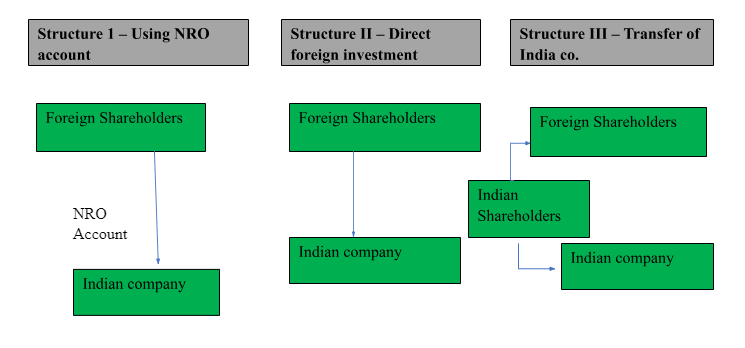
Pre-Incorporation Requirements for WOS in India
Before incorporating a wholly owned subsidiary in India, foreign companies must meet minimum statutory requirements under the Companies Act, 2013. These conditions are straightforward and designed to facilitate faster market entry.
Directors
To set up a wholly owned subsidiary in India, the following director requirements apply:
- Minimum 2 directors are mandatory
- At least 1 director must be an Indian resident
- Resident = stayed in India for ≥182 days in the previous calendar year
- Foreign nationals, NRIs, and PIOs are permitted to act as directors
- Directors must obtain DIN and Class-3 DSC
Shareholders
Shareholding requirements for registering a wholly owned subsidiary in India are minimal:
- Minimum 2 shareholders required at incorporation
- No residency restriction for shareholders
- Nominee shareholder permitted
- Used to satisfy the two-member requirement
- Nominee holds shares on behalf of the parent company
This structure enables 100% ownership by the foreign parent despite the two-shareholder rule.
Capital Requirements
- No minimum paid-up capital mandated
- As per the Companies (Amendment) Act, 2015
- The Articles of Association (AOA) may prescribe the initial share capital
- Capital can be infused later via:
- Direct FDI
- Rights issue
- Additional share allotment
Documents Required for Incorporation of a Wholly Owned Subsidiary in India
For setting up a wholly owned subsidiary in India, accurate documentation is critical. All foreign documents must be notarized and apostilled (or consularised, where applicable) before submission to the Ministry of Corporate Affairs (MCA).
Foreign Parent Company Documents
Mandatory documents from the foreign holding entity for incorporation of a wholly owned subsidiary in India:
- Board Resolution (apostilled)
- Approving incorporation of the Indian WOS
- Authorising a representative/signatory
- Memorandum & Articles of Association (MOA & AOA) of the parent company (apostilled)
- Certificate of Incorporation / Registration of the foreign company
- Trademark Registration Certificate (apostilled, if Indian entity uses parent’s brand name)
- No Objection Certificate (NOC) for use of parent company’s name in India
Director & Shareholder Documents
Required for all proposed directors and shareholders when registering a wholly owned subsidiary in India:
- Passport (mandatory for foreign nationals)
- Address proof (not older than 2 months)
- Utility bill / bank statement / government-issued ID
- Class-3 DSC application details
- Indian mobile number and valid email ID (mandatory for DSC and MCA filings)
Indian Registered Office Documents
Proof of registered office address in India is mandatory at incorporation or within statutory timelines:
- Lease deed / rent agreement or ownership documents
- Utility bill (electricity / water / gas)
- Must be ≤ 2 months old
- NOC from property owner (if premises are rented)
Step-by-Step Process: Incorporation of a Wholly Owned Subsidiary in India
Foreign companies setting up a wholly owned subsidiary in India must follow a streamlined, MCA-driven process under the Companies Act, 2013. The entire incorporation of a wholly owned subsidiary in India is executed digitally through the SPICe+ (Simplified Proforma for Incorporating Company Electronically Plus) framework.
Step 1: Obtain Digital Signature Certificate (DSC)
- Class-3 Digital Signature Certificate (DSC) is mandatory
- Required for all proposed directors and authorised signatories
- Documents typically include:
- Passport (mandatory for foreign nationals)
- Address proof (not older than 2 months)
- Email ID and Indian mobile number (mandatory for OTP-based verification)
- Photograph
DSC enables secure and authenticated filing of incorporation and compliance forms on the MCA portal.
Step 2: Name Reservation via SPICe+ Part A
- Application submitted through SPICe+ Part A on the MCA portal
- Two proposed names can be submitted per application
- Name may be:
- Same as foreign parent company, or
- A variation with “India” / “Private Limited” suffix
Validity of Approved Name
- Initial validity: 20 days
- Extendable up to 60 days with additional fees
Supporting documents (apostilled) may include:
- Parent company resolution
- NOC for name usage
- Trademark certificate (if applicable)
Step 3: Filing SPICe+ Part B & C (Integrated Incorporation)
This is the core incorporation stage for setting up a wholly owned subsidiary in India. SPICe+ Part B & C is a single consolidated application covering corporate, tax, and statutory registrations.
Inclusions Under SPICe+ Part B & C
Corporate Registrations
- Company incorporation under Companies Act, 2013
- DIN allotment for first-time directors
- Issuance of Certificate of Incorporation
Tax Registrations
- Permanent Account Number (PAN)
- Tax Deduction & Collection Account Number (TAN)
Operational Registrations
- GST registration (optional, based on business model)
- Bank account opening through MCA-integrated banks
- EPFO registration (mandatory once employee threshold is met)
- ESIC registration (mandatory once salary threshold applies)
Key Attachments
- Memorandum of Association (MOA)
- Articles of Association (AOA)
- Subscriber declarations
- Proof of registered office
- Apostilled foreign documents
Estimated timeline: 7–10 working days
This integrated filing significantly reduces setup time and compliance burden.
Step 4: Certificate of Incorporation & CIN Allotment
Once the Registrar of Companies (RoC) verifies the application:
- Certificate of Incorporation (COI) is issued
- Corporate Identification Number (CIN) is allotted
- PAN and TAN are generated simultaneously
Legal Effect
- The company becomes a separate legal entity from the date mentioned on the COI
- Eligible to:
- Open operational bank accounts
- Receive foreign investment
- Enter into contracts
- Hire employees
Post-Incorporation Compliance for WOS in India
After incorporation of a wholly owned subsidiary in India, strict post-registration compliances apply under the Companies Act, 2013, FEMA, and RBI regulations. Timely compliance is critical to avoid penalties, restriction on business commencement, and regulatory scrutiny.
Mandatory Compliance Timeline
| Compliance | Statutory Time Limit |
| First Board Meeting | Within 30 days of incorporation |
| Appointment of First Auditor | Within 30 days of incorporation |
| INC-20A (Commencement of Business) | Within 180 days of incorporation |
| Issue of Share Certificates | Within 60 days of incorporation |
Key Execution Notes
- Business operations cannot commence until INC-20A is filed
- Subscription money must be deposited before filing INC-20A
- Auditor holds office until the first Annual General Meeting (AGM)
Statutory & Operational Requirements
To remain compliant after setting up a wholly owned subsidiary in India, the following ongoing obligations apply:
- Name board display
Company name, registered office address, CIN, contact details, and GST number (if applicable) must be displayed at every place of business. - Statutory registers
Mandatory registers include:- Register of members
- Register of directors & KMP
- Register of charges
- Share transfer records
- Electronic maintenance of registers is legally permitted.
- Business licences & registrations
Depending on operations:- GST registration
- Importer Exporter Code (IEC)
- Shops & Establishment Act licence
- Professional Tax (PT)
RBI & FEMA Compliance for Wholly Owned Subsidiary in India
Foreign capital infusion into a WOS is governed by FEMA and RBI reporting norms. Non-compliance can attract monetary penalties and compounding proceedings.
What Qualifies as Foreign Direct Investment (FDI)
- Any capital contribution from a non-resident into the Indian company’s share capital
- Includes equity shares, compulsorily convertible instruments, and additional infusions
Mandatory RBI Compliance Workflow
- Foreign Inward Remittance Certificate (FIRC)
Issued by the Indian bank receiving foreign funds - KYC from Remitter Bank
Confirms identity of foreign investor - Allotment of shares
Must be completed after receipt of funds - Form FC-GPR filing
- Mandatory within 30 days of share allotment
- Filed through the authorised dealer (AD) bank
FC-TRS for Share Transfers
- Applicable when:
- Shares are transferred from resident to non-resident, or vice versa
- Valuation report required
- Filing responsibility lies with:
- Buyer or seller (as per transaction type)
Compliance Risk Insight
For foreign companies, delays in FC-GPR or FC-TRS filings are among the most penalised FEMA violations. Proper sequencing of remittance → allotment → reporting is essential after registering a wholly owned subsidiary in India.
Taxation of Wholly Owned Subsidiary in India
A wholly owned subsidiary in India is taxed as a domestic company, making it significantly more tax-efficient than branch or liaison offices. Understanding corporate tax, MAT, and incentives is critical when setting up a wholly owned subsidiary in India.
Corporate Income Tax
- Standard corporate tax rate:
22% + surcharge & cess = 25.17%
(Applicable if the company opts for Section 115BAA) - Foreign company tax (specific incomes):
40% on royalty, technical services, and certain other incomes
This lower domestic rate is a key reason foreign entities prefer incorporation of a wholly owned subsidiary in India over branch offices.
Other Applicable Taxes
- Minimum Alternate Tax (MAT):
15% on book profits
Applicable if the company does not opt for concessional tax regimes - Surcharge on income tax:
- INR 1–10 crore: 2%
- Above INR 10 crore: 5%
- Health & Education Cess:
4% on income tax plus surcharge
Tax Incentives for Wholly Owned Subsidiaries
Foreign companies incorporating a wholly owned subsidiary in India may benefit from:
- Presumptive taxation exemptions
Available to specific sectors such as shipping, air transport, oil exploration, and turnkey construction - Amortisation of startup & expansion costs
Eligible expenses can be amortised over five years - Dividend tax relief
Dividends received from foreign subsidiaries where shareholding is 26% or more are taxed at a reduced 15% rate, improving group-level tax efficiency
Ongoing Compliance & Governance Requirements
After registering a wholly owned subsidiary in India, continuous governance compliance is mandatory to remain legally active.
Annual & Periodic Compliance Checklist
- Minimum 4 board meetings per year
Maximum gap between meetings: 120 days - Annual General Meeting (AGM)
Mandatory once every financial year - Statutory audit
Conducted by a practising Chartered Accountant - Books of accounts (Section 128)
Must present a true and fair view of financial position - Annual ROC filings
Includes financial statements and annual return - SEBI & FEMA reporting
Applicable if listed securities, foreign investment, or cross-border transactions are involved
Benefits of a Wholly Owned Subsidiary in India
Foreign companies setting up a wholly owned subsidiary in India gain strategic, legal, and financial advantages that are not available through branch or liaison office structures. This is why incorporation of a wholly owned subsidiary in India remains the most scalable and risk-efficient entry model.
Strategic & Operational Advantages
- Full managerial control
The parent company owns 100% shareholding, enabling complete control over operations, policies, and governance. - Faster decision-making
No minority shareholders → quicker approvals, streamlined execution, and agile business expansion. - Brand continuity & global goodwill
A WOS can operate under the parent company’s name, leveraging existing brand value and international reputation. - Local market credibility
Indian customers, regulators, and partners show higher trust in Indian-incorporated entities compared to foreign branches.
Legal & Risk Advantages
- Separate legal entity
A WOS is distinct from the parent company under the Companies Act, 2013. - Limited liability protection
Parent company’s exposure is limited to its capital investment. - Asset ring-fencing
Indian operational risks, litigation, and liabilities remain confined to the subsidiary.
Financial & Tax Advantages
- Profit repatriation (structure-dependent)
Profits and dividends are freely repatriable under the direct FDI route, subject to applicable taxes. - Consolidated tax planning
Losses and profits can be aligned with global tax strategies for efficiency. - R&D deductions & amortisation benefits
Eligible startup, expansion, and R&D expenses can be amortised over five years under Indian tax laws. - MAT exemptions for certain sectors
Companies under presumptive taxation (shipping, air transport, oil exploration, turnkey projects) are exempt from Minimum Alternate Tax (MAT), which otherwise applies at 15% of book profits.
Timeline for Setting Up a Wholly Owned Subsidiary in India
Foreign companies planning setting up a wholly owned subsidiary in India typically complete the process within 3–5 weeks, provided documentation and apostilles are prepared in advance.
Estimated Timeline Breakdown
| Activity | Estimated Time |
| Document preparation & apostille | 7–10 days |
| Name approval (SPICe+ Part A) | 2–5 days |
| Incorporation (SPICe+ Part B & C) | 7–10 days |
| RBI filings (FDI-related) | Parallel |
| Total time to set up a WOS in India | 3–5 weeks |
Delays typically arise due to incomplete documentation or apostille requirements for foreign documents.
Challenges in Starting a Wholly Owned Subsidiary(WOS) in India
Despite a streamlined process, incorporating a wholly owned subsidiary in India presents practical challenges for foreign entities.
Key Risks & Mitigation Measures
- Regulatory complexity
Mitigation: Engage India-focused legal and compliance experts early. - Apostille delays
Mitigation: Initiate apostille of parent company documents before name reservation. - RBI & FEMA compliance risks
Mitigation: Follow strict sequencing—remittance → allotment → FC-GPR/FC-TRS filing. - State-wise labour law variations
Mitigation: Assess local Shops Act, PT, and labour requirements at the registered office location. - Infrastructure & cost challenges
Mitigation: Use serviced offices or EOR partners during the initial phase.
Setting up a wholly owned subsidiary in India is a legally robust, tax-efficient, and operationally flexible option for foreign companies seeking long-term presence, revenue generation, and full control under Indian law. With simplified incorporation, competitive corporate tax rates (effective 25.17%), and clear FEMA/RBI pathways, a WOS is preferable to a branch office for scalable operations and to an EOR for businesses moving beyond pilot hiring into IP ownership, contracting, and market expansion. Strategically, a WOS suits companies entering a growth or scale phase, while EOR fits early testing and branches suit limited, non-revenue activities making the WOS the optimal choice for sustained India-focused growth.
]]>Overview of India’s Business Environment
In 2026, India presents a highly dynamic and lucrative business environment for foreign companies. With a rapidly growing economy, diverse consumer base, and increasing digital infrastructure, the country is one of the top destinations for international business expansion. Here are some key factors driving Foreign Company Registration in India:
- Market Size: India is the world’s 5th largest economy, with a population of over 1.4 billion people. This provides a vast consumer base for businesses to tap into.
- Growth Rate: India’s GDP growth rate has consistently outpaced many developed nations, with projections indicating growth of around 7% annually, making it one of the fastest-growing major economies.
- High-Potential Sectors: Several industries in India present high growth potential, including:
- Automotive: India is the 4th largest automotive market globally, with a significant shift towards electric vehicles (EVs) and smart technologies.
- Technology: The tech sector is booming, with India being a global hub for software development, AI, fintech, and digital transformation.
- Services: The service sector, including IT, business process outsourcing (BPO), and consulting, is one of the largest contributors to India’s GDP.
- Retail & E-commerce: With an expanding middle class and a young, tech-savvy population, India’s retail and e-commerce markets are experiencing rapid growth.
Why Foreign Companies Should Register in India
Advantages of Setting Up a Business in India
India has rapidly positioned itself as one of the most attractive global destinations for foreign companies. From a vast consumer base to favorable government policies, there are numerous strategic advantages to setting up operations in India.
This section outlines the most compelling business, legal, financial, and talent-based benefits of foreign company registration in India.
Key Benefits of Registering a Foreign Company in India
| Benefit | Why It Matters |
|---|---|
| 1. Access to a Large Consumer Market | India has a population of over 1.4 billion, with a growing middle class of 400+ million and increasing urbanization. Businesses can tap into rising disposable incomes, a young population (average age 28), and demand for premium and tech-driven products. |
| 2. Legal Recognition & Business Credibility | Registration under the Companies Act, 2013 offers legitimacy. This builds trust with Indian customers, banks, investors, and regulators. |
| 3. 100% FDI-Friendly Policies | India permits 100% Foreign Direct Investment in most sectors (e.g., IT, manufacturing, retail) under the automatic route, minimizing red tape. |
| 4. Skilled Workforce at Competitive Costs | India provides access to a large, English-speaking talent pool. Roles in tech, finance, healthcare, and R&D are globally competitive. For instance, average software developer salaries in India are significantly lower than in the US or Europe, without compromising on skill. |
| 5. Tax Incentives for Foreign Businesses | – Eligible startups can benefit from 3-year tax holidays under the Startup India scheme. – Businesses in Special Economic Zones (SEZs) enjoy corporate tax exemptions and faster clearances. |
| 6. Strategic Location & Market Access | India serves as a gateway to South Asia, offering logistical advantages for companies targeting Asian, Middle Eastern, and African markets. |
| 7. Strong Legal and IP Protection | Indian laws safeguard intellectual property rights (IPR) and provide legal recourse for contract enforcement, essential for international operations. |
| 8. Access to Government Incentives | Initiatives like Make in India, Digital India, and PLI Schemes (Production Linked Incentives) support manufacturing, electronics, pharma, and other sectors. |
| 9. Banking & Financial Access | Registration enables opening of Indian bank accounts, access to INR-denominated transactions, and easier compliance with foreign exchange rules (FEMA, RBI). |
| 10. Favorable Tax Treaties | India has Double Taxation Avoidance Agreements (DTAA) with over 90 countries, reducing tax burden on cross-border income and dividends. |
Ideal for These Foreign Business Types
- Tech companies looking to establish development centers or offshore teams
- Manufacturing units wanting to tap into Make in India incentives
- E-commerce brands aiming to reach Indian consumers
- Consulting, financial, and legal firms expanding into South Asia
- Joint venture or B2B businesses partnering with Indian companies
What Is a Foreign Company Under the Companies Act, 2013?
Definition:
As per Section 2(42) of the Companies Act, 2013, a foreign company is defined as:
“Any company or body corporate incorporated outside India which—
(a) has a place of business in India whether by itself or through an agent, physically or through electronic mode; and
(b) conducts any business activity in India in any other manner.”
Key Statutory Criteria for Foreign Business Recognition
| Criteria | Explanation |
|---|---|
| Incorporated outside India | Must be legally registered in a country other than India |
| Has a place of business in India | Can be physical (e.g. office, branch) or virtual (e.g. website, online platform) |
| Engages in business in India | Includes sales, services, consultancy, project execution, or any business activity |
Understanding the Types of Foreign Company Registrations in India
India offers several options for foreign companies to establish their presence, each with distinct advantages and requirements. Below is a breakdown of the most common types of foreign company registrations in India, including their eligibility, registration process, and the pros and cons of each.
1. Wholly-Owned Subsidiary (WOS) Setup in India
Definition and Process
A Wholly-Owned Subsidiary (WOS) is an Indian company where 100% of the shares are owned by a foreign parent company. This structure gives foreign investors full control over the operations and direction of the business in India.
Process:
- Choose a company name and get approval from the Ministry of Corporate Affairs (MCA).
- Obtain Director Identification Numbers (DIN) for directors and Digital Signature Certificates (DSC).
- Prepare the Memorandum of Association (MOA) and Articles of Association (AOA).
- Submit the incorporation application through SPICe+ form and get the Certificate of Incorporation.
- Obtain PAN and TAN for tax purposes.
Eligibility and FDI Compliance
- Foreign Direct Investment (FDI) is allowed up to 100% under the automatic route in many sectors.
- The foreign parent company should ensure that the business activities comply with FEMA (Foreign Exchange Management Act).
Advantages
- Full Control: The foreign parent company has complete authority over decision-making, ensuring alignment with global business strategies.
- Legal Entity Status: The subsidiary is a separate legal entity, providing protection from the parent company’s liabilities.
- The Employee Linked Incentive (ELI) Scheme, benefits businesses setting up a wholly-owned subsidiary (WOS) in India by providing incentives for generating employment from August 1, 2025, to July 31, 2027
Disadvantages
- Complex Documentation: Extensive paperwork and compliance with Indian regulations like FEMA and FDI policies.
- Requirements of appointing a nominee as a shareholder.
- More Compliance: Requires maintaining regular filings, audits, and tax returns.
2. Joint Venture (JV)
Overview and Process
A Joint Venture (JV) is a business partnership between a foreign company and an Indian entity. The JV operates under a detailed agreement outlining capital contributions, profit-sharing, and management structure.
Process:
- Identify a local partner with complementary strengths.
- Draft and negotiate the Joint Venture Agreement (JVA).
- Choose the legal structure: Private Limited Company, LLP, or Partnership.
- Register with the Registrar of Companies (RoC).
- Apply for PAN, TAN, and GST registration.
Local Partnerships and Shared Risks
The local partner brings market knowledge, established networks, and an understanding of regulatory compliance. Shared risks and responsibilities help mitigate the challenges of entering a foreign market.
Advantages
- Access to Local Expertise: Leverage the local partner’s knowledge of the Indian market, legal environment, and consumer behavior.
- Market Reach: Gain access to established distribution channels, customer bases, and regional networks.
Disadvantages
- Potential Conflicts: Disagreements on management, strategy, or profit-sharing can disrupt operations.
- Imbalance in Resources: Unequal contributions from partners can lead to operational inefficiencies.
3. Liaison Office
Purpose and Restrictions
A Liaison Office (LO) acts as a representative office for a foreign company in India. It is meant to conduct non-commercial activities such as promoting business, collecting information, and coordinating communication between the parent company and local stakeholders.
Restrictions:
- Non-commercial Activities Only: Cannot engage in direct revenue-generating activities, sign contracts, or deal with goods.
Eligibility: Profit Track Record, Minimum Net Worth
- The foreign parent must have a profit-making track record for the past three years.
- A minimum net worth of USD 50,000 is required to establish a liaison office.
Registration Process and RBI Approval
- Apply to the Reserve Bank of India (RBI) through an authorized dealer bank.
- Submit documents, including the audited financials of the parent company and the intended scope of operations in India.
- Obtain an RBI UIN and register with the MCA.
Advantages
- Low-Cost Entry: Setting up a liaison office is more cost-effective than setting up a subsidiary or branch office.
- Minimal Compliance: Simplified regulatory requirements compared to other entity types.
Disadvantages
- No Revenue Generation: The office cannot engage in profit-making activities or sign contracts.
- Limited Scope: It serves only as a point of communication and coordination, limiting business expansion.
4. Branch Office
Definition and Permitted Activities
A Branch Office is an extension of the foreign parent company that can carry out business activities like market research, consultancy, sales, and acting as an agent for the parent company. It is not allowed to engage in manufacturing or retail trading.
Permitted Activities:
- Represent the parent company’s business in India.
- Provide consultancy and research services.
- Engage in wholesale trading and export-import activities.
Eligibility: Profit Record and Net Worth Requirements
- The parent company must have a profit-making record for the last five years.
- Net worth of at least USD 100,000 is required.
Process and Requirements
- Submit an application to the RBI via an authorized dealer bank.
- Provide necessary documents, including the Certificate of Incorporation, MoA, Board Resolution, and KYC of directors.
- Register with MCA, obtain PAN and TAN, and comply with GST if applicable.
Advantages
- Direct Business Operations: A branch office allows the foreign company to run operations in India under the same business identity.
- Brand Presence: Establishes the parent company’s brand directly in India, improving visibility.
Disadvantages
- Tax Rate: Branch offices are subject to corporate tax of 35%, which is higher than for subsidiaries.
- Activity Restrictions: Cannot engage in manufacturing or retail activities without additional approvals.
5. Project Office
Temporary Setup for Specific Projects (Construction, Infrastructure, etc.)
A Project Office is a temporary setup established by foreign companies to execute specific projects such as construction, infrastructure, and research-based projects in India.
Eligibility:
- The foreign company must have a contract with an Indian company or financial institution.
- The project must be funded through inward remittances or multilateral funding.
Advantages
- Quick Setup: Ideal for executing time-bound projects, facilitating faster entry into the market.
- Cost-Effective: The project office structure is more affordable for short-term operations compared to a subsidiary.
Disadvantages
- Limited to Project Activities: The office can only conduct operations related to the specific project and must cease operations once the project is completed.
- Requires Closure: After the project ends, the office must be closed, and any funds or assets must be repatriated.
Entry Options for Foreign Companies in India
Foreign companies looking to establish a presence in India can choose from several legal and operational entry routes based on their business goals, capital commitment, and operational control. Below is a comprehensive comparison of the most common entry modes available for foreign entities.
| Entry Route / Type | Eligibility | Permitted Activities | Key Approvals & Conditions | Advantages | Major Limitations / Disadvantages |
|---|---|---|---|---|---|
| Wholly Owned Subsidiary (WOS) | 100% FDI compliance; minimum two directors | Any permitted commercial activity (manufacturing, trading, IT, services, etc.) | Registrar of Companies (ROC) registration under Companies Act, 2013; FDI allowed in most sectors under automatic route | Full control, separate legal entity, tax benefits, easier repatriation of profits | Complex documentation and higher compliance burden under Companies Act and FEMA |
| Joint Venture (JV) | Local Indian partner required | Activities depend on JV terms; suitable for sector-specific or local market expertise | ROC registration; government approval if FDI is in a restricted sector; governed by JV Agreement | Access to local market, shared risks and expertise | Shared ownership may cause conflicts or slow decision-making; imbalance in resource contribution |
| Branch Office (BO) | Profit track record; net worth ≥ USD 100,000 | Import/export, consultancy, professional services, research, IT support, etc. | Prior approval from RBI via Authorized Dealer (AD) Bank | Direct business operations in India, established brand presence | Cannot manufacture or retail; income taxable at ~40%; activity-specific restrictions |
| Liaison Office (LO) | Profit track record; net worth ≥ USD 50,000 | Non-income generating activities — promotion, communication channel, brand building, market research | Prior approval from RBI via AD Bank; profitability track record of 3 years | Low-cost entry, simple setup, minimal compliance | Cannot generate revenue, sign contracts, or undertake commercial operations |
| Project Office (PO) | Valid project contract from Indian company or funded by inward remittance | Execution of a specific project in India | RBI approval not required if funded by inward remittance or bilateral funding; otherwise, approval needed | Quick setup, cost-effective for short-term projects | Limited to project duration; cannot perform unrelated activities; requires closure after project completion |
MCA Portal Registration: Creating a Business User Account
Before initiating the incorporation process for a foreign company in India, it is mandatory to register on the Ministry of Corporate Affairs (MCA) portal. This registration allows you to access digital forms, upload documents, and digitally sign and track company filings.
![Foreign Company Registration in India - Complete Guide [2026] - Treelife](https://cdn.treelife.in/2025/10/image-3-1024x470.png "Foreign Company Registration in India - Complete Guide [2026]")
This is a crucial pre-filing step for all foreign promoters, directors, and authorized representatives.
Why Register on the MCA Portal?
- Required to access and submit incorporation forms like SPICe+, RUN, Form FC-1, etc.
- Enables Digital Signature Certificate (DSC) integration and form validation
- Ensures authenticated user login and document traceability
- Allows real-time tracking of application status and post-registration filings
Step-by-Step: How to Create an MCA Business User Account
| Step | Action | Details |
|---|---|---|
| 1 | Go to MCA Portal | Visit www.mca.gov.in |
| 2 | Click on “Register” | Located at the top-right of the homepage |
| 3 | Choose User Category | Select ‘Business User’ (NOT registered user) |
| 4 | Enter User Details | – Full Name (as per passport) – Date of Birth – Email ID – Mobile Number – PAN (if Indian) |
| 5 | Provide Role Type | Select from: • Director • Authorized Representative • Manager/Secretary • Practicing Professional (for consultants) |
| 6 | Upload ID Proof | Foreign directors must upload notarized & apostilled passport copy |
| 7 | Create Login Credentials | Choose username, password, and security questions |
| 8 | Submit and Activate | Verify via OTP (for Indian numbers) or email confirmation for foreign users |
Who Should Register as a Business User?
- Foreign Directors planning to hold office in the Indian company
- Authorized Representatives of foreign parent companies
- Chartered Accountants / Company Secretaries managing the incorporation process
- Indian Directors who will digitally sign and submit forms
Step-by-Step Guide to Registering a Foreign Company in India
Registering a foreign business in India can be a lucrative opportunity, but the process requires careful planning and adherence to legal and regulatory requirements. This step-by-step guide outlines the essential procedures for registering a foreign company in India. From selecting the right business structure to post-incorporation compliance, each step is designed to ensure a smooth and compliant entry into the Indian market.
Step 1: Choose the Right Business Structure
Choosing the right structure is crucial to ensure that your foreign business aligns with your operational goals and compliance needs. There are several types of foreign business entities you can register in India:
- Wholly-Owned Subsidiary (WOS): A WOS allows a foreign parent company to have full control over operations and decision-making in India.
- Joint Venture (JV): A JV is a partnership between a foreign company and an Indian entity, sharing risks and resources.
- Branch Office: A branch office acts as an extension of the parent company and is suitable for non-manufacturing activities like research, consultancy, and sales.
Comparison of Business Structures
| Factor | Wholly-Owned Subsidiary (WOS) | Joint Venture (JV) | Branch Office |
| Complexity | Moderate | High | Low |
| Control | Full control | Shared control | Full control by parent |
| Funding | Self-funded or through FDI | Joint capital funding | Funded by parent company |
| Regulatory Requirements | High | Moderate | Moderate |
Decision Matrix:
If your goal is full control and you have the necessary capital, a WOS is the best choice. If you want to share risks and leverage local expertise, a JV is ideal. For lower complexity and direct operations, a branch office can be a suitable option.
Step 2: Document Requirements for Foreign Entity Registration in India
Proper documentation is critical to ensure a smooth registration process. Here are the key documents required:
Key Documents
- Certificate of Incorporation from the parent company.
- MOA (Memorandum of Association) and AOA (Articles of Association) outlining the business’s objectives and rules.
- Board Resolution authorizing the incorporation of the business in India.
- Proof of Registered Office in India (lease/rental agreement or utility bill).
- KYC Documents for all directors (passport, identity proof, address proof).
Additional Documents for Specific Structures
- Joint Venture Agreement for Joint Ventures, specifying capital contributions, profit sharing, and management responsibilities.
- Project Contract for Project Offices, outlining the details of the specific project and funding arrangements.
Legalization and Notarization
- Apostille or Notarization: Documents executed abroad must be notarized or apostilled to confirm authenticity.
- Translation: Non-English documents must be translated and certified by an advocate or a competent authority.
Step 3: Apply for Digital Signature and Director Identification Number (DIN)
Digital Signature Certificate (DSC)
- A Digital Signature Certificate (DSC) is mandatory for online filings with the Ministry of Corporate Affairs (MCA).
- It is required to sign the incorporation documents and other forms electronically.
Director Identification Number (DIN)
- Each director must have a DIN, which is a unique identification number issued by the MCA.
- It is necessary for all individuals serving as directors in the company.
Step 4: Name Reservation and Approval
Choosing a Company Name
- The company name must be unique and in line with the MCA’s naming guidelines.
- Avoid using names that are identical or similar to existing businesses or trademarks.
Name Approval Process
- Submit the name for approval through SPICe+ (Simplified Proforma for Incorporating Company Electronically) on the MCA portal.
- The approval process typically takes 2-4 working days.
Step 5: Incorporation Application and Filing
SPICe+ Form Filing
- Once the name is approved, you need to file the SPICe+ form with the Registrar of Companies (RoC) for company incorporation.
- Attach the required documents, including MOA, AOA, proof of address, and director KYC.
Filing Fee Structure
| Authorized Capital | Fee |
| Up to Rs 50 Lakh | Rs 5,000 |
| Rs 50 Lakh – Rs 5 Crore | Rs 50,000 |
| Above Rs 5 Crore | Rs 1 Lakh |
Estimated Time:
- The filing and verification process generally takes 10-15 days.
Step 6: Obtain Certificate of Incorporation (COI), PAN, and TAN
Certificate of Incorporation (COI)
- The COI signifies that the company has been legally incorporated. It is issued by the Registrar of Companies (RoC).
PAN (Permanent Account Number)
- A PAN is required for tax purposes and to file income tax returns.
TAN (Tax Deduction and Collection Account Number)
- A TAN is needed for tax deduction at source (TDS) when making payments like salaries, rent, etc.
GST Registration
- If your company deals with goods or services above the turnover threshold, it is mandatory to get GST registration.
Step 7: Post-Incorporation Compliance
After your company is officially incorporated, there are several compliance requirements to follow:
Bank Account Setup
- Open a corporate bank account in India with all necessary KYC documents from directors and shareholders.
F-GPR Filings
- FC-GPR filing is a mandatory Indian regulatory submission for companies that receive Foreign Direct Investment (FDI) by issuing shares to foreign investors, using the RBI’s FIRMS (Foreign Investment Reporting and Management System) portal to report details of share allotment within 30 days of issuance.
Filing Annual Returns
- File the first annual return within 60 days from the end of the financial year.
Tax Filing and Audits
- Ensure that you file annual tax returns, maintain proper financial statements, and conduct statutory audits.
Post-Incorporation Compliance Checklist
| Requirement | Timeline | Remarks |
| Bank Account Setup | Immediately post-COI | KYC documentation required |
| First Annual Return | 60 days from FY-end | File with MCA |
| Income Tax Filing | Annually | Comply with Indian tax law |
We help with Foreign Company Registration in India Let’s Talk
Pre-Incorporation Requirements for Foreign Company Registration in India
Before initiating the registration of a foreign company in India whether as a Wholly Owned Subsidiary, Joint Venture, or foreign office there are several legal, logistical, and compliance prerequisites to fulfill. These ensure your application meets the Companies Act, FEMA, and RBI standards from the outset.
Pre-Incorporation Checklist for Foreign Companies
| Requirement | Details |
|---|---|
| Minimum Capital | – No statutory minimum capital for Private Limited Companies. – FDI-linked capital thresholds apply in regulated sectors (e.g., banking, NBFCs, telecom). – For example, NBFCs require a minimum net owned fund of ₹2 crore (~USD 250,000). |
| RBI Approval (When Required) | – Needed only if the business falls outside the automatic FDI route. – Mandatory for setting up Branch, Liaison, or Project Offices. – Processed via an Authorized Dealer (AD) Bank under FEMA guidelines. |
| Detailed Business Plan | – Required to support FDI applications, structure selection, and internal compliance. – Should include: business model, Indian market focus, funding route, legal structure (WOS/JV/BO), and projected revenues/expenses. |
| Registered Office Address in India | – A physical Indian address is mandatory for ROC filings and communication. – Submit address proof (e.g., lease agreement, utility bill) at the time of incorporation. |
| Indian Resident Director | – At least one director must be a resident of India (≥182 days in previous year), per Section 149(3) of the Companies Act, 2013. – Applies to Private Limited and Public Companies. |
| Digital Signature Certificate (DSC) | – Required to e-sign incorporation forms. – Must be obtained from a licensed Indian Certifying Authority. – Foreign directors are eligible post identity verification. |
| Director Identification Number (DIN) | – DIN is mandatory for each director. – Can be applied for using the SPICe+ incorporation form. |
| Name Reservation | – File SPICe+ Part A via the MCA portal for name approval. – Proposed name must comply with Companies (Incorporation) Rules and reflect the business activity. |
| Documentation Compilation | – Notarized & apostilled/attested documents required for: • Foreign directors’ identity/address proof • Charter documents of foreign parent company • Board resolution approving Indian investment • Proof of Indian office address |
Documents Required from Foreign Directors & Shareholders
| Document | For | Authentication Required |
|---|---|---|
| Passport (Mandatory ID Proof) | All foreign directors | Notarized + Apostilled / Consular Attested |
| Proof of Address (bank statement, utility bill) | Residential verification | Notarized + Apostilled / Attested |
| Photograph | MCA filings | Plain JPEG |
| DSC (Digital Signature Certificate) | E-filing on MCA portal | Must be issued by Indian DSC provider after identity verification |
| DIN (Director Identification Number) | All directors | Applied during SPICe+ form submission |
| Board Resolution (for nominee directors) | Authorizing director to act on behalf of foreign company | On official letterhead; notarized and certified |
| PAN Card (for Indian directors) | Tax identity | Mandatory; must be valid and linked with Aadhaar |
| Corporate Shareholder Documents (if applicable) | When parent company holds shares | – Certificate of Incorporation – MOA & AOA – Board Resolution for investment – KYC of Authorized Signatory All documents notarized + apostilled or consular attested |
RBI Approval Quick Reference
| Structure | Is RBI Approval Required? | Notes |
|---|---|---|
| Wholly Owned Subsidiary (WOS) | Not required if sector is under automatic route | FDI filing still required after incorporation |
| Joint Venture (JV) | Not required for automatic route sectors | JV agreement must be submitted |
| Branch Office | Yes | Must show profitability & net worth criteria |
| Liaison Office | Yes | Cannot generate income in India |
| Project Office | Conditional | Approval not needed if funded via inward remittance or Indian bank loan |
Legal Framework Governing Foreign Company Registration in India
If you’re planning to register a foreign company in India, it’s essential to understand the legal ecosystem that governs the process. Several Indian laws and regulatory guidelines apply, ensuring that foreign entities operate in a transparent and compliant manner.
Key Legal Acts and Guidelines You Must Know
| Legal Framework | What It Governs | Applicability to Foreign Companies |
|---|---|---|
| Companies Act, 2013 | Corporate registration, structure, governance | Defines “foreign company” (Section 2(42)), registration procedures (Chapter XXII), and ongoing compliance for foreign companies operating in India |
| Companies (Registration of Foreign Companies) Rules, 2014 | Filing processes, documents, timelines | Lays down procedural rules for registering a foreign company under the Companies Act, including formats like Form FC-1, FC-2, and FC-3 |
| Foreign Exchange Management Act (FEMA), 1999 | Cross-border capital flow and foreign investments | Regulates foreign direct investment (FDI), repatriation of profits, and ensures currency transaction compliance through RBI mandates |
| Reserve Bank of India (RBI) Guidelines | Entry route approvals and sectoral caps | Mandatory for setting up branch offices, liaison offices, and project offices in India. RBI approval is needed under certain conditions (e.g. sector restrictions, capital thresholds) |
| Income Tax Act, 1961 | Tax liabilities and transfer pricing | Determines how foreign companies are taxed in India, including permanent establishment (PE) rules, withholding tax, and TP documentation |
| Goods and Services Tax (GST) Act, 2017 | Indirect taxation | If a foreign company supplies goods/services in India, GST registration and compliance may be mandatory |
Which Authority Does What?
| Authority | Role in Foreign Company Setup |
|---|---|
| Ministry of Corporate Affairs (MCA) | Company registration, digital filings, ongoing corporate compliance |
| Reserve Bank of India (RBI) | Approval for setting up liaison, branch, or project offices; FDI regulations |
| Department for Promotion of Industry and Internal Trade (DPIIT) | FDI policy formation and sector-specific rules |
| Authorized Dealer Banks | Act as intermediaries between foreign companies and RBI for approvals and filings |
| Income Tax Department | Direct tax compliance, PAN issuance, and tax deduction at source (TDS) administration |
| Goods and Services Tax (GST) Authorities | GST registration and compliance for foreign suppliers and Indian branches |
Post-Incorporation Compliance Checklist for Foreign Companies in India
Receiving your Certificate of Incorporation (COI) is a major milestone but it’s not the end. Foreign companies must complete several critical regulatory and operational steps to legally begin business in India and stay compliant with Indian laws.
Key Post-Incorporation Steps (Required for All Entities)
| Compliance Task | Description | Responsible Authority |
|---|---|---|
| 1. Open an Indian Corporate Bank Account | Required for capital infusion, vendor payments, and salary disbursal | RBI-regulated Indian banks |
| 2. Deposit Initial Capital | Share capital must be deposited by shareholders (including foreign) into the company bank account | Bank + Auditor Verification |
| 3. File Form INC-20A (Declaration of Commencement of Business) | Must be filed within 180 days of incorporation (for companies with share capital) | MCA (Ministry of Corporate Affairs) |
| 4. Apply for GST Registration (if applicable) | Required if turnover crosses threshold (₹40 lakh for goods / ₹20 lakh for services), or for e-commerce or inter-state transactions | GST Portal (CBIC) |
| 5. Register for Shops & Establishments Act | Mandatory in most states to operate a physical office and employ staff | State Labour Department |
| 6. ESIC and EPFO Registration | Mandatory if the company has 10+ (ESIC) or 20+ (EPF) employees | Ministry of Labour |
| 7. Issue Share Certificates to Subscribers | Must be issued within 60 days from the date of allotment | Board of Directors |
| 8. Maintain Statutory Registers & Minutes | Includes Registers of Members, Directors, Share Allotment, etc. | Internal corporate records (auditable) |
| 9. Appoint First Auditor | Required within 30 days of incorporation | Board of Directors / ROC |
| 10. Apply for Import Export Code (IEC) | Only if the company plans to import/export goods or services | DGFT (Directorate General of Foreign Trade) |
Bank Account Setup: Important Notes
- Foreign capital remitted to India must be reported to the RBI through the Authorized Dealer (AD) Bank
- The company must maintain proper FIRC (Foreign Inward Remittance Certificates) for compliance under FEMA
- KYC and board resolution must be submitted to the bank to activate the account
GST Registration: When Is It Required?
| Condition | Is GST Required? |
|---|---|
| Annual turnover exceeds ₹40 lakh (goods) / ₹20 lakh (services) | Yes |
| Business involves inter-state supply | Yes |
| Selling via e-commerce platforms | Yes |
| Providing online services to Indian consumers | Yes |
| Only dealing in exempted goods/services | Not required |
Voluntary registration is also allowed to claim input tax credits (ITC).
Compliance Timeline Overview
| Timeline | Action Required |
|---|---|
| Within 15–30 Days | Open bank account, appoint auditor |
| Within 60 Days | Issue share certificates |
| Within 180 Days | File Form INC-20A |
| Ongoing | Maintain registers, conduct board meetings, file annual returns, tax filings, etc. |
Estimated Timeline for Foreign Company Incorporation in India
Understanding the time involved in registering a foreign company in India helps plan operations, capital inflow, and market entry strategies. While the timeline may vary based on the type of entity (Wholly Owned Subsidiary, Branch Office, etc.) and quality of documentation, here’s what to expect under ideal conditions.
Average Timeline Under Ideal Conditions
| Stage | Process | Estimated Time |
|---|---|---|
| Step 1 | Document Collection & Authentication (apostille/attestation) | 3–7 working days (depends on country of origin) |
| Step 2 | Digital Signature Certificate (DSC) Application | 1–2 working days |
| Step 3 | Director Identification Number (DIN) Application via SPICe+ | Same day (via SPICe+ form) |
| Step 4 | MCA Name Reservation (SPICe+ Part A) | 1–2 working days |
| Step 5 | Filing Incorporation Forms (SPICe+ Part B, MOA, AOA, AGILE-Pro) | 1–2 working days |
| Step 6 | MCA Review & Certificate of Incorporation (COI) Issuance | 3–5 working days after submission |
| Step 7 | PAN, TAN, EPFO, ESIC, GSTIN Allotment (auto-generated) | 1–3 working days post COI |
Total Estimated Time: 10–15 working days (approximately 2–3 weeks), assuming all documents are in order and approvals are automatic.
Setting Up a Foreign Company Office in India (Branch, Liaison, or Project Office)
If you are a foreign company looking to establish a non-subsidiary presence in India, you can do so by opening a:
- Branch Office (BO)
- Liaison Office (LO)
- Project Office (PO)
Each structure allows for different levels of business engagement and comes with its own eligibility conditions and RBI/MCA compliance requirements.
Procedure to Set Up a Foreign Office in India (BO/LO/PO)
| Step | Action Required | Details |
|---|---|---|
| 1 | Determine Suitable Office Type | Choose between Branch, Liaison, or Project Office based on business intent |
| 2 | Obtain RBI Approval (if required) | Apply via an Authorized Dealer (AD) Bank using the FNC Form (Foreign Entity – New Connection) |
| 3 | Prepare Documents | – Board resolution – Certificate of incorporation – Company charter – Audited financials – Director passports – Authority letter |
| 4 | File Form FC-1 on MCA Portal | Once RBI approval is granted, file Form FC-1 (within 30 days) for Registrar of Companies (RoC) compliance |
| 5 | Set Up Indian Bank Account | Mandatory for operational and capital infusion purposes |
| 6 | Register for PAN, TAN, GST (if applicable) | Required for statutory and tax compliance |
Liaison Office (LO): Setup Criteria & Operational Restrictions
A Liaison Office, also called a Representative Office, is a non-income-generating setup used to build initial presence.
| Requirement | Details |
|---|---|
| Permitted Activities | – Brand promotion – Market research – Acting as communication channel – Liaising with Indian stakeholders |
| Eligibility Criteria | – Foreign parent company must have: • 3 years of profitability track record • Net worth ≥ USD 50,000 |
| Approval Authority | Reserve Bank of India (via AD Bank) |
| Taxability | No taxation as it cannot earn revenue |
| Restrictions | Cannot: • Sign commercial contracts • Raise invoices • Import/export • Earn income |
Any revenue-generating or contractual activities will result in regulatory non-compliance.
Branch Office (BO): Criteria & Permitted Business Activities
A Branch Office allows foreign companies to carry out limited commercial activities in India under RBI supervision.
| Requirement | Details |
|---|---|
| Permitted Activities | – Import/export of goods – Professional services – IT support – Research & development – Technical collaboration support – Acting as buying/selling agent for parent company |
| Eligibility Criteria | – Foreign parent company must have: • 5 years of profitable operations • Net worth ≥ USD 100,000 |
| Approval Authority | Reserve Bank of India (via AD Bank) |
| Taxability | Yes, as per Indian corporate tax laws |
| Restrictions | Cannot: • Manufacture goods directly • Retail products to Indian consumers |
Branch offices are ideal for companies wanting partial commercial engagement without full incorporation.
Project Office (PO): Criteria for Setup Without RBI Approval
A Project Office is a temporary establishment set up to execute a specific contract or project in India.
| Requirement | Details |
|---|---|
| When RBI Approval Is NOT Needed | If the project is funded by: • Inward remittance from abroad • Indian company or entity • Multilateral/bilateral international funding agencies • Loan from Indian bank or public financial institution |
| Permitted Activities | – Execute the specific project only |
| Restrictions | Cannot engage in unrelated commercial activity |
| Taxability | Subject to tax on income generated through project execution |
POs are ideal for EPC contractors, infrastructure firms, and short-term foreign engagement.
Summary Table: Foreign Office Options in India
| Office Type | Income Allowed? | RBI Approval Required? | Key Conditions |
|---|---|---|---|
| Liaison Office | No | Yes | 3-year profit + USD 50K net worth |
| Branch Office | Yes (restricted) | Yes | 5-year profit + USD 100K net worth |
| Project Office | Yes (project-specific) | No (subject to funding source) | Linked to specific contract |
FDI Reporting and FEMA Compliance After Incorporation
Once a foreign company is incorporated in India either as a Wholly Owned Subsidiary, Joint Venture, or via capital infusion it must report foreign direct investment (FDI) to the Reserve Bank of India (RBI) under the Foreign Exchange Management Act (FEMA), 1999.
This ensures transparency of cross-border investments and compliance with India’s foreign exchange laws.
Why FDI Reporting Is Mandatory
- RBI tracks all capital inflows into Indian entities from foreign sources.
- Failure to report FDI in time may attract penalties under FEMA, including compounding fines.
- Timely filing builds credibility with regulators and banks and is essential for repatriation of dividends, future funding, and statutory audits.
FDI Reporting Requirements After Incorporation
| Step | Action | Time Limit | Filing Mode |
|---|---|---|---|
| 1 | Receipt of foreign share capital into Indian bank account | Immediate (within incorporation phase) | Via FIRC (issued by AD Bank) |
| 2 | File Advance Remittance Form (ARF) | Within 30 days of receiving inward remittance | RBI’s FIRMS Portal (https://firms.rbi.org.in) |
| 3 | Allot shares to foreign investors | Within 60 days of receiving funds | Company records & board resolution |
| 4 | File Form FC-GPR (Foreign Currency-Gross Provisional Return) | Within 30 days of share allotment | FIRMS Portal – RBI |
| 5 | Annual Return on Foreign Liabilities and Assets (FLA) | Every year by 15th July | RBI FLAIR Portal (https://flair.rbi.org.in) |
Note: All filings must be digitally signed by an authorized representative of the company.
Required Documents for FC-GPR Filing
- Board resolution for allotment of shares
- Certificate of incorporation & MOA
- KYC report of foreign investor (from remitting bank)
- FIRC (Foreign Inward Remittance Certificate)
- CS/CA certificate confirming compliance with FDI norms
- Share valuation certificate (if applicable)
FEMA Penalties for Non-Compliance
| Violation | Possible Consequences |
|---|---|
| Late or non-filing of FC-GPR/ARF | Penalty up to 3x the amount involved or ₹2 lakh + ₹5,000/day |
| Misreporting of investment details | Regulatory scrutiny, restrictions on future capital infusion |
| No share allotment within 60 days | Capital must be refunded to foreign investor within 15 days or attract penal interest |
Compounding of offences may be required to regularize the non-compliance.
Common Challenges for Foreign Companies in India and How to Overcome Them
Expanding into India offers vast opportunities, but foreign companies often face several regulatory, cultural, and compliance-related challenges. Understanding these in advance helps ensure a smooth market entry and long-term success.
1. Regulatory and Legal Complexities
India’s legal and business framework can appear intricate to newcomers.
- FEMA and FDI Compliance: The Foreign Exchange Management Act (FEMA) regulates foreign investment, capital repatriation, and cross-border transactions. In addition, Foreign Direct Investment (FDI) policies vary by sector, with some industries requiring prior government approval.
- Approval Processes: Certain restricted sectors mandate clearances from ministries or the Reserve Bank of India (RBI), making it essential to understand sector-specific FDI caps and procedures.
- How to Overcome: Collaborate with experienced local legal and compliance advisors who specialize in FEMA and FDI regulations. Use digital filing platforms and subscribe to government updates (DPIIT, RBI, MCA) to stay compliant and avoid delays.
2. Cultural and Business Environment Differences
India’s business culture blends tradition and modernity, which can be unfamiliar to foreign entities.
- Cultural Nuances: Business relationships in India are often built on trust, patience, and personal rapport. Decision-making can be hierarchical, and negotiations may take time.
- Regional Diversity: Each region has unique customs, languages, and consumer behaviors, requiring localized business strategies.
- How to Overcome: Invest in cross-cultural training and hire local leadership to bridge communication gaps. Building long-term partnerships and demonstrating cultural respect enhance credibility and negotiation outcomes.
3. Taxation and Compliance Challenges
India’s multi-layered tax system requires careful attention to ensure full compliance.
- GST and Corporate Tax: The Goods and Services Tax (GST) framework involves multiple tax slabs, while foreign companies are subject to a corporate tax rate of 40%.
- Transfer Pricing & Reporting: Complex transfer pricing rules, audit requirements, and annual filings under the Companies Act demand accuracy and timely execution.
- How to Overcome: Engage a local tax advisory or VCFO partner to handle filings, automate returns using digital compliance tools, and schedule regular reviews to prevent penalties.
Despite the challenges, India remains a top destination for foreign business due to its strong legal framework and pro-business reforms. The government’s push for ‘ease of doing business’, combined with competitive tax rates, a vast consumer market, and a skilled workforce, offers a solid foundation for international expansion. By proactively addressing potential hurdles and leveraging local expertise, foreign companies can tap into India’s immense growth opportunities and build a sustainable and profitable presence. India is not just an emerging market; it’s a long-term strategic partner for global growth.
We help navigate foreign company incorporation compliances. Let’s Talk
India has recently undertaken a significant reform in its succession framework by removing the requirement of compulsory probate rule for certain categories of wills. Previously, in metropolitan jurisdictions such as Mumbai, Kolkata, and Chennai, beneficiaries could not legally act upon a will unless it was first validated by a court through probate a procedure that was frequently time-consuming, expensive, and procedurally intensive. Pursuant to the Repealing and Amending Act, 2025, which amends the Indian Succession Act, 1925, this mandatory requirement has been dispensed with. As a result, a validly executed will may now be implemented without prior court confirmation, while probate continues to remain available as a voluntary protective mechanism in cases involving heightened risk, uncertainty, or potential disputes. In effect, the reform simplifies and accelerates inheritance for families and businesses, places greater emphasis on accurate will-drafting and documentation, and enables courts to concentrate judicial resources on matters that genuinely require adjudication.
India’s Succession Law Reform under the Repealing and Amending Act, 2025
India’s succession law framework has undergone a structural reset with the formal notification of the Repealing and Amending Act, 2025 in December 2025. The most consequential outcome of this legislation is the complete omission of Section 213 of the Indian Succession Act, 1925, which for nearly a century imposed a mandatory probate requirement on wills executed by certain communities in the former Presidency Towns of Mumbai, Kolkata, and Chennai.
This reform dismantles a long-criticised geographical and religious anomaly, replacing a court-mandated gatekeeping regime with a choice-based, risk-calibrated succession framework. Probate has not been abolished. Instead, it has transitioned from a compulsory procedural hurdle into a strategic legal instrument, to be deployed selectively where estate complexity, dispute risk, or asset value demands judicial certainty.
For founders, family offices, high-net-worth individuals (HNIs), banks, housing societies, trustees, and corporate stakeholders, this change materially alters:
- estate administration timelines and costs
- institutional compliance models
- litigation risk allocation
- succession planning strategies
- property and securities transmission workflows
In parallel, financial-market reforms such as SEBI’s Transmission to Legal Heirs (TLH) reporting code (effective January 2026) indicate a coordinated regulatory shift toward trust-based, friction-reduced asset transmission.
This merged report-blog provides a complete legal, operational, and strategic analysis of the reform, supported by legislative history, case law evolution, quantitative impact assessment, stakeholder-specific implications, global comparisons, and a practitioner-ready playbook.
1. What Is Probate and Why It Historically Mattered in India
Probate is a judicial certification of a will that confirms:
- the authenticity of the will, and
- the authority of the executor to administer the estate
Once granted, probate operates as a judgment in rem, conclusively binding on the world at large.
The pre-2025 mandatory probate regime
Before the 2025 reform:
- Section 213 of the Indian Succession Act, 1925 created a statutory bar: no right under a will could be enforced in court without probate or letters of administration.
- This mandate applied only in the former Presidency Towns:
- Mumbai (Bombay)
- Kolkata (Calcutta)
- Chennai (Madras)
- It applied selectively to Hindus, Sikhs, Jains, Buddhists, and Parsis, while Muslims and residents of cities such as Delhi or Bengaluru were exempt.
Practical consequences of mandatory probate
- High Court filings even for uncontested estates
- Ad-valorem court fees
- Procedural hearings and public notices
- Typical timelines of 2–5 years in complex cases
- Costs that often exceeded the value of modest estates
2. The 2025 Succession Law Reform: What Changed
Core legislative action – Omission of Section 213, Indian Succession Act, 1925
The Second Schedule of the Repealing and Amending Act, 2025 explicitly directs that “Section 213 of the Indian Succession Act, 1925 shall be omitted.”
This removes the condition precedent that previously treated wills in Presidency Towns as legally “suspect” unless judicially validated.
Consequential statutory amendments
To prevent interpretational gaps, Parliament simultaneously amended:
- Section 3(1) – removing references to Section 213 from state-exemption powers
- Section 370(1) and (2) – expanding access to Succession Certificates for debts and securities
- Retained Section 212 (intestacy) and Section 273 (conclusive nature of probate)
What remains unchanged
- Probate continues to exist
- Courts retain probate jurisdiction
- Probate still delivers the highest level of legal certainty
The reform does not weaken probate; it repositions it.
3. Why This Reform Matters: Ending a Colonial Anomaly
The mandatory probate rule originated in late-19th-century colonial administration. Its survival into modern India created formal inequality across geography and religion.
Before vs After (Structural Comparison)
| Dimension | Pre-2025 | Post-2025 |
| Geography | Mandatory in 3 cities | Optional nationwide |
| Religion | Selective communities | Uniform application |
| Institutional practice | Probate-driven | Risk-based discretion |
| Cost & time | High, court-centric | Reduced, flexible |
| Citizen autonomy | Limited | Restored |
By removing mandatory probate, the reform restores testamentary autonomy, reduces scope for procedural abuse, and aligns succession law with contemporary ease-of-living objectives.
4. Legal Mechanics: How the Burden of Proof Has Shifted
From court-first to challenge-based scrutiny
Under the old regime, judicial scrutiny occurred upfront. Post-reform, scrutiny is deferred and triggered only if a dispute arises.
Interpretation risks
- Different institutions may evaluate the same will differently
- Mutation is not proof of title
- Revenue authorities conduct only summary inquiries
- Litigation risk now depends heavily on drafting quality and documentation
This makes preventive legal design more critical than ever.
5. Probate vs Succession Certificate: Practical Distinctions
| Factor | Probate | Succession Certificate |
| Purpose | Validates will & executor | Enables collection of debts/securities |
| Judicial depth | High | Summary |
| Typical duration | 6–18+ months | 2–4 months |
| Use case | High-value, complex, disputed estates | Financial assets |
| Legal conclusiveness | Judgment in rem | Limited |
Post-2025, Succession Certificates are now accessible in situations previously blocked by mandatory probate.
6. Quantitative Impact: Time, Cost, and Court Burden
| Metric | Earlier Regime | Post-Reform |
| Median estate settlement | 12–24 months | 2–8 months |
| Court hearings | Multiple | Only if disputed |
| High Court load | Heavy | Expected to decline |
7. Stakeholder-Wise Operational Impact
Banks and Financial Institutions
- Faster claim settlements
- Increased payout.
- Nominees remain trustees, not owners
- Likely adoption of valuation-based thresholds
- Indemnities and affidavits gain prominence
Housing Societies & Real Estate
- Bye-laws must be updated
- Reliance shifts to:
- registered wills
- indemnity bonds
- title search reports
- Buyers may still demand probate for “clean title”
Corporate Trustees & Family Offices
- Trusts remain superior for probate-free succession
- Voluntary probate recommended for:
- blended families
- estranged heirs
- large real-estate portfolios
Startups & Founders
- Share transmission under Companies Act, 2013 becomes faster
- SHAs must be reviewed to remove probate-contingent clauses
- Voting control during succession improves materially
8. Risk Scenarios and Decision Tree (2026)
High-risk scenarios (probate strongly advised)
- Handwritten or copy wills
- Exclusion of spouse/child
- Multiple wills or suspicious circumstances
- Large debts or ongoing litigation
Medium-risk scenarios
- High-value real estate
- Third-party executors
- Unequal distributions
Low-risk scenarios
- Registered wills
- Aligned nominations
- Amicable Class-I heirs
- Assets under ₹50 lakh
9. International Comparison: Where India Now Stands
The move toward optional probate aligns India with international trends where judicial intervention is reserved for higher-risk or high-value cases.
| Jurisdiction | Probate Trigger Mechanism | Strategic Parallel to India |
| United Kingdom | Determined by individual banks/institutions; typically £5k to £50k thresholds. | India’s banks are expected to adopt similar “risk-based” internal limits. |
| Singapore | Mandatory for most asset transfers; “Resealing” allowed for Commonwealth grants. | Singapore still maintains a robust mandatory regime, showing India is now “more liberal” than its neighbor. |
| United States (UPC) | Dual “Informal” and “Formal” tracks based on size and complexity ($25k threshold common). | India’s “optional probate” is akin to the UPC’s “Informal Probate” where the court role is minimal for uncontested estates. |
The US Massachusetts Uniform Probate Code (MAUPC) provides a glimpse into India’s future. In the US, “Voluntary Administration” is a simplified process for small estates with no real estate.
India has gone a step further by removing the mandatory requirement even for real estate in the Presidency Towns, effectively trusting the “Deed” unless challenged. India has effectively leapfrogged into a trust-first, court-last succession model.
10. Market Synergy: SEBI’s TLH Code (Effective Jan 2026)
The 2025 probate reform does not exist in a vacuum. It is supported by financial market reforms aimed at “Ease of Doing Investment”
- TLH = Transmission to Legal Heirs – Effective January 1, 2026, SEBI has introduced the “TLH” reporting code for market intermediaries (RTAs, DPs).
- Enables tax-neutral securities transfer – Previously, when a nominee transferred securities to a legal heir, it was sometimes wrongly taxed as a “transfer” (Capital Gains). The TLH code signals to the CBDT that the transaction is an exempt inheritance under Section 47(iii) of the Income Tax Act.
- Prevents misclassification as capital gains
- Complements probate reform by:
- clarifying who inherits
- simplifying how assets transfer
By first ensuring who should inherit through nomination reforms and now ensuring a tax-neutral, probate-free transfer path, the regulators are creating a “seamless loop” for financial assets.
11. Practitioner Playbook
Before death (testator)
- Drafting Quality: Ensure the will explicitly mentions Section 63 formalities. Since there is no automatic court audit, the “internal robustness” of the document is the only defense.
- Video Attestation: Record a video of the signing ceremony to prove “testamentary capacity” and “sound mind”.
- Registration: Although not mandatory, register the will at the Sub-Registrar’s office. This provides a “public record” that can satisfy housing societies even without probate.
- Nomination Audit: Ensure all financial nominees match the legatees in the will to minimize “Trustee vs. Owner” friction.
After death (executor/heirs)
- Succession Certificate Route: For debts/securities, evaluate if a Succession Certificate (now easier post-Section 370 update) is faster than a full probate.
- SEBI TLH Reporting: Ensure your DP uses the “TLH” code for share transfers to avoid capital gains tax demands.
- Property Mutation: Apply for mutation at the Municipal Corporation (e.g., KMC or MCGM) using an affidavit of “No Other Legal Heirs” and a copy of the will.
- Indemnity Strategy: Prepare standard indemnity bonds for banks and housing societies to offset their perceived risk of paying out without a court order.
12. Policy & Market Implications
- Judicial capacity unlocked for substantive adjudication:
By eliminating compulsory probate for uncontested wills, the High Courts of Mumbai, Kolkata, and Chennai are relieved of a significant volume of routine, procedural probate filings. Judicial time and institutional capacity can now be reallocated toward complex civil, commercial, insolvency, and constitutional matters that genuinely require adjudication. - Accelerated liquidity and operational continuity for families and enterprises:
Heirs and executors can access immovable property, bank deposits, securities, and business interests without prolonged court timelines. This materially improves cash flow availability for household needs, debt servicing, succession-driven business continuity, and founder-led enterprise stability. - Reduction in unclaimed and dormant financial assets:
Easier execution of valid wills reduces friction in succession, directly addressing the chronic accumulation of unclaimed balances held by banks, insurance companies, mutual funds, and depositories. Faster transmission of assets limits dormancy, improves capital circulation in the financial system, and reduces administrative and compliance burdens on financial institutions. - Greater emphasis on precision-driven estate planning:
With courts no longer functioning as an automatic validation layer, outcomes increasingly depend on the technical quality of will drafting, asset identification, nomination alignment, and record integrity. This is likely to drive higher demand for structured estate planning, particularly among founders, business families, and high-net-worth individuals. - Professional evolution from probate processing to succession strategy:
Legal and advisory services are shifting away from volume-driven probate filings toward integrated succession advisory. The focus moves to risk mitigation, dispute avoidance, instrument selection (wills, trusts, voluntary probate), intergenerational governance, and long-term ownership continuity for family enterprises and institutional wealth.
13. Strategic Conclusion
The scrapping of mandatory probate is not deregulation, it is re-regulation by design.
The law has reduced compulsion, but increased responsibility. Those who plan well gain speed and efficiency. Those who plan poorly face amplified litigation risk.
The scrapping of the mandatory probate rule is a victory for legal uniformity and administrative efficiency in India. However, as the “compulsion” of the law recedes, the “responsibility” of the individual increases. The 2025 reforms have handed the keys to estate administration back to the families, but they must now navigate the landscape without the automatic “certification” of the court.
Treelife is uniquely positioned to assist stakeholders in this transition. Our expertise in estate planning, corporate governance, and succession strategy ensures that your legacy is not only legally valid but operationally seamless.
- Legacy Audits: Is your 20-year-old will still the best way to protect your heirs under the new law?
- Institutional Liaising: We manage the “paperwork war” with banks and housing societies so you don’t have to.
- Strategic Succession: For founders and HNIs, we design trust structures that render probate questions entirely moot.
References & Sources:
All statutory analysis, data, frameworks, and conclusions above incorporate and rely upon Treelife’s internal report and the following publicly available sources:
- https://prsindia.org/files/bills_acts/bills_parliament/2025/Repealing_And_Amending_Bill,2025.pdf
- https://prsindia.org/files/bills_acts/acts_parliament/2025/The_Repealing_and_Amending_Act_2025.pdf
- https://economictimes.indiatimes.com/wealth/plan/probate-no-longer-mandatory-in-these-three-metros-what-repealing-section-213-means-for-wills-and-estates/articleshow/126309769.cms
- https://economictimes.indiatimes.com/wealth/legal/will/govt-scraps-mandatory-probate-of-wills-is-voluntary-probate-still-a-smart-move/articleshow/126137433.cms
- https://trilegal.com/knowledge_repository/trilegal-update-removal-of-the-mandatory-probate-requirement-under-the-indian-succession-act/
- https://www.khaitanco.com/thought-leadership/Probate-no-longer-mandatory-Impact-of-the-Repealing-and-Amending-Act-2025-on-Testamentary-Succession
- https://ssrana.in/articles/a-long-overdue-reform-repeal-of-section-213-of-the-indian-succession-act-1925/
- https://www.sebi.gov.in/legal/circulars/sep-2025/smooth-transmission-of-securities-from-nominee-to-legal-heir_77204.html
- https://www.taxmann.com/post/blog/sebi-introduces-tlh-reporting-code-for-transmission-of-securities
India has introduced a historic regulatory change with the new labour law in India 2025. For the first time since Independence, 29 separate labour legislations have been consolidated into four unified Labour Codes, transforming how organisations manage employment, wages, social security, and workplace safety.
This represents a paradigm shift from fragmented regulation to integrated compliance.
What Is the New Indian Labour Law 2025?
The new labour law framework operationalised on 21 November 2025 restructures India’s employment regulatory landscape by replacing legacy sector-specific statutes with four comprehensive labour codes:
| Labour Code | Year | Acts Merged | Key Outcomes |
|---|---|---|---|
| Code on Wages | 2019 | Payment of Wages Act, Minimum Wages Act, Payment of Bonus Act, Equal Remuneration Act | Universal wage definition, removal of sector-wise exemptions |
| Industrial Relations Code | 2020 | Trade Unions Act, Standing Orders Act, Industrial Disputes Act | Fixed-term employment formalised, retrenchment threshold raised 100→300 |
| Code on Social Security | 2020 | EPF Act, ESIC Act, Maternity Benefit Act, Gratuity Act & others | Social security extended to gig & platform workers |
| Occupational Safety, Health and Working Conditions (OSH) Code | 2020 | Factories Act, Contract Labour Act, Inter-State Migrant Workers Act | Unified PAN-India registration & licensing |
How the New Labour Law Differs from Earlier Legislation
1. Fixed-Term Employment Now Has Full Benefit Parity
Fixed-term workers are now legally recognised and must receive the same wages, allowances, and benefits as permanent staff. They also qualify for pro-rata gratuity after one year, lowering the previous five-year requirement.
2. Gig & Platform Workers Included Under Social Security
For the first time, gig and platform workers are eligible for life insurance, health insurance, accident cover, and maternity benefits.
Aggregators must contribute 1–2% of annual turnover (capped at 5% of payouts) to a Social Security Fund.
3. New Wage Definition – No More Allowance-Inflation Loophole
If allowances (HRA, conveyance, bonus, etc.) exceed 50% of CTC, the excess gets added back to wages for PF, ESIC, and gratuity calculations.
This prevents under-reporting of wages for statutory contributions.
4. Retrenchment Threshold Increased 100 → 300
Employers can restructure establishments up to 300 workers without prior government approval. But new obligations accompany this flexibility:
| New Mandatory Requirements | Applicability |
|---|---|
| Grievance Redressal Committee with gender diversity | 20+ employees |
| Standing Orders | 300+ employees |
| Worker Re-Skilling Fund (15-day wages per retrenched worker) | All establishments |
| Women allowed in night shifts with consent & safety provisions | All establishments |
5. Unified Registration and Licensing
Instead of multiple registrations under multiple acts, organisations now receive a single unified PAN-India licence within 60 days.
Offences are compoundable at 50–75% of maximum penalties, reducing litigation risk.
Impact of the New Labour Law 2025 on Employers
| Operational Area | Impact Summary |
|---|---|
| Workforce cost planning | Gratuity payable for fixed-term employees and recomputation of wage structure |
| HR documentation | Appointment letters mandatory for all categories of workers |
| Technology & payroll systems | Systems must support the 50% wage-definition rule |
| Compliance structure | Aggregator contribution + unified registration + grievance committees |
| Risk management | New penalties, but compounding reduces punitive exposure |
Priority Action Checklist for Employers in 2025
To remain compliant with the new labour law in India 2025, organisations should act immediately:
- Issue appointment letters to all categories of workers (including contract, gig and fixed-term).
- Audit wage structures to ensure excluded allowances do not artificially exceed 50%.
- Establish a Grievance Redressal Committee (20+ employees) with prescribed gender representation.
- Apply for unified PAN-India licence and registration within 60 days.
- Onboard all workers under PF, ESIC and statutory social security frameworks.
- Recompute gratuity eligibility for fixed-term workers with one-year tenure.
What Employers Should Monitor Next
State-specific notifications will define procedural details on:
- Working hours and weekly rest
- Trade union verification
- Inter-state migrant worker housing and allowances
- Leave matrix under OSH vs state laws
- Model Standing Orders formats
Early preparation reduces costs, disputes and audit complications.
Conclusion — Why the New Labour Law Matters
The new labour law 2025 is not just an HR update; it is a structural transformation of India’s employment ecosystem. By simplifying compliance, expanding social security, and modernising labour flexibility, the Codes aim to protect both workers and business continuity.
Adapting early will protect employers from penalties while creating a transparent, future-ready workforce framework.
What is a Contract of Indemnity?
A contract of indemnity is defined under Section 124 of the Indian Contract Act, 1872 as an agreement where one party promises to save the other from loss caused by the conduct of the promisor or any other person . In simple terms, it is a legal promise of protection against future losses, ensuring that the indemnified party does not bear the financial burden of risks beyond their control.
Key points:
- Parties involved: Indemnifier (promisor) and Indemnity-holder (promisee).
- Purpose: To safeguard against unanticipated financial losses .
- Scope: Covers losses arising from human conduct (Indian law) but in English law extends to accidents and unforeseen events .
Why is it Important?
Contracts of indemnity have become essential in modern commerce, insurance, and investment ecosystems:
- Businesses: Used in M&A agreements, vendor contracts, and joint ventures to allocate risks and reduce disputes.
- Insurers: The insurance industry (valued at ₹58 trillion in India, IRDAI 2024) relies on indemnity as its foundation, especially in general insurance like fire, marine, and health (excluding life insurance).
- Investors: Venture capital and private equity deals use indemnity clauses to protect against misrepresentations and hidden liabilities.
- Startups: Early-stage companies use indemnity in shareholder agreements, employment contracts, and fundraising documents to build investor trust while limiting founder liability.
What is a Contract of Indemnity? (Meaning & Definition)
Statutory Definition under Indian Law
As per Section 124 of the Indian Contract Act, 1872, a contract of indemnity is:
“A contract by which one party promises to save the other from loss caused to him by the conduct of the promisor himself, or by the conduct of any other person.”
Key takeaways:
- It is a bipartite contract between indemnifier (promisor) and indemnity-holder (promisee) .
- The liability of the indemnifier is primary and arises only when a loss occurs .
- Indian law recognizes only express contracts of indemnity, not implied ones .
Common Contexts Where Indemnity Applies
- Insurance Contracts (General Insurance)
- Fire, marine, motor, and health insurance are indemnity contracts.
- Notably, life insurance is excluded, as it deals with certainty of death and not pure loss .
- M&A and Commercial Transactions
- Indemnity clauses protect buyers/investors from misrepresentation, breach of warranties, or hidden liabilities.
- For instance, in private equity deals, indemnities often cover tax liabilities or undisclosed debts.
- Agency and Business Agreements
- Example: Principal indemnifying an agent for losses incurred while executing instructions.
- Basis: Section 222 of ICA also supplements indemnity principles in agency law.
Snapshot Table – Contextual Use
| Context | Example Use Case | Why It Matters |
| Insurance | Fire insurance covering factory loss | Protects insured from catastrophic risks |
| M&A Transactions | Buyer indemnified against tax claims | Allocates hidden risks fairly |
| Agency Relationship | Agent selling goods on behalf of principal | Ensures agent isn’t penalized for lawful acts |
| Commercial Contracts | Vendor/service indemnity clauses | Reduces disputes and ensures accountability |
The contract of indemnity under Indian law is a narrower statutory concept than under English law. While Indian law restricts indemnity to loss from human actions, English law extends it to accidents and unforeseen events, making it the backbone of insurance contracts.
Essential Elements of a Contract of Indemnity
A contract of indemnity under the Indian Contract Act, 1872 is a legally binding promise that transfers the risk of loss from one party to another. For such an agreement to be valid and enforceable, certain essential elements must be present. These elements ensure that the contract is not only legally sound but also capable of providing real protection in case of a loss.
Parties to the Contract
- Indemnifier (Promisor): The party who undertakes to compensate for the loss.
- Indemnified/Indemnity Holder (Promisee): The party who is protected under the contract and entitled to recover compensation.
Example: In an insurance policy, the insurance company acts as the indemnifier, while the policyholder is the indemnified.
Promise to Compensate
- The core of the contract is a clear and unequivocal promise by the indemnifier to make good the losses of the indemnified.
- This promise can be express (written contract, e.g., insurance policies) or, under English law, even implied from circumstances (e.g., agent-principal relationship).
- Under Indian law, only express indemnities are recognized.
Scope of Loss
- The loss must arise from an act or omission covered by the agreement.
- Indian law restricts indemnity to loss caused by human conduct (act of promisor or any other person) .
- English law is broader, extending indemnity to accidents, unforeseen events, and liabilities incurred without actual fault .
Illustrative Scope Table
| Jurisdiction | Scope of Loss Covered | Example |
| India (Sec. 124 ICA, 1872) | Loss caused by human acts (promisor or third parties) | Misrepresentation in business contracts |
| English Law | Human acts + accidents + unforeseen events | Fire accident destroying goods during transit |
Legality & Validity
Like any other contract, an indemnity must satisfy the general essentials of a valid contract under Sections 1–75 of the Indian Contract Act, 1872:
Checklist for a Valid Indemnity Contract
- Offer & Acceptance: Clear consent by both parties to the indemnity terms.
- Consideration: May include premiums (in insurance), payments, or reciprocal contractual promises.
- Free Consent: Parties must agree without coercion, undue influence, fraud, misrepresentation, or mistake.
- Lawful Object: The purpose of indemnity must not be illegal or against public policy.
Case Insight: In Gajanan Moreshwar v. Moreshwar Madan (1942), the Bombay High Court emphasized that indemnity contracts must operate within the framework of valid contract law and cannot be enforced if unlawful.
The essential elements of a contract of indemnity ensure it is not just a risk-allocation tool but also a legally enforceable instrument. By fulfilling these requirements, businesses, insurers, and investors can confidently rely on indemnity as a safeguard against financial losses.
Nature and Characteristics of a Contract of Indemnity
A contract of indemnity under the Indian Contract Act, 1872 is a special type of contract. Unlike a contract of guarantee, which is collateral in nature and involves three parties, indemnity is a bipartite arrangement with primary liability resting on the indemnifier.
Key Characteristics of a Contract of Indemnity
- Bipartite nature: Only two parties – the indemnifier and indemnified.
- Primary obligation: The indemnifier’s liability is original and not dependent on a third party’s default.
- Contingent contract: Enforceable only upon the occurrence of a specified loss.
- Risk-transfer mechanism: Designed to protect against financial harm from acts of promisor or third parties.
Commencement of Liability
A frequent question is: When does the indemnifier’s liability begin?
- Traditional Indian position (Sec. 124): Liability begins after the indemnified has actually suffered a loss.
- Judicial development: Courts recognized that this narrow interpretation defeats the purpose.
Case Reference – Gajanan Moreshwar v. Moreshwar Madan (AIR 1942 Bom 302):
The Bombay High Court held that indemnity must be effective when liability becomes absolute or imminent, not only after actual loss.
- Example: If a suit is filed against the indemnified, he can compel the indemnifier to step in before paying damages himself.
Rights of the Indemnity Holder (Section 125, ICA 1872)
The indemnity-holder (promisee) has clearly codified rights:
- Right to recover damages – All damages he is compelled to pay in a suit.
- Right to recover costs – Legal costs incurred in defending or bringing a suit, if:
- He acted prudently, and
- Did not contravene the promisor’s orders.
- Right to recover sums under compromise – Settlement amounts paid in good faith, provided the compromise was lawful and prudent.
Rights of Indemnity Holder under Section 125
| Right | Scope of Recovery | Example Case |
| Damages | Damages paid in suit | Gokuldas v. Gulab Rao (1926) |
| Costs | Reasonable litigation costs | Gopal Singh v. Bhawani Prasad (1888) |
| Compromise Sums | Payments made in lawful settlement | Osman Jamal & Sons v. Gopal Purshottam (1928) |
Duties and Rights of the Indemnifier
The indemnifier (promisor) carries key obligations but also enjoys rights once compensation is paid:
- Duty to compensate: Bound to indemnify for covered losses as per contract scope.
- Right to mitigation: May require the indemnified to act prudently and minimize avoidable losses.
- Right of subrogation: Once the indemnifier pays, he steps into the shoes of the indemnified and can recover from third parties responsible for the loss.
Case Reference – Jaswant Singh v. State of Bombay (14 Bom 299):
The court recognized indemnifier’s rights akin to a surety’s under Section 141, including the benefit of securities available against the principal wrongdoer.
The nature and characteristics of a contract of indemnity establish it as a risk-shield contract with primary liability on the indemnifier, judicially widened beyond Section 124 to ensure practical protection. Section 125 further secures the indemnity-holder’s rights, while duties of prudence and subrogation balance obligations between both parties.
Practical Examples of Indemnity Contracts
Indemnity contracts are not just theoretical concepts under the Indian Contract Act, 1872 – they are widely used across industries to allocate risks and protect parties from financial losses. Below are some real-world contexts where contracts of indemnity play a central role.
1. Insurance Contracts (Fire, Marine, Health)
- General insurance policies such as fire, marine, motor, and health insurance are classic examples of indemnity contracts.
- The insurer (indemnifier) promises to compensate the policyholder (indemnified) for losses suffered due to specified perils.
- Life insurance is excluded since it deals with certainty of death rather than indemnifying an uncertain financial loss.
Stat insight: As of 2024, India’s general insurance market crossed ₹3.3 trillion in gross direct premiums, with indemnity-based health insurance contributing over 35% to total non-life premiums (IRDAI data).
2. Business Agreements (M&A, Venture Capital, Founder Indemnities)
- Mergers & Acquisitions (M&A): Buyers often demand indemnity clauses to cover tax claims, pending litigation, or undisclosed liabilities.
- Venture Capital Deals: Investors require founders to indemnify against misrepresentations or regulatory non-compliance.
- Commercial service contracts: Vendors may indemnify clients against losses caused by negligence or breach of obligations.
Example: In a share purchase agreement, the seller indemnifies the buyer for any losses arising from breach of warranties, ensuring risk transfer post-closing.
3. Employment & Corporate Governance (D&O Indemnity)
- Companies frequently indemnify directors and officers (D&O) against legal claims arising in the course of performing their duties.
- This protection is crucial as directors may face personal liability for regulatory actions, shareholder suits, or compliance failures.
- Many Indian listed companies also purchase D&O insurance, an indemnity-based cover, to supplement contractual indemnities.
Fact check: Globally, over 90% of Fortune 500 companies carry D&O indemnity insurance; in India, uptake has accelerated post-2013 Companies Act, where directors can be held personally liable for statutory breaches.
Table: Types of Indemnity Contracts
| Type | Example | Legal Coverage |
| Insurance-based | Health, fire, marine insurance policies | Loss from specified covered events |
| Commercial transaction | Share purchase agreements, vendor contracts | Breach of warranty, negligence, misrepresentation |
| Corporate governance | Director & Officer (D&O) indemnity agreements | Liabilities of directors arising from regulatory or shareholder claims |
Contracts of indemnity act as the financial safety net across insurance, commerce, and corporate governance. Whether it’s protecting a family from hospital bills, an investor from hidden tax liabilities, or a director from personal lawsuits, indemnity ensures certainty in an uncertain world.
Difference Between Indemnity and Guarantee
Both contracts of indemnity and contracts of guarantee are recognized under the Indian Contract Act, 1872, but they serve different purposes and operate on distinct principles. Understanding the difference between these two is crucial for businesses, investors, and professionals dealing with commercial transactions, loans, and risk allocation.
Key Differences at a Glance
| Basis | Indemnity (Sec. 124–125, ICA 1872) | Guarantee (Sec. 126–129, ICA 1872) |
| Parties involved | 2 – Indemnifier & Indemnified | 3 – Creditor, Principal Debtor, Surety |
| Nature of liability | Primary – indemnifier directly liable once loss occurs | Secondary – surety liable only if principal debtor defaults |
| Objective | To protect against loss | To ensure performance of debt/obligation |
| Scope of liability | Covers compensation for actual loss | Covers payment upon default of principal debtor |
| Legal provision | Sections 124–125 of ICA, 1872 | Sections 126–129 of ICA, 1872 |
| Number of contracts | Only one contract between indemnifier & indemnified | Three contracts: (i) Creditor & Debtor, (ii) Creditor & Surety, (iii) Surety & Debtor |
| Example | Fire insurance covering factory damage | Bank guarantee for loan repayment |
Practical Understanding
- Indemnity is a risk-transfer mechanism: the indemnifier assumes direct responsibility for losses. Example: An insurer compensating for property damage.
- Guarantee is a credit-protection mechanism: the surety ensures the debtor fulfills obligations, stepping in only on default. Example: A guarantor paying the bank if the borrower defaults.
Case Law Insights
- Gajanan Moreshwar v. Moreshwar Madan (1942): clarified indemnity liability arises once loss is imminent.
- Bank of Bihar v. Damodar Prasad (1969): reinforced that a surety’s liability in a guarantee is immediate upon default, and the creditor is not obliged to first exhaust remedies against the debtor.
Contract of Guarantee: Meaning, Essentials, and Key Features
What is a Contract of Guarantee?
A Contract of Guarantee is a type of contract under the Indian Contract Act, 1872. It is an agreement where one party (the surety) promises to discharge the liability of a third party (the principal debtor) in case the debtor defaults in repaying the creditor.
In simple terms:
- Creditor – The person to whom the money is owed.
- Principal Debtor – The person who borrows money or incurs liability.
- Surety (Guarantor) – The person who assures the creditor that they will pay if the debtor fails.
This contract plays a vital role in loans, business financing, supply of goods on credit, and performance guarantees.
Essentials of a Valid Contract of Guarantee
For a guarantee to be legally enforceable, it must meet the following conditions:
- Agreement of Three Parties – There must be a creditor, a principal debtor, and a surety.
- Consideration – The guarantee must be supported by lawful consideration (e.g., loan given to debtor).
- Consent – Free consent of all three parties is required; coercion, fraud, or misrepresentation invalidates it.
- Written or Oral – It may be oral or written, though written contracts are preferred in practice.
- Lawful Object – The purpose of the contract must not be illegal or against public policy.
Types of Contract of Guarantee
- Specific Guarantee – Covers a single debt or transaction. Ends once the debt is repaid.
- Continuing Guarantee – Extends to a series of transactions or future debts. Can be revoked for future dealings.
- Conditional Guarantee – Becomes enforceable only upon the happening of a specified condition.
Rights of a Surety
A guarantor is not left without protection. The Indian Contract Act grants several rights, such as:
- Right to Indemnity – Surety can recover from the debtor any amount they pay to the creditor.
- Right of Subrogation – After paying the creditor, the surety steps into the shoes of the creditor and enjoys the same rights.
- Right to Benefit of Securities – If the creditor holds securities against the debtor, the surety is entitled to benefit from them.
Discharge of a Surety
A surety can be discharged (released) under certain situations:
- By revocation of the contract in case of a continuing guarantee.
- By variance in the contract terms without the surety’s consent.
- By release or discharge of the principal debtor by the creditor.
- By creditor’s act impairing surety’s rights (e.g., negligence in maintaining securities).
Contracts of guarantee are widely used in:
- Bank Loans – Personal or corporate guarantees required for repayment assurance.
- Trade Credit – Suppliers extending credit often demand a guarantee.
- Performance Contracts – Construction projects, government tenders, and service contracts often include performance guarantees.
Case Laws Shaping Contracts of Indemnity in India
Judicial interpretation has played a critical role in shaping how contracts of indemnity under the Indian Contract Act, 1872 are applied. While Section 124 defines indemnity, its scope and enforceability have been clarified through landmark judgments in India and influential English precedents.
Gajanan Moreshwar v. Moreshwar Madan (AIR 1942 Bom 302)
- Issue: Could the indemnified demand performance before actually paying damages?
- Court’s Ruling: The Bombay High Court held that indemnity would be meaningless if the indemnified had to first suffer an actual loss before enforcing it.
- Principle Laid Down:
- Liability of the indemnifier arises when the indemnified’s liability becomes absolute or imminent, not just after the loss has been discharged.
- Expanded the protective scope of indemnity in India, making it a practical risk-management tool.
Impact: This judgment aligned Indian law closer with English principles, ensuring indemnity contracts function effectively in commercial transactions.
Osman Jamal & Sons Ltd. v. Gopal Purshottam (AIR 1928 Cal 362)
- Issue: Whether costs incurred under a lawful settlement (compromise) are recoverable under indemnity.
- Court’s Ruling: The Calcutta High Court recognized that indemnity covers not just damages awarded by courts, but also reasonable compromise amounts, provided:
- The compromise was made prudently, and
- It was not contrary to law or promisor’s instructions.
- Principle Laid Down:
- Indemnity extends to compromise costs and settlements, strengthening Section 125 rights of the indemnity-holder.
Impact: Gave businesses flexibility to settle disputes without fear of losing indemnity coverage.
Key Takeaways from Case Law
| Case | Principle Established | Relevance Today |
| Gajanan Moreshwar (1942) | Liability arises when indemnified’s liability becomes absolute | Protects parties before actual payment |
| Osman Jamal (1928) | Costs under lawful compromises are indemnifiable | Encourages prudent settlements |
| Adamson v. Jarvis (1827, UK) | Indemnity may be express or implied | Influenced Indian courts’ liberal interpretation |
Modern Applications & Commercial Relevance of Indemnity
Contracts of indemnity have evolved beyond insurance to become a cornerstone of modern commercial agreements, especially in high-value transactions and cross-border deals. Their role in startups, venture capital (VC), M&A, and fintech contracts highlights how indemnity functions as a risk allocation and investor-protection tool.
Role in Startups, Venture Capital & Cross-Border Transactions
- Startups & VC Deals: Investors often demand indemnities to protect against:
- Misrepresentation of financials or compliance gaps.
- Undisclosed liabilities such as pending litigation or tax claims.
- Breach of founder warranties during fundraising.
- Cross-border deals: In cross-jurisdictional transactions, indemnities bridge differences in regulatory frameworks, providing certainty in enforcement.
- Fact check: A 2024 PwC report noted that over 70% of VC term sheets in India include specific indemnity clauses, reflecting heightened investor caution.
Indemnities in M&A Due Diligence & RWI Insurance
- M&A due diligence: Buyers rely on indemnity clauses to ensure sellers remain liable for:
- Historical tax exposures,
- Labour disputes, and
- Regulatory non-compliance.
- Representations & Warranties Insurance (RWI): Increasingly popular in India’s PE/VC space, RWI policies transfer indemnity risks to insurers.
- Example: In cross-border acquisitions, RWI provides comfort to foreign investors wary of Indian regulatory complexities.
- Market stat: Globally, the RWI insurance market has grown by 20% CAGR (2019–2024), with Asia-Pacific emerging as a key growth region (AON 2024).
Indemnity Clauses in Technology, Fintech & GIFT City IFSC
- Technology & SaaS contracts: Vendors indemnify clients for IP infringement, data breaches, and regulatory violations.
- Fintech agreements: Indemnities protect investors and partners from compliance risks under RBI and DPDP Act, 2023.
- GIFT City IFSC contracts: Cross-border contracts drafted under IFSCA regulations frequently include indemnity provisions for:
- Currency risk,
- Taxation disputes,
- Regulatory penalties.
Why it matters:
These indemnities enhance investor confidence in India’s global financial hub, GIFT IFSC, which saw $58+ billion in cumulative banking transactions by 2024 (IFSCA data).
Drafting Considerations for Indemnity Clauses
When drafting indemnity clauses, precision is critical to avoid disputes.
Scope of Indemnity
- Direct losses: Cover measurable financial damages.
- Consequential losses: Often negotiated, as they include indirect impacts like reputational harm or lost profits.
Caps, Baskets & Thresholds
- Cap: Maximum indemnity liability (e.g., 10–30% of deal value).
- Basket: Minimum aggregate claim amount before indemnity applies.
- Deductible vs. tipping basket: Determines whether claims below threshold are absorbed or trigger full liability.
Duration & Survival
- Indemnity obligations often survive beyond contract termination, typically 12–36 months post-closing in M&A deals.
Interaction with Limitation of Liability
- Clauses must clearly state whether indemnity is subject to or overrides general liability caps.
- Example: IP infringement indemnities in SaaS contracts are usually carved out of liability limits.
Indemnity Drafting Matrix
| Consideration | Best Practice | Commercial Impact |
| Scope of indemnity | Limit to direct losses unless negotiated | Avoids inflated claims |
| Cap on liability | 10–30% of contract/deal value | Balances fairness |
| Basket/threshold | ₹50 lakh–₹1 crore in mid-market deals | Filters trivial claims |
| Survival period | 12–36 months post-closing | Protects buyer long-term |
| Interaction with liability | Specify carve-outs (IP, fraud, regulatory) | Ensures enforceability |
Modern indemnity contracts are multi-sectoral tools protecting investors in startups, securing buyers in M&A, and shielding parties in fintech and GIFT City deals. Well-drafted clauses on scope, caps, survival, and liability carve-outs ensure enforceability and fairness, making indemnity one of the most powerful mechanisms in Indian and global commerce.
]]>In contract law, damages refer to the monetary compensation awarded to an aggrieved party when the other side breaches a contract. They ensure that the injured party is placed, as far as money can do, in the same position as if the contract had been performed.
Understanding the distinction between liquidated damages (pre-agreed sums written into contracts) and unliquidated damages (court-assessed compensation for actual loss) is critical. For businesses, it reduces financial risk and litigation costs. For lawyers, it frames negotiation and dispute strategy. For contracting parties, it determines whether compensation will be swift and certain or require proof of loss in court.
Did you know?
According to the FICCI Arbitration Study (2023), over 60% of construction disputes in India arise from damages claims linked to project delays or performance failures. This highlights why drafting and interpreting damages clauses correctly can directly impact dispute outcomes and financial exposure.
What Are Damages in Contract Law?
In simple terms, damages in contract law are the financial compensation awarded to a party who suffers a loss because the other party failed to honor their contractual obligations. They serve as a legal remedy that balances fairness: the injured party is restored to the position they would have been in had the contract been performed, while the defaulting party bears the financial consequence of their breach.
Definition under the Indian Contract Act, 1872
The Indian Contract Act codifies the rules on damages:
- Section 73: When a contract is broken, the party who suffers is entitled to compensation for losses that naturally arise from the breach or which the parties knew were likely at the time of entering into the contract. Losses that are remote or indirect are not recoverable.
- Section 74: If a contract specifies a sum payable on breach (liquidated damages), the aggrieved party can claim reasonable compensation not exceeding the pre-agreed amount. Courts will not enforce punitive or excessive sums.
Why Sections 73 & 74 Matter
- They form the statutory backbone for distinguishing unliquidated damages (court-determined) and liquidated damages (pre-agreed).
- They provide clarity to businesses and individuals on what kind of losses are legally compensable.
- They ensure damages are compensatory, not punitive, aligning Indian law with global contract law principles.
Quick Reference Table
| Provision | Covers | Key Rule |
| Section 73 | Unliquidated damages | Compensation for actual loss caused by breach; excludes remote/indirect loss |
| Section 74 | Liquidated damages | Enforces pre-agreed sum if reasonable; courts reduce excessive/penal sums |
What Are Liquidated Damages?
Definition
Liquidated damages are a pre-determined sum written into a contract, payable if one party breaches its obligations. Instead of leaving compensation to be decided later by a court, the parties agree upfront on the financial consequences of a breach.
This makes liquidated damages a powerful tool in contract drafting and dispute prevention.
Purpose of Liquidated Damages
The inclusion of a liquidated damages clause serves multiple objectives:
- Certainty – Both parties know in advance what the breach will cost.
- Risk Allocation – Financial risks are fairly distributed, especially in high-value projects.
- Efficiency – Avoids lengthy litigation over quantum of damages.
- Deterrence – Encourages timely and proper performance of contractual duties.
Practical Examples
Liquidated damages are common in construction, supply, and service contracts:
- Construction delays: A contractor agrees to pay ₹50,000 per day for each day of delay in completing a project.
- Supply contracts: A vendor pays a fixed penalty for late delivery of critical components.
- Software/IT projects: Fixed compensation for missing go-live deadlines.
According to the FICCI Arbitration Study (2023), delays and performance defaults account for over 60% of disputes in Indian construction projects, making liquidated damages clauses central to resolving claims quickly.
Statutory Position in India
Under Section 74 of the Indian Contract Act, 1872:
- Courts will enforce liquidated damages only if they represent a genuine pre-estimate of loss.
- If the stipulated amount is penal or excessive, courts may reduce it and award reasonable compensation instead.
- Key precedent: ONGC v. Saw Pipes Ltd. (2003) – the Supreme Court upheld liquidated damages where they were a fair and genuine estimate of probable loss.
Liquidated damages provide predictability and enforceability, but in India, they are never punitive. Courts act as gatekeepers to ensure parties only recover what is fair, not what is oppressive.
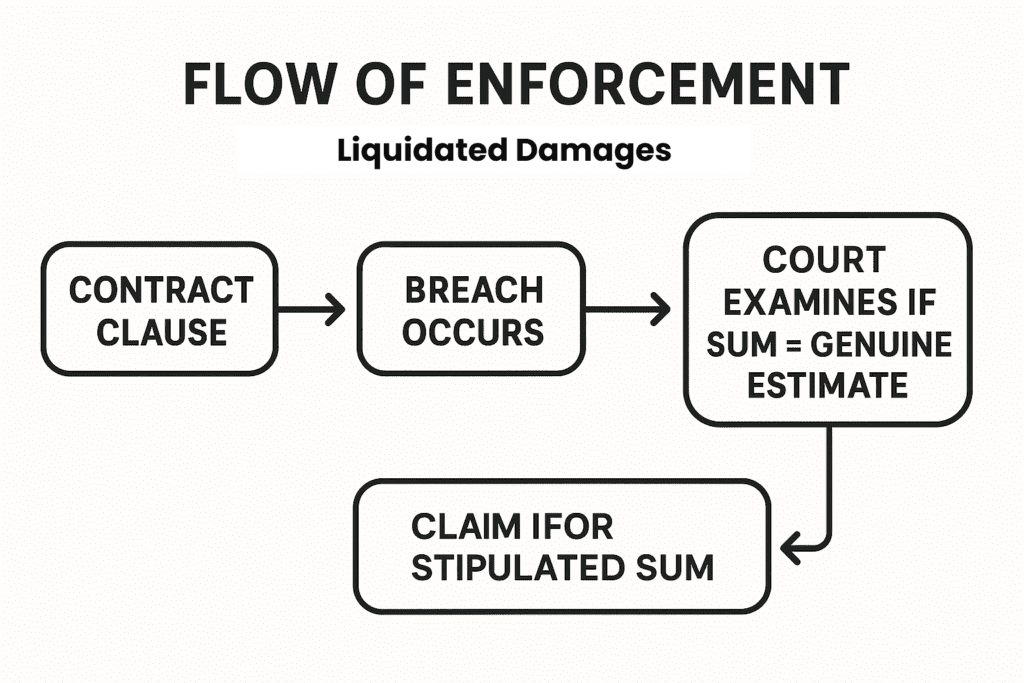
What Are Unliquidated Damages?
Definition
Unliquidated damages are damages not pre-decided in the contract. Instead, they are assessed by a court or arbitral tribunal after a breach occurs, based on the actual loss suffered. Unlike liquidated damages (where the amount is predetermined), unliquidated damages require the claimant to prove the extent of loss with evidence such as invoices, expert reports, or financial statements.
Purpose of Unliquidated Damages
The core purpose of unliquidated damages is flexibility:
- Covers unforeseen losses that were not, or could not be, predetermined when drafting the contract.
- Ensures fairness by compensating only the actual harm suffered.
- Protects claimants in complex situations where damages are uncertain or vary widely (e.g., reputational harm, loss of future profits).
This mechanism allows courts to tailor compensation to the specific facts of each dispute rather than relying on fixed formulas.
Practical Examples
Unliquidated damages commonly arise in disputes where losses are uncertain or variable:
- Professional negligence: A consultant gives faulty advice, causing financial loss to a business.
- Supply chain disruptions: A supplier’s failure to deliver raw materials forces a manufacturer to buy substitutes at a higher cost.
- Employment disputes: Wrongful termination leading to claims for lost salary and benefits.
- Service defaults: A software company’s system outage causes measurable business downtime and lost revenue.
In arbitration cases tracked by SCC Online (2019 study), nearly 40% of commercial disputes in India involve unliquidated damages, especially in supply chain and service contracts.
Case Law Spotlight
Union of India v. Raman Iron Foundry (1974):
The Supreme Court held that a claim for unliquidated damages does not become a debt until the court has determined the amount. This means that merely alleging breach is not enough—damages must be proven and quantified before they are recoverable.
Unliquidated damages ensure fair, evidence-based compensation where losses cannot be estimated in advance. They require proof, causation, and legal scrutiny, making them vital in disputes involving negligence, supply failures, or wrongful termination.
Key Differences Between Liquidated and Unliquidated Damages
Understanding the difference between liquidated damages and unliquidated damages is critical for anyone drafting, negotiating, or enforcing contracts. While both provide monetary relief for breach of contract, they operate very differently under the Indian Contract Act, 1872.
| Aspect | Liquidated Damages | Unliquidated Damages |
| Predetermined? | Yes – Fixed in the contract as a pre-agreed sum payable on breach | No – Assessed by court after breach, based on actual loss |
| Statutory Basis | Section 74 of the Contract Act | Section 73 of the Contract Act |
| Proof Required | Breach is assumed to cause loss, but party must show that some loss occurred | Actual loss must be proven through evidence (invoices, expert reports, financial records) |
| Purpose | Ensures certainty, efficiency, and faster enforcement | Provides fair compensation for unforeseen or hard-to-quantify losses |
| Flexibility | Low – Bound to contractual figure (subject to reasonableness test by courts) | High – Courts can tailor compensation to the facts of each dispute |
| Risk Allocation | Predominantly risk-shifting tool; loss is quantified upfront | Risk remains open; loss determined only after breach |
Why This Difference Matters
- For Businesses: A well-drafted liquidated damages clause minimizes disputes over calculation and gives financial predictability.
- For Lawyers: Choice of LD vs. ULD impacts litigation strategy, burden of proof, and settlement negotiations.
- For Courts: The distinction ensures that damages remain compensatory, not punitive, upholding fairness in commercial law.
Real-World Insight
According to FICCI Arbitration Study (2023), more than 60% of construction disputes in India involve damages claims for delays and performance defaults. Many of these disputes turn on whether a clause qualifies as liquidated damages or requires the court to award unliquidated damages.
Key Takeaway:
- Liquidated damages = Pre-decided certainty, governed by Section 74.
- Unliquidated damages = Court-decided fairness, governed by Section 73.
What are the Conditions to Claim Damages (Liquidated and Unliquidated)?
Not every contractual breach automatically entitles the aggrieved party to compensation. Courts and arbitral tribunals apply well-established legal tests to decide whether liquidated damages or unliquidated damages can be awarded. Meeting these conditions is critical to ensure enforceability.
1. Existence of a Valid Contract
- A legally enforceable agreement must exist with concluded terms.
- If terms are vague, incomplete, or not properly executed, claims for damages usually fail.
- Case reference: Vedanta Ltd. v. Emirates Trading Agency – the Supreme Court held that without a validly concluded contract, damages cannot be claimed.
2. Breach of Obligation
- The claimant must show that the other party failed to perform a contractual duty.
- Breach may be:
- Non-performance (e.g., failure to deliver goods).
- Defective performance (e.g., substandard construction work).
- Delay in performance (e.g., late completion of a project).
3. Proof of Causation
- There must be a direct link between the breach and the loss suffered.
- Courts use “common sense” and “dominant cause” tests to exclude remote or unrelated losses.
- Example: If a contractor delays a project, the employer can recover additional costs for substitute performance but not speculative losses like reputational harm.
4. Proof of Actual Loss (For Unliquidated Damages)
- Unliquidated damages require credible evidence of the loss:
- Financial records, invoices, or contracts for substitute performance.
- Expert testimony in cases of professional negligence.
- Audited accounts in claims involving loss of profit.
- Union of India v. Raman Iron Foundry: the Supreme Court held that unliquidated damages do not constitute a debt until the court determines liability and quantifies the loss.
5. Reasonableness (For Liquidated Damages)
- Under Section 74 of the Contract Act, even when a contract specifies a sum as liquidated damages, courts examine if it is a genuine pre-estimate of loss.
- If the amount is excessive or penal, it will be reduced to “reasonable compensation.”
- Key precedent: ONGC v. Saw Pipes Ltd. – liquidated damages clauses are enforceable if they represent a fair estimate of probable loss.
Checklist for Claimants
- Is there a valid and enforceable contract?
- Has a clear breach of obligation occurred?
- Can you demonstrate causation between breach and loss?
- Do you have documentary proof of actual loss (for unliquidated claims)?
- Is the claim amount fair and proportionate (for liquidated claims)?
Key Takeaway:
To succeed in claiming damages, parties must establish contract validity, breach, causation, quantifiable loss, and reasonableness. Without meeting these conditions, even strong claims risk rejection in court or arbitration.
How Are Liquidated Damages Calculated?
When a contract includes a liquidated damages clause, the calculation follows a structured approach. The goal is not punishment, but reasonable compensation for breach.
Step-by-Step Process
- Refer to the Clause in the Contract
- Identify the pre-agreed damages clause specifying compensation (e.g., per day of delay).
- Establish Breach
- Prove that the contractual obligation (e.g., delivery, performance, completion date) was breached.
- Demonstrate Loss (Though Not Exact)
- While exact quantification isn’t necessary, evidence that some loss occurred is required.
- Example: Additional costs, lost revenues, substitute performance expenses.
- Court Tests Reasonableness
- Under Section 74 of the Contract Act, courts enforce only reasonable compensation.
- Excessive or penal sums are reduced.
- Judicial Precedent
- ONGC v. Saw Pipes Ltd. (2003) – The Supreme Court upheld liquidated damages where they represented a genuine pre-estimate of loss, even if actual loss was difficult to quantify.
Example Calculation
- Clause: Contractor pays ₹50,000 per day of project delay.
- Breach: 10-day delay in completion.
- Claim: ₹50,000 × 10 = ₹5,00,000.
- Court Review: Award upheld if reasonable and reflective of probable loss.
Insight: In construction arbitration, daily LD clauses between 0.05%–0.1% of project value per day are common globally, ensuring proportionality.
How Are Unliquidated Damages Calculated?
Unlike liquidated damages, unliquidated damages are determined after breach, based on actual evidence of loss. Courts apply structured principles to avoid overcompensation.
Unliquidated Damages = Total Direct Loss – Mitigation + Expectation / Reliance Interest – Remote or Indirect Losses
Key Factors Considered
- Substitute Performance Costs
- If goods/services are not delivered, the injured party’s higher purchase costs are recoverable.
- Lost Profits
- Profits lost due to breach (e.g., buyer refuses contracted goods, seller loses resale margin).
- Costs to Remedy Defective Work
- Expenses to fix or replace faulty performance (e.g., repair defective construction).
- Interest on Delayed Payment
- Compensation for money withheld beyond due date.
Example Application
- The manufacturer fails to supply raw material.
- Buyer sources substitute at ₹12,00,000 (contract price = ₹10,00,000).
- Direct Loss = ₹2,00,000.
- Buyer also claims ₹50,000 for extra transport and ₹30,000 interest.
- Court awards ₹2,80,000, excluding remote claims like reputational harm.
Before You Draft: Foundational Questions
Ask yourself these before writing any LD clause:
- Is this loss foreseeable and quantifiable at contract signing? (If not, use unliquidated damages instead)
- Can I justify this amount as a genuine pre-estimate of loss, not a penalty? (Indian courts will scrutinize this under Section 74)
- Does the amount proportionally relate to the contract value? (E.g., daily LD in construction = 0.05% to 0.1% of project value)
- What specific breach am I protecting against? (Be precise: delays, non-performance, defects, late payment)
- Have I documented the commercial reasoning behind this figure? (Courts want to see you considered actual loss)
- Is this the sole remedy, or are other damages still available? (Clarify in the contract)
Red Flag: If you can’t explain why you chose this number, a court won’t enforce it.
Essential Elements of an Enforceable Liquidated Damages Clause
Your clause MUST include these components:
Clear Trigger Event
“Liquidated damages shall be payable by [Party] to [Other Party] upon:
(i) Failure to deliver goods by [Date], or
(ii) Defective performance as defined in Section [X], or
(iii) Breach of Clause [Y]”
Why: Vague triggers make the clause unenforceable. Be specific about what causes the breach.
Amount and Calculation Method
“Liquidated damages shall be Rs [Amount] per [day/unit/occurrence].
In case of cumulative breaches, the maximum liability shall not exceed Rs [Cap].”
Genuine Pre-Estimate Language
“The parties acknowledge that:
(a) Actual loss from this breach is difficult to quantify in advance,
(b) This amount represents a reasonable and genuine pre-estimate of probable loss, and
(c) This is agreed compensation, not a penalty.”
Why: Under Section 74 of the Indian Contract Act, courts enforce only amounts that are genuine pre-estimates. This language protects you.
Causation and Mitigation Clause
“Liquidated damages are payable on breach of [Obligation]. The non-breaching party
shall take reasonable steps to mitigate losses and shall not allow damages to accumulate
beyond what is necessary.”
Why: Indian law requires both parties to act reasonably. If you don’t mitigate, courts may reduce your claim.
Exclusivity Statement (if applicable)
“The parties agree that payment of liquidated damages shall be the sole and exclusive
remedy for [specific breach], and unliquidated damages shall not be claimed for this breach.”
Why: This prevents double recovery and makes enforcement simpler.
Enforceable Amounts in India: Practical Benchmarks
What Indian courts have upheld (based on Section 74 jurisprudence):
| Contract Type | Typical LD Rate | Example | Courts’ Position |
|---|---|---|---|
| Construction Delays | 0.05% to 0.1% of project value/day | Rs 50,000/day on Rs 10 crore project | Generally enforceable if genuine |
| Supply/Vendor Contracts | 1% to 2% of contract value/month | Rs 2,00,000 for delayed delivery | Enforceable if loss is quantifiable |
| Software/IT Projects | 0.5% to 1% of project value/week | Fixed penalty for missed go-live | Enforceable if time-critical |
| Service Defaults | 0.1% to 0.5% per day of outage | Rs 25,000/day for downtime | Depends on business impact proof |
| Late Payment | 12% to 18% per annum interest | Statutory interest + penalty | Enforceable under Interest Act |
Key Precedent: ONGC v. Saw Pipes Ltd. (2003) – Supreme Court upheld LD as fair and genuine estimates even when actual loss was hard to quantify.
Red Flag: Amounts exceeding 5% to 10% of contract value per breach are often reduced by courts as “penal.”
What to Watch Out For in Term Sheets and Vendor Contracts
Questions to ask when the OTHER party’s LD clause comes at you:
Red Flags in Incoming Clauses:
- Excessive Caps? Is the maximum liability more than 10% of contract value? (Push back, argue it’s penal)
- Vague Trigger? Does it say “breach” without defining what constitutes a breach? (Ask for specificity)
- No Mitigation Language? Are they claiming damages even if they didn’t minimize loss? (Resist this)
- Cumulative Liability? Can breaches stack endlessly without a ceiling? (Negotiate a cap or sunset clause)
- Survives Termination? Do LD obligations continue after you end the contract? (Clarify end date)
- Applies to Both? Is it one-sided, only you pay, not them? (Insist on reciprocity or justify imbalance)
How to Negotiate Down Aggressive Clauses:
If they propose: Rs 1,00,000/day penalty for any software bug You counter with: “Rs 1,00,000/day applies only to critical bugs causing more than 4 hours downtime, capped at 10% of annual contract value”
If they propose: “Unlimited liability for service failure” You counter with: “Liability capped at fees paid in the preceding 12 months, excluding third-party losses”
If they propose: “LD clause survives 5 years post-termination” You counter with: “LD claims must be raised within 90 days of breach, not retroactively”
Specific Clauses for Common Startup Scenarios
For Investor/Funding Agreements:
“Misrepresentation Liquidated Damages: If a founder makes a material misrepresentation
in the investment agreement, the investor may recover liquidated damages of [Rs X or Y%
of investment], representing reasonable pre-estimate of investigation and legal costs,
capped at [Z]% of total investment.”
For Vendor/Service Contracts:
“Service Failure LD: If the vendor fails to maintain [X]% uptime in any calendar month,
the vendor shall pay Rs [Amount] per 1% of downtime below the SLA, capped at [Y]% of
monthly fees. This is the sole remedy for SLA breaches.”
For Supply/Manufacturing Agreements:
“Delay LD: Supplier shall pay buyer Rs [X] per day for deliveries exceeding agreed
delivery date, provided delay is within [Y] days. Beyond [Y] days, buyer may source
substitute goods at supplier’s cost, plus Rs [Z] per day for the shortfall.”
For Employment/Contractor Clauses:
“Non-Compete Breach: If contractor engages in competitive activity within [X km / Industry]
during employment plus [Y months] post-termination, contractor shall pay Rs [Amount] per day
of violation. This reflects loss of confidentiality and business opportunity.”
Enforcement Checklist: Before You Claim LD
When you need to actually enforce the clause, verify:
- Breach Established: Can you prove the other party actually breached the specific obligation?
- Documentation: Do you have emails, logs, invoices, or expert reports showing the breach?
- No Mitigation Failure: Did you take reasonable steps to minimize your loss? (If not, court may reduce award)
- Causation Clear: Is the loss directly caused by THIS breach, not by other factors? (Courts exclude remote losses)
- Amount Proportionate: Is your LD claim reasonable under Section 74, or will it look like a penalty? (Honestly assess)
- Timeline: Are you raising this claim promptly, or will courts view it as waived? (Delays invite challenges)
- No Double Recovery: Are you not also claiming unliquidated damages for the same breach? (Choose one remedy)
Key Law: Union of India v. Raman Iron Foundry (1974) – Unliquidated damages don’t become a debt until proven. Same applies to LD: you must still show the breach and causation, even if amount is pre-fixed.
India-Specific Considerations
What Makes a Clause ENFORCEABLE in India:
Under Section 74 of the Indian Contract Act, 1872, courts enforce LD only if:
- Genuine Pre-Estimate: Amount must be a reasonable forecast of probable loss, not a surprise punishment
- Not Excessive: Must be proportionate to contract value and foreseeable harm
- No Unconscionability: Amount must not be so harsh that it shocks the conscience of the court
- Causation Proven: Even with LD, you must still prove the breach caused loss
What Makes a Clause UNENFORCEABLE:
- Amounts that are 5-10x actual or probable loss (viewed as penal)
- LD that applies to breaches the drafter couldn’t have foreseen (vague triggers)
- Clauses designed explicitly to punish, not compensate
- Unlimited or open-ended LD with no cap
- Clauses that contradict statutory protections (e.g., trying to enforce LD despite no breach)
Courts’ Approach (Favorable to Startups):
Indian courts are generally reasonable about LD clauses if drafted carefully. Per FICCI Arbitration Study (2023), 60% of construction disputes involve LD claims. Most are resolved favorably when clauses are well-drafted.
Final Checklist for Founders
Before you sign ANY contract with an LD clause:
- Can I explain in 2 sentences why this LD amount is fair and based on actual risk?
- Does it pass the “would a court find this reasonable?” test?
- Is it proportionate to the contract value and business impact?
- Have I negotiated caps and exclusions to match my risk tolerance?
- Do I understand which party bears which risks?
- Have I checked if the clause is reciprocal or heavily one-sided?
- Is the trigger event clear enough that courts will understand when LD applies?
- Have I avoided language like “unlimited,” “punitive,” or “indefinite”?
- Do I have documentation to support the LD amount (cost analysis, expert opinion, market benchmarks)?
Bottom Line: A well-drafted LD clause protects you AND survives court scrutiny. A sloppy one wastes time in litigation and may be struck down entirely.
What Are the Legal Principles Governing Damages?
When courts decide whether to award liquidated damages or unliquidated damages, they rely on long-standing legal principles. These principles ensure that compensation is fair, proportionate, and rooted in evidence rather than speculation.
1. Principle of Causation
- The breach must be the real and effective cause of the loss.
- Courts exclude consequences that are too remote or unrelated.
- Example: If a supplier fails to deliver steel, damages may cover higher replacement costs but not speculative losses like “missed future projects.”
2. Principle of Remoteness
- Established in Hadley v. Baxendale (1854): only losses that naturally arise from the breach or were reasonably foreseeable at contract formation are recoverable.
- Reinforced in Victoria Laundry v. Newman Industries (1949): ordinary lost profits were recoverable, but extraordinary profits from special contracts were too remote.
- This principle prevents parties from claiming for unexpected, unforeseeable consequences.
3. Principle of Mitigation
- Claimants must take reasonable steps to reduce their losses.
- British Westinghouse v. Underground Electric Railways (1912): the claimant replaced defective turbines with more efficient ones, reducing losses; the court deducted the benefits gained.
- Failure to mitigate (e.g., not sourcing substitute goods) may reduce compensation.
4. Principle of Proof
- Damages must be backed by credible evidence:
- Contracts, invoices, and purchase orders.
- Expert testimony in technical disputes.
- Financial statements in profit-loss claims.
- Courts reject speculative or exaggerated claims without proof.
Common Scenarios Where Damages Are Claimed
Damages disputes are especially common in commercial, construction, and service contracts. Based on arbitration studies and reported cases, the following sectors dominate claims:
- Construction delays – disputes over project deadlines with or without liquidated damages clauses.
- Supply chain failures – higher replacement costs when suppliers default.
- Professional negligence – losses caused by consultants, auditors, or advisors giving faulty advice.
- Employment disputes – wrongful termination, delayed wages, or breach of employment contracts.
Damages in contract law are governed by principles of causation, remoteness, mitigation, and proof, ensuring that awards remain compensatory, not punitive. In practice, disputes often arise in construction and supply contracts, where the line between liquidated and unliquidated damages becomes crucial for financial outcomes.
Global & Indian Perspectives on Damages
Understanding how liquidated damages and unliquidated damages operate across jurisdictions is crucial for companies engaged in both domestic and cross-border transactions. While Indian law emphasizes reasonableness, many international systems enforce clauses more strictly.
Indian Perspective
- Governed by the Indian Contract Act, 1872.
- Section 73: Provides for unliquidated damages, limited to losses that naturally arise or were in the contemplation of the parties.
- Section 74: Governs liquidated damages, but courts only enforce amounts that are reasonable compensation—never punitive.
- ONGC v. Saw Pipes Ltd. (2003) reinforced that pre-estimated damages are valid but subject to judicial review for fairness.
- Arbitration studies show that over 60% of construction disputes in India revolve around damages claims linked to delays or performance failures (FICCI, 2023).
International Perspective (English Law as Benchmark)
- English law enforces liquidated damages clauses as agreed, unless they amount to a penalty.
- Cavendish Square Holding BV v. Talal El Makdessi (2015, UKSC) clarified that a clause is enforceable if it protects a legitimate commercial interest and is not extravagant or unconscionable.
- This creates more certainty and predictability for contracting parties, with courts rarely interfering in agreed sums.
Cross-Border Contract Implications
For businesses operating across India and international markets:
- Adapt LD Clauses – Ensure clauses are drafted to meet the stricter reasonableness test in India, while still enforceable abroad.
- Choice of Law Provisions – Clearly specify governing law and jurisdiction in contracts to avoid disputes on enforceability.
- Risk Allocation Strategy – Use liquidated damages where losses are quantifiable (construction, supply contracts) and rely on unliquidated damages where risks are uncertain (services, consultancy).
Key Takeaway:
- India: Courts cap damages at reasonable compensation.
- International (English law): Courts enforce LD unless penal.
- Businesses with cross-border contracts must customize their damages clauses to ensure they are valid and enforceable in all relevant jurisdictions.
In summary, liquidated damages and unliquidated damages are the two cornerstone remedies under contract law that balance certainty with fairness. While liquidated damages provide pre-agreed compensation that ensures predictability and risk allocation, unliquidated damages allow courts to tailor awards based on actual loss, supported by proof and governed by principles of causation, remoteness, mitigation, and reasonableness. Under the Indian Contract Act, 1872, damages are capped at reasonable compensation, whereas international regimes like English law often enforce liquidated damages unless they are penal, making cross-border contract drafting critical. For businesses, lawyers, and contracting parties, understanding these distinctions not only helps minimize disputes but also ensures enforceable, fair, and commercially viable agreements—especially in high-dispute areas like construction, supply chain, and service contracts, where over 60% of arbitration cases in India involve damages claims.
]]>The Coastal Shipping Act, 2025, enacted on August 9, 2025, represents a landmark transformation in India’s maritime legal framework. This revolutionary legislation aims to consolidate and modernize laws governing coastal shipping, boost domestic participation in coasting trade, and ensure India’s maritime security through a citizen-owned coastal fleet. 1
This act replaces the outdated Part XIV of the Merchant Shipping Act, 1958, aligning India’s maritime regulations with global standards while unlocking the immense potential of India’s 11,098 km coastline – a strategic step toward achieving the twin national visions of “Viksit Bharat” (Developed India) and “Aatmanirbhar Bharat” (Self-Reliant India).
Key Statistics at a Glance
- Target for coastal cargo: 230 million metric tonnes by 2030
- Growth in coastal shipping (2015-2024): 133% increase (from 74 to 172.5 million tonnes)2
- India’s coastline: 11,098 kilometers
- Current coastal shipping freight share: 5% (compared to 40% in EU)
- Potential reduction in logistics costs: 3-4% of GDP3
Key Highlights of the Coastal Shipping Act 2025
The Coastal Shipping Act introduces several ground-breaking reforms that position India for maritime excellence:
- Simplified Licensing System: Removes license requirements for Indian vessels while maintaining strategic control over foreign vessels in Indian waters 4
- Strategic Planning Framework: Mandates a National Coastal and Inland Shipping Strategic Plan with biennial updates
- Data-Driven Governance: Establishes a comprehensive National Database for evidence-based policymaking
- Expanded Coasting Trade Definition: Includes services like exploration and research beyond just cargo and passenger transport5
- Multimodal Integration: Promotes synergy between coastal shipping and inland waterways
- Inclusive Stakeholder Participation: Creates a multi-stakeholder committee representing central and state interests
- Environmental Sustainability Focus: Encourages shift to more energy-efficient transportation modes
Historical Context and Need for Maritime Reform
India’s maritime sector has operated under increasingly obsolete regulations that failed to address contemporary challenges and opportunities. As the 16th largest maritime nation globally, handling 95% of trade by volume and 70% by value through its network of ports, India needed a modernized legal framework to improve its global competitiveness. 6
Critical Factors Driving the Need for Reform
| Factor | Challenge | Solution in Coastal Shipping Act 2025 |
| Economic Inefficiency | High logistics costs (13-14% of GDP vs. global average of 8-10%) | Promotes cost-effective coastal shipping to reduce overall logistics expenses |
| Environmental Impact | Transport sector contributes 10-11% of India’s GHG emissions (roads: 90%, rail: 3%, waterways: <1%) | Encourages modal shift to energy-efficient water transport |
| Infrastructure Underutilization | Indian ports operate below capacity potential | Strategic planning to optimize port usage and development |
| Foreign Dependence | Reliance on foreign vessels causes foreign exchange outflow | Promotes Indian-owned vessels for coastal trade |
| Regulatory Complexity | Outdated, fragmented regulatory framework | Streamlined, modern legal structure aligned with global standards |
| Regional Development Gaps | Uneven economic development in coastal regions | Catalyst for local economic growth and job creation |
India’s position in the World Bank’s Logistics Performance Index (38th in 2023) highlighted significant room for improvement, reinforcing the urgent need for the transformative Coastal Shipping Act.
Comprehensive Provisions of the Coastal Shipping Act
Scope and Applicability
The Coastal Shipping Act, 2025 has a comprehensive scope that covers:
- Vessel Types: All water craft used or capable of being used in the marine environment, whether self-propelled or not, including:
- Ships and boats
- Sailing vessels
- Fishing vessels
- Submersibles and semi-submersibles
- Mobile offshore drilling units
- Other marine vessels 7
- Geographical Coverage:
- Territorial waters (extending up to 12 nautical miles from coast)
- Adjoining maritime zones (extending up to 200 nautical miles)
- Trade Activities:
- Vessels engaged in coasting trade
- Chartered vessels as specified in Chapter IV
- Services including exploration, research, and commercial activities
Licensing Framework for Coasting Trade
Chapter II of the Act revolutionizes the licensing system for coastal shipping in India:
License Exemptions and Requirements
- Exempt from Licensing: Vessels wholly owned by Indian persons – a significant step toward reducing compliance burdens and enhancing ease of doing business
- License Required: All non-Indian vessels engaged in coasting trade
Director-General’s Licensing Considerations
When reviewing license applications, the Director-General of Shipping evaluates:
- Applicant’s historical compliance
- Previous violations of the Act
- Crew nationality
- Vessel build requirements
- Route availability analysis
- Safety and national security concerns
- Onboard equipment standards
- Transport cost efficiency
- Alignment with Strategic Plan
- Certification and insurance validity
Special Provisions for Inland Vessels
The Director-General can authorize vessels registered under the Inland Vessels Act, 2021 to engage in coastal trade through written orders, facilitating multimodal integration.
License Management and Reporting
- Validity and Classification: The Director-General specifies license validity periods and categories
- Regulatory Actions: Licenses can be suspended, revoked, or modified for violations or non-compliance
- Mandatory Reporting: Vessels must report:
- Ports of call during voyages
- Cargo and passenger details with drop-off locations
- Offshore operating areas
National Coastal and Inland Shipping Strategic Plan
Chapter III establishes a visionary planning framework through the National Coastal and Inland Shipping Strategic Plan:
Development Timeline and Update Cycle
- Initial development: Within 2 years of Act commencement
- Update frequency: Every 2 years via government notification
Strategic Plan Components
The comprehensive plan addresses:
- Route Assessment: Evaluation of existing coastal shipping routes including inland waterway connections
- Operational Improvements: Identification of enhancements needed for cost-efficient maritime transport
- Traffic Forecasting: Long-term projections for coastal and inland waterway traffic
- Best Practices: Performance optimization strategies and intermodal synergies
- Route Development: Identification of new routes and integration opportunities
- Fleet Expansion: Measures to promote building, registration, and participation of Indian vessels
- Inland-Coastal Integration: Guidelines for inland vessels in coastal operations
Multi-Stakeholder Planning Committee
The Act establishes a diverse committee to prepare the Strategic Plan, including:
- Central Government Representatives:
- Director-General of Shipping (Chairperson)
- Chairman of Inland Waterways Authority of India
- National Security Council Secretariat representative
- Port Authorities: Representatives from each Major Port Authority Board
- State Representatives: Members from State Maritime Boards
- Industry Stakeholders: Ship owners and seafarers representatives
- Subject Matter Experts: Maritime specialists appointed by the government
National Database of Coastal Shipping
The Act establishes a centralized information system to enhance transparency and facilitate evidence-based decision-making:
Database Structure and Access
- Maintained by: Director-General of Shipping
- Format: Electronic web portal
- Update frequency: Monthly
- Accessibility: Public access
Database Contents
The comprehensive repository includes:
- License applications and their status
- Approved licenses with terms and conditions
- Active coastal trade routes and services
- Applicant requirements documentation
- License expiration and revocation records
- Vessel-reported information
- Other relevant maritime data
This database enhances transparency, improves infrastructure planning, and builds investor confidence in India’s maritime sector. 8
Regulations for Chartered Vessels
Chapter IV extends the Act’s regulatory framework beyond coastal operations to international shipping:
Eligibility for Vessel Chartering
The Act expands chartering opportunities to:
- Indian citizens
- Non-resident Indians (NRIs)
- Overseas citizens of India (OCIs)
- Companies and cooperative societies
- Limited liability partnerships
- Other entities specified by the government
Operational Routes Covered
- Indian ports to international ports
- International ports to Indian ports
- Between international ports (when chartered by eligible Indian entities)
Licensing Exemptions
OCIs hiring vessels for operation exclusively outside India are exempt from licensing requirements, facilitating global operations by the Indian diaspora.
Offences, Penalties, and Enforcement
The Act establishes a robust enforcement framework to ensure compliance:
Punishable Offenses
- Unauthorized participation in coasting trade
- Operating with expired licenses
- Providing false or misleading information
- Violating license conditions
- Non-compliance with official directives
Enforcement Authorities
The following officials may detain vessels under the principal officer’s instructions:
- Naval, Coast Guard, or Police commissioned officers
- Port officers
- Pilots and harbor masters
- Port conservators
- Customs commissioners
Transition Provisions
While repealing Part XIV of the Merchant Shipping Act, 1958, the Act retains Section 411A regarding protection of Indian shipping interests from foreign intervention. A savings clause ensures smooth transition by maintaining validity of existing rules, regulations, and licenses until expiration or replacement.
Impact Assessment of the Coastal Shipping Act
Environmental Benefits and Sustainability
The Coastal Shipping Act, 2025 delivers significant environmental advantages by promoting modal shift to more sustainable transportation:
Carbon Footprint Reduction
- Current Emissions Profile: Transport contributes 10-11% of India’s greenhouse gas emissions
- Road transport: 90%
- Railways: 3%
- Waterways: Less than 1%
- Energy Efficiency Comparison: Waterways are significantly more energy-efficient than road and rail transport
- 1 liter of fuel can move:
- 24 ton-km by road
- 85 ton-km by rail
- 105 ton-km by inland water transport 9
- 1 liter of fuel can move:
Alignment with Climate Goals
The Act supports India’s alignment with:
- IMO’s mandate for net-zero maritime emissions by 2050
- India’s Nationally Determined Contributions under the Paris Agreement
- Green shipping initiatives like the India–Singapore Green & Digital Shipping Corridor
- Development of green hydrogen hubs at ports like Paradip, Kandla, and Tuticorin
Urban Environmental Benefits
- Reduced road congestion in port cities and major logistics corridors
- Lower particulate matter emissions in urban areas
- Decreased noise pollution from freight transport
- Minimized road infrastructure damage from heavy vehicles
Economic Impact and Growth Projections
The Coastal Shipping Act, 2025 promises transformative economic benefits across multiple dimensions:
Cargo Volume and Market Growth
- Target: 230 million tonnes of coastal cargo by 2030
- Historical Growth: 133% increase between 2015-2024 (74 million tonnes to 172.5 million tonnes)
- Current Modal Split: Road (66%), Rail (31%), Coastal (5%)
- EU Benchmark: 40% of freight moved by coastal shipping
Logistics Cost Reduction
- Current Logistics Cost: 13-14% of GDP
- Global Average: 8-10% of GDP
- Potential Savings: 3-4% of GDP through modal optimization
- Per-kilometer Cost Comparison:
- Road: ₹2.50 per ton-km
- Rail: ₹1.36 per ton-km
- Waterways: ₹1.06 per ton-km
Employment Generation
The expansion of coastal shipping will create jobs across multiple sectors:
- Direct Employment:
- Vessel operations and management
- Port operations and handling
- Maritime administration and support services
- Indirect Employment:
- Shipbuilding and repair
- Marine equipment manufacturing
- Maritime technology and digital services
- Logistics and supply chain management
Economic Security Benefits
- Foreign Exchange Conservation: Reduced dependence on foreign vessels prevents outflow of valuable foreign exchange
- Supply Chain Resilience: Domestic shipping fleet enhances security against international disruptions
- Regional Development: Economic growth in coastal areas through maritime-related industries and services
Transformation of Indian Ports and Infrastructure
The Coastal Shipping Act catalyzes significant improvements in India’s maritime infrastructure:
Port Capacity and Efficiency Enhancements
- Capacity Growth: 87% increase in major ports’ cargo-handling capacity (2014-2024), reaching 1,629.86 million tonnes
- Efficiency Improvements: Turnaround time reduction from 93.59 hours (2013-14) to 48.06 hours (2023-24)
- Cargo Handled: 819.22 million tonnes in FY24 across major ports
Multimodal Integration Benefits
- Seamless Cargo Movement: Integration of coastal shipping with inland waterways creates a comprehensive transportation network
- Last-Mile Connectivity: Reduced costs through optimized intermodal transfers
- Improved Port-Hinterland Connections: Enhanced rail and road links to inland destinations
Investment and Development Opportunities
- Private Sector Participation: 100% FDI under automatic route for port and harbor projects
- Public-Private Partnerships: Core strategy for modernizing facilities, with government’s $82 billion investment plan through 2035
- Sagarmala Initiative: 116 projects identified to unlock more than 100 million metric tonnes per annum capacity across 12 major ports
Reduction in Foreign Port Dependence
- Current Transshipment Reliance: 75% of India’s transshipment cargo handled at foreign ports
- Annual Revenue Loss: USD 200-220 million
- Strategic Projects: Development of domestic transshipment capabilities through projects like the Vizhinjam International Deepwater Seaport
Comparative Analysis: Old vs. New Maritime Regulations
The Coastal Shipping Act, 2025 represents a paradigm shift from the previous regulatory framework under the Merchant Shipping Act, 1958:
| Parameter | Merchant Shipping Act, 1958 (Part XIV) | Coastal Shipping Act, 2025 | Key Advantage |
| Legislative Approach | Vessel-centric provisions embedded within broader shipping law | Dedicated, standalone legislation focused specifically on coastal shipping | Greater policy focus and specialized governance |
| Vessel Coverage | Limited to ships other than sailing vessels engaged in coasting trade | All vessel types regardless of propulsion method, plus chartered vessels | Comprehensive regulation of diverse maritime assets |
| Coasting Trade Definition | Limited to goods and passenger transport between Indian ports | Expanded to include services such as exploration, research, and other commercial activities | Accommodates modern maritime business models |
| Licensing Requirements | All vessels in coasting trade required licenses | Indian vessels exempted; only foreign vessels require licenses | Reduced compliance burden for domestic operators |
| Chartering Eligibility | Limited provisions for chartered vessels | Expanded to NRIs, OCIs, LLPs; dedicated chapter on licensing | Greater opportunities for Indian diaspora investment |
| Strategic Planning | No formal planning provisions | Mandated Strategic Plan with biennial updates | Long-term vision and adaptability |
| Data Management | No centralized information system | National Database with public access | Transparency and evidence-based decision-making |
| Intermodal Integration | Limited coordination with other transport modes | Explicit promotion of coastal-inland waterway integration | Seamless multimodal transportation network |
| Stakeholder Involvement | Minimal provisions for stakeholder participation | Multi-stakeholder committee with state and industry representation | Inclusive governance and diverse expertise |
This comprehensive modernization addresses the limitations of the previous framework while creating a forward-looking foundation for sustainable growth in India’s maritime sector.
Implementation Challenges and Strategic Solutions
Despite its transformative potential, the Coastal Shipping Act, 2025 faces several implementation challenges that require strategic solutions:
Infrastructure and Connectivity Gaps
Challenge:
- Inadequate port infrastructure, especially at non-major ports
- Insufficient drafts for larger vessels at many ports
- Poor last-mile connectivity between ports and inland destinations
- Limited intermodal transfer facilities
Strategic Solutions:
- Accelerated investment in port modernization through public-private partnerships
- Development of dedicated freight corridors connecting ports to industrial centers
- Standardization of intermodal equipment and procedures
- Digital integration of multimodal transport systems 10
Human Resource Development
Challenge:
- Significant skills gap, especially in high-tech maritime operations
- Shortage of professionals familiar with advanced technologies
- Gender imbalance (less than 2% of Indian seafarers are female)
- Limited specialized maritime education facilities
Strategic Solutions:
- Establishment of specialized maritime technology training centers
- Industry-academia partnerships for curriculum development
- Gender diversity initiatives with targeted recruitment programs
- International exchange programs and certification standardization
Governance and Coordination
Challenge:
- Potential tensions between central and state authorities
- Complex clearance processes causing operational delays
- Regulatory overlap between different maritime agencies
- Resistance from stakeholders benefiting from status quo
Strategic Solutions:
- Implementation of cooperative federalism principles through regular consultations
- Digitalization of customs and regulatory procedures
- Single-window clearance systems for maritime operations
- Stakeholder education and change management programs
Financial and Economic Barriers
Challenge:
- High initial investment requirements for fleet expansion
- Limited availability of specialized maritime financing
- Competition from established international shipping lines
- Uncertainty during transition period
Strategic Solutions:
- Dedicated maritime development funds and credit enhancement mechanisms
- Tax incentives for coastal shipping investments
- Risk-sharing mechanisms for early adopters
- Clear transition guidelines with adequate preparation time
Addressing these challenges requires coordinated efforts from government agencies, industry stakeholders, and educational institutions, supported by adequate funding, technology adoption, and skill development initiatives.
Conclusion: The Future of Indian Maritime Sector
The Coastal Shipping Act, 2025 marks a watershed moment in India’s maritime history, laying the foundation for a new era of growth, efficiency, and sustainability in the coastal shipping sector. By replacing outdated regulations with a forward-looking framework, the Act addresses longstanding challenges while creating unprecedented opportunities for innovation and development.
The Act’s comprehensive approach—encompassing licensing reforms, strategic planning, data management, and multimodal integration—provides a robust platform for achieving ambitious goals such as increasing coastal cargo to 230 million tonnes by 2030 and reducing logistics costs to globally competitive levels.
As part of India’s broader maritime reform package that includes the Merchant Shipping Act, 2025, and the Carriage of Goods by Sea Bill, 2025, this legislation demonstrates a clear commitment to transforming India into a global maritime powerhouse. With this new legal foundation firmly established, the focus now shifts to implementation, where the National Coastal and Inland Shipping Strategic Plan will serve as the roadmap for translating vision into reality.
The success of the Coastal Shipping Act will ultimately be measured by its contribution to key national objectives: enhancing economic competitiveness, creating sustainable employment, improving environmental performance, strengthening supply chain security, and advancing the twin visions of “Viksit Bharat” (Developed India) and “Aatmanirbhar Bharat” (Self-Reliant India). With effective implementation and stakeholder collaboration, the Act has the potential to usher in a golden age for India’s maritime sector, with benefits that extend far beyond the coastline to touch the lives of all Indians.
Key Takeaways
- The Coastal Shipping Act 2025 revolutionizes India’s maritime legal framework by replacing outdated regulations with a modern, dedicated coastal shipping law
- It aims to increase coastal cargo to 230 million tonnes by 2030 through streamlined licensing, strategic planning, and data-driven governance
- Environmental benefits include reduced carbon emissions through modal shift from road (90% of transport emissions) to energy-efficient waterways
- Economic advantages include lower logistics costs, job creation, foreign exchange conservation, and regional development
- The Act creates a multi-stakeholder approach to maritime governance, balancing central coordination with state and industry participation
- Successful implementation requires addressing infrastructure gaps, human resource development, governance coordination, and financial barriers
References:
- mondaq: Modernizing India’s Maritime Sector: The Coastal Shipping Act, 2025
 ︎
︎ - indiatimes: A separate coastal shipping law could make India an attractive … ︎
- drishtiias: Coastal Shipping Bill & Protection of Interest in Aircraft Objects Bill ︎
- prsindia: The Coastal Shipping Bill, 2024 ︎
- scconline: Coastal Shipping Act, 2025 issued to streamline Coasting Trade … ︎
- drishtiias: (13 Aug, 2025) ︎
- prsindia: THE COASTAL SHIPPING BILL, 2024 ______ ︎
- drishtiias: Bills to Modernise India’s Maritime Laws ︎
- drishtiias: India’s Maritime Sector in Transformation ︎
- drishtiias: India’s Maritime Sector in Transformation ︎
What Are iSAFE Notes in India?
India’s startup ecosystem has witnessed the emergence of various funding tools designed to address the challenges of early-stage fundraising. Among these, the India Simple Agreement for Future Equity (“iSAFE”) notes have gained traction as an innovative funding mechanism tailored specifically for the Indian market. iSAFE (India Simple Agreement for Future Equity) notes are an innovative funding instrument designed to address the challenges faced by early-stage startups in India, particularly in securing funding without having to immediately establish a company valuation.
iSAFE notes are agreements to purchase equity shares of a company at a future date. They allow investors to put money into startups in an ‘unpriced round’ where the startup is pre-revenue and cannot be easily valued in exchange for equity shares that will be issued later. Unlike traditional funding instruments, iSAFE notes defer valuation to a future date, typically when a priced round occurs.
Why are iSAFE Notes used?
- Unpriced Funding: iSAFE notes eliminate the need for a precise valuation of the startup, making them ideal for early-stage companies still in their ideation or prototype phase.
- Quick Funding: They streamline the fundraising process, enabling startups to secure capital faster compared to traditional funding routes.
By deferring valuation to a future date, iSAFE notes help startups avoid over or under-valuing their company early on, which could hinder future fundraising or result in investor dissatisfaction.
How Do iSAFE Notes Work in India?
iSAFE notes operate on a simple premise: investors inject capital into a startup without determining its valuation at the time of investment. Instead, the capital is convertible into equity in a future round of funding or upon a liquidity event.
Here’s how iSAFE notes work in practice:
- Investment without a fixed price: Investors contribute capital to the startup without agreeing on the price per share. The terms of the iSAFE note include a trigger event that will determine the conversion of the capital into equity at a later stage.
- Conversion of the investment: When a specified event occurs, such as the startup raising a priced funding round or achieving a liquidity event (e.g., merger or acquisition), the investment in iSAFE notes is automatically converted into equity shares.
- Valuation at the next funding round: The conversion price is determined by the valuation of the company at the next funding round. Investors typically receive a discount on the share price to compensate for their early-stage risk.
When do iSAFE Notes Convert into Equity?
- Next Funding Round: The most common trigger for conversion is the next priced round of funding.
- Liquidity Events: If the startup is sold, merged, or undergoes another significant event, iSAFE notes may convert into equity before the next round of funding.
- Set Time Limit: iSAFE notes must be converted into equity within a specific period, typically 20 years, as per Indian regulations.
Key characteristics of iSAFE notes include:
- They are structured as Compulsorily Convertible Preference Shares (“CCPS”) in India.
- They automatically convert into equity shares upon specified liquidity events (next pricing round, dissolution, merger, acquisition) or at the end of a specific number of years from issuance (not more than 20 years), whichever is earlier.
- They do not accrue interest as they are not debt instruments but do have a nominal dividend percentage attached to them.
Key Features of iSAFE Notes in India
iSAFE notes have several unique characteristics that make them attractive to both investors and startups. These features differentiate iSAFE from other traditional funding mechanisms and offer a more flexible approach for early-stage fundraising.
1. No Interest but Nominal Dividend Percentage
Unlike debt instruments, iSAFE notes do not accrue interest. However, they often come with a nominal dividend attached, typically around 1-2%. This feature makes them an attractive option for investors who want equity exposure without the complexities of traditional equity funding or debt.
2. Deferred Valuation
One of the defining characteristics of iSAFE notes is the deferred valuation. This means that investors do not need to agree on the valuation of the company at the time of investment. Instead, the valuation is determined during the next funding round when the company is better positioned to assess its worth. This approach benefits startups by allowing them to focus on growth instead of negotiating valuation early on.
Key Benefits of Deferred Valuation:
- Flexibility for Startups: No need to fix a valuation, which could be challenging for pre-revenue startups.
- Better Terms for Investors: They are rewarded with a discount when the startup raises a priced round in the future.
3. Conversion Triggers
iSAFE notes convert into equity upon specific triggers that can be tied to future funding rounds or major business events. These events include:
- Next Funding Round: The most common trigger where iSAFE notes are converted into equity shares at a discounted price, based on the valuation in the next funding round.
- Liquidity Events: If the startup is acquired, merged, or undergoes a similar liquidity event, iSAFE notes convert into equity at a pre-agreed price or discount.
- Time-based Conversion: If no funding round or liquidity event occurs within a set timeframe (usually 20 years), the iSAFE notes will convert into equity automatically, subject to the terms agreed upon at issuance.
Legal Framework of iSAFE Notes in India
Governing Laws & Regulations for iSAFE Notes
The legal framework governing iSAFE Notes in India operates under the provisions of the Companies Act, 2013, with specific sections addressing the issuance, compliance, and conversion of financial instruments like Compulsorily Convertible Preference Shares (CCPS), which iSAFE notes are structured as.
In India, iSAFE Notes represent a convergence of modern funding mechanisms with existing laws on convertible instruments. The legal framework ensures that these funding tools are valid and structured within established compliance requirements, providing clarity for investors and startups alike.
Section 42: Private Placement Provisions for iSAFE Notes
Section 42 of the Companies Act, 2013 lays down the process for private placements, including the issuance of iSAFE Notes. It specifically allows companies to raise capital through private placements, subject to certain conditions. Here’s how iSAFE Notes fit into Section 42:
- Private Placement Process: iSAFE Notes are offered to specific investors (e.g., venture capitalists, angel investors) in a private placement, without offering them to the general public. This private nature of iSAFE notes allows startups to raise funds quickly without extensive regulatory approvals that come with public offerings.
- Compliance with Section 42: For a private placement of iSAFE Notes, companies must:
- Ensure that the offer is made to a selected group of investors.
- Follow the prescribed format for the private placement offer letter.
- Obtain shareholder approval and board resolutions to issue the notes.
- Filing Requirements: Companies must file a return with the Registrar of Companies (RoC) detailing the private placement offer and the amount raised.
Section 55: Issuance and Redemption of Preference Shares
Section 55 of the Companies Act, 2013 governs the issuance and redemption of preference shares in India. As iSAFE Notes are structured as Compulsorily Convertible Preference Shares (CCPS), this section plays a crucial role in determining how iSAFE Notes are issued and redeemed:
- Issuance of Preference Shares: iSAFE Notes are issued as preference shares, and their issuance must comply with the requirements laid out in Section 55, which covers the terms of issuing preference shares, including the issuance process, pricing, and conditions of redemption.
- Redemption of Preference Shares: While iSAFE Notes are typically structured for automatic conversion into equity, Section 55’s redemption provisions apply when preference shares are not converted but are instead redeemed within a specified time. For iSAFE Notes, the time frame is usually 20 years (as per Section 55) within which the notes must be converted into equity shares.
Section 62: Further Issue of Shares Upon Conversion
Section 62 of the Companies Act, 2013 deals with the process for the further issue of shares. This is particularly relevant when iSAFE Notes convert into equity, as this section provides the legal basis for such conversions:
- Conversion of iSAFE Notes: Once iSAFE Notes are triggered for conversion (via the next funding round or liquidity event), they convert into equity shares. This issuance is governed under Section 62, which outlines the procedures for offering new shares to existing shareholders or specific investors.
- Rights Issue and Private Placement: Section 62 also covers the possibility of a rights issue or private placement to facilitate the conversion of iSAFE Notes into equity. iSAFE notes, when converted, must comply with the conditions set by the company’s Articles of Association, and shareholders may need to approve the issue of new shares.
- Preemptive Rights: Shareholders may or may not have preemptive rights on the new shares issued during the conversion of iSAFE Notes. In some cases, iSAFE investors receive shares with priority or a discount, while others may issue them under the broader rights offering.
Regulatory Adaptations for iSAFE Notes
Though there is no specific law solely governing iSAFE Notes in India, they are structured within the existing legal framework to ensure compliance with Indian regulations, primarily through the use of CCPS. These regulatory adaptations enable iSAFE Notes to be a legally sound option for startups while addressing the unique needs of early-stage fundraising.
How iSAFE Notes Fit into India’s Existing Legal Provisions
- CCPS Structure: As iSAFE Notes are structured as Compulsorily Convertible Preference Shares (CCPS), they comply with the relevant provisions for the issuance of preference shares, including the rules for conversion into equity.
- Conversion Timeline: The Companies Act mandates that preference shares (i.e., iSAFE Notes) must convert into equity shares within 20 years of issuance, ensuring that iSAFE Notes are not held indefinitely and giving both investors and startups clarity on their exit strategy.
- Private Placement Compliance: By using the private placement provisions under Section 42, iSAFE Notes avoid the complexities of public fundraising and allow startups to raise capital quickly and efficiently while adhering to the regulatory framework set forth in the Companies Act.
Summary Table: iSAFE Notes Legal Framework
| Section | Provisions | Relevance to iSAFE Notes |
| Section 42 | Private placement provisions, filing requirements | Governs the private placement of iSAFE Notes and filing with RoC. |
| Section 55 | Issuance and redemption of preference shares | Governs the issuance of iSAFE Notes as CCPS and outlines redemption terms. |
| Section 62 | Further issue of shares upon conversion | Governs the issuance of equity shares upon conversion of iSAFE Notes. |
Issuing iSAFE Notes: Step-by-Step Process
How to Issue iSAFE Notes in India?
Issuing iSAFE Notes in India is a structured process governed by the provisions of the Companies Act, 2013. This process ensures that startups can raise capital from investors in a legally compliant manner, using iSAFE Notes as a funding instrument. Here’s a clear, step-by-step guide on how to issue iSAFE Notes:
Step 1: Corporate Authorizations (Board & Shareholder Approvals)
Before issuing iSAFE Notes, startups must ensure that they have the necessary corporate authorizations:
- Board Approval: The company’s board of directors must approve the issuance of iSAFE Notes. A board resolution needs to be passed that outlines the terms of the iSAFE Notes, including the amount to be raised, the conversion mechanism, and any applicable conditions.
- Shareholder Approval: Shareholder approval may also be required, depending on the company’s Articles of Association and the specific conditions under which the iSAFE Notes will be issued. This approval is often obtained through an ordinary resolution passed during a general meeting of shareholders.
Step 2: Issuance through Private Placement or Rights Issue
iSAFE Notes are primarily issued through two methods:
- Private Placement: Most commonly, iSAFE Notes are issued under the private placement process, which is governed by Section 42 of the Companies Act, 2013. This method allows the company to raise funds by offering the notes to a select group of investors without a public offering. Startups need to follow the steps outlined in the private placement rules, including:
- Preparing a private placement offer letter.
- Filing the necessary documents with the Registrar of Companies (RoC).
- Rights Issue: In some cases, iSAFE Notes may also be issued through a rights issue, where the company offers these notes to its existing shareholders, giving them the right to purchase the notes in proportion to their existing holdings.
Step 3: Allotment and Post-Allotment Compliance
After the iSAFE Notes are issued, the startup must complete the following steps to ensure compliance:
- Allotment of iSAFE Notes: After investor funds are received, the company must allot the iSAFE Notes to the investors. This is typically done via a board resolution, which records the allotment of the notes, including the number of notes and the investors’ details.
- Issuance of Allotment Letters: The company must issue allotment letters to investors confirming their investment in the iSAFE Notes. These letters should detail the terms and conditions of the investment, including conversion terms.
- Post-Allotment Compliance: Following the allotment, the company must complete various compliance steps, such as:
- Updating the share register to reflect the investors’ holdings.
- Filing the return of allotment with the Registrar of Companies (RoC) within the prescribed time frame.
- Maintaining proper accounting records for the raised funds.
Documentation & Compliance Requirements
Issuing iSAFE Notes in India requires specific documentation to ensure compliance with Indian regulations. Here’s an overview of the essential documentation and post-allotment compliance:
Documentation Required to Issue iSAFE Notes
- Private Placement Offer Letter: This document outlines the terms of the iSAFE Notes offering and must be presented to the investors. It includes:
- Details of the company and its financial position.
- The terms and conditions of the iSAFE Notes, including the conversion triggers, price, and timeline.
- Rights and obligations of the investors.
- Board Resolution: A resolution passed by the board of directors approving the issuance of iSAFE Notes. This document outlines the amount to be raised, the terms of conversion, and other relevant details.
- Shareholder Resolution (if applicable): A resolution passed by shareholders (if required by the company’s Articles of Association) authorizing the issue of iSAFE Notes.
- Subscription Agreement: This agreement is entered into between the company and the investors, confirming the subscription for iSAFE Notes.
- Return of Allotment (Form PAS-3): This form must be filed with the Registrar of Companies (RoC) within 30 days of allotment to notify the authorities of the issue of iSAFE Notes.
Post-Allotment Compliance Requirements
- Updating Share Register: After the allotment of iSAFE Notes, the company must update its share register to reflect the new investors and their holdings.
- Filing with Registrar of Companies (RoC): The company must file a Return of Allotment (Form PAS-3) with the Registrar of Companies (RoC) within 30 days of the allotment, notifying the authorities about the issuance of iSAFE Notes.
- Ongoing Compliance: The company must ensure ongoing compliance with the Companies Act, 2013 by maintaining proper accounting records and adhering to corporate governance practices as required by law.
- Investor Communication: After the iSAFE Notes are issued, the company must continue to communicate with investors, providing updates on the company’s progress and informing them about any events that trigger the conversion of the notes into equity.
When Are iSAFE Notes Typically Issued?
Ideal Use Cases for iSAFE Notes
iSAFE Notes offer a flexible and efficient fundraising mechanism, particularly for early-stage startups in India. Here are the most common scenarios in which iSAFE Notes are typically issued:
1. Pre-Revenue Startups: How iSAFE Notes Help Early-Stage Companies
Startups at the pre-revenue stage often face a significant challenge: determining the company’s valuation. Traditional funding methods, which require a clear valuation, may not be feasible during this phase. iSAFE Notes help solve this issue by deferring the valuation to a later stage, typically when the company raises its next round of funding.
Why iSAFE Notes Work for Pre-Revenue Startups:
- No Immediate Valuation Required: Founders don’t need to worry about setting a valuation early on.
- Investor Confidence: Investors can still enter early with the potential for a discount when the valuation is set during the next funding round.
- Future Equity Conversion: iSAFE Notes convert into equity once a valuation is determined, making it a flexible tool for both startups and investors.
2. Unpriced Funding Rounds: Why iSAFE Notes Are Preferred
Unpriced funding rounds refer to investment rounds where the valuation of the startup is not yet determined. iSAFE Notes are an ideal tool in these situations because they allow startups to raise funds without having to fix a price per share at the time of investment.
Benefits of iSAFE Notes in Unpriced Rounds:
- Deferred Valuation: The price per share is determined at a future date, typically in the next priced round.
- Faster Fundraising: Startups can raise money quickly without getting bogged down in valuation negotiations.
- Attractive to Early Investors: iSAFE Notes often come with a discount on future shares, making them an appealing option for investors.
3. Bridge Financing: How iSAFE Notes Serve as Bridge Financing Between Rounds
Bridge financing refers to temporary funding provided to startups between major funding rounds. iSAFE Notes are an excellent option for this purpose, as they offer a streamlined way for startups to secure the necessary capital while they work toward a larger, priced funding round.
Why iSAFE Notes Work for Bridge Financing:
- Quick and Efficient: iSAFE Notes provide an easy way to raise funds without the complexity of traditional financing options.
- Deferred Valuation: Startups can raise funds without immediately determining a company valuation.
- Convertible to Equity: Once the startup completes a larger funding round, the iSAFE Notes automatically convert to equity, giving investors access to future growth.
4. Quick Fundraising: The Streamlined Process for Fast, Early-Stage Funding
Startups often face urgent cash flow needs, and quick fundraising is essential during early stages. iSAFE Notes offer a simple and fast mechanism for securing capital without lengthy negotiations or extensive due diligence.
Benefits of iSAFE Notes for Quick Fundraising:
- Streamlined Process: iSAFE Notes require less documentation and fewer negotiations than traditional equity funding or convertible debt.
- Speed: Entrepreneurs can raise funds quickly without the need for complex valuation or equity discussions.
- Faster Deals: iSAFE Notes facilitate faster capital deployment, helping startups hit key milestones before the next funding round.
Why Startups Choose iSAFE Notes
Startups favor iSAFE Notes for several reasons, especially given the flexibility and speed they offer compared to traditional funding methods. Here are some of the top advantages of choosing iSAFE Notes:
1. Simplified Fundraising Process
iSAFE Notes simplify the fundraising process by eliminating the need for a detailed valuation at the outset. This makes them a great option for early-stage startups looking for quick capital without the complications of equity negotiation.
2. Speed and Efficiency
Startups can secure funds quickly with iSAFE Notes, as they avoid the lengthy processes involved in priced equity rounds. The streamlined documentation and fewer negotiation hurdles make iSAFE Notes an attractive option for urgent capital needs.
3. Deferred Valuation
The deferred valuation mechanism allows startups to avoid the complexities of determining an early-stage valuation, which can be particularly difficult for pre-revenue businesses. The valuation is set in a later funding round when the company is in a better position to determine its worth.
4. Flexibility for Future Funding Rounds
iSAFE Notes provide flexibility by allowing startups to raise funds now without locking in a valuation. They are especially beneficial for startups anticipating future funding rounds at a higher valuation.
Advantages of iSAFE Notes in India
For Startups
1. Easier Fundraising Without the Need for Immediate Valuation
Startups can avoid the challenges of early-stage valuation by using iSAFE Notes. Investors agree to a future equity conversion without the need for setting a price immediately.
2. Flexibility for Future Funding Rounds
iSAFE Notes allow startups to raise capital now and determine their valuation at a future funding round, providing flexibility in terms of timing and pricing.
3. Reduced Legal and Negotiation Complexities
The process of raising capital through iSAFE Notes is simpler than traditional equity or debt funding. There are fewer legal requirements and negotiations, making the fundraising process quicker and more efficient.
For Investors
1. Deferred Valuation Allows Early Investment at a Discount
Investors benefit from early-stage access to startups at a discounted price, as they can convert their investment into equity at a discount when the valuation is set.
2. Conversion Rights into Equity in the Future
Investors in iSAFE Notes have the right to convert their investment into equity once the company reaches a priced funding round or a liquidity event. This provides them with potential upside when the company grows.
iSAFE vs Other Funding Instruments
iSAFE Notes offer several advantages over traditional funding methods like equity financing or convertible debentures.
| Feature | iSAFE Notes | Convertible Debentures | Equity Financing |
| Valuation | Deferred valuation until future round | Requires a valuation at issuance | Immediate valuation needed |
| Conversion | Converts into equity at a discount | Converts into equity at set terms | Direct equity issuance |
| Fundraising Speed | Fast, with minimal negotiation | Slower, requires detailed terms | Slower, detailed discussions |
| Investor Rights | Equity conversion at future round | Interest payments before conversion | Immediate ownership in company |
Common Pitfalls and Considerations for iSAFE Notes
Challenges for Startups
While iSAFE Notes offer a simplified way for startups to raise capital, there are potential pitfalls that founders should be aware of:
1. Potential Difficulties with Conversion Triggers and Valuation at Future Rounds
One key challenge for startups is the uncertainty around the conversion trigger events. These triggers—such as the next funding round or liquidity event—may not always occur as expected. If the valuation in future rounds is lower than anticipated, it could lead to unintended dilution for the founders.
- Impact of Lower Valuation: If the company’s valuation decreases in the next round, the conversion of iSAFE Notes could result in more equity being given to investors than initially expected.
- Delayed or Missed Triggers: If a liquidity event or funding round doesn’t happen as expected, the conversion could be delayed, leading to uncertainty for both founders and investors.
2. Managing the Cap Table After Conversion
When iSAFE Notes convert into equity, it affects the cap table (capitalization table), which tracks ownership stakes in the company. Post-conversion, startups may need to adjust their equity structure to reflect the new investor ownership, which could lead to potential conflicts or challenges in raising future rounds.
- Equity Dilution: Founders may experience more dilution than expected if iSAFE Notes convert at a discount.
- Shareholder Confusion: The conversion can lead to confusion among existing shareholders if the cap table is not well-managed or communicated.
Challenges for Investors
While iSAFE Notes are attractive for investors due to their deferred valuation and equity conversion potential, there are challenges they should consider:
1. Risk if Startup Valuation Does Not Meet Expectations
Investors face risk if the startup’s valuation in future rounds doesn’t meet their expectations. Since iSAFE Notes convert into equity at a future round’s price, a lower-than-expected valuation could result in investors receiving less equity than anticipated, impacting their return on investment.
- Discount on Shares: While iSAFE investors are typically offered a discount, if the company’s future valuation doesn’t meet expectations, this discount might not be as valuable as anticipated.
2. Timing of the Liquidity Event
The timing of a liquidity event (such as an acquisition or IPO) is crucial for investors in iSAFE Notes. If the liquidity event takes longer than expected, investors may have to wait for a prolonged period before seeing any returns.
- Delayed Returns: If the startup’s exit is delayed, investors may not see a timely return on their investment, potentially impacting their financial strategy.
Step 1: Does this condition need to be fulfilled before the transaction can proceed or be completed?
- If Yes: It is a Condition Precedent (CP).
Why? CPs are conditions that must be satisfied before the deal can close. If they are not met, the transaction cannot proceed.
Example: Obtaining regulatory approval for the transaction before the subscription can happen.
- If No: Move to Step 2.
Step 2: Does failing to fulfil this condition prevent the transaction or deal from going forward?
- If Yes: It is a Condition Precedent (CP).
Why? A CP addresses risks or requirements that are essential for the completion of the transaction. If not met, the deal cannot proceed.
Example: Shareholder approval must be obtained before closing, or the deal cannot proceed.
- If No: Move to Step 3.
Step 3: Is this condition required to ensure the legality or validity of the transaction?
- If Yes: It is a Condition Precedent (CP).
Why? CPs are typically required to meet legal or regulatory requirements before the transaction can close.
Example: Completing required filings with regulatory authorities to ensure the transaction is legally valid.
- If No: Move to Step 4.
Step 4: Does this condition relate to obtaining necessary approvals, consents, or clearances before the deal can close?
- If Yes: It is a Condition Precedent (CP).
Why? A CP typically involves obtaining any approvals or consents that must be in place before the deal proceeds.
Example: Regulatory or third-party consents required before closing.
- If No: Move to Step 5.
Step 5: Is this condition necessary to mitigate risks or resolve issues that could affect the deal before it closes?
- If Yes: It is a Condition Precedent (CP).
Why? A CP helps mitigate risks or issues that would affect the value or integrity of the deal.
Example: Satisfactory completion of due diligence before the deal can proceed.
- If No: Reevaluate the condition, as it may not be a CP.
Key Guidelines for Conditions Precedent (CP):
- Timing: Must be fulfilled before the remittance of funds can be made by the investor.
- Impact: If not fulfilled, the deal cannot proceed.
- Risk Mitigation: CPs address issues that would affect the deal’s completion or integrity.
- Examples: Regulatory approvals, due diligence completion, shareholder consents.
Example Walkthrough:
- Condition: The company must receive regulatory approval form Competition Commission of India before the subscription can proceed.
- Step 1: Does this condition need to be fulfilled before the transaction can close?
Answer: Yes, the deal cannot proceed without regulatory approval.
Conclusion: This is a Condition Precedent (CP).
- Step 1: Does this condition need to be fulfilled before the transaction can close?
- Condition: After executing the agreement, the investor must pay the subscription amount before shares are issued.
- Step 1: Does this condition need to be fulfilled before closing?
Answer: No, this happens at closing.
Conclusion: This is not a Condition Precedent (CP) but part of the closing action.
- Step 1: Does this condition need to be fulfilled before closing?
- Condition: The company must complete due diligence and resolve any issues identified before the deal can proceed.
- Step 1: Will failing to complete due diligence stop the deal?
Answer: Yes, the deal cannot proceed without satisfactory due diligence.
Conclusion: This is a Condition Precedent (CP).
- Step 1: Will failing to complete due diligence stop the deal?
Note:
This test provides a general framework to determine whether a condition is a Condition Precedent (CP). For more complex transactions or unique conditions, it is always recommended to consult with a legal professional to ensure that conditions are properly classified and compliant with applicable laws.
]]>Whether you’re a founder seeking investment or an investor looking to deploy capital, familiarity with these conditions will help you navigate the transaction process more effectively and avoid potential pitfalls. The following comprehensive tables break down these conditions into digestible components, explaining their relevance and importance in the investment journey.
What are Investment Transactions in India?
Investment transactions in India refer to structured financial deals where capital is infused into a business in exchange for equity, debt instruments, or other financial interests. These include equity funding, venture debt, mergers & acquisitions, joint ventures, and private equity deals, governed by Indian laws such as the Companies Act, 2013, FEMA regulations, and SEBI guidelines.
Why are they Important?
They are essential for business growth, scaling operations, attracting strategic partners, and enabling exits. For investors, they offer an opportunity to gain equity ownership, secure returns, or participate in India’s expanding market. A well-structured transaction ensures compliance, protects rights, and reduces financial and legal risks.
Usage in Practice
- Startups raising seed or Series A funding through Share Subscription Agreements (SSA) and Shareholders’ Agreements (SHA).
- Foreign investors entering India under the FDI policy, ensuring FEMA compliance.
- M&A transactions for strategic acquisitions or consolidations.
- Venture debt deals for cash flow support without equity dilution.
1. Conditions Precedent (CPs)
Conditions Precedent are requirements that must be satisfied before the main transaction can proceed. These conditions protect investors by ensuring that the company meets certain standards before funds are transferred.
| Stage | Condition Precedent | Description | Relevance in Transactions |
| 1 | Due Diligence | The investor shall complete financial, tax, legal, regulatory, intellectual property, and other due diligence of the Company. This involves a thorough investigation of the company’s legal, financial, tax, and operational standing to ensure no hidden liabilities or risks exist before proceeding with the investment.1 | Ensures that the investor is fully aware of the company’s health and risk factors before finalizing the deal.3 |
| 2 | Execution of Transaction Documents | The parties shall have executed the Transaction Documents to the satisfaction of the investors and the company. This involves formal signing of key documents like Share Purchase Agreement (SPA), Shareholders’ Agreement (SHA), Subscription Agreement (SSA), and other relevant agreements.1 | Ensures that both the company and investors are legally bound by the transaction terms.3 |
| 3 | Material Adverse Effect (MAE) | No event(s) or condition(s) constituting a Material Adverse Effect shall occur on or prior to the Closing Date. This ensures that no adverse changes in the company’s business or financial condition occur between signing and closing, which could significantly affect the value of the investment.2 | Protects the investor from any unforeseen negative impacts that could arise between the agreement signing and closing.3 |
| 4 | Accuracy of Representations | The representations of the company shall be true, correct, and complete as of the Execution Date and Closing Date. The company guarantees that all representations made in the transaction documents (such as financial statements, legal standing, and tax filings) are accurate and truthful.2 | Ensures that the investor is not misled by inaccurate or incomplete disclosures by the company.3 |
| 5 | Governmental Action | No Governmental Authority shall have taken action that could restrain, prohibit, or delay the investment or company operations.3 | Ensures the transaction is not impacted by unforeseen regulatory or governmental intervention.3 |
| 6 | Increase in Share Capital | The company shall have increased or reclassified its authorised share capital to facilitate the issue and allotment of Subscription Shares. This is a corporate action required to ensure that the company has enough authorised share capital to issue new shares as part of the transaction.4 | Necessary when issuing new shares to investors as part of the investment.4 |
| 7 | Registrar Filings | The company shall have delivered copies of all filings made with the Registrar of Companies (RoC) related to the issuance of Subscription Shares. These filings confirm that the necessary documents (e.g., MGT-14, PAS-4) have been submitted to RoC for approval.4 | Ensures that the investment is properly documented and recorded with the Indian authorities.5 |
| 8 | Board & Shareholder Resolutions | Certified true copies of Board and Shareholder resolutions for executing the Transaction Documents, approving the private placement, and valuation reports. These resolutions demonstrate that the necessary corporate approvals have been obtained from the company’s Board of Directors and Shareholders.5 | Ensures that the company’s corporate governance processes are followed, protecting the investor’s rights.6 |
| 9 | Issuance of Shares for Subscription | The company shall have issued shares for subscription in accordance with the private placement offer. The company must initiate the issuance of shares for subscription as per the Subscription Agreement and in compliance with the terms agreed upon in the transaction documents.6 | Protects the investor by ensuring that the shares are issued as per the agreed terms at the closing stage of the transaction.6 |
| 10 | Filing of Form MGT-14 | The company shall have filed Form MGT-14 with RoC, approving the board resolution and special resolution regarding the Subscription Shares. Filing Form MGT-14 is required under the Companies Act, 2013 to record the approval of the share issuance in a formal, legally binding manner.7 | Ensures compliance with Indian corporate law, which is essential for the legitimacy of the transaction.7 |
| 11 | Issuance of PAS-4 | The company shall have issued a private placement offer letter (Form PAS-4) to the investor with supporting documents. The company must issue a formal offer for the subscription of shares to the investor under Form PAS-4, which is required for private placements in India.7 | Ensures that the offer is made in compliance with SEBI and FEMA guidelines, protecting both parties legally.10 |
| 12 | Record of Offer (PAS-5) | The company shall have maintained a record of offer in PAS-5 and delivered a copy to the investor. Form PAS-5 is the official record of the offer made by the company to investors, confirming the shares offered and the terms of the transaction.8 | Ensures that the offer to the investor is properly documented and legally valid under Indian regulations.10 |
| 13 | Valuation Certificate | The company shall have provided a valuation certificate from a registered valuer specifying the valuation of the Shares. The company must provide a certificate from a registered valuer, confirming the value of the shares being issued. This is required for tax compliance under the Income Tax Act.8 | Protects the investor by ensuring that the valuation is fair and in line with Indian tax laws.10 |
| 14 | Merchant Banker Report | The company shall have procured a valuation report from a SEBI-registered merchant banker certifying the fair market value of the Shares. This report ensures that the price at which shares are being offered aligns with the fair market value, as per Indian regulations, and is required for private placements.8 | Ensures compliance with Indian securities law, particularly important when new shares are being issued.10 |
| 15 | Restated Articles of Association | The company shall have shared a draft of the Restated Articles of Association, and it shall be in agreed form. The Articles of Association must be amended to reflect the new shareholding structure, governance policies, and other critical terms agreed upon in the transaction.8 | Ensures the company’s governance structure is aligned with the investor’s interests and complies with Indian laws.10 |
| 16 | Employment Agreements | The company shall have executed employment agreements with the Founders and Key Employees in an agreed form, including non-compete and IP assignment clauses. The company must ensure that key employees are contractually bound with clauses that protect the business’s assets.9 | Protects the investor’s interest by securing key employees and safeguarding intellectual property.11 |
Deadline Terminology
Understanding the deadline terminology in investment transactions is crucial for managing expectations and timelines:
| Aspect | Definition | Flexibility | Purpose | Use Case | Consequences |
| Long Stop Date | The final deadline for completing the transaction or fulfilling CPs, often subject to extension.11 | May be extended by mutual consent between parties.11 | To provide flexibility while ensuring a reasonable timeframe for closing.11 | Used in transactions requiring third-party approvals or complex processes that may take time.11 | The transaction may be terminated or extended, depending on the situation.11 |
| Drop Dead Date | The absolute final deadline for closing the transaction; no extension possible.12 | No flexibility; termination is automatic if the date is not met.12 | To force finality and prevent indefinite delays.12 | Used when there is a strong need for finality or when the transaction must close by a certain date.12 | The transaction automatically terminates without any further action required.12 |
2. Closing Conditions
Closing conditions are the requirements that must be fulfilled at the time of the actual investment. These conditions ensure that the transaction is properly executed and documented:
| Condition | Action | Description | Relevance |
| 1 | Payment of Subscription Amount | The Subscribing Investors shall pay the Subscription Amount via wire transfer to the Company Designated Account. The investors pay the agreed subscription amount for shares in the company.13 | Ensures the investor’s commitment to the deal and sets the transaction in motion.15 |
| 2 | Company’s Actions Upon Receipt of Subscription Amount | Upon receiving the subscription amount, the company and the founders shall take the following actions simultaneously:13 | These actions confirm the company’s commitment and finalize the investor’s subscription.15 |
| 2(i) | Board Meeting | The company will convene a Board meeting to pass the necessary resolutions. Board Resolutions are required to formalize the receipt of subscription funds and approve the subscription share issuance.14 | The Board meeting validates the receipt of funds, share issuance, and board-level changes (if any).15 |
| 2(i)(a) | Acknowledging Subscription and Allotting Shares | The Board shall pass a resolution for acknowledging the receipt of subscription amount and allotting the subscription shares. It will also make the necessary filings with the Registrar of Companies (RoC).14 | This step ensures legal compliance and formal documentation of share issuance.15 |
| 2(i)(b) | Appointment of Investor Director | The Board shall approve the appointment of the Investor Director as a non-executive director (if appointed). If the investor has the right to appoint a director, the company will resolve to appoint them to the Board.15 | This gives the investor influence over company decisions through board representation.15 |
| 2(i)(c) | Approval of Restated Articles | The Board will approve the Restated Articles of Association and recommend its adoption at an extra-ordinary general meeting (EGM) of the shareholders. The Restated Articles are the governing document, reflecting changes in the company’s structure and operations post-investment.15 | Essential for incorporating the investor’s rights and governance provisions post-investment.16 |
| 2(i)(d) | Authorization for Issuance of Allotment Letter | The Board will authorize the issuance and delivery of the duly executed and stamped letter of allotment to the subscribing investors. This letter serves as evidence of the investor’s title to the subscription shares.16 | Protects the investor by providing official proof of share ownership.18 |
| 2(i)(e) | Authorization for ISIN Filing | The Board will authorize the filing of the application for ISIN with the relevant authorities to dematerialize the shares. The ISIN (International Securities Identification Number) is required for the dematerialization and trading of shares in the market.16 | Ensures that the investor’s shares are issued in dematerialized form for easier transfer and management.18 |
| 2(ii) | Extra-ordinary General Meeting (EGM) | The company will convene an EGM to: (a) approve and adopt the Restated Articles; (b) confirm the appointment of the Investor Director. The EGM is required to formally adopt the Restated Articles and confirm any director appointments.16 | Ensures shareholder approval and formalizes the governance structure changes.18 |
| 3 | Registration of Investors in Share Register | The company shall ensure that the names of the subscribing investors are entered in the register of members of the company. The company will update its official records to reflect the new shareholders and provide a certified copy of the updated register to the investors.16 | Ensures that the investors are formally recognized as shareholders in the company’s official records.18 |
3. Conditions Subsequent (CSs)
Conditions Subsequent are requirements that must be fulfilled after the investment has been made. These conditions ensure proper documentation and regulatory compliance post-transaction:
| Condition | Action | Description | Relevance |
| 1 | Issuance of Allotment Letter | The company shall issue a duly stamped physical letter of allotment to the subscribing investors. This letter serves as formal proof of the subscription shares allotted to the investors.19 | Ensures the investor’s legal ownership of the shares is acknowledged and confirmed.22 |
| 2 | Filing with RoC | The company shall file the following forms with the Registrar of Companies (RoC): (i) Form PAS-3 for allotment of Subscription Shares; (ii) Form MGT-14 for adoption of Restated Articles and appointment of Investor Director, if applicable; (iii) Form DIR-12 for the appointment of the Investor Director, if applicable.19 | Ensures regulatory compliance and makes the allotment and board changes official under applicable law.22 |
| 3 | Furnishing Certified Documents | The company shall furnish the following certified copies to the Investor: (1) Register of Directors and Key Managerial Personnel; (2) Register of Investments, Loans, Guarantees, or Securities; (3) Register of Renewed and Duplicate Certificates; (4) Register of Employee Stock Options. These registers provide transparency regarding the company’s structure, shareholding, and employee stock options.20 | Ensures the investor has access to key company records for verification and transparency.22 |
| 4 | ISIN Application | The company shall apply for an ISIN (International Securities Identification Number) for the subscription shares and make necessary arrangements with depositories (NSDL / CDSL). The ISIN is required to facilitate the dematerialization of the shares, making them tradable and transferable electronically.21 | Essential for the investor to have the shares in dematerialized form, enabling easy transfer and trading.22 |
| 5 | Credit of Subscription Shares | The company shall ensure the credit of Subscription Shares to the Designated Dematerialized Account of the subscribing investors. This step is required to transfer the shares into the investor’s dematerialized account. The company must also provide the BENPOS report reflecting ownership.21 | Ensures that the investor’s shares are credited to their account and provides confirmation of share ownership.22 |
| 6 | Register of Members | The company shall deliver a certified copy of the register of members in Form MGT-1 as at the date of allotment to the subscribing investors. This register lists all shareholders and their respective shareholdings. It is crucial for confirming the investor’s ownership in the company.23 | Ensures that the investor is officially recognized as a shareholder in the company’s records.23 |
Conclusion: Ensuring Successful Investment Transactions
Navigating the complex landscape of investment transactions in India requires a thorough understanding of the conditions that govern each stage of the process. By carefully managing conditions precedent, closing conditions, and conditions subsequent, both investors and companies can ensure that their transactions proceed smoothly and in compliance with all applicable regulations.
For companies seeking investment, proactive preparation for these conditions can significantly accelerate the transaction timeline. For investors, a clear understanding of these conditions provides important protections and ensures that their investment is properly documented and secured.
It’s worth noting that while this guide covers the general framework, each investment transaction is unique and may require additional or modified conditions based on the specific circumstances, industry regulations, and the nature of the parties involved. Consulting with legal experts specialized in investment transactions is always advisable to ensure that all aspects of the transaction are properly addressed.
Note: This document does not include the due diligence findings. These are the general Conditions Precedent (CPs) and Conditions Subsequent (CSs) for domestic investors. In case of a foreign investor, FEMA and other applicable regulations shall also be considered.
]]>What is an Event of Default?
An Event of Default is a specific set of circumstances that, when they occur, trigger certain rights for non-defaulting parties. In a typical shareholders’ agreement, these events can range from material breaches of the agreement to more serious issues like fraudulent conduct or bankruptcy proceedings.
From a recent shareholders’ agreement we reviewed, Events of Default typically include:
- Occurrence of “Cause” events such as fraud or misconduct
- Taking actions on Reserved Matters without proper investor consent
- Material breaches of key provisions like anti-dilution rights, information rights, and non-compete obligations
- Bankruptcy or insolvency proceedings
- Criminal convictions or findings of fraudulent conduct
Consequences of an Event of Default
When an Event of Default occurs, the non-defaulting party (typically investors) gains significant leverage. The remedies available to investors can be far-reaching and potentially devastating for founders and the company.
Common consequences we’ve observed in shareholders’ agreements include:
- Removal of founders’ rights to appoint directors
- Investors gaining the right to reconstitute the Board
- Acceleration of exit rights, including drag-along rights
- Removal of transfer restrictions on investors’ shares
These consequences can fundamentally alter the control and direction of the company, which is why careful drafting of these provisions is essential.
Drafting Considerations for Companies
When representing a company or founders, we typically advise focusing on the following aspects:
1. Clear Definition of Default Events
Ensure that events constituting defaults are clearly defined and limited to genuinely material breaches. Vague language can lead to disputes and potential misuse of these provisions.
2. Cure Periods
Negotiate for adequate cure periods. In the agreement we reviewed, a 60-day cure period was provided for breaches that are capable of remedy. This gives the company a reasonable opportunity to address issues before severe consequences are triggered.
3. Proportionate Remedies
Push for remedies that are proportionate to the nature of the default. For instance, if a default is attributable to an individual founder, only that founder’s rights should be affected, not all founders’ rights.
4. Independent Determination
For subjective matters like misconduct or negligence, include provisions for determination by an independent third party rather than leaving it solely to investor discretion.
Considerations for Investors
When representing investors, we focus on the following:
1. Comprehensive Default Triggers
Ensure all potential scenarios that could materially affect investment value are covered, including operational defaults, financial defaults, and governance breaches.
2. Effective Remedies
Include remedies that provide real protection, such as board reconstitution rights and accelerated exit mechanisms.
3. Notice and Verification Mechanisms
Include clear procedures for how defaults are notified and verified. The agreement we reviewed included an “EoD Notice” procedure that initiates the process.
4. Preservation of Rights
Include language clarifying that the remedies for Events of Default are without prejudice to other claims or rights of action available under the agreement.
Balanced Approach
The most effective Event of Default clauses strike a balance between protecting investor interests and not unduly hampering company operations. A well-drafted clause should:
- Focus on material issues that genuinely threaten investor value
- Provide reasonable opportunities to remedy defaults where possible
- Include escalating consequences proportionate to the severity of the default
- Ensure clear procedures for determination and enforcement
Conclusion
Event of Default clauses are powerful tools in shareholders’ agreements that can significantly impact the balance of power between founders and investors. As legal professionals, our role is to ensure these provisions are drafted with precision and fairness, reflecting the legitimate interests of all parties while providing clear guidance on processes and consequences.
Whether you’re representing a startup or an investor, paying careful attention to these clauses during negotiations can help avoid disputes and provide clarity should challenging situations arise.
Disclaimer: This blog is for informational purposes only and does not constitute legal advice. Always consult with a qualified attorney for advice specific to your situation.
]]>Under Section 124 of the Indian Contracts Act, 1872, indemnity is defined as a contract where one party (the “Indemnifying Party“) agrees to compensate another party (the “Indemnified Party“) for any loss incurred due to the actions of the indemnifying party or the conduct of any other person.
In the context of a Share Subscription Agreement (“SSA”), the indemnity clause serves as a critical risk allocation mechanism that protects one party, typically the investor, from financial losses or liabilities arising from various events such as contractual breaches, third-party claims, misrepresentations, fraud, regulatory non-compliance, tax liabilities, intellectual property issues, or post-closing liabilities.
Understanding Indemnity in Relation to Damages and Specific Relief
Indemnity: Designed to protect the Indemnified Party from financial losses due to specific issues like contract breaches or third-party claims. When a loss occurs, the Indemnified Party can claim compensation from the Warrantors, who must either accept or dispute the claim within a specified timeframe.
Damages: Monetary compensation awarded to a party who has suffered loss or injury due to another party’s wrongful act or breach of contract. The primary purpose is to restore the injured party to the position they would have been in had the breach not occurred.
Specific Relief: Involves remedies that compel a party to perform or refrain from performing a specific act, such as enforcing the performance of an agreement, rather than providing monetary compensation.
Key Distinction: While indemnity covers a broader scope including third-party claims and indirect losses, damages typically address direct losses caused by contract breaches. Specific relief, unlike both indemnity and damages, is non-monetary and demands performance according to contractual terms.
Framework for Drafting or Reviewing an Indemnity Clause
When drafting or reviewing an indemnity clause in an SSA, it’s essential to approach it using a structured framework comprising three key components: What, When, and How.
What is Definition of Loss
The definition of “loss” is paramount as it outlines the scope of indemnification obligations. A comprehensive definition prevents future disputes regarding covered losses.
Investor’s Perspective:
- Prefer a broad definition covering all losses or liabilities arising from breaches of representations and warranties
- Include both financial losses (e.g., reduction in share value) and non-financial losses (reputational damage, legal expenses)
- Encompass direct, indirect, and consequential damages
Company’s Perspective:
- Seek to exclude certain types of losses such as consequential or punitive damages
- Consider excluding losses arising from force majeure events or regulatory changes
- Limit indemnity to losses that directly relate to the company’s core obligations
Practical Tips:
- Temporal Limitation: When representing the Indemnifying Party (typically the company or promoters), include the phrase “on and from the Closing Date” in the indemnity clause. This important qualifier limits the indemnification obligation to losses that occur before the transaction closes, protecting the Indemnifying Party from historical liabilities that precede their involvement.
- Expanding Liability: When representing the Indemnified Party (typically investors), explicitly include language stating that “the Indemnifying Parties agree to jointly and severally indemnify, defend and hold harmless the Indemnified Party and its affiliates.” This joint and several liability provisions ensures that each Indemnifying Party is fully responsible for the entire indemnification obligation, giving the Indemnified Party multiple sources of recovery and strengthening their protection.
When: Triggering the Indemnity Obligation
The “when” component specifies the events that activate the indemnity obligation.
Investor’s Perspective:
- Indemnity should be triggered by any breach or inaccuracy of representations and warranties, non-compliance with applicable laws, failure to perform obligations under the transaction documents (which includes the Shareholders Agreement, SSA, or SPA), actions arising from the company or promoters’ acts/omissions, and any fraud, gross negligence, or wilful misconduct by the promoters.
Company’s Perspective:
- Materiality Threshold: Limit indemnification to material breaches only.
- Minor or technical breaches should not trigger indemnity unless they result in significant losses.
How: The Procedure for Indemnity Claims
This component addresses the procedural aspects of initiating and handling indemnity claims, ensuring clarity and minimizing disputes.
The indemnity clause is designed to protect the Indemnified Party from financial losses arising due to specific issues, such as breaches of contract or third-party claims. Under this clause, if the Indemnified Party suffers a loss, they can claim compensation from the Indemnifying Party. The Indemnifying Party must either accept or dispute the claim within a specified time frame. If the claim is accepted, the Indemnifying Party are obligated to cover the loss. In situations involving third parties, the Indemnifying Party have the option to assume control of the defense but are still responsible for covering the associated costs. Essentially, this indemnity clause ensures that the Indemnified Party is not financially burdened by losses resulting from these specified issues.
Note: If the Indemnified Party chooses to control the defence when the Indemnifying Party has elected to defend them, they should not be indemnified for those costs by the Indemnifying Party.
Key Protective Mechanisms in Indemnity Clauses
| Mechanism | Investor Perspective | Company/Promoter Perspective |
| Limitation/Cap | No Limitation or Cap: Investors typically demand no cap on indemnity to ensure full recovery of losses. | Limitation: The company should restrict indemnity claims to the amount invested by the Indemnified Party. |
| Minimum Threshold | No De Minimis: Investors prefer no minimum threshold for claims. | De Minimis: Sets a minimum limit for claims to avoid dealing with small or insignificant issues. |
| Grossed-up Indemnity | Normal Gross Up: X = (Y × (Z/(1-Z))) where Y = Loss and Z = Shareholding in decimal Tax Gross-Up: Tax Gross-Up refers to the additional amount an indemnifying party must pay to cover any taxes that may be deducted from the indemnity payment. If the indemnified party is subject to tax on the indemnity amount, the indemnifying party must pay an extra amount to ensure that after tax, the indemnified party still receives the full amount they are entitled to. Example: If a party is entitled to ₹100 but has to pay taxes of 20%, the indemnifying party must pay ₹125 so that the indemnified party receives ₹100 after taxes. The additional ₹25 compensates for the tax deduction. | Avoid gross-up provisions that inflate indemnity amounts. |
| Liability Structure | Joint & Several Liability: All Indemnifying Parties are fully responsible. | Waterfall Structure: Company indemnifies first; promoters/founders only liable if company cannot fulfill obligations. |
| Personal Assets | Include personal assets of founders/promoters. | No Personal Asset: Founders may seek to exclude their personal assets from indemnity claims. |
| Basket Threshold | Low or no basket threshold. | Implement a basket threshold where indemnity only triggers once claims exceed a certain aggregate amount. |
Conclusion
The indemnity clause in a Share Subscription Agreement is a crucial risk allocation mechanism that requires careful drafting to balance the interests of all parties involved. By systematically addressing the What, When, and How components, legal practitioners can create robust indemnity provisions that provide clarity and protection while minimizing the potential for disputes.
]]>The Food Safety and Standards Authority of India (FSSAI) plays a crucial role in regulating food safety standards across the country. Established under the Food Safety and Standards Act, 2006, FSSAI’s primary responsibility is to ensure that all food products are safe for consumption and meet the required standards of quality and hygiene. As we step into 2025, FSSAI continues to adapt its regulations to meet global standards and address emerging challenges in food safety.
FSSAI’s Role in Food Safety
FSSAI operates as the central authority overseeing food safety laws in India, regulating every aspect from food production to food consumption. With the growing food industry and expanding consumer awareness, FSSAI’s role has become even more pivotal in safeguarding public health. The authority’s regulations aim to ensure that food businesses maintain safe food handling practices, provide accurate labelling, and meet hygiene standards across various food sectors, including manufacturing, distribution, and retail.
The Evolution of FSSAI Regulations in 2025
As of 2025, FSSAI’s food safety regulations are evolving to accommodate the dynamic needs of the food industry. The guidelines are constantly updated to incorporate international best practices and advancements in food safety. In 2025, FSSAI has introduced several new policies and amendments aimed at enhancing food safety in India. These updates reflect the growing importance of consumer transparency, innovation in food products, and the increasing complexity of the global food supply chain.
FSSAI’s 2025 guidelines emphasize key areas such as:
- Food Product Standards: Regular updates to the standards governing food additives, ingredients, and contaminants.
- Packaging and Labeling Requirements: Stricter rules for nutritional information and clearer labels to ensure consumers can make informed choices.
- Food Safety Audits and Inspections: Enhanced audit procedures to ensure compliance with the regulations.
The authority’s efforts are aligned with India’s goal of enhancing food safety practices and elevating its food industry to global standards, ensuring that Indian food products remain competitive and safe for both domestic and international markets.
The Impact of FSSAI on Food Businesses in India
For food businesses, understanding and adhering to FSSAI rules and regulations is not just a legal obligation but also an opportunity to build consumer trust. With a growing focus on food safety standards in India, businesses are required to meet FSSAI guidelines to continue operating legally and avoid penalties. Obtaining an FSSAI license has become a mark of quality, indicating that the food products adhere to the highest standards of hygiene and safety.
FSSAI Standards in India – Overview
FSSAI standards form the cornerstone of food safety regulations in India, ensuring that food products meet essential quality, safety, and hygiene requirements. These regulations are regularly updated to keep pace with global developments in food safety and to address emerging concerns. By adhering to FSSAI standards, businesses contribute to public health protection and build consumer trust in their products.
Key Components of FSSAI Standards
FSSAI regulations cover multiple aspects of food safety, ranging from food product specifications to packaging, labeling, hygiene standards, and the importation of food products into India. These regulations are designed to ensure that food businesses provide safe, high-quality products to consumers.
1. Food Product Specifications
FSSAI sets clear guidelines for the composition of food products, detailing which ingredients are permissible, the use of food additives, and acceptable levels of contaminants. These standards ensure that food products are safe for consumption and meet the required quality expectations.
- Composition Guidelines: Food products must adhere to defined standards regarding the ingredients used and their proportions.
- Additives: FSSAI regulates the use of food additives to ensure they are safe and do not pose health risks.
- Contaminants: Standards are in place to limit the presence of harmful substances, such as pesticides or heavy metals, in food.
These guidelines protect consumers from unsafe food and help maintain food quality in the market.
2. Packaging and Labeling Requirements
FSSAI’s packaging and labelling guidelines are designed to ensure that food products provide consumers with the necessary information to make informed choices. These regulations help prevent food contamination and promote transparency in food labelling.
- Nutritional Information: Food labels must clearly display the nutritional content, such as calories, fats, sugar, and proteins.
- Ingredient List: Ingredients must be listed in descending order of weight to provide transparency.
- Expiration Dates: Clear display of the manufacturing and expiration dates to ensure food products are consumed within safe periods.
- Country of Origin: For imported food, labels must include the country of origin to inform consumers about where the product comes from.
These packaging and labelling rules help consumers understand the nutritional content of food products and make safer purchasing decisions.
3. Hygiene Standards
Hygiene is a critical aspect of food safety, and FSSAI’s hygiene standards apply to all food establishments, ensuring that food handling, preparation, and storage are done safely to prevent contamination.
- Food Handling: Food handlers are required to maintain high standards of personal hygiene to prevent contamination.
- Sanitation Practices: Regular cleaning and disinfecting of food contact surfaces are mandatory to avoid cross-contamination.
- Temperature Control: Proper storage temperatures are essential to keeping food safe. Hot foods should remain above 60°C, while cold foods should be stored below 5°C.
Maintaining high hygiene standards in food establishments prevents foodborne illnesses and ensures consumer safety.
4. Import Standards
FSSAI has established regulations governing the importation of food products to ensure that food items entering India meet the required safety standards. These standards help maintain the integrity of the food supply chain and protect consumers from unsafe imported foods.
- Import Certifications: All imported food products must meet FSSAI’s safety standards and be accompanied by appropriate certifications.
- Testing and Inspection: FSSAI conducts tests on imported food to verify compliance with Indian food safety standards.
- Import Control: Only food products that pass these tests are allowed into the market, ensuring that substandard or harmful products do not enter India.
These import regulations protect the Indian market from unsafe food products and ensure that imported goods are in line with local safety standards.
FSSAI Food Safety Regulations – Evolving in 2025
As of 2025, FSSAI continues to enhance and update its food safety regulations to keep pace with evolving challenges in food manufacturing, retail, and distribution. The Authority’s ongoing reforms aim to ensure that food products in India meet the highest standards of hygiene, safety, and transparency. Key areas of focus include food audits, contaminant control, recall mechanisms, and the regulation of novel foods.
1. Food Safety Audits
Regular food safety audits play a pivotal role in ensuring that food establishments follow FSSAI guidelines and maintain the highest standards of hygiene and safety. These audits are conducted by trained food safety officers and serve as a comprehensive review of the food handling, storage, and preparation practices within the business.
- Inspection Frequency: Food businesses must undergo periodic audits to confirm compliance with FSSAI’s safety standards.
- Audit Scope: The audits assess various areas, such as food storage conditions, staff hygiene, sanitation practices, and temperature control.
- Consequences of Non-Compliance: Failure to comply with audit results can lead to fines, penalties, or suspension of licenses.
2. Contaminant and Toxin Levels
One of FSSAI’s primary concerns is the regulation of contaminants and toxins in food products. Contaminants such as pesticides, heavy metals, and other harmful substances can negatively impact consumer health. FSSAI has set strict limits on the permissible levels of these substances in food products.
- Pesticides and Chemicals: FSSAI has introduced new guidelines to limit the levels of pesticide residues in food items, ensuring that food safety is not compromised.
- Heavy Metals: FSSAI regulates the levels of heavy metals such as lead, arsenic, and mercury, which can be harmful when consumed in high quantities.
- Other Toxins: Guidelines are in place to monitor and control the presence of toxins like aflatoxins and mycotoxins in food products.
3. Food Recall Procedures
Food recall procedures are a crucial aspect of food safety regulations, allowing businesses to act swiftly if a food product is found to be unsafe or non-compliant. A streamlined recall process helps minimize public health risks by removing potentially harmful products from the market.
- Triggering a Recall: If a food product is found to contain harmful levels of contaminants or has not met FSSAI standards, a recall must be initiated.
- Recall Process: The business must notify relevant authorities, remove the affected products from shelves, and inform consumers through public notices and media.
- Traceability: The ability to trace the source and distribution of the food product is essential to a successful recall.
4. Regulations for Novel Foods
As the food industry evolves, new food products—often referred to as novel foods—are introduced into the market. FSSAI has introduced specific regulations for these products to ensure their safety and consumer acceptability. Novel foods include those without a history of safe use in India, such as certain genetically modified foods, lab-grown proteins, and highly innovative plant-based formulations.
- Approval Process: All novel foods must undergo a safety evaluation by FSSAI before they are introduced to the market.
- Safety Assessments: These assessments evaluate the product’s nutritional content, potential allergens, and safety for human consumption.
- Market Authorization: Only those novel foods that meet FSSAI’s safety standards are authorized for sale in India.
How to Get an FSSAI License in India
An FSSAI license is a mandatory requirement for any food business operating in India. Whether you’re a food manufacturer, distributor, or retailer, obtaining an FSSAI license not only ensures legal compliance but also reassures consumers that your food products adhere to the highest safety and quality standards. As food safety becomes increasingly important, having an FSSAI license is essential for businesses aiming to build consumer trust and protect public health.
Steps to Obtain an FSSAI License
The process of obtaining an FSSAI license in India is structured and simple. Below is a step-by-step guide to FSSAI Registration Process Online which helps you understand the process clearly.
1. Determine Your License Type
The first step in obtaining an FSSAI license is determining which type of license your food business requires. FSSAI offers three types of licenses based on the size and nature of the business:
Basic Registration
- Eligibility: For small businesses with an annual turnover of up to ₹12 lakh.
- Example Businesses: Small manufacturers, food vendors, and small retail outlets.
State License
- Eligibility: For medium-sized businesses with a turnover between ₹12 lakh and ₹20 crore.
- Example Businesses: Food processing units, mid-sized restaurants, and large food retailers.
Central License
- Eligibility: For large-scale food businesses with an annual turnover exceeding ₹20 crore or businesses operating in multiple states.
- Example Businesses: Large-scale manufacturers, multinational food companies, and businesses operating across state borders.
Choosing the right type of license is crucial to ensure compliance with the FSSAI license process.
2. Prepare Required Documents
Once you’ve determined the type of license you need, the next step is to prepare the required documents. These documents help FSSAI verify your business’s legal and operational standing.
- Identity Proof: A government-issued identity proof (such as Aadhaar card, passport, or voter ID).
- Address Proof: Proof of the business location, such as an electricity bill or rental agreement.
- Food Product Details: Information about the food products you handle, including the type of food, ingredients, and packaging methods.
These documents must be submitted online as part of the FSSAI registration process.
3. Submit Online Application
The FSSAI registration process online has made it significantly easier for food businesses to comply with India’s food safety regulations. Through the FoSCoS portal, the Food Safety and Standards Authority of India (FSSAI) offers a seamless, digital solution that allows businesses to apply for FSSAI registration quickly and efficiently. Whether you’re a food manufacturer, distributor, or retailer, registering through the FoSCoS portal ensures that your business adheres to the necessary legal requirements and meets food safety standards.
Steps for FSSAI Online Registration
STEP 1. Create an Account on the FoSCoS Portal
To begin the FSSAI registration process online, create an account on the FoSCoS portal (Food Safety and Compliance System). This platform streamlines the entire process.

- Visit the FoSCoS portal.
- Sign up with your business details and create a username and password.
- Verify your email to activate your account.
STEP 2. Fill the Registration Form
Select the appropriate form based on your business type:
- Form A: For basic registration (business turnover up to ₹12 lakh).
- Form B: For state or central licenses (larger businesses or those operating in multiple states).
Provide key details like your business name, type, contact info, and food safety practices followed.
STEP 3. Upload the Required Documents
Upload essential documents for verification:
- Identity Proof: Aadhaar, passport, voter ID.
- Address Proof: Lease agreement, electricity bill, etc.
- Food Product Details: Information about your food products.
Ensure documents are clear to avoid delays.
STEP 4. Pay the Registration Fee
After uploading the documents, pay the applicable registration fee:
- Basic Registration: Lower fees for small businesses.
- State or Central License: Higher fees for larger businesses.
Payment can be made securely through the FoSCoS portal using various online methods. Keep a record of the payment confirmation.
STEP 5. Track Your Application
Monitor the progress of your application through the FoSCoS portal:
- Track updates and communicate with FSSAI if required.
- Once approved, download and print your FSSAI registration certificate.
The process is quick and ensures your business is legally compliant with FSSAI regulations.
4. Receive Your FSSAI License
After completing the application and payment process, FSSAI will review your submission. Once your application is approved, you will receive your FSSAI license.
- Processing Time: The approval process typically takes 30 to 60 days, depending on the license type and completeness of the application.
- License Validity: The FSSAI license is typically valid for one to five years, and businesses need to renew it before expiration.
Upon approval, you can legally operate your food business and display the FSSAI license number on your food products and packaging to build consumer trust.
FSSAI Labeling Guidelines: 2025 and Future Directions
The FSSAI is actively working on enhancing food labeling regulations, with several key initiatives and proposed changes expected to shape the landscape in 2025 and beyond. These efforts are aimed at increasing consumer transparency, improving readability, and empowering consumers to make more informed decisions about the food products they purchase, aligning with global best practices.
Key Proposed Updates for 2025 (and ongoing discussions)
While some regulations are already in force, several significant amendments to the existing Food Safety and Standards (Labelling and Display) Regulations, 2020, are currently in the draft stage or under discussion, reflecting FSSAI’s forward-looking approach. Food manufacturers and sellers should closely monitor these developments for future compliance.
1. Enhanced Nutritional Information Display
FSSAI has proposed amendments to make nutritional information clearer and more prominent. If finalized, the new regulations would require food products to display the following nutritional details in a more visible manner, potentially using larger, bold fonts:
- Percentage Contribution to RDA (Recommended Dietary Allowance): A major focus is on the mandatory display of the percentage contribution to RDA for added sugar, saturated fat, and sodium on the front of the pack. This aims to highlight ingredients of public health concern.
- Total Calories: The calorie content of the product is also a key focus for prominent display to help consumers make healthier food choices.
- Fat Content: Information about the total fat content, including saturated fats, is a consistent focus for clear labeling.
- Sugar Content: The amount of sugar per serving, particularly added sugars, is being emphasized to encourage awareness about sugar intake.
- Salt Content: Total salt levels (or sodium) are continuously being evaluated for clearer marking to help consumers manage their sodium intake.
These proposed changes aim to give consumers easy access to a more digestible nutritional breakdown of products, allowing them to make informed choices based on their dietary needs, a critical aspect as health-conscious consumers demand greater clarity.
2. Front-of-Pack Labeling (Ongoing Deliberations)
The concept of front-of-pack labeling (FoPL) remains a significant area of focus and ongoing discussion within FSSAI for 2025. While specific final guidelines are still being developed, the aim is to make it easier for consumers to interpret the nutritional value of products at a glance.
- Simplified Information: The front of the packaging is intended to display essential nutritional information in a simplified, easy-to-understand format.
- Interpretive Labels: FSSAI has been exploring various models, including star ratings or warning labels, to denote the nutritional profile (e.g., high in sugar, fat, or salt), allowing consumers to quickly assess the healthiness of the product without detailed analysis.
- Prominent Display: The goal is to ensure that critical data such as calories, sugar, salt, and fat content are easily visible on the front of the package, making it more accessible for shoppers in-store.
This change, once finalized, is aimed at enhancing consumer convenience, enabling them to make healthier choices efficiently without having to sift through small text on the back of the package.
3. Country of Origin Labeling
FSSAI has already reinforced and continues to emphasize the importance of clear country of origin labeling, particularly for imported products. While not a brand new initiative for 2025, its enforcement and visibility remain a priority as part of FSSAI’s efforts to enhance transparency in the food supply chain and enable consumers to know where their food comes from.
- For Imported Products: All imported food items are required to clearly display the country of origin on the packaging. This is crucial in helping consumers make informed choices and is particularly important for food safety and traceability.
- Domestic Products: While primarily mandated for imported goods, transparent sourcing and, where relevant, indicating the place of production for domestic goods, continues to be encouraged for broader consumer trust.
- Consumer Trust: This labeling helps build trust with consumers by providing more transparency in sourcing and manufacturing practices, making them more aware of the origins of their food.
This requirement is particularly significant in the context of growing consumer interest in sustainable sourcing and support for locally produced goods.
Food Safety Rules for Restaurants in India
Restaurants in India must adhere to strict food safety rules under FSSAI to ensure the hygiene, quality, and safety of the food they serve. These regulations are designed to protect consumers from foodborne illnesses and ensure that food establishments maintain high standards of cleanliness and operational safety.
Restaurant Food Safety Requirements
In 2025, FSSAI guidelines for restaurants have become more detailed and specific, covering various aspects of food safety—from food handling and temperature control to pest management. Here are the key requirements for restaurants to follow:
1. Food Handling
Proper food handling is one of the most critical aspects of restaurant food safety. Restaurants must ensure that food is stored, prepared, and served under safe conditions to prevent contamination.
- Storage: Food items must be stored in clean, sealed containers to prevent contamination from dust, insects, or bacteria.
- Preparation: The kitchen and food preparation areas must maintain high hygiene standards, including regular cleaning and sanitization of surfaces and utensils.
- Handling: Food handlers must use gloves or utensils when handling ready-to-eat food to prevent direct contact with hands.
Following these proper food handling standards is essential for reducing the risk of foodborne diseases in restaurants.
2. Temperature Control
Temperature control is vital in ensuring that food remains safe for consumption. Improper storage temperatures can lead to the growth of harmful bacteria, which can cause food poisoning.
- Hot Foods: Must be maintained at a temperature above 60°C to ensure they stay safe for consumption.
- Cold Foods: Should be kept below 5°C to prevent bacterial growth, especially in perishable items such as dairy products, meats, and seafood.
By maintaining proper temperature levels, restaurants can prevent contamination and spoilage, ensuring that their food is safe for customers.
3. Hygiene Practices
Maintaining high hygiene practices is essential for any restaurant. FSSAI’s guidelines mandate strict cleanliness protocols to ensure the health and safety of customers.
- Cleanliness: All surfaces, kitchen equipment, and utensils must be cleaned and sanitized regularly. Floors, counters, and restrooms must also be kept spotless to prevent cross-contamination.
- Personal Hygiene: Restaurant staff must follow personal hygiene practices, including hand washing, wearing clean uniforms, and using gloves or hairnets when necessary. Food handlers should also avoid touching their faces, hair, or body when preparing food.
By adhering to these hygiene practices, restaurants can significantly reduce the risk of contamination and ensure a safe dining experience for their customers.
4. Pest Control
Pests are a major threat to food safety and can contaminate food supplies, leading to health risks for customers. Restaurants must implement effective pest control measures to prevent pests such as rats, cockroaches, and flies from entering food preparation areas.
- Prevention: Regularly inspect and seal any cracks or gaps in walls, windows, and doors to prevent pests from entering.
- Cleaning: Keep the restaurant’s environment clean and free from food scraps or waste that can attract pests.
- Professional Services: Restaurants should consider hiring professional pest control services for regular treatments and inspections.
By following these pest management practices, restaurants can ensure their premises remain safe and sanitary for both customers and staff.
Food Business Compliance Under FSSAI
Compliance with FSSAI regulations is essential for any food business in India. It ensures food safety, protects consumers, and supports business growth. Here’s how to ensure your food business stays compliant:
1. Follow Food Safety Standards
Ensure your food products meet FSSAI standards, including safe ingredients, permissible additives, and limits for contaminants like pesticides and heavy metals.
2. Regular Audits and Inspections
Participate in FSSAI audits and inspections to ensure your business meets hygiene and food safety requirements. These checks assess food handling, storage, and staff hygiene.
3. Hygiene Practices
Implement proper hygiene practices: keep food contact surfaces clean, ensure food handlers maintain personal hygiene, and manage waste properly to prevent contamination.
4. Record Keeping
Maintain detailed records of food safety practices, including product traceability, audit reports, and staff training logs, to demonstrate compliance during inspections.
By following these FSSAI business compliance steps, your food business will meet safety standards, protect public health, and maintain legal and operational success.
FSSAI Certification Benefits
FSSAI certification offers several advantages that help food businesses grow and gain consumer trust. Here’s why getting certified is essential:
1. Consumer Trust
FSSAI certification assures consumers that your food products meet safety standards, building trust and encouraging repeat business.
2. Legal Compliance
Certification ensures your business complies with India’s food safety laws, avoiding legal issues and penalties.
3. Brand Recognition
Being FSSAI certified boosts your brand recognition, enhancing credibility and differentiating your business in a competitive market.
4. Market Expansion
FSSAI certification is often required to enter international markets, helping your business expand globally.
FSSAI certification provides both legal compliance and business growth opportunities, making it crucial for any food business aiming for long-term success.
]]>An indemnification clause or indemnity clause serves as a contractual mechanism for mitigating and re-allocating risk between two parties, ensuring compensation for financial losses that may arise due to specific events outlined in an agreement. It acts as a legal safeguard, protecting one party from liabilities or losses resulting from particular actions by the other party.
Rooted in common law, indemnity clauses fall under the broader category of compensation. A contract of indemnity essentially involves a commitment by one party to shield the other from financial harm.
This article explores the nature of indemnity clauses, their legal framework, and how they differ from damages.
What is the Contract of Indemnity?
According to Section 124 of the Indian Contract Act, 1872, a contract of indemnity is defined as “A contract by which one party promises to save the other from loss caused to him by the conduct of the promisor himself, or by the conduct of any other person.“
In other words, the first party agrees to defend against and/or cover any losses incurred by the second party, as a result of the first party’s actions or omissions. An indemnifier is the party in a contract who promises to compensate the other party, i.e., the indemnified, for any losses, damages, or liabilities specified in the indemnity clause. The indemnifier assumes responsibility for defending against legal claims and/or covering financial losses that may arise due to certain predefined events, actions, or third-party claims.
To ensure that an indemnity clause is fair and practical, it should include a predetermined liability cap (usually as a proportion of the consideration paid or payable between the parties), preventing the indemnifier from being burdened with excessive liability beyond reasonable circumstances. This liability cap usually excludes losses or damages resulting from serious breaches which can result in material losses or damages, such as fraud, misconduct, negligence, and/or breaches of data privacy, confidentiality, intellectual property rights, and/or applicable laws.
Key Components of an Indemnification Clause
A well-drafted indemnification clause typically includes:
- Indemnification Event: Specific circumstances triggering indemnification.
- Indemnifying Party: The party responsible for providing indemnity.
- Indemnified Party: The party receiving indemnity.
- Scope of Indemnification: Types of losses covered.
- Exclusions: Limitations on indemnification.
- Time Limits: Period within which indemnification claims must be made.
Why Are Indemnification Provisions Essential?
Indemnification clauses provide numerous benefits to contracting parties, enabling them to:
- Customize Risk Allocation: Parties can tailor the level of financial responsibility they are willing to assume in each transaction. The indemnification clause in an agreement ensures that risks are assigned based on which party is better positioned to manage them.
- Protect Against Damages and Lawsuits: An indemnification clause in a contract helps safeguard a party from liabilities that the counterparty can more efficiently manage. For example, in a sale of goods agreement, the seller is better suited to bear risks associated with product defects or third-party injuries, as they have greater control over the quality and manufacturing process.
How Indemnification Clauses Benefit Contracting Parties
- Recovering Additional Costs: Some losses, such as legal fees and litigation costs, can explicitly state that such expenses will be compensated by the indemnifying party.
- Limiting Financial Exposure: A contract can incorporate liability caps, materiality qualifiers, and liability to ensure that the indemnifying party’s obligations are reasonable and proportionate. A mutual indemnification clause can ensure both parties have protection while limiting excessive liability.
Indemnification Clauses in Different Agreements
- Employment Agreements: Indemnification clauses in employment agreements protect employees from liabilities arising during their employment, provided they acted within the scope of their duties.
- Consultant Contracts: A sample indemnification clause for consultants might state: “The Consultant shall indemnify and hold harmless the Client from any losses, damages, or claims arising due to errors, omissions, or negligence in the services provided, except where such claims result from the Client’s own negligence.”
Liability of the Indemnifier
- The indemnifier must compensate the indemnified party for any losses that arise due to the event specified in the indemnity clause.
- The indemnifier’s liability is limited to the scope of indemnity agreed upon in the contract. If the contract has a financial limit, the indemnifier is only responsible up to that amount. If indemnity does not cover indirect or consequential losses, the indemnifier is not liable for them.
- The indemnifier cannot be forced to pay beyond what is stated in the indemnity contract.
Difference between Indemnity and Damages
| Indemnity | Damages |
| Can be invoked for losses arising from the actions of third parties or specific events outlined in the contract, irrespective of a breach. | Arise solely from a breach of contract by one of the contracting parties. |
| It allows the indemnified party to claim compensation upon the accrual of liability, even before an actual loss is suffered. | Claims can only be made after the breach has occurred and actual loss has been incurred. |
| May cover a broader range of losses, depending on the contract’s terms. | Typically limited to direct losses that are a natural consequence of the breach; indirect or remote damages are generally not recoverable. |
Indemnification Case Laws
Gajanan Moreshwar v. Moreshwar Madan, 1 April, AIR 1942 BOMBAY 302, Bombay high court
In this case, the plaintiff (Gajanan Moreshwar) had given certain immovable property as security for a loan taken by the defendant (Moreshwar Madan). The defendant was responsible for repaying the loan, but he failed to do so. The plaintiff, fearing that the creditor would take legal action against him, sought an indemnity from the defendant, asking him to either repay the loan or compensate him before he suffered an actual loss.
The defendant contended that the plaintiff had not yet suffered an actual loss and, therefore, could not claim indemnity. The court noted that Sections 124 and 125 of the Indian Contract Act, 1872, do not cover all possible situations of indemnity. It pointed out that indemnity can apply even when the loss is not caused directly by the indemnifier or a third party. If a person has a definite financial liability, they don’t have to wait until they actually lose money to claim indemnity. The court also said that forcing them to wait could be unfair, especially if they cannot afford to pay the liability on their own.
Deepak Bhandari v. Himachal Pradesh State Industrial Development Corporation 29 January, 2014, AIR 2014 SUPREME COURT 961, 2015
Deepak Bhandari had provided a personal guarantee (indemnity) for a loan taken by a company. When the company defaulted on repayment, the creditor demanded the amount from Bhandari under the indemnity clause. Plaintiff argued that he should not be held liable as he had not yet suffered an actual loss.
The Supreme Court of India held that an indemnity clause is separate from the main contract, meaning an indemnity holder can enforce indemnification without needing to prove actual loss.
The court ruled that once the liability is triggered (i.e., the company defaulted and the creditor demanded payment), the indemnity provider must fulfill the obligation, even if no direct loss has been suffered yet.
Conclusion
Indemnification clauses are vital components of contracts, providing a structured approach to risk allocation and financial responsibility. By clearly defining the scope, limitations, and obligations of each party, these clauses ensure that potential liabilities are managed effectively, fostering trust and stability in contractual relationships.
]]>Introduction: Navigating Early-Stage Funding in India
The Indian startup ecosystem is a vibrant and rapidly evolving landscape, recognized globally as the third largest. For entrepreneurs navigating this environment, securing timely and appropriate funding is paramount, yet often challenging. Early-stage ventures, frequently characterized by innovative ideas but limited revenue streams and uncertain valuations, face hurdles in attracting capital. Investors, similarly, grapple with assessing risk and potential returns in these nascent businesses.
In response to these challenges, hybrid financial instruments have gained significant traction, offering flexible solutions that bridge the gap between traditional debt and equity financing. Among the most prominent in the Indian context are Convertible Notes and Compulsorily Convertible Debentures (CCDs). Both instruments allow startups to raise capital initially structured as debt, with provisions for conversion into equity at a later stage. This structure can be particularly advantageous when determining a precise company valuation is difficult or premature.
The increasing adoption of these instruments signifies a maturing Indian venture ecosystem, adapting sophisticated financing structures seen globally, yet embedding them within India’s specific regulatory framework. The government’s formal introduction of Convertible Notes specifically for startups further underscores this trend.
However, Convertible Notes and CCDs are distinct instruments with crucial differences in their legal nature, eligibility requirements, conversion mechanisms, procedural formalities, and tax implications. Choosing between them is not merely a financial calculation but a strategic decision impacting founder control, investor rights, risk allocation, and regulatory compliance, especially concerning foreign investment governed by the Foreign Exchange Management Act (FEMA). This analysis aims to provide a clear, expert comparison of Convertible Notes and Compulsorily Convertible Debentures within the Indian legal and business environment, equipping founders and investors with the knowledge to make informed decisions.
Understanding Convertible Notes(CN) : The Flexible Friend?
Meaning
A Convertible Note is formally defined as an instrument issued by a startup company acknowledging the receipt of money initially as debt. Crucially, it is repayable at the option of the holder (the investor), or convertible into a specified number of equity shares of the issuing company within a defined period, upon the occurrence of specified events or as per agreed terms.
Key characteristics define the Convertible Note in India:
- Initial Debt Structure: The instrument begins its life as a debt obligation of the company.
- Investor Optionality: This is a defining feature. The decision to convert the note into equity or demand repayment at maturity (or upon other specified events) rests solely with the investor. The company cannot force conversion if the investor prefers repayment.
- Strict Eligibility Criteria:
- Issuer: Only a ‘Startup Company’ recognized by the Department for Promotion of Industry and Internal Trade (DPIIT) under the Startup India initiative can issue Convertible Notes1. To qualify as a DPIIT-recognized startup, a private limited company generally must be incorporated or registered for less than 10 years, have an annual turnover not exceeding INR 100 crore in any financial year since incorporation, and be working towards innovation, development, or improvement of products/processes/services, or possess a scalable business model with high potential for employment or wealth creation.
- Investment Amount: Each investor must invest a minimum amount of INR 25 Lakhs (or its equivalent) in a single tranche. This minimum threshold effectively acts as a filter, potentially excluding smaller angel investors or traditional friends-and-family rounds from utilising this specific instrument. It suggests a regulatory inclination towards channeling Convertible Note usage for slightly larger, perhaps more formalized, early-stage investments involving sophisticated angels or funds.
- Tenure: The maximum period within which the Convertible Note must be either repaid or converted into equity shares is 10 years from the date of issue. Notably, a recent amendment to the Foreign Exchange Management (Non-debt Instruments) Rules, 2019 (FEMA NDI Rules) extended the tenure for foreign investments via Convertible Notes from 5 years to 10 years. This alignment resolves a previous inconsistency between domestic regulations (Companies Act/Deposit Rules) and foreign investment rules, significantly enhancing the practicality and predictability of Convertible Notes for startups raising capital from both domestic and foreign investors in the same round.
- Valuation Deferral: One of the primary attractions of Convertible Notes is the ability to postpone the often contentious process of establishing a precise company valuation until a later, typically larger, funding round (like a Series A). Valuation is instead handled implicitly through mechanisms negotiated in the Convertible Note agreement, such as:
- Conversion Discount: A percentage reduction on the share price determined in the subsequent qualified financing round.
- Valuation Cap: A ceiling on the company valuation used for conversion, ensuring early investors receive a potentially lower effective price per share if the next round valuation is very high.
- Valuation Floor: A minimum valuation for conversion, protecting the company from excessive dilution if the next round valuation is unexpectedly low.
- Simpler Process: Compared to equity rounds or even CCD issuance, the process for issuing Convertible Notes is generally perceived as faster, involving less complex documentation and potentially lower legal costs. This speed is often critical for early-stage companies needing quick capital infusion.
Understanding Compulsorily Convertible Debentures (CCDs): The Path to Equity
Meaning
Compulsorily Convertible Debentures (CCDs) are hybrid financial instruments issued by a company initially as debt, but which must mandatorily convert into equity shares of the company after a predetermined period or upon the occurrence of specified trigger events.
Key features of CCDs:
- Hybrid Nature: CCDs embody a transition – they begin as debt instruments but are destined to become equity. Because conversion is certain, they are often referred to as “deferred equity instruments”.
- Mandatory Conversion: Unlike Convertible Notes, there is no option for the investor to seek repayment of the principal amount instead of conversion. The conversion into equity shares is compulsory as per the terms agreed upon at issuance. This mandatory feature signals a stronger, pre-agreed commitment to eventual equity ownership from both the company and the investor compared to the optionality inherent in Convertible Notes.
- Broader Issuer Eligibility: Any private limited company incorporated under the Companies Act, 2013, can issue CCDs, regardless of whether it is recognized as a startup by DPIIT. This makes CCDs accessible to a wider range of companies than Convertible Notes.
- Tenure: While the Companies Act doesn’t specify a maximum tenure for debentures themselves, to avoid being classified as ‘deposits’ under the Companies (Acceptance of Deposits) Rules, 2014, CCDs must be structured to convert into equity within 10 years from the date of issue.
- Valuation Approach: The terms of conversion, including the ratio or formula for converting the debenture amount into equity shares, must be clearly defined at the time of issuance. If the conversion price or ratio is predetermined and fixed upfront, a valuation report from a registered valuer is generally required under the Companies Act. Even if the conversion is linked to a future valuation, FEMA pricing guidelines (discussed later) necessitate establishing a floor price based on fair market value at issuance for foreign investors.
- Regulatory Treatment Complexity: CCDs navigate a complex regulatory landscape.
- Under FEMA, for the purpose of foreign investment, CCDs (that are fully, compulsorily, and mandatorily convertible) are treated as ‘Capital Instruments’, akin to equity shares, from the outset.
- Under the Companies Act, 2013, they are legally classified as ‘debentures’ and must comply with the provisions of Section 71, including the requirement for shareholder approval via special resolution for issuance.
- Under Tax Law, interest paid on CCDs before conversion is generally treated as deductible interest on ‘borrowed capital’ for the company.
- Under the Insolvency and Bankruptcy Code, 2016 (IBC), their treatment as ‘debt’ or ‘equity’ has been contentious, often depending on the specific agreement terms and how they are reflected in financial statements, as highlighted by the Supreme Court ruling in IFCI Ltd. v. Sutanu Sinha2. This multifaceted classification across different legal regimes creates significant legal and accounting complexity. Navigating these potential conflicts requires careful structuring and expert advice to ensure consistent treatment and compliance, impacting everything from financial reporting to tax planning and rights during insolvency.
Differences between Convertible Notes and Compulsorily Convertible Debentures
Understanding the fundamental distinctions between Convertible Notes and Compulsorily Convertible Debentures is crucial for founders and investors to align their funding strategy with their objectives and the applicable regulatory framework. The choice is often dictated not just by preference but by the company’s status and the specific terms negotiated. For instance, a company not recognized by DPIIT simply cannot legally issue Convertible Notes, making CCDs or direct equity the only viable routes for convertible instruments.
The following table summarizes the key differences:
Key Differences: Convertible Notes vs. Compulsorily Convertible Debentures (CCDs) in India
| Feature | Convertible Note | Compulsorily Convertible Debenture (CCD) |
| Nature | Debt instrument initially, potentially converting to equity | Hybrid instrument: Debt initially, mandatorily converts to equity |
| Issuer Eligibility | DPIIT-Recognized Startup Only | Any Private Limited Company |
| Minimum Investment | INR 25 Lakhs (per investor, per tranche) | No specific minimum amount mandated by law |
| Conversion Mechanism | Optional (at the discretion of the note holder/investor) | Mandatory (conversion into equity is compulsory) |
| Repayment Option for Investor | Yes (if the investor chooses not to convert at maturity/trigger) | No (principal amount must be converted into equity, no repayment) |
| Maximum Tenure | 10 years (for conversion or repayment, under Deposit Rules & aligned FEMA NDI Rules) | 10 years (for conversion, to avoid classification as ‘Deposit’) |
| Valuation at Issuance | Often deferred; No statutory valuation report needed typically (unless formula requires) | Often required/formula fixed; Valuation report needed if price fixed or for FEMA compliance |
| Issuance Process Complexity | Generally simpler and faster | More complex and time-consuming |
| Primary Governing Laws | Companies (Acceptance of Deposits) Rules, FEMA NDI Rules | Companies Act (Sec 71), FEMA NDI Rules |
| FEMA Treatment (Foreign Inv.) | Debt initially, converts to Equity; Requires Form Convertible Note filing | Treated as Equity Instrument from the outset |
Navigating the Legal Maze: Companies Act, FEMA, and Deposit Rules Compliance
Issuing convertible instruments in India requires careful navigation of several key regulations:
A. Companies Act, 2013:
- Debenture Definition (Sec 2(30)): Defines ‘debenture’ to include instruments evidencing debt, relevant for classifying CCDs.
- Issuance of Debentures (Sec 71): This section governs CCDs. It mandates a special resolution from shareholders for issuing debentures convertible into shares, prohibits debentures from carrying voting rights, and outlines requirements like the Debenture Redemption Reserve (DRR), although fully convertible CCDs are exempt from creating a DRR.
- Conversion Option (Sec 62(3)): Requires a special resolution passed prior to issuing any debentures or loans that carry an option to convert into shares. This applies conceptually to both Convertible Notes and CCDs, although the formal process under Section 71 is more emphasized for CCDs.
- Private Placement (Sec 42 & Rules): If CCDs are issued via private placement (the common route for startups), compliance with Section 42 and the Companies (Prospectus and Allotment of Securities) Rules is necessary. This includes issuing a private placement offer letter (Form PAS-4) and maintaining records (Form PAS-5).
B. Companies (Acceptance of Deposits) Rules, 2014:
- Exemptions (Rule 2(c)): These rules define what constitutes a ‘deposit’, which companies are heavily restricted from accepting. Crucially, Rule 2(c)(xvii) exempts amounts of INR 25 lakhs or more received by a DPIIT-recognized startup via a Convertible Note (convertible into equity or repayable within 10 years) in a single tranche from being treated as a deposit. Similarly, amounts raised through the issue of secured debentures or compulsorily convertible debentures are also excluded from the definition of deposits. This exemption is vital as it allows startups and companies to use these instruments without triggering the onerous compliance requirements associated with accepting public deposits.
C. Foreign Exchange Management Act (FEMA), 1999 & FEMA (Non-Debt Instruments) Rules, 2019:
- Convertible Notes (Foreign Investment): The NDI Rules specifically define Convertible Notes for foreign investment, mirroring the Deposit Rules definition but now also aligned with the 10-year tenure. Issuance to a person resident outside India requires:
- Meeting the INR 25 Lakh minimum investment.
- Filing Form Convertible Note with the Authorized Dealer bank within 30 days of receiving the investment amount.
- Adherence to FEMA Pricing Guidelines.
- Capital Instruments Definition: FEMA NDI Rules define ‘Capital Instruments’ eligible for Foreign Direct Investment (FDI) to include equity shares, Compulsorily Convertible Preference Shares (CCPS), and Compulsorily Convertible Debentures (CCDs). This explicit inclusion treats CCDs as equity-equivalent for FDI purposes from day one. Conversely, debentures that are optionally convertible or partially convertible are classified as debt and must comply with External Commercial Borrowing (ECB) guidelines, a separate and often more restrictive regime. This regulatory channeling strongly influences instrument choice for foreign investors seeking equity-like returns, effectively pushing them towards CCDs if they opt for a debenture format.
- Pricing Guidelines: These are critical for any FDI transaction, including Convertible Notes and CCDs. The price or the conversion formula must be determined upfront at the time of issuance. Importantly, the conversion price cannot be lower than the Fair Market Value (FMV) of the underlying equity shares at the time of issuance of the convertible instrument. For unlisted companies, this FMV must be determined using any internationally accepted pricing methodology, duly certified by a Chartered Accountant or a SEBI Registered Merchant Banker. This implies that even for Convertible Notes involving foreign investors, some form of baseline valuation is needed at issuance to set this floor price, potentially mitigating the perceived advantage of complete valuation deferral.
- Other Conditions: FDI via Convertible Notes or CCDs is also subject to applicable sectoral caps, entry routes (automatic vs. government approval), and other conditions prescribed under the FDI policy. If the startup operates in a sector requiring government approval for FDI, such approval must be obtained before issuing the convertible instrument to a foreign investor.
The interplay between these regulations highlights potential compliance traps. While a Convertible Note might appear simpler under the Companies Act due to the Deposit Rules exemption, involving a foreign investor immediately triggers specific FEMA compliances (Form Convertible Note filing, pricing rules, minimum investment), adding layers of complexity that diminish the instrument’s perceived simplicity in cross-border
What Founders Often Miss
Convertible Notes and CCDs appear simpler than priced equity rounds, but founders frequently overlook critical details that create downstream problems during conversion or exit. Understanding these traps prevents costly mistakes.
Valuation Cap Traps
The valuation cap a ceiling on the company valuation used for conversion seems founder-friendly (it limits dilution), but it can backfire. If your Series A valuation far exceeds the cap, Convertible Note holders convert at the capped valuation, receiving significantly more shares than they “deserve” based on their actual investment. Example: You raise ₹1 crore in convertible notes with a ₹25 crore cap. In Series A, your valuation is ₹100 crore. Note holders convert using the ₹25 crore cap, receiving 4x more shares than they would at the actual Series A price. This massively dilutes you and remaining founders. Negotiate caps carefully: ensure they’re realistic relative to your expected growth trajectory, and consider whether multiple note holders with different caps create valuation uncertainty at conversion. Additionally, some founders fail to specify what happens if conversion triggers before a priced round (e.g., at maturity) this ambiguity can trigger disputes or force unfavorable conversion mechanics.
Discount Implications
Convertible Note discounts (e.g., 20% off the Series A price) seem reasonable but compound across multiple investors. If you raise from 5 different investors, each with a 20% discount, your Series A price is effectively diluted by that discount pool. More critically, founders often fail to clarify whether discounts apply to the full note amount (principal + accrued interest) or just principal. If interest accrues at 6-8% annually, a 3-year note accrues significant interest, and applying the discount to the total (principal + interest) massively expands the share grant. Model this explicitly: calculate shares issued at different discount levels and interest rates. Additionally, if your Series A occurs at a lower valuation than expected, discount mechanics can create perverse outcomes (e.g., investors receiving more shares than they bargained for, further diluting founders).
SEBI Filings and Regulatory Oversights
Founders raising via Convertible Notes often assume no SEBI involvement because notes aren’t equity. However, SEBI’s 2015 guidance on Mindtree clarified that phantom stock and certain cash-settled equity arrangements can trigger SEBI’s regulations if they involve “any form of securities dealing, subscription, or purchase, directly or indirectly.” While Convertible Notes issued as pure debt-with-conversion likely escape SEBI jurisdiction, the line is blurry. Additionally, Form Convertible Note filings (required for FEMA compliance with foreign investors) are often overlooked. Failure to file within 30 days of receiving foreign investment can trigger penalties and create legal uncertainty around the investment’s validity. Even domestically, many founders fail to file the mandatory Board Resolution (Form MGT-14) with ROC within 30 days of the shareholder approval for issuing convertible instruments. This creates compliance gaps that surface during due diligence and can delay funding in subsequent rounds.
FEMA Issues (If Cross-Border)
Foreign investors in Convertible Notes trigger multiple FEMA compliance requirements that founders often ignore:
- Pricing Guidelines: FEMA mandates that the conversion price cannot be lower than the Fair Market Value (FMV) at the time the note was issued. Many founders negotiate notes without establishing a baseline FMV, creating legal uncertainty. At conversion, if the startup’s FMV at issuance wasn’t documented, the RBI or IT authorities could challenge the conversion price as artificially low, triggering penalties or tax issues (Section 56(2)(viib) risk for the company).
- Form Convertible Note Filing: Required within 30 days of receiving foreign investment. Missing this deadline creates a compliance violation and can invalidate the investment legally, exposing both founder and investor to regulatory action.
- Minimum Investment Threshold: Foreign investors must invest minimum ₹25 lakhs per tranche. If you’re expecting a smaller foreign angel investment, Convertible Notes won’t work—you’ll need direct equity or CCDs instead.
- Authorized Dealer (AD) Bank Involvement: All foreign investment flows must go through an authorized dealer bank, adding friction and cost. Founders often don’t budget for AD bank fees (typically 0.1-0.25% of the transaction) or account for processing delays (10-15 business days).
- Subsequent Investment Rounds: If a foreign investor in a Convertible Note subsequently converts in a Series A, the converted equity must also comply with FDI policies and FEMA rules. Failure to align the Series A terms with FEMA (e.g., by offering preferential pricing to the convertible note holder that’s not justified by FMV) can trigger tax or RBI issues.
Section 56(2)(viib) Risk at Conversion
The most serious, yet overlooked, founder tax trap: When Convertible Notes or CCDs convert into equity, if the value of the converted debt exceeds the Fair Market Value of the shares issued, the excess is taxable income to the company under Section 56(2)(viib). Example: A ₹1 crore Convertible Note with 8% interest converts to shares worth ₹1.08 crore based on the Series A valuation. If the FMV at conversion is only ₹1.05 crore, the ₹3 lakh difference is taxable as income to the company at corporate tax rates, this could be ₹1 lakh+ in unexpected tax liability. Many founders don’t plan for this and are blindsided. Additionally, if your FMV is undervalued at issuance (to satisfy FEMA pricing floors), but the company’s actual valuation has grown substantially by conversion, the tax authority could argue the conversion price is artificially low and challenge it. Protect yourself: (a) obtain formal FMV valuations at both issuance and conversion from reputable merchant bankers or chartered accountants, (b) document the valuation assumptions thoroughly, and (c) budget for potential Section 56(2)(viib) tax liability in your conversion planning.
Model Your Dilution Before Choosing Your Instrument
Before committing to Convertible Notes, CCDs, or direct equity, founders must model dilution scenarios across different funding instruments to understand the downstream impact on their ownership.
Create a Dilution Model
Build a cap table projection showing your ownership at each funding stage under different instrument scenarios. For each scenario, calculate:
Scenario 1: Convertible Notes with 20% Discount + ₹25 Crore Cap
- Seed investment: ₹1 crore Convertible Notes from 3 investors
- Series A: ₹10 crore at ₹100 crore post-money valuation
- Series A investors: Receive shares at ₹100 crore valuation
- Convertible Note holders: Convert at ₹25 crore cap (discounted 20% further), receiving approximately 4-5x more shares than if they converted at Series A price
- Founder dilution: Assume you started at 60% post-seed. By Series A conversion, you might drop to 35-40% depending on interest accrual and actual conversion mechanics.
Scenario 2: Compulsorily Convertible Debentures with Fixed Conversion Price
- Seed investment: ₹1 crore CCDs at a fixed conversion ratio agreed upfront (e.g., ₹100 per share)
- Series A: ₹10 crore at ₹100 crore post-money (₹200 per share)
- CCD holders: Convert at their fixed ₹100 per share (now underwater relative to Series A price), receiving fewer shares than if they’d waited
- Founder dilution: More predictable; typically 40-45% post-Series A, depending on ESOP pool size.
Scenario 3: Direct Equity (Priced Seed Round)
- Seed investment: ₹1 crore at ₹10 crore post-money valuation (₹10 per share)
- Series A: ₹10 crore at ₹100 crore post-money (₹200 per share)
- Founder dilution: Most transparent; you calculate ownership immediately based on seed pricing.
Key Insights from Modeling:
- Valuation caps in convertible instruments can create massive founder dilution if your Series A valuation significantly exceeds the cap. If you’re confident in reaching a ₹100+ crore Series A, a ₹25 crore cap is aggressive. Model both bull-case and base-case Series A valuations to see dilution ranges.
- Interest accrual on Convertible Notes compounds dilution. A 3-year note at 8% annual interest means the note holder converts principal + ₹24 lakhs interest. If discounts apply to the total, dilution is amplified. Always model interest explicitly.
- ESOP pool expansion in Series A further dilutes founders. Most Series A investors mandate a 15-20% fully diluted ESOP pool. If your seed round used a 10% pool, the expansion to 15-20% in Series A hits founders hardest. Model cumulative dilution from seed instrument + Series A instrument + ESOP expansion.
- Multiple convertible note rounds without resolution compound uncertainty. If you raise Seed from Note investors, then pre-Series A from another set of Note investors, you now have overlapping cap/discount mechanics, making conversion calculations complex and creating potential disputes.
Dilution Modeling Checklist:
- Start with current founder ownership post-incorporation (e.g., 60% if you’ve issued some founder ESOPs)
- Model seed funding under each instrument type (CN, CCD, direct equity)
- Calculate post-seed ownership for founders and seed investors
- Model Series A: Assume a valuation range (conservative, base, bull case)
- For Convertible Notes: Model cap/discount conversion at each Series A valuation
- For CCDs: Model fixed conversion price vs. Series A price
- Add Series A investor ownership
- Calculate ESOP pool impact (assume 15-20% fully diluted)
- Calculate founder ownership post-Series A for each scenario
- Project forward to Series B/C to see long-term dilution trajectory
Example Output:
| Scenario | Seed Investment | Seed Ownership (Founders) | Series A Dilution | Post-Series A Ownership (Founders) |
|---|---|---|---|---|
| CN (20% disc, ₹25cr cap) | ₹1cr | 52% | Severe (cap hit) | 28-32% |
| CCD (fixed ₹100/sh) | ₹1cr | 54% | Moderate | 38-42% |
| Direct Equity | ₹1cr | 50% | Transparent | 35-40% |
When Dilution Modeling Changes Your Instrument Choice:
If modeling reveals that a valuation cap or discount mechanism in your Convertible Note creates >50% dilution in Series A, renegotiate the cap upward or the discount downward. If you can’t reach consensus, consider CCDs with fixed conversion pricing (more predictable) or direct equity (most transparent).
Conversely, if Series A valuations are highly uncertain and you want to preserve founder optionality, Convertible Notes with a reasonable cap and discount may still make sense the upside protection justifies the complexity.
Final Point:
The “best” instrument isn’t just about speed, simplicity, or DPIIT eligibility. It’s about understanding downstream dilution and making a conscious choice about how much ownership you’re comfortable surrendering at each stage. Modeling forces you to confront this reality upfront, preventing regrets during Series A when you realize you’ve diluted yourself far more than necessary.scenarios.
Closing a convertible note round? We handle term sheets, cap tables, and regulatory filings. Let’s Talk
The Issuance Playbook: Step-by-Step Process
The procedural pathways for issuing Convertible Notes and CCDs reflect their differing legal treatments and complexities.
A. Issuing Convertible Notes (Simplified View):
- Agreement: Negotiate and finalize the Convertible Note Agreement, detailing terms like amount, interest (if any), maturity date, conversion triggers (e.g., qualified financing round), discount/cap/floor mechanisms, and investor rights.
- Board Approval: Convene a Board Meeting to approve the Convertible Note agreement and the proposed issuance.
- Shareholder Approval: Obtain shareholder approval, typically via a Special Resolution as per Section 62(3) of the Companies Act. An Extraordinary General Meeting (EGM) may be held. File Form MGT-14 with the Registrar of Companies (RoC) for the Special Resolution within 30 days.
- Receive Funds: The investor remits the funds to the company’s bank account. While not mandated like for CCDs, using a separate account can be good practice for clarity.
- Issue Note: Issue the physical or digital Convertible Note instrument to the investor.
- FEMA Compliance (if Foreign Investor):
- Ensure the investment meets the INR 25 Lakh minimum and complies with FEMA Pricing Guidelines.
- File Form Convertible Note with the Authorized Dealer (AD) Bank within 30 days of receiving the funds.
B. Issuing Compulsorily Convertible Debentures (More Formal Process):
- Check AoA: Ensure the company’s Articles of Association authorize the issuance of debentures.
- First Board Meeting:
- Approve the CCD issuance, including terms (amount, interest, conversion ratio/formula, tenure).
- Approve the draft Offer Letter (Form PAS-4) and Private Placement Record format (Form PAS-5).
- Consider the Valuation Report if the conversion price is fixed.
- Authorize the opening of a separate bank account solely for receiving CCD subscription money.
- Approve the notice for calling an EGM to obtain shareholder approval.
- Shareholder Approval (EGM):
- Pass a Special Resolution approving the issuance of CCDs under Section 71 and Section 42/62.
- File Form MGT-14 (for the Special Resolution) with the RoC within 30 days of the EGM.
- Issue Offer Letter: Circulate the Private Placement Offer Letter (Form PAS-4) to the identified potential investors.
- Receive Funds: Receive the application/subscription money in the designated separate bank account.
- Second Board Meeting (Allotment):
- Hold a Board Meeting to allot the CCDs to the investors. This must be done within 60 days of receiving the application money.
- RoC Filing (Allotment): File the Return of Allotment (Form PAS-3) with the RoC within 15 days of the allotment date.
- Issue Certificates: Issue Debenture Certificates to the allottees within 6 months of allotment.
- Maintain Register: Maintain a Register of Debenture Holders as required under Section 88 of the Companies Act.
- FEMA Compliance (if Foreign Investor): Ensure adherence to FEMA Pricing Guidelines. Since CCDs are treated as equity from the start under FEMA, no separate reporting form like Form Convertible Note is typically required at issuance; the investment is reported as FDI through standard procedures.
The procedural contrast underscores the relative speed and simplicity often associated with Convertible Notes. The multiple mandatory filings (MGT-14, PAS-3), stricter timelines (60 days for allotment), and the requirement for a separate bank account for CCDs contribute to a longer, more formal, and potentially costlier issuance process compared to Convertible Notes.
Valuation Conundrums: When and How Valuation Applies
Valuation is a central theme in early-stage funding, and Convertible Notes and CCDs approach it differently.
Convertible Notes:
Convertible Notes are often positioned as a tool to defer valuation negotiation. This doesn’t mean valuation is irrelevant, but rather that a specific pre-money valuation isn’t fixed at the time of investment. Instead, the economic terms of conversion are typically linked to a future priced equity round using mechanisms like:
- Conversion Discount: Investors convert their note (principal + accrued interest, if any) into the equity security issued in the next qualified financing round, but at a discounted price per share (e.g., 15-20% discount) compared to the new investors. This rewards the early risk taken by the Convertible Note holder.
- Valuation Cap: This sets a maximum company valuation for the purpose of converting the note. If the next round valuation exceeds the cap, the Convertible Note holder converts based on the capped valuation, resulting in more shares than they would get based purely on the discount. This protects the investor’s potential upside.
- Valuation Floor: Less common, this sets a minimum valuation for conversion, protecting the company from excessive dilution if the next round occurs at a very low valuation.
- Maturity Conversion Terms: The note agreement may specify a default valuation or conversion mechanism if a qualified financing round doesn’t occur before the note’s maturity date.
For domestic investments via Convertible Notes, a formal valuation report is generally not required at the time of issuance. However, for foreign investors, the FEMA pricing guidelines still apply. These guidelines mandate that the conversion price cannot be lower than the Fair Market Value (FMV) at the time the Convertible Note was issued. This necessitates establishing a defensible FMV floor at the outset, potentially requiring a valuation exercise even for Convertible Notes, thereby reducing the distinction from CCDs in terms of upfront valuation burden when foreign capital is involved. Valuation becomes explicitly relevant for all investors at the actual time of conversion.
Compulsorily Convertible Debentures (CCDs):
Valuation for CCDs is often addressed more directly at the issuance stage:
- Fixed Conversion Price/Ratio: If the agreement specifies a fixed price or ratio at which the CCD will convert into equity shares, a valuation report from a registered valuer justifying this price is typically required under the Companies Act at the time of issuance.
- Formula-Based/Future Valuation Linked Conversion: If the conversion is linked to the valuation of a future funding round (similar to Convertible Notes), an upfront valuation report might not be strictly necessary under the Companies Act unless it involves foreign investors.
- FEMA Compliance: For foreign investments in CCDs, FEMA mandates that the conversion price or formula be determined upfront, and the effective price at conversion cannot be less than the FMV at the time the CCD was issued. This requires an assessment of FMV at issuance.
Tax Treatment in India: Implications for Startups and Investors
The tax implications under the Income Tax Act, 1961, differ for the issuing company and the investor, and depend on the stage (pre-conversion, conversion, post-conversion).
A. For the Issuing Startup:
- Interest Deduction: Interest paid on CCDs prior to conversion is generally allowed as a tax-deductible business expense under Section 36(1)(iii), provided the funds were borrowed for business purposes. This is based on the principle that CCDs are treated as ‘borrowed capital’ for tax purposes until conversion. Interest paid on Convertible Notes would likely receive similar treatment. However, deductibility might be subject to thin capitalization rules (Section 94B) limiting interest deductions based on EBITDA, especially relevant for foreign-related party debt3.
- Conversion Event: The act of converting the Convertible Note or CCD into equity shares is generally not considered a taxable event for the issuing company itself.
- Section 56(2)(viib) Risk: As mentioned previously, the primary tax risk for the startup lies here. If the equity shares are deemed to be issued at a premium over their FMV at the time of conversion (with the value of the converted debt being the consideration), the excess premium can be taxed as income for the startup. This requires robust valuation justification at conversion.
B. For the Investor:
- Interest Income: Any interest received by the investor on the Convertible Note or CCD before conversion is taxable under the head ‘Income from Other Sources’. For resident investors, this is taxed at their applicable income tax slab rates. For non-resident investors, it’s taxed at rates specified in the Income Tax Act or potentially lower rates under an applicable Double Taxation Avoidance Agreement (DTAA). Tax Deduction at Source (TDS) is applicable on interest payments. The concept of Original Issue Discount (OID), where interest accrues but isn’t paid until conversion/maturity, might also trigger tax liability annually for the investor depending on the note’s terms and accounting standards, even without cash receipt.
- Conversion Event: The conversion of the Convertible Note or CCD into equity shares is generally not treated as a ‘transfer’ under the Income Tax Act and is therefore not a taxable event for the investor. The investor’s cost of acquiring the original Convertible Note/CCD (plus any accrued interest already taxed) becomes the cost basis for the newly acquired equity shares. The holding period for calculating capital gains on these shares commences from the date of conversion, not the date of the original note/debenture purchase.
- Sale/Transfer of the Instrument (Pre-Conversion): If the investor sells or transfers the Convertible Note or CCD itself to another party before it converts into equity, this transaction is subject to capital gains tax. The tax treatment depends on:
- Holding Period: Whether it’s short-term capital gain (STCG) or long-term capital gain (LTCG). The threshold period for unlisted debentures to qualify as long-term assets is generally 36 months4.
- Residency Status: Tax rates differ for residents and non-residents.
- Tax Treaties (for Non-Residents): Some DTAAs (e.g., potentially with Singapore, Mauritius) might offer relief or exemption from Indian capital gains tax on the transfer of debt instruments or securities other than shares. Whether a Convertible Note/CCD qualifies as ‘other than shares’ under a specific treaty is a matter of interpretation, but this can create strategic tax planning opportunities for non-resident investors considering an exit before conversion.
- Repayment of Convertible Note: If a Convertible Note reaches maturity and the investor opts for repayment instead of conversion, the repayment of the principal amount is generally not taxable for the investor. However, any accrued interest paid along with the principal is taxable as interest income [Implied from debt nature and interest taxability].
The most significant, yet often overlooked, tax risk frequently resides with the startup due to Section 56(2)(viib) exposure at conversion. While investors rightly focus on tax on their interest and capital gains, founders must diligently manage the conversion valuation process to shield the company from potentially crippling tax demands that could erode the very capital raised.
Weighing the Options: Advantages and Disadvantages
Choosing between Convertible Notes and CCDs involves weighing their respective pros and cons from both the founder’s and the investor’s perspectives.
A. Convertible Notes :
- Founder Advantages:
- Valuation Deferral: Avoids difficult valuation negotiations at a very early stage.
- Speed & Simplicity: Generally faster issuance process with less documentation compared to CCDs or equity rounds.
- Control Retention: No dilution of voting rights or board control until conversion.
- Flexibility: Allows sequential closing with multiple investors (“high-resolution fundraising”).
- Founder Disadvantages:
- Repayment Risk: The obligation to repay the debt (principal + interest) if conversion doesn’t occur at maturity can pose an existential threat to a cash-strapped startup. This makes the “founder-friendly” label context-dependent; while valuation deferral is friendly, repayment risk is not.
- Strict Eligibility: Limited to DPIIT-recognized startups only.
- Minimum Investment Hurdle: The INR 25 Lakh threshold can exclude smaller angels.
- Potential Misalignment: Investor’s option to demand repayment might conflict with the company’s need for equity capital.
- Investor Advantages:
- Optionality: Flexibility to choose between converting to equity or seeking repayment based on company progress.
- Economic Upside: Potential benefits from conversion discounts and/or valuation caps.
- Simpler Documentation: Less complex agreements compared to full equity rounds.
- Initial Downside Protection: Treated as debt initially, offering theoretical priority over equity holders if repaid (though recovery in failure scenarios is often low).
- Investor Disadvantages:
- Limited Influence: No voting rights or significant control before conversion.
- Conversion Uncertainty: No guarantee of becoming an equity holder.
- Repayment Risk: Company might be unable to repay the note if it fails to raise further funds or perform well.
- Delayed Tax Benefits: Holding period for certain capital gains tax benefits (like QSBS in the US context, though less directly applicable in India) only starts upon conversion.
B. Compulsorily Convertible Debentures (CCDs):
- Founder Advantages:
- Certainty of Conversion: Eliminates the risk of having to repay the principal amount; the capital is definitively destined to become equity.
- Broader Eligibility: Can be issued by any private limited company, not just DPIIT startups.
- Interest Tax Shield: Potential to deduct interest payments pre-conversion, reducing taxable income.
- Founder Disadvantages:
- Process Complexity: More cumbersome and time-consuming issuance process involving more regulatory filings.
- Earlier Valuation Focus: Often requires agreeing on a conversion price/formula upfront, potentially involving valuation reports.
- Higher Upfront Costs: Potentially higher legal and compliance fees due to the more involved process.
- Investor Advantages:
- Guaranteed Equity Stake: Certainty of becoming an equity holder upon conversion.
- Fixed Return Stream: Earns fixed interest payments during the pre-conversion debt phase.
- Liquidation Priority (Pre-conversion): As debenture holders, they rank higher than equity shareholders for repayment if liquidation occurs before conversion. May be preferred by investors seeking this certainty.
- Investor Disadvantages:
- No Optionality: Locked into converting to equity, even if the company’s prospects decline or the conversion terms seem unfavorable later.
- Valuation Risk: The predetermined conversion price/formula might turn out to be disadvantageous compared to market conditions at the time of conversion.
- Less Flexibility: Compared to the choices offered by Convertible Notes.
- Structural Complexity: Can involve more complex terms and conditions compared to simpler Convertible Notes or direct equity.
For investors, the decision often reflects their risk appetite. Convertible Note investors embrace outcome risk (will it convert?) for flexibility, while CCD investors accept valuation risk (is the conversion price fair?) for the certainty of equity participation.
Strategic Use Cases: Which Instrument Suits Which Funding Stage?
The choice between Convertible Notes and CCDs often aligns with specific funding stages and strategic objectives:
Convertible Notes are typically favored in:
- Seed/Angel Rounds: Particularly when the startup is pre-revenue or valuation is highly ambiguous. Convertible Notes allow funding to proceed quickly without getting bogged down in valuation debates. Their flexibility facilitates closing deals sequentially with different investors, potentially on slightly varied terms (e.g., different caps).
- Bridge Rounds: Used to provide operational runway between priced equity rounds (e.g., Seed to Series A) without setting a potentially low valuation that could negatively impact the upcoming larger round. Speed is often key here.
- Deals with Foreign Investors: Non-resident investors, particularly from ecosystems like Silicon Valley or Singapore, are often familiar with similar instruments (like SAFEs or US-style convertible notes) and may prefer the optionality and perceived simplicity of Convertible Notes. The emergence of Convertible Notes in India reflects a global convergence, although Indian regulations add unique requirements (DPIIT status, INR 25L min, FEMA rules) demanding localization, not just replication, of foreign templates.
Compulsorily Convertible Debentures (CCDs) are often utilized when:
- Early Stage / Seed Rounds: When valuation is uncertain, but both the founders and investors desire the certainty of eventual equity conversion. It provides a clear path to equity while offering initial debt-like features (interest).
- Bridge Rounds: Also employed for bridge financing, especially if the subsequent priced round is anticipated with high confidence, making the certainty of conversion preferable to optionality. The choice between Convertible Note and CCD for bridge rounds often hinges on the negotiation leverage and risk perception of the parties involved regarding the next funding event.
- Deals with Domestic Investors: Some domestic investors might be more familiar or comfortable with the CCD structure compared to the relatively newer Convertible Note concept in the Indian market.
- Funding Non-DPIIT Recognized Companies: If a private limited company needs funding via a convertible instrument but does not qualify for DPIIT recognition, CCDs are the primary available option.
- Structured Investments: When investors specifically require a fixed interest return during the initial period, coupled with the guaranteed equity upside upon mandatory conversion.
Conclusion: Making the Informed Choice for Your Startup Journey
Convertible Notes and Compulsorily Convertible Debentures offer valuable flexibility for early-stage fundraising in India, particularly when navigating valuation uncertainty. However, they are distinct instruments governed by different rules and carrying different strategic implications.
Key Takeaways:
- Convertible Notes offer investor optionality (convert or repay) and a potentially simpler, faster process, but are restricted to DPIIT-recognized startups and require a minimum INR 25 Lakh investment. They carry a repayment risk for the founder.
- CCDs mandate conversion into equity, providing certainty for both parties regarding the eventual equity outcome but eliminating investor flexibility. They are available to any private limited company but involve a more complex issuance process.
- Regulatory compliance is critical: Adherence to the Companies Act, Deposit Rules, FEMA (especially pricing guidelines and reporting for foreign investment), and Tax Laws is non-negotiable and differs between Convertible Notes and CCDs.
- Valuation is never truly avoided: While Convertible Notes defer explicit valuation negotiation, mechanisms like caps/discounts and FEMA rules necessitate valuation considerations, particularly at issuance for foreign deals and critically at conversion for managing tax risks (Sec 56(2)(viib)) for the company.
- Tax implications matter: Understand the treatment of interest income, the non-taxability of conversion itself, potential capital gains on instrument sale, and the crucial Section 56(2)(viib) risk for the issuing company.
The “best” instrument is context-dependent. The optimal choice hinges on the startup’s stage and DPIIT status, the investor profile (domestic vs. foreign), the degree of valuation certainty, the desired speed of fundraising, the parties’ appetite for risk (repayment vs. valuation), and preferences regarding control and flexibility.
Furthermore, the legal and regulatory landscape governing these instruments in India continues to evolve, as seen with the recent alignment of Convertible Note tenure under FEMA. Staying abreast of legislative and judicial developments (like the ongoing interpretations of CCDs under IBC) is essential.
Ultimately, while regulations provide the framework, the specific terms meticulously negotiated and documented in the Convertible Note Agreement or Debenture Subscription Agreement are paramount. These contractual details define the rights, obligations, conversion mechanics, and protections that will govern the relationship and dictate outcomes. Using generic templates without careful customization to the specific deal context and Indian regulations is fraught with risk.
Given the complexities and nuances involved, founders and investors are strongly advised to seek expert legal and financial counsel tailored to their specific circumstances before issuing or subscribing to Convertible Notes or Compulsorily Convertible Debentures in India. Making an informed choice, backed by professional advice, is crucial for navigating the funding journey successfully.
References:
- [1] Convertible Note: Flexible funding options for Startups – Invest India, accessed May 5, 2025, https://www.investindia.gov.in/team-india-blogs/convertible-note-flexible-funding-options-startups ︎
- [2] Compulsory Convertible Debentures [CCDs]-Debt or Equity- Interplay between Income Tax and Other laws – Taxmann, accessed May 5, 2025, https://www.taxmann.com/research/income-tax/top-story/105010000000023805/compulsory-convertible-debentures-ccds-debt-or-equity-interplay-between-income-tax-and-other-laws-experts-opinion ︎
- [3] https://www.livemint.com/market/stock-market-news/what-are-hybrid-instruments-tax-treatment-compulsorily-convertible-debentures-fdi-markets-ccds-debt-equity-11707982726576.html ︎
- [4] https://taxsummaries.pwc.com/india/corporate/income-determination ︎
What Are Convertible Debentures?
Convertible debentures are financial instruments issued by companies that start as debt but offer the unique option to convert into equity shares after a specified period or under certain conditions. Essentially, they are hybrid securities combining the features of both debt and equity. The holder receives fixed interest payments like traditional debentures, but also gains the potential benefit of owning shares in the company by converting the debentures into equity.
This dual nature provides investors with a safety net of fixed returns while also offering the upside of participating in the company’s growth through equity conversion. The conversion terms, including the price and ratio, are predefined at issuance, ensuring transparency and clarity for investors.
Convertible Debentures Meaning and Their Role in Corporate Finance
In corporate finance, convertible debentures serve as a strategic tool for companies looking to raise capital without immediate dilution of ownership. They allow firms to secure debt financing with the promise of future equity conversion, providing flexibility in managing capital structure and balancing debt-equity ratios.
For investors, convertible debentures present a compelling option to earn steady interest income coupled with the possibility of capital appreciation. They are particularly attractive in scenarios where investors seek lower risk than direct equity investment but want exposure to potential upside.
By issuing convertible debentures, companies can often access funding at lower interest rates compared to non-convertible debt, reflecting the added value of the conversion option. This feature makes convertible debentures an important instrument for growth-oriented businesses and startups aiming to optimize their financing costs while preserving long-term equity capital.
Understanding the Basics: Convertible Debentures Explained
How Convertible Debentures Work
Convertible debentures are essentially debt instruments that give the holder an option to convert their debentures into equity shares of the issuing company, usually after a predetermined period. When an investor purchases a convertible debenture, they lend money to the company and receive regular fixed interest payments, similar to traditional debentures. However, unlike regular debentures, convertible debentures come with a built-in option allowing investors to convert their debt into equity shares at a specified conversion price and ratio.
This conversion feature provides flexibility. If the company’s equity performs well, investors can convert their debentures into shares and benefit from capital appreciation. Conversely, if the share price does not perform favorably, investors may choose to hold onto the debentures, earning fixed interest until maturity.
Difference Between Debentures and Shares
The key difference between debentures and shares lies in their nature and rights:
- Debentures represent a loan made by investors to the company. Debenture holders are creditors and have a fixed income through interest payments. They do not have voting rights or ownership in the company unless they convert their debentures into shares.
- Shares, on the other hand, represent ownership in the company. Shareholders have voting rights and can participate in the company’s profits through dividends and capital gains. However, shares come with higher risk, as returns depend on the company’s performance.
Convertible debentures blend these characteristics by starting as debt and potentially transforming into equity, giving investors the best of both worlds.
Fixed Interest vs Potential Equity Upside
A defining feature of convertible debentures is their combination of fixed income and equity participation potential:
- Fixed Interest: Until conversion, debenture holders receive fixed periodic interest payments, providing a steady income stream regardless of company performance.
- Potential Equity Upside: Upon conversion, investors gain equity shares, enabling them to benefit from the company’s growth and share price appreciation.
Types of Convertible Debentures in India
Fully Convertible Debentures (FCDs)
Definition:
Fully Convertible Debentures (FCDs) are debt instruments that can be entirely converted into equity shares of the issuing company after a specified period or upon meeting certain conditions. Unlike partly convertible debentures, the entire principal amount converts into shares, eliminating the debt component post-conversion.
Conversion Mechanics:
At the time of issuance, the conversion ratio and conversion price are fixed. Upon maturity or at the investor’s option (based on the terms), FCD holders convert their debentures fully into equity shares. This process increases the company’s share capital as the debt portion is completely converted.
Impact on Company Equity:
Issuing FCDs leads to dilution of existing shareholders’ equity since new shares are issued upon conversion. However, it improves the company’s debt-equity ratio by replacing debt with equity, enhancing the company’s financial stability and creditworthiness.
Legal Reference:
The issuance and conversion of FCDs are governed by the provisions of the Companies Act, 2013, particularly those related to the issuance of debentures and allotment of shares. Compliance with SEBI (Issue and Listing of Debt Securities) Regulations is also essential for listed companies or public offerings of FCDs.
Partly Convertible Debentures (PCDs)
Definition:
Partly Convertible Debentures (PCDs) are hybrid instruments where only a portion of the debenture amount is convertible into equity shares, while the remaining portion continues as a debt instrument until maturity.
Portion Convertible vs Non-Convertible:
For example, a PCD might be structured so that 60% of the amount is convertible into shares, and 40% remains as a non-convertible debenture that pays fixed interest and is redeemed in cash at maturity.
Benefits for Issuers and Investors:
PCDs allow companies to raise capital while controlling equity dilution. For investors, PCDs provide a balance of fixed income (from the non-convertible portion) and the opportunity for capital gains via conversion of the convertible portion.
Legal Reference:
PCDs are subject to the regulations under the Companies Act, 2013, applicable to debentures. The convertible portion is further governed by regulations pertaining to the allotment of shares, and if listed, SEBI regulations related to debt securities apply to the non-convertible portion.
Compulsory Convertible Debentures (CCDs)
Meaning and Mandatory Conversion:
Compulsory Convertible Debentures (CCDs) are debentures that must be converted into equity shares after a predetermined period. Unlike optionally convertible debentures, the conversion is not at the investor’s discretion but mandated by the terms of issuance.
Regulatory Context in India:
In India, CCDs are popular in startup funding and venture capital deals because they comply with regulatory requirements related to foreign direct investment (FDI) and pricing norms. SEBI and RBI guidelines regulate their issuance, ensuring that conversion pricing and timelines adhere to legal frameworks. CCDs help maintain compliance with equity investment norms while providing structured financing.
Legal Reference:
CCDs are significantly influenced by regulations related to foreign direct investment (FDI) in India, governed by the Reserve Bank of India (RBI) regulations, including the Foreign Exchange Management Act (FEMA), 1999, and related circulars on pricing and reporting requirements. The Companies Act, 2013, also governs the conversion of debentures into shares. SEBI regulations may apply if the CCDs are listed or publicly offered.
Optionally Convertible Debentures (OCDs)
Conversion at Investor’s Discretion:
Optionally Convertible Debentures (OCDs) give the investor the choice to convert the debentures into equity shares within a specified period or continue to hold them as debt.
Key Considerations:
The flexibility benefits investors by allowing them to time conversion based on market conditions or company performance. However, this optionality can pose uncertainty for the company’s capital structure and future equity dilution.
Legal Reference:
The issuance and potential conversion of OCDs are governed by the Companies Act, 2013. SEBI regulations related to debt securities and equity issuances become applicable if the OCDs are listed or offered to the public. The optional nature of conversion adds a layer of complexity in terms of compliance with share allotment regulations.
Non-Convertible Debentures (NCDs)
Definition and Characteristics:
Non-Convertible Debentures (NCDs) are debt instruments that do not carry any option for conversion into equity shares. Investors receive fixed interest payments and the principal amount is repaid on maturity.
Contrast with Convertible Debentures:
Unlike convertible debentures, NCDs provide no opportunity for equity participation or capital appreciation through conversion. They generally offer higher coupon rates to compensate for the lack of conversion benefits.
Summary Table: Types of Debentures and Key Features
| Type of Debenture | Conversion Feature | Equity Dilution Impact | Interest Rate | Conversion Timing | Investor Option |
| Fully Convertible Debentures (FCDs) | 100% convertible | High | Generally lower | At maturity or option | Conversion mandatory/optional per terms |
| Partly Convertible Debentures (PCDs) | Partially convertible | Moderate | Moderate | At maturity or option | Partial conversion |
| Compulsory Convertible Debentures (CCDs) | Mandatory conversion | High | Generally lower | At predetermined date | No option; conversion mandatory |
| Optionally Convertible Debentures (OCDs) | Conversion at investor’s discretion | Variable | Typically moderate | Within conversion window | Investor discretion |
| Non-Convertible Debentures (NCDs) | No conversion | None | Higher than convertible | N/A | No option |
Key Features of Convertible Debentures
Unsecured Nature of Convertible Debentures
Convertible debentures are generally unsecured instruments, meaning they are not backed by specific company assets as collateral. Investors rely on the company’s creditworthiness and future prospects rather than tangible security. This contrasts with secured debentures, which offer asset-backed protection.
Coupon (Interest) Rate Differences Compared to NCDs
Because of the added benefit of conversion into equity, convertible debentures typically offer a lower coupon (interest) rate than Non-Convertible Debentures (NCDs). The potential for capital appreciation via conversion compensates investors for accepting a lower fixed return.
Conversion Price and Ratio Explained
The conversion price is the predetermined price at which a convertible debenture can be exchanged for equity shares. The conversion ratio determines how many shares an investor receives per debenture. These terms are fixed at issuance to provide clarity and predictability for both the company and investors.
Maturity and Conversion Period
Convertible debentures have a maturity period—often ranging from 1 to 5 years—after which the holder can convert the debentures into shares or receive repayment if conversion is not exercised. The conversion window specifies the time frame during which conversion can occur.
Priority in Company Liquidation
Convertible debenture holders generally have a higher claim on company assets than equity shareholders in liquidation, but this is subject to the specific terms of the debenture issuance and applicable insolvency laws.
Benefits of Investing in Convertible Debentures
Regular Fixed Income Through Interest Payments
One of the primary benefits of convertible debentures is the provision of regular, fixed interest payments until conversion or maturity. This steady income stream appeals to investors seeking predictable returns alongside growth opportunities.
Potential for Capital Appreciation via Conversion to Equity
Convertible debentures offer investors the option to convert their debt holdings into equity shares, enabling participation in the company’s upside potential. This feature provides a chance for capital appreciation, especially if the company’s stock price rises significantly.
Lower Risk Compared to Direct Equity Investment
Compared to investing directly in equity shares, convertible debentures carry lower risk. Investors receive fixed interest payments and have priority over equity shareholders during liquidation, providing downside protection while retaining upside exposure through conversion.
Priority Over Shareholders in Liquidation
In the event of liquidation, convertible debenture holders have a higher claim on company assets than equity shareholders, enhancing investment security. This priority reduces the risk of total capital loss compared to pure equity investments.
Tax Implications Overview
Interest earned on convertible debentures is typically taxed as income, while gains from conversion may be subject to capital gains tax, depending on holding periods and specific tax laws. Investors should consider these tax implications when evaluating returns from convertible debentures.
How Convertible Debentures Are Used by Companies in India
Raising Capital with Flexible Financing Options
Companies in India widely use convertible debentures as a versatile tool to raise capital. They provide an attractive alternative to traditional equity or debt by combining fixed returns with the option of future equity conversion. This flexibility helps companies access funds for expansion, working capital, or strategic investments while delaying immediate equity dilution.
Managing Dilution of Ownership
By issuing convertible debentures, companies can control the timing and extent of equity dilution. Since conversion happens at a later date, founders and existing shareholders can maintain control during critical growth phases. This phased approach to equity issuance aids in managing ownership stakes effectively.
Regulatory Compliance Overview (SEBI, RBI)
The issuance of convertible debentures in India is regulated by the Securities and Exchange Board of India (SEBI) and the Reserve Bank of India (RBI). Companies must adhere to prescribed guidelines on pricing, disclosure, and investor protection. Compliance ensures transparency and legal validity, particularly for listed companies and those raising funds from the public or foreign investors.
Role of Debenture Redemption Reserve (DRR)
Indian companies issuing convertible debentures are required to create a Debenture Redemption Reserve (DRR) as mandated by the Companies Act, 2013. The DRR ensures that sufficient funds are earmarked to repay debenture holders at maturity or upon conversion, safeguarding investor interests and enhancing corporate creditworthiness.
Important Considerations and Risks of Convertible Debentures
Impact of Share Price Fluctuations on Conversion Value
The conversion value of convertible debentures depends heavily on the company’s share price at the time of conversion. Significant fluctuations can affect the attractiveness of conversion. If the share price falls below the conversion price, investors may forgo conversion, limiting potential gains.
Dilution Risk for Existing Shareholders
When convertible debentures convert into equity shares, it leads to dilution of ownership for existing shareholders. This dilution can impact voting power and earnings per share, which may concern founders and current investors.
Lower Coupon Rates Compared to NCDs
Convertible debentures generally offer lower coupon rates than non-convertible debentures (NCDs) because of the added benefit of potential equity conversion. Investors need to balance fixed income with conversion upside.
Company Credit Risk
Since convertible debentures are often unsecured, investors bear the company’s credit risk. If the company faces financial distress, interest payments and principal repayment may be jeopardized.
Regulatory Compliance and Legal Framework
Issuance and conversion of convertible debentures are subject to regulations by SEBI, RBI, and the Companies Act. Non-compliance can lead to legal complications, impacting investor rights and company operations.
]]>A company’s transition from private to public ownership is marked by an Initial Public Offering (IPO), enabling it to raise capital for growth, debt repayment, or acquisitions. While an IPO offers greater visibility and access to funds, it also brings challenges such as regulatory scrutiny and increased shareholder expectations.
A crucial aspect of this process is the lock-in period, during which company insiders and early investors are restricted from selling their shares. This helps ensure market stability by preventing a sudden flood of shares immediately after the IPO. The lock-in period plays a vital role in maintaining investor confidence and enabling a smoother post-IPO transition by stabilizing share prices.
What is a Lock-In Period?
A lock-in period is a specific timeframe during which certain shareholders—such as company promoters, executives, and early investors—are restricted from selling their shares after the company has gone public through an IPO. This restriction helps prevent a sudden influx of shares into the market immediately after listing, which could trigger sharp price declines and increased volatility.
In simple terms, a lock-in period ensures that designated shareholders cannot sell their stocks for a specified duration after an IPO, and promotes post-IPO market stability.
Who Does the Lock-In Period Apply To?
The lock-in period generally applies to the company’s founders, promoters, anchor investors, employees holding ESOPs (Employee Stock Option Plans), and certain other pre-IPO investors.
Retail investors who purchase shares during the IPO are typically exempt from the lock-in period and can freely trade their shares once the stock is listed.
The exact duration and applicability of the lock-in period depend on regulatory guidelines and the category of the investor.
Types of Lock-In Periods in IPO
As per SEBI guidelines, the lock-in periods in the Indian stock market include the following:
- Anchor Investors: 50% of the shares allotted to anchor investors are subject to a lock-in of 90 days from the date of allotment, while the remaining 50% are locked in for 30 days. (Initially, the lock-in period for anchor investors was only 30 days, but this was extended to curb early exits and enhance market stability.)
- Promoters:
- For allotment up to 20% of the post-issue paid-up capital, the lock-in period has been reduced to 18 months, down from the earlier 3 years.
- For any allotment exceeding 20% of the post-issue paid-up capital, the lock-in period has been reduced to 6 months, from the previous 1 year.
- Non-Promoter Pre-IPO Shareholders: The lock-in period for non-promoters (such as venture capital or private equity investors) has also been reduced to 6 months, down from 1 year.
After the lock-in period expires for a particular investor category, those shareholders are free to sell their shares in the open market.
Regulatory Framework – SEBI
Lock-in periods are regulated by stock exchanges, financial regulators, and securities laws. While regulations vary across countries, the underlying objective is to prevent market manipulation and stabilize the stock price of newly listed companies.
In India, lock-in periods are governed by the Securities and Exchange Board of India (SEBI) under the SEBI (Issue of Capital and Disclosure Requirements) Regulations, 2018.
As per current SEBI guidelines:
- For promoters, the lock-in requirement for allotment up to 20% of the post-issue paid-up capital is 18 months, and for any holding exceeding 20%, the lock-in period is 6 months.
- For other pre-IPO investors, such as venture capitalists, private equity firms, and early-stage investors, the lock-in period is also 6 months.
SEBI plays a critical role in regulating and approving IPOs, ensuring transparency, preventing unfair practices, and maintaining fairness in the market.
Why are Lock-In Periods important?
- Market Stability & Reduced Volatility: Lock-in periods prevent sudden large sell-offs that could lead to a price crash, particularly after an IPO. They help maintain a stable share price and boost investor confidence.
- Investor Protection: They safeguard retail investors from potential price manipulation by preventing early investors or promoters from offloading their shares immediately. This reduces the risk of speculative trading and artificial price inflation.
- Promoter & Institutional Commitment: Lock-in periods ensure that promoters, founding shareholders, and key institutional investors remain committed to the company for a defined period. This encourages long-term strategic decision-making over short-term profit-taking.
- Enhances Corporate Governance: They strengthen trust between public investors and key shareholder groups by ensuring that major stakeholders have a vested interest in the company’s long-term growth. This also helps reduce instances of fraud and “pump-and-dump” schemes.
- Encourages Employee Retention (ESOPs): In Employee Stock Ownership Plans (ESOPs), lock-in periods help retain employees by incentivizing long-term service and aligning their interests with the company’s success.
- Ensures Proper Use of Funds (IPOs & Venture Capital): Lock-in periods ensure that funds raised through IPOs and venture capital are utilized for business growth rather than immediate exits by early investors. While they restrict liquidity temporarily, they ultimately build trust, stability, and long-term value in financial markets.
What Are the Drawbacks of Lock-In Periods?
Lock-in periods restrict major shareholders from selling their stocks, which can sometimes create a misleading perception of the stock’s stability.
Retail investors may not realize that some early investors who lack long-term conviction in the company could be waiting for the lock-in period to end before selling their shares.
Once the lock-in period expires, stock prices often decline as some investors offload their holdings to capitalize on post-IPO price levels. This sudden surge in supply can lead to a drop in share price and negatively impact market sentiment. Retail investors may interpret the exit of major shareholders as a red flag, triggering a shift toward bearish sentiment.
As a result, the end of a lock-in period is often seen as a key test of the market’s confidence in the company.
Conclusion
Lock-in periods play a crucial role in maintaining market stability, protecting investor interests, and ensuring long-term commitment from key stakeholders. By restricting the sale of shares for a predetermined duration, they help prevent excessive volatility and safeguard retail investors from potential price manipulation.
These restrictions are particularly important in IPOs, as they ensure that promoters, institutional investors, and employees remain committed to the company during its early public phase.
While lock-in periods promote stability, they can also be limiting for shareholders and investors seeking liquidity. Therefore, a balanced regulatory framework is essential to prevent misuse while allowing flexibility where appropriate.
Overall, lock-in periods are a vital regulatory tool that enhance governance, foster investor trust, and support sustainable market development.
]]>In this article, we break down what SARs are, how they work and what the key advantages are to offering this form of employee compensation, from the perspective of both employers and employees.
What are Stock Appreciation Rights (SARs)?
SARs are typically defined as the right to receive the benefit of increase/appreciation of the value of a company’s stock. This appreciation can be monetised by way of cash or stock and does not require the employee to invest their own money to purchase the stocks (as is the case with traditional ESOPs).
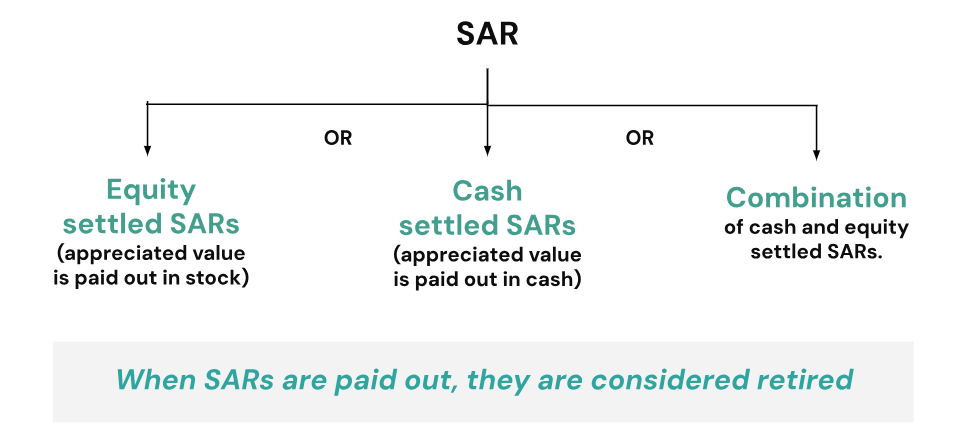
How are SARs issued?
SARs follow a lifecycle similar to that of ESOPs2, but differ in how these entitlements are earned. Unlike ESOPs, which require an employee to purchase the option and thereby exercise their right to the shares, SARs require no upfront payment from employees. Only the difference between the SAR price on the grant date and the market price on the settlement date will be paid out in cash, equity, or a combination of both. Once settled, SARs are considered retired.
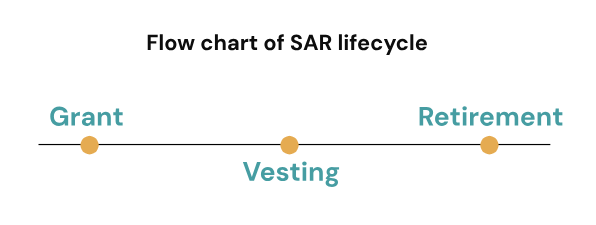
How do SARs work?
Stock Appreciation Rights (SARs) in India are a popular employee benefit that allows employees to gain from the appreciation in a company’s stock price without purchasing shares. The appreciation is calculated as the difference between the market value of the SAR on a predetermined date and its price on the grant date. This gain is typically settled in cash or equity, providing employees with financial incentives tied to the company’s growth. SARs offer a tax-efficient and flexible alternative to stock options, making them an attractive tool for employee retention and motivation in India’s corporate landscape.

Illustration of Stock Appreciation Rights Working
Company A grants 100 SARs to an employee. The SAR Price is fixed at INR 10/- per SAR. The SARs will evenly vest over the next 4 years. The table below shows how the appreciation will be computed. This breakdown will be subject to change depending on how the company decides to settle these SARs – i.e., as Cash Settled SAR or Equity Settled SAR or a combination of both.
| No. | Particulars | End of Year 1 | End of Year 2 | End of Year 3 | End of Year 4 |
| 1 | SAR Price (each; in INR) | 10 | 10 | 10 | 10 |
| 2 | Vested SARs (in nos.) | 25 | 50 | 75 | 100 |
| 3 | % of Vested SARs | 25% | 50% | 75% | 100% |
| 4 | Market Value per SAR(in INR) | 100 | 200 | 300 | 400 |
| 5 | Appreciation per SAR[No. 4 – No. 1] (in INR) | 90 | 190 | 290 | 390 |
| 6 | If Cash Settled SAR[No. 2 * No. 5] (in INR) | 2,250 | 9,500 | 21,750 | 39,000 |
| 7 | If Equity Settled SAR[No. 6/No. 4] (in nos.)* | 23 | 48 | 73 | 98 |
Notes:
- * Numbers are rounded up to prevent fractional computation.
- The amounts and number of shares in rows 6 and 7 above indicate the money/equity to be received by the employee based on the vesting schedule that vests 25% each year for 4 years. Combination of Cash Settled SAR and Equity Settled SAR will result in change to rows 6 and 7 appropriately, basis the relevant % to be applied.
Legal Background of SAR in India
It is pertinent to note that companies that are listed on a recognised stock exchange are subject to certain regulations prescribed from time to time by the Securities and Exchange Board of India (‘SEBI’). While their formation and key foundational principles are contained within the framework of the Companies Act, 2013 (‘CA 2013’), public listed entities are predominantly governed by SEBI regulations issued from time to time. However, only the CA 2013 is applicable to private companies and the provisions of the act read with the rules formulated thereunder, do not explicitly address SARs, leading to uncertainty in the legal framework governing the adoption of employee equity-linked reward schemes by private companies that are alternatives to the traditional ESOP scheme.
SARs issued by Public Listed Companies
SAR is legally defined in the Securities and Exchange Board of India (Share Based Employee Benefits and Sweat Equity) Regulations, 2021 (“SBEB Regulations”), to mean:
“a right given to a SAR grantee entitling him to receive appreciation for a specified number of shares of the company where the settlement of such appreciation may be made by way of cash payment or shares of the company.
Explanation 1 – A SAR settled by way of issue of shares of the company shall be referred to as equity settled SAR.
Explanation 2 – For the purpose of these regulations, any reference to stock appreciation right or SAR shall mean equity settled SARs and does not include any scheme which does not, directly or indirectly, involve dealing in or subscribing to or purchasing, securities of the company.3”
The SBEB Regulations also define “appreciation” to mean “the difference between the market price4 of the share of a company on the date of exercise5 of SAR or the date of vesting of SAR, as the case may be, and the SAR price.6”
The grant of SAR under a scheme by a public company is further governed by Part C of the SBEB Regulations, which impose inter alia, the following restrictions on issuing SARs as employee benefit:
- Cash Settled or Equity Settled SAR: Companies are free to implement cash settled or equity settled SAR schemes. It is notable that where the settlement results in fractional shares, such fractional shares should be settled in cash.
- Disclosures to Grantees: Every SAR grantee is required to be given a disclosure document from the company, including a statement of risks, information about the company and salient features of the scheme.
- Vesting: SARs have a minimum vesting period of 1 year which shall only be inapplicable in the event of death or permanent incapacitation of a grantee.
- Restrictions on Rights: SAR holders will not be entitled to receive dividend or vote or otherwise enjoy the benefits a shareholders would have. These SARs cannot be transferred and are often subject to further conditions through the articles of association of the company. However the SAR grantee will be entitled to all information disseminated to shareholders by the company.
SEBI has in response to requests from Mindtree Limited, Saregama India Limited and JSW Steel Limited previously clarified that the SBEB Regulations are not applicable to Cash Settled SAR schemes7. Further, by virtue of their identity as publicly traded companies, the regulations prescribed by the Securities and Exchange Board of India from time to time prescribe specific limitations on public listed companies that are not extended to private companies. Most critically, the definition of “market price” in the SBEB Regulations is linked to the price on the recognised stock exchange, whereas with private companies, fair market value is not a defined construct, and therefore the determination is often left to a valuation report obtained at the relevant point in time. It is also important to note that by virtue of express identification in the SBEB Regulations, the company is constrained to issue SARs in the manner permitted, leaving less room for flexibility of approach.
SARs issued by Private/Unlisted Companies
The SBEB Regulations and resultant compliances are only applicable to companies whose equity shares are listed on a recognised stock exchange in India. By contrast, the Companies Act, 2013 (“CA 2013”) which governs the operation of unlisted and private companies in India, does not include any provisions on SARs.
However, employee stock-linked compensation/incentive schemes are not completely excluded from the ambit of the CA 2013. Formulated thereunder, the Companies (Issue of Share Capital and Debentures) Rules, 2014 (“SCD Rules”) prescribe conditions within which a private company can issue ESOPs. This would require the following critical compliances to be completed by the employer/issuer company:
- Special Resolution: The ESOP scheme is approved by shareholders of the company by way of special resolution (including reporting to ROC thereunder). This is also required if any employees are being granted options during one year, that equals or exceeds 1% of the issued capital of the company at such time;
- Eligible Employees: The proposed grantee should be eligible employees in accordance with the criteria prescribed in explanation to Rule 12(1) of the SCD Rules.
- Disclosures to Shareholders: The Company makes the requisite disclosures in the explanatory statement to the notice of shareholders’ meeting to approve the scheme including on total number of stock options to be granted, how the eligibility criteria will be determined (beyond statutory mandates), the requirements of vesting and period thereof, exercise price or formula to arrive at the same; exercise period and process thereof, lock-in, etc.
- Minimum Vesting: 1 year period between grant and vesting of options is mandated by Rule 12(6)(a) of the SCD Rules.
- Restrictions on ESOP Holders: Until exercised, such option holders do not receive dividend or vote or enjoy benefits of shareholders. The options also cannot be transferred, pledged, mortgaged, or encumbered in any manner.
- Compliance by Company: The Company will be required to maintain a register of employee stock options in Form No. SH-6.
Pursuant to a reading of the CA 2013 with the SCD Rules, it is clear that there is no procedure prescribed for the grant and settlement of SARs by private companies. The provisions regarding ESOPs do not lend themselves to be extended for SARs and consequently, as a matter of good governance, it is recommended that private companies issuing SARs take the following considerations into account as good practice:
- Board Approval – The board of the company must approve the terms of the SARs being granted, including grant date, number of SARs, vesting schedule and SAR price.
- Shareholders Approval – Similar to how ESOPs require a special resolution, the shareholders of the company should also approve the issuance of the SAR scheme, and any variation of terms, provided that such variation is not prejudicial to the interests of the SAR holders.
- SAR Grantees – Given that the restrictions applicable to ESOP are not extended to SAR grantees, this leaves the benefit of SARs being extendable to third parties.
- Vesting – a legally mandated vesting period is not applicable for private limited companies; ergo, certain employees may be granted SARs upfront with no vesting requirement, while others may be required to earn the SARs in accordance with a vesting schedule.
- SAR Price – This can vary from grant to grant, and is subject to the price determined by the employer company.
- Retirement – This can be entirely subject to the SAR Scheme, and may thus be retired in such manner as may be prescribed in the Scheme.
- Administration – SARs need not be administered by the Compensation Committee of a board of directors, and may be administered directly by the board itself.
Practical Considerations
ESOPs create practical challenges for private companies as a result of the restrictions imposed by the CA 2013 and the SCD Rules. Consequently, issuance of SARs instead of ESOPs allows companies to circumvent these practical challenges. Some considerations that go into the issue of SARs are:
- Reduced Scope of Dilution: By virtue of settlement of SARs in cash, companies can avoid dilution of their shareholders’ stake in the company. Further, even where SARs are settled with corresponding equity stake, the dilution is only triggered when the shares are purchased by the employee.
- No Mandatory Financial Disclosures: The company need not provide the financial disclosures of the company (normally provided to shareholders) to SAR holders and this would remain true on the date of retirement of the SARs as the employees never actually become shareholders in the company.
- Exercise Price Eliminated: From the employee’s perspective, no purchase cost is incurred in reaping the benefits of the grant.
- Value of the Options: ESOPs can have no value in the absence of a buyer for the shares however with Cash Settled SARs in particular, the value is offered by the company itself.
- Cost to Company: In case of E quity Settled SARs, the company can, within the confines of applicable law, issue and allot shares to the employee and reduce the cost of settling the grants.
- Flexibility of Settlement: Companies can align incentives with their financial strategies and stakeholder interest. The choice of cash or equivalent shares to settle the SAR is a feature not found with ESOPs.
- Taxation: SARs typically incur perquisite tax for the employees under the “salaries” head, required to be deducted at source for employers. Equity Settled SARs typically incur this tax liability on the exercise date whereas Cash Settled SARs incur tax on date of cash payment.
 #TreelifeInsight #TreelifeInsightCash Settled SARs are viewed as cash bonus plans for employees. The offeree can benefit from the appreciation of equity but they are not representative of actual equity shares and where Cash Settled SARs are issued, the employees never actually become shareholders in the company. However, the ultimate objective of value and appreciation of share ownership being given to employees continues to be met, making this an attractive consideration for companies looking to reward their employees. From a legal and regulatory space, it is advisable that startups looking to grant SARs to their employees align themselves with the SCD Rules and the SBEB Regulations as a best practice guide, to ensure that the lack of explicit regulation for SARs issued by private companies does not create scope of contravention of law. |
Concluding Thoughts
Stock Appreciation Rights have emerged as a versatile and attractive compensation tool in India, offering both flexibility and value to employers and employees. By enabling employees to benefit from the appreciation in a company’s valuation without requiring upfront investment, SARs provide a compelling alternative to traditional ESOPs. The ability to settle SARs in cash, equity, or a combination of both ensures alignment with a company’s financial strategy and employee retention goals.
For public companies, SARs are governed by the SEBI regulations, ensuring structured implementation. However, for private companies, the absence of explicit regulation under the Companies Act, 2013, creates both flexibility and challenges. Startups can leverage SARs as a cost-effective way to reward employees while mitigating shareholder dilution and administrative burdens typically associated with ESOPs.
Ultimately, SARs strike a balance between incentivizing employees and maintaining operational agility, making them an indispensable part of the evolving startup ecosystem in India. By adhering to best practices and aligning with regulatory frameworks, companies can effectively use SARs to foster growth, innovation, and employee satisfaction.
References:
- [1] https://entrackr.com/2020/06/exclusive-jitendra-gupta-jupiter-valuation-rs-720-cr/
︎ - [2] To learn more about this, check out our #TreelifeInsights article on Understanding ESOPs in India (including the process flow, tax implications, exercise price and benefits), here: https://treelife.in/taxation/understanding-esops-in-india/
︎ - [3] Regulation 2(qq), SBEB Regulations.
︎ - [4] “Market Price” is defined in Regulation 2(x) of the SBEB Regulations, to mean “the latest available closing price on a recognised stock exchange on which the shares of the company are listed on the date immediately prior to the relevant date.
Explanation – If such shares are listed on more than one recognised stock exchange, then the closing price on the recognised stock exchange having higher trading volume shall be considered as the market price.”
︎ - [5] “Exercise” is defined in Regulation 2(l) of the SBEB Regulations, to mean “making of an application by an employee to the company or to the trust for issue of shares or appreciation in the form of cash, as the case may be, against vested options or vested SARs in pursuance of the schemes covered under Part A or Part C of Chapter III of these regulations, as the case may be;”.
︎ - [6] “SAR Price” is defined in Regulation 2(kk) of the SBEB Regulations, to mean “the base price defined on the grant date of SAR for the purpose of computing appreciation;”.
︎ - [7] https://www.mondaq.com/india/directors-and-officers/983918/an-analysis-of-stock-appreciation-rights-in-india
︎
In this blog, we break down the key provisions of the Draft Rules having regard to their background in the DPDP Act, and highlight certain challenges found in the draft legislation.
Background: the DPDP Act, 2023
The DPDP Act was a revolutionary step towards India’s adoption of a robust data protection regime. This legislation marks the first comprehensive law dedicated to the protection of personal data and received presidential assent on August 11, 2023. However, the Act itself is yet to be notified for enforcement and the implementation is expected in a phased manner. To understand the impact of the Draft Rules2, it is crucial to first understand the key terms and legal framework introduced by the DPDP Act.
A. Key Terms:
- Board: the Data Protection Board of India established by the Central Government.
- Consent Manager: a person registered with the Board who acts as a single point of contact to enable a Data Principal to give, manage, review, and withdraw consent through an accessible, transparent and interoperable platform.
- Data Fiduciary: any person who alone or in conjunction with other persons determines the purpose and means of processing personal data.
- Data Principal: the individual to whom the personal data relates. The ambit of this definition is expanded where the Data Principal is: (i) a child, to include their parents and/or lawful guardian; and (ii) a person with disability, to include their lawful guardian.
- Data Processor: person processing personal data on behalf of a Data Fiduciary.
- Personal Data: any data about an individual who can be identified by or in relation to such data.
- Processing: (in relation to personal data) wholly or partly automated operation(s) performed on digital personal data. Includes collection, recording, organisation, structuring, storage, adaptation, retrieval, use, alignment or combination, indexing, sharing, disclosure by transmission, dissemination or otherwise making available, restriction, erasure or destruction.
B. Legal Framework:
- Scope and Applicability: Applies to the processing of personal data within India and to entities outside India offering goods/services to individuals in India. Covers personal data collected in digital form or data that is digitized after collection and excludes personal data processed for a personal or domestic purpose and data made publicly available by the Data Principal.
- Data Processing: Statutory requirement for clear, informed and unambiguous consent from Data Principals including a notice of rights. Certain scenarios (such as compliance with legal obligations or during emergencies) allow data processing without explicit consent – i.e., for a legitimate purpose3.
- Data Principals: Given rights that include access to information, correction and erasure of data, grievance redressal, and the ability to nominate representatives for exercising rights in case of incapacity or death.
- Data Fiduciaries: Obligated to implement data protection measures, establish grievance redressal mechanisms, and ensure data security. Significant Data Fiduciaries4 are required to additionally conduct Data Protection Impact Assessments (DPIAs), and appoint Data Protection Officer and an independent data auditor evaluating compliance with the DPDP Act.
- Cross-Border Data Transfer: In a departure from the earlier regime requiring data localisation, the DPDP Act permits cross-border transfer of data unless explicitly restricted by the Indian government.
- Organisational Impact: Organizations must assess and enhance their data protection frameworks to comply with the DPDPA. Key steps include appointing Data Protection Officers (for significant data fiduciaries), implementing robust security measures, establishing clear data processing agreements, and ensuring mechanisms for data principals to exercise their rights.
- Penalties: Monetary penalty can be imposed by the Board based on the circumstances of the breach and the resultant impact (including whether any gain/loss has been realised/avoided by a person).
Enabling Mechanisms: the DPDP Rules, 2025
Under Section 40 of the DPDP Act, the Central Government is empowered to formulate rules to enable the implementation of the Act. Pursuant to this, the Draft Rules seek to provide guidance on compliance, operational aspects, administration and enforcement of the DPDP Act. The Draft Rules are to come into force upon publication however, certain critical provisions will only become effective at a later date5.
Key Provisions:
- Notice Requirements for Data Fiduciaries: The notice for consent required to be provided to the Data Principal should be clear, standalone, simple and understandable. Most crucially, the Draft Rules specify that the notice should include an itemized list of personal data being collected and a clear description of the goods/services/uses which are enabled by such data processing. The Data Principal should also be informed of the manner in which they can withdraw their consent, exercise their rights and file complaints. Data Fiduciaries should provide a communication link and describe applicable methods that will enable the Data Principal to withdraw their consent or file complaints with the Board.
- Consent Managers: Strict eligibility criteria have been prescribed for persons who can be appointed as Consent Managers – this must be an India-incorporated company with sound financial and operational capacity, with a minimum net worth of INR 2,00,00,000, a reputation for fairness and integrity and certified interoperable platform enabling Data Principals to manage their consent. These Consent Managers must uphold high standards of transparency, security and fiduciary responsibility and are additionally required to be registered with the Board and act as a single point of contact for Data Principals. Any transfer of control of such entities will require the prior approval of the Board.
- Data Processing by the State: The government can process personal data to provide subsidies, benefits, certificates, services, licenses or permits. However such processing must comply with the standards prescribed in the Draft Rules6 and the handling of personal data is lawful, transparent and secure.
- Reasonable Security Safeguards: The Draft Rules call for the implementation of ‘reasonable security measures’ by Data Fiduciaries to protect personal data. This includes encryption of data, access control, monitoring of access (particularly for unauthorised access), backup of data, etc. The safeguards should also include provisions to detect and address breach of data, maintenance of logs, and ensure that appropriate safety measures are built into any contracts with Data Processors.
- Data Breach Notification: Data Fiduciaries are required to promptly notify all affected Data Principals in the event of a breach. This notification shall include a clear explanation of the breach, the nature, extent, timing, potential consequences, mitigation measures and safety recommendations to safeguard the data. The Board is also required to be informed of such breach (including a description of the breach, nature, extent, timing, location and likely impact) within 72 hours of the Data Fiduciary being aware. Longer intimation timelines may be permitted upon request.
- Accountability and Compliance: Grievance redressal mechanisms are mandated to be published on Data Fiduciary’s platforms and the obligation is borne by such persons to ensure lawful processing of personal data. Processing is required to be limited to ‘necessary purposes’ and the data is only permitted to be retained for ‘as long as needed’.
- Data Retention by E-Commerce Entities and Online Gaming and Social Media Intermediaries: The Draft Rules require the deletion of user data after 3 years7 by: (i) e-commerce entities having minimum 2,00,00,000 registered users in India; (ii) online gaming intermediaries having minimum 50,00,000 registered users in India; and (iii) social media intermediaries having minimum 2,00,00,000 registered users in India.
- Consent for Children and Persons with Disabilities: The DPDP Act and Draft Rules envisage greater protection of personal data of children and persons with disabilities. Verifiable consent must be obtained from parents or legal guardians in accordance with the requirements set out in the Draft Rules. Critically, a Data Fiduciary is required to implement measures to ensure that the person providing consent on behalf of a child/person with disabilities is in fact, that child/person’s parent or legal guardian, who is identifiable. The Data Fiduciary is further required to verify that the parent is an adult by using reliable identity details or virtual tokens mapped to such details.
- Impact Assessment: Predominantly an obligation on Significant Data Fiduciaries, the Draft Rules impose a mandate to conduct yearly DPIAs to evaluate the risks associated with the data processing activities. This requires observance of due diligence to verify the algorithmic software8 to ensure there is no risk to the rights of Data Principals.
- Data Transfer Outside India: Discretion is left to the Central Government to set any requirements in respect of making personal data available to a foreign state or its entities. Data Fiduciaries processing data within India or in connection with goods or services offered to Data Principals from outside India must comply with these requirements as may be prescribed from time to time.
- Exemptions: The Draft Rules prescribe exemptions from the applicability of the DPDP Act for processing of personal data carried out: (i) for research, archival or statistical purposes, subject to compliance with the standards set out in Schedule II of the Draft Rules9; and (ii) by healthcare professionals, educational institutions, creche or day care facilities and their transporters, subject to compliance with conditions set out in Schedule IV of the Draft Rules.
- Enforcement: Including establishment of the regulatory authority (i.e., the Board), appointment of its chairperson, members, etc. and the appellate framework for decisions of the Board, the Draft Rules prescribe the mechanism for enforcement of the DPDP Act, including redressal of grievances and any consequent penalties imposed for contraventions of the law.
Implications of the Draft Rules
While the Draft Rules have been long awaited, there is still no clarity on the implementation timeline. Further, while the Ministry of Electronics & Information Technology have requested public comments on the Draft Rules, it is unlikely that the same would be released to the public. At the outset, it is apparent that the Draft Rules will require organisations to make significant investment in compliance measures to meet the requirements outlined. Including robust consent management systems, enhanced security protocols and transparent communication mechanisms with users, this will increase the overall compliance costs borne by businesses – particularly impacting smaller scale entities. Some of the key issues found in this framework as below:
- Operational Costs: Businesses may be required to restructure their platforms at a design and architecture level of application, leading to increased costs. With the added compliance burdens, this will also result in increased costs related to conducting regular audits and verifying algorithmic software (particularly by Significant Data Fiduciaries) and can lead to stifled innovation and limit market entry for upcoming businesses.
- Vagueness: Terms such as “reasonable safeguards”, “appropriate measures” or “necessary purposes” are used liberally in the Draft Rules however the same have not been adequately defined in the law, leaving a lack of clarity on what constitutes “reasonable”, “appropriate” or “necessary” standards. Further, use of phrasing such as “likely to pose a risk to the rights of data principals” does not provide clarity in satisfaction of due diligence obligations, which can lead to subjective enforcement.
- Significant reliance on discretionary authority: The Union Government has been given significant authority in determining exemptions, processing standards, data transfer and government functions involving data processing. There is consequently a lot of power given to the Government to determine the limits of the law and there is no clear criteria provided for an objective assessment, leading to questions on fairness and transparency. The Draft Rules also do not appear to adhere with the directions of the Supreme Court in the landmark judgment of K.S. Puttaswamy v Union of India 10 which explicitly states that: “the matter shall be dealt with appropriately by the Union Government, with due regard to what has been set out in this judgment” (emphasis supplied). Further, large parts of the implementation and enforcement will be administered per the discretion of the competent government ministry, leaving a lack of clarity in the foundational framework.
- Potential for mandatory universal registration: Verifiable parental consent requirements for children’s data can be used to require every online user to verify their age through governmental credentials, while seemingly placing reliance on self-verification. Consequently, parents/legal guardians would be required to provide government-issued identity to verify their credentials. Further, this mechanism not only violates the principles of data minimization and retention limitations but risks over-collection, prolonged storage and potential mass surveillance11.
- Lack of clarity in the law: In addition to a lack of guiding frameworks for mode of delivery of issuance of notices12, the Draft Rules create further ambiguity in legislations such as the Rights of Persons with Disabilities Act, 2016, Guardians and Wards Act, 1890, National Trust for the Welfare of Persons with Autism, Cerebral Palsy, Mental Retardation and Multiple Disabilities Act, 1999, or the Mental Health Act, 2017 with respect to consent notices issued to persons with disabilities/children. The DPDP Act also does not consider regulation of non-personal data (such as traffic) and defined procedures for processes such as appointment of nominees or appeal timeline for orders of the Board, are not clearly outlined in the Draft Rules. The Draft Rules are also required to be harmonized with existing legislations such as the Information Technology Act, 2000 and the CERT-In directions issued thereunder, where the mandated reporting of cyber incidents is required to be made within 6 hours.
Concluding Thoughts
The Draft Digital Personal Data Protection Rules, 2025, represent a significant step toward operationalizing India’s ambitious DPDP Act, 2023, and businesses can use the Draft Rules as guidelines to determine the extent of revision of their existing data protection framework that may be required. While the Draft Rules aim to create a robust framework for safeguarding personal data, their implementation will require businesses to overhaul their data protection systems, leading to increased compliance costs and operational challenges. However, despite progressive provisions like Consent Managers and enhanced security measures, the Draft Rules leave room for ambiguity, particularly with undefined terms and broad discretionary powers. As stakeholders await further clarity and finalization, it is evident that achieving a balance between privacy rights, operational feasibility, and fostering innovation will be crucial for the success of this legislation.
India’s journey toward a comprehensive data protection regime has begun, but a clear roadmap for implementation, harmonization with existing laws, and addressing key gaps will be pivotal in building trust and driving compliance across sectors. For businesses, the time to prepare is now—building compliant frameworks will not just ensure legal adherence but also enhance user confidence in the digital ecosystem.
Stay tuned for more #TreelifeInsights as the Draft Rules evolve into actionable mandates.
References:
- [1] https://pib.gov.in/PressReleasePage.aspx?PRID=2090271
︎ - [2] https://pib.gov.in/PressReleasePage.aspx?PRID=2090271
︎ - [3] This marks a change from the earlier regime which included a concept of “deemed consent”. The DPDP Act creates a category of permitted use that does not require explicit consent. See Section 7 of the DPDP Act.
︎ - [4] Data Fiduciaries notified by the Central Government under Section 10 of the DPDP Act, on the basis of factors such as: (i) volume and sensitivity of personal data processed; (ii) risk to the rights of the Data Principal; (iii) potential impact on the sovereignty and integrity of India; (iv) risk to electoral democracy; (v) security of the state; and (vi) public order. Significant Data Fiduciaries have additional obligations under the DPDP Act.
︎ - [5] Rules 3, 4, 5, 6, 7, 8, 9, 10, 11, 12, 13, 14, 15, 21 and 22. See: Explanatory Note to Digital Personal Data Protection Rules, 2025 published by the Ministry of Electronics & Information Technology on January 3, 2025 here:
https://www.meity.gov.in/writereaddata/files/Explanatory-Note-DPDP-Rules-2025.pdf
︎ - [6] See Schedule II of the Draft Rules.
︎ - [7] Subject to users actively maintaining their accounts.
︎ - [8] The verification exercise focuses on software deployed for hosting, display, uploading, modification, publishing, transmission, storage, updation or sharing of personal data processed by the Data Fiduciary.
︎ - [9] This exemption is granted to ensure necessary data processing for academic and policy research can occur while maintaining safeguards and standards to protect such data.
︎ - [10] (2018) 8 S.C.R. 1, where principles of “proportionality” and “necessity” were held to be essential safeguards of any data protection regime.
︎ - [11] https://internetfreedom.in/statement-on-the-draft-dpdp-rules-2025/
︎ - [12] https://www.fortuneindia.com/macro/draft-dpdp-rules-2025-a-closer-look-at-the-hits-and-misses/119825
︎
Security of sensitive business information, protection of intellectual property and trade secrets and trust in collaborations are critical aspects of business security in an increasingly competitive and data-driven market today. It is to this effect that businesses typically execute non disclosure agreement (“NDA”), which imposes a contractual obligation on the party receiving the protected information to not only keep the same confidential but to not disclose or divulge such information without permission from the disclosing party.
NDAs can relate to trade secrets, business models, or intellectual property; all of which help to ensure confidentiality and security in business partnerships. Fundamentally, this agreement ensures that the recipient of such confidential information is obligated to keep the same protected. As such, any breach of an NDA would typically build in mechanisms for compensation for damages caused by the party in breach of the NDA.
Overview of NDAs in Indian Law / Legal Environment
NDAs in India are enforceable as per the Indian Contract Act, 1872. They are very commonly employed across sectors and can be used for purposes ranging from technology/manufacturing to consulting to even labour or critical events requiring protection of sensitive information. An airtight NDA defines what is and is not confidential information, limits the use of such information, and outlines the consequences for a breach of the obligations. NDAs are widely used in India to guard proprietary information involving in commercial transactions, employment, or partnership. NDAs keep the most important business information private by:
- Security of proprietary information from unauthorized use or leakage.
- Developing intellectual property, trade secrets, and business plans protection laws.
- Establishing trust in relationships while going through mergers, acquisitions or negotiations.
NDAs by ensuring confidentiality preserve a business’s competitive edge and eliminate litigation.such as technology, manufacturing, and consulting. NDAs can be unilateral, mutual or multilateral, but for it to be effective they should meet Indian laws. The success of an NDA depends on its definitions, enforceable provisions and jurisdiction. A breach of an NDA can be financially and reputationally disastrous.
What is a Non-Disclosure Agreement (NDA)?
A Non-Disclosure Agreement (NDA) is a legally binding contract designed to safeguard sensitive and proprietary information shared between two or more parties. It establishes a confidential relationship by outlining the type of information that must remain undisclosed, the purpose of sharing the information, and the consequences of any breach. NDAs are integral to protecting intellectual property, trade secrets, and other business-critical data.
Definition of a Non-Disclosure Agreement
In simple terms, an NDA is a formal agreement where one party agrees not to disclose or misuse the confidential information provided by the other party. Colloquially also referred to as a confidentiality agreement, an NDA ensures that the disclosed information is used solely for the intended purpose and remains secure. NDAs are enforceable under the Indian Contract Act, 1872, making them a vital tool in safeguarding sensitive data in India.
Key Purposes and Objectives of NDAs
The primary goal of an NDA is to maintain the confidentiality of information and prevent its unauthorized use. Key objectives include:
- Protecting Intellectual Property: Ensuring that trade secrets, patents, and proprietary processes remain secure.
- Establishing Trust: Building a reliable relationship between parties, particularly in mergers, acquisitions, or joint ventures.
- Avoiding Misuse of Data: Preventing employees, contractors, or partners from sharing confidential details with competitors.
- Defining Legal Recourse: Outlining the consequences of a breach, including penalties and legal actions.
By clearly defining the scope of confidentiality, NDAs reduce the likelihood of disputes and offer a framework for resolution if a breach occurs.
Real-Life Examples of NDA Use in Business Scenarios
NDAs are widely used across various industries and situations, such as:
- Employment Agreements: Employers often require NDAs to protect internal policies, client lists, and proprietary methods from being disclosed by employees.
- Mergers and Acquisitions: During due diligence, NDAs secure sensitive financial and operational data exchanged between companies. This can also include restrictions on disclosure of investment by a party and prevention of any media release (as typically required by incubators).
- Technology and Innovation: Startups and tech companies frequently use NDAs to safeguard unique ideas, algorithms, or software codes when pitching to investors or collaborating with developers.
- Freelance and Consulting Projects: Freelancers or consultants working with confidential client data are bound by NDAs to prevent misuse.
- Vendor or Supplier Relationships: NDAs protect sensitive pricing strategies, product designs, or supply chain details shared with third-party vendors.
For example, a startup seeking funding may share its business model, product specifications and financial projections with potential investors under an NDA, ensuring these details remain confidential and protected from competitors.
Types of Non-Disclosure Agreements in India
Non-Disclosure Agreements (NDAs) come in various forms depending on the nature of the relationship and the flow of confidential information between parties. Understanding the types of NDAs is essential for selecting the most suitable agreement to safeguard sensitive information. Typically, an NDA will impose a total ban on disclosure, except where such disclosure is required by law or on order of any statutory authority. Below are the primary types of NDAs used in India:
1. Unilateral NDAs
A Unilateral NDA is a one-sided agreement where only one party discloses confidential information, and the receiving party agrees to protect it. This type of NDA is commonly used when a business shares proprietary information with employees, contractors, or third-party vendors who are not expected to reciprocate with their own confidential data.
Common Use Cases:
- Protecting trade secrets during product development.
- Sharing sensitive business data with potential investors.
- Securing intellectual property shared with a freelancer or consultant.
Example: A tech startup providing details of its proprietary algorithm to a marketing agency under a unilateral NDA.
2. Bilateral/Mutual NDAs
A Bilateral NDA, also known as a mutual NDA, involves two parties sharing confidential information with each other and agreeing to protect it. This type of agreement is ideal when both parties need to exchange sensitive data, such as in partnerships, collaborations, or joint ventures.
Common Use Cases:
- Collaborations between companies on a new product or service.
- Mergers and acquisitions where both entities share financial and operational data.
- Negotiations between two businesses for a potential partnership.
Example: Two pharmaceutical companies working together on developing a new drug may use a mutual NDA to safeguard their research and development data.
3. Multilateral NDAs
A Multilateral NDA is used when three or more parties need to share confidential information among themselves while ensuring mutual protection. This type of NDA simplifies the process by consolidating multiple bilateral agreements into a single document, reducing legal complexities and administrative overhead.
Common Use Cases:
- Consortiums or alliances in large-scale projects like infrastructure development.
- Joint ventures involving multiple stakeholders.
- Collaborative research projects between academic institutions and private companies.
Example: A group of IT companies collaborating on a government project to develop a unified digital platform may use a multilateral NDA to protect their individual contributions.
Essential Clauses in an NDA
A well-drafted Non-Disclosure Agreement (NDA) is only as strong as the clauses it includes. Each clause serves a specific purpose in defining the rights and obligations of the parties, ensuring comprehensive protection of confidential information. Here are the key clauses every NDA should have:
1. Confidentiality Clause
The confidentiality clause is the cornerstone of an NDA. It explicitly defines what constitutes “confidential” or “privileged” or “sensitive” information, how it can be used, and the obligations of the receiving party to protect it.
Key Points to Include:
- Clearly specify the information considered confidential.
- Outline permissible uses of the information.
- Prohibit unauthorized sharing, reproduction, or disclosure.
2. Non-Compete Clause
A Non-Compete Clause prevents the receiving party from using the confidential information to gain a competitive advantage or engage in competing activities.
Key Points to Include:
- Define the duration of the non-compete obligation.
- Specify the geographic scope where competition is restricted.
- Ensure compliance with Indian laws to avoid enforceability issues.
Example: An NDA between a software company and a vendor may include a non-compete clause to prevent the vendor from replicating or selling similar software.
3. Duration and Scope of Confidentiality
This clause specifies how long the confidentiality obligation will remain in effect and the extent to which it applies.
Key Points to Include:
- Duration: Specify whether confidentiality is time-bound (e.g., 3-5 years) or indefinite.
- Scope: Clearly define the level of protection and the limitations of disclosure.
Tip: While most NDAs in India enforce confidentiality for a limited period, indefinite clauses are often used for trade secrets.
4. Dispute Resolution Clause
This clause outlines how disputes related to the NDA will be resolved. It ensures a smooth resolution process and avoids lengthy litigation.
Key Points to Include:
- Specify the jurisdiction under which disputes will be resolved.
- Choose between arbitration, mediation, or court proceedings.
- Define the governing laws (e.g., Indian Contract Act, 1872).
Example: An NDA might state that disputes will be resolved through arbitration under the Arbitration and Conciliation Act, 1996.
5. Exclusions from Confidentiality
This clause identifies situations where confidentiality obligations do not apply.
Common Exclusions:
- Information already in the public domain.
- Information disclosed with prior consent.
- Data independently developed without using confidential information.
Including clear exclusions prevents ambiguity and protects the receiving party from unwarranted liability.
Tips for Drafting a Legally Sound NDA in India
- Be Specific: Avoid vague terms; clearly define confidential information and obligations.
- Customize the NDA: Tailor the agreement to the specific needs of your business and the type of relationship.
- Include Remedies for Breach: Specify monetary penalties or injunctive relief for violations.
- Use Simple Language: Avoid overly complex legal jargon to ensure all parties fully understand their obligations.
- Seek Professional Help: Consult legal experts to ensure compliance with Indian laws and enforceability in courts.
Adding these essential clauses strengthens the NDA, ensuring that confidential information remains secure and disputes are minimized.
We help draft effective NDAs Let’s Talk
Non Disclosure Agreements Format
Overview of an NDA Template in India
An NDA template serves as a standard framework for creating confidentiality agreements tailored to specific needs. While the format can vary depending on the context, every NDA must clearly define the scope of confidentiality, the parties involved, and the remedies in case of a breach. A professionally drafted NDA ensures enforceability under the Indian Contract Act, 1872.
Key Elements to Include in an NDA
- Parties to the Agreement
- Clearly identify the disclosing party and the receiving party.
- Include details such as names, designations, and addresses to eliminate ambiguity.
- For multilateral NDAs, list all parties involved.
Example: “This Agreement is entered into by ABC Pvt. Ltd. (Disclosing Party) and XYZ Pvt. Ltd. (Receiving Party) on [date].”
- Definition of Confidential Information
- Specify the information considered confidential, such as trade secrets, business strategies, or technical data.
- Use precise language to avoid disputes about the scope of confidentiality. The more detailed the scope of what constitutes “confidential information”, the better clarity that is brought about on the non-disclosure obligation.
Example: “Confidential Information includes but is not limited to financial data, client lists, marketing strategies, and proprietary software.”
- Obligations of the Receiving Party
- Detail the receiving party’s responsibilities to safeguard the information.
- Prohibit disclosure to third parties and unauthorized use.
Example: “The Receiving Party agrees not to disclose the Confidential Information to any third party without prior written consent of the Disclosing Party.”
- Consequences of Breach
- Define the penalties for unauthorized disclosure or misuse of confidential information.
- Specify remedies such as monetary damages, injunctions, or termination of the agreement.
Example: “In the event of a breach, the Receiving Party shall indemnify the Disclosing Party for all losses, including legal fees and damages.”
- Jurisdiction and Governing Law
- Specify the jurisdiction under which disputes will be resolved.
- Include the applicable legal framework, such as Indian Contract Act, 1872.
Example: “This Agreement shall be governed by and construed in accordance with the laws of India, and disputes shall be subject to the exclusive jurisdiction of the courts in [city].”
Sample NDA Template for Download
To make the process easier, here’s a downloadable sample Non Disclosure Agreement PDF template for Indian businesses. The NDA Document includes all the main elements mentioned , ensuring compliance and clarity.
Download Sample Non Disclosure Agreement Format.
Legal Validity of NDAs in India
Non-Disclosure Agreements (NDAs) are widely used to protect sensitive information in India, but their enforceability depends on how well they align with the legal framework. Understanding the legal validity of NDAs is crucial for ensuring that these agreements hold up in a court of law.
Enforceability Under the Indian Contract Act, 1872
NDAs in India are governed by the Indian Contract Act, 1872, which mandates that:
- Lawful Consideration and Object: The agreement must not violate any existing laws or public policy.
- Free Consent: All parties must willingly agree to the terms without coercion, fraud, or misrepresentation.
- Definite and Certain Terms: The NDA must clearly define the confidential information, obligations, and consequences of a breach.
Key Point: NDAs with overly broad or vague clauses may be deemed unenforceable. Clauses such as “indefinite confidentiality for all types of information” are likely to be rejected by Indian courts.
Relevant Case Laws Supporting NDA Breaches in India
Case laws play a significant role in determining the enforceability of NDAs. Below are some landmark cases that highlight how Indian courts address NDA breaches, which have informed and clarified the interpretation of the Indian Contract Act, 1872 and its governance of non-disclosure agreements, including the enforceability of such agreements and their legal validity. These case laws have also informed the principle of “reasonableness” in enforcing such restrictions, from the perspective of protecting a business and its data:
- Niranjan Shankar Golikari v. Century Spinning & Manufacturing Co. Ltd. (1967):
- The Supreme Court upheld the validity of confidentiality clauses in employment contracts, ruling that such restrictions must be reasonable and protect legitimate business interests.
- Superintendence Company of India v. Krishan Murgai (1980):
- This case emphasized that NDAs and restrictive covenants must strike a balance between protecting business interests and not imposing unreasonable restrictions on an individual’s right to work.
- American Express Bank Ltd. v. Priya Puri (2006):
- The Delhi High Court ruled that NDAs signed by employees are enforceable, particularly when the disclosed information constitutes trade secrets or proprietary knowledge.
- Gujarat Bottling Co. Ltd. v. Coca-Cola Co. (1995):
- The court underscored that an injunction can be granted to prevent further disclosure of confidential information in case of a breach of an NDA.
Key Point: Courts often evaluate the reasonableness of the NDA’s terms and whether the breach caused material harm to the disclosing party.
Breach of NDAs: Consequences & Remedies
A breach of a Non-Disclosure Agreement (NDA) is a serious violation that can lead to significant legal, financial, and reputational damage. NDAs are legally binding contracts that ensure the confidentiality of sensitive information. Breaching an NDA can result in severe consequences, including legal actions, fines, and loss of business trust. This section explores common types of NDA breaches, legal remedies available in India, and ways to mitigate risks.
Common Types of Breaches
- Intentional Disclosure of Confidential Information
- This occurs when the receiving party intentionally discloses confidential information to unauthorized third parties.
- Example: An employee shares proprietary business strategies with a competitor to gain personal benefits.
- Accidental Breaches
- These breaches occur due to negligence, such as sending an email to the wrong person or failing to secure confidential files.
- Example: A company accidentally discloses confidential client information in an unsecured email.
What Happens If You Breach a Confidentiality Agreement?
A breach of the NDA is considered a civil offense in India. NDAs are legally enforceable contracts, and the receiving party is obligated to keep the disclosed information confidential. If the confidentiality clause is breached, several legal consequences may follow:
Legal Remedies for Breach of NDA
In the event of a breach, the NDA itself may outline remedies such as termination, injunctions, and indemnification.
- Injunctions
- The non-breaching party may seek a court order to stop the breaching party from further disclosing confidential information. Injunctions may be interim (temporary) or perpetual (permanent).
- Legal Basis: Governed by Order XXXIX Rule 1 and 2 of the Code of Civil Procedure, 1908, and Section 38 of the Specific Relief Act, 1963.
- Indemnification and Damages
- The breaching party may be required to indemnify the non-breaching party for any losses, including court fees, legal costs, and actual damages incurred. This can include both compensatory and consequential damages.
- Compensatory Damages: These are calculated based on the actual financial loss suffered due to the breach.
- Example: If a business loses ₹50,000 due to a breach, compensatory damages may cover that loss.
- Consequential Damages: These damages include losses that occurred indirectly due to the breach, such as lost profits or opportunities.
- Example: A tour company loses potential sales after a breach prevents them from securing a necessary asset.
- Criminal Remedies
- In certain cases, criminal remedies may apply, particularly under the Indian Penal Code (IPC) and the Information Technology Act, 2000.
- Section 72A of the IT Act, 2000 provides for imprisonment up to 3 years or fines up to ₹5 lakh for the unlawful disclosure of information obtained during a contractual relationship.
- In certain cases, criminal remedies may apply, particularly under the Indian Penal Code (IPC) and the Information Technology Act, 2000.
Why Should You Not Break a Confidentiality Agreement?
Breaking an NDA can lead to severe consequences, including:
- Legal and Financial Penalties
- NDAs often specify penalties for violations, including injunctions, indemnifications, and damages.
- A breach could result in substantial financial loss, not only in direct damages but also in reputational harm and loss of future business.
- Job Termination and Reputational Damage
- For employees or contractors, breaching an NDA may result in termination from their position and loss of professional reputation.
- Businesses that breach NDAs risk losing client trust and face the possibility of damaging their public image, which could lead to a loss of clients and future opportunities.
Different Types of Contract Breach Remedies
The remedy for a breach of NDA depends on the specific provisions in the agreement, the nature of the violation, and the facts of the case. Common remedies include:
- Damages for Compensation
- Compensatory Damages: The most common remedy, compensatory damages are calculated based on the actual losses suffered due to the breach, including expectation damages and consequential damages.
- Example: A business loses potential profits from a deal that fell through due to a breach.
- Specific Performance
- Courts may order the breaching party to fulfill its contractual obligations if monetary damages are insufficient. This remedy is more common for contracts involving unique or irreplaceable items.
- Example: A company may seek specific performance if the item breached is a unique asset that cannot be replaced.
- Injunctions
- Injunctions prevent the breaching party from further disclosing confidential information. These can be temporary or permanent, depending on the severity of the breach.
- Liquidated Damages
- A set amount specified in the NDA to cover the breach, particularly where it is difficult to quantify actual damages. Liquidated damages clauses are often used in construction contracts, real estate deals, and partnerships.
- Revocation
- The non-breaching party can rescind the contract, returning both parties to their original position. This remedy is typically used for significant breaches that go to the heart of the agreement.
How to Mitigate the Risk of NDA Breaches
- Draft Clear and Precise NDAs
- Ensure that the NDA clearly defines the scope of confidentiality and the consequences of a breach. Consider incorporating clauses for arbitration to resolve disputes efficiently.
- Implement Security Measures
- Use encryption, access restrictions, and secure systems to prevent accidental breaches.
- Regular Audits and Training
- Conduct periodic reviews of compliance and train employees and third parties on proper handling of confidential information.
- Legal Preparation
- Ensure that any breach is met with swift legal action through well-defined remedies in the NDA.
This proactive approach helps mitigate risks and maintain business integrity.
Importance of Customized NDAs for Businesses
A generic NDA may not always be effective in addressing the specific needs and risks of a business. Customized NDAs are essential for ensuring that the confidentiality, legal obligations, and remedies align with the unique aspects of each business relationship.
Benefits of Tailoring NDAs for Specific Business Needs
- Enhanced Protection of Sensitive Information
Custom NDAs allow businesses to define confidential information more precisely, ensuring better protection for proprietary data, trade secrets, and strategic plans. - Addressing Unique Business Risks
A tailored NDA can address the unique risks associated with different types of business relationships, such as vendor contracts, partnerships, or employee agreements, ensuring that all specific scenarios are covered. - Clearer Terms and Obligations
By customizing the terms and obligations, businesses can ensure both parties have a clear understanding of their responsibilities, reducing the potential for disputes. - Better Enforcement of Terms
A well-crafted NDA that aligns with business needs is easier to enforce in case of breach, as it clearly defines the scope of confidential information, obligations, and penalties for violation. - Minimized Legal Loopholes
Customization helps eliminate ambiguities and potential legal loopholes that could undermine the NDA’s effectiveness in protecting confidential information.
Wrapping up, Non-Disclosure Agreements (NDAs) are a vital tool for businesses in India to protect confidential information and ensure that sensitive data remains secure. Whether it’s a unilateral, bilateral, or multilateral NDA, having the right type tailored to your specific needs is essential for safeguarding trade secrets, business strategies, and proprietary information. A well-drafted NDA template can serve as a solid foundation for any business relationship, offering clarity on obligations and consequences in case of breach. Understanding the legal framework surrounding NDAs, including remedies for breach, is crucial to ensure enforceability under Indian law. To maximize protection, it’s highly recommended to consult with a legal professional to draft a customized NDA that best suits your business’s unique requirements.
FAQs on Non-Disclosure Agreements (NDAs) in India
1. What is an NDA, and why is it important in business?
A Non-Disclosure Agreement (NDA) is a legally binding contract that protects confidential information shared between parties during business dealings. It ensures sensitive data like trade secrets, strategies, or intellectual property remains secure, preventing unauthorized disclosure and fostering trust in business relationships.
2. What are the types of NDAs commonly used in India?
The three main types of NDAs are:
- Unilateral NDA: One party discloses information to another.
- Bilateral (Mutual) NDA: Both parties share confidential information.
- Multilateral NDA: Multiple parties are involved in the agreement.
Each type caters to different business scenarios and ensures tailored protection.
3. What happens if someone breaches an NDA in India?
A breach of NDA can lead to serious consequences, including:
- Civil remedies: Injunctions, monetary damages, or compensation under the Indian Contract Act, 1872.
- Criminal penalties: Punishments under laws like the IT Act, 2000 for unauthorized data disclosure.
Legal actions ensure accountability and protect the affected party’s interests.
4. How can businesses draft an effective NDA?
Businesses should seek legal assistance to draft customized NDAs that address their specific needs. This includes tailoring clauses for confidentiality, scope, and remedies for breach, ensuring compliance with Indian laws for enforceability.
5. Are NDAs legally enforceable in India?
Yes, NDAs are enforceable under Indian laws, including the Indian Contract Act, 1872, Specific Relief Act, 1963, and other relevant statutes. Courts uphold NDAs as long as the terms are fair, reasonable, and not overly broad.
7. Why is it essential to customize an NDA instead of using a generic one?
A customized NDA addresses the unique risks and requirements of your business, ensuring better protection of sensitive information. Tailoring an NDA minimizes legal loopholes, clarifies obligations, and provides effective remedies for breach.
8. How long does an NDA remain valid?
The validity of an NDA depends on the terms set in the agreement. It can be for a fixed duration (e.g., 2-5 years) or remain indefinite, especially for trade secrets or proprietary information that requires long-term protection.
]]>In today’s competitive market, building a strong brand identity is vital for success. It is in this context that trademarks become a critical asset to distinguish a business’ products or services from others, ensuring they stand out and are instantly recognizable to a consumer. Consequently, protection of the trademark through trademark registration in India is a crucial step for businesses aiming to protect their brand identity and establish legal ownership over their logos, names, and symbols – all of which constitute intellectual property of the business. As a result, whether it’s a logo, name, slogan, or unique design, registering a trademark provides legal protection against infringement of intellectual property and legitimizes the brand’s ownership of such intellectual property.
In India, the process of registering a trademark is governed by the Trade Marks Act, 1999, and is overseen by the Trade Marks Registry. The Trade Marks Registry was established in 1940, and was followed by the passing of the Trademark Act in 1999. The Head Office of the Trade Marks Registry is located in Mumbai and regional offices in Ahmedabad, Chennai, Delhi, and Kolkata.
A registered trademark offers exclusive rights of use to the owner, preventing unauthorized use of the mark by others and providing a legal mechanism to pursue recourse against infringement. Additionally, registration helps avoid potential legal conflicts or claim of the mark by a third party, and protects the business from unfair competition.
The answer to question – How to Register Trademark in India? is relatively straightforward, but it requires careful attention to detail to ensure compliance with legal requirements. It involves several steps, including a trademark search, filing the application, examination, publication, and ultimately the issuance of the registration certificate. Throughout this process, it is crucial to ensure that the trademark is distinct, does not conflict with existing marks, and is used in a way that is representative of the business’ activities.
What is Trademark Registration?
Trademark registration is a legal process that grants exclusive rights to a brand or business to use a specific mark, symbol, logo, name, or design to distinguish its products or services from others in the market. A registered trademark becomes an integral part of a company’s intellectual property portfolio, offering both legal protection and a competitive edge.
In India, trademarks are governed by the Trade Marks Act, 1999, which provides the framework for registering, protecting, and enforcing trademark rights.
Definition of a Trademark
A trademark is a distinct sign, symbol, word, or combination of these elements that represents a brand and differentiates its offerings from others. Trademarks are not just limited to logos or names; they can include slogans, colors, sounds, or even packaging styles that uniquely identify a product or service. In India, trademarks are protected under the Trade Marks Act, 1999, offering exclusive rights to the owner.
For example:
- The golden arches of McDonald’s are a globally recognized logo trademark.
- The tagline “Just Do It” is an example of a registered “wordmark” by Nike.
Trademarks are classified into 45 trademark classes, which group various goods and services to streamline the registration process. Businesses must choose the relevant class that aligns with their offerings during registration.
Intellectual Property Rights Symbols and Their Significance:  , ℠, ®
Understanding the symbols associated with trademarks is crucial for businesses and consumers alike:
- (Trademark):
- This symbol indicates that the mark is being used as a trademark, but it is not yet registered.
- It signifies intent to protect the brand and discourages misuse.
- ℠ (Service Mark):
- Used for service-based businesses to highlight unregistered marks.
- Common in industries like hospitality, consulting, and IT services.
- ® (Registered Trademark):
- Denotes that the trademark is officially registered with the government.
- Provides legal protection and exclusive rights to use the mark in its registered category.
Using the correct symbol helps businesses communicate their trademark status while deterring infringement and ensuring legal enforceability.
Importance of Trademark Registration
Trademark registration is essential for businesses looking to secure their brand identity. It ensures legal protection and provides exclusive rights to the owner to use the mark for their goods or services. Key reasons why trademark registration is important include:
- Brand Protection: Prevents competitors from using similar names, logos, or designs that could mislead customers.
- Legal Recognition: Grants official ownership under Indian law, ensuring your rights are safeguarded.
- Customer Trust: A trademark adds credibility to your brand, making it easier for customers to identify and trust your products or services.
- Asset Creation: Registered trademarks are intangible assets that can be licensed, franchised, or sold for business growth.
- Global Reach: Trademark registration in India can facilitate international trademark recognition, helping businesses expand globally.
Benefits of Registering a Trademark in India
The benefits of trademark registration extend beyond legal protection. Here are the key advantages:
- Exclusive Rights: Registration provides exclusive rights to the owner, ensuring the trademark cannot be legally used by others in the registered class.
- Competitive Edge: A trademark helps establish a distinct identity in the market, giving your business a competitive advantage.
- Prevention of Infringement: Protects against unauthorized use of your brand name, logo, or design.
- Market Goodwill: Builds trust and goodwill with customers, enhancing brand loyalty.
- Ease of Business Expansion: A registered trademark facilitates licensing or franchising, opening doors for business growth.
- Strong Legal Position: In the event of disputes, a registered trademark provides a strong legal standing.
Brief Overview of the Trademark Registration Process in India
The procedure for trademark registration in India is systematic and straightforward. Here’s a quick overview:
- Trademark Search: Conduct a trademark registration search to ensure the desired trademark is unique and not already registered.
- Application Filing: Submit the trademark application online or offline with all required documents, including ID proofs, business registration details, and the logo (if applicable).
- Examination and Review: Authorities review the application and may raise objections, which must be addressed within the stipulated time.
- Publication: The trademark is published in the Trademark Journal, allowing for public objections.
- Approval and Registration: If no objections are raised or resolved satisfactorily, the trademark is approved and the trademark registration certificate is issued.
Registering a trademark not only provides legal protection but also secures your brand’s future, ensuring long-term growth and recognition in the market.
Types of Trademarks in India
Trademarks in India are categorized into general and specific types, each serving different purposes to protect distinct aspects of a brand’s identity.
General Trademarks
- Generic Mark: Refers to common terms or names that describe a product or service. These marks are not eligible for registration as they lack uniqueness (e.g., “Milk” for dairy products).
- Suggestive Mark: Indicates the nature or quality of the goods or services indirectly, requiring imagination to connect with the product (e.g., “Netflix” suggests internet-based flicks).
- Descriptive Mark: Describes the product or service but must acquire distinctiveness to qualify for registration (e.g., “Best Rice”).
- Arbitrary Mark: Uses common words in an unrelated context, making them distinctive (e.g., “Apple” for electronics).
- Fanciful Mark: Invented words with no prior meaning, offering the highest level of protection (e.g., “Google”).
Specific Trademarks
- Service Mark: Identifies and protects services rather than goods (e.g., logos of consulting firms).
- Certification Mark: Indicates that the product meets established standards (e.g., ISI mark).
- Collective Mark: Used by a group of entities to signify membership or collective ownership (e.g., “CA” for Chartered Accountants).
- Trade Dress: Protects the visual appearance or packaging of a product, such as color schemes or layouts (e.g., Coca-Cola bottle shape).
- Sound Mark: Protects unique sounds associated with a brand (e.g., the Nokia tune).
Other types include Pattern Marks, Position Marks, and Hologram Marks, which add further layers of protection to unique brand elements.
Who can Apply for Trademark?
Anyone can apply for trademark registration, including individuals, companies, and LLPs. The person listed as the applicant in the trademark registration form will be recognized as the trademark owner once the registration is complete. This process allows businesses and individuals to protect their brand identity under trademark law.
Procedure for Online Trademark Registration in India
Trademark registration in India involves a detailed and systematic process that ensures legal protection for your brand. Below is a step-by-step guide to the procedure:
Step 1: Choose a Unique Trademark and Conduct a Trademark Registration Search
- Begin by selecting a unique and distinctive trademark that effectively represents your brand. It could be a logo, wordmark, slogan, or even a combination of elements.
- Ensure your trademark aligns with your business’s trademark class. There are 45 classes under which trademarks can be registered:
- Classes 1-34 cover goods.
- Classes 35-45 cover services.
- Conduct a trademark registration search using the Controller General of Patents, Designs, and Trademarks’ online database. This ensures your chosen mark isn’t already in use or similar to an existing trademark, avoiding potential objections or rejections.
Step 2: Prepare and Submit the Application (Online/Offline)
- Application Form: File Form TM-A, which allows registration for one or multiple classes.
- Required Documents:
- Business Registration Proof (e.g., GST certificate or incorporation document).
- Identity and address proof of the applicant (e.g., PAN, Aadhaar).
- A clear digital image of the trademark (dimensions: 9 cm x 5 cm).
- Proof of claim, if the mark has been used previously in another country.
- Power of Attorney, if an agent is filing on your behalf.
- Filing Options:
- Manual Filing: Submit the form at the nearest Trademark Registry Office (Delhi, Mumbai, Kolkata, Chennai, or Ahmedabad).
- Acknowledgment takes 15-20 days.
- Online Filing: Faster and efficient, with instant acknowledgment via the IP India portal (https://ipindia.gov.in/).
- Manual Filing: Submit the form at the nearest Trademark Registry Office (Delhi, Mumbai, Kolkata, Chennai, or Ahmedabad).
- Government Fees for Trademark Registration (as on date):
- ₹4,500 (e-filing) or ₹5,000 (manual filing) for individuals, startups, and small businesses.
- ₹9,000 (e-filing) or ₹10,000 (manual filing) for others.
Step 3: Verification of Application and Documents
- The Registrar of Trademarks examines the application to ensure compliance with the Trademark Act of 1999 and relevant guidelines.
- If any issues arise, such as incomplete information or similarity with an existing mark, the Registrar raises an objection and sends a notice to the applicant.
- Applicants must respond to objections within the stipulated timeframe, providing justifications or additional documentation.
Step 4: Trademark Journal Publication and Opposition
- Once cleared, the trademark is published in the Indian Trademark Journal, inviting public feedback.
- Opposition Period:
- Third parties have four months to file an opposition if they believe the trademark conflicts with their rights.
- If opposition arises, both parties present their evidence, and the Registrar conducts a hearing to resolve the matter.
Step 5: Approval and Issuance of Trademark Registration Certificate
- If there are no objections or oppositions (or they are resolved), the Registrar approves the trademark.
- A Trademark Registration Certificate is issued, officially granting the applicant the right to use the ® symbol alongside their trademark.
Additional Points to Note
- The entire trademark registration process in India can take 6 months to 2 years, depending on the objections or oppositions.
- During the registration process, you can use the symbol to indicate a pending trademark application. Once the certificate is issued, switch to the ® symbol, denoting a registered trademark.
By following this step-by-step guide, businesses can protect their brand, build trust, and enjoy exclusive rights to their trademark in India. Ensure proper documentation and legal assistance for a smoother registration process.
Documents Required for Trademark Registration in India
To successfully register a trademark in India, specific documents must be submitted. These documents establish the applicant’s identity, business details, and trademark uniqueness. Here’s a concise list with key details:
1. Business Registration Proof
- Sole Proprietorship: GST Certificate or Business Registration Certificate.
- Partnership Firm: Partnership Deed or Registration Certificate.
- Company/LLP: Incorporation Certificate and Company PAN card.
2. Identity and Address Proof
- Individuals/Sole Proprietors: PAN Card, Aadhaar Card, or Passport.
- Companies/LLPs: Identity proof of directors/partners and registered office address proof.
3. Trademark Representation
- A clear digital image of the trademark (logo, wordmark, or slogan) with dimensions of 9 cm x 5 cm.
4. Power of Attorney (Form TM-48)
- A signed Power of Attorney authorizing an agent or attorney to file the trademark application.
5. Proof of Prior Usage (If Applicable)
- Evidence such as invoices, advertisements, or product labels showing prior use of the trademark.
6. Udyog Aadhaar or MSME Certificate
- Required for startups, small businesses, and individuals to avail reduced trademark registration fees.
7. Class-Specific Details
- Declaration of the class of goods or services (from 45 available trademark classes).
8. Address Proof of Business
- Recent utility bills, lease agreements, or ownership documents as proof of the business location.
By ensuring all these documents for trademark registration are complete and accurate, applicants can avoid delays and simplify the registration process. Proper documentation is key to protecting your brand identity in India.
Costs and Fees for Trademark Registration in India
Understanding of the costs involved in trademark registration in India is needed for businesses and individuals planning to protect their intellectual property. Here’s a detailed breakdown:
1. Government Fees for Trademark Registration (as on date)
- Individuals, Startups, and Small Enterprises:
- ₹4,500 for e-filing.
- ₹5,000 for physical filing.
- Others (Companies, LLPs, etc.):
- ₹9,000 for e-filing.
- ₹10,000 for physical filing.
2. Additional Costs for Professional Services
- Hiring a trademark attorney or agent may involve additional charges depending on the complexity of the application and services provided.
3. Factors Affecting Trademark Registration Costs
- Number of Classes: Registering under multiple trademark classes increases the fees.
- Type of Trademark: Filing for a collective trademark or series mark incurs higher costs.
- Opposition Proceedings: If objections are raised, handling opposition can add to the expenses.
Planning your trademark registration carefully can help you manage costs effectively while ensuring maximum protection for your brand.
How to Check Trademark Registration Status
After filing your application, it’s essential to monitor its status regularly to avoid delays. Here’s how you can do it:
1. Online Methods to Check Trademark Status
- Visit the official website of the Controller General of Patents, Designs, and Trademarks.
- Navigate to the “Trademark Status” option or visit https://tmrsearch.ipindia.gov.in/eregister/eregister.aspx .
- Enter your application number or trademark details.
- View the current status, including examination, opposition, or registration updates.
2. Common Reasons for Delays
- Incomplete Documentation: Missing or incorrect documents can lead to processing delays.
- Objections or Oppositions: Objections raised by the Trademark Office or third-party oppositions require resolution, prolonging the process.
- Backlog at Trademark Office: High volume of applications can slow down the approval process.
3. Resolving Delays
- Ensure that all documents are complete and accurate during submission.
- Respond promptly to objections or opposition notices.
- Seek professional assistance to expedite the process.
By staying informed about the trademark registration status and addressing issues proactively, you can secure your trademark efficiently and avoid unnecessary complications.
Common Grounds for Refusal of Trademark Registration in India
When applying for trademark registration in India, the application may be refused based on certain grounds. It’s essential to understand these absolute grounds for refusal to avoid issues during the process.
1. Absolute Grounds for Refusal
These are the reasons that may lead to the rejection of a trademark application even if no other parties oppose it. They include:
- Lack of Distinctiveness: A trademark must be unique and capable of distinguishing the goods or services of one entity from another. Generic or descriptive marks are often refused.
- Deceptive or Misleading Marks: Trademarks that mislead consumers about the nature or quality of the goods or services are not eligible for registration.
- Conflict with Public Order or Morality: Trademarks that go against public morality or religious beliefs can be refused.
- Confusion with Existing Trademarks: Trademarks that are too similar to an already registered mark or a pending application will be rejected.
2. Examples of Trademarks That May Be Rejected
- Descriptive Marks: For example, “Sweet Cake” for a bakery.
- Generic Terms: Words like “Apple” for computer-related products or “Coffee” for coffee-related services.
- Marks That Resemble Flags, Emblems, or National Symbols: Trademarks that resemble state or national flags or symbols.
By understanding these grounds, applicants can avoid common mistakes and improve their chances of approval.
Renewing a Trademark in India
Once your trademark is registered, it remains valid for a specific period. However, it must be renewed to continue enjoying protection under the law.
1. Validity Period of a Trademark
In India, a trademark is valid for 10 years from the date of registration. After this period, the trademark owner must renew the registration to maintain its exclusive rights.
2. Procedure and Timeline for Trademark Renewal
- Filing for Renewal: The application for renewal must be filed before the expiration of the 10-year validity period. It can be done within 6 months before or after the expiration date.
- Online Filing: The process can be done through the official website of the Controller General of Patents, Designs, and Trademarks. You need to fill out the appropriate form (Form TM-R) and pay the renewal fees.
- Timeline: The renewal process is typically completed within 1–2 months, depending on the workload of the Trademark Office.
3. Costs Involved in Trademark Renewal
- The renewal fees for individuals, startups, and small businesses are typically ₹4,500 for e-filing and ₹5,000 for physical filing.
- For companies, LLPs, and other organizations, the renewal fees are ₹9,000 for e-filing and ₹10,000 for physical filing.
By renewing your trademark on time, you ensure continued protection and exclusive rights to your brand name and logo in India. Regular renewal is key to maintaining the integrity of your intellectual property and protecting your business identity.
Hence, trademark registration in India is essential for businesses aiming to protect their intellectual property and strengthen their brand presence. Registering a trademark provides exclusive rights to your brand name, logo, or symbol, preventing unauthorized use and offering legal protection. The trademark registration process is simple, starting with a trademark search, followed by filing an application and addressing any objections or oppositions. Renewing your trademark ensures ongoing protection and secures your brand’s identity for years to come. With trademark registration in India, businesses, whether startups or established companies, can build trust, create valuable assets, and safeguard their brand in the competitive market.
Frequently Asked Questions (FAQs) on Trademark Registration in India
1. Is trademark registration mandatory in India?
No, trademark registration is not mandatory in India. However, registering your trademark provides several benefits, such as legal protection, exclusive rights to use the mark, and the ability to take legal action in case of infringement. It also prevents others from using a similar mark and adds value to your brand by enhancing its credibility.
2. Who can apply for trademark registration in India?
Any individual, business entity, or legal entity claiming to be the proprietor of the trademark can apply for registration. The application can be filed either on a “used” or “proposed to be used” basis. Trademark applications can be filed online through the official IP India portal or at one of the regional trademark offices located in Delhi, Mumbai, Ahmedabad, Kolkata, or Chennai.
3. What are the benefits of trademark registration in India?
Trademark registration offers exclusive rights to use the trademark for the registered goods or services. It protects your brand from unauthorized use, provides legal backing in case of infringement, and allows you to use the and ® symbols. It also enhances brand recognition and helps in building a trustworthy reputation in the market.
4. How long does it take to register a trademark in India?
Trademark registration in India typically takes between 8-15 months. This duration may vary depending on the complexity of the case and whether any objections or oppositions are raised during the process. If there are no complications, registration is usually completed within this time frame.
5. What documents are required for trademark registration in India?
Key documents required include a clear representation of the trademark (logo or wordmark), proof of business registration, identity and address proof (e.g., PAN, Aadhaar), and relevant certificates (for startups or small enterprises). If filing through an agent, a Power of Attorney may also be required.
6. How much does trademark registration cost in India?
The trademark registration fee varies based on the type of applicant. For individuals, startups, and small enterprises, the fee is ₹4,500 for e-filing and ₹5,000 for physical filing. For others, the fee is ₹9,000 for e-filing and ₹10,000 for physical filing. Additional professional fees may apply if you choose to hire legal assistance.
7. Where do I apply for trademark registration in India?
Trademark registration applications can be submitted online through the official IP India website or filed at one of the regional trademark offices in Delhi, Mumbai, Ahmedabad, Kolkata, or Chennai. E-filing provides instant acknowledgment, while physical filing may take 15-20 days to receive acknowledgment.
8. Why should I register my trademark if it’s not mandatory?
Although not mandatory, trademark registration offers several advantages, including legal protection, exclusive rights to your mark, and the ability to use the ® symbol. It also boosts your brand’s credibility and safeguards your intellectual property against infringement.
9. What is the typical timeline for trademark registration in India?
Trademark registration generally takes 8-15 months in uncomplicated cases. However, if objections or oppositions arise, the process may take longer due to the need to resolve these issues.
10. How can I check the status of my trademark registration application?
You can easily check the status of your trademark registration online through the IP India website. It will provide updates on the status of your application, including any objections or progress on its approval.
11. What are common reasons for the refusal of trademark registration?
Trademarks may be refused on absolute grounds if they are too generic, descriptive, offensive, or conflict with an already registered trademark. Marks that lack distinctiveness or mislead the public may also face rejection by the authorities.
12. How do I renew my trademark in India?
Trademark registration in India is valid for 10 years. To renew your trademark, you need to file a renewal application before the expiry date and pay the renewal fee. Renewing your trademark on time ensures continued protection of your intellectual property rights.
What is a Trademark?
A trademark is a unique symbol, word, phrase, logo, design, or combination thereof that identifies and distinguishes the goods or services of one entity from others. It is a vital aspect of branding and helps create a distinct identity in the minds of consumers.
For instance, iconic logos like the golden arches of McDonald’s or the swoosh of Nike are registered trademarks that symbolize their respective brands globally. Similarly, Indian brands like Tata, Reliance, and Flipkart rely heavily on trademarks to maintain their market dominance and consumer trust.
Why is Trademark Registration Important in India?
1. Legal Protection Against Infringement
Trademark registration provides legal protection under the Trademarks Act, 1999. If another business attempts to use your registered trademark without authorization, you can take legal action against them. This protection ensures that your brand’s identity remains intact and safeguarded.
2. Exclusive Rights
A registered trademark grants the owner exclusive rights to use the trademark for the goods or services it represents. It also prevents competitors from using similar marks that could confuse consumers.
3. Brand Recognition and Goodwill
A trademark acts as an asset that enhances brand recognition and builds consumer trust. Over time, a strong trademark becomes synonymous with quality and reliability, which contributes to long-term goodwill.
4. Market Differentiation
In a saturated market, a trademark helps distinguish your products or services from those of competitors. It establishes your brand’s unique identity and strengthens customer loyalty.
5. Asset Creation
A registered trademark is an intangible asset that can be sold, licensed, or franchised. This adds financial value to your business, making it an attractive proposition for investors or partners.
6. Global Expansion
Trademark registration in India can serve as the foundation for international trademark registration under treaties like the Madrid Protocol. This is especially important for businesses planning to expand globally.
Consequences of Not Registering a Trademark
Failure to register a trademark can expose your business to several risks:
- Risk of Infringement: Without registration, proving ownership of a trademark becomes challenging.
- Brand Dilution: Competitors might use similar marks, leading to loss of distinctiveness and consumer trust.
- Limited Legal Remedies: Unregistered trademarks are harder to defend in court.
- Missed Opportunities: A lack of trademark protection can hinder global expansion plans.
Steps to Register a Trademark in India
- Trademark Search: Conduct a thorough search to ensure that the trademark is unique and not already registered by someone else.
- Application Filing: Submit a trademark application with the necessary details, including the logo, class of goods or services, and owner details.
- Examination: The Trademark Registry examines the application to ensure compliance with legal requirements.
- Publication: The trademark is published in the Trademark Journal to invite objections, if any.
- Registration Certificate: If no objections are raised, or if objections are resolved, the trademark is registered, and a certificate is issued.
Costs and Duration
Trademark registration in India is a cost-effective process. The official fees depend on the nature of the applicant, with reduced fees for startups, individuals, and small businesses. The registration process typically takes 12-18 months, but the protection is valid for 10 years and can be renewed indefinitely.
Key Industries Benefiting from Trademark Registration
- E-commerce and Retail: Trademarks protect brand identity in a highly competitive digital marketplace.
- Pharmaceuticals: Ensures safety and trust by preventing counterfeit products.
- Technology Startups: Safeguards innovations and unique business models.
- Food and Beverage: Builds trust and loyalty through distinctive branding.
Conclusion
Trademark registration is not just a legal formality but a strategic move to protect and enhance your brand’s value. In a thriving economy like India, securing a trademark ensures that your brand stands out, builds trust, and enjoys long-term growth.
Investing in trademark registration today is a step toward safeguarding your business’s future. Don’t wait for competitors to claim what’s rightfully yours. Secure your brand’s identity and take it to new heights with the power of trademarks. If you’re ready to register your trademark or need expert guidance, reach out to Treelife for a consultation today.
]]>- Goods: Classes 1 to 34
- Services: Classes 35 to 45
Selecting the appropriate trademark class ensures that your brand receives protection specific to its industry, preventing potential legal conflicts. For instance, Class 25 covers clothing, while Class 35 pertains to advertising and business management services. Accurate classification not only safeguards your brand identity but also streamlines the registration process, providing clarity and legal security. Utilizing online tools can assist in identifying the correct class for your trademark application.
Introduction to Trademarks
A trademark is a unique term, symbol, logo, design, phrase, or a combination of these elements that distinguishes a business’s products or services from those of its competitors in the market. Trademarks can take the form of text, graphics, or symbols and are commonly used on company letterheads, service banners, publicity brochures, and product packaging. By creating a distinct identity, trademarks play a vital role in building customer trust, enhancing brand recognition, and establishing a competitive edge.
As a form of intellectual property, a trademark grants its owner the exclusive rights to use the registered term, symbol, or design. No other individual, company, or organization can legally use the trademark without the owner’s consent. If unauthorized use occurs, the trademark owner can take legal action under the Trade Marks Act of 1999.
Registering your trademark as per trademark classification not only safeguards your brand identity but also prevents third parties from using it without authorization. It is a straightforward process in India, allowing businesses to protect their intellectual property and ensure their products or services stand out in the market.
Trademarks are categorized into various classes based on the goods or services they represent. Understanding the classification system is crucial to ensure proper protection. In this article, we will explore the legal framework for trademarks, the classification system, and the online tools available to identify the correct trademark class for your registration.
Background of Trademarks in India
The Trade Marks Registry, established in 1940, administers trademark regulations under the Trademarks Act of 1999 in India. This Act aims to protect trademarks, regulate their use, and prevent infringement. Registering a trademark is essential for businesses to safeguard their name, reputation, and goodwill, as well as to strengthen brand identity and build customer trust. Trademarks can be in the form of graphics, symbols, text, or a combination, commonly used on letterheads, service banners, brochures, and product packaging to stand out in the market.
The Trade Marks Registry has offices in Mumbai, Ahmedabad, Chennai, Delhi, and Kolkata to handle trademark applications. To apply for protection, businesses must classify their products or services under the NICE Classification (10th edition), a global system that ensures clarity in trademark registration.
The importance of trademark classification was emphasized in the Nandhini Deluxe v. Karnataka Co-operative Milk Producers Federation Ltd. (2018) case, where the Supreme Court clarified that visually distinct trademarks for unrelated goods or services are not “deceptively similar” and may be registered, even if they fall under the same class.
What is a Trademark Class?
Trademark classes are the categories into which goods and services are classified under the NICE Classification (NCL), an internationally recognized system created by the World Intellectual Property Organization (WIPO). This classification system is essential for businesses seeking trademark registration, as it ensures that each trademark application accurately reflects the nature of the goods or services it represents.
Types of Trademark Classes
The NICE Classification divides goods and services into 45 distinct trademark classes:
- Goods: Classes 1 to 34.
Goods type trademark classes, numbered 1 to 34, categorize products based on their nature. 1 This classification system helps businesses protect their brands by ensuring clear identification and preventing confusion in the marketplace. - Services: Classes 35 to 45.
Trademark classes 35-45 are dedicated to services, ranging from advertising and business management to education, healthcare, and legal services.
Each class represents a specific category of goods or services. For example: Class 13 for Firearms and explosives. Class 36 for Financial and insurance services.
How to Choose the Right Trademark Class?
When filing a trademark application, the applicant must carefully select the correct class that corresponds to the goods or services their business offers. This choice is crucial for avoiding potential trademark infringement and conducting effective trademark searches. During the trademark registration process, specifying the trademark classes or categories of products and services for which the trademark will be used is essential. It defines the mark and determines its usage in the industry, acting as an identifier for the mark. Choosing the right category and classification for a trade name is highly beneficial. The applicant can also apply for protection of the same mark under multiple classes if applicable.
Services are typically identified from the alphabetical list provided, using the divisions of operations indicated in the headers and their explanatory notes. For instance, rental facilities are categorized in the same class as the rented items.
Multiple Classes for Comprehensive Protection
Applicants can file for trademark protection under multiple classes if their goods or services span across different categories. For example, a business dealing in both clothing (Class 25) and retail services (Class 35) should register under both classes to ensure complete coverage.
Importance of Trademark Classification
The significance of a trademark class search to safeguarding a business’ intellectual property and brand cannot be overstated. In 2018, the Hon’ble Supreme Court highlighted the significance of categorizing trademarks under different classes in a landmark case involving the popular dairy brand “Nandhini Deluxe”1 in Karnataka. The court observed that two visually distinct and different marks cannot be called deceptively similar, especially when they are used for different goods and services. The Court also concluded that there is no provision of law that expressly prohibits the registration of a trademark which is similar to an existing trademark used for dissimilar goods, even when they fall under the same class.
Benefits of Classification
- Preventing Conflicts: Using a trademark class search makes it easier to find already-registered trademarks that could clash with your intended mark. This averts any legal conflicts and expensive lawsuits.
- Registration Success: You increase the likelihood of a successful registration by classifying your trademark correctly. The possibility of being rejected by the trademark office is reduced with an appropriate categorization.
- Protection of Brand Identity: You may operate with confidence knowing that your brand is protected within your industry by registering it in the correct class.
- Market Expansion: When your company develops, you may use a well-classified trademark to launch additional goods and services under the same way.
Trademark Classification List
The trademark class list consists of two types :-
- Trademark Classification for Goods
- Trademark Classification for Services
1. Trademark Classification for Goods
This trademark registration class of goods contains 34 classes.
- If a final product does not belong in any other class, the trademark is categorized according to its function and purpose.
- Products with several uses can be categorized into various types based on those uses.
- The categories list is classified according to the mode of transportation or the raw materials if the functions are not covered by other divisions.
- Based on the substance they are composed of, semi-finished goods and raw materials are categorised.
- When a product is composed of many components, it is categorized according to the substance that predominates.
2. Trademark Classification for Services
This trademark registration class of services contains 10 classes.
- The trademark class for services is divided into branches of activity. The same categorization applies to rental services.
- Services connected to advice or consultations are categorized according to the advice, consultation, or information’s subject.
Search Trademark Classes in India
List of Trademark Classes of Goods in India (1-34 Classes)
| Trademark Class | Description |
|---|---|
| Trademark Class 1 | Chemicals used in industry, science, and photography. |
| Trademark Class 2 | Paints, varnishes, lacquers, and preservatives against rust. |
| Trademark Class 3 | Cleaning, polishing, scouring, and abrasive preparations. |
| Trademark Class 4 | Industrial oils, greases, and fuels (including motor fuels). |
| Trademark Class 5 | Pharmaceuticals and other preparations for medical use. |
| Trademark Class 6 | Common metals and their alloys, metal building materials. |
| Trademark Class 7 | Machines, machine tools, and motors (except vehicles). |
| Trademark Class 8 | Hand tools and implements, cutlery, and razors. |
| Trademark Class 9 | Scientific, photographic, and measuring instruments. |
| Trademark Class 10 | Medical and veterinary apparatus and instruments. |
| Trademark Class 11 | Apparatus for lighting, heating, and cooking. |
| Trademark Class 12 | Vehicles and parts thereof. |
| Trademark Class 13 | Firearms and explosives. |
| Trademark Class 14 | Precious metals and jewelry. |
| Trademark Class 15 | Musical instruments. |
| Trademark Class 16 | Paper, stationery, and printed materials. |
| Trademark Class 17 | Rubber, gutta-percha, and plastics in extruded form. |
| Trademark Class 18 | Leather and imitation leather goods. |
| Trademark Class 19 | Non-metallic building materials. |
| Trademark Class 20 | Furniture and furnishings. |
| Trademark Class 21 | Household utensils and containers. |
| Trademark Class 22 | Ropes, string, nets, and tarpaulins. |
| Trademark Class 23 | Yarns and threads for textile use. |
| Trademark Class 24 | Textiles and textile goods. |
| Trademark Class 25 | Clothing, footwear, and headgear. |
| Trademark Class 26 | Lace, embroidery, and decorative textiles. |
| Trademark Class 27 | Carpets, rugs, mats, and floor coverings. |
| Trademark Class 28 | Toys, games, and sporting goods. |
| Trademark Class 29 | Meat, fish, poultry, and other food products. |
| Trademark Class 30 | Coffee, tea, spices, and other food products. |
| Trademark Class 31 | Agricultural, horticultural, and forestry products. |
| Trademark Class 32 | Beers, mineral waters, and soft drinks. |
| Trademark Class 33 | Alcoholic beverages (excluding beers). |
| Trademark Class 34 | Tobacco, smokers’ articles, and related products. |
List of Trademark Classes of Services in India (35-45 Classes)
| Trademark Class | Description |
|---|---|
| Trademark Class 35 | Business management, advertising, and consulting services. |
| Trademark Class 36 | Financial, banking, and insurance services. |
| Trademark Class 37 | Construction and repair services. |
| Trademark Class 38 | Telecommunications services. |
| Trademark Class 39 | Transport, packaging, and storage services. |
| Trademark Class 40 | Treatment of materials and manufacturing services. |
| Trademark Class 41 | Education, training, and entertainment services. |
| Trademark Class 42 | Scientific and technological services, including IT. |
| Trademark Class 43 | Food, drink, and temporary accommodation services. |
| Trademark Class 44 | Medical, beauty, and agricultural services. |
| Trademark Class 45 | Legal services, security services, and social services. |

We help companies with IPR registrations & statutory requirements Let’s Talk
Online Tools available for Classifying Trademarks
Classifying products and services accurately is a crucial step in the trademark registration process in India. Several reliable online tools are available to simplify the trademark categories listing process:
- NICE Classification Tool: Developed by the World Intellectual Property Organization (WIPO), this tool provides a comprehensive guide to the classification of goods and services under the NICE system.
- TMclass Tool: Offered by the European Union Intellectual Property Office (EUIPO), TMclass helps users determine the appropriate trademark class for their goods or services with ease.
Trademark classification is vital for the Trademark Registry to understand the scope of the trademark, its market segment, and the target audience it aims to address. It establishes the trademark’s value in the competitive market and serves as a unique identifier for the registrant.
Conclusion
Trademark classification is a foundational step in the trademark registration process, ensuring that a business’s intellectual property is accurately categorized and effectively protected. By adhering to the NICE classification system, businesses can prevent conflicts, enhance brand identity, and expand their market presence with confidence. Proper classification streamlines the registration process, minimizes legal risks, and safeguards brand equity. As trademarks play a pivotal role in defining a company’s market presence, leveraging expert guidance for classification is vital for long-term success.
FAQs on Trademark Classification in India
1. What is trademark classification, and why is it important?
Trademark classification is a system that organizes goods and services into 45 specific categories under the NICE classification. It is essential for ensuring accurate registration, avoiding conflicts, and securing protection for a business’s intellectual property in its relevant industry.
2. How are goods and services categorized under trademark classification?
Goods fall under the first 34 classes, and services fall under classes 35 to 45. The classification is based on the function, purpose, or material of the goods and the activity or purpose of the services.
3. Why is trademark classification essential during the registration process?
Proper classification:
- Helps prevent conflicts by identifying existing trademarks that may clash with the new mark.
- Ensures the trademark application is correctly filed, reducing the likelihood of rejection.
- Protects brand identity by categorizing trademarks accurately within their industry.
4. Can a trademark be registered under multiple classes?
Yes, businesses can register their trademark under multiple classes if their goods or services span across different categories. This ensures comprehensive protection.
5. What tools are available for trademark classification in India?
The following online tools are helpful:
- NICE Classification Tool by the World Intellectual Property Organization (WIPO).
- TMclass Tool by the European Union Intellectual Property Office.
6. How does trademark classification help prevent legal conflicts?
By conducting a trademark class search, businesses can identify existing trademarks in the same category and avoid conflicts, reducing the risk of legal disputes and costly lawsuits.
7. What is the significance of the NICE classification system?
The NICE classification, created by the World Intellectual Property Organization (WIPO), standardizes the categorization of goods and services worldwide. It streamlines trademark registration processes and ensures consistency.
8. What are the benefits of correct trademark classification?
- Prevention of Conflicts: Avoids disputes by identifying existing trademarks in the same class.
- Enhanced Brand Identity: Safeguards the brand within its industry.
- Streamlined Registration: Increases the likelihood of successful trademark registration.
- Market Expansion: Facilitates the introduction of new products and services under the same brand.
9. What happens if someone infringes my registered trademark?
- You can take legal action to stop the infringement and seek damages.
- Registration makes legal enforcement easier and more effective.
10. Where can I find more information and resources on trademark registration?
- The Controller General of Patents, Designs and Trademarks website: https://ipindia.gov.in/
- Start-up India resources: https://www.startupindia.gov.in/
- Consult a trademark attorney for personalized guidance.
References:
- [1] Nandhini Deluxe v Karnataka Co-operative Milk Producer Federation Ltd. 2018 (9) SCC 183
︎
In the dynamic world of corporate finance, the buyback of shares has emerged as a significant tool for companies to optimize their capital structure and reward shareholders. Simply put, a buyback of shares happens when a company repurchases its own shares from the market or its shareholders, usually at a higher price than issue. This action reduces the number of outstanding shares, effectively consolidating ownership and potentially enhancing shareholder value. Consequently, buyback of shares is subject to strict legal frameworks.
The concept of buyback of shares plays a pivotal role in India’s evolving corporate landscape, where businesses increasingly use this mechanism as an exit strategy to strengthen investor confidence and showcase financial stability. Whether you’re an investor keen on maximizing returns or a company exploring strategic financial moves, understanding the meaning and relevance of buybacks is crucial.
What is Buyback of Shares?
Definition and Meaning
A buyback of shares is a corporate action whereby a company reacquires its own outstanding shares from the market or existing shareholders. This reduces the number of shares available in the market, thereby increasing the proportional ownership of remaining shareholders and often boosting key financial metrics like Earnings Per Share (EPS).
Example:
Imagine a company has 1,000 outstanding shares, and its total profit is ₹1,00,000. The Earnings Per Share (EPS) would be ₹100 (₹1,00,000 ÷ 1,000 shares). If the company repurchases 200 shares through a buyback, the outstanding shares are reduced to 800. The EPS now becomes ₹125 (₹1,00,000 ÷ 800 shares), which enhances the value for the remaining shareholders.
Importance of Buyback of Shares for Companies and Investors
In India, buybacks have gained prominence due to their dual benefits:
For Companies
- Enhanced Financial Ratios:
A buyback increases EPS by reducing the number of shares in circulation, which can improve the perception of the company’s profitability. - Efficient Use of Surplus Cash:
Companies with excess reserves often prefer buybacks over dividends, as it avoids tax on dividends and optimizes shareholder returns. - Signaling Confidence:
By repurchasing its shares, a company conveys that its stock is undervalued, boosting market confidence and stabilizing share prices during volatility. - Capital Structure Optimization:
Companies use it to optimize their capital structure under the regulatory framework of the Companies Act, 2013, and SEBI guidelines.
For Investors
- Opportunity for Higher Returns:
Shareholders participating in a buyback often receive a premium over the prevailing market price, providing an attractive exit option. - Ownership Consolidation:
Fewer shares outstanding mean that each share represents a larger ownership stake in the company, benefiting long-term investors. - Tax Benefits:
Shareholders may find buybacks more tax-efficient compared to receiving dividends, especially in jurisdictions with high dividend taxes. - Market Perception:
A buyback of equity shares is often perceived as a positive move, signaling that the company is confident about its future prospects.
The primary reasons behind a buyback include:
- Reducing the number of outstanding shares to increase Earnings Per Share (EPS).
- Signaling confidence in the company’s intrinsic value.
- Utilizing surplus cash in a tax-efficient manner.
- Providing investors with an exit mechanism (especially when no other exit options are consummated).
Buybacks are commonly executed in the Indian securities market, including by corporate giants like Infosys Ltd., Tata Consultancy Services Ltd., and Wipro Ltd., emphasizing their importance in today’s financial ecosystem. The buyback of shares in India is a confidence-building measure for all stakeholders involved. This is not just a tactical financial decision; it is also a tool for strengthening a company’s relationship with its investors. From improving financial ratios to boosting shareholder value, the buyback of shares meaning extends beyond just repurchasing shares it reflects a company’s commitment to optimizing its capital structure and instilling market confidence.
Reasons for Buyback of Shares
The buyback of shares has become a popular financial strategy for companies seeking to strengthen their market position and enhance shareholder value. Here are the key reasons for buyback of shares and the strategic benefits they offer:
1. Efficient Use of Surplus Cash
One of the primary reasons for buyback of shares is to utilize surplus cash reserves effectively. Instead of letting idle cash accumulate, companies use buybacks as a way to reinvest in their own stock. This helps optimize their capital structure and deliver returns to shareholders. This strategy is derived from limitations prescribed under the Indian law as to the source of funds for the buyback of securities by a company.
Example: If a company has significant cash reserves but limited high-yield investment opportunities, a share buyback is a strategic way to deploy that excess cash.
Benefits of Buyback of Shares:
- Avoids inefficient use of capital.
2. Boosting Earnings Per Share (EPS)
Reducing the number of outstanding shares through a buyback directly impacts a company’s EPS. A higher EPS often attracts investors by signaling improved profitability and financial health.
Example: A company earning ₹10,00,000 annually with 1,00,000 shares outstanding, results in an EPS of ₹10. If the company buys back 20,000 shares, the EPS increases to ₹12.5 (₹10,00,000 ÷ 80,000 shares).
Benefits:
- Enhances shareholder value.
- Improves valuation metrics like Price-to-Earnings (P/E) ratio.
3. Indicating Stock Undervaluation
A buyback often signals that the company believes its stock is undervalued in the market. By repurchasing shares, the company reinforces confidence in its intrinsic value, which can help stabilize or boost stock prices.
Strategic Decision: This move not only supports the share price during market downturns but also builds investor trust.
4. Strengthening Market Perception
Buybacks are seen as a positive indicator of a company’s financial strength, particularly in case of public listed companies. Investors interpret this move as a vote of confidence from the management about the company’s future growth and profitability.
Benefits:
- Improves investor sentiment.
- Attracts long-term investors.
5. Adjusting Capital Structure
Companies often aim to maintain an optimal balance between equity and debt. A buyback helps reduce equity capital, leading to better leverage ratios and overall financial efficiency.
Strategic Financial Decision: By reducing equity, companies can enhance returns on equity (ROE) and improve their capital structure for sustainable growth.
6. Preventing Hostile Takeovers
In some cases, public listed companies use buybacks as a defensive strategy to reduce the number of shares available in the market. This limits the potential for hostile takeovers by external entities. Buyback can also be offered as an exit strategy for investors in order to ensure that the share capital is brought back into the company, and not sold to a third party buyer – especially when such a move would be strategically advantageous for the company.
Example: By repurchasing shares, the company consolidates ownership and control, strengthening its position against unwanted acquisitions.
Types of Buyback of Shares
The buyback of shares can be executed in different ways, depending on the company’s objectives and regulatory requirements. Under law, buyback can be executed through: (i) open market; (ii) tender offers; (iii) odd lots; and (iv) purchase of ESOP or sweat equity options. Of these, the most commonly used methods are Open Market Buybacks and Tender Offer Buybacks. Each has its own procedures, advantages, and implications for companies and shareholders. Let’s explore these types and compare them to understand their strategic significance.
1. Open Market Buybacks
In an open market buyback, a company repurchases its shares directly from the stock exchange. The process is gradual, with the company buying shares over a specified period, depending on market conditions and availability.
How They Work:
- The company announces a buyback plan specifying the maximum price and the total number of shares it intends to repurchase.
- Shares are bought back at prevailing market prices.
- The process can extend over several months to achieve the desired share quantity.
Key Features:
- Flexible and cost-efficient.
- Shareholders are not obligated to sell their shares.
Example: A company like TCS or Infosys may execute an open market buyback to boost shareholder value and stabilize stock prices over time.
Critical Conditions for Buyback of Shares:
- Must comply with SEBI regulations for listed companies.
- A maximum of 25% of the total paid-up capital and free reserves can be used for buybacks in a financial year.
2. Tender Offer Buybacks
In a tender offer buyback, the company offers to buy shares directly from its existing shareholders at a specified price, which is usually at a premium to the market price.
How They Work:
- The company issues a public offer, inviting shareholders to tender (sell) their shares.
- Shareholders can choose to accept or reject the offer.
- Once the buyback is completed, the tendered shares are canceled, reducing the total outstanding shares.
Advantages of Tender Offers:
- Offers a premium price, making it attractive to shareholders.
- Ensures a quicker and more predictable process compared to open market buybacks.
Example: Wipro conducted a tender offer buyback, providing shareholders with a lucrative exit option while optimizing its capital structure.
Critical Conditions for Buyback of Shares:
- Companies must ensure that the buyback price is fair and justifiable.
- Shareholders holding equity in dematerialized form must tender shares electronically.
Comparison: Open Market Buybacks vs. Tender Offer Buybacks
| Aspect | Open Market Buybacks | Tender Offer Buybacks |
| Execution Method | Shares purchased gradually via stock market. | Shares purchased directly from shareholders. |
| Price Offered | Market price at the time of purchase. | Premium price fixed by the company. |
| Timeframe | Extended period, often months. | Limited duration, usually a few weeks. |
| Shareholder Participation | Voluntary, no obligation to sell. | Voluntary, but a direct invitation. |
| Cost Efficiency | Cost-effective due to market-driven pricing. | Higher cost due to premium pricing. |
Legal Framework and Procedure for Buyback of Shares in India
The buyback of shares in India is governed by a well-defined regulatory framework to ensure transparency, fairness, and compliance. The key regulations include provisions under the Companies Act, 2013 and guidelines from the Securities and Exchange Board of India (SEBI). Here’s a detailed overview of the legal framework and the step-by-step process for buybacks in India.
Legal Framework: Companies Act, 2013 and SEBI Regulations
- Companies Act, 2013
- Section 68 of the Companies Act, 2013 primarily governs the buyback of shares by a company, read with Rule 17 of the Share Capital and Debenture Rules, 2014.
- Companies can buy back shares out of:
- Free reserves;
- Securities premium account; or
- Proceeds of any earlier issue of shares. No proceeds from an earlier issue of shares / securities of the same kind that are sought to be bought back can be used.
- The buyback must not exceed 25% of the total paid-up share capital in a financial year.
- The company is required to follow certain corporate processes in this regard, including obtaining approval of the buyback by the board of directors and/or the shareholders (as may be required).
- Company cannot make a buyback offer for a period of one year from the date of the closure of the preceding offer of buy-back.
- For a period of 6 months, no fresh issue of shares is allowed.
- Post buyback the debt equity ratio cannot exceed 2:1.
- SEBI Regulations
- SEBI (Buyback of Securities) Regulations, 2018 govern buybacks for listed companies.
- Companies must file a public announcement with SEBI before initiating a buyback.
- The buyback price must be justified, and adequate disclosures must be made to protect investor interests.
Step-by-Step Process for Buybacks in India
1. Board Approval
- The Board of Directors discusses and approves the buyback proposal.
- For buybacks exceeding 10% of paid-up capital and free reserves, shareholder approval is required through a special resolution.
- The buyback should be completed within a period of 1 year from the date of such resolution passed.
2. Public Announcement
- In case of a public listed company, the company makes a public announcement detailing:
- The buyback price.
- The number of shares to be repurchased.
- The timeline and reasons for the buyback.
3. Filing with SEBI
- Listed companies file the offer document with SEBI within five working days of the public announcement.
4. Appointment of Intermediaries
- In case of a listed company, a merchant banker shall be appointed to oversee the buyback process and ensure compliance with SEBI regulations.
5. Execution of Buyback
- Open Market Buyback:
- The company purchases shares through stock exchanges at prevailing market prices.
- Tender Offer Buyback:
- Shareholders tender their shares electronically through their broker.
6. Completion and Reporting
- After completing the buyback, the company extinguishes the repurchased shares.
- A compliance certificate is submitted to SEBI within seven days of the buyback closure.
7. Filing with ROC/MCA
- Through the buyback process, the company will also be required to file certain forms with the Registrar of Companies (under Ministry of Corporate Affairs) including Form SH-8 (where a special resolution has been passed), Form SH-9 (declarations by the directors including managing director), Form SH-10 (statutory register), Form SH-11 (return of buyback) and a compliance certificate in Form SH-15.
How to Apply for Buyback of Shares Online
For shareholders looking to participate in a buyback of shares of a public listed company, this can be pursued online:
- Check Buyback Details:
- Review the company’s public announcement to understand the buyback price, eligibility criteria, and timeline.
- Tender Shares via Broker:
- Log in to your trading account.
- Navigate to the corporate actions section.
- Select the buyback offer and enter the number of shares you wish to tender.
- Confirmation and Settlement:
- After submitting your application, you will receive a confirmation.
- If accepted, the buyback amount will be credited to your bank account within the stipulated timeline.
Taxability and Financial Implications of Buyback of Shares
Understanding the tax on buyback of shares is crucial for both companies and investors, as it impacts the overall financial outcome of the transaction. The tax implications for buybacks differ depending on whether the shares are listed or unlisted. Under the Income Tax Act, 1961, share buybacks historically attracted company-level buyback taxation, exempting shareholders from buyback tax liability. However, effective October 1, 2024, the regime has shifted the buyback taxation regime to the proceeds in the hands of shareholders.
1. Tax on Buyback of Shares for Companies
- Previous Regime:
- Companies were liable to pay a buyback tax under Section 115QA at an effective rate of 23.296%, including surcharge and cess.
- Shareholders were exempt from tax on buyback proceeds under Section 10(34A).
- Current Regime (Post-October 2024):
- The buyback tax under Section 115QA has been abolished.
- Companies must now deduct Tax Deducted at Source (TDS) on buyback proceeds: (i) 10% TDS for resident shareholders; and (ii) TDS at applicable rates under Section 195 for non-residents, considering relevant DTAA benefits.
- Example: If a company buys back shares worth ₹10 lakh from a resident shareholder, it must deduct ₹1 lakh (10% TDS) before disbursing the amount.
2. Tax on Buyback of Shares for Investors
- Tax Treatment for Shareholders:
- The proceeds are now treated as deemed dividend under Section 2(22)(f) and taxed under “Income from Other Sources.”
- Tax rates applicable to the shareholder’s income slab apply to the buyback proceeds.
- No Deductions Allowed:
- As per Section 57, shareholders cannot claim deductions for any expenses incurred in relation to the buyback.
- Example: If a shareholder in the 30% tax slab receives ₹10 lakh in buyback proceeds, they will pay ₹3 lakh as tax.
3. Capital Gain on Buyback of Shares
While buybacks now fall under the “deemed dividend” category, their impact on capital gains is significant:
- Capital Loss Recognition:
- Shareholders can declare the original cost of the bought-back shares as a capital loss since the consideration for capital gains computation is deemed NIL.
- This loss can be carried forward for 8 assessment years and set off against future capital gains.
- Financial Implications:
- Shareholders with a substantial cost base may face capital losses, impacting their overall tax position in future years.
- Example: If a shareholder purchased shares for ₹5 lakh and sold them back under buyback, they could recognize a ₹5 lakh capital loss to offset against future gains.
Financial Implications
- For Companies:
- Eliminating the buyback tax reduces the immediate tax burden but increases compliance due to TDS requirements.
- For Shareholders:
- Taxing proceeds as deemed dividends may result in higher tax liabilities, particularly for those in higher income brackets.
- The introduction of capital loss provisions adds complexity but can be leveraged for long-term tax planning.
The tax on buyback of shares plays a significant role in determining the financial viability of a buyback for companies and its attractiveness to investors.
We help with Buyback support for shares Let’s Talk
Advantages and Disadvantages of Buyback of Shares
Advantages of Buyback of Shares
- Increase in Shareholder Value
- A buyback reduces the total number of outstanding shares, boosting key financial metrics like Earnings Per Share (EPS).
- This leads to higher valuations and returns for long-term investors.
- Signal of Undervalued Stock
- Companies repurchase shares to signal that their stock is undervalued, restoring investor confidence and stabilizing prices.
- Efficient Use of Surplus Funds
- Instead of letting idle cash accumulate, companies use buybacks to optimize their capital structure and reward shareholders.
Key Benefits:
The advantages of buyback of shares include enhanced shareholder returns, improved financial ratios, and positive market perception.
Disadvantages of Buyback of Shares
- Misallocation of Funds
- Companies may prioritize buybacks over investing in growth opportunities, potentially harming long-term profitability.
- Impact on Liquidity
- Large buybacks can strain a company’s cash reserves, reducing financial flexibility in times of need.
- Short-Term Focus
- Buybacks may artificially inflate stock prices, prioritizing short-term gains over sustainable growth.
Key Concerns:
The disadvantages of buyback of shares revolve around potential financial strain, taxation liability on shareholders and missed investment opportunities.
Dividend vs. Share Buyback: Key Differences Explained
Dividends and share buybacks are two common methods companies use to return value to their shareholders, but they have distinct characteristics. Dividends involve the direct distribution of a company’s profits to all shareholders, typically on a regular basis, and are taxed at multiple levels. In contrast, share buybacks occur when a company repurchases its own shares, reducing the number of outstanding shares, which can potentially increase the earnings per share (EPS) and the stock price. While dividends offer immediate income to shareholders, buybacks are seen as a signal of undervalued stock and efficient capital use. The tax treatment of buybacks is more favorable, as they are subject to a single tax on the company’s earnings, unlike dividends, which face taxes at both the corporate and shareholder levels.
| Aspect | Dividend | Share Buyback |
| Definition | A portion of a company’s earnings distributed to all shareholders. | A company repurchases its own shares from shareholders. |
| Beneficiaries | All existing shareholders. | Shareholders who choose to sell their shares back to the company. |
| Effect on Share Count | The total number of outstanding shares remains unchanged. | The total number of outstanding shares decreases. |
| Frequency | Often periodic (e.g., annual, quarterly) or special in nature. | Typically irregular and less common in markets like India. |
| Tax Treatment | Taxed at multiple levels (e.g., corporate tax, dividend tax for high earners). | Taxed through a buyback tax paid by the company (20% in India), with no further tax for shareholders. |
| Signal to Market | Indicates stable profits and cash flow. | Can signal undervalued stock or efficient use of surplus cash. |
| Types | Various types (e.g., regular, special, one-time). | No distinct types; generally a single mechanism. |
| Impact on Shareholder Value | Provides immediate income to shareholders. | Increases earnings per share (EPS) and potentially share price over time. |
Wrapping things up, the buyback of shares in India is a vital corporate strategy that allows companies to repurchase their own shares from shareholders, offering various advantages like boosting earnings per share (EPS) and signaling confidence in the company’s valuation. The process involves adhering to legal frameworks such as the Companies Act, 2013, and SEBI regulations. Buybacks can be carried out through open market purchases or tender offers, with both having distinct implications for companies and investors. The tax treatment of buybacks in India is relatively favorable, with capital gains tax applicable on the sale of shares, making it a tax-efficient alternative to dividends. Understanding the reasons, types, legal requirements, and taxability of buybacks is essential for investors and companies to leverage this tool effectively in their financial strategies
Frequently Asked Questions (FAQs) on the Buyback of shares in India
1. What is a buyback of shares in India?
A buyback of shares in India refers to the process where a company repurchases its own shares from the existing shareholders, typically through the open market or a tender offer. This can help improve the company’s financial structure, enhance shareholder value, or use excess cash.
2. Why do companies buy back their shares?
Companies buy back shares to increase the value of remaining shares, improve financial ratios like earnings per share (EPS), return surplus cash to shareholders, or signal confidence in the company’s future performance.
3. How does a buyback of shares affect shareholders?
Shareholders may benefit from a buyback if the company repurchases shares at a premium, leading to an increase in the stock’s market value. However, if a shareholder’s shares are bought back, they will no longer hold those shares.
4. What are the different types of buyback of shares in India?
In India, buybacks can be conducted through:
- Open Market Buyback: Shares are purchased from the open market.
- Tender Offer Buyback: Shareholders are invited to offer their shares back to the company at a fixed price.
- Book Building Buyback: A price range is set, and shareholders can offer their shares within that range.
5. What are the tax implications of a buyback of shares in India?
Effective October 1, 2024, the Finance Act, 2024, abolished the buyback tax under Section 115QA. Instead, the proceeds received by shareholders during a buyback are taxed as deemed dividends under Section 2(22)(f) and taxed in the hands of shareholders under “Income from Other Sources”.
6. What are the advantages of a share buyback for a company?
A share buyback offers several advantages, including a reduction in the number of outstanding shares, an increase in earnings per share (EPS), enhanced shareholder value, and improved market perception of the company.
7. Can a company buy back its shares at any time?
A company can buy back shares only during specific windows or as per regulatory approvals. It must comply with the Companies Act, 2013 and/or guidelines from the Securities and Exchange Board of India (SEBI; as applicable) regarding the timing, method, and amount of buyback.
One of the most discussed media and entertainment industry developments since early 2023 is the merger of the media assets of Reliance Industries’ (“RIL”; including JioCinema) with Disney India’s (“Disney”; including Disney+Hotstar)1. The deal has continued to make headlines, with the latest being a series of developments in an enterprising case of ‘cybersquatting’ on the “JioHotstar.com” domain2. In this #TreelifeInsights piece, we break down the core legal issues surrounding this JioHotstar dispute: what cybersquatting is, why it is considered an infringement of intellectual property rights, and what the legal ramifications of the developer’s actions are.
Timeline
- 2022 – Disney loses digital streaming rights for Indian Premier League to RIL’s Viacom18. Disney sees loss of subscriber revenue.
- February 2024 – Disney and Viacom18 sign contracts; Viacom18 and Star India to be integrated into a JV reportedly valued at INR 70,352 crores (post money).
- August 2024 – Competition Commission of India and NCLT approve the USD 8.5 billion merger.
- October 2024 – Anonymous Delhi-based app developer reveals registration of “Jiohotstar.com” domain name; offers to sell to RIL in exchange for higher education funding. RIL responds threatening legal action.
- October 26, 2024 – Reports emerge that domain name has been sold to a UAE-based sibling duo involved in social work.
- November 11, 2024 – UAE siblings reveal their refusal of sale of domain name; offers to legally transfer to RIL for free.
Legal Backdrop: Intellectual Property Rights
In order to better understand the implications of this ‘cybersquatting’, it is critical to recognise the intellectual property rights (‘IPR’) in question:
- Intellectual Property Rights (‘IPR’): legal right of ownership over the creation, invention, design, etc. of intangible property resulting from human creativity. A critical element to the protection of IPR is restraining other persons from using the protected material without the prior permission of the owner.
- Trademarks: a form of intellectual property referring to names, signs, or words that are a distinctive identifier for a particular brand in the market, protected in Indian law by Trade Marks Act 1999.
- Domain names included in IPR: in today’s digital world, a web address that helps customers easily find the business/organization online – a domain – is also considered a brand that should be registered as a trademark to prevent misuse.
- Value: trademarks are a great marketing tool that make the brand recognizable to the consumers, and directly correlates to an increase in the financial resources of the business.
- Consequences: breach of IPR can lead to monetary loss, reputational damage, operational disruptions or even loss of market access for a business. Infringement therefore attracts significant criminal and civil liability, as a means to dissuade unauthorized use and protect such IPR owners.
In this regard, the positions adopted by RIL and the developer are briefly set out below:
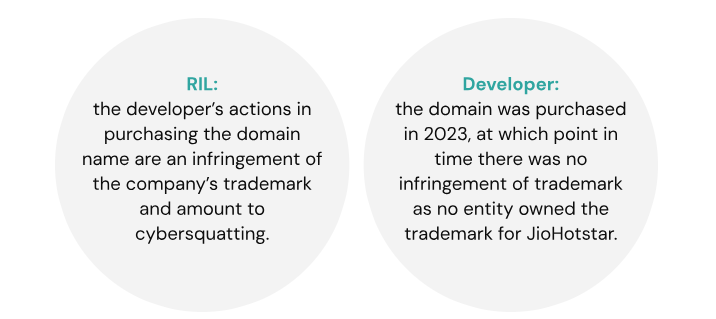
What is Cybersquatting?
‘Cybersquatting’ or digital squatting refers to the action of individuals who register domain names closely resembling established brands, often with the intent to sell for profit or otherwise leverage for personal gain. Cybersquatting can take the following forms:
- Typo squatting/URL hijacking: Domains are purchased with a typographical error in the name of a well-known brand, with the intent to divert the target audience when they misspell a domain name. This could occur with an error as simple as “gooogle.com” instead of “google.com”.
- Identity Theft: Existing brand’s website is copied with the intent to confuse the target consumer.
- Name Jacking: Impersonation of a celebrity/famous public figure on the internet (includes creating fake websites/accounts on social media claiming to be such public figure).
- ‘Reverse’ Cybersquatting: False claim of ownership over a trademark/domain name and accusing the domain owner of cybersquatting.
Cybersquatting can be used as a form of extortion, an attempt to take over business from a rival, or even to mislead/scam consumers, but there is no law in India that specifically addresses such acts of cybersquatting. Since domains are considered ‘trademarks’ under the law, use of a similar or identical domain would render an individual liable for trademark infringement3, in addition to any other liabilities that may be applicable from the perspective of consumer protection laws.
Legal Treatment of Cybersquatting
Cybersquatting rose as an issue as more and more businesses began to realize the value of their online presence in the market. As the digital age unfolded, the Internet Corporation of Assigned Names and Numbers (ICANN) was founded in 1998 as a non-profit corporation based out of the United States with global participation. In 1999, the ICANN adopted the Uniform Domain Name Dispute Resolution Policy (UDRP) to set out parameters in which top level domain disputes are resolved through arbitration. It is important to note that the remedies available under UDRP are only cancellation or transfer of the disputed domain name and do not envisage monetary compensation for any loss suffered. This was ratified in India through the .IN Domain Name Dispute Resolution Policy (INDRP) which is available to all domains registered with .in or .bharat.
Procedure under ICANN/UDRP
- File a Complaint: Approach a provider organization like the World Intellectual Property Organization (WIPO), Asian Domain Name Dispute Resolution Centre (ADNDRC), or the Arab Center for Dispute Resolution (ACDR). Complaints must demonstrate certain key elements.
- Submissions: The respondent is notified of the complaint and UDRP proceedings initiated. Respondents are given 20 days to submit a response to the complaint defending their actions.
- Ruling: A panel with 1 or 3 members is appointed to review the submissions and evaluate the complaint. The panel renders a decision within 14 days of the response submission deadline.
- Implementation and Judicial Recourse: 10 day period is given to the losing party to seek judicial relief in the competent courts. The Registrar of ICANN will implement the panel’s decision on expiry of this period. Either party can seek to challenge the decision in a court of competent relief. The panel’s decision remains binding until overturned by a court order.
Key Elements to a Successful Complaint of Cybersquatting
- Identical or Confusingly Similar Domain Name: The disputed domain name should be identical or confusingly similar to an established trademark or service mark to which the complainant has legal right of ownership;
- Lack of Legitimate Interest: The registrant of the domain name (i.e., the alleged squatter) should have no legitimate interest or right in the domain name; and
- Bad Faith: The disputed domain name should be registered and being used in bad faith.
Factors influencing the UNDRP Panel Review
- Disrupt Competitors: Intent of registrant was to disrupt the business of a competitor;
- Sale/Transfer to Owner: Intent is to resell, transfer, rent or otherwise give right of use to the owner of the trademark;
- Disrupt Reflection of Trademark: Intent is to disrupt the owner from reflecting their trademark in a corresponding domain name and whether a pattern of such conduct is observed by the domain name owner;
- Commercial Gain through Confusion: Intent is to attract internet users to the registrant’s website for commercial gain by capitalizing on the likelihood of confusion with the complainant’s trademark.
Remedies under Indian Law
As held by the Honorable Supreme Court of India, disputes on domain names are legally protected to the extent possible under the laws relating to passing off even if the operation of the Indian Trade Marks Act, 1999 is not extraterritorial (i.e., capable of application abroad). Thus, complainants of cybersquatting can pursue the standard reliefs available under the Trade Mark Act, 1999:
- Remedy for Infringement: Available only when the trademark is registered;
- Remedy for Passing Off: Available even without registration of the trademark.
Notable Examples of Cybersquatting in India
With the evolution of the digital age, India has seen some notable judicial precedents that have shaped how cybersquatting is legally addressed:
| Disputing Parties | Issue | Outcome of Dispute |
| Plaintiff: Yahoo!, Inc. v Defendant: Akash Arora4 Notable for: considered the first case of cybersquatting in India. | Defendant was using the domain name “YahooIndia.com” for internet-related services, with similar content and color scheme to “Yahoo.com”. As the registered owner of the “Yahoo.com” trademark, the plaintiffs sought restraining the defendant from using any deceptively similar trademark/ domain name. | The Court observed the degree of similarity of marks was vital for a passing off claim, and that in this case there is every possibility of the likelihood of confusion and deception being caused, leading a consumer to believe the two domains belong to the same owner, the plaintiffs. |
| Plaintiff: Aqua Minerals Limited v Defendants: Mr. Pramod Borse & Anr.5 Notable for: infringement of plaintiff’s registered trademark “Bisleri”. | Defendants registered the domain “www.bisleri.com” in their name and faced action for infringement of trademark claimed by the plaintiff, owner of registered trademark “Bisleri”. | The conduct of the defendants in quoting an exorbitant amount to sell the domain name to the trademark owner was held to be evidence of bad faith, and the defendants were held to have infringed the trademark. The plaintiff was allowed to seek transfer of the domain to their name. |
| Plaintiff: Sbicards.comvDefendants: Domain Active Property Ltd.6 Notable for: international dispute with an Australian entity. | The defendants had registered the domain name “sbicards.com” with the intent to sell for profit to the State Bank of India subsidiary at a later date. | Acknowledging the defendants’ business of purchase and sale of domain names through its website, WIPO ordered transfer of the domain to the plaintiffs. |
| Plaintiff: Kalyan Jewellers India Ltd.v Defendants: Antony Adams & Ors.7 Notable for: infringement of plaintiff’s registered trademarks “Kalyan”, “Kalyan Jewelers”. | Defendants registered the domain “www.kalyanjewlers.com” in their name and faced action for infringement of trademark claimed by the plaintiff, owner of registered trademark “Kalyan” and “Kalyan Jewelers”. | Initially advised by the WIPO to establish bad faith, the plaintiff filed a suit before Madras High Court, which held that there was an infringement of registered trademarks and restrained the defendant from using the same. |
| Plaintiff: Bundl Technologies Private LimitedvDefendants: Aanit Awattam alias Aanit Gupta & Ors.8 Notable for: infringement of Swiggy trademark | Plaintiff alleged infringement of registered trademark Swiggy, where the defendants were deceptively collecting money from consumers under the false pretext of bringing them on board the Swiggy Instamart platform. | Finding an infringement of trademark, GoDaddy.com LLC, a defendant, was additionally restrained from registering any domain with “Swiggy” in the name, but this was recalled by the Bombay High Court on the grounds that disallowing such registration would amount to a global temporary injunction, instead directing GoDaddy to inform the plaintiff where any application for such registration of domain name was received. |
The JioHotstar Case
The registration of the domain name “JioHotstar” by the unnamed developer amounts to a textbook case of cybersquatting, for which relief can be pursued by RIL and/or Star Television Productions Limited (respectively, the registered owners of “Jio” and “Hotstar” trademarks), either under Trade Marks Act, 1999 or through ICANN/UDRP, relying on the following factors:
- Confusing Similarity: The domain name is confusingly similar to the registered trademarks owned by RIL and Star respectively. Though the formal transfer of trademark has not happened, RIL can still rely solely on the Jio trademark to claim similarity of the mark9. A joint application can also be filed by RIL and Star, as this domain registration would amount to infringement of two separate registered marks;
- Lack of Legitimate Interest: The message posted by the developer on the domain webpage makes it clear that there is no legitimate interest in the domain name to be held by the developer. There is no common reference in public to him by the brand name “JioHotstar” and his clear intent to sell the name for profit evidences a lack of legitimate interest;
- Bad Faith Registration: The transparent intent of the developer to sell the name to profit from the merger and fund his education (i.e., personal gain) evidences a bad faith registration. This is further bolstered by his statement recalling the rebranding of music platform Saavn to ‘JioSaavn’ post the acquisition by RIL’s Jio, which motivated the application for and registration of the domain name10. Bad faith is also recognised within the UDRP itself, when the purpose of the domain name registration is to gain valuable consideration in excess of documented out of pocket costs related directly to the domain name11.
Conclusion
Given the intent behind such domain registrations arousing JioHotstar controversy, cybersquatting typically targets established, reputed brands. In fact, the domain name “JioSaavn.com” was itself the subject of a domain name dispute for cybersquatting in 201812. Though the merger had swiftly navigated regulatory challenges including conditional approval from the Competition Commission of India and clearances from the National Company Law Tribunal and the Ministry of Information and Broadcasting, the domain registration in an unrelated third party’s name serves to showcase the impact that issues such as cybersquatting can have on large scale mergers and acquisitions. The “noble” intent of the developer to use this registration to fund his education aside, the intent is still to leverage the registration for personal gain, thereby satisfying the conditions under law to establish bad faith registration and consequently, cybersquatting that amounts to an infringement of IPR. Interestingly, the domain registration has seemingly been transferred and the webpage now reflects the social service mission of two children in the UAE13. Given the now cross border nature of the dispute and the fact that Trade Marks Act, 1999 cannot be applied extraterritorially, the recourse available to RIL and/or Star to gain ownership of this domain would now be through the UDRP and prescribed dispute resolution mechanisms thereunder. However, in light of latest reports that the UAE siblings have offered to legally transfer the registration to RIL for free, it remains to be seen how this dispute will unfold.
NOTE:
Recently, the domain “Jiostar.com” went live with a teaser message, “coming soon,” sparking speculation that it could be the official platform for Reliance Industries’ streaming services following the Reliance-Disney merger. While there is no official confirmation, many believe this new domain may replace or supplement “JioHotstar.com” in the wake of the cybersquatting issue.
FAQs on the JioHotstar Cybersquatting Case
1. What is cybersquatting?
Cybersquatting, also known as domain squatting, is the act of registering, selling, or using a domain name with the intent of profiting from the trademark of another person or business. Typically, cybersquatters aim to sell the domain to the rightful trademark owner or use it to redirect traffic for personal gain.
2. What does cybersquatting mean in the context of domain names?
In domain name cybersquatting, individuals register domains that closely resemble well-known brands, trademarks, or business names. This practice is intended to leverage the established brand’s reputation, either for financial gain or to redirect web traffic.
3. Are there examples of cybersquatting in India?
Yes, cybersquatting cases in India include notable legal battles such as Yahoo! v. Akash Arora, where the defendant registered the domain “YahooIndia.com,” and Bisleri v. Mr. Pramod Borse, involving the domain “Bisleri.com.” The recent JioHotstar domain row is another example, highlighting cybersquatting practices and legal implications.
4. What happened in the JioHotstar domain case?
An anonymous app developer registered “JioHotstar.com” shortly after news of the Reliance-Disney merger. The developer initially intended to sell the domain to Reliance Industries to fund his education, which led to claims of cybersquatting and trademark infringement.
5. Why is the JioHotstar domain considered a case of cybersquatting?
The JioHotstar domain is deemed cybersquatting because it combines two well-known trademarks, “Jio” and “Hotstar,” for potential personal gain, evidenced by the developer’s offer to sell the domain to Reliance. This action reflects typical cybersquatting behavior under both Indian law and international dispute resolution standards.
6. How does Indian law address cybersquatting?
Although India lacks specific cybersquatting laws, such cases can be pursued under the Trade Marks Act, 1999. The Act offers remedies for trademark infringement and passing off, both of which can apply in cybersquatting disputes.
7. What legal recourse is available for cybersquatting cases in India?
Victims of cybersquatting can file a complaint under the Uniform Domain Name Dispute Resolution Policy (UDRP) through ICANN or under the .IN Domain Name Dispute Resolution Policy (INDRP) if the domain is registered with .in. In addition, they may pursue action under the Trade Marks Act, 1999, for trademark infringement or passing off.
8. Why is the JioHotstar domain case significant?
The JioHotstar domain row is a high-profile example of cybersquatting involving established brands. This case underscores the importance of protecting trademarks in India, particularly in the context of large mergers and acquisitions, as well as the challenges of cross-border cybersquatting disputes.
9. What are the steps to resolve a cybersquatting dispute under the UDRP?
To resolve a cybersquatting case, a complainant files a complaint with an organization like WIPO. The process includes notifying the domain owner, reviewing submissions, and having a panel render a decision. Remedies include transferring or canceling the domain but not monetary compensation.
10. How did the JioHotstar domain row end?
Initially, the domain was offered for sale by the developer, but later it was transferred to two UAE-based siblings. Given the now cross border nature of the dispute and the fact that Trade Marks Act, 1999 cannot be applied extraterritorially, the recourse available to RIL and/or Star to gain ownership of this domain would now be through the UDRP and prescribed dispute resolution mechanisms thereunder. However, in light of latest reports that the UAE siblings have offered to legally transfer the registration to RIL for free, it remains to be seen how this dispute will unfold.
References:
- [1] https://economictimes.indiatimes.com/industry/media/entertainment/media/reliance-disney-media-giant-may-be-born-in-november/articleshow/114477261.cms?from=mdr
︎ - [2] https://www.business-standard.com/companies/news/delhi-techie-snags-jiohotstar-domain-asks-reliance-to-fund-cambridge-dream-124102400446_1.html
︎ - [3] Under Section 29 of the Trade Marks Act, 1999.
︎ - [4] 1999 ALR 620
︎ - [5] 2001 SCC OnLine Del 444
︎ - [6] WIPO Case No. D2005 0271
︎ - [7] C.S. No. 335 of 2020
︎ - [8] IA (Lodging) No. 38837 of 2022 in IA (Lodging) no. 26556 of 2022 in Commercial IP Suit (Lodging) No. 26549 of 2022
︎ - [9] This argument has been successfully put forth by Decathlon SAS in previous UDRP case, where the domain name “decathlon-nike.com” was ordered to be transferred to Decathlon trademark owner despite a lack of consent from Nike, as there was no provision in the policy or rules requiring a third party consent [Decathlon SAS v Nadia Michalski Case No. D2014-1996, available here: https://www.wipo.int/amc/en/domains/search/text.jsp?case=D2014-1996].
︎ - [10] https://economictimes.indiatimes.com/news/new-updates/cant-stand-against-reliance-app-maker-who-demanded-rs-1-crore-for-jiohotstar-com-domain-name-seeks-legal-help/articleshow/114543044.cms?from=mdr
︎ - [11] Paragraph 4(b)(i) of the UDRP (accessible here: https://www.icann.org/resources/pages/policy-2024-02-21-en)
︎ - [12] WIPO Case No. D2018-1481
︎ - [13] https://www.hindustantimes.com/entertainment/web-series/techies-message-asking-reliance-1-crore-for-jiohotstar-domain-mysteriously-vanishes-uae-siblings-now-own-the-website-101729919899425.html
︎
Introduction
In June 2007, tech giant Infosys Ltd. introduced non-compete agreements for its employees1. The clause, which was subsequently made part of the employment agreements, required that post termination of an employee, such employee agrees to not accept any offer of employment from: (i) any Infosys customer (from the last 12 months); and (ii) a named competitor of Infosys (including TCS, Wipro, Accenture, Cognizant and IBM) if the employment would require work with an Infosys customer (from the last 12 months), for a period of 6 months.
Following an increased attrition rate in Q4 of Financial Year 2022, the company began to implement this clause2, leading to the Nascent Information Technology Employees Senate (NITES), an IT workers union based out of Pune, filing a complaint with the Union Labour Ministry in April 20223. Deeming the application of the clause post exit of an employee from Infosys to be “illegal, unethical and arbitrary”, NITES demanded the removal of such clauses from the employment agreement. Defending the clause, Infosys issued a statement claiming that the non-compete clause was a “standard business practice in many parts of the world for employment contracts”, to include “controls of reasonable scope and duration” to protect the “confidentiality of information, customer connection and other legitimate business interests”4.
While there is limited public information available on the outcome of the discussions between NITES, Infosys and the competent labor authorities, this throws light on an issue that has been the subject of legal discourse in India time and again: enforceability of non-compete contracts.
In this piece, we break down what non-compete is; the legal framework governing such contractual provisions; and practical considerations for employers and employees, to facilitate informed decision making at all levels.
What is a Non-compete Clause?
Non-compete clauses are a contractual provision whereby a person exiting a business typically agrees to not start a new business, take up employment in or otherwise engage in any manner with a competing entity. Also termed as “negative covenants”, these clauses impose a contractual obligation on the person to not undertake certain activities. Consequently, failure to abide by these contractual restrictions would result in a breach of the contract:
- Duration: Non-compete clauses can be for the duration of the employment relationship but also are typically contemplated for a specific period post termination, i.e., post exit of the individual from the business.
- Limitations to Restrictions: These contractual restrictions are usually limited by geographical location or for a fixed period of time having the effect that the said person would be in breach of the non-compete agreement if they were to start a new business/engage with a competing entity within the same geographical area and within such time period.
- Who is Restricted: These clauses are typically built into employment agreements (particularly of founders and key managerial personnel) where access to confidential and proprietary information pertaining to a business (including with respect to intellectual property) is to be considered; if such information is used by the departing employee/founder/key employee, the likelihood of an unfair business advantage is increased.
- M&A perspective: Non-compete clauses are also seen in transaction documents executed in mergers and acquisitions, where the value of the investment can be impacted if exiting founders/key employees start or join a competing business, leading to loss of competitive advantage to the acquirer.
Can non-compete contracts be enforced in India?
Once a breach of contract is determined, the parties to such contract would have the appropriate remedial measures built in, which can typically include compensation for any loss suffered as a result of the breach. However, in order to be able to enforce such remedial measures, it is critical for the underlying contractual obligation itself to be enforceable. It is against this backdrop that the provisions of the Indian Contract Act, 1872 (“ICA”) become relevant. Section 27 of the ICA stipulates that any agreement in restraint of trade is void. In other words, any agreement that restricts a person from exercising a lawful profession, trade or business of any kind is to that extent void5. Stemming from the fundamental right to practice any profession or occupation protected by Article 19(1)(g) of the Constitution of India, the intent
behind Section 27 of the ICA is to guard against any interference with freedom of trade even if it results in interference with freedom of contract.
However it is important to note that even within the Constitution, the freedoms protected by the fundamental rights are not absolute and can be limited within specified circumstances. Historically, the Supreme Court of India and various high courts across the country have consistently adopted the following approach towards enforceability of such negative covenants:
- Reasonableness: The enforceability will be limited to the extent that such a negative covenant is reasonable6; and
- Legitimacy: The purpose of the negative covenant is to protect the legitimate business interests of the buyer. The restraint cannot be greater than necessary to protect the interest concerned7.
In light of the above, the Indian courts have adopted the approach that these restrictions during the period of employment are valid, as they can be considered legitimate for the protection of the business interests of the company. Against this reasoning, Section 27 would not be violated8. However, such obligations cannot be unconscionable, excessively harsh, unreasonable or one-sided, i.e., satisfying the requirement of reasonableness and legitimacy..
The controversy associated with such negative covenants arises when they are sought to be enforced beyond the period of employment. In a high profile ruling, the Supreme Court held that a media management company’s non-compete clause that prevented a prominent Indian cricketer from joining their competitor for a specific period of time after their agreement had terminated, could not be enforced9. The principle that enforcement of non-compete beyond the period of employment is void under Section 27 has been well-settled10. In a pattern followed by high courts across the country, post-termination non-compete clauses have generally not been enforced on the rationale that the right to livelihood of a person must prevail over the interests of an employer11.
However, this is not to say that all non-compete clauses are automatically unenforceable. For instance, the Delhi High Court held that while employees who had already accepted the offer of employment with the competitor could not be injuncted against (as the same would read a negative covenant into their employment contracts which would violate Section 27), an injunction against future solicitation could be granted on the grounds it was a legitimate and reasonable restriction12.
Given the uncertainty over enforcement of non-compete clauses, employers have adopted a novel approach of inserting a “garden leave” clause, during which the employee is fully paid their salary for the period in which they are restricted by such negative covenants. While such a concept has been held by the Bombay High Court to be a prima facie restraint of trade affected by Section 2713, it is a popular solution practiced widely by employers. Additionally, restrictions on non-disclosure of confidential information and non-solicitation of customers and employees have been previously enforced14. Non-compete obligations are also often found in mergers and acquisitions transactions, with the courts permitting such restrictions on the basis of specified local limits that are reasonable to the court, having regard to the nature of business/industry concerned15.
We help draft effective Contracts & Agreements Let’s Talk
Practical Considerations
Despite the trend of non-enforceability of non-compete contracts, such negative covenants are commonly found in employment and M&A contracts. These restrictions are still seen as soft deterrents, with employees preferring to comply rather than bear litigation costs and the burden of being sued by a former employer16. Here are some practical considerations for employers and employees when considering a non-compete contract:
- Legitimacy: Employers should carefully consider whether the non-compete restriction is necessary to protect business interests. It would be prudent for employers to undertake a reasonable calculation of quantifiable harm and risk from such a breach and inform the employees of the same.
- Reasonableness: The clause should consider: (i) the duration of restriction and geographical scope; (ii) nature of the employees position and exposure to trade secrets, proprietary information, etc.; (iii) availability of alternative employment; and (iv) compensation in terms of salary, etc. for the duration of restriction.
- Review Impact: It is critical that employees are made fully aware of the extent to which such negative covenants are applicable and the legitimacy and reasonableness of the same arising from the impact of the employee’s departure from the organization.
Conclusion
Non-compete clauses continue to face enforceability challenges, with the most recent example being Wipro’s lawsuit against its former CFO for violating the restriction in his employment contract and joining Cognizant as a competitor in December 202317. India’s judicial approach to enforceability of post-termination non-compete clauses is clear: if it is not permissible within the scope of Section 27, it would not be enforceable. This differs from jurisdictions such as the United Kingdom, where post-termination restrictions that are designed to protect a proprietary interest of an employer or buyer are enforceable provided there is a material risk and the restriction is itself reasonable, are enforceable; and the United States, where the US Federal Trade Commission recently banned non-compete clauses for US workers18. The clear conclusion is that a uniform approach to enforcement of negative covenants cannot be adopted.
Frequently Asked Questions (FAQ) on Non-Compete Clauses
1. What is a non-compete clause?
A non-compete clause is a contractual restriction that prevents an employee from joining a competitor or starting a competing business after leaving a company. It may include specific limitations on time, geographic location, and types of activities.
2. Are non-compete clauses legally enforceable in India?
In India, enforceability of non-compete clauses is limited. Section 27 of the Indian Contract Act deems any restraint of trade to be void. While certain in-employment restrictions may be valid, post-employment restrictions are generally not enforceable, as they can interfere with an individual’s right to livelihood.
3. Why do companies use non-compete clauses if they are often unenforceable?
Despite legal limitations, companies may still include non-compete clauses to act as deterrents. Many employees prefer to comply rather than face potential legal disputes.
4. What are some exceptions where non-compete clauses may be enforceable?
Non-compete clauses may be enforceable if they are reasonable in scope and necessary to protect legitimate business interests, such as confidential information or trade secrets. Courts may uphold them if they are limited to the duration of employment or for protecting specific business interests.
5. How does India’s approach compare with other countries?
India’s approach to non-compete clauses is more restrictive compared to countries like the UK, where reasonable post-termination restrictions are often enforceable if they protect a legitimate proprietary interest. In the US, non-compete laws vary by state, and recently, the Federal Trade Commission proposed a ban on non-competes for American workers.
6. What is a “garden leave” clause, and how does it relate to non-compete agreements?
A garden leave clause allows employees to remain on payroll after they resign or are terminated, but restricts them from joining competitors during this period. Although some Indian courts view it as a restraint of trade, it’s a popular alternative to non-compete clauses.
7. Can non-compete clauses be included in M&A agreements?
Yes, non-compete clauses are common in mergers and acquisitions (M&A) to protect the buyer’s investment and maintain competitive advantage. Courts may allow such clauses if they are reasonable and necessary for the protection of business interests.
8. What are the practical considerations for employees facing a non-compete clause?
Employees should assess the reasonableness and impact of any non-compete clause, including its duration, scope, and potential limitations on future employment opportunities.
9. What options do employees have if they disagree with a non-compete clause?
Employees may negotiate the terms before signing or, if already in effect, seek legal advice to understand the likelihood of enforceability based on Indian law and precedent cases.
- [1] https://economictimes.indiatimes.com/news/company/corporate-trends/infy-asks-staffs-to-sign-pact-against-joining-rivals/articleshow/2101866.cms?from=mdr ︎
- [2] https://www.businesstoday.in/latest/corporate/story/infosys-served-notice-by-union-labour-ministry-over-its-non-compete-clause-in-employee-contract-331508-2022-04-27 ︎
- [3] https://nites.co.in/nites-submits-complaint-against-infosys-illegal-non-compete-agreement-to-labour-ministry/#:~:text=The%20employee’s%20covenants%20should%20be,clause%20from%20the%20employment%20agreements. ︎
- [4] ibid, 2 above. ︎
- [5] The Indian Contract Act, 1872 exempts such restraint of trade contracts for transactions where the goodwill of a business is sold. ︎
- [6] As laid down by the Supreme Court in Niranjan Shankar Golikari v Century Spinning and Mfg. Co. (1967) 2 SCR 378. ︎
- [7] As laid down by the Supreme Court in Gujarat Bottling Co Ltd v The Coca Cola Co & Ors. (1995) SCC (5) 545. ︎
- [8] As laid down by the Supreme Court in Niranjan Shankar Golikari v Century Spinning and Mfg. Co. (1967) 2 SCR 378. ︎
- [9] As laid down by the Supreme Court in Percept D’Mark (India) Pvt. Ltd. v Zaheer Khan and Ors. Appeal (Civil) 5573-5574 of 2004. ︎
- [10] As laid down by the Supreme Court in Superintendence Company of India (P) Ltd. v Krishan Murgai 1981 2 SCC 246. ︎
- [11] Trend observed in rulings of: (i) Bombay High Court in VFS Global Services Pvt. Ltd. v Mr. Suprit Roy 2008 (3) MhLj 266; and (ii) Delhi High Court in Affle Holdings Pte. Ltd. v Saurabh Singh 2015 SCC OnLine Del 6765, and Wipro Limited v Beckman Coulter International S.A. 2006 (3) ARBLR 118 (Delhi). ︎
- [12] As laid down by the Delhi High Court in Wipro Limited v Beckman Coulter International S.A. 2006 (3) ARBLR 118 (Delhi). ︎
- [13] In VFS Global Services Private Limited v Mr. Suprit Roy 2008 (3) MhLj 266, the Bombay High Court reasoned that the payment of salary during garden leave does not renew the contract of employment and therefore amounted to a prima facie restraint of trade. ︎
- [14] As held by: (i) Madras High Court in E-merge Tech Global Services Private Limited v M. R. Vindhyasagar and Ors. C.S. No. 258 of 2020; and (ii) Bombay High Court in Zee Telefilms Limited v Sundial Communications Private Limited 2003 (5) BOM CR 404. ︎
- [15] As held by the Delhi High Court in Ozone Spa Pvt. Ltd. v Pure Fitness & Ors. 2015 222 DLT 372. ︎
- [16] https://economictimes.indiatimes.com/jobs/c-suite/non-compete-clauses-unenforceable-under-law-but-companies-love-them/articleshow/109633571.cms?from=mdr ︎
- [17] https://economictimes.indiatimes.com/jobs/c-suite/non-compete-clauses-unenforceable-under-law-but-companies-love-them/articleshow/109633571.cms?from=mdr ︎
- [18] https://www.ftc.gov/system/files/ftc_gov/pdf/noncompete-rule.pdf ︎
A board observer’s position in the intricate realm of corporate governance is crucial and varied. With increased distress particularly in the private equity sector, we may see investors deploying various tools to keep a closer eye on the company’s financial performance. Appointing a board observer is one such tool.
Despite not having statutory authority or the ability to vote, board observers have a special position of influence and can provide productive insights.
Board observers quite literally are individuals who are fundamentally appointed with the task to ‘observe’. They act as representatives typically from major investors, strategic partners, or key stakeholders, and are granted access to board meetings.
Understanding the Role of Board Observers
Board observers are not formal members of the board, nor do they hold the power to vote on corporate decisions. However, their presence in board meetings is a tool used primarily by major investors, strategic partners, and other key stakeholders to monitor the company’s strategic direction and financial health. These individuals are entrusted with providing valuable insights without the direct legal responsibilities that directors typically face.
Although board observers do not have a formal vote, their influence can shape company strategies. This unique role enables them to represent the interests of investors or stakeholders while remaining free from the direct obligations of fiduciary duties.
Board Observer Rights – How does it work?
Investors involved in the venture capital (VC) and private equity (PE) spaces often negotiate for a board seat with the intent to contribute to the decision-making process and protect their interests by having representation on the board. A recent trend, however, indicates that these investors are reluctant to formally exercise their nomination rights owing to the possible risks/liabilities associated with directorships, such as fiduciary duties and vicarious liability that is often intertwined in the acts and omissions of the company, which can lead to such directors being identified as “officers in default”.
The rights and responsibilities of a board observer are distinct from those of a nominee director, primarily due to the lack of formal voting authority. Accordingly, board observers are relieved from the direct fiduciary duties that are normally connected with board membership since their position is specified contractually rather than by statutory board responsibilities.
Is a Board Observer an officer in default?
The Act provides a definition for the term “Officer” which inter alia includes any person in accordance with whose directions or instructions the board of directors of the company or any one or more of the directors are accustomed to act. Additionally, the term “Officer in Default” states that an Officer of the company who is in default will incur liability in terms of imprisonment, penalties, fines or otherwise, regardless of their lack of an official position in the company.
Accordingly, any person who exercises substantial decision-making authority on the board of the company may be covered as an Officer in Default.
While board observers may not be equivalent to formal directors, the litmus test lies in determining where the decision-making power truly resides, leading to potential liabilities that may surpass the protections sought by investors.
Observers are not subject to a company’s breach of any statutory provisions because their appointment is based on a contractual obligation rather than a statutory one, unlike nominee directors who are permitted to participate in board meetings.
Even though board observers are not designated as directors, they run the risk of being seen as “Shadow Directors” if they have a significant amount of authority or influence over the decisions made by the company.
The Legal Perspective on Board Observers
Unlike nominee directors, who are formally appointed and legally bound to fulfill statutory responsibilities, board observers are appointed through contractual obligations. This shields them from liabilities tied to breaches of statutory provisions. However, as their influence grows, so does the risk of being classified as shadow directors, particularly if they are perceived as playing a significant role in decision-making.
Conclusion
Corporate Governance is an evolving concept, especially in the context of active investor participation. In order to foster a corporate environment that is legally robust, it will be imperative to strike a balance between active investor participation and legal prudence. That being said, as businesses continue to navigate complex and evolving landscapes, the value of a well-integrated board observer cannot be overstated. A board observer can bring clarity to the business and operations of an investee company without attaching the risk of incurring statutory liability for acts/omissions by the company. This is a significant factor that makes the option of a board observer nomination more attractive to PE and VC investors, vis-a-vis the appointment of a nominee director.
FAQs on Board Observers
- What is a board observer in corporate governance?
A board observer is an individual appointed by investors or key stakeholders to attend board meetings without having formal voting power. They offer insights and monitor the company’s performance, primarily to protect the interests of those they represent. - How do board observers differ from directors?
Unlike board directors, board observers do not have the authority to vote on decisions or take on fiduciary duties. Their role is more about observation and providing feedback rather than participating in the decision-making process. - What are the rights of a board observer?
A board observer has the right to attend board meetings and access key company information, but they do not hold any voting rights. Their responsibilities and rights are typically outlined in a contractual agreement between the company and the observer’s appointing party. - Can board observers influence corporate decisions?
Yes, board observers can provide valuable insights and advice that may influence corporate decisions, but they do not have direct decision-making power. Their influence comes from their ability to offer expert advice and represent investors’ interests. - Are board observers liable for company decisions?
Generally, board observers are not legally liable for company decisions as they are not formal board members. However, if their influence over board decisions becomes significant, they could be viewed as shadow directors, which might expose them to certain legal liabilities. - Why do investors appoint board observers instead of directors?
Investors often prefer appointing board observers because it allows them to monitor company performance and offer guidance without taking on the fiduciary duties and potential liabilities associated with being a formal board member. - What is the risk of being considered a shadow director as a board observer?
If a board observer has significant influence over board decisions, they could be classified as a shadow director. Shadow directors can be held liable for the company’s actions, similar to formally appointed directors, especially in cases of misconduct or financial mismanagement. - How does a board observer benefit private equity and venture capital investors?
Board observers allow PE and VC investors to maintain oversight of their portfolio companies, ensuring the company’s strategic direction aligns with their interests. This role provides investors with valuable insights without the risk of statutory liabilities that come with directorship.
What is SaaS?
Software as a Service (“SaaS”), is a way of delivering software applications over the internet. Instead of purchasing and installing software on your computer, you access it online through a subscription. This makes it easier to use and manage, as updates, security, and maintenance are handled by the service provider. Examples of SaaS include tools like Google Workspace or Microsoft 365, where everything is accessible from a web browser. This model is convenient for businesses because it reduces upfront costs and offers scalability based on their needs.
What are SaaS Agreements?
However, beneath the surface of this convenient access lies a complex web of agreements that govern the relationship between SaaS providers and their customers, which are essential to ensuring a smooth and secure experience for all parties involved. These agreements outline the terms of using a cloud-based software service. These agreements specify the rights and responsibilities of both parties, covering aspects such as subscription fees, data privacy, service availability, support, and usage limitations.
This article delves into the various types of agreements that form the backbone of the SaaS industry and it will explore their key components, importance, and how they work together to create a win-win situation for both SaaS providers and their subscribers.
What are the types of Agreement in SaaS Industry
In the SaaS industry, various types of agreements are commonly used to establish the terms of service, licensing, and other legal arrangements between the SaaS provider and its customers. Here are some key types of agreements used in the SaaS industry:
Terms of Service (ToS) or Terms of Use (ToU)
These agreements outline the terms and conditions under which users are allowed to access and use the SaaS platform. They typically cover aspects such as user obligations, limitations of liability, intellectual property rights, privacy policies, and dispute resolution procedures.
Key Components: User obligations, limitations of liability, intellectual property rights, privacy policies, dispute resolution procedures.
Importance: Provides clarity and sets apt expectations for users regarding acceptable use of the SaaS platform, protecting the provider from misuse and establishing guidelines for resolving disputes.
Service Level Agreement (SLA)
SLAs define the level of service that the SaaS provider agrees to deliver to its customers, including uptime guarantees, response times for support requests, and performance metrics. SLAs also often outline the remedies available to customers in the event that service levels are not met.
Key Components: Uptime guarantees, response times for support requests, performance metrics, remedies for breaches.
Importance: Defines the quality of service expected by customers, establishes accountability for the SaaS provider, and offers assurances to customers regarding system reliability and support responsiveness
Master Services Agreement (MSA)
An MSA is a comprehensive contract that governs the overall relationship between the SaaS provider and the customer. It typically includes general terms and conditions applicable to all services provided, as well as specific terms related to individual transactions or services.
Key Components: General terms and conditions, specific terms related to individual transactions or services, payment terms, termination clauses.
Importance: Forms the foundation of the contractual relationship between the SaaS provider and the customer, streamlining the process for future transactions and ensuring consistency in terms across multiple agreements.
Subscription Agreement:
This agreement outlines the terms of the subscription plan selected by the customer, including pricing, payment terms, subscription duration, and any applicable usage limits or restrictions.
Key Components: Pricing, payment terms, subscription duration, usage limits, renewal terms.
Importance: Specifies the terms of the subscription plan selected by the customer, including pricing and payment obligations, ensuring transparency and clarity in the commercial relationship.
Data Processing Agreement (DPA)
DPAs are used when the SaaS provider processes personal data on behalf of the customer, particularly in relation to data protection regulations such as GDPR. These agreements specify the rights and obligations of both parties regarding the processing and protection of personal data.
Key Components: Data processing obligations, data security measures, rights and responsibilities of both parties regarding personal data as laid down in India’s Digital Personal Data Protection Act 2023, and GDPR compliance.
Importance: Ensures compliance with data protection regulations, establishes safeguards for the processing of personal data, and defines the roles and responsibilities of each party in protecting data privacy.
Non-Disclosure Agreement (NDA)
NDAs are used to protect confidential information exchanged between the SaaS provider and the customer during the course of their relationship. They prevent either party from disclosing sensitive information to third parties without consent.
Key Components: Definition of confidential information, obligations of confidentiality, exceptions to confidentiality, duration of the agreement.
Importance: Protects sensitive information shared between parties from unauthorized disclosure, fostering trust and enabling the exchange of confidential information necessary for business collaboration.
End User License Agreement (EULA)
If the SaaS platform includes downloadable software or applications, an EULA may be required to govern the use of that software by end users. EULAs specify the rights and restrictions associated with the use of the software.
Key Components: Software license grant, permitted uses and restrictions, intellectual property rights, termination clauses.
Importance: Establishes the rights and obligations of end users regarding the use of software, ensuring compliance with licensing terms and protecting the provider’s intellectual property rights.
Beta Testing Agreement
When a SaaS provider offers a beta version of its software for testing purposes, a beta testing agreement may be used to outline the terms and conditions of the beta program, including feedback requirements, confidentiality obligations, and limitations of liability.
Key Components: Scope of the beta program, feedback requirements, confidentiality obligations, limitations of liability.
Importance: Sets the terms for participation in beta testing, manages expectations regarding the beta software’s functionality and stability, and protects the provider from potential risks associated with beta testing activities.
These are some of the most common types of agreements used in the SaaS industry, though the specific agreements required may vary depending on the nature of the SaaS offering and the requirements of the parties involved.
Conclusion
In conclusion, the Software as a Service (SaaS) industry relies on a variety of agreements to establish and govern the relationships between SaaS providers and their customers. Each agreement plays a crucial role in defining the terms of service, protecting intellectual property, ensuring data privacy and security, and mitigating risks for both parties involved. From Terms of Service outlining user responsibilities to Service Level Agreements guaranteeing performance standards, and from Data Processing Agreements ensuring compliance with regulations like GDPR to Non-Disclosure Agreements safeguarding confidential information, these agreements collectively form the legal backbone of the SaaS ecosystem. By clearly delineating rights, obligations, and expectations, these agreements promote transparency, trust, and effective collaboration in the dynamic landscape of cloud-based software delivery. As the SaaS industry continues to evolve, these agreements will remain essential tools for fostering mutually beneficial partnerships and driving innovation in the digital economy.
FAQs on Types of SaaS Agreements
Q. What is the significance of agreements in the SaaS industry?
Agreements play a crucial role in defining the legal relationships between SaaS providers and their customers, outlining rights, obligations, and terms of service.
Q. What are the key types of agreements used in the SaaS industry?
Common agreements in the SaaS industry include Terms of Service (ToS), Service Level Agreements (SLAs), Master Services Agreements (MSAs), Subscription Agreements, Data Processing Agreements (DPAs), Non-Disclosure Agreements (NDAs), End User License Agreements (EULAs), and Beta Testing Agreements.
Q. What is the purpose of a Terms of Service (ToS) agreement in the SaaS industry?
ToS agreements establish the rules and guidelines for using the SaaS platform, including user responsibilities, intellectual property rights, and dispute resolution procedures.
Q. How do Service Level Agreements (SLAs) benefit customers in the SaaS industry?
SLAs define the level of service that the SaaS provider commits to delivering, including uptime guarantees, support response times, and performance metrics, offering assurances to customers regarding service quality.
Q. What does a Master Services Agreement (MSA) encompass in the SaaS industry?
MSAs serve as comprehensive contracts governing the overall relationship between SaaS providers and customers, covering general terms, specific transaction details, payment terms, and termination clauses.
Q. What is the purpose of Non-Disclosure Agreements (NDAs) in the SaaS industry?
NDAs protect confidential information exchanged between parties during the course of their relationship, preventing unauthorized disclosure and fostering trust in business collaborations.
Q. How do End User License Agreements (EULAs) affect users of SaaS platforms?
EULAs define the terms of use for software provided by SaaS platforms, including permitted uses, restrictions, and intellectual property rights, ensuring compliance and protecting the provider’s interests.
Q. What is the role of Beta Testing Agreements in the SaaS industry?
Beta Testing Agreements establish terms for participating in beta programs, outlining feedback requirements, confidentiality obligations, and limitations of liability for both parties involved in testing new software releases.
Q. How can businesses ensure they are effectively using these agreements in the SaaS industry?
Businesses should carefully review, customize, and regularly update these agreements to reflect evolving legal requirements, industry standards, and the specific needs of their SaaS offerings and customer base.
]]>As part and parcel of a transaction, companies seeking investment provide their investors with certain rights, which are contractually negotiated. These range from receiving periodic reports on the business and financials of the company to representation on the board of directors and the right to be involved in certain key decisions required to be taken by the company in the course of their growth. Such rights are typically requested by investors based on factors such as the nature of the investment (i.e., financial or strategic) and the level of insight into the business, operations and management of the company required. In such transactions, these rights (and the extent) are agreed upon and captured in a shareholders’ agreement (“SHA”) between the parties, whereas the rights and obligations pertaining to the fundraising itself are governed by the investment agreement.
Typically, investors (especially foreign) and companies/founders agree to arbitrate any disputes arising from the investment agreement or the SHA. However, referring a dispute to arbitration is often not as clear-cut as a contractual agreement between parties. Indian courts have repeatedly been required to provide rulings on whether or not arbitration can be invoked by the parties to a SHA. This issue is complicated further by conflicting judicial precedents which have ultimately resulted in an unclear understanding of the law forming the basis of how parties can agree to arbitrate any disputes.
In this article Dispute Resolution in the Articles of Association (AOA), we have provided an overview of the contested legal position and our suggestions for navigating the murky landscape, with the fundamental goal of ensuring the parties’ contractually documented intent is protected and legally enforceable.
Relationship between a Shareholders’ Agreement and the Articles of Association (‘AOA’)
What is the AOA?
Similar to how the constitution of India forms the basis of Indian democracy, the memorandum of association (‘MOA’) and AOA form the basis for a company’s legal existence. The MOA can be seen as the constitutional document that lays down the fundamental elements and broad scope within which the company, business, and operations will typically operate. However, it is the AOA that puts in place a ‘rulebook’, prescribing the regulations and by-laws that govern the company and in effect, enshrining and giving effect to the principles of the MOA.
It is crucial to understand that because a company is seen as a separate legal person, the AOA is a critical document that establishes the legal relationship between the shareholders of the company inter se and with the company. In order to lay the framework for the operations of the company, an AOA will include provisions (in accordance with applicable laws) that:
(i) regulate internal affairs and operations of the company;
(ii) provide clarity on procedures the company must follow;
(iii) govern the issue/buyback of securities and clarify the legal rights and obligations of shareholders holding different classes of securities; and
(iv) legitimize the authority of the board of directors and their functions.
It is, therefore, a reasonable presumption that any action undertaken by a company must be authorised by the AOA/MOA. Any amendment or alteration to these documents would not only require the assent of the board, but also of the shareholders (i.e., members of the company), and requires filing with the competent Registrar of Companies under the Companies Act, 2013. While these procedures are in place primarily to protect the shareholders from mischief by the company, the lengthy process involved in altering the AOA serves to highlight how essential a document it is for a company’s action to hold legal justification.
How does the shareholders’ agreement typically become enforceable?
Often in transaction documents, a critical mechanism that enables the enforcement of the investor rights agreed in the SHA is captured in the investment agreement, where as part of the conditions required to be satisfied upon receipt of the investment amount by the company, the company, and founders must also ensure that the AOA is suitably amended to codify the investor rights.
However, the legal justification for this action in itself finds a conflict between two different schools regarding the enforceability of provisions from the SHA that have not been incorporated into the AOA:
(i) The “incorporation” view – the prominent authority for this view is the ruling of the High Court of Delhi in World Phone India Pvt. Ltd. & Ors. v. WPI Group Inc. USA (the “World Phone Case”)[1], where it was held that a board resolution passed without considering an affirmative voting right granted to a shareholder under a joint venture agreement, was legally valid in light of the company’s AOA, which contained no such restriction. Relying on the decision of the Supreme Court in V.B. Rangaraj v. V.B. Gopalakrishnan (the “Rangaraj Case”)[2] and subsequent decision of the Bombay High Court in IL&FS Trust Co. Ltd. v. Birla Perucchini Ltd. (the “Birla Perucchini Case”)[3], the Delhi High Court was of the view that the joint venture agreement could not bind the company unless incorporated into the AOA.
The Rangaraj Case is of particular interest in this school of thought because while the issue dealt with share transfer restrictions, the Supreme Court held that it was evident from the provisions of the erstwhile Companies Act, 1956 that the transfer of shares is a matter regulated by the AOA of the subject company and any restriction not specified in the AOA was not binding on the company or its shareholders. Crucially, the World Phone Case poses a problem in the legal interpretation of the “incorporation” view because the Delhi High Court has carried the ratio of the Rangaraj Case to a logical conclusion and observed that even where the subject company is party to an SHA, the provisions regarding management of affairs of the company cannot be enforced unless incorporated into the AOA.
(ii) the “contractual” view – the prominent authority for this view is the ruling of the Supreme Court in Vodafone International Holdings B.V. v Union of India (the “Vodafone Case”)[4], where the Supreme Court disagreed with the ratio in the Rangaraj Case, without expressly overruling it, and held that freedom of contract includes the freedom of shareholders to define their rights and share-transfer restrictions. This was found to not be in violation of any law and therefore not be subject to incorporation within the AOA. This has also been supported by the Delhi High Court in Spectrum Technologies USA Inc. v Spectrum Power Generation[5] and in Premier Hockey Development Pvt. Ltd. v Indian Hockey Federation[6]. In fact, in the latter case, the Delhi High Court was of the view that the subject company, being party to both an SHA and a share subscription and shareholders agreement containing an obligation to modify the AOA to incorporate the SHA, was conclusive in binding the subject company to the same despite an absence of incorporation into the AOA.
How can this fundamental disagreement be reconciled?
It is difficult to reconcile the issues caused by conflicting rulings from the same judicial authority. Given that the circumstances of each case provide scope for situation-specific reasoning, we cannot conclusively say one view is preferred, or more appropriate, over the other. Further, where the courts have stopped short of conclusively overruling previous judgments (for instance the Supreme Court on the Vodafone Case only disagreed with the ratio of the Rangaraj Case), the result is an unclear understanding of the legal position regarding the enforceability of SHA without incorporation in the AOA.
It is also pertinent to note that the issues in the above rulings also deal with the enforceability of certain shareholder rights that have been contractually agreed upon (such as affirmative votes or share transfer restrictions). By contrast, dispute resolution is a mechanism contractually agreed upon between the parties in the event of any dispute/breach of the SHA and cannot be characterized as a “right” of any shareholder(s), in the true sense of the word. However, in light of the conflicting principles guiding the “incorporation” and “contractual” views, the lack of clarity extends to the inclusion of dispute resolution in the AOA simply to make the intent of parties to approach arbitration, enforceable.
Incorporation of arbitration clauses
Flowing from the “incorporation” view, the Delhi High Court, relying on the Rangaraj Case, World Phone Case, and the Birla Perucchini Case, held in Umesh Kumar Baveja v IL&FS Transportation Network[7] that despite the subject company being a party to the SHA, it was the AOA that governed the relationship between the parties and that since they did not contain any arbitration provision, the parties could not be referred to arbitration. A similar ruling was passed by the Company Law Board, Mumbai in Ishwardas Rasiwasia Agarwal v Akshay Ispat Udyog Pvt. Ltd.[8], where it was held the non-incorporation of the arbitration clause into the AOA of the subject company was fatal to the request for a reference to arbitration, despite findings that the dispute was contractual in nature and arbitrable.
A second line of reasoning flowing from the “contractual” view has attempted to uphold the contractual intent of the parties reflected in an SHA. In Sidharth Gupta v Getit Infoservices Pvt. Ltd.[9], the Company Law Board, Delhi was required to rule on the reference to arbitration. Relying on the facts that the SHA had been incorporated verbatim into the AOA and the subject company was a party to the SHA, the Company Law Board rejected the argument from an “incorporation” view and remarked on the importance of holding shareholders “to their bargain” when significant money had been invested on the basis of the parties’ understanding recorded in the SHA. It is pertinent to note in this case, that the Company Law Board had been directed by the Supreme Court to dispose of the case without being influenced by the decisions of the Delhi High Court. This led the Company Law Board to not consider the ruling of the Delhi High Court in the World Phone Case as binding.
An unusual third line of reasoning has also been provided by the High Court of Himachal Pradesh in EIH Ltd. v State of Himachal Pradesh & Ors.[10]. In this case, a dispute regarding a breach of AOA was referred to arbitration under the arbitration clause of the constitutive joint venture agreement to which the resultant company was not a party. The High Court held that the joint venture agreement and the AOA of the subject company were part of the same transaction, where the primary contractual relationship was contained in the joint venture agreement, and that the AOA functioned as a “facilitative sister agreement” to the same. Given the critical nature of the AOA to the internal governance of the subject company as a juristic person however, this line of reasoning where the AOA is relegated to a “sister agreement” is likely to not stand the test of a comprehensive judicial review of this issue.
Navigating the landscape and concluding thoughts
The startup growth trajectory continues to contribute significantly to the Indian economy, with funding crossing USD 5.3 billion in the first six months of 2024 and over 915 investors participating in funding deals[11]. This will see a proportional rise in investor-company disputes, and when reference to arbitration is contractually agreed but not enshrined in the SHA, this can lead to further delays at the stage of dispute resolution, where the competent court would be required to first rule on whether the reference to arbitration can even be enforced. However, the conflicting judicial precedents are only the tip of this murky iceberg; party autonomy is a fundamental guiding principle to any reference to arbitration. Where judicial precedent sets the grounds for formal incorporation into the AOA as a condition to enforcing this party intent, however, a question of whether the parties’ contractually documented intent is being ignored, is raised.
Further, the legal basis for the “incorporation” view is itself under question. A key component from the Rangaraj Case is that the Supreme Court based its ruling on the issue of share transfer restrictions and basis the provision of Companies Act, 1956 that stated a company’s shares are “transferable in the manner provided by the articles of the company”. This position has also been questioned by a larger bench of the Supreme Court in the Vodafone Case and by academics and has been distinguished and disregarded by lower High Courts on slim grounds. Consequently, the judicial precedent has been applied to a non-share transfer context as well, forming the basis for the incorporation view on arbitration clauses.
In conclusion, while it is our opinion that a contract-centric approach is more reflective of party intent, especially with reference to arbitration, the insistence on incorporating provisions of the SHA into the AOA would pose a potential roadblock in the event the parties are required to approach dispute resolution. Pending clarity from the judiciary on this issue, the best approach to dealing with this situation is adopting a conservative approach of incorporating dispute resolution provisions within the AOA, preventing delays in the event of a dispute between the parties.
[1] World Phone India Pvt. Ltd. v. WPI Group Inc. USA 2013 SCC OnLine Del 1098.
[2] V.B. Rangaraj v. V.B. Gopalakrishnan (1992) 1 SCC 160.
[3] IL&FS Trust Co. Ltd. v. Birla Perucchini Ltd. 2002 SCC OnLine Bom 1004
[4] Vodafone International Holdings B.V. v. Union of India (2012) 6 SCC 613.
[5] Spectrum Technologies USA Inc. v. Spectrum Power Generation, 2000 SCC OnLine DEL 472
[6] Premier Hockey Development Pvt. Ltd. v. Indian Hockey Federation, 2011 SCC OnLine Del 2621
[7] Umesh Kumar Baveja v. IL&FS Transportation Network, 2013 SCC OnLine Del 6436
[8] Ishwardas Rasiwasia Agarwal v. Akshay Ispat Udyog Pvt. Ltd., C.A. 328/2013 in CP 117/2013 (Compay Law Board, Mumbai Bench) (Unreported).
[9] Sidharth Gupta v. Getit Infoservices Pvt. Ltd., C.A.128/C-II/2014 in CP No. 64(ND)/2014 (Company Law Board, New Delhi Bench) (Unreported).
[10] EIH Ltd. v. State of Himachal Pradesh, Arb Case 60/2005 (H.P. H.C.) (Unreported).
]]>This article delves into the multifaceted aspects of equity dilution providing a comprehensive overview of its definition, mechanics, underlying causes, and real-life examples. By unraveling the complexities surrounding this phenomenon, the article will give valuable insights into its implications for companies, shareholders, and the broader market dynamics.
What Is Equity Dilution?
Equity dilution refers to the reduction in ownership percentage and/or value of existing shares in a company as a result of any circumstance resulting in either a drop in the valuation of the shares itself or upon new securities being issued, causing a decrease in the overall stake. Equity dilution is a mathematical consequence of commonly undertaken corporate decisions such as raising funding, incentivizing employees through stock options, or acquisition/liquidation of any businesses. While equity dilution is a common phenomenon in corporate finance, its implications can be far-reaching and have significant effects on the company’s stakeholders.
In the context of India, where innovation, entrepreneurship and investment in the startup ecosystem are thriving, equity dilution plays a pivotal role in shaping the trajectory of businesses across industries. Founders often resort to equity dilution as a means to access much-needed capital for growth and expansion. By selling a portion of their ownership stake to investors, founders can infuse funds into the business, fueling innovation, scaling operations, and penetrating new markets.
However, equity dilution is not without its challenges. For existing shareholders, the prospect of their ownership stake being diluted can be concerning, as it can dilute not only the impact of their voting rights and stake on future earnings, but also the value of the shares themselves, potentially triggering disagreements between shareholders and founders regarding the company’s worth.
When Does Equity Dilution Happen?
Equity dilution or share dilution is a is caused by any of the following actions:
- Conversion by holders of optionable securities: Holders of optionable securities (i.e., securities they have a right to purchase and hold title in their name once successfully purchased) may convert their holdings into common shares by exercising their stock options, which will increase the company’s ownership stake. This includes employees, board members, and other individuals.
- Mergers and acquisitions: In case of a merger of corporate entities or amalgamation/acquisition thereof, the resultant entity may buy out the existing shareholders or have a lower valuation, leading to a lower price per share and an economic dilution of the equity stake.
- Issue of new stock: A company may issue new securities as part of a funding round. Where any equity shares or equity securities are issued, the existing shareholders’ would see a dilution to their shareholding on a fully diluted basis (i.e., all convertible securities are converted into equity shares for the purpose of calculation).
Working of Equity Dilution
Given the nuanced commercial terms involved, a company may opt to pursue any of the following in the ordinary course of business, and as a result experience equity dilution:
- Issuing New Shares for Capital: This is the most common cause of dilution. Companies raise capital by issuing new securities to investors. The more shares issued, the smaller the percentage of ownership held by existing shareholders ultimately becomes. Economic dilution happens here when the shares are issued at a lower price than the one paid by the existing shareholders.
- Employee Stock Options (ESOPs): When companies grant employees stock options as part of their compensation package, they are essentially creating a pool of shares that will only be issued in the future to employees. The right to purchase these securities (at a discounted price) is first granted to an employee, creating an option. Upon fulfillment of the conditions of the ESOP policy, employees exercise their options and purchase these shares in their name. The creation or increase of an ESOP pool will lead to a mathematical dilution in the overall percentage distribution, affecting a shareholder’s individual stake in the company.
- Convertible Debt: Some debt instruments, such as convertible notes or compulsorily convertible debentures, can be converted into equity shares at a later date and on certain predetermined conversion terms. This conversion leads to an increase in the total number of equity shares, leading to dilution of the individual percentage stakes. Depending on the terms of the convertible debt securities, there could also be an economic dilution of the value of the equity shares held by existing shareholders.
- Stock Splits: While a stock split doesn’t technically change the total value of a company’s equity, it does increase the number of outstanding shares. For example, a 2-for-1 stock split doubles the number of shares outstanding, which dilutes ownership percentages without affecting the overall company value.
- Acquisitions Using Shares: When a company acquires another company using its own shares as currency, it issues new shares to the acquired company’s shareholders. This increases the total number of outstanding shares and dilutes existing shareholders’ ownership. This is commonly seen with schemes of arrangement between two sister companies under common ownership and control.
- Reacquired Stock Issuances: If a company repurchases or buys back its own shares (reacquired stock) and then issues them later, it can dilute the existing shareholders’ ownership. This impact can be both stake-wise and economic, especially if the shares are essentially reissued at a lower price than the original price.
- Subsidiary Formation: When a company forms a subsidiary and issues shares in that subsidiary, it technically dilutes its own ownership stake. However, this is usually done for strategic reasons and doesn’t necessarily impact the value of the parent company.
Example of Equity Dilution
Infographic Illustration
Fundamentally, each company is made of 100% shares (remember the one whole of something is always 100%). Let’s understand this with an example to get clarity.
- 2 Founders viz. A and B are holding 5,000 shares each with 50% of ownership in the Company.
- An investor, C comes with an investment of 1Mn dollars considering the valuation of 3Mn dollars
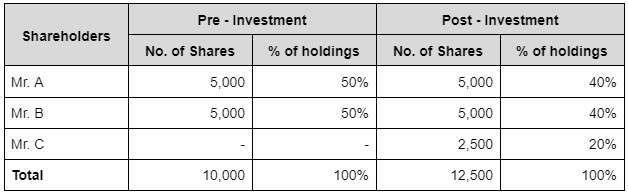
Now have a look at the figures in below table to understand this quickly:
Here, the number of shares has been increased basis the ratio to post investment i.e. 25% (1Mn/4Mn). The investor can keep any ratio post investment basis the agreement.
We can understand that post investment round, the holding % of founders are getting diluted and their controlling interest has been reduced from the original scenario.
There are various types of dilution, including dilution of shares in a private company. It’s also important to know the equity dilution meaning and examples of equity dilution in startups.
There is no exact solution to how much equity to dilute; it depends on the stage of the business you are at. Too much dilution can be of concern to a future incoming investor and too little dilution concerns investors as they should have skin in the game. The ultimate goal is to grow the business. So even if the dilution numbers are skewed from the expected dilution you have in mind, the growth of the business is primary, and investment helps you get closer to that goal.
Pre-money valuation is the value of the company prior to receiving the investment amount. It is derived through various internationally accepted valuation methods like the discounted cash flow method. Investors offer equity based on pre-money valuation; however, the percentage sought is based on post-money valuation.
Understanding dilution and cap tables are pertinent metrics for fundraising and talking to investors. Founders often neglect it due to a lack of clarity of these concepts. A grasp on concepts like dilution and the cap table enables the founder to have better control of the startup equity.
Effects of Equity Dilution
During share dilution, the amount of extra shares issued and retained may impact a portfolio’s value. Dilution affects a company’s EPS (earnings per share) in addition to the price of its shares. For instance, a company’s earnings per share or EPS could be INR 50 prior to the issuance of new shares, but after dilution, it might be INR 18. However, if the dilution dramatically boosts earnings, the EPS might not be impacted. Revenue may rise as a result of dilution, offsetting any increase in shares, and earnings per share may remain constant.
Public companies may calculate diluted EPS to assess the effects of share dilution on stock prices in the event of stock option exercises. As a result of dilution, the book value of the shares and earnings per share of the company decline.
Equity dilution, a fundamental consequence of issuing new shares, is a double-edged sword for companies. While it unlocks doors to growth capital, it also impacts existing shareholders’ ownership and potential control. Understanding the effects of dilution is crucial for companies navigating fundraising rounds and strategic decisions.
Example: If a company having 100 shares issued, paid up and subscribed, each representing 1% ownership, issues 20 new shares, the total number of issued, paid up and subscribed shares becomes 120. Consequently, the existing shareholders’ ownership stake is diluted post-issue, as each share now represents only 0.83% (100/120) of the company. This translates to a decrease in:
- Ownership Percentage: Existing shareholders own a smaller portion of the company.
- Voting Power: Their voting rights are proportionally reduced, potentially impacting their influence on company decisions.
- Earnings Per Share: If company profits remain constant, EPS might decrease as profits are spread over a larger number of shares. This can affect short-term stock price performance.
How to minimize equity dilution?
Companies can employ various strategies to minimize dilution and maximize the benefits of issuing new shares:
- Strategic Valuation: A higher valuation during fundraising allows the company to raise the target capital while offering fewer shares. However, maintaining a realistic valuation is crucial to attract investors without inflated expectations.
- Debt Financing: Exploring debt options like loans or convertible notes can provide capital without immediate dilution. However, debt carries interest payments and other obligations.
- Structured Equity Instruments: Utilizing options like preferred shares can offer different rights and value compared to common shares, potentially mitigating the dilution impact on common shareholders.
- Phased Funding with Milestones: Structuring investments in tranches tied to achieving milestones allows the valuation to climb incrementally, reducing dilution in later rounds.
- Focus on Organic Growth: Prioritizing revenue and profit growth naturally leads to higher valuations. This requires less equity dilution to raise capital in the future.
Pros of Equity Dilution:
Equity dilution, while often viewed with apprehension by existing shareholders, can also bring several advantages to a company. By issuing new shares and thereby diluting existing ownership, companies can access capital and unlock opportunities for growth and expansion:
- Access to Capital: Equity dilution allows companies to raise funds by selling shares to investors. This infusion of capital can be instrumental in financing expansion projects, funding research and development initiatives, or addressing financial challenges.
- Diversification of Shareholder Base: Bringing in new investors through equity dilution can diversify the company’s shareholder base. This diversification can enhance liquidity in the stock, broaden the investor pool, and potentially attract institutional investors or strategic partners.
- Alignment of Interests: Equity dilution can align the interests of shareholders and management, particularly in startups or early-stage companies. By offering equity stakes to employees, management can incentivize them to work towards the company’s long-term success, fostering a culture of ownership and commitment.
- Reduced Financial Risk: Diluting ownership through equity issuance can reduce the financial risk for existing shareholders. By sharing the burden of ownership with new investors, shareholders may benefit from a more diversified risk profile, particularly in cases where the company’s prospects are uncertain.
Cons of Equity Dilution:
While equity dilution offers certain advantages, it also presents challenges and drawbacks that companies and shareholders must carefully consider. From the perspective of existing shareholders, dilution can erode ownership stakes and diminish control over the company. Let’s delve into some of the key drawbacks of equity dilution:
- Loss of Ownership and Control: One of the primary concerns associated with equity dilution is the loss of ownership and control for existing shareholders. As new shares are issued and ownership is spread among more investors, the influence of individual shareholders over corporate decisions may diminish.
- Dilution of Earnings Per Share: Equity dilution can lead to a reduction in earnings per share for existing shareholders. This dilution occurs when the company’s profits are spread across a larger number of shares, potentially decreasing the value of each share and impacting shareholder returns.
- Potential for Share Price Decline: The issuance of new shares through equity dilution can signal to the market that the company is in need of capital or that its growth prospects are uncertain. This perception may lead to a decline in the company’s share price, adversely affecting shareholder wealth.
- Strain on Shareholder Relations: Equity dilution can strain relations between existing shareholders and management, particularly if the dilution is perceived as unfair or detrimental to shareholder interests. Managing investor expectations and communicating the rationale behind equity issuances is crucial to maintaining trust and credibility.
Conclusion
Equity dilution poses a significant impact on the ownership stakes of founders and investors alike. Whether you are already implementing a corporate equity plan or considering setting one up, equity dilution is a critical aspect to consider. Understanding the fundamentals of equity dilution and how it functions, particularly in the context of stock option dilution, is essential for informed decision-making.
Share dilution, occurring whenever a corporation issues new shares to investors, can significantly affect the value of your financial portfolio. During this process, the corporation must adjust its earnings-per-share and share price ratios accordingly. While share dilution is often viewed unfavorably, it can also signify potential acquisitions that may enhance stock performance in the future. To mitigate any potential surprises, it is prudent to remain vigilant for indicators of stock dilution. By staying informed and proactive, stakeholders can navigate the complexities of equity dilution with confidence and clarity.
Frequently Asked Questions (FAQs) on Equity Dilution in India
1. What is equity dilution?
Equity dilution refers to the reduction in ownership percentage of existing shareholders in a company due to the issuance of new shares. This dilution can occur during fundraising rounds, employee stock option plans (ESOPs), mergers, acquisitions, or other corporate actions.
2. How does equity dilution work in Indian companies?
Equity dilution typically occurs when a company issues additional shares, either through primary offerings to raise capital or secondary offerings for employee incentives or acquisitions. This issuance increases the total number of shares outstanding, reducing the ownership percentage of existing shareholders.
3. What are the primary causes of equity dilution in India?
Equity dilution in India can be caused by various factors, including fundraising activities such as initial public offerings (IPOs), follow-on offerings, private placements, or debt conversions. Additionally, the implementation of ESOPs, mergers, acquisitions, and convertible securities can also contribute to equity dilution.
4. Can you provide examples of equity dilution in Indian companies?
Examples of equity dilution in India include IPOs of startups or established firms where new shares are issued to the public, leading to dilution for existing shareholders. Similarly, when companies offer ESOPs to employees or acquire other businesses through stock issuance, equity dilution occurs.
5. What are the implications of equity dilution for shareholders in India?
Equity dilution can impact shareholders in India by reducing their ownership percentage and voting rights in the company. It may also lead to dilution of earnings per share (EPS) and share price, potentially affecting shareholder value and returns on investment.
6. How can companies minimize equity dilution in India?
Companies in India can minimize equity dilution by carefully managing their capital structure, negotiating favorable terms during fundraising rounds, implementing efficient ESOP schemes, and exploring alternative financing options such as debt financing or strategic partnerships.
7. Are there any regulatory considerations related to equity dilution in India?
Yes, companies in India must comply with regulatory requirements set forth by the Securities and Exchange Board of India (SEBI) and other relevant authorities when issuing new shares or implementing equity-related transactions. Compliance with disclosure norms and corporate governance standards is essential to ensure transparency and accountability.
]]>“Vesting” is a contractual structure to facilitate gradual transfer of ownership. It is a legal term referring to the process in which a person secures his ownership of (legally referred to as “title to”) certain assets over a period of time.
What is a Vesting Period?
Vesting is a typical construct built around ownership of shares, and also refers to the process by which conditional ownership of such shares is converted to full ownership (including rights of transferability) over a fixed period of time. A critical feature of vesting is that the person will only have conditional ownership of such shares until the fixed period (legally referred to as the “Vesting Period”) is completed.
What are Vesting Schedules?
Depending on the needs of the contractual relationship and subject to applicable laws, vesting can adopt many forms. However, a common element found in most forms of vesting is the “Vesting Schedule”, i.e., the breakdown showing how the relevant assets/shares will be transferred to the ownership of the person over the Vesting Period.
Types of Vesting Schedules
(i) Uniform or Linear Vesting – a simple process through which the person receives a percentage of their shares over a fixed period of time. Eg: if an employee is granted 10,000 options with 25% of them vesting per year for 4 years, then the employee will have vested 2,500 shares after 1 year and can exercise the rights to the same in accordance with the applicable policies.
(ii) Bullet Vesting – usually employed on a need-based circumstance in the event of any operational delay impacting the Vesting Schedule, bullet vesting works in one shot, completing the vesting in one instance.
(iii) Performance-based Vesting – tied typically to the performance of an employee in relation to stock option grants, performance based vesting will depend on the satisfaction of a performance condition. This can be in the nature of milestones to be achieved by the employee or revenue goals to be achieved by the company. The critical feature here is that there is no fixed Vesting Period in such a model, and the vesting is instead directly tied to the achievement of performance goals.
(iv) Hybrid Vesting – usually a combination of linear and performanced-based vesting, this type of vesting will often require the fulfillment of tenure and performance requirements. Eg: an employee is required to complete a four year tenure in addition to satisfying certain key performance indicators in order to receive the full set of options/benefits.
(v) Cliff Vesting – in such a model, no benefits are vested in a person until a certain predetermined point in time is reached. Once that time is met, all options/benefits become fully vested at once. Eg: if a 1-year cliff vesting is employed for grant of employee stock options, the employee will receive 100% of the options only once the full year has been completed with the company.
Examples of Vesting: Employee Stock Option Plans and Founder Vesting – Explained:
Vesting is largely relevant to startups in two main areas: (i) employee stock option plans (“ESOP”); and (ii) lock-in of founder shares:
1. Employee Stock Option Plans:
ESOPs are a vital component of modern employee compensation structures and prove a great tool for employee motivation and retention. Through an ESOP scheme, an employee is: (i) given the right to purchase certain shares in his name through the ESOP pool formulated by the employer company (“Grant of Option”); (ii) required to complete the Vesting Period during which the shares will vest in his name; and (iii) exercise the right to purchase the shares upon completion of the Vesting Schedule at a predetermined price (as per terms of the ESOP scheme).
It is important to note here that under Indian law, the Securities Exchange Board of India (Share Based Employee Benefits) Regulations, 2014 (applicable to listed public companies) and the Companies (Share Capital and Debentures) Rules, 2014 (applicable to private and unlisted public companies) both prescribe a mandatory minimum Vesting Period of 1 year from the date of Grant of Option. As such, any ESOP scheme formulated by an Indian company will need to comply with this requirement.
ESOPs typically see use of any of the above described Vesting Schedules. This is because Vesting Schedules primarily serve as a great tool to employee motivation and retention, as when ESOPs are granted to employees, they become part owners of the company and consequently, aligning their performance and goals with those of the company over the Vesting Schedule proves beneficial for overall growth. Further, employee turnover is a huge cost incurred by a company and grant of ESOPs acts as a means to dissuade employees from leaving until their options/grants have fully vested.
2. Founder Vesting:
In a funding round – especially where an institutional investor is brought onto the capitalisation table of a company for the first time, much of the trust forming the basis of the investment is rooted in the demonstrated results, passion, experience and skillset of the founders. Consequently, in order to secure the investment for a minimum period and to ensure the founders do not exit the company prematurely, the parties will typically agree to a lock-in of the founders’ shares, which will give them conditional ownership until completion of a Vesting Schedule, at which point in time the unconditional ownership of all their shares is restored to the founders.
Founder Vesting typically sees use of linear, bullet or cliff vesting. Given that the founders are originally shareholders of the company who voluntarily accept restrictions on their shares for a fixed period of time, performance-based or hybrid vesting would not typically be accepted for release of these locked shares. Consequently, a clear Vesting Schedule that employs the linear, bullet or cliff vesting options provides greater clarity to the parties and offers a modicum of flexibility when determining the Vesting Schedule.
Frequently Asked Questions (FAQs) on Vesting in India:
- How long does a typical Vesting Period last?
According to the Securities Exchange Board of India (Share Based Employee Benefits) Regulations, 2014 (applicable to listed public companies) and the Companies (Share Capital and Debentures) Rules, 2014 (applicable to private and unlisted public companies) both prescribe a mandatory minimum Vesting Period of 1 year from the date of Grant of Option and consequently companies/parties are free to determine the upper limit. However, we see that Vesting Periods typically last between 3 and 5 years.
- Can a Vesting Schedule be accelerated?
Yes, however this would be possible in limited, predefined circumstances. For example, in the event that an employee is permanently incapacitated or dies during the Vesting Period, companies will typically accelerate the Vesting Period in order to ensure that the employee (or their legal heirs/executors of estate) is able to exercise the rights on the options that would have otherwise vested in accordance with the schedule, but for the extenuating circumstance. Similarly, the same principle can be applied to vesting of founders’ shares, in the event of the mutually agreed departure of a founder (also known as a good leaver situation). This is ultimately dependent on the terms of the applicable policy/agreement between the parties.
- Can a Vesting Schedule be changed?
Generally, altering a Vesting Schedule is not permitted, but there are specific situations where changes can be made. For example, in the case of ESOPs, if the company must amend its ESOP policy to comply with applicable laws, the Vesting Schedule can be modified accordingly. Additionally, if the alteration benefits the employee or enhances the effectiveness of the ESOP scheme, changes may be allowed, provided they comply with legal guidelines.
For founder shares, where the Vesting Schedule is part of a contractual agreement, modifications can be made if they adhere to applicable laws and are mutually agreed upon by all parties involved.
- How does ESOP vesting work for a startup?
For example, if a startup employee is granted 10,000 stock options with a 4-year vesting schedule and a 1-year cliff, the employee must remain employed with the company for at least 1 year before any options vest. After the cliff period (i.e., once the 1-year mark is reached), 25% of the options (2,500 shares) will vest. The remaining options will then vest evenly at a rate of 25% per year over the next 3 years.
- How does vesting work in case of lock in of founder shares?
For example, according to the contractual agreement between the parties, 80% of the founders’ shares will be locked in for a period of 4 years, allowing the founders to retain 20% of their shares for immediate liquidity. The locked-in shares will then vest at a rate of 20% per year over the 4-year period, meaning the founders will achieve full (100%) ownership of their shares only at the end of the fourth year.
]]>One key component of a contract is the termination clause, which outlines how and when the contract can be legally “ended”. These clauses are critical because they define the conditions under which a party can walk away from the binding nature of the contract, without breaching the terms thereof. Whether due to non-performance, changes in business needs, or unforeseen events, contracts may need to be terminated in the course of business and thus, having a clear termination clause in place protects a party from potential risks and ensures they are not locked into unfavorable situations.
Based on the nature of the commercial relationship between the parties, there are several types of termination clauses which can be agreed, each serving a unique purpose. Termination clauses can allow for a party to end the agreement if the other fails to meet their obligations or breaches the contract, or even for termination by both parties on the basis of mutual convenience. Understanding termination clauses in a contract helps businesses avoid disputes and protect their interests when a contract must end.
What is a Termination Clause?
A termination clause is a critical provision in a contract that outlines the conditions under which one or both parties can end the agreement before its natural conclusion. It specifies the events or circumstances that allow for contract termination and often includes guidelines on the notice period, reasons for termination, and any potential penalties or obligations upon termination. Typically, termination clauses do not automatically end all obligations between the parties, and certain legal provisions (such as governing law and dispute resolution) would survive the termination of the agreement.
Definition of a Termination Clause
A termination clause legally defines how a contractual relationship between parties can be ended, by setting out pre-defined terms and conditions to be satisfied such that the termination itself does not amount to a breach of the contract. Depending on the nature of the underlying commercial relationship, termination clauses can be linked to performance, force majeure conditions that render performance impossible, mutual convenience, or even a unilateral right retained by one party (such as in investment agreements).
Purpose of Including Termination Clauses in Contracts
The primary purpose of a termination clause is to offer clarity on how the parties can end their contractual relationship and (to the extent feasible) protection from any claims of breach. It safeguards both parties by:
- Managing Risks: Helps to limit financial or operational damages if the business relationship is no longer viable.
- Ensuring Flexibility: Provides a means to break the contractual binds if the conditions become unfavorable, without triggering a dispute for breach of contract.
- Defining Responsibilities: Clearly outlines post-termination duties, such as settling payments or returning property.
General Impact on Contractual Relationships
Termination clauses have a significant impact on contractual relationships by:
- Fostering Accountability: Parties are aware of the consequences of failing to meet contractual obligations, promoting a higher standard of performance.
- Reducing Uncertainty: Pre-defined termination conditions prevent conflicts, ensuring both sides know the terms of disengagement.
- Enabling Smooth Transitions: When included, these clauses ensure that relationships can end in a structured manner, reducing the risk of disputes.
Relevance of Termination Clauses in Contracts
Termination clauses play a vital role in ensuring clarity on how and when a contract can be legally ended, thus preventing misunderstandings and disputes.
How Termination Clauses Prevent Disputes
A well-structured termination clause helps prevent disputes by clearly outlining the conditions under which the contract can be terminated. By establishing specific scenarios such as non-performance, breach of contract, force majeure or for mutual agreement, both parties understand their rights and obligations, reducing the risk of legal battles. This clear guidance helps avoid confusion and ensures that the end of a contract is handled fairly and predictably.
Importance in Managing Risks and Obligations
Termination clauses are essential to manage risks in contracts. They protect both parties from being locked into unfavorable agreements or suffering financial losses due to unforeseen circumstances. For example, if one party fails to meet their obligations, the termination clause offers a legal avenue to separate from the commercial relationship without breaching the contract. This minimizes potential damage to the business, whether by way of financial loss or reputational harm.
Influence on Contract Flexibility and Exit Strategies
A termination clause provides much-needed flexibility in contracts by offering a clear exit strategy. Businesses can adjust or end their contractual relationships without fearing legal consequences, provided the termination aligns with the agreed-upon terms. This flexibility is crucial in dynamic business environments where conditions can change quickly, and the ability to terminate a contract allows companies to adapt without long-term obligations.
Types of Termination Clauses in Contracts
Termination clauses in contracts provide clear terms for ending an agreement, protecting both parties from legal issues. There are several types of termination clauses, each with specific purposes and implications. Here are the most common types:
a. Termination for Convenience
Explanation: This clause allows one party to terminate the contract without providing a specific reason or cause. It is often used to offer flexibility in long-term contracts.
Typical Usage: Commonly found in government contracts, large-scale business agreements, and long-term partnerships where conditions may change over time.
Benefits: Provides flexibility for businesses to exit a contract when needs or priorities shift, allowing them to avoid being bound to unfavorable terms.
Challenges: Can be misused, leading to one-sided terminations or potential unfair treatment of the other party, especially if compensation for early termination is not properly addressed.
b. Termination for Cause
Explanation: Triggered when one party fails to meet specific contractual obligations, such as a breach of terms, non-performance, material issues such as negligence, gross misconduct or fraud, or other agreed-upon criteria.
Examples: Common triggers include non-payment, failure to deliver goods or services, breach of confidentiality provisions, failure to satisfy the terms of an employment relationship.
Importance of Defining “Cause”: Clarity in what constitutes “cause” leading to a breach or failure is critical to avoid disputes. Vague definitions can lead to legal battles and delays in enforcing the termination.
Legal Implications: The party terminating the contract must prove that “cause” was present, leading to the breach. Proper documentation and a clear process for addressing the breach are essential to avoid litigation.
c. Termination by Mutual Agreement
Explanation: Both parties agree to end the contract on terms that are mutually acceptable, often because the agreement is no longer necessary or beneficial.
Common Use: This is frequently used when both parties realize the business relationship is no longer advantageous and prefer to part ways amicably. A common example of such a clause is often seen in investment agreements, where the parties will typically agree to terminate the contract basis mutual agreement in the event that certain conditions cannot be fulfilled.
Benefits: A simplified and non-contentious process that allows the parties quick solution and where the costs and complications of dispute resolution can be avoided.
d. Automatic Termination Clauses
Explanation: The contract terminates automatically when specific predefined events occur without the need for further action by either party.
Examples: These events may include the death of a party, the dissolution of a company, or the completion of the contract’s objectives/duration of the contract.
Importance of Defining Triggering Events: Clearly specifying the events that will lead to automatic termination is essential to prevent confusion or disputes over whether the contract has ended.
Benefits: Such clauses ensure that once the objective/term of the contract has been achieved/completed, the parties do not need to take further steps to record their intent to terminate their arrangement.
e. Termination Due to Force Majeure
Explanation: This clause allows the termination of a contract when unforeseen or uncontrollable events prevent one or both parties from fulfilling their obligations.
Common Events: Natural disasters, war, pandemics (such as COVID-19), or significant government actions that impact the performance of the contract itself, are typical triggers for force majeure.
Significance: Including a force majeure clause in contracts is crucial for managing risks during global crises. It allows parties to exit contracts without penalties when extraordinary events make performance impossible.
Key Considerations When Drafting a Termination Clause
When drafting a termination clause in a contract, several critical factors must be carefully considered to ensure clarity, legal enforceability, and risk management. Here are the key considerations:
Clarity in Defining the Grounds for Termination
One of the most important aspects is clearly outlining the specific grounds for termination. Whether it’s termination for cause, convenience, or due to force majeure, the conditions must be unambiguous to prevent disputes. Clearly defining terms such as “material breach” or “failure to perform” will help both parties understand when termination is justified.
Notice Periods Required Before Termination
Including a well-defined notice period is essential. This provides the other party with sufficient time to rectify the issue or prepare for the termination. The notice period can vary depending on the type of contract and the reason for termination (e.g., 30 days’ notice for termination for cause, which may or may not include a timeline to cure the breach, or immediate termination for mutual convenience).
Consequences of Termination
Termination can lead to various consequences that should be addressed within the clause:
- Compensation: Specify whether any financial compensation is due upon termination, particularly in cases of early termination.
- Return of Goods: Include provisions for the return of physical goods, assets, or property that were exchanged during the contract.
- Intellectual Property Rights: Clearly outline what happens to any intellectual property created or shared during the contract term.
Legal Enforceability and Compliance with Local Laws
It is vital to ensure that the termination clause complies with local laws and regulations, as termination rights can vary significantly across jurisdictions. Contracts must be legally enforceable in the applicable region to avoid issues in the event of a dispute. In India, this requires that the elements of a legally valid and binding contract as set out in the Indian Contract Act, 1872 must be satisfied.
Handling Disputes Arising from Termination
Even with a well-drafted termination clause, disputes can arise. This can typically be around the circumstances of the termination itself and consequently, provisions such as governing law and dispute resolution are deemed to survive the termination of the contract, in order to permit the parties to resolve the dispute and avoid prolonged legal battles.
Termination Clauses in a Contract Examples
Sample Image of Termination Clause
The Legal and Financial Implications of Contract Termination
Termination clauses in contracts come with significant legal and financial implications. Understanding these aspects is crucial to avoid costly disputes and ensure compliance with the terms of the agreement.
Legal Obligations of Both Parties After Termination
Once a contract is terminated, both parties have specific legal obligations they must fulfill. These may include the return of property, settling outstanding payments, or maintaining confidentiality. Failing to meet these obligations can result in legal action and penalties. It’s essential for contracts to outline post-termination duties clearly to ensure both parties comply with their legal responsibilities.
How Termination Clauses Impact Damages or Penalties
Termination clauses often address the potential for damages or penalties. For instance, if a party terminates the contract without meeting the agreed conditions, they may be liable for compensatory damages. Additionally, contracts may include penalty clauses for early or improper termination, which can lead to significant financial losses if not followed correctly. Clear language regarding these penalties helps mitigate financial risks and also aids in determining the liability of the parties vis-à-vis the termination of the contract.
Real-World Examples of Improper Termination Leading to Lawsuits or Financial Losses
Improper termination of contracts can lead to lawsuits, significant financial penalties, or reputational damage. For example, if a party terminates a contract without just cause or fails to follow the notice period, they can be sued for breach of contract. Real-world cases have shown that businesses that do not adhere to the terms of their termination clauses may face substantial financial losses, including compensating the other party for lost profits or operational disruption. This also presents a reputational risk, where the non-justifiable failure to honour the contract is seen as grounds for distrust in future dealings.
How to Handle Contract Termination Effectively
Handling contract termination effectively is essential for minimizing disruption to your business and maintaining good relationships with other parties. Here are key tips to ensure a smooth termination process:
Tips for Businesses to Navigate Contract Termination with Minimal Disruption
To avoid potential pitfalls, businesses should follow a structured approach when terminating a contract. Begin by reviewing the termination clause to ensure all conditions are met. Provide the required notice to the other party and plan for any transitional measures to minimize operational disruptions. Clear communication throughout the process helps prevent misunderstandings and maintains professionalism.
Importance of Consulting Legal Experts Before Terminating
Consulting a legal expert is crucial before terminating any contract. Legal advisors can help ensure compliance with the termination clause and local laws, preventing unintended breaches or legal challenges. They can also assist in understanding the financial and legal implications, such as penalties, compensations, or intellectual property rights, safeguarding your business from unnecessary risks.
Documentation and Communication During the Termination Process
Proper documentation is essential when handling contract termination. All communications related to the termination should be documented, including notices, emails, and formal letters. This ensures that you have a record of compliance with the terms of the contract. Clear and timely communication with the other party is key to preventing disputes and ensuring that both sides understand their responsibilities during and after termination.
Ensuring Smooth Transitions for Parties Involved After Contract Ends
A well-planned transition ensures minimal disruption after the contract ends. This may involve transferring responsibilities, returning assets, or settling outstanding payments. Businesses should coordinate with the other party to ensure a seamless handover of any obligations. Setting a clear timeline for post-termination tasks helps to ensure that both parties fulfill their remaining duties without delay.
Termination clauses are an essential component of any contract, providing clarity and security for both parties involved. By defining the conditions under which a contract can be legally ended, these clauses help prevent disputes, manage risks, and offer flexibility in evolving business relationships. Whether it’s termination for convenience, cause, or due to unforeseen events, well-drafted termination clauses ensure that the rights and obligations of each party are protected, allowing for smooth transitions when the contractual relationship comes to an end.
Ultimately, the importance of termination clauses lies in their ability to safeguard businesses from legal and financial repercussions. By working with legal experts to craft clear and enforceable termination provisions, businesses can avoid costly litigation, protect intellectual property, and ensure compliance with local laws. In today’s dynamic business environment, termination clauses offer a crucial exit strategy that maintains the integrity of both the contract and the business relationship.
Frequently Asked Questions (FAQs) on Termination Clauses in a Contract
- What is a Termination Clause in a Contract?
A termination clause defines the conditions under which a contract can be ended by either party. It outlines the grounds for termination, the required notice period, and any consequences that may arise. - Why is a Termination Clause Important in a Contract?
A termination clause provides clarity and certainty for both parties, preventing disputes and ensuring that the contract can be ended legally and fairly if necessary. - What are the Most Common Grounds for Terminating a Contract?
Common grounds for termination include:- Breach of Contract: If one party fails to fulfill their obligations under the contract.
- Force Majeure: If an unforeseen event beyond the parties’ control makes it impossible to perform the contract.
- Material Adverse Change: If a significant event occurs that negatively impacts the contract’s viability.
- Insolvency: If one party becomes bankrupt or insolvent.
- Mutual Consent: If both parties agree to terminate the contract.
- What is a Notice Period in a Termination Clause?
A notice period specifies the amount of time one party must give the other before terminating the contract. - What are the Consequences of Terminating a Contract?
Consequences can vary depending on the specific circumstances, but they may include:- Payment of Termination Fees: If specified in the contract.
- Return of Property: If property was transferred under the contract.
- Confidentiality Obligations: If sensitive information was shared.
- Dispute Resolution: If there is a disagreement about termination.
- How Can a Termination Clause Protect Intellectual Property?
A termination clause can include provisions to protect intellectual property rights, such as ownership, confidentiality, and non-compete agreements. - What is a Survival Clause in a Termination Clause?
A survival clause specifies which provisions of the contract will continue to apply even after termination, such as confidentiality obligations or dispute resolution procedures. - How Can a Termination Clause Address Force Majeure Events?
A termination clause can define what constitutes a force majeure event and outline the steps that must be taken by the affected party to mitigate the impact. - When Should I Consult a Lawyer About a Termination Clause?
It’s always advisable to consult a lawyer when drafting or reviewing a contract, especially if the contract involves complex terms or significant financial stakes. - Can a Termination Clause Be Modified After the Contract is Signed?
Yes, similar to how any contractual provision can be amended, a termination clause can be modified through a written amendment to the contract, but this requires mutual agreement from both parties.
Mumbai-based brand ‘Shaadi.com’ was launched in 1997 by Anupam Mittal and cousins, founders of People Interactive (India) Private Limited (“Company”). Since its introduction into the “matrimonial market”, the brand has become a prominent online matchmaking platform with international repute and presence. However, in early 2024, news broke about a messy legal battle between Anupam Mittal (by this time, serving as managing director for over 15 years) and WestBridge Ventures II Holdings, a Mauritius-based private equity fund (“WestBridge”), from whom the Company had secured funding in 2006. Spanning proceedings before courts in India and Singapore, the case is poised to become a landmark moment in the evolution of international arbitration law and intra-corporate disputes. Involving allegations of forced transfer to competitors and an expensive series of litigations, this dispute necessitates that potential investors and investee companies (and their founders) glean an understanding of the key takeaways.
Background of the Relationship between the Parties
| Timeline | Event |
| 1997 | People Interactive (India) Private Limited (“Company”) founded and Mumbai-based “sagaai.com” launched by Anupam Mittal and family (“Founders”), offering an online matchmaking platform for Indians around the world. |
| 2001 | The platform is renamed to “Shaadi.com” and becomes the Company’s flagship brand. [1] |
| October 2004 | Anupam Mittal appointed as Managing Director of the Company. |
| February 10, 2006 | WestBridge Ventures II Holdings, a Mauritius-based private equity fund (“WestBridge”) invests INR 165,89,00,000 (Rupees One Hundred Sixty Five Crores Eighty Nine Lakhs) in the Company (“Investment”). Company, Founders and WestBridge sign a shareholders’ agreement. [2] |
| Parties agree on exit rights for WestBridge, which includes the following options:(i) an Initial Public Offering (IPO) to be completed within 5 years of closing;(ii) sale of WestBridge shares to third parties (excluding significant competitors);(iii) redemption or buyback provisions if the IPO was not completed within 5 years; and(iv) drag-along rights if the Company fails to buyback shares within 180 days of exercising the buyback option (“Drag Along”). If an IPO was not completed within 5 years, WestBridge could redeem all its shares and if necessary, “drag along” all other shareholders (including Founders) to sell their shares to a third party. | |
| Parties agree in the SHA that:(i) the SHA is governed by the laws of India; (ii) any disputes arising from the agreement would be resolved through arbitration as per the International Chamber of Commerce Rules (“ICC”) with seat of arbitration in Singapore; and (iii) the enforcement of arbitration award would be subject to Indian laws. | |
| 2006 | Consequent to the investment, WestBridge holds 44.38% and Anupam Mittal holds 30.26% of the shareholding of the Company. |
| 2011 | Contractually agreed period to complete IPO expires. |
| 2017 – 2019 | WestBridge seeks to exit the Company by allegedly entering into discussions to sell its shares to a direct competitor, Info Edge India Limited (“Info Edge”), owner of matchmaking platform ‘Jeevansathi’. [3] |
| Tensions between the parties continue, with alleged acts of oppression and mismanagement by WestBridge “facilitated” by other Founder directors [4], including a joint requisition to the Company to convene an extraordinary general meeting of the Company. The agenda for such meeting involves replacing Anupam Mittal as the managing director. | |
| December 2020 | WestBridge exercises its buyback option, requiring that the Company: (i) convert the 1,000 Series A1 preference shares into 580,779 equity shares; and then, (ii) effect a buyback of said equity shares. Company converts the preference shares, but is unable to offer the buyback price for the converted equity shares. |
| October 2021 | WestBridge issues a drag-along notice compelling the sale of shares to a “significant competitor”, relying on the SHA which states that if the buyback could not be completed, the Drag Along rights would be triggered, which included the right to have the holding of the minority shareholders (including founders) liquidated and sold to any party without restriction. |
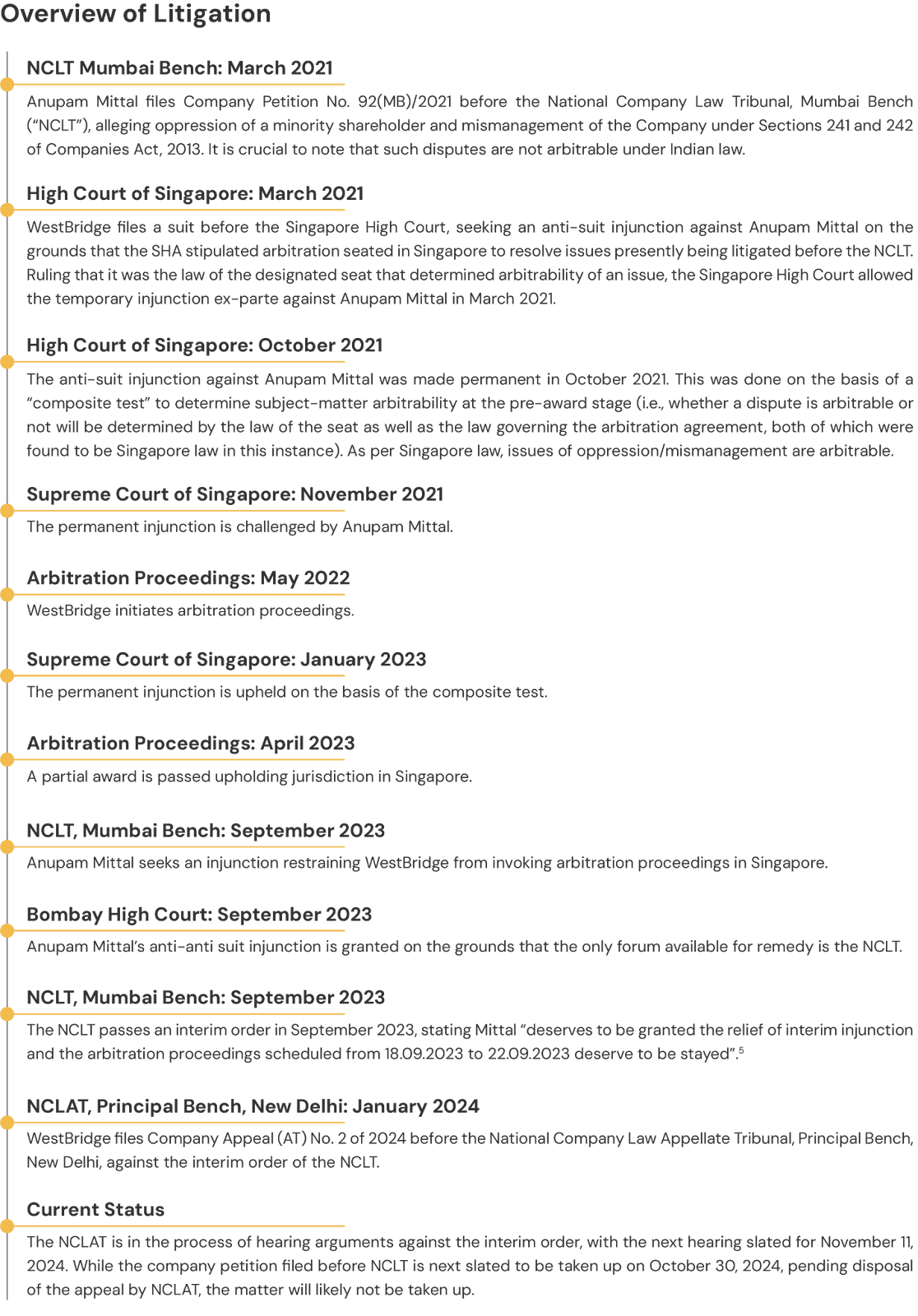
Jurisdiction is Key – India v/s Singapore:
This dispute has highlighted significant challenges in cross-border legal disputes and the complexities of enforcing shareholder agreements in international fora. Despite litigation stretching on since 2021, the issue of oppression and mismanagement has yet to be ruled on, and the current issue before the courts is actually of: (i) jurisdiction, i.e., determining the competent authority to adjudicate on the SHA and allegations of oppression and mismanagement; and (ii) enforceability of foreign arbitration awards:
- Singapore Jurisdiction: WestBridge argued that since the SHA stipulated that arbitration would be governed by International Chamber of Commerce (ICC) rules with Singapore as the arbitration seat, the dispute was to be heard and adjudicated in Singapore. The Singapore courts upheld this on the basis of: (i) the composite test, ruling that whether a dispute is arbitrable or not will be determined by the law of the seat as well as the law governing the arbitration agreement; and (ii) oppression/mismanagement disputes being arbitrable under Singapore law.
- Indian Jurisdiction: Mittal argued that jurisdiction to hear issues of corporate oppression and mismanagement is exclusively vested with the NCLT under Sections 241-244 of the Companies Act, 2013 and are not arbitrable under Indian law, in accordance with Section 48(2) of the Indian Arbitration & Conciliation Act, 1996 (“A&C Act”), which is briefly excerpted below:
“Enforcement of an arbitral award may also be refused if the Court finds that—
(a) the subject-matter of the difference is not capable of settlement by arbitration under the law of India; or
(b) the enforcement of the award would be contrary to the public policy of India.
Explanation 1: For the avoidance of any doubt, it is clarified that an award is in conflict with the public policy of India, only if – (i) the making of the award was induced or affected by fraud or corruption or was in violation of section 75 or section 81; or (ii) it is in contravention with the fundamental policy of Indian law; or (iii) it is in conflict with the most basic notions of morality or justice.” (emphasis added)
It is crucial to note that the provisions of the A&C Act have been interpreted to limit the arbitrability of intra-company disputes and consequently, provide Mittal with the legal grounds to resist enforcement of the foreign arbitration award.
Implications of the Case
This case holds significant implications for corporate law, cross-border investments, and the arbitration landscape, particularly in the context of Indian startups and venture capital:
- Jurisdiction Determination: The case emphasizes the importance of clearly defining jurisdiction in cross-border agreements, especially where legal disputes span multiple countries. The differing interpretations of arbitration clauses by Singapore and Indian courts underscore the complexities of jurisdictional overlaps.
- Extent of Arbitration in Legal Disputes: The case explores the limits of arbitration, particularly concerning corporate governance issues like oppression and mismanagement. The contrasting legal positions in Singapore and India highlight the potential conflicts that arise when arbitration is attempted in disputes traditionally reserved for domestic courts.
- Enforcement of Cross-Border Orders: The enforceability of foreign arbitration awards in domestic courts is a critical concern, especially when the awards conflict with local laws. The Bombay High Court’s observation that corporate oppression disputes are non-arbitrable under Indian law, thus rendering foreign awards unenforceable, could set a precedent for future cases.
- Corporate Oppression and Minority Rights in India: The case brings to light the challenges of protecting minority shareholder rights in complex financial arrangements involving multiple jurisdictions. It illustrates the potential for exit mechanisms, such as drag-along rights, to be used in ways that might disadvantage minority stakeholders.
Adverse Impact on Shaadi.com
The crux of Anupam Mittal’s case is simple – if the Drag Along with sale of shares to a significant competitor is enforced, the impacts to the Company and the ‘Shaadi.com’ brand are adverse:
- Control of the Company: If Info Edge or any other competitor were to purchase the shares sold as part of the Drag Along structure, this would open the path for them to acquire the majority shareholding in the Company, and could drastically alter the Company’s control dynamics. Currently, Anupam Mittal holds a 30% stake, while WestBridge controls 44.3%. With the consummation of the Drag Along sale, this could facilitate a takeover by such competitor and potentially diminish the Founder’s influence over the Company.
- Business, Strategy and Culture: A shift in control/ownership could lead to a major restructuring of Shaadi.com’s strategic direction and operations. This might affect key business decisions, brand positioning, and market strategies. Additionally, a change in control could impact the Company’s culture and its relationships with stakeholders, including employees, customers, and partners.
- Competition: As one of three prominent names in the online matchmaking platform industry (including ‘BharatMatrimony’ and ‘JeevanSathi’), any potential acquisition of the Company by a competitor would result in a potential acquisition of the ‘Shaadi.com’ brand absorbing the customer base and effectively, the market share held. This could not only result in a dramatic change in the existing market competition but potentially require strategic realignment within the industry.
Future Implications for Startups and Venture Capital Firms
For startups and venture capital (VC) firms, this case underscores several crucial lessons.
- Lessons in Drafting: It is crucial that: (i) exit clauses and dispute resolution mechanisms be drafted with precision; and (ii) transaction documents include clearly outlined terms for various scenarios, including exits, buybacks, and drag-along rights, to prevent ambiguous interpretations and conflicts. Properly crafted agreements and well-defined dispute resolution processes can mitigate risks and facilitate smoother exits and transitions
- Jurisdictional Issues: It is critical that arbitration provisions be aligned with the legal frameworks of all involved jurisdictions. This alignment helps avoid prolonged and expensive legal disputes that can arise when different legal systems have conflicting interpretations of agreements. Startups and VCs should also consider the implications of international arbitration clauses and ensure they are practical and enforceable across jurisdictions.
- Preference for Singapore-seated arbitration: One of the key takeaways from this dispute is that differing principles of law governing arbitrability of a subject matter, would impact the enforceability of foreign awards in India. Given its reputation as an arbitration-friendly jurisdiction, Singapore is often designated as the seat of arbitration in investment and shareholder agreements. However, in light of this case it is crucial for parties to keep two elements in mind when negotiating an arbitration clause designating a foreign seat: (i) the law applicable to the arbitration agreement must be expressly stipulated to avoid any uncertainty; and (ii) the subject matter of the anticipated dispute should be arbitrable under both the law applicable to the arbitration agreement as well as the law of the seat.
Conclusion
The WestBridge vs. Shaadi.com dispute transcends a typical investor-company conflict and stands as a landmark case in corporate governance and cross-border legal disputes, with particular impact on arbitration law. It has the potential to reshape how shareholder agreements are interpreted and enforced, particularly in complex, multi-jurisdictional contexts. The outcome of this case is likely to set important precedents for the management of shareholder rights, dispute resolution, and arbitration processes in international investments, especially given the popularity of choice of Singapore as a seat of arbitration for foreign investors. It also sheds light on the intricate balance between protecting minority shareholder interests and upholding contractual agreements. The implications of this case extend beyond Shaadi.com, influencing future legal frameworks and practices for corporate governance and investor relations in the global business landscape.
References:
[1] Article published in the business journal from the Wharton School of the University of Pennsylvania on May 11, 2012, accessible here.
[2] NCLT Order on September 15, 2023, in Anupam Mittal v People Interactive (India) Private Limited and others, available here.
[3] Article published by Inc42 on September 05, 2024, accessible here.
[4] Bombay High Court Judgement on September 11, 2023, in Anupam Mittal v People Interactive (India) Private Limited and others, available here.
The Companies Act, 2013 (the “Act”), has introduced significant changes to the rules governing application monies received by companies through private placement and preferential allotment of shares, aiming at enhanced transparency, protection of investor interests, and ensuring timely utilization of funds.
This article outlines the key provisions and implications of non-compliance regarding the refund of
application monies under the Act.
Important Steps
- Term Sheet – a non-binding agreement that outlines the basic terms and conditions of the transaction.
- Transaction Documents – refers to the agreements required to be entered into between the parties to lay down the governing framework of the investment. This would typically take the form of a securities subscription agreement (“SSA”) and a shareholders’ agreement (“SHA”), or a variation of the same known as a securities subscription and shareholders’ agreement (“SSHA”). These agreements will contain detailed language on the nature of each party’s rights and obligations under the contract and will be binding on the parties.
- Execution – refers to the stage where the parties actually sign and ‘execute’ the Transaction Documents, validating the same and binding the parties to the terms agreed.
- Conditions Precedent – refers to the conditions required to be completed by the Company and/or Founders to the Investor’s satisfaction before the investors wire the funds to the Company’s bank account (also referred to as Closing). The conditions precedent shall be completed in parallel with execution of transaction documents so that there is no delay in Closing.
- Closing – refers to the stage at which the funds are received by the company and securities are allotted to the Investors.
- Conditions Subsequent – refers to the conditions required to be completed by the Company and/or Founders after Closing, typically include conditions arising out of due diligence of the company and other compliance related steps.
The ‘Transaction Flow’ – A Founders’ perspective
| Important Terms | Points to bear in mind for Founders |
|---|---|
| Term Sheet | A Term Sheet helps layout the structure for the Transaction Documents and can help establish the negotiated position on critical terms early in the process, which in turn, enables a quick flow from drafting and vetting of agreements to Execution. Term Sheets are non-binding and the terms, although not advisable, but, can vary in the transaction documents. |
| Due Diligence | A due diligence exercise reviews the records maintained by the Company to ascertain whether the Company’s operations are in accordance with the applicable law. The findings are then highlighted to the Investors basis the magnitude of risk involved in a due diligence report.
Typically, startups have trouble ensuring the secretarial compliances prescribed under Companies Act, 2013 (and relevant rules thereunder) or compliances prescribed under labour legislations, and rectifying the same is made a Condition Precedent or a Condition Subsequent. This would vary from Investor to Investor, based on how risk averse they are. |
| Transaction Documents | In the event that the Company has already completed previous round(s) of funding, Founders must pay heed to the rights of existing Investors and ensure that the appropriate waiver of rights (as applicable) is captured in the agreements. Further, in case of an existing SHA with Investors from earlier rounds of funding, the parties would execute an amendment to SHA or a complete restated SHA, which would be signed by all shareholders of the Company, in addition to the incoming Investors. Consequently, the transaction documents would require consensus of terms from both existing and incoming Investors.
It is also important to note that employment agreements between the Founder(s) and the Company (sometimes prescribing specific conditions of employment by Investors) are often made part of this stage. |
| Execution | Every agreement would require payment of stamp duty to the competent state government. The duty payable varies from state to state and agreement to agreement, and is either a fixed value or a percentage (%) value of the investment amount (i.e., the ‘consideration’). The Stamp papers are required to be procured prior to the execution of the transaction documents.
Execution can be done through either wet ink or digital signatures. |
| Conditions Precedent | This usually encompasses a variety of obligations on the Company/Founders. Typically, completion of this stage is marked by a “Completion Certificate” issued by the Company.
We can broadly categorise Conditions Precedent into two headings: (a) statutorily mandated conditions; and (b) Investor mandated conditions.
|
| Closing | This stage is marked by movement of funds from the Investors and related compliances to be undertaken under law/the Transaction Documents to complete the allotment of securities, such as: filing of PAS-3, issue of share certificates, amending the articles of association, compliance with Foreign Exchange Management Act, 1999 (including filing form FC-GPR reporting the remittance received), appointment of directors, etc.
It is critical to understand that this is the stage at which the Investors actually become shareholders of the Company. |
| Conditions Subsequent | Conditions subsequent are usually required to be completed within a specific period after the Closing Date (i.e., the date on which Closing takes place).
These can include items such as amendment of articles of association and memorandum of association of the Company or even statutory filings (such as under Companies Act, 2013 or Foreign Exchange Management Act, 1999). However, this can also include special items mandated by the Investors such as appointment of a labour law consultant or privacy law consultant to ensure that the Company is in compliance with applicable laws that might be too complex for the Founders to navigate without professional expertise. |
Conclusion
It is important to realise that every Investor is different and therefore the ‘transaction flow’ can look different for two different rounds of funding for the same Company. The above terms are simplified for Founders to gain an understanding of what to expect when preparing to raise funding. Founders who are aware of the intricacies involved in raising funding can:
- be better prepared in structuring the round;
- gain an understanding of the ancillary costs roughly involved; and
- negotiate a position that allows for the completion of certain action items in a manner that does not cause significant financial strain or undue delay in reaching the Closing stage.
Reach out to us at garima@treelife.in to discuss any questions you may have!
]]>
Criteria for Work to Qualify as a “Work for Hire”
To qualify as a “work for hire,” certain criteria must be met, although the specifics may vary depending on the jurisdiction. Generally, the following elements are considered:
- Employee-Employer Relationship: In an employment scenario, the work created by an employee within the scope of their employment duties is automatically considered a “work for hire.” The employer is deemed the legal author and owner of the copyright.
- Commissioned Works: In some cases, a work may be commissioned from an independent contractor, such as a freelancer or consultant. For such works to be categorized as “works for hire,” there must be a written agreement explicitly stating that the work is a “work for hire” and that the commissioning party will be considered the legal owner of the copyright.
It is important to note that different jurisdictions may have variations in the specific requirements and definitions of a “work for hire.” Therefore, it is essential to consult the copyright laws of the relevant jurisdiction for a comprehensive understanding.
“Work for Hire” In The United Kingdom
In collaborative scenarios, where multiple parties contribute to the creation of a work, it becomes necessary to ascertain the ownership of the copyright. The terms of the collaboration agreement and the intentions of the parties involved play a crucial role in such cases.
The case of Creation Records Ltd v. News Group Newspapers Ltd [1997] EMLR 444 shed light on this issue. The court considered a situation where a photograph was taken by a photographer for a newspaper article. The court emphasized the importance of the contractual arrangements and the intention of the parties involved in determining the ownership of the copyright. The photographer, in this case, retained the copyright as the collaboration agreement did not clearly transfer it to the newspaper.
“Work for Hire” In The United States
In the United States, the concept of “work for hire” is extensively addressed under the Copyright Act of 1976. According to Section 101 of the Act, a work qualifies as a “work for hire” if it is:
Prepared by an Employee: The work must be created by an employee within the scope of their employment duties. In such cases, the employer is considered the legal author and owner of the copyright.
The landmark case of Community for Creative Non-Violence v. Reid (490 U.S. 730, 1989) explored the scope of an employment relationship and ownership of a work. The Supreme Court considered factors such as the control exerted by the employer, the provision of employee benefits, and the nature of the work to determine whether the work was a “work for hire.” The court ultimately ruled that the work in question did not meet the criteria for a “work for hire,” and the copyright ownership remained with the creator.
“Work for Hire” In India
In India, the concept of “work for hire” is not explicitly defined in copyright legislation. However, the Copyright Act, 1957, does provide provisions related to the ownership of copyright in works created in the course of employment. The case of Eastern Book Company v. D.B. Modak (2008) addressed the ownership of copyright in works created by employees. The court held that if an employee creates a work during the course of their employment and it falls within the scope of their duties, the employer will be considered the first owner of the copyright unless there is an agreement to the contrary.
When it comes to works created by freelancers or under contractual arrangements, the ownership of copyright is typically determined by the terms of the agreement between the parties involved. In the case of Indian Performing Right Society v. Eastern Indian Motion Pictures Association (2012), the court emphasized the importance of contractual arrangements and the intent of the parties involved in determining copyright ownership. The court ruled that the ownership of copyright rests with the party who commissions the work unless otherwise specified in the agreement.
Similarities and Differences between U.K., U.S., and Indian Approaches
The U.K., U.S., and India have different approaches to the “work for hire” doctrine. While all jurisdictions consider the employment relationship and written agreements as important factors, the specific criteria and legal provisions differ. The U.S. has a more detailed statutory framework for “works for hire,” while the U.K. and India rely on case law and contractual agreements to determine copyright ownership.
Emerging Trends and Future Outlook
- Evolving Nature of Employment Relationships: The nature of employment relationships is undergoing significant changes, driven by factors such as the gig economy, remote work, and freelance culture. These developments pose new challenges in applying the doctrine of “work for hire.” The line between employee and independent contractor can become blurred, making it more complex to determine copyright ownership. As the workforce becomes more flexible and diverse, legal frameworks may need to adapt to address these evolving employment relationships.
- Influence of Technology and Remote Work: Advancements in technology have transformed the creative industries, enabling collaboration and work across geographical boundaries. Remote work has become more prevalent, and creative projects often involve contributors from different locations. This raises questions about jurisdictional issues and the application of copyright laws in cross-border collaborations. Clear contractual agreements and international harmonization of copyright laws may be necessary to provide guidance and ensure fair treatment of creators.
Practical Considerations for Creators and Employers
- Clear Contractual Agreements: Creators and employers should prioritize clear and comprehensive contractual agreements that address the issue of copyright ownership explicitly. These agreements should clearly define the scope of work, the intended ownership of copyright, and any limitations or conditions related to its use, licensing, or transfer.
- Negotiating Fair Terms: Creators, especially freelancers and independent contractors, should be proactive in negotiating fair terms that protect their rights and interests. This may involve discussing ownership, compensation, attribution, moral rights, and the ability to use their work for self-promotion or future projects.
- Consultation with Legal Professionals: Seeking legal advice from professionals well-versed in copyright law is crucial, particularly when dealing with complex projects or cross-jurisdictional collaborations. Legal experts can provide guidance, ensure compliance with relevant laws, and help draft contracts that protect the rights of creators while meeting the needs of employers.
- Awareness of Jurisdictional Differences: When engaging in international collaborations, it is important to have a thorough understanding of the copyright laws and regulations in the relevant jurisdictions. Being aware of jurisdictional differences can help parties anticipate potential conflicts and take proactive measures to address them through appropriate contractual provisions.
- Regular Review and Updates: Contracts and agreements should be periodically reviewed and updated to reflect changes in circumstances, business relationships, or legal frameworks. Regularly revisiting contractual arrangements can help ensure that they remain relevant and provide adequate protection to all parties involved.
- Collaboration and Communication: Open and transparent communication between creators and employers is essential for a successful working relationship. Engaging in discussions about copyright ownership, expectations, and any potential issues can help prevent misunderstandings and disputes down the line.
Conclusion
In conclusion, the doctrine of “work for hire” under copyright law is a complex and significant concept that determines copyright ownership in various employment and contractual relationships. Through our critical survey of cases in the United Kingdom, United States, and India, several key insights emerge. In India, while there is no explicit provision for “work for hire,” the Copyright Act recognizes the ownership of copyright in works created during the course of employment. Ownership in freelance and contractual arrangements is determined by the terms of the agreement. Throughout our survey, it becomes apparent that clear and explicit contractual agreements are vital in all jurisdictions to address copyright ownership and prevent disputes.
]]>
What is Legal Metrology?
Legal Metrology sets out to ensure that whatever you buy (whether it’s rice, oil, fruits, cosmetics, backpacks, electronics, or any other packaged goods or commodities) is in compliance with requirements and guidelines about the quantity, weight, measurements, expiry date, origin, manufacturer, etc., and is also packaged in a manner that these details are captured and made available to you. It’s like having referees in the game of trade, making sure everyone plays fair.
How Does It Work?
- Ensuring Accuracy: You might notice a stamp or mark on the weighing/measuring devices/equipments, this is to show that they’ve been verified and are accurate. In fact, the Legal Metrology department also issues Licenses to manufacturers, dealers and repairer of weighing/measuring devices for dealing with such instruments.
- Packaged Goods: Ever look at a pack of biscuits or a bottle of shampoo and see all those details like MRP, manufacturing date, expiry date, consumer care information as well as the quantity of the package? Legal Metrology rules make it mandatory for companies to give you this information in the manner prescribed under the Legal Metrology Act, 2009 as well as the Legal Metrology (Packaged Commodities) Rules, 2011 so you are aware of the contents of the package and of your mode of communication with the company in case of any complaints.
What a Consumer Should Know?
- Rights as a Consumer: You have the right to get what you pay for. If you feel something is not right, like the weight of a product or the information on the pack, you can file a complaint through the online platform – https://consumerhelpline.gov.in/ , which will be forwarded to the appropriate officer for grievance redressal. One can register complaints by call on 1800-11-4000 or 1915 or through SMS on 8800001915.
- Checking for Stamps: Next time you buy something by weight, look for the stamp or mark on the scale or the measuring device. It means it’s been checked and is okay to use
What a Business Owner (For Consumer Goods) Should Know?
- Product Packaging and Labelling: You must ensure that all products intended for retail sale are accurately weighed or measured and are packaged as per the prescribed standards. This includes providing essential information such as net quantity, MRP (Maximum Retail Price), date of manufacture, expiry date, and consumer care details on the packaging.
- Weighing and Measuring Instruments: Businesses using weighing and measuring instruments (like scales, meters, etc.) must ensure these instruments are verified and stamped by authorized Legal Metrology officers. Regular calibration and maintenance of these instruments are essential to maintain accuracy and compliance.
- Compliance and Audits: Regular audits and inspections are conducted by Legal Metrology authorities to verify compliance with Legal Metrology rules. Non-compliance can lead to penalties, fines, seizure of goods or even legal repercussions, which can impact a company’s reputation and operations.
Challenges and Moving Forward
Offences relating to weights and measures are punished with fine or imprisonment or with both depending on the offence committed. The government is working on making these rules easier to understand and ensuring everyone follows them correctly.
Conclusion
Legal Metrology rules are not just about weights and measures; they are about fairness and trust in every transaction you make. By making sure everything is measured and packaged correctly, these rules protect you as a consumer and ensure that businesses play by the rules. So, next time you shop, remember these rules are on your side to make sure you get what you deserve!
]]>
Understanding Governing Law Clauses
Definition and Purpose: Governing law clauses, commonly included in commercial agreements, specify the legal system and laws that will govern the interpretation, validity, and enforcement of contractual rights and obligations. These clauses serve to provide certainty and predictability to parties involved in international transactions, ensuring uniformity in legal interpretation and dispute resolution. The selection of a governing law in international contracts assumes paramount significance, as it delineates the legal framework governing the formation, performance, and termination of contractual relationships. Failure to specify the governing law can culminate in costly jurisdictional disputes, highlighting the indispensability of clear and unequivocal clause articulation. Through diligent consideration of factors such as suitability, parties’ jurisdictions, and intellectual property protection, stakeholders can strategically align the governing law with their commercial imperatives, thereby bolstering contract enforceability and mitigating legal risks.
Importance of Governing Law
The selection of an appropriate governing law is crucial for several reasons:
- Consistency and Predictability: By designating a governing law, parties ensure consistency and predictability in the interpretation and application of contractual terms, thereby reducing uncertainty and potential conflicts.
- Enforcement of Rights: Understanding the governing law facilitates the effective enforcement of contractual rights and obligations, enabling parties to seek legal remedies in a familiar legal environment.
- Mitigation of Legal Risks: Parties can mitigate legal risks associated with unfamiliar legal systems by selecting a governing law that aligns with their business objectives and risk tolerance.
English law is widely preferred in international commercial contracts due to its:
- Predictability: English law offers a well-established and predictable legal framework, providing parties with clarity and certainty in contractual matters.
- Commercial Expertise: The city of London, renowned as a global financial center, boasts a sophisticated legal infrastructure and expertise in commercial law, making it an attractive jurisdiction for international business transactions.
- Arbitration Facilities: London is home to prestigious arbitration institutions like the London Court of International Arbitration (LCIA), offering efficient and impartial dispute resolution mechanisms for international disputes.
Exploring Jurisdiction Clauses
Definition and Scope: Jurisdiction clauses, often coupled with governing law provisions, determine the forum where disputes arising from the contract will be adjudicated and the procedural rules that will govern the resolution process. These clauses play a crucial role in establishing the legal framework for dispute resolution and clarifying the parties’ rights and obligations. Absence of a jurisdiction clause can precipitate jurisdictional ambiguities, exacerbating legal costs and impeding timely resolution of disputes. Through meticulous consideration of factors such as geographical locations, dispute resolution mechanisms, and governing law recognition, stakeholders can strategically align the jurisdiction clause with their commercial objectives, thereby facilitating efficient and cost-effective dispute resolution.
Key Considerations in Jurisdiction Clause Drafting
- Type of Jurisdiction: Parties must decide whether to opt for exclusive, non-exclusive, or one-sided jurisdiction clauses, each with distinct implications for dispute resolution.
- Geographical Factors: Considerations such as the location of parties, performance of contractual obligations, and the subject matter of the contract influence the selection of an appropriate jurisdiction.
- Enforcement Considerations: Parties should assess the enforceability of judgments and awards in potential jurisdictions, considering factors such as reciprocal enforcement treaties and local legal practices.
- Best Practices for Clause Selection
- Clarity and Precision: Drafting governing law and jurisdiction clauses requires clarity and precision to avoid ambiguity and potential disputes over interpretation.
Conclusion
Navigating governing law and jurisdiction issues in international commercial contracts requires careful consideration of legal principles, industry best practices, and regulatory frameworks. By selecting appropriate governing law and jurisdiction clauses that align with their commercial objectives and risk tolerance, parties can mitigate legal risks, enhance contractual certainty, and foster successful business relationships on a global scale. With a comprehensive understanding of the complexities surrounding these clauses and adherence to best practices, businesses can navigate the challenges of international commerce with confidence and resilience.
]]>In addition to unconscionability, the principles of non est factum offer further protection to individuals against unfair contracts. Non est factum, meaning “it is not the deed,” applies when a party signs a document under circumstances where they are mistaken as to its nature or contents. This principle recognizes that individuals should not be bound by contracts they did not understand or intend to enter into. Indian courts have invoked non est factum to set aside contracts in cases of fraud, misrepresentation, or extreme misunderstanding, thereby safeguarding individuals from unjust contractual obligations.
Furthermore, the doctrines of coercion and undue influence provide additional safeguards against unfair contractual practices. Coercion refers to situations where one party compels another to enter into a contract through threats, undermining the voluntariness of the agreement. Undue influence, on the other hand, occurs when one party having apparent authority of a fiduciary relationship exploits a position of power or trust to exert undue pressure on the other party, thereby influencing their decision-making. Indian courts scrutinize contracts for signs of coercion or undue influence, and contracts tainted by these factors may be declared void or unenforceable.
UK and Indian Law
In the United Kingdom, scholars have associated “exploitation” with the concept of unconscionability. They distinguish between unconscionable enrichment and unjust enrichment, with the former focusing on preventing exploitation and providing restitution for damages caused by exploitative bargains. Courts assess whether one party has taken advantage of the other, often due to factors like immaturity, poverty, or lack of adequate advice.
Indian law, while not explicitly codifying the doctrine of unjust enrichment, embodies principles that align with its core tenets. Within Indian jurisprudence, concepts of undue influence and unequal bargaining power, as delineated in Sections 16 (Undue Influence) and 19 (Voidability of Agreements without Free Consent) of the Indian Contract Act 1872, establish a foundation for equitable treatment in agreements. Unjust enrichment, though not codified, encapsulates the essence of retaining benefits unjustly at another’s expense, contravening principles of justice and fairness. Despite the absence of specific legislative mandates, Indian courts possess inherent authority to order restitution, aiming to dismantle unjust gains and restore fairness. This empowerment enables courts to fashion remedies tailored to the unique circumstances of each case, ensuring that aggrieved parties are made whole again.
Landmark Judgments in India:
The evolution of unconscionability in Indian contract law is punctuated by landmark judgments that have shaped its contours and applications. In Central Inland Water Transport Corporation v. Brojo Nath Ganguly (1986 SCR (2) 278), the Supreme Court of India set a precedent by declaring a clause in an employment contract, which waived an employee’s right to sue for breach of contract, as unconscionable and therefore void. Similarly, in Mithilesh Kumari v. Prem Behari Khare (AIR 1989 SC 1247), the court deemed a lease agreement clause requiring exorbitant security deposits as unconscionable and unenforceable. These judgments underscore the judiciary’s commitment to upholding fairness and equity in contractual relationships, irrespective of the parties’ relative bargaining positions.
Recent judicial pronouncements further illuminate the significance of the Doctrine of Unconscionable Contract in protecting vulnerable parties from exploitation. In Surinder Singh Deswal v. Virender Gandhi (2020 (2) SCC 514), the Supreme Court struck down a clause in a promissory note that deprived the borrower of due process rights, reaffirming the judiciary’s commitment to rectifying injustices arising from unconscionable contracts.
Broader Implications and Legal Perspectives:
The Doctrine of Unconscionable Contract transcends its immediate legal implications, embodying broader principles of distributive justice and societal welfare. By addressing power imbalances and ensuring equitable outcomes in contractual relationships, unconscionability contributes to a legal framework that prioritizes fairness and integrity. Moreover, the doctrine underscores the judiciary’s role as a guardian of individual rights and a bulwark against exploitative practices in commercial transactions.
Conclusion:
In conclusion, the Doctrine of Unconscionable Contract serves as a cornerstone of Indian contract law, safeguarding individuals against exploitation and injustice in contractual agreements. Through landmark judgments and insightful analyses, Indian courts have reaffirmed the legality and relevance of unconscionability, underscoring its pivotal role in upholding fairness and equity in contractual relationships. By promoting principles of distributive justice and societal welfare, unconscionability contributes to a legal landscape that fosters integrity, equality, and justice for all parties involved.
]]>
Contextualizing the Disclaimer of Warranty Clause
At its essence, the disclaimer of warranty clause embodies the principle of caveat emptor – let the buyer beware. In the realm of SaaS agreements, this clause assumes paramount significance as it pertains to the assurances and guarantees, or lack thereof, regarding the performance, functionality, and suitability of the software platform provided by the service provider. By disclaiming certain warranties, the provider seeks to mitigate legal exposure and shield itself from potential claims arising from performance discrepancies, operational disruptions, or functional inadequacies inherent to software solutions.
Providing Platform on an “As Is” Basis
Central to the disclaimer of warranty clause is the provision of the SaaS platform on an “as is” basis. This legal construct signifies that the service provider makes no representations or warranties regarding the platform’s fitness for a particular purpose, merchantability, or non-infringement of third-party rights. Essentially, the platform is delivered in its current state, devoid of any implicit or explicit assurances regarding its performance, reliability, or compatibility with the user’s specific requirements.
Waiving Off All Warranties
By waiving off warranties of merchantability, fitness for purpose, and infringement, the service provider seeks to insulate itself from potential liabilities stemming from software deficiencies, operational disruptions, or intellectual property conflicts. This blanket waiver underscores the contractual understanding that the user assumes all risks associated with platform utilization, including but not limited to data loss, system incompatibility, or third-party claims arising from intellectual property violations.
Legal Framework in India
Under Indian contract law, SaaS agreements are governed primarily by the Indian Contract Act, 1872, which provides the legal framework for the formation, interpretation, and enforcement of contracts. Section 16 of the Act specifies that contracts which are entered into by parties under a mistake of fact or under certain misrepresentations may be voidable at the option of the aggrieved party. However, the Act also recognizes the principle of freedom of contract, allowing parties to negotiate and agree upon the terms of their agreement, including limitations of liability and disclaimer of warranties.
Implications and Importance
- Limitation of Liability: The disclaimer of warranty clause serves to limit the liability of the service provider in case of software defects, performance issues, or service interruptions. By explicitly stating that the platform is provided “as is” and disclaiming certain warranties, the service provider seeks to shield itself from potential claims or lawsuits arising from user dissatisfaction or system failures.
- Risk Allocation: In SaaS agreements, the disclaimer of warranty clause helps to allocate risks between the parties more equitably. It puts the onus on the user to assess the suitability of the platform for their intended purposes and acknowledges that the service provider cannot guarantee flawless performance or absolute compatibility with the user’s specific requirements.
- Clarity and Transparency: Clear and explicit disclaimer of warranty clauses promote transparency and facilitate informed decision-making by apprising users of the inherent risks associated with platform utilization. Users are empowered to assess the platform’s suitability for their specific requirements and risk tolerance, thereby fostering a relationship grounded in mutual understanding and transparency. Further, a well-drafted disclaimer of warranty clause ensures compliance with Indian contract law principles, particularly regarding the requirement of clear and unambiguous contractual terms. Indian courts generally uphold the principle of freedom of contract and give effect to the intentions of the parties as expressed in their agreement, provided that such terms are not contrary to public policy or statutory provisions.
- Flexibility and Innovation: By disclaiming warranties of merchantability and fitness for purpose, service providers are afforded greater flexibility and autonomy to innovate and iterate upon their software solutions without the burden of implicit contractual obligations. This fosters an environment conducive to continuous improvement and technological advancement, thereby enhancing the platform’s competitiveness and value proposition in the marketplace.
Conclusion
In the ever-evolving landscape of SaaS agreements, the disclaimer of warranty clause emerges as a cornerstone of legal protection, risk mitigation, and transparency. By delineating the scope of warranties provided and waiving off certain assurances, service providers and users alike navigate the SaaS ecosystem with prudence, clarity, and mutual understanding. As digital solutions continue to redefine business paradigms and empower enterprises with unprecedented capabilities, embracing the nuances of the disclaimer of warranty clause becomes indispensable for fostering resilient, mutually beneficial contractual relationships in the digital age.
]]>In the intricate realm of Indian Contract law, the doctrine of severability and the Blue Pencil Rule serve as vital tools in ensuring fairness and enforceability in agreements. When confronted with contracts containing both legal and illegal provisions, courts employ these doctrines to salvage the valid portions while nullifying the illegal ones. This article delves into the principles behind severability and the Blue Pencil Rule, their application in various jurisdictions, and their significance in modern contract law.
The Doctrine of Severability
At the heart of the contract law lies the Doctrine of Severability, which dictates that if any provision of a contract is deemed illegal or void, the remaining provisions should be severed and enforced independently, provided such severance does not thwart the original intentions of the parties. This principle, embodied in the Severability Clause, safeguards the validity of contracts by allowing courts to salvage the enforceable portions while disregarding the unlawful ones.
The Severability Clause is based on the ‘Doctrine of Severability’ or ‘Doctrine of Separability’, according to which, if any provision of a contract is rendered illegal or void, the remaining provisions shall be severed and enforced independent of the unenforceable provision, ensuring the effectuation of the parties’ intention.
The Blue Pencil Rule
The Blue Pencil Doctrine, rooted in the principle of severability, offers a solution to this dilemma by allowing courts to strike out the illegal, unenforceable, or unnecessary portions of a contract while preserving the remainder as enforceable and legal. The term “blue pencil” originates from the practice of using a blue pencil for editing or censoring manuscripts and films. In contract law, the doctrine gained prominence through the case of Mallan v. May (1844) 13 M and W 511, initially applied in disputes over non-compete agreements.
Subsequently, the doctrine received broader application through cases like Nordenfelt v. Maxim Nordenfelt Guns and Ammunitions Co. Ltd. [1894] A.C. 535, extending its reach beyond non-compete agreements. The concept was officially named in the case of Atwood v. Lamont [1920] 3 K.B. 571. Grounded in the principle of severability, the Blue Pencil Doctrine operates in common law jurisdictions, allowing courts to salvage valid contractual terms by excising the problematic ones.
In India, the Blue Pencil Doctrine finds expression in Section 24 and Section 27 of the Indian Contract Act, 1872. Section 24 states that if any part of the consideration in a contract is unlawful, the entire contract becomes void. Similarly, Section 27 provides that any restraint on lawful profession or trade is void to that extent. Initially applied in cases involving non-compete agreements, the doctrine has since been expanded to cover various aspects of contracts, including arbitration agreements, memorandum of understanding, sale of real estate, and contracts against public policy.
Judicial Pronouncements and Principles
Judicial pronouncements, particularly in landmark cases like Shin Satellite Public Co. Ltd. v. Jain Studios Limited, have elucidated the principles underlying severability. The Supreme Court of India has emphasized the doctrine of substantial severability, focusing on retaining the core aspects of contracts while disregarding trivial or technical elements. Furthermore, principles governing statutory provisions, as outlined in cases like R.M.D. Chamarbaugwalla & Anr. v. Union of India & Anr., provide a roadmap for the application of severability in contractual contexts.
The landmark case of Shin Satellite Public Co. Ltd. v. Jain Studios Limited, AIR 2006 SC 963, underscores the significance of the Blue Pencil Doctrine in Indian jurisprudence. The court emphasized the principle of “substantial severability” over “textual divisibility,” highlighting the importance of preserving the main or substantial portion of the contract while excising trivial or unnecessary elements. For the Blue Pencil Doctrine to be applied, substantial severability is essential, and it is incumbent upon the court to carefully assess the contract to determine its validity.
Importance of Express Severability Clauses
The insertion of express Severability Clauses in contracts serves to clarify the intentions of the parties regarding the enforceability of contractual provisions. While such clauses are invaluable in eliminating ambiguity, their absence does not preclude the application of severability principles. Courts rely on established tests and principles to determine the validity and enforceability of contracts, even in the absence of explicit Severability Clauses.
Conclusion
In conclusion, the doctrines of severability and the Blue Pencil Rule stand as bulwarks of fairness and equity in contract law. These principles enable courts to navigate complex contractual disputes, ensuring that valid agreements remain enforceable while invalid clauses are appropriately disregarded. As contract law continues to evolve, the application of these doctrines remains essential in preserving the integrity of contractual relationships and upholding the principles of justice and fairness.
]]>Employment Agreements Clauses
In employment agreements in India, certain clauses often give rise to more debate or controversy compared to others. These contentious clauses, their significance, and aspects of their enforceability and negotiability are as follows:
- Non-Compete and Non-Solicitation:
-
- Importance: Restricts employees from working with competitors or soliciting clients or other employees after leaving the company. This helps employers safeguard their trade secrets and customer relationships.
- Enforceability: Non-solicit clauses are generally valid. However non-compete clauses are generally not enforceable post-termination of employment, except in special circumstances with limited scope and duration.
- Negotiability: Scope and duration can sometimes be negotiated.
- Confidentiality:
-
- Importance: Ensures protection of sensitive business information.
- Enforceability: Strongly upheld, often extending beyond the employment tenure.
- Negotiability: Generally non-negotiable due to its critical nature for safeguarding business interests.
- Intellectual Property Rights (IPR):
-
- Importance: If done correctly, automatically transfers rights of employee inventions created during employment to the employer.
- Enforceability: Widely enforced, especially in roles involving research and development.
- Negotiability: Typically not negotiable.
- Termination Clauses:
-
- Importance: Defines conditions for ending employment, either ‘at-will’, for cause, or by resignation.
- Enforceability: Enforceable when compliant with labor laws (such as the reason for termination).
- Negotiability: Limited, as it usually aligns with statutory requirements.
- Probationary Period:
-
- Importance: Establishes a trial period to evaluate the employee’s suitability.
- Enforceability: Standard practice, conditions usually enforced as stated.
- Negotiability: Duration or terms may be negotiable.
- Salary and Compensation:
-
- Importance: Details salary, bonuses, and other benefits.
- Enforceability: Highly enforceable as per agreed terms.
- Negotiability: Often negotiable, dependent on the role and candidate’s experience.
- Working Hours and Leave:
-
- Importance: Specifies expected working hours, workdays, and leave entitlements.
- Enforceability: Generally enforceable within labor law guidelines.
- Negotiability: Limited, generally adheres to company policy.
- Appointment and Position:
-
- Importance: Specifies role, designation, and key responsibilities.
- Enforceability: Generally binding but subject to changes in organizational structure.
- Negotiability: Limited, often aligned with organizational needs.
- Dispute Resolution:
-
- Importance: Outlines how employment disputes will be resolved.
- Enforceability: Generally upheld, often includes arbitration clauses.
- Negotiability: May be negotiable but usually follows standard legal practices.
- Governing Law and Jurisdiction:
-
- Importance: Indicates the legal jurisdiction and laws governing the agreement.
- Enforceability: Standard and enforceable.
- Negotiability: Typically non-negotiable, aligns with the company’s operational jurisdiction.
In these agreements, the most contentious clauses tend to be those that limit future employment opportunities (non-compete and non-solicitation) and protect business secrets (confidentiality and IPR). While clauses like salary and probation can be more open to negotiation, those related to legal compliance and the company’s proprietary rights are usually firmly set.
Employment Agreements Importance
- Protecting Business Interests: These clauses are crucial for employers to safeguard their business interests, including trade secrets, customer relationships, and market position.
- Restricting Future Employment: Non-Compete clauses prevent employees from joining competitors or starting a competing business for a specified period post-employment.
- Preventing Talent Poaching: Non-Solicitation clauses help companies prevent ex-employees from poaching their clients and current employees.
Employment Agreements Enforceability
- Reasonableness of Terms: The Indian Contract Act, 1872, governs these clauses. A Non-Compete clause is generally not enforceable post-termination of employment if it is overly restrictive or unreasonable in terms of duration, geographic scope, and the nature of restrictions.
- During Employment: However, during the term of employment, such restrictions are usually considered reasonable and enforceable.
- Judicial Interpretation: Courts in India have often held that any clause which ‘restrains trade’ is void to the extent of the restraint, post-termination of employment, as per Section 27 of the Indian Contract Act. However, a balance is sought between the employee’s right to earn a livelihood and the employer’s right to protect its interests.
Employment Agreements Negotiability
- Depends on Bargaining Power: The scope for negotiation often depends on the employee’s bargaining power, which varies based on seniority, uniqueness of skills, and market demand.
- Customization for High-Value Employees: For senior-level employees or those with access to sensitive information, these clauses are often tailored more specifically and may involve negotiations.
- Clarity and Fairness: Prospective employees can negotiate for clarity, a reasonable duration, and a specific scope to ensure the clauses are fair and not overly burdensome.
- Compensation in Lieu of Restrictions: Sometimes, negotiations can include compensation for the period during which the employee is restricted from certain activities post-termination.
Under India’s new Digital Personal Data Protection Act, 2023 (the “DPDP Act”), entities which process any personal data in digital form will be required to implement appropriate technical and organizational measures to ensure compliance. In addition, entities will remain responsible for protecting such data as long as it remains in their possession or under their control, including in respect of separate processing tasks undertaken by data processors on their behalf. These overarching responsibilities will extend to taking reasonable security safeguards and procedures to prevent data breaches, as well as complying with prescribed steps if and when a breach does occur.
Importantly, compared to its predecessor draft and unlike the General Data Protection Regulation (“GDPR”) of the European Union which places direct regulatory obligations on data processors, the DPDP Act appears to attribute sole responsibility upon the main custodians of data vis-à-vis the individuals related to such data – as opposed to a mechanism of ‘joint and several’ or shared liability with contracted data processors – even when the actual processing may be undertaken by the latter pursuant to a contract or other processing arrangement.
This position appears to be based on the principle that an entity which decides the purpose and means of processing should be held primarily accountable in the event of a personal data breach. Such liability may also be invoked when an event of non-compliance arises on account of the negligence of a data processor. While processing tasks can be delegated to a third party, such delegation and/or outsourcing needs to be made under a valid contract in specified cases.
Further, organizations need to ensure that their own compliance requirements and other statutory obligations remain mirrored in their supply chain in terms of (i) implementing appropriate technical and organizational measures, as well as (ii) taking reasonable security safeguards to prevent a personal data breach. This parallel compliance regime will extend to the actions and practices of data processors, including in terms of rectifying or erasing data. For example, when an individual withdraws a previously issued consent with respect to the processing of personal data for a specified purpose, all entities processing their data – including contracted data processors – must stop, and/or must be made to stop, the processing of such information – failing which the primary entity may be held liable.
CONTRACTUAL ARRANGEMENTS
Although the term ‘processing,’ as defined in the DPDP Act, involves automated operations, such operations can be either fully or partially automated. Besides, the definition includes any activity among a wide range of operations that businesses routinely perform on data, including the collection, storage, use and sharing of information. Thus, even those business operations which involve some amount of human intervention and/or stem from human prompts will be covered under the definition of ‘processing,’ and thus, the DPDP Act will remain applicable in all such cases.
A “data fiduciary” (i.e., those entities which determine the purpose and means of processing personal data, including in conjunction with other entities) can engage, appoint, use or otherwise involve a data processor to process personal information on its behalf for any activity related to the offering of goods or services to “data principals” (i.e., specifically identifiable individuals to whom the personal data relates) as long as it is done through a valid contract. However, irrespective of any agreement to the contrary, a data fiduciary will remain responsible for complying with the provisions of the law, including in respect of any processing undertaken on its behalf by a data processor.
DUE DILIGENCE AND RISK ASSESSMENT
Given that data fiduciaries may be ultimately responsible for the omissions of data processors, contracts between such entities need to be negotiated carefully. In this regard, the risks associated with such outsourced data processing activities need to be taken into account by data fiduciaries, including in respect of risks related to the following categories:
- Compliance: where obligations under the DPDP Act with respect to implementing appropriate technical and organizational measures, preventing personal data breach and protecting data are not adequately complied with by a data processor;
- Contractual: where a data fiduciary may not have the ability to enforce the contract;
- Cybersecurity: where a breach in a data processor’s information technology (“IT”) systems may lead to potential loss, leak or breach of personal data;
- Legal: where the data fiduciary is subjected to financial penalties due to the negligence or omission of the data processor; and
- Operational: arising due to technology failure, fraud, error, inadequate capacity to fulfill obligations and/or to provide remedies.
Thus, data fiduciaries need to (1) exercise due diligence, (2) put in place sound and responsive risk management practices for effective supervision, and (3) manage the risks arising from outsourced data processing activities. Accordingly, data fiduciaries need to select data processors based on a comprehensive risk assessment strategy.
A data fiduciary may need to retain ultimate control over the delegated data processing activity. Since such processing arrangements will not affect the rights of an individual data principal against the data fiduciary – including in respect of the former’s statutory right to avail of an effective grievance redressal mechanism under the DPDP Act – the responsibility of addressing such grievances will rest with the data fiduciary itself, including in respect of the services provided by the data processor.
If, on the other hand, a data fiduciary outsources its grievance redressal function to a third party, it needs to provide data principals with the option of accessing its own nodal officials directly (i.e., a data protection officer, where applicable, or any other person authorized by such data fiduciary to respond to communications from a data principal for the purpose of exercising their rights).
In light of the above, before entering into data processing arrangements, a data fiduciary may want to have a board-approved processing policy which incorporates specific selection criteria for: (i) all data processing activities and data processors; (ii) parameters for grading the criticality of outsourced data processing; (iii) delegation of authority depending on risks and criticality; and (iv) systems to monitor and review the operation of data processing activities.
DATA PROCESSING AGREEMENT
The terms and conditions governing the contract between the data fiduciary and the data processor should be carefully defined in written data processing agreements (“DPAs”) and vetted by the data fiduciary’s legal counsel for legal effect and enforceability. Each DPA should address the risks and the strategies for mitigation. The agreement should also be sufficiently flexible to allow the data fiduciary to retain adequate control over the delegated activity and the right to intervene with appropriate measures to meet legal and regulatory obligations. In situations where the primary or initial interface with data principals lies with data processors (e.g., where data processors are made responsible for collecting personal data on behalf of data fiduciaries), the nature of the legal relationship between the parties, including in respect of agency or otherwise, should also be made explicit in the contract. Some of the key provisions could incorporate the following:
- Defining the data processing activity, including appropriate service and performance standards;
- The data fiduciary’s access to all records and information relevant to the processing activity, as available with the data processor;
- Providing for continuous monitoring and assessment by the data fiduciary of the data processing activity, so that any corrective measures can be taken immediately;
- Ensuring that controls are in place for maintaining the confidentiality of customer data, and incorporating the data processor’s liability in case of a security breach and/or a data leak;
- Incorporating contingency plans to ensure business continuity;
- Requiring the data fiduciary’s prior approval for the use of sub-contractors for all or part of a delegated processing activity;
- Retaining the data fiduciary’s right to conduct an audit of the data processor’s operations, as well as the right to obtain copies of audit reports and findings made about the data processor in conjunction with the contracted processing services;
- Adding clauses which make clear that government, regulatory or other authorized person(s) may want to access the data fiduciary’s records, including those that relate to delegated processing tasks;
- In light of the above, adding further clauses related to a clear obligation on the data processor to comply with directions given by the government or other authorities with respect to processing activities related to the data fiduciary;
- Incorporating clauses to recognize the right of the data fiduciary to inspect the data processor’s IT and cybersecurity systems;
- Maintaining the confidentiality of personal information even after the agreement expires or gets terminated; and
- The data processor’s obligations related to preserving records and data in accordance with the legal and/or regulatory obligations of the data fiduciary, such that the data fiduciary’s interests in this regard are protected even after the termination of the contract.
LEARNINGS FROM THE GDPR
Many companies that primarily act as data processors have standard DPAs which they ask data fiduciaries to agree to, or negotiate from. The GDPR provides a set of requirements for such DPAs, including certain compulsory information. In India, such standards could evolve through practice, such as by including clauses in DPAs related to the following:
- Information about the processing, including its: (i) subject matter; (ii) duration; (iii) nature; and purpose
- The types of personal data involved
- The categories of data principals (e.g., customers of the data fiduciary)
- The obligations of the data fiduciary
A DPA in India could also set out the obligations of a data processor, including those that require it to:
- Act only on the written instructions of the data fiduciary
- Ensure confidentiality
- Maintain security
- Only hire sub-processors under a written contract, and with the data fiduciary’s permission
- Ensure all personal data is deleted or returned at the end of the contract
- Allow the data fiduciary to conduct audits and provide all necessary information on request
- Inform the data fiduciary immediately if something goes wrong
- Assist the data fiduciary, where required, with respect to: (i) facilitating requests from data principals in exercise of their statutory rights; (ii) maintaining security; (iii) data breach notifications; and (iv) data protection impact assessments and audits, if required.
CAN A DPA BE USED TO TRANSFER LIABILITY?
Even if a personal data breach or an incident of non-compliance arises on account of a data processor’s act or omission, a DPA alone may not be sufficient to relieve the corresponding data fiduciary of its obligations (including in terms of a financial penalty, as may be imposed by the Data Protection Board of India (the “DPBI”)). However, a DPA may be negotiated such as to allow the data fiduciary to recover money from the data processor in some circumstances.
To be sure, if a data processor fails to comply with its contractual obligations under a DPA and thereby causes a data breach or leads to some other ground of complaint under the DPDP Act, the data fiduciary may still be required to pay the penalty, if and when imposed by the DPBI. However, if such breach and/or non-compliance occurs because the data processor did (or did not do) something, thus amounting to a breach of its DPA with the data fiduciary, then the data fiduciary may be able to seek compensation from the data processor for a breach of the DPA and/or invoke the indemnity provisions under such contract.
For example, a DPA can include a “hold harmless” clause. Such clauses may serve to govern how liability falls between the parties. On the other hand, a limitation (or exclusion) of liability clause may aim to limit the amount that one party will pay to the other in the event that it breaches the contract.
WHAT IF A DATA PROCESSOR PROCESSES PERSONAL DATA OUTSIDE THE CONFINES OF A DPA?
If a data processor processes personal data beyond what is permitted under a DPA, or does so contrary to the data fiduciary’s directions, such processor may become a data fiduciary by itself (other than possibly being in breach of the DPA). As long as a data processor operates pursuant to the instructions of a data fiduciary, it is only the latter that will remain directly responsible to data principals under the DPDP Act (for the specified purpose with respect to the processing of such personal data). However, as soon as a data processor determines the means and purpose of processing in its own right, it may become directly responsible to corresponding data principals.
In this regard, a data fiduciary may wish to include a clause in the DPA that obliges the data processor to process personal data only in accordance with the DPA, and to the extent necessary, for the purpose of providing the services contemplated under such DPA. Alternatively, a data processor could be permitted to process personal data further to the written instructions of corresponding data principals. Further, processing outside the scope of the DPA could require a prior contract between the data principal(s) concerned and the data processor, respectively, with respect to a separate arrangement.
Nevertheless, the personal information that a data processor receives from a data fiduciary for the purpose of processing, or that it collects on the latter’s behalf, can only be processed pursuant to the restrictions of a DPA. If the data processor starts processing such personal data outside the confines pf a DPA, e.g., by gathering additional personal data that it has not been instructed to collect, or starts processing data in a way that is inconsistent with, or contrary to, the data fiduciary’s directions, such data processor is likely to be considered a data fiduciary for the purposes of the DPDP Act.
INDEMNIFICATION
As mentioned above, data fiduciaries may need to include indemnity clauses in their DPAs with data processors, where data processors agree to indemnify the data fiduciary against all third-party complaints, charges, claims, damages, losses, costs, liabilities, and expenses due to, arising out of, or relating in any way to a data processor’s breach of contractual obligations. A mutual “hold harmless” clause is one in which the protections offered and/or excluded are reciprocal between the parties.
CONFIDENTIALITY AND SECURITY
Data fiduciaries need to ensure the security and confidentiality of customer information which remains in the custody or possession of a data processor. Accordingly, the access to customer information by the staff of the data processor should be strictly on a ‘need-to-know’ basis, i.e., limited to such areas and issues where the personal information concerned is necessary to perform a specifically delegated processing function.
Further, the data processor should be able to isolate and clearly identify the data fiduciary’s customer information to protect the confidentiality of such individuals. Where the data processor acts as a processing agent for multiple data fiduciaries, there should be strong safeguards (including via encryptions of customer data) to avoid the co-mingling of such information related to different entities.
Nevertheless, a data fiduciary should regularly monitor the security practices of its data processors, and require the latter to disclose security breaches and/or cybersecurity-related incidents, including, in particular, a personal data breach. After all, a data fiduciary is required to notify the DPBI as well as each affected individual if a personal data breach occurs. In addition, cybersecurity incidents also need to be reported to the Indian Computer Emergency Response Team (“CERT-In”) within six hours from the identification or notification of such incident. At any rate, the data processor must be obliged through a DPA to notify the data fiduciary about any breach of security or leak of confidential information related to customers or other individuals as soon as possible.
BUSINESS CONTINUITY AND DISASTER RECOVERY
Data processors could be required to establish a framework for documenting, maintaining and testing business continuity and recovery procedures arising out of any data processing activity. The data fiduciary could then ensure that the data processor periodically tests such continuity and recovery plans. Further, a data fiduciary could consider conducting occasional joint exercises with its data processors for the purpose of testing such procedures periodically.
To mitigate the risk of an unexpected DPA termination or the liquidation of a data processor, the data fiduciary should retain adequate control over the data processing activities and retain its contractual right to intervene with appropriate measures to continue business operations and customer services. As part of its contingency plans, the data fiduciary may also want to consider the availability of alternative data processors, as well as the possibility of bringing back the outsourced processing activity in-house, especially in the event of an emergency. In this regard, the data fiduciary may need to assess upfront the cost, time and resources that would be involved in such an exercise.
In the event of a DPA termination, where the data processor deals with the data fiduciary’s customers directly, the fact of such termination should be adequately publicized among data fiduciary customers to ensure that they stop dealing with the concerned data processor.
CONCLUSION
As discussed in our previous note, organizations need to check whether and to what extent the DPDP Act applies to them and their operations. Although the provisions of the DPDP Act are not effective as yet, organizations may need to improve their IT and cybersecurity systems to meet new compliance requirements. Relatedly, organizations should monitor entities in their supply chains, such as suppliers and vendors, about data processing obligations. Further, existing contractual arrangements may need to be reviewed, and future contracts with data processors must be negotiated in light of the DPDP Act’s compliance requirements.
]]>SLA stands for service level agreement. It refers to a document that outlines a commitment between a service provider and a client, including details of the service, the standards the provider must adhere to, and the metrics to measure the performance.
Typically, it is IT companies that use service-level agreements. These contracts ensure customers can expect a certain level or standard of service and specific remedies or deductions if that service is not met. SLAs are usually between companies and external suppliers, though they can also be between departments within a company.
Why are SLAs important?
Service Level Agreements (SLAs) are essential in the B2B (Business-to-Business) SaaS (Software as a Service) industry for several reasons:
- Customer Expectations: SLAs help set clear and specific expectations for customers regarding the level of service they can expect. This transparency is crucial in B2B SaaS, where businesses rely on the software for critical operations. Clear expectations reduce misunderstandings and improve customer satisfaction.
- Quality Assurance: SLAs provide a framework for measuring and maintaining the quality of service. By defining metrics, response times, and availability requirements, B2B SaaS companies can ensure that their software consistently meets or exceeds customer needs and industry standards.
- Risk Mitigation: SLAs also serve as risk mitigation tools. They outline what happens in the event of service disruptions, downtime, or other issues. This helps both parties understand their rights and responsibilities, reducing legal disputes and financial liabilities.
- Service Improvement: SLAs encourage continuous improvement. When B2B SaaS companies commit to specific performance metrics, they have a strong incentive to invest in infrastructure, monitoring, and support to meet these commitments. Regular performance evaluations can lead to service enhancements and increased customer satisfaction.
- Competitive Advantage: Having well-crafted SLAs can be a competitive advantage. B2B customers often compare SLAs when evaluating SaaS providers. Companies that offer more robust and reliable service levels are more likely to win and retain customers.
- Trust and Credibility: B2B SaaS companies build trust and credibility by adhering to their SLAs. Meeting or exceeding the agreed-upon service levels demonstrates a commitment to customer success and reliability.
- Compliance Requirements: In some industries, regulatory requirements demand that service providers maintain certain service levels and provide documentation of compliance. SLAs serve as the basis for demonstrating adherence to these regulations.
- Scalability: As a B2B SaaS company grows and serves a larger customer base, SLAs can help ensure that the quality of service remains consistent and can be scaled to meet increasing demand.
- Communication and Accountability: SLAs provide a structured means of communication between the service provider and the customer. They help define roles and responsibilities, making it clear who to contact in case of issues and who is accountable for specific aspects of service delivery.
- Customer Satisfaction and Retention: Meeting SLAs leads to higher customer satisfaction and loyalty. Satisfied customers are more likely to renew their subscriptions and recommend the service to others, contributing to long-term business success.
In July 2023, the Delhi High Court in Arg Outlier Media Private Limited v. HT Media Limited,2 while considering a challenge to an arbitral award passed on an unstamped agreement held that although in terms of NN Global, the agreement not being properly stamped could not have been admitted in evidence; however, once having been admitted in evidence by the arbitrator, the award passed by relying on such agreement cannot be faulted on this ground. Similar view has been expressed by the Delhi High Court in SNG Developers Limited v. Vardhman Buildtech Private Limited (initially by the Single Judge,3 and later confirmed by the Division Bench4).
In another recent judgment in August 2023, the Delhi High Court in Splendor Landbase Ltd. (“Splendor”) v. Aparna Ashram Society & Anr. (“Aparna Ashram”),5 has laid down the guidelines for expeditiously carrying out the process of impounding the agreement, and determining the stamp duty (and penalties, if applicable) payable. The judgment is in the context of appointment of the arbitrator under Section 11 of the Arbitration Act, and as such, not a binding precedent, as clarified by the Supreme Court in State of West Bengal & Ors. v. Associated Contractors.6
BACKGROUND TO THE DISPUTE
Indo Unique was awarded a work order and entered into a sub-contract with NN Global. The work order (which included the sub-contract) contained an arbitration agreement. A dispute arose in relation to encashment of a bank guarantee between NN Global and Indo Unique. NN Global filed a suit against Indo Unique. Indo Flame applied under Section 8 of the Arbitration and Conciliation Act, 1996 (“Arbitration Act”) for referring the dispute to arbitration. The application was rejected on the ground that the work order was unstamped, and therefore, unenforceable under Section 357 of the Indian Stamp Act, 1899 (“Stamp Act”).
Indo Flame filed a writ petition challenging the order of rejection. The Bombay High Court allowed the writ. Subsequently, NN Global approached the Supreme Court, where the primary issue was whether an arbitration clause, contained in an unstamped work order, can be acted upon. A three-judge bench of the Supreme Court, vide its judgment dated 11 January 2021 in NN Global vs. Indo Unique,8 held that an arbitration agreement is a distinct and separate agreement, and can be acted upon even if contained in an unstamped instrument.
ISSUE BEFORE THE SUPREME COURT
As there existed contrary judgments of the Supreme Court on this issue, the three-judge bench referred the question of law (reproduced below) to be conclusively decided by the five-judge constitutional bench of the Supreme Court:
“Whether the statutory bar contained in Section 35 of the Stamp Act, 1899 applicable to instruments chargeable to stamp duty under Section 3 read with the Schedule to the Act, would also render the arbitration agreement contained in such an instrument, which is not chargeable to payment of stamp duty, as being non-existent, unenforceable, or invalid, pending payment of stamp duty on the substantive contract/instrument?”
DISCUSSION BY THE SUPREME COURT
Existence vs. validity of the arbitration agreement
The Supreme Court discussed the purpose of insertion of Section 11(6A) in the Arbitration Act.10 Noting that under Section 11(6A), Courts must confine their examination to the existence of an arbitration agreement in proceedings under Section 11 of the Arbitration Act, it held that the examination of the existence of an arbitration agreement under Section 11(6A) does not mean mere “existence in fact”. In enquiry under Section 11, the Courts must see if the arbitration agreement exists in law, i.e., the arbitration agreement must be enforceable in the eyes of the law.
Reliance was placed on Vidya Drolia & Ors. vs. Durga Trading Corporation (“Vidya Drolia”),11 where it was held that for an arbitration agreement to “exist”, it should meet and satisfy the requirements under both Arbitration Act and the Indian Contract Act, 1872 (“Contract Act”).12 Therefore, an arbitration agreement must be a valid and enforceable contract under the law. The phrase “arbitration agreement” under Section 11(6A) of the Arbitration Act must mean a contract, by meeting the requirements under Section 2(h) & (j) of the Contract Act.13 Any agreement that cannot be enforced under law cannot be said to be a valid contract and therefore cannot be said to “exist”.
Effect of non-stamping of a document under the Stamp Act
It was held that under Section 35 of the Stamp Act, an unstamped agreement cannot be “acted upon” by the Courts. Relying on the judgment in Hindustan Steel Limited vs. Dilip Construction Company,14 it was held that to “act upon” an instrument or document would mean to give effect to it or enforce it. Therefore, an unstamped agreement, which is otherwise exigible to stamp duty, cannot be enforced by the Courts and cannot be said to have any existence in the eyes of the law.
Further reliance was placed on Mahanth Singh vs. U Ba Yi15 to observe that Section 2(j) of the Contract Act would only be attracted when a contract is rendered unenforceable by application of a substantive law. While the Stamp Act is a fiscal statute, it was held to be substantive law. Therefore, any unstamped contract exigible to stamp duty shall be rendered void under Section 2(j) of the Contract Act. It was further observed that the rights of the parties under an unstamped agreement would remain frozen or rather would not exist until such an agreement is duly stamped.16
Lastly, it was held that Courts are bound under Section 3317 of the Stamp Act to impound an instrument that has not been stamped or is unduly stamped.
On the doctrine of severability
It was observed that doctrine of severability would not play any role in the Courts duty to impound and not give effect to an unstamped instrument under the Stamp Act. While upholding that the arbitration agreement is a separate and distinct agreement from the principal agreement containing the arbitration clause, it was held that the evolution of the doctrine of severability indicates that the same cannot be invoked when dealing with the provisions of the Stamp Act.
It was observed that the doctrine of severability was primarily developed to preserve the arbitration clause in situations where the principal contract is terminated or rescinded for any reason. This was to protect the rights of the parties to resolve their disputes through arbitration, and to ensure that the powers of the arbitrator are not extinguished with the termination of the main contract. The Supreme Court opined that since arbitration agreement by itself is also exigible to stamp duty,18 the doctrine of severability would not be of help where the main contract, containing the arbitration clause, is unstamped.
DECISION OF THE SUPREME COURT
In light of the above analysis, the majority held as under:
- An instrument containing the arbitration clause, if exigible to stamp duty, will have to be necessarily stamped before it can be acted upon. Such instrument, if remains unstamped, will not be a contract and not be enforceable in law, and therefore, cannot exist in law.
- Section 33 and 35 of the Stamp Act would render an arbitration agreement contained in an unstamped instrument as being non-existent in law, unless the instrument is validated under the Stamp Act.
However, the Supreme Court specifically observed that it is not pronouncing any judgment in relation to the proceedings under Section 9 of the Arbitration Act, i.e., interim protection in aid of arbitration.
EMERGING CHALLENGES IN THE AFTERMATH OF THE JUDGMENT
The judgment of the Supreme Court will have far reaching implications on the pro-arbitration trend that started in 2012 with the BALCO judgment by the Supreme Court. The process for impounding an unstamped or unduly stamped instrument is generally marred by extreme delays, which would in turn cause delays in initiating arbitral proceedings. From a policy perspective, the judgment will also impede the implementation of the institutional arbitration in India, as recommended by the high-level committee chaired by Justice Srikrishna (retd.), as the arbitral institution may not be able to appoint an arbitrator in proceedings arising from unstamped arbitration agreements governed by Indian law. However, the Delhi High Court has provided guidance on the expeditious disposal of the impounding proceedings in cases where the agreement has to be impounded in relation to appointment of arbitrator under Section 11 of the Arbitration Act.
The finding that an unstamped agreement does not exist in law, and the rights of the parties under such an agreement would rather not exist may adversely impact foreign-seated arbitrations. For example, an unstamped agreement, executed outside India, and subject to Indian laws, may not be given effect to by the foreign-seated tribunal, as such an agreement would not exist under the Indian laws. Moreover, while the Supreme Court has stated that it has not pronounced on the matter in relation to Section 9 of the Arbitration Act, it remains to be seen if the Courts would grant any interim reliefs in an agreement that does not “exist” in law.
Lastly, as recognized in the dissenting opinion of Justice Hrishikesh Roy, there have been technological advances in the manner of execution of agreements (such as electronic signatures through DocuSign, etc.) and the advent of smart contract arbitration. The majority judgment has not considered such developments. This may threaten the developing ecosystem of dispute resolution through deployment of technological and artificial intelligence tools.
]]>One of the essential conditions for claiming consequential damages is that they should be clearly and undoubtedly linked to the breach of the contract, rather than being remotely related. It is necessary for the plaintiff to demonstrate that the pecuniary loss or expenses incurred are a direct consequence of the other party’s breach of the agreement.
Important considerations in determination of consequential damages
When determining the extent of consequential damages, several important aspects must be considered:
Proximity/Natural ConsequenceThe first step in assessing consequential damages is to establish that the loss being claimed by the plaintiff is a direct result of the contract breach. Section 73 of the Indian Contract Act, 1872 emphasizes that damages cannot be sought for losses that are remote or indirect.
To determine proximity, the concept of the remoteness of damages is applied. According to the Indian Contract Act, for damages to be awarded, it is essential that the loss or damage “arose in the usual course of things from such breach, or the parties knew that such loss or damage could reasonably occur at the time of entering into the contract.”
Consequently, the defendant would not be held responsible for damages that are not closely connected to the breach of the contract. The landmark case of Hadley v. Baxendale provided guidelines for assessing the remoteness of damages. According to this case, a party suffering from a contract breach can only recover damages that can reasonably be considered as naturally arising from the breach, following the usual course of events, or that both parties could have reasonably anticipated as the likely result of the breach when making the contract.
In summary, consequential damages must be a direct and foreseeable consequence of a contract breach, and damages for remote or indirect losses are generally not recoverable, as established by the Indian Contract Act and the principles outlined in the Hadley v. Baxendale case.Reasonable ContemplationIn order to understand the remoteness of damage, the first thing which is needed to be determined is whether such loss on the event of a breach was contemplated or anticipated by the party while entering into a contract. When the terms of the agreement are formulated the parties envisage the possible/potential outcomes arising out of the breach of contract. If such loss for which the consequential damages are claimed, was genuinely contemplated by both the parties, then the defendant party cannot evade liability to pay consequential damages by saying that such loss was remote or indirect. This is the unique thing about consequential damages, that even after the apprehension of the possibility of such loss, it is not explicitly mentioned in the contract but the claim can be raised for such loss because it seems plausible to seek damages for such loss.
TestTo establish the connection between default committed and loss is suffered is the necessary concomitant for claiming damages, the breach has to have the real and effective cause for the loss. So basically, the impact of the breach which transcends actual loss and causes other ancillary damages closely related to the subject matter of contract can be recovered in the name of consequential damages. To ascertain the link between breach and injury, the English Courts introduced the “But For” test. In this test, the court discerns on a simple question, whether the loss would have taken place if it weren’t for the wrongful acts/omission by the defendant. The test was first applied in Reg Glass Pty Ltd v. Rivers Locking Systems Ltd, the defendant did not insert the locks on the doors in accordance with the terms of the agreement, later a robbery took place in the house of the plaintiff. The court held that if it weren’t for the defendant’s failure in putting locks in accordance with the agreement the robbery could have been precluded.
- The same test of “but for” test was applied by the Hon’ble Supreme Court of India in a landmark case “but for” test, the Hon’ble Supreme Court had stated that neglect of duty of the defendant to keep the goods insured resulted in a direct loss of claim from the government (there was an ordinance that the government would compensate for damage to property insured wholly or partially at the time of the explosion against fire under a policy covering fire risk). The Supreme Court concluded that “But for the appellants’ neglect of duty to keep the goods insured according to the agreement, they (the respondents) could have recovered the full value of the goods from the government”.
]]>
Advancements in technology and the expansion of global markets have introduced more intricate challenges, necessitating the businesses take steps to safeguard their rightful interests. To maintain and secure assets like confidential data, unique concepts, and trade secrets, parties entering into contracts frequently find it necessary to incorporate restrictive clauses, which limit the freedom of the other party to utilize confidential information or engage in a particular profession, trade, or business with other parties.
However, it is pertinent to note that these are often a subject of debate since these covenants contradict Section 27 of the Indian Contract Act, 1872 (ICA), which sets out that any agreement restraining someone from engaging in a legal profession, trade, or business is void to that extent. Since the legal framework addressing these conflicts is still in its early stages in India, judicial rulings and established legal principles have been crucial in shaping a jurisprudence that balances the competing interests and rights inherent in restrictive covenants and the provisions of Section 27 of the Indian Contract Act, 1872.
Nevertheless, conflicting interpretations continue to arise, making it necessary to thoroughly review the developments and validity of restrictive covenants in light of Section 27 of the Act.
What are restrictive covenants?
Restrictive covenants typically form a part of most agreements and aims to prevent employees from sharing confidential or valuable information which they gain access to during the term of their employment, a restrictive covenant is a provision that restricts an employee from seeking new employment for a specified period after leaving a company or organization. Notable examples of such restrictive clauses include contracts related to maintaining confidentiality, refraining from disclosing sensitive information, and avoiding solicitation of former colleagues or clients.
Restrictive covenants in employment agreements are contractual obligations placed on employees prohibiting them from engaging in certain actions/activities. The most common kinds of restrictive covenants in the employment context are:
- Exclusivity Clauses: These obligations are coterminous with employment and prohibit employees from taking up any other employment or engagements without the express permission of the employer.
- Non-Compete Clauses: Employers use these clauses to bar employees during and post-termination from taking up employment or engagements with competitors or from conducting business that would compete with the employer.
- Non-Solicit Clauses: These clauses typically restrict an employee from soliciting the employer’s and clients post cessation of the employee’s employment with the organization.
- Confidentiality Clauses: These clauses protect trade secrets or other proprietary information from unauthorized disclosure by an employee during and after employment. A confidentiality clause usually defines what information should be considered confidential, the temporal and geographical scope of the obligation, and related rights and consequences for breach of the obligation.
Types of Restrictive Covenants

Points to Remember
- Is it lawful for the employers to use restrictive covenants beyond the termination of the employment of the employee?
No. Any agreement which restrains a person from exercising a lawful profession, trade or business of any kind is, to that extent, void under the Indian Contract Act, 1872. The only statutory exception to this rule applies to agreements involving the sale of goodwill, wherein the seller and the buyer may agree to certain reasonable restrictions on carrying out a similar trade or business within a certain geographic area.
In interpreting this provision, Indian courts have consistently held that while restrictive covenants operating during the term of the employment contract are valid, any clauses restricting an employee’s activities post-employment would be in restraint of trade - How to ensure that the Restrictive Covenants are not in contradiction to Section 27 of the Act?
It is advisable that restrictive covenants are drafted narrowly to ensure their enforceability. However, even if restrictions are drafted broadly, the courts ordinarily use the principle of severability to invalidate the restrictions only to the extent that they are excessively broad. The courts can do this whether or not the contract contains a severability clause, although it is advisable to include such a clause in the interests of clarity. An excessively broad restriction may not render the covenant unenforceable in its entirety. For example, it is common for contracts to include restrictive covenants protecting the business of group companies, but the courts will enforce such a clause only to the extent that the employer can demonstrate a reasonable nexus between its business and that of the company concerned. - If an employee is dismissed or the employee resigns in response to a repudiatory breach, will the employee be still bound by any restrictive covenants?
The restrictive covenants of non-solicitation, confidentiality and misrepresentation would survive a repudiatory breach or wrongful dismissal and would continue to be enforceable.
]]>
While liquidated damages refer to the amount of damages which the party estimates for the breach of the contract. On the other hand, Penalty is damages which are additional to the liquidated damages. The expression ‘penalty’ is an elastic term with many different shades, but it always involves an idea of punishment. The Purpose of a Penalty clause is not to ensure compensation in case of a breach but the performance of a contract. In English Law, the penalty clause is against Public Policy. However, the Indian Courts have been silent on this particular aspect. Section 23 of the Indian Contract Act states that Agreements whose object is opposed to Public Policy is void.
The Indian statue has made a classification on Liquidated Damages and Penalty with reasonability. It means that liquidated damages are reasonable whereas anything which is unreasonable and excessive of the amount of breach is penalty. Liquidated damages or Penalty act as a penalty beyond which the Court cannot give reasonable compensation.
Current legislation governing penalty clauses regulation
The legislature in India has not stated the validity of penalty clauses. These clauses are governed under Chapter VI of the Indian Contract Act, 1872.
Section 73 of the Act states that compensation for loss is caused by breach of contract. It is defined as “When a contract has been broken, the party who suffers by such breach is entitled to receive, from the party who has broken the contract, compensation for any loss or damage caused to him thereby, which naturally arose in the usual course of things from such breach, or which the parties knew, when they made the contract, to be likely to result from the breach of it.
Such compensation is not to be given for any remote and indirect loss or damage sustained by reason of the breach.” It is clear from this Section that the loss should be natural and should arise directly out of the breach of this contract. Further, this Section also discusses the remoteness of damage. Remoteness refers to whether the said damage was directly related to the breach. In cases where the damage is indirect and remote, the Court shall not give compensation to the defaulting party. Penalty clauses on the other hand are penal damages which are more than the loss which is incurred.
Section 74 of the Act defines Compensation for breach of Contract where penalty is stipulated for. Contracts in which there is a penalty clause, the aggrieved party can only ask for a reasonable compensation from the parties. The word reasonable is not stated but shall be taken up on a case-to-case basis looking at the circumstances of the case, the amount of default, paying capabilities of the parties etc.
Both liquidated damages and penalty follow the doctrine of reasonable compensation. Doctrine of Reasonable Compensation refers to when the compensation is “reasonable”. Reasonability is determined by the facts and circumstances of each case. In case of a breaching party, reasonability may mean the damage suffered.
The Supreme Court of India in various judgements has mentioned the importance of reasonable compensation. In the case of Construction & Design Services v. Delhi Development Authority [8], the Court stated that the Court must determine the reasonable compensation and then grant it to the injured party.
Enforceability of a penalty clause
In India, the Validity of Penalty Clauses was questioned in various Supreme Court judgements. Generally, penalty clauses are taken in consideration with liquidated damages. In ONGC v Saw Pipes, the Court laid down certain observations referring to Section 73 and 74 of the Act one of which was that “If the terms are clear and unambiguous stipulating the liquidated damages in case of the breach of the Contract unless it is held that such estimate of damages/compensation is unreasonable or is by way of penalty, the party who has committed the breach is required to pay such compensation and that is what is provided in Section 73 of the Contract Act.” The Law not only decides the amount of liquidated damages but also the compensation which is ‘likely’ to arise from the breach of the Contract.
Therefore, the Apex Court had explicitly stated that liquidated damages unless unreasonable or penalty shall be allowed. It further stated that even in case of unliquidated damages, if it is not unreasonable or penal then the Court shall allow compensation which is a genuine pre-estimate of the loss.
In Fateh Chand v Balkishan Das, the Supreme Court similarly stated that the “Duty not to enforce the penalty clause but only to award reasonable compensation is statutorily imposed upon Courts by Section 74.” Contracts with penalty clauses often are unreasonable and put a burden on the defaulting party. Parties in case of wilful default might suffer consequences which are much more than their default. It can be said that putting unreasonable penalties on the defaulting party is against Public Policy. In Central Inland Water Transport Corpn. Ltd. V Brojo Nath Ganguly [12], the Supreme Court said that “Public Policy” and “Opposed to Public Policy” is not defined under the Indian Contract Act and is incapable of a precise definition. Therefore, what is injurious to public good can be the basic definition of ‘Opposed to Public Policy’. Contracts with Penalty Clauses can be said to be against Public Policy because it is harmful to the parties who have defaulted even in cases when the default is not wilful.
Conclusion
Damages are of two types – liquidated and unliquidated. Liquidated damages are defined at the start of the Contract whereas the unliquidated damages refer to when damages have not been pre-estimated but are equal to the amount of breach.
Penalty on the other hand is often added to the Agreement in order to deter the parties to not perform their part of the obligation. In the common law jurisdictions, penalty clauses are not valid. However, the amount of penalty should be excessive and unreasonable.
In India, a variety of cases have been filed with reference to Liquidated Damages and Penalty. Only the amount which is reasonable to the breach shall be provided by the Courts. Therefore, the Indian judiciary makes penalty clauses valid only till the point where it is reasonable and not in excess of the breach.
]]>
What is Advisor Equity?
Advisor equity refers to a form of compensation offered to company advisors in the form of stock or stock options. This incentivizes advisors by aligning their interests with the long-term success of the company. Unlike a traditional retainer fee, the value of advisor equity is directly tied to the company’s growth and potential future acquisition or IPO.
Advisor equity, also referred to as advisory shares, are a form of equity compensation given to company advisors in place of (or in addition to) a professional fee. They serve as a means of rewarding advisors for providing valuable insights, guidance, and connections to a startup, especially during the early stages. They provide no formal ownership rights like voting or dividends but allow advisors to benefit from the future success of the company. Advisory shares can be stock options or other forms of equity and are often used when startups require expertise but are low on funds.
Types of Advisor Equity
- Stock Options: The advisor receives the right to buy shares of company stock at a predetermined price in the future. The advisor only profits if the company’s stock price increases.
- Restricted Stock Units (RSUs): The advisor receives actual shares of company stock that vest over time according to a predetermined schedule. This gives the advisor a stake in the company’s success even if the stock price doesn’t rise.
Who issues advisor equity?
The issuance of advisory equity typically comes from the company itself. When a company decides to compensate advisors with equity, it typically involves the company’s founders, board of directors, or executive team making the decision to allocate a certain percentage of the company’s ownership to advisors in exchange for their services, expertise, or guidance. This issuance is usually documented through legal agreements such as advisory agreements or equity compensation plans outlining the terms and conditions of the equity grants, including vesting schedules, rights, and responsibilities.
The Granting Process of Advisor Equity
Board Approval: The startup’s board of directors, which usually consists of the founders and potentially some investors, needs to approve the issuance of advisor equity. They will consider factors like the advisor’s experience, the value they bring to the company, and the overall equity pool available.
The Granting Process: Once approved, the startup and the advisor will sign a formal equity grant agreement. This document outlines the specific details of the advisor equity, including:
- Type of Equity: Stock options (right to buy shares) or restricted stock units (actual shares vesting over time).
- Number of Shares: The total number of shares granted to the advisor.
- Vesting Schedule: The timeframe over which the advisor gains full ownership of the shares (e.g., 4 years with 25% vesting each year).
- Exercise Price: The price the advisor pays to purchase the shares (applicable only to stock options).
- Exercise Window: The timeframe during which the advisor can buy the shares (applicable to stock options).
- Vesting Acceleration Clauses (Optional): Allow faster vesting under specific conditions (e.g., company acquisition).
- Advisor’s Role and Responsibilities: This outlines the specific services or guidance the advisor will provide in exchange for the equity.
Issuing Equity: Once the agreement is signed, the company will officially issue the advisor equity through a process determined by the company’s jurisdiction and chosen equity management platform. This might involve electronically recording the shares or issuing stock certificates.
Note: It’s important to note that advisor equity is not a replacement for traditional compensation methods. Advisors might still receive retainer fees for ongoing services or project-based payments for specific deliverables. However, equity offers the potential for a significant long-term reward if the startup succeeds.
Who Receives Advisor Equity?
Advisory equity is granted to startup advisors, typically not full-time employees. These advisors bring a wealth of experience and connections to the table, helping founders navigate the complexities of running a startup.
Types of Startup Advisors Who Might Receive Equity
- Industry Experts & Subject Matter Specialists: These advisors possess deep knowledge in a specific field relevant to the startup’s business, such as marketing strategy or intellectual property law. Their expertise can be invaluable, and equity incentivizes their ongoing commitment.
- Business Mentors: Seasoned entrepreneurs who have successfully built companies can provide invaluable guidance on strategy, fundraising, and overcoming common challenges. Equity allows the startup to show appreciation and keep these mentors invested in the company’s success.
- Strategic Investors: Some investors, particularly angel investors who provide early-stage funding, might receive a small amount of equity in exchange for their expertise and network. This creates a win-win situation, aligning the investor’s interests with the long-term success of the startup.
How Much Equity for Advisors?
The amount of equity offered to an advisor typically falls within a range of 0.25% to 5% of the company’s total ownership. This range depends on several factors:
- Advisor’s Contribution: Advisors who actively participate and provide significant value to the company’s growth can expect a higher equity stake. This could include board advisors who offer strategic guidance or industry experts with deep market knowledge. Conversely, general advisors with a less hands-on role might receive a lower percentage.
- Advisor Expertise: The specific expertise and experience an advisor brings to the table also influences their equity grant. Advisors with highly sought-after skills or a proven track record of success may command a larger ownership stake.
- Company’s Willingness: Ultimately, the company needs to determine how much ownership it’s comfortable giving away. Balancing advisor compensation with maintaining sufficient control for founders is crucial.
Understanding Dilution
As a company raises capital through funding rounds, it often issues new shares to investors. This increases the total number of outstanding shares, which dilutes the ownership percentage of all existing shareholders, including advisors.
For example, an advisor who initially receives 0.5% equity might see their ownership decrease to around 0.25% after the first round of seed funding. This doesn’t necessarily mean a loss of value. The advisor’s remaining ownership stake can still appreciate significantly if the company experiences strong growth and its valuation increases.
Other key aspects:
- Vesting Schedule: This outlines the timeframe over which the advisor earns full ownership of their granted shares. A common approach is to vest equity over a period of several years, incentivizing the advisor to remain engaged with the company for the long term.
- Dilution: Clearly explain the concept of dilution and how it might impact the advisor’s ownership percentage over time. Transparency helps manage expectations and fosters a stronger relationship with the advisor.
By carefully considering these factors companies can develop a fair and effective strategy for compensating advisors with equity while ensuring founders maintain control over the company’s future.
Pros & Cons of Issuing Advisor Equity in Start-Ups
Advisor equity, where advisors receive shares in a startup company in exchange for their expertise and guidance, is a common practice. But like most things, it has both advantages and disadvantages for both the startup and the advisor.
Pros
- Alignment of Interests: When advisors are compensated with equity, their interests are aligned with the company’s success. They have a vested interest in providing valuable guidance and support since the growth of the company directly benefits them financially.
- Cost-Effective: Offering equity as compensation can be more cost-effective for startups and small businesses, especially when they may have limited cash flow. Instead of paying high consulting fees, they can offer equity, conserving their cash reserves.
- Access to Expertise: Equity compensation can attract high-quality advisors who may be otherwise inaccessible due to high fees or limited availability. This can provide startups with valuable expertise and networks they wouldn’t have had access to otherwise.
- Long-Term Commitment: Advisors who receive equity are often more likely to commit to the company over the long term. They have a vested interest in the company’s success beyond just short-term consulting engagements.
- Increased Motivation: Equity can incentivize advisors to go above and beyond their contracted duties. Knowing they have a stake in the company’s success can motivate them to put in extra effort and contribute valuable insights.
Cons
- Dilution of Ownership: Issuing equity to advisors dilutes the ownership stakes of existing shareholders, including founders and early investors. This can be a significant concern as the company grows and takes on more equity stakeholders.
- Complexity in Management: Managing equity compensation for advisors can be administratively complex, requiring legal and accounting expertise. This complexity can increase as the number of advisors and the complexity of the equity structure grows.
- Valuation Challenges: Determining the fair market value of the equity offered to advisors can be challenging, especially for early-stage start-ups. Misvaluation can lead to dissatisfaction and potential disputes.
- Impact on Future Fundraising: The equity granted to advisors is part of the company’s overall equity pool. Excessive issuance can complicate future fundraising efforts by reducing the amount of available equity to offer new investors.
Conclusion
Issuing advisor equity can be a strategic move for startups, offering a cost-effective way to attract and retain high-quality advisors whose interests are aligned with the company’s success. The long-term commitment and increased motivation that come with equity can be invaluable as startups navigate their growth journey. However, this approach is not without its challenges. Companies must manage the complexities of equity compensation, including dilution of ownership, valuation difficulties, and the potential impact on future fundraising efforts. By understanding and carefully considering these pros and cons, startups can effectively leverage advisor equity to build a strong foundation for success while maintaining a balanced and sustainable ownership structure.
FAQs on Advisor’s Equity
- What is advisor equity?
Advisor equity refers to a form of compensation offered to company advisors in the form of stock or stock options. It incentivizes advisors by aligning their interests with the long-term success of the company, providing them with potential future ownership in exchange for their expertise and guidance. - How is advisor equity different from traditional compensation?
Traditional compensation typically involves cash payments, such as retainer fees or project-based payments. Advisor equity, on the other hand, ties the advisor’s compensation to the company’s performance and growth, offering stock or stock options instead of or in addition to cash. - Who decides to issue advisor equity?
The issuance of advisor equity is typically decided by the company’s founders, board of directors, or executive team. They allocate a percentage of the company’s ownership to advisors in exchange for their services, expertise, or guidance. - What types of advisor equity are there?
The two most common types of advisor equity are:
- Stock Options: The advisor receives the right to buy shares of company stock at a predetermined price in the future.
- Restricted Stock Units (RSUs): The advisor receives actual shares of company stock that vest over time according to a predetermined schedule.
- Who can receive advisor equity?
Advisor equity is typically granted to startup advisors who are not full-time employees. These advisors can include industry experts, business mentors, strategic investors, and subject matter specialists who provide valuable insights and guidance to the company. - What is a vesting schedule?
A vesting schedule outlines the timeframe over which the advisor earns full ownership of their granted shares. A common vesting schedule might be over a period of several years, incentivizing the advisor to remain engaged with the company long-term. - What are the potential downsides of issuing advisor equity?
The potential downsides include:
- Dilution of Ownership: Issuing equity dilutes the ownership stakes of existing shareholders.
- Management Complexity: Managing equity compensation requires legal and accounting expertise.
- Valuation Challenges: Determining the fair market value of equity can be difficult.
- Impact on Future Fundraising: Excessive issuance of equity can complicate future fundraising efforts.
- What happens to advisor equity during a company acquisition or IPO?
Advisor equity typically includes vesting acceleration clauses that can allow faster vesting under specific conditions, such as a company acquisition or IPO. This ensures that advisors can benefit from the company’s success during significant events.
What is a Term Sheet?
A term sheet is a pre-contractual agreement that outlines the key terms of a proposed transaction between two parties. It is generally non-binding. Nevertheless, term sheets frequently include legally binding clauses to protect sensitive information and prevent either party from pursuing other options during the negotiation period, often related to non-solicitation, exclusivity, secrecy, and more. Before signing final agreements, a term sheet is created. Think of a term sheet as a handshake that signifies a mutual interest in moving forward with a deal. It summarizes the core principles agreed upon by both sides, paving the way for a more comprehensive contract. The first crucial stage in a transaction is the creation of a term sheet.
What Does Term Sheets typically contain?
The specific content of a term sheet will vary depending on the nature of the transaction. For instance, an angel investment term sheet will differ significantly from a Series B and above transaction round. However, some common elements are frequently included in investment-related term sheets:
| Type of Security | It is important to determine the type of security, whether equity, debt, derivatives, or hybrid securities, to be offered to the other party in a deal. |
| Capital Structure | This clause contains the paid-up capital, share capital which include face value of equity, preference shares, etc. It also mentions the shareholding pattern of the company as on the effective date of the term sheet. |
| Valuation | This clause mentions the valuation of the company prior to the investment or financing, for the purpose of the proposed transaction. |
| Investment Amount | This clause sets out the proposed amount to be invested into the company where post investment shareholding structure is also laid down. |
| Stake Percentage | This specifies the ownership stake the investor will receive in the company in exchange for their investment. |
| Conversion Rights | This clause gives the shareholders the ability to convert preferred shares to equity where the investor would get certain key rights. |
| Anti-Dilution Protection | This right protects the investor from dilution of equity from future issues of stock if the stock is sold at a lower price than the initially invested price. |
| Board Composition | This clause mentions the composition of board members immediately after closing the deal where the investor may be given the right to nominate directors. |
| Transfer Restrictions | This clause provides any condition or restriction on the ability of the shareholder to sell or transfer such securities, protecting the interests of the investors. |
| Conditions Precedent | This clause mentions the list of conditions or obligations that need to be performed by the obligated party prior to a certain date, as agreed, to give effect to the term sheet. |
| Pre-emptive Rights | This clause provides a right to the investors to participate in the future fund raise, where the first option is given to buy before public offering or whatsoever the case may be. |
| Confidentiality | This clause obligates the parties to maintain confidentiality with respect to the term sheet, its terms, negotiations, and such other details. |
| Anti-dilution | These clauses protect investors from their ownership stake being reduced if the company issues new shares at a lower valuation in future funding rounds. |
| Voting Rights | The term sheet may outline the voting rights associated with the investor’s stake. This can be a point of negotiation, particularly for startups where venture capitalists might seek greater control over decision-making. |
| Liquidation Preference | This provision specifies how proceeds from the sale of the company or its assets will be distributed among shareholders in the event of a liquidation event. |
| Governing Law and Jurisdiction | This clause would determine the jurisdiction governing the term sheet as it may be entered between companies governed under the laws of two different jurisdictions. |
Binding and Non-Binding Term Sheets in India
A common misconception surrounds term sheets in India – are they legally binding or not? The answer is nuanced. While a term sheet typically isn’t enforceable in its entirety, it can contain pockets of legally binding provisions.
Non-Binding Term Sheets
In India, a non-binding term sheet is typically used in the early stages of negotiation to outline the broad terms of a potential deal, such as a business partnership, investment, or acquisition. This document serves as an expression of intent rather than a legally enforceable agreement. Non-binding term sheets are instrumental in facilitating discussions between parties by identifying key deal points and areas of agreement and divergence without committing either party to final terms. Although the term sheet itself is non-binding, it often contains a few binding clauses related to confidentiality, exclusivity, and sometimes, dispute resolution mechanisms to protect the interests of the parties during negotiations. The primary advantage of a non-binding term sheet is its flexibility, allowing parties to explore potential cooperation with minimal legal risk and costs before committing significant resources to due diligence and contract drafting.
- This is the more prevalent type of term sheet in India.
- It serves as a roadmap for negotiations, outlining key deal points without legal enforceability.
- Both parties have the flexibility to walk away or renegotiate terms before finalizing a binding contract.
However, some clauses within a non-binding term sheet can be legally binding. These typically include:
- Confidentiality: Protects sensitive information disclosed during negotiations.
- Non-Solicitation: Prevents either party from soliciting business from the other’s counterparties during the negotiation period.
- Exclusivity: Limits the ability of both parties to pursue other deals for a specific timeframe.
- Governing Law and Jurisdiction: Specifies the legal framework and courts that will govern any disputes arising from the term sheet’s binding clauses.
SAMPLE TERM SHEET TEMPLATE DOWNLOAD NOW
Binding Term Sheets
A binding term sheet is a preliminary document used in various business transactions, including mergers, acquisitions, and venture capital financing, that outlines the key terms and conditions of an agreement between parties. Unlike a non-binding term sheet, which serves merely as a framework for discussions, a binding term sheet legally obligates the involved parties to adhere to the terms specified within it, except those specifically designated as non-binding. It typically includes essential details such as the structure of the deal, pricing, timelines, confidentiality obligations, and conditions precedent that must be met for the transaction to proceed. By signing a binding term sheet, parties demonstrate their commitment to moving forward under the outlined terms, subject to due diligence and final contract negotiations. This document helps streamline subsequent negotiations by clarifying the critical elements of the deal, reducing ambiguity, and facilitating a smoother path to the final agreement.
- Less common in India, a Binding term sheet implies that the parties are bound to follow the obligations contained therein, and it can be enforceable in a court of law.
The partially binding nature is usually indicated in the ‘preamble’ of a term sheet where it states, “this term sheet is non-binding except for Clause XYZ which shall be legally binding on the parties”. Below are term sheet sample clauses for your reference:
Binding Term Sheet Preamble (Sample Binding Term Sheet Clause):
“This Binding Term Sheet (“Term Sheet”) is entered into as of [Date], by and between [Party A], a [Type of Entity] organized and existing under the laws of [Jurisdiction], and [Party B], a [Type of Entity] organized and existing under the laws of [Jurisdiction]. This Term Sheet sets forth the principal terms and conditions agreed upon by the Parties with respect to [brief description of the transaction], and constitutes a binding agreement between the Parties hereto, subject to the terms and conditions set forth herein. Each Party acknowledges that it is entering into this Term Sheet with the intention of being legally bound hereby, and agrees to negotiate in good faith to finalize the definitive agreements contemplated hereby.”
Non-Binding Term Sheet Preamble (Sample Non-Binding Term Sheet Clause):
“This Non-Binding Term Sheet (“Term Sheet”) is entered into as of [Date], by and between [Party A], a [Type of Entity] organized and existing under the laws of [Jurisdiction], and [Party B], a [Type of Entity] organized and existing under the laws of [Jurisdiction]. This Term Sheet sets forth the principal terms and conditions agreed upon by the Parties with respect to [brief description of the transaction], and serves as a framework for further discussions and negotiations between the Parties. The Parties acknowledge and agree that this Term Sheet does not create any legally binding obligations, rights, or liabilities on either Party, except as otherwise expressly provided herein. The Parties further acknowledge that they are not obligated to proceed with the transaction contemplated hereby unless and until mutually acceptable definitive agreements are executed and delivered by the Parties.”
We help startups get Term Sheets ready. Book a 30 min consultation Let’s Talk
Case Law: Zostel Hospitality Pvt. Ltd. vs. Oravel Stays Pvt. Ltd. (Oyo)
Factual Background
Zostel Hospitality Private Limited, a startup offering backpacker hostel accommodations in India, entered into negotiations with Oravel Stays Private Limited (OYO), a company providing hotel rooms through its platform. Oyo expressed interest in acquiring Zostel’s business, leading to the signing of a Term Sheet. This Term Sheet outlined the transfer of Zostel’s business assets, customer data, key employees, software, and IP rights to Oyo in exchange for a 7% shareholding in Oyo. Notably, the Term Sheet was explicitly stated as non-binding in its preamble.
Dispute
The acquisition hinged on several conditions, including Oyo’s successful completion of due diligence, necessary approvals from Zostel, and the signing of definitive agreements. Zostel claimed to have fulfilled all prerequisites mentioned in the Term Sheet, but Oyo refrained from formalizing the acquisition. Oyo countered that due diligence revealed liabilities that deterred them from finalizing the deal. They argued that the non-binding nature of the Term Sheet meant it was not enforceable.
Arbitral Tribunal Observations
The sole arbitrator found that despite the non-binding declaration in the preamble, the contents and the parties’ actions suggested a commitment to complete the transaction. The detailed conditions and the progress towards fulfilling them implied a de facto binding agreement. Zostel’s transfer of key assets and information, alongside Oyo’s engagement with the due diligence, created expectations protected by the arbitral tribunal.
Analysis of the Arbitral Award
The tribunal highlighted that the conduct of both parties and the substantial completion of transactional obligations effectively negated the stated non-binding nature of the Term Sheet. The arbitrator ruled that such conduct, coupled with the definitive nature of the obligations undertaken, amounted to a binding agreement, warranting enforcement.
This case illustrates that even a “non-binding” Term Sheet can lead to enforceable obligations if the parties act in a manner that indicates a clear intention to complete the transaction. The specific terms and the extent of actions taken by the parties in reliance on these terms play a crucial role in determining the binding nature of a Term Sheet.
Broader Implications for Drafting Term Sheets
From a drafting perspective, clarity about the binding or non-binding nature of each clause can prevent ambiguities. Typically, certain clauses like exclusivity, confidentiality, and governing law are binding, even in a non-binding Term Sheet. The enforceability of a Term Sheet often depends on how it is drafted and the nature of obligations explicitly stated or implied through conduct.
This case serves as a critical reminder of the legal implications that can arise from the practical execution of terms agreed upon in a Term Sheet, highlighting the importance of precise language and a clear understanding of the terms’ enforceability.
Conclusion
Term sheets in India serve as pivotal documents in facilitating business agreements, providing a roadmap for negotiations and potential partnerships. While traditionally non-binding, their enforceability can hinge on specific clauses and the actions of the involved parties, as exemplified in the Zostel vs. Oyo case.
This duality stems from the intent and actions of the parties involved, which can transform an ostensibly non-binding document into a legally enforceable commitment. The critical analysis of such cases in India underlines the importance of careful drafting, explicit stipulations of binding and non-binding clauses, and the profound implications of the parties’ conduct post-agreement.
Frequently Asked Questions about Term Sheets in India
- What is a term sheet?
A term sheet is a pre-contractual agreement outlining the basic terms and conditions under which an investment will be made. It serves as a template to develop more detailed legally binding documents. - Are term sheets legally binding?
Generally, term sheets are not legally binding in terms of the investment or acquisition itself. However, they often contain binding provisions such as confidentiality, exclusivity, and governing law clauses. - What are the essential elements of a term sheet?
Essential elements typically include the type of security being offered, valuation, investment amount, capital structure, stake percentage, voting rights, anti-dilution protections, and any rights to future capital sales. - How is a binding term sheet different from a non-binding term sheet?
A binding term sheet obligates the parties to proceed with the transaction under the terms laid out, subject to due diligence and definitive agreements. A non-binding term sheet serves as a preliminary agreement with some binding clauses but does not compel the parties to finalize the transaction. - What makes a term sheet binding?
A term sheet becomes binding if both parties engage in actions that indicate a commitment to proceed based on the terms outlined, such as transferring assets or sensitive information, or if specific clauses in the term sheet are expressly stated to be binding. - What is the importance of confidentiality in a term sheet?
Confidentiality protects the sensitive information exchanged during negotiations from being disclosed to third parties. It is one of the commonly binding clauses in a term sheet to ensure that business details and negotiations remain private.
In the world of corporate finance, buybacks are a tactical instrument that businesses use to maximize shareholder value and optimize their capital structure. The complexities of buyback transactions, however, increase when foreign shareholders are involved, requiring a careful comprehension of regulatory frameworks and tax ramifications. Such transactions are governed by the Foreign Exchange Management Act (FEMA), which places stringent compliance measures in place to guarantee legality and transparency in cross-border transactions. A further degree of complexity is added by the tax treatment of repurchase profits, which takes into account dividend income and capital gains. This necessitates careful navigating of tax regulations and double taxation avoidance agreements (DTAA).
In light of this, businesses need to approach buyback from foreign shareholders thoughtfully and strategically. Companies can unlock value for shareholders and ensure compliance with legal demands while navigating the regulatory maze and optimizing tax efficiency by adopting transparency, adhering to compliance standards, and obtaining expert help. Companies and shareholders alike may handle repurchase transactions in the global arena with confidence and clarity by having a thorough awareness of the regulatory subtleties and tax ramifications, which will ultimately encourage sustainable growth and shareholder value.
Buyback by a private company from its shareholders
Private companies can buy back their own shares from foreign shareholders, but the process is subject to specific regulations depending on the jurisdiction. In India, for example, the Reserve Bank of India (RBI) has streamlined the process, making it automatic for companies to buy back shares from foreign investors under certain conditions.
Section 68 of the Companies Act, 2013
This section outlines the legal framework for buybacks by Indian companies. It specifies requirements such as shareholder approval, funding sources, and limitations on the amount of shares that can be repurchased. Additionally, it mandates disclosures that the company must make to its shareholders and regulatory authorities.
The Buyback Process from Foreign Shareholders in India
Indian companies often utilize share buybacks to enhance shareholder returns and optimize their capital structure. In cases where a company has foreign shareholders, the buyback process is governed by relevant regulations and carries unique complexities. Let’s break down the steps involved:
1) Determining Eligibility
- Company Eligibility:
Indian companies must meet specific criteria outlined by SEBI and the Companies Act, 2013, to conduct a buyback. These include sufficient free reserves, limited debt-to-equity ratio, and compliance with previous buyback conditions. - Foreign Shareholder Eligibility:
Foreign shareholders must confirm their eligibility to participate. Regulations generally permit participation, but there may be specific restrictions depending on the shareholder’s investment structure.
2) Choosing the Buyback method
- Tender Offer:
The company makes a direct offer to foreign shareholders to purchase their shares at a predetermined price within a specified time frame. This method is often used for targeted buybacks from a select group of shareholders. - Open Market Purchase:
The company buys back shares through the stock exchange over a period of time. This method offers flexibility, but the company cannot guarantee the number of shares it will repurchase or the price.
3) Regulatory Approvals
- Board consent:
To start the repurchase program, the board of directors of the company’s consent. Get shareholder approval for the repurchase program by submitting a special resolution to the shareholders. - RBI and FEMA:
In accordance with the provisions of the Foreign Exchange Management Act (FEMA), clearances from the Reserve Bank of India (RBI) may be necessary, contingent upon the extent of the repurchase and the characteristics of the foreign shareholders.
4) Execution of the Buyback
- Tender Offer Execution:
If using the tender offer method, the company will formally announce the offer to foreign shareholders with details on pricing, timeline, and documentation requirements. Shareholders would need to respond within the stipulated time frame. - Open Market Execution:
If proceeding with the open market route, the company engages brokers to buy back shares on the stock exchange over time.
5) Repatriation of Funds
- Foreign shareholders can repatriate the proceeds of the buyback after the necessary tax deductions, subject to certain RBI guidelines.
- Exchange rate fluctuations at the time of repatriation may impact the amount finally received by shareholders in their home currency.
Compliance under FEMA
When a private company in India intends to buy back shares held by foreign shareholders, compliance with the Foreign Exchange Management Act (FEMA) becomes crucial. Here’s a breakdown of the key aspects:
- Automatic Route:
The Reserve Bank of India (RBI) has placed buybacks from foreign investors on an automatic route, eliminating the need for prior approval. However, this route comes with certain conditions. - FEMA Regulations:
The buyback must comply with the Foreign Exchange Management (Transfer or Issue of Security by a Person Resident Outside India) Regulations, 2017 (FEMA 20(R)/2017-RB). These regulations specify the manner of fund receipt, pricing, and reporting requirements for buybacks involving foreign investors. - FDI Policy:
The buyback should not violate the existing Foreign Direct Investment (FDI) policy applicable to the specific sector in which the company operates. Certain sectors like defense, media, etc., have specific restrictions on foreign shareholding. - Form FC-TRS:
The company must file Form FC-TRS (Transfer of Shares) with an authorized dealer within 30 days of the buyback transaction. This form reports the details of the transaction, including the number of shares bought back, the price paid, and the foreign investor’s information. - Additional Considerations:
a) Valuation:
The buyback price must be determined based on an independent valuation conducted by a registered valuer. The valuation report should be submitted to the authorized dealer along with Form FC-TRS.
b) Who needs valuation?
Valuation is mandatory for all buybacks from foreign investors, regardless of the size of the transaction or the company’s listing status.
c) Limitations:
This automatic route is not available for companies with specific restrictions under FEMA or facing any enforcement action by the RBI.
Tax Implications
When a buyback transaction occurs, tax implications take place for both the Company as well as the Investors. Here’s a breakdown of the key points :-
Company’s Tax Liabilities
- Buyback Tax (BT):
The company is liable to pay Buyback Tax (BT) on the amount paid to shareholders for buyback. The current rate is 20%, with surcharges and cess, resulting in an effective tax rate of 23.296%. - No Dividend Distribution Tax (DDT):
Unlike dividends, BT isn’t subject to Dividend Distribution Tax (DDT). This can be advantageous for the company compared to distributing profits as dividends, especially if the tax rate in the foreign shareholder’s jurisdiction is higher.
Shareholder’s Tax Implications
- Exemption from Income Tax:
The amount received by foreign shareholders from the buyback is generally exempt from income tax in India under Section 10(34A) of the Income Tax Act. This exemption aims to avoid double taxation, as the shareholders might be taxed on the gain in their home country. - Section 14A:
However, even though the income is exempt, Section 14A comes into play. This section requires the shareholders to add the exempt income to their total income and adjust their tax liability accordingly. This might not affect their final tax payment if their tax rate in their home country is higher than India’s.
Buyback Gains Tax
- The exemption under Section 10(34A) applies to both long-term and short-term capital gains arising from the buyback. Therefore, there is no separate buyback gains tax in India
Additional Considerations
- Foreign shareholders might still be subject to taxes in their home country on the capital gain arising from the buyback, as per the tax laws there.
- The specific tax implications can vary depending on the individual circumstances and the tax treaty between India and the foreign shareholder’s country. Consulting a tax expert is recommended for accurate and personalized advice.
Tax filings
- Form 15CA:
This form is filed by the Indian company purchasing the shares to deduct tax at source (TDS) from the buyback amount payable to foreign shareholders. The applicable tax rate is determined by the India-Mauritius Double Taxation Avoidance Agreement (DTAA) or other relevant treaties, if applicable. - Form 15CB:
This certificate is issued by the Indian company to the foreign shareholder, certifying the TDS deduction and the applicable tax rate. The foreign shareholder then submits this certificate to their home country tax authorities to claim any tax credit or relief available.
Conclusion
While buybacks offer immense value for companies and shareholders, navigating the complexities associated with foreign involvement requires a cautious and well-informed approach. This blog has explored the key regulatory and tax considerations for private companies in India undertaking buybacks from foreign shareholders.
Key Takeaways:
- Compliance is paramount:
Adherence to FEMA regulations, including the automatic route conditions and Form FC-TRS filing, is essential. - Tax implications:
While buyback tax applies for the company, certain exemptions benefit foreign shareholders. Consulting a tax expert is crucial. - Transparency and expertise:
Maintaining transparency throughout the process and seeking expert guidance ensure smooth execution and mitigate potential risks.
Frequently Asked Questions (FAQ’s)
Q. What are the key regulations governing buybacks involving foreign shareholders in India?
- FEMA regulations, particularly the automatic route and Form FC-TRS filing.
- Companies Act, 2013, outlining buyback procedures and limitations.
- FDI policy relevant to the company’s sector.
Q. What are the conditions for using the automatic route for buybacks from foreign investors?
- Company eligibility (non-restricted sector, etc.).
- Pricing compliance with RBI norms.
- Transaction reporting within 30 days.
Q. What are the tax implications for the company when buying back shares from foreign shareholders?
- Buyback Tax (BT) applies at 20% with surcharges.
- No Dividend Distribution Tax (DDT).
Q. Are foreign shareholders taxed on the buyback proceeds in India?
- Generally exempt under Section 10(34A) of Income Tax Act.
- Section 14A requires adjusting total income for tax purposes.
- They might still be taxed in their home country.
Q. What forms need to be filed for tax purposes?
- Form 15CA for tax deduction at source (TDS) by the company.
- Form 15CB issued by the company to the shareholder for TDS details.
Q. What are the key steps involved in a buyback from foreign shareholders?
- Compliance with regulations, including Form FC-TRS.
- Shareholder approval (if required).
- Valuation by a registered valuer.
- Tax considerations and form filings.
Q. What documents are required for a buyback involving foreign shareholders?
- Board resolution approving the buyback.
- Shareholder approval documents (if applicable).
- Valuation report.
- Form FC-TRS and other regulatory filings.
- Tax forms (15CA, 15CB).
Q. When is it advisable to seek expert help for a buyback involving foreign shareholders?
- For complex transactions, regulatory compliance, and tax optimization.
Q. Are there any recent changes or updates to the regulations for buybacks with foreign shareholders?
- Staying updated on regulatory changes is crucial for compliance.
Q. What are the potential risks associated with buybacks involving foreign shareholders?
- Non-compliance with regulations, inaccurate tax calculations, and disputes.
Despite the social taboos associated with the purchase and use of adult toys in India, market research indicates rapid growth in the category, driven largely by online marketplaces and changing consumer attitudes toward sexual wellness products. According to industry reports, India’s sex toys market was valued at around USD 112.45 million in 2024 and is projected to expand at a compound annual growth rate (CAGR) of roughly 15–16% through 2030, potentially reaching about USD 264 million by the end of the decade.
With the global sex toys market expected to grow to approximately USD 45–49 billion by 2026, India’s market continues to show strong momentum as one of the fastest growing regional segments in personal intimacy and wellness products. This growth trajectory reflects rising digital penetration, urban consumer acceptance, and increased accessibility through e-commerce platforms. However, the legal landscape surrounding the manufacture, import, marketing, and sale of adult toys in India remains ambiguous and challenging. While there is no specific statutory prohibition on sex toys, provisions related to obscenity in the Indian Penal Code are often invoked in enforcement and interpretation creating uncertainty for businesses in the sector.
This overview highlights key developments signifying an evolving legal and social understanding of the sex toy business in India. It aims to navigate the complex regulatory environment, offering insights into the challenges and solutions for adult toy sellers attempting to capitalise on this rapidly growing market.
The adult toys market in India is experiencing a period of significant growth, fueled by a number of social and economic trends.
- Shifting Attitudes: Social media and increased openness about sex are leading to a normalization of adult toys, particularly among younger generations. This is chipping away at traditional stigmas.
- E-commerce Boom: The rise of shopping platforms to purchase sex toys online in India provides a discreet and convenient way for people to purchase adult toys, bypassing potential embarrassment in physical stores.
- Increasing Disposable Income: A growing middle class with more spending power creates a larger market for these products.
- Focus on Sexual Wellness: Adult toys are increasingly seen as tools for enhancing sexual pleasure and intimacy, not just taboo items.
- Dominant Products and Users: Vibrators currently hold the largest market share, but rings and other male-oriented products are showing promising growth. Women are the primary users, but the male segment is catching up.
- Distribution Channels: Purchasing sex toys online in India is the preferred method of purchase, accounting for over 59% of the market. Discreet packaging and secure transactions are key factors. Key players include Besharam, Snapdeal, LoveTreats, and ThatsPersonal.
Legal Framework for Sex Toys in India
While there is no express legislation banning the manufacture/import and sale of adult toys in India, the applicable regulatory framework relies primarily on obscenity laws, followed by laws which generally regulate the quality of goods and protect consumer interests. In India, the topic of sex doll laws order is characterized by a lack of clear legal guidelines, resulting in an ambiguous status for these products. The fundamental challenge under this framework is that these legislations contain language that is sufficiently vague enough that authorities are left to exercise their own discretion in its interpretation, often leading to an adverse outcome:
- Indian Penal Code, 1860 (“IPC”):
Section 292(1) of the IPC deems an object to be ‘obscene’ if “it is lascivious or appeals to the prurient interest” or if its effect is “such as to tend to deprave and corrupt a person”. In essence, an object is considered obscene if it’s seen as offensive or appeals to sexual desires in a way that could harm people’s morals. This includes selling, distributing, or advertising these objects. The sale, distribution, import, conveyance, profit from and advertisement of “obscene objects” is also punishable by fine and imprisonment, upon conviction under Section 292(2) of the IPC.
Given the inherent subjectivity in determining whether content is “obscene”, Indian courts have adopted a ‘Community Standard Test’ to determine whether a product and its marketing caters to such a deviant mindset. The problem is that what’s “obscene” can be a matter of opinion. Indian courts consider what most people in India would think, not just a small group of susceptible or sensitive people. Consequently what’s considered obscene can change over time. However, many people in India still see sex and obscenity as the same thing; this continues to present a challenge in determining an objective standard of obscenity. - Indecent Representation of Women (Prohibition) Act, 1986 (“IRW”):
The IRW explicitly defines “indecent representation of women” to mean a “depiction in any manner of the figure of a woman, her form or body or any part thereof in such a way as to have the effect of being indecent, or derogatory to, or denigrating women, or is likely to deprave, corrupt or injure the public morality or morals”, with the promotion of such representation (through books, pamphlets, etc.) being punishable under Section 4 of IRW with imprisonment and fine (including upon a company and its directors/key managerial personnel). The problem is, what’s “indecent” can be a matter of opinion. The law also says this kind of content can’t harm public morals and consequently impacts the manner in which sex toys – especially how sex toys in India are marketed to the consumer base. - Information Technology Act, 2000 (“IT Act”) and Information Technology (Intermediary Guidelines and Digital Media Ethics Code) Rules, 2021 (“ IT Rules”):
Section 67 of the IT Act expressly prohibits the publication or transmission of “lascivious or prurient material” (defined as material that is sexually explicit or arousing in nature) in electronic form. The responsibility to prevent such publication or transmission is further imposed specifically on intermediaries (i.e., online platforms listing adult toys in India, in the present case) in the IT Rules, where intermediaries are required to not only prevent obscene materials from being hosted on their platform, but requires implementation of effective content removal mechanisms. - Customs Act, 1962 (“CA”):
Section 11 of the CA empowers the government to prohibit the import or export of certain goods for the purpose of “maintenance of public order and standards of decency or morality”, with the competent officer further empowered to seize such goods that may be liable for confiscation under the CA. Further, customs officers typically rely on a 60 years old Notification as of 2024 (the “Customs Notification”), whereunder the import of any “obscene book, pamphlet, paper, drawing, painting, representation, figure or article” was prohibited.
Given existing social taboos around the discussion of sex – adult toys purchased overseas by Indian consumers are often seized by customs officials, under the grounds that such products are “obscene” and violative of the “standards of decency or morality”. Adult toys also do not fall in a class of products by themselves (and do not have an explicit Harmonized System of Nomenclature classification), leading to these products being marketed as “massagers” and such other nomenclature that does not expressly identify that the product is marketed for private enjoyment. - Patents Act, 1970 (“PA”):
Section 3(b) of PA empowers the government to reject applications for patents on the grounds that the product sought to be patented went against the principles of public order and morality. The provision has even been invoked to reject a plea by a Canadian company seeking to patent a vibrator in India, stating “the law has never engaged positively with the notion of sexual pleasure”. - Consumer Protection (E-Commerce) Rules, 2020 (“E-Commerce Rules”) read with the Consumer Protection Act, 2019 and the IT Act:
The E-Commerce Rules were enacted to protect consumer interests in the rapidly burgeoning e-commerce marketplace in India. To this effect, the E-Commerce Rules place an onus on online platforms to ensure sellers offer precise and truthful product information. This creates an added burden on sellers of sex toys online in India and online platforms listing such adult toys, in order to prevent misrepresentation and requiring accurate labelling and imagery to distinguish between adult toys and other items, directly influencing the sale and marketing of such products in India.
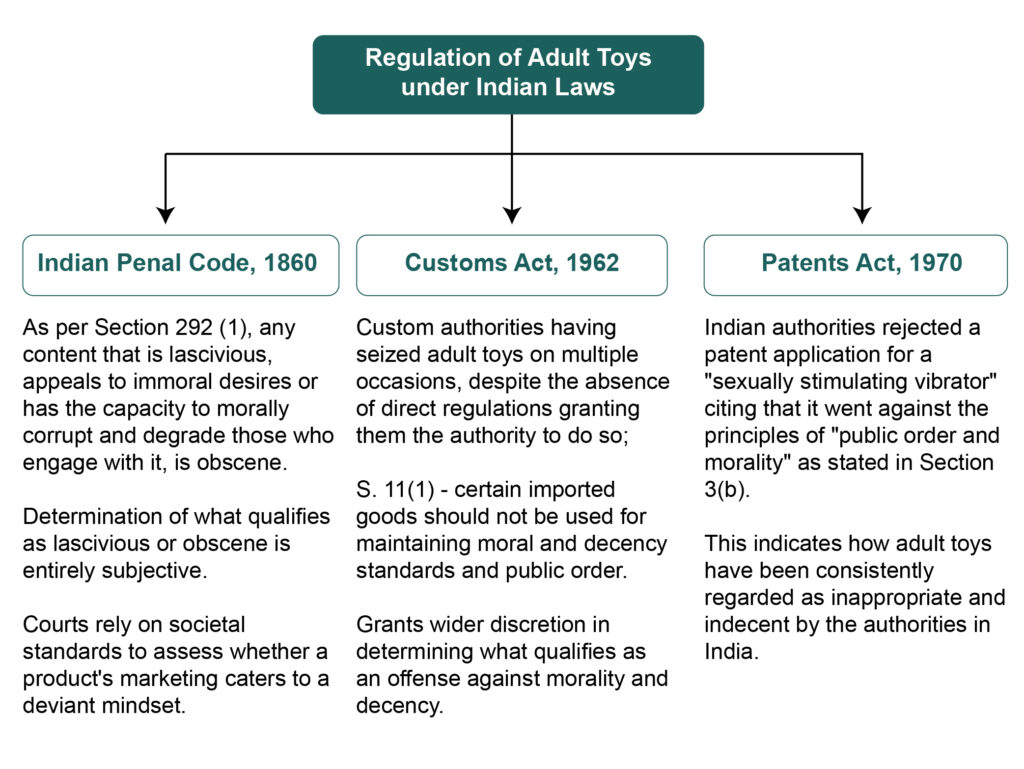
The Evolving Legal Position for Sex Toys in India
The alleged illegality of adult toys in India has been a subject of judicial study on numerous occasions, with intermediaries like Snapdeal.com and Ohmysecret.com being taken to court for sale of “obscene” products on their website even as recently as 2015. However, the notion that the “State has no place in the bedrooms of the nation” is one that is increasingly reflected in judicial precedents surrounding, inter alia, the legality of sex toys in India.
Critics of the ambiguous legal position regulating the sex toy market in India have relied on the Supreme Court’s landmark rulings in the cases of: (i) Justice K S Puttaswamy (Retd.) v Union of India, where the apex court categorically held that “privacy includes at its core the preservation of personal intimacies, the sanctity of family life, marriage, procreation, the home and sexual orientation.”; and (ii) Navtej Singh Johar & Ors. v Union of India, where it was held that “human sexuality cannot be limited to its role solely in procreation” and that the Constitution “safeguards the diverse and changing nature of sexual experiences”.
The High Court of Calcutta, while hearing a case where sex toys purchased by a woman were confiscated by the Customs Authority of Calcutta, held that “Regard being had to the prevailing social mores and standards of morals in our country the goods and items do not reflect anything obscene. Merely because the rules of some of the games may have an erotic and aphrodisiac content or may have a titillating effect for arousing sexual desires, these items, without anything more, cannot be labelled as obscene. The rules of the game have not employed any offensive language. In our opinion, an article or instruction suggesting various modes for stimulating the enjoyment of sex, if not expressed in any lurid or filthy language, cannot be branded as obscene. If that not be so, books like Kama Sutra should also be banned on the charge of obscenity as this ancient Sanskrit treatise on the art of love and sexual techniques also candidly contains various instructions for heightening the pleasures of sexual enjoyment.” The High Court emphasizes that sex toys cannot be classified as “obscene” just because they give sexual pleasure is a welcome assertion and the Honourable Court’s rationale rings particularly true in face of the exemptions contained in the legislations outline earlier in this manual, where “obscene” content produced is not violative of the IPC or IRW, where it is justifiable as being for the public good by contributing to art or culture.
As part of the evolving judicial trends, companies seeking to enter the sex toys market in India can feel bolstered by the March 2024 ruling of the High Court of Bombay in Commissioner of Customs NS-V v DOC Brown Industries LLP. The case in question revolved around an appeal by the company, challenging a confiscation order from the Commissioner of Customs. This order had seized a shipment of body massagers, labeling them as “adult sex toys” which were “prohibited for import” and that the applicant company had mis-declared the description of the goods (relying upon Section 292 of the IPC and the Customs Notification). The Commissioner further relied upon testimony from medical experts who opined that while the products were in fact body massagers, they could be used for sexual pleasure.
In quashing the impugned order of the Commissioner, the High Court held that:
- Body massagers cannot be legally equated with items explicitly banned under Customs Notifications, which traditionally cover materials like books and pamphlets. This differentiation highlighted a misinterpretation of the law by the customs authority.
- It was determined that the classification of these massagers as prohibited items stemmed from the subjective viewpoint of the Commissioner, rather than any solid legal basis. The judgement clarified that customs notifications do not categorise body massagers as obscene or contraband.
- Significantly, the court pointed out that since body massagers are legally sold within India, it contradicts logic to ban their import. This acknowledgment serves as a reminder of the need for consistency in regulatory approaches.
- Lastly, the court refuted the argument that the potential for an alternative sexual use of these massagers could justify their prohibition. It stressed that such a criterion is not valid for deeming goods as banned, provided they meet the standard requirements for import and sale.
Challenges and Solutions around Legality of Sex Toys in India
The market for adult toys, particularly for sex toys online in India, is booming, but the legal landscape is still a bit cloudy. Wherever the discussions around topics like sex doll laws order or legality of sex toys in India occur, the law regulations appear hazy. Here’s a breakdown of the challenges companies face and some creative solutions they’re using:
Challenges:
- Obscenity Laws: The primary challenge lies in the ambiguity surrounding the classification of sex toys under Section 292 of the IPC and the Customs Act, 1962. The subjective nature of “obscenity” creates uncertainty for businesses, as customs officials may confiscate adult toys in India deemed obscene at their discretion.
- Misleading Marketing: To circumvent legal complexities, companies often resort to marketing adult toys under alternative names like “massagers.” While this allows them to operate, it raises concerns about consumer protection laws. Misrepresenting a product’s purpose could be misleading and lead to subsequent actions.
- Importation Issues: The absence of specific Harmonized System of Nomenclature (HSN) codes for adult toys creates difficulties in importation procedures. Classification as “obscene” can lead to confiscation by customs authorities. Additionally, misclassifying adult toys can result in penalties for importers.
- Medical Device Registration: While some adult toys with therapeutic applications may be registered as medical devices under the Medical Devices Rules, 2017, most pleasure-oriented sex toys lack inherent therapeutic value. Obtaining medical device approval based solely on disclosure, without a genuine therapeutic application, raises concerns about the integrity of the system.
Solutions:
- Judicial Clarity: A definitive ruling by the Supreme Court on the legality of sex toy business in India would provide much-needed clarity for the industry. This would eliminate the subjective interpretation of obscenity laws and provide a clear framework for businesses to operate within.
- Legislative Reform: Enacting specific legislation regulating adult toys would address current ambiguities. This could involve creating a separate category for adult toys within the HSN code and establishing clear guidelines for their marketing and sale; or creating legislation specifically addressing the legality of the sex toy business in India.
- Ethical Marketing: Companies can navigate the current environment by adopting ethical marketing practices. Utilizing neutral product descriptions and focusing on potential wellness benefits associated with certain adult toys can help avoid legal issues related to obscenity.
- Transparent Disclosures: When registering adult toys in India for medical device approval, companies should ensure transparency in disclosures. This ensures the integrity of the system and avoids misuse of the medical device classification for products lacking a genuine therapeutic purpose.
Read our Previous Report on Are Sex Toys Legal in India?
Conclusion
The adult toys market in India exhibits tremendous potential. However, the legal ambiguity surrounding these products necessitates creative strategies and cautious navigation by companies. In India, adult toys that are not presented or advertised in an indecent manner are generally considered legally acceptable. However, if these products have packaging or marketing materials that are deemed obscene according to Indian obscenity laws, they may be in violation of those laws. This creates confusion regarding whether or not sale of products in India can be lawfully sold in India. The legal ambiguity surrounding these products necessitates creative strategies and cautious navigation by companies. Until a definitive legal framework or a Supreme Court ruling emerges, the industry will likely rely on a combination of ethical marketing practices, judicious use of medical device registration, and a continued push for legislative reform to ensure a more stable and transparent business environment.
We help navigate legal compliances & statutory regulations Let’s Talk
Frequently Asked Questions (FAQs) on Legal Status of Sex Toys in India
- Are sex toys (adult toys) legal in India?
Yes, adult toys that are not presented or advertised in an indecent or obscene manner are generally considered legally acceptable in India. - Is there a sex dolls legislation in India?
No, there is no specific law that directly governs the sale of sex dolls or other adult toys in India. This has resulted in a gap in the legal framework where the interpretation of the law is subjective and dependent on legislations that were enacted decades ago. - Can I bring sex toys to India?
Yes, there is no law that directly bans this. However, as seen in the case of Commissioner of Customs NS-V v DOC Brown Industries LLP, where the interpretation of the sex toy legislation (or lack thereof) is in itself subjective, there can be practical issues posed by customs officials at the port of entry into India. - Are sex toys banned in India?
No, there is no law that expressly bans sex toys. Conversely however, there is also no law explicitly stating that the sex toy business in India is legal. As such, sale of sex toys online in India operates in murky waters.
Micro, Small and Medium Enterprises (MSMEs) contribute significantly to the nation’s GDP, generate vast employment opportunities, and foster innovation across various industries. Recognizing their critical role, the Government of India established the National Board for Micro, Small and Medium Enterprises (NBMSME) under the Micro, Small and Medium Enterprises Development Act, 2006 (MSMED Act). MSMEs are the backbone of the Indian economy, playing a vital role in production, exports, and overall economic health. Their contributions are essential for the nation’s success. Recognizing this immense potential, the Government of India (GOI) has actively supported the MSME sector through various initiatives in recent years. In this article ahead, we explore various MSME Registration Benefits & Tax Benefits for Businesses in India. These maybe established business organizations or startups.
The NBMSME serves a three-fold purpose:
- Examining Growth Factors: The NBMSME acts as a strategic advisor, constantly examining factors that impact MSME growth. This includes analyzing market trends, infrastructure needs, and policy regulations. By understanding these growth drivers, the NBMSME can advocate for policies and initiatives that directly benefit MSMEs.
- Facilitating Benefits: Businesses registering under the MSME Act gain access to a multitude of advantages, including:
- Easier Access to Credit: While not all MSME loans are collateral-free, the NBMSME’s advocacy has led to schemes offering easier credit access with relaxed collateral requirements. This can significantly improve your MSME’s financial flexibility.
- Reduced Interest Burden: Some loan schemes provide exemptions on overdraft interest, easing your financial burden and allowing you to reinvest profits back into the business.
- Protection Against Delayed Payments (for Micro and Small Enterprises): Late payments can cripple cash flow. The NBMSME works towards initiatives that safeguard MSMEs from delayed customer payments, ensuring a smoother financial flow.
- A Voice for MSMEs: The NBMSME acts as a bridge between the government and MSMEs. By representing various MSME segments, including women entrepreneurs and regional associations, the NBMSME ensures your concerns are heard. This allows the government to tailor policies and programs that directly address the needs of MSMEs.
MSME Classification and Support
The MSMED Act further categorizes MSMEs based on their investment in plant and machinery (for manufacturing enterprises) or investment in equipment (for service enterprises), along with their annual turnover. This classification system allows the government to tailor support initiatives and benefits to the specific needs of each category. Here’s a breakdown of the MSME classification:
| Enterprise Category | Investment in Plant & Machinery/Equipment | Turnover |
| Micro | Does not exceed INR 1 Crore | Does not exceed INR 5 Crore |
| Small | Does not exceed INR 10 Crore | Does not exceed INR 50 Crore |
| Medium | Does not exceed INR 50 Crore | Does not exceed INR 250 Crore |
What is MSME Udyam Registration?
Udyam Registration is a free, online, and mandatory process for all MSMEs in India. It eliminates the complexities of earlier registration procedures by implementing a self-declaration system. There’s no need to submit any documents or verification for registration. To streamline the registration process for MSMEs, the Government of India (GOI) implemented a user-friendly online system called Udyam Registration. Following the notification issued under the MSMED Act, any aspiring MSME owner can apply for a Udyam Registration Certificate (URC) – essentially an MSME registration certificate – through the Udyam registration portal.
Steps for Udyam Registration:
The Udyam Registration process is simple and can be completed online through the official Udyam Registration portal (https://udyamregistration.gov.in/). Here’s a basic overview of the steps involved:
- Visit the Udyam Registration portal.
- Enter your Aadhaar number and PAN details.
- Fill in the required information about your business, including its nature, activity, and investment details.
- Self-declare your business category (Micro, Small, or Medium) based on the prescribed turnover criteria.
- Submit the online application.
Upon successful registration, you’ll receive a URN electronically. This registration never expires, eliminating the need for renewals.
What is the Benefit of MSME Registration in India?
To empower these crucial businesses, the Indian government offers a compelling incentive: MSME registration.
From easier access to credit to financial grants and subsidies, MSME registration offers a significant edge in today’s competitive marketplace. MSME registration unlocks a multitude of advantages designed to empower your business. These benefits can be categorized into key areas:
Financial Advantages:
- Reduced Interest Rates: MSMEs benefit from lower interest rates on loans and overdrafts compared to unregistered businesses. Government programs further subsidize interest costs, easing financial burdens.
- Easier Access to Credit: Registration facilitates access to collateral-free loans and government credit guarantee schemes, making it easier to secure funding at competitive rates.
Operational Improvements:
- Free or Discounted ISO Certification: Government schemes offer financial assistance for obtaining ISO Certification, a globally recognized symbol of quality that enhances brand image.
- Electricity Bill Rebates: Reduce operational costs with rebates on electricity bills offered to registered MSME.
- Feasible Complaint Portal: The MSME Samadhan Portal empowers you to file complaints against delayed payments, ensuring a healthy cash flow.
Market Expansion Opportunities:
- Government Tender Participation: Registration facilitates participation in government tenders and e-Procurement marketplaces, expanding your customer base.
- Reduced Government Security Deposits: Waived security deposits for tenders ease the financial burden of bidding on government projects.
- International Trade Facilitation: Government support includes funding for attending international trade fairs, providing opportunities to gain global exposure.
- Marketing and Technology Upgradation: Government initiatives offer assistance with marketing and technology upgrades, propelling your business towards greater success.
Additional Benefits:
- Industrial Promotion Subsidy: This subsidy assists in acquiring new technology and machinery, enhancing production processes, efficiency, and market competitiveness.
By leveraging these comprehensive benefits, MSME registration empowers you to overcome financial hurdles, foster innovation, enhance credibility, and unlock new market opportunities.
Tax Benefits of MSME Registration in India
MSME registration unlocks a treasure trove of tax benefits designed to incentivize and support small businesses in India. These advantages translate to significant cost savings, improved cash flow, and a more competitive business environment. Let’s delve deeper into some key tax benefits:
- Reduced Taxable Income: Interest on business loans is deductible under Section 36(1)(iii) of the Income Tax Act, 1961, effectively reducing taxable income and potentially the overall tax liability.
- Increased Depreciation Benefits: For “Qualifying Assets” with extended readiness times, capitalized interest on borrowed funds can be added to the acquisition cost. This increases the base for depreciation deductions, reducing taxable income under the Income Tax Act.
- Employment Generation Incentive: Under Section 80JJAA of the Income Tax Act, MSMEs creating new jobs can claim deductions for additional employee costs.
- Tax Holiday for Specific Sectors (Limited Applicability): This benefit, relevant to manufacturing MSMEs in specific sectors like mineral oil and natural gas, offered a tax holiday under Section 80-IB. It’s important to note that this section has been phased out and now primarily applies only to certain older cases that are still under its tenure.
- Reduced Tax Rates: Manufacturing MSMEs can opt for a reduced corporate tax rate of 25% under Section 115BA if their turnover is under Rs 400 crore. This requires giving up various exemptions and deductions. Additionally, under Section 115BAA, any company, not restricted to MSMEs, can opt for a tax rate of 22% (effective rate approximately 25.17% including surcharges and cess), also with the forfeiture of most other tax exemptions and deductions.
- GST Composition Scheme: MSMEs with a turnover of up to INR 1.5 crore can benefit from the simplified GST Composition Scheme, reducing tax compliance burdens and offering lower tax rates.
- Capital Gains Tax Exemption: Section 54GB allows exemptions on capital gains tax if the gains from long-term asset sales are reinvested in eligible startups, subject to conditions.
- Investment Allowance: Under Section 32AC, businesses investing in new plant and machinery can claim an investment allowance, reducing taxable income.
- Maximizing Deductions: Routine business expenses like rent, salaries, and depreciation are deductible, which helps in further reducing taxable income.
- Startup India Tax Benefits: Startups, including those in the MSME sector, can avail of benefits like exemption from income tax for three consecutive years out of their first ten years under the Startup India initiative and capital gains tax exemption for investments in startups.
- Presumptive Taxation Scheme: For small businesses meeting certain conditions, the Presumptive Taxation Scheme under Section 44AD simplifies tax filings by allowing them to declare income at a prescribed rate on total turnover. The threshold for eligibility under this scheme was increased to INR 2 crore, not INR 3 crore.
- Timely Payment Incentive: The introduction of Section 43B(h) in the Income Tax Act incentivizes timely payments to MSMEs, allowing deductions for such payments only if they are made within the prescribed timeframe.
- Extended Carry Forward Period for MAT: The carry forward period for Minimum Alternate Tax (MAT) credit for MSMEs has been extended to 15 years, aiding in better financial planning and utilization of MAT credits.
By leveraging these tax benefits, MSME registration empowers you to retain more of your hard-earned profits, invest in growth, and contribute significantly to the Indian economy.
Conclusion
The MSME sector stands as a pillar of the Indian economy, not only bolstering economic growth but also fostering innovation and providing substantial employment opportunities. The Government of India, recognizing the sector’s potential, has put forth numerous initiatives under the MSME registration framework to support these enterprises. MSME registration offers a gateway to myriad opportunities that can transform a small or medium enterprise into a robust, competitive business. These opportunities range from financial benefits like easier access to credit and tax reliefs to operational advantages such as international trade facilitation and technological upgrades. As MSMEs continue to evolve, the continuous support from the government is vital to ensure their growth and sustainability, thereby powering India’s progress on a global scale.
FAQ on MSME Registration Benefits & Tax Benefits for Business in India
Q1: What is MSME?
A: MSME stands for Micro, Small and Medium Enterprises. These businesses play a vital role in the Indian economy, contributing significantly to its growth and development. Entities are classified either as micro, small or medium on the basis of their turnover and investments.
Q2: What is The National Board for Micro, Small and Medium Enterprises (NBMSME)?
A: The NBMSME is a board established by the Government of India under the MSME Development Act, 2006. It works to examine the factors affecting promotion and development of MSME and recommends policies to the government for the growth of the MSME sector.
Q3: What are the benefits of registering under MSME?
A: The benefits of MSME registration include (a) easy access to collateral-free loans; ; (b) protection against delayed payments (only to micro and small enterprises); (c) subsidies on patent and trademark applications; (d) reimbursement of ISO certification charges; and (e) reduced electricity bills.
Q4: How can I register my business under MSME?
A: You can register your business under MSME by visiting the Udyam registration website and filing the registration form.
Q5: Can a business change its MSME classification after registration?
A: Yes, a business can change its MSME classification anytime (based on its growth and investment) through the Udyam registration portal.
Q6: What qualifies a business as an MSME in India?
A: Businesses are classified as Micro, Small, or Medium Enterprises based on investment in plant and machinery for manufacturing units or equipment for service units, along with annual turnover, according to the MSMED Act.
Q7: How does MSME registration help in tax reduction?
A: Registered MSMEs can avail themselves of various tax deductions such as increased depreciation, investment allowances, and specific incentives under the Income Tax Act, which reduce taxable income and overall tax liability.
Q8: Is MSME registration mandatory for all small and medium businesses?
A: While MSME registration is not mandatory, it is highly beneficial and recommended as it provides access to several government benefits, schemes, and subsidies designed to support business growth and sustainability.
Q9: Can MSME benefits be availed immediately after registration?
A: Most benefits can be availed immediately post-registration, although some might require specific conditions to be met or additional documentation, particularly those related to tax benefits or financial subsidies.
An anti-dilution clause is a contractual provision typically found in investment agreements, particularly in the context of equity financing for startups. Its primary purpose is to protect existing investors from the dilutive effects of subsequent equity issuances at a lower valuation.
Anti-dilution provisions are incorporated in a company’s transactional documents that aim at protecting the value of an investor’s shares in the event of a future equity financing round. The anti dilution provisions in the term sheet often state that when an investor invests in a company, they are designed to protect the investor’s equity stake in the company if the company issues additional shares at a lower price in the future.
Why is the Anti-Dilution Clause Important?
Anti-dilution provisions play a crucial role in safeguarding the interests of both startups and investors within the dynamic world of startup financing.
Benefits of anti-dilution clause for startups:
- Preserves Founder Control: By granting founders additional shares at a lower price point in a down round, anti-dilution clauses for founders help maintain a significant ownership stake. This ensures they retain control over company decisions and guide the venture towards its goals.
- Attracts and Retains Talent: Equity-based compensation plans are essential for attracting top talent in the startup ecosystem. Anti-dilution provisions mitigate excessive dilution, ensuring these equity incentives remain valuable and motivating for employees, thereby minimizing the risk of talent loss.
- Enhanced Investment Appeal: The stability and fairness instilled by anti-dilution clauses make the startup more attractive to potential investors and strategic partners, facilitating future fundraising efforts.
Benefits for anti-dilution clause for Investors:
- Protects Stake Value: These clauses shield investors from a decrease in ownership percentage (dilution) when a company issues new shares at a lower valuation in a subsequent financing round.
- Maintains Investment Worth: They play a major role in ensuring the value of an investor’s stake remains stable even if the company’s overall valuation goes down. This is particularly crucial for investors making significant investments.
- Increased Confidence: Anti-dilution provisions offer investors a level of protection and predictability, fostering greater confidence in their investment decisions.
What does an anti-dilution clause include?
Anti-dilution clauses for a startup or an investor typically include several key elements:
- Trigger Events: Anti-dilution clauses are activated by specific trigger events, most commonly subsequent equity financings at a lower valuation than the original investment. These trigger events can also include stock splits, mergers, or acquisitions that may dilute the ownership stakes of existing investors.
- Adjustment Mechanism: Once triggered, the anti-dilution clause adjusts the number of shares or the conversion price of existing investor holdings to compensate for the dilution. The adjustment mechanism aims to maintain the proportional ownership of existing investors relative to the new shares issued.
- Full Ratchet vs. Weighted Average: There are two primary types of anti-dilution mechanisms which acts as an essential for the corporation while incorporating such a clause: full ratchet and weighted average.
a) Full Ratchet: This type of anti-dilution clause typically functions to adjust the conversion price of existing holdings to the price of the new issuance, essentially providing the most protection to existing investors by completely offsetting the dilution.
b) Weighted Average: This type mainly takes into account both the price and the number of shares issued in the new financing round, offering a more balanced approach to anti-dilution protection. It considers the dilution on a weighted average basis, mitigating the severity of adjustment compared to full ratchet. - Exceptions and Limitations: Anti-dilution clauses may include exceptions or limitations to their application. For example, certain issuances, such as employee stock options or convertible debt, may be excluded from triggering the clause. Additionally, there may be caps or limits on the extent of adjustment to prevent excessive dilution of future investors.
- Negotiation and Customization: Anti-dilution clauses are subject to negotiation between the company and investors. The specific terms and conditions, including the type of anti-dilution mechanism used, the trigger events, and any exceptions or limitations, are customized based on the negotiating leverage and preferences of the parties involved.
Types of Anti-Dilution Provisions
There are two main types of anti-dilution provisions: full-ratchet and weighted average.
- Full-Ratchet: For investors seeking maximum protection against dilution, full-ratchet anti-dilution provisions provide the most comprehensive safeguards. They fully compensate an investor for dilution caused by a future equity financing round by adjusting the investor’s share count and conversion price to the same extent as the dilution caused by the new financing round.For example, if a company issues new shares at a price that is 50% lower than the price at which the investor’s shares were issued, a full-ratchet provision would adjust the investor’s share count and conversion price by 50%. This means that the investor’s share count would increase by 50% and the conversion price would decrease by 50%, effectively nullifying the dilution caused by the new financing round.
- Weighted-Average: Weighted average anti-dilution provisions are less protective for investors than full-ratchet provisions, but they are also less disruptive to a company’s capital structure. These provisions adjust the investor’s share count and conversion price based on a formula that takes into account the size of the new financing round and the price at which the new shares are issued. The formula used to calculate the adjustment may vary, but it typically involves multiplying the investor’s existing share count by a weighted average of the old and new share prices, and then dividing the result by the new share price. This results in a smaller adjustment to the investor’s share count and conversion price than a full-ratchet provision would provide.The weighted average provision uses the following formula to determine new conversion prices:
C2 = C1 x (A + B) / (A + C)
Where:
C2 = new conversion price
C1 = old conversion price
A = number of outstanding shares before a new issue
B = total consideration received by the company for the new issue
C = number of new shares issuedBoth full-ratchet and weighted average anti-dilution provisions are designed to protect the value of an investor’s equity stake in a company by compensating them for dilution caused by future equity financing rounds. However, the extent of protection provided by these provisions can vary significantly, and the choice of which type of provision to include in a company’s financing documents can have significant consequences for both the company and its investors.
There are both pros and cons to anti-dilution provisions in a company’s transaction agreements:
Pros of Anti-Dilution Provisions for startups:
- Maintains Founder Control: By protecting against dilution, anti-dilution provisions for founders help retain a significant ownership stake in the company. This ensures they have a strong voice in shaping the company’s future and making critical decisions.
- Enhanced Investment Appeal: The stability and predictability offered by anti-dilution clauses can make the company more attractive to potential investors and strategic partners. Investors seeking protection against dilution are more likely to be drawn to such opportunities, and strategic partners might value the reduced risk associated with a company’s capital structure.
Cons of Anti-Dilution Provisions for startups:
- Increased Complexity: Anti-dilution provisions can introduce complexities into a company’s capital structure. Managing these provisions might involve adjusting investor share conversion prices based on various trigger events. Additionally, dealing with multiple investors who have different anti-dilution clauses in their agreements can lead to intricate calculations and potential disagreements.
- Potential Financial Strain: To compensate investors for future dilution, a company might need to issue additional shares or make cash payouts. This can be financially burdensome, especially for startups with limited resources or cash flow constraints. However, companies can negotiate limitations or exceptions in anti-dilution clauses to mitigate this risk.
Pros of Anti-Dilution Provisions for investors
- Protects Investment Value: Shields against dilution and safeguards the value of your investment, especially crucial for larger investments.
- Stronger Negotiating Position: Offers leverage during financing discussions, potentially leading to more favorable terms.
Cons of Anti-Dilution Provisions for investors
- Limited Control: May restrict your ability to negotiate for increased ownership in future rounds, potentially limiting your returns.
- Exit Strategy Concerns: Strong provisions could signal higher risk for the company, hindering future financing and limiting your exit options.
Conclusion
Anti-dilution provisions offer investors valuable protection against dilution, safeguarding the value of their investment in a startup. This can be particularly important for early-stage companies where the risk of future down-round financing is higher. However, these provisions can also introduce complexity and potentially limit a company’s ability to attract future investors or strategic partners. Investors should carefully consider the potential benefits and drawbacks of anti-dilution clauses when evaluating investment opportunities in startups. Companies, on the other hand, need to weigh these considerations against the importance of attracting investors, especially in the crucial early stages. Ultimately, the decision to include anti-dilution provisions should be based on a careful analysis of the company’s specific situation and its investor landscape.
Frequently Asked Questions on Anti-Dilution
Q. What is an anti-dilution clause?
A. An anti-dilution clause is a provision in an investment agreement that protects investors from the dilution of their equity stake in the event that a company issues more shares at a lower valuation in the future.
Q. Why are anti-dilution clauses important?
A. Anti-dilution clauses help preserve the value of investments by adjusting the number of shares or the conversion price to compensate for dilution caused by subsequent equity issuances. This ensures that investors maintain a proportional ownership relative to new shares issued, safeguarding their investment’s value.
Q. What are the main types of anti-dilution provisions?
A. There are two primary types of anti-dilution provisions: full-ratchet and weighted-average. Full-ratchet provisions offer the most protection by adjusting the investor’s share count and conversion price to match the price of new shares issued, while weighted-average provisions take into account the price and number of new shares, resulting in a less drastic adjustment.
Q. How do anti-dilution provisions benefit startups?
A. For startups, these provisions can attract and retain top talent by ensuring that equity-based compensation plans remain valuable. They also help preserve founder control and enhance the startup’s appeal to potential investors by stabilizing the capital structure.
Q. What are the potential drawbacks of anti-dilution provisions for companies?
A. While beneficial in protecting founders and early investors, anti-dilution provisions can complicate the capital structure and make future fundraising more challenging. They may also impose financial strains on startups by requiring additional shares or cash payouts to compensate for dilution.
Q. Can anti-dilution clauses be negotiated?
A. Yes, anti-dilution clauses are typically subject to negotiation between investors and the company. The specific terms, including the type of mechanism used and any exceptions or limitations, are often tailored based on the negotiating power and preferences of the parties involved.
Q. What triggers an anti-dilution clause?
A. Trigger events for anti-dilution clauses commonly include subsequent equity financings at a lower valuation than the original investment. Other events might include stock splits, mergers, or acquisitions that could dilute the ownership stakes of existing shareholders.
]]>- Introduction: A privacy policy typically begins with an introduction that underscores the organization’s commitment to safeguarding user privacy and complying with relevant laws and regulations. This section aims to establish trust and transparency from the outset, laying the foundation for user confidence in the organization’s data practices.
- Consent and Updates: User consent forms the cornerstone of data collection and processing activities. A robust privacy policy should clarify that by using the organization’s services or accessing its platform, users implicitly agree to its terms. Furthermore, the policy should outline procedures for notifying users of any material changes, ensuring ongoing consent and transparency.
- Opt-Out Provision: Respecting user autonomy is paramount. A privacy policy should include provisions for users to opt out of data collection and processing activities. By providing clear instructions on how to do so, organizations empower users to assert control over their personal information.
- Collection of Personal Information: The policy should detail the types of personal information collected and the methods used for its acquisition. Importantly, it should clarify that only information provided voluntarily or available in the public domain is collected, fostering transparency and user trust.
- Use of Personal Information: The policy should articulate the purposes for which personal information is collected and used, ensuring alignment with specific organizational objectives. By providing clarity on data usage, organizations demonstrate transparency and accountability in their data practices.
- Sharing Personal Information with Third Parties: Instances where personal information may be shared with third parties should be clearly delineated in the policy. By stipulating the conditions under which data is shared, organizations establish transparency and accountability in their data-sharing practices.
- Use of Cookies: If cookies are used for enhancing user experience or analyzing site traffic, the policy should address their usage and implications for user privacy. By informing users about cookie management options, organizations empower users to make informed decisions about their privacy preferences.
- Retention and Security of Personal Information: The policy should outline the organization’s approach to data retention and the security measures employed to protect user information. By reassuring users of robust security measures, organizations foster trust and confidence in their data handling practices.
- International Data Transfer: If data processing involves international transfer, the policy should clarify the jurisdictions involved and the measures taken to ensure compliance with relevant laws and regulations. Transparent communication about data transfer practices enhances user trust and confidence.
- Disclaimers and Limitations of Liability: The policy may include disclaimers regarding external links and user-contributed content, mitigating the organization’s liability for third-party actions. By setting clear boundaries, organizations minimize legal risks associated with user-generated content and external links.
- User Rights: Users should be empowered with rights to access, rectify, and erase their personal information, as well as to withdraw consent and lodge complaints. The policy should pledge to facilitate the exercise of these rights while upholding legal obligations, fostering trust and accountability.
- Grievance Officer: Designating a grievance officer to address user concerns and complaints promptly demonstrates the organization’s commitment to resolving privacy-related issues effectively. Providing a dedicated point of contact enhances accountability and transparency in conflict resolution.
- Legal Compliance: In compliance with relevant legislation, such as the Digital Personal Data Protection Act of 2023, organizations should ensure that their privacy policy aligns with stipulated requirements for data protection and privacy. Adhering to legislative provisions enhances legal compliance and user trust in the organization’s data handling practices.
In conclusion, a comprehensive privacy policy plays a pivotal role in navigating the complexities of data protection and privacy regulation in the digital age. By prioritizing transparency, user consent, and data protection, organizations can foster trust, enhance user experiences, and maintain compliance with regulatory standards. In doing so, they uphold privacy as a fundamental right in the modern digital landscape.
]]>
RETROSPECTIVE AND PROSPECTIVE EFFECT
| Outsourcing Agreements | Particulars | Timelines |
| Existing Agreements | Due for renewal before October 1, 2023 | Must comply with the Directions on the renewal date (preferably) but no later than April 9th, 2024. |
| Due for renewal on or after October 1, 2023 | Must comply with the Directions on the renewal date or by April 9th, 2026, whichever is earlier. | |
| New Agreements | Will come into force before October 1, 2023 | Must comply with the Directions as on the effective date of the agreement (preferably) or by April 9th, 2024, whichever is earlier. |
| Will come into force on or after October 1, 2023 | Must comply with the Directions from the effective date of the agreement. |
APPLICABILITY
These Directions shall apply to Material Outsourcing of IT Services arrangements entered by the REs. The term “Material Outsourcing of IT Services” shall include any such services which:
(a) if disrupted or compromised will significantly impact the RE’s business operations; or
(b) may have material impact on the RE’s customers in the event of any unauthorised access, loss or theft of customer information.
The “Outsourced IT Services” will include the following:
| S.No. | IT Services | Inclusions (not an exhaustive list) |
| 1. | IT infrastructure management, maintenance and support (hardware, software or firmware) | Hardware/ Software installation and configuration, OS management, network setup and configuration, server management, data backup and recovery, technical support services, security management, performance monitoring and optimization, IT asset management and vendor management |
| 2. | Network and security solutions, maintenance (hardware, software or firmware) | Firewall, IDS/IPS, VPN, NAC and WAF management, network monitoring and traffic analysis, patch management, security policy management and security audits and compliance |
| 3. | Application Development, Maintenance and Testing; Application Service Providers (ASPs) including ATM Switch ASPs | Requirements analysis, application design and architecture, programming and development, software testing, bug fixing and maintenance, performance optimization, version development, application security and hosting, application development, integration and customization |
| 4. | Services and operations related to Data Centres | Installation, setup, design, consulting, networking, security, compliance and auditing, maintenance and upgrades and server and storage management of Data Centres. |
| 5. | Cloud Computing Services | SaaS, PaaS, IaaS, DBaaS, cloud storage, monitoring and management, cloud networking, IAM management and data analytics and machine learning |
| 6. | Managed Security Services | Security monitoring and incident response, vulnerability management, security device management, security assessments and audits, security incident handling and forensics, security policy and governance and managed encryption services |
| 7. | Management of IT infrastructure and technology services associated with payment system ecosystem | Payment Gateway management, merchant account management, fraud detection and prevention, payment processor management and infrastructure management |
ROLES AND RESPONSIBILITIES OF THE REs
The guidelines underscore the critical responsibility of REs in overseeing outsourced activities. The Board and Senior Management bear ultimate accountability and must ensure that service providers adhere to the same standards and obligations as the REs themselves. To this end, REs are mandated to maintain a robust grievance redressal mechanism and compile an inventory of services provided by service providers.
- Governance Framework: A comprehensive governance framework is essential for effective oversight of outsourcing activities. REs intending to outsource IT activities must formulate a board-approved IT outsourcing policy encompassing roles and responsibilities, selection criteria for service providers, risk assessment methodologies, disaster recovery plans, and termination processes. The Board is entrusted with approving policies and establishing administrative frameworks, while Senior Management is responsible for policy formulation and risk evaluation.
- Evaluation and Engagement of Service Providers: Prior to engaging service providers, REs must conduct meticulous due diligence to assess their capabilities and suitability. Evaluation criteria should span qualitative, quantitative, financial, operational, legal, and reputational factors. The subsequent agreement between REs and service providers should be legally binding and encompass critical aspects such as service level agreements, data confidentiality, and liability clauses.
- Risk Management: Mitigating risks associated with outsourcing activities requires a robust risk management framework. REs must identify, measure, mitigate, and manage risks comprehensively. Additionally, they are required to establish business continuity plans (BCP) and disaster recovery plans (DRP) to ensure uninterrupted operations during emergencies.
- Monitoring and Control of Outsourced Activities: Maintaining effective oversight of outsourced IT activities is paramount for REs. Regular audits, performance monitoring, and periodic reviews of service providers are essential components of this oversight. Access to relevant data and business premises must be granted for oversight purposes.
- Outsourcing within a Group / Conglomerate: While REs are permitted to outsource IT activities within their business group or conglomerate, they must ensure the adoption of appropriate policies and service level agreements. Maintaining an arm’s length relationship with group entities and adhering to identical risk management practices is imperative.
- Cross-Border Outsourcing: Engaging service providers based in different jurisdictions necessitates a thorough understanding of associated risks. REs must closely monitor country risks, political, social, economic, and legal conditions, and ensure compliance with regulatory requirements. Contingency and exit strategies must be in place to mitigate potential disruptions.
- Exit Strategy: Incorporating a clear exit strategy in outsourcing policies is essential for ensuring business continuity during and after termination of outsourcing arrangements. Alternative arrangements and procedures for data removal, transition, and cooperation between parties must be clearly defined.
EXCLUSIONS
The following services/ activities are excluded from the ambit of “Outsourcing IT Services” (non-exhaustive list):
- Corporate Internet Banking services obtained by regulated entities as corporate customers/ sub members of another regulated entity
- External audit such as Vulnerability Assessment/ Penetration Testing (VA/PT), Information Systems Audit, security review
- SMS gateways (Bulk SMS service providers)
- Procurement of IT hardware/ appliances
- Acquisition of IT software/ product/ application (like CBS, database, security solutions, etc.,) on a licence or subscription basis and any enhancements made to such licensed third-party applications by its vendor (as upgrades) or on specific change requests made by the RE.
- Any maintenance service (including security patches, bug fixes) for IT Infra or licensed products, provided by the Original Equipment Manufacturer (OEM) themselves, in order to ensure continued usage of the same by the RE.
- Applications provided by financial sector regulators or institutions like CCIL, NSE, BSE, etc.
- Platforms provided by entities like Reuters, Bloomberg, SWIFT, etc.
- Any other off the shelf products (like anti-virus software, email solution, etc.,) subscribed to by the regulated entity wherein only a license is procured with no/ minimal customisation
- Services obtained by a RE as a sub-member of a Centralised Payment Systems (CPS) from another RE
- Business Correspondent (BC) services, payroll processing, statement printing
In addition to the above, certain vendors/ entities will not be considered as a third-party service provider for these Directions. A non-exhaustive list is provided below:
- Vendors providing business services using IT. Example – BCs
- Payment System Operators authorised by the Reserve Bank of India under the Payment and Settlement Systems Act, 2007 for setting up and operating Payment Systems in India
- Partnership based Fintech firms such as those providing co-branded applications, service, products (would be considered under outsourcing of financial services)
- Services of Fintech firms for data retrieval, data validation and verification services such as (list is not exhaustive): (a) bank statement analysis; (b) GST returns analysis; (c) fetching of vehicle information; (d) digital document execution; and (e) data entry and call centre services.
- Telecom Service Providers from whom leased lines or other similar kind of infrastructure are availed and used for transmission of the data
- Security/ Audit Consultants appointed for certification/ audit/ VA-PT related to IT infra/ IT services/ Information Security services in their role as independent third-party auditor/ consultant/ lead implementer.
- The RBI’s IT Outsourcing Directions represent a significant regulatory milestone aimed at enhancing the resilience and integrity of IT outsourcing practices within the financial sector. By delineating clear roles, responsibilities, and standards, these guidelines seek to foster transparency, accountability, and risk mitigation in outsourcing arrangements. Compliance with these directives is essential for REs to maintain operational stability and safeguard customer interests in an increasingly digitalized financial landscape.
]]>
In the ever-evolving landscape of innovation, intellectual property rights (IPR) serve as the cornerstone of creativity and progress. It’s the shield that protects original ideas, inventions, and brand identity, to reap the rewards of one’s hard work and rightfully enjoy the reputational credit of being the first, original creator of a certain intangible property.
India’s decision to be a signatory to international intellectual property conventions, like the Berne Convention for the Protection of Literary and Artistic Works and the Agreement on Trade-Related Aspects of Intellectual Property Rights (TRIPS), signifies its commitment to upholding a global framework for protecting creativity and innovation. These conventions establish a set of rules and minimum standards that member countries, including India, agree to implement within their legal systems.
This article aims to explain Difference between Copyrights, Trademarks and Patents and their associated legal intricacies which are the three most widely implemented types of intellectual property protection. From safeguarding original works of authorship to securing exclusive rights for groundbreaking inventions, and establishing a recognizable brand identity, this research article will equip you to choose the most effective form of IP protection for the specific needs of your creation.
What is Intellectual Property?
Intellectual property (IP) refers to creations of the mind. These creations are intangible, meaning they can’t be physically held and can include inventions; literary and artistic works; designs; and symbols, names, and images used in commerce, as defined by the World Intellectual Property Organization (WIPO). Intellectual property rights (IPR) serve as the cornerstone for fostering innovation and creativity across various industries, by providing legal protection to inventors, creators, and businesses for their unique ideas and creations. The importance of intellectual property rights lies in their ability to promote a fair competitive environment, encouraging the development of new technologies, artistic expressions, and brands. By securing exclusive rights to use, share, and monetize their creations, individuals and companies are incentivized to invest in research and development, leading to economic growth and the advancement of human knowledge.
A) Types of Intellectual Property: The most common types of Intellectual Property Rights (IPR) include:
- Copyright: Protects original works of authorship like books, music, software, and artistic designs.
- Patents: Grants exclusive rights for new and inventive products or processes.
- Trademarks: Distinguishes the source of goods or services, allowing consumers to identify a particular brand.
- Trade secrets: Confidential information that provides a competitive advantage, such as a unique formula or manufacturing process.
B) Importance of Intellectual Property: IPR protection plays a vital role in:
- Protects Innovation and Creativity: IPR incentivizes people to create new things by giving them control over their inventions, designs, and creative works. Knowing their work is protected encourages investment in research and development, which fosters innovation.
- Competitive Advantage: IPR can be a significant source of competitive advantage for businesses. A unique product design protected by a trademark or a groundbreaking invention with a patent can set a business apart from competitors.
- Monetization: IPR can be a way to generate income. Owners can license their rights to others for a fee, or they can sell their rights altogether. This can be a valuable revenue stream for individuals and businesses.
- Builds Brand Reputation: Strong trademarks can help build brand recognition and customer loyalty. Customers associate a trademark with a certain level of quality and trust, and IPR helps ensure that only the authorized owner can use that mark.
- Promotes Fair Trade: IPR enforcement helps prevent counterfeiting and piracy. This protects consumers from getting lower-quality goods and helps ensure that creators are fairly compensated for their work.
What is copyright?
Copyright © is a right given by the law protecting the original form or expression to creators of literary, dramatic, musical, and artistic works and producers of cinematograph films and sound recordings. Copyright does not protect brands or names, short word combinations, slogans, short phrases, methods, plots, or factual information. Copyright also does not protect ideas or concepts.

The meaning of copyright is mentioned under the Indian Copyright Act, 1957 (hereinafter ‘Copyright Act’) in Section 14 which essentially states that exclusive rights are granted to the owner of a copyright.
- Section 14: Meaning of copyright – This section defines the exclusive rights granted to copyright owners. These rights typically include reproduction, distribution, public performance, and adaptation of the copyrighted work.
- Section 13: Acts not infringing copyright – This section outlines certain actions that don’t constitute copyright infringement. These may include fair dealing for purposes like research, criticism, or review.
- Sections 15-21: Deal with specific rights and limitations – These sections cover various aspects of copyright ownership and limitations on those rights. They delve deeper into specific rights for certain types of creative works, like cinematograph films, sound recordings, and performer’s rights.
What are the rights protected under copyright?
Here are the main types of rights protected by copyright:
- Reproduction rights: This allows the copyright owner to control how their work is copied, whether in physical form (printing a book) or digital form (downloading music).
- Distribution rights: This grants the copyright owner control over how copies of their work are distributed to the public. This could include selling books, distributing movies, or making music available online.
- Public performance or communication rights: The copyright owner controls how their work is performed or communicated to the public. This could involve public readings of a book, screenings of a film, or online transmissions of music.
- Adaptation rights: This allows the copyright owner to control the creation of derivative works based on their original work. This could include translations, adaptations for films, or other modifications.
Copyright primarily protects two main categories of rights: economic rights and moral rights.
- Economic rights
These are the exclusive rights that allow the copyright owner to financially benefit from their work. They encompass the reproduction, distribution, public performance, and adaptation rights as mentioned earlier. - Moral rights
Moral rights are distinct. These rights are personal and non-economic. They protect the creator’s non-financial interests in their work:
a) The right of attribution: This ensures the creator is identified as the author of the work.
b) The right of integrity: This allows the creator to object to any distortion or modification of their work that could damage their reputation.
Moral rights are separate from economic rights and continue to belong to the author and cannot be transferred or sold. They remain with the creator even if they assign their economic rights to someone else.
What does copyright include?
The Copyright Act protects original expressions in various creative works. Section 13 of the Act specifies the types of works that can be copyrighted:
- Literary works: This includes written materials like books, articles, poems, scripts, computer programs, and compilations like databases.
- Dramatic works: Plays, screenplays, and other works intended for performance fall under this category.
- Musical works: Original musical compositions, with or without lyrics, are protected.
- Artistic works: This broad category encompasses paintings, sculptures, drawings, photographs, architectural works, and any other artistic creations.
- Cinematograph films: Movies and films are included in this section.
- Sound recordings: Recordings of music, speeches, or other sounds are protected. It’s important to note that copyright protects the original form of expression in these works, not the ideas themselves.
What is not protected under copyright?
While the Copyright Act safeguards creative expression, it doesn’t encompass everything under the sun. This law grants copyright protection to specific categories of original works. Let’s delve into what elements fall outside the scope of copyright. Here’s a list of things that generally fall outside the copyright ambit:
- Ideas, concepts, and methods: Copyright protects the way something is expressed, not the underlying idea, concept, or method itself. For instance, the concept of a love story cannot be copyrighted, but the specific expression of that story in a novel can be.
- Facts and information: Factual information, common knowledge, and news items are not copyrightable.
- Short phrases, names, and titles: Copyright doesn’t typically protect short phrases like slogans, names, titles, or common expressions.
- Official documents and symbols: Government reports, emblems, and other official documents are not protected by copyright. Simple formats and arrangements: Standard calendars, height and weight charts, or phone directory layouts wouldn’t be copyrightable.
- Works that haven’t been fixed in a tangible form: Copyright protects things that are expressed in a physical or digital medium. Improv comedy or a speech wouldn’t be protected until written down or recorded.
- Public domain works: Works whose copyright term has expired or that were never copyrighted in the first place fall into the public domain and can be freely used by anyone.
Benefits of Copyright
Copyright offers several benefits that incentivize creativity and protect the rights of creators. Here are some key advantages:
- Encourages Creativity: Copyright grants creators exclusive control and the potential for financial gain from their work. This incentive fuels the creation of new and original works across various fields.
- Protects Investment: The creative process often requires substantial time, effort, and resources. Copyright safeguards these investments by allowing creators to control how their work is used and potentially earn royalties or licensing fees.
- Fair Compensation: Copyright ensures creators are fairly compensated for their work. They control commercial use and can choose to license their work for a fee or sell copies directly.
- Builds Brand Reputation: Strong copyright protection allows creators to manage how their work is presented to the public. This helps them build and maintain a positive reputation associated with their brand or style.
- Promotes Innovation: Copyright protection extends to areas like software and computer programs. This incentivizes investment in research and development, fostering innovation that benefits society as a whole.
Duration of Copyright
Copyright protection in India grants creators a set time frame of exclusive rights over their original works. The duration of copyright protection varies depending on the type of work:
- Literary, Dramatic, Musical, and Artistic Works: For these works, copyright protection lasts for the lifetime of the author plus 60 years from the year following the author’s death. If the work is created by multiple authors (joint authorship), the duration is 60 years from the death of the last surviving author.
- Cinematograph Films, Sound Recordings, Photographs: The copyright term for these works is 60 years from the year of their publication. For unpublished works in these categories, the duration is 60 years from the year of creation.
- Posthumous Publications, Anonymous and Pseudonymous Publications: These works are protected for 60 years from the year of their publication.
- Works of Government and Works of International Organizations: These works have a copyright term of 60 years from the year of their publication.
Section 22 of the Indian Copyright Act focuses on the term of copyright for published literary, dramatic, musical, and artistic works. Here’s a breakdown of what it says:
- General Rule: Copyright in these types of works subsists during the lifetime of the author and for 60 years after the beginning of the calendar year following the year in which the author dies.
In simpler terms, the copyright protection for these works lasts for the author’s lifetime plus 60 years after their death. - Joint Authorship: The explanation included in Section 22 clarifies that for works with multiple authors (joint authorship), the 60-year period starts after the death of the last surviving author.
So, if a book is written by two authors and one passes away in 2020, copyright protection continues until 2080 (60 years after the second author’s death, assuming they die in 2040).
Fair Use Doctrine
The Copyright Act, 1957, recognizes the concept of fair dealing, a crucial doctrine that carves out exceptions to copyright infringement. This doctrine allows for the limited use of copyrighted material without the copyright holder’s permission, fostering a balance between protecting creators’ rights and enabling public access to information. Section 52 of the Act lays the groundwork for fair dealing. It specifies that “fair dealing with any literary, dramatic, musical or artistic work for private use, research, criticism or review, whether of that work or any other work” shall not constitute copyright infringement. The Act, however, doesn’t provide a rigid definition of “fair dealing.”
In the judicial pronouncement of, Folsom vs Marsh, the doctrine of fair use emerged for the first time in the USA, wherein, Justice Story set forth the following four factors to determine a work to be of Fair Use, which later went to be codified under the Copyright Act, 1976:
- “The nature and objects of the selections made;
- The nature of the original work;
- The amount is taken; and
- The degree in which the use may prejudice the sale, or diminish the profits, or supersede the objects, of the original work.”
It was through the Copyright (Amendment) Act, 2012 that fair dealing as a concept brought within its scope musical recordings and cinematograph films, as laid down in the ruling of India TV Independent News Services Pvt. Ltd. vs Yashraj Films Pvt. Ltd. This case established a crucial precedent for fair use of copyrighted material in India, particularly for news reporting, criticism, and commentary. It allows for limited use of excerpts from musical recordings and films without permission from the copyright holder, as long as the use falls under the fair dealing ambit.
Landmark Cases & Judgements in India concerning Copyrights
1) Super Cassettes Industries Limited vs Google and YouTube (2008): This case addressed the issue of online copyright infringement. The court held that online platforms like YouTube have a duty to take down infringing content if they are notified by the copyright owner. This case played a significant role in shaping the online copyright landscape in India.
2) R.G. Anand vs. Deluxe Films and Ors. (1978): This case established the principle that copyright protects the expression of ideas, not the ideas themselves. The plaintiff, a playwriter, sued a film producer for copyright infringement because the film’s plot was similar to his play. The court ruled that while the themes might be similar, the way they were expressed in the play and film were distinct.
3) Ratna Sagar (P) Ltd. vs. Trisea Publications and Ors. (1996): This case dealt with copyright infringement of children’s educational books. The court ruled that copying the substantial and original elements of the book’s layout, illustrations, and content constituted copyright infringement. This case highlighted the protection extended to creative elements beyond just the text in a work.
4) Shree Venkatesh Films Pvt. Ltd. vs. Vipul Amrutlal Shah and Ors. (2009): This case involved a dispute over the copyright of the iconic Hindi film dialogue “Mogambo khush hua” (Mogambo is pleased). The court ruled that short phrases or slogans might not be protected by copyright on their own, but they could be protected if they are unique and distinctive elements within a larger copyrighted work (the film in this case).
What is a Trademark?
A trademark is a mark capable of being represented graphically and which is capable of distinguishing the goods or services of one person from those of others. It can include the shape of goods, their packaging, and combinations of colors. In other words, trademarks can be almost anything that distinguishes the products and/or services from others and signifies their sources. Brand names, taglines, and logos are some examples.
The definition of a trademark according to the Trademark Act, 1999 of India (hereinafter ‘Trademark Act’) is provided in Section 2(zb). It states: “trademark means a mark capable of being represented graphically and which is capable of distinguishing the goods or services of one person from those of others and may include the shape of goods, their packaging, and combination of colors.”

Breaking down the definition, following are the the key elements:
- capable of being represented graphically;
- capable of distinguishing the goods or services of one person from those of others;
- may include the shape of goods, their packaging, and combinations of colors.
Under the Trademark Act, the word “mark” is defined under Section 2(1)(i)(V)(m) as “a device, brand, heading, label, ticket, name, signature, word, letter, numeral”. The term “Mark” under the Act also includes the shape of goods, packaging, or combination of colors or any other type of combination.
What does a trademark protect?
A trademark protects various elements that act as identifiers for your brand, not the product or service itself. Following are the aspects that are covered under the umbrella protection of trademark:
- Logos, Symbols, and Designs: This is the most common type of trademark. It encompasses logos, symbols, or even unique product designs that visually represent your brand. For instance, the swoosh symbol identifies Nike and the golden arches represent McDonald’s. Registering these visual elements as trademarks prevents competitors from using confusingly similar designs that could mislead consumers.
- Words, Phrases, and Slogans: Catchy brand names, slogans, or even short phrases can be registered as trademarks. Think of “Just Do It” by Nike or “Melts in Your Mouth, Not in Your Hand” by M&M’s. Trademark registration protects these unique word combinations and ensures they’re solely associated with your brand.
- Sounds and Audio Elements: While less common, distinctive sounds or audio elements associated with a brand can also be trademarked. For example, the MGM lion’s roar or the Netflix startup sound are registered trademarks that instantly bring a brand to mind.
- Packaging and Color Combinations: The unique design or color scheme of your product packaging can be protected as a trademark if it’s distinctive enough to identify your brand. For instance, the distinctive yellow color of BIC pens or the Tiffany blue packaging are registered trademarks.
What is not protected under trademark?
However, there are certain categories of marks that generally cannot be registered as trademarks:
- Generic Terms: Words or phrases that have become synonymous with the product or service itself cannot be trademarked. For instance, “computer” or “running shoes” wouldn’t be protectable trademarks because they are generic terms for those products.
- Descriptive Marks: Marks that merely describe the qualities, ingredients, functions, or characteristics of the product or service are not registrable. For example, “shiny shoes” for footwear or “long-lasting battery” for a mobile phone wouldn’t qualify as trademarks.
- Deceptive or Misleading Marks: Marks that could mislead consumers about the nature, place of origin, or qualities of the product or service cannot be registered. For instance, a trademark for woolen clothing depicting a tropical island would be considered deceptive.
- Immoral or Scandalous Marks: Marks that are considered offensive, indecent, or against public morality cannot be registered. The Trademark Office would likely reject such applications.
- Marks Lacking Distinctiveness: Marks that are too common, generic, or lack any inherent distinctiveness wouldn’t be registrable. For example, a simple geometric shape or a common letter wouldn’t qualify as a trademark unless it has acquired distinctiveness through use in association with a specific brand.
- Flags and Emblems: The use of national flags, emblems, or official symbols is restricted and cannot be registered as trademarks without proper authorization from the relevant authorities.
Types of Trademark
The Trademark Act serves as the foundation for protecting and registering trademarks in India. While the Trademark Act doesn’t explicitly categorize types of trademarks, the following are the most common types categorized based on their utility:
- Product Marks: Product marks represent the brand name, logo, or symbol associated with a specific product. They are the first point of contact for consumers, helping them identify the source and quality of the goods. Examples: The iconic Apple logo instantly identifies Apple smartphones and computers.
- Service Marks: Service Marks act as identifiers in a world of intangible offerings, allowing consumers to choose between various service providers. Examples: Think of “Uber” for ride-hailing services or “FedEx” for delivery services. These service marks help consumers differentiate between different transportation options available.
- Collective Marks: Collective marks are used by a group of entities, typically an association or organization, to identify their members or the goods or services offered by its members. Examples: A prominent example in India is the “Khadi Mark” used by certified producers of khadi fabric. This mark signifies that the fabric adheres to specific production methods and ethical practices promoted by the Khadi and Village Industries Commission.
- Certification Marks: Certification marks act as a seal of approval for certain characteristics of a product or service. They function as independent third-party endorsements, assuring consumers that the product or service meets specific quality standards. Examples: The ISI mark (Bureau of Indian Standards) is a well-known certification mark in India. It signifies that a product has undergone rigorous testing and meets established quality standards.
- Shape Marks: The Trademark Act allows for the registration of the shape of goods or their packaging as a trademark if it’s distinctive enough to identify the source. This opens doors for creative branding strategies that go beyond traditional logos and symbols. Examples: The bottle shape of Coca-Cola or the triangular Toblerone chocolate packaging. These unique shapes have become synonymous with the respective brands, allowing for instant recognition on store shelves.
- Sound Marks: While less common, distinctive sounds or audio elements associated with a brand can be registered as trademarks in India. This allows businesses to leverage the power of sound to create a unique brand identity. Examples: Imagine the iconic MGM lion’s roar before a movie or the familiar Netflix startup sound.
Benefits of Trademark Protection
Trademark protection under the Trademark Act offers a multitude of benefits for businesses, fostering brand growth and safeguarding their hard-earned reputation. Here are some key advantages to consider:
- Brand Protection: Trademark registration prevents competitors from using confusingly similar marks that could mislead consumers and dilute your brand’s reputation. This ensures your brand identity is protected.
- Builds Brand Recognition: A strong trademark becomes synonymous with the quality and trust associated with your brand. Consumers can easily recognize your trademark and rely on it when making purchasing decisions.
- Controls Brand Image: Trademark protection allows you to control how your brand is presented to the public. This ensures consistency and prevents unauthorized use that could damage your brand’s image.
- Market Differentiation: A unique and well-protected trademark sets your brand apart from competitors. It allows you to establish a distinct market presence and attract customers seeking a specific brand experience.
- Legal Action: Trademark registration provides a legal basis for taking action against infringers. This can involve stopping the infringement, seeking compensation for damages, and recovering attorney fees. It strengthens your legal position and deters counterfeiting.
Trademark Duration
Unlike copyright, trademarks in India don’t have a set expiration date. However, they require renewal every 10 years to maintain exclusive rights. Here’s a breakdown of how trademark duration works in India:
- Initial Registration: A trademark registration in India is valid for 10 years from the date of filing.
- Renewal: To maintain exclusive rights after the initial 10 years, the trademark needs to be renewed every 10 years. Renewal applications can be submitted within six months before the current registration expires or six months after the expiry date with an additional fee.
- Indefinite Protection: As long as a trademark is properly renewed and in use, it can be protected indefinitely.
Landmark Cases & Judgements in India concerning Trademarks
1) McDonalds Corporation & Ors vs. Supermac’s Restaurants Ltd. & Ors (1996): This case dealt with the concept of distinctiveness in trademarks. McDonalds sued a fast-food chain named “Supermac’s” for trademark infringement. The court ruled that while “Supermac” was similar to “McDonald’s,” it wasn’t deceptively similar due to the addition of the “‘s” This case highlights the importance of considering the degree of similarity and the likelihood of consumer confusion while evaluating trademark infringement.
2) Britannia Industries Ltd. vs. Hindustan Lever Ltd. (1995): This case centered around the concept of descriptive marks. Britannia Industries, known for their “50-50” biscuits, sued Hindustan Lever for using “Treat” in their biscuit brand name “Treat Perfect.” The court ruled that “Treat” was a descriptive term for a biscuit and couldn’t be exclusively owned by any brand. This case emphasizes the limitations on registering generic or descriptive terms as trademarks.
3) Cadila Health Care Ltd. vs. Zydus Cadila Ltd. (2008): This case dealt with the concept of deceptive similarity. The court ruled that even slight similarities in trademarks can lead to confusion if the products are closely related. In this case, “Cadila” for pharmaceuticals could mislead consumers regarding the source of the drugs.
4) RK Cables vs. DG Cables (2009): This case emphasized the importance of distinctiveness in trademarks. The court ruled that a combination of weak elements (like common words) wouldn’t be a strong trademark because it lacked the necessary distinctiveness to identify the source.
5) Havmor Ice Cream Ltd. vs. Arjun Ice Cream Pvt. Ltd. (2010): This case addressed the concept of passing off. The court ruled that even if a mark isn’t registered, a company can still take action if a competitor’s mark is so similar that it deceives consumers into believing they are purchasing the well-known brand’s product.
What is a Patent?
A patent (Pat.) is an exclusive right for an invention provided by the law for a limited time to an inventor or their legal representatives. By patenting an invention, the patentee can control the making, using, selling, or importing of the patented product or process for producing that product without his/her consent.
- The Indian Patents Act, 1970 (hereinafter ‘Patent Act’), defines a patent under Section 2(m) as: “patent” means a patent for any invention granted under this Act.

Patentability and Non-Patentability of Inventions
The Patents Act defines a patentable invention as one that fulfills three key criteria:
- Novelty (Section 2(1)(d)): The invention must be new and not have been disclosed to the public anywhere in the world before the patent application date.
This includes:
Public knowledge or use description in printed publications; prior filing of a patent application for the same invention.
Disclosures made by the inventor within one year before filing don’t necessarily preclude patentability.
- Inventive Step (Section 2(1)(ja)): The invention must not be obvious to a person skilled in the art (someone with knowledge in the relevant field). It should involve a non-trivial technical advancement over existing knowledge.
- Industrial Applicability (Section 2(1)(g)): The invention must be capable of being produced or used in an industry. This means it should have practical use and be capable of being manufactured or implemented using readily available technologies.
An invention must fulfill all three requisites – novelty, inventive step, and industrial applicability – to be considered patentable under the Patents Act. The onus of proving these requirements lies with the applicant.
What all can be Patented?
The Act also specifies various categories of inventions that can be patented, including:
- New products or processes – Machines, articles of manufacture, compositions of matter, or processes for producing them, as long as they meet the criteria of novelty, inventive step, and industrial application (Section 2(j)).
- Improvements to existing products or processes – Improvements to existing inventions can also be patentable if they meet the aforementioned criteria (Section 2(j)).
- Machines, apparatus, and methods of manufacture
- Computer software (subject to certain conditions)
What all cannot be patented?
While patents encourage innovation, there are certain categories of inventions that are excluded from protection. These exclusions ensure that fundamental principles and abstract ideas remain freely available for further innovation. Here are some key categories of non-patentable inventions:
- Discoveries: Simply discovering a new scientific principle or phenomenon wouldn’t qualify for a patent.
- Scientific theories: Abstract theories or mathematical methods are not patentable.
- Mere juxtaposition of known devices: Combining existing devices in a known way without any inventive step wouldn’t be patentable.
- Schemes, rules, and methods for performing mental acts, playing games, or doing business: Business methods or algorithms in their abstract form are not patentable.
- Plants and animals (other than microorganisms): Naturally occurring plants and animals cannot be patented. However, new varieties of plants or genetically modified organisms might be patentable under specific conditions.
- Methods for the treatment of human beings or animals: Medical and surgical procedures cannot be patented. However, inventions related to medical devices or pharmaceuticals might be patentable.
- Immoral or scandalous inventions: Inventions that are deemed offensive or against public order are not patentable.
Types of Patents
The Patents Act doesn’t explicitly categorize patents into different types. However, based on the nature of the invention and the provisions within the Act, we can identify two main categories:
- Utility Patents: This is the most common type of patent in India and covers new inventions, involves an inventive step, and is capable of industrial application (as defined in Section 2(j) of the Act). These patents protect the functionality of an invention, encompassing:
- Machines (e.g., a new engine design) Articles of manufacture (e.g., a unique type of packaging) Compositions of matter (e.g., a new chemical formula)
- Processes for producing these products (e.g., a method for manufacturing a specific material) Utility patents are the workhorses of the patent system, granting inventors exclusive rights to prevent others from making, using, selling, offering to sell, or importing their invention for a specific period (typically 20 years from the filing date).
- Patent of Addition:
This is a special type of patent used to protect improvements or modifications made to an existing invention that is already covered by a granted utility patent.
The main invention must have a valid utility patent in place, and the improvement must be directly related to the original invention.
The term of a patent of addition expires along with the term of the original utility patent to which it relates.
Patent Duration
The duration of a patent in India depends on the type of patent:
- Utility Patent: The most common type of patent in India, a utility patent grants exclusive rights for 20 years from the date of filing the application.
- Patent of Addition: This special type of patent protects improvements on an existing utility patent. The duration of a patent of addition is tied to the original utility patent. It expires along with the original patent, not necessarily after 20 years from filing the addition.
Landmark Cases & Judgements in India involving Patents
- Novartis AG & Ors vs. Union of India & Ors (2013)
- This landmark case in 2013 centered on a dispute regarding the patentability of a new form (polymorph) of an existing medication.
- Novartis, a pharmaceutical company, challenged the Indian government’s rejection of their patent application for a specific form of a known drug.
- The Supreme Court of India issued a critical judgment, establishing a stricter standard for granting patents in the pharmaceutical industry.
- The court ruled that simply creating a new form (polymorph) of an existing drug wouldn’t be sufficient for a patent. The new form must demonstrate a significant improvement in effectiveness (efficacy) to be considered a patentable invention.
- This decision aimed to strike a balance between encouraging innovation in drug development and ensuring access to affordable medicines for the public.
- F. Hoffmann-La Roche Ltd vs Cipla Ltd. (2008)
- This case decided in 2008, marked a significant turning point for patent litigation in India, particularly concerning pharmaceutical products.
- Following the introduction of product patents for pharmaceuticals in 2005, this case was the first major legal dispute related to such patents.
- F. Hoffmann-La Roche Ltd., a pharmaceutical giant, sued Cipla Ltd., a leading Indian generic drug manufacturer, for allegedly infringing their patent on the anti-cancer drug Erlotinib.
- The Delhi High Court, while acknowledging the validity of Roche’s patent, delivered a nuanced judgment.
- The court recognized the importance of intellectual property rights but also emphasized the need to consider public health concerns, such as ensuring the availability of affordable medicines, when dealing with patents for life-saving drugs.
Copyright vs Trademark vs Patent
Here are the core differences between copyright, trademark and patent –
| Feature | Copyright | Trademark | Patent |
| Governed Under | The Copyright Act, 1957 | Trademark Act, 1999 | The Patent Act, 1970 |
| Protects | Original works of authorship (literary, artistic, musical, cinematographic, and sound recordings) | Distinctive signs that identify a source of goods/services | New and inventive products, processes, or methods |
| Grants Exclusive Right | To reproduce, distribute, adapt, perform, or display the copyrighted work | To control the use of the trademark and prevent others from using confusingly similar marks | To prevent others from making, using, selling, importing, or exporting the invention for a limited period. |
| Duration of Protection | Generally lasts for the author’s lifetime + 60 years after their death (automatic upon creation) | Can be protected indefinitely as long as the mark is used and renewed every 10 years. | Typically 20 years from the date of filing (no renewal required) |
| Focus | Originality and expression of ideas | Distinctiveness and consumer identification of the source | Novelty, inventive step, and industrial applicability |
| Registration | Not required for copyright protection, but registration offers benefits (e.g., easier enforcement) | Recommended for stronger legal protection and enforcement | Required to obtain exclusive rights and enforce protection. |
| Examples | Novels, poems, paintings, sculptures, musical composition | Logos, slogans, brand names, product packaging | New drug formula, manufacturing process, software, integrated circuit layout |
| Additional Points | * Copyright protects the expression of an idea, not the idea itself. | * Trademarks can be words, symbols, designs, or sounds, or combinations of these. | * Patents can be utility patents (functional inventions), design patents (appearance of an article), or plant patents (new varieties of plants). |
Common FAQs on Copyrights, Trademarks and Parents
1. Q: What is copyright protection in India?
A: Copyright safeguards your original creative work, like a song or painting, from being copied by others in India. It grants you exclusive rights for your lifetime + 60 years.
2. Q: Do I need to register copyright in India?
A: Copyright protection arises automatically upon creation. However, registering with the Copyright Office offers benefits like easier enforcement in case of infringement.
3. Q: What can be trademarked in India?
A: You can trademark logos, brand names, slogans, or even product packaging designs in India. It safeguards your unique identifier from being used by competitors.
4. Q: Is trademark registration mandatory in India?
A: While not compulsory, registering your trademark strengthens legal protection and allows you to take legal action against infringement more effectively.
5. Q: What is patentable in India?
A: You can patent new inventions or processes in India, as long as they are novel, inventive, and have industrial application. This protects your innovation for 20 years.
6. Q: How much does a patent cost in India?
A: Patent filing fees in India vary depending on the complexity of the invention. The Indian Patent Office website provides a fee calculator for estimates https://www.ipindia.gov.in/.
7. Q: What are some trending copyright issues in India?
A: Copyright issues related to online content sharing and piracy are gaining attention in India. The government is actively working on strengthening copyright laws.
8. Q: Are there any government resources for IPR in India?
A: Yes, the Indian Patent Office (IPO) is a valuable resource for information and registration processes related to patents, trademarks, and copyrights https://www.ipindia.gov.in/.
9. Q: How long is a trademark valid in India?
A: Trademarks in India can be protected indefinitely as long as they are actively used and renewed every 10 years. Non-use for five years can lead to revocation.
10. Q: What are the benefits of registering a trademark in India?
A: Trademark registration strengthens your brand identity, deters imitation, and allows you to sue for infringement. It also helps establish ownership in case of disputes.
11. Q: Can an idea be patented in India?
A: No, ideas alone cannot be patented in India. The invention must be a concrete product, process, or design that meets specific criteria for novelty and functionality.
12. Q: What happens after a patent expires in India?
A: Once a patent expires in India (typically 20 years), the invention becomes public domain and anyone can use it without permission.
]]>This article dives deep into the legal landscape surrounding breach of contract, the different types, distinctive nature of the types, causes, implications and the potential consequences. It also explores remedies available to the non-breaching party and the penalties that can be imposed by the court in case the dispute is elevated.
What is Breach of Contract?
A contract is breached or broken when any of the parties fails or refuses to perform its obligations or duties either partially or completely as originally agreed under the contract. Breach of contract is a legal cause of action in which a binding agreement is not honored by one or more parties by non-performance of its promise. A contract involves mutual obligations and rights between parties who have entered into such a contract. A failure, by either of the parties or both, to fulfill the terms of the contract results in a breach of contract.
Some examples of a breach of contract can be:
(a) A contract to perform in a classical music festival is breached if the performing artist does not come to the venue on the day of the performance.
(b) A agrees to buy 100 coconuts from B on a particular date. The contract is breached if A refuses to buy the coconuts on the agreed date or B fails to deliver the promised number of coconuts.
In India, the Indian Contract Act, 1872 (“the Act” hereinafter) governs disputes arising out of instances where a legally binding agreement and contract is breached, and when the terms initially agreed in the contract are not adhered to. Although the Act does not provide for an explicit definition of ‘breach of contract’, it effectively enumerates the particulars of a breach of contract through its focus on obligations and consequences of non-performance. If a party fails to fulfill their contractual obligations, and this failure causes the other party to suffer a loss, it can be considered a breach of contract under the Act. These consequences can include:
- Right to Claim Damages: The non-breaching party can claim compensation for any financial loss they suffer as a direct result of the non-performance.
- Specific Performance: In certain situations, a court order can compel the breaching party to fulfill their obligations exactly as agreed upon.
- Termination of Contract: Depending on the severity of the breach, the non-breaching party may have the right to terminate the contract.
Sections 73 to 75 in the Act enumerate the consequences of the breach of contract such as compensation for loss or damage caused by breach of contract (section 73); compensation for breach of contract where penalty is stipulated (section 74) and instances when a party is rightfully rescinding contract and is entitled to compensation (section 75). The Act addresses breach of contract through several key provisions, following are the particulars of the provisions:
- Section 73: This section deals with compensation for loss or damage caused by a breach. It allows the non-breaching party to claim financial compensation for losses that naturally arise from the breach. These losses must be foreseeable and the plausible effects that can be anticipated by parties at the time the contract was formed. This section is based on the rule laid down in Hadley v. Baxendale[1]. In this case, the court established the principle that a breaching party is only liable for damages that are reasonably foreseeable at the time of entering the contract.
This section states that compensation for a breach of contract cannot be given for any remote or indirect loss or damage sustained by reason of the breach. However, compensation can be awarded for:
- Loss or damage which the parties knew at the time of the contract was likely to result from the breach.
- Loss or damage which follows according to the usual course of things from such breach.
- Sections 74 & 75: These sections deal with pre-determined compensation. Section 74 allows for ‘liquidated damages’ where the contract specifies a fixed amount payable in case of a breach. Section 75 covers situations where the contract is rescinded (canceled) due to a breach. Here, the non-breaching party can claim compensation alongside canceling the contract.
In the case of Fateh Chand vs. Balkishan Das (1963)[2], the court interpreted section 74, which says that “the contract contains any other stipulation by way of penalty,” was interpreted by the Court. In accordance with the judicial pronouncement, the applicability of this section extends to any contract that includes a penalty. It also applies to instances where there was a delay in payment for money or property delivery due to a contract breach, as well as instances in which the right to receive payment was forfeited for previously delivered property.
Types of Breach of Contract
While the Act doesn’t explicitly list breach types, courts consider factors like the severity of non-performance (material vs. minor breach), timing (actual vs. anticipatory breach) in order to categorize the types of breaches of contract.
Breach of contract may be actual or anticipatory, material or minor. In case of any breach of contract, the affected party can claim the damage from the court by forcing the other party to perform as promised. Remedies for breach of contract include suit for damages, suit for specific performance, canceling the contract, stopping the other party from doing something, suit upon quantum meruit (which means compensation for work done and services carried on before the breach took place). Following is a better explanation for the types of breach of contract and what they entail:
- Actual Breach: This occurs when one of the parties fails to meet contractual duties and obligations within the specified time period for performance. In such cases, the other party is not obligated to fulfill their obligations and can hold the defaulting party liable for the breach of contract. In such a case, the decision to enable the defaulting party to complete the contract would be based on whether the contract’s objective revolved around a stipulated time or the duration as decided in Venkataraman vs. Hindustan Petroleum Corporation Ltd[3]. Examples include non-payment for delivered goods, incomplete services, or receiving faulty products.
- Anticipatory Breach: Anticipatory breach of contract is a declaration made by one of the contracting parties of his intention not to fulfill the contract. And proclaim that he will no longer remain bound by it. The entire contract is rejected or canceled in the event of an anticipatory breach of contract. In an anticipatory breach of contract, the aggrieved party can rescind or cancel the contract and file a lawsuit for damages without having to wait until the contract’s due date. This breach occurs before the due date of a contract hits. The case of Hari Shankar vs. Anant Ram[4], is an instance in which the court determined an anticipatory breach of contract when the defendant refused to complete a sale of property, hence declaring his intention to not fulfill his duty of participating in the completion of the sale.
- Material Breach: A material breach is a serious breach of the terms entailed in a contract. It’s not just a minor inconvenience; it significantly impacts the core purpose of the contract entered by parties. The word “material” emphasizes the seriousness of the breach. It allows the non-breaching party to potentially terminate the contract and seek significant compensation for losses incurred. In the case of State Bank of India vs. Mula Sahakari Sakhar Karkhana Ltd[5], the court determined that the defendant’s failure to repay a loan was a material breach, entitling the bank to enforce its security interest.
- Minor Breach: A minor breach, also known as a partial or immaterial breach, occurs when a party receives what they were owed under the contract, but with a slight delay or imperfection. While the breaching party didn’t completely fulfill their obligations, the other party still receives the main benefit of the contract.
The UK Court of Appeal had decided in Rice (t/a the Garden Guardian) v. Great Yarmouth Borough Council (2000), that a clause stating that the contract could be terminated “if the contractor commits a breach of any of its obligations under the contract” should not be taken literally. It was deemed contrary to business norms to allow any breach, no matter how minor, to be grounds for termination.
Difference between Material and Minor Breach
| Minor Breach | Material Breach | |
| Impact on Non-Breaching Party | Causes minimal inconvenience or harm | Deals with the objective and purpose of the contract, making it difficult or impossible for the non-breaching party to receive the benefit of the bargain |
| Example | Delivering a product a few days late | Delivering a completely different product than what was agreed upon |
| Remedies | – Non-breaching party may seek to:
a) Withhold payment until the breach is cured. b) Demand the breaching party fulfill their obligations | – Non-breaching party may seek to:
a) Terminate the contract b) Sue for damages c) Withhold payment |
| Termination | Generally not grounds for termination | May be grounds for termination |
| Meaning | Relatively unimportant deviation from the contract | Serious deviation that undermines the purpose of the contract |
Generally, the cause of action for breach of contract claim has four main elements:
- The existence of a contract: The existence of a contract, whether it be written or oral, is the first and most important component of a breach of contract.
- Performance by the plaintiff or some justification for nonperformance: Secondly, the plaintiff needs to prove that they fulfilled their end of the bargain. There might not be any compensation if both parties assert that the contract was broken, unless one party’s violation was more serious than the other.
- Failure to perform the contract by the defendant: Thirdly, the plaintiff needs to demonstrate which clause or condition of the agreement the defendant violated and how the the violation of contract happened.
- Resulting damages to the plaintiff: Lastly, In the event that the plaintiff demonstrates all three of these elements, they will also need to demonstrate the extent of the injury.
Causes of Breach of Contract
Contracts clearly define the obligations and expectations of each party, ensuring a smooth exchange of goods, services, or money. However, despite their best intentions, unforeseen circumstances or internal missteps can sometimes lead to a breach of contract. Ranging from an ambiguous linguistic built of the contract to force majeure event, the most common cause that build the foundation a breach of contract are as follows:
- Unclear or Ambiguous Contract Terms: The language of a contract must be as transparent as possible. It should not be ambiguous or cryptically knitted to stipulate different interpretations. If two clauses in a contract contradict or if a phrase has more than one reasonable interpretation, the contract is deemed ambiguous.
- Failure to meet deadlines: Even if a contract sets a deadline without explicitly stating that time is of the essence, missing the deadline is still considered a breach. It does not, however, grant the party the right to terminate the contract.
- Force majeure events: Lastly, indeterminate, unpredictable calamities like pandemics, wars, or natural disasters may also result in a breach of contract. Companies should think about putting words about force majeure in their contracts. In the case of unforeseen events, these clauses may offer relief.
- Non compliance with contract terms: Non-compliance with contract terms refers to a situation where a party to a contract fails to fulfill their obligations as outlined in the agreement. This can take various forms, such as delivering a faulty product, missing deadlines, or not completing the agreed-upon service at all.
- Incapacity to fulfill a contract: A contract’s validity can be challenged if a party lacked the legal capacity to form the agreement. This could be due to factors like being a minor, mentally incompetent, or under the influence of substances at the time of signing. Additionally, unforeseen circumstances may render performance impossible, or frustrate the contract’s purpose to the point of impracticability.
Void vs Voidable
A breaking of contract generally does not make the contract become void or voidable automatically. In most cases, the contract remains valid, but the non-breaching party has options.
Here’s a breakdown:
- A void contract is essentially never a valid contract. It’s like it never existed from the beginning, and neither party has any obligations under it. This typically happens if the contract involves illegal activity or if it’s impossible to perform from the start.
- A voidable contract is initially considered valid, but the non-breaching party can choose to cancel it due to certain issues, like fraud, mistake or misrepresentation or lack of capacity or undue influence or more.
Legal Remedies and Penalties
Entering into a contract is a solemn act, establishing a set of expectations and obligations for both parties. However, unforeseen circumstances can disrupt these expectations, leading one party to fail in fulfilling their contractual duties. This constitutes a breach of contract, and the aggrieved party is not left without recourse. The act provides a legal framework for seeking remedies and, in some cases, penalties for such breaches. Hence, sections 73, 74, and 75 specifically address the concept of penalties and compensation for breach. Below is a breakdown of these legal provisions:
- Section 73: Compensation for Loss or Damage
This section establishes the general principle that compensation awarded for a breach of contract cannot include any remote or indirect loss or damage. The focus is on compensating the non-breaching party for the actual financial losses they suffer as a direct consequence of the breach.
- Section 74: Penalty (Unreasonable) Not Recoverable
This section discourages the use of excessive penalties in contracts. If a contract includes a penalty clause that the court deems unreasonable or unconscionable, the court has the power to reduce the amount payable by the breaching party.
- Section 75: Party Rightfully Rescinding Contract Entitled to Compensation
This section applies when a party rightfully rescinds (cancels) the contract due to a breach by the other party. Even after rescission, the non-breaching party can still claim compensation for any loss or damage they have already suffered due to the breach.
Several remedies can be sought by the aggrieved party in India. The act allows you to claim financial reimbursement for losses suffered due to the breach. However, there are limitations. This compensation only applies to losses that were natural consequences of the breach, foreseeable by both parties when signing the contract, and directly caused by the broken agreement. Remote or indirect losses are not covered under the act. Legal Remedies, for the counter-effect of a breach of contract may include:
- Recession of Contract
- Sue for Damages
- Sue for Specific Performance
- Injunction
- Quantum Meruit
1] Recession of Contract
When one of the parties to a contract does not fulfill his obligations, then the other party can rescind the contract and refuse the performance of his obligations. As per section 65 of the Act, the party that rescinds the contract must restore any benefits he got under the said agreement. And section 75 states that the party that rescinds the contract is entitled to receive damages and/or compensation for such a recession.
2] Suit for Damages
Section 73 clearly states that the party who has suffered, since the other party has broken promises, can claim compensation for loss or damages caused to them in the normal course of business.
Such damages will not be payable if the loss is abnormal in nature, i.e. not in the ordinary course of business. There are two types of damages according to the Act,
- Liquidated Damages: Sometimes the parties to a contract will agree to the amount payable in case of a breach. This is known as liquidated damages.
- Unliquidated Damages: Here the amount payable due to the breach of contract is assessed by the courts or any appropriate authorities.
3] Suit for Specific Performance
Specific performance is a remedy developed by the principle of equity. A party to a contract who is damaged because the contract is breached by another party has the option to file a suit for specific performance compelling to perform his part of contract. Before an equity court will compel specific performance, however, the contract must be one which can be specifically performed. So if any of the parties fails to perform the contract, the court may order them to do so. This is a decree of specific performance and is granted instead of damages. For example, A decided to buy a parcel of land from B. B then refuses to sell. The courts can order B to perform his duties under the contract and sell the land to A.
4] Injunction
An injunction is basically like a decree or court order for specific performance but for restraining a party to do an act. An injunction is a court order restraining a person from doing a particular act. So a court may grant an injunction to stop a party of a contract from doing something which is causing harm to the other party and is ultra vires to the purpose enshrined in the contract. In a prohibitory injunction, the court stops the commission of an act and in a mandatory injunction, it will stop the continuance of an act that is unlawful.
5] Quantum Meruit
Quantum meruit literally translates to “as much is earned”. At times when one party of the contract is prevented from finishing his performance of the contract by the other party, he can claim quantum meruit. So he must be paid a reasonable remuneration for the part of the contract he has already performed. This could be the remuneration of the services he has provided or the value of the work he has already done.
Mutually Beneficial Breach of Contract
A mutually beneficial breach of contract occurs when both parties involved in an agreement decide to walk away from, or alter, the terms of the contract because it’s in their best interest. This isn’t the same as simply failing to fulfill the contract – there’s an element of communication and agreement between the parties. In a typical breach of contract, one party fails to fulfill their obligations as outlined in the agreement, causing harm to the other party. However, in a mutually beneficial breach, both parties acknowledge that adhering to the original terms might no longer be in their best interests.
- An architect designs a building based on the client’s specifications. However, during construction, a critical safety flaw is discovered in the plans. In this situation, breaching the contract to redesign the building to meet safety standards would be beneficial for both parties, even though it might cause delays.
Conclusion
Ultimately, a well-crafted contract serves not just as a legal safeguard, but also as a foundation for a productive and resilient partnership between individuals who decide to join hands for a mutual objective. The world of commerce thrives on agreements, with contracts acting as the sheet music that orchestrates a symphony of successful collaborations. However, just like any complex performance, unforeseen circumstances or discordant notes can lead to a breakdown in communication and a potential breach of contract. The true essence of a successful contract lies in fostering trust, transparency and a closely knitted linguistic built so that the possibility of a breach is less and hence, the terms of a contract are respected and adhered to.
Clearly defined terms, obligations, and expectations within the contract leave little room for misinterpretation and potential breaches. It is important to note that a successful contract with no discrepancies fosters a win-win situation, ensuring all parties fulfill their obligations and achieve their goals.
FAQs on Breach of Contract
- What is a breach of contract?
A breach of contract occurs when one or more parties involved fail or refuse to perform their obligations under the contract, either partially or completely. This failure can result from various reasons and can be categorized into actual, anticipatory, material, or minor breaches. - What are the consequences of breaching a contract?
The consequences include the right to claim damages for financial losses, the option for specific performance where the court compels the breaching party to fulfill their obligations, and the termination of the contract based on its severity. - What legal remedies are available for a breach of contract?
Available remedies include claiming damages, specific performance, rescission of the contract, injunctions against further breaches, and quantum meruit for services rendered before the breach. - Can a breach of contract lead to the termination of the contract?
Yes, depending on the severity of the breach (particularly in cases of material breaches), the non-breaching party may have the right to terminate the contract. - What is the difference between a material breach and a minor breach?
A material breach significantly affects the contract’s core purpose, potentially allowing for termination and significant damages. A minor breach involves a slight delay or imperfection but still delivers the contract’s main benefits, typically not grounds for termination. - How does the Indian Contract Act, 1872 address breach of contract?
The Act, while not defining “breach of contract” explicitly, outlines the consequences and remedies available for breaches, including compensation for losses (Sections 73 to 75), and specific performance or termination of the contract. - What if I partially breached the contract? Can the other party still sue me?
Yes, even a partial breach can lead to legal action, especially if it significantly affects the other party’s ability to fulfill their obligations. The impact of a partial breach depends on its nature and severity. - How can ambiguities in contracts lead to breaches?
Unclear or ambiguous terms can result in different interpretations, leading to breaches if parties fail to meet expectations based on these interpretations. - Are there situations where breaching a contract is mutually beneficial?
Yes, in some cases, both parties may find it in their best interest to alter or walk away from the contract, known as a mutually beneficial breach, which involves communication and agreement between the parties to deviate from the original terms. - What role do force majeure events play in contract breaches?
Force majeure events, such as natural disasters or pandemics, can render the fulfillment of contractual obligations impossible, potentially excusing breaches under specified contract clauses.
[1] (1854) 9 Exch 341
[2] 1964 SCR (1) 515
[3] 1998 AIR (SC) 817
[4] 2000 (1)WLC 351
[5] AIR 2005 BOM 385
]]>In today’s digital age, the way we conduct business has fundamentally transformed. Gone are the days of paper-based workflows and physical signatures. As businesses embrace the efficiency of electronic transactions, e-signatures have emerged as a critical tool for streamlining operations and ensuring legal certainty. The legal landscape surrounding electronic signatures has undergone a fascinating evolution. With the rise of digital technologies, the validity of eSign in India has been a topic of much debate. In a contemporary perspective, electronic signatures have gained legal recognition due to protection demanded by online procedure requisites of legal transactions such as e-contracts, cross-border MOUs (memorandum of understanding), transnational deals between corporations, online dispute resolution methods etc.
The conventional way of signing was hand-written and served a distinct unique representation of one’s identity. Marking a signature on a document has always been a legal requisite, without which the authenticity and legality of the document comes into question. Prior to the digital age, the validity of contracts relied heavily on physical signatures. However, the Information Technology Act (IT Act) of 2000 revolutionized the legal landscape in India by introducing a framework for electronic signatures (e-signatures). The IT Act established the legal validity of e-signatures, provided they meet specific criteria. The IT Act, along with other relevant laws like the Indian Contract Act (ICA), the Electronic Securities Act (ESA), the Information Technology (Electronic Signature Certificate Authorities) Rules (ESECAR), and the Indian Stamp Act, 1899, create a comprehensive legal framework governing the use of e-signatures in India. From the global lens, The UNCITRAL Model Law on Electronic Signatures of 2001 is the foundation stone that transmitted the hybrid concept of electronic signatures into legal systems of various nations. This article will delve into the world of e-signatures in India, exploring their legal validity, use cases, and the benefits they offer.
What is eSign?
eSign, or electronic signature, is the digital equivalent of a traditional handwritten signature. It’s a secure way to approve documents and transactions online, eliminating the need for printing, signing, and scanning physical paperwork. Instead, eSign utilizes electronic methods to verify your identity and bind you to the document. This can involve Typing your name, Drawing your signature or Using dedicated eSign software.
Just like traffic laws differ by country, the definition and legal framework for eSignatures vary around the globe. In India, the IT Act Information Technology Act (IT Act) of 2000 established the legal foundation for e-Sign, ensuring its validity and widespread adoption. By using eSignatures, businesses can significantly streamline record management. Documents are signed electronically, stored securely in a digital format, and easily retrievable whenever needed. This eliminates the need for physical storage and simplifies the entire document lifecycle.
While the core function remains the same (signifying your intent to agree), the technicalities of eSignatures can differ.
eIDAS (EU): Defines an eSignature as “data in electronic form which is attached to or logically associated with other data in electronic form and which is used by the signatory to sign.” eIDAS recognizes three types of eSignatures – simple, advanced, and qualified – each with varying levels of security and legal weight.
ESIGN & UETA (US): Both define an eSignature as “an electronic sound, symbol, or process, attached with a contract or other record and executed or adopted by a person with the intent to sign the record.”
This essentially means that your eSignature can take various forms, from typing your name to using a digital pen on a touchscreen or dedicated eSignature software. The key factor is that the chosen method securely links your eSignature to the document, creating an auditable record of your agreement.
India has taken eSign a step further with Aadhaar-based eSign. This innovative system leverages the Aadhaar identification platform to simplify the e-Signing process for Aadhaar holders. Here’s how it works:
- If you possess an Aadhaar card and a linked mobile number, you can digitally sign documents with ease.
- The e-Sign service verifies your identity through Aadhaar eKYC, ensuring a secure and reliable experience.
Legal Validity of eSign in India – Laws and Compliance
Remember the days of printing, signing, and physically mailing documents for every agreement? Thankfully, those days are fading with the rise of eSign. But a crucial question remains: Are eSignatures legally valid in India? The answer is Yes, eSignatures are legally valid in India! The Information Technology Act (IT Act) of 2000, established the legal framework for eSignatures, ensuring they hold the same weight as traditional handwritten signatures when used correctly. This act, along with other relevant laws like the Indian Contract Act (ICA) and the Information Technology (Electronic Signature Certificate Authorities) Rules (ESECAR), create a comprehensive legal framework for eSign in India. You can also use Digital Signature Certificates (DSCs) for enhanced security or leverage Aadhaar eSign for a simpler signing experience – both recognized under the legal framework.
Here’s a breakdown of the key aspects that ensure the legal validity of eSignatures in India:
- Equivalence to Handwritten Signatures: The IT Act explicitly states that a contract cannot be denied enforceability solely because it was conducted electronically, provided it fulfills the essential elements of a valid contract under the ICA. In simpler terms, an eSignature has the same legal weight as a traditional handwritten signature.
- Digital Signature Certificates (DSCs): For enhanced security, the IT Act recognizes Digital Signature Certificates (DSCs) issued by licensed certifying authorities. These certificates act as a digital identity verification tool, adding an extra layer of trust and security to eSignatures.
- Aadhaar eSign: India has further simplified eSigning with the introduction of Aadhaar eSign. This innovative system leverages the Aadhaar identification platform to allow Aadhaar holders to digitally sign documents easily. The e-Sign service verifies the signer’s identity through Aadhaar eKYC, ensuring a secure and reliable experience.

Legal Provisions concerning E-signatures in India
- Section 2(1)(ta) of Information Technology Act, 2000 provides for the definition of e-signature as “Authentication of any electronic record by a subscriber by means of the electronic technique specified in the second schedule and includes digital signature.” The said definition of electronic signature is inclusive of digital signature and other techniques in electronic form which are specified on the second schedule of the Act. The incorporation of such a definition recognized two methods of signing digitally which are a) cryptography technique (hash functions etc) and b) marking e-signature using other technologies.
- Any individual can digitally sign an e-contract in accordance with Section 3 of the IT Act, 2000. Furthermore, section 10A of the IT Act makes contracts created by electronic records and communication legally binding.
- Section 5 of the IT Act provides legal recognition to digital signatures based on asymmetric cryptosystems.
- Section 65B of the Indian Evidence Act is a significant provision in terms of implicitly providing admissibility to electronic records. Regarding the admissibility of electronically signed documents, the Evidence Act states that they will be allowed as evidence as long as the signer can demonstrate in court the integrity and originality of the electronic or digital signature. Additionally, the Evidence Act establishes an assumption regarding the veracity of electronic signatures and records. But only in relation to a secure electronic signature or record would there be such an assumption.
- Section 85A of the Evidence Act, 1872 presumes that all contracts containing electronic signatures are presumed to be final and there shall be no question arising on the validity of such a document on the grounds of it being signed and authenticated digitally . According to Section 85B of the Evidence Act, the court must assume that the person to whom the secure electronic or digital signature pertains is the one who attached it in any process involving such signatures.
- Section 67A of the Indian Evidence Act, 1872 stipulates that in circumstances of a dispute concerning the native authorship (authenticity) of an e-signature, the individual whose e-signature is in question has to provide the proof of the originality.
The Madras High Court decided in the Tamil Nadu Organic Pvt. Ltd. vs. State Bank of India that contracts may be enforced by law and that contractual duties might emerge by electronic methods. Furthermore, the Court had declared that, as stipulated in section 3-A of the IT Act, digital signatures are typically used to authenticate electronic records, and that section 10-A of the IT Act permits the use of electronic records and electronic means for the execution of contracts, agreements, and other purposes.
The necessity of digital signatures in electronic transactions was highlighted by the Delhi High Court in the 2010 case of Trimex International FZE Ltd. vs. Vedanta Aluminum Ltd. and Ors. The court decided that digital signatures have the same legal standing as handwritten signatures as long as they are utilized in accordance with the IT Act of 2000. The importance of digital signatures in guaranteeing the reliability and validity of computer-generated records and financial transactions was emphasized by this decision.
Is eSign secure?
While eSign offers undeniable convenience, security is a top priority for any electronic transaction. Concerns might arise around the possibility of forgery or tampering with documents after they’ve been signed electronically.
However, eSignatures often incorporate robust security measures that can even surpass traditional handwritten signatures. Here’s why:
- Many eSignature platforms employ encryption technology to scramble the data within the signed document. This makes it virtually impossible for someone to intercept and alter the document without detection.
- e-Sign solutions typically create a detailed audit trail that records the entire signing process. This trail includes timestamps, signer identity verification details, and any changes made to the document. This detailed log provides a clear picture of who signed the document, when, and if any modifications were made.
- For transactions requiring the highest level of security, Digital Signature Certificates (DSCs) can be used. These act like digital passports, verifying the signer’s identity and adding an extra layer of tamper-proof security to the eSignature.
eSign utilizes a combination of encryption, audit trails, and optional features like DSCs to ensure the security and integrity of electronic documents. This makes eSignatures a reliable and secure way to conduct business electronically.
What documents can I legally eSign in India? – Use Cases
From streamlining business processes to simplifying life for individuals, eSign is making its mark across various sectors.
Boosting Efficiency and Security in Businesses:
- Effortless Sales & Procurement: Close deals faster and manage purchase orders efficiently with eSigned sales agreements, invoices, trade and payment terms, and order acknowledgements. eSign ensures secure and legally binding transactions, eliminating the need for physical copies and manual approvals.
- Enhanced Security for Contracts & Agreements: Securely manage non-disclosure agreements (NDAs), certificates, and other sensitive documents with eSignatures. eSign creates a tamper-proof audit trail, providing a clear record of who signed the document and when.
- Streamlined HR Management: Onboard new employees, manage contracts, and facilitate approvals electronically. eSign allows for pre-approved HR templates and easy updates for each employee, saving valuable time and resources.
Simplifying Life for Individuals:
- Faster Banking & Financial Services: Sign loan documents, account opening forms, and investment agreements from anywhere, anytime with eSign. This eliminates the need to visit branches and ensures a secure and convenient experience.
- Hassle-Free Real Estate Transactions: Sign lease agreements for both residential and commercial properties electronically. eSign offers a faster and more secure alternative to traditional paper-based signing.
- Efficient Government Services: Access and sign government documents like permits, applications, and licenses electronically. eSign makes interacting with government agencies faster and more user-friendly.
The use cases for eSign in India are vast and ever-expanding. From healthcare to education, and from legal contracts to insurance applications, eSign is transforming document management across various sectors.
Limitations of eSign: Inappropriate Use Cases
Here’s a list of situations where a traditional handwritten signature remains the preferred method:
Documents Requiring Physical Possession:
- Negotiable Instruments (except cheques): Instruments like promissory notes and bills of exchange often require physical possession for negotiation and enforcement. The IT Act specifically excludes these documents from the purview of eSignatures.
Documents with Specific Formalities:
- Power of Attorney: Power of attorney documents often involve specific legal requirements, such as witnessing or notarization, which may not be readily replicated in the digital realm. Currently, the IT Act doesn’t recognize eSignatures on power of attorney documents.
- Trust Deeds: Establishing a trust often involves a high degree of formality, and the IT Act doesn’t currently encompass trust deeds signed electronically.
High-Value Transactions and Inheritance:
- Sale of Immovable Property: For high-value transactions like the sale of land or property, the law in India still necessitates a physically signed document. The IT Act doesn’t apply to contracts involving the sale or conveyance of immovable property.
- Wills and Testaments: Documents related to inheritance, such as wills and testaments, traditionally require a handwritten signature for legal validity. The IT Act specifically excludes wills and testamentary dispositions from the scope of eSignatures.
Advantages Of eSign
- eSign saves time and money by eliminating printing, scanning, and mailing physical documents.
- Aadhaar eSign simplifies the process with Aadhaar KYC-based verification.
- eSign expedites transactions and improves customer experience.
- No need for physical documents; eSign works with any device and internet connection.
- Easy to use – apply your signature electronically with a typed name, drawn signature, or dedicated software.
- Secure signing process with biometric or OTP verification.
- Creates a clear audit trail with obvious electronic signatures and identification of the signatory.
- Versatile and integrates seamlessly with various applications.
- Enhances security – eSignatures are tamper-proof and more difficult to forge than traditional signatures.
How does eSign work?
eSign utilizes a combination of technologies to ensure a secure and legally binding signing process. The document to be signed is first converted into a digital format, typically a PDF. The signer is then presented with various signing methods depending on the chosen security level. Simple signatures might involve typing a name or uploading a pre-defined image, while advanced eSignatures leverage digital certificates issued by trusted authorities to verify the signer’s identity and bind the signature to the document using encryption techniques. In high-security scenarios, biometric authentication through fingerprint or facial recognition can be an additional layer of verification.
Once the signing method is chosen, the eSign solution verifies the signer’s identity. This might involve a simple password or one-time code for basic signatures. For advanced eSignatures, a more complex verification process validates the digital certificate, ensuring its authenticity and validity. After successful verification, the chosen signing method creates a unique electronic signature embedded within the document. This signature is accompanied by a timestamp and other data points. Additionally, a tamper-proof audit trail is generated, meticulously recording the entire signing process – who signed, how they were verified, and the exact time of signature. This combination of measures ensures the integrity and authenticity of eSignatures, making them a secure and reliable alternative to traditional pen-and-paper signatures.
Digital Signature vs Electronic Signature: What’s the Difference?
| Feature | Digital Signature | Electronic Signature |
| Security Level | Higher | Lower |
| Technology | Uses public key infrastructure (PKI) and digital certificates | Can involve various methods like typed name, drawn signature, or image upload |
| Verification Process | Verifies signer’s identity using a digital certificate issued by a trusted authority | May or may not verify signer’s identity |
| Tamper Detection | Any alteration to the document after signing invalidates the signature | May not inherently detect tampering, although some eSign solutions offer audit trails |
| Legal Validity | Generally considered more legally secure due to stronger verification | Can be legally valid depending on the method used and local regulations |
| Common Use Cases | High-value contracts, financial agreements, government documents | Less critical documents, contracts with lower risk, user agreements |
Legal Admissibility of eSign in Other Countries
UNCITRAL’s Model Law on Electronic Signatures, 2001
In 1996, the United Nations Commission on International Trade Law (UNCITRAL) adopted the Model Law on Electronic Commerce which encompasses an apt foundation regarding electronic signature with an aim to bring about uniformity in cross-border trades and transnational agreements. The General Assembly of UNCITRAL eventually adopted a Model Law on Electronic Signatures in 2001 as an addendum to the preexisting Model Law.
In accordance with the Model Law’s Article 2(a), electronic signatures are as follows: An “electronic signature” is any data in electronic form attached to, logically connected to, or included in a data message. It can be used to identify the signatory in connection with the data message and to show that the signatory approves of the content inside. After examining with an eagle-eye at the distinct methods of electronic signatures in use, the Model Law recognized two main types of electronic signatures: digital signatures that utilize public-key cryptography and electronic signatures that use alternative methods.
England and Wales (UK)
Electronic signatures are recognized by English law in instances where there is no formality requirement or duty to use a signature. It’s not necessary for the signature to be highly technical. Under English law, a scanned signature or something as casual as a name scribbled at the conclusion of an email might be considered a signature.
In the case of Bassano v Toft, the judge determined that the necessity of an admissible form of electronic signature was met by clicking the ‘I accept’ button on the digital consumer loan agreement and the same is enforceable in consumer credit laws of the state. An electronic signature administered by a third party (like an assistant) would not be acceptable if the law mandates that the signatory personally apply the signature (as a procedural formality) as held in Kassam v Gill.
Argentina
Agreements and collaborations that are not subject to a particular legal form requirement under Argentine law may be carried out in any way that the parties agree upon, including orally, electronically, or in hard copy. Requests for specific legal documents may be made in the form of public deeds or handwritten signatures. For the purpose of satisfying any handwritten requirements mandated by local legislation, digital signatures are deemed effective but it solely will not be viable for substitution as requirements of public deed. Digitally signed documents are assumed to have been signed by the signatory listed with the certifying licensee, and that the content has not been changed, hence the position of admissibility of electronic signatures is partially similar to India. In both the jurisdictions, If a party disputes the authorship of the digital signature, they will need to provide proof to support their claim.
The Future of eSign in India: A Secure and Efficient Path Forward
The COVID-19 pandemic has served as a catalyst for the widespread adoption of eSignatures in India. With the need for remote transactions and the disruption of traditional document processes, e-Sign has emerged as a critical tool for ensuring business continuity. This has paved the way for potential advancements in the legal framework. We can expect updates to the IT Act of 2000 and the online document registration process. These changes could involve streamlining the registration process, expanding the applicability of eSignatures to a wider range of transactions, and creating a more user-friendly experience.
As India embraces this new era of digital transactions, public awareness is crucial. The IT Information Technology Act provides a clear definition and legal framework for eSignatures. However, further efforts are needed to improve user-friendliness and enhance authentication mechanisms. Developing fraud-resistant methods and eliminating security vulnerabilities will be essential for building trust and confidence in eSignatures for the long term. By focusing on legal clarity, user experience, and robust security measures, India can solidify eSign’s position as a cornerstone of a secure and efficient digital future.
Frequently Asked Questions (FAQs) on e-Sign in India
- What is eSign and is it legal in India?
eSign, or electronic signature, is a secure way to approve documents electronically. India has a robust legal framework around eSignatures, established by the IT Act Information Technology Act (IT Act) of 2000. This act recognizes eSignatures as legally valid when they meet specific criteria. - How secure are eSignatures?
eSign solutions often employ encryption and digital signatures to ensure document security. These measures can be even more secure than traditional handwritten signatures. Additionally, eSign creates a detailed audit trail that records the entire signing process, providing a clear record of who signed and when. - What are the benefits of using eSign in India?
eSign offers a multitude of benefits, including:
- Increased Efficiency: Streamline workflows and expedite document management.
- Enhanced Security: Utilize encryption and audit trails for secure transactions.
- Reduced Costs: Save on printing, scanning, and postage expenses.
- Convenience: Sign documents from anywhere, anytime, using any device.
- Environmental Friendliness: Reduce paper usage and contribute to a greener planet.
- What are some common use cases for eSign in India?
eSign is transforming various sectors in India. Here are some examples:
- Business: Sales agreements, invoices, NDAs, HR documents
- Finance: Loan documents, account opening forms, investment agreements
- Real Estate: Lease agreements for residential and commercial properties
- Government: Permits, applications, licenses
- Can I use eSign for all types of documents in India?
While eSign is widely applicable, there are exceptions. The IT Act doesn’t cover documents requiring a wet signature, such as:
- Negotiable instruments (except cheques)
- Power of attorney
- Trust deeds
- Wills and testaments
- Contracts for sale of immovable property
- How does eSign work in India?
The eSign process is simple:
- Receive an eSign request for a document.
- Review the document and choose your signing method (typed name, drawn signature, or dedicated software).
- Verify your identity through password, OTP, or biometrics (depending on security level).
- The document is signed electronically, and a tamper-proof audit trail is created.
- What are the different types of eSignatures in India?
There are two main types of eSignatures:
- Simple Electronic Signature: Typing your name or uploading a pre-defined image. Offers basic convenience but lower security.
- Advanced Electronic Signature: Utilizes a digital certificate issued by a trusted authority for stronger verification and tamper detection.
- What is Aadhaar eSign and how does it work?
Aadhaar eSign is a simplified signing process for Aadhaar holders in India. It leverages the Aadhaar identification platform to verify the signer’s identity through eKYC, making eSigning fast and convenient. - What are the requirements for using eSign in India?
There are no specific requirements to use eSign, but the legal validity of the signature depends on the chosen method and adherence to the IT Act. For maximum security, consider using advanced eSignatures with digital certificates. - Where can I find more information about eSign in India?
You can find detailed information about eSign on the websites of the Ministry of Electronics and Information Technology (MeitY) and the Controller of Certifying Authorities (CCA) in India. These government websites offer official guidelines and resources.
FSSAI Registration: Mandatory for All Food Businesses in India
Getting an FSSAI registration is a crucial step for anyone starting a food business in India. This includes individuals planning to open restaurants, bakeries, hotels, cloud kitchens, or even food stalls. The requirement applies to all Food Business Operators (FBOs). This broad term encompasses any entity or person involved in the food industry, including those who manufacture, prepare, sell, transport, distribute, or store food products.
FSSAI stands for the Food Safety and Standards Authority of India. This autonomous organization, established under the Ministry of Health and Family Welfare, is responsible for monitoring and regulating the entire food sector in India. The FSSAI was created under the Food Safety and Standards Act, 2006 (FSS Act). This act consolidates all regulations related to food safety in India. By ensuring food products undergo quality checks, FSSAI helps reduce food adulteration and the sale of substandard products. In addition to registering and licensing FBOs, FSSAI also lays down the rules and regulations that govern the operation of food businesses throughout India.
What is FSSAI Registration?
In India, the Food Safety and Standards Authority of India (FSSAI) plays a critical role in safeguarding public health by regulating the food industry. To achieve this, FSSAI mandates FSSAI Registration or Licensing for every entity (individual or company) involved in the food business lifecycle, encompassing manufacturing, processing, storage, distribution, and sale of food products.
FSSAI Registration is a 14-digit registration or a license number obtained from FSSAI and printed on food packages. The 14-digit registration number provides details about the assembling state of the product and producer’s permit. Furthermore, the requirement to display the FSSAI registration number on food packaging serves as a nudge for Food Business Operators (FBOs) to prioritize food safety and quality. The Food Safety & Standards (Licensing and Registration of Food Business) Regulations, 2011 form the bedrock for FSSAI’s registration and licensing procedures. These regulations establish clear guidelines regarding the eligibility criteria, application process, and documentation required for FBOs to obtain the necessary authorization.
FSSAI Registration vs. FSSAI License?
The type of FSSAI authorization an entity requires depends on the size and nature of its business operations. FSSAI Registration caters to small-scale food businesses with an annual turnover of up to INR 12 lakh. This includes petty retailers, hawkers, small manufacturers, and temporary stall owners. FSSAI Licenses, on the other hand, are applicable to larger businesses with higher turnovers or specific food business activities.
Difference between FSSAI Registration and FSSAI License –
| Feature | FSSAI Registration | FSSAI License |
| Purpose | Basic compliance for small food businesses | Mandatory for medium and large food businesses |
| Turnover Limit | Up to ₹ 12 lakh per year | Above ₹ 12 lakh per year |
| Type of Businesses | Small manufacturers, retailers, petty vendors, temporary stalls | Food processing & manufacturing units, large retailers, exporters, importers |
| Validity | 5 years | 1 to 5 years (depending on license type) |
| Process | Simpler online application | More complex process with inspections |
| Fee | Lower fees | Higher fees |
| Information Displayed | Registration number displayed at office premises | License number displayed on product packaging |
Food Business Operators (FBO) Who Need FSSAI Registration in India
FSSAI registration is a requirement for a broad spectrum of food businesses, encompassing various sizes and activities. Here’s a breakdown of the FBOs that need to register:
- Retailers and Shops: This includes permanent establishments like grocery stores, snack shops, bakeries, confectionery shops, and more.
- Street Food Vendors: Temporary or fixed stalls selling prepared or packaged food items, such as Gol Gappa stalls, chaat stalls, fruit and vegetable vendors, tea stalls, juice shops, etc., all require registration. Hawkers selling food while moving from one location to another also fall under this category.
- Dairy Units: Milk chilling units, petty milkmen, and milk vendors must register with FSSAI.
- Food Processing Units:
- Vegetable oil processing units
- Meat processing and fish processing units
- All food manufacturing units, including those involved in repacking food
- Facilities processing proprietary or novel food items
- Storage and Transportation:
- Cold storage facilities that refrigerate or freeze food products
- Businesses involved in transporting food products, especially those using specialized vehicles like refrigerated vans, milk tankers, and food trucks
- Distribution and Marketing: Wholesalers, suppliers, distributors, and marketers of food products need to be registered.
- Food Service Establishments:
- Hotels, restaurants, and bars
- Canteens and cafeterias, including mid-day meal canteens
- Food vending agencies, caterers, and dabhas
- PGs providing food service, banquet halls with catering arrangements
- Home-based canteens and food stalls operating in fairs or religious institutions
- Import and Export: Businesses involved in importing or exporting food items, including food ingredients, require FSSAI registration. This extends to e-commerce food suppliers and cloud kitchens.
Determining Your FSSAI License/Registration Type:
The type of FSSAI license or registration an FBO needs depends on specific eligibility criteria. These criteria consider factors like the business’s annual turnover, production capacity, and the nature of food products handled. The FSSAI website provides detailed information on the eligibility criteria for each type of license and registration.
Types of FSSAI Registration in India
The Food Safety and Standards Authority of India (FSSAI) regulates and ensures food safety across the country. To operate legally within this framework, food businesses (FBOs) need to obtain an FSSAI registration or license. The type of FSSAI registration an FBO requires depends on its size, turnover, and production capacity. Here’s a breakdown of the three main categories:
- FSSAI Basic Registration:
- Eligibility: This is the most basic form of FSSAI registration and is mandatory for small businesses with an annual turnover of up to Rs. 12 lakh.
- Process: Registration is done online through Form A. It’s a relatively simple process requiring basic details about the FBO and its operations.
- Suitable for: Small manufacturers, retailers, marketers, or suppliers dealing in:
- Homemade food products like jams, pickles, candies, etc.
- Small restaurants and cafes
- Food stalls and mobile canteens
- Small-scale storage units
- FSSAI State License:
- Eligibility: This license is required for medium-sized businesses with an annual turnover of more than Rs. 12 lakh but less than Rs. 20 crore.
- Process: Obtaining a state license involves a more detailed application process through Form B. It may require inspections of the FBO’s premises and adherence to stricter hygiene and safety regulations.
- Suitable for: Mid-sized manufacturers, processors, and exporters of food products, such as:
- Bakeries and confectionery units
- Oil processing units
- Packaging and bottling units
- Restaurants with a larger seating capacity
- FSSAI Central License:
- Eligibility: This is the most comprehensive license category, mandatory for large businesses with an annual turnover of more than Rs. 20 crore.
- Process: The central license application process through Form B is the most rigorous, involving in-depth inspections, documentation, and compliance with stringent quality standards.
- Suitable for: Large-scale food manufacturing units, processing plants, and importers, including:
- Multi-state or national food chains
- Large slaughterhouses and meat processing units
- Importers of food products
Step By Step Process of Getting FSSAI Registration Online
Obtaining an FSSAI registration online is a convenient and efficient way for food businesses (FBOs) to comply with food safety regulations in India. This section will guide you through the entire online registration process on the Food Safety Compliance System (FoSCoS) portal.
Step 1: Gather the Required Documents
Before applying online, ensure you have all the necessary documents scanned and saved in a digital format. The specific documents required will vary depending on the type of FSSAI registration you are applying for (Basic, State, or Central). Generally, you will need:
- Basic KYC Documents: Proof of identity (PAN card, Aadhaar card, Voter ID, etc.), proof of address (electricity bill, property tax receipt, etc.)
- Business Details: Business name, nature of business, address of operation, contact details
- Food Category Details: Description of food products manufactured, processed, or traded
- Authorization Letters (if applicable): For manufacturers, a No Objection Certificate (NOC) from the local authority might be required
Step 2: Access the FoSCoS Portal
Visit the official FoSCoS portal (https://foscos.fssai.gov.in/) and navigate to the “Apply for New License/Registration” section.

Step 3: Register or Login
- New Users: Click on “New User Registration” and create an account by providing a valid email address and password.
- Existing Users: If you have already registered, simply log in using your credentials.
Step 4: Choose the Registration Type
On the dashboard, select the appropriate registration type based on your business turnover:
- FSSAI Basic Registration (Form A): For businesses with a turnover of up to Rs. 12 lakh per annum.
- FSSAI State License (Form B): For businesses with a turnover between Rs. 12 lakh and Rs. 20 crore per annum.
- FSSAI Central License (Form B): For businesses with a turnover exceeding Rs. 20 crore per annum.
Step 5: Complete the Online Application Form
Carefully fill out the application form with accurate details about your business, including:
- Business name and address
- Nature of business activity (manufacturing, processing, storage, distribution, etc.)
- Food product category details
- Details of food manufacturing or processing premises (if applicable)
- Source of raw materials (if applicable)
Step 6: Upload Required Documents
Step 7: Fee Payment
Pay the applicable registration fee online using a debit card, credit card, or net banking facility. The fee varies depending on the type of registration you are applying for.
Step 8: Submit the Application and Track Status
Once you have reviewed all the information and ensured its accuracy, submit the online application form. You will receive a confirmation email with a tracking number. Use this number to track the status of your application on the FoSCoS portal.
Step 9: Department Scrutiny and Inspection (if applicable)
The FSSAI department will scrutinize your application and documents. For State or Central licenses, an inspection of your food premises might be conducted to verify compliance with FSSAI regulations.
Step 10: Granting of FSSAI Registration Certificate
If your application is approved, the FSSAI will issue a registration certificate with a unique registration number. You can download the certificate by logging into your FoSCoS account. If your application is not approved, you will be informed by the Department within 7 days from the date of receipt of an application either physically or online through the FoSCoS portal.
Step 11: Display the FSSAI Certificate Prominently
As per regulations, you are required to prominently display the FSSAI registration certificate at your place of business during operating hours. This signifies your compliance with food safety standards and builds trust with your customers.
By following these steps and keeping the necessary documents prepared, you can efficiently obtain your FSSAI registration online and operate your food business legally within India.
Eligibility for FSSAI Registration
FSSAI registration applies to Food Business Operators (FBOs) involved in various small-scale food business activities. Here’s a breakdown of the eligibility criteria:
- Turnover: Any FBO with an annual turnover of not more than Rs. 12 lakh needs to register.
- Business Type:
- Petty retailers dealing in food products (e.g., local grocery stores).
- Individuals who manufacture or sell any food article themselves (e.g., homemade bakery owners).
- Temporary stall holders selling food (e.g., street food vendors).
- Individuals distributing food in religious or social gatherings (except caterers).
- Small-scale or cottage industries involved in food production.
Food Production Capacity Limits:
For businesses involved in specific food production activities, registration applies if their daily capacity falls under the following limits:
- Food Production (excluding milk and meat): Up to 100 kg/liter per day.
- Procurement, Handling, and Collection of Milk: Up to 500 liters per day.
- Slaughtering: Up to 2 large animals or 10 small animals or 50 poultry birds per day.
- Transportation: Businesses operating a single vehicle for food transportation.
- Vending Machines: Up to 12 vending machines operating within a single state/union territory.
Important Note:
While FSSAI registration caters to small-scale businesses, FSSAI licenses are available for larger businesses with higher turnovers or exceeding the mentioned production capacities.
Eligibility for FSSAI License
While FSSAI registration caters to small-scale operations, FSSAI licenses are mandatory for medium and large businesses. Let’s delve into the eligibility criteria for these licenses.
FSSAI License Categories:
FSSAI licenses are categorized into two depending on the business size:
- State FSSAI License: Applicable to medium-scale businesses.
- Central FSSAI License: Mandatory for large-scale businesses.
State FSSAI License Eligibility:
This license is targeted towards medium-sized manufacturers, transporters, distributors, and wholesalers. Here’s a breakdown of the key requirements:
- Turnover: FBOs with an annual turnover between Rs. 12 lakh and Rs. 20 crore (Rs. 30 crore for transportation and wholesale businesses).
- Business Activities:
- All grain, cereal, and pulse milling units (irrespective of production capacity).
- Food business operations limited to a single state.
- Food Production Capacity Limits: (Daily Capacity)
- Food Production (excluding milk and meat): 1 MT to 2 MT.
- Milk Procurement, Handling, and Collection: 501 liters to 50,000 liters.
- Slaughtering: 3-50 large animals, 11-150 small animals, or 51-1,000 poultry birds.
- Storage capacity: Up to 10,000 MT.
- Transportation fleet: Up to 100 vehicles.
- Hospitality Establishments: Hotels with one to four-star ratings.
- Vending Machines: Up to 100 machines operating within a single state/union territory.
Central FSSAI License Eligibility:
This license caters to large-scale food manufacturers, importers, and exporters. Here are the eligibility criteria:
- Turnover: FBOs with an annual turnover exceeding Rs. 20 crore (Rs. 30 crore for transportation and wholesale businesses).
- Business Activities:
- Food businesses operating in multiple states.
- Importers and exporters of food products.
- Manufacturers of proprietary foods, non-specified foods, food or health supplements, and nutraceuticals.
- Businesses involved in radiation processing of food.
- Food business activities at Central Government Agency premises.
- Caterers, restaurants, canteens, hawkers, or petty retailers operating at railway stations.
- E-commerce food businesses.
- Food Production Capacity Limits: (Daily Capacity)
- Food Production (excluding milk and meat): More than 2 MT.
- Milk Procurement, Handling, and Collection: More than 50,000 liters.
- Slaughtering: More than 50 large animals, more than 150 small animals, or more than 1,000 poultry birds.
- Storage capacity: More than 10,000 MT.
- Transportation fleet: More than 100 vehicles.
- Hospitality Establishments: Hotels with five-star ratings and above.
- Vending Machines: More than 100 machines located in two or more states/UTs.
License Tenure:
Both State and Central FSSAI licenses are issued for a minimum of one year and a maximum of five years.
Documents Required for FSSAI Registration and License
Here’s a detailed breakdown of the documents needed for FSSAI registration/license:
General Documents (Required for All Categories):
- Form A: This is the application form for FSSAI registration/license. You can download it from the FSSAI website https://www.fssai.gov.in/.
- Photo ID Proof: A valid government-issued photo ID (PAN Card, Aadhaar Card, Voter ID, etc.) of the food business operator(s).
- Business Constitution Certificate:
- Proprietorship Declaration (for sole proprietors)
- Partnership Deed (for businesses with partners)
- Certificate of Incorporation (for companies)
- Shop & Establishment License or other relevant business registration certificate.
- Proof of Possession of Business Premises: This could be a rental agreement, No Objection Certificate (NOC) from the owner, utility bills (electricity, water), etc.
- Food Safety Management System Plan (FSMS Plan): A documented plan outlining your food safety procedures for ensuring hygiene and quality control.
- List of Food Products: A detailed list of all food items you manufacture, process, or trade.
- Bank Account Information: Details of the bank account associated with your food business.
Additional Documents (Required for Specific Licenses):
- FSSAI State License (Turnover between ₹12 Lakhs and ₹20 Crore):
- Form B: Duly filled and signed application form.
- Processing Unit Plan: A blueprint showcasing the processing unit layout with dimensions and designated areas for each operation (applicable to manufacturers only).
- Directors’/Partners’/Proprietor Details: List with complete contact information and photo IDs.
- Machinery and Equipment List: Details including names, quantities, and installed capacity.
- Authority Letter: A document from the machinery manufacturer nominating a responsible person for the equipment.
- Water Analysis Report: A report confirming the potability of the water used in the process.
- Cooperative Society Certificate (if applicable): A copy of the certificate obtained under the Coop Act 1861 or Multi-State Coop Act 2002 (for cooperative societies).
- FSSAI Central License (Turnover Above ₹20 Crore or Importers/Exporters):
- All documents required for the State License (mentioned above).
- Ministry of Commerce Certificate (for 100% Export Oriented Units – EOU): A certificate issued by the Ministry of Commerce for EOUs.
- NOC/PA from FSSAI: A No Objection Certificate (NOC) or Prior Approval (PA) document issued by FSSAI (depending on the scenario).
- Import/Export (IE) Code: A document issued by the Directorate General of Foreign Trade (DGFT) for import/export activities.
- Form IX: A specific form required for central license applications.
- Ministry of Tourism Certificate (for hotels): A certificate issued by the Ministry of Tourism (applicable to hotels seeking a central license).
- Turnover and Transportation Proof: Supporting documents that demonstrate your business turnover and transportation details.
- Declaration Form: A signed declaration form as per FSSAI requirements.
FSSAI License Costs
The cost of acquiring a FSSAI license varies depending on your business size and operations.
FSSAI Registration Fee:
This is the most basic tier of FSSAI compliance. It’s ideal for small, home-based businesses or those with a turnover of less than Rs. 12 lakh annually. The FSSAI Basic Registration fee is a minimal Rs. 100 per year.
FSSAI State License Fee:
As your business scales up, you’ll likely need a State License. This applies to businesses with a turnover between Rs. 12 lakh and Rs. 20 crore annually. The FSSAI State License fee ranges from Rs. 2,000 to Rs. 5,000 per year, depending on the specific category of your food business.
FSSAI Central License Fee:
This license is required for large food businesses with a turnover exceeding Rs. 20 crore annually, or those involved in inter-state operations, or exports. The FSSAI Central License has a fixed fee of Rs. 7,500 per year.
Additional Points to Consider:
- The fees mentioned above are for a one-year license period. Renewal fees are typically the same as the initial application fee. Businesses must apply online for renewal, 30 days before the expiry of the current license.
- In case you require a duplicate license/certificate due to loss or damage, you’ll need to pay 10% of the applicable license fee.
Navigate FSSAI Registration with ease Let’s Talk
Tracking Your FSSAI Registration Status
The Food Safety and Standards Authority of India (FSSAI) keeps applicants informed throughout the registration process. Checking the FSSAI registration status is easy via the portal.
Monitoring Your Application Status
The FSSAI provides multiple ways to check your application status:
- SMS/Email Alerts: The FSSAI will send alerts via SMS or email at crucial stages of your application’s processing. These alerts keep you informed and ensure you don’t miss any critical updates.
- FoSCoS Website: You can actively track your application status on the Food Safety Central System (FoSCoS) website, the official FSSAI online portal. To do this, follow these steps:
- Visit the FoSCoS website (https://foscos.fssai.gov.in/).
- Go to the “Track Applications” tab.
- Enter your 17-digit application reference number, which you received upon submitting your application.
- Click “Search” to view the current status of your application.
Understanding the FSSAI Registration Statuses
The FoSCoS portal displays your application status using various terms. Let’s explore what each status signifies:
- Submitted: This indicates that the FSSAI has received your application and is initiating the processing procedures.
- Under Scrutiny: The FSSAI is reviewing your application to ensure it meets all the necessary requirements.
- Information Required: The FSSAI requires additional information or clarification regarding your application. You’ll receive details about the required information through an SMS/email alert or within the application status itself on the FoSCoS portal. Respond promptly to avoid delays.
- Application Reverted: This status signifies that the FSSAI has identified some inconsistencies or missing information in your application. They have reverted the application for necessary modifications or clarifications. You’ll be given 30 days from the reverted date to address these concerns and resubmit your application. Failure to respond within the timeframe can lead to application rejection.
- Approved: Congratulations! Your application has been approved by the FSSAI.
- Registration Certificate Issued: This is the final stage, indicating that the FSSAI has issued your FSSAI registration certificate. You can download the certificate by logging into your FoSCoS account.
Benefits of Getting a FSSAI Food License
The license, issued by the Food Safety and Standards Authority of India (FSSAI), unlocks a multitude of benefits that can propel your business towards success.
- Legal Compliance and Peace of Mind: Operating without an FSSAI license is a punishable offense. The license ensures you adhere to all the regulations set forth by the FSSAI, safeguarding you from hefty fines and penalties.
- Building Trust and Brand Reputation: The FSSAI license signifies your commitment to food safety and hygiene. Displaying the FSSAI logo on your products and the registration number at your premises acts as a badge of honor for your customers.
- Enhanced Market Access and Growth Potential: An FSSAI license opens doors to new business opportunities. It becomes easier to secure licenses for operating in larger markets, participate in trade fairs, and collaborate with bigger retailers.
- Investor Confidence and Funding Opportunities: Investors are more likely to consider funding a business that demonstrates a commitment to quality and legal compliance.
- Improved Supply Chain Management: The FSSAI regulations guide not only food production but also storage, distribution, and import/export. By adhering to these guidelines, you establish a more robust and efficient supply chain.
- Promoting Food Safety and Consumer Awareness: The FSSAI’s core mission is to ensure food safety for all consumers in India. By obtaining a license, you become part of this vital initiative.
To wrap things up, acquiring an FSSAI food license is an investment in the future of your food business. It’s a mark of quality, a symbol of trust, and a key that opens up a world of possibilities for growth and success.
Non-Compliance for FSSAI Registration
Any business operator involved in the food industry, from manufacturing and processing to storage, distribution, and sale, must comply with the regulations set forth under the Food Safety and Standards Act, 2006 (FSS Act). Failure to adhere to these regulations can result in significant consequences.
Inspections and Compliance Levels:
FSSAI designates Food Safety Officers (FSOs) to conduct regular inspections of food business operator (FBO) facilities. During these inspections, the FSO utilizes a checklist to assess the FBO’s adherence to regulations. Based on the findings, the inspection report reflects one of the following compliance levels:
- Compliance (C): The FBO adheres to all applicable regulations.
- Non-compliance (NC): The FBO fails to meet specific regulations.
- Partial Compliance (PC): The FBO meets some, but not all, of the regulations.
- Not Applicable/Not Observed (NA): Certain regulations are not applicable to the FBO’s specific operation, or the FSO could not observe adherence due to limitations during the inspection.
Improvement Notices and License Cancellation:
If the inspection reveals non-compliance (NC) or partial compliance (PC), the FSO may issue an improvement notice under Section 32 of the FSS Act. This notice specifies the areas where the FBO must improve and outlines a timeframe for achieving compliance.
Non-compliance with the improvement notice can lead to serious consequences. The FSO, after providing the FBO with an opportunity to explain their position, may cancel the FBO’s license to operate. This effectively shuts down the business.
Appeal Process:
FBOs who disagree with an improvement notice have the right to appeal. The appeal process involves submitting a petition to the State Commissioner of Food Safety. If the FBO remains unsatisfied with the Commissioner’s decision, they can further escalate the appeal to the Food Safety Appellate Tribunal or even the High Court.
Fines and Imprisonment:
Beyond license cancellation, non-compliance with FSSAI regulations can also result in hefty fines. The penalty amount varies depending on the nature and severity of the violation. In some cases, particularly those involving the sale of unsafe food that causes harm to consumers, the FBO may face imprisonment alongside a fine.
Maintaining Compliance:
Understanding the potential consequences of non-compliance serves as a strong motivator for FBOs to prioritize adherence to FSSAI regulations. By following best practices for food safety, sanitation, labeling, and licensing, FBOs can ensure the safety of consumers and avoid the significant disruptions caused by non-compliance issues.
Fines and Penalties for FSSAI Non- Compliance
| Sl. No. | Particulars | Fine Amount |
| 1 | Food quality not in compliance with the Act | Up to ₹ 2 Lakh |
| 2 | Sub-standard food | Up to ₹ 5 Lakh |
| 3 | Misbranded Food | Up to ₹ 3 Lakh |
| 4 | Misleading advertisement or false description | Up to ₹ 10 Lakh |
| 5 | Extraneous matter in food | Up to ₹ 1 Lakh |
| 6 | Failure to comply with Food Safety Officer direction | Up to ₹ 2 Lakh |
| 7 | Unhygienic processing or manufacture | Up to ₹ 1 Lakh |
| 8 | Operating without a valid FSSAI License | Up to ₹ 5,00,000 |
| 9 | Sale of Adulterated Food | Up to ₹ 5,00,000 |
| 10 | Offenses Leading to Public Harm (e.g., food poisoning outbreak) | Variable (may include imprisonment alongside fines) |
Sample FSSAI Registration Certificate
Frequently Asked Questions on FSSAI Registration
Q: How can I download my FSSAI registration certificate?
A: Once your FSSAI registration is issued, navigate to the Issued tab on your FoSCoS portal dashboard to download your certificate.
Q: What information does the FSSAI registration certificate contain?
A: The certificate provides key details about your business, including your business name and address, food business location, business type, and the validity period of your registration.
Q: How long is an FSSAI license valid for?
A: The validity of your FSSAI license can range from 1 to 5 years, depending on the specific license type you hold and the food products your business deals with.
Q: How do I renew my FSSAI registration/license?
A: To avoid needing a whole new application, ensure you renew your FSSAI registration/license well before the expiry date. Renew your certificate at https://foscos.fssai.gov.in/
Q: What are the FSSAI renewal fees?
A: The FSSAI renewal fees depend on the type of license you hold:
- Basic FSSAI License (Registration): Rs 100 to Rs 500 (varies depending on the number of renewal years chosen).
- Central FSSAI License: Rs 7500 per year.
Q: Are there any additional fees associated with FSSAI renewal?
A: There is a Rs 100 application fee for all FSSAI renewals.
Q: Can I convert a manually issued license to online during renewal?
A: Yes, you can! Contact the designated officer to create a user ID and facilitate the conversion of your license to the online system.
Q: What are the different FSSAI license categories?
A: The FSSAI offers a tiered licensing system based on your business’s turnover and production capacity. There are three categories:
- Basic FSSAI Registration: For businesses with an annual turnover below Rs. 12 lakh.
- State FSSAI License: For businesses with a turnover between Rs. 12 lakh and Rs. 20 crore.
- Central FSSAI License: For large businesses with a turnover exceeding Rs. 20 crore per year.
Q: Do medical stores selling dietary products need an FSSAI license?
A: Yes. All food businesses selling food products, including dietary foods and nutraceuticals, require a valid FSSAI license regardless of their category.
Q: Can I modify my FSSAI license information?
A: Yes, you can apply for modifications to your license information, such as a change of address. However, processing fees might be applicable.
Q: What is an improvement notice, and who issues it?
A: A Designated Officer from FSSAI issues an improvement notice if your business is found to be non-compliant with food safety regulations. This notice specifies the areas requiring improvement.
Q: When can my license be suspended?
A: The FSSAI Designated Officer has the authority to suspend your license if you fail to address the issues highlighted in an improvement notice within the given timeframe.
Q: Can I appeal an improvement notice, suspension, or cancellation?
A: Yes. You have the right to appeal against an improvement notice, suspension, or even cancellation of your license. Appeals can be filed with the State Commissioner of Food Safety or higher authorities within the prescribed time frame.
Let’s face it, contracts are broken, and sometimes, unexpected situations cause financial losses. But what recourse do you have? When it comes to recouping your losses, legal concepts like damages and indemnity come into play. While they both aim to compensate for financial hardship, they differ significantly. This blog post will be your guide to understanding damages vs indemnity. In this Article Difference between Indemnity and Damages, We’ll explore into the situations where each applies, the scope of what you can recover, and the key differences that can make all the difference in your claim. So, whether you’re a business owner, an entrepreneur , or simply someone who wants to be prepared, buckle up and get ready to understand the legalese of damages and indemnity!
Damage, Damages & Compensation
The terms ‘damage’ and ‘compensation’ are often used interchangeably for ‘damages’, it is essential to understand that the two terms hold significant differences to the concept of ‘damages’.
‘Damages’ are related to the compensation that is granted or sought for, whereas ‘damage’ pertains to the pecuniary and non-pecuniary harm or loss for which such compensation is requested or granted.
‘Damage’ can encompass both aspects, such as harm to one’s reputation, physical or mental suffering, while ‘damages’ strictly refer to monetary relief.
Compensation is a comprehensive term that covers payments to address losses or harm resulting from acts or omissions, such as property acquisition by another party, legal violations, wrongful termination. In contrast, damages specifically arise from actionable legal wrongs.
What are Damages?
In Common Cause v Union of India, the apex court observed that damages refer to a form of compensation awarded in case of breach, loss or injury.
Damages are covered under Sections 73 and 74 of the Indian Contract Act, 1872 (Act). While section 73 of the Act encompasses the actual damage incurred upon breach of contract, Section 74 provides for liquidated damages i.e., genuine estimate of the loss incurred by the aggrieved party.
What is Indemnity?
According to section 124 of the Indian Contract Act, a claim for indemnity arises due to the conduct of the indemnifier or by the conduct of any other person. This is a major advantage of claiming indemnities over damages. Indemnity clauses shift the entire risk of future loss to indemnifier.
Indemnity is a form of protection from any third-party losses and is established by way of an indemnity agreement between the claimant and indemnifier. Indemnity clauses are often subject to extensive debate during the commercial contract negotiations since poorly negotiated indemnity clauses can cause serious repercussions to the parties.
Understanding the Differences between Damages and Indemnity
| Damages | Indemnity |
| Defined under Section 73 and 74 of the Act. Damages can be liquidated or unliquidated, and refer to the losses incurred. | Indemnity is an undertaking to make good loss caused by one party to another. The act describes indemnity as “ A contract by which one party promises to save the other from loss caused to him by the conduct of the promisor, himself or by the conduct of any other person.” |
| In cased of monetary damages, award may be awarded for more than the actual loss occurred or even less than the actual loss occurred. | The primary objective behind indemnity is to restore the original position of the party aggrieved by the breach. |
| The concepts of foreseeability, reasonability and remoteness bring a duty to mitigate, covering two broad principles: a) The claimant must take all reasonable steps to reduce or contain his loss; and b) The claimant must not act unreasonably so as to increase his loss. | Such an obligation to mitigate may not arise in an indemnity unless specifically stated so in the indemnity clause. |
| Damages can only be claimed when there is a breach of contract by either party | Relief may be claimed for loss caused by the action of a third party which may not necessarily result from the breach of contract. |
| Represent a secondary obligation awarded by a court in response to a proven wrongful act. The liable party only incurs the obligation to pay damages after a finding of wrongdoing. | Creates a primary obligation, meaning the indemnifying party is directly responsible for compensating the indemnified party for losses regardless of any other obligations. |
| Involves at least two parties: the injured party (who suffered the harm) and the liable party (who caused the harm). Courts determine the amount of damages awarded. | Typically involves two parties: the indemnifier (who promises to reimburse) and the indemnified party (who receives the reimbursement). |
| The liable party must be found to have caused the loss through their wrongful act or breach of duty. They are only liable for the damages directly attributable to their actions. | The indemnifier may not necessarily be the direct cause of the loss. The obligation can arise due to contractually agreed-upon scenarios, even if the indemnifier had no role in causing the loss. |
| Limited to the actual losses suffered by the injured party due to the specific wrongful act. Courts aim to restore the injured party to their pre-loss position, not provide excessive windfalls. | Can potentially encompass all losses incurred by the indemnified party that fall within the scope of the agreement, even if the losses exceed the actual wrongdoing. |
| Can be express (written in a formal agreement) or implied (inferred from the circumstances and conduct of the parties). | No formal agreement is involved. Damages are awarded through a court order based on the evidence presented during a lawsuit. |
| Judges and juries hold greater discretion in determining the appropriate amount of damages based on the specific facts of the case and legal precedents relevant to similar situations. | Limited by contractual terms and established legal principles regarding contract interpretation. |
- Basis for claim: Damages are awarded for a breach of contract, while indemnity can be claimed for a loss arising from various situations, including a breach of contract, a third-party action, or even a potential future loss.
- Scope of recovery: Damages are limited to the actual loss suffered by the injured party, while indemnity can cover a wider range of losses, including consequential, remote, indirect, and third-party losses, unless specifically excluded in the indemnity clause.
- Duty to mitigate: The injured party has a duty to mitigate their losses when claiming damages, while there is no such duty for the indemnified party.
- Timing of claim: Damages can only be claimed after a breach of contract has occurred, while an indemnity claim may be brought even before a breach occurs, if the potential for loss exists.
- Objective vs. contractual: Damages are awarded based on the objective loss suffered by the injured party, while indemnity is based on the specific terms of the indemnity clause in the contract.
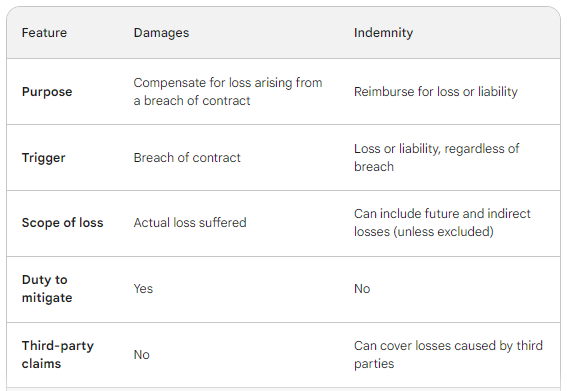
We draft effective contracts and protect against damages Let’s Talk
Conclusion
Damages on breach of contracts are considered to be advantageous than other remedies that may be available to parties suffering losses from breach of contracts. Liquidated damages play a significant role in cases where it is difficult to ascertain the quantum of damages since that is predetermined by inserting a clause on ‘liquidated damages’ in the contract itself. Such clauses for liquidated damages aim at the prevention of litigation to the extent possible. This would also help in reducing the burden to prove actual damage suffered pursuant to breach, in order to claim damages.
However, in certain cases, damages may not suffice in respect of the losses or damage suffered by a party. This may lead to a situation which warrants a specific performance by the other party instead of damages to enable restoration of the position of the party prior to such contractual breach. Such situations may arise if the subject matter of the contract is of rare quality or indispensable for the aggrieved party. Thus, courts may opt to award damages in addition to or in substitution of specific performance, depending on what is warranted by a given situation. Moreover, stipulation for liquidated damages would not be a bar to specific performance.
FAQs on Indemnity v/s Damages
- What is the difference between “damage” and “damages”?
- Damage: This refers to the harm or loss suffered, both financial (pecuniary) and non-financial (non-pecuniary), such as damage to reputation, physical or mental suffering.
- Damages: This specifically refers to the monetary compensation awarded for the harm or loss suffered.
- What are damages?
Damages are a form of compensation awarded in situations like breach of contract, loss, or injury. In India, they are covered under the Indian Contract Act, 1872. There are two types:
- Actual damages: Compensation for the actual loss incurred.
- Liquidated damages: A predetermined amount agreed upon in the contract to compensate for potential future losses.
- What is indemnity?
Indemnity is a contractual agreement where one party (indemnifier) promises to compensate another party (indemnitee) for any losses incurred due to the actions of the indemnifier, another person, or even a third party. This essentially shifts the risk of future loss to the indemnifier. - What are the circumstances where damages might not be sufficient?
Damages might not be enough if the subject matter of the breach is unique or irreplaceable, in which case, specific performance might be sought. - When is indemnity more advantageous than damages?
Indemnity can be more advantageous because:
- It covers losses caused by third parties, beyond just breach of contract.
- It may not require proving the extent of the loss suffered.
- The duty to mitigate losses might not apply, potentially leading to higher compensation.
- What are the drawbacks of indemnity clauses?
- Poorly negotiated clauses can expose the indemnifier to unexpected liabilities.
- They can be complex and require careful drafting to avoid ambiguity.
- Can damages and indemnity be claimed together?
It depends on the specific situation and the contract terms. In certain cases, the court might award both damages and specific performance (fulfilling the contract) depending on what best restores the aggrieved party’s position. - What are some situations where specific performance might be preferred over damages?
Specific performance might be preferred when:
- The subject matter of the contract is unique or irreplaceable.
- Monetary compensation wouldn’t adequately address the loss.
- What role do liquidated damages play in contracts?
Liquidated damages clauses pre-determine the compensation amount for potential future losses, avoiding the need to prove actual damages in case of breach. This helps:
- Prevent litigation.
- Reduce the burden of proving actual losses.
- What are some important considerations when drafting indemnity clauses?
- Clearly define the scope of losses covered.
- Specify whether the duty to mitigate applies.
- Consider potential for future legal disputes and ensure the clause is enforceable.
A limited liability partnership (LLP) is a kind of general partnership in which each partner’s personal responsibility for the firm’s obligations is strictly restricted. In accordance with the state, partners may be held accountable for contractual debts but not for the tortious damages of other partners. Larger partnerships and professionals in particular frequently employ limited liability companies (LLPs); in fact, several jurisdictions restrict the use of LLPs to professionals. An LLP, like ordinary partnerships, must consist of two or more partners; however, the structure of the amount of control and profits that each partner keeps is flexible. With the exception of choices involving the modification of the partnership agreement, which call for the consent of all partners, almost all decisions in an LLP can be delegated to specific partners. Limited liability is permitted under LLPs, unlike limited partnerships, even in cases where partners continue to have managerial control over the company. The court may, however, pierce the veil of limited liability to reclaim funds for creditors in cases where it determines that the partners attempted to undermine creditors, for example, through improper distributions. However, the specific actions that would prompt such treatment need to be examined on a case-by-case basis in accordance with applicable state laws. In contrast, consider limited liability companies (LLCs) and limited partnerships. The members (partners) of a limited liability partnership are solely accountable for the money they contribute plus any personal guarantees; the partnership is a distinct legal entity. It is mandatory for partners to furnish the firm with a registered location and preserve a membership registry. The maximum number of partners is unrestricted; nevertheless, upon incorporation, there must be a minimum of two members, who may be either people or limited businesses. An LLP can also be established by one person and a defunct business. Now let us understand Important Amendments to the LLP.
Amendment to LLP Rules: Increased Transparency and Scrutiny
On October 27, 2023, the Ministry of Corporate Affairs (MCA) of the Indian government notified the Limited Liability Partnership (Third Amendment) Rules, 2023. These amendments introduce significant changes aimed at increasing transparency and accountability within Limited Liability Partnerships (LLPs). These changes require LLPs to maintain a record of their partners and disclose information about individuals with a significant financial stake in the partnership.
Who is Affected?
These amendments apply to all Limited Liability Partnerships, both existing and newly incorporated, effective from October 27, 2023.
Impact:
These changes are expected to enhance transparency and accountability within LLPs by:
- Providing a clear record of ownership: The register of partners and disclosure of beneficial interest allows for a clearer picture of who ultimately controls and benefits from the LLP.
- Combating potential misuse: Increased transparency can help prevent the misuse of LLPs for illegal activities, such as money laundering or tax evasion.
- Improving investor confidence: Greater transparency can boost investor confidence in LLPs by ensuring a clearer understanding of ownership and risk profiles.
List of Important Amendments to the Limited Liability Partnership Rules, 2009
- Maintaining a Register of Partners in Form 4A (similar to the concept of a Register of Members in a Company).
Every LLP is now required by Rule 22A of the LLP Rules to keep a register of its partners in Form 4A (annexed to the modified LLP Rules); this record should be maintained at the LLP’s registered office. Existing LLPs must comply with this obligation within 30 (thirty) days following the start of the modified LLP Rules, even though the LLP Rules now mandate that any new LLP keep such a register from the date of its creation. The following information about each partner must be included in the register of partners: (i) PAN or CIN; (ii) name, address, and email address;; (iii) Unique Identification Number (if any); (iv) father’s, mother’s, or spouse’s name; (v) occupation, status, nationality, and the name and address of their nominee; (vi) date of partnership formation; (vii) date of cessation; (viii) type and amount of contribution with monetary value thereof; (ix) any other interest (if any). Any modification to the amount of the contribution, the name and contact information of the LLP’s partners, or the termination of a partnership interest must be recorded in the register within seven (seven) days.
- Declaration regarding Beneficial Interest in the Contribution of LLPs (similar to the applicability of Companies under Section 89 of the Companies Act, 2013).
Within 30 (thirty) days of the date on which their name was entered in the aforementioned register of partners, each registered partner of the LLP that does not have a beneficial interest (fully or partially) in any contribution is required to file a declaration with the LLP in Form 4B (annexed to the amended LLP Rules), stating the name and details of the person who actually holds any beneficial interest in such contributions. In addition, any modifications to the beneficial interest must be disclosed on Form 4B within 30 (thirty) days of the modification date. In addition, within 30 (thirty) days of acquiring their beneficial interest in the LLP’s contribution, anyone who has a benefit interest in the LLP’s contribution but is not listed in the LLP’s partner registry must file a declaration in Form 4C, which is annexed to the amended LLP Rules, with the LLP, outlining their specifics and the nature of their interest. In addition, any modification to the beneficial interest must be recorded in Form 4C within 30 (thirty) days of the new information being available The LLP must enter the aforementioned declarations (if applicable) in the register of partners and submit a Form 4D report to the Registrar of Companies (“ROC”) within thirty (30) days after receiving the declarations, together with any necessary costs.
- Declaration regarding Significant Beneficial Owners (“SBOs”) in LLPs (similar to the applicability of Companies under the Companies (Significant Beneficial Owners) Rules, 2018).
According to Rule 22B(4) of the amended LLP Rules, every LLP must designate a designated partner who will cooperate and provide information to the ROC (or any other officer authorized by the Central Government) regarding beneficial interests in the LLP’s contribution. Additionally, it specifies that the previously specified data must be sent in Form 4 (which is appended to the revised LLP Rules) to the ROC. According to the LLP Rules, each designated partner is obligated to provide this information up until a certain designated partner is identified. The Ministry of Corporate Affairs has acted swiftly to incorporate limited liability companies (LLPs) into a regulatory framework that matches their growing usage as a means of conducting business in India. LLPs are nearly as popular as private limited corporations and are far more preferred than traditional partnerships. To prevent the flexibility offered by the LLP structure from being abused to the harm of important stakeholders including financial institutions, creditors, partners, and workers, rules and regulations must be skillfully crafted.
- Maintaining a Register of SBOs in Form LLP BEN – 3 (similar to the concept of Register of SBO in a Company).
Register of Partners in LLP
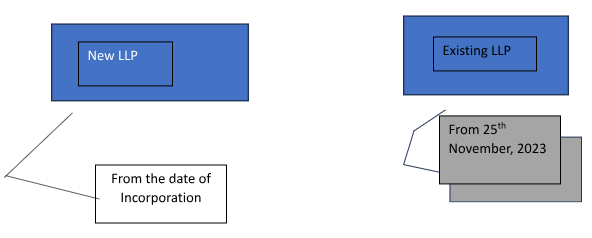
a) Maintain in Form 4A
b) Any change in particulars to be updated within 7 days.
Declaration w.r.t Beneficial Interest in Contribution
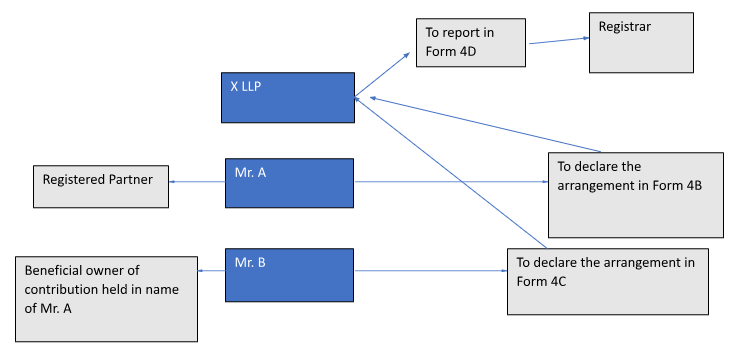
a) Note 1: Form 4B & 4C shall be submitted within 30 days from the date when name is entered in the register of partners & after acquiring such beneficial interest in the contribution respectively.
b) Note 2: Form 4D shall be submitted within 30 days from the date of receipt of declaration.
Declaration w.r.t Significant Beneficial Owners (SBOs)
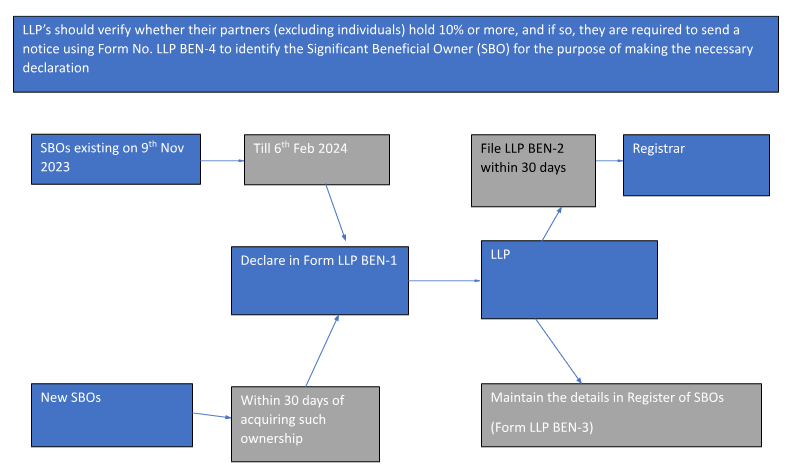
The SBO rules shall not apply to the extent of contribution held by;
- Central, State or local Authority
- Reporting LLP, Body Corporate or an entity controlled by Central or State Government
- Investment vehicles regulated by SEBI, RBI
Conclusion
In a significant move towards enhancing transparency and accountability within Limited Liability Partnerships (LLPs), the Ministry of Corporate Affairs (MCA) introduced key amendments to the LLP Rules, 2009. These amendments represent a comprehensive update, aligning LLP regulations with best practices and bolstering stakeholder confidence. Let’s delve into the core changes and their potential impact.
- Unveiling the Register of Partners: Bridging the Information Gap
The introduction of Form 4A mandates maintaining a Register of Partners, mirroring the concept of a Register of Members in companies. This readily accessible record offers transparency into LLP ownership structures, facilitating informed decision-making by investors, creditors, and other stakeholders. The requirement to update the register within 7 days of any changes ensures its accuracy and timeliness.
- Demystifying Beneficial Interests: Lifting the Veil
Similar to the provisions of Section 89 of the Companies Act, 2013, LLPs must now file declarations regarding beneficial interests in contributions through Form 4B and 4C. This crucial step sheds light on the ultimate economic beneficiaries of LLP holdings, mitigating potential risks associated with hidden ownership and promoting responsible financial conduct.
- Identifying Significant Beneficial Owners (SBOs): Shining a Light on Complex Structures
Building upon the beneficial interest disclosures, the amendments introduce SBO regulations, echoing the Companies (Significant Beneficial Owners) Rules, 2018. LLPs are now required to identify and verify SBOs, defined as individuals with significant control or ownership (exceeding 10%) over partners holding non-individual interests. This additional layer of transparency empowers regulators and stakeholders to hold ultimate beneficiaries accountable, combating financial crime and enhancing market integrity.
- Establishing the SBO Register: Centralizing Information
LLPs are mandated to maintain a dedicated Register of SBOs in Form LLP BEN-3. This centralized repository acts as a one-stop shop for accessing crucial information about the ultimate beneficiaries, streamlining due diligence and regulatory oversight.
- Strengthening Compliance Mechanisms: Ensuring Timely Adherence
These amendments are accompanied by stringent compliance timelines. Declaration regarding beneficial interests must be submitted within 30 days of entry into the register and acquiring such interest, respectively. Further, LLPs have 30 days to file form 4D after receiving declarations. These timeframes ensure prompt information disclosure and facilitate effective enforcement.
Impact and Beyond: Building a More Equitable Ecosystem
The revamped LLP Rules offer a multi-pronged approach towards fostering a more transparent and accountable LLP ecosystem. By demystifying ownership structures, identifying ultimate beneficiaries, and establishing robust compliance mechanisms, these amendments empower stakeholders, bolster regulatory effectiveness, and ultimately contribute to a healthier financial landscape. However, the journey doesn’t end here. Continuous stakeholder engagement, capacity building initiatives, and regulatory fine-tuning remain crucial to ensure the successful implementation and long-term impact of these amendments. As the LLP landscape evolves, adapting regulations to best practices will be vital in solidifying India’s position as a global leader in fostering a transparent and responsible financial environment.
FAQs on Amendments to the Limited Liability Partnership Rules, 2009
- What are the major changes introduced in the revised LLP Rules?
The major amendments to the Limited Liability Partnership Rules, 2009 are
- Register of Partners (Rule 22A),
- Declaration of Beneficial Interest (Rule 22B),
- Designated Partner for Providing Information
- What is the purpose of maintaining a Register of Partners in Form 4A?
The register provides detailed information about each partner, including their contribution, contact details, and status. It enhances transparency and facilitates communication with stakeholders. - When do existing LLPs need to comply with the Register of Partners requirement?
Existing LLPs have 30 days from the implementation date to create and maintain this register. New LLPs must have it from the date of incorporation. - What happens if a partner doesn’t have a beneficial interest in their contribution?
They need to file a declaration (Form 4B) disclosing the name and details of the actual beneficiary within 30 days of joining the register. - Who are Significant Beneficial Owners (SBOs), and how are they reported?
SBOs are individuals with ultimate control or significant influence over the LLP. They are identified and reported by a designated partner using Form 4 to the Registrar of Companies (ROC). - What is the penalty for non-compliance with these new requirements?
Non-compliance may lead to penalties and fines as specified by the ROC. - Do these amendments apply to all types of LLPs?
Yes, these amendments apply to all LLPs registered in India, regardless of size or industry. - How will these changes benefit LLPs and stakeholders?
Increased transparency and disclosure foster trust, attract investors, and improve corporate governance. - What are the challenges in implementing these changes?
Ensuring proper record-keeping and timely reporting within short time frames might require adaptation and support for smaller LLPs. - Where can I find more information about these amendments?
One can find information related to the new amendment of LLP’S on The Ministry of Corporate Affairs website and official notifications related to the revised LLP Rules offer detailed information.
]]>
In the ever-evolving world of gaming, innovation and imagination often take the centre stage. Intellectual Property Rights are a crucial foundation in the gaming industry as they safeguard everything we cherish, from our beloved characters to the groundbreaking technologies that fuel immersive adventures. Let us learn about types of intellectual property rights in gaming industry.
Types of Intellectual Properties in Gaming Industry
1) Trademark
Safeguarding brand elements like names, logos, slogans, taglines, sound marks, cartoon images etc. that differentiate one vendor’s products or services from another’s. Trademarks registration is optional but advisable, and once granted will be valid for 10 years, renewable every decade. A recognizable phrase, word, symbol, or emblem that designates a particular product and legally sets it apart from all other items of its sort is referred to as a trademark. A trademark acknowledges the firm’s ownership of the brand and uniquely identifies a product as being owned by that company. Trademarks may or may not be registered and are often regarded as a type of intellectual property. Any term, phrase, symbol, design, or combination of these that uniquely distinguishes your products or services can be used as a trademark. It’s how consumers identify you in the market and set you apart from your rivals. Both service marks and trademarks may be referred to by the same term. A service mark is used for services, whereas a trademark is used for commodities.
Key IP
- Names, word-marks,
- Logos, symbols,
- Tag-lines,
- Cartoon/ caricature image,
- Short sound marks
Example

XBOX Logo
2) Copyright
Copyright is an inherent right for original works, like literary, artistic, dramatic, musical, cinematographic, architectural works and software codes. Creator owns the copyright 60 years from creation before the work becomes public. The legal word “copyright,” often known as “author’s right,” refers to the ownership rights that authors and artists have over their creative works. Books, music, paintings, sculptures, films, computer programmes, databases, ads, maps, and technical drawings are among the works that fall under the purview of copyright protection. For a specific amount of time, copyright law grants the producers of creative content the only authority to use and replicate their creations. The copyrighted material enters public domain when the copyright expires.
Key IP
- Software code,
- Cartoon caricature,
- Storyline,
- Music and sound effects,
- Conceptual art and design,
- Maps and buildings,
- Choreography
- Gaming rules and manual
Example

3) Patent
Protection for an original invention, typically granted for 20 years, and covers utility, plant/industrial, or design patents. An innovation is entitled to a patent, which is an exclusive privilege. Put another way, a patent is the exclusive right to a good or service that, in most cases, offers a novel approach to a problem or a fresh technical solution. Technical details of the invention must be made public in a patent application in order to get one.
On mutually agreeable terms, the patent owner may provide permission or a license to third parties to exploit the innovation. The patent owner may potentially transfer ownership of the innovation to a third party by selling them the right to use it. An innovation becomes public domain—that is, anybody can use it for commercial purposes without violating the patent—when a patent expires, ending its protection. In return for a thorough disclosure of the innovation, a patent grants the creator the exclusive right to use the patented design, technique, or invention for a certain amount of time. They represent a type of intangible right. Usually, government organizations examine and authorize patent applications.
Key IP
- Gaming console, joystick or other hardware device, and
- Drastically unique or different technology
- User interfaces
4) Design
Protection for the aesthetic appearance of products/articles, including shape, configuration, pattern, ornament, or composition of lines/colours. Intellectual property in design is the result of human creativity. This covers names and pictures that may be used in business, as well as designs, emblems, innovations, and creative and literary works. The legal protection of intellectual property is provided by copyright, patents, and trademarks. These enable individuals to profit monetarily or gain notoriety for the goods they produce. The system fosters an atmosphere where creativity and innovation may flourish by striking the right balance between the interests of inventors and the larger public good. For creative workers, intellectual property is a crucial subject. In legal terms, an article’s decorative or artistic elements are referred to as its industrial design. Two-dimensional elements like lines or patterns may be present, or there may be three-dimensional elements like the contour of an object. A registered or patent-holding owner of an industrial design has the legal authority to prevent other parties from manufacturing, importing, or selling products that imitate their design. A wide range of handicrafts and industrial products are included in industrial designs. They consist of textiles, jewellery, electronics, home items, and containers.
These designs may also apply to logos, visual symbols, and graphical user interfaces. To be protected by industrial design laws, the majority of countries mandate that all industrial designs be registered. Some nations’ laws grant unregistered industrial designs—a term used to describe designs that are not registered—limited protection. Certain industrial designs, like works of art, could also be protected by copyright laws. One of the key elements that draws customers to a product and convinces them to choose it over another is its design. An unique, novel, and unobtrusive decorative design for a manufactured item is protected by a design patent. Just the look is protected by the patent; the structural or functional aspects are not. For instance, the outside style of an athletic sneaker or bicycle helmet may be protected. There will be no intermediate maintenance costs, and the design patent will remain enforceable for 14 years after it was first awarded. When it comes to intellectual and copyright property, designers face several challenges. It is more difficult for artists to maintain ownership control when a single idea is presented in a variety of forms and media.
Key IP
- Graphic characters,
- Gaming cover and
- Graphic interface
5) Trade Secret
Trade secrets are confidential, commercially valuable information known to a limited group and protected by the rightful owner through reasonable measures, typically including confidentiality agreements. Economically valuable knowledge that is not widely known, has value for those who cannot lawfully access it, and has been the subject of reasonable attempts to keep secret is referred to as a trade secret. Trade secrets are crucial for gaining financial advantage, strategic positioning, and commercial competitiveness. One can recognize trade secrets and learn how to properly secure them with the aid of this toolbox. One kind of IP is a trade secret. A trade secret is only real for the duration that it is kept secret. Not only is it crucial to keep trade secrets secret from a business perspective, but owners of trade secrets are legally required to take specific actions in order to preserve their rights. Misappropriation happens when someone discloses, obtains, or uses a trade secret after knowing or having reasonable suspicion that it was obtained illegally. Courts have shed light on what constitutes “improper” behaviour via trade secret lawsuits, even if the law doesn’t define it.
Key IP
- Algorithms and
- Customer lists
What can be protected under copyright protection in Gaming Industry?
The game is qualified for copyright protection, but each component of the game is also protected. This covers the game’s storyline, sound effects, music, graphic designs, characters, and more. A video game is more than just its gameplay; it’s also about its contents and other elements that make it whole and satisfying. Not just the programme itself is deserving of praise; every character, screenplay, game code, piece of music, sound recording, and graphic design has a right to protection under different copyright laws. In the US, video games and other types of media have comparable copyright protection periods. Video games are awarded a copyright that lasts for 95 years from the date of publishing or 120 years from the date of invention, whichever comes first, because the majority of them are made by companies.
What provisions are there for Patent Law in the Gaming Industry?
Patents for video games can cover a broad variety of novel features. Whether they have to do with the game engines, software, or hardware. techniques for application communication, game interfaces, or even gameplay techniques. Novel technological developments such as new methods of avatar transmission or the addition of additional hardware components to controllers can be protected by these patents. Moreover, patents can be acquired for advancements made to current technology. A video game’s components that can entail patents are as follows:
- Used algorithms
- Editing functions, menu organization, and display representation functions of control
characteristics of the user interface, - Data processing, formulas, program languages, compilation processes, translation procedures, and utilities.
The main concern regarding the patentability of video games is the possibility that software may be patented. A software patent is characterized as a patent awarded for computer functions performed by computer programs. The capacity to patent software is now the subject of a contentious discussion, with some advocating for no protection at all and others suggesting protection only under very specific guidelines. The European Patent Convention (EPC) expressly excludes computer programmes from eligibility for patents in Europe. By upholding a regulation that specifies software cannot be patented unless it can establish an extra technical impact beyond the inherent technological interactions between the hardware and the software , the European Patent Office (EPO) sustains this exclusion. Developing video games frequently results in the development of patentable technology that isn’t limited to a single game. Many gaming firms use the same, or nearly the same, technologies in their various titles. Alternatively, they create game-specific technology that form the basis of a whole line of goods. One example of this would be the creation of a first-person shooter game engine platform. a communications platform for interactive mobile games, or a graphical user interface platform for racing games. by locating these crucial innovations and securing patent protection for them. Businesses can obtain a considerable competitive edge. To be eligible for patent protection, it is crucial to remember that. The programme needs to fulfil specific criteria, such being brand-new. Not immediately apparent. Practical. and signed up.
What are the Trademark Law for Video Games?
Securing ownership over these marks owned by developers and producers themselves is the first step in ensuring trademark protection for video games. These people or businesses have legally registered names and logos (words, pictures, and sounds) that serve as their unique identifiers in this industry area. Interestingly, these distinct markers are repeated throughout a game’s graphical user interface and are prominently displayed through splash screens at the game’s opening. In a similar vein, they decorate digital package materials, boxed editions, and online adverts in a manner appropriate for them. In addition to adding unique identifiers associated with a certain video game, unaffiliated parties (such as the game’s developers or producers) may be able to obtain trademarks through creative techniques that meet their specific needs.
What are the Trade Secret Law for Gaming Industry?
Trade secrets are a key component of intellectual property rights (IPR), which are extremely important in the gaming business. Confidential information such as formulae, procedures, methods, or strategies that provide organizations a competitive edge are considered trade secrets. inside the video game business. Character creation, gaming mechanics, game design, algorithms, and other aspects are all considered trade secrets. Trade Secret Example Axel Gembe was accused in 2004 of breaking into the network of Valve Corporation, stealing the computer game Half-Life 2, releasing it online, and creating damages that Valve estimated to be worth more than $250 million. Companies in the gaming business use a number of precautions to safeguard trade secrets, such as: Developers often ask partners, contractors, and staff to sign confidentiality agreements in order to protect private data and stop abuse or unauthorized disclosure. Businesses also use restricted access strategies to safeguard trade secrets. limiting access to just authorised workers who have a real need to know this kind of information. These security precautions guarantee that private information is protected and that unauthorized parties cannot access it or compromise its privacy.
To safeguard priceless trade secrets against online attacks and unwanted access. Businesses use both digital and physical security measures. These precautions include of monitoring systems, access controls, secure servers, and encryption. by putting these precautions into place. Businesses can successfully stop unauthorised people from getting their hands on private information. Companies may also ask partners, publishers, distributors, and other third parties to sign Non-Disclosure Agreements (NDAs) in addition to these security precautions. These NDAs work as a formal agreement that guarantees the privacy of disclosed private information. Companies are being proactive in protecting any unauthorized exposure or use of their valuable information by forcing third parties to sign non-disclosure agreements (NDAs).
Conclusion – The Intricate Web of Intellectual Property in Gaming
The world of gaming thrives on creativity and innovation, constantly pushing boundaries and forging unique experiences. But behind the dazzling visuals and immersive storylines lies a complex web of intellectual property (IP) rights. From iconic characters and innovative mechanics to intricate game designs and proprietary software, IP safeguards the very essence of what makes a game unique.
- Copyright stands as the cornerstone of game protection, shielding the creative expression of its creators. It covers the game’s code, artwork, music, and storyline, preventing unauthorized copying or distribution. Trademarks like logos, character names, and slogans become instantly recognizable symbols, differentiating brands and protecting consumer trust.
- Patents, though less common, play a crucial role in safeguarding novel game mechanics, hardware innovations, and even specific algorithms. They incentivize research and development, fostering advancements in gaming technology and experiences.
- Design protection shields the visual identity of games, encompassing everything from character appearance to user interfaces. This ensures the distinct look and feel of a game remains unique, preventing copycats from capitalizing on another’s creative vision.
- Trade secrets, on the other hand, cloak vital technical know-how and confidential business information. This could include proprietary game engines, development tools, or even specific algorithms or formulas that drive in-game economies. Protecting these secrets maintains a competitive edge and safeguards the financial viability of studios.
However, the intricate tapestry of IP in gaming isn’t without its challenges. Balancing protection with the freedom to innovate remains a constant concern. Fair use doctrines and limitations on copyright pose questions about permissible inspiration and derivative works. Patent thickets, where numerous overlapping patents stifle competition, can hinder progress. Furthermore, enforcing IP rights across international borders becomes complex due to varying legal frameworks and enforcement capabilities. Piracy and unauthorized distribution continue to plague the industry, demanding collaborative efforts to combat them. Despite these challenges, a robust IP framework remains essential for the gaming industry’s continued growth and vibrancy. It incentivizes creativity, fosters innovation, and protects the investments made in building captivating worlds and experiences. Through ongoing dialogue and collaborative efforts, stakeholders can ensure that IP rights support, rather than hinder, the future of gaming, allowing it to continue delivering immersive experiences that capture the imagination of players worldwide.
FAQs on Intellectual Property Rights in Gaming:
- Trademark: Can I trademark my in-game username or clan name?
Yes, potentially! If your username or clan name is unique, distinctive, and used in commerce (e.g., merchandise), you can file for trademark protection. However, be aware of existing trademarks and restrictions by game platforms.
- Copyright: Do I own the copyright to my gameplay recordings or screenshots?
Generally, yes, you own the copyright to your creations, including gameplay recordings and screenshots. However, game terms of service might limit use, and copyrighted content within the game (e.g., music) remains protected by its owner.
- Design: Can I patent the look and feel of my in-game character or item?
For design patents, it depends on originality and functionality. Simple character designs might not qualify, but unique and non-obvious elements could. Consult an expert for specific advice.
- Trade Secret: Can I keep my game’s mechanics or algorithms secret?
Yes, trade secrets can protect confidential information like game mechanics or algorithms. However, maintaining secrecy is crucial, and reverse engineering might expose them. Carefully assess what truly needs trade secret protection.
- Copyright: Can I use copyrighted music or characters in my game?
No, not without permission. Using copyrighted material without licenses or fair use exceptions constitutes infringement. Obtain licensing rights or use royalty-free alternatives.
- Copyright: What about using assets from the game engine or community-created mods?
Respect licensing terms! Game engine assets usually come with usage restrictions. Community-created mods might have individual copyright ownership, so check and credit accordingly.
- Trademark: Can I use another game’s name or logo in my own game?
Trademarks protect brand identity. Using another game’s name or logo without permission, even for criticism, could be infringement. Consider alternatives or seek proper licensing.
- Copyright: Can I stream or monetize gameplay walkthroughs of copyrighted games?
Fair use might allow some transformative content like commentary or reviews. However, extensive gameplay footage without significant addition might infringe. Check game terms and fair use guidelines.
- Copyright: Can I create and sell fan art or merchandise based on game characters or logos?
Copyright law applies. Using copyrighted characters or logos for commercial gain without permission is usually infringement. Consider fair use for limited, transformative works or seek licensing from the rights holder.
- Patent: Can I patent a new game mechanic or concept?
Game mechanics are often abstract ideas, which are generally not patentable. However, specific technical implementations or unique devices involved in the game might be patentable. Consult an expert for specific advice.
**Images shown are for representation purposes only and all rights belong to respective owners.
]]>In the bustling corporate landscape of India, companies thrive on the dedication and expertise of their employees. However, with great power comes great responsibility, and the actions, or sometimes, even the lack thereof, of an employee can have significant legal ramifications for the company itself. This post aims at explaining the legal implications a company can face on behalf of its employees, and summarizing the legal concepts underlying the same.
Vicarious Liability: Carrying the Weight of Another’s Wrongdoing
The concept of vicarious liability, or imputed liability, forms the bedrock of understanding a company’s accountability for employee conduct. Stemming from the Latin phrase “Respondeat Superior” which translates to “let the master answer” this principle holds an employer liable for the torts (civil wrongs) committed by their employees while acting within the scope of their employment. The basis of holding a company vicariously liable for the actions or inactions of its employees is that employers are in a position to limit and/or curtail such actions or inactions. However, it often becomes practically difficult to determine situations where an employee acted within the scope of their employment.
Scope of Employment: Defining the Line between Work and Personal
Determining whether an employee’s actions fall within the scope of employment is crucial in establishing vicarious liability of the employer. Generally, acts undertaken:
- During work hours,
- At the place of work,
- While performing duties assigned by the employer/company, or
- While furthering the employer/company’s interest, are considered to be within the scope of an employee’s employment.
However, exceptions exist for the following:
- Frolic and Detour: Acts of an employee that are motivated by personal agendas, and completely deviating from the duties and responsibilities of the employee, as determined by the company, fall outside the scope of his/her employment.
- Intentional Torts: Malicious and intended acts of an employee that exceed the boundaries of reasonable conduct expected from them are deemed outside the scope of their employment,
Beyond Civil Wrongs: The Shadow of Criminal Liability
In certain situations, a company can also face criminal liability for the actions of its employees. The Indian Penal Code, 1860, outlines specific offenses where a company can be held accountable for offenses committed by employees. These include situations where:
- The offense was committed by the employee for the company’s direct or indirect benefit.
- The offense was committed by the employee with the knowledge or consent of the company’s management.
- The offense committed by the employee was facilitated by a lack of proper due diligence or oversight by the company.
Proactive Measures: Shielding the Company from the Storm
While the law holds companies accountable for employee conduct, proactive measures can mitigate the risk of legal and financial repercussions. These include:
- Robust Employee Training: Regularly training employees on company policies, ethical conduct, and legal compliance can minimize the chances of misconduct.
- Clear Codes of Conduct: Establishing and disseminating clear codes of conduct outlining acceptable and unacceptable behavior provides a framework for employee actions.
- Effective Supervision: Implementing proper supervision and monitoring systems can help identify and address potential issues before they escalate.
- Adequate Insurance Coverage: Investing in comprehensive liability insurance can provide financial protection against legal claims arising from employee actions.
Navigating the Legal Labyrinth: Seeking Expert Guidance
The legal landscape surrounding company liability for employee actions can be complex and nuanced. It is crucial for companies to seek the guidance of experienced legal counsel to deal with such scenarios as well as while framing its internal policies to minimize the risk of attracting such liability. Indian courts have, from time to time, set out certain guardrails and principles to address the issue of employers’ liabilities for their employees, which form the basis of the concept of vicarious liability in India.
Landmark Judgments
- State of Rajasthan v. Mst. Vidhyawati & Anr. (1962): The Hon’ble Supreme Court held that the State of Rajasthan was vicariously liable for the tortious act of its employee who carried out such act during the course of his employment, despite the State not directly authorizing or condoning the act so carried out by the employee. It was also held that the liability of the State in such matters would be the same as any other employer, and that the State would not enjoy any immunity in matters of vicarious liability.
- State Bank of India v. Shyama Devi (1978): The respondent gave some cash and a cheque to her husband’s friend, who was an employee of the appellant bank, for depositing the same in her account. No receipt or voucher was obtained indicating the said deposit. The employee, instead of making the deposits in the respondent’s account, got the cheque cashed and misappropriated the amounts. To cover up his act, the employee made false entries in the respondent’s passbook. The Hon’ble Supreme Court held that the employee had acted outside the scope of his employment and without the directions, orders or knowledge of the bank. Hence, the appellant bank was not held liable for the fraud committed by its employee in this matter.
- State of Maharashtra & Ors. v. Kanchanmala Vijaysingh Shirke & Ors. (1995): In this matter, Vijaysingh died in an accident when a jeep, which belonged to the State, dashed against his scooter. The 3rd appellant was the driver of the jeep but at the time of the accident, the 4th respondent, who was then a clerk in a separate department of the State Government, was driving the jeep. The State contended that since the act was not authorized by it, the State could be held vicariously liable. The Bombay High Court affirmed this stance and penalized only the 4th respondent. The Hon’ble Supreme Court, while overruling the High Court’s decision, held that the accident took place when the act authorised by the State was being performed in a mode which may not be proper but nonetheless it was directly connected with ‘the course of employment’ and it was not an independent act for a purpose or business which had no nexus or connection with the business of the State so as to absolve the appellant-State from the liability. Further, it was held that in its capacity as an employer, the State has to shoulder the responsibility on a wider basis and will be responsible to third parties for acts which it has expressly or implicitly forbidden its servant (the driver) to do.
- Anita Bhandari v. Union of India (2002): In this matter, the husband of the petitioner went to a bank and happened to enter at the same time as the cash box of the bank was being carried inside the bank. The security guard thought of him as an attacker and shot him, causing his death. The petitioner claimed that the bank was vicariously liable because the security guard had done such an act in the course of his employment. Despite the bank’s defense that it had not authorized the security guard to shoot, the Gujarat High Court opined that the act of giving the guard a gun amounted to authorizing him to shoot when he deemed it necessary.
- M Anumohan v. State of Tamil Nadu & Ors. (2016): The State was held liable for the acts of a police officer who falsely implicated certain individuals under the NDPS Act, 1985, and attempted to blackmail victims and extort money from them. The Court emphasized that acts directly connected with authorized acts that can be carried out by a police officer would be within the course of employment and held that the act of filing a false complaint is directly connected to an authorized act by the State and hence, vicarious liability for such matters can be attached to the State.
Examples
Here are some examples to illustrate where the line is drawn in cases pertaining to vicarious liability of a company/employer:
Company Liable:
a) Delivery driver causing an accident while on a delivery route – The driver is acting within the scope of employment, fulfilling company duties and hence, the company is vicariously liable for the driver’s act.
b) Security guard assaulting a customer in the company parking lot – This act, though wrong, falls within the guard’s responsibility to maintain safety on company premises, and therefore, the company would be held vicariously liable.
Company not Liable:
a) Employee getting into a car accident after work hours while driving their own car – The act is purely personal and outside the scope of the employee’s employment. Hence, the company will not be liable here.
b) Salesperson making offensive jokes to a client at a bar after work – Though inappropriate, the act doesn’t involve company time, resources, or duties, and the company will not be held liable.
Understanding and managing the potential liabilities arising from employee conduct is an essential aspect of responsible corporate governance in India. By implementing proactive measures and fostering a culture of ethical conduct, companies can create a safe and compliant work environment while minimizing the risk of legal entanglements. Remember, an ounce of prevention is worth a pound of cure. By prioritizing employee training, clear policies, and effective supervision, companies can not only safeguard their legal standing but also foster a more ethical and productive work environment for all.
Conclusion
The concept of company liability for employee actions in India is a complex and evolving landscape. Rooted in principles of vicarious liability, the extent of an employer’s responsibility rests on a delicate balance that takes into account factors like the nature of the employee’s wrongful act, the scope of their employment, and the connection between the action and the employer’s enterprise.
The cases and legal principles discussed in this analysis highlight the nuances involved. Employers carry a substantial burden to ensure that their workplaces are safe, free from discrimination, and operate within a framework of ethical conduct. Understanding the legal nuances of employer liability in India is not only a matter of compliance but a fundamental aspect of responsible business operation and risk management.
- Robust Policies and Procedures: Implement clear and comprehensive policies addressing workplace harassment, discrimination, data protection, and other areas of potential risk. These policies should clearly define acceptable and unacceptable behaviours, provide mechanisms for grievance redressal, and outline the company’s commitment to upholding ethical behaviour.
- Thorough Training and Education: Conduct regular training programs to educate employees on their responsibilities under company policies, as well as relevant labour and anti-discrimination laws. Training should not only convey rules but also help employees understand the principles behind them and the real-world impact of their actions.
- Effective Reporting and Investigation Mechanisms: Establish channels for employees to report concerns or suspected violations without fear of retaliation. Investigate all allegations promptly and thoroughly, taking corrective action where necessary.
- Due Diligence in Hiring: Conduct thorough background checks for potential hires, especially for sensitive positions. Consider not only technical skills but also integrity, past conduct, and suitability for the company culture.
- Proactive Risk Management: Identify potential areas of risk within the company’s operations and implement measures to mitigate those risks. This includes potential risks related to employee interactions with clients, handling sensitive data, and the use of company resources.
- Insurance Coverage: Explore relevant insurance products to cover potential liabilities arising from employee actions.
FAQs on the Burden of the Employer: A Look at Company Liabilities for Employee Action in India
- What is the concept of vicarious liability and how does it apply to companies in India?
Vicarious liability holds employers responsible for the torts (civil wrongs) committed by their employees while acting within the scope of their employment. This means the company can be sued for the employee’s actions, even if the company didn’t directly authorize them. - What factors determine whether an employee’s action falls within the scope of their employment?
Generally, actions undertaken during work hours, at the workplace, while performing assigned duties, or furthering the company’s interests are considered within the scope of employment. However, exceptions exist for personal errands, intentional torts exceeding expected conduct, and actions outside working hours. - Can companies ever be criminally liable for employee actions in India?
Yes, under certain circumstances. The Indian Penal Code outlines specific offenses where companies can be held accountable for employee actions, such as when the act benefits the company directly or indirectly, is committed with the management’s knowledge or consent, or results from a lack of proper oversight by the company. - What proactive measures can companies take to minimize the risk of legal repercussions from employee actions?
- Implement robust employee training on company policies, ethics, and legal compliance.
- Establish and disseminate clear codes of conduct outlining acceptable and unacceptable behaviour.
- Implement effective supervision and monitoring systems to identify and address potential issues.
- Invest in comprehensive liability insurance to provide financial protection against legal claims.
- What are some landmark judgments in India that have shaped the understanding of vicarious liability?
- State of Rajasthan v. Mst. Vidhyawati & Anr. (1962): Established the principle of vicarious liability for employers even without directly authorizing the employee’s act.
- State Bank of India v. Shyama Devi (1978): Highlighted that acting outside the scope of employment, without the company’s knowledge, exempts the company from liability.
- State of Maharashtra & Ors. v. Kanchanmala Vijaysingh Shirke & Ors. (1995): Clarified that unauthorized acts directly connected to authorized duties can still attract liability.
- Can you provide some examples to illustrate the concept of vicarious liability in action?
- Company Liable: A delivery driver causing an accident while on duty, or a security guard assaulting a customer at work.
- Company Not Liable: An employee’s car accident after work or a salesperson making offensive jokes to a client outside work hours.
- What are the key takeaways for companies regarding employee conduct and associated liabilities?
Understanding and managing potential liabilities is crucial for responsible corporate governance. Companies can minimize risks by prioritizing employee training, clear policies, and effective supervision, fostering a culture of ethical conduct, and adhering to relevant legal guidelines.
DOWNLOAD FULL PDF
An officer-in-default is a person associated with a company who is held liable for any penalty or punishment in case of default committed by the company under the Companies Act, 2013.
Who is qualified as an officer in default?
Section 2(60) of the Companies Act 2013 makes provision for identifying specific persons who may be held liable in case of a default by the company:
Introduction
Every restaurant has to comply with some taxation regulations and also file its returns on a regular interval as required under the specific laws in India. Among others, the Income Tax Act, 1961 (“Act”) and the Goods and Service Tax, 2017 (“GST Act”) are the main governing regulations for taxation of restaurant business income. In this article we provide a detailed insight on Tax and Returns for a Restaurant in India.
Taxation in India is divided into two parts – A. Direct Tax and B. Indirect Tax.
Direct Tax is the tax that is levied and paid directly by the restaurant while, Indirect taxes are those taxes that are levied on goods or services. They differ from direct taxes because they are not levied on a person who pays them directly to the government, they are instead levied on products and are collected by an intermediary, the person selling the product. These taxes are levied by adding them to the price of the service or product which tends to push the cost of the product up.
A. Understanding Direct Tax
Income Tax
Income from restaurants is governed by ‘Profits and Gains of Business or Profession Chapter’ as provided under the Act. Section 2(13) of the Act has defined the term ‘Business’ as including any trade, commerce or manufacture or any adventure or concern in the nature of trade, commerce or manufacture. Section 2(36) states that ‘Profession’ includes vocation’ without defining what the profession means. Generally, the profession involves labour skills, education and special domain knowledge.
All the businesses, including the food industry, must have a PAN and TAN in the name of the business or in the name of the owner (in case of a Sole-Proprietorship) in whose name the transactions are to be carried out. PAN and TAN are two ten-digit different alphanumeric numbers provided by the IT Department. Every person who deducts or collects tax at the source has to get a TAN.
In case the business is set up in the form of a company or a LLP, there are different rates of tax applicable. In case of an individual the income from PGBP (defined hereinafter) shall form a part of the income of the assessee.
Principles of Computation of business income
Most Relevant Income Tax Provisions
- Section 28 of the Act states that –
The following income shall be chargeable to income-tax under the head “Profits and gains of business or profession” (“PGBP”) — 1) the profits and gains of any business or profession which was carried on by the assessee at any time during the previous year.
Along with specific provisions as detailed in Section 28(ii) to 28(vii) of the Act. - Section 41 “Profits chargeable to tax” of the Act deals with a situation where:
1) A loss, expenditure or trading liability has been incurred in the course of business or profession;
2) Allowance or deduction has been made in respect of such loss, expenditure or trading liability in the course of assessment; and
3) A benefit is subsequently obtained in respect of such loss, expenditure or trading liability by way of remission or cessation thereof.
In such a situation, the value of the benefit accruing to the assessee is deemed to be profits and gains of business or profession. - Section 176(3A) states that –
Where any business is discontinued in any year, any sum received after the discontinuance shall be deemed to be the income of the recipient and charged to tax accordingly in the year of receipt, if such sum would have been included in the total income of the person who carried on the business had such sum been received before such discontinuance - Any other incomes received during the course of business such as income from house property or rental income, bank interest, etc.
- Presumptive taxation –
Section 44AD of the Act states that in the case of an eligible assessee engaged in an eligible business, a sum equal to eight per cent of the total turnover or gross receipts of the assessee in the previous year on account of such business or, as the case may be, a sum higher than the aforesaid sum claimed to have been earned by the eligible assessee, shall be deemed to be the profits and gains of such business chargeable to tax under the head PGBP. However, eight percent shall be replaced with ―six per cent in respect of the amount of total turnover or gross receipts which is received by an account payee cheque or an account payee bank draft or use of electronic clearing system through a bank account during the previous year.
Here eligible business shall mean –
(i) any business except the business of plying, hiring or leasing goods carriages referred to in section 44AE; and (ii) whose total turnover or gross receipts in the previous year does not exceed an amount of 2 [two] crore rupees. - Deductions under Section 30 to 37 of the Act –
Deductions available from the income under the sections pertaining to rent, repairs, depreciation, additional depreciation (if applicable), deduction under section 32AC is available if actual cost of new plant and machinery acquired and installed by a manufacturing company during the previous year exceeds Rs. 25/100 Crores, as the case may be (in case the business is engaged in manufacturing), Non-corporate taxpayers can amortise certain preliminary expenses (up to maximum of 5% of cost of the project) (Subject to certain conditions and nature of expenditures), insurance premium paid, bonus or commission paid to employees, interest on borrowed capital, employer’s contribution to provident fund and gratuity fund, bad debts written off, securities transaction and commodities transaction tax paid etc. and other such deduction as may be applicable. - Disallowances –
There are some disallowances that have been specifically mentioned in the Act which shall not be eligible to be deducted from the income for the purposes of calculation of PGBP, some of them are wealth-tax or any other tax of similar nature shall not be deductible, Any sum payable to a resident, which is subject to deduction of tax at source, would attract 30% disallowance if it was paid without deduction of tax at source or if tax was deducted but not deposited with the Central Government till the due date of filing of return, Any sum (other than salary) payable outside India or to a non-resident, which is chargeable to tax in India in the hands of the recipient, shall not be allowed to be deducted if it was paid without deduction of tax at source or if tax was deducted but not deposited with the Central Government till the due date of filing of return etc.
We take care of all your restaurant taxation needs Let’s Talk
Computation of PGBP (Profit and Gains from Business & Profession)
Business Profit should be calculated through Profit & Loss Account. On the Credit side of Profit & Loss Account there are some Incomes which are tax free or not taxable under the head Business/Profession.
Balance as per P & L A/c
(+) Profit
(-) Loss Amount
Add Expenses claimed but not allowed under the Act
- All Provisions & Reserves (Provision for Bad Debt/Depreciation/Income)
- All Taxes (Except Income Tax, Wealth Tax etc.) except sales Tax,Excise
- Duty & Local Taxes of premises used for business.
- All Charities & Donations
- All personal expenses
- Any type of fine / penalty
- Speculative Losses
- All capital losses
- Any Difference in Profit & Loss Account
- Previous year expenses
- Rent paid to self
- All expenses related to other head of Income
- Payments made to the partner (in terms of salary, commission or any other way.)
- All capital expenses except scientific research
- Loss by theft
- Expenses on illegal business
- Rent for residential portion
- Interest on Income tax, TDS etc
Total of these Items is added to the profit or adjusted from loss
Business Tax Returns
A business tax return is an income tax return. The return is a statement of income and expenditure of the business. Any tax to be paid on the profits made by you is declared in this return. The return also contains details of the assets and liabilities held by the business. Items like fixed assets, debtors and creditors of business, loans taken and loans were given are declared here.
- In the case of a sole proprietor, business income and other personal income like salary, income from house property and interest income have to be stated on the same return. If your total income before deductions is above the basic taxable limit it is mandatory to file the income tax return irrespective of profit or loss in the business. The basic taxable limit is Rs. 2.5 lakh.
- For companies, firms and Limited Liability Partnership (LLP) a business tax return has to be filed irrespective of profit or loss. Even if there are no operations undertaken, a return has to be filed. Companies, firms, and LLPs are taxed at a rate of 30%.
Every taxpayer whose turnover is above Rs. 1 Crore in case of businesses and Rs. 50 Lakh in case of professionals is required to get a tax audit done. The taxpayer has to appoint a Chartered Accountant to audit their accounts. A tax audit is necessary even when the profits declared by you is less than 8% (6% on Digital transactions) of the turnover in case of presumptive taxation.
Additionally, surcharge is applicable in the following cases –
Health & education Cess: Further 4% of income tax calculated and applicable surcharge will be added to the amount of total tax liability before this cess.
Alternate Minimum Tax (“AMT”)
AMT provisions are applicable to following taxpayers:
- All non-corporate taxpayers; and
- Taxpayers who have claimed deduction under:
- Chapter VI-A under the heading “C. — Deductions in respect of certain incomes’ – These deductions are under Section 80H to 80RRB provided in respect of profits and gains of specific industries such as hotel business, small scale industrial undertaking, housing projects, export business, infrastructure development etc. However, deduction under Section 80P which provides deduction to co-operative societies is excluded for this purpose; or
- Deduction under Section 35AD – While capital expenditure in assets usually qualify for depreciation year on year, under this Section 100% deduction is allowed on capital expenditure incurred for specified business such as operation of cold chain facility, fertiliser production etc; or
- Profit linked deduction under Section 10AA – Deduction of profit varying from 100% to 50% is provided to units in Special Economic Zones (SEZs).
Based on the above, it can be concluded that AMT provisions are applicable only to those non-corporate taxpayers having income under the head ‘Profits or Gains of Business or Profession’. Further, as mentioned above AMT provisions are applicable only when normal tax payable is lower than AMT in any financial year.
Minimum Alternate Tax (“MAT”)
Alternatively, all the companies (including foreign companies) are required to pay minimum alternate tax at the rate of 15% on book profits if the tax calculated as per above rates are less than 15% of book profits.
Returns under the Act
- ITR -3 is to be filed by individuals and HUFs having income from PGBP
- ITR -4 SUGAM for Individuals, HUFs and Firms (other than LLP) being a resident having total income upto Rs.50 lakh and having income from business and profession which is computed under sections 44AD, 44ADA or 44AE
- ITR -6 is to be filed by companies other than companies claiming exemption under section 11 of the Act.
All restaurants having business in the individual capacity shall file the ITR -3 while those in the capacity of the company shall be required to file ITR -6.
B. Understanding Indirect Tax
Tax concepts under Indirect Tax include GST.
GST (Goods and Services Tax)
It was introduced in July 2017. What this tax regime does is it unifies all the taxes that the restaurant and customers had to pay earlier. The Minimum turnover is required to be Rs 20 Lakhs for registration in GST.
Therefore, this variety of taxes is now just consolidated into State Goods and Services Tax (SGST) and Central Goods and Services Tax (CGST). Moreover, GST registration is a state-centric matter; therefore, if the restaurants have different outlets, each outlet must be registered separately under that particular state. Furthermore, there are different tax slabs as well for different restaurants. The restaurant GST rates are laid down below:
- Category 1: For the restaurants without an AC or liquor license
- Category 2: For the restaurants with AC
- Category 3: For 5-star hotels or luxury hotels that serve liquor and food.
GST tax has replaced the Value Added Tax (“VAT”) and service tax regime on food services. However, the point to note here is the service charge by restaurants is separate from GST.
Alcoholic beverages have applicable VAT, which is a state-level tax, therefore restaurants serving both food and alcoholic beverages will levy separate taxes with GST applying to food and non-alcoholic beverages; however, VAT will be charged on alcoholic beverages served only.
Types of GST
There are three types of GST namely CGST, SGST, and Integrated Goods and Services Tax (IGST). CGST is the tax charged by the central government on the intrastate supply of goods and services. In the same way, SGST is the tax applied to the same intrastate supply of goods and services by the state government and IGST is Integrated Goods and Services Tax, which is levied for the interstate transfer of goods and services. The GST rate on food items and GST rate on restaurants is governed on the whole by the central government.
Composition Scheme in GST
The composition scheme under GST means that a taxable person under a certain turnover limit has to pay tax at a lower rate concerning certain conditions. This scheme is developed for the timely recovery of taxes, filing of returns, and to provide a simplified way of record maintenance for small businesses.
Since the objective of the GST composition scheme for restaurants or any other business is basically to bring all businesses under one roof, this composition scheme will be provided to a taxable person only if he/she registers all the other registered taxable persons who are using the same. Food Tax in India can be 5%, 12%, or 18% based on factors such as the establishment type and location of restaurants or food service providers among others. Goods and services tax has replaced the VAT and Service tax regime on food services. 18% GST rate applies to accommodation in hotels including 5 stars and above rated hotels, inns, guest houses, clubs, campsites or other commercial places meant for residential or lodging purposes, where room rent ranges from Rs.5000 and above per night per room.
The rate at which restaurants are required to pay GST is fixed at a concessional rate of 5% which is to be levied on the turnover subject to the following restrictions:
- The Turnover of the restaurant should not exceed Rs 1.5 Crores (Rupees 150 lakhs). However, this limit is Rupees 1 Crore for special category States.
- The restaurant should not be engaged in any services other than the restaurant subject to certain exemptions.
- The restaurant can’t be engaged in the interstate supply of goods
- The restaurant can’t supply any items exempt under GST.
- The restaurant can’t supply goods through an e-commerce operator
- The restaurant can’t avail any Input Tax Credit (“ITC”)
- The restaurant can’t collect taxes from the customer
Rates of GST
*This covers individuals supplying catering or other services in hotels (having room tariff of Rs 7,500 or more) and not any hotel accommodation services.
Returns under GST
All businesses need to file the GST return. GSTR 1 is to be filed on a monthly basis.
GSTR 3B needs to be filed by all restaurants and hotels. The GSTR 3B needs to be filed by the 20th of every month.
Return filing under GST composition Scheme for Restaurants
A person engaged in Restaurant business can pay tax under GST normal provisions without opting GST composition scheme and have to file monthly GST returns. On the contrary, restaurants opting the composition scheme will have to file GST returns quarterly in Form GSTR-4 on the common GSTN portal by the 18th of the month following the quarter. For example, a GST return in respect of supplies made by the restaurant from October to December is required to file the return by 18th January.
Conclusion
Complying with Tax regulations for your Restaurant in India
In conclusion, navigating the tax landscape for restaurants in India requires a comprehensive understanding of various aspects, including income tax on restaurant business, GST rates, and tax deductions for restaurant owners. Restaurant owners must be aware of taxes such as income tax, payroll taxes, and GST on restaurant food. Understanding how tax is calculated in a restaurant is crucial for financial planning and compliance. Additionally, restaurants must stay informed about changes in tax laws and rates to ensure accurate tax filings and avoid penalties. While taxes can pose challenges, they are essential for funding government services and infrastructure. By managing taxes effectively, restaurant owners can optimize their financial performance and contribute positively to the economy. Moreover, leveraging tax refunds and deductions can provide additional financial benefits for restaurant businesses. In summary, staying informed about tax concepts and regulations is vital for the success and sustainability of restaurants in India.As per the National Restaurant Association of India (NRAI) report, the restaurant market has reached Rs.5.99 lakh crore, growing at a compounded annual growth rate of 9%.Running a successful restaurant in India requires not only culinary expertise but also a firm grasp of the various tax regulations governing your business.The restaurant monthly income have gradually trimmed down due to the market acquired by popular third-party platforms such as Swiggy, Zomato and UberEats that have embedded the concept of discounts and freebies in the mind of all customers. This blog has provided a comprehensive overview of the key direct and indirect taxes applicable to restaurants, including income tax under the Income Tax Act, 1961, and Goods and Services Tax (GST) under the GST Act, 2017.The payroll department can be a big challenge for restaurant owners.
- Income Tax :
File income tax returns under the appropriate form (ITR-3, ITR-4 SUGAM, or ITR-6) based on your business structure and income. - GST :
Register for GST if your turnover exceeds Rs. 20 lakhs and comply with applicable rates and return filing requirements. Consider the composition scheme for simplified compliance if eligible. - Stay informed :
Tax laws and regulations can change. Regularly consult with a tax advisor or accountant to ensure your restaurant remains compliant.
By understanding and adhering to these tax regulations for 2026, you can ensure your restaurant operates smoothly and avoids potential penalties. A restaurant owner needs to diligently keep track of all expenses to ensure accurate income tax filings. Moreover, restaurants must stay abreast of changes in tax laws and rates to optimize their financial performance and capitalize on tax refunds where applicable.
Frequently Asked Questions (FAQ’s) about Tax and Returns for Restaurant
1. What are the main taxes applicable to restaurants in India?
Restaurants in India comply with both Income Tax under the Income Tax Act, 1961 and Goods and Services Tax (GST) under the GST Act, 2017.
2. Which ITR form should I file for my restaurant?
The applicable ITR form depends on your business structure:
- ITR-3: Individuals and HUFs with profits under PGBP.
- ITR-4 SUGAM: Individuals, HUFs, and firms with income up to Rs. 50 lakh and taxed under sections 44AD, 44ADA, or 44AE.
- ITR-6: Companies (except those exempt under Section 11).
3. When do I need to register for GST for my restaurant?
Registration is mandatory if your annual turnover exceeds Rs. 20 lakh.
4. What are the different GST rates for restaurants?
Rates vary depending on factors like air-conditioning, liquor service, and hotel presence. Check the blog for details.
5. Does my restaurant qualify for the GST composition scheme?
This scheme offers a 5% flat tax rate for eligible restaurants with a turnover less than Rs. 1.5 crore (Rs. 1 crore in special states). See the blog for eligibility criteria.
6. How often do I need to file GST returns for my restaurant?
Restaurants generally file GSTR-3B monthly and GSTR-4 quarterly under the composition scheme.
7. What are the key points for ensuring tax compliance for my restaurant?
- Maintain proper records and invoices.
- File returns accurately and on time.
- Pay taxes due promptly.
- Seek professional guidance if needed.
8. Where can I find more information on restaurant taxation in India?
Consult a tax advisor like Treelife, refer to the official websites of the Income Tax Department and GST Council, or revisit this blog for a deeper dive!
9 . How is PGBP for a restaurant calculated?
Revenue – Expenses = PGBP (excluding exempt income)
10.Is there an Alternate Minimum Tax (AMT) for restaurants?
Yes, Minimum Alternate Tax (MAT) applies if taxable income is lower than 15% of book profit.
Need help with FSSAI Compliances for your Restaurant Let’s Talk
Exit provisions determine how, when and at what price investors can sell their stake in a company and procure an exit from the Company, thereby, being the most crucial exit rights that an investor seeks in an investment transaction.
Important aspects of an Exit provision –
- Exit period: This determines the maximum period within which the Company and the Founders are required to provide returns to the Investors on their investment. Typically Investors agree upon an exit period of about 5-7 years.
- Exit Price: Investors usually do not incorporate an exit price in the documentation at an early stage as it is difficult to determine the growth trajectory of a company so early on, hence, exit is to be procured at the fair market value at the time of such exit
- Exit Mechanisms: The investment documentation sets out the manner in which an exit can be provided such as IPO, third party sale, etc.
Various Exit Mechanisms
- IPO: An investor can procure an exit by ensuring their shares are sold in an initial public offer, in case the Company decides to be listed on a stock exchange.
- Strategic Sale and Third Party Sale: In case the Company has an offer from a strategic buyer to buy substantial amount of shares/assets of the Company, the Investor can procure an exit by selling their shares in such a strategic out, whereas, a third party sale is a simple secondary transfer between the investor and a proposed buyer.
- Buyback: In the event the Company/Founders are unable to provide an exit to the Investors within the exit period, the Investors may require the Company to repurchase the shares held by them.
- Put Option: Considering the legal barriers in executing a buyback, investors seldom insist on having a Put Option on the Founders, i.e., at the option of the Investors, the Founders are required to purchase the shares held by the Investors.
- Sale in a new fundraise: In case the Company raises a new round of funding, they could offer the investors exit by way of facilitating a secondary transfer of their shares to the new Investors.
- Liquidation Preference: The Company may provide an exit to the investors at the time of a liquidity event ,i.e., an event including but not limited to merger, acquisition, corporate restructure, change of control of a company, liquidation, etc. by providing them at least 1x of their investment amount or such amount from the proceeds of a liquidation event, proportionate to their shareholding in the Company.
- Tag Along Right: This is right enables the investors to tag alongside the Founders in case the Founders find a third party buyer for their shares.
- Drag Along Right: In the event the Company is unable to provide an exit to the Investors, the investors have a right to invoke a right to drag all the shareholders of the Company in a drag sale (sale of substantially all shares of the Company) facilitated by such investors.
Founders’ Perspective on Exit
Let us look at certain exit provisions from a Founders’ perspective and what kind of safeguards do founders need to build in the exit rights:
| Exit Right | Founder specific provisions |
| Exit Period | Founders can be about providing an exit period of not less than 5 years. |
| Exit Price | Founders of especially early stage companies should not agree on a delta on the investment amount, and instead provide the exit price equivalent to the fair market value at the time of such exit. |
| IPO | It is important to ensure that while Investors would be able to sell their shares in an IPO, the Founders should also have the right to do so in order to realise the value of their shares. |
| Put Option | A Put Option ensures a direct obligation on the Founders to purchase the shares held by the Investors from their own funds and hence, it is not recommended to sign up to such provisions. |
| Sale in a new fundraise | While this right is not a major redflag for the founders, it may act as an impediment to raise funds in the Company. In case such rights are exercised, a substantial portion of the investment will be provided to such existing investor leading to shortage of funds to the Company. |
| Liquidation Preference | Founders should be wary of the mechanism of liquidation preference clause. Some investors require more than 1x of their investment amount along with a participating liquidation preference, meaning, once they are provided with their investment amount, they will have a right to participate in distribution of funds to the other investors as well on a pro-rata basis. This is to the detriment of the other investors and especially founders, as, they are at the lower end of the liquidation preference recipients and leaves very little funds for distribution amongst the Founders. |
| Tag Along Right | Founders to ensure that in case they provide a tag along right to the Investors, they must provide only a proportionate tag along right, i.e., in the event the Founders transfer 10% of their shareholding in the Company, they facilitate only a 10% exit of such investor’s shareholding. Having a complete tag on Founder’s shares leaves very little opportunity for the Founders to procure liquidity on their shares. |
| Drag Along Right | Founders should ensure that while Investors have a right to drag all the shareholders (including the Founders), the Founders should get an exit on terms which are pari passu with the terms provided to such dragging investors for their shares. |
Conclusion
In conclusion, ensuring safeguards for the Founders/Company in the exit clauses of shareholders’ agreements is not merely a legal formality, but crucial for the interests and vision of the Company. These provisions ensure that founders retain a degree of benefit from the company’s growth, even as they navigate the complex waters of investment and potential corporate events such as mergers/acquisition. This careful consideration of exit strategies reflects a mature approach to entrepreneurship, recognizing the importance of legal foresight in the unpredictable journey of business growth.
]]>But do you know what POSH is? What does it stand for? Who can claim under POSH and when? What are your rights and how does it impact you? What can you do in a POSH-related situation?
If the answer is no, here’s a quick read giving you the basics of POSH.
Sexual harassment in workplaces is a global issue, including in India. However, as India was a very patriarchal country, women oriented laws were few. Sexual Harassment against women was also majorly neglected in our country until about a decade ago when Supreme Court and the Government of India finally took some measures and regularised it by passing a legislation called: “Sexual Harasment of Women at Workplace (Prevention, Prohibition and Redressal) Act, 2013”, better known as “POSH” Act.
- Physical contact or advances
- Making sexually coloured remarks
- Demand or request for sexual favours
- Eve-teasing and any other unwelcome physical, verbal or non-verbal conduct of a sexual nature
- Showing Pornography
- Staring, leering, obscene gestures, making kissing sounds, licking lips
- Stalking, blocking, cornering
- Implied or explicit preferential treatment or threat about jobs
- Making work discussions sound sexual and using innuendos
- Physical assault and molestation
- So what is not sexual harassment?
While sexual harassment can encompass a wide range of behaviours, there are certain actions and interactions that, in isolation, may not be considered sexual harassment. Here are some examples of such actions:
- Compliments: Giving compliments or making polite comments about someone’s appearance or attire, as long as they are respectful and not objectifying.
- Single, Non-Offensive Jokes: Telling a single, non-offensive joke that has a sexual theme may not necessarily be sexual harassment, especially if it’s not directed at someone in a demeaning or offensive way.
- Non-Sexual Touching: Non-sexual physical contact, like a friendly hug or handshake.
Whether something constitutes sexual harassment often depends on the context, intent, and impact it has on the victim.
- Where can an incident occur?
- Any department, organization, undertaking, establishment, enterprise institution, office or branch unit of the Company.
- Any place visited by the employee during the course of employment, including the following:
- Cafeteria
- Meeting room
- Staircase
- Premises
- Car Park
- Elevator
- Cabins
- Cab
- Online or over the phone
- What is a POSH Policy?
Every employer with female employees is required to adopt and enforce a POSH Policy elaborating on its scope, acts considered as sexual harassment covered, applicability, complaint and redressal mechanism,details and contact information of POSH committee members.
Today, a lot of organisations internationally are embracing a gender neutral and “all inclusive” policy, to protect every individual employee from sexual harassment regardless of their gender or orientation or identity.
- What’s a POSH Internal Committee?
It’s a committee appointed by employers with more than 10 employees including female employees, comprised of 4 members, with atleast 50% women, one being an external independent member, to whom any victim can complain about any incident of sexual harassment.
The Committee’s responsibility is to acknowledge the complaint filed, investigate and prepare a report with details of the incident, and to recommend a suitable course of action to the employer.
- What to do if you are a victim but your organisation does not have a POSH Internal committee?
If your organisation is not required to appoint a committee under the law, or has failed to appoint, you can always file a complaint with the Local Committee, appointed for each District by the respective State Government.
- What to do if you have a complaint?
Complaints can be filed with IC within 3 months of the incident or the last incident in a series. IC can extend this period up to 3 months for any valid reasons.
- If a complainant is physically incapacitated, a complaint can be lodged with their prior written consent by a relative, friend, co-worker, an officer of the NCW or SCW, or any individual with knowledge of the incident.
- If a complainant is mentally incapacitated, a complaint can be made with their prior written consent by a relative, friend, special educator, qualified psychiatrist, psychologist, guardian, authority responsible for their care, or any person knowledgeable about the incident.
- If a complainant has passed away, a complaint can be filed with the prior written consent of the deceased employee’s legal heir or any designated person.
- If the complaint is made to an employee (not a member of the IC), the employee shall promptly report it to the IC.
- What actions can the Internal Committee recommend and/or employer take against the offender / accused?
- Censure or reprimand
- Written warning
- Withholding promotion and/or increments
- Suspension
- Termination
- Deduction of compensation payable to the victim
- Community service or counseling
- Or any other action that the management and/or the board of directors of the Company may deem fit.
What to do if you are a witness or a colleague?
As observers or witnesses:
- Intervene If Safe
- Document What Was Seen
- Support the Victim
- Report the Harassment
As colleagues:
- Create a Supportive Environment
- Encourage Reporting
- Cooperate with Investigations
- Respect Privacy
- Maintain confidentiality
- What not to do?
- Do NOT ignore it – reporting is essential
- Do NOT accept inappropriate or uncomfortable behaviour
- Do NOT retaliate or mock the victim – Instead be supportive, instead of socially ostracizing or demeaning or intimidating the victim
- The confidentiality of all aspects related to the complaint has to be strictly maintained. Do not disclose this information to the public or media in any way.
The internal committee possesses the authority to initiate actions against the accused when found guilty and against the complainant in the event that false claims are proven.
- Any party not satisfied by the recommendations of IC, can appeal to the appellate authority within 90 (ninety) days of the recommendations being communicated.
Conclusion
It is every employer’s duty to provide a safe working space to all employees, and the Internal Committee is obligated to not only redress complaints but also ensure sexual harassment is prevented and does not happen at the workplaces. All complaints and proceedings
]]>International Investment Regulation Compliance
Establishing lawful compliance with investment regulations and rules is a key factor in setting up a business internationally. Private capital investment structuring is vital for raising funds through Alternative Investment Funds (AIFs). Startups should also consider bilateral and multilateral agreements that promote foreign investment and provide substantial protection to investors. The growth of international business is driven by these agreements and policy announcements that encourage businesses to invest in foreign markets, such as the Indian government’s recent directive allowing Indian startups to offer public listings in foreign markets.
CapOne Research Case Study
CapOne Research is a thriving fintech startup that launched in 2016 and uses blockchain and AI to design payment systems. The company’s founder initially planned to incorporate the business in the US but faced roadblocks with visa compliance and structuring expenses.
Instead, CapOne took advantage of Estonia’s Startup Programme, gaining access to EU-based venture capital markets and angel investors. The ease of business and personnel availability were key factors in the company’s growth. CapOne’s experience is a valuable lesson in understanding the opportunities and challenges of international business.
Data Protection and Policy
Data protection and policy regulations vary between countries. It’s essential to adhere to strict data privacy guidelines and ensure proper security measures are in place. Incorporating the latest advancements in technology, such as blockchain and AI, to design payment systems provides exceptional opportunities for global business expansion.
As companies handle and process personal data, it is crucial to ensure strict compliance with processing guidelines under EU-GDPR privacy regulations, which are now considered a global standard for privacy protection. To comply with these regulations, business entities that handle personal data must follow specific consent, disclosure, and collection mechanisms. Moreover, these regulations may restrict the transfer of data outside the region from where it was collected.
Data privacy law and compliance are at the forefront of not just the technology industry but also the service and sales industry to ensure the free, fair, and safe processing of sensitive consumer data. Indian startups such as Paytm have taken positive steps to match global giants like Google and Facebook in ensuring data welfare and protection.
Paytm and Privacy Case Study
Paytm recognizes that in an era where data is ‘the new gold,’ regulatory authorities must create a strong consumer data protection framework that respects the privacy concerns of citizens. Paytm deems all financial data (KYC, Aadhar, and other identification-related biodata) as ‘Critical Personal Data’ and takes measures to store and process the same within India alone.
Likewise, startups wanting to expand to foreign jurisdictions can expect to deal with regulations that enforce cooperation and compliance in matters of private data. Paytm has expanded to Canada and Japan and is compliant with related data privacy regulations – Canada’s Personal Information Protection and Electronic Documents Act (PIPEDA) and Japan’s Act for Protection of Personal Information (APPI).
To summarize, the basic tenets that an enterprise must follow to ensure data protection include accountability, consent, limitation of use, disclosure, and retention, and data security systems.
Human Resources & Labour Law Compliance
Startups expanding into new markets must comply with local labour laws regarding employment contracts, minimum wage, and working hours. Companies must also be mindful of cultural differences in regards to communication and working styles. The advantages of expanding a business internationally are vast, but understanding the challenges and opportunities of international business is critical to success.
Each jurisdiction has specifics and standards on HR and Labour law that need to be incorporated into employee contracts and other agreements on personnel and conduct. Anti-Corruption policies and Insider Trading Disclosure mechanisms need to be in place to regulate fair and lawful business conduct. Startups that enter new countries often take advantage of ‘floating employee’ arrangements that constitute a network of consultants and independent contractors.
Intellectual Property
Intellectual property protection laws, such as patents, trademarks, and copyrights, differ between countries. Startups must protect their intellectual property by adhering to proper regulations to prevent infringement. Avoiding problems in international business is possible by investing in the right legal expertise and understanding the comprehensive international expansion strategy.
It is important to refile for intellectual property, such as trademarks, copyrights or patents, in a new territory to ensure global recognition. The business may either apply for the same individually in each country or go for a comprehensive filling such as that offered by the EU Intellectual Property regime that holds valid for all European Union countries. Trademark incorporation and registration in North America, as done by giants such as Flipkart and Myntra, is a route preferred not only to ease tax burdens in India but also to increase valuation and reputation in business.
Case Study
A very well-known startup in India recently started expanding in the UK and posted vacancy ads on LinkedIn. The public, at large, including some prospective recruiters mistook this Indian startup for a UK-based startup that had a similar sounding name. This came into the eyes of the UK-based startup and rounds of to and fro legal notices were ensued on the Indian startup. This delayed the Indian startup’s expansion plans and also cost a substantial legal fee on top of settlement offers for coexisting in the UK market.
Tax Obligations
Startups must also be aware of tax laws and obligations when operating in a foreign market. These can vary significantly depending on the nature of business and location. Engaging with authorities at different levels including legal and taxation experts will help startups establish a scalable international business expansion.
Tax structuring and management may help minimize tax obligations. Ensure that taxes deducted at the source such as employee payment and post-sale/service VAT are dealt with in a timely manner. Different geographies are subject to different rates and methods of taxation, with jurisdictions even incentivizing small to medium business entities that can take advantage of international agreements between states that support and ease business activities.
The Vodafone Tax Case: A Case Study on Global Expansion & Taxation
Vodafone International, a leading telecom giant based in Amsterdam, acquired Hutchison Telecommunications International Limited (HTIL), based in Hong Kong, by acquiring its subsidiary, CGP Investments (Holdings) Ltd based in the Cayman Islands. However, Vodafone’s entry to the Indian market through Hutch brought them under the Indian Income Tax authorities’ radar for Capital Gains Tax on CGP. As CGP was not based in India but held essential Indian asset companies in operation, a legislative change introduced in India, called ‘Retrospective Taxation,’ presented Vodafone with a liability of over INR 22,100 Cr.
Vodafone faced a prolonged legal battle in the highest Indian courts before the recent International Tribunal hearing. Vodafone was able to plead protection under India-Netherlands Bilateral Investment Protection Agreement (BIPA), and the tribunal ruled that India had breached its ‘guarantee of fair and equitable treatment.’
Acquisition Opportunities, Joint Venture/Cooperative Relationship
Exploring acquisition opportunities or joint ventures with established businesses in foreign markets can help startups navigate local regulations and establish a strong foothold in the market. Acquiring the right companies with the right international business expansion examples create both opportunities and challenges of international business from which startups can learn.
Acquiring foreign entities in similar fields to allow for expansion is now a popular way of global expansion for India’s biggest startups. One example is when Oyo acquired Amsterdam-based Leisure Group for €369.5 Mn, while Byju’s acquired US-based ‘Osmo’ for $120 Mn, making it the world’s biggest EdTech company.
InMobi Goes International: A Case Study
InMobi is a mobile advertising company that rose from humble beginnings in 2007 as an SMS-based service to become India’s first unicorn startup company. To extend its growth and resources, InMobi sought to operate in new markets by expanding resource and technical partnerships.
In 2018, InMobi strategically partnered with telecom giant ‘Sprint’ for digital marketing and data services to make inroads in the US market. Setting up offices in locations such as Kansas City and San Francisco, it acquired Pinsight Media, the mobile advertising branch of Sprint that operates and advertises across verticals, including consumer goods, retail, entertainment, and finance. The acquisition of Pinsight offers InMobi an infrastructure to combine network mobile services and integrating customer information, helping companies better target ads on smartphones to the right audiences. Naveen Tewari, Founder and CEO at InMobi, said, “this industry-first acquisition allows InMobi and Sprint to work on our respective strengths together and provides a global template for partnerships between advertising platforms and telcos.”
Conclusion
Expanding your startup globally can offer significant opportunities and pave the way for the growth of international business. Understanding the necessary compliance and regulations upfront is critical. Incorporating in business-conducive territories or exploring a startup accelerator program can be viable options for startups looking to go global. The opportunities and challenges of international business are numerous, but with the right international expansion strategy, startups can find success.
FAQ’s
Q: What is the major reason for international business expansion?
A: The major reason for international business expansion is to increase the market share, gain new customers, exploit new opportunities and diversify the risks involved in operating a business.
Q: What is an international business expansion example?
A: An example of international business expansion is when a company based in the United States establishes store locations in other countries such as China, Japan, and Italy.
Q: What are the four types of international business?
A: The four types of international business are exporting, licensing, franchising, and direct investment.
Q: What are the 5 stages of international business?
A: The five stages of international business are no direct foreign market involvement, export via an independent representative, the establishment of sales subsidiaries, production and sales subsidiaries, and a global service provider.
Q: What to consider when expanding a business internationally?
A: When expanding a business internationally, factors to consider are market conditions, cultural differences, currency exchange rates, taxes and tariffs, language barriers, legal and regulatory requirements, and logistics and infrastructure.
]]>Factual Matrix
- Play Games24x7 Private Limited (“Petitioner”) is engaged in the business of designing and developing software related to games of skill (“Business”), and offers the games ‘Ultimate Teen Patti’ and ‘Call it Right’ (“Impugned Games”). However, these Impugned Games do not involve any real-money winnings or cash prizes as rewards.
- During the period 2006-2012, the Petitioner received several foreign remittances, for which the necessary reporting with the Reserve Bank of India (“RBI”) under the Foreign Exchange Management Act, 1999 and the rules made thereunder (“FEMA”) was pending from the Petitioner’s end. In 2012, the RBI, directed the Petitioner to file an application such that all the FEMA contraventions could be compounded together (“Compounding Application”).
- In early 2013, the foreign exchange department of the RBI returned directed the Petitioner to approach the then Department of Industrial Policy and Promotion (now the Department from Promotion of Industry and Internal Trade (“DPIIT”)), to seek a clarification whether the Petitioner was eligible to legally receive FDI (“DPIIT Clarification”), which the Petitioner had applied for, but to no avail.
- Thereafter, in March 2020, the Petitioner filed yet another Compounding Application with the RBI, which the RBI returned to Petitioner, citing that the DPIIT Clarification was still not obtained by the Petitioner.
- Despite multiple communications with the RBI, there was no tangible outcome with regards to the DPIIT Clarification. In light of the same, in May 2021, the Petitioner filed the present petition against the RBI before the Hon’ble Bombay High Court alleging that the Compounding Application was being unreasonably delayed by the RBI.
Contentions and the question in point
| Party | Contentions |
| Petitioner | The Impugned Games were casual/ social games which did not involve any real-money winnings or cash prizes as rewards. The Petitioner earned revenue through the Impugned Games only through in-app purchases by players and through in-game advertisements. Since the Impugned Games, although ‘games of skill’, did not have any real-money winnings or rewards, they could not be construed as ‘gambling’ under gaming laws in India. |
| RBI | It was not concerned with the assessment of the Petitioner’s nature of Business and that it just required for its records, the DPIIT to state that the Petitioner’s Business was not illegal in nature. If the DPIIT Clarification would identify the Petitioner’s Business as permissible, the Compounding Application would be processed by the RBI. |
| DPIIT | The Impugned Games, being ‘games of chance’ under Indian laws, fell under the purview of ‘gambling’, which is a prohibited sector under the FDI Policy 2020 (“FDI Policy”). |
| Question in point before the Hon’ble Bombay High Court |
| Whether the Petitioner’s Business would constitute ‘gambling’ (which is a prohibited sector under the FDI Policy) and thus, disqualify the Petitioner from being entitled to FDI. |
Judgement and Key Takeaways
JUDGEMENT
- The Hon’ble Bombay High Court primarily placed reliance on the Hon’ble Supreme Court of India’s decisions in RMD Chamarbaugwala v. Union of India (AIR 1957 SC 628) and Dr. K.R. Laxmanan v. State of Tamil Nadu & Anr. [1996 (2) SCC 226] in order to determine the legality of the Petitioner’s Business and whether the same constitutes ‘gambling’.
- The Hon’ble Bombay High Court held that in order to be construed as ‘gambling’, the game shall: (i) predominantly be a ‘game of chance; and (ii) be played for a reward. Since there was no real-money reward involved, the Impugned Games could not be brought under the purview of ‘gambling’.
- The Hon’ble Bombay High Court also directed the RBI consider the Petitioner’s Compounding Application in an expedited manner.
KEY TAKEAWAYS
- FDI in entities offering games with no real-money rewards is legal and shall not be prohibited under the FDI Policy.
- For an online game to be considered ‘gambling’, it shall: (i) predominantly be a ‘game of chance’; and (ii) be played for a real-money reward.
2. Gameskraft Technologies Private Limited v. Directorate General of Goods Services Tax Intelligence & Ors.
Factual Matrix
- Gameskraft Technologies Private Limited (“Petitioner”) is a company engaged in developing skill-based online games such as ‘Rummyculture’.
- In November 2021, the GST authorities (“Respondents”) having conducted search and seizure operations at the Petitioner’s premises, alleged that the Petitioner had suppressed taxable amounts and passed certain orders (“Attachment Orders”) attaching the Petitioner’s bank accounts (“Attached Accounts”), to which the Petitioner filed several objections in the Hon’ble High Court of Karnataka, but to no avail.
- In December 2021, the Petitioner challenged the Respondent’s orders attaching the Attached Accounts pursuant to which, the Hon’ble High Court of Karnataka issued an order, allowing the Petitioner to operate the Attached Accounts for limited purposes.
- In August 2022, the Hon’ble High Court of Karnataka directed that no further action be initiated against the Petitioner by the Respondents. However, soon thereafter, in September 2022, the Respondents issued an intimation notice to the Petitioner under the applicable GST provisions, demanding that the Petitioner deposit a sum of approximately INR 21,000 crores along with applicable interest and penalty (“Intimation Notice”).
- Thereafter, in March 2020, the Petitioner filed yet another Compounding Application with the RBI, which the RBI returned to Petitioner, citing that the DPIIT Clarification was still not obtained by the Petitioner.
- Despite multiple communications with the RBI, there was no tangible outcome with regards to the DPIIT Clarification. In light of the same, in May 2021, the Petitioner filed the present petition against the RBI before the Hon’ble Bombay High Court alleging that the Compounding Application was being unreasonably delayed by the RBI.
Contentions and the question in point
| Party | Contentions |
| Petitioner | – The Petitioner merely hosts the ‘rummy’ game and the discretion to play a game and the stake for which it is to be played lies entirely with the players. The Petitioner merely charges 10% of the players’ winnings as ‘platform fees’. – The Respondents’ contentions under the Impugned Notice were completely false, perverse, malicious and deserved to be disregarded on the following grounds: the game ‘rummy’ is a ‘game of skill’ as per well-established judgements of the Hon’ble Supreme Court of India and thus, the Petitioner cannot be said to have been engaged in betting/ gambling. – The Respondents had maliciously inflated the ‘buy-in’ amounts for the ‘rummy’ game and had shown the same as revenue derived by the Petitioner, whereby in reality, the ‘buy-in’ amount is not the Petitioner’s property and the same is reimbursed to the winner by the Petitioner, once the game is over. – The Terms & Conditions mentioned on the Petitioner’s portal, which were not referred to by the Petitioner, clearly mention that the monies deposited by the players are held in ‘trust’ by the Petitioner and that the same completely negated the Respondent’s contention that the entire ‘buy-in’ amount was the Petitioner’s income. |
| Respondents | – The Petitioner’s provision of the platform, which allows users to play online ‘rummy’ and from which the Petitioner derives profits and gains, amounts to ‘betting and gambling’ under the CGST Act, since rummy is a ‘game of chance’. – The Petitioner’s contention that it charged 10% of the stakes placed by users as ‘platform fees’ was not acceptable, as the same shall be only collected in order to meet expenses and shall not be in the nature of commission. – In light of the above points, the Petitioner’s contention that ‘rummy’ is a ‘game of skill’ shall be rejected. |
| Question in point before the Hon’ble High Court of Karnataka |
| Whether games such as ‘rummy’, being predominantly ‘games of skill’, would tantamount to ‘gambling or betting’ as contemplated under the CGST Act. |
Judgement and Key Takeaways
JUDGEMENT
- The Hon’ble High Court of Karnataka held that ‘rummy’ would predominantly be a ‘game of skill’ and not a ‘game of chance’.
- A ‘game of skill’ whether played with or without stakes would not amount to ‘gambling’.
- The meaning of the terms “lottery, betting and gambling” under the CGST Act shall not include games of skill, and thus the same shall not apply to ‘rummy’, whether played with or without stakes. In light of the same, the game ‘rummy’ on the Petitioner’s platform, shall not be taxable as “betting and gambling” as contended by the Respondents under the Impugned Notice.
- The Hon’ble High Court of Karnataka, finding the Impugned Notice illegal, arbitrary and without jurisdiction or authority of law, passed orders to quash the same.
KEY TAKEAWAYS
- A game of skill whether played with or without stakes and whether played online/ offline does not amount to gambling. Thus, ‘rummy’, predominantly being a ‘game of skill’, whether played with or without stakes and whether played offline/ online, is not gambling.
- A game of chance and played with stakes, is gambling.
- A game of mixed chance and skill is not gambling, if it is predominantly a game of skill and not of chance.
- A game of mixed chance and skill is gambling, if it is predominantly a game of chance and not of skill.
A Liquidation Preference provision sets out the level of priority that an investors’ shares receive for the purpose of recovering their initial investment (or a multiple thereof) upon trigger of a liquidation event. A liquidation event typically includes winding up, sale of substantial assets of a company, change of control, merger, acquisition, reorganization and other corporate transactions, among others.
How Liquidation Preference Helps an Investor?
| 1 | Recovery of Initial | A liquidation preference allows the investors to recover at least their initial investment in a company. |
| 2 | Multiple on the Initial Investment | A liquidation preference provision also allows the investors to earn a multiple on their initial investment, i.e., instead of 1x, investors may seek 2x or more, if so agreed. |
| 3 | Distribution in order of seniority | A liquidation preference clause allows the distribution of the proceeds to be in an order of priority on the basis of the series of securities held by the investors. |
.
Types and Mechanics of Liquidation Preference
Types of Liquidation Preference
| Type of LP | Particulars |
| Non-participating Liquidation Preference | |
| 1x | Allows the investors to recover only their initial investment in the company. |
| 1x or pro-rata, whichever is higher* (single dip) | Allows the investors to recover their initial investment or entitles them to the proceeds from the liquidation event, basis their pro-rata shareholding in the company (on an as-if converted basis), whichever is higher. |
| Participating Liquidation Preference | |
| 1x (double-dip) | Allows the investor to recover their initial investment (or a multiple thereof) in addition to a right to participate in the remaining proceeds basis their pro-rata shareholding in the company. |
*Note:The multiple on the liquidation preference may be more than 1x and the amount of distribution of the liquidation preference shall be determined basis such a multiple.
Let us understand the mechanism of different types of liquidation preference through the below illustration:
| Investment Amount | INR 10cr |
| Percentage shareholding in the Company | 10% |
.
Scenario 1: Non-participating liquidation preference
1x or pro rata, whichever is higher
| Total Liquidation proceeds* | Investors’ liquidation entitlement (2x) | Investors’ liquidation entitlement (pro-rata) | Actual entitlement |
| INR 20cr | INR 10cr | INR 2cr | INR 10cr. |
| INR 200cr | INR 10cr | INR 20cr | INR 20cr. |
*Note: The total liquidation proceeds are the total proceeds from a liquidation event which are subject to distribution between the shareholders.
2x or pro rata, whichever is higher
| Total Liquidation proceeds* | Investors’ liquidation entitlement (2x) | Investors’ liquidation entitlement (pro-rata) | Actual entitlement |
| INR 20cr | INR 20cr | INR 2cr | INR 20cr. |
| INR 400cr | INR 20cr | INR 40cr | INR 40cr. |
.
This form of liquidation preference is most desirable as, while it allows the investors to recover their initial investment, it also enables them to take advantage of the upside in case the larger proceeds are accumulated from a liquidation event.
It is however, not recommend signing up for a multiple on the investment amount.
Scenario 2: 1x (participating liquidation preference)
| Total Liquidation proceeds* | Investors’ liquidation entitlement (1x) | Investors’ liquidation entitlement (pro-rata) | Actual Entitlement |
| INR 20cr | INR 10cr | INR 2cr | INR 12cr |
| INR 500cr | INR 10cr | INR 50cr | INR 60cr. |
.
While this may seem like a desirable form of liquidation preference, in the event the structure of a liquidation is not pari passu, i.e., in case the liquidation clause provides for a seniority, this may lead to disadvantage to the holders of equity shares (in most cases, the founders).
Conclusion
In conclusion, while liquidation preference is a crucial right for the investors, it is important for the founders to be mindful about the construct of this provision.
Early stage founders are recommended to consider the 1x non-participating liquidation preference, preferably provided in Scenario 1. Excessive or stringent liquidation preferences can deter future investment rounds and put the founders at risk of reduced share in the liquidation proceeds.
]]>Deep tech Definition
Deep tech refers to technologies which are based on pioneering scientific breakthroughs, which help providing solutions to complex problems. Deep tech conceptually includes the segment of Artificial Intelligence, Big data and analytics, Robotics, Internet of Things, Blockchain, etc., however, it is seldom difficult to make that identification.
The NDTSP recognizes that in order to understand the issues in the ecosystem, it is important to focus on identifying what qualifies as ‘deep tech’. While doing so may be challenging, the NDTSP aims to establish a framework of a working group that would be responsible in identifying the techno-commercially viable startups, which would further enable the creation of a definitive criterion for determining whether a startup can be qualified as ‘deep tech’.
Objective of the NDTSP
The NDTSP seeks to address the needs, complex challenges and strengthen the deep tech startup ecosystem by complimenting the current Start-up India policies and initiatives. The NDTSP aims to thematically prioritize the areas that require intervention and propose policy level changes in order to create a conducive ecosystem for the deep tech startups in the following manner:
Nurturing Research, Development & Innovation
The NDTSP aims to bolster research, development and innovation by incentivizing researchers, facilitate seamless dissemination of knowledge and set up platforms for protection and commercialization of IP. The primary priority of the policy is to increase gross expenditure on research and development by encouraging public and private investment through patient capital.
Strengthening Intellectual Property Regime
The NDTSP recognizes that the deep tech ecosystem lacks specialized support in obtaining patents required for such cutting-edge technology. In order to streamline the process of obtaining IP registrations, the NDTSP focuses on building framework for obtaining and managing the IP specifically in the deep tech space, capacity building for patent landscaping, monetary incentive for developing technologies with the government and other amendments in the current IPR Policy, 2016.
Facilitating Access to Funding
The NDTSP aims to enhance the already existing policies and programs of the government in order to tailor them for the requirements of the deep tech space by various initiatives such as setting up a centralized window to capture the lifecycle of government grant payments, assessment of the current CSR laws in order to facilitate CSR funding into the deep tech sector, building a dedicated deep tech guidance fund with longer tenure to match the gestation period of the deep tech startups, to mobilise the government, private and foreign funding in the ecosystem, reducing the compliance burden and onerous taxation in order to curb the relocation of startups to other countries with better taxation regimes, among others.
Enabling Infrastructure Access and Resource Sharing
The NDTSP recognizes the high cost required for the primary R&D in the frontier technology space and hence, it endeavours to provide access to shared infrastructure to deep tech startups at nominal fees. The NDTSP also aims to build other resource sharing mechanisms for dissemination of data to such startups, as well as dissemination of data expertise.
Creating Conducive Regulations, Standards and Certifications
The NDTSP encourages establishment of mechanisms such as regulatory sandboxes that would help startups, end-users, industry, and regulatory experts to test the technology in a controlled environment while gathering evidence on functionality and potential risks of the technology. The NDTSP also focuses on providing subsidies and exemption in certification and accreditation costs for deep tech startups. This enables experimentation of frontier technology to comply with existing regulatory frameworks.
Attracting Human Resource & Initiate Capacity Building
The NDTSP places great impetus on capacity building vis-à-vis encourages establishment of knowledge dissemination mechanisms in different segments of frontier technology, creation of accessibility to the educational resources and building inclusive framework for encouraging involvement of women and people from tier II and tier III cities in augmenting the deep tech ecosystem.
Promoting Procurement & Adoption
The NDTSP advocates for public procurement as a market for deep tech startups and aims to enhance the current programs and initiatives by implementing targeted interventions. The NDTSP urges the government to take a higher risk on such deep tech startups and enable public procurement to be the first market for such startups.
Enhancing Policy & Program Interlinkages
While many policies to encourage the deep tech segment are already established, the NDTSP encourages enhancing the policies and creating interlinkages in already existing initiatives in order to create a larger impact.
Sustenance of Deep Tech Startups
Lastly, considering the gestation period of deep tech startups, the policy aims to set mechanisms and provide a roadmap to the startups engaged in building frontier technology to ensure sustainable growth by implementation of funding sensitization programs, facilitation of meaningful partnerships, among many other initiatives.
While the initiative of formulating a policy for the deep tech ecosystem is meritorious, it would be interesting to witness how the policy shapes up. Considering the nascent stage of the deep tech ecosystem in India and the multitudes of benefits that the deep tech actually offers, it is pertinent to encourage experimentation and high-risk investments in this ecosystem.
The Draft National Deep Tech Startup Policy is open for public recommendation until September 15, 2023.
]]>WhatsApp has become a ubiquitous messaging platform, with millions of users worldwide relying on it for personal and professional communication. With the legal system having already embraced technology and digital transformation to streamline their processes and enhance accessibility and electronic filing systems, digital signatures, and online platforms for case management, it has now also started accepting WhatsApp as a tool to enhance client communication and flow of information. Courts in India have also started accepting service of documents sent through WhatsApp to be valid service in certain situations.
Here is an analysis of accepting WhatsApp as a valid platform for service:
- Proof of Delivery
One of the primary requirements for accepting WhatsApp documents as valid court service is the ability to prove delivery. Traditionally, a clear paper trail was created through registered mail or in-person delivery to demonstrate that the documents were received by the intended recipient. With WhatsApp, the challenge lies in establishing irrefutable evidence of delivery.
- Acknowledgment and Read Receipts
WhatsApp offers features like read receipts and acknowledgment indicators, which can serve as evidence of delivery and receipt of documents. When a recipient opens and reads a message, the sender can receive a read receipt, providing a timestamp as proof of delivery. Additionally, if the recipient acknowledges receiving the message or responds to it, it further strengthens the case for the validity of WhatsApp documents as court service.
- Authentication and Integrity
Courts place a high value on document authenticity and integrity. When considering WhatsApp documents as valid court service, it becomes crucial to establish the authenticity of the sender and the integrity of the document. Verification mechanisms, such as digital signatures or encryption, can help ensure that the documents have not been tampered with and that they originate from the identified sender. Confidentiality of documents and service is another concern faced by courts, however, WhatsApp claims to incorporate end-to-end encryption.
- Legal Framework and Precedents
Courts in India have explicitly started recognizing WhatsApp as a valid platform of communication and service of documents related to court proceedings. However, burden of proof of service lies entirely on the party claiming service to have been completed through WhatsApp.
- Cost-Effective Solution
Adopting WhatsApp as a communication tool can be a cost-effective solution for legal service providers and helps reduce wastage of paper.
- Instances where courts have accepted service done via WhatsApp to be valid
- The Delhi High Court set a precedent in 2017 in Tata Sons Limited & Ors Vs John Does, by allowing service of summons through WhatsApp after the Defendants evaded service though regular modes.
- Thereafter, in SBI Cards and Payments Services Pvt Ltd Versus Rohidas Jadhav, the Bombay High Court accepted the service of notice in an execution application after finding that the PDF file containing the notice had not only been served but the attachment had also been opened by the opposite party. Justice G.S. Patel observed that “For the purposes of service of Notice under Order XXI Rule 22, I will accept this. I do so because the icon indicators clearly show that not only was the message and its attachment delivered to the Respondent’s number but that both were opened.
- Justice G.S. Patel at Bombay High Court in Kross Television India Pvt Ltd & Anr Vs. Vikhyat Chitra Production & Ors. has also held that the purpose of service is to put the other party to notice. Where an alternative mode (email and WhatsApp) is used and service is shown to be effected and acknowledged, it cannot be suggested that there was ‘no notice’.
- The Rohini Civil Court at Delhi in a case has also accepted the blue double-tick sign in a WhatsApp message as valid proof that the message’s recipients had seen a case-related notice.
Conclusion
As the Supreme Court is yet to lay down a precedent or ruling accepting Whatsapp as valid medium of service. The acceptance of WhatsApp documents as valid court service is a complex issue that requires careful consideration of factors such as proof of delivery, acknowledgment, authentication, and adherence to legal frameworks. As the Indian courts continue to navigate the digital landscape and embrace technology, it is essential for legal professionals, lawmakers, and technology providers to work together to establish clear guidelines and standards that safeguard the integrity of court proceedings while embracing the efficiencies offered by modern communication platforms like WhatsApp. The courts incorporating WhatsApp as part of the legal service workflow demonstrates the industry’s commitment to adapting to the evolving needs of clients in an increasingly digital world.
]]>A fast-track merger is a streamlined process for combining two or more companies. It is typically designed to expedite the merger process, reduce administrative burdens, and facilitate efficient integration of the merging entities. It involves simplifying certain procedural steps and regulatory approvals, allowing the merger to be completed quickly.
Eligibility Criteria
A scheme of merger or amalgamation under section 233 of the Companies Act, 2013 may be entered into between any of the following classes of companies, namely:-
- A holding company and its wholly-owned subsidiary company or such other class or classes of companies;
- Two or more start-up companies; or
- One or more start-up companies with one or more small companies*.
*Small Company means a company whose paid up capital is maximum Rs 4 crore and turnover is maximum Rs 40 crore
Highlights of Recent Amendment
The Ministry of Corporate Affairs (“MCA”) made amendments to Rule 25 of the Companies (Compromises, Arrangements and Amalgamations) Rules, 2016, on 15th May, 2023 which states that the Central Government (CG) now has a specific timeframe to approve merger and amalgamation schemes, addressing the previous absence of a defined time frame for approval from the Registrar of Companies (“ROC”) or Official Liquidator (“OL”).
The purpose of these amendments is to streamline and expedite the merger and amalgamation process specifically for start-up companies and small companies under section 233 of the Companies Act, 2013.
Step Plan for a Fast-track Merger
- Step 1: Authorization under Articles & Memorandum of Association
- Step 2: Draft a scheme of merger (“Scheme”)
- Step 3: Convene a Board Meeting approving the Scheme
- Step 4: Declaration of solvency with the ROC
- Step 5: Convening meetings of Shareholders & Creditors
- Step 6: Filing a copy of Scheme with Regional Director (“RD”), ROC, OL for inviting objections
- Step 7: No Objections from the authorities
- Step 8: If found within public interest RD may approve the scheme
- Step 9: File form INC 28 with ROC within 30 days of approval from RD
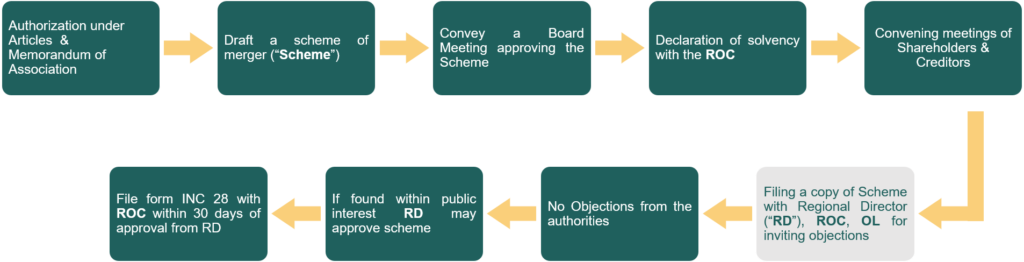
Amendments are as follows
Note: The Scheme in each of the aforementioned situations shall be approved or deemed to be approved only if the same is in the public interest or in the interest of the creditors
| IF | THEN |
|---|---|
| No objection/ suggestion received by the CG from ROC/OL within 30 days of the receipt of copy of scheme. | CG shall confirm and approve the scheme within 15 days after the expiry of 30 days. |
| No confirmation from CG within 60 days from the receipt of the scheme. | The scheme shall be deemed to be approved. |
| On receipt of objections/ suggestions from ROC/ OL where such objection/ suggestion are not sustainable. | CG shall approve the scheme and issue confirmation order within 30 days after the expiry of 30 days.If no confirmation order is issued within the aforementioned period, it shall be deemed that it has no objection to the scheme and a confirmation order shall be issued accordingly. |
| On receipt of objections/ suggestions from ROC/ OL where CG is of opinion that the scheme is not in the public interest or in the interest of creditors. | CG shall file an application with the tribunal within 60 days of receipt of the scheme, requesting the tribunal to consider the scheme in the regular manner. If CG does not file the application within the aforesaid period, it shall be deemed that it has no objection to the scheme and a confirmation order shall be issued accordingly. |
| Proposed Name | •Name to be available and unique. Should contain the nature of business •Minimum 2 names to be proposed |
| Share Capital | •Authorized and paid-up share capital to be determined •Sample capital structure: -10,000 equity shares of INR 10 per share -Total paid-up capital of INR 100,000 -Total authorized capital of INR 1,000,000 |
| Directors | •Minimum 2 directors required •Minimum 1 director to mandatorily be Indian resident |
| Shareholders | •Minimum 2 shareholders required |
| Registered Office Address | •Commercial property/office location required as registered address •Services of co-working office spaces can also be availed for virtual office address |
Incorporation process
Step 1 – Obtain DSC of directors & shareholders
Approx TAT: 2 Days Key documents/information required to be filed: Aadhar/PAN card, contact no. & email address and photo of individual
Step 2 – File for name application
Approx TAT: 3 Days Form: Spice+ Part-A Key documents/information required to be filed:
a. 2 proposed names of company b. NIC code along with 2-3 sentences about proposed business of company
Step 3 – File incorporation documents
Approx TAT: 1 Days Form: Spice+ Part-B Key documents/information required to be filed:
A. Shareholder and director details + KYC proofs
- KYC documents of foreign director and shareholder need to be apostilled and notarized in home country
B. Company details – Share capital (authorized and paid up), registered office address, email address and contact no.
Note: TAT is subject to MCA website
- On approval of spice forms, company incorporation is complete
- Certificate of incorporation, PAN, and TAN are issued to the company
- Company can open bank account
Post – incorporation process
STEP 1 – Post incorporation filings
A. FORM ADT 1 Approx TAT: 2 Days Key documents and information required to be filed:
– Auditor details – Name of auditor/auditor’s firm along with partner’s name, PAN, Membership no., registered address, email address, written consent & certificate stating he/she is not disqualified for appointment
– Company’s board resolution appointing such auditor B. FORM INC 20A Approx TAT: 2 Days Key documents/information required to be file: Bank statement of company showing inward receipt of subscription money from subscribers
- Company can issue share certificates to its shareholders
STEP 2 – RBI filing in case of foreign investor
Form: FC-GPR Approx TAT: 2 Days* (*2 days from receipt of FIRC and KYC from AD bank) Key documents/information required to be filed: FIRC and KYC for the fund transfer in foreign exchange entity master registration and business user registration to be obtained on FIRMS portal
Obtain initial registrations:
- Shops & establishment registration
- Profession tax registration
- GST registration
- Udyog Aadhar/MSME registration
- Startup India registration
- Angel tax exemption
For further details on licenses and registrations, refer to the document attached here.
]]>The Constitution of India explicitly prohibits discrimination based on sex, race, religion, or on any other ground, but it has taken some time for this protection to be extended to LGBTQ+ individuals. The landmark judgment in NALSA v. Union of India case in 2014 marked a progressive interpretation by the Supreme Court, which recognized that discrimination based on sexual orientation and gender identity falls within the ambit of “discrimination on the grounds of sex.” The court emphasized that such discrimination violates the fundamental right to equality enshrined in the Constitution.
In a subsequent case, Navtej Singh Johar v. Union of India, the Supreme Court took one step forward by acknowledging that the freedom to choose one’s sexual orientation and express one’s gender identity, including through dress, speech, and mannerisms, is at the core of an individual’s identity.
Although there is an absence of standalone anti-discrimination legislations in India, certain laws such as the Rights of Persons with Disabilities Act, 2016, the Equal Remuneration Act, 1976 (along with the Code on Wages, 2019), the Human Immunodeficiency Virus and Acquired Immune Deficiency Syndrome (Prevention and Control) Act, 2017, and the Transgender Persons (Protection of Rights) Act, 2019, do contain provisions addressing discrimination against individuals falling under the ambit of the aforementioned laws.
A major drawback of the Equal Remuneration Act, 1976 is that while it encourages pay parity at workplaces, however its scope is restricted to merely two genders, i.e., men and women thereby alienating an individual with a different sexual orientation from obtaining the benefits under this legislation.
This piece highlights the various workplace policies in India and the need to make them more inclusive for the disabled persons and those belonging to LGBTQ+ communities.
Equal Opportunity Policy under Rights of Persons with Disabilities Act, 2016
The Rights of Persons with Disabilities Act (“Act”) requires all establishments to have an equal opportunity policy (EOP) specifically for individuals with disabilities. This policy must be made publicly available, preferably on the establishment’s website or in conspicuous locations within the premises. The EOP should outline the facilities and services that will be provided to enable individuals with disabilities to fulfill their responsibilities effectively in the establishment.
Furthermore, if the organization employs 20 or more individuals, the EOP must include the following details:
- A comprehensive list of positions within the establishment that are deemed suitable for individuals with disabilities;
- The procedure for selecting individuals with disabilities for different positions, as well as providing post-recruitment and pre-promotion training, prioritizing them in transfers and job assignments, granting special leave, allocating residential accommodation if available, and offering other necessary facilities.
- Provisions for assistive devices, ensuring barrier-free accessibility, and implementing other necessary measures to accommodate individuals with disabilities.
- Information about the designated liaison officer. It is mandatory for every establishment with 20 or more employees to appoint a liaison officer responsible for overseeing the recruitment of individuals with disabilities and ensuring the provision of necessary facilities and amenities.
- A copy of the EOP must be registered with the relevant authority (whether a Chief Commissioner or State Commissioner, as the case may be) specified by the law.
Can POSH Policy be Gender Neutral?
The Sexual Harassment of Women at Workplace (Prevention, Prohibition and Redressal) Act, 2013 (“POSH Act”) is an Indian legislation designed to address workplace sexual harassment and ensure a safe working environment for women. Although the law primarily aims to protect women due to the widespread gender-based discrimination they face, it does not exclude or expressly/impliedly prohibit inclusion of men or individuals of other gender identities from receiving protection. It is important to recognize and address the experiences of all individuals who may encounter sexual harassment, regardless of their gender identity.
It is important to note that in the POSH Act, there is no bar on gender for the respondent, i.e., although the victim can only be a woman, but there is no specific gender mentioned for the respondent. Therefore, the term “respondent” encompasses all genders.
During the legislative process, the idea of enacting a gender-neutral law was discussed. However, this discussion primarily centered around men’s rights groups advocating for equal treatment and was framed as a debate between men and women. In response to this, the Parliamentary Standing Committee in 2011 proposed that the law should remain specific to one gender, citing the historical disadvantages, discrimination, abuse, and harassment faced by women. The committee based its recommendation on the belief that women are particularly vulnerable to workplace harassment, which hinders their ability to work. The primary objective of maintaining a gender-specific law was to increase female participation in the workforce and establish a robust mechanism to safeguard women’s employment rights.
In Anamika v Union of India, the Delhi High Court ruled that transgender individuals can utilize the protection under provisions related to sexual harassment, (which are commonly resorted to in cases of harassment by men against women), to file complaints. It is pertinent to note that in this case, although the aggrieved person was a transgender, however she identified herself as a woman and possessed a legally sanctioned identity document as evidence.
Provisions under Transgender Persons (Protection of Rights) Act, 2019
In 2014, the Supreme Court of India made a significant ruling in the case of National Legal Services Authority v. Union of India. This ruling played a crucial role in establishing the rights of transgender individuals in India. The court recognized the category of “transgender” as the “third gender” and introduced various measures to prevent discrimination against transgender individuals and protect their rights. The judgment also suggested that reservations should be made for transgender individuals in employment and educational institutions. Additionally, it affirmed the right of transgender individuals to identify their gender based on their self-perception, without the requirement of undergoing a sex reassignment surgery.
The Transgender Persons Act requires all establishments, including private employers, to adhere to certain regulations:
- Prohibition of discrimination: Ensure a safe working environment and prevent any form of discrimination against transgender individuals in all aspects of employment, such as recruitment, promotions, infrastructure adjustments, employment benefits, and related matters.
- Equal opportunity policy: Develop and publish an equal opportunity policy specifically for transgender persons. Display this policy on the company website, and if there is no website, post it at a conspicuous place within the premises.
- Infrastructural facilities: Provide necessary infrastructure adjustments, including unisex toilets, to cater to the needs of transgender employees. Take measures to ensure their safety and security, such as transportation arrangements and security guards. Additionally, ensure the availability of amenities like hygiene products for transgender employees.
- Confidentiality of identity of the transgender employees to be ensured at workplaces.
- Appointment of Complaint Officers: Establishments are obligated to assign a complaint officer who will handle any grievances concerning the infringement of the regulations stated in the Transgender Persons Act. The designated complaint officer is entrusted with the responsibility of investigating the complaints, and it is mandatory for the head of the establishment to act upon the report produced by the complaint officer within the specified timeframes.
Got a question? Call us on 9930156000
References
Constitution of India, Article 14
Rights of Persons with Disabilities Act, 2016, Section 21
Rights of Persons with Disabilities Rules, 2017
]]>
For a presentation view, click here!
Factual Matrix
• The nature of the subject matter of the case at hand has been weighed and adjudicated upon around the world across various jurisdictions. In order to observe the case at hand more objectively and illuminate the grounds and discussions which have been placed before the Honourable Supreme Court thus far, we have laid out a summary of the facts of the case:
• The Petitioners identify themselves as gay men and are Indian citizens. Both petitioners, presently aged about 32 and 35 years respectively, have been in a committed relationship for almost a decade.
• On 17.08.2021, the Petitioners held a ceremony in the presence of their families, friends and colleagues.
• However, despite a decade long committed relationship, the Petitioners are unmarried in the eyes of law as the legal regime around recognition and solemnization of marriages excludes marriage between a same-sex couple.
• Despite the ceremony, the Petitioners realized that they are legally incapable of exercising the rights of married individuals and strangers in the eyes of the law, such as securing health insurance which would include their partner, nominating each other for life insurance, mutual funds, PPF, pension scheme, or any other financial instruments. Legally, they do not have the right to inheritance, property, to take medical or end-of-life decisions pertaining to each other.
• In light of the same, the Petitioners filed their PIL before the Hon’ble Supreme Court seeking recognition and solemnization of same-sex marriage.
Questions In Point
The Hon’ble Supreme Court is hearing the matter based involving the following issues:
• Recognition of Same-Sex Marriage: Whether same-sex marriage or non-heterosexual marriage can be recognized and solemnized under the Special Marriage Act, 1954?
• Constitutionality of the Special Marriage Act: Whether the Special Marriage Act, 1954 can be declared to be unconstitutional and violative of Articles 14, 15, 19 and 21 of the Constitution of India to the extent that it does not provide for solemnization of marriage between a same sex couple?
Recognition of same-sex marriage
| Petitioners | UoI |
| • Broad interpretation to be made of the word “spouse” under Special Marriage Act, 1954 (“SMA”) and its meaning should not be confined merely to and be read as “a man and a woman”. Additionally, Section 4, SMA, which refers to a marriage in gender-neutral terms, between ‘any two persons’. However, it was clarified that merely amending the SMA isn’t enough and that a constitutional declaration of marriage, akin to that of the heterogeneous group, is needed. • It is important to remove the 30-day notice period under Section 5 of the SMA on the grounds that it invites unwarranted interference and such notice period violates an individual’s privacy along with their personal and decisional autonomy. • Advocate Abhishek Manu Singhvi, Counsel to the Petitioner stated that “But on the canvas there are two crucial words here. ‘Marriage’ and ‘persons’. ‘Same sex’ is a slight misnomer. The correct word is ‘person’, not ‘same sex’.”* • It was contended that the State could not deny marriage equality on grounds of “impracticality” as the discriminatory laws were created by it • Excluding the LGBTQIA+ community from their right to marry sends a message that it is legitimate to differentiate between the commitments of heterosexual and non-heterosexual couples, by indicating that the latter’s marriages are not as significant as “real” marriages. | • The Supreme Court could not hear this case as it fell under the powers of Parliament. The Respondent’s Counsel argued that there are certain issues which are better left to the discretion of the Parliament. There is no discrimination, no breach of privacy, right of choosing one’s sexual orientation. • It was argued that argued that 160 laws would be impacted in the process of bringing marriage equality. • It was argued that the subject of marriage is in the concurrent list and the possibility of one state agreeing to it and another against it cannot be ruled out. In this scenario, the maintainability of the petition would come into question. • Counsel to the Respondent stated that “Societal acceptance of any relationship in the society is never dependent either on legislation or on judgments. It comes only from within. Let us accept it whether we like to accept it or not.” • It was argued that the legislative intent of the legislature throughout has been a relationship between a biological male and a biological female including Special Marriage Act. • It was argued that the concept of biological man means a biological man and the question of notion does not arise. |
Recognition of same-sex marriage
Constitutionality of the Special Marriage Act
| Petitioners | UoI |
| • The Counsel argued that “The right to marry non-heterosexual unions is implicit in Articles 14, 15, 16, 19 and 21 of the Indian Constitution, especially after the Supreme Court rulings in “Navtej Singh Johar vs. Union of India” and “KS Puttaswamy and Anr. vs. Union of India”. • It was contended that the State could not deny marriage equality on grounds of “impracticality” as the discriminatory laws were created by it. • It is a civil union, as permitted in some countries, is not a solution to what same-sex couples are asking for. civil unions are not an equal alternative and do not address constitutional anomalies presented by excluding non-heterosexual couples from the institution of marriage • Excluding the LGBTQIA+ community from their right to marry sends a message that it is legitimate to differentiate between the commitments of heterosexual and non-heterosexual couples, by indicating that the latter’s marriages are not as significant as “real” marriages. • Adv. Mukul Rohatgi argued that “Gender identity is one of the most fundamental aspects of life and refers to a person’s intrinsic sense of being male, female or transgender or transsexual.” • Inalienable right to privacy must be granted in sanctity of a natural right to privacy in the Constitution as a fundamental right and the soulmate of dignity. Therefore, privacy, dignity go in hand in hand. Dignity is a part of life lived to its fullest under Article 21. | • The lawmakers had a conscious intent to include only heterosexual marriages under the SMA and the said Act’s character and intent cannot be altered. • It was argued that under the SMA, the court cannot give rights to non-heterosexual couples that heterosexual couples don’t have. • The State has a ‘legitimate’ interest in regulating marriages, while citing aspects such as the age of consent, prohibition of bigamy, prescription of prohibited degrees of marriage, judicial separation, and divorce. • While the rulings in Navtej or Shafeen Jahan were monocentric, the present dispute is a “polycentric”, one that will affect several legal provisions, possibly wreaking collateral damage or side effects in its wake. • The Respondent’s Counsel stated that “The question is not right of equality, right of dignity or right of privacy of persons who belong to LGBTQ community. That is first. The question is right of conferment of a socio-legal status and whether that can be done by judicial adjudication. There was no law governing the rights and other rights and other immunities to the LGBTQ community.” • It was argued that the concept of biological man means a biological man and the question of notion does not arise. |
Constitutionality of the Special Marriage Act
Observations by the Hon’ble Supreme Court
| Question | Observations |
| Inclusion of LGBTQ+ in SMA | • Justice D.Y. Chandrachud observed that “Man is not a definition of what your genitals are. It’s far more complex. That’s the point. So even when the Special Marriage Act says man and woman, the very notion of a man and a notion of a woman is not an absolute based on what genitals you have.” • There should be a declaration of the right to marry, then there are two courses of action according to you. Either the court then finds a legislative void in that Parliament has not legislated explicitly to recognize the right of marry, and therefore finding a legislative void, you supplant that deficiency so long as Parliament enacts the law. The other option is, to locate the modalities for implementing that declaration in existing law. • The notice issue is even in a heterosexual marriage, because you are saying that even in a heterosexual marriage, the fact that you have to give a notice and have people object to whether there should be a marriage or not, is unconstitutional. |
| Violation of Fundamental Rights due to marriage inequality | • There are two corresponding rights and perhaps duties and obligations as well. On the one hand the LGBTQ community has or a same sex couple is entitled to say, I have a right to make my own choices. We have our right to make our own choices, to live as we wish together and therefore, that is a part of our dignity our privacy. But equally, society can’t say that. Well, all right. We will recognize that right and we leave you alone. And we will not recognize your relationship. • It’s not enough, in terms of privacy to leave them alone and to make their choices but it is equally important to assert a ride equally, to have the recognition of those social institutions. Because private is an individual concept which allows you to get to the core of your being and to live your life as you want. But equally, each of us are social individuals, social animals, so to speak. And therefore, for society to assert that all right, we’ll leave you alone, or the state will leave you alone. |
Observations by the Hon’ble Supreme Court
Key Takeaways, pending the Supreme Court’s judgment
• Public opinion on various LGBTQ+ rights in India has evolved over the years and verdicts passed by the Judiciary. The progress of laws relating to LGBTQ+ marriage in India has been a complex and evolving journey. While the decriminalization of homosexuality and the recognition of civil partnerships have marked significant milestones, marriage equality remains unrealized. However, the recognition of same-sex marriages has seen progress in certain states.
• The LGBTQIA+ community has averred that it needs an anti-discrimination law that gives them the freedom to forge fulfilling relationships and lives regardless of their gender identity or sexual orientation and places the responsibility for change on the state and society rather than the person. The assertion is that when individuals belonging to the LGBTQ community are granted their complete set of constitutional rights, it is imperative to acknowledge their right to marry the person (and not only a man or a woman) of their choosing.
• However, while there is growing acceptance and support for equality, there is continued opposition to same-sex marriages.
• The arguments made against the petition were on both technical grounds (the jurisdiction of the Supreme Court qua the Parliament to confer rights of a socio-legal status, and the non-joinder of the States for an issue on the concurrent list of the Constitution), and on the grounds of maintainability (considering the provisions of the Transgender Act which already prohibit discrimination, and on the impact on personal laws and their amendment).
• After a hearing that ran for 10 days, the Honourable Supreme Court reserved its verdict on the batch of petitions seeking legal recognition of same-sex marriages.
]]>I. GENERAL
| Particulars | Responses | Remarks / Examples |
| Name of the Business | – | – |
| Registered office address (to be skipped if the Business is yet to be set up) | – | – |
| Brief Description of the Business | – | Note: This can be a 2-3 line description of the industry/sector where the Company currently operates and any differentiating factors. |
| Face Value of Equity Shares | – | – |
| Chairman of the Board | – | – |
II. FOUNDERS
| Particulars | Responses | Remarks / Examples |
| Name and Address of the Founders | Founder 1: – | |
| Founder 2: – | ||
| PAN/ Tax Registration Number of the Founders | Founder 1: – | |
| Founder 2: – | ||
| Founders who are a party to a pre-existing Shareholders Agreement (if any) | – | |
| Monetary Contribution of each Founder (if any) | Founder 1: – | |
| Founder 2: – | ||
| Shareholding Pattern of the Founders before the execution of the Co-Founders’ Agreement (to be skipped if the Business is yet to be set up) | Founder 1: – | |
| Founder 2: – | ||
| Shareholding Pattern of the Founders as on the execution of the Co-Founders’ Agreement | Founder 1: – | |
| Founder 2: – | ||
| Maximum amount of financial assistance that can be provided by the Business to each of the Founders during the course of Business | – |
III. DECISION MAKING AND DISPUTE RESOLUTION
| Particulars | Responses | Remarks / Examples |
| Founder whose opinion will hold more weight in case of any conflict with respect to the Business | – | Note: This can be an internal ‘veto’ right granted to one or more Founders, and is extremely customizable to the relationships between the Founders and their responsibilities. For example, one Founder may hold the deciding vote in general or have the final say on specific parts of the business such as design, costs, funding, or hires. |
| How will the day-to-day and major decisions of the Business be taken? | – | Note: Similar to the ‘veto’ mentioned above, this is customizable to match the working relationship between Founders. While one Founder may control day-to-day operations, another may be the decision-maker for the long-term direction. Alternatively, a voting mechanism can be set up for multiple Founders. |
| How will a sale of the Business be decided? | – | Example: To be decided by the Board/mutual agreement of the Founders. In case the parties have executed a SHA, this will ideally also be covered under reserved matters to be taken upon consent from the investor. |
| Dispute resolution in case one of the Founders is not performing his duties in accordance with the Co-Founders’ Agreement | – | Example: To be decided by the Board/such Founder may be terminated upon a simple majority of the other Founders. While this is difficult to account for at an early stage, it’s important to set checks and balances to avoid any disconnect in goals, ideals, and responsibilities. |
IV. EXIT OPTIONS
| Particulars | Responses | Remarks / Examples |
| Procedure to be followed by the Founders in case of resignation | – | Example: Prior written notice of 60 (sixty) days is to be provided to the Company. The Founder may not, in lieu of notice, pay the company his salary for the notice period, and may not also avail leave. |
| Can any of the Founder’s employment with the Business be terminated in the following situations? If yes, what will be the procedure followed by the Business to terminate such Founder’s employment? | – | Example: (a) For Cause (fraud, negligence, misconduct, crime of moral turpitude, material breach): Yes – the board may terminate the Founder’s employment with immediate effect by simple majority. (b) Without Cause (restructuring, cost cutting, underperformance): Yes – the board shall provide the Founder with an opportunity to present his case and may terminate his employment with 60 days’ notice or relieve him from duties or pay his salary. |
| Procedure to be followed by the Business in case any permanent disability is suffered by any Founder | – | Example: Agreement shall be terminated immediately in case the Founder is unable to perform his duties for a continuous period of 3 (three) months. |
| Would the Founder be obliged to leave his position as a Director on the Board in the following situations? | – | Example: (a) Termination of the Founder’s employment by the Business: Yes (b) Resignation by the Founder: Yes |
| Time period for which the exiting Founders shall be contractually obliged to not work with or as a competitor to the Business | – | Example: 1 year. This restriction, while falling into a grey area in terms of enforceability, is important to ensure that the Company’s confidential and proprietary information doesn’t become available to a competitor (whether directly or indirectly). Considering the goodwill carried by Founders, it is likely that courts will uphold such clauses. |
V. TRANSFER OF SHARES
| Particulars | Responses | Remarks / Examples |
| How will the Founder shares be dealt with in the following situations: (Please provide the details if any buyback options shall be given to the Business or remaining Founders) | – | Example: (a) Termination of the Founder’s employment by the Business: – For Cause: The company shall be entitled to purchase the unvested and vested shares at their face value or such other lower price as may be permissible under applicable law / as determined by the Board / in case of existing SHA, to be dealt with as described in the transaction document. – Without Cause: The company shall be entitled to purchase unvested shares at their face value or such other lower price as may be permissible under applicable law, and the vested shares at the fair market value / as determined by the Board / in case of existing SHA, to be dealt with as described in the transaction document. (b) Resignation by the Founder: The company shall be entitled to purchase unvested shares at their face value or such other lower price as may be permissible under applicable law, and the vested shares at the fair market value / as determined by the Board / in case of existing SHA, to be dealt with as described in the transaction document. |
| How will the market value of Shares be determined in case a Founder wants to sell his Shares? | – | Example: Fair market value / last valued round. |
VI. DISSOLUTION OR SALE OF THE BUSINESS
| Particulars | Responses | Remarks / Examples |
| What will happen to the Intellectual Property of the Business in case of the following: | – | Example: (a) Dissolution of the Business: If any compensation is received from the intellectual property owned by the company, the proceeds will be divided among the Founders in the ratio of their shareholding in the company. (b) Sale of the Business: Remains with the Business. (c) Termination of the Founder’s employment by the Business: Remains with the Business. (d) Resignation by the Founder: Remains with the Business. |
| Who will retain the original brand name of the Business? | – | Example: To be decided at the time of sale as part of negotiation / any Founder having the highest shareholding or who has single-handedly established the brand name. |
Sample Responses
| Particulars | Responses | Remarks / Examples |
| Name of the Business | – | – |
| Registered office address (to be skipped if the Business is yet to be set up) | – | – |
| Brief Description of the Business | – | Note: This can be a 2-3 line description of the industry/sector where the Company currently operates and any differentiating factors. |
| Face Value of Equity Shares | – | – |
| Chairman of the Board | – | – |
| Vesting conditions of each of the Founder’s shares (if any) | – | Example: Vesting conditions may be different for the Founders. This could include yearly, monthly, or quarterly vesting or vesting based on milestones achieved by the Business. For instance:Founder 1: Shares to be vested on an annual basis over a period of 4 years.Founder 2: 40% to be vested upon achieving 50,000 customers and 60% upon 1.5L customers.Founder 3: 25% to be vested on [date], and 75% monthly over 3 years. |
| Roles and Responsibilities of each Founder | – | Example:Founder 1: CEO, Head business development, investor relations, B2B sales, sourcing components, legal/compliance.Founder 2: CTO, OS/Apps/Cloud, overall product security. |
| Time and commitment to the Business expected of each Founder | – | Example: Founder 1: Full-time.Founder 2: Part-time (can also specify hours per day or days per week). |
| Which Founders hold a position of Director on the Board? | Founder 1: – | |
| Founder 2: – | ||
| Remunerations including salary, bonus, commission, etc. (if any) of each Founder | Founder 1: – | |
| Founder 2: – | ||
| Whether the Founders’ rights shall be inheritable? If yes, will the successors of the Founders have the same rights as such Founder or merely be Shareholders in the Business? | – | Note: While employment contracts are personal in nature, some Founders may choose to name successors to take over in their stead. Further, as shareholders, Founders are required to name nominees in case of death or disabilities. |
]]>
What are ECB?
External Commercial Borrowings (“ECB”) are commercial loans raised by eligible resident entities from recognized non- resident entities and should conform to parameters such as minimum maturity, permitted and non permitted end-uses, maximum all-in-cost ceiling, etc. Transactions on account of ECBs are governed by the provisions of Foreign Exchange Management Act, 1999 and the Master Direction – External Commercial Borrowings, Trade Credits and Structured Obligations (2018-19) issued by the RBI and as amended from time to time (“ECB Master Directions”)
External Commercial Borrowings (“ECB”) are commercial loans raised by eligible resident entities from recognized non- resident entities and should conform to parameters such as minimum maturity, permitted and non permitted end-uses, maximum all-in-cost ceiling, etc. Transactions on account of ECBs are governed by the provisions of Foreign Exchange Management Act, 1999 and the Master Direction – External Commercial Borrowings, Trade Credits and Structured Obligations (2018-19) issued by the RBI and as amended from time to time (“ECB Master Directions”)
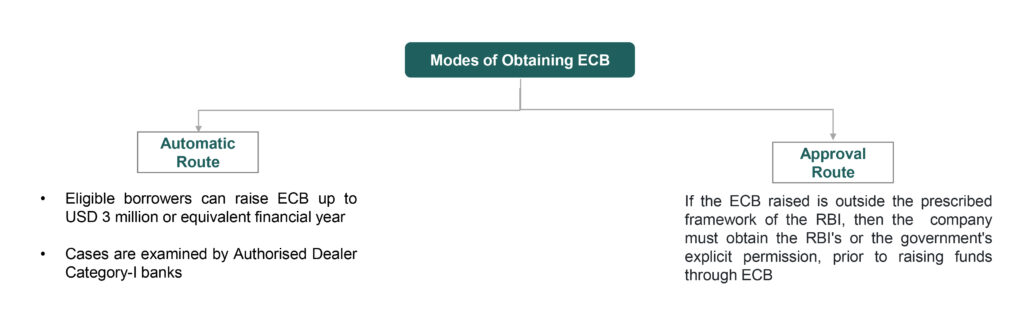
RBI permitted Startups to raise ECB with the introduction of new guidelines vide its circular dated 16th January, 2019. Pursuant to the said guidelines, AD Category-I Banks are permitted to allow recognized Startups to raise ECB under the automatic route as per the prescribed framework
Recognized Lenders
•Lender/Investor, who is a resident of a Financial Action Task Force compliant country
•The recognized lenders do not include the following:
- Indian banks’ foreign branches or their Indian subsidiaries; and
- Overseas entity in which Indian entity has made overseas direct investment
Key Considerations
| Term | Brief description |
| MAMP* | MAMP for ECB will be 3 years. |
| Forms | The borrowing can be in form of loans or non-convertible, optionally convertible or partially convertible preference shares |
| Currency | The borrowing should be denominated in any freely convertible currency or in Indian Rupees (INR) or a combination thereof |
| Amount | The borrowing per Startup will be limited to USD 3 million or equivalent per financial year (either in INR or any convertible foreign currency or a combination of both) |
| All-in-cost | As may be mutually agreed between the lender and borrower |
| End-uses | For any expenditure in connection with the business of the borrower |
| Choice of Security | At the discretion of the borrower. Security can be in the nature of: -movable assets; -Immovable assets; -intangible assets (including patents, intellectual property rights); -financial securities and shall comply with foreign direct investment or foreign portfolio investment/ or any other norms applicable to foreign lenders -Issuance of corporate and personal guarantee. Guarantee is only allowed if such parties qualify as lender under ECB for start-ups |
| Conversion Rate | In case of borrowing in INR, the foreign currency – INR conversion will be at the market rate as on the date of agreement |
Notes : * MAMP: Minimum Average Maturity Period * All-in-cost: It includes rate of interest, other fees, expenses, charges, guarantee fees, Export Credit Agency charges, whether paid in foreign currency or INR but will not include commitment fees and withholding tax payable in INR.
Other Provisions
| Term | Brief description |
| Parking of ECB Proceeds | ECB Proceeds can be parked abroad as well as domestically •If ECB Proceeds parked/repatriated to India, ECB borrowers are allowed to park ECB proceeds for a maximum period of 12 months cumulatively |
| Reporting arrangements | Submission of Form ECB and obtaining loan registration number (LRN) •Any change in terms and conditions of ECB should be reported to DSIM through revised form ECB •Monthly reporting through form ECB 2 |
| Conversion of ECB into Equity | • Conversion is allowed subject to the conditions such as (without limitation): – activity should be covered under automatic route for FDI or government approval is received where required -conversion must not contravene eligibility or applicable sectoral cap on foreign equity holding -compliance with applicable pricing guidelines • The exchange rate prevailing on the date of the agreement between the parties concerned for such conversion or any lesser rate can be applied with a mutual agreement with the ECB lender •Equity ratio of 7:1 not applicable |
| Non applicability of Equity-liability ratio | The requirement of equity liability ratio of 7:1 as prescribed under the ECB Master Directions is not applicable for start-ups |
Other provisions summarised in short
Process Flow
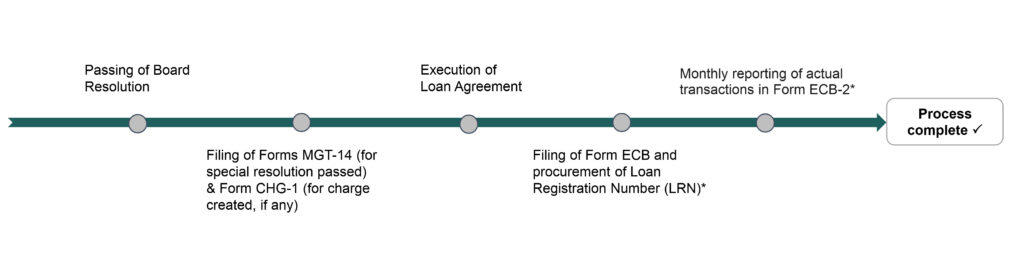
Notes :
LRN: Any drawdown in respect of an ECB should happen only after obtaining the LRN from the RBI. To obtain the LRN, borrowers are required to submit duly certified Form ECB, which also contains terms and conditions of the ECB, in duplicate to the bank
Monthly Reporting of Actual Transactions: Form ECB 2 Return through the AD Bank on monthly basis.
- One of the key issues that an entity, being a startup, faces is not having adequate knowledge about what qualifies as a “Startup” under the Department for Promotion of Industry and Internal Trade (“DPIIT”). Due to lack of unawareness, many entities fail to avail the benefits applicable and attracted to them under the Startup India Action Plan prescribed vide notification No. G.S.R. 34 (E) dated January 16, 2019 issued by the Ministry of Commerce and Industry.
Under the DPIIT Scheme, an entity shall be considered as a startup:
● Upto a period of ten years from the date of incorporation/ registration, if it is incorporated as a private limited company (as defined in the Companies Act, 2013) or registered as a partnership firm (registered under section 59 of the Partnership Act, 1932) or a limited liability partnership (under the Limited Liability Partnership Act, 2008) in India.
● Turnover of the entity for any of the financial years since incorporation/ registration has not exceeded INR 100 crore
● Entity is working towards innovation, development or improvement of products or processes or services, or if it is a scalable business model with a high potential of “employment generation” or “wealth creation”.
Provided that an entity formed by splitting up or reconstruction of an existing business shall not be considered a ‘Startup’
- The other major concern is lack of information about the registration process, the documents required for making registrations, collating the information and documents and uploading the same on the portal. The company will need the Charter documents of the Company i.e. MOA and AOA, Certificate of Incorporation, Pitch deck of the Company, Link of the company website(optional), Intellectual Property Registration Certificates (if applicable), Proof of any funding received by the company (MCA records, capital structure of the company, bank statements etc), Aadhar card of the authorized signatory making application on behalf of the Company, Director details (DIN, PAN, Address, contact details), Company details (CIN, Address, authorized signatory details for the Company).
In order to help ease the process, here are a few things one needs to bear in mind while initiating the registration process.
- Preliminary process for registration:
● The Company needs to make a profile on the Startup India Portal. The registered email id will then receive an OTP and once that is confirmed the profile can be operated using the login credentials entered for registration.
● The User will have to complete the profile by adding the company specific details i.e. name of the company, CIN, the industry that the company operates, area of operation, stage of development the startup is currently at (ideation, validation early traction, scaling) etc
● The User will have to provide company specific responses to the questions basis which, at the discretion of the DPIIT, the application will be accepted/rejected or asked for clarification in case of any deficiency.
Questions on the portal:
a. Details of the innovation product/service or improvement in any existing product/service the Startup aims to create/provide
b. What is the problem that the startup aims to solve
c. How does your startup propose to solve this problem
d. What is the uniqueness of the solution provided by the startup.
e. How does startup generate revenue. Etc.
The authorized signatory signing and making application on behalf of the Company needs to be authorized by the other director/s of the Company and the same needs to be authenticated by signing a Letter of Authorisation (in the format provided on the startup India portal).
Once the application is submitted, the department will, at its discretion, approve the application of the Company.
]]>•Code on Wages
•Occupational Safety, Health and Working Conditions Code
•Social Security Code
•Industrial Relations Code
These Labour Codes are yet to be notified.
In India, the labour laws can be divided into compliance under central laws and the specific state laws.
We have compiled a list of central laws and examples of specific state laws herein.
| Sr. No | Labour Laws | Applicability | Registration/ Implementation | Penalty for non-compliance with the applicable laws |
| 1 | Employee’s State Insurance Act, (ESI Act 1948) | a) Working with the aid of power- 10 or more employees b) Without the aid of power- 20 or more employees | Section 2-A of the Act read with Regulation 10-B, registration within 15 days from the date of its applicability to them | Imprisonment for a period extending up to 2 years and a fine of up to INR 5,000. |
| 2 | Prevention of Sexual Harassment of Women at Workplace (Prevention Prohibition and Redressal Act, 2013) (“POSH Act”) | Applicable to all organizations, however the formation of an internal committee is applicable when there are 10 or more employees | The company has to elect an internal committee and pass a board resolution for adopting the internal committee as per the provisions of POSH Act | A fine of INR 50,000 |
| 3 | Maternity Benefit Act, 1961 | Any organization with 10 or more employees | No registration required. However, an organization needs to maintain a muster roll. An organization is required to provide for first and second-time mothers, a leave of 6 months, or 26 weeks, off, which is a paid leave wherein her employer needs to pay her in full. | Imprisonment which may extend to 3 months, or with fine which may extend to INR 500, or with both. |
| 4 | Payment of Gratuity Act, 1972 | Any organization with 10 or more employees | Form A to be filed within 30 days of registration | punishable with imprisonment for a term which may extend to six months, or with fine which may extend to ten thousand rupees or with both |
| 5 | Rights of Persons with Disabilities Act, 2016 | Any organization with 20 or more employees | a) Form E for registration under Rule 27(3). b) Organization needs to appoint a grievance officer as a compliance | Imprisonment up to 6 months and/ or a fine of INR 10,000, or both |
| 6 | Equal Remuneration Act, 1976 | No minimum applicability | Form D- Register to be maintained by the employer | Penalty levied may be up to INR 10,000 |
| 7 | Payment of Bonus Act, 1965 | Any organization with 20 or more employees | In case of new establishments, for the first 5 years, bonus is payable only if the business is profitable. | Imprisonment for six months or may impose a fine of INR. 1000 or both |
| 8 | The Employees’ Provident Funds and Miscellaneous Provisions Act, 1952 | Any organization with 20 or more employees | Form 5 to be filled by employers for enrolling new employees for this scheme | For delay in payment of PF- a)For 0 — 2 months delay – @ 5 % p.a. b)For 2 — 4 months delay – @10 % p.a. c)For 4 — 6 months delay – @ 15 % p.a. d)For delay above 6 months – @ 25 % p.a. (subject to a maximum of 100%) |
List of Central Labour Laws applicable to Start-ups
State Specific Labour Laws applicable to Start-ups
Types Of Applicable Legislations For Specific States:
•State-specific shops and establishment acts
•State-specific labour welfare acts
•State-specific professional tax acts
STATE OF MAHARASHTRA AND KARNATAKA COVERED HEREIN
State Specific Labour Laws applicable to Start-ups
A. For Maharashtra
| Sr. No | Labour Laws | Applicability | Registration/ Implementation | Penalty for non-compliance with the applicable laws |
| 1 | Maharashtra Shops and Establishment Act, 1948 | Applicable to all organizations. Any organization with 10 or more employees needs to register. | Form A to be filed for registration | Fine which shall be not less than INR 1,000 but which may extend to INR 3,000 along with the prescribed registration or renewal Fee |
| 2 | Maharashtra Labour Welfare Fund Act, 1953 | Any organization with 05 or more employees | Form A to be filed for registration | A fine of INR 500 and/or imprisonment up to 3 months |
| 3 | The Maharashtra State Tax on Profession, Trades, Callings and Employments Act, 1975 | Applicable to all organizations/ establishments | Form I-I and I-II to be filled for enrollment | Employer will be liable to pay a simple interest @ 1.25% of the tax payable for each month for which the tax remains unpaid. |
Maharashtra Labour Laws applicable to Start-ups
B. For Karnataka
| Sr. No | Labour Laws | Applicability | Registration/ Implementation | Penalty for non-compliance with the applicable laws |
| 1 | Karnataka Shops and Commercial Establishments Act, 1961 | Applicable to all. Organizations with 10 or more employees have to register | Registration of establishment in Form B | punishable with fine up to INR 1,000 and in case of a continuing contravention, a further fine of up to INR 2,000 for every day during which such contravention continues |
| 2 | The Karnataka Tax on Professions, Trades, Callings And Employment Act, 1976 | Applicable to all person working in Karnataka | Registration of establishment under Sec 5 | Penalty not exceeding fifty per cent of the amount of tax due. This penalty shall be in addition to the interest payable under sub-section (2) or (3) of section 11. |
Karnataka Labour Laws applicable to Start-ups
]]>The Ministry of Electronics and Information Technology (“MeiTY”), vide notification dated April 6, 2023 released the Information Technology (Intermediary Guidelines and Digital Media Ethics Code) Amendment Rules, 2023 (“Amended Rules”), whereby the Information Technology (Intermediary Guidelines and Digital Media Ethics Code) Amendment Rules, 2021 were amended in order to provide for certain regulations with respect to online gaming industry. View complete Amended Rules
• The following new terms have been defined:
a) online game (Rule 2(1)(qa))
b) online gaming intermediary(Rule 2(1)(qb))
c) online gaming self-regulatory body(Rule 2(1)(qc))
d) online real money game (Rule 2(1)(qd))
e) permissible online game (Rule 2(1)(qe))
f) permissible online real money game (Rule 2(1)(qf))
• Online self-regulatory body (SRO) shall verify an online real money game as a permissible online real money game. Main criteria would be to satisfy that (Rule 4A (3)):
(a) the online game doesn’t involve wagering on any outcome
(b) the users are at least 18 years of age
• Obligations on online gaming intermediaries to ensure compliance under IT act and also to not show, distribute or host any data that can cause harm to the users.
• Obligations on permissible online real money game providers:
(a) displaying a visible mark verification by such online self-regulatory body on such games
(b) informing users about withdrawal or refund of deposit policies
(c) the manner in which the determination of distribution of winnings, fees and other charges is done
2. New Concepts Introduced
Online games (Rule 2(1)(qa)) – A game that is offered on the Internet and is accessible by a user through a computer resource or an intermediary.
Online real money game (Rule 2(1)(qb)) – Online games where users make deposits in cash or kind with the expectation of earning winnings on that deposit. Examples of online real money games shall be: Dream 11, My Premier League and My11Circle.
Permissible online real money game (Rule 2(1)(qc)) – Online real money game verified by an online gaming self-regulatory body.
Permissible online games (Rule 2(1)(qd)) – (a) Permissible online real money game; or (b) any other online game that is not an online real money game.
Online self governing Body (Rule 2(1)(qe)) – MeitY may designate as many online gaming self-regulatory bodies as it may consider necessary for the purposes of verifying an online real money game as a permissible online real money game.
Online gaming intermediary (Rule 2(1)(qf)) – Any intermediary that enables the users of its computer resource to access one or more online games.
3. Changes in the Gaming Ecosystem
| Business of the gaming entity | Law before the Amendment | Effect of the amendment |
| Online Gaming Intermediaries | Not regulated earlier. | Will be covered under the IT Act, 2000 and shall have a plethora of obligations. List of obligations found in further slides |
| Online Fantasy Sports | Online fantasy sports, though not heavily regulated, is permitted all over India except few states namely • Assam, Sikkim, Nagaland, Andhra Pradesh, Odisha, Telangana and Tamil Nadu. | Online games covered here shall be taken up for consideration by the online self-regulatory body to be classified as a permissible online real money game, provided that the same (Rule 4A (3)): (a) does not involve wagering on any outcome (b) the user is at least 18 years of age. |
| eSports | Not regulated. However, recognised as a part of multi-sports events in India and recognised by the Ministry of Youth Affairs and Sports. | With respect to eSports, the online self-regulatory body shall ensure that its rules and regulations, privacy policy or user agreement inform the users not to host, display, upload, modify, publish, transmit, store, update or share any information that is in relation to an online game which causes harm (Rule 4 and Rule 5 (11)). |
| Online Casino Games including Poker | • Sikkim allows casino games, such as Casino and Blackjack • Nagaland and West Bengal allow Poker • Gujarat bans Poker. | Online games covered here shall be taken up for consideration by the online self-regulatory body to be classified as a permissible online real money game, provided that the same (Rule 4A (3)) : (a) is permitted by the applicable state enactment within a particular state’s territory (b) does not involve wagering on any outcome (c) the user is at least 18 years of age. |
Changes in the gaming ecosystem
4. Obligations of Online Gaming Intermediary
- Reasonable security practices and procedures as prescribed in the Information Technology (SPDI) Rules, 2011 (Rule 3(1)(i)).
- To retain information for a period of 180 days from cancellation or withdrawal of his registration in case information is collected from user for registration (Rule 3(1)(g)).
- To not deploy / install / modify technical configuration of computer resource or become party to any act that may change operations such computer resource thereby, circumventing any law (Rule 3(1)(g)).
- To publish the rules and regulations, privacy policy and user agreement on its website or mobile based application (Rule 3(1)(a)) :
a) To inform its users of its rules and regulations, privacy policy or user agreement (or any changes) at least once in a year (Rule 3(1)(f))
(Online real money game intermediary shall inform its users of such changes as soon as possible, not later than 24 hours after such change is effected)*
(b) To not display, upload, publish or share any information that (Rule 3 (1) (b) of Amended Rules)–
• related to online games that causes a user harm
• is not verified as a permissible online game
• is in the nature of advertisement of an online game that is not permissible
• violates any law
(c) To include provisions to inform the user not to host, display, upload or share any information that belongs to another person, is defamatory, obscene, pornographic, pedophiliac, invasive of another‘s privacy, including bodily privacy, racially or ethnically objectionable, relating or encouraging money laundering or gambling, is harmful to child, infringes any patent, trademark, copyright or other proprietary rights, violates any law for the time being in force; any deceiving or misleading information, impersonates another person; threatens the unity, integrity, defense, security or sovereignty of India, contains software virus or any other computer code (Rule 3(1)(b)).
5.Online Self Regulatory Body
Criteria to apply (Rule 4(A)) –
- Should be a company
- Membership is representative of gaming industry
- Members are offering & promoting online games in a responsible manner
- Board of directors –individuals with special knowledge or practical experience suitable for the performance of functions of self-regulatory body
- the MOA and AOA of such entity includes provisions regarding grievance redressals, framework for disclosure and accountability of the members of such body, etc.
Responsibilities (Rule 4(A)) –
- to designate an online real money game (ORMG) as permissible
- to prominently publish a framework for verifying an ORMG on its portal
- to publish and maintain an updated list of all permissible ORMG verified by it
- to ensure that ORMG so verified by it shall display a demonstrable and visible mark of such verification stating that ORMG is verified by the body as permissible
- publish framework for redressal of grievances and the contact details of the Grievance Officer on its portal. An applicant aggrieved by decision of such body with respect to verification may make a complaint which is acknowledged by the Grievance Officer within 24 hours and resolved within 15 days from the date of its receipt.
6. Conclusion
The new rules create an umbrella framework for the online gaming industry. While the distinction of game skill/ game of chance has not been dealt with in these rules, it lays down the basic stepping stone to crystallize the online gaming industry’s challenges and provides clarity on various concepts that were hitherto only industry parlance.
]]>Non-participating liquidation preference allows investors to receive predetermined returns without any share in the surplus. In contrast, participating liquidation preference allows investors to receive predetermined returns as well as a share of the surplus proceeds based on their shareholding.
Standard Seniority Liquidation Preference is followed by most early-stage companies, where liquidation preferences are honored in reverse order from the latest investment round to the earliest. Pari-Passu Seniority gives all preferred investors equal seniority status, meaning that all investors would share in at least some part of the proceeds. Tiered Seniority is a hybrid between standard and pari-passu seniority, with investors grouped into distinct seniority levels.
Investors ask for liquidation preference to protect themselves, particularly if a company fails to meet expectations and sells or liquidates at a lower valuation than anticipated. Liquidation preferences are expressed as a multiple of the initial investment and are most commonly set at 1X. In the event of liquidation, investors receive the full amount of their investment before any other equity holders or their share in the liquidation proceeds on a pro-rata basis, whichever is more. Understanding liquidation preference is important for founders to negotiate well with potential investors.
]]>A BO is a suitable business model for foreign companies looking to establish a temporary presence in India. The BO serves as an extension of the head office business and carries on the same business and activity as that of its parent company. The foreign company can have any revenue from the Indian BO only from the activity allowed by the Reserve Bank of India (“RBI”). It has to meet all its expenses of Indian office through remittances from the head office or through the revenue generated from the Indian operation permitted by the RBI.
BO is suitable for a foreign company to test and understand the Indian market with a very strict control by the RBI, as it does allow the companies to do business but just to do the activity which are mentioned in the application of BO. The Master Direction on Establishment of Branch Office (BO)/ Liaison Office (LO)/ Project Office (PO) or any other place of business in India by foreign entities shall be relevant for setting up of the BO.
Permitted Activities
Companies incorporated outside India and engaged in manufacturing or trading activities are allowed to set up BO in India and undertake the following activities in India;
i. Export/import of goods.
ii. Rendering professional or consultancy services (other than practice of legal profession in any matter).
iii. Carrying out research work in which the parent company is engaged.
iv. Promoting technical or financial collaborations between Indian companies and parent or any overseas group company.
v. Representing the parent company in India and acting as buying/ selling agent in India.
vi. Rendering services in information technology and development of software in India.
vii. Rendering technical support to the products supplied by parent/group companies.
viii. Representing a foreign airline/shipping company.
General Criteria
Applications from foreign companies (a body corporate incorporated outside India, including a firm or other association of individuals) for establishing BO in India shall be considered by the AD Category-I (“AD”) bank as per the guidelines given by RBI.
An application from a person resident outside India for opening of a BO in India shall require prior approval of Reserve Bank of India and shall be forwarded by the AD Category-I bank to the General Manager, Reserve Bank of India, Central Office Cell, Foreign Exchange Department, 6, Sansad Marg, New Delhi – 110 001 who shall process the applications in consultation with the Government of India, in the following cases:
a. The applicant is a citizen of or is registered/incorporated in Pakistan;
b. The applicant is a citizen of or is registered/incorporated in Bangladesh, Sri Lanka, Afghanistan, Iran, China, Hong Kong or Macau and the application is for opening a BO in Jammu and Kashmir, North East region and Andaman and Nicobar Islands;
c. The principal business of the applicant falls in the four sectors namely Defence, Telecom, Private Security and Information and Broadcasting. However, prior approval of RBI shall not be required in cases where Government approval or license/permission by the concerned Ministry/Regulator has already been granted.
d. The applicant is a Non-Government Organisation (NGO), Non-Profit Organisation, Body/ Agency/ Department of a foreign government. However, if such entity is engaged, partly or wholly, in any of the activities covered under Foreign Contribution (Regulation) Act, 2010 (FCRA), they shall obtain a certificate of registration under the said Act and shall not seek permission under FEMA 22.
The non-resident entity applying for a BO in India should have a financially sound track record of a profit making track record during the immediately preceding five financial years in the home country and net worth of not less than USD 100,000 or its equivalent.
Net Worth [total of paid-up capital and free reserves, less intangible assets as per the latest Audited Balance Sheet or Account Statement certified by a Certified Public Accountant or any Registered Accounts Practitioner by whatever name called].
An applicant that is not financially sound and is a subsidiary of another company may submit a Letter of Comfort (“LOC”) from its parent/ group company, subject to the condition that the parent/ group company satisfies the prescribed criteria for net worth and profit.
Procedure for setting up a BO
i. The application for establishing BO in India may be submitted by the non-resident entity in Form FNC to a designated AD Category – I bank (i.e. an AD Category – I bank identified by the applicant with whom they intend to pursue banking relations) along with the prescribed documents mentioned in the Form and the LOC, wherever applicable. The AD Category-I bank shall after exercising due diligence in respect of the applicant’s background, and satisfying itself as regards adherence to the eligibility criteria for establishing BO, antecedents of the promoter, nature and location of activity of the applicant, sources of funds, etc., and compliance with the extant KYC norms grant approval to the foreign entity for establishing BO in India.
ii. However, before issuing the approval letter to the applicant, the AD Category-I bank shall forward a copy of the Form FNC along with the details of the approval proposed to be granted by it to the General Manager, Reserve Bank of India, CO Cell, New Delhi, for allotment of Unique Identification Number (UIN) to each BO. After receipt of the UIN from RBI, the AD Category-I bank shall issue the approval letter to the non-resident entity for establishing BO in India.
iii. An applicant that has received a permission for setting up of a BO shall inform the designated AD Category I bank as to the date on which the BO has been set up. The AD Category I bank in turn shall inform RBI accordingly. The approval granted by the AD Category I bank should include a proviso to the effect that in case the BO for which approval has been granted is not opened within six months from the date of the approval letter, the approval shall lapse.
iv. All applications for establishing a BO in India by foreign banks and insurance companies will be directly received and examined by the Department of Banking Regulation (DBR), Reserve Bank of India, Central Office and the Insurance Regulatory and Development Authority (IRDA),
v. There is a general permission to non-resident companies for establishing BO in the Special Economic Zones (SEZs) to undertake manufacturing and service activities subject to the conditions that:
o such BOs are functioning in those sectors where 100% FDI is permitted;
o such BOs comply with Chapter XXII of the Companies Act, 2013; and
o such BOs function on a stand-alone basis.
vi. A BO may approach any AD Category-I bank in India to open an account for its operations in India. Credits to the account should represent the funds received from Head Office through normal banking channels for meeting the expenses of the office and any legitimate receivables arising in the process of its business operations. Debits to this account shall be for the expenses incurred by the BO and towards remittance of profit/winding up proceeds. Any foreign entity except an entity from Pakistan who has been awarded a contract for a project by the Government authority/Public Sector Undertakings or are permitted by the AD to operate in India may open a bank account without any prior approval of the Reserve Bank.
Annual Activity Certificate by BO
The Annual Activity Certificate (“AAC”) as at the end of March 31 each year along with the required documents needs to be submitted by the following:
a. In case of a sole BO, by the BO concerned;
b. In case of multiple BOs, a combined AAC in respect of all the offices in India by the nodal office of the BOs.
The BO needs to submit the AAC to the designated AD Category -I bank as well as Director General of Income Tax (International Taxation), New Delhi.
The designated AD Category – I bank shall scrutinize the AACs and ensure that the activities undertaken by the BO are being carried out in accordance with the terms and conditions of the approval given. In the event of any adverse findings reported by the auditor or noticed by the designated AD Category -I bank, the same should immediately be reported to the General Manager, Reserve Bank of India, CO Cell, New Delhi, along with the copy of the AAC and their comments thereon.
Registration with police authorities
Applicants from Bangladesh, Sri Lanka, Afghanistan, Iran, China, Hong Kong, Macau or Pakistan desirous of opening BO in India shall have to register with the state police authorities. Copy of approval letter for ‘persons’ from these countries shall be marked by the AD Category-I bank to the Ministry of Home Affairs, Internal Security Division-I, Government of India, New Delhi for necessary action and record.
Remittance of profit/surplus
BOs are permitted to remit outside India profit of the branch net of applicable Indian taxes, on production of the following documents to the satisfaction of the AD Category-I bank through whom the remittance is effected:
a. A certified copy of the audited balance sheet and profit and loss account for the relevant year.
b. A Chartered Accountant’s certificate certifying –
i. the manner of arriving at the remittable profit;
ii. that the entire remittable profit has been earned by undertaking the permitted activities; and
iii. that the profit does not include any profit on revaluation of the assets of the branch.
General Conditions
· BO is allowed to open non-interest-bearing current accounts in India. Such Offices are required to approach their AD for opening the accounts.
· A BO is required to register with the Registrar of Companies (ROCs) once it establishes a place of business in India under the Companies Act, 2013.
· The BOs shall obtain Permanent Account Number (PAN) from the Income Tax Authorities on setting up of their office in India and report the same in the AACs.
· Each BO is required to transact through one designated AD Category-I bank only who shall be responsible for the due diligence and KYC norms of the BO. BO, present in multiple locations, are required to transact through their designated AD.
· Acquisition of property by BO shall be governed by the guidelines issued under Foreign Exchange Management (Acquisition and transfer of immovable property outside India) Regulations.
· AD Category-I bank can allow term deposit account for a period not exceeding 6 months in favour of a BO provided the bank is satisfied that the term deposit is out of temporary surplus funds and the BO furnishes an undertaking that the maturity proceeds of the term deposit will be utilised for their business in India within 3 months of maturity.
Steps in brief There are two routes available under the FEMA 1999 for setting up the BO in India:
- Reserve Bank Approval Route
- Automatic Route
i. Designate a Bank and branch where the account will be opened (post approval of RBI) who will be an Authorized Dealer Bank (AD Bank) for BO in India.
ii. File an application for BO, with all necessary documents to the RBI through the AD Bank.
iii. Obtain approval of RBI.
iv. Apply to ROC to obtain a “Certificate of Establishment of Place of Business in India” within 30 days of approval by RBI.
v. Apply for Permanent Account Number with Income Tax Authority.
vi. Apply for TAN with Income Tax Authority.
vii. Open account with Bank and to obtain bank account number.
viii. Registration with police authorities if required.
FAQ’s
Q: Who can open a branch office in India?
A: Any foreign company can open a branch office in India provided it complies with Reserve Bank of India (RBI) guidelines.
Q: What is a branch office in India?
A: A branch office is an extension of a foreign company that carries out similar business activities as the parent company.
Q: What is branch office and examples?
A: The branch office is the extension of a parent company located outside India operating in India with similar business activities as that of the parent company. Examples of foreign companies having branch offices in India include Google India Private Limited, Microsoft India Private Limited, etc.
Q: How do you start a branch office?
A: To start a branch office, foreign companies need to apply to the RBI through an Authorized Dealer bank in Form FNC along with the required documents as mentioned in the RBI guidelines.
Q: What is the legal status of branch office?
A: The branch office does not have a separate legal status and is an extension of the foreign entity headquartered outside India.
Q: What is a branch office under Companies Act 2013?
A: Under Companies Act 2013, a branch office is considered as an establishment of a foreign company in India, and it requires registration with the Registrar of Companies (ROC).
Q: Is branch office a separate legal entity?
A: No, a branch office does not have a separate legal entity.
Q: How to open a branch office in another state?
A: The procedure for opening a branch in another state in India is the same as opening a branch office in India, and foreign companies must comply with RBI guidelines.
Q: Can a foreign company open a branch office in India?
A: Yes, foreign companies can open a branch office in India after getting permission from the RBI.
Q: What is the difference between head office and branch office?
A: The head office is the main administrative center and the place where major decisions are made, while a branch office is an extension of a head office located in another location, carrying out similar business activities as the parent company.
Q: What to consider when opening a new branch?
A: Before opening a new branch, companies should consider factors such as market demand, the location of the branch, competition, availability of talent, legal and regulatory compliance, and financial feasibility, among other things.
]]>Software as a Service or SaaS is a cloud-based software delivery model that licenses applications on a subscription basis through the internet. It’s one of the three main types of cloud computing, along with platform as a service (PaaS) and infrastructure as a service (IaaS). Unlike traditional software, SaaS products do not require upfront purchases or underlying infrastructure maintenance. A software as a service agreement, or SaaS agreement, specifies the parameters of a software delivery framework. Under this kind of arrangement, users will access software and data via the internet from a central location.
A software as a service (SaaS) agreement may have extensive service components, or it may only provide end customers with access to items that are already available for traditional licensing. With the SaaS approach, data is uploaded into a system and then saved on the cloud, negating the need for extra hardware or software.
In today’s technology industry, SaaS products have become widely prominent. Its features, including cost-effectiveness, greater flexibility, low risk, an increasing mobile workforce, and customers, have led to its widespread adoption across industries such as hospitality, education, healthcare, and wellness. The demand for SaaS products has led to a massive rise in startups dealing in SaaS products.
How is SAAS different from a License Agreement?
A licensing arrangement is not the same as a SaaS deal. A business would normally provide the actual software for usage via a licensing arrangement, usually in exchange for a one-time or ongoing charge. Hardware and software must be installed physically.
Contrarily, with a SaaS deal, clients receive cloud-based access to software and other technologies without exchanging any tangible commodities. End customers will get online access to the relevant items through a SaaS arrangement. Consequently, rather than authorizing product usage as a service, which would allow the licensee to install and execute the software on their own servers, the form of a SaaS agreement concentrates on allowing the use of a product, i.e., offering access to software housed remotely.
Components of a SAAS Contract
SaaS agreements serve a purpose when a business decides to license software rather than purchase it. In contrast to the conventional method, which sold software as a whole to an organization and installed it on servers on their premises, SaaS suppliers grant access to software and other technologies through public, private, or hybrid clouds. Although the nature, structure, and requirements of SaaS contracts are generally similar, the particular services, service level agreements, and obligations might differ depending on the technology or service being provided.
Difference between a SaaS company and a Software company
The main difference between a SaaS company and a software company is that a SaaS product is hosted on a cloud server, while the software is sold in a pre-packaged form. This technology eliminates the need for an end-user license to activate the software and any infrastructure to host the software. Instead, the SaaS company hosts its membership in the form of a subscription. The customer only needs to log into their account and get complete access. Any software company that leases its software through a central, cloud-based system is said to be a SaaS company. The basic distinguishing factor between a mainstream software company and a SaaS based company is the method of delivery.
SaaS Business Model and its Benefits
The SaaS business model is basically a delivery model and is not just about selling software but also being a full-fledged service provider. This involves not just selling the product but also customer retention for the foreseeable future.
SaaS companies can follow a Business to Business (B2B) approach or a Business to Customer (B2C) approach. In the B2B approach, the SaaS company sells its products and services to other companies, helping businesses operate more efficiently and effectively with highly automated technology. The B2C model focuses on individual customers, providing them ease of access to the software and products online, taking into account the exact user requirements.The SaaS business model offers several benefits, including cost-effectiveness, recurring revenue, and ease of maintenance. It also allows companies to optimize their sales, marketing, and customer care services to enhance performance and generate more revenue.For startups and small businesses, the SaaS business model is a cost-effective solution that eliminates the need for prompt customer support and various operating systems and devices. Instead, the product should only support different web browsers.
SAAS Terms and Conditions
A Terms and Conditions document for your SaaS application will help you better manage it while also reducing the reasons why users may file lawsuits against you. It is a legally significant document that every SaaS application should own. Having a Software as a Service (SaaS) Terms and Conditions agreement is crucial, regardless of how long your business has been in operation or if you’re a startup offering your first product.Legal conflicts may have been averted by those who do not have a Terms and Conditions agreement or who do not include the necessary terms.In addition to all the provisions found in regular Terms and Conditions agreements, SaaS terms and conditions agreements may contain additional sections or clauses specific to SaaS agreements. For instance, the majority of terms and conditions agreements include a section on acceptable behaviour on the website or app, copyright laws regarding content usage, and guidelines for suspending or cancelling a user’s account. Information about a SaaS’s licence agreement, reseller agreement, and subscription agreement may also be included in the Terms and Conditions document.
A Service Level Agreement (SLA), which outlines the service level a customer may anticipate, the metrics used to assess it, and the potential remedies in the event that the firm falls short of these expectations, may also be included in some.
Negotiating a SAAS Contract
The topic of SaaS negotiation is seldom explored due to the fact that SaaS providers do not publicly promote their willingness to negotiate SaaS contracts. Instead, they utilise sales techniques to convince SaaS consumers that they’re receiving a fantastic deal, or they brag about pricing transparency on their websites. Negotiations are not limited to multi-year contracts at the corporate level. Small and medium-sized business SaaS purchasers have the option to bargain for specific conditions in their master services agreements, software licence agreements, and service level agreements (SLAs). Software negotiation strategies can be used to get improved support services, warranties, liability restrictions, and other pertinent contractual provisions.
White Label SAAS Agreement
The terms and conditions under which the provider offers the customer Software as a Service (SaaS) are outlined in a white label software agreement. It must to contain the supplier’s liability limitations and disclaimers about the SaaS solution. It also lays out the service level agreement that the supplier has promised to adhere to.
SAAS products and the Indian market
The Indian market is a great avenue for entrepreneurs to create a lucrative source of revenue by developing SaaS products. Indian entrepreneurs have competitive advantages over their global peers as they have access to a wide pool of skilled talent at a relatively lower cost. By 2025, the Indian SaaS market is projected to capture 8-9% of the global market and generate revenue of $30 billion.
The pandemic has also enhanced the need for software and tools that empower businesses by connecting and servicing customers, amidst physical limitations and being located in different parts of the world. SaaS is actively replacing other extraneous software segments like enterprise resource planning (ERP), customer relationship management (CRM), and point-of-sale (POS) systems.
A few examples of Indian SaaS companies include CleverTap, PingSafe, AppSecure, Zoho, WebEngage, Freshworks, Dukaan, and Talview.
Conclusion on Demystifying SaaS Agreements: A Concise Guide
A SaaS agreement is a roadmap for your journey with a cloud-based software service. It outlines the rights and responsibilities of both you (the customer) and the SaaS provider. Covering everything from payment terms and data security to service availability and user access, it ensures a smooth and mutually beneficial relationship.
- SaaS Agreement/Contract/Software as a Service Agreement: These terms are interchangeable, representing the legal document governing your SaaS usage.
- SaaS Agreement Template/Sample/Standard Agreement: These provide a starting point for drafting your agreement, often tailored to specific service types.
- SaaS Terms and Conditions/License Agreement: These define the permitted uses and limitations of the software, often part of the broader agreement.
- Negotiating SaaS Contracts: Don’t be afraid to discuss and adjust terms like pricing, support levels, and termination clauses to fit your needs.
- SaaS Reseller Agreement: This enables you to resell the SaaS service to your own customers under specific conditions.
- SaaS Service Level Agreement (SLA): This sets expectations for service uptime, performance, and support response times.
- SaaS User Agreement/EULA: This outlines the acceptable use of the software for individual users within your organization.
- Types of SaaS Contracts: Different terms might apply depending on your industry, service type, and business model (e.g., B2B, white-label).
- SaaS License Types: These define the scope of your access and usage, such as per user, per feature, or by volume.
- Templates and samples are helpful starting points, but customization is crucial.
- Negotiating terms is often possible, so don’t hesitate to advocate for your interests.
By understanding these key terms and approaching agreements with clarity and awareness, you can navigate the world of SaaS with confidence and secure a contract that benefits both you and your chosen provider.
FAQs on Understanding SaaS Agreements:
- What’s a SaaS Agreement?
A contract outlining service terms, responsibilities, and rights between you and a SaaS provider.
- What do I need in a SaaS Agreement Template?
Essentials like payment terms, data privacy, service levels, warranties, and termination clauses.
- Can I use a Free SaaS Agreement Template?
Use with caution! Consult a lawyer for complex needs or sensitive data.
- Should I negotiate a SaaS Contract?
Yes! Discuss pricing, service levels, and specific needs to get a fair deal.
- What are SaaS Reseller Agreements?
For reselling another company’s SaaS product under your brand.
- What’s a SaaS Service Agreement Template?
Outlines specific service level guarantees and uptime commitments.
- What are B2B SaaS Contract Templates?
Tailored for businesses, addressing data security, compliance, and liability.
- What are SaaS Subscription Agreements?
Focus on payment terms, subscription tiers, and automatic renewals.
- What are Standard SaaS Agreements?
Generic templates, often not suitable for complex situations.
- What are SaaS License Types?
Per user, per feature, or concurrent user models, impacting pricing and access
]]>
The Ministry of Finance has notified an amendment in Prevention of Money-Laundering Act, 2002 (“Act”) by way of Notification No. S.O. 1072(E) dated 07.03.2023 (“Notification”). The Act has been amended to include cryptocurrency or virtual digital assets (“VDA”) transactions within its scope. This means that certain transactions are now subject to the provisions of the Act.
The amendment shall be applicable to the following entities:
(a) exchange between virtual digital assets and fiat currencies;
(b) exchange between one or more forms of virtual digital assets;
(c) transfer of virtual digital assets;
(d) safekeeping or administration of virtual digital assets or instruments enabling control over virtual digital assets; and
(e) participation in and provision of financial services related to an issuer’s offer and sale of a virtual digital asset.
If a company falls under the above mentioned categories they are considered to be Virtual Assets Service Providers (“VASPs”) and are required to follow various reporting requirements.
Reporting Requirements
- Verifying Identity: Under section 11A of the Act, every reporting entity shall verify the identity of its clients and the beneficial owner, by:
- authentication under section 2(c) of the Aadhaar (Targeted Delivery of Financial and Other Subsidies, Benefits and Services) Act, 2016, if the reporting entity is a banking company;
- offline verification under the Aadhaar (Targeted Delivery of Financial and Other Subsidies, Benefits and Services) Act, 2016;
- use of passport issued under section 4 of the Passports Act, 1967; and
- use of any other officially valid document or modes of identification as may be notified by the Central Government on this behalf.
- Records Maintenance: Under section 12 of the Act,
- Every reporting entity shall:
- maintain a record of all transactions as to enable it to reconstruct individual transactions (for 5 years from the date of the transaction);
- furnish to the Director, information relating to such transactions, whether attempted or executed, the nature and value of which may be prescribed; and
- (iii) maintain record of documents evidencing identity of its clients and beneficial owners as well as account files and business correspondence relating to its clients (for 5 years after the business relationship between a client and the reporting entity has ended).
- Every information maintained, furnished or verified, shall be kept confidential.
- Every reporting entity shall:
Conclusion
It can be therefore concluded that, the activities of any company who is just a marketplace or an aggregator of VDAs would not fall within the purview of this amendment. However, if a company engages in activities related to the buying and selling of VDAs, such as processing transactions, offering VDAs for sale, making purchase offers, or providing financial services related to them, it will be considered a reporting entity. In our view, advisory services or other non-financial services which do not include any actual facilitation of payments/ sale would not be covered under the ambit of the amendment. However, if a reporting entity engages in such activities, it must comply with the above mentioned requirements.
]]>Section 43 of the Companies Act, 2013 states that
(ii) “preference share capital‘‘, with reference to any company limited by shares, means that part of the issued share capital of the company which carries or would carry a preferential right with respect to— (a) payment of dividend, either as a fixed amount or an amount calculated at a fixed rate, which may either be free of or subject to income-tax; and
(b) repayment, in the case of a winding up or repayment of capital, of the amount of the share capital paid-up or deemed to have been paid-up, whether or not, there is a preferential right to the payment of any fixed premium or premium on any fixed scale, specified in the memorandum or articles of the company;
(iii) capital shall be deemed to be preference capital, notwithstanding that it is entitled to either or both of the following rights, namely: —
(a) that in respect of dividends, in addition to the preferential rights to the amounts specified above, it has a right to participate, whether fully or to a limited extent, with capital not entitled to the preferential right aforesaid;
(b) that in respect of capital, in addition to the preferential right to the repayment, on a winding up, of the amounts specified above, it has a right to participate, whether fully or to a limited extent, with capital not entitled to that preferential right in any surplus which may remain after the entire capital has been repaid.”
From the above definition, we can understand that Preference Shares are those shares that are given priority over other equity shares. Preference Shares are held by preference shareholders who get the right to receive the first payouts in case the company decides to pay its investors any dividends. Another way to understand preference shares is those shares whose shareholders have the right to claim dividends during the lifetime of a company. The same shareholders also can claim repayment of capital in case the company is wound up or liquidated. These shares combine the characteristics of debt and equity both.
Preference shares are given priority over other equity shares and are held by preference shareholders who receive the first payouts in case the company pays its investors any dividends. These shares also provide a preferential right to claim dividends during the lifetime of a company and the repayment of capital if the company is liquidated. The features of preference shares:
- Dividend payouts: Preference shares allow holders to receive dividend payouts when other stockholders may not receive any dividends or receive them later. The payouts can be fixed or floating based on the interest rate benchmark.
- Preference in assets: When the company is liquidated or wound up, preference shares get priority over non-preferential shareholders when claiming the company’s assets.
- Voting rights: Preference shares generally do not carry voting rights, but preference shareholders may be allowed to vote in specific events that directly affect their rights as holders of preference shares.
- Convertibility: Preference Shares can be converted into ordinary equity shares. They are typically converted into a predetermined number of non-preference shares after certain trigger events.
Types of preference shares:
- Convertible preference shares: Convertible Preference Shares allow shareholders to convert their Preference Shares into equity shares at a fixed rate after a specified period.
- Non-convertible preference shares: These shares cannot be converted into equity shares and only receive fixed dividend payouts.
- Redeemable preference shares: Redeemable Preference Shares can be repurchased or redeemed by the company at a fixed rate and date.
- Irredeemable preference shares: Irredeemable Preference Shares cannot be redeemed during the company’s lifetime.
- Participating preference shares: These shares allow shareholders to demand a part in the surplus profit of the company at the event of liquidation after the dividends have been paid to other shareholders.
- Non-participating preference shares: These shares only offer fixed dividends and do not provide shareholders with the additional option of earning dividends from the surplus profits earned by the company.
The prime reason investors ask for Preference Shares is the security it offers them, especially when investing in early-stage startups. Preference Shares provide a participating liquidation preference that grants the investor a right to receive its funds in a liquidation event, with the balance of the proceeds being shared ratably amongst the holders of the equity shares and Preference Shares. In a non-participating liquidation preference, the preference holder will receive its predetermined returns, but will not receive any portion of the remaining proceeds.
FACTS:
Startup- ABC Private Limited
Investor-XYZ Ventures,
Investment amount: USD 5 million for 20 percent of the equity in the Startup with a predetermined liquidation preference of 1x of the Investment Amount. (this typically ranges from 1x to 1.5x depending on the deal size)
Liquidation Event Proceeds = USD 100 million
- As per Non-participating Liquidation Preference, XYZ Ventures will have the option to take the greater of USD 5 million or 20 percent of USD 100 million. Here, XYZ Ventures will opt for the latter and take away USD 20 million;
- As per the Participating Liquidation Preference, XYZ Ventures will have the right to take USD 5 million first and then partake 20% in the remaining USD 95 million as well. This totals the aggregate amount of return to XYZ Ventures to USD 24 million (USD 5 million + 20% of USD 95 million).
In practice, an event of liquidation is not limited to “winding up”, under the Companies Act, 2013. It usually includes any merger or consolidation of the company in which its shareholders do not retain a majority of the voting power in the surviving entity, the sale of all or substantially all of the company’s assets, and any other transaction constituting a change of control or even an initial public offer.
If the company has to be wound up, then to ensure the protection of their money, an investor would prefer to have preferential rights at the time capital is repaid. Here, preference shareholders have an edge over equity shareholders. The priority of repayment in the course of winding up is statutorily prescribed, such that shareholders may be repaid only after all outstanding liabilities of the company have been discharged. The Companies Act, 2013 provides that, with regard to capital, Preference Shares carry or will carry on winding up or repayment of capital a preferential right to be repaid the amount of the capital paid up or deemed to have been paid up, whether or not there is a preferential right to the payment of either or both of the following amount: (i) any dividend remaining unpaid up to the date of winding up or repayment of capital; and (ii) any fixed premium or premium on any fixed scale, specified in the company’s charter documents.
An investment agreement usually includes provisions that provide an assured exit to the investors at a fixed return post a specified period. However, the need for liquidation preference protection arises in scenarios where a liquidation event takes place prior to the investor being provided an exit. In such a case it is essential that the investor receives a return on its investment and such a clause is included in an investment agreement.
Anti-dilution –
Another practical benefit of preference shares is that they provide ‘down round’ protection to the investor. In India, the two commonly used forms of anti-dilution protection are: (a) Full Ratchet and (b) Broad-Based Weighted Average.
A Preference Shareholder has the option to require the company to protect its interest in the event the company issues shares in the subsequent rounds at a price lower than the price of the investor’s share. This is achieved by conversion of the existing Preference Shares of the investor into such number of equity shares, or by issuing a further number of Preference Shares to the company at a lower value, such that the shareholding percentage of the investor does not take a hit.
Dividends –
“The first rule in investing: don’t lose any money. The second rule: don’t forget the first rule!” as quoted by Warren Buffet on an occasion.
Since the prime reason for all investments is returns, it is only prudent to investigate the nature of the instrument in respect of returns. While most investments are done looking at the returns being received via the enhanced value of the shares at the time of exit, it is also prudent to also look at dividends.
A Preference Share gives a preferential right in regard to dividends under the Companies Act, of 2013. An interesting fact is that the provision relating to Preference Shares under the Companies Act only contemplates the payment of a fixed amount or an amount calculated at a fixed rate, in preference to the equity shareholders of a company. The provision does not mention the time period within which a dividend has to be paid. Therefore, the investor is free to contractually require the company to pay not only a dividend in preference to other shareholders but also to require the company to pay a dividend on a year-on-year basis, rather than as and when declared.
Conclusion
The characteristics and the understanding of how Preference Shares are beneficial to the investors lead us to conclude that Preference Shares are a perfect mechanism to protect the interest of the investors who are making an investment in startups and taking on the risk associated with such investments.
We can conclude that the liquidation preference that these Preference Shares provide to the investors (which is incorporated in the investment agreements in the language acceptable to the investor) becomes one of the prime reasons for them asking for Preference Shares.
However, dividends and anti-dilution are also equally important factors. Dividends are primarily important because investors are majorly interested in protecting cash flows through dividends than returns.
Based on the above discussion we can conclude a Preference Share can be customized to the needs of the investor, making Preference Shares a more attractive solution for investments than equity or debt. However, it is always advisable for investors to invest in a few equity shares as well in order to maintain their voting rights.
]]>Intellectual Property is any creative work or invention of the mind and it belongs to the person who created it unless it is stated otherwise in a predetermined contract. In the case of employment, the employer may own or have assigned rights over the intellectual property that an employee creates during the employment period, if his signed employment contract says so. But, the employee still has original rights over the work they created and can claim them later after leaving the company which may lead to confusion and potential dispute. Therefore, it is essential to include terms related to the ownership of intellectual property in employment contracts, independent contractor agreements, or consultant and designer agreements.
What falls under Intellectual Property Rights?
Intellectual property includes inventions, designs, literary and artistic works, trademarks (symbols, and images) used in commerce. There are nine categories of intellectual property such as copyrights, trademarks, patents, designs, geographical indications, trade secrets, and more. Some key attributes of IPRs are that they are intangible assets, creations of the mind, and entail negative rights which means the owner can exclude others from using their property.
Under the employment scene, the most common IPRs are industrial designs, copyrights, trademarks, inventions and patents, trade secrets, and more. Protection of intellectual property is crucial, as employees have access to the business’s internal and pre-existing codes, models, and systems. Employees can leak or steal data and share it with competitors. Therefore, it is essential to protect IPRs from being stolen or leaked from the company.
Ownership of IPR in Employment
As per common practice and industry standards, the employer owns the intellectual property an employee creates during their employment, since the employer invests in the employee in terms of salary and providing infrastructure and basic resources which enables the employee to create such work product and IP. However, no blanket rights are granted to employers, and there are some factors to consider while resolving any dispute related to the ownership of intellectual property rights in employment.
Ordinarily, the employment agreement signed by the employee at the time of agreeing to work with the employer will detail out the IP rights and which party will retain ownership in the work product consisting of such IP and for how long. Including clauses about confidentiality in employment contracts or commercial relationships between the parties can also help to protect intellectual property. If there is no pre-existing agreement defining terms of ownership of IPR between employee and the employer, the employee can assign his rights in the IP by executing an assignment deed at a subsequent stage in favour of the employer, based on mutual understanding.
By including clear clauses in employment contracts or other written agreements, employers can define title to seek protect their IPRs and prevent any legal disputes regarding ownership.
Understanding Intellectual Property Rights in Employment: Key Factors and Agreements
In India, the ownership of Intellectual Property (IP) rights can vary under different IP laws. Copyright law states that the creator or author is the first owner of copyright, and patents law says that the inventor is the first owner. The Designs Act, 2000, mandates a procedure for the assignment of designs similar to patent assignments. Trademarks are the property of the registered proprietor. However, there is no current domestic legislation protecting trade secrets or confidential information. Hence, disputes may arise between employers and employees regarding ownership rights, which can be resolved by including clear terms in employment contracts for how employee-developed IP will be dealt with.
Key Factors to Decide Ownership in IPR
Statutory Provisions – The ownership rights of IP will be decided according to clear legal provisions specified in law.
Contract of Service – The employer must pay salary to the employee for work done under a contract of service, and the employer can claim the ownership of IP if provided in the employment contract.
Agreement for IP Ownership – An intellectual property assignment agreement between the employer and employee specifies the ownership of IP in different situations. This agreement solves the ownership issue with respect to the IP created during the employment, especially if terms of ownership are not contemplated in the employment agreement itself.
Nature of Work – If there is no statutory provision, the nature of work that the employee is engaged in can decide the ownership of the IP created during the employment. If any IP is created by the employee in connection with work profile and part of his day-to-day functions, then it belongs to the employer unless there is a contrary contractual understanding.
Agreements to Execute Between Employer and Employee to Avoid Disputes
Employment Agreement
It is recommended to execute a detailed and exhaustive employment agreement at the time of hiring an employee that mentions the ownership of IP generated during the course of employment. Confidentiality and Intellectual Property Assignment clauses, and governing law clauses can be included.
Intellectual Property Assignment Agreement
If the employer wants to acquire the IP created by an employee that does not fall under the employee’s nature of work and IP that doesn’t get owned by the employer automatically, an IP Assignment Agreement can be executed subsequently with proper terms and conditions.
Conclusion
Employers need to protect their IP, but they cannot always be the deemed owner of IP created by an employee during the employment. With proper contracts between the employer and the employee, the risks associated with the ownership of IP can be mitigated. To avoid disputes, terms and conditions of ownership of IP created during the employment must be executed on paper, and a lawyer can help dilute the prospective risk of tussles for ownership rights.
]]>- Capital Contribution: Clearly state the contribution that each co-founder will make to the company, the percentage of total capital held by each of them, and the form and manner of the contribution.
- Roles and Responsibilities: Describe each co-founder’s roles and responsibilities in the company and assign specific decision-making responsibilities.
- Transfer of Shares: Clearly state any restrictions on the transferability of shares held by the founders, including lock-in of shares, vesting of shares, and right of first refusal.
- Non-Compete: Incorporate a non-compete clause to protect the business and the interests of other founders. The clause should clearly state that founders are not eligible to engage in activities that conflict with the objectives of the business while they are part of the company and for a certain number of years post-exit.
- Confidentiality: Incorporate a confidentiality clause to protect the business’s know-how, client information, pricing, and future strategies, among other things.
- Intellectual Property: Ensure that all intellectual property developed during the course of the business is owned by the business and not by any individual co-founder.
- Exit Process: Clearly state the manner to be adopted and the exit mechanism in case any co-founder is removed from the company or wants to exit voluntarily.
- Dispute Resolution: Provide a clear mechanism for the resolution of deadlocks or conflicts that may arise between the co-founders, such as arbitration.
- Compensation: Determine the compensation to be paid to each co-founder and state the profit-sharing mechanism.
- Voting Matters and Governance: Address any voting matters and governance issues to ensure smoother decision-making in the long run.
Incorporating these clauses into your Co-Founders Agreement can help build a long-lasting and successful relationship between co-founders and lead to the ultimate success of your business.
]]>Trademark registration provides legal rights to the owner to use the name, logo, symbol, etc., as the identity of their business. It also helps customers associate your brand name with your product/service, creating a strong consumer base. For instance, Cadbury is a multinational company known for its milk chocolates. Still, due to its unique and widely used name, people interchangeably use Cadbury to refer to a basic milk chocolate.
In India, the Ministry of Commerce & Industry, Controller General of Patents, Designs, and Trade Marks, and Indian Government regulate Trademark Registration. Before initiating the registration process, it is essential to keep the following crucial aspects in mind:
- What can be trademarked?
Understand what can be trademarked and what cannot. You can trademark a wordmark, device mark or logo, unique sound mark associated with your brand, or a new color/shade of color.
- Which are the types of Trademarks?
Goods marks and Service marks are the two broad categories for trademarks. There are also Product marks, which are marks on products or goods, and Service marks to register services. The applicant needs to choose the appropriate class from the notified classification to register a Trademark according to the nature of its products/service provided.
- Choose a mark that is protective
Choose a unique and easily identifiable mark that protects your brand from infringement. Ensure that your mark is not too common or generic or directly descriptive of your product/service, leading to issues arising due to its similarity with common words or other brand names or logos.
- Check for similar marks and the availability of the chosen mark in the specific class
Running a preliminary search in the database to check for any similar trademarks in the same class is crucial to avoid rejection of the Trademark application.
- The cost involved
The cost of filing a Trademark application varies based on the type of entity applying for the mark. It is advisable to renew the registration before the lapse of ten years; otherwise, the mark will be considered abandoned and can be applied for by someone else.
Trademark registration is an efficient tool to gain a competitive edge over other businesses of similar nature. Apart from providing a unique identity, filing for your Trademark comes with a package of advantages that can be beneficial for the business in the long run. These include a greater brand image, product differentiation, identity, and most importantly, legal protection against infringement.
If you need any legal assistance in Trademark Registration, Treelife Consulting is a one-stop solution for you. Contact us for more information.
]]>What are Tag and Drag Along Rights in SHA?
At its core, tag (or tag-along) rights and drag (or drag-along) rights are contractual provisions designed to address the potential scenarios where shareholders seek to sell their ownership stakes in a company. These rights play a pivotal role in determining how ownership transfers occur and the extent to which shareholders can protect their interests in such transactions. In essence, the article focuses on comprehending tag and drag rights in an SHA that goes beyond mere contractual clauses; it embodies a deeper understanding of the intricate interplay between shareholder rights, corporate governance, and transactional dynamics.
Importance of Tag and Drag Rights in a Shareholder’s Agreement
An SHA is a legally binding document that outlines the rights, obligations, and protections of shareholders in a company. It is typically entered into when an investor comes on board and will include all the shareholders, often in conjunction with the transaction documents, the company’s articles of association and other governing documents. SHAs are particularly common in closely-held companies, startups, and private companies where the relationship between shareholders is critical and the ownership structure is more fluid.
Tag and drag rights are often critically negotiated when drafting the SHA; here’s why they are crucial:
- Protection of Minority Shareholders: Tag-along rights empower minority shareholders by allowing them to join in a sale of the company initiated by majority shareholders. This ensures that minority shareholders have the opportunity to participate in the sale on the same terms and conditions as the selling majority shareholders. Without tag-along rights, minority shareholders could risk being left behind in transactions that significantly impact the company’s ownership and control structures or value.
- Facilitating Majority Control: Drag-along rights provide a mechanism for majority shareholders to compel minority shareholders to sell their shares alongside theirs in a sale of the company. This provision is particularly advantageous for majority shareholders seeking to streamline the sale process, overcome potential obstacles posed by dissenting minority shareholders, and maximize the attractiveness of the company to potential buyers. Drag-along rights help ensure that majority shareholders can effectively exercise their control over the company’s ownership.
- Clarity on Transfer of Ownership: By including tag and drag rights in an SHA, the parties establish clear rules and procedures for ownership transfers. This clarity helps minimize disputes and uncertainties among shareholders, providing a framework for orderly and efficient transactions. Shareholders can enter into agreements with confidence, knowing that their rights and obligations are clearly defined and protected.
- Facilitating Liquidity Events: Tag and drag rights are particularly important in the context of liquidity events such as mergers, acquisitions, or sales of the company. These provisions ensure that all shareholders, regardless of their ownership percentage, have the opportunity to participate in and benefit from such transactions. By facilitating liquidity events, tag and drag rights can enhance the attractiveness of the company to potential investors and buyers, ultimately contributing to its growth and success.
Drag-Along Rights
What are drag-along rights?
A drag-along right allows a majority shareholder (i.e., usually a shareholder holding more than 50% of shares in a company that has voting rights attached) of a company to force the remaining minority shareholders (ie usually a shareholder holding less than 50% of shares in a company that has voting rights attached) to accept an offer from a third party to purchase the whole company.
The majority shareholder who is ‘dragging’ the other shareholders must offer the minority shareholders the same price, terms and conditions that the majority shareholder has been offered. For example, a majority shareholder who holds 75% of the shares in the company who agrees to sell their shares in a share sale to a potential buyer, must offer the same price for the shares to the minority shareholders if they want to ‘drag them along’. A drag-along clause will allow the majority shareholder to ‘drag’ the remaining minority shareholders with them and require them to sell their shares to the potential buyer at the same price, in order to allow the buyer to purchase the entire company.
Why are drag-along rights used?
The aim of drag-along rights is to provide liquidity, flexibility and an easy exit route for a majority shareholder. The majority shareholder’s percentage of shares is variable depending on the company’s ownership mix and the negotiating strength of the shareholders but is normally between 51% – 75%. As many buyers of a target company will want 100% control over the business and rarely agree to allow a minority shareholder to retain a minority share, it would be difficult for a majority shareholder to accept an offer if the minority shareholders are uncooperative and block the sale of a company.
Although drag-along rights are heavily favoured towards investors/majority shareholders by preventing them from being ‘locked in’ to the company, these types of clauses also ensure that minority shareholders are treated the same as the majority shareholder.
How are drag-along rights triggered?
The conditions triggering a drag-along right are usually contained in the SHA and can range from sales transactions such as mergers and acquisitions, or a change of control in the company, to events of default such as the company/founders failing to provide the investors with an exit. Drag rights are powerful tools available to investors to protect their investment and consequently, the construct of the drag-along right is often heavily negotiated. The Treelife team recently did a deep dive into a high profile dispute stemming from an investor’s exercise of drag-along rights, check it out here!
Some shareholders, such as venture capital investors or angel investors, may require that drag-along provisions are conditional and limited, or contain certain exceptions.
Tag-Along Rights
What are tag-along rights?
Tag-along rights are also known as ‘co-sale rights’ are the inverse of drag-along rights. When a majority shareholder sells their shares, a tag-along right will entitle the minority shareholder to participate in the sale at the same time for the same price for the shares. The minority shareholder then ‘tags along’ with the majority shareholder’s sale. Tag-along rights are usually worded to state that if the tag-along procedures aren’t followed then any attempt to buy shares in the company is invalid and won’t be registered.
Why are tag-along rights used?
Tag-along clauses are designed to protect the minority shareholders from being left behind when a majority shareholder decides to sell their shares. If a minority shareholder held 10% of the shares in a company, it would be difficult to sell as most buyers will want 100% of a company. This puts minority shareholders at risk of being forced to sell their shares at a price which is substantially much lower or has no relationship to the actual value of the company. Without tag-along rights, minority shareholders may find that they hold unsalable or devalued shares.
Tag-Along vs Drag-Along Rights : Differences
Tag-along rights and drag-along rights are both provisions found in the SHA that deal with the exit strategy of shareholders, but they offer different benefits to minority shareholders.
| Feature | Tag-along Rights | Drag-along Rights |
| Definition | Option for minority shareholders to sell with majority shareholder | Obligation for minority shareholders to sell with majority shareholder |
| Benefit to Minority Shareholder | Same price and terms as majority shareholder | None (may be forced to sell even if not ready) |
| Benefit to Majority Shareholder | None | Ensures clean and complete sale of the company |
| Power Dynamics | Gives minority shareholder some control over exit strategy | Favors majority shareholder, can force sale |
Conclusion
In conclusion, understanding tag and drag rights in an SHA is essential for navigating the complexities of ownership transfers and corporate governance in closely-held companies and startups. These provisions, while seemingly technical in nature, carry significant implications for shareholder rights, company valuation, and transactional dynamics. By empowering minority shareholders with tag-along rights and enabling majority shareholders to streamline ownership transfers through drag-along rights, these provisions strike a delicate balance between protecting minority interests and facilitating majority control.
In addition to their role in protecting shareholder interests, tag and drag rights also contribute to the clarity, certainty, and efficiency of ownership transfers within the company. By establishing clear rules and procedures for transactions, these provisions help minimize disputes, uncertainties, and potential disruptions to the company’s operations. Furthermore, tag and drag rights facilitate liquidity events such as mergers, acquisitions, or sales of the company, enhancing the company’s growth prospects and value proposition for investors and stakeholders.
As companies continue to evolve and grow, the importance of tag and drag rights in SHAs cannot be overstated. By comprehensively understanding these provisions and their implications, shareholders can navigate ownership transfers, preserve shareholder value, and foster a conducive environment for sustainable growth and success within the company. Ultimately, tag and drag rights serve as cornerstones of effective corporate governance, ensuring fairness, transparency, and accountability in shareholder relations.
Frequently Asked Questions (FAQs) on Tag Along and Drag Along Rights
- What are tag-along rights in a shareholder’s agreement?
Tag-along rights allow minority shareholders to join in a sale of the company initiated by majority shareholders, ensuring they can participate in the sale on the same terms and conditions.
- What are drag-along rights and why are they important?
Drag-along rights empower majority shareholders to compel minority shareholders to sell their shares alongside theirs in a sale of the company, streamlining the process and maximizing the company’s attractiveness to potential buyers.
- What role do tag and drag rights play in facilitating liquidity events?
Tag and drag rights facilitate liquidity events such as mergers, acquisitions, or sales of the company, enhancing the company’s growth prospects and value proposition for investors and stakeholders.
- Why are tag and drag rights important for effective corporate governance?
Tag and drag rights serve as cornerstones of effective corporate governance, ensuring fairness, transparency, and accountability in shareholder relations while balancing minority interests with majority control.
]]>What they have in common is that they’re not after a quick buck; they’re interested in the company’s long-term success and are willing to invest time and resources to help it grow.
This investment model requires a well-thought-out strategy and a solid legal understanding by both parties. That said, here are five elementary things founders and investors must be mindful of during strategic investments.
1. Founder Veto Rights
As a founder, it’s crucial to retain the right to veto any significant decisions regarding the startup. This should include decisions such as major hiring and firing, altering the company’s vision, and changes in the corporate structure.
As hinted earlier, these investors only chip in for a say in the startup and not total control. This is where founder veto rights come into play. These policies allow the founder(s) to maintain ultimate control of the startup while still enjoying investments from the investor.
Having such policies in place before signing any agreement protects the founders’ vision for the company.
2. Any Business Arrangements Apart From Investments by the Investor
Apart from financial assistance, the investor and the startup can agree to other business arrangements. For example, many investors may offer more than just money to startups by bringing new expertise and connections. But what does this mean for founders?
Founders must first determine if these arrangements can benefit the startup or potentially damage it. A clause that clearly defines the agreement and the investor’s role (and capacity) can help startups avoid problems.
3. Tag-Along Rights in Case the Investor is Exiting
‘Tag-along rights’ refer to a contractual agreement between the investor and the startup, which states that if the major investor decides to exit the investment, the other shareholders can leave alongside the investor on similar terms.
This prevents them from being obliged to stay on in a company that may not be profitable anymore. Founders and investors need to negotiate this before entering a deal, as it protects the latter against any unwanted outcomes.
4. Additional Investment Requirement Protocols
It takes time and multiple funding rounds to get a startup on its feet. Thus, in addition to the initial investment, founders and investors should discuss any additional investments that the startup may require going forward.
This prepares both parties as it sets out each party’s obligation regarding further investment in the company upfront. Doing this eliminates any miscommunication or surprises later on and gives existing investors a say in ongoing growth decisions.
It also ensures that the existing investors have some say over any future dilution of their equity due to additional investments. This step is crucial to keep everyone on the same page and maintain lasting investor relationships.
5. If Buy-Out Conditions Need to Be Discussed
Strategic investors must factor in buy-out conditions when investing in a startup. This means discussing with the investor what happens if the startup is acquired by another company.
Founders also need to outline when and how to execute such a transaction. Most importantly, they must determine who will manage such a transaction and agree on specific triggers to meet before this process kicks off.
Further, these details must remain confidential and not be disclosed outside of the transaction. Preferably, seeking legal assistance to ensure that all details are legally binding while remaining fair for both parties is advisable.
These steps will ensure a smooth transition if a buy-out happens during the investment journey.
Wrapping Up
Taking strategic investment can be a boon for startups and VCs, but keeping a few things in mind is important.
Founders should focus on veto rights and consider any other business arrangement an investor offers in addition to the investment itself. They also need to lay down the terms and conditions for future additional investment needs. In the same vein, investors need their ‘tag-long rights’ to protect their bottom line if things go south and clear buy-out conditions if the startup lists for sale.
In a nutshell, strategic investments built on these five pillars will favor both parties and lead to long-lasting relationships.
]]>